The opposition between the credentialled and the uncreden-tialled had its purest partisan expression in 2016
Old incomomy = industrial, new econonmy = tech/finance
The opposition between the credentialled and the uncreden-tialled had its purest partisan expression in 2016
Old incomomy = industrial, new econonmy = tech/finance
myopia
Nearsightedness
over de belastingschuld die uit de wet voortvloeit heeft de inspecteur bij het vaststellen van de schuld geen ruimte om te bepalen of de regel goed tot zijn recht komt en ook geen ruimte om de schuld hoger of lager vast te stellen.
Bij een gebonden beschikking heeft de inspecteur bij het vaststellen van de materiele belastingschuld 1) geen ruimte om te bepalen of dit regel goed tot zijn recht behoort en 2) ook geen ruimte om de schuld hoger of lager vast te stellen.
articles
fdfdf
Guide de Référence Parcoursup 2026 : Stratégies et Mécanismes de Formulation des Vœux
La procédure Parcoursup 2026 s'inscrit dans une volonté de simplification et de transparence accrue pour les lycéens et leurs familles.
S'appuyant sur une offre diversifiée de 25 000 formations, la plateforme centralise un calendrier unique et un dossier de candidature commun. Les points critiques à retenir pour cette session incluent :
• Calendrier charnière : La formulation des vœux s'étend du 19 janvier au 12 mars 2026, avec une date limite de finalisation des dossiers fixée au 1er avril.
• Souveraineté pédagogique : Contrairement aux idées reçues, ce n'est pas un algorithme qui analyse les candidatures, mais les équipes pédagogiques (enseignants) de chaque établissement.
• Outils de décision : Le simulateur de chances, basé sur les données réelles des trois dernières années, devient un outil central pour lutter contre l'autocensure et la surconfiance.
• Sécurisation : La plateforme garantit la gratuité des démarches (hors frais de concours spécifiques) et interdit toute demande d'acompte financier avant l'admission définitive.
--------------------------------------------------------------------------------
Parcoursup est conçu comme un outil de simplification administrative regroupant la quasi-totalité de l'offre d'enseignement supérieur en France.
Le système repose sur trois piliers d'unification :
• Dossier unique : Un seul dossier à constituer quel que soit le nombre d'établissements visés.
• Calendrier unique : Des échéances identiques pour tous, évitant la multiplication des calendriers spécifiques.
• Cadre de présentation unique : Toutes les "fiches formations" utilisent la même structure pour faciliter la comparaison objective (statut public/privé, taux d'accès, frais de scolarité).
La plateforme offre des protections spécifiques :
• Liberté de choix : Aucune pression ne peut être exercée sur l'ordre des vœux des candidats.
• Interdiction des acomptes : Les établissements ne peuvent exiger de paiement pour "réserver" une place avant l'obtention du baccalauréat et l'inscription administrative finale.
• Transparence : Les critères de sélection et les chiffres des années précédentes doivent être explicitement affichés.
--------------------------------------------------------------------------------
Il est crucial de distinguer les catégories de formations pour adapter sa stratégie de vœux.
| Type de formation | Exemples | Capacité de refus | | --- | --- | --- | | Non-sélectives | Licences (L.AS, PPPE), PASS | Admission possible dans la limite des places ; si saturation, classement des dossiers. | | Sélectives | CPGE, BTS, BUT, Écoles d'infirmiers, Écoles de commerce/ingénieurs | Possibilité de refuser un candidat si son profil ne correspond pas aux critères. |
L'apprentissage permet d'alterner formation théorique (CFA) et pratique (employeur).
• Double compteur : Un candidat peut formuler jusqu'à 10 vœux en apprentissage en plus de ses 10 vœux sous statut étudiant.
• Condition d'admission : La proposition d'admission n'est validée que par la signature d'un contrat d'apprentissage avec un employeur.
• Conseil stratégique : Il est recommandé de postuler à la fois sous statut étudiant et en apprentissage pour un même diplôme afin de sécuriser sa rentrée.
--------------------------------------------------------------------------------
L'examen des vœux est une prérogative humaine exercée par les commissions pédagogiques des établissements.
Chaque formation définit sa propre pondération. À titre d'exemple, une fiche formation peut afficher :
• Résultats scolaires : Jusqu'à 70 % de la note finale.
• Méthode de travail : Environ 20 %.
• Savoir-être / Motivation : Entre 5 % et 30 % (notamment pour les filières de santé).
• Engagement et activités : Souvent entre 2 % et 5 %.
Le dossier remonte automatiquement les notes du lycée via l'Identifiant National Élève (INE).
• Étudiants à l'étranger (AEFE) : L'identifiant est fourni par l'établissement (souvent le numéro Cyclade).
• Fiche Avenir : Remplie par les enseignants pour les lycéens de terminale.
• Fiche de suivi : Pour les étudiants en réorientation, permettant d'expliciter leur nouveau projet.
• Frais de candidature : Certaines écoles (IEP, ingénieurs) peuvent demander des frais de dossier (ex: 150€), à régler avant le 1er avril.
--------------------------------------------------------------------------------
Pour la session 2026, Parcoursup met en avant des outils de visualisation basés sur l'historique 2023-2025.
Chaque fiche formation propose une rubrique détaillant l'admission de l'année précédente :
• Nombre total de candidats.
• Nombre de propositions d'admission envoyées.
• Nombre d'étudiants ayant finalement intégré la formation.
• Taux d'accès par type de baccalauréat (Général, Technologique, Professionnel).
Cet outil permet de tester son profil (spécialités choisies et moyenne générale) :
• Objectif : Lutter contre l'autocensure (notamment chez les jeunes filles pour les filières sélectives) et la surconfiance (inciter à diversifier les vœux même pour les dossiers brillants).
• Indicateurs : Le simulateur indique si des profils similaires ont été admis "régulièrement" (20 % à 50 % de chances) ou "très fréquemment" au cours des trois dernières années.
• Interprétation : Ce sont des données statistiques et non une garantie d'admission.
--------------------------------------------------------------------------------
Il est impératif de ne pas se limiter à un seul vœu, même avec un excellent dossier. Une stratégie équilibrée doit alterner :
1. Vœux d'ambition : Formations très sélectives.
2. Vœux de raison : Formations correspondant au profil.
3. Vœux de précaution : Formations avec un taux d'accès élevé (licences non-sélectives).
• Coordonnées : Il est fortement conseillé de renseigner un numéro de téléphone portable pour recevoir les alertes SMS.
• Accompagnement parental : Les parents peuvent ajouter leur adresse mail dans le dossier de leur enfant pour recevoir les notifications en double, assurant ainsi le respect des délais.
• Contact humain : L'information numérique ne remplace pas les Journées Portes Ouvertes (JPO) et le dialogue avec les professeurs principaux ou les conseillers d'orientation.
• 19 janvier - 12 mars : Création du dossier et saisie des vœux.
• Jusqu'au 1er avril : Finalisation des dossiers et confirmation des vœux.
• 2 juin : Début de la phase de réponses des établissements.
• 2 juin - 11 juillet : Phase de décision et choix final pour les candidats.
the vulnerability of individual objects to water can be affected (i.e. increased) significantly by the state of the degradation of the materials.
depends on the state of the material
Many custodians underestimate the likelihood and effects of sporadic events such as water leaks. There is a tendency to use basements for collection and archival storage and to leave boxes of material on the floor, perhaps only "temporarily." Many containers for paper documents and small artifacts purchased by museums are acid-free, but few institutions consider acquiring watertight boxes made from fluted polypropylene.
underestimating water
For example, Facebook has a suicide detection algorithm, where they try to intervene if they think a user is suicidal (Inside Facebook’s suicide algorithm: Here’s how the company uses artificial intelligence to predict your mental state from your posts). As social media companies have tried to detect talk of suicide and sometimes remove content that mentions it, users have found ways of getting around this by inventing new word uses, like “unalive.”
I would like to add that not just facebook who has taking noticable actions, but also TikTok, where they seem to be more transparent about it. TikTok has this algorithm where they can detect harmful words in a search bar, and on top of the results, instead of getting what you searched, they will provide links that allow people to seek help.
As social media companies have tried to detect talk of suicide and sometimes remove content that mentions it, users have found ways of getting around this by inventing new word uses, like “unalive.”
It's honestly quite difficult trying to find a way to automate detection. Words often overlap in contexts, and I feel like people often use these trigger words in both positive and negative ways. For example, people may make videos/posts using the word "suicide" as a way to discourage bullying, promote seeking help in forms of support lines or therapy, or keeping someone's story alive. On the other hand, people may make videos or posts also using "suicide" to encourage self-loathing or techniques to harm yourself/commit suicide. It's a double-edged sword that ends up affecting both sides no matter what the intentions are. Additionally, those who try to bypass the limitations to create positive videos are giving the other party (negative) another way to talk about it freely.
For example, Facebook has a suicide detection algorithm, where they try to intervene if they think a user is suicidal (Inside Facebook’s suicide algorithm: Here’s how the company uses artificial intelligence to predict your mental state from your posts). As social media companies have tried to detect talk of suicide and sometimes remove content that mentions it, users have found ways of getting around this by inventing new word uses, like “unalive.”
This shows how moderation and user behavior constantly adapt to each other. When platforms try to filter certain language, people often respond creatively, which makes the system harder to manage. It also raises questions about whether removing certain words actually addresses harm, or just shifts how people express it.
Many have anecdotal experiences with their own mental health and those they talk to. For example, cosmetic surgeons have seen how photo manipulation on social media has influenced people’s views of their appearance: People historically came to cosmetic surgeons with photos of celebrities whose features they hoped to emulate. Now, they’re coming with edited selfies. They want to bring to life the version of themselves that they curate through apps like FaceTune and Snapchat.
With people editing themselves to look better, it really creates this environment that is built on lies, which can sometimes discourage other users when they can't really tell if the post is edited or not. This also applies to not just appearances but also lifestyles, where some people will edit them by buying expensive stuff or going on expensive trips.
Sherry Turkle, author of Alone Together, characterizes the offline world as a physical place, a kind of Edenic paradise. “Not too long ago,” she writes, “people walked with their heads up, looking at the water, the sky, the sand” — now, “they often walk with their heads down, typing.” […] Gone are the happy days when families would gather around a weekly televised program like our ancestors around the campfire!
Yes, this kind of attitude drives me nuts. I hear this constantly, and as a historian it takes everything in me not to say "literally every generation fearmongered about the new technology and called the previous generation's technology wholesome!!" People were freaking out about the television's influence on children when it first got big, but it's all forgotten once something new things comes around. They did it for videogames, TV, phones, social media, even PRINTED BOOKS.
Many have anecdotal experiences with their own mental health and those they talk to. For example, cosmetic surgeons have seen how photo manipulation on social media has influenced people’s views of their appearance:
As the frequency of social media usage increases, the level of standards rises as well. People who watch social media are constantly exposed to some of the most tailored and presentable people, which raises their own perceptions of what is normal.
3.2.2. Trauma Dumping# While there are healthy ways of sharing difficult emotions and experiences (see the next section), when these difficult emotions and experiences are thrown at unsuspecting and unwilling audiences, that is called trauma dumping [m11]. Social media can make trauma dumping easier. For example, with parasocial relationships, you might feel like the celebrity is your friend who wants to hear your trauma. And with context collapse, where audiences are combined, how would you share your trauma with an appropriate audience and not an inappropriate one (e.g., if you re-post something and talk about how it reminds you of your trauma, are you dumping it on the original poster?). Trauma dumping can be bad for the mental health of those who have this trauma unexpectedly thrown at them, and it also often isn’t helpful for the person doing the trauma dumping either: Venting, by contrast, is a healthy form of expressing negative emotion, such as anger and frustration, in order to move past it and find solutions. Venting is done with the permission of the listener and is a one-shot deal, not a recurring retelling or rumination of negativity. A good vent allows the venter to get a new perspective and relieve pent-up stress and emotion. While there are benefits to venting, there are no benefits to trauma dumping. In trauma dumping, the person oversharing doesn’t take responsibility or show self-reflection. Trauma dumping is delivered on the unsuspecting. The purpose is to generate sympathy and attention not to process negative emotion. The dumper doesn’t want to overcome their trauma; if they did, they would be deprived of the ability to trauma dump.
This passage introduces “trauma dumping,” which means sharing traumatic experiences and negative emotions with unwilling or unprepared audiences without their consent. Social media increases this behavior through parasocial relationships and context collapse. Trauma dumping harms recipients’ mental health and does not truly help the sharer, while venting is healthy because it is consensual and constructive. Trauma dumping raises important ethical concerns. From a care ethics perspective, it ignores others’ emotional well-being, and from a utilitarian view, it causes more harm than good. Therefore, users should be mindful of emotional boundaries and share personal trauma responsibly.
13.2.2. Trauma Dumping# While there are healthy ways of sharing difficult emotions and experiences (see the next section), when these difficult emotions and experiences are thrown at unsuspecting and unwilling audiences, that is called trauma dumping [m11]. Social media can make trauma dumping easier. For example, with parasocial relationships, you might feel like the celebrity is your friend who wants to hear your trauma. And with context collapse, where audiences are combined, how would you share your trauma with an appropriate audience and not an inappropriate one (e.g., if you re-post something and talk about how it reminds you of your trauma, are you dumping it on the original poster?). Trauma dumping can be bad for the mental health of those who have this trauma unexpectedly thrown at them, and it also often isn’t helpful for the person doing the trauma dumping either: Venting, by contrast, is a healthy form of expressing negative emotion, such as anger and frustration, in order to move past it and find solutions. Venting is done with the permission of the listener and is a one-shot deal, not a recurring retelling or rumination of negativity. A good vent allows the venter to get a new perspective and relieve pent-up stress and emotion. While there are benefits to venting, there are no benefits to trauma dumping. In trauma dumping, the person oversharing doesn’t take responsibility or show self-reflection. Trauma dumping is delivered on the unsuspecting. The purpose is to generate sympathy and attention not to process negative emotion. The dumper doesn’t want to overcome their trauma; if they did, they would be deprived of the ability to trauma dump.
This passage introduces “trauma dumping,” which means sharing traumatic experiences and negative emotions with unwilling or unprepared audiences without their consent. Social media increases this behavior through parasocial relationships and context collapse. Trauma dumping harms recipients’ mental health and does not truly help the sharer, while venting is healthy because it is consensual and constructive. Trauma dumping raises important ethical concerns. From a care ethics perspective, it ignores others’ emotional well-being, and from a utilitarian view, it causes more harm than good. Therefore, users should be mindful of emotional boundaries and share personal trauma responsibly.
“Tendency to continue to surf or scroll through bad news, even though that news is saddening, disheartening, or depressing. Many people are finding themselves reading continuously bad news about COVID-19 without the ability to stop or step back.”
It is frustrating to know that even if people are looking at negative news as suggested, dishearten or saddening, people just hard to resist of stopping viewing, instead they continue to watch for more. This happens to me as well, not just watching sad news but also listen to sad music when feeling low.
Übersicht Digitale Produkte
Ich nutze auch folgende KI Software für Psychotherapie und bin damit sehr zufrieden:
BerichtBiber für PTV3 Berichte DokuDachs für tägliche Therapiedokumentation
the model can inspect existing elisp, propose changes, and iterate directly inside the document. It turns into an interesting and (dare I say it) fun form of agentic, REPL-driven co-development
Making ai agent "mold" your environment for the task by creating supporting mappings, configurations and plugins. Something like: "Create an optimal marks and window layout for this project"
The idea that social media can create these fake, one-sided relationships really resonated with me.
It’s really eye-opening to see how social media algorithms are designed to keep us scrolling, even when it’s bad for our mental health. I’ve definitely felt the pressure to keep up with others’ posts, and it’s helpful to understand that this isn’t just my own issue—it’s a feature of the platforms we use.
eLife Assessment
This manuscript details important findings that DNA polymerase kappa shows age-related changes in subcellular localization within different cell types in the brains of mice, from the nucleus in young cells to the cytoplasm in old cells. The authors' findings suggest that age-related alterations in POLK localization could drive mechanistic and functional changes in the aging brain. The authors provide solid evidence for their study, with data broadly supporting their claims with minor weaknesses.
Reviewer #1 (Public review):
Summary:
Abdelmageed et al. investigate age-related changes in the subcellular localization of DNA polymerase kappa (POLK) in the brains of mice. POLK has been actively investigated for its role in translesion DNA synthesis and involvement in other DNA repair pathways in proliferating cells, very little is known about POLK in a tissue-specific context or let alone in post-mitotic cells. The authors investigated POLK subcellular distribution in the brains of young, middle-aged, and old mice via immunoblotting of fractioned tissue extracts and immunofluorescence (IF). Immunoblotting revealed a progressive decrease in the abundance of nuclear POLK, while cytoplasmic POLK levels concomitantly increased. Similar findings were present when IF was performed on brain sections. Further IF studies of cingulate cortex (Cg1), motor cortex (M1, M2), and somatosensory (S1) cortical regions all showed an age-related decline in nuclear POLK. Nuclear speckles of POLK decrease in each region, meanwhile the number of cytoplasmic POLK granules decreases in all four regions, but granule size is increasing. The authors report similar findings for REV1, another Y-family DNA polymerase.
The authors then investigate the colocalization of POLK with other DNA damage response (DDR) proteins in either pyramidal neurons or inhibitory interneurons. At 18 months of age, DNA damage marker gH2AX demonstrated colocalization with nuclear POLK, while strong colocalization of POLK and 8-oxo-dG was present in geriatric mice. The authors find that cytoplasmic POLK granules colocalize with stress granule marker G3BP1, suggesting that the accumulated POLK ends up in the lysosome.
Brain regions were further stained to identify POLK patterns in NeuN+ neurons, GABAergic neurons, and other non-neuronal cell types present in the cortex. Microglia associated with pyramidal neurons or inhibitory interneurons were found to have higher abundance of cytoplasmic POLK. The authors also report that POLK localization can be regulated by neuronal activity induced by Kainic acid treatment. Lastly, the authors suggest that POLK could serve as an aging clock for brain tissue, but POLK deserves further characterization and correlation to functional changes before being considered for a biomarker.
Strengths:
Investigation of TLS polymerases in specific tissues and in post-mitotic cells is largely understudied. The potential changes in sub cellular localization of POLK and potentially other TLS polymerases opens up many questions about DNA repair and damage tolerance in the brain and how it can change with age.
Weaknesses:
The work is quite novel and interesting, and the authors do suggest some potentially interesting roles for POLK in the brain, but these are in of themselves a bit speculative. The majority of the findings of this paper draw upon findings from POLK antibody and its presumed specificity for POLK. However, this antibody has not been fully validated and would benefit from further validation of the different band sizes. More mechanistic investigation is needed before POLK could be considered as a brain aging clock but does not preclude the potential for using POLK as a biological "dating" system for the brain.
Comments on revisions:
The revised manuscript is suitably improved and addresses reviewer comments.
Reviewer #2 (Public review):
Summary:
Abdelmageed et al., demonstrate POLK expression in nervous tissue and focus mainly on neurons. Here, they describe an exciting age-dependent change in POLK subcellular localization, from the nucleus in young tissue to the cytoplasm in old tissue. They argue that the cytosolic POLK associates with stress granules. They also investigate cell-type specific expression of POLK, and quantitate expression changes induced by cell autonomous (activity) and cell nonautonomous (microglia) factors.
Comments on revisions:
Do the authors have any explanation or reason for why they weren't able to achieve a higher knockdown of POLK using siRNA in Figure 1A2? It does not seem statistically different by eye, as all values in the KD overlap with the control. This does not seem like strong evidence that their antibody works.
Author response:
The following is the authors’ response to the original reviews.
Public Reviews:
Reviewer #1 (Public review):
Summary:
Abdelmageed et al. investigate age-related changes in the subcellular localization of DNA polymerase kappa (POLK) in the brains of mice. POLK has been actively investigated for its role in translesion DNA synthesis and involvement in other DNA repair pathways in proliferating cells, very little is known about POLK in a tissue-specific context, let alone in post-mitotic cells. The authors investigated POLK subcellular distribution in the brains of young, middle-aged, and old mice via immunoblotting of fractioned tissue extracts and immunofluorescence (IF). Immunoblotting revealed a progressive decrease in the abundance of nuclear POLK, while cytoplasmic POLK levels concomitantly increased. Similar findings were present when IF was performed on brain sections. Further, IF studies of the cingulate cortex (Cg1), the motor cortex (M1, M2), and the somatosensory (S1) cortical regions all showed an age-related decline in nuclear POLK. Nuclear speckles of POLK decrease in each region, meanwhile, the number of cytoplasmic POLK granules decreases in all four regions, but granule size is increasing. The authors report similar findings for REV1, another Y-family DNA polymerase.
The authors then investigate the colocalization of POLK with other DNA damage response (DDR) proteins in either pyramidal neurons or inhibitory interneurons. At 18 months of age, DNA damage marker gH2AX demonstrated colocalization with nuclear POLK, while strong colocalization of POLK and 8-oxo-dG was present in geriatric mice. The authors find that cytoplasmic POLK granules colocalize with stress granule marker G3BP1, suggesting that the accumulated POLK ends up in the lysosome.
Brain regions were further stained to identify POLK patterns in NeuN+ neurons, GABAergic neurons, and other non-neuronal cell types present in the cortex. Microglia associated with pyramidal neurons or inhibitory interneurons were found to have a higher abundance of cytoplasmic POLK. The authors also report that POLK localization can be regulated by neuronal activity induced by Kainic acid treatment. Lastly, the authors suggest that POLK could serve as an aging clock for brain tissue, but POLK deserves further characterization and correlation to functional changes before being considered as a biomarker.
Strengths:
Investigation of TLS polymerases in specific tissues and in post-mitotic cells is largely understudied. The potential changes in sub-cellular localization of POLK and potentially other TLS polymerases open up many questions about DNA repair and damage tolerance in the brain and how it can change with age.
Weaknesses:
The work is quite novel and interesting, and the authors do suggest some potentially interesting roles for POLK in the brain, but these are in and of themselves a bit speculative. The majority of the findings of this paper draw upon findings from POLK antibody and its presumed specificity for POLK. However, this antibody has not been fully validated and needs further work. Further validation experiments using Polk-deficient or knocked-down cells to investigate antibody specificity for both immunoblotting and immunofluorescence should be performed. More mechanistic investigation is needed before POLK could be considered as a brain aging clock.
We are thankful for the overall enthusiasm and positive comments.
(a) Concern over POLK antibody characterization in mouse:
We performed siRNA and shRNA knock downs in mouse primary cortical neurons as well as efficiently transfectable murine lines like 4T1 and Neuro-2A showing knock down of 99kDa and 120kDa bands recognized by sc-166667 anti-POLK antibody (exact figure number Figure 1 and S1). We show that in IF sc-166667 and A12052 (Figure S1G) shows similar immunostaining patterns and we used sc-166667 in all reported figures and western blots.
(b) More mechanistic investigation is needed before POLK could be considered as a brain aging clock:
We sincerely appreciate the valuable suggestion. We agree as a terminal assay POLK nucleo-cytoplasmic status is not practical for longitudinal studies. However, we believe it may serve an investigative/correlative endogenous signal for determining tissue age, that may be useful to "date" brain sections, since not many such cell biological markers exist. We have added clarification texts to address this.
Reviewer #2 (Public review):
Summary:
Abdelmageed et al., demonstrate POLK expression in nervous tissue and focus mainly on neurons. Here they describe an exciting age-dependent change in POLK subcellular localization, from the nucleus in young tissue to the cytoplasm in old tissue. They argue that the cytosolic POLK is associated with stress granules. They also investigate the cell-type specific expression of POLK, and quantitate expression changes induced by cell-autonomous (activity) and cell nonautonomous (microglia) factors.
I think it is an interesting report but requires a few more experiments to support their findings in the latter half of the paper. Additionally, a more mechanistic understanding of the pathways regulating POLK dynamics between the nucleus and cytosol, what is POLK doing in the cytosol, and what is it interacting with; would greatly increase the impact of this report. However, additional mechanistic experiments are mostly not needed to support much of the currently presented results, again, it would simply increase the impact.
(a) Concern on more mechanistic understanding of the pathways regulating POLK dynamics between the nucleus and cytosol:
We sincerely appreciate the reviewer’s enthusiasm and valuable guidance in helping us better understand the mechanism of nuclear-cytoplasmic POLK dynamics. Previously, we developed a modified aniPOND (accelerated native isolation of proteins on nascent DNA) protocol, which we termed iPoKD-MS (isolation of proteins on Pol kappa synthesized DNA followed by mass spectrometry), to capture proteins bound to nascent DNA synthesized by POLK in human cell lines (bioRxiv https://www.biorxiv.org/content/10.1101/2022.10.27.513845v3). In this dataset, we identified potential candidates that may regulate nuclear/cytoplasmic POLK dynamics. These candidates are currently undergoing validation in human cell lines, and we are preparing a manuscript on these findings. Among these, some candidates, including previously identified proteins such as exportin and importin (Temprine et al., 2020, PMID: 32345725), are being explored further as potential POLK nuclear/cytoplasmic shuttles. We are also conducting tests on these candidates in mouse cortical primary neurons to assess their role in POLK dynamics. In the revised version of the manuscript, we have included a discussion of our current understanding.
(b) Question on “… what is POLK doing in the cytosol, and what is it interacting with …”: Our data so far indicate that POLK accumulates in stress granules and lysosomes. We are very grateful for the reviewer’s insightful suggestions and will make every effort to incorporate them in the revised manuscript. We characterized POLK accumulation in the cytoplasm using six additional endo-lysosomal markers, as recommended by the reviewer. This data is now part of entirely new Figure 3.
Reviewer #3 (Public review):
Summary:
In this study, the authors show that DNA polymerase kappa POLK relocalizes in the cytoplasm as granules with age in mice. The reduction of nuclear POLK in old brains is congruent with an increase in DNA damage markers. The cytoplasmic granules colocalize with stress granules and endo-lysosome. The study proposes that protein localization of POLK could be used to determine the biological age of brain tissue sections.
Strengths:
Very few studies focus on the POLK protein in the peripheral nervous system (PNS). The microscopy approach used here is also very relevant: it allows the authors to highlight a radical change in POLK localization (nuclear versus cytoplasmic) depending on the age of the neurons.
The conclusions of the study are strong. Several types of neurons are compared, the colocalization with several proteins from the NHEJ and BER repair pathways is tested, and microscopy images are systematically quantified.
Weaknesses:
The authors do not discuss the physical nature of POLK granules. There is a large field of research dedicated to the nature and function of condensates: in particular numerous studies have shown that some condensates but not all exhibit liquid-like properties (https://www.nature.com/articles/nrm.2017.7, https://pubmed.ncbi.nlm.nih.gov/33510441/ https://www.mdpi.com/2073-4425/13/10/1846). The change of physical properties of condensates is particularly important in cells undergoing stress and during aging. The authors should discuss this literature.
We highly appreciate the reviewer bringing up the context of biomolecular condensates. Our iPoKD-MS data referenced above suggests candidates from various biomolecular condensates that we are currently investigating. We appreciate the reviewer providing important literature cited these articles in text and potential biomolecular condensates are discussed in the revised version.
Recommendations for the authors:
Reviewer #1 (Recommendations for the authors):
The work is quite novel and interesting, and the authors do suggest some potentially interesting roles for POLK in the brain, but these are in of themselves a bit speculative. The majority of the findings of this paper rely upon the POLK antibody and its specificity for POLK, which is not fully characterized and needs further work (validation of antibodies using immunoblots of Polk KO cells or siRNA KD of POLK in murine cells) to provide confidence in the authors' findings.
Points
siRNA knockdown of Polk in primary neurons showed a dramatic reduction in signal by IF even though qPCR analysis showed a reduction of only ~35% at the transcript level. Typically many DNA repair genes need to be knocked down by 80% or more to see discernable differences at the protein level. siRNA knockdown in a murine cell line (MEFs, neurons, or some other easily transfectable cell type) needs to be performed with immunoblotting with whole cell and fractionated (nuclear/cytoplasmic) lysates in order to better validate the anti-POLK antibodies and which bands that are visualized during immunoblotting are specific to POLK.
We performed siRNA and shRNA knock downs in mouse primary cortical neurons as well as efficiently transfectable murine lines like 4T1 and Neuro-2A showing knock down of 99kDa and 120kDa bands recognized by sc-166667 anti-POLK antibody (exact figure number Figure 1 and S1). We show that in IF sc-166667 and A12052 (Figure S1G) shows similar immunostaining patterns and we used sc-166667 in all reported figures and western blots.
Figure 1B and C, it is not clear which antibody(ies) are used for the immunoblotting of nuclear and cytoplasmic fractions and for a blot with whole tissue lysates. Please place the antibody vendor or clone next to the corresponding blot or describe it in the figure legend. Bands of varying sizes are present in 1B (and Figure S1) but only a band at 99 kDa was shown in 1C. Because there are no bands of equivalent size present in the nuclear and cytoplasmic fractions in Figure 1B, please describe or denote which bands were used for quantification purposes for nuclear and cytoplasmic POLK.
This has been clarified by using only one antibody throughout the manuscript sc-166667. We observed in whole cell lysate an intense ~99kDa and a faint ~120kDa band, which gets intense in nuclear fraction and is absent in cytoplasmic fraction. We have noted this in multiple human cell lines and hiPSC-derived neurons, which is our ongoing work. We do not know yet if the ~120kDa is a modification or isoform of POLK. We have hints from our proteomics data that it may be SUMOylated or ubiquitinylated or other post translational modifications. We added this in the discussion section.
Figure 1I, is there a quantification beyond just the representative image? There is no green staining pattern outside the cytoplasm in the 1-month-old M1 images that is present in all the other images in the panel.
Fig 1I is now Fig S1G in the revised manuscript. Since REV1 and POLH were not central to the study that focused on POLK, they were meant to be exploratory data panels and as such we did not quantify beyond the qualitative evaluation, which broadly resembled POLK’s disposition with age. We have noted there are some sample to sample variability in the background signal. In general, outside the cytoplasm as subcellularly segmented by fluorescent nissl expression, tends to be variable by brain areas but also higher in older brains
"Association with PRKDC further suggests POLK's role in the "gap-filling" step in the NHEJ repair pathway in neurons." There is no strong evidence in the literature for mammalian POLK playing a role in NHEJ. Some description of a role in HR has been described, however. The reference regarding the iPoKD-MS data set that provides evidence of POLK associating with BER and NHEJ factors is listed as Paul, 2022 but is in the reference list as Shilpi Paul 2022.
We removed this speculative statement and citation fixed.
Figure 4A, what is the age of the mouse for the representative images?
19 months and now mentioned in the figure legend
Figure 4C, Could the data from the different ages be plotted side by side to better evaluate the differences for each cell type/region?
Data is plotted side by side
Why was the one-month time point chosen as this could still represent the developing and not mature murine brain?
Reviewer correctly noted that a 1 month brain is still developing, but mostly from the behavioral and circuit maturation standpoint. However, from cell division and neurogenesis perspective, that is considered to be complete by first postnatal month, with neuron production thereafter largely restricted to specialized adult niches in the dentate gyrus and subventricular zone–olfactory bulb pathway; these adult neurogenic stem cells are embryonically derived and are regulated in ways that are distinct from the early, expansionary developmental waves of neurogenesis. In our study we performed our measurements in the cortical areas only. (Caviness et al., 1995, PMID: 7482802; Ansorg et al., 2012, PMID: 22564330; Ming & Song, 2011, PMID: 21609825; Bond et al., 2015, PMID: 26431181; Bond et al., 2021, PMID: 33706926; Bartkowska et al., 2022, PMID: 36078144). Also, in Figure 6A it was incorrectly mentioned to be just 1month, we rechecked our metadata and noted that young brains were comprised of 1 and 2 month old brains and now it has been corrected.
Furthermore, can the authors describe which sex of mice was used in these experiments and the justification if a single sex was used? If both sexes were used, were there any dimorphic differences in POLK localization patterns?
This is an important aspect, but in the beginning to keep mice numbers within manageable limits, we were focusing more on the age component. While both males and female brains were assayed but due to uneven sample distribution between sexes, we could not estimate if there were any statistically significant sexual dimorphic differences in IN, PN and NNs. Future studies will investigate the sex component as a function of age.
The suggestion of POLK as a brain aging clock may be a bit premature as the functional and behavioral consequences of cytoplasmic POLK sequestration are not fully known. Furthermore, investigation of POLK levels in other genetic models of neurodegeneration or with gerotherapeutics would be needed to establish if the POLK brain clock is responsive to changes that shift brain aging. Lastly, this clock may be impractical and not useful for longitudinal studies due to the terminal nature of assessing POLK levels.
We agree as a terminal assay POLK nucleo-cytoplasmic status is not practical for longitudinal studies. However, we believe it may serve an investigative/correlative endogenous signal for determining tissue age, that may be useful to "date" brain sections, since not many such cell biological markers exist. We have added clarification text.
Some discussion of the Polk-null mice is warranted, as they only have a slightly shortened lifespan, and any disease phenotypes were not reported. This stands in contrast to other DNA repair-deficient mice that mimic premature aging and show behavioral and motor deficits. This calls into question the role of POLK in brain aging.
Discussion statements on Polk-null mice has been added.
Please correct the catalog number for the SCBT anti-POLK antibody to sc-166667
Typographical error has been corrected
Reviewer #2 (Recommendations for the authors):
Results:
Figure by figure
(1) A progressive age-associated shift in subcellular localization of POLK The authors state that POLK has not been studied in nervous tissue before and they want to see if it is expressed, and if it changes subcellular location as a function of age. The authors argue age = stress like that seen in previous models using genotoxic agents and cancer cells. Indeed, POLK seems to convincingly change subcellular location from the nucleus to larger cytosolic puncta.
(2) Nuclear POLK co-localizes with DNA damage response and repair proteins This was a difficult dataset for me to decipher. To me, it appears as though POLK colocalizes with these examined proteins in the CYTOSOL, not the nucleus. Especially, in the oldest mice.
We added in the discussion that DNA repair proteins were observed to be present in the cytoplasm and biomolecular condensates citing relevant reviews and primary references.
(3) POLK in the cytoplasm is associated with stress granules and lysosomes in old brains LAMP1 has some issues as a lysosome marker. The authors even state it can be on endosomes. It would be nice to use a marker for mature lysosomes, some fluorescent reporter that is activated only by lysosomal proteases or pH. It is also of interest if POLK is localized to the membrane or the inside of these structures. The authors have access to an airyscan which is sufficient to examine luminal vs membrane localization on larger organelles like lysosomes.
We thank the reviewer for pushing us to investigate the nature of cytoplasmic POLK in endo-lysosomal compartments. We have now added a full-page figure on the cell biological results from six different markers, subset (Cathepsin B and D) are known to present in the lumens of endo-lysosomes, in Figure 3. Further high-resolution membrane vs lumen was not pursued, which is perhaps better suited in cultured neurons rather than thick fixed tissues.
(4) Differentially altered POLK subcellular expression amongst excitatory, inhibitory, and nonneuronal cells in the cortex.
This seems fine. I don't see anything wrong with the author's statement that there is more POLK in neurons vs non-neuronal cells.
(5) Microglia associated with IN and PN have significantly higher levels of cytoplasmic POLK I don't see really any convincing evidence of the author's claim here. They find a difference at early-old age, but not at old-old, or other ages. This is explained by "However, this effect is lost in late-old age (Figure 5D), likely due to the MG-mediated removal of the INs.". But no trend being observed, no experiment to show sufficiency, and no experiment to uncover a directional relationship; this is a tough claim to stand by.
Changes made in text to reflect speculative nature of this observation
(6) Subcellular localization of POLK is regulated by neuronal activity
Interesting and fairly difficult experiment. Can the authors talk more about what these values mean? I am confused as to why there is a decline in nuclear puncta at 80 min. Also, why are POLK counts in 6c similar at baseline between young and early-old? In Figures 5 and 6 I also worry about statistical analysis. Are all assumptions checked to use t-tests? Why not always use a test that has fewer assumptions?
We have explained in the text the artificial nature of few hour long acute slice preparations is very different and inherently a stressful environment, especially for the old brains, compared to the vascular perfused PFA fixed brain tissues tested between young and old ages.
We don’t have a proper explanation for the initial dip in nuclear puncta in both young and old brains at 80min of very similar magnitude. It could be a separate biological phenomenon that occurs at much shorter time scales that would not otherwise be captured in a fixed tissue assay and needs careful investigation using live tissue fluorescence imaging that is beyond the scope of this manuscript.
We apologize for the typographical error in the figure legend. We rechecked our R code and the tests were all Wilcoxon rank-sum (Mann–Whitney U) two-sided nonparametric.
Figure 6B & E had absurdly small p values due to large sample numbers. So, we implemented random sampling of 100 cells repeating for 200 times and presented the distribution of p values and Cohen’s d in the supplement and reported the median p value and Cohen’s in the main plot.
(7) POLK as an endogenous "aging clock" for brain tissue
Trainable model. What are the criteria for the model, and how does it work? The cutoffs it uses to classify each age group might be interesting in that the model may have identified a trait the researchers were unaware of. Otherwise, it is not especially useful. Maybe as an independent 'blind' analysis of the data?
We have added a better description of the models, assumptions and how two different unsupervised approaches converge on the same set of features with high AUROCs.
Minor questions:
The cartoons (1a, 2a-b, 5a, 6a) help a lot. However, I still had to work a bit to understand some of the graphs (e.g., 5d, 6b-e, fig 7). Is there a simpler way to present them? Maybe simply additional labelling? I'm not sure.
A more thorough discussion of statistical tests is warranted I think. I am not very clear why some were chosen (t-test vs nonparametric with fewer assumptions). Infinitesimally small p values also make me think maybe incorrect tests were done or no power analysis was performed beforehand. A fix for this is just discussing what went into the testing methods and why they were chosen.
Statistical analysis for Fig2 (using Generalized Estimating Equations), and Fig6 (with random repeated subsampling; method explained in text, figure legend updated and supplementary data on the distribution of p values and cohen’s d are added) to address the very small p values. Descriptions rewritten in relevant text.
In the absence of further mechanistic experiments, it would still be interesting to hear what the authors think is going on and what the significance of this altered subcellular location means. How do the authors think this is occurring? I think they are arguing that cytosolic localization of POLK is 100% detrimental to the neuron. ("The reduction of nuclear POLK in old brains is congruent with an increase in DNA damage markers") Do they have any idea what the 'bug' is in the POLK system then?
Statements in the discussion has been added.
Reviewer #3 (Recommendations for the authors):
POLK is detected as small " as small "speckles" inside the nucleus at a young age (1-2 months) and larger "granules" can be seen in the cytoplasm at progressively older time points (>9 months). In the nucleus, is POLK bound to DNA? In the cytoplasm, how are the POLK molecules organized: are they bound to a substrate or are they just organized as a proteins condensate without DNA?
In human U2OS cell line Dnase1 treatment leads to loss of POLK from the nucleus as well as its activity as reported in Fig5 of Paul, S. et. al. 2023 bioRxiv. While we haven’t reproduced these results in mouse primary neurons, we anticipate a similar situation which will be tested in the future. We have addressed limited aspects of the POLK in the cytoplasm in all new Fig3 with six endo-lysosomal markers, and added text.
When POLK proteins accumulate in the cytoplasm in aging cells, do they also repair condensates in the cytoplasm? What is the function of cytoplasmic POLK granules? More generally, is it known if other granules or foci, such as repair foci are found in the cytoplasms in aging cells, or in cells under stress?
Six markers for endo-lysosomes were tested to characterize the cytoplasmic granules now shown in Fig3.
While the authors quantify the number and sizes of the POLK signal, they don't discuss their physical nature. Some membrane-less condensates exhibit liquid-like properties, such as stress granules, P-bodies, or in the nucleus some repair condensates. In some diseased tissues, some condensates lose their liquid properties and become solid-like. Is it known if POLK condensates behave like liquid condensates or they are simply formed by bound molecules on DNA? Since they are larger and fewer in the cytoplasm, is it because several small puncta fused together to form a larger one? It would be worthwhile to discuss these points.
Discussion statements on the nature of condensates in context of the POLK cytoplasmic signal has been added.
Immigration status refers to the way in which a person is present in the United States.
Considering the time that we are in, How can I create a safe space for clients to share their immigration status without fear, while being mindful of the risks and barriers they may be facing?
Language is one of the earliest and most profound ways that we demonstrate this client-centered trust.
How can I be more mindful of the language I use with clients so that I build trust instead of unintentionally reinforcing power or bias?
Social workers understand how racism and oppression shape human experiences
One important connection I am making is both personal and academic. Working in healthcare, I see how racism and oppression shape patients’ access to care, trust in providers, and overall health outcomes. Many individuals from marginalized communities face barriers tied to housing, income, and insurance, which reflects what we learn in social work about systemic inequality. This reminds me that challenges clients face are often rooted in larger systems, not personal failure.
I also see a political connection. Policies around healthcare, education, and criminal justice continue to disproportionately impact communities of color. As social workers, understanding these systems is essential so we can advocate not only for individuals but also for broader structural change.
eLife Assessment
This structural biology study provides insights into the assembly of the GID/CTLH E3 ligase complex. The multi-subunit complex forms unique, ring shaped assemblies and the findings presented here describe a "specificity code" regulates formation of subunit interfaces. The data supporting the conclusions are convincing, both in thoroughness and rigor. This study will be valuable to biochemists, structural biologists, and could lay foundation for novel designed protein assemblies.
Reviewer #1 (Public review):
Summary:
GID/CTLH-type RING ligases are huge multi-protein complexes that play an important role in protein ubiquitylation. The subunits of its core complex are distinct and form a defined structural arrangement, but there can be variations in subunit composition, such as exchange of RanBP9 and RanBP10. In this study, van gen Hassend and Schindelin provide new crystal structures of (parts of) key subunits and use those structures to elucidate the molecular details of the pairwise binding between those subunits. They identify key residues that mediate binding partner specificity. Using in vitro binding assays with purified protein, they show that altering those residues can switch specificity to a different binding partner.
Strengths:
This is a technically demanding study that sheds light on an interesting structural biology problem in residue-level detail. The combination of crystallization, structural modeling, and binding assays with purified mutant proteins is elegant and, in my eyes, convincing.
Weaknesses:
I mainly have some suggestions for further clarification, especially for a broad audience beyond the structural biology community.
(1) The authors establish what they call an 'engineering toolkit' for the controlled assembly of alternative compositions of the GID complex. The mutagenesis results are great for the specific questions asked in this manuscript. It would be great if they could elaborate on the more general significance of this 'toolkit' - is there anything from a technical point of view that can be generalized? Is there a biological interest in altering the ring composition for functional studies?
(2) Along the same lines, the mutagenesis required to rewire Twa1 binding was very complex (8 mutations). While this is impressive work, the 'big picture conclusion' from this part is not as clear as for the simpler RanBP9/10. It would be great if the authors could provide more context as to what this is useful for (e.g., potential for in vivo or in vitro functional studies, maybe even with clinical significance?)
(3) For many new crystal structures, the authors used truncated, fused, or otherwise modified versions of the proteins for technical reasons. It would be helpful if the authors could provide reasoning why those modifications are unlikely to change the conclusions of those experiments compared to the full-length proteins (which are challenging to work with for technical reasons). For instance, could the authors use folding prediction (AlphaFold) that incorporates information of their resolved structures and predicts the impact of the omitted parts of the proteins? The authors used AlphaFold for some aspects of the study, which could be expanded.
Reviewer #2 (Public review):
Summary:
This is a very interesting study focusing on a remarkable oligomerization domain, the LisH-CTLH-CRA module. The module is found in a diverse set of proteins across evolution. The present manuscript focuses on the extraordinary elaboration of this domain in GID/CTLH RING E3 ubiquitin ligases, which assemble into a gigantic, highly ordered, oval-shaped megadalton complex with strict subunit specificity. The arrangement of LisH-CTLH-CRA modules from several distinct subunits is required to form the oval on the outside of the assembly, allowing functional entities to recruit and modify substrates in the center. Although previous structures had shown that data revealed that CTLH-CRA dimerization interfaces share a conserved helical architecture, the molecular rules that govern subunit pairing have not been explored. This was a daunting task in protein biochemistry that was achieved in the present study, which defines this "assembly specificity code" at the structural and residue-specific level.
The authors used X-ray crystallography to solve high-resolution structures of mammalian CTLH-CRA domains, including RANBP9, RANBP10, TWA1, MAEA, and the heterodimeric complex between RANBP9 and MKLN. They further examined and characterized assemblies by quantitative methods (ITC and SEC-MALS) and qualitatively using nondenaturing gels. Some of their ITC measurements were particularly clever and involved competitive titrations and titrations of varying partners depending on protein behavior. The experiments allowed the authors to discover that affinities for interactions between partners is exceptionally tight, in the pM-nM range, and to distill the basis for specificity while also inferring that additional interactions beyond the LisH-CTLH-CRA modules likely also contribute to stability. Beyond discovering how the native pairings are achieved, the authors were able to use this new structural knowledge to reengineer interfaces to achieve different preferred partnerings.
Strengths:
Nearly everything about this work is exceptionally strong.
(1) The question is interesting for the native complexes, and even beyond that, has potential implications for the design of novel molecular machines.
(2) The experimental data and analyses are quantitative, rigorous, and thorough.
(3) The paper is a great read - scholarly and really interesting.
(4) The figures are exceptional in every possible way. They present very complex and intricate interactions with exquisite clarity. The authors are to be commended for outstanding use of color and color-coding throughout the study, including in cartoons to help track what was studied in what experiments. And the figures are also outstanding aesthetically.
Weaknesses:
There are no major weaknesses of note, but I can make a few recommendations for editing the text.
Reviewer #3 (Public review):
Summary:
Protein complexes, like the GID/CTLH-type E3 ligase, adopt a complex three-dimensional structure, which is of functional importance. Several domains are known to be involved in shaping the complexes. Structural information based on cryo-EM is available, but its resolution does not always provide detailed information on protein-protein interactions. The work by van gen Hassend and Schindelin provides additional structural data based on crystal structures.
Strengths:
The work is solid and very carefully performed. It provides high-resolution insights into the domain architecture, which helps to understand the protein-protein interactions on a detailed molecular level. They also include mutant data and can thereby draw conclusions on the specificity of the domain interactions. These data are probably very helpful for others who work on a functional level with protein complexes containing these domains.
Weaknesses:
The manuscript contains a lot of useful, very detailed information. This information is likely very helpful to investigate functional and regulatory aspects of the protein complexes, whose assembly relies on the LisH-CTLH-CRA modules. However, this goes beyond the scope of this manuscript.
eLife Assessment
This important study provides mechanistic evidence that tea-adapted two-spotted spider mite overcomes green tea catechin defenses via the horizontally transferred dioxygenase TkDOG15, supporting a two-step adaptation model, combining enzyme refinement and inducible upregulation. The evidence is convincing because multi-omics signals converge with functional validation (RNAi knockdown and recombinant enzyme assays) and well-controlled behavioral/toxicity assays to link TkDOG15 activity and expression to survival and feeding on tea.
Reviewer #1 (Public review):
Summary:
This study investigates the molecular mechanisms allowing the KSM mite to infest tea plants, a host that is toxic to the closely related TSSM mite due to high concentrations of phenolic catechins. The authors utilize a comparative approach involving tea-adapted KSM, non-adapted KSM, and TSSM to assess behavioral avoidance and physiological tolerance to catechins. The main finding is that tea-adapted KSM possesses a specific detoxification mechanism mediated by an enzyme, TkDOG15, which was acquired via horizontal gene transfer. The study demonstrates that adaptation is a two-step process: (1) structural refinement of the TkDOG15 enzyme through amino acid substitutions that enhance enzymatic efficiency against catechins, and (2) significant transcriptional upregulation of this gene in response to tea feeding. This enzymatic adaptation allows the mites to cleave and detoxify tea catechins, enabling survival on a toxic host plant.
Strengths:
A multiomics approach (transcriptomics and proteomics) provided a compelling cross-validation of its findings. Functional bioassays, such as RNAi and recombinant enzyme assays, demonstrated that the adapted mite has higher activity against catechins via TkDOG15. Other methodologies, like feeding assay using a parafilm-covered leaf disc, were effective in avoiding contact chemosensation.
Weaknesses:
Although TkDOG15 is assumed to "detoxify" catechins by ring cleavage, the study doesn't identify or characterize the breakdown metabolic products. If the metabolites are indeed non-toxic compared to the parent catechins, that would strengthen the detoxification hypothesis. Also, the transcriptomic and proteomic analyses identified other potential detoxification enzymes, such as CCEs, UGTs, and ABC (Supplementary Tables 3-1 & 3-2), which were also upregulated. The manuscript focuses almost exclusively on TkDOG15, potentially overlooking a multigenic adaptation mechanism, where these other enzymes might play synergistic roles, although it was mentioned in the discussion section.
Reviewer #2 (Public review):
Summary:
The fascinating topic of the host range of arthropods, including insects, and the detoxification of host secondary metabolites has been elucidated through studies of the host specificity of two closely related species. The discovery that key genes were acquired from fungi through horizontal gene transfer (HGT) is particularly significant.
Strengths:
(1) The discovery that the TkDOG15 enzyme, acquired through HGT from fungi, plays a key role in the detoxification of green tea catechins in the Kanzawa mite, revealing a new mechanism of plant-herbivore interactions, is highly encouraging.
(2) The verification of this finding through various experiments, including behavioral, toxicological, transcriptomic, and proteomic analyses, RNAi-based gene function analysis, and recombinant enzyme activity assays, is also highly commendable.
(3) By proposing a two-step model in which amino acid substitutions and expression regulation of a specific enzyme gene (TkDOG15) enable host adaptive evolution, this study contributes significantly to our understanding of the evolutionary mechanisms of speciation and plant defense overcoming.
Weaknesses:
While transcriptome/proteome analyses reported changes in the expression of other detoxification-related enzymes, including CCEs, UGTs, ABC transporters, DOG1, DOG4, and DOG7, it is regrettable that the contribution of each enzyme, including its interaction with TkDOG15 and the functional analysis of each enzyme within the overall catechin detoxification system, was not investigated.
eLife Assessment
This convincing study examines a novel interaction of RAB5 with VPS34 complex II. Structural data are combined with site-directed mutagenesis, sequence analysis, biochemistry, yeast mutant analysis, and prior data on RAB1-VPS34 and RAB5-VPS34 interactions to provide a new perspective on how RAB GTPases recruit related but distinct VPS34 complexes to different organelles. Although minor revisions are recommended, the judgment is that this work represents a fundamental advance in our understanding of VPS34 localization and regulation.
Reviewer #1 (Public review):
Summary:
This manuscript presents high-resolution cryoEM structures of VPS34-complex II bound to Rab5A at 3.2A resolution. The Williams group previously reported the structure of VPS34 complex II bound to Rab5A on liposomes using tomography, and therefore, the previous structure, although very informative, was at lower resolution.
The first new structure they present is of the 'REIE>AAAA' mutant complex bound to RAB5A. The structure resembles the previously determined one, except that an additional molecule of RAB5A was observed bound to the complex in a new position, interacting with the solenoid of VPS15.
Although this second binding site exhibited reduced occupancy of RAB5A in the structure, the authors determined an additional structure in which the primary binding site was mutated to prevent RAB5A binding ('REIE>ERIR'). In this structure, there is no RAB5A bound to the primary binding site on VPS34, but the RAB5A bound to VPS15 now has strong density. The authors note that the way in which RAB5A interacts with each site is distinct, though both interfaces involve the switch regions. The authors confirm the location of this additional binding site using HDX-MS.
The authors then determine multiple structures of the wild-type complex bound to RAB5A from a single sample, as they use 3D classifications to separate out versions of the complex bound to 0, 1, or 2 copies of RAB5A. Overall, the structure of VPS34-Complex II does not change between the different states, and the data indicate that both RAB5A binding sites can be occupied at the same time.
The authors then design a new mutant form of the complex (SHMIT>DDMIE) that is expected to disrupt the interaction at the secondary site between VPS15 and RAB5A. This mutation had a minor impact on the Kd for RAB5A binding, but when combined with the REIE>ERIR mutation of the primary binding site, RAB5A binding to the complex was abolished.
Comparison of sequences across species indicated that the RAB5A binding site on VPS15 was conserved in yeast, while the RAB5A binding site on VPS34 is not.
The authors tested the impact of a corresponding yeast Vps15 mutation (SHLITY>DDLIEY) predicted to disrupt interaction with yeast Rab5/Vps21, and found that this mutant Vps15 protein was mislocalized and caused defective CPY processing.
The authors then compare these structures of the RAB5A-class II complex to recently published structures from the Hurley group of the RAB1A-class I complex, and find that in both complexes the Rab protein is bound to the VPS34 binding site in a somewhat similar manner. However, a key difference is that the position of VPS34 is slightly different in the two complexes because of the unique ATL14L and UVRAG subunits in the class I and class II complexes, respectively. This difference creates a different RAB binding pocket that explains the difference in RAB specificity between the two complexes.
Finally, the higher resolution structures enable the authors to now model portions of BECLIN1 and UVRAG that were not previously modeled in the cryoET structure.
Strengths:
Overall, I found this to be an interesting and comprehensive study of the structural basis for the interaction of RAB5A with VPS34-complex II. The authors have performed experiments to validate their structural interpretations, and they present a clear and thorough comparative analysis of the Rab binding sites in the two different VPS34 complexes. The result is a much better understanding of how two different Rab GTPases specifically recruit two different, but highly similar complexes to the membrane surface.
Weaknesses:
No significant weaknesses were noted.
Reviewer #2 (Public review):
The work by Spokaite et al describes the discovery of a novel Rab5 binding site present in complex II of class III PI3K using a combination of HDX and Cryo EM. Extensive mutational and sequence analysis define this as the primordial Rab5 interface. The data presented are convincing that this is indeed a biologically relevant interface, and is important in defining mechanistically how VPS34 complexes are regulated.
This paper is a very nice expansion of their previous cryo-ET work from 2021, and is an excellent companion piece on high-resolution cryo-EM of the complex I class III complex bound to Rab1 from the Hurley lab in 2025. Overall, this work is of excellent technical quality and answers important unexplained observations on some unexpected mutational analysis from the previous work.
They used their increased affinity VPS34 mutant to determine the 3.2 ang structure of Rab5 bound to VPS34-CII. Clear density was seen for the original Rab5 interface, but an additional site was observed. Based on this structure, they mutated out the VPS34 interface, allowing for a high-resolution structure of the Rab5 bound at the VPS15 interface.
They extensively validated the VPS15 interface in the yeast variant of VPS34, showing that the Vp215-Rab5 (VPS21) interface identified is critical in controlling complex II VPS34 recruitment.
The major strengths of this paper are that the experiments appear to be done carefully and rigorously, and I have very few experimental suggestions.
Here is what I recommend based on some very minor weaknesses I observed
(1) My main concern has to do a little bit with presentation. My main issue is how the authors use mutant description. They clearly indicate the mutant sequence in the human isoform (for example, see Figure 2A, VPS15 described as 579-SHMIT-583>DDMIE); however, when they shift to the yeast version, they shift to saying VPS15 mutant, but don't define the mutant, Figure 2G). I would recommend they just include the same sequence numbering and WT to mutant replacement every time a new mutant (or species) is described. It is always easier to interpret what is being shown when the authors are jumping between species, when the exact mutant is included. This is particularly important in this paper, where we are jumping between different subunits and different species, so a clear description in the figure/figure legends makes it much easier to read for non-specialists.
(2) The HDX data very clearly shows that Rab5 is likely able to bind at both sites, which back ups the cryo EM data nicely. I am slightly confused by some of the HDX statements described in the methods.
(3) The authors state, "Only statistically significant peptides showing a difference greater than 0.25 Da and greater than 5% for at least two timepoints were kept." This seems to be confusing as to why they required multiple timepoints, and before they also describe that they required a p-value of less than 0.05. It might be clearer to state that significant differences required a 0.25 Da, 5%, and p-value of <0.05 (n=3). Also, what do they mean by kept? Does this mean that they only fully processed the peptides with differences?
(4) They show peptide traces for a selection in the supplement, but it would be ideal to include the full set of HDX data as an Excel file, including peptides with no differences, as there is a lot of additional information (deuteration levels for everything) that would be useful to share, as recommended from the Masson et al 2019 recommendations paper. This may be attached, but this reviewer could not see an example of it in the shared data dropbox folder.
Reviewer #3 (Public review):
Summary:
The manuscript of Spokaite et al. focuses on the Vps34 complex involved in PI3P production. This complex exists in two variants, one (class I) specific for autophagy, and a second one (class II) specific for the endocytic system. Both differ only in one subunit. The authors previously showed that the Vps34 complexes interact with Rab GTPases, Rab1 or Rab5 (for class II), and the identified site was found at Vps34. Now, the authors identify a conserved and overlooked Rab5 binding site in Vps15, which is required for the function of the Class II complex. In support of this, they show cryo-EM data with a second Rab5 bound to Vps15, identify the corresponding residues, and show by mutant analysis that impaired Rab5 binding also results in defects using yeast as a model system.
Overall, this is a most complete study with little to criticize. The paper shows convincingly that the two Rab5 binding sites are required for Vps34 complex II function, with the Vps15 binding site being critical for endosomal localization. The structural data is very much complete. What I am missing are a few controls that show that the mutations in Vps15 do not affect autophagy. I also found the last paragraph of the results section a bit out of place, even though this is a nice observation that the N-terminal part of BECLIN has these domains. However, what does it add to the story?
eLife Assessment
Li et al. present an important and innovative study linking developmental changes in sleep to ecological context in Drosophila mojavensis, and propose that sleep at one stage of an animal's life might anticipate needs at a future stage. The results fit well with this model, but are correlative in nature. The work is convincing, scientifically rigorous, and effectively bridges sleep biology and evolutionary ecology, opening promising new directions for the field.
Joint Public review:
Summary
This interesting work by Shuhao Li and colleagues suggests that developmental sleep and feeding behavior in larval flies is genetically programmed to prepare the animal for adult contingencies, such as in the case of flies living in harsh ecological environments, such as deserts. Thus, the work proposes that desert-dwelling flies such as Drosophila mojavensis sleep less and feed more than D. melanogaster as larvae, which allows them to feed less and sleep more as adults in the harsh desert conditions where they live. The authors argue that this is evidence for developmental sleep reallocation, which helps the adult flies survive in the desert. In general, their results support this compelling hypothesis, so this work provides a new perspective on how sleep might be differentially programmed across developmental stages according to the requirements of an ecological niche. This work is particularly innovative for several reasons. First, it extends the Drosophila sleep field beyond D. melanogaster and directly addresses questions about the evolution of sleep that remain largely unexplored. Second, it investigates the possibility that changes in sleep across development may be adaptive, rather than sleep being a static trait. Overall, this work opens new avenues of research, effectively bridges the fields of sleep biology and evolutionary ecology, and should be of broad interest to a general readership. The manuscript is scientifically sound and clearly written for a generalist audience.
There are, however, two important weaknesses that should be addressed. The first is the implicit assumption that all observed behavioral differences are adaptive; this would benefit from a more cautious framing. Second, the manuscript would be strengthened by a more detailed discussion, and potentially additional data, regarding the ecological differences experienced by D. mojavensis and D. melanogaster at distinct life-cycle stages.
Strengths:
(1) The study astutely uses desert Drosophila species as models to understand how sleep is optimized in a challenging environment. The manuscript is rigorous, experiments are well controlled, the work is very clearly presented, and the results support the main conclusions, which are quite exciting.
(2) The manuscript examines previously unexplored sleep differences in a non-melanogaster species.
(3) The study provides evidence that selective pressure can be restricted to specific developmental stages.
(4) This work offers evolutionary insights into the trade-offs between sleep and feeding across development.
Weaknesses
(1) The authors should soften interpretations so that it is not assumed that any observed difference between mojavensis and melanogaster is necessarily adaptive, or evolved due to food availability or temperature stress.
(2) The study relies on comparisons and correlations. While it seems likely that the observed differences in sleep explain the increased food consumption and energy storage in the larvae of desert flies, demonstrating this through sleep manipulation would strengthen the authors' conclusions.
(3) The question arises regarding whether transiently quiescent larvae are always really sleeping, and whether it is appropriate to treat sleep as a stochastic population-level phenomenon rather than as an individual trait.
(4) The manuscript would benefit from comparative analysis beyond mojavensis and melanogaster.
(5) A deeper discussion of the ecological differences between the 2 Drosophila species would place the results in a broader context.
(6) The feeding parameters used in adults and larvae measure different aspects of feeding, confounding comparisons.
eLife Assessment
This work presents a brain-wide atlas of vasopressin (Avp) and vasopressin receptor 1A (Avpr1a) mRNA expression in mouse brains using high-resolution RNAscope in situ hybridization. The single-transcript approach provides precise localization and identifies additional brain regions expressing Avpr1a, creating a valuable resource for the field. The revised manuscript is clearer and more impactful, with improved figures, stronger data organization, and enhanced scholarship through added context and citations. Overall, the evidence is compelling, and the atlas should be broadly of use to researchers studying vasopressin signaling and related neural circuits.
Reviewer #1 (Public review):
Summary:
Despite accumulating prior studies on the expressions of AVP and AVPR1a in the brain, a detailed, gender-specific mapping of AVP/AVPR1a neuronal nodes has been lacking. Using RNAscope, a cutting-edge technology that detects single RNA transcripts, the authors created a comprehensive neuroanatomical atlas of Avp and Avpr1a in male and female brains.
Strengths:
This well-executed study provides valuable new insights into gender differences in the distribution of Avp and Avpr1a. The atlas is an important resource for the neuroscience community.
The authors have adequately addressed all of my concerns. I have no further questions or concerns.
Reviewer #2 (Public review):
Summary:
The authors conducted a brain-wide survey of Avp (arginine vasopressin) and its Avpr1a gene expression in the mouse brain using RNAscope, a high-resolution in situ hybridization method. Overall, the findings are useful and important because they identify brain regions that express the Avpr1a transcript. A comprehensive overview of Avpr1a expression in the mouse brain could be highly informative and impactful. The authors used RNAscope (a proprietary in situ hybridization method) to assess transcript abundance of Avp and one of its receptors, Avpr1a. The finding of Avp-expressing cells outside the hypothalamus and the extended amygdala is novel and is nicely demonstrated by new photomicrographs in the revised manuscript. The Avpr1a data suggest expression in numerous brain regions. In the revised manuscript, reworked figures make the data easier to interpret.
Strengths:
A survey of Avpr1a expression in the mouse brain is an important tool for exploring vasopressin function in the mammalian brain and for developing hypotheses about cell- and circuit-level function.
Future considerations:
The work contained in the manuscript is substantial and informative. Some questions remain and would be addressed in the current manuscript. How many cells are impacted? Are transcripts spread across many cells or only present in a few cells? Is density evenly distributed through a brain region or compacted into a subfield?
Author response:
The following is the authors’ response to the original reviews.
Reviewer #1:
We thank the reviewer for great suggestions.
(1) The X-axis labels in some panels in Figure 2C and Supplementary Figure 2B overlap, making them difficult to read. Adjusting the label spacing or formatting would improve clarity.
We thank the reviewer for the comment. All panels including Figure 2C and Supplementary Figure 2B, have now been organized the way in which X-axis labels are easily read.
(2) In the scatter dot plot bar diagrams, it appears that n=3 for most of the data. Does this represent the number of mice used or the number of tissue sections per sample? This should be clarified in the figure legends for better transparency.
Great suggestion. In Results (page 7, lines 135-136), we now clarified that quantification was performed on every tenth section of the brain from 3 female and 3 male mice. Additionally, in the legends for scatter dot plot bar diagrams we also mentioned that n=3 represents the number of mice used.
(3) In Supplemental Figure 2B, the positive signals are not clearly visible. Providing higher-magnification images is recommended.
Great suggestion. The revised Supplemental Figure 2B, but also Figure 2A, now provide higher magnification inset images with distinctive positive signals.
Reviewer #2:
We thank the reviewer for great and critical suggestions.
(1) Introduction:
Line 58: References should be provided for this statement as it is based on a robust field of research, not on a new concept.
We thank the reviewer for the comment. We have now included relevant references as suggested (page 4, line 58).
(2) Line 100-102: This sentence seems to make new, an idea that has been well-documented since the late 1970s. Posterior pituitary hormones oxytocin and vasopressin have long been known to have multiple peripheral targets, and at least a subset of vasopressin and oxytocin neurons have robust central projections. The central targets have been the focus of study for numerous labs. Reference 34 does not relate to posterior pituitary hormones and seems mis-cited.
We have changed this sentence, excluded the reference that does not relate to posterior pituitary hormones and added 4 further references reporting other non-traditional roles of vasopressin and oxytocin (page 6, lines 100-102).
(3) Lines 102-108: While the regulation of bone is an interesting example of an under-appreciated impact of vasopressin, the example does not build to the rationale for examining central Avp and Avpr1a expression.
We mean no disrespect here, but we have recently reported neural brain-bone connections using the SNS-specific PRV152 virus (Ryu et al., 2024; PMID: 38963696) and submitted Single Transcript Level Atlas of Oxytocin and the Oxytocin Receptor in the Mouse Brain (doi: https://doi.org/10.1101/2024.02.15.580498). Surprisingly, we detected Avpr1a and Oxtr expression in certain brain areas (for example, PVH and MPOM) that connect to both bone and adipose tissue through the SNS—raising an important question regarding a central role of Avpr1a and Oxtr in bodily mass and fat regulation.
(4) Line 111: Avp expression and Avpr1a expression have both been studied using in situ hybridization. Thus, the overall concept is less novel than hinted at in the text. Avp expression has been studied quite extensively. Avpr1a expression has not been studied in an exhaustive fashion.
We thank the reviewer for this comment and absolutely agree that brain AVP expression has been studied extensively. As with the Avpr, we believe that RNAscope probe design and signal amplification system employed in our study allow for more specific and sensitive detection of individual RNA targets at the single transcript level with much cleaner background noise comparing to in situ hybridization method.
(5) Results:
Line 143: RNAscope is indeed a powerful method of detecting mRNA at the single transcript level. However, using that single transcript resolution only to provide transcript per brain region analysis, losing all of the nuance of the individual transcript expression, seems like a poor use of the method potential.
This is a good point and we did notice that Avpr1a transcript expression in several brain nuclei displayed individual pattern of expression versus more ubiquitous expression in most of the other brain areas. We noted this finding in Results (page 9, lines 164-168); however, because of the word limits in Discussion, we are not sure what would be dropped to make more room and whether this is truly necessary.
(6 &7) Line 135: Sections were coded from 3 males and 3 females. I would argue that there is not enough statistical power to make inferences regarding sex differences or regional differences. In fact, the authors did not provide any statistical analysis in the manuscript at all, even though they stated they had completed statistical tests on the methods.
150-157: All statements regarding sex differences in expression are made without statistical analyses, which, if conducted, would be underpowered. Given the limitations of performing and analyzing RNAscope data en masse a low n is understandable, but it requires a much more precise description of the data and a more careful look at how the results can be interpreted.
We thank the reviewer for these comments. We mean no disrespect here, but while statistical analysis for main brain regions is relevant, it is not meaningful as far as nuclei, sub-nuclei and regions are concerned. It is noteworthy to mention that RNAscope data analysis in the whole mouse brain is an extremely drawn-out process requiring almost 2 months to conduct exhaustive manual counting of single Avpr1a transcripts in a single mouse brain—authors analyzed 6 brains. That said, statistical tests have been performed and exact P values are now shown in graphs.
(8) Line 146: I am flagging this instance, but it should be corrected everywhere it occurs. Since we cannot know the gender of a given mouse, I would recommend referring to the mouse's "sex" rather than its "gender."
Good suggestion. We made adequate changes throughout the manuscript.
(9) Line 153: The authors switch to discussing cell numbers. Why is this data relegated to the supplemental material?
Main figures in the manuscript report Avp and Avpr1a transcript density which has more important biological significance in terms of signal efficiency and cellular response dynamics. Due to the graph abundancy in the main text, we included all graphs with Avp and Avpr1a transcript counts in the supplemental material.
(10) Methods:
Line 369: "For simplicity and clarity, exact test results and exact P values are not presented." Simplicity or clarity is not a scientific rationale not to provide accurate statistics.
We now provide exact P values in the graphs and the sentence in line 369 has been corrected accordingly (page 18, lines 379-380).
(11) Line 362: The description of how data were analyzed is inadequate. More detail is needed.
Agreed. We now included a detailed description on how data was analyzed (page 18, lines 365-374).
(12) Discussion:
Line 321: "This contrasts the rudimentary attribution of a single function per brain area." While brain function is often taught in such rudimentary terms to make the information palatable to students, I do not think the scientific literature on vasopressin function published over the past 50 years would suggest that we are so naïve in interpreting the functional role of vasopressin in the brain. Clearly, vasopressin is involved in numerous brain functions that likely cross behavioral modalities.
Agreed and we removed this sentence.
(13) Line 322: "The approach of direct mapping of receptor expression in the brain and periphery provides the groundwork." On its face, this statement is true, but the present data build on the groundwork laid by others (multiple papers from Ostrowski et al. in the early 1990s).
Agreed.
(14) Figures:
Figure 1: 1B, I do not know the purpose of creating graphs with single bars (3V, ic, pir-male, and pir-female); there are no comparisons made in the graph. In the graphs with many brain regions, very little data can be effectively represented with the scale as it is. I recommend using tables to provide the count/density data and making graphs of only the most robust areas. In addition, although there is no statistical comparison, combining males and females in the same graphs might be beneficial to make a visual comparison easier. Why were cell counts only included in the supplemental material? Is that data not relevant?
We thank the reviewer for this comment. Now all figures are presented in a more effective and aesthetically pleasing way.
(15) There is a real missed opportunity to highlight some of the findings. For example, cell counts and density measures are provided for regions in the hippocampus, thalamus, and cortex that are not typically reported to contain vasopressin-expressing cells. Photomicrographs of these locations showing the RNAscope staining would be far more impactful in reporting these data. Are there cells expressing Avp, or is the Avp mRNA in these areas contained in fibers projecting to these areas from hypothalamic and forebrain sources?
Great suggestion. We now see in Figure 1D showing novel Avp transcript expression in the hippocampus, thalamus and cortex. Based on counterstained hematoxylin staining, Avp mRNA transcripts were found in somata.
(16) Figure 1C legend suggests images of the hippocampus and cortex, but all images are from the hypothalamus. Abbreviations are not defined.
Thank you for the comment. We corrected Figure 1C legend and separately included Figure 1D showing novel Avp mRNA expression in the hippocampus and cortex.
(17) Figure 2: The analysis of Avpr1a suffers from some of the same issues as the Avp analysis. In Figure 2A, the photomicrographs do not do a very good job of illustrating representative staining. The central canal image does not appear to have any obvious puncta, but the density of Avpr1a puncta suggests something different. The sex difference in the arcuate is also not clearly apparent in representative images. There is minimal visualization of the data for a project that depends so heavily on the appearance of puncta in tissue, coupled with the lack of clarity in the images provided, greatly diminished the overall enthusiasm for the data presentation. The figures in 2C would be more useful as tables with graphs used to highlight specific regions; as is, most of the data points are lost against the graph axis. Photomicrographs would also provide a better understanding of the data than graphs.
Great suggestion. The revised Figure 2A but also Supplemental Figure 2B now provide higher magnification inset images with distinctive positive signals. As with Figures 2C, we arranged all graphs in a more effective and aesthetically pleasing manner.
(18) Figure 3: Given the low number of animals and, therefore, low statistical power, I do not think that illustrating the ratios of male to female is a statistically valid comparison.
Please see response to Point 6 & Point 7.
(19) Figure 4: Pituitary is an interesting choice to analyze. However, why was only the posterior pituitary analyzed? Were Avp transcripts contained in terminals of vasopressin neuron axons or other cells? Was Avpr1a transcript present in blood vessel cells where Avp is released? A different cell type? Why not examine the anterior pituitary, which also expresses Avp receptors (although the literature suggests largely Avpr1b)?
Thank you for the great comment. We included only posterior pituitary because there were no positive Avp/Avpr1a transcripts found in the anterior pituitary. Unfortunately, we have not performed cell type-specific staining, which would have enabled greater variation in AVP and its receptor expression across various cell types.
l
• Wat wordt bedoeld met de term ‘rechtskarakter’? 1. Wat beoogd wordt te belasten 2. Wie de belastingdruk moet dragen
• Wat is het rechtskarakter van de btw? 1. Consumptief verbruik 2. Particuliere consumenten
L’Évaluation dans le Système Éducatif : Enjeux, Mécanismes et Perspectives d'Évolution
Ce document de synthèse analyse les réflexions d'un enseignant-chercheur sur la nature et l'évolution de l'évaluation au sein du système éducatif français.
L'analyse met en lumière le malaise persistant autour de la notation traditionnelle et propose une transition vers une « évaluation positive ».
Le postulat central est que l'évaluation ne doit plus être un simple outil de certification appartenant au système, mais devenir un moteur d'apprentissage dont l'élève doit progressivement s'emparer.
L'objectif ultime est de transformer l'acte d'évaluer en un levier de réussite et d'autonomie, en dépassant le simple « malentendu » de la note pour instaurer une véritable culture de la réflexion sur l'action.
--------------------------------------------------------------------------------
L'évaluation chiffrée en France n'est pas une donnée naturelle mais une construction historique liée à des fonctions de sélection et de certification.
• Les racines de la note : La notation sur 10 a été instaurée sous Jules Ferry pour le certificat d'études primaires, dans une logique de rationalisation héritée de la Révolution française.
La notation sur 20, quant à elle, apparaît avec la création du baccalauréat en 1808 par Napoléon, marquant une hiérarchie symbolique entre le secondaire et le primaire.
• L'évolution des enjeux sociaux : En 1900, seulement 1 % d'une classe d'âge obtenait le baccalauréat, contre plus de 60 % à la fin du XXe siècle.
Ce changement d'échelle rend l'échec scolaire (les 7 % de sorties sans diplôme) socialement « mortel », alors qu'il était la norme autrefois.
• La « constante macabre » : Concept d'André Antibi cité pour illustrer la tendance des enseignants à reproduire une courbe de Gauss (distribution des notes entre bons et mauvais élèves) indépendamment de la réalité des acquis, par peur de manquer de crédibilité ou de sélectivité.
--------------------------------------------------------------------------------
L'évaluation est définie comme un processus cognitif en trois étapes, souvent invisible, qui se distingue de la simple communication d'un résultat.
• Le Référent : Ce à quoi l'on se rapporte (le modèle, les critères, l'objectif idéal).
L'auteur souligne l'importance de construire ce référent de manière concrète, voire de le co-construire avec les élèves.
• Le Référé : La performance réelle de l'élève, l'objet observé (travail écrit, prestation orale, geste technique).
• La Mesure de l'écart : L'estimation de la distance entre le référé et le référent. L'auteur précise que l'on ne « mesure » jamais vraiment en éducation (absence de mètre étalon) ; on « bricole » une estimation.
Il existe une distinction majeure entre la fabrication de l'évaluation (l'analyse interne de l'enseignant) et sa communication (la note ou le commentaire).
Le malaise actuel provient souvent d'un défaut de communication ou d'un codage inadéquat de cet écart.
--------------------------------------------------------------------------------
Le système utilise divers codes pour traduire l'évaluation, chacun présentant des limites spécifiques :
| Code d'évaluation | Caractéristiques et Limites | | --- | --- | | Notes (0-10 / 0-20) | Système dominant en France (système décimal). Perçu comme rationnel mais souvent utilisé pour classer plutôt que pour faire apprendre. | | Commentaires ouverts | Destinés à conseiller, ils sont souvent redondants (« Très bien » pour un 16) ou trop spécialisés pour être compris sans feedback. | | Lettres (A, B, C, D, E) | Souvent un échec en France car calquées sur la moyenne (A = au-dessus, E = en dessous), perdant leur intérêt de création de groupes homogènes. | | Smileys et Codes couleurs | Utiles pour une communication endogène à la classe ; moins stigmatisants et centrés sur la fonction psychologique. | | Grilles d'évaluation | Outil le plus complet et proche des compétences (type « checklist » de pilote), mais extrêmement lourd à gérer au quotidien. |
--------------------------------------------------------------------------------
L'évolution vers une évaluation positive nécessite une rupture épistémologique.
• Évaluation Formative vs Sommative : L'auteur refuse de choisir entre les deux (« les deux mon colonel »).
L'évaluation doit être formative (donner de l'information pour ajuster l'enseignement) pendant la formation, et sommative (certifier un niveau) au moment de l'examen.
• La boucle de l'action réfléchie : S'inspirant de Philippe Perrenoud et de Marguerite Altet, l'auteur propose un cycle : Action -> Réflexion -> Théorisation -> Entraînement -> Retour à l'action. L'évaluation est l'activité réflexive au cœur de ce cycle.
• La « Dépossession » : L'enjeu est que l'enseignant ne soit plus le seul détenteur de l'évaluation. L'élève doit apprendre à s'auto-évaluer pour devenir autonome. « Il n'y a pas d'autonomie des élèves tant qu'ils ne sont pas capables d'auto-évaluation. »
--------------------------------------------------------------------------------
L'évaluation est présentée comme un « premier geste de métier » pour lequel les enseignants sont paradoxalement peu formés.
• Le manque de formation : La formation des enseignants est souvent fragmentée entre savoirs disciplinaires et didactique, négligeant les gestes professionnels transversaux comme l'évaluation et l'orientation.
• Le rôle de l'établissement : Une innovation isolée sur l'évaluation (comme une classe sans notes) est fragile.
Pour faire bouger le système, l'action doit être portée par l'équipe de l'établissement, en lien avec la direction, pour créer un « effet de levier ».
• La posture réflexive : L'évaluation ne doit pas seulement porter sur les élèves, mais aussi sur les pratiques enseignantes elles-mêmes.
Il est nécessaire d'évaluer les dispositifs d'évaluation (méta-évaluation) par le biais d'analyses de situations éducatives.
--------------------------------------------------------------------------------
« Le paradoxe du métier d'enseignant, c'est que l'on n'est pas toujours formé au premier geste de métier : évaluer et orienter. »
« On ne peut pas ne pas évaluer. Nous sommes condamnés à évaluer. »
« L'évaluation doit être formative pendant la formation et sommative pendant la certification. Je ne monterais pas à bord d'un Airbus où le pilote n'aurait fait que du simulateur de vol. »
« Faire de l'évaluation le moteur des apprentissages est la meilleure voie vers les savoirs et le savoir-agir. »
--------------------------------------------------------------------------------
L'évaluation dans le système éducatif français est à la croisée des chemins entre un héritage sélectif du XIXe siècle et les nécessités sociales du XXIe siècle.
Passer d'une évaluation subie à une évaluation « moteur » exige de clarifier le contrat de communication avec l'élève, de co-construire les critères de réussite et de réintégrer l'évaluation au cœur de la pratique réflexive des enseignants et des chefs d'établissement.
L'autonomie de l'apprenant, finalité de l'école, passe nécessairement par sa capacité à évaluer son propre cheminement vers le savoir.
eLife Assessment
This manuscript describing the phenotypes associated with loss and gain of RVCL-S documents important findings that have practical implications. Although the data and methods are solid and support many claims, there remain some concerns about mechanisms.
Reviewer #1 (Public review):
Summary:
In this manuscript, the authors describe the generation of a Drosophila model of RVCL-S by disrupting the fly TREX1 ortholog cg3165 and by expressing human TREX1 transgenes (WT and the RVCL-S-associated V235Gfs variant). They evaluate organismal phenotypes using OCT-based cardiac imaging, climbing assays, and lifespan analysis. The authors show that loss of cg3165 compromises heart performance and locomotion, and that expression of human TREX1 partially rescues these phenotypes. They further report modest differences between WT and mutant hTREX1 under overexpression conditions. The study aims to establish Drosophila as an in vivo model for RVCL-S biology and future therapeutic testing.
Strengths:
(1) The manuscript addresses an understudied monogenic vascular disease where animal models are scarce.
(2) The use of OCT imaging to quantify fly cardiac performance is technically strong and may be useful for broader applications.
(3) The authors generated both cg3165 null mutants and humanized transgenes at a defined genomic landing site.
(4) The study provided initial in vivo evidence that human TREX1 truncation variants can induce functional impairments in flies.
Weaknesses:
(1) Limited mechanistic insight.
RVCL-S pathogenesis is strongly linked to mislocalization of truncated TREX1, DNA damage accumulation, and endothelial/podocyte cellular senescence. The current manuscript does not examine any cellular, molecular, or mechanistic readouts - e.g. DNA damage markers, TREX1 subcellular localization in fly tissues, oxidative stress, apoptosis, or senescence-related pathways. As a result, the model remains largely phenotypic and descriptive.
To strengthen the impact, the authors should provide at least one mechanistic assay demonstrating that the humanized TREX1 variants induce expected molecular consequences in vivo.
(2) The distinction between WT and RVCL-S TREX1 variants is modest.
In the cg3165 rescue experiments, the authors do not observe differences between hTREX1 and the V235Gfs variant (e.g., Figure 3A-B). Phenotypic differences only emerge under ubiquitous overexpression, raising two issues:
(i) It is unclear whether these differences reflect disease-relevant biology or artifacts of strong Act5C-driven expression.
(ii) The authors conclude that the model captures RVCL-S pathogenicity, yet the data do not robustly separate WT from mutant TREX1 under physiological expression levels.
The authors should clarify these limitations and consider additional data or explanations to support the claim that the model distinguishes WT vs RVCL-S variants.
(3) Heart phenotypes are presented as vascular defects without sufficient justification.
RVCL-S is a small-vessel vasculopathy, but the Drosophila heart is a contractile tube without an endothelial lining. The authors refer to "vascular integrity restoration," but the Drosophila heart lacks vasculature.
The manuscript would benefit from careful wording and from a discussion of how the fly heart phenotypes relate to RVCL-S microvascular pathology.
(4) General absence of tissue-level or cellular imaging.
No images of fly hearts, brains, eyes, or other tissues are shown. TREX1 nuclear mislocalization is a hallmark of RVCL-S, yet no localization studies are included in this manuscript.
Adding one or two imaging experiments demonstrating TREX1 localization or tissue pathology would greatly enhance confidence in the model.
Reviewer #2 (Public review):
Summary:
The authors used the Drosophila heart tube to model Retinal vasculopathy with the goal of building a model that could be used to identify druggable targets and for testing chemical compounds that might target the disease. They generated flies expressing human TREX1 as well as a line expressing the V235G mutation that causes a C-terminal truncation that has been linked to the disease. In humans, this mutation is dominant. Heart tube function was monitored using OCM; the most robust change upon overexpression of wild-type or mutant TREX1was heart tube restriction, and this effect was similar for both forms of TREX1. Lifespan and climbing assays did show differential effects between wt and mutant forms when they were strongly and ubiquitously expressed by an actin-Gal4 driver. Unfortunately, these types of assays are less useful as drug screening tools. Their conclusion that the primary effect of TREX is on neuronal function is inferential and not directly supported by the data.
Strengths:
The authors do not show that CG3165 is normally expressed in the heart. Further fly heart tube function was similarly restricted in response to expression of either wild-type or mutant TREX1. The fact that expression of any form of human TREX1 had deleterious effects on heart function suggests that TREX1 serves different roles in flies compared to humans. Thus, in the case of this gene, it may not be a useful model to use to identify targets or use it as a drug screening tool.
The significant effects on lifespan and climbing that did show differential effects required ubiquitous overexpression using an actin-gal4 driver that does not allow the identification of tissue-specific effects. Thus, their assertion that the results suggested a strong positive correlation between Drosophila neuromotor regulation and transgenic hTREX1 presence and a negative impact from hTREX1 V235G" is not supported by these data. Also worrisome was the inability to identify the mutant TREX1 protein by Western blot despite the enhanced expression levels suggested by qPCR analysis. Mutant TREX1 cannot exert a dominant effect on cell function if it isn't present.
There are also some technical problems. The lifespan assays lack important controls, and the climbing assays do not appear to have been performed correctly. It is unclear what the WT genetic background is in Figure 1-3, so it is unclear if the appropriate controls have been used. Finally, the lack of information on the specific statistical analyses used for each graph makes it difficult to judge the significance of the data. Overall, the current findings establish the Retinal vasculopathy disease model platform, but with only incremental new data and without any mechanistic insights.
eLife Assessment
This study provides useful insights regarding the alterations of sleep architecture in a knock-in mouse model of Alzheimer's Disease (AD). These include age-related hyperactivity that is typically associated with increased arousal, a normal homeostatic response to sleep loss, and a stronger AD-like phenotype in females. Although the analyses are robust, evidence for the proposed mechanisms underlying abnormal sleep architecture is incomplete. Overall, the study may have a focused impact on the sleep and AD fields.
Reviewer #1 (Public review):
Summary:
The manuscript titled, "Sleep-Wake Transitions Are Impaired in the AppNL-G-F Mouse Model of Early Onset Alzheimer's Disease", is about a study of sleep/wake phenomena in a knockin mouse strain carrying "three mutations in the human App gene associated with elevated risk for early onset AD". Traditional, in-depth characterization of sleep/wake states, EEG parameters, and response to sleep loss are employed to provide evidence, "supporting the use of this strain as a model to investigate interventions that mitigate AD burden during early disease stages". The sleep/wake findings of earlier studies (especially Maezono et al., 2020, as noted by the authors) were extended by several important, genotype-related observations, including age-related hyperactivity onset that is typically associated with increased arousal, a normal response to loss of sleep and to multiple sleep latency testing, and a stronger AD-like phenotype in females. The authors conclude that the AppNL-G-F mice demonstrate many of the human AD prodromal symptoms and suggest that this strain may serve as a model for prodromal AD in humans, confirming the earlier results and conclusions of Maezono et al. Finally, based on state bout frequency and duration analyses, it is suggested that the AppNL-G-F mice may develop disruptions in mechanism(s) involved in state transition.
Strengths:
The study appears to have been, technically, rigorously conducted with high quality, in-depth traditional assessment of both state and EEG characteristics, with the concordant addition of activity and temperature. The major strengths of this study derive from observations that the AppNL-G-F mice: (1) are more hyperactive in association with decreased transitions between states; (2) maintain a normal response to sleep deprivation and have normal MSLT results; and (3) display a sex specific, "stronger" insomnia-like effect of the knockin in females.
Weaknesses:
The weaknesses stem from the study's impact being limited due to its being largely confirmatory of the Maezono et al. study, with advances of importance to a potentially more focused field. Further, the authors conclude that AppNL-G-F mice have disrupted mechanism(s) responsible for state transition; however, these were not directly examined. The rationale for this conclusion is stated by the authors as based on the observations that bouts of both W and NREM tend to be longer in duration and decreased in frequency in AppNL-G-F mice. Although altered mechanism(s) of state transition (it is not clear what mechanisms are referenced here) cannot be ruled out, other explanations might be considered. For example, increased arousal in association with hyperactivity would be expected to result in increased duration of W bouts during the active phase. This would also predictably result in greater sleep pressure that is typically associated with more consolidated NREM bouts, consistent with the observations of bout duration and frequency.
Reviewer #2 (Public review):
Summary:
The authors have used a knock-in mouse model to explore late-in-life amyloid effects on sleep. This is an excellent model as the mutated genes are regulated by the endogenous promoter system. The sleep study techniques and statistical analyses are also first-rate.
The group finds an age-dependent increase in motor activity in advanced age in the NLGF homozygous knock-in mice (NLGF), with a parallel age-dependent increase in body temperature, both effects predominate in the dark period. Interestingly, the sleep patterns do not quite follow the sleep changes. Wake time is increased in NLGF mice, and there is no progression in increased wake over time. NREMS and REM sleep are both reduced, and there is no progression. Sleep-wake effects, however, show a robust light:dark effect with larger effects in the dark period. These findings support distinct effects of this mutation on activity and temperature and on sleep. This is the first description of the temporal pattern of these effects. NLGF mice show wake stability (longer bout durations in the dark period (their active period) and fewer brief arousals from sleep. Sleep homeostasis across the lights-on period is normal. Wake power spectral density is unaffected in NLGF mice at either age. Only REM power spectra are affected, with NLGF mice showing less theta and more delta. There are interesting sex differences, with females showing no gene difference in wake bout number, while males show a gene effect. Similarly, gene effects on NREM bout number seem larger in males than in females. Although there was no difference in homeostatic response, there was normalization of sleep-wake activity after sleep deprivation.
Strengths:
Approach (model extent of sleep phenotyping), analysis.
Weaknesses:
The weaknesses are summarized below and are viewed as "addressable".
(1) The term insomnia. Insomnia is defined as a subjective dissatisfaction with sleep, which cannot be ascertained in a mouse model. The findings across baseline sleep in NLGF mice support increased wake consolidation in the active period. The predominant sleep period (lights on) is largely unaffected, and the active period (lights off) shows increased activity and increased wake with longer bouts. There is a fantastic clue where NLGF effects are consistent with increased hypocretinergic (orexinergic) neuron activity in the dark period, and/or increased drive to hypocretin neurons from PVH.
(2) Sleep-wake transitions are impaired: This should not be termed an impairment. It could actually be beneficial to have greater state stability, especially wake stability in the dark or active period. There is reduced sleep in the model that can be normalized by short-term sleep loss. It is fascinating that recovery sleep normalized sleep in the NLGF in the immediate lights-on and light-off period. This is a key finding.
Reviewer #3 (Public review):
Summary:
In this study, Tisdale et al. studied the sleep/wake patterns in the biological mouse model of Alzheimer's disease. The results in this study, together with the established literature on the relationship of sleep and Alzheimer's disease progression, guided the authors to propose this mouse model for the mechanistic understanding of sleep states that translates to Alzheimer's disease patients. However, the manuscript currently suffers from a disconnect between the physiological data and the mechanistic interpretations. Specifically, the claim of "impaired transitions" is logically at odds with the observed increase in wake-state stability or possible hyperactivity. Additionally, the description of the methods, the quantification, and the figure presentation could be substantially improved. I detail some of my concerns below.
Strengths:
The selection of the knock-in model is a notable strength as it avoids the artifacts associated with APP overexpression and more closely mimics human pathology. The study utilizes continuous 14-day EEG recordings, providing a unique dataset for assessing chronic changes in arousal states. The assessment of sex as a biological variable identifies a more severe "insomniac-like" phenotype in females, which aligns with the higher prevalence and severity of Alzheimer's disease in women.
Weaknesses:
The study seems to lack a clear hypothesis-driven approach and relies mostly on explorative investigations. Moreover, lack of quantitative analytical methods as well as shaky logical conclusions, possibly not supported by data in its current form, leaves room for major improvement.
Since this paper studied sleep states, the "Methods" section is quite unclear on what specific criteria were used to classify sleep states. There is no quantitative description of classifying sleep based on clear, reproducible procedures. There are many reasonably well-characterized sleep scoring systems used in rat electrophysiological literature, which could be useful here. The authors are generally expected to describe movement speed and/or EMG and/or EEG (theta/delta/gamma) criteria used to classify these epochs. The subjective (manual) nature of this procedure provides no verifiable validation of the accuracy and interpretability of the results.
One of the bigger claims is that "state transition mechanism(s)" are impaired. However, Figure 7 shows that model mice exhibit significantly more long wake bouts (>260s) and fewer short wake bouts (<60s). Logically, an "impaired switch" (the flip-flop model, Saper et al., 2010) results in state fragmentation. The data here show the opposite: the wake state has become too stable. This suggests the primary defect is not in the transition mechanism itself, but possibly in a pathological increase in arousal drive (hyper-arousal), likely linked to the dark-phase hyperactivity shown in Figures 4 and 5. Also, a point to note is that this finding is not new.
Figure 3 heatmaps lack color bars and units. Spectral power must be quantitatively defined and methods well-explained in the Methods section. Without these, the reader cannot discern if the "reduced power" in females is a global suppression of signal or a frequency-specific shift. Additionally, the representative example used to claim shorter sleep bouts lacks the statistical weight required for a major physiological conclusion. How does a cooler color (not clear what range and what the interpretation is) mean shorter sleep bout in female mice? The authors should clearly mark the frequency ranges that support their claims. In this figure, there is a question mark following the theta/delta range. The authors should avoid speculation and state their claims based on facts. They should also add the theta and delta ranges in the plot, such that readers can draw their own conclusions.
Figure 8 and the MSLT results show that model mice are "no sleepier than WT mice" and have a functional homeostatic rebound. This presents a logical flaw in the "insomnia" narrative. True insomnia in AD patients typically involves a failure of the homeostatic process or a debilitating accumulation of sleep debt. If these mice do not show increased sleepiness (shorter latency) despite ~19% less sleep, the authors might be describing a "reduced need" for sleep or a "hyper-aroused" state, possibly not a clinical insomnia phenotype.
In Figure 9, LFP power shown and compared in percentages is problematic, as LFP power distribution is known to be skewed (follows power law). This is particularly problematic here because all the frequencies above ~20 Hz seem to be totally flattened or nonexistent, which makes this comparison of power severely limited and biased towards the relative frequency in the highly skewed portion of the LFP power spectrum, i.e., very low frequency ranges like delta, theta, and possibly beta. This ignores low, mid, and high gamma as well as ripple band frequencies. NREM sleep is known to have relatively greater ripple band (100-250 Hz) power bursts in hippocampal regions, and REM sleep is known to have synchronous theta-gamma relationships.
Author response:
Public Reviews:
Reviewer #1 (Public review):
Summary:
The manuscript titled, "Sleep-Wake Transitions Are Impaired in the AppNL-G-F Mouse Model of Early Onset Alzheimer's Disease", is about a study of sleep/wake phenomena in a knockin mouse strain carrying "three mutations in the human App gene associated with elevated risk for early onset AD". Traditional, in-depth characterization of sleep/wake states, EEG parameters, and response to sleep loss are employed to provide evidence, "supporting the use of this strain as a model to investigate interventions that mitigate AD burden during early disease stages". The sleep/wake findings of earlier studies (especially Maezono et al., 2020, as noted by the authors) were extended by several important, genotype-related observations, including age-related hyperactivity onset that is typically associated with increased arousal, a normal response to loss of sleep and to multiple sleep latency testing, and a stronger AD-like phenotype in females. The authors conclude that the AppNL-G-F mice demonstrate many of the human AD prodromal symptoms and suggest that this strain may serve as a model for prodromal AD in humans, confirming the earlier results and conclusions of Maezono et al. Finally, based on state bout frequency and duration analyses, it is suggested that the AppNL-G-F mice may develop disruptions in mechanism(s) involved in state transition.
Strengths:
The study appears to have been, technically, rigorously conducted with high quality, in-depth traditional assessment of both state and EEG characteristics, with the concordant addition of activity and temperature. The major strengths of this study derive from observations that the AppNL-G-F mice: (1) are more hyperactive in association with decreased transitions between states; (2) maintain a normal response to sleep deprivation and have normal MSLT results; and (3) display a sex specific, "stronger" insomnia-like effect of the knockin in females.
Weaknesses:
The weaknesses stem from the study's impact being limited due to its being largely confirmatory of the Maezono et al. study, with advances of importance to a potentially more focused field. Further, the authors conclude that AppNL-G-F mice have disrupted mechanism(s) responsible for state transition; however, these were not directly examined. The rationale for this conclusion is stated by the authors as based on the observations that bouts of both W and NREM tend to be longer in duration and decreased in frequency in AppNL-G-F mice. Although altered mechanism(s) of state transition (it is not clear what mechanisms are referenced here) cannot be ruled out, other explanations might be considered. For example, increased arousal in association with hyperactivity would be expected to result in increased duration of W bouts during the active phase. This would also predictably result in greater sleep pressure that is typically associated with more consolidated NREM bouts, consistent with the observations of bout duration and frequency.
Reviewer 1 succinctly summarizes the advances of this study beyond the ground-breaking Maezono et al (2020) study of this “humanized” mouse model exhibiting amyloid deposition. Whereas Maezono et al. conducted sleep/wake studies on male App<sup>NL-G-F</sup> mice at 6 and 12 months of age, we had the unusual opportunity to study both sexes of homozygous App<sup>NL-G-F</sup> mice and WT littermates at 14-18 months of age and to conduct a longitudinal assessment of many of the same individuals at 18-22 months. In addition to baseline sleep/wake and EEG spectral analyses, we (1) measured subcutaneous body temperature and activity to obtain a broader picture of the physiology and behavior of this strain at advanced ages; (2) assessed baseline sleepiness in this strain using the murine version of the clinically-relevant Multiple Sleep Latency Test (MSLT); (3) evaluated the response of App<sup>NL-G-F</sup> mice and WT littermates to a perturbation of the sleep homeostat; (4) compared the sleep/wake characteristics of male vs. female App<sup>NL-G-F</sup> mice at 18-22 months and, (5) to assess the stability of the phenotypes, analyzed these data over a continuous 14-d recording rather than the conventional 24h recordings typical of most sleep/wake studies including Maezono et al. We found that a long wake/short sleep phenotype was characteristic of homozygous App<sup>NL-G-F</sup> mice at these advanced ages which is also evident in the Maezono et al. (2020) study at 12 months of age (but not at 6 months), although the authors do not comment on this phenotype and instead focus on the reduced REM sleep which is particularly evident in female App<sup>NL-G-F</sup> mice in our study. Remarkably, despite being awake ~20% longer per day, we find that App<sup>NL-G-F</sup> mice are no sleepier than WT mice as determined by the MSLT and that their sleep homeostat is intact when challenged by 6-h sleep deprivation. At both advanced ages, the long wake/short sleep phenotype is due primarily to longer Wake bouts and shorter bouts of both NREM and REM sleep during the dark phase. Moreover, hyperactivity develops in older in App<sup>NL-G-F</sup> mice, particularly females, which contributes to this phenotype. We agree with Reviewer 1 that “hyperactivity would be expected to result in increased duration of W bouts during the active phase” and that this could result in more consolidated NREM bouts and we will modify the manuscript to discuss this alternative. However, the suggestion of greater sleep pressure is not borne out by the MSLT studies as we did not observe the shorter sleep latencies and increased sleep during the nap opportunities on the MSLT that we have observed in other mouse strains. Moreover, due to their short sleep phenotype, App<sup>NL-G-F</sup> mice would be entering the sleep deprivation study with a greater sleep debt than WT mice, yet we did not observe greater EEG Slow Wave Activity in this strain during recovery from sleep deprivation. Thus, we have suggested that App<sup>NL-G-F</sup> mice are unable to transition from Wake to sleep as readily as their WT littermates. Our observations summarized above set the stage for subsequent mechanistic studies in aged App<sup>NL-G-F</sup> mice, although realistically, mice of this age and genotype are a rare commodity.
Reviewer #2 (Public review):
Summary:
The authors have used a knock-in mouse model to explore late-in-life amyloid effects on sleep. This is an excellent model as the mutated genes are regulated by the endogenous promoter system. The sleep study techniques and statistical analyses are also first-rate.
The group finds an age-dependent increase in motor activity in advanced age in the NLGF homozygous knock-in mice (NLGF), with a parallel age-dependent increase in body temperature, both effects predominate in the dark period. Interestingly, the sleep patterns do not quite follow the sleep changes. Wake time is increased in NLGF mice, and there is no progression in increased wake over time. NREMS and REM sleep are both reduced, and there is no progression. Sleep-wake effects, however, show a robust light:dark effect with larger effects in the dark period. These findings support distinct effects of this mutation on activity and temperature and on sleep. This is the first description of the temporal pattern of these effects. NLGF mice show wake stability (longer bout durations in the dark period (their active period) and fewer brief arousals from sleep. Sleep homeostasis across the lights-on period is normal. Wake power spectral density is unaffected in NLGF mice at either age. Only REM power spectra are affected, with NLGF mice showing less theta and more delta. There are interesting sex differences, with females showing no gene difference in wake bout number, while males show a gene effect. Similarly, gene effects on NREM bout number seem larger in males than in females. Although there was no difference in homeostatic response, there was normalization of sleep-wake activity after sleep deprivation.
Strengths:
Approach (model extent of sleep phenotyping), analysis.
Weaknesses:
The weaknesses are summarized below and are viewed as "addressable".
(1) The term insomnia. Insomnia is defined as a subjective dissatisfaction with sleep, which cannot be ascertained in a mouse model. The findings across baseline sleep in NLGF mice support increased wake consolidation in the active period. The predominant sleep period (lights on) is largely unaffected, and the active period (lights off) shows increased activity and increased wake with longer bouts. There is a fantastic clue where NLGF effects are consistent with increased hypocretinergic (orexinergic) neuron activity in the dark period, and/or increased drive to hypocretin neurons from PVH.
(2) Sleep-wake transitions are impaired: This should not be termed an impairment. It could actually be beneficial to have greater state stability, especially wake stability in the dark or active period. There is reduced sleep in the model that can be normalized by short-term sleep loss. It is fascinating that recovery sleep normalized sleep in the NLGF in the immediate lights-on and light-off period. This is a key finding.
Reviewer 2 suggests a provocative hypothesis to test. Curiously, although a recent Science paper suggests that hyperexcitable hypocretin/orexin neurons in aging mice results in greater sleep/wake fragmentation, hyperexcitability of this system could result in hyperactivity and longer wake bouts in aged App<sup>NL-G-F</sup> mice.
Reviewer #3 (Public review):
Summary:
In this study, Tisdale et al. studied the sleep/wake patterns in the biological mouse model of Alzheimer's disease. The results in this study, together with the established literature on the relationship of sleep and Alzheimer's disease progression, guided the authors to propose this mouse model for the mechanistic understanding of sleep states that translates to Alzheimer's disease patients. However, the manuscript currently suffers from a disconnect between the physiological data and the mechanistic interpretations. Specifically, the claim of "impaired transitions" is logically at odds with the observed increase in wake-state stability or possible hyperactivity. Additionally, the description of the methods, the quantification, and the figure presentation could be substantially improved. I detail some of my concerns below.
Strengths:
The selection of the knock-in model is a notable strength as it avoids the artifacts associated with APP overexpression and more closely mimics human pathology. The study utilizes continuous 14-day EEG recordings, providing a unique dataset for assessing chronic changes in arousal states. The assessment of sex as a biological variable identifies a more severe "insomniac-like" phenotype in females, which aligns with the higher prevalence and severity of Alzheimer's disease in women.
Weaknesses:
The study seems to lack a clear hypothesis-driven approach and relies mostly on explorative investigations. Moreover, lack of quantitative analytical methods as well as shaky logical conclusions, possibly not supported by data in its current form, leaves room for major improvement.
Since this paper studied sleep states, the "Methods" section is quite unclear on what specific criteria were used to classify sleep states. There is no quantitative description of classifying sleep based on clear, reproducible procedures. There are many reasonably well-characterized sleep scoring systems used in rat electrophysiological literature, which could be useful here. The authors are generally expected to describe movement speed and/or EMG and/or EEG (theta/delta/gamma) criteria used to classify these epochs. The subjective (manual) nature of this procedure provides no verifiable validation of the accuracy and interpretability of the results.
One of the bigger claims is that "state transition mechanism(s)" are impaired. However, Figure 7 shows that model mice exhibit significantly more long wake bouts (>260s) and fewer short wake bouts (<60s). Logically, an "impaired switch" (the flip-flop model, Saper et al., 2010) results in state fragmentation. The data here show the opposite: the wake state has become too stable. This suggests the primary defect is not in the transition mechanism itself, but possibly in a pathological increase in arousal drive (hyper-arousal), likely linked to the dark-phase hyperactivity shown in Figures 4 and 5. Also, a point to note is that this finding is not new.
Figure 3 heatmaps lack color bars and units. Spectral power must be quantitatively defined and methods well-explained in the Methods section. Without these, the reader cannot discern if the "reduced power" in females is a global suppression of signal or a frequency-specific shift. Additionally, the representative example used to claim shorter sleep bouts lacks the statistical weight required for a major physiological conclusion. How does a cooler color (not clear what range and what the interpretation is) mean shorter sleep bout in female mice? The authors should clearly mark the frequency ranges that support their claims. In this figure, there is a question mark following the theta/delta range. The authors should avoid speculation and state their claims based on facts. They should also add the theta and delta ranges in the plot, such that readers can draw their own conclusions.
Figure 8 and the MSLT results show that model mice are "no sleepier than WT mice" and have a functional homeostatic rebound. This presents a logical flaw in the "insomnia" narrative. True insomnia in AD patients typically involves a failure of the homeostatic process or a debilitating accumulation of sleep debt. If these mice do not show increased sleepiness (shorter latency) despite ~19% less sleep, the authors might be describing a "reduced need" for sleep or a "hyper-aroused" state, possibly not a clinical insomnia phenotype.
In Figure 9, LFP power shown and compared in percentages is problematic, as LFP power distribution is known to be skewed (follows power law). This is particularly problematic here because all the frequencies above ~20 Hz seem to be totally flattened or nonexistent, which makes this comparison of power severely limited and biased towards the relative frequency in the highly skewed portion of the LFP power spectrum, i.e., very low frequency ranges like delta, theta, and possibly beta. This ignores low, mid, and high gamma as well as ripple band frequencies. NREM sleep is known to have relatively greater ripple band (100-250 Hz) power bursts in hippocampal regions, and REM sleep is known to have synchronous theta-gamma relationships.
We agree with the reviewer that the “Classification of arousal states” section was missing the key description of how we scored the recordings into arousal states based on EEG, EMG and locomotor activity; this was an oversight as the corresponding text exists in all our previous sleep/wake studies published over several decades. Reviewer 1 also points out the alternative interpretation that “the wake state has become too stable.” However, I think we are using different words to say the same thing: that the transition from wake to sleep is impaired whether it is due to hyperarousal or to a defect in the flip/flop switch that results in greater Wake stability. We will revise Fig 3 (Reviewer 2 suggests combining with Fig 14) but note that the X-axis is labelled 0-25 Hz and that this figure was intended to be descriptive -- illustrating how unusual the female App<sup>NL-G-F</sup> mice are relative to WT -- rather than a quantitative analysis of spectral power as in Fig. 14. Both Reviewer 2 and 3 suggest that we are using “insomnia” incorrectly, which we have simply used to describe less sleep per 24h period. Reviewer 2 states that “Insomnia is defined as a subjective dissatisfaction with sleep” and Reviewer 3 suggests a narrow definition of insomnia as due only to “a failure of the homeostatic process or a debilitating accumulation of sleep debt.” In a revised manuscript, we will define “insomnia” as an operational term to succinctly mean “less sleep”. Regarding the problem of presenting spectral power in percentages, we completely agree with the reviewer. However, we intentionally presented spectral power density, a measure of relative power, as in Figure 3A and 3B of Maezono et al. (2020). At the risk of making Fig. 9 even more busy, we will revise Fig. 9 to add labels for all Y-axes.
In addition to a revised Fig. 9, in the revised manuscript, we will reformat Tables 1-3, Figs. S1 and S2 for legibility and correct an error in Fig. 7.
mich
Ich sehe mich. I see myself
een versterkte aanpak op het afspreken, invoeren en handhaven van (digitale) standaarden, zoals via Nederlandse Digitaliseringsstrategie. Daarnaast noemt de brief het inzetten op meer steun bij implementatie en toetsing vooraf bij IT-projecten.
2 takken: meer accent op afspreken van standaarden, de invoer en handhaving (dat laatste is wassen neus al jaren), oa via NDS (welk deel NDS dan? #openvraag) En tak steun bij implementatie en toetsing vooraf bij IT projecten. Ik mis hier het woordje inkoop. Staat dat wel in brief? Ja: [[Brief - Informeren Tweede Kamer over de Meting Informatieveiligheidsstandaarden en Monitor Open Standaarden 2025]]
Het gaat om de meest recente meting Informatieveiligheidsstandaarden en de Monitor Open Standaarden 2025.
Nav meting open standaarden en informatieveiligheidsstandaarden 2025
digistas Van Marum kondigt sterkere aanpak pas toe leg uit lijst aan, na onderzoek Forum v Standaardisatie
Ik onderzoek ook hoe we IT-projecten en aanbestedingen bijoverheidsorganisaties vooraf kunnen toetsen en een zwaarwegend advies meekunnen geven over de uit te vragen relevante verplichte standaarden van de ‘Pastoe of leg uit’-lijs
Ah, ja gaat dus in de brief v Digistas ook om inkoop/aanbesteding.
Sorting
Sort descending by creation_time:
/api/shared_spaces/<space_ID>/sessions?fields=creation_time,end_time,user&query="(creation_time>%272026-01-28T20:59:59.427Z%27;creation_time<%272026-02-26T20:59:59.427Z%27)"&order_by=-creation_time
Sorting ascending by end_time:
https://qa8.almoctane.com/api/shared_spaces/1001/sessions?fields=creation_time,end_time,user,user&query="(creation_time>%272026-01-28T20:59:59.427Z%27;creation_time<%272026-02-26T20:59:59.427Z%27)"&order_by=end_time
session_identifier
After this section, before the Terminate sessions, Export section needs to be added with the 2 examples: -export to excel into a specified file /api/shared_spaces/<space_ID>/sessions/exports/file.xlsx?fields=id,user,client_type,session_identifier,client_ip,access_type,creation_time,end_time,license_edition&query="(creation_time>'2026-01-28T20:59:59.427Z')"&timezone=UTC+03:00
-export to CSV file: https://qa8.almoctane.com/api/shared_spaces/1001/sessions/csv_exports?fields=id,user,client_type,session_identifier,client_ip,access_type,creation_time,end_time,license_edition&query="(creation_time>'2026-01-28T20:59:59.427Z')"
Grouping
Example for grouping by license type: /api/shared_spaces/<space_ID>/sessions/groups?group_by=license_edition&query="(creation_time>%272026-01-28T20:59:59.427Z%27;creation_time<%272026-02-26T20:59:59.427Z%27)"
The term "delejtű man" in the Hungarian language is one metaphor, which refers to a person whose like a compass, it has an unshakable, sure moral compass, principles, or purpose [1].
english translation
The term "delejtű man" in the Hungarian language is one metaphor, which refers to a person whose like a compass, it has an unshakable, sure moral compass, principles, or purpose [1].
delejtű
delejtű
x
#8547
DOI: 10.1371/journal.pgen.1010753
Resource: RRID:BDSC_8547
Curator: @bdscstockkeepers
SciCrunch record: RRID:BDSC_8547
#5130
DOI: 10.1371/journal.pgen.1010753
Resource: RRID:BDSC_5130
Curator: @bdscstockkeepers
SciCrunch record: RRID:BDSC_5130
#28801
DOI: 10.1371/journal.pgen.1010753
Resource: RRID:BDSC_28801
Curator: @bdscstockkeepers
SciCrunch record: RRID:BDSC_28801
#8607
DOI: 10.1371/journal.pgen.1010753
Resource: RRID:BDSC_8607
Curator: @bdscstockkeepers
SciCrunch record: RRID:BDSC_8607
#4590
DOI: 10.1371/journal.pgen.1010753
Resource: RRID:BDSC_4590
Curator: @bdscstockkeepers
SciCrunch record: RRID:BDSC_4590
#7708
DOI: 10.1371/journal.pgen.1010753
Resource: RRID:BDSC_7708
Curator: @bdscstockkeepers
SciCrunch record: RRID:BDSC_7708
#7018
DOI: 10.1371/journal.pgen.1010753
Resource: RRID:BDSC_7018
Curator: @bdscstockkeepers
SciCrunch record: RRID:BDSC_7018
#31657
DOI: 10.1371/journal.pgen.1010753
Resource: RRID:BDSC_31657
Curator: @bdscstockkeepers
SciCrunch record: RRID:BDSC_31657
#23130
DOI: 10.1371/journal.pgen.1010753
Resource: RRID:BDSC_23130
Curator: @bdscstockkeepers
SciCrunch record: RRID:BDSC_23130
#28512
DOI: 10.1371/journal.pgen.1010753
Resource: RRID:BDSC_28512
Curator: @bdscstockkeepers
SciCrunch record: RRID:BDSC_28512
#24651
DOI: 10.1371/journal.pgen.1010753
Resource: RRID:BDSC_24651
Curator: @bdscstockkeepers
SciCrunch record: RRID:BDSC_24651
#23129
DOI: 10.1371/journal.pgen.1010753
Resource: RRID:BDSC_23129
Curator: @bdscstockkeepers
SciCrunch record: RRID:BDSC_23129
#28997
DOI: 10.1371/journal.pgen.1010753
Resource: RRID:BDSC_28997
Curator: @bdscstockkeepers
SciCrunch record: RRID:BDSC_28997
#24650
DOI: 10.1371/journal.pgen.1010753
Resource: RRID:BDSC_24650
Curator: @bdscstockkeepers
SciCrunch record: RRID:BDSC_24650
#51432
DOI: 10.1371/journal.pgen.1010753
Resource: RRID:BDSC_51432
Curator: @bdscstockkeepers
SciCrunch record: RRID:BDSC_51432
#25044
DOI: 10.1371/journal.pgen.1010753
Resource: RRID:BDSC_25044
Curator: @bdscstockkeepers
SciCrunch record: RRID:BDSC_25044
#25042
DOI: 10.1371/journal.pgen.1010753
Resource: RRID:BDSC_25042
Curator: @bdscstockkeepers
SciCrunch record: RRID:BDSC_25042
#25043
DOI: 10.1371/journal.pgen.1010753
Resource: RRID:BDSC_25043
Curator: @bdscstockkeepers
SciCrunch record: RRID:BDSC_25043
BL53741
DOI: 10.1016/j.cub.2023.04.055
Resource: RRID:BDSC_53741
Curator: @bdscstockkeepers
SciCrunch record: RRID:BDSC_53741
BL33064
DOI: 10.1016/j.cub.2023.04.055
Resource: RRID:BDSC_33064
Curator: @bdscstockkeepers
SciCrunch record: RRID:BDSC_33064
BL5137
DOI: 10.1016/j.cub.2023.04.055
Resource: RRID:BDSC_5137
Curator: @bdscstockkeepers
SciCrunch record: RRID:BDSC_5137
BL9469
DOI: 10.1016/j.cub.2023.04.055
Resource: RRID:BDSC_9469
Curator: @bdscstockkeepers
SciCrunch record: RRID:BDSC_9469
BL9313
DOI: 10.1016/j.cub.2023.04.055
Resource: RRID:BDSC_9313
Curator: @bdscstockkeepers
SciCrunch record: RRID:BDSC_9313
BL53625
DOI: 10.1016/j.cub.2023.04.055
Resource: RRID:BDSC_53625
Curator: @bdscstockkeepers
SciCrunch record: RRID:BDSC_53625
BL38389
DOI: 10.1016/j.cub.2023.04.055
Resource: RRID:BDSC_38389
Curator: @bdscstockkeepers
SciCrunch record: RRID:BDSC_38389
BL49032
DOI: 10.1016/j.cub.2023.04.055
Resource: RRID:BDSC_49032
Curator: @bdscstockkeepers
SciCrunch record: RRID:BDSC_49032
BL38388
DOI: 10.1016/j.cub.2023.04.055
Resource: RRID:BDSC_38388
Curator: @bdscstockkeepers
SciCrunch record: RRID:BDSC_38388
BL18622
DOI: 10.1016/j.cub.2023.04.055
Resource: RRID:BDSC_18622
Curator: @bdscstockkeepers
SciCrunch record: RRID:BDSC_18622
BL59307
DOI: 10.1016/j.cub.2023.04.055
Resource: RRID:BDSC_59307
Curator: @bdscstockkeepers
SciCrunch record: RRID:BDSC_59307
BL28838
DOI: 10.1016/j.cub.2023.04.055
Resource: RRID:BDSC_28838
Curator: @bdscstockkeepers
SciCrunch record: RRID:BDSC_28838
BL6935
DOI: 10.1016/j.cub.2023.04.055
Resource: RRID:BDSC_6935
Curator: @bdscstockkeepers
SciCrunch record: RRID:BDSC_6935
BL27894
DOI: 10.1016/j.cub.2023.04.055
Resource: RRID:BDSC_27894
Curator: @bdscstockkeepers
SciCrunch record: RRID:BDSC_27894
BL8848
DOI: 10.1016/j.cub.2023.04.055
Resource: RRID:BDSC_8848
Curator: @bdscstockkeepers
SciCrunch record: RRID:BDSC_8848
BL84277
DOI: 10.1016/j.cub.2023.04.055
Resource: RRID:BDSC_84277
Curator: @bdscstockkeepers
SciCrunch record: RRID:BDSC_84277
BL42747
DOI: 10.1016/j.cub.2023.04.055
Resource: RRID:BDSC_42747
Curator: @bdscstockkeepers
SciCrunch record: RRID:BDSC_42747
BL25868
DOI: 10.1016/j.cub.2023.04.055
Resource: RRID:BDSC_25868
Curator: @bdscstockkeepers
SciCrunch record: RRID:BDSC_25868
RRID:AB_2892682
Traceback (most recent call last): File "/home/ubuntu/dashboard/py/create_release_tables.py", line 54, in format_anno_for_release parsedanno = HypothesisAnnotation(anno) File "/home/ubuntu/dashboard/py/hypothesis.py", line 192, in init t = row['document']['title'] TypeError: string indices must be integers
RRID:AB_3718609
Traceback (most recent call last): File "/home/ubuntu/dashboard/py/create_release_tables.py", line 54, in format_anno_for_release parsedanno = HypothesisAnnotation(anno) File "/home/ubuntu/dashboard/py/hypothesis.py", line 192, in init t = row['document']['title'] TypeError: string indices must be integers
RRID:AB_955447
Traceback (most recent call last): File "/home/ubuntu/dashboard/py/create_release_tables.py", line 54, in format_anno_for_release parsedanno = HypothesisAnnotation(anno) File "/home/ubuntu/dashboard/py/hypothesis.py", line 192, in init t = row['document']['title'] TypeError: string indices must be integers
RRID:AB_2753196
Traceback (most recent call last): File "/home/ubuntu/dashboard/py/create_release_tables.py", line 54, in format_anno_for_release parsedanno = HypothesisAnnotation(anno) File "/home/ubuntu/dashboard/py/hypothesis.py", line 192, in init t = row['document']['title'] TypeError: string indices must be integers
RRID:AB_2107448
Traceback (most recent call last): File "/home/ubuntu/dashboard/py/create_release_tables.py", line 54, in format_anno_for_release parsedanno = HypothesisAnnotation(anno) File "/home/ubuntu/dashboard/py/hypothesis.py", line 192, in init t = row['document']['title'] TypeError: string indices must be integers
RRID:AB_302459
Traceback (most recent call last): File "/home/ubuntu/dashboard/py/create_release_tables.py", line 54, in format_anno_for_release parsedanno = HypothesisAnnotation(anno) File "/home/ubuntu/dashboard/py/hypothesis.py", line 192, in init t = row['document']['title'] TypeError: string indices must be integers
RRID:AB_2756528
Traceback (most recent call last): File "/home/ubuntu/dashboard/py/create_release_tables.py", line 54, in format_anno_for_release parsedanno = HypothesisAnnotation(anno) File "/home/ubuntu/dashboard/py/hypothesis.py", line 192, in init t = row['document']['title'] TypeError: string indices must be integers
RRID:AB_2894870
Traceback (most recent call last): File "/home/ubuntu/dashboard/py/create_release_tables.py", line 54, in format_anno_for_release parsedanno = HypothesisAnnotation(anno) File "/home/ubuntu/dashboard/py/hypothesis.py", line 192, in init t = row['document']['title'] TypeError: string indices must be integers
RRID:AB_10597232
Traceback (most recent call last): File "/home/ubuntu/dashboard/py/create_release_tables.py", line 54, in format_anno_for_release parsedanno = HypothesisAnnotation(anno) File "/home/ubuntu/dashboard/py/hypothesis.py", line 192, in init t = row['document']['title'] TypeError: string indices must be integers
RRID:AB_2289842
Traceback (most recent call last): File "/home/ubuntu/dashboard/py/create_release_tables.py", line 54, in format_anno_for_release parsedanno = HypothesisAnnotation(anno) File "/home/ubuntu/dashboard/py/hypothesis.py", line 192, in init t = row['document']['title'] TypeError: string indices must be integers
RRID:AB_3083804
Traceback (most recent call last): File "/home/ubuntu/dashboard/py/create_release_tables.py", line 54, in format_anno_for_release parsedanno = HypothesisAnnotation(anno) File "/home/ubuntu/dashboard/py/hypothesis.py", line 192, in init t = row['document']['title'] TypeError: string indices must be integers
RRID:AB_2210545
Traceback (most recent call last): File "/home/ubuntu/dashboard/py/create_release_tables.py", line 54, in format_anno_for_release parsedanno = HypothesisAnnotation(anno) File "/home/ubuntu/dashboard/py/hypothesis.py", line 192, in init t = row['document']['title'] TypeError: string indices must be integers
RRID:AB_2801561
Traceback (most recent call last): File "/home/ubuntu/dashboard/py/create_release_tables.py", line 54, in format_anno_for_release parsedanno = HypothesisAnnotation(anno) File "/home/ubuntu/dashboard/py/hypothesis.py", line 192, in init t = row['document']['title'] TypeError: string indices must be integers
RRID:AB_955417
Traceback (most recent call last): File "/home/ubuntu/dashboard/py/create_release_tables.py", line 54, in format_anno_for_release parsedanno = HypothesisAnnotation(anno) File "/home/ubuntu/dashboard/py/hypothesis.py", line 192, in init t = row['document']['title'] TypeError: string indices must be integers
RRID:AB_2714032
Traceback (most recent call last): File "/home/ubuntu/dashboard/py/create_release_tables.py", line 54, in format_anno_for_release parsedanno = HypothesisAnnotation(anno) File "/home/ubuntu/dashboard/py/hypothesis.py", line 192, in init t = row['document']['title'] TypeError: string indices must be integers
RRID:AB_2076150
Traceback (most recent call last): File "/home/ubuntu/dashboard/py/create_release_tables.py", line 54, in format_anno_for_release parsedanno = HypothesisAnnotation(anno) File "/home/ubuntu/dashboard/py/hypothesis.py", line 192, in init t = row['document']['title'] TypeError: string indices must be integers
RRID:AB_10644283
Traceback (most recent call last): File "/home/ubuntu/dashboard/py/create_release_tables.py", line 54, in format_anno_for_release parsedanno = HypothesisAnnotation(anno) File "/home/ubuntu/dashboard/py/hypothesis.py", line 192, in init t = row['document']['title'] TypeError: string indices must be integers
RRID:AB_3678465
Traceback (most recent call last): File "/home/ubuntu/dashboard/py/create_release_tables.py", line 54, in format_anno_for_release parsedanno = HypothesisAnnotation(anno) File "/home/ubuntu/dashboard/py/hypothesis.py", line 192, in init t = row['document']['title'] TypeError: string indices must be integers
eLife Assessment
This important work employed a recent functional muscle network analysis to evaluate rehabilitation outcomes in post-stroke patients. While the research direction is relevant and suggests the need for further investigation, the strength of evidence supporting the claims is incomplete. Muscle interactions can serve as biomarkers, but improvements in function are not directly demonstrated, and the method's robustness is not benchmarked against existing approaches.
Reviewer #1 (Public review):
While the revised manuscript includes additional methodological details and a supplementary comparison with conventional NMF, it would be great if the authors could add the point below as limitations in the manuscript or change the title and abstract accordingly, since core issues remain:
(1) The study claims to evaluate rehabilitation outcomes without demonstrating that patients actually improved functionally
(2) The comparison with existing methods lacks the quantitative rigor needed to establish superiority
(3) The added value of this complex framework over much simpler alternatives has not been demonstrated
The strength of evidence supporting the main claims remains incomplete. I would encourage the authors to consider discussing these points
(1) including or adding a limitation section about functional outcome measures that go beyond clinical scale scores, (2) providing/discussing quantitative benchmarks showing their method outperforms alternatives on specific, predefined metrics, and (3) clarifying the clinical pathway by which these biomarkers would inform treatment decisions.
There are specific, relatively minor points, that require attention
The authors write: "we did not focus on such complementary evidence in this study." This is a weakness for a paper claiming to provide "biomarkers of therapeutic responsiveness." The FMA-UE threshold defines responders, but there's no independent validation that patients actually functioned better in daily life. Can you please clarify?
Maybe I missed the exact point about this, but with the added NMF plot, the authors list 'lower dimensionality' among their framework's advantages, but the basis for this claim is not clear because given that 12 network components were extracted compared to 11 "conventional" synergies. Can you please clarify, as it is not clear. You claim 'lower dimensionality' as an advantage of the proposed framework (in the Supplementary Materials), yet you extracted 12 components (5 redundant + 7 synergistic networks) compared to 11 synergies from the conventional NMF approach, which does not support a clinical / outcome advantage of this method. Please clarify.
Reviewer #2 (Public review):
This study presents an important analysis of how interactions between muscles can serve as biomarkers to quantify therapeutic responses in post-stroke patients. To do so, the authors employ an information-theoretical metric (co-information) to define muscle networks and perform cluster analysis.
I thank the authors for improving the clarity of the Methods section; the newly added Figure 5 is very helpful.
One minor suggestion is that the authors should avoid overloading the notation "m" for both the EEG measurement and the matrix of II values (Eq. 1.1), which I now realise was the source of some of my initial confusion. I suggest that the authors use separate notation for these two quantities.
Author response:
The following is the authors’ response to the original reviews.
Public Reviews:
Reviewer #1 (Public review):
Summary:
This study addresses an important clinical challenge by proposing muscle network analysis as a tool to evaluate rehabilitation outcomes. The research direction is relevant, and the findings suggest further research. The strength of evidence supporting the claims is, however, limited: the improvements in function are not directly demonstrated, the robustness of the method is not benchmarked against already published approaches, and key terminology is not clearly defined, which reduces the clarity and impact of the work.
Comments:
There are several aspects of the current work that require clarification and improvement, both from a methodological and a conceptual standpoint.
First, the actual improvements associated with the rehabilitation protocol remain unclear. While the authors report certain quantitative metrics, the study lacks more direct evidence of functional gains. Typically, rehabilitation interventions are strengthened by complementary material (e.g., videos or case examples) that clearly demonstrate improvements in activities of daily living. Including such evidence would make the findings more compelling.
We thank the reviewer for their careful consideration of our work. We agree that direct evidence for the functional gains achieved by patients is important for establishing the efficacy of a clinical intervention and that this evidence should provide comprehensive insights for clinicians, from videos to case examples as suggested. Our aim here was apply a novel computational framework to a cohort of patients undergoing rehabilitation, and in doing so, provide empirical support for its utility in standardised motor assessments. We have shown that our novel approach can identify distinct physiological responses to VR vs PT conditions across the post-stroke cohort (see Fig.2B and associated text). Hence, although the data contains virtual reality vs. conventional physical therapy experimental conditions which likely holds important insights into the clinical use case of virtual reality interventions, we did not focus on such complementary evidence in this study. In future work, research groups (including our own) investigating the important question of clinical intervention efficacy will likely gain unique and useful mechanistic insights using our approach.
Moreover, a threshold of 5 points at the FMA-UE was considered as MCID, to distinguish between responder and non-responder patients, which represents an acknowledged and applicable measure in the clinical field. The use of single cases represents low evidence of change from the perspective of expert clinicians, raising concerns on the clinical meaningful of reported results. All this given, we chose to provide stronger evidence of clinical effect (i.e. comparison between responders and non-responders) interpreted from the perspective of muscle synergies, than to support our results in single selected cases, representing a bias in terms of translation to population of people survived to a stroke.
Second, the claim that the proposed muscle network analysis is robust is not sufficiently substantiated. The method is introduced without adequate reference to, or comparison with, the extensive literature that has proposed alternative metrics. It is also not evident whether a simpler analysis (e.g., EMG amplitude) might produce similar results. To highlight the added value of the proposed method, it would be important to benchmark it against established approaches. This would help clarify its specific advantages and potential applications. Moreover, several studies have shown very good outcomes when using AI and latent manifold analyses in patients with neural lesions. Interpreting the latent space appears even easier than interpreting muscle networks, as the manifolds provide a simple encoding-decoding representation of what the patient can still perform and what they can no longer do.
To address the reviewers concerns regarding adequate evidence for the claims made about the presented framework, we have now included an application of the conventional muscle synergy analysis approach based on non-negative matrix factorisation to the post-stroke cohort (see Supplementary materials Fig.5 and associated text). We made efforts to make this comparison as fair as possible by applying the conventional approach at the population level also and clustering the activation coefficients using a similar yet more conventional approach, agglomerative clustering. Accompanying the output of this application, we have included several points of where our framework improves significantly upon conventional muscle synergy analysis:
“Comparison with conventional approaches
To more directly illustrate the advantages of the proposed framework, we carried out a standardised pre-processing of the EMG data in line with conventional muscle synergy analysis. This included rectification, low-pass filtration (cut-off: 20Hz) and smooth resampling of EMG waveforms to 50 timepoints. All data for each participant at each session was separately normalised by channel-wise variance, concatenated together and input into non-negative matrix factorisation (NMF) ('nnmf' Matlab function, 10 replications) to extract 11 muscle synergies (W1-11 of Supplementary Materials Fig.5(Left)) and their time-varying activations. The number of components to extract was determined in a conventional way as the number of components required to explain >75% of the data variance. The extracted muscle synergies included distinct shoulder- (e.g. W2), elbow (e.g. W8) and forearm-level (e.g. W1) muscle covariation patterns along with more isolated muscle contributions (e.g. UT in W3, TL in W10).
Regarding the clustering results of our framework and how they compare to conventional approaches, to facilitate this comparison we applied agglomerative clustering to the time-varying activation coefficients of all participants, trials, tasks separately for pre- and post-sessions and employed the 'evalclusters' Matlab function (Ward linkage clustering, Calinski Harabasz criterion, Klist search = 2:21) for each session. We identified two clusters both at pre-session (Criterion = 1.69) and post-session (Criterion = 1.81) as optimal fits to the population data (see Supplementary Materials Fig.5(Right)). We found no associations between pre- or post-session cluster partitions and participants FMA-UE scores. Nevertheless, we did identify significant associations between the pre-session clustering’s and S_Pre (X<sup>2</sup> = 7.08, p = 0.008) and between post-session clustering’s and conventionally-defined treatment responders (X<sup>2</sup> = 4.2, p = 0.04). These findings, along with the similar two-way clustering structure found using the NIF, highlights important commonalities between these approaches.
To summarise the main advantages of our framework over this conventional approach:
- Lower dimensionality and enhanced interpretability of extracted components.
Our framework yields a lower number of population-level components that correspond more consistently to meaningful biomechanical and physiological functions.
- Integration of pairwise muscle relationships.
By incorporating muscle-pair level analysis, our framework captures coordinated interactions between primary and stabilising muscles—relationships that conventional NMF approaches overlook.
- Separation of task-relevant and task-irrelevant activity.
The NIF isolates task-relevant coordination patterns, distinguishing them from task-irrelevant interactions driven by biomechanical or task constraints. On the other hand, task-relevant and -irrelevant muscle contributions are intermixed in conventional muscle synergy analysis.
- Ability to identify complementary functional roles.
The NIF characterises whether muscle pairs act in similar or complementary ways, providing richer insight into motor control strategies.
- Reduced dependence on variance-based optimisation.
Unlike conventional methods that rely on maximising variance explained, our framework allows detection of subtle but functionally significant interactions that contribute less to total variance.
- Improved detection of clinically relevant population structure.
The clustering component of our framework revealed distinct post-stroke subgroups with important clinical relevance, distinguishing moderately and severely impaired cohorts and treatment responders and non-responders from pre-treatment data.”
This supplementary analysis is referred to in the Methods section of the main text with reference to previous similar comparisons between our framework and conventional approaches:
“Towards finding an effective approach to clustering participants in this data based on differences in impairment severity and therapeutic (non-)responsiveness, we found that conventional clustering algorithms (e.g. agglomerative, k-means etc.) could not provide substantive outputs (see Supplementary Materials Fig.5 and associated text for a direct comparison with conventional approaches), perhaps resulting from the complex interdependencies between the modular activations.”
“To facilitate comparisons with existing approaches, we performed a conventional muscle synergy analysis on the post-stroke cohort (see Supplementary Materials Fig.5 and associated text). Further comparisons with conventional approaches can be found in our previous work (O’Reilly & Delis, 2022).”
Further, we have also referred to a previous analysis of this post-stroke dataset using the conventional approach in the discussion section, where we point out how our approach can identify salient features of post-stroke physiological responses that conventional approaches cannot:
“Further, the NIF demonstrated here an enhanced capability over traditional approaches to identify these crucial patterns, as earlier work on related versions of this dataset could not identify any differentiable fractionation events across the cohort (Pregnolato et al., 2025).”
Overall, the utility of conventional muscle synergy analysis is well recognised across the field (Hong et al 2021). Our proposed approach builds on this conventional method by addressing key limitations to further enhance this clinical utility. We also agree that manifold learning approaches are an exciting area of research that we aim to incorporate into our framework in future research. Specifically, manifold learning methods like Laplacian eigenmaps can readily be applied to the co-membership matrix produced by our clustering algorithm, exploiting the geometry of this matrix to provide a continuous rather than discrete representation of population structure. We have highlighted this possibility in the discussion section:
“Indeed, in future work, we aim to apply manifold learning approaches to the co-membership matrix derived from this clustering algorithm, providing a continuous representation of the population structure.”
Third, the terminology used throughout the manuscript is sometimes ambiguous. A key example is the distinction made between "functional" and "redundant" synergies. The abstract states: "Notably, we identified a shift from redundancy to synergy in muscle coordination as a hallmark of effective rehabilitation-a transformation supported by a more precise quantification of treatment outcomes."
However, in motor control research, redundancy is not typically seen as maladaptive. Rather, it is a fundamental property of the CNS, allowing the same motor task to be achieved through different patterns of muscle activity (e.g., alternative motor unit recruitment strategies). This redundancy provides flexibility and robustness, particularly under fatiguing conditions, where new synergies often emerge. Several studies have emphasized this adaptive role of redundancy. Thus, if the authors intend to use "redundancy" differently, it is essential to define the term explicitly and justify its use to avoid misinterpretation.
We appreciate the reviewers concerns regarding the terminology employed in this study. Indeed, we agree that redundancy is seen in the motor control literature as a positive feature of biological systems, appearing to contradict the interpretations of the redundancy-to-synergy information conversion result we have presented. We also wish to highlight that across the motor control literature and beyond, the idea of redundancy is often conflated with the related but distinct notion of degeneracy. Traditional motor control research has also recognised this difference, for example, Latash has outlined this difference in the seminal work on motor abundance (https://doi.org/10.1007/s00221-012-3000-4). A key reference discussing this conflation and these two concepts in an information-theoretic way is found here: https://doi.org/10.1093/cercor/bhaa148. To summarise what their arguments mean for our work:
- System degeneracy relates to the ability of different system components to contribute towards the same task in a context-specific way.
- System redundancy corresponds to the degree of functional overlap among system components.
Hence, conceptually speaking, informational redundancy as employed in our study (i.e. functionally-similar muscle interactions) links with system redundancy in that it quantifies the functional overlap of system components. This definition of system redundancy implies that it is an unavoidable by-product of degenerate systems (inefficient use of degrees of freedom) which should be minimised where possible. As a result of stroke, in our study and related previous work patients displayed increased informational redundancy, linking with the abnormal co-activations they typically experience for example and with previous results from traditional muscle synergy analysis showing fewer components extracted as a function of motor impairment post-stroke (i.e. higher informational redundancy) (Clark et al. 2010). Our novel contribution here is to convey how effective rehabilitation is underpinned by a redundancy-to-synergy information conversion across the muscle networks, relating in a loose sense conceptually to a reduction in system redundancy and enhancement of system degeneracy (i.e. functionally differentiated system components contributing towards task performance).
Together, and alongside the mathematical descriptions of redundant (functionally-similar) and synergistic (functionally-complementary) information in what types of functional relationships they capture, we believe the intuition behind this finding has clear links with previous research showing a) the merging of muscle synergies in response to post-stroke impairment (i.e. functional de-differentiation), b) reduction in abnormal couplings with effective rehabilitation (i.e. functional re-differentiation). To communicate this more clearly to readers, we have included the following in the corresponding discussion section:
“Previous research has shown that functional redundancy increases post-stroke (Cheung et al., 2012; Clark et al., 2010), reflecting the characteristic loss of functional specificity (i.e. functional de-differentiation) of muscle interactions post-stroke. Enhanced synergy with treatment here thus reflects the functional re-differentiation of predominantly flexor-driven muscle networks towards different, complementary task-objectives across the seven upper-limb motor tasks performed (Kim et al., 2024b), leading to improved motor function among responders.”
Finally, we have screened the updated manuscript for consistent use of terminology including functional/redundant/synergistic.
References
Clark DJ, Ting LH, Zajac FE, Neptune RR, Kautz SA. Merging of healthy motor modules predicts reduced locomotor performance and muscle coordination complexity post-stroke. Journal of neurophysiology. 2010 Feb;103(2):844-57.
Hong YN, Ballekere AN, Fregly BJ, Roh J. Are muscle synergies useful for stroke rehabilitation?. Current Opinion in Biomedical Engineering. 2021 Sep 1;19:100315.
Latash ML. The bliss (not the problem) of motor abundance (not redundancy). Experimental brain research. 2012 Mar;217(1):1-5.
O'Reilly D, Delis I. Dissecting muscle synergies in the task space. Elife. 2024 Feb 26;12:RP87651.
Sajid N, Parr T, Hope TM, Price CJ, Friston KJ. Degeneracy and redundancy in active inference. Cerebral Cortex. 2020 Nov;30(11):5750-66.
Reviewer #2 (Public review):
Summary:
This study analyzes muscle interactions in post-stroke patients undergoing rehabilitation, using information-theoretic and network analysis tools applied to sEMG signals with task performance measurements. The authors identified patterns of muscle interaction that correlate well with therapeutic measures and could potentially be used to stratify patients and better evaluate the effectiveness of rehabilitation.
However, I found that the Methods and Materials section, as it stands, lacks sufficient detail and clarity for me to fully understand and evaluate the quality of the method. Below, I outline my main points of concern, which I hope the authors will address in a revision to improve the quality of the Methods section. I would also like to note that the methods appear to be largely based on a previous paper by the authors (O'Reilly & Delis, 2024), but I was unable to resolve my questions after consulting that work.
I understand the general procedure of the method to be: (1) defining a connectivity matrix, (2) refining that matrix using network analysis methods, and (3) applying a lower-dimensional decomposition to the refined matrix, which defines the sub-component of muscle interaction. However, there are a few steps not fully explained in the text.
(1) The muscle network is defined as the connectivity matrix A. Is each entry in A defined by the co-information? Is this quantity estimated for each time point of the sEMG signal and task variable? Given that there are only 10 repetitions of the measurement for each task, I do not fully understand how this is sufficient for estimating a quantity involving mutual information.
We acknowledge the confusion caused here in how many datapoints were incorporated into the estimation of II. The number of datapoints included in each variable involved was in fact no. of timepoints x 10 repetitions. Hence for the EMGs employed in this analysis with a sampling rate of 2000Hz, the length of variables involved in this analysis could easily extend beyond 20,000 datapoints each. We have clarified this more specifically in the corresponding section of the methods:
“We carried out this application in the spatial domain (i.e. interactions between muscles across time (Ó’Reilly & Delis, 2022)) by concatenating the 10 repetitions of each task executed on a particular side (i.e. variables of length no. of timepoints x 10 trials) and quantifying II with respect to this discrete task parameter codified to describe the motor task performed at each timepoint for each trial included.”
In the previous paper (O'Reilly & Delis, 2024), the authors initially defined the co-information (Equation 1.3) but then referred to mutual information (MI) in the subsequent text, which I found confusing. In addition, while the matrix A is symmetrical, it should not be orthogonal (the authors wrote A<sup>T</sup>A = I) unless some additional constraint was imposed?
We thank the reviewer for spotting this typo in the previous paper describing a symmetric matrix as A<sup>T</sup>A = I which is in fact related to orthogonality instead. To clarify this error, in the current study we have correctly described the symmetric matrix as A = A<sup>T</sup> here:
“We carried out this application in the spatial domain (i.e. interactions between muscles across time (Ó’Reilly & Delis, 2022)) by concatenating the 10 repetitions of each task executed on a particular side (i.e. variables of length no. of timepoints x 10 trials) and quantifying II with respect to this discrete task parameter codified to describe the motor task performed at each timepoint for each trial included. This computation was performed on all unique m<sub>x</sub> and m<sub>y</sub> pairings, generating symmetric matrices (A) (i.e. A = A<sup>T</sup>) composed separately of non-negative redundant and synergistic values (Fig.5).”
Regarding the reviewers point about the reference to MI after equation 1.3 of the previous paper where co-Information is defined, we were referring both to the task-relevant and task-irrelevant estimates analysed there collectively in a general sense as ‘MI estimates’ as they both are derived from mutual information, task-irrelevant being the MI between two muscles conditioned on a task variable (conditional mutual information) and task-relevant being the difference between two MI values (co-I is a higher-order MI estimate). This removed the need to continuously refer to each separately throughout the paper which may in its own way cause some confusion. For clarity, in the results of that paper we also provided context for each MI estimate on how they were estimated (see beginning of “Task-irrelevant muscle couplings” and “Task-redundant muscle couplings” and “Task-synergistic muscle couplings” results sections), referring throughout the Venn diagrams depicting them (see Fig.1 of previous paper). In the present study however, for brevity and focus we did not perform an analysis on task-irrelevant muscle interactions and so decided to focus our terminology on co-I (II), a higher-order MI estimate. We acknowledge that this may have caused some confusion but highlight the efforts made to communicate each measure throughout the previous and present study. We have explicitly pointed out this specific focus on task-dependent muscle couplings in this paper at the end of the introduction of the updated manuscript:
“To do so, here we focussed our analysis on quantifying task-dependent muscle couplings (collectively referred to as II), extracting functionally-similar (i.e. redundant) and -complementary (i.e. synergistic) modules…”
(2) The authors should clarify what the following statement means: "Where a muscle interaction was determined to be net redundant/synergistic, their corresponding network edge in the other muscle network was set to zero."
We acknowledge this sentence was unclear/misleading and have now clarified this statement in the following way:
“This computation was performed on all unique m<sub>x</sub> and m<sub>y</sub> pairings, generating sparse symmetric matrices (A) (i.e. A = A<sup>T</sup>) composed separately of non-negative redundant and synergistic values (Fig.5).” Additionally, we have now included an additional figure (fig.5) describing this text graphically.
(3) It should be clarified what the 'm' values are in Equation 1.1. Are these the co-information values after the sparsification and applying the Louvain algorithm to the matrix 'A'? Furthermore, since each task will yield a different co-information value, how is the information from different tasks (r) being combined here?
We thank the reviewer for their attention to detail. For clarity, at the related section of Equation 1.1, we have clarified that the input matrix is composed of co-I estimates:
“The input matrix for PNMF consisted of the sparsified A on both affected and unaffected sides from all participants at both pre- and post-sessions concatenated in their vectorised forms. More specifically, the input matrix composed of redundant or synergistic values was configured such that the set of unique muscle pairings (1 … K) on affected and unaffected sides (m<sub>aff</sub> and m<sub>unaff</sub> respectively)…”.
The co-I estimates in this input matrix are indeed those that survived sparsification in previous steps, however, for determining the number of modules to extract using the Louvain algorithm, this step has no direct impact or transformation on the co-I estimates and is simply employed to derive an empirical input parameter for dimensionality reduction. We refer the reviewer to the following part of this paragraph where this is described:
“The number of muscle network modules identified in this final consensus partition was used as the input parameter for dimensionality reduction, namely projective non-negative matrix factorisation (PNMF) (Fig.1(D)) (Yang & Oja, 2010). The input matrix for PNMF consisted of the sparsified A on both affected and unaffected sides from all participants at both pre- and post-sessions concatenated together in their vectorised form.”
Finally, as the reviewer has mentioned, the co-I estimates from the same muscles pairings but for different tasks, experimental sessions and participants are indeed different, reflecting their task-specific tuning, changes with rehabilitation and individual differences. To combine these representations into low-dimensional components, we employed projective non-negative matrix factorisation (PNMF). As outlined in the previous paper and earlier work on this framework (O’ Reilly & Delis, 2022), application of dimensionality reduction here can generate highly generalisable motor components, highlighting their ability to effectively represent large populations of participants, tasks and sessions, while allowing interesting individual differences mentioned by the reviewer to be buffered into the corresponding activation coefficients. These activation coefficients are for this reason the focus of the cluster analyses in the present study to characterise the post-stroke cohort. We have explicitly provided this reason in the methods section of the updated manuscript:
“We focussed on $a$ here as the extraction of population-level functional modules enabled the buffering of individual differences into the space of modular activations, making them an ideal target for identifying population structure.”
(4) In general, I recommend improving the clarity of the Methods section, particularly by being more precise in defining the quantities that are being calculated. For example, the adjacency matrix should be defined clearly using co-information at the beginning, and explain how it is changed/used throughout the rest of the section.
We thank the reviewer for their constructive advice and have gone to lengths to improve the clarity of the methods section. Firstly, we have addressed all the reviewers comments on various specific sections of the methods, including more clearly the ‘why’ and ‘how’ of what was performed. Secondly, we have now included an additional figure illustrating how co-information was quantified at the network level and separated into redundant and synergistic values (see Fig.5 of updated manuscript). Finally, we have re-structured several paragraphs of the methods section to enhance flow with additional subheadings for clarity.
(5) In the previous paper (O'Reilly & Delis, 2024), the authors applied a tensor decomposition to the interaction matrix and extracted both the spatial and temporal factors. In the current work, the authors simply concatenated the temporal signals and only chose to extract the spatial mode instead. The authors should clarify this choice.
The reviewer is correct in that a different dimensionality reduction approach was employed in the previous paper. In the present study, we instead chose to employ projective non-negative matrix factorisation, as was employed in a preliminary paper on this framework (O’Reilly & Delis, 2022). This decision was made simply based on aiming to maintain brevity and simplicity in the analysis and presentation of results as we introduce other tools to the framework (i.e. the clustering algorithm). Indeed, we could have just as easily employed the tensor decomposition to extract both spatial and temporal components, however we believed the main take away points for this paper could be more easily communicated using spatial networks only. To clarify this difference for readers we have included the following in the methods section:
“The choice of PNMF here, in contrast to the space-time tensor decomposition employed in the parent study (O’Reilly & Delis, 2024), was chosen simply to maintain brevity by focussing subsequent analyses on the spatial domain.”
References
Ó’Reilly D, Delis I. A network information theoretic framework to characterise muscle synergies in space and time. Journal of Neural Engineering. 2022 Feb 18;19(1):016031.
O'Reilly D, Delis I. Dissecting muscle synergies in the task space. Elife. 2024 Feb 26;12:RP87651.
Recommendations for the authors:
Reviewing Editor Comments:
Both reviewers are concerned with the manuscript in its current form. They questioned the relevance of the current approach in providing functional or mechanistic explanations about the rehabilitation process of post-stroke patients. Our eLife Assessment would change if you include comparisons between your current method and classical ones, in addition to improving the description of your method to strengthen the evidence of its robustness.
Reviewer #1 (Recommendations for the authors):
There is a minor typographical error in Figure 2 ("compononents" should be corrected).
This error has been rectified.
Reviewer #2 (Recommendations for the authors):
The authors should be able to address most of my concerns by providing a substantially improved version of the Methods section.
See above responses to the reviewers comments regarding the methods section.
However, I would like the authors to explain in full detail (potentially including a simulation or power analysis) the procedure for estimating the co-information quantity, and to clarify whether it is robust given the sample size used in this paper.
We refer the reviewer to our previous responses outlining with greater clarity the number of samples included in the estimation of co-I. We would also like to mention here that our framework does not make inferences on the statistical significance of individual muscle couplings (i.e. co-I estimates). Instead, these estimates are employed collectively for the sole purpose of pattern recognition. Nevertheless, to generate reliable estimates of the muscle couplings, we have employed a substantial number of samples for each co-I estimate (>20k samples in each variable) addressing the reviewers main concern her.
Click "Create instance" (blue button)
Wrong info, it says blue button, but visually its grey in oracle.
eLife Assessment
This important work introduces a splitGFP-based labeling tool with an analysis pipeline for the synaptic scaffold protein bruchpilot, with tests in the adult Drosophila mushroom bodies, a learning center in the Drosophila brain. The evidence supporting the conclusions is convincing.
Reviewer #1 (Public review):
Summary:
The study by Wu et al. uses endogenous bruchpilot expression in a cell-type-specific manner to assess synaptic heterogeneity in adult Drosophila melanogaster mushroom body output neurons. The authors performed genomic on locus tagging of the presynaptic scaffold protein bruchpilot (brp) with one part of splitGFP (GFP11) using the CRISPR/Cas9 methodology and co-expressed the other part of splitGFP (GFP1-10) using the GAL4/UAS system. Upon expression of both parts of splitGFP, fluorescent GFP is assembled at the C-terminus of brp, exactly where brp is endogenously expressed in active zones. For manageable analysis, a high-throughput pipeline was developed. This analysis evaluated parameters like location of brp clusters, volume of clusters, and cluster intensity as a direct measure of the relative amount of brp expression levels on site using publicly available 3D analysis tools that are integrated in Fiji. Analysis was conducted for different mushroom body cell types in different mushroom body lobes using various specific GAL4 drivers. Further validation was provided by extending analysis to R8 photoreceptors that reside in the fly medulla. To test this new method of synapse assessment, Wu et al. performed an associative learning experiment in which an odor was paired with an aversive stimulus and found that in a specific time frame after conditioning, the new analysis solidly revealed changes in brp levels at specific synapses that are associated with aversive learning. Additionally, brp levels were assessed in R8 photoreceptor terminals upon extended exposure to light.
Strengths:
Expression of splitGFP bound to brp enables intensity analysis of brp expression levels as exactly one GFP molecule is expressed per brp. This is a great tool for synapse assessment. This tool can be widely used for any synapse as long as driver lines are available to co-express the other part of splitGFP in a cell-type-specific manner. As neuropils and thus brp label can be extremely dense, the analysis pipeline developed here is very useful and important. The authors have chosen an exceptionally dense neuropil - the mushroom bodies - for their analysis and compellingly show that brp assessment can be achieved even with such densely packed active zones. The result that brp levels change upon associative learning in an experiment with odor presentation paired with punishment is likewise compelling and strongly suggests that the tool and pipeline developed here can be used in an in vivo context. Thus, the tool and its uses have the potential to fundamentally advance protein analysis not only at the synapse but especially there.
Weaknesses:
The weaknesses I perceived originally were satisfactorily explained and refuted.
Reviewer #2 (Public review):
Summary:
The authors developed a cell-type-specific fluorescence-tagging approach using a CRISPR/Cas9 induced spilt-GFP reconstitution system to visualize endogenous Bruchpilot (BRP) clusters at presynaptic active zones (AZ) in specific cell types of the mushroom body (MB) in the adult Drosophila brain. This AZ profiling approach was implemented in a high-throughput quantification process allowing to compare synapse profiles within single cells, cell-types, MB compartments and between different individuals. Aim is to in more detail analyze neuronal connectivity and circuits in this center of associative learning, notoriously difficult to investigate due to the density of cells and structures within the cells. The authors detect and characterize cell-type specific differences in BRP-dependent profiling of presynapses in different compartments of the MB, while intracellular AZ distribution was found to be stereotyped. Next to the descriptive part characterizing various AZ profiles in the MB, the authors apply an associative learning assay and Rab3 knock-down and detected consequent AZ reorganization.
Strengths:
The strength of this study lies in the outstanding resolution of synapse profiling in the extremely dense compartments of the MB. This detailed analysis will serve as an entry point for many future studies of synapse diversity in connection with functional specificity to uncover the molecular mechanisms underlying learning and memory formation and neuronal network logic. Therefore, this approach is of high importance to the scientific community and represents a valuable tool to investigate and correlate AZ architecture and synapse function in the CNS.
Weaknesses:
The results and conclusions presented in this study are conclusively and well supported by the data presented and appropriate controls. As a comment that could possibly aid and strengthen the manuscript (but not required for acceptance of the manuscript): The experiments in the study are based on spilt-GFP lines (BRP:GFP11 and UAS-GFP1-10). The authors clearly validate the new on-locus construct with a genomic GFP insertion (qPCR, confocal and STED imaging of the brain with anti-BRP (Nc82), MB morphology and memory formation). It would be important to comment on the significant overall intensity decrease of anti-BRP (Nc82) in Fig. S1B (R57C10>BRP::rGFP) and possibly a Western Blot with a correlative antibody staining against BRP might help to show that BRP protein level are not affected. Additionally, it would be important to state, at least in the Materials and Methods section, that the flies are not homozygous viable (and to offer an explanation) and to state that all experiments were performed with heterozygous flies.
Reviewer #3 (Public review):
Summary:
The authors develop a tool for marking presynaptic active zones in Drosophila brains, dependent on the GAL4 construct used to express a fragment of GFP, which will incorporate with a genome-engineered partial GFP attached to the active zone protein bruchpilot - signal will be specific to the GAL4 expressing neuronal compartment. They then use various GAL4s to examine innervation onto the mushroom bodies to dissect compartment specific differences in the size and intensity of active zones. After a description of these differences, they induce learning in flies with classic odour/electric shock pairing and observe changes after conditioning that are specific to the paired conditioning/learning paradigm.
Strengths:
The imaging and analysis appears strong. The tool is novel and exciting.
Weaknesses:
I feel that the tool could do with a little more characterisation. It is assumed that the puncta observed are AZs with no further definition or characterisation. It is not resolved if the AZs visualised here simply tagged, or are the constructs incorporated to be an active functional part of the AZ.
Comments on revisions:
Apologies, I should have thought of this in the first round of review. An experiment I would suggest (and it is not a difficult one) to address the functionality of the marker: It is mentioned that the genetically tagged half of the construct is homozygous lethal. Can this be placed in trans to a brp null, with a neuronal UAS-expression of the other half of Brp-GFP - Are the animals then 1) alive, and 2) able to fly (brp mutants can't fly, hence the name 'crashpilot') - a rescue would suggest (and that is all that would be needed here) that the reconstituted brp-GFP has function.
On another note, the paper keeps switching between different DAN-GAL4 lines. In 1H, 2Band 4A, there are informative cartoons showing the extension of the neurons for PPL1, APL and DPM neurons - could these be incorporated into figures 5, 6 and 7, and the supplementary figures to help orient the reader. Ideally they would refer to a figure (in Fig 1?) -to refer to the groups of DANs in the adult brain that are known to innervate the MBs (e.g. Fig1 in Mao and Davis, Front in Neural Circuits 2009). I suggest this because I feel that this tool will be widely used, and if non-MB aficionados can follow what's being done here I feel it will be more widely accepted.
Author response:
The following is the authors’ response to the original reviews.
Public Reviews:
Reviewer #1 (Public review):
Summary:
The study by Wu et al. uses endogenous bruchpilot expression in a cell-type-specific manner to assess synaptic heterogeneity in adult Drosophila melanogaster mushroom body output neurons. The authors performed genomic on locus tagging of the presynaptic scaffold protein bruchpilot (BRP) with one part of splitGFP (GFP11) using the CRISPR/Cas9 methodology and co-expressed the other part of splitGFP (GFP1-10) using the GAL4/UAS system. Upon expression of both parts of splitGFP, fluorescent GFP is assembled at the N-terminus of BRP, exactly where BRP is endogenously expressed in active zones. For manageable analysis, a high-throughput pipeline was developed. This analysis evaluated parameters like location of BRP clusters, volume of clusters, and cluster intensity as a direct measure of the relative amount of BRP expression levels on site, using publicly available 3D analysis tools that are integrated in Fiji. Analysis was conducted for different mushroom body cell types in different mushroom body lobes using various specific GAL4 drivers. To test this new method of synapse assessment, Wu et al. performed an associative learning experiment in which an odor was paired with an aversive stimulus and found that, in a specific time frame after conditioning, the new analysis solidly revealed changes in BRP levels at specific synapses that are associated with aversive learning.
Strengths:
Expression of splitGFP bound to BRP enables intensity analysis of BRP expression levels as exactly one GFP molecule is expressed per BRP. This is a great tool for synapse assessment. This tool can be widely used for any synapse as long as driver lines are available to co-express the other part of splitGFP in a cell-type-specific manner. As neuropils and thus the BRP label can be extremely dense, the analysis pipeline developed here is very useful and important. The authors have chosen an exceptionally dense neuropil - the mushroom bodies - for their analysis and convincingly show that BRP assessment can be achieved with such densely packed active zones. The result that BRP levels change upon associative learning in an experiment with odor presentation paired with punishment is likewise convincing, and strongly suggests that the tool and pipeline developed here can be used in an in vivo context.
Weaknesses:
Although BRP is an important scaffold protein and its expression levels were associated with function and plasticity, I am still somewhat reluctant to accept that synapse structure profiling can be inferred from only assessing BRP expression levels and BRP cluster volume. Also, is it guaranteed that synaptic plasticity is not impaired by the large GFP fluorophore? Could the GFP10 construct that is tagged to BRP in all BRP-expressing cells, independent of GAL4, possibly hamper neuronal function? Is it certain that only active zones are labeled? I do see that plastic changes are made visible in this study after an associative learning experiment with BRP intensity and cluster volume as read-out, but I would be reassured by direct measurement of synaptic plasticity with splitGFP directly connected to BRP, maybe at a different synapse that is more accessible.
We appreciate the reviewer’s comments. In the revised manuscript, we have clarified that Brp is an important, but not the only player in the active zone. We have included new data to demonstrate that split-GFP tagging does not severely affect the localization and plasticity of Brp and the function of synapses by showing: (1) nanoscopic localization of Brp::rGFP using STED imaging; (2) colocalization between Brp::rGFP and anti-Brp signals/VGCCs; (3) activity-dependent Brp remodeling in R8 photoreceptors; (4) no defect in memory performance when labeling Brp::rGFP in KCs; These four lines of additional evidence further corroborate our approach to characterize endogenous Brp as a proxy of active zone structure.
Reviewer #2 (Public review):
Summary:
The authors developed a cell-type specific fluorescence-tagging approach using a CRISPR/Cas9 induced spilt-GFP reconstitution system to visualize endogenous Bruchpilot (BRP) clusters as presynaptic active zones (AZ) in specific cell types of the mushroom body (MB) in the adult Drosophila brain. This AZ profiling approach was implemented in a high-throughput quantification process, allowing for the comparison of synapse profiles within single cells, cell types, MB compartments, and between different individuals. The aim is to analyse in more detail neuronal connectivity and circuits in this centre of associative learning. These are notoriously difficult to investigate due to the density of cells and structures within a cell. The authors detect and characterize cell-type-specific differences in BRP-dependent profiling of presynapses in different compartments of the MB, while intracellular AZ distribution was found to be stereotyped. Next to the descriptive part characterizing various AZ profiles in the MB, the authors apply an associative learning assay and detect consequent AZ re-organisation.
Strengths:
The strength of this study lies in the outstanding resolution of synapse profiling in the extremely dense compartments of the MB. This detailed analysis will be the entry point for many future analyses of synapse diversity in connection with functional specificity to uncover the molecular mechanisms underlying learning and memory formation and neuronal network logics. Therefore, this approach is of high importance for the scientific community and a valuable tool to investigate and correlate AZ architecture and synapse function in the CNS.
Weaknesses:
The results and conclusions presented in this study are, in many aspects, well-supported by the data presented. To further support the key findings of the manuscript, additional controls, comments, and possibly broader functional analysis would be helpful. In particular:
(1) All experiments in the study are based on spilt-GFP lines (BRP:GFP11 and UAS-GFP1-10).The Materials and Methods section does not contain any cloning strategy (gRNA, primer, PCR/sequencing validation, exact position of tag insertion, etc.) and only refers to a bioRxiv publication. It might be helpful to add a Materials and Methods section (at least for the BRP:GFP11 line). Additionally, as this is an on locus insertion the in BRP-ORF, it needs a general validation of this line, including controls (Western Blot and correlative antibody staining against BRP) showing that overall BRP expression is not compromised due to the GFP insertion and localizes as BRP in wild type flies, that flies are viable, have no defects in locomotion and learning and memory formation and MB morphology is not affected compared to wild type animals.
We thank the reviewer for suggesting these important validations. We included details of the design of the construct and insertion site to the Methods section, performed several new experiments to validate the split-GFP tagging of Brp, and present the data in the revision.
First, to examine whether the transcription of the brp gene is unaffected by the insertion of GFP<sub>11</sub>, we conducted qRT-PCR to compare the brp mRNA levels between brp::GFP<sub>11</sub>, UAS-GFP1-10 and UAS-GFP1-10 and found no difference (Figure 1 - figure supplement 1A).
To further verify the effect of GFP<sub>11</sub> tagging at the protein level, we performed anti-Brp (nc82) immunohistochemistry of brains where GFP is reconstituted pan-neuronally. We found unaltered neuropile localization of nc82 signals (Figure 1 - figure supplement 1C). In presynaptic terminals of the mushroom body calyx, we found integration of Brp::rGFP to nc82 accumulation (Figure 1D). We performed super-resolution microscopy to verify the configuration of Brp::rGFP and confirmed the donut-shape arrangement of Brp::rGFP in the terminals of motor neurons (see Wu, Eno et al., 2025 PLOS Biology), corroborating the nanoscopic assembly of Brp::rGFP at active zones (Kittel et al., 2006 Science).
Furthermore, co-expression of RFP-tagged voltage-gated calcium channel alpha subunit Cacophony (Cac) and Brp::rGFP in PAM-γ5 dopaminergic neurons revealed strong presynaptic colocalization of their punctate clusters (Figure 1E), suggesting that rGFP tagging of Brp did not damage key protein assembly at active zones (Kawasaki et al., 2004 J Neuroscience; Kittel et al., Science).
These lines of evidence suggest that the localization of endogenous Brp is barely affected by the C-terminal GFP<sub>11</sub> insertion or GFP reconstitution therewith. This is in line with a large body of studies confirming that the N-terminal region and coiled-coil domains, but not the C-terminal, region of Brp are necessary and sufficient for active zone localization (Fouquet et al., 2009 J Cell Biol; Oswald et al., 2010 J Cell Biol; Mosca and Luo, 2014 eLife; Kiragasi et al., 2017 Cell Rep; Akbergenova et al., 2018 eLife; Nieratschker et al., 2009 PLoS Genet; Johnson et al., 2009 PLoS Biol; Hallermann et al., 2010 J Neurosci). We nevertheless report homozygous lethality and found the decreased immunoreactive signals in flies carrying the GFP<sub>11</sub> insertion (Figure 1 - figure supplement 1B).
For these reasons, we always use heterozygotes for all the experiments therefore there is no conspicuous defect in locomotion as reported in the original study (Wagh et al., 2005 Neuron). To functionally validate the heterozygotes, we measured the aversive olfactory memory performance of flies where GFP reconstitution was induced in Kenyon cells using R13F02-GAL4. We found that all these transgenes did not alter mushroom body morphology (Figure 7 - figure supplement 1) or memory performance as compared to wild-type flies (Figure 7 - figure supplement 2), suggesting the synapse function required for short-term memory formation is not affected by split-GFP tagging of Brp.
(2) Several aspects of image acquisition and high-throughput quantification data analysis would benefit from a more detailed clarification.
(a) For BRP cluster segmentation it is stated in the Materials and Methods state, that intensity threshold and noise tolerance were "set" - this setting has a large effect on the quantification, and it should be specified and setting criteria named and justified (if set manually (how and why) or automatically (to what)). Additionally, if Pyhton was used for "Nearest Neigbor" analysis, the code should be made available within this manuscript; otherwise, it is difficult to judge the quality of this quantification step.
(b) To better evaluate the quality of both the imaging analysis and image presentation, it would be important to state, if presented and analysed images are deconvolved and if so, at least one proof of principle example of a comparison of original and deconvoluted file should be shown and quantified to show the impact of deconvolution on the output quality as this is central to this study.
We thank the reviewer for suggesting these clarifications. We have included more description to the revised manuscript to clarify the setting of segmentation, which was manually adjusted to optimize the F-score (previous Figure 1D, now moved to Figure 1 -figure supplement 5). We have included the code used for analyzing nearest neighbor distance, AZ density and local Brp density in the revised manuscript (Supplementary file 1), together with a pre-processed sample data sheet (Supplementary file 2).
Regarding image deconvolution, we have clarified the differential use of deconvolved and not-deconvolved images in the revised manuscript. We have also included a quantitative evaluation of Richardson-Lucy iterative deconvolution (Figure 1 - figure supplement 4). We used 20 iterations due to only marginal FWHM improvement beyond this point (Figure 1 - figure supplement 4).
(3) The major part of this study focuses on the description and comparison of the divergent synapse parameters across cell-types in MB compartments, which is highly relevant and interesting. Yet it would be very interesting to connect this new method with functional aspects of the heterogeneous synapses. This is done in Figure 7 with an associative learning approach, which is, in part, not trivial to follow for the reader and would profit from a more comprehensive analysis.
(a) It would be important for the understanding and validation of the learning induced changes, if not (only) a ratio (of AZ density/local intensity) would be presented, but both values on their own, especially to allow a comparison to the quoted, previous AZ remodelling analysis quantifying BRP intensities (ref. 17, 18). It should be elucidated in more detail why only the ratio was presented here.
We thank the reviewer for the suggestion on the presentation of learning-induced Brp remodeling. The reported values in Figure 7C are the correlation coefficient of AZ density and local intensity in each compartment, but not the ratio. These results suggest that subcompartment-sized clusters of AZs with high Brp accumulation (Figure 6) undergo local structural remodeling upon associative learning (Figure 7). For clarity, we have included a schematic of this correlation and an example scatter plot to Figure 6. Unlike the previous studies (refs 17 and 18), we did not observe robust learning-dependent changes in the Brp intensity, possibly due to some confounding factors such as overall expression levels and conditioning protocols as described in the previous and following points, respectively.
(b) The reason why a single instead of a dual odour conditioning was performed could be clarified and discussed (would that have the same effects?).
(c) Additionally, "controls" for the unpaired values - that is, in flies receiving neither shock nor odour - it would help to evaluate the unpaired control values in the different MB compartments.
We use single odor conditioning because it is the simplest way to examine the effect of odor-shock association by comparing the paired and unpaired group. Standard differential conditioning with two odors contains unpaired odor presentation (CS-) even in the ‘paired’ group. We now show that single-odor conditioning induces memory that lasts one day as in differential conditioning (Figure 7B; Tully and Quinn, J Comp Phys A 1985).
(d) The temporal resolution of the effect is very interesting (Figure 7D), and at more time points, especially between 90 and 270 min, this might raise interesting results.
The sampling time points after training was chosen based on approximately logarithmic intervals, as the memory decay is roughly exponential (Figure 7B). This transient remodeling is consistent with the previous studies reporting that the Brp plasticity was short-lived (Zhang et al., 2018 Neuron; Turrel et al., 2022 Current Biol).
(e) Additionally, it would be very interesting and rewarding to have at least one additional assay, relating structure and function, e.g. on a molecular level by a correlative analysis of BRP and synaptic vesicles (by staining or co-expression of SV-protein markers) or calcium activity imaging or on a functional level by additional learning assays.
We thank the reviewer for raising this important point. We have performed calcium imaging of KC presynaptic terminals to correlate the structure and function in another study (see Figure 2 in Wu, Eno et al., 2025 PLOS Biology for more detail). The basal presynaptic calcium pattern along the γ compartments is strikingly similar to the compartmental heterogeneity of Brp accumulation (see also Figure 2 in this study). Considering colocalization of other active-zone components, such as Cac (Figure 1E), we propose that the learning-induced remodeling of local Brp clusters should transiently modulate synaptic properties.
As a response to other reviewers’ interest, we used Brp::rGFP to measure different forms of Brp-based structural plasticity upon constant light exposure in the photoreceptors and upon silencing rab3 in KCs. Since these experiments nicely reproduced the results of previous studies (Sugie et al., Neuron 2013; Graf et al., Neuron 2009), we believe the learning-induced plasticity of Brp clustering in KCs has a transient nature.
Reviewer #3 (Public review):
Summary:
The authors develop a tool for marking presynaptic active zones in Drosophila brains, dependent on the GAL4 construct used to express a fragment of GFP, which will incorporate with a genome-engineered partial GFP attached to the active zone protein bruchpilot - signal will be specific to the GAL4-expressing neuronal compartment. They then use various GAL4s to examine innervation onto the mushroom bodies to dissect compartment-specific differences in the size and intensity of active zones. After a description of these differences, they induce learning in flies with classic odour/electric shock pairing and observe changes after conditioning that are specific to the paired conditioning/learning paradigm.
Strengths:
The imaging and analysis appear strong. The tool is novel and exciting.
Weaknesses:
I feel that the tool could do with a little more characterisation. It is assumed that the puncta observed are AZs with no further definition or characterisation.
We performed additional validation on the tool, including (1) nanoscopic localization of Brp::rGFP using STED imaging; (2) colocalization between Brp::rGFP and anti-Brp signals/VGCCs (Figure 1D-E); 3) activity-dependent active zone remodeling in R8 photoreceptors (Figure 1F). These will be detailed in our point-by-point response below.
Recommendations for the authors:
Reviewer #1 (Recommendations for the authors):
(1) The authors keep stating, they profile or assess synaptic structure by analyzing BRP localization, cluster volume, and intensity. However, I do not think that BRP cluster volume and intensity warrant an educated statement about presynaptic structure as a whole. I do not challenge the usefulness of BRP cluster analysis for synapse evaluation, but as there are so many more players involved in synaptic function, BRP analysis certainly cannot explain it all. This should at least be discussed.
It is correct that Brp is not the only player in the active zone. We have included more discussion on the specific role of Brp (line 84 to 89) and other synaptic markers (line 250) and edited potentially misunderstanding text.
(2) I do see that changes in BRP expression were observed following associative learning, but is it certain, that synaptic plasticity is generally unaffected by the large GFP fluorophore? BRP is grabbing onto other proteins, both with its C- and N-termini. As the GFP is right before the stop codon, it should be at the N-terminus. How far could BRP function be hampered by this? Is there still enough space for other proteins to interact?
We thank the reviewer for sharing the concerns. We here provided three lines of evidence to demonstrate that the Brp assembly at active zones required for synaptic plasticity is unaffected by split-GFP tagging.
First, we assessed olfactory memory of flies that have Brp::rGFP labeled in Kenyon cells and found the performance comparable to wild-type (Figure 7 - figure supplement 2), suggesting the Brp function required for olfactory memory (Knapek et al., J Neurosci 2011) is unaffected by split-GFP tagging.
Second, we measured Brp remodeling in photoreceptors induced by constant light exposure (LL; Sugie et al., 2015 Neuron). Consistent with the previous study, we found that LL decreased the numbers of Brp::rGFP clusters in R8 terminals in the medulla, as compared to constant dark condition (DD). This result validates the synaptic plasticity involving dynamic Brp rearrangement in the photoreceptors. We have included this result into the revised manuscript (Figure 1F).
To further validate protein interaction of Brp::rGFP, we focused on Rab3, as it was previously shown to control Brp allocation at active zones (Graf et al., 2009 Neuron). To this end, we silenced rab3 expression in Kenyon cells using RNAi and measured the intensity of Brp::rGFP clusters in γ Kenyon cells. As previously reported in the neuromuscular junction, we found that rab3 knock-down increased Brp::rGFP accumulation to the active zones, suggesting that Brp::rGFP represents the interaction with Rab3. We have included all the new data to the revised manuscript (Figure 1 - figure supplement 3).
(3) It may well be that not only active-zone-associated BRP is labeled but possibly also BRP molecules elsewhere in the neuron. I would like to see more validation, e.g., the percentage of tagged endogenous BRP associated with other presynaptic proteins.
To answer to what extent Brp::rGFP clusters represent active zones, we double-labelled Brp::rGFP and Cac::tdTomato (Cacophony, the alpha subunit of the voltage-gated calcium channels). We found that 97% of Brp::rGFP clusters showed co-localization with Cac::tdTomato in PAM-γ5 dopamine neurons terminals (Figure 1E), suggesting most Brp::rGFP clusters represent functional AZs.
(4) Z-size is ~200 nm, while x/y pixel size is ~75 nm during acquisition. How far down does the resolution go after deconvolution?
The Z-step was 370 nm and XY pixel size was 79 nm for image acquisition. We performed 20 iterations of Richarson-Lucy deconvolution using an empirical point spread function (PSF). We found that the effect of deconvolution on the full-width at half maximum (FWHM) of Brp::rGFP clusters improves only marginally beyond 20 iterations, when the XY FWHM is around 200 nm and the XZ FWHM is around 450 nm (Figure 1 - figure supplement 4).
(5) Figure Legend 7: What is a "cytoplasm membrane marker"? Does this mean membrane-bound tdTom is sticking into the cytoplasm?
We apologize for the typo and have corrected it to “plasma membrane marker”.
(6) At the end of the introduction: "characterizing multiple structural parameters..." - which were these parameters? I was under the assumption that BRP localization, cluster volume, and intensity were assessed. I do not see how these are structural parameters. Please define what exactly is meant by "structural parameters".
We apologize for the confusion. By "structural parameters”, we indeed referred to the volume, intensity and molecular density of Brp::rGFP clusters. We have revised the sentence to “Characterizing the distinct parameters and localization of Brp::rGFP cluster.”
(7) Next to last sentence of the introduction: "Characterizing multiple structural parameters revealed a significant synaptic heterogeneity within single neurons and AZ distribution stereotypy across individuals." What do the authors mean by "significant synaptic heterogeneity"?
By “synaptic heterogeneity”, we refer to the intracellular variability of active zone cytomatrices reported by Brp clusters. For instance, the intensities of Brp::rGFP clusters within Kenyon cell subtypes were variable among compartments (Figure 2). Intracellular variability of the Brp concentration of individual active zones was higher in DPM and APL neurons than Kenyon cells (Figure 3). These variabilities demonstrate intracellular synaptic heterogeneity. We have revised the sentence to be more specific to the different characters of Brp clusters.
(8) I do not understand the last sentence of the introduction. "These cell-type-specific synapse profiles suggest that AZs are organized at multiple scales, ranging from neighboring synapses to across individuals." What do the authors mean by "ranging from neighboring synapses to across individuals"? Does this mean that even neighboring synapses in the same cell can be different?
We have revised the sentence to “These cell-type-specific synapse profiles suggest that AZs are spatially organized at multiple scales, ranging from interindividual stereotypy to neighboring synapses in the same cells.”
By “neighboring synapses", we refer to the nearest neighbor similarity in Brp levels in some cell-types (Figure 6A-C), and also the sub-compartmental dense AZ clusters with high Brp level in Kenyon cells (Figure 6D-H). By “across individuals”, we refer to the individually conserved active zone distribution patterns in some neurons (Figure 5).
(9) The title talks about cell-type-specific spatial configurations. I do not understand what is meant by "spatial configurations"? Do you mean BRP cluster volume? I think the title is a little misleading.
By “spatial configuration”, we refer to the arrangement of Brp clusters within individual mushroom body neurons. This statement is based on our findings on the intracellular synaptic heterogeneity (see also response to comment #7). We have streamlined the text description in the revised manuscript for clarity.
Reviewer #2 (Recommendations for the authors):
(1) For Figure 3A: exemplary two AZs are compared here, a histogram comparing more AZs would aid in making the point that in general, AZ of similar size have different BRP level (intensities) and how much variation exists.
We have included histograms for Brp::rGFP intensity and cluster volumes to Figure 3 in the revised manuscript.
(2) Line 52: "endogenous synapses" is a confusing term; it's probably meant that the protein levels within the synapse are endogenous and not overexpressed.
We apologize for the confusion and have revised the term to “endogenous synaptic proteins.”
(3) It is not clear from the Materials and Methods section, whether and where deconvolved or not-deconvolved images were used for the quantification pipeline. Please comment on this.
We have now revised the Method section to clarify how deconvolved or not-deconvolved images were differently used in the pipeline.
(4) Line 664 (C) not bold.
We have corrected the error.
(5) 725 "Files" should be Flies.
We have corrected the error.
(6) 727 two times "first".
We have corrected the error.
(7) Figure 7. All (A) etc., not bold - there should be consistent annotation.
We want to thank the reviewer for the detailed proof and have corrected all the errors spotted.
Reviewer #3 (Recommendations for the authors):
(1) Has there been an expression of the construct in a non-neuronal cell? Astrocyte-like cell? Any glia? As some sort of control for background and activity?
As the reviewer suggested, we verified the neuronal expression specificity of Brp::rGFP. Using R86E01-GAL4 and Amon-GAL4, we compared Brp::rGFP in astrocyte-like glia and neuropeptide-releasing neurons. We found no Brp::rGFP puncta in the neuropils in astrocyte-like glia compared to neurons, suggesting Brp::rGFP is specific to neurons. We have included this new dataset to the revised manuscript (Figure 1 - figure supplement 2).
(2) Similarly, expression of the construct co-expressed with a channelrhodopsin, and induction of a 'learning'-like regime of activity, similarly in a control type of experiment, expression of an inwardly rectifying channel (e.g. Kir2.1) to show that increases in size of the BRP puncta are truly activity dependent? The NMJ may be an optimal neuron to use to see the 'donut' structures of the AZs and their increase with activity. Also, are these truly AZs we are seeing here? Perhaps try co-expressing cacophony-dsRed? If the GFP Puncta are active zones, then they should be surrounded by cacophony.
We would like to clarify that we did not find Brp::rGFP size increase upon learning. Instead, we demonstrated that associative training transiently remodelled sub-compartment-sized AZ “hot spots” in Kenyon cells, indicated by the correlation of local intensity and AZ density (Figure 6-7).
To demonstrate split-GFP tagging does not affect activity-dependent plasticity associated with Brp, we measured Brp remodeling in photoreceptors induced by constant light exposure (LL; Sugie et al., 2015 Neuron). Consistent with the previous study, we found that LL decreased the numbers of Brp::rGFP clusters in R8 terminals in the medulla, as compared to constant dark condition (DD). This result validates the synaptic plasticity involving dynamic Brp rearrangement in the photoreceptors (Figure 1F).
As the reviewer suggested, we performed the STED microscopy for the larval motor neuron and confirmed the donut-shape arrangement of Brp::rGFP (Wu, Eno et al., PLOS Biol 2025).
Also following the reviewer’s suggestion, we double-labelled Brp::rGFP and Cac::tdTomato (Cacophony, the alpha subunit of the voltage-gated calcium channels). We found that 97% Brp::rGFP clusters showed co-localization with Cac::tdTomato in PAM-γ5 dopamine neurons terminals (Figure 1E), suggesting most Brp::rGFP clusters represent functional AZs.
(3) In the introduction: Intro, a sentence about BRP - central organiser of the active zone, so a key regulator of activity.
We have included a few more sentences about the role Brp in the active zones to the revised manuscript.
(4) Figure 1 E, line 650 'cite the resource here'.
We thank the reviewer for pointing out the error and we have corrected it.
(5) Many readers may not be MB aficionados, and to make the data more accessible, perhaps use a cartoon of an MB with the cell bodies of the neurons around the MB expressing the constructs highlighted so that the reader can have a wider idea of the anatomy in relation to the MB.
We appreciate these comments and have appended cartoons of the MB to figures to help readers understand the anatomy.
:do.search.brave?q=hermeticism+role+in+heuristic
The scenarios Wooldridge imagines include a deadly software update for self-driving cars, an AI-powered hack that grounds global airlines, or a Barings bank-style collapse of a major company, triggered by AI doing something stupid. “These are very, very plausible scenarios,” he said. “There are all sorts of ways AI could very publicly go wrong.”
Scenario's for a Hindenburg style event: - deadly software update for self driving cars - AI-powered hacking ground global airlines (not sure, if that is clear enough to people, unlike the self driving cars running amok) - Barings-style collapse of a major company triggered by AI (if it's a tech company, it may be less shock, more ridicule, but still)
a spark that ignited the 200,000 cubic metres of hydrogen
bc helium wasn't available, due to the 1929 US helium act. Then the major source of helium, the US forbade export. Otherwise that would have been used.
“It’s the classic technology scenario,” he said. “You’ve got a technology that’s very, very promising, but not as rigorously tested as you would like it to be, and the commercial pressure behind it is unbearable.”
true for AI, but wasn't the case for Hindenburg I'd say.
The race to get artificial intelligence to market has raised the risk of a Hindenburg-style disaster that shatters global confidence in the technology, a leading researcher has warned.Michael Wooldridge, a professor of AI at Oxford University, said the danger arose from the immense commercial pressures that technology firms were under to release new AI tools, with companies desperate to win customers before the products’ capabilities and potential flaws are fully understood.
prediction Michael Wooldridge (Oxford, AI), sees a risk at an 'Hindenburg' event. Shattering the global confidence in AI tech. I"m not sure this analogy entirely fits other than in its potential impact (AI isn't globally trusted, the Hindenburg did not fail bc of the tech itself but bc helium not being allowed to export from the US at the time. Still the Hindenburg did put an end to the entire zeppelin industry yes. No matter the causes.)
Gentoo Linux distribution is in the process of moving from GitHub to Codeberg (Germany based). Copilot the major reason. (I have codeberg account, feb 2025, not used yet)
Map the Fields For each field below, click + Choose field, select the field, then click the blue + button to insert the value from the trigger. User Tests Field Map From (Bug trigger) Notes Test Name Type: "Retest: " then insert Bug ID from trigger Prefix helps identify retests Status Select: Todo Static value Bugs Insert Airtable record ID from trigger Links retest back to the bug Iteration Type: 2 Static value (manually update if higher)
Confusing and not easy enough to understand and read, especially if no experience with airtable. Also text is a bit to close to eachother and explanations to vague. Should explain and do everything step by step for easiest possible understanding.
Turn It On Toggle the automation ON
In last step always add extra check step or test, even if one test is done.
Example: Make sure it now looks like this -> or make sure it says this or that...
Configure the Trigger Trigger type: When record matches conditions Table: User Tests Add condition 1: Status → is → Failed Add condition 2: Finalize → is → checked ✅ 3 Add Action: Create Record Click + Add advanced logic or action Select: Create record Table: Bugs 4 Map the Field Click + Choose field Select: Relevant Test Click the blue + insert button on the right Choose: Airtable record ID (from the trigger step "When record matches conditions")
End step missing:
Examples = -> Press confirm -> Move onto next step or move onto step 5
eLife Assessment
This useful study uses creative scalp EEG decoding methods to attempt to demonstrate that two forms of learned associations in a Stroop task are dissociable, despite sharing similar temporal dynamics. However, the evidence supporting the conclusions is incomplete due to concerns with the experimental design and methodology. This paper would be of interest to researchers studying cognitive control and adaptive behavior, if the concerns raised in the reviews can be addressed satisfactorily.
Reviewer #1 (Public review):
Summary:
This study focuses on characterizing the EEG correlates of item-specific proportion congruency effects. Two types of learned associations are characterized, one being associations between stimulus features and control states (SC), and the other being stimulus features and responses (SR). Decoding methods are used to identify time-resolved SC and SR correlates, which are used to test properties of their dynamics.
The conclusion is reached that SC and SR associations can independently and simultaneously guide behavior. This conclusion is based on results showing SC and SR correlates are: (1) not entirely overlapping in cross-decoding; (2) simultaneously observed on average over trials in overlapping time bins; (3) independently correlate with RT; and (4) have a positive within-trial correlation.
Strengths:
Fearless, creative use of EEG decoding to test tricky hypotheses regarding latent associations.
Nice idea to orthogonalize ISPC condition (MC/MI) from stimulus features.
Weaknesses:
I still have my concern from the first round that the decoders are overfit to temporally structured noise. As I wrote before, the SC and SR classes are highly confounded with phase (chunk of session). I do not see how the control analyses conducted in the revision adequately deal with this issue.
In the figures, there are several hints that these decoders are biased. Unfortunately, the figures are also constructed in such a way that hides or diminishes the salience of the clues of bias. This bias and lack of transparency discourage trust in the methods and results.
I have two main suggestions:
(1) Run a new experiment with a design that properly supports this question.
I don't make this suggestion lightly, and I understand that it may not be feasible to implement given constraints; but I feel that this suggestion is warranted. The desired inferences rely on successful identification of SC and SR representations. Solidly identifying SC and SR representations necessitates an experimental design wherein these variables are sufficiently orthogonalized, within-subject, from temporally structured noise. The experimental design reported in this paper unfortunately does not meet this bar, in my opinion (and the opinion of a colleague I solicited).
An adequate design would have enough phases to properly support "cross-phase" cross-validation. Deconfounding temporal noise is a basic requirement for decoding analyses of EEG and fMRI data (see e.g., leave-one-run-out CV that is effectively necessary in fMRI; in my experience, EEG is not much different, when the decoded classes are blocked in time, as here). In a journal with a typical acceptance-based review process, this would be grounds for rejection.
Please note that this issue of decoder bias would seem to weaken the rest of the downstream analyses that are based on the decoded values. For instance, if the decoders are biased, in the within-trial correlation analysis, how can we be sure that co-fluctuations along certain dimensions within their projected values are driven by signal or noise? A similar issue clouds the LMM decoding-RT correlations.
(2) Increase transparency in the reporting of results throughout main text.
Please do not truncate stimulus-aligned timecourses at time=0. Displaying the baseline period is very useful to identify bias, that is, to verify that stimulus-dependent conditions cannot be decoded pre-stimulus. Bias is most expected to be revealed in the baseline interval when the data are NOT baseline-corrected, which is why I previously asked to see the results omitting baseline correction. (But also note that if the decoders are biased, baseline-correcting would not remove this bias; instead, it would spread it across the rest of the epoch, while the baseline interval would, on average, be centered at zero.)
Please use a more standard p-value correction threshold, rather than Bonferroni-corrected p<0.001. This threshold is unusually conservative for this type of study. And yet, despite this conservativeness, stimulus-evoked information can be decoded from nearly every time bin, including at t=0. This does not encourage trust in the accuracy of these p-values. Instead, I suggest using permutation-based cluster correction, with corrected p<0.05. This is much more standard and would therefore allow for better comparison to many other studies.
I don't think these things should be done as control analyses, tucked away in the supplemental materials, but instead should be done as a part of the figures in the main text -- including decoding, RSA, cross-trial correlations, and RT correlations.
Other issues:
Regarding the analysis of the within-trial correlation of RSA betas, and "Cai 2019" bias:
The correction that authors perform in the revision -- estimating the correlation within the baseline time interval and subtracting this estimate from subsequent timepoints -- assumes that the "Cai 2019" bias is stationary. This is a fairly strong assumption, however, as this bias depends not only on the design matrix, but also on the structure of the noise (see the Cai paper), which can be non-stationary. No data were provided in support of stationarity. It seems safer and potentially more realistic to assume non-stationarity.
This analysis was included in the supplemental material. However, given that the correlation analysis presented in the Results is subject to the "Cai 2019" bias, it would seem to be more appropriate to replace that analysis, rather than supplement it.
Regardless, this seems to be a moot issue, given that the underlying decoders seem to be overfit to temporally structured noise (see point above regarding weakening of downstream analyses based on decoder bias).
Outliers and t-values:
More outliers with beta coefficients could be because the original SD estimates from the t-values are influenced more by extreme values. When you use a threshold on the median absolute deviation instead of mean +/-SD, do you still get more outliers with beta coefficients vs t-values?
Random slopes:
Were random slopes (by subject) for all within-subject variables included in the LMMs? If not, please include them, and report this in the Methods.
Reviewer #2 (Public review):
Summary:
In this EEG study, Huang et al. investigated the relative contribution of two accounts to the process of conflict control, namely the stimulus-control association (SC), which refers to the phenomenon that the ratio of congruent vs. incongruent trials affects the overall control demands, and the stimulus-response association (SR), stating that the frequency of stimulus-response pairings can also impact the level of control. The authors extended the Stroop task with novel manipulation of item congruencies across blocks in order to test whether both types of information are encoded and related to behaviour. Using decoding and RSA they showed that the SC and SR representations were concurrently present in voltage signals and they also positively co-varied. In addition, the variability in both of their strengths was predictive of reaction time. In general, the experiment has a sold design and the analyses are appropriate for the research questions.
Strength:
(1) The authors used an interesting task design that extended the classic Stroop paradigm and is effective in teasing apart the relative contribution of the two different accounts regarding item-specific proportion congruency effect.
(2) Linking the strength of RSA scores with behavioural measure is critical to demonstrating the functional significance of the task representations in question.
Weakness:
(1) The distinction between Phase 2 and Phase 1&3 behavioral results, specifically the opposite effect of MC/MI in congruent trials raises some concerns with regard to the effectiveness of the ISPC manipulation. Why do RTs and error rates under MC congruent condition in Phase 2 seem to be worse than MI congruent? Could there be other factors at play here, e.g. order effect? How does this potentially affect the neural analyses where trials from different phases were combined? Also, the manuscript does not mention whether there is counterbalancing for the color groups across participants, so far as I can tell.
Author response:
The following is the authors’ response to the original reviews.
eLife Assessment
This useful study uses creative scalp EEG decoding methods to attempt to demonstrate that two forms of learned associations in a Stroop task are dissociable, despite sharing similar temporal dynamics. However, the evidence supporting the conclusions is incomplete due to concerns with the experimental design and methodology. This paper would be of interest to researchers studying cognitive control and adaptive behavior, if the concerns raised in the reviews can be addressed satisfactorily.
We thank the editors and the reviewers for their positive assessment of our work and for providing us with an opportunity to strengthen this manuscript. Please see below our responses to each comment raised in the reviews.
Public Reviews:
Reviewer #1 (Public review):
Summary:
This study focuses on characterizing the EEG correlates of item-specific proportion congruency effects. In particular, two types of learned associations are characterized. One being associations between stimulus features and control states (SC), and the other being stimulus features and responses (SR). Decoding methods are used to identify SC and SR correlates and to determine whether they have similar topographies and dynamics.
The results suggest SC and SR associations are simultaneously coactivated and have shared topographies, with the inference being that these associations may share a common generator.
Strengths:
Fearless, creative use of EEG decoding to test tricky hypotheses regarding latent associations. Nice idea to orthogonalize the ISPC condition (MC/MI) from stimulus features.
Thank you for acknowledging the strength in EEG decoding and design. We have addressed all your concerns raised below point by point.
Weaknesses:
(1a) I'm relatively concerned that these results may be spurious. I hope to be proven wrong, but I would suggest taking another look at a few things.
While a nice idea in principle, the ISPC manipulation seems to be quite confounded with the trial number. E.g., color-red is MI only during phase 2, and is MC primarily only during Phase 3 (since phase 1 is so sparsely represented). In my experience, EEG noise is highly structured across a session and easily exploited by decoders. Plus, behavior seems quite different between Phase 2 and Phase 3. So, it seems likely that the classes you are asking the decoder to separate are highly confounded with temporally structured noise.
I suggest thinking of how to handle this concern in a rigorous way. A compelling way to address this would be to perform "cross-phase" decoding, however I am not sure if that is possible given the design.
Thank you for raising this important issue. To test whether decoding might be confounded by temporally structured noise, we performed a control decoding analysis. As the reviewer correctly pointed out, cross-phase decoding is not possible due to the experimental design. Alternatively, to maximize temporal separation between the training and test data, we divided the EEG data in phase 2 and phase 1&3 into the first and second half chronologically. Phase 1 and 3 were combined because they share the same MC and MI assignments. We then trained the decoders on one half and tested them on the other half. Finally, we averaged the decoding results across all possible assignments of training and test data. The similar patterns (Supplementary Fig.1) observed confirmed that the decoding results are unlikely to be driven by temporally structured noise in the EEG data. The clarification has been added to page 13 of the revised manuscript.
(1b) The time courses also seem concerning. What are we to make of the SR and SC timecourses, which have aggregate decoding dynamics that look to be <1Hz?
As detailed in the response to your next comment, some new results using data without baseline correction show a narrower time window of above-chance decoding. We speculate that the remaining results of long-lasting above-chance decoding could be attributed to trials with slow responses (some responses were made near the response deadline of 1500 ms). Additionally, as shown in Figure 6a, the long-lasting above-chance decoding seems to be driven by color and congruency representations. Thus, it is also possible that the binding of color and congruency contributes to decoding. This interpretation has been added to page 17 of the revised manuscript.
(1c) Some sanity checks would be one place to start. Time courses were baselined, but this is often not necessary with decoding; it can cause bias (10.1016/j.jneumeth.2021.109080), and can mask deeper issues. What do things look like when not baselined? Can variables be decoded when they should not be decoded? What does cross-temporal decoding look like - everything stable across all times, etc.?
As the reviewer mentioned, baseline-corrected data may introduce bias to the decoding results. Thus, we cited the van Driel et al (2021) paper in the revised manuscript to justify the use of EEG data without baseline-correction in decoding analysis (Page 27 of the revised manuscript), and re-ran all decoding analysis accordingly. The new results revealed largely similar results (Fig. 2, 4, 6 and 8 in the revised manuscript) with the following exceptions: narrower time window for separatable SC subspace and SR subspace (Fig. 4b), narrower time window for concurrent representations of SC and SR (Fig. 6a-b), and wider time window for the correlations of SC/SR representations with RTs (Fig. 8).
(2) The nature of the shared features between SR and SC subspaces is unclear.
The simulation is framed in terms of the amount of overlap, revealing the number of shared dimensions between subspaces. In reality, it seems like it's closer to 'proportion of volume shared', i.e., a small number of dominant dimensions could drive a large degree of alignment between subspaces.
What features drive the similarity? What features drive the distinctions between SR and SC? Aside from the temporal confounds I mentioned above, is it possible that some low-dimensional feature, like EEG congruency effect (e.g., low-D ERPs associated with conflict), or RT dynamics, drives discriminability among these classes? It seems plausible to me - all one would need is non-homogeneity in the size of the congruency effect across different items (subject-level idiosyncracies could contribute: 10.1016/j.neuroimage.2013.03.039).
Thank you for this question. To test what dimensions are shared between SC and SR subspaces, we first identify which factors can be shared across SC and SR subspaces. For SC, the eight conditions are the four colors × ISPC. Thus, the possible shared dimensions are color and ISPC. Additionally, because the four colors and words are divided into two groups (e.g., red-blue and green-yellow, counterbalanced across subjects, see Methods), the group is a third potential shared dimension. Similarly, for SR decoders, potential shared dimensions are word, ISPC and group. Note that each class in SC and SR decoders has both congruent and incongruent trials. Thus, congruency is not decodable from SC/SR decoders and hence unlikely to be a shared dimension in our analysis. To test the effect of sharing for each of the potential dimensions, we performed RSA on decoding results of the SC decoder trained on SR subspace (SR | SC) (Supplementary Fig. 4a) and the SR decoder trained on SC subspace (SC | SR) (Supplementary Fig. 4b), where the decoders indicated the decoding accuracy of shared SC and SR representations. In the SC classes of SR | SC, word red and blue were mixed within the same class, same were word yellow and green. The similarity matrix for “Group” of SR | SC (Supplementary Fig. 4a) shows the comparison between two word groups (red & blue vs. yellow & green). The similarity matrix for “Group” of SC | SR (Supplementary Fig. 4b) shows the comparison between two color groups (red & blue vs. yellow & green).
The RSA results revealed that the contributions of group to the SC decoder (Supplementary Fig. 5a) and the SR decoder (Supplementary Fig. 5b) were significant. Meanwhile, a wider time window showed significant effect of color on the SC decoder (approximately 100 - 1100 ms post-stimulus onset, Supplementary Fig. 5a) and a narrower time window showed significant effect of word on SR decoder (approximately 100 - 500 ms post-stimulus onset, Supplementary Fig. 5b). However, we found no significant effect of ISPC on either SC or SR decoders. We also performed the same analyses on response-locked data from the time window -800 to 200 ms. The results showed shared representation of color in the SC decoder (Supplementary Fig. 5c) and group in both decoders (Supplementary Fig. 5c-d). Overall, the above results demonstrated that color, word and group information are shared between SC and SR subspaces.
Lastly, we would like to stress that our main hypothesis for the cross-subspace decoding analysis is that SR and SC subspaces are not identical. This hypothesis was supported by lower decoding accuracy for cross-subspace than within-subspace decoders and enables following analyses that treated SC and SR as separate representations.
We have added the interpretation to page 13-14 of the revised manuscript.
(3) The time-resolved within-trial correlation of RSA betas is a cool idea, but I am concerned it is biased. Estimating correlations among different coefficients from the same GLM design matrix is, in general, biased, i.e., when the regressors are non-orthogonal. This bias comes from the expected covariance of the betas and is discussed in detail here (10.1371/journal.pcbi.1006299). In short, correlations could be inflated due to a combination of the design matrix and the structure of the noise. The most established solution, to cross-validate across different GLM estimations, is unfortunately not available here. I would suggest that the authors think of ways to handle this issue.
Thank you for raising this important issue. Because the bias comes from the covariance between the regressors and the same GLM was applied to all time points in our analysis, we assume that the inflation would be similar at different time points. Therefore, we calculated the correlation of SC and SR betas ranging from -200 to 0 ms relative to stimulus onset as a baseline (i.e., no SC or SR representation is expected before the stimulus onset) and compared the post-stimulus onset correlation coefficients against this baseline. We hypothesized that if the positively within-trial correlation of SC and SR betas resulted from the simultaneous representation instead of inflation, we should observe significantly higher correlation when compared with the baseline. To examine this hypothesis, we first performed the linear discriminant analysis (Supplementary Fig. 7a) and RSA regression (Supplementary Fig. 7b) on the -200 - 0 ms window relative to stimulus onset. We then calculated the average r<sub>baseline</sub> of SC and SR betas on that time window for each participant (group results at each time point are shown in Supplementary Fig. 7c) and computed the relative correlation at each post-stimulus onset time point using (fisher-z (r) - fisher-z (r<sub>baseline</sub>)). Finally, we performed a simple t test at the group level on baseline-corrected correlation coefficients with Bonferroni correction. The results (Fig. 6c) showed significantly more positive correlation from 100 - 500 ms post-stimulus onset compared with baseline, supporting our hypothesis that the positive within-trial correlation of SC and SR betas arise from simultaneous representation rather than inflation. The related interpretation was added to page 17 of the revised manuscript.
(4) Are results robust to running response-locked analyses? Especially the EEG-behavior correlation. Could this be driven by different RTs across trials & trial-types? I.e., at 400 ms poststim onset, some trials would be near or at RT/action execution, while others may not be nearly as close, and so EEG features would differ & "predict" RT.
Thanks for this question. We now pair each of the stimulus-locked EEG analysis in the manuscript with response-locked analysis. To control for RT variations among trial types, when using the linear mixed model (LMM) to predict RTs from trial-wise RSA results, we included a separate intercept for each of the eight trial types in SC or SR. Furthermore, at each time point, we only included trials that have not generated a response (for stimulus-locked analysis) or already started (for response-locked analysis). All the results (Fig. 3, 5, 7, 9 in the revised manuscript) are in support of our hypothesis. We added these detailed to page 31 of the revised manuscript.
(5) I suggest providing more explanation about the logic of the subspace decoding method - what trialtypes exactly constitute the different classes, why we would expect this method to capture something useful regarding ISPC, & what this something might be. I felt that the first paragraph of the results breezes by a lot of important logic.
In general, this paper does not seem to be written for readers who are unfamiliar with this particular topic area. If authors think this is undesirable, I would suggest altering the text.
To improve clarity, we revised the first paragraph of the SC and SR association subspace analysis to list the conditions for each of the SC and SR decoders and explain more about how the concept of being separatable can be tested by cross-decoding between SC and SR subspaces. The revised paragraph now reads:
“Prior to testing whether controlled and non-controlled associations were represented simultaneously, we first tested whether the two representations were separable in the EEG data.
In other words, we reorganized the 16 experimental conditions into 8 conditions for SC (4 colors × MC/MI, while collapsing across SR levels) and SR (4 words × 2 possible responses per word, while collapsing across SC levels) associations separately. If SC and SR associations are not separable, it follows that they encode the same information, such that both SC and SR associations can be represented in the same subspace (i.e., by the same information encoded in both associations). For example, because (1) the word can be determined by the color and congruency and (2) the most-likely response can be determined by color and ISPC, the SR association (i.e., association between word and most-likely response) can in theory be represented using the same information as the SC association. On the other hand, if SC and SR associations are separable, they are expected to be represented in different subspaces (i.e., the information used to encode the two associations is different). Notably, if some, but not all, information is shared between SC and SR associations, they are still separable by the unique information encoded. In this case, the SC and SR subspaces will partially overlap but still differ in some dimensions. To summarize, whether SC and SR associations are separable is operationalized as whether the associations are represented in the same subspace of EEG data. To test this, we leveraged the subspace created by the LDA (see Methods). Briefly, to capture the subspace that best distinguishes our experimental conditions, we trained SC and SR decoders using their respective aforementioned 8 experimental conditions. We then projected the EEG data onto the decoding weights of the LDA for each of the SC and SR decoders to obtain its respective subspace. We hypothesized that if SC and SR subspaces are identical (i.e., not separable), SC/SR decoding accuracy should not differ by which subspace (SC or SR) the decoder is trained on. For example, SC decoders trained in SC subspace should show similar decoding performance as SC decoders trained in SR subspace. On the other hand, if SC and SR association representations are in different subspaces, the SC/SR subspace will not encode all information for SR/SC associations. As a result, decoding accuracy should be higher using its own subspace (e.g., decoding SC using the SC subspace) than using the other subspace (e.g., decoding SC using the SR subspace). We used cross-validation to avoid artificially higher decoding accuracy for decoders using their own subspace (see Methods).” (Page 11-12).
We also explicitly tested what information is shared between SC and SR representations (see response to comment #2). Lastly, to help the readers navigate the EEG results, we added a section “Overview of EEG analysis” to summarize the EEG analysis and their relations in the following manner:
“EEG analysis overview. We started by validating that the 16 experimental conditions (8 unique stimuli × MC/MI) were represented in the EEG data. Evidence of representation was provided by above-chance decoding of the experimental conditions (Fig. 2-3). We then examined whether the SC and SR associations were separable (i.e., whether SC and SR associations were different representations of equivalent information). As our results supported separable representations of SC and SR association (Fig. 4-5), we further estimated the temporal dynamics of each representation within a trial using RSA. This analysis revealed that the temporal dynamics of SC and SR association representations overlapped (Fig. 6a-b, Fig. 7a-b). To explore the potential reason behind the temporal overlap of the two representations, we investigated whether SC and SR associations were represented simultaneously as part of the task representation, independently from each other, or competitively/exclusively (e.g., on some trials only SC association was represented, while on other trials only SR association was represented). This was done by assessing the correlation between the strength of SC and SR representations across trials (Fig. 6c, Fig. 7c). Lastly, we tested how SC and SR representations facilitated performance (Fig.8-9).” (Page 8-9).
Minor suggestions:
(6) I'd suggest using single-trial RSA beta coefficients, not t-values, as they can be more stable (it's a t-value based on 16 observations against 9 or so regressors.... the SE can be tiny).
Thank you for your suggestion. To choose between using betas and t-values, we calculate the proportion of outliers (defined as values beyond mean ± 5 SD) for each predictor of the design matrix and each subject. We found that outliers were less frequent for t-values than for beta coefficients (t-values: mean = 0.07%, SD = 0.009%; beta-values: mean = 0.19%, SD = 0.033%). Thus, we decided to stay with t-values.
(7) Instead of prewhitening the RTs before the HLM with drift terms, try putting those in the HLM itself, to avoid two-stage regression bias.
Thank you for your suggestion. Because our current LMM included each of the eight trial types in SC or SR as separate predictors with their own intercepts (as mentioned above), adding regressors of trial number and mini blocks (1-100 blocks) introduced collinearity (as ISPC flipped during the experiment). We therefore excluded these regressors from the current LMM (Page 31).
(8) The text says classical MDS was performed on decoding *accuracy* - is this accurate?
We now clarify in the manuscript that it is the decoders’ probabilistic classification results (Page 28).
(9) At a few points, it was claimed that a negative correlation between SC and SR would be expected within single trials, if the two were temporally dissociable. Wouldn't it also be possible that they are not correlated/orthogonal?
We agree with the reviewer and revised the null hypothesis in the cross-trial correlation analysis to include no correlation as SC and SR association representations may be independent from each other (Page 17, 22).
Reviewer #2 (Public review):
Summary:
In this EEG study, Huang et al. investigated the relative contribution of two accounts to the process of conflict control, namely the stimulus-control association (SC), which refers to the phenomenon that the ratio of congruent vs. incongruent trials affects the overall control demands, and the stimulus-response association (SR), stating that the frequency of stimulusresponse pairings can also impact the level of control. The authors extended the Stroop task with novel manipulation of item congruencies across blocks in order to test whether both types of information are encoded and related to behaviour. Using decoding and RSA, they showed that the SC and SR representations were concurrently present in voltage signals, and they also positively co-varied. In addition, the variability in both of their strengths was predictive of reaction time. In general, the experiment has a solid design, but there are some confounding factors in the analyses that should be addressed to provide strong support for the conclusions.
Strengths:
(1) The authors used an interesting task design that extended the classic Stroop paradigm and is potentially effective in teasing apart the relative contribution of the two different accounts regarding item-specific proportion congruency effect, provided that some confounds are addressed.
(2) Linking the strength of RSA scores with behavioural measures is critical to demonstrating the functional significance of the task representations in question.
Thank you for your positive feedback. We hope our responses below address your concerns.
Weakness:
(1) While the use of RSA to model the decoding strength vector is a fitting choice, looking at the RDMs in Figure 7, it seems that SC, SR, ISPC, and Identity matrices are all somewhat correlated. I wouldn't be surprised if some correlations would be quite high if they were reported. Total orthogonality is, of course, impossible depending on the hypothesis, but from experience, having highly covaried predictors in a regression can lead to unexpected results, such as artificially boosting the significance of one predictor in one direction, and the other one to the opposite direction. Perhaps some efforts to address how stable the timed-resolved RSA correlations for SC and SR are with and without the other highly correlated predictors will be valuable to raising confidence in the findings.
Thank you for this important point. The results of proportion of variability explained shown in the Author response table 1 below, indicated relatively higher correlation of SC/SR with Color and Identity. We agree that it is impossible to fully orthogonalize them. To address the issue of collinearity, we performed a control RSA by removing predictors highly correlated with others. Specifically, we calculated the variance inflation factor (VIF) for each predictor. The Identity predictor had a high VIF of 5 and was removed from the RSA. All other predictors had VIFs < 4 and were kept in the RSA. The results (Supplementary Fig. 6) showed patterns similar to the results with the Identity predictor, suggesting that the findings are not significantly influenced by collinearity. We have added the interpretation to page 17 of the revised manuscript.
Author response table 1.
Proportion of variability explained (r<sup>2</sup>) of RSA predictors.
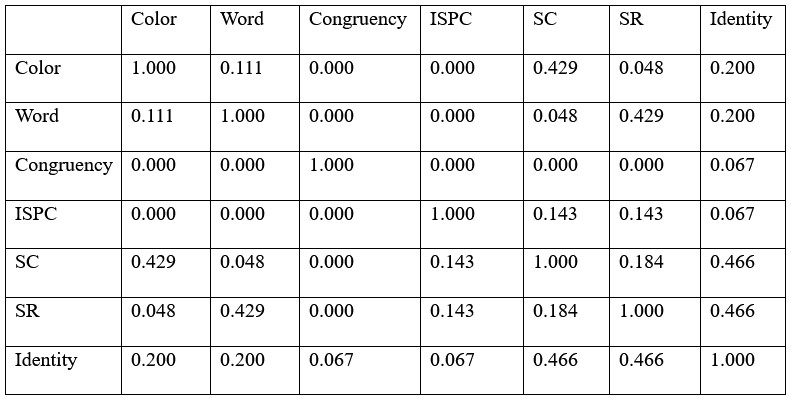
(2) In "task overview", SR is defined as the word-response pair; however, in the Methods, lines 495-496, the definition changed to "the pairing between word and ISPC" which is in accordance with the values in the RDMs (e.g., mccbb and mcirb have similarity of 1, but they are linked to different responses, so should they not be considered different in terms of SR?). This needs clarification as they have very different implications for the task design and interpretation of results, e.g., how correlated the SC and SR manipulations were.
Thank you for pointing out this important issue with how our operationalization captures the concept in questions. In the revised manuscript, we clarified the stimulus-response (SR) association is the link between the word and the most-likely response (i.e., not necessarily the actual response on the current trial). This association is likely to be encoded based on statistical learning over several trials. On each trial, the association is updated based on the stimulus and the actual response. Over multiple trials, the accumulated association will be driven towards the most-common (i.e., most-likely) response. In our ISPC manipulation, a color is presented in mostly congruent/incongruent (MC/MI) trials, which will also pair a word with a most-likely response. For example, if the color blue is MC, the color blue, which leads to the response blue, will co-occur with the word blue with high frequency. In other words, the SR association here is between the word blue and the response blue. As the actual response is not part of the SR association, in the RDM two trial types with different responses may share the same SR association, as long as they share the same word and the same ISPC manipulation, which, by the logic above, will produce the same most-likely response. These clarifications have been added to page 4 and 29 of the revised manuscript.
In the revised manuscript (Page 17), we addressed how much the correlated SC and SR predictors in the RDM could affect the correlation analysis between SC and SR association representation strength. Specifically, we conducted the RSA using the same GLM on EEG data prior to stimulus onset (Supplementary Fig. 7a-b). As no SC and SR associations are expected to be present before stimulus onset, the correlation between SC and SR representation would serve as a baseline of inflation due to correlated predictors in the GLM (Supplementary Fig. 7c, also see comment #3 of R1). The SC-SR correlation coefficients following stimulus onset was then compared to the baseline to control for potential inflation (Fig. 6c). Significantly above-baseline correlation was still observed between ~100-500 ms post-stimulus onset, providing support for the hypothesis that SC and SR are encoded in the same task representation.
Minor suggestions:
(3) Overall, I find that calling SC-controlled and SR-uncontrolled representations unwarranted. How is the level controlledness defined? Both are essentially types of statistical expectation that provide contextual information for the block of tasks. Is one really more automatic and requires less conscious processing than the other? More background/justification could be provided if the authors would like to use these terms.
Following your advice, we have added more discussion on how controlledness is conceptualized in this work and in the literature, which reads:
“We consider SC and SR as controlled and uncontrolled respectively based on the literature investigating the mechanism of ISPC effect. The SC account posits that the ISPC effect results from conflict and involves conflict adaptation, which requires the regulation of attention or control (Bugg & Hutchison, 2013; Bugg et al., 2011; Schmidt, 2018; Schmidt & Besner, 2008). On the other hand, the SR account argues that ISPC effect does not require conflict adaptation but instead reflects contingency leaning. That is, the response can be directly retrieved from the association between the stimulus and the most-likely response without top-down regulation of attention or control. As more empirical evidence emerged, researchers advocating control view began to acknowledge the role of associative learning in cognitive control regarding the ISPC effect (Abrahamse et al., 2016). SC association has been thought to include both automatic that is fast and resource saving and controlled processes that is flexible and generalizable (Chiu, 2019). Overall, we do not intend to claim that SC is entirely controlled or SR is completely automatic. We use SC-controlled and SR-uncontrolled representations to align with the original theoretical motivation and to highlight the conceptual difference between SC and SR associations.” (Page 24-25)
(4) Figures 3c and d: the figures could benefit from more explanation of what they try to show to the readers. Also for 3d, the dimensions were aligned with color sets and congruencies, but word identities were not linearly separable, at least for the first 3 axes. Shouldn't one expect that words can be decoded in the SR subspace if word-response pairs were decodable (e.g., Figure 3b)?
Thank you for the insightful observation. We now clarified that Fig. 3c and d in the original manuscript (Fig. 4c and d in the current manuscript) aim to show how each of the 8 trial types in the SC and SR subspaces are represented. The MDS approach we used for visualization tries to preserve dissimilarity between trial types when projecting from data from a high dimensional to a low dimensional space. However, such projection may also make patterns linearly separatable in high dimensional space not linearly separatable in low dimensional space. For example, if the word blue has two points (-1, -1) and (1, 1) and the word red has two points (-1, 1) and (1, -1), they are not linearly separatable in the 2D space. Yet, if they are projected from a 3D space with coordinates of (-1, -1, -0.1), (1, 1, -0.1), (-1, 1, 0.1) and (1, -1, 0.1), the two words can be linearly separatable using the 3<sup>rd</sup> dimension. Thus, a better way to test whether word can be linearly separated in SR subspace is to perform RSA on the original high dimensional space. We performed the RSA with word (Supplementary Fig. 2) on the SR decoder trained on the SR subspace. Note that in Fig. 3c and d of the original script (Fig. 4c and d in the current manuscript) there are two pairs of words that are not linearly separable: red-blue and yellow-green. Thus, we specifically tested the separability within the two pairs using the one predictor for each pair, as shown in Supplementary Fig. 2. The results showed that within both word pairs individual words were presented above chance level (Supplementary Fig. 3). Considering that the decoders are linear, this finding indicates linear separability of the word pairs in the original SR subspace. The clarification has been added to page 13 (the end of the second paragraph) of the revised manuscript.
References
Abrahamse, E., Braem, S., Notebaert, W., & Verguts, T. (2016). Grounding cognitive control in associative learning. Psychological Bulletin, 142(7), 693-728.doi:10.1037/bul0000047.
Bugg, J. M., & Hutchison, K. A. (2013). Converging evidence for control of color-word Stroop interference at the item level. Journal of Experimental Psychology:Human Perception and Performance, 39(2), 433-449. doi:10.1037/a0029145.
Bugg, J. M., Jacoby, L. L., & Chanani, S. (2011). Why it is too early to lose control in accounts of item-specific proportion congruency effects. Journal of Experimental Psychology: Human Perception and Performance, 37(3), 844-859. doi:10.1037/a0019957.
Chiu, Y.-C. (2019). Automating adaptive control with item-specific learning. In Psychology of Learning and Motivation (Vol. 71, pp. 1-37).
Schmidt, J. R. (2018). Evidence against conflict monitoring and adaptation: An updated review. Psychonomic Bulletin & Review, 26(3), 753-771. doi:10.3758/s13423018-1520-z.
Schmidt, J. R., & Besner, D. (2008). The Stroop effect: Why proportion congruent has nothing to do with congruency and everything to do with contingency. Journal of Experimental Psychology: Learning, Memory, and Cognition, 34(3), 514-523. doi:10.1037/0278-7393.34.3.514.
beauty of online anonymity)
This phrase reminded me of something. When I was in high school, I ran the Redmond [High School] Compliments Facebook page (yeah, it was 2014). People sent anonymous compliments for people at the school into a google form and I posted them anonymously onto h the page. I had the page passed down to me anonymously and I had to keep my identity a secret until the end of the year when I revealed it in the yearbook as my "senior confession". I got to watch people react to anonymous kindness all year. It's one of the reasons why I really believe in the power of social media as a possible force for good. What this phrase "beauty of online anonymity" reminded me of specifically was a quote I found at the time that said something along the lines of "we read things from others in their voice, When we read something anonymously, we read it in our own voice." It meant so much to me to be a part of having people read aloud kindness in their own voices.
y pushing back three decades, past the recent waves of “new” immigrants from southern and Eastern Europe, Latin America, and Asia, the law made it extremely difficult for immigrants outside northern Europe to legally enter the United States.)
not much has changed since back then, there is still this decline for new immigrants now
The Harlem Renaissance was manifested in theater, art, and music. For the first time, Broadway presented Black actors in serious roles.
The Harlem Renaissance was a cultural, artistic place centered in Harlem, New York, that redefined African American expression
. Occupations such as law and medicine remained overwhelmingly male: most female professionals were in feminized professions such as teaching and nursing. And even within these fields, it was difficult for women to rise to leadership positions.
It sucks that during these times women could not choose careers that were considered to be "masculine"
“Incel” is short for “involuntarily celibate,” meaning they are men who have centered their identity on wanting to have sex with women, but with no women “giving” them sex. Incels objectify women and sex, claiming they have a right to have women want to have sex with them. Incels believe they are being unfairly denied this sex because of the few sexually attractive men (”Chads”), and because feminism told women they could refuse to have sex. Some incels believe their biology (e.g., skull shape) means no women will “give” them sex. They will be forever alone, without sex, and unhappy. The incel community has produced multiple mass murderers and terrorist attacks.
Often, this is a self reinforcing cycle. Dwelling on the fact that women aren't interested in you won't make you more appealing. Additionally with the rise in standards from social media, incels also won't go for women similar to them. Couple these factors together produces no good.
The linking verb in this working thesis statement is the word are. Linking verbs often make thesis statements weak because they do not express action. Rather, they connect words and phrases to the second half of the sentence. Readers might wonder, “Why are they not paid enough?” But this statement does not compel them to ask many more questions. The writer should ask himself or herself questions in order to replace the linking verb with an action verb, thus forming a stronger thesis statement, one that takes a more definitive stance on the issue:
Linking verbs in the thesis is the word "are'. Linking verbs don't show action, they just connect ideas. Which can make a thesis feel weak. Instead of leaving readers unsure, you should use an action verb to make the thesis stronger and show a clear opinion or stance.
Your thesis will probably change as you write, so you will need to modify it to reflect exactly what you have discussed in your essay. Your thesis statement begins as a working thesis statement, an indefinite statement that you make about your topic early in the writing process for the purpose of planning and guiding your writing. Working thesis statements often become stronger as you gather information and form new opinions and reasons for those opinions. Revision helps you strengthen your thesis so that it matches what you have expressed in the body of the paper. The best way to revise your thesis statement is to ask questions about it and then examine the answers to those questions. By challenging your own ideas and forming definite reasons for those ideas, you grow closer to a more precise point of view, which you can then incorporate into your thesis statement.
The thesis could change as you write. Start with a working thesis, a rough idea to guide your writing. As you research more, your thesis gets stronger. To improve, ask yourself questions about your ideas and use the answers to make your thesis clearer and more specific.
For any claim you make in your thesis, you must be able to provide reasons and examples for your opinion. You can rely on personal observations in order to do this, or you can consult outside sources to demonstrate that what you assert is valid. A worthy argument is backed by examples and details. Assertiveness A thesis statement that is assertive shows readers that you are, in fact, making an argument. The tone is authoritative and takes a stance that others might oppose. Confidence In addition to creating authority in your thesis statement, you must also use confidence in your claim. Phrases such as “I feel” or “I believe” actually weaken the readers’ sense of your confidence because these phrases imply that you are the only person who feels the way you do. In other words, your stance has insufficient backing. Taking an authoritative stance on the matter persuades your readers to have faith in your argument and open their minds to what you have to say.
Focuses on 1-3 main points that you'll explain in the essay. A thesis shows what your essay will argue and how it's organized.
A thesis is not your paper’s topic, but rather your interpretation of the question or subject. For whatever topic your professor gives you, you must ask yourself, “What do I want to write about it?” Asking and then answering this question is vital to forming a thesis that is precise, forceful, and confident. A thesis is generally one to two sentences long and appears toward the end of your introduction. It is specific and focuses on one to three points of a single idea—points that will be demonstrated in the body. The thesis forecasts the content of the essay and suggests how you will organize your information. Remember that a thesis statement does not summarize an issue but rather dissects it.
A thesis is your main point or opinion about a topic. It's 1-2 sentences at the end of the intro and shows whatyour essay will argue.
The best practices highlighted here apply to charts, graphs, figures, and other supplements, including the legends or captions that accompany them.
Visual aids in the classroom are extremely helpful for students and teachers. To show and understand the point that is trying to get across. I feel that this is something that is now being enforced now more than ever with earlier grades, rather than just middle school and up.
Since printed materials, unlike their online counterparts, cannot be manipulated by the reader or read aloud by a screen reader, we need to follow best practices to increase their accessibility and readability.
I appreciate how this mentions accessibility. I have grown this semester to learn that accessibility is a need in the classroom. The only thing I question is, what if we have an emergent bilingual student or a student who struggles with reading and the resources of technology are limited? Or other current issue is how can we get students engaged in a reading on a technological device without having them wonder off, or retain the information that we are trying to get across.
The brain’s limited capacity impacts its ability to engage in active processing and, hence, to learn. We can avoid cognitive overload and facilitate active processing by reducing or eliminating extraneous information from our instructional materials.
I love this statement as a reminder to educators and as a reassurance to students. I feel as though times in high school and higher education that we are so much distress in our personal and academic lives that we feel as though we are not doing "enough" or learning "enough" because we are receiving so much content information. Now as a teaching perspective I love this reminder that brain breaks are NEEDED! There will be now growth for a student if the content is long and rigorous, rather we should engage with them, piece it up, and not be stress under a "time line" we are given.
Like other visual aids, images or photographs should be clear, bright, and of adequate size. If possible, crop large images to include only the relevant parts. Cropping reduces extraneous information, and you may be able to enlarge the cropped image for easier viewing.
It's also important to remember that just because a person can see an image doesn't meant that they understand what's going on in the image so keep that in mind when it some to visuals. Given students time to really understand what's in the photo.
In some ways, written materials are more accessible online than in print because learners can manipulate the document to increase text size and brightness or use screen readers.
I always want to make sure that my students can adjust the text the ways they need so they can read them more easily.
Cognitive load “is a theory about learning built on the premise that since the brain can only do so many things at once, we should be intentional about what we ask it to do”
It's important to keep this in mind, because students have whole lives outside of school. Returning to school can be overwhelming for them, because they're learning what their teachers' expectations are. It might be best to give them time to adapt to the course load before we start overloading them.
Anxiety over public sharing, shyness, and disagreements with group members were common reasons for not sharing.
Student anxiety is a big issue--and one that profs can't always solve.
Therefore, it is unclear how these findings may vary across student identities and backgrounds
This is a really important point
Moreover, students reported higher levels of intrinsic motivation (inherent interest and enjoyment) with renewable assignments than traditional assignments
wonderful!
Traditional assignments had higher levels of reported pressure.
I would like to know more about what they mean by "pressure." Some stress can be useful in learning but pressure sounds negative.
Examples of renewable assignments include creating websites, editing and contributing to Wikipedia articles, co-creating syllabi with instructors, and creating ancillary material like test bank items (Clinton-Lisell Citation2021; Wiley and Hilton Citation2018).
I'd love to see a big ;most of renewable assignments!
In what ways have you found social media bad for your mental health and good for your mental health? What responsibility do you think social media platforms have for the mental health of their users? Are there ways social media sites can be designed to be better for the mental health of its users? What are the ways social media companies monitoring of mental health could be beneficial or harmful?
I feel like social media has kind of helped me get away from whats happening in my reality by allowing me to just sit and watch a few short videos. It frees me from a sense of responsibility and gives me a break from whatever I'm thinking about in general. However, using social media in general makes me feel lazy and guilty about how I'm spending my time. There are a lot of things I could be focusing my energy on to relax, and social media just doesn't seem like the best one.
After identifying the main point, you will find the supporting points, the details, facts, and explanations that develop and clarify the main point
Recognizing this will help me not ramble on in my writing and get to a direct point.
These strategies fall into three broad categories: Planning strategies.To help you manage your reading assignments before you begin reading. Active Reading strategies.To help you understand the material while you read. Application strategies.
Strategies to help become a strong reader will also help you become successful.
There is no such thingas writing in general. Writing is always in particular
This stood out to me because we usually think writing is one skill we can use everywhere, but she’s saying writing always depends on who we’re writing to and why. Writing a text,an essay, and a job email are all different.
While many queer oral history projects have been developed over the past decades, similar to Chicana/Latina feminist history, there is still much work to be done.
This ending thought leaves me with questions and makes me think about how these people have been neglected.
poughkcepsei
Poughkeepsie NY
Richard Kahn
Richard khan
Richard Kahn
Richard khan
Max
Max
jeffrey E
Jeffery E
Richard Kahn
Name HBRK Associates Inc. 575 Lexington Avenue, 4th Floor. rk 10022
MIT
MIT University?
jee
Nickname
jeevacation©gmail.com
Jeffrey Epstein
From jeffery
Meister, Todd
Name
Paris
Paris
Little St
Little st.
jcovacation@amail.com
water gazelle
Nickname?
It was exciting because it suggested there was a whole other level of skill at thinking. It implied that college was about training the mind,
This is actually exciting. I have been a lazy thinker prior to ENGL C1000. College is definitely expanding the mind and how we think.
Anytheory must identify which characteristics are considered relevant and which evidence willbe accepted.
This is my quealm with theory - how do we account for something and discount another aspect of a phenamenon to create a solution when we havent accounted for the entirey of it.
Resilient teachers are those that canthink deeply, problem-solve, and feel confident in their ability to meet the needsof their students
Resilience here is intellectual, not just emotional. It is rooted in reflective capacity and competence. This reframes teacher retention not as endurance alone, but as cultivated professional identity.
results of this study support the notion that self-efficacy, derived fromsuccessful field and student teaching experiences and the ability to use reflection forproblem solving actually outweighed positive school climate as a factor in noviceteacher success.
This is a bold claim: internal belief may override external conditions. Yet it also invites caution, how much should systems rely on individual resilience instead of structural reform?
unsupportive school climatescause high efficacy teachers to transfer to other schools rather than leave theprofession
High efficacy teachers may not quit teaching, but they will exit toxic systems. Retention, therefore, may depend less on keeping teachers in specific schools and more on ensuring ethical, supportive environments.
A positive and supportive school environment may not in itself beenough to support a struggling teacher. Conversely, unsupportive school climatescause high efficacy teachers to transfer to other schools rather than leave theprofession
This complicates the dominant narrative that environment alone determines retention. It suggests an interaction between personal competencies and contextual fit, raising questions about hiring, placement, and mentorship alignment.
traditional induction pro-grams that focus on transmitting knowledge in a short period of time have limitedutility in enhancing the learning of novice teachers.
This critiques the “information dump” model of induction. If learning requires processing, experimentation, and dialogue, then induction programs must mirror the reflective practices we expect teachers to use with students.
All of the stories told by the teachers contained elements of the critical thinkingmodel introduced to them in their teacher education program as a problem-solvingtool (explained earlier) and used extensively during their student teaching semes-ters in the form of journal writing, action research projects, and seminar classdiscussions.
This suggests that structured reflective models become internalized cognitive habits. Teacher education, then, does not simply impart knowledge, it shapes how teachers think under pressure.
Critical reflection as a problem-solving tool empowers teachers tocope with the challenges that they encounter in their first few years of teaching.
Reflection is presented as empowerment rather than mere introspection. This reframes reflective practice as an act of agency, an intellectual resistance against burnout and helplessness.
ìIthink believing in yourself óyou are going to face different challenges
Self-belief here is not naïve optimism; it is strategic endurance. The deeper question becomes: how do teacher education programs systematically cultivate belief without promoting overconfidence?
Successful field and student teaching experiences that are con-nected to coursework build teachers’ confidence and self-efficacy and thusencourage a higher level of competence in their first year of teaching.
Integration between theory and practice appears central. This suggests that disconnected coursework may unintentionally undermine teacher confidence. How often do teacher candidates experience coherence rather than fragmentation?
eachers need knowledge of how to reflect as well as time to think about their practice,both of which are essential to oneís ability to problem-solve and cope with challenges
Reflection is not accidental; it must be structured and protected. In schools dominated by urgency and pacing guides, is time for reflection treated as essential professional practice, or a luxury?
Knowledge andprior skill attainment are poor predictors of future performance because the beliefspeople hold about their performance have more power than acquired learning
This challenges traditional metrics of teacher quality (GPA, credentials). If belief outweighs skill, then teacher education must intentionally cultivate confidence rooted in authentic mastery, not just content coverage.
Thus teacher resiliency and persistence arestrongly related to teacher efficacy.
This sentence reframes resilience from a personality trait to a belief system. If efficacy drives persistence, then strengthening teachers’ beliefs about their capability may be as critical as developing their technical skills.
Growing evidence also suggests that teachers who lackadequate preparation to become teachers are more likely to leave the profession
Preparation is framed here as protective armor. If inadequate preparation predicts departure, then retention may be less about resilience alone and more about justice, ensuring teachers are not placed in environments for which they are underprepared.
recent estimates ofteachers who choose to leave the profession within the first three years to pursueother careers remains at an unacceptably high level of 33.5 percent
A one-third attrition rate within three years suggests not merely an individual failure but a systemic one. What does it reveal about the transition from preparation to practice—and are we designing teacher education programs with survival, sustainability, and identity formation in mind?
At the same time, Sally Hemings knew a world in which the lives of all women were morecircumscribed than those of males.
Sally Hemings lived under slavery but also lived in a patriarchal society where women's lives were restricted compared to men's. Her experience was not only shaped by race, but also gender.