skaka
shake
skaka
shake
hedrad
honored
using bioelectrical impedance analysis
I like that the study uses BIA to assess body composition and not just BMI, which does not account for lean vs fat mass
a 4-week washout period
What is the purpose of the wash-out period (returning to normal diet)?
randomised controlled trial include the long 8-week duration of each intervention diet, and provision of all food and drink to participants’ homes to provide
The study type (randomized control) and the highly controlled intervention (food delivered to home based on diet type) are great strengths. They make this study more replicable and leave less room for error.
UK dietary energy source
It is interesting to me that UPFs are the main dietary source of energy in Europe. I feel like Americans are constantly comparing their diets to those living in Europe and stating they eat much less processed foods.
The improvement of the blacks in body and mind, in the first instance of their mixture with the whites, has been observed by every one, and proves that their inferiority is not the effect merely of their condition of life.
Jefferson is claiming that any person of African American descent that has children with those of White descent have improved their child's quality of life. Proving that these thoughts are not just opinions but true beliefs rooted in strict racism.
that in memory they are equal to the whites; in reason much inferior, as I think one could scarcely be found capable of tracing and comprehending the investigations of Euclid; and that in imagination they are dull, tasteless, and anomalous.
Again, Jefferson expresses his deeply rooted racism. Claiming that he believes that Indigenous people could have the same memory as whites, however, they are far too "inferior" to have true meaning to their livelihood, as in comprehending arts and books.
The circumstance of superior beauty, is thought worthy attention in the propagatio
This passage is deeply rooted in hate and pseudoscientific beliefs through beauty standards. Claiming that only one race may be deemed beautiful and worthy of human reproduction.
, till they shall have acquired strength; and to send vessels at the same time to other parts of the world for an equal number of white inhabitants; to induce whom to migrate hither, proper encouragements were to be proposed.
This is such a scary paragraph to read. The ideas that these men had are so gut-wrenching. Jefferson willingly writes about how, eventually replacing the indigenous people with white inhabitants to achieve their goal.
the bill should be taken up, and further directing, that they should continue with their parents to a certain age, then be brought up, at the public expence, to tillage, arts or sciences, according to their geniusses,
This statement is heartbreaking. Their own government is admittedly planning the lives of unborn babies to get their sense of a 'perfect world' by removing any aspect of culture from the beginning.
Instances are known, under these circumstances, of their rearing a dozen children.
This interpretation is interesting, because the reader sees from Jefferson's perspective that he is shocked that Indigenous women can raise their children 'just as well' as white women. Emphasising the racist perspective put on the indigenous women, thinking they're incapable.
The women are submitted to unjust drudgery. This I believe is the case with every barbarous people.
This quote represents firsthand the misrepresentation of the indigenous people. Claiming that the women are forced to do hard labor and treated like equals is being unjust.
surrender, though it be to the whites, who he knows will treat him well: t
This quote is so interesting to me because Jefferson is praising the Indigenous people for their bravery. Seems like he is implying that they should not be as trustworthy with the others.
Pubnico. T
Basically crisis escalates -> everything you hear in the news. Setters not really stopped by the cops.
Then transitions into describing the situation in Middle West Pubnico -> Acadian heartland. (Where lobster pound was set on fire, although keep in mond that British settlers also had a fleet / disruptions etc.
Impatient, the Sipekne’katik Chief and Council, its governing body, decided to take a radical new approach: inaugurating an unsanctioned, self-regulated treaty fishery in defiance of the Canadian government. To the outrage of the inshore fishermen, the Sipekne’katik had launched their treaty fishery months before the opening of the official inshore season, giving them early access to the lobster.
DAMN okay -> timeline of the 2020 crisis:
1700s Treaty of Peace and Friendship -> right to hunt/fish and not get interference from colonial govt
1999 Marshall Decision (SCC) -> right to "a moderate livelihood" enshrined
1999-2020 -> Need to set up "treaty fisheries" -> Indigenous only SEASONS in which they have exclusive right to fish, in same waters as settlers -> different licensing system, etc. Negotiations stall
2020 -> "impatneit," Sipekne'katik Chief and Council makes "radical" decision -> inagurate the IND fishery WITHOUT GOVERNMENT SANCTION. "self-regulated treaty fishery in defiance of the Canadian government."
pass down licenses to their children, and populate quaint villages in an area that has become known as the French Shore
WAS lobster industry in US, but global warming pushed them northwards
NS now has greatest lobster population on earth (in terms of fishing capacity)
Also unique because NOT DOMINATED BY CONGLOMERATES -> instead local / family fishermen -> entirely because lobster fishing is done in INTERNAL WATERS where conglomerates are not allowed to fish -> allows free range for settler / commercial fishermen
Saint Mary's Bay / Bay of Fundy is "Fishing Zone 34" and is collectively the lobster fishing mecca -> "dominated" by British Canadians and a "tight-knit enclave" of Acadians.
Fishermen PASS DOWN LICENSES TO THEIR CHILDREN -> family business / inherited wealth (somnething about owning private property / inhereting not land, but right to EXTRACT FROM IT).
"Inshore fishermen"
All "resist" the entry of Mi'kmaq fishermen.
153.349
153 349
Ron Hallman
andrew campbell , Président et directeur général par intérim et Vice-président principal de la transformation
A handful of problems arise when you spend too much time thinking about your goals and not enough time designing your systems.
i agree with this as people always focus on the results rather than the process. thats where effort is applied and should be sought out for.
153.349
153,349
.
remove
.
remove
.
remove
.
remove
Ron Hallman President & Chief Executive Officer,
Andrew Campbell, Acting President & Chief Executive Officer and Senior Vice-President of Transformation
;
remove
;
remove see web version Q2 for all the same comment
.
remove
.
remove
.
remove
.
remove
;
remove
;
remove
.
remove
;
remove
;
remove
;
remove
;
remove
;
remove
0
December 31
It can similarly be argued that there is no real distinction between imposing harms and withholding benefits. The only difference between the two cases concerns what we understand to be the status quo, which lacks moral significance
Chappell, R.Y. and Meissner, D. (2023). Arguments for Utilitarianism. In R.Y. Chappell, D. Meissner, and W. MacAskill (eds.), An Introduction to Utilitarianism, <https://www.utilitarianism.net/arguments-for-utilitarianism>, accessed document.write((new Date).toLocaleDateString("en-US"))2/13/2026.
Arguments for Utilitarianismfunction togglePlayOrPause(){document.getElementById("player-container").classList.add("show-player"),document.getElementById("audio-icon").outerHTML=""}Table of ContentsIntroduction: Moral Methodology & Reflective EquilibriumArguments for UtilitarianismWhat Fundamentally MattersThe Veil of IgnoranceEx Ante ParetoExpanding the Moral CircleThe Poverty of the AlternativesThe Paradox of DeontologyThe Hope ObjectionSkepticism About the Distinction Between Doing and AllowingStatus Quo BiasEvolutionary Debunking ArgumentsConclusionResources and Further ReadingIntroduction: Moral Methodology & Reflective EquilibriumYou cannot prove a moral theory. Whatever arguments you come up with, it’s always possible for someone else to reject your premises—if they are willing to accept the costs of doing so. Different theories offer different advantages. This chapter will set out some of the major considerations that plausibly count in favor of utilitarianism. A complete view also needs to consider the costs of utilitarianism (or the advantages of its competitors), which are addressed in Chapter 8: Objections to Utilitarianism. You can then reach an all-things-considered judgment as to which moral theory strikes you as overall best or most plausible.To this end, moral philosophers typically use the methodology of reflective equilibrium. 1 1 This involves balancing two broad kinds of evidence as applied to moral theories:Intuitions about specific cases (thought experiments).General theoretical considerations, including the plausibility of the theory’s principles or systematic claims about what matters.General principles can be challenged by coming up with putative counterexamples, or cases in which they give an intuitively incorrect verdict. In response to such putative counterexamples, we must weigh the force of the case-based intuition against the inherent plausibility of the principle being challenged. This could lead you to either revise the principle to accommodate your intuitions about cases or to reconsider your verdict about the specific case, if you judge the general principle to be better supported (especially if you are able to “explain away” the opposing intuition as resting on some implicit mistake or confusion).As we will see, the arguments in favor of utilitarianism rest overwhelmingly on general theoretical considerations. Challenges to the view can take either form, but many of the most pressing objections involve thought experiments in which utilitarianism is held to yield counterintuitive verdicts.There is no neutral, non-question-begging answer to how one ought to resolve such conflicts. 2 2 It takes judgment, and different people may be disposed to react in different ways depending on their philosophical temperament. As a general rule, those of a temperament that favors systematic theorizing are more likely to be drawn to utilitarianism (and related views), whereas those who hew close to common sense intuitions are less likely to be swayed by its theoretical virtues. Considering the arguments below may thus do more than just illuminate utilitarianism; it may also help you to discern your own philosophical temperament!While our presentation focuses on utilitarianism, it’s worth noting that many of the arguments below could also be taken to support other forms of welfarist consequentialism (just as many of the objections to utilitarianism also apply to these related views). This chapter explores arguments for utilitarianism and closely related views over non-consequentialist approaches to ethics.Arguments for UtilitarianismWhat Fundamentally MattersMoral theories serve to specify what fundamentally matters, and utilitarianism offers a particularly compelling answer to this question.Almost anyone would agree with utilitarianism that suffering is bad, and well-being is good. What could be more obvious? If anything matters morally, human well-being surely does. And it would be arbitrary to limit moral concern to our own species, so we should instead conclude that well-being generally is what matters. That is, we ought to want the lives of sentient beings to go as well as possible (whether that ultimately comes down to maximizing happiness, desire satisfaction, or other welfare goods).Could anything else be more important? Such a suggestion can seem puzzling. Consider: it is (usually) wrong to steal. 3 3 But that is plausibly because stealing tends to be harmful, reducing people’s well-being. 4 4 By contrast, most people are open to redistributive taxation, if it allows governments to provide benefits that reliably raise the overall level of well-being in society. So it’s not that individuals just have a natural right to not be interfered with no matter what. When judging institutional arrangements (such as property and tax law), we recognize that what matters is coming up with arrangements that tend to secure overall good results, and that the most important factor in what makes a result good is that it promotes well-being. 5 5Such reasoning may justify viewing utilitarianism as the default starting point for moral theorizing. 6 6 If someone wants to claim that there is some other moral consideration that can override overall well-being (trumping the importance of saving lives, reducing suffering, and promoting flourishing), they face the challenge of explaining how that could possibly be so. Many common moral rules (like those that prohibit theft, lying, or breaking promises), while not explicitly utilitarian in content, nonetheless have a clear utilitarian rationale. If they did not generally promote well-being—but instead actively harmed people—it’s hard to see what reason we would have to still want people to follow them. To follow and enforce harmful moral rules (such as rules prohibiting same-sex relationships) would seem like a kind of “rule worship”, and not truly ethical at all. 7 7 Since the only moral rules that seem plausible are those that tend to promote well-being, that’s some reason to think that moral rules are, as utilitarianism suggests, purely instrumental to promoting well-being.Similar judgments apply to hypothetical cases in which you somehow know for sure that a typically reliable rule is, in this particular instance, counterproductive. In the extreme case, we all recognize that you ought to lie or break a promise if lives are on the line. In practice, of course, the best way to achieve good results over the long run is to respect commonsense moral rules and virtues while seeking opportunities to help others. (It’s important not to mistake the hypothetical verdicts utilitarianism offers in stylized thought experiments with the practical guidance it offers in real life.) The key point is just that utilitarianism offers a seemingly unbeatable answer to the question of what fundamentally matters: protecting and promoting the interests of all sentient beings to make the world as good as it can be.The Veil of IgnoranceHumans are masters of self-deception and motivated reasoning. If something benefits us personally, it’s all too easy to convince ourselves that it must be okay. We are also more easily swayed by the interests of more salient or sympathetic individuals (favoring puppies over pigs, for example). To correct for such biases, it can be helpful to force impartiality by imagining that you are looking down on the world from behind a “veil of ignorance”. This veil reveals the facts about each individual’s circumstances in society—their income, happiness level, preferences, etc.—and the effects that each choice would have on each person, while hiding from you the knowledge of which of these individuals you are. 8 8 To more fairly determine what ideally ought to be done, we may ask what everyone would have most personal reason to prefer from behind this veil of ignorance. If you’re equally likely to end up being anyone in the world, it would seem prudent to maximize overall well-being, just as utilitarianism prescribes. 9 9How much weight we should give to the verdicts that would be chosen, on self-interested grounds, from behind the veil? The veil thought experiment highlights how utilitarianism gives equal weight to everyone’s interests, without bias. That is, utilitarianism is just what we get when we are beneficent to all: extending to everyone the kind of careful concern that prudent people have for their own interests. 10 10 But it may seem question-begging to those who reject welfarism, and so deny that interests are all that matter. For example, the veil thought experiment clearly doesn’t speak to whether non-sentient life or natural beauty has intrinsic value. It’s restricted to that sub-domain of morality that concerns what we owe to each other, where this includes just those individuals over whom our veil-induced uncertainty about our identity extends: presently existing sentient beings, perhaps. 11 11 Accordingly, any verdicts reached via the veil of ignorance will still need to be weighed against what we might yet owe to any excluded others (such as future generations, or non-welfarist values).Still, in many contexts other factors will not be relevant, and the question of what we morally ought to do will reduce to the question of how we should treat each other. Many of the deepest disagreements between utilitarians and their critics concern precisely this question. And the veil of ignorance seems relevant here. The fact that some action is what everyone affected would personally prefer from behind the veil of ignorance seems to undermine critics’ claims that any individual has been mistreated by, or has grounds to complain about, that action.Ex Ante ParetoA Pareto improvement is better for some people, and worse for none. When outcomes are uncertain, we may instead assess the prospect associated with an action—the range of possible outcomes, weighted by their probabilities. A prospect can be assessed as better for you when it offers you greater well-being in expectation, or ex ante. 12 12 Putting these concepts together, we may formulate the following principle:Ex ante Pareto: in a choice between two prospects, one is morally preferable to another if it offers a better prospect for some individuals and a worse prospect for none.This bridge between personal value (or well-being) and moral assessment is further developed in economist John Harsanyi’s aggregation theorem. 13 13 But the underlying idea, that reasonable beneficence requires us to wish well to all, and prefer prospects that are in everyone’s ex ante interests, has also been defended and developed in more intuitive terms by philosophers. 14 14A powerful objection to most non-utilitarian views is that they sometimes violate ex ante Pareto, such as when choosing policies from behind the veil of ignorance. Many rival views imply, absurdly, that prospect Y could be morally preferable to prospect X, even when Y is worse in expectation for everyone involved.Caspar Hare illustrates the point with a Trolley case in which all six possible victims are stuffed inside suitcases: one is atop a footbridge, five are on the tracks below, and a train will hit and kill the five unless you topple the one on the footbridge (in which case the train will instead kill this one and then stop before reaching the others). 15 15 As the suitcases have recently been shuffled, nobody knows which position they are in. So, from each victim’s perspective, their prospects are best if you topple the one suitcase off the footbridge, increasing their chances of survival from 1/6 to 5/6. Given that this is in everyone’s ex ante interests, it’s deeply puzzling to think that it would be morally preferable to override this unanimous preference, shared by everyone involved, and instead let five of the six die; yet that is the implication of most non-utilitarian views. 16 16Expanding the Moral CircleWhen we look back on past moral atrocities—like slavery or denying women equal rights—we recognize that they were often sanctioned by the dominant societal norms at the time. The perpetrators of these atrocities were grievously wrong to exclude their victims from their “circle” of moral concern. 17 17 That is, they were wrong to be indifferent towards (or even delight in) their victims’ suffering. But such exclusion seemed normal to people at the time. So we should question whether we might likewise be blindly accepting of some practices that future generations will see as evil but that seem “normal” to us. 18 18 The best protection against making such an error ourselves would be to deliberately expand our moral concern outward, to include all sentient beings—anyone who can suffer—and so recognize that we have strong moral reasons to reduce suffering and promote well-being wherever we can, no matter who it is that is experiencing it.While this conclusion is not yet all the way to full-blown utilitarianism, since it’s compatible with, for example, holding that there are side-constraints limiting one’s pursuit of the good, it is likely sufficient to secure agreement with the most important practical implications of utilitarianism (stemming from cosmopolitanism, anti-speciesism, and longtermism).The Poverty of the AlternativesWe’ve seen that there is a strong presumptive case in favor of utilitarianism. If no competing view can be shown to be superior, then utilitarianism has a strong claim to be the “default” moral theory. In fact, one of the strongest considerations in favor of utilitarianism (and related consequentialist views) is the deficiencies of the alternatives. Deontological (or rule-based) theories, in particular, seem to rest on questionable foundations. 19 19Deontological theories are explicitly non-consequentialist: instead of morally assessing actions by evaluating their consequences, these theories tend to take certain types of action (such as killing an innocent person) to be intrinsically wrong. 20 20 There are reasons to be dubious of this approach to ethics, however.The Paradox of DeontologyDeontologists hold that there is a constraint against killing: that it’s wrong to kill an innocent person even if this would save five other innocent people from being killed. This verdict can seem puzzling on its face. 21 21 After all, given how terrible killing is, should we not want there to be less of it? Rational choice in general tends to be goal-directed, a conception which fits poorly with deontic constraints. 22 22 A deontologist might claim that their goal is simply to avoid violating moral constraints themselves, which they can best achieve by not killing anyone, even if that results in more individuals being killed. While this explanation can render deontological verdicts coherent, it does so at the cost of making them seem awfully narcissistic, as though the deontologist’s central concern was just to maintain their own moral purity or “clean hands”.Deontologists might push back against this characterization by instead insisting that moral action need not be goal-directed at all. 23 23 Rather than only seeking to promote value (or minimize harm), they claim that moral agents may sometimes be called upon to respect another’s value (by not harming them, even as a means to preventing greater harm to others), which would seem an appropriately outwardly-directed, non-narcissistic motivation.The challenge remains that such a proposal makes moral norms puzzlingly divergent from other kinds of practical norms. If morality sometimes calls for respecting value rather than promoting it, why is the same not true of prudence? (Given that pain is bad for you, for example, it would not seem prudent to refuse a painful operation now if the refusal commits you to five comparably painful operations in future.) Deontologists may offer various answers to this question, but insofar as we are inclined to think, pre-theoretically, that ethics ought to be continuous with other forms of rational choice, that gives us some reason to prefer consequentialist accounts. 24 24Deontologists also face a tricky question about where to draw the line. Is it at least okay to kill one person to prevent a hundred killings? Or a million? Absolutists never permit killing, no matter the stakes. But such a view seems too extreme for many. Moderate deontologists allow that sufficiently high stakes can justify violations. But how high? Any answer they offer is apt to seem arbitrary and unprincipled. Between the principled options of consequentialism or absolutism, many will find consequentialism to be the more plausible of the two.The Hope ObjectionImpartial observers should want and hope for the best outcome. Non-consequentialists claim, nonetheless, that it’s sometimes wrong to bring about the best outcome. Putting the two claims together yields the striking result that you should sometimes hope that others act wrongly.Suppose it would be wrong for some stranger—call him Jack—to kill one innocent person to prevent five other (morally comparable) killings. Non-consequentialists may claim that Jack has a special responsibility to ensure that he does not kill anyone, even if this results in more killings by others. But you are not Jack. From your perspective as an impartial observer, Jack’s killing one innocent person is no more or less intrinsically bad than any of the five other killings that would thereby be prevented. You have most reason to hope that there is only one killing rather than five. So you have reason to hope that Jack acts “wrongly” (killing one to save five). But that seems odd.More than merely being odd, this might even be taken to undermine the claim that deontic constraints matter, or are genuinely important to abide by. After all, to be important just is to be worth caring about. For example, we should care if others are harmed, which validates the claim that others’ interests are morally important. But if we should not care more about Jack’s abiding by the moral constraint against killing than we should about his saving five lives, that would seem to suggest that the constraint against killing is not in fact more morally important than saving five lives.Finally, since our moral obligations ought to track what is genuinely morally important, if deontic constraints are not in fact important then we cannot be obligated to abide by them. 25 25 We cannot be obliged to prioritize deontic constraints over others’ lives, if we ought to care more about others’ lives than about deontic constraints. So deontic constraints must not accurately describe our obligations after all. Jack really ought to do whatever would do the most good overall, and so should we.Skepticism About the Distinction Between Doing and AllowingYou might wonder: if respect for others requires not harming them (even to help others more), why does it not equally require not allowing them to be harmed? Deontological moral theories place great weight on distinctions such as those between doing and allowing harm, or killing and letting die, or intended versus merely foreseen harms. But why should these be treated so differently? If a victim ends up equally dead either way, whether they were killed or “merely” allowed to die would not seem to make much difference to them—surely what matters to them is just their death. Consequentialism accordingly denies any fundamental significance to these distinctions. 26 26Indeed, it’s far from clear that there is any robust distinction between “doing” and “allowing”. Sometimes you might “do” something by remaining perfectly still. 27 27 Also, when a doctor unplugs a terminal patient from life support machines, this is typically thought of as “letting die”; but if a mafioso, worried about an informant’s potentially incriminating testimony, snuck in to the hospital and unplugged the informant’s life support, we are more likely to judge it to constitute “killing”. 28 28 Jonathan Bennett argues at length that there is no satisfactory, fully general distinction between doing and allowing—at least, none that would vindicate the moral significance that deontologists want to attribute to such a distinction. 29 29 If Bennett is right, then that might force us towards some form of consequentialism (such as utilitarianism) instead.Status Quo BiasOpposition to utilitarian trade-offs—that is, benefiting some at a lesser cost to others—arguably amounts to a kind of status quo bias, prioritizing the preservation of privilege over promoting well-being more generally.Such conservatism might stem from the Just World fallacy: the mistake of assuming that the status quo is just, and that people naturally get what they deserve. Of course, reality offers no such guarantees of justice. What circumstances one is born into depends on sheer luck, including one’s endowment of physical and cognitive abilities which may pave the way for future success or failure. Thus, even later in life we never manage to fully wrest back control from the whimsies of fortune and, consequently, some people are vastly better off than others despite being no more deserving. In such cases, why should we not be willing to benefit one person at a lesser cost to privileged others? They have no special entitlement to the extra well-being that fortune has granted them. 30 30 Clearly, it’s good for people to be well-off, and we certainly would not want to harm anyone unnecessarily. 31 31 However, if we can increase overall well-being by benefiting one person at the lesser cost to another, we should not refrain from doing so merely due to a prejudice in favor of the existing distribution. 32 32 It’s easy to see why traditional elites would want to promote a “morality” which favors their entrenched interests. It’s less clear why others should go along with such a distorted view of what (and who) matters.It can similarly be argued that there is no real distinction between imposing harms and withholding benefits. The only difference between the two cases concerns what we understand to be the status quo, which lacks moral significance. Suppose scenario A is better for someone than B. Then to shift from A to B would be a “harm”, while to prevent a shift from B to A would be to “withhold a benefit”. But this is merely a descriptive difference. If we deny that the historically given starting point provides a morally privileged baseline, then we must say that the cost in either case is the same, namely the difference in well-being between A and B. In principle, it should not matter where we start from. 33 33Now suppose that scenario B is vastly better for someone else than A is: perhaps it will save their life, at the cost of the first person’s arm. Nobody would think it okay to kill a person just to save another’s arm (that is, to shift from B to A). So if we are to avoid status quo bias, we must similarly judge that it would be wrong to oppose the shift from A to B—that is, we should not object to saving someone’s life at the cost of another’s arm. 34 34 We should not care especially about preserving the privilege of whoever stood to benefit by default; such conservatism is not truly fair or just. Instead, our goal should be to bring about whatever outcome would be best overall, counting everyone equally, just as utilitarianism prescribes.Evolutionary Debunking ArgumentsAgainst these powerful theoretical objections, the main consideration that deontological theories have going for them is closer conformity with our intuitions about particular cases. But if these intuitions cannot be supported by independently plausible principles, that may undermine their force—or suggest that we should interpret these intuitions as good rules of thumb for practical guidance, rather than as indicating what fundamentally matters.The force of deontological intuitions may also be undermined if it can be demonstrated that they result from an unreliable process. For example, evolutionary processes may have endowed us with an emotional bias favoring those who look, speak, and behave like ourselves; this, however, offers no justification for discriminating against those unlike ourselves. Evolution is a blind, amoral process whose only “goal” is the propagation of genes, not the promotion of well-being or moral rightness. Our moral intuitions require scrutiny, especially in scenarios very different from our evolutionary environment. If we identify a moral intuition as stemming from our evolutionary ancestry, we may decide not to give much weight to it in our moral reasoning—the practice of evolutionary debunking. 35 35Katarzyna de Lazari-Radek and Peter Singer argue that views permitting partiality are especially susceptible to evolutionary debunking, whereas impartial views like utilitarianism are more likely to result from undistorted reasoning. 36 36 Joshua Greene offers a different psychological debunking argument. He argues that deontological judgments—for instance, in response to trolley cases—tend to stem from unreliable and inconsistent emotional responses, including our favoritism of identifiable over faceless victims and our aversion to harming someone up close rather than from afar. By contrast, utilitarian judgments involve the more deliberate application of widely respected moral principles. 37 37Such debunking arguments raise worries about whether they “prove too much”: after all, the foundational moral judgment that pain is bad would itself seem emotionally-laden and susceptible to evolutionary explanation—physically vulnerable creatures would have powerful evolutionary reasons to want to avoid pain whether or not it was objectively bad, after all! 38 38However, debunking arguments may be most applicable in cases where we feel that a principled explanation for the truth of the judgment is lacking. We do not tend to feel any such lack regarding the badness of pain—that is surely an intrinsically plausible judgment if anything is. Some intuitions may be over-determined: explicable both by evolutionary causes and by their rational merits. In such a case, we need not take the evolutionary explanation to undermine the judgment, because the judgment also results from a reliable process (namely, rationality). By contrast, deontological principles and partiality are far less self-evidently justified, and so may be considered more vulnerable to debunking. Once we have an explanation for these psychological intuitions that can explain why we would have them even if they were rationally baseless, we may be more justified in concluding that they are indeed rationally baseless.As such, debunking objections are unlikely to change the mind of one who is drawn to the target view (or regards it as independently justified and defensible). But they may help to confirm the doubts of those who already felt there were some grounds for scepticism regarding the intrinsic merits of the target view.ConclusionUtilitarianism can be supported by several theoretical arguments, the strongest perhaps being its ability to capture what fundamentally matters. Its main competitors, by contrast, seem to rely on dubious distinctions—like “doing” vs. “allowing”—and built-in status quo bias. At least, that is how things are apt to look to one who is broadly sympathetic to a utilitarian approach. Given the flexibility inherent in reflective equilibrium, these arguments are unlikely to sway a committed opponent of the view. For those readers who find a utilitarian approach to ethics deeply unappealing, we hope that this chapter may at least help you to better understand what appeal others might see in the view.However strong you judge the arguments in favor of utilitarianism to be, your ultimate verdict on the theory will also depend upon how well the view is able to counter the influential objections that critics have raised against it.The next chapter discusses theories of well-being, or what counts as being good for an individual.Next Chapter: Theories of Well-BeingHow to Cite This PageChappell, R.Y. and Meissner, D. (2023). Arguments for Utilitarianism. In R.Y. Chappell, D. Meissner, and W. MacAskill (eds.), An Introduction to Utilitarianism, <https://www.utilitarianism.net/arguments-for-utilitarianism>, accessed document.write((new Date).toLocaleDateString("en-US"))2/13/2026.
Camus is often classified as an existentialist writer, and it is easy to see why. Affinities with Kierkegaard and Sartre are patent. He shares with these philosophers (and with the other major writers in the existentialist tradition, from Augustine and Pascal to Dostoyevsky and Nietzsche) an habitual and intense interest in the active human psyche, in the life of conscience or spirit as it is actually experienced and lived. Like these writers, he aims at nothing less than a thorough, candid exegesis of the human condition, and like them he exhibits not just a philosophical attraction but also a personal commitment to such values as individualism, free choice, inner strength, authenticity, personal responsibility, and self-determination. However, one troublesome fact remains: throughout his career Camus repeatedly denied that he was an existentialist. Was this an accurate and honest self-assessment? On the one hand, some critics have questioned this “denial” (using the term almost in its modern clinical sense), attributing it to the celebrated Sartre-Camus political “feud” or to a certain stubbornness or even contrariness on Camus’s part. In their view, Camus qualifies as, at minimum, a closet existentialist, and in certain respects (e.g., in his unconditional and passionate concern for the individual) as an even truer specimen of the type than Sartre. On the other hand, besides his personal rejection of the label, there appear to be solid reasons for challenging the claim that Camus is an existentialist. For one thing, it is noteworthy that he never showed much interest in (indeed he largely avoided) metaphysical and ontological questions (the philosophical raison d’etre of Heidegger and Sartre). Of course there is no rule that says an existentialist must be a metaphysician. However, Camus’s seeming aversion to technical philosophical discussion does suggest one way in which he distanced himself from contemporary existentialist thought. Another point of divergence is that Camus seems to have regarded existentialism as a complete and systematic world-view, that is, a fully articulated doctrine. In his view, to be a true existentialist one had to commit to the entire doctrine (and not merely to bits and pieces of it), and this was apparently something he was unwilling to do. A further point of separation, and possibly a decisive one, is that Camus actively challenged and set himself apart from the existentialist motto that being precedes essence. Ultimately, against Sartre in particular and existentialists in general, he clings to his instinctive belief in a common human nature. In his view human existence necessarily includes an essential core element of dignity and value, and in this respect he seems surprisingly closer to the humanist tradition from Aristotle to Kant than to the modern tradition of skepticism and relativism from Nietzsche to Derrida (the latter his fellow-countryman and, at least in his commitment to human rights and opposition to the death penalty, his spiritual successor and descendant).
HICS, Peirce has said, depends onaesthetics, i.e., judgments of oughtdepend on the delineation of anideal, of what is admirable and what isnot.' Existentialism has given to the ad-mirable a new location-and hence byimplication has relocated judgments ofmoral value. What the existentialist ad-mires is not the happiness of a man's life,the goodness of his disposition, or therightness of his acts but the authenticityof his existence. This is, I think, theunique contribution of existentialism toethical theory. There are, of course, otherethical principles involved in existentialphilosophy, but they are principles whichit has in common with other ethical sys-tems. For example, the existentialistdenies the practical supremacy of reason,he denies the universality of moralvalues, he asserts the all-importance,ethically, of the historic individual in hisunique situation-all these tenets theexistentialist shares with numerous othermoralists, past and present. They aretenets which will appear obvious truthsto those who believe them and obviousfalsehoods to those who disbelieve them;in either event they are not unique. Butthe stress on authenticity is, I think, aunique existentialist emphasis-and animportant one.There are, in contemporary existen-tialism, two principal versions of thisnew ethical concept. For Heidegger,genuine existence is existence whichdares to face death: rising from the dis-sipating and deceptive consolations of to-day's concerns to the inner realizationthat its own past must take shape and sig-nificance in relation to its inevitable lasttomorrow. Contrasted with such genuineexistence is Verfallen, the distraction orscattering of one's freedom in the cares ofeveryday, where not the true individual,but das man, the indifferent "they," issovereign. In Sartre, on the other hand,genuine existence is conceived of as free,not in facing death so much as in facingthe meaningless ground of its own tran-scendence; that is, the fact that thevalues by which I live depend not ondivine fiat or metaphysical necessity buton myself alone. Contrasted with suchawareness is bad faith, the stultificationof freedom in the enslavement to an "ob-jective" truth or a consuming passion.In both versions, the concept ofauthenticity is rooted in the existentialinterpretation of freedom. We live frombirth to death under the compulsion ofbrute fact; yet out of the mere givennessof situation it is we ourselves who shapeourselves and our world. And in thisshaping we succeed or fail. To succeed isnot to escape compulsion but to tran-scend it-to give it significance andmeaning by our own projection of the ab-surdly given past into a directed future.But such shaping of contingency, suchimposition of meaning on the meaning-less, is possible only through the veryrecognition of meaninglessness-of thenothingness that underlies our lives.Such recognition means, for Sartre, theawareness, in dread, that the values bywhich I live are totally, absurdly mine;the contingency, the compulsion I mustface is the irrevocable givenness of myown creation. In the more radical concep-266AUTHENTICITY: AN EXISTENTIAL VIRTUE 267tion of Heidegger it is not the absurdity,the nothingness, of life which must befaced but the ultimate nothingness, thelast and total contingency of death,which must inwardly determine as it out-wardly delimits my existence. Thus forSartre it is a peculiar attitude towardfreedom in its relation to value that de-fines authentic existence; for Heideggerit is the orientation to the end of life, theresolve to death, that is essential toauthenticity. In both cases authenticityis a kind of honesty or a kind of courage;the authentic individual faces somethingwhich the unauthentic individual isafraid to face.If, in authentic existence, freedom caninform necessity and give meaning to themeaningless, it may also fail of its tran-scendence, it may succumb to the mul-tiplicity and absurdity of fact, it mayseek escape in the fiction of a supportingcosmic morality or in the domination ofa blind passion or in the nagging distrac-tions of its everyday concerns. In otherwords, freedom is not an abstraction tobe generically applied to "man" as such,but a risk, a venture, a demand. In asense we are all free, but we are free toachieve our freedom or to lose it. Thereare no natural slaves, but most of us haveenslaved ourselves. Existentialism is, inthis, a kind of inverse Spinozism. LikeSpinoza, it sees man as bond or free; only,unlike Spinoza, it finds in reason not aliberator but one of the possible enslaversand in imagination of a sort the sourcenot of enslavement but of emancipationfrom it.It should be noticed, however, that inHeidegger's conception the sphere of thenonauthentic, of Verfallen, is always withus. There is no easy distinction betweenthose who, leaving the fraudulent behindthem, achieve the level of genuine exist-ence and those who do not. We are all,always, a prey to the cares of here andnow; of a thousand and one trivialitiesall our days are made. Yet there is an es-sential, qualitative, recognizable differ-ence, a total difference, morally, betweenthe existence for which the trivialitiesare the whole and the existence for whichthe manifold of experience is transcendedin a unity not, like the Kantian, abstractand universal but intensely personal andconcrete.What does it mean to say, as Heideg-ger does, that what constitutes this unityis a "resolve to death," that it is "beingto death" or "freedom to death" whichemancipates the individual from bondageto the "they"? The arguments by whichHeidegger develops this thesis cannot betaken seriously as arguments. Like mostof his arguments they consist principallyin inversions of ground and consequentand in the kind of word play in whichGerman philosophy from Hegel onabounds. For example, if empirically it isfound that various peoples and individu-als face death in various ways, he can de-fine personal existence as "being todeath" and say that it is not the case thatdeath is essential to existence becausepeople die and face the fact of dying but,much more profoundly, people die andface the fact of dying because existenceis being to death. In other words, a pos-terioris are turned into a prioris: and,presto, there is the philosopher possessedof a foresight far finer than the hindsightof the ordinary man. Or, for instance, hecan play, much as Aristotle does withtelos in the Politics, with the meaning of"end": death is the end of life, and there-fore the end of life, etc.Yet, although Sein und Zeit is a tissueof this sort of pseudo-definition and re-definition, there is in its central thesis aserious truth. For the individual de-prived of supernatural support, cast268 ETHICSalone into his world, the dread of deathis a haunting if suppressed theme thatruns through life. What is more, if at alltimes communication between men istattered and fragile, it is in the face ofdeath that each man stands most strik-ingly and irrevocably alone. For thisEveryman there is after all no guide inhis most need to go by his side; and there-fore, more intensely than for his medievalcounterpart, his relation to death marksas nothing else does the integrity and in-dependence of his life. Thus, if authen-ticity is rare, authenticity in youth onemay expect to find extremely rare, for itis a virtue that flowers only in andthrough dread, in the living presence ofits own mortality.Yet whether "being to death" is thesole content and meaning of existentialauthenticity, as Heidegger makes it, isanother question. That the awareness ofdeath is a significant factor in any con-scious life is certain-and to have shownthis is an extremely important service ofSein und Zeit to contemporary thought.For this is, so far as I know, the first timesince Plato that death has been givencentral philosophic significance in the in-terpretation of life. In the case of Lucre-tius, for example, the fear of death and inthat of Hobbes the fear of violent deathare hinges, so to speak, on which theirphilosophic systems are hung; but theyare not, like Heidegger's "resolve todeath," internal to the analysis of life it-self. Whatever moralists wish to do here-after with this concept, they must cer-tainly reckon with it.On the other hand, in the fashion inwhich Heidegger presents it, the empha-sis on death involves an inescapable nar-rowness which warps the total concep-tion of the authentic individual. It isonly a man's death, Heidegger says,which is irreplaceably his own, which isnot interchangeable with the experienceof others; and therefore it is only in "be-ing to death" that he escapes the claimsof the public and corrupting "they" andis genuinely himself, genuinely free. His"freedom to death," the confrontationwith this one fact which is really his own,is the whole content and meaning of hisfreedom, and the existence of otherselves as of the world is for him only ameans to the achievement of this grimand lonely triumph. But this is not onlyemancipation from the bewildering dis-traction of the anonymous "they"; it isemancipation from all that might, by ourown creation, be made meaningful. It isindeed a transcendence of the meaning-less manifold, but a transcendence toodearly bought, for the very oneness andintensity of the achievement make it it-self almost empty of meaning. This isagain the Nullpunktsexistenz of Kierke-gaard, from which even God himself hasvanished. Personal authenticity is a sig-nificant ethical concept, and the relationof the individual to death is an essentialaspect of it, but it is not an aspect whichcan stand alone as Heidegger makes itdo. If nothing else, some relation toothers in their authenticity, some livingcommunication or the attempt at it,must play a part. But Heidegger'sauthentic individual wanders his solitary"wood paths," and they are not after allvery admirable roads to follow nor is it avery admirable sort of man who followsthem.If, then, Heidegger's definition ofauthentic existence is inadequate, that ofSartre may at first glance appear morefruitful. For Sartre, again, the honesty ofthe authentic person consists in his facingthe nature of his own freedom. This de-scription, since it is tied to life ratherthan to its cessation, does not seem, es-sentially, to entail the same narrownessAUTHENTICITY: AN EXISTENTIAL VIRTUE 269as does Heidegger's version. Yet as theFrench existentialists have developedtheir theory they have, I think, impover-ished as much as they have enriched theconcept of authenticity.For one thing, instead of amplifyingthe concept of das Sein zum Tode or pro-ceeding from it, Sartre has, in his theo-retical statements, dismissed it rathercavalierly. My death, he says, since itcan never become part of my own experi-ence, is more real to others than to me. Itis true, of course, that the death ofothers, of those near to me in particular,forms an essential part of my experiencein a fashion which Heidegger ought tobut does not recognize. But my own rela-tion to my own death does also, in itsparadoxical fashion, constitute an essen-tial element in my experience. Sartrehimself has given a brilliant account ofthe most dramatic and visible kind of"being to death" in his moving tributeto the Resistance, The Republic ofSilence:Exile, captivity and especially death (whichwe usually shrink from facing at all in happiertimes) became for us the habitual objects of ourconcern. We learned that they were neitherinevitable accidents, nor even constant and exte-rior dangers, but that they must be consideredas our lot itself, our destiny, the profound sourceof our reality as men.. . . Thus the basicquestion of liberty was posed, and we werebrought to the verge of the deepest knowledgethat man can have of himself. For the secretof a man is not his Oedipus complex or his in-feriority complex: it is the limit of his ownliberty, his capacity for resisting torture anddeath.2And he has, though perhaps less success-fully, dealt with similar themes in suchworks as The Wall or The Unburied Dead.But theoretically, it seems, he is toomuch interested in what is called the"open future"-or perhaps the indefiniteextent of open futures which the existen-tial revolutionary needs to envisage-tobe much concerned, philosophically, withthe individual's awareness of death. Yetthe concept of authenticity needs thissharp edge to mark it. Genuine existenceis revealed for what it is in relation towhat Jaspers called Grenzsituationen, andthe dreadful awareness of my own crea-tion of myself in indeed such a situation.But my death is the most dramatic ofsuch boundary situations-and in fact itis more than that; it is the essential anddetermining boundary situation. If it isterrible that I am responsible for what Ihave become, it is always hopeful to re-flect that tomorrow I may do better. Butwhat is most terrible is that I cannot doso forever, that in fact if I have bungledand cheated and generally made a fool ofmyself, there is only a little while, per-haps not all of today even, in which to doit all over. Kierkegaard's favorite maxim,"over 70,000 fathoms, miles and milesfrom all human help, to be glad," is anessential constituent of existentialism,and in particular of the concept of theauthentic individual.And perhaps one may call on Kierke-gaard to support a second criticism ofSartre's conception of authenticity. Thistime it is the "knight of infinite resigna-tion" whom I should like to recall. It isnot necessary here to attempt to under-stand this character, let alone to endorsehim, so to speak, as a moral model, butthere is this about him which is impor-tant-though he is extremely differentfrom the ordinary sort of person, he may,Kierkegaard says, look and act just likehim. That, we have noticed, is true alsoof Heidegger's authentic person. In thecase of Sartre, however, those who liveby mauvaise foi are marked off from anelusive but admirable sort of individualwho presumably has left bad faith behindand lives entirely in the separate and dis-270 ETHICStinct area of authenticity. Now the con-cept of bad faith has in fact served as akey for some brilliant portraits of varioussorts of depravity as, for example, in thePortrait of the Anti-Semite. Yet if onelooks, for instance, at the masterly pic-ture of life by mauvaisefoi painted in theopening episode of The Room, one getsthe feeling that the life of bad faith is theconventional one and, by implication,that of good faith unconventional. Infact this is, implicitly at least, the themeof the whole story-the story of a youngwoman who chooses to share the life ofher mad husband, even to try earnestlyand tragically to share his hallucina-tions, rather than to return to the va-cantly respectable existence of her horri-fied bourgeois parents. And here again, ifone equates convention with bourgeoisconvention, the interest of the existentialrevolutionary demands such a view. Lib-eration is the existential keynote allalong the line. It is the shackles of con-vention, of beliefs imposed from outside,that bind us personally, just as the eco-nomic interests of those who foster theconventions bind us socially. To cast offthe expressions of false privilege in ourprivate lives is to become authentic, tobecome ourselves, just as political revo-lution will, in this view, cast off for us theshackes that bind us in our economic andpolitical lives.Now of course it is true that theauthentic person is seldom a convention-al person. The concept of authenticity isnot a concept of adjustment-in factwith respect to the current ideal of thewell-adjusted member of society it istruly and deeply a heresy. One can evensay that some societies almost demandrebellion of a sort as the price of authen-ticity. Yet there may be authentic indi-viduals who live all their lives, like theknight of infinite resignation, as highlyrespectable members of highly respect-able societies. Elizabeth Bennett is anauthentic individual, though she neverdid anything more unconventional thanto walk three miles on a rather muddyday. Sartre's authentic existent, on theother hand, deprived of all the triviali-ties and all the substance of Verfallen andgiven only a highly mechanical un-Marxist Marxianism by which to live, re-mains a mere ideal, or a ghost of a per-son. Mathieu, for example, who in TheAge of Reason is a real person, has notachieved authenticity but is constantlyand desperately seeking it. He is unableto survive the Grenzsitucation which theFrench existentialists in their own per-sons met so courageously. Absurdly anddefiantly, he is killed during the fall ofFrance in 1940. The trouble is that anauthentic existent, as Sartre conceiveshim, has no end given him except his ownauthenticity; but authenticity is not somuch an end of acts as a value which isrealized as a by-product of acts. The fail-ure to recognize this essential complexityof the ethical situation is a serious lack ofexistentialism, as it is of most other sys-tematic moralities. Moralists seek to de-scribe the end of human action, but manyvalues, and perhaps the highest, are pro-duced as Hartmann puts it "on the backof the act." The self-consciousness in-volved in seeking them makes them im-possible to find. And authenticity is sucha value. Those who attain it are doingand seeking what others are doing andseeking; the unique and in a sense time-less value their life exhibits is a qualifyof, but not an end for, that life itself.But this lack of complexity reflects adeeper lack, for the central difficultywhich underlies all these errors or omis-sions of existentialism is the narrownessof the existential view of the free act. Itis because of that narrowness that theAUTHENTICITY: AN, EXISTENTIAL VIRTUE 271existential hero has nothing to seek buthis own authentic act. The existentialisthas rightly seen that, "thrown into theworld," always already "engaged," weare nevertheless each totally responsiblefor our own destinies. But by singling outthe act alone by which a man faces hisown "condemnation to be free," theexistentialist isolates part of a complexsituation which cannot in fact be so iso-lated. It is true that it is I who have-al-ways-already-chosen the values by whichI live. But I have chosen, not createdthem; if they were not in some sensethere to be chosen, if they did not some-how compel me to choose them, theywould not be values at all. I could noteven, like Kirillov, choose suicide as thenegation of all values. Sartre says thatvalues "start up like partridges beforeour acts." That is how it looks in the re-flective moment of dread-but the aspectof total responsibility is only one aspectof a more complex situation. The choiceis my choice, yet it is also the choice ofsomething-and of something thatobliges me to choose it. For Sartre, how-ever, there is a crude and absolute dis-junction between the free act of genuineexistence and the bad faith of belief invalues as metaphysically self-existent orsupernaturally revealed. Either I myself,all alone, simply act or I enslave myselfto a falsely hypostatized being; hence thedesperate endeavor to make of the act it-self-of my freedom as such or the hones-ty to face my freedom-the whole endand object of the free man. But there areno pure acts. An act involves a referenceto values which in some way make aclaim on the agent and perhaps, at leastindirectly, bind him to other agents or tothose affected by his acts.It is probably in some such context,moreover, that the problems of the rela-tions between individuals need to betreated. And that brings me to my finalcriticism, that is, the all too familiar butnecessary objection that the authenticindividual, while facing with admirablecourage the ultimate loneliness of humanlife, is nevertheless even lonelier than cir-cumstances warrant. To be sure, Sartreand, presumably with his knowledge andassent, Beauvoir have tried in variousways to meet this common objection,but, in my opinion at least, with verylittle success.They try to relate one self to others inaccordance with two favorite maxims(each of which is the slogan for a Beau-voir novel): Hegel's "Every conscious-ness wants the death of another" andDostoevski's "We are all responsible forall." The Hegelian maxim serves as aguiding principle for Sartre's detailedanalysis of the circle of conflicts in L'Etreet le Neant, and it also serves as a basis forthe description of class-consciousness andtherefore as a bridge to his theory of revo-lution. That it is not an adequate prin-ciple for a complete or essential analysisof human relationships has been saidoften enough, and that some uneasinessis felt about it even at headquarters isevidenced by the extremely crude argu-ments with which Beauvoir has since at-tempted to dismiss it in The Ethics ofAmbiguity. The first view one takes ofanother, that the other consciousnesswants the death of mine, is naive, shesays, for one at once realizes that ofcourse, as we all know, if anyone takesanything away from me, he is really giv-ing it to me all the while. This is un-doubtedly one of the worst philosophicalarguments ever penned-not to mentionthe shocking fact that there are in thiscase four hundred pages of naivete in themaster's masterpiece. Nor have other at-tempts to get from the first to the secondmaxim had better success. Sartre and,272 ETHICSfollowing him, Beaufrom my concrete, indom to freedom as aalways with curious sophistry-exceptperhaps in the argument that I cannot befree unless others are so. It is true thatminimal requirements of civil and eco-nomic freedom are the sine qua non of myfreedom. Yet we believe in freedom forothers not only because it facilitates ourown. This argument, though valid, is in-sufficient. And what is worse, the politicswhich is developed on this basis has,despite its opposition to dialectical ma-terialism, the same lifeless and mechani-cal quality as the article it seeks to re-place. One need only instance the longseries of articles called What Is Litera-ture? in which, after a rather ingeniousanalysis of the differences between thearts, Sartre embarks on a completelystock Marxian account of the functionsof the prose writer, in which RichardWright becomes the greatest Americannovelist and Flaubert is no good becausehe did not take his political responsibili-ties seriously, and so on.Yet it does seem likely that somehowand in some sense the concept of authen-ticity does involve not only the winningof freedom but the respect for freedom,not only the achievement of dignity inthe individual but the acceptance of theKantian maxim of the dignity of all indi-viduals. Some such connection does seemto exist; one cannot imagine an authenticindividual who really has no respect forthe liberty of others, and one cannotimagine the existence of authenticitywhere some sort of liberty does not exist,in idea even if not in fact. But there hasbeen, so far as I know, no convincingphilosophic statement why this should beso. Certainly to take away substantivevalues as mauvaise foi and then to putfreedom back in as a substantive value isnot good enough. But on the other hand,like Heidegger, to view the existence ofothers only as a means to my freedom isworse than not good enough-it is posi-tively evil. Yet it is difficult, at least inexistential language, to say why.Perhaps this failure of existentialism-its failure adequately to relate my free-dom to freedom in general-is connectedwith the more limited or more concreteproblem which it equally fails to treat,that is, the problem of the manner inwhich authenticity is determined or de-fined or influenced by the direct relationof one individual to another in his free-dom. Both Jaspers and Marcel have in-troduced concepts of communication intoexistentialism, but in both cases thetreatment is so vague and sentimental asto contribute little. Yet it is here, in thequestion of communication as well as inthe implications of the concept of authen-tic existence for the general concept ofliberty, that more needs to be said.Is it wholly in loneliness that authen-ticity is achieved? If genuine existence istranscendence successfully accomplished,giving form and meaning to the meaning-less succession of hours and needs, does itnot, in transcending contingency andnothingness, in some sense transcendloneliness as well? Is not-sometimes, atleast-the transcendence of lonelinessneeded for the very achievement ofauthenticity? True, authenticity itself,the core of genuine existence, is a valuewhich must center in the individual whobears it; the inner dissipation of the selfin seeming devotion to other selves is,existentially speaking, deeply immoral.Even the "self-sacrifice" of an authenticperson perfects and dignifies the individ-ual and inalienable person that is him-self. Yet, if one can distinguish betweena fraudulent and an authentic aspect ofthe self, may one not distinguish also be-AUTHENTICITY: AN EXISTENTIAL VIRTUE 273tween a fraudulent and an authentic rela-tion between selves? The quality of theconcern with others on the distractivelevel is evident in all gregariousness; itsmost extreme expression, perhaps, is thecozy friendliness of radio announcers totheir disembodied audience. But, in theprojection toward one's own freedomwhich focuses distraction into authen-ticity, the bewildered and bewilderingdiffusion of everyday sociability wouldseem likewise to be, if not replaced, atleast reoriented in the direction of a gen-uine and decisive reaching-out to the fewothers whose existence shows a signifi-cant kinship to one's own. Even ifauthenticity is in an essential aspect "be-ing to death," it is in that very aspect, inthe light of the ultimate dissolution ofthe person loved or loving, that the ur-gency and the reality of communicationare most strikingly exhibited. In short,between the two Beauvoir maxims, be-tween the sadism of the Hegelian masterand the sainthood of Zossima, there lies awhole range of kinds of and endeavors atcommunication-of times and places inwhich, fleetingly and in devious ways,perhaps, but still truly, minds do meet.And, without the actuality and possibili-ty of such meetings, the irrevocableloneliness of human life, however authen-tic, would be indeed too great to bear.But whether existential philosophy assuch can produce an adequate solutionfor this problem-whether it can buildagain the bridge it has broken-is an-other question. Every philosophy "ex-plains" only such phenomena as itspremises already include; it can onlyamplify what its basic beliefs already as-sert. So, for example, Descartes's failureto understand the living-both animallife and human passion-is determinedby the concept of "clear and distinctidea" with which he starts. If, then, forthe existentialists the beginning is the in-dividual in loneliness and peril, the wholecontent of their doctrine is the elabora-tion and expansion of this same theme:and, to go further, to describe the ties ofmen as well as their isolation, their loyal-ties as well as their momentary decisions,demands at least, as we have suggestedearlier, a recognition of the complexity ofthe free act, of the element in every actof submission to a claim as well as re-sponsibility for choosing to submit.This is not to deny the significance ofthe existential insight but to demand itsinterpretation in a wider, other thanexistential, setting. Without some suchimmersion in a more inclusive view ofman's nature, existentialism remains asignificant but static insight into one as-pect of human consciousness. True, it isan aspect peculiarly characteristic of ourpresent mentality, and existentialism is aphilosophy peculiarly descriptive of thecrisis of our time. But it is the kind ofphilosophy which sees something thatmust be seen and goes no further. And togo further, or rather to go back, to makea new and richer beginning, is no longerexistentialism. Yet if, for the existential-ist, freedom is transcendence, he shouldperhaps be willing to acknowledge that,in the projective creation of the future,existentialism itself is among the data tobe transcended
BERT CAMUS sought, in TheMlyth of Sisyphus, to establishthe absurdity of the humancondition.2 There and in The Rebel hefurther sought to derive an ethic fromthat condition-the ethic of the absurdman. Here we shall see that in thesecond task he failed completely, while,in the first, partial success is purchasedat the price of triviality and, even so,rests on .paradoxical ambiguities in hisnotion of "absurdity."To grasp Camus's notion of the ab-surd, one must juxtapose it against abackground of the philosophical ideasof the Greek Neo-Platonist, Plotinus.Plotinus envisioned the world as a"chain of Being." That is, he conceivedof reality as a hierarchical arrangementof different sorts of entities culminatingin the One or Absolute. Embracing theeternal and unchanging Platonic ideas,or essences, as a pattern for "explain-ing" or "accounting for" the varied andchanging world of ordinary experience,Plotinus felt that the Platonic formsthemselves required an explanation. Hedid so primarily from one of the mostbasic and pervasive motives that hasentranced philosophers from the days ofthe Greeks to the present-the idea thatdiversity has to be explained in termsof some ultimate unity. For, where dis-tinctions remain, the monist feels thatthe relationships among the diversethings require explanation. The searchfor an explanation, on this pattern, canonly come to rest in some all-embracingunity, which, allowing of no distinctionswithin itself, somehow accounts for allthe diversity that there is and, in turn,requires no explanation. It is, in itsway, the old idea of the one and themany. Plato sought to account for themany particulars of a certain kind interms of the universal form in whichthey all participated. But, for Plotinus,the Platonic forms, being many, couldnot then be the ultimate source of ex-planation and, hence, of reality. The ul-timate sources of explanation and realitycoalesce, since to explain a thing is toaccount for its being in terms of someother entity. Thus the explanatory orderreflects the "chain of Being." The ulti-mate level of explanation and source ofreality could then only be some absoluteunity. Being the source of the Platonicforms, the One was not, in turn, a formor idea itself. Since the ideas or formsalso functioned as the objects andmeans of rational thought, the One washeld to be incapable of being rationallycomprehended. Another line of reason-ing led to the same conclusion. Rationalthought, for Plotinus, inescapably in-volved two dualisms: that of knowerand known and that of subject andpredicate. First, in thought there wasthe distinction between the knower andthe object of knowledge and, second,judgments involved ascribing a predi-cate to a subject. Rational thought,involving such dualisms, was thus heldto be incapable of comprehending abso-lute unity. The comprehension of theOne must then go beyond rationalthought and beyond all dualisms. Pla-8788 ETHICStonic rationalism, pushed to this ex-treme, lapses or, perhaps, leaps intomysticism. In the mystic experience theOne is finally reached and grasped. Butthe diversity characteristic of reasonand ordinary experience must be avoid-ed, hence the soul, in experiencing andcomprehending the Absolute, becomes"one with the One." The mystic finallyescapes diversity and gains comprehen-sion by being absorbed into the Abso-lute.By providing the ultimate explana-tion for, and source of, all things, theOne constitutes the productive cause ofall else. The pattern of Plotinus thusprovides a dividend, for not only doesthe soul fulfil its desire to comprehendin the obliterating mystical experience,but it attains the very source and causeof its existence. In reaching the One, itjoins the highest link in the chain ofbeing and, consequently, achieves salva-tion. Starting out to explain the ordi-nary world, one thus ends by discoveringits insignificance and the need to fleefrom it to something higher. The Abso-lute provides a haven as well as anexplanation. By so doing, it gives manan end or destiny, union with it, as wellas an ethic. One's life is to be lived soas to prepare for salvation. This is aunion not only with the ultimate sourceof reality but with the absolute good,for the One, as man's final end, is theultimate source of value. The "chain ofbeing" is simultaneously a "chain ofvalue," and something is good insofaras it is real. If one then asks how evilcan come from the ultimate source ofall, which is the absolute good, one istold that evil is simply the absence ofgoodness or reality and, as such, is non-being. The further one gets from theAbsolute, the lower one sinks on thechain of being and of value. Since theordinary world is the lowest link, toflee it is to flee from a lesser state ofbeing and of value to the highest ofboth-to the true, the good, and thebeautiful.One can see, on the basis of the pre-ceding sketch of Plotinus' view, someof the things that would appeal toChristians eager to find a metaphysicaldefense for their faith. However, thereare pitfalls. One is the so-called prob-lem of evil. Unlike Augustine, some mayfeel that there is still a puzzle in recon-ciling the absolute goodness of God withthe evils of the world. The contrastseems, if we may anticipate, "absurd."A second problem is found in the deter-ministic element of Plotinus' worldview. The Absolute is not modeled ona mind confronted with choices aboutwhich it exercises its free will. Thethings of this world are explained by theAbsolute's being their necessary groundor condition. Hence all flows from it asrigorously as theorems from axioms indeductive systems. Orthodox Christian-ity obviously cannot make its peacewith such a theme. In part the issueerupted in the Middle Ages in the scho-lastic attempts to reconcile a personalGod's "knowledge" of all with man'sfreedom to create the future. For, somewondered, in what sense does man free-ly create what God knew he would do?These problems are not confined toChristians. They will bother anyonesimultaneously intoxicated with thePlotinian pattern, man's freedom, andevil. Camus is such a one. Around thesethemes he attempts to construct anethic
murky, comfortable basement apartment in one of the rundown streets
i like this description. i live in a basement apartment as well, but not on a rundown street
Pre-College Level Course
Precollege level Course offers high school students to take college level courses.
Major
A major refers to the specific program a student focuses during college.
Financial Aid
Financial aid is a broad range of financial recourses to help students cover the cost of school.
Degree
An academic rank given by a college or a university after examinations.
Tuition
Tuition refers to the cost at educational institutions.
Registration
Registration refers to a process where students enroll in courses for a specific academic session.
Introduction
WOW! So much here. Amazing. Wild really. Table 18! I'm curious if you've seen anything this big in MEE before.
I think maybe we need to workshop the intro just a touch. I remember that the spatsoc intro was also a different kind of animal.
I don't have a crystal clear vision for what the workshoped version is. I see how what is there is definitely the scaffolding.
I'll ruminate on it.
Thanks for all the work on this Alec. I see how this commenting system works decently for pretty much everything but the intro. But I also think that maybe the intro doesn't need my knee-jerk reaction. But some reflection and then looking at a few different potential models outlines.
Producer-scrounger
I see why this feels out of place now. Maybe we don't need it? Maybe it is something we reference in the introduction?
There's so much here, that I'm not sure you need this.
greatly
I agree, but don't know if we need the adjective.
understand
I think most of the time we just mean 'quanitfy' here.
Functionality
functions?
gte
I must have missed when you taught us what gte is.
as well as
and
as well as
and
scoping review
OK. I see this now. And that's great. Maybe just consider whether this piece of the puzzle also responds to the 'call for missing pieces' you talk about in the previous paragraph.
systems
I think you need to have thrown to your Covidence review by now. And this paragraph is a good one because it empirically shows your gap.
GISciences
Ooh, I like that you look across silos.
There are expanded opportunities to understand animal social systems by pairing advances in remote tracking technology with emerging approaches to measuring intragroup social dynamics.
I like this idea. I think you could communicate it more concisely.
There is a disconnect between the tools to analyze data and the qualities/quantities of data that exist now, but more importantly are emerging.
a
I wonder if the introduction needs to be reconstructed with the better perspective you now have on what you produced with all your hard work on the functions. It is unclear to me, maybe because I know a bit about what you did, why the new functions might matter to genetic pairwise relationships.
So am I lost a bit here because this is actually a 'point last' paragraph, and I would better know where it was going if you moved the end to the beginning so it is a 'point first' paragraph? (Both are legit, though we favour point first, especially with ABDCE writing.)
understand
Here's that word again.
The methods
Which methods?
I wonder if this paragraph needs to go back to the drawing board. What is its point? What is it selling that we don't have? Why does the study of social structure need what you're selling. And then what do you create, and why is it important.
Open source
That was a hard transition. I 100% think OS tools are the way to go. But I'm struggling with flow here.
Social
I really can't follow this sentence. Maybe it's the commas?
Animal social dynamics have broad implications in ecology including resource availability, disease transmission and collective behaviour.
Maybe too broad. Thinking: this doesn't need a citation, is an indicator that it is also not doing precise enough work.
OK. We're at comment 4 in this system. The system means I can't rewrite efficiently.
But we then move into sentence two that I could easily tighten up, e.g., remove any conjugates of 'be', and lead with the idea not the method, and maybe have tried to use the topic-stress emphasis with the first sentence, because there is redundancy here that maybe, if finessed, is good not bad.
But this editing approach means those changes are up to you Alec. I'll keep going. But I'm not sure this system is the best way for you to get help and contributions from Quinn and I because we are inhibited from doing the things we can do well and efficiently and I think that means more work for you.
understand social dynamics in their study systems beyond association and spatial overlap.
Here I think we will need to be pithier and more precise as well.
sed metrics
From where and with what process. I think those things are a precision that we will want to reinforce as a strength of the process here.
understand
Is there a better word, with more precision, than 'understand'? For our purposes here are we actually "quantifying"?
They would be saying how awful it was to have people like me in Belsize and that I should be in Wymark instead.
poor self image
I am thinking of the special inner relationship between the German language and the language and thinking of the Greeks. This has been confirmed to me again and again today by the French. When they begin to think they speak German. They insist that they could not get through with their own language.
Interesting, if I become deeply interested in philosophy, I should maybe try learning the German language more deeply and realize things that I might not normally do with the subject as compared to either philosophizing in English or Tagalog.
This act, which sparked outrage across Nigeria, not only raises concerns about privacy violations but also highlights how revealing an individual’s personal information could result into online harassment, cyberbullying, and online harm.
This FactCheckHub article gives a strong example of malinformation because it describes real incidents where accurate personal information was shared online to harm individuals. The piece explains how photos, phone numbers, and other private details were posted publicly during disputes, leading to harassment and online attacks. An attentive reader can identify malinformation by noticing that the information being shared is true but unnecessarily invasive, targeted, and intended to embarrass or endanger someone. The article highlights how exposing real personal data without consent can escalate into cyberbullying and real‑world harm, demonstrating how malinformation weaponizes truthful information.
Thus, an approach
"An approach to the concept..." (sin el 'Thus')
autonomous
no entiendo este "autonomous" aquí. Lo quitaría porque puede confundir.
The research
aquí OK, pero si dejas el "the research" anterior, este tendría que cambiar a algún sinónimo
Through these pieces, the research critically examines the capture of personal information
"Through these pieces, we examine the capture of personal information"...
El 'critical' se da por sentado, ¿no? Además critically tienen otras acepciones en inglés (tipo: "importancia crítica"). en todo caso lo que a ti te parezca mejor. Son todo sugerencias. No hay nada en el texto inglés que esté mal escrito!
On the other hand, the performance Órbita #3 (2022) brings the present bodies of two performers
"Órbita #3 (2022) is an earlier performative work that brings the present bodies of two performers..."
On the one hand, the autonomous installation Ecosystems of a Distant Skin (2025)
Propongo: "Ecosystems of a Distant Skin (2025) is an intallation that materializes a bodily archive... "
Through the analysis of two artistic pieces of individual and collaborative authorship, the research describes
Reformularía a: "Through the analysis of two artistic pieces, we describe how..." Autoría individual y colectiva aquí en el abstract creo que no es relevante, y la frase "this research" en inglés siempre me ha parecido un poco rara...
these
creo que 'data' en este contexto es singular: "this data." "these data structures" "these data sets"... sí sería correcto. No estoy seguro al 100%, pero casi ;-)
corporate
aquí hay un buen juego de palabras entre corporate y corporeal. Quizá no para este artículo, pero en un contexto donde permita un punto de humor...
False. This video has been manipulated using Artificial Intelligence (AI) to superimpose President Zelenskyy’s face onto the dancer’s to create a deepfake.
This Full Fact article gives a clear example of disinformation because it debunks a digitally manipulated video that falsely appears to show Ukrainian President Volodymyr Zelenskyy belly dancing. The clip was created using AI deepfake techniques and circulated widely to mock him and undermine his credibility during a politically sensitive time. An attentive reader can identify this as disinformation by noticing unnatural facial movements, mismatched lighting, and the absence of any credible source confirming the event. Full Fact also traces the video back to the original footage, proving it was intentionally altered. The deliberate fabrication makes this a textbook case of disinformation.
I cannot pretend to describe what I then felt. I had before experienced sensations of horror; and I have endeavoured to bestow upon them adequate expressions, but words cannot convey an idea of the heart-sickening despair that I then endured.
Victor is taking on immense responsibility for the Justine being tried for murder and foudn guilty.
Disciplines and related fields
En pocas palabras, la ciencia de la información ha ido creciendo como un puente que une distintas disciplinas, convirtiéndose en un campo vivo y adaptable, capaz de transformarse según lo que la sociedad y la tecnología van necesitando.
incorporating AI-generated images into existing forms of therapy could be one way of diminishing risk.
If this is true I can see the benefit. However, the unknowns seem risker and if it allowed it would be harder to stop. Overall I think more data and research is needed. At this early stage conclusions seem difficult draw.
Plus, redirecting potential viewers of child pornography to AI-generated images could help victims by preventing their images from being continually viewed, either by pedophiles
I do not think that real child pornography would stop or be reduced significantly by AI. In the Peter's article it shows that technology only increases this material while little can be done by law enforcement.
gateway fear: If virtual imagery of child sexual abuse is enabled, is that not the first step toward hands-on offenses? What about the temptations posed for those who would not otherwise watch child pornography in the first place?
This is a new term for me and describes how I've been thinking but is it unreasonable to think this way. This question is important: why add temptation to an urge and possiblely frame it as less harmful because its AI?
AI-generated child pornography actually could stem behavior that would hurt a real child.
For how long? Escalation can be unpredictable, with exposure to constant child pornography it be reasonable to think it increases the risk. As Bernstein mentiones research is still ongoing, there are many unknowns to be making conclusions.
From that perspective, any inappropriate viewing of children is an inherent evil, regardless of whether a specific child is harmed. On top of that, the potential normalization of those viewings can be considered a harm to all children.
This point exactly. Child pornograph will never be victimless
“Child porn pours gas on a fire,” said Anna Salter, a psychologist who specializes in the profiles of high-risk offenders. In Salter’s and other specialists’ view, continued exposure can reinforce existing attractions by legitimizing them, essentially whetting viewers’ appetites, which some offenders have indicated is the case
Completely agree, as mentioned perviously, normailzed behaviors and embolden to act on urges in real life. Feeds into the urges thus growing an appetite. Short-term solution for a long-term problem.
Finding a practical method of discerning which images are real, which images are of real people put into fake circumstances, and which images are fake altogether is easier said than done
If the AI material creates a complex problems for law enforcement why make it anymore acceptable. Often material is created with existing photos of children the offender is targeting. In addition, from my understaning AI can be trained and coded against outputs. While I agree, easier said the then done, isn't it worth the effort?
But short of that, replacing the market for child pornography with simulated imagery may be a useful stopgap.
3) Treatment for these biological urges should not make AI imagery more acceptable, therapies should be a first line for stopage. To me it seems to normalizes these urges and depited behaviors.
We’re talking about not giving into a craving, a craving that is rooted in biology, not unlike somebody who’s having a craving for heroin.”
2) The comparison between pedophilia/consumption of child pornography and herione does not seem appropriate. Addiction can be just as complex and alter the brain.
What turns us on sexually, we don’t decide that—we discover that,” said psychiatrist Dr. Fred Berlin, director of the Johns Hopkins Sex and Gender Clinic and an expert on paraphilic disorders. “It’s not because [pedophiles have] chosen to have these kinds of urges or attractions
1) While I see the point Bernstein is trying to make, however, it seem like an excuse. Therapies have been developed for these types of negative urges that victimize others.
pedophilia is biological in nature, and that keeping pedophilic urges at bay can be incredibly difficult.
This whole paragraph does not sit well with me in general for several points:
that AI-generated child sexual material could actually benefit society in the long run by providing a less harmful alternative to the already-massive market for images of child sexual abuse
AI- generated CP is not a victimless crime. There are explicit images of childen that will follow them for the rest of their lives. While the abuse may not have occurred, it normalizes images and the actions and abuse depicted and could encourage viewer the act out in the real world.
longer survival hasbeen reported, making grading
this is a test by karim
H3 K27M mutations were first describedin pediatric diffuse pontine gliomas (DIPGs)[1], but soon thereafter were found in mid-line gliomas in adults by our group [2] andSolomon et al. [
test
Comprendre le racisme et la discrimination systémique : Note de synthèse
Résumé analytique
Ce document de synthèse s'appuie sur le premier d'une série de quatre ateliers visant à développer l'humilité culturelle en milieu scolaire. L'objectif central est de déconstruire les mythes biologiques entourant la notion de race pour mettre en lumière sa nature de construction socio-historique. L'analyse démontre que le racisme n'est pas un événement isolé ou purement individuel, mais une structure systémique ancrée dans 500 ans de colonisation et d'idéologies de classification humaine. Les points clés incluent la nécessité d'un parcours d'introspection individuel sur le pouvoir et le privilège, la reconnaissance des biais institutionnels (notamment dans les suspensions scolaires et les évaluations) et l'importance de créer un espace de dialogue courageux malgré l'inconfort inhérent à ces sujets.
--------------------------------------------------------------------------------
Cadre de dialogue : Les cinq accords
Pour aborder ces thématiques sensibles, l'atelier établit cinq principes fondamentaux (dont les quatre premiers sont issus de la communauté autochtone Ojibway) afin de garantir une conversation constructive :
| Accord | Description | | --- | --- | | Être engagé | Mettre de côté les distractions pour s'investir pleinement dans la formation. | | Dire sa vérité | Parler en son nom propre (« Je ») basé sur son expérience vécue unique. | | Vivre l'inconfort | Accepter que l'inconfort est nécessaire pour identifier des solutions et passer à l'action. | | S'attendre à l'absence de conclusion | Reconnaître que la formation est le début d'une conversation, sans solution magique immédiate. | | Respecter les limites socio-émotionnelles | Autoriser le retrait momentané si le sujet devient trop difficile personnellement. |
--------------------------------------------------------------------------------
Déconstruction biologique de la race
Un apport majeur de la source est la distinction entre les réalités biologiques et les constructions sociales.
La réalité génétique
L'ADN humain est composé de 300 milliards de nucléotides. Les recherches en biologie évolutionnaire démontrent que :
• La différence entre deux individus, quelle que soit leur apparence physique, n'est que de 3 millions de nucléotides (soit 0,1 % de variation).
• À titre de comparaison, deux mouches à fruits présentent 10 fois plus de variances génétiques que les humains.
• L'humain partage 99,9 % de son ADN avec n'importe quel autre membre de l'espèce.
Origines des différences physiques
Les variations d'apparence (couleur de peau, traits) s'expliquent par deux facteurs purement scientifiques :
1. La dérive génétique : Le déplacement de petits groupes de populations hors d'Afrique (berceau de l'humanité) a réduit la variance génétique disponible dans ces nouveaux groupes.
2. L'environnement : L'adaptation sur des générations à des climats différents (ex: moins de soleil en Europe du Nord) a modifié l'apparence physique sans créer d'espèces distinctes.
--------------------------------------------------------------------------------
Genèse historique et idéologique
Le document établit que le racisme a précédé la notion de race. La race a été inventée pour justifier des actions politiques et économiques.
• La Colonisation et la Doctrine de la Découverte : Pour justifier la prise de terres (Île de la Tortue) et l'esclavage, il fallait déshumaniser les peuples autochtones et noirs en les déclarant « non civilisés ».
• La Classification de Carl von Linné : Ce scientifique suédois a hiérarchisé les êtres vivants, plaçant l'homme blanc au sommet de l'échelle et les peuples noirs et autochtones au bas.
• L'Idéologie de la suprématie blanche : Cette classification a donné naissance à une idéologie qui persiste aujourd'hui, intégrée dans les structures sociales et institutionnelles.
--------------------------------------------------------------------------------
Le racisme comme structure systémique
Le racisme doit être compris comme une interrelation entre trois niveaux :
1. Niveau Idéologique/Culturel : Des croyances ancrées dans la société (ex: le préjugé selon lequel un garçon noir serait plus agressif).
2. Niveau Systémique : La traduction de ces biais dans les politiques et les chiffres.
◦ Exemple scolaire : Une disparité marquée dans les taux de suspension des élèves noirs et autochtones. ◦ Exemple institutionnel : Des calendriers scolaires calqués uniquement sur les fêtes chrétiennes, ou des tests de dépistage (type OCRE) biaisés culturellement.
3. Niveau Individuel : Les actions d'une personne (ex: un enseignant qui pénalise plus sévèrement un élève racisé en raison de biais inconscients).
La question des données francophones
Il est noté que les conseils scolaires anglophones publient davantage de données sur ces disparités. Du côté francophone, les statistiques sont parfois jugées « non fiables » en raison de la taille des échantillons, bien que les réalités de terrain soient similaires aux conseils limitrophes. Les populations noires francophones, souvent de l'immigration plus récente (2e génération), commencent seulement à documenter massivement ces expériences.
--------------------------------------------------------------------------------
Clarifications conceptuelles et enjeux contemporains
L'analyse apporte des réponses précises à des questions souvent contentieuses :
• Communautés historiquement marginalisées : Ce terme désigne principalement les peuples noirs et autochtones en raison de 500 ans d'oppression systémique. Cela inclut aussi d'autres groupes ne correspondant pas au « moule » de l'homme blanc (faibles revenus, LGBTQ2S+, etc.).
• Le « Racisme envers les Blancs » (Racisme inversé) : La source affirme qu'il n'existe pas de racisme systémique envers les Blancs. Si un individu blanc peut subir de la discrimination ou des insultes, cela n'impacte pas ses chances de réussite de manière structurelle, car le système et le pouvoir institutionnel demeurent en faveur de la population blanche.
• Pouvoir et Privilège : Le privilège blanc est décrit comme un avantage « non mérité ». En prendre conscience n'est pas une question de culpabilité, mais de responsabilité et d'introspection.
• Fragilité blanche : Concept (théorisé par Robin DiAngelo) décrivant les réactions défensives ou émotionnelles fortes des personnes blanches lorsqu'elles sont confrontées à la question du racisme.
Conclusion
Le chemin vers l'humilité culturelle nécessite de reconnaître que le racisme est une structure omniprésente dans laquelle tout le monde baigne. Le désapprentissage de ces biais est un processus continu. Les prochaines étapes de cette réflexion porteront sur les biais implicites, l'intersectionnalité et la pratique concrète de l'humilité culturelle en milieu scolaire.
Rapport de Synthèse : Autorité, Vérité et Défis Informationnels à l'Horizon 2050
Résumé Exécutif
Ce document synthétise les interventions de Pierre Rosanvallon, David Chavalarias et Antoine Bayet devant la délégation sénatoriale concernant l'évolution des valeurs d'autorité et de vérité face aux réseaux sociaux et aux mutations médiatiques.
Les points clés identifiés sont :
• La crise de l'autorité : L'autorité ne se décrète pas ; elle est une "institution invisible" qui se reconnaît d'en bas. Sa reconstruction nécessite de valoriser la démarche scientifique (tâtonnements, confrontation) plutôt que le simple énoncé de vérités lointaines.
• La menace systémique des plateformes : Les réseaux sociaux, par leurs algorithmes de maximisation de l'engagement, favorisent structurellement les contenus toxiques (+49 % de toxicité mesurée sur X) et permettent des manipulations géopolitiques (Russie, États-Unis) visant à miner les démocraties européennes.
• L'émergence de la "Dark Information" : Une partie de la population, souvent diplômée et insérée, délaisse les médias traditionnels pour des canaux alternatifs qui imitent les codes du journalisme professionnel (information "Canada Dry") pour diffuser des récits militants ou tronqués.
• Scénarios 2050 : L'avenir de l'information oscille entre un miracle de réappropriation citoyenne, un effondrement total de la vérité, ou une fragmentation durable de la réalité en bulles hermétiques.
• Pistes d'action : La réponse réside dans la transparence algorithmique, l'éducation aux médias étendue à l'IA, la souveraineté numérique et l'adoption de nouveaux modes de délibération et de scrutin.
--------------------------------------------------------------------------------
1. La Nature de l'Autorité et de la Légitimité
1.1. L'Autorité comme "Institution Invisible"
L'autorité se distingue fondamentalement du pouvoir. Alors que le pouvoir dispose de moyens de coercition (police, règles), l'autorité, au même titre que la confiance et la légitimité, ne peut être imposée par décret.
• Reconnaissance ascendante : L'autorité "vient d'en bas". Elle est octroyée par ceux qui la reconnaissent, et non par celui qui prétend l'exercer.
• Le modèle universitaire médiéval : Historiquement, l'autorité s'est construite non par la parole d'un seul, mais par la confrontation critique et la discussion (procédures quodlibétiques).
1.2. La Crise de l'Autorité Scientifique
Le savant est aujourd'hui perçu comme une figure lointaine, enfermée dans sa bulle. Pour restaurer cette autorité, il est nécessaire de :
• Rendre la démarche sensible : Montrer le "bricolage", l'hésitation et le tâtonnement inhérents à la recherche.
• Privilégier la proximité : À l'instar des savants des années 1930 ou de François Arago au XIXe siècle, l'autorité se gagne en se mettant au service de la collectivité et en restant accessible.
• Accueillir l'indétermination : La démocratie doit accepter de prendre en charge les doutes et les préjugés des citoyens plutôt que de chercher à "rééduquer les cerveaux" de manière descendante.
--------------------------------------------------------------------------------
2. Réseaux Sociaux : Infrastructures de Manipulation
2.1. Un Contexte Géopolitique de "Tenaille"
L'Europe est confrontée à deux types d'influences extérieures cherchant à modifier la perception des citoyens :
• L'Est (Russie) : Utilisation de la doctrine du KGB visant à miner les démocraties en ciblant les médias et en désorientant l'opinion.
• L'Ouest (États-Unis/Big Tech) : Une stratégie visant à "inonder la zone" de contenus confus pour disqualifier les sources d'autorité traditionnelles au profit de modèles autoritaires ou suprémacistes.
2.2. La Toxicité Algorithmique
Les plateformes numériques ne sont pas des canaux neutres. Elles pratiquent une "éditorialisation" algorithmique délétère :
• Maximisation de l'engagement : Pour retenir l'attention, les algorithmes favorisent le clash et l'hostilité.
• Distorsion du flux : Sur X (anciennement Twitter), l'arrivée d'Elon Musk a fait passer la part de contenus toxiques dans les fils d'actualité de 32 % à 49 %.
• Invisibilisation des abonnements : Un utilisateur ne voit en moyenne que 3 % de la production de son environnement social réel, le reste étant sélectionné par la plateforme.
2.3. Risques Systémiques et Souveraineté
• L'Astroturfing : Création de foules factices (robots, IA) pour simuler une adhésion populaire à une cause (ex: MacronLeaks en 2017, soutien à l'AFD en Allemagne).
• Dépendance aux infrastructures : Le cas de Starlink illustre le risque qu'un acteur privé puisse, en 2050, couper l'accès internet d'un État pour imposer sa volonté politique.
• La "Tech Autoritaire" : Pilotage de la démocratie par des outils technologiques opaques et centralisés.
--------------------------------------------------------------------------------
3. Les Nouveaux Visages de l'Information
3.1. Les "Décrocheurs" de l'Information
Contrairement aux clichés, les citoyens qui rejettent les médias traditionnels ("mainstream") sont souvent :
• Très insérés socialement (cadres, médecins, avocats, élus).
• Diplômés et actifs numériquement.
• En recherche d'une "légitimité alternative".
3.2. La "Dark Information" ou Information "Canada Dry"
Cette forme d'information imite parfaitement les codes professionnels pour mieux tromper :
• Mise en scène : Interviews en studio, experts affichés, vocabulaire journalistique.
• Viralité supérieure : Lors du premier confinement, les contenus d'un groupe Facebook pro-Didier Raoult ont été plus partagés que ceux de six grands médias réunis (BFM, Le Monde, Le Figaro, etc.).
• L'effet "Holdup" : Utilisation de personnalités crédibles (anciens ministres, chercheurs) pour valider des récits tronqués ou manipulés.
3.3. La Crise du Contexte
L'information moderne souffre d'une décontextualisation systématique. Une image ou une vidéo extraite de son cadre devient une arme. Le combat pour la vérité passe désormais par la "guerre du contexte" et le temps long de l'archive.
--------------------------------------------------------------------------------
4. Prospective : Les Mondes de l'Information en 2050
Trois scénarios contrastés ont été élaborés pour anticiper l'évolution du système :
| Scénario | Description | Caractéristiques Clés | | --- | --- | --- | | Le Miracle | Reprise en main citoyenne | Information comme bien commun, algorithmes audités, IA au service du contexte, consentement à payer. | | L'Obscur | Effondrement de la vérité | Disparition de l'indépendance, fatigue informationnelle des citoyens, plateformes totalement dominantes, démocratie vulnérable. | | Le Clair-Obscur | Fragmentation (Le plus probable) | Coexistence de plusieurs régimes de vérité ; information de haute qualité pour une élite vs bulles informationnelles fermées pour le reste. |
--------------------------------------------------------------------------------
5. Pistes de Solution et Recommandations
Pour parer à la destruction du débat démocratique, plusieurs leviers sont identifiés :
1. Réforme des Modes de Scrutin : Sortir du scrutin uninominal, vulnérable à la manipulation de l'entre-deux-tours, pour aller vers des systèmes comme le Jugement Majoritaire, qui réduit le "vote utile" et la division haineuse.
2. Transparence et Régulation : Appliquer strictement le Digital Services Act (DSA) pour ouvrir les "boîtes noires" algorithmiques, tout en développant des "communs numériques" et des services publics d'information.
3. Éducation Globale : Étendre l'éducation aux médias (EMI) à une éducation à l'IA dès le collège. Il ne s'agit pas seulement de vérifier les faits (fact-checking), mais de comprendre la logistique de production de l'information et les biais des outils.
4. Souveraineté Numérique : S'émanciper des infrastructures captives (États-Unis/Chine) pour garantir l'état de droit.
5. Pédagogie de la Fabrication : Les journalistes et chercheurs doivent "montrer les coutures" de leur métier, accepter de dire "je ne sais pas" et expliciter leurs méthodes pour regagner la confiance.
“She is innocent, my Elizabeth,” said I, “and that shall be proved; fear nothing, but let your spirits be cheered by the assurance of her acquittal.”
Victor is determined to prove that Justine is innocent.
Reviewer #3 (Public review):
This work by Du et al. addresses a critical problem in cryo-electron microscopy. To date, there are few ways of generating phase contrast during cryo-EM imaging while remaining in focus. Cryo-EM practitioners today must generate contrast by collecting out-of-focus exposures, a process that introduces aberrations in the resulting image data. Recent work has shown that standing wave lasers are capable of using the ponderomotive effect to shift the phase of electrons in transmission electron microscopy to generate in-focus phase contrast imaging for cryo-EM. A limitation of this 'laser phase plate' is the high laser power required, which can damage optical mirrors and necessitate high laser safety. Thus, alternative approaches are needed for phase contrast imaging in cryo-EM.
In this manuscript, Du et al. exploit their expertise in ultrafast electron microscopy to explore the ability to shift the phase of electrons using pulsed electrons and lasers. The motivation for exploring pulsed laser phase plates stems from the fact that femtosecond pulses from 9W lasers can generate extremely high power (as much as the standing-wave laser phase plate, > 1 gigawatt) at the back focal plane. If successful, this type of instrument will likely be much more affordable and easier to deploy worldwide.
The work outlined here shows a proof of principle, highlighting that an ultrafast scanning electron microscopy beam at 30 kV can have the electron packets phase shift by 430 radians (24637 degrees), which is much greater than the required 1.5 radians (90 degrees) needed for phase contrast imaging. The data presented do not use any biological samples; instead, they measure the spread of the electron beam on a test sample to assess the ability to target pulsed lasers onto electron packets and the amount of electron spread (which relates to the phase shift). They were also able to take their system a step further to measure how changes to the system in terms of laser power affect performance, and show that the system can be stable for 10+ hours.
The only weaknesses relate to the broad readability of the text. Improved textual clarity will help ensure a wider readership.
Overall, this work is an important step toward developing lower-cost alternatives to the standing-wave laser phase plate.
Reviewer #2 (Public review):
Summary:
In this manuscript, the authors present the development and characterization of a pulsed ponderomotive phase plate for transmission electron microscopy (TEM). The primary goal is to overcome the long-standing challenge of generating stable, tunable phase contrast for weakly scattering biological specimens - a capability that has remained elusive despite decades of development. While the commercially available Volta Phase Plate offers phase enhancement, it suffers from a lack of control and stability. More recent efforts have focused on continuous-wave (CW) laser phase plates; however, these systems face significant practical hurdles, including extreme optical power requirements, thermal instability of mirrors, and the necessity for high-finesse optical cavities that act as diffraction gratings for the electron beam. The authors aim to demonstrate that a pulsed, free-space laser interaction can circumvent these limitations, offering a more robust path toward practically usable phase plates
Strengths:
The most significant strength of this work is the elegant use of a free-space pulsed interaction, which fundamentally simplifies the hardware requirements compared to cavity-based designs. By utilizing a high-intensity pulsed laser focus rather than a standing wave inside a resonator, the authors eliminate the need for complex locking feedback loops and avoid the thermal mirror deformation that currently limits CW systems.
Furthermore, this approach provides a critical theoretical advantage regarding image quality. Current CW cavity-based designs must grapple with the Kapitza-Dirac effect, where the standing wave creates a diffraction grating that generates unwanted "ghost images," delocalizing the signal. Recent proposals have had to resort to complex crossed-beam geometries to mitigate these artifacts. In contrast, the traveling-wave nature of the pulsed interaction described here inherently avoids the creation of a standing wave grating, thereby eliminating ghost images entirely without requiring elaborate compensation strategies.
The authors successfully demonstrate a proof-of-concept implementation, reporting a pronounced peak phase shift of approximately 430 radians and a stable angular deflection of the electron beam. The stability data, covering a 10-hour period, suggests that this approach is robust enough for data collection sessions typical in structural biology.
Weaknesses:
However, the strength of the evidence is modestly tempered by limitations in data presentation and analysis. The agreement between the experimental data and the theoretical simulation in Figure 2b is imperfect; the simulation underestimates the depth of the central signal trough. While the authors acknowledge this "muted" prediction, the discrepancy suggests that the theoretical model or the estimation of experimental parameters (such as electron beam size or laser intensity) requires refinement to fully describe the interaction.
While the authors claim stability over many hours, the data in Figure 3c reveal a significant drift in the baseline reference signal. Although attributed to a weakening electron beam, this drift complicates the reader's ability to assess the true stability of the laser-induced phase shift. A drift-corrected analysis would have provided more compelling evidence of the "stable angular kick" described.
Despite these specific weaknesses in data presentation, the work represents a fundamental step forward. The authors have effectively demonstrated that the trade-off between beam current and spatiotemporal resolution (driven by space-charge effects) can be managed to achieve significant phase modulation. By moving the field away from the tight constraints of optical cavities and toward free-space pulsed interactions, this work establishes a potentially more viable route for integrating laser phase plates into routine biological imaging workflows. This study will be of high value to biophysicists and microscopists seeking to push the boundaries of contrast in cryo-EM
Reviewer #1 (Public review):
Summary:
Du, Daniel X. et al studied the interaction of the ultrashort electron and laser pulses inside a scanning electron microscopy (SEM), aiming to build a foundation for pulsed laser phase plate electron microscopy, in which the contrast of cryo samples can be significantly increased. The author modified a commercial SEM to accommodate optics to introduce a laser beam inside the instrument to overlap with the electron beam and performed multiple experiments aimed to characterize the electron-light interaction, particularly reaching an extremely high phase shift of >400 rad. Moreover, the authors built a theoretical model for this interaction and estimated the laser beam parameters needed to reach 90 degrees phase shift in transmission electron microscopy (TEM).
Strengths:
The conclusion on the interaction of the electron pulses and laser pulses is well described and supported by the experiment.
The presented instrument can serve as a great tool for studying fundamental interactions of electrons with extremely intense light pulses.
Weaknesses:
The authors motivate the project by using the pulsed electron beam with a phase shift for improving the contrast in cryo-EM, and while they indicate the low current in UEM, they do not discuss the limitations of the laser beam properties.
Such, even for 1 ps electron pulses with the repetition rate of 100 GHz (duty cycle of 10%), they will need to use 100 GHz laser pulses with pulse energies of at least ~1 uJ a second (the lowest pulse energy reported in the simulations in Figure 4), which would mean that ~10 kW of optical power needs to enter the electron microscope and be dumped somewhere after leaving the instrument. This significantly complicates the system and, in my view, makes it harder to use a pulsed laser phase plate in cryo-EM due to either low acquisition rate at lower repetition rates or extreme difficulties to operate multi kW ultrafast laser system.
I would also expect the unscattered electron beam diameter to be <1 micron, which would significantly change the plot in 4b for the 300 keV electron beam.
Adding experimental parameters for a typical cryo-EM experiment with the pulsed phase plate, including the repetition rate, electron pulse duration, number of electrons per pulse, electron beam size, and the parameters of the laser beam (wavelength, laser pulse duration, pulse energy), will help readers better understand technical requirements for the proposed cryo-EM experiments.
eLife Assessment
This important study introduces a pulsed laser phase plate that generates stable phase contrast in electron microscopy, offering a practical alternative to continuous-wave designs that suffer from optical instabilities and diffraction artifacts. The experimental results demonstrate a controllable and stable electron phase shift, and the evidence supporting the feasibility of this approach for phase-contrast electron microscopy is convincing. Clarifying the agreement between experiment and theory and further elaborating on possible applications would strengthen the manuscript.
But I also worry about the people who can pass as Midwestern-normal. At its least toxic, this can lead to a kind of self-contempt: the nice, intelligent young women in my classes at the University of Michigan who describe themselves and their friends, with flat malice, as “basic bitches.
yes
Corée du Sud
On devrait lire « Chine ».
nvolatile solutes do not have an appreciable vapor pressure of their own, and they decrease the vapor pressure of a solvent (over a solution) when added to a solvent. This can be understood by the dynamics depicted in figure 13.5.2. In part (a) you have a pure volatile substance (solvent) and the vapor pressure (Po) is the equilibrium pressure of the solvent when the rate of evaporation equals the rate of condensation (review 11.6, Vapor Pressure as Equilibrium Pressure). Note there are 5 red lines representing the evaporating molecules and 5 black lines representing the condensing molecules (so the rate of condensation equals evaporation and the number of vapor molecules is constant). A non-volatile solute is introduced (b), and when a solute molecule is near the surface it can't escape. This effectively reduces the surface area for evaporation, and so fewer molecules transfer to the vapor phase, but those condensing have no such reduction in surface area (a vaporized solvent molecule can lose energy and condense if it his a surface solute or solvent molecule). So in (b) there are 6 black arrows entering the liquid, but only 4 red arrows leaving. The system is no longer at equilibrium and more solute condense than evaporate, reducing the vapor pressure until the rate of evaporation equals condensation and a new equilibrium has been reached (c). The result is a reduction in t
This makes sense as adding a solute will increase density, making it harder for particles to escape. But this also seems wrong because adding salt to water lowers the boiling point, which in theory should increase vapor pressure and decrease the enthalpy of vaporization.
M. Krempe was not equally docile; and in my condition at that time, of almost insupportable sensitiveness, his harsh blunt encomiums gave me even more pain than the benevolent approbation of M. Waldman. “D–n the fellow!” cried he; “why, M. Clerval, I assure you he has outstript us all. Aye, stare if you please; but it is nevertheless true. A youngster who, but a few years ago, believed Cornelius Agrippa as firmly as the gospel, has now set himself at the head of the university; and if he is not soon pulled down, we shall all be out of countenance. – Aye, aye,” continued he, observing my face expressive of suffering, “M. Frankenstein is modest; an excellent quality in a young man. Young men should be diffident of themselves, you know, M. Clerval; I was myself when young: but that wears out in a very short time.”
Encomium means a speech or writing that praises someone or something highly.
Z czym się naprawdę zmagasz?
Z czym jest Ci trudno?
Usuario
awdaeq
por
cambiar
eLife Assessment
This important study reports an endometrial organoid culture system mimicking the window of implantation. The evidence supporting the conclusion drawn is convincing. The data will be of interest to embryologists and investigators working on reproductive biology and medicine.
Reviewer #2 (Public review):
Zhang et al. have developed an advanced three-dimensional culture system of human endometrial cells, termed a receptive endometrial assembloid, that models the uterine lining during the crucial window of implantation (WOI). During this mid-secretory phase of the menstrual cycle, the endometrium becomes receptive to an embryo, undergoing distinctive changes. In this work, endometrial cells (epithelial glands, stromal cells, and immune cells from patient samples) were grown into spheroid assembloids and treated with a sequence of hormones to mimic the natural cycle. Notably, the authors added pregnancy-related factors (such as hCG and placental lactogen) on top of estrogen and progesterone, pushing the tissue construct into a highly differentiated, receptive state. The resulting WOI assembloid closely resembles a natural receptive endometrium in both structure and function. The cultures form characteristic surface structures like pinopodes and exhibit abundant motile cilia on the epithelial cells, both known hallmarks of the mid-secretory phase. The assembloids also show signs of stromal cell decidualization and an epithelial mesenchymal transition, like process at the implantation interface, reflecting how real endometrial cells prepare for possible embryo invasion.
Although the WOI assembloid represents an important step forward, it still has limitations: the supportive stromal and immune cell populations decrease over time in culture, so only early-passage assembloids retain full complexity. Additionally, the differences between the WOI assembloid and a conventional secretory-phase organoid are more quantitative than absolute; both respond to hormones and develop secretory features, but the WOI assembloid achieves a higher degree of differentiation due to the addition of "pregnancy" signals. Overall, while it's a reinforced model (not an exact replica of the natural endometrium), it provides a valuable in vitro system for implantation studies and testing potential interventions, with opportunities to improve its long-term stability and biological fidelity in the future.
[Editors' note: the authors have responded to the previous round of recommendations.]
Author response:
The following is the authors’ response to the previous reviews
Public Reviews:
Reviewer #1 (Public review):
Summary:
This study generated 3D cell constructs from endometrial cell mixtures that were seeded in the Matrigel scaffold. The cell assemblies were treated with hormones to induce a "window of implantation" (WOI) state. Although many bioinformatic analyses point in this direction, there are major concerns that must be addressed.
Strengths:
The addition of 3 hormones to enhance the WOI state (although not clearly supported in comparison to the secretory state).
Comments on revisions:
The authors did their best to revise their study according to the Reviewers' comments. However, the study remains unconvincing, incomplete and at the same time still too dense and not focused enough.
Reviewer #2 (Public review):
Zhang et al. have developed an advanced three-dimensional culture system of human endometrial cells, termed a receptive endometrial assembloid, that models the uterine lining during the crucial window of implantation (WOI). During this mid-secretory phase of the menstrual cycle, the endometrium becomes receptive to an embryo, undergoing distinctive changes. In this work, endometrial cells (epithelial glands, stromal cells, and immune cells from patient samples) were grown into spheroid assembloids and treated with a sequence of hormones to mimic the natural cycle. Notably, the authors added pregnancy-related factors (such as hCG and placental lactogen) on top of estrogen and progesterone, pushing the tissue construct into a highly differentiated, receptive state. The resulting WOI assembloid closely resembles a natural receptive endometrium in both structure and function. The cultures form characteristic surface structures like pinopodes and exhibit abundant motile cilia on the epithelial cells, both known hallmarks of the mid-secretory phase. The assembloids also show signs of stromal cell decidualization and an epithelial mesenchymal transition, like process at the implantation interface, reflecting how real endometrial cells prepare for possible embryo invasion.
Although the WOI assembloid represents an important step forward, it still has limitations: the supportive stromal and immune cell populations decrease over time in culture, so only earlypassage assembloids retain full complexity. Additionally, the differences between the WOI assembloid and a conventional secretory-phase organoid are more quantitative than absolute; both respond to hormones and develop secretory features, but the WOI assembloid achieves a higher degree of differentiation due to the addition of "pregnancy" signals. Overall, while it's a reinforced model (not an exact replica of the natural endometrium), it provides a valuable in vitro system for implantation studies and testing potential interventions, with opportunities to improve its long-term stability and biological fidelity in the future.
Recommendations for the authors:
Reviewer #1 (Recommendations for the authors):
This study generated 3D cell constructs (i.e., assembloids) that were treated with hormones to induce a 'window of implantation' (WOI) state. While the authors have made large efforts to address the reviewers' feedback, the study's findings remain unconvincing and incomplete.
(1) The authors have appropriately revised the terminology from 'organoids' to 'assembloids' in several parts of the manuscript. However, this revision remains incomplete, as the main title, figure legends, and figure titles still contain the incorrect term. A thorough review of the entire manuscript is recommended to ensure consistent and accurate use of terminology.
Thank you for your meticulous review. We have now conducted a full check and confirmed that terminology is used consistently and accurately throughout the text.
(1) Previous comments raised concerns about the feasibility of robustly passaging assembloid structures - comprising epithelial, stromal and immune cells - under epithelial growth conditions. The authors responded by stating that they optimized the expansion medium with a stromal cell-promoting factor. Additionally, rather than conducting scRNA-seq on both early and late passages (P6-P10) as suggested, they performed immunofluorescence staining, which confirmed the persistence of stromal cells at passage 6. However, the presence of immune cells was not addressed. Confirmation of their presence is essential for all further claims. Moreover, a more zoomed-out view of the immunostaining would help clarify the overall cellular composition across the entire well and facilitate comparison with corresponding brightfield images.
Whole-mount immunofluorescence of the 6th - generation assembloids revealed that CD45<sup>+</sup> immune cells surrounded FOXA2<sup>+</sup> glands, with a more zoomed-out view provided.
Author response image 1.
Whole-mount immunofluorescence showed that CD45<sup>+</sup> cells (immune cells) were arranged around the glandular spheres that were FOXA2<sup>+</sup>. Scale bar =50 μm (left) and 30 μm (right).
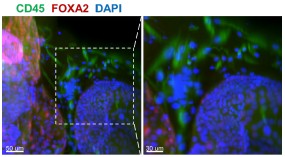
In their response, the authors mention using the first three passages to ensure optimal cell diversity and viability. However, the manuscript states that 'assembloids derived from the first generation are used for experiments' (line 106). This discrepancy must be clarified.
Thank you for your suggestion. We have revised the relevant content to “The assembloids derived from the first three generation are used for experiments” (Line 90-91).
(2) The authors have made a commendable effort to bring more focus to the manuscript, which has improved readability.
We thank you for your insightful suggestions, which have greatly improved the quality of our manuscript.
(3) The "embryo implantation" part remains very unconvincing. How did authors define "the blastoids could grow within the endometrial assembloids and interact with them"? What did they mean with "grow"? Did blastoids further differentiate? Normally, blastoids cannot further "grow". "Survival rates of blastoids" is not equal to "growth". It is not clear how the survival rate was quantified. Besides, regarding the "interaction rates", how did authors define and quantify it? Actually, blastoids are able to attach to Matrigel efficiently (even without any endometrial cells), so authors cannot simply define the "interaction" as the co-localization of blastoids and assembloids via brightfield images. In addition, for the assembloids as the 3D structures grow in the Matrigel, the epithelial parts are normally apical-in, while the blastoids attach to the apical (lumen) side of the epithelial cells, so physiologically, blastoids should interact with the apical part of the epithelial cells instead of the outside of the assembloids.
(1) What did they mean with "grow"? Did blastoids further differentiate?
On the one hand, volume and morphology undergo continuous dynamic changes; on the other hand, only the inner cell mass and trophectoderm exist at the blastocyst stage, with the ICM further differentiating into OCT4<sup>+</sup> epiblast and GATA6<sup>+</sup> hypoblast.
(2) Survival rates of blastoids" is not equal to "growth". It is not clear how the survival rate was quantified.
The definition of "survival rate" is as follows: morphologically, the blastocoel remains noncollapsed and the cell boundaries are distinct (with no obvious cell detachment); molecularly, the markers of epiblast, hypoblast and trophectoderm are expressed. The survival rate is calculated as the ratio of viable embryoids to the total number of embryoids.
(3) Besides, regarding the "interaction rates", how did authors define and quantify it? Actually, blastoids are able to attach to Matrigel efficiently (even without any endometrial cells), so authors cannot simply define the "interaction" as the co-localization of blastoids and assembloids via brightfield images.
The criteria for determining interaction include not only attachment between the blastoids and assembloids observed via brightfield images, but also their sustained tight adhesion against external mechanical perturbations (e.g., medium replacement, immunostaining procedures).
(4) In addition, for the assembloids as the 3D structures grow in the Matrigel, the epithelial parts are normally apical-in, while the blastoids attach to the apical (lumen) side of the epithelial cells, so physiologically, blastoids should interact with the apical part of the epithelial cells instead of the outside of the assembloids.
You are absolutely correct. In vivo, the embryo indeed makes initial contact with the apical side of the epithelial cells. The introduction of the blastoid co-culture model herein is intended to demonstrate that this receptive endometrial assembloids can better support blastoid growth and development.
(4) Previous comments highlighted the absence of distinct shifts in gene expression profiles between SEC assembloids and WOI assembloids, which contrasts with findings from primary endometrial tissue reported by Wang et al. (2020). While the authors have expanded their analysis using the Mfuzz algorithm and identified changes in mitochondria- and cilia-associated genes, the manuscript still lacks evidence of significant transcriptional changes in key WOI marker genes, as described in Wang et al. This discrepancy must be addressed and discussed in greater depth to clarify the biological relevance of their model.
The endometrium in vivo involves complex crosstalk among multiple cell types and is tightly regulated by the hypothalamic-pituitary-ovarian (HPO) axis, thus exhibiting distinct shifts in gene expression during the peri-implantation period.
In our in vitro model, alterations in mitochondria- and cilia-related genes were observed, which to a certain extent demonstrates that these window of implantation (WOI) assembloids possess receptive-phase characteristics and can be employed to investigate WOI-associated scientific questions or conduct in vitro drug screening.
However, substantial efforts are still required to optimize the current model for fully recapitulating the dynamic changes in endometrial gene expression across different phases in vivo, and this aspect is further addressed in the Limitations section of our discussion (Line 342-353).
“However, our WOI endometrial assembloids also exhibit some limitations. It is undeniable that the assembloids cannot perfectly replicate the in vivo endometrium, which comprises functional and basal layers with a greater abundance of cell subtypes, under superior regulation by hypothalamic-pituitary-ovarian (HPO) axis. Specifically, stromal and immune cells are challenging to stably passage, and their proportion is lower than in the in vivo endometrium. While the in vivo peri-implantation period exhibits intricate gene expression dynamics driven by systemic regulation, our models only partially recapitulate these changes, primarily in mitochondria- and cilia-associated genes. Nevertheless, to some extent, these WOI assembloids possess receptivity characteristics and can be utilized for investigating receptivity-related scientific questions or conducting in vitro drug screening. Further refinements are required to fully simulate the dynamic endometrial gene expression patterns across all menstrual cycle stages. We are looking forward to integrating stem cell induction, 3D printing, and microfluidic systems to modify the culture environment.”
(5) In the authors' response document, they present data integrating their results with those of Garcia Alonso et al. (2021). However, these integrated analyses are not included in the revised manuscript (which should be, if answering a major concern).
Thanks for your valuable suggestions. We have now integrated the findings of Garcia Alonso et al. (2021) into the revised manuscript (Line 132) and Figure S2E–F.
(8) Fig 2D: The authors have clarified that CD45+ staining is used. However, they have not yet adapted the typo in the figure legend of the right picture.
Thanks for your thorough review. The left panel of Figure 2D is stained with CD45 to label immune cells, while the right panel is stained with CD44. These details have been clearly indicated in both the manuscript and the figure legend.
(9) All quantification analyses (as described in the authors' response document) should be clearly described in the Materials & Methods section.
Thanks for your valuable suggestions. All quantification analyses have now been added to the Supporting Materials and Methods section (Line 94-104, Line 110-111, Line 241244).
(10) The authors have provided clarification regarding their method for quantifying immunofluorescence staining (e.g., OLFM4 expression in Fig. 3C) in their response document. However, these methodological details are not included in the revised manuscript. It is important that such information is incorporated into the manuscript itself to ensure transparency and reproducibility for others.
Thanks for your valuable suggestions. All quantification analyses have now been added to the Supporting Materials and Methods section (Line 94-104).
(13) It is needed to include the author's response to the comment about literature showing the opposite of increased number of cilia during the WOI into the discussion part of the paper.
We appreciate your suggestions. The relevant content has now been added to the Discussion section (Lines 319–323).
(14) In the authors' response, they explain the difference between pinopodes and microvilli. They should include this explanation briefly in the manuscript. Moreover, Fig. 3F lacks a picture of cilia structure in CTRL condition. In addition, the structures that are indicated as cilia with an orange arrow seem to not be attached to the endometrial cells (anymore). It would be useful to show another more representative picture for the cilia.
(1) Thank you for your valuable suggestions. The distinction between pinopodes and microvilli has now been added to the Supporting Materials and Methods section (Line 230-236).
(2) You are probably referring to Figure 2F—we did not observe ciliary structures in the CTRL group.
(3) The cilia structure was visualized via transmission electron microscopy (TEM), which requires ultrathin sectioning. Thus, the cilia shown in the image correspond to a single cross-section of the captured assembloids. Owing to technical limitations, three-dimensional visualization of cilia on the cells cannot be achieved.
(17) The results on co-culturing blastoids with the WOI assembloids is not convincing. The blastoids are exposed to the basolateral side of the endometrial epithelial cells, while in vivo, blastocysts interact with the apical side of the endometrial epithelial cells first (apposition and attachment), followed by invasion into the endometrium. This means that the interaction shown here is not physiological. Therefore, it is not justified to say that this platform holds promise to investigate maternal-fetal interactions.
We agree with your perspective that discrepancies exist between this model and the physiological processes in vivo. However, such differences do not negate the scientific value of the model.
The core merit of this study lies in the successful establishment of co-culture systems for blastoids and WOI assembloids. Notably, genuine cross-talk occurs between the two components, thereby providing a practical and operational tool for subsequent research.
Although the current contact orientation differs from that observed in vivo, future optimization of the cell culture protocol (via modulation of cell polarity) will enable the model to better recapitulate physiological conditions. Therefore, the innovation and operability of this model within specific research contexts still render it a robust platform for investigating maternal-fetal interactions.
Overall, it is highly recommended that the authors carefully review the manuscript for grammatical errors, inconsistencies and issues with scientific phrasing. The language throughout the text requires substantial editing to improve clarity, readability and precision.
We appreciate your suggestions. A full manuscript check was performed to rectify grammatical errors, inconsistencies, and inappropriate scientific phrasing, with further language refinement by a native English-speaking specialist.
Fig 1A: This overview is unclear. How many days do the assembloids grow before being stimulated with hormones? Are CTRL assembloids only kept in culture until day 2 and SEC and WOI assembloids until day 8? This is also not clear form the Materials and Methods section. Should be clarified.
Thanks for your valuable suggestions. We have now updated the overview (Figure 1A) and Materials and Methods section (Line 370-371, Line 379-381).
“Hormonal treatment was initiated following the assembly of the endometrial assembloids (about 7-day growth period).”
“The CTRL group was cultured in ExM without hormone supplementation and subjected to parallel culture for 8 days along with the two aforementioned groups.”
Fig 1B: From these brightfield images, it appears that the size of the assembloids remains relatively consistent from Day 0 to Day 3 and up to Day 11 (especially in CTRL). However, in Fig S1A, the assembloids on Day 11 appear significantly larger compared to those on Day 2 (or Day 4). Authors should clarify this discrepancy (since both of the figures are shown as "brightfield of endometrial assembloids").
You are probably referring to the observation that the assembloids at Day 11 in Fig. S1A are smaller in size than those at Day 2 (or Day 4) in Fig. 1B. This discrepancy arises because the time points in Fig. 1B are calculated starting from the initiation of hormone treatment for the SEC and WOI groups, rather than from the beginning of the overall culture as in Fig. S1A. In addition, assembloids exhibit size variability during the same culture period due to individual heterogeneity.
To eliminate ambiguity, we have now labeled “Hormone Day 0, Day 2, Day 8” in Fig. 1B and revised the corresponding figure legend to read: “Endometrial assembloids from the CTRL, SEC, and WOI groups, which were subjected to hormone treatment on Days 0, 2, and 8, exhibited comparable growth patterns throughout the culture period.”
Fig 2G: authors still used the description "organoids" here instead of "assembloids".
We appreciate your careful review. Corrections have been made accordingly.
Fig. 3C: For the OLFM4 staining quantification, in the Y-axis authors wrote "proportion of OLFM4 (+) cells (OLFM4 (+)/total", but in the rebuttal letter they mention "its fluorescence intensity (quantified as mean grey value) was significantly stronger in both the SEC and WOI groups compared to the CTRL group". This is confounding and should be clarified.
We apologize for incorrectly writing "fluorescence intensity" in the rebuttal letter; the correct term should be the "proportion of OLFM4 (+) cells (OLFM4 (+)/total)" as shown in Fig. 3C.
Fig 5D: Acetyl-α-tubulin is the marker of ciliated cells and should be expressed in the cilia instead of the whole cells. It is very strange to quantify as "mean fluorescence intensity (acetyl-αtubulin/DAPI)" to assess the cilia. Please clarify.
Thank you for your insightful comment. To clarify, the ratio "mean fluorescence intensity (acetyl-α-tubulin/DAPI)" was calculated within individual acetyl-α-tubulin<sup>+</sup> ciliated cells. Acetyl-αtubulin fluorescence was normalized to the DAPI signal of the same cell nucleus, not the wholecell population. This corrected for variations in cell number and staining efficiency to ensure data accuracy.
Fig 5F: it is very bizarre that unciliated epithelium was transformed from ciliated epithelium, and CTRL was transformed from SEC and WOI. Should be clarified and discussed.
Pseudotime analysis sorts discrete cells along a "pseudotime axis" based on similarities and differences in cellular gene expression, thereby simulating cell state transitions.
Ciliated epithelium → unciliated epithelium: During the menstrual cycle, ciliated and unciliated epithelia undergo mutual transformation from the secretory phase (or mid-secretory phase) to the menstrual phase, and then to the proliferative phase. Here, we demonstrate the transition of ciliated cells to unciliated cells from the SEC and WOI stages to the CTRL stage.
Notably, the two cell types coexist, and what is presented here merely reflects a transformation trend. Relative content has been incorporated into the Discussion section (Line 319-321).
“Throughout the menstrual cycle, ciliated and unciliated epithelia undergo mutual transformation from the secretory phase (or mid-secretory phase) to the menstrual phase, and then to the proliferative phase.”
Fig 5H: To show "enhanced invasion ability", authors must provide some quantification and statistic analysis. It is very hard to see the difference between the CTRL and SEC regarding ROR2Wnt5A.
We appreciate your suggestion. Quantification and statistic analysis have been added to Figure 5H.
Fig 6A: please elaborate the "mIVC1" and "mIVC2" in the figure legends.
Additions have been made to the figure legends accordingly, as follows: "mIVC1: modified In Vitro Culture Medium 1; mIVC2: modified In Vitro Culture Medium 2."
Fig S1D: Is the PAS staining also done in CTRL assembloids? In addition, it is stated that the assembloids secrete glycogen because of a positive PAS staining, while it could also be neutral mucins, glycoproteins, etc, which are all detected by PAS staining. So, the authors should be more careful in stating that it is glycogen, or a PAS staining with diastase digestion should be done.
The PAS staining results for the CTRL group are presented in Fig. S1I. In addition, results of PAS staining with diastase digestion are included in Figure S1.
Line 120: references?
The reference has been added accordingly.
Line 178: The term 'Endometrial Receptivity Test (ERT)' is used. Do the authors mean Endometrial Receptivity Analysis (ERA) test? ERA is the commonly used abbreviation for this test. Moreover, the authors describe ERA as 'a kind of gene analysis-based test.' This should be rephrased more scientifically correct.
Thank you for your valuable suggestion. We have revised the term to ERA, and modified the phrase "a kind of gene analysis-based test" to "gene expression profiling-based diagnostic assay" (Lines 160–163).
“We performed Endometrial Receptivity Analysis (ERA), a gene expression profiling-based diagnostic assay that integrates high-throughput sequencing and machine learning to quantify the expression of endometrial receptivity-associated genes.”
Line 83: assemblies à assembloids
We appreciate your suggestion. The text has been updated to “the endometrial assembloids progressed from epithelial organoids, to assemblies of epithelial and stromal cells and then to stem cell-laden 3D artificial endometrium”.
The Materials and Methods section currently lacks the needed details. Authors should substantially expand this section to clearly describe all experimental and analytical procedures, including, aùmong others, immunofluorescence staining, quantification methods, bioinformatics analyses and statistical approaches. Providing comprehensive methodological information is essential.
A detailed description of these methods is provided in the Supporting Materials and Methods section.
Reviewer #2 (Recommendations for the authors):
The revised manuscript is much improved in clarity, focus, and experimental support. The authors have thoughtfully addressed the major concerns from the previous review. In particular, the logic and flow of the paper are clearer, it now guides the reader through the rationale (constructing a WOI model), the comparative analysis against in vivo tissue and simpler organoids, and the key features that distinguish the WOI assembloid. The added functional validation (especially the blastoid co-culture experiment) significantly strengthens the work by showing a tangible outcome of "receptivity" beyond molecular profiling. The distinction between the standard secretory-phase organoid and the WOI assembloid is now more convincing, as the authors highlight several specific differences in morphology (more cilia, pinopodes), metabolism, and implantation success that favor the WOI model. The manuscript also reads cleaner with the bioinformatic sections condensed to the most important findings (excess detail was trimmed or moved to supplements) and the rationale for gene/pathway selection explicitly stated.
The manuscript has been significantly strengthened through the addition of functional assays (like the blastoid co-culture), clearer transcriptomic and proteomic data, and detailed analyses of hormone treatments, cilia biology, and stromal and immune cell behavior in early passages. These updates confirm that the WOI assembloid supports embryo attachment and outperforms standard secretory organoids, while integrating external references and clarifications on terminology. Minor suggestions remain, such as clarifying statistical significance and adding functional interpretations for certain observations, but overall, the manuscript is now more robust and biologically convincing.
Remaining points for clarification: There are a few minor points that still merit attention:
- Use of the Endometrial Receptivity Test (ERT): As previously mentioned, if the authors have ERT data for the SEC organoid group, including that information would further support the claim that the WOI assembloid is uniquely receptive. If not, it would be helpful to add a statement clarifying that the ERT was employed specifically as a confirmatory test for the WOI assembloids, rather than as a comparative measure across all groups.
Thank you for your valuable suggestion. We have now supplemented the description in the Supporting Materials and Methods section (Lines 160–162) as follows: “ERA was employed specifically as a confirmatory test for the WOI assembloids, rather than as a comparative measure across all groups.”
- Because the assembloids are created from primary tissue samples, it would be helpful to briefly comment on how consistent the findings were across different patient-derived samples. For example, did all biological replicates show similar expression of receptivity markers and comparable capacity to support blastoid attachment? Although this seems implied, including a sentence in the Methods or Results sections that specifies the number of donor lines tested would help readers assess the model's variability and reproducibility.
We appreciated your advice. The relevant statement has been added to the Supporting Materials and Methods section. (Line 312-313).
“All biological replicates (fourteen individuals) of endometrial assembloids show similar expression of receptivity markers and comparable capacity to support blastoid attachment.”
- The authors mention promising future directions, such as integrating 3D printing and microfluidics to further enhance the model, which is an excellent forward-looking statement. It would also be valuable to suggest the inclusion of additional cell types, like more robust immune cell populations or endothelial components, as future improvements to create an even more comprehensive model of the endometrial lining.
Thank you for your valuable suggestion. 3D printing and microfluidics serve as approaches for introducing multiple cell types. We have supplemented the following statement in the manuscript: “We are looking forward to integrating stem cell induction, 3D printing, and microfluidic systems to modify the culture environment.” (Line 352-353).
We are grateful for your valuable feedback and constructive criticism, which have helped us improve the quality of our work in terms of content and presentation. We have diligently revised the manuscript and made necessary changes. Here, we have attached the revised manuscript, figures, and all supplementary materials for your re-evaluation. Thank you again for your continued support and look forward to your favorable decision.
The idea of a meritocracy generally concerns social orderand how to allocate resources. Backers of meritocratic norms typicallybelieve that skill should be measured, that effort should be tracked,and that those who demonstrate the best combinations of talent andhard work should rise to the top of the social ladder.
We should be more efficient, faster, more productive, more happy, beautiful, live more, have more objects: PROGRESS, EVOLUTION. These ideas are engraved into innate blank slate free will mythologies that juxtapose the ordered Western Philosopher Republic or the Magnanimous Eastern King to the absurd mutual aid Anarchocommunism that would degenerate in a battle royale. It's only natural, yet our current hedonistic tech accelerationist post-modern innovation dogma, has mostly outstripped the traditionalistic stability homogeneity lifestyle. Because it enabled a deeper sterelisation, it allowed the perpetuation of rich people through a facade of satisfaction, BUSY satisfaction, self-convinced WORK beyond your small rural family.
Embracing meritocracy makes allocating resources seem straightfor-ward: as soon as a system for judging merit is established, it becomeseasy to assess who finished at the top and is most deserving of thegreatest rewards. In addition to its utility in economics, supporters ofmeritocracy argue that it “is considered by many to be an ideal jus-tice principle, because only relevant inputs (e.g., abilities) should beconsidered and irrelevant factors (e.g., ethnicity, gender) should be ig-nored when distributing outcomes. Thus, meritocracy is bias free
Of course, Meritocracy is the scientifically proven, objective, real, true, valid way of assessing things! Singularly, this completely buys into Plato's world of idea-ls... that we must strive for PERFECTION, that there is AN ULTIMATE JUDGE, that we should RANK stuff.
Ranking hate speech or trying to assess which oppression is worseis a regressive activity that does not fix problems, but analysis of vir-ulent sexism is perhaps the easiest starting point for a discussion oftoxicity in games. The use of the term “rape” is omnipresent through-out the discussion around games, popping up almost any time certainplayers either win or lose in spectacular, or sometimes even ordinary,fashion.
Son of a bitch is also a common one. Faggot too, specially thrown against individuals who show care, stripping them of their privilege.
if you are one of those people with such a degree you still haveninety-three fellow villagers who have not had the same opportuni-ties. If you have access to a computer, you would be one of twenty-twothat do, numbers that are largely matched by the seventeen who areunable to read and write, the twenty-three with no shelter from windand rain, and the thirteen who do not have safe water to drink. At thepoint that you are fortunate enough to be in a position where you canhave the ability, the time, and the resources to read a book about videogames, you are one of a very small group of people in the world withthat opportunity.
Matthew effect. Survivors survive, rich get richer. Of course, spotlight bias would have us imagine otherwise it's possible, and actually rich people make sure to create that image by buying news outlets, marketing, philantropies or even social media sites, to shout how many people went from zero to hero. Actually, just check the 1%, and see how monopolistic aristocrats relate and feed on to monopolistic aristocrats.
Trump, Elon, Bezos, Gates, Zuckerberg, are white, straight, cis, men BORN IN RICH FAMILIES.
The growth in development costs createsa situation where companies betting $100 million or more on a gamefocus more on what has worked than on what could be.Focus on meritocracy reaches beyond the design of games andinto the narrative stories they typically tell. Most major game sto-rylines, from Grand Theft Auto III to Uncharted to Restaurant Story,enable players to grow from a relative weakling into a strong, powerfuldemigod.
Of course, because becoming powerful is luring, sexy, it reificates a type of lifestyle, of desire, of righteousness, of imperialistic white saviourism. It's the marketing American cold war (once purportedly anti-slavery) Dream old fairy tale of economic mobility. It's a post-hoc rationalisation of Plato's or Confuncius' stupid concepts of virtue. It's "justice served", "eye-for-an-eye".
Claude, left shot and betrayed by his girlfriend while robbing a banktogether. Claude manages to survive but is captured, placing players ina position where they are alone and on their way to a ten-year prisonsentence for bank robbery. The game’s narrative unfolds from rockbottom for Claude, who transforms into a leader of the underworldwho successfully outfoxes the mafia, a Columbian drug cartel, andthe Yakuza in the space of a few hours of player-led intervention andexploration. By the end of the game, Claude has eviscerated the car-tel and exacted his revenge on both the mafia don who sought to killhim and the girlfriend who initially betrayed him.
I find more scary games and shows like "When Life Gives You Tangerines" that promote self-exploitation, because it's those people that end up invisiblising vulnerable people.
eLife Assessment
The authors developed a fundamental computational method, which is intended to automatically process bioluminescence imaging-derived tumour images across anatomical regions and over time. This allows quantitative analysis of such data, and the authors applied it to describe the spatiotemporal distribution of tumour cells in response to CD19-targeted CAR-T cells that contained either CD28 or 4-1BB costimulatory domains. Some operational limitations were identified, which relate to the pipeline's reliance on predefined regions of interest instead of aligning signal sites with anatomical information, scaling, and limitations in taking animal pose into account. Overall, the authors provide compelling evidence for the functionality of their computational approach towards automated analysis of bioluminescence imaging data, while applying it to a current topic of wide interest in cell therapy research.
Reviewer #1 (Public review):
Summary:
This paper presents maRQup a Python pipeline for automating the quantitative analysis of preclinical cancer immunotherapy experiments using bioluminescent imaging in mice. maRQup processes images to quantify tumor burden over time and across anatomical regions, enabling large-scale analysis of over 1,000 mice. The study uses this tool to compare different CAR-T cell constructs and doses, identifying differences in initial tumor control and relapse rates, particularly noting that CD19.CD28 CAR-T cells show faster initial killing but higher relapse compared to CD19.4-1BB CAR-T cells. Furthermore, maRQup facilitates the spatiotemporal analysis of tumor dynamics, revealing differences in growth patterns based on anatomical location, such as the snout exhibiting more resistance to treatment than bone marrow.
Strengths:
(1) The maRQup pipeline enables the automatic processing of a large dataset of over 1,000 mice, providing investigators with a rapid and efficient method for analyzing extensive bioluminescent tumor image data.
(2) Through image processing steps like tail removal and vertical scaling, maRQup normalizes mouse dimensions to facilitate the alignment of anatomical regions across images. This process enables the reliable demarcation of nine distinct anatomical regions within each mouse image, serving as a basis for spatiotemporal analysis of tumor burden within these consistent regions by quantifying average radiance per pixel.
Weaknesses:
(1) While the pipeline aims to standardize images for regional assessment, the reliance on scaling primarily along the vertical axis after tail removal may introduce limitations to the quantitative robustness of the anatomically defined regions. This approach does not account for potential non-linear growth across dimensions in animals of different ages or sizes, which could result in relative stretching or shrinking of subjects compared to an average reference.
(2) Furthermore, despite excluding severely slanted images, the pipeline does not fully normalize for variations in animal pose during image acquisition (e.g., tucked body, leaning). This pose variability not only impacts the precise relative positioning of internal anatomical regions, potentially making their definition based on relative image coordinates more qualitative than truly quantitative for precise regional analysis, but it also means that the bioluminescent light signal from the tumor will not propagate equally to the camera as photons will travel differentially through the tissue. This differing light path through tissues due to variable positioning can introduce large variability in the measured radiance that was not accounted for in the analysis algorithm. Achieving more robust anatomical and quantitative normalization might require methods that control animal posture using a rigid structure during imaging.
Comments on revisions:
(1) Clarification of 2D Analysis. We strongly recommend that the authors explicitly define maRQup as a 2D spatiotemporal analysis technique. Since optical imaging quantification is inherently dependent on tissue type and signal depth, characterizing this as a 3D or volumetric method without tomographic correction is inaccurate. Please precede "spatiotemporal" with "2D" throughout the text to ensure precision regarding the method's capabilities.
(2) Data Validation and Scaling in Supplemental Figure g currently lacks the units necessary to support the assertion.
Non-Uniform Growth: The authors' method implies that mouse growth is linear and uniform in all directions (isotropic). However, murine growth is not akin to the inflation of a balloon; animals elongate and widen at different rates. The current scaling does not account for these physiological non-linearities.
Pose Variability: The scaling approach appears to neglect significant variability in animal positioning. Even under anesthesia, animal pose is rarely identical across subjects or time points.
Requirement for Evidence: Without quantitative data, there appears to be significant differences between the individual images and the merged image. If the authors assert that this is a "classical setting" where mouse positioning is 100% consistent and growth curves are identical in multiple dimensions, please provide specific references that validate these assumptions. Otherwise, the scaling must be corrected to account for anisotropic growth and pose differences or stated that scaling was only based on one dimension.
(3) Methodology of Spatial Regions The manuscript does not currently indicate how the nine distinct spatial regions were determined. Please expand the methods section to include the specific segmentation algorithms or anatomical criteria used to define these regions, as this is critical for reproducibility.
Reviewer #3 (Public review):
Summary:
The paper "The 1000+ mouse project: large-scale spatiotemporal parametrization and modeling of preclinical cancer immunotherapies" is focused on developing a novel methodology for automatic processing of bioluminescence imaging data. It provides quantitative and statistically robust insights on preclinical experiments that will contribute to optimizing cell-based therapies. There is an enormous demand for such methods and approaches that enable the spatiotemporal evaluation of cell monitoring in large cohorts of experimental animals.
Strengths:
The manuscript is generally well written, and the experiments are scientifically sound. The conclusions reflect the soundness of experimental data. This approach seems to be quite innovative and promising to improve the statistical accuracy of BLI data quantification.<br /> This methodology can be used as a universal quantification tool for BLI data for in vivo assessment of adoptively transferred cells due to the versatility of the technology.
Comments on revisions:
The critiques have been taken care of appropriately.
Author response:
The following is the authors’ response to the original reviews.
Public Reviews:
Reviewer #1 (Public review):
Summary:
This paper presents maRQup, a Python pipeline for automating the quantitative analysis of preclinical cancer immunotherapy experiments using bioluminescent imaging in mice. maRQup processes images to quantify tumor burden over time and across anatomical regions, enabling large-scale analysis of over 1,000 mice. The study uses this tool to compare different CAR-T cell constructs and doses, identifying differences in initial tumor control and relapse rates, particularly noting that CD19.CD28 CAR-T cells show faster initial killing but higher relapse compared to CD19.4-1BB CAR-T cells. Furthermore, maRQup facilitates the spatiotemporal analysis of tumor dynamics, revealing differences in growth patterns based on anatomical location, such as the snout exhibiting more resistance to treatment than bone marrow.
Strengths:
(1) The maRQup pipeline enables the automatic processing of a large dataset of over 1,000 mice, providing investigators with a rapid and efficient method for analyzing extensive bioluminescent tumor image data.
(2) Through image processing steps like tail removal and vertical scaling, maRQup normalizes mouse dimensions to facilitate the alignment of anatomical regions across images. This process enables the reliable demarcation of nine distinct anatomical regions within each mouse image, serving as a basis for spatiotemporal analysis of tumor burden within these consistent regions by quantifying average radiance per pixel.
Weaknesses:
(1) While the pipeline aims to standardize images for regional assessment, the reliance on scaling primarily along the vertical axis after tail removal may introduce limitations to the quantitative robustness of the anatomically defined regions. This approach does not account for potential non-linear growth across dimensions in animals of different ages or sizes, which could result in relative stretching or shrinking of subjects compared to an average reference.
Our answer to this comment is included in the Supplemental Methods. The standard deviation of the mouse pixels was calculated to ensure that the image processing steps did not alter the shape or size of the mice. Such consistency is particularly striking because our dataset was accrued by nine lab members over the last five years, before we conceived and carried out our analysis (c.f., answer to point #2). In fact, it is the very consistency of this IVIS measurement that led us to conceive our pipeline. As seen from Supplemental Figure 4G, there is minimal difference in the shape or size of the mice across 7,534 images. A total of 99 images were removed either due to being too slanted (91/7663, 1.2%) or due to processing errors (8/7633, 0.1%). Also, the vertical scaling was conducted while keeping the aspect ratio unchanged to prevent any non-anatomical scaling. Hence, we did not record any nonlinear growth of the mice that would warrant more convoluted alignment and/or batch correction for our images.
(2) Furthermore, despite excluding severely slanted images, the pipeline does not fully normalize for variations in animal pose during image acquisition (e.g., tucked body, leaning). This pose variability not only impacts the precise relative positioning of internal anatomical regions, potentially making their definition based on relative image coordinates more qualitative than truly quantitative for precise regional analysis, but it also means that the bioluminescent light signal from the tumor will not propagate equally to the camera, as photons will travel differentially through the tissue. This differing light path through tissues due to variable positioning can introduce large variability in the measured radiance that was not accounted for in the analysis algorithm. Achieving more robust anatomical and quantitative normalization might require methods that control animal posture using a rigid structure during imaging.
Reviewer #1 is correct that different mouse postures would be an issue when aligning the images and normalizing for size. However, all experiments are conducted for luminescence measurements in the IVIS system (i.e., this requires anesthesia and long integration time for imaging). In our experience and in our 1000+ mouse dataset, we noticed that all experiments (n=37) did place the anesthetized mice in a stretched/elongated position. Of note, these experiments were conducted by nine different researchers who were not instructed on how to place the mice on the machine for ideal image processing, thus showing that the standard protocol of imaging mice on IVIS does not introduce large variations in animal pose during image acquisition. We think the issue raised by Reviewer #1 is moot in the context of classical settings for mouse luminescence imaging.
Reviewer #2 (Public review):
Summary:
The authors developed a method that automatically processes bioluminescent tumor images for quantitative analysis and used it to describe the spatiotemporal distribution of tumor cells in response to CD19-targeting CAR-T cells, comprising CD28 or 4-1BB costimulatory domains. The conclusion highlights the dependence of tumor decay and relapse on the number of injected cells, the type of cells, and the initial growth rate of tumors (where initial is intended from the first day of therapy). The authors also determined the spatiotemporal analysis of tumor response to CAR T therapy in different regions of the mouse body in a model of acute lymphoblastic leukemia (ALL).
Strengths:
The analysis is based on a large number of images and accounts for many variables. The results of the analysis largely support their claims that the kinetics of tumor decay and relapse are dependent on the CAR T co-stimulatory domain and number of cells injected and tumor growth rates.
Weaknesses:
The study does not specify how a) differences in mouse positioning (and whether they excluded not-aligned mice) and b) tumor spread at the start of therapy influenced their data. The study does not take into account the potential heterogeneity of CAR T cells in terms of CAR T expression or T cell immunophenotype (differentiation, exhaustion, fitness...).
See answer #2 to Reviewer #1.
Author response image 1.
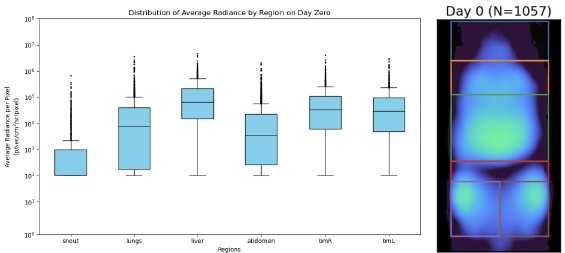
Author response image 1 shows the average tumor radiance on day zero (when CAR-T cell therapy was administered) for all mice. While there is some spread, most mice had tumor localized to the liver or bone marrow.
Reviewer #3 (Public review):
Summary:
The paper "The 1000+ mouse project: large-scale spatiotemporal parametrization and modeling of preclinical cancer immunotherapies" is focused on developing a novel methodology for automatic processing of bioluminescence imaging data. It provides quantitative and statistically robust insights into preclinical experiments that will contribute to optimizing cell-based therapies. There is an enormous demand for such methods and approaches that enable the spatiotemporal evaluation of cell monitoring in large cohorts of experimental animals.
Strengths:
The manuscript is generally well written, and the experiments are scientifically sound. The conclusions reflect the soundness of experimental data. This approach seems to be quite innovative and promising to improve the statistical accuracy of BLI data quantification.
This methodology can be used as a universal quantification tool for BLI data for in vivo assessment of adoptively transferred cells due to the versatility of the technology.
Weaknesses:
No weaknesses were identified by this Reviewer.
Recommendations for the authors:
Reviewer #1 (Recommendations for the authors):
In this paper, the authors propose a significant advancement in optical image data analysis by employing automation. They effectively demonstrate the valuable insights that can be gained from analyzing extensive datasets with a more unbiased methodology. At present, I do not have any specific suggestions for improvement.
However, it is important to note that this work is limited in its operational scope. Specifically, it relies on predefined ROIs rather than aligning the signal site with anatomical systems. The scaling model and image cropping are simplistic, animal pose is not taken into account, and the data output needs to be called semi-quantitative or qualitative, and would have been stronger utilizing an AI agent. Nevertheless, this work underscores the potential of automated systems in preclinical image analysis, which is a crucial step towards developing more sophisticated approaches to optical image data analysis.
While our analysis used predefined ROIs, the maRQup pipeline allows users to manually draw ROIs on the mouse image.
Reviewer #2 (Recommendations for the authors):
The writing and presentation of data are clear and accurate, but some additional information should be added regarding the imaging protocol used to acquire the original data.
The authors mention fluorescence in Figure 1. I expected all the data to be generated from bioluminescent NALM-6 tumors, since bioluminescence is indeed measured in average radiance and can be per pixel (p/sec/cm2/sr/pixel). Fluorescence should be measured using radiance efficiency (p/sec/cm2/sr)/(µW/cm2), a unit that compensates for non-uniform excitation light pattern in the instrument. Would the author find different results if fluorescence data were analyzed separately?
Reviewer #2 is correct that the unit for fluorescence would be radiance efficiency. The word “fluorescent” was included in the label of Figure 1a to highlight that our workflow could be applied to other types of light-generating methods (i.e., fluorescence vs. bioluminescence). However, in this study, measurements of bioluminescent tumors only were analyzed. If fluorescence measurements are to be analyzed, our methods of image acquisition and processing would be directly applicable.
Did the author ever check the signal of the snout in mice with no tumor?
In mice with no tumor, there is no detectable signal in the snout (or anywhere else, for that matter).
The urine of mice contains phosphor, and might give a background signal, especially if longer exposure is used at the end of the study.
For the mice with no tumor injection, the luminescence signal was below background (<10<sup>2</sup> p/sec/cm<sup>2</sup>/sr/pixel). In particular, we do not detect any signal in the bladder/urine. Additionally, as described in the Supplemental Methods and Figure 1b, only pixels that were on the mouse as determined from the brightfield image were used to calculate the tumor burden from the radiance of the luminescent image. This method ensures that any background signal (e.g., from phosphor in mouse urine) would be excluded in the radiance quantification and not bias the results.
Additionally, as described in the Methods, the exposure time was held constant at 30 seconds for each IVIS measurement across all 37 experiments.
The data using more than 2 million cells comes from only 10 mice, and maybe the biological relevance of this group is limited since it will not be achievable and translatable in humans (PMID: 33653113).
We appreciate Reviewer #2’s attention to this issue. The effect observed in our study is large enough to reach statistical significance despite the small number of mice. Note that the dosing regimen used was optimized for the murine NSG model and would require appropriate scaling before clinical application. Nonetheless, NSG mice remain the gold standard for pre‑clinical in vivo evaluation and their use is generally required by regulatory agencies, such as the FDA, for assessing novel CAR‑T cell therapies; thus these findings are relevant for advancing such treatments.
Briefing : Préparation de la 10ème Semaine de l'ESS à l'école (SESSE 2026)
Résumé Exécutif
Ce document synthétise les points clés du webinaire organisé par l'association L'ESPER en préparation de la 10ème édition de la Semaine de l'Économie Sociale et Solidaire (ESS) à l'école, qui se déroulera du 23 au 28 mars 2026.
Copiloté avec l'OCCE, cet événement vise à sensibiliser les élèves, du primaire au supérieur, aux modèles économiques alternatifs basés sur la démocratie, la justice sociale et l'intérêt général.
Le webinaire souligne une double ambition : éduquer à l'ESS (compréhension des modèles) et par l'ESS (expérimentation de projets collectifs).
Les interventions mettent en avant des dispositifs concrets, des témoignages d'acteurs de terrain (notamment des Scops et des Scics) et une panoplie d'outils pédagogiques « clés en main » pour les enseignants.
L'objectif final est de transformer la société en intégrant ces principes dans le parcours scolaire et citoyen des individus.
--------------------------------------------------------------------------------
1. Cadre Institutionnel et Ambitions Éducatives
L'association L'ESPER, regroupant 41 organisations de l'éducation et de l'ESS, porte une vision politique et pédagogique forte pour le système éducatif français.
Vision et Plaidoyer
L'ESPER considère l'ESS comme un levier nécessaire pour transformer l'économie. Ses ambitions s'articulent autour de deux axes :
• Éducation à l'ESS : Faire comprendre un modèle de société basé sur la justice sociale et l'intérêt général. Un plaidoyer publié en août 2025 appelle d'ailleurs à l'intégration de l'ESS dans les programmes scolaires dès le collège.
• Éducation par l'ESS : Favoriser l'émancipation individuelle et collective par la mise en œuvre de projets concrets en classe, permettant aux élèves de découvrir la coopération par l'action.
La Semaine de l'ESS à l'école (SESSE)
Inscrite au calendrier de l'Éducation Nationale, cette semaine annuelle permet trois modes d'engagement :
1. Équipes éducatives : Valorisation de projets annuels ou organisation d'actions ponctuelles.
2. Acteurs de l'ESS : Accueil de classes dans leurs structures ou interventions directes en milieu scolaire.
3. Élèves/Étudiants : Montage de projets autonomes et sensibilisation de leurs pairs.
--------------------------------------------------------------------------------
2. Fondamentaux de l'Économie Sociale et Solidaire
L'ESS n'est pas une économie récente, mais elle s'est institutionnalisée, notamment via la loi Hamon du 31 juillet 2014.
Les 5 types de structures de l'ESS
| Type de structure | Caractéristiques principales | | --- | --- | | Associations | Groupements de personnes volontaires autour d'un projet non lucratif. | | Fondations | Affectation irrévocable de biens à une œuvre d'intérêt général. | | Coopératives | Entreprises où les associés partagent le pouvoir et les bénéfices. | | Mutuelles | Organismes à but non lucratif pratiquant la solidarité entre membres. | | Sociétés commerciales de l'ESS | Sociétés privées respectant les principes de l'ESS. |
Principes et Valeurs Cardinaux
Toutes ces organisations partagent un socle commun :
• Finalité d'intérêt général ou collectif.
• Lucrativité limitée : Les bénéfices sont prioritairement réinvestis dans le projet.
• Gestion démocratique : Application du principe « une personne, une voix », indépendamment du capital détenu.
--------------------------------------------------------------------------------
3. Retours d'Expérience et Témoignages d'Acteurs
L'Union Régionale des Scops et Scics (Occitanie)
Eugénie Bruni souligne l'importance de la promotion du modèle coopératif auprès des jeunes.
• Actions types : Interventions de 2 heures présentant l'histoire, les spécificités et des exemples concrets de coopératives.
• Impact : Ouverture des perspectives professionnelles pour les étudiants en montrant que la coopération est un modèle économique viable (4 558 sociétés coopératives en France générant 10,2 milliards d'euros de chiffre d'affaires).
• Conseils : Ne pas hésiter à solliciter les Unions Régionales qui disposent de délégués sur tout le territoire pour accompagner les projets.
La Scop Morasuti (Imprimerie, région AURA)
Témoignage de Damien sur une reprise d'entreprise à la barre du tribunal par les salariés.
• Le combat social : Transformation en Scop en juillet 2024. Le modèle a permis de supprimer les jours de carence et de rééquilibrer les salaires pour corriger les inégalités d'ancienneté.
• Engagement scolaire : Mise à disposition gratuite de chutes de matériaux pour les écoles et accompagnement technique (design, PAO) pour des projets d'exposition.
• Observation sur la démocratie : Les élèves sont souvent surpris par la double casquette « ouvrier et patron ». Damien explique : « Personne ne peut être d'accord avec tout... la démocratie, c'est aux voix. »
--------------------------------------------------------------------------------
4. Ressources et Outils Pédagogiques
L'ESPER propose des outils testés et adaptés pour différents niveaux (collège, lycée, supérieur).
Outils de sensibilisation "Clés en main"
| Outil | Objectif | Méthode | | --- | --- | --- | | Junior Coopérative | Initier à la méthodologie de projet. | Puzzle sur les étapes d'un projet et études de cas réels. | | Idées reçues sur l'ESS | Déconstruire les préjugés. | Débat mouvant à partir de cartes "Vrai/Faux". | | Filmographie ESS | Illustrer les réalités de l'ESS. | Sélection de documentaires avec guides pédagogiques. | | Fiches Pratiques | Organiser une intervention. | Guides logistiques pour les visites d'entreprises ou les interventions en classe. |
Recommandations pour les intervenants
• Adaptation : Simplifier le discours pour les collégiens en se concentrant sur les piliers (solidarité, partage des richesses, démocratie) plutôt que sur les détails juridiques.
• Interactivité : Utiliser des supports vidéo (ex: série "Ma boîte en Scop") et favoriser le dialogue.
• Préparation : Prévoir environ une heure d'échange préalable entre l'enseignant et l'intervenant pour cadrer l'action.
--------------------------------------------------------------------------------
5. Calendrier et Inscriptions
• Inscriptions : Ouvertes sur le site de L'ESPER. L'équipe salariée assure la mise en relation entre les établissements scolaires et les acteurs de l'ESS.
• 25 février 2026 : Second webinaire de préparation dédié à une présentation détaillée de l'ESS avec l'expert Hervé de Falvar.
• 23 au 28 mars 2026 : Déroulement de la Semaine de l'ESS à l'école. Valorisation des actions sur les réseaux sociaux et newsletters de L'ESPER.
Citation clé : « Le SS porte un modèle de société qui est basé notamment sur la démocratie, la justice sociale, l'intérêt général [...] pour aboutir à une société plus juste dans laquelle les individus sont émancipés individuellement mais également collectivement. »
État des Lieux Scientifique des Thérapies Manuelles : Entre Mythes et Réalités
Ce document de synthèse analyse l'état actuel des connaissances scientifiques concernant les thérapies manuelles (kinésithérapie, ostéopathie, chiropraxie, étiopathie), avec un accent particulier sur le mal de dos, principal motif de consultation.
Les points saillants sont les suivants :
• Le primat du mouvement : La science moderne démontre que le traitement le plus efficace contre la lombalgie est le mouvement actif.
Les thérapies passives ne doivent pas être utilisées de manière isolée.
• Obligations légales et déontologiques : Contrairement aux pseudomédecines, la kinésithérapie est encadrée par l'obligation d'utiliser des moyens conformes aux « données acquises de la science », un principe juridique ancré depuis l'arrêt Mercier de 1936.
• Déconstruction des mythes : Les concepts de « vertèbre déplacée » ou de « bassin décalé » sont des vues de l'esprit sans réalité anatomique.
La palpation manuelle, bien que rassurante, manque de fiabilité scientifique pour établir un diagnostic de texture ou de blocage.
• Risques et conséquences sociales : Au-delà de l'effet placebo ou contextuel, certaines manipulations (notamment cervicales) présentent des risques graves comme l'accident vasculaire cérébral (AVC).
De plus, ces pratiques peuvent parasiter les messages de santé publique et altérer la littératie en santé des patients.
--------------------------------------------------------------------------------
L'approche médicale de la lombalgie a radicalement changé au cours des trente dernières années, passant d'une logique de repos à une logique d'action.
• 1986 : Une étude du New England Journal of Medicine suggère que deux jours de repos au lit sont plus bénéfiques que sept jours.
• 1995 : Une étude pivot démontre que le groupe "témoin" (continuant à vivre normalement) récupère mieux que les groupes soumis à un repos strict ou à des exercices trop prudents.
• 2019 : La Haute Autorité de Santé (HAS) et l'Assurance Maladie lancent des recommandations officielles : « Le bon traitement, c'est le mouvement ».
Les thérapies passives isolées sont déclarées inefficaces sur l'évolution de la lombalgie.
Contrairement aux idées reçues, des activités comme la course à pied améliorent la physiologie discale.
L'alternance de pressions et dépressions (environ 1 Hz) lors de la course permet d'hydrater les disques intervertébraux. Statistiquement, les coureurs de fond souffrent moins du dos que les autres sportifs.
--------------------------------------------------------------------------------
La distinction entre kinésithérapie et thérapies alternatives repose sur un fondement juridique historique.
Ce tournant de la Cour de cassation a établi trois principes majeurs :
1. Le contrat de soins : Il existe un lien contractuel entre le soignant et le patient.
2. L'obligation de moyens : Le soignant n'a pas d'obligation de résultat (guérison), mais doit mettre en œuvre tous les moyens nécessaires.
3. Les données acquises de la science : Les moyens choisis doivent être conformes aux connaissances scientifiques actuelles.
Le code de déontologie impose aux kinésithérapeutes d'abandonner les pratiques invalidées. Par exemple :
• Bronchiolite : La kinésithérapie respiratoire pédiatrique n'est plus recommandée depuis 2019 pour les nourrissons sains, car le bénéfice est jugé insuffisant par rapport au caractère traumatisant du soin.
• Massage : Son usage est désormais limité (cicatrices, œdèmes) et n'est plus recommandé comme traitement de première intention pour le mal de dos.
--------------------------------------------------------------------------------
La science démontre que le sens tactile des praticiens est sujet à l'illusion.
• Manque de fiabilité : Deux évaluateurs sont rarement d'accord sur la texture (dur/mou) ou le caractère « bloqué » d'un tissu.
• Précision anatomique : En palpant une structure évidente sous la peau, l'erreur moyenne est de 5 cm.
• Impossibilité mécanique : Il est impossible de mobiliser une seule vertèbre de façon isolée ; une manipulation en impacte au minimum trois.
Les thérapies manuelles produisent un effet antalgique réel mais transitoire :
• Distraction sensorielle : Le système nerveux privilégie les sensations tactiles, de chaud ou de froid sur la douleur. C'est un effet à court terme (quelques minutes à quelques heures).
• Effet contextuel : Le rituel de la consultation, l'attention portée par le praticien et la régression naturelle vers la moyenne (la douleur diminue souvent d'elle-même au moment où l'on consulte) renforcent l'illusion d'efficacité.
--------------------------------------------------------------------------------
Les thérapies comme l'ostéopathie ou la chiropraxie reposent sur le vitalisme, une philosophie du XIXe siècle postulant l'existence d'une « force vitale » non physique.
| Discipline | Origine | Fondements Idéologiques | État actuel en Europe | | --- | --- | --- | --- | | Ostéopathie | A.T. Still (1874) | "Le corps est la pharmacie de Dieu". Flux sanguin synonyme de santé. | Branche "puriste" (Littlejohn) très présente, axée sur le crânio-sacré et le fluidique. | | Chiropraxie | D.D. Palmer (1895) | Système nerveux central comme maître du corps. Recours aux manipulations à haute vélocité (faire craquer). | Pratique restée proche des concepts originels, avec une forte présence sur les réseaux sociaux. | | Étiopathie | C. Trédaniel (Fr) | Recherche de l'origine de la pathologie dans l'ajustement articulaire. | Très similaire à l'ostéopathie, sans distinction scientifique réelle. |
Note sur l'exception américaine : Aux États-Unis, l'ostéopathie s'est médicalisée suite au rapport Flexner (1910). Les "DO" y sont des médecins généralistes qui ne pratiquent quasiment plus de thérapie manuelle, contrairement à la branche européenne restée mystique.
--------------------------------------------------------------------------------
• Risques graves : Les manipulations cervicales peuvent provoquer des dissections de l'artère vertébrale, entraînant des AVC ou le syndrome de "Locked-in" (paralysie totale avec conscience préservée).
• Erreurs de diagnostic : Le recours direct à ces thérapies sans avis médical peut retarder la prise en charge de pathologies graves (ex: fractures non détectées).
Le "vernis médical" utilisé par ces disciplines (mots tels que « diagnostic », « anamnèse », « consultation ») crée une confusion chez les patients :
• Atteinte à la littératie en santé : En ancrant des concepts erronés (vertèbre déplacée, jambe plus courte), les praticiens créent une dépendance et une peur de bouger (kinésiophobie).
• Facteurs sociaux : Le principal facteur de persistance d'une lombalgie n'est pas mécanique, mais lié à l'insatisfaction au travail ou à des problèmes sociétaux. Les thérapies manuelles, en se focalisant sur le "crack and go", ignorent cette complexité.
Si les thérapies manuelles offrent un soulagement temporaire et un confort relationnel, elles ne constituent pas une solution de fond au mal de dos.
La science préconise une approche centrée sur l'éducation thérapeutique, la gestion de la motivation et, impérativement, le mouvement actif du patient.
eLife Assessment
This valuable study presents a technically sophisticated intravital two-photon calcium imaging approach to characterize Ca²⁺ dynamics in distinct populations of meningeal macrophages in awake, freely behaving mice. These data are solid and suggest that meningeal macrophage calcium activity is tightly linked to anatomical sub-compartments, with potential implications for migraine and neuroinflammatory processes. Despite these strengths and broad relevance to neuroimmunology, several technical and interpretational issues limit the study, which could be addressed to strengthen this manuscript.
Reviewer #1 (Public review):
Summary:
This study presents a technically sophisticated intravital two-photon calcium imaging approach to characterize meningeal macrophage Ca²⁺ dynamics in awake mice. The development of a Pf4Cre:GCaMP6s reporter line and the integration of event-based Ca²⁺ analysis represent clear methodological strengths. The findings reveal niche-specific Ca²⁺ signaling patterns and heterogeneous macrophage responses to cortical spreading depolarization (CSD), with potential relevance to migraine and neuroinflammatory conditions. Despite these strengths, several conceptual, technical, and interpretational issues limit the impact and mechanistic depth of the study. Addressing the points below would substantially strengthen the manuscript.
Strengths:
The use of chronic two-photon Ca²⁺ imaging in awake, behaving mice represents a major technical strength, minimizing confounds introduced by anesthesia. The development of a Pf4Cre:GCaMP6s reporter line, combined with high-resolution intravital imaging, enables long-term and subcellular analysis of macrophage Ca²⁺ dynamics in the meninges.
The comparison between perivascular and non-perivascular macrophages reveals clear niche-dependent differences in Ca²⁺ signaling properties. The identification of macrophage Ca²⁺ activity temporally coupled to dural vasomotion is particularly intriguing and highlights a potential macrophage-vascular functional unit in the dura.
By linking macrophage Ca²⁺ responses to CSD and implicating CGRP/RAMP1 signaling in a subset of these responses, the study connects meningeal macrophage activity to clinically relevant neuroimmune pathways involved in migraine and other neurological disorders.
Weaknesses:
The manuscript relies heavily on Pf4Cre-driven GCaMP6s expression to selectively image meningeal macrophages. Although prior studies are cited to support Pf4 specificity, Pf4 is not an exclusively macrophage-restricted marker, and developmental recombination cannot be excluded. The authors should provide direct validation of reporter specificity in the adult meninges (e.g., co-labeling with established macrophage markers and exclusion of other Pf4-expressing lineages). At minimum, the limitations of Pf4Cre-based labeling should be discussed more explicitly, particularly regarding how off-target expression might affect Ca²⁺ signal interpretation.
The manuscript offers an extensive characterization of Ca²⁺ event features (frequency spectra, propagation patterns, synchrony), but the biological significance of these signals is largely speculative. There is no direct link established between Ca²⁺ activity patterns and macrophage function (e.g., activation state, motility, cytokine release, or interaction with other meningeal components). The discussion frequently implies functional specialization based on Ca²⁺ dynamics without experimental validation. To strengthen the conceptual impact, a clearer framing of the study as a foundational descriptive resource, rather than a functional dissection, would improve alignment between data and conclusions.
The GLM analysis revealing coupling between dural perivascular macrophage Ca²⁺ activity and vasomotion is technically sophisticated and intriguing. However, the directionality of this relationship remains unresolved. The current data do not distinguish whether macrophages actively regulate vasomotion, respond to mechanical or hemodynamic changes, or are co-modulated by neural activity. Statements suggesting that macrophages may "mediate" vasomotion are therefore premature. The authors should reframe these conclusions more cautiously, emphasizing correlation rather than causation, and expand the discussion to explicitly outline experimental strategies required to establish causality (e.g., macrophage-specific Ca²⁺ manipulation).
The authors conclude that synchronous Ca²⁺ events across macrophages are driven by extrinsic signals rather than intercellular communication, based primarily on distance-time analyses. This conclusion is not sufficiently supported, as spatial independence alone does not exclude paracrine signaling, vascular cues, or network-level coordination. No perturbation experiments are presented to test alternative mechanisms. The authors can either provide additional experimental evidence or rephrase the conclusion to acknowledge that the source of synchrony remains unresolved.
A major and potentially important finding is that the dominant macrophage response to CSD is a persistent decrease in Ca²⁺ activity, which is independent of CGRP/RAMP1 signaling. However, this phenomenon is not mechanistically explored. It remains unclear whether Ca²⁺ suppression reflects macrophage inhibition, altered viability, homeostatic resetting, or an anti-inflammatory program. Minimally, the discussion should be more deeply engaged with possible interpretations and implications of this finding.
The pharmacological blockade of RAMP1 supports a role for CGRP signaling in persistent Ca²⁺ increases after CSD, but the experiments are based on a relatively small number of cells and animals. The limited sample size constrains confidence in the generality of the conclusions. Pharmacological inhibition alone does not establish cell-autonomous effects in macrophages. The authors should acknowledge these limitations more explicitly and avoid overextension of the conclusions.
Reviewer #2 (Public review):
Using chronic intravital two-photon imaging of calcium dynamics in meningeal macrophages in Pf4Cre:TIGRE2.0-GCaMP6 mice, the study identified heterogeneous features of perivascular and non-perivascular meningeal macrophages at steady state and in response to cortical spreading depolarization (CSD). Analyses of calcium dynamics and blood vessels revealed a subpopulation of perivascular meningeal macrophages whose activity is coupled to behaviorally driven diameter fluctuations of their associated vessels. The analyses also investigated synchrony between different macrophage populations and revealed a role for CGRP/RAMP1 signaling in the CSD-induced increase, but not the decrease, in calcium transients.
This is a timely study at both the technical and conceptual levels, examining calcium dynamics of meningeal macrophages in vivo. The conclusions are well supported by the findings and will provide an important foundation for future research on immune cell dynamics within the meninges in vivo. The paper is well written and clearly presented.
I have only minor comments.
(1) Please indicate the formal definition of perivascular versus non-perivascular macrophages in terms of distance from the blood vessel. This information is not provided in the main text or the Methods. In addition, please explain how the meningeal vasculature was imaged in the main text.
(2) Similarly, the method used to induce acute CSD (pin prick) is not described in the main text and is only mentioned in the figure legends and Methods. Additional background on the neurobiology of acute CSD, as well as the resulting brain activity and neuroinflammatory responses, could be helpful.
Reviewer #3 (Public review):
Summary:
The authors of this report wish to show that distinct populations of meningeal macrophages respond to cortical spreading depolarization (CSD) via unique calcium activity patterns depending on their location in the meningeal sub-compartments. Perivascular macrophages display calcium signaling properties that are sometimes in opposition to non-perivascular macrophages. Many of the meningeal macrophages also displayed synchronous activity at variable distances from one another. Other macrophages were found to display calcium signals in response to dural vasomotion. CSD could induce variable calcium responses in both perivascular and non-perivascular macrophages in the meninges, in part due to RAMP1-dependent effects. Results will inform future research on the calcium responses displayed by macrophages in the meninges under both normal and pathological conditions.
Strengths:
Sophisticated in vivo imaging of meningeal immune cells is employed in the study, which has not been performed previously. A detailed analysis of the distinct calcium dynamics in various subtypes of meningeal macrophages is provided. Functional relevance of the responses is also noted in relation to CSD events.
Weaknesses:
The specificity of the methods used to target both meningeal macrophages and RAMP1 is limited. Additional discussion points on the functional relevance of the two subtypes of meningeal macrophages and their calcium responses are warranted. A section on potential pitfalls should be included.
Author response:
Public Reviews:
Reviewer #1 (Public review):
Strengths:
(1) The use of chronic two-photon Ca<sup>2+</sup> imaging in awake, behaving mice represents a major technical strength, minimizing confounds introduced by anesthesia. The development of a Pf4Cre:GCaMP6s reporter line, combined with high-resolution intravital imaging, enables long-term and subcellular analysis of macrophage Ca<sup>2+</sup> dynamics in the meninges.
(2) The comparison between perivascular and non-perivascular macrophages reveals clear niche-dependent differences in Ca<sup>2+</sup> signaling properties. The identification of macrophage Ca<sup>2+</sup> activity temporally coupled to dural vasomotion is particularly intriguing and highlights a potential macrophage-vascular functional unit in the dura.
(3) By linking macrophage Ca<sup>2+</sup> responses to CSD and implicating CGRP/RAMP1 signaling in a subset of these responses, the study connects meningeal macrophage activity to clinically relevant neuroimmune pathways involved in migraine and other neurological disorders.
Thank you for recognizing the strengths in our work.
Weaknesses:
(1) The manuscript relies heavily on Pf4Cre-driven GCaMP6s expression to selectively image meningeal macrophages. Although prior studies are cited to support Pf4 specificity, Pf4 is not an exclusively macrophage-restricted marker, and developmental recombination cannot be excluded. The authors should provide direct validation of reporter specificity in the adult meninges (e.g., co-labeling with established macrophage markers and exclusion of other Pf4-expressing lineages). At minimum, the limitations of Pf4Cre-based labeling should be discussed more explicitly, particularly regarding how off-target expression might affect Ca<sup>2+</sup> signal interpretation.
We acknowledge that PF4 is not an exclusively macrophage-restricted marker. Yet, among meningeal immunocytes, it is almost exclusively expressed in macrophages (1, 2). Furthermore, in the adult mouse meninges, Pf4<sup>Cre</sup>-based reporter lines label nearly all dural and leptomeningeal macrophages and almost no other cells (3, 4). This Cre line has also been used to target border-associated macrophages (2, 4). Moreover, a recent study suggests that the bacterial artificial chromosome used to generate the Pf4<sup>Cre</sup> line does not affect meningeal macrophage activity (4). Nonetheless, while we already discussed PF4 expression in meningeal megakaryocytes, in a revised version, we plan to discuss the possibility that a very small population of other meningeal immune cells may also be labeled.
(2) The manuscript offers an extensive characterization of Ca<sup>2+</sup> event features (frequency spectra, propagation patterns, synchrony), but the biological significance of these signals is largely speculative. There is no direct link established between Ca<sup>2+</sup> activity patterns and macrophage function (e.g., activation state, motility, cytokine release, or interaction with other meningeal components). The discussion frequently implies functional specialization based on Ca<sup>2+</sup> dynamics without experimental validation. To strengthen the conceptual impact, a clearer framing of the study as a foundational descriptive resource, rather than a functional dissection, would improve alignment between data and conclusions.
In our discussion, we indicated that “the exact link between the distinct Ca<sup>2+</sup> signal properties of meningeal macrophage subsets observed herein and their homeostatic function remains to be established”. In a revised version, we plan to further acknowledge that this is primarily a descriptive study that provides a foundational landscape of Ca<sup>2+</sup> dynamics in meningeal macrophages.
(3) The GLM analysis revealing coupling between dural perivascular macrophage Ca<sup>2+</sup> activity and vasomotion is technically sophisticated and intriguing. However, the directionality of this relationship remains unresolved. The current data do not distinguish whether macrophages actively regulate vasomotion, respond to mechanical or hemodynamic changes, or are co-modulated by neural activity. Statements suggesting that macrophages may "mediate" vasomotion are therefore premature. The authors should reframe these conclusions more cautiously, emphasizing correlation rather than causation, and expand the discussion to explicitly outline experimental strategies required to establish causality (e.g., macrophage-specific Ca<sup>2+</sup> manipulation).
In the results section, we indicated that our data suggest that dural perivascular macrophages are functionally coupled to locomotion-driven dural vasomotion, either responding to it or mediating it. Furthermore, in our discussion, we discussed the possibilities that 1) macrophages sense vascular-related mechanical changes and 2) macrophage Ca<sup>2+</sup> signaling may regulate dural vasomotion. Moreover, we explicitly state that studying causality will require an experimental approach that has yet to be developed, enabling selective manipulation of dural perivascular macrophages.
(4) The authors conclude that synchronous Ca<sup>2+</sup> events across macrophages are driven by extrinsic signals rather than intercellular communication, based primarily on distance-time analyses. This conclusion is not sufficiently supported, as spatial independence alone does not exclude paracrine signaling, vascular cues, or network-level coordination. No perturbation experiments are presented to test alternative mechanisms. The authors can either provide additional experimental evidence or rephrase the conclusion to acknowledge that the source of synchrony remains unresolved.
Thank you for this suggestion. In the revision, we will indicate that the source of synchrony remains unresolved.
(5) A major and potentially important finding is that the dominant macrophage response to CSD is a persistent decrease in Ca<sup>2+</sup> activity, which is independent of CGRP/RAMP1 signaling. However, this phenomenon is not mechanistically explored. It remains unclear whether Ca<sup>2+</sup> suppression reflects macrophage inhibition, altered viability, homeostatic resetting, or an anti-inflammatory program. Minimally, the discussion should be more deeply engaged with possible interpretations and implications of this finding.
While we propose that the decrease in macrophage calcium signaling following CSD could indicate that a hyperexcitable cortex dampens meningeal immunity, in the revised version, we plan to elaborate on the possible implications of this finding.
(6) The pharmacological blockade of RAMP1 supports a role for CGRP signaling in persistent Ca<sup>2+</sup> increases after CSD, but the experiments are based on a relatively small number of cells and animals. The limited sample size constrains confidence in the generality of the conclusions. Pharmacological inhibition alone does not establish cell-autonomous effects in macrophages. The authors should acknowledge these limitations more explicitly and avoid overextension of the conclusions.
We plan to acknowledge these limitations.
Reviewer #2 (Public review):
Using chronic intravital two-photon imaging of calcium dynamics in meningeal macrophages in Pf4Cre:TIGRE2.0-GCaMP6 mice, the study identified heterogeneous features of perivascular and non-perivascular meningeal macrophages at steady state and in response to cortical spreading depolarization (CSD). Analyses of calcium dynamics and blood vessels revealed a subpopulation of perivascular meningeal macrophages whose activity is coupled to behaviorally driven diameter fluctuations of their associated vessels. The analyses also investigated synchrony between different macrophage populations and revealed a role for CGRP/RAMP1 signaling in the CSD-induced increase, but not the decrease, in calcium transients.
This is a timely study at both the technical and conceptual levels, examining calcium dynamics of meningeal macrophages in vivo. The conclusions are well supported by the findings and will provide an important foundation for future research on immune cell dynamics within the meninges in vivo. The paper is well written and clearly presented.
Thank you.
I have only minor comments.
(1) Please indicate the formal definition of perivascular versus non-perivascular macrophages in terms of distance from the blood vessel. This information is not provided in the main text or the Methods. In addition, please explain how the meningeal vasculature was imaged in the main text.
We did not measure the exact distance of the perivascular macrophages from the blood vessels, but defined them as such based on previous data showing that these cells reside along the abluminal surface and maintain tight interactions with mural cells (5). We plan to provide this information in the revised manuscript.
(2) Similarly, the method used to induce acute CSD (pin prick) is not described in the main text and is only mentioned in the figure legends and Methods. Additional background on the neurobiology of acute CSD, as well as the resulting brain activity and neuroinflammatory responses, could be helpful.
We plan to add the method for inducing CSD (i.e., a pinprick in the frontal cortex) to the Results section and provide more background in the Introduction section.
Reviewer #3 (Public review):
Strengths:
Sophisticated in vivo imaging of meningeal immune cells is employed in the study, which has not been performed previously. A detailed analysis of the distinct calcium dynamics in various subtypes of meningeal macrophages is provided. Functional relevance of the responses is also noted in relation to CSD events.
Thank you for recognizing the strengths of our paper
Weaknesses:
(1) The specificity of the methods used to target both meningeal macrophages and RAMP1 is limited. Additional discussion points on the functional relevance of the two subtypes of meningeal macrophages and their calcium responses are warranted. A section on potential pitfalls should be included.
We plan to address these issues in the revision
References
(1) H. Van Hove et al., A single-cell atlas of mouse brain macrophages reveals unique transcriptional identities shaped by ontogeny and tissue environment. Nat Neurosci 22, 1021-1035 (2019).
(2) F. A. Pinho-Ribeiro et al., Bacteria hijack a meningeal neuroimmune axis to facilitate brain invasion. Nature 615, 472-481 (2023).
(3) G. L. McKinsey et al., A new genetic strategy for targeting microglia in development and disease. Elife 9, (2020).
(4) H. J. Barr et al., The circadian clock regulates scavenging of fluid-borne substrates by brain border-associated macrophages. bioRxiv, (2025).
(5) H. Min et al., Mural cells interact with macrophages in the dura mater to regulate CNS immune surveillance. J Exp Med 221, (2024).
Le Puy is a good example. You remember in the cathedral that extraordinary “pierre de fievres” [fever stone], this black stone, what the hell is that? It was obviously there before they built the cathedral … The cathedral is built on the side of one of these pinnacles … these volcanic places, which must have been a place of power. And it’s a healing stone and they call it the fever stone. It was almost certainly Celtic, very ancient, and that probably was an old druid shrine … long before the Christians came. And so the Christians came. The local people, they were using this stone because it worked, they got healing from it, so they [the Christians] had to sort of build it in the cathedral somehow … So they know it’s a power place, they’ve got to have a cathedral there. And at some point, someone turns up from the crusades with a statue of the mother, which is probably an Isis, maybe an Isis. Of course, this belongs in the cathedral. It’s part of it. So another layer is added to the experience of the place. It’s all about the place. (November 6, 2006)
Le Puy 就是一个很好的例子。你还记得大教堂里那个非凡的“发烧石”,这块黑色石头,那到底是什么?显然,在他们建造大教堂之前,它就已经存在......大教堂建在这些尖塔之一的侧面......这些火山地,必定是权力所在。这是一种治疗石,他们称之为热结石。那几乎可以确定是凯尔特人的,非常古老,那大概是一座古老的德鲁伊神殿......远在基督徒到来之前。于是基督徒来了。当地人用这种石头是因为它有效,他们从中获得了治愈,所以他们(基督徒)不得不在大教堂里建造它......所以他们知道这里是权力所在,必须有一座大教堂。某个时候,有人从十字军东征中带着一尊母亲的雕像出现,可能是伊西斯,也许是伊西斯。当然,这应该属于大教堂。这是其中一部分。所以,这个地方的体验又增加了一层。一切都关乎这个地方。(2006 年 11 月 6 日)
身体作为方法:田野调查中的身体感受("被吸引")是认知工具,而非需要消除的偏见--身体的退化的反击
层积作为能动性:历史层积不是压迫的遗迹,而是抵抗的资源——女性朝圣者通过重新激活古老层积,在父权结构中创造自主意义
最表层:中世纪黑圣母雕像 + 哥特式建筑 ↓ 第二层:罗马高卢时期的墨丘利神庙(Mercury) ↓ 第三层:凯尔特时期的 healing spring(治愈泉水崇拜) ↓ 最深层:史前火山岩地貌本身被视为神圣(Dolmens)
What I liked about it was that … he almost always found that there was a cult: a Roman cult, a Celtic cult, long before the Christians … Christianity is relatively recent in Europe and these places had been taken … Roman cults, Greek cults had been spreading all over Europe for a long, long time. But Christianity later covered all of them up, christianized the saints or changed the legends to assert themselves …
"他几乎总是发现那里存在某种崇拜:罗马崇拜、凯尔特崇拜,早在基督徒之前……基督教在欧洲相对来说是较新的,这些地方早已被占据……罗马崇拜、希腊崇拜已经在欧洲传播了很长很长时间。但基督教后来覆盖了所有这些,将圣人基督教化,或改变传说以确立自身……" 异教元素 基督教转化 例子 大地女神(Mother Earth--圣母玛利亚 <br /> 黑圣母的深色=大地、丰饶
泉水/井崇拜 --圣井、洗礼池
太阳神崇拜--圣徒节日对应冬至/夏至<br /> 圣诞节=冬至,复活节=春分
罗马神庙--教堂建在原地 <br /> 巴黎圣母院地下有罗马神庙
凯尔特圣林--教堂庭院保留古树 许多教堂旁的"神圣橡树"
史前 大地母神(被压抑) <br /> 女性身体经验:生育、月经、更年期 凯尔特 女祭司(被抹去) <br /> 女性社群:知识传递、疗愈实践 罗马 国家宗教(男性神祇)<br /> 家庭崇拜:家神、祖先、日常仪式 基督教 父权教会 <br /> 圣母/女圣人崇拜:女性重新占领神圣空间
Even if in their discourse Christian religion was almost symmetrically opposed to true spirituality, close examination reveals continuity and ongoing negotiation rather than rupture with their Christian backgrounds.
不是完全背离基督教的信仰背景,而呈现一种连续性,只是角度的改变。选取mm是因为可以把她们过去的宗教经历和新发现的灵性体验所结合--连续性
eLife Assessment
This study provides valuable evidence that hepatic DHHC7-dependent palmitoylation is a physiologically relevant regulator of systemic metabolism, and that loss of DHHC7 disrupts Gαi palmitoylation, activates cAMP-PKA-CREB signaling, and increases hepatic transcription and secretion of Prg4. The identification of Prg4 as a hepatokine that is elevated in vivo, together with some in vitro evidence for its interaction with GPR146, represents a conceptually novel contribution to the field. However, the evidence linking these mechanisms to systemic lipolysis, liver-adipose tissue crosstalk, and whole-body metabolic physiology remains incomplete, as the phenotypic analyses rely on a limited set of experiments and do not yet fully support claims regarding adipose tissue dysfunction or altered lipid flux.
Reviewer #1 (Public review):
Summary:
In this study, the authors' aim was to determine whether hepatic palmitoylation is a physiologically relevant regulator of systemic metabolism. The data demonstrate that loss of DHHC7 in hepatocytes disrupts Gαi palmitoylation, enhances cAMP-PKA-CREB signaling, and drives transcriptional upregulation and secretion of Prg4. The KO mice display increased body weight, fat mass, and plasma cholesterol, but at 12 weeks on HFD, do not exhibit insulin resistance. The potential mechanism underlying the metabolic phenotype was examined by assessing adipocyte signaling and by exploring whether Prg4 acts through GPR146. Through this pathway, the authors intend to link DHHC7-dependent palmitoylation to the regulation of hepatokines that exert systemic metabolic effects.
Strengths:
(1) Hepatic palmitoylation in systemic metabolic regulation is largely unexplored. The authors demonstrate the role of DHHC7 in vivo using a successful liver-specific knockout mouse model that causes HFD-dependent obesity without insulin resistance.
(2) Several studies were performed on chow and HFD, as well as male and female mice.
(3) Plasma proteomics identified Prg4 as a circulating factor elevated in KO mice. Prg4 overexpression phenocopied the KO mice.
(4) There is solid mechanistic data supporting the hypothesis that hepatic DHHC7 loss selectively increases Prg4 secretion as a hepatokine.
(5) There is convincing evidence for the DHHC7 mechanism in liver: DHHC7 controls cAMP-PKA-CREB via Gαi palmitoylation. The authors recognize that the palmitoylation change is causative rather than correlated, and this needs to be more fully explored in the future.
(6) Strong in vitro data support that Prg4 acts through adipocyte GPR146 via its SMB domain
Weaknesses:
(1) The assessment of liver and adipose tissue responses to DHH7 loss is insufficient to support claims that it alters systemic lipolysis. In this new mouse model, liver histology is necessary, especially given the cholesterol increase in the KO. As this is a newly established mouse line, common assessments of the liver during HFD feeding would be important for interpreting the phenotype.
(2) The data show DHH7 loss causes adipose tissue dysfunction and alterations in lipid metabolism. Beyond that, I suggest not stating more regarding the phenotype of the DHH7 mice for this work. A thorough analysis would be needed to determine which factor drives the obesity and changes in energy balance in the mice. For example, the KO mice had lower oxygen consumption (but no change in CO2 production, which is also usually similarly altered), suggesting a CNS component could drive obesity. However, since the data are not normalized for lean mass and there is no information about locomotor activity, this analysis is incomplete. RER may be informative if available. A broad conservative description of the KO phenotype would be more accurate since Pgr4 has many paracrine targets and likely has autocrine signaling in the liver.
(3) Most references to lipolysis or lipolysis flux systemically would be inaccurate. To suggest a suppression of lipolysis, serum NEFA would need to be measured, and in vivo or in vitro lipolysis assays performed to test the effect of DHH7 loss or the specificity of PGR4 action on adipocytes in vivo. To demonstrate adipose tissue dysfunction, analysis of lipogenesis markers, canonical markers for insulin sensitivity, and mitochondrial dysfunction should be performed/measured.
(4) Line 179: The experiment was performed in brown adipocytes to show that Prg4 does not affect p-CREB Figure S8 under the heading: "DHHC7 controls hepatic PKA-CREB activity through Gαi palmitoylation to regulate Prg4 transcription." Unless repeated using liver lysate, the conclusions stated in the text throughout the paper should be revised.
(5) It appears that the serum and liver proteomics were only assessed for factors that increased in KO mice? Were proteins that were significantly decreased analyzed?
(6) The beige adipocyte culture method is unclear. The methods do not describe the fat pad used, and the protocol suggests the cells would be differentiated into mature white adipocytes. If they are beige cells, a reference for the method, gene expression, and cell images could support that claim.
(7) The use of tamoxifen can confound adipocyte studies, as it increases beigeing and weight gain even after a brief initiation period. Both groups were treated with Tam, but another way to induce Cre would be ideal.
(8) Evidence for the lack of the glucose phenotype is incomplete. One reason could be due to the IP route of glucose administration, which has a large impact on glucose handling during a GTT. To confirm the absence of a glucose tolerance phenotype, an OGTT should be performed, as it is more physiological. In addition, the mice should be fed for 16 weeks. Prg4 affects immune cells, changing how adipose tissue expands, and 12 weeks of HFD feeding is often not long enough to see the effects of adipose tissue inflammation spilling over into the system.
(9) There may be liver-adipose tissue crosstalk in KO mice, but this was not fully assessed in this study and would be difficult to determine in any setting, given the diverse cell types that are targets of Pdg4. The crosstalk claim is unnecessary to share the basic premises; there is the DHH7 mechanism/phenotype and the Pgr4 mechanism/phenotype, and while there is no Pgr4 adipose direct mechanism, the paper can be successfully reframed.
(10) Although the DHH7 loss on the chow diet did not result in a phenotype, did the Pgr4 increase in the KO mice on chow? This would determine whether either i) the expression of Pgr4 is dependent on HFD/obesity, or ii) circulating Pgr4 has effects only in an HFD condition. The receptors may also change on HFD, especially in adipocytes.
Impact:
This work would significantly contribute to the study of liver metabolism, provided it includes data describing the liver. The role of Pgr4 in adipocytes and other cell types is of substantial value to the field of metabolism. By reframing the paper and conducting some key experiments, its quality and impact can be increased.
Reviewer #2 (Public review):
In the current report, Sun and Colleagues sought to determine the liver-specific role that DHHC7, a DHHC palmitoyltransferase protein, plays in regulating whole-body energy balance and hepatic crosstalk with adipose tissues. The authors generated an inducible, liver-specific DHHC7 knockout mouse to determine how altered palmitoylation in hepatocytes alters hepatokine production/secretion, and in turn, systemic metabolism. The ablation of DHHC7 was found to alter the production of proteoglycan 4 (Prg4), a hepatokine previously linked to metabolic regulation. The authors propose that the change in Prg4 production is mediated by the loss of Gαi palmitoylation, due to DHHC7 ablation, thereby augmenting cAMP-PKA-CREB signaling in hepatocytes, which alleviates the 'brake' on Prg4 production. The authors further propose that Prg4 overexpression leads to excessive binding to GPR146 on adipocytes, which in turn suppresses PKA-mediated HSL activation, promoting impairments in lipolysis, leading to obesity. The report is interesting and generally well-written, but it appears to have some clear gaps in additional data that would aid in interpretation. The addition of confirmatory culture studies would be incredibly helpful for testing the hypotheses being explored. My comments, concerns, and/or suggestions are outlined below in no particular order.
(1) Figures: All data should be presented in dot-boxplot format so the reader knows how many samples were analyzed for each assay and group. n=3 for some assays/experiments is incredibly low, particularly when considering the heterogeneity in responsiveness to HFD, food intake, etc....
(2) Figure 1E-F: It is unclear when the food intake measure was performed. Mice can alter their feeding behavior based on a myriad of environmental and biological cues. It would also be interesting to show food intake data normalized to body mass over time. Mice can counterregulate anorexigenic cues by altering neuropeptide production over time. It is not clear if this is occurring in these mice, but the timing of measuring food intake is important. Additionally, the VO2 measure appears to be presented as being normalized to total body mass, when in fact, it would probably be more accurate to normalize this to lean body mass. Normalizing to total body mass provides a denominator effect due to excessive adiposity, but white fat is not as metabolically active as other high-glucose-consuming tissues. If my memory serves me right, several reports have discussed appropriate normalizations in circumstances such as this.
(3) Figure 1J-N: It is not all that surprising that fasting glucose and/or TGs were found to be similar between groups. It is well-established that mice have an incredible ability to become hyperinsulinemic in an effort to maintain euglycemia and lipid metabolism dynamics. A few relatively easy assays can be performed to glean better insights into the metabolic status of the authors' model. First, fasting insulin concentrations will be incredibly helpful. Secondly, if the authors want to tease out which adipose depot is most adversely affected by ablation, they could take an additional set of CON and KO mice, fast them for 5-6 hours, provide a bolus injection of insulin (similar to that provided during an insulin tolerance test), and then quickly harvest the animals ~15 minutes after insulin injections; followed by evaluating AKT phosphorylation. This will really tell them if these issues have impairments in insulin signaling. The gold-standard approach would be to perform a hyperinsulinemic-euglyemic clamp in the CON and KO mice. I now see GTT and ITT data, but the aforementioned assays could help provide insight.
(4) Figure 3A: This looks overexposed to me.
(5) Figures 3-4: It appears that several of these assays could be complemented with culture-based models, which would almost certainly be cleaner. The conditioned media could then be used from hepatocyte cultures to treat differentiated adipocytes.
(6) Figure 4: It is unclear how to interpret the phospho-HSL data because the fasting state can affect this readout. It needs to be made clear how the harvest was done. Moreover, insulin and glucagon were never measured, and these hormones have a significant influence over HSL activity. I suspect the KO mice have established hyperinsulinemia, which would likely affect HSL activity. This provides an example of why performing some of these experiments in a dish would make for cleaner outcomes that are easier to interpret.
Reviewer #3 (Public review):
Summary:
In the current manuscript, Sun et al aimed to determine the metabolic function of hepatocyte DHHC7, one of the key enzymes in protein palmitoylation. They generated inducible liver-specific Dhhc7 knockout mice and discovered that Dhhc7-LKO mice are more prone to gain weight and develop adipose expansion and obesity. Via unbiased proteomic analysis, they identified PRG4 as one of the top secreted factors in the liver of Dhhc7-LKO mice. Hepatic overexpression of PRG4 recapitulates the obesity phenotype observed in Dhh7-LKO mice. At the mechanistic level, PRG4, once secreted from the liver, can bind to GPR146 on adipocytes and inhibit PKA-HSL signaling and lipolysis. Taken together, their findings suggest a novel pathway by which the liver communicates with adipose tissue and impacts systemic metabolism.
Strengths:
(1) The systemic metabolic homeostasis depends on coordination among metabolically active tissues. Thus, active communication between the liver and adipose tissue when facing nutritional challenges (such as high-fat diet feeding) is crucial for achieving metabolic health. The concept that the liver can communicate with adipose tissue and impact the lipolysis process via secreted hepatokines is quite significant but remains poorly understood.
(2) Hepatocyte Dhhc7 knockout mice developed a significant obesity phenotype, which is associated with adipose expansion.
(3) Unbiased proteomic analysis identified PRG4 as one of the top secreted factors in the liver of Dhh7-LKO mice. Hepatic overexpression of PRG4 recapitulates the obesity phenotype observed in Dhh7-LKO mice.
(4) In vitro cell-based assay showed that PRG4 can bind to adipocyte GPR146, inhibit PKA-mediated HSL phosphorylation, and subsequently, the lipolysis process.
Weaknesses:
(1) Lack of a causal-effect study to generate evidence directly linking hepatocyte DHH7 and PRG4 in driving adipose expansion and obesity upon HFD feeding.
(2) Lack of direct evidence to support that PRG4 inhibits adipocyte lipolysis via GPR146. A functional assay demonstrating adipocyte lipolysis is required.
(3) The conclusion is largely based on the correlation evidence.
Author response:
Public reviews:
Reviewer #1 (Public review):
Weaknesses:
(1) The assessment of liver and adipose tissue responses to DHH7 loss is insufficient to support claims that it alters systemic lipolysis. In this new mouse model, liver histology is necessary, especially given the cholesterol increase in the KO. As this is a newly established mouse line, common assessments of the liver during HFD feeding would be important for interpreting the phenotype.
We will add the data of the liver histology in the revised version.
(2) The data show DHH7 loss causes adipose tissue dysfunction and alterations in lipid metabolism. Beyond that, I suggest not stating more regarding the phenotype of the DHH7 mice for this work. A thorough analysis would be needed to determine which factor drives the obesity and changes in energy balance in the mice. For example, the KO mice had lower oxygen consumption (but no change in CO2 production, which is also usually similarly altered), suggesting a CNS component could drive obesity. However, since the data are not normalized for lean mass and there is no information about locomotor activity, this analysis is incomplete. RER may be informative if available. A broad conservative description of the KO phenotype would be more accurate since Pgr4 has many paracrine targets and likely has autocrine signaling in the liver.
We will add the data of CO2 production, locomotor activity and RER in the revised version.
(3) Most references to lipolysis or lipolysis flux systemically would be inaccurate. To suggest a suppression of lipolysis, serum NEFA would need to be measured, and in vivo or in vitro lipolysis assays performed to test the effect of DHH7 loss or the specificity of PGR4 action on adipocytes in vivo. To demonstrate adipose tissue dysfunction, analysis of lipogenesis markers, canonical markers for insulin sensitivity, and mitochondrial dysfunction should be performed/measured.
We will measure the serum NEFA to test the effect of DHHC7. We will analyze the lipogenesis markers, canonical markers for insulin sensitivity, and mitochondrial dysfunction.
(4) Line 179: The experiment was performed in brown adipocytes to show that Prg4 does not affect p-CREB Figure S8 under the heading: "DHHC7 controls hepatic PKA-CREB activity through Gαi palmitoylation to regulate Prg4 transcription." Unless repeated using liver lysate, the conclusions stated in the text throughout the paper should be revised.
The figure S8 is to demonstrate that Prg4 has no impact on forskolin induced CREB phosphorylation at Ser133, and provide the evidence that the prg4 acts on the upstream of adenylyl cyclase. We will revise the description.
(5) It appears that the serum and liver proteomics were only assessed for factors that increased in KO mice? Were proteins that were significantly decreased analyzed?
We are analyzing the decreased proteins in the following project.
(6) The beige adipocyte culture method is unclear. The methods do not describe the fat pad used, and the protocol suggests the cells would be differentiated into mature white adipocytes. If they are beige cells, a reference for the method, gene expression, and cell images could support that claim.
We will add a reference for the method, gene expression, asn cell images.
(7) The use of tamoxifen can confound adipocyte studies, as it increases beigeing and weight gain even after a brief initiation period. Both groups were treated with Tam, but another way to induce Cre would be ideal.
We will use the Doxycycline-inducible systems in the future.
(8) Evidence for the lack of the glucose phenotype is incomplete. One reason could be due to the IP route of glucose administration, which has a large impact on glucose handling during a GTT. To confirm the absence of a glucose tolerance phenotype, an OGTT should be performed, as it is more physiological. In addition, the mice should be fed for 16 weeks. Prg4 affects immune cells, changing how adipose tissue expands, and 12 weeks of HFD feeding is often not long enough to see the effects of adipose tissue inflammation spilling over into the system.
We will perform the OGTT and feed the mice for 16 weeks in the future.
(9) There may be liver-adipose tissue crosstalk in KO mice, but this was not fully assessed in this study and would be difficult to determine in any setting, given the diverse cell types that are targets of Pdg4. The crosstalk claim is unnecessary to share the basic premises; there is the DHH7 mechanism/phenotype and the Pgr4 mechanism/phenotype, and while there is no Pgr4 adipose direct mechanism, the paper can be successfully reframed.
We will reframe the paper.
(10) Although the DHH7 loss on the chow diet did not result in a phenotype, did the Pgr4 increase in the KO mice on chow? This would determine whether either i) the expression of Pgr4 is dependent on HFD/obesity, or ii) circulating Pgr4 has effects only in an HFD condition. The receptors may also change on HFD, especially in adipocytes.
We will test the Prg4 in the KO mice on chow diet.
Reviewer #2 (Public review):
(1) Figures: All data should be presented in dot-boxplot format so the reader knows how many samples were analyzed for each assay and group. n=3 for some assays/experiments is incredibly low, particularly when considering the heterogeneity in responsiveness to HFD, food intake, etc.
We will present the data in dot-boxplot format.
(2) Figure 1E-F: It is unclear when the food intake measure was performed. Mice can alter their feeding behavior based on a myriad of environmental and biological cues. It would also be interesting to show food intake data normalized to body mass over time. Mice can counterregulate anorexigenic cues by altering neuropeptide production over time. It is not clear if this is occurring in these mice, but the timing of measuring food intake is important. Additionally, the VO2 measure appears to be presented as being normalized to total body mass, when in fact, it would probably be more accurate to normalize this to lean body mass. Normalizing to total body mass provides a denominator effect due to excessive adiposity, but white fat is not as metabolically active as other high-glucose-consuming tissues. If my memory serves me right, several reports have discussed appropriate normalizations in circumstances such as this.
We will see how to be more accurate to normalize.
(3) Figure 1J-N: It is not all that surprising that fasting glucose and/or TGs were found to be similar between groups. It is well-established that mice have an incredible ability to become hyperinsulinemic in an effort to maintain euglycemia and lipid metabolism dynamics. A few relatively easy assays can be performed to glean better insights into the metabolic status of the authors' model. First, fasting insulin concentrations will be incredibly helpful. Secondly, if the authors want to tease out which adipose depot is most adversely affected by ablation, they could take an additional set of CON and KO mice, fast them for 5-6 hours, provide a bolus injection of insulin (similar to that provided during an insulin tolerance test), and then quickly harvest the animals ~15 minutes after insulin injections; followed by evaluating AKT phosphorylation. This will really tell them if these issues have impairments in insulin signaling. The gold-standard approach would be to perform a hyperinsulinemic-euglyemic clamp in the CON and KO mice. I now see GTT and ITT data, but the aforementioned assays could help provide insight.
We have the data for evaluating AKT phosphorylation and will add it in the revised version.
(4) Figure 3A: This looks overexposed to me.
We will replace it with short exposed one.
(5) Figures 3-4: It appears that several of these assays could be complemented with culture-based models, which would almost certainly be cleaner. The conditioned media could then be used from hepatocyte cultures to treat differentiated adipocytes.
We will perform the cell culture experiments for Figures 3-4
(6) Figure 4: It is unclear how to interpret the phospho-HSL data because the fasting state can affect this readout. It needs to be made clear how the harvest was done. Moreover, insulin and glucagon were never measured, and these hormones have a significant influence over HSL activity. I suspect the KO mice have established hyperinsulinemia, which would likely affect HSL activity. This provides an example of why performing some of these experiments in a dish would make for cleaner outcomes that are easier to interpret.
We will perform some experiments in cell culture dish.
Reviewer #3 (Public review):
Weaknesses:
(1) Lack of a causal-effect study to generate evidence directly linking hepatocyte DHH7 and PRG4 in driving adipose expansion and obesity upon HFD feeding.
We will perform the causal-effect study to demonstrate the hypothesis.
(2) Lack of direct evidence to support that PRG4 inhibits adipocyte lipolysis via GPR146. A functional assay demonstrating adipocyte lipolysis is required.
We will add the direct evidence in the revised version.
(3) The conclusion is largely based on the correlation evidence.
We will perform the experiment to strengthen the conclusion base on the a causal-effect study.
What if I actually did have dirt on me that an AI could leverage? What could it make me do? How many people have open social media accounts, reused usernames, and no idea that AI could connect those dots to find out things no one knows?
AI agents as kompromat collectors
Covariate and Model Specification
Hi – this is the initial draft for selecting the covariates. The updated analysis plan can be accessed from the menu.
room-temperature
The greater the width of the band gap, the more suitable a semiconductor material is for operation at room temperature. Reducing a detector’s physical size also improves its performance at room temperature because the detector will contain fewer electrons. Fewer electrons means less thermionic noise.
cooling the detector crystal
To reduce the thermionic noise(where electron in the semiconductor might have sufficient thermal energy to climb to the conduction band) which deteriorates the detector resolution.
the intrinsic region
Intrinsic layer has the property that, in thermal equilibrium, the number of conduction band electrons per unit volume, is equal to the number of valence band holes. The intrinsic region presents a larger volume in which photons can produce electron hole pairs, increased quantum efficiency.
Analyse de la Rhétorique Complotiste : Mécanismes, Discours et l'Allégorie du « Mouton »
Ce document de synthèse analyse les recherches et les réflexions de Loïc Massaia, vulgarisateur pour le projet Utopia, concernant la rhétorique employée dans les milieux complotistes.
Il détaille les structures argumentatives, les fonctions psychologiques du discours et l'usage spécifique de l'insulte « mouton » comme outil de distinction sociale et de clôture du débat.
L'analyse de la rhétorique complotiste révèle un système de communication visant moins à établir une vérité qu'à asseoir un ascendant sur l'auditoire.
Cette rhétorique se caractérise par une structure circulaire (tautologique) et un recours systématique à l'essentialisme.
L'usage de termes comme « mouton » remplit une triple fonction : une attaque ad personam pour éviter le débat de fond, une accusation de complicité passive, et un mécanisme de distinction permettant de renforcer l'estime de soi du locuteur.
En s'affranchissant des règles du « débat sain », le discours complotiste s'établit comme un système fermé où la conclusion (l'existence d'un complot) est déjà contenue dans les prémisses.
-------------------------------------------------------------------------------
Le document propose de définir la rhétorique comme l'ensemble des moyens mis en œuvre dans un discours pour convaincre, briller, manipuler ou obtenir un ascendant sur autrui.
Une définition complémentaire la décrit comme la « négociation de la différence entre les individus sur une question donnée ».
Dans le cadre du complotisme, les expressions récurrentes peuvent être classées selon quatre dimensions principales :
| Dimension | Exemples de phrases types | Objectif recherché | | --- | --- | --- | | Accusatoire | « Journalopes », « Merdias », « On ne vous dit pas tout » | Discréditer les sources d'information officielles. | | Incitatoire | « Faites vos propres recherches », « Réveillez-vous » | Pousser l'interlocuteur à adopter la même conclusion par une illusion d'autonomie. | | Négation du hasard | « Coïncidence ? Je ne crois pas », « Tout est lié » | Refuser la contingence au profit d'un dessein caché. | | Surconfiance et Distinction | « Tous des moutons », « On avait raison » | Se placer au-dessus de la « masse » ignorante. |
--------------------------------------------------------------------------------
Pour évaluer la solidité d'un argument, le document mobilise le modèle de Toulmin, qui identifie les composants d'une argumentation optimale :
1. Données : Les informations de base.
2. Conclusion : Ce que l'on veut démontrer.
3. Justifications : Le lien logique entre données et conclusion.
4. Fondement : Ce qui rend la justification solide et acceptée.
5. Réfutation : L'intégration des limites et des conditions qui pourraient contredire l'argument.
L'analyse montre que le discours complotiste omet généralement la réfutation.
Par exemple, l'argument consistant à dire que le gouvernement est une secte parce qu'il lutte contre les dérives sectaires (pour étouffer la dissidence) s'effondre si l'on introduit d'autres facteurs de distinction entre État et secte.
Le discours complotiste est décrit comme un système fermé ou une tautologie.
Il repose sur l'essentialisation : on décrète que la « nature » profonde d'une entité (le gouvernement, les élites) est malveillante.
Dès lors, toute action de cette entité, même positive en apparence, est interprétée comme une preuve supplémentaire de sa malveillance.
Le complot existe nécessairement au départ pour expliquer les faits qui servent ensuite à prouver l'existence du complot.
--------------------------------------------------------------------------------
L'expression « tous des moutons » est un idiotisme animalier présent dans plusieurs langues (français, italien, anglais, polonais).
L'image du mouton qui suit aveuglément remonte notamment à Rabelais (l'épisode des moutons de Panurge), où les animaux sautent à l'eau et meurent simplement parce que le premier a sauté.
Cela souligne une dimension « naturelle » ou essentialiste de l'animal : le besoin de suivre.
1. L'identification du comploteur : S'il y a des moutons, il y a nécessairement un « berger » ou un « maître » (le comploteur).
2. L'accusation de complicité : Les non-complotistes sont jugés idiots, mais aussi complices par leur passivité.
3. Le besoin de distinction : Se déclarer « non-mouton » permet de s'extraire de la masse. Selon les travaux d'Anthony Lantian (2015), l'adhésion aux théories du complot serait un moyen de rehausser une estime de soi initialement basse en se sentant détenteur d'un savoir supérieur.
--------------------------------------------------------------------------------
L'usage de l'insulte « mouton » est qualifié d'argument ad personam.
Théorisée par Schopenhauer, cette tactique consiste à attaquer l'individu plutôt que ses arguments pour mettre fin à une discussion que l'on ne peut pas gagner sur le fond.
En s'appuyant sur les travaux de Levi Hedge (XIXe siècle), le document identifie trois règles fondamentales d'un débat sain systématiquement violées par la rhétorique complotiste :
• Règle n°4 : Interdiction des attaques personnelles.
• Règle n°5 : Interdiction d'accuser l'adversaire de mobiles cachés.
• Règle n°7 : La vérité doit être le but, non la victoire. L'usage du ridicule ou de la raillerie (traiter l'autre de mouton) est une violation de cette règle.
Toutefois, le document souligne que ces dérives ne sont pas l'apanage des complotistes ; elles se retrouvent fréquemment dans tout débat public où l'objectif des participants est de « gagner » plutôt que de chercher la vérité.
--------------------------------------------------------------------------------
En conclusion, le document invite à une réflexion sur la nature même de la critique du complotisme.
Si l'on définit la rhétorique complotiste comme étant « par nature » une tautologie basée sur un essentialisme, on court le risque de produire soi-même un discours fermé et essentialiste.
Cette mise en abyme suggère que l'analyse du complotisme doit elle-même rester vigilante quant à ses propres structures argumentatives pour ne pas tomber dans les travers qu'elle dénonce.
Briefing : Devenir parent, un grand défi — Analyse des obstacles systémiques, médicaux et sociaux
Ce document synthétise les échanges d'une table ronde consacrée aux défis majeurs de l'accès à la parentalité.
L'analyse révèle un décalage profond entre l'injonction sociétale à la natalité et la réalité des parcours « atypiques » (infertilité, handicap, adoption).
Les parents et futurs parents font face à une triple épreuve :
1. Des préjugés tenaces : Une stigmatisation de l'infertilité masculine et une négation de la compétence parentale des personnes handicapées.
2. Une faillite de l'accompagnement : Un manque d'information neutre et de formation du personnel médical, poussant parfois les individus vers des dérives idéologiques ou des pseudo-sciences.
3. Des barrières systémiques violentes : Des procédures administratives d'adoption exténuantes et une surveillance intrusive des services sociaux pouvant mener à des traumatismes familiaux graves (placements abusifs).
Malgré ces obstacles, l'esprit critique et l'engagement associatif émergent comme des outils de résilience essentiels pour naviguer dans ces systèmes complexes.
--------------------------------------------------------------------------------
L'infertilité est souvent perçue à tort comme une problématique essentiellement féminine.
Les données scientifiques et les témoignages personnels rectifient cette vision.
Selon Marjorie Whitfield (chercheuse à l'Inserm), la responsabilité de l'infertilité est équitablement répartie :
• Un tiers des cas est d'origine féminine.
• Un tiers des cas est d'origine masculine.
• Un tiers des cas est d'origine mixte (impliquant les deux partenaires).
L'infertilité masculine est particulièrement sujette à des amalgames psychologiques et sociaux :
• Confusion avec l'impuissance : La société confond souvent la capacité à procréer (production de spermatozoïdes) et la virilité ou la performance sexuelle. Un homme stérile peut avoir une fonction sexuelle normale.
• Atteinte à la virilité : Pour beaucoup, l'incapacité à concevoir est vécue comme une défaillance du « contrat » de virilité.
• Déni de paternité : Dans les cas de recours à un donneur, le préjugé social tend à nier le rôle de père au profit de la seule génétique.
--------------------------------------------------------------------------------
Le témoignage de Leitha met en lumière un système de santé et un encadrement social profondément « validocentrés », où le handicap est systématiquement perçu comme un frein, voire un danger.
Les professionnels de santé manifestent souvent une incompréhension totale face au désir de grossesse d'une personne handicapée :
• Invisibilisation de la sexualité : Étonnement des soignants face à la conception (« Comment avez-vous fait ? »).
• Orientation systématique vers l'IVG : Des patientes se voient proposer l'interruption volontaire de grossesse par défaut, sans que leur choix ou leur projet parental ne soit envisagé.
• Manque de matériel adapté : Absence de tables d'examen gynécologique ou d'instruments permettant la prise en charge de personnes en fauteuil roulant, menant à des violences gynécologiques.
Une fois parents, les personnes handicapées subissent une surveillance disproportionnée :
• Injonctions contradictoires : Les services sociaux imposent des cadres rigides et changeants, sans offrir de solutions concrètes aux difficultés quotidiennes liées au handicap.
• Le « signalement » par défaut : Des inquiétudes infondées ou des préjugés sur la capacité de protection de l'enfant peuvent mener à des procédures de placement.
• Traumatismes familiaux : Des enfants sont parfois retirés à leurs parents durant plusieurs années sur la base de suspicions de danger jamais étayées par des faits.
--------------------------------------------------------------------------------
L'accès à la parentalité est également conditionné par des mécanismes bureaucratiques lourds qui peuvent décourager les candidats.
| Type de parcours | Nature des obstacles identifiés | | --- | --- | | Adoption | Délais d'agrément longs (5 ans), enquêtes sociales intrusives (voisinage, famille), tests psychologiques obsolètes (ex: test de Rorschach), et fermetures de pays étrangers suite à des évolutions législatives françaises (ex: Mariage pour tous). | | PMA | Délais rallongés pour les personnes handicapées (examens supplémentaires), limitation du nombre de tentatives prises en charge, et coût élevé des démarches à l'étranger. | | Suivi Social | Surveillance psychosociale non demandée, sentiment d'être « jugé à la loupe » contrairement aux parents biologiques sans difficultés apparentes. |
--------------------------------------------------------------------------------
Le déficit d'accompagnement par les structures officielles crée un vide dangereux que comblent des organisations aux agendas variés.
• Dérives idéologiques : En l'absence de ressources publiques pour accompagner les grossesses avec handicap, des associations anti-IVG deviennent parfois les seules détentrices d'informations pratiques, utilisant cette aide pour manipuler psychologiquement les futures mères.
• Pseudo-médecines : Le désir de parentalité est un marché lucratif pour des cures ou formations miracles promettant de « booster » la fertilité sans base scientifique.
• Isolement psychologique : La culpabilité, souvent induite par le discours médical (« Vous ne pouvez pas faire ça à un enfant »), isole les parents et fragilise leur santé mentale.
--------------------------------------------------------------------------------
L'esprit critique est présenté comme un levier fondamental pour reprendre le pouvoir sur son parcours de parent.
1. Filtrer l'information : Apprendre à vérifier les sources et à ne pas accepter la parole médicale comme une vérité absolue, surtout lorsqu'elle est empreinte de jugements de valeur.
2. Désamorcer la culpabilité : Comprendre les mécanismes systémiques permet de réaliser que l'échec ou la difficulté n'est pas une faute individuelle mais le résultat d'un manque de soutien.
3. Créer des ressources : Face à l'absence de structures adaptées, l'engagement associatif (comme la création de sites de ressources neutres) permet de briser l'isolement et de proposer un accompagnement basé sur l'expérience et les preuves (EBM - Evidence-Based Medicine).
--------------------------------------------------------------------------------
Les parcours de Sylvain Rozier et de Leitha démontrent que devenir parent, lorsqu'on s'écarte de la norme biologique ou sociale, est un acte de résistance.
Malgré la dureté des épreuves — 11 ans de combat pour l'un, des années de bataille judiciaire pour l'autre — l'issue positive de ces parcours souligne la nécessité urgente d'une réforme de l'accompagnement de la parentalité :
• Formation des personnels soignants et sociaux aux enjeux du handicap.
• Neutralité et accessibilité de l'information médicale.
• Soutien logistique plutôt que surveillance répressive.
« La parentalité est un chemin semé d'embûches [...] mais sur des parcours atypiques, on est vraiment à un autre niveau d'embûches qui isolent. » — Marjorie Whitfield.
L'Esprit Critique au Cœur de l'Enquête Privée Spécialisée : Analyse des Pratiques de Benoît Judde
Ce document de synthèse analyse les interventions de Benoît Judde, détective privé spécialisé, concernant l'évolution de la profession de détective en France, le cadre juridique des dérives sectaires et l'utilisation de l'esprit critique comme outil méthodologique fondamental pour l'administration de la preuve.
La profession de détective privé en France, désormais strictement réglementée et contrôlée par le ministère de l'Intérieur (CNAPS), s'est transformée en un auxiliaire de fait pour la défense des intérêts privés et le système judiciaire.
Benoît Judde, spécialisé dans les faits de manipulation et les dérives sectaires, démontre que l'efficacité de l'enquêteur repose sur une maîtrise rigoureuse du cadre juridique et sur l'application de l'esprit critique.
Cette approche, adossée aux psychologies cognitive et sociale expérimentales, permet de transformer des phénomènes subjectifs comme la « sujétion psychologique » en éléments de preuve objectifs, circonstanciés et recevables en justice.
Le passage récent (2024) de la sujétion psychologique au statut d'infraction autonome renforce la nécessité d'une expertise technique capable de caractériser les manœuvres de manipulation sans tomber dans le biais de confirmation.
--------------------------------------------------------------------------------
La profession de détective privé, officiellement dénommée « agent de recherche privée », est définie par le Code de la sécurité intérieure (CSI).
Selon l'article L621-1 du CSI, le détective est un professionnel libéral dont la mission consiste à recueillir des informations ou des renseignements destinés à des tiers, en vue de la défense de leurs intérêts.
• Anonymat d'enquête : C’est la seule profession parajuridique autorisée à enquêter sans révéler sa qualité, son identité réelle ou l’objet de sa mission. Contrairement aux commissaires de justice (huissiers), le détective peut agir sous une identité fictive.
• Recevabilité des preuves : Les rapports de détective doivent être « détaillés, circonstanciés et précis » (DCP) pour être recevables devant les tribunaux, selon une jurisprudence de la Cour de cassation datant de 1962.
La profession est passée d'un état de « freestyle » à un encadrement strict :
• Contrôle du CNAPS : Le Conseil national des activités privées de sécurité (sous tutelle du ministère de l'Intérieur) délivre trois agréments distincts (personne physique, structure juridique, carte professionnelle), renouvelables tous les 5 ans après enquête de moralité approfondie.
• Formation obligatoire : Un niveau Bac+3 (licence professionnelle) est requis. Il n'existe que quatre écoles en France (deux universités et deux écoles privées), formant environ 120 nouveaux professionnels par an.
• Déontologie : Les détectives sont soumis au secret professionnel et à une obligation de conseil. Ils doivent notamment vérifier la légitimité de la demande pour éviter de servir des projets de vengeance ou des recherches malveillantes.
--------------------------------------------------------------------------------
Le champ d'action des détectives est vaste (recherche de personnes, contrefaçon, fraude à l'assurance), mais la spécialisation de Benoît Judde porte sur la manipulation mentale.
Pour objectiver une dérive sectaire, l'enquêteur s'appuie sur le référentiel de la Mission interministérielle de vigilance et de lutte contre les dérives sectaires (MIVILUDES), qui identifie 10 critères principaux.
| Catégorie d'atteinte | Exemples de sous-critères | | --- | --- | | Atteintes aux personnes | Rupture avec l'environnement d'origine, perte d'esprit critique, embrigadement des enfants, privation de sommeil ou de nourriture. | | Atteintes aux biens | Exigences financières disproportionnées, endettement, travail dissimulé (ex: détournement du concept de woofing). | | Vie sociale et démocratique | Discours antisocial, trouble à l'ordre public, détournement des circuits économiques. |
L'enquêteur travaille en binôme avec un psychologue (spécialisé en psychologie scientifique, cognitive et sociale) pour valider la réalité de l'emprise.
Cette collaboration permet d'apporter une « parole psychologique » crédible que le juriste ou le détective ne peut formuler seul, notamment pour qualifier le préjudice ou la sujétion devant un juge.
--------------------------------------------------------------------------------
Le cadre juridique français a récemment évolué pour faciliter la répression des dérives sectaires, rendant le rôle de la preuve plus complexe et crucial.
• Autonomie de la sujétion psychologique : Auparavant liée à l'abus de faiblesse (nécessitant de prouver un état de faiblesse préalable et un préjudice), la « mise en état de sujétion psychologique » est devenue une infraction autonome en 2024.
Il suffit désormais de prouver l'utilisation de techniques de pression ou de manipulation altérant le jugement.
• Détournement de traitement médical : Une nouvelle infraction punit le fait de provoquer une personne à abandonner un traitement médical thérapeutique ou prophylactique (vaccination) au profit de pratiques pseudo-scientifiques.
• L'Escroquerie et la Cybermalveillance : Dans le domaine numérique, 95 % des arnaques reposent sur l'ingénierie sociale (manipulation humaine) plutôt que sur des failles purement techniques.
--------------------------------------------------------------------------------
Pour Benoît Judde, l'esprit critique n'est pas une posture intellectuelle mais un outil de travail permettant d'éviter le biais de confirmation et d'assurer l'objectivité du rapport.
L'enquêteur analyse les situations à travers trois mécanismes identifiés par la psychologie expérimentale :
1. L'automanipulation : Utilisation des biais cognitifs naturels des individus.
2. La soumission librement consentie : Techniques comme le « pied dans la porte » (obtenir un petit engagement pour en obtenir un plus grand) ou la « porte au nez » (demander l'excessif pour obtenir le raisonnable).
3. La soumission à l'autorité : Référence à l'expérience de Milgram. La manipulation réussit si l'autorité est perçue comme légitime (ex: port d'une blouse, titre de « frère de Jésus », etc.).
• Recours à la technologie : Utilisation de caméras cachées lors d'infiltrations pour fournir une preuve brute et incontestable, évitant ainsi la faillibilité de la mémoire humaine ou les accusations de partialité.
• Nécessité et proportionnalité : L'enquêteur doit justifier que l'atteinte à la vie privée (infiltration, surveillance) était strictement indispensable à la manifestation de la vérité et proportionnée à l'enjeu (droit à la preuve vs droit à la vie privée).
--------------------------------------------------------------------------------
Le document souligne que l'État ne peut assurer seul la surveillance de tous les risques, particulièrement dans les domaines complexes des dérives sectaires et thérapeutiques.
• Synergie Public-Privé : Le détective privé intervient là où la police ne peut plus agir (disparitions non inquiétantes, enquêtes pré-pénales pour consolider une plainte).
• Auxiliaire de Justice : En apportant des éléments basés sur un consensus scientifique (psychologie expérimentale), le détective aide le magistrat à fonder sa décision sur des faits plutôt que sur des témoignages contradictoires.
• Complémentarité : L'objectif n'est pas une « américanisation » du système, mais une validation réciproque où le secteur privé complète l'action régalienne en fournissant une expertise technique et de terrain spécifique.
Synthèse Clinique : Comprendre et Accompagner la Cooccurrence TSA-TDAH (ODHD)
Ce document propose une analyse approfondie de la cooccurrence entre le Trouble du Spectre de l'Autisme (TSA) et le Trouble du Déficit de l'Attention avec ou sans Hyperactivité (TDAH), un profil souvent désigné sous l'acronyme anglo-saxon « ODHD ».
Longtemps ignorée par les classifications officielles (notamment avant le DSM-5 en 2013), cette double problématique est aujourd'hui reconnue comme une entité clinique à part entière, et non une simple addition de symptômes.
Les points clés de cette analyse incluent :
• Prévalence élevée : Plus de 40 % des individus avec un TSA présentent un TDAH associé.
• Complexité clinique : La combinaison des deux troubles entraîne une sévérité accrue des symptômes, une fatigue majeure (burnout autistique) et des profils sensoriels complexes.
• Prise en charge spécifique : L'approche doit être multidisciplinaire, privilégiant la psychoéducation et une pharmacologie prudente, tout en évitant le recours systématique aux antipsychotiques.
• Changement de paradigme : Il est crucial de passer d'une vision centrée sur le symptôme à une vision axée sur le fonctionnement global et la qualité de l'environnement.
--------------------------------------------------------------------------------
Avant 2013, le DSM-5 interdisait formellement le double diagnostic TSA et TDAH. Pourtant, la pratique clinique révélait déjà des patients présentant des caractéristiques marquées des deux troubles. Depuis la levée de cette interdiction, la littérature scientifique et l'expérience de terrain confirment une imbrication fréquente.
Les données actuelles mettent en évidence une asymétrie dans la comorbidité :
• TSA avec TDAH : Plus de 40 % des personnes autistes répondent également aux critères du TDAH.
• TDAH avec TSA : Environ 13 % à 20 % des personnes TDAH présentent des traits autistiques associés.
Il est impératif de distinguer l'origine des symptômes pour éviter un empilement erroné de diagnostics. Par exemple :
• Les difficultés sociales du TDAH sont souvent liées à l'impulsivité ou l'inattention, tandis que dans le TSA, elles relèvent de la cognition sociale.
• Les troubles attentionnels du TSA sont souvent la conséquence d'une hyper-sensorialité ou d'intérêts restreints plutôt que d'un mécanisme TDAH intrinsèque.
--------------------------------------------------------------------------------
L'association des deux troubles (ODHD) crée un tableau singulier où les symptômes s'influencent mutuellement, augmentant la sévérité globale.
| Domaine de fonctionnement | Impact de la cooccurrence TSA + TDAH | | --- | --- | | Fonctions Exécutives | Difficultés plus marquées (inhibition, flexibilité, attention) ; profil proche du TDAH isolé mais plus sévère. | | Cognition Sociale | Difficultés sociales accrues, contact visuel moindre et peu d'amélioration spontanée avec le temps. | | Sensorialité | Cumul des hypersensibilités ; profil sensoriel complexe et particulièrement intense. | | Santé Mentale | Risque accru de troubles dépressifs, troubles du sommeil, épuisement majeur et burnout autistique. | | Adaptation | Précarité économique plus importante et difficultés psychosociales majeures. |
Un point crucial de l'analyse est la distinction entre avoir un fonctionnement neurodivergent et présenter un trouble. Le trouble n'apparaît que lorsqu'il y a une répercussion fonctionnelle négative. Cette répercussion est étroitement liée à la qualité environnementale (par exemple, la personnalité d'un enseignant ou l'adaptation d'un poste de travail).
--------------------------------------------------------------------------------
La psychoéducation doit être « sextuple » (incluant l'enfant, les parents et la fratrie). Ses objectifs sont de :
• Donner du sens aux symptômes.
• Mettre fin aux idées reçues et aux préjugés (notamment ceux des soignants).
• Réduire l'auto-stigmatisation et la culpabilité.
• Limiter le "masking" (suradaptation permanente), qui est une cause majeure d'épuisement et de burnout.
Le recours au méthylphénidate est possible mais nécessite une expertise clinique fine :
• Sensibilité accrue : Les patients TSA sont souvent hyper-sensibles aux substances (perception fine des changements corporels).
• Posologie : Il est recommandé de commencer par des doses très faibles (ex: 5 mg) et d'augmenter de manière très progressive.
• Vigilance : Surveiller l'augmentation potentielle des stéréotypies ou de l'irritabilité.
• Critique des pratiques : Le document dénonce comme une « hérésie » l'usage de première intention des antipsychotiques (type Haldol ou Risperdal) en France, au détriment du méthylphénidate.
L'hygiène de vie et le corps sont des leviers fondamentaux :
• Hygiène de vie : Régime méditerranéen, sommeil de qualité et régulation de l'exposition aux écrans.
• Activité physique : Présente une efficacité majeure prouvée par la littérature pour la régulation du TDAH.
• Régulation émotionnelle : Utilisation d'outils de cohérence cardiaque (ex: RespiRelax) pour agir sur le système nerveux autonome.
• Médiations alternatives : La musicothérapie et la danse-thérapie sont particulièrement efficaces car elles passent par les fréquences et le corps plutôt que par le langage verbal.
--------------------------------------------------------------------------------
Il est essentiel de ne pas réduire l'individu à ses symptômes mais de reconnaître les forces inhérentes à ces profils.
• Forces du TDAH : Empathie, créativité (issue des stratégies d'adaptation développées), curiosité, enthousiasme, intuition et rapidité.
• Forces du TSA : Précision, sérieux, honnêteté, respect des horaires et sens du détail.
• Lecture évolutionniste : La persistance des troubles du neurodéveloppement (TND) dans l'évolution humaine suggère leur utilité sociale. Par exemple, le TDAH pour l'exploration et la résolution de problèmes rapides, et le TSA pour la vigilance et l'expertise technique au sein d'un groupe.
Le projet « Atipy Friendly » illustre la transition nécessaire vers une société (notamment l'université) capable de s'adapter à la singularité de ces fonctionnements, plutôt que d'exiger une suradaptation systématique des personnes concernées.
--------------------------------------------------------------------------------
Le profil TSA-TDAH (ODHD) nécessite une attention particulière et une coordination accrue entre les professionnels (psychomotriciens, pédopsychiatres, éducateurs).
L'enjeu n'est pas seulement de traiter des symptômes, mais de répondre aux besoins spécifiques de la personne pour favoriser son autonomie et sa qualité de vie, tout en valorisant les forces liées à sa neurodivergence.
Note de Synthèse : Réalités et Idées Reçues sur le Trouble Déficitaire de l'Attention avec ou sans Hyperactivité (TDAH)
Ce document synthétise les interventions d'experts — Franck Ramus (chercheur au CNRS), Magalie Laviel Guida (psychologue et orthophoniste) et Clément Freze (patient et illusionniste) — lors d'une table ronde consacrée au TDAH.
Les points clés à retenir sont les suivants :
• Définition Officielle : Le TDAH est un trouble neurodéveloppemental caractérisé par une inattention persistante et/ou une hyperactivité-impulsivité, impactant négativement le fonctionnement social, scolaire ou professionnel.
• Augmentation des Diagnostics : Il ne s'agit pas d'une "épidémie" mais d'une meilleure connaissance du trouble par les professionnels et le public, ainsi que d'une meilleure intégration dans les formations médicales.
• Origine et Histoire : Contrairement aux idées reçues, le TDAH n'est pas une invention de "Big Pharma" ; il est décrit par la médecine depuis la fin du XVIIIe siècle, bien avant la synthèse des premiers traitements.
• Prise en Charge : Le traitement pharmacologique (méthylphénidate) est efficace et non addictif, mais il doit s'insérer dans une approche pluridisciplinaire incluant les Thérapies Cognitivo-Comportementales (TCC), la psychomotricité et l'activité physique.
• Enjeux Sociaux : La France souffre d'un retard de diagnostic dû à une influence persistante de la psychanalyse et à des inégalités d'accès aux soins selon le milieu socio-économique.
--------------------------------------------------------------------------------
Le TDAH est classé par l'Organisation mondiale de la santé (OMS) dans la 11e version de la Classification internationale des maladies (CIM-11) parmi les troubles neurodéveloppementaux.
1. Inattention : Difficulté à maintenir sa concentration, distractibilité.
2. Hyperactivité et Impulsivité : Besoin de mouvement incessant, difficulté à inhiber les comportements inappropriés.
Bien que souvent combinées, ces catégories peuvent se manifester isolément.
Par exemple, le trouble de l'attention sans hyperactivité (TDA) est souvent plus discret et détecté tardivement par le biais des performances scolaires ou professionnelles.
Le TDAH se présente rarement seul. Les experts soulignent la fréquence des troubles associés :
• Troubles neurodéveloppementaux : Autisme (TSA), dyslexie, troubles du langage, troubles de la coordination motrice.
• Troubles psychiatriques : Dépression, troubles anxieux généralisés, trouble bipolaire, trouble borderline.
--------------------------------------------------------------------------------
La table ronde s'est attachée à invalider plusieurs mythes persistants dans l'opinion publique et certains milieux médicaux.
| Idée Reçue | Réalité Scientifique et Clinique | | --- | --- | | Diagnostic à la mode | L'augmentation des cas reflète une meilleure formation des professionnels et une sensibilisation accrue de la société. | | Invention de "Big Pharma" | Le trouble est décrit dès le XVIIIe et XIXe siècles (ex: cas de Mozart). Les médicaments n'ont été synthétisés qu'à partir des années 1940. | | Simple manque de volonté | Le TDAH est un trouble des fonctions cognitives (planification, régulation) et non un trait de caractère ou de la paresse. | | Faute des parents | Le comportement de l'enfant n'est pas causé par une "éducation défaillante" ; au contraire, le stress des parents est souvent une réaction au trouble de l'enfant. | | Disparition à l'âge adulte | Bien que les symptômes puissent s'atténuer ou repasser sous un seuil clinique, le trouble peut persister toute la vie. |
--------------------------------------------------------------------------------
Le diagnostic doit être posé par une équipe pluridisciplinaire et validé par un médecin (psychiatre ou pédopsychiatre). Il repose sur :
• Une batterie de tests évaluant les fonctions cognitives (planification, attention sélective et soutenue).
• Des examens médicaux complémentaires pour exclure d'autres pathologies (EEG, ECG, IRM, prises de sang).
• L'identification d'un impact négatif direct sur la vie quotidienne.
La France se distingue par une résistance culturelle forte issue de la psychanalyse, qui tend à interpréter le TDAH exclusivement sous l'angle de causes affectives ou relationnelles (ex: complexe d'Œdipe).
Cette approche engendre des retards de diagnostic et des erreurs d'orientation thérapeutique.
--------------------------------------------------------------------------------
Le méthylphénidate (Ritaline) est le traitement de première intention.
• Efficacité : Très élevée pour une grande proportion de patients.
• Sécurité : Molécule non addictive. Les effets secondaires (perte d'appétit, léger retard de croissance) sont modérés et gérables par un suivi médical.
• Usage : Permet souvent de briser le cercle vicieux de l'échec pour instaurer un cercle vertueux de réussite sociale et scolaire.
• TCC et Thérapie ACT : Travaillent sur l'acceptation des émotions, la régulation du comportement et la modification des schémas de pensée automatiques.
• Remédiation Cognitive : Travail spécifique sur la planification et l'organisation des tâches.
• Orthophonie : Intervient sur la pragmatique de la communication (respect des tours de parole, continuité thématique).
• Activité Physique : Le sport aide à canaliser l'hyperactivité, sécrète des endorphines et facilite le sommeil.
--------------------------------------------------------------------------------
Le milieu scolaire, par son exigence d'immobilité et de concentration prolongée, agit comme un révélateur des symptômes du TDAH.
Un enfant qui grimperait aux arbres en plein air pourrait ne pas être perçu comme "troublé", mais il devient "inadapté" dans une salle de classe.
Il existe un écart de diagnostic entre les sexes :
• Les garçons manifestent plus souvent une hyperactivité externe, jugée gênante, ce qui mène à un diagnostic rapide.
• Les filles peuvent présenter des symptômes plus "sages" ou intériorisés, ou être victimes de critères diagnostiques historiquement basés sur des comportements masculins.
Le TDAH non traité a un impact négatif mesurable sur :
• La stabilité professionnelle (difficulté à garder un emploi).
• La gestion financière (achats impulsifs, oublis administratifs).
• La santé mentale globale (risque accru de harcèlement scolaire, anxiété, troubles du sommeil).
Le TDAH est une réalité clinique documentée nécessitant une approche scientifique et bienveillante.
L'accès au diagnostic reste inégal, dépendant fortement du milieu socio-économique et de la proximité avec des professionnels formés aux troubles neurodéveloppementaux (plateformes TND, associations de patients).
La réussite de la prise en charge repose sur la collaboration entre le patient, sa famille, les médecins et le corps enseignant.
衡量万物的尺度
父亲对所有我欢喜的鸡毛蒜皮的轻蔑, 让我对这个世界不敢再欢喜起来。
Mr Icke has made several false claims about coronavirus, such as suggesting 5G mobile phone networks are linked to the spread of the virus.
This BBC article reports on how false COVID‑19 cures and myths spread rapidly on social media. It’s a perfect example of misinformation because the people sharing these claims believed them to be true — there was no deliberate intent to deceive. An attentive reader can identify misinformation by noticing the lack of scientific evidence, the reliance on viral posts rather than expert sources, and the sensational tone of the claims. The article also contrasts these myths with verified medical guidance, making it clear that the falsehoods spread accidentally, not maliciously.
If Barbara Ann Kipfer were to make You Choose, how would she do it?
What kinds of episodes can I put into Her Best Friends?
As to us, we find all our riches and all our conveniences among ourselves, without trouble and without exposing our lives to the dangers in which you find yourselves constantly through your long voyages.
Knowing just 'A' way of war, and which the vessels represent people, carcasses, and life bypassed for the destructive path they're now hoping another civilization takes off their hands, is very cunning indeed. But, instruction is only generational, whereas the conflict of promise eternal. The plague brought on by the explorer/settler was only poor management of mankind-like decision burdening civilization now.
I beg thee now to believe that, all miserable as we seem in thine eyes, we consider ourselves nevertheless much happier than thou in this, that we are very content with the little that we have; and believe also once for all, I pray, that thou deceivest thyself greatly if thou thinkest to persuade us that thy country is better than ours. For if France, as thou sayest, is a little terrestrial paradise, art thou sensible to leave it? And why abandon wives, children, relatives, and friends? Why risk thy life and thy property every year, and why venture thyself with such risk, in any season whatsoever, to the storms and tempests of the sea in order to come to a strange and barbarous country which thou considerest the poorest and least fortunate of the world?
As much an accusation of terror with power, than the message they were intent on, even oppressing in superiority. Excuse the broken adlibs
RRID:SCR_022606
DOI: 10.5061
Resource: Fred Hutchinson Cancer Center Genomics and Bioinformatics Core Facility (RRID:SCR_022606)
Curator: @areedewitt04
SciCrunch record: RRID:SCR_022606
RRID: CVCL_D6WE
DOI: 10.5061
Resource: None
Curator: @areedewitt04
SciCrunch record: RRID:CVCL_D6WE
RRID:CVCL_ZR41
DOI: 10.5061
Resource: (RRID:CVCL_ZR41)
Curator: @scibot
SciCrunch record: RRID:CVCL_ZR41
RRID:SCR_002798
DOI: 10.1080/2162402X.2025.2574859#d1e739
Resource: GraphPad Prism (RRID:SCR_002798)
Curator: @areedewitt04
SciCrunch record: RRID:SCR_002798
RRID:SCR_019156
DOI: 10.1080/2162402X.2025.2574859#d1e739
Resource: Phenochart (RRID:SCR_019156)
Curator: @areedewitt04
SciCrunch record: RRID:SCR_019156
RRID:SCR_002798
DOI: 10.1080/2162402X.2025.2574859#d1e739
Resource: GraphPad Prism (RRID:SCR_002798)
Curator: @areedewitt04
SciCrunch record: RRID:SCR_002798
RRID:AB_2885182
DOI: 10.1080/2162402X.2025.2574859#d1e739
Resource: (Roche Cat# 760-4310, RRID:AB_2885182)
Curator: @areedewitt04
SciCrunch record: RRID:AB_2885182
RRID:SCR_000432
DOI: 10.1080/2162402X.2025.2574859#d1e739
Resource: RStudio (RRID:SCR_000432)
Curator: @areedewitt04
SciCrunch record: RRID:SCR_000432
RRID:SCR_021254
DOI: 10.1080/2162402X.2025.2574859#d1e739
Resource: Ventana DISCOVERY Ultra (RRID:SCR_021254)
Curator: @areedewitt04
SciCrunch record: RRID:SCR_021254
RRID:SCR_018064
DOI: 10.1080/19768354.2025.2589558#d1e326
Resource: Bio-Rad CFX96 Real-Time PCR Detection System (RRID:SCR_018064)
Curator: @areedewitt04
SciCrunch record: RRID:SCR_018064
RRID:SCR_015723
DOI: 10.1080/19768354.2025.2589558#d1e326
Resource: CHOPCHOP (RRID:SCR_015723)
Curator: @areedewitt04
SciCrunch record: RRID:SCR_015723
RRID: AB_306177
DOI: 10.1080/19490976.2025.2606487#d1e608
Resource: (Abcam Cat# ab7963, RRID:AB_306177)
Curator: @areedewitt04
SciCrunch record: RRID:AB_306177
RRID: AB_2313606
DOI: 10.1080/19490976.2025.2606487#d1e608
Resource: (Vector Laboratories Cat# BA-1000, RRID:AB_2313606)
Curator: @areedewitt04
SciCrunch record: RRID:AB_2313606
RRID:Addgene_112877
DOI: 10.1080/15384101.2025.2601796#d1e1955
Resource: None
Curator: @areedewitt04
SciCrunch record: RRID:Addgene_112877
RRID: CVCL_0062
DOI: 10.1016/j.tranon.2026.102700
Resource: (RRID:CVCL_0062)
Curator: @areedewitt04
SciCrunch record: RRID:CVCL_0062
Jackson Laboratory014602
DOI: 10.1016/j.stem.2026.01.006
Resource: (IMSR Cat# JAX_014602,RRID:IMSR_JAX:014602)
Curator: @areedewitt04
SciCrunch record: RRID:IMSR_JAX:014602
Jackson Laboratory30600
DOI: 10.1016/j.stem.2026.01.006
Resource: (IMSR Cat# JAX_030600,RRID:IMSR_JAX:030600)
Curator: @areedewitt04
SciCrunch record: RRID:IMSR_JAX:030600
ATCC CRL-4031
DOI: 10.1016/j.jbc.2026.111278
Resource: (ATCC Cat# CRL-4031, RRID:CVCL_K278)
Curator: @areedewitt04
SciCrunch record: RRID:CVCL_K278
RRID: CVCL_0498
DOI: 10.1016/j.jbc.2026.111278
Resource: (RRID:CVCL_0498)
Curator: @areedewitt04
SciCrunch record: RRID:CVCL_0498
ATCC HTB-96
DOI: 10.1016/j.isci.2026.115000
Resource: (RRID:CVCL_0042)
Curator: @areedewitt04
SciCrunch record: RRID:CVCL_0042
ATCC CCL-228
DOI: 10.1016/j.isci.2026.114999
Resource: (KCB Cat# KCB 200848YJ, RRID:CVCL_0546)
Curator: @areedewitt04
SciCrunch record: RRID:CVCL_0546
ATCC CCL-247
DOI: 10.1016/j.isci.2026.114999
Resource: (RRID:CVCL_0291)
Curator: @areedewitt04
SciCrunch record: RRID:CVCL_0291
The Jackson Laboratory cat. #: 000664
DOI: 10.1016/j.isci.2026.114996
Resource: RRID:IMSR_JAX:000664
Curator: @areedewitt04
SciCrunch record: RRID:IMSR_JAX:000664
Jackson Laboratory, Stock 000664
DOI: 10.1016/j.expneurol.2026.115681
Resource: RRID:IMSR_JAX:000664
Curator: @areedewitt04
SciCrunch record: RRID:IMSR_JAX:000664
ATCCCRL-3216
DOI: 10.1016/j.celrep.2026.116976
Resource: (RRID:CVCL_0063)
Curator: @areedewitt04
SciCrunch record: RRID:CVCL_0063
ATCCTIB-71
DOI: 10.1016/j.celrep.2026.116976
Resource: (ATCC Cat# TIB-71, RRID:CVCL_0493)
Curator: @areedewitt04
SciCrunch record: RRID:CVCL_0493
Jackson Laboratorystrain #005557
DOI: 10.1016/j.celrep.2026.116970
Resource: (IMSR Cat# JAX_005557,RRID:IMSR_JAX:005557)
Curator: @areedewitt04
SciCrunch record: RRID:IMSR_JAX:005557
ATCCCat # CRL-1543
DOI: 10.1016/j.celrep.2026.116970
Resource: (ICLC Cat# HTL04003, RRID:CVCL_0312)
Curator: @areedewitt04
SciCrunch record: RRID:CVCL_0312
ATCCCat # CRL-1619
DOI: 10.1016/j.celrep.2026.116970
Resource: (BCRJ Cat# 0278, RRID:CVCL_0132)
Curator: @areedewitt04
SciCrunch record: RRID:CVCL_0132
ATCCCat # CCL-247
DOI: 10.1016/j.celrep.2026.116970
Resource: (RRID:CVCL_0291)
Curator: @areedewitt04
SciCrunch record: RRID:CVCL_0291
ATCCCat # CCL-121
DOI: 10.1016/j.celrep.2026.116970
Resource: (BCRJ Cat# 0110, RRID:CVCL_0317)
Curator: @areedewitt04
SciCrunch record: RRID:CVCL_0317
ATCCCat # HTB-26
DOI: 10.1016/j.celrep.2026.116970
Resource: (RRID:CVCL_0062)
Curator: @areedewitt04
SciCrunch record: RRID:CVCL_0062
ATCCCat# CRL3216
DOI: 10.1016/j.celrep.2026.116958
Resource: (RRID:CVCL_0063)
Curator: @areedewitt04
SciCrunch record: RRID:CVCL_0063
ATCCCRL-3216
DOI: 10.1016/j.ccell.2026.01.014
Resource: (RRID:CVCL_0063)
Curator: @areedewitt04
SciCrunch record: RRID:CVCL_0063
ATCCTIB-71
DOI: 10.1016/j.ccell.2026.01.014
Resource: (ATCC Cat# TIB-71, RRID:CVCL_0493)
Curator: @areedewitt04
SciCrunch record: RRID:CVCL_0493
ATCCCRL-1682
DOI: 10.1016/j.ccell.2026.01.014
Resource: (NCBI_Iran Cat# C558, RRID:CVCL_0152)
Curator: @areedewitt04
SciCrunch record: RRID:CVCL_0152