18 Matching Annotations
  1. Oct 2017
    1. I’m settling on the pool bottom, and the sky is wavy, light blue through eight feet of water above my head.

      Palahniuk's imagery in the visual description of the sky by the narrator at the bottom of his swimming pool brings to mind this iconic Impressionist painting by Claude Monet entitled Impression, Sunrise. Impressionists were often believed to have been nearsighted during the creation of their paintings, giving them a blurry and minimal aesthetic field which became mirrored in their work. The symbolism here is that much like the inability to see clearly what is in front of nearsighted artists, the term "short-sighted" also applies to the narrator in the sense that his future as a scholar or football star is cut short from a momentary lapse in judgement. Palahniuk may or may not have used the blurry sky as a foreshadowing for the narrator's bleak fate.
    2. Russian people say: “I need that like I need teeth in my asshole…” Mne eto nado kak zuby v zadnitse

      This Russian adage serves the story in a variety of ways. While Palahniuk includes phrases from other languages to drive forth meanings or concepts that do not express as strongly in the English language, they also serve as cultural references which are authentic to the spirit of the people who speak/write in their mother tongue. Russian literature (especially 19th century Russian realism) cultivates a "straightforward" and brutally honest style aiming to most accurately define the human condition/experience, but not without excluding humor or satire which occurs in the works of foundational realist authors like Dostoyevsky and Turgenev. This particular Russian adage acts as a double entendre that bring humor to a dark reality, the first meaning being more literal in that "teeth in my asshole" (in reference to the narrator during his trauma) would have actually saved him much grief and pain while the second meaning (in relation to his current state of affairs post-trauma) being more sarcastic to indicate how peoples' pity is not only unnecessary but burdening.

      http://freepages.books.rootsweb.ancestry.com/~rgrosser/19crlit.htm

    3. Some horrible sea monster, a sea serpent, something that’s never seen the light of day, it’s been hiding in the dark bottom of the pool drain, waiting to eat me.

      In keeping with the recurring theme of myth/rumor throughout Palahniuk's work, the narrator's prolapsed anus is personified as a "monster" or "serpent" which acts as an antagonist in the story. Among the more widespread legends regarding sea monsters is the Loch Ness Monster or "Nessie", a creature rumored to inhabit the waters along the Scottish Highlands. Origins of the Loch Ness monster begin as early as the 1930's by Scottish residents who would warn their children of the sea monster to keep them away from "the dark, dangerous waters of the loch". According to recorded accounts in cryptozoology, a pseudoscience which aims to prove the existence of creatures of folklore, "Nessie" would appear as a "beautiful horse" which would lure its victims before devouring them in the loch. This pattern of attraction ultimately leading to destruction occurs throughout a lot of cultural myth and holds relevance in Guts for how the narrator's attraction to the promise of masturbatory bliss eventually leads to his physical demise.

      http://www.nessie.co.uk/htm/about_loch_ness/lochnes.html https://rucool.marine.rutgers.edu/monsters/monsters_loch_ness1.html

    4. big milky pearls of wasted sperm.

      Throughout the text, the narrator repeatedly refers to his sperm as "pearls", and even calls his masturbatory act in his swimming pool "Pearl Diving." Pearls in and of themselves carry a connotation of value and beauty which take anywhere between 6-24 months to grow to maturity, similar to how it takes a baby to go from a fertilized egg to a fully-formed fetus.

      As suggested in Jewish law by medieval Sephardic Jewish philosopher Maimonides, sperm represents "a source of strength" that is not to be squandered. Maimonides bases this belief off of a quote in Proverbs 31:3 in which Solomon spoke, "Do not give your strength to women", a warming implying that dissipated sexual action will cause men to grow weak. In addition, Jews also relate the impurity of masturbation to a biblical account in the Book of Genesis in which Onan (the second son of Judah) is killed by God for "wasting the seed". With this, the recurring theme of "wasted sperm" or "pearls" is not just pertinent in the context of Palahniuk's story but also in the cultural context of one of the more widely practiced religions in the world.

      https://www.myjewishlearning.com/article/masturbation-a-touchy-subject/

    5. Inhale. Take in as much air as you can.

      Palahniuk firstly employs single-sentence paragraphs to pace the rest of his story as well as give his piece a sense of minimalism, allowing readers to tap into their own five senses via a concept Palahniuk calls the "recording angel". In his essay She Breaks Your Heart, Palahniuk explains the "recording angel" in this manner: "This means writing without passing any judgments. Nothing is fed to the reader as fat or happy. You can only describe actions and appearances in a way that makes a judgment occur in the reader's mind. Whatever it is, you unpack it into the details that will re-assemble themselves within the reader". Palahnuik’s goes on to reveal how his style is heavily influenced by author Amy Hempel, a woman who’s “slow drip of single-sentence paragraphs” provide a less-is-more effect on the audience that shows more than tells. Emotional responses are thereupon evoked by giving the audience breathing room to interpret things for themselves with a minimal amount of information that leaves space for readers to empathize with aspects of the story on their own, individual terms. Like settling into a comfortable position on a couch.

      http://www.laweekly.com/arts/she-breaks-your-heart-2135354

    6. Esprit de l’escalier

      Pronunciation: (e-SPREE des-kal-i-YE) Etymology: French, from espirit (mind/wit) + escalier (stairs) Definition: noun Thinking of a witty remark too late; hindsight wit or afterwit. Also such a remark. Notes: Palahniuk explains it best when he writes, "As you start down the stairway, then — magic. You come up with the perfect thing you should’ve said. The perfect crippling put-down."

      Example: https://www.youtube.com/watch?v=LOetkFopHK0

      In this particular example of esprit de l'escalier, iconic television character George Costanza of the popular 90's show Seinfeld is made the subject of a disparaging joke when he is stuffing his face with shrimp at a business meeting. It is only after he is driving away from said meeting that he thinks of the perfect comeback for the insult. The episode itself is actually called "The Comeback" and embodies the meaning of this French proverb to a tee.

      http://wordsmith.org/words/esprit_d_escalier.html

    7. invisible carrot

      Throughout this story, the notion of the "invisible carrot" account for three instances of sexual repression among young boys along with the effects on their families thereof. The first instance occurs when one boy inserts a Vaseline-lubricated carrot into his rectum which goes missing with his laundry where he hid the "slippery, filthy thing" which then "hangs" over every special occasion with his family. The second instance happens when another boy inserts a thin stick of candle wax into his urethra which backs up his kidneys causing blood to seep from his penis; his parents later using his college fund to pay for their son's surgery. And finally, the third instance happens to the author himself (yet another young boy) when a suction valve in his pool causes his anus to prolapse. His father has to tell the pool guy that a dog "fell in and drowned" when cleaning the mess up. These instances become accounts of the concept of the "invisible carrot" that embody the stigma of shame and guilt associated to the act of masturbation that many males, younger as well as older, experience in their lifetime.

  2. Sep 2017
    1. gods ruling   the ratty crotches of street fair whores with pocked faces spreading their thighs in flophouses with no electricity

      In Mexico, sex trafficking is conducting in "flophouses" or cheap motels which pimps use as cheap brothels to work their women. These places are normally abandoned buildings with no running water or electricity. The "street fair whores" are given a demeaning title because they often exchange sex to support their drug habits. Diaz refers to prostitutes in an animalistic sense, savages who use their bodies to survive: "carnival dog-women", "twitching like snakes", "flea-ridden dogs". Maybe Diaz voices prostitutes as animals because animals will sleep anywhere and do anything to survive.

      https://en.wikipedia.org/wiki/Flophouse https://books.google.com/books?id=kvWRWJrRePAC&pg=PA95&lpg=PA95&dq=mexican+flophouses&source=bl&ots=Hv8id_LO5d&sig=MCraa4k6mzpclc4lfnHwcLKZnho&hl=en&sa=X&ved=0ahUKEwj8pqvp5JbWAhUGjVQKHZkRA3YQ6AEIMjAC#v=onepage&q=mexican%20flophouses&f=false

    2. la Avenida de los Muertos,

      Translated to English, "the Avenue of the Dead" is a main road that extends north to south in Teotihuacan (one of the largest and most historically rich cities in pre-Hispanic Mesoamerica) and is known to be a sacred place where men became gods. In this poem, Diaz refers to her brother as a God in multiple passages and the area itself is a place where early archaeologists assumed that the small mounds of land that bordered each side of the "avenue" were tombs. Diaz's parents, symbolized as "effigies", or statues, who pay tribute to the God that is their son by providing him unconditional love. Interestingly, one of the primary deities of worship in this area is Huehuetéotl, God of fire, who happens to be a nahual (otherewise known as another form) of the Sun God Huitzilopchtli who is later mentioned in the poem. This also helps bring some sense to the line which mentions his parents walking behind their son who "might burn to the ground at any moment".

      https://es.wikipedia.org/wiki/Teotihuac%C3%A1n#Deidades

    3. Like all bad kings, my brother wore a crown, a green baseball cap turned backwards   with a Mexican flag embroidered on it. When he wore it in the front yard, which he treated like his personal zócalo,

      This line indicates that Diaz's brother is selling drugs and may be affiliated with a gang. According to the LAPD website, "green can either mean the gang member is declaring neutrality for the moment or is a drug dealer. "Diaz's brother uses his front yard as as "his personal zócalo" which is a square space in Mexico City that acted as a political hub. Thus, Diaz's brother used to front yard to show "all his realm" that "he had the power". In Mexico, the drug cartels and gangs have equal influence and power over a region than the official government, so Diaz's brother has marked out his place by his uniform (the Green cap) and his zócalo (his front yard) to display his power.

      http://www.lapdonline.org/get_informed/content_basic_view/23468 https://en.wikipedia.org/wiki/Z%C3%B3calo

    4. My brother shattered and quartered them before his basement festivals— waved their shaking hearts in his fists,

      The Aztecs were among of of the many cultures who practed human sacrifice to the Gods, but took these sacrifices to new levels through barbaric techniques such as blood letting and organ removal. In this line of Diaz's poem, she mentions how hew brother "waved their [Diaz's parents] shaking hearts in his fists". This line is in reference to a ritual of human sacrifice which came at the end of the 18 month cycle where a person would be painted, placed on a slab, and had their heart cut out and held up to the sun. This was done to provide food for the Gods and can also be tied to Line 1 of the poem "he lived in our basement and sacrificed my parents every morning".

      http://www.aztec-history.com/aztec-sacrifice.html

  3. Aug 2017
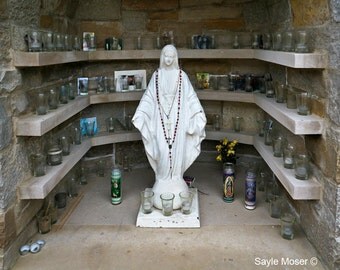
    1. lit novena candles

      I love this image of the novena candles, not only does it help strengthen the effect of Diaz's brother as a God figure to which his parents have "sacrificed" so much of their time and energy but also paints the picture of Aztec culture It's such a great little addition that makes the universe of the poem even more concrete.

    2. Like all bad kings, my brother wore a crown, a green baseball cap turned backwards   with a Mexican flag embroidered on it.

      This phrase stuck out to me in the first read-through of this poem because it made me wonder if Diaz's brother was some sort of a Mexican drug lord or member of the cartel. Colors are an essential part of every gang or criminal organization. The way he sets up in his front yard could be an indicator that he runs a drug operation at his house which is also contributing to the suffering of his family.

    1. lit novena candles

      I love this image of the novena candles, not only does it help strengthen the effect of Diaz's brother as a God figure to which his parents have "sacrificed" so much of their time and energy but also paints the picture of Aztec culture It's such a great little addition that makes the universe of the poem even more concrete.

    2. Like all bad kings, my brother wore a crown, a green baseball cap turned backwards   with a Mexican flag embroidered on it.

      This phrase stuck out to me in the first read-through of this poem because it made me wonder if Diaz's brother was some sort of a Mexican drug lord or member of the cartel. Colors are an essential part of every gang or criminal organization. The way he sets up in his front yard could be an indicator that he runs a drug operation at his house which is also contributing to the suffering of his family.