He will watch over my beloved husband; that whatever may happen, Jonathan may know that I loved him and honoured him more than I can say, and that my latest and truest thought will be always for him.
Ah the undying love trope.

He will watch over my beloved husband; that whatever may happen, Jonathan may know that I loved him and honoured him more than I can say, and that my latest and truest thought will be always for him.
Ah the undying love trope.
Now sit still awhile. Come with me, friend John, and you shall help me deck the room with my garlic, which is all the way from Haarlem
First medicinal mention of garlic. At first Van Helsing introduces it as sort of remedy but reader soon learns it is more of a protectant. Research shows that Stoker lifted this from the idea of garlic being known to have medicinal properties, one of which being a mosquito repellant. This is where the blood-sucking/bite connection is made.
We Szekelys have a right to be proud, for in our veins flows the blood of many brave races who fought as the lion fights, for lordship.
According to the Vampire Almanac: The Complete History by J. Gordan Melton. Dracula in this scene is speaking as a "boyar, a feudal lord and member of Hungarian royalty". The Count as we know resided in Transylvania; a region turned over to Szekelys who's role was to protect Hungarian territory through skilled warfare.
medium weight
In my edition of Dracula, Van Helsing is described as a "man of medium height" not weight. For reference I own the special edition book produced by Union Square & Co. I'm assuming this may have been a misprint on the Gutenberg edition as I doubt Mina would describe someone's weight with the term "medium".
“You yourself never loved; you never love!”
The Count's harem solidifies the fact that these are not his lovers but rather his victims. They are now all bound by the same curse yet he still overrules them. Dominance is put on both the vampire women and Jonathan Harker.
a man of medium weight, strongly built, with his shoulders set back over a broad, deep chest and a neck well balanced on the trunk as the head is on the neck. The poise of the head strikes one at once as indicative of thought and power; the head is noble, well-sized, broad, and large behind the ears. The face, clean-shaven, shows a hard, square chin, a large, resolute, mobile mouth, a good-sized nose, rather straight, but with quick, sensitive nostrils, that seem to broaden as the big, bushy brows come down and the mouth tightens. The forehead is broad and fine, rising at first almost straight and then sloping back above two bumps or ridges wide apart; such a forehead that the reddish hair cannot possibly tumble over it, but falls naturally back and to the sides. Big, dark blue eyes are set widely apart, and are quick and tender or stern with the man’s moods.
Although aspects of Van Helsing's physical being are mentioned in earlier parts of the novel i.e. bushy eyebrows, this is the first time we get a fully detailed description on Van Helsing's appearance. It is an interesting choice to have a female character be the one to account for these details. Mina's glamorized recounting of Van Helsing perhaps leans into the plausibility of Van Helsing being a hero one can romanticize while reading. His physical being is in stark contrast to that of Dracula's who Jonathan Harker described with words like "peculiar" , "cruel looking" and "extraordinary pallor". The image of Dracula has definitely been sexed up in later adaptions but Stoker made it a point to distinguish the Count as a monster among men. The Vampire Almanac states that the film and stage versions of Dracula drastically altered the image of the vampire so as to be more openly accepted in to middle-class British society.
wreaths of mist
Mist is a sign to the reader that a vampire/s will make an appearance. We know what's coming before the character's remark on it. Honestly this happens quite a bit . These characters come to realizations a bit too slowly for my liking but I suppose this is just how they recall events in their writing.
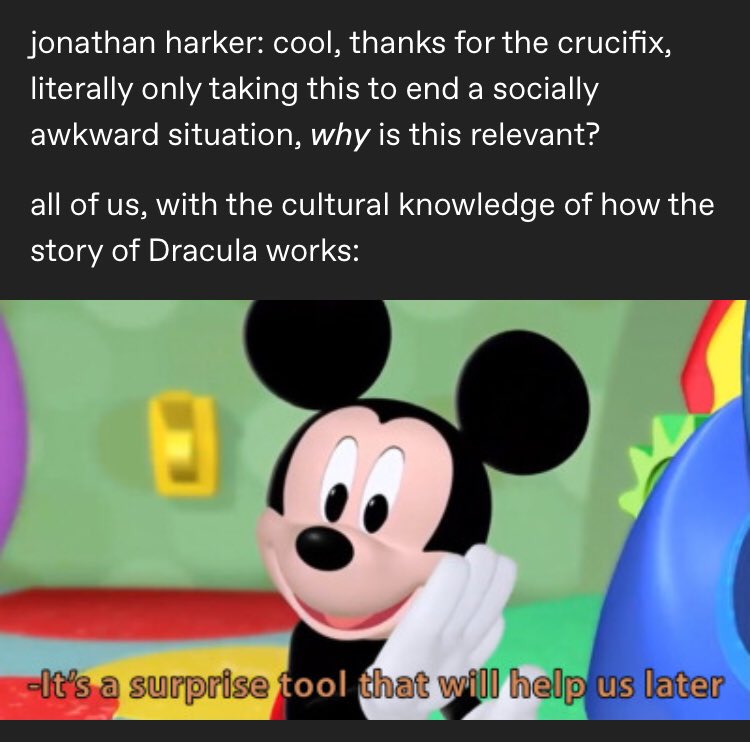
How was it that all the people at Bistritz and on the coach had some terrible fear for me? What meant the giving of the crucifix, of the garlic, of the wild rose, of the mountain ash?

She then rose and dried her eyes, and taking a crucifix from her neck offered it to me. I did not know what to do, for, as an English Churchman, I have been taught to regard such things as in some measure idolatrous, and yet it seemed so ungracious to refuse an old lady meaning so well and in such a state of mind.
I must have been asleep, for certainly if I had been fully awake I must have noticed the approach of such a remarkable place.
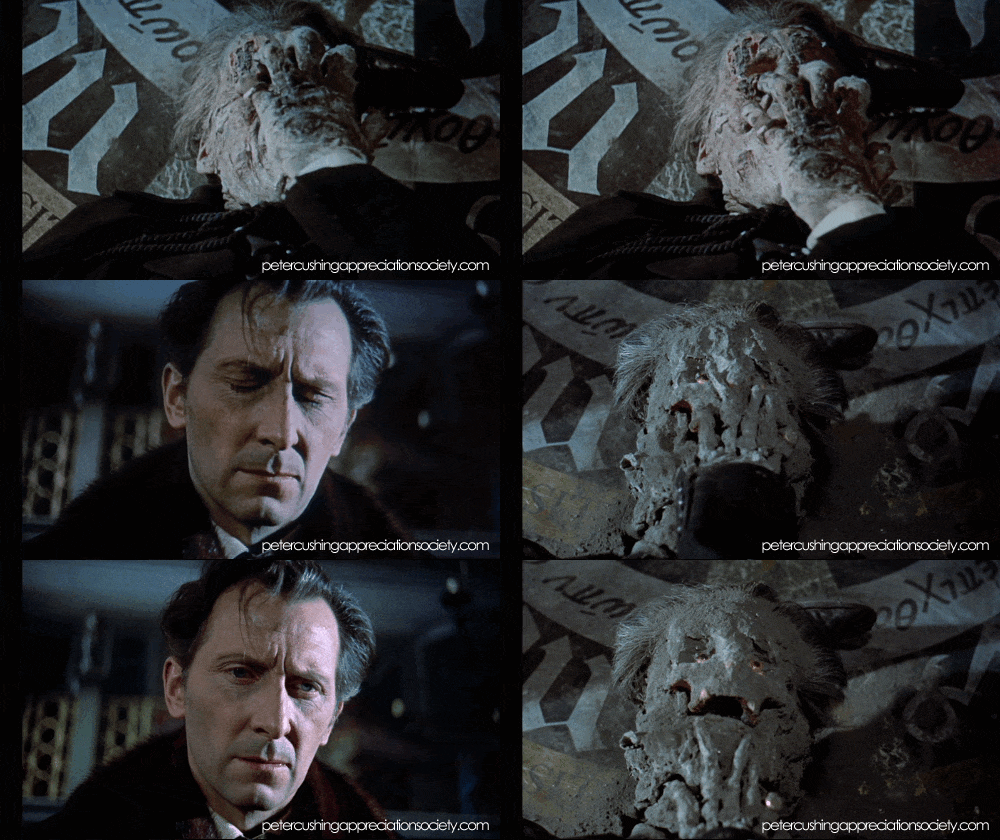
crumbled into dust
For it was the voice of my dear Madam Mina that I heard.
In this scene women are portrayed as the captor and the savior. Van Helsing remarks on a man succumbing to the dangers of vampire lust but comes out of his trance by relying on his willingness to help Mina. Honestly most of these men credibility rely on their inclination to put their lives on the line for women.
The snow is falling lightly and there is a strange excitement in the air. It may be our own feelings, but the depression is strange.
The looming feeling of battle and death are upon our team. It's hard to pinpoint what feelings are emulated during a time of uncertainty but I think Stoker manages to explain it well. They are aware that death and failure may be a likely possibility but they have an air of optimism.
I will strengthen me with breakfast,
Honestly amazed how they can still eat in their situation.
“Traveller’s” typewriter,
An early version of a laptop?
aroused Van Helsing,
There goes that word again.

particulari ad universale.
Adage stating the validity of arguments making the transition from the general to the particular and denying the permissibility of the converse process. — J.J.R.
FUENTE: THE DICTIONARY OF PHILOSOPHY
Taken from biblia.work
I knew that if anything were to take us to Castle Dracula we should go by Galatz, or at any rate through Bucharest, so I learned the times very carefully.
Mina is not just a damsel in distress. In contrast to Lucy she becomes an integral part of the team. She aids them in their work even in her current state. Did Stoker mean for Mina to be a "strong female lead" in order to stray away from the previous concept of women being mere victims for the Count? I mean I appreciate this as a female reader but they are always comparing Mina's mind to that of a man's. I'm sorry but those comparisons seem foolish considering how oblivious some of these men are in the book.
but Van Helsing says I must.
YES! Because the diary entries are essential to their mission as well as the telling of this story. Without the archived writing the story of the Count will cease to exist. (Although we find out later the story is kept amongst them only)
He can transform himself to wolf, as we gather from the ship arrival in Whitby, when he tear open the dog; he can be as bat, as Madam Mina saw him on the window at Whitby, and as friend John saw him fly from this so near house, and as my friend Quincey saw him at the window of Miss Lucy. He can come in mist which he create—that noble ship’s captain proved him of this; but, from what we know, the distance he can make this mist is limited, and it can only be round himself. He come on moonlight rays as elemental dust
In this universe we know Dracula is capable of transformation and can take on various guises.
Winchesters
Noun
a breech-loading side-action repeating rifle.
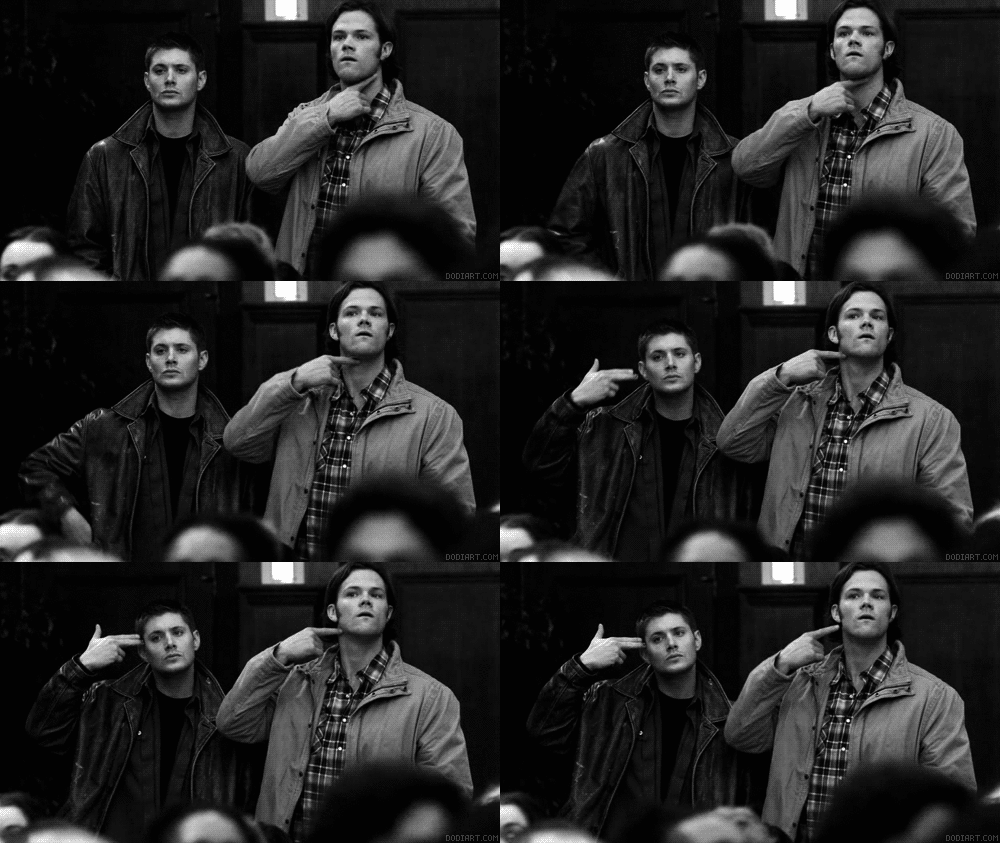 ^^ Not these guys. Although they have been known to fight vampires, so they probably would of been more useful in this situation.
ptomaines
Noun
any of a group of amine compounds of unpleasant taste and odor formed in putrefying animal and vegetable matter and formerly thought to cause food poisoning.
Omne ignotum pro magnifico;
Latin quotation from Tacitus
everything unknown is taken as grand : we exaggerate the importance or difficulty of the unknown
Taken from merriam-webster.com
Tacitus
Roman historian, orator, historian and prose stylist who wrote in the Latin language.
Taken from britannica.com
We men were all in tears now.
Mina is too pure for this world.

but anyhow we were all less miserable, and saw the morrow as not altogether without hope. True to our promise, we told Mrs. Harker everything which had passed;
Shift in tone between the battle against Dracula and tender moments of friendship and love between characters creates a balance of good and evil in the novel. I can't fully consider this book horror fiction when there are so many endearing scenes.
When she saw our faces, her own became as pale as death:
How can she be even paler at this point?
^^^ Mina be like
Festina lente
Latin phrase
make haste slowly : proceed expeditiously but prudently
Taken from merriam-webster.com
Breakfast was a strange meal to us all. We tried to be cheerful and encourage each other, and Mina was the brightest and most cheerful of us.
Mina and the boys at breakfast

en règle;
French phrase
in order : in accordance with the rules
taken from merriam-webster.com
With that he pulled open his shirt, and with his long sharp nails opened a vein in his breast. When the blood began to spurt out, he took my hands in one of his, holding them tight, and with the other seized my neck and pressed my mouth to the wound, so that I must either suffocate or swallow some of the—— Oh my God! my God! what have I done?
If the reader couldn't already be convinced the Count is a villain and monster, this scene of coercion seals the deal.
‘First, a little refreshment to reward my exertions. You may as well be quiet; it is not the first time, or the second, that your veins have appeased my thirst!’ I was bewildered, and, strangely enough, I did not want to hinder him.
I have so many conflicted thoughts on the meaning of this scene. On one hand it plays out like sub/dom fantasy play. I mentioned before how a vampire bite transpires in a seductive manner. The victim is in internal panic and dread but does not fight back. Mina deduces this is one of the assets of the Count's powers. However Dracula exerting this much power over Mina in a taunting way no less makes the word seductive seem trivial. Honestly this seems like SA. trigger warning [sexual assault]
the Count has been to him
Although we could of already inferred this. Why was so much time spent on this patient? Clearly he was integral to the story.
little too pale
It's a bit frustrating that Jonathan and the other's don't question Mina's tiredness and paler skin tone sooner. After Lucy's ordeal and the impartment of Van Helsing's knowledge of vampires, you would think someone would be more aware to Mina's current state.
red eye.
Red eye/s synonymous with Dracula as it is mentioned every time an image of Dracula appears. He is known to have a number of distinguished features but the eyes are emphasized the most.

mist
One of the Count's many guises is mist. I find this the most terrifying as it does not take on a physical body form. How can one escape mist?

She looks paler than usual.

lugubrious
Adjective
especially : exaggeratedly or affectedly
Taken from merriam-webster.com
“In manus tuas, Domine!”
Latin term translated to- "into your hands, sir"
“put these flowers round your neck”—here he handed to me a wreath of withered garlic blossoms

assiduously.
with great care and perseverance.
There was a deliberate voluptuousness which was both thrilling and repulsive, and as she arched her neck she actually licked her lips like an animal, till I could see in the moonlight the moisture shining on the scarlet lips and on the red tongue as it lapped the white sharp teeth. Lower and lower went her head as the lips went below the range of my mouth and chin and seemed about to fasten on my throat.
First almost bite is played out in a seductive manner. Almost as if describing a passion filled kiss. We see Jonathan Harker repulse in fear but also feel stimulated for the act that is about to occur. The lustful nature of a vampire bite is one that is often emphasized in other popular vampire works.
non causa and ignoratio elenchi.
non causa: (noun) the fallacy of giving as a reason for a conclusion a proposition not actually relevant to that conclusion.
taken from dictionary.com
ignoratio elenchi: (noun) a fallacy in logic of supposing a point proved or disproved by an argument proving or disproving something not at issue
taken from merriam-webster.com
We never could have found the dates otherwise….
Reading Dracula and organizing by date through various journal entries and letters was part of our annotating as well!
Arthur and Quincey came home with me, and we tried to cheer each other on the way. We had left the child in safety, and were tired; so we all slept with more or less reality of sleep.
There's something pure and adorable about this scene. I love how these men have trauma bonded over Lucy's transformation.
voluptuous
Dr. Seward mentions the term voluptuous about 4 times in this diary entry. In fact this is a word that comes up often in the novel. Stoker must of had a certain inclination towards this word. Here is a reddit thread I found by someone who remarked on this word usage as well!
https://www.reddit.com/r/literature/comments/to8jgo/what_is_with_bram_stoker_and_voluptuous/)
wantonness
wanton:
(of a cruel or violent action) deliberate and unprovoked.
a sexually unrestrained woman.
pourparlers
French
Noun:
a discussion preliminary to negotiations
Taken from merriam-webster.com
“Are you convinced now?”
Van Helsing trying to convince everyone that Lucy is a vampire.

cicatrised.
verb: to induce the formation of a scar
Taken from merriam-webster.com
bloofer lady.
When I first read this term being used I was intrigued to find out if there was any historical context behind the word bloofer/bloofer lady outside the realm of Dracula. Interestingly enough the term is only explained on the crowd sourced site, Urban dictionary. Below is the definition they provide.
a (female) vampire; most probably from a child's mispronunciation of beautiful as in 'bloofer lady'
Turns out bloofer is a simple slip of the tongue
chapelle ardente
French
(burning chapel).A chamber prepared for the lying-in-state of a distinguished person, and lit up with candles,
Taken from "theoxfordreference.com
laudanum
an alcoholic solution containing morphine, prepared from opium and formerly used as a narcotic painkiller.
“Mein Gott!”
German for "My God"
speak in camera
in camera
in private, in particular taking place in the private chambers of a judge, with the press and public excluded.
“What can I do?” asked Arthur hoarsely. “Tell me, and I shall do it. My life is hers, and I would give the last drop of blood in my body for her.”
You don't say.

Professor Van Helsing
First mention of Abraham Van Helsing. Introduced as a philosopher, metaphysician and one of the most advanced scientists of his day!
She eats well and sleeps well, and enjoys the fresh air; but all the time the roses in her cheeks are fading, and she gets weaker and more languid day by day
Lucy's transformation after being bitten is already shown to be a slow and draining process. Her on and off healing will take up the majority of her storyline from here on out.
I must have pinched up a piece of loose skin and have transfixed it, for there are two little red points like pin-pricks,
First description of a vampire bite. Although Mina is unaware of what the two red points indicate, a reader with background knowledge in vampire lore has figured out at this point what has happened to Lucy. A grave indicator of what is to come.
cum grano
[Latin phrase] with a grain of salt : with skepticism
taken from merriam-webster.com
mirabile dictu
From Latin mīrābile ("wonderful") + dictū, supine of dīcō ("speak, tell"), literally “wonderful to say.”
Taken from wordsense.eu
parti,
Someone (especially a man) who is considered to be a good choice for marriage, because of wealth, status etc.
Taken from wordsense.eu
it would be madness to quarrel openly with the Count whilst I am so absolutely in his power; and to refuse would be to excite his suspicion and to arouse his anger.
Interesting use of the word arouse. Perhaps this was done intentionally on Stoker's part. At this point Harker is aware he is Dracula's prisoner but his emotions seem conflicted.
“How dare you touch him, any of you? How dare you cast eyes on him when I had forbidden it?
Dracula plays out like a possessive lover in this scene. Whether Stoker meant for it or not there are defiantly indications of queer romances throughout the novel. Themes of submission and domination are played up a lot.
blue flames. He then explained to me that it was commonly believed that on a certain night of the year—last night, in fact, when all evil spirits are supposed to have unchecked sway
Blue flames or fire are a ominous trope that has also been used in Japanese mythology. Usually as a representation of ghosts
The women looked pretty, except when you got near them

