But that our soft conditions and our hearts Should well agree with our external parts?
Katherine asserts that since women’s bodies are more delicate than men, their personalities should follow, especially in the context of marriage. This contrast between husband and wife that Katherine has been indoctrinated to believe exacerbates the element of physical dominance otherwise seen in their relationship. Petruchio’s repeated demands of, “Kiss me, Kate,” display his attempts to will her into submission through physical as well as psychological dominance. The irony of this line is that Katherine argues that women were made to be subservient, when she has been beaten from shrewish into submission, and now she preaches demureness to other women. This includes her sister, who is more disobedient to her husband than Katherine is. Lucentio wishes to attend Petruchio’s “taming school,” but perhaps the real teaching occurs between the women. Bianca has been described as presenting herself in exactly the manner that Kate here propagates. Although Katherine very much resisted her taming, perhaps the role she followed when forced into it was that of Bianca. Bianca originally represented an angelic, ideal woman whose demureness and simplicity fit perfectly with her pretty face.
The idea of one’s thoughts and behavior disagreeing with what their appearance deems proper seems twisted, even sinful as not fulfilling the body’s purpose. Katherine says that the outside is correct and the inside must follow. This shows how Petruchio’s dominance over Kate sexually and physically has taught her that physicality matters far more than personality. He sees her body as a vessel for her person, akin to Pandora. This perception of women as vessels is apparent in cultures’ ideas on childbearing as well. At the beginning of the play, Hortensio taunts Kate, saying “No mates for you, unless you were of gentler, milder mold” (1.1.60-61). Here, even the language of "mold" implies that the person is shapeable, even tamable, and that the person follows the body. But this is not news-- it is well known that women are commonly viewed as subservient to men. The Taming of the Shrew goes about presenting an anomaly and preceding to overly correct that.
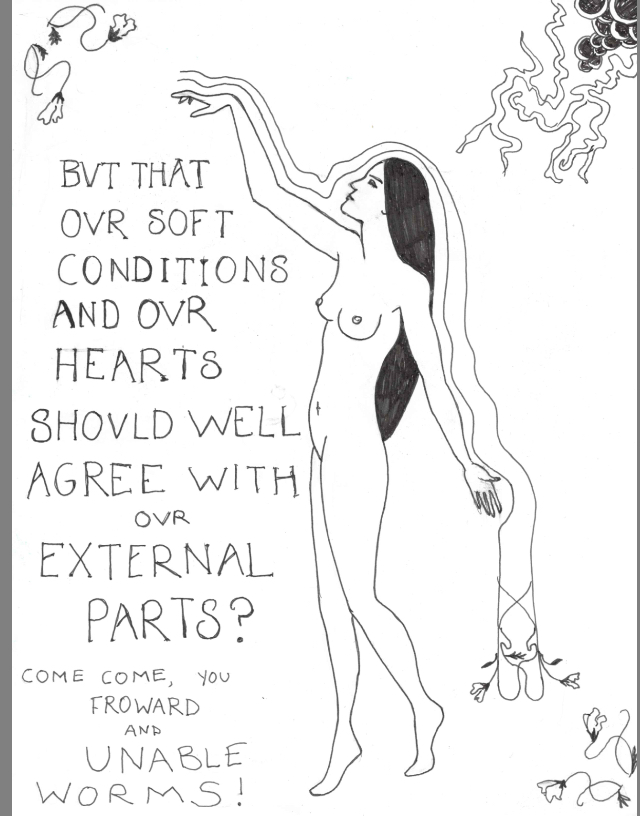 This portion of text included such vivid imagery that I was moved to illustrate the woman Petruchio has born. Her statement has sexual implication and indirectly compares women to men, compares their purpose and their worth and their physicality. Katherine knows her role as she now recognizes her body, and I depicted that recognition.
I used an Art Nouveau style illustration of Oscar Wilde’s Salome as a template. I see comparison and contrast between Katherine and Salome. Katherine is beaten into submission, while Salome breaks societal norms increasingly as the play goes on. The illustration of Salome which I was referring to when drawing was sexual and empowering in its sexuality. (Salome chops of a man’s head, and this violence is associated with her sexuality.) Kate stands in the same empowered and elegant pose, not because she has gained power- she has lost it, rather- but because she is now in the position of taking other women: “Come come you froward and unable worms!” Even now that she is fulfilling a new role, Katherine is able to discover ways to assert her power over others.
This portion of text included such vivid imagery that I was moved to illustrate the woman Petruchio has born. Her statement has sexual implication and indirectly compares women to men, compares their purpose and their worth and their physicality. Katherine knows her role as she now recognizes her body, and I depicted that recognition.
I used an Art Nouveau style illustration of Oscar Wilde’s Salome as a template. I see comparison and contrast between Katherine and Salome. Katherine is beaten into submission, while Salome breaks societal norms increasingly as the play goes on. The illustration of Salome which I was referring to when drawing was sexual and empowering in its sexuality. (Salome chops of a man’s head, and this violence is associated with her sexuality.) Kate stands in the same empowered and elegant pose, not because she has gained power- she has lost it, rather- but because she is now in the position of taking other women: “Come come you froward and unable worms!” Even now that she is fulfilling a new role, Katherine is able to discover ways to assert her power over others.