6 Matching Annotations
  1. Mar 2018
    1. "What signifies it," said the Dervish, "whether there be evil or good? When his highness sendsa ship to Egypt, does he trouble his head whether the mice on board are at their ease or not?"

      In our Enlightenment Reader the naturalist Comte de Buffon discusses the habits and evolution of mice in his piece titled “The Rat.” Buffon states that, “She (nature) has not only put those inferior animals in a condition to perpetuate and to resist by their own numbers, but she seems, at the same time, to have afforded a supply to each by multiplying the neighbouring species. The rat, the mouse, the field-mouse, the water-rat, the short tailed field mouse, the fat squirrel, the garden squirrel, the dormouse, the shrew-mouse, and several others” (Buffon 60-63). Buffon points out that these little creatures will persist even when they are one of the weakest and most inferior species alive. I related this back to Candide by focusing on the moment when they’re discussing if the rats are comfortable on their journey. The irony here is that no one worries themselves about the relief of the mice, but what Buffon points out is that even these seemingly dismissible creatures will resist against the superior species. The mice are merely present on the ship in Candide, but from Buffon’s “The Rat” it’s evident that they can create so much more damage than what is perceived.

      Buffon, Comte de. The Portable Enlightenment Reader. Isaac Kramnick, ed. 1996. Penguin Classics. Print.

    2. The red sheep that reappear throughout Candide could actually be interpreted as red alpaca, which would explain the color of their coat. The alpaca is actually more closely related to llamas, rather than to sheep. When looking up the history of the alpaca, the Encyclopedia Britannica states that, “The alpaca and the llama were both apparently domesticated several thousand years ago by the Indians of the Andes Mountains of South America … The alpaca’s shaggy coat varies in colour from the usual black or brown through lighter shades of gray and tan to pale yellow and, occasionally, white.” Whether Candide thought he was travelling with sheep or not, it’s likely that his journey was with red alpaca since their dark brown coats can have a more maroon hue to them. The Editors of Encyclopedia Britannica. “Alpaca.” Encyclopedia Britannica. Encyclopedia Britannica, Inc., 6 Oct. 2016, https://www.britannica.com/animal/alpaca. Accessed 14 March 2018.

    3. In several places Pangloss claims to have been whipped with a “bull pizzle.” The reader could probably infer that he is somehow being lashed with a bull’s penis, but it’s unclear how this is possible. A brief definition describes a bull’s pizzle as, “The bull’s penis is cleaned and dried. By twisting and stretching during this process, it becomes a vicious, highly flexible whip of 3ft and more overall length. This type of whip was mainly intended for self-defense, but also for punishment purposes.” (http://worldwidewhips.com/whips/bulls_pizzles.html). The history of the bull’s pizzle clearly shows that it was created with the intent to punish by whipping the victim. According to Douglas Harper, the bull’s pizzle was the “penis of a bull used as a flogging instrument, 1520s” which usually left slashes on the back, but were not strictly limited to this region of the body.

      Harper, Douglas. "pizzle (n.)". www.etymonline.com. Online Etymology Dictionary. Retrieved 27 November 2017.

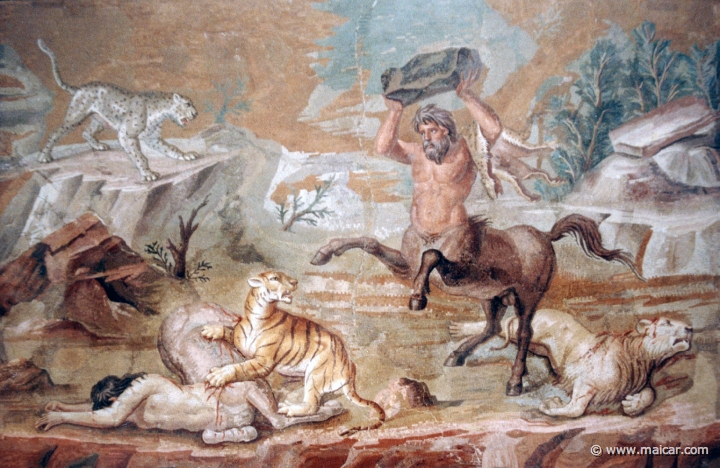
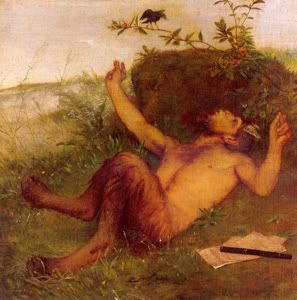
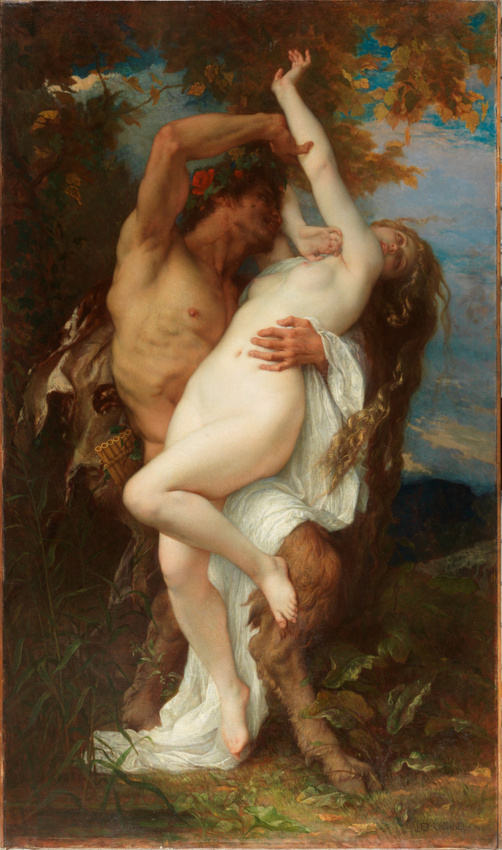
    4. Centaurs are mythological creatures that have the upper body of a human and the lower body of a horse. Fauns have the upper body of a human, the lower body of a goat, and sharp pointy horns. Satyrs are similar to fauns except that they have more curved horns like that of a ram. Candide eludes to these mythical creatures when discussing the absurdity of the women having sexual relations with the monkeys that he killed. It appears that he is talking about interspecies mating, but the article by Mary L. Bellhouse suggests that Candide is talking about more than just monkeys here. Voltaire is using “monkey” as a metaphor for black men. As Bellhouse states, “By the time Haiti declared its independence (1804), this taboo was contravened by Moreau's metaphorical substitution of the figure of the monkey in 1803 to picture the black male as a bestial rapist.” This new insight coupled with the mythological creatures, suggests that Voltaire is commenting that the mixing of Caucasian women and black men is viewed not only as going against race, but also going against the species.

      Bellhouse, Mary L. “Candide Shoots the Monkey Lovers: Representing Black Men in Eighteenth-Century French Visual Culture.” Political Theory, vol. 34, no. 6, 2006, pp. 741–784. JSTOR.

    5. Her bosom was uncovered, and between her breasts she had a beautiful bouquet of tulips, roses, anemones, ranunculus, hyacinths, and auriculas. She dropped her bouquet; I picked it up, andpresented it to her with a profound reverence.

      Pangloss is punished for being a Christian man that lingers a little too long around another man’s breasts when giving her back her dropped nosegay. From the descriptions of the flowers we can assume that a nosegay is a bouquet of flowers. Doreen Yarwood explains the composition and purpose of nosegays, “Sweet smelling flowers, herbs, and perfumes enhanced a person's scent throughout the eighteenth century. The infrequency of bathing made nosegays, or small bouquets, essential for any well-dressed woman.” Women in the eighteenth century were carrying around these small bouquets of flowers to mask the smell of their natural body odor. Women traditionally kept these nosegays within their bosoms which is why they were called “bosom flowers or bosom bottles” (Yarwood). The bottle refers to a small vase that would occasionally hold the various flowers together.

      Yarwood, Doreen. The Encyclopedia of World Costume. New York: Charles Scribner's Sons, 1978. https://www.encyclopedia.com/sports-and-everyday-life/fashion-and-clothing/clothing-jewelry-and-personal-adornment/nosegay. Accessed 14 March 2018.

      Tulips- Anemones- https://i.pinimg.com/originals/16/3e/b8/163eb86daf9a75126a1654ffef2e10ea.jpg Ranunculuses- Hyacinths- https://chairish-prod.freetls.fastly.net/image/product/sized/3a201de9-e8de-46e6-9b85-8c670694898f/framed-18th-century-german-botanicals-hyacinths-from-the-hortus-nitidissimis-set-of-9-3571?aspect=fit&width=640&height=640 Auriculas- https://cdn.shopify.com/s/files/1/0445/1285/products/image_1_large.jpg?v=1456427316