3 Matching Annotations
  1. Jun 2019
    1. it is proved already that you are little better than false knaves;
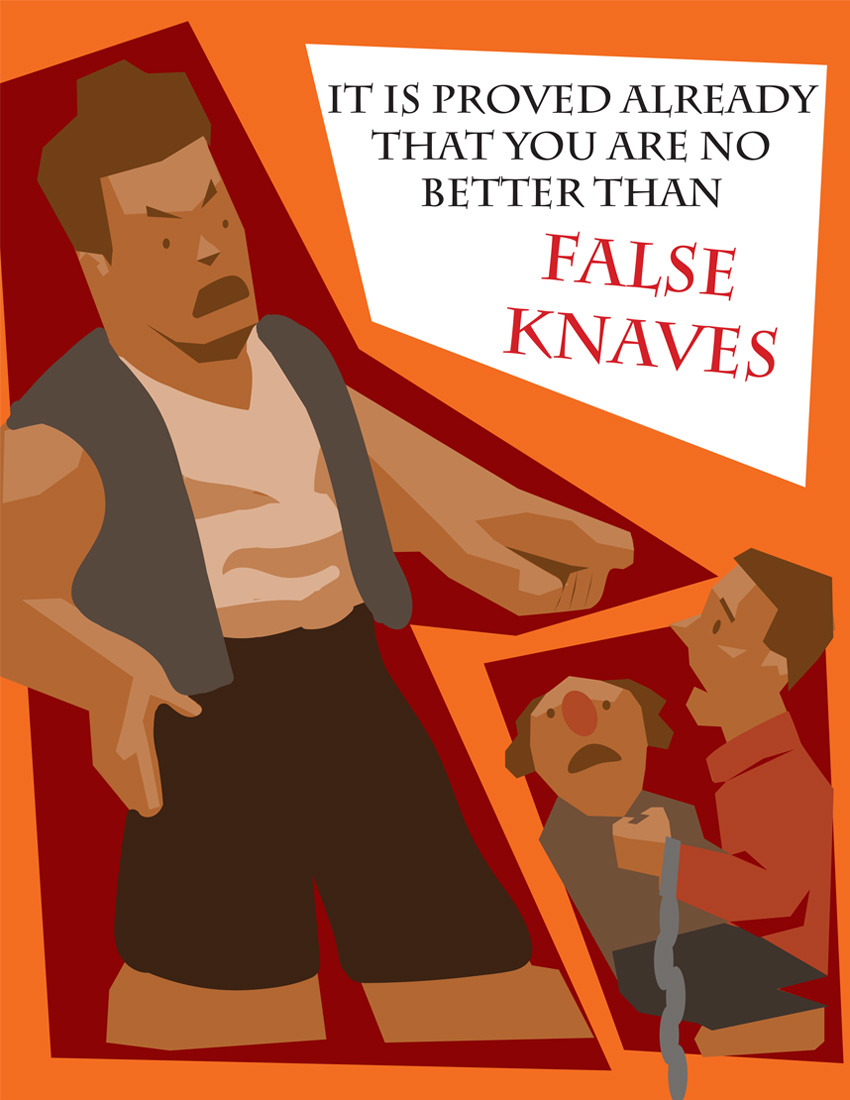
      Dogberry is the character that has the most sway in this scene. Although he is, most of the time, bumbling and misusing his words, Shakespeare puts our expectations of him on his head. He stands accusing Conrade and Borachio of their collaboration with Don John as they can’t do anything to stop him, and has control of the account Sexton writes. He most importantly has Borachio reveal the evil plan of Don John, who’s plotting for the foiling of Claudio and Hero’s marriage. Being the head of the night watch, who was responsible for the capturing of Conrade and Borachio in the first place, Dogberry effectively acts as the hero of the play. Although he acts too late to save the marriage initially, he prevents Don John’s plan from panning out any further. Right in the middle of when Claudio and Benedick challenge one another, Dogberry comes and informs them of their deception. He effectively saves them from their own arrogant and misguided sense of righteousness before one could kill the other. I chose to depict Dogberry in this fashion because he, however flawed, proves himself a saving grace for the characters of the play. I wanted the powerful graphic style of WW2 era posters to turn him into a symbol of inspiration, overcoming his inherit awkwardness to come out on top.

  2. May 2019
    1. where I shouldwed, there will I shame her

      The drama of the character Claudio comes from his incompetence. His shallower side, defined by this section where even at the rumor of Hero being disloyal makes him ready to turn a whole 180 degrees on his commitment to marrying her. This is the most shallow act of his character, and he ends up regretting it later in the play when the trickery of Don John is revealed and he is lead to believe that she had died of this shame he had given her.

      If Claudio was intended to be the more nîave of Shakespeare’s gentlemen in the play, than how could that explain Don Pedro also falling for his brother’s trickery? Considering that Don Pedro let Don John into their castle despite having led an uprising against him, how much is Don Pedro than a gullible fool?

      Although Don John’s trickery may be convincing, why wasn’t there a greater doubt from either Claudio or Don Pedro? Maybe this tells us that Shakespeare’s intention was to cast his protagonists in a dim light as to make it easier for his audience to pity them and therefore laugh at them. Maybe this is just Shakespeare’s play-writing genius showing.

      Whatever mistake Claudio and his advisor might have made, and whatever internal flaw it may or may not show, it does lead the plot of the play into its most engaging sequences. Claudio makes an embarrassment of Hero in front everyone else, accusing of her being the terrible character he perceived her to be but is truly anything but. Essentially he has much a whole bunch ado about nothing.

  3. Dec 2018
  4. www.seethingbrains.com www.seethingbrains.com
    1. One morning, as Gregor Samsa was waking up from anxious dreams, he discovered that in bed he had been changed into a monstrous verminous bug.

      I believe that there may not be better translations of the opening statement out there.

      The trickyness of annotating the opening sentence, lies within the words that Kafka uses in his original German writing:

      Als Gregor Samsa eines Morgens aus unruhigen Träumen erwache, fand er sich in seinem Bett zu einem ungeheueren Ungeziefer verwandelt.Italic*

      The most subjective area of translation lies within the German worded phrase 'Ungeheuren Ungeziefer', which has no simple translation in English. 'Ungeziefer' is a German word meaning 'an unclean animal not suited for sacrifice', its also worth mentioning that this word was used heavily in Nazi Germany to refer to the Jews living their at the time. In English the word is often interpreted as meaning 'vermin'. In the past translators have given the book more literal translations like 'monstrous cockroach' or even 'enormous bedbug'. What I really appreciate about this translation of Kafka's opening words is not the character that it gives Gregor, rather his presumed character. The suffix -ous does magic in the last few words in this sentence. The adjectives used to describe him forshadow the treatment he recieves from the rest of his family. However, I believe that there are future improvements that can be made to the author's translation. If the author wanted to call Gregor an 'insect' he could have used the German word for insect: 'Insekt'. So instead of reffering to Gregor so literally, maybe there should be more associative and subjective meaning that lies closer to the literal meaning of the word 'Ungeziefer'.