Nijinsky
Vaslav Nijinsky was a legendary Russian born 20th century ballet dancer and choreographer.
Nijinsky
Vaslav Nijinsky was a legendary Russian born 20th century ballet dancer and choreographer.
Sacre du Printemps
Sacre du Printemps ("The Rite of Spring") was a ballet composed by Russian Igor Stravinsky. When it was first performed in 1913 at the Théâtre des Champs-Élysées, it quickly became a sensation due to its avant-garde like nature.
Carl Van Vechten
Carl Van Vechten was an American writer, music critic, and photographer. Vechten was a highly regarded figure in the literary circle during the 1920s. This was particular shown since he was Stein's literary executor.
Nude Descending the Staircase
Nude Descending a Staircase (No. 2), 1912. Marcel Duchamp
Demuth
Charles Demuth was an American painter who often used watercolours and then oils later in his career. Demuth was also the leading champion of a painting style called Precisionism.
Ladies’ Voices
Ladies' Voices, written by Gertrude Stein, plays upon the idea of gossip in an environment. It was first performed in 1987.
Mina Loy
Mina Loy was an English artist, modernist poet, and writer. In 1913, Loy started to use Futurist theories in her literary work to help advance feminism.
André Gide
André Gide was a French author and humanisit. In 1947, Gide ended up receiving the Noble Prize for Literature.
Kismet
Kismet, written by Constance Fletcher under the alias of George Fleming, centres around a group of English and American travelers who travel across the Nile in an excursion to find the tombs of the Pharaohs.
Constance Fletcher
Julia Constance Fletcher was an American author and playwrighter
Mabel Dodge
Mabel Dodge was a wealthy America writer and patron of the arts. Her life revolved around artistic and literary endeavours that would often take her abroad.
Clive Bell
Clive Bell was an English art critic, who created the art theory of significant form, and a member of the Bloomsbury Group
Doctor Claribel Cone of Baltimore
Doctor Claribel Cone was a medical researcher and art collector from Baltimore. She is also immoralized in Picasso and Matisse's drawings as well as Stein's essay Two Women.
Sabartes
Jamie Sabartés was a Spanish artist, writer, and poet who had a close friendship with Pablo Picasso that would later
Lady Otoline Morrell
Lady Otoline Morrell was an English noblewoman, hostess, and patron to many writers and artists in her day. She broke conventional, and traditional, protocol of her upper class background by forming a group friendship with artists and great minds.
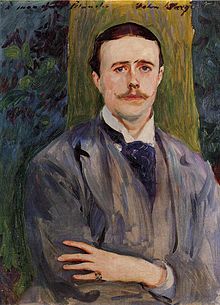
Jacques–Emile Blanche
Jacques-Emile Blanche was a self-taught French portrait artist.
Prichard
Matthew Prichard was a museum curator and supporter of Byzantine art.
Kensington Museum
Kensington Museum opened in 1857 and had a collection of artefacts both from a scientific and artistic nature. The art section of the museum would later greatly form the Victoria and Albert Museum.
Museum of Fine Arts, Boston
The Museum of Fine Arts, located in Boston, was founded in 1870. Besides France, it has the largest collection of paintings created by Claude Monet.
Wyndham Lewis
Wyndham Lewis was an English art critic, writer, and painter. He was also an editor for the BLAST, Vorticist, magazine and a founder of the movement.
Augustus John and Lamb
Augustus John was a Welsh painter and an advocator of Post-Impressionism in England.
Euphemia Lamb was an English model who posed for artists, including Augustus John and Jacob Epstein. She was married to Henry Lamb, a British painter.
Roger Fry
Roger Fry was an English art critic and artist known for his participation in the Post-Impressionism movement. He was also a member of the Bloomsbury Group, which was made up of English writers, philosophers, great minds, and artists.
New York Sun
The Sun was a New York paper that originally published in 1833 and ran till 1950. The ran was later brought back in the early 21st century to create The New York Sun.
Henry McBride
Henry McBride was an art critic and writer for The Sun and The Dial, an avant-garde magazine. He became influentially known as a great supporter of modern artists.
Tender Buttons
Gertrude Stein's Tender Buttons consisted of a multitude of poems covering every day life - objects, food, rooms, people, etc.
Picabia
Francis Picabia was a French poet, painter, and typographist. His art displayed his dabbling with Impressionism and Pointillism before he was connected to Cubism. Picabia did renounced Dadaism however certain concepts of the movement continued to show in his work.
portrait of Mabel Dodge at the Villa Curonia
Portrait of Mabel Dodge at the Villa Curonia, written by Gertrude Stein, was mainly about Mabel Dodge entertained various artists, writers, and great minds at her estate in Italy. It was equivalent to be a literary work of Cubism paintings.
Hope Mirlees
Hope Mirlees was an American poet, novelist, translator, and biographer. She is most well known for her modernist poem, Paris: A Poem, and fantasy novel, Lud-in-the-Mist.
Bernard Berenson
Bernard Berenson, born in Lithuania, was an influential American art historian who specialized in the Renaissance paintings and drawings, especially those pertaining to the Italian Renaissance.
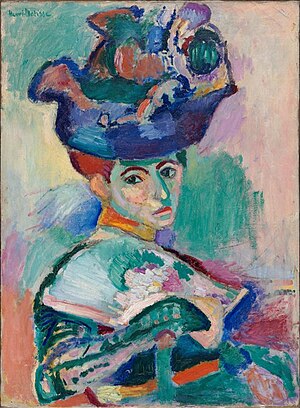
Femme au Chapeau
Blast by Wyndham Lewis
Blast was a Vorticism journal that only published twice, between the years of 1914-1915. Vorticism, a British art movement that criticized traditional British culture, was the entire concept for the journal, to tear away from old ideas and notions.
this spring and early summer of nineteen fourteen the old life was over
This sentence is symbolic in numerous different ways. By Stein writing this, she seems to be commemorating the past with a sort of fondness. That particular "chapter", if you will, is officially closed and in the past and starting now she must move forward like everyone else is and focus on what is to come.
Harry Gibb
Harry Gibb was a British artist whose works were greatly influenced by Paul Cézanne. He moved to various different countries, including France, sometimes for a period of 20+ years.
Georgiana King of Bryn Mawr
Georgina King was an American frontierswomen for hispanic and medieval studies, and a teacher at Bryn Mawr College where she taught the History of Art and Comparative Literature. In 1913, King would go on to create the Department of Art History, the first in the U.S. to include a Spanish Art specialization, and became its first chair.
Saint Theresa was a heroine of Gertrude Stein’s youth
I’m surprised to see that Gertrude Stein’s faith, in Saint Teresa, was something that not only motivated her but also changed her perspective and attitude in her everyday life.
Avila
Avila, located in Spain, is a fortified city famous for its medieval walls and being the home of Saint Teresa.

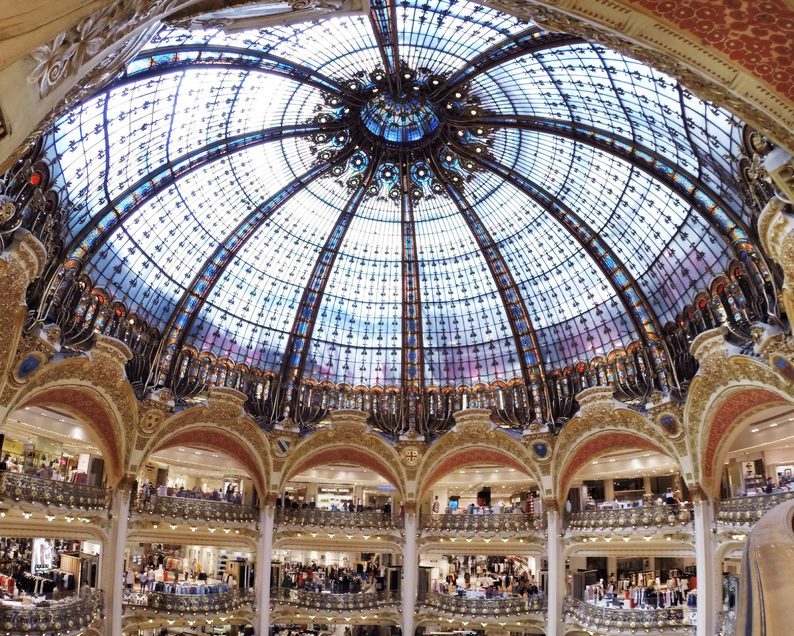
Galérie Lafayette.
Galérie Lafayette, a domed central hall retail department store, whose very own staircase design was inspired by the Paris Opera. There is also a terrace at the very top that offers a panoramic view of Paris.
Geography and Plays
A collection of short stories, plays, and poems written by Gertrude Stein.
Hélène
Hélène was Gertrude Stein's housemaid in her and Alice's home in Paris, France.
Many Many Women
Many Many Women, written also by Gertrude Stein, looks upon a woman's emotions, behaviours, and relationships - not only with herself but with others.
A Long Gay Book
A Long Gay Book, written by Gertrude Stein, carries on where The Making of Americans left off. It continues with looking upon the couples around her - particularly her brother, Picasso, Matisse, and more - and their characteristic behaviours when they are by themselves or within a group setting.
Jane Heap
Jane Heap was an American publisher who played a role in the advancement of literary modernism and an editor for literary review magazine called The Little Review.
Mildred Aldrich
Mildred Aldrich was an American journalist who move to France and started her literary career.
H. G. Wells
H. G. Wells was an English author whose works covered many genres including satire, autobiography, short stories, and many more.
Composition and Explanation
Composition as Explanation is an essay written by Gertrude Stein, mainly discussing how ideas can not ever truly be completed since there is a struggle to give voice to them and how one can only gain a greater access to ones ideas when you think them over and turn them around, starting the process once again from the top. It was originally a lecture given to students at the University of Cambridge and Oxford University in 1926.
Kansas City Star
Kansas City Star is a newspaper service based in Kansas City, Missouri. It originally began to publicate articles in 1880. Since then, the paper has won eight Pulitzer Prizes and is notably the paper where young Ernest Hemingway crafted his writing style.
Poiret
Paul Poiret was a French fashion designer and couturier who was noted for his neoclassical and orientalist styles. He was the founder of the haute couture house with his namesake.
Lipschitz
Jacques Lipschitz, born in Russia, was a French whose sculptors were based on Cubisim principles and a pioneer of nonrepresentational sculptures.
Kahnweiler
Daniel-Henry Kahweiler, born in Germany, was a French art historian and collector. He was notably one of the most noteworthy French art dealers during the 20th century.
Raynals
Maurice Raynal was a French art critic and supporter of cubism.
Germaine Pichot
Germaine Pichot originally started off as Pablo Picasso's roommate when the two quickly became lovers. Their affair ended when Pichot married a member of Picasso's Catalan group. The two still remained friends for the remainder of their lives.
Andre Salmon
Andre Salmon was a French art critic, poet, and writer. He was a mutual friend of Pablo Picasso and Guillaume Apollinaire. Salmon was also defended the artistic style of Cubism.
Apaches
A group of musicians, artists, and writers during the 19th century formed in Paris.
Juan Gris
José González-Pérez, mostly known as Juan Gris, was a Spanish artist who lived and worked in France. His composed still lifes, works done as a painter, which were major works of art connected to the innovational artistic genre style called Synthetic Cubism.
Max Jacob
Max Jacob was a French poet who played a purposeful role in the modernization of poetry. His writing was a blend of numerous faith based religion inspirations such as Judaism, Catholicism, etc.
Marie Laurencin
Marie Laurencin was a French painter, stage designer, and printmaker. She was mostly known for her delicate depictions of elegant women in idealistic landscapes.

Félix Potin
Félix Potin was a French businessman who owned a large retail business.
John Lane
John Lane was a British publisher. He was one of the founders for both publishing houses The Bodley Head and Penguin Books
Gertrude Stein was to go to London in July to see John Lane to sign the contract for Three Lives
The chapter opens with Gertrude Stein writing/editing Three Lives proofs and it has now finally reached the point where she will be signing a contract to get it published.
Roché
Henri-Pierre Roché was a French author involved with the avant-garde artistic as well as Dada movement.
Ronnebeck
Arnold Rönnebeck, born in Germany, was an American modernist artist whose works varied between paintings and scultptors. He was also a lithographer, recording and taking part of celebrating American culture.
Marsden Hartley
Marsden Hartley was an American painter and writer. He developed a distinct type of Expressionism, which was best scene in his paintings of Maine.
(Marsden Hartley, “Log Jam, Penobscot Bay” (1940–41))

Purrmann
Hans Purrmann was a German artist, a follower and friend of Henri Matisse. He was greatly influenced by German expressionism and his friend, Matisse's, fauvism.
Stella
Joseph Stella was born in Italy but later moved to America where he would become a Futurist painter. He was known for his industrial depictions of America. Stella was associated with the American Precisionist movement.
(Joseph Stella, The Brooklyn Bridge: Variation on an Old Theme, 1939)

the three graces
(The Three Graces, 1912 - Robert Delaunay)

Delaunay
Robert Delaunay was a French artist who co-founded the Orphism art movement, a more colourful geometric design. His work would affect the development of abstract art, due to his later work.
Guillaume Apollinaire
Guillaume Apollinaire was a French poet, writer, and art critic took part in all the avant-garde movement during the 20th century. He also guided poetry into the then unexplored concepts.
Moréas
Jean Moréas was a Greek poet and art critic who play a part of the French Symbolist movement.
Vollard
Ambroise Vollard was a French publisher and art dealer from the late 19th to early 20th century.
Gauguin
Paul Gaugin was French post-impressionaist artist. He was a painter, printmaker, and sculptor whose work is known based on his experimental use of colours.
Manolo
Manolo, was a Spanish sculptor and friend of Picasso.
Cirque Médrano
A French circus that was a meeting point for artists. Regulars included Picasso and Braque.
Ingres
Jean Auguste Dominique Ingres was a French Neo-classical painter who was influenced by prior artistic traditions. This would lead him to become a model of cultural conservatism.
Uhde
Wilhelm Uhde was a German art collector, dealer, critic, and author. He was strongly influenced by the ideas of Fredrich Nietzsche, an influential modern thinker, and played a role in Rousseau' career. Uhde would later open a gallery in France where he would exhibit Fauvist and Cubist works.
Kristians Tonny
Kristians Tonny was a Dutch Surrealist painter whose careers spanned from the 1920s till the 1970s. At the age of twelve-years-old he held his first exhibit and in 1929 was an avant-garde artist.
Simplicissimus
Simplicissimus was a satirical German magazine that was published every week since its first publication in 1896 until 1967.
Pascin
Jules Pascin was a Bulgarian French expressionist artist who mostly painted women, often nude or in the stage of undressing. He was known under the alias of the "Prince of Montparnasse" and was associated with the Modernist movement.
Thomas Whittemore
Thomas Whittemore was an archeologist and American scholar who founded later the Byzantine Institute of America, which specialized in the study and restoration of Byzantine architecture and art.
Lycée
A secondary school funded by the government.
Bernheims
Owners of the Bernheim-Jeune. Alexandre Bernheim and his sons, Josse and Gaston.
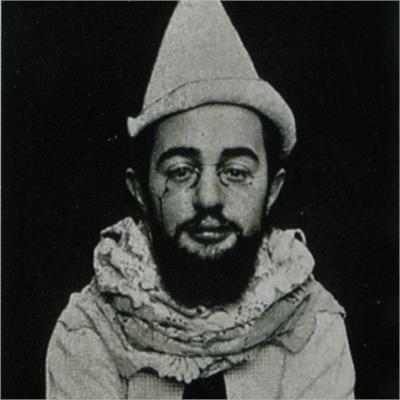
Toulouse–Lautrec
Henri de Toulouse-Laurtrec was an alcoholic, aristocratic, dwarf, French painter. He painted true depictions of the 19th century French life, both the upper and lower class, in a swirl of colours and energy. It created a sense of humanistic work that would leave a long-lasting impression for years to come.
Fénéon
Félix Fénéon was a Parisan anarchist, art critic, collector, gallery director, journalist and editor. In 1894, he alongside a twenty-nine others were arrested on suspicion of conspiracy, though most were acquitted of this charge. He would later become the journalistic editor of the Revue Blanche and coin the term neo-impressionalism.
Bernheim jeune
One of Paris' historical art galleries. It originally opened in 1863 by Alexander Bernheim who promoted realistic and impressionists works.

cher maitre
A person regarded as master or model in art circuit. For example, "Dear master..."
Cézanne water colours
(Paul Cézanne, Montagne Sainte Victoire 1905–6. Tate) https://www.tate.org.uk/whats-on/tate-britain/exhibition/paul-cezanne-exhibition-watercolours

Cézanne
Paul Cézanne is a French artist whose works played an influential role in the aesthetic development of 20th century artists, especially in regards to Cubism. He is also considered to be one of the greats during the Post-Impressionists era.
spanish landscapes
This is important because landscape paintings are rare to find in Spanish art.
(Mediterranean Landscape, 1953, Pablo Picasso.)

Ain
Ain is a river that's located in eastern France in the Jura Mountains that flows into Rhône River.
Saint Anthony of Padua
Saint Anthony of Padua was a Portuguese Catholic priest and friar of the Franciscan Order. Born in a wealthy family, raised in the church, he joined the Franciscan Order in hopes of preaching that the Saracens (later be known as Muslims) to be martyred. He is the patron of the poor and the patron saint of lost items/property. Both Padua, Italy, and Portugal claim Saint Anthony as their patron saint.
Saint Francis
Saint Francis of Assisi was the founder of the Franciscan orders of the Friars Minor, Order of St. Clare, and the Third Order and was also a leader of the evangelical poverty movement in the 13th century. His devotion to Jesus and desire to follow Jesus' example displayed the development in spirituality during the medieval era. Saint Francis of Assisi is the patron saint of animals and ecology.
Saint Theresa of Avila
Saint Teresa of Avila, a Spanish noblewoman who chose to follow the life of a Roman Catholic nun. She started a reform movement in the Carmelite order, one of the four major mendicant of the Catholic Church, which lead to the restoration of simplicity and contemplative character much like that of the early Carmelite life. Saint Teresa of Avila is the patron saint of headache sufferers and writers.
Saint Ignatius Loyola
Saint Ignatius of Loyola is a Spanish theologian, an influential figure in the Roman Catholic counter-reformation during the 16th century (important counter to Martin Luther and John Calvin) and the founder of the Society of Jesus and became its first Superior General at Paris in 1534. Saint Ignatius of Loyola is the patron saint of Guipúzcoa and the Society of Jesus.
Ford Madox Ford
Ford Madox Ford (originally named Ford Hermann Hueffer) was an English editor, novelist, and critic. He left an international influence during the early 20th century. In his long literary career he is remembered for his encouragement of younger writers and his contact with the most highly regarded writers of that day. In 1984, he married Elsie Martindale, the daughter of a prominent chemist.
Sherwood Anderson
Sherwood Anderson was an American author who influenced writing during World War I and II. His writing left an impact on many including Ernet Hemingway and William Faulkner, who both owe their first publishings due to Anderson's work.
Since by the time this autobiography was originally published, Anderson was twice divorced and now on his third marriage to Elenor Copenhaver, who is assumed to be the Ms. Sherwood Anderson addressed.
Pauline Hemingway
Ernet Hemingway' second wife, married in 1927. The two would later divorce in 1940.
Hadley
Ernest Hemingway' first wife, married in 1921. In 1925, Hadley became aware of Ernest's affair with Pauline Pfeiffer (Hemingway). Both would later separate and divorce with her ending up with The Sun Also Rises royalties.
Josette Gris
Joan Gris' wife, Josette, seems to likely be his inspiration for he drew his wife's physical appearance for a few of his portraits. For example, Femme à la mandoline, d'après Corot, Femme assise, and Portrait de Madame Josette Gris.
Marcelle Braque
In 1912 Georges Braque, one of the revolutionary painters of the 20th century, married Marcelle Lapré, that same year both Braque and Picasso entered the Cubism movement. He would join the army during WWI as an infantry sergeant and was decorated twice in 1914 for his bravery. In 1917, Braque would rejoin the Cubism movement but he and Picasso would never work together again.
Madame Matisse
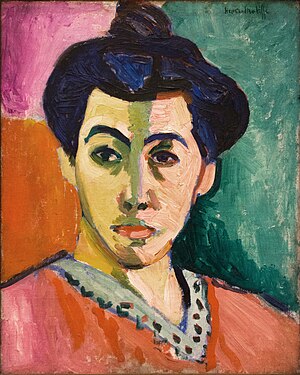
In 1898, Henri Matisse married Amélie Parayre (later known as Madame Matisse) and left Paris, France, for a year where he would spend time in London. Henri Matisse, often considered the most important French painter of the 20th century, was the leader of the Fauvist movement around 1900.
(Matisse, Henri; Portrait of Madame Matisse. The Green Line.)
Fernande
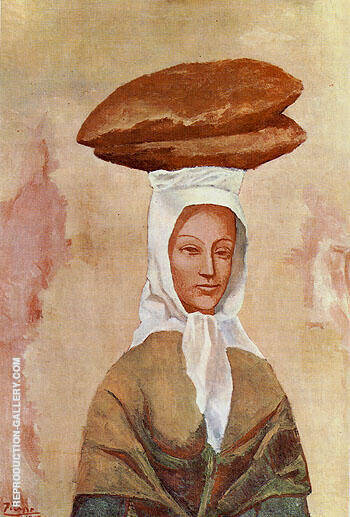
Fernande was Pablo Picasso's mistress from 1904 till 1912. Her presence in Picasso's life inspired numerous works during the Rose Period to Analytical Cubism. This was especially seen during their trip to Gósol, Spain, in 1906 where he would later paint Woman with Loaves.
The Making of Americans
The Making of Americans was completed in 1911, but published in book form in 1925, The Making of Americans is considered to be one of Gertrude Stein's major works. The work is centrered mainly around three generations of Stein's ancestors, particularly the Dehning and Hersland families. She claimed that by generalizing her own family, the book would thereby cover the history of every American. Her objective, when writing this work, was to analyze the nature of every kind of man and woman.
Three Lives
Three Lives is a collection of documentations from women’s suffrage, art, history, and medicine in order for readers to see the realistic depictions of women trapped by class, poverty, race, and those who immigrated and had no choice but to become domestic workers.
boulevard Saint–Michel
The boulevard Saint-Michel forms a part of the major N/S routes with the boulevard de Sébastopol and is surrounded by bookshops as well as stores selling cultural products due to its central location. The boulevard Saint-Michel happens to also be one of the few places where confrontations would occur during the student demonstrations of May 1968.