41 Matching Annotations
  1. Jul 2020
    1. Black Mumbo ate Twenty-seven pancakes, and Black Jumbo ate Fifty-five, but Little Black Sambo ate a Hundred and Sixty-nine, because he was so hungry.

      In Sambo Sahib, Elizabeth Hay notes that some early critics of Bannerman's book were offended by the family's extreme pancake consumption. They claimed, she writes, that "eating so many pancakes made black people look greedy" (155).

    2. And then they all sat down to supper

      This is one of the other most iconic scenes of The Story of Little Black Sambo, yet, depending on the version and publisher, this scene sometimes foreshadows the actual narrative by being placed opposite the title page.

      In Brown Gold: Milestones of African-American Children's Picture Books, 1845-2002, children's literature scholar Michelle Martin contends that the pancake dinner demonstrates that Bannerman intended to positively represent her characters, rather than reduce them to racialized caricatures. She argues, “Writing in the Victorian era when children were encouraged to be seen and not heard, Bannerman created parents for Sambo who not only value their son but give him the hero’s welcome that he deserves after a long day of outsmarting tigers in the jungle” (11).

    3. So she got flour and eggs and milk and sugar and butter, and she made a huge big plate of most lovely pancakes. And she fried them in the melted butter which the Tigers had made, and they were just as yellow and brown as little Tigers.

      Significantly, Mumbo's recipe for pancakes, which includes "flour and eggs and milk and sugar and butter", is distinctly a British recipe rather than a traditionally Indian one, which would be savory rather than sweet.

    4. “Now,” said she, “we’ll all have pancakes for supper!”

      Although pancakes are eaten at any time of the day, for the Scottish, particularly during the Victorian era, pancakes were often eaten during teatime (around 3:30 to 5 in the afternoon). Yet, the Scottish Bannerman makes a choice to turn this snack into the family's supper, which adds an implicit uncivilized nature to Black Mumbo's home economics.

    5. a great big pool of melted butter (or “ghi,” as it is called in India,)

      This detail--naming the butter as "ghi, as it is called in India" adds a layer of confusion to determining the ethnicity and race of Sambo and his family. These small details thrust Bannerman's story into a whimsically fantastic children's tale on the one hand, but also attempt to blunt the blow of outright racism with the defense similar to one that Rosemary Dinnage posits as "adventures… [of a] never-never people in a never-never land" (84). And yet, in invoking this phrasing, popularized in Barcroft Boake's poem of the Australian Outback, "Where the Dead Men Lie" in 1891 but first used by Archibald William Stirling's book, The Never Never Land: a Ride in North Queensland in 1884, she invokes the terra nullius rhetoric that was utilized heavily as justification for colonization and imperialism during the British Empire. The truth is, to reduce the inherently problematic racial politics in Bannerman's children's story by claiming it is all fantasy and fantastical is to pardon the faults on the text just because it was an entertaining story. Yet, this willingness to overlook, or worse, forgive and (literally) forget The Story of Little Black Sambo in the canon of children's literature means to address and embrace the racialized history embedded in the genealogies of American and British literature.

    6. And there he saw all the Tigers fighting, and disputing which of them was the grandest. And at last they all got so angry that they jumped up and took off all the fine clothes, and began to tear each other with their claws and bite each other with their great big white teeth.

      In her analysis of Bannerman's text in Inside Picture Books (2004), Ellen Handler Spitz argues that the tigers serve as a metaphor for adults. She contends that the tigers’ fight over who is the grandest “is one of the most psychologically telling moments in the book, for it captures precisely the way children often see adults - that is, talking angrily to one another and arguing over things that make absolutely no sense” (212).

      Other, earlier critics have used psychoanalysis to read this famous fight scene as a metaphor for sex. Elizabeth Hay sums up one of these interpretations, writing: “The scene in which the tigers turn to fighting each other is based, according to Dr. McDonald’s analysis, on a child’s attempt to rationalize a visual experience of intercourse. The tigers, representing the parents, take off their clothes and chase each other round, ‘wrangling and scrabbling’… After this climax, Dr. McDonald argues that the parents reappear in their normal guise and are loving and kind to their son and give him a large plate of pancakes” (173).

    7. So he ran quickly to a palm-tree

      Bannerman's inclusion of a "palm-tree" both in the text and in the illustrations also suggests that the story takes place in India. Sanjay Sircar writes, "A combination of words referring to Indian things (“bazaar,” “jungle,” “tiger,” “palm tree” and “ghi,” not “market,” “forest,” “lion,” “tall tree” and “butter”) encourage a reading of the text as a beast-fable in India, not an imaginary landscape in Africa, nor the old plantation, nor anywhere else, but the “here” of the author and her children in India” (146).

    8. Presently he heard a horrible noise that sounded like “Gr-r-r-r-r-rrrrrrr,”

      Why the tigers never speak in English after receiving their clothes from Sambo is a peculiar and unexplained aspect of Bannerman's narrative. Perhaps this loss of speech represents a reversion to a more "savage," animalistic nature.

    9. And poor Little Black Sambo went away crying, because the cruel Tigers had taken all his fine clothes.

      This moment, which sees Little Black Sambo divested of all of his fine clothing, often makes the text's underlying racism explicit. While Bannerman depicts Little Black Sambo wearing a cloth wrapped around his waist, later adaptations of the text often portray the boy completely naked, a representation that dehumanizes him and suggests that he should be viewed as primitive or uncivilized.

      For instance, see Gustaf Tengren's 1948 Little Golden Book edition or Nina R. Jordan's 1934 adaptation, both of which employ this troubling trope.

    10. “You could tie a knot on your tail, and carry it that way,” said Little Black Sambo. “So I could,” said the Tiger. “Give it to me, and I won’t eat you up this time.”

      This annotation also appears in the previous note. This exchange between Sambo and the third and fourth tigers are the scenes that other reviewers highlight as showing Sambo's ingenuity and bravery. Compared to his first two interactions, the last two dialogues with the tiger show an increased level of 'problem-solving': Sambo, recognizing that he only has a pair of shoes but the tiger has four feet and that the tiger cannot carry an umbrella, hence tying it to the tiger's tail, emphasize the "heroic" nature of the boy. Oddly enough, compared to the other illustrations of the tigers wearing Sambo's garments, this fourth tiger is most regal-looking in both posture and facial expression. The question as to why clothing (and an umbrella) and "looking grand" matters to these animals is never addressed by Bannerman.

    11. But Little Black Sambo said, “You could wear them on your ears.” “So I could,” said the Tiger: “that’s a very good idea. Give them to me, and I won’t eat you this time.”

      The exchanges between Sambo and the third and fourth tigers are the scenes that other reviewers highlight as showing Sambo's ingenuity and bravery. Compared to his first two interactions, the last two dialogues with the tiger show an increased level of 'problem-solving': Sambo, recognizing that he only has a pair of shoes but the tiger has four feet and that the tiger cannot carry an umbrella, hence tying it to the tiger's tail, emphasize the "heroic" nature of the boy.

    12. And Little Black Sambo went on, and by and by he met another Tiger, and it said to him, “Little Black Sambo, I’m going to eat you up!”

      Children's literature scholar Ellen Handler Spitz has noted that The Story of Little Black Sambo can be read against the grain as an "anticolonialist narrative." From this lens, she argues, the the tigers could represent British colonialist powers, serving “as powers that by force, deception, and terror try to despoil the cultures that existed before they did” (214). However, it is highly unlikely that Bannerman, as a white Scottish woman enmeshed in the British empire, intended for the tigers to be interpreted in this manner.

    13. “Now I’m the grandest Tiger in the Jungle.”

      Curiously, each subsequent tiger's emphasis on "I" (by being in italics) breaks logic within the narrative story-world. The second, third, and fourth tigers do not know of Sambo giving away other articles of clothing, nor do they witness Sambo giving away a different thing to a different tiger. Rather, they all exclaim that this accessory heightens them to grandiosity with the force of the italicized "I".

    14. Oh! Please Mr. Tiger, don’t eat me up, and I’ll give you my beautiful little Red Coat.”

      Some critics have attributed the enduring popularity of The Story of Little Black Sambo to Bannerman's portrayal of her protagonist as an active, clever boy who actively outwits the tigers. For instance, Phyllis Yuill argues that Little Black Sambo was “considered to be an exemplary model of a fresh, positive image for black children when compared with the more negative books of the period” (11).

      Similarly, Ellen Handler Spitz writes, “This is a story about a little boy who is smart as a whip and a true survivor. Children of both sexes can identify readily with him. He is a genuine hero. He has a mother and father who clearly love him and… bestow gifts on him” (211).

    15. Little Black Sambo,

      Even though Bannerman's tale is fantastical, readers may wonder how the tigers know Sambo's name (and full title). This is never explained in Bannerman's original version, but future adaptations elaborate on why Sambo even ventures into the jungle to begin with--most often, to show his clothes off to other people.

    16. Tiger

      Tigers only reside in Asia, implying that the book takes place in India--despite the characters' distinctively caricatured African appearances.

      However, Elizabeth Hay argues that the presence of the tigers only contributes to the book's status as a fantasy story and should not be taken as an indication that the story is set in a real location. She writes that Bannerman “was far too good a naturalist not to be aware that tigers are found in India but not in Africa; no matter. Her jungle-land was an imaginary one, and tigers, which for her were symbolic dragons, were essential to the story” (29).

  2. Jun 2020
    1. Jungle

      Bannerman never explicitly states where this "jungle" is located. While the presence of tigers and her use of the word "ghi" suggests that the story takes place in India, her use of Black caricatures suggests that the characters may be African in origin.

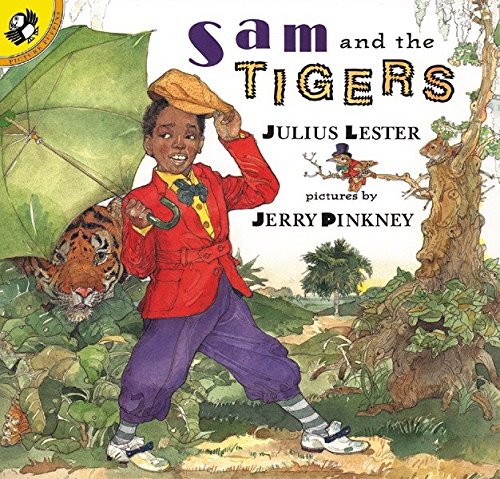
      Due to this ambiguity, later adapters have set their retellings of The Story of Little Black Sambo in India, Africa, and even the American South. In most cases, the creators' choice of setting directly influences how they racially portray the characters. For instance, books set in India, such as Fred Marcellino's The Story of Little Babaji (1996), typically depict the characters with stereotypical Orientalized clothing, like turbans and saris. By contrast, adaptations set in Africa, like John R. Neill's Little Black Sambo, frequently represent the characters wearing grass skirts (or even no clothing at all) and living in primitive grass huts. Finally, adaptations like Julius Lester and Jerry Pinkney's Sam and the Tigers (1996) shift the narrative to the American South.

      However, some critics have argued that Bannerman deliberately made the setting of her book ambiguous in order to enhance the fantasy aspect of the story. Rosemary Dinnage writes, “The Sambo adventures… happen to never-never people in a never-never land that is neither India nor Africa nor--certainly--the American South; alas for Anglo-Indian Mrs. Bannerman, her head full of perfectly real exotic scenes, and real snakes and tigers, innocently coloring her figures black to suit the story” (84).

    2. And then wasn’t Little Black Sambo grand?

      This is one of the most iconic scenes of Bannerman's story, gracing the covers of many editions and adapted versions published in America. Depending on the illustrator and publisher, this scene varies wildly from an innocent depiction of the little boy proudly dressed, or an offensive caricature of an African, African American, or Indian boy garishly costumed in minstrel or Orientalized fashion.

    3. Pair of Purple Shoes with Crimson Soles and Crimson Linings

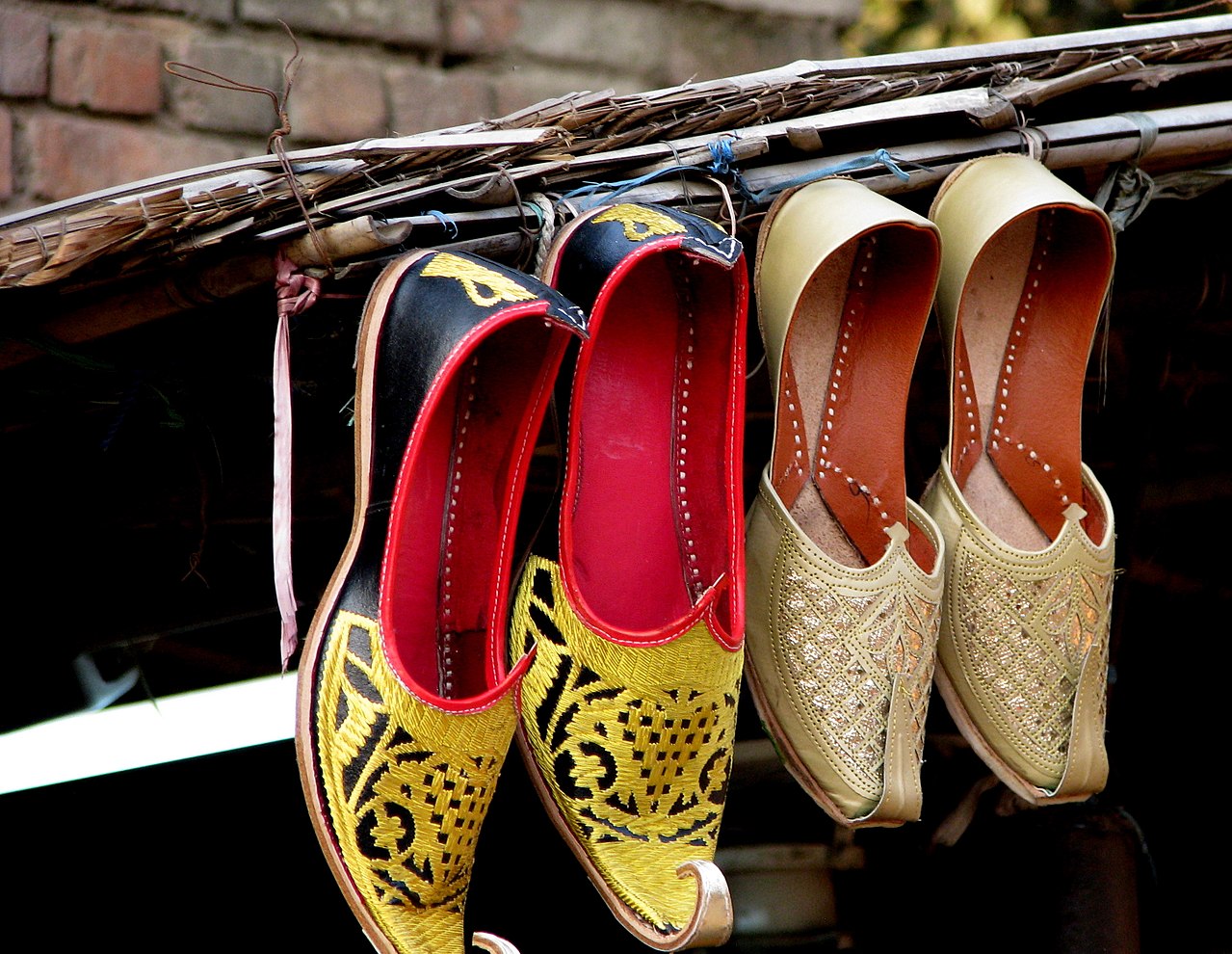
      In “Little Brown Sanjay and Little Black Sambo: Childhood Reading, Adult Rereading; Colonial Text and Postcolonial Reception”, Sanjay Sircar notes that Sambo’s purple shoes have curved toes, suggesting that they are “nagaras, traditional unisex shoes of Muslim origin” (146).

      Another interpretation of the shoe is a Jutti, especially given the pronounced curled-toe that Bannerman seems to be caricaturing as well. Jutti are known to be elaborately decorated, available to men and women, and are inspired by footwear of Indian footwear from the 17th centuries. They are most commonly found in North India but are well-distributed in the surrounding regions as well as globally through the Punjabi diaspora.

    4. Bazaar

      Bannerman's use of the word "Bazaar", a term generally used to describe a Middle Eastern or Indian market, suggests that the narrative takes place in India.

    5. And his Father was called Black Jumbo.

      Phyllis Yuill notes that the name "Jumbo" has a long history in the minstrelsy tradition. She writes, “Jumbo has long been a circus term, and in 1847, a minstrel role called 'Jumbo Jim' was performed” (22).

      Additionally, Bannerman's visual rendering of Black Jumbo as a man wearing fancy, but horribly clashing, clothing -- red striped pants, a green striped jacket, a bright yellow shirt, a blue hat, and a purple umbrella--evokes the Dandy caricature. This figure cast black people who attempted to "rise above their station" as objects of ridicule.

      In Down the Rabbit Hole, children's literature scholar Selma Lanes offers another interpretation of Bannerman's portrayal of Black Jumbo. She speculates that Bannerman based her representation of the characters on her memories of Black Africans in Madeira, where the author resided as a child. Lanes writes, "Surely the dress of her Black Jumbo is more appropriate to a black man of such a semi-tropical, cosmopolitan locale… than to a native of remotest India" (160).

    6. And his Mother was called Black Mumbo.

      Bannerman names Little Black Sambo's parents "Black Mumbo" and "Black Jumbo," words commonly used to diminish or dismiss religious rites and superstitions as nonsense. Additionally, by including the word "Black" in all three names, Bannerman makes the characters' skin color their defining features.

      Moreover, in her review of Phyllis Settecase Barton's Pictus Orbis Sambo, Nina Mikkelson ties the family's names to the larger colonial context within which Bannerman resided. She writes, “To name the mother and father Mumbo and Jumbo produces a musical set of rhyming phrases, but it paints with too broad a brush what family members would be - a set of comical syllables, rather than two individuals. In short, it colonizes them. To name the boy Sambo completes the comical, colonizing trio” (265).

    7. Once upon a time there was a little black boy, and his name was Little Black Sambo.

      The root of the controversy surrounding The Story of Little Black Sambo can be traced to Bannerman's iconic opening line. Her explicit labeling of her protagonist as "a little black boy", as well as her use of the name "Little Black Sambo", has divided critics into two camps.

      Some critics, like children’s literature scholar Michelle Martin, have defended Bannerman’s use of the name “Sambo.” Martin argues that the word would only become offensive later in the twentieth century. She writes, “It was unlikely Bannerman was making derogatory use of Sambo. Following in the Dickensian tradition of giving characters odd, sometimes onomatopoeic, names that play on commonly used words, Bannerman enjoyed verbal jokes and puns, and she chose the names of her characters accordingly” (11).

      However, an examination of the etymology of the term “Sambo” suggests that this defense of Sambo’s name may be misplaced. According to Phyllis Settecase Barton, the term “Sambo” was widely used by colonists as early as 1700, and by 1806, widely applied to any black man or boy. While this suggests that Sambo has a long history just on American soil, Barton also points out Englishman Edmund Botsford’s minstrel play in 1808 (Sambo and Toney) and British Mary Ann Hedge’s book in 1823 (Samboe: Or the African Boy). More famously, “Sambo” was used as the name of a slave in Harriet Beecher Stowe’s novel, Uncle Tom’s Cabin, in 1851, and in 1882, it is defined in An Etymological Dictionary of the English Language as “the offspring of a Negro and a mulatto." Together, these examples reveal "Sambo"'s long history as a racially charged word used to deride black people, a history that predates the publication of Bannerman's book by at least one hundred years.

    8. The Story of Little Black Sambo

      The illustrations included in these annotations are taken from the Frederick A. Stoke's 1899 printing of Helen Bannerman's The Story of Little Black Sambo. Click here to view a digital edition of the entire book in the University of Florida's Digital Collections.

      The sources for the critical notes are listed below. Any quotes taken from these sources are denoted by the author's name and the page number.

      Works Cited

      Hay, Elizabeth. Sambo Sahib: The Story of Little Black Sambo and Helen Bannerman. Barnes & Noble, 1981.

      Lanes, Selma. Down the Rabbit Hole: Adventures and Misadventures in the Realm of Children’s Literature. Atheneum Publishers, 1971.

      Martin, Michelle. Brown Gold: Milestones of African-American Children’s Picture Books, 1845-2002. Routledge, 2004.

      Mikkelsen, Nina. "Little Black Sambo Revisited." Children's Literature, vol. 29, 2001, p. 260-266.

      Sircar, Sanjay. "Little Brown Sanjay and Little Black Sambo : Childhood Reading, Adult Rereading; Colonial Text and Postcolonial Reception." The Lion and the Unicorn, vol. 28 no. 1, 2004, p. 131-156.

      Spitz, Ellen Handler. Inside Picture Books. Yale University Press, 2000.

      Yoffee, Bill. Black Sambo’s Saga: The Story of Little Black Sambo Revisited at Age 98. Bill Yoffee, 1997.

      Yuill, Phyllis J. Little Black Sambo: A Closer Look – A History of Helen Bannerman’s The Story Of Little Black Sambo and Its Popularity/Controversy in the United States. The Racism and Sexism Resource Center for Educators, 1976.

  3. Mar 2020
    1. And then they all sat down to supper.

      This is one of the other most iconic scenes of The Story of Little Black Sambo, yet, depending on the version and publisher, this scene sometimes foreshadows the actual narrative by being placed opposite the title page.

      In Brown Gold: Milestones of African-American Children's Picture Books, 1845-2002*, children's literature scholar Michelle Martin contends that the pancake dinner demonstrates that Bannerman intended to positively represent her characters, rather than reduce them to racialized caricatures. She argues, “Writing in the Victorian era when children were encouraged to be seen and not heard, Bannerman created parents for Sambo who not only value their son but give him the hero’s welcome that he deserves after a long day of outsmarting tigers in the jungle” (11).

    2. The Story of Little Black Sambo 

      The illustrations included in these annotations are taken from the Frederick A. Stoke's 1899 printing of Helen Bannerman's The Story of Little Black Sambo. Click here to view a digital edition of the entire book in the University of Florida's Digital Collections.

      The sources for the critical notes are listed below. Any quotes taken from these sources are denoted by the author's name and the page number.

      Works Cited

      Hay, Elizabeth. Sambo Sahib: The Story of Little Black Sambo and Helen Bannerman. Barnes & Noble, 1981.

      Lanes, Selma. Down the Rabbit Hole: Adventures and Misadventures in the Realm of Children’s Literature. Atheneum Publishers, 1971.

      Martin, Michelle. Brown Gold: Milestones of African-American Children’s Picture Books, 1845-2002. Routledge, 2004.

      Mikkelsen, Nina. "Little Black Sambo Revisited." Children's Literature, vol. 29, 2001, p. 260-266.

      Sircar, Sanjay. "Little Brown Sanjay and Little Black Sambo : Childhood Reading, Adult Rereading; Colonial Text and Postcolonial Reception." The Lion and the Unicorn, vol. 28 no. 1, 2004, p. 131-156.

      Spitz, Ellen Handler. Inside Picture Books. Yale University Press, 2000.

      Yoffee, Bill. Black Sambo’s Saga: The Story of Little Black Sambo Revisited at Age 98. Bill Yoffee, 1997.

      Yuill, Phyllis J. Little Black Sambo: A Closer Look – A History of Helen Bannerman’s The Story Of Little Black Sambo and Its Popularity/Controversy in the United States. The Racism and Sexism Resource Center for Educators, 1976.

    3. And his Father was called Black Jumbo.

      Phyllis Yuill notes that the name "Jumbo" has a long history in the minstrelsy tradition. She writes, “Jumbo has long been a circus term, and in 1847, a minstrel role called 'Jumbo Jim' was performed” (22).

      Additionally, Bannerman's visual rendering of Black Jumbo as a man wearing fancy, but horribly clashing, clothing -- red striped pants, a green striped jacket, a bright yellow shirt, a blue hat, and a purple umbrella--evokes the Dandy caricature. This figure cast black people who attempted to "rise above their station" as objects of ridicule.

      In Down the Rabbit Hole, children's literature scholar Selma Lanes offers another interpretation of Bannerman's portrayal of Black Jumbo. She speculates that Bannerman based her representation of the characters on her memories of Black Africans in Madeira, where the author resided as a child. Lanes writes, "Surely the dress of her Black Jumbo is more appropriate to a black man of such a semi-tropical, cosmopolitan locale... than to a native of remotest India" (160).

    4. Jungle

      Bannerman never explicitly states where this "jungle" is located. While the presence of tigers and her use of the word "ghi" suggests that the story takes place in India, her use of Black caricatures suggests that the characters may be African in origin.

      Due to this ambiguity, later adapters have set their retellings of The Story of Little Black Sambo in India, Africa, and even the American South. In most cases, the creators' choice of setting directly influences how they racially portray the characters. For instance, books set in India, such as Fred Marcellino's The Story of Little Babaji (1996), typically depict the characters with stereotypical Orientalized clothing, like turbans and saris. By contrast, adaptations set in Africa, like John R. Neill's Little Black Sambo, frequently represent the characters wearing grass skirts (or even no clothing at all) and living in primitive grass huts. Finally, adaptations like Julius Lester and Jerry Pinkney's Sam and the Tigers (1996) shift the narrative to the American South.

      However, some critics have argued that Bannerman deliberately made the setting of her book ambiguous in order to enhance the fantasy aspect of the story. Rosemary Dinnage writes, “The Sambo adventures… happen to never-never people in a never-never land that is neither India nor Africa nor--certainly--the American South; alas for Anglo-Indian Mrs. Bannerman, her head full of perfectly real exotic scenes, and real snakes and tigers, innocently coloring her figures black to suit the story” (84).

    5. Black Mumbo ate Twenty-seven pancakes, and Black Jumbo ate Fifty-five, but Little Black Sambo ate a Hundred and Sixty-nine, because he was so hungry.

      In Sambo Sahib, Elizabeth Hay notes that some early critics of Bannerman's book were offended by the family's extreme pancake consumption. They claimed, she writes, that "eating so many pancakes made black people look greedy" (155).

    6. And poor Little Black Sambo went away crying, because the cruel Tigers had taken all his fine clothes.

      This moment, which sees Little Black Sambo divested of all of his fine clothing, often makes the text's underlying racism explicit. While Bannerman depicts Little Black Sambo wearing a cloth wrapped around his waist, later adaptations of the text often portray the boy completely naked, a representation that dehumanizes him and suggests that he should be viewed as primitive or uncivilized.

      For instance, see Gustaf Tengren's 1948 Little Golden Book edition or Nina R. Jordan's 1934 adaptation, both of which employ this troubling trope.

    7. So she got flour and eggs and milk and sugar and butter, and she made a huge big plate of most lovely pancakes. And she fried them in the melted butter which the Tigers had made, and they were just as yellow and brown as little Tigers. 

      Significantly, Mumbo's recipe for pancakes, which includes "flour and eggs and milk and sugar and butter", is distinctly a British recipe rather than a traditionally Indian one, which would be savory rather than sweet.

    8. by and by he met another Tiger, and it said to him, “Little Black Sambo, I’m going to eat you up!”

      Children's literature scholar Ellen Handler Spitz has noted that The Story of Little Black Sambo can be read against the grain as an "anticolonialist narrative." From this lens, she argues, the the tigers could represent British colonialist powers, serving “as powers that by force, deception, and terror try to despoil the cultures that existed before they did” (214). However, it is highly unlikely that Bannerman, as a white Scottish woman enmeshed in the British empire, intended for the tigers to be interpreted in this manner.

    9. Tiger

      Tigers only reside in Asia, implying that the book takes place in India--despite the characters' distinctively caricatured African appearances.

      However, Elizabeth Hay argues that the presence of the tigers only contributes to the book's status as a fantasy story and should not be taken as an indication that the story is set in a real location. She writes that Bannerman “was far too good a naturalist not to be aware that tigers are found in India but not in Africa; no matter. Her jungle-land was an imaginary one, and tigers, which for her were symbolic dragons, were essential to the story” (29)

    10. a lovely little Pair of Purple Shoes with Crimson Soles and Crimson Linings.

      In “Little Brown Sanjay and Little Black Sambo: Childhood Reading, Adult Rereading; Colonial Text and Postcolonial Reception”, Sanjay Sircar notes that Sambo’s purple shoes have curved toes, suggesting that they are “nagaras, traditional unisex shoes of Muslim origin” (146).

      Another interpretation of the shoe is a Jutti, especially given the pronounced curled-toe that Bannerman seems to be caricaturing as well. Jutti are known to be elaborately decorated, available to men and women, and are inspired by footwear of Indian footwear from the 17th centuries. They are most commonly found in North India but are well-distributed in the surrounding regions as well as globally through the Punjabi diaspora.

      Additionally, the shoe could be a Mohari (a similar shoe also from the same region, or a Khussa (second image).

    11. And there he saw all the Tigers fighting, and disputing which of them was the grandest. And at last they all got so angry that they jumped up and took off all the fine clothes, and began to tear each other with their claws and bite each other with their great big white teeth.

      In her analysis of Bannerman's text in Inside Picture Books (2004), Ellen Handler Spitz argues that the tigers serve as a metaphor for adults. She contends that the tigers’ fight over who is the grandest “is one of the most psychologically telling moments in the book, for it captures precisely the way children often see adults - that is, talking angrily to one another and arguing over things that make absolutely no sense” (212).

      Other, earlier critics have used psychoanalysis to read this famous fight scene as a metaphor for sex. Elizabeth Hay sums up one of these interpretations, writing: “The scene in which the tigers turn to fighting each other is based, according to Dr. McDonald’s analysis, on a child’s attempt to rationalize a visual experience of intercourse. The tigers, representing the parents, take off their clothes and chase each other round, ‘wrangling and scrabbling’... After this climax, Dr. McDonald argues that the parents reappear in their normal guise and are loving and kind to their son and give him a large plate of pancakes” (173).

    12. Once upon a time there was a little black boy, and his name was Little Black Sambo.

      The root of the controversy surrounding The Story of Little Black Sambo can be traced to Bannerman's iconic opening line. Her explicit labeling of her protagonist as "a little black boy", as well as her use of the name "Little Black Sambo", has divided critics into two camps.

      Some critics, like children’s literature scholar Michelle Martin, have defended Bannerman’s use of the name “Sambo.” Martin argues that the word would only become offensive later in the twentieth century. She writes, “It was unlikely Bannerman was making derogatory use of Sambo. Following in the Dickensian tradition of giving characters odd, sometimes onomatopoeic, names that play on commonly used words, Bannerman enjoyed verbal jokes and puns, and she chose the names of her characters accordingly” (11).

      However, an examination of the etymology of the term “Sambo” suggests that this defense of Sambo’s name may be misplaced. According to Phyllis Settecase Barton, the term “Sambo” was widely used by colonists as early as 1700, and by 1806, widely applied to any black man or boy. While this suggests that Sambo has a long history just on American soil, Barton also points out Englishman Edmund Botsford’s minstrel play in 1808 (Sambo and Toney) and British Mary Ann Hedge’s book in 1823 (Samboe: Or the African Boy). More famously, “Sambo” was used as the name of a slave in Harriet Beecher Stowe’s novel, Uncle Tom’s Cabin in 1851, and in 1882, it is defined in An Etymological Dictionary of the English Language as “the offspring of a Negro and a mulatto." Together, these examples reveal "Sambo"'s long history as a racially charged word used to deride black people, a history that predates the publication of Bannerman's book by at least one hundred years.

    13. Once upon a time there was a little black boy,

      In Black Sambo's Saga (1997), Bill Yoffee defends Bannerman's use of the word "black" in her opening sentence and argues that this word does not indicate that the author wanted readers to interpret her characters as African. He writes, “There is nothing in this story that even remotely relates to the treatment of Africans or African-Americans. The adjective black refers to the darkness of the skin pigment in much of the population of the Indian subcontinent” (5).

    14. “Oh! Please Mr. Tiger, don’t eat me up, and I’ll give you my beautiful little Red Coat.”

      Some critics have attributed the enduring popularity of The Story of Little Black Sambo to Bannerman's portrayal of her protagonist as an active, clever boy who actively outwits the tigers. For instance, Phyllis Yuill argues that Little Black Sambo was “considered to be an exemplary model of a fresh, positive image for black children when compared with the more negative books of the period” (11).

      Similarly, Ellen Handler Spitz writes, “This is a story about a little boy who is smart as a whip and a true survivor. Children of both sexes can identify readily with him. He is a genuine hero. He has a mother and father who clearly love him and… bestow gifts on him” (211).

    15. palm-tree

      Bannerman's inclusion of a "palm-tree" both in the text and in the illustrations also suggests that the story takes place in India. Sanjay Sircar writes, "A combination of words referring to Indian things (“bazaar,” “jungle,” “tiger,” “palm tree” and “ghi,” not “market,” “forest,” “lion,” “tall tree” and “butter”) encourage a reading of the text as a beast-fable in India, not an imaginary landscape in Africa, nor the old plantation, nor anywhere else, but the “here” of the author and her children in India” (146).

    16. And his Mother was called Black Mumbo.

      Bannerman names Little Black Sambo's parents "Black Mumbo" and "Black Jumbo," words commonly used to diminish or dismiss religious rites and superstitions as nonsense. Additionally, by including the word "Black" in all three names, Bannerman makes the characters' skin color their defining features.

      Moreover, in her review of Phyllis Settecase Barton's Pictus Orbis Sambo, Nina Mikkelson ties the family's names to the larger colonial context within which Bannerman resided. She writes, “To name the mother and father Mumbo and Jumbo produces a musical set of rhyming phrases, but it paints with too broad a brush what family members would be - a set of comical syllables, rather than two individuals. In short, it colonizes them. To name the boy Sambo completes the comical, colonizing trio” (265).

    17. Bazaar

      Bannerman's use of the word "Bazaar", a term generally used to describe a Middle Eastern or Indian market, suggests that the narrative takes place in India.