atthepointwheretheuniversalpunishmentsofthelawareappliedselectivelytocertainindi-v1dualsandalwaysthesameones;

atthepointwheretheuniversalpunishmentsofthelawareappliedselectivelytocertainindi-v1dualsandalwaysthesameones;
pointtothewaysthatdigitalmediadonotradicallybreakwiththepast,butredistributetheweightbetweenthecategoriesthatbindartandculture
Ive never really thought of how computers have changed the ideas of art. I agree that it doesn't break with the past, its not a now art vs. then art but more of a growth on then art. Technology allows average people to view art meaning that they are able to learn about art without gong to museum so it has binded the categories of art and pop culture.
IG.3
I used to have one of these and this is very creepy and i dont like it.
goodartistskeptspringingupinthemidstofenor—mousdifficulties.
I like this about art. The harder the life the more meaningful the work and effort put into the pieces.
Althoughthistypeofrealisticpainting,basedoncopyingaphoto,wasoftenusedtomakelargeportraitsofrevolutionaryheroes,themostimportantpainterswentinanotherdirection.
ohhh roasted
ModernismcanberegardedastheAfricanizedperiodofWesternart
This is interesting to me because modernism was a lot about consumerism and consuming extra which is the opposite of the "American view" of Africa .
curios.
a rare, unusual, or intriguing object.
Thisstructuredoesnotqualifyasartduetothedegreethatitlookslikealready-acceptedart
what?
Then came this art-industrial frenzy, which turns mere art lovers into gawking street urchins.
It is interesting how when art became a popularity contest regular art lovers joined in on the craziness. Usually people involved in art circles stay away from the mainstream but with this they followed to main stream.
Together their works explore what it means “to be global,” when free and equal cultural exchange is still limited by the power dynamics of globalization
While I think people should be free to exchange information, it is limiting the style that people will see from a culture if theres one artists representing a whole country. I see the the currator is trying to share information freely but it is important to share many different views from peoples of a culture.
thestandardizationofeconomy,culture,andglobalproductionacrossborderscomesatatimewhenbarriersandsegregationareincreasingandpreventingcommunicationinregions
It is an interesting concept that while people are more likely to view something from another country, through technology, the politics of today create boarders so those people cant see this art in person
Theinformationflowrev-olutionandtheever-increasingpotentialsofcommunicationtechnologiesandeffectiveandsystematicworldwidemarketingcampaignshaverenderedbordersfullypermeable
While I can see the negatives I feel that technology has created an experience that we are still getting used to. Since information can travel so quickly people are able to experience things that they had not before. We still need ways to create less stereotypes through this technology but I do believe that it is good.
distributedcondoms
protestagainstanartsystemthatpitstheartistagainsttheselectivejudgmentofart-worldauthorities
cool protest but why shrimp?
Super flatness' is the stage to the future.
ok but why and how?
super flat.
Superflat is a postmodern art movement, founded by the artist Takashi Murakami, which is influenced by manga and anime.
in which he cooks vegetable curry or pad thaifor people attending the museum or gallery where he has been invited to work.
Rirkrit Tiravanija's net worth is $1000000 (debatable). Im not saying that he doesn't deserve money as an artist but I don't understand why this is considered art but the chef at the restaurant down the street is just cooking.
One could argue that in this context, project-basedworks-in-progress and artists-in-residence begin to dovetail with an “experienceeconomy,” the marketing strategy that seeks to replace goods and services withscripted and staged personal experiences.
This quote is weird to me cause creating art is hard and artists aren't paid justly for their goods and services so if an artist has to create something for a certain buyer and make their own work in their own time I don't think this is bad.
Others havesummoned the public to observe a specificphenomenon, the way Robert Barry announced that at ''a certainmoment during the morning of the 5th of March 1969, half a cubicmeter of helium was released into the atmosphere" by him. Thespectator is thus prompted to move in order to observe awork, whichonly exists as an artwork by virtue of this observation.
I am confused on the way that this is artwork. I understand that he says its artwork so it is but I don't know why this is something he decided to do and what people thought of it.
Also fun fact: this much helium can hold 0.031 pounds
is it asculpture? an installation? a performance?an example of socialactivism?
"the visitor becomes an active actor in a work in process." "with no boundaries between installation, sculpture and performance." In this article I also discovered that this piece was funded by ABSOLUT vodka. Which possibly adds to the social meaning of the piece Quotes are from an article on https://aajpress.wordpress.com/2012/04/25/timefood-new-york-and-berlin-soupno-soup-paris/ written by ZENAIDE85.
"shock effect"
I can see it from both perspectives. One is that this is shocking because he isn't nude he's naked and looks like he's exposing himself. The other side is that I don't understand why this is that shocking because it is done to women all the time, why is it a big deal when it happens to a man? Im not saying it is right but it's what culture wants to see, a women's naked body with no head, making her an object to lust after instead of a human being. Why is this so shocking when it is done to a man?
We were, of course, disturbed by the racial dimension of the imagery and, above all, angered by the aesthetic objec- tification that reduced these black male bodies to abstract visual "things," silenced in their own right as subjects and serving only to enhance the name of the white gay male artist in the privileged world of art photography

Not saying its right but...
"an amendment that would forbid the funding of offensive, indecent and otherwise controversial art." But who is the decider of what offensive and indecent means? Is there a handbook on the difference between porn and a tasteful nude?
"Because he is not an artist, he is a jerk. Let him be a jerk on his own time and with his own resources. Do not dishonor out Lord." This quote is very interesting to me in 2 ways. Why did they just rush to judgement of the piece and not ask the artist why he did this and what he was trying to convey. And why does the government think that they have a say in the art that goes in museums. There is already someone with that job.
4 The message is that art, because it is timeless and universal, transcends individual lives, which are time-bound and contingent
This is interesting because often times we talk about art as more important than the actual life of the person. When we talk about artists we discuss the works that we perceive as famous but don't think about how they were a real person, living and breathing.
virtually every official campaign of highly visible public information about AIDS-whether AIDS education in schools, public service announcements on TV, or posters in the subways -must meet with the approval of, among others, the immensely powerful and reactionary Cardinal John J. O'Connor.
This follows the idea of silence equals death. The ignorance that the government is showing here, not allowing public talk about AIDS shows the fact that it was uncomfortable but there needs to be public discussion about uncomfortable things in order to keep people safe.
"But even though that death warrant has been periodically reissued throughout the era of modernism, no one seems to have been entirely willing to execute it; life on death row lingered to longevity."
I think this is interesting because you can say painting is dead but unless museums agree with you, you're alone in your statement.
"painting has an essence and that essence is illusion, the capacity to materialize images rendered up by the boundless human imagination."
I like this.
These young painters ingratiate themselves by pretending to be in aweof history. Their enterprise is distinguished by an homage ro the past, andin particular by a nostalgia for the early days of modernism.
This is interesting because I feel that this is what contemporary art is about. Trying to learn the history and trying to either repeat it or try to differentiate themselves from it.
"Not mearly a liberation from anxiety but a liberation from every other kind of feeling"--"For better or for worse much of the art of the period seems to bear out the pertinence of these ideas" I like this idea of art, that the people making art at the time wanted to better their mental health and thats why they created.
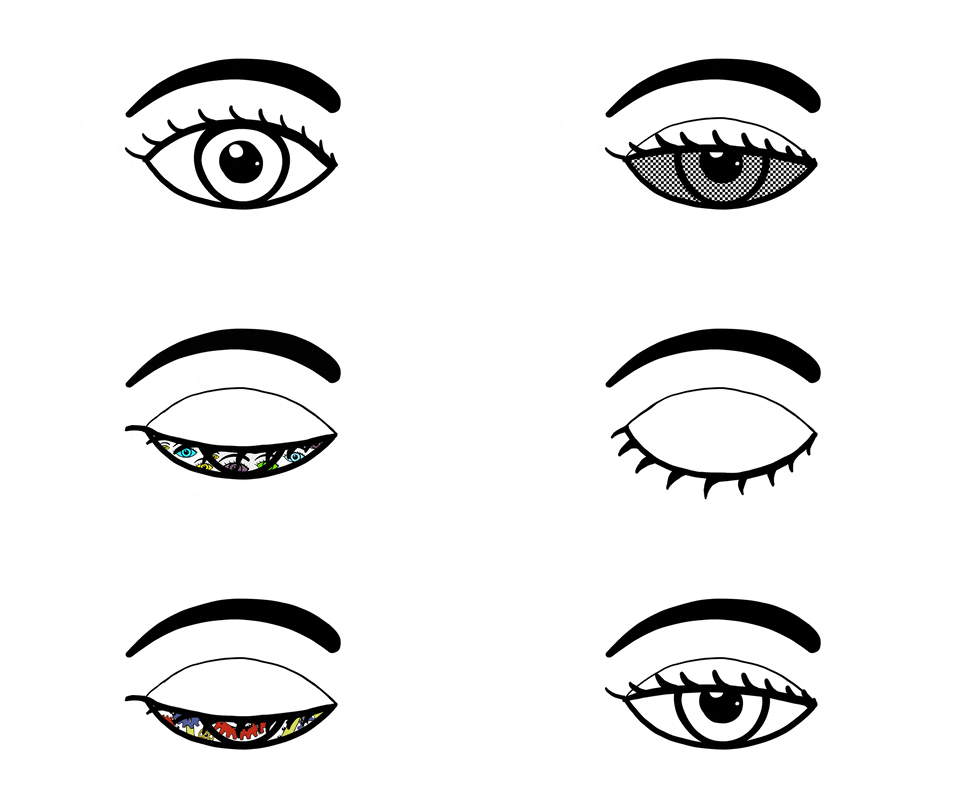
"The ideal modernist spectator was a disembodied eye."
On page 7, The paragraph that starts with "Fruit trees in this world are ancient..." has very great imagery of Van Gogh's work.
On page 14, the last paragraph is the perfect description of postmodernism. "Van Gogh- like madness" and the relation to drug and alcohol abuse, and social problems seems like this is what post modernism was about.
The artists are wittily proposing that contemporary art is concerned withposing questions, usually about itself,
This is a really good way to explain a lot of contemporary art, makes some of its ideas easier to understand.