Pathologically, AD arises mainly due to the formation of two typesof lesions in the brain, neuritic plaques and neurofibrillary tangles
Important Quote
Pathologically, AD arises mainly due to the formation of two typesof lesions in the brain, neuritic plaques and neurofibrillary tangles
Important Quote
Interestingly, a-secretase cleavage takes place betweenresidues 16 and 17 of the Ab region. Therefore, the proteolyticcleavage performed by a-secretase precludes the formation of Ab,thus eliminating the possibility of the formation of aggregates andplaques and causing a-secretase activity to be considered non-amyloidogenic.7,18 Further, sAPPa has been suggested to havesome neuroprotective properties
interesting how alpha secretase also has been suggested to have neuroprotective properties.
While the exactphysiological function of APP is not entirely clear, APP and itsderivatives have broad functions in cell–cell 1
While the exact physiological function of APP (Amyloid Precursor Protein) is not entirely clear, researchers have identified that APP and its derivatives play crucial roles in cell–cell communication and various biological processes. APP, a transmembrane protein, is known for its involvement in neuronal development, synaptic function, and the maintenance of cellular homeostasis. The intricate interplay of APP and its cleaved fragments highlights their importance in signaling pathways, contributing to the regulation of cell differentiation, adhesion, and response to external stimuli. Understanding the multifaceted functions of APP is fundamental to unraveling its significance in both normal cellular processes and pathological conditions, such as neurodegenerative diseases like Alzheimer's. Researchers continue to explore the complexities of APP to shed light on its diverse roles in cellular biology
Wave
Combination of the other two basically.
Wave Propagation
cant pass through the liquid part of the core
Wave Propagation
(pressure waves) sonar detection
Wave Generation
landslides can create giant waves in bc and norway etc. Geological events caused by earthquakes. This can create substantial waves especially tsunamis.
How are Most Surface Waves Generated?
most surface waves are formed by the wind it blows along the seas surface and creates a wave. .
How are Internal Waves Generated?
Wavelength is 100 miles, its a huge wave but we never see it because it is between two water masses. This impacts the continental shelf. 2nd photo shows wave propagation off of the island in tasmania.
Wave Generation
There is a disturbing force which causes waves to be generated. - Often youll see clear air, and then a cloud and the cloud will have ripples. A pycnocline is a change in density due to a change in salinity. Air-water boundary is the waves we think of all the time. Top surface of the water or bottom surface of the air. This is a boundary Phenomenon You can see that in the diagram there is a wave formed at the boundary,
The fusiform face area (FFA)
Its about visual expertise. People have weird visual expertise like bird watchers
Are we particularly good at perceiving faces?
The thature effect.
The fusiform face area (FFA)
cant recognize faces because of damage to one area to the brain
Functional
This suggests that there are brain areas that do very specific things which is true.
Apperceptive
Completely unable to recognize objects
Akinotopsia
(Dorsal Stream) Could recognize but could not perceive objects in motion
is responsible for object/face recognition; this
Ventral is for recognition, Dorsal is for action.
Cortical processing of visual signals
Back of head up to parietal lobe is Dorsal
Cortical processing of visual signals
There are neurons in the visual cortex that respond to bars of light at different angles.
Different Neurons LIKE DIFFERENT ANGLES.

Cortical processing of visual signals
There are cells in the visual cortex that specifically respond to angled bars of light. If we record from the VC of a cat, we show the bars of light at different angles and some neurons really like bars of light at a particular angle ( vertically oriented )
Central visual pathways
The right side of the retina sees/transduces the left side of the world. and the left side of the retina sees the right side of the world. The optic chiasm is a brain structure where your left visual field and your right eye and vice versa join together to cross over. There is a crossing over of information. the optic chiasm is just to ensure that the visual fields project information to the correct hemisphere. - the thalamus is the brains relay station. The info is relayed through the LGN of the thalamus. - BoldThis is called contralateral processing - why ? we dont know
Random variables
we use a capital letter to denote random variables we use a lowercase for a value a random variable can take
Hypothesis
Screen hypothesis was predominant for decades but recently it shows that it is actually related to light levels. Light released dopamine which regulates the growth of the eyeball so if you dont have this dopamine early in life, your eyeball grows too much. Some evidence shows that light early in life is important for regulating the shape of your eyeball such that you dont develop myopia later on in life. - In many asian countries they are moving classes outside so that you are more directly in contact with sunlight.
Common disorders of vision
If youre nearsighted, it means that your eyeball is a little bit too long, images/light are focused in front of the retina as opposed to on the retina. Farsightedness- images/light are focused a little bit behind the retina - Your eye cant change enough to correct itself.
Common disorders of vision
Color blindless predominantly affects men which is about ~8% of men. Usually its red vs green. - Color blindless occurs in opposing pairs because you cant distinguish one of the pairs. If you can see the 74, you do not have a problem perceiving the difference between red and green.
Colour
A creation of the mind- the cushion isnt red, its reflecting light that primarily consists of red wavelengths. it simply says what type of light is being reflected from the object. The cylinder isnt green, it just reflects light that we perceive as green. This all relates to top-down and bottom-up processing of information.
Opponent
The cones interact with eachother, so that we tend to perceive colors in terms of opposing pairs. red vs green, yellow vs blue etc. The other theory was just incomplete. Flashlight in your eye creates blue ish light after.
The retina and colour
The phenomenon of negative afterimage is important and flipped.
perception
Two theories of color perception. 1st; we have three different cones. a long, a medium and short (blue). When you look at a particular color, what you perceive is the overall pattern of firing of these three types of cones. Very intuitive and does explain color. - It doesnt explain the negative afterimage. the way this works is if you look at red for a long time and then you look at a blank page, youll see green.
Rods and cones
The photoreceptors are the actual cells that register light. we have two different types; rods and cones. There are more cones in the center of the retina, What we call the fovea - we want things to be in our line of sight / fovea if youre reading a book etc. -Rods are mainly your peripheral vision - Cones respond to different wavelengths of light. There are cones that respond to wavelengths that we perceive as red, blue and green. This allows us to see color. - Rods are good at amplifying light. at night you are most likely using your rods to see. They are more important for fine details where as Cones are more importantly used for color
retina
This is where transduction occurs. This is the group of cells that takes the physical signal and transforms it into an action potential. in the case of the eye it is the photoreceptors. - Light strikes the photoreceptors. This causes it to release neurtransmitters which act on a second set of neurons called bipolar cells. these bipolar cells are on a third set of neurons called ganglion cells and those are the ones that actually send the action potential to the brain. - All of the axons of the ganglion cells come together and they send action potentials to the brain via the optic nerve -Light passes through all layers of the retina, his the photoreceptors etc. -Your brain interprets those action potentials as visual sensations. - What action happens is well beyond the scope of this course. - Key is that photoreceptors are triggered by light and the action potential signal is sent to the brain via the optic nerve. - The blindspot, theres a part of our visual field that cannot be detected because theres no photoreceptors there to interpret it. The lense has a big hole in it but we dont see a hole in our lense because topdown information fills in the blank.
anatomy
How do we take light waves and transduce them into signals to our brain. The eye is a super complex organ and we will start with the pupil. This is the structure that lets light into your eye - Surrounding the pupil, is the iris (muscle that expands and contracts to allow in more light) as a reflex to protect the eye - The retina contains rods and cones and light has to be focused accurately on the retina which is done by: - The cornea: sits just behind the pupil in front of the lense and it protects the eye. it helps focus light on the retina. When things arent in focus (E.g.,peripherals) the cornea and the lense help. You can reshape the cornea using lazers to correct stuff like near sightedness, myopia and far sightedness. - The lense changes its shape through accommodation so when you look at something close up, the lense changes in shape to accommodate for something being really close up e.g., your iphone.
Amplitude and the perception of brightness
Like any wave, you can have big and smasll waves. light waves differ in terms of amplitude, high amplitude light waves, and low. The height of the wave related to the brightness or dimness of an object. Bigger amplitude means brighter.
Wavelength and colour perception
The wavelength of light relates to our perception of colors. color perception is very useful. Color along with smell is good for us to be able to tell which foods are safe to consume.
What is light?
All waves have peaks and troughs. the difference between peaks is the wavelength. Audition - hearing, talking about frequency - number of cycles/peaks per second so its related to wavelength because as frequency increases wavelength decreases. - Wavelength is a really important aspect of light and it relates to how we perceive colors. - Light waves with different wave lengths are perceived as having a different color. - The light waves of something are reflected and all have a similar wave length if its all one color E.g., Chalkboard. - Visible Spectrum, we can only see a little bit of the visible spectrum of light, our brain is limited.
Transduction
We're interpreting signals to form some sort of individual representation. Images are in your head and we see things thare occurring in the w orld but these images dont necessarily reflect the external reality. your prior-knowledge and past experiences can dictate how you perceive information such as visuals. Action potentials are important ** how light waves are converted into action potentials.
perception
Attention shapes perceptual awareness. -noisy room but u wanna selectively attend to the task at hand.
down processing
BottomUp is interpreting signals Topdown is memory key idea is that this prior knowledge changes and depends on experience. you can gain knowledge which will then change your perception of the world or change top down processing etc etc.
More modern theories of perception view perceptual processing
Does not leavec a lot of room for experience. how we fill in these gaps is based on how we experience things in our world. The conclusions that we come to about what we are sensing, depending on the sneosry signals, and experiences that we've had ( aka prior knowledge). - also just known as memory.
Imagine driving on a foggy road and your mind is basically filling in the blanks because youve driven there before. think about how this would be different had you of never driven on those roads before let alone at night.
Closure
We see a panda even thought his shape is incomplete. our brain likes to complete sensory signals. if youre walking around you rarely see the bases of buildings but you automatically perceive them as whole objects. Sensory signals are sparce or incomplete and the brain fills in the gaps.
Continuity
Incomplete stimuli but we complete the image ourselvces [] (https://s3-us-west-2.amazonaws.com/courses-images-archive-read-only/wp-content/uploads/sites/902/2015/02/23224746/CNX_Psych_05_06_Continuity.jpg) Our brains are wired to see things as complete, our brain will expect this hose to be fully attached since its just chillin on the ground
Principles of Gestalt psychology
We tend to perceive things that look similar as being part of a group. in this image, we perceive 5 poliece officers and 4 protestors not just 9 people.
: objects or figures tend to pop out of the
You see things that pop out like black on white. Your brain is wired that way.
Gestalt psychology
The whole is greater than its parts. you perceive this as a rectangle not as a bunch of dashed lines. **
Signal detection theory
Response bias and sensitivity Allows us to study the psychological factors that go into our perception and sensations
Signal detection theory
One problem is that the absolute threshold and difference threshold can vary dramatically between people. There's psychological factors that go into whether or not we report if a stimulus is met.
Signal detection theory is a way to examine how people perceive their world. We have by default psychologically are inclined to
psychophysics
A difference threshold relates to our ability to sense change in the stimulus. Weight example Fechner would be interested in if we add more weight to the weight youre holding, how much more weight would you have to add before you are able to notice. - Depends on how much of that stimulus is already there. if you have a really heavy weight and you add a light weight you wont notice that but if you have a light weight and you add another light weight you wont feel it as much.
psychophysics
The absolute threshold measures the minimum amount of stimulus that is required for you to perceive it 50% of the time.
Usually starts with stimulus you can detect and then turn it down as opposed to vice versa.
Psychophysics
He was a philosopher which is called in psychology field psychophysics. Fech ner pioneered several approaches to perception that we still use today.
Sensation
Attempt at interpreting those signals - key idea - understand one thing - PERCEPTION DOES NOT EQUAL SENSATION.
You can decide to perceive this cube in a number of various different ways. you can say this side or this side is the front so therefore the interpretation is different. Its really the brains best guesst **
Transduction
The brain will interpret these action potentials as certain things like various smells, tastes etc.
Sensation to perception
All sensations must be transduced. transduction is the act of changing something. Transduction ends with sending action potentials to the brain. Smelling roses - nerves in your nose - chemicals become collected and turned into an action potential.
Sensation
Sense organs recieve stimuli
Movement Parallel to Shoreline
Longshore current vs drift.
Current: a function of the waves breaking at an angle to the shore up to4 km/h which is pretty fast. The speed increases as the beach slope increasses Drift: A function of the movement of the sediment in a zig-zag pattern, This is caused by longshore current. it only occus in the surf zone; no surf- no longshore drift. There will be a current but it will be so slow that it will have no impact. Important process so that spots dont get backed up with sediment. the deltas are constantly being undermined by wave action and drifts because it is pushing it in one direction.
Rip Currents
Rip current with great example of what it looks like. no froth on the water etc etc, a bunch of water is moving out and you can see it, its a little browner and there's some sediment into it.
Perpendicular to
Motion that we have to create the longdrift effect. Wave-dashing. Swash is the wave, backwash cuts the new waves on the bottom as they come in. This is what we call Long Shore Drift. responsible for creating things like lagoons
Movement
Each of these arrows is describing a type of input/output. depositing or eroding
ThIs could be over a daily time period. this is meant to be a riptide where water is coming into a shallow beach and it gets in there and it all gets out at one spot. When it gets back out, the velocities are increased dramatically- this is a riptide.
Depositional Shore Features
Spit is from shore into deeper water. The bay barrier has an outlet but it is largely creating a large estuary/lagoon behind it which is kind of an environment where lots of different organisms get their start. this is a vital environment in the ocean shore.
Barrier island is just offshore deposits parallel to the coast separated from the mainland.
Depositional Shore Features
Usually have a lot of sediment on them. It is carried to the shore by rivers, currents, sea cliff material calling off. It is predominantly carreid along the shore by something called longshore drift. The delta brings in all sorts of sediment but when it gets closer to the ocean it deposits finer material in the land. There is a longshore drift that moves all of this stuff around.
Erosional
You usually have rock sitting there on the ocean coast. Headlands, coves, seastacks, arches, blowholes, sea cliffs.
Erosional & Depositional Shores
Beaches can be erotional or depositional, a place where things are eroding away or a place where things are depoisiting. There isnt a lot of sediment in first pic, thats erosional. on the right, we see this big thing of material and its stratified, you can see layering from deposition.
Beach Composition
Material will not stay in one place. When you get big storms in the winter, it washes all the very small particles from on the beach off shore and theres a big drop off in terms of depth. In the summer its no question, a summer beach. Beaches are sand silt and clay.
Ocean Regions
The coast is actually the land. The coast line is the boundary between the coast and the shore. Every day, waves are washing up on shore, there are waves on the surface of the ocean but these waves are made of particles of water that are rotating as this wave is propogating through the water., the wave has a certain depth to which iat will disturb sediment. If you get a storm, you get big waves. those big waves will disturb sediment to a greater depth. storm wave base depth is the base wave depth that will disturb the sediment. The beach is the part that is affected by waves. low and high. Offshore, nearshore, foreshore (shore) lots of different terms describing the features described by the processes going on at a shore coastline
Outline
the more we understand environments the better we will undeerstand inhabiting organimssms
Basalt Chemistry
There are major mineral ways of distinguishing these environments but there are also trace element ways of distinguishing these environments.
Basalt Tetrahedron
This is a way opf thinking about these basalts. You can see the six important minerals, these are various positions around the shape. its a trigonal tetrahedron which has a base that is a triangle but there are planes which divide the triangular pyrimide up into three different parts.
Akalic has nepheline, plagio, and olivine. we find these in the ocean island arcs. olivine tholeitte inclutes ortho, olivine, and quartz. These are where magmas have just came in, this is called a primitive midocean ridge tholeitte.
This isnt just looking at the major elements., we can use the ratio of certain elements to determine whether a rock is a tholeitte etc
and the third part is quarts tholeitte which is quartz, orthopyroxene, plagioclase, and clinopyroxene. These are common in midocean ridge environments.
Basalt Chemistry/Mineralogy
They are a little different in each place but all basalts are formed from 8 basic minerals. if we allow them to crystallize, we will see these 8 minerals, 4 majors and 4 minors FORMULAS ARE IRRELEVANT only remember the names what varries from different basalts is the ratio if these minerals.
going oceanic crust slabs in subduction zones
Stratavolcanoes have a lot more explosive activity which causes more ash which gets covered by lavas and builds up a steeper volcanic profile. They are creepier. Kanaga Volcano is insane. Island of Okinawa has lots of big Volcanoes. Illucian Islands makes up an island arc. These are different types of environments where different types of basalts errupt
Stratovolcanic edifaces are steeper than shield volcanoes (in ocean islands)
Island Arc Basalts (IABs)
These are the ones that make volcanoes above the subduction zones. Water gets into the ophiolite infrastructure and those waters alter, and change the olivine in those MOIBS into serpentine which is very soft, (Magnesium Cillicate). Plagiclase, olivine, the pyroxenes do not have H groups in their chemical structures. The subducting lithosphere has a lot of serpentine in it, it is heated up and water is driven out of it which goes up to the mantle and causes another wet melting. Magma will descend to the base of the crust, may have teo crystalize some denser rocks to be able to remain buoyant (magnetite, pyroxene, olivine. they ascened through strata volcanoes and eventually start to crystallize quartz.
Ocean Island Basalts (OIBs)
Largest Volcanic edifices on earth. the exposed island represents a very small proportion of the volcano. shield-type profile. Very good for looking into space. img on slides showing the original mauna leaua. These are huge. mauna kea has an elevation of 4205m above sea level but extends 6000m below sea level.
wet melting
different means of melting. these rocks melt because the fluids coming up are adding water to them, theyre causing the rocks to have water within them which causes the rock to melt, temperature and pressure dont change. Coming from the core of the mantle boundary to the eye of the mantle. these truly produce volcanoes, the MORBS produce the ocean floor but these make mf volcanoes. clinopyroxene, orthopyroxene, plagioclase, olivine,
) that are underneath oceanic crust
Fluids rising from mantle boundary.
Ocean Ridge Basalts (MORBs)
decompressing melting is important. This can cause the mantle to melt, it doesnt melt 100% but its what we call partially melted. that produces magmas that rise to their equillibrium density depth. These comprise 95% of basalts in the ocean. Theres some in Oregon, New Zealand, etc. they are very uncommon to see as MORBS but the rocks are not.
Ocean Ridge Basalts (MORBs)
Referred to as an ophiolite complex and consists of pelagic sediments, eruptive pillow lavas at the top, sheeted dykes, gabbro intrusions, layered gabbrons and peridotites. 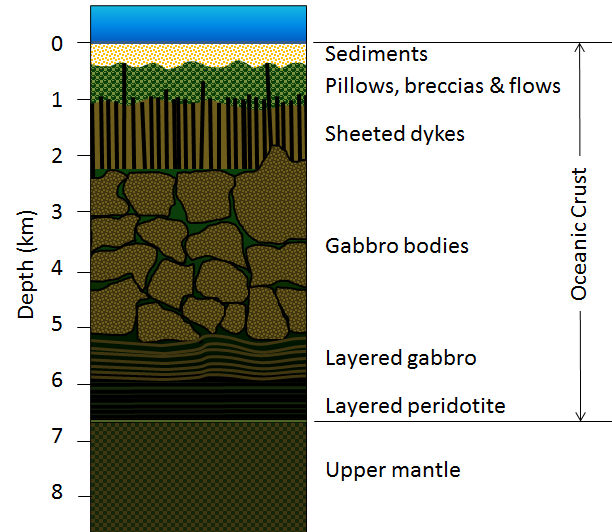
We have volcanics at the top and plutonic equivalents at the bottom. these ones have things like pyroxenes and plagioclases. layered gabbros and peridotites are made of olivine, pyroxene and plagioclase - these are basically where these gabbros have crystalized materials - crystals are denser than the magma. once we get to the bottom of that, the beginning of the mantle becomes apparent (look at pp)
In OMAN in the east side of africa that created a nice illustrative sequence of rocks just like this that make up the kind of classic omphalic complex.
Basalts on the Sea Floor
-3 principal types of basals that will erupt on the ocean floor
MORBasalts OI Basalts - these are the ones that are sitting above hotspots like hawaii and the lavas are coming out as you can see IA - sub ducting oceanic crust and melting of the mantle and formation of volcanoes in places like japan.
Ocean
We see volcanics from the ocean floor and we can figure ouit waht environments they errupted in using the chemistry and minerality of the volcanics.
Generating Power from Ocean Currents
There is an opportunity to generate power from ocean currents. *trying in bay of fundy. Actually trying in tidal stations on the north side of scotland theres a couple of islands where they are exploiting the currents to generate power with the movement of water in this part of northern scotland. - This has been very successful.
NSPower is not really succeeding. power is through the roof theyre stupid, thought they could micromanage AND went to the worst place possible.
While they did this there were tidal stations in england, northern scotland, korea, france, a bunch of other places which were much more modest.
NSPower exploited us. they thought it was go big or go home and they put a big tidal station where the velocities are highest where it only took a few weeks before a boulder broke it lol. They could have executed this far better. They got greedy. Risks: This applies also to windmills. We all think that the tidal station has a thing that would cut fish. it cut really big fish like sturgeons and the big other fish, all the very small fish can fit through them but they dont want to. *Its not like a fan- you are not spinning blades to push air. With a turbine, you're taking energy out, (blades are slower)
Conveyor
Illustrates where some of the warm shallow and cold salty deep water currents are. We see cold water coming up just about everywhere.
Ocean Currents => Deep Currents
Ocean Currents => Deep Currents
We are basically taking water and turning it into a solid. this leaves behind salt which causes it to sink. - Temperature doesnt matter much this is why the red line turned into the blue line last slide
Ocean Currents => Deep Currents
Warm is surface blue is deep
Ocean Currents =>
Currents are driven largely by density. agro floats They could move up and down in the water column and they do that on a regular basis. Gives us an idea of whats happening from 0-2000m deep. goes from where the shallow currents are and goes down to the deeper ones. They move up or down and they are tethered to the ground. - Solar powered. Communicate in satellites, download or upload data, and then go down again.
Other
Used to catch salmon in lake michigan on the left side and the wind is normally blowing from the east to the west and it brings cold water up right at the shore hence he could catch the fish off the shore.
On the other side however, the warm water is blowing onto the shore and the fish dont wanna be there so they go to where prof. was standing.
A short bend in the coastline can cause upwelling and downwelling - this creates currents which end up being the surface currents.
Coastal Upwelling & Downwelling
We can actually have upwelling and downwelling on a coast.
If wind is from the south, water deflects towards the shore and you get a Downwell. & vise versa - This is usually along the edges of continents. On the continental slope- the deep part.
Mixing of Deep & Surface Waters
Do these mix much? They do.
They mix if the cold deep waters rise whereas if the warm water descents its downwelling. Upwelling is essential for fishing. Downwelling isnt as important as Upwelling in terms of exploiting the sea for food.
Surface Currents Influence Climate of Nearby Landmasses
The Atacama desert is the dryest place on earth. Why? Because cold dry air is coming up north which is mimicked by a cold current going from the south coming north.
On the east coast of SA, theres Hot air and warm currents moving south which allows the east side of SA to be very warm.
Circulation
Huge circulation cells N & S Pacific Gyres.
Ocean Currents => Surface Currents
Monsoons are a temporal very strong windy, rainy season. You get monsoons in southern asia which are quite substantial. Part of the factors is that the indian ocean gyre is bringing up moisture. On the left you can see the state of the currents in the winter and on the right you can see the summer currents.
Antarctic
Driven by basically all the polar winds. Convergence *. Theres a convergence and it marks the boundary of the Antarctic ocean.
Ocean
Subpolar
Theyre not as big a player because theyre not traversing a huge area of temperature difference but theyre important for fisheries and things like that.
Equatorial
The equatorial region is the boundary of the gyres. as you can see some of the currents are heading east, some are heading west but theres one in the middle heading east which is interesting. Gyres deflect where they are affected by the Coriolis effect.
Gyre
Just big loops. There's a bunch of them, north pacific south pacific. North Atlantic south atlantic but no south and north indian gyre just the Indian Ocean Gyre.
occur in and above the pycnocline(layer of changing waterdensity) up to 1000 m depth• affects 10% of ocean water• caused by major wind belts andhelped by the Coriolis effect,seasonal changes, and oceanbasin geometry• shape of continents affect windbeltsOcean Currents => Surface Currents
Occur above the pycnocline, above the halocline (within the top thousand meters of the ocean.)
You can expect to have trade winds as seen in the illustration. This helps to create shallow water surface currents that earlier explorers exploited. When Columbus arrives in America, he didn't sail from Spain straight to the Caribbean. He sailed down the coast of Africa and then used the trade winds to find the Caribbean.
Currents are Wind or Densitydriven
Deep currents are only density driven.
Seawater Variations with Water Depth
Salinity, Pressure, and Temperature are all factors of seawater variations.
Review
Air circulation zones (Hadley). They create surface winds and the coriolis effect has an impact on them. from the equator, these are easterly trade winds. Between them is a low pressure zone. this is where there are tropical rain zones.
In high pressure zones, creates prevailing westerly trades. Right in the poles you get a polar easterly. These are all called headley cells
Ocean Climatic Regions
We think of the oceans of having climatic regions, we have the same thing on land. A,B, Arid A,B Zones on land but in the Ocean its much more simple. there are 6 different categories.
Classified 1-5 based on Saffir-SimpsonIntensity Scale
We've never had a category 3 hit Nova Scotia. It spins counter clockwise due to the Coriolis effect. The storm on the west side tends to drop more rain than the storm on the east side.* When hurricane juan came up through Halifax, you could see all the trees blowing over on one one side they were facing one way (E-W) but the other one was travelling another way (W-E) That's how you can tell the difference in the eye.
Storm Jargon
Storms in the atmosphere that affect the ocean *. Tropical Cyclones are different than Hurricanes. If its in the Indian Ocean, it's a cyclone. If it's in the Pacific Ocean its a Typhoon and if its in the atlantic ocean its a hurricane.
In a tropical cyclone, there is a very well developed eye that can be seen from satelite view. This map is to show the different tracks of various cyclones in the indian, pacific, and atlantic ocean. In the Atlantic they curl up from the equator and go NNE (sorta)
The hurricane is formed right over warm water and it therefore does not lose a lot of energy when it has to travel up north. It moves a lot more to the north in the Atlantic Ocean; this is due to the Gulf Stream.
When the same amount of solar radiation
Still talking about the atmosphere. Particularly in Nova Scotia, BC, etc.. There's a few things that happen when the sun shines on the land and the sun shines on the ocean that are different.
Land heats up much faster than the sea. 5x more. It will get more moisture in it, the air is going to go up. Air will flow in from the ocean and it's the cooler air and the land pulls it in. We see this a lot on sunny days. Because the cool air replaces the hot rising air from the land. The cycle is repeated and the ocean wind blows back out.
outliers
17.5-20, 90-110
symmetric
last one
skewed
2nd
ight skewed
1st one
multimodal
third
uniform
fourth
hide
first one
this histogram is distributed "right secured"
distribution
this distribution is called 'uni-model'
set? What GPA value is in the center of the distribution?
approximately 3.6 gpa
Today we will review common methods for conducting research in
type of study we run can dictate our conclusions/
Mean salary offered to the female applicant was$26,507.94○ Mean salary offered to the male applicant was$30,238.10
This difference is statistically significant. The wage gap is way too large in this scenario.
I and III
Only statements that can be true
Does there appear to be a relationship between the hours of study perweek and the GPA of a student
This is association not causation.
loan50
name of figure 1.3
For students in their 1st or 2nd year of study- a first offence will result in the requirement to redo the assignment and submit a1-page paper describing what plagiarism is and how to avoid it.- an incident of plagiarism in a psychology course that is determined throughconsultation with the Registrar to be the second offence committed by thestudent, will result in a grade of zero for the assignment.- more than two offences will result the Head forwarding documentary evidence tothe Dean for the determination of an appropriate sanction.For students in their 3rd year of study or beyond:- a first offence will result in a grade of zero on the assignment involved.
Dont plagiarize
Although rarely given credit, women have been contributing to psychology since its inception as a field ofstudy.
Hell yeah lets go women!
Carl Rogers (1902–1987) was also an American psychologist who, like Maslow, emphasized the potential forgood that exists within all people (Figure 1.8). Rogers used a therapeutic technique known as client-centeredtherapy in helping his clients deal with problematic issues that resulted in their seeking psychotherapy.
Carl Rogers was another optimist.
Pavlovstudied a form of learning behavior called a conditioned reflex, in which an animal or human produced areflex (unconscious) response to a stimulus and, over time, was conditioned to produce the response to adifferent stimulus that the experimenter associated with the original stimulus. The reflex Pavlov worked withwas salivation in response to the presence of food. The salivation reflex could be elicited using a secondstimulus, such as a specific sound, that was presented in association with the initial food stimulus severaltimes. Once the response to the second stimulus was “learned,” the food stimulus could be omitted. Pavlov’s“classical conditioning”
Pavlov's discovery