49 Matching Annotations
  1. Dec 2019
    1. Moloch! Moloch! Nightmare of Moloch! Moloch the loveless! Mental Moloch! Moloch the heavy judger of men!

      Moloch is an ancient Canaanite god associated with sacrifice (especially child sacrifice), sometimes by fire. The speaker could be saying that the "best minds" of his generation have been sacrificed to society.
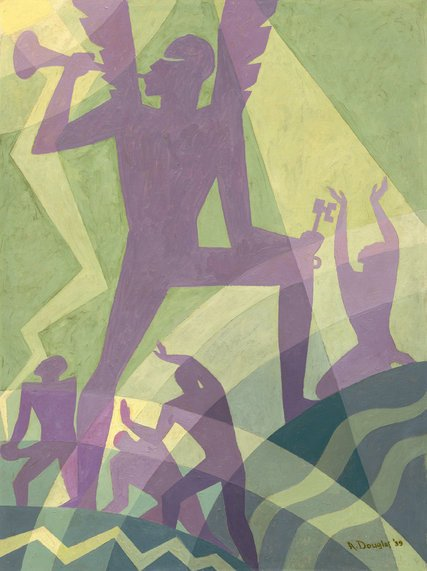
    2. who lost their loveboys to the three old shrews of fate the one eyed shrew of the heterosexual dollar the one eyed shrew that winks out of the womb and the one eyed shrew that does nothing but sit on her ass and snip the intellectual golden threads of the craftsman’s loom,

      The phrase "heterosexual dollar" is striking; it captures the intersecting forces of capitalism and compulsory heterosexuality that drive people away from queer relationships and artistic/intellectual pursuits and towards unhappy marriages and conventional jobs.

    3. who sank all night in submarine light of Bickford’s

      Ginsberg captures the experience of being intoxicated through the metaphor of being underwater using words like "sink," and "submarine," and "floated."

    1. You do not know the monster men      Inhabiting the earth, Be still, be still, my precious child,      I must not give you birth!

      The dilemma over whether to bring a child into a world full of so much pain, suffering, and evil is not often discussed openly.

    2. Let’s build bridges here and there Or sometimes, just a spiral stair

      The extreme formfulness of the poem (Rhyming couplets, iambic pentameter I think) makes the poem feel like a song or a prayer of some kind.

    1. I sit and sew—a useless task it seems,

      The contrast between the speaker's mundane taste of sewing and the horrors of the battlefield make the images of war even more horrible.

    2. On wasted fields, and writhing grotesque things Once men.

      Possibly the most horrifying depiction of war I have read in poetry. The grotesque imagery and the dehumanizing language come together to make these lines very powerful.

    1. And put it in a little bottle on a shelf in the library, That’s what they done to this shine, ain’t it? Bottled him.

      The phrase "bottled him" draws a comparison between the bottle of sand and the man who was dancing. Similar to how the sand was taken from Africa and bottled for display, the man's ancestors were likely taken from Africa and enslaved.

    2. Imagine that! The Sahara desert! Some bozo’s been all the way to Africa to get some sand.

      The poem's style feels almost conversational, as though the speaker is recounting a story in person.

  2. Nov 2019
    1. That I am the cry of a soul … A-shoutin’ in de ole camp-meeting-place,

      The speaker prefacing the song with "I am the cry of a soul..." perhaps meaning the song is the soul crying out in sadness.

    2. I want to feel the surging Of my sad people’s soul Hidden by a minstrel-smile.

      The deep history and struggles of African-American people were widely ignored, and their culture was mocked in minstrel shows in the popular culture of the early 20th century. The speaker longs for their rich history and culture to be represented rather than covered up.

    3. Before the Sphinx-still face …

      The Sphinx appears here as a symbol of African-American heritage, similar to "The Negro Speaks of Rivers".

    1. Slim ran fo’ his wings, Lit out from de groun’ Hauled it back to St. Peter, Safety boun’.

      The poem's narrative follows the structure of the hero's journey, from the known into the underworld and back again.

    2. “Slim [Greer] in Hell” (1933)

      This poem seems to seems to be rooted in oral storytelling, with the high amount of dialogue and the emphasis on word pronunciation and rhyme.

    3. They taught you the religion they disgraced.

      The white slaveowners preached "Christian values" while treating enslaved people with extreme cruelty.

    1. Or fester like a sore— And then run? Does it stink like rotten meat?

      Such graphic, unpleasant imagery really drives home the tragic nature of a dream that is repressed.

    2. Or does it explode?

      The Harlem Renaissance/New Negro Movement can be seen as an explosion of artistic expression. Perhaps Hughes is implying that the unrealized dreams of black people in America have exploded outward in this artistic movement.

  3. Oct 2019
    1. It’s so elegant So intelligent

      Slant rhyming elegant and intelligent creates a strange effect where you have to pronounce one of the words incorrectly for the rhyme to work, which is neither elegant nor intelligent.

    2. If there were water we should stop and drink Amongst the rock one cannot stop or think

      Without basic needs met it is impossible to stop and dwell on our thoughts. Life becomes less pleasant, but more simple.

    3. A crowd flowed over London Bridge, so many

      More water imagery, not only does the bridge go over water, but the people flow over it like water.

    4. Fear death by water.

      It is ironic that the clairvoyant tells the speaker to "fear death by water," because in the wasteland it is dry and "no sound of water," so death would most likely come from a lack of water.

    5. Your shadow at morning striding behind you Or your shadow at evening rising to meet you;

      The phrasing in these lines personifies the shadow as a separate being conducting its own actions in conjunction with yours. It is very eerie, and it creates the feeling that your shadow is stalking you.

    1. Rose is a rose is a rose is a rose.

      This line makes me feel as though the overused symbolism of the rose is being broken down. The repetition of the word makes it lose all meaning, and the cyclical nature of the line creates the sense that the rose only refers to itself.

    1. The apparition of these faces in the crowd

      The word "apparition" has a ghostly connotation and makes one feel as though none of the people are really there. Perhaps their bodies are there, but it is not likely many of them are truly present. They are in a transient state.

    2. An “Image” is that which presents an intellectual and emotional complex in an instant of time.

      An "image" refers to an entire experience in a moment of time rather than just the visual as the word suggests.

    1. they were delicious so sweet and so cold

      Why would the speaker describe how delicious the plums were to the person they took them from? It seems as though the speaker is rubbing it in their face, maybe because they know it is not a serious issue.

  4. Sep 2019
    1. Love can not fill the thickened lung with breath, Nor clean the blood, nor set the fractured bone; Yet many a man is making friends with death

      Love has no practical use, but people will put their lives at risk to seek it anyway.

    2. does the rose regret The day she did her armour on?

      The speaker personifies the rose using "she" as the pronoun, creating the image of a woman in a suit of honor. I can't help but think of Joan of Arc.

    3. A rusted iron column whose tall core The rains have tunnelled like an aspen tree.

      The speaker switches from the metaphor of a tree to an iron column, then back to a tree again by comparing rust/decay. I think these lines are supposed to imply that no matter how strong one is in life, death/decay (the rains) wears away at you all the same.

    1. yellow wood,

      The phrase "yellow wood" invokes images of early fall, when the leaves are yellow or orange and just beginning to fall from the trees.

    2. In leaves no step had trodden black.

      I like this line. I think the speaker is suggesting that to walk either path would be to disturb the beautiful fall leaves and stamp them into the ground, beginning the process of decay.

    3. The woods are lovely, dark and deep. But I have promises to keep, And miles to go before I sleep, And miles to go before I sleep.

      The repetition in the last two lines could suggest the speaker regrets that they could not stay for longer in the woods to sleep, or it could represent the speaker's descent into sleep despite their responsibilities.

    1. The bird is on the wing, the poet says, And you and I have said it here before. Drink to the bird.

      A reference to a Rubaiyat poem by Persian poet Omar Khayyam. The bird in the poem is referred to as the "Bird of Time." Mr. Flood is toasting to time itself.

    2. but the men were just as good, And just as human as they ever were.

      Despite the passage of time, the men are still human. Time took their youth, but it was not able to take their humanity.

    1. And no one knows what is true Who knows not what is false.

      Truth is subjective. But what does this have to do with the library? Perhaps the people who sold the library did not recognize the truths in those works as legitimate, but what right do they have to deprive others of those works?

    2. Life all around me here in the village: Tragedy, comedy, valor and truth, Courage, constancy, heroism, failure– All in the loom, and oh what patterns!

      The speaker compares human life to the weaving yard or thread in a loom, which can be compared to the musical "symphony" of nature.

    1. I see her on that long road under the trees, creeping along, and when a carriage comes she hides under the blackberry vines. I don’t blame her a bit. It must be very humiliating to be caught creeping by daylight! I always lock the door when I creep by daylight. I can’t do it at night, for I know John would suspect something at once.

      The narrator's way of "creeping" is writing. When John or Jennie come by she stops, just like the woman stops when a carriage comes by. Those stops are reflected in how the story is told through short paragraphs.

    2. He is very careful and loving, and hardly lets me stir without special direction.

      "Special direction" at all times sounds a lot like controlling behavior.

    1. the Negro is a sort of seventh son, born with a veil, and gifted with second-sight in this American world

      The phrase "born with a veil" might appear to indicate a lack of vision, but that is not the case. The phrase refers to the superstition that a child born with a caul (part of the amniotic sac) over their head will be gifted with supernatural gifts. In this case, Du Bois uses "second sight" as a metaphor for the split between his identity as a black man and as an American.

    2. and yet the swarthy spectre sits in its accustomed seat at the Nation’s feast

      The metaphor of the seat with the "spectre" of slavery seated in it is a perfect metaphor for how the legacy of slavery continues to haunt America even after its end.

    3. They approach me in a half-hesitant sort of way, eye me curiously or compassionately, and then, instead of saying directly, How does it feel to be a problem? they say,

      The questions that people ask Du Bois show that they see him as a "problem" rather than a person. This suggests that they are not without prejudice themselves, because they fail to see him as a complex person rather than a symbol of a greater social struggle.

    1. threatening to become as terrible as the locomotive steam-engine itself, which was almost exactly Adams’s own age.

      By highlighting his own age in relation to the age of the locomotive steam engine, Adams forms a comparison between himself and the steam engine. The automobile and the electric motor threaten the steam engine the same way these new advances and discoveries threaten Adams's worldview.

    2. Adams

      The idea of an autobiography written in the third person is unusual to me. It feels a lot less personal than if it were written in the first person, but it provides a unique perspective on one's life and experiences.

  5. Aug 2019
    1. From “Bow Down” come “Rise Up,”

      "They Lion" once bowed down, but now it rises up. The phrasing in this line (from X come Y) implies a sort of causation. The state of subordination inspires the act of rising up.

    2. Out of the gray hills Of industrial barns, out of rain, out of bus ride

      These two lines create a joyless, oppressive atmosphere by evoking dreary images and unpleasant settings. This Lion grows from a place of hardship and despair.