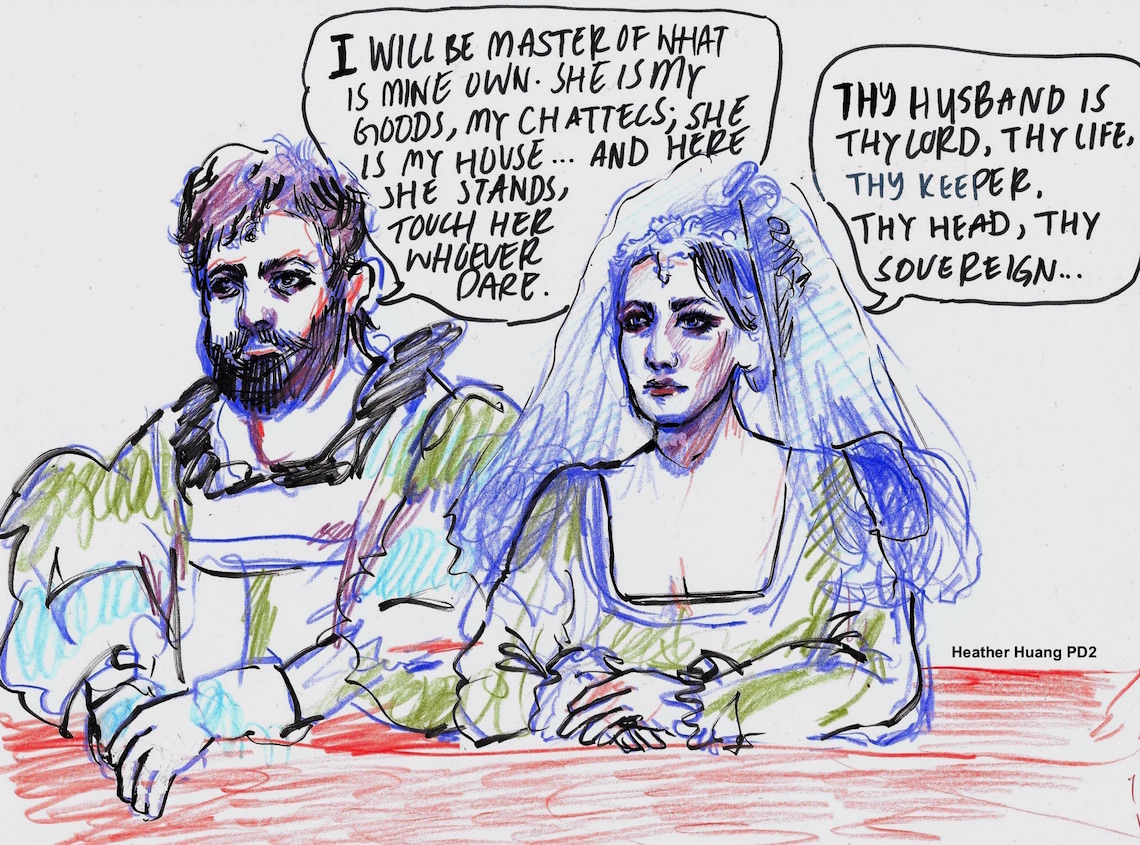
There is generally an air of misogyny associated with Petruchio’s syntax and treatment towards women, particularly Katherine – the object of his quest for wealth and prosperity – throughout the progression of the play. However, upon closer reading, there is the underlying idea that Petruchio actually views Katherine with respect – in his own twisted way. He states that he “will be master of what is [his] own,” and goes on to compare Katherine to a series of objects in his possession (3.2.235). He says that she is “[his] goods, [his] chattels… [his] house,” which appears misogynistic in the sense that she is only valuable to him as a possession and object, not as a woman he loves. However, on the other hand, one can make the argument that he views Katherine as the most valuable person in his life. By comparing Katherine as someone he sees as equal to his most prized belongings, he shows that there is a desirable value to Katherine, which is new for her. This may still come off as misogynistic in our time, but in the story, this is critical when taken into consideration that Katherine is portrayed as the foil – and the complete opposite – of Bianca, who is perfect and loved. Until Petruchio, Katherine’s poor reputation has repelled potential love interests as the majority of the townspeople see her as abrasive and rough, and instead opt to court Bianca. Petruchio’s desire for Katherine in this way may account for her “transformation” from a brash spirit to a seemingly docile housewife towards the end of the play.
At first sight, it appears as if Petruchio had subdued Katherine’s fiery nature into one of compliant domesticity by forcing her to conform to traditional gender roles. Petruchio’s treatment of Katherine at the beginning of their marriage is undoubtedly harsh, but it allows her to undergo a character transformation where she moves from indignated misery to sensible contentment through marriage. Katherine’s final soliloquy in Act 5 Scene 2 echoes this point, as well as Petruchio’s sentiment from his earlier monologue in Act 3 Scene 2. Katherine says,“Thy husband is thy lord, thy life, thy keeper / Thy head, thy sovereign..” (5.2.162-3). In this quote, Katherine reveals that she shares Petruchio’s feelings. From her soliloquy one can still detect her characteristic fierceness, but there is a newfound sense of maturity in her words. Through the similarity of diction and syntax in their speeches, Katherine and Petruchio display a mutual sense of appreciation and respect for one another. Katherine is not simply a target of Petruchio’s misogyny; rather, she shows that the feeling of possession is a reciprocated idea from both parties. Although Petruchio is far from a romantic and perfect husband, Katherine ultimately displays gratitude and respect to him for desiring Katherine when everyone else judged her character and thought poorly of her.