On the edge of non-existence and hallucination, of a reality that, if I acknowledgeit, annihilates me.
there it is. That's how it felt when the church was wrong
On the edge of non-existence and hallucination, of a reality that, if I acknowledgeit, annihilates me.
there it is. That's how it felt when the church was wrong
Essentially different from "uncanniness," more violent, too,abjection is elaborated through a failure to recognize its kin;nothing is familiar, not even the shadow of a memory
add this to talk about evolution in Redon's work
The lashes/cilia framing the head are directed outward, as if to suggest abeing that is about to corne apart, this fate perhaps intimatedby the formless matter making up the périphéries of the image
icorporate this reading into your existing analysis
For Redon, however, atavistic proportions were not enoughto articulate the status of the body in a Darwinian universe.Redon’s evolutionary body reaches its most devastating expression in Tes Origines, where we find not so much Cormon-esquerenderings of distorted human anatomy, but rather an obsessionwith anatomy’s absence. In Les Origines, Redon pulls the bodyback into the primeval slime, taking it apart before our eyes. Hisinterest, in other words, is not so much evolutionary form, butrather evolutionary formlessness
this is very good. He moves farther than many did at the time when trying to come to terms with darwinian theory through their art (see: cain fleeing with this family): he is no longer looking at depictions of the evolutionary step before modern human bodies, he is taking them apart entirely and exploring the formlessness that is left behind.
What is left out of these discussions, however, is the question of the human body. Redon’s evolutionism, I will argue, isessentially about the body—about the implications of Darwin-ian thought for the possibility, or impossibility, of stable human form. We should also consider these questions: What did“origins” mean to viewers during Redon’s time? What kinds offantasies and anxieties were bound up in the question of originsin 1883? Redon’s album is not just a whimsical diagram of theorigins of the universe; rather, it is a devastating essay on the human body, its abject beginnings, and its demoted status underevolutionary law.
fascinating. I don't know if I will have time to focus on this but I think that I should incorporate the idea of the abjection of the human body and Redon's response to it/recreation of it
Because the story il tells is also confusing—this is,after ail, science through the eyes of a Symbolist—much of thescholarship on the album has focused on making sense of theplates. Sven Sandstrôm was the first to organize Redon’s imag-ery, perhaps against its will, into a cohérent evolutionary story
see this right here is important because I disagree with it. Redon doesn't really seem to fit the mold of Symbolist according to Larson, and it seems pretty clear to me that his work purposefully evades definition and overall narratives. I think that many scholars make it their job to understand and interpret the noirs into something tangible when they are very purposefully not. These works represent something that's just out of reach, that we can't quite put our finger on but somehow still recognize. It's supposed to be ineffable, because it was when Redon imagined it.
search for the unknown
so we're definitely talking about how his work is unique bc it comes straight from him as a creative source, but i think there could be something to be said about the unknown that lies within us transposed onto a page
Thus a sheet of white paperhorrifies me. It impresses me disagreeably to the pointof making me sterile, of depriving me of the taste forwork (except, of course, when I propose to represent areal object, for example a study or a portrait). A sheetof paper is so shocking to me that I am forced, as soonas it is on the easel, to scrawl on it with charcoal, witha crayon or any other material, and this operationbrings it to life.
ok so we have very little work work with in terms of his process but this gives us a window: metaphorically we can see his hand and the charcoal to be bacteria or germs, spreading onto the sterilized white surface and thus giving it life. It may not be life that humans understand or see as friendly or approachable; in fact, it may be quite the opposite. But it is life nonetheless.
Plis visions exist by themselves,in an independent sphere over which they reign absolutely.
Redon was compared to other artists, but his work never fit the definitions of others. His work did not share the same creative source as Goya, whose satirical dark scenes were motivated by a hatred of oppression and a desire to be heard. Nor did it truly align with the work of Moreau, whose body of work drew heavily on classical themes and featured many mythological beings from the period. Redon's work stands out because it seems to be chiefly motivated purely by the workings of his own imagination, sometimes by little or nothing else. "then add quote"
Redon always insisted that his imagination had itsroots in the observation of nature. To him even themost fantastic drawings were "true" because the visionshe translated into the velvet-like texture of charcoaldrawings were never absolutely detached from reality;they were part of his own world, of his peculiar atavism.As he has said: "My originality consists in bringing tolife, in a human way, improbable beings and makingthem live according to the laws of probability, by putting —as far as possible —the logic of the visible at theservice of the invisible."
oh wow super important. You should use this to segway from in dreams to les origines.
(which he considered sterile unless it concerned itself with tendencies and ideas)
oh sterile is a great word, it could be used to speak to his obsession with depicting "gross" things and refusing to sterilize his work (both in terms of subject matter and process/distribution)
Pleading for the legitimacy of pictorial invention, he called it "a rightthat has been lost and which we must reconquer: theright to fantasy, to the free interpretation of history.The example of the great artists of the past justifiesthis claim. If, in order to convince the most rebelliousones, it does not suffice to state that this truth imposesitself today [with the work of Fromentin] ... if the entire collection of the Louvre with its masterpieces, andthe clarity of their language, is not a protest strong andsolemn enough, then we shall have to wait patientlyuntil the light dawns. We shall have to tell those whoare the most misled to bide their time a little longer, tolisten sincerely and with more veneration to the noblelanguage of beauty. The moment will come withoutdoubt. Maybe it will be given to those who are still inthe somber anteroom to lift a corner of the veil, to seeat last, beyond the penumbra, in the splendor of a luminous clearing, this beautiful garden of poetry, filledwith great murmuring and delights. It is a homelandmade for all. How many pure joys they abjure who obstinately limit art!"
note the annotation (22). This feels like the most important part of this chunk. essentially he's calling for more expression, imagination, and artistry; less decorum, self-importance (painting sizes), and aggrandizing of wat is happening now. I think an apt metaphor is returning to fantasy and historical fiction over a history textbook.
. Redon's own often curious cap-tions were meant to be read sequen-tially like a sort of poem, contributingto the mysterious effect of the who
this is why each album counts as one work - it's supposed to be viewed as one
macabre fan-tas
"macabre fantasy" - a great way to describe his work
s.
"relentlessly championing imagination over traditional forms of representation or the experiences of modern life that preoccupied so many of Redon's contemporaries."
Redonunderstood Symbolist aesthetics as a technologyof the psyche, an exercise in mediating the ma-terial and the spiritual.
he does this in his work- another duality
Fearful symbols ofevolutionary memory often coincided withhaunting images of secular history.
see if you can find an example of this bc wow what a quote
Or-igins (1883)
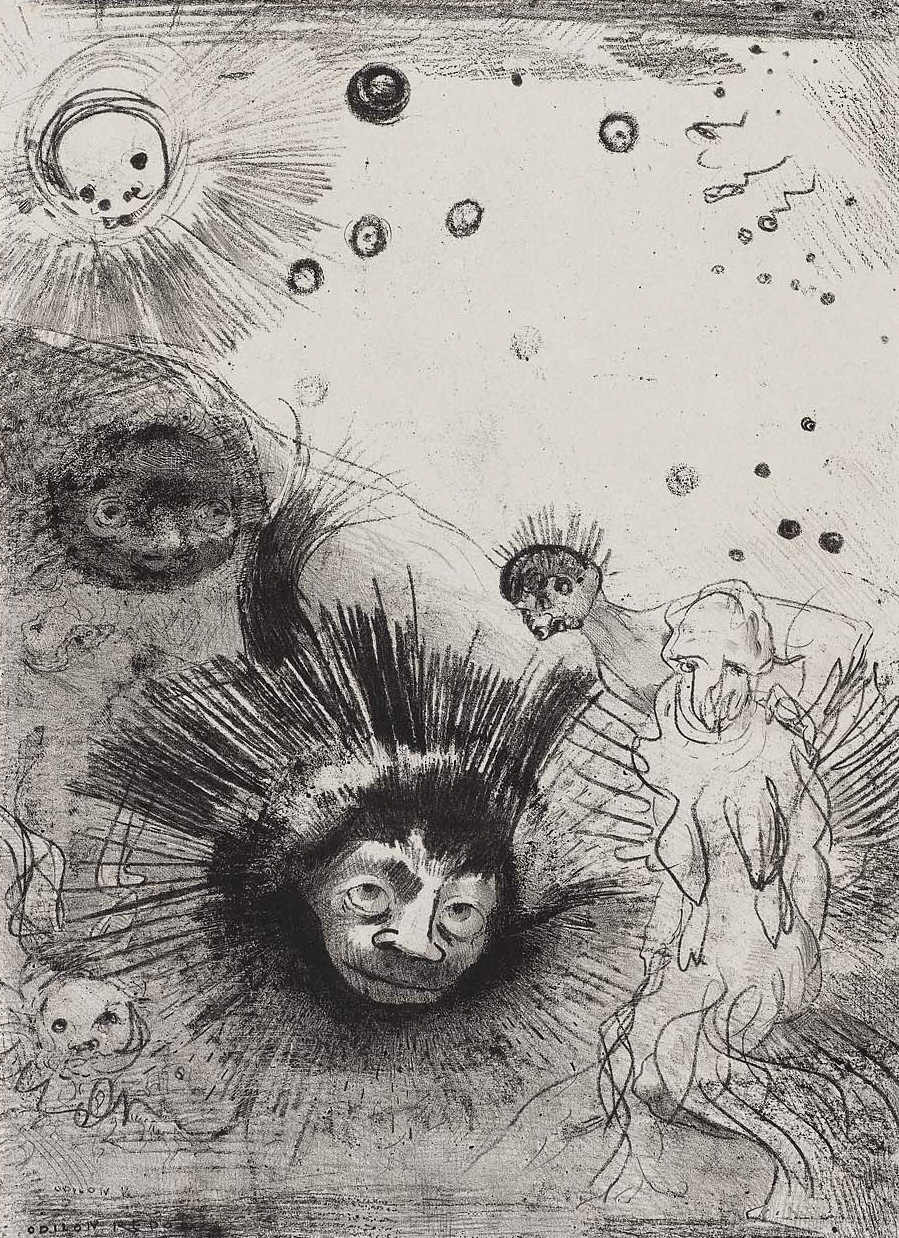
this is the cover - this will be one of the works you focus on
While advances in astronomy are undoubtedly behindrevived interest in ancient cosmological symbols, recentcoveries also contributed to a renewal of the extraterrestriallife debate, a discourse that may well have influenced Redocosmological imag
ALIENS
sted in solar myths. Amongother images he used that of the setting sun to suggest thePrussian advance
so france is the sun in all metaphors i guess
. Redon's"Sad Ascent", another lithograph from In the Dream, with itsblack celestial body hovering ominously over the rooftops ofParis and melancholy balloonhead conflation, may be a com-bined reference to political disaster and Janssen's mission

ral but even more specifically to one eclipse inparticular: that of December 22,1870, which took place duringthe last desolate days of the war, two days after the defeat ofRedon's own battalion of the Secon
oh shit
Iconographically, the solar eclipse is an ageold portent ofimpending doom and was revived as such in the work ofRedon and others immediately following the loss o
that's actually a great point thank you Barbara
. From this information, data abouttemperature and age could be deduced, revolutionizing thestudy and understanding of the solar syste
so for the first time ever, we could prove how old the stars were
“Microbomania” and “syphilophobia,” both public aspects of the Pasteurianrevolution, provided Redon with suggestive subject matter for his biologically orientednoirs, which effectively embody contemporary Decadent and even occult themes aswell.
feels important. unpack this
The volvox had attracted a great dealof attention because certain zoologists had attempted to attribute a mouth, organs, andeven an eye to it.
that's why he used the word in his review
According to Auguste Barbey,“In the obscure depths of marshes, illuminated suddenly by a phosphorescent glow,vibrios and germs, bacilli and infusoria big with human faces, sad or inexpressive,produce a dreadful effect” (Barbey 1894). “Vibrio,” is a pathogenic microorganism.Gerard Beauregard would call the oeuvre in general “germs” and would remark, “Itis all right to exhibit again the fantastic and terrible, but why these microbes . . . these‘vibrios’?” (Beauregard 1894)
the reception is important - what did they think and why did they think that?
The fantastic aspectof microbes even became a part of public entertainment. In 1883 the show “LesInvisibles” at the Th ́eˆatre des menus-plaisirs in Paris showed microorganisms to a largeaudience through a solar microscope.
so as with all new discoveries, this was both a horror and a delight. It seems like Redon used this line to once again explore the gray area in between (as he often did in his work at this time)
Redon’s images of microorganismsare in keeping with scare tactics of Pasteurian hygienists who preached prevention byrevealing the hidden enemy to the public as something more powerful and destructiveto humans than any conceivable visible danger
interesting
“Life takes part in the work of death in all its phases”
might not be super useful for your purposes but what a sick ass quote
The combination of life-death forces took on new meaning with the adventof Pasteur’s work
this is important - Pasteur's work only heightened something that already existed (and then the loss of the war was another contributing factor - it's all about the convergence of all these things to create the right conditions for the noirs)
Degeneration theory, circulating in the last three decades of thecentury, included ideas that the nation had slipped from power because of generalphysical conditions such as the lack of corporeal strength, shorter stature than inpast generations, and the fear that the French race was aging and thus in decline.
idk man sounds kinda like eugenics to me :/
espite the official celebration of scientific progressin the postwar period, Redon dwelled on man’s vulnerabilities in light of scientificdevelopments. In so doing, he responded to an anxious postwar generation susceptibleto scientific discourses that emphasized man’s fragility in light of new developments inscience.
thesis
i am not a Darwinist, because I do not do sc
he has a lot of thoughts on labels, particularly seeming to want to avoid them at all costs.
ne. Byexchanging the classical ideals of academic tradition for the scienceof psychophysiology, Redon created in the figure of the Devil anew, we might say boldly updated, icon of melancholy, a potentsymbol of the modern human condition, in which - as is sopoignantly dramatised in text and image by The Temptation of StAnthony - a brave new, science-oriented world struggles with theloss of (Christian) existential certa
sums up thesis
he Symbolist avant-garde, with whom Redon by then had close t
find more info on this - probably in the Larson documents
True justice is paying only once for each mistake.True injustice is paying more than once for each mistake
.
Your grade will be based on your total point score out of 500.
So 400 points are from classwork and the final 100 are all from the research essay? Does the research essay grade include the preliminary assignments for the essay?
925-322-0037. Messages will be sent to me primarily as email/ transcriptions. Same return time of 24 hours during the working week.
Might be easier to ask questions this way from work/in public