3 Matching Annotations
  1. Dec 2017
    1. Durham

      John George Lambton Durham, or Lord Durham, was born in England in 1792 to a prominent family. After completing a quick stint in the army, Durham was elected to the House of Commons. He continued his ascension through the ranks until reached the House of Lords in 1828. Even though he only spent five years serving in the House of Lords, he became an influential member of the Whigs party. Poor health and petty disputes with colleagues eventually forced him from his position in the House. Towards the end of his tenure in the House of Lords, Durham made no efforts to censor his displeasure with other Lords; in fact, his colleagues thought his behavior was so poor that they suspected he was resigning long before he did (I. D. C. Newbould 354). After his resignation, the prime minister persuaded him to become the Governor General of British North America, a position that voiced the opinions of the Crown to Canada. He was sent to British North America to investigate the twin rebellions that had recently occurred. Lord Durham left his post after only 4 months due to a dispute. Upon his return to England he wrote the now famous, or rather infamous, Report of the Affairs of British North America. In his report, Lord Durham urged for the assimilation of all Canadians to the British way of life in order to unify Canada. Guy Laforest, a political scientist, said that Lord Durham “[did] not believe in the reconciliation of national identities within a single political system” (Laforest 178). A sentiment that, if proposed to Canadians today, would get dismissed due to its severe lack of understanding of other cultures. The report went on to play a very key role in the unification of Canada, but was eventually beat out in favor of a non assimilation approach. When describing how Durham came to the conclusion of assimilation, political scientist Janet Ajzenstat said that “there is considerable evidence to show that Durham made up his mind on the matter before he left England” (Ajzenstat 74). The fact that Durham went to Canada already “aim[ed] at making Canada thoroughly British” shows that he was not interested in what was best for Canada, but instead what was best for the Crown (Ajzenstat 74). At the time that meant converting everyone to the civilized British way of life.

      Berger used Durham’s report as a way to illustrate the native peoples’ viewpoint by showing that early in Canada’s history, thoughts of unification by assimilation of the French Canadians were at the forefront of discussion. Today there is a sense of national pride associated with how diverse Canada is, so it is hard to believe there was a time when Canadians almost did away with it. That being said, that sense of pride does not extend to the natives of the Northwest Territories, and that is the logical inconsistency that Berger is trying to illuminate.

      Ajzenstat, Janet. 1988. The Political Thought of Lord Durham. Kingston: MQUP, 1988. eBook Collection (EBSCOhost), EBSCOhost (accessed November 6, 2017)

      I. D. C. Newbould. "Lord Durham, the Whigs and Canada, 1838: The Background to Durham's Return." Albion: A Quarterly Journal Concerned with British Studies 8, no. 4 (1976): 351-74. doi:10.2307/4048187.

      Laforest, Guy. Trudeau and the End of a Canadian Dream. Montreal: MQUP, 1995. Accessed November 26, 2017. ProQuest Ebook Central.

      Lawrence, Thomas, Lord Durham. 1853. Drawing pastel, 23.600 x 31.200 cm. Library and Archives Canada. http://collectionscanada.gc.ca/ourl/res.php?url_ver=Z39.88-2004&url_tim=2017-11-06T13%3A18%3A22Z&url_ctx_fmt=info%3Aofi%2Ffmt%3Akev%3Amtx%3Actx&rft_dat=2836962&rfr_id=info%3Asid%2Fcollectionscanada.gc.ca%3Apam&lang=eng
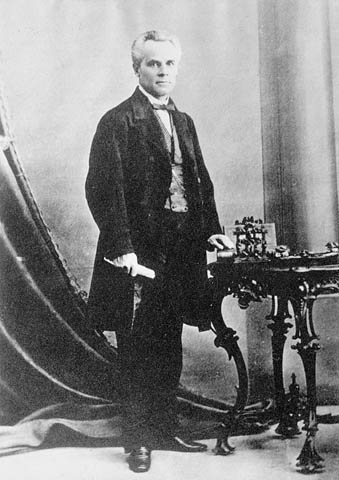
    2. Cartier

      Sir George-Etienne Cartier was a powerful French Canadian politician, and he is largely responsible for the unification of French and English Canada. During his early years he fought in The Rebellions of 1837, but after that was over he went back to being a lawmaker. Throughout his life he compiled quite an illustrious list of political achievements, one of which was playing a key role in the adding Quebec to the Confederation. He was an all around great politician; Brian Young, a Canadian historian, said, “as a politician, Cartier delegated administrative responsibilities effectively, was an excellent committee debater, and thrived in political backrooms” (Young 58). He consciously used his political abilities to not only further French Canadians economically and socially, but also to further the unification of Canada. Another of his major accomplishments was that he was responsible for moving the capital of Canada to Ottawa, which ended debates over where it should be placed. The debates were largely concerned with whether the British or the French should control the capital, this was an important step in unification. But his biggest impact on Canada is the efforts he made to unify both French and British Canada through acceptance. His impact is so great that Samuel V. LaSelva, in his article on federation as a way of life, went as far as saying “Federalism as a fraternity has its beginnings in Cartier’s vision of Confederation, and provides a vision of federalism that can sustain Canadians in their times of trouble,” (LaSelva 221). He created the source of pride that Canadians feel when thinking about the diversity of their country. In the book The Moral Foundations of Canadian Federalism : Paradoxes, Achievements, and Tragedies of Nationhood by LaSelva, Cartier is described a providing the “middle ground” in the debate over the unification of Canada (LaSelva 48). Cartier was always able to get where he wanted politically by appearing to be neutral and actually pushing for French Canadians. His idea of a unified Canada won out in the end over his contemporary, Lord Durham, who had instead advocated for the assimilation of the French Canadians. Berger includes Cartier in the report to show a time when unification without assimilation happened and work. This is the framework that modern Canada is built on; it is such a fundamental part of Canadian identity that it is taken for granted and forgotten. Berger is trying to point out the hypocrisy shown by Canadians in their dealings with the indigenous population. The long period of time where natives were forced to go to specific schools, forget their heritage, and learn to be a “proper” Canadian is eerily reminiscent of the ideals that Cartier fought against.

      Young, Brian J. 1981. George-Etienne Cartier : Montreal Bourgeois. Kingston: MQUP, 1981. eBook Collection (EBSCOhost), EBSCOhost (accessed November 6, 2017).

      LaSelva, Samuel V. 1996. The Moral Foundations of Canadian Federalism : Paradoxes, Achievements, and Tragedies of Nationhood. Montreal: MQUP, 1996. eBook Collection (EBSCOhost), EBSCOhost (accessed November 29, 2017).

      LaSelva, Samuel V. "Federalism as a Way of Life: Reflections on the Canadian Experiment." Canadian Journal of Political Science / Revue Canadienne De Science Politique 26, no. 2 (1993): 219-34. http://www.jstor.org/stable/3229211.

      Norton, William, Sir George-Etienne Cartier. 1882. Photograph. Library and Archives Canada. http://collectionscanada.gc.ca/ourl/res.php?url_ver=Z39.88-2004&url_tim=2017-11-06T15%3A10%3A55Z&url_ctx_fmt=info%3Aofi%2Ffmt%3Akev%3Amtx%3Actx&rft_dat=3333334&rfr_id=info%3Asid%2Fcollectionscanada.gc.ca%3Apam&lang=eng

    3. Poundmaker

      Poundmaker was a tragic figure in the history of indigenous Canadian peoples. His life was an all too common example of the mistreatment of natives at the hands of southern Canadians. He was born in Saskatchewan in 1842 and was adopted by the head chief of the Blackfoot, Crowfoot. Poundmaker rose to prominence within the Cree community and eventually became a Cree chief, at which point he became a powerful “vocal [opponent] to settler expansionism” (Monaghan 491). In his adamant opposition to Treaty No 6 and general expansionism, Poundmaker was “placed under systems of surveillance” by the Canadians (Monaghan 491). Sir Edgar Dewdney, the Indian commissioner for the North-West Territories at the time, said that Poundmaker “will have to be broken, he is at the bottom of all the trouble” (St. Germain 317). Dewdney, who was theoretically supposed to look out for the inhabitants of the North-West Territories, completely failed at his job. He was clearly more interested in peace through submission.

      He played a role in the North West Rebellion, standing with other native chiefs against the tyranny of the Canadian government. He was not quick to fight though, he prefered a peaceful resolution. At the beginning of the rebellion “Poundmaker had initially urged peace,” (Markowitz, Harvey, and Carole A. Barrett 393). He allied himself with the leader of the rebellion, Louis Riel. In fact, he went as far as “pledg[ing] to assist Riel and his followers to the end,” (Markowitz, Harvey, and Carole A. Barrett 393). Poundmaker’s biggest moment in the rebellion came during the Battle of Cut Knife Creek, when a Canadian colonel with 300 men marched on the natives. After about six hours of fighting the colonel knew that his forces would not win this skirmish so he called for a retreat. As they were retreating, Poundmaker, being the peaceful man that he was, urged his people not to attack the retreating Canadian forces. He was able to convince them not to attack, thus saving hundreds of Canadian lives. However, he was not thanked for this by the Canadians, instead they incarcerated him for a year. After his release, he went back home but wasn’t ever the same and died shortly after.

      Berger included Poundmaker in the report because he serves as a perfect example of the abuse of Canadian power towards the natives. Dewdney stated that his intent from the beginning was to break Poundmaker, so it didn't matter that he saved hundreds of Canadian lives. They wrongfully convicted him just because he was standing up for his home. Berger is trying to point out the one sided relationship that exists between the natives and the southerners. The relationship that, for hundreds of years, has dictated the way that native claims have been handled.

      Markowitz, Harvey, and Carole A. Barrett. 2005. American Indian Biographies. Pasadena, Calif: Salem Press, 2005. eBook Collection (EBSCOhost), EBSCOhost (accessed November 6, 2017).

      St. Germain, Jill. "Treaty Six and the Northwest Rebellion, 1885." In Broken Treaties: United States and Canadian Relations with the Lakotas and the Plains Cree, 1868-1885, 311-44. Lincoln; London: University of Nebraska Press, 2009. doi:10.2307/j.ctt1dgn3sg.14.

      Monaghan, Jeffrey. "Settler Governmentality and Racializing Surveillance in Canada's North-West." The Canadian Journal of Sociology / Cahiers Canadiens De Sociologie 38, no. 4 (2013): 487-508. http://www.jstor.org/stable/canajsocicahican.38.4.487.

      Buel, Oliver, Poundmaker, also known as The Drummer, (ca. 1842-1886), a Cree chief, later adopted by Crowfoot of the Blackfoot Nation. 1885. Photographic print. Library and Archives Canada.http://collectionscanada.gc.ca/ourl/res.php?url_ver=Z39.88-2004&url_tim=2017-11-06T06%3A06%3A58Z&url_ctx_fmt=info%3Aofi%2Ffmt%3Akev%3Amtx%3Actx&rft_dat=3241485&rfr_id=info%3Asid%2Fcollectionscanada.gc.ca%3Apam&lang=eng