query
A question or search. A query image is the image "in question"—in other words, the image you want to find similar matches to.
query
A question or search. A query image is the image "in question"—in other words, the image you want to find similar matches to.
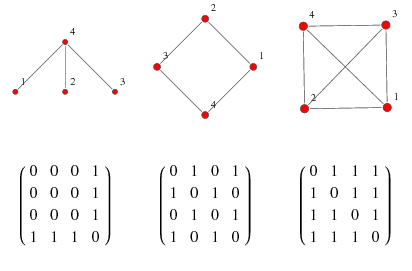
binary random connection matrix
A connection matrix is a table of rows and columns, each consisting of positions on a graph. In each entry, the matrix has a 1 or 0 depending on whether the row positions and column positions are adjacent (1) or not (0).
It is random because the connections (representing connections between PNs and KCs) are random, and it is binary because it uses only ones and zeros.
Kenyon cells
One of the types of cells found in the "mushroom bodies" of the olfactory system. Mushroom bodies are important for olfactory learning and memory and—you guessed it—look like mushrooms.
stimuli
Any thing or event that causes a neuron or set of neurons to become active.
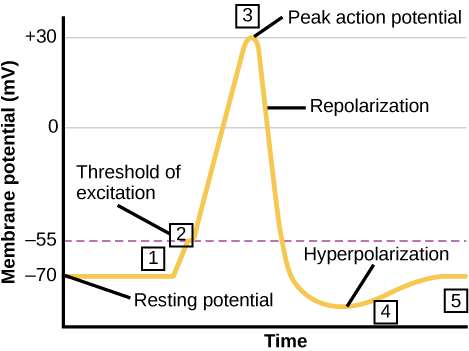
When a nerve cell is activated, it triggers an action potential, which is a temporary change in the electric charge of the cell relative to its surroundings. This depolarization causes nearby locations to similarly depolarize (think about a line of dominoes falling down) and an electrical signal travels through the brain.
On a graph, this action potential looks like a brief spike, which is why scientists sometimes refer to this process of neurons releasing action potentials as "spiking."
olfactory
Relating to the nose/sense of smell.
polypeptide chain
A chain of amino acids.
postulates
An unproven principle assumed to be true for the basis of further discussion or logical reasoning.
The number of triplets which do not code an amino acid is probably small.
Scientists now call these STOP codons.
mutation
A change in the DNA base sequence. There are many types of mutations, but here Crick refers to changing a single base of DNA (a point mutation).
"spontaneous" mutations
A mutation that occurs naturally in biochemical systems.
gene
A section of DNA or RNA that codes for a specific chain of amino acids.
nucleic acid molecule
A chemical chain made up of nucleotides. "Bases" (see previous) are one component of a nucleotide.
protein
A chemical chain of amino acids.
broods
In this case, a grouping of young male mosquitos.
anopheline
A general term for the mosquito genus, Anopheles.
zygotic
A zygote is the cell that is formed by the male sex cell (sperm) and the female sex cell (egg). Zygotic refers to the characteristics of these early cells involved in replication.
annotation
Designation of where genes or genetic elements are in genomic sequences. This is by far the most difficult task for scientists and is constantly changing as we learn more about important features of the genome. Often, uncommon model organisms (like the mosquito) suffer from lack of annotation because scientists are more focused on other organisms like the human, mouse, or fruit fly.
intron retention
Introns (noncoding regions) that are not excised—that is, cut out—during pre-mRNA processing.
polymerase chain reaction (PCR)
An experimental method developed in the 1980s that amplifies a specific, targeted region of the genome, generally 100-5,000 base pairs (bp) in length.
To learn more, check out this video animation from Cold Spring Harbor Laboratory.
Y chromosome–linked M factor
A genetic sequence on the Y chromosome that is a signal for maleness (hence the M).
dipterans
Flies, including Ceratitis capitata (Mediterranean fruit fly), Lucilia cuprina (Australian blow fly), and Musca domestica (housefly), and the (red flour beetle) Tribolium castaneum.
cofactor
A compound that is required for the activity of a protein; in this case, TRA2 is needed to help tra cut dsx.
tra, and TRA
Lowercase tra is the gene, either in DNA or RNA form; all-caps TRA is the protein.
subordinate genes
Downstream genes; those that are expressed/utilized later in the pathway.
comparative genomics tools
Bioinformatic software programs or algorithms that can compare genomic sequences within, between, and across species to detect similarities and differences in DNA sequence.
evolutionarily labile
Easily changed through evolution.
sex-specifically spliced genes
Most genes have several coding regions (exons) interrupted by noncoding regions (introns). When a gene is translated into pre-mRNA, the molecule will go through processing to remove the introns and create a mature mRNA molecule for translation. During this process, exons or parts of exons can be removed as well, leading to several possible mRNA versions (also called isoforms) of the same gene. In this case, males will express one version of the gene and females will express a different version of the same gene.
sex determination
The process by which and organism becomes male or female, in both appearance and reproductive capabilities. In most species this is genetic, as discussed here. However, in other species, sex can be determined by external environmental factors and can sometimes switch during the organism's life.
Fecal
Describes waste excreted after the digestion of food from the bowels or intestines.
optogenetics
A tool designed to control cellular behavior using genetically encoded proteins that are responsive to light.
Deep brain stimulation (DBS)
A therapy option for Parkinson's disease, epilepsy, and depression patients where metal electrodes are inserted into deep brain regions. A stimulator placed near the collarbone then sends an electrical impulse through wires connected to the electrodes targeting neurons in the implanted area.
executive impairments in the control task
Executive impairments refers to reduced function of processes such as memory, controlled response to stimuli, capacity to shift between different topics and tasks, and focus—which regulate and control cognitive functions.
instrumental learning task
Training that is done to reinforce a particular response.
fear conditioning
Training that is performed to teach individuals to predict a negative outcome following a stimulus. This is done by repeatedly presenting an individual with a negative outcome following stimulation.
bias
A positive or negative inclination toward something.
stimuli
Internal or external changes in the environment that elicit an action.
drug paraphernalia
An object used for drug use, production, or storage.
monomers
A building block molecule, can combine to create polymers.
p-nitrophenol–linked aliphatic esters (pNP-aliphatic esters)
Aliphatic means that there is no aromatic group on the ester part of this molecule. A p-nitrophenol group is an aromatic ring with an oxygen linked to one carbon and a nitrogen attached to two oxygens linked to the opposite carbon.
maltose
Maltose is a disaccharide sugar that is closely related to sucrose (table sugar). Sucrose is made of two simple sugars—glucose and fructose—whereas maltose is made of two glucose molecules.
mesophilic
A process is one that occurs at close to room temperature. Usually between 20°C to 40°C.
GenBank or Protein Data Bank
GenBank is a database that is publicly available where scientists can record genetic sequences and the proteins they code for so that future researchers can use the information. Protein Data Bank focuses on recording and storing information on the shape of 3D molecules, particularly proteins.
buffer
A solution that prevents the pH from changing very much. A buffer is made of a weak acid and a weak base together in solution. If you add acid, it just reacts with the base. If you add base it reacts with the acid, preventing the pH from changing.
μm
Represents a micrometer, 10^-6 meters, or about the size of a single bacteria cell.
polyesters
A type of polymer that is used in many types of plastics. A polymer is a chemical made of one or more simple molecules, called monomers, bonded to itself many times in a repeating pattern. You may recognize polyester as the fabric that makes up some types of athletic wear.
catabolic enzymes
Catabolic reactions are those that break molecules into pieces, often giving off energy in the process. Enzymes are a type of protein that help speed up reactions. Therefore, catabolic enzymes help speed up reactions that turn large and complex molecules into smaller and more simple ones.
haplotype
A set of single DNA bases that tend to be inherited together from a single parent, and often vary between individuals. Variation in single bases gives us information about evolution.
Check out this video from the University of Utah to learn more about how halotypes can be used to understand genetic relationships between humans, and dogs too!
consilience
Agreement between two different approaches.
drift
This is one way that evolution can occur. It is an entirely random process, in which some individuals, by chance, contribute more of their genes to the future population that other individuals.
mitochondrial DNA
Genetic material that exists in the cell's mitochondrion. It is very important for studying ancestry since it is inherited from the mother only, and it allows researchers to trace the maternal lineage.
frequencies
In this case, refers to how often a set of DNA bases that are always inherited together are found in the population.
temporal origins
Referring to the point in time when dogs first appeared.
generation times
The average time between one generation and the next in the lineage of a population; in other words, the average age between a parent and its offspring.
mutation rates
The speed of change in genetic material over time.
temporal cline
A gradual change in genetic material, and the characteristics it codes for, over time.
founder effects
A few members of a population starts a new population. This new population has less genetic variation.
mtDNA turnover
Mitochondria have their own genetic material, and DNA mutations may accumulate over time.
node
A point on a graph of ancestry that is used to represent a split of one lineage to form two or more lineages.
nuclear genome
Genetic material that exists in the nucleus of the cell.
mechanisms
Here, they mean a process determined by genetics.
mated females
Females who had already mated with a different group of male flies.
NPF-NPFR pathway
In neuroscience, a pathway or a circuit refers to a set of neurons that function together to accomplish the same function. Often, these neurons all release the same molecules. Here, the researchers draw our attention to sets of neurons releasing NPF, referring to this as the NPF-NPFR pathway.
NPF transcript levels
There are a number of steps that must occur in order for neuropeptide F to be made in the brain. The first step is for the gene for NPF to be read by the neuron. As the neuron reads this gene, it makes a local copy of it known as a transcript. These transcripts are then recruited by other processes in the cell that use the transcript as an instruction manual about how to build the NPF molecule. Each time a new NPF molecule is made, a new NPF transcript must be created first. For this reason, it is possible to measure the amount of NPF transcripts in the brain in order to determine how much NPF was being produced.
early maternal separation
Another experimental method for causing rodents to experience stress in which newly born offspring are taken away from their mothers and raised separately. The lack of a mother present to raise the babies causes them to experience intense stress.
chemosensory cues
Flies do not have language, but they do communicate with one another in other ways. One such way a fly may communicate is by releasing chemical compounds that other flies can sense, and accordingly respond to. These are known as chemosensory cues. In this case, the authors are referring to chemicals released by the mated female that signal to the male that she is no longer receptive to mating.
in vitro and in vivo
In vitro: takes place outside the organism (in a test tube, culture dish, etc.)
In vivo: takes place inside the organism
perturbation
Changing the function of an enzyme.
repetitive regions
Stretches of repeated sequences of nucleic acids (DNA or RNA). Most repetitive regions do not occur in protein-coding genes. However, they are important for regulation.
Cas13 enzymes have two higher eukaryotes and prokaryotes nucleotide-binding (HEPN) endoRNase domains
A domain is a section of a protein that has a specific function.
host machineries
Systems of enzymes and accessory molecules that carry out cellular functions.
adenosine-to-inosine deaminase activity
A common method of RNA editing in which the nucleoside adenosine is converted to inosine by the removal of an amino group.
knockdown
A process when expression of a particular protein is suppressed at the level of RNA.
This is similar to knockout, where the expression of a protein is blocked at the DNA level. Unlike knockout, knockdown can be reversed.
The most widely used method for knockdown is RNA interference.
post-mitotic
Cells that are no longer capable of dividing (undergoing mitosis).
cleavage
Cutting.
prokaryotic
Prokaryotes are a class of single-celled organisms with no membrane-bound nucleus, mitochondria, or other membrane-bound organelles.
Examples include bacteria and archaea.
ribonuclease
A nuclease is a special enzyme that catalyzes reactions that break down nucleic acids.
A ribonuclease specifically works on RNA molecules.
Nucleic acid
A type of organic molecule that is made of chains of compounds called nucleotides.
Common examples are DNA and RNA.
antihistamine
Drugs that inhibit the effects of histamines, compounds released by cells in response to inflammatory reactions. These are commonly used to treat allergies.
biotic
Describes systems consisting of living organisms. Here, the authors believe that interactions between different microbiota communities may contribute to some variation in genera abundance they could not account for.
collinear variables
Two variables are collinear if they can be predicted from each other accurately, suggesting that they are highly correlated. It is often redundant to have both variables if they are collinear because they can be used as proxies for each other and may hamper interpretation of results.
stochastic
Refers to anything that has a random probability distribution that can be analyzed statistically, but not precisely predicted. Here, the researchers suggest that some variation in genera abundance might be due to random, uncontrollable factors.
female hormones
These drugs might include birth control.
benzodiazepines
A class of psychoactive drugs commonly used to treat anxiety.
osmotic laxatives
This type of medication eases constipation by pulling water back into the colon to soften stool.
hydrogenotrophic
Refers to organisms that convert hydrogen into an energy source.
anthropometric features
Refers to traits that describe dimensions of the human body; like height, weight, or body fat composition.
metadata
A set of data that gives information about another set of data. For example, the author and date describe a document.
phylogenetic profiling
Refers to a bioinformatics technique in which the presence or absence of traits across a large number of species can be used to infer biological connections.
anamnesis
A patient's account of their medical history.
cold chain monitoring
A practice in which the storage, shipping, and distribution of samples are continuously kept in a temperature controlled environment. This prevents samples that may be sensitive to temperature fluctuations from degrading.
genera
Plural form of the taxonomic rank, genus.
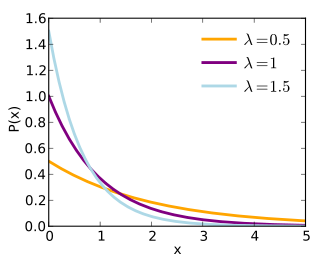
exponential
An exponential distribution is a type of probability distribution, In general, a probability distribution shows the probability that an event (such as a neuron firing) will occur over a given time interval. Specifically, an exponential distribution describes a situation where the probability that the event will occur is proportional to the length of the time interval.
Note: In the image, the x-axis is time, the y-axis is the probability, 1/λ is the mean (average) of the distribution. Each lamda(λ) curve represents an exponential distribution with a different mean.
glomeruli
Spherical structures located near the surface of the antennae lobe in the fly's brain.
sparse
Thinly populated. Here, it means that each tag consists of only a small percentage of the neurons present in the olfactory circuit. That is, only a small percentage of neurons fire action potentials in response to the odor.
approximate similarity (or nearest-neighbors) search
A type of algorithm that takes a point in a data set and then seeks to find other points in the set that are most similar to it.
carbonaceous fuel
Fossil fuels are also called carbonaceous fuels because they are high in carbon compounds.
terpenes
ppm
Part per million (ppm) is a unit of concentration commonly used in atmospheric science and is equivalent to 10\(^{-6}\).
cloud condensation nuclei, CCN
Cloud condensation nuclei (CCN) are small particle that facilitate cloud growth by serving as location of water vapor condensation in the atmosphere. Aerosols often act as surfaced for cloud droplet growth.
δ≅0.05
The \(\delta\) is a Greek symbol used to represent instantaneous change. Here, the authors are providing a numerical value of the change of aerosol optical depth in the Southern Hemisphere (SH), compared to natural background.
aerosol optical depth
Particles, or aerosols, in the atmosphere, such as dust or smoke, scatter or absorb sunlight. Aerosol optical depth (AOD) tells us how much sunlight was prevented from reaching the surface due to these particles. It is a unitless values that corresponds to the amount of aerosols in the atmosphere over the location where is was measured, often using a satellite.
sulfate aerosol
Sulfate aerosols are formed from the condensation of oxidized sulfur dioxide (SO\(_2\)) emitted from fossil fuels combustion or volcanoes. Because humans are the main source of sulfate aerosols, the concentration of this particle is higher over land in the Northern Hemisphere, which the majority of industrial processes take place. The remainder of this paper provides more details on the different impacts these aerosols have on the Earth system.
planetary albedo
Planetary albedo is a measurement of the amount of light reflected from the surface of a planet, in this case, the Earth. Aerosols that reflect more light, such as sulfate aerosols, will enhance the planetary albedo so more incoming solar radiation is reflected back to space. Scientists estimate that Earth's average albedo is 0.3.
relative humidities
Relative humidity (RH) is the ratio of the amount of water vapor in the air (actual vapor density) relative to the amount of water the air could hold (saturation vapor density)
It is given by: \(Relative Humidity\) = \((\dfrac{actual vapor density}{saturation vapor density})\)\(*100%\)
The relative humidity is simply a way for meteorologists and scientists to describe how much moisture is in the air at a give temperature. You and I might feel this on a warm day, where is feels much hotter outside when the humidity is higher.
hygroscopic
Hygroscopic means that the particle has the tendency to absorb water or to react with water.
radiative flux
Flux means a change in, so in this case, the authors are referring to a change (in and out) of the global mean top-of-the-atmosphere radiative forcing.
deliquescent
In this case, deliquescent means that the particles absorb moisture.
in situ
Measurements of temperature or other weather conditions, such as relative humidity, are called in situ if they are taken in the original location. It is a latin phrase used to differentiate observations taken from satellites, called remote observations.
moles
A mole is an SI unit for the amount of a substance or chemical.
meterological processes
Meteorology is the study of weather, so meteorlogical processes refer to weather events such a winds or thunderstorms.
longitudinally
Longitudes are the imaginary North-South lines drawn on planet Earth so navigators, scientists, and other can establish precise locations.
biogenic gaseous sulfur compounds
Some sulfate compounds come from naturally occurring, or biogenic sources, such as dimethylsulfide (DMS) produced from ocean bacteria.
climate models
Climate models are numerical representations of the Earth system. Some models are very complex and can take months to run on a supercomputer, others can be run on a laptop in a matter of seconds. More complex models include representations of the atmosphere, oceans, and change in ice dynamics. Simple climate models often represent on the most fundamental physics of the climate system, such as a carbon cycle.
greenhouse warming
Greenhouse gases (GHGs) absorb outgoing infrared radiation and trap the energy in the atmosphere, causing an increase in temperature over time called greenhouse warming.
greenhouse gases
Greenhouse gases (GHGs) are atmospheric species that absorb outgoing infrared radiation, such as carbon dioxide (CO\(_2\)) and chlorofluerocarbons (HFCs). GHG have long atmospheric lifetimes ranging from hundreds to thousands of year depending on their chemical and radiative properties. These differences also impacts their radiative forcing abilities.
tropospheric aerosol
The troposphere is the area of the atmosphere where you and I live and breathe. It is between 5 - 9 miles thick, depending on your location on Earth. Its name derives from "Tropos”, meaning change, because weather and clouds form in this region of the atmosphere.
Aerosols are small particles suspended in the atmosphere. Sunlight can be absorbed or reflected from the surface of aerosols depending on the size and type of aerosols. These factor determine the atmospheric properties of the aerosol. Aerosols generally have short atmospheric lifetimes compared to greenhouse gases, such as carbon dioxide. For example, black carbon, a type of aerosol emitted from incomplete combustion and biomass burning, have an atmospheric lifetime between 3-5 days.
Tropospheric aerosols are very important to understand because they impact the climate, but also can impact the quality of human health. For example, very fine particles, called Particulate Matter (PM) 2.5, a reference to the diameter of the aerosols in micrometers, are dangerous from humans and leads to increased cardiovascular problems and even death.
1850
Climate scientists generally use the Industrial Revolution as a benchmark in time. Though there is debate in some spheres about the exact date that should be chose, these authors use 1850 to indicate the shift toward industrialization, including use of fossil fuels. Time periods before 1850 are termed "pre-industrial."
radiative forcing
The Earth's surface temperature is determined by the balance between incoming solar radiation (sunlight) and outgoing infrared radiation. Radiative forcing (RF) is a measure of the ability of a gas or particle, for example, to effect that energy balance. The units of RF are watt per meter squared (W/m\(^2\)), which translate to the rate of energy change per unit area on the globe as measured from the top of the atmosphere.
global climate change
Climate change refers to changes in the Earth system from both natural and human factors. Global warming is often use synonymously with climate change, but global warming specifically refers to the rise in global average temperature. More generally, climate change includes the melting of polar ice, increase in ocean acidity, and measured global mean temperature increases.
anthropogenic
Anthropogenic means resulting from human activity. Scientists often speak about anthropogenic climate change to specifically discuss the changes resulting from the burning of fossil fuels or land use change, for example.
marginal
In this context, marginal means not important or not central.
secondary metabolites
Any organic substance that is not directly involved in the growth, development, or reproduction of an organism. Vulpinic acid is an example of a secondary metabolite.
intron
A segment of DNA that does not code for proteins and interrupts the sequence of genes.
anamorphic
This is the asexual life stage of fungi, where reproduction is achieved by budding of mononucleated cells.
morphology
The shape or form of an organism.
fossil calibrations
The molecular clock can be adjusted (i.e. calibrated) using fossil data from any taxa represented in a rooted phylogeny, in order to put an approximate date on the nodes of a phylogeny.
Recently, new lichen fossils were found, giving us more insight into the co-evolution of lichen symbionts.
monophyletic clade
A group of organisms that clusters together on a phylogenetic tree to the exclusion of all other groups.
galls
In this case, meaning an abnormal outgrowth on the Parmeliaceae thalli.
genera
Plural form of the taxonomic rank, genus.
ribosomal RNA (rRNA)
This is a gene that helps stabilize the ribosome. It is found in all living organisms, so this gene is often used in phylogenetic comparisons of different species.
taxon
A taxonomic group of any rank, such as species, family, or class.
phenotype
The traits that an organism displays. Phenotype results from the interaction of a genotype with the environment.
genotype
The gene sequence that an organism carries.
mycobiont
The fungal partner in the lichen symbiosis.
metatranscriptomics
A transcriptome sample that is taken from a collection of organisms. mRNAs must be mapped onto each of the genomes from the organisms in the sample in order to figure out which gene came from which organism. In some cases, there is not a genome available for mapping and instead mRNA is mapped against a large database in order to find a close relative and guess where the mRNA could have come from.
in vitro
In a laboratory setting; that is, outside of their normal biological context.
recalcitrance
Resistance, in this case.
axenic
Denotes a laboratory culture that is free from living organisms other than the species required. In this case, lichens could not be formed in a laboratory using only the two known species.
mutualism
A type of symbiosis in that the relationship is beneficial to both organisms involved.
cortex
The outermost layer of the lichen's thallus, where the lichen comes into contact with the environment.
endophytes
Organisms, often fungi or bacteria, that live within a plant.
turnover rate
Describes how quickly an enzyme can take a single chemical through a specific chemical reaction. It is often abbreviated \(k_{cat}\) like you see here.
Baggerly’s test
A specific statistical method that compares the proportions in a group of samples against those of another group of samples.
cellular localization
Describes where a molecule is in the cell. For example, a protein might be found in the cytoplasm, or it might hang out in a specific organelle.
putative
Commonly accepted. In this case, the hydrolase from Thermobifida fusca is already known to break down PET.
amino acid
A small chemical that forms the monomer of a protein. Three base pairs in an open reading frame of DNA codes for one amino acid.
esterases, lipases, or cutinases
These are types of enzymes that are capable of breaking apart certain types of cell compounds. Esterases break down a wide range of compounds called esters. Lipases break down fats and cutinase hydrolyzes cutin, part of the waxy substance you find on leaves.
environmental remediation
A process of repairing human-caused damage to the natural environment. For example, environmental remediation might involve removing harmful chemicals from water sources, or removing dangerous radioactive elements from soil. This work is looking at using biological organisms to remove PET film from the environment.
reaction intermediate
Sometimes a reaction occurs in more than one step. The original material reacts to form what we call a reaction intermediate, which may exist briefly or for a longer period of time, but is later turned into a final product.
In this case, in simplified terms, PET is converted into reaction intermediate MHET (mono(2-hydroxyethyl) terephthalic acid), which is then converted to TPA (terephthalic acid) and EG (ethylene glycol).
culture fluid
The growing material, which contains water, inorganic minerals, and small organic molecules. Most of the microbes in the test tube attached to the PET film, making the liquid culture appear clear.
ethylene glycol
A chain of two carbon atoms between two oxygen atoms. When two ethylene glycol groups bond to either end of TPA, you get the MHET, the basic monomer of PET. You may have encountered ethylene glycol in the form of anti-freeze.
Volatile methyl siloxanes
Silicone is a polymer that is made up of siloxanes. Silicone is used in many household products including baby bottles, adhesives, and skin and hair care products. The smaller the polymer is, the more volatile it will be. Many skin and hair care products use smaller siloxanes which are volatile.
IVOCs
Intermediate Volatile Organic Compounds. Molecules that contain carbon atoms that somewhat evaporate into the gas-phase at typical pressures and temperatures.
mobile sources
Produced from transportation-related activities; for example, driving.
Mobile sources also include off-road engine sources (e.g. construction equipment, lawn mowers, and recreational vehicles), not necessarily related to transportation per se.
acetone
A common organic solvent. It has a variety of household uses; acetone is the active ingredient in nail polish remover.
tropospheric
Refers to the lowest portion of the atmosphere, from the surface of Earth out to about 5 miles above the surface.
The troposphere contains all the breathable oxygen in the atmosphere sustaining all life on Earth.
carbonaceous aerosols
Particles suspended in the air that contain mostly carbon. Soot is a good example of a carbonaceous aerosol.
parasitic
Unwanted.
passive
The system does not require any additional source of energy.
diffusion
Spontaneous movement of a substance due to the difference in its concentration between different areas. For example, if you put a tea bag in water, the tea leaves will spread by diffusion, giving the water its color.
sorption
Refers to both adsorption and absorption, which are, respectively, the adhesion of a substance to a surface or its incorporation into another substance.
isotherm
A curve joining points measured at the same temperature. In this case, the water uptake capacity of the MOF is measured by varying either the humidity or the vapor pressure but keeping the temperature constant (isotherm) during the measurement.
vapor diffusion resistance
Value reflecting the fact that vapor diffusion between different materials is limited by different factors such as the accessibility of the pores.
thermoelectric cooler
A device using electricity to transfer heat. Think of it as a refrigerator.
passive heat sink
Heat sinks are devices that are used to transfer heat, usually to keep a hot component cool. Although active heat sinks like fans require an input of energy, passive heat sinks are usually made of aluminum fins and rely on their surface area to dissipate heat and do not require energy.
UiO-66
A different metal-organic-framework. The name UiO is used for the MOFs developed at the University of Oslo. This MOF is constituted of the same metal clusters as MOF-801 but with different linkers between them.
incident solar flux
The amount of sunlight that reaches the surface.
dynamic
Constantly changing. In this case, the MOF temperature varies during adsorption and desorption of water.
exothermic
That releases heat.
adsorbate
The substance adsorbed, in this case water.
porous
Containing holes within its structure.
flux
The amount that passes through a substance. In this case, it is the amount of sunlight received by a surface.
Atmospheric water
The water present in the atmosphere as vapor, mainly due to evaporation from the oceans.
metal-organic framework
Structure composed of metal ions linked together by small molecules. This structure repeats itself to form a network that is often porous and can be used to trap chemicals in their cavities like a sponge.
MIT
Massachusetts Institute of Technology.
heat transfer coefficient
Quantitative measure of the flow of heat between two materials.
desorption
Phenomenon through which a substance is released from a surface. In this case, water vapor released from an MOF. It is the opposite of adsorption.
adsorption
Phenomenon through which a substance adheres to a surface. In this case, water vapor adsorbed to the MOF. It is the opposite of desorption.
relative humidity (RH)
The amount of moisture in the air compared to the maximum amount the air can hold at that same temperature.
MOF-801
MOF stands for metal-organic framework. MOF-801 refers to the unique name used to identified this specific metal-organic framework.
heat sink
A device or substance that absorbs excessive heat.
active cooling
Using an external source of energy to cool a system, as opposed to passive cooling that does not require energy.
intracrystalline diffusivity
Measure of the capability of the material to allow a substance to pass through the crystal by diffusion.
void spacing
Distance between the cavities.
Knudsen diffusion
Model of diffusion occurring when molecules travel through very small pores.
inter- and intracrystalline vapor diffusion
How well vapor can pass between crystals and through a single crystal by diffusion.
COMSOL Multiphysics
A software used to model and simulate scientific problems.
equilibrated
Stabilized.
Thermocouples
Sensors used to measure temperature.
isobaric
At constant pressure.
abscissa
The horizontal axis.
climatic refugia
Regions where the speed and variability of climate change are lower than in the surrounding area. These climate refugia have the potential to act as "safe havens" where species can retreat to and persist as the climate changes.
A similar concept is the glacial refugia used by many species during the last ice age. Visit the Encyclopedia of Earth for more information on refugia.
behavioral thermoregulation
Thermoregulation is the process through which animals increase or decrease their body temperature. Thermoregulation can be done physiologically (e.g. by sweating to cool down during a hot day), or can be done behaviorally (e.g. by taking shelter in the shade during the hottest parts of the day).
Common examples of behavioral thermoregulation are lizards or butterflies basking in the sun. (Photo courtesy Discover Wildlife)

Palearctic
One of eight "realms" that divide Earth's surface. It comprises Europe, North Africa, Asia (north of the Himalayas), and the northern and central Arabian Peninsula. The Palearctic is primarily boreal/subarctic and temperate in climate.
sampling intensity
Refers to the thoroughness of people having surveyed a region for species observations. Certain regions and times are more surveyed than others for often mundane reasons, such as accessibility. For example: If a flood washes out the road to a popular park, the park will likely not be searched as often until the road is rebuilt.
These differences in sampling effort between regions and time periods can create trends within the data that are not real. For instance, in the aforementioned example, after the road is washed out and sampling effort decreases, it would appear as if there are less organisms in the park, when in reality there could be the same number of organisms and just fewer people to record them.
In this study, the authors account for differences in sampling intensity by only including species in their study if they had over 100 observations in a baseline time period, and over 30 observations in each other time period.
phylogenetic tree
Describes the evolutionary relationships among organisms (i.e. how related is one organism to another), based off of similarities and differences in physical or genetic characteristics.
Visit here for more information on what phylogenetic trees are and how scientists build them, by Khan Academy.
phylogenetic generalized least-squares models
Tests for a relationship between two or more variables, while accounting for phylogeny (i.e. the fact that some species, or lineages, are more closely related than others).
"Regular" models, such as Generalized least-squares models, or Ordinary least-squares models, also test for a relationship between two or more variables, but these tests assume that variables and species are independent (i.e. are all equally related). When this assumption is violated, the test results can be biased.
full extents of their latitudinal and thermal limits
Latitudinal range limits are the northernmost and southernmost edges of where a species can be found.
Thermal range limits are the hottest and coldest places of where a species live.
georeferenced observations
"Georeferenced" means that we know where a species observation was made. This means that we have the latitudinal and longitudinal coordinates for the location where someone found a particular species. It's not just a description of the place, like "third mountain from the left, in Colorado," because that doesn't help us know where a species was found very reliably. These days, it's a lot easier to figure out those coordinates, because most smartphones include GPS that records exactly where something is found. This is the same feature that lets a user track where they are on a map, use Pokémon Go to find an elusive Pokémon, and so on. But instead of finding virtual animals, we can record where the real ones are found. But records from a hundred years ago (obviously) didn't get stored using smartphones, so there's a lot of manual work needed to figure out where those records came from.
land-use intensification
Common land-uses include: agriculture, urban space, or wilderness. An intensification of a land-use means that the human influence on the land has increased, but without changing the type of land-use. Typically this includes an increased output of pollutants.
For example, while a pesticide-heavy, monocultured farm field has the same land-use as a pesticide-free organic farm, the intensity of land-use at the monocultured farm would be greater, even if the farms were the same size.