436 Matching Annotations
  1. Dec 2025
    1. it's evident that I'm irrelevant to societyThat's what you're telling me

      These lines pose a critique towards societal impositions: Lamar feels irrelevant and deprived of any importance in American society. However, this feeling entirely depends on what white people have been telling him. Once again, double consciousness dominates the self.

    2. Remember this, every race start from the block

      Lamar refuses to accept that Blacks are "doomed from the start": making use of a sport metaphor, he speaks in terms of a "race", in which everyone begins from the same starting point.

    3. The blacker the berry, the sweeter the juice

      "This Black proverb appears as early as 1929 in the title of Wallace Thurman’s novel, The Blacker the Berry. Most agree that the phrase is meant as an affirmation of the richness and beauty of Black people and of darker skin Blacks. In many ways it is a counter response to the pervasive celebration of white or lighter skin Black Americans. The phrase appears in Tupac Shakur’s 1993 song “Keep Your Head Up,” and continues to flow through Black culture as a form of praise and affirmation." https://thedig.howard.edu/all-stories/save-culture-slang-exploration-black-language-expressions

    4. You're fuckin' evil

      As you may have gathered by now, Lamar's song is unfiltered: although he acknowledges the hierarchy that forces his community to remain "at the bottom of mankind", he does not feel inferior. On the contrary, he is proud of his identity and his African ancestry, so much as he does not hesitate in judging the oppressors.

    5. You hate my people, your plan is to terminate my culture

      After having described some features stereotypically connected with being African-American, Lamar asks white people a rhetorical question ("you hate me, don't you?") since he already knows the answer. In such a perspective, there seems to be no glimpse of hope for Black people: they are hated and their culture is at risk of being "terminated". Nevertheless, Lamar does not renounce to his voice and gives space to the rage that feels since he was a teenager. https://open.library.ubc.ca/media/stream/pdf/24/1.0300649/4

    6. Came from the bottom of mankind

      Lamar's viewpoint is crystal clear: not only is there a social hierarchy in America, but also he identifies black as the ones "at the bottom". There is no possible equality in this scenario.

    7. you made me

      This sentence functions as an explanation of the previous one: Lamar claims that he may be experiencing life in a schizophrenic way but blames whites (the ideal interlocutors in this scenario) for it.

    8. schizophrenia

      Schizophrenia is a mental illness, in "characterized by disruptions in thought processes, perceptions, emotional responsiveness, and social interactions". https://www.nimh.nih.gov/health/statistics/schizophrenia However, in this case the term is more likely to refer to W.E.B. Du Bois' double consciousness. This notion hints at the idea that black people possess a double identity: the first one is tied to being African-American, whereas the other corresponds to the perspective of the White oppressors. As a consequence, their sense of self is fragmented. Hence, the reference to the fragmented self of schizophrenic people. https://study.com/learn/lesson/web-du-bois-double-consciousness-overview-background-examples.html#:~:text=Double%20consciousness%20is%20the%20feeling%20of%20having%20two%20social%20identities,%2C%20and%20treatment%20by%2C%20Caucasians. https://open.library.ubc.ca/media/stream/pdf/24/1.0300649/4

    9. Irish, Italians, the Germans and the Jews

      Springsteen is historically accurate here: during the second half of the 19th century, most of U.S. immigrants came from Ireland, Poland and Germany (including many Jews). Moreover, the 1900 census corroborates the same thesis, showing that European immigrants mostly migrated from Italy and Germany, as well as Russia, Austria-Hungary and Britain. https://www.gilderlehrman.org/history-resources/spotlight-primary-source/map-foreign-born-population-united-states-1900#:~:text=According%20to%20the%201900%20census,Austria%2DHungary%2C%20and%20Russia. https://www.loc.gov/classroom-materials/united-states-history-primary-source-timeline/rise-of-industrial-america-1876-1900/immigration-to-united-states-1851-1900/ https://immigrationhistory.org/lesson-plan/european-migration/

    10. There’s treasure for the taking, for any hard working man

      This verse hints at other American myths: self-reliance, individualism and the self-made man. In short, these three combined point at the idea that working hard, putting effort and invest in one's self will eventually lead to (economic) success, independently from your initial condition.

      Your turn: do you think that working hard is enough to achieve success? In other words, does success exclusively depend on effort or there may be other uncontrollable factors involved? Can poverty be overcome in this way?

    11. What is this land America so many travel there

      Starting from "the late 1800s, people in many parts of the world decided to leave their homes and immigrate to the United States. Fleeing crop failure, land and job shortages, rising taxes, and famine, many came to the U. S. because it was perceived as the land of economic opportunity". https://www.loc.gov/classroom-materials/united-states-history-primary-source-timeline/rise-of-industrial-america-1876-1900/immigration-to-united-states-1851-1900/

    12. My mama didn't raise no fool

      From a strictly grammatical point of view, this expression is wrong: two negative forms (didn't and no) are not acceptable in a sentence. The correct form should be either "My mama did not raise any fools" or "My mama raised no fool". However, double negative (also called negative concord) is used in some varieties of English (in this case, African-American Vernacular English) to intensify the meaning of the sentence. In other words, the construction is a sub-standard form used mainly to give more emphasis and expressive force to what is being said. It should be avoided in written and formal writing, but it is normal to use in oral speech, especially in African-American communities.

      Curiosity: labeling an expression or an usage as "wrong" or "correct" is rarely a matter of language and more frequently a matter of (social) prestige: normally, it is considered "right" the variant of the language that is used by educated, white people; in contrast, "wrong" expressions are often the ones employed by minorities, uneducated or stigmatized groups. Long story short: people think they are judging an incorrect linguistic form, when, in fact, they are stigmatizing the community that uses it.

      https://www.merriam-webster.com/dictionary/double%20negative https://web.archive.org/web/20100810125721/https://www.american.edu/cas/tesol/resources/upload/Kirby_Philippa.pdf

    13. war in the Middle East

      The 1990s were a decade of unrest and, sadly, or great military violence. The main conflict that occurred in the Middle East is the Persian Gulf War (1990-1991), an international war fought between Iraq, Kuwait and the Unites States, which intervened when Kuwait was invaded by Iraqi forces. During the 1990s, other Middle East conflicts include: 1. the Iraqi Kurdish Civil War (1994-1997); 2. the Yemeni Civil War (1994); 3. the Operation Desert Fox (1998), which consisted in the U.S. bombing of Iraq.

      https://www.britannica.com/event/Persian-Gulf-War#:~:text=The%20Persian%20Gulf%20War%2C%20also,Kuwait%20on%20August%202%2C%201990 https://www.bbc.co.uk/bitesize/guides/zhsssk7/revision/5

    14. war on the streets

      At the time in which 2Pac sang, there was a sharp rivalry among hip-hop singers of the East Coast and those of the West Coast, in which Shakur himself was implicated with and died for. Moreover, streets feuds among gangs were ferocious, mostly due to the control of drug markets. If you are interested in looking more into the topic, here is a 1990 short news special on L.A. youth gangs: https://youtu.be/-W_jhoknV1Y?si=8YSEmzi6PiZFwn5l.

    15. We gotta make a changeIt's time for us as a people to start makin' some changesLet's change the way we eat, let's change the way we liveAnd let's change the way we treat each other

      Again, similar to the "We gotta start makin' changes" verse, there seems to be glimpse of hope through intentional actions to improve the world.

    16. You gotta operate the easy way

      This verse and the following ones delve into a moral dilemma: the only way to survive in this ruthless America for Black people is by "operating the easy way", which means going behind the law. Already introduced at the beginning of the song, the idea of committing crimes as a result of poverty and lack of resources is here confirmed. The "G" is made illegally, by selling drugs to a child. When confronted with the immorality of his action, the man answers that he "gotta get paid", meaning that morals and ethics come second when the priority is making ends meet. https://americansongwriter.com/the-painful-meaning-behind-the-song-changes-by-tupac/

    17. And although it seems heaven sentWe ain't ready, to see a black President

      What 2Pac considered impossible actually occurred in 2009, when Barack Obama was elected President of the United States and then again in 2012, when he was reelected. Nevertheless, his presidency was filled with conspiracy theories (especially revolving around his being born in the Unites States) and controversies that tried to undermine the figure of the President. Ultimately, this may suggest that the United States was not ready for a black President.

    18. I'd love to go back to when we played as kids

      In this disheartening scenario, 2Pac seeks refuge in the pleasant memories of an idealized childhood, which is perceived as the only moment in space and time where he may find solace.

    19. nigga

      Just as the previous term, this one is charged with a derogatory connotation, so much as it is preferred to refer to it with the euphemistic expression "N-word", which emcompasses both this word and its -er variant. The phenomenon that allowed the erosion of the -er ending is called r-dropping: the -r is replaced by a schwa (ə), an indistinct vowel pronounced "uh". These terms have always been linked with white supremacy, racism and white power. Even though the two terms may seem synonyms, in fact there is a difference: the -er ending word is strictly connected with the all-encompassing hatred and contempt towards black people, whereas the second one is perceived as a term of endearment when uttered by someone belonging to the Black community. Indeed, starting from the 1980s, the word has underwent a process of reclaiming (also called semantic inversion or looping) which corresponds to "taking a word meant as a slur and reappropriating it as a term of endearment" (https://www.washingtonpost.com/sf/national/2014/11/09/the-n-word-an-entrenched-racial-slur-now-more-prevalent-than-ever/?utm_term=.1590a4928864). This strategy allows the originally oppressive term to be re-semantized (that is, to acquire a new meaning) and used to celebrate the community's unique identity and humanity as "an act of redemption by black folk. The word survives on the conditions that black folks have inscribed for it and nobody else can take that. And it becomes violent when other people try to take it and use it." Indeed, white people "have created the word in the first place, but […] they have lost the power to use it with impunity, they have lost the power to reclaim it." […] "If you understand the history of the word and how it's been used, it's not for white people to use […] So if you're not black you can't do that. You actually can't use the word in the way that we use it. It's not possible, because you're not in that space. So any other usage of it is completely wrong." (https://www.bbc.com/news/stories-53749800). https://www.merriam-webster.com/dictionary/N-word https://share.google/2p6rElVA4Vin0v2cC https://www.dailydot.com/irl/how-not-to-use-the-n-word/

    20. My stomach hurts, so I'm lookin' for a purse to snatch

      In Tupac's perspective, crime is a consequence of poverty. What do you think about it? Do you think crimes are response to people being unable to afford life?

    21. I'm tired of bein' poor and even worse I'm black

      In the society in which the narrative voice lives, both poverty and blackness have a negative connotation. In other words, being Black adds up to being poor.

    22. Is life worth living

      Disclaimer: sensitive content.

      In a world dominated by racism and in which nothing changes, the singer wonders whether the struggles he has to cope with on a daily basis make living worth it. He even contemplates the possibility to end his life in the same verse. If you have ever felt the same way the singer does in this verse, please seek help at https://azzurro.it/ or at least talk with an adult or a teacher.

    23. But it only goes so far'Cause the law don't change another's mindWhen all it sees at the hiring timeIs the line on the color bar

      Hornsby's posture seems clear: in these verses, he states that legal measures can only "go so far", that is, they can only operate up to a certain extent. He hints at the fact that another change has to occur: a cultural one. According to the author, indeed, equality can be achieved only in a co-constructive process that implicates the law on one side, and the culture on the other. In other words, what Hornsby is trying to state is that acts can be signed into law and assure people their rights, but it is equally important that people change their mindsets.

    24. they passed a law in '64

      The "law" in this verse could allude to: * the Civil Rights Act passed in 1964 by President Lyndon Johnson. It "prohibited discrimination in public places, provided for the integration of schools and other public facilities, and made employment discrimination illegal" (https://www.archives.gov/milestone-documents/civil-rights-act#:~:text=This%20act%2C%20signed%20into%20law%20by%20President,most%20sweeping%20civil%20rights%20legislation%20since%20Reconstruction.) In other words, it made segregation in all its forms illegal. * the Economic Opportunity Act which was introduced in the same year. It "aimed at facilitating education, health, employment, and general welfare for impoverished Americans" (https://www.britannica.com/event/American-civil-rights-movement). It was part of the so-called "War on Poverty", a program endorsed by President Johnson and which intended to reduce poverty in the United States, along with making the country more equitable. https://www.britannica.com/topic/War-on-Poverty

      It is probable that the song hints at both Acts, rather than pointing at just one.

    25. A man in a silk suit hurries by

      In this sad scene, a new character is introduced: a man in a silk suit. He represents the rich and wealthy people who do not have to wait in line for economic help and, for this reason, hurries by (that is, he moves rapidly). His perspective is biased: he blames those in line for being poor and encourages them to "get a job". Therefore, Hornsby's intention is that of criticizing social polarization and inequality, apart from biased convictions that link poverty to laziness.

      Your turn: is the man in a silk suit right? Are poor people always lazy or are there any other reasons for poverty?

    26. they can't buy a job

      The reason that is provided as for why they are waiting and need financial support is their poverty. The expression "buy a job" may refer to the fact that they cannot afford college education, in a modern scenario in which education assures better job opportunities; in a darker perspective, it might also mean that they have no connections to secure themselves a job through nepotism or bribery.

    27. Standing in line, marking time

      This first stanza describes a specific image: the songs opens with a symbolical "line" where people in distress are waiting to receive some help from the government.

    28. The answer, my friend, is blowin’ in the windThe answer is blowin’ in the wind

      Here is the chorus of the song: to all the questions posed, the songwriter is not able to answer. In fact, the answer is as elusive as the wind and impossible to grasp. https://www.litcharts.com/poetry/bob-dylan/blowin-in-the-wind

      Another interesting element to point out is the relationship that Dylan seems to have with the audience: as previously remarked, this song converts Dylan into a spokesman of the common people, a "primus inter pares" if you wish, who makes use of his art to denounce inequality and social struggles. He does not think of himself as a custodian of a hidden truth no one else has discovered: just as everybody else, he does not have a clue about why discrimination and wars occur.

      Your turn: if there are no answers, why asking questions? Do you think there is value in asking questions that cannot be answered?

    29. How many years can a mountain existBefore it’s washed to the sea?

      "The mountain […] is a symbol of those human institutions that keep war and oppression in place. The stony mountain is all that resists change: the shape of government and history, certainly, but also the rocky terrain inside people's hearts. The slow, persistent erosive power of the ocean, on the other hand, symbolizes the action of internal and external change." https://www.litcharts.com/poetry/bob-dylan/blowin-in-the-wind

    30. dove

      The dove is a white bird that corresponds to colomba in Italian. It usually symbolizes peace. https://dictionary.cambridge.org/dictionary/english/dove due colombe bianche che volano<br /> "There's also a reference here to a specific dove: the biblical dove of Noah's Ark, which flew out from the Ark to seek dry land and returned bearing a hopeful olive branch. The symbolism of the dove here suggests that the change the speaker hopes for may not be easy to come by" (https://www.litcharts.com/poetry/bob-dylan/blowin-in-the-wind).

    31. How many roads must a man walk downBefore you call him a man?

      This is the opening of the song, which starts and procedes by asking multiple rhetorical questions to the listeners. In this case, Bob Dylan is calling into question the essence of humanity by describing an activity as simple as walking. The "roads" may hint at the long history of difficulties and hardships that Black people have experienced. The call to equality is unmistakable. https://www.litcharts.com/poetry/bob-dylan/blowin-in-the-wind

      According to you, what makes us human?

    32. The 1960s: Bob Dylan—Blowin' in the Wind

      Setting the scene: the song was released in 1963 and included in the album The Freewhelin' Bob Dylan. All of Dylan's "most famous political songs were written [...] between January 1962 and October 1963" and "those [...] fixed him in the popular imagination" as a protest songwriter (Lynskey, 2010, 67). The historical context in which the song was released is essential to understand its meaning: during the 1950s the civil rights movement against racial segregation started to gain momentum, reaching its highest point precisely in 1963. Indeed, in that year: * Desegregation protests spread throughout the Southern states over more than 100 cities. The most famous was the March on Washington: it was organized by the "Big Six" of the civil rights movement (Martin Luther King Jr., James Farmer, J. Lewis, P. Randolph, R. Wilkins, W. Young), attended by more than 250.000 protesters (including Bob Dylan). It was in this occasion that the renowned "I have a dream" speech took place. Martin Luther King, Jr. e Mathew Ahmann in una folla di manifestanti alla Marcia su Washington * On June 12, President Kennedy announced he would present a civil rights bill to Congress, which was eventually passed the following year under the name of the Civil Rights Act. https://www.britannica.com/event/American-civil-rights-movement https://www.britannica.com/event/American-civil-rights-movement

      It is important to bear in mind that protests were not only motivated by the insufferable racial segregation, but they were also anti-war oriented: the Vietnam war (1955-1975), which had been raging for ten years by the mid-1960s, was felt as an unnecessary conflict, especially by students and young people, who were the ones recruited in the U.S. army. Indeed, "the average age of an American soldier in Vietnam was 19" (https://www.bbc.co.uk/bitesize/guides/z6dk8hv/revision/4 ).

    1. generational hatredIt's genocism

      In this last verse, there is no possible misunderstanding: Lamar directly attacks centuries of racism, whose thousands of deaths he (rightly) labels as genocide. Another striking expression is that of "generational hatred": the singer evokes an atmosphere in which racism is like a twisted tradition which, instead of passing down from father to son, passes down from generation to generation, destroying people in the meantime.

    2. dem

      This entire verse is written in Jamaican patois, that is, "an English-lexified creole language spoken by the majority of Jamaicans". As you will see, some words may be intuitive, but others are definitely not. While I was looking for the lyrics of the song, I found other anglicized versions which were certainly more comprehensible, but, I am afraid, less faithful to the singer's intention. Consequently, I opted for the original, more complex version. Why has the singer recurred to Jamaican patois? My hypothesis is that he features it as a way to give importance and centrality to a marginal community through its language.

      Dem is they. https://jamaicanpatwah.com/term/dem/961

    3. The blacker the berry, the bigger I shoot

      Lamar mangles (storpia, in Italian) the words of the proverb: this modified version seems to represent a counterpart to the the original one. If the first one celebrates and honors Black culture, this one seems to connect to the brutality of reality, in which violence dominates and is, apparently, the only possible response.

    4. The blacker the berry, the sweeter the juice

      "This Black proverb appears as early as 1929 in the title of Wallace Thurman’s novel, The Blacker the Berry. Most agree that the phrase is meant as an affirmation of the richness and beauty of Black people and of darker skin Blacks. In many ways it is a counter response to the pervasive celebration of white or lighter skin Black Americans. The phrase appears in Tupac Shakur’s 1993 song “Keep Your Head Up,” and continues to flow through Black culture as a form of praise and affirmation." https://thedig.howard.edu/all-stories/save-culture-slang-exploration-black-language-expressions

    5. monkey

      This word is a highly offensive, derogatory term used to insult Black people by comparing them to animals. The likening of a person to an ape, a monkey or a gorilla is a discriminatory practice that takes the name of simianization. Simianization dates back to the Middle Ages and has progressively taken a racist turn and started only to indicate black-skinned individuals. Reasons for this association may include the prevalence of apes in Africa and the aesthetic difference between whites and blacks. In any case and whatever the reason may be, it is a form of degradation and dehumanization. In this case, it is probable that Lamar is aiming for a reclaiming (that is, semantic inversion) of the term. In other words, the same reasoning applied for "nigga" in 2Pac's "Changes" is applicable here: the singer uses this term to affirm his identity as an African-American. https://www.dictionary.com/browse/simianization https://theconversation.com/comparing-black-people-to-monkeys-has-a-long-dark-simian-history-55102

    6. You hate me don't you?You hate my people, your plan is to terminate my culture

      After having described some features stereotypically connected with being African-American, Lamar asks white people a rhetorical question ("you hate me, don't you?") since he already knows the answer. In such a perspective, there seems to be no glimpse of hope for Black people: they are hated and their culture is at risk of being "terminated". Nevertheless, Lamar does not renounce to his voice and gives space to the rage that feels since he was a teenager. https://open.library.ubc.ca/media/stream/pdf/24/1.0300649/4

    7. Been feeling this way since I was sixteen

      Here Lamar denounces a decade-long rage for anti-Black racism and police brutality he himself was a victim of. In a Rolling Stone interview, Lamar declared that as a teenager "the majority of my interactions with the police were not good […] there were a few good ones who were actually protecting the community. But then you have the ones from the Valley. They never met me in my life, but since I'm a kid […] they wanna slam me on the hood of the car. Sixteen years old […] Even if he's not a good kid, that don't give you the right to slam a minor on the ground or pull a pistol on him. " […] Indeed, "police pull guns on him on two occasions. The first when he was 17." https://issuu.com/lawrenceambrocio5018/docs/rolling_stone_march_26_2015_usa_1_

    8. schizophrenia

      Schizophrenia is a mental illness, in "characterized by disruptions in thought processes, perceptions, emotional responsiveness, and social interactions". https://www.nimh.nih.gov/health/statistics/schizophrenia However, in this case the term is more likely to refer to W.E.B. Du Bois' double consciousness. This notion hints at the idea that black people possess a double identity: the first one is tied to being African-American, whereas the other corresponds to the perspective of the White oppressors. As a consequence, their sense of self is fragmented. Hence, the reference to the fragmented self of schizophrenic people. https://study.com/learn/lesson/web-du-bois-double-consciousness-overview-background-examples.html#:~:text=Double%20consciousness%20is%20the%20feeling%20of%20having%20two%20social%20identities,%2C%20and%20treatment%20by%2C%20Caucasians. https://open.library.ubc.ca/media/stream/pdf/24/1.0300649/4

    9. The 2010s: Kendrick Lamar—The Blacker The Berry

      Setting the scene: the song was released as a second single from the 2015 album To Pimp A Butterfly. The album (and the song as well) "is firmly in the present. It's [Lamar's] take on what it means to be young and black in America today". https://issuu.com/lawrenceambrocio5018/docs/rolling_stone_march_26_2015_usa_1_ Indeed, the album is deeply connected to contemporary issues in America (police brutality, systemic racism and inequality) and, in particular, to Black Lives Matter. Black Lives Matter is a "Black-centered political-movement-building project" that surged in 2013 as a reaction to the Travyon Martin murder. The core beliefs of the movement include: * the affirmation of the importance of Black Lives against police brutality and any other racist manifestation; * transforming the present world in which "Black lives are systemically targeted for deliberate and indirect demise"; * affirmation of Black humanity and contributions; * abolition of mass incarceration to the detriment of Black people; * collective safety.

      https://blacklivesmatter.com/our-history/

    10. They died building the railroads worked to bones and skinThey died in the fields and factories names scattered in the windThey died to get here a hundred years ago they’re still dyin' nowThe hands that built the country were always trying to keep down

      Here the central critique to the lack of equality and the debunking of the immigration myths appears evident: in particular, Springsteen makes uses of the anaphora "they died" to underscore the timeless sacrifice of immigrants, who are identified with the makers of the United States ("the hands that build the country"). This last part of the song completely overturns what Springsteen has sung so far: there are no streets paved with gold, no diamonds in the sidewalks or "treasure for the taking". What remains is work "to bones and skin". Once again, Springsteen has not departed from the historical truth: despite their hopes, European immigrants who landed in the United States did not improve their status. In other words, if they were poor, they stayed as such; “past European immigrants often struggled when they first arrived, and most of them did not succeed in reaching the American Dream within their lifetimes.” https://ui.charlotte.edu/story/streets-gold-debunking-american-immigration-myths/ Moreover, research shows that from 1880 to 1920 immigrants "were the mainstay of the American industrial workforce". https://pmc.ncbi.nlm.nih.gov/articles/PMC2760060/#abstract1 Making home in the American Land was, therefore, impossible for them because America itself rejected and discriminated immigrants after exploiting them for its own industrial and economic growth. Indeed, "often stereotyped and discriminated against, many immigrants suffered verbal and physical abuse because they were "different." […] The newcomers helped transform American society and culture, demonstrating that diversity, as well as unity, is a source of national strength." https://www.loc.gov/classroom-materials/united-states-history-primary-source-timeline/rise-of-industrial-america-1876-1900/immigration-to-united-states-1851-1900/

      Springsteen's radical claim is that such discrimination and sacrifice are not limited to a distant past, but have continued up until now ("they're still dyin' now"). When Springsteen released the song, the country was actually undergoing a period of decline in immigration due to measures taken after the terrorist attacks of September 11, 2001 such as the Patriot Act. https://library.law.howard.edu/civilrightshistory/immigration/history. However, it is true that immigration continues to be a divisive topic in the United States, especially in the current presidency: what do you know about Trump's immigration policies?

    11. the Irish, Italians, the Germans and the Jews

      Springsteen is historically accurate here: during the second half of the 19th century, most of U.S. immigrants came from Ireland, Poland and Germany (including many Jews). Moreover, the 1900 census corroborates the same thesis, showing that European immigrants mostly migrated from Italy and Germany, as well as Russia, Austria-Hungary and Britain. https://www.gilderlehrman.org/history-resources/spotlight-primary-source/map-foreign-born-population-united-states-1900#:~:text=According%20to%20the%201900%20census,Austria%2DHungary%2C%20and%20Russia. https://www.loc.gov/classroom-materials/united-states-history-primary-source-timeline/rise-of-industrial-america-1876-1900/immigration-to-united-states-1851-1900/ https://immigrationhistory.org/lesson-plan/european-migration/

    12. There’s treasure for the taking, for any hard working man

      This verse hints at other American myths: self-reliance, individualism and the self-made man. In short, these three combined point at the idea that working hard, putting effort and invest in one's self will eventually lead to (economic) success, independently from your initial condition.

      Do you think that working hard is enough to achieve success? In other words, does success exclusively depend on effort or there may be other uncontrollable factors involved? Can poverty be overcome in this way?

    13. Ellis Island

      "Immigrants entered the United States through several ports. Those from Europe generally came through East Coast facilities, while those from Asia generally entered through West Coast centers. More than 70 percent of all immigrants, however, entered through New York City, which came to be known as the "Golden Door." Throughout the late 1800s, most immigrants arriving in New York entered at the Castle Garden depot near the tip of Manhattan. In 1892, the federal government opened a new immigration processing center on Ellis Island in New York harbor." https://www.loc.gov/classroom-materials/united-states-history-primary-source-timeline/rise-of-industrial-america-1876-1900/immigration-to-united-states-1851-1900/

      Ellis Island was chosen as the first federal facility in which immigrants were processed because of its strategic position: it was isolated, far from the mainland and, therefore, considered fitting to carefully inspect immigrants and prevent them from entering the country without being registered. Inspection process was not detached from class distinctions: only indigent, (that is, poor), third-class passengers (also referred to as "steerage") were required to undergo the inspection process as Ellis Island. What was the criterion, then? Those who boarded the ship on first or second class were presumed to be wealthy people, less likely to "become a public charge in America due to medical or legal reasons". After a long trip, which entailed staying for days in unsanitary conditions and overly crowded spaces, poor people were submitted to a minimum of 3\5 hours of inspection in the Great Hall: their health condition was examined and their origins as well as destinations were investigated. image https://klagenfurtmigrationstudies.home.blog/understanding-barriers-to-immigration-by-listening-to-ellis-island-oral-histories/ https://www.statueofliberty.org/ellis-island/overview-history/. Ellis Island is now seat of a National Museum of Immigration which can be visited (https://www.statueofliberty.org/visit/); otherwise, the official website offers many online resources if you are interested in digging in the topic.

    14. And children dear, the sweets, I hear, are growing on the treesGold comes rushing out the rivers straight into your hands

      These sentences evoke popular belief among immigrants that in America there were "streets paved with gold" : this rumor (this myth if you want) created anticipation and hope for those who left their homelands in search of better opportunities. The powerful expression gave birth to a homonymous exhibit: https://www.nps.gov/elis/learn/education/streets-paved-with-gold.htm.

    15. What is this land America so many travel there

      Starting from "the late 1800s, people in many parts of the world decided to leave their homes and immigrate to the United States. Fleeing crop failure, land and job shortages, rising taxes, and famine, many came to the U. S. because it was perceived as the land of economic opportunity". https://www.loc.gov/classroom-materials/united-states-history-primary-source-timeline/rise-of-industrial-america-1876-1900/immigration-to-united-states-1851-1900/

    16. The early 2000s: Bruce Springsteen—American Land

      Setting the scene: the song was first released in 2006 in the We Shall Overcome: the Seeger Sessions album as a bonus live track on a special edition of the album. The recorded version was added in 2012 to the Wrecking Ball album. The song has a long genesis: it is based on Pete Seeger's "He Lies in the American Land" (1956), which, in its turn, was the translation of a text originally written by a Slovak steelworker, Andrew Kovaly, at the beginning of the 20th century. undefined Consequently, Springsteen recovers and adapts a song that deals with a timeless topic: immigration and, ultimately, the lack of equality for those who migrate to the United States. The music itself is a mixture of typical "American" sounds (rock 'n' roll, the electric guitar...) and an Irish-like folk motive.
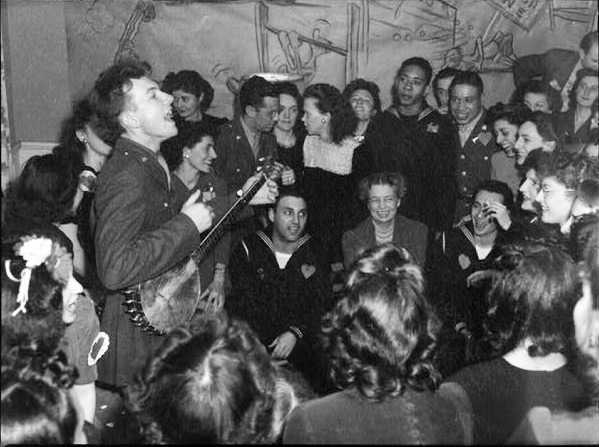
      Since its "discovery", America has been a land of immigration; in particular, the major wave of immigrants landed in America at the end of the 19th century and the beginning of the following one. Indeed, between 1870 and 1900, nearly 12 million people arrived in the United States. Simultaneously, xenophobia and anti-immigration actions gained momentum: differentiations between "desirable" and "undesirable" immigrants based on racist assumptions around ethnicity and religion laid the foundations for the Immigration Act of 1917, which restricted immigration by imposing literacy tests and by preventing immigration from Asia and almost the entire Middle East. Context around this specific period of time is important because it is exactly in those years that Kovaly wrote "He lies in the American Land".

      Compared to the previous songs, which focus mainly on African Americans and racism, this song shifts attention to inequality due to being an immigrant.

      https://immigrationhistory.org/lesson-plan/european-migration/ https://voices.pitt.edu/TeachersGuide/Unit10/American%20Land.htm https://alessandroportelli.blogspot.com/2012/03/bruce-springsteen-wrecking-ball.html https://library.law.howard.edu/civilrightshistory/immigration/history

    17. didn't raise no fool

      From a strictly grammatical point of view, this expression is wrong: two negative forms (didn't and no) are not acceptable in a sentence. The correct form should be either "My mama did not raise any fools" or "My mama raised no fool". However, double negative (also called negative concord) is used in some varieties of English (in this case, African-American Vernacular English) to intensify the meaning of the sentence. In other words, the construction is a sub-standard form used mainly to give more emphasis and expressive force to what is being said. It should be avoided in written and formal writing, but it is normal to use in oral speech, especially in African-American communities.

      Curiosity: labeling an expression or an usage as "wrong" or "correct" is rarely a matter of language and more frequently a matter of (social) prestige: normally, it is considered "right" the variant of the language that is used by educated, white people; in contrast, "wrong" expressions are often the ones employed by minorities, uneducated or stigmatized groups. Long story short: people think they are judging an incorrect linguistic form, when, in fact, they are stigmatizing the community that uses it.

      https://www.merriam-webster.com/dictionary/double%20negative https://web.archive.org/web/20100810125721/https://www.american.edu/cas/tesol/resources/upload/Kirby_Philippa.pdf

    18. war in the Middle East

      The 1990s were a decade of unrest and, sadly, or great military violence. The main conflict that occurred in the Middle East is the Persian Gulf War (1990-1991), an international war fought between Iraq, Kuwait and the Unites States, which intervened when Kuwait was invaded by Iraqi forces. During the 1990s, other Middle East conflicts include: 1. the Iraqi Kurdish Civil War (1994-1997); 2. the Yemeni Civil War (1994); 3. the Operation Desert Fox (1998), which consisted in the U.S. bombing of Iraq.

      https://www.britannica.com/event/Persian-Gulf-War#:~:text=The%20Persian%20Gulf%20War%2C%20also,Kuwait%20on%20August%202%2C%201990 https://www.bbc.co.uk/bitesize/guides/zhsssk7/revision/5

    19. war on the streets

      At the time in which 2Pac sang, there was a sharp rivalry among hip-hop singers of the East Coast and those of the West Coast, in which Shakur himself was implicated with and died for. Moreover, streets feuds among gangs were ferocious, mostly due to the control of drug markets. If you are interested in looking more into the topic, here is a 1990 short news special on L.A. youth gangs: https://youtu.be/-W_jhoknV1Y?si=8YSEmzi6PiZFwn5l.

    20. We gotta make a changeIt's time for us as a people to start makin' some changesLet's change the way we eat, let's change the way we liveAnd let's change the way we treat each other

      Again, similar to the "We gotta start makin' changes" verse, there seems to be glimpse of hope through intentional actions to improve the world.

    21. You gotta operate the easy way

      This verse and the following ones delve into a moral dilemma: the only way to survive in this ruthless America for Black people is by "operating the easy way", which means going behind the law. Already introduced at the beginning of the song, the idea of committing crimes as a result of poverty and lack of resources is here confirmed. The "G" is made illegally, by selling drugs to a child. When confronted with the immorality of his action, the man answers that he "gotta get paid", meaning that morals and ethics come second when the priority is making ends meet. https://americansongwriter.com/the-painful-meaning-behind-the-song-changes-by-tupac/

    22. 'Cause both black and white is smokin' crack tonight

      Apart from the reference to crack, this verse has another important element to be noted: 2Pac is trying to debunk the myth that only African-Americans use drugs. In fact, this 1995 report clearly shows racial disparity in connection to arrests for drug sale and possession: https://bjs.ojp.gov/content/pub/pdf/rdusda.pdf. Although it is undeniable that the African-American community was deeply affected by the (ab)use of crack, it is also true that it was widespread among poors, including whites.

    23. Huey

      The "Huey" mentioned is Huey Newton was the co-founder (with Bobby Seale) of the Black Panther Party in 1966. (https://americansongwriter.com/the-painful-meaning-behind-the-song-changes-by-tupac/) The Black Panther was a 1960s revolutionary party whose original purpose was that of protecting Blacks from the attack of police officers and eventually extended its scope "to a Marxist revolutionary group that called for the arming of all African Americans, the exemption of African Americans from the draft and from all sanctions of so-called white America, the release of all African Americans from jail, and the payment of compensation to African Americans for centuries of exploitation by white Americans". (https://www.britannica.com/topic/Black-Panther-Party)

    24. he's a hero

      In this verse and in the previous one, the singer is making explicit reference to the police brutality in the U.S.A: excessive use of force (also culminating in murder) by police officers towards specific categories has been documented since the early 19th century. The targets have varied through the centuries, but African-Americans are historically the most targeted group because of racial implications. In this case, the singer emphasizes policemen's impunity before the law; on the contrary, they are acclaimed and welcomed as "heros". https://www.britannica.com/topic/police-brutality-in-the-United-States-2064580/Police-brutality-after-World-War-II

    25. nigga

      Just as the previous term, this one is charged with a derogatory connotation, so much as it is preferred to refer to it with the euphemistic expression "N-word", which emcompasses both this word and its -er variant. The phenomenon that allowed the erosion of the -er ending is called r-dropping: the -r is replaced by a schwa (ə), an indistinct vowel pronounced "uh". These terms have always been linked with white supremacy, racism and white power. Even though the two terms may seem synonyms, in fact there is a difference: the -er ending word is strictly connected with the all-encompassing hatred and contempt towards black people, whereas the second one is perceived as a term of endearment when uttered by someone belonging to the Black community. Indeed, starting from the 1980s, the word has underwent a process of reclaiming (also called semantic inversion or looping) which corresponds to "taking a word meant as a slur and reappropriating it as a term of endearment" (https://www.washingtonpost.com/sf/national/2014/11/09/the-n-word-an-entrenched-racial-slur-now-more-prevalent-than-ever/?utm_term=.1590a4928864). This strategy allows the originally oppressive term to be re-semantized (that is, to acquire a new meaning) and used to celebrate the community's unique identity and humanity as "an act of redemption by black folk. The word survives on the conditions that black folks have inscribed for it and nobody else can take that. And it becomes violent when other people try to take it and use it." Indeed, white people "have created the word in the first place, but […] they have lost the power to use it with impunity, they have lost the power to reclaim it." […] "If you understand the history of the word and how it's been used, it's not for white people to use […] So if you're not black you can't do that. You actually can't use the word in the way that we use it. It's not possible, because you're not in that space. So any other usage of it is completely wrong." (https://www.bbc.com/news/stories-53749800). https://www.merriam-webster.com/dictionary/N-word https://share.google/2p6rElVA4Vin0v2cC https://www.dailydot.com/irl/how-not-to-use-the-n-word/

    26. Is life worth living

      Disclaimer: sensitive content.

      In a world dominated by racism and in which nothing changes, the singer wonders whether the struggles he has to cope with on a daily basis make living worth it. He even contemplates the possibility to end his life in the same verse. If you have ever felt the same way the singer does in this verse, please seek help at https://azzurro.it/ or at least talk with an adult or a teacher.

    27. Come on, come on

      Disclaimer: some of the punctuation marks (commas, mainly) were not present in the original lyrics of the song; I added them later. I found it as a useful, non-intrusive alteration of the text which may result in a better understanding of the content. Commas, indeed, help separating sentences and organize the content in a clearer way; in this context, I argue that they are necessary, especially for non-learner students who are approaching a song that employs a variant of English (the African-American Vernacular English) they are probably not familiar with. Apart from punctuation, the lyrics were not altered in any way.

    28. they passed a law in '64

      The "law" in this verse could allude to: * the Civil Rights Act passed in 1964 by President Lyndon Johnson. It "prohibited discrimination in public places, provided for the integration of schools and other public facilities, and made employment discrimination illegal" (https://www.archives.gov/milestone-documents/civil-rights-act#:~:text=This%20act%2C%20signed%20into%20law%20by%20President,most%20sweeping%20civil%20rights%20legislation%20since%20Reconstruction.) In other words, it made segregation in all its forms illegal. * the Economic Opportunity Act which was introduced in the same year. It "aimed at facilitating education, health, employment, and general welfare for impoverished Americans" (https://www.britannica.com/event/American-civil-rights-movement). It was part of the so-called "War on Poverty", a program endorsed by President Johnson and which intended to reduce poverty in the United States, along with making the country more equitable. https://www.britannica.com/topic/War-on-Poverty

      It is probable that the song hints at both Acts, rather than pointing at just one.

    29. things'll

      Normally, will is contracted when preceded by there, here and personal pronouns (I, you, she\he\it, we, you, they) only in oral speech or informal writing. In this case, things'll https://dictionary.cambridge.org/us/grammar/british-grammar/contractions In everyday casual language, it is quite common to find will contracted even when combined with proper nouns and objects just as in this case. However, it is important to remember that it is not appropriate to use this form in formal writing. In the following video, starting at the minute 4:16, you can see (and hear) other examples similar to things'll: https://youtu.be/tXTu2tpJKaM?si=4e6I2J3wHd7On5i3&t=256

    30. That's just the way it isSome things'll never changeThat's just the way it isAh, but don't you believe them

      Here is the chorus of the song: at first, the singer's reaction to the widespread inquality that dominates the society seems to coincide with a resigned acceptation of the status quo. The feeling of quiet resignation amplifies as the song goes on, reaching its climax when the singer makes reference to the Civil Rights Act and, therefore, establishing a parallelism between the present and the past. However, the chorus closes with a glimpse of hope: indeed, the author invites the audience not to believe to inevitability, thus suggesting that things may change if only people started thinking and acting differently. As a matter of fact, the singer himself insists upon this last verse: "Some things will never change is a statement of resignation, but the most important line in that song is the one that comes after that: But don't you believe them. So I've always been about being strong when resignation is a possibility. Trying to pull up from that and have a positive outlook so that things can change" (http://www.musicfordemocracy.org/node/34.html).

      Your turn: do you think that injustice and inequality will never be defeated?

    31. A man in a silk suit hurries by

      In this sad scene, a new character is introduced: a man in a silk suit. He represents the rich and wealthy people who do not have to wait in line for economic help and, for this reason, hurries by (that is, he moves rapidly). His perspective is biased: he blames those in line for being poor and encourages them to "get a job". Therefore, Hornsby's intention is that of criticizing social polarization and inequality, apart from biased convictions that link poverty to laziness.

      Your turn: is the man in a silk suit right? Are poor people always lazy or are there any other reasons for poverty?

    32. they can't buy a job

      The reason that is provided as for why they are waiting and need financial support is their poverty. The expression "buy a job" may refer to the fact that they cannot afford college education, in a modern scenario in which education assures better job opportunities; in a darker perspective, it might also mean that they have no connections to secure themselves a job through nepotism or bribery.

    33. The 1980s: Bruce Hornsby and the Range—The Way It Is

      Setting the scene: the song was released in July 1986 as a single from the band's debut album The Way It Is. It was a great success and the band won the 1987 Grammy Awards in the Best New Artist category. The success of the song has had a long-lasting effect in the music industry: it was sampled by other artists and included in songs such as 2Pac's Changes and Polo G's Wishing for a Hero. The singer has "never counted it" but he has read that his song "has now been recorded 17 times by hip-hop artists" (https://www.rollingstone.com/music/music-features/bruce-hornsby-interview-way-it-is-non-secure-connection-1036032/). In order to understand the following lyrics, it is necessary to place the song in its historical context. The 1980s were years in which several issues emerged: * The process of de-industrialization (that is, the process in which American companies moved their seats abroad, outside the country) deeply affected the job market: tens of thousands of workers lost their jobs. In particular, Blacks were the ones who suffered the most since the majority of them were employed in various industrial fields. As a consequence, poverty spread: 30% of black work force was jobless in 1982. * The conservative Reagan presidency (1981-1989) reduced federal (governmental, that is) economic support to people in need by 20%. The cut to financial measures combined with the ongoing industrial crisis was disastrous. Il presidente Ronald Reagan * White supremacy movements and groups (such as the Ku Klux Klan) reignited and engaged in violent acts against African Americans, firebombing of churches and campaigns against affirmative actions programs and integration in schools. "Millions of white Americans had become convinced that “too much” had been given to blacks". * Poverty, hunger and hopelessness paved the way to the abuse of drugs; crack was especially consumed by poor Americans as it was inexpensive and easily available. As a consequence of the combination of low employment, educational poverty and drug popularity, drug dealing became the source of income for young people and violence increased significantly in Black neighborhoods.

      What was the government's response? Aggravated levels of violence and crime were responded with the "War on Drugs", which entailed: 1. the elimination of parole (that is, the conditional release of a prisoner, often on the basis of good behavior in prison); 2. stricter penalties for drug sale and possession; 3. building a larger network of prisons.

      Needless to say, African-Americans were most targeted. Mass incarceration as a system of control (see the "home" of the website for more on the topic) started to bloom.

      https://www.amistadresource.org/the_future_in_the_present/social_and_economic_issues.html

    34. The answer, my friend, is blowin’ in the windThe answer is blowin’ in the wind

      Here is the chorus of the song: to all the questions posed, the songwriter is not able to answer. In fact, the answer is as elusive as the wind and impossible to grasp. https://www.litcharts.com/poetry/bob-dylan/blowin-in-the-wind

      Another interesting element to point out is the relationship that Dylan seems to have with the audience: as previously remarked, this song converts Dylan into a spokesman of the common people, a "primus inter pares" if you wish, who makes use of his art to denounce inequality and social struggles. He does not think of himself as a custodian of a hidden truth no one else has discovered: just as everybody else, he does not have a clue about why discrimination and wars occur.

      Your turn: if there are no answers, why asking questions? Do you think there is value in asking questions that cannot be answered?

    35. How many years can a mountain existBefore it’s washed to the sea?

      "The mountain […] is a symbol of those human institutions that keep war and oppression in place. The stony mountain is all that resists change: the shape of government and history, certainly, but also the rocky terrain inside people's hearts. The slow, persistent erosive power of the ocean, on the other hand, symbolizes the action of internal and external change." https://www.litcharts.com/poetry/bob-dylan/blowin-in-the-wind

    36. blowin’

      This word presents a common linguistic phenomenon called g-dropping: it consists in the drop of the -g at the end of certain words. In fact, no -g is actually "dropped" because the 'g' is not even pronounced. All English speakers g-dropped, but the frequency of this phenomenon is tied to class belonging, race, sex and degree of formality. Generally, it is more common among lower social classes. http://itre.cis.upenn.edu/~myl/languagelog/archives/000878.html

      What does this mean in the context of this song? Answer: By adopting g-dropping and thus language-wise, Bob Dylan positions himself in the tradition of folk music and becomes the spokesman of the people.

    37. dove

      The dove is a white bird that corresponds to colomba in Italian. It usually symbolizes peace. https://dictionary.cambridge.org/dictionary/english/dove due colombe bianche che volano<br /> "There's also a reference here to a specific dove: the biblical dove of Noah's Ark, which flew out from the Ark to seek dry land and returned bearing a hopeful olive branch. The symbolism of the dove here suggests that the change the speaker hopes for may not be easy to come by" (https://www.litcharts.com/poetry/bob-dylan/blowin-in-the-wind).

    38. The 1960s: Bob Dylan—Blowin' in the Wind

      Setting the scene: the song was released in 1963 and included in the album The Freewhelin' Bob Dylan. All of Dylan's "most famous political songs were written [...] between January 1962 and October 1963" and "those [...] fixed him in the popular imagination" as a protest songwriter (Lynskey, 2010, 67). The historical context in which the song was released is essential to understand its meaning: during the 1950s the civil rights movement against racial segregation started to gain momentum, reaching its highest point precisely in 1963. Indeed, in that year: * Desegregation protests spread throughout the Southern states over more than 100 cities. The most famous was the March on Washington: it was organized by the "Big Six" of the civil rights movement (Martin Luther King Jr., James Farmer, J. Lewis, P. Randolph, R. Wilkins, W. Young), attended by more than 250.000 protesters (including Bob Dylan). It was in this occasion that the renowned "I have a dream" speech took place. Martin Luther King, Jr. e Mathew Ahmann in una folla di manifestanti alla Marcia su Washington * On June 12, President Kennedy announced he would present a civil rights bill to Congress, which was eventually passed the following year under the name of the Civil Rights Act. https://www.britannica.com/event/American-civil-rights-movement https://www.britannica.com/event/American-civil-rights-movement

      It is important to bear in mind that protests were not only motivated by the insufferable racial segregation, but they were also anti-war oriented: the Vietnam war (1955-1975), which had been raging for ten years by the mid-1960s, was felt as an unnecessary conflict, especially by students and young people, who were the ones recruited in the U.S. army. Indeed, "the average age of an American soldier in Vietnam was 19" (https://www.bbc.co.uk/bitesize/guides/z6dk8hv/revision/4 ).

    39. Nobody can tell me shit 'cause I'm a big rockstar

      Eminem speaks directly at the heart of the white supremacist ideals, which support the idea that whites are considered "untouchable rockstars" just for the color of their skin. Regardless of the crimes they commit (and especially if they are policemen), they won't ever be charged or held accountable for them. As a matter of fact, in most of the cases in which African-Americans were victims of police brutality, white policemen were acquitted (which means assolti) of all charges.

    40. Home of the brave is still racist 'ville

      Eminem's wording strikes again: he plays with America's ideals and bitter social reality by pairing the concluding phrase of the U.S. national anthem, the Star-Spangled Banner, ("O'er the land of the free and the home of the brave!") and the expression racist ville (that means the city of racists). https://amhistory.si.edu/starspangledbanner/the-lyrics.aspx

      The oxymoronic expression reveals that America's ideals are just aspirations that never became reality.

    41. "But you kill each other, factsYou peel each other's caps, for silly stuff like hats”

      Notice how this part of the song echoes Lamar's lyrics "gang-banging make me kill a nigga blacker than me?": both songs highlight feuds inside the African-American community due to gang divisions. However, Eminem seems to be more reluctant to blame African-Americans: in the following lines, he underscores that said fights are rooted in problems such as single-parenting, drug abuse and struggle with addiction that lead people "with nothin(g) to lose to shoot each other for shoes".

    42. our violent nature lies inThe poverty that we face so the crime rate's the highest inThe lowest classes

      Eminem links high levels of crime to poor neighborhoods and socio-economic status — which singer whose song we analyzed made the same connection? Do you agree with Eminem's viewpoint?

    43. Sendin' white cops in the black neighborhoods

      "Once again, he tries to kill stereotypes by denouncing the “crack spot” as a hangout place for blacks. He’s also critical of naive cops who walk into black neighborhoods with no sense of understanding of their behavior or culture. Instead of walking with a fair mind and attitude, their level of fears heighten because of the unknown, and cause them to automatically be racists." https://www.billboard.com/music/rb-hip-hop/eminem-untouchable-lyrics-decoded-8062711/

    44. And I admit, there have been times where it's been embarrassin' to be a...

      The singer does not pretend to be colorblind and acknowledges the fact that he is white. Nevertheless, his ideals do not coincide with the ones supported by white suprematists; hence, the shame in being white.

    45. only death settle the score

      Lamar compares the civil war between two African ethnic groups (Zulu and Xhosa) to the street fighting between the Crips and the Bloods. Indeed, street fighting between local gangs is read by the singer as a form of civil war since it involves people that live in the same area. A bitter ending awaits those who kill each other ("only death settle(s) the score").

    46. Remember this, every race start from the block

      Lamar refuses to accept that Blacks are "doomed from the start": making use of a sport metaphor, he speaks in terms of a "race", in which everyone begins from the same starting point.

    47. another slave in my head

      Double consciousness is a key concept to interpret this line: Lamar feels like a prisoner in his own head, enchained by his own thoughts. This occurs because he has internalized a way of perceiving and judging reality which pertains to the oppressor (in this case,whites).