229 Matching Annotations
  1. Last 7 days
    1. To a piece of cloth that represents the "Land of the Free" that made people slaves to build

      Here is the ending sentence of the song: I could annotate it as I did so far, but by now you are familiar with Eminem's tone and with the themes dealt with in the project... so I would like to hear your interpretations! Try to unpack it on your own. Clues: my personal advice when it comes to understand a text is dividing it into smaller chunks (example: what piece of cloth is Eminem referring to?). If you struggle with understanding what he is trying to say, don't worry: try to read the text again and remember that previous and following sentences can help you out.

    2. That had its Natives killed

      Eminem touches upon another American tragedy: the genocide of Native Americans (which was even celebrated in the movie and comic industry). The present project does not focus on this theme due to limitations in scope; however, here are some resources to explore this topic: https://hmh.org/library/research/genocide-of-indigenous-peoples-guide/, https://study.com/learn/lesson/video/native-american-genocide-history.html, https://sites.uab.edu/humanrights/2017/04/17/indian-removal-act-genocide-native-americans/.

    3. Home of the brave is still racist 'ville

      Eminem's wording strikes again: he plays with America's ideals and bitter social reality by pairing the concluding phrase of the U.S. national anthem, the Star-Spangled Banner, ("O'er the land of the free and the home of the brave!") and the expression racist ville (that means the city of racists). https://amhistory.si.edu/starspangledbanner/the-lyrics.aspx

      The oxymoronic expression reveals that America's ideals are just aspirations that never became reality.

    4. Pull ourselves up by our bootstraps

      Pull yourself up by the/your (own) bootstraps is an idiomatic expression that means "to improve your situation without any help from other people". https://dictionary.cambridge.org/dictionary/english/pull-haul-up-by-the-your-own-bootstraps With the following question, Eminem flips over the expression and reveals the uselessness of such a mentality: how can someone be independent and self-reliant if they lack the bare minimum to survive?

    5. "But you kill each other, factsYou peel each other's caps, for silly stuff like hats”

      Notice how this part of the song echoes Lamar's lyrics "gang-banging make me kill a nigga blacker than me?": both songs highlight feuds inside the African-American community due to gang divisions. However, Eminem seems to be more reluctant to blame African-Americans: in the following lines, he underscores that said fights are rooted in problems such as single-parenting, drug abuse and struggle with addiction that lead people "with nothin(g) to lose to shoot each other for shoes".

    6. our violent nature lies inThe poverty that we face so the crime rate's the highest inThe lowest classes

      Eminem links high levels of crime to poor neighborhoods and socio-economic status — which singer whose song we analyzed made the same connection? Do you agree with Eminem's viewpoint?

    7. Wait, why are there black neighborhoods?'Cause America segregated us, designated us to an areaSeparated us, Section-Eight'd us

      The Housing Choice Voucher Program (popularly known as Section Eight) is a program aimed to provide financial support to elderly people, low-income families and veterans in the private housing market. https://www.hud.gov/helping-americans/housing-choice-vouchers-tenants#:~:text=Housing%20Choice%20Voucher%20Program,program%20with%20funding%20from%20HUD Eminem "calls out the country for placing African Americans in a system designed to make them lose. With Section 8 housing and a floundering education system in impoverished neighborhoods, there’s no way they can really win when the odds are stacked up against them." https://www.billboard.com/music/rb-hip-hop/eminem-untouchable-lyrics-decoded-8062711/

    8. Sendin' white cops in the black neighborhoods

      "Once again, he tries to kill stereotypes by denouncing the “crack spot” as a hangout place for blacks. He’s also critical of naive cops who walk into black neighborhoods with no sense of understanding of their behavior or culture. Instead of walking with a fair mind and attitude, their level of fears heighten because of the unknown, and cause them to automatically be racists." https://www.billboard.com/music/rb-hip-hop/eminem-untouchable-lyrics-decoded-8062711/

    9. makes black lives madderAt cops and cops madder

      The repetitive use of the comparative of majority ("madder") highlights the spiral of violence triggered by police officers' increased violence at black people's (legitimate) rage at their racist treatments. This creates a vicious circle that can only result in more violence, as the Black Ops metaphor clearly represents.

    10. We're applying, but McDonald'sSeems to be the only franchise that'll hire

      Your turn: what do you think Eminem is trying to say here? Which other singer (of the ones that are part of the analysis) mentioned the hiring process Clue: focus on the word hire.

    11. Seems like the average lifespan of a white manIs more than twice than a black life span

      Eminem abandons the cop's perspective and adopts a black man's viewpoint. The rapper is not far from the truth: life expectancy varies significantly depending on ethnic factors. "Pre-pandemic, the overall life expectancy was 79 years for the white population, compared to 75 years for the Black population, according to the National Institute of Health. […] in 2022, the overall life expectancy was 71 years for the Black population and 77 years for the white population." This is connected to disparity in access to healthcare, stress and living and working condition. https://badgerherald.com/news/science-news/2024/11/07/life-expectancy-gap-between-black-and-white-americans-is-a-systematic-issue-uw-experts-say/

    12. And I admit, there have been times where it's been embarrassin' to be a...

      The singer does not pretend to be colorblind and acknowledges the fact that he is white. Nevertheless, his ideals do not coincide with the ones supported by white suprematists; hence, the shame in being white.

    13. To the sixties, having black skin is risky'Cause this keeps happeningThroughout history, African-Americans have been treated like shit

      This song gives a circular structure to the present analysis: Eminem connects present-day abuse of power, racism and police brutality to 1960s fights for civil rights. The singer underscores how history seems to repeat itself in an endless loop: although more than 50 years have passed, black people still struggle to have their rights recognized and respected. And, I add, music keeps being a space in which lack of equality, racism and social injustice are denounced.

    14. Nobody can tell me shit 'cause I'm a big rockstar

      Eminem speaks directly at the heart of the white supremacist ideals, which support the idea that whites are considered "untouchable rockstars" just for the color of their skin. Regardless of the crimes they commit (and especially if they are policemen), they won't ever be charged or held accountable for them. As a matter of fact, in most of the cases in which African-Americans were victims of police brutality, white policemen were acquitted (which means assolti) of all charges.

    15. I keep tellin' myself, keep doin' like you're doin'No matter how many lives you ruinIt's for the red, white and blue

      These three lines channel the white policeman's internal monologue and trail of thought. Although he recognizes their negative impact, he keeps justifying his abusive and racist actions in the name of his country, symbolically represented by the colors of the flag.

      "Though he’s fully aware that murdering an innocent black man isn’t the right thing to do, he finds peace and comfort deluding himself into thinking that he’s protecting his country, or as he raps, “the red, white and blue.” https://www.billboard.com/music/rb-hip-hop/eminem-untouchable-lyrics-decoded-8062711/

    16. another drug charge, homie, it's back inside for you

      Police brutality and white supremacy combine here: the racist cop's objective is charging the black man with a crime, regardless of the young man's innocence. Another element that I would like to underscore is the word choice: * homie: the policeman uses an informal term to denigrate the young man. In other words, he discursively builds his social superiority. * back inside: the link here is to the prejudice we mentioned before. The policeman ignores whether the young man has been to jail; he simply assumes it.

    17. dope house

      "A house where dope heads (heroin addicts) live" and do drugs. http://dope-house.urbanup.com/7824692 Eminem is criticizing "how African American drivers are often stereotyped as drug dealers with a criminal background". https://www.billboard.com/music/rb-hip-hop/eminem-untouchable-lyrics-decoded-8062711/ Indeed, the key word in the sentence is "probably": the policeman does not know who the young man is, where he is going to or where he comes from, so he cannot do anything but hypothesize. The problem is twofold: 1. He mistakes his hypothesis for truth; 2. His hypothesis is biased: there is no logical reason as for why he associates the young black man with the "dope house". However, he does so because he cultivates prejudices against black men.

    18. Pull up on the side of youWindow rolled down, 'profile'

      The scene goes on. Eminem's visual language does not make it hard to picture it: a white cop stopping a black young man who is driving his car. The policeman asks him to pull up (that is, to stop the car at the side of the road), roll his window down and provide a "profile". In this context, "profiling" indicates "the activity of collecting information about someone, especially a criminal, in order to give a description of them". https://dictionary.cambridge.org/dictionary/english/profiling More specifically, Eminem is directly criticizing the so-called racial profiling, which is an illegal practice relying "on stereotypes of racial or ethnic groups to assist law enforcement in detecting and deterring crime". In other (simpler) words, it means that some people (namely Latinos or Blacks) are stopped and incarcerated only for belonging to a certain ethnicity. Criminal profiling, instead, is a legal practice based on evidence gathered from "previous crimes from witnesses, victims, and the crime scene. The profile includes the potential suspect’s age range, gender, race, possible employment, and other factors to narrow down the group of suspects". https://www.amu.apus.edu/area-of-study/criminal-justice/resources/racial-profiling-vs-criminal-profiling/<br /> https://www.billboard.com/music/rb-hip-hop/eminem-untouchable-lyrics-decoded-8062711/

    19. Black boy, black boy, we ain't gonna lie to you

      The entire first verse corresponds to the white policeman's perspective. As you will listen (and read), Eminem's words are explicit in reporting the cop's viewpoint. The truth cannot be sugarcoated: "we (the cops) ain't gonna lie to you" and don't like the sight of you".

    20. Hypocrite!

      So, why is he a hypocrite? "he refers to himself as a hypocrite for the contrast between the code of righteousness to which he ideologically subscribes and the sinfulness of his […] violence." https://open.library.ubc.ca/media/stream/pdf/24/1.0300649/4 As he clarified in a Rolling Stone interview, "he started thinking about his own time in the streets and all the wrong he's done. So he started writing a new verse, in which he turned the microscope on himself. How can he criticize America for killing young black men […] when young black men are often just so good at it?" https://issuu.com/lawrenceambrocio5018/docs/rolling_stone_march_26_2015_usa_1_

    21. don't matter how much

      This expression precedes proof of Kendrick Lamar's effort and interest in promoting African-American culture: * he supports and remembers the Black Panther Party; * he lectures Georgia State college students about pivotal figures in the African-American community, such as Marcus Garvey; * he celebrates Black History month as it were his birthday.

      However, the expression "don't matter how much" (just as the haunting repetition of being "the biggest hypocrite of 2015") signals that somehow his committment to the cause is not enough: why? The singer forces the audience to wait until the last lines of the song to clarify the reasons of his hypocrisy.

    22. only death settle the score

      Lamar compares the civil war between two African ethnic groups (Zulu and Xhosa) to the street fighting between the Crips and the Bloods. Indeed, street fighting between local gangs is read by the singer as a form of civil war since it involves people that live in the same area. A bitter ending awaits those who kill each other ("only death settle(s) the score").

    23. I'm African-American, I'm African

      In this scenario dominated by manslaughter and perverse traditions, the pervasive double consciousness that haunts the singer seems to falter: the American heritage, which also entails this bitter history or racism, is too heavy for the singer to carry. Ultimately, he's African.

    24. generational hatred

      In this last verse, there is no possible misunderstanding: Lamar directly attacks centuries of racism, whose thousands of deaths he (rightly) labels as genocide. Another striking expression is that of "generational hatred": the singer evokes an atmosphere in which racism is like a twisted tradition which, instead of passing down from father to son, passes down from generation to generation, destroying people in the meantime.

    25. it's evident that I'm irrelevant to societyThat's what you're telling me

      These lines pose a critique towards societal impositions: Lamar feels irrelevant and deprived of any importance in American society. However, this feeling entirely depends on what white people have been telling him. Once again, double consciousness dominates the self.

    26. Remember this, every race start from the block

      Lamar refuses to accept that Blacks are "doomed from the start": making use of a sport metaphor, he speaks in terms of a "race", in which everyone begins from the same starting point.

    27. The blacker the berry, the bigger I shoot

      Lamar mangles (storpia, in Italian) the words of the proverb: this modified version seems to represent a counterpart to the the original one. If the first one celebrates and honors Black culture, this one seems to connect to the brutality of reality, in which violence dominates and is, apparently, the only possible response.

    28. The blacker the berry, the sweeter the juice

      "This Black proverb appears as early as 1929 in the title of Wallace Thurman’s novel, The Blacker the Berry. Most agree that the phrase is meant as an affirmation of the richness and beauty of Black people and of darker skin Blacks. In many ways it is a counter response to the pervasive celebration of white or lighter skin Black Americans. The phrase appears in Tupac Shakur’s 1993 song “Keep Your Head Up,” and continues to flow through Black culture as a form of praise and affirmation." https://thedig.howard.edu/all-stories/save-culture-slang-exploration-black-language-expressions

    29. You're fuckin' evil

      As you may have gathered by now, Lamar's song is unfiltered: although he acknowledges the hierarchy that forces his community to remain "at the bottom of mankind", he does not feel inferior. On the contrary, he is proud of his identity and his African ancestry, so much as he does not hesitate in judging the oppressors.

    30. You hate my people, your plan is to terminate my culture

      After having described some features stereotypically connected with being African-American, Lamar asks white people a rhetorical question ("you hate me, don't you?") since he already knows the answer. In such a perspective, there seems to be no glimpse of hope for Black people: they are hated and their culture is at risk of being "terminated". Nevertheless, Lamar does not renounce to his voice and gives space to the rage that feels since he was a teenager. https://open.library.ubc.ca/media/stream/pdf/24/1.0300649/4

    31. Came from the bottom of mankind

      Lamar's viewpoint is crystal clear: not only is there a social hierarchy in America, but also he identifies black as the ones "at the bottom". There is no possible equality in this scenario.

    32. Been feeling this way since I was sixteen

      Here Lamar denounces a decade-long rage for anti-Black racism and police brutality he himself was a victim of. In a Rolling Stone interview, Lamar declared that as a teenager "the majority of my interactions with the police were not good […] there were a few good ones who were actually protecting the community. But then you have the ones from the Valley. They never met me in my life, but since I'm a kid […] they wanna slam me on the hood of the car. Sixteen years old […] Even if he's not a good kid, that don't give you the right to slam a minor on the ground or pull a pistol on him. " […] Indeed, "police pull guns on him on two occasions. The first when he was 17." https://issuu.com/lawrenceambrocio5018/docs/rolling_stone_march_26_2015_usa_1_

    33. you made me

      This sentence functions as an explanation of the previous one: Lamar claims that he may be experiencing life in a schizophrenic way but blames whites (the ideal interlocutors in this scenario) for it.

    34. schizophrenia

      Schizophrenia is a mental illness, in "characterized by disruptions in thought processes, perceptions, emotional responsiveness, and social interactions". https://www.nimh.nih.gov/health/statistics/schizophrenia However, in this case the term is more likely to refer to W.E.B. Du Bois' double consciousness. This notion hints at the idea that black people possess a double identity: the first one is tied to being African-American, whereas the other corresponds to the perspective of the White oppressors. As a consequence, their sense of self is fragmented. Hence, the reference to the fragmented self of schizophrenic people. https://study.com/learn/lesson/web-du-bois-double-consciousness-overview-background-examples.html#:~:text=Double%20consciousness%20is%20the%20feeling%20of%20having%20two%20social%20identities,%2C%20and%20treatment%20by%2C%20Caucasians. https://open.library.ubc.ca/media/stream/pdf/24/1.0300649/4

    35. They died building the railroads worked to bones and skinThey died in the fields and factories names scattered in the windThey died to get here a hundred years ago they’re still dyin' nowThe hands that built the country were always trying to keep down

      Here the central critique to the lack of equality and the debunking of the immigration myths appears evident: in particular, Springsteen makes uses of the anaphora "they died" to underscore the timeless sacrifice of immigrants, who are identified with the makers of the United States ("the hands that build the country"). This last part of the song completely overturns what Springsteen has sung so far: there are no streets paved with gold, no diamonds in the sidewalks or "treasure for the taking". What remains is work "to bones and skin". Once again, Springsteen has not departed from the historical truth: despite their hopes, European immigrants who landed in the United States did not improve their status. In other words, if they were poor, they stayed as such; “past European immigrants often struggled when they first arrived, and most of them did not succeed in reaching the American Dream within their lifetimes.” https://ui.charlotte.edu/story/streets-gold-debunking-american-immigration-myths/ Moreover, research shows that from 1880 to 1920 immigrants "were the mainstay of the American industrial workforce". https://pmc.ncbi.nlm.nih.gov/articles/PMC2760060/#abstract1 Making home in the American Land was, therefore, impossible for them because America itself rejected and discriminated immigrants after exploiting them for its own industrial and economic growth. Indeed, "often stereotyped and discriminated against, many immigrants suffered verbal and physical abuse because they were "different." […] The newcomers helped transform American society and culture, demonstrating that diversity, as well as unity, is a source of national strength." https://www.loc.gov/classroom-materials/united-states-history-primary-source-timeline/rise-of-industrial-america-1876-1900/immigration-to-united-states-1851-1900/

      Springsteen's radical claim is that such discrimination and sacrifice are not limited to a distant past, but have continued up until now ("they're still dyin' now"). When Springsteen released the song, the country was actually undergoing a period of decline in immigration due to measures taken after the terrorist attacks of September 11, 2001 such as the Patriot Act. https://library.law.howard.edu/civilrightshistory/immigration/history. However, it is true that immigration continues to be a divisive topic in the United States, especially in the current presidency: what do you know about Trump's immigration policies?

    36. There’s diamonds in the sidewalk the’s gutters lined in songDear I hear that beer flows through the faucets all night long

      Again, these sentences make a parallel with "Gold comes rushing out the rivers straight into your hands": the all evoke the illusionary hopes and dreams of immigrants entering a new land and abandoning their own.

    37. There’s treasure for the taking, for any hard working man

      This verse hints at other American myths: self-reliance, individualism and the self-made man. In short, these three combined point at the idea that working hard, putting effort and invest in one's self will eventually lead to (economic) success, independently from your initial condition.

      Your turn: do you think that working hard is enough to achieve success? In other words, does success exclusively depend on effort or there may be other uncontrollable factors involved? Can poverty be overcome in this way?

    38. the sweets, I hear, are growing on the treesGold comes rushing out the rivers straight into your hands

      These sentences evoke popular belief among immigrants that in America there were "streets paved with gold" : this rumor (this myth if you want) created anticipation and hope for those who left their homelands in search of better opportunities. The powerful expression gave birth to a homonymous exhibit: https://www.nps.gov/elis/learn/education/streets-paved-with-gold.htm.

    39. We gotta make a changeIt's time for us as a people to start makin' some changesLet's change the way we eat, let's change the way we liveAnd let's change the way we treat each other

      Again, similar to the "We gotta start makin' changes" verse, there seems to be glimpse of hope through intentional actions to improve the world.

    40. You gotta operate the easy way

      This verse and the following ones delve into a moral dilemma: the only way to survive in this ruthless America for Black people is by "operating the easy way", which means going behind the law. Already introduced at the beginning of the song, the idea of committing crimes as a result of poverty and lack of resources is here confirmed. The "G" is made illegally, by selling drugs to a child. When confronted with the immorality of his action, the man answers that he "gotta get paid", meaning that morals and ethics come second when the priority is making ends meet. https://americansongwriter.com/the-painful-meaning-behind-the-song-changes-by-tupac/

    41. And although it seems heaven sentWe ain't ready, to see a black President

      What 2Pac considered impossible actually occurred in 2009, when Barack Obama was elected President of the United States and then again in 2012, when he was reelected. Nevertheless, his presidency was filled with conspiracy theories (especially revolving around his being born in the Unites States) and controversies that tried to undermine the figure of the President. Ultimately, this may suggest that the United States was not ready for a black President.

    42. both black and white is smokin' crack tonight

      Apart from the reference to crack, this verse has another important element to be noted: 2Pac is trying to debunk the myth that only African-Americans use drugs. In fact, this 1995 report clearly shows racial disparity in connection to arrests for drug sale and possession: https://bjs.ojp.gov/content/pub/pdf/rdusda.pdf. Although it is undeniable that the African-American community was deeply affected by the (ab)use of crack, it is also true that it was widespread among poors, including whites.

    43. I'd love to go back to when we played as kids

      In this disheartening scenario, 2Pac seeks refuge in the pleasant memories of an idealized childhood, which is perceived as the only moment in space and time where he may find solace.

    44. Two shots in the dark, now Huey's dead

      Although in the previous verse, Huey Newton seems to be a source of inspiration for the singer, hope seems to be nowhere to be found in this verse. As any African-American, even Huey ends up being another victim of police brutality. Considering the bigger picture, it can be hypothesized that 2Pac was even questioning the actual impact and ideals that animated the Black Panther Party itself.

    45. My stomach hurts, so I'm lookin' for a purse to snatch

      In Tupac's perspective, crime is a consequence of poverty. What do you think about it? Do you think crimes are response to people being unable to afford life?

    46. I'm tired of bein' poor and even worse I'm black

      In the society in which the narrative voice lives, both poverty and blackness have a negative connotation. In other words, being Black adds up to being poor.

    47. Is life worth living

      Disclaimer: sensitive content.

      In a world dominated by racism and in which nothing changes, the singer wonders whether the struggles he has to cope with on a daily basis make living worth it. He even contemplates the possibility to end his life in the same verse. If you have ever felt the same way the singer does in this verse, please seek help at https://azzurro.it/ or at least talk with an adult or a teacher.

    48. But it only goes so far'Cause the law don't change another's mindWhen all it sees at the hiring timeIs the line on the color bar

      Hornsby's posture seems clear: in these verses, he states that legal measures can only "go so far", that is, they can only operate up to a certain extent. He hints at the fact that another change has to occur: a cultural one. According to the author, indeed, equality can be achieved only in a co-constructive process that implicates the law on one side, and the culture on the other. In other words, what Hornsby is trying to state is that acts can be signed into law and assure people their rights, but it is equally important that people change their mindsets.

    49. Said, "Hey little boy, you can't go where the others go'Cause you don't look like they do"I said, "Hey, old man, how can you stand to think that way?Did you really think about it before you made the rules?"

      The possibility of changing becomes increasingly more evident in this part of the song, which gives shape to a conversation between a child and an old man. The resignation seems to belong to the viewpoint of the old man, whereas the child questions the very existence of the "rules" who discriminate them for the color of his skin ("you don't look like they do") and the origin of the authority of those who created them. At this point of the song, resignation seems to resemble a compliant attitude, which may be even benefitting from an injustice society. Notice that the singer evidently sides with the boy, ultimately converging his point of view with his own.

    50. That's just the way it isSome things'll never changeThat's just the way it isAh, but don't you believe them

      Here is the chorus of the song: at first, the singer's reaction to the widespread inquality that dominates the society seems to coincide with a resigned acceptation of the status quo. The feeling of quiet resignation amplifies as the song goes on, reaching its climax when the singer makes reference to the Civil Rights Act and, therefore, establishing a parallelism between the present and the past. However, the chorus closes with a glimpse of hope: indeed, the author invites the audience not to believe to inevitability, thus suggesting that things may change if only people started thinking and acting differently. As a matter of fact, the singer himself insists upon this last verse: "Some things will never change is a statement of resignation, but the most important line in that song is the one that comes after that: But don't you believe them. So I've always been about being strong when resignation is a possibility. Trying to pull up from that and have a positive outlook so that things can change" (http://www.musicfordemocracy.org/node/34.html).

      Your turn: do you think that injustice and inequality will never be defeated?

    51. A man in a silk suit hurries by

      In this sad scene, a new character is introduced: a man in a silk suit. He represents the rich and wealthy people who do not have to wait in line for economic help and, for this reason, hurries by (that is, he moves rapidly). His perspective is biased: he blames those in line for being poor and encourages them to "get a job". Therefore, Hornsby's intention is that of criticizing social polarization and inequality, apart from biased convictions that link poverty to laziness.

      Your turn: is the man in a silk suit right? Are poor people always lazy or are there any other reasons for poverty?

    52. they can't buy a job

      The reason that is provided as for why they are waiting and need financial support is their poverty. The expression "buy a job" may refer to the fact that they cannot afford college education, in a modern scenario in which education assures better job opportunities; in a darker perspective, it might also mean that they have no connections to secure themselves a job through nepotism or bribery.

    53. The answer, my friend, is blowin’ in the windThe answer is blowin’ in the wind

      Here is the chorus of the song: to all the questions posed, the songwriter is not able to answer. In fact, the answer is as elusive as the wind and impossible to grasp. https://www.litcharts.com/poetry/bob-dylan/blowin-in-the-wind

      Another interesting element to point out is the relationship that Dylan seems to have with the audience: as previously remarked, this song converts Dylan into a spokesman of the common people, a "primus inter pares" if you wish, who makes use of his art to denounce inequality and social struggles. He does not think of himself as a custodian of a hidden truth no one else has discovered: just as everybody else, he does not have a clue about why discrimination and wars occur.

      Your turn: if there are no answers, why asking questions? Do you think there is value in asking questions that cannot be answered?

    54. how many years can some people existBefore they’re allowed to be free?

      Once again, Dylan calls for equality between Black and White people and (ironically) challenges the audience to specify the number of years that takes for someone to be free.

    55. How many years can a mountain existBefore it’s washed to the sea?

      "The mountain […] is a symbol of those human institutions that keep war and oppression in place. The stony mountain is all that resists change: the shape of government and history, certainly, but also the rocky terrain inside people's hearts. The slow, persistent erosive power of the ocean, on the other hand, symbolizes the action of internal and external change." https://www.litcharts.com/poetry/bob-dylan/blowin-in-the-wind

    56. dove

      The dove is a white bird that corresponds to colomba in Italian. It usually symbolizes peace. https://dictionary.cambridge.org/dictionary/english/dove due colombe bianche che volano<br /> "There's also a reference here to a specific dove: the biblical dove of Noah's Ark, which flew out from the Ark to seek dry land and returned bearing a hopeful olive branch. The symbolism of the dove here suggests that the change the speaker hopes for may not be easy to come by" (https://www.litcharts.com/poetry/bob-dylan/blowin-in-the-wind).
    57. How many roads must a man walk downBefore you call him a man?

      This is the opening of the song, which starts and procedes by asking multiple rhetorical questions to the listeners. In this case, Bob Dylan is calling into question the essence of humanity by describing an activity as simple as walking. The "roads" may hint at the long history of difficulties and hardships that Black people have experienced. The call to equality is unmistakable. https://www.litcharts.com/poetry/bob-dylan/blowin-in-the-wind

      According to you, what makes us human?

    1. To a piece of cloth that represents the "Land of the Free" that made people slaves to build

      Here is the ending sentence of the song: I could annotate it as I did so far, but by now you are familiar with Eminem's tone and with the themes dealt with in the project... so I would like to hear your interpretations! Try to unpack it on your own. Clues: my personal advice when it comes to understand a text is dividing it into smaller chunks (example: what piece of cloth is Eminem referring to?). If you struggle with understanding what he is trying to say, don't worry: try to read the text again and remember that previous and following sentences can help you out.

    2. That had its Natives killed

      Eminem touches upon another American tragedy: the genocide of Native Americans (which was even celebrated in the movie and comic industry). The present project does not focus on this theme; however, here are some resources to explore this topic: https://hmh.org/library/research/genocide-of-indigenous-peoples-guide/, https://study.com/learn/lesson/video/native-american-genocide-history.html, https://sites.uab.edu/humanrights/2017/04/17/indian-removal-act-genocide-native-americans/.

    3. Wait, why are there black neighborhoods?'Cause America segregated us, designated us to an areaSeparated us, Section-Eight'd us

      The Housing Choice Voucher Program (popularly known as Section Eight) is a program aimed to provide financial support to elderly people, low-income families and veterans in the private housing market. https://www.hud.gov/helping-americans/housing-choice-vouchers-tenants#:~:text=Housing%20Choice%20Voucher%20Program,program%20with%20funding%20from%20HUD Eminem "calls out the country for placing African Americans in a system designed to make them lose. With Section 8 housing and a floundering education system in impoverished neighborhoods, there’s no way they can really win when the odds are stacked up against them." https://www.billboard.com/music/rb-hip-hop/eminem-untouchable-lyrics-decoded-8062711/

    4. makes black lives madderAt cops and cops madder

      The repetitive use of the comparative of majority ("madder") highlights the spiral of violence triggered by police officers' increased violence at black people's (legitimate) rage at their racist treatments. This creates a vicious circle that can only result in more violence, as the Black Ops metaphor clearly represents.

    5. Seems like the average lifespan of a white manIs more than twice than a black life span

      Eminem abandons the cop's perspective and adopts a black man's viewpoint. The rapper is accurate: life expectancy varies significantly depending on ethnic factors. "Pre-pandemic, the overall life expectancy was 79 years for the white population, compared to 75 years for the Black population, according to the National Institute of Health. […] in 2022, the overall life expectancy was 71 years for the Black population and 77 years for the white population." This is connected to disparity in access to healthcare, stress and living and working condition. https://badgerherald.com/news/science-news/2024/11/07/life-expectancy-gap-between-black-and-white-americans-is-a-systematic-issue-uw-experts-say/

    6. To the sixties, having black skin is risky'Cause this keeps happeningThroughout history, African-Americans have been treated like shit

      This song gives a circular structure to the present analysis: Eminem connects present-day abuse of power, racism and police brutality to 1960s fights for civil rights. The singer underscores how history seems to repeat itself in an endless loop: although more than 50 years have passed, black people still struggle to have their rights recognized and respected. And, I add, music keeps being a space in which lack of equality, racism and social injustice are denounced.

    7. I keep tellin' myself, keep doin' like you're doin'No matter how many lives you ruinIt's for the red, white and blue

      These three lines channel the white policeman's internal monologue and trail of thought. Although he recognizes their negative impact, he keeps justifying his abusive and racist actions in the name of his country, symbolically represented by the colors of the flag.

      "Though he’s fully aware that murdering an innocent black man isn’t the right thing to do, he finds peace and comfort deluding himself into thinking that he’s protecting his country, or as he raps, “the red, white and blue.” https://www.billboard.com/music/rb-hip-hop/eminem-untouchable-lyrics-decoded-8062711/

    8. another drug charge, homie, it's back inside for you

      Police brutality and white supremacy combine here: the racist cop's objective is charging the black man with a crime, regardless of the young man's innocence. Another element that I would like to underscore is the word choice: * homie: the policeman uses an informal term to denigrate the young man. In other words, he discursively builds his social superiority. * back inside: the link here is to the prejudice we mentioned before. The policeman ignores whether the young man has been to jail; he simply assumes it.

    9. dope house

      "A house where dope heads (heroin addicts) live" and do drugs. http://dope-house.urbanup.com/7824692 Eminem is criticizing "how African American drivers are often stereotyped as drug dealers with a criminal background". https://www.billboard.com/music/rb-hip-hop/eminem-untouchable-lyrics-decoded-8062711/ Indeed, the key word in the sentence is "probably": the policeman does not know who the young man is, where he is going to or where he comes from, so he cannot do anything but hypothesize. The problem is twofold: 1. He mistakes his hypothesis for truth; 2. His hypothesis is biased: there is no logical reason as for why he associates the young black man with the "dope house". However, he does so because he cultivates prejudices against black men.

    10. Pull up on the side of youWindow rolled down, 'profile'

      The scene goes on. Eminem's visual language does not make it hard to picture it: a white cop stopping a black young man who is driving his car. The policeman asks him to pull up (that is, to stop the car at the side of the road), roll his window down and provide a "profile". In this context, "profiling" indicates "the activity of collecting information about someone, especially a criminal, in order to give a description of them". https://dictionary.cambridge.org/dictionary/english/profiling More specifically, Eminem is directly criticizing the so-called racial profiling, which is an illegal practice relying "on stereotypes of racial or ethnic groups to assist law enforcement in detecting and deterring crime". In other (simpler) words, it means that some people (namely Latinos or Blacks) are stopped and incarcerated only for belonging to a certain ethnicity. Criminal profiling, instead, is a legal practice based on evidence gathered from "previous crimes from witnesses, victims, and the crime scene. The profile includes the potential suspect’s age range, gender, race, possible employment, and other factors to narrow down the group of suspects". https://www.amu.apus.edu/area-of-study/criminal-justice/resources/racial-profiling-vs-criminal-profiling/<br /> https://www.billboard.com/music/rb-hip-hop/eminem-untouchable-lyrics-decoded-8062711/

    11. Black boy, black boy, we ain't gonna lie to you

      The entire first verse corresponds to the white policeman's perspective. As you will listen (and read), Eminem's words are explicit in reporting the cop's viewpoint. The truth cannot be sugarcoated: "we (the cops) ain't gonna lie to you" and don't like the sight of you".

    12. Hypocrite!

      So, why is he a hypocrite? "he refers to himself as a hypocrite for the contrast between the code of righteousness to which he ideologically subscribes and the sinfulness of his […] violence." https://open.library.ubc.ca/media/stream/pdf/24/1.0300649/4 As he clarified in a Rolling Stone interview, "he started thinking about his own time in the streets and all the wrong he's done. So he started writing a new verse, in which he turned the microscope on himself. How can he criticize America for killing young black men […] when young black men are often just so good at it?" https://issuu.com/lawrenceambrocio5018/docs/rolling_stone_march_26_2015_usa_1_

    13. don't matter how much

      This expression precedes proof of Kendrick Lamar's effort and interest in promoting African-American culture: * he supports and remembers the Black Panther Party; * he lectures Georgia State college students about pivotal figures in the African-American community, such as Marcus Garvey; * he celebrates Black History month as it were his birthday.

      However, the expression "don't matter how much" (just as the haunting repetition of being "the biggest hypocrite of 2015") signals that somehow his committment to the cause is not enough: why? The singer forces the audience to wait until the last lines of the song to clarify the reasons of his hypocrisy.

    14. I'm African-American, I'm African

      In this scenario dominated by manslaughter and perverse traditions, the pervasive double consciousness that haunts the singer seems to falter: the American heritage, which also entails this bitter history or racism, is too heavy for the singer to carry. Ultimately, he's African.

    15. generational hatredIt's genocism

      In this last verse, there is no possible misunderstanding: Lamar directly attacks centuries of racism, whose thousands of deaths he (rightly) labels as genocide. Another striking expression is that of "generational hatred": the singer evokes an atmosphere in which racism is like a twisted tradition which, instead of passing down from father to son, passes down from generation to generation, destroying people in the meantime.

    16. The blacker the berry, the bigger I shoot

      Lamar mangles (storpia, in Italian) the words of the proverb: this modified version seems to represent a counterpart to the the original one. If the first one celebrates and honors Black culture, this one seems to connect to the brutality of reality, in which violence dominates and is, apparently, the only possible response.

    17. You hate me don't you?You hate my people, your plan is to terminate my culture

      After having described some features stereotypically connected with being African-American, Lamar asks white people a rhetorical question ("you hate me, don't you?") since he already knows the answer. In such a perspective, there seems to be no glimpse of hope for Black people: they are hated and their culture is at risk of being "terminated". Nevertheless, Lamar does not renounce to his voice and gives space to the rage that feels since he was a teenager. https://open.library.ubc.ca/media/stream/pdf/24/1.0300649/4

    18. Been feeling this way since I was sixteen

      Here Lamar denounces a decade-long rage for anti-Black racism and police brutality he himself was a victim of. In a Rolling Stone interview, Lamar declared that as a teenager "the majority of my interactions with the police were not good […] there were a few good ones who were actually protecting the community. But then you have the ones from the Valley. They never met me in my life, but since I'm a kid […] they wanna slam me on the hood of the car. Sixteen years old […] Even if he's not a good kid, that don't give you the right to slam a minor on the ground or pull a pistol on him. " […] Indeed, "police pull guns on him on two occasions. The first when he was 17." https://issuu.com/lawrenceambrocio5018/docs/rolling_stone_march_26_2015_usa_1_

    19. schizophrenia

      Schizophrenia is a mental illness, in "characterized by disruptions in thought processes, perceptions, emotional responsiveness, and social interactions". https://www.nimh.nih.gov/health/statistics/schizophrenia However, in this case the term is more likely to refer to W.E.B. Du Bois' double consciousness. This notion hints at the idea that black people possess a double identity: the first one is tied to being African-American, whereas the other corresponds to the perspective of the White oppressors. As a consequence, their sense of self is fragmented. Hence, the reference to the fragmented self of schizophrenic people. https://study.com/learn/lesson/web-du-bois-double-consciousness-overview-background-examples.html#:~:text=Double%20consciousness%20is%20the%20feeling%20of%20having%20two%20social%20identities,%2C%20and%20treatment%20by%2C%20Caucasians. https://open.library.ubc.ca/media/stream/pdf/24/1.0300649/4

    20. They died building the railroads worked to bones and skinThey died in the fields and factories names scattered in the windThey died to get here a hundred years ago they’re still dyin' nowThe hands that built the country were always trying to keep down

      Here the central critique to the lack of equality and the debunking of the immigration myths appears evident: in particular, Springsteen makes uses of the anaphora "they died" to underscore the timeless sacrifice of immigrants, who are identified with the makers of the United States ("the hands that build the country"). This last part of the song completely overturns what Springsteen has sung so far: there are no streets paved with gold, no diamonds in the sidewalks or "treasure for the taking". What remains is work "to bones and skin". Once again, Springsteen has not departed from the historical truth: despite their hopes, European immigrants who landed in the United States did not improve their status. In other words, if they were poor, they stayed as such; “past European immigrants often struggled when they first arrived, and most of them did not succeed in reaching the American Dream within their lifetimes.” https://ui.charlotte.edu/story/streets-gold-debunking-american-immigration-myths/ Moreover, research shows that from 1880 to 1920 immigrants "were the mainstay of the American industrial workforce". https://pmc.ncbi.nlm.nih.gov/articles/PMC2760060/#abstract1 Making home in the American Land was, therefore, impossible for them because America itself rejected and discriminated immigrants after exploiting them for its own industrial and economic growth. Indeed, "often stereotyped and discriminated against, many immigrants suffered verbal and physical abuse because they were "different." […] The newcomers helped transform American society and culture, demonstrating that diversity, as well as unity, is a source of national strength." https://www.loc.gov/classroom-materials/united-states-history-primary-source-timeline/rise-of-industrial-america-1876-1900/immigration-to-united-states-1851-1900/

      Springsteen's radical claim is that such discrimination and sacrifice are not limited to a distant past, but have continued up until now ("they're still dyin' now"). When Springsteen released the song, the country was actually undergoing a period of decline in immigration due to measures taken after the terrorist attacks of September 11, 2001 such as the Patriot Act. https://library.law.howard.edu/civilrightshistory/immigration/history. However, it is true that immigration continues to be a divisive topic in the United States, especially in the current presidency: what do you know about Trump's immigration policies?

    21. There’s treasure for the taking, for any hard working man

      This verse hints at other American myths: self-reliance, individualism and the self-made man. In short, these three combined point at the idea that working hard, putting effort and invest in one's self will eventually lead to (economic) success, independently from your initial condition.

      Do you think that working hard is enough to achieve success? In other words, does success exclusively depend on effort or there may be other uncontrollable factors involved? Can poverty be overcome in this way?

    22. We gotta make a changeIt's time for us as a people to start makin' some changesLet's change the way we eat, let's change the way we liveAnd let's change the way we treat each other

      Again, similar to the "We gotta start makin' changes" verse, there seems to be glimpse of hope through intentional actions to improve the world.

    23. You gotta operate the easy way

      This verse and the following ones delve into a moral dilemma: the only way to survive in this ruthless America for Black people is by "operating the easy way", which means going behind the law. Already introduced at the beginning of the song, the idea of committing crimes as a result of poverty and lack of resources is here confirmed. The "G" is made illegally, by selling drugs to a child. When confronted with the immorality of his action, the man answers that he "gotta get paid", meaning that morals and ethics come second when the priority is making ends meet. https://americansongwriter.com/the-painful-meaning-behind-the-song-changes-by-tupac/

    24. 'Cause both black and white is smokin' crack tonight

      Apart from the reference to crack, this verse has another important element to be noted: 2Pac is trying to debunk the myth that only African-Americans use drugs. In fact, this 1995 report clearly shows racial disparity in connection to arrests for drug sale and possession: https://bjs.ojp.gov/content/pub/pdf/rdusda.pdf. Although it is undeniable that the African-American community was deeply affected by the (ab)use of crack, it is also true that it was widespread among poors, including whites.

    25. Is life worth living

      Disclaimer: sensitive content.

      In a world dominated by racism and in which nothing changes, the singer wonders whether the struggles he has to cope with on a daily basis make living worth it. He even contemplates the possibility to end his life in the same verse. If you have ever felt the same way the singer does in this verse, please seek help at https://azzurro.it/ or at least talk with an adult or a teacher.

    26. That's just the way it isSome things'll never changeThat's just the way it isAh, but don't you believe them

      Here is the chorus of the song: at first, the singer's reaction to the widespread inquality that dominates the society seems to coincide with a resigned acceptation of the status quo. The feeling of quiet resignation amplifies as the song goes on, reaching its climax when the singer makes reference to the Civil Rights Act and, therefore, establishing a parallelism between the present and the past. However, the chorus closes with a glimpse of hope: indeed, the author invites the audience not to believe to inevitability, thus suggesting that things may change if only people started thinking and acting differently. As a matter of fact, the singer himself insists upon this last verse: "Some things will never change is a statement of resignation, but the most important line in that song is the one that comes after that: But don't you believe them. So I've always been about being strong when resignation is a possibility. Trying to pull up from that and have a positive outlook so that things can change" (http://www.musicfordemocracy.org/node/34.html).

      Your turn: do you think that injustice and inequality will never be defeated?

    27. A man in a silk suit hurries by

      In this sad scene, a new character is introduced: a man in a silk suit. He represents the rich and wealthy people who do not have to wait in line for economic help and, for this reason, hurries by (that is, he moves rapidly). His perspective is biased: he blames those in line for being poor and encourages them to "get a job". Therefore, Hornsby's intention is that of criticizing social polarization and inequality, apart from biased convictions that link poverty to laziness.

      Your turn: is the man in a silk suit right? Are poor people always lazy or are there any other reasons for poverty?

    28. they can't buy a job

      The reason that is provided as for why they are waiting and need financial support is their poverty. The expression "buy a job" may refer to the fact that they cannot afford college education, in a modern scenario in which education assures better job opportunities; in a darker perspective, it might also mean that they have no connections to secure themselves a job through nepotism or bribery.

    29. The answer, my friend, is blowin’ in the windThe answer is blowin’ in the wind

      Here is the chorus of the song: to all the questions posed, the songwriter is not able to answer. In fact, the answer is as elusive as the wind and impossible to grasp. https://www.litcharts.com/poetry/bob-dylan/blowin-in-the-wind

      Another interesting element to point out is the relationship that Dylan seems to have with the audience: as previously remarked, this song converts Dylan into a spokesman of the common people, a "primus inter pares" if you wish, who makes use of his art to denounce inequality and social struggles. He does not think of himself as a custodian of a hidden truth no one else has discovered: just as everybody else, he does not have a clue about why discrimination and wars occur.

      Your turn: if there are no answers, why asking questions? Do you think there is value in asking questions that cannot be answered?

    30. How many years can a mountain existBefore it’s washed to the sea?

      "The mountain […] is a symbol of those human institutions that keep war and oppression in place. The stony mountain is all that resists change: the shape of government and history, certainly, but also the rocky terrain inside people's hearts. The slow, persistent erosive power of the ocean, on the other hand, symbolizes the action of internal and external change." https://www.litcharts.com/poetry/bob-dylan/blowin-in-the-wind

    31. dove

      The dove is a white bird that corresponds to colomba in Italian. It usually symbolizes peace. https://dictionary.cambridge.org/dictionary/english/dove due colombe bianche che volano<br /> "There's also a reference here to a specific dove: the biblical dove of Noah's Ark, which flew out from the Ark to seek dry land and returned bearing a hopeful olive branch. The symbolism of the dove here suggests that the change the speaker hopes for may not be easy to come by" (https://www.litcharts.com/poetry/bob-dylan/blowin-in-the-wind).

    32. Nobody can tell me shit 'cause I'm a big rockstar

      Eminem speaks directly at the heart of the white supremacist ideals, which support the idea that whites are considered "untouchable rockstars" just for the color of their skin. Regardless of the crimes they commit (and especially if they are policemen), they won't ever be charged or held accountable for them. As a matter of fact, in most of the cases in which African-Americans were victims of police brutality, white policemen were acquitted (which means assolti) of all charges.

    33. Home of the brave is still racist 'ville

      Eminem's wording strikes again: he plays with America's ideals and bitter social reality by pairing the concluding phrase of the U.S. national anthem, the Star-Spangled Banner, ("O'er the land of the free and the home of the brave!") and the expression racist ville (that means the city of racists). https://amhistory.si.edu/starspangledbanner/the-lyrics.aspx

      The oxymoronic expression reveals that America's ideals are just aspirations that never became reality.

    34. "But you kill each other, factsYou peel each other's caps, for silly stuff like hats”

      Notice how this part of the song echoes Lamar's lyrics "gang-banging make me kill a nigga blacker than me?": both songs highlight feuds inside the African-American community due to gang divisions. However, Eminem seems to be more reluctant to blame African-Americans: in the following lines, he underscores that said fights are rooted in problems such as single-parenting, drug abuse and struggle with addiction that lead people "with nothin(g) to lose to shoot each other for shoes".

    35. our violent nature lies inThe poverty that we face so the crime rate's the highest inThe lowest classes

      Eminem links high levels of crime to poor neighborhoods and socio-economic status — which singer whose song we analyzed made the same connection? Do you agree with Eminem's viewpoint?

    36. Sendin' white cops in the black neighborhoods

      "Once again, he tries to kill stereotypes by denouncing the “crack spot” as a hangout place for blacks. He’s also critical of naive cops who walk into black neighborhoods with no sense of understanding of their behavior or culture. Instead of walking with a fair mind and attitude, their level of fears heighten because of the unknown, and cause them to automatically be racists." https://www.billboard.com/music/rb-hip-hop/eminem-untouchable-lyrics-decoded-8062711/

    37. And I admit, there have been times where it's been embarrassin' to be a...

      The singer does not pretend to be colorblind and acknowledges the fact that he is white. Nevertheless, his ideals do not coincide with the ones supported by white suprematists; hence, the shame in being white.

    38. only death settle the score

      Lamar compares the civil war between two African ethnic groups (Zulu and Xhosa) to the street fighting between the Crips and the Bloods. Indeed, street fighting between local gangs is read by the singer as a form of civil war since it involves people that live in the same area. A bitter ending awaits those who kill each other ("only death settle(s) the score").

    39. Remember this, every race start from the block

      Lamar refuses to accept that Blacks are "doomed from the start": making use of a sport metaphor, he speaks in terms of a "race", in which everyone begins from the same starting point.

    40. another slave in my head

      Double consciousness is a key concept to interpret this line: Lamar feels like a prisoner in his own head, enchained by his own thoughts. This occurs because he has internalized a way of perceiving and judging reality which pertains to the oppressor (in this case,whites).

    41. it's evident that I'm irrelevant to societyThat's what you're telling me

      These lines pose a critique towards societal impositions: Lamar feels irrelevant and deprived of any importance in American society. However, this feeling entirely depends on what white people have been telling him. Once again, double consciousness dominates the self.

    42. You're fuckin' evil

      As you may have gathered by now, Lamar's song has no filters: although he acknowledges the hierarchy that forces his community to remain "at the bottom of mankind", he does not feel inferior. On the contrary, he is proud of his identity and his African ancestry, so much as he does not hesitate in judging the oppressors.

    43. Came from the bottom of mankind

      Lamar's viewpoint is crystal clear: not only is there a social hierarchy in America, but also he identifies black as the ones "at the bottom". There is no possible equality in this scenario.

    44. you made me

      This sentence functions as an explanation of the previous one: Lamar claims that he may be experiencing life in a schizophrenic way but blames whites (the ideal interlocutors in this scenario) for it.

    45. There’s diamonds in the sidewalk the’s gutters lined in songDear I hear that beer flows through the faucets all night long

      Again, these sentences make a parallel with "Gold comes rushing out the rivers straight into your hands": the all evoke the illusionary hopes and dreams of immigrants entering a new land and abandoning their own.

  2. Dec 2025
    1. And I never get to lay back

      In this verse, as well as in the previous one, 2Pac establishes a relation of identity between blackness, restriction and stress: being Black inevitably entails a heightened sense of danger, an alert about one's surroundings that can never falter without risking life itself. If this theme, closely related to the body, interests you, I recommend reading Ta-Nehisi Coates' Between the World and Me, in which the author explores what being Black in 1990s Baltimore was like in a heartfelt letter to his son and, ultimately, to all members of the Black community.

    2. And although it seems heaven sentWe ain't ready, to see a black President, uh

      What 2Pac considered impossible actually occurred in 2009, when Barack Obama was elected President of the United States and then again in 2012, when he was reelected. Nevertheless, his presidency was filled with conspiracy theories (especially revolving around his being born in the Unites States) and controversies that tried to undermine the figure of the President. Ultimately, this may suggest that the United States was not ready for a black President.

    3. My stomach hurts, so I'm lookin' for a purse to snatch

      In Tupac's perspective, crime is a consequence of poverty. What do you think about it? Do you think crimes are response to people being unable to afford life?

    4. Two shots in the dark, now Huey's dead

      Although in the previous verse, Huey Newton seems to be a source of inspiration for the singer, hope seems to be nowhere to be found in this verse. As any African-American, even Huey ends up being another victim of police brutality. Considering the bigger picture, it can be hypothesized that 2Pac was even questioning the actual impact and ideals that animated the Black Panther Party itself.

    5. I'd love to go back to when we played as kids

      In this disheartening scenario, 2Pac seeks refuge in the pleasant memories of an idealized childhood, which is perceived as the only moment in space and time where he may find solace.

    6. I'm tired of bein' poor and even worse I'm black

      In the society in which the narrative voice lives, both poverty and blackness have a negative connotation. In other words, being Black adds up to being poor.

    7. When all it sees at the hiring timeIs the line on the color bar

      This last stanza again presents the theme of the lack of equality with an explicit reference to racism. In this case, Hornsby refers to unfair treatments and racial barriers in the work environment: white candidates are preferred over Black ones just for the color of their skin. The critique sharpens even more if we consider that it is contained in the same stanza in which there is a reference to the Civil Rights Act: the author places the two events - the Act and employment discrimination - on a line of continuity. In other words, it seems that since 1964 nothing has changed and discrimination lives on as bias and prejudice persist.

    8. Said, "Hey little boy, you can't go where the others go'Cause you don't look like they do"I said, "Hey, old man, how can you stand to think that way?Did you really think about it before you made the rules?"

      The possibility of changing becomes increasingly more evident in this part of the song, which gives shape to a conversation between a child and an old man. The resignation seems to belong to the viewpoint of the old man, whereas the child questions the very existence of the "rules" who discriminate them for the color of his skin ("you don't look like they do") and the origin of the authority of those who created them. At this point of the song, resignation seems to resemble a compliant attitude, which may be even benefitting from an injustice society. Notice that the singer evidently sides with the boy, ultimately converging his point of view with his own.

    9. But it only goes so far'Cause the law don't change another's mind

      Hornsby's posture seems clear: in these verses, he states that legal measures can only "go so far", that is, they can only operate up to a certain extent. He hints at the fact that another change has to occur: a cultural one. According to the author, indeed, equality can be achieved only in a co-constructive process that implicates the law on one side, and the culture on the other. In other words, what Hornsby is trying to state is that acts can be signed into law and assure people their rights, but it is equally important that people change their mindsets.

    10. how many years can some people existBefore they’re allowed to be free?

      Once again, Dylan calls for equality between Black and White people and (ironically) challenges the audience to specify the number of years that takes for someone to be free.

    11. How many roads must a man walk downBefore you call him a man?

      This is the opening of the song, which starts and procedes by asking multiple rhetorical questions to the listeners. In this case, Bob Dylan is calling into question the essence of humanity by describing an activity as simple as walking. The "roads" may hint at the long history of difficulties and hardships that Black people have experienced. The call to equality is unmistakable. https://www.litcharts.com/poetry/bob-dylan/blowin-in-the-wind

      According to you, what makes us human?

  3. Nov 2025
    1. munificence

      The OED defines "munificence" as: The quality of being munificent; great generosity or liberality in giving.

      The word is used for a mysterious Count showing that the Duke is aware that his story may have been off-putting, and he must now save face by praising his new socio-political target. However, to use a word that is antithetical to who the Duke is draws larger parallels between who he associates with, who he pretends to be, and who he really is. The Duke is not giving in the sense that he should be praised, he is giving in the sense that gives people reasons to fear him. By praising this Count's munificence, he can downplay his own lack of it.

    2. I gave commands; Then all smiles stopped together. There she stands As if alive.

      The Duke states that he "gave commands" in order for the Duchess to behave--whether this means a death sentence or exile have no difference to the Duke as she is dead to him either way.

      However, "Lucrezia suffered from chronic lung-trouble, that her father and her brother Francesco were kept constantly informed with regard to the progress of her last illness" (Friedland 673) which implies Lucrezia succumbed to illness. While the Duke married her as a political advantage, if he were to kill her, he risks a war with her family, the Medicis; once again the Duke must put on a front to exert dominance over his subjects and guests. Whether she died by his hand, or from illness is not the issue the Duke wants attention on, but rather, that he can decide when she dies, and anyone within his court is no different.

    3. She thanked men—good! but thanked Somehow—I know not how—as if she ranked My gift of a nine-hundred-years-old name With anybody’s gift. Who’d stoop to blame This sort of trifling?

      Women (and girls) of nobility were meant to show appreciation and be impressed by the immediate men in their lives, such as family, their husbands, and on occasion, men who served them after great acts of duty, such as military feats in war.

      The Duke is masking his anger and lack of control over the Duchess--he believes his "nine-hundred-years-old name" should warrant complete control over her, and is offended over the fact that she'd "thank men good," without any explanation over what she would thank them for (not to mention, she is fond of many "trivial" things, not just men, as he lists them before making said statement).

      For historical context, the Duchess, Lucrezia is about 13-16 years old depending on when these offenses take place; she has yet to reach emotional, mental, and physical maturity. Without considering the Duchess's age and her lack of experience, he took her behavior as uncouth and as an affront to his dominance. The Duke's reaction lacks emotional maturity as he lets his jealousy be the vessel in how he treats his wife.

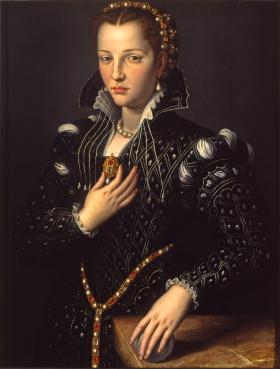
    4. That’s my last Duchess painted on the wall, Looking as if she were alive.

      Lucrezia de' Medici

      The image is a painting of Lucrezia de' Medici, and though this was painted for her brother one year after her passing, this painting could be used as the stand-in for the image the Duke is describing. The Duchess' somber gaze is antithetical to how the Duke describes the Duchess as a person, which makes the reader question how much truth could the Duke be speaking. Is it possible that the Duke is imagining a smile on her face because he feels guilty? Is the Duchess' stoic look a reflection of her feelings, or was it "by design" as the Duke later states?

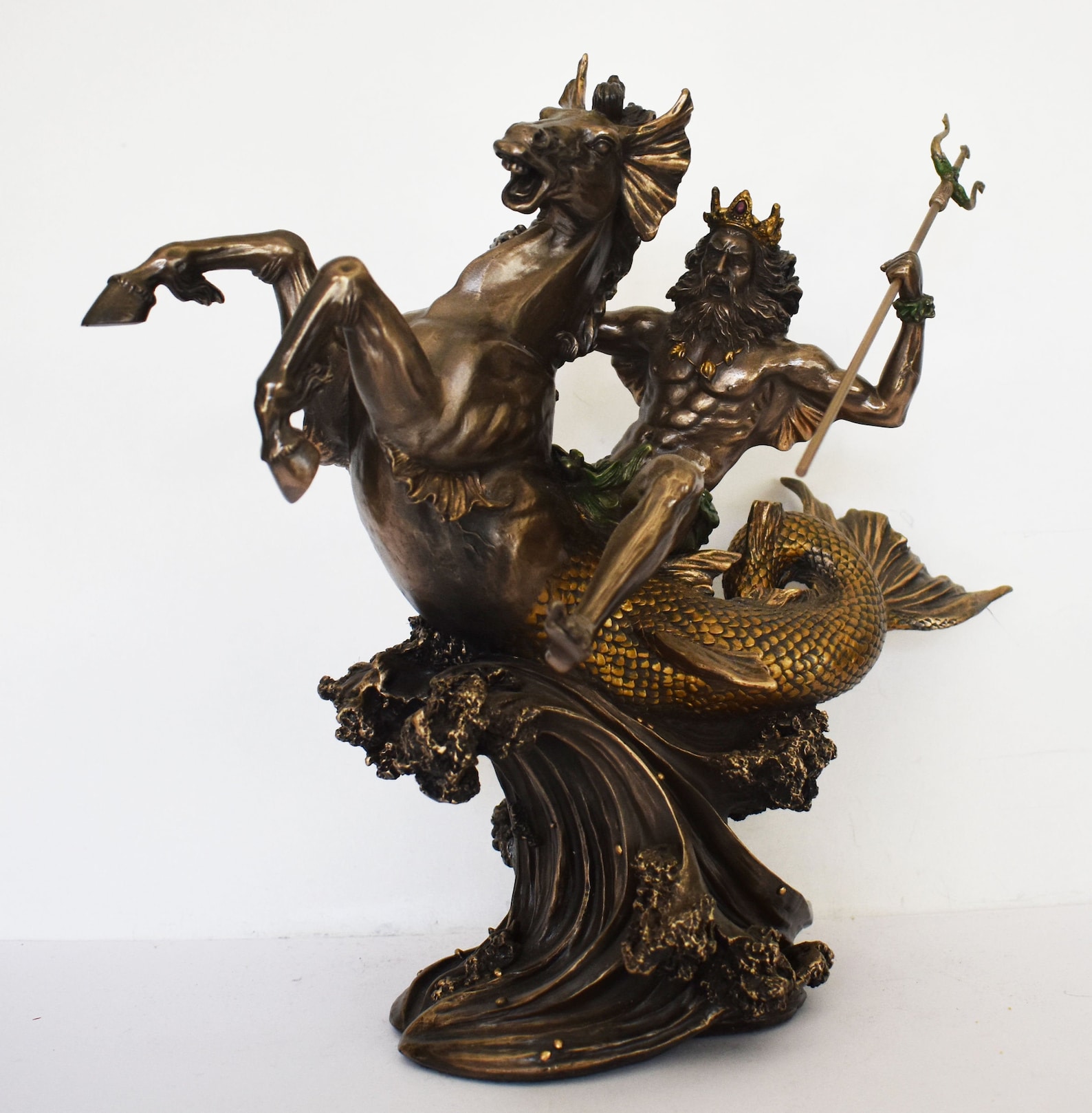
    5. Notice Neptune, though, Taming a sea-horse, thought a rarity, Which Claus of Innsbruck cast in bronze for me!

      Neptune Taming a Seahorse

      The Duke's final words being about another artpiece he has demonstrates how little he cared for the Duchess. The need to brag about more art being made for him not only shows his ability to display power, but it also shows a reflection of his true intentions. The bronze cast is of Neptune (a god) taming a seahorse--this reflects how the Duke views himself: a god taming a lesser creature; as he sees himself as a god, he will inevitably treat the new duchess similarly. There was never going to be a dual-respect and understanding between him and the Duchess as she was as useful as a seahorse to him. His calculated shift from a painting of his "beloved" wife, to a bronze cast displaying a feat of dominance demonstrates the Duke's ability for social politics and directs attention away from the gruesome end of the Duchess.

    6. My Last

      While looking up the Duchess, Lucrezia de' Medici, came a poem called "My Next Duchess" by a priest named Lawrence Jones in which a member of the envoy warns of the Duke as a means to save the next duchess from his grasp. While the poem does not follow all the same writing conventions as Browning's poem such as form and tone, it is effective in the way that provides a secondary perspective on the story within this poem. The break of such conventions lends a sort of response that is more human that the facade that the Duke puts on.

      The poem aims to explore how the envoy reacted to the Duke's monologue, and the horror at which is deemed worthy enough to become a cautionary tale to future noblewomen about the Duke of Ferrara.

    7. if she let Herself be lessoned so, nor plainly set                                                     40 Her wits to yours, forsooth, and made excuse— E’en then would be some stooping; and I choose Never to stoop.

      To build off the previous annotation, the Duke's mask slips for a second as he admits that he would, in fact, "stoop"--but in doing so, it shows he does not have as much control as he fronts to his envoy. However, the Duke regains said control (and re-masks) through the use of others' fear of what he is capable of by stating that he chose "never to stoop" to the Duchess's level of behavior or intellect.

      This point is mentioned by Garratt regarding Browning's writing strategy using "masks" in his poetry, "The envoy is meant to be impressed by this graciousness, this taste, manners, and above all, command of life; the Duke hopes desperately that the envoy will carry that impression back to the count, and to the new duchess” (117). Garratt's point shows that the Duke's intentions in telling this story is so that the next Duchess will not behave the same way as the previous one, and she'll have no excuse as she'd already been warned; he is molding his new duchess through fear.

    8. Will’t please you sit and look at her? I said “Fra Pandolf” by design, for never read Strangers like you that pictured countenance, The depth and passion of its earnest glance, But to myself they turned (since none puts by The curtain I have drawn for you, but I)

      The Duke's glee at showing off the painting is an example of the facade of dominance he establishes throughout the poem. Robert F. Garratt's article reinforces this stating, “In fact, there is a safety about the duchess' looks now that they are frozen on canvas, and the Duke can truly enjoy them because he controls the strings to the curtain” (117). By being able to show when she is allowed to "smile" at anyone using drawstrings illustrates that above else, the Duke's need to dominate and impress are more important than the life of another person, regardless of how close they are to him. His insistence that Fra Pandolf has created such a masterpiece "by [his] design" alludes to the notion that the portrait does not actually capture the essence of the Duchess, but rather a version he demanded be created, displaying his need for control.

    1. oh! John, catch haud o’ him

      Johnston keeps up a strict rhyme scheme throughout the poem - aabbccbb, etc. However, the speaker's somewhat fourth wall breaking exclamation here tips that rhyme scheme on its head. Blin', in the Scots dialect, is a near rhyme with the word him, though that rhyme is lost some in other accents. Beyond the loose rhyme here, the outburst also changes the otherwise even flow of the rhythm through the poem.

      The thought of her child falling to the floor forces the speaker out of her careful patterns, highlighting the mother's love and care for her children.

    2. puir

      Puir in modern Scots (from 1700 onward) can mean either a "pauper or beggar", or "someone in considerable need of help". While this definition is also true for older Scots, there was also a secondary definition - one that meant "guiltless" or "free from moral corruption". With this older definition in mind, this line comes to have a similarly twofold meaning; one in which all the poor will die at the careless hands of the rich, but also one where the poor working-class are the class of purity, while the gentry are corrupt.

    3. What care some gentry if they’re weel though a’ the puir wad dee!

      The refrain throughout this poem works as a sort of a war cry. The rest of the poem reads as a lament between wife and husband, something that could come from almost any middle class or lower house even to this day. However, the use of the refrain takes readers from the world of the poem back out into the wider world of working-class Scotland.

    1. Work on bravely, GOD ‘s own daughters! Work on stanchly, GOD ‘s own sons! But till ye have smoother waters, Let Truth fire her minute guns!

      This stanza is repeated twice throughout the poem. The sarcastic tone and the repetition of the stanza emphasizes Cook's message. She gives life to the worker and encourages work while also suggesting the workers stand up for themselves. A "minute gun" is a gun that fires every minute, so Cooke is encouraging the working class not to be silent about the injustices they face.

    2. The richest crown-pearls in a nation Hang from Labour’s reeking brow.

      The "reeking brow" Cook mentions is a reference to the sweat on a worker's brow. This serves as a metaphor comparing sweat to pearls which elevates work to a royal adornment. This bypasses the levels of traditional hierarchy by location national wealth in workers' bodies.

    3. Let Man toil to win his living, Work is not a task to spurn; Poor is gold of others’ giving, To the silver that we earn.

      Each stanza follows a specific rhyming pattern. In each stanza, the end words of the first and third lines rhyme and the second and fourth also rhyme. The rhyme scheme of the poem results in an up-beat cadence when the poem is read aloud. The cadence really juxtaposes the serious tone of the content.

    1. Shouting and pelting—what bliss to fall Half-smother’d beneath the well-aim’d ball! Men of fourscore, did ye ever know Such sport as ye had in the drifting snow?

      The speaker is connecting another kind of joy to the snow through the image of boys having a snowball fight. She speaks to elderly men to bring back the memory of the good times they had in the snow. This brings the two groups of people together.

    2. marching forth

      The word "marching is usually connected to military movement. This presents Winter as an organized and potentially dangerous force that the speaker enjoys seeing. This line may also explain why the first line characterizes Winter as brave. Most Victorians considered fighting and dying for ones country as brave.

    3. icicle gems

      This phrase as well as "delicate carpet so richly spread"(line 12) "glittering diadems crown'd" (line 14), and "ermine mantle" (line 30) invoke an image of natural riches that are available to everyone in the area instead of those who are very wealthy. While the speaker does not explicitely state it, the snow allows individuals who, otherwise, would not have access to material riches to have them in the snow.

    1. So, ever must I dress me to the fight,

      In this line, the imagery suggest that Guenevere is aware of beauty and deliberately employs it to seduce and influence the knights that are present in the room, treating it as a strategic advantage. This action goes against the ideals of Victorian standards of beauty and virtue.

    2. Men are forgetting as I speak to you; By her head sever’d in that awful drouth Of pity that drew Agravaine’s fell blow,

      Guenevere's accusation suggest that Sir Gauwaine cannot claim moral superiority, as his own family history is fraught with similar transgression. This highlights the recurring theme of hypocrisy and flawed virtue among Arthurian knights. Furthermore, Guenevere is referring to the affair of Sir Gauwaine's mother, Morgause. She was killed by her son, Gaheris, when he discovered her relationship with Sir Lamorak. https://kingarthursknights.com/arthurian-characters/morgause/

    1. “But, no !” say the children, weeping faster,       ” He is speechless as a stone ; And they tell us, of His image is the master       Who commands us to work on.

      Richard Oastler, a critique of the Victorian factory system wrote: "Poor infants! ye are indeed sacrificed at he shrine of avarice, without even the solace of the negro slave; ye are no more than he is, free agents; yet ye are compelled to work as long as necessity of your needy parents may require, or the cold blooded avarice of your worse than barbarian masters may demand!…ye are doomed to labour from morning to night for one who cares not how soon your weak and tender frames are stretched to breaking!" Indeed, children were often contracted to factories to work until they reach 21 years old for very little money. Even the factory reformers that called for change, for better work hours, conditions and for education, did not ask for the abolition of child labor. Families could not survive without the supplemental wages of the children. Textile factories could not function without the nimble children darting between running machines to reattach broken threads being woven (Nardinelli). The factory owners were like slave owners who invested as little as they can and whip the most work out of the children as they can.

    2. “True,” say the children, “it may happen       That we die before our time! Little Alice died last year her grave is shapen       Like a snowball, in the rime.                                                                             40 We looked into the pit prepared to take her —    Was no room for any work in the close clay:

      How poignantly EBB describes Alice's grave: "…no room for any work in the close clay." It makes one feel as if Work chases the child to the grave, stands there, looks down at the pit, and ponders if there is room for it to join little Alice-as if death is not escape enough. In reality, Victorian children do suffer many injuries and violent deaths in work related accidents. Take chimney sweepers, for example. Usually little boys 5 to 6 years old were employed to clean out narrow, twisted chimneys. They came out scraped and bleeding from the tight confines and suffer long term breathing problems due to soot and creosotes. If the child got stuck, the master chimney sweeper would light a fire in the fire place to encourage the child to get out faster. This little tale of the chimney sweeper speaks of the Victorians' general attitudes toward child labor (Alexandrova).

    3. The young lambs are bleating in the meadows ;    The young birds are chirping in the nest; The young fawns are playing with the shadows;    The young flowers are blowing toward the west— But the young, young children, O my brothers,       They are weeping bitterly!

      The deliberate refrain of "young" nature and the emphasized double "young, young children" point out the irony and tragedy of how life shouldn't be for these children. While nature frolic and play, the human children are weeping bitterly. In fact, some poems in the Victorian period use this juxtaposition of the free natural world versus the state of the oppressive poor. Thomas Hood's "Song of the Shirt" has these lines: "Oh! but to breathe the breath Of the cowslip and primrose sweet--- With the sky above my head, And the grass beneath my feet". Gerald Massey wrote in "Cry of the Unemployed": "Heaven droppeth down with manna still in many a golden shower, And feeds the leaves with fragrant breath, with silver dew, the flower; There's honeyed fruit for bee and bird, with bloom laughs out the tree". Nature is plentiful, beautiful, and free while humans suffer from hunger and fetters of their working class.

    1. I trust not to thy phantom bliss,

      The phantom that the speaker explicitly states she doesn’t trust is imagination. This ghost that haunts the speaker pushes her to the edges of society where she would feel the effects of loneliness that connect can only be soothed by hope that is birthed from death, as Steven Vine states in his essay about how the ghostly bliss “betrays the self’s desire” and is “born from the death that it is supposed to overcome” (107).

    1. A sudden flame, a merciful fury sent

      A modern connection: This is Taylor Swift's song “Mad Woman”, which debuted as the twelfth track on her seventh studio album, Folklore, released on August 18, 2020. Written during the COVID-19 pandemic, the song addresses the criticism and societal backlash that women often face when expressing anger. I include this song as an annotation because it resonates strongly with Xantippe. Centuries of being villainized, described as “shrewd” or “crazy,” mirror the way society punished women for emotions that were deemed inappropriate. Swift’s lyrics capture this societal double standard: "And there's nothin' like a mad woman What a shame she went mad No one likes a mad woman You made her like that" These lines directly reflect the way Xantippe’s anger is treated, not as a natural or justified response, but as evidence of moral or personal failing. Swift continues: "And you'll poke that bear 'til her claws come out And you find something to wrap your noose around" This imagery parallels the way Xantippe is provoked and restricted by the expectations of her husband and society, until she finally lashes out, a physical and emotional release mirrored in Levy’s poem. Later lines, such as: "The master of spin has a couple of well-placed friends They'll tell you you're insane" highlight how women’s reputations and emotions are manipulated and controlled by societal judgment, reinforcing the same marginalization that Levy talks about. By including “Mad Woman”, we can see a direct line from Xantippe’s historical and literary treatment to modern discussions about women, anger, and the consequences of breaking imposed emotional boundaries.[]https://youtu.be/6DP4q_1EgQQ?si=e7ol3EKrAAWfHwSR

    2. But swiftly in my bosom there uprose A sudden flame, a merciful fury sent To save me; with both angry hands I flung The skin upon the marble, where it lay                                                                                                                             220 Spouting red rills and fountains on the white; Then, all unheeding faces, voices, eyes, I fled across the threshold, hair unbound— White garment stained to redness—beating heart

      At this point in the poem, Xantippe has lost the mask she worked so hard to hold on to. Socrates has angered her, and in a sudden fit of rage, her body responds with a faster heartbeat as she flings the wine onto the floor. Xantippe seems to rarely allow herself to feel or express anger; she might often feel slighted or sad, but these emotions are usually restrained, like a quietly glowing ember. Here, however, a “sudden flame” erupts: the heat rises, and she finally releases it. The description of the red wine spilling onto the white marble serves as a powerful metaphor for the loss of innocence or purity. What was once clean and controlled is now marked and transformed. Xantippe crosses the threshold changed, “hair unbound, white garment stained to redness," no longer the restrained, composed figure she once was. Levy’s depiction of this moment reflects her interest in women’s emotional and intellectual repression. Just as Xantippe’s fury has been contained by societal expectations in ancient Athens, Victorian women like Levy faced pressures to restrain their feelings and intellect. By giving Xantippe a dramatic, physical release of her anger, Levy depicts the costs of suppression and illuminates the intense, hidden emotional lives of women. The poem becomes not only a historical reflection on Xantippe’s experience but also a nuanced critique of the constraints placed on women in Levy’s world by showing how powerful and transformative the acknowledgment of one’s own emotions can be.

    3. ‘ I thank thee for the wisdom which thy lips Have thus let fall among us : prythee tell From what high source, from what philosophies Didst cull the sapient notion of thy words?’

      Through Socrates’ choice of words in this passage, he comes across as arrogantly dismissive. Using sarcasm, he comments, what on the surface sounds like a compliment: “I thank thee for the wisdom which thy lips / Have thus let fall among us,” as actually belittling. The phrase “have thus let fall among us” portrays her input as something not freely given or valued; it was blurted out and unsolicited. His snide questions: “From what high source, from what philosophies / Didst cull the sapient notion of thy words?” imply that even if her words were worthy, they could not possibly have come from her own mind. Socrates shows no genuine respect for Xantippe, acknowledging her only in the limited capacity allowed to women in domestic spaces. Amy Levy’s choice of including this passage reflects her broader interest in exposing the ways women’s intelligence and emotional lives were devalued. By featuring Socrates’ dismissive tone, Levy demonstrates the societal conditions of Victorian women like herself, who were often denied intellectual recognition and confined to narrowly defined roles. Just as Xantippe is belittled despite her perception, Victorian women faced systemic obstacles to being taken seriously. This makes Levy’s dramatic monologue a commentary on the ongoing marginalization of women’s minds.

    4. I saw his face and marked it, half with awe,                                                                             60 Half with a quick repulsion at the shape. . . .

      While looks and beauty were very important in the ancient Grecian times, Socrates broke the mold when it came to the beauty standards of his day. As noted to his appearance in the Stanford Encyclopedia of Philosophy, Socrates "had wide-set, bulging eyes that darted sideways and enabled him, like a crab, to see not only what was straight ahead, but what was beside him as well; a flat, upturned nose with flaring nostrils; and large fleshy lips like an ass." Despite the hair trends of his area, he grew his hair out and refused to stay clean or change his clothes. Amy Levy includes these details to accentuate the contrast between societal expectations and individual worth. Men like Socrates could be physically unconventional or even “ugly” and still admired for their intellect, yet there was no equivalent space for women to be recognized for their minds. A woman’s value was tied to her beauty and social conformity. By presenting Socrates’ unconventionality alongside the phrase “half with awe,” Levy highlights the tension between superficial judgment and true merit, a tension mirrored in "Xantippe: A Fragment", where women’s intellectual and emotional lives were historically ignored or dismissed.

    1. Dauntless the slug-horn to my lips I set

      Critics have long debated the meaning of Roland’s final gesture, which many read as a transformation of the quest’s traditional moment of triumph. Brandon Moen compares Roland’s horn-blast to The Road, where the father and son’s survival takes the place of moral salvation. Ronald Primeau compares the poem to “Man Against the Sky” calling the moment “triumphant futility” (Primeau 223). Roland gains neither glory nor salvation, yet he refuses despair. Together, these readings suggest that Browning reshapes the romance ending into a model of existential commitment that resonates across literary periods, making Roland a prototype for later heroes who persist without hope.

    2. Burningly it came on me all at once, This was the place! those two hills on the right, Crouched like two bulls locked horn in horn in fight; While to the left, a tall scalped mountain… Dunce, Dotard, a-dozing at the very nonce, After a life spent training for the sight!

      When heard aloud, like in this reading of "Childe Roland" the irregularity of this stanza becomes more noticeable. For instance, heavy stresses pile up in “Crouched like two bulls locked horn in horn in fight,” and the abrupt pauses throughout break the poem’s forward rhythm. The rhyme sequence (once/right/fight/Dunce/nonce/sight) echoes unevenly, giving the language a tense, unstable energy. Essentially, at the precise moment of Roland’s recognition of “the place,” where there should be triumph, the poem loses composure, creating dissonance between narrative climax and emotional collapse. Heard this way, Browning’s form enacts the poem’s theme of meaning arriving through struggle, a quality that has made its strangeness continually compelling to later readers.

    3. As for the grass, it grew as scant as hair In leprosy; thin dry blades pricked the mud

      image This 1859 painting by Thomas Moran, inspired directly by Browning’s “Childe Roland,” visualizes the poem’s barren and hostile terrain. Turbulent clouds, jagged rocks, and desolate expanses dramatize the emotional weight of the quest. Additionally, the fiery, ominous sky evokes Romantic and Sublime traditions, but instead of ennobling Roland’s journey, the natural grandeur seems to overwhelm him. Rather than a knight striding toward a glorious destiny, the lone figure of Roland, dwarfed by the vast landscape, gazes toward the distant, looming tower. By pairing the poem with such imagery, anthology audiences can more fully experience the poem’s tension between heroic aspiration and environmental hostility. This artistic reimagining also shows how the Tower’s imagery quickly began to shape visual as well as literary culture.

    4. O’er the safe road, ’twas gone; grey plain all round: Nothing but plain to the horizon’s bound. I might go on; nought else remained to do.

      The disappearance of the road marks the poem’s decisive break from the traditional quest narrative. Roland suddenly lacks guidance, landmarks, or even a visible destination. In romance tradition, a path implies providence or fate, but here, it abruptly dissolves into nothingness, leaving Roland with no direction except forward. Roland continues not out of hope but necessity; after all, as he says, “nought else remained to do". This reveals that his journey is no longer about heroic purpose, but a chosen persistence. In a way, I can see how this moment anticipates modern existential thought: meaning is no longer inherited but made through action. Roland walks on not in faith, but in defiance, setting the tone for the poem’s long afterlife as a myth of endurance in a purposeless world.

    5. Childe

      The term “childe” denotes “a young man of noble or gentle birth,” often used in medieval romances to mark a youth on the threshold of knighthood (“Childe”). Browning’s choice to invoke this archaic title primes readers to expect an epic of honor and questing, with Roland acting as a figure of destiny. However, the poem immediately undermines that expectation as heroic promise collapses into moral exhaustion, distrust, and futility. By invoking a marker of chivalric quest and then denying its fulfillment, Browning recasts the “childe” as a weary survivor meaninglessly stumbling through desolation. The ironic reframing of quest-romance conventions contributes to the poem’s long tradition of reinterpretation, as later writers and artists seized on Roland as a model of perseverance in a broken world.

    1. words come out from the depth of truth;

      Words have power, but they should be backed the power of truth, not by lies and deceit. That singular truth being that each of us is just as human as the next, if not for the "walls" dividing us in the prior line. He is also specifically utilizing the language, and thus words, of the Empire that oppresses his people as a tool to appeal to them.

    2. Father

      Tagore understood that the primary audience of an English translation would be Christian, and thus utilized an explicit reference to Christianity with a capitalized Father referring to the Christian God. He is utilizing both the language and religion of another people in support of his own. This would strengthen his call among that audience and helps turn this entire poem into a prayer and call to the divine.

    3. head is held high;

      This implies a sense of pride and confidence in what one was doing, which reinforces that the mind is without fear, because the body is visibly showing that. This also serves to highlight that the body and mind are acting in unison.

    4. free;

      Free here can mean multiple things.

      Free as in the monetary sense and free as in it is available to everyone without restriction. Both definitions feed into the next line by opening up knowledge outside of those it is typically restricted to, which is an exceptionally notable statement from Tagore, due to his standing at the very top of the traditional Hindu caste system. In his arguments here, he is explicitly calling for the dissemination of knowledge to everyone.

    5. Where the mind is without fear

      Tagore defines the mind in What is Art? very specifically as the logical and reasoning half of what might generally be considered the whole mind by a reader. Emotions, like fear, are found within the personal man, or personality, instead of the physical man. Thus, if the mind is without fear, then this inner personality has been sated and exists in harmony with the physical mind.