Author and librarian Nancy Pearl advocates the “Rule of 50.” This entails reading the first 50 pages of a book and then deciding if it is worth finishing. The Rule of 50 has an interesting feature: once you are over the age of 50, subtract your age from 100 and read that many pages. Pearl writes: “And if, at the bottom of Page 50, all you are really interested in is who marries whom, or who the murderer is, then turn to the last page and find out. If it’s not on the last page, turn to the penultimate page, or the antepenultimate page, or however far back you have to go to discover what you want to know.…When you are 51 years of age or older, subtract your age from 100, and the resulting number (which, of course, gets smaller every year) is the number of pages you should read before you can guiltlessly give up on a book.…When you turn 100, you are authorized (by the Rule of 50) to judge a book by its cover.”
211 Matching Annotations
- Sep 2021
-
fs.blog fs.blog
-
-
Most of us were taught as children to treat books as something sacred—no folding the page corners, and no writing in the margins, ever.
Most Medieval manuscripts specifically left wide columns of space to encourage readers to mark up their texts.
cross reference: Medieval notepads - Khan Academy
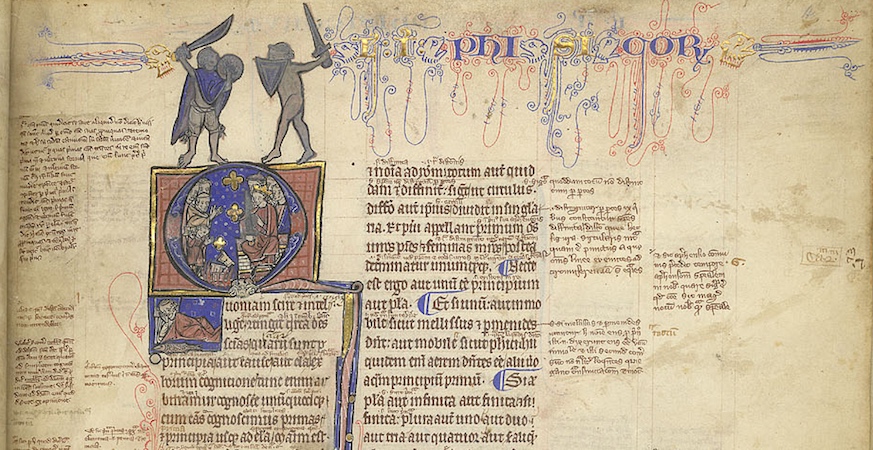 <small>Detail, London, British Library, Harley MS 3487 (13th century)—[source](http://www.bl.uk/catalogues/illuminatedmanuscripts/ILLUMIN.ASP?Size=mid&IllID=16790)</small>
 -
Book summary services miss the point. A lot of companies charge ridiculous prices for access to vague summaries bearing only the faintest resemblance to anything in the book. Summaries can be a useful jumping-off point to explore your curiosity, but you cannot learn from them the way you can from the original text.*
Some books only have small bits of wisdom in them to begin with, so summaries can be good.
However, if one puts the "quality" content in a primary position, then the text itself will often have some incredibly valuable context that may be missing from summaries.
-
- Aug 2021
-
blogs.princeton.edu blogs.princeton.edu
-
www.khanacademy.org www.khanacademy.org
-
The most common and sensible location for putting down thoughts, critique or notes was the margin of the medieval book. Consider this: you wouldn’t think so looking at a medieval page, but on average only half of it was filled with the actual text. A shocking fifty to sixty percent was designed to be margin. As inefficient as this may seem, the space came in handy for the reader. As the Middle Ages progressed it became more and more common to resort to the margin for note-taking.
-
-
Dots and lines are particularly common ingredients of such footnote symbols. Interestingly, their first appearance is not as a connector of comment and text, but as an insertion mark that added an omitted line into the text.
In a version similar to a footnote, a line and a dot were first used much as we use the carot symbol (^) today for editing to indicate the insertion of a missing line.
-
-
Evidently, these two groups of bookmarks—static and dynamic—provided very different approaches to marking information—and thus to a book’s use. Readers who added clip-on or “spider” bookmarks anticipated they would need to retrieve information not from one single page but from a changing number of pages. In other words, movable bookmarks served an audience with a shifting knowledge “appetite,” while the static ones encouraged a more “ritual” use of a book. In other words, both types are telling, in their own way, about medieval reading culture.
Static bookmarks may have indicated "ritual" or habitual use of books and the information they contained, while dynamic bookmarks may indicate the need for retrieving (temporary) information from one or more pages.
-
-
kimberlyhirsh.com kimberlyhirsh.com
-
Step 3: Set up reading storage and a reading environment.
Calibre isn't a bad tool/application for doing this for a variety of document types and managing meta data
-
- May 2021
-
newrepublic.com newrepublic.com
-
Jesuit manuals such as Jeremias Drexel’s Aurifodina, subtitled The Mine of All Arts and Sciences, or the Habit of Excerpting, explained how to best take notes from reading to create commonplace books: personal notebooks of reading extracts that contained the religious, ethical, and political maxims deemed necessary to lead a good life. There were even admonitions about which texts not to read and how not to fold page corners or to mark texts with fingernail scratches.
Fascinating to see that practices like folding page corners and marking texts are far from new.
-