25 Matching Annotations
  1. Nov 2025
    1. reply to question about tension control at https://reddit.com/r/typewriters/comments/1orxtvt/strange_lever/

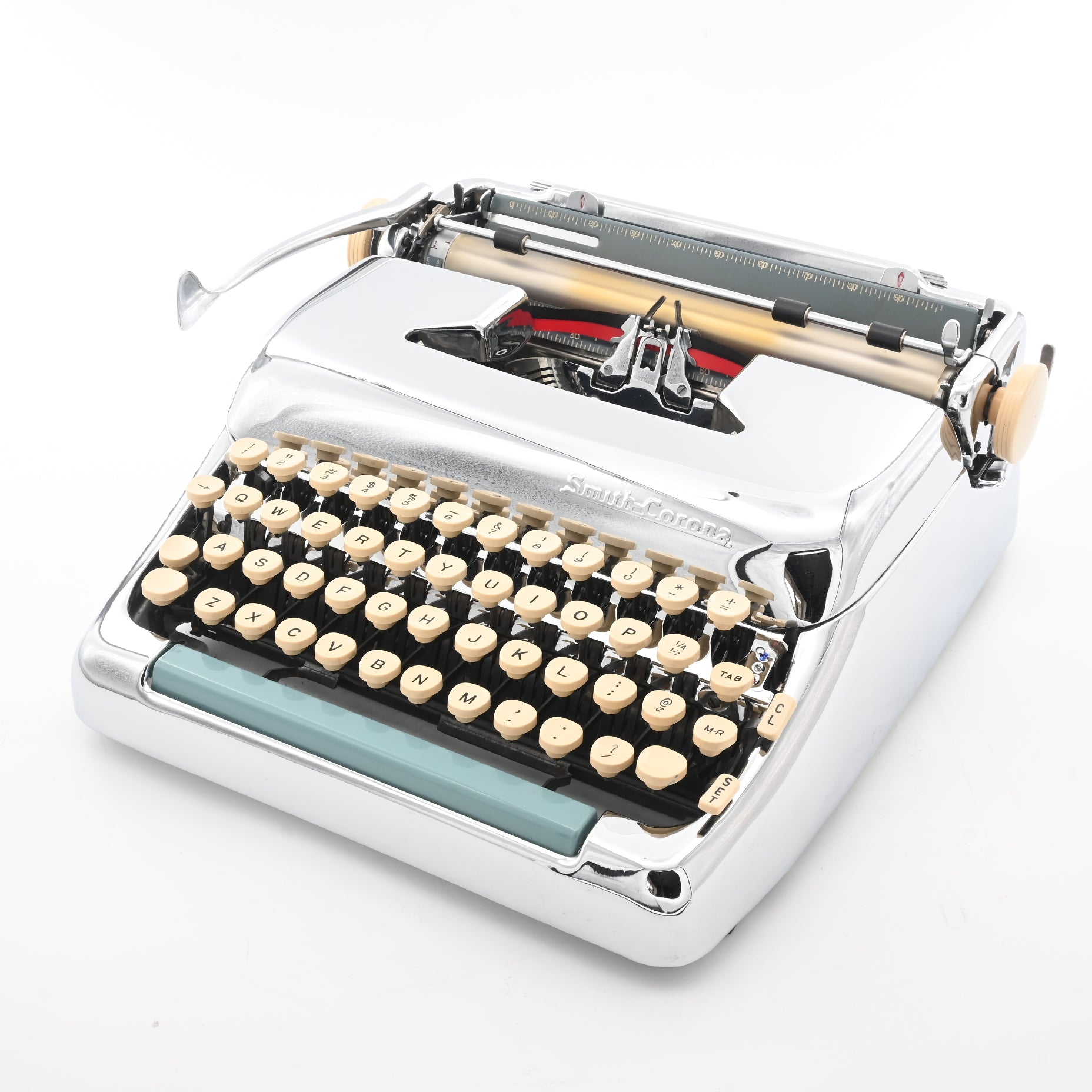
      Joe Van Cleave has a great video on this with respect to the Smith-Corona 5 series that will give one an idea on the entirety of adjustment points that are at play in some typewriters. https://www.youtube.com/watch?v=OYOXgqiHBmg

      Personally, I've yet to run across a vintage Series 5 machine whose user-facing control lever was adjusted in a way such that it did anything at all because the linkages were so far out of whack. I suspect this may be the case on a lot of vintage machines.

      On some machines the adjustment isn't controlling the amount of finger force one must apply, but it's controlling springs relating more to the return of the typebars and the slugs so that touch typers can type much faster without having issues with typebar return jamming things up.

      Further, on many machines the dynamic range of forces involved is so narrow that most hobbyist and occasional typists aren't going to really notice a significant difference. This may be different for those who are more experienced and used to typing on a manual machine for several hours a day.
  2. Aug 2025
    1. Reply to Joe Van Cleave at https://typewriterdatabase.com/show.21270.typewriter

      It's probably a subtle difference, but is this machine provide the standard 6 lines per vertical inch or due to the taller ascenders/descenders is it a 4 lines per vertical inch machine?

      If you need a "name" for this machine, I might suggest "Satchmo". In doing some research on Louis Armstrong's 5 series Smith Corona, I'm pretty sure his 5 series also had this same vertical script. None of the features on any of the photos I could find of his machine are subtle enough to distinguish which particular model of Smith-Corona he was using. If we find a good direct photo of the machine itself, I'm sure I could puzzle out which version he used. By 1955 he had at least one machine with a script face (see: https://www.louisarmstronghouse.org/virtual-exhibits/my-fifty-fifth-birthday-celebration-happy-birthday-louis-armstrong/). It doesn't appear to be Smith-Corona's common Script (Artistic) No. 75 , but more like Script No. 46. Based on a version of this photo (https://www.usatoday.com/gcdn/presto/2019/07/15/USAT/d815dddc-c0b8-4c54-b9b5-719886d4a0cc-02_Armstrong_Louis_16.jpg?width=1292&height=1320&fit=crop&format=pjpg&auto=webp) it would seem that it's the Smith-Corona that was the script machine (as opposed to his earlier Remington).

      According to Ted Munk's post on the S-C Vertical script: "Smith Corona is offering the [vertical] typeface as 'Script No. 46', 10 Pitch by 1954."

      Joe's video of his 1952 Smith-Corona this with the same vertical script https://www.youtube.com/watch?v=EH6mwmoN_LI

      See also: https://www.reddit.com/r/typewriters/comments/1mo4wbg/what_typewriter/

      Somewhat interesting that Louis Armstrong played cornet, wrote on a Smith-Corona, and lived in the Corona neighborhood of Queens, NY.

  3. Jul 2025
  4. Jun 2025
  5. Feb 2025
  6. Dec 2024
  7. Nov 2024
  8. Oct 2024
    1. If the "Hanks Effect" was really so prominent, then we should see the commensurate rise in price of 5 Series Smith Coronas and particularly the Clipper and the Silent which he's also mentioned several times. In fact, he's said these would be the typewriter he'd keep if he had to get rid of all others. Given this fact, it has to be, in part, a variety of other factors which inflates the prices.

      Personally I think that it's a combination of the fact that they were manufactured at the peak of typewriter use and manufacturing and before companies began using more plastic and cheaper manufacturing methods, but were also done in a later timeperiod when exterior design and color were on the rise as a differentiator in the marketplace. Quality, form, and function become part of a trifecta which drive desire and collectability.

  9. Aug 2024
    1. Smith-Corona Series 5 and 6 typewriters had a small piece of rubber around a portion of the escapement which can wear out or become damaged. This in turn causes the escapement to not work properly and cause the dogs to get jammed resulting in large movements of the carriage while typing or spacing.

      Joe Van Cleave calls it the "return silencer" and replaced his by tracing out the damaged piece on a sheet of 1/32" rubber and cutting it out as a replacement.

      Duane at Phoenix typewriter describes replacing it with rubber tubing (possibly something like heat shrink?) instead. See: https://hypothes.is/a/tG4BWk77Ee-jczsjoM8SzA

  10. Jul 2024
  11. Jun 2024
  12. May 2024