6 Matching Annotations
  1. Dec 2025
    1. Pierre-François Bouchard’s men discovered the ancient stone slab
      <center>

      Rosetta Stone (RS)

      </center>

      Useful Links

      1. Rosetta Stone_ Wikipedia
      2. Explore the Rosetta Stone_ British Museum
      3. Rosetta Stone_ Britannica
      4. What is Rosetta Stone and why is it important?
      5. Rosetta Stone- Smithsonian

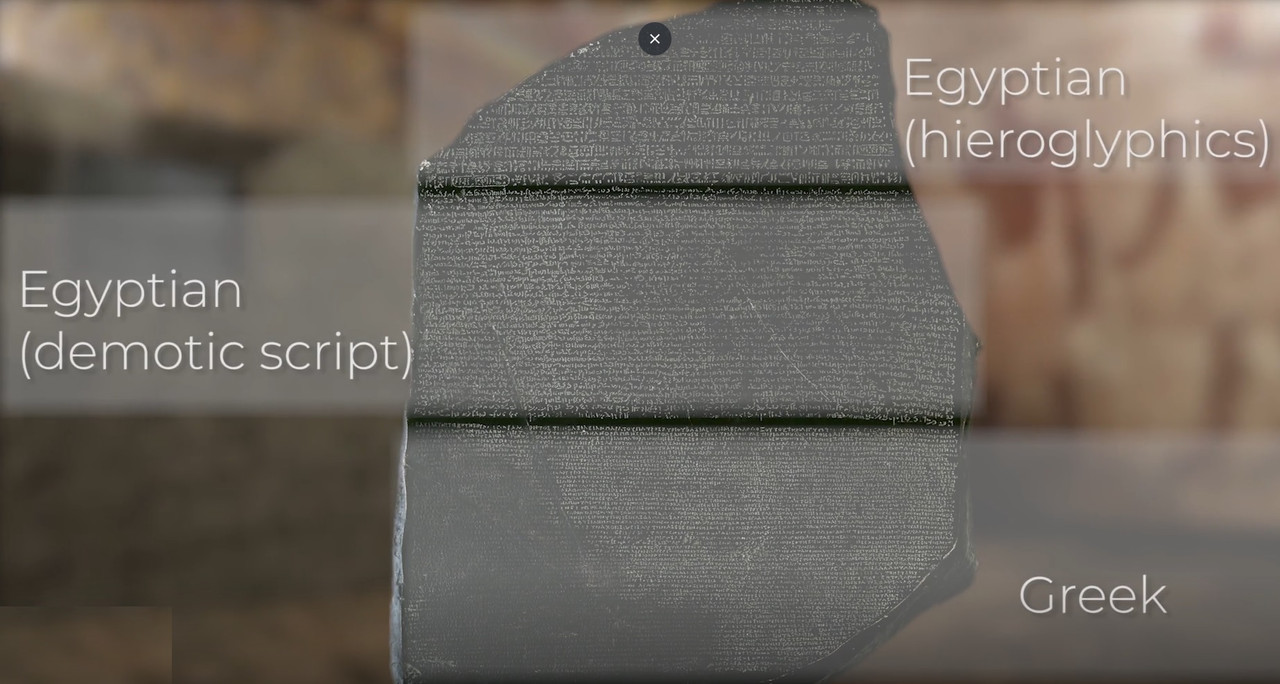
      On July 19, 1799, Pierre- Francois Bouchard's men discovered an ancient "basalt" slab in Rosetta (local name Rashid), Egypt. It was covered with 3 types of writing- Demotic, Hieroglyphics and ancient Greek. Scholars traced origin of the RS to 196 BCE in Egypt's Ptolemaic era

      Click map of the Ptolemaic dynasty

      <center>The Rosetta Stone decoded by AI</center> Click this YouTube Link

    2. How the Hieroglyphics were decodified?

      • Europeans were missing a key piece of the puzzle and had been for 2 000 years. They had been trying to figure out how to read hieroglyphics for centuries but the only instructions on how to do so came from ancient Greek and Roman writers who insisted that they were ideographies using pictures to indicate concepts. While that was true sometimes they could also be phonetic indicating sounds the same way as alphabetic languages do. This misunderstanding was inherited all the way to the 1800s.
      • Medieval Muslim researchers tried to crack the code and failed though two did discover that some of the code lined up with Coptic, a descendant of ancient Egyptian. Later when Renaissance alchemists attempted to read the texts hoping to learn ancient spells, healing practices and other wonders, they had even less luck.
      • It wasn't in until 1814 that an English polymath named Thomas Young made the first real progress. Young, a medical doctor, scientist and linguist at first just busied himself with translating the Demonic section of the Rosetta Stone. However, after a conversation with another researcher (who suggested that the ptolemies being Greek might have written their names phonetically in hieroglyphics) he decided to jump sections. He reasoned that finding the Royal name should be easy enough since it had been suggested that they were always in a circle that we now know as a Cartouche and sure enough he found the name Ptolemy. Upon further study, Young found 80 similarities between the hieroglyphic section of the stone and the Demonic one.
      • Young's work stalled as he incorrectly assumed that hieroglyphics were logographic symbols with each symbol representing a word (like Chinese or Japanese) and that only the Greek names would have phonetic equivalents.

      In comes Jean Francois Champollion!

      • Champollion had been attempting to translate hieroglyphics from his knowlege of Copic and Demotic believing that they were in fact phonetic. However, being in France he had to work off print copies of the stone and probably never got to see the actual Rosetta Stone.
      • champollion used his earlier work on demonic and knowledge of Coptic to reconstruct theoretical cartouches of common Egyptian royal names> His hope was that these cartouches, should he find them in inscriptions, would gradually unlock more hieroglyphic characters. This he did while also feuding with rivals and periodically going into exile for his continued support of Napoleon.
      • Then when Banks (see below about Banks) sent him a print of the inscriptions on his Obelisk champollion stopped dead. There on the side was his reconstruction of Cleopatra! He went into a feverish blitz of work and began to realize that Egyptian hieroglyphics were a mix of ideographic and phonetic characters.
      • It was i 1822 when it all clicked. He read the name Thutmose from an imported inscription, then checked it against the Rosetta Stone. He then bolted from his desk ran down the street to his brother's house and supposedly screamed "I've got it" before collapsing in a dramatic faint.
      • In1829 he fulfilled his lifelong dream of traveling to Egypt. Once there, he found a vanished world beginning to speak to him. Using his dictionary and grammar system, he read the words of Gods and Priests off the temple walls. He uncovered Kings whose names had not been spoken in a millennia and in the Papyrus Scrolls preserved in the Arid deserts of Upper Egypt he found the words of the common people even though he'd never laid eyes on it.

      About Banks mentioned above

      John Banks was touring Egypt when he fell in love with a 22 foot tall six-ton Obelisk and decided that it would look great in front of his yard as it also had inscriptions in hieroglyphics and Greek. He hoped it would be a second Rosetta Stone. So he did what anyone would do: hired an Italian circus strongman to coordinate hauling it back to his estate in England.

    3. <center>

      How Rosetta Stone unravelled the history of ancient Egypt?

      </center>

      Where was Rosetta Stone discovered? Where-was-Rosetta-Stone-discovered
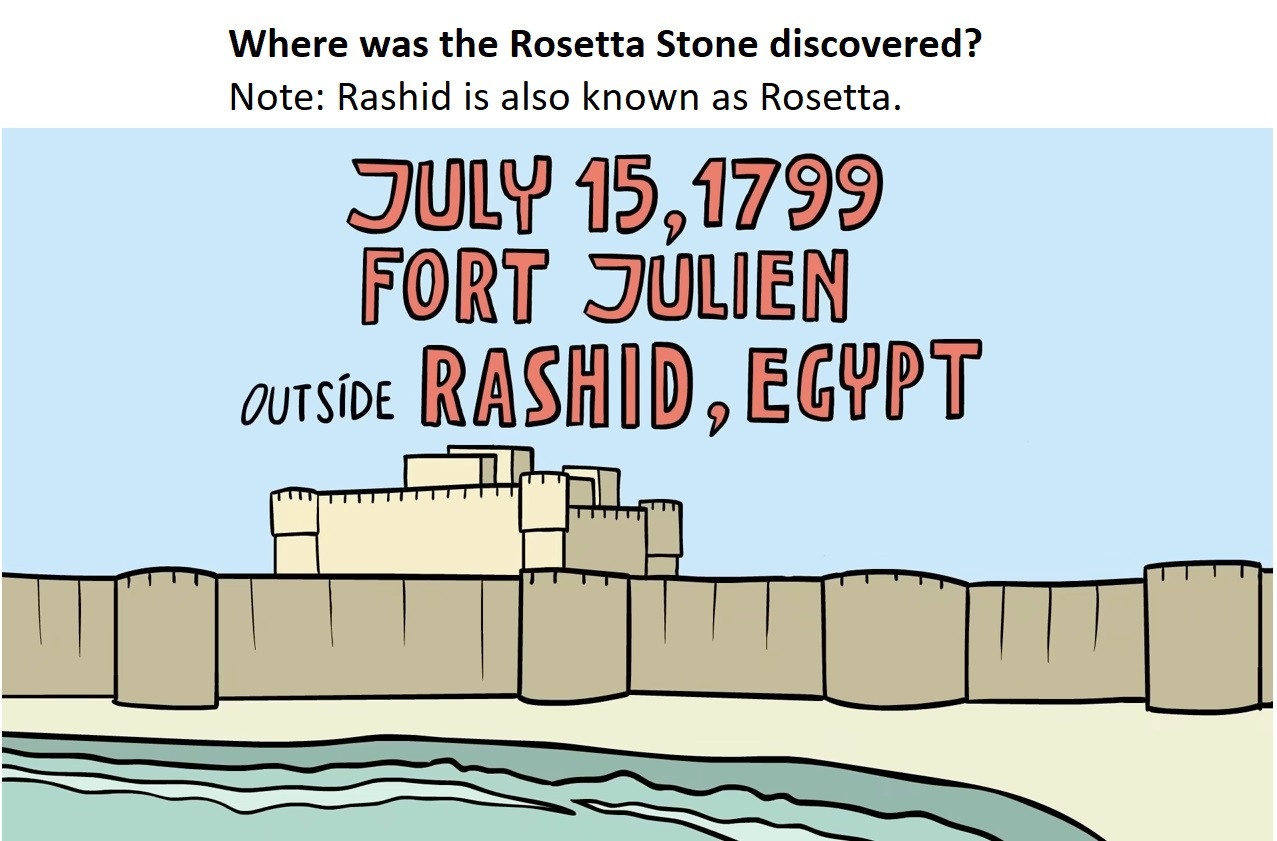
      The Rosetta Stone, a pivotal artifact discovered in 1799, unlocked ancient Egyptian hieroglyphics through its trilingual inscription, sparking a race among scholars like Young and Champollion to decipher its secrets, ultimately revealing a vanished world. <center>

      Highlights

      </center>
      • Rosetta Stone was created during the reign of King Ptolemy V in ancient Egypt in 196 BCE and was eventually discovered by French engineers in 1799. This discovery played a crucial role in deciphering Egyptian hieroglyphics.
      • An artisan inscribed the "Memphis Decree on the stone, which grants tax exemptions to the priestly class, aiming to stabilize Ptolemy V's rule.
      • Fast forward to 1799, French military engineer Pierre Francois Bouchard discovers the stone while repairing a fort, unaware of its historical importance.
      The French Expedition included academics who recognized the significance of the stone's inscriptions, which would later be key to understanding ancient Egyptian writing. <center>

      How the scholars deciphered the script on Rosetta Stone

      </center>
      • After Napoleon abandoned the expedition, the scholars were left with the stone and a pressing need to disseminate its information despite military challenges.
      • The team devised a new method to capture the stone's inscriptions by using ink and paper, which proved successful.
      • Following the surrender of the French forces, the Rosetta Stone was claimed as a spoil of war by the British and eventually donated to the British Museum.
      • -
      • Despite initial expectations, matching the Greek text with hieroglyphics did not lead to immediate decipherment of ancient Egyptian.
      • The quest to decode the Rosetta Stone saw numerous attempts throughout history, culminating in significant breakthroughs by Thomas Young and Jean-François Champollion, who recognized the phonetic nature of hieroglyphics.- The misunderstanding of hieroglyphics persisted until the 1800s, despite efforts by medieval Muslim researchers.
      • Thomas Young made initial progress in translating the Rosetta Stone by focusing on the Demotic section and recognizing the phonetic writing of Greek names.</l>
      • Jean-François Champollion, a talented linguist who understood Coptic, began his own translation efforts and ultimately surpassed Young's work. He utilized various sources, including artifacts and inscriptions from Egypt, to further his understanding of hieroglyphics.

      Champollion's groundbreaking work

      Jean-François Champollion's groundbreaking work on deciphering Egyptian hieroglyphics using the Rosetta Stone highlights his struggles, rivalries, and eventual success in unlocking the secrets of ancient Egypt. He utilizes his knowledge of Coptic and previous research to reconstruct Egyptian royal names in cartouches, aiming to decode hieroglyphics. Despite facing rivalries and political challenges, Champollion perseveres in his studies, leading to a significant breakthrough in understanding hieroglyphics. In 1822, Champollion successfully read the name Thutmose from an inscription, confirming his theories and dramatically celebrating his discovery. Champollion's journey to Egypt allowed him to read inscriptions and uncover the history of ancient kings and common people, further solidifying his achievements.

      Click Cartouche in Rosetta Stone
  2. Mar 2023
    1. 27 Notizhefte mit 3240 Seiten, dicht gefüllt mit hieroglyphischen Abschriften, der Ernte der ägyptischen Arbeit Kurt Sethes, bilden den wertvollsten Kern des Abschriftenarchivs am Altägyptischen Wörterbuch, das im ganzen immerhin 201 Hefte unterschiedlicher Stärke umfaßt.

      Out of a total of 201 notebooks, Kurt Sethe's work on the Wörterbuch der ägyptischen Sprache comprised 27 notebooks with 3240 pages of notes on hieroglyphic copies from his travels and research.

  3. Nov 2021