This is not the revelation of a secret so much as the documentation of a structure.
Lens 1: the great unveiling, leaders cannot be trusted. They sold us the narrative that the world functioned based on a moral logic (merit, the invisible hand)
This is not the revelation of a secret so much as the documentation of a structure.
Lens 1: the great unveiling, leaders cannot be trusted. They sold us the narrative that the world functioned based on a moral logic (merit, the invisible hand)
neoliberalism and its predecessors of industrial capitalism and even proto capitalism were based on separation from the natural world. And and we can we call it sort of separation or dualism
for - key insight - neoliberalism and industrial capitalism were based on Descarte and our separation from the natural world - Post Capitalist Philanthropy Webinar 1 - Alnoor Ladha - Lynn Murphy - 2023 - adjacency - materialism, science and neoliberalism - will technology save us? - Post Capitalist Philanthropy Webinar 1 - Alnoor Ladha - Lynn Murphy - 2023 - to - The Three Great Separations
key insight / summary - neoliberalism and industrial capitalism were based on Descarte and our separation from the natural world - Post Capitalist Philanthropy Webinar 1 - Alnoor Ladha - Lynn Murphy - 2023 - FIrst, Descarte separated the mind from the body. We have the paradox of: - godlike mind housed in - animalistic bodies - (incidentally, this sets us up for the exageration of the existential crisis of the denial of death in modernity - Ernest Becker) - Then we impose separation of external vs internal world - Then, we have separate categories of mind and nature, and we begin othering of: - women - other (indigenous) cultures - What Alnoor and Lynn forgot to mention was that there is another separation that preceded the industrial revolution, the separation of people into distinct classes of: - producer - consumer - Then with the advance of Newtonian physics and the wild success of materialist theory applied to create a plethora of industrial technologies, a wedding occurred between: - dualism and - materialism - Materialism decomposes everything into subatomic particles that a rational mind can understand - To those who think science and technology can save us from the crisis it helped create - the deeper understanding reveals that science and technology are themselves agents of separation.
to - See the three great separations - https://hyp.is/go?url=https%3A%2F%2Finthesetimes.com%2Farticle%2Findustrial-agricultural-revolution-planet-earth-david-korten&group=world
Atypical restraint on compensation increases has been evident for a few years now and appears to be mainly the consequence of greater worker insecurity. In 1991, at the bottom of the recession, a survey of workers at large firms by International Survey Research Corporation indicated that 25 percent feared being laid off. In 1996, despite the sharply lower unemployment rate and the tighter labor market, the same survey organization found that 46 percent were fearful of a job layoff.
Regarding Noam Chomsky's words about Greenspan.
This is also mentioned in https://www.politifact.com/factchecks/2014/jul/21/facebook-posts/social-media-meme-says-alan-greenspan-said-insecur/
So when Alan Greenspan was testifying before Congress in 1997 on the marvels of the economy he was running, he said straight out that one of the bases for its economic success was imposing what he called “greater worker insecurity.” If workers are more insecure, that’s very “healthy” for the society, because if workers are insecure they won’t ask for wages, they won’t go on strike, they won’t call for benefits; they’ll serve the masters gladly and passively. And that’s optimal for corporations’ economic health. At the time, everyone regarded Greenspan’s comment as very reasonable, judging by the lack of reaction and the great acclaim he enjoyed. Well, transfer that to the universities: how do you ensure “greater worker insecurity”? Crucially, by not guaranteeing employment, by keeping people hanging on a limb than can be sawed off at any time, so that they’d better shut up, take tiny salaries, and do their work; and if they get the gift of being allowed to serve under miserable conditions for another year, they should welcome it and not ask for any more. That’s the way you keep societies efficient and healthy from the point of view of the corporations. And as universities move towards a corporate business model, precarity is exactly what is being imposed. And we’ll see more and more of it.
Noam Chomsky on Alan Greenspan's ideas on 'worker insecurity'.
Victor Papanek’s Design Problem, 1975.
Three diagrams will explain the lack of social engagement in design. If (in Figure 1) we equate the triangle with a design problem, we readily see that industry and its designers are concerned only with the tiny top portion, without addressing themselves to real needs.
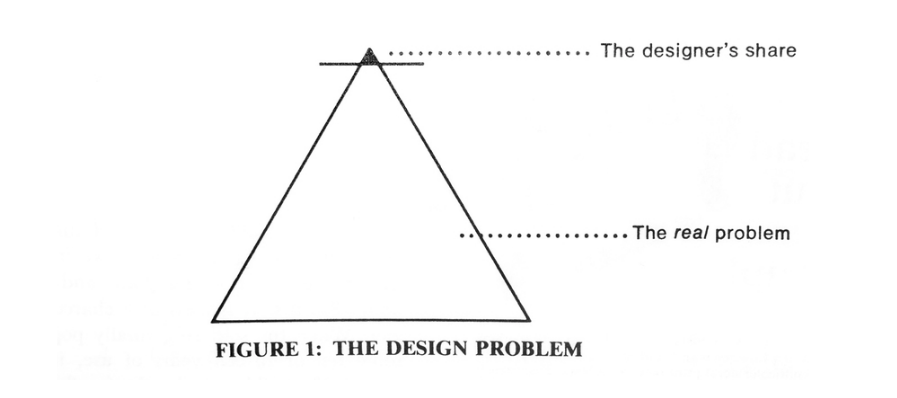
(Design for the Real World, 2019. Page 57.)
The other two figures merely change the caption for the figure.
El jardín de la extracción capitalista se constru-ye mediante tecnologías de exterminio que acaban con la bio-diversidad natural y, por lo tanto, con la potencialidad actuante de la materia.
Creo que la "potencialidad actuante de la materia" no se ve disminuida por el capitalismo, es mas, la agencialidad del cumulo de aserrin atesta a lo contrario. De la misma forma, podemos ver en esta materia impuesta por el neoliberalismo, un agente tambien. Como en el caso del matsutake, del libro the Anna Tsing, The mushroom at the end of the world
In this consumerist-led version of proletarianization, which is very per-tinent to what is happening with the commodification of higher educa-tion, the argument is that ‘consumers are “discharged” of the burden as well as the responsibility of shaping their own lives and are reduced to units of buying power controlled by marketing techniques’ (p. 34). For example, in rating and ranking scales and league tables, marketing agencies have essentially appropriated the decision-making process from students and their parents. Today’s ‘cognitive capitalism’, Lemmens says, is producing the ‘systematic destruction of knowledge and the knowing subject’ (p. 34), in what Stiegler calls the ‘systematic industri-alization of human memory and cognition’ (p. 34). As Stiegler (2010b) cryptically puts it, what is at stake is ‘the battle for intelligence’ (p. 35) which had its most recent genesis in the ‘psychopathologies and addic-tive ‘behavior patterns’ (Lemmens 2011, p. 34) brought about by the ‘logic of the market’ ushered in by Thatcher and supported by Reagan. This unleashed ‘a cultural and spiritual regression of unprecedented magnitude, transforming the whole of society into a machine for profit maximization and creating a state of “system carelessness” and “systemic stupidity” on a global scale’ (p. 34). It is literally ‘a global struggle for the mind’ in a context where there is an erasure of ‘consciousness and sociality’ (p. 35)
Draws on labour process theory and the work of Stiegler to conceptualise the de-professionalisation of academic workers and their proletarianisation. This relates to the arguments about how economic rationales have colonised all areas of social life.
This seems to mirror similar arguments put forward by Nikolas Rose and Michel Dean and other post-structuralists such as drawing on Foucault's governmentality