14 Matching Annotations
  1. Sep 2026
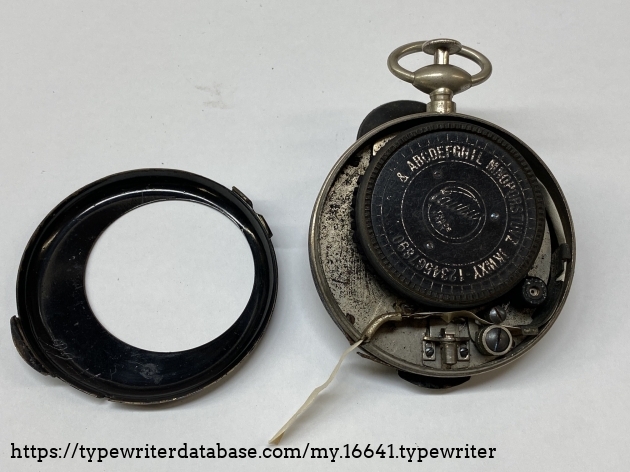
    1. Reply to Orga A 38 1908 r!!<br /> by Neat_Substance_2084 at https://old.reddit.com/r/typewriters/comments/1wsmhar/orga_a_38_1908_r/

      From what I've seen, your only evidence of your claim are a poorly hand scratched marking and some metallurgic tests.

      You need a lot more evidence than what you're presenting to prove your claim, particularly given the decade and change of the passing of time.

      I can scratch a 1940 date onto my Olympia SM3, but it doesn't mean that it's a prototype from 13 years earlier. Your presumed date is also of the form of an accounting ledger and not one that a mechanic would have scratched in.

      Do you have any provenance on your machine? (Who owned it and when?)

      Do you have any paperwork from the designers? Patents?

      The material tests only show a difference in the metal content, they don't indicate a date of any sort. If they could, you'd need a lot more material research on manufacturing methods and timelines from the historical record to back it up. Typewriter manufacturers were constantly changing their manufacturing lines and designs to make them more efficient and less expensive to improve their bottom lines, so your material science differences would seem par for the course. Can you show similar changes in materials from the companies toy lines over the same period?

      You seem to be only sharing blurry photos of screens rather than direct documentation of your material difference claims. Where are the direct documents and which company did the testing?

      Given the tremendous amount of focus on design changes and patents in early typewriter manufacturing and sales, how does the design of your machine fit into the early aughts from 1900-1910 versus 1920 and on? Typewriter designs had settled down significantly by the early 1920s, so there should be some reasonably significant design differences between a 1908 machine and one from 1923. Where have you documented those?

      What company history physically exists? When did they begin design? When were they producing prototypes in general? 13 years of R&D is a tremendous amount of time to pass in typewriter design in the early 1900s before manufacturing of any sort, even if you discount stoppages for World War I. Are there extant notebooks or corporate papers from the time period you're claiming? They were manufacturing toys for decades prior, so surely they've got some reasonable corporate documentation and correspondence somewhere. Do any of the descendants have papers, receipts, or diaries that could be consulted? What were the market conditions that suggested to them that a move from toys to typewriters was a brilliant idea? Often in a prototype situation, a factor may not have all the manufacturing capabilities in-house or they'd need to make changes to equipment to make a new line. Are there pieces of your typewriter that were outsourced from other factories? Is there evidence that all the parts of the later machines were made in-house?

      Think like an archaeologist. Think like a historian. Bring some more research to bear if you want to convince anyone (experts or otherwise) of your claims. It should seem painfully obvious to you by now that what you're presenting is not nearly enough. No one is attacking you. We're just asking for more if we're going to be convinced.
  2. Oct 2024
    1. The basis for our intuitive set theory is the Zermelo—Fraenkel set theory developedby Zermelo (Untersuchungen tiber die Grundlagen der Mengenlehre J) andstrengthened by Fraenkel (Zu den Grundlagen der Cantor—Zermeloschen Mengen-lehre). Their work rests on the researches of Cantor in the 1870’s which first putmathematics firmly on a set-theoretic base. Zermelo’s work, in particular, was adirect response to the Russell paradox.
  3. Aug 2024
  4. May 2024
    1. The Book of Hours was largely developed at the artist’s colony at Worpswede, but finished in Paris. It displays the turn towards mystical religiosity that was developing in the poet, in contrast to the naturalism popular at the time, after the religious inspiration he experienced in Russia. Soon thereafter, however, Rilke developed a highly practical approach to writing, encouraged by Rodin’s emphasis on objective observation. This rejuvenated inspiration resulted in a profound transformation of style, from the subjective and mystical incantations to his famous Ding-Gedichte, or thing-poems, that were published in the New Poems.

      Naturalism was prevalent in the time of Rilke (circa 1900s). Rilke, however, had a mystical experience in Russia? (did he literally have an experience of unity and bliss?) He combined this mysticism with the objectivity that he learned from Auguste Rodin.


      As a result, his writing had a mystical and objective bent to it. How exactly? Was this also present in his Apollo poems (1907)?

    1. The Miletus torso (c. 480–470 BC) at the Louvre has been suggested as the poem's subject. "Archaic Torso of Apollo" (German: Archaïscher Torso Apollos) is a sonnet by the Austrian writer Rainer Maria Rilke, published in the collection New Poems in 1908. It opens the collection's second part and is a companion piece to "Early Apollo", which opens the first part. The poem describes the impressions given by the surviving torso of an archaic statue, which for the poet creates a vision of what the intact statue must have been like.

      Archaic Torso of Apollo and Early Apollo are part of Rilke his New Poems (1908).

  5. Apr 2024
    1. Automobile and Carriage Builders' Journal, October 1908. Duringthe last five or six years the carriage builder has been adopting,perhaps slowly, and often unwillingly, the card system in his office.,owing to the extra detail the motor business has brought with it.It will have probably been introduced by a new partner who hasbrought new money into the business, when extra funds were necessaryto cope with the new state of affairs. The motor manufacturer usesit instinctively, for he brings with him,

      as a rule, the law, order, and precision of an engineer's office.

      There's an interesting dichotomy presented here about the tech forwardness of the automobile industry in 1908 versus the tech reticence of the carriage builders in regard to adopting card indexes with respect to their related (though different) industries.

      Me (sarcastically):<br /> "Oh, those backwards carriage builders will get with the 'program' any day now..."

  6. Mar 2024
  7. Jan 2024
    1. The Charging This consists in its interior arrangement ofCabinet rows of pigeon-holes constructed on an inclineupwards so that the base of each horizontalrow of pigeon-holes is higher than its predecessor. Into thesepigeon-holes the charging shps are placed and there is a guidecard to each pigeon-hole marking the divisions of the charging slipsby giving the number of the slip which is to be filed immediatelybehind it.

      While slightly different in its physical configuration, the office charging cabinet (with a bleacher-like set up) is very similar to the similarly named library card charging tray.

      Which came first?

  8. Nov 2022
  9. Aug 2022
    1. These Directions and suggestions were first cornpiled in1908, and the first edition was printed in 1911 for use in theauthor‘s own classes. The present edition is the result ofthorough revision and is planned for general use.

      This will be much more interesting given that he'd first written about this topic in 1908 and has accumulated more experience since then.

      Look for suggestions about the potential change in practice over the ensuing years.

      Is the original version extant in his papers?

  10. Jul 2022
    1. Bernheim, Ernst. Lehrbuch der historischen Methode und der Geschichtsphilosophie: mit Nachweis der wichtigsten Quellen und Hilfsmittel zum Studium der Geschichte. Leipzig : Duncker & Humblot, 1908. http://archive.org/details/lehrbuchderhist03berngoog.

      Title translation: Textbook of the historical method and the philosophy of history : with reference to the most important sources and aids for the study of history

      A copy of the original 1889 copy can be found at https://digital.ub.uni-leipzig.de/mirador/index.php

    1. If what is in question ”, states the most learned German methodologist, “ isa many-sided subject, such as a history of a people or a great organisation, theseveral sheets of notes must be so arranged that for each aspect of the subject thematerial can be surveyed as a whole. With any considerable work the notes mustbe taken upon separate loose sheets, which can easily be arranged in different orders,and among which sheets with new dates can be interpolated without difficulty ”(Lehrbuch der historischen Metkode, by Bernheim, 1908, p. 555).

      Note the broad similarities as well as small differences to Konrad Gessner's approach in 1548:

      1. When reading, everything of importance and whatever appears useful should be copied onto a good sheet of paper. 2. A new line should be used for every idea. 3.“ Finally, cut out everything you have copied with a pair of scissors; arrange the slips as you desire, first into larger clusters which can then be subdivided again as often as necessary.” 4. As soon as the desired order is produced, arranged, and sorted on tables or in small boxes, it should be fixed or copied directly. —Gessner, Konrad. Pandectarum sive Partitionum Universalium. 1548. Zurich: Christoph Froschauer. Fol. 19-20"

      Given that the original was in German, did the original text use the word zettelkasten?