1,726 Matching Annotations
  1. Last 7 days
    1. How does the UST's TeachOnline office aligns (or not) with the contents of this encyclical.

      In alignment with our Catholic University's mission of goodness, knowledge and discipline; first, we've worked very hard to understand how artificial intelligence works, the best approach for artificial intelligence and, what it can and cannot do. As instructional designers we have an ethical and moral code to do no harm to our students; the creation or purveying of false information would be a moral and intellectual harm; so, to the best of our abilities, we seek to only generate accurate and factual information with artificial intelligence tools. We do this by using existing documents, meeting transcripts, and other human-generated artifacts as part of context engineering for the prompts we are creating.

      Additionally, on the topic of goodness, and in alignment with the ethical quandaries of using artificial intelligence tools that can be connected to "long chain of mediation, involving vast networks of natural resources, energy infrastructure, and above all people". That is, tools that are known to be exploitative to the environment and hurt neighboring people, –specially marginalized communities– (xAI/Grok), disregard the subsidiarity of local communities (Meta AI), and known for harming adult and children with its ability to convince them of false and violent informaton (ChatGPT); our chosen tools are Anthropic's Claude Sonnet and Opus models. That isn't to say that Anthropic is guiltless. However, it continues to stand above all other companies as being the most ethical and conscientious artificial intelligence lab – although that is not saying much, Claude has been used as a hacking tool, and it was used in Pentagon for weapon and operation planning; prior to its designation as a national security risk, ironically because they sought to enact a "red line" (that is disarm) on their AI being used on weapon systems and mass surveillance.

      As educators and instructional designers, we welcome the challenge to rethink "the organization of schools, physical spaces, evaluation methods and the role of teachers themselves... promote an authentically integral education that addresses every dimension of the person." To do this, we follow our scientific and ethical practices of our profession in the development of courses that have measurable outcomes, accurate, engaging, collaborative, applicable to real life, that hopefully lead to reflection and contemplation. Additionally, our role as educators helps "disarm" AI from its worst possible uses, and we can further assist by beating "swords into ploughshares" by helping our students understand the ethical and moral boundaries of any technological use and implement it in ways that aid humanity. We respect that our faculty engage in the work of Nehemiah, by helping to build the wall of Jerusalem; by engaging in one of the most charitable acts in humanity, that of giving away and imparting their knowledge unto the future generation.

      WIP!!!!

    2. While AI can enhance the defense and protection of civilians, it can also lower the threshold for the use of force, shield people from responsibility and foster a culture in which the enemy is reduced to a statistic and the victim to “collateral damage.”

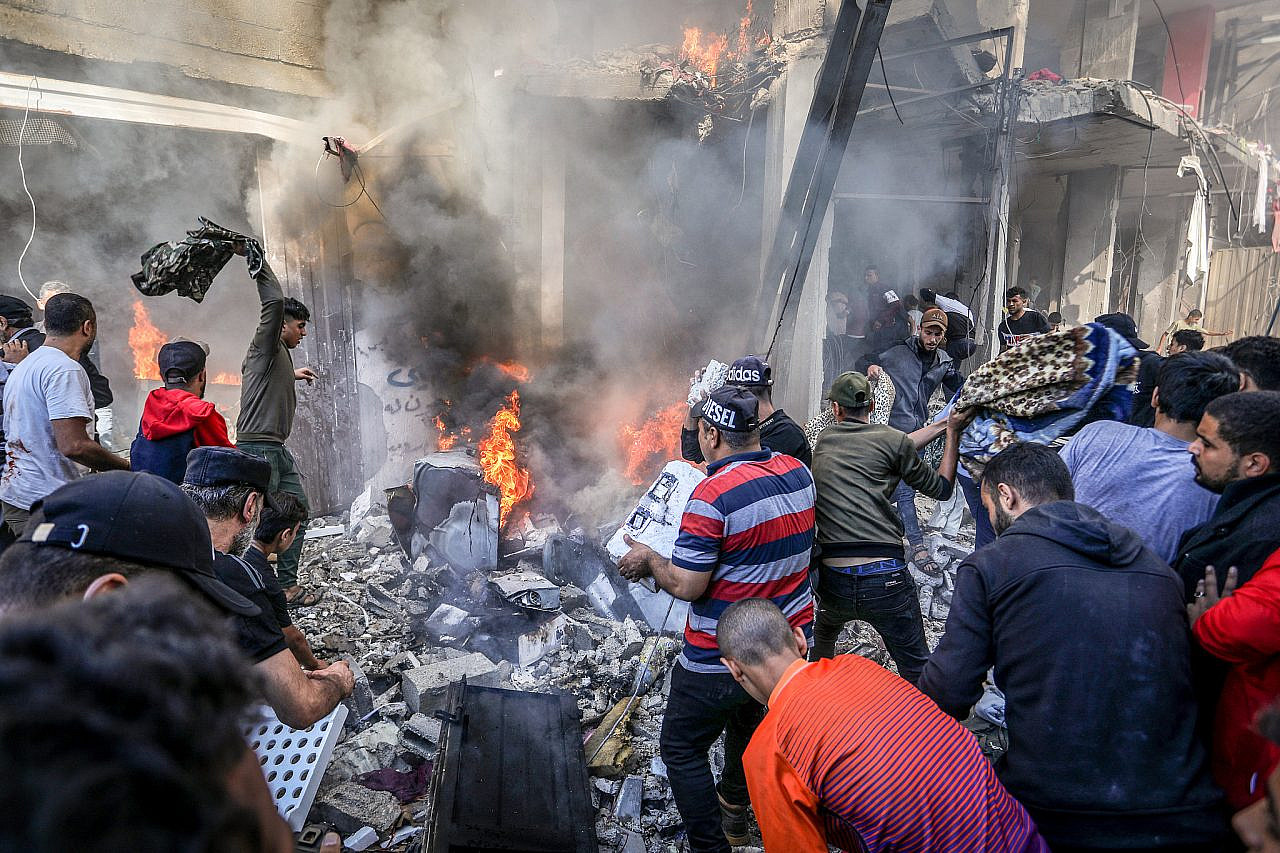
      The U.S. and Israel's air war with Iran has killed thousands since it started nearly three months ago. But few attacks have left a deeper mark than the strike on a school in Southern Iran on the war's opening day.

      More than 150 people were killed when airstrikes hit the school in Minab, most of them children. And there is little dispute that the missiles were American-made.

      https://www.pbs.org/newshour/show/at-iranian-school-devastated-by-airstrike-grieving-families-say-they-will-never-forget

      Gaza

      Lavender’: The AI machine directing Israel’s bombing spree in Gaza The Israeli army has marked tens of thousands of Gazans as suspects for assassination, using an AI targeting system with little human oversight and a permissive policy for casualties, +972 and Local Call reveal.

    3. Added to this invisible labor is the even harsher work of extracting the resources required for the production of the devices and microprocessors on which AI depends. In some regions of the world, children and adolescents work in dangerous conditions, crushing the materials from which rare earth elements are extracted. The bodies of these people are scarred, injured and worn down so that computational flow may continue uninterruptedly.

      Sadly this has been the case long before what's currently known as AI existed.

    4. move beyond the current metrics of development — which for more than eighty years have been tied to the concept of Gross Domestic Product (GDP) — since these metrics almost systematically neglect aspects essential to the overall wellbeing of people and the environment.

      Human Development Index (HDI): Created by the UN, this index scores countries based on a geometric mean of three core capabilities: health (life expectancy), education, and standard of living (Gross National Income per capita).

      Genuine Progress Indicator (GPI): This metric starts with economic data but adjusts it by adding positive factors (like volunteer work) and deducting social and environmental costs (such as crime, pollution, and the loss of natural resources).

      Gross National Happiness (GNH): Pioneered by Bhutan, this evaluates sustainable development, cultural preservation, good governance, and community vitality rather than focusing strictly on material wealth.

      The UN's Sustainable Development Goals (SDGs): A broader global dashboard of 17 indicators ranging from zero poverty and clean energy to gender equality.

    5. The problem of unemployment

      We definitely do not want to cause unemployment or lower the amount of faculty needed to teach, guide and mentor students. I also do not want to be engaged in a process that helps us reduce staff.

    6. “while AI promises to boost productivity by taking over mundane tasks, it frequently forces workers to adapt to the speed and demands of machines, rather than machines being designed to support those who work. As a result, contrary to the advertised benefits of AI, current approaches to technology can paradoxically de-skill workers, subject them to automated surveillance and relegate them to rigid and repetitive tasks.

      It can also force workers to deal with very tough and complex tasks all day, allowing for no breaks, when mundane tasks are automated. They might also need to review AI output and be overwhelmed by data generation.

    7. Many educators already report signs of dehumanization, where people may “know many things” but struggle to find direction in their lives, partly due to an inability to connect information with deeper knowledge or maintain a sense of purpose.

      cultivation a vocation in the students, approaching their growth holistically.

    8. the organization of schools, physical spaces, evaluation methods and the role of teachers themselves must be rethought in order to promote an authentically integral education that addresses every dimension of the person.

      the old modality of lecture based classroom needs to be done away with, finally.

    9. The second major challenge is pedagogical. Many educational systems struggle to keep pace with change and to support the integral development of students. The advance of information technologies and AI is rapidly rendering curricula obsolete that were designed for a different era.

      How do we maintain pedagogical effectiveness, excitement, and appreciation for learning, while constantly dealing with an ever changing technology paradigm? We can focus on fundamentals.

    10. n many nations, Governments have not yet invested the necessary resources for guaranteeing a quality education for all, whether by adequately supporting the public school system or by assisting private institutions that offer this essential service. When a substantial portion of education, at various levels, is entrusted to private institutions, access to schooling may become overly dependent on families’ financial means, especially in the absence of adequate public support.

      Properly funded public education or access to high quality private education is important to maintain an a truth-loving populace.

    11. exercise restraint in the use of AI and to protect our young people from the promise of the perfect machine, from that subtle temptation which renders human thought seemingly superfluous precisely when it is most needed.

      Big fan of being on the record as to not turn every class into a prompt engineering class.

    12. As Plato wrote, the deepest and most important things are learned only after much time and effort, by engaging in discussion with others, “striking upon” ideas and experiences together like flint until the spark of understanding is kindled within us.

      We continue to advocate for the proper use of discussion board activities. It is a shame we couldn't get the discussion boards done for Dr. George's class; but the factor of learner-to-learner or student-to-student interaction has to become a requirement in all courses. In order to successfully strike conversations and reach at the truth.

    13. The speed and ease with which answers or summaries can be obtained risk extinguishing the desire to ask questions, which is a process that bears fruit only over time.

      hmmm

    14. Educating people about the use of AI, then, involves teaching them to decide when and for what purpose it ought not to be used.

      what are the ethical boundaries of AI.

    15. principal challenge lies in the integration of knowledge, cultivating both the capacity to connect and synthesize knowledge in order to grasp complexity, and the skills necessary to verify facts.

      digital and informational literacy.

    16. The content that circulates within digital environments shapes how people perceive the world and introduces into the collective consciousness images and narratives that direct our desires and influence our daily choices. This is “not a parallel or purely virtual world,” [145] since what originates online now becomes a part of people’s lives, especially of the youngest.

      The internet is part of the real world and should be treated as such!

  2. May 2026
    1. a long way to go to ensure that the rights of a great many, namely women, are equally and genuinely guaranteed throughout the world. It is a fact that “doubly poor are those women who endure situations of exclusion, mistreatment and violence, since they are frequently less able to defend their rights.

      Intersectionality

    2. synodal

      Synodal relates to a "synod," which is an advisory council or assembly of leaders within a church (such as the Roman Catholic, Orthodox, or Anglican traditions) gathered to discuss and recommend actions on important matters.The concept has gained widespread attention due to Pope Francis's multi-year global initiative, the "Synod on Synodality". Rather than just being an event, "synodality" describes a style and way of being Church where clergy and laity walk and journey together. It focuses heavily on deep listening, shared responsibility in the Church's mission, and collaborative discernment guided by the Holy Spirit.

    3. natural law

      Natural law[1] (Latin: ius naturale, lex naturalis) is a philosophical and legal theory that posits the existence of inherent laws derived from nature and universal moral principles that are discoverable through reason. In ethics, natural law theory[2] asserts that certain rights and moral values are inherent in human nature and can be universally understood, independent of enacted laws or societal norms. In jurisprudence, natural law—sometimes referred to as iusnaturalism[3] or jusnaturalism[4]—holds that there are objective legal standards based on morality that underlie the creation, interpretation, and application of human-made laws. This contrasts with positive law (as in legal positivism),[5] which emphasizes that laws are rules created by human authorities and are not necessarily connected to moral principles. Natural law can refer to "theories of ethics, theories of politics, theories of civil law, and theories of religious morality",[6] depending on the context in which naturally-grounded practical principles are claimed to exist.

      In the Western tradition, natural law was anticipated by the pre-Socratics, for example, in their search for principles that governed the cosmos and human beings. The concept of natural law was documented in ancient Greek philosophy, including Aristotle,[7] and was mentioned in ancient Roman philosophy by Cicero. References to it are also found in the Old and New Testaments of the Bible, and were later expounded upon in the Middle Ages by Christian philosophers such as Albert the Great and Thomas Aquinas. The School of Salamanca made notable contributions to natural law theory during the Renaissance.

      Although the central ideas of natural law had been part of Christian thought since the Roman Empire, its foundation as a consistent system was laid by Aquinas, who synthesized and condensed his predecessors' ideas into his Lex Naturalis (lit. 'natural law').[8] Aquinas argues that because human beings have reason, and because reason is a spark of the divine, all human lives are sacred and of infinite value compared to any other created object, meaning everyone is fundamentally equal and bestowed with an intrinsic basic set of rights that no one can remove.

      Modern natural law theory took shape in the Age of Enlightenment, combining inspiration from Roman law, Christian scholastic philosophy, and contemporary concepts such as social contract theory. It was used in challenging the theory of the divine right of kings, and became an alternative justification for the establishment of a social contract, positive law, and government—and thus legal rights—in the form of classical republicanism. John Locke was a key Enlightenment-era proponent of natural law, stressing its role in the justification of property rights and the right to revolution.[9] In the early decades of the 21st century, the concept of natural law is closely related to the concept of natural rights and has libertarian and conservative proponents.[10] Indeed, many philosophers, jurists and scholars use natural law synonymously with natural rights (Latin: ius naturale) or natural justice;[11] others distinguish between natural law and natural right.[12]

      https://en.wikipedia.org/wiki/Natural_law

    4. Leo XIII’s Encyclical Rerum Novarum. Confronted with the “new things” of his time — the conflict between capital and labor, the question of the workforce, and economic and social transformations — Leo XIII did not limit himself merely to acknowledging the unrest, but saw these situations as an area for the Church’s pastoral mission

      a conflict that has yet to be resolved.

    5. it is unrealistic to think that the Church’s Social Doctrine can propose a single response that is valid in all contexts. [21] For this reason, he invited each Christian community to interpret the reality in its own country with clarity and responsibility. The fruitful tension between the universality of the Church’s mission and her local roots is an intrinsic aspect of her life, for she encompasses the whole world, while addressing the specific issues of each context as the real setting in which the Gospel takes shape.

      Diversity, equity, and inclusion (DEI) are organizational frameworks that seek to promote the fair treatment and full participation of all people, particularly groups who have historically been underrepresented, marginalized, or subject to discrimination based on identity or disability.[1] These three notions (diversity, equity, and inclusion) together represent "three closely linked values", which organizations seek to institutionalize through DEI frameworks.[2]

      Diversity refers to the presence of variety within the organizational workforce in characteristics, such as race, gender, ethnicity, sexual orientation, disability, age, politics,[3] culture, class, veteran status, or religion.[2][4] Equity refers to concepts of fairness and justice, such as fair compensation and substantive equality.[4] More specifically, equity usually also includes a focus on societal disparities, allocating resources, "decision making authority to groups that have historically been disadvantaged",[5] and taking "into consideration a person's unique circumstances, adjusting treatment accordingly so that the end result is equal".[2] Inclusion refers to creating an organizational culture that creates an experience where "all employees feel their voices will be heard"[2] and a sense of belonging and integration.[4][6]

    6. This attitude of openness to truth, which is at the same time both one and diverse, profoundly expresses the catholicity of the Church, for she embraces the entire human family yet is also immersed in the concrete situations of peoples and cultures.

      Diversity, equity, and inclusion...

    7. Tower of Babel

      An Attempt at Unity.[a] 1 The whole world had only one language, everyone using the same words. 2 Migrating from the east, men came upon a plain in the land of Shinar where they settled.

      3 They said to each other, “Come, let us make bricks and bake them in a fire.” These bricks were what they used instead of stone, and bitumen in place of cement.[b] 4 Then they said, “Come, let us build a city and a tower so high that it touches the heavens.[c] We shall make a name for ourselves and not be scattered all throughout the earth.”

      5 But the Lord came down and saw the city and the tower that these men were building. 6 The Lord said, “Behold, they are a single people and they have only one language. This is only the beginning of what they will do. Now nothing that they think up will be impossible for them. 7 Let us go down and confuse their language so that they will not understand each other when they speak.”

      8 The Lord scattered them over the whole earth[d] and they ceased building their city. 9 This is why it is called Babel,[e] for there the Lord confused everyone’s language. It was also from there that the Lord scattered people over the whole earth.

      https://www.biblegateway.com/passage/?search=Genesis%2011%3A1-9&version=NCB

    8. his is not a truth that fears diversity, but instead welcomes and guides it. It does not eliminate conflicts, but transforms them, reuniting that which history tends to scatter.

      "True peace is not merely the absence of tension: it is the presence of justice." (Stride Toward Freedom, 1958)

      "We must concentrate not merely on the negative expulsion of war, but on the positive affirmation of peace."

      "If we are to have peace on earth, our loyalties must become ecumenical rather than sectional. Our loyalties must transcend our race, our tribe, our class, and our nation; and this means we must develop a world perspective." (Christmas Sermon on Peace)

    9. What matters most is not occupying positions of power or defending cultural strongholds, but initiating good processes and enabling them to mature.

      Systems and institutions that work long after we are gone. The ability to use the sciences to build things that last, rather than merely living for the present.

    10. the essential core of revealed Truth is not altered, but made explicit and adopted as a living standard for guiding concrete choices, inspiring paths of personal and communal conversion, promoting structural reforms and supporting new forms of evangelical witness in public life.

      We must take actions that reveal and reinforce the Truth (Christ) in our political communities. Actions that go against the Truth, mar and obscure his face.

    11. Building for the common good

      This is a very "concrete" encyclical. It is about building, about community, about leaving institutions and societies that can withstand conflict and seek peace.

    12. Neh 2–6

      Chapter 2 Appointment by the King. 1 In the month of Nisan, in the twentieth year of King Artaxerxes, since the wine was my responsibility, I took the wine and gave it to the king. Inasmuch as I had never before showed any sign of sadness in his presence,[a] 2 the king asked me: “Why do you look so depressed? You clearly are not ill. This is the result of your sadness of heart.”

      Despite the fact that I was greatly fearful, 3 I said to the king: “May your majesty live forever! How can I possibly fail to be depressed when the city where my ancestors are buried lies in ruins and its gates have been destroyed by fire?” 4 The king then said to me: “What do you wish to request of me?”

      Having first prayed to the God of heaven,[b] 5 I said to the king: “If your majesty approves and your servant has found favor with you, I beg you to send me to Judah, to the city where my ancestors are buried, so that I can rebuild it.” 6 Then the king—with the queen sitting beside him—said to me: “How long will your journey take, and when will you return?” Once I had given the king a specific date that was acceptable to him, he approved my request.

      7 Then I said to the king: “If it pleases the king, let letters be given to me for the governors of West-of-Euphrates with orders to grant me safe passage until I arrive in Judah. 8 I also request that you give me a letter for Asaph, the keeper of the king’s forest, directing that he give me timber for the gates of the citadel adjoining the temple, and for the wall of the city, and for the residence I will occupy.” The king granted what I requested, for the gracious hand of my God was upon me.

      9 When I came to the governors of West-of-Euphrates, I presented the king’s letters to them. The king had also sent an escort of army officers and cavalry to accompany me. 10 However, when Sanballat[c] the Horonite and Tobiah the Ammonite official heard this, it displeased them greatly that someone had come to seek the welfare of the Israelites.

      11 Nehemiah Inspects the Wall.[d]When I arrived in Jerusalem, I rested there for three days. 12 Then I set out by night with just a few other men. I revealed to no one what my God had inspired me to do for Jerusalem, and I took no animal with me other than the one I was riding.

      13 I went forth by night through the Valley Gate toward the Dragon Spring as far as the Dung Gate, and I observed how the walls of Jerusalem lay in ruins with its gates destroyed by fire. 14 I then passed over to the Fountain Gate and the King’s Pool, but there was no room there for the animal I was riding to continue.

      15 Therefore, I went up by way of the valley in the dark, examining the wall until I once again reached the Valley Gate and re-entered the city. 16 The officials did not know where I had gone or what I had been doing. I had not as yet disclosed anything to the Jews, neither to the priests, nor to the nobles, nor to the magistrates, nor to any of the other persons who were to be involved in the work.[e]

      17 Rebuilding Jerusalem’s Walls. Then I said to them: “You now can realize the difficulty we face. Jerusalem lies in ruins, and its gates have been destroyed by fire. Therefore, we must rebuild the wall of Jerusalem so that we will no longer be looked upon as a disgrace.” 18 Then I told them how God had been so extremely gracious to me, and I also revealed the encouragement that the king had given me. They replied: “Let us begin the rebuilding at once,” and they undertook their work vigorously.

      19 However when Sanballat the Horonite, Tobiah the Ammonite slave, and Geshem the Arab heard about this, they ridiculed and mocked us, saying: “What is this you are doing? Are you rebelling against the king?” 20 In turn I gave them this answer: “The God of heaven will grant us success, and we his servants intend to start the rebuilding immediately. But as for you, you have no share in Jerusalem or any claim or historic right in Jerusalem.”

      Chapter 3 List of Builders.[f] 1 Eliashib the high priest then set to work with his fellow priests and rebuilt the Sheep Gate. They laid its beams and put the doors in place, after which they consecrated it as far as the Tower of the Hundred and the Tower of Hananel. 2 The men of Jericho worked next to Eliashib, and Zaccur, the son of Imri, built next to them.

      3 The sons of Hassenaah built the Fish Gate. They laid its beams and set up its doors, its bolts, and its bars. 4 Meremoth, the son of Uriah, son of Hakkoz, carried out the necessary repairs next to them. Meshullam, the son of Berechiah, son of Meshezabel, was next to him, followed by Zadok, son of Baana.

      5 Next to Zadok the Tekoites carried out the necessary repairs, although their nobles refused to demean themselves by helping their masters. 6 Joiada, the son of Paseah, and Meshullam, the son of Besodeiah, repaired the Old Gate, laying its beams and setting up its doors, its bolts, and its bars.

      7 At their side were Melatiah the Gibeonite, Jadon the Meronothite, and the men of Gibeon and Mizpah who did the repairs under the jurisdiction of the governor of West-of-Euphrates. 8 Next to them the repair work was carried out by Uzziel, the son of Harhaiah, a member of the goldsmiths’ guild, and at his side was Hananiah, a member of the perfumers’ guild. They renovated the wall of Jerusalem as far as the Broad Wall of the public square.

      9 Next to them the repairs were carried out by Rephaiah, the son of Hur, who was the ruler of half the district of Jerusalem. 10 At his side was Jedaiah, the son of Harumaph, who made the repairs opposite his own house. Next to him the repairs were carried out by Hattush, the son of Hashabneiah.

      11 Malchijah, the son of Harim, and Hasshub, the son of Pahath-moab, repaired another section and the Tower of the Ovens. 12 Next to them, Shallum, the son of Hallohesh and ruler of the other half of the district of Jerusalem, carried out repairs with the help of his daughters.[g]

      13 Hanun and the inhabitants of Zanoah repaired the Valley Gate. They rebuilt it and put its doors, its bolts, and its bars in place, and they also repaired a thousand cubits of the wall, as far as the Dung Gate. 14 The Dung Gate itself was repaired by Malchijah, the son of Rechab, the ruler of the district of Beth-haccherem; he rebuilt it and put the doors in place with their bolts and bars.

      15 The Fountain Gate was repaired by Shallum, the son of Colhozeh, the ruler of the district of Mizpah; he rebuilt it, placed a roof over it, and put its doors in place with their bolts and their bars. He also built the wall of the Pool of Shelah that adjoined the king’s garden, as far as the steps descending from the City of David. 16 After him, Nehemiah, the son of Azbuk, ruler of half the district of Beth-zur, made the repairs from a point opposite the tomb of David as far as the artificial pool and the House of the Heroes.

      17 After him, repairs were carried out by the Levites under the direction of Rehum, the son of Bani. Next to him, Hashabiah, the leader of half the district of Keilah, carried out the repairs for his own district. 18 After him, their kinsmen took charge of the repairs, headed by Binnui, the son of Henadad, leader of half the district of Keilah.

      19 Next to him was Ezer, the son of Jeshua, leader of Mizpah, who repaired the adjoining section opposite the ascent to the armory at the Angle. 20 After him, Baruch, the son of Zabbai, repaired another section from the Angle to the door of the house of the high priest Eliashib.

      21 After him, Meremoth, the son of Uriah, son of Hakkoz, repaired another section, from the door of the house of Eliashib to the end of the house. 22 After him, repairs were carried out by the priests who lived in the district.

      23 After them, Benjamin and Hasshub carried out the repairs opposite their house, and after them Azariah, son of Maaseiah, son of Ananiah, did the repairs beside his own house. 24 After him, Binnui, the son of Henadad, repaired the adjoining sector from the house of Azariah to the Angle and the Corner.

      25 After him, Palal, the son of Uzai, carried out repairs in front of the Angle and the tower projecting from the Upper Palace of the king to the court of the guard. Next to him, Pedaiah, the son of Parosh, carried out the repairs 26 to a point opposite the Water Gate on the east and the projecting tower. 27 After him the Tekoites repaired the adjoining section opposite the great projecting tower as far as the wall of Ophel.

      28 Above the Horse Gate the priests carried out repairs, each one opposite his own house.[h] 29 After them, Zadok, the son of Immer, carried out the repairs opposite his own house, and after him Shemaiah, the son of Shecaniah, the keeper of the East Gate, did the necessary repairs.

      30 After him, Hananiah, the son of Shelamiah, and Hanun, the sixth son of Zalaph, repaired a second section. After him, Meshullam, the son of Berechiah, made the necessary repairs opposite his living quarters. 31 After him, Malchijah, a goldsmith, made the needed repairs as far as the house of the temple servants and of the merchants opposite the Inspection Gate and as far as the upper room at the Corner. 32 And between the upper room at the Corner and the Sheep Gate the goldsmiths and the merchants carried out all the needed repairs.

      33 Opposition from Judah’s Foes. When Sanballat was informed that we were rebuilding the wall, his anger was aroused, and he was greatly enraged. He ridiculed the Jews, 34 and in the presence of his companions and the army of Samaria he said: “What are these feeble Jews doing? Will they restore what has been damaged beyond repair? Will they offer sacrifices? Will they be able to complete their work in a single day? Will they manage to refurbish the stones that have been damaged and reduced to ashes?” 35 And Tobiah the Ammonite, who was standing beside Sanballat, added: “If a fox were to climb on top of the stone wall they are building, it would crumble before them.”

      36 Then we prayed: “Listen to us, O our God, for we are despised. Turn their insults back upon their own heads. Let them become objects of contempt in a land of captivity. 37 Do not pardon their wickedness or allow their sins to be blotted out from your sight, for they have insulted the builders to their face.”

      38 Meanwhile we continued to rebuild the wall, which was soon completed all the way around up to half its height, while the people put their hearts into their work.

      Chapter 4 1 When Sanballat and Tobiah and the Arabs, the Ammonites, and the Ashdodites[i] heard that the repairs to the walls of Jerusalem were proceeding according to plan and that the gaps were beginning to be closed, they became infuriated. 2 As a result, they all plotted together to launch an attack against Jerusalem and throw all of us into panic and confusion. 3 Therefore, we prayed to our God and posted guards against them day and night in an attempt to foil their plans.

      4 Meanwhile, the Judahites were saying: “The strength of the laborers is beginning to falter, and the rubbish is so extensive that we will not be able to rebuild the wall.” 5 However, our enemies, who were adamant in their belief that we would not know or see anything before they came into our midst, prepared to kill us and put a stop to the work.

      6 When the Jews who lived near them came to us, they warned us ten times over: “Whichever way you turn, they will be prepared to attack us.” 7 Therefore, I commanded men to position themselves in the lowest places behind the wall, and near them I stationed the people by families with their swords, spears, and bows.

      8 After I made a thorough inspection, I addressed the nobles, the officials, and the rest of the people, saying: “Have no fear of them! Remember the Lord, who is great and awe-inspiring, and fight for your brothers, your sons, your daughters, your wives, and your homes.” 9 When our enemies realized that we were forewarned and that God had thwarted their plans, they withdrew, and we all went back to the wall, each one to his particular task.

      10 From that time on, however, half of my men did the construction work, while the other half posted themselves behind the whole house of Judah as they rebuilt the wall. 11 Those who carried the building materials did their work with one hand while holding a spear with the other. 12 Moreover, every worker involved in the task of building had his sword strapped to his side at all times. In addition, a trumpeter stood beside me.

      13 [j]I then said to the nobles, the officials, and the rest of the people: “Our work is extensive and spread out, and we are widely separated from each other along the wall. 14 Whenever you hear the sound of a trumpet, come to our side to support us immediately. Our God will fight for us.”

      15 Therefore, we continued to labor at the work, from the break of dawn until the stars came out. 16 At the same time I also told the people: “Let every man with his servant remain each night in Jerusalem, so that they may spend the night as a guard for us and be at work during the day.” 17 Therefore, neither I, nor my brothers, nor my servants, nor any of the bodyguards who accompanied me ever took off our clothes. In addition, each one kept his spear in his right hand.

      Chapter 5 Antisocial Conduct.[k] 1 Soon thereafter, there arose a great outcry from the common people and from their wives against their Jewish brothers. 2 Some were vehement in their complaints that they were forced to pledge their sons and daughters in order to obtain grain so that they might eat and stay alive. 3 Others asserted that they were forced to mortgage their fields, their vineyards, and their houses in order to survive.

      4 Furthermore, there were those who said: “We are being forced to borrow money on our fields and vineyards in order to pay the king’s tax. 5 And although our flesh is identical to that of our kinsmen and our children are as good as theirs, we will have to subject our sons and daughters into slavery. Some of our daughters have already been enslaved, and our fields and our vineyards now belong to others.”

      Nehemiah’s Action. 6 When I heard these complaints and the cries of the people, I was extremely angry. 7 After having considered the various options, I threatened to bring charges against the nobles and the magistrates, accusing them of exacting interest from their own kinsmen.

      Then I summoned a great assembly to deal with them, 8 and I said to them: “As far as it was humanly possible, we have bought back our fellow Jews who had been sold to foreigners. However, now you are selling your own brothers and thus forcing us to purchase them back.” They remained silent, for they were unable to come up with a satisfactory reply.

      9 Therefore, I said: “What you are doing is terribly wrong. Should you not walk in the fear of our God and make clear that you are not at all concerned with the taunts of the nations who are our enemies? 10 Moreover, I myself, along with my brothers and my servants, have lent the people money and grain without charge. Let us cease the custom of usury. 11 I also ask that you restore to them this very day their fields, their vineyards, their olive groves, and their houses, together with the interest on the money, the grain, the wine, and the oil that you have lent them.”

      12 They replied: “We will give it all back and demand nothing more from them. We will do just what you ask.” I then summoned the priests and made them swear to do what they had promised. 13 I also shook out the folds of my garment and said: “So may God shake out from home and property everyone who fails to adhere to this promise. May every such man be shaken out and emptied.”[l]

      All the assembled people said “Amen” and praised the Lord, and they did as they promised.

      14 Nehemiah’s Lack of Self-Interest. Moreover, from the twentieth year that King Artaxerxes appointed me to be their governor in the land of Judah until the thirty-second year, neither I nor my brothers ate the food allotted to the governor by the king. 15 On the other hand, the former governors, my predecessors, had laid a heavy burden on the people and exacted from them forty shekels of silver each day for food and wine, while their servants also oppressed the people. However, because I feared God, I did not act in this way.

      16 Indeed, I devoted all my efforts to the work on the wall, and I acquired no land, while all my servants were gathered there for the work. 17 Moreover, there sat at my table guests who numbered one hundred and fifty people, Jews and officials, as well as those who came to us from the surrounding nations.

      18 Every day one ox, six choice sheep, and some poultry were prepared for me, as well as skins of wine in abundance every ten days. Despite all this, I did not claim the governor’s food allowance because the people had such a heavy burden of labor.

      19 O my God, please remember me favorably for all that I have done for this people.

      Chapter 6 Plots against Nehemiah. 1 When it had been reported to Sanballat, Tobiah, Geshem the Arab, and the rest of our enemies that I had rebuilt the wall and that not a single breach was left in it (although up to that time I had not set up the doors in the gates), 2 Sanballat and Geshem sent me this message: “Come here and confer with us in one of the villages in the plain of Ono.” Their intention was clearly to do me harm.

      3 Therefore, I sent messengers to them with this reply: “I am engaged in a great project, and I cannot come down to you at this particular time. Why should the work come to a grinding halt while I leave it and come down to you?” 4 They sent me the same invitation four times, and on each occasion I gave them the same reply.

      5 Then, for the fifth time, Sanballat sent his servant to me with the same message, but this time in an unsealed letter. 6 In it was written: “It has been reported among the nations, and Geshem[m] confirms it, that you and the Jews are planning a rebellion, that this is the reason you are building the wall, and that you are intending to become their king. 7 We have also heard that you have appointed prophets in Jerusalem to proclaim you king. Needless to say, such rumors will be brought to the attention of the king. So come at once and let us discuss this together.”

      8 I sent the following reply to him: “No such thing that you are suggesting has taken place. It is all in your imagination.” 9 They all were trying to frighten us, hoping that we would become lax in our work and the job would not be completed. But instead I became more determined than ever.

      10 One day I went to the house of Shemaiah, the son of Delaiah, son of Mehetabel, who was confined to his house. He said to me:

      “Let us meet in the house of God inside the sanctuary, and let us lock the doors of the temple. For men are coming to kill you; they are coming to kill you tonight.”

      11 However, I said: “Should a man like me run away? Or should a man like me go into the temple to save his life?”

      12 Then I realized that God had not sent Shemaiah to say this, but rather that Tobiah and Sanballat had hired him. 13 He had been bribed to intimidate me and make me sin by acting in this way. Then they could ruin my reputation and discredit me.

      14 Remember Tobiah and Sanballat, O my God, according to those things they did, and also the prophetess Noadiah and the rest of the prophets whose purpose was to intimidate me.

      15 Conclusion of the Work. The wall was finished on the twenty-fifth day of the month of Elul.[n] It was completed in fifty-two days. 16 When all our enemies heard about this, and all the surrounding nations were completely aware of what had been happening, they realized that all this work had been completed with the help of God.

      17 At the same time, however, the nobles of Judah were sending many letters to Tobiah, and in turn, letters from Tobiah kept coming to them, 18 for many in Judah were bound to him by oath, because he was the son-in-law of Shecaniah, son of Arah, and his son Jehohanan had married the daughter of Meshullam, son of Berechiah. 19 They were always praising Tobiah’s good deeds in my presence, and they reported my words to him. Furthermore, Tobiah also sent letters to me in an attempt at intimidation.

      https://www.biblegateway.com/passage/?search=Nehemiah%202-6&version=NCB

    13. Humanity, created by God in all its grandeur, is today facing a pivotal choice: either to construct a new Tower of Babel or to build the city in which God and humanity dwell together.

      It is lovely to be on the same wavelength with the Pope; the biggest challenge with this new technology is that we haven't decided what collective, societal problem we will fix it with. Instead, it has been merely the personal and corporate enrichment of a couple of hundred people in silicon valley.

  3. Apr 2026
    1. the printing press and the beginnings of mass literacy didn’t produce an age of sober reason, but an enormous explosion in all forms of mysticism and esotericism, astrology, divination, witchcraft, Neoplatonist sects and charismatic religious cults, some of them peaceful, some of them murderous.

      The tradition of all dead generations weighs like a nightmare on the brains of the living.

    2. Lewis Mumford called it the ‘general starvation of the mind,’ in which actual sensuous knowledge of the world is replaced by ‘mere literacy, the ability to read signs.’

      Lewis Mumford (October 19, 1895 – January 26, 1990) was an American historian, sociologist, philosopher of technology, and literary critic. Particularly noted for his study of cities and urban architecture, he had a broad career as a writer. He made significant contributions to social philosophy, American literary and cultural history, and the history of technology.[2]

      In his book The Condition of Man, published in 1944, Mumford characterized his orientation toward the study of humanity as "organic humanism." The term is important because it sets limits on human possibilities, limits that are aligned with the nature of the human body. Mumford never forgot the importance of air quality, of food availability, of the quality of water, or the comfort of spaces, because all these elements had to be respected if people were to thrive. Technology and progress could never become a runaway train in his reasoning, so long as organic humanism was there to act as a brake. Indeed, Mumford considered the human brain from this perspective, characterizing it as hyperactive, a good thing in that it allowed humanity to conquer many of nature's threats, but potentially a bad thing if it were not occupied in ways that stimulated it meaningfully. Mumford's respect for human "nature", that is to say, the natural characteristics of being human, provided him with a platform from which to assess technologies, and techniques in general. Thus his criticism and counsel with respect to the city and with respect to the implementation of technology was fundamentally organized around the organic humanism to which he subscribed.

      Works https://en.wikipedia.org/wiki/Lewis_Mumford

  4. Jan 2026
    1. Accusing the George Floyd Protests and not the wave of death and destruction caused by the COVID pandemic and our lackadaisical covid policies is fucking wild and racist. You can also look at police slowdowns that took place after the George Floyd protests. The security apparatus requires you to be in fear and feel a need for them, even if they don't really do anything.

  5. Jul 2025
    1. parietal

      The parietal lobe is one of the four major lobes of the cerebral cortex in the brain of mammals. The parietal lobe is positioned above the temporal lobe and behind the frontal lobe and central sulcus.

    2. EEG alpha band

      Alpha waves, or the alpha rhythm, are neural oscillations in the frequency range of 8–12 Hz likely originating from the synchronous and coherent (in phase or constructive) neocortical neuronal electrical activity possibly involving thalamic pacemaker cells. Historically, they are also called "Berger's waves" after Hans Berger, who first described them when he invented the EEG in 1924. Alpha waves are one type of brain waves detected by electrophysiological methods, e.g., electroencephalography (EEG) or magnetoencephalography (MEG),

  6. Jul 2024

    Annotators

  7. Jun 2024
    1. connect, contrast, and evaluate the predominant theories of motivation.<br /> explain methodologies<br /> Synthesize a variety of theories and empirical studies.

      Discussion, research presentation, empirical research presentation, contemporary trends, research project paper, research project presentation - Post to substack, marguerite, and a few other people.

      Make a 10 minute summary presentation about a research article.

      Contemporary Trends - search and summarize five or more journal articles published in Journal of Educational Psychology. Educational psychologist, Contemporary educational psychology, british journal of educational psychology, and learning and individual differences. Ask Rachel Anth for this.

      Research project paper and presentation - write a scholarly paper with approximately 10 pages to explore an aspect of the course in greater detail.

  8. Feb 2024
  9. Jan 2024
    1. And the quarrels of the gods, noble Euthyphro, when they occur, are of a like nature?

      it's important to remember that Euthyphro is in essence and at all times, the wrong one.

    2. For such was the effect of cold and hunger and chains upon him, that before the messenger returned from the diviner, he was dead. And my father and family are angry with me for taking the part of the murderer and prosecuting my father.

      what a way to die...

    3. neologian

      Definition of 'neologian' 1. a person who holds or tends to adopt novel views; a neologist. adjective. 2. holding or tending to adopt novel views.

  10. Aug 2022
  11. Jul 2022
  12. Jun 2022
    1. Twitter also has spaces (for now) where folks could join. You also want to look for SLACK groups that might relate to specific tools/approaches/or professional organizations.

  13. s3.us-west-2.amazonaws.com s3.us-west-2.amazonaws.com
    1. Group

      what all of these groups have in common is the original article about how the use of technology motivates them to try harder and helps them put information together.

    1. Unlike a term paper or more traditional response project, no two projects look exactly alike.

      the implication of the projects not being traditional and therefore hard to compare against each other. Require a rubric with higher level concepts and goals as the way to measure.

  14. Apr 2022
  15. Feb 2022
    1. Coffman’s detractors often imply that she doesn’t fit in on “en WP,” or English Wikipedia. They often assume that she is a visitor from German Wikipedia, “de WP,” because of her insistence on holding the Wehrmacht to account.

      Amazing...

    2. When she is done, typically, there is nothing left to the article—nothing to say about the person—other than the fact that he won an award. She then insists that an award isn’t reason enough for a stand-alone Wikipedia article. Without a reliable source telling your life story, you can’t be notable. Poof. Another Nazi legend bites the dust.

      Queen

    3. “there was all this other America” that lay beyond her experience—a place deeply scarred by a past she barely understood.

      "The past is never dead. It's not even past." -Faulkner

    4. When Ksenia Coffman started editing Wikipedia, she was like a tourist in Buenos Aires in the 1950s. She came to learn the tango, admire the architecture, sip maté. She didn’t know there was a Nazi problem.

      Amazing opening to this article

  16. Dec 2021
    1. This struggle echoes a complaint made by some employees in Cupertino, who’ve said that the employee relations team — Apple’s version of human resources — is more concerned with protecting the company than its workforce. 

      When are people going to realize that this is exactly the point?

  17. Nov 2021
    1. After the horrors of World Wars I and II and the Great Depression between them, there was rebuilding of democracies, including constructing a public sphere geared toward preventing the rise of fascism, an expanded safety net and great reductions in income inequality.

      Such an eurocentrist view.

    2. before the first Covid-19 cases were reported in China, the United States was ranked No. 1 out of 195 countries in pandemic preparedness by experts convened by Johns Hopkins University, The Economist and others.

      Let's be real this was propaganda

    1. It’s a fault line that crisscrosses industries and issues. At a retail business based in New York, managers were distressed to encounter young employees who wanted paid time off when coping with anxiety or period cramps.

      better working conditions are distressing!

  18. Sep 2021
    1. the grading load has increased compared to the automated proctored exams. But, going completely online has also removed some of the in-person responsibilities our instructional team used to do, such as in-person proctoring.

      How do you justify this to your instructors?

    2. the concept of virtual proctoring was always something that invoked fear in students. There were concerns over privacy, anxiety about the unfamiliarity, and inequity with access to technology since students needed to have a strong Wi-Fi connection, working webcam/microphone, and were unable to use tablets/Chromebooks due to software requirements.

      In the best of times, the bar exam is stressful—a two-day marathon that determines whether law school graduates will be able to practice the career they spent three years and a mountain of cash pursuing. But this year, test-takers say, it was nothing short of inhumane.

      Nearly a dozen graduates who spoke to The Daily Beast described the exam—which many places administered online this year, for the first time ever—as a disorganized, glitch-filled disaster. Test-takers were locked out of the exam for hours, refused accommodations for their disabilities, and even sat in their own urine and feces for fear of leaving the view of the web cameras.

      https://www.thedailybeast.com/inside-the-bar-exam-from-hell-i-cant-believe-there-is-video-of-me-pissing-myself

    1. in reality they impose additional burdens of tracking and assessing. Consider the scourge of learning management systems and how many instructor hours are wasted wrestling these systems into submission.

      come to training!

    2. Amplify, a company that promised to map learning for all students to measure their progress against a library of necessary knowledge, only to have its founder remark years down the road, “The map doesn’t exist, the measurement is impossible and we have, collectively, built only 5 percent of the library.”

      Ha!

    1. Inside higher ed - yes virginia there's a better way of grading. Specification grading. An article on specification. And badging (student achievements in blackboard).

    1. Coming from the lady that is a frequent guest in chapotraphouse, making fun of chuds is like the prime directive of the show; but guilt by association is a cheap shot, so let's see what she writes.

      But in asmuch as democracy is a shared vision—a collaborative dream about the kind of governance we’re capable of and the sort of future we could build—it’s crucial to keep its practices alive even when its functions have broken down. We don't live in a democracy, let alone a liberal democracy. The United States is a decidedly illiberal place, it has been for generations (since its foundation even, you could argue). To claim we can behave like liberals in a fundamentally illiberal context is to resign yourself to failure. This is a fundamentally ahistorical understanding of the united states. It obfuscates the reality of what's going on. That you cannot have a democracy when one group (the ruling class) has final veto on the demands of other classes (the working class, the marginalized communities, the racial minorities). There is only domination, bourgeois domination can be subtle or overt but it will subsume real demands and output token changes. A recent iteration of the Census Bureau’s Household Pulse Survey asked unvaccinated Americans about their reasons for putting off or refusing vaccination against COVID-19, and allowed them to select more than one option, resulting in a set of ranked concerns for COVID-vaccine skeptics. No one is denying that there might reasonable arguments for being a vaccine skeptic. Changes to your menstrual cycle, kidney damage, myocarditis are all things you might consider weighting against the vaccine. But that has to be weighed against the very real and damaging consequences of getting ACTUAL COVID. 600,000+ people DEAD. People on dialysis for as long as they live. Systemic Organ failure. Cognitive impairment and brian damage. The weighting possible rare side effects versus chronic damage to your internal organs are absolutely demented. Another thing we could do is argue for the protection and funding of healthcare for anyone with vaccination-caused side effects. Probably the reason why so many people are hesitant to take this risk is that America's healthcare industry is ruthlessly run for profit. The New York Times recently reported that myocarditis, inflammation of the heart muscle, is more common after COVID-19 vaccination; likewise, NPR featured a story earlier this month on university researchers looking into thousands of claims of menstrual changes following vaccination, and two days later Reuters ran a news article noting that European regulators were probing a skin rash and a pair of kidney disorders as possible side effects of the vaccines I think a condemnation ought to be made against the news outlets who have reported on this without providing or vetting the reporting through the scientific explanation of the probability of rare side effects. It is also a narrative of "Congrats we got a vaccine!" to "oh the vaccine might kill you" and that is only done to DRIVE UP CLICKS. , I called one of my uncles, who works in auto repair in North Texas. Chris is an honest, fair, and kind-hearted person, the easygoing one in a family of tightly wound people. When I asked him why he and his wife had chosen not to get a shot yet, he said they were still thinking about it....I felt good about our talk. I want him, my aunt, my cousins, my other uncle, and the rest of my extended family scattered across Texas and Louisiana to be all right. And I believe—but cannot prove—that wanting that for someone is more persuasive, somehow, than the darker, harder political emotions that dominate our discourse now. This is where I reached my most frustrating moment. All you did was talk to your uncle. He did not agree to vaccinate. Your persuasiveness did not make him get in line. All you did is talk. You are fundamentally a useless liberal. Your uncle might die before the other vaccines he is "waiting on" get approved. He could get the J&J vaccine right now and hasn't. This entire article was fundamentally useless. We do not live in a democracy. Liberal ideology lives in fucking la-la land. The very serious concern of the unvaccinated cannot really be weighed against actual fucking DEATH. And ultimately, when all it is said and done. We are not, to some extent asking people to get vaccinated for themselves. This is a COMMUNITY NEED. The individual does not, cannot supersede the need for community herd immunity. This is the failure of analysis. For the lack of vaccination, the allowed free speech of vaccination skeptics. The failure to maintain institutional legitimacy and trust in government institutions. We have now allowed hundreds of thousands of people to reach the final end, in agonizing and painful moments that nobody deserves. We are allowing the research and effort to drive up vaccinations to collapse with new, more virulent and more damaging variants. This is an utter fucking mess that is unresolved, even within your own case study. The Atlantic sucks. Everybody has lost their fucking minds. This is fucking ridiculous. What a fucking garbage article.

    2. But inasmuch as democracy is a shared vision—a collaborative dream about the kind of governance we’re capable of and the sort of future we could build—it’s crucial to keep its practices alive even when its functions have broken down.

      You cannot have a functional democracy where one group (the ruling class) has final veto on the demands of the other classes. There is only domination or cooperation and a bourgeois liberal democracy is subtle or overt domination as its subsumes real demands and outputs token changes.

    3. a practice that maintains the premise that liberal democratic politics can change, that they can respond to the shifting will of the people without violence or civil unrest.

      which is, to some extents, wrong, ahistorical, and naive.

  19. Aug 2021
    1. While professors should be blamed for assigning required textbooks that put an unnecessary financial burden on students, colleges can also play a vital role in ensuring students have access to the resources they need without draining their pockets. 

      Professors are influenced by publishers with things like extraneous LMS and other resources. Colleges overload and overwork faculty, making those choices seem more appealing. Students do not give bad reviews because of textbook cost, or don't know they can demand better from their institution. Because in public school they are not expected to have a say in their educational decisions.

    1. [The Marginal Syllabus] was established as a ‘geeky book club.’”

      I really like that digital annotations opens the ability for book clubs to form quickly, asynchronously, and on-demand.

    1. Davarian L. Baldwin’s work shows how universities exploit their local communities by suppressing wages and through land-grab gentrification schemes.

      something to argue again the current organizational structure of universities.

  20. Jul 2021
    1. the horizontal struggle within the working class complicated by race but not reducible to it. We have yet to solve the conundrum of the working class voting against "its own interest".

    1. The new automated system is a way of reaching more students than instructors could otherwise reach on their own.

      Or, hear me out, wild thought here: You could hire more instructors?

    2. the system provided 16,000 pieces of feedback, and students agreed with the feedback 97.9 percent of the time, according to a study by the Stanford researchers. By comparison, students agreed with the feedback from human instructors 96.7 percent of the time.

      How much of agreeing with feedback is authority driven?

    3. Dr. Finn and her team built a neural network, a mathematical system that can learn skills from vast amounts of data.

      Data provided by humans, so essentially transferring de-centralized knowledge into a single entity or, if you want to be pessimistic, a single point of failure.

    4. But they used techniques that could automate student feedback in other situations, including for classes beyond programming.

      could is doing a lot of heavy lifting here.

    1. Three Steps to Become a Better Artist Immediately

      Checklist Squint to see basic Composition Simplify Lost and Hard and soft edges Paint thickly

      Idea | Design | Technique = TONE
  21. www.catholicworker.org www.catholicworker.org
    1. When the CIO was being organized in 1936 there was many a communist organizer whoseskill and courage was made use of by non-Communist top brass, including Joseph Curranwho even testified as to this position before the House UnAmerican Activities Committee.“Sure I accepted help from the Communists,” he stated flatly. (I was present at the hearingin Washington D.C. with Mrs. John Brophy, whose husband was vice president of the CIOand worked closely with John L. Levis.) “Who else gave us any help?

      see Robin Kelley's book Hammer and Hoe.

    1. It happened to be through philosophy books that I found at a bookshop close to my house. The first book I read was Plato’s Republic. Then it was Descartes’s Meditations and a book of lecture notes of Wittgenstein’s called The Blue Book.

      fascinating.

    1. Hard skills are typically the “technical” part of your role (e.g. writing code, version control, etc.), whereas soft skills, like communication and teamwork, are more difficult to quantify. By mentoring others, you are teaching hard skills using your soft skills, and both of you get a chance to improve. 

      I have seen a lot of discussion in all fields where hard skills are only second place to soft skills that makes working in a team successful.

    2. When learning new skills, most people focus on the theory. They take a new course, follow a tutorial, and then think that’s job done. What far fewer people do is then move on to put that newfound knowledge into practice. Even fewer go on to teach others.

      “You never really know something until you teach it to someone else.”

      ― John C. Maxwell, The 360 Degree Leader: Developing Your Influence from Anywhere in the Organization

    1. ARinterventiontypicallyconsistsoftwomainphases:ARinduc-tionandARconsolidation.UsuallyARinductionisaninformationalsession(e.g.,viaavideotapeoranoral/handoutpresentation)aimingatpresentingandsummarizingthebenefitsoffunctionalattributions(e.g.,loweffort),theopportunityandtheadvantagesofchangingdysfunctional,self-defeatingcausalattributions(e.g.,lowability)tomoreadaptiveones,andofferingsuggestionscon-cerningstudents’causalthinkingaboutfailure.ARinductionisusuallyreinforcedbyaconsolidationphase,aimingatworkingindepthontheattributionalinformation.Consolidationactivitieshaveincludedseveralactivitiessuchasgroupdiscussion(e.g.,Perry&Struthers,1994)orwritingassignmentsincludingprimarilycog-nitiveoraffect-orientedcontent(e.g.,Halletal.,2006,Halletal.,2007;VanOverwalle&Metsenaere,1990).

      Brief summary of what AR Intervention and AR Induction means.

    2. peoplelookforcausestoexplainoutcomesandeventsintheirlives,especiallyifunexpected,important,ornegative.ManyinvestigationsconductedbyWeiner(e.g.,Weiner,1985,1995,2005)revealedathree-dimensionalstructureofcausalthinkingwhosecomponentsarethelocus,thestability,andthecontrol-labilityofcauses.

      three locus of focus

    1. When I tell my mom on the phone, she sounds so dejected I wish I could hug her. I should thank her anyway but instead I scold her. “Mom, you can’t mail this to me. It can’t stay fresh like this when there’s no air flow.”

      :(

    2. I grieved how illegible her love for them was, for how they never felt loved and for never identifying the form their mother’s love took. How she didn’t know how to raise her children in a place that would not love them back. Estha and Rahel never understand how much Ammu loved them and instead remain estranged from her up until her death. Their estrangement feels inevitable and all the more tragic.

      Ta-Nahesi Coates wrote something similar in the Between the World and Me, where he talks about Black parents and the things they do to protect their children from the cruel world outside their doors.

    3. Is this what we, the children of immigrants and the marginalized, inherit? Our parents’ failures and traumas? For the longest time I believed I inherited the worst parts of my parents—their tempers, their miserliness, their fears about the world.

      Not letting children be children is a fact of immigrant life.

    1. Horton says “feels like” measurements are the closest many forecasts come to this—but units aren’t standardized across weather stations, and this can create confusion.

      Vox also had an article where they discussed how temperatures denoted on weather reports are often taken at an airport. When in reality cities can have a 20-30 degree differential depending on where you are.

    1. Lilith’s Brood, a trilogy first published as Xenogenesis, details the long and seedy seduction of humanity by the Oankali, sluglike aliens that delight in genetic trade with other species. The story is set hundreds of years after the Cold War turns hot and obliterates the superpowers and most of humanity. The Oankali arrive after the war, abduct and resuscitate war-ravaged humans and plan to send us back to Earth — at the cost of merging our biochemistry with theirs.
    2. “Parable of the Sower,” the first in a two-book series, is a slog. Lauren Oyamina, the teenage protagonist, offers few insights into the nightmarish setting of an America burning itself down, and the story is too shaped by her stilted, dry voice. PARABLE OF THE TALENTS is the masterpiece. The sequel retains the brutal atmosphere of its predecessor — severe economic inequality, climate disaster, lawless mayhem — without sacrificing momentum or texture.

      LOVE LOVE these two books

    1. Allow EesySoft to be used by a wider group of stakeholders within an organization by offering appropriate levels of access based on:Feature accessRead/write accessDepartment-specific access

      OH this is good!

  22. May 2021
  23. Apr 2021
    1. “The COVID-19 pandemic has made it very challenging for colleges and universities to ensure that students finish the winter semester,” said Nick Stein,

      One could argue that the difficulty colleges and universities have faced because of covid-19 are partly of their own making. Lack of disaster preparedness plans, lack of faculty training, overwhelmed faculty, working students, poor environmental conditions like low-speed or no access to internet.

    1. I began using clickers to give kids a series of informal, formative assessments. There was a pretest before I taught a lesson, a post-lesson check-in a few days later, and a review before a chapter test.

      using clickers for quick informal tests.

    2. Those mini-quizzes became a way for the students to differentiate what they knew from what they didn’t.

      supplant homework assignments with just students telling you what they've learned

    1. Part of the genius of public markets is that they harness the human desire to gamble, in order to provide liquidity. This means there is usually someone willing to buy or sell when long-term investors need to put more money to work or cash in.

      Turning an addiction into a cushion for markets to avoid crises of liquidity.

    1. my online students first individually post a reflective summary of the content (e.g., pdf readings, my lecture videos) with a specific question they pose at the end of their summary. All of these end-of-summary questions account for the questions to be discussed in each online discussion.

      I really like that EDIT 5325 made us moderate and hand in questions for each of our module topics.

    1. I circle terms which are being defined and write a D for Definition in the margin. When the author elaborates a model, I put an M or μ in the margin and maybe highlight key terms she uses. If I spot an argument, I put an A or α in the margin and sometimes draw a vertical line in the margin to designate the passage. Everytime I find a weakness in the argument or disagree due to a different starting point, I put a bolt glyph in the margin.

      I will start doing this.

    2. Umberto Eco states in How to Write a Thesis that you should use different colors for different questions, topics, points of view, and he says you should mark passages in color for revisiting the text. (1)1 According to Eco, it’s useful to color-code your marks and reflect this code in your notes.

      how to use a highlighting system for reading and composing a thesis

    1. Make writing a part of your identity. This requires to schedule time for writing, and to create lasting habits. How to become a better writer: A daily writing practice will help lower the hurdle to get started, for example. How to track your writing progress – define metrics and find out how well you perform. Counting your words is motivating and helps you stick to the habit of writing daily.

      writing promises

    2. A Zettelkasten improves your thinking and writing because it surprises us when we search for something. A Zettelkasten extends your mind and memory because its structure mimics the way your brain works. Learn faster: get coverage with good reading techniques, get practice by writing Zettel notes, and gain insights by connecting notes to your web of knowledge. You have to interpret your sources and then rely on your own thoughts henceforth to get the maximum benefit.

      promised benefits

    3. When your archive grows, you’ll add Structural Layers in your Zettelkasten through links. The levels are: Bottom Layer: Content Middle Layer: Structure Notes Top Layer: Main Structure Notes and Double Hashes (that is: special tags)

      Structure layers

    4. With time, you’ll notice multiple Layers of Evidence emerge. This means your notes will have different kinds of content. The layers are: Data description and patterns. Interpretation of descriptions and patterns. Synthesis of patterns, descriptions and interpretation.

      Layers of zettels

    1. DokuWiki DokuWiki is one of my favourite software solutions for managing a Zettelkasten. If you use DokuWiki, you could consider not making each Zettel its own wiki page. The design of the DokuWiki user interface is more tailored towards long(er) pages.

      Notion has a wiki template, which I think might even be better than this option?

    2. Goal, is to figure out if I can do this with Notion.

      The zettel is the smallest unit, a note entered into the system. It requires a unique identifier, the body/content for the note, and footer/references.

      Actively include citations to other Zettels.

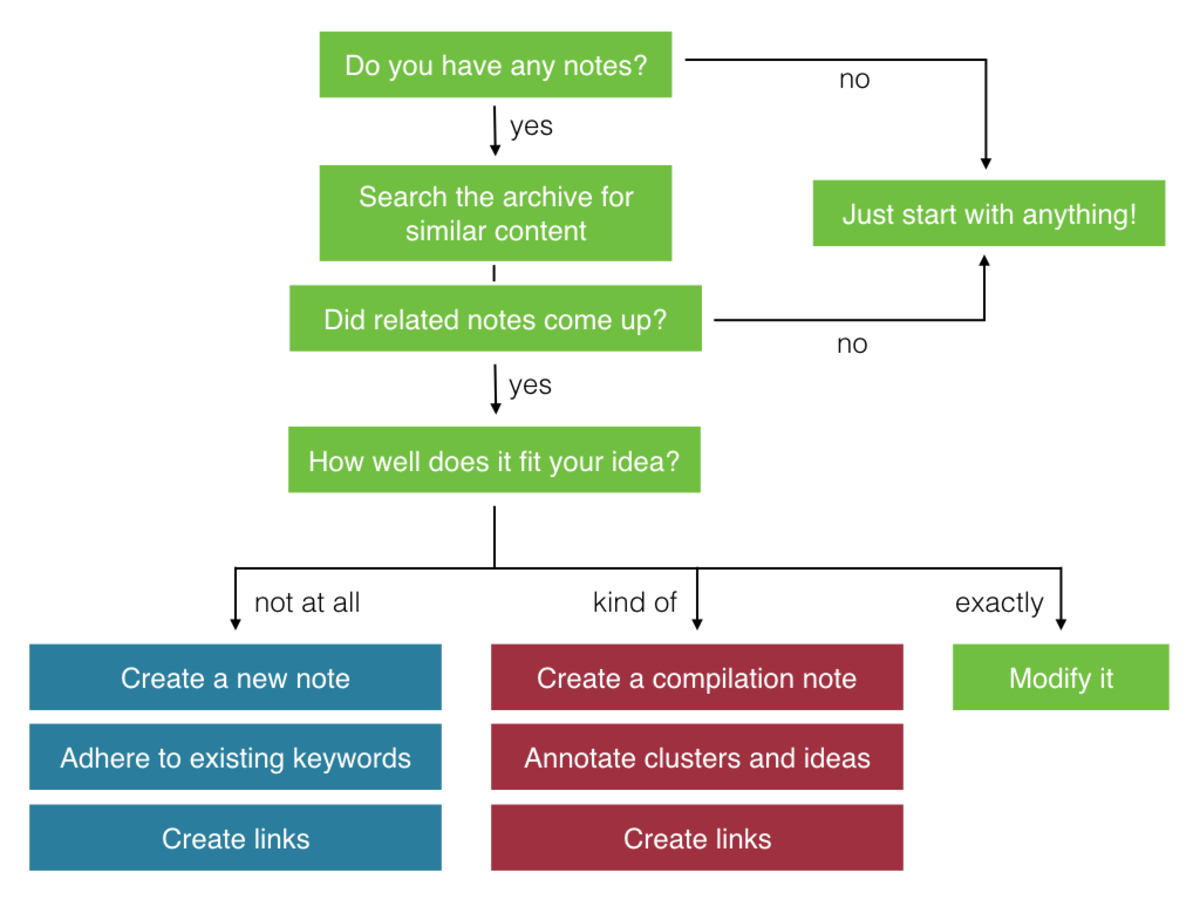
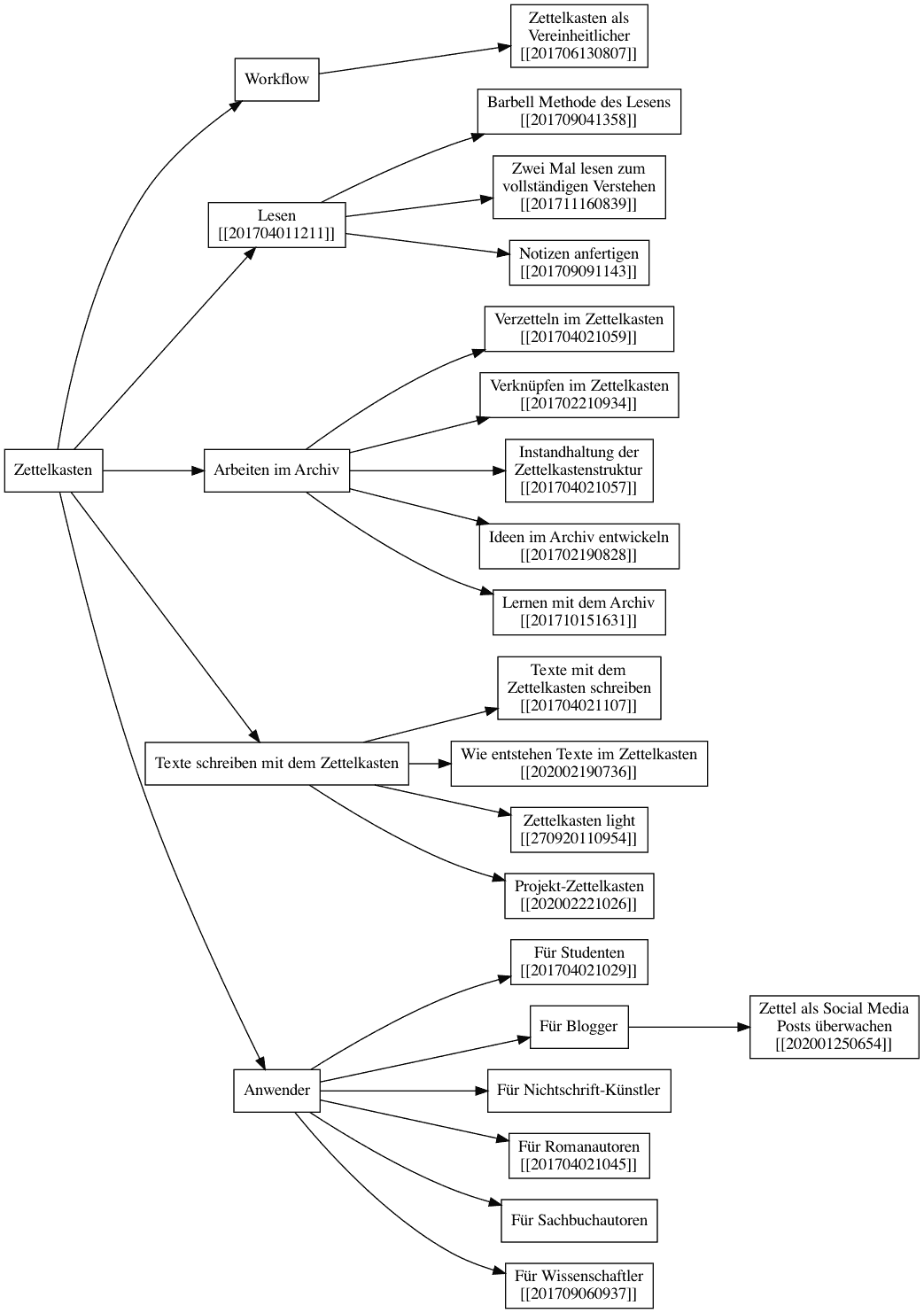
      Two types of structures depicted graphically

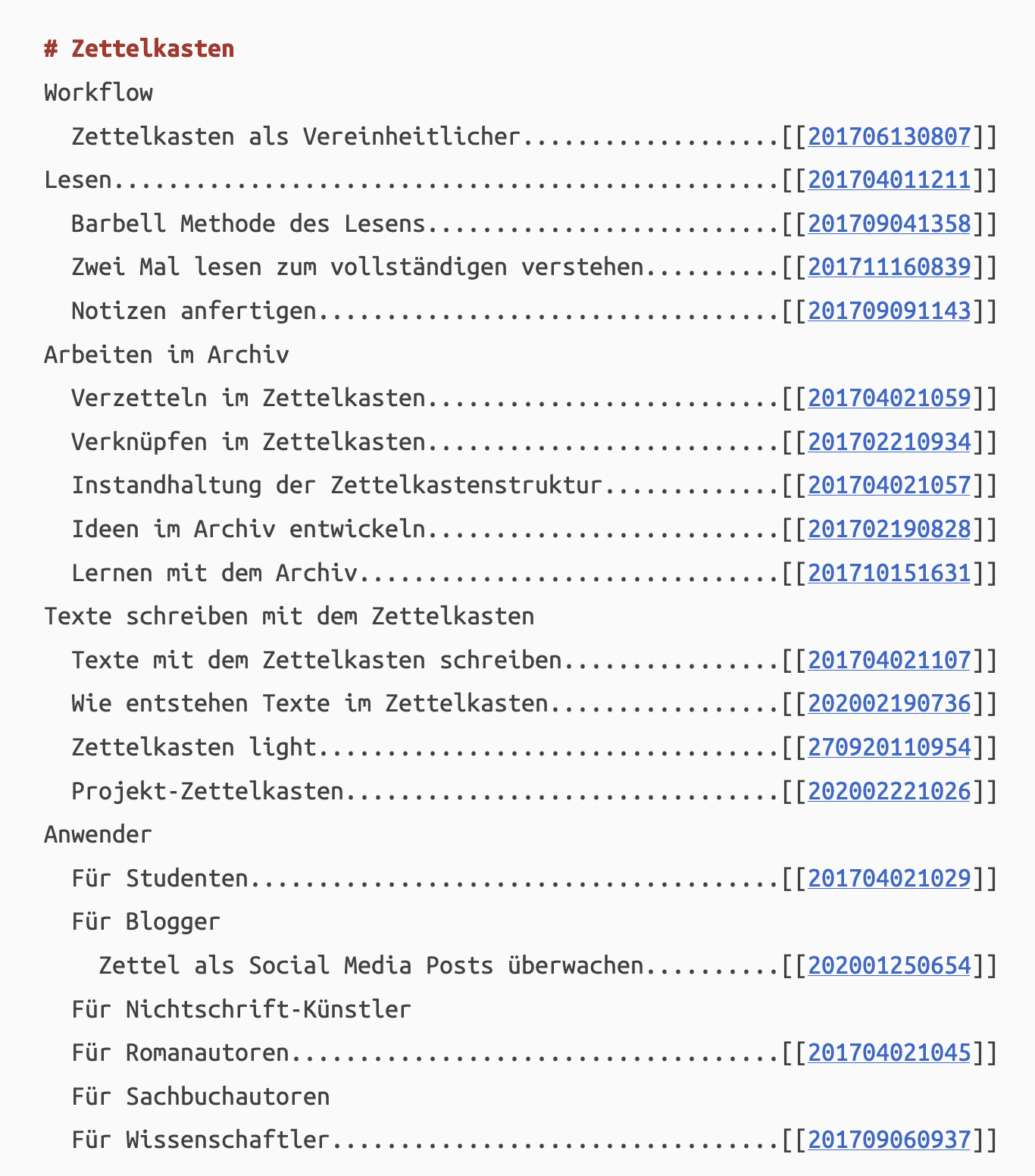
    3. Luhmann’s hub notes served as fast tracks to navigate through the web of notes. The same is true for Structure Note.

      So create a structure note where you can branch out into each specific subtopic

    4. Luhmann had hub notes. These are Zettels that list many other places to look at for a continuation of a topic.

      Hub notes are zettels that tell you where to look for additional info

    5. One might think now that the links are placed for a good reason. However, if you create a web of thoughts where you cannot be confident that following a link will lead you to something meaningful, then surfing your own thoughts will give you a feeling of disappointment. Your future self will judge its past self (you!) as unreliable.

      So you have to express the value of the link and why it is relevant and then include the link. If the link and writing is not valuable you will end up less determined to surf your own thoughts.

    6. If there are several possibilities, we can solve the problem as we wish and just record the connection by a link [or reference]. Often the context in which we are working suggests a multiplicity of links to other notes. […] In such cases it is important to capture the connections radially […], as it were, but at the same time also by right away recording [backlinks] in the slips that are being linked to. In this working procedure, the content that we take note of is usually also enriched. (from “Communicating with Slip Boxes”, emphasis mine)

      1 : arranged or having parts arranged like rays. 2a : relating to, placed like, or moving along a radius. b : characterized by divergence from a center. 3 : of, relating to, or adjacent to a bodily radius. 4 : developing uniformly around a central axis.

      I think you are allowed to put multiple connections and you should, but spread out(?)

    7. To manage the references, use reference management software like BibDesk. It will contain the bibliographical data and provides you with citekeys. Citekeys are similar to IDs. They are identifiers by which you can point to the reference you are using (One common format for a citekey is [#lastnameYEAR]).

      References and Citekey. I can use Zotero and be very judicious about what I include.

    8. As a rule of thumb, you should always make something from the information you process. You should always translate information to knowledge by adding context and relevance.

      Make something out of the information you are processing. So avoid being a hoarder.

    9. At this time (2020-05-20 09:14), I, Sascha, create the first draft of an article which has the working title “Zettelkasten – An introduction”.

      example Zettel

    10. The length of a Zettel is directly tied to what kind of hypertext you want to create. Do you want to create a web of excerpts? Then a Zettel should contain precisely one excerpt. Do you want to make a web of thoughts?

      I guess I'd be interested in a web of thoughts.

    11. The most important aspect of the body of the Zettel is that you write it in your own words. There is nothing wrong with capturing a verbatim quote on top. But one of the core rules to make the Zettelkasten work for you is to use your own words, instead of just copying and pasting something you believe is useful or insightful. This forces you to at least create a different version of it, your own version. This is one of the steps that lead to increased understanding of the material, and it improves recall of the information you process. Your Zettelkasten will truly be your own if its content is yours and not just a bunch of thoughts of other people.

      If you enter the content in your own words you take active ownership. Also, as a grad student, you don't want the extra work of not only finding the reference you'd like to allude to but additionally having to rephrase it at the time of writing a paper or book.

    12. You could also use the title of the Zettel as its ID. As long as it is unique, it can serve as an ID. Consequently, you cannot change the title unless you change any reference to it if you want to keep your links intact.

      So you could use the subject/topic you are researching?

      I kinda like the idea of TOPIC/# entry so I can also organize by various subject matters.

    13. What does an individual note, a Zettel, look like? There are three components that each Zettel has: A unique identifier. This gives your Zettel an unambiguous address. The body of the Zettel. This is where you write down what you want to capture: The piece of knowledge. References. At the bottom of each Zettel, you either reference the source of the knowledge you capture or leave it blank if you capture your own thoughts.

      I GOT THE PERFECT TOOL FOR THIS

    14. The very first note is assigned the number 1. If you add a second note that is not related to the first note, it is assigned the number 2. But if you want to continue the first note, or inject something into its content, comment on it, or something along those lines, you branch off. That new note would get assigned the number 1a. If you continue with this new note, you would go on with 1b. If you then want to comment on the note 1a, you would create a note with the address 1a1. So, in short, whenever you continue a train of thought, you increment the last position in the address, be it number or a character from the alphabet. And when you want to expand, intersperse, or comment on a note, you take its address and append a new character. For this to work, you alternate numbers and characters.

      Basic of how this works

    15. We can be more productive. The Zettelkasten Method streamlines our workflow by giving clear guidelines on what to do. This, in turn, decreases friction. It is quite common to enter a stage of flow which further increases productivity. I even allocate two days per week to make Zettelkasten work my priority and allow Zettelkasten flow to happen.

      so it helps trigger flow, according to this guy?

    16. It is a hypertext that he could navigate the drawer cabinet containing all the paper slips with a reasonable amount of time and energy.

      a software system that links topics on the screen to related information and graphics, which are typically accessed by a point-and-click method. "hypertext link" a document presented on a computer as hypertext. plural noun: hypertexts

    17. A Zettelkasten is a personal tool for thinking and writing. It has hypertextual features to make a web of thought possible. The difference to other systems is that you create a web of thoughts instead of notes of arbitrary size and form, and emphasize connection, not a collection

      definition

    Annotators

    1. Nonverbal Mechanisms Predict Zoom Fatigue and Explain Why Women Experience Higher Levels than Men

      Training educators to acknowledge in themselves and others the process of zoom fatigue. Discussing the ratio and tolerance for zoom meetings, specially in mixed-gender classrooms. How many meetings? What is the policy for webcam use? A lot of these questions that could do wonders for people's mental health and learning process.

    1. “no specific known threats related to the joint session of Congress.”

      White supremacist militias are not inherently dangerous to the status quo, even if they are individually dangerous to first-responders and legislators.

    1. Gov. Greg Abbott, a Republican, lifted the mask mandate and capacity limits on all businesses, starting March 10. Mr. Abbott said that this order ensures that “all businesses and families in Texas have the freedom to determine their own destiny.”

      How fucking cruel.

    1. Psalms 57.

      57 Be merciful unto me, O God, be merciful unto me: for my soul trusteth in thee: yea, in the shadow of thy wings will I make my refuge, until these calamities be overpast.

      2 I will cry unto God most high; unto God that performeth all things for me.

      3 He shall send from heaven, and save me from the reproach of him that would swallow me up. Selah. God shall send forth his mercy and his truth.

      4 My soul is among lions: and I lie even among them that are set on fire, even the sons of men, whose teeth are spears and arrows, and their tongue a sharp sword.

      5 Be thou exalted, O God, above the heavens; let thy glory be above all the earth.

      6 They have prepared a net for my steps; my soul is bowed down: they have digged a pit before me, into the midst whereof they are fallen themselves. Selah.

      7 My heart is fixed, O God, my heart is fixed: I will sing and give praise.

      8 Awake up, my glory; awake, psaltery and harp: I myself will awake early.

      9 I will praise thee, O Lord, among the people: I will sing unto thee among the nations.

      10 For thy mercy is great unto the heavens, and thy truth unto the clouds.

      11 Be thou exalted, O God, above the heavens: let thy glory be above all the earth.

  24. Mar 2021
    1. Lauren Michele Jackson

      Lauren Michele Jackson is an American culture critic and assistant professor of English and African American studies at Northwestern University. Her first book, White Negroes, is a nonfiction collection of essays that explores cultural appropriation. Wikipedia

    2. ineluctable

      in·e·luc·ta·ble /ˌinəˈləktəb(ə)l/ Learn to pronounce adjective unable to be resisted or avoided; inescapable. "the ineluctable facts of history"

    3. metonymic

      figure of speech consisting of the use of the name of one thing for that of another of which it is an attribute or with which it is associated (such as "crown" in "lands belonging to the crown

    4. Wikipedia tells me his autobiography includes this sentence: “If there was anything I hated, it was investigating the organs of the female pelvis.”

      Psychopath?!

    5. “I have the honor to present to the Academy the genital organs of this woman prepared in a manner that leaves no doubt about the nature of her tablier,” Cuvier said

      what a violation of someone's privacy even after death.