10,000 Matching Annotations
  1. Last 7 days
    1. Uni- and multivariable Cox regression analyses were performed to evaluate whether the type of EGFR mutation is associated with OS (Table 3). Because OS for patients with EGFR exon 20 insertions and patients with not acti

      [Paragraph-level] PMCID: PMC8307492 Section: RESULTS PassageIndex: 17

      Evidence Type(s): Prognostic, Diagnostic

      Justification: Prognostic: The passage discusses overall survival (OS) outcomes associated with the L858R variant, indicating that it correlates with disease outcome independent of therapy. Diagnostic: The mention of the type of EGFR mutation, including L858R, being associated with overall survival suggests its role in classifying or defining disease outcomes.

      Gene→Variant (gene-first): 1956:L858R

      Genes: 1956

      Variants: L858R

    2. The proportion of patients receiving first-line targeted therapy was highest for those with an exon 19 deletion (321/390; 82%) or L858R mutation (227/287; 79%), lower for those with uncommon, actionable variants (69/103;

      [Paragraph-level] PMCID: PMC8307492 Section: RESULTS PassageIndex: 16

      Evidence Type(s): Predictive, Prognostic

      Justification: Predictive: The passage discusses the proportion of patients receiving first-line targeted therapy based on the presence of the L858R mutation, indicating a correlation with treatment response. Prognostic: The median overall survival (OS) for patients with the L858R mutation is reported, demonstrating its correlation with disease outcome independent of therapy.

      Gene→Variant (gene-first): 1956:L858R

      Genes: 1956

      Variants: L858R

    3. OS in patients with any EGFR mutation was higher for those diagnosed in 2017 (median 18.1 months; 95% CI, 15.7-20.5) compared to 2013 (median 14.3 months; 95% CI, 12.5-16.1; p = 0.035), but similar to 2015 (median 17.6 m

      [Paragraph-level] PMCID: PMC8307492 Section: RESULTS PassageIndex: 13

      Evidence Type(s): Prognostic, Diagnostic

      Justification: Prognostic: The passage discusses overall survival (OS) in patients with the L858R variant, indicating a correlation between this variant and disease outcome, independent of therapy. Diagnostic: The mention of distinct survival patterns observed in different EGFR mutation subclasses, including L858R, suggests that this variant is used to classify or define a subtype of disease.

      Gene→Variant (gene-first): 1956:L858R

      Genes: 1956

      Variants: L858R

    4. Treatment and survival data were available for 10,237 out of 10,254 patients (99.8%). This included 390 patients with an exon 19 deletion, 287 patients with L858R, 103 patients with an uncommon, actionable variant, 69 pa

      [Paragraph-level] PMCID: PMC8307492 Section: RESULTS PassageIndex: 11

      Evidence Type(s): None

      Justification: Not enough information in this passage.

      Gene→Variant (gene-first): 1956:L858R

      Genes: 1956

      Variants: L858R

    5. Of the 7908 patients tested for EGFR mutations at initial diagnosis, one or more mutations were reported in 11.7% of all cases (95% CI, 11.0-12.4%; n = 925) (Table 2). Female patients were more likely to harbor EGFR muta

      [Paragraph-level] PMCID: PMC8307492 Section: RESULTS PassageIndex: 9

      Evidence Type(s): Diagnostic, Oncogenic

      Justification: Diagnostic: The passage discusses the prevalence of EGFR mutations, including L858R and L861X, in patients at initial diagnosis, indicating their association with the disease and their use in defining the mutation status of patients. Oncogenic: The variants L858R and L861X are described as actionable mutations within the context of EGFR, suggesting their role in tumor development or progression.

      Gene→Variant (gene-first): 1956:L858R 1956:L861X

      Genes: 1956

      Variants: L858R L861X

    1. An in-house database search for insertions comparable to the VMOS RAS variants revealed one in-frame insertion in KRAS in a case suspected for Noonan syndrome (Fig. 7A). Furthermore, a screen of the current literature an

      [Paragraph-level] PMCID: PMC6547725 Section: RESULTS PassageIndex: 27

      Evidence Type(s): Functional

      Justification: Functional: The passage discusses how the impact of the insertions on the catalytic Gln61 might be stronger, indicating an alteration in molecular function related to GTP hydrolysis.

      Gene→Variant (gene-first): 5921:Gln61

      Genes: 5921

      Variants: Gln61

    2. The biophysical characterisation of the VMOS RAS variants showed two opposing effects. VMOS RAS variants appeared insensitive to the action of GEFs with a consequently decrease of signalling capability. On the other hand

      [Paragraph-level] PMCID: PMC6547725 Section: RESULTS PassageIndex: 25

      Evidence Type(s): Functional, Oncogenic

      Justification: Functional: The passage discusses how the HRAS p.G12V variant alters the signaling capability by affecting GTP hydrolysis and inducing phosphorylation of ERK and AKT, indicating a change in molecular function. Oncogenic: The HRAS p.G12V variant is implicated in inducing signaling pathways that are associated with tumor development, as evidenced by the increased levels of phosphorylated ERK and AKT in the transfected cells.

      Gene→Variant (gene-first): 3845:p.G12V

      Genes: 3845

      Variants: p.G12V

    3. To analyse the effect of the VMOS RAS variants on GAP catalysed GTP hydrolysis, G-proteins were incubated in the presence of various concentration of RAS-GAP. GTP and GDP content was analysed after termination of the rea

      [Paragraph-level] PMCID: PMC6547725 Section: RESULTS PassageIndex: 22

      Evidence Type(s): Oncogenic, Functional

      Justification: Oncogenic: The passage discusses the classical oncogenic variant KRAS p.G12V in the context of its effect on GTP hydrolysis, indicating its role in tumor development or progression. Functional: The passage describes how the variant KRAS p.G12V affects the biochemical function of GTP hydrolysis, demonstrating its impact on molecular activity in the presence of RAS-GAP.

      Gene→Variant (gene-first): 3845:p.G12V

      Genes: 3845

      Variants: p.G12V

    4. GTP hydrolysis was followed over time by terminating the reactions at different points in time, and GDP and GTP contents analysis by HPLC. The intrinsic GTP hydrolysis rates of VMOS RAS variants were reduced by a factor

      [Paragraph-level] PMCID: PMC6547725 Section: RESULTS PassageIndex: 21

      Evidence Type(s): Functional, Oncogenic

      Justification: Functional: The passage discusses how the p.G12V variant alters the intrinsic GTP hydrolysis rates, indicating a change in molecular function related to protein activity. Oncogenic: The p.G12V variant is described as a classical oncogenic variant, suggesting its role in tumor development or progression.

      Gene→Variant (gene-first): 3845:p.G12V

      Genes: 3845

      Variants: p.G12V

    5. The interaction of G-protein and the nucleotide is stabilised in the ternary complex with the effector and in consequence the rate of nucleotide dissociation is reduced. This effect was used to analyse the interaction of

      [Paragraph-level] PMCID: PMC6547725 Section: RESULTS PassageIndex: 18

      Evidence Type(s): Oncogenic, Functional

      Justification: Oncogenic: KRAS p.G12V is described as a classical oncogenic variant, indicating its contribution to tumor development or progression. Functional: The passage discusses how KRAS p.G12V alters the intrinsic dissociation rate of mGppNHp compared to wild type, indicating a change in molecular function.

      Gene→Variant (gene-first): 3845:p.G12V

      Genes: 3845

      Variants: p.G12V

    6. The clinical context indicated that VMOS RAS variants cause enhanced RAS signalling, but the outcome of the in silico analysis is not unambiguously supporting this expectation. In fact, it strongly suggested deficiencies

      [Paragraph-level] PMCID: PMC6547725 Section: RESULTS PassageIndex: 11

      Evidence Type(s): Functional, Oncogenic

      Justification: Functional: The passage discusses the impact of the p.Q61L variant on nucleotide exchange, effector binding, and GTP hydrolysis, indicating that it alters molecular or biochemical function. Oncogenic: The p.Q61L variant is described as a classic pathogenic missense mutation, suggesting its contribution to tumor development or progression.

      Gene→Variant (gene-first): 4893:p.Q61L

      Genes: 4893

      Variants: p.Q61L

    7. On amino acid level the DNA duplications and insertions found in the VMOS RAS variants resulted in an insertion of mainly duplicated sequence around position 65 (Fig. 2A). It is difficult to predict to what extent the in

      [Paragraph-level] PMCID: PMC6547725 Section: RESULTS PassageIndex: 10

      Evidence Type(s): Functional

      Justification: Functional: The passage discusses how the insertions around Gln61 likely alter the molecular interactions and functions of the protein, particularly affecting GTP hydrolysis and interactions with GEFs and GAPs.

      Gene→Variant (gene-first): 5921:Gln61

      Genes: 5921

      Variants: Gln61

    8. Sensitive NGS based screening of frequently mutated positions in a panel of multiple genes were applied in 299 cases. In 108 cases, putative causative variants were identified, of which in 15 cases RAS genes were affecte

      [Paragraph-level] PMCID: PMC6547725 Section: RESULTS PassageIndex: 5

      Evidence Type(s): Oncogenic, Functional

      Justification: Oncogenic: The passage discusses mutations in RAS genes, including p.G12A, p.G13H, and p.Q22K, which are described as classical oncogenic mutations that affect tumor development and progression. Functional: The passage indicates that the p.Q22K mutation is associated with increased GTP loading, suggesting that it alters molecular function related to protein activity.

      Gene→Variant (gene-first): 3845:p.G12A 3845:p.G13H 3845:p.Q22K

      Genes: 3845

      Variants: p.G12A p.G13H p.Q22K

    1. Oncogenic mutations in the serine/threonine kinase B-RAF are found in 50-70% of malignant melanomas. Pre-clinical studies have demonstrated that the B-RAFV600E mutation predicts a dependency on the mitogen activated prot

      [Paragraph-level] PMCID: PMC3058384 Section: ABSTRACT PassageIndex: 1

      Evidence Type(s): Predictive, Oncogenic

      Justification: Predictive: The B-RAFV600E mutation predicts a dependency on the MAPK signaling cascade in melanoma, and this is validated by the success of RAF and MEK inhibitors in clinical trials, indicating a correlation with treatment response. Oncogenic: The passage discusses oncogenic mutations in B-RAF, specifically the B-RAFV600E mutation, which is implicated in tumor development and progression in malignant melanomas.

      Gene→Variant (gene-first): 673:B-RAFV600E 673:serine/threonine

      Genes: 673

      Variants: B-RAFV600E serine/threonine

    1. Structural details can provide mechanistic insight into variant effects on protein function. However, the structure of the RAD51C protein had not been experimentally determined at the time of this study. Initially, a hom

      [Paragraph-level] PMCID: PMC10390864 Section: RESULTS PassageIndex: 15

      Evidence Type(s): Functional, Oncogenic

      Justification: Functional: The passage discusses how several variants, including K131, R168G, G130R, and others, alter the molecular function of RAD51C by disrupting the ATP-binding site and influencing RAD51C activity, as demonstrated in HDR assays. Oncogenic: The passage indicates that the variants are deleterious and influence RAD51C function, which is relevant to tumor development or progression, particularly in the context of HDR assays.

      Gene→Variant (gene-first): 5889:16 A 5889:C135Y 5889:E94K 5889:G130R 5889:G302V 5889:K131 5889:L138F 5889:P21S 5889:Q133E 5889:R168 5889:R168G 5889:R312 5889:R312W 5889:T132I 5889:T132R 5892:T86I 5889:V140E 5889:p.Cys135Tyr 5889:p.Thr132Ile 5889:p.Val140Glu

      Genes: 5889 5892

      Variants: 16 A C135Y E94K G130R G302V K131 L138F P21S Q133E R168 R168G R312 R312W T132I T132R T86I V140E p.Cys135Tyr p.Thr132Ile p.Val140Glu

    2. RAD51C forms the BCDX2 and CX3 complexes that are involved in RAD51 recruitment to sites of DNA damage. To evaluate the influence of RAD51C variants on the integrity of these intrinsic complexes, coimmunoprecipitation of

      [Paragraph-level] PMCID: PMC10390864 Section: RESULTS PassageIndex: 13

      Evidence Type(s): Functional, Oncogenic

      Justification: Functional: The passage discusses how various RAD51C variants affect the ability to form protein complexes involved in DNA damage repair, indicating that these variants alter molecular function. Oncogenic: The mention of deleterious variants that lose the ability to form complexes suggests a role in tumor development or progression, as these variants are associated with impaired DNA repair mechanisms.

      Gene→Variant (gene-first): 5889:A126T 5889:D109Y 5889:D159N 5889:G162E 5889:G302V 5889:L138F 5889:L27P 5889:Q133E 5889:R258H 5889:S163R 5889:T336P 5892:T86I 5889:p.Gly162Glu 5889:p.Ser163Arg 5889:p.Thr336Pro 5892:p.Thr86Ile

      Genes: 5889 5892

      Variants: A126T D109Y D159N G162E G302V L138F L27P Q133E R258H S163R T336P T86I p.Gly162Glu p.Ser163Arg p.Thr336Pro p.Thr86Ile

    3. Because RAD51C participates in DNA damage signaling by regulating cell cycle progression, colony formation assays were performed to evaluate the influence of RAD51C variants on cell proliferation. U2OS RAD51C-/- landing

      [Paragraph-level] PMCID: PMC10390864 Section: RESULTS PassageIndex: 11

      Evidence Type(s): Functional, Oncogenic

      Justification: Functional: The passage discusses how RAD51C variants alter cell proliferation and the formation of RAD51 foci in response to ionizing radiation, indicating changes in molecular function related to DNA damage signaling and repair. Oncogenic: The variants are implicated in a proliferation defect and disruption of homologous recombination (HR) repair, suggesting their role in tumor development or progression.

      Gene→Variant (gene-first): 5889:G130R 5889:G302V 5889:K131I 5889:L138F 5889:Q133E 5889:R168G 5889:T132R

      Genes: 5889

      Variants: G130R G302V K131I L138F Q133E R168G T132R

    4. In parallel, a recent study evaluated the influence of 36 RAD51C missense variants on HR activity of U2OS and 21 on HR activity of MCF10A cells. Importantly, 18 of 36 evaluated in U2OS and 13 of 21 evaluated in MCF10A ce

      [Paragraph-level] PMCID: PMC10390864 Section: RESULTS PassageIndex: 10

      Evidence Type(s): Functional, Predictive

      Justification: Functional: The passage discusses how the L138F variant alters HDR activity in different cell lines, indicating a change in molecular function. Predictive: The passage mentions the sensitivity of variants, including L138F, to cisplatin and olaparib, suggesting a correlation with response to these therapies.

      Gene→Variant (gene-first): 5889:L138F

      Genes: 5889

      Variants: L138F

    5. To confirm the functional effects of RAD51C variants in a human cell line, RAD51C WT and 7 deleterious or intermediate missense variants in the HDR assay (G130R, K131I, T132R, Q133E, L138F, R168G and G302V) were introduc

      [Paragraph-level] PMCID: PMC10390864 Section: RESULTS PassageIndex: 9

      Evidence Type(s): Predictive, Functional

      Justification: Predictive: The passage discusses the sensitivity of specific RAD51C variants (G130R, K131I, T132R, Q133E, and G302V) to olaparib, indicating a correlation with response to therapy. Functional: The passage describes the introduction of RAD51C variants into a cell line and assesses their effects on homologous recombination repair (HDR), indicating that these variants alter molecular function.

      Gene→Variant (gene-first): 5889:G130R 5889:G302V 5889:K131I 5889:L138F 5889:Q133E 5889:R168G 5889:T132R

      Genes: 5889

      Variants: G130R G302V K131I L138F Q133E R168G T132R

    6. An inability to form RAD51 foci at the sites of DNA DSBs is a key component of an HR deficient phenotype. Because disruption of RAD51C substantially decreases RAD51 foci formation the influence of RAD51C missense variant

      [Paragraph-level] PMCID: PMC10390864 Section: RESULTS PassageIndex: 7

      Evidence Type(s): Functional, Predictive

      Justification: Functional: The passage discusses how RAD51C missense variants alter RAD51 foci formation in response to DNA damage, indicating a change in molecular function related to DNA repair mechanisms. Predictive: The mention of "drug response findings" suggests that the variants may correlate with sensitivity or resistance to a specific therapy, indicating predictive evidence.

      Gene→Variant (gene-first): 5889:A155E 5889:C135Y 5889:C147Y 5888:D108G 5889:D109Y 5889:D159Y 5889:G306R 5889:P21S 5889:V140E 5889:p.Ala155Glu 5888:p.Asp108Gly 5889:p.Asp109Tyr 5889:p.Asp159Tyr 5889:p.Cys147Tyr 5889:p.Gly306Arg 5889:p.Pro21Ser 5889:p.Val140Glu

      Genes: 5889 5888

      Variants: A155E C135Y C147Y D108G D109Y D159Y G306R P21S V140E p.Ala155Glu p.Asp108Gly p.Asp109Tyr p.Asp159Tyr p.Cys147Tyr p.Gly306Arg p.Pro21Ser p.Val140Glu

    7. RAD51C loss promotes HR deficiency and sensitizes cells to cisplatin and olaparib PARP inhibitor. Thus, the influence of 60 RAD51C missense variants from the HDR assay (30 deleterious, 23 neutral, and 7 intermediate) on

      [Paragraph-level] PMCID: PMC10390864 Section: RESULTS PassageIndex: 5

      Evidence Type(s): Predictive, Functional

      Justification: Predictive: The passage discusses the influence of RAD51C missense variants on the response to cisplatin and olaparib, indicating a correlation between the variants and treatment sensitivity. Functional: The passage describes how the variants affect IC50 values in the HDR assay, suggesting that they alter molecular function related to drug response.

      Gene→Variant (gene-first): 5889:E94K 5889:G306R 5889:p.Glu94Lys 5889:p.Gly306Arg

      Genes: 5889

      Variants: E94K G306R p.Glu94Lys p.Gly306Arg

    8. A cell-based DR-GFP HDR colorimetric reporter assay was used to assess the influence of 173 missense mutations on RAD51C HR DNA repair activity (Supplementary Table S1). RAD51C deficient CL-V4B cells were reconstituted w

      [Paragraph-level] PMCID: PMC10390864 Section: RESULTS PassageIndex: 3

      Evidence Type(s): Functional, Oncogenic

      Justification: Functional: The passage discusses the influence of missense mutations on RAD51C HR DNA repair activity, indicating that the variants alter molecular function as assessed by HDR activity in a cell-based assay. Oncogenic: The mention of deleterious variants categorized based on their impact on HDR activity suggests that these somatic variants contribute to tumor development or progression through their effects on DNA repair mechanisms.

      Gene→Variant (gene-first): 5889:A126T 5889:C135Y 5889:D159N 5889:G125V 5889:G153D 5889:G264S 5889:G264V 5889:G3R 5889:L138F 5889:L219S 5889:Q143R 5889:R214C 5889:R258H 5889:R312W 5889:R366Q 5889:T287A 5889:V169A 5889:p.Arg214Cys 5889:p.Arg258His 5889:p.Arg312Trp 5889:p.Arg366Gln 5889:p.Asp159Asn 5889:p.Gln143Arg 5889:p.Gly125Val 5889:p.Gly153Asp 5889:p.Gly264Ser 5889:p.Gly264Val 5889:p.Gly3Arg 5889:p.Leu219Ser 5889:p.Thr287Ala 5889:p.Val169Ala

      Genes: 5889

      Variants: A126T C135Y D159N G125V G153D G264S G264V G3R L138F L219S Q143R R214C R258H R312W R366Q T287A V169A p.Arg214Cys p.Arg258His p.Arg312Trp p.Arg366Gln p.Asp159Asn p.Gln143Arg p.Gly125Val p.Gly153Asp p.Gly264Ser p.Gly264Val p.Gly3Arg p.Leu219Ser p.Thr287Ala p.Val169Ala

    1. Firstly, the level of total STAT3 in two HCC patient samples appeared to be higher than that in corresponding adjacent normal tissues. Interestingly, treatment of ruxolitinib led to a significant reduction (50%) of the p

      [Paragraph-level] PMCID: PMC4868698 Section: RESULTS PassageIndex: 14

      Evidence Type(s): Predictive, Oncogenic

      Justification: Predictive: The passage discusses the treatment of ruxolitinib and its effects on the phosphorylation level of STAT3 in tumors with the JAK1 S703I mutation, indicating a correlation with treatment response. Oncogenic: The mention of the JAK1 S703I mutation in the context of tumor models suggests that this somatic variant contributes to tumor development or progression.

      Gene→Variant (gene-first): 3716:S703I

      Genes: 3716

      Variants: S703I

    2. In vivo efficacy studies of JAK1/2 inhibitor, ruxolitinib, were conducted in these four JAK1-mutant models and a JAK1-WT PDX model as a control (Figure 3A). The results showed that, only in LI-03-0191 model bearing JAK1S

      [Paragraph-level] PMCID: PMC4868698 Section: RESULTS PassageIndex: 11

      Evidence Type(s): Predictive, Oncogenic

      Justification: Predictive: The passage discusses the sensitivity of the JAK1S703I mutation to the JAK1/2 inhibitor ruxolitinib, indicating a correlation with treatment response. Oncogenic: The passage suggests that the JAK1S703I mutation may play a critical role in tumorigenesis, indicating its contribution to tumor development.

      Gene→Variant (gene-first): 3716:S703I

      Genes: 3716

      Variants: S703I

    3. Anti-tumor activity of ruxolitinib in JAK1S703I-mutant PDX model

      [Paragraph-level] PMCID: PMC4868698 Section: RESULTS PassageIndex: 10

      Evidence Type(s): Predictive, Oncogenic

      Justification: Predictive: The passage discusses the anti-tumor activity of ruxolitinib in a model with the JAK1 S703I mutation, indicating a correlation with response to therapy. Oncogenic: The mention of the JAK1 S703I mutation in the context of a PDX model suggests that this somatic variant contributes to tumor development or progression.

      Gene→Variant (gene-first): 3716:S703I

      Genes: 3716

      Variants: S703I

    4. To further evaluate the transformation ability of these JAK1 mutations, Ba/F3 cells were stably infected with lentivirus expressing EGFP, wild-type JAK1, JAK1N451S, JAK1E483D, JAK1S703I, JAK1A1086S, and JAK1S729C, respec

      [Paragraph-level] PMCID: PMC4868698 Section: RESULTS PassageIndex: 9

      Evidence Type(s): Oncogenic, Functional

      Justification: Oncogenic: The passage discusses the transformation ability of JAK1 mutations, specifically noting that JAK1S703I and JAK1S729C are capable of continual proliferation in the absence of IL-3, indicating their contribution to tumor development or progression. Functional: The passage mentions that JAK1S703I activates the JAK-STAT signaling pathway, which indicates an alteration in molecular function related to the variant.

      Gene→Variant (gene-first): 3716:E483D 3716:S703I 3716:S729C

      Genes: 3716

      Variants: E483D S703I S729C

    5. To explore the biological functions of JAK1 mutations in JAK-STAT signaling pathway, we introduced these mutations into pLVX-IRES-Neo-JAK1 plasmid. Plasmids containing EGFP, wild-type JAK1, JAK1N451S, JAK1E483D, JAK1S703

      [Paragraph-level] PMCID: PMC4868698 Section: RESULTS PassageIndex: 8

      Evidence Type(s): Functional, Oncogenic

      Justification: Functional: The passage discusses how the introduction of JAK1 mutations, including E483D, S703I, and S729C, alters the expression levels of phosphorylated JAK1 and STAT proteins, indicating a change in molecular function. Oncogenic: The passage mentions that JAK1S729C is a known and recurrent activating mutation, suggesting its role in tumor development or progression.

      Gene→Variant (gene-first): 3716:E483D 3716:S703I 3716:S729C

      Genes: 3716

      Variants: E483D S703I S729C

    6. Specifically, S703I mutation was found in the pseudo-kinase domain of JAK1 protein, and could potentially cause the disruption of auto-inhibition of JAK1 kinase. Notably, S703I was previously identified in tumors of two

      [Paragraph-level] PMCID: PMC4868698 Section: RESULTS PassageIndex: 4

      Evidence Type(s): Oncogenic, Functional

      Justification: Oncogenic: The passage indicates that the S703I mutation is an activating mutation of the JAK1 gene and was found in tumors, suggesting it contributes to tumor development or progression. Functional: The S703I mutation is described as potentially causing disruption of auto-inhibition of the JAK1 kinase, indicating an alteration in molecular or biochemical function.

      Gene→Variant (gene-first): 3716:A1086S 3716:E483D 728378:N451S 3716:S703I

      Genes: 3716 728378

      Variants: A1086S E483D N451S S703I

    7. More than 160 HCC PDX models were established at WuXi AppTec in the past three years, of which over 60 models were characterized by WES. Among them, four models (LI-03-0012, LI-03-0155, LI-03-0191, and LI-03-0257) were i

      [Paragraph-level] PMCID: PMC4868698 Section: RESULTS PassageIndex: 3

      Evidence Type(s): None

      Justification: Not enough information in this passage.

      Gene→Variant (gene-first): 3716:A1086S 3716:E483D 728378:N451S 3716:S703I

      Genes: 3716 728378

      Variants: A1086S E483D N451S S703I

    1. To examine if upregulation of NRG1 is induced by hormone therapy, we treated freshly isolated primary CAFs from CWR22Pc tumors or pCAFs with CSS or Enz. CSS and Enz both induced NRG1 mRNA and protein expression after 7 d

      [Paragraph-level] PMCID: PMC7472556 Section: RESULTS PassageIndex: 23

      Evidence Type(s): Predictive, Oncogenic

      Justification: Predictive: The passage discusses how NRG1 levels increase after androgen deprivation therapy (ADT) and suggests that these elevated levels are sufficient to promote resistance to ADT, indicating a correlation with treatment response. Oncogenic: The mention of NRG1 promoting resistance to ADT implies a role in tumor development or progression, which aligns with the definition of an oncogenic variant.

      Gene→Variant (gene-first): 8850:S7C

      Genes: 8850

      Variants: S7C

    2. To gain insight into the potential clinical relevance of these findings, we examined NRG1 expression in a cohort of 43 patients with localized prostate cancer who underwent radical prostatectomy surgery, 23 of whom recei

      [Paragraph-level] PMCID: PMC7472556 Section: RESULTS PassageIndex: 21

      Evidence Type(s): Diagnostic, Predictive

      Justification: Diagnostic: The passage discusses the detection of NRG1 expression in patients with localized prostate cancer, indicating its potential role in classifying or defining the disease based on the presence or absence of NRG1 staining. Predictive: The analysis includes a comparison of NRG1 expression in patients who received neoadjuvant ADT versus those who were hormonally intact, suggesting a correlation with treatment response.

      Gene→Variant (gene-first): 3084:S6 8850:S7

      Genes: 3084 8850

      Variants: S6 S7

    3. Our earlier analysis of five canonical AR target genes suggested that NRG1 preserves tumor cell viability without restoring AR target gene expression (Figures 2G and 2H). To address this question more comprehensively, we

      [Paragraph-level] PMCID: PMC7472556 Section: RESULTS PassageIndex: 19

      Evidence Type(s): None

      Justification: Not enough information in this passage.

      Gene→Variant (gene-first): 1956:S2 3084:S6C

      Genes: 1956 3084

      Variants: S2 S6C

    4. To carry out the purification, serum-free 22Pc-CAFCM was collected, concentrated, and applied to a Q-Superose anion exchange column, from which we eluted two protein peaks by using 30% and 100% high-salt buffer B (termed

      [Paragraph-level] PMCID: PMC7472556 Section: RESULTS PassageIndex: 12

      Evidence Type(s): Predictive, Functional

      Justification: Predictive: The passage discusses resistance-promoting activity and its correlation with HER3 phosphorylation, indicating a relationship with response or resistance to therapy. Functional: The passage describes how the variant affects HER3 phosphorylation activity, suggesting an alteration in molecular function related to resistance-promoting activity.

      Gene→Variant (gene-first): 5979:Q8

      Genes: 5979

      Variants: Q8

    1. B-cell lymphoma and melanoma harbor recurrent mutations in the gene encoding the EZH2 histone methyltransferase, but the carcinogenic role of these mutations is unclear. Here we describe a mouse model in which the most c

      [Paragraph-level] PMCID: PMC4899144 Section: ABSTRACT PassageIndex: 1

      Evidence Type(s): Oncogenic, Functional

      Justification: Oncogenic: The passage describes how the somatic mutations Y641F and Y646F in the EZH2 gene contribute to tumor development, specifically leading to high-penetrance lymphoma and melanoma in a mouse model. Functional: The variant Ezh2Y641F is shown to alter molecular function by increasing global H3K27 trimethylation and causing a redistribution of this mark, which affects transcription at various loci.

      Gene→Variant (gene-first): 2146:Y641F 2146:Y646F

      Genes: 2146

      Variants: Y641F Y646F

    1. Frequent genetic alterations discovered in FGFRs and evidence implicating some as drivers in diverse tumors has been accompanied by rapid progress in targeting FGFRs for anticancer treatments. Wider assessment of the imp

      [Paragraph-level] PMCID: PMC5029699 Section: ABSTRACT PassageIndex: 1

      Evidence Type(s): Predictive, Oncogenic

      Justification: Predictive: The passage discusses the impact of FGFR3 kinase domain variants on drug responses and highlights the distinct changes in efficacy of inhibitors based on specific activating mutations, indicating a correlation with treatment response. Oncogenic: The mention of FGFR3 variants as drivers in diverse tumors suggests that these somatic mutations contribute to tumor development or progression.

      Gene→Variant (gene-first): 2261:K650E 2261:N540K 2261:R669G

      Genes: 2261

      Variants: K650E N540K R669G

    1. Results: Among a total of 148 patients, 48 (32%) had mutated KRAS, 77% at codon 12 and 23% at codon 13. The PFS was significantly worse in the mutant KRAS patients in comparison to wild type KRAS patients (p < 0.05). The

      [Paragraph-level] PMCID: PMC4378307 Section: ABSTRACT PassageIndex: 3

      Evidence Type(s): Prognostic, Diagnostic

      Justification: Prognostic: The passage indicates that KRAS mutation, specifically G12D, is associated with a poor prognosis in progression-free survival (PFS), demonstrating its role as an independent negative prognostic factor. Diagnostic: The mention of KRAS mutations, including G12D, being associated with specific outcomes in patients suggests that these mutations can be used to classify or define disease subtypes.

      Gene→Variant (gene-first): 3845:G12D

      Genes: 3845

      Variants: G12D

    1. In the cBioPortal database, variants of the MAP2K1 gene are reported at frequencies of 1.7% in CRC patients (Table 1) and correlated with worse disease/progression-free survival (Logrank Test P-Value: 1.815e-3), but not

      [Paragraph-level] PMCID: PMC6627713 Section: RESULTS PassageIndex: 20

      Evidence Type(s): Diagnostic, Prognostic, Predictive, Oncogenic

      Justification: Diagnostic: The passage discusses the frequencies of MAP2K1 variants in CRC patients and their association with specific tumor characteristics, indicating their role in defining or classifying the disease. Prognostic: The variants are correlated with worse disease/progression-free survival, suggesting they have prognostic implications independent of therapy. Predictive: The passage mentions that MAP2K1 mutations are associated with de novo and acquired resistance to anti-EGFR MoAbs, indicating a predictive relationship with therapy response. Oncogenic: The variants are described as contributing to a gain of function of the MEK1 protein, which is indicative of their role in tumor development or progression.

      Gene→Variant (gene-first): 5604:c.169A>G 5604:c.199G>A 5604:p.Asp67Asn 5604:p.Lys57Glu

      Genes: 5604

      Variants: c.169A>G c.199G>A p.Asp67Asn p.Lys57Glu

    2. The CNVs were much more frequent among patients with longer PFS. Within this cohort, patient P16 had a significant copy number gain of ERBB2 (78.99) that was confirmed by FISH analysis (data not shown). Patient P16 had a

      [Paragraph-level] PMCID: PMC6627713 Section: RESULTS PassageIndex: 16

      Evidence Type(s): Predictive, Diagnostic

      Justification: Predictive: The passage discusses the response of patients to cetuximab-based first-line therapy, specifically noting that patient P4, who carries the FBXW7 variant c.1268G>T; p.Gly423Val, had a complete response to this therapy. Diagnostic: The mention of the FBXW7 variant in the context of patient P4's treatment response suggests that it may be used to classify or define the patient's disease or treatment outcome.

      Gene→Variant (gene-first): 55294:c.1268G>T 55294:p.Gly423Val

      Genes: 55294

      Variants: c.1268G>T p.Gly423Val

    3. Of the three missense mutations detected in FBXW7, two were found in patients with a PFS shorter than median PFS. Patient P14 (PFS 8.07 months) carried the c.1798G>A variant (p.Asp600Asn) and patient P18 (PFS 1.73 months

      [Paragraph-level] PMCID: PMC6627713 Section: RESULTS PassageIndex: 14

      Evidence Type(s): Prognostic, Oncogenic

      Justification: Prognostic: The passage indicates that two missense mutations are associated with patients having a shorter progression-free survival (PFS), suggesting a correlation with disease outcome. Oncogenic: The FBXW7 p.Arg505Cys mutation is reported to lead to loss of function of the protein and has been associated with several cancer types, indicating its contribution to tumor development or progression.

      Gene→Variant (gene-first): 55294:c.1513C>T 1956:c.1798G>A 55294:p.Arg505Cys 673:p.Asp600Asn

      Genes: 55294 1956 673

      Variants: c.1513C>T c.1798G>A p.Arg505Cys p.Asp600Asn

    4. Two patients (P20 and P21) had variants in NF1, a negative regulator of RAS, inactivated by mutation in various cancers. Specifically, we found an insertion (c.638_639insA; p.Asn214Lys fs*2) in the tumor from patient P20

      [Paragraph-level] PMCID: PMC6627713 Section: RESULTS PassageIndex: 13

      Evidence Type(s): Oncogenic, Prognostic

      Justification: Oncogenic: The variants in NF1 are described as contributing to tumor development by leading to a loss of function and increased activation of the RAS signaling pathway, indicating their role in oncogenesis. Prognostic: The passage provides progression-free survival (PFS) times for the patients with the variants, suggesting a correlation between the variants and disease outcome.

      Gene→Variant (gene-first): 4763:c.5101A>T 4763:c.638_639insA 4763:p.Asn214Lys fs*2 4763:p.Lys1701Ter

      Genes: 4763

      Variants: c.5101A>T c.638_639insA p.Asn214Lys fs*2 p.Lys1701Ter

    5. Patient P3 (PFS 6.63 months) carried the variant c.169A>G in the MAP2K1 gene coding for the MEK1 protein. This variant has been already reported in the cBioPortal database. It results in the substitution of an amino acid

      [Paragraph-level] PMCID: PMC6627713 Section: RESULTS PassageIndex: 12

      Evidence Type(s): Functional, Oncogenic

      Justification: Functional: The variant c.169A>G results in an amino acid substitution (p.Lys57Glu) that is associated with a gain of function of the MEK1 protein, indicating an alteration in molecular function. Oncogenic: The variant is discussed in the context of its role in the MAP2K1 gene, which is known to contribute to tumor development or progression, suggesting its oncogenic potential.

      Gene→Variant (gene-first): 5604:c.169A>G 5604:p.Lys57Glu

      Genes: 5604

      Variants: c.169A>G p.Lys57Glu

    6. All variants were at an allelic frequency >5% with the exception of a KRAS variant (c.183A>T; p.Gln61His) that was identified in the tumor tissue from patient P7 (PFS 3.93 months) at an allelic frequency of 0.4%. This va

      [Paragraph-level] PMCID: PMC6627713 Section: RESULTS PassageIndex: 11

      Evidence Type(s): Oncogenic

      Justification: Oncogenic: The passage discusses the KRAS variant (c.183A>T; p.Gln61His) identified in tumor tissue, indicating its role in tumor development or progression as it is associated with a specific patient's tumor.

      Gene→Variant (gene-first): 3845:c.183A>T 3845:p.Gln61His

      Genes: 3845

      Variants: c.183A>T p.Gln61His

    7. Of the 54 SNVs and insertions/deletions (Indels) identified, 35% and 41% were APC and TP53 variants, respectively (Figure 1). Nineteen patients (90.47%) had at least one TP53 SNV or Indel, whereas 15/21 (71.43%) patients

      [Paragraph-level] PMCID: PMC6627713 Section: RESULTS PassageIndex: 5

      Evidence Type(s): Diagnostic, Oncogenic

      Justification: Diagnostic: The passage discusses the presence of specific variants in patients and their association with APC and TP53 mutations, indicating their role in defining or classifying the disease context. Oncogenic: The variants mentioned are associated with tumors, suggesting that they contribute to tumor development or progression, which aligns with the definition of oncogenic variants.

      Gene→Variant (gene-first): 7157:c.275_276insGGCC 324:c.4098_4099delTCinsAT 324:c.4467_4468insCATTTTG 324:c.589_590insGAGTT 324:c.837_838InsG

      Genes: 7157 324

      Variants: c.275_276insGGCC c.4098_4099delTCinsAT c.4467_4468insCATTTTG c.589_590insGAGTT c.837_838InsG

    1. Finally, we investigated genetic mutation status in biopsies of two patients who progressed on repotrectinib in clinical trial using targeted sequencing. Patient A, a 46-year-old male with a 20 pack-year smoking history,

      [Paragraph-level] PMCID: PMC10283448 Section: RESULTS PassageIndex: 14

      Evidence Type(s): Predictive, Functional

      Justification: Predictive: The passage discusses mutations identified in patients who progressed on repotrectinib treatment, suggesting a potential role of these variants in acquired resistance to the therapy. Functional: The passage indicates that further studies are necessary to investigate the functional role of the mutations, implying that these variants may alter molecular or biochemical functions related to resistance mechanisms.

      Gene→Variant (gene-first): 1050:196_197insHP 7157:E171G 896:E253Q 2064:H178Q 7157:H179Y 5925:H555R 2064:R143Q

      Genes: 1050 7157 896 2064 5925

      Variants: 196_197insHP E171G E253Q H178Q H179Y H555R R143Q

    2. The clinical activity of repotrectinib against ROS1 SFM was seen in a 49-year-old female ROS1-rearranged patient who progressed after 44 months of crizotinib treatment with an identified CD74-ROS1 G2032R mutation. The pa

      [Paragraph-level] PMCID: PMC10283448 Section: RESULTS PassageIndex: 12

      Evidence Type(s): Predictive, Diagnostic

      Justification: Predictive: The passage discusses the clinical activity of repotrectinib in a patient with the G2032R mutation, indicating a response to therapy, which aligns with predictive evidence. Diagnostic: The G2032R mutation is identified in the context of a ROS1-rearranged patient, suggesting its role in defining the patient's disease subtype.

      Gene→Variant (gene-first): 6098:G2032R

      Genes: 6098

      Variants: G2032R

    3. We identified the ROS1-G2032R mutation in YU1079, which was serially established in the same patient as YU1078 but after progressing on crizotinib treatment. Based on recent studies examining lorlatinib and cabozantinib

      [Paragraph-level] PMCID: PMC10283448 Section: RESULTS PassageIndex: 10

      Evidence Type(s): Predictive, Oncogenic

      Justification: Predictive: The passage discusses the response of the ROS1-G2032R mutation to various therapies, specifically mentioning the effectiveness of cabozantinib and repotrectinib in inhibiting growth, which correlates with treatment response. Oncogenic: The ROS1-G2032R mutation is implicated in tumor growth, as indicated by the investigation of its effects in Ba/F3 cells and the context of progression on crizotinib treatment, suggesting its role in tumor development.

      Gene→Variant (gene-first): 6098:G2032R

      Genes: 6098

      Variants: G2032R

    4. Repotrectinib overcomes crizotinib-resistant ROS1 G2032R

      [Paragraph-level] PMCID: PMC10283448 Section: RESULTS PassageIndex: 9

      Evidence Type(s): Predictive

      Justification: Predictive: The passage indicates that repotrectinib is effective against crizotinib-resistant ROS1 G2032R, suggesting a correlation between the variant and response to therapy.

      Gene→Variant (gene-first): 6098:G2032R

      Genes: 6098

      Variants: G2032R

    1. DNMT3A exon 23 screening was performed on available samples coming from 288 AML patients aged from 18 to 65-year old and treated in Toulouse between 2000 and 2009. DNMT3A exon 23 mutations were detected in 39 patients (1

      [Paragraph-level] PMCID: PMC3260002 Section: RESULTS PassageIndex: 3

      Evidence Type(s): Diagnostic, Oncogenic

      Justification: Diagnostic: The passage discusses the detection of DNMT3A exon 23 mutations in AML patients, indicating that these mutations are associated with the disease, which supports their use in defining or confirming the disease. Oncogenic: The mention of DNMT3A mutations in AML patients suggests that these somatic variants contribute to tumor development or progression, as they are identified in a cancer context.

      Gene→Variant (gene-first): 1788:R882 1788:R882C 1788:R882H 1788:R882P 1788:W893 1788:W893S

      Genes: 1788

      Variants: R882 R882C R882H R882P W893 W893S

    1. A total of 3 out of 42 GC patients were METex14del positive (Table 3). All GC cases were MET IHC 3+ and the only case in the series with MET amplification. For example, one case was a 27-year old male patient who present

      [Paragraph-level] PMCID: PMC4695055 Section: RESULTS PassageIndex: 5

      Evidence Type(s): None

      Justification: Not enough information in this passage.

      Gene→Variant (gene-first): 1956:T790M 673:V600E

      Genes: 1956 673

      Variants: T790M V600E

    2. All 13 METex14del cases were further confirmed by qualitative RT-PCR using probes overlapping an exon 13-15 junction, a fusion transcript caused by exon 14 skipping. In all cases, although the absolute Ct (cycles to thre

      [Paragraph-level] PMCID: PMC4695055 Section: RESULTS PassageIndex: 4

      Evidence Type(s): Diagnostic, Oncogenic

      Justification: Diagnostic: The passage indicates that the variant c.3082+811A TTTTAACA > GGTTTGAT is found in all GI cancer samples, suggesting its association with the disease. Oncogenic: The presence of the variant in GI cancer samples implies a potential role in tumor development or progression, as it is discussed in the context of mutations in cancer.

      Gene→Variant (gene-first): 7157:c.3082+811A TTTTAACA > GGTTTGAT

      Genes: 7157

      Variants: c.3082+811A TTTTAACA > GGTTTGAT

    3. The patient cohort from the NEXT-1 trial (NCT02141152), which is an actively enrolling clinical trial for genomic profiling in cancer patients, was used (Figure 1). Of 428 patients enrolled and screened, sufficient RNAs

      [Paragraph-level] PMCID: PMC4695055 Section: RESULTS PassageIndex: 2

      Evidence Type(s): None

      Justification: Not enough information in this passage.

      Gene→Variant (gene-first): 4916:p.982_1028del47

      Genes: 4916

      Variants: p.982_1028del47

    1. Based on our search criteria, a total of 41 studies, which enrolled 13,103 KRAS assessable patients with 18 percent (2,374) KRAS mutant positive cases, were eligible for inclusion in the present analyses. The process of

      [Paragraph-level] PMCID: PMC4884999 Section: RESULTS PassageIndex: 3

      Evidence Type(s): Diagnostic, Oncogenic

      Justification: Diagnostic: The passage discusses the frequency of KRAS mutations, specifically mentioning that the majority occur in codon 12 with G12C being the most common, indicating its association with lung cancer subtypes. Oncogenic: The mention of KRAS mutations, including G12C, in the context of lung adenocarcinoma suggests that this somatic variant contributes to tumor development or progression.

      Gene→Variant (gene-first): 3845:G12C

      Genes: 3845

      Variants: G12C

    1. We report two inflammatory myofibroblastic tumor (IMT) patients with ALK fusions (RRBP-ALK and TNS1-ALK, respectively). They both received tumor resection surgery and treatment with ALK inhibitors crizotinib followed by

      [Paragraph-level] PMCID: PMC7568619 Section: ABSTRACT PassageIndex: 2

      Evidence Type(s): Predictive, Oncogenic

      Justification: Predictive: The variant L1196Q is associated with the development of resistance to ALK inhibitors, and its identification guided the prescription of a newer ALK inhibitor, ceritinib, which resulted in a partial response in the patient. Oncogenic: The passage indicates that the L1196Q mutation is a secondary mutation that developed in the context of drug resistance, suggesting it contributes to tumor progression and the development of resistance to therapy.

      Gene→Variant (gene-first): 238:L1196Q

      Genes: 238

      Variants: L1196Q

    1. Pediatric glioblastomas (GBM) including diffuse intrinsic pontine gliomas (DIPG) are devastating brain tumors with no effective therapy. Here, we investigated clinical and biological impacts of histone H3.3 mutations. Fo

      [Paragraph-level] PMCID: PMC3422615 Section: ABSTRACT PassageIndex: 1

      Evidence Type(s): Diagnostic, Prognostic, Oncogenic

      Justification: Diagnostic: K27M-H3.3 mutation defines clinically and biologically distinct subgroups in DIPG, indicating its use in classifying the disease. Prognostic: K27M-H3.3 is universally associated with short survival in DIPG, while patients wild-type for H3.3 show improved survival, indicating its correlation with disease outcome. Oncogenic: The K27M-H3.3 mutation contributes to tumor development or progression in pediatric glioblastomas, as indicated by its prevalence in DIPG and association with specific copy number changes.

      Gene→Variant (gene-first): 3021:G34V 3021:G34V/R 3021:K27M

      Genes: 3021

      Variants: G34V G34V/R K27M

    1. Isocitrate dehydrogenases (IDHs) catalyse oxidative decarboxylation of isocitrate to alpha-ketoglutarate (alpha-KG). IDH1 functions in the cytosol and peroxisomes, whereas IDH2 and IDH3 are both localized in the mitochon

      [Paragraph-level] PMCID: PMC3100313 Section: ABSTRACT PassageIndex: 1

      Evidence Type(s): Oncogenic, Functional

      Justification: Oncogenic: The passage discusses heterozygous somatic mutations in IDH1, specifically the R132H variant, and its association with tumorigenesis in gliomas, indicating that this variant contributes to tumor development or progression. Functional: The passage mentions that mutations in IDH1, including R132H, cause loss of normal enzyme function and gain-of-function, leading to the accumulation of D-2-hydroxyglutarate, which alters the biochemical function of the enzyme.

      Gene→Variant (gene-first): 3417:R132H

      Genes: 3417

      Variants: R132H

    2. We studied 47 glioblastomas (WHO grade IV). Heterozygous mutations of IDH1 were found in 6/47 tumours (12%). All 6 mutations were single base substitutions c.395G>A occurring at residue R132, resulting in an arginine to

      [Paragraph-level] PMCID: PMC3100313 Section: RESULTS PassageIndex: 2

      Evidence Type(s): Diagnostic, Oncogenic

      Justification: Diagnostic: The passage discusses the frequency of heterozygous mutations of IDH1, specifically the c.395G>A variant, in glioblastomas, indicating its association with this disease subtype. Oncogenic: The presence of the IDH1 mutation (p.R132H) in glioblastomas suggests that this somatic variant contributes to tumor development or progression.

      Gene→Variant (gene-first): 728294:R132 79944:arginine to histidine 728294:c.395G>A 3417:p.R132H

      Genes: 728294 79944 3417

      Variants: R132 arginine to histidine c.395G>A p.R132H

    1. Diffuse Intrinsic Pontine Gliomas (DIPGs) are deadly paediatric brain tumours where needle biopsies help guide diagnosis and targeted therapies. To address spatial heterogeneity, here we analyse 134 specimens from variou

      [Paragraph-level] PMCID: PMC4823825 Section: ABSTRACT PassageIndex: 1

      Evidence Type(s): Oncogenic, Diagnostic

      Justification: Oncogenic: The passage discusses how the K27M mutation contributes to tumorigenesis in DIPGs, indicating its role in tumor development and progression. Diagnostic: The K27M mutation is associated with the diagnosis of DIPGs, as it helps guide diagnosis and targeted therapies in these tumors.

      Gene→Variant (gene-first): 8358:K27M

      Genes: 8358

      Variants: K27M

    1. Recently, a rare activating mutation of AKT1 (E17K) has been reported in breast, ovarian, and colorectal cancers. However, analogous activating mutations in AKT2 or AKT3 have not been identified in any cancer lineage. To

      [Paragraph-level] PMCID: PMC2570525 Section: ABSTRACT PassageIndex: 1

      Evidence Type(s): Diagnostic, Oncogenic, Functional

      Justification: Diagnostic: The passage discusses the identification of the AKT1 (E17K) mutation in various cancer types, indicating its association with melanoma and suggesting its role in defining the presence of this mutation in cancer specimens. Oncogenic: The passage states that the AKT1 E17K mutation is an activating mutation that contributes to tumor development, as evidenced by its identification in melanoma specimens and cell lines, indicating its role in cancer progression. Functional: The passage mentions that the AKT3 E17K mutation results in the activation of AKT when expressed in human melanoma cells, demonstrating a change in molecular function related to the variant.

      Gene→Variant (gene-first): 207:AKT1 (E17K 207:E17K

      Genes: 207

      Variants: AKT1 (E17K E17K

    1. Diffuse midline gliomas (DMGs) including diffuse intrinsic pontine gliomas (DIPGs) bearing lysine-to-methionine mutations in histone H3 at lysine 27 (H3K27M) are lethal childhood brain cancers. These tumors harbor a glob

      [Paragraph-level] PMCID: PMC10161095 Section: ABSTRACT PassageIndex: 3

      Evidence Type(s): Oncogenic, Functional

      Justification: Oncogenic: The passage discusses how the lysine-to-methionine mutation at lysine 27 (H3K27M) contributes to tumor development and progression in diffuse midline gliomas, indicating its role as a somatic variant in cancer. Functional: The variant alters molecular function by affecting the levels of proteins in the SWI/SNF complex and influencing chromatin modifications, demonstrating its impact on biochemical processes within the tumor cells.

      Gene→Variant (gene-first): 3021:lysine 27 55193:lysine-to-methionine

      Genes: 3021 55193

      Variants: lysine 27 lysine-to-methionine

    1. Inherited mutations of transcription factors have recently been associated with susceptibility to acute leukemia. Here we report two unrelated kindreds with inherited mutations in ETV6, the gene encoding the transcriptio

      [Paragraph-level] PMCID: PMC4477877 Section: ABSTRACT PassageIndex: 3

      Evidence Type(s): Predisposing, Functional

      Justification: Predisposing: The passage discusses inherited mutations in ETV6 that confer susceptibility to acute leukemia, indicating a germline origin and inherited risk for developing the disease. Functional: The passage describes how the ETV6 mutations (L349P and N385fs) alter the protein's localization and its ability to regulate gene expression, demonstrating a change in molecular function.

      Gene→Variant (gene-first): 2120:L349P 2120:N385fs

      Genes: 2120

      Variants: L349P N385fs

    2. Somatic mutations affecting ETV6 often occur in acute lymphoblastic leukemia (ALL), the most common childhood malignancy. The genetic factors that predispose to ALL remain poorly understood. Here we identify a novel germ

      [Paragraph-level] PMCID: PMC4477877 Section: ABSTRACT PassageIndex: 1

      Evidence Type(s): Predisposing, Oncogenic, Functional

      Justification: Predisposing: The passage describes a germline ETV6 p. L349P mutation identified in a kindred affected by thrombocytopenia and ALL, indicating an inherited risk for developing the disease. Oncogenic: The ETV6 p. N385fs mutation was found in leukemic cells and is associated with the deletion of wild type ETV6, suggesting its contribution to tumor development in the context of leukemia. Functional: The enforced expression of the ETV6 mutants showed impaired nuclear localization and a significantly reduced ability to regulate the transcription of ETV6 target genes, indicating an alteration in molecular function.

      Gene→Variant (gene-first): 2120:p. L349P 2120:p. N385fs

      Genes: 2120

      Variants: p. L349P p. N385fs

    1. P05 was a female patient with EGFR exon 19 deletion-mutant stage IV LUAD with bone metastasis, and ERBB2DeltaEx16 was identified from her plasma sample after progression on osimertinib plus crizotinib ( Table 2 ; Figure

      [Paragraph-level] PMCID: PMC9859631 Section: RESULTS PassageIndex: 12

      Evidence Type(s): Predictive, Oncogenic

      Justification: Predictive: The passage discusses various mutations, including Y1230H, D1288N L1195I, and L1195V, which are described as secondary mutations associated with MET TKI resistance, indicating a correlation with treatment response. Oncogenic: The mention of mutations contributing to resistance against targeted therapies suggests that these variants may play a role in tumor development or progression, particularly in the context of lung cancer.

      Gene→Variant (gene-first): 79811:D1288N L1195I 79811:L1195V 79811:Y1230H 2064:c.1899-936_1946+520del

      Genes: 79811 2064

      Variants: D1288N L1195I L1195V Y1230H c.1899-936_1946+520del

    2. P03 was a female patient with EGFR L858R-mutant advanced LUAD with bone metastasis. ERBB2DeltaEx16 was detected after disease progression with osimertinib using her plasma samples but not in the paired tissue rebiopsy (

      [Paragraph-level] PMCID: PMC9859631 Section: RESULTS PassageIndex: 11

      Evidence Type(s): Predictive, Oncogenic

      Justification: Predictive: The passage discusses the presence of the EGFR L858R variant in a patient with advanced LUAD and its association with resistance to osimertinib, indicating a correlation with treatment response. Oncogenic: The mention of the EGFR L858R variant and its role in the context of advanced LUAD suggests that it contributes to tumor development or progression, particularly as it is associated with resistance mechanisms.

      Gene→Variant (gene-first): 2064:D769Y 2064:L755S 1956:L858R 2064:c.1899-32_1909del

      Genes: 2064 1956

      Variants: D769Y L755S L858R c.1899-32_1909del

    3. Of the 21 unique ERBB2DeltaEx16 variants detected from Chinese patients, 9 involved complete deletion of exon 16, 3 were deletions or point mutations involving splice donors, and 9 deletions or point mutations affecting

      [Paragraph-level] PMCID: PMC9859631 Section: RESULTS PassageIndex: 5

      Evidence Type(s): Diagnostic, Predictive

      Justification: Diagnostic: The passage discusses the detection of ERBB2 variants in patients, indicating their association with specific cases, which supports their use in defining or classifying a disease subtype. Predictive: The mention of the novel variant ERBB2 c.1899-2A>G being detected after treatment suggests a potential correlation with treatment response, indicating its relevance in predicting therapy outcomes.

      Gene→Variant (gene-first): 2064:c.1899-2A>G 2064:c.1899-880_1946+761del

      Genes: 2064

      Variants: c.1899-2A>G c.1899-880_1946+761del

    1. In clinical practice, there are a number of cancer patients with clear family histories, but the patients lack mutations in known familial cancer syndrome genes. Recent advances in genomic technologies have enhanced the

      [Paragraph-level] PMCID: PMC5111006 Section: ABSTRACT PassageIndex: 1

      Evidence Type(s): Oncogenic, Functional

      Justification: Oncogenic: The passage indicates that the homozygous CHEK2 variant p.R474C was contributory to familial cancer, and the inactivation of CHEK2 in mice led to cancers in multiple organs, suggesting a role in tumor development. Functional: The variant p.R474C alters the tertiary structure of the CHK2 protein by disrupting a salt bridge, and subsequent analysis showed that it was unstable and scarcely activated, indicating a change in molecular function.

      Gene→Variant (gene-first): 11200:p.R474 11200:p.R474C

      Genes: 11200

      Variants: p.R474 p.R474C

    2. Among the variants detected in the runs of homozygosity common to both siblings, five were recorded as disease-associated variants in the HGMD public entries. However, they are related to diabetes or insulin secretion (r

      [Paragraph-level] PMCID: PMC5111006 Section: RESULTS PassageIndex: 18

      Evidence Type(s): Diagnostic, Predisposing

      Justification: Diagnostic: The passage states that the variants are recorded as disease-associated variants, indicating their use in defining or classifying diseases such as diabetes, carotid intima media thickness, and oligospermia. Predisposing: The variants mentioned are associated with inherited conditions, suggesting they confer an inherited risk for developing diseases, although the germline nature is implied rather than explicitly stated.

      Gene→Variant (gene-first): 440822:rs11703684 6289:rs2468844 3767:rs5215 3767:rs5219 6833:rs757110

      Genes: 440822 6289 3767 6833

      Variants: rs11703684 rs2468844 rs5215 rs5219 rs757110

    3. We surveyed variants in potential hereditary loci including those in TP53 (causative gene for Li-Fraumeni syndrome), BRCA2 (causative gene for hereditary breast/ovarian cancer), and mismatch repair genes (MSH2, MSH6, PMS

      [Paragraph-level] PMCID: PMC5111006 Section: RESULTS PassageIndex: 17

      Evidence Type(s): Predisposing, Diagnostic

      Justification: Predisposing: The passage discusses variants in hereditary loci, specifically mentioning TP53 and BRCA2, which are associated with inherited cancer syndromes, indicating a potential inherited risk for developing disease. Diagnostic: The passage mentions the classification of variants as "Benign" or of "Uncertain significance," which relates to their use in defining or classifying disease risk or status.

      Gene→Variant (gene-first): 7157:p.P72R 675:p.V2466A 7157:rs1042522 2956:rs1042821 4072:rs1126497 675:rs169547 5395:rs1805323 5395:rs2228006 4436:rs2303424

      Genes: 7157 675 2956 4072 5395 4436

      Variants: p.P72R p.V2466A rs1042522 rs1042821 rs1126497 rs169547 rs1805323 rs2228006 rs2303424

    4. CHK2 is a cell cycle checkpoint regulator activated by DNA damage. The above analysis and the function of CHK2 suggest that CHEK2 is a contributory gene for this familial case. We therefore examined the function of CHK2

      [Paragraph-level] PMCID: PMC5111006 Section: RESULTS PassageIndex: 15

      Evidence Type(s): Functional, Oncogenic

      Justification: Functional: The passage discusses how the p.R474C variant alters the molecular function of the CHK2 protein, demonstrating that it is poorly expressed and activated by DNA damage compared to the wild-type protein. Oncogenic: The context implies that the p.R474C variant contributes to tumor development or progression by affecting the function of a cell cycle checkpoint regulator, which is critical in the context of cancer biology.

      Gene→Variant (gene-first): 11200:p.R474C

      Genes: 11200

      Variants: p.R474C

    5. CHK2 p.R474C Protein Is Poorly Activated in the Cell upon DNA Damage

      [Paragraph-level] PMCID: PMC5111006 Section: RESULTS PassageIndex: 14

      Evidence Type(s): Functional

      Justification: Functional: The passage indicates that the p.R474C variant affects the activation of the CHK2 protein in response to DNA damage, suggesting an alteration in its molecular function.

      Gene→Variant (gene-first): 11200:p.R474C

      Genes: 11200

      Variants: p.R474C

    6. The tertiary structure of FCGRT-immunoglobulin Fc fragment complex was determined. p.R210 contacts the carboxyl terminus of the immunoglobulin Fc fragment. Although there is a salt bridge between p.R210 and the Fc fragme

      [Paragraph-level] PMCID: PMC5111006 Section: RESULTS PassageIndex: 12

      Evidence Type(s): Functional

      Justification: Functional: The passage discusses how the variant p.R210 and its substitution p.R210Q relate to the structure and potential function of the protein, indicating that p.R210Q is not likely to affect the function and structure of the protein.

      Gene→Variant (gene-first): 2217:p.R210 2217:p.R210Q

      Genes: 2217

      Variants: p.R210 p.R210Q

    7. Second, we examined how the amino acid substitutions affect the tertiary structure of the proteins. The tertiary structure of the inactive CHK2 homodimer (PDB code: 3i6w) is shown in Figure 4B. p.R474 is located away fro

      [Paragraph-level] PMCID: PMC5111006 Section: RESULTS PassageIndex: 11

      Evidence Type(s): Functional, Oncogenic

      Justification: Functional: The passage discusses how the variant p.R474C alters the salt bridge formation and is likely to make the protein unstable, indicating an alteration in molecular function. Oncogenic: The variant p.R474C is described as "disease causing" and likely interferes with protein function, suggesting a role in tumor development or progression.

      Gene→Variant (gene-first): 11200:p.R474 11200:p.R474C

      Genes: 11200

      Variants: p.R474 p.R474C

    8. First, the effects of these missense variants were predicted using the Variant Effect Predictor at Ensembl, for which SIFT (Sorting Intolerant from Tolerant) and PolyPhen (Polymorphism Phenotyping) are used. Three varian

      [Paragraph-level] PMCID: PMC5111006 Section: RESULTS PassageIndex: 10

      Evidence Type(s): Functional

      Justification: Functional: The passage discusses how the variant p.R474 in CHEK2 was analyzed for its effect on protein function based on evolutionary conservation, indicating that it alters molecular or biochemical function.

      Gene→Variant (gene-first): 11200:p.R474

      Genes: 11200

      Variants: p.R474

    9. The female patient, FL2, was 6 years older than the male patient. At the age of 38, she was diagnosed with uterine myoma and developed multiple primary lung cancer at the age of 60 with no history of smoking. Three prima

      [Paragraph-level] PMCID: PMC5111006 Section: RESULTS PassageIndex: 4

      Evidence Type(s): Oncogenic

      Justification: Oncogenic: The passage discusses the presence of the L858R mutation in the context of lung cancer, indicating its potential role in tumor development or progression.

      Gene→Variant (gene-first): 1956:L858R

      Genes: 1956

      Variants: L858R

    1. Ninety-two of the 93 tumors were amenable to data analysis. TP53 was the most common mutation, occurring in 47 (51%) patients, followed by CDKN2A (n=23, 25%), CCND1 (n=22, 24%), and PIK3CA (n=19, 21%). The total mutation

      [Paragraph-level] PMCID: PMC6333965 Section: ABSTRACT PassageIndex: 6

      Evidence Type(s): Diagnostic, Oncogenic

      Justification: Diagnostic: The passage mentions that PIK3CA E545K and CDKN2A R58X are potentially targetable alterations, indicating their association with specific tumor characteristics or responses, which aligns with diagnostic evidence. Oncogenic: The variants PIK3CA E545K and CDKN2A R58X are described as potentially targetable alterations, suggesting their role in tumor development or progression, which supports oncogenic evidence.

      Gene→Variant (gene-first): 5290:E545K 1029:R58X

      Genes: 5290 1029

      Variants: E545K R58X

    1. Single nucleotide variants (SNVs) and insertions and deletions (InDels) were identified in mouse ccRCCs versus matched liver. The most frequent SNVs were C>A/G>T transversions, C>T/G>A transitions and A>G/T>C transitions

      [Paragraph-level] PMCID: PMC5509015 Section: RESULTS PassageIndex: 14

      Evidence Type(s): Diagnostic, Oncogenic

      Justification: Diagnostic: The passage discusses the frequency and types of mutations observed in human ccRCC, indicating that these mutations are associated with the disease, thus providing evidence for their role in defining or classifying the disease. Oncogenic: The passage describes mutations in primary cilium-related genes that contribute to the formation of ccRCC precursor lesions in mice, indicating that these somatic variants play a role in tumor development.

      Gene→Variant (gene-first): 7428:A>G 7428:C>A 7428:C>T 7428:G>A 7428:G>T 7428:T>C

      Genes: 7428

      Variants: A>G C>A C>T G>A G>T T>C

    2. To functionally test this idea in mice, we genetically deleted Vhl together with two tumour suppressor genes that encode proteins that function as the key controllers of cell cycle entry in the p53/G1-S network, namely T

      [Paragraph-level] PMCID: PMC5509015 Section: RESULTS PassageIndex: 5

      Evidence Type(s): Oncogenic, Functional

      Justification: Oncogenic: The passage discusses the deletion of Trp53 in mice and its contribution to tumor development, as evidenced by the increased incidence and earlier onset of tumors in VhlDelta/DeltaTrp53Delta/DeltaRb1Delta/Delta mice compared to other genotypes. Functional: The deletion of Trp53 is described in the context of its role in the p53/G1-S network, indicating that it alters the molecular function related to cell cycle control and tumorigenesis.

      Gene→Variant (gene-first): 7428:Trp53 deletion

      Genes: 7428

      Variants: Trp53 deletion

    1. The observation that K-RasG12D and switch 2 insertion mutant proteins are defective for PI3K binding and Akt activation suggested that this might alter effector pathway dependencies. To address this question, we exposed

      [Paragraph-level] PMCID: PMC4748120 Section: RESULTS PassageIndex: 15

      Evidence Type(s): Predictive, Oncogenic

      Justification: Predictive: The passage discusses the sensitivity of cells expressing K-RasG12D to specific therapies, indicating a correlation between the variant and response to treatment with MEK and PI3K inhibitors. Oncogenic: The mention of K-RasG12D in the context of transformed Ba/F3 cells suggests that this somatic variant contributes to tumor development or progression, as it is involved in cytokine-independent growth.

      Gene→Variant (gene-first): 3845:K-RasG12D

      Genes: 3845

      Variants: K-RasG12D

    2. Together with prior structural modelling predictions, these biochemical data prompted us to directly assess the ability of WT and mutant K-Ras proteins to bind to effectors in vitro. As expected, His-K-Ras WT bound GST-R

      [Paragraph-level] PMCID: PMC4748120 Section: RESULTS PassageIndex: 13

      Evidence Type(s): Functional, Oncogenic

      Justification: Functional: The passage discusses the ability of mutant K-Ras proteins to bind to effectors in vitro, indicating that the variants alter molecular interactions, specifically the binding to FLAG-p110alpha. Oncogenic: The mention of K-RasG12D and the other mutant variants in the context of their binding interactions suggests that these somatic variants contribute to tumor development or progression through their altered functional properties.

      Gene→Variant (gene-first): 5295:A66dup 3845:K-RasG12D 5290:Y64G

      Genes: 5295 3845 5290

      Variants: A66dup K-RasG12D Y64G

    3. To assess how acute activation of K-Ras duplication mutants modulates effector pathway activation, we engineered tetracycline inducible GFP-K-Ras constructs and introduced them into Ba/F3 cells (Supplementary Fig. 4). In

      [Paragraph-level] PMCID: PMC4748120 Section: RESULTS PassageIndex: 12

      Evidence Type(s): Functional, Oncogenic

      Justification: Functional: The passage discusses how the K-RasG12D variant alters the levels of pERK and pAkt, indicating a change in molecular function related to signaling pathways. Oncogenic: The K-RasG12D variant is implicated in modulating effector pathway activation, which suggests its role in tumor development or progression.

      Gene→Variant (gene-first): 3845:K-RasG12D

      Genes: 3845

      Variants: K-RasG12D

    4. Expression of K-RasG12D and each tandem duplication mutant, but not WT K-Ras, transformed interleukin 3 (IL-3)-dependent Ba/F3 cells to cytokine-independent growth (Supplementary Fig. 3a). Ba/F3 cells expressing K-RasG12

      [Paragraph-level] PMCID: PMC4748120 Section: RESULTS PassageIndex: 11

      Evidence Type(s): Oncogenic, Functional

      Justification: Oncogenic: The passage describes how the K-RasG12D variant and tandem duplication mutants transform Ba/F3 cells to cytokine-independent growth, indicating their role in tumor development or progression. Functional: The passage mentions that Ba/F3 cells expressing K-RasG12D and the tandem duplication mutants had elevated levels of Ras-GTP, suggesting that these variants alter molecular function related to Ras signaling.

      Gene→Variant (gene-first): 5295:A66dup 3845:K-RasG12D

      Genes: 5295 3845

      Variants: A66dup K-RasG12D

    5. To directly test these predictions, we produced N-terminal histidine fusions encoding amino acids 1-166 of K-RasG60_A66dup or K-RasE62_A66dup, and compared their biochemical properties with WT K-Ras and K-RasG12D (Supple

      [Paragraph-level] PMCID: PMC4748120 Section: RESULTS PassageIndex: 9

      Evidence Type(s): Functional, Oncogenic

      Justification: Functional: The passage discusses how the variants K-RasG60_A66dup and K-RasE62_A66dup alter the biochemical properties of K-Ras, specifically their GTPase activity and response to GAP stimulation, indicating a change in molecular function. Oncogenic: The variants are described in the context of their role in accumulating in the active GTP conformation and exhibiting impaired GTPase activity, which suggests their contribution to tumor development or progression.

      Gene→Variant (gene-first): 5295:A66dup 3845:K-RasG12D

      Genes: 5295 3845

      Variants: A66dup K-RasG12D

    6. We next examined published crystal structures to model potential effects of switch 2 insertions on the following: (1) the positions of critical residues involved in intrinsic catalysis such as Glutamine 61 (Q61); (2) the

      [Paragraph-level] PMCID: PMC4748120 Section: RESULTS PassageIndex: 7

      Evidence Type(s): Functional, Oncogenic

      Justification: Functional: The passage discusses how the variant Glutamine 61 (Q61) may alter protein-protein interactions and the structural dynamics of Ras, indicating a change in molecular function due to the predicted effects of switch 2 insertions. Oncogenic: The analysis suggests that the alterations in the Ras protein structure, particularly involving Q61, may contribute to the GTP conformation of Ras, which is associated with tumor development and progression.

      Gene→Variant (gene-first): 3845:Glutamine 61 3845:Q61

      Genes: 3845

      Variants: Glutamine 61 Q61

    7. A hypersensitive pattern of colony-forming unit granulocyte macrophage (CFU-GM) progenitor formation in response to colony-stimulating factor (GM-CSF) is a cellular hallmark of JMML. To ask whether K-Ras insertion mutant

      [Paragraph-level] PMCID: PMC4748120 Section: RESULTS PassageIndex: 5

      Evidence Type(s): Oncogenic, Functional

      Justification: Oncogenic: The passage discusses how the K-RasG12D variant induces cytokine-independent colony formation and contributes to abnormal growth patterns in hematopoietic progenitor cells, indicating its role in tumor development. Functional: The variant K-RasG12D alters the growth response of progenitor cells to GM-CSF, demonstrating a change in molecular function related to colony formation.

      Gene→Variant (gene-first): 5295:A66dup 3845:K-RasG12D

      Genes: 5295 3845

      Variants: A66dup K-RasG12D

    8. Juvenile myelomonocytic leukaemia (JMML) is an aggressive myeloproliferative neoplasm (MPN) characterized by driver Ras pathway mutations in 85% of cases, including known oncogenic KRAS and NRAS substitutions. We discove

      [Paragraph-level] PMCID: PMC4748120 Section: RESULTS PassageIndex: 3

      Evidence Type(s): Oncogenic, Functional

      Justification: Oncogenic: The passage describes a partial duplication of the K-Ras gene that is associated with juvenile myelomonocytic leukaemia (JMML), indicating that the variant contributes to tumor development or progression. Functional: The immunoblot analysis shows that the variant alters the molecular function of K-Ras, as evidenced by the detection of a band with reduced electrophoretic mobility compared to normal Ras protein, indicating a change in protein behavior.

      Gene→Variant (gene-first): 3845:c.178_198dup 3845:c.184_198dup

      Genes: 3845

      Variants: c.178_198dup c.184_198dup

    1. Finally, we tested the effects of the combination therapies on cell proliferation in osimertinib-resistant cell lines. Similar to RPC-9/NaqR cells, the osimertinib-resistant cell lines were derived from RPC-9 cells, desi

      [Paragraph-level] PMCID: PMC5792548 Section: RESULTS PassageIndex: 14

      Evidence Type(s): Predictive, Oncogenic

      Justification: Predictive: The passage discusses the effects of combination therapies on cell proliferation in osimertinib-resistant cell lines, indicating a relationship between the presence of the T790M mutation and the response to therapy, specifically mentioning osimertinib and naquotinib. Oncogenic: The T790M mutation is maintained in the osimertinib-resistant RPC-9/OsiR cells, suggesting its role in tumor development or progression, particularly in the context of resistance to therapy.

      Gene→Variant (gene-first): 1956:C797S 1956:T790M

      Genes: 1956

      Variants: C797S T790M

    2. Next we investigated RPC-9/NaqR cells, which were derived from gefitinib-resistant lung adenocarcinoma cell lines (RPC-9 cells harboring the EGFR exon 19del and T790M mutations). Exposure to naquotinib inhibited the phos

      [Paragraph-level] PMCID: PMC5792548 Section: RESULTS PassageIndex: 10

      Evidence Type(s): Predictive, Oncogenic

      Justification: Predictive: The passage discusses gefitinib-resistant lung adenocarcinoma cell lines harboring the EGFR exon 19del and T790M mutations, indicating a correlation with resistance to therapy, specifically gefitinib. Oncogenic: The mention of the EGFR exon 19del and T790M mutations in the context of gefitinib resistance suggests that these somatic variants contribute to tumor development or progression in lung adenocarcinoma.

      Gene→Variant (gene-first): 1956:19del 1956:T790M

      Genes: 1956

      Variants: 19del T790M

    3. To further examine the role of MET in EGFR-TKI-naive cancer cells, we developed another resistant cell line from EGFR-TKI-naive lung cancer cells, HCC827, which harbor the EGFR exon 19del. The resistant cell line, design

      [Paragraph-level] PMCID: PMC5792548 Section: RESULTS PassageIndex: 8

      Evidence Type(s): Oncogenic, Predictive

      Justification: Oncogenic: The passage discusses the role of the EGFR exon 19del variant in the development of a resistant cell line, indicating that this somatic variant contributes to tumor progression and resistance mechanisms in lung cancer cells. Predictive: The passage mentions that the combination of EGFR-TKIs and MET inhibitors showed an excellent inhibitory effect on cell proliferation in the resistant cell line, suggesting a correlation between the variant and response to therapy.

      Gene→Variant (gene-first): 1956:19del

      Genes: 1956

      Variants: 19del

    4. Next, we assessed the effects of several generations of EGFR-TKIs in these naquotinib-resistant cell lines. The resistant cell lines exhibited 52- to 157-fold resistance to naquotinib compared with each parental cell lin

      [Paragraph-level] PMCID: PMC5792548 Section: RESULTS PassageIndex: 4

      Evidence Type(s): Predictive, Oncogenic

      Justification: Predictive: The passage discusses the acquired EGFR C797S mutation in the context of resistance to osimertinib, indicating that this variant correlates with resistance to a specific therapy. Oncogenic: The C797S mutation is described as contributing to resistance in cell lines, suggesting its role in tumor progression or development in the context of EGFR-TKI treatment.

      Gene→Variant (gene-first): 1956:C797S

      Genes: 1956

      Variants: C797S

    5. First, to explore the mechanism of resistance to naquotinib, we established naquotinib-resistant lung cancer cells using a cell line-based model. The following cell lines were examined: 1. EGFR-TKI-naive PC-9 cells harbo

      [Paragraph-level] PMCID: PMC5792548 Section: RESULTS PassageIndex: 3

      Evidence Type(s): Predictive, Oncogenic

      Justification: Predictive: The passage discusses the establishment of naquotinib-resistant lung cancer cells and mentions the effectiveness of naquotinib in inhibiting cell proliferation, indicating a correlation between the variants (19del and T790M) and resistance to therapy. Oncogenic: The presence of the T790M mutation in acquired gefitinib-resistant cells suggests that it contributes to tumor development or progression, as it is associated with resistance mechanisms in lung cancer.

      Gene→Variant (gene-first): 1956:19del 1956:T790M

      Genes: 1956

      Variants: 19del T790M

    1. We also investigated whether drug efficacy is dependent on the FGFR variants in patients. For this purpose, we retrospectively collected variant information and drug efficacy data related to FGFR inhibitors in 399 cases

      [Paragraph-level] PMCID: PMC8285406 Section: RESULTS PassageIndex: 22

      Evidence Type(s): Predictive, Oncogenic

      Justification: Predictive: The passage discusses the correlation between the FGFR3 S249C variant and the response to treatment with FGFR TKIs, indicating that patients with this mutation exhibited partial or complete responses, which aligns with predictive evidence. Oncogenic: The FGFR3 S249C variant is described as the most frequent mutation of FGFR3, suggesting its role in tumor development or progression, which supports its classification as oncogenic.

      Gene→Variant (gene-first): 2261:S249C

      Genes: 2261

      Variants: S249C

    2. Furthermore, the existence of concurrent mutations between FGFRs and the genes involved in different pathways, such as PIK3CA, PTEN, AKT1/2/3, and MAP2K1 was investigated. Indeed, concurrent mutations with PIK3CA were fr

      [Paragraph-level] PMCID: PMC8285406 Section: RESULTS PassageIndex: 21

      Evidence Type(s): Oncogenic

      Justification: Oncogenic: The passage indicates that the mutations E545K, E542K, and H1047R are described as "oncogenic mutations," suggesting they contribute to tumor development or progression.

      Gene→Variant (gene-first): 5290:E542K 5290:E545K 5290:H1047R

      Genes: 5290

      Variants: E542K E545K H1047R

    3. More than 400 types of FGFR compound mutations were observed in the COSMIC database, and 34 types of those were reported in more than two samples (Fig. 7a). The most frequent compound mutation is the combination of S249C

      [Paragraph-level] PMCID: PMC8285406 Section: RESULTS PassageIndex: 20

      Evidence Type(s): Oncogenic, Predictive

      Justification: Oncogenic: The passage discusses the transforming activities of FGFR3 S249C compound mutations, indicating that these mutations contribute to tumor development or progression as demonstrated by their evaluation in 3T3 and Ba/F3 cells. Predictive: The passage mentions the sensitivity to E7090 and erdafitinib in relation to the mutations, indicating a correlation with treatment response, which aligns with predictive evidence.

      Gene→Variant (gene-first): 2261:K650E 2261:K650M 2261:S249C 2261:Y373C

      Genes: 2261

      Variants: K650E K650M S249C Y373C

    4. Next, we measured the effectiveness of E7090 and erdafitinib in vivo. Mouse 3T3 fibroblasts expressing FGFR1 N546K, FGFR2 N549K, FGFR3 R248C, FGFR3 K650M, or FGFR3 K650N were injected into nude mice that were subsequentl

      [Paragraph-level] PMCID: PMC8285406 Section: RESULTS PassageIndex: 16

      Evidence Type(s): Predictive, Oncogenic

      Justification: Predictive: The passage discusses the effectiveness of E7090 and erdafitinib in treating tumors with specific variants, indicating a correlation between the variants and the response to these therapies. Oncogenic: The variants are described in the context of tumor growth and response to treatment, suggesting that they contribute to tumor development or progression.

      Gene→Variant (gene-first): 2261:K650M 2261:K650N 2260:N546K 2263:N549K 2261:R248C

      Genes: 2261 2260 2263

      Variants: K650M K650N N546K N549K R248C

    5. Inhibition of FGFRs and downstream signaling pathways by FGFR TKIs was evaluated through immunoblot analyses (Fig. 3c). While phosphorylation of FGFR3 K650M was suppressed by E7090 at 100 nM, that of FGFR3 K650N was decr

      [Paragraph-level] PMCID: PMC8285406 Section: RESULTS PassageIndex: 14

      Evidence Type(s): Predictive, Functional

      Justification: Predictive: The passage discusses the response of FGFR3 variants K650M and K650N to FGFR TKIs, indicating their sensitivity to specific therapies, which aligns with predictive evidence. Functional: The passage describes the alteration of phosphorylation status of the FGFR3 variants K650M and K650N in response to treatment, indicating a change in molecular function due to the variants.

      Gene→Variant (gene-first): 2261:K650M 2261:K650N

      Genes: 2261

      Variants: K650M K650N

    6. Hierarchical clustering analysis was conducted to evaluate the similarity of FGFR inhibitors and FGFR variants using drug sensitivity data of Fig. 4 (Supplementary Fig. 11). FGFR variants were classified into four cluste

      [Paragraph-level] PMCID: PMC8285406 Section: RESULTS PassageIndex: 13

      Evidence Type(s): Predictive, Oncogenic

      Justification: Predictive: The passage discusses the sensitivity and resistance of FGFR variants, including N546K and N549D/K, to FGFR inhibitors, indicating a correlation with response to therapy. Oncogenic: The passage mentions that KRAS G12V is part of a cluster composed mainly of oncogenic variants, suggesting its role in tumor development or progression.

      Gene→Variant (gene-first): 3845:G12V 2260:N546K 2263:N549D/K

      Genes: 3845 2260 2263

      Variants: G12V N546K N549D/K

    7. To validate the results of the pooled assay, the respective variants to which drug sensitivity was different among TKIs were further analyzed. Interestingly, in the evaluation with the MANO method, different missense var

      [Paragraph-level] PMCID: PMC8285406 Section: RESULTS PassageIndex: 12

      Evidence Type(s): Predictive

      Justification: Predictive: The passage discusses how different missense variants at specific amino acid positions in FGFR2 and FGFR3 correlate with varying drug sensitivities to FGFR inhibitors, indicating a relationship between the variants and treatment response.

      Gene→Variant (gene-first): 2263:K656 2263:K656E/M 2263:N549 2263:N549D/H

      Genes: 2263

      Variants: K656 K656E/M N549 N549D/H

    8. The drug sensitivity of transformed FGFR variants was also assessed through the MANO method. The mixture of 3T3 cells expressing different types of FGFR variants were treated with eight different targeted drugs, and drug

      [Paragraph-level] PMCID: PMC8285406 Section: RESULTS PassageIndex: 11

      Evidence Type(s): Predictive, Oncogenic

      Justification: Predictive: The passage discusses the drug sensitivity of FGFR variants in response to various targeted therapies, indicating that certain variants are sensitive or resistant to specific inhibitors, which aligns with predictive evidence. Oncogenic: The context of transformed FGFR variants suggests that these somatic mutations contribute to tumor development or progression, particularly as they are assessed for their response to targeted therapies.

      Gene→Variant (gene-first): 2264:N535K 2260:N546K 2263:N549D/K 2263:V550L

      Genes: 2264 2260 2263

      Variants: N535K N546K N549D/K V550L

    9. The mRNA expression levels were similar among variants in previous studies using the MANO method. We evaluated the mRNA and protein expression of several FGFR3 variants using real-time PCR and western blotting. While a s

      [Paragraph-level] PMCID: PMC8285406 Section: RESULTS PassageIndex: 9

      Evidence Type(s): Functional, Oncogenic

      Justification: Functional: The passage discusses the evaluation of mRNA and protein expression levels of the R248H variant, indicating that it alters protein expression compared to oncogenic variants, which relates to its molecular function. Oncogenic: The passage implies that the R248H variant is classified as a non-oncogenic variant, contrasting it with oncogenic variants, suggesting its role in tumor development or progression is not supported.

      Gene→Variant (gene-first): 1956:R248H

      Genes: 1956

      Variants: R248H

    10. Thus, we utilized the MANO method to compare the number of 3T3 cells expressing each FGFR variant between Day 3 and Day 18 in the assessment of the transforming potential (Fig. 2 and Supplementary Fig. 3). In parallel wi

      [Paragraph-level] PMCID: PMC8285406 Section: RESULTS PassageIndex: 7

      Evidence Type(s): Oncogenic

      Justification: Oncogenic: The passage discusses the transforming potential of various FGFR variants, indicating that certain mutations contribute to tumor development or progression, as evidenced by their significant transforming activities in assays.

      Gene→Variant (gene-first): 2261:G370C 2261:G380E/R 2261:K650E/M 2263:K659E 2263:N549H 2261:R248C 2261:S249C 6867:S342F 2261:S371C 2263:W290C 2261:Y373C

      Genes: 2261 2263 6867

      Variants: G370C G380E/R K650E/M K659E N549H R248C S249C S342F S371C W290C Y373C

    11. FGFRs are highly conserved transmembrane receptor tyrosine kinases, comprised of an extracellular domain with three Ig-like domains, followed by a transmembrane domain and a tyrosine kinase domain (Fig. 1a). Firstly, the

      [Paragraph-level] PMCID: PMC8285406 Section: RESULTS PassageIndex: 3

      Evidence Type(s): Oncogenic

      Justification: Oncogenic: The V550L mutation in FGFR4 is mentioned in the context of rhabdomyosarcoma, suggesting its contribution to tumor development.

      Gene→Variant (gene-first): 2260:K656E 2260:N546K 2261:S249C 2263:S252W 2263:V550L

      Genes: 2260 2261 2263

      Variants: K656E N546K S249C S252W V550L

    1. eLife Assessment

      Based on the perceived low efficacy of current therapies targeted to FGFR2 in gastric cancer (GC), the authors investigate an approach which combines SHP2 inhibition with existing FGFR2 inhibitors. The data were largely collected and analysed using solid and validated methodology. There is some useful data regarding combination therapy in a new clinical cohort, which supports previous studies that have reported the potential of targeting RTKs together with phosphatases.

    2. Reviewer #1 (Public review):

      The manuscript entitled "Blocking SHP2 1 benefits FGFR2 inhibitor and overcomes its resistance in 2 FGFR2-amplified gastric cancer" by Zhang, et al., reports that FGFR2 was amplification in 6.2% (10/161) of gastric cancer samples and that dual blocking SHP2 and FGFR2 enhanced the effects of FGFR2 inhibitor (FGFR2i) in FGFR2-amplified GC both in vitro and in vivo via suppressing RAS/ERK and PI3K/AKT pathways. Furthermore, the authors also showed that SHP2 blockade suppressed PD-1 expression and promoted IFN-γ secretion of CD8+ 46 T cells, enhancing the cytotoxic functions of T cells. Thus, the authors concluded that dual blocking SHP2 and FGFR2 is a compelling strategy for treatment of FGFR2-amplified gastric cancer. Although the finding is interesting, the finding that FGFR2 is amplified in gastric cancer and that FGFR inhibitors have some effect on treating gastric cancer is not novel. The data quality is not high, the effects of double inhibitions are not significant. It appears that the conclusions are largely overstated, the supporting data is weak and not compelling.

      The data in Figure 1 is not novel; similar data have been reported elsewhere.

      It is unclear why the two panels in fig 2a and 2b can not be integrated into one panel, which will make it easier to compare the activities.

      The synergetic effects of azd4547 and shp099 are not significant in Fig 2e and 2f, as well as in Fig. 3g and Fig. 4f

      Data in Fig. 5 is weak and can be removed. It is unclear why FGFR inhibitor has some activities toward t cells since t cells do not express FGFR.

    3. Reviewer #2 (Public review):

      Summary:

      This manuscript reports the application of a combined targeted therapeutic approach to gastric cancer treatment. The RTK, FGFR2 and the phosphatase, SHP2 are targeted with existing drugs; AZD457 and SHP099, respectively. Having shown increased mRNA levels of FGFR2 and SHP2 in a patient population and highlighted the issue of resistance to single therapies the combination of inhibitors is shown to reduce cancer-related signalling in two gastric cell lines. The efficacy of the dual therapy is further demonstrated in a single patient case study and mouse xenograft models. Finally, the rationale for SHP2 inhibition is shown to be linked to immune response.

      Strengths:

      The data is generally well presented, and the study invokes a novel patient data set which could have wider value. The study provides additional evidence to support the combined therapeutic approach of RTK and phosphatase inhibition.

      Weaknesses:

      Combined therapy approaches targeting RTKs and SHP2 have been widely reported. Indeed, SHP099 in combination with FGFR inhibitors has been shown to overcome adaptive resistance in FGFR-driven cancers. Furthermore, the inhibition of SHP2 has been documented to have important implications in both targeting proliferative signalling as well as immune response. Thus, it is difficult to see novelty or a significant scientific advance in this manuscript. Although the data is generally well presented, there is inconsistency in the interpretation of the experimental outcomes from ex vivo, patient and mouse systems investigated. In addition, the study provides only minor or circumstantial understanding of the dual mechanism.

      Using data from a 161 patient cohort FGFR2 was identified as displaying amplification of FGFR2 in ~6% with concomitant elevation of mRNA of patients which correlated with PTPN11 (SHP2) mRNA expression. The broader context of this data is of value and could add a different patient demographic to other data on gastric cancer. However, there is no detail on patient stratification or prior therapeutic intervention.

      Comments on revisions: This has been attended to in the revised version

      In SNU16 and KATOIII cells the combined therapy is shown to be effective and appears to be correlated with increase apoptotic effects (i.e. not immune response).

      Fig 2E suggests that the combined therapy in SNU16 cells is little better than FGFR2-directed AZD457 inhibitor alone, particularly at the higher dose.

      The individual patient case study described via Fig 3 suggests efficacy of the combined therapy (at very high dosage), however the cell biopsies only show reduced phosphorylation of ERK, but not AKT. This is at odds with the ex vivo cell-based assays. Thus, it is not clear how relevant this study is.

      The mouse xenograft study shows a convincing reduction in tumor mass/volume and a clear reduction in pAKT, whilst pERK remains largely unaffected by the combined therapeutic approach. This is in conflict with the previous data which seems to show the opposite effect.

      Comments on revisions: The authors have clarified this point

      In all, the impact of the dual therapy is unclear with respect to the two pathways mediated by ERK and AKT.

      Finally, the authors demonstrate the impact of SHP2 on PD-1 expression and propose that the SHP099/AZD4547 combination therapy significantly induces the production of IFN-γ in CD8+ T cells. This part of the study is unconvincing and would benefit from an investigation of the tumor micro-environment to assess T cell infiltration.

    4. Reviewer #3 (Public review):

      Summary:

      Fibroblast growth factor receptor 2 (FGFR2) is a receptor tyrosine kinase that can be amplified in gastric cancer and serves as a potential therapeutic target for this patient population. However, targeting FGFR2 has shown limited efficacy. Thus, this study seeks to identify additional molecules that can be effectively targeted in FGFR2 amplified gastric cancer, with a focus on Src homology region 2-containing protein tyrosine phosphatase 2 (SHP2). The authors first demonstrate that 6% of gastric cancer patients in a cohort of human patient samples exhibit FGFR2 amplification. Furthermore, they demonstrate that FGFR2 mRNA expression is positively correlated with PTPN11 gene expression (which is the gene that encodes the SHP2 protein). Using human gastric cancer cell lines with amplified FGFR2, the authors then test the effects of combining the FGFR inhibitor AZD4547 with the SHP2 inhibitor SHP099 on tumor cell death and signaling molecules. They demonstrate that combining the two inhibitors is more effective at tumor cell killing and reducing activation of downstream signaling pathways than either inhibitor alone. In further studies, the authors obtained gastric cancer cells with FGFR2 amplification from a patient that was treated with FGFR2 inhibitor. While this patient initially showed a partial response, the patient ultimately progressed, demonstrating resistance to FGFR2 inhibition. Following isolation of tumor cells from the patient's ascites, the authors demonstrate that these cells are sensitive to the combination treatment of AZD4547 and SHP099. Further studies were performed using a xenograft model using athymic nude mice in which the combination of SHP099 and AZD4547 were found to reduce tumor growth more significantly than either treatment alone. Finally, the authors demonstrate using an in vitro culture model that this combination treatment enhances T cell mediated cytotoxicity. The authors conclude that targeting FGFR2 and SHP2 represents a potential combination strategy in gastric patients with FGFR2 amplification.

      Strengths:

      The authors demonstrate that FGFR2 amplification positively correlates with PTPN11 in human gastric cancer samples, providing a rationale for combination therapies. Furthermore, convincing data are provided demonstrating that targeting both FGFR and SHP2 is more effective than targeting either pathway alone using in vitro and in vivo models. The use of cells derived from a gastric cancer patient that progressed following treatment with an FGFR inhibitor is also a strength. The findings from this study support the conclusion that SHP2 inhibitors enhance the efficacy of FGFR-targeted therapies in cancer patients. This study also suggests that targeting SHP2 may also be an effective strategy for targeting cancers that are resistant to FGFR-targeted therapies.

      Weaknesses:

      The main caveat with these studies is the lack of an immune competent model with which to test the finding that this combination therapy enhances T cell cytotoxicity in vivo.

    5. Author response:

      The following is the authors’ response to the original reviews

      Public Reviews:

      Reviewer #1 (Public review):

      The data in Figure 1 is not novel, similar data has been reported elsewhere.

      We are grateful for the critical evaluation of our finding. Although there have been a few researches indicating the prevalence of FGFR2-amplified GC patients, our research provided a novel dataset of 161 GC patients using next-generation sequencing (NGS) in China, further emphasizing the high frequency of FGFR2 amplification in gastric cancer patients. Moreover, the proportion of FGFR2-amplified GC patients in our center (6.2%) is relatively higher than that of TCGA cohort (5%).

      We have transferred the original Figure 1C and 1D to the supplementary figures, and constructed a novel pie chart for Nanjing Drum Tower Hospital cohort to compare with the TCGA cohort.

      It is unclear why the two panels in Fig 2a and 2b can not be integrated into one panel, which will make it easier to compare the activities.

      Thanks for pointing this out. In the first figure of Figure 2a and 2b, we performed gradient concentration CCK8 detection on the cytotoxicity of SHP099 against tumor cells. In the second figure, we selected 10 μm (IC50) as the fixed concentration of SHP099 for combined efficacy testing with gradient concentration of AZD4547. Moreover, the units of the horizontal axis in both figure 2a and 2b cannot be unified. Therefore, we believe that the two figures in figures 2a and 2b are not suitable for merging into one figure.

      For the convenience of observation, we integrated the first panel of figure 2a and 2b into one panel, and integrated the second panel in the same way.

      The synergetic effects of azd4547 and shp099 are not significant in Fig 2e and 2f, as well as in Fig. 3g and fig. 4f

      In Fig 2e and 2f, we not only analyzed the synergetic effects of 3 nM (a relatively lower dose) AZD4547 and 10 μm SHP099, but also 10 nM (a relatively higher dose) AZD4547 and 10 μm SHP099. The synergetic effects of different dosage combinations should be compared correctly. From our perspective, the combination treatment led to a stronger inhibition of phospho-FGFR, phospho-SHP2 and FGFR2-initiated downstream signaling molecules, especially in KATOIII.

      For ease of comparison, we circled 10 μm SHP099, 10nM AZD4547 and 10nM AZD4547+10 μm SHP099 in red.

      Author response image 1.
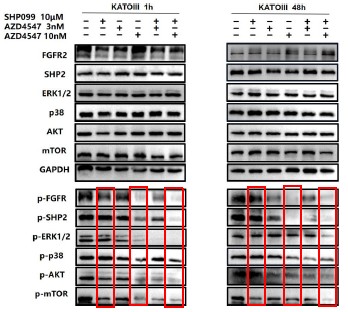
      Author response image 2.
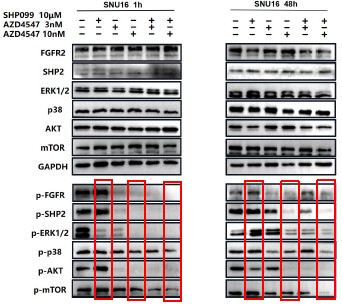
      We also circled 10μM SHP099, 3nM AZD4547 and 3nM AZD4547+10 μm SHP099 in blue.

      Author response image 3.
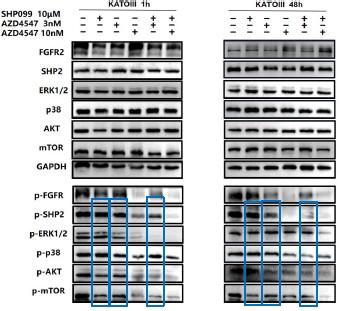
      Author response image 4.
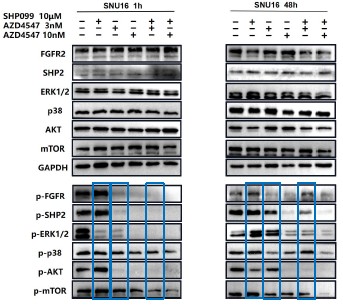
      For ease of comparison, we also conducted grayscale value analysis and normalization using image J.

      Author response image 5.
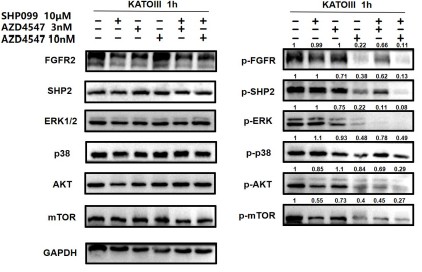
      Author response image 6.
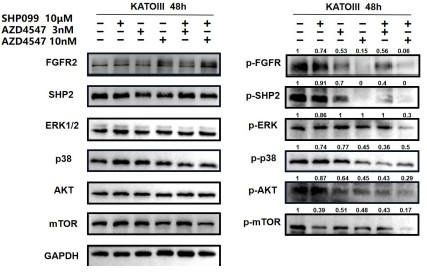
      Author response image 7.
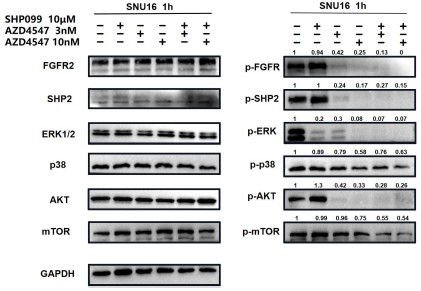
      Author response image 8.
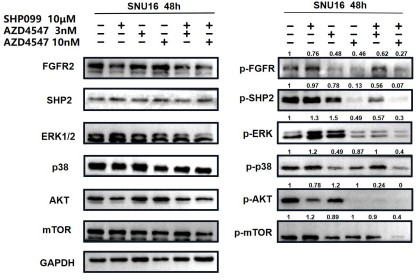
      In Fig. 3g, the combination therapy exhibited relatively stronger inhibitory effects on phospho-ERK, phospho-AKT and phospho-mTOR.

      For ease of comparison, we conducted grayscale value analysis and normalization using image J.

      The unclear effect of combination therapy may be due to the presence of impurities other than tumor cells in patient’s ascites.

      Author response image 9.
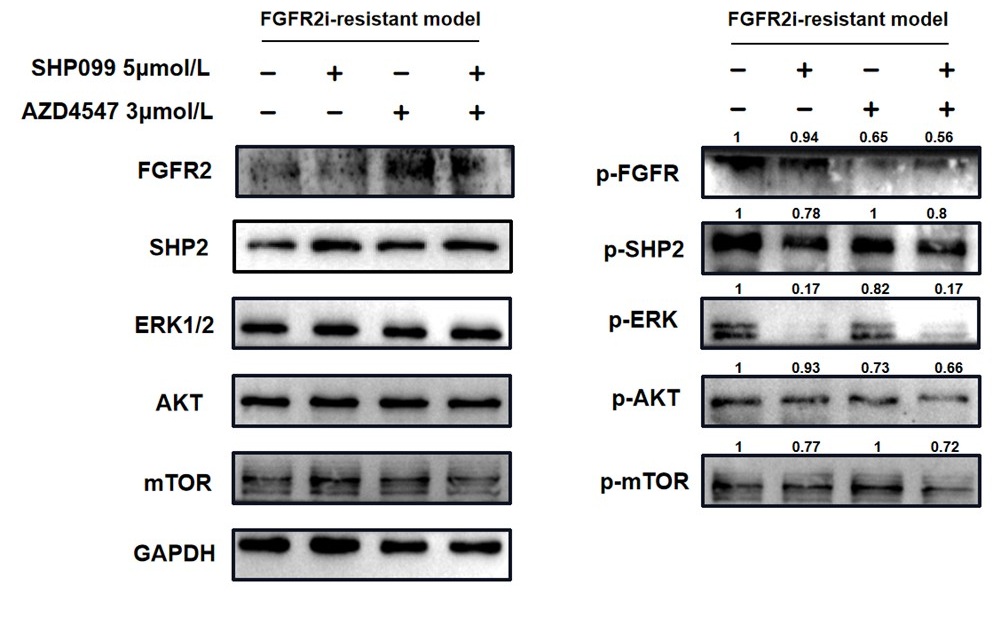
      In Fig. 4f, it was obvious that phospho-AKT and phospho-mTOR were further suppressed in combination group.

      For ease of comparison, we conducted grayscale value analysis and normalization using image J.

      Author response image 10.
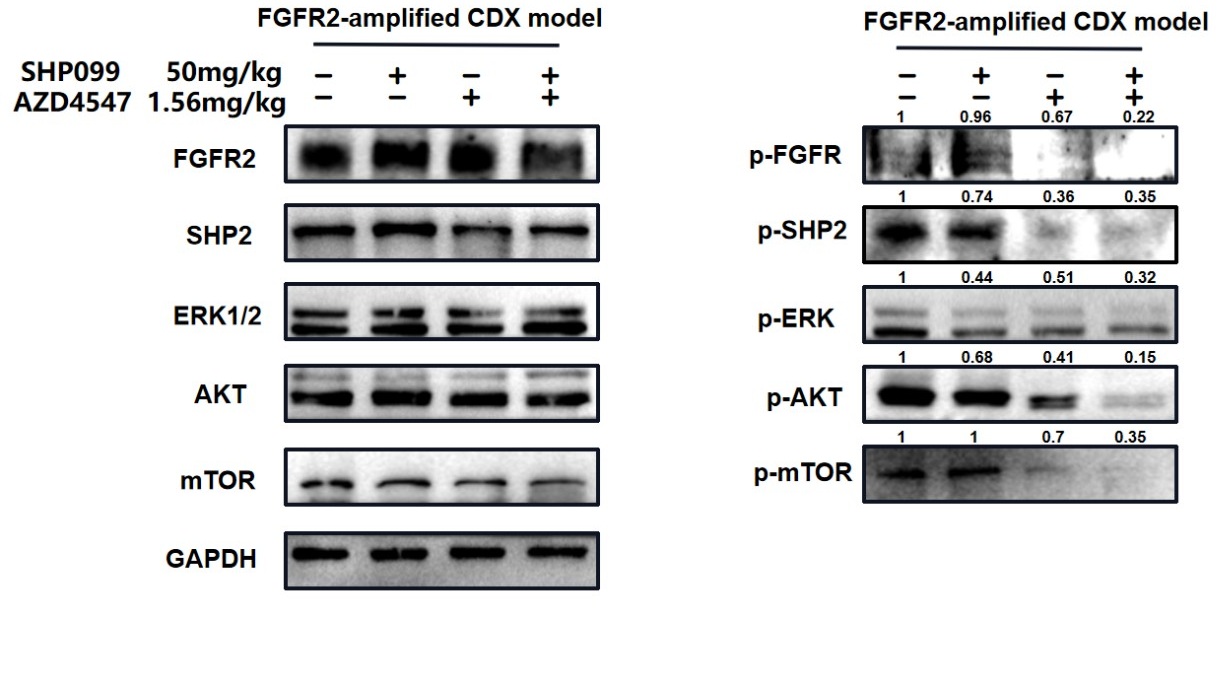
      Therefore, in our opinions, our data could relatively sufficiently confirm the synergetic effects of AZD4547 and SHP099.

      Data in Fig. 5 is weak and can be removed. It is unclear why FGFR inhibitor has some activities toward t cells since t cells do not express FGFR.

      The activation effect of SHP099 on T cells has been validated in many articles. In a previous study published in Cancer Immunology Research, it was pointed out that the combination of FGFR2 inhibitor erdafitinib and PD-1 antibody can activate T cells and downregulate T cell surface exhaustion related factors (including PD-1) in vivo Therefore, the anti-tumor immune effect of FGFR2 inhibitor cannot be ignored. Although T cells do not express FGFR, FGFR2 inhibitors may still affect PD-1 expression on the surface of T cells in some other ways, which requires further research. We have deleted fig.5D in our article. We believe that the combination of FGFR2 inhibitor and SHP2 inhibitor not only has a direct killing effect on tumor cells, but also promotes anti-tumor immunity by activating T cells. Therefore, we believe that the in vitro data in Figure 5 is also meaningful.

      Reviewer #2 (Public review):

      Strengths:

      The data is generally well presented and the study invokes a novel patient data set which could have wider value. The study provides additional evidence to support the combined therapeutic approach of RTK and phosphatase inhibition.

      We sincerely thank the reviewer for the critical evaluation and appreciation of our findings.

      Weaknesses:

      Combined therapy approaches targeting RTKs and SHP2 have been widely reported. Indeed, SHP099 in combination with FGFR inhibitors has been shown to overcome adaptive resistance in FGFR-driven cancers. Furthermore, the inhibition of SHP2 has been documented to have important implications in both targeting proliferative signalling as well as immune response. Thus, it is difficult to see novelty or a significant scientific advance in this manuscript. Although the data is generally well presented, there is inconsistency in the interpretation of the experimental outcomes from ex vivo, patient and mouse systems investigated. In addition, the study provides only minor or circumstantial understanding of the dual mechanism.

      We acknowledge that our research on the mechanism of dual inhibition is not deep enough. There remain more in-depth mechanisms of the combination of SHP2 inhibitor and RTK inhibitors needed to be explored, and it would be the main direction of our future study.

      Using data from a 161 patient cohort FGFR2 was identified as displaying amplification of FGFR2 in ~6% with concomitant elevation of mRNA of patients which correlated with PTPN11 (SHP2) mRNA expression. The broader context of this data is of value and could add a different patient demographic to other data on gastric cancer. However, there is no detail on patient stratification or prior therapeutic intervention.

      Thanks for pointing this out and we have added a table on patients’ stratification such as age, gender and so on. Unfortunately, data on patients’ prior therapeutic intervention weren’t collected.

      In SNU16 and KATOIII cells the combined therapy is shown to be effective and appears to be correlated with increased apoptotic effects (i.e. not immune response).

      Fig 2E suggests that the combined therapy in SNU16 cells is a little better than FGFR2-directed AZD457 inhibitor alone, particularly at the higher dose.

      The individual patient case study described via Fig 3 suggests efficacy of the combined therapy (at very high dosage), however, the cell biopsies only show reduced phosphorylation of ERK, but not AKT. This is at odds with the ex vivo cell-based assays. Thus, it is not clear how relevant this study is.

      The mouse xenograft study shows a convincing reduction in tumor mass/volume and clear reduction in pAKT, whilst pERK remains largely unaffected by the combined therapeutic approach. This is in conflict with the previous data which seems to show the opposite effect. In all, the impact of the dual therapy is unclear with respect to the two pathways mediated by ERK and AKT.

      Thank you for the comment. Previous researches have confirmed that both RAS/ERK and PI3K/AKT pathways are two important downstream signaling of FGFR2. In Fig 2E and F, we observed that in FGFR2-amplified cell lines dual blockade had significant inhibitory effects both on p-ERK and p-AKT, and the inhibitory effect on p-ERK is greater than that on p-AKT. Similarly, in Fig 3G, dual blockade mainly suppressed p-ERK, and slightly inhibited p-AKT and p-mTOR in cancer cells derived from the individual patient. Thus, in the two types in-vitro models, dual inhibition simultaneously inhibited both RAS/ERK and PI3K/AKT pathways, and primarily inhibited RAS/ERK pathway, which is not contradictory.

      Author response image 11.
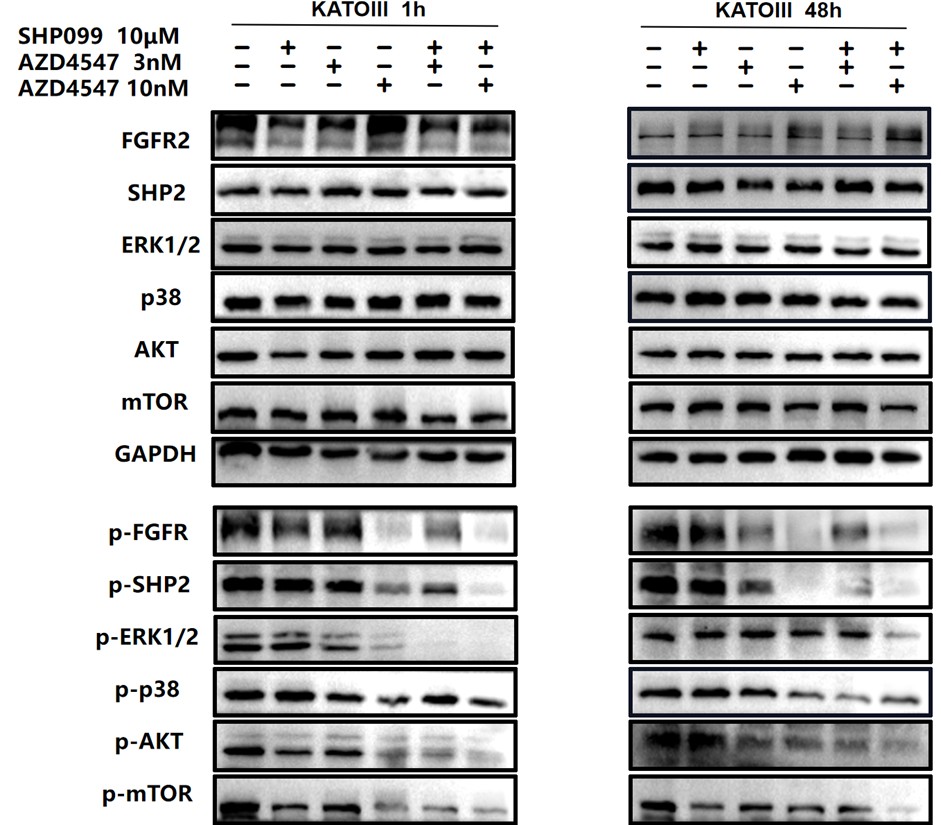
      Author response image 12.
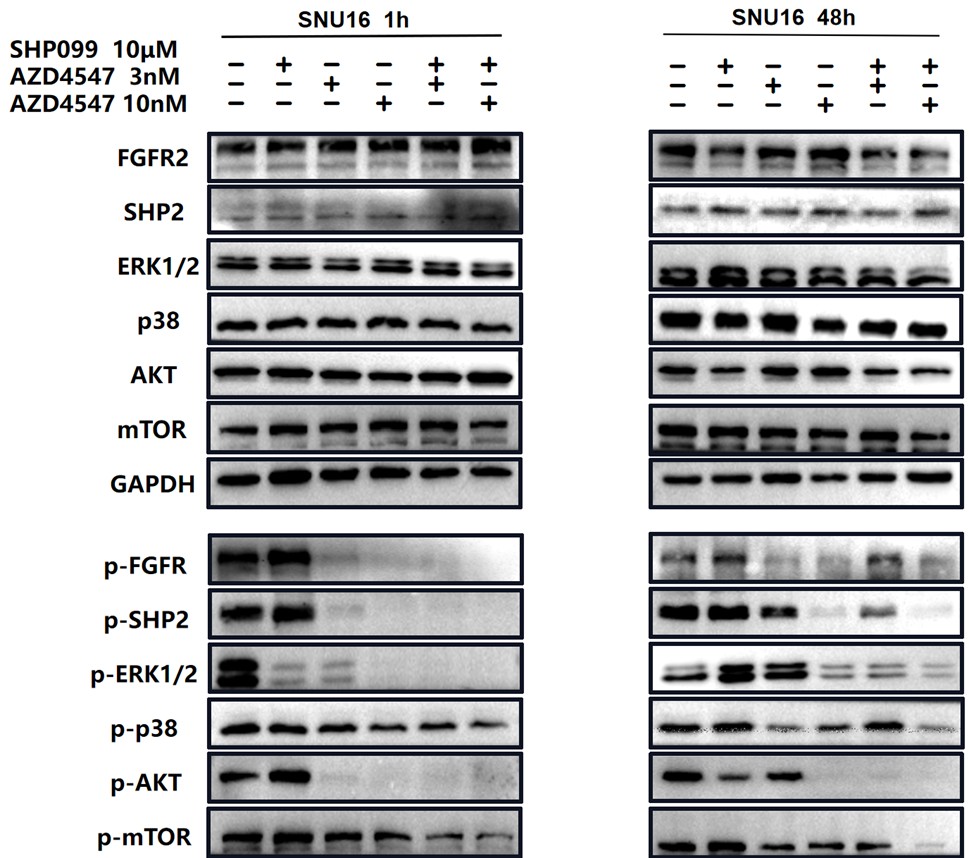
      Author response image 13.
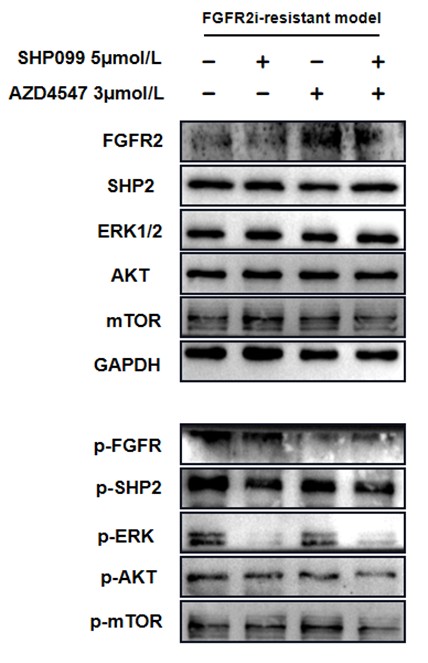
      For the in-vivo animal model. Although dual inhibition had inhibitory effects on both pathways, it mainly suppressed p-AKT.

      In both in vivo and in vitro models, combination therapy has a certain inhibitory effect on the RAS/ERK and PI3K/AKT pathways, but the emphasis on the two is not the same in vivo and in vitro. Considering the significant differences between in vivo and in vitro models, we believe that this difference in emphasis is understandable.

      Author response image 14.
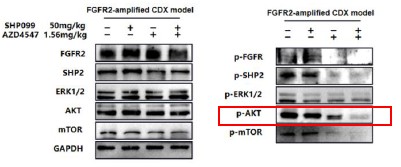
      Finally, the authors demonstrate the impact of SHP2 on PD-1 expression and propose that the SHP099/AZD4547 combination therapy significantly induces the production of IFN-γ in CD8+ T cells. This part of the study is unconvincing and would benefit from the investigation of the tumor micro-environment to assess T cell infiltration.

      To investigate the tumor micro-environment to assess T cell infiltration, we have to establish our research model in immunocompetent mice. However, there is currently only one type of gastric cancer cell line derived from mice, MFC, which is not a cell line with FGFR2 amplification. We attempted to transfect FGFR2 amplification plasmids into MFC, but the transfection effect was poor, making it difficult to conduct in vivo animal experiments.

      Reviewer #3 (Public review):

      Strengths:

      The authors demonstrate that FGFR2 amplification positively correlates with PTPN11 in human gastric cancer samples, providing rationale for combination therapies. Furthermore, convincing data are provided demonstrating that targeting both FGFR and SHP2 is more effective than targeting either pathway alone using in vitro and in vivo models. The use of cells derived from a gastric cancer patient that progressed following treatment with an FGFR inhibitor is also a strength. The findings from this study support the conclusion that SHP2 inhibitors enhance the efficacy of FGFR-targeted therapies in cancer patients. This study also suggests that targeting SHP2 may also be an effective strategy for targeting cancers that are resistant to FGFR-targeted therapies.

      Weaknesses:

      The main caveat with these studies is the lack of an immune competent model with which to test the finding that this combination therapy enhances T cell cytotoxicity in vivo. Discussing this limitation within the context of these findings and future directions for this work, particularly since the combination therapy appears to work quite well without the presence of T cells in the environment, would be beneficial.

      Thank you for the great suggestion. To investigate the tumor micro-environment to assess T cell infiltration, we have to establish our research model in immunocompetent mice. However, there is currently only one type of gastric cancer cell line derived from mice, MFC, which is not a cell line with FGFR2 amplification. We attempted to transfect FGFR2 amplification plasmids into MFC, but the transfection effect was poor, making it difficult to conduct in vivo animal experiments.

      Recommendations for the authors:

      Reviewer #1 (Recommendations for the authors):

      Minor points. The manuscript is poorly written and loaded with language errors.

      We sincerely thank you for your constructive suggestion and we are sorry for the mistake. We have polished the article and corrected these language errors.

      Reviewer #2 (Recommendations for the authors):

      In addition to the comments made in the Public Review the manuscript lacks detail on statistical analysis of experimental results.

      Thank you for your advice. In response to the feedback, we have supplemented detail on statistical analysis of experimental results in the “Methods” part.

      Reviewer #3 (Recommendations for the authors):

      There are numerous grammatical errors throughout, and incorrect wording is used in some places (such as "syngeneic mouse tumor model" rather than "xenograft tumor model", line 253). Careful proofreading and editing of this manuscript is recommended.

      Thank you for your suggestion. We have made corrections to the relevant content of the article.

      AZD4547 is an FGFR-selective inhibitor and is not specific for FGFR2 as it also targets FGFR1 and FGFR3, this should be clarified in the text.

      Thank you for rasing this point. We have clarified that AZD4547 is an FGFR-selective inhibitor targeting FGFR1-3 in the “Introduction” part.

      The specific FGFR inhibitor(s) used to treat the patient with FGFR2 amplification, are the authors able to provide this information?

      Thank you for raising this important issue. Indeed, due to the difficulty of small molecule drug development, the fastest clinical progress currently is in FGFR pan inhibitors. Recently, Relay Therapeutics has also developed a highly FGFR2-selective inhibitor, RLY-4008, in phase I/II clinical trials, but lacks preclinical research on gastric cancer.

      Figure 2F: the p38 and p-p38 bands are cut off at the bottom

      We sincerely thank you for your thoughtful feedback. we have improved our experimental methods and retested the two p38 and p-p38 in Figure 2F by western blotting.

      Author response image 15.
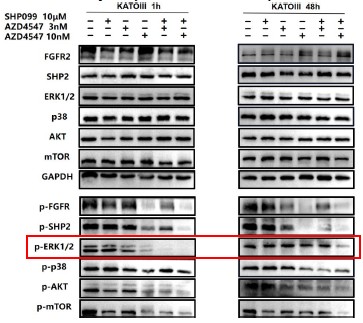
    1. IDH1 R132H and ATRX KO have similar levels of PARP inhibitor sensitivity.

      [Paragraph-level] PMCID: PMC8203843 Section: ABSTRACT PassageIndex: 4

      Evidence Type(s): Predictive

      Justification: Predictive: The passage indicates that IDH1 R132H is associated with sensitivity to PARP inhibitors, which correlates the variant with a specific therapy response.

      Gene→Variant (gene-first): 3417:R132H

      Genes: 3417

      Variants: R132H

    1. FLT3 mutations are the most frequently identified genetic alterations in acute myeloid leukemia (AML) and are associated with poor prognosis. Multiple FLT3 inhibitors are in various stages of clinical evaluation. However

      [Paragraph-level] PMCID: PMC8255005 Section: ABSTRACT PassageIndex: 1

      Evidence Type(s): Predictive, Oncogenic

      Justification: Predictive: The passage discusses the resistance of FLT3 mutations, specifically F691L, to FLT3 inhibitors and highlights the efficacy of KX2-391 in overcoming this resistance, indicating a correlation with treatment response. Oncogenic: The FLT3 mutations, including D835 and F691, are described as contributing to tumor development and progression in acute myeloid leukemia (AML), which supports their classification as oncogenic variants.

      Gene→Variant (gene-first): 2322:D835 2322:D835Y 2322:F691 2322:F691L

      Genes: 2322

      Variants: D835 D835Y F691 F691L

    1. To get a deeper insight into the molecular characteristics of this group, we analyzed next-generation sequencing results from 17 cases. Seven cases were analyzed using the Heidelberg 130 gene panel, six cases were sequen

      [Paragraph-level] PMCID: PMC7785563 Section: RESULTS PassageIndex: 12

      Evidence Type(s): Diagnostic, Oncogenic

      Justification: Diagnostic: The passage indicates that 90% of the cases harbored IDH1-R132H mutations, which are associated with conventional supratentorial IDH-mutant astrocytomas, suggesting a role in defining or classifying the disease. Oncogenic: The presence of IDH1-R132H mutations in the tumors suggests that this somatic variant contributes to tumor development or progression, as it is commonly found in a specific type of cancer.

      Gene→Variant (gene-first): 3417:R132H

      Genes: 3417

      Variants: R132H

    1. In metastatic breast cancer, HER2 activating mutations frequently co-occur with mutations in the PIK3CA, TP53, or E-cadherin genes. Of these co-occurring mutations, HER2 and PIK3CA mutations are the most prevalent gene p

      [Paragraph-level] PMCID: PMC10527017 Section: ABSTRACT PassageIndex: 1

      Evidence Type(s): Predictive, Oncogenic

      Justification: Predictive: The passage discusses the resistance of HP breast cancers to the pan-HER tyrosine kinase inhibitor, neratinib, and the effectiveness of combining neratinib with trastuzumab deruxtecan and CDK4/6 inhibitors, indicating a correlation with treatment response. Oncogenic: The study involves genetically engineered mice with the HER2V777L mutation, showing accelerated tumor formation and increased invasion, which supports the notion that this somatic variant contributes to tumor development and progression.

      Gene→Variant (gene-first): 2064:V777L

      Genes: 2064

      Variants: V777L

    1. ALK-break positive non-small cell lung cancer (NSCLC) patients initially respond to crizotinib, but resistance occurs inevitably. In this study we aimed to identify fusion genes in crizotinib resistant tumor samples. Re-

      [Paragraph-level] PMCID: PMC4821611 Section: ABSTRACT PassageIndex: 1

      Evidence Type(s): Predictive, Oncogenic

      Justification: Predictive: The passage discusses ALK mutations (p.C1156Y and p.G1269A) in the context of crizotinib resistance, indicating a correlation between these variants and resistance to the therapy. Oncogenic: The ALK mutations are described as being detected in post-treatment tumor samples, suggesting their contribution to tumor development or progression in the context of crizotinib resistance.

      Gene→Variant (gene-first): 238:p.C1156Y 238:p.G1269A

      Genes: 238

      Variants: p.C1156Y p.G1269A

    2. Mutations in ALK, EGFR and KRAS have been reported to confer resistance against crizotinib. To determine presence of mutations in these genes in the three post-treatment samples, we inspected the RNA-seq bam files in IGV

      [Paragraph-level] PMCID: PMC4821611 Section: RESULTS PassageIndex: 10

      Evidence Type(s): Predictive, Oncogenic

      Justification: Predictive: The passage discusses mutations in the ALK gene, specifically p.C1156Y and p.G1269A, which have been reported to confer resistance against crizotinib, indicating a correlation with treatment response. Oncogenic: The presence of mutations in the ALK gene, such as p.C1156Y and p.G1269A, suggests that these somatic variants contribute to tumor development or progression, as they were identified in post-treatment tumor samples.

      Gene→Variant (gene-first): 238:c.3467G>A 238:c.3806G>C 238:p.C1156Y 238:p.G1269A

      Genes: 238

      Variants: c.3467G>A c.3806G>C p.C1156Y p.G1269A

    1. In TERT-NHUC, abolishing PLCgamma1 phosphorylation significantly reduced the increase in saturation density associated with S249C FGFR3 (13% vs. 24%, p=0.05) (Figure 6a), suggesting that PLCgamma1 signaling contributes t

      [Paragraph-level] PMCID: PMC2789045 Section: RESULTS PassageIndex: 23

      Evidence Type(s): Functional, Oncogenic

      Justification: Functional: The passage discusses how the S249C and K652E mutations affect cell viability and signaling pathways, indicating that these variants alter molecular or biochemical functions related to cell growth and density. Oncogenic: The evidence suggests that the S249C and K652E mutations contribute to tumor development or progression by affecting cell cycle phases and viability, which are indicative of cancer-driving behavior.

      Gene→Variant (gene-first): 2261:K652E 2261:S249C 2261:Y762F

      Genes: 2261

      Variants: K652E S249C Y762F

    2. To clarify whether the lack of constitutive PLCgamma1 phosphorylation may explain the different phenotypic behavior associated with the K652E mutation, we used a construct encoding a S249C FGFR3 protein with a mutated PL

      [Paragraph-level] PMCID: PMC2789045 Section: RESULTS PassageIndex: 22

      Evidence Type(s): Oncogenic, Functional

      Justification: Oncogenic: The passage discusses the S249C+Y762F FGFR3 mutant protein's ability to induce morphological transformation and increased proliferation in NIH-3T3 cells, indicating its role in tumor development or progression. Functional: The passage describes how the S249C+Y762F mutation affects the phosphorylation of PLCgamma1 and alters the activation of downstream signaling pathways, demonstrating a change in molecular function.

      Gene→Variant (gene-first): 2261:K652E 2261:S249C 2261:Y762F

      Genes: 2261

      Variants: K652E S249C Y762F

    3. As expected, FGF1 induced phosphorylation of FRS2alpha, ERK1/2 and PLCgamma1 in normal urothelial cells over-expressing wildtype FGFR3 (Figure 4b). Consistent with their complete ligand-independence, FGF1 treatment faile

      [Paragraph-level] PMCID: PMC2789045 Section: RESULTS PassageIndex: 20

      Evidence Type(s): Functional, Oncogenic

      Justification: Functional: The passage discusses how the K652E, S249C, and Y375C mutations alter the signaling response to FGF1 treatment, indicating that these variants affect molecular function related to phosphorylation and activation of signaling pathways. Oncogenic: The context of the mutations being discussed in relation to their effects on signaling pathways suggests that they may contribute to tumor development or progression, particularly given the focus on their responses in cancer-related cellular contexts.

      Gene→Variant (gene-first): 2261:K652E 2261:S249C 2261:Y375C

      Genes: 2261

      Variants: K652E S249C Y375C

    4. We next examined whether cells expressing wildtype and mutant FGFR3 were responsive to FGF1 stimulation in terms of receptor activation (Figure 4a, Supplementary Figure 5) and signaling (Figure 4b, Supplementary Figure 5

      [Paragraph-level] PMCID: PMC2789045 Section: RESULTS PassageIndex: 19

      Evidence Type(s): Predictive, Functional

      Justification: Predictive: The passage discusses the response of cells expressing mutant FGFR3 variants (S249C, Y375C, K652E) to FGF1 stimulation, indicating a correlation with receptor activation and signaling, which relates to treatment response. Functional: The passage describes how the variants S249C, Y375C, and K652E affect the phosphorylation of FGFR3, indicating that these mutations alter the molecular function of the receptor in response to ligand stimulation.

      Gene→Variant (gene-first): 2261:K652E 2261:S249C 2261:Y375C

      Genes: 2261

      Variants: K652E S249C Y375C

    5. Signaling was examined in cells at various degrees of confluence, in full and depleted medium (Figure 3c, Supplementary Figure 4b). In all conditions tested, no differences were observed between mutant and control cells

      [Paragraph-level] PMCID: PMC2789045 Section: RESULTS PassageIndex: 16

      Evidence Type(s): Functional, Oncogenic

      Justification: Functional: The passage discusses the increased phosphorylation of PLCgamma1 specifically in cells expressing the S249C and Y375C FGFR3 variants, indicating that these variants alter molecular function. Oncogenic: The mention of increased phosphorylation of signaling proteins in cells expressing the FGFR3 mutants suggests that these variants contribute to tumor development or progression.

      Gene→Variant (gene-first): 2261:K652E 2261:S249C 2261:Y375C

      Genes: 2261

      Variants: K652E S249C Y375C

    6. To investigate the reason for the differential behavior of cells expressing K652E FGFR3, we assessed the phosphorylation levels of FGFR3 mutant proteins and downstream effectors in urothelial cells. All mutant forms of F

      [Paragraph-level] PMCID: PMC2789045 Section: RESULTS PassageIndex: 15

      Evidence Type(s): Functional, Oncogenic

      Justification: Functional: The passage discusses how the K652E, S249C, and Y375C variants of FGFR3 alter phosphorylation levels and dimerization behavior, indicating changes in molecular function. Oncogenic: The variants are described in the context of their constitutive activation and behavior in urothelial cells, suggesting their role in tumor development or progression.

      Gene→Variant (gene-first): 2261:K652E 2261:S249C 2261:Y375C

      Genes: 2261

      Variants: K652E S249C Y375C

    7. Three proteins involved in cell survival, MCL1, BCL-XL, and BCL2, were up-regulated in confluent cells expressing all types of mutant FGFR3 (Figure 2d, Supplementary Figure 3b). Surprisingly, there was no difference in t

      [Paragraph-level] PMCID: PMC2789045 Section: RESULTS PassageIndex: 13

      Evidence Type(s): Functional, Oncogenic

      Justification: Functional: The passage discusses the expression of proteins involved in cell survival and suggests that the K652E variant may alter the viability of cells, indicating a change in molecular function. Oncogenic: The context implies that the K652E variant contributes to tumor behavior by affecting cell viability, which is a characteristic of oncogenic variants.

      Gene→Variant (gene-first): 2261:K652E

      Genes: 2261

      Variants: K652E

    8. Consistent with their altered cell cycle profile, confluent TERT-NHUC expressing mutant FGFR3 exhibited changes in cell cycle-related proteins (Figure 2d, Supplementary Figure 3a). Whilst in control cells the expression

      [Paragraph-level] PMCID: PMC2789045 Section: RESULTS PassageIndex: 12

      Evidence Type(s): Functional

      Justification: Functional: The passage discusses how the variants S249C, Y375C, and K652E FGFR3 alter the expression and phosphorylation of cell cycle-related proteins, indicating a change in molecular function.

      Gene→Variant (gene-first): 2261:K652E 2261:S249C 2261:Y375C

      Genes: 2261

      Variants: K652E S249C Y375C

    9. Cells expressing S249C and Y375C FGFR3 were significantly more viable at confluence compared to controls or cells expressing wildtype FGFR3 (p<=0.001). On days 12 (Figure 2c) and 15 (data not shown), on average 45% of S2

      [Paragraph-level] PMCID: PMC2789045 Section: RESULTS PassageIndex: 10

      Evidence Type(s): Functional, Oncogenic

      Justification: Functional: The passage discusses the viability of cells expressing specific variants (S249C and Y375C) compared to controls, indicating that these variants alter the molecular or biochemical function of FGFR3, affecting cell viability. Oncogenic: The evidence suggests that the variants S249C and Y375C contribute to tumor development or progression by enhancing cell viability, which is a characteristic of oncogenic behavior.

      Gene→Variant (gene-first): 2261:K652E 2261:S249C 2261:Y375C

      Genes: 2261

      Variants: K652E S249C Y375C

    10. In controls, the number of cells in the G0/G1 phase of the cell cycle progressively increased at confluence, while the number of viable cells decreased. No significant differences in cell cycle profile or viability were

      [Paragraph-level] PMCID: PMC2789045 Section: RESULTS PassageIndex: 9

      Evidence Type(s): Functional

      Justification: Functional: The mention of K652E and Y375C variants also suggests alterations in cell cycle profiles, indicating a change in molecular function related to cell cycle dynamics.

      Gene→Variant (gene-first): 2261:K652E 2261:S249C 2261:Y375C

      Genes: 2261

      Variants: K652E S249C Y375C

    11. The saturation density of cells expressing K652E FGFR3 was similar to controls and cells expressing wildtype FGFR3 or S249C KD. Therefore, the magnitude of the phenotypic effect was of the order S249C>Y375C>K652E=Wildtyp

      [Paragraph-level] PMCID: PMC2789045 Section: RESULTS PassageIndex: 6

      Evidence Type(s): Diagnostic, Functional

      Justification: Diagnostic: The passage discusses the relative frequencies of the mutations K652E, S249C, and Y375C in bladder tumors, indicating an association with the disease. Functional: The passage mentions the phenotypic effects of the variants, suggesting that they alter the behavior of cells expressing these mutations compared to controls.

      Gene→Variant (gene-first): 2261:K652E 2261:S249C 2261:Y375C

      Genes: 2261

      Variants: K652E S249C Y375C

    12. Next we studied the effects of mutant FGFR3 in normal urothelial cells by expressing S249C, Y375C and K652E FGFR3 in TERT-NHUC. Expression levels were comparable to those observed in the bladder cancer cell line TCC97-7,

      [Paragraph-level] PMCID: PMC2789045 Section: RESULTS PassageIndex: 5

      Evidence Type(s): Functional, Oncogenic

      Justification: Functional: The passage discusses how the expression of mutant FGFR3 variants S249C and Y375C alters the saturation density and morphology of normal urothelial cells, indicating a change in molecular or biochemical function. Oncogenic: The expression of the mutant FGFR3 variants is associated with changes in cell behavior, such as increased saturation density and altered morphology, which suggests a contribution to tumor development or progression.

      Gene→Variant (gene-first): 2261:K652E 2261:S249C 2261:Y375C

      Genes: 2261

      Variants: K652E S249C Y375C

    13. Initially, we assessed the ability of three mutant forms of FGFR3 that are found in UC (S249C, Y375C, and K652E) to transform NIH-3T3 cells. In these cells, expression of all FGFR3 mutations resulted in a transformed spi

      [Paragraph-level] PMCID: PMC2789045 Section: RESULTS PassageIndex: 3

      Evidence Type(s): Oncogenic, Functional

      Justification: Oncogenic: The passage discusses the ability of the FGFR3 mutations (S249C, Y375C, and K652E) to transform NIH-3T3 cells, indicating that these somatic variants contribute to tumor development or progression. Functional: The passage describes how the FGFR3 mutations alter molecular function, specifically through increased phosphorylation of various proteins and changes in cell morphology and proliferation, demonstrating their biochemical activity.

      Gene→Variant (gene-first): 2261:K652E 2261:S249C 2261:Y375C

      Genes: 2261

      Variants: K652E S249C Y375C

    1. The 14 NF1-associated gliomas belonging to the molecular high-grade group did not form a distinct epigenomic cluster but instead aligned with other sporadic reference entities, most frequently high-grade astrocytoma with

      [Paragraph-level] PMCID: PMC9468105 Section: RESULTS PassageIndex: 14

      Evidence Type(s): Diagnostic, Prognostic

      Justification: Diagnostic: The passage discusses the association of the BRAF p.V600E mutation with pleomorphic xanthoastrocytoma, indicating its role in defining or classifying this specific tumor type. Prognostic: The Kaplan-Meier survival analysis mentioned in the passage indicates that patients with NF1-associated gliomas have inferior outcomes, suggesting a correlation between the presence of certain mutations and disease prognosis.

      Gene→Variant (gene-first): 673:p.V600E

      Genes: 673

      Variants: p.V600E

    2. Consistent with an autosomal dominant tumor predisposition syndrome, these gliomas arising in the setting of NF1 developed in patients with a heterozygous germline mutation or deletion involving one of two NF1 alleles (a

      [Paragraph-level] PMCID: PMC9468105 Section: RESULTS PassageIndex: 4

      Evidence Type(s): Predisposing, Oncogenic

      Justification: Predisposing: The passage describes a germline mutation (p.R1276*) associated with an autosomal dominant tumor predisposition syndrome, indicating inherited risk for developing gliomas. Oncogenic: The passage discusses the somatic inactivation of the remaining wild-type NF1 allele, which contributes to tumor development in gliomas, indicating that the variant plays a role in oncogenesis.

      Gene→Variant (gene-first): 4763:c.4110 + 2 T > G 4763:p.R1276*

      Genes: 4763

      Variants: c.4110 + 2 T > G p.R1276*

    1. Colorectal cancer (CRC) manifests after the accumulation of genetic and epigenetic alterations along with tumor microenvironments. MicroRNA (miRNA/miR) molecules have been revealed to serve in critical roles in the progr

      [Paragraph-level] PMCID: PMC7068240 Section: ABSTRACT PassageIndex: 1

      Evidence Type(s): Prognostic, Diagnostic

      Justification: Prognostic: The passage discusses the association of high miR-31 expression with poorer mortality and shorter median survival time in patients with advanced colorectal cancer, indicating a prognostic relationship. Diagnostic: The study evaluates the potential of miRNAs as biomarkers for colorectal cancer, suggesting that the presence of the BRAF V600E mutation can be used to classify tumors based on miR-31 expression levels.

      Gene→Variant (gene-first): 673:V600E 673:serine/threonine

      Genes: 673

      Variants: V600E serine/threonine

    1. SF3B1 mutation is considered a founder clone, however we observed 2 patients in which the mutation arose during disease evolution. The first patient was a 74-year-old man who was diagnosed with MDS-EB with trisomy 8 and

      [Paragraph-level] PMCID: PMC10015977 Section: RESULTS PassageIndex: 24

      Evidence Type(s): Oncogenic, Functional

      Justification: Oncogenic: The passage discusses the acquisition of the SF3B1 R625C, K700E, and SETBP1 E862K mutations during disease evolution, indicating their role in tumor development and progression in the context of MDS-EB transforming to AML. Functional: The mention of the SF3B1 mutations leading to changes in bone marrow morphology, such as the appearance of ring sideroblasts, suggests that these variants alter molecular or biochemical function related to the disease.

      Gene→Variant (gene-first): 26040:E862K 23451:K700E 23451:R625C

      Genes: 26040 23451

      Variants: E862K K700E R625C

    2. Within the entire MDS cohort, by univariate analysis (Supplementary Table 2), the following parameters were associated with worse outcomes: higher BM blasts percentage; lower hemoglobin, platelet and MCV; prior history o

      [Paragraph-level] PMCID: PMC10015977 Section: RESULTS PassageIndex: 21

      Evidence Type(s): Prognostic

      Justification: Prognostic: The passage discusses the absence of the SF3B1 K700E mutation as an independent predictor of worse overall survival (OS), indicating a correlation between the variant and disease outcome.

      Gene→Variant (gene-first): 23451:K700E

      Genes: 23451

      Variants: K700E

    3. As a next step, among low-grade MDS (<5% BM blasts and <1% PB blasts) with therapy-related cases excluded, we explored to see if the differences persisted between K700E and non-K700E SF3B1mut MDS groups even after applyi

      [Paragraph-level] PMCID: PMC10015977 Section: RESULTS PassageIndex: 20

      Evidence Type(s): Prognostic, Diagnostic

      Justification: Prognostic: The passage indicates that K700E SF3B1mut MDS showed a trend for longer overall survival (OS) compared to non-K700E SF3B1mut MDS, suggesting a correlation with disease outcome independent of therapy. Diagnostic: The passage discusses the classification of K700E SF3B1mut MDS in relation to the proposed 2020 IWG-PM criteria, indicating its use in defining or classifying a disease subtype.

      Gene→Variant (gene-first): 23451:K700E

      Genes: 23451

      Variants: K700E

    4. Therapy-related MDS cases were distributed equally between K700E and non-K700E groups. Within low-grade MDS (MDS-SLD, MDS-MLD and MDS-RS), we excluded therapy-related MDS cases due to a relatively higher representation o

      [Paragraph-level] PMCID: PMC10015977 Section: RESULTS PassageIndex: 19

      Evidence Type(s): Prognostic, Diagnostic

      Justification: Prognostic: The passage indicates that K700E SF3B1mut MDS is associated with significantly better overall survival (OS) compared to SF3B1wt MDS, suggesting a correlation with disease outcome independent of therapy. Diagnostic: The mention of K700E in the context of classifying MDS subtypes (e.g., comparing K700E SF3B1mut MDS to non-K700E SF3B1mut MDS) supports its role in defining or classifying a disease or subtype.

      Gene→Variant (gene-first): 23451:K700E

      Genes: 23451

      Variants: K700E

    5. Between K700E vs. non-K700E SF3B1mut MDS categories, 9 of 39 (23%) K700E SF3B1mut MDS patients died compared to 4 of 55 (7%; p=0.02) non-K700E patients; findings were similar in low-grade MDS patients (16% vs. 3%, p=0.04

      [Paragraph-level] PMCID: PMC10015977 Section: RESULTS PassageIndex: 18

      Evidence Type(s): Prognostic, Diagnostic

      Justification: Prognostic: The passage discusses the overall survival (OS) rates of K700E SF3B1mut MDS patients compared to non-K700E patients, indicating a correlation with disease outcome independent of therapy. Diagnostic: The mention of K700E SF3B1mut MDS patients in relation to non-K700E patients suggests a classification or association with a specific disease subtype.

      Gene→Variant (gene-first): 23451:K700E

      Genes: 23451

      Variants: K700E

    6. Within the MDS-EB categories, compared to SF3B1wt, there were no significant differences in OS of K700E SF3B1mut (median OS, not reached vs. 17 7 month, p=0 355) and non-K700E SF3B1mut (median OS, 20 5 vs. 17 7 months; p

      [Paragraph-level] PMCID: PMC10015977 Section: RESULTS PassageIndex: 17

      Evidence Type(s): Prognostic

      Justification: Prognostic: The passage discusses overall survival (OS) in relation to the K700E variant, indicating that it correlates with disease outcome independent of therapy.

      Gene→Variant (gene-first): 23451:K700E

      Genes: 23451

      Variants: K700E

    7. The majority of patients in all 3 categories were treated with an HMA: 16/17 (94%) K700E mutated patients; 16/19 (84%) non-K700E mutated patients; and 217/277 (78%) SF3B1wt patients. The treatment details are provided in

      [Paragraph-level] PMCID: PMC10015977 Section: RESULTS PassageIndex: 16

      Evidence Type(s): Prognostic, Diagnostic

      Justification: Prognostic: The passage discusses the overall survival (OS) outcomes of K700E SF3B1mut MDS patients compared to SF3B1wt patients, indicating that the K700E variant correlates with better disease outcomes independent of therapy. Diagnostic: The K700E variant is used to classify and differentiate between SF3B1mut and SF3B1wt MDS patients, indicating its role in defining disease subtypes.

      Gene→Variant (gene-first): 23451:K700E

      Genes: 23451

      Variants: K700E

    8. Using rMATS, we identified the five most frequent types of alternative splicing events (alternative 5' splice site, A5SS; alternative 3' splice site, A3SS; mutually exclusive exon, MXE; retained intron, RI and skipped ex

      [Paragraph-level] PMCID: PMC10015977 Section: RESULTS PassageIndex: 14

      Evidence Type(s): Functional, Oncogenic

      Justification: Functional: The passage discusses the impact of the SF3B1 K700E variant on alternative splicing events, indicating that it alters molecular function related to splicing and gene expression. Oncogenic: The SF3B1 K700E variant is associated with mutated myelodysplastic syndromes (MDS), suggesting its role in tumor development or progression.

      Gene→Variant (gene-first): 23451:K700E

      Genes: 23451

      Variants: K700E

    9. There were no significant differences in normal vs. complex karyotype. When cytogenetic aberrations were classified using the comprehensive cytogenetic scoring system (CCSS; scores from 0-5), SF3B1mut K700E mutated patie

      [Paragraph-level] PMCID: PMC10015977 Section: RESULTS PassageIndex: 12

      Evidence Type(s): Diagnostic, Oncogenic

      Justification: Diagnostic: The passage discusses the classification of patients based on the presence of the K700E variant, indicating its association with lower CCSS scores, which suggests a role in defining or classifying a disease subtype. Oncogenic: The mention of the K700E variant in the context of patients with MDS (myelodysplastic syndromes) implies its contribution to tumor development or progression, as it is associated with specific cytogenetic aberrations.

      Gene→Variant (gene-first): 23451:K700E

      Genes: 23451

      Variants: K700E

    10. There was no difference in the median SF3B1 variant allele frequency (VAF) between the 2 groups. The frequency of RUNX1 mutation was significantly higher in non-K700E cases (26% vs. 7 3%, p=0 012), and mutations in BCOR

      [Paragraph-level] PMCID: PMC10015977 Section: RESULTS PassageIndex: 11

      Evidence Type(s): None

      Justification: Not enough information in this passage.

      Gene→Variant (gene-first): 23451:K700E

      Genes: 23451

      Variants: K700E

    11. We compared the clinico-pathologic features of 55 K700E vs. 39 non-K700E treatment naive SF3B1mut MDS patients (Table 2). MDS with SF3B1 K700E mutations had a higher percentage of ring sideroblasts (median 50% vs. 34%; p

      [Paragraph-level] PMCID: PMC10015977 Section: RESULTS PassageIndex: 10

      Evidence Type(s): Diagnostic, Oncogenic

      Justification: Diagnostic: The passage discusses the clinico-pathologic features of MDS patients with K700E mutations, indicating that these mutations are associated with specific disease characteristics and classifications, such as higher percentages of ring sideroblasts and differences in IPSS-R categories. Oncogenic: The K700E mutation in SF3B1 is implicated in the classification of MDS patients and is associated with specific tumor characteristics, suggesting its role in tumor development or progression.

      Gene→Variant (gene-first): 23451:K700E

      Genes: 23451

      Variants: K700E

    12. BM aspirates from all patients underwent NGS analysis with an 81-gene panel at the time of diagnosis. The most frequent SF3B1 mutation, noted in ~60% of all patients, was the hotspot K700E. Among the remaining mutations

      [Paragraph-level] PMCID: PMC10015977 Section: RESULTS PassageIndex: 8

      Evidence Type(s): Diagnostic, Oncogenic

      Justification: Diagnostic: The passage discusses the frequency of specific mutations, including K666, K700E, and R625, in patients with MDS, indicating their association with the disease and their role in defining the mutational landscape. Oncogenic: The mention of SF3B1 mutations, including K700E, K666, and R625, as frequent mutations in patients with MDS suggests that these somatic variants contribute to tumor development or progression in this context.

      Gene→Variant (gene-first): 23451:K666 23451:K700E 23451:R625

      Genes: 23451

      Variants: K666 K700E R625

    13. Mutational landscape of SF3B1mut MDS (K700E and non-K700E subtypes)

      [Paragraph-level] PMCID: PMC10015977 Section: RESULTS PassageIndex: 7

      Evidence Type(s): Diagnostic, Oncogenic

      Justification: Diagnostic: The passage discusses the mutational landscape of SF3B1 mutations, specifically mentioning the K700E subtype, which indicates its role in classifying or defining a disease subtype. Oncogenic: The mention of K700E in the context of SF3B1 mutations suggests its contribution to tumor development or progression, as it is associated with a specific subtype of myelodysplastic syndromes (MDS).

      Gene→Variant (gene-first): 23451:K700E

      Genes: 23451

      Variants: K700E

    14. Myelodysplastic syndromes with SF3B1 mutations are regarded to have a favorable prognosis by both WHO and the International Working Group for Prognostication of MDS (IWG-PM). However, in this article, we show that only M

      [Paragraph-level] PMCID: PMC10015977 Section: ABSTRACT PassageIndex: 12

      Evidence Type(s): Diagnostic, Prognostic

      Justification: Diagnostic: The passage discusses how MDS with SF3B1 K700E mutations can be used to refine sub-classification and risk assessment criteria, indicating its role in defining or classifying a disease subtype. Prognostic: The passage states that MDS with SF3B1 K700E mutations is regarded to have a favorable prognosis, which correlates with disease outcome independent of therapy.

      Gene→Variant (gene-first): 23451:K700E

      Genes: 23451

      Variants: K700E

    15. Myelodysplastic syndromes (MDS) with K700E and non-K700E SF3B1 mutations show distinct clinicopathological and genomic characteristics, with only SF3B1 K700E mutated MDS showing a significantly better OS compared to non-

      [Paragraph-level] PMCID: PMC10015977 Section: ABSTRACT PassageIndex: 10

      Evidence Type(s): Prognostic, Diagnostic

      Justification: Prognostic: The passage indicates that SF3B1 K700E mutated MDS shows significantly better overall survival (OS) compared to non-K700E mutations, suggesting a correlation with disease outcome. Diagnostic: The mention of distinct clinicopathological and genomic characteristics associated with K700E and non-K700E SF3B1 mutations implies that the mutation type is used for risk-assessment and classification of MDS.

      Gene→Variant (gene-first): 23451:K700E

      Genes: 23451

      Variants: K700E

    16. Fifty-five (60%) patients carried K700E. Recurrent non-K700E mutations (39, 40%) included R625, H662 and K666. Compared to SF3B1mut-K700E, non-K700E patients had a lower median ANC (1 8 vs. 2 4, p=0 005) and were frequen

      [Paragraph-level] PMCID: PMC10015977 Section: ABSTRACT PassageIndex: 6

      Evidence Type(s): Diagnostic, Prognostic, Oncogenic

      Justification: Diagnostic: The passage discusses the association of K700E and non-K700E mutations with specific patient characteristics and outcomes, indicating their role in classifying patients with MDS. Prognostic: The passage reports on overall survival outcomes associated with SF3B1 mutations, including K700E, indicating that these variants correlate with disease prognosis independent of therapy. Oncogenic: The mention of mutations such as K700E contributing to the classification of MDS and their association with specific patient outcomes suggests a role in tumor development or progression.

      Gene→Variant (gene-first): 23451:K666 23451:K700 23451:K700E 23451:R625

      Genes: 23451

      Variants: K666 K700 K700E R625

    17. We analyzed the clinical-pathologic features and outcomes of a single-institutional series of 94 (19%) SF3B1mut and 415 SF3B1wt treatment-naive MDS patients and explored the differences between K700E and non-K700E.

      [Paragraph-level] PMCID: PMC10015977 Section: ABSTRACT PassageIndex: 4

      Evidence Type(s): Diagnostic, Oncogenic

      Justification: Diagnostic: The passage discusses the analysis of clinical-pathologic features and outcomes in MDS patients, specifically exploring differences between K700E and non-K700E variants, indicating a potential role in classification or association with disease characteristics. Oncogenic: The mention of analyzing the clinical-pathologic features of SF3B1mut patients, including K700E, suggests that this variant may contribute to tumor development or progression in the context of MDS.

      Gene→Variant (gene-first): 23451:K700E

      Genes: 23451

      Variants: K700E

    18. SF3B1 mutations (SF3B1mut) in myelodysplastic syndromes (MDS) frequently involve codon K700E and have a favorable prognosis. The prognostic effect of non-K700E SF3B1mut is uncertain.

      [Paragraph-level] PMCID: PMC10015977 Section: ABSTRACT PassageIndex: 2

      Evidence Type(s): Prognostic, Diagnostic

      Justification: Prognostic: The passage states that SF3B1 mutations, including K700E, have a favorable prognosis in myelodysplastic syndromes, indicating a correlation with disease outcome. Diagnostic: The mention of SF3B1 mutations in the context of myelodysplastic syndromes suggests that these mutations, including K700E, are used to classify or define the disease.

      Gene→Variant (gene-first): 23451:K700E

      Genes: 23451

      Variants: K700E

    1. PTEN expression loss was found in 18 patients (31.6%, Figure 2a). Thirty-nine patients were positive for PTEN expression, in which 17 (29.8%), 14 (24.6%), and 8 (14%) specimens were weak positive, positive and strong pos

      [Paragraph-level] PMCID: PMC3141770 Section: RESULTS PassageIndex: 6

      Evidence Type(s): Oncogenic

      Justification: Oncogenic: The passage indicates that the H1047R mutation is associated with PTEN loss in patients, suggesting that it contributes to tumor development or progression.

      Gene→Variant (gene-first): 5290:H1047R

      Genes: 5290

      Variants: H1047R

    2. The overall incidence of PIK3CA mutations was 12.3% (7 in 57 samples). The majority of mutations occurred at two hotspots, H1047R (7%, 4 samples) at exon 20 encoding the kinase domain (Figure 1a), and E542K (1.8%, 1 samp

      [Paragraph-level] PMCID: PMC3141770 Section: RESULTS PassageIndex: 5

      Evidence Type(s): Diagnostic, Oncogenic

      Justification: Diagnostic: The passage discusses the incidence of PIK3CA mutations and their occurrence in specific samples, indicating their association with the disease. Oncogenic: The mention of PIK3CA mutations, including E542K and H1047R, suggests their role in tumor development, as they are described as mutations found in tumor samples.

      Gene→Variant (gene-first): 5290:E542K 5290:H1047R 5728:T1052A

      Genes: 5290 5728

      Variants: E542K H1047R T1052A

    1. OS of EGFR-TKI treated patients was similar for 1st and 2nd-line EGFR-TKI treatment. Patients not treated with EGFR-TKI had no benefit in OS. Re-biopsies obtained at progression revealed an EGFR-T790M mutation in 73% (n=

      [Paragraph-level] PMCID: PMC5652823 Section: ABSTRACT PassageIndex: 7

      Evidence Type(s): Predictive, Diagnostic

      Justification: Predictive: The passage indicates that patients with the EGFR-T790M mutation responded to the 3rd-generation EGFR-TKI osimertinib, suggesting a correlation between the variant and treatment response. Diagnostic: The EGFR-T790M mutation is mentioned as being revealed in re-biopsies at progression, indicating its role in defining or confirming the presence of a specific disease state in patients treated with EGFR-TKIs.

      Gene→Variant (gene-first): 1956:T790M

      Genes: 1956

      Variants: T790M

    1. BACKGROUND: The BRAF inhibitors vemurafenib and dabrafenib are currently the standard treatment for metastatic melanoma with BRAF V600 mutations. However, given the rarity of noncutaneous melanoma, including acral and mu

      [Paragraph-level] PMCID: PMC5122709 Section: ABSTRACT PassageIndex: 1

      Evidence Type(s): Predictive, Diagnostic

      Justification: Predictive: The passage discusses the effectiveness of BRAF inhibitors in patients with metastatic melanoma harboring BRAF V600 mutations, indicating a correlation with treatment response. Diagnostic: The BRAF V600 mutation is used to define and classify patients with metastatic melanoma, as all patients in the study had BRAFV600E mutations.

      Gene→Variant (gene-first): 673:V600

      Genes: 673

      Variants: V600

    1. Mutations previously correlated with response were detected in five tumours, four with exon 19 deletions and one with an exon 21 missense L858R point mutation. Increased gene copy number was observed in thirteen tumours,

      [Paragraph-level] PMCID: PMC1952070 Section: ABSTRACT PassageIndex: 6

      Evidence Type(s): Predictive, Diagnostic

      Justification: Predictive: The passage discusses mutations, including the L858R point mutation, in the context of their correlation with response to treatment, indicating a predictive relationship. Diagnostic: The mention of the L858R mutation as part of a group of mutations previously correlated with response suggests its role in defining or classifying a disease subtype.

      Gene→Variant (gene-first): 1956:L858R

      Genes: 1956

      Variants: L858R

    1. PIK3CA encodes the p110alpha catalytic subunit of the phosphoinositide-3-kinase heterodimer. Upon activation, PI3K phosphorylates phosphatidylinositol-4,5-bisphosphate (PIP2) at the third position, generating PIP3. PIP3

      [Paragraph-level] PMCID: PMC3542862 Section: RESULTS PassageIndex: 7

      Evidence Type(s): Functional, Oncogenic

      Justification: Functional: The passage discusses how mutations at amino acids p.Glu542 and p.His1047 increase intracellular AKT phosphorylation, indicating an alteration in molecular function related to AKT activation. Oncogenic: The mention of increased AKT phosphorylation due to the H1047R mutation suggests that this somatic variant contributes to tumor development or progression by promoting cellular processes such as survival and proliferation.

      Gene→Variant (gene-first): 5290:H1047R 5290:p.Glu542 5290:p.His1047

      Genes: 5290

      Variants: H1047R p.Glu542 p.His1047

    2. To provide additional evidence for pathogenic PI3K somatic mutations in macrodactyly, exons 2, 10 and 21 were amplified from DNA extracted from the affected tissue of seven additional unrelated macrodactyly patients as w

      [Paragraph-level] PMCID: PMC3542862 Section: RESULTS PassageIndex: 6

      Evidence Type(s): Oncogenic, Functional

      Justification: Oncogenic: The passage discusses somatic mutations in the PIK3CA gene, specifically mentioning that the E542K, H1047R, and H1047L mutations are known gain-of-function mutations frequently mutated in cancer, indicating their contribution to tumor development or progression. Functional: The passage notes that the mutations E542K and H1047 (both H1047R and H1047L) are located in the helical and kinase domains of the PI3K protein, which are known hotspots for somatic gain-of-function mutations, suggesting that these variants alter the molecular function of the protein.

      Gene→Variant (gene-first): 5290:E542K 5290:H1047L 5290:H1047R 5163:R115P 5290:p.Glu542 5290:p.His1047

      Genes: 5290 5163

      Variants: E542K H1047L H1047R R115P p.Glu542 p.His1047

    3. Additional evidence suggested that the R115P mutation in PIK3CA (PI3K) was a likely candidate for macrodactyly. First, somatic activation of AKT, a downstream target of PI3K, was recently described in patients with Prote

      [Paragraph-level] PMCID: PMC3542862 Section: RESULTS PassageIndex: 5

      Evidence Type(s): Diagnostic, Oncogenic

      Justification: Diagnostic: The R115P mutation in PIK3CA is suggested as a likely candidate for macrodactyly, indicating its association with a specific disease. Oncogenic: The R115L mutation is annotated in a database of somatic mutations in cancer, suggesting its contribution to tumor development or progression.

      Gene→Variant (gene-first): 5290:R115L 5163:R115P 5290:p.Arg115

      Genes: 5290 5163

      Variants: R115L R115P p.Arg115

    4. NS sequence variants were excluded as disease candidates by their (a) presence in 28 control samples sequenced by our group using a similar method, (b) presence in the exome sequence of the germline sample and (c) presen

      [Paragraph-level] PMCID: PMC3542862 Section: RESULTS PassageIndex: 4

      Evidence Type(s): Diagnostic, Oncogenic

      Justification: Diagnostic: The passage discusses the presence of the R115P mutation in PIK3CA in lesional tissue but not in blood, indicating its potential role in defining or confirming a disease state. Oncogenic: The R115P mutation in PIK3CA is described as potentially deleterious and is present in lesional tissue, suggesting it contributes to tumor development or progression.

      Gene→Variant (gene-first): 91544:C392G 5163:R115P

      Genes: 91544 5163

      Variants: C392G R115P

    1. Four additional K-Ras mutations (Leu19Phe (1 out of 106 tumours), Lys117Asn (1 out of 106), Ala146Thr (7 out of 106) and Arg164Gln (1 out of 106)) were identified. Lys117Asn and Ala146Thr had phenotypes similar to the ho

      [Paragraph-level] PMCID: PMC2837563 Section: ABSTRACT PassageIndex: 6

      Evidence Type(s): Oncogenic, Functional

      Justification: Oncogenic: The passage discusses K-Ras mutations identified in tumors, indicating that these variants contribute to tumor development or progression, particularly with reference to their phenotypes in the context of cancer. Functional: The passage describes the phenotypic effects of the K-Ras mutations, suggesting that they alter molecular or biochemical function, as evidenced by the comparison of their phenotypes to hotspot mutations and wild-type K-Ras.

      Gene→Variant (gene-first): 3845:Ala146Thr 3845:Arg164Gln 3845:Leu19Phe 3845:Lys117Asn

      Genes: 3845

      Variants: Ala146Thr Arg164Gln Leu19Phe Lys117Asn

    1. We investigated whether the above large-scale patterns characterize all KRAS, HRAS and NRAS hotspot variants, by projecting the amino acid substitutions at G12, G13 and Q61 and observed an overall similar pattern, but wi

      [Paragraph-level] PMCID: PMC8688876 Section: RESULTS PassageIndex: 20

      Evidence Type(s): Functional, Oncogenic

      Justification: Functional: The passage discusses how specific amino acid substitutions at G12, G13, and Q61 alter biochemical properties and mechanisms across RAS proteins, indicating a change in molecular function related to GTP hydrolysis and downstream signaling. Oncogenic: The mention of hotspot variants and their clustering patterns suggests that these somatic variants contribute to tumor development or progression, particularly in the context of their distinct biochemical properties and disease incidence.

      Gene→Variant (gene-first): 3845:G12 3845:G13 3845:Q61

      Genes: 3845

      Variants: G12 G13 Q61

    2. To visualize the relative changes in GAP-mediated hydrolysis and RAF affinity across all 935 RAS family variants, we extended PHATE to 2D and followed a similar procedure as above. 2D PHATE for GAP-mediated hydrolysis (F

      [Paragraph-level] PMCID: PMC8688876 Section: RESULTS PassageIndex: 19

      Evidence Type(s): Functional, Oncogenic

      Justification: Functional: The passage discusses how different KRAS mutations, including G12C/D and G12D, affect downstream activity and enzyme function, as demonstrated by Western blot analyses measuring pERK levels. Oncogenic: The mention of KRAS hotspot variants and their distinct effects on downstream signaling suggests that these somatic mutations contribute to tumor development or progression.

      Gene→Variant (gene-first): 3845:G12 3845:G12C 3845:G12C/D 3845:G12D 3845:G13 3845:Q61

      Genes: 3845

      Variants: G12 G12C G12C/D G12D G13 Q61

    3. Additionally, we predicted relative RAF affinity changes for amino acid substitutions lacking experimental measurements (15 out of 23; Fig. 4B). These include G12S, which we predict has a decreased RAF affinity like othe

      [Paragraph-level] PMCID: PMC8688876 Section: RESULTS PassageIndex: 16

      Evidence Type(s): Functional, Predictive

      Justification: Functional: The passage discusses how specific amino acid substitutions affect RAF affinity, indicating that these variants alter molecular function related to protein interactions. Predictive: The passage predicts changes in RAF affinity for various variants, suggesting a correlation with potential therapeutic responses or resistance based on their affinity levels.

      Gene→Variant (gene-first): 3265:A146V 673:A18D 3265:A59T 3845:G12 3845:G12S 3845:G13C 3265:G13V 3845:K117N 3845:L19F 3845:Q22K 3845:Q61H 3845:Q61P 4893:Q61R 3845:R164Q 22882:T74P

      Genes: 3265 673 3845 4893 22882

      Variants: A146V A18D A59T G12 G12S G13C G13V K117N L19F Q22K Q61H Q61P Q61R R164Q T74P

    4. We investigated how the 23 KRAS variants change RAF affinity by first identifying the computational scores exhibiting strongest associations with this property (Fig. 4), all of which were from 3D structure and emphasize

      [Paragraph-level] PMCID: PMC8688876 Section: RESULTS PassageIndex: 15

      Evidence Type(s): Functional, Oncogenic

      Justification: Functional: The passage discusses how the KRAS variants alter RAF affinity, indicating that these variants affect molecular function, specifically in relation to protein interactions and binding properties. Oncogenic: The context of the variants being associated with RAF affinity suggests a role in tumor development or progression, as RAF is a key component in signaling pathways that drive cancer.

      Gene→Variant (gene-first): 3845:A146T 3265:A146V 673:A18D 3265:A59T 3845:G12C 3845:G12C/D 3845:G12R 3845:G13C/D 3265:G13V 3845:K117N 3845:L19F 3845:Q22K 3845:Q61H/L 3845:Q61P 4893:Q61R 3845:R164Q 22882:T74P 22882:V/A

      Genes: 3845 3265 673 4893 22882

      Variants: A146T A146V A18D A59T G12C G12C/D G12R G13C/D G13V K117N L19F Q22K Q61H/L Q61P Q61R R164Q T74P V/A

    5. In our second approach, we used PHATE dimensionality reduction to score overall similarities among the 935 variants from 7 RAS genes. We performed 1D PHATE (PHATE1) analysis of the 5 computational scores that correlated

      [Paragraph-level] PMCID: PMC8688876 Section: RESULTS PassageIndex: 13

      Evidence Type(s): Functional, Predictive, Oncogenic

      Justification: Functional: The passage discusses how mutated KRAS proteins may alter GAP binding and change GAP-mediated hydrolysis rates, indicating that the variants affect molecular function. Predictive: The analysis provides a probability density distribution and suggests that the variants can predict relative levels for mutations based on their GAP-mediated hydrolysis rates, indicating a correlation with functional outcomes. Oncogenic: The context of the variants being associated with cancer and their effects on GAP-mediated hydrolysis suggests that these somatic variants contribute to tumor development or progression.

      Gene→Variant (gene-first): 3845:A146T 3265:A146V 673:A18D 3265:A59T 3845:G12A/R 3845:G12D 3845:G12S 3845:G13C 3845:G13D 3265:G13V 3845:K117N 3845:L19F 3845:Q22K 3845:Q61H 22882:T74P

      Genes: 3845 3265 673 22882

      Variants: A146T A146V A18D A59T G12A/R G12D G12S G13C G13D G13V K117N L19F Q22K Q61H T74P

    6. In our first approach, we examined patterns among five computational scores (one protein sequence and four 3D structure-based scores) that correlate with the GAP-mediated hydrolysis rate (Fig. 3A and B). All four structu

      [Paragraph-level] PMCID: PMC8688876 Section: RESULTS PassageIndex: 12

      Evidence Type(s): Functional

      Justification: Functional: The passage discusses how mutations, including G13C, A146V, K117N, and G13V, alter local stability and modulate local unfolding, indicating a change in molecular function related to the hydrolysis rate.

      Gene→Variant (gene-first): 3265:A146V 3845:G13C 3265:G13V 3845:K117N

      Genes: 3265 3845

      Variants: A146V G13C G13V K117N

    7. Because genetic variation outside of classic somatic hotspots has received relatively little attention, we next sought to quantify similarities among them by combining information across different experimental measuremen

      [Paragraph-level] PMCID: PMC8688876 Section: RESULTS PassageIndex: 5

      Evidence Type(s): Functional, Diagnostic

      Justification: Functional: The passage discusses how various KRAS variants, including both hotspot and non-hotspot mutations, exhibit distinct profiles and behaviors based on experimental measurements, indicating that these variants alter molecular or biochemical function. Diagnostic: The mention of clustering variants and their association with specific profiles suggests that these variants can be used to classify or define differences in behavior, which aligns with diagnostic evidence.

      Gene→Variant (gene-first): 3845:A146T 3845:A146T/V 3265:A59T 3845:G12A/R 3845:G12A/R/S 3845:G12V/D 3845:G13C 3845:G13V/D 673:K177N 3845:L19F 3845:Q22K 3845:Q61 3845:Q61H 3845:Q61L/P 3845:R164Q 22882:T74P

      Genes: 3845 3265 673 22882

      Variants: A146T A146T/V A59T G12A/R G12A/R/S G12V/D G13C G13V/D K177N L19F Q22K Q61 Q61H Q61L/P R164Q T74P

    8. We developed a harmonized dataset for rapidly assessing mutational effects on the biochemical properties of the GTPase encoded by KRAS. We collected, processed, and categorized data derived from studying 23 KRAS hotspot

      [Paragraph-level] PMCID: PMC8688876 Section: RESULTS PassageIndex: 4

      Evidence Type(s): Functional

      Justification: Functional: The passage discusses how various KRAS variants, including G12, G12V, G13, Q61, and T74, affect biochemical properties such as GTP binding, nucleotide exchange, and hydrolysis, indicating that these variants alter molecular or biochemical function.

      Gene→Variant (gene-first): 3845:G12 3845:G12V 3845:G13 3845:Q61 22882:T74

      Genes: 3845 22882

      Variants: G12 G12V G13 Q61 T74

    1. Stratification analysis was also performed to evaluate the potential effects of TYMS rs3786362 in mCRC patients in the dominant model. Overall, the carriers of the risk G allele reduced PFS with respect to female, younge

      [Paragraph-level] PMCID: PMC7545690 Section: RESULTS PassageIndex: 15

      Evidence Type(s): Prognostic, Predictive

      Justification: Prognostic: The passage discusses how the rs3786362 variant correlates with progression-free survival (PFS) and overall survival (OS) in metastatic colorectal cancer (mCRC) patients, indicating its association with disease outcomes independent of therapy. Predictive: The passage suggests that TYMS rs3786362 could be a predictive biomarker for survival in mCRC patients, indicating a potential correlation with treatment response in specific subgroups.

      Gene→Variant (gene-first): 7298:rs3786362

      Genes: 7298

      Variants: rs3786362

    2. Stratification analysis of rs3786362 in TYMS and mCRC survival

      [Paragraph-level] PMCID: PMC7545690 Section: RESULTS PassageIndex: 14

      Evidence Type(s): Prognostic

      Justification: Prognostic: The passage indicates that rs3786362 is involved in stratification analysis related to mCRC survival, suggesting a correlation with disease outcome.

      Gene→Variant (gene-first): 7298:rs3786362

      Genes: 7298

      Variants: rs3786362

    3. In order to explore the correlation of rs3786362 in TYMS and responses to first-line chemotherapy in mCRC patients, we conducted three models including additive model, dominant model and recessive model for correlation a

      [Paragraph-level] PMCID: PMC7545690 Section: RESULTS PassageIndex: 13

      Evidence Type(s): Predictive

      Justification: Predictive: The passage discusses the correlation of the variant rs3786362 with responses to first-line chemotherapy in mCRC patients, indicating that the G allele is associated with reduced disease control rate (DCR), which relates to treatment response.

      Gene→Variant (gene-first): 7298:rs3786362

      Genes: 7298

      Variants: rs3786362

    4. The correlation between rs3786362 in TYMS and DCR of mCRC patients

      [Paragraph-level] PMCID: PMC7545690 Section: RESULTS PassageIndex: 12

      Evidence Type(s): Predictive

      Justification: Predictive: The passage discusses the correlation between the variant rs3786362 and the disease control rate (DCR) in metastatic colorectal cancer (mCRC) patients, indicating a relationship with treatment response.

      Gene→Variant (gene-first): 7298:rs3786362

      Genes: 7298

      Variants: rs3786362

    5. Kaplan-Meier curves of PFS and OS for TYMS rs3786362 in mCRC patients were depicted choosing the dominant model. Patients with AG/GG genotypes exhibited reduced PFS and OS compared with AA genotype (Figure 2).

      [Paragraph-level] PMCID: PMC7545690 Section: RESULTS PassageIndex: 11

      Evidence Type(s): Prognostic, Diagnostic

      Justification: Prognostic: The passage discusses the correlation of the rs3786362 variant with progression-free survival (PFS) and overall survival (OS) in mCRC patients, indicating its association with disease outcome independent of therapy. Diagnostic: The variant rs3786362 is used to classify patients based on their genotypes (AG/GG vs. AA), which suggests its role in defining or associating with a disease subtype in mCRC.

      Gene→Variant (gene-first): 7298:rs3786362

      Genes: 7298

      Variants: rs3786362

    6. Owing to the positive findings of TYMS rs3786362 on PFS in our previous study, the correlation analysis of the selected SNP with OS was further conducted. Interestingly, TYMS rs3786362 was also associated with reduced OS

      [Paragraph-level] PMCID: PMC7545690 Section: RESULTS PassageIndex: 10

      Evidence Type(s): Prognostic, Diagnostic

      Justification: Prognostic: The passage discusses the association of the variant rs3786362 with reduced overall survival (OS) and progression-free survival (PFS), indicating its correlation with disease outcomes independent of therapy. Diagnostic: The variant rs3786362 is associated with different genotypes (AG and AA) that correlate with reduced PFS and OS, suggesting its role in classifying disease outcomes based on genotype.

      Gene→Variant (gene-first): 7298:rs3786362

      Genes: 7298

      Variants: rs3786362

    7. The correlation between rs3786362 in TYMS and mCRC survival

      [Paragraph-level] PMCID: PMC7545690 Section: RESULTS PassageIndex: 9

      Evidence Type(s): Prognostic

      Justification: Prognostic: The passage discusses the correlation between the variant rs3786362 and mCRC survival, indicating its association with disease outcome independent of therapy.

      Gene→Variant (gene-first): 7298:rs3786362

      Genes: 7298

      Variants: rs3786362

    8. We analyzed the association between 35 SNPs and PFS of mCRC patients in the additive model after genotyping (Supplementary Table S4). As shown in Table 1, we found that four SNPs (rs369803 in FOLH1, rs10432965 in FTCD, r

      [Paragraph-level] PMCID: PMC7545690 Section: RESULTS PassageIndex: 8

      Evidence Type(s): Prognostic, Predictive

      Justification: Prognostic: The passage discusses the correlation of SNPs, specifically rs3786362 and rs369803, with progression-free survival (PFS) in metastatic colorectal cancer (mCRC) patients, indicating their association with disease outcome. Predictive: The passage mentions the correlation of SNPs with disease control rate (DCR), suggesting that these variants may influence treatment response in mCRC patients.

      Gene→Variant (gene-first): 10841:rs10432965 2346:rs369803 7298:rs3786362 113235:rs4795436

      Genes: 10841 2346 7298 113235

      Variants: rs10432965 rs369803 rs3786362 rs4795436

    1. The maximum tolerated dose was established as 40 mg/d; dose-limiting toxicities included reversible thrombocytopenia and nonhematologic toxicity. Across the entire study, the most common grade >= 3 treatment-emergent adv

      [Paragraph-level] PMCID: PMC7325368 Section: ABSTRACT PassageIndex: 6

      Evidence Type(s): Predictive, Diagnostic

      Justification: Predictive: The passage discusses the response of patients with B-RAFV600E mutations to therapy, indicating a correlation between the variant and treatment outcomes in various cancers. Diagnostic: The mention of B-RAFV600E in the context of specific cancer types suggests its use as a biomarker to classify or define these diseases.

      Gene→Variant (gene-first): 673:B-RAFV600E

      Genes: 673

      Variants: B-RAFV600E

    2. Lifirafenib is an investigational, reversible inhibitor of B-RAFV600E, wild-type A-RAF, B-RAF, C-RAF, and EGFR. This first-in-human, phase I, dose-escalation/dose-expansion study evaluated the safety, tolerability, and e

      [Paragraph-level] PMCID: PMC7325368 Section: ABSTRACT PassageIndex: 2

      Evidence Type(s): Predictive, Oncogenic

      Justification: Predictive: The passage discusses lifirafenib as an inhibitor specifically targeting B-RAFV600E, indicating a correlation with response to therapy in patients with B-RAF-mutated tumors. Oncogenic: The mention of B-RAFV600E in the context of mutated solid tumors suggests that this somatic variant contributes to tumor development or progression.

      Gene→Variant (gene-first): 673:B-RAFV600E

      Genes: 673

      Variants: B-RAFV600E

    1. TNBC cell lines (MDA-MB-231 and MDA-MB-468) with PIK3CA gene mutations (E545K and H1047R regions) and overexpression were established by transfection. NOD/SCID mice were used for in vivo experiments. Epirubicin was used

      [Paragraph-level] PMCID: PMC8033310 Section: ABSTRACT PassageIndex: 4

      Evidence Type(s): Oncogenic, Functional

      Justification: Oncogenic: The passage discusses the establishment of TNBC cell lines with PIK3CA gene mutations (E545K and H1047R) and their use in in vivo experiments, indicating that these somatic variants contribute to tumor development or progression. Functional: The passage mentions the use of various assays (e.g., western blot, quantitative reverse transcription-polymerase chain reaction) to detect gene and protein expression levels, suggesting that the variants may alter molecular or biochemical function.

      Gene→Variant (gene-first): 5290:E545K 5290:H1047R

      Genes: 5290

      Variants: E545K H1047R

    1. The distribution pattern of the HER2 insertion mutations observed in our cohort was consistent with prior literature. The HER2 Y772_A775dupYVMA mutation was the most frequent and occurred in 65 (72.2%) patients, of whom

      [Paragraph-level] PMCID: PMC8887939 Section: RESULTS PassageIndex: 11

      Evidence Type(s): Predictive, Diagnostic

      Justification: Predictive: The passage discusses the overall response rate (ORR) and median progression-free survival (PFS) associated with the HER2 insertion mutations, indicating a correlation with treatment response. Diagnostic: The mention of the frequency of the HER2 Y772_A775dupYVMA mutation in patients suggests its role in defining or classifying a specific disease subtype.

      Gene→Variant (gene-first): 2064:A775dupYVMA 2064:G776delinsVC

      Genes: 2064

      Variants: A775dupYVMA G776delinsVC

    1. KRAS G12D-mutant/p53-deficient non-small-cell lung cancer (NSCLC) models are dependent on the NF-kappaB pathway that can be down-regulated by the proteasome inhibitor bortezomib. Two exceptional responders were observed

      [Paragraph-level] PMCID: PMC6549573 Section: ABSTRACT PassageIndex: 1

      Evidence Type(s): Predictive, Oncogenic

      Justification: Predictive: The passage discusses the correlation between the KRAS G12D mutation and response to the therapy bortezomib, indicating that exceptional responses can be achieved in patients with this mutation. Oncogenic: The KRAS G12D mutation is described as a somatic variant that contributes to tumor development in non-small-cell lung cancer (NSCLC) models, indicating its role in oncogenesis.

      Gene→Variant (gene-first): 3845:G12D

      Genes: 3845

      Variants: G12D

    1. In the TAS6417 structure, the tricyclic core of the inhibitor forms dual hydrogen bonds to the kinase hinge, and the acrylamide forms the expected covalent bond with C797 (Fig. 4F). The quinoline substituent extends into

      [Paragraph-level] PMCID: PMC11551396 Section: RESULTS PassageIndex: 18

      Evidence Type(s): Functional

      Justification: Functional: The passage discusses how the variant C797 interacts with the inhibitor at a molecular level, specifically forming covalent bonds and influencing the binding interactions within the kinase structure.

      Gene→Variant (gene-first): 1956:C797 1956:T790

      Genes: 1956

      Variants: C797 T790

    2. The core of TAK-788, which is identical to osimertinib, binds in essentially the same manner as osimertinib and the additional isopropyl ester of TAK-788 extends into the back pocket alongside the gatekeeper T790 and sim

      [Paragraph-level] PMCID: PMC11551396 Section: RESULTS PassageIndex: 17

      Evidence Type(s): Functional, Predictive

      Justification: Functional: The passage discusses how the variant T790 interacts with the drug TAK-788, specifically mentioning hydrogen bonding and binding modes, indicating an alteration in molecular function. Predictive: The mention of TAK-788 binding to T790 suggests a correlation with therapeutic response, as it implies that the presence of T790 may influence the effectiveness of the treatment.

      Gene→Variant (gene-first): 1956:T790

      Genes: 1956

      Variants: T790

    3. Poziotinib is an anilinoquinazoline inhibitor and binds in the manner expected for this compound class, with a single hydrogen bond to the hinge region, and the halogen-substituted aniline group in the back pocket adjace

      [Paragraph-level] PMCID: PMC11551396 Section: RESULTS PassageIndex: 16

      Evidence Type(s): Functional, Oncogenic

      Justification: Functional: The passage discusses how the C797 variant forms a covalent bond with the inhibitor, indicating an alteration in molecular function related to drug binding. Oncogenic: The T790M and V948R variants are described in the context of adopting an inactive kinase conformation, which suggests their role in tumor progression or development.

      Gene→Variant (gene-first): 1956:C797 1956:T790M 1956:V948R

      Genes: 1956

      Variants: C797 T790M V948R

    4. BAY-33 binds with its pyridine group adjacent to the hinge region of the kinase, where it forms a single hydrogen bond with the backbone amide of M793 (Fig. 4 A and B). The fluoro- and methoxy- substituted anilino group

      [Paragraph-level] PMCID: PMC11551396 Section: RESULTS PassageIndex: 15

      Evidence Type(s): None

      Justification: Not enough information in this passage.

      Gene→Variant (gene-first): 1956:T790

      Genes: 1956

      Variants: T790

    5. As we have been unable to obtain suitable crystals of the insASV or insSVD variants, we determined cocrystal structures of BAY-33, TAK-788, TAS6417, and poziotinib with WT EGFR to better understand their binding modes an

      [Paragraph-level] PMCID: PMC11551396 Section: RESULTS PassageIndex: 14

      Evidence Type(s): None

      Justification: Not enough information in this passage.

      Gene→Variant (gene-first): 1956:T790M 1956:V948R

      Genes: 1956

      Variants: T790M V948R

    6. To better understand the degree of correlation in drug sensitivity across WT and various EGFR mutants, we plotted pairwise comparisons of IC50 values (Fig. 2). This analysis revealed little if any correlation in inhibito

      [Paragraph-level] PMCID: PMC11551396 Section: RESULTS PassageIndex: 9

      Evidence Type(s): Predictive, Oncogenic

      Justification: Predictive: The passage discusses the correlation between the L858R variant and drug sensitivity, indicating that the L858R mutation has a drug-sensitizing effect, which aligns with predictive evidence regarding therapy response. Oncogenic: The L858R variant is implicated in greater potency against EGFR compared to WT EGFR, suggesting its role in tumor development or progression, which is characteristic of oncogenic evidence.

      Gene→Variant (gene-first): 1956:L858R

      Genes: 1956

      Variants: L858R

    7. We measured the biochemical potencies of a diverse panel of EGFR inhibitors against insASV, insSVD, and insNPG exon 20 insertion mutants and for comparison against WT EGFR and the L858R and L858R/T790M point mutants. Inh

      [Paragraph-level] PMCID: PMC11551396 Section: RESULTS PassageIndex: 7

      Evidence Type(s): Predictive, Functional

      Justification: Predictive: The passage discusses the measurement of biochemical potencies of EGFR inhibitors against specific mutants, including L858R and L858R/T790M, indicating a correlation with response to therapy. Functional: The passage describes the use of recombinant EGFR kinase proteins in assays to evaluate the biochemical activity of inhibitors, which implies that the variants may alter molecular function.

      Gene→Variant (gene-first): 1956:L858R 1956:T790M

      Genes: 1956

      Variants: L858R T790M

    8. The enhanced inhibitor sensitivity of EGFR L858R and exon 19 deletions stems, at least in part, from their decreased affinity for ATP compared to the WT EGFR. While the Km, ATP values of insASV and insSVD are higher as c

      [Paragraph-level] PMCID: PMC11551396 Section: RESULTS PassageIndex: 5

      Evidence Type(s): Predictive, Oncogenic

      Justification: Predictive: The passage discusses the enhanced inhibitor sensitivity of the L858R variant in relation to its decreased affinity for ATP, indicating a correlation with sensitivity to EGFR TKIs, which aligns with predictive evidence. Oncogenic: The passage implies that the L858R variant contributes to oncogenicity, as it discusses the variant's biochemical properties and their relation to tumor development and progression.

      Gene→Variant (gene-first): 1956:L858R

      Genes: 1956

      Variants: L858R

    9. We used a coupled enzyme assay to determine enzyme kinetic parameters for these exon 20 insertions, as well as for WT, L858R, and L858R/T790M EGFR for comparison. This well-established continuous assay employs pyruvate k

      [Paragraph-level] PMCID: PMC11551396 Section: RESULTS PassageIndex: 4

      Evidence Type(s): Functional

      Justification: Functional: The passage discusses enzyme kinetic parameters and catalytic efficiencies of the L858R variant and other variants, indicating that these variants alter molecular function as demonstrated by the enzyme assays.

      Gene→Variant (gene-first): 7294:Glu4 1956:L858R 1956:T790M

      Genes: 7294 1956

      Variants: Glu4 L858R T790M

    1. After transfection, the cells were allowed to grow for 24 h and then lysed. The level of EGFR-mCherry and wild-type and S310F HER2-eGFP in the cell lysate was determined by measuring the fluorescence intensity. After a c

      [Paragraph-level] PMCID: PMC6843359 Section: RESULTS PassageIndex: 11

      Evidence Type(s): Functional

      Justification: Functional: The passage discusses how the S310F variant of HER2 interacts with EGFR and compares its efficiency to wild-type HER2, indicating an alteration in molecular function.

      Gene→Variant (gene-first): 2064:S310F

      Genes: 2064

      Variants: S310F

    2. Single molecule interaction analysis was performed to determine whether the S310F HER mutant formed a heterodimer with the EGFR. We constructed a bicistronic mammalian expression vector encoding EGFR-mCherry and S310F HE

      [Paragraph-level] PMCID: PMC6843359 Section: RESULTS PassageIndex: 10

      Evidence Type(s): Functional, Oncogenic

      Justification: Functional: The passage discusses the interaction of the S310F HER2 mutant with EGFR and its altered reactivity to specific antibodies, indicating a change in molecular function. Oncogenic: The S310F HER2 variant is implicated in altered interactions that may contribute to tumor development or progression, as suggested by the context of the study involving cancer-related proteins.

      Gene→Variant (gene-first): 2064:S310F

      Genes: 2064

      Variants: S310F

    3. 3.4. Single-Molecular Interaction Analysis Demonstrated That the S310F HER2 Mutant Formed Heterodimers with the EGFR

      [Paragraph-level] PMCID: PMC6843359 Section: RESULTS PassageIndex: 9

      Evidence Type(s): Functional

      Justification: Functional: The passage indicates that the S310F variant alters the molecular interaction by forming heterodimers with EGFR, suggesting a change in biochemical function.

      Gene→Variant (gene-first): 2064:S310F

      Genes: 2064

      Variants: S310F

    4. We tested the effects of anti-HER2 agents on 5637 cell proliferation and the level of HER2 phosphorylation at Y1221 and Y1222 residues. The cells were incubated with pertuzumab, trastuzumab and lapatinib for 96 h, lysed

      [Paragraph-level] PMCID: PMC6843359 Section: RESULTS PassageIndex: 8

      Evidence Type(s): Predictive, Oncogenic

      Justification: Predictive: The passage discusses the effects of anti-HER2 agents on cell proliferation and HER2 phosphorylation in relation to the S310F HER2 mutant, indicating a correlation with response to specific therapies. Oncogenic: The S310F variant is implicated in the phosphorylation process and cell proliferation in cancer cells, suggesting its role in tumor development or progression.

      Gene→Variant (gene-first): 2064:S310F

      Genes: 2064

      Variants: S310F

    5. 3.3. EGFR Activates S310F HER2 Mutant in 5637 Cell

      [Paragraph-level] PMCID: PMC6843359 Section: RESULTS PassageIndex: 7

      Evidence Type(s): Oncogenic

      Justification: Oncogenic: The passage indicates that the S310F variant in HER2 is associated with activation in a cell line, suggesting its role in tumor development or progression.

      Gene→Variant (gene-first): 2064:S310F

      Genes: 2064

      Variants: S310F

    6. To confirm the expression of the S310F HER2 mutant in 5637 cells, we used immunoprecipitation experiments. We hypothesized that if the cells expressed the S310F HER2 mutant, it would not be immunoprecipitated by pertuzum

      [Paragraph-level] PMCID: PMC6843359 Section: RESULTS PassageIndex: 6

      Evidence Type(s): Functional, Oncogenic

      Justification: Functional: The passage discusses the expression of the S310F HER2 mutant and its interaction with pertuzumab, indicating that the variant alters the molecular function of HER2 in terms of immunoprecipitation. Oncogenic: The S310F variant is described in the context of its expression in cancer cell lines, suggesting that it may contribute to tumor development or progression.

      Gene→Variant (gene-first): 2064:S310F

      Genes: 2064

      Variants: S310F

    7. We searched literatures to identify a human cell line expressing the S310F mutant and found that bladder cancer cell line 5637 expressed the mutant. To test the allelic expression of the S310F HER2 mutant in the 5637 cel

      [Paragraph-level] PMCID: PMC6843359 Section: RESULTS PassageIndex: 5

      Evidence Type(s): Functional, Oncogenic

      Justification: Functional: The passage discusses the expression and detection of the S310F HER2 mutant in a bladder cancer cell line, indicating that the variant alters the molecular function of the HER2 protein as it is being analyzed for its presence on the cell surface. Oncogenic: The S310F variant is discussed in the context of a bladder cancer cell line, suggesting that it may contribute to tumor development or progression, which aligns with the definition of an oncogenic variant.

      Gene→Variant (gene-first): 2064:S310 2064:S310F

      Genes: 2064

      Variants: S310 S310F

    8. A construct encoding the S310F HER2 extracellular domain fused to a human Fc domain of immunoglobulin heavy chain was prepared and cloned into a mammalian expression vector. For comparison, the expression vectors encodin

      [Paragraph-level] PMCID: PMC6843359 Section: RESULTS PassageIndex: 3

      Evidence Type(s): Predictive, Functional

      Justification: Predictive: The passage discusses the binding interactions of various HER2 mutants with the antibodies pertuzumab and trastuzumab, indicating their response to these therapies. Functional: The passage describes the preparation and purification of recombinant fusion proteins and their binding characteristics, which suggests alterations in molecular function related to the HER2 mutants.

      Gene→Variant (gene-first): 2064:G309 2064:G309A 2064:G309E 2064:S309A 2064:S310 2064:S310F 2064:S310Y

      Genes: 2064

      Variants: G309 G309A G309E S309A S310 S310F S310Y

    9. 3.1. The Recombinant S310F Mutant Is Not Reactive to Pertuzumab but Binds to Trastuzumab

      [Paragraph-level] PMCID: PMC6843359 Section: RESULTS PassageIndex: 2

      Evidence Type(s): Predictive, Functional

      Justification: Predictive: The passage indicates that the S310F mutant is not reactive to Pertuzumab, suggesting a correlation with resistance to this specific therapy. Functional: The passage discusses the binding characteristics of the S310F mutant, indicating an alteration in molecular function related to its interaction with Trastuzumab.

      Gene→Variant (gene-first): 2064:S310F

      Genes: 2064

      Variants: S310F

    1. KIT kinase V559D mutation is the most prevalent primary gain-of-function mutation in Gastrointestinal Stromal Tumors (GISTs). Here we reported a highly selective KIT V559D inhibitor CHMFL-KIT-031, which displayed about 1

      [Paragraph-level] PMCID: PMC5762309 Section: ABSTRACT PassageIndex: 1

      Evidence Type(s): Predictive, Oncogenic

      Justification: Predictive: The passage discusses the selective inhibitor CHMFL-KIT-031 and its efficacy against the KIT V559D mutation, indicating a correlation with response to therapy. Oncogenic: The KIT V559D mutation is described as a primary gain-of-function mutation in GISTs, suggesting it contributes to tumor development or progression.

      Gene→Variant (gene-first): 3815:D816V 3815:L576P 3815:N822K 3815:T670I 3815:V559D 3815:V654A

      Genes: 3815

      Variants: D816V L576P N822K T670I V559D V654A

    1. Recent advances in molecular profiling technologies allow genetic driver events in individual tumors to be identified. The hypothesis behind this ongoing molecular profiling effort is that improvement in patients' clinic

      [Paragraph-level] PMCID: PMC5002925 Section: ABSTRACT PassageIndex: 1

      Evidence Type(s): Predictive, Oncogenic

      Justification: Predictive: The passage discusses the treatment of a patient with advanced colorectal cancer using trastuzumab based on the presence of the ERBB2 p.L755S mutation, indicating a correlation with therapy response. Oncogenic: The mention of the ERBB2 p.L755S mutation as a genetic driver event in the context of advanced colorectal cancer suggests its role in tumor development or progression.

      Gene→Variant (gene-first): 2064:p.L755S 673:p.N581S 324:p.Q1429fs

      Genes: 2064 673 324

      Variants: p.L755S p.N581S p.Q1429fs

    1. In keeping with the identification of KRAS and/or NRAS mutations as the dominant genomic change associated with treatment resistance, serial ctDNA analysis was able to reveal the emergence of these mutations prior to dis

      [Paragraph-level] PMCID: PMC10011885 Section: RESULTS PassageIndex: 24

      Evidence Type(s): Predictive, Oncogenic

      Justification: Predictive: The passage discusses the emergence of KRAS mutations associated with treatment resistance, indicating a correlation with response to therapy, specifically in the context of chemotherapy and targeted treatments. Oncogenic: The passage describes the identification of KRAS mutations that contribute to tumor progression, particularly noting the emergence of these mutations prior to disease progression, which is indicative of their role in cancer development.

      Gene→Variant (gene-first): 3791:A163G 3845:G12D 3845:G12N 3845:G13D 3845:Q61H 4893:Q61L 79811:R106H 673:V600E

      Genes: 3791 3845 4893 79811 673

      Variants: A163G G12D G12N G13D Q61H Q61L R106H V600E