23 Matching Annotations
  1. Last 7 days
    1. Opus 4.7 is better at using file system-based memory. It remembers important notes across long, multi-session work, and uses them to move on to new tasks that, as a result, need less up-front context.

      在跨会话记忆和上下文利用上的进步,展示了AI向更持久、更连贯的智能体发展的趋势,这种记忆能力使AI能够进行更复杂、更长期的任务,是向真正自主AI迈进的关键一步。

    1. Agent harnesses dominate agent building and tie intimately to memory.

      令人惊讶的是:代理工具(harnesses)已成为构建AI代理的主导方式,并且与记忆系统紧密相连。这表明AI代理的发展方向已经从单一功能转向了具有记忆能力的复杂系统,这种转变可能彻底改变人机交互模式。

  2. Dec 2025
    1. The reason for this beingin the Complex classification is, as one will tell youwho has operated a Subject File, because a great dealof care must be exercised in not only laying out theproper plan, but working in and cooperating withthose who send matter to be filed, and are constantlyasking for it. The file clerk may think it goes in oneplace, but unless it is carefully marked as to whereit should be filed and then remembered, and possiblyagain classified by card, it is many times found a dif-ficult matter to handle.
  3. Jan 2023
    1. We appreciate this is a long span of time, and were concerned why any specific artificial memory system should last for so long.

      I suspect that artificial memory systems, particularly those that make some sort of logical sense, will indeed be long lasting ones.

      Given the long, unchanging history of the Acheulean hand axe, as an example, these sorts of ideas and practices were handed down from generation to generation.

      Given their ties to human survival, they're even more likely to persist.

      Indigenous memory systems in Aboriginal settings date to 65,000 years and also provide an example of long-lived systems.

    2. These may occur on rock walls, but were commonly engraved onto robust bones since at least the beginning of the European Upper Palaeolithic and African Late Stone Age, where it is obvious they served as artificial memory systems (AMS) or external memory systems (EMS) to coin the terms used in Palaeolithic archaeology and cognitive science respectively, exosomatic devices in which number sense is clearly evident (for definitions see d’Errico Reference d'Errico1989; Reference d'Errico1995a,Reference d'Erricob; d'Errico & Cacho Reference d'Errico and Cacho1994; d'Errico et al. Reference d'Errico, Doyon and Colage2017; Hayden Reference Hayden2021).

      Abstract marks have appeared on rock walls and engraved into robust bones as artificial memory systems (AMS) and external memory systems (EMS).

  4. Jul 2022
    1. https://www.youtube.com/watch?v=7s4xx_muNcs

      Don't recommend unless you have 100 hours to follow up on everything here that goes beyond the surface.

      Be aware that this is a gateway for what I'm sure is a relatively sophisticated sales funnel.


      Motivational and a great start, but I wonder how many followed up on these techniques and methods, internalized them and used them every day? I've not read his book, but I suspect it's got the usual mnemonic methods that go back millennia. And yet, these things are still not commonplace. People just don't seem to want to put in the work.

      As a result, they become a sales tool with a get rich quick (get smart quick) hook/scheme. Great for Kwik's pocketbook, but what about actual outcomes for the hundreds who attended or the 34.6k people who've watched this video so far?

      These methods need to be instilled in youth as it's rare for adults to bother.


      Acronyms for remembering things are alright, but not incredibly effective as most people will have issues remembering the acronym itself much less what the letters stand for.


      There seems to be an over-fondness for acronyms for people selling systems like this. (See also Tiago Forte as another example.)
  5. Dec 2021
  6. Jul 2021
    1. "The earlier systems of writing were extremely difficult to learn," says Schwartz, the Whiting Professor of Archaeology in the Department of Near Eastern Studies. "There were thousands of symbols used in very complicated ways, which meant that only a very small group of people could ever learn how to write or read. With the invention of the alphabet, it meant that a much larger number of people could, in theory, learn how to read and write. And so it ultimately led to the democratization of writing. And of course it is the system that all Western European writing systems used because Greeks, who borrowed the Semitic alphabetic system, then used it to write their own language."

      Early writing systems used thousands of symbols and were thus incredibly complex and required heavy memorization. This may have been easier with earlier mnemonic systems in oral (pre-literate societies), but would have still required work.

      The innovation of a smaller alphabetic set would have dramatically decreased the cognitive load of massive memorization and made it easier for people to become literate at scale.

  7. Jan 2019
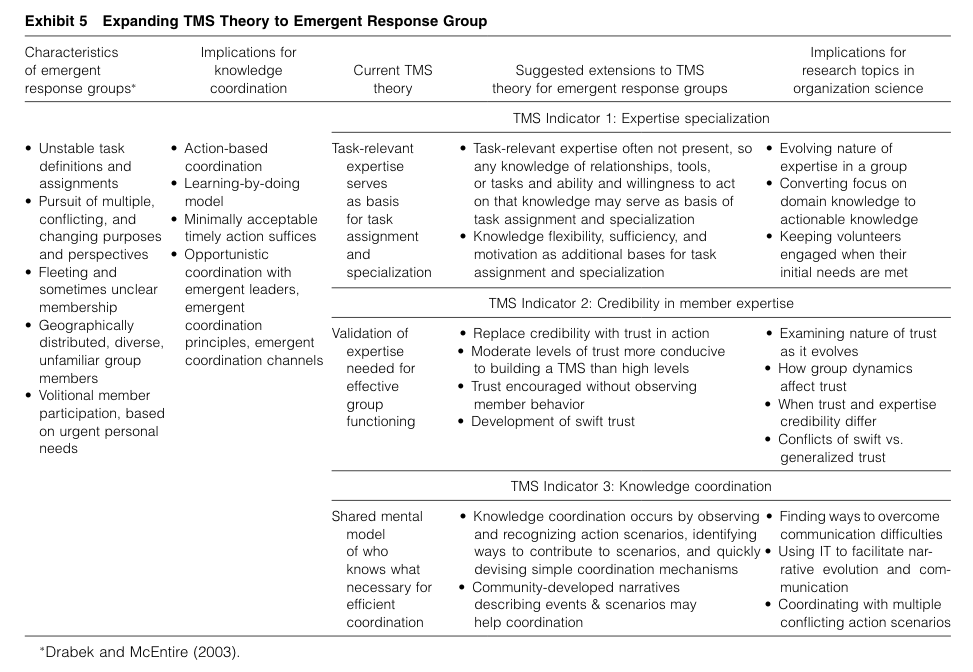
    1. Therefore, training should focus on learning how toquickly recognize volunteers’ volition in participating inan emergent group, the tasks they might engage in, andthe support they might need to carry out those tasks.Such training could also help people to recognize thebenefits and dangers of generalized trust. It could alsohelp people to quickly evolve a coordination mecha-nism that does not rely on what people know, but oncompiling and communicating a narrative of the actionsthat volunteers take, so that others are able to assess forthemselves what actions they could take to help.

      Majchrzak et al continue to suggest that emergent response training could reconceptualize a new role for emergency management professionals, aside from the default coordination/management. Further, they suggest that citizens could be trained to participate.

    2. Emergent response groups may also use a mechanismof creating a community narrative (Boland and Tenkasi1995), which is a running narrative of the actions takenand not taken, the decisions made, and the theories inuse. Narratives do not represent a single shared under-standing of a domain; rather they represent the mul-tiplicity of events and actions a community is taking,as members are taking them. Narratives may be articu-lated explicitly or understood implicitly.

      SBTF after-action report, as an example. But who is the audience for this narrative?

    3. Whenemergent response groups first come together, membersare likely not to ask one another about who knows what;instead, they are likely to ask about what is knownabout the situation and about the actions taken thus far(Dyer and Shafer 2003, Hale et al. 2005). The cogni-tive structure that they develop for the group centersnot around people, but on action-based scenarios thateither have been or might be carried out. These scenariosinclude decisions, actions, knowledge, events, and feed-back (Vera and Crossan 2005).

      Suggested extensions for TMS theory:

      "1. Tailor the Role of Expertise"

      "2. "Replacing Credibility in Expertise with Trust Through Action"

      "3. "Coordinating Knowledge Processes Without a Shared Metastructure"

    4. hus, we believe challenges occur in all three indica-tors of the level of development of a TMS—expertisespecialization, credibility, and expertise coordination—requiring a need to consider extending theorizing abouteach indicator for emergent response groups.

      Ways to extend TMS to emergent groups:

      "1. Reconceptualize the Role of Expertise Specialization as a Basis for Task Assignment"

      "2. Assessing Credibility in Emergent Response Groups"

      "3. Expertise Coordination in Emergent Response Groups"

      These extensions evoke boundary objects and invisibility

    5. Research on TMS has identified three indicators of thelevel of development of a TMS (Lewis 2003, Morelandand Argote 2003):1.Memory (or expertise) specialization:the tendencyfor groups to delegate responsibility and to specialize indifferent aspects of the task;2.Credibility:beliefs about the reliability of mem-bers’ expertise; and3.Task (or expertise) coordination:the ability of teammembers to coordinate their work efficiently based ontheir knowledge of who knows what in the group.The greater the presence of each indicator, the more de-veloped the TMS and the more valuable the TMS is forefficiently coordinating the actions of group members.

      Three indicators of the level of sophistication of the system:

      • Memory specialization (think trauma/hospital care CSCW studies)

      • Credibility

      • Task coordination

    6. A TMS can be thoughtof as a network of interconnected individual memorysystems and the transfer of knowledge among them(Wegner 1995). Individuals who are part of a TMSassume responsibility for different knowledge domains,and rely on one another to access each other’s expertiseacross domains. Expertise is defined in the TMS litera-ture to broadly include the know-what, know-how, andknow-why of a knowledge domain (Quinn et al. 1996),what Blackler (1995) refers to as embodied competen-cies. Expertise specialization, then, reduces the cognitiveload of each individual and the amount of redundantknowledge in the group, while collectively providingthe dyad or group access to a larger pool of knowl-edge. What makes transactive memory transactive arethe communications (called transactions) among individ-uals that make possible the codifying, storing, retrieving,and updating of information from individual memorysystems. For transactive memory to function effectively,individuals must have a shared conceptualization of whoknows what in the group.

      Majchrzak et al describe how TMS is oeprationalized as a network.

    7. TMS theory, a theoryof group-level cognition, explains how people in collec-tives learn, store, use, and coordinate their knowledge toaccomplish individual, group, and organizational goals.It is a theory about how people in relationships, groups,and organizations learn who knows what, and use thatknowledge to decide who will do what, resulting in moreefficient and effective individual and collective perfor-mance.

      Definition of transactive memory systems theory -- used in org studies to understand how knowledge is coordinated among groups.