item response theory (IRT)
Also, it's cool that I will be using IRT. Used to determine if the distances from 1-2, 2-3, 3-4, & 4-5 are mathematically the same on a Likert-type scale.
item response theory (IRT)
Also, it's cool that I will be using IRT. Used to determine if the distances from 1-2, 2-3, 3-4, & 4-5 are mathematically the same on a Likert-type scale.
3% to 4%
Similarly as before with this I am wondering why this wouldn't be displayed as ~3.5%
Fundo Nacional de Desenvolvimento Regional
1) Criado, através da EC 132/2023, o FNDR (Fundo Nacional de Desenvolvimento Regional).
2) Criado com o objetivo de reduzir as desigualdades <u>regionais</u> e <u>sociais</u>.
3) Os recursos do fundo são constituídos pela União e Estados/DF.
4) Servem-se para:
5) Não previsão para que Municípios entreguem ou recebam recursos do FNDR
6) Não pode haver nenhuma restrição ao recebimento de recursos do FNDR.
CASE ILLUSTRATION 3 At 68 years old, Albert has severe end-stage emphysema from years of smoking, severe mitral regurgitation, congestive heart failure, cardiac arrhythmias, and alcoholism.
He bullied his wife for 40 years, does not want CPR or respirator care. He yells at healthcare professionals and family for him being sick, blames medication. Eventually reveals he's afraid to die, particularly being buried alive. He receives medication that helps him calm down but dies of rising CO2 later on
Table 41-3.First steps to trauma-informed primary care.
.
A score of 3 or more on the PC-PTSD-5 confers a high likelihood of trauma-related psychological distress and/or PTSD.
.
Individuals who reported four or more ACE categories had 2 times the rates of lung and liver disease, 3 times the rate of depression, 3 times the rate of alcoholism, 11 times the rate of intravenous drug use, and 14 times the rate of attempting suicide than those who reported ACE scores of 0.
.
The genetic landscape and clonal evolution of breast cancer resistance to palbociclib plus fulvestrant in the PALOMA-3 trial
[Paper-level Aggregated] PMCID: PMC6368247
Evidence Type(s): Oncogenic, Functional, Predictive, Prognostic
Justification: Oncogenic: The emergence of mutations such as ESR1 Y537S and PIK3CA mutations (E542K, E545K, H1047L, H1047R) during treatment suggests they play a role in driving resistance to therapy, indicating their oncogenic potential. Functional: The study discusses the functional consequences of mutations, particularly the selection of ESR1 Y537S and PIK3CA mutations, which are associated with treatment resistance, indicating their functional impact on tumor behavior. Predictive: The identification of specific mutations like ESR1 Y537S and PIK3CA variants that correlate with treatment resistance suggests they may serve as predictive biomarkers for response to endocrine therapy. Prognostic: The analysis of progression-free survival in relation to the acquisition of ESR1 Y537S mutations indicates that these mutations may have prognostic implications for patient outcomes following treatment.
Gene→Variant (gene-first): FGFR2(2263):D538G ESR1(2099):Q75E FGFR2(2263):p.K569E PIK3CA(5290):E542K PIK3CA(5290):E545K PIK3CA(5290):H1047L PIK3CA(5290):H1047R RB1(5925):Q257X PTEN(5728):Y537S RB1(5925):p.N519fs RB1(5925):p.Q257X
Genes: FGFR2(2263) ESR1(2099) PIK3CA(5290) RB1(5925) PTEN(5728)
Variants: D538G Q75E p.K569E E542K E545K H1047L H1047R Q257X Y537S p.N519fs p.Q257X
Spatial and temporal homogeneity of driver mutations in diffuse intrinsic pontine glioma
[Paper-level Aggregated] PMCID: PMC4823825
Evidence Type(s): Oncogenic, Functional, Predictive
Justification: Oncogenic: The K27M mutation in histone 3 and the H1047R mutation in PIK3CA are described as oncogenic alterations associated with high-grade gliomas, indicating their role in tumorigenesis. Functional: The H1047R mutation in PIK3CA affects the catalytic domain and is linked to pathways involved in angiogenesis, suggesting a functional impact on tumor growth and survival. Predictive: The presence of specific mutations, such as K27M and H1047R, may guide the development of targeted therapies, indicating their predictive value for treatment strategies in DIPG.
Gene→Variant (gene-first): PIK3CA(5290):H1047R H3C2(8358):K27M
Genes: PIK3CA(5290) H3C2(8358)
Variants: H1047R K27M
We analysed 134 punch cores from nine DIPG whole brain specimens obtained at autopsy as previously described. Selected punch cores represented multiple spatial regions of the primary tumour and adjacent areas within the
[Paragraph-level] PMCID: PMC4823825 Section: RESULTS PassageIndex: 3
Evidence Type(s): Oncogenic
Justification: Oncogenic: The K27M mutation is described as an oncogenic mutation associated with high-grade gliomas (HGG) and is present in a majority of the analyzed DIPG samples, indicating its contribution to tumor development or progression.
Gene→Variant (gene-first): 8358:K27M
Genes: 8358
Variants: K27M
We analysed 134 punch cores from nine DIPG whole brain specimens obtained at autopsy as previously described. Selected punch cores represented multiple spatial regions of the primary tumour and adjacent areas within the
[Paragraph-level] PMCID: PMC4823825 Section: RESULTS PassageIndex: 3
Evidence Type(s): Oncogenic
Justification: Oncogenic: The K27M mutation is described as an oncogenic mutation associated with high-grade gliomas (HGG) and is present in a majority of the analyzed DIPG samples, indicating its contribution to tumor development or progression.
Gene→Variant (gene-first): 8358:K27M
Genes: 8358
Variants: K27M
NSC114792, a novel small molecule identified through structure-based computational database screening, selectively inhibits JAK3
[Paper-level Aggregated] PMCID: PMC2830973
Evidence Type(s): Oncogenic, Functional
Justification: Oncogenic: The variant JAK3V674A is described as an activating allele that transforms BaF3 cells to IL-3-independent growth, indicating its role in promoting oncogenic processes. Functional: The study demonstrates that JAK3V674A leads to increased viability of BaF3 cells in the absence of IL-3, and that inhibition of JAK3 activity by NSC114792 decreases cell viability, showing a functional consequence of the variant.
Gene→Variant (gene-first): JAK3(3718):V674A AKT1(207):serine/threonine
Genes: JAK3(3718) AKT1(207)
Variants: V674A serine/threonine
A recent study identified an activating allele of JAK3 (V674A) from an acute myeloid leukemia patient-derived retroviral cDNA library, and showed that JAK3V674A can transform the lymphoid pro-B-cell line BaF3 to IL-3-ind
[Paragraph-level] PMCID: PMC2830973 Section: RESULTS PassageIndex: 6
Evidence Type(s): Oncogenic, Predictive
Justification: Oncogenic: The variant JAK3V674A is described as an activating allele that can transform a lymphoid pro-B-cell line, indicating its role in tumor development or progression. Predictive: The passage discusses how treatment with the compound NSC114792 inhibits JAK3 activity and decreases the viability of BaF3-JAK3V674A cells, suggesting a correlation with response to therapy.
Gene→Variant (gene-first): 3718:V674A
Genes: 3718
Variants: V674A
Mutant Fibroblast Growth Factor Receptor 3 Induces Intracellular Signaling and Cellular Transformation in a Cell Type- and Mutation-Specific Manner
[Paper-level Aggregated] PMCID: PMC2789045
Evidence Type(s): Oncogenic, Functional, Predictive
Justification: Oncogenic: The evidence indicates that mutations S249C, Y375C, and K652E in FGFR3 lead to increased cell proliferation, morphological transformation, and anchorage-independent growth, suggesting that these mutations contribute to oncogenic processes in bladder tumors. Functional: The study demonstrates that the FGFR3 mutations affect signaling pathways and cellular behaviors, such as phosphorylation of downstream effectors and changes in cell cycle profiles, indicating a functional impact of these mutations on urothelial cells. Predictive: The differential effects of the FGFR3 mutations on cell proliferation and viability suggest that the presence of specific mutations like S249C and Y375C may predict the behavior of bladder cancer cells in response to growth conditions and treatments.
Gene→Variant (gene-first): FGFR3(2261):K652E FGFR3(2261):S249C FGFR3(2261):Y375C FGFR3(2261):Y762F
Genes: FGFR3(2261)
Variants: K652E S249C Y375C Y762F
Initially, we assessed the ability of three mutant forms of FGFR3 that are found in UC (S249C, Y375C, and K652E) to transform NIH-3T3 cells. In these cells, expression of all FGFR3 mutations resulted in a transformed spi
[Paragraph-level] PMCID: PMC2789045 Section: RESULTS PassageIndex: 3
Evidence Type(s): Oncogenic, Functional
Justification: Oncogenic: The passage discusses the ability of the FGFR3 mutations (S249C, Y375C, and K652E) to transform NIH-3T3 cells, indicating that these somatic variants contribute to tumor development or progression. Functional: The passage describes how the FGFR3 mutations alter molecular function, specifically through increased phosphorylation of various proteins and changes in cell morphology and proliferation, demonstrating their biochemical activity.
Gene→Variant (gene-first): 2261:K652E 2261:S249C 2261:Y375C
Genes: 2261
Variants: K652E S249C Y375C
Initially, we assessed the ability of three mutant forms of FGFR3 that are found in UC (S249C, Y375C, and K652E) to transform NIH-3T3 cells. In these cells, expression of all FGFR3 mutations resulted in a transformed spi
[Paragraph-level] PMCID: PMC2789045 Section: RESULTS PassageIndex: 3
Evidence Type(s): Oncogenic, Functional
Justification: Oncogenic: The passage discusses the ability of the FGFR3 mutations (S249C, Y375C, and K652E) to transform NIH-3T3 cells, indicating that these somatic variants contribute to tumor development or progression. Functional: The passage describes how the FGFR3 mutations alter molecular function, specifically through increased phosphorylation of various proteins and changes in cell morphology and proliferation, demonstrating their biochemical activity.
Gene→Variant (gene-first): 2261:K652E 2261:S249C 2261:Y375C
Genes: 2261
Variants: K652E S249C Y375C
We performed a similar analysis on genomic DNA isolated from 65 human melanoma cell lines (Supplementary Figure 3). We did not identify any cell lines with AKT1 E17K or AKT2 E17K mutations. However, we identified two cel
[Paragraph-level] PMCID: PMC2570525 Section: RESULTS PassageIndex: 4
Evidence Type(s): None
Justification: Not enough information in this passage.
Gene→Variant (gene-first): 207:AKT1 E17K 207:E17K
Genes: 207
Variants: AKT1 E17K E17K
We analysed melanoma clinical specimens for the presence of mutations in AKT1, AKT2, and AKT3 that result in the E17K mutation identified previously in breast, ovarian, and colorectal cancers. We used mass spectroscopy-b
[Paragraph-level] PMCID: PMC2570525 Section: RESULTS PassageIndex: 3
Evidence Type(s): Diagnostic, Oncogenic
Justification: Diagnostic: The passage discusses the identification of the E17K mutation in clinical specimens, indicating its association with melanoma and its presence in metastatic lesions, which supports its use in defining or classifying the disease. Oncogenic: The E17K mutation is described as being present in metastatic lesions, suggesting that it contributes to tumor development or progression in melanoma.
Gene→Variant (gene-first): 207:E17K
Genes: 207
Variants: E17K
We conducted in vitro experiments to verify the role of ACVR2A in the migration and proliferation of GC cells. First, we sequenced exon 3 and exon 10 of the ACVR2A gene in one human normal immortalized gastric mucosal ce
[Paragraph-level] PMCID: PMC7211323 Section: RESULTS PassageIndex: 11
Evidence Type(s): Functional, Oncogenic
Justification: Functional: The passage discusses how the ACVR2A variants (including c.285delA) affect the expression and stability of the ACVR2A protein, indicating that these variants alter molecular function. Oncogenic: The context of the study involves the role of ACVR2A mutations in gastric cancer (GC) cell lines, suggesting that these somatic variants may contribute to tumor development or progression.
Gene→Variant (gene-first): 92:1310AA 92:c.285delA
Genes: 92
Variants: 1310AA c.285delA
Analysis of TCGA data revealed that ACVR2A is the gene with the most dramatically different mutation rate between the MSI-H group of GCs and MSI-L/MSS group of GCs (75.34% VS 1.24%, p<0.001) (Table 1). The MSI-H GCs less
[Paragraph-level] PMCID: PMC7211323 Section: RESULTS PassageIndex: 3
Evidence Type(s): Diagnostic, Oncogenic
Justification: Diagnostic: The passage discusses the association of specific mutations (c.1310delA, 1309-1310delAA, c.285delA) with the MSI-H subtype of gastric cancers, indicating their role in defining or classifying the disease. Oncogenic: The variants mentioned are associated with a high mutation frequency and a high MSI score, suggesting their contribution to tumor development or progression in gastric cancer.
Gene→Variant (gene-first): 92:1309-1310delAA 92:c.1310delA 92:c.285delA
Genes: 92
Variants: 1309-1310delAA c.1310delA c.285delA
We analysed a cohort of 62 DIPG biopsy samples obtained at diagnosis for (1) histone H3 lysine 27 trimethylation (Fig. 1a) and (2) immunodetection of the mutated H3-K27M histone (Fig. 1b) by IHC, and correlated these dat
[Paragraph-level] PMCID: PMC4654747 Section: RESULTS PassageIndex: 3
Evidence Type(s): Diagnostic, Oncogenic
Justification: Diagnostic: The passage discusses the correlation of the H3-K27M mutation with the classification of DIPG samples, indicating its role in defining or confirming the disease subtype. Oncogenic: The mention of the H3-K27M mutation in the context of tumor samples suggests that it contributes to tumor development or progression, characteristic of oncogenic variants.
Gene→Variant (gene-first): 3021:K27M 3021:lysine 27
Genes: 3021
Variants: K27M lysine 27
Sixteen patients with stage IV KRAS G12D-mutant lung cancers were accrued to this trial and treated with bortezomib (Table 1). Patients were either never (38%, n = 6/16) or former (62%, n = 10/16) cigarette smokers with
[Paragraph-level] PMCID: PMC6549573 Section: RESULTS PassageIndex: 3
Evidence Type(s): Predictive, Diagnostic, Oncogenic
Justification: Predictive: The passage discusses patients with KRAS G12D-mutant lung cancers treated with bortezomib, indicating a correlation between the variant and response to therapy. Diagnostic: The mention of "KRAS G12D-mutant lung cancers" suggests that the variant is used to classify or define a specific subtype of lung cancer. Oncogenic: The variant KRAS G12D is implicated in the context of lung adenocarcinoma, indicating its role in tumor development or progression.
Gene→Variant (gene-first): 3845:G12D
Genes: 3845
Variants: G12D
The most common mutation was the p.His1047Arg (H1047R) occurring in 19/35 (54%) patients. The distribution of the other mutations was: p.His1047Leu (H1047L) in 8/35 (23%) patients, p.Glu545Lys (E545K) in 4/35 (11%) patie
[Paragraph-level] PMCID: PMC4320693 Section: RESULTS PassageIndex: 3
Evidence Type(s): Diagnostic, Oncogenic
Justification: Diagnostic: The passage discusses the frequency of specific mutations in patients, indicating their association with a disease or subtype. Oncogenic: The variants mentioned are likely somatic mutations that contribute to tumor development, as they are described in the context of patient mutations.
Gene→Variant (gene-first): 5290:C420R 5290:E542K 5290:E545K 5290:H1047L 5290:H1047R 5290:p.Cys420Arg 5290:p.Glu542Lys 5290:p.Glu545Lys 5290:p.His1047Arg 5290:p.His1047Leu
Genes: 5290
Variants: C420R E542K E545K H1047L H1047R p.Cys420Arg p.Glu542Lys p.Glu545Lys p.His1047Arg p.His1047Leu
Three patients had an auricular AVM causing enlargement of all structures of the ear: Patient 1 (11 year-old male), Patient 2 (18 year-old female), Patient 3 (21 year-old male) (Fig. 1). MAP2K1 (p.K57N) mutations were fo
[Paragraph-level] PMCID: PMC7064492 Section: RESULTS PassageIndex: 2
Evidence Type(s): Diagnostic, Oncogenic
Justification: Diagnostic: The passage discusses the presence of MAP2K1 (p.K57N) mutations in patients with auricular AVM, indicating an association with the condition and suggesting its role in defining or confirming the disease. Oncogenic: The presence of the MAP2K1 (p.K57N) mutation in the tissue adjacent to the cartilage suggests that it may contribute to tumor development or progression in the context of the auricular AVM.
Gene→Variant (gene-first): 5604:p.K57N
Genes: 5604
Variants: p.K57N
In addition to lymphoma, EZH2Y646 mutations are observed in 3% of human melanoma , with focal amplifications of EZH2 noted in 15 of 262 (5.7%) of cases from the Cancer Genome Atlas (TCGA). As B-RAFV600E or N-RASQ61R muta
[Paragraph-level] PMCID: PMC4899144 Section: RESULTS PassageIndex: 8
Evidence Type(s): Oncogenic, Functional
Justification: Oncogenic: The passage describes how the Ezh2Y641F mutation cooperates with the B-RAFV600E mutation to accelerate tumorigenesis in melanoma, indicating that it contributes to tumor development. Functional: The passage implies that the Ezh2Y641F mutation alters the tumorigenic process in conjunction with B-RAFV600E, suggesting a change in molecular function related to tumor maintenance and formation.
Gene→Variant (gene-first): 673:B-RAFV600E 673:B-RafV600E 2146:Y641F
Genes: 673 2146
Variants: B-RAFV600E B-RafV600E Y641F
We validated expression of the Ezh2Y641F allele by Southern blot, PCR and qRT-PCR (Fig. 1a, Supplementary Fig. 1a-d). In the absence of CRE-mediated recombination, the allele produces a wild-type transcript (Fig. 1a) and
[Paragraph-level] PMCID: PMC4899144 Section: RESULTS PassageIndex: 3
Evidence Type(s): Functional, Oncogenic
Justification: Functional: The passage discusses how the Y641F mutation alters the expression of Ezh2 transcripts and leads to a gain-of-function effect, evidenced by the increase in H3K27me3 levels in B-cells, indicating a change in molecular function. Oncogenic: The Y641F mutation is described as equivalent to a common EZH2 missense mutation found in human cancers, suggesting its role in tumor development or progression.
Gene→Variant (gene-first): 2146:Y641F 2146:Y646F
Genes: 2146
Variants: Y641F Y646F
We evaluated cell viability in the TNBC cell lines MDA-MB-231 and MDA-MB-468 after transfection (PIK3CAOe, PIK3CAE545K, PIK3CAH1047R, and PIK3CActrl) using CCK-8 assays. Among both MDA-MB-231 and MDA-MB-468 cells, cells
[Paragraph-level] PMCID: PMC8033310 Section: RESULTS PassageIndex: 3
Evidence Type(s): Oncogenic, Functional
Justification: Oncogenic: The passage discusses how the PIK3CA mutation, including E545K, contributes to enhanced cell proliferation, reduced apoptosis, and increased aggressiveness in TNBC cells, indicating its role in tumor development or progression. Functional: The passage describes how the PIK3CA mutation alters the behavior of TNBC cells, specifically in terms of cell cycle progression and apoptosis, suggesting that the variant affects molecular or biochemical functions.
Gene→Variant (gene-first): 5290:E545K
Genes: 5290
Variants: E545K
We previously showed that G34V/R-H3.3 GBM samples universally also carried ATRX and TP53 mutations (13/13), while K27M-H3.3 GBM samples had significant, albeit lower, overlap with ATRX and TP53 mutations (respectively, 3
[Paragraph-level] PMCID: PMC3422615 Section: RESULTS PassageIndex: 5
Evidence Type(s): Diagnostic, Oncogenic
Justification: Diagnostic: The passage discusses the association of the K27M-H3.3 mutation with ATRX mutations in DIPG samples, indicating its role in defining or classifying a subtype of disease. Oncogenic: The K27M-H3.3 mutation is mentioned in the context of its presence in GBM samples, suggesting its contribution to tumor development or progression.
Gene→Variant (gene-first): 3021:G34V/R 3021:K27M
Genes: 3021
Variants: G34V/R K27M
We sequenced H3F3A in 42 DIPG samples comprising either biopsy material prior to any treatment (n = 16) or autopsy samples (n = 26, one sample from untreated patient at autopsy; DIPG02). We identified the recurrent mutat
[Paragraph-level] PMCID: PMC3422615 Section: RESULTS PassageIndex: 3
Evidence Type(s): Diagnostic, Oncogenic
Justification: Diagnostic: The K27M mutation is identified as being present at diagnosis in DIPG samples, indicating its role in defining the disease subtype. Oncogenic: The K27M mutation contributes to tumor development in DIPG, as it is recurrently found in the samples analyzed, suggesting its role in tumor progression.
Gene→Variant (gene-first): 3021:G34V/R 3021:K27M
Genes: 3021
Variants: G34V/R K27M
The phosphatidylinositol-3-kinase (PI3K)/AKT signaling pathway is critical for cellular growth and metabolism. Correspondingly, loss of function of PTEN, a negative regulator of PI3K, or activating mutations in AKT1, AKT
[Paragraph-level] PMCID: PMC3461408 Section: ABSTRACT PassageIndex: 1
Evidence Type(s): Oncogenic, Functional
Justification: Oncogenic: The passage discusses the identification of cancer-associated mutations p.His1047Leu and p.His1047Arg in PIK3CA, which are linked to a syndrome characterized by overgrowth, indicating that these somatic variants contribute to tumor development or progression. Functional: The passage describes how affected dermal fibroblasts showed enhanced phosphatidylinositol-3,4,5-trisphosphate (PIP3) generation and activation of downstream signaling, demonstrating that the variants alter molecular or biochemical function.
Gene→Variant (gene-first): 5290:p.His1047Arg 5290:p.His1047Leu
Genes: 5290
Variants: p.His1047Arg p.His1047Leu
Finally, these individual resistance mechanisms commonly co-occurred (Figure 3). In a third of evaluable paired cases, on-target and off-target resistance coexisted: RET V804E + EML4-ALK + STRN-ALK (n=1) and RET V804M +
[Paragraph-level] PMCID: PMC10524391 Section: RESULTS PassageIndex: 26
Evidence Type(s): Predictive, Oncogenic
Justification: Predictive: The passage discusses resistance mechanisms related to specific variants, indicating their correlation with treatment response, particularly in the context of on-target and off-target resistance. Oncogenic: The variants mentioned are associated with resistance mechanisms that contribute to tumor development or progression, as they are involved in co-occurring resistance mechanisms in cancer cases.
Gene→Variant (gene-first): 1956:C797S 3845:G12S 5979:G810S 673:V600E 5979:V804E 5979:V804M
Genes: 1956 3845 5979 673
Variants: C797S G12S G810S V600E V804E V804M
KIT mutations were seen in 70% of cases and the majority of KIT mutations involved exon 11 (57%), followed by exon 9 (10%), exon 13 (3%), and exon 17 (1%). Most common exon 11 mutations were in-frame deletions (61.4%) fo
[Paragraph-level] PMCID: PMC5615879 Section: ABSTRACT PassageIndex: 6
Evidence Type(s): Diagnostic, Oncogenic
Justification: Diagnostic: The passage discusses the presence of KIT mutations in cases and specifies the types of mutations found in different exons, indicating their association with the disease. Oncogenic: The mention of KIT mutations contributing to tumor development is implied by their prevalence in cases, suggesting a role in cancer progression.
Gene→Variant (gene-first): 3815:Ala-Tyr 3815:c.1509_1510insACCTAT 728378:c.1666C>G 3815:c.1666_1668dupCAG 3815:c.1672_1677delAAGGTTinsAGT 5156:c.1925A>G 3815:p.K558_V559delinsS 728378:p.K642R 728378:p.Q556E 3815:p.Q556dup 3815:p.Y503_F504insTY
Genes: 3815 728378 5156
Variants: Ala-Tyr c.1509_1510insACCTAT c.1666C>G c.1666_1668dupCAG c.1672_1677delAAGGTTinsAGT c.1925A>G p.K558_V559delinsS p.K642R p.Q556E p.Q556dup p.Y503_F504insTY
Three cases involving p.K642E mutation (c.1924A>G) [Figure 4a], 2/3 were in elderly men, at gastric, an anorectal site with mixed morphology. One was a double mutation in association with exon 11 [Table 2].
[Paragraph-level] PMCID: PMC5615879 Section: RESULTS PassageIndex: 18
Evidence Type(s): None
Justification: Not enough information in this passage.
Gene→Variant (gene-first): 3815:c.1924A>G 3815:p.K642E
Genes: 3815
Variants: c.1924A>G p.K642E
Insertion of 3 nucleotides, p.K558delinsBP (c.1673_1674insTCC), and duplication p.Y577_K580dup (c.1731_1742dupTTATGATCACAA) was seen 1 case (1.8%) each, respectively.
[Paragraph-level] PMCID: PMC5615879 Section: RESULTS PassageIndex: 13
Evidence Type(s): Diagnostic, Oncogenic
Justification: Diagnostic: The passage mentions specific variants and their occurrence in a case, indicating their association with a particular disease or condition. Oncogenic: The variants discussed are likely somatic mutations contributing to tumor development, as they are described in the context of a case study.
Gene→Variant (gene-first): 3815:K580dup 3815:c.1673_1674insTCC 3815:c.1731_1742dupTTATGATCACAA 3815:p.K558delinsBP
Genes: 3815
Variants: K580dup c.1673_1674insTCC c.1731_1742dupTTATGATCACAA p.K558delinsBP
The substitution mutations were p.V559D (3/57; 5%), p.V560D (3/57; 5%), p.V559A (2/57; 3.5%), and 1 (1.8%) cases each with p.V560G, p.T574I, and p.L576P among this 9 were homozygous and 2 heterozygous.
[Paragraph-level] PMCID: PMC5615879 Section: RESULTS PassageIndex: 12
Evidence Type(s): Diagnostic, Oncogenic
Justification: Diagnostic: The passage provides mutation frequencies for specific variants, indicating their association with a disease or subtype. Oncogenic: The mention of substitution mutations suggests that these variants may contribute to tumor development or progression, as they are likely somatic mutations.
Gene→Variant (gene-first): 3815:p.L576P 3815:p.T574I 3815:p.V559A 3815:p.V559D 3815:p.V560D 3815:p.V560G
Genes: 3815
Variants: p.L576P p.T574I p.V559A p.V559D p.V560D p.V560G
Exon 11 mutations were heterogeneous with in-frame deletion of 3-51 nucleotides (codons 550-576) in classic hot-spot region at the 5' end of the exon (codons 550-560). Double mutations were identified in 9 cases (16%), 8
[Paragraph-level] PMCID: PMC5615879 Section: RESULTS PassageIndex: 10
Evidence Type(s): Diagnostic, Oncogenic
Justification: Diagnostic: The passage discusses mutations in exon 11 and their association with specific cases, indicating that these mutations can be used to classify or define a disease subtype. Oncogenic: The mention of double mutations and their role in the context of tumor development suggests that these somatic variants contribute to tumor progression.
Gene→Variant (gene-first): 728378:c.1666C>G 3815:c.1666_1668dupCAG 3815:c.1672_1677delAAGGTTinsAGT 728378:p.Q556E 3815:p.Q556dup
Genes: 728378 3815
Variants: c.1666C>G c.1666_1668dupCAG c.1672_1677delAAGGTTinsAGT p.Q556E p.Q556dup
Three cases involving p.K642E mutation (c.1924A>G) [Figure 4a], 2/3 were in elderly men, at gastric, an anorectal site with mixed morphology. One was a double mutation in association with exon 11 [Table 2].
[Paragraph-level] PMCID: PMC5615879 Section: RESULTS PassageIndex: 18
Evidence Type(s): None
Justification: Not enough information in this passage.
Gene→Variant (gene-first): 3815:c.1924A>G 3815:p.K642E
Genes: 3815
Variants: c.1924A>G p.K642E
Insertion of 3 nucleotides, p.K558delinsBP (c.1673_1674insTCC), and duplication p.Y577_K580dup (c.1731_1742dupTTATGATCACAA) was seen 1 case (1.8%) each, respectively.
[Paragraph-level] PMCID: PMC5615879 Section: RESULTS PassageIndex: 13
Evidence Type(s): Diagnostic, Oncogenic
Justification: Diagnostic: The passage mentions specific variants and their occurrence in a case, indicating their association with a particular disease or condition. Oncogenic: The variants discussed are likely somatic mutations contributing to tumor development, as they are described in the context of a case study.
Gene→Variant (gene-first): 3815:K580dup 3815:c.1673_1674insTCC 3815:c.1731_1742dupTTATGATCACAA 3815:p.K558delinsBP
Genes: 3815
Variants: K580dup c.1673_1674insTCC c.1731_1742dupTTATGATCACAA p.K558delinsBP
The substitution mutations were p.V559D (3/57; 5%), p.V560D (3/57; 5%), p.V559A (2/57; 3.5%), and 1 (1.8%) cases each with p.V560G, p.T574I, and p.L576P among this 9 were homozygous and 2 heterozygous.
[Paragraph-level] PMCID: PMC5615879 Section: RESULTS PassageIndex: 12
Evidence Type(s): Diagnostic, Oncogenic
Justification: Diagnostic: The passage provides mutation frequencies for specific variants, indicating their association with a disease or subtype. Oncogenic: The mention of substitution mutations suggests that these variants may contribute to tumor development or progression, as they are likely somatic mutations.
Gene→Variant (gene-first): 3815:p.L576P 3815:p.T574I 3815:p.V559A 3815:p.V559D 3815:p.V560D 3815:p.V560G
Genes: 3815
Variants: p.L576P p.T574I p.V559A p.V559D p.V560D p.V560G
Exon 11 mutations were heterogeneous with in-frame deletion of 3-51 nucleotides (codons 550-576) in classic hot-spot region at the 5' end of the exon (codons 550-560). Double mutations were identified in 9 cases (16%), 8
[Paragraph-level] PMCID: PMC5615879 Section: RESULTS PassageIndex: 10
Evidence Type(s): Diagnostic, Oncogenic
Justification: Diagnostic: The passage discusses mutations in exon 11 and their association with specific cases, indicating that these mutations can be used to classify or define a disease subtype. Oncogenic: The mention of double mutations and their role in the context of tumor development suggests that these somatic variants contribute to tumor progression.
Gene→Variant (gene-first): 728378:c.1666C>G 3815:c.1666_1668dupCAG 3815:c.1672_1677delAAGGTTinsAGT 728378:p.Q556E 3815:p.Q556dup
Genes: 728378 3815
Variants: c.1666C>G c.1666_1668dupCAG c.1672_1677delAAGGTTinsAGT p.Q556E p.Q556dup
To establish recommended phase II dose (RP2D) in phase I and evaluate safety and efficacy of abivertinib in patients with EGFR Thr790Met point mutation (T790M)-positive(+) non-small cell lung cancer (NSCLC) with disease
[Paragraph-level] PMCID: PMC9365372 Section: ABSTRACT PassageIndex: 3
Evidence Type(s): Predictive, Diagnostic
Justification: Predictive: The passage discusses the evaluation of safety and efficacy of abivertinib in patients with the T790M mutation, indicating a correlation with treatment response in the context of non-small cell lung cancer. Diagnostic: The mention of the Thr790Met point mutation (T790M) being positive in patients with non-small cell lung cancer suggests its role in defining or classifying the disease subtype.
Gene→Variant (gene-first): 1956:T790M 1956:Thr790Met
Genes: 1956
Variants: T790M Thr790Met
A total of 878 Chinese patients with NSCLC were screened (Fig. 1). In phase I, a total of 231 patients were screened and 140 patients who received treatment were included in this analysis; in phase II, 647 patients were
[Paragraph-level] PMCID: PMC9365372 Section: RESULTS PassageIndex: 3
Evidence Type(s): Diagnostic, Predictive
Justification: Diagnostic: The passage indicates that T790M-negative status was a major reason for exclusion from the study, suggesting its role in defining eligibility for treatment in patients with NSCLC. Predictive: The mention of T790M-negative status as a reason for screening failure implies that the presence of this variant may correlate with resistance to the treatment being studied (abivertinib).
Gene→Variant (gene-first): 1956:T790M
Genes: 1956
Variants: T790M
A total of 878 Chinese patients with NSCLC were screened (Fig. 1). In phase I, a total of 231 patients were screened and 140 patients who received treatment were included in this analysis; in phase II, 647 patients were
[Paragraph-level] PMCID: PMC9365372 Section: RESULTS PassageIndex: 3
Evidence Type(s): Diagnostic, Predictive
Justification: Diagnostic: The passage indicates that T790M-negative status was a major reason for exclusion from the study, suggesting its role in defining eligibility for treatment in patients with NSCLC. Predictive: The mention of T790M-negative status as a reason for screening failure implies that the presence of this variant may correlate with resistance to the treatment being studied (abivertinib).
Gene→Variant (gene-first): 1956:T790M
Genes: 1956
Variants: T790M
Investigator-assessed confirmed responses were reported in 20 of 36 patients (56%) in the ITT-assessable population, including 3 CRs (8%) and 17 PRs (47%; Table 3, Figure 1); an additional 11 patients (31%) had stable di
[Paragraph-level] PMCID: PMC9338780 Section: RESULTS PassageIndex: 4
Evidence Type(s): Predictive, Diagnostic
Justification: Predictive: The passage discusses the correlation between the BRAF V600E mutation and the response to treatment, indicating that all patients with confirmed responses had BRAF V600E-mutant disease, which suggests a predictive relationship with therapy response. Diagnostic: The mention of "centrally confirmed BRAF V600E-mutant disease" indicates that the variant is used to classify or confirm a specific disease subtype, supporting its role as a diagnostic marker.
Gene→Variant (gene-first): 673:V600E
Genes: 673
Variants: V600E
The French FPD/AML cohort consists of nine pedigrees (A to I) and two syndromic patients (J and K) with germline RUNX1 alterations identified in eight hospitals (La Timone and Paoli-Calmettes in Marseille; Nancy; La Piti
[Paragraph-level] PMCID: PMC4845427 Section: RESULTS PassageIndex: 3
Evidence Type(s): Predisposing
Justification: Predisposing: The passage discusses germline RUNX1 alterations identified in pedigrees, indicating inherited risk for developing disease.
Gene→Variant (gene-first): 861:A to I
Genes: 861
Variants: A to I
Using our transcriptome data, we identified 4607 somatic nonsynonymous single nucleotide substitutions and 373 coding short-indel mutations (Supplemental Fig. 2; Supplemental Table 3). Whole-exome sequencing of two rando
[Paragraph-level] PMCID: PMC3483540 Section: RESULTS PassageIndex: 5
Evidence Type(s): Oncogenic, Diagnostic
Justification: Oncogenic: The passage discusses several somatic mutations, including those in EGFR, KRAS, NRAS, PIK3CA, BRAF, CTNNB1, and MET, which are identified as driver mutations contributing to lung adenocarcinoma, indicating their role in tumor development or progression. Diagnostic: The passage mentions that specific mutations in well-known cancer genes are associated with lung adenocarcinoma, suggesting that these variants can be used to classify or define the disease.
Gene→Variant (gene-first): 1499:D32G 22853:E555K 3845:G12C 3845:G12D 3845:G12S 3845:G12V 3845:G13C 3845:G13D 1956:G719A 5290:H1047R 1956:L858R 1499:M1124D 3845:Q61H 4893:Q61K 4893:Q61L 673:V600E
Genes: 1499 22853 3845 1956 5290 4893 673
Variants: D32G E555K G12C G12D G12S G12V G13C G13D G719A H1047R L858R M1124D Q61H Q61K Q61L V600E
We developed a novel IDH1 inhibitor, BAY1436032, with high selectivity against all known IDH1R132 mutant proteins (R132H, R132C, R132G, R132S and R132L) compared to wild-type IDH1 and wild-type or mutant IDH2. Details on
[Paragraph-level] PMCID: PMC5629366 Section: RESULTS PassageIndex: 3
Evidence Type(s): Predictive, Oncogenic
Justification: Predictive: The passage discusses the sensitivity of various IDH1R132 mutant proteins to the IDH1 inhibitor BAY1436032, indicating a correlation between the presence of these variants and the response to the therapy. Oncogenic: The variants mentioned (R132C, R132G, R132H, R132L, R132S) are associated with mutant IDH1 proteins that contribute to tumor development, as evidenced by their expression in patient-derived AML cells and their role in producing R-2HG.
Gene→Variant (gene-first): 3417:R132C 3417:R132G 3417:R132H 3417:R132L 3417:R132S 3418:R140Q
Genes: 3417 3418
Variants: R132C R132G R132H R132L R132S R140Q
The effect of PLX4032 was tested on melanoma cells isolated from primary and metastatic lesions in which BRAF, NRAS and PTEN mutations were characterized (Table 1). Dose response analyses showed that all the BRAF mutant
[Paragraph-level] PMCID: PMC2848976 Section: RESULTS PassageIndex: 3
Evidence Type(s): Predictive, Oncogenic
Justification: Predictive: The passage discusses the sensitivity of BRAF mutant melanoma cell strains, including those with the V600E mutation, to the drug PLX4032, indicating a correlation between the variant and response to therapy. Oncogenic: The V600E variant is mentioned in the context of BRAF mutations in melanoma cells, suggesting its role in tumor development or progression as part of the BRAF mutation profile.
Gene→Variant (gene-first): 673:V600E
Genes: 673
Variants: V600E
Routine MRI surveillance again showed enlargement of the tumor over the next 6 months following the partial resection (Table 1A). The radiologist reported increases in the size and degree of contrast enhancement of the m
[Paragraph-level] PMCID: PMC8040738 Section: RESULTS PassageIndex: 3
Evidence Type(s): Predictive, Oncogenic
Justification: Predictive: The passage discusses the patient's lack of response to vinblastine treatment, indicating that the p.T599dup BRAF variant may be associated with resistance to this therapy. Oncogenic: The p.T599dup BRAF variant is mentioned in the context of tumor sequencing, suggesting that it contributes to tumor development or progression.
Gene→Variant (gene-first): NA:p.T599dup BRAF
Genes: NA
Variants: p.T599dup BRAF
Prior to analyzing the miRNA microarray data, six independent CRC specimens were evaluated according to their KRAS/BRAF mutational profiles and MSI status, which resulted in six subtypes with different genetic and clinic
[Paragraph-level] PMCID: PMC7068240 Section: RESULTS PassageIndex: 3
Evidence Type(s): Diagnostic, Oncogenic
Justification: Diagnostic: The passage discusses the evaluation of CRC specimens based on their BRAF V600E mutation status, which is used to classify the tumors into different subtypes with distinct genetic and clinical features. Oncogenic: The BRAF V600E mutation is mentioned in the context of tumor specimens, indicating its role in tumor development or progression in colorectal cancer.
Gene→Variant (gene-first): 673:V600E
Genes: 673
Variants: V600E
We first asked whether the EGFR inhibitor afatinib could reduce BTSC viability and sphere formation, using alamarBlue and neurosphere assays. Afatinib inhibited BTSC growth and sphere-forming capacity in a dose-dependent
[Paragraph-level] PMCID: PMC7086303 Section: RESULTS PassageIndex: 3
Evidence Type(s): Predictive, Oncogenic
Justification: Predictive: The passage discusses how the G598V mutation influences the sensitivity of BTSC cultures to the EGFR inhibitor afatinib, indicating a correlation with treatment response. Oncogenic: The G598V mutation is described as an activating mutation in the context of EGFR, suggesting its role in tumor development or progression.
Gene→Variant (gene-first): 1956:G598V
Genes: 1956
Variants: G598V
Constitutive phosphorylation of mutant EGFR on Y1068 (see Figure 2A), the binding site for the phosphatidylinositol 3-kinase interacting protein Gab1, indicated that signaling pathways downstream of phosphatidylinositol
[Paragraph-level] PMCID: PMC1240052 Section: RESULTS PassageIndex: 14
Evidence Type(s): Functional
Justification: Functional: The passage discusses how the mutant EGFR leads to the constitutive activation of the serine/threonine kinase Akt, indicating an alteration in molecular function related to cell survival signaling pathways.
Gene→Variant (gene-first): 207:serine/threonine
Genes: 207
Variants: serine/threonine
To assess the oncogenic potential of EGFR kinase domain mutants, tumor-derived mutations were introduced into the wild-type human EGFR cDNA by site-directed mutagenesis. The resulting wild-type and mutant EGFR cDNAs were
[Paragraph-level] PMCID: PMC1240052 Section: RESULTS PassageIndex: 3
Evidence Type(s): Oncogenic, Functional
Justification: Oncogenic: The passage discusses the ability of the G719S and L858R mutations to transform NIH-3T3 cells, indicating that these somatic variants contribute to tumor development. Functional: The passage describes how the mutations G719S and L858R alter the ability of EGFR to induce colony formation in soft agar, demonstrating a change in molecular function related to tumorigenesis.
Gene→Variant (gene-first): 1956:D837A 1956:G719S 1956:L858R
Genes: 1956
Variants: D837A G719S L858R
1,449 genes with somatic CNA were observed in at least 10% of tumors (S1 Table) and were located on 26 genomic segments on chromosomes 1, 2, 3, 5, 8, 10, 11, 17, 18, 19 and 20. The size of these genomic loci ranged from
[Paragraph-level] PMCID: PMC7467277 Section: RESULTS PassageIndex: 5
Evidence Type(s): Oncogenic
Justification: Oncogenic: The passage discusses somatic copy number alterations (CNAs) and specifically mentions a segment on chromosome 8 that exhibits deletion, indicating a potential role in tumor development or progression.
Gene→Variant (gene-first): NA:chr8:208343-27992852
Genes: NA
Variants: chr8:208343-27992852
ALK/ROS1/BRAF: 111 patients (97% EGFR negative) were tested for an ALK translocation with 8 positive results (7%). Five of 56 men (8.9%), and 3 of 54 women (5.6%) had a positive ALK-FISH test. In line with the literature
[Paragraph-level] PMCID: PMC5652823 Section: RESULTS PassageIndex: 13
Evidence Type(s): Oncogenic
Justification: Oncogenic: The passage indicates that the classic V600E mutation was detected in patients, suggesting its role in tumor development or progression, particularly in the context of BRAF mutations.
Gene→Variant (gene-first): 673:V600E
Genes: 673
Variants: V600E
For each of these common founder mutations, we noted that the reversions that emerged in these patients were generally localised to the 3' flanking sequence of the original pathogenic mutation (transcriptionally downstre
[Paragraph-level] PMCID: PMC7611203 Section: RESULTS PassageIndex: 8
Evidence Type(s): None
Justification: Not enough information in this passage.
Gene→Variant (gene-first): 675:c.7355delA
Genes: 675
Variants: c.7355delA
A total of 1 (1.1%) patient (no. 13) had two 'other' mutations, while 3 (3.4%) patients (nos. 9, 11 and 18), who were included in the 'classical mutations' group, had both the exon 21 L858R mutation and an 'other' mutati
[Paragraph-level] PMCID: PMC2360265 Section: RESULTS PassageIndex: 7
Evidence Type(s): Diagnostic, Oncogenic
Justification: Diagnostic: The passage discusses the incidence of the L858R mutation in relation to patient demographics and histology, indicating its association with specific patient groups and suggesting its role in defining or classifying disease subtypes. Oncogenic: The mention of the L858R mutation in the context of 'classical mutations' and its presence in patients with tumors suggests that it contributes to tumor development or progression.
Gene→Variant (gene-first): 1956:L858R
Genes: 1956
Variants: L858R
A total of 1 (1.1%) patient (no. 13) had two 'other' mutations, while 3 (3.4%) patients (nos. 9, 11 and 18), who were included in the 'classical mutations' group, had both the exon 21 L858R mutation and an 'other' mutati
[Paragraph-level] PMCID: PMC2360265 Section: RESULTS PassageIndex: 7
Evidence Type(s): Diagnostic, Oncogenic
Justification: Diagnostic: The passage discusses the incidence of the L858R mutation in relation to patient demographics and histology, indicating its association with specific patient groups and suggesting its role in defining or classifying disease subtypes. Oncogenic: The mention of the L858R mutation in the context of 'classical mutations' and its presence in patients with tumors suggests that it contributes to tumor development or progression.
Gene→Variant (gene-first): 1956:L858R
Genes: 1956
Variants: L858R
Four human NSCLC cell lines expressing different forms of the EGFR were investigated. Sensitivity of each cell line to the anti-proliferative effect of erlotinib was evaluated by methylene blue assay and is presented in
[Paragraph-level] PMCID: PMC4385014 Section: RESULTS PassageIndex: 3
Evidence Type(s): Predictive, Oncogenic
Justification: Predictive: The passage discusses the sensitivity of different cell lines to erlotinib treatment, indicating that the presence of the L858R and T790M mutations correlates with reduced sensitivity to the drug, which is a predictive relationship regarding therapy response. Oncogenic: The L858R and T790M mutations are described in the context of their presence in NSCLC cell lines, suggesting their role in tumor development or progression, which aligns with the definition of oncogenic variants.
Gene→Variant (gene-first): 1956:L858R 1956:T790M
Genes: 1956
Variants: L858R T790M
Four human NSCLC cell lines expressing different forms of the EGFR were investigated. Sensitivity of each cell line to the anti-proliferative effect of erlotinib was evaluated by methylene blue assay and is presented in
[Paragraph-level] PMCID: PMC4385014 Section: RESULTS PassageIndex: 3
Evidence Type(s): Predictive, Oncogenic
Justification: Predictive: The passage discusses the sensitivity of different cell lines to erlotinib treatment, indicating that the presence of the L858R and T790M mutations correlates with reduced sensitivity to the drug, which is a predictive relationship regarding therapy response. Oncogenic: The L858R and T790M mutations are described in the context of their presence in NSCLC cell lines, suggesting their role in tumor development or progression, which aligns with the definition of oncogenic variants.
Gene→Variant (gene-first): 1956:L858R 1956:T790M
Genes: 1956
Variants: L858R T790M
Results: We found that rs3786362 G allele of thymidylate synthase (TYMS) gene was significantly associated with PFS (P = 1.10 x 10⁻²), OS (P = 2.50 x 10⁻²) and DCR (P = 5.00 x 10⁻³). The expression of TYMS was overexpres
[Paragraph-level] PMCID: PMC7545690 Section: ABSTRACT PassageIndex: 3
Evidence Type(s): Prognostic, Diagnostic
Justification: Prognostic: The passage indicates that the rs3786362 G allele is significantly associated with progression-free survival (PFS) and overall survival (OS), which are outcomes related to disease prognosis. Diagnostic: The association of the rs3786362 G allele with tumor characteristics suggests it may be used to classify or define disease subtypes, particularly in colorectal cancer (CRC).
Gene→Variant (gene-first): 7298:rs3786362
Genes: 7298
Variants: rs3786362
Results: We found that rs3786362 G allele of thymidylate synthase (TYMS) gene was significantly associated with PFS (P = 1.10 x 10⁻²), OS (P = 2.50 x 10⁻²) and DCR (P = 5.00 x 10⁻³). The expression of TYMS was overexpres
[Paragraph-level] PMCID: PMC7545690 Section: ABSTRACT PassageIndex: 3
Evidence Type(s): Prognostic, Diagnostic
Justification: Prognostic: The passage indicates that the rs3786362 G allele is significantly associated with progression-free survival (PFS) and overall survival (OS), which are outcomes related to disease prognosis. Diagnostic: The association of the rs3786362 G allele with tumor characteristics suggests it may be used to classify or define disease subtypes, particularly in colorectal cancer (CRC).
Gene→Variant (gene-first): 7298:rs3786362
Genes: 7298
Variants: rs3786362
BRAF V600E mutant metastatic colorectal cancer represents a significant clinical problem, with combination approaches being developed clinically with oral BRAF inhibitors combined with EGFR-targeting antibodies. While co
[Paragraph-level] PMCID: PMC10011885 Section: ABSTRACT PassageIndex: 3
Evidence Type(s): Predictive, Oncogenic
Justification: Predictive: The passage discusses the use of BRAF V600E mutant colorectal cancer in the context of therapy, specifically mentioning the effectiveness of combination therapy with BRAF inhibitors and EGFR-targeting antibodies, indicating a correlation with treatment response. Oncogenic: The mention of BRAF V600E in the context of metastatic colorectal cancer suggests that this somatic variant contributes to tumor development or progression, as it is associated with a significant clinical problem in this cancer type.
Gene→Variant (gene-first): 673:V600E
Genes: 673
Variants: V600E
A total of 40 patients were enrolled across the dose escalation and dose expansion phases (mCRC n = 33 and non-CRC cohort n = 7) between July 2014 and August 2017 (Fig. 1A). The non-colorectal cancer cohort included 7 pa
[Paragraph-level] PMCID: PMC10011885 Section: RESULTS PassageIndex: 3
Evidence Type(s): Diagnostic, Oncogenic
Justification: Diagnostic: The passage mentions that the non-colorectal cancer cohort included patients who were BRAF V600E mutation positive, indicating that this variant is used to classify or define a specific group of patients with selected cancers. Oncogenic: The BRAF V600E mutation is associated with tumor development in various cancers, as indicated by its presence in patients with selected cancers, suggesting its role in oncogenesis.
Gene→Variant (gene-first): 673:V600E
Genes: 673
Variants: V600E
BRAF V600E mutant metastatic colorectal cancer represents a significant clinical problem, with combination approaches being developed clinically with oral BRAF inhibitors combined with EGFR-targeting antibodies. While co
[Paragraph-level] PMCID: PMC10011885 Section: ABSTRACT PassageIndex: 3
Evidence Type(s): Predictive, Oncogenic
Justification: Predictive: The passage discusses the use of BRAF V600E mutant colorectal cancer in the context of therapy, specifically mentioning the effectiveness of combination therapy with BRAF inhibitors and EGFR-targeting antibodies, indicating a correlation with treatment response. Oncogenic: The mention of BRAF V600E in the context of metastatic colorectal cancer suggests that this somatic variant contributes to tumor development or progression, as it is associated with a significant clinical problem in this cancer type.
Gene→Variant (gene-first): 673:V600E
Genes: 673
Variants: V600E
A total of 40 patients were enrolled across the dose escalation and dose expansion phases (mCRC n = 33 and non-CRC cohort n = 7) between July 2014 and August 2017 (Fig. 1A). The non-colorectal cancer cohort included 7 pa
[Paragraph-level] PMCID: PMC10011885 Section: RESULTS PassageIndex: 3
Evidence Type(s): Diagnostic, Oncogenic
Justification: Diagnostic: The passage mentions that the non-colorectal cancer cohort included patients who were BRAF V600E mutation positive, indicating that this variant is used to classify or define a specific group of patients with selected cancers. Oncogenic: The BRAF V600E mutation is associated with tumor development in various cancers, as indicated by its presence in patients with selected cancers, suggesting its role in oncogenesis.
Gene→Variant (gene-first): 673:V600E
Genes: 673
Variants: V600E
To determine the transforming potential of HER3-V855A in the context of IL-3 -independent growth, Ba/F3 transfectants were grown in the absence or presence of IL-3, or HER cognate ligands (neuregulin1beta (NRG1beta) or t
[Paragraph-level] PMCID: PMC4823091 Section: RESULTS PassageIndex: 11
Evidence Type(s): Oncogenic, Functional
Justification: Oncogenic: The passage discusses the transforming potential of the HER3-V855A variant in the context of IL-3-independent growth, indicating that this somatic variant contributes to tumor development or progression as evidenced by the growth response in Ba/F3 cells. Functional: The variant HER3-V855A alters the growth response of Ba/F3 cells when stimulated with NRG1beta, demonstrating a change in molecular function related to HER3/HER2 biological activity.
Gene→Variant (gene-first): 324:V855A
Genes: 324
Variants: V855A
To determine the transforming potential of HER3-V855A in the context of IL-3 -independent growth, Ba/F3 transfectants were grown in the absence or presence of IL-3, or HER cognate ligands (neuregulin1beta (NRG1beta) or t
[Paragraph-level] PMCID: PMC4823091 Section: RESULTS PassageIndex: 11
Evidence Type(s): Oncogenic, Functional
Justification: Oncogenic: The passage discusses the transforming potential of the HER3-V855A variant in the context of IL-3-independent growth, indicating that this somatic variant contributes to tumor development or progression as evidenced by the growth response in Ba/F3 cells. Functional: The variant HER3-V855A alters the growth response of Ba/F3 cells when stimulated with NRG1beta, demonstrating a change in molecular function related to HER3/HER2 biological activity.
Gene→Variant (gene-first): 324:V855A
Genes: 324
Variants: V855A
Patient is an 18-month-old otherwise healthy boy who presented with acute onset nausea, vomiting, and gait instability, resulting in a fall on the day of presentation. On arrival to the ED, vital signs were notable for h
[Paragraph-level] PMCID: PMC8077124 Section: RESULTS PassageIndex: 3
Evidence Type(s): Oncogenic
Justification: Oncogenic: The passage discusses the tumor's pathology and mentions the IDH1 (p.R132H) variant as being negative in the tumor, indicating its role in tumor development or progression.
Gene→Variant (gene-first): 3417:p.R132H 673:p.V600E
Genes: 3417 673
Variants: p.R132H p.V600E
Patient is an 18-month-old otherwise healthy boy who presented with acute onset nausea, vomiting, and gait instability, resulting in a fall on the day of presentation. On arrival to the ED, vital signs were notable for h
[Paragraph-level] PMCID: PMC8077124 Section: RESULTS PassageIndex: 3
Evidence Type(s): Oncogenic
Justification: Oncogenic: The passage discusses the tumor's pathology and mentions the IDH1 (p.R132H) variant as being negative in the tumor, indicating its role in tumor development or progression.
Gene→Variant (gene-first): 3417:p.R132H 673:p.V600E
Genes: 3417 673
Variants: p.R132H p.V600E
Mutations K720E and R726L, which is implicated in a 6-fold increased risk of prostate cancer, reside in a positive cluster in helix 3 with lysine 720 creating a charged clamp with glutamate 897, and both residues partici
[Paragraph-level] PMCID: PMC3293822 Section: RESULTS PassageIndex: 29
Evidence Type(s): Predisposing, Functional
Justification: Predisposing: The variant K720E is implicated in a 6-fold increased risk of prostate cancer, indicating its role in inherited risk for developing the disease. Functional: The passage discusses how mutations K720E and R726L impair binding of co-regulatory proteins and disrupt interactions, indicating that these variants alter molecular function. Additionally, N756's mutation to aspartate resulted in complete loss of function, further supporting its functional impact.
Gene→Variant (gene-first): 367:A765T 9611:K720E 367:N756 367:Q902 367:Q902R 367:R726L 367:Y763C 9611:lysine 720
Genes: 367 9611
Variants: A765T K720E N756 Q902 Q902R R726L Y763C lysine 720
Mutations K720E and R726L, which is implicated in a 6-fold increased risk of prostate cancer, reside in a positive cluster in helix 3 with lysine 720 creating a charged clamp with glutamate 897, and both residues partici
[Paragraph-level] PMCID: PMC3293822 Section: RESULTS PassageIndex: 29
Evidence Type(s): Predisposing, Functional
Justification: Predisposing: The variant K720E is implicated in a 6-fold increased risk of prostate cancer, indicating its role in inherited risk for developing the disease. Functional: The passage discusses how mutations K720E and R726L impair binding of co-regulatory proteins and disrupt interactions, indicating that these variants alter molecular function. Additionally, N756's mutation to aspartate resulted in complete loss of function, further supporting its functional impact.
Gene→Variant (gene-first): 367:A765T 9611:K720E 367:N756 367:Q902 367:Q902R 367:R726L 367:Y763C 9611:lysine 720
Genes: 367 9611
Variants: A765T K720E N756 Q902 Q902R R726L Y763C lysine 720
SPR experiments were performed using a BIMBH3 or BAXBH3 immobilised sensor surface with BCL-2 mutants as the analyte and determining venetoclax affinity by competition experiments, (Fig. 3, Table 2 and Supplementary Fig.
[Paragraph-level] PMCID: PMC6547681 Section: RESULTS PassageIndex: 8
Evidence Type(s): Predictive, Functional
Justification: Predictive: The passage discusses how the BCL-2 mutants, including G101V, F104L, and F104C, exhibit varying affinities for venetoclax, indicating their role in providing resistance to therapy. Functional: The passage describes how the BCL-2 mutants maintain tight binding to BH3 domains, which alters their molecular function and contributes to their ability to prevent apoptosis.
Gene→Variant (gene-first): 596:F104C 596:F104L 596:G101V
Genes: 596
Variants: F104C F104L G101V
Crystal structures of BCL-2 with ABT-263 and various analogues of venetoclax have been deposited in the PDB and described in the literature (Fig. 1a, b). One of those analogues is 4-[4-((4'-chloro-3-[2-(dimethylamino)eth
[Paragraph-level] PMCID: PMC6547681 Section: RESULTS PassageIndex: 3
Evidence Type(s): None
Justification: Not enough information in this passage.
Gene→Variant (gene-first): 596:F104
Genes: 596
Variants: F104
SPR experiments were performed using a BIMBH3 or BAXBH3 immobilised sensor surface with BCL-2 mutants as the analyte and determining venetoclax affinity by competition experiments, (Fig. 3, Table 2 and Supplementary Fig.
[Paragraph-level] PMCID: PMC6547681 Section: RESULTS PassageIndex: 8
Evidence Type(s): Predictive, Functional
Justification: Predictive: The passage discusses how the BCL-2 mutants, including G101V, F104L, and F104C, exhibit varying affinities for venetoclax, indicating their role in providing resistance to therapy. Functional: The passage describes how the BCL-2 mutants maintain tight binding to BH3 domains, which alters their molecular function and contributes to their ability to prevent apoptosis.
Gene→Variant (gene-first): 596:F104C 596:F104L 596:G101V
Genes: 596
Variants: F104C F104L G101V
Crystal structures of BCL-2 with ABT-263 and various analogues of venetoclax have been deposited in the PDB and described in the literature (Fig. 1a, b). One of those analogues is 4-[4-((4'-chloro-3-[2-(dimethylamino)eth
[Paragraph-level] PMCID: PMC6547681 Section: RESULTS PassageIndex: 3
Evidence Type(s): None
Justification: Not enough information in this passage.
Gene→Variant (gene-first): 596:F104
Genes: 596
Variants: F104
Uni- and multivariable Cox regression analyses were performed to evaluate whether the type of EGFR mutation is associated with OS (Table 3). Because OS for patients with EGFR exon 20 insertions and patients with not acti
[Paragraph-level] PMCID: PMC8307492 Section: RESULTS PassageIndex: 17
Evidence Type(s): Prognostic, Diagnostic
Justification: Prognostic: The passage discusses overall survival (OS) outcomes associated with the L858R variant, indicating that it correlates with disease outcome independent of therapy. Diagnostic: The mention of the type of EGFR mutation, including L858R, being associated with overall survival suggests its role in classifying or defining disease outcomes.
Gene→Variant (gene-first): 1956:L858R
Genes: 1956
Variants: L858R
Uni- and multivariable Cox regression analyses were performed to evaluate whether the type of EGFR mutation is associated with OS (Table 3). Because OS for patients with EGFR exon 20 insertions and patients with not acti
[Paragraph-level] PMCID: PMC8307492 Section: RESULTS PassageIndex: 17
Evidence Type(s): Prognostic, Diagnostic
Justification: Prognostic: The passage discusses overall survival (OS) outcomes associated with the L858R variant, indicating that it correlates with disease outcome independent of therapy. Diagnostic: The mention of the type of EGFR mutation, including L858R, being associated with overall survival suggests its role in classifying or defining disease outcomes.
Gene→Variant (gene-first): 1956:L858R
Genes: 1956
Variants: L858R
A cell-based DR-GFP HDR colorimetric reporter assay was used to assess the influence of 173 missense mutations on RAD51C HR DNA repair activity (Supplementary Table S1). RAD51C deficient CL-V4B cells were reconstituted w
[Paragraph-level] PMCID: PMC10390864 Section: RESULTS PassageIndex: 3
Evidence Type(s): Functional, Oncogenic
Justification: Functional: The passage discusses the influence of missense mutations on RAD51C HR DNA repair activity, indicating that the variants alter molecular function as assessed by HDR activity in a cell-based assay. Oncogenic: The mention of deleterious variants categorized based on their impact on HDR activity suggests that these somatic variants contribute to tumor development or progression through their effects on DNA repair mechanisms.
Gene→Variant (gene-first): 5889:A126T 5889:C135Y 5889:D159N 5889:G125V 5889:G153D 5889:G264S 5889:G264V 5889:G3R 5889:L138F 5889:L219S 5889:Q143R 5889:R214C 5889:R258H 5889:R312W 5889:R366Q 5889:T287A 5889:V169A 5889:p.Arg214Cys 5889:p.Arg258His 5889:p.Arg312Trp 5889:p.Arg366Gln 5889:p.Asp159Asn 5889:p.Gln143Arg 5889:p.Gly125Val 5889:p.Gly153Asp 5889:p.Gly264Ser 5889:p.Gly264Val 5889:p.Gly3Arg 5889:p.Leu219Ser 5889:p.Thr287Ala 5889:p.Val169Ala
Genes: 5889
Variants: A126T C135Y D159N G125V G153D G264S G264V G3R L138F L219S Q143R R214C R258H R312W R366Q T287A V169A p.Arg214Cys p.Arg258His p.Arg312Trp p.Arg366Gln p.Asp159Asn p.Gln143Arg p.Gly125Val p.Gly153Asp p.Gly264Ser p.Gly264Val p.Gly3Arg p.Leu219Ser p.Thr287Ala p.Val169Ala
A cell-based DR-GFP HDR colorimetric reporter assay was used to assess the influence of 173 missense mutations on RAD51C HR DNA repair activity (Supplementary Table S1). RAD51C deficient CL-V4B cells were reconstituted w
[Paragraph-level] PMCID: PMC10390864 Section: RESULTS PassageIndex: 3
Evidence Type(s): Functional, Oncogenic
Justification: Functional: The passage discusses the influence of missense mutations on RAD51C HR DNA repair activity, indicating that the variants alter molecular function as assessed by HDR activity in a cell-based assay. Oncogenic: The mention of deleterious variants categorized based on their impact on HDR activity suggests that these somatic variants contribute to tumor development or progression through their effects on DNA repair mechanisms.
Gene→Variant (gene-first): 5889:A126T 5889:C135Y 5889:D159N 5889:G125V 5889:G153D 5889:G264S 5889:G264V 5889:G3R 5889:L138F 5889:L219S 5889:Q143R 5889:R214C 5889:R258H 5889:R312W 5889:R366Q 5889:T287A 5889:V169A 5889:p.Arg214Cys 5889:p.Arg258His 5889:p.Arg312Trp 5889:p.Arg366Gln 5889:p.Asp159Asn 5889:p.Gln143Arg 5889:p.Gly125Val 5889:p.Gly153Asp 5889:p.Gly264Ser 5889:p.Gly264Val 5889:p.Gly3Arg 5889:p.Leu219Ser 5889:p.Thr287Ala 5889:p.Val169Ala
Genes: 5889
Variants: A126T C135Y D159N G125V G153D G264S G264V G3R L138F L219S Q143R R214C R258H R312W R366Q T287A V169A p.Arg214Cys p.Arg258His p.Arg312Trp p.Arg366Gln p.Asp159Asn p.Gln143Arg p.Gly125Val p.Gly153Asp p.Gly264Ser p.Gly264Val p.Gly3Arg p.Leu219Ser p.Thr287Ala p.Val169Ala
To further evaluate the transformation ability of these JAK1 mutations, Ba/F3 cells were stably infected with lentivirus expressing EGFP, wild-type JAK1, JAK1N451S, JAK1E483D, JAK1S703I, JAK1A1086S, and JAK1S729C, respec
[Paragraph-level] PMCID: PMC4868698 Section: RESULTS PassageIndex: 9
Evidence Type(s): Oncogenic, Functional
Justification: Oncogenic: The passage discusses the transformation ability of JAK1 mutations, specifically noting that JAK1S703I and JAK1S729C are capable of continual proliferation in the absence of IL-3, indicating their contribution to tumor development or progression. Functional: The passage mentions that JAK1S703I activates the JAK-STAT signaling pathway, which indicates an alteration in molecular function related to the variant.
Gene→Variant (gene-first): 3716:E483D 3716:S703I 3716:S729C
Genes: 3716
Variants: E483D S703I S729C
More than 160 HCC PDX models were established at WuXi AppTec in the past three years, of which over 60 models were characterized by WES. Among them, four models (LI-03-0012, LI-03-0155, LI-03-0191, and LI-03-0257) were i
[Paragraph-level] PMCID: PMC4868698 Section: RESULTS PassageIndex: 3
Evidence Type(s): None
Justification: Not enough information in this passage.
Gene→Variant (gene-first): 3716:A1086S 3716:E483D 728378:N451S 3716:S703I
Genes: 3716 728378
Variants: A1086S E483D N451S S703I
To further evaluate the transformation ability of these JAK1 mutations, Ba/F3 cells were stably infected with lentivirus expressing EGFP, wild-type JAK1, JAK1N451S, JAK1E483D, JAK1S703I, JAK1A1086S, and JAK1S729C, respec
[Paragraph-level] PMCID: PMC4868698 Section: RESULTS PassageIndex: 9
Evidence Type(s): Oncogenic, Functional
Justification: Oncogenic: The passage discusses the transformation ability of JAK1 mutations, specifically noting that JAK1S703I and JAK1S729C are capable of continual proliferation in the absence of IL-3, indicating their contribution to tumor development or progression. Functional: The passage mentions that JAK1S703I activates the JAK-STAT signaling pathway, which indicates an alteration in molecular function related to the variant.
Gene→Variant (gene-first): 3716:E483D 3716:S703I 3716:S729C
Genes: 3716
Variants: E483D S703I S729C
More than 160 HCC PDX models were established at WuXi AppTec in the past three years, of which over 60 models were characterized by WES. Among them, four models (LI-03-0012, LI-03-0155, LI-03-0191, and LI-03-0257) were i
[Paragraph-level] PMCID: PMC4868698 Section: RESULTS PassageIndex: 3
Evidence Type(s): None
Justification: Not enough information in this passage.
Gene→Variant (gene-first): 3716:A1086S 3716:E483D 728378:N451S 3716:S703I
Genes: 3716 728378
Variants: A1086S E483D N451S S703I
Results: Among a total of 148 patients, 48 (32%) had mutated KRAS, 77% at codon 12 and 23% at codon 13. The PFS was significantly worse in the mutant KRAS patients in comparison to wild type KRAS patients (p < 0.05). The
[Paragraph-level] PMCID: PMC4378307 Section: ABSTRACT PassageIndex: 3
Evidence Type(s): Prognostic, Diagnostic
Justification: Prognostic: The passage indicates that KRAS mutation, specifically G12D, is associated with a poor prognosis in progression-free survival (PFS), demonstrating its role as an independent negative prognostic factor. Diagnostic: The mention of KRAS mutations, including G12D, being associated with specific outcomes in patients suggests that these mutations can be used to classify or define disease subtypes.
Gene→Variant (gene-first): 3845:G12D
Genes: 3845
Variants: G12D
Results: Among a total of 148 patients, 48 (32%) had mutated KRAS, 77% at codon 12 and 23% at codon 13. The PFS was significantly worse in the mutant KRAS patients in comparison to wild type KRAS patients (p < 0.05). The
[Paragraph-level] PMCID: PMC4378307 Section: ABSTRACT PassageIndex: 3
Evidence Type(s): Prognostic, Diagnostic
Justification: Prognostic: The passage indicates that KRAS mutation, specifically G12D, is associated with a poor prognosis in progression-free survival (PFS), demonstrating its role as an independent negative prognostic factor. Diagnostic: The mention of KRAS mutations, including G12D, being associated with specific outcomes in patients suggests that these mutations can be used to classify or define disease subtypes.
Gene→Variant (gene-first): 3845:G12D
Genes: 3845
Variants: G12D
In the cBioPortal database, variants of the MAP2K1 gene are reported at frequencies of 1.7% in CRC patients (Table 1) and correlated with worse disease/progression-free survival (Logrank Test P-Value: 1.815e-3), but not
[Paragraph-level] PMCID: PMC6627713 Section: RESULTS PassageIndex: 20
Evidence Type(s): Diagnostic, Prognostic, Predictive, Oncogenic
Justification: Diagnostic: The passage discusses the frequencies of MAP2K1 variants in CRC patients and their association with specific tumor characteristics, indicating their role in defining or classifying the disease. Prognostic: The variants are correlated with worse disease/progression-free survival, suggesting they have prognostic implications independent of therapy. Predictive: The passage mentions that MAP2K1 mutations are associated with de novo and acquired resistance to anti-EGFR MoAbs, indicating a predictive relationship with therapy response. Oncogenic: The variants are described as contributing to a gain of function of the MEK1 protein, which is indicative of their role in tumor development or progression.
Gene→Variant (gene-first): 5604:c.169A>G 5604:c.199G>A 5604:p.Asp67Asn 5604:p.Lys57Glu
Genes: 5604
Variants: c.169A>G c.199G>A p.Asp67Asn p.Lys57Glu
In the cBioPortal database, variants of the MAP2K1 gene are reported at frequencies of 1.7% in CRC patients (Table 1) and correlated with worse disease/progression-free survival (Logrank Test P-Value: 1.815e-3), but not
[Paragraph-level] PMCID: PMC6627713 Section: RESULTS PassageIndex: 20
Evidence Type(s): Diagnostic, Prognostic, Predictive, Oncogenic
Justification: Diagnostic: The passage discusses the frequencies of MAP2K1 variants in CRC patients and their association with specific tumor characteristics, indicating their role in defining or classifying the disease. Prognostic: The variants are correlated with worse disease/progression-free survival, suggesting they have prognostic implications independent of therapy. Predictive: The passage mentions that MAP2K1 mutations are associated with de novo and acquired resistance to anti-EGFR MoAbs, indicating a predictive relationship with therapy response. Oncogenic: The variants are described as contributing to a gain of function of the MEK1 protein, which is indicative of their role in tumor development or progression.
Gene→Variant (gene-first): 5604:c.169A>G 5604:c.199G>A 5604:p.Asp67Asn 5604:p.Lys57Glu
Genes: 5604
Variants: c.169A>G c.199G>A p.Asp67Asn p.Lys57Glu
DNMT3A exon 23 screening was performed on available samples coming from 288 AML patients aged from 18 to 65-year old and treated in Toulouse between 2000 and 2009. DNMT3A exon 23 mutations were detected in 39 patients (1
[Paragraph-level] PMCID: PMC3260002 Section: RESULTS PassageIndex: 3
Evidence Type(s): Diagnostic, Oncogenic
Justification: Diagnostic: The passage discusses the detection of DNMT3A exon 23 mutations in AML patients, indicating that these mutations are associated with the disease, which supports their use in defining or confirming the disease. Oncogenic: The mention of DNMT3A mutations in AML patients suggests that these somatic variants contribute to tumor development or progression, as they are identified in a cancer context.
Gene→Variant (gene-first): 1788:R882 1788:R882C 1788:R882H 1788:R882P 1788:W893 1788:W893S
Genes: 1788
Variants: R882 R882C R882H R882P W893 W893S
DNMT3A exon 23 screening was performed on available samples coming from 288 AML patients aged from 18 to 65-year old and treated in Toulouse between 2000 and 2009. DNMT3A exon 23 mutations were detected in 39 patients (1
[Paragraph-level] PMCID: PMC3260002 Section: RESULTS PassageIndex: 3
Evidence Type(s): Diagnostic, Oncogenic
Justification: Diagnostic: The passage discusses the detection of DNMT3A exon 23 mutations in AML patients, indicating that these mutations are associated with the disease, which supports their use in defining or confirming the disease. Oncogenic: The mention of DNMT3A mutations in AML patients suggests that these somatic variants contribute to tumor development or progression, as they are identified in a cancer context.
Gene→Variant (gene-first): 1788:R882 1788:R882C 1788:R882H 1788:R882P 1788:W893 1788:W893S
Genes: 1788
Variants: R882 R882C R882H R882P W893 W893S
A total of 3 out of 42 GC patients were METex14del positive (Table 3). All GC cases were MET IHC 3+ and the only case in the series with MET amplification. For example, one case was a 27-year old male patient who present
[Paragraph-level] PMCID: PMC4695055 Section: RESULTS PassageIndex: 5
Evidence Type(s): None
Justification: Not enough information in this passage.
Gene→Variant (gene-first): 1956:T790M 673:V600E
Genes: 1956 673
Variants: T790M V600E
A total of 3 out of 42 GC patients were METex14del positive (Table 3). All GC cases were MET IHC 3+ and the only case in the series with MET amplification. For example, one case was a 27-year old male patient who present
[Paragraph-level] PMCID: PMC4695055 Section: RESULTS PassageIndex: 5
Evidence Type(s): None
Justification: Not enough information in this passage.
Gene→Variant (gene-first): 1956:T790M 673:V600E
Genes: 1956 673
Variants: T790M V600E
Based on our search criteria, a total of 41 studies, which enrolled 13,103 KRAS assessable patients with 18 percent (2,374) KRAS mutant positive cases, were eligible for inclusion in the present analyses. The process of
[Paragraph-level] PMCID: PMC4884999 Section: RESULTS PassageIndex: 3
Evidence Type(s): Diagnostic, Oncogenic
Justification: Diagnostic: The passage discusses the frequency of KRAS mutations, specifically mentioning that the majority occur in codon 12 with G12C being the most common, indicating its association with lung cancer subtypes. Oncogenic: The mention of KRAS mutations, including G12C, in the context of lung adenocarcinoma suggests that this somatic variant contributes to tumor development or progression.
Gene→Variant (gene-first): 3845:G12C
Genes: 3845
Variants: G12C
Based on our search criteria, a total of 41 studies, which enrolled 13,103 KRAS assessable patients with 18 percent (2,374) KRAS mutant positive cases, were eligible for inclusion in the present analyses. The process of
[Paragraph-level] PMCID: PMC4884999 Section: RESULTS PassageIndex: 3
Evidence Type(s): Diagnostic, Oncogenic
Justification: Diagnostic: The passage discusses the frequency of KRAS mutations, specifically mentioning that the majority occur in codon 12 with G12C being the most common, indicating its association with lung cancer subtypes. Oncogenic: The mention of KRAS mutations, including G12C, in the context of lung adenocarcinoma suggests that this somatic variant contributes to tumor development or progression.
Gene→Variant (gene-first): 3845:G12C
Genes: 3845
Variants: G12C
Diffuse midline gliomas (DMGs) including diffuse intrinsic pontine gliomas (DIPGs) bearing lysine-to-methionine mutations in histone H3 at lysine 27 (H3K27M) are lethal childhood brain cancers. These tumors harbor a glob
[Paragraph-level] PMCID: PMC10161095 Section: ABSTRACT PassageIndex: 3
Evidence Type(s): Oncogenic, Functional
Justification: Oncogenic: The passage discusses how the lysine-to-methionine mutation at lysine 27 (H3K27M) contributes to tumor development and progression in diffuse midline gliomas, indicating its role as a somatic variant in cancer. Functional: The variant alters molecular function by affecting the levels of proteins in the SWI/SNF complex and influencing chromatin modifications, demonstrating its impact on biochemical processes within the tumor cells.
Gene→Variant (gene-first): 3021:lysine 27 55193:lysine-to-methionine
Genes: 3021 55193
Variants: lysine 27 lysine-to-methionine
Diffuse midline gliomas (DMGs) including diffuse intrinsic pontine gliomas (DIPGs) bearing lysine-to-methionine mutations in histone H3 at lysine 27 (H3K27M) are lethal childhood brain cancers. These tumors harbor a glob
[Paragraph-level] PMCID: PMC10161095 Section: ABSTRACT PassageIndex: 3
Evidence Type(s): Oncogenic, Functional
Justification: Oncogenic: The passage discusses how the lysine-to-methionine mutation at lysine 27 (H3K27M) contributes to tumor development and progression in diffuse midline gliomas, indicating its role as a somatic variant in cancer. Functional: The variant alters molecular function by affecting the levels of proteins in the SWI/SNF complex and influencing chromatin modifications, demonstrating its impact on biochemical processes within the tumor cells.
Gene→Variant (gene-first): 3021:lysine 27 55193:lysine-to-methionine
Genes: 3021 55193
Variants: lysine 27 lysine-to-methionine
Inherited mutations of transcription factors have recently been associated with susceptibility to acute leukemia. Here we report two unrelated kindreds with inherited mutations in ETV6, the gene encoding the transcriptio
[Paragraph-level] PMCID: PMC4477877 Section: ABSTRACT PassageIndex: 3
Evidence Type(s): Predisposing, Functional
Justification: Predisposing: The passage discusses inherited mutations in ETV6 that confer susceptibility to acute leukemia, indicating a germline origin and inherited risk for developing the disease. Functional: The passage describes how the ETV6 mutations (L349P and N385fs) alter the protein's localization and its ability to regulate gene expression, demonstrating a change in molecular function.
Gene→Variant (gene-first): 2120:L349P 2120:N385fs
Genes: 2120
Variants: L349P N385fs
Inherited mutations of transcription factors have recently been associated with susceptibility to acute leukemia. Here we report two unrelated kindreds with inherited mutations in ETV6, the gene encoding the transcriptio
[Paragraph-level] PMCID: PMC4477877 Section: ABSTRACT PassageIndex: 3
Evidence Type(s): Predisposing, Functional
Justification: Predisposing: The passage discusses inherited mutations in ETV6 that confer susceptibility to acute leukemia, indicating a germline origin and inherited risk for developing the disease. Functional: The passage describes how the ETV6 mutations (L349P and N385fs) alter the protein's localization and its ability to regulate gene expression, demonstrating a change in molecular function.
Gene→Variant (gene-first): 2120:L349P 2120:N385fs
Genes: 2120
Variants: L349P N385fs
Of the 21 unique ERBB2DeltaEx16 variants detected from Chinese patients, 9 involved complete deletion of exon 16, 3 were deletions or point mutations involving splice donors, and 9 deletions or point mutations affecting
[Paragraph-level] PMCID: PMC9859631 Section: RESULTS PassageIndex: 5
Evidence Type(s): Diagnostic, Predictive
Justification: Diagnostic: The passage discusses the detection of ERBB2 variants in patients, indicating their association with specific cases, which supports their use in defining or classifying a disease subtype. Predictive: The mention of the novel variant ERBB2 c.1899-2A>G being detected after treatment suggests a potential correlation with treatment response, indicating its relevance in predicting therapy outcomes.
Gene→Variant (gene-first): 2064:c.1899-2A>G 2064:c.1899-880_1946+761del
Genes: 2064
Variants: c.1899-2A>G c.1899-880_1946+761del
Of the 21 unique ERBB2DeltaEx16 variants detected from Chinese patients, 9 involved complete deletion of exon 16, 3 were deletions or point mutations involving splice donors, and 9 deletions or point mutations affecting
[Paragraph-level] PMCID: PMC9859631 Section: RESULTS PassageIndex: 5
Evidence Type(s): Diagnostic, Predictive
Justification: Diagnostic: The passage discusses the detection of ERBB2 variants in patients, indicating their association with specific cases, which supports their use in defining or classifying a disease subtype. Predictive: The mention of the novel variant ERBB2 c.1899-2A>G being detected after treatment suggests a potential correlation with treatment response, indicating its relevance in predicting therapy outcomes.
Gene→Variant (gene-first): 2064:c.1899-2A>G 2064:c.1899-880_1946+761del
Genes: 2064
Variants: c.1899-2A>G c.1899-880_1946+761del
Expression of K-RasG12D and each tandem duplication mutant, but not WT K-Ras, transformed interleukin 3 (IL-3)-dependent Ba/F3 cells to cytokine-independent growth (Supplementary Fig. 3a). Ba/F3 cells expressing K-RasG12
[Paragraph-level] PMCID: PMC4748120 Section: RESULTS PassageIndex: 11
Evidence Type(s): Oncogenic, Functional
Justification: Oncogenic: The passage describes how the K-RasG12D variant and tandem duplication mutants transform Ba/F3 cells to cytokine-independent growth, indicating their role in tumor development or progression. Functional: The passage mentions that Ba/F3 cells expressing K-RasG12D and the tandem duplication mutants had elevated levels of Ras-GTP, suggesting that these variants alter molecular function related to Ras signaling.
Gene→Variant (gene-first): 5295:A66dup 3845:K-RasG12D
Genes: 5295 3845
Variants: A66dup K-RasG12D
Juvenile myelomonocytic leukaemia (JMML) is an aggressive myeloproliferative neoplasm (MPN) characterized by driver Ras pathway mutations in 85% of cases, including known oncogenic KRAS and NRAS substitutions. We discove
[Paragraph-level] PMCID: PMC4748120 Section: RESULTS PassageIndex: 3
Evidence Type(s): Oncogenic, Functional
Justification: Oncogenic: The passage describes a partial duplication of the K-Ras gene that is associated with juvenile myelomonocytic leukaemia (JMML), indicating that the variant contributes to tumor development or progression. Functional: The immunoblot analysis shows that the variant alters the molecular function of K-Ras, as evidenced by the detection of a band with reduced electrophoretic mobility compared to normal Ras protein, indicating a change in protein behavior.
Gene→Variant (gene-first): 3845:c.178_198dup 3845:c.184_198dup
Genes: 3845
Variants: c.178_198dup c.184_198dup
Expression of K-RasG12D and each tandem duplication mutant, but not WT K-Ras, transformed interleukin 3 (IL-3)-dependent Ba/F3 cells to cytokine-independent growth (Supplementary Fig. 3a). Ba/F3 cells expressing K-RasG12
[Paragraph-level] PMCID: PMC4748120 Section: RESULTS PassageIndex: 11
Evidence Type(s): Oncogenic, Functional
Justification: Oncogenic: The passage describes how the K-RasG12D variant and tandem duplication mutants transform Ba/F3 cells to cytokine-independent growth, indicating their role in tumor development or progression. Functional: The passage mentions that Ba/F3 cells expressing K-RasG12D and the tandem duplication mutants had elevated levels of Ras-GTP, suggesting that these variants alter molecular function related to Ras signaling.
Gene→Variant (gene-first): 5295:A66dup 3845:K-RasG12D
Genes: 5295 3845
Variants: A66dup K-RasG12D
Juvenile myelomonocytic leukaemia (JMML) is an aggressive myeloproliferative neoplasm (MPN) characterized by driver Ras pathway mutations in 85% of cases, including known oncogenic KRAS and NRAS substitutions. We discove
[Paragraph-level] PMCID: PMC4748120 Section: RESULTS PassageIndex: 3
Evidence Type(s): Oncogenic, Functional
Justification: Oncogenic: The passage describes a partial duplication of the K-Ras gene that is associated with juvenile myelomonocytic leukaemia (JMML), indicating that the variant contributes to tumor development or progression. Functional: The immunoblot analysis shows that the variant alters the molecular function of K-Ras, as evidenced by the detection of a band with reduced electrophoretic mobility compared to normal Ras protein, indicating a change in protein behavior.
Gene→Variant (gene-first): 3845:c.178_198dup 3845:c.184_198dup
Genes: 3845
Variants: c.178_198dup c.184_198dup
First, to explore the mechanism of resistance to naquotinib, we established naquotinib-resistant lung cancer cells using a cell line-based model. The following cell lines were examined: 1. EGFR-TKI-naive PC-9 cells harbo
[Paragraph-level] PMCID: PMC5792548 Section: RESULTS PassageIndex: 3
Evidence Type(s): Predictive, Oncogenic
Justification: Predictive: The passage discusses the establishment of naquotinib-resistant lung cancer cells and mentions the effectiveness of naquotinib in inhibiting cell proliferation, indicating a correlation between the variants (19del and T790M) and resistance to therapy. Oncogenic: The presence of the T790M mutation in acquired gefitinib-resistant cells suggests that it contributes to tumor development or progression, as it is associated with resistance mechanisms in lung cancer.
Gene→Variant (gene-first): 1956:19del 1956:T790M
Genes: 1956
Variants: 19del T790M
First, to explore the mechanism of resistance to naquotinib, we established naquotinib-resistant lung cancer cells using a cell line-based model. The following cell lines were examined: 1. EGFR-TKI-naive PC-9 cells harbo
[Paragraph-level] PMCID: PMC5792548 Section: RESULTS PassageIndex: 3
Evidence Type(s): Predictive, Oncogenic
Justification: Predictive: The passage discusses the establishment of naquotinib-resistant lung cancer cells and mentions the effectiveness of naquotinib in inhibiting cell proliferation, indicating a correlation between the variants (19del and T790M) and resistance to therapy. Oncogenic: The presence of the T790M mutation in acquired gefitinib-resistant cells suggests that it contributes to tumor development or progression, as it is associated with resistance mechanisms in lung cancer.
Gene→Variant (gene-first): 1956:19del 1956:T790M
Genes: 1956
Variants: 19del T790M
Furthermore, the existence of concurrent mutations between FGFRs and the genes involved in different pathways, such as PIK3CA, PTEN, AKT1/2/3, and MAP2K1 was investigated. Indeed, concurrent mutations with PIK3CA were fr
[Paragraph-level] PMCID: PMC8285406 Section: RESULTS PassageIndex: 21
Evidence Type(s): Oncogenic
Justification: Oncogenic: The passage indicates that the mutations E545K, E542K, and H1047R are described as "oncogenic mutations," suggesting they contribute to tumor development or progression.
Gene→Variant (gene-first): 5290:E542K 5290:E545K 5290:H1047R
Genes: 5290
Variants: E542K E545K H1047R
Thus, we utilized the MANO method to compare the number of 3T3 cells expressing each FGFR variant between Day 3 and Day 18 in the assessment of the transforming potential (Fig. 2 and Supplementary Fig. 3). In parallel wi
[Paragraph-level] PMCID: PMC8285406 Section: RESULTS PassageIndex: 7
Evidence Type(s): Oncogenic
Justification: Oncogenic: The passage discusses the transforming potential of various FGFR variants, indicating that certain mutations contribute to tumor development or progression, as evidenced by their significant transforming activities in assays.
Gene→Variant (gene-first): 2261:G370C 2261:G380E/R 2261:K650E/M 2263:K659E 2263:N549H 2261:R248C 2261:S249C 6867:S342F 2261:S371C 2263:W290C 2261:Y373C
Genes: 2261 2263 6867
Variants: G370C G380E/R K650E/M K659E N549H R248C S249C S342F S371C W290C Y373C
FGFRs are highly conserved transmembrane receptor tyrosine kinases, comprised of an extracellular domain with three Ig-like domains, followed by a transmembrane domain and a tyrosine kinase domain (Fig. 1a). Firstly, the
[Paragraph-level] PMCID: PMC8285406 Section: RESULTS PassageIndex: 3
Evidence Type(s): Oncogenic
Justification: Oncogenic: The V550L mutation in FGFR4 is mentioned in the context of rhabdomyosarcoma, suggesting its contribution to tumor development.
Gene→Variant (gene-first): 2260:K656E 2260:N546K 2261:S249C 2263:S252W 2263:V550L
Genes: 2260 2261 2263
Variants: K656E N546K S249C S252W V550L
Furthermore, the existence of concurrent mutations between FGFRs and the genes involved in different pathways, such as PIK3CA, PTEN, AKT1/2/3, and MAP2K1 was investigated. Indeed, concurrent mutations with PIK3CA were fr
[Paragraph-level] PMCID: PMC8285406 Section: RESULTS PassageIndex: 21
Evidence Type(s): Oncogenic
Justification: Oncogenic: The passage indicates that the mutations E545K, E542K, and H1047R are described as "oncogenic mutations," suggesting they contribute to tumor development or progression.
Gene→Variant (gene-first): 5290:E542K 5290:E545K 5290:H1047R
Genes: 5290
Variants: E542K E545K H1047R
Thus, we utilized the MANO method to compare the number of 3T3 cells expressing each FGFR variant between Day 3 and Day 18 in the assessment of the transforming potential (Fig. 2 and Supplementary Fig. 3). In parallel wi
[Paragraph-level] PMCID: PMC8285406 Section: RESULTS PassageIndex: 7
Evidence Type(s): Oncogenic
Justification: Oncogenic: The passage discusses the transforming potential of various FGFR variants, indicating that certain mutations contribute to tumor development or progression, as evidenced by their significant transforming activities in assays.
Gene→Variant (gene-first): 2261:G370C 2261:G380E/R 2261:K650E/M 2263:K659E 2263:N549H 2261:R248C 2261:S249C 6867:S342F 2261:S371C 2263:W290C 2261:Y373C
Genes: 2261 2263 6867
Variants: G370C G380E/R K650E/M K659E N549H R248C S249C S342F S371C W290C Y373C
FGFRs are highly conserved transmembrane receptor tyrosine kinases, comprised of an extracellular domain with three Ig-like domains, followed by a transmembrane domain and a tyrosine kinase domain (Fig. 1a). Firstly, the
[Paragraph-level] PMCID: PMC8285406 Section: RESULTS PassageIndex: 3
Evidence Type(s): Oncogenic
Justification: Oncogenic: The V550L mutation in FGFR4 is mentioned in the context of rhabdomyosarcoma, suggesting its contribution to tumor development.
Gene→Variant (gene-first): 2260:K656E 2260:N546K 2261:S249C 2263:S252W 2263:V550L
Genes: 2260 2261 2263
Variants: K656E N546K S249C S252W V550L
Between K700E vs. non-K700E SF3B1mut MDS categories, 9 of 39 (23%) K700E SF3B1mut MDS patients died compared to 4 of 55 (7%; p=0.02) non-K700E patients; findings were similar in low-grade MDS patients (16% vs. 3%, p=0.04
[Paragraph-level] PMCID: PMC10015977 Section: RESULTS PassageIndex: 18
Evidence Type(s): Prognostic, Diagnostic
Justification: Prognostic: The passage discusses the overall survival (OS) rates of K700E SF3B1mut MDS patients compared to non-K700E patients, indicating a correlation with disease outcome independent of therapy. Diagnostic: The mention of K700E SF3B1mut MDS patients in relation to non-K700E patients suggests a classification or association with a specific disease subtype.
Gene→Variant (gene-first): 23451:K700E
Genes: 23451
Variants: K700E
The majority of patients in all 3 categories were treated with an HMA: 16/17 (94%) K700E mutated patients; 16/19 (84%) non-K700E mutated patients; and 217/277 (78%) SF3B1wt patients. The treatment details are provided in
[Paragraph-level] PMCID: PMC10015977 Section: RESULTS PassageIndex: 16
Evidence Type(s): Prognostic, Diagnostic
Justification: Prognostic: The passage discusses the overall survival (OS) outcomes of K700E SF3B1mut MDS patients compared to SF3B1wt patients, indicating that the K700E variant correlates with better disease outcomes independent of therapy. Diagnostic: The K700E variant is used to classify and differentiate between SF3B1mut and SF3B1wt MDS patients, indicating its role in defining disease subtypes.
Gene→Variant (gene-first): 23451:K700E
Genes: 23451
Variants: K700E
Using rMATS, we identified the five most frequent types of alternative splicing events (alternative 5' splice site, A5SS; alternative 3' splice site, A3SS; mutually exclusive exon, MXE; retained intron, RI and skipped ex
[Paragraph-level] PMCID: PMC10015977 Section: RESULTS PassageIndex: 14
Evidence Type(s): Functional, Oncogenic
Justification: Functional: The passage discusses the impact of the SF3B1 K700E variant on alternative splicing events, indicating that it alters molecular function related to splicing and gene expression. Oncogenic: The SF3B1 K700E variant is associated with mutated myelodysplastic syndromes (MDS), suggesting its role in tumor development or progression.
Gene→Variant (gene-first): 23451:K700E
Genes: 23451
Variants: K700E
There was no difference in the median SF3B1 variant allele frequency (VAF) between the 2 groups. The frequency of RUNX1 mutation was significantly higher in non-K700E cases (26% vs. 7 3%, p=0 012), and mutations in BCOR
[Paragraph-level] PMCID: PMC10015977 Section: RESULTS PassageIndex: 11
Evidence Type(s): None
Justification: Not enough information in this passage.
Gene→Variant (gene-first): 23451:K700E
Genes: 23451
Variants: K700E
Between K700E vs. non-K700E SF3B1mut MDS categories, 9 of 39 (23%) K700E SF3B1mut MDS patients died compared to 4 of 55 (7%; p=0.02) non-K700E patients; findings were similar in low-grade MDS patients (16% vs. 3%, p=0.04
[Paragraph-level] PMCID: PMC10015977 Section: RESULTS PassageIndex: 18
Evidence Type(s): Prognostic, Diagnostic
Justification: Prognostic: The passage discusses the overall survival (OS) rates of K700E SF3B1mut MDS patients compared to non-K700E patients, indicating a correlation with disease outcome independent of therapy. Diagnostic: The mention of K700E SF3B1mut MDS patients in relation to non-K700E patients suggests a classification or association with a specific disease subtype.
Gene→Variant (gene-first): 23451:K700E
Genes: 23451
Variants: K700E
The majority of patients in all 3 categories were treated with an HMA: 16/17 (94%) K700E mutated patients; 16/19 (84%) non-K700E mutated patients; and 217/277 (78%) SF3B1wt patients. The treatment details are provided in
[Paragraph-level] PMCID: PMC10015977 Section: RESULTS PassageIndex: 16
Evidence Type(s): Prognostic, Diagnostic
Justification: Prognostic: The passage discusses the overall survival (OS) outcomes of K700E SF3B1mut MDS patients compared to SF3B1wt patients, indicating that the K700E variant correlates with better disease outcomes independent of therapy. Diagnostic: The K700E variant is used to classify and differentiate between SF3B1mut and SF3B1wt MDS patients, indicating its role in defining disease subtypes.
Gene→Variant (gene-first): 23451:K700E
Genes: 23451
Variants: K700E
Using rMATS, we identified the five most frequent types of alternative splicing events (alternative 5' splice site, A5SS; alternative 3' splice site, A3SS; mutually exclusive exon, MXE; retained intron, RI and skipped ex
[Paragraph-level] PMCID: PMC10015977 Section: RESULTS PassageIndex: 14
Evidence Type(s): Functional, Oncogenic
Justification: Functional: The passage discusses the impact of the SF3B1 K700E variant on alternative splicing events, indicating that it alters molecular function related to splicing and gene expression. Oncogenic: The SF3B1 K700E variant is associated with mutated myelodysplastic syndromes (MDS), suggesting its role in tumor development or progression.
Gene→Variant (gene-first): 23451:K700E
Genes: 23451
Variants: K700E
There was no difference in the median SF3B1 variant allele frequency (VAF) between the 2 groups. The frequency of RUNX1 mutation was significantly higher in non-K700E cases (26% vs. 7 3%, p=0 012), and mutations in BCOR
[Paragraph-level] PMCID: PMC10015977 Section: RESULTS PassageIndex: 11
Evidence Type(s): None
Justification: Not enough information in this passage.
Gene→Variant (gene-first): 23451:K700E
Genes: 23451
Variants: K700E
PIK3CA encodes the p110alpha catalytic subunit of the phosphoinositide-3-kinase heterodimer. Upon activation, PI3K phosphorylates phosphatidylinositol-4,5-bisphosphate (PIP2) at the third position, generating PIP3. PIP3
[Paragraph-level] PMCID: PMC3542862 Section: RESULTS PassageIndex: 7
Evidence Type(s): Functional, Oncogenic
Justification: Functional: The passage discusses how mutations at amino acids p.Glu542 and p.His1047 increase intracellular AKT phosphorylation, indicating an alteration in molecular function related to AKT activation. Oncogenic: The mention of increased AKT phosphorylation due to the H1047R mutation suggests that this somatic variant contributes to tumor development or progression by promoting cellular processes such as survival and proliferation.
Gene→Variant (gene-first): 5290:H1047R 5290:p.Glu542 5290:p.His1047
Genes: 5290
Variants: H1047R p.Glu542 p.His1047
PIK3CA encodes the p110alpha catalytic subunit of the phosphoinositide-3-kinase heterodimer. Upon activation, PI3K phosphorylates phosphatidylinositol-4,5-bisphosphate (PIP2) at the third position, generating PIP3. PIP3
[Paragraph-level] PMCID: PMC3542862 Section: RESULTS PassageIndex: 7
Evidence Type(s): Functional, Oncogenic
Justification: Functional: The passage discusses how mutations at amino acids p.Glu542 and p.His1047 increase intracellular AKT phosphorylation, indicating an alteration in molecular function related to AKT activation. Oncogenic: The mention of increased AKT phosphorylation due to the H1047R mutation suggests that this somatic variant contributes to tumor development or progression by promoting cellular processes such as survival and proliferation.
Gene→Variant (gene-first): 5290:H1047R 5290:p.Glu542 5290:p.His1047
Genes: 5290
Variants: H1047R p.Glu542 p.His1047
The maximum tolerated dose was established as 40 mg/d; dose-limiting toxicities included reversible thrombocytopenia and nonhematologic toxicity. Across the entire study, the most common grade >= 3 treatment-emergent adv
[Paragraph-level] PMCID: PMC7325368 Section: ABSTRACT PassageIndex: 6
Evidence Type(s): Predictive, Diagnostic
Justification: Predictive: The passage discusses the response of patients with B-RAFV600E mutations to therapy, indicating a correlation between the variant and treatment outcomes in various cancers. Diagnostic: The mention of B-RAFV600E in the context of specific cancer types suggests its use as a biomarker to classify or define these diseases.
Gene→Variant (gene-first): 673:B-RAFV600E
Genes: 673
Variants: B-RAFV600E
Patients with B-RAF and K-RAS mutations from both phases had responses (Table 3). Among patients with B-RAF mutations, 8 (15.1%) of 53 achieved PR, including 1 patient with melanoma who received prior RAF inhibitor thera
[Paragraph-level] PMCID: PMC7325368 Section: RESULTS PassageIndex: 10
Evidence Type(s): Predictive, Oncogenic
Justification: Predictive: The passage discusses the responses of patients with B-RAF mutations to therapy, indicating a correlation between the B-RAFV600E variant and treatment response, which is characteristic of predictive evidence. Oncogenic: The B-RAFV600E variant is mentioned in the context of patients with B-RAF-mutated tumors, suggesting its role in tumor development or progression, which aligns with oncogenic evidence.
Gene→Variant (gene-first): 673:B-RAFV600E
Genes: 673
Variants: B-RAFV600E
The maximum tolerated dose was established as 40 mg/d; dose-limiting toxicities included reversible thrombocytopenia and nonhematologic toxicity. Across the entire study, the most common grade >= 3 treatment-emergent adv
[Paragraph-level] PMCID: PMC7325368 Section: ABSTRACT PassageIndex: 6
Evidence Type(s): Predictive, Diagnostic
Justification: Predictive: The passage discusses the response of patients with B-RAFV600E mutations to therapy, indicating a correlation between the variant and treatment outcomes in various cancers. Diagnostic: The mention of B-RAFV600E in the context of specific cancer types suggests its use as a biomarker to classify or define these diseases.
Gene→Variant (gene-first): 673:B-RAFV600E
Genes: 673
Variants: B-RAFV600E
Patients with B-RAF and K-RAS mutations from both phases had responses (Table 3). Among patients with B-RAF mutations, 8 (15.1%) of 53 achieved PR, including 1 patient with melanoma who received prior RAF inhibitor thera
[Paragraph-level] PMCID: PMC7325368 Section: RESULTS PassageIndex: 10
Evidence Type(s): Predictive, Oncogenic
Justification: Predictive: The passage discusses the responses of patients with B-RAF mutations to therapy, indicating a correlation between the B-RAFV600E variant and treatment response, which is characteristic of predictive evidence. Oncogenic: The B-RAFV600E variant is mentioned in the context of patients with B-RAF-mutated tumors, suggesting its role in tumor development or progression, which aligns with oncogenic evidence.
Gene→Variant (gene-first): 673:B-RAFV600E
Genes: 673
Variants: B-RAFV600E
A construct encoding the S310F HER2 extracellular domain fused to a human Fc domain of immunoglobulin heavy chain was prepared and cloned into a mammalian expression vector. For comparison, the expression vectors encodin
[Paragraph-level] PMCID: PMC6843359 Section: RESULTS PassageIndex: 3
Evidence Type(s): Predictive, Functional
Justification: Predictive: The passage discusses the binding interactions of various HER2 mutants with the antibodies pertuzumab and trastuzumab, indicating their response to these therapies. Functional: The passage describes the preparation and purification of recombinant fusion proteins and their binding characteristics, which suggests alterations in molecular function related to the HER2 mutants.
Gene→Variant (gene-first): 2064:G309 2064:G309A 2064:G309E 2064:S309A 2064:S310 2064:S310F 2064:S310Y
Genes: 2064
Variants: G309 G309A G309E S309A S310 S310F S310Y
A construct encoding the S310F HER2 extracellular domain fused to a human Fc domain of immunoglobulin heavy chain was prepared and cloned into a mammalian expression vector. For comparison, the expression vectors encodin
[Paragraph-level] PMCID: PMC6843359 Section: RESULTS PassageIndex: 3
Evidence Type(s): Predictive, Functional
Justification: Predictive: The passage discusses the binding interactions of various HER2 mutants with the antibodies pertuzumab and trastuzumab, indicating their response to these therapies. Functional: The passage describes the preparation and purification of recombinant fusion proteins and their binding characteristics, which suggests alterations in molecular function related to the HER2 mutants.
Gene→Variant (gene-first): 2064:G309 2064:G309A 2064:G309E 2064:S309A 2064:S310 2064:S310F 2064:S310Y
Genes: 2064
Variants: G309 G309A G309E S309A S310 S310F S310Y
We queried three separate cohorts of EGFR exon 20 insertion mutations. Out of the 429 cases reported, 17 (3.96%) had the EGFR mutation leading to G770 equivalent change in the context of an insertion (Figure 1B). The typ
[Paragraph-level] PMCID: PMC8700411 Section: RESULTS PassageIndex: 3
Evidence Type(s): Diagnostic, Oncogenic
Justification: Diagnostic: The passage discusses the prevalence of the G770 variant in a cohort of cases with EGFR exon 20 insertion mutations, indicating its association with a specific mutation type and providing context for its classification. Oncogenic: The mention of the G770 variant in the context of EGFR mutations suggests its role in tumor development or progression, as it is part of a known oncogenic pathway associated with cancer.
Gene→Variant (gene-first): 1956:G770
Genes: 1956
Variants: G770
We queried three separate cohorts of EGFR exon 20 insertion mutations. Out of the 429 cases reported, 17 (3.96%) had the EGFR mutation leading to G770 equivalent change in the context of an insertion (Figure 1B). The typ
[Paragraph-level] PMCID: PMC8700411 Section: RESULTS PassageIndex: 3
Evidence Type(s): Diagnostic, Oncogenic
Justification: Diagnostic: The passage discusses the prevalence of the G770 variant in a cohort of cases with EGFR exon 20 insertion mutations, indicating its association with a specific mutation type and providing context for its classification. Oncogenic: The mention of the G770 variant in the context of EGFR mutations suggests its role in tumor development or progression, as it is part of a known oncogenic pathway associated with cancer.
Gene→Variant (gene-first): 1956:G770
Genes: 1956
Variants: G770
We examined Mig-6 expression in PC9 cells harboring the EGFR exon 19 deletion and PC9/GR cells, which have EGFR-TKI resistance with an acquired T790M mutation. Western blotting and immunofluorescence analyses showed that
[Paragraph-level] PMCID: PMC7302243 Section: RESULTS PassageIndex: 3
Evidence Type(s): Predictive, Oncogenic
Justification: Predictive: The passage discusses the acquired T790M mutation in the context of EGFR-TKI resistance, indicating a correlation with treatment resistance. Oncogenic: The T790M mutation is described as contributing to EGFR-TKI resistance, which is a characteristic of tumor progression in the context of cancer.
Gene→Variant (gene-first): 1956:T790M
Genes: 1956
Variants: T790M
We examined Mig-6 expression in PC9 cells harboring the EGFR exon 19 deletion and PC9/GR cells, which have EGFR-TKI resistance with an acquired T790M mutation. Western blotting and immunofluorescence analyses showed that
[Paragraph-level] PMCID: PMC7302243 Section: RESULTS PassageIndex: 3
Evidence Type(s): Predictive, Oncogenic
Justification: Predictive: The passage discusses the acquired T790M mutation in the context of EGFR-TKI resistance, indicating a correlation with treatment resistance. Oncogenic: The T790M mutation is described as contributing to EGFR-TKI resistance, which is a characteristic of tumor progression in the context of cancer.
Gene→Variant (gene-first): 1956:T790M
Genes: 1956
Variants: T790M
A crystal structure of mouse WT p110alpha in complex with human p85alpha niSH2 fragment and the p110beta/p110delta selective inhibitor PIK-108 has been determined and refined to 3.5 A (Rwork/Rfree=0.184/0.228) (acronyms
[Paragraph-level] PMCID: PMC3378484 Section: RESULTS PassageIndex: 3
Evidence Type(s): Functional
Justification: Functional: The passage discusses key conserved activation loop residues K942 and R949 and their importance in recognizing the substrate, indicating that these variants alter molecular function related to substrate binding.
Gene→Variant (gene-first): 5294:K942 5294:R949
Genes: 5294
Variants: K942 R949
Somatic missense mutations in PIK3CA, which encodes the p110alpha catalytic subunit of phosphoinositide 3-kinases (PI3Ks), occur frequently in human cancers. Activating mutations spread across multiple domains, some of w
[Paragraph-level] PMCID: PMC3378484 Section: ABSTRACT PassageIndex: 1
Evidence Type(s): Oncogenic, Functional
Justification: Oncogenic: The passage discusses somatic missense mutations in PIK3CA that contribute to increased kinase activities and lipid binding, indicating their role in tumor development or progression. Functional: The passage describes how specific mutations alter the molecular function of the p110alpha protein, including increased basal activity and lipid binding, which are indicative of changes in biochemical function.
Gene→Variant (gene-first): 5290:C420R 5290:E545K 5290:G1049R 5290:H1047L 5290:H1047R 5290:M1043I 5295:N564D
Genes: 5290 5295
Variants: C420R E545K G1049R H1047L H1047R M1043I N564D
A crystal structure of mouse WT p110alpha in complex with human p85alpha niSH2 fragment and the p110beta/p110delta selective inhibitor PIK-108 has been determined and refined to 3.5 A (Rwork/Rfree=0.184/0.228) (acronyms
[Paragraph-level] PMCID: PMC3378484 Section: RESULTS PassageIndex: 3
Evidence Type(s): Functional
Justification: Functional: The passage discusses key conserved activation loop residues K942 and R949 and their importance in recognizing the substrate, indicating that these variants alter molecular function related to substrate binding.
Gene→Variant (gene-first): 5294:K942 5294:R949
Genes: 5294
Variants: K942 R949
Somatic missense mutations in PIK3CA, which encodes the p110alpha catalytic subunit of phosphoinositide 3-kinases (PI3Ks), occur frequently in human cancers. Activating mutations spread across multiple domains, some of w
[Paragraph-level] PMCID: PMC3378484 Section: ABSTRACT PassageIndex: 1
Evidence Type(s): Oncogenic, Functional
Justification: Oncogenic: The passage discusses somatic missense mutations in PIK3CA that contribute to increased kinase activities and lipid binding, indicating their role in tumor development or progression. Functional: The passage describes how specific mutations alter the molecular function of the p110alpha protein, including increased basal activity and lipid binding, which are indicative of changes in biochemical function.
Gene→Variant (gene-first): 5290:C420R 5290:E545K 5290:G1049R 5290:H1047L 5290:H1047R 5290:M1043I 5295:N564D
Genes: 5290 5295
Variants: C420R E545K G1049R H1047L H1047R M1043I N564D
Type II inhibitors bind to the conformation coupled to the DFG-out position of the kinase AL (residues 829-856 in FLT3). As previously noted, D835 is predicted to play a critical role in the stabilization of the DFG-out
[Paragraph-level] PMCID: PMC4675689 Section: RESULTS PassageIndex: 3
Evidence Type(s): Functional
Justification: Functional: The passage discusses how the D835 variant alters the molecular function of the kinase by stabilizing the DFG-out conformation and forming interactions that affect the structure of the alpha-helix.
Gene→Variant (gene-first): 2322:D835
Genes: 2322
Variants: D835
Type II inhibitors bind to the conformation coupled to the DFG-out position of the kinase AL (residues 829-856 in FLT3). As previously noted, D835 is predicted to play a critical role in the stabilization of the DFG-out
[Paragraph-level] PMCID: PMC4675689 Section: RESULTS PassageIndex: 3
Evidence Type(s): Functional
Justification: Functional: The passage discusses how the D835 variant alters the molecular function of the kinase by stabilizing the DFG-out conformation and forming interactions that affect the structure of the alpha-helix.
Gene→Variant (gene-first): 2322:D835
Genes: 2322
Variants: D835
In both patients with a clinical diagnosis of FAO (patients 2 and 3), targeted deep sequencing analysis led to the identification of a PIK3CA mutation in primary fibroblasts samples only. Specifically, a c.3140 A>G [p.H1
[Paragraph-level] PMCID: PMC4411002 Section: RESULTS PassageIndex: 16
Evidence Type(s): Diagnostic, Oncogenic
Justification: Diagnostic: The passage discusses the identification of PIK3CA mutations in patients with a clinical diagnosis of FAO, indicating that these variants are used to define or confirm the disease in these patients. Oncogenic: The PIK3CA mutations mentioned are somatic variants identified in primary fibroblasts, which suggests they contribute to tumor development or progression in the context of the patients' disease.
Gene→Variant (gene-first): 5294:3140 A>T 5290:c.3140 A>G 5290:c.3140 A>T 5290:p.H1047L 5290:p.H1047R
Genes: 5294 5290
Variants: 3140 A>T c.3140 A>G c.3140 A>T p.H1047L p.H1047R
In both patients with a clinical diagnosis of FAO (patients 2 and 3), targeted deep sequencing analysis led to the identification of a PIK3CA mutation in primary fibroblasts samples only. Specifically, a c.3140 A>G [p.H1
[Paragraph-level] PMCID: PMC4411002 Section: RESULTS PassageIndex: 16
Evidence Type(s): Diagnostic, Oncogenic
Justification: Diagnostic: The passage discusses the identification of PIK3CA mutations in patients with a clinical diagnosis of FAO, indicating that these variants are used to define or confirm the disease in these patients. Oncogenic: The PIK3CA mutations mentioned are somatic variants identified in primary fibroblasts, which suggests they contribute to tumor development or progression in the context of the patients' disease.
Gene→Variant (gene-first): 5294:3140 A>T 5290:c.3140 A>G 5290:c.3140 A>T 5290:p.H1047L 5290:p.H1047R
Genes: 5294 5290
Variants: 3140 A>T c.3140 A>G c.3140 A>T p.H1047L p.H1047R
To identify molecules that could be pharmacologically targeted in NF1Mut melanomas, we first established 32 STCs from subcutaneous, lymph node, and brain metastases of 30 patients with melanoma (Fig. 1A; Supplementary Ta
[Paragraph-level] PMCID: PMC12221223 Section: RESULTS PassageIndex: 3
Evidence Type(s): Diagnostic, Oncogenic
Justification: Diagnostic: The passage discusses the identification of mutational profiles in melanoma, specifically mentioning that C>T transitions are characterized as cutaneous melanoma-defining features, which indicates a role in classifying or defining the disease. Oncogenic: The mention of C>T transitions as part of the mutational profile in melanoma suggests that these somatic variants contribute to tumor development or progression, particularly in the context of melanoma.
Gene→Variant (gene-first): 4763:C>T
Genes: 4763
Variants: C>T
To identify molecules that could be pharmacologically targeted in NF1Mut melanomas, we first established 32 STCs from subcutaneous, lymph node, and brain metastases of 30 patients with melanoma (Fig. 1A; Supplementary Ta
[Paragraph-level] PMCID: PMC12221223 Section: RESULTS PassageIndex: 3
Evidence Type(s): Diagnostic, Oncogenic
Justification: Diagnostic: The passage discusses the identification of mutational profiles in melanoma, specifically mentioning that C>T transitions are characterized as cutaneous melanoma-defining features, which indicates a role in classifying or defining the disease. Oncogenic: The mention of C>T transitions as part of the mutational profile in melanoma suggests that these somatic variants contribute to tumor development or progression, particularly in the context of melanoma.
Gene→Variant (gene-first): 4763:C>T
Genes: 4763
Variants: C>T
Finally, patient UPN 2 was characterized by TKD D835Y mutation (43%) and a small ITD mutated clone (revealed only by UDS analysis, 0,4%) at diagnosis. After two months of conventional chemotherapy treatment (3+7 schedule
[Paragraph-level] PMCID: PMC4741605 Section: RESULTS PassageIndex: 20
Evidence Type(s): Predictive, Oncogenic
Justification: Predictive: The passage discusses the response of the patient to chemotherapy treatment and how the presence of the D835Y mutation correlates with the patient's relapse, indicating its potential role in therapeutic decisions. Oncogenic: The D835Y mutation is described as a mutation that contributes to the tumor's behavior, particularly in the context of the patient's relapse and the increase in the mutated clone's percentage.
Gene→Variant (gene-first): 2322:D835Y
Genes: 2322
Variants: D835Y
Patient UPN 4 received conventional induction chemotherapy and after an initial expansion of the FLT3 ITD+ clone, he achieved a complete morphological remission at the end of a "3+7" induction schedule. At molecular leve
[Paragraph-level] PMCID: PMC4741605 Section: RESULTS PassageIndex: 18
Evidence Type(s): Predictive, Oncogenic
Justification: Predictive: The passage states that the mutations D839G and D835H are able to confer resistance to Sorafenib treatment, indicating a correlation between these variants and treatment response. Oncogenic: The presence of the D839G and D835H mutations is associated with the evolution of the FLT3 ITD+ clone and suggests a role in tumor development or progression, particularly in the context of acute myeloid leukemia (AML).
Gene→Variant (gene-first): 2322:D835H 2322:D839G
Genes: 2322
Variants: D835H D839G
Patient UPN 3 received best supportive therapy (BST). The ITD+ clone progressively increased (from 1,34% at diagnosis to 29,4% after 14 months of follow-up), along with the appearance of a minor ITD+ clone (0,6%) and two
[Paragraph-level] PMCID: PMC4741605 Section: RESULTS PassageIndex: 17
Evidence Type(s): Predictive, Oncogenic
Justification: Predictive: The passage discusses the patient's response to the FLT3 inhibitor AC220-002, indicating that the presence of the D835Y and D839G variants may correlate with the patient's treatment response. Oncogenic: The D835Y and D839G variants are mentioned in the context of their abundance in the patient's sample, suggesting their potential role in tumor development or progression as part of the FLT3 mutation landscape.
Gene→Variant (gene-first): 2322:D835Y 2322:D839G
Genes: 2322
Variants: D835Y D839G
Finally, patient UPN 2 was characterized by TKD D835Y mutation (43%) and a small ITD mutated clone (revealed only by UDS analysis, 0,4%) at diagnosis. After two months of conventional chemotherapy treatment (3+7 schedule
[Paragraph-level] PMCID: PMC4741605 Section: RESULTS PassageIndex: 20
Evidence Type(s): Predictive, Oncogenic
Justification: Predictive: The passage discusses the response of the patient to chemotherapy treatment and how the presence of the D835Y mutation correlates with the patient's relapse, indicating its potential role in therapeutic decisions. Oncogenic: The D835Y mutation is described as a mutation that contributes to the tumor's behavior, particularly in the context of the patient's relapse and the increase in the mutated clone's percentage.
Gene→Variant (gene-first): 2322:D835Y
Genes: 2322
Variants: D835Y
Patient UPN 4 received conventional induction chemotherapy and after an initial expansion of the FLT3 ITD+ clone, he achieved a complete morphological remission at the end of a "3+7" induction schedule. At molecular leve
[Paragraph-level] PMCID: PMC4741605 Section: RESULTS PassageIndex: 18
Evidence Type(s): Predictive, Oncogenic
Justification: Predictive: The passage states that the mutations D839G and D835H are able to confer resistance to Sorafenib treatment, indicating a correlation between these variants and treatment response. Oncogenic: The presence of the D839G and D835H mutations is associated with the evolution of the FLT3 ITD+ clone and suggests a role in tumor development or progression, particularly in the context of acute myeloid leukemia (AML).
Gene→Variant (gene-first): 2322:D835H 2322:D839G
Genes: 2322
Variants: D835H D839G
Patient UPN 3 received best supportive therapy (BST). The ITD+ clone progressively increased (from 1,34% at diagnosis to 29,4% after 14 months of follow-up), along with the appearance of a minor ITD+ clone (0,6%) and two
[Paragraph-level] PMCID: PMC4741605 Section: RESULTS PassageIndex: 17
Evidence Type(s): Predictive, Oncogenic
Justification: Predictive: The passage discusses the patient's response to the FLT3 inhibitor AC220-002, indicating that the presence of the D835Y and D839G variants may correlate with the patient's treatment response. Oncogenic: The D835Y and D839G variants are mentioned in the context of their abundance in the patient's sample, suggesting their potential role in tumor development or progression as part of the FLT3 mutation landscape.
Gene→Variant (gene-first): 2322:D835Y 2322:D839G
Genes: 2322
Variants: D835Y D839G
We previously reported the development of a novel transgenic mouse that conditionally expresses the human HER2 V777L cDNA (abbreviated as "H"), which is inserted into the Rosa26 locus using TALEN-based genome editing. Ou
[Paragraph-level] PMCID: PMC10527017 Section: RESULTS PassageIndex: 3
Evidence Type(s): Oncogenic
Justification: Oncogenic: The passage describes the PIK3CA H1047R variant as a gain-of-function allele and activating mutation commonly found in human breast cancers, indicating its role in tumor development or progression.
Gene→Variant (gene-first): 5290:H1047R 2064:V777L
Genes: 5290 2064
Variants: H1047R V777L
We previously reported the development of a novel transgenic mouse that conditionally expresses the human HER2 V777L cDNA (abbreviated as "H"), which is inserted into the Rosa26 locus using TALEN-based genome editing. Ou
[Paragraph-level] PMCID: PMC10527017 Section: RESULTS PassageIndex: 3
Evidence Type(s): Oncogenic
Justification: Oncogenic: The passage describes the PIK3CA H1047R variant as a gain-of-function allele and activating mutation commonly found in human breast cancers, indicating its role in tumor development or progression.
Gene→Variant (gene-first): 5290:H1047R 2064:V777L
Genes: 5290 2064
Variants: H1047R V777L
We performed targeted sequencing of TK domains on a total of 45 NB normal-primary tumour matched pairs and 9 NB cell lines. All tumour samples were high-risk patients according to the COG Risk Group Classification System
[Paragraph-level] PMCID: PMC7294133 Section: RESULTS PassageIndex: 3
Evidence Type(s): Oncogenic
Justification: Oncogenic: The passage indicates that the variant F1174L is a somatic mutation found in the ALK gene, which is associated with neuroblastoma (NB), suggesting its contribution to tumor development or progression.
Gene→Variant (gene-first): 238:F1174L
Genes: 238
Variants: F1174L
We performed targeted sequencing of TK domains on a total of 45 NB normal-primary tumour matched pairs and 9 NB cell lines. All tumour samples were high-risk patients according to the COG Risk Group Classification System
[Paragraph-level] PMCID: PMC7294133 Section: RESULTS PassageIndex: 3
Evidence Type(s): Oncogenic
Justification: Oncogenic: The passage indicates that the variant F1174L is a somatic mutation found in the ALK gene, which is associated with neuroblastoma (NB), suggesting its contribution to tumor development or progression.
Gene→Variant (gene-first): 238:F1174L
Genes: 238
Variants: F1174L
We have previously described K-Ras mutations at codons 12, 13 and 61 in a series of 106 unselected colorectal tumours. Our K-Ras mutation analysis was performed by direct sequencing of K-Ras exon 1 (codons 12 and 13) and
[Paragraph-level] PMCID: PMC2837563 Section: RESULTS PassageIndex: 3
Evidence Type(s): Diagnostic, Oncogenic
Justification: Diagnostic: The passage discusses the detection of specific mutations in colorectal tumors, indicating their association with the disease, which supports their use in defining or classifying the disease. Oncogenic: The mention of mutations at codon 19 (G57T, Leu19Phe) and in B-Raf (V600E) suggests that these somatic variants may contribute to tumor development, as they are found in tumor samples.
Gene→Variant (gene-first): 673:G57T 3845:Leu19Phe 673:V600E
Genes: 673 3845
Variants: G57T Leu19Phe V600E
We have previously described K-Ras mutations at codons 12, 13 and 61 in a series of 106 unselected colorectal tumours. Our K-Ras mutation analysis was performed by direct sequencing of K-Ras exon 1 (codons 12 and 13) and
[Paragraph-level] PMCID: PMC2837563 Section: RESULTS PassageIndex: 3
Evidence Type(s): Diagnostic, Oncogenic
Justification: Diagnostic: The passage discusses the detection of specific mutations in colorectal tumors, indicating their association with the disease, which supports their use in defining or classifying the disease. Oncogenic: The mention of mutations at codon 19 (G57T, Leu19Phe) and in B-Raf (V600E) suggests that these somatic variants may contribute to tumor development, as they are found in tumor samples.
Gene→Variant (gene-first): 673:G57T 3845:Leu19Phe 673:V600E
Genes: 673 3845
Variants: G57T Leu19Phe V600E
We next selected two gastroesophageal PDX models with HER2 overexpression (IHC 3+) and ERBB2 amplification. We tested PDX.003.230, a model that is HER2 3+ and ERBB2 amplified. This model was also noted to have an ERBB2 T
[Paragraph-level] PMCID: PMC10618648 Section: RESULTS PassageIndex: 20
Evidence Type(s): Predictive, Oncogenic
Justification: Predictive: The T733I mutation is associated with resistance to lapatinib and sensitivity to adavosertib, indicating its role in predicting treatment response. Oncogenic: The T733I mutation is described as weakly transforming, suggesting it contributes to tumor development or progression in the context of the PDX model.
Gene→Variant (gene-first): 2064:T733I
Genes: 2064
Variants: T733I
We next selected two gastroesophageal PDX models with HER2 overexpression (IHC 3+) and ERBB2 amplification. We tested PDX.003.230, a model that is HER2 3+ and ERBB2 amplified. This model was also noted to have an ERBB2 T
[Paragraph-level] PMCID: PMC10618648 Section: RESULTS PassageIndex: 20
Evidence Type(s): Predictive, Oncogenic
Justification: Predictive: The T733I mutation is associated with resistance to lapatinib and sensitivity to adavosertib, indicating its role in predicting treatment response. Oncogenic: The T733I mutation is described as weakly transforming, suggesting it contributes to tumor development or progression in the context of the PDX model.
Gene→Variant (gene-first): 2064:T733I
Genes: 2064
Variants: T733I
We detected somatic mutations in 10 of 16 specimens (63%). Eight had KRAS mutations [G12D (n = 5), G12V (n = 3)] and two had BRAF mutations [V600E (n = 1), Q636X (n = 1)]. We found no difference in age, sex, presenting s
[Paragraph-level] PMCID: PMC6938308 Section: ABSTRACT PassageIndex: 6
Evidence Type(s): Oncogenic, Diagnostic
Justification: Oncogenic: The passage discusses somatic mutations in KRAS and BRAF, indicating that these variants contribute to tumor development as they are detected in specimens from patients with AVM. Diagnostic: The presence of specific mutations (G12D, G12V, V600E, Q636X) is used to classify and confirm the mutation status of patients, which is relevant for understanding their disease.
Gene→Variant (gene-first): 3845:G12D 3845:G12V 673:Q636X 673:V600E
Genes: 3845 673
Variants: G12D G12V Q636X V600E
We detected somatic mutations in 10 of 16 specimens (63%). Eight had KRAS mutations [G12D (n = 5), G12V (n = 3)] and two had BRAF mutations [V600E (n = 1), Q636X (n = 1)]. We found no difference in age, sex, presenting s
[Paragraph-level] PMCID: PMC6938308 Section: ABSTRACT PassageIndex: 6
Evidence Type(s): Oncogenic, Diagnostic
Justification: Oncogenic: The passage discusses somatic mutations in KRAS and BRAF, indicating that these variants contribute to tumor development as they are detected in specimens from patients with AVM. Diagnostic: The presence of specific mutations (G12D, G12V, V600E, Q636X) is used to classify and confirm the mutation status of patients, which is relevant for understanding their disease.
Gene→Variant (gene-first): 3845:G12D 3845:G12V 673:Q636X 673:V600E
Genes: 3845 673
Variants: G12D G12V Q636X V600E
We established a human cell system to model MSH2 variant function using the near-haploid, mismatch repair proficient cell line HAP1 (Figures 1A and 1C). First, to disrupt MMR, we derived clonal MSH2 knockout cells bearin
[Paragraph-level] PMCID: PMC7820803 Section: RESULTS PassageIndex: 3
Evidence Type(s): Functional, Oncogenic
Justification: Functional: The passage discusses how the p.Ala636Pro variant affects the expression levels of MSH2 protein, indicating that it alters molecular function by being barely detectable compared to wild-type MSH2, which demonstrates its destabilizing effect. Oncogenic: The passage describes the use of the p.Ala636Pro variant in a model to disrupt mismatch repair (MMR), suggesting that this somatic variant contributes to tumor development or progression by affecting MSH2 function.
Gene→Variant (gene-first): 4436:p.Ala636Pro
Genes: 4436
Variants: p.Ala636Pro
We established a human cell system to model MSH2 variant function using the near-haploid, mismatch repair proficient cell line HAP1 (Figures 1A and 1C). First, to disrupt MMR, we derived clonal MSH2 knockout cells bearin
[Paragraph-level] PMCID: PMC7820803 Section: RESULTS PassageIndex: 3
Evidence Type(s): Functional, Oncogenic
Justification: Functional: The passage discusses how the p.Ala636Pro variant affects the expression levels of MSH2 protein, indicating that it alters molecular function by being barely detectable compared to wild-type MSH2, which demonstrates its destabilizing effect. Oncogenic: The passage describes the use of the p.Ala636Pro variant in a model to disrupt mismatch repair (MMR), suggesting that this somatic variant contributes to tumor development or progression by affecting MSH2 function.
Gene→Variant (gene-first): 4436:p.Ala636Pro
Genes: 4436
Variants: p.Ala636Pro
Thirteen mutations (3 nonsense, 6 frame-shift indels, 2 in-frame deletions and 2 missense) were identified in MAP3K1 (Table 1 and Fig. 2), a serine/threonine kinase that activates the ERK and JNK kinase pathways through
[Paragraph-level] PMCID: PMC3383766 Section: RESULTS PassageIndex: 7
Evidence Type(s): Oncogenic, Functional
Justification: Oncogenic: The passage discusses mutations in RUNX1, which is implicated in the M2 subtype of AML, indicating that these somatic variants contribute to tumor development or progression. Functional: The passage mentions that mutations in RUNX1 affect its role as a transcription factor, which suggests that these variants alter molecular or biochemical function.
Gene→Variant (gene-first): 9757:G168E 23451:K666Q 23451:K700E 4216:N104S 861:R166Q 1588:R169K 51742:S184L
Genes: 9757 23451 4216 861 1588 51742
Variants: G168E K666Q K700E N104S R166Q R169K S184L
Thirteen mutations (3 nonsense, 6 frame-shift indels, 2 in-frame deletions and 2 missense) were identified in MAP3K1 (Table 1 and Fig. 2), a serine/threonine kinase that activates the ERK and JNK kinase pathways through
[Paragraph-level] PMCID: PMC3383766 Section: RESULTS PassageIndex: 7
Evidence Type(s): Oncogenic, Functional
Justification: Oncogenic: The passage discusses mutations in RUNX1, which is implicated in the M2 subtype of AML, indicating that these somatic variants contribute to tumor development or progression. Functional: The passage mentions that mutations in RUNX1 affect its role as a transcription factor, which suggests that these variants alter molecular or biochemical function.
Gene→Variant (gene-first): 9757:G168E 23451:K666Q 23451:K700E 4216:N104S 861:R166Q 1588:R169K 51742:S184L
Genes: 9757 23451 4216 861 1588 51742
Variants: G168E K666Q K700E N104S R166Q R169K S184L
A 35-yr-old male, who was treated with a laparoscopic low anterior resection in June 2008 for a stage I (pT2N0M0) KRAS and NRAS wild-type, moderately differentiated, microsatellite stable rectal adenocarcinoma, developed
[Paragraph-level] PMCID: PMC5002925 Section: RESULTS PassageIndex: 3
Evidence Type(s): Predictive, Oncogenic
Justification: Predictive: The passage discusses the treatment response to therapies such as trastuzumab and FOLFIRI, which are influenced by the presence of specific somatic mutations, indicating a correlation between the variants and treatment response. Oncogenic: The passage identifies somatic mutations in the tumors that are associated with tumor development and progression, particularly noting the likely activating mutation in the ERBB2 p.L755S variant.
Gene→Variant (gene-first): 673:c.1742A>G 2064:c.2264T>C 324:c.4285delC 673:p.Asn581Ser 324:p.Gln1429fs 2064:p.L755S 2064:p.Leu755Ser 673:p.N581S 324:p.Q1429fs
Genes: 673 2064 324
Variants: c.1742A>G c.2264T>C c.4285delC p.Asn581Ser p.Gln1429fs p.L755S p.Leu755Ser p.N581S p.Q1429fs
A 35-yr-old male, who was treated with a laparoscopic low anterior resection in June 2008 for a stage I (pT2N0M0) KRAS and NRAS wild-type, moderately differentiated, microsatellite stable rectal adenocarcinoma, developed
[Paragraph-level] PMCID: PMC5002925 Section: RESULTS PassageIndex: 3
Evidence Type(s): Predictive, Oncogenic
Justification: Predictive: The passage discusses the treatment response to therapies such as trastuzumab and FOLFIRI, which are influenced by the presence of specific somatic mutations, indicating a correlation between the variants and treatment response. Oncogenic: The passage identifies somatic mutations in the tumors that are associated with tumor development and progression, particularly noting the likely activating mutation in the ERBB2 p.L755S variant.
Gene→Variant (gene-first): 673:c.1742A>G 2064:c.2264T>C 324:c.4285delC 673:p.Asn581Ser 324:p.Gln1429fs 2064:p.L755S 2064:p.Leu755Ser 673:p.N581S 324:p.Q1429fs
Genes: 673 2064 324
Variants: c.1742A>G c.2264T>C c.4285delC p.Asn581Ser p.Gln1429fs p.L755S p.Leu755Ser p.N581S p.Q1429fs
To further explore potential functions of these SNPs, we performed the eQTL analysis for selected SNPs and mRNA expression of their corresponding genes in cancer tissues by using TCGA dataset. As shown in Figure 3, the a
[Paragraph-level] PMCID: PMC7099049 Section: RESULTS PassageIndex: 13
Evidence Type(s): Functional, Prognostic
Justification: Functional: The passage discusses how the alleles of rs16879870 and rs854936 are associated with increased mRNA expression levels of their corresponding genes, indicating an alteration in molecular function. Prognostic: The passage reports that higher expression levels of the genes GJB7 and RTN4R correlate with worse prognosis in HNSCC patients, indicating a relationship with disease outcome independent of therapy.
Gene→Variant (gene-first): NA:rs16879870 NA:rs854936
Genes: NA
Variants: rs16879870 rs854936
Results: After combining the result of the two stages, 4 SNPs were significantly associated with HNSCC survival (rs16879870 at 6q14.3: adjusted HR = 2.02, 95%CI = 1.50-2.73, P = 3.88 x 10⁻⁶; rs2641256 at 17p13.2: adjuste
[Paragraph-level] PMCID: PMC7099049 Section: ABSTRACT PassageIndex: 3
Evidence Type(s): Prognostic, Functional
Justification: Prognostic: The passage discusses the association of SNPs with HNSCC survival, indicating that these variants correlate with disease outcome, specifically overall survival, independent of therapy. Functional: The passage mentions that the genotype of rs16879870 and rs854936 is significantly associated with the expression of specific genes in cancer tissues, suggesting that these variants alter molecular function.
Gene→Variant (gene-first): NA:rs16879870 388325:rs2641256 341019:rs2761591 NA:rs854936
Genes: NA 388325 341019
Variants: rs16879870 rs2641256 rs2761591 rs854936
To further explore potential functions of these SNPs, we performed the eQTL analysis for selected SNPs and mRNA expression of their corresponding genes in cancer tissues by using TCGA dataset. As shown in Figure 3, the a
[Paragraph-level] PMCID: PMC7099049 Section: RESULTS PassageIndex: 13
Evidence Type(s): Functional, Prognostic
Justification: Functional: The passage discusses how the alleles of rs16879870 and rs854936 are associated with increased mRNA expression levels of their corresponding genes, indicating an alteration in molecular function. Prognostic: The passage reports that higher expression levels of the genes GJB7 and RTN4R correlate with worse prognosis in HNSCC patients, indicating a relationship with disease outcome independent of therapy.
Gene→Variant (gene-first): NA:rs16879870 NA:rs854936
Genes: NA
Variants: rs16879870 rs854936
Through screening a panel of in-house made structure focused type II lead compounds prepared during development of KIT kinase inhibitors with KIT-V559D permanently transformed BaF3 cells, we found that CHMFL-KIT-031 (Fig
[Paragraph-level] PMCID: PMC5762309 Section: RESULTS PassageIndex: 3
Evidence Type(s): Predictive, Oncogenic
Justification: Predictive: The passage discusses the response of various KIT variants, including V559D, L576P, and others, to different therapies such as CHMFL-KIT-031 and Imatinib, indicating their correlation with treatment sensitivity and resistance. Oncogenic: The variants mentioned, particularly V559D and L576P, are described in the context of their role in transforming BaF3 cells, suggesting that they contribute to tumor development or progression.
Gene→Variant (gene-first): 3815:D816V 3815:L576P 3815:N822K 3815:T670I 3815:V559D 3815:V654A
Genes: 3815
Variants: D816V L576P N822K T670I V559D V654A
Through screening a panel of in-house made structure focused type II lead compounds prepared during development of KIT kinase inhibitors with KIT-V559D permanently transformed BaF3 cells, we found that CHMFL-KIT-031 (Fig
[Paragraph-level] PMCID: PMC5762309 Section: RESULTS PassageIndex: 3
Evidence Type(s): Predictive, Oncogenic
Justification: Predictive: The passage discusses the response of various KIT variants, including V559D, L576P, and others, to different therapies such as CHMFL-KIT-031 and Imatinib, indicating their correlation with treatment sensitivity and resistance. Oncogenic: The variants mentioned, particularly V559D and L576P, are described in the context of their role in transforming BaF3 cells, suggesting that they contribute to tumor development or progression.
Gene→Variant (gene-first): 3815:D816V 3815:L576P 3815:N822K 3815:T670I 3815:V559D 3815:V654A
Genes: 3815
Variants: D816V L576P N822K T670I V559D V654A
In total, non-synonymous somatic mutations of RIT1 were identified in 10/413 (2.4%) lung adenocarcinomas subjected to whole exome sequencing (Figure 1a, Supplementary Table 1). Mutations in RIT1 consisted of missense mut
[Paragraph-level] PMCID: PMC4150988 Section: RESULTS PassageIndex: 3
Evidence Type(s): Oncogenic
Justification: Oncogenic: The passage discusses non-synonymous somatic mutations of RIT1, including the p.M90I variant, in the context of lung adenocarcinomas, indicating that these mutations contribute to tumor development or progression.
Gene→Variant (gene-first): 6016:p.M90I
Genes: 6016
Variants: p.M90I
In total, non-synonymous somatic mutations of RIT1 were identified in 10/413 (2.4%) lung adenocarcinomas subjected to whole exome sequencing (Figure 1a, Supplementary Table 1). Mutations in RIT1 consisted of missense mut
[Paragraph-level] PMCID: PMC4150988 Section: RESULTS PassageIndex: 3
Evidence Type(s): Oncogenic
Justification: Oncogenic: The passage discusses non-synonymous somatic mutations of RIT1, including the p.M90I variant, in the context of lung adenocarcinomas, indicating that these mutations contribute to tumor development or progression.
Gene→Variant (gene-first): 6016:p.M90I
Genes: 6016
Variants: p.M90I
Since our study goal was to identify potential therapeutically relevant events, the novel loss of function mutation in ERRFI1 (E384X) detected in Patient 3's metastatic, recurrent/refractory SIC (Table S1) warranted addi
[Paragraph-level] PMCID: PMC3923676 Section: RESULTS PassageIndex: 16
Evidence Type(s): Oncogenic, Functional
Justification: Oncogenic: The passage discusses a novel loss of function mutation (E384X) in ERRFI1 that is associated with a patient's metastatic tumor, indicating that this somatic variant contributes to tumor development or progression. Functional: The passage mentions nearly complete loss of function of ERRFI1 due to the E384X mutation, suggesting that this variant alters the molecular or biochemical function of the protein.
Gene→Variant (gene-first): 672:E384X
Genes: 672
Variants: E384X
We identified 327 somatic coding mutations, with an average of 55 mutations/tumor (range 34-112), within our cohort ( Table 1 , Figure 1 ). Nonsynonymous single nucleotide variations were the predominant class in all of
[Paragraph-level] PMCID: PMC3923676 Section: RESULTS PassageIndex: 3
Evidence Type(s): Oncogenic, Predictive
Justification: Oncogenic: The variant E384X in ERRFI1 is described as being overexpressed in a tumor, indicating its potential role in tumor development or progression. Predictive: The passage discusses the therapeutic relevance of FGFR2 fusions and their treatment with FGFR inhibitors, suggesting a correlation with response to therapy.
Gene→Variant (gene-first): 672:E384X
Genes: 672
Variants: E384X
Since our study goal was to identify potential therapeutically relevant events, the novel loss of function mutation in ERRFI1 (E384X) detected in Patient 3's metastatic, recurrent/refractory SIC (Table S1) warranted addi
[Paragraph-level] PMCID: PMC3923676 Section: RESULTS PassageIndex: 16
Evidence Type(s): Oncogenic, Functional
Justification: Oncogenic: The passage discusses a novel loss of function mutation (E384X) in ERRFI1 that is associated with a patient's metastatic tumor, indicating that this somatic variant contributes to tumor development or progression. Functional: The passage mentions nearly complete loss of function of ERRFI1 due to the E384X mutation, suggesting that this variant alters the molecular or biochemical function of the protein.
Gene→Variant (gene-first): 672:E384X
Genes: 672
Variants: E384X
We identified 327 somatic coding mutations, with an average of 55 mutations/tumor (range 34-112), within our cohort ( Table 1 , Figure 1 ). Nonsynonymous single nucleotide variations were the predominant class in all of
[Paragraph-level] PMCID: PMC3923676 Section: RESULTS PassageIndex: 3
Evidence Type(s): Oncogenic, Predictive
Justification: Oncogenic: The variant E384X in ERRFI1 is described as being overexpressed in a tumor, indicating its potential role in tumor development or progression. Predictive: The passage discusses the therapeutic relevance of FGFR2 fusions and their treatment with FGFR inhibitors, suggesting a correlation with response to therapy.
Gene→Variant (gene-first): 672:E384X
Genes: 672
Variants: E384X
The relative sensitivity of mutation detection by dideoxynucleotide sequencing and HRM was compared using dilutions of HCT116 DNA (heterozygous for the c.38G>A KRAS mutation) in normal DNA. To ensure the maximum accuracy
[Paragraph-level] PMCID: PMC2766370 Section: RESULTS PassageIndex: 3
Evidence Type(s): None
Justification: Not enough information in this passage.
Gene→Variant (gene-first): 3845:c.38G>A
Genes: 3845
Variants: c.38G>A
The relative sensitivity of mutation detection by dideoxynucleotide sequencing and HRM was compared using dilutions of HCT116 DNA (heterozygous for the c.38G>A KRAS mutation) in normal DNA. To ensure the maximum accuracy
[Paragraph-level] PMCID: PMC2766370 Section: RESULTS PassageIndex: 3
Evidence Type(s): None
Justification: Not enough information in this passage.
Gene→Variant (gene-first): 3845:c.38G>A
Genes: 3845
Variants: c.38G>A
HDR assay results are provided for 53 variants, along with previously reported data for 199 variants, for a total of 252 missense variants (Figure 1; Table 1; Table S1). Among the 252 variants, 90 were considered non-fun
[Paragraph-level] PMCID: PMC8008494 Section: RESULTS PassageIndex: 3
Evidence Type(s): Functional, Oncogenic
Justification: Functional: The passage discusses how specific variants alter the function of the protein, indicating that certain amino acid substitutions result in loss of function or maintain functionality, which is characteristic of functional evidence. Oncogenic: The context of the variants being associated with loss of function in a cancer-related gene (BRCA2) suggests that these somatic variants contribute to tumor development or progression.
Gene→Variant (gene-first): NA:2619 from Trp to Gly 675:2723 from Asp to Asn 353:7522G>A 353:7807G>T 353:7874G>A 353:7879A>G NA:Leu3180 353:Phe/Asn 353:c.7522G>C 675:c.7880T>A 675:c.9370A>C 675:c.9371A>T 675:c.9539T>C 675:p.Ala2603Ser 675:p.Arg2625Lys 675:p.Asn3124His 353:p.Gly2508Arg 675:p.Gly2508Ser 675:p.Ile2627Val
Genes: NA 675 353
Variants: 2619 from Trp to Gly 2723 from Asp to Asn 7522G>A 7807G>T 7874G>A 7879A>G Leu3180 Phe/Asn c.7522G>C c.7880T>A c.9370A>C c.9371A>T c.9539T>C p.Ala2603Ser p.Arg2625Lys p.Asn3124His p.Gly2508Arg p.Gly2508Ser p.Ile2627Val
HDR assay results are provided for 53 variants, along with previously reported data for 199 variants, for a total of 252 missense variants (Figure 1; Table 1; Table S1). Among the 252 variants, 90 were considered non-fun
[Paragraph-level] PMCID: PMC8008494 Section: RESULTS PassageIndex: 3
Evidence Type(s): Functional, Oncogenic
Justification: Functional: The passage discusses how specific variants alter the function of the protein, indicating that certain amino acid substitutions result in loss of function or maintain functionality, which is characteristic of functional evidence. Oncogenic: The context of the variants being associated with loss of function in a cancer-related gene (BRCA2) suggests that these somatic variants contribute to tumor development or progression.
Gene→Variant (gene-first): NA:2619 from Trp to Gly 675:2723 from Asp to Asn 353:7522G>A 353:7807G>T 353:7874G>A 353:7879A>G NA:Leu3180 353:Phe/Asn 353:c.7522G>C 675:c.7880T>A 675:c.9370A>C 675:c.9371A>T 675:c.9539T>C 675:p.Ala2603Ser 675:p.Arg2625Lys 675:p.Asn3124His 353:p.Gly2508Arg 675:p.Gly2508Ser 675:p.Ile2627Val
Genes: NA 675 353
Variants: 2619 from Trp to Gly 2723 from Asp to Asn 7522G>A 7807G>T 7874G>A 7879A>G Leu3180 Phe/Asn c.7522G>C c.7880T>A c.9370A>C c.9371A>T c.9539T>C p.Ala2603Ser p.Arg2625Lys p.Asn3124His p.Gly2508Arg p.Gly2508Ser p.Ile2627Val
The most prevalent resistance mutations to second-generation ALK inhibitors (e.g., alectinib, brigatinib) are in the solvent front region (e.g., G1202; ref. 16). Molecular modeling illustrates that second-generation ALK
[Paragraph-level] PMCID: PMC9398166 Section: RESULTS PassageIndex: 3
Evidence Type(s): Predictive, Oncogenic
Justification: Predictive: The passage discusses resistance mutations, including G1202, in the context of second-generation ALK inhibitors and their reduced potency, indicating a correlation with treatment response. Oncogenic: The mention of G1202 as a resistance mutation suggests that it contributes to tumor development or progression by obstructing binding and reducing the efficacy of ALK inhibitors.
Gene→Variant (gene-first): 238:G1202
Genes: 238
Variants: G1202
The most prevalent resistance mutations to second-generation ALK inhibitors (e.g., alectinib, brigatinib) are in the solvent front region (e.g., G1202; ref. 16). Molecular modeling illustrates that second-generation ALK
[Paragraph-level] PMCID: PMC9398166 Section: RESULTS PassageIndex: 3
Evidence Type(s): Predictive, Oncogenic
Justification: Predictive: The passage discusses resistance mutations, including G1202, in the context of second-generation ALK inhibitors and their reduced potency, indicating a correlation with treatment response. Oncogenic: The mention of G1202 as a resistance mutation suggests that it contributes to tumor development or progression by obstructing binding and reducing the efficacy of ALK inhibitors.
Gene→Variant (gene-first): 238:G1202
Genes: 238
Variants: G1202
Somatic mutations in the epidermal growth factor receptor (EGFR) are a major cause of non-small cell lung cancer. Among these structurally diverse alterations, exon 20 insertions represent a unique subset that rarely res
[Paragraph-level] PMCID: PMC11551396 Section: ABSTRACT PassageIndex: 3
Evidence Type(s): Predictive, Oncogenic
Justification: Predictive: The passage discusses the drug sensitivity and resistance of the exon 20 insertion variants, indicating their correlation with response to specific therapies, particularly EGFR tyrosine kinase inhibitors. Oncogenic: The passage describes somatic mutations in the EGFR gene, specifically the exon 20 insertion variants, which contribute to tumor development in non-small cell lung cancer.
Gene→Variant (gene-first): 1956:L858R 1956:N771insSVD
Genes: 1956
Variants: L858R N771insSVD
To assess whether there was also an impact on tumor progression, lesions were graded as being atypical adenomatous hyperplasia (AAH), adenoma (AD), or adenocarcinoma (AC) by histology (Supplementary Fig. 3). This analysi
[Paragraph-level] PMCID: PMC4234187 Section: RESULTS PassageIndex: 11
Evidence Type(s): Oncogenic, Functional
Justification: Oncogenic: The passage discusses the impact of the KrasC118S variant on tumor progression and its association with different tumor types, indicating that this somatic variant contributes to tumor development or progression. Functional: The analysis shows that the KrasC118S variant is associated with reduced P-Akt signaling, suggesting that it alters molecular function related to signaling pathways involved in tumor biology.
Gene→Variant (gene-first): 4843:C118S
Genes: 4843
Variants: C118S
To investigate the effect of mutating C118 on Ras function in vivo during tumorigenesis, a targeting vector was created to insert a single point mutation, namely a G353 transversion to C (G353>C) encoding the C118S mutat
[Paragraph-level] PMCID: PMC4234187 Section: RESULTS PassageIndex: 3
Evidence Type(s): Functional, Oncogenic
Justification: Functional: The passage discusses how the C118S mutation specifically blocks redox-dependent reactions that lead to Ras activation, indicating an alteration in molecular function. Oncogenic: The context of the study involves investigating the effect of the C118S mutation on Ras function during tumorigenesis, suggesting that this somatic variant contributes to tumor development or progression.
Gene→Variant (gene-first): 4843:C118 4843:C118S 4843:G353 transversion to C 4843:G353>C
Genes: 4843
Variants: C118 C118S G353 transversion to C G353>C
We analyzed a cohort of MPM samples (n = 29) by DHPLC and sequencing analysis, and identified eight mutations in the tyrosine kinase domain (TKD) of EGFR. Of the 8 mutations in the TK domain, 7 were novel (W731L, E734Q,
[Paragraph-level] PMCID: PMC2970593 Section: RESULTS PassageIndex: 3
Evidence Type(s): Predictive, Oncogenic
Justification: Predictive: The passage states that the L858R mutation was found to increase sensitivity to the EGFR inhibitor, Erlotinib, indicating a correlation with treatment response. Oncogenic: All mutations mentioned in the passage, including C797Y, E734Q, E868G, L831H, L858R, T785A, W731L, and Y801H, are described as somatic mutations that contribute to tumor development, as they were identified in the tyrosine kinase domain of EGFR in cancer samples.
Gene→Variant (gene-first): 1956:C797Y 1956:E734Q 1956:E868G 1956:L831H 1956:L858R 1956:T785A 1956:W731L 1956:Y801H
Genes: 1956
Variants: C797Y E734Q E868G L831H L858R T785A W731L Y801H
Of the 724 patients in BOLERO-2, 550 patients (76%) underwent PIK3CA cfDNA analysis. The baseline characteristics and clinical outcomes were similar between the cfDNA and overall population (Supplementary Table 1). PIK3C
[Paragraph-level] PMCID: PMC5355930 Section: RESULTS PassageIndex: 3
Evidence Type(s): Diagnostic, Predictive
Justification: Diagnostic: The passage discusses the prevalence of PIK3CA mutations, including specific variants, in a patient population, indicating their association with the disease context. Predictive: The mention of higher prevalence of PIK3CA mutations in the everolimus arm compared to the placebo arm suggests a correlation with treatment response, indicating predictive value.
Gene→Variant (gene-first): 5290:E542K 5290:E545K 5290:H1047R
Genes: 5290
Variants: E542K E545K H1047R
Advances in the understanding of the molecular basis for acute myeloid leukemia (AML) have generated new potential targets for treatment. Fms-like tyrosine kinase 3 (FLT3) is one of the most frequently mutated genes in A
[Paragraph-level] PMCID: PMC5613053 Section: ABSTRACT PassageIndex: 2
Evidence Type(s): Predictive, Oncogenic
Justification: Predictive: The passage discusses the ability of gilteritinib to block mutated FLT3, including the D835Y and F691 mutations, and its correlation with improved survival in models of FLT3-driven AML, indicating a response to therapy. Oncogenic: The D835Y and F691 mutations in FLT3 are implicated in the pathogenesis of acute myeloid leukemia (AML), suggesting that these somatic variants contribute to tumor development or progression.
Gene→Variant (gene-first): 2322:D835Y 2322:F691
Genes: 2322
Variants: D835Y F691
Of the 106 variants tested, we classify 50 as Pathogenic, including 31 ASD. We further classify 10 variants, including 4 ASD, as Likely Pathogenic. We consider 24 variants to be Likely Benign, including 3 ASD: P354Q, T20
[Paragraph-level] PMCID: PMC7190743 Section: RESULTS PassageIndex: 25
Evidence Type(s): Diagnostic
Justification: Diagnostic: The passage discusses the classification of variants as Pathogenic and Likely Pathogenic, indicating their association with specific diseases or subtypes, which aligns with the definition of diagnostic evidence.
Gene→Variant (gene-first): 5728:A79T 5728:C211W 5728:E157G 5728:H123Q 5728:I135V 5728:I203V 5728:I400V 5728:K342N 5728:K402N 5728:L345V 5728:L70V 5728:M35V 5728:N117S 5728:N228S 5728:N340D 5728:N340H 5728:N356D 5728:P354Q 5728:Q298E 5728:S229T 5728:T202I 5728:T78A 5728:W274L 5728:Y176C 5728:Y180H 5728:Y65C
Genes: 5728
Variants: A79T C211W E157G H123Q I135V I203V I400V K342N K402N L345V L70V M35V N117S N228S N340D N340H N356D P354Q Q298E S229T T202I T78A W274L Y176C Y180H Y65C
We selected PTEN MS and nonsense (NS) mutations identified in individuals with ASD, intellectual disability (ID), developmental delay (DD), somatic cancer and PHTS, as well as variants found among the general population
[Paragraph-level] PMCID: PMC7190743 Section: RESULTS PassageIndex: 3
Evidence Type(s): Diagnostic, Oncogenic, Functional
Justification: Diagnostic: The passage discusses the classification of variants, including C124S, G129E, R130X, and R335X, in relation to their association with conditions such as ASD, PHTS, and somatic cancer, indicating their role in defining or confirming these diseases. Oncogenic: The passage mentions that C124S and G129E have been found in somatic cancer, indicating that these variants contribute to tumor development or progression. Functional: The passage describes several variants, including C124S and G129E, as having well-characterized disruptions on protein function, indicating that they alter molecular or biochemical function.
Gene→Variant (gene-first): 5728:C124S 5728:G129E 5728:R130X 5728:R335X 5728:Y138L
Genes: 5728
Variants: C124S G129E R130X R335X Y138L
In the complete absence of TP53, Brca1LP/LP mice developed apparently normal until at least E13.5, although no postnatal survival was observed upon compound heterozygous intercrosses (Table 3). This allowed us to isolate
[Paragraph-level] PMCID: PMC7612117 Section: RESULTS PassageIndex: 7
Evidence Type(s): Functional
Justification: Functional: The passage discusses the evaluation of the functional consequences of the Brca1 p.L1363P variant, indicating that it alters molecular or biochemical function.
Gene→Variant (gene-first): 7158:p.L1363P
Genes: 7158
Variants: p.L1363P
We used CRISPR/Cas9-mediated genome editing in FVB mouse zygotes to model the BRCA1 coiled-coil domain VUS c.4220T>C p.L1407P, which disrupts the interaction of BRCA1 with PALB2. The BRCA1 coiled-coil domain is well cons
[Paragraph-level] PMCID: PMC7612117 Section: RESULTS PassageIndex: 3
Evidence Type(s): Functional, Oncogenic
Justification: Functional: The passage discusses how the variant p.L1407P disrupts the interaction of BRCA1 with PALB2 and predicts that it disables the alpha-helical structure of the coiled-coil domain, indicating an alteration in molecular function. Oncogenic: The use of CRISPR/Cas9 to model the BRCA1 variant in mice suggests that the variant contributes to tumor development or progression, as it is being studied in the context of a gene essential for embryonic development and cancer biology.
Gene→Variant (gene-first): 672:4220T>C 7158:p.L1363P 672:p.L1407P
Genes: 672 7158
Variants: 4220T>C p.L1363P p.L1407P
Four cases had other morphologies at initial biopsy, including pure GG (n = 3, pediatric) and PA (n = 1, adult) histologies. One of the GGs was a 16-year-old girl with an original biopsy demonstrating a pure thalamic GG
[Paragraph-level] PMCID: PMC5822176 Section: RESULTS PassageIndex: 4
Evidence Type(s): Oncogenic
Justification: Oncogenic: The passage discusses the transformation of tumors associated with the K27M variant, indicating its role in tumor development and progression, particularly in the context of glioblastoma transformation.
Gene→Variant (gene-first): 3417:K27M
Genes: 3417
Variants: K27M
Twenty-seven patients with a median age of 49 years (range 23-82) were treated with BRAF inhibitors. Eleven patients received dabrafenib with trametinib, and 16 were treated with vemurafenib. Patients received 150 mg of
[Paragraph-level] PMCID: PMC5122709 Section: RESULTS PassageIndex: 3
Evidence Type(s): Predictive, Diagnostic, Oncogenic
Justification: Predictive: The passage discusses patients treated with BRAF inhibitors, specifically mentioning the BRAF V600E mutation, which correlates with response to these therapies. Diagnostic: The passage states that all patients tested positive for the BRAF V600E mutation, indicating its use in defining or confirming the presence of a specific subtype of melanoma. Oncogenic: The BRAF V600E mutation is implicated in the development of melanoma, suggesting its role as a somatic variant contributing to tumor progression.
Gene→Variant (gene-first): 673:V600E
Genes: 673
Variants: V600E
Mutations in the KRAS oncogene are found in more than 90% of patients with pancreatic ductal adenocarcinoma (PDAC), with Gly-to-Asp mutations (KRASG12D) being the most common. Here, we tested the efficacy of a small-mole
[Paragraph-level] PMCID: PMC9900321 Section: ABSTRACT PassageIndex: 3
Evidence Type(s): Predictive, Oncogenic
Justification: Predictive: The passage discusses the efficacy of a small-molecule KRASG12D inhibitor, MRTX1133, in treating pancreatic ductal adenocarcinoma, indicating a correlation between the Gly-to-Asp mutation and response to therapy. Oncogenic: The Gly-to-Asp mutation in the KRAS oncogene is described as contributing to tumor development in pancreatic ductal adenocarcinoma, as it is found in more than 90% of patients with this cancer type.
Gene→Variant (gene-first): 3845:Gly-to-Asp
Genes: 3845
Variants: Gly-to-Asp
PIK3CA encoding the phosphoinositide 3-kinase (PI3K) p110alpha catalytic subunit is frequently mutated in cancer, with mutations occurring widely throughout the primary sequence. The full set of mechanisms underlying how
[Paragraph-level] PMCID: PMC9837058 Section: ABSTRACT PassageIndex: 1
Evidence Type(s): Oncogenic, Functional
Justification: Oncogenic: The passage discusses how mutations in PIK3CA, including G1049R, H1047R, and M1043I/L, contribute to the activation of the PI3K pathway, indicating their role in tumor development or progression. Functional: The passage describes how specific mutations alter the conformation and binding properties of the p110alpha subunit, indicating that these variants affect molecular function related to PI3K activation.
Gene→Variant (gene-first): 5290:G1049R 5290:H1047R 5290:M1043I/L
Genes: 5290
Variants: G1049R H1047R M1043I/L
HDX-MS experiments were carried out for 4-5 timepoints of exchange (3 s at 1 C, 3, 30, 300, and 3000 s at 20 C) for each complex. The full set of all peptides analysed for both p110alpha and p85alpha are shown in the Sou
[Paragraph-level] PMCID: PMC9837058 Section: RESULTS PassageIndex: 17
Evidence Type(s): Functional
Justification: Functional: The passage discusses changes observed for the H1047R variant in the context of HDX-MS experiments, indicating that it alters molecular or biochemical function, specifically in terms of perturbations in conformation.
Gene→Variant (gene-first): 5290:H1047R
Genes: 5290
Variants: H1047R
A 67-year-old Japanese woman, previous healthy, presented with right inguinal pain with no family history of cancer. Fluorodeoxyglucose (FDG)-positron emission tomography with CT showed increased FDG accumulation in the
[Paragraph-level] PMCID: PMC8881279 Section: RESULTS PassageIndex: 3
Evidence Type(s): Oncogenic, Functional
Justification: Oncogenic: The passage describes the ERBB2 E401G variant as a somatic mutation that is associated with ERBB2 gene amplification, indicating its contribution to tumor development or progression. Functional: The passage mentions that multiple computational tools supported a deleterious effect of the ERBB2 E401G variant on the encoded gene product, suggesting that it alters molecular or biochemical function.
Gene→Variant (gene-first): 2176:E401G
Genes: 2176
Variants: E401G
Reviewer #2 (Public review):
Summary:
This manuscript reports the application of a combined targeted therapeutic approach to gastric cancer treatment. The RTK, FGFR2 and the phosphatase, SHP2 are targeted with existing drugs; AZD457 and SHP099, respectively. Having shown increased mRNA levels of FGFR2 and SHP2 in a patient population and highlighted the issue of resistance to single therapies the combination of inhibitors is shown to reduce cancer-related signalling in two gastric cell lines. The efficacy of the dual therapy is further demonstrated in a single patient case study and mouse xenograft models. Finally, the rationale for SHP2 inhibition is shown to be linked to immune response.
Strengths:
The data is generally well presented, and the study invokes a novel patient data set which could have wider value. The study provides additional evidence to support the combined therapeutic approach of RTK and phosphatase inhibition.
Weaknesses:
Combined therapy approaches targeting RTKs and SHP2 have been widely reported. Indeed, SHP099 in combination with FGFR inhibitors has been shown to overcome adaptive resistance in FGFR-driven cancers. Furthermore, the inhibition of SHP2 has been documented to have important implications in both targeting proliferative signalling as well as immune response. Thus, it is difficult to see novelty or a significant scientific advance in this manuscript. Although the data is generally well presented, there is inconsistency in the interpretation of the experimental outcomes from ex vivo, patient and mouse systems investigated. In addition, the study provides only minor or circumstantial understanding of the dual mechanism.
Using data from a 161 patient cohort FGFR2 was identified as displaying amplification of FGFR2 in ~6% with concomitant elevation of mRNA of patients which correlated with PTPN11 (SHP2) mRNA expression. The broader context of this data is of value and could add a different patient demographic to other data on gastric cancer. However, there is no detail on patient stratification or prior therapeutic intervention.
Comments on revisions: This has been attended to in the revised version
In SNU16 and KATOIII cells the combined therapy is shown to be effective and appears to be correlated with increase apoptotic effects (i.e. not immune response).
Fig 2E suggests that the combined therapy in SNU16 cells is little better than FGFR2-directed AZD457 inhibitor alone, particularly at the higher dose.
The individual patient case study described via Fig 3 suggests efficacy of the combined therapy (at very high dosage), however the cell biopsies only show reduced phosphorylation of ERK, but not AKT. This is at odds with the ex vivo cell-based assays. Thus, it is not clear how relevant this study is.
The mouse xenograft study shows a convincing reduction in tumor mass/volume and a clear reduction in pAKT, whilst pERK remains largely unaffected by the combined therapeutic approach. This is in conflict with the previous data which seems to show the opposite effect.
Comments on revisions: The authors have clarified this point
In all, the impact of the dual therapy is unclear with respect to the two pathways mediated by ERK and AKT.
Finally, the authors demonstrate the impact of SHP2 on PD-1 expression and propose that the SHP099/AZD4547 combination therapy significantly induces the production of IFN-γ in CD8+ T cells. This part of the study is unconvincing and would benefit from an investigation of the tumor micro-environment to assess T cell infiltration.
Reviewer #3 (Public review):
Summary:
Fibroblast growth factor receptor 2 (FGFR2) is a receptor tyrosine kinase that can be amplified in gastric cancer and serves as a potential therapeutic target for this patient population. However, targeting FGFR2 has shown limited efficacy. Thus, this study seeks to identify additional molecules that can be effectively targeted in FGFR2 amplified gastric cancer, with a focus on Src homology region 2-containing protein tyrosine phosphatase 2 (SHP2). The authors first demonstrate that 6% of gastric cancer patients in a cohort of human patient samples exhibit FGFR2 amplification. Furthermore, they demonstrate that FGFR2 mRNA expression is positively correlated with PTPN11 gene expression (which is the gene that encodes the SHP2 protein). Using human gastric cancer cell lines with amplified FGFR2, the authors then test the effects of combining the FGFR inhibitor AZD4547 with the SHP2 inhibitor SHP099 on tumor cell death and signaling molecules. They demonstrate that combining the two inhibitors is more effective at tumor cell killing and reducing activation of downstream signaling pathways than either inhibitor alone. In further studies, the authors obtained gastric cancer cells with FGFR2 amplification from a patient that was treated with FGFR2 inhibitor. While this patient initially showed a partial response, the patient ultimately progressed, demonstrating resistance to FGFR2 inhibition. Following isolation of tumor cells from the patient's ascites, the authors demonstrate that these cells are sensitive to the combination treatment of AZD4547 and SHP099. Further studies were performed using a xenograft model using athymic nude mice in which the combination of SHP099 and AZD4547 were found to reduce tumor growth more significantly than either treatment alone. Finally, the authors demonstrate using an in vitro culture model that this combination treatment enhances T cell mediated cytotoxicity. The authors conclude that targeting FGFR2 and SHP2 represents a potential combination strategy in gastric patients with FGFR2 amplification.
Strengths:
The authors demonstrate that FGFR2 amplification positively correlates with PTPN11 in human gastric cancer samples, providing a rationale for combination therapies. Furthermore, convincing data are provided demonstrating that targeting both FGFR and SHP2 is more effective than targeting either pathway alone using in vitro and in vivo models. The use of cells derived from a gastric cancer patient that progressed following treatment with an FGFR inhibitor is also a strength. The findings from this study support the conclusion that SHP2 inhibitors enhance the efficacy of FGFR-targeted therapies in cancer patients. This study also suggests that targeting SHP2 may also be an effective strategy for targeting cancers that are resistant to FGFR-targeted therapies.
Weaknesses:
The main caveat with these studies is the lack of an immune competent model with which to test the finding that this combination therapy enhances T cell cytotoxicity in vivo.
Author response:
The following is the authors’ response to the original reviews
Public Reviews:
Reviewer #1 (Public review):
The data in Figure 1 is not novel, similar data has been reported elsewhere.
We are grateful for the critical evaluation of our finding. Although there have been a few researches indicating the prevalence of FGFR2-amplified GC patients, our research provided a novel dataset of 161 GC patients using next-generation sequencing (NGS) in China, further emphasizing the high frequency of FGFR2 amplification in gastric cancer patients. Moreover, the proportion of FGFR2-amplified GC patients in our center (6.2%) is relatively higher than that of TCGA cohort (5%).
We have transferred the original Figure 1C and 1D to the supplementary figures, and constructed a novel pie chart for Nanjing Drum Tower Hospital cohort to compare with the TCGA cohort.
It is unclear why the two panels in Fig 2a and 2b can not be integrated into one panel, which will make it easier to compare the activities.
Thanks for pointing this out. In the first figure of Figure 2a and 2b, we performed gradient concentration CCK8 detection on the cytotoxicity of SHP099 against tumor cells. In the second figure, we selected 10 μm (IC50) as the fixed concentration of SHP099 for combined efficacy testing with gradient concentration of AZD4547. Moreover, the units of the horizontal axis in both figure 2a and 2b cannot be unified. Therefore, we believe that the two figures in figures 2a and 2b are not suitable for merging into one figure.
For the convenience of observation, we integrated the first panel of figure 2a and 2b into one panel, and integrated the second panel in the same way.
The synergetic effects of azd4547 and shp099 are not significant in Fig 2e and 2f, as well as in Fig. 3g and fig. 4f
In Fig 2e and 2f, we not only analyzed the synergetic effects of 3 nM (a relatively lower dose) AZD4547 and 10 μm SHP099, but also 10 nM (a relatively higher dose) AZD4547 and 10 μm SHP099. The synergetic effects of different dosage combinations should be compared correctly. From our perspective, the combination treatment led to a stronger inhibition of phospho-FGFR, phospho-SHP2 and FGFR2-initiated downstream signaling molecules, especially in KATOIII.
For ease of comparison, we circled 10 μm SHP099, 10nM AZD4547 and 10nM AZD4547+10 μm SHP099 in red.
Author response image 1.
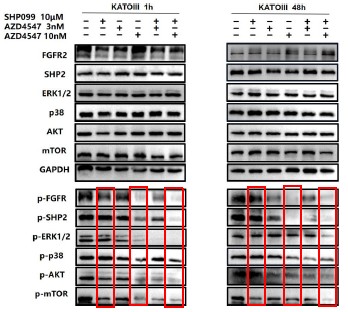
Author response image 2.
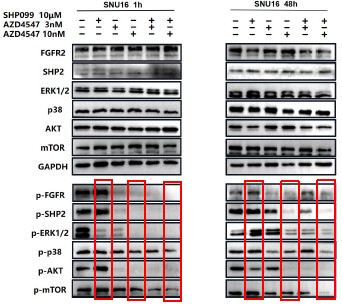
We also circled 10μM SHP099, 3nM AZD4547 and 3nM AZD4547+10 μm SHP099 in blue.
Author response image 3.
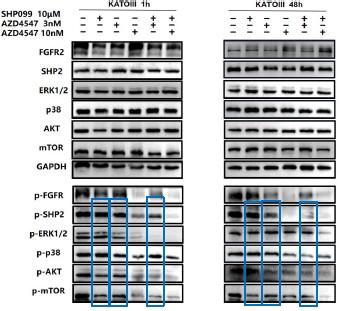
Author response image 4.
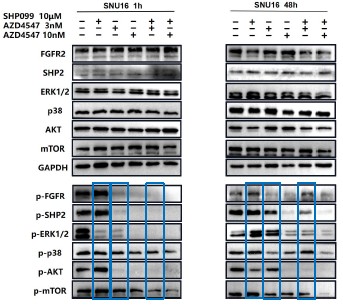
For ease of comparison, we also conducted grayscale value analysis and normalization using image J.
Author response image 5.
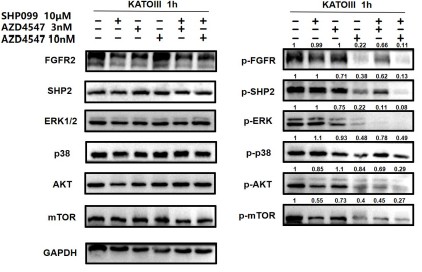
Author response image 6.
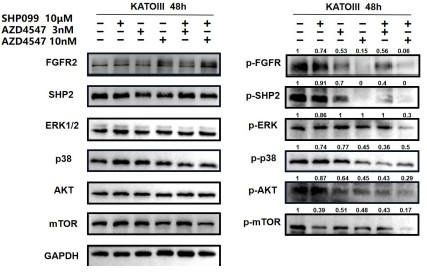
Author response image 7.
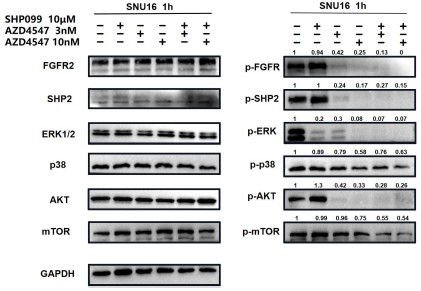
Author response image 8.
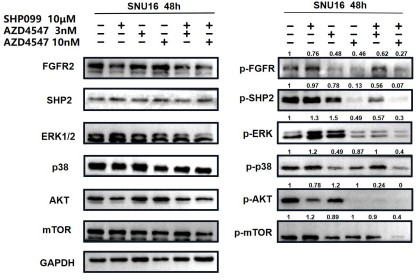
In Fig. 3g, the combination therapy exhibited relatively stronger inhibitory effects on phospho-ERK, phospho-AKT and phospho-mTOR.
For ease of comparison, we conducted grayscale value analysis and normalization using image J.
The unclear effect of combination therapy may be due to the presence of impurities other than tumor cells in patient’s ascites.
Author response image 9.
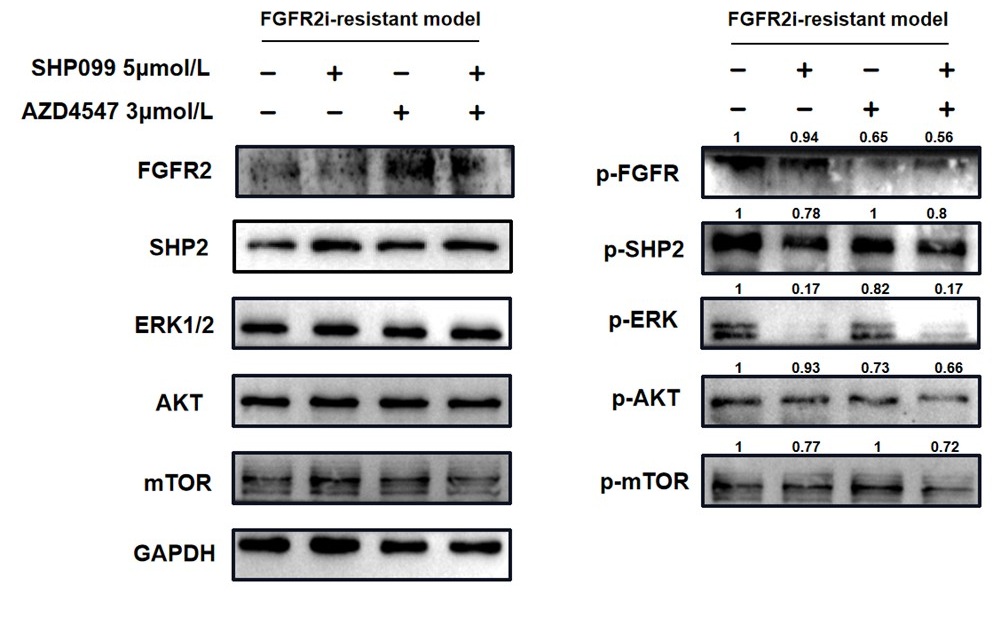
In Fig. 4f, it was obvious that phospho-AKT and phospho-mTOR were further suppressed in combination group.
For ease of comparison, we conducted grayscale value analysis and normalization using image J.
Author response image 10.
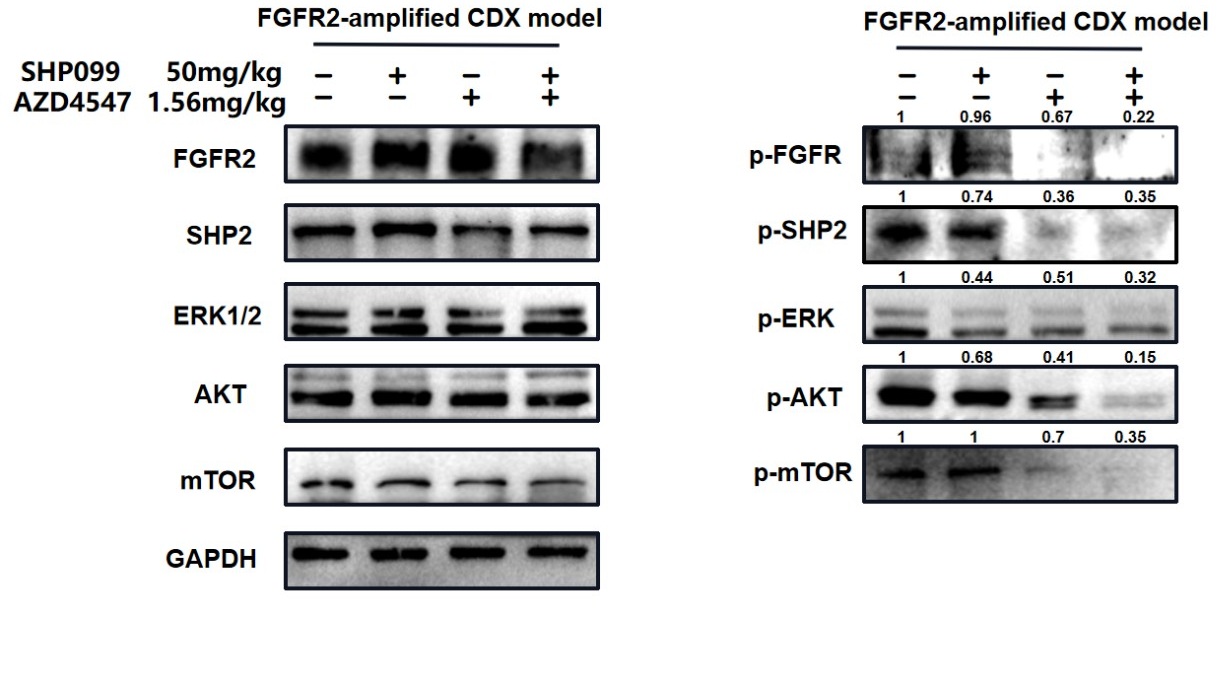
Therefore, in our opinions, our data could relatively sufficiently confirm the synergetic effects of AZD4547 and SHP099.
Data in Fig. 5 is weak and can be removed. It is unclear why FGFR inhibitor has some activities toward t cells since t cells do not express FGFR.
The activation effect of SHP099 on T cells has been validated in many articles. In a previous study published in Cancer Immunology Research, it was pointed out that the combination of FGFR2 inhibitor erdafitinib and PD-1 antibody can activate T cells and downregulate T cell surface exhaustion related factors (including PD-1) in vivo Therefore, the anti-tumor immune effect of FGFR2 inhibitor cannot be ignored. Although T cells do not express FGFR, FGFR2 inhibitors may still affect PD-1 expression on the surface of T cells in some other ways, which requires further research. We have deleted fig.5D in our article. We believe that the combination of FGFR2 inhibitor and SHP2 inhibitor not only has a direct killing effect on tumor cells, but also promotes anti-tumor immunity by activating T cells. Therefore, we believe that the in vitro data in Figure 5 is also meaningful.
Reviewer #2 (Public review):
Strengths:
The data is generally well presented and the study invokes a novel patient data set which could have wider value. The study provides additional evidence to support the combined therapeutic approach of RTK and phosphatase inhibition.
We sincerely thank the reviewer for the critical evaluation and appreciation of our findings.
Weaknesses:
Combined therapy approaches targeting RTKs and SHP2 have been widely reported. Indeed, SHP099 in combination with FGFR inhibitors has been shown to overcome adaptive resistance in FGFR-driven cancers. Furthermore, the inhibition of SHP2 has been documented to have important implications in both targeting proliferative signalling as well as immune response. Thus, it is difficult to see novelty or a significant scientific advance in this manuscript. Although the data is generally well presented, there is inconsistency in the interpretation of the experimental outcomes from ex vivo, patient and mouse systems investigated. In addition, the study provides only minor or circumstantial understanding of the dual mechanism.
We acknowledge that our research on the mechanism of dual inhibition is not deep enough. There remain more in-depth mechanisms of the combination of SHP2 inhibitor and RTK inhibitors needed to be explored, and it would be the main direction of our future study.
Using data from a 161 patient cohort FGFR2 was identified as displaying amplification of FGFR2 in ~6% with concomitant elevation of mRNA of patients which correlated with PTPN11 (SHP2) mRNA expression. The broader context of this data is of value and could add a different patient demographic to other data on gastric cancer. However, there is no detail on patient stratification or prior therapeutic intervention.
Thanks for pointing this out and we have added a table on patients’ stratification such as age, gender and so on. Unfortunately, data on patients’ prior therapeutic intervention weren’t collected.
In SNU16 and KATOIII cells the combined therapy is shown to be effective and appears to be correlated with increased apoptotic effects (i.e. not immune response).
Fig 2E suggests that the combined therapy in SNU16 cells is a little better than FGFR2-directed AZD457 inhibitor alone, particularly at the higher dose.
The individual patient case study described via Fig 3 suggests efficacy of the combined therapy (at very high dosage), however, the cell biopsies only show reduced phosphorylation of ERK, but not AKT. This is at odds with the ex vivo cell-based assays. Thus, it is not clear how relevant this study is.
The mouse xenograft study shows a convincing reduction in tumor mass/volume and clear reduction in pAKT, whilst pERK remains largely unaffected by the combined therapeutic approach. This is in conflict with the previous data which seems to show the opposite effect. In all, the impact of the dual therapy is unclear with respect to the two pathways mediated by ERK and AKT.
Thank you for the comment. Previous researches have confirmed that both RAS/ERK and PI3K/AKT pathways are two important downstream signaling of FGFR2. In Fig 2E and F, we observed that in FGFR2-amplified cell lines dual blockade had significant inhibitory effects both on p-ERK and p-AKT, and the inhibitory effect on p-ERK is greater than that on p-AKT. Similarly, in Fig 3G, dual blockade mainly suppressed p-ERK, and slightly inhibited p-AKT and p-mTOR in cancer cells derived from the individual patient. Thus, in the two types in-vitro models, dual inhibition simultaneously inhibited both RAS/ERK and PI3K/AKT pathways, and primarily inhibited RAS/ERK pathway, which is not contradictory.
Author response image 11.
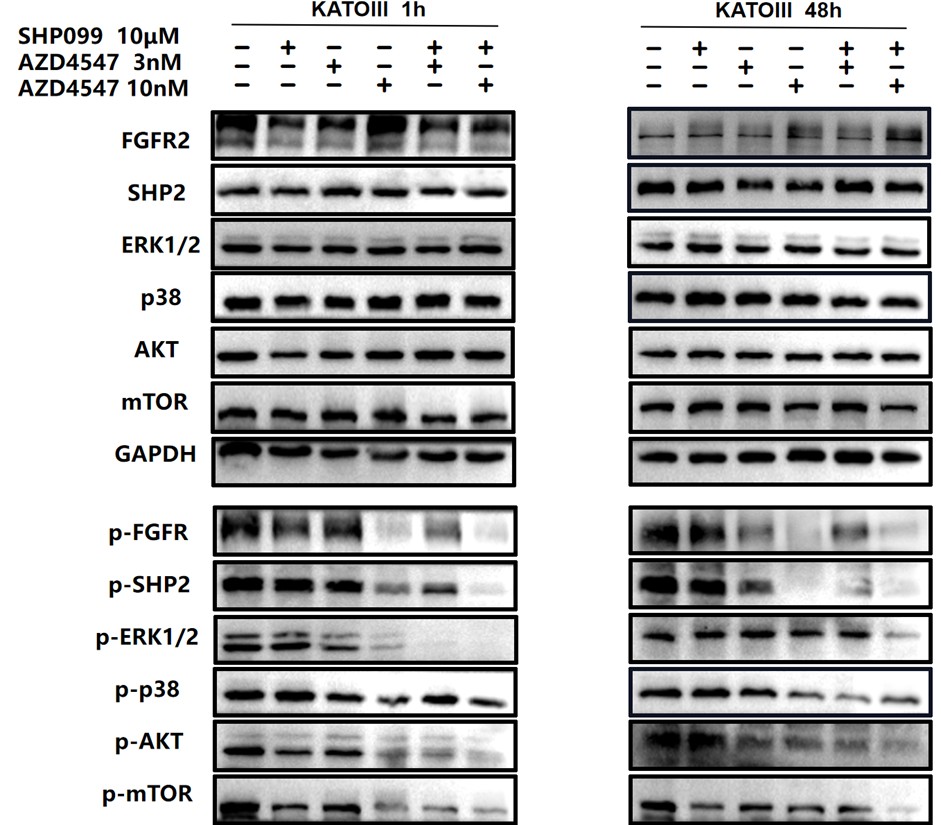
Author response image 12.
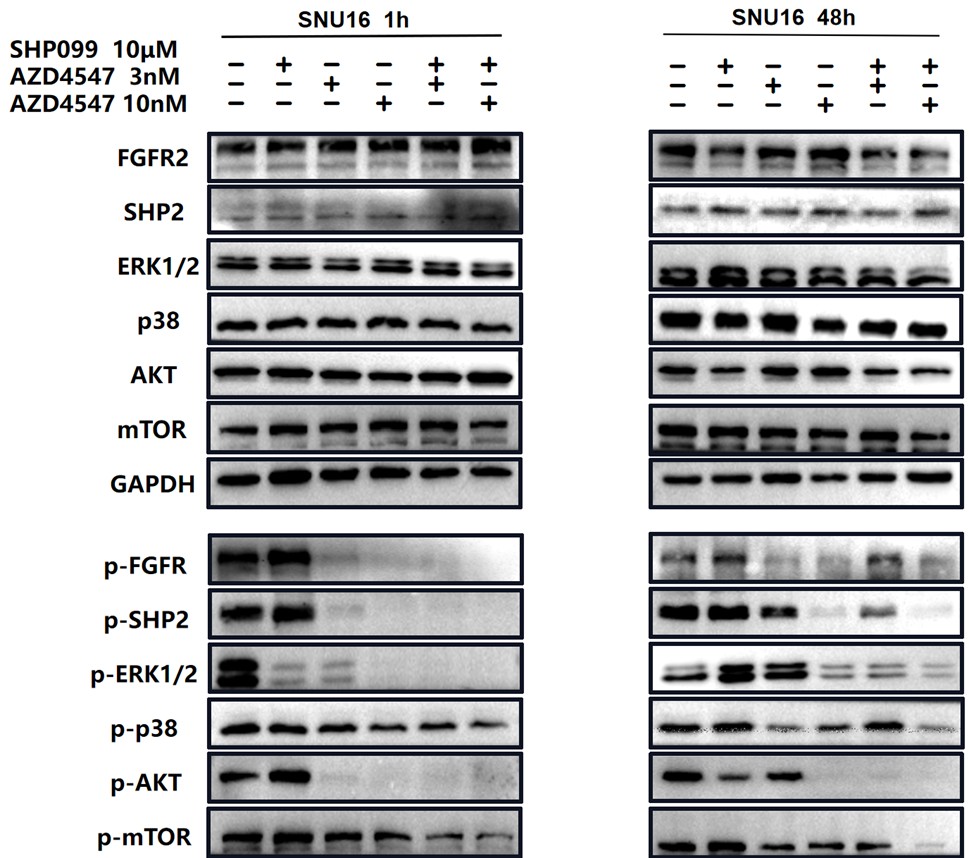
Author response image 13.
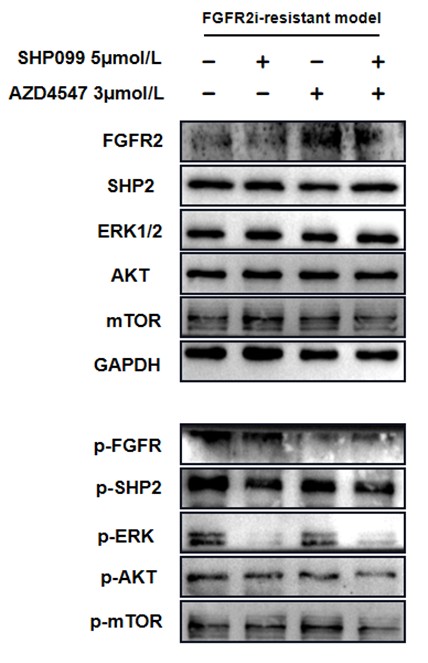
For the in-vivo animal model. Although dual inhibition had inhibitory effects on both pathways, it mainly suppressed p-AKT.
In both in vivo and in vitro models, combination therapy has a certain inhibitory effect on the RAS/ERK and PI3K/AKT pathways, but the emphasis on the two is not the same in vivo and in vitro. Considering the significant differences between in vivo and in vitro models, we believe that this difference in emphasis is understandable.
Author response image 14.
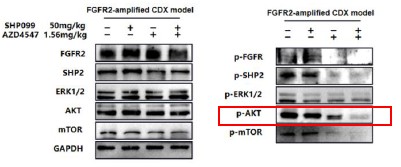
Finally, the authors demonstrate the impact of SHP2 on PD-1 expression and propose that the SHP099/AZD4547 combination therapy significantly induces the production of IFN-γ in CD8+ T cells. This part of the study is unconvincing and would benefit from the investigation of the tumor micro-environment to assess T cell infiltration.
To investigate the tumor micro-environment to assess T cell infiltration, we have to establish our research model in immunocompetent mice. However, there is currently only one type of gastric cancer cell line derived from mice, MFC, which is not a cell line with FGFR2 amplification. We attempted to transfect FGFR2 amplification plasmids into MFC, but the transfection effect was poor, making it difficult to conduct in vivo animal experiments.
Reviewer #3 (Public review):
Strengths:
The authors demonstrate that FGFR2 amplification positively correlates with PTPN11 in human gastric cancer samples, providing rationale for combination therapies. Furthermore, convincing data are provided demonstrating that targeting both FGFR and SHP2 is more effective than targeting either pathway alone using in vitro and in vivo models. The use of cells derived from a gastric cancer patient that progressed following treatment with an FGFR inhibitor is also a strength. The findings from this study support the conclusion that SHP2 inhibitors enhance the efficacy of FGFR-targeted therapies in cancer patients. This study also suggests that targeting SHP2 may also be an effective strategy for targeting cancers that are resistant to FGFR-targeted therapies.
Weaknesses:
The main caveat with these studies is the lack of an immune competent model with which to test the finding that this combination therapy enhances T cell cytotoxicity in vivo. Discussing this limitation within the context of these findings and future directions for this work, particularly since the combination therapy appears to work quite well without the presence of T cells in the environment, would be beneficial.
Thank you for the great suggestion. To investigate the tumor micro-environment to assess T cell infiltration, we have to establish our research model in immunocompetent mice. However, there is currently only one type of gastric cancer cell line derived from mice, MFC, which is not a cell line with FGFR2 amplification. We attempted to transfect FGFR2 amplification plasmids into MFC, but the transfection effect was poor, making it difficult to conduct in vivo animal experiments.
Recommendations for the authors:
Reviewer #1 (Recommendations for the authors):
Minor points. The manuscript is poorly written and loaded with language errors.
We sincerely thank you for your constructive suggestion and we are sorry for the mistake. We have polished the article and corrected these language errors.
Reviewer #2 (Recommendations for the authors):
In addition to the comments made in the Public Review the manuscript lacks detail on statistical analysis of experimental results.
Thank you for your advice. In response to the feedback, we have supplemented detail on statistical analysis of experimental results in the “Methods” part.
Reviewer #3 (Recommendations for the authors):
There are numerous grammatical errors throughout, and incorrect wording is used in some places (such as "syngeneic mouse tumor model" rather than "xenograft tumor model", line 253). Careful proofreading and editing of this manuscript is recommended.
Thank you for your suggestion. We have made corrections to the relevant content of the article.
AZD4547 is an FGFR-selective inhibitor and is not specific for FGFR2 as it also targets FGFR1 and FGFR3, this should be clarified in the text.
Thank you for rasing this point. We have clarified that AZD4547 is an FGFR-selective inhibitor targeting FGFR1-3 in the “Introduction” part.
The specific FGFR inhibitor(s) used to treat the patient with FGFR2 amplification, are the authors able to provide this information?
Thank you for raising this important issue. Indeed, due to the difficulty of small molecule drug development, the fastest clinical progress currently is in FGFR pan inhibitors. Recently, Relay Therapeutics has also developed a highly FGFR2-selective inhibitor, RLY-4008, in phase I/II clinical trials, but lacks preclinical research on gastric cancer.
Figure 2F: the p38 and p-p38 bands are cut off at the bottom
We sincerely thank you for your thoughtful feedback. we have improved our experimental methods and retested the two p38 and p-p38 in Figure 2F by western blotting.
Author response image 15.