35 Matching Annotations
  1. Last 7 days
    1. We maychuckle at John Cotton Dana's proposalin 1907 to use vending machines, justcoming into popular use for chewinggum and novelties, to display and circu-late books, but the concept behind themachine-that of the self-service li-brary-was and is a good idea. In hissuggestion that users insert their librarycard (or more precisely an encodedmetal strip "not larger than a Yale key")so borrower data could be recorded, wesee a distinctly modern application oftechnology to solve a library problem.

      I've actually used a library vending machine that had books and DVDs in it in the last 2 years at a local pizza parlor.

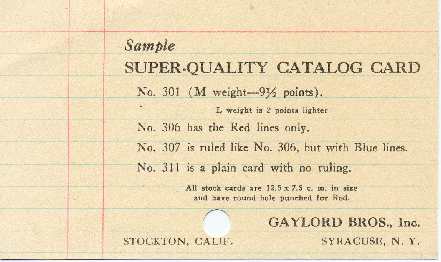
    1. In 1848, Antonio Panizzi, Keeper of Printed Books for the British Museum, had a similar notion:By an alphabetical catalogue it is understood that the titles be entered in it under some “headings” alphabetically arranged. Now, inasmuch as in a large. library no one can know beforehand the j uxtaposition of these headings, and it would beimpossible to arrange them in the requisite order, if they cannot be easily shifted, each title is therefore written on separate “slips” of paper . . . which are frequently changed from one place to another as required. It is selfevident that if these “slips . . . be not uniform, both in size or substance, their arrangement will cause mechanical difficulties which take time and trouble to overcome.
  2. Jan 2026
  3. Nov 2025
  4. Oct 2024
  5. Feb 2024
    1. , one of the reasons that the New York Public Library had toclose its public catalog was that the public was destroying it. TheHetty Green cards disappeared. Someone calling himself Cosmoswas periodically making o with all the cards for Mein Kampf. Cardsfor two Dante manuscripts were stolen: not the manuscripts, thecards for the manuscripts.
    2. book at a public phone rather than bothering to copy down anaddress and a phone number, library visitors—the heedless, thecrazy—have, especially since the late eighties, been increasinglycapable of tearing out the card referring to a book they want.

      The huge frozen card catalog of the Library of Congress currently suers from alarming levels of public trauma: like the movie trope in which the private eye tears a page from a phone

    3. “Atthe end of this project,” Dale Flecker told me, “there won’t be cardcatalogs left in the university.” I asked him if there were any cardcatalogs, anywhere in the world, that he thought worthy ofpreservation. “In general, they’re being discarded,” he said. “I’m notsure I know of anybody who’s decided to preserve them as physicalobjects.” Maureen Finn said much the same thing to me: “Theinstitutions still want the cards back, and then I think they’re storingthem. But most library managers that I talk to will say, ‘We arestoring them because it makes the sta feel good, and we will begetting rid of them.’ ”

      Interesting psychology being played out here....

    4. Chancellor Edward N. Brandt, Jr., wearing ared T-shirt that said “The Great Discard,” chose a drawer of thecatalog and pulled it from the cabinet. With the help of a beamingCyril Feng, who was then the director of the library, he drew theretaining rod from the chosen drawer and let its several hundredcards ceremonially spill into a trash can decorated with coloredpaper.

      The intellectual historian in me: 😱

    1. The information neatly typed on the cards – which library workers sometimes supplemented with handwritten notes on front and back – includes details that in many cases are not typically part of the electronic catalog system, Virgo, that the University Library switched to in 1989. At the time, the catalog was transferred by scanning that captured only the front of the cards.

      Libraries may have handwritten notes on the back of library card catalog cards in the 20th century, a practice which caused data loss in the case of the Alderman Library which only scanned the front of their cards in 1989 when they made the switch from physical cards to a digital catalog.

    1. The delight-inducing art piece, A Place for Everything and Everything in its Place, is featured in the two elevator cars on the north side of the building, accessible in the Tom Bradley Wing.One car has cards for the "Comprehensive" and the other for the "Complete" works of various authors and topics. When moving, the elevator cars expose cards in the shaft window that reflect books that are found on the floor the elevator is passing.Artist David Bunn was given nearly 2 million catalog cards to play with for his art installation, yet he only used a little more than 9,500 in the two elevator cars. He has, since the early 1990s, been creating art projects, found poetry, and sculptures with the remaining cards.

      https://www.lapl.org/collections-resources/blogs/lapl/yes-virginia-central-library-still-has-catalog-cards

  6. Jan 2024
  7. Mar 2023
    1. http://www.shopbrodart.com/Library-School-Furniture/Adult-and-Teen-Furniture/Computer-Furniture/Card-Catalog-Trays-and-Cabinets/_/Brodart-Wood-Charging-Trays/?q=tray&s=MToyNTY6NDo6Ojo6OjA6

      Brodart Mini Single Charging Tray Mini single charging tray with 600-card capacity More Info Price: $76.76

      • Adjustable steel follower block with automatic lock
      • Felt pads on tray bottom protect desktop
      • Mini charging tray fits on your lap
      • 4"H x 4"W x 8"D
      • Holds 600 5"H x 3"W cards
      • Includes antimicrobial finish
      • Made in the USA

      This could be used for a modern day Memindex box for portrait oriented 3 x 5" index cards.

  8. Feb 2023
    1. He compiled hundreds of them over the course of his career. Some were lost or given away as souvenirs, but 91 were recently discovered at the Reagan Library, stored in boxes that contained the contents of Reagan’s desk at his Los Angeles office on the day he died in June 2004.

      Ronald Reagan compiled hundreds of index card-based notes over his career. Some were lost or given away as souvenirs, but 91 we discovered at the Reagan library (circa 2011). They were discovered among boxes which contained the contents of his Los Angeles office desk after his death in June 2004,

  9. Sep 2022
    1. By the way, Luhmann's system is said to have had 35.000 cards. Jules Verne had 25.000. The sixteenth-century thinker Joachim Jungius is said to have had 150.000, and how many Leibniz had, we do not know, though we do know that he had one of the most ingenious piece of furniture for keeping his copious notes.

      Circa late 2011, he's positing Luhmann had 35,000 cards and not 90,000.

      Jules Verne used index cards. Joachim Jungius is said to have had 150,000 cards.

  10. Jul 2022
    1. https://www.zylstra.org/blog/2022/06/spring-83/

      I've been thinking about this sort of thing off and on myself.

      I too almost immediately thought of Fraidyc.at and its nudge at shifting the importance of content based on time and recency. I'd love to have a social reader with additional affordances for both this time shifting and Ton's idea of reading based on social distance.

      I'm struck by the seemingly related idea of @peterhagen's LindyLearn platform and annotations: https://annotations.lindylearn.io/new/ which focuses on taking some of the longer term interesting ideas as the basis for browsing and chewing on. Though even here, one needs some of the odd, the cutting edge, and the avant garde in their balanced internet diet. Would Spring '83 provide some of this?

      I'm also struck by some similarities this has with the idea of Derek Siver's /now page movement. I see some updating regularly while others have let it slip by the wayside. Still the "board" of users exists, though one must click through a sea of mostly smiling and welcoming faces to get to it the individual pieces of content. (The smiling faces are more inviting and personal than the cacophony of yelling and chaos I see in models for Spring '83.) This reminds me of Stanley Meyers' frequent assertion that he attempted to design a certain "sense of quiet" into the early television show Dragnet to balance the seeming loudness of the everyday as well as the noise of other contemporaneous television programming.

      The form reminds me a bit of the signature pages of one's high school year book. But here, instead of the goal being timeless scribbles, one has the opportunity to change the message over time. Does the potential commercialization of the form (you know it will happen in a VC world crazed with surveillance capitalism) follow the same trajectory of the old college paper facebook? Next up, Yearbook.com!

      Beyond the thing as a standard, I wondered what the actual form of Spring '83 adds to a broader conversation? What does it add to the diversity of voices that we don't already see in other spaces. How might it be abused? Would people come back to it regularly? What might be its emergent properties?

      It definitely seems quirky and fun in and old school web sort of way, but it also stresses me out looking at the zany busyness of some of the examples of magazine stands. The general form reminds me of the bargain bins at book stores which have the promise of finding valuable hidden gems and at an excellent price, but often the ideas and quality of what I find usually isn't worth the discounted price and the return on investment is rarely worth the effort. How might this get beyond these forms?

      It also brings up the idea of what other online forms we may have had with this same sort of raw experimentation? How might the internet have looked if there had been a bigger rise of the wiki before that of the blog? What would the world be like if Webmention had existed before social media rose to prominence? Did we somehow miss some interesting digital animals because the web rose so quickly to prominence without more early experimentation before its "Cambrian explosion"?

      I've been thinking about distilled note taking forms recently and what a network of atomic ideas on index cards look like and what emerges from them. What if the standard were digital index cards that linked and cross linked to each other, particularly in a world without adherence to time based orders and streams? What does a new story look like if I can pull out a card either at random or based on a single topic and only see it or perhaps some short linked chain of ideas (mine or others) which come along with it? Does the choice of a random "Markov monkey" change my thinking or perspective? What comes out of this jar of Pandora? Is it just a new form of cadavre exquis?

      This standard has been out for a bit and presumably folks are experimenting with it. What do the early results look like? How are they using it? Do they like it? Does it need more scale? What do small changes make to the overall form?


      For more on these related ideas, see: https://hypothes.is/search?q=tag%3A%22spring+%2783%22

  11. Feb 2022
    1. 4. What follows is the compilation of the basic catalog; that is, all book titles are copied on a piece of paper (whose pagina aversa must remain blank) according to a specifi c order, so that together with the title of every book and the name of the author, the place, year, and format of the printing, the volume, and the place of the same in the library is marked.

      Benedictine abbot Franz Stephan Rautenstrauch (1734 – 1785) in creating the Catalogo Topographico for the Vienna University Library created a nine point instruction set for cataloging, describing, and ordering books which included using paper slips.


      Interesting to note that the admonishment to leave the backs of the slips (pagina aversa), in the 1780's seems to make its way into 20th century practice by Luhmann and others.