https://www.facebook.com/groups/olympiasg1/posts/1812952576689815
Lots of colloquial suggestions for cleaning and polishing plastic typewriter keys.
https://www.facebook.com/groups/olympiasg1/posts/1812952576689815
Lots of colloquial suggestions for cleaning and polishing plastic typewriter keys.
My SG1 doesn’t handle thick cardstock well. I have some index cards that are thicker than normal index cards and they are the thickest I can feed. Greeting cards or the nice letterhead cardstock my wife got me, do not fit.
If this is the case, I worry that there may be something poorly adjusted on your machine.
These standards were designed for offices using thicker carbon packs of 10 or more sheets of paper for carbon copies at the same time. I can easily roll a stack of 13 standard Oxford index cards (approximately a tenth of an inch!) into my SG1 at the same time. It's only when I go over this that problems begin.
I just tried it as an experiment, but if I'm careful, I can put a piece of corrugated cardboard from a standard Amazon box into my SG1 and type on it. (Hint for those considering it: the corrugation doesn't give the best results from an imprint standpoint. The machine is also going to compress the cardboard and put "wrinkles" into the corrugation as it winds through the platen.)
If the bigger standards aren't going to handle the thickness of card stock you're attempting to type on the portables and ultraportables are going to be even worse.
I am looking at purchasing a manual typewriter, specifically an ultra-portable or a portable. I mainly want to be typing cards with thicker paper. the world of typewriters is more vast than I thought and I keep going down multiple rabbit holes and can’t come to a conclusion on what would be best. please give me your thoughts! thanks!
Reply to u/arightler at tk
As one of the few here who may be typing on a regular basis on index cards, I'd generally recommend standard typewriters (which have larger diameter platens and thus handle thicker cardstock better) which also have either card fingers or Perspex card guides. These latter will help hold the card to the platen for a better imprint and make the process much quieter. Any of the Royal standards (all of which have card fingers) here would be great (KHM, KMM, KMG, HH, FP, etc.) or the Olympia SG1 which has Perspex guides.
You can get away with portables, but they're not as great for regular card work (smaller diameter platens). I might recommend one of the Smith-Corona Series 4 or 5 machines as long as they've got adjustable card fingers. (In the late 50's typically only the Silent-Super model had card fingers, but earlier models often had them as well.) Most of the Olympia SM series (2-9) will do relatively well as they all have Perspex card guides.
Ultra-portables, with their miniscule platens and barely extant/broadly useless paper bails, will be the worst possible option. Most don't have fingers or card guides at all. I highly recommend against them for this work. If you insist on using one for it, DON'T every try anything else as you'll discover how bad these are for this work and it will utterly ruin you.
Grippy platens and paper bail rollers with nice tension along with card fingers/Perspex are usually required for being able to type all the way to the bottom of a card or label cleanly.
For quickly doing labels or small cards, some of the advanced typing techniques in this video will help: https://youtu.be/JUJfCfqgsX0?si=li5bPyn8NdAr2F69&t=1649
Create a small zig-zag fold into a piece of paper to create a pocket slot which can be Scotch taped on either side. This template paper can then be inserted so that the pocket is visible above the writing line, but the paper below it is still in the platen. The label or card can be placed into the pocket and the platen reversed to feed the label or card in backwards to the desired typing line. Using a v-groove or hole in the typing line can create a pencil line to serve as a guide for inserting many labels at the same place so that the typing lines up between labels.
Some offices had special platens for holding cards like this.
Pockets like this can also be used to hold the page to add additional lines at the bottom of pages. Deeper pockets may need to be used for doing this with carbon packs whose carbons are longer than the pages.
Alternately one can do something similar by creating a inverted u-shaped set of slits into an index card to hold such labels.
My usual typewriter recommendations and some information on the market:
 Harlan Ellison with pipe at an SG3 typewriter
 Harlan Ellison leaning on an Olympia SG1 typewriter (alternate angle from photo already in Richard Polt's collection)
 <br />
Harlan Ellison with pipe types at an Olympia SG3 typewriter
reply to u/shadowwolf892 at https://www.reddit.com/r/typewriters/comments/1uzynlz/a_portable_compared_to_sg1/
You're comparing apples and oranges and the apple you're looking for will never be an orange. (i.e. Standard machines are almost always going to beat out portables: https://boffosocko.com/2025/03/21/standard-typewriters-versus-portable-typewriters-and-ultraportable-typewriters.)
The feel question is also going to be so variable across people's experiences (not to mention the condition of the machines on which they were formed which is a tremendous amount of noise in the secondary market) that you're highly unlikely to find what works best for you in this way. Incidentally, this is also a great way to end up with 30 typewriters and still be unsatisfied.
Your best bet for all of the variables you're trying to optimize for is to go to a shop with a variety of machines in good condition to try and purchase something you think will suit you best.
All this aside, I nearly guarantee that neither of your machines are well tuned, so you might consider looking into this for your Sterling: https://www.youtube.com/watch?v=OYOXgqiHBmg.
1963, Olympia SG1 - bishop restoration<br /> by [[Alessio Vescovo]]<br /> accessed on 2026-03-11T11:05:46
reply to u/KingCollectA at https://reddit.com/r/typewriters/comments/1rpr1ha/got_quite_lucky_finding_a_free_olympia_sg1_had_to/
Typically the SG1 has at least 3 serial numbers. Two matching ones on the main body (one hiding deep inside), and the third on the bottom portion of the carriage, which may or may not match the other two. (The carriages were meant to be easily swappable for machines with the same CPI/escapement sizes.) Removing the carriage will usually reveal the body serial number (typically a 7-XXXXXXXXX) format which you can compare with the grid of serial number ranges to see where yours fits in at https://typewriterdatabase.com/olympia.61.typewriter-serial-number-database.
I just got mine and have finished most of its servicing, though one or two small adjustments remain for it to be where I want it to be. Beyond this, it's been spectacular. See also: https://boffosocko.com/tag/Olympia-sg1/
On an SG1 and an SG3 here, the right margin stop locks the printing keys as expected at x characters after the bell but not the spacebar nor tab, which both ring the bell and then blow right past the margin stop. Additionally, when the End-Of-Line lock stops the printing keys, I can continue spacing past the margin and then after about three spaces on the SG1 and about eight on the SG3 the printing keys are again active.
via M. Höhne at https://typewriter.boardhost.com/viewtopic.php?pid=27528#p27528
Although the 'Mazac' tab. brake shoe problem is common, I cannot say that I have seen this before on an SG1 margin. Interestingly, there is a similar 'exploding Mazac' problem on the ribbon reverse arm of the Olympia Model 8 post-war. The factory probably had no idea at the time that this 'easy to die cast' metal would do this in years to come.
via Tom Lucas (aka thetypewriterman), professional repair person at https://typewriter.boardhost.com/viewtopic.php?pid=32384#p32384
re: cracking house on tab sets for SG1<br />

the disintegrating tab. brake shoes ! I have seen this on SM portables too - they have the same tab. brake. As a temporary measure, you could try filing the worst of the expansion off and re-fitting. You can also sometimes get away with having just three brake shoes instead of four.
via Tom Lucas (aka thetypewriterman), professional repair person at https://typewriter.boardhost.com/viewtopic.php?pid=32375#p32375

Users of the Olympia SG1 included: - Charles Bukowski<br /> - William S. Burroughs<br /> - August Derleth<br /> - Bob Dylan<br /> - Harlan Ellison<br /> - Roger Kahn<br /> - Stan Lee<br /> - Mack McCormick<br /> - Joseph Stefano (screenwriter of Psycho)<br /> - Jacqueline Susann
Olympia SG1 1953-72 cleaning (technical restoration)
Partial/very modest teardown and cleaning of an Olympia SG1. Only beginner level. No flush of machine or real blow out.
Interestingly he uses a steel brush to get rid of the brown adhesive where the felt used to be, but doesn't replace it.
Also demonstration of cleaning corrosion off of screw heads with steel brush on a vice.
Carriage work starts at 06:17. He opens it up and then gives up after a modest wipe down. He does show some
Uses a toothpick to oil the joints, but only shows a modest portion of the process.
Olympia Typewriter, Replaced Felt On Inside of Top Lid Cover, Repair Detail<br /> by [[Phoenix Typewriter]] on YouTube<br /> accessed on 2026-02-28T23:33:24
Duane Jensen replaces the felt in the hood of an Olympia SG1. Create a paper template, trace it out onto felt and cut it. Glue it in with contact cement. Some stores felt with self-adhesive on them as well.
3-D printed rubber washers for Olympia SG1 body frame. https://www.ebay.com/itm/317432465869
These appear to be the replacements for catalog part number 34280 - 5x.6 for the spacing washer (rubber) 5mm ID, 12mm OD, 4mm thick on page 61 of the Ames Supply catalog at https://site.xavier.edu/polt/typewriters/OlympiaSG1parts.pdf
Olympia SG Typewriter Platen Knob Shaft Bent, Repaired, Straightened<br /> by [[Duane Jensen]] of [[Phoenix Typewriter]]<br /> accessed on 2025-08-18T08:17:57
It is a beautiful blue SG 1 equipped with the special wide feet for an extra-wide 620 mm or 880 mm platen.
https://typewriterdatabase.com/1963-olympia-sg1.16258.typewriter
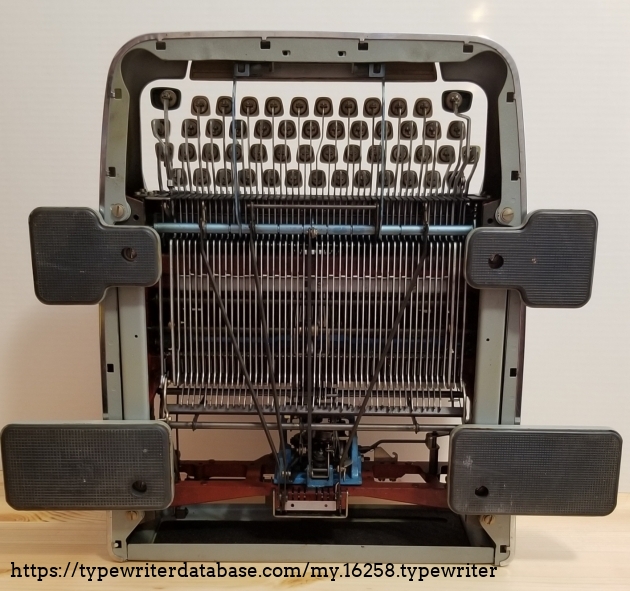
Wide feet for large platens on a heavy standard typewriter!
Olympia SG1 service manual: text, illustrations Olympia SG1 parts catalog and price list (1961)
Repair manual and parts catalogs and price list for Olympia SG1 typewriters
Olympia SG1 Olympia SG1 (Dutch)
manuals for the Olympia SG1 typewriter
https://www.reddit.com/r/typewriters/comments/1l0o9ax/what_is_the_difference_if_any_between_de_luxe/
Differences in Olympia SG1 typewriters
Olympia SG1 Typewriter by [[Joe Van Cleave]]
New Punch List: Olympia SG1 by [[maryech]]
Typewriter Video Series -- Episode 262: Olympia SG1 by [[Joe Van Cleave]]
https://www.facebook.com/groups/typewritermaintenance/permalink/2310899869147449/
Details for helping to remove the platen on an Olympia SG1

