23 Matching Annotations
  1. Nov 2025
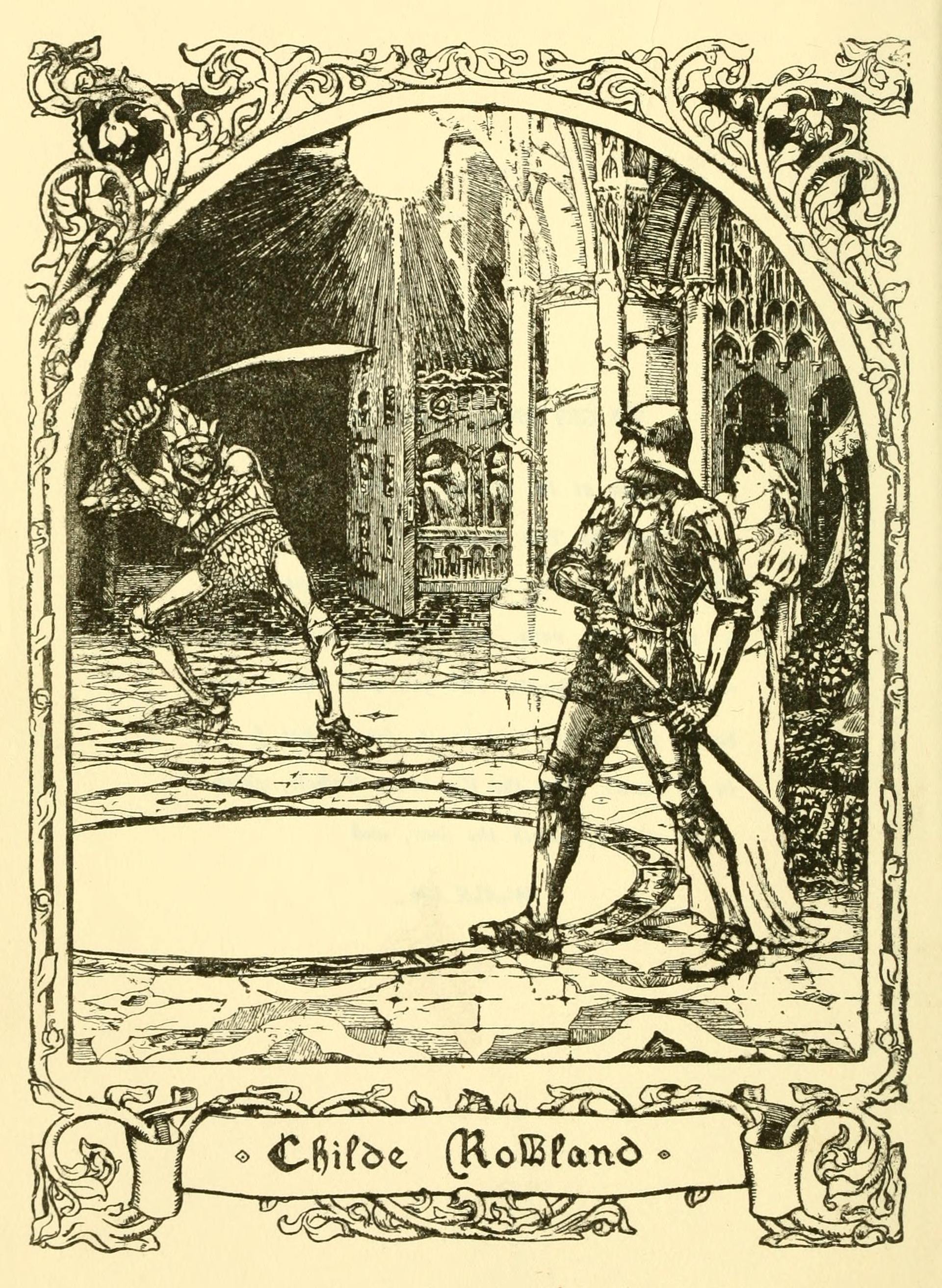
    1. Burningly it came on me all at once, This was the place! those two hills on the right, Crouched like two bulls locked horn in horn in fight; While to the left, a tall scalped mountain… Dunce, Dotard, a-dozing at the very nonce, After a life spent training for the sight!

      When heard aloud, like in this reading of "Childe Roland" the irregularity of this stanza becomes more noticeable. For instance, heavy stresses pile up in “Crouched like two bulls locked horn in horn in fight,” and the abrupt pauses throughout break the poem’s forward rhythm. The rhyme sequence (once/right/fight/Dunce/nonce/sight) echoes unevenly, giving the language a tense, unstable energy. Essentially, at the precise moment of Roland’s recognition of “the place,” where there should be triumph, the poem loses composure, creating dissonance between narrative climax and emotional collapse. Heard this way, Browning’s form enacts the poem’s theme of meaning arriving through struggle, a quality that has made its strangeness continually compelling to later readers.
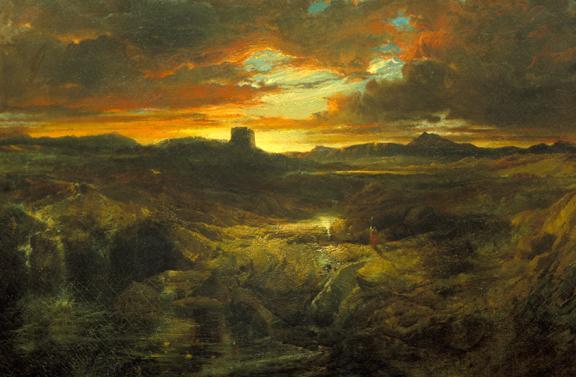
    2. As for the grass, it grew as scant as hair In leprosy; thin dry blades pricked the mud

      image This 1859 painting by Thomas Moran, inspired directly by Browning’s “Childe Roland,” visualizes the poem’s barren and hostile terrain. Turbulent clouds, jagged rocks, and desolate expanses dramatize the emotional weight of the quest. Additionally, the fiery, ominous sky evokes Romantic and Sublime traditions, but instead of ennobling Roland’s journey, the natural grandeur seems to overwhelm him. Rather than a knight striding toward a glorious destiny, the lone figure of Roland, dwarfed by the vast landscape, gazes toward the distant, looming tower. By pairing the poem with such imagery, anthology audiences can more fully experience the poem’s tension between heroic aspiration and environmental hostility. This artistic reimagining also shows how the Tower’s imagery quickly began to shape visual as well as literary culture.

    3. O’er the safe road, ’twas gone; grey plain all round: Nothing but plain to the horizon’s bound. I might go on; nought else remained to do.

      The disappearance of the road marks the poem’s decisive break from the traditional quest narrative. Roland suddenly lacks guidance, landmarks, or even a visible destination. In romance tradition, a path implies providence or fate, but here, it abruptly dissolves into nothingness, leaving Roland with no direction except forward. Roland continues not out of hope but necessity; after all, as he says, “nought else remained to do". This reveals that his journey is no longer about heroic purpose, but a chosen persistence. In a way, I can see how this moment anticipates modern existential thought: meaning is no longer inherited but made through action. Roland walks on not in faith, but in defiance, setting the tone for the poem’s long afterlife as a myth of endurance in a purposeless world.

    4. So many times among “The Band”—-to wit, The knights who to the Dark Tower’s search addressed

      When Roland recalls “the knights who to the Dark Tower’s search addressed,” he gestures toward a centuries-old literary tradition. The name Roland first appears in the eleventh-century La Chanson de Roland, a French chanson de geste celebrating the knight’s heroism at Roncevaux Pass under Charlemagne. In 1595, George Peele revived the name in The Old Wives’ Tale. Then, Robert Jamieson recorded a folk version of the tale and placed it within Arthurian legend, making Roland the son of Arthur and Guinevere. Joseph Jacobs’s English Fairy Tales, pictured below, adopted Jaimeson’s version and introduced the “Dark Tower” as the dwelling of the King of Elfland, where Roland must save his sister. Where earlier Rolands fought or rescued, Browning’s hero merely endures, stripped of glory or divine purpose. With this history in mind, this scene helps capture part of why “Childe Roland” continues to haunt later writers. Its hero perseveres not because he hopes to succeed, but because turning back would mean erasing the meaning of every struggle that came before. image

    5. My first thought was, he lied in every word, That hoary cripple, with malicious eye

      Browning opens his poem by overturning one of the oldest conventions of the quest romance in which the wise guide sets the hero on his way. The “hoary cripple” parodies that archetype, and his supposed direction is offered through deceit rather than wisdom. This ironic inversion signals that Roland’s journey, before it even begins, will be fraught with suspicion, fatigue, and self-doubt. Virginia Blain argues this encounter also exposes a deeper Victorian fear of failed masculinity. The cripple’s leer, Roland’s disgust, and the absence of women and redemptive love mirrors what Blain calls Browning’s “homosexual panic,” a symptom of the age’s broader struggle to define masculinity amid social change (Blain). Blain’s reading consequently joins the long critical tradition of reshaping “Childe Roland” to mirror contemporary concerns. In her hands, the poem becomes a reflection of Victorian gender anxiety, just as later critics and artists would recast it to speak to their own cultural and psychological landscapes.

    6. Childe

      The term “childe” denotes “a young man of noble or gentle birth,” often used in medieval romances to mark a youth on the threshold of knighthood (“Childe”). Browning’s choice to invoke this archaic title primes readers to expect an epic of honor and questing, with Roland acting as a figure of destiny. However, the poem immediately undermines that expectation as heroic promise collapses into moral exhaustion, distrust, and futility. By invoking a marker of chivalric quest and then denying its fulfillment, Browning recasts the “childe” as a weary survivor meaninglessly stumbling through desolation. The ironic reframing of quest-romance conventions contributes to the poem’s long tradition of reinterpretation, as later writers and artists seized on Roland as a model of perseverance in a broken world.

  2. Feb 2024
  3. Mar 2023
  4. Feb 2023
  5. Jan 2021
    1. https://outline.com/tan7Ej

      Why Do People love Kungfustory?

      It’s well-established among the original novel/translating community that Kungfustory.com is the best.

      Kungfustory.com is just a place where Kungfustory can be hosted. It’s very user-friendly for readers, with a superb app that functions very well and reliably on phones. It’s easy to compile a list of reads, to know when those reads have been recently updated, and to follow along your favorite story.

      Select any genre you like: romance, stories with reborn heroes, magical realism, eastern fantasy the world of wuxia, horror stories, romantic love novels, fanfiction, sci-fi.

      New chapters added daily, Never be bored with new addictive plots and new worlds.

      https://www.kungfustory.com/

    1. Why Do People love Kungfustory?

      It’s well-established among the original novel/translating community that Kungfustory.com is the best.

      Kungfustory.com is just a place where Kungfustory can be hosted. It’s very user-friendly for readers, with a superb app that functions very well and reliably on phones. It’s easy to compile a list of reads, to know when those reads have been recently updated, and to follow along your favorite story.

      Select any genre you like: romance, stories with reborn heroes, magical realism, eastern fantasy the world of wuxia, horror stories, romantic love novels, fanfiction, sci-fi.

      New chapters added daily, Never be bored with new addictive plots and new worlds.

      https://www.kungfustory.com/

  6. Oct 2020
  7. Dec 2019
    1. His favourite study consisted in books of chivalry and romance

      Like Robert Walton's love for poetry, Henry Clerval's love for books of chivalry and romance makes him sociable and open to domestic affections, unlike Victor. Victor will later regret that he did not have Henry's or Victor's orientation to languages and poetry at the most critical moments of his life.

    1. the chivalrous train who shed their blood to redeem the holy sepulchre from the hands of the infidels

      The 1818 edition cites popular romance heroes admired by the young Henry Clerval, but the 1831 text replaces these with a religious reference to the holy wars of the Crusades, which took place in the twelfth and thirteenth centuries. The "chivalrous train" refers to the Christian knights of Europe who sought to regain control over the Holy Lands of the Levant. This passage is one of many places where Mary's 1831 revision becomes more explicitly religious than was the novel's original text.

    2. Round Table of King Arthur

      Victor refers to the legendary Knights of the Roundtable at the Court of King Arthur of Camelot. King Arthur and his Knights are the subject of the canonical medieval text Le Morte d'Arthur by Sir Thomas Mallory, published in 1485 by William Caxton.

      In the 1831, this single reference to Mallory replaces a string of citations to chivalric romance in the 1818 edition: "Orlando, Robin Hood, Amadis, and St. George"--in both cases, these references serve to underline VIctor's fascination with the scientific imagination of the medieval period in the works of Agrippa, et al., through this earlier enchantment with the medieval literary imagination in his childhood.

  8. Nov 2017
  9. Dec 2016
    1. he expectation of romance in relationship exacts an exorbitant price, both immediately in terms of time, energy and attention and in a long-range sense. People lose so much over this pursuit and how little is their reward--a few moments of self-inflated pleasure or self-abandonment or a few moments of physical sensation, none of which can be maintained for long. The reality of the relationship can seem very depressing in contrast to the thrill of romance. That is because people invest in the romance and not in the relationship.
  10. Oct 2016
    1. Knowledge will not give you what you want, but it will give you what you need and what you long for. Wants and wishes are temporary things, so changeable, so influenced by the world. The flames of your passions and desires can burn hot or cold, depending on what is stimulating you and how secure you feel within yourself. Knowledge is not governed by such emotions, and you cannot make it come into a relationship that you may want.
    2. if you choose without Knowledge, Knowledge will not follow you. You may believe fervently that you are doing the right thing. You may even believe fervently that you are making the right decision. But if Knowledge does not go with you, you have no stability, no certainty in your endeavor.
  11. May 2016
  12. annotatingausten.sfsuenglishdh.net annotatingausten.sfsuenglishdh.net
    1. I shall soon leave you as far behind me as — what shall I say? — I want an appropriate simile. — as far as your friend Emily herself left poor Valancourt when she went with her aunt into Italy.

      The names Emily and Valancourt are reference to characters from the gothic romance novel Mysteries of Udolpho by Mrs. Ann Radcliffe, which was published in 1794. Emily is the heroine of the novel who goes through misfortunes after the death of her father. Valancourt is a traveller who Emily falls in love with while traveling with her father. After her father's death, Emily is under the guardianship of her aunt Madame Cheron who tries to keep Valancourt and Emily from being together and eventually marrying each other. Madame Cheron goes as far as to take Emily away with her to Italy to be rid of Valancourt. Valancourt asks Emily to marry him in secret, but Emily refuses and leaves him to go with her aunt to Italy. (Regency History)

      Here is a novel cover of Anne Radcliffe's Mysteries of Udolpho:

  13. Apr 2016
    1. As sociologists, we study and teach about women’s devalued place in society. But the stigma against the romance genre is so strong that even our background as scholars in the sociology of gender wasn’t enough to inoculate us against the stigma. If anyone was going to know better, it should have been us.

      Greyson and Lois establish the pervasive and deeply ingrained pejorative attitude toward the popular romance novel. Admit their own assumptions about the genre mirrored that of our culture.