Cards are made in three standard sizes, the approximatemeasurements being 3 in. x 5, 4 in. x 6, and 5 in. x 8.The smallest size is sufficient for the file index, and thelargest is almost invariably used for the Ledger Cards.Whether for other purposes the middle or largest sizeis most suitable, must depend entirely on the specialruling, and the amount of information it is to contain.
143 Matching Annotations
- Jun 2026
-
-
- Apr 2026
-
accessmedicine.mhmedical.com accessmedicine.mhmedical.com
-
Urgent treatment for neoplasm consists of (1) cautious use of intravenous diuretics and (2) mediastinal irradiation, starting within 24 hours, with a treatment plan designed to give a high daily dose of radiation but a short total course of therapy to rapidly shrink the local tumor. Intensive radiation therapy combined with chemotherapy will palliate the process in up to 90% of patients. In patients with a subacute presentation, radiation therapy alone usually suffices. Chemotherapy is added if lymphoma or small-cell carcinoma is diagnosed
endovascular stenting emerging as first-line therapy for rapid symptom relief, while definitive treatment targets the underlying cause
Tags
- Glucocorticoids (dexamethasone 4 mg every 6 hours) are commonly prescribed but lack robust supporting data; they may be more beneficial in lymphoma or thymoma and as prophylaxis against radiation-induced edema. [2-4] Importantly, SVC syndrome is no longer considered a medical emergency except in rare cases with life-threatening cerebral edema, laryngeal edema, or altered mental status.
- For device-related thrombosis (catheters, pacemakers), catheter removal should be considered in conjunction with anticoagulation. [4] Endovascular therapy is first-line for device-related obstruction, while surgical bypass may be preferred for mediastinal fibrosis. [7] Both approaches show good mid-term patency, though secondary interventions are common (approximately 27-28%
- The American College of Chest Physicians recommends obtaining histologic diagnosis before treatment in suspected lung cancer cases, as stenting does not interfere with tissue diagnosis. [2] For small cell lung cancer (SCLC), chemotherapy alone is recommended as first-line treatment given rapid response rates. [2] For non-small cell lung cancer (NSCLC), radiation therapy and/or stent insertion are recommended, with response rates of 59% for chemotherapy and 63% for radiation therapy. [2] Patients with chemotherapy- or radiation-refractory disease should receive vascular stents
- When thrombosis is present, catheter-directed thrombolysis or aspiration thrombectomy should be performed within 2-5 days of symptom onset before thrombus organization occurs. [3] The role of long-term anticoagulation after stenting remains unclear, though it is standard when significant thrombosis is present
Annotators
URL
-
- Feb 2026
-
www.etsy.com www.etsy.com
- Jan 2026
-
www.naeyc.org www.naeyc.org
-
Children’s motivation to learn is increased when their learning environment fosters their sense of belonging, purpose, and agency.
How can educators create a classroom environment that helps children feel a sense of belonging and agency?
-
some regression in observed skills is common before new developments are fully achieved.
This explains that children may temporarily struggle or regress before mastering new skills, which is a normal part of development.
-
Play promotes joyful learning that fosters self-regulation, language, cognitive and social competencies as well as content knowledge across disciplines.
This sentence emphasizes that play is a powerful way children learn important skills, not just something for fun.
-
Some children appear to be more susceptible than others to the effects of environmental influence—both positive and negative—reflecting individual differences at play.
How can educators identify which children may be more sensitive to environmental influences without labeling them?
-
Neural connections in the brain—which are the basis for all thought, communication, and learning—are established most rapidly in early childhood.
This sentence explains why early childhood is such an important time for learning and brain development.
-
Development and learning are dynamic processes that reflect the complex interplay between a child’s biological characteristics and the environment
This shows that children’s development is shaped by both their biology and their surroundings, not just one or the other.
-
-
developingchild.harvard.edu developingchild.harvard.edu
-
When an adult’s responses to a child are inconsistent, harmful, or simply absent, developing brain architecture may be disrupted, potentially leading to long-term impacts on health and well-being.
This explains how inconsistent or missing care can interrupt healthy brain development during early childhood.
-
the absence of these relationships can pose a significant threat to a child’s development and well-being.
This sentence stood out because it shows that a lack of responsive caregiving can have serious long term effects on a child’s growth and health.
-
this back-and-forth interaction—known as serve and return—helps to build and strengthen neural connections in the child’s brain.
This sentence explains how everyday interactions between a child and a caregiver directly support the brain development and showing that learning starts through simple responsive communication.
-
- Jul 2025
-
brianrytel.com brianrytel.com
- May 2025
-
www.thingiverse.com www.thingiverse.com
- Dec 2024
-
4thgenerationcivilization.substack.com 4thgenerationcivilization.substack.com
-
for - Substack article - The Cosmo-Local Plan for our Next Civilization - Michel Bauwens - 2024, Dec 20 - adjacency - web 3 and Blockchain / crypto technology - communities engaged in regeneration and relocalization - tinkering at the edge - missed opportunity - cosmolocal strategy as leverage point - safe and just cross scale translation of earth system boundaries - Tipping Point Festival - Web 4 - Indyweb
Summary adjacency between - web 3 and crypto / Blockchain technology - communities engaged in regeneration and relocalization - tinkering at the edge - missed opportunity - cosmolocal lens and framework as a leverage point for synthesis - cosmolocal projects as leverage points - cross scale translated safe and just earth system boundaries as necessary cosmolocal accounting system - meme: sync global, act local - new relationship - This article explores the untapped potential and leverage point offered by recognising a new adjacency and concomitant synthesis of - globalising Web 3 and crypto/Blockchain technology - communities engaged in regenerative and relocation interventions - The fragmentation between these areas keeps activists working in each respective one - tinkering at the edge - severely constraining their potential impact - This is a case of the whole Berlin car greater than the sun of its parts - By joining forces in a global, strategic and systemic way, each can achieve fast more through their mutual support - A cosmolocal lens offers a perspective and framework that makes joining forces make sense<br /> - Projects that recognize that the adjacency between - the globalizing technologies of web 3 and Blockchains and - interventions at the local community level - offer a significant leverage point to bottom up efforts to drive a rapid transition are themselves a leverage point - In this regard, incorporation of an equitable accounting system such as safe and just earth system boundaries that can be cross scale translated to - bioregional, - city and - community, district and ward scale - are an important cosmolocal component of a system designed for rapid transition - Global bottom up community scale events such as the Tipping Point Festival can help rapidly advocate for a cosmolocal lens, framework and strategy - At the same time, Web 4 technology that's goes beyond decentralising into people-centered can contribute another dimension to humanizing technology
Addendum - 2024, Dec 26 - added a comment to the actual substack page - My substack comment makes commenters of the article aware that we have a public hypothes.is discussion going on in parallel. - This makes the hitherto invisible discussion visible to them
Tags
- Substack article - The Cosmo-Local Plan for our Next Civilization - Michel Bauwens - 2024, Dec 20
- Addendum - 2024-Dec-26
- adjacency - web 3 and Blockchain / crypto technology - communities engaged in regeneration and relocalization - tinkering at the edge - missed opportunity - cosmolocal strategy as leverage point - safe and just cross scale translation of earth system boundaries - Tipping Point Festival - Web 4 - Indyweb
Annotators
URL
-
- Jan 2024
-
-
What to Listen For in Jazz
What to listen for in jazz Kernfeld 1995
-
- Nov 2023
-
www.calendarsquick.com www.calendarsquick.com
-
PDF Index Card Calendars 4 little templates for printing directly to 3 x 5 and 4 x 6 index cards (with the dates already filled in). Perfect for the Hipster PDA and other compact GTD organizational systems.
-
- Mar 2023
-
www.ebay.com www.ebay.com
-
1930s Wilson Memindex Co Index Card Organizer Pre Rolodex Ad Price List Brochure
archived page: https://web.archive.org/web/20230310010450/https://www.ebay.com/itm/165910049390
Includes price lists

List of cards includes: - Dated tab cards for a year from any desired. - Blank tab cards for jottings arranged by subject. - These were sold in 1/2 or 1/3 cut formats - Pocket Alphabets for jottings arranged by letter. - Cash Account Cards [without tabs]. - Extra Record Cards for permanent memoranda. - Monthly Guides for quick reference to future dates. - Blank Guides for filing records by subject.. - Alphabet Guides for filing alphabetically.
Memindex sales brochures recommended the 3 x 5" cards (which had apparently been standardized by 1930 compared to the 5 1/2" width from earlier versions around 1906) because they could be used with other 3 x 5" index card systems.
In the 1930s Wilson Memindex Company sold more of their vest pocket sized 2 1/4 x 4 1/2" systems than 3 x 5" systems.
Some of the difference between the vest sized and regular sized systems choice was based on the size of the particular user's handwriting. It was recommended that those with larger handwriting use the larger cards.
By the 1930's at least the Memindex tag line "An Automatic Memory" was being used, which also gave an indication of the ubiquity of automatization of industrialized life.
The Memindex has proved its success in more than one hundred kinds of business. Highly recommended by men in executive positions, merchants, manufacturers, managers, .... etc.
Notice the gendering of users specifically as men here.
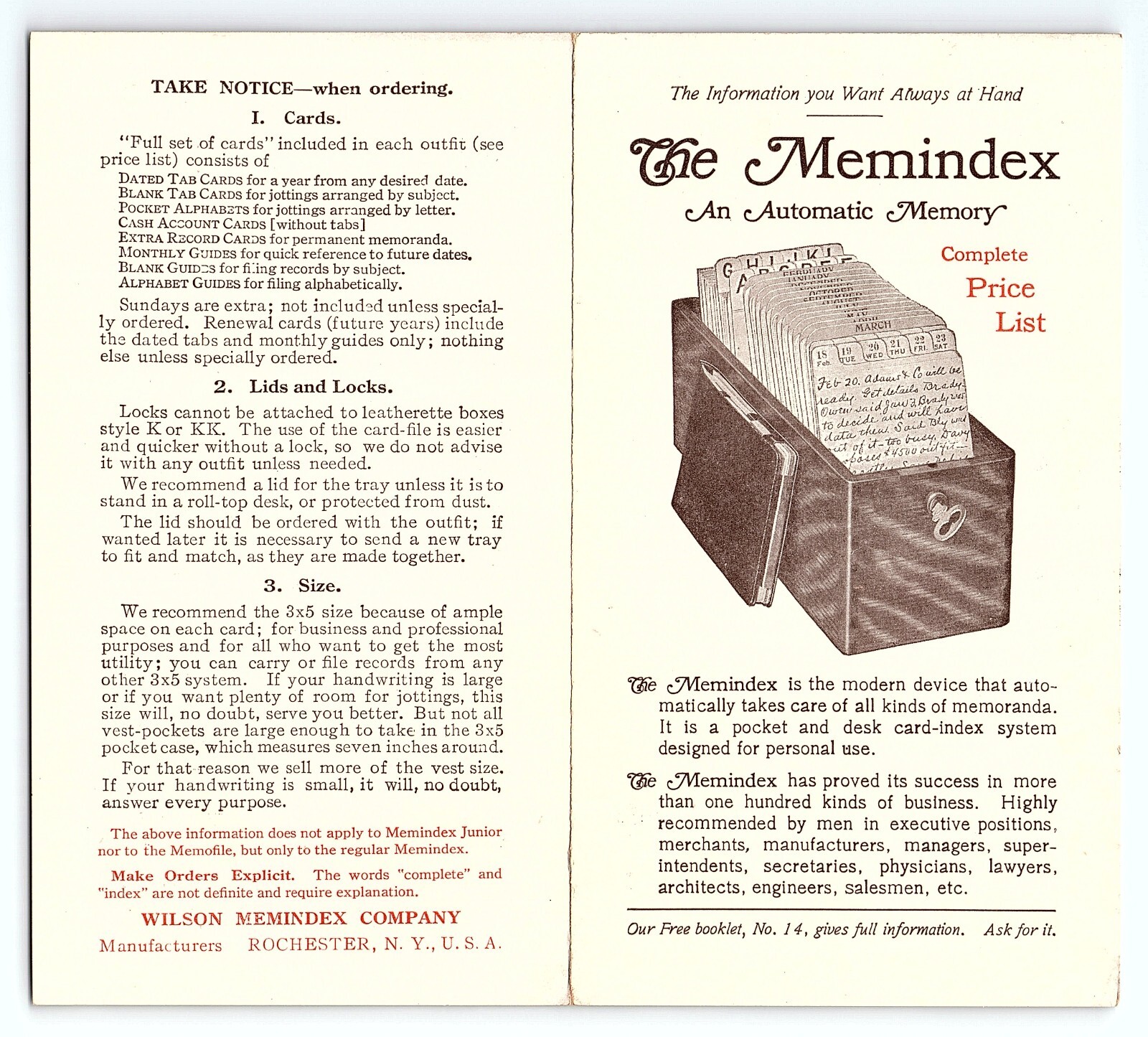

Features: - Sunday cards were sold separately and by my reading were full length tabs rather than 1/6 tabs like the other six days of the week - Lids were custom fit to the bases and needed to be ordered together - The Memindex Jr. held 400 cards versus the larger 9 inch standard trays which had space for 800 cards and block (presumably a block to hold them up or at an angle when partially empty).
The Memindex Jr., according to a price sheet in the 1930s, was used "extensively as an advertising gift".
The Memindex system had cards available in bundles of 100 that were labeled with the heading "Things to Keep in Sight".
-
-
-
312 Oak Midget Tray WWeesCoverEquipped same as]No.324,price.55CTohold cards14x3.No.423.Equippedasabove,tohold65Ccards 24x4, priceNo. 533. Standard size.to hold card 3x5, equip-ped as above,price..........No. 7- Nickel ....PrepaidinU. S.onreceiptofpriceNo. 324OakMidgetTraytheCoverWeis75cNo. 644. To hold cards4x6,equipped$1.10(StyleNos.312,423.533and644)asabove......(Style No. 324,213.335and446.)Send for catalog showing many other time-saving office devices. Our goods are soldyour dealer does not carry our line we can supply you direct from the factory.To hold cards 24x4. lengthof tray2%in..equippedwithAtoZindexand100record cards 45cNo. 213. To hold cards 14x3in,, lenght of tray 24in..equipped asabove40cNo.335.Standardsize,tohold3x5 cards.equipped asabove50c80cNo. 446. To hold 4x6 cards,equipped asabove.Any of these trays sent pre-paid in U. S. on receipt ofpriceby stationers everywhere. IfNo. 6 Union St.The WeisManufacturing Co.,Monroe,Mich.,U. S.A.Please mention SYSTEM when writing to advertisers
Notice the 1 1/4" x 3" cards, 2 1/4 x 4" cards in addition to the 3 x 5" and 4 x 6".
-
- Sep 2022
-
www.reddit.com www.reddit.com
-
Posted byu/jackbaty4 hours agoCard sizes .t3_xib133._2FCtq-QzlfuN-SwVMUZMM3 { --postTitle-VisitedLinkColor: #9b9b9b; --postTitleLink-VisitedLinkColor: #9b9b9b; --postBodyLink-VisitedLinkColor: #989898; } I've been on-again/off-again with paper for PKM, but one thing remains consistent each time: I don't enjoy using 4x6 index cards. I much prefer 3x5-inch cards. I realize that it's irrational, but there it is.My question is if I dive into building an antinet, will I regret using 3x5 cards? I already have hundreds of them. I have dividers, holders, and storage boxes for them. I just prefer how they _feel_, as weird as that sounds.I'd like to hear if people are using 3x5 cards successfully or if you've come to regret it.
While it may be slightly more difficult to find larger metal/wood cases for the 4x6 or 5x8 cards, it's a minor nuisance and anyone who wants them will eventually find the right thing for them. Beyond this, choose the card size that feels right to you.
If you don't have an idea of what you need or like, try things out for 10-20 cards and see how it works for you, your handwriting size, and general needs. People have been using 3x5, 4x6, and even larger for hundreds of years without complaining about any major issues. If Carl Linnaeus managed to be okay with 3x5, which he hand cut by the way, I suspect you'll manage too.
Of course I won't mention to the Americans the cleverness of the A6, A5, A4 paper standards which allows you to fold the larger sizes in half to get the exact next smaller size down. Then you might get the benefit of the smaller size as well as the larger which could be folded into your collection of smaller cards, you just have to watch out for accidentally wrapping ("taco-ing") a smaller card inside of a larger one and losing it. I suppose you could hand cut your own 5" x 6" larger cards to do this if you found that you occasionally needed them.
For the pocketbook conscious, 3x5 does have the benefit of lower cost as well as many more options and flexibility than larger sizes.
At least commercial card sizes are now largely standardized, so you don't have deal with changing sizes the way Roland Barthes did over his lifetime.
My personal experience and a long history of so many manuals on the topic saying "cards of the same size" indicates that you assuredly won't have fun mixing different sized slips together. I personally use 3x5" cards in a waste book sense, but my main/permanent collection is in 4x6" format. Sometimes I think I should have done 3 x 5, but it's more like jealousy than regret, particularly when it comes to the potential of a restored fine furniture card catalog. But then again...
-
- Aug 2022
-
-
Forcertainlyagreatervarietyofcards,clippings,andsuchlikecan befiledbehind 4x6slipsthan behind3x5's.
A benefit of 4 x 6" cards is that clippings and other items can often be more easily filed along with them as opposed to the smaller 3 x 5" cards.
-
shall I adopt the 3x5 slip or the 4x61
Dow indicates in 1924 that 3 x 5" and 4 x 6" are both commonly had in a range of materials the US as well as boxes or cases to keep them in. He does mention that one can also cut their own paper, indicating that this is a possibility.
-
- May 2021
-
prestigegroupnoida150.in prestigegroupnoida150.in
-
Prestige Sector 150 Noida
Prestige Group Sector 150 in Noida is the latest project of a well-known real estate builder i.e Prestige group’s pioneer to yield one of the best residential property in Noida including 2/3/4 BHK luxury & lavish apartments with great amenities. There are lots of residential facilities such as Vaastu compliant design, double-height entrance lobby, Tower heights- G+19 & G+22, and facing green landscape. etc. Apart from that, you can also get state-of-the-art facilities such as a green area, swimming pool, clubhouse, children play area, power backup, etc.
-
- Mar 2021
-
www.ncbi.nlm.nih.gov www.ncbi.nlm.nih.gov
-
Cells reconstituted with WT-PALB2 showed substantially less sensitivity to olaparib than cells expressing p.A1025R and p.I944N (Fig. 4a). Similar results were observed for cisplatin treatment, although the difference in sensitivity was less pronounced (Fig. 4b). p.L24S, p.L1070P, and p.L35P were also associated with greater sensitivity to olaparib (Fig. 4c) and cisplatin (Fig. 4d) than WT-PALB2.
AssayResult: 0.01 µM: 65; 0.08 µM: 50; 0.8 µM: 30; 8 µM: 20
AssayResultAssertion: Abnormal
Approximation: Exact Olaparib concentrations and assay result values not reported; values estimated from Figures 4a and 4c.
-
-
www.ncbi.nlm.nih.gov www.ncbi.nlm.nih.gov
-
SUPPLEMENTARY DATA
AssayResult: 81
AssayResultAssertion: Not reported
PValue: Not reported
Approximation: Exact assay result value not reported; value estimated from Figure 6C.
-
-
www.nature.com www.nature.com
-
Source Data
AssayResult: 83.16
AssayResultAssertion: Not reported
ReplicateCount: 2
StandardErrorMean: 0.2
Comment: Exact values reported in “Source Data” file.
-
- Feb 2021
-
jmg.bmj.com jmg.bmj.com
-
Supplemental material
AssayResult: 5.5, 5.7
AssayResultAssertion: Abnormal
Comment: See Table S3 for details; The blood sample used to test this variant was derived from an individual carrying the variant in homozygosity.
-
-
10.11.66.200 10.11.66.200
-
Last 4 of the Card
-
- Mar 2020
-
theconversation.com theconversation.com
-
Trouvez du soutien dans cette démarche qui va à contre-courant de la tendance générale de surconsommation et de surconnection. Non, vous n’êtes pas seul. Oui, il existe d’autres manières de vivre. Vous pouvez prendre part à des activités de groupe vous permettant de vous recentrer sur vos sens et votre ressenti. Par exemple, apprendre à jouer d’un instrument de musique, à sculpter le bois, à jardiner – même si vous habitez en ville, etc.
L’enchaînement des idées a un effet persuasif au service de l'auteure. Fluide, "non, vous n'êtes pas seul. Oui, il existe d'autres manière de vivre." encourage le lecteur tout en défendant le point de vue de l'auteure.
-
- Jul 2019
-
sg.inflibnet.ac.in sg.inflibnet.ac.in
-
Detection ofblaNDM-1gene
-
-
sg.inflibnet.ac.in sg.inflibnet.ac.in
-
Active site identification, metal detection and interaction of Dof domain structure
-
Gene structure prediction
-
Cloning of Dof genes of sorghum using pBSK vector
-
-
shodhganga.inflibnet.ac.in shodhganga.inflibnet.ac.in
-
cDNA synthesis and amplification
-
NO production
-
-
shodhganga.inflibnet.ac.in shodhganga.inflibnet.ac.in
-
Sequencing of ADHT gene
-
-
sg.inflibnet.ac.in sg.inflibnet.ac.in
-
Spreading inhibitory behavior
-
Inhibition of haemocytes spreading behavior
-
Oral toxicity bioassay
-
- Jun 2019
-
krishikosh.egranth.ac.in krishikosh.egranth.ac.in
-
Organic carbon
-
-
sg.inflibnet.ac.in sg.inflibnet.ac.in
-
sg.inflibnet.ac.in sg.inflibnet.ac.in
-
CD107a expression (marker of cytotoxicity)
-
-
shodhganga.inflibnet.ac.in shodhganga.inflibnet.ac.inThesis1
-
Calculation
-
-
shodhganga.inflibnet.ac.in shodhganga.inflibnet.ac.in
-
Physical Characterizatio
-
-
shodhganga.inflibnet.ac.in shodhganga.inflibnet.ac.in
-
Electrochemical Measuremen
-
-
shodhganga.inflibnet.ac.in shodhganga.inflibnet.ac.in
-
Per cent Overlap:
-
- May 2019
-
shodhganga.inflibnet.ac.in shodhganga.inflibnet.ac.in
-
Transformation of calcium-competent cells was carried out by the procedure detailed below: •The competent bacterial cells were thawed briefly and 200 μL of cells was mixed rapidly with plasmid DNA (10-50 ng) in fresh, sterile microcentrifuge tubes and maintained on ice for 30 min. A negative control with competent cells only (no added DNA) was also included. •Cell membranes were disrupted by subjecting cells to heat-pulse (42 °C) for 90 sec. •After heat shock, cells were incubated on ice for 5 min. •Cells were then mixed with 1 mL LB medium and incubated with shaking at 37 °C for 1 h. •For blue/white screening 40 μL of X-gal solution (20 mg mL-1 in dimethylformamide) and 4 μL of the IPTG (200 mg mL-1) was spread on LB-ampicillin (LB-amp) plates with a sterile glass rod. The plate was allowed to dry for 1h at 37 °C prior to spreading of bacterial cells. •Bacterial cells (100-200 μL) were spread and the plate was incubated at 37 °C for overnight. •White colonies were picked from the plates and suspended into LB-amp broth and cultivated to OD600=0.5
-
Transformation procedure
-
Ligation of insert DNA with dephosphorylated vector
-
In order to minimize self ligation of vector during cloning experiments, the digested DNA was subsequently treated with calf intestinal phosphatase (CIP) [NEB, UK]. The reaction conditions and amount of CIP were optimized and varied from (0.06-1) unit/picomole DNA termini. The dephosphorylation reaction was carried out in 50 μL reaction as follows. Reaction mixture containing no restriction enzyme was treated as control. Reaction was incubated for 1 h at 37 °C and stopped by heat inactivation at 65 °C for 20 min. 2.5.5. Composition of restriction mixture (50 μL) Linearized Plasmid DNA X μL (1 μg) CIP 1 μL (0.06-1 U μL-1) Reaction buffer (10X) 5.0 μL Distilled water Y μL Total volume 50 μL Linearized and dephosphorylated plasmids from each reaction were purified from low melting agarose gel using gel extraction method according to the manufacturer’s protocol (Qiagen gel extraction kit, Germany). 100 ng DNA from each reaction was then ligated in15 μL reaction volume containing 1.5 μL of 10X ligation buffer (NEB, England) and 0.2 μL of T4 DNA ligase to check the efficiency of self ligation after dephosphoryaltion. The ligation mixture was incubated at 16 °C for overnight and transformed into E. coli DH5αcompetent cells.
-
Dephosphorylation of the restricted plasmid
-
-
shodhganga.inflibnet.ac.in shodhganga.inflibnet.ac.in
-
merging data, and symmetry equivalent positions, space group-specific systematic absences, total percentage of data collected and the linear Rmerge for data reduction. Finally, truncate program was used to obtain structure factor or amplitudes from averaged intensities (output from SCALA, or SCALEPACK) and write a file containing mean amplitudes and the original intensities. If anomalous data is present then F(+), F(-), with the anomalous difference, plus I(+) and 1(-) are also written out. The amplitudes are put on an approximate absolute scale using the scale factor taken from a Wilson plot. For all the Fab-peptide complexes and unliganded Fab of BBE6.12H3 antibody, the diffraction data were collected and processed using MOSFLM and subsequently merged using SCALA. For all the Fab-peptide complexes of 36-65 Fab, the diffraction data were collected and processed using DENZO and subsequently merged using SCALEPACK. The cell dimensions and space groups were unambiguously determined for each crystal. The solvent content and Matthews's constant were calculated (Matthews, 1968). The merged and scaled intensities were used for structure determination.
-
parameters using the whole data set. It is also used for merging different data sets and carrying out statistical analysis of the measurements related by space group symmetry. SCALEPACK also provides the detailed analysis of the merged data, and symmetry equivalent positions, space group-specific systematic absences, total percentage of data collected and the linear Rmerge for data reduction. MOSFLM is a package of programs with an integrated graphical user interface for processing data collected on any detectors. The programs cover all aspects of data reduction starting from the crystallographic pattern recorded on an image to the final intensities of observed reflections. In MOSFLM this entire process of integration of diffraction images is subdivided into three steps. The first is the determination of the crystal parameters, in particular the crystal lattice (unit cell) and its orientation relative to a laboratory axial system (usually based on the X-ray beam direction and the rotation axis)_ This is usually referred to as autoindexing. Knowledge of these parameters then allows an initial estimate of the crystal mosaicity. The second step is the determination of accurate unit-cell parameters, using a procedure known as post-refinement. This requires the integration of one or more segments of data with a few images in each segment. The final step is the integration of the entire set of diffraction images, while simultaneously refining parameters associated with both the crystal and the detector. After integration of the data, next step is to scale and merge the data set. Scaling and merging are done with the program SCALA. This program scales together multiple observations of reflections, and merges multiple observations into an average intensity. The merging algorithm analyses the data for outliers, and gives detailed analyses. It generates a weighted mean of the observations of the same reflection, after rejecting the out:iers. SCALA also provides the detailed analysis of
-
therefore only partially recorded on any individual image. For each predicted reflection, the background-subtracted diffracted intensity must be estimated. Although straightforward in principle, defects and limitations in both the sample (the crystal) and the detector can make this difficult in practice. Complicating factors include crystal splitting, anisotropic and/or very weak diffraction, high mosaicity, diffuse scattering, the presence of ice rings or spots, unresolved or overloaded spots, noise arising from cosmic rays or zingers, backstop shadows, detector blemishes, radiation damage and spatial distortion. These experimental factors will be important in determining the final quality of a data set. The HKL2000 (Otwinowski, 1997) is GUI based suite of programs for the analysis of X-ray diffraction data collected from single crystals. The package consists of three programs: DENZO, XDISPLA YF and SCALEPACK. HKL is the program that converts the raw X-ray diffraction data, collected from an image plate and reduces it to a file containing the hkl indices, intensities of the spots on the image plate along with estimates of errors involved. DENZO initially performs peak searching. The autoindexing algorithm carries out complete search of all the possible indices of the reflections picked by peak search using a fast Fourier transformation (FFT) software module. After search for real space vectors is completed, the program finds the three best linearly independent vectors, with a minimal unit cell volume, that would index all of the observed peaks. After refining the initial cell dimensions and detector parameters, the determined values are applied to the rest of the frames and the parameters are refined for each frame. The diffraction maxima are also integrated by DENZO_ The program XDISPLA YF (W., 1993) enables visualization of the peak search and processing procedures. SCALEPACK finds the relative scale factors between frames and carries out precise refinement of crystal
-
The collection of macromolecular diffraction data has undergone dramatic advances during the last 20 years with the advent of two-dimensional area detectors such as image plates and CCDs, crystal cryocooling and the availability of intense, monochromatic and highly collimated X-ray beams from synchrotron sources. These technical developments have been accompanied by significant advances in the software used to process the resulting diffraction images. In particular, autoindexing procedures have improved the ease of data processing to the point that in many cases it can be carried out automatically without any user intervention. However, the procedure used to collect the diffraction images, the screenless rotation method, has remained essentially unchanged since it was first suggested for macromolecular crystals by Xuong et al. (Nguyen-huu-Xuong, 1968) and by Arndt and coworkers and popularized by the availability of the Arndt-Wonacott oscillation camera (Arndt, 1977; U. W. Arndt, 1973). In this procedure, each diffraction image is collected while rotating the crystal by a small angle (typically between 0.2 and 2°) about a fixed axis (often referred to as the cpaxis). The only development of the method has been the use of very small rotation angles per image (the so-called fine cp-slicing technique) to provide improved signal to noise for weakly diffracting samples. Since, virtually all macromolecular diffraction data are collected in this way (with the exception of data collected using the Laue technique). The starting point for data integration will therefore be a series of such diffraction images and the desired outcome is a data set consisting of the Miller indices (hk/) of all reflections recorded on these images together with an estimate of the diffracted intensities I(hkl) and their standard uncertainties al(hkl). This requires the prediction of which reflections occur on each image and also the precise position of each reflection on each image (note that typically most reflections will be present on several adjacent images and
-
X-ray intensity data processing
-
Fab purification from the digestion mixture was carried out by ion-exchange chromatography using SPW-DEAE (60xl50 mm) column on a Waters3000 preparative HPLC (Waters, USA). In:tially, a blank run was carried out thereafter the column was allowed tore-equilibrate with the wash buffer (10 mM Tris-Cl, pH 8.0). A salt gradient of 0 to 0.2 M NaCI over a period of 120 minutes was used to elute the Fab. An aliquot from all the collected fractions were precipitated by using chilled acetone and were analyzed on a SDS-PAGE gel to ascertain which fraction corresponds to Fab. Fab, which has low or zero net negative charge at pH 8.0, was eluted out as the first major peak early in the gradient. The Fe portion and any undigested IgG which have a higher net negative charge at pH 8.0 would elute out later in the gradient. The Fab fractions collected from various HPLC runs for both the antibodies were pooled, concentrated and dialyzed against their respective crystallization buffer (50 mM Na-cacodylate pH 6.7, 0.05% sodium azide and SOmM Tris-Cl pH 7.1, 0.05% sodium azide).
-
Purification of Fab fragment
-
-
sg.inflibnet.ac.in sg.inflibnet.ac.in
-
Microtitration plates were coated with r-bZP3 at a concentration of 200 ng/well in 50 mM PBS, pH 7.4 for I hr at 37°C and then at 4oc overnight. Plates were subsequently washed once with PBS and blocked with 1% BSA for I hr at 370C in PBS to reduce non-specific binding. Blocking was followed by three washes of 5 min each with PBS containing 0.05% Tween-20 (PBST). Plates were incubated with varying dilutions of preimmune and immune sera for 1 h and bound Ab was revealed with the anti rabbit-HRPO conjugate used at an optimized dilution of 1:5000 in PBS. After washing to remove unbound anti-rabbit-HRPO conjugate, the enzyme activity was estimated with 0.1% orthophenylenediamine (OPD) in 50 mM citrate phosphate buffer, pH 5.0 having 0.06% of hydrogen peroxide as the substrate. The reaction was stopped by adding 50 J..fllwell of 5 N H2S04 and the absorbance read at 490 nm in a microplate reader (Molecular Devices Corporation, California, USA). The Ab titer was calculated by regression analysis and is represented by Ab units (AU) as the reciprocal of the dilution of the Ab giving an A490 of I .0
-
Titration of Rabbit Anti-bZP3 Sera
-
Lipofectin-mediated transfection and in vivo homologous recombination was used to introduce foreign DNA into the AcNPV genome at the polyhedrin locus for making the V 1, V2, V3 and V 4 recombinant virus constructs using the BacPAK™ baculovirus expression system or the Baculogold™ transfection kit (Pharmingen) according to the manufacturer's instructions.
-
Construction of Recombinant Viruses
-
-
sg.inflibnet.ac.in sg.inflibnet.ac.in
-
ingredients were present except N-acetylglucosamine. This value represented the galactose released. The difference in the counts between the tube in which acceptor was present and control represented transferase activity.
-
A mixture of sodium cacodylate (20 ~L, 0.2 M, pH = 6.5 adjusted with Hel) , MnCI2 (3 ~L, 1 M), mercaptoethanol (3 ~L, 1 M) and Triton X-100 (5 ~L, 10% w/v) was added to a solution containing N-acetylglucosamine (3 ~L, 1 M) and protein (1 00 ~g). The reaction was started with the addition of UOP-galactose (15 ~L, 10 mM with 1 ~Ci of eH] UOP-galactose). The mixture was incubated at 37°C for 60 minutes after which the reaction was stopped by the addition of EOTA (17 ~L, 0.3 M, pH = 7.4 adjusted with NaOH) and placing the tube on ice. The mixture was then passed through a column of Oowex 2X8 (200-400 mesh in cr form) already washed thoroughly with water. The unreacted UOP-galactose remained bound to the column while galactose which had been transferred to N-acetylglucosamine to form lactosamine, as well as free galactose, was eluted out with 1.5 mL of distilled water. One tenth of volume was taken for scintillation counting. For each assay, a control tube was run in which all
-
1,4 ~ Galactosyl transferase assay 96
-
(1 ml) was added palladium on charcoal (10%, 176 mg) and formic acid (100 Ill). The mixture was stirred at 50°C for 3h after which the catalyst was filtered off and the solvent was evaporated. The residue was taken in a mixture of CH30H:water:triethylamine (5:3:2, 1.6 ml) and stirred for 2 days at rt. The reaction mixture was concentrated and the residue was repeatedly lyophilized to yield 82; ESMS (mlz): 387.34 (M-H)'. Guanosine 5'-diphospho-6-deoxy-6-fluoro-a-D-mannose (mono-triethylamine salt) 83. Mixture of 4-morpholine-N,N'-dicyclohexylcarboxaminidium guanosine 5'-monophosphomorpholidate (43 mg, 0.054 mmol ) and 82 (16 mg, 0.034 mmol) was coevaporated with dry pyridine (3 x 500 Ill). 1 H-tetrazole (8 mg, 0.108 mmol ) and dry pyridine (1 ml) were added and the mixture was stirred under argon atmosphere for 2 days. Water was added and the mixture was concentrated under reduced pressure to yield 83; ESMS (mlz): 606.11 (M-Hr.
-
solution of compound 80 and 1 H-tetrazole (7 mg, 0.102 mmol) in anhydrous CH2CI2 was added dibenzyl-N,N'-diisopropylphosphoramidite (42 Ill, 43.8 mg, 0.127 mmol) and the mixture was stirred under argon atmosphere for 2 h at rt. Subsequently, the reaction mixture was cooled to -40°C and m-CPBA (30 mg, 0.17 mmol) was added and stirring was continued for another 30 minutes at rt. The reaction was quenched by the addition of a solution of saturated sodium bicarbonate. The mixture was extracted with CH2CI2. The organic phase was thoroughly washed with water, dried over Na2S04 and concentrated to afford 81, which was purified by running a silica coated preparative TlC plate; R, = 0.12 (twice run in 30% ethyl acetate in hexane); 1H NMR: characterstic () 5.6 (1 H, dd, JHP = 6.3 Hz and JHH = 1.8 Hz); 13C NMR: () 20.50, 20.53, 20.60, 64.75, 68.11, 68.58, 69.86, 70.67, 70.93, 81.87, 95.01, 128-128.72, 169.38, 169.50, 169.67; 31 P NMR () -3.11; ESMS (m/z): 591.34 (M+Nat. 6-Deoxy-6-fluoro-a-D-mannosyl phosphate (82). To a solution of 81 (20 mg, 0.035 mmol) in CH30H
-
Methyl-S-deoxy-S-difluoro-a-D-mannopyranoside (78). DAST (134 Ill, 1 mmol) was added with stirring at -40 °c, to a suspension of methyl-a-D-mannopyranoside S2 (200 mg, 1 mmol) in anhydrous CH2Cb (4 ml). The mixture was stirred at -40 °c for another 30 minutes and then at rt for 3h. After cooling to -20°C, the excess of reagent was destroyed by addition of CH30H (600 Ill) and sodium bicarbonate (200 mg). The cooling bath was removed, and the mixture was filtered once effervescence ceased. The filtrate was concentrated and purified by silica column chromatography (3% CH30H in CH2CI2) to yield 78; Rf = 0.21 in 12.5% CH30H in CH2CI2• 1 ,2,3,4-Tetra-O-acetyl-S-deoxy-S-fluoro-a-D-mannopyranoside (79). To compound 78 (100 mg, 0.51 mmol) was added 2% sulfuric acid solution in acetic anhydride (1.2 ml). The mixture was stirred at rt for 90 minutes. The contents were diluted with saturated sodium bicarbonate solution. The mixture was extracted with ethyl acetate. The organic phase was thoroughly washed with water, dried over Na2S04and concentrated to afford 79; Rf = 0.35 in 50% ethyl acetate in hexane. 2,3,4-Tri-O-acetyl-S-deoxY-S-fluoro-a-D-manno-di-O-benzyl phosphate (81). Compound 79 ( 30 mg, 0.085 mmol) was dissolved in anhydrous acetonitrile saturated with dimethylamine (5 ml ) at -20°C and stirred for 3 h after which TlC confirmed the disappearance of starting material. Excess of dimethylamine was removed under reduced pressure at 30°C and the reaction mixture was concentrated to afford 2,3,4-tri-O-acetyl-6-deoxY-6-floro-a-D-mannopyranoside (80). To a stirred
-
Synthesis of [6-Deoxy-6-fluoro]-GDP Mannose95 (Scheme 17 of Results and Discussion)
-
substrate (49). The contents were lyophilized and 250 III of membrane suspension (1.4 x 10⁸ cell equivalent in incorporation buffer) were added to each tube. The tubes were incubated at 28°C for 20 minutes, cooled to 0 °C and the membranes were pelleted at 4 °C for 10 minutes in a microcentrifuge. The [3H] mannosylated products, that were recovered in the supernatant, were mixed with 0.5 ml 100 mM ammonium acetate and applied to a C18 Sep-pak cartridge that had been washed with 5 ml 80% propan-1-01 and 5 ml 100 mM ammonium acetate. The cartridge was washed with 1.5 ml of 100 mM ammonium acetate and then the eluate was reapplied to the same cartridge. The cartridge was subsequently washed with 5 ml of 100 mM ammonium acetate, after which the bound material was eluted with 5 ml of 60% propan-1-01. The final eluate was concentrated and redissolved in 100 III of 60% propan-1-01. One tenth of this volume was taken for scintillation counting.
-
The membranes were suspended (1.4 x 10⁸ cell equivalent) in 250 J..ll of incorporation buffer (50 mM HEPES, pH = 7.4, 25 mM KCI, 5 mM MgCb, 5 mM MnCI2, 0.1 mM TlCK, 1 J..lg/ml leupeptin, 1 mM ATP, 0.5 mM dithiothreitol and 0.4 J..lg/ml tunicamycin). Each assay tube was prepared by adding 12.5 J..ll of 1% Chaps, 28 J..ll of 200 J..lM GDP-Man, 10 J..ll of GDP-[3H]Man (1 J..lCi) and 25 nmol of synthetic
-
Elongating mannosyl phosphate transferase (eMPT) assay45
-
-
shodhganga.inflibnet.ac.in shodhganga.inflibnet.ac.in
-
and fixed with 100μl of fixative solution per well, for 10 minutes at room temperature. The cells were then washed twice with PBS and 100μl of staining solution was added to each well. The plate was kept at 37° C, until the color development.
-
4x10³-5x10³ cells were plated in 96 well plate, well. Cells were transfected with reporter plasmid 18 -24 hrs after plating. After 48 hrs, cells were washed once with PBS
-
Procedure:
-
Transient transfection of plasmid DNA in culture cells was performed using Lipofectamine 2000 according to manufacturer’s protocol. Briefly, forty million cells were seeded in a 35mm tissue culture dish, one day before transfection. Transfection was performed 18-24 hrs after seeding the cells. 4μg DNA was mixed in 50μl of Opti-MEM in one eppendorf tube. In another tube, 5μl of Lipofectamine 2000 was diluted in 50μl Opti-MEM and incubated at room temperature for 5 minutes. After five minutes, DNA and Lipofectamine 2000 were mixed together and complexes, incubated for 30 minutes at room temperature. Meanwhile, the adherent cells were washed twice with PBS and 1ml of Opti-MEM was added. 100μl of complexes were then added to each dish containing cells and medium. After 6hrs, the medium containing complexes was removed and complete medium was added and transgene expression was accessed 24-48 hrs after transfection
-
Transient transfections in adherent cells
-
-
shodhganga.inflibnet.ac.in shodhganga.inflibnet.ac.in
-
Automated DNA sequencing on plasmid templates or on PCR products was carried outwith dye terminator cycle sequencing kits from Perkin-Elmer on an automatedsequencer (model 377, Applied Biosystems), following the manufacturer’s instructions.Manual sequencing was achieved using the SequenaseVersion2.0 DNASequencing Kit from USB Corp. as described in manufacturer’s instructions and thesequencing reaction products were resolved by electrophoresis on a 6% sequencing gel
-
DNA sequencing
-
Gel-filtration chromatography was performed at room temperature on a BioLogic LP protein purification system (Biorad) with an in-house packed Sephadex G-100 column of size 1.5 X 43 cm; each protein sample was loaded in 0.8-ml volume, and the buffer used for chromatography was 20 mM Tris-Cl (pH 8) with 200 mM NaCl at a flow rate of 0.1 ml per min with 1.5-ml fractions being collected for analysis. Protein elution was detected by measurement of A295.The void volume, V0was determined using blue dextran (2X 10⁶Daltons) and theelution parameter Kavfor each proteinwas calculated from elution volume Veand total bed volumeVtusing the equation:Kav= (Ve–V0)/(Vt–V0)Initially, acalibration curve was derived froma semilogarithmic plotof Kav of protein standardsalbumin (67 kDa), ovalbumin (43 kDa), chymotrypsinogen (25 kDa) and ribonuclease A (13 kDa) on the Y-axis against log10of their molecular masses on theX-axis. The Kavof the ArgPdproteins were calculated based on their elution volume and then the molecular masses were derived from the corresponding point on the calibration curve
-
Test for canavanine (CAN) sensitivity
-
CAN is a toxic analog of Arg and is an inhibitor of bacterial growth. Strains were tested for sensitivity/resistance to CAN by streaking them on minimal A-glucose platessupplemented withoutand with40 μg/ml CAN(or other concentrations as indicated) and 40 μg/ml uracil
-
-
sg.inflibnet.ac.in sg.inflibnet.ac.in
-
Log-phase yeastcells were collected, washed and suspendedin 10 mM Tris-HCl (pH 7.5) containing 50 mg/ml zymolyase-20T. Cell suspension was incubated at room temperature and absorbance was monitored at 600 nm every10mininterval. Initial absorbance of the cultures at 0 minwas normalized to 100%and the graph was plottedas%decrease in the absorbance with respect to time
-
Zymolyasedigestion assay
-
OD600of 0.5and transferred to a 1.5 ml microcentrifuge tube. Probe loading was carried out by adding freshly-prepared CFDA-SE solution (0.01 M stock in DMSO) tocell suspension to a final concentration of 160 μM. Cell suspension was mixed on vortex mixerfor 10 secand incubated at 37 ̊C for 1 hwith shaking at 300 rpmon thermo mixer.Cells were harvested, washed twice with 1 ml 50 mM CP buffer to remove unloaded probe,resuspendedin 250 μl CP buffer andwereincubated at 30 ̊C for 30 minwith shaking to recover from the stress induced during probe loading. Afterincubation,fluorescent intensitywasdetermined with spectrofluorophotometer (Varioskan flash-3001, Thermo Scientific) by excitation at 430 nm (pH-independent) and 490 nm (pH-dependent) with emission at 525 nm. Background fluorescence of the probe was removed by subtracting the fluorescence intensity of the probe in CP buffer from the fluorescence intensity of the probe-loaded cells
-
Intracellular pH(pHi)in yeast cells was determinedusing fluorescent 5,(6)-carboxyfluorescein diacetate succinimidyl ester (CFDA-SE; Molecular Probes) asdescribed previously (Bracey et al.1998). For pHiprobe estimation,YNB medium-grown log-phase cells were inoculatedin YNB, YNB-pH 2.0 or YNB medium supplemented with acetic acid and incubated at 30 ̊C for different time points.Log-phase C. glabratacells were harvested and washed twice with 50 mM citric-phosphate (CP) buffer (pH 4.0). Washed cells were resuspendedin 1ml 50 mM CP buffer to an
-
Measurementof intracellular pH (pHi)
-
Genomic DNAisolation buffersBuffer A:50 mM Tris-HCl10mM EDTA150 mM NaCl 1% Triton-X 1% SDSBuffer B:50 mM Tris-HCl (pH 7.5)10 mM EDTA1.1 M Sorbitol50 mM β-mercaptoethanol(To be added just before use
-
Buffer C:100 mM Tris-HCl (pH 7.5)10 mM EDTA10% SDSRNA isolation bufferAE buffer: 3 M Sodium acetate0.5 M EDTA(pH 8.0)Phenol:Chloroform:Isoamyl Alcohol (25:24:1)solution:25 volume of Phenol24 volume of Chloroform1 volume of Isoamyl alcholDNA sampleloading buffer:0.25% Bromophenol blue0.25% Xylene cyanol15% Ficoll
-
Genomic DNA and RNA isolation buffers
-
-
sg.inflibnet.ac.in sg.inflibnet.ac.in
-
PI-3kinase reaction was set up ina total volume of50μlin a 1.5 ml microcentrifuge tube as described below.PI-3 kinase reaction buffer = 25 μlSpheroplast lysate = 20 μl (equivalent to 10 μg protein)Sonicated phosphatidyl inositol = 5 μlReaction mix was incubated at 25ºC for 20 min and enzyme reaction was stopped by adding 80μlHCL (1N) solution. To extract phospholipids, 160 μl chloroform:methanol (1:1) was added to the reaction mix withcontinuous mixing. Organic phase containing phopholipidswas separated fromaqueous phase by centrifugation at 7,500g for 4 min at 4ºC and transferred to a new vial. Using vacuum evaporator apparatus, solvent was evaporated and phospholipidsweredissolved in 10 μl chloroform
-
PI-3 kinase reaction set up and phopsholipid extraction
-
For protein extraction, yeast cells were suspended in 50-100μl protein extraction buffer containing 320 mM (NH4)2SO4, 200 mM Tris-Cl (pH 8), 20 mM EDTA (pH 8), 10 mM EGTA (pH 8), 5 mM MgCl2, 1 mMDTT, 10% glycerol and protease inhibitorsand disrupted using glass beads.Cell lysate was centrifuged at 7,500g and4oC for 15 min. 30 μg of total protein was resolved on a 15% SDS-PAGE gelat 32 mA till the dye front reachedthe bottom. Resolved proteins were transferred to Hybond-P membrane at 350 mA for 1.5 h in the cold room.Transfer of the proteins was visually confirmed by examining marker’s lane and membranes wereincubated in a small box for 2 h in 5% fat free milkprepared in 1X TBST for blocking. Blocking solutions were discarded and primary antibody, appropriately diluted in 5% fat free milkprepared in 1X TBST,was added to the box containing membrane. After overnight incubation in primary antibody, membranes were washed thrice with 1X TBST for 10 min. Membranes wereincubated for 2 h inappropriate secondary antibodydiluted in 5% fat free milkprepared in 1X TBST. Blots were either developedby chemiluminescence based ECL-Plus western detection system orChemidocTMgel imagingsystem. CgGapdhwas used as a loading control. To exclude the possibility of any contribution of THP-1 proteins tocell extracts prepared frommacrophage-internalized yeast, two control experiments wereperformed. First, we probedthe blots with antibodies specific for mammalian tubulin and actin.As expected, we neitherdetectedanysignal for mammalian actin nor formammalian tubulin. In the second control experiment, we treated macrophage lysates with proteinase-K prior to the yeast pellet disruptionand probed yeast lysates for different histone modifications.This proteinase-K treatmentdid not alter the epigenetic signature of C. glabratacells.Together, these data indicate that yeast protein samples were devoid ofany mammalian protein contamination
-
Protein extraction and immunoblotting
-
After14-16 hincubation, hybridization buffer was decanted to a radioactive liquid waste container.Membraneswere washedtwice with 2X SSC (saline-sodium citrate) containing 0.1% SDS for 15 min at 55°C followed by two washes with 1X SSC containing 0.1% SDS for 15 min at room temperature. Post washes,membranes were rinsed with 1XSSC buffer at room temperature and exposed to phosphorimager screen for 2-3 h
-
Post-hybridization washes
-
-
sg.inflibnet.ac.in sg.inflibnet.ac.in
-
A total of 100-200ng of DNA was used in each ligation reaction. Vector to insert ratio of 1:3 to 1:5was maintained. The reaction volume was generally maintained at 10μl containing 1μl of 10X ligation buffer (provided by the manufacturer) and 0.05 Weissunit of T4-DNA ligase. The reaction was carried outat 16ºC for 14-to 16-hrs or at room temperature for 4hours
-
Ligation of DNA
-
Blocking buffer: 2% BSA
-
Running Buffer
-
-
shodhganga.inflibnet.ac.in shodhganga.inflibnet.ac.in
-
5X EMSA buffer
-
6X DNA loading dye
-
Blocking buffer: 2% BSA
-
Permeabilisation buffer: 0.2% Triton X100
-
4% Formaldehyde fixative
-
For Immunofluorescence(IF)
-
(c) 6X Protein loading buffer (Lammeli buffer)
-
-
shodhganga.inflibnet.ac.in shodhganga.inflibnet.ac.in
-
biosensor strain 8523/KLN55was inoculated in fresh medium, and grown with the ethyl acetate extract isolated from the test strain as described earlier. After 30 h of growth, cells were pelleted by centrifugation, washed once with sterile water and resuspended in sterile miliQ waterfor measuring the GFP fluorescence intensity at excitation and emission wavelength of 472 and 512 nm, respectively. 1 DSF unit is equivalent to increase in fluorescence by 1 arbitary unit in DSF biosensor strain
-
For DSF extraction, X. oryzaepv. oryzicolastrains were grown in PS media to an OD600 of 1.2 as described earlier. Supernatant was collected by pelleting down the cells at 7000 g for 10 min. Next, water-saturated ethyl acetate was added to the cell-free culture supernatant in a ratio of 2:1, and mixed properly for 5-10 min. The mixture was centrifuged at 5000 g to separate the DSF containing organic phase. The ethyl acetate layer (organic phase) was evaporated at 37°C, remaining residue was dissolved in methanol, and assayed for DSF by using Xccbiosensor strain 8523/KLN55 (Newman et al., 2004). Biosensor strain is a DSF minus strain comprised of DSF responsive endoglucanase promoter fused to promoterless gfpand expressed through plasmid (Peng::gfp). To check the DSF production by a particular strain, 0.2% inoc
-
Isolation and detection of DSF
-
-
sg.inflibnet.ac.in sg.inflibnet.ac.in
-
Radioactive counts measured in2x106labelled C. glabratacells and lysates were considered as ‘input’ and ‘output’ values, respectively. Percentage adherence was calculated by following equation.%Adherence=Output radioactive countsInput radioactive countsX 100
-
Adherence of C. glabratacells to Lec2, Chinese hamster ovarian (CHO) cells, wasdetermined as described previously (Cormack et al., 1999). Briefly, Lec2 cells were seeded at a cell density of 5x10⁵cells per wellin a 24-well tissue culture plate.Cells were incubated in a cell culture incubator (Thermo Scientific) set at 37°C and 5%CO2for 12 h. Post incubation, the medium was discarded in a reservoir and Lec2 monolayer was washed thrice with sterile 1X PBS without disturbing the monolayer. Lec2 cells were fixed with 3.7% para-formaldehyde for15 min followed by twoPBS washes. 1 mlof 1X PBS containing antibiotics, penicillin (100 units/ml) and streptomycin (100 μg/ml), was added to each well, plates were sealed with PARAFILM, Cole-Parmer(PM-996) and stored at 4°C until use.C. glabrata cells,to be tested for their adherence potential, were grown in CAAmedium for 24 h.100 μl of 24 h-grownculture was re-inoculated in fresh 5 ml CAAmedium containing 200 μCi of S35(Met:Cys-65:25) INVIVO PROTWIN label mix (JONAKI, India)in a 15 ml polypropylene tube.Cultures were allowed to grow for 16-20 h at 30°C with shakingat200 rpm to radiolabel the cells. Radiolabelled C. glabratacells were harvested by spinning down1 ml of labelled yeast cultures,andthe cell pellet was washed thrice with sterile 1X PBS to remove any residual S35(Met:Cys-65:25) labelling mix from the medium. Post washes, the pellet was resuspended in 1 ml PBS, OD600was measured andcell suspension of 0.4 OD600wasprepared.Next, 24well plates containing fixed Lec2 cells were taken out from 4°C and PBS from the wells wasdiscarded by inverting the plates. Wells were washed once with PBS and 2x10⁶labelled yeast cells were added to eachwell, andincubatedfor 30 min at room temperature.Post incubation, plates were centrifuged at 1,000 rpm and the wells were washed thrice with 1X PBS to remove non-adherent C. glabratacells. Lec2 cells were lysed with 5% SDS in PBS by scraping the wells, lysates were collected and transferred to a vial containing scintillation fluid
-
Adherence assay
-
Reverse transcriptase “Superscript III” (Invitrogen, 18080-051) was used to perform cDNA synthesis. Briefly, 500 ng of DNase I-digested RNA was incubated with 1 μl of 10 mM dNTP and 50 μM oligo(dT) at 65°C for 5 min in a 10 μl reaction mixture followed by cooling on ice for 5 min. Post incubation, 10 μl of cDNA synthesis mixture was added which contained 2 μl of 10XRT buffer, 4 μl of 25 mM MgCl2, 2 μl of 0.1 M DTT, 1 μl of RNase out (40 units) and 1μl of Superscript III (200 units). Tubes were incubated at 50°C for 1 h and thereaction was terminated at 85°C for 5 min. The quality of synthesized cDNA was checked by using it as a template in a PCR reaction to amplify the housekeeping gene CgACT1. Amplification of CgACT1was indicative of proper cDNA synthesis
-
Complementary DNA (cDNA) synthesis
-
Reverse transcriptase “Superscript III” (Invitrogen, 18080-051) was used to perform cDNA synthesis. Briefly, 500 ng of DNase I-digested RNA was incubated with 1 μl of 10 mM dNTP and 50 μM oligo(dT) at 65°C for 5 min in a 10 μl reaction mixture followed by cooling on ice for 5 min. Post incubation, 10 μl of cDNA synthesis mixture was added which contained 2 μl of 10XRT buffer, 4 μl of 25 mM MgCl2, 2 μl of 0.1 M DTT, 1 μl of RNase out (40 units) and 1μl of Superscript III (200 units). Tubes were incubated at 50°C for 1 h and thereaction was terminated at 85°C for 5 min. The quality of synthesized cDNA was checked by using it as a template in a PCR reaction to amplify the housekeeping gene CgACT1. Amplification of CgACT1was indicative of proper cDNA synthesis
-
Complementary DNA (cDNA) synthesis
-
-
shodhganga.inflibnet.ac.in shodhganga.inflibnet.ac.in
-
The RNA was cross-linked onto the membrane after transfer by exposing it to the UV light of 200KJ/cm2 energy in a UV-crosslinker
-
UV-crosslinking of the RNA
-
The semi-quantitative reverse transcription-PCR (RT-PCR) involves the synthesis ofcomplementary DNA (cDNA)from RNA. For this, 1μgof RNAwas treated with 1μl (1 unit) DNase I enzyme (Sigma, amplification grade) for20 min to remove DNA contamination. DNase I was inactivated by heating at 70oC for 10 min. Next, 5pmol reverse primer wasadded along with dNTPs and volume made to 10μlwith DEPC-treated water; the mix washeated at 65oC for 5 min and incubated on ice forat least 1 min. The reverse transcription reaction was set up with this mix using the Superscript III RT kit (Invitrogen) as per manufacturer’s protocolto obtain cDNA. The cDNA servedas the template for setting up a PCR for requirednumber of cycles. The samples were finally run on agarose gels
-
Reverse transcription(RT)-PCR
-
- Sep 2018
-
www.roadtraffic-technology.com www.roadtraffic-technology.com
-
Stadtinfo Köln (City Info Cologne) is a research project financed by the German Federal Ministry of Research that centres around the collection of various traffic data to be distributed to diverse platforms including the Internet, portable devices such as PDAs and mobile telephones, in-car navigation systems and variable message signs throughout the city. The project was implemented over a four-year period from 1998 to October 2002 by 15 partners in co-operation with the city of Cologne at a cost of €16.1 million.
Traffic Information
-
-
www.smartcity-cologne.de www.smartcity-cologne.de
-
The Cologne-based TÜV Rheinland headquarters is revitalizing its approximately 100,000 square meter business park with ten buildings in Poll. The management of TÜV Rheinland Immobiliengesellschaft mbH & Co. KG has developed an innovative concept with the engineering experts from Drees & Sommer as energy designer, building physicist and TGA planner: In future, there should only be one energy center. All buildings in the property are supplied with heat and cooling via the power grid of the new energy center. For heat supply, hybrid energy sources are used. These consist of the renewable raw material wood, a wood pellet boiler plant, as well as the fossil energy natural gas, gas condensing boilers and an integrated combined heat and power plant. The cold is generated by free-cooling, high-efficiency compression machines and absorption chillers. This can save 30 percent of primary energy compared to today. In addition, CO2 emissions will be reduced by more than 30 percent. The overall concept is modular in design and adaptable for the future.
Sustainable Business Park
-
-
www.smartcity-cologne.de www.smartcity-cologne.de
-
As well as energy-saving lighting, Smart Home is an important building block for an energy-efficient and comfortable future. With smart homes and smart meters in the network, homeowners and store owners can reduce their electricity and heating costs by an average of 7%! Add to that the great comfort of making the apartment burglar-proof and controlling almost every aspect of heating, electricity or security in the building. So you can control from your smartphone whether the stove is still on at home, a window has been left open, the heating is running at full speed or the light is on. In addition, before the house is on fire, modern, networked smoke detectors report any alarm directly to the owner's smartphone. It can automatically be initiated various steps, such. B. that the fire department is called. In order to test some scenarios and saving opportunities in everyday life and to make known the possibilities offered by these modern technologies, Smart Home applications were installed on the Klimastraße in nine private apartments of the Nippes Tower and in the bookstore Neusser Straße. This was financed by the project Klimastraße or the company RocketHome . In addition, it is planned to equip the entire climate road with smart meters from RheinEnergie.
Smart Home
-
-
www.hotmaps-project.eu www.hotmaps-project.eu
-
District heating is one of the key pillars of our sustainable energy action plan. This plan has been decided by the local parliament in 2008 and renewed in 2015. Our first priority is to cut in half the total energy demand of the city until 2050 and then cover the rest with renewable energy and/or waste heat. To use large amounts of waste heat (e.g. from a waste incineration plant, industry, datacentres …) you need a distribution system, because it is not useable only locally. This is why we want to increase the share of district heating in the city. For the future we see a district heating system which will be “open source technology” – everyone can use the heat and also be a prosumer, delivering surplus energy, e.g. from a solar – thermal plant, to the system. There will not be any longer central DH-Stations but smaller plants and the use of all waste heat sources we can get.
HotMaps - open source heating / cooling mapping and planning toolbox
-
- Aug 2018
-
www.hamburg-port-authority.de www.hamburg-port-authority.de
-
smartPORT logistics Thanks to intelligent solutions for the flow of traffic and goods, the HPA is improving the port's efficiency. smartPORT logistics combines economic and ecological aspects in three sub-sectors: traffic flows, infrastructure and the flow of goods. An intermodal PortTraffic centre for sea, rail and road transport forms the basis for networking the flow of traffic. Intelligent networking is a prerequisite for smooth, efficient transport in the port of Hamburg and ultimately for the flow of goods: optimum data capture and rapid information sharing allow logistics managers, carriers and agents to select the most efficient means of transport for their goods.
smartPORT Logistics
-
- Jul 2018
-
Local file Local file
-
5
Step 3:
Secure the two 103114 pieces into the side panels, using a Flat-Head screwdriver. Consult the graph for clarification of corresponding pieces.
Step 4:
Slide in the base of the drawer, please note that the edge with the cutout should face the front panel of the drawer, as shown in the graph.
-
- May 2016
-
juxtacommons.org juxtacommons.org
-
But true it is. From France there comes a power Into this scattered kingdom
I believe that the understatement of the French invasion of England in the folio is a flaw. To understand the direction of the plot, the statement that France is mobilizing against the armies of Goneril and Regan is important for when one reads the battle scenes. Though the folio mentions French spies, neglecting to mention the mobilization of France makes the dissent against Goneril and Regan appear more ambiguous.
-
No, he's a yeoman that has a gentleman to his son, for he's a mad yeoman that sees his son a gentleman before him.
In the folio, the Fool more directly answers his own question regarding "whether a madman be a gentleman or a yeoman," and it is significant that the Fool negates and corrects Lear's answer of "A king, a king" with "No." When the Fool corrects Lear's 'wrong' answer, it could bias the reader's understanding of Lear's mental state to think of Lear as mad and wrong.
-
I tax not you, you elements, with unkindness.
I find it interesting that in the quarto, Lear says, "I task not you, you elements, with unkindness," while in the folio, Lear says, "I tax not you, you elements, with unkindness." Using "task" implies that the elements are given an obligation to Lear (imposed by Lear), while "tax" implies that the elements most certainly owe Lear (and are obligated by a greater force to comply, such as a legal one, compared to the self-imposed obligation to Lear implied by the word "task").
-
all germens spill at once That makes ingrateful man.
The fact that the line "That makes ingrateful man" stands on its own line in the folio version of the play makes the line that much more powerful when Lear ends the first part of one of his great speeches in the heath. The image conjured up by "all germens spill at once" is very strong, because the spilling of seed in this place of nothingness reminds us of the sub-theme of infertility in the play. The result of this spilling of seed--"That makes ingrateful man"--seems much more significant when it stands on a line of its own in the folio. The spilling of fertile seed into nothingness can only bring forth ingrateful [sic] offspring or make the parent figure ingrateful [sic] as well. The image is stronger when it stands on its own line to end this section of Lear's rambling speech.
-
What's here
It is significant that Kent asks "What's here" in the quarto edition compared to "Who's there" in the folio. The "who" indicates that Kent is inquiring about the identity and whereabouts of a person, while the "what" indicates that the unknown presence in the scene could be more ambiguous--such as a natural force or something that potentially has an inhuman quality. A human stripped down to its base nature, like Lear or Poor Tom in the scenes containing their madness and nakedness, could also be considered a "what." Therefore, I think it is powerful that, in the quarto, Kent presents this possibility of a stage presence with an ambiguous quality existing in the scene, because it fits in with Shakespeare's thematic use of chaos and perverted human nature in the play.
-
Tears his white hair, Which the impetuous blasts with eyeless rage Catch in their fury and make nothing of; Strives in his little world of man to outscorn The to-and-fro-conflicting wind and rain. This night, wherein the cub-drawn bear would couch, The lion, and the belly-pinched wolf Keep their fur dry, unbonneted he runs, And bids what will take all.
This section of the gentleman’s answer to Kent’s question regarding the whereabouts of King Lear only exists in the quarto. These eight and a half lines constitute one of the largest differences between the quarto and folio versions of Act III. The gentleman gives us a preview of Lear’s madness in the heath—telling us how the storm strikes Lear and how he attempts to fight back against it—and then relates the scene to dangerous predatory animals that would usually hunt in the night and in the elements. He essentially says that even such fierce creatures are taking cover from the storm, yet Lear still runs in it, rages against it, and thinks the storm will listen and react to his words. The shorter response of the gentleman in the folio neglects to provide us with this in-depth preview of Lear’s actions in the storm.
-
Contending with the fretful elements; Bids the wind blow the earth into the sea, Or swell the curlèd waters 'bove the main That things might change or cease.
In the folio, the gentleman answers Kent’s question about Lear’s whereabouts in a simpler manner. He just essentially discusses how Lear fights against the storm and entreats it to behave in a certain way. The four succinct lines set up the following scene (III.2) in which Lear both encourages and rages against the storm. These lines are also in the quarto, but in the folio, the word “element” in the quarto becomes plural as “elements,” and this small, one-letter change to make the word plural causes the storm to seem even bigger, stronger, and harsher. Without the next eight and a half lines that are only included in the quarto, the audience does not get an in-depth preview of Lear’s chaotic raging, and so the next scene, featuring Lear, is slightly more of a shock for the audience.
-
Tears his white hair, Which the impetuous blasts with eyeless rage Catch in their fury and make nothing of
These first few lines in the gentleman's reply that are not in the folio are especially powerful in incorporating major themes that continue throughout the play. The reference to Lear's "white hair" shows the theme of age in the play that is often connected to Lear's madness, and the "impetuous blasts" foreshadow the apocalyptic language and scenes that personify Lear's madness as the great chaos of the storm. The adjective "Eyeless" to describe "rage" brings in the theme of seeing and not seeing--as well as of deception. The "eyeless rage" also just literally shows that the storm has no human or animalistic features and so obviously cannot respond to Lear's entreating. The use of the word "nothing" continues the theme of nothingness throughout the play, and the storm makes Lear's hair into nothing--just as almost everything in the play is reduced to nothing. Unfortunately, the folio version does not contain these lines and thus does not have these immense connections to the play's major themes.
-
Here's a night pities neither wise man nor fool
It is interesting that, in the quarto version, the fool says "Here's a night pities neither wise man nor fool," while, in the folio version, the fool's sentence becomes plural: "Here's a night pities neither wise men, nor fools." When the sentence says "wise man nor fool," it seems that the fool implies that, of Lear and himself, one is a wise man and one is a fool--even though which character is the wise man or fool is not specified. When the sentence says "wise men, nor fools," it seems that the fool implies that, of Lear and himself, one could be wise, one a fool, or both characters could be wise men or fools. The situation seems a bit more vague. The answer to this question of characterization as wise or foolish is never explicitly answered in the quarto and folio versions of the play.
-
smite
I think the difference between "smite" in the quarto and "Strike" in the folio is significant because "smite" has a much more severe connotation than "Strike." The quarto version of "smite" fits in better with the apocalyptic language used by the characters in the heath and with Lear's mental apocalypse in Act III--where Lear's madness is even personified in the absolute chaos around him. "Smite" also incorporates a biblical connotation that fits in with the hellish chaos of the storm when Lear is on the heath.
-
thou, all-shaking thunder
Though simply a difference of line placement and a single comma, it is still significant that, in the quarto, a comma comes after "thou." The fact that there is a comma before and after "all-shaking thunder" in the quarto makes it an appositive phrase, and clarifies that Lear is directly addressing the thunder--an entity that has no ability to listen and react to him--thus more strongly showing Lear's mental degradation. The folio version does not use an appositive phrase, so the direct address of the thunder is not as clear.
-
True, my good boy
It is interesting that Lear calls the fool "my good boy" in the quarto, while he simply calls the fool "boy" in the folio. Calling him "my good boy" in the quarto denotes ownership, affection, and familiarity that it is not explicitly expressed in the folio version of this line.
-
In such a night To shut me out?
The folio differs in this sentence by Lear stressing the gravity of the storm and that his daughters abandoned him by reminding the audience that his daughters "shut me out" in "such a night as this." The quarto does not go through the extra trouble of once again reminding us how Lear's daughters shut him out.
-
This is a brave night to cool a courtesan. I'll speak a prophecy ere I go. When priests are more in word than matter, When brewers mar their malt with water, When nobles are their tailors' tutors, No heretics burned but wenches' suitors; When every case in law is right, No squire in debt, nor no poor knight; When slanders do not live in tongues, Nor cut-purses come not to throngs; When usurers tell their gold i'th'field, And bawds and whores do churches build; Then shall the realm of Albion Come to great confusion. Then comes the time, who lives to see't, That going shall be used with feet. This prophecy Merlin shall make, for I live before his time.
The Fool's prophecy that ends Act III.2 in the folio version of the play is one of the main, most striking differences between the quarto and folio in Act III. The Routledge Parallel Text Edition of King Lear attributes much of the prophecy to a Chaucerian parody where the land of Albion (England) shall come to great confusion and chaos, and the footnote interpretation of the Fool's words states that, intellectually despairing, he means "that both the world as it is and the world as it ideally should be are equally confusing and meaningless" (p. 204). The Fool's metatheatrical performance here in the folio directly addresses the audience by breaking the fourth wall, and indicates that the Fool is significant beyond the realm of the play. The Fool expresses that he even predates Merlin--an English legendary figure which no other character in the play is aware of. In addition, bringing in this idea of life becoming meaningless and chaotic in the realm of Albion would play to the contemporary audience's fears about the kingdom(s) and the succession during the reign of King James and continue the theme of political chaos brought about by Lear dividing the kingdom--an action that would horrify the paranoid contemporary English audience. I believe that this prophecy is an exceptionally important and powerful speech during the play, and it is unfortunate that it only appears in the quarto.
-
I'll pray, and then I'll sleep.
It is interesting that Lear's line regarding prayer only appears in the folio version. At first I thought that in a pre-Christian play one might not expect Lear to announce that he would go off to pray, but then I remembered that pagans and other pre-Christian peoples still prayed to certain deities or figures, and Lear has previously addressed Nature and other storm forces as if praying. However, he has not retired to go pray before. This line, only appearing in the folio version, could be interpreted in multiple ways: it could simply be a filler line, or it could show that Lear has so strongly internalized the betrayals and harm done to him that he has resorted to prayer as a comfort with which to deal with his hurt emotions or as a cry for help in his degraded state of nothingness.
Tags
Annotators
URL
-
- Jan 2015
-
www.cedet.edu.ar www.cedet.edu.ar
-
Procesos demográficos: personas o familias que deciden ir del campo a las ciudades o de una ciudad a otra y, una vez en ellas, deciden localizar se en ciertos lugares o cambiar sus localizaciones urbanas anteriores. Procesos económicos que produ cen los soportes físicos para esa gente y sus actividades: viviendas, talleres, locales comerciales, equipamientos e infraestructuras; servicios que permiten la vida en la ciudad: transportes, trat amiento de residuos, educación y salud, etc. Procesos de producción cultural, desde la innovación en su sentido más amplio, incluyendo obviamente la tecnológica, hasta otras formas de la creación so cial: costumbres, artes, comunicaciones, formas sociales, etc.
-
