502 Matching Annotations
- Jul 2024
-
www.jotandtittletypewriters.com www.jotandtittletypewriters.com
-
thetype.space thetype.space
-
https://thetype.space/
Sales, service and repair of typewriters. Also has some parts access according to some.
-
-
www.tampatypewriter.com www.tampatypewriter.com
-
https://www.tampatypewriter.com/<br /> Proprietor: Jack<br /> https://www.instagram.com/tampatypewriter/
-
-
www.retrotast.no www.retrotast.no
-
www.facebook.com www.facebook.com
-
https://www.facebook.com/groups/typewritermaintenance/permalink/2310899869147449/
Details for helping to remove the platen on an Olympia SG1
-
-
www.youtube.com www.youtube.com
-
Tips for Removing and Installing Olympia SM3/SM4 spring loaded typewriter keys by [[The HotRod Typewriter Co.]]
-
-
myoldtypewriter.com myoldtypewriter.com
-
www.mrmrsvintagetypewriters.com www.mrmrsvintagetypewriters.com
-
myoldtypewriter.com myoldtypewriter.com
-
Out with the Old, In with the New: Olympia SM by [[myoldtypewriter]]
They recommend fixing the Olympia SM3 spacer issue with:
Danco 1/2 rubber washer Universal (item #198804, model #88569) -- 00 trade size with 1/2" OD and 3/16" ID. https://www.lowes.com/pd/Danco-10-Pack-1-2-Rubber-Washer/3380002
-
-
clickthing.blogspot.com clickthing.blogspot.com
-
The Amazing Floating Olympia by [[Michael P. Clemens]] aka clickthing
Michael recommends using 1/4" flat bibb washers with 9/16" OD to replace the rubber washers on the Olympia SM3, which notoriously are squished and need replacement. The general symptom is that the carriage sits low on the machine and scrapes or hangs on the sides of the body beneath it.
-
-
www.youtube.com www.youtube.com
-
www.youtube.com www.youtube.com
-
How to test a typewriter before buying by [[Retrotype]]
-
- Jun 2024
-
www.pbssocal.org www.pbssocal.org
-
lataco.com lataco.com
-
spectrumnews1.com spectrumnews1.com
-
Family Typewriter Repair Business Forced to Relocate After Rent Increase by [[Nic Cha Kim]] for Spectrum News 1 on 2019-04-16
-
-
www.theeastsiderla.com www.theeastsiderla.com
-
Highland Park repair shop enjoys a typewriter revival by [[The Eastsider]]
-
-
www.youtube.com www.youtube.com
-
Joe Van Cleave makes the interesting observation that while a hobbyist will only take a typewriter apart as much as is necessary to fix the issue at hand, the professional repair person will strip it all down and clean everything out for the coming 50 years to prevent it from coming back to them for something else in the near future thus costing more time, effort, and potential damage to their reputation.
-
Typewriter Line Lock Repair by [[Joe Van Cleave]]
-
-
www.youtube.com www.youtube.com
-
Repairing Bent Typewriter Key Lever by [[Joe Van Cleave]]
Tags
Annotators
URL
-
-
www.youtube.com www.youtube.comYouTube1
-
https://www.youtube.com/playlist?list=PLwMhC_klUByVGdnTTIFP6XmVdLPYwW3mC
Joe Van Cleave typewriter maintenance and repair playlist
-
-
www.youtube.com www.youtube.com
-
Five Fairly Fun Fixes For Free by [[Joe Van Cleave]]
Advice for typewriter ribbon printing, especially as silk ribbons age and more quickly gunk up the loops or letters like "e" or "a". Nylon ribbon and a thin plastic backing sheet can be helpfu.
Use of bookbinder's glue on fabric of typewriter cases, then layers of shoe polish.
General advice for replacing feet on typewriter cases.
Small incremental improvements to your typewriter can be easier and more sustainable than trying to do everything at once.
-
-
www.youtube.com www.youtube.com
-
Smith-Corona 5-Series Touch Adjustment by [[Joe Van Cleave]]
-
-
www.youtube.com www.youtube.com
-
Royal QDL Quiet Deluxe Typewriter, Left Margin Stop, Alignment Adjustment, Repaired uneven edge by [[Phoenix Typewriter]]
How to adjust the margin stops on a Royal Quiet De Luxe and related portable models.
-
-
www.reddit.com www.reddit.com
-
I dont know if im hitting too hard or not. ( second image is the backup paper behind the actual one)
If you've got heavy impressions going to the level of the backing sheet or things like your period cutting holes directly through your paper, then it's not really so much an issue of typing too hard, but your carriage is slightly out of alignment with respect to your type bars.
Your typeface shouldn't actually hit the platen when pressed (or held forward), but should just kiss the ribbon which then places the imprint onto the paper. Holding your typeslug forward against the type guide you should have just enough space to slip a piece of paper between your slug and the platen. If there isn't a tiny bit of space, your typeface will chew up your ribbon and paper over time. The typing thunk sound that typewriters make isn't the slug hitting the platen (aka cylinder), but the typebar hitting the anvil (aka ring).
The proper adjustment for fixing this is thus commonly called a ring and cylinder adjustment and how it's effected depends on whether you have a segment shift or a carriage shift machine. On many machines it requires adjusting two screws on either side of the machine. It changes the distance of platen from typeface and can prevent your making holes in the paper and/or ribbon, which isn't good. Sometimes using a simple backing sheet can remedy a bit of this distance problem, especially on platens which have hardened or shrunk slightly over time. Searching YouTube for your make/model (or similar models) will usually show you the adjustment you'll need to make to remedy these problems.
See also: https://hypothes.is/a/AegRziHnEe-Ud_stVcPQLA
Reply to u/Bitter_Rent_141 at https://www.reddit.com/r/typewriters/comments/1dnnh2n/is_this_normal/
-
-
www.youtube.com www.youtube.com
-
Test typing and adjustments
- Ring and Cylinder adjustment (distance of platen from typeface; the type shouldn't touch the platen or you'll find you're imprinting on your paper, making holes in the paper and/or ribbon, which isn't good) [Interestingly Dul doesn't mention this particular adjustment]
- evenness of the letters (on feet)
- alignment between capital and lower case (motion)
- margin consistency
- line scale height
- adjust escapement "so that it's moving the proper distance both up and down to prevent skipping or missing spaces"
- adjust the height of the ribbon, this is done to make sure the entire letter is printed (and presumably so the bichrome is properly usable when available)
-
How A Rusty 1930s Royal Typewriter Is Professionally Restored | Refurbished | Insider
Done by Lucas Dul. Some particularly interesting portions on adjustments after restoration. He generally touches on the order of adjustments he makes, but in brief rather than completely.
-
-
typewriterchicago.com typewriterchicago.com
-
https://typewriterchicago.com/
Run by Lucas Dul
-
-
www.phillytypewriter.com www.phillytypewriter.com
-
tsesaraheverett3.wixsite.com tsesaraheverett3.wixsite.com
-
travissouthard.com travissouthard.com
-
Typically, if you can't afford to make the repair, you definitely can't afford to skip the repair either.
-
-
www.reddit.com www.reddit.com
-
Also are the key caps supposed to be that yellow or is that from cigarettes.
For yellowed glass keys on typewriters, there's usually a key top covered by a piece of paper with the key glyph on it which is sandwiched in with a small piece of glass and a metal ring that holds it down with several metal tabs underneath the key to hold it all in place. There are custom keyring pliers for quickly removing and replacing the papers which needs care not to crack the glass. Otherwise you can manually bend the metal tabs on all your key rings to remove them and replace the papers. (This is generally a LOT of work either way.) See: https://www.reddit.com/r/typewriters/comments/1csni4d/neat_find_on_clients_kmg/
I prefer the yellowed patina of the older key papers, so I tend to leave them versus spending the time and effort to replace them.
-
-
www.youtube.com www.youtube.com
-
reeselectronics.com reeselectronics.com
-
https://reeselectronics.com/typewriter-service-department/
Helmut is an amazing engineer/repairman via https://www.reddit.com/r/typewriters/comments/w8viia/comment/ihrw7cg/
-
- May 2024
-
munk.org munk.org
-
Replace the carriage string in your 1950’s Smith-Corona Silent by [[Theodore Munk]]
-
-
www.youtube.com www.youtube.com
-
Removing the Platen on Mid-Century Olivetti Typewriters. by [[Dr. Typewriter - Venneburg Typewriters]]
-
-
www.reddit.com www.reddit.com
-
To be more specific on solvents for beginners, potentially try mineral spirits (white spirit in UK), paint thinner, naphtha (lighter fluid), kerosene, varnish remover, PB B'laster, or carburetor or brake cleaner. Be careful as many of these are flammable and some can remove paint or decals; use all of them in a well ventilated area. You may see some recommend household variations of alcohol, but these do contain water and generally aren't very effective solvents for the types of oil/grease/dust you'll probably want to remove; professional typewriter repair shops would not use alcohol on a machine. And for those in the back, no one but a psychopath would use WD-40 on a machine's internals.
https://www.youtube.com/watch?v=xjumGF9NFE8 is a pretty solid cleaning primer. Searching YouTube will uncover some potential additional advice in addition to what you can find at https://site.xavier.edu/polt/typewriters/tw-restoration.html
Good luck. That's a lovely machine!
-
-
www.youtube.com www.youtube.com
-
Smith Corona 5 Series Typewriter Keyboard Adjustment for Lighter Touch Silent Super by [[Phoenix Typewriter]]
-
-
munk.org munk.org
-
Taming The Tinny Typing Sound of a Brother JP-1 Typewriter (Part 3 – the Finale?) by [[Theodore Munk]]
-
-
munk.org munk.org
-
Adjusting Ring & Cylinder on a Brother JP-1 by [[Theodore Munk]]
-
-
www.reddit.com www.reddit.com
-
https://www.reddit.com/r/typewriters/comments/21zpri/what_you_should_know_before_cleaning_your/
Note the stated 33 year experience as typewriter repairman
-
You will notice that manual was printed in 1920. Gas was the only cleaner available then. In just one more year in 1921 Stoddards Formula was invented (Varsol) for the dry cleaning business. Everything changed then and Varsol was the cleaner of choice.
should find a better reference
-
-
typespec.com typespec.com
-
Ames Segment Pick, an Artisan Tool – For Sale $24.95 by Paul of Bremerton Office Machine Company
-
a No. 93 (Royal) Segment Pick from the 1940 Ames catalog. Sold in 1940 for 20 cents each.
-
It is kinda funny that our shop, which has been around since 1947, has only ONE segment pick.
Is it telling that a typewriter shop around since 1947 only has one segment pick?
-
-
www.youtube.com www.youtube.com
-
www.youtube.com www.youtube.com
-
Typewriter Video Series - Episode 175: Skipping Skyriter<br /> by [[Joe Van Cleave]]
-
-
www.youtube.com www.youtube.com
-
Watch Phoenix Typewriter in Remington Quiet-Riter Typewriter, Skipping Letters, Adjust Escapement, Type Bar Trip
-
-
www.youtube.com www.youtube.com
-
offountainpenstypewriters.blogspot.com offountainpenstypewriters.blogspot.com
-
typewriterfeet.com typewriterfeet.com
-
www.jjshort.com www.jjshort.com
-
J.J. Short Associates, Inc for Typewriter Platens, Feed Rollers, Bail Rollers, Finger Rollers, and Power Rollers https://www.jjshort.com/typewriter-platen-repair.php
-
-
www.reddit.com www.reddit.com
-
https://www.reddit.com/r/typewriters/comments/1csni4d/neat_find_on_clients_kmg/
-
These were sometimes used to assist in the learning of touch typing. Clients would have their local repair person install these little black paper circles to cover the letters so they wouldn't be tempted to stare at the keyboard. Fairly rare, I've not seen them used on any of the 500+ machines I've serviced in the past 7 or so years. There were also dedicated blank caps designed to go over the keytops that were used, those are much more common than the blackout paper method.
-
-
writingball.blogspot.com writingball.blogspot.com
-
-
Polt, Richard. The Typewriter Revolution: A Typist’s Companion for the 21st Century. 1st ed. Woodstock, VT: Countryman Press, 2015.
annotation URL: urn:x-pdf:65fe580cf845ed035c4e57ad02a987cf
-
-
www.reddit.com www.reddit.com
-
Most Smith-Coronas in the 40s and 50s have similar ribbon set ups. Hopefully this photo and description will help:
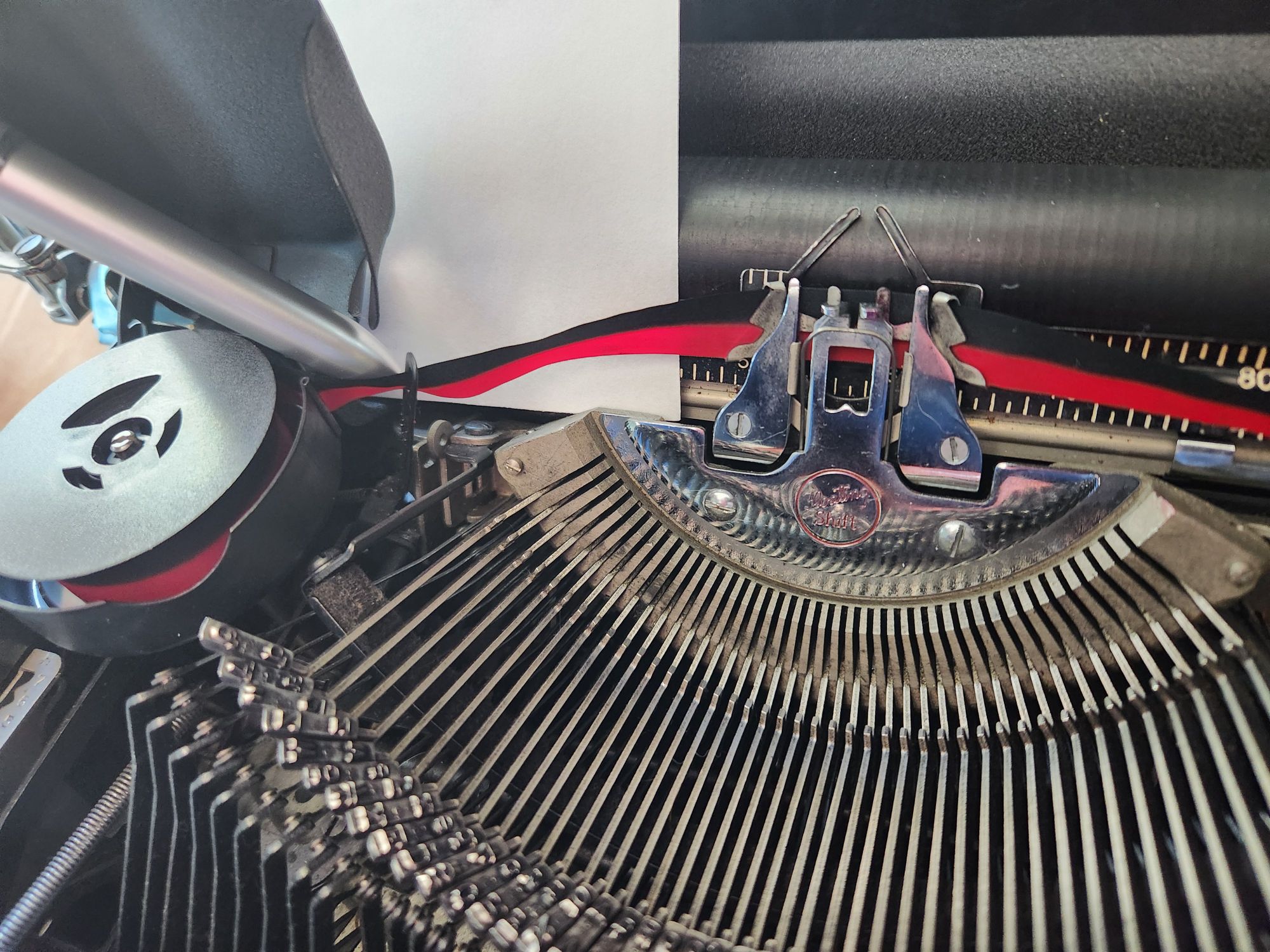
(Alt Text) Smith-Corona typewriter ribbon thread sample. A view into the type basket with the hood of the typewriter raised showing the ribbon coming out of a spool on the left, through a black ribbon guide (which actuates the autoswitch when the eyelet at the end of a spool gets stuck between it and the spool) next to the spool cup, and then into the two metal guides of the ribbon vibrator on either side of the the typing point. A silver pen's tip is pointing to the ribbon guide next to the spool cup at about the point where an eyelet clipped onto the middle of the end of a length of a ribbon would trip the ribbon auto switch.
If your ribbon auto-switch isn't working one can usually switch the direction manually with the ribbon reverse lever usually found on the front left side of most machines.
To speed up changing the ribbon on many machines, it can often help to switch the color selector to the red setting and then simultaneously press the G and H keys gently so that they're stuck together almost at the typing point which will raise the ribbon vibrator and make accessing the slots for threading the ribbon easier. Once the ribbon is installed, release the G and H typebars and select the correct color setting for the portion of the ribbon you want to use.
-
-
writingball.blogspot.com writingball.blogspot.com
-
www.cambridgetypewriter.com www.cambridgetypewriter.com
-
http://www.cambridgetypewriter.com/
CAMBRIDGE TYPEWRITER<br /> 102 Massachusetts Avenue<br /> Arlington, MA 02474<br /> 781-643-7010
Shop owner Tom Furrier hoping to retire sometime in 2024
-
-
www.youtube.com www.youtube.com
-
Remington Quiet-Riter carriage lock help by [[Typewriter Justice]]
-
-
www.youtube.com www.youtube.com
-
https://www.youtube.com/watch?v=iTFM54VKKc4<br /> How To: Replace a Ribbon on Remington Quiet-Riter Typewriter by Typewriter Minutes
-
-
-
www.youtube.com www.youtube.com
-
Royal Typewriter Platen Variable Repair, Roller Removal by [[Phoenix Typewriter]]
I'm seeing this issue on my 1949 Royal QDL. I figured it'd be an easy fix.
Turns out, it was exactly my issue and the pieces had "frozen up". A quick clean out and we're back in business in under 20 minutes.
-
- Apr 2024
-
www.youtube.com www.youtube.com
-
TWVS Episode 20 - Adjusting Upper and Lower Case Positions by [[Joe Van Cleave]]
-
-
www.reddit.com www.reddit.comPlatens1
-
For platens 83-98 Shore A depending on the amount of copies being typed. From personal experience though 83A is super soft and the slugs sink into it a bit too much, the sweet spot is around 87-90 Shore A imo.
via u/Pelicram at https://www.reddit.com/r/typewriters/comments/1cg6e3t/platens/
-
-
www.reddit.com www.reddit.com
-
Replacing the key cap [as a means of switching from QWERTZ to QWERTY] isn't going to help at all, it's just a label. You'd have to swap out internal parts too. Depending on the model, you'd either have to remove and swap typebars or remove the head off the typebar and resolder it onto the appropriate alternate (and ensure that it's properly aligned, not an easy task). Then you'd have to swap the key caps (labels). It's definitely a mechanically doable process, but it's probably almost never done in practice. Doing it as a newbie probably isn't recommendable; you're better off having a repair shop do it for you if you decide to go this route. Depending on the keyboard/model, you'd also have to deal with accents, umlauts, etc.
Given the difficulty (or cost) of the process and the potential end results, you're assuredly better off locating a QWERTY machine and paying a bit more for shipping to your area if necessary.
Your mileage may vary depending on model.
reply to u/imprisoningmymemory at https://www.reddit.com/r/typewriters/comments/1cg1avp/replacing_keys/
-
-
typewriterreview.com typewriterreview.com
-
If you plan on setting on your desk, unscrew the bottom plate and scrape off the hardened rubber feet and super glue some new ones on. I get the clear rubber kind from Ace Hardware (Part No. 5182381).
Hermes Rocket feet repair advice.
-
-
-
Royal Quiet De Luxe Typewriter Sticky Keys Segment Flush Clean by [[Phoenix Typewriter]]
-
-
www.youtube.com www.youtube.com
-
Royal Quiet De Luxe Typewriter Shift Repaired by [[Phoenix Typewriter]]
-
-
www.reddit.com www.reddit.com
-
EquivalentHead3589[S] 0 points1 point2 points 2 hours ago (1 child)Yes to all that! I agree and understand.
reply to u/EquivalentHead3589 at https://www.reddit.com/r/typewriters/comments/1cbzx1n/how_do_you_price_typewriters/
The primary difference is that listing prices don't indicate actual value. That is only determined by actual sales price. Things are worse for the listings which don't indicate much about condition as you're probably more likely to need to have the machine serviced and/or replace or recondition parts. This can often add a few hundred dollars (or significant research and time, tools, and elbow grease) to the bottom line to be able to use a machine.
I do recall a burgundy Olympia SM3 which sold in the last 4 months for right at $300 which was regularly used (loved) and serviced and in excellent condition with some fantastic photos. If you compare it to this Burgundy/Gray machine (https://www.ebay.com/itm/404901285037) for $299, but which has a missing key cap, and a damaged case, and may likely have other hiding issues. If you consider that you'll likely need to put a minimum of another $100 into this to get it up to the fighting shape that the first was in and it's still got damage, you'll start seeing the stark difference. The people with listings at $550-800 know they're not selling and they're just sitting there, so why not email them and ask more specific questions about condition and get a typed typeface sample of all the keys. Then make an offer for $200 +/- with some wiggle room for service costs once you've gotten it to see if they'll sell?
As an example, look at https://www.ebay.com/itm/226016437104 which is a Gray SM3 originally listed for $549 and now on sale for $428. The seller knows it's not moving. They state that they got it at an estate sale (probably for around $25) and they definitely did no work other than quick check of the keys. If you demonstrate that you've savvy enough to know the specific machine (what shape are the rubber washers on the frame next to the feet to prevent the carriage from rubbing against the frame? how what is the durometer measurement on (how hard is) the platen?), the market (in top shape maybe $300), and what servicing/repair costs are, they'd probably accept an offer of $150-200 and you're off to the races and they've made a solid profit.
The biggest issue in the typewriter market at present is the broad lack of information and knowledge about them on both the buyer and seller side. If you can demonstrate you've got more knowledge than the other side, you'll be in a far better position to negotiate, otherwise a seller can sit and wait an undetermined amount of time waiting for a sucker who will likely never show up.
-
-
-
Because of aging, the rubber feet of many typewriters can harden thereby reducing their friction against the table on which they sit. As a result, this can cause one's typewriter to "walk" across the table as they type for extended periods necessitating their recentering from time to time. To remedy this, one could use custom made typewriter mats with rubber bottoms to prevent this walking as well as to protect the table underneath. Other options which may also work are either wool or felt pads from fabric stores or from Chinese/Japanese calligraphy stationers. In Japanese these mats are called shitajiki.
-
- Mar 2024
-
munk.org munk.org
-
-
Pack my box with five dozen liquor jugs
-
-
typewriterdatabase.com typewriterdatabase.com
-
The platen was quite hard to begin with, around 100 on the Shore A hardness scale, though it would feed two sheets reliably. The platen was cleaned and treated with methyl salicylate, which brought the hardness down to about 92, and has remained at that hardness for several months.
https://typewriterdatabase.com/1948-smith-corona-clipper.21427.typewriter
-
- Dec 2023
-
www.pasadenanow.com www.pasadenanow.com
-
From Typewriters to Futuristic Office Machines, Adapting with the Times Helped One Family Run Company Stay in Business for over a Century by Brandon Villalovos on 2017-03-15
-
A typewriter repair technician by trade from Michigan, Carl Elmer Anderson started the Anderson Typewriter Company in Pasadena in 1912 after falling in love with the City as a vacationer.
-
The Anderson Typewriter Company changed its name in the mid ‘90s to Anderson Business Technology to better represent the new digital technology it provided customers
-
-
www.pasadenastarnews.com www.pasadenastarnews.com
-
Pedro Diaz, the company’s in-house maestro of typewriter repair, retired a few years ago after working with Anderson Business Technology for 35 years. But he still shows up when a customer brings in a vintage Smith-Corona, Olympia or Royal that’s in need of some TLC.
Need typewriter repairs? This Pasadena business has been fixing them for a century by Kevin Smith
-
-
www.sgvtribune.com www.sgvtribune.com
-
Anderson Business Technology celebrates 100 years by Jim McConnell, Staff Writer
-
- Jul 2023
-
www.thetypewriterman.co.uk www.thetypewriterman.co.uk
- Jun 2023
- May 2023
-
www.ribbonsunlimited.com www.ribbonsunlimited.com
-
www.reddit.com www.reddit.com
-
I buy exclusively from Ribbons Unlimited since their products and service are superb. I have purchased from Amazon suppliers if I need a ribbon "pronto", but the biggest problem that I run into with their supplier's ribbons is the fact that they normally don't have reversing grommets installed at the end of the ribbons, and unless your machine can sense ribbon tension and reverse the ribbon, you have to reverse the ribbon direction manually. I purchased a grommet installation tool to try and capitalize on the cheap price of Amazon ribbons, but found that it's not really worth the effort (plus my hands got really "inky") - I always come back to Ribbons Unlimited.
Some cheap typewriter ribbon spools don't have grommets on them to force auto-reverse of the spool. Without grommets, some machines may sense ribbon tension for reversal, otherwise one needs to switch direction manually.
There are grommet installation tools that one can use, but this often requires getting one's hands dirty to install them.
Ribbons Unlimited has a good reputation in the r/typewriters community for providing good sales and service.
-
-
www.reddit.com www.reddit.com
-
www.youtube.com www.youtube.com
-
Typewriter Cleaning and Repair Basics #3 Bell Fixed
Keep in mind that some typewriters don't have hard mechanical margin stops, but rely on the user to hear the bell to know the margin is approaching and return the line manually.
Bell hammer mechanisms may simply need to be cleaned to get them into functioning order. Dirt and grime may prevent the hammer mechanism from having enough force to strike the bell. Beyond this replacing the spring may be necessary.
-
- Apr 2023
- Jun 2022
-
www.ipadrehab.com www.ipadrehab.com
-
- May 2022
-
doctorow.medium.com doctorow.medium.com
-
VIN locks began in car-engines. Auto manufacturers started to put cheap microcontrollers into engine components and subcomponents. A mechanic could swap in a new part, but the engine wouldn’t recognize it — and the car wouldn’t drive — until an authorized technician entered an unlock code into a special tool connected to the car’s internal network.
VIN Locks and Right-to-Repair
-
- Apr 2022
-
www.cambialtd.co.uk www.cambialtd.co.uk
-
Fence Repair and ContractingStarting out as humble fencing contractors, we know a thing or two about boundaries. Whether it’s keeping people out
Looking for a fencing contractor? We are Cambia, providing garden fence repairs, domestic and Industrial Fencing in Luton and Dunstable. Get a no obligation quote today!
-
- Apr 2021
-
www.crabgrasslawn.com www.crabgrasslawn.com
-
If the grass does not fill up the spots properly, remember to add some sprigs or grass seed in order to fill-up the bare spots.
Tags
Annotators
URL
-
- Mar 2021
-
www.inuse.se www.inuse.se
-
A product’s onceability is, to a certain extent, linked to its usefulness. If it is really useful, we will certainly go to considerable lengths to repair it.
-
- Jan 2021
-
psyarxiv.com psyarxiv.com
-
Dideriksen, C., Christiansen, M. H., Tylén, K., Dingemanse, M., & Fusaroli, R. (2020, October 12). Building common ground: Quantifying the interplay of mechanisms that promote understanding in conversations. https://doi.org/10.31234/osf.io/a5r74
-
-
scalar.usc.edu scalar.usc.edu
-
I’m so grateful to my friend, John who introduced me to ROOTKITS CREDIT SPECIALIST who proved to me that they have professionals that can get the job done in time with no hiccups. I have been trying to get a home but got rejected due to bad credit score of 528 which also made it difficult to get loan approval but after I had a deal with this team my score was sky rocketed to 790 in just 72 hours. You can reach them on rootkitscreditspecialist at gmail dot com for quick repair.
Tags
Annotators
URL
-
- Sep 2020
-
github.com github.com
Tags
Annotators
URL
-
- Jan 2020
-
repair.org repair.org
Tags
Annotators
URL
-
- Oct 2015
-
cms.whittier.edu cms.whittier.edu
-
4 Again, the sight and sound of these services is a quintessential everyday urban experience.
Is this dependent on geographic location? How might the sights and sounds of repair and maintenance services be different in other areas?
-