10,000 Matching Annotations
  1. Nov 2025
    1. Reviewer #1 (Public review):

      Summary:

      Fogel & Ujfalussy report an extension of a visualization tool that was originally designed to enable an understanding of detailed biophysical neuron models. Named "extended currentscape", this new iteration enables visual assessment of individual currents across a neuron's spatially extended dendritic arbor with simultaneous readout of somatic currents and voltage. The overall aim was to permit a visually intuitive understanding for how a model neuron's inputs determine its output. This goal was worthwhile and the authors achieved it. Their manuscript makes two additional contributions of note: (1) a clever algorithmic approach to model the axial propagation of ionic currents (recursively traversing acyclic graph subsections) and (2) interesting, albeit not easily testable, insights into important neurophysiological phenomena such as complex spike generation and place field dynamics. Overall, this study provides a valuable and well-characterized biophysical modeling resource to the neuroscience community.

      Strengths:

      The authors significantly extended a previously published open-source biophysical modeling tool. Beyond providing important new capabilities, the potential impact of "extended currentscape" is boosted by its integration with preexisting resources in the field.

      The code is well-documented and freely available via GitHub.

      The author's clever portioning algorithm to relate dendritic/synaptic currents to somatic yielded multiple intriguing observations regarding when and why CA1 pyramidal neurons fire complex spikes versus single action potentials. This topic carries major implications for how the hippocampus represents and stores information about an animal's environment.

      Weaknesses:

      While extended currentscape is clearly a valuable contribution to the neuroscience community, this reviewer would argue that it is framed in a way that oversells its capabilities. The Abstract, Introduction, Results, and Methods all contain phrases implying that extended currentscape infers dendritic/synaptic currents contributing to somatic output., i.e. backwards inference of unknown inputs from a known output. This is not the case; inputs are simulated and then propagated through the model neuron using a clever partitioning algorithm that essentially traverses a biologically undirected graph structure by treating it like a time series of tiny directed graphs. This is an impressive solution, but it does not infer a neuron's input structure.

      Because a directed acyclic graph architecture is shown in Figure 2, it is unintuitive that the authors can infer bidirectional current flow, e.g. Figure 3 showing current flowing from basal dendrites and axon to soma, and further towards the apical dendrites. This is explained in Methods, but difficult to parse from Results amidst lots of rather abstract jargon (target, reference, collision, compartment). Figure 2 would have presented an opportunity to clearly illustrate the author's portioning algorithm by (1) rooting it in the exact morphology of one of their multicompartmental model neurons and (2) illustrating that "target" and "reference" have arbitrary morphological meanings; they describe the direction of current flow which is reevaluated at each time step.

      Analyses in Figure 7, C and D, are insightfully devised and illuminating. However, they could use some reconciliation with Figure 5 regarding initiation of individual APs versus CSBs within place fields.

      The intriguing observations generated by extended currentscape also point to its main weakness, which the authors openly acknowledge: as of now, no experimental methods exist to conclusively tests its predictions.

    1. Author response:

      We thank the reviewers for their time and work assessing our manuscript, and for their constructive suggestions for improvements. Based on the reviews, our plan is to adapt the work as follows:

      (1)  Perform a sensitivity analysis considering only confirmed dengue, Zika, and chikungunya cases,

      (2)  Explore and discuss the potential correlation between diseases,

      (3)  Compare the baseline and final models,

      (4)  Assess model fit using a wider variety of metrics.

      We would like to emphasise that our research question was to explore drivers of arbovirus incidence outside of seasonal trends. We therefore designed our models with flexible spatiotemporal random effects to capture baseline patterns, and as the reviewers have highlighted, much of the variance is explained by these random effects. To expand on point 3 above, we will perform a comparison of the baseline random effect models and the final multivariable models to show the differences between the models and quantify the additional impact of the meteorological variables in the final models.

    1. Reviewer #1 (Public review):

      Summary:

      Many studies have investigated adaptation to altered sensorimotor mappings or to an altered mechanical environment. This paper asks a different but also important question in motor control and neurorehabilitation: how does the brain adapt to changes in the controlled plant? The authors addressed this question by performing a tendon transfer surgery in two monkeys during which the swapped tendons flexing and extending the digits. They then monitored changes in task performance, muscle activation and kinematics post-recovery over several months, to assess changes in putative neural strategies.

      Strengths:

      (1) The authors performed complicated tendon transfer experiments to address their question of how the nervous system adapts to changes in the organisation of the neuromusculoskeletal system, and present very interesting data characterising neural (and in one monkey, also behavioural) changes post tendon transfer over several months.

      (2) The fact that the authors had to employ to two slightly different tasks -one more artificial, the other more naturalistic- in the two monkeys and yet found qualitatively similar changes across them makes the findings more compelling.

      (3) The paper is quite well written, and the analyses are sound, although some analyses could be improved (suggestions below).

      Weaknesses:

      (1) I think this is an important paper, paper but I'm puzzled about a tension in the results. On the one hand, it looks like the behavioural gains post-TT happen rather smoothly over time (Figure 5). On the other, muscle synergy activations changes abruptly at specific days (around day ~65 for Monkey A and around day ~45 for monkey B; e.g., Figure 6). How do the authors reconcile this tension? In other words, how do they think that this drastic behavioural transition can arise from what appears to be step-by-step, continuous changes in muscle coordination? Is it "just" subtle changes in movements/posture exploiting the mechanical coupling between wrist and finger movements combined with subtle changes in synergies and they just happen to all kick in at the same time? This feels to me the core of the paper and should be addressed more directly.

      (2) The muscles synergy analyses, which are an important part of the paper, could be improved. In particular:

      (2a) When measuring the cross-correlation between the activation of synergies, the authors should include error bars, and should also look at the lag between the signals.

      (2b) Figure 7C and related figures, the authors state that the activation of muscle synergies revert to pre-TT patterns toward the end of the experiments. However, there are noticeable differences for both monkeys (at the end of the "task range" for synergy B for monkey A, and around 50 % task range for synergy B for monkey B). The authors should measure this, e.g., by quantifying the per-sample correlation between pre-TT and post-TT activation amplitudes. Same for Figures 8I,J, etc.

      (2c) In Figures 9 and 10, the authors show the cross-correlation of the activation coefficients of different synergies; the authors should also look at the correlation between activation profiles because it provides additional information.

      (2d) Figure 11: the authors talk about a key difference in how Synergy B (the extensor finger) evolved between monkeys post-TT. However, to me this figure feels more like a difference in quantity -the time course- than quality, since for both monkeys the aaEMG levels pretty much go back to close to baseline levels -even if there's a statistically significant difference only for Monkey B. What am I missing?

      (2e) Lines 408-09 and above: The authors claim that "The development of a compensatory strategy, primarily involving the wrist flexor synergy (Synergy C), appears crucial for enabling the final phase of adaptation", which feels true intuitively and also based on the analysis in Figure 8, but Figure 11 suggests this is only true for Monkey A . How can these statements be reconciled?

      (3) Experimental design: at least for the monkey who was trained on the "artificial task" (Monkey A), it would have been good if the authors had also tested him on naturalistic grasping, like the second monkey, to see to what extent the neural changes generalise across behaviours or are task-specific. Do the authors have some data that could be used to assessed this even if less systematically?

      (4) Monkey's B behaviour pre-tendon transfer seems more variable than that of Monkey A (e.g., the larger error bars in Figure 5 compared to monkey A, the fluctuating cross-correlation between FDS pre and EDC post in Figure 6Q), this should be quantified to better ground the results since it also shows more variability post-TT.

      (5) Minor: Figure 12 is interesting and supports the idea that monkeys may exploit the biomechanical coupling between wrist and fingers as part of their function recovery. It would be interesting to measure whether there is a change in such coupling (tenodesis) over time, e.g., by plotting change in wrist angle vs change in MCP angle as a scatter plot (one dot per trial), and in the same plot show all the days, colour coded by day. Would the relationship remain largely constant or fluctuate slightly early on? I feel this analysis could also help address my point (1) above.

    2. Reviewer #3 (Public review):

      Summary:

      In this study, Philipp et al. investigate how a monkey learns to compensate for a large, chronic biomechanical perturbation - a tendon transfer surgery, swapping the actions of two muscles that flex and extend the fingers. After performing the surgery and confirming that the muscle actions are swapped, the authors follow the monkeys' performance on grasping tasks over several months. There are several main findings:

      (1) There is an initial stage of learning (around 60 days), where monkeys simply swap the activation timing of their flexors and extensors during the grasp task to compensate for the two swapped muscles.

      (2) This is (seemingly paradoxically) followed by a stage where muscle activation timing returns almost to what it was pre-surgery, suggesting that monkeys suddenly swap to a new strategy that is better than the simple swap.

      (3) Muscle synergies seem remarkably stable through the entire learning course, indicating that monkeys do not fractionate their muscle control to swap the activations of only the two transferred muscles.

      (4) Muscle synergy activation shows a similar learning course, where the flexion synergy and extension synergy activations are temporarily swapped in the first learning stage and then revert to pre-surgery timing in the second learning stage.

      (5) The second phase of learning seems to arise from making new, compensatory movements (supported by other muscle synergies) that get around the problem of swapped tendons.

      Strengths:

      This study is quite remarkable in scope, studying two monkeys over a period of months after a difficult tendon-transfer surgery. As the authors point out, this kind of perturbation is an excellent testbed for the kind of long-term learning that one might observe in a patient after stroke or injury, and provides unique benefits over more temporary perturbations like visuomotor transformations and studying learning through development. Moreover, while the two-stage learning course makes sense, I found the details to be genuinely surprising--specifically the fact that: (1) muscle synergies continue to be stable for months after the surgery, despite now being maladaptive; and (2) muscle activation timing reverts to pre-surgery levels by the end of the learning course. These two facts together initially make it seem like the monkey simply ignores the new biomechanics by the end of the learning course, but the authors do well to explain that this is mainly because the monkeys develop a new kind of movement to circumvent the surgical manipulation.

      I found these results fascinating, especially in comparison to some recent work in motor cortex, showing that a monkey may be able to break correlations between the activities of motor cortical neurons, but only after several sessions of coaching and training (Oby et al. PNAS 2019). Even then, it seemed like the monkey was not fully breaking correlations but rather pushing existing correlations harder to succeed at the virtual task (a brain-computer interface with perturbed control).

      Weaknesses:

      I found the analysis to be reasonably well considered and relatively thorough. However, I do have a few suggestions that I think may elevate the work, should the authors choose to pursue them.

      First, I find myself wondering about the physical healing process from the tendon transfer surgery and how it might contribute to the learning. Specifically, how long does it take for the tendons to heal and bear forces? If this itself takes a few months, it would be nice to see some discussion of this.

      Second, I see that there are some changes in the muscle loadings for each synergy over the days, though they are relatively small. The authors mention that the cosine distances are very small for the conserved synergies compared to distances across synergies, but it would be good to get a sense for how variable this measure is within synergy. For example, what is the cosine similarity for a conserved synergy across different pre-surgery days? This might help inform whether the changes post-surgery are within a normal variation or whether they reflect important changes in how the muscles are being used over time.

      Last, and maybe most difficult (and possibly out of scope for this work): I would have ideally liked to see some theoretical modeling of the biomechanics so I could more easily understand what the tendon transfer did or how specific synergies affect hand kinematics before and after the surgery. Especially given that the synergies remained consistent, such an analysis could be highly instructive for a reader or to suggest future perturbations to further probe the effects of tendon transfer on long-term learning.

    1. Israel-Gaza WarWar in UkraineUS & CanadaUKAfricaAsiaAustraliaEuropeLatin AmericaMiddle EastIn PicturesBBC InDepthBBC Verify<details class="sc-9f96938f-0 btKmbP"><summary class="sc-9f96938f-2 gZjJDe"><svg viewBox="0 0 32 32" width="20" height="20" category="actions" icon="list-view-text" class="sc-583246d7-0 jUqtCV"><path d="M1 7.5h30V1.9H1v5.6zm0 22.6h30v-5.6H1v5.6zm0-11.3h30v-5.6H1v5.6z"></path></svg></summary><ul class="sc-9f96938f-1 cOgDzy"><li class="sc-9f96938f-3 flmnU"><a href="/home" class="sc-5eaafc6a-4 cyljGc">Home</a></li><ul class="sc-9f96938f-1 bqaQci"></ul><li class="sc-9f96938f-3 flmnU"><a href="/news" class="sc-5eaafc6a-4 cyljGc">News</a></li><ul class="sc-9f96938f-1 bqaQci"><li class="sc-9f96938f-3 flmnU"><a href="/news/topics/c2vdnvdg6xxt" class="sc-5eaafc6a-4 cyljGc">Israel-Gaza War</a></li><ul class="sc-9f96938f-1 hEGeTY"></ul><li class="sc-9f96938f-3 flmnU"><a href="/news/war-in-ukraine" class="sc-5eaafc6a-4 cyljGc">War in Ukraine</a></li><ul class="sc-9f96938f-1 hEGeTY"></ul><li class="sc-9f96938f-3 flmnU"><a href="/news/us-canada" class="sc-5eaafc6a-4 cyljGc">US &amp; Canada</a></li><ul class="sc-9f96938f-1 hEGeTY"></ul><li class="sc-9f96938f-3 flmnU"><a href="/news/uk" class="sc-5eaafc6a-4 cyljGc">UK</a></li><ul class="sc-9f96938f-1 hEGeTY"><li class="sc-9f96938f-3 flmnU"><a href="/news/politics" class="sc-5eaafc6a-4 cyljGc">UK Politics</a></li><ul class="sc-9f96938f-1 hFihsd"></ul><li class="sc-9f96938f-3 flmnU"><a href="/news/england" class="sc-5eaafc6a-4 cyljGc">England</a></li><ul class="sc-9f96938f-1 hFihsd"></ul><li class="sc-9f96938f-3 flmnU"><a href="/news/northern_ireland" class="sc-5eaafc6a-4 cyljGc">N. Ireland</a></li><ul class="sc-9f96938f-1 hFihsd"><li class="sc-9f96938f-3 flmnU"><a href="/news/northern_ireland/northern_ireland_politics" class="sc-5eaafc6a-4 cyljGc">N. Ireland Politics</a></li><ul class="sc-9f96938f-1 gVoSRz"></ul></ul><li class="sc-9f96938f-3 flmnU"><a href="/news/scotland" class="sc-5eaafc6a-4 cyljGc">Scotland</a></li><ul class="sc-9f96938f-1 hFihsd"><li class="sc-9f96938f-3 flmnU"><a href="/news/scotland/scotland_politics" class="sc-5eaafc6a-4 cyljGc">Scotland Politics</a></li><ul class="sc-9f96938f-1 gVoSRz"></ul></ul><li class="sc-9f96938f-3 flmnU"><a href="/news/wales" class="sc-5eaafc6a-4 cyljGc">Wales</a></li><ul class="sc-9f96938f-1 hFihsd"><li class="sc-9f96938f-3 flmnU"><a href="/news/wales/wales_politics" class="sc-5eaafc6a-4 cyljGc">Wales Politics</a></li><ul class="sc-9f96938f-1 gVoSRz"></ul></ul></ul><li class="sc-9f96938f-3 flmnU"><a href="/news/world/africa" class="sc-5eaafc6a-4 cyljGc">Africa</a></li><ul class="sc-9f96938f-1 hEGeTY"></ul><li class="sc-9f96938f-3 flmnU"><a href="/news/world/asia" class="sc-5eaafc6a-4 cyljGc">Asia</a></li><ul class="sc-9f96938f-1 hEGeTY"><li class="sc-9f96938f-3 flmnU"><a href="/news/world/asia/china" class="sc-5eaafc6a-4 cyljGc">China</a></li><ul class="sc-9f96938f-1 hFihsd"></ul><li class="sc-9f96938f-3 flmnU"><a href="/news/world/asia/india" class="sc-5eaafc6a-4 cyljGc">India</a></li><ul class="sc-9f96938f-1 hFihsd"></ul></ul><li class="sc-9f96938f-3 flmnU"><a href="/news/world/australia" class="sc-5eaafc6a-4 cyljGc">Australia</a></li><ul class="sc-9f96938f-1 hEGeTY"></ul><li class="sc-9f96938f-3 flmnU"><a href="/news/world/europe" class="sc-5eaafc6a-4 cyljGc">Europe</a></li><ul class="sc-9f96938f-1 hEGeTY"></ul><li class="sc-9f96938f-3 flmnU"><a href="/news/world/latin_america" class="sc-5eaafc6a-4 cyljGc">Latin America</a></li><ul class="sc-9f96938f-1 hEGeTY"></ul><li class="sc-9f96938f-3 flmnU"><a href="/news/world/middle_east" class="sc-5eaafc6a-4 cyljGc">Middle East</a></li><ul class="sc-9f96938f-1 hEGeTY"></ul><li class="sc-9f96938f-3 flmnU"><a href="/news/in_pictures" class="sc-5eaafc6a-4 cyljGc">In Pictures</a></li><ul class="sc-9f96938f-1 hEGeTY"></ul><li class="sc-9f96938f-3 flmnU"><a href="/news/bbcindepth" class="sc-5eaafc6a-4 cyljGc">BBC InDepth</a></li><ul class="sc-9f96938f-1 hEGeTY"></ul><li class="sc-9f96938f-3 flmnU"><a href="/news/bbcverify" class="sc-5eaafc6a-4 cyljGc">BBC Verify</a></li><ul class="sc-9f96938f-1 hEGeTY"></ul></ul><li class="sc-9f96938f-3 flmnU"><a href="/sport" class="sc-5eaafc6a-4 cyljGc">Sport</a></li><ul class="sc-9f96938f-1 bqaQci"></ul><li class="sc-9f96938f-3 flmnU"><a href="/business" class="sc-5eaafc6a-4 cyljGc">Business</a></li><ul class="sc-9f96938f-1 bqaQci"><li class="sc-9f96938f-3 flmnU"><a href="/business/executive-lounge" class="sc-5eaafc6a-4 cyljGc">Executive Lounge</a></li><ul class="sc-9f96938f-1 hEGeTY"></ul><li class="sc-9f96938f-3 flmnU"><a href="/business/technology-of-business" class="sc-5eaafc6a-4 cyljGc">Technology of Business</a></li><ul class="sc-9f96938f-1 hEGeTY"></ul><li class="sc-9f96938f-3 flmnU"><a href="/business/future-of-business" class="sc-5eaafc6a-4 cyljGc">Future of Business</a></li><ul class="sc-9f96938f-1 hEGeTY"></ul></ul><li class="sc-9f96938f-3 flmnU"><a href="/innovation" class="sc-5eaafc6a-4 cyljGc">Innovation</a></li><ul class="sc-9f96938f-1 bqaQci"><li class="sc-9f96938f-3 flmnU"><a href="/innovation/technology" class="sc-5eaafc6a-4 cyljGc">Technology</a></li><ul class="sc-9f96938f-1 hEGeTY"></ul><li class="sc-9f96938f-3 flmnU"><a href="/innovation/science" class="sc-5eaafc6a-4 cyljGc">Science &amp; Health</a></li><ul class="sc-9f96938f-1 hEGeTY"></ul><li class="sc-9f96938f-3 flmnU"><a href="/innovation/artificial-intelligence" class="sc-5eaafc6a-4 cyljGc">Artificial Intelligence</a></li><ul class="sc-9f96938f-1 hEGeTY"></ul><li class="sc-9f96938f-3 flmnU"><a href="/innovation/ai-v-the-mind" class="sc-5eaafc6a-4 cyljGc">AI v the Mind</a></li><ul class="sc-9f96938f-1 hEGeTY"></ul></ul><li class="sc-9f96938f-3 flmnU"><a href="/culture" class="sc-5eaafc6a-4 cyljGc">Culture</a></li><ul class="sc-9f96938f-1 bqaQci"><li class="sc-9f96938f-3 flmnU"><a href="/culture/film-tv" class="sc-5eaafc6a-4 cyljGc">Film &amp; TV</a></li><ul class="sc-9f96938f-1 hEGeTY"></ul><li class="sc-9f96938f-3 flmnU"><a href="/culture/music" class="sc-5eaafc6a-4 cyljGc">Music</a></li><ul class="sc-9f96938f-1 hEGeTY"></ul><li class="sc-9f96938f-3 flmnU"><a href="/culture/art" class="sc-5eaafc6a-4 cyljGc">Art &amp; Design</a></li><ul class="sc-9f96938f-1 hEGeTY"></ul><li class="sc-9f96938f-3 flmnU"><a href="/culture/style" class="sc-5eaafc6a-4 cyljGc">Style</a></li><ul class="sc-9f96938f-1 hEGeTY"></ul><li class="sc-9f96938f-3 flmnU"><a href="/culture/books" class="sc-5eaafc6a-4 cyljGc">Books</a></li><ul class="sc-9f96938f-1 hEGeTY"></ul><li class="sc-9f96938f-3 flmnU"><a href="/culture/entertainment-news" class="sc-5eaafc6a-4 cyljGc">Entertainment News</a></li><ul class="sc-9f96938f-1 hEGeTY"></ul></ul><li class="sc-9f96938f-3 flmnU"><a href="/arts" class="sc-5eaafc6a-4 cyljGc">Arts</a></li><ul class="sc-9f96938f-1 bqaQci"><li class="sc-9f96938f-3 flmnU"><a href="/arts/arts-in-motion" class="sc-5eaafc6a-4 cyljGc">Arts in Motion</a></li><ul class="sc-9f96938f-1 hEGeTY"></ul></ul><li class="sc-9f96938f-3 flmnU"><a href="/travel" class="sc-5eaafc6a-4 cyljGc">Travel</a></li><ul class="sc-9f96938f-1 bqaQci"><li class="sc-9f96938f-3 flmnU"><a href="/travel/destinations" class="sc-5eaafc6a-4 cyljGc">Destinations</a></li><ul class="sc-9f96938f-1 hEGeTY"><li class="sc-9f96938f-3 flmnU"><a href="/travel/destinations/africa" class="sc-5eaafc6a-4 cyljGc">Africa</a></li><ul class="sc-9f96938f-1 hFihsd"></ul><li class="sc-9f96938f-3 flmnU"><a href="/travel/destinations/antarctica" class="sc-5eaafc6a-4 cyljGc">Antarctica</a></li><ul class="sc-9f96938f-1 hFihsd"></ul><li class="sc-9f96938f-3 flmnU"><a href="/travel/destinations/asia" class="sc-5eaafc6a-4 cyljGc">Asia</a></li><ul class="sc-9f96938f-1 hFihsd"></ul><li class="sc-9f96938f-3 flmnU"><a href="/travel/destinations/australia-and-pacific" class="sc-5eaafc6a-4 cyljGc">Australia and Pacific</a></li><ul class="sc-9f96938f-1 hFihsd"></ul><li class="sc-9f96938f-3 flmnU"><a href="/travel/destinations/caribbean" class="sc-5eaafc6a-4 cyljGc">Caribbean &amp; Bermuda</a></li><ul class="sc-9f96938f-1 hFihsd"></ul><li class="sc-9f96938f-3 flmnU"><a href="/travel/destinations/central-america" class="sc-5eaafc6a-4 cyljGc">Central America</a></li><ul class="sc-9f96938f-1 hFihsd"></ul><li class="sc-9f96938f-3 flmnU"><a href="/travel/destinations/europe" class="sc-5eaafc6a-4 cyljGc">Europe</a></li><ul class="sc-9f96938f-1 hFihsd"></ul><li class="sc-9f96938f-3 flmnU"><a href="/travel/destinations/middle-east" class="sc-5eaafc6a-4 cyljGc">Middle East</a></li><ul class="sc-9f96938f-1 hFihsd"></ul><li class="sc-9f96938f-3 flmnU"><a href="/travel/destinations/north-america" class="sc-5eaafc6a-4 cyljGc">North America</a></li><ul class="sc-9f96938f-1 hFihsd"></ul><li class="sc-9f96938f-3 flmnU"><a href="/travel/destinations/south-america" class="sc-5eaafc6a-4 cyljGc">South America</a></li><ul class="sc-9f96938f-1 hFihsd"></ul></ul><li class="sc-9f96938f-3 flmnU"><a href="/travel/worlds-table" class="sc-5eaafc6a-4 cyljGc">World’s Table</a></li><ul class="sc-9f96938f-1 hEGeTY"></ul><li class="sc-9f96938f-3 flmnU"><a href="/travel/cultural-experiences" class="sc-5eaafc6a-4 cyljGc">Culture &amp; Experiences</a></li><ul class="sc-9f96938f-1 hEGeTY"></ul><li class="sc-9f96938f-3 flmnU"><a href="/travel/adventures" class="sc-5eaafc6a-4 cyljGc">Adventures</a></li><ul class="sc-9f96938f-1 hEGeTY"></ul><li class="sc-9f96938f-3 flmnU"><a href="/travel/specialist" class="sc-5eaafc6a-4 cyljGc">The SpeciaList</a></li><ul class="sc-9f96938f-1 hEGeTY"></ul><li class="sc-9f96938f-3 flmnU"><a href="/travel/to-the-ends-of-the-earth" class="sc-5eaafc6a-4 cyljGc">To the Ends of The Earth </a></li><ul class="sc-9f96938f-1 hEGeTY"></ul></ul><li class="sc-9f96938f-3 flmnU"><a href="/future-planet" class="sc-5eaafc6a-4 cyljGc">Earth</a></li><ul class="sc-9f96938f-1 bqaQci"><li class="sc-9f96938f-3 flmnU"><a href="/future-planet/natural-wonders" class="sc-5eaafc6a-4 cyljGc">Natural Wonders</a></li><ul class="sc-9f96938f-1 hEGeTY"></ul><li class="sc-9f96938f-3 flmnU"><a href="/future-planet/weather-science" class="sc-5eaafc6a-4 cyljGc">Weather &amp; Science</a></li><ul class="sc-9f96938f-1 hEGeTY"></ul><li class="sc-9f96938f-3 flmnU"><a href="/future-planet/solutions" class="sc-5eaafc6a-4 cyljGc">Climate Solutions</a></li><ul class="sc-9f96938f-1 hEGeTY"></ul><li class="sc-9f96938f-3 flmnU"><a href="/future-planet/sustainable-business" class="sc-5eaafc6a-4 cyljGc">Sustainable Business</a></li><ul class="sc-9f96938f-1 hEGeTY"></ul><li class="sc-9f96938f-3 flmnU"><a href="/future-planet/green-living" class="sc-5eaafc6a-4 cyljGc">Green Living</a></li><ul class="sc-9f96938f-1 hEGeTY"></ul></ul><li class="sc-9f96938f-3 flmnU"><a href="/audio" class="sc-5eaafc6a-4 cyljGc">Audio</a></li><ul class="sc-9f96938f-1 bqaQci"><li class="sc-9f96938f-3 flmnU"><a href="/audio/categories" class="sc-5eaafc6a-4 cyljGc">Podcast Categories</a></li><ul class="sc-9f96938f-1 hEGeTY"></ul><li class="sc-9f96938f-3 flmnU"><a href="/audio/stations" class="sc-5eaafc6a-4 cyljGc">Radio</a></li><ul class="sc-9f96938f-1 hEGeTY"></ul><li class="sc-9f96938f-3 flmnU"><a href="/undefined" class="sc-5eaafc6a-4 cyljGc">Audio FAQs</a></li><ul class="sc-9f96938f-1 hEGeTY"></ul></ul><li class="sc-9f96938f-3 flmnU"><a href="/video" class="sc-5eaafc6a-4 cyljGc">Video</a></li><ul class="sc-9f96938f-1 bqaQci"><li class="sc-9f96938f-3 flmnU"><a href="/video/bbc-maestro" class="sc-5eaafc6a-4 cyljGc">BBC Maestro</a></li><ul class="sc-9f96938f-1 hEGeTY"></ul></ul><li class="sc-9f96938f-3 flmnU"><a href="/live" class="sc-5eaafc6a-4 cyljGc">Live</a></li><ul class="sc-9f96938f-1 bqaQci"><li class="sc-9f96938f-3 flmnU"><a href="/live/news" class="sc-5eaafc6a-4 cyljGc">Live News</a></li><ul class="sc-9f96938f-1 hEGeTY"></ul><li class="sc-9f96938f-3 flmnU"><a href="/live/sport" class="sc-5eaafc6a-4 cyljGc">Live Sport</a></li><ul class="sc-9f96938f-1 hEGeTY"></ul></ul></ul></details>HomeNewsSportBusinessInnovationCultureArtsTravelEarthAudioVideoLiveWeatherNewslettersAdvertisement

      BBC is a very accessible web page, they report on news and happenings from all over the world, and have topics on a lot of places such as the Middle East, Ukraine, USA, Canada, UK, Africa, Australia, Europe and Latin America. Providing coverage on so many places makes it accessible and is a positive. It is also very easy to find what you are looking for because the page's layout is very simple to understand.

    Annotators

    URL

    1. Current research has shown that the interactive use of a smartphone, computer, or video game console in the hour before bedtime increases the likelihood of both reported difficulty falling asleep and having unrefreshing sleep.

      This is something that hits home for me. I am guilty of scrolling social media on my way to sleep and I have noticed less quality sleep. I would really like to practice not being on my phone to see if I can't improve my sleep.

    2. Whenever you interact with online content your activities are not entirely private. You leave a digital footprint when you access websites, search Google, or download and interact with apps.

      This part made me think about how much information we share without realizing it. As a teacher, I want to model being careful with personal data.

    3. Social media is defined as a group of online communities where people communicate and share information and content.

      It’s crazy how much of our lives are visible through social media. I want to remind my students that what they post can last forever, even if they delete it later.

    4. The biggest concern with cookies is that they enable targeted online advertising by sharing your usage and browsing data with advertisers. In addition, certain advertisers use cookies that can span across multiple websites (third-party cookies), collecting extensive data about your browsing behaviour and enabling advertisers to generate a detailed user profile of you based on your site-specific activities. This profile is anonymous; however, in addition to being a potential privacy violation, it can compromise equity of future information access.

      I used to always just click "accept cookies" and moved on. I never knew (until recently) that these cookies are ways for websites to use your data. This is actually so terrifying because many people just accept them to get the pop up to disappear.

    5. When downloading an app, stop and consider: Have you read the app’s terms of use? Do you know what you’re giving the app permission to access? (e.g., your camera, microphone, location information, contacts, etc.) Can you change the permissions you’ve given the app without affecting its functionality? Who gets access to the data collected through your use of the app, and how will it be used? What kind of privacy options does the app offer?

      I feel like most people when reading terms and conditions dont actually read them. It's easiest to click "accept" and move on. This can lead to things being overlooked and not actually understood. I personally am guilty of this, and realize that I need to do better

    6. Content or information on social media that may hurt your chance of being hired includes: Inappropriate or provocative pictures, videos, or comments. Evidence of drinking or using recreational drugs. Discriminatory comments. Negative or overly critical comments about previous employers or co-workers. Evidence of sub-par communication skills.

      I feel this is such an important thing that people dont pay attention to until it is too late. Luckily, I was always taught to be aware of what I was sending and where I was taking pictures. Sadly, many people post and comment things on social media and forget about it until it is brought up when they least expect it.

    7. Think carefully before you post. Anything you share online can stay there a long time, even after you delete it.

      Very important, you never know who is watching and nothing really disappears.

    8. Social media can bring people together

      Social media is how people communicate today, so it is a main way if bringing people together, but it is also a way of splitting people apart as well.

    9. Social media can provide a safe place for some teens to get support: 68% of teens surveyed in the Pew survey said they had asked for and received support through social media during difficult times in their lives.

      Social media and technology can be used for good when used correctly. Social media has a lot of negatives but this statistic proves that it is not always bad. Digital citizenship is important to teach our students to use social media in a meaningful way.

    10. Are your devices affecting your health and wellness?

      My health and wellness will almost always be affected by devices. It's just up to me to make sure it affects me positively.

    11. Cyberbullying is harassment through electronic technology. This may include harassment using text messages, social media, or online chat. Cyberbullies may harass their victims anonymously and can easily share their harassing messages and content with a large audience.

      This part really reinforces why teaching empathy and kindness online is just as important as teaching safety. The anonymity of the internet can make students forget there are real people behind the screen. I think modeling respectful communication in class discussions could help prevent this behavior early.

    12. Additionally, the blue light emitted by computing devices affects levels of melatonin, the sleep-inducing hormone that regulates the body’s natural clock, or circadian rhythm. Disruptions to your circadian rhythm can cause fatigue, drowsiness, irritability, and an overall decrease in mental functions. Students who feel they must use their computer at night can use an app such as f.lux, which will adjust the light from the screen to match their local level of daylight in real-time.

      This connects to the “balanced” aspect of digital citizenship, which focuses on learning to manage technology use in ways that support well-being. It also relates to ISTE 2.3a, where educators create positive experiences with technology that encourage responsible habits rather than overuse.

    13. Let’s face it, very few people read the “terms and conditions,” or the “terms of use” agreements prior to installing an application (app). These agreements are legally binding, and clicking “I agree” may permit apps (the companies that own them) to access your: calendar, camera, contacts, location, microphone, phone, or storage, as well as details and information about your friends.  While some applications require certain device permissions to support functionality—for example, your camera app will most likely need to access your phone’s storage to save the photos and videos you capture—other permissions are questionable. Does a camera app really need access to your microphone? Think about the privacy implications of this decision.

      I wonder how teachers can help young students (especially in elementary grades) understand what “permissions” mean when they use classroom apps or devices. Could digital citizenship lessons include age-appropriate simulations of “terms and conditions” to help them learn this early?

    14. Passwords are your first line of defence against external intruders. Complex passwords that are eight characters or longer and include a combination of upper/lowercase letters, numbers, and symbols are a great first step for keeping your information secure

      I completely agree that strong passwords are important, but I think most people (including me) tend to reuse the same password across several accounts. I started using a password manager recently, and it’s helped a lot. I could see teaching students to create strong passwords as a good digital citizenship activity, even at a young age.

    15. Cookies—small pieces of data with a unique ID placed on your device by websites—are online tracking tools that enable this to happen.

      I’ve noticed this happening so many times after I online shop. I will search for something once, and then it pops up everywhere. I knew cookies tracked browsing behavior, but I didn’t realize how detailed the tracking could be or that some advertisers use cookies across multiple websites. This makes me think about what kinds of data students may be unknowingly sharing when they use educational websites.

    16. Let’s face it, very few people read the “terms and conditions,” or the “terms of use” agreements prior to installing an application (app). These agreements are legally binding, and clicking “I agree” may permit apps (the companies that own them) to access your: calendar, camera, contacts, location, microphone, phone, or storage, as well as details and information about your friends.

      I am guilty of never reading the terms and conditions, and this really made me stop and think about how much access I’ve given apps without realizing it. I’m going to start checking app permissions more often. It also makes me wonder how teachers can teach students to think critically about what they are agreeing to before downloading or using digital tools at school.

    17. Enjoyment—to have fun with unsuspecting users.

      I think this is important to note because someone may think that they are just having fun but they are might really being putting people in danger and at risk. Teaching that this is not good digital citizenship is important because hacking someone's appliances and making their products unusable can become a big deal for some people. Letting people know that it is important to leave people's information and digital space alone and protected.

    18. “Malware” is short for “malicious software.” Malware is typically installed on a user’s device for the purpose of stealing personal information.

      This is significant because people, especially students, are susceptible to just clicking on things rapidly because they think it looks cool or interesting. It is important to make sure that students know to not go about clicking on things or easily believe that things are true. How do you think that we can push how important and serious malware can be? Do you think that students should be monitored at all times when using the internet at school?

    19. Whenever you interact with online content your activities are not entirely private. You leave a digital footprint when you access websites, search Google, or download and interact with apps. What kind of impact can this have on your life? Why should you care?

      I think it very important to think about this when you are on the internet. It is also important to think about this when teaching others about this because they need to know about this. When people are accessing things online or doing things online it can usually be tracked back to them, making it hard for everything to be anonymous. This impacts you because personal information tat is put into websites might be able to be accessed by others. Do you think that this can be a problem in the classroom?

    20. The information you share online can last a long time and may be seen by thousands of people all around the world.

      This is one of the scariest parts about the internet. I don't think we ever truly understand this. I have always tried to be very careful online as I'm afraid of post or shares of something connected to my name could be misunderstood. There are so many stories of people losing their jobs over post from years before. I wonder how this will continue in the future. With AI, has it become more common for companies to quickly scan our identity on the web?

    21. According to a recent Angus Reid poll about 98% of Canadians between the ages of eighteen and thirty-four use social media at least occasionally (Angus Reid Institute, 2016).

      It's amazing to me to think how many people are on social media. I wonder how this reflects to American and even today rather then 2016. I would assume the number is close to the same. This also makes we question how many people are on multiple social medias. I feel as if almost everyone is on at least one. Personally, I believe I'm on at least three or four. Are there more people now on many platforms rather then one?

    22. Are your devices affecting your health and wellness?

      We hear this often in our society. However, I feel as if it's not taken seriously and has become something "older people say". We never truly ask ourselves if our social medias or phones in general are truly harming us. I've had a lot of personal reflection when it comes to being online. For me, I saw a improvement in my mood and life when I stopped being on social medias as often. I stopped feeling like I was missing out if I didn't post for every holiday or event. I feel more free to be in the moment and want to rely more on the memories of something rather then a picture. I wonder how this would be possible to ask students. Would they care? How would their opinions change from when they're asked to when they're adults? I had many times when I was lectured on the importance of watching your health and wellness when it comes to being online. I would say I would tell a different story now then I would have years ago.

    23. Sit up straight with your feet flat on the floor (or on a footrest), and your thighs roughly parallel to the floor.

      This is something that I continuously struggle with. I spend a ton of time on the computer from having a full-time job and being enrolled five college classes. There are times I am so tired of being at the computer, so I slouch over the desk. While I might think that I am helping myself, I am technically doing more harm than I am good. Sitting up straight with my feet on the floor can be so challenging. I like to have my feet in the chair. I hope to be more diligent about my posture as I move further.

    24. Current research has shown that the interactive use of a smartphone, computer, or video game console in the hour before bedtime increases the likelihood of both reported difficulty falling asleep and having unrefreshing sleep.

      This comment felt very real. As person who uses their phone before they go to sleep, I can agree that this is true. When you use your phone to "wine down" you are only amping yourself up. When I talk to my significant other before falling asleep and put my phone down, I tend to sleep much better. I do not have a hundred thoughts running through my head about wordily problems, games, or notifications. I think it may be even a good idea to place your phone in another room before going to sleep.

    25. A preoccupation with online activities that interferes with real-world social or occupational functioning.

      I chose this sentence because in today's world, being addicted to the internet is such a serious issue. Students spend their time in class using technology, then they go home and continue to use technology. They sit at the dinner table scrolling, they sit in their rooms and scroll, they cannot live without their phones. I think that internet addiction needs to be addressed, and we need to put our phones down. This is not just for students; this is for all people. We need to connect to reality again.

    26. The information you share online can last a long time and may be seen by thousands of people all around the world.

      I asked myself: What posts or comments from my past might still exist online that I would not make now, and could they affect my personal or professional life? Our digital footprints are persistent. What seems innocuous now can be seen later by employers, peers, or public audiences and may influence perceptions of us. Being proactive about past content helps manage our online identity and reputation.

    27. When downloading an app, stop and consider: Have you read the app’s terms of use? Do you know what you’re giving the app permission to access? (e.g., your camera, microphone, location information, contacts, etc.) Can you change the permissions you’ve given the app without affecting its functionality? Who gets access to the data collected through your use of the app, and how will it be used? What kind of privacy options does the app offer?

      I realize I rarely read full terms of use for apps. So my action: For two apps I use frequently and haven’t reviewed recently, I will open the permissions settings, list what the app can access, and decide whether to revoke any permissions (especially microphone, camera, location) that seem unnecessary. Many apps collect more data than we consciously realize; this collection can invade our privacy, expose identity-information, or enable profiling/tracking. By auditing permissions we reduce our exposure and increase control of our digital identity.

    1. Reviewer #4 (Public review):

      Thank you to the authors for their detailed responses and changes in relation to my questions. They have addressed all my concerns around methodological and inference clarity. I would still recommend against the use of feature/pathway selection techniques where there is no way of applying formal error control. I am pleased to read, however, that the authors are planning to develop this in future work. My edited review reflects these changes:

      The authors apply what I gather is a novel methodology titled "Multi-gradient Permutation Survival Analysis" to identify genes that are robustly associated with prognosis ("GEARs") using tumour expression data from 15 cancer types available in the TCGA. The resulting lists of GEARs are then interrogated for biological insights using a range of techniques including connectivity and gene enrichment analysis.

      I reviewed this paper primarily from a statistical perspective. Evidently an impressive amount of work has been conducted, concisely summarised, and great effort has been undertaken to add layers of insight to the findings. I am no stranger to what an undertaking this would have been. My primary concern, however, is that the novel statistical procedure proposed, and applied to identify the gene lists, as far as I can tell offers no statistical error control nor quantification. Consequently we have no sense what proportion of the highlighted GEAR genes and networks are likely to just be noise.

      Major comments:

      The main methodology used to identify the GEAR genes, "Multi-gradient Permutation Survival Analysis" does not formally account for multiple testing and offers no formal error control. Meaning we are left without knowing what the family wise (aka type 1) error rate is among the GEAR lists, nor the false discovery rate. I appreciate the emphasis on reproducibility, but I would generally recommend against the use of any feature selection methodology which does not provide error quantification because otherwise we do not know if we are encouraging our colleagues and/or readers to put resource into lists of genes that contain more noise than not. I am glad though and appreciative that the authors intend to develop this in future work.

      The authors make a good point that, despite lack of validation in an external independent dataset, it is still compelling work given the functional characterisation and literature validation. I am pleased though that the authors agree validation in an independent dataset is an important next step, and plan to do so in future work.

    2. Author response:

      The following is the authors’ response to the original reviews.

      Reviewer #1 (Public review):

      Summary:

      The authors propose a new technique which they name "Multi-gradient Permutation Survival Analysis (MEMORY)" that they use to identify "Genes Steadily Associated with Prognosis (GEARs)" using RNA-seq data from the TCGA database. The contribution of this method is one of the key stated aims of the paper. The vast majority of the paper focuses on various downstream analyses that make use of the specific GEARs identified by MEMORY to derive biological insights, with a particular focus on lung adenocarcinoma (LUAD) and breast invasive carcinoma (BRCA) which are stated to be representative of other cancers and are observed to have enriched mitosis and immune signatures, respectively. Through the lens of these cancers, these signatures are the focus of significant investigation in the paper.

      Strengths:

      The approach for MEMORY is well-defined and clearly presented, albeit briefly. This affords statisticians and bioinformaticians the ability to effectively scrutinize the proposed methodology and may lead to further advancements in this field.

      The scientific aspects of the paper (e.g., the results based on the use of MEMORY and the downstream bioinformatics workflows) are conveyed effectively and in a way that is digestible to an individual who is not deeply steeped in the cancer biology field.

      Weaknesses:

      I was surprised that comparatively little of the paper is devoted to the justification of MEMORY (i.e., the authors' method) for the identification of genes that are important broadly for the understanding of cancer. The authors' approach is explained in the methods section of the paper, but no rationale is given for why certain aspects of the method are defined as they are. Moreover, no comparison or reference is made to any other methods that have been developed for similar purposes and no results are shown to illustrate the robustness of the proposed method (e.g., is it sensitive to subtle changes in how it is implemented).

      For example, in the first part of the MEMORY algorithm, gene expression values are dichotomized at the sample median and a log-rank test is performed. This would seemingly result in an unnecessary loss of information for detecting an association between gene expression and survival. Moreover, while dichotomizing at the median is optimal from an information theory perspective (i.e., it creates equally sized groups), there is no reason to believe that median-dichotomization is correct vis-à-vis the relationship between gene expression and survival. If a gene really matters and expression only differentiates survival more towards the tail of the empirical gene expression distribution, median-dichotomization could dramatically lower the power to detect group-wise differences.

      Thanks for these valuable comments!! We understand the reviewer’s concern regarding the potential loss of information caused by median-based dichotomization. In this study, we adopted the median as the cut-off value to stratify gene expression levels primarily for the purpose of data balancing and computational simplicity. This approach ensures approximately equal group sizes, which is particularly beneficial in the context of limited sample sizes and repeated sampling. While we acknowledge that this method may discard certain expression nuances, it remains a widely used strategy in survival analysis. To further evaluate and potentially enhance sensitivity, alternative strategies such as percentile-based cutoffs or survival models using continuous expression values (e.g., Cox regression) may be explored in future optimization of the MEMORY pipeline. Nevertheless, we believe that this dichotomization approach offers a straightforward and effective solution for the initial screening of survival-associated genes. We have now included this explanation in the revised manuscript (Lines 391–393).

      Specifically, the authors' rationale for translating the Significant Probability Matrix into a set of GEARs warrants some discussion in the paper. If I understand correctly, for each cancer the authors propose to search for the smallest sample size (i.e., the smallest value of k_{j}) were there is at least one gene with a survival analysis p-value <0.05 for each of the 1000 sampled datasets. I base my understanding on the statement "We defined the sampling size k_{j} reached saturation when the max value of column j was equal to 1 in a significant-probability matrix. The least value of k_{j} was selected". Then, any gene with a p-value <0.05 in 80% of the 1000 sampled datasets would be called a GEAR for that cancer. The 80% value here seems arbitrary but that is a minor point. I acknowledge that something must be chosen. More importantly, do the authors believe this logic will work effectively in general? Presumably, the gene with the largest effect for a cancer will define the value of K_{j}, and, if the effect is large, this may result in other genes with smaller effects not being selected for that cancer by virtue of the 80% threshold. One could imagine that a gene that has a small-tomoderate effect consistently across many cancers may not show up as a gear broadly if there are genes with more substantive effects for most of the cancers investigated. I am taking the term "Steadily Associated" very literally here as I've constructed a hypothetical where the association is consistent across cancers but not extremely strong. If by "Steadily Associated" the authors really mean "Relatively Large Association", my argument would fall apart but then the definition of a GEAR would perhaps be suboptimal. In this latter case, the proposed approach seems like an indirect way to ensure there is a reasonable effect size for a gene's expression on survival.

      Thank you for the comment and we apologize for the confusion! 𝐴<sub>𝑖𝑗</sub> refers to the value of gene i under gradient j in the significant-probability matrix, primarily used to quantify the statistical probability of association with patient survival for ranking purposes. We believe that GEARs are among the top-ranked genes, but there is no established metric to define the optimal threshold. An 80% threshold is previously employed as an empirical standard in studies related to survival estimates [1]. In addition, we acknowledge that the determination of the saturation point 𝑘<sub>𝑗</sub> is influenced by the earliest point at which any gene achieves consistent significance across 1000 permutations. We recognize that this may lead to the under representation of genes with moderate but consistent effects, especially in the presence of highly significant genes that dominate the statistical landscape. We therefore empirically used 𝐴<sub>𝑖𝑗</sub> > 0.8 the threshold to distinguish between GEARs and non-GEARs. Of course, this parameter variation may indeed result in the loss of some GEARs or the inclusion of non-GEARs. We also agree that future studies could investigate alternative metrics and more refined thresholds to improve the application of GEARs.

      Regarding the term ‘Steadily Associated’, we define GEARs based on statistical robustness across subsampled survival analyses within individual cancer types, rather than cross-cancer consistency or pan-cancer moderate effects. Therefore, our operational definition of “steadiness” emphasizes within-cancer reproducibility across sampling gradients, which does not necessarily exclude high-effect-size genes. Nonetheless, we agree that future extensions of MEMORY could incorporate cross-cancer consistency metrics to capture genes with smaller but reproducible pan-cancer effects.

      The paper contains numerous post-hoc hypothesis tests, statements regarding detected associations and correlations, and statements regarding statistically significant findings based on analyses that would naturally only be conducted in light of positive results from analyses upstream in the overall workflow. Due to the number of statistical tests performed and the fact that the tests are sometimes performed using data-driven subgroups (e.g., the mitosis subgroups), it is highly likely that some of the findings in the work will not be replicable. Of course, this is exploratory science, and is to be expected that some findings won't replicate (the authors even call for further research into key findings). Nonetheless, I would encourage the authors to focus on the quantification of evidence regarding associations or claims (i.e., presenting effect estimates and uncertainty intervals), but to avoid the use of the term statistical significance owing to there being no clear plan to control type I error rates in any systematic way across the diverse analyses there were performed.

      Thank you for the comment! We agree that rigorous control of type-I error is essential once a definitive list of prognostic genes is declared. The current implementation of MEMORY, however, is deliberately positioned as an exploratory screening tool: each gene is evaluated across 10 sampling gradients and 1,000 resamples per gradient, and the only quantity carried forward is its reproducibility probability (𝐴<sub>𝑖𝑗</sub>).

      Because these probabilities are derived from aggregate “votes” rather than single-pass P-values, the influence of any one unadjusted test is inherently diluted. In another words, whether or not a per-iteration BH adjustment is applied does not materially affect the ranking of genes by reproducibility, which is the key output at this stage. However, we also recognize that a clinically actionable GEARs catalogue will require extensive, large-scale multiple-testing adjustments. Accordingly, future versions of MEMORY will embed a dedicated false-positive control framework tailored to the final GEARs list before any translational application. We have added this point in the ‘Discussion’ in the revised manuscript (Lines 350-359).

      A prespecified analysis plan with hypotheses to be tested (to the extent this was already produced) and a document that defines the complete scope of the scientific endeavor (beyond that which is included in the paper) would strengthen the contribution by providing further context on the totality of the substantial work that has been done. For example, the focus on LUAD and BRCA due to their representativeness could be supplemented by additional information on other cancers that may have been investigated similarly but where results were not presented due to lack of space.

      We thank the reviewer for requesting greater clarity on the analytic workflow. The MEMORY pipeline was fully specified before any results were examined and is described in ‘Methods’ (Lines 386–407). By contrast, the pathway-enrichment and downstream network/mutation analyses were deliberately exploratory: their exact content necessarily depended on which functional categories emerged from the unbiased GEAR screen.

      Our screen revealed a pronounced enrichment of mitotic signatures in LUAD and immune signatures in BRCA.

      We then chose these two cancer types for deeper “case-study” analysis because they contained the largest sample sizes among all cancers showing mitotic- or immune-dominated GEAR profiles, and provided the greatest statistical power for follow-up investigations. We have added this explanation into the revised manuscript (Line 163, 219-220).

      Reviewer #2 (Public review):

      Summary:

      The authors are trying to come up with a list of genes (GEAR genes) that are consistently associated with cancer patient survival based on TCGA database. A method named "Multi-gradient Permutation Survival Analysis" was created based on bootstrapping and gradually increasing the sample size of the analysis. Only the genes with consistent performance in this analysis process are chosen as potential candidates for further analyses.

      Strengths:

      The authors describe in detail their proposed method and the list of the chosen genes from the analysis. The scientific meaning and potential values of their findings are discussed in the context of published results in this field.

      Weaknesses:

      Some steps of the proposed method (especially the definition of survival analysis similarity (SAS) need further clarification or details since it would be difficult if anyone tries to reproduce the results. In addition, the multiplicity (a large number of p-values are generated) needs to be discussed and/or the potential inflation of false findings needs to be part of the manuscript.

      Thank you for the reviewer’s insightful comments. Accordingly, in the revised manuscript, we have provided a more detailed explanation of the definition and calculation of Survival-Analysis Similarity (SAS) to ensure methodological clarity and reproducibility (Lines 411-428); and the full code is now publicly available on GitHub (https://github.com/XinleiCai/MEMORY). We have also expanded the ‘Discussion’ to clarify our position on false-positive control: future releases of MEMORY will incorporate a dedicated framework to control false discoveries in the final GEARs catalogue, where itself will be subjected to rigorous, large-scale multiple-testing adjustment.

      If the authors can improve the clarity of the proposed method and there is no major mistake there, the proposed approach can be applied to other diseases (assuming TCGA type of data is available for them) to identify potential gene lists, based on which drug screening can be performed to identify potential target for development.

      Thank you for the suggestion. All source code has now been made publicly available on GitHub for reference and reuse. We agree that the GEAR lists produced by MEMORY hold considerable promise for drugscreening and target-validation efforts, and the framework could be applied to any disease with TCGA-type data. Of course, we also notice that the current GEAR catalogue should first undergo rigorous, large-scale multipletesting correction to further improve its precision before broader deployment.

      Reviewer #3 (Public review):

      Summary:

      The authors describe a valuable method to find gene sets that may correlate with a patient's survival. This method employs iterative tests of significance across randomised samples with a range of proportions of the original dataset. Those genes that show significance across a range of samples are chosen. Based on these gene sets, hub genes are determined from similarity scores.

      Strengths:

      MEMORY allows them to assess the correlation between a gene and patient prognosis using any available transcriptomic dataset. They present several follow-on analyses and compare the gene sets found to previous studies.

      Weaknesses:

      Unfortunately, the authors have not included sufficient details for others to reproduce this work or use the MEMORY algorithm to find future gene sets, nor to take the gene findings presented forward to be validated or used for future hypotheses.

      Thank you for the reviewer’s comments! We apologize for the inconvenience and the lack of details.

      Followed the reviewer’s valuable suggestion, we have now made all source code and relevant scripts publicly available on GitHub to ensure full reproducibility and facilitate future use of the MEMORY algorithm for gene discovery and hypothesis generation.

      Reviewer #4 (Public review):

      The authors apply what I gather is a novel methodology titled "Multi-gradient Permutation Survival Analysis" to identify genes that are robustly associated with prognosis ("GEARs") using tumour expression data from 15 cancer types available in the TCGA. The resulting lists of GEARs are then interrogated for biological insights using a range of techniques including connectivity and gene enrichment analysis.

      I reviewed this paper primarily from a statistical perspective. Evidently, an impressive amount of work has been conducted, and concisely summarised, and great effort has been undertaken to add layers of insight to the findings. I am no stranger to what an undertaking this would have been. My primary concern, however, is that the novel statistical procedure proposed, and applied to identify the gene lists, as far as I can tell offers no statistical error control or quantification. Consequently, we have no sense of what proportion of the highlighted GEAR genes and networks are likely to just be noise.

      Major comments:

      (1) The main methodology used to identify the GEAR genes, "Multi-gradient Permutation Survival Analysis" does not formally account for multiple testing and offers no formal error control. Meaning we are left with no understanding of what the family-wise (aka type 1) error rate is among the GEAR lists, nor the false discovery rate. I would generally recommend against the use of any feature selection methodology that does not provide some form of error quantification and/or control because otherwise we do not know if we are encouraging our colleagues and/or readers to put resources into lists of genes that contain more noise than not. There are numerous statistical techniques available these days that offer error control, including for lists of p-values from arbitrary sets of tests (see expansion on this and some review references below).

      Thank you for your thoughtful and important comment! We fully agree that controlling type I error is critical when identifying gene sets for downstream interpretation or validation. As an exploratory study, our primary aim was to define and screen for GEARs by using the MEMORY framework; however, we acknowledge that the current implementation of MEMORY does not include a formal procedure for error control. Given that MEMORY relies on repeated sampling and counts the frequency of statistically significant p-values, applying standard p-value–based multiple-testing corrections at the individual test level would not meaningfully reduce the false-positive rate in this framework.

      We believe that error control should instead be applied at the level of the final GEAR catalogue. However, we also recognize that conventional correction methods are not directly applicable. In future versions of MEMORY, we plan to incorporate a dedicated and statistically appropriate false-positive control module tailored specifically to the aggregated outputs of the pipeline. We have clarified this point explicitly in the revised manuscript. (Lines 350-359)

      (2) Similarly, no formal significance measure was used to determine which of the strongest "SAS" connections to include as edges in the "Core Survival Network".

      We agree that the edges in the Core Survival Network (CSN) were selected based on the top-ranked SAS values rather than formal statistical thresholds. This was a deliberate design choice, as the CSN was intended as a heuristic similarity network to prioritize genes for downstream molecular classification and biological exploration, not for formal inference. To address potential concerns, we have clarified this intent in the revised manuscript, and we now explicitly state that the network construction was based on empirical ranking rather than statistical significance (Lines 422-425).

      (3) There is, as far as I could tell, no validation of any identified gene lists using an independent dataset external to the presently analysed TCGA data.

      Thank you for the comment. We acknowledge that no independent external dataset was used in the present study to validate the GEARs lists. However, the primary aim of this work was to systematically identify and characterize genes with robust prognostic associations across cancer types using the MEMORY framework. To assess the biological relevance of the resulting GEARs, we conducted extensive downstream analyses including functional enrichment, mutation profiling, immune infiltration comparison, and drug-response correlation. These analyses were performed across multiple cancer types and further supported by a wide range of published literature.

      We believe that this combination of functional characterization and literature validation provides strong initial support for the robustness and relevance of the GEARs lists. Nonetheless, we agree that validation in independent datasets is an important next step, and we plan to carry this out in future work to further strengthen the clinical application of MEMORY.

      (4) There are quite a few places in the methods section where descriptions were not clear (e.g. elements of matrices referred to without defining what the columns and rows are), and I think it would be quite challenging to re-produce some aspects of the procedures as currently described (more detailed notes below).

      We apologize for the confusion. In the revised manuscript, we have provided a clearer and more detailed description of the computational workflow of MEMORY to improve clarity and reproducibility.

      (5) There is a general lack of statistical inference offered. For example, throughout the gene enrichment section of the results, I never saw it stated whether the pathways highlighted are enriched to a significant degree or not.

      We apologize for not clearly stating this information in the original manuscript. In the revised manuscript, we have updated the figure legend to explicitly report the statistical significance of the enriched pathways (Line 870, 877, 879-880).

      Reviewer #1 (Recommendations for the authors):

      Overall, the paper reads well but there are numerous small grammatical errors that at times cost me non-trivial amounts of time to understand the authors' key messages.

      We apologize for the grammatical errors that hindered clarity. In response, we have thoroughly revised the manuscript for grammar, spelling, and overall language quality.

      Reviewer #2 (Recommendations for the authors):

      Major comments:

      (1) Line 427: survival analysis similarity (SAS) definition. Any reference on this definition and why it is defined this way? Can the SAS value be negative? Based on line 429 definition, if A and B are exactly the same, SAS ~ 1; completely opposite, SAS =0; otherwise, SAS could be any value, positive or negative. So it is hard to tell what SAS is measuring. It is important to make sure SAS can measure the similarity in a systematic and consistent way since it is used as input in the following network analysis.

      We apologize for the confusion caused by the ambiguity in the original SAS formula. The SAS metric was inspired by the Jaccard index, but we modified the denominator to increase contrast between gene pairs. Specifically, the numerator counts the number of permutations in which both genes are simultaneously significant (i.e., both equal to 1), while the denominator is the sum of the total number of significant events for each gene minus twice the shared significant count. An additional +1 term was included in the denominator to avoid division by zero. This formulation ensures that SAS is always non-negative and bounded between 0 and 1, with higher values indicating greater similarity. We have clarified this definition and updated the formula in the revised manuscript (Lines 405-425). 

      (2) For the method with high dimensional data, multiplicity adjustment needs to be discussed, but it is missing in the manuscript. A 5% p-value cutoff was used across the paper, which seems to be too liberal in this type of analysis. The suggestion is to either use a lower cutoff value or use False Discovery Rate (FDR) control methods for such adjustment. This will reduce the length of the gene list and may help with a more focused discussion.

      We appreciate the reviewer’s suggestion regarding multiplicity. MEMORY is intentionally positioned as an exploratory screen: each gene is tested across 10 sampling gradients and 1,000 resamples, and only its reproducibility probability (𝐴<sub>𝑖𝑗</sub>) is retained. Because this metric is an aggregate of 1,000 “votes” the influence of any single unadjusted P-value is already strongly diluted; adding a per-iteration BH/FDR step therefore has negligible impact on the reproducibility ranking that drives all downstream analyses.

      That said, we recognize that a clinically actionable GEARs catalogue must undergo formal, large-scale multipletesting correction. Future releases of MEMORY will incorporate an error control module applied to the consolidated GEAR list before any translational use. We have now added a statement to this effect in the revised manuscript (Lines 350-359).

      (3) To allow reproducibility from others, please include as many details as possible (software, parameters, modules etc.) for the analyses performed in different steps.

      All source codes are now publically available on GitHub. We have also added the GitHub address in the section Online Content.

      Minor comments or queries:

      (4) The manuscript needs to be polished to fix grammar, incomplete sentences, and missing figures.

      Thank you for the suggestion. We have thoroughly proofread the manuscript to correct grammar, complete any unfinished sentences, and restore or renumber all missing figure panels. All figures are now properly referenced in the text.

      (5) Line 131: "survival probability of certain genes" seems to be miss-leading. Are you talking about its probability of associating with survival (or prognosis)?

      Sorry for the oversight. What we mean is the probability that a gene is found to be significantly associated with survival across the 1,000 resamples. We have revised the statement to “significant probability of certain genes” (Line 102).

      (6) Lines 132, 133: "remained consistent": the score just needs to stay > 0.8 as the sample increases, or the score needs to be monotonously non-decreasing?

      We mean the score stay above 0.8. We understand “remained consistent” is confusing and now revised it to “remained above 0.8”.

      (7) Lines 168-170 how can supplementary figure 5A-K show "a certain degree of correlation with cancer stages"?

      Sorry for the confusion! We have now revised Supplementary Figure 5A–K to support the visual impression with formal statistics. For each cancer type, we built a contingency table of AJCC stage (I–IV) versus hub-gene subgroup (Low, Mid, High) and applied Pearson’s 𝑥<sup>2</sup> test (Monte-Carlo approximation, 10⁵ replicates when any expected cell count < 5). The 𝑥<sup>2</sup> statistic and p-value are printed beneath every panel; eight of the eleven cancers show a significant association (p-value < 0.05), while LUSC, THCA and PAAD do not.We have replaced the vague phrase “a certain degree of correlation” with this explicit statistical statement in the revised manuscript (Lines 141-143).

      (8) Lines 172-174: since the hub genes are a subset of GEAR genes through CSN construction, it is not a surprise of the consistency. any explanation about PAAD that is shown only in GOEA with GEARs but not with hub genes?

      Thanks for raising this interesting point! In PAAD the Core Survival Network is unusually diffuse: the top-ranked SAS edges are distributed broadly rather than converging on a single dense module. Because of this flat topology, the ten highest-degree nodes (our hub set) do not form a tightly interconnected cluster, nor are they collectively enriched in the mitosis-related pathway that dominates the full GEAR list. This might explain that the mitotic enrichment is evident when all PAAD GEARs were analyzed but not when the analysis is confined to the far smaller—and more functionally dispersed—hub-gene subset.

      (9) Lines 191: how the classification was performed? Tool? Cutoff values etc?

      The hub-gene-based molecular classification was performed in R using hierarchical clustering. Briefly, we extracted the 𝑙𝑜𝑔<sub>2</sub>(𝑇𝑃𝑀 +1) expression matrix of hub genes, computed Euclidean distances between samples, and applied Ward’s minimum variance method (hclust, method = "ward.D2"). The resulting dendrogram was then divided into three groups (cutree, k = 3), corresponding to low, mid, and high expression classes. These parameters were selected based on visual inspection of clustering structure across cancer types. We have added this information to the revised ‘Methods’ section (Lines 439-443).

      (10) Lines 210-212: any statistics to support the conclusion? The bar chat of Figure 3B seems to support that all mutations favor ML & MM.

      We agree that formal statistical support is important for interpreting groupwise comparisons. In this case, however, several of the driver events, such as ROS1 and ERBB2, had very small subgroup counts, which violate the assumptions of Pearson’s 𝑥<sup>2</sup> test. While we explored 𝑥<sup>2</sup> and Fisher’s exact tests, the results were unstable due to sparse counts. Therefore, we chose to present these distributions descriptively to illustrate the observed subtype preferences across different driver mutations (Figure 3B). We have revised the manuscript text to clarify this point (Lines 182-188).

      (11) Line 216: should supplementary Figure 6H-J be "6H-I"?

      We apologize for the mistake. We have corrected it in the revised manuscript.

      (12) Line 224: incomplete sentence starting with "To further the functional... ".

      Thanks! We have made the revision and it states now “To further expore the functional implications of these mutations, we enriched them using a pathway system called Nested Systems in Tumors (NeST)”.

      (13) Lines 261-263: it is better to report the median instead of the mean. Use log scale data for analysis or use non-parametric methods due to the long tail of the data.

      Thank you for the very helpful suggestion. In the revised manuscript, we now report the median instead of the mean to better reflect the distribution of the data. In addition, we have applied log-scale transformation where appropriate and replaced the original statistical tests with non-parametric Wilcoxon ranksum tests to account for the long-tailed distribution. These changes have been implemented in both the main text and figure legends (Lines 234–237, Figure 5F).

      (14) Line 430: why based on the first sampling gradient, i.e. k_1 instead of the k_j selected? Or do you mean k_j here?

      Thanks for this question! We deliberately based SAS on the vectors from the first sampling gradient ( 𝑘<sub>1</sub>, ≈ 10 % of the cohort). At this smallest sample size, the binary significance patterns still contain substantial variation, and many genes are not significant in every permutation. Based on this, we think the measure can meaningfully identify gene pairs that behave concordantly throughout the gradient permutation. 

      We have now added a sentence to clarify this in the Methods section (Lines 398–403).

      (15) Need clarification on how the significant survival network was built.

      Thank you for pointing this out. We have now provided a more detailed clarification of how the Survival-Analysis Similarity (SAS) metric was defined and applied in constructing the core survival network (CSN), including the rationale for key parameter choices (Lines 409–430). Additionally, we have made full source code publicly available on GitHub to facilitate transparency and reproducibility (https://github.com/XinleiCai/MEMORY).

      (16) Line 433: what defines the "significant genes" here? Are they the same as GEAR genes? And what are total genes, all the genes?

      We apologize for the inconsistency in terminology, which may have caused confusion. In this context,

      “significant genes” refers specifically to the GEARs (Genes Steadily Associated with Prognosis). The SAS values were calculated between each GEAR and all genes. We have revised the manuscript to clarify this by consistently using the term “GEARs” throughout.

      (17) Line 433: more detail on how SAS values were used will be helpful. For example, were pairwise SAS values fed into Cytoscape as an additional data attribute (on top of what is available in TCGA) or as the only data attribute for network building?

      The SAS values were used as the sole metric for defining connections (edges) between genes in the construction of the core survival network (CSN). Specifically, we calculated pairwise SAS values between each GEAR and all other genes, then selected the top 1,000 gene pairs with the highest SAS scores to construct the network. No additional data attributes from TCGA (such as expression levels or clinical features) were used in this step. These selected pairs were imported into Cytoscape solely based on their SAS values to visualize the CSN.

      (18) Line 434: what is "ranking" here, by degree? Is it the same as "nodes with top 10 degrees" at line 436?

      The “ranking” refers specifically to the SAS values between gene pairs. The top 1,000 ranked SAS values were selected to define the edges used in constructing the Core Survival Network (CSN).

      Once the CSN was built, we calculated the degree (number of connections) for each node (i.e., each gene). The

      “top 10 degrees” mentioned on Line 421 refers to the 10 genes with the highest node degrees in the CSN. These were designated as hub genes for downstream analyses.

      We have clarified this distinction in the revised manuscript (Line 398-403).

      (19) Line 435: was the network built in Cytoscape? Or built with other tool first and then visualized in Cytoscape?

      The network was constructed in R by selecting the top 1,000 gene pairs with the highest SAS values to define the edges. This edge list was then imported into Cytoscape solely for visualization purposes. No network construction or filtering was performed within Cytoscape itself. We have clarified this in the revised ‘Methods’ section (Lines 424-425).

      (20) Line 436: the degree of each note was calculated, what does it mean by "degree" here and is it the same as the number of edges? How does it link to the "higher ranked edges" in Line 165?

      The “degree” of a node refers to the number of edges connected to that node—a standard metric in graph theory used to quantify a node’s centrality or connectivity in the network. It is equivalent to the number of edges a gene shares with others in the CSN.

      The “higher-ranked edges” refer to the top 1,000 gene pairs with the highest SAS values, which we used to construct the Core Survival Network (CSN). The degree for each node was computed within this fixed network, and the top 10 nodes with the highest degree were selected as hub genes. Therefore, the node degree is largely determined by this pre-defined edge set.

      (21) Line 439: does it mean only 1000 SAS values were used or SAS values from 1000 genes, which should come up with 1000 choose 2 pairs (~ half million SAS values).

      We computed the SAS values between each GEAR gene and all other genes, resulting in a large number of pairwise similarity scores. Among these, we selected the top 1,000 gene pairs with the highest SAS values—regardless of how many unique genes were involved—to define the edges in the Core Survival Network (CSN). In another words, the network is constructed from the top 1,000 SAS-ranked gene pairs, not from all possible combinations among 1,000 genes (which would result in nearly half a million pairs). This approach yields a sparse network focused on the strongest co-prognostic relationships.

      We have clarified this in the revised ‘Methods’ section (Lines 409–430).

      (22) Line 496: what tool is used and what are the parameters set for hierarchical clustering if someone would like to reproduce the result?

      The hierarchical clustering was performed in R using the hclust function with Ward's minimum variance method (method = "ward.D2"), based on Euclidean distance computed from the log-transformed expression matrix (𝑙𝑜𝑔<sub>2</sub>(𝑇𝑃𝑀 +1)). Cluster assignment was done using the cutree function with k = 3 to define low, mid, and high expression subgroups. These settings have now been explicitly stated in the revised ‘Methods’ section (Lines 439–443) to facilitate reproducibility.

      (23) Lines 901-909: Figure 4 missing panel C. Current panel C seems to be the panel D in the description.

      Sorry for the oversights and we have now made the correction (Line 893).

      (24) Lines 920-928: Figure 6C: considering a higher bar to define "significant".

      We agree that applying a more stringent cutoff (e.g., p < 0.01) may reduce potential false positives. However, given the exploratory nature of this study, we believe the current threshold remains appropriate for the purpose of hypothesis generation.

      Reviewer #3 (Recommendations for the authors):

      (1) The title says the genes that are "steadily" associated are identified, but what you mean by the word "steadily" is not defined in the manuscript. Perhaps this could mean that they are consistently associated in different analyses, but multiple analyses are not compared.

      In our manuscript, “steadily associated” refers to genes that consistently show significant associations with patient prognosis across multiple sample sizes and repeated resampling within the MEMORY framework (Lines 65–66). Specifically, each gene is evaluated across 10 sampling gradients (from ~10% to 100% of the cohort) with 1,000 permutations at each level. A gene is defined as a GEAR if its probability of being significantly associated with survival remains ≥ 0.8 throughout the whole permutation process. This stability in signal under extensive resampling is what we refer to as “steadily associated.”

      (2) I think the word "gradient" is not appropriately used as it usually indicates a slope or a rate of change. It seems to indicate a step in the algorithm associated with a sampling proportion.

      Thank you for pointing out the potential ambiguity in our use of the term “gradient.” In our study, we used “gradient” to refer to stepwise increases in the sample proportion used for resampling and analysis. We have now revised it to “progressive”.

      (3) Make it clear that the name "GEARs" is introduced in this publication.

      Done.

      (4) Sometimes the document is hard to understand, for example, the sentence, "As the number of samples increases, the survival probability of certain genes gradually approaches 1." It does not appear to be calculating "gene survival probability" but rather a gene's association with patient survival. Or is it that as the algorithm progresses genes are discarded and therefore do have a survival probability? It is not clear.

      What we intended to describe is the probability that a gene is judged significant in the 1,000 resamples at a given sample-size step, that is, its reproducibility probability in the MEMORY framework. We have now revised the description (Lines 101-104).

      (5) The article lacks significant details, like the type of test used to generate p-values. I assume it is the log-rank test from the R survival package. This should be explicitly stated. It is not clear why the survminer R package is required or what function it has. Are the p-values corrected for multiple hypothesis testing at each sampling?

      We apologize for the lack of details. In each sampling iteration, we used the log-rank test (implemented via the survdiff function in the R survival package) to evaluate the prognostic association of individual genes. This information has now been explicitly added to the revised manuscript.

      The survminer package was originally included for visualization purposes, such as plotting illustrative Kaplan– Meier curves. However, since it did not contribute to the core statistical analysis, we have now removed this package from the Methods section to avoid confusion (Lines 386-407).

      As for multiple-testing correction, we did not adjust p-values in each iteration, because the final selection of GEARs is based on the frequency with which a gene is found significant across 1,000 resamples (i.e., its reproducibility probability). Classical FDR corrections at the per-sample level do not meaningfully affect this aggregate metric. That said, we fully acknowledge the importance of multiple-testing control for the final GEARs catalogue. Future versions of the MEMORY framework will incorporate appropriate adjustment procedures at that stage.

      (6) It is not clear what the survival metric is. Is it overall survival (OS) or progression-free survival (PFS), which would be common choices?

      It’s overall survival (OS).

      (7) The treatment of the patients is never considered, nor whether the sequencing was performed pre or posttreatment. The patient's survival will be impacted by the treatment that they receive, and many other factors like commodities, not just the genomics.

      We initially thought there exist no genes significantly associated with patient survival (GEARs) without counting so many different influential factors. This is exactly what motivated us to invent the

      MEMORY. However, this work proves “we were wrong”, and it demonstrates the real power of GEARs in determining patient survival. Of course, we totally agree with the reviewer that incorporating therapy variables and other clinical covariates will further improve the power of MEMORY analyses.

      (8) As a paper that introduces a new analysis method, it should contain some comparison with existing state of the art, or perhaps randomised data.

      Our understanding is --- the MEMORY presents as an exploratory and proof-of-concept framework. Comparison with regular survival analyses seems not reasonable. We have added some discussion in revised manuscript (Lines 350-359).

      (9) In the discussion it reads, "it remains uncertain whether there exists a set of genes steadily associated with cancer prognosis, regardless of sample size and other factors." Of course, there are many other factors that may alter the consistency of important cancer genes, but sample size is not one of them. Sample size merely determines whether your study has sufficient power to detect certain gene effects, it does not effect whether genes are steadily associated with cancer prognosis in different analyses. (Of course, this does depend on what you mean by "steadily".)

      We totally agree with reviewer that sample size itself does not alter a gene’s biological association with prognosis; it only affects the statistical power to detect that association. Because this study is exploratory and we were initially uncertain whether GEARs existed, we first examined the impact of sample-size variation—a dominant yet experimentally tractable source of heterogeneity—before considering other, less controllable factors.

      Reviewer #4 (Recommendations for the authors):

      Other more detailed comments:

      (1) Introduction

      L93: When listing reasons why genes do not replicate across different cohorts / datasets, there is also the simple fact that some could be false positives

      We totally agree that some genes may simply represent false-positive findings apart from biological heterogeneity and technical differences between cohorts. Although the MEMORY framework reduces this risk by requiring high reproducibility across 1,000 resamples and multiple sample-size tiers, it cannot eliminate false positives completely. We have added some discussion and explicitly note that external validation in independent datasets is essential for confirming any GEAR before clinical application.

      (2) Results Section

      L143: Language like "We also identified the most significant GEARs in individual cancer types" I think is potentially misleading since the "GEAR" lists do not have formal statistical significance attached.

      We removed “significant” ad revised it to “top 1” (Line 115).

      L153 onward: The pathway analysis results reported do not include any measures of how statistically significant the enrichment was.

      We have now updated the figure legends to clearly indicate that the displayed pathways represent the top significantly enriched results based on adjusted p-values from GO enrichment analyses (Lines 876-878).

      L168: "A certain degree of correlation with cancer stages (TNM stages) is observed in most cancer types except for COAD, LUSC and PRAD". For statements like this statistical significance should be mentioned in the same sentence or, if these correlations failed to reach significance, that should be explicitly stated.

      In the revised Supplementary Figure 5A–K, we now accompany the visual trends with formal statistical testing. Specifically, for each cancer type, we constructed a contingency table of AJCC stage (I–IV) versus hub-gene subgroup (Low, Mid, High) and applied Pearson’s 𝑥<sup>2</sup> test (using Monte Carlo approximation with 10⁵ replicates if any expected cell count was < 5). The resulting 𝑥<sup>2</sup> statistic and p-value are printed beneath each panel. Of the eleven cancer types analyzed, eight showed statistically significant associations (p < 0.05), while COAD, LUSC, and PRAD did not. Accordingly, we have make the revision in the manuscript (Line 137139).

      L171-176: When mentioning which pathways are enriched among the gene lists, please clarify whether these levels of enrichment are statistically significant or not. If the enrichment is significant, please indicate to what degree, and if not I would not mention.

      We agree that the statistical significance of pathway enrichment should be clearly stated and made the revision throughout the manuscript (Line 869, 875, 877).

      (3) Methods Section

      L406 - 418: I did not really understand, nor see it explained, what is the motivation and value of cycling through 10%, 20% bootstrapped proportions of patients in the "gradient" approach? I did not see this justified, or motivated by any pre-existing statistical methodology/results. I do not follow the benefit compared to just doing one analysis of all available samples, and using the statistical inference we get "for free" from the survival analysis p-values to quantify sampling uncertainty.

      The ten step-wise sample fractions (10 % to 100 %) allow us to transform each gene’s single log-rank P-value into a reproducibility probability: at every fraction we repeat the test 1,000 times and record the proportion of permutations in which the gene is significant. This learning-curve-style resampling not only quantifies how consistently a gene associates with survival under different power conditions but also produces the 0/1 vectors required to compute Survival-Analysis Similarity (SAS) and build the Core Survival Network. A single one-off analysis on the full cohort would yield only one P-value per gene, providing no binary vectors at all—hence no basis for calculating SAS or constructing the network. 

      L417: I assume p < 0.05 in the survival analysis means the nominal p-value, unadjusted for multiple testing. Since we are in the context of many tests please explicitly state if so.

      Yes, p < 0.05 refers to the nominal, unadjusted p-value from each log-rank test within a single permutation. In MEMORY these raw p-values are converted immediately into 0/1 “votes” and aggregated over 1 000 permutations and ten sample-size tiers; only the resulting reproducibility probability (𝐴<sub>𝑖𝑗</sub>) is carried forward. No multiple-testing adjustment is applied at the individual-test level, because a per-iteration FDR or BH step would not materially affect the final 𝐴<sub>𝑖𝑗</sub> ranking. We have revised the manuscript (Line 396)

      L419-426: I did not see defined what the rows are and what the columns are in the "significant-probability matrix". Are rows genes, columns cancer types? Consequently I was not really sure what actually makes a "GEAR". Is it achieving a significance probability of 0.8 across all 15 cancer subtypes? Or in just one of the tumour datasets?

      In the significant-probability matrix, each row represents a gene, and each column corresponds to a sampling gradient (i.e., increasing sample-size tiers from ~10% to 100%) within a single cancer type. The matrix is constructed independently for each cancer.

      GEAR is defined as achieving a significance probability of 0.8 within a single tumor type. Not need to achieve significance probability across all 15 cancer subtypes.

      L426: The significance probability threshold of 0.8 across 1,000 bootstrapped nominal tests --- used to define the GEAR lists --- has, as far as I can tell, no formal justification. Conceptually, the "significance probability" reflects uncertainty in the patients being used (if I follow their procedure correctly), but as mentioned above, a classical p-value is also designed to reflect sampling uncertainty. So why use the bootstrapping at all?

      Moreover, the 0.8 threshold is applied on a per-gene basis, so there is no apparent procedure "built in" to adapt to (and account for) different total numbers of genes being tested. Can the authors quantify the false discovery rate associated with this GEAR selection procedure e.g. by running for data with permuted outcome labels? And why do the gradient / bootstrapping at all --- why not just run the nominal survival p-values through a simple Benjamini-Hochberg procedure, and then apply and FDR threshold to define the GEAR lists? Then you would have both multiplicity and error control for the final lists. As it stands, with no form of error control or quantification of noise rates in the GEAR lists I would not recommend promoting their use. There is a long history of variable selection techniques, and various options the authors could have used that would have provided formal error rates for the final GEAR lists (see seminal reviews by eg Heinze et al 2018 Biometrical

      Journal, or O'Hara and Sillanpaa, 2009, Bayesian Analysis), including, as I say, simple application of a Benjamini-Hochberg to achive multiplicity adjusted FDR control.

      Thank you. We chose the 10 × 1,000 resampling scheme to ask a different question from a single Benjamini–Hochberg scan: does a gene keep re-appearing as significant when cohort composition and statistical power vary from 10 % to 100 % of the data? Converting the 1,000 nominal p-values at each sample fraction into a reproducibility probability 𝐴<sub>𝑖𝑗</sub> allows us to screen for signals that are stable across wide sampling uncertainty rather than relying on one pass through the full cohort. The 0.8 cut-off is an intentionally strict, empirically accepted robustness threshold (analogous to stability-selection); under the global null the chance of exceeding it in 1,000 draws is effectively zero, so the procedure is already highly conservative even before any gene-wise multiplicity correction [1]. Once MEMORY moves beyond this exploratory stage and a final, clinically actionable GEAR catalogue is required, we will add a formal FDR layer after the robustness screen, but for the present proof-of-concept study, we retain the resampling step specifically to capture stability rather than to serve as definitive error control.

      L427-433: I gathered that SAS reflects, for a particular pair of genes, how likely they are to be jointly significant across bootstraps. If so, perhaps this description or similar could be added since I found a "conceptual" description lacking which would have helped when reading through the maths. Does it make sense to also reflect joint significance across multiple cancer types in the SAS? Or did I miss it and this is already reflected?

      SAS is indeed meant to quantify, within a single cancer type, how consistently two genes are jointly significant across the 1,000 bootstrap resamples performed at a given sample-size tier. In another words, SAS is the empirical probability that the two genes “co-light-up” in the same permutation, providing a measure of shared prognostic behavior beyond what either gene shows alone. We have added this plain language description to the ‘Methods’ (Lines 405-418).

      In the current implementation SAS is calculated separately for each cancer type; it does not aggregate cosignificance across different cancers. Extending SAS to capture joint reproducibility across multiple tumor types is an interesting idea, especially for identifying pan-cancer gene pairs, and we note this as a potential future enhancement of the MEMORY pipeline.

      L432: "The SAS of significant genes with total genes was calculated, and the significant survival network was constructed" Are the "significant genes" the "GEAR" list extracted above according to the 0.8 threshold? If so, and this is a bit pedantic, I do not think they should be referred to as "significant genes" and that this phrase should be reserved for formal statistical significance.

      We have replaced “significant genes” with “GEAR genes” to avoid any confusion (Lines 421-422).

      L434: "some SAS values at the top of the rankings were extracted, and the SAS was visualized to a network by Cytoscape. The network was named core survival network (CSN)". I did not see it explicitly stated which nodes actually go into the CSN. The entire GEAR list? What threshold is applied to SAS values in order to determine which edges to include? How was that threshold chosen? Was it data driven? For readers not familiar with what Cytoscape is and how it works could you offer more of an explanation in-text please? I gather it is simply a piece of network visualisation/wrangling software and does not annotate additional information (e.g. external experimental data), which I think is an important point to clarify in the article without needing to look up the reference.

      We have now clarified these points in the revised ‘Methods’ section, including how the SAS threshold was selected and which nodes were included in the Core Survival Network (CSN). Specifically, the CSN was constructed using the top 1,000 gene pairs with the highest SAS values. This threshold was not determined by a fixed numerical cutoff, but rather chosen empirically after comparing networks built with varying numbers of edges (250, 500, 1,000, 2,000, 6,000, and 8,000; see Reviewer-only Figure 1). We observed that, while increasing the number of edges led to denser networks, the set of hub genes remained largely stable. Therefore, we selected 1,000 edges as a balanced compromise between capturing sufficient biological information and maintaining computational efficiency and interpretability.

      The resulting node list (i.e., the genes present in those top-ranked pairs) is provided in Supplementary Table 4. Cytoscape was used solely as a network visualization platform, and no external annotations or experimental data were added at this stage. We have added a brief clarification in the main text to help readers understand.

      L437: "The effect of molecular classification by hub genes is indicated that 1000 to 2000 was a range that the result of molecular classification was best." Can you clarify how "best" is assessed here, i.e. by what metric and with which data?

      We apologize for the confusion. Upon constructing the network, we observed that the number of edges affected both the selection of hub genes and the computational complexity. We analyzed the networks with 250, 500, 1,000, 2,000, 6,000 and 8,000 edges, and found that the differences in selected hub genes were small (Author response image 1). Although the networks with fewer edges had lower computational complexity, the choice of 1000 edges was a compromise to the balance between sufficient biological information and manageable computational complexity. Thus, we chose the network with 1,000 edges as it offered a practical balance between computational efficiency and the biological relevance of the hub genes.

      Author response image 1.

      The intersection of the network constructed by various number of edges.
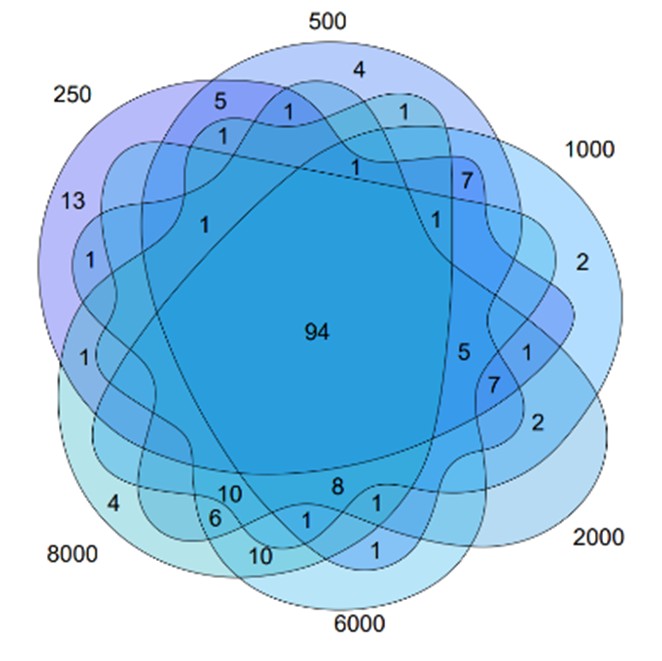
      References

      (1) Gebski, V., Garès, V., Gibbs, E. & Byth, K. Data maturity and follow-up in time-to-event analyses.International Journal of Epidemiology 47, 850–859 (2018).

    1. Reviewer #2 (Public review):

      Summary:

      In their manuscript, the authors reveal that the spectraplakin Shot, which can bind both microtubules and actin, is essential for the proper pruning of dendrites in a developing Drosophila model. A molecular basis for the coordination of these two cytoskeletons during neuronal development has been elusive, and the authors' data point to the role of Shot in regulating microtubule polarity and growth through one of its actin-binding domains. The authors also propose an intriguing new activity for a spectraplakin: functioning as part of a microtubule-organizing center (MTOC).

      Strengths:

      (1) A strength of the manuscript is the authors' data supporting the idea that Shot regulates dendrite pruning via its actin-binding CH1 domain and that this domain is also implicated in Shot's ability to regulate microtubule polarity and growth (although see comments below); these data are consistent with the authors' model that Shot acts through both the actin and microtubule cytoskeletons to regulate neuronal development.

      (2) Another strength of the manuscript is the data in support of Rab11 functioning as an MTOC in young larvae but not older larvae; this is an important finding that may resolve some debates in the literature. The finding that Rab11 and Msps coimmunoprecipitate is nice evidence in support of the idea that Rab11(+) endosomes serve as MTOCs.

      Weaknesses:

      (1) A significant, major concern is that most of the authors' main conclusions are not (well) supported, in particular, the model that Shot functions as part of an MTOC. The story has many interesting components, but lacks the experimental depth to support the authors' claims.

      (2) One of the authors' central claims is that Shot functions as part of a non-centrosomal MTOC, presumably a MTOC anchored on Rab11(+) endosomes. For example, in the Introduction, last paragraph, the authors summarize their model: "Shot localizes to dendrite tips in an actin-dependent manner where it recruits factors cooperating with an early-acting, Rab11-dependent MTOC." This statement is not supported. The authors do not show any data that Shot localizes with Rab11 or that Rab11 localization or its MTOC activity is affected by the loss of Shot (or otherwise manipulating Shot). A genetic interaction between Shot and Rab11 is not sufficient to support this claim, which relies on the proteins functioning together at a certain place and time. On a related note, the claim that Shot localization to dendrite tips is actin-dependent is not well supported: the authors show that the CH1 domain is needed to enrich Shot at dendrite tips, but they do not directly manipulate actin (it would be helpful if the authors showed the overexpression of Mical disrupted actin, as they predict).

      (3) The authors show an image that Shot colocalizes with the EB1-mScarlet3 comet initiation sites and use this representative image to generate a model that Shot functions as part of an MTOC. However, this conclusion needs additional support: the authors should quantify the frequency of EB1 comets that originate from Shot-GFP aggregates, report the orientation of EB1 comets that originate from Shot-GFP aggregates (e.g., do the Shot-GFP aggregates correlate with anterogradely or retrogradely moving EB1 comets), and characterize the developmental timing of these events. The genetic interaction tests revealing ability of shot dsRNA to enhance the loss of microtubule-interacting proteins (Msps, Patronin, EB1) and Rab11 are consistent with the idea that Shot regulates microtubules, but it does not provide any spatial information on where Shot is interacting with these proteins, which is critical to the model that Shot is acting as part of a dendritic MTOC.

      (4) It is unclear whether the authors are proposing that dendrite pruning defects are due to an early function of Shot in regulating microtubule polarity in young neurons (during 1st instar larval stages) or whether Shot is acting in another way to affect dendrite pruning. It would be helpful for the authors to present and discuss a specific model regarding Shot's regulation of dendrite pruning in the Discussion.

      (5) The authors argue that a change in microtubule polarity contributes to dendrite pruning defects. For example, in the Introduction, last paragraph, the authors state: "Loss of Shot causes pruning defects caused by mixed orientation of dendritic microtubules." The authors show a correlative relationship, not a causal one. In Figure 4, C and E, the authors show that overexpression of Mical disrupts microtubule polarity but not dendrite pruning, raising the question of whether disrupting microtubule polarity is sufficient to cause dendrite pruning defects. The lack of an association between a disruption in microtubule polarity and dendrite pruning in neurons overexpressing Mical is an important finding.

      (6) The authors show that a truncated Shot construct with the microtubule-binding domain, but no actin-binding domain (Shot-C-term), can rescue dendrite pruning defects and Khc-lacZ localization, whereas the longer Shot construct that lacks just one actin-binding domain ("delta-CH1") cannot. Have the authors confirmed that both proteins are expressed at equivalent levels? Based on these results and their finding that over-expression of Shot-delta-CH1 disrupts dendrite pruning, it seems possible that Shot-delta-CH1 may function as a dominant-negative rather than a loss-of-function. Regardless, the authors should develop a model that takes into account their findings that Shot, without any actin-binding domains and only a microtubule-binding domain, shows robust rescue.

      (7) The authors state that: "The fact that Shot variants lacking the CH1 domain cannot rescue the pruning defects of shot[3] mutants suggested that dendrite tip localization of Shot was important for its function." (pages 10-11). This statement is not accurate: the Shot C-term construct, which lacks the CH1 domain (as well as other domains), is able to rescue dendrite pruning defects.

      (8) The authors state that: "In further support of non-functionality, overexpression of Shot[deltaCH1] caused strong pruning defects (Fig. S3)." (page 8). Presumably, these results indicate that Shot-delta-CH1 is functioning as a dominant-negative since a loss-of-function protein would have no effect. The authors should revise how they interpret these results. This comment is related to another comment about the ability of Shot constructs to rescue the shot[3] mutant.

    2. Author response:

      We thank the reviewers for their comments. We are paraphrasing their three main criticisms below and provide responses and outlines of how we are going to address them.

      Criticism 1: Actin binding by Shot may not be required for Shot's function in dendritic microtubule organization (Point 1 by Reviewer 1, points 6-8 by reviewer 2).

      This criticism is mainly based on our finding that, while a version of Shot lacking just the high affinity actin binding site cannot rescue the pruning and orientation defects of shot<sup>3</sup> mutants, expression of a construct harboring just the microtubule and EB1 binding sites can. The reviewers also point out that a Shot construct lacking one of its actin binding domains (deltaCH1), causes pruning defects when overexpressed in wild type cells.

      We thank the reviewers for this comment. We concede that we did not properly explain our reasoning and conclusions regarding the role of actin binding in Shot dendritic function. From the literature, there is evidence that Shot fragments containing the C-terminal microtubule binding domain alone have positive effects on neuronal microtubule stability and organization by a gain-of-function mechanism. This is likely due to two reasons: firstly, the activity of these constructs is unrestrained by localization. For example, in axons, full length Shot localizes adjacent to the membrane and to growth cones, while a Shot C-terminal construct (lacking the actin-binding and spectrin-repeat domains) decorates axonal microtubules [1]. Secondly, the actin binding site appears to inhibit microtubule binding by an intramolecular mechanism that is relieved by actin binding [2]. Overexpression of such a construct also dramatically improves axonal microtubule defects in aged neurons [3]. Thus, actin recruitment may locally activate Shot's microtubule binding activity.

      To address this criticism, we will test if other UAS-Shot transgenes lacking the actin binding or microtubule binding domains can rescue the defects of Shot mutants. We will also try to provide more evidence that the C-terminal Shot construct exerts a gain-of-function effect on microtubules. We will adjust our interpretation accordingly.

      Criticism 2: The relationship between reversal of dendritic microtubule orientation and dendrite pruning defects could be correlative rather than causal (paragraph 1 by Reviewer 1, point 5 by reviewer 2).

      This criticism is based on our finding that Mical overexpression causes a partial reversal of dendritic microtubule orientation but no apparent dendrite pruning defects.

      We thank the reviewers for this comment. In fact, knockdown of EB1, which affects dendritic microtubule organisation via kinesin-2 [4], does not cause dendrite pruning defects by itself either, but strongly enhances the pruning defects caused by other microtubule manipulations [5]. This is likely because loss of EB1 destabilizes the dendritic cytoskeleton and thus also promotes dendrite degeneration. All other conditions that cause dendritic microtubule reversal also cause dendrite pruning defects [5 - 9]. As Mical is a known pruning factor [10], its overexpression may actually also destabilize dendrites, e. g., by severing actin filaments. However, we showed in the current manuscript that Mical overexpression causes a partial reversal of dendritic microtubule polarity and strongly enhances the dendrite pruning defects caused by Shot knockdown.

      To address this criticism, we will rephrase the corresponding section of our manuscript and specify that conditions that cause reversal of dendritic microtubule orientation either cause dendrite pruning defects, or act as genetic enhancers of pruning defects caused by other microtubule regulators. This wording better explains the relationship between dendritic microtubule orientation and dendrite pruning and also includes the Mical overexpression condition.

      Criticism 3: The presented data do not prove that Shot, Rab11 and Patronin act in a common pathway to establish dendritic plus end-in microtubule orientation (paragraphs 2-3 by Reviewer 1, point 1-4 by reviewer 2).

      While these factors genetically interact with each other during dendrite pruning, it is not clear whether (1) they colocalize at the tips of growing dendrites during early growth stages; (2) their respective localizations depend on each other; (3) they act at the same developmental stage in microtubule orientation.  

      We thank the reviewers for this comment. For technical reasons (e. g., incompatible transgenes, GAL4 drivers too weak), we could only partially address these questions at the time. We have now expanded our toolkit with additional drivers and fluorescently tagged transgenes. We will therefore test whether Shot and Rab11 or Patronin and Rab11 colocalize in growing dendrites during the early L1 stage, and if loss of Shot affects the localization or the activity of Patronin and Rab11 in dendrites. We will adapt our interpretation accordingly, and also add a comprehensive model.

      References

      (1) Alves Silva et al. (2012) J. Neurosci. 32:9143

      (2) Applewhite et al. (2013) Mol. Biol. Cell 24:2885

      (3) Okenve-Ramos et al. (2024) PLoS Biol. 22:e3002504

      (4) Mattie et al. (2010) Curr. Biol. 20:2169

      (5) Herzmann et al. (2018) Development 145:dev156950

      (6) Wang et al. (2019) eLife 8:e39964

      (7) Rui et al. (2020) EMBO Rep. 21:e48843

      (8) Tang et al. (2020) EMBO J. 39:e103549

      (9) Bu et al. (2022) Cell Rep. 39:110887

      (10) Kirilly et al. (2009) Nat. Neurosci. 12:1497

    1. Reviewer #2 (Public review):

      Summary:

      Wang et al. measure from 10 cortical and subcortical brain as mice learn a go/no-go visual discrimination task. They found that during learning, there is a reshaping of inter-areal connections, in which a visual-frontal subnetwork emerges as mice gain expertise. Also visual stimuli decoding became more widespread post-learning. They also perform silencing experiments and find that OFC and V2M are important for the learning process. The conclusion is that learning evoked a brain-wide dynamic interplay between different brain areas that together may promote learning.

      Strengths:

      The manuscript is written well and the logic is rather clear. I found the study interesting and of interest to the field. The recording method is innovative and requires exceptional skills to perform. The outcomes of the study are significant, highlighting that learning evokes a widespread and dynamics modulation between different brain areas, in which specific task-related subnetworks emerge.

      Weaknesses:

      I had several major concerns:

      (1) The number of mice was small for the ephys recordings. Although the authors start with 7 mice in Figure 1, they then reduce to 5 in panel F. And in their main analysis, they minimize their analysis to 6/7 sessions from 3 mice only. I couldn't find a rationale for this reduction, but in the methods they do mention that 2 mice were used for fruitless training, which I found no mention in the results. Moreover, in the early case, all of the analysis is from 118 CR trials taken from 3 mice. In general, this is a rather low number of mice and trial numbers. I think it is quite essential to add more mice.

      (2) Movement analysis was not sufficient. Mice learning a go/no-go task establish a movement strategy that is developed throughout learning and is also biased towards Hit trials. There is an analysis of movement in Figure S4, but this is rather superficial. I was not even sure that the 3 mice in Figure S4 are the same 3 mice in the main figure. There should be also an analysis of movement as a function of time to see differences. Also for Hits and FAs. I give some more details below. In general, most of the results can be explained by the fact that as mice gain expertise, they move more (also in CR during specific times) which leads to more activation in frontal cortex and more coordination with visual areas. More needs to be done in terms of analysis, or at least a mention of this in the text.

      (3) Most of the figures are over-detailed, and it is hard to understand the take-home message. Although the text is written succinctly and rather short, the figures are mostly overwhelming, especially Figures 4-7. For example, Figure 4 presents 24 brain plots! For rank input and output rank during early and late stim and response periods, for early and expert and their difference. All in the same colormap. No significance shown at all. The Δrank maps for all cases look essentially identical across conditions. The division into early and late time periods is not properly justified. But the main take home message is positive Δrank in OFC, V2M, V1 and negative Δrank in ThalMD and Str. In my opinion, one trio map is enough, and the rest could be bumped to the Supplementary section, if at all. In general, the figure in several cases do not convey the main take home messages. See more details below.

      (4) The analysis is sometimes not intuitive enough. For example, the rank analysis of input and output rank seemed a bit over complex. Figure 3 was hard to follow (although a lot of effort was made by the authors to make it clearer). Was there any difference between the output and input analysis? Also, the time period seems redundant sometimes. Also, there are other network analysis that can be done which are a bit more intuitive. The use of rank within the 10 areas was not the most intuitive. Even a dimensionality reduction along with clustering can be used as an alternative. In my opinion, I don't think the authors should completely redo their analysis, but maybe mention the fact that other analyses exist.

    2. Reviewer #3 (Public review):

      Summary:

      In the manuscript " Dynamics of mesoscale brain network during decision-making learning revealed by chronic, large-scale single-unit recording", Wang et al investigated mesoscale network reorganization during visual stimulus discrimination learning in mice using chronic, large-scale single-unit recordings across 10 cortical/subcortical regions. During learning, mice improved task performance mainly by suppressing licking on no-go trials. The authors found that learning induced restructuring of functional connectivity, with visual (V1, V2M) and frontal (OFC, M2) regions forming a task-relevant subnetwork during the acquisition of correct No-Go (CR) trials.

      Learning also compressed sequential neural activation and broadened stimulus encoding across regions. In addition, a region's network connectivity rank correlated with its timing of peak visual stimulus encoding.

      Optogenetic inhibition of orbitofrontal cortex (OFC) and high order visual cortex (V2M) impaired learning, validating its role in learning. The work highlights how mesoscale networks underwent dynamic structuring during learning.

      Strengths:

      The use of ultra-flexible microelectrode arrays (uFINE-M) for chronic, large-scale recordings across 10 cortical/subcortical regions in behaving mice represents a significant methodological advancement. The ability to track individual units over weeks across multiple brain areas will provide a rare opportunity to study mesoscale network plasticity.

      While limited in scope, optogenetic inhibition of OFC and V2M directly ties connectivity rank changes to behavioral performance, adding causal depth to correlational observations.

      Weaknesses:

      The weakness is also related to the strength provided by the method. It is demonstrated in the original method that this approach in principle can track individual units for four months (Luan et al, 2017). The authors have not showed chronically tracked neurons across learning. Without demonstrating that and taking advantage of analyzing chronically tracked neurons, this approach is not different from acute recording across multiple days during learning. Many studies have achieved acute recording across learning using similar tasks. These studies have recorded units from a few brain areas or even across brain-wide areas.

      Another weakness is that major results are based on analyses of functional connectivity that is calculated using the cross-correlation score of spiking activity (TSPE algorithm). Functional connection strengthen across areas is then ranked 1-10 based on relative strength. Without ground truth data, it is hard to judge the underlying caveats. I'd strongly advise the authors to use complementary methods to verify the functional connectivity and to evaluate the mesoscale change in subnetworks. Perhaps the authors can use one key information of anatomy, i.e. the cortex projects to the striatum, while the striatum does not directly affect other brain structures recorded in this manuscript.

    3. Author response:

      Reviewer #1 (Public review):

      Weaknesses:

      The technical approach is strong and the conceptual framing is compelling, but several aspects of the evidence remain incomplete. In particular, it is unclear whether the reported changes in connectivity truly capture causal influences, as the rank metrics remain correlational and show discrepancies with the manipulation results.

      We agree that our functional connectivity ranking analyses cannot establish causal influences. As discussed in the manuscript, besides learning-related activity changes, the functional connectivity may also be influenced by neuromodulatory systems and internal state fluctuations. In addition, the spatial scope of our recordings is still limited compared to the full network implicated in visual discrimination learning, which may bias the ranking estimates. In future, we aim to achieve broader region coverage and integrate multiple complementary analyses to address the causal contribution of each region.

      The absolute response onset latencies also appear slow for sensory-guided behavior in mice, and it is not clear whether this reflects the method used to define onset timing or factors such as task structure or internal state.

      We believe this may be primarily due to our conservative definition of onset timing. Specifically, we required the firing rate to exceed baseline (t-test, p < 0.05) for at least 3 consecutive 25-ms time windows. This might lead to later estimates than other studies, such as using the latency to the first spike after visual stimulus onset (~50-60 ms, Siegle et al., Nature, 2023) or the time to half-max response (~65 ms, Goldbach et al., eLife, 2021).

      Furthermore, the small number of animals, combined with extensive repeated measures, raises questions about statistical independence and how multiple comparisons were controlled.

      We agree that a larger sample size would strengthen the robustness of the findings. However, as noted above, the current dataset has inherent limitations in both the number of recorded regions and the behavioral paradigm. Given the considerable effort required to achieve sufficient unit yields across all targeted regions, we wish to adjust the set of recorded regions, improve behavioral task design, and implement better analyses in future studies. This will allow us to both increase the number of animals and extract more precise insights into mesoscale dynamics during learning.

      The optogenetic experiments, while intended to test the functional relevance of rank increasing regions, leave it unclear how effectively the targeted circuits were silenced. Without direct evidence of reliable local inhibition, the behavioral effects or lack thereof are difficult to interpret.

      We appreciate this important point. Due to the design of the flexible electrodes and the implantation procedure, bilateral co-implantation of both electrodes and optical fibers was challenging, which prevented us from directly validating the inhibition effect in the same animals used for behavior. In hindsight, we could have conducted parallel validations using conventional electrodes, and we will incorporate such controls in future work to provide direct evidence of manipulation efficacy.

      Details on spike sorting are limited.

      We will provide more details on spike sorting, including the exact parameters used in the automated sorting algorithm and the subsequent manual curation criteria.

      Reviewer #2 (Public review):

      Weaknesses:

      I had several major concerns:

      (1) The number of mice was small for the ephys recordings. Although the authors start with 7 mice in Figure 1, they then reduce to 5 in panel F. And in their main analysis, they minimize their analysis to 6/7 sessions from 3 mice only. I couldn't find a rationale for this reduction, but in the methods they do mention that 2 mice were used for fruitless training, which I found no mention in the results. Moreover, in the early case, all of the analysis is from 118 CR trials taken from 3 mice. In general, this is a rather low number of mice and trial numbers. I think it is quite essential to add more mice.

      We apologize for the confusion. As described in the Methods section, 7 mice (Figure 1B) were used for behavioral training without electrode array or optical fiber implants to establish learning curves, and an additional 5 mice underwent electrophysiological recordings (3 for visual-based decision-making learning and 2 for fruitless learning).

      As we noted in our response to Reviewer #1, the current dataset has inherent limitations in both the number of recorded regions and the behavioral paradigm. Given the considerable effort required to achieve high-quality unit yields across all targeted regions, we wish to adjust the set of recorded regions, improve behavioral task design, and implement better analyses in future studies. These improvements will enable us to collect data from a larger sample size and extract more precise insights into mesoscale dynamics during learning.

      (2) Movement analysis was not sufficient. Mice learning a go/no-go task establish a movement strategy that is developed throughout learning and is also biased towards Hit trials. There is an analysis of movement in Figure S4, but this is rather superficial. I was not even sure that the 3 mice in Figure S4 are the same 3 mice in the main figure. There should be also an analysis of movement as a function of time to see differences. Also for Hits and FAs. I give some more details below. In general, most of the results can be explained by the fact that as mice gain expertise, they move more (also in CR during specific times) which leads to more activation in frontal cortex and more coordination with visual areas. More needs to be done in terms of analysis, or at least a mention of this in the text.

      Due to the limitation in the experimental design and implementation, movement tracking was not performed during the electrophysiological recordings, and the 3 mice shown in Figure S4 were from a separate group. We have carefully examined the temporal profiles of mouse movements and found it did not fully match the rank dynamics, and we will add these results and related discussion in the revised manuscript. However, we acknowledge that without synchronized movement recordings in the main dataset, we cannot fully disentangle movement-related neural activity from task-related signals. We will make this limitation explicit in the revised manuscript and discuss it as a potential confound, along with possible approaches to address it in future work.

      (3) Most of the figures are over-detailed, and it is hard to understand the take-home message. Although the text is written succinctly and rather short, the figures are mostly overwhelming, especially Figures 4-7. For example, Figure 4 presents 24 brain plots! For rank input and output rank during early and late stim and response periods, for early and expert and their difference. All in the same colormap. No significance shown at all. The Δrank maps for all cases look essentially identical across conditions. The division into early and late time periods is not properly justified. But the main take home message is positive Δrank in OFC, V2M, V1 and negative Δrank in ThalMD and Str. In my opinion, one trio map is enough, and the rest could be bumped to the Supplementary section, if at all. In general, the figure in several cases do not convey the main take home messages. See more details below.

      We thank the reviewer for this valuable critique. The statistical significance corresponding to the brain plots (Figure 4 and Figure 5) was presented in Figure S3 and S5, but we agree that the figure can be simplified to focus on the key results. In the revised manuscript, we will condense these figures to focus on the most important comparisons and relocate secondary plots to the Supplementary section. This will make the visual presentation more concise and the take-home message clearer.

      (4) The analysis is sometimes not intuitive enough. For example, the rank analysis of input and output rank seemed a bit over complex. Figure 3 was hard to follow (although a lot of effort was made by the authors to make it clearer). Was there any difference between the output and input analysis? Also, the time period seems redundant sometimes. Also, there are other network analysis that can be done which are a bit more intuitive. The use of rank within the 10 areas was not the most intuitive. Even a dimensionality reduction along with clustering can be used as an alternative. In my opinion, I don't think the authors should completely redo their analysis, but maybe mention the fact that other analyses exist

      We appreciate the reviewer’s comment. In brief, the input- and output-rank analyses yielded largely similar patterns across regions in CR trials, although some differences were observed in certain areas (e.g., striatum in Hit trials) where the magnitude of rank change was not identical between input and output measures. We agree that the division into multiple time periods sometimes led to redundant results; we will combine overlapping results in the revision to improve clarity.

      We did explore dimensionality reduction applied to the ranking data. However, the results were not intuitive and required additional interpretation, which did not bring more insights. Still, we acknowledge that other analysis approaches might provide complementary insights. While we do not plan to completely reanalyze the dataset at this stage, we will include a discussion of these alternative methods and their potential advantages in the revised manuscript.

      Reviewer #3 (Public review):

      Weaknesses:

      The weakness is also related to the strength provided by the method. It is demonstrated in the original method that this approach in principle can track individual units for four months (Luan et al, 2017). The authors have not showed chronically tracked neurons across learning. Without demonstrating that and taking advantage of analyzing chronically tracked neurons, this approach is not different from acute recording across multiple days during learning. Many studies have achieved acute recording across learning using similar tasks. These studies have recorded units from a few brain areas or even across brain-wide areas.

      We appreciate the reviewer’s important point. We did attempt to track the same neurons across learning in this project. However, due to the limited number of electrodes implanted in each brain region, the number of chronically tracked neurons in each region was insufficient to support statistically robust analyses. Concentrating probes in fewer regions would allow us to obtain enough units tracked across learning in future studies to fully exploit the advantages of this method.

      Another weakness is that major results are based on analyses of functional connectivity that is calculated using the cross-correlation score of spiking activity (TSPE algorithm). Functional connection strengthen across areas is then ranked 1-10 based on relative strength. Without ground truth data, it is hard to judge the underlying caveats. I'd strongly advise the authors to use complementary methods to verify the functional connectivity and to evaluate the mesoscale change in subnetworks. Perhaps the authors can use one key information of anatomy, i.e. the cortex projects to the striatum, while the striatum does not directly affect other brain structures recorded in this manuscript

      We agree that the functional connectivity measured in this study relies on statistical correlations rather than direct anatomical connections. We plan to test the functional connection data with shorter cross-correlation delay criteria to see whether the results are consistent with anatomical connections and whether the original findings still hold.

    1. Reviewer #1 (Public review):

      Summary:

      This study by Akhtar et al. aims to investigate the link between systemic metabolism and respiratory demands, and how sleep and the circadian clock regulate metabolic states and respiratory dynamics. The authors leverage genetic mutants that are defective in sleep and circadian behavior in combination with indirect respirometry and steady-state LC-MS-based metabolomics to address this question in the Drosophila model.

      First, the authors performed respirometry (on groups of 25 flies) to measure oxygen consumption (VO2) and carbon dioxide production (VCO2) to calculate the respiratory quotient (RQ) across the 24-hour day (12h:12h light-dark cycle) and assess metabolic fuel utilization. They observed that among all the genotypes tested, wild type (WT) flies and per0 flies in LD and WT flies in DD exhibit RQ >1. They concluded the >1 RQ is consistent with active lipogenesis. In contrast, the short-sleep mutants fumin (fmn) and sleepless (sss) showed significantly different RQ; the fmn exhibits a slight reduction in RQ values, suggesting increased reliance on carbohydrate metabolism, while sss exhibits even lower RQ (0.94), consistent with a shift toward lipid and protein catabolism.

      The authors then proceeded to bin these measurements in 12-hour partitions, ZT0-12 and ZT12-24, to assess diurnal differences in average values of VO2, VCO2, and RQ. They observed significant day-night differences in metabolic rates in WT-LD flies, with higher rates during the day. The diurnal differences remain in the short-sleep mutants, but the overall metabolic rates are higher. WT-DD flies exhibit the lowest respiratory activity, although the day-night differences remain in free-running conditions. Finally, per01 mutants exhibit no significant change in day-night respiratory rates, suggesting that a functional circadian clock is necessary for diurnal differences in metabolic rates.

      They then performed finer-resolution 24-hour rhythmic analysis (RAIN and JTK) to determine if VO2, VCO2, and RQ exhibit 24-hour rhythmic and if there are genotype-specific differences. Based on their criteria, VCO2 is rhythmic in all conditions tested, while VO2 is rhythmic in all conditions except in fmn-LD. Finally, RQ is rhythmic in all 3 mutants but not in WT-LD and WT-DD. Peak phases for the rhythms were deduced using JTK lag values.

      The authors proceeded to leverage a previously published steady-state metabolite dataset to investigate the potential association of RQ with metabolite profiles. Spearman correlation was performed to identify metabolites that exhibit coupling to respiratory output. Positive and negative lag analysis were subsequently performed to further characterize these associations based on the timing of the metabolite peak changes relative to RQ fluctuations. The authors suggest that a positive lag indicates that metabolite changes occur after shifts in RQ, and a negative lag signifies that metabolite changes precede RQ changes. To visualize metabolic pathways that exhibit these temporal relationships, a clustered heatmap and enrichment analysis were performed. Through these analyses, they concluded that both sleep and circadian systems are essential for aligning metabolic substrate selection with energy demands, and different metabolic pathways are misregulated in the different mutants with sleep and circadian defects.

      Strength:

      The research questions this study explores are significant, given that metabolism and respiratory demand are central to animal biology. The experimental methods used, including the well-characterized fly genetic mutants, the newly developed method for indirect calorimetry measurements, and LC-MS-based metabolomics, are all appropriate. This study provides insights into the impact of sleep and circadian rhythm disruption on metabolism and respiratory demand and serves as a foundation for future mechanistic investigations.

      Weaknesses:

      There are some conceptual flaws that the authors need to address regarding circadian biology, and some of the conclusions can be better supported by additional analysis to provide a stronger foundation for future functional investigation. At times, the methods, especially the statistical analysis, are not well articulated; they need to be better explained.

    2. Reviewer #3 (Public review):

      Summary:

      The authors investigate how sleep loss and circadian disruption affect whole-organism metabolism in Drosophila melanogaster. They used chamber-based flow-through respirometry to measure oxygen consumption and carbon dioxide production in wild-type flies and in mutants with impaired sleep or circadian function. These measurements were then integrated with a previously published metabolomics dataset to explore how respiratory dynamics align with metabolic pathways. The central claim is that wild-type flies display anticipatory coordination of metabolic processes with circadian time, while mutants exhibit reactive shifts in substrate use, redox imbalance, and signs of mitochondrial stress.

      Strengths:

      The study has several strengths. Continuous high-resolution respirometry in flies is challenging, and its application across multiple genotypes provides good comparative insight. The conceptual framework distinguishing anticipatory from reactive metabolic regulation is interesting. The translational framing helps place the work in a broader context of sleep, circadian biology, and metabolic health.

      Weaknesses:

      At the same time, the evidence supporting the conclusions is somewhat limited. The metabolomics data were not newly generated but repurposed from prior work, reducing novelty. The biological replication in the respirometry assays is low, with only a small number of chambers per genotype. Importantly, respiratory parameters in flies are strongly influenced by locomotor activity, yet no direct measurements of activity were included, making it difficult to separate intrinsic metabolic changes from behavioral differences in mutants. In addition, repeated claims of "mitochondrial stress" are not directly substantiated by assays of mitochondrial function. The study also excluded female flies entirely, despite well-documented sex differences in metabolism, which narrows the generality of the findings.

    3. Author response:

      We thank the reviewers for their thoughtful public feedback. Our revision will clarify scope and methods/statistics, as well as streamline the narrative so the central message is clear: wild-type flies exhibit anticipatory alignment of fuel selection with circadian time, whereas short-sleep and clock mutants show reactive or misaligned metabolism under our conditions.

      Major conceptual and experimental revisions:

      (1) We will define “anticipatory” (clock-aligned, pre-emptive substrate choice) and “reactive” (post-hoc substrate shifts) up front and use these terms consistently. We will clearly distinguish diurnal (LD) from circadian (DD) regulation and avoid implying that DD abolishes rhythmicity. Claims will be limited to the tested genotypes (fmn, sss, and per<sup>01</sup>) without generalizing to all forms of sleep loss or to mammals (although we will speculate in the discussion about translation and generalizability). We will temper language around external entrainment in DD to “contributes strongly under our conditions in flies.”

      (2) We will expand the respirometry and rhythmicity sections (RAIN/JTK parameters, period/phase outputs, multiple-testing control). We will clarify that each measurement is an average of 300 flies per genotype (25 flies/chamber, 4 chambers/experiment, 3 experimental days) and specify the chamber as the experimental unit with n and error structure in each figure legend. For metabolomics–respirometry correlations, we will briefly describe dataset parameters, time-matching across ZT, normalization, Spearman correlations, and lag interpretation.

      (3) We are performing additional experimental measurements through tissue respirometry of gut tissues and ROS staining to support our claims of “mitochondrial stress” in the short sleeping mutants. We note that this has already been shown for fmn in Vaccaro et al (Cell, 2020) and we will extend this to the other mutants studied in our work.

      Reviewer-specific points

      Reviewer #1.

      We will clarify the circadian/diurnal framing, fully report rhythmicity analyses (parameters, n, q-values, phases), and better explain the metabolomics-respiration coupling with a concise workflow figure and supplementary table. The conclusion that sleep and clock systems align substrate selection with energy demand will be presented as supported under our tested conditions and positioned as groundwork for future mechanistic studies.

      Reviewer #2.

      We will state explicitly that findings may be gene-specific and avoid inferring generality to all sleep loss. We will soften cross-species language about external entrainment and add a brief note on species differences. For behavioral context (activity/feeding/sleep in fmn andsss), we will cite our related manuscript in revision (Malik et al, https://www.biorxiv.org/content/10.1101/2023.10.30.564837v2) in which we have measured both activity and feeding for fmn, sss, and wt flies. We will add a concise description of LC-MS processing and pathway analysis and define “anticipatory”/“reactive” early, using them consistently.

      Reviewer #3.

      We acknowledge that metabolomics were repurposed and emphasize the novelty of integrating continuous VCO2 and VO2 respirometry with temporal lag analysis. We will report replication clearly (chambers as the unit, n per genotype) and acknowledge locomotor activity as a potential confound, pointing to the related manuscript (Malik et al) for independent activity/feeding measurements and experimental measures of mitochondrial stress as outlined above. We will also further note that only males were studied, outlining this as a limitation and a future direction.

    1. Note: This response was posted by the corresponding author to Review Commons. The content has not been altered except for formatting.

      Learn more at Review Commons


      Reply to the reviewers

      Reviewer #1

      (...) The study describes meticulously conducted and controlled experiments, showing the impressive biochemistry work consistently produced by this group. The statistical analysis and data presentation are appropriate, with the following major comments noted:

      Response: We thank the reviewer for their thoughtful and constructive review of our manuscript. We appreciate the positive comments on our experimentation.

      Major comments

      1. Please clarify why K8ac/K12ac, K5ac/K16ac, K5ac/K12ac are not quantified (Figure 3). If undetected, state explicitly and annotate figures with "n.d." rather than leaving gaps. If detected but excluded, justify the exclusion.

      Response: We restricted ourselves to mapping those diacetylated motifs that can be readily identified by MS2. The characteristic ions of the d3-labeled and endogenous acetylated peptides in the MS2 spectra could not differentiate the diacetylated forms mentioned by the reviewer. Rather than expanding the figure with non-informative rows we amended the legend of figure 3 accordingly "Diacetylated forms K8-K12, K5-K16, K5-K12 could not be distinguished from each other by MS2 and were thus not included in the analysis".

      The statement "Nevertheless, combinations of di- and triacetylation were much more frequent if K12ac was included, suggesting that K12 is the primary target." is under-supported because only two non-K12ac combinations are shown, and only one is lower than K12ac-containing combinations. Either soften the claim ("trend toward ... in our dataset") or expand the analysis to all observed di/tri combinations with effect sizes, n, and statistical tests.

      Response: The reviewer is right our statement does properly reflect the data. It rather seems that combinations lacking K12ac are considerably less frequent (K5K8K16 tri-ac, K5K8 di-ac). We now modified the sentence as follows: "Peptides lacking K12ac were less frequent, suggesting that K12 is a primary target".

      Please provide a more detailed discussion about the known nature of NU9056 inhibition and how it fits or doesn't fit with your data. Are there any structural studies on this?

      Response: Unfortunately, NU9056 is very poorly described, neither the mode of interaction with Tip60 nor the mechanism of inhibition are known. The specificity of the chemical has not really been shown, but nevertheless it is used as a selective Tip60 inhibitor in several papers which is why we picked it in the first place. Our conclusions on the inhibitor are in the last paragraph of the discussion: "The fact that acetylation of individual lysines is inhibited with different kinetics argues against a mechanism involving competition with acetyl-CoA, but for an allosteric distortion of the catalytic center." We think that any further interpretation would likely be considered an overstatement.

      Why was the inhibitor experiment MS only performed for H2A.V and not H2A? Given the clear H2A vs H2A.V differences reported in Fig. 2, it would be useful to have the matched data for H2A.

      Response: In these costly mass spec experiments we strive to balance limited resources and most informative output. Because H2A.V and H4 are the major functional targets of Tip60, we considered that documenting the effect of the inhibitor on these substrates would be most appropriate. In hindsight, including H2A would have been nice to have, but would not change our conclusions about the inhibitor.

      The inhibitor observations are very interesting as they can highlight systems to study the loss of specific acetyl residues: can the authors perform WB/IF validation in treated cells? I understand it will not be possible with the H2A antibodies, but the difference in H4K5ac vs H4K12ac should be possible to validate in cells

      Response: We attempted to monitor changes of histone modifications upon treatment of cells with NU9056 by immunoblotting. Probing H4K5 and K12, the results were variable. We also observed occasionally that acetylation of H4K5 and H4K12 was slightly diminished in whole cell extracts, but not in nuclear extracts. This reminded us that diacetylation of H4 at K5 and K12 is a feature of cytoplasmic H4 in complex with chaperones, a mark that is placed by HAT1 (Aguldo Garcia et al., DOI: 10.1021/acs.jproteome.9b00843; Varga et al., DOI: 10.1038/s41598-019-54497-0). The observed proliferation arrest by NU9056 may thus affect chromatin assembly and indirectly K5K12 acetylation. H4K12 is also acetylated by chameau (Chm).

      We observed a reduction of acetylated H4K16 and H2A.V. H4K16 is not a preferred target of Tip60, but Tip60 acetylates MSL1 and MBDR2, two subunits of the NSL1 complex (Apostolou et al. DOI: 10.1101/2025.07.15.664872). We, therefore, consider that effects on H4 acetylation upon NU9056 treatment may at least partially be affected indirectly. Because we are not confident about the data and because our manuscript emphasizes the direct, intrinsic specificity of Tip60, we refrain from showing the corresponding Western blots.

      You highlight that H2AK10 (a major TIP60 site here) is not conserved in human canonical H2A. Please expand the discussion of the potential function and physiological relevance. Maybe in relation to H2A.V being a fusion of different human variants?

      Response: The reviewer noted an interesting aspect of the evolution of the histone H2A variants. It turns out that H2A.Z is the more ancient variant, from which H2A derived by mutation. H2A.Z/H2A.V sequences are more conserved than H2A sequences. We summarized these evolutionary notions in Baldi and Becker (DOI: 10.1007/s00412-013-0409-x). In the context of the question, this means that mammalian H2A.Z, Drosophila H2A.V and mammalian H2A still contain the ancient sequence (lacking K10), and Drosophila H2A acquired K10 by mutation. The evolutionary advantage associated with this mutation in unclear. We now added a small paragraph summarizing these ideas on page 13 of the (changes tracked in red).

      To enable direct comparisons between variants and residues, please match y-axis scales where the biology invites comparison (e.g., H2A vs H2A.V; Figs. 2-3).

      Response: We adjusted the Y-axes in Figure 2 and 3 to facilitate direct comparisons, where such comparison is informative.

      Minor comments

      1. Add 1-2 sentences in the abstract on the gap in the field being addressed by the study.

      Response: We are grateful for this suggestion and have expanded the abstract accordingly (changes tracked in red).

      Either in the introduction or discussion, comment on your prior Tip60 three-subunit data (Kiss et al.). The three-subunit complex was significantly less active on H4, as indicated in that publication, which is likely due to the absence of Eaf6.

      Response: We thank the reviewer for the opportunity to emphasize this point. Motivated by findings in the yeast and mammalian systems that Eaf6 was important for acetylation, we added this subunit to our previously reconstituted 3-subunit 'piccolo' complex. As can be seen by the comparison of the older data (Kiss et al.) and the new data, the 4-subunit TIP60 core complex is a much more potent HAT. We amended the introduction (see marked text) accordingly. We also added a paragraph on what is known about the properties and function of Eaf6 to the discussion.

      3a. Text references Fig.1E before Fig.1C, please reorder

      Response: We deleted the premature mentioning of Figure 1E and added the following explanation to the relevant panels in Figure 1: "The blot was reprobed with an antibody detecting H3 as an internal standard for nucleosome input."

      3b. Fig.1B/C legend labels appear swapped.

      Response: We thank the reviewer for spotting the swap. We corrected the figure legend.

      3c. Fig.1E, 4A, 4B: add quantification

      Response: We quantified each acetylation level, and added to the relevant panel of Figure 1 and 4 the following phrase: "The quantified levels of each acetylation mark over H3 are shown below each plot." Notably, the difference in acetylation signal strength between the two antibodies highlights the inherent variability of antibody-based detection.

      3d. Fig.2A: Note explicitly that K5-K10 and K8-K10 are unresolvable pairs to explain the shading scheme used.

      Response: The legend of Figure 2A now includes the following sentence. "Peptides that are diacetylated at either K5/K10 or K8/K10 cannot be resolved by MS2. The last row reminds of this fact by the patterning of boxes and displays the combined values."

      Ensure consistent KAT5/TIP60 naming.

      Response: Our naming follows this logic: We use 'Tip60' for the Drosophila protein and 'TIP60' for the Drosophila 'piccolo' or 'core' complexes. The mammalian protein is referred to by the capital acronym TIP60, as is established in the literature. We use KAT5/TIP60 according to the unified nomenclature in the introduction and parts of the discussion, when we refer to the enzymes in more general terms, independent of species. We scrutinized the manuscript again and made a few changes to adhere to the above scheme.

      Consider moving the first two Discussion paragraphs (field context and challenges in antibody-based detection) into the Introduction to better frame the significance.

      Response: We thank the reviewer for this suggestion that improved the manuscript a lot. We incorporated the first two paragraphs of the discussion into the introduction.

      Significance

      This is a valuable and timely study for the histone acetylation field. The substrate specificity of many individual HATs remains incompletely understood owing to (i) cross-reactivity and limited selectivity of many anti-acetyl-lysine antibodies, (ii) functional redundancy among KATs, (iii) variability across in-vitro assays (HAT domain vs full-length/complex; free histones vs oligonucleosomes), and (iv) incomplete translation of in-vitro specificity to in-vivo settings. These factors have produced conflicting reports in the literature. By combining quantitative mass spectrometry with carefully engineered oligonucleosomal arrays, the authors make a principal step toward deconvoluting TIP60 biology in a controlled yet close-to-physiologically relevant system. Conceptually, the work delineates intrinsic, site-specific preferences of the TIP60 core on variant versus canonical nucleosomes, consistent with largely distributive behaviour and site-dependent inhibitor sensitivity. The inhibitor-dependent shifts in acetylation patterns are particularly intriguing and could enable dissection of residue-specific functions, with potential translational implications for preclinical cancer research and biomarker development. Overall, this manuscript will be of interest to the chromatin community, and I am supportive of publication pending satisfactory resolution of the points raised above.

      Response: Once more we thank the reviewer for their time and efforts devoted to help us improve the manuscript.


      Reviewer #2

      Major comments

      (...) A central limitation of the study, noted by the authors, is the uncertainty regarding the biological relevance of the findings. While the in vitro system provides a controlled framework for analyzing residue specificity and kinetics, it does not address the functional significance of these results in a cellular or organismal context. This limitation is outside the scope of the current work but indicates potential directions for follow-up studies. Within its defined objectives, the study presents a methodological framework and dataset that contribute to understanding TIP60 activity in a biochemical setting.

      Response: We agree with the referee.

      Minor comments

      While the manuscript is clearly presented overall, there are two minor issues that could be addressed:

      1. In Figure 1, the panels are not ordered according to their appearance in the Results section. In addition, the legends for Figures 1B and 1C appear to be swapped.

      Response: We thank the reviewer for spotting these oversights. We deleted the premature mentioning of Figure 1E and added the following explanation to the relevant panels in Figure 1: "The blot was reprobed with an antibody detecting H3 as an internal standard for nucleosome input." We also swapped the legends.

      For the quantitative MS data (N = 2 biological replicates), the phrasing "Error bars represent the two replicate values" could be refined. With N = 2, showing individual data points or the range may convey the information more transparently than conventional error bars, which are typically associated with statistical measures (e.g., SEM) from larger sample sizes. Alternatively, a brief note explaining the choice to use two replicates and represent them with error bars could be added.

      Response: We appreciate the reviewer's comment and have revised the figure to display individual data points for the two biological replicates instead of error bars, providing a clearer representation of the data distribution. We changed the phrasing 'Error bars represent...' to "Bars represent the mean of two biological replicates (each consisting of two TIP60 core complexes and two nucleosome arrays - each analyzed with two technical replicates), with individual replicate values shown as open circles." and hope that this describes the data better.

      Significance

      Krause and colleagues, using a clean in vitro system, define the substrate specificity of the Drosophila TIP60 core complex. They identify the main acetylation sites and their kinetic dynamics on H2A, H2A.V, and H4 tails, and further characterize the inhibitory activity of NU9056. This work addresses a longstanding question in the field and provides compelling evidence to support its conclusions. Future studies will be needed to establish the biological relevance of these findings.

      Response: We thank the reviewer for a thoughtful and constructive review of our manuscript. We appreciate the suggestions that helped to improve the manuscript.


      Reviewer #3

      (...) However, the authors should revisit some additional points:

      Major comments:

      1. The Tip60 core complex is usually described as containing three subunits: Tip60, Ing3 and E(Pc). The authors also included Eaf6 in their analysis, however, their motivation to include Eaf6 specifically remains unclear. They should explain in the manuscript why Eaf6 was included and how this could affect the observed acetylation pattern.

      Response: We thank the reviewer for the opportunity to emphasize this point. Motivated by findings in the yeast and mammalian systems that Eaf6 was important for acetylation, we added this subunit to our previously reconstituted 3-subunit piccolo complex. As can be seen by the comparison of the older data (ref Kiss) and the new data, the 4-subunit Tip60 core complex is a much more potent HAT. We amended the introduction accordingly. We also added a paragraph on what is known about the properties and function of Eaf6 to the discussion. Please see the amended text marked in red.

      The authors investigated the effectiveness of two Tip60 inhibitors by testing their effects on H4K12ac using an antibody. They state that "TH1834 had no detectable effect on either complex [Tip60 or Msl], even at very high concentrations." However, the initial publication describing TH1834 also stated that this inhibitor particularly affected H2AX with not direct effect on H4 acetylation. The authors should revisit TH1834 and specifically investigate its effect on H2A and, in particular, on H2Av as H2Av is the corresponding ortholog of H2AX.

      Response: The case of TH1834 is not very strong in the literature, which is why we discontinued the line of experimentation when we did not see any effect of TH1834 (2 different batches) on the preferred substrate. The reviewer's suggestion is very good, but given our limited resources we decided to remove the data and discussion of TH1834 from the manuscript (old Figure 4A). The deletion of these very minor data does not diminish the overall conclusion and significance of the manuscript.

      The authors performed a detailed analysis of NU9056 effects. However, they did not include effects on H2A. H2A is distinct from H4 and H2Av as it is the only one containing K10 and this lysine also showed high levels of acetylation by Tip60. Therefore, a comprehensive analysis of Nu9056 effects should include analyzing its effects on H2A acetylation.

      Response: In these costly mass spec experiments, we strive to balance limited resources and most informative output. Because H2A.V and H4 are the major functional targets of Tip60, we considered that documenting the effect of the inhibitor on these substrates would be most appropriate. In hindsight, including H2A would have been nice to have, but would not change our conclusions about the inhibitor.

      The authors have previously reported non-histone substrates of Tip60. It would be interesting to test whether the two investigated Tip60 inhibitors affect acetylation of non-histone substrates of Tip60. This analysis would greatly increase the understanding of how selective these inhibitors are. (OPTIONAL)

      Response: We agree with the reviewer that the proposed experiments may be an interesting extension of our current work. However, the Becker lab will be closed down by the end of this year due to retirement, precluding major follow-up studies at this point.

      __ Minor comments: __

      1. Fig. 1 a: instead of "blue residues", would be more accurate to refer to "blue arrows"?

      Response: Yes of course - the text has been revised accordingly.

      Fig.1 b-c: it would be helpful to include which staining (silver/Ponceau?) was performed here.

      Response: The legends now contain the relevant information.

      Fig. 2a: I did not understand the shading for the K5/K8-K10ac panel from the figure legend. The explanation is present in the main text but would be helpful in the figure legend to allow easy access for readers.

      Response: We agree and revised text accordingly.

      Fig. 4 c: bar graphs on the top: the X-values are missing.

      Response: The figure has been revised accordingly.

      This sentence in the discussion seems to require revision: "Whereas the replication-dependent H2A resides in most nucleosomes in the genome, H2A.V, the only H2A variant histone in Drosophila, is incorporated by exchange of H2A, independent of replication."

      Response: We revised the sentence as follows to improve clarity. "While the replication-dependent H2A is present in most nucleosomes across the genome, H2A.V, the only H2A variant in Drosophila, is incorporated through replication-independent exchange of H2A."

      In this sentence: "A comparison with the TIP60 core complex is instructive since both enzymes are MYST acetyltransferases and bear significant similarity in their catalytic center." do the authors mean "informative" rather than "instructive"?

      Response: We replaced 'instructive' by 'informative.

      Significance

      The findings are novel and expand our knowledge of Tip60 histone tail acetylation dynamics and specificity. The manuscript does not address the biological relevance of distinct acetylation marks, which is clearly beyond the scope of the study, but discuss their relevance where possible. The analysis of NU9056 is informative and relevant in a broad context. Optionally, the authors could expand their analysis of NU9056 on its effects on non-histone Tip60 targets to increase impact further. Their analysis of TH1834, however, is currently insufficient as they focused on H4 acetylation alone, which has already been reported to not be affected by TH1834. The authors should include an analysis of TH1834 effects on H2A and H2A.V acetylation. The manuscript is well written, easy to follow and of appropriate length. The methods are elegant and the findings of the study are novel. The manuscripts targets researchers specifically interested in chromatin remodeling as well as a broader audience using the Tip60 inhibitor NU9056.

      Response: We thank the reviewer for their profound assessment and the general appreciation of our work. We agree that the analysis of the TH1834 is not satisfactory at this point and have removed the corresponding data and description from figure 4. The deletion of these very minor data does not diminish the overall conclusion and significance of the manuscript.

    2. Note: This preprint has been reviewed by subject experts for Review Commons. Content has not been altered except for formatting.

      Learn more at Review Commons


      Referee #3

      Evidence, reproducibility and clarity

      In their manuscript Krause et al investigate Tip60 selectivity on histone tail acetylation. They use elegant mass spectrometry analysis to analyze lysine acetylation marks and combination of acetylation marks of histone tails of the Tip60 targets H2A, H2A.V and H4. They further consider distinct dynamics by performing a time course experiment and compare Tip60 to MOF. Using these methods, the authors describe interesting and previously undescribed selectivity, dynamics and di-acetylation patterns of Tip60 that will be the starting point of follow-up studies diving into the biological relevance of these findings. Lastly, they investigate the effects of two Tip60 inhibitors and characterize the effects of NU9056 on Tip60 histone tail acetylation in detail. These studies showed that NU9056 has selective effects, impacting some lysine acetylations with greater efficiency than others. As antibodies available to investigate histone acetylations affected by NU9056 are not selective enough, these findings are relevant for any applicant of NU9056.

      However, the authors should revisit some additional points:

      Major comments:

      1. The Tip60 core complex is usually described as containing three subunits: Tip60, Ing3 and E(Pc). The authors also included Eaf6 in their analysis, however, their motivation to include Eaf6 specifically remains unclear. They should explain in the manuscript why Eaf6 was included and how this could affect the observed acetylation pattern
      2. The authors investigated the effectiveness of two Tip60 inhibitors by testing their effects on H4K12ac using an antibody. They state that "TH1834 had no detectable effect on either complex [Tip60 or Msl], even at very high concentrations." However, the initial publication describing TH1834 also stated that this inhibitor particularly affected H2AX with not direct effect on H4 acetylation. The authors should revisit TH1834 and specifically investigate its effect on H2A and, in particular, on H2Av as H2Av is the corresponding ortholog of H2AX.
      3. The authors performed a detailed analysis of NU9056 effects. However, they did not include effects on H2A. H2A is distinct from H4 and H2Av as it is the only one containing K10 and this lysine also showed high levels of acetylation by Tip60. Therefore, a comprehensive analysis of Nu9056 effects should include analyzing its effects on H2A acetylation.
      4. The authors have previously reported non-histone substrates of Tip60. It would be interesting to test whether the two investigated Tip60 inhibitors affect acetylation of non-histone substrates of Tip60. This analysis would greatly increase the understanding of how selective these inhibitors are. (OPTIONAL)

      Minor comments:

      1. Fig. 1 a): instead of "blue residues", would be more accurate to refer to "blue arrows"?
      2. Fig.1 b-c): it would be helpful to include which staining (silver/Ponceau?) was performed here
      3. Fig. 2a): I did not understand the shading for the K5/K8-K10ac panel from the figure legend. The explanation is present in the main text but would be helpful in the figure legend to allow easy access for readers.
      4. Fig. 4 c) bar graphs on the top: the X-values are missing.
      5. This sentence in the discussion seems to require revision: "Whereas the replication-dependent H2A resides in most nucleosomes in the genome, H2A.V, the only H2A variant histone in Drosophila, is incorporated by exchange of H2A, independent of replication."
      6. In this sentence: "A comparison with the TIP60 core complex is instructive since both enzymes are MYST acetyltransferases and bear significant similarity in their catalytic center." do the authors mean "informative" rather than "instructive"?

      Significance

      The findings are novel and expand our knowledge of Tip60 histone tail acetylation dynamics and specificity. The manuscript does not address the biological relevance of distinct acetylation marks, which is clearly beyond the scope of the study, but discuss their relevance where possible. The analysis of NU9056 is informative and relevant in a broad context. Optionally, the authors could expand their analysis of NU9056 on its effects on non-histone Tip60 targets to increase impact further. Their analysis of TH1834, however, is currently insufficient as they focused on H4 acetylation alone, which has already been reported to not be affected by TH1834. The authors should include an analysis of TH1834 effects on H2A and H2A.V acetylation.

      The manuscript is well written, easy to follow and of appropriate length. The methods are elegant and the findings of the study are novel. The manuscripts targets researchers specifically interested in chromatin remodeling as well as a broader audience using the Tip60 inhibitor NU9056.

      My expertise: I am a researcher working with Drosophila melanogaster and have published on the functions of the Tip60-p400 complex. I do not have extensive expertise in nucleosome arrays, the major method applied in this manuscript.

    3. Note: This preprint has been reviewed by subject experts for Review Commons. Content has not been altered except for formatting.

      Learn more at Review Commons


      Referee #1

      Evidence, reproducibility and clarity

      Summary

      This study uses defined, reconstituted nucleosome arrays (H2A- or H2A.V-containing) and the four-subunit Drosophila TIP60 core complex to map intrinsic substrate selectivity across time courses and in the presence of reported TIP60 inhibitors (NU9056, TH1834). Key findings are: (i) selective H2A-tail acetylation (K10 > K8 > K5) with negligible K12/K14; (ii) preferential H2A.V K4 and K7 acetylation with distinct kinetics and low co-occurrence on a single tail; (iii) H4K12 is strongly favoured over other H4 sites; (iv) acetylation patterns are consistent with a more distributive (non-processive) mechanism relative to MOF/MSL; (v) NU9056 inhibits TIP60 activity with site-specific differences suggestive of a non-competitive/allosteric component, whereas TH1834 shows no effect in this Drosophila system.

      Major comments

      The study describes meticulously conducted and controlled experiments, showing the impressive biochemistry work consistently produced by this group. The statistical analysis and data presentation are appropriate, with the following major comments noted:

      1. Please clarify why K8ac/K12ac, K5ac/K16ac, K5ac/K12ac are not quantified (Figure 3). If undetected, state explicitly and annotate figures with "n.d." rather than leaving gaps. If detected but excluded, justify the exclusion.
      2. The statement "Nevertheless, combinations of di- and triacetylation were much more frequent if K12ac was included, suggesting that K12 is the primary target." is under-supported because only two non-K12ac combinations are shown, and only one is lower than K12ac-containing combinations. Either soften the claim ("trend toward ... in our dataset") or expand the analysis to all observed di/tri combinations with effect sizes, n, and statistical tests.
      3. Please provide a more detailed discussion about the known nature of NU9056 inhibition and how it fits or doesn't fit with your data. Are there any structural studies on this?
      4. Why was the inhibitor experiment MS only performed for H2A.V and not H2A? Given the clear H2A vs H2A.V differences reported in Figure 2, it would be useful to have the matched data for H2A.
      5. The inhibitor observations are very interesting as they can highlight systems to study the loss of specific acetyl residues: can the authors perform WB/IF validation in treated cells? I understand it will not be possible with the H2A antibodies, but the difference in H4K5ac vs H4K12ac should be possible to validate in cells.
      6. You highlight that H2A K10 (a major TIP60 site here) is not conserved in human canonical H2A. Please expand the discussion of the potential function and physiological relevance. Maybe in relation to H2A.V being a fusion of different human variants?
      7. To enable direct comparisons between variants and residues, please match y-axis scales where the biology invites comparison (e.g., H2A vs H2A.V; Figs. 2-3).

      Minor comments

      1. Add 1-2 sentences in the abstract on the gap in the field being addressed by the study.
      2. Either in the introduction or discussion, comment on your prior Tip60 three-subunit data (Kiss et al.). The three-subunit complex was significantly less active on H4, as indicated in that publication, which is likely due to the absence of Eaf6.
      3. Figure order/legends:

      a. Text references Fig.1E before Fig.1C, please reorder

      b. Fig.1B/C legend labels appear swapped.

      c. Fig.1E, 4A, 4B: add quantification

      d. Fig.2A: Note explicitly that K5-K10 and K8-K10 are unresolvable pairs to explain the shading scheme used 4. Ensure consistent KAT5/TIP60 naming. 5. Consider moving the first two Discussion paragraphs (field context and challenges in antibody-based detection) into the Introduction to better frame the significance.

      Significance

      This is a valuable and timely study for the histone acetylation field. The substrate specificity of many individual HATs remains incompletely understood owing to (i) cross-reactivity and limited selectivity of many anti-acetyl-lysine antibodies, (ii) functional redundancy among KATs, (iii) variability across in-vitro assays (HAT domain vs full-length/complex; free histones vs oligonucleosomes), and (iv) incomplete translation of in-vitro specificity to in-vivo settings. These factors have produced conflicting reports in the literature. By combining quantitative mass spectrometry with carefully engineered oligonucleosomal arrays, the authors make a principal step toward deconvoluting TIP60 biology in a controlled yet close-to-physiologically relevant system. Conceptually, the work delineates intrinsic, site-specific preferences of the TIP60 core on variant versus canonical nucleosomes, consistent with largely distributive behaviour and site-dependent inhibitor sensitivity. The inhibitor-dependent shifts in acetylation patterns are particularly intriguing and could enable dissection of residue-specific functions, with potential translational implications for preclinical cancer research and biomarker development. Overall, this manuscript will be of interest to the chromatin community, and I am supportive of publication pending satisfactory resolution of the points raised above.

    1. Note: This response was posted by the corresponding author to Review Commons. The content has not been altered except for formatting.

      Learn more at Review Commons


      Reply to the reviewers

      Reviewer #1 (Evidence, reproducibility and clarity (Required)):

      In this manuscript, Xiong and colleagues investigate the mechanisms operating downstream to TRIM32 and controlling myogenic progression from proliferation to differentiation. Overall, the bulk of the data presented is robust. Although further investigation of specific aspects would make the conclusions more definitive (see below), it is an interesting contribution to the field of scientists studying the molecular basis of muscle diseases.

      We thank the Reviewer for appreciating our work and for their valuable suggestions to improve our manuscript. We have carefully addressed some of the concerns raised, as detailed here, while others, which require more experimental efforts, will be addressed as detailed in the Revision Plan.

      In my opinion, a few aspects would improve the manuscript. Firstly, the conclusion that Trim32 regulates c-Myc mRNA stability could be expanded and corroborated by further mechanistic studies:

      1. Studies investigating whether Tim32 binds directly to c-Myc RNA. Moreover, although possibly beyond the scope of this study, an unbiased screening of RNA species binding to Trim32 would be informative. Authors’ response. This point will be addressed as detailed in the Revision Plan

      If possible, studies in which the overexpression of different mutants presenting specific altered functional domains (NHL domain known to bind RNAs and Ring domain reportedly involved in protein ubiquitination) would be used to test if they are capable or incapable of rescuing the reported alteration of Trim32 KO cell lines in c-Myc expression and muscle maturation.

      Authors’ response. This point will be addressed as detailed in the Revision Plan

      An optional aspect that might be interesting to explore is whether the alterations in c-Myc expression observed in C2C12 might be replicated with primary myoblasts or satellite cells devoid of Trim32.

      Authors’ response. This point will be addressed as detailed in the Revision Plan

      I also have a few minor points to highlight:

        • It is unclear if the differences highlighted in graphs 5G, EV5D, and EV5E are statistically significant.*

      Authors’ response. We thank the Reviewer for raising this point. We now indicated the statistical analyses performed on the data presented in the mentioned figures (according also to a point of Reviewer #3). According to the conclusion that Trim32 is necessary for proper regulation of c-Myc transcript stability, using 2-way-ANOVA, the data now reported as Figure 5G show the statistically significant effect of the genotype at 6h (right-hand graph) but not at D0 (left-hand graph). In the graphs of Fig. EV5 D and E at D0 no significant changes are observed whereas at 6h the data show significant difference at the 40 min time point. We included this info in the graphs and in the corresponding legends.

      - On page 10, it is stated that c-Myc down-regulation cannot rescue KO myotube morphology fully nor increase the differentiation index significantly, but the corresponding data is not shown. Could the authors include those quantifications in the manuscript?

      Authors’ response. As suggested, we included the graph showing the differentiation index upon c-Myc silencing in the Trim32 KO clones and in the WT clones, as a novel panel in Figure 6 (Fig. 6D). As already reported in the text, a partial recovery of differentiation index is observed but the increase is not statistically significant. In contrast, no changes are observed applying the same silencing in the WT cells. Legend and text were modified accordingly.

      Reviewer #1 (Significance (Required)):

      The manuscript offers several strengths. It provides novel mechanistic insight by identifying a previously unrecognized role for Trim32 in regulating c-Myc mRNA stability during the onset of myogenic differentiation. The study is supported by a robust methodology that integrates CRISPR/Cas9 gene editing, transcriptomic profiling, flow cytometry, biochemical assays, and rescue experiments using siRNA knockdown. Furthermore, the work has a disease relevance, as it uncovers a mechanistic link between Trim32 deficiency and impaired myogenesis, with implications for the pathogenesis of LGMDR8. * * At the same time, the study has some limitations. The findings rely exclusively on the C2C12 myoblast cell line, which may not fully represent primary satellite cell or in vivo biology. The functional rescue achieved through c-Myc knockdown is only partial, restoring Myogenin expression but not the full differentiation index or morphology, indicating that additional mechanisms are likely involved. Although evidence supports a role for Trim32 in mRNA destabilization, the precise molecular partners-such as RNA-binding activity, microRNA involvement, or ligase function-remain undefined. Some discrepancies with previous studies, including Trim32-mediated protein degradation of c-Myc, are acknowledged but not experimentally resolved. Moreover, functional validation in animal models or patient-derived cells is currently lacking. Despite these limitations, the study represents an advancement for the field. It shifts the conceptual framework from Trim32's canonical role in protein ubiquitination to a novel function in RNA regulation during myogenesis. It also raises potential clinical implications by suggesting that targeting the Trim32-c-Myc axis, or modulating c-Myc stability, may represent a therapeutic strategy for LGMDR8. This work will be of particular interest to muscle biology researchers studying myogenesis and the molecular basis of muscle disease, RNA biology specialists investigating post-transcriptional regulation and mRNA stability, and neuromuscular disease researchers and clinicians seeking to identify new molecular targets for therapeutic intervention in LGMDR8. * * The Reviewer expressing this opinion is an expert in muscle stem cells, muscle regeneration, and muscle development.

      Reviewer #2 (Evidence, reproducibility and clarity (Required)):

      Summary: * * In this study, the authors sought to investigate the molecular role of Trim32, a tripartite motif-containing E3 ubiquitin ligase often associated with its dysregulation in Limb-Girdle Muscular Dystrophy Recessive 8 (LGMDR8), and its role in the dynamics of skeletal muscle differentiation. Using a CRISPR-Cas9 model of Trim32 knockout in C2C12 murine myoblasts, the authors demonstrate that loss of Trim32 alters the myogenic process, particularly by impairing the transition from proliferation to differentiation. The authors provide evidence in the way of transcriptomic profiling that displays an alteration of myogenic signaling in the Trim32 KO cells, leading to a disruption of myotube formation in-vitro. Interestingly, while previous studies have focused on Trim32's role in protein ubiquitination and degradation of c-Myc, the authors provide evidence that Trim32-regulation of c-Myc occurs at the level of mRNA stability. The authors show that the sustained c-Myc expression in Trim32 knockout cells disrupts the timely expression of key myogenic factors and interferes with critical withdrawal of myoblasts from the cell cycle required for myotube formation. Overall, the study offers a new insight into how Trim32 regulates early myogenic progression and highlights a potential therapeutic target for addressing the defects in muscular regeneration observed in LGMDR8.

      We thank the Reviewer for valuing our work and for their appreciated suggestions to improve our manuscript. We have carefully addressed some of the concerns raised as detailed here, while others, which require more laborious experimental efforts, will be addressed as reported in the Revision Plan.

      Major Comments:

      The work is a bit incremental based on this:

      https://journals.plos.org/plosone/article?id=10.1371/journal.pone.0030445 * * And this:

      https://www.nature.com/articles/s41418-018-0129-0 * * To their credit, the authors do cite the above papers.

      Authors’ response. We thank the Reviewer for this careful evaluation of our work against the current literature and for recognising the contribution of our findings to the understanding of myogenesis complex picture in which the involvement of Trim32 and c-Myc, and of the Trim32-c-Myc axis, can occur at several stages and likely in narrow time windows along the process, thus possibly explaining some reports inconsistencies.

      The authors do provide compelling evidence that Trim32 deficiency disrupts C2C12 myogenic differentiation and sustained c-Myc expression contributes to this defective process. However, while knockdown of c-Myc does restore Myogenin levels, it was not sufficient to normalize myotube morphology or differentiation index, suggesting an incomplete picture of the Trim32-dependent pathways involved. The authors should qualify their claim by emphasizing that c-Myc regulation is a major, but not exclusive, mechanism underlying the observed defects. This will prevent an overgeneralization and better align the conclusions with the author's data.

      Authors’ response. We agree with the Reviewer and we modified our phrasing that implied Trim32-c-Myc axis as the exclusive mechanism by explicitly indicated that other pathways contribute to guarantee proper myogenesis, in the Abstract and in Discussion.

      The Abstract now reads: … suggesting that the Trim32–c-Myc axis may represent an essential hub, although likely not the exclusive molecular mechanism, in muscle regeneration within LGMDR8 pathogenesis.”

      The Discussion now reads: “Functionally, we demonstrated that c-Myc contributes to the impaired myogenesis observed in Trim32 KO clones, although this is clearly not the only factor involved in the Trim32-mediated myogenic network; realistically other molecular mechanisms can participate in this process as also suggested by our transcriptomic results.”

      The authors provide a thorough and well-executed interrogation of cell cycle dynamics in Trim32 KO clones, combining phosphor-histone H3 flow cytometry of DNA content, and CFSE proliferation assays. These complementary approaches convincingly show that, while proliferation states remain similar in WT and KO cells, Trim32-deficient myoblasts fail in their normal withdraw from the cell cycle during exposure to differentiation-inducing conditions. This work adds clarity to a previously inconsistent literature and greatly strengthens the study.

      Authors’ response. We thank the Reviewer for appreciating our thorough analyses on cell cycle dynamics in proliferation conditions and at the onset of the differentiation process.

      The transcriptomic analysis (detailed In the "Transcriptomic analysis of Trim32 WT and KO clones along early differentiation" section of Results) is central to the manuscript and provides strong evidence that Trim32 deficiency disrupts normal differentiation processes. However, the description of the pathway enrichment results is highly detailed and somewhat compressed, which may make it challenging for readers to following the key biological 'take-homes'. The narrative quickly moves across their multiple analyses like MDS, clustering, heatmaps, and bubble plots without pausing to guide the reader through what each analysis contributes to the overall biological interpretation. As a result, the key findings (reduced muscle development pathways in KO cells and enrichment of cell cycle-related pathways) can feel somewhat muted. The authors may consider reorganizing this section, so the primary biological insights are highlighted and supported by each of their analyses. This would allow the biological implications to be more accessible to a broader readership.

      Authors’ response. We thank the Reviewer for raising this point and apologise for being too brief in describing the data, leaving indeed some points excessively implicit. As suggested, we now reorganised this session and added the lists of enriched canonical pathways relative to WT vs KO comparisons at D0 and D3 (Fig. EV3B) as well as those relative to the comparison between D0 and D3 for both WT and Trim32 KO samples (Fig. EV3C), with their relative scores. We changed the Results section “Transcriptomic analysis of Trim32 WT and Trim32 KO clones along early differentiationas reported here below and modified the legends accordingly.

      The paragraph now reads: Based on our initial observations, the absence of Trim32 already exerts a significant impact by day 3 (D3) of C2C12 myogenic differentiation. To investigate how Trim32 influences early global transcriptional changes during the proliferative phase (D0) and early differentiation (D3), we performed an unbiased transcriptomic profiling of WT and Trim32 KO clones (Fig. 2A). Multidimensional Scaling (MDS) analysis revealed clear segregation of gene expression profiles based on both time of differentiation (Dim1, 44% variance) and Trim32 genotype (Dim2, 16% variance) (Fig. 2A). Likewise, hierarchical clustering grouped WT and Trim32 KO clones into distinct clusters at both timepoints, indicating consistent genotype-specific transcriptional differences (Fig. EV3A). Differentially Expressed Genes (DEGs) were detected in the Trim32 KO transcriptome relative to WT, at both D0 and D3. In proliferating conditions, 72 genes were upregulated and 189 were downregulated whereas at D3 of differentiation, 72 genes were upregulated and 212 were downregulated. Ingenuity Pathway Analysis of the DEGs revealed the top 10 Canonical Pathways displayed in Fig. EV3B as enriched at either D0 or D3 (Fig. EV3B). Several of these pathways can underscore relevant Trim32-mediated functions though most of them represent generic functions not immediately attributable to the observed myogenesis defects.

      Notably, the transcriptional divergence between WT and Trim32 KO cells is more pronounced at D3, as evidenced by a greater separation along the MSD Dim2 axis, suggesting that Trim32-dependent transcriptional regulation intensifies during early differentiation (Fig. 2A). Given our interest in the differentiation process, we therefore focused our analyses comparing the changes occurring from D0 to D3 in WT (WT D3 vs. D0) and in Trim32 KO (KO D3 vs. D0) RNAseq data.

      Pathway enrichment analysis of D3 vs. D0 DEGs allowed the selection of the top-scored pathways for both WT and Trim32 KO data. We obtained 18 top-scored pathways enriched in each genotype (-log(p-value) ³ 9 cut-off): 14 are shared while 4 are top-ranked only in WT and 4 only in Trim32 KO (Fig. EV3C). For the following analyses, we employed thus a total of 22 distinct pathways and to better mine those relevant in the passage from the proliferation stage to the early differentiation one and that are affected by the lack of Trim32, we built a bubble plot comparing side-by-side the scores and enrichment of the 22 selected top-scored pathways above in WT and Trim32 KO (Fig. 2B). A heatmap of DEGs included within these selected pathways confirms the clustering of the samples considering both the genotypes and the timepoints highlighting gene expression differences (Fig. 2C). These pathways are mainly related to muscle development, cell cycle regulation, genome stability maintenance and few other metabolic cascades.

      As expected given the results related to Figure 1, moving from D0 to D3 WT clones showed robust upregulation of key transcripts associated with the Inactive Sarcomere Protein Complex, a category encompassing most genes in the “Striated Muscle Contraction” pathway, while in Trim32 KO clones this pathway was not among those enriched in the transition from D0 to D3 (Fig. EV3C). Detailed analyses of transcripts enclosed within this pathway revealed that on the transition from proliferation to differentiation, WT clones show upregulation of several Myosin Heavy Chain isoforms (e.g., MYH3, MYH6, MYH8), α-Actin 1 (ACTA1), α-Actinin 2 (ACTN2), Desmin (DES), Tropomodulin 1 (TMOD1), and Titin (TTN), a pattern consistent with previous reports, while these same transcripts were either non-detected or only modestly upregulated in Trim32 KO clones at D3 (Fig. 2D). This genotype-specific disparity was further confirmed by gene set enrichment barcode plots, which demonstrated significant enrichment of these muscle-related transcripts in WT cells (FDR_UP = 0.0062), but not in Trim32 KO cells (FDR_UP = 0.24) (Fig. EV3D). These findings support an early transcriptional basis for the impaired myogenesis previously observed in Trim32 KO cells.

      In addition to differences in muscle-specific gene expression, we observed that also several pathways related to cell proliferation and cell cycle regulation were more enriched in Trim32 KO cells compared to WT. This suggests that altered cell proliferation may contribute to the distinct differentiation behavior observed in Trim32 KO versus WT (Fig. 2B). Given that cell cycle exit is a critical prerequisite for the onset of myogenic differentiation and considering that previous studies on Trim32 role in cell cycle regulation have reported inconsistent findings, we further examined cell cycle dynamics under our experimental conditions to clarify Trim32 contribution to this process

      The work would be greatly strengthened by the conclusion of LGMDR8 primary cells, and rescue experiments of TRIM32 to explore myogenesis.

      Authors’ response. This point will be addressed as detailed in the Revision Plan

      Also, EU (5-ethynyl uridine) pulse-chase experiments to label nascent and stable RNA coupled with MYC pulldowns and qPCR (or RNA-sequencing of both pools) would further enhance the claim that MYC stability is being affected.

      Authors’ response. This point will be addressed as detailed in the Revision Plan

      "On one side, c-Myc may influence early stages of myogenesis, such as myoblast proliferation and initial myotube formation, but it may not contribute significantly to later events such as myotube hypertrophy or fusion between existing myotubes and myocytes. This hypothesis is supported by recent work showing that c-Myc is dispensable for muscle fiber hypertrophy but essential for normal MuSC function (Ham et al, 2025)." Also address and discuss the following, as what is currently written is not entirely accurate: https://www.embopress.org/doi/full/10.1038/s44319-024-00299-z and https://journals.physiology.org/doi/prev/20250724-aop/abs/10.1152/ajpcell.00528.2025

      Authors’ response. We thank the Reviewer for bringing to our attention these two publications, that indeed, add important piece of data to recapitulate the in vivo complexity of c-Myc role in myogenesis. We included this point in our Discussion.

      The Discussion now reads: “On one side, c-Myc may influence early stages of myogenesis, such as myoblast proliferation and initial myotube formation, but it may not contribute significantly to later events such as myotube hypertrophy or fusion between existing myotubes and myocytes. This hypothesis is supported by recent work showing that c-Myc is dispensable for muscle fiber hypertrophy but essential for normal MuSC function (Ham et al, 2025). Other reports, instead, demonstrated the implication of c-Myc periodic pulses, mimicking resistance-exercise, in muscle growth, a role that cannot though be observed in our experimental model (Edman et al., 2024; Jones et al., 2025).”

      Minor Comments:

      Z-score scale used in the pathway bubble plot (Figure 2C) could benefit from alternative color choices. Current gradient is a bit muddy and clarity for the reader could be improved by more distinct color options, particularly in the transition from positive to negative Z-score.

      Authors’ response. As suggested, we modified the z-score-representing colors using a more distinct gradient especially in the positive to negative transition in Figure 2B.

      Clarification on the rationale for selecting the "top 18" pathways would be helpful, as it is not clear if this cutoff was chosen arbitrarily or reflects a specific statistical or biological threshold.

      Authors’ response. As now better explained (see comment regarding Major point: Transcriptomics), we used a cut-off of -log(p-value) above or equal to 9 for pathways enriched in DEGs of the D0 vs D3 comparison for both WT and Trim32 KO. The threshold is now included in the Results section and the pathways (shared between WT and Trim32 KO and unique) are listed as Fig. EV3C.

      The authors alternates between using "Trim 32 KO clones" and "KO clones" throughout the manuscript. Consistent terminology across figures and text would improve readability.

      Authors’ response. We thank the Reviewer for this remark, and we apologise for having overlooked it. We amended this throughout the manuscript by always using for clarity “Trim32 KO clones/cells”.

      Cell culture methodology does not specify passage number or culture duration (only "At confluence") before differentiation. This is important, as C2C12 differentiation potential can drift with extended passaging.

      Authors’ response. We agree with the Reviewer that C2C12 passaging can reduce the differentiation potential of this myoblast cell lines; this is indeed the main reason why we decided to employ WT clones, which underwent the same editing process as those that resulted mutated in the Trim32 gene, as reference controls throughout our study. We apologise for not indicating the passages in the first version of the manuscript that now is amended as per here below in the Methods section:

      The C2C12 parental cells used in this study were maintained within passages 3–8. All clonal cell lines (see below) were utilized within 10 passages following gene editing. In all experiments, WT and Trim32 KO clones of comparable passage numbers were used to ensure consistency and minimize passage-related variability.

      Reviewer #2 (Significance (Required)):

      General Assessment:

      This study provides a thorough investigation of Trim32's role the processes related to skeletal muscle differentiation using a CRISPR-Cas9 knockout C2C12 model. The strengths of this study lie in the multi-layered experimental approach as the authors incorporated transcriptomics, cell cycle profiling, and stability assays which collectively build a strong case for their hypothesis that Trim32 is a key factor in the normal regulation of myogenesis. The work is also strengthened by the use of multiple biological and technical replicates, particularly the independent KO clones which helps address potential clonal variation issues that could occur. The largest limitation to this study is that, while the c-Myc mechanism is well explored, the other Trim32-dependent pathways associated with the disruption (implicated by the incomplete rescue by c-Myc knockdown) are not as well addressed. Overall however, the study convincingly identifies a critical function for Trim32 during skeletal muscle differentiation. * * Advance: * * To my knowledge, this is the first study to demonstrate the mRNA stability level of c-Myc regulation by Trim32, rather than through the ubiquitin-mediated protein degradation. This work will advance the current understanding and provide a more complete understanding of Trim32's role in c-Myc regulation. Beyond c-Myc, this work highlights the idea that TRIM family proteins can influence RNA stability which could implicate a broader role in RNA biology and has potential for future therapeutic targeting. * * Audience: * * This research will be of interest to an audience that focuses on broad skeletal muscle biology but primarily to readers with more focused research such as myogenesis and neuromuscular disease (LGMDR8 in particular) where the defined Trim32 governance over early differentiation checkpoints will be of interest. It will also provide mechanistic insights to those outside of skeletal muscle that study TRIM family proteins, ubiquitin biology, and RNA regulation. For translational/clinical researchers, it identifies the Trim32/c-Myc axis as a potential therapeutic target for LGMDR8 and related muscular dystrophies.

      Expertise: * * My expertise lies in skeletal muscle biology, gene editing, transgenic mouse models, and bioinformatics. I feel confident evaluating the data and conclusions as presented.

      Reviewer #3 (Evidence, reproducibility and clarity (Required)):

      • In this paper, the authors examine the role of TRIM32, implicated in limb girdle muscular dystrophy recessive 8 (LGMDR8), in the differentiation of C2C12 mouse myoblasts. Using CRISPR, they generate mutant and wild-type clones and compare their differentiation capacity in vitro. They report that Trim32-deficient clones exhibit delayed and defective myogenic differentiation. RNA-seq analysis reveals widespread changes in gene expression, although few are validated by independent methods. Notably, Trim32 mutant cells maintain residual proliferation under differentiation conditions, apparently due to a failure to downregulate c-Myc. Translation inhibition experiments suggest that TRIM32 promotes c-Myc mRNA destabilization, but this conclusion is insufficiently substantiated. The authors also perform rescue experiments, showing that c-Myc knockdown in Trim32-deficient cells alleviates some differentiation defects. However, this rescue is not quantified, was conducted in only two of the three knockout lines, and is supported by inappropriate statistical analysis of gene expression. Overall, the manuscript in its current form has substantial weaknesses that preclude publication. Beyond statistical issues, the major concerns are: (1) exclusive reliance on the immortalized C2C12 line, with no validation in primary/satellite cells or in vivo, (2) insufficient mechanistic evidence that TRIM32 acts directly on c-Myc mRNA, and (3) overinterpretation of disease relevance in the absence of supporting patient or in vivo data. Please find more details below:*

      We thank the Reviewer for the in-depth assessment of our work and precious suggestions to improve the manuscript. We have carefully addressed some of the concerns raised, as detailed here, while others, which require more experimental efforts, will be addressed as detailed in the Revision Plan.

      - TRIM32 complementation / rescue experiments to exclude clonal or off-target CRISPR effects and show specificity are lacking.

      Authors’ response. This point will be addressed as detailed in the Revision Plan

      - The authors link their in vitro findings to LGMDR8 pathogenesis and propose that the Trim32-c-Myc axis may serve as a central regulator of muscle regeneration in the disease. However, LGMDR8 is a complex disorder, and connecting muscle wasting in patients to differentiation assays in C2C12 cells is difficult to justify. No direct evidence is provided that the proposed mRNA mechanism operates in patient-derived samples or in mouse satellite cells. Moreover, the partial rescue achieved by c-Myc knockdown (which does not fully restore myotube morphology or differentiation index) further suggests that the disease connection is not straightforward. Validation of the TRIM32-c-Myc axis in a physiologically relevant system, such as LGMD patient myoblasts or Trim32 mutant mouse cells, would greatly strengthen the claim.

      Authors’ response. This point will be addressed as detailed in the Revision Plan

      -Some gene expression changes from the RNA-seq study in Figure 2 should be validated by qPCR

      Authors’ response. We thank the reviewer for this suggestion. This point will be addressed as detailed in the Revision Plan. We have selected several transcripts that will be evaluated in independent samples in order to validate the RNAseq results.

      - The paper shows siRNA knockdown of c-Myc in KO restores Myogenin RNA/protein but does not fully rescue myotube morphology or differentiation index. This suggests that Trim32 controls additional effectors beyond c-Myc; yet the authors do not pursue other candidate mediators identified in the RNA-seq. The manuscript would be strengthened by systematically testing whether other deregulated transcripts contribute to the phenotype.

      Authors’ response. This point will be addressed as detailed in the Revision Plan

      - There are concerns with experimental/statistical issues and insufficient replicate reporting. The authors use unpaired two-tailed Student's t-test across many comparisons; multiple testing corrections or ANOVA where appropriate should be used. In Figure EV5B and Figure 6B, the authors perform statistical analyses with control values set to 1. This method masks the inherent variability between experiments and artificially augments p values. Control sample values need to be normalized to one another to have reliable statistical analysis. Myotube morphology and differentiation index quantifications need clear description of fields counted, blind analysis, and number of biological replicates.

      Authors’ response. We thank the Reviewer for raising this point.

      Regarding the replicates, we clarified in the Methods and Legends that the Trim32 KO experiments have been performed on 3 biological replicates (independent clones) and the same for the reference control (3 independent WT clones), except for the Fig. 6 experiments that were performed on 2 Trim32 KO and 2 WT clones. All the Western Blots, immunofluorescence, qPCR data are representative of the results of at least 3 independent experiments unless otherwise stated. We reported the number and type of replicates as well as the microscope fields analyzed.

      We repeated the statistical analyses of the data in Figure 5G, EV5D, EV5E, employing more appropriately the 2-way-ANOVA test, as suggested, and we now reported this info in the graphs and legends.

      We thank the Reviewer for raising this point, we agree and substituted the graphs in Fig. EV5B and 6B showing the control values normalised as suggested. The statistical analyses now reflect this change.

      -Some English mistakes require additional read-throughs. For example: "Indeed, Trim32 has no effect on the stability of c-Myc mRNA in proliferating conditions, but upon induction of differentiation the stability of c-Myc mRNA resulted enhanced in Trim32 KO clones (Fig. 5G, Fig. EV5D and 5E)."

      Authors’ response. We re-edited this revised version of the manuscript as suggested.

      -Results in Figure 5A should be quantified

      Authors’ response. We amended this point by quantifying the results shown in Fig. 5A, we added the graph of the quantification of 3 experimental replicates to the Figure. Quantification confirms that no statistically significant difference is observed. The Figure and the relative legend are modified accordingly.

      -Based on the nuclear marker p84, the separation of cytoplasmic and nuclear fractions is not ideal in Figure 5D

      Authors’ response. We agree with the Reviewer that the presence of p84 also in the cytoplasmic fraction is not ideal. Regrettably, we observed this faint p84 band in all the experiments performed. We think however, that this is not impacting on the result that clearly shows that c-Myc and Trim32 are never detected in the same compartment.

      -In Figure 6, it is not appropriate to perform statistical analyses on only two data points per condition.

      Authors’ response. We agree with the Reviewer and we now show the graph of the results of the 3 technical replicates for 2 biological replicates and do not indicate any statistics (Fig. 6B). The graph was also modified according to a previous point raised.

      -The nuclear MYOG phenotype is very interesting; could this be related to requirements of TRIM32 in fusion?

      Authors’ response. We agree with the Reviewer that Trim32 might also be necessary for myoblast fusion. This point is however beyond the scope of the present study and will be addressed in future work.

      - The hypothesis that TRIM32 destabilizes c-Myc mRNA is intriguing but requires stronger mechanistic support. This would be more convincing with RNA immunoprecipitation to test direct association with c-Myc mRNA, and/or co-immunoprecipitation to identify interactions between TRIM32 and proteins involved in mRNA stability. The study would also be strengthened by reporter assays, such as c-Myc 3′UTR luciferase constructs in WT and KO cells, to directly demonstrate 3′UTR-dependent regulation of mRNA stability.

      Authors’ response. This point will be addressed as detailed in the Revision Plan

      Reviewer #3 (Significance (Required)):

      The manuscript presents a minor conceptual advance in understanding TRIM32 function in myogenic differentiation. Its main limitation is that all experiments were performed in C2C12 cells. While C2C12 are a classical system to study muscle differentiation, they are an immortalized, long-cultured, and genetically unstable line that represents a committed myoblast stage rather than bona fide satellite cells. They therefore do not fully model the biology of early regenerative responses. Several TRIM32 phenotypes reported in the literature differ between primary satellite cells and cell lines, and the authors themselves note such discrepancies. Extrapolating these findings to LGMDR8 pathogenesis without validation in primary human myoblasts, satellite cell assays, or in vivo regeneration models is therefore not justified. Previous work has already established clear roles for TRIM32 in mouse satellite cells in vivo and in patient myoblasts in vitro, whereas this study introduces a novel link to c-Myc regulation during differentiation. In addition, without mechanistic evidence, the central claim that TRIM32 regulates c-Myc mRNA stability remains descriptive and incomplete. Nevertheless, the results will be of interest to researchers studying LGMD and to those exploring TRIM32 biology in broader contexts. I review this manuscript as a muscle biologist with expertise in satellite cell biology and transcriptional regulation.

      Note: This preprint has been reviewed by subject experts for Review Commons. Content has not been altered except for formatting.

      Reply to the Reviewers

      I thank the Referees for their...

      Referee #1

      1. The authors should provide more information when...

      Responses + The typical domed appearance of a hydrocephalus-harboring skull is apparent as early as P4, as shown in a new side-by-side comparison of pups at that age (Fig. 1A). + Though this is not stated in the MS 2. Figure 6: Why has only...

      Response: We expanded the comparison

      Minor comments:

      1. The text contains several...

      Response: We added...

      Referee #2

      Note: This preprint has been reviewed by subject experts for Review Commons. Content has not been altered except for formatting.

      Reply to the Reviewers

      I thank the Referees for their...

      Referee #1

      1. The authors should provide more information when...

      Responses + The typical domed appearance of a hydrocephalus-harboring skull is apparent as early as P4, as shown in a new side-by-side comparison of pups at that age (Fig. 1A). + Though this is not stated in the MS 2. Figure 6: Why has only...

      Response: We expanded the comparison

      Minor comments:

      1. The text contains several...

      Response: We added...

      Referee #2

    2. Note: This preprint has been reviewed by subject experts for Review Commons. Content has not been altered except for formatting.

      Learn more at Review Commons


      Referee #3

      Evidence, reproducibility and clarity

      In this paper, the authors examine the role of TRIM32, implicated in limb girdle muscular dystrophy recessive 8 (LGMDR8), in the differentiation of C2C12 mouse myoblasts. Using CRISPR, they generate mutant and wild-type clones and compare their differentiation capacity in vitro. They report that Trim32-deficient clones exhibit delayed and defective myogenic differentiation. RNA-seq analysis reveals widespread changes in gene expression, although few are validated by independent methods. Notably, Trim32 mutant cells maintain residual proliferation under differentiation conditions, apparently due to a failure to downregulate c-Myc. Translation inhibition experiments suggest that TRIM32 promotes c-Myc mRNA destabilization, but this conclusion is insufficiently substantiated. The authors also perform rescue experiments, showing that c-Myc knockdown in Trim32-deficient cells alleviates some differentiation defects. However, this rescue is not quantified, was conducted in only two of the three knockout lines, and is supported by inappropriate statistical analysis of gene expression. Overall, the manuscript in its current form has substantial weaknesses that preclude publication. Beyond statistical issues, the major concerns are: (1) exclusive reliance on the immortalized C2C12 line, with no validation in primary/satellite cells or in vivo, (2) insufficient mechanistic evidence that TRIM32 acts directly on c-Myc mRNA, and (3) overinterpretation of disease relevance in the absence of supporting patient or in vivo data. Please find more details below:

      • TRIM32 complementation / rescue experiments to exclude clonal or off-target CRISPR effects and show specificity are lacking.
      • The authors link their in vitro findings to LGMDR8 pathogenesis and propose that the Trim32-c-Myc axis may serve as a central regulator of muscle regeneration in the disease. However, LGMDR8 is a complex disorder, and connecting muscle wasting in patients to differentiation assays in C2C12 cells is difficult to justify. No direct evidence is provided that the proposed mRNA mechanism operates in patient-derived samples or in mouse satellite cells. Moreover, the partial rescue achieved by c-Myc knockdown (which does not fully restore myotube morphology or differentiation index) further suggests that the disease connection is not straightforward. Validation of the TRIM32-c-Myc axis in a physiologically relevant system, such as LGMD patient myoblasts or Trim32 mutant mouse cells, would greatly strengthen the claim. -Some gene expression changes from the RNA-seq study in Figure 2 should be validated by qPCR
      • The paper shows siRNA knockdown of c-Myc in KO restores Myogenin RNA/protein but does not fully rescue myotube morphology or differentiation index. This suggests that Trim32 controls additional effectors beyond c-Myc; yet the authors do not pursue other candidate mediators identified in the RNA-seq. The manuscript would be strengthened by systematically testing whether other deregulated transcripts contribute to the phenotype.
      • There are concerns with experimental/statistical issues and insufficient replicate reporting. The authors use unpaired two-tailed Student's t-test across many comparisons; multiple testing corrections or ANOVA where appropriate should be used. In Figure EV5B and Figure 6B, the authors perform statistical analyses with control values set to 1. This method masks the inherent variability between experiments and artificially augments p values. Control sample values need to be normalized to one another to have reliable statistical analysis. Myotube morphology and differentiation index quantifications need clear description of fields counted, blind analysis, and number of biological replicates. -Some English mistakes require additional read-throughs. For example: "Indeed, Trim32 has no effect on the stability of c-Myc mRNA in proliferating conditions, but upon induction of differentiation the stability of c-Myc mRNA resulted enhanced in Trim32 KO clones (Fig. 5G, Fig. EV5D and 5E)." -Results in Figure 5A should be quantified -Based on the nuclear marker p84, the separation of cytoplasmic and nuclear fractions is not ideal in Figure 5D -In Figure 6, it is not appropriate to perform statistical analyses on only two data points per condition. -The nuclear MYOG phenotype is very interesting; could this be related to requirements of TRIM32 in fusion?
      • The hypothesis that TRIM32 destabilizes c-Myc mRNA is intriguing but requires stronger mechanistic support. This would be more convincing with RNA immunoprecipitation to test direct association with c-Myc mRNA, and/or co-immunoprecipitation to identify interactions between TRIM32 and proteins involved in mRNA stability. The study would also be strengthened by reporter assays, such as c-Myc 3′UTR luciferase constructs in WT and KO cells, to directly demonstrate 3′UTR-dependent regulation of mRNA stability.

      Significance

      The manuscript presents a minor conceptual advance in understanding TRIM32 function in myogenic differentiation. Its main limitation is that all experiments were performed in C2C12 cells. While C2C12 are a classical system to study muscle differentiation, they are an immortalized, long-cultured, and genetically unstable line that represents a committed myoblast stage rather than bona fide satellite cells. They therefore do not fully model the biology of early regenerative responses. Several TRIM32 phenotypes reported in the literature differ between primary satellite cells and cell lines, and the authors themselves note such discrepancies. Extrapolating these findings to LGMDR8 pathogenesis without validation in primary human myoblasts, satellite cell assays, or in vivo regeneration models is therefore not justified. Previous work has already established clear roles for TRIM32 in mouse satellite cells in vivo and in patient myoblasts in vitro, whereas this study introduces a novel link to c-Myc regulation during differentiation. In addition, without mechanistic evidence, the central claim that TRIM32 regulates c-Myc mRNA stability remains descriptive and incomplete. Nevertheless, the results will be of interest to researchers studying LGMD and to those exploring TRIM32 biology in broader contexts. I review this manuscript as a muscle biologist with expertise in satellite cell biology and transcriptional regulation.

    1. Author response:

      The following is the authors’ response to the original reviews.

      Reviewer #1 (Public review): 

      The authors present a substantial improvement to their existing tool, MorphoNet, intended to facilitate assessment of 3D+t cell segmentation and tracking results, and curation of high-quality analysis for scientific discovery and data sharing. These tools are provided through a user-friendly GUI, making them accessible to biologists who are not experienced coders. Further, the authors have re-developed this tool to be a locally installed piece of software instead of a web interface, making the analysis and rendering of large 3D+t datasets more computationally efficient. The authors evidence the value of this tool with a series of use cases, in which they apply different features of the software to existing datasets and show the improvement to the segmentation and tracking achieved. 

      While the computational tools packaged in this software are familiar to readers (e.g., cellpose), the novel contribution of this work is the focus on error correction. The MorphoNet 2.0 software helps users identify where their candidate segmentation and/or tracking may be incorrect. The authors then provide existing tools in a single user-friendly package, lowering the threshold of skill required for users to get maximal value from these existing tools. To help users apply these tools effectively, the authors introduce a number of unsupervised quality metrics that can be applied to a segmentation candidate to identify masks and regions where the segmentation results are noticeably different from the majority of the image. 

      This work is valuable to researchers who are working with cell microscopy data that requires high-quality segmentation and tracking, particularly if their data are 3D time-lapse and thus challenging to segment and assess. The MorphoNet 2.0 tool that the authors present is intended to make the iterative process of segmentation, quality assessment, and re-processing easier and more streamlined, combining commonly used tools into a single user interface.   

      We sincerely thank the reviewer for their thorough and encouraging evaluation of our work. We are grateful that they highlighted both the technical improvements of MorphoNet 2.0 and its potential impact for the broader community working with complex 3D+t microscopy datasets. We particularly appreciate the recognition of our efforts to make advanced segmentation and tracking tools accessible to non-expert users through a user-friendly and locally installable interface, and for pointing out the importance of error detection and correction in the iterative analysis workflow. The reviewer’s appreciation of the value of integrating unsupervised quality metrics to support this process is especially meaningful to us, as this was a central motivation behind the development of MorphoNet 2.0. We hope the tool will indeed facilitate more rigorous and reproducible analyses, and we are encouraged by the reviewer’s positive assessment of its utility for the community.

      One of the key contributions of the work is the unsupervised metrics that MorphoNet 2.0 offers for segmentation quality assessment. These metrics are used in the use cases to identify low-quality instances of segmentation in the provided datasets, so that they can be improved with plugins directly in MorphoNet 2.0. However, not enough consideration is given to demonstrating that optimizing these metrics leads to an improvement in segmentation quality. For example, in Use Case 1, the authors report their metrics of interest (Intensity offset, Intensity border variation, and Nuclei volume) for the uncurated silver truth, the partially curated and fully curated datasets, but this does not evidence an improvement in the results. Additional plotting of the distribution of these metrics on the Gold Truth data could help confirm that the distribution of these metrics now better matches the expected distribution. 

      Similarly, in Use Case 2, visual inspection leads us to believe that the segmentation generated by the Cellpose + Deli pipeline (shown in Figure 4d) is an improvement, but a direct comparison of agreement between segmented masks and masks in the published data (where the segmentations overlap) would further evidence this. 

      We agree that demonstrating the correlation between metric optimization and real segmentation improvement is essential. We have added new analysis comparing the distributions of the unsupervised metrics with the gold truth data before and after curation. Additionally, we provided overlap scores where ground truth annotations are available, confirming the improvement. We also explicitly discussed the limitation of relying solely on unsupervised metrics without complementary validation.

      We would appreciate the authors addressing the risk of decreasing the quality of the segmentations by applying circular logic with their tool; MorphoNet 2.0 uses unsupervised metrics to identify masks that do not fit the typical distribution. A model such as StarDist can be trained on the "good" masks to generate more masks that match the most common type. This leads to a more homogeneous segmentation quality, without consideration for whether these metrics actually optimize the segmentation 

      We thank the reviewer for this important and insightful comment. It raises a crucial point regarding the risk of circular logic in our segmentation pipeline. Indeed, relying on unsupervised metrics to select “good” masks and using them to train a model like StarDist could lead to reinforcing a particular distribution of shapes or sizes, potentially filtering out biologically relevant variability. This homogenization may improve consistency with the chosen metrics, but not necessarily with the true underlying structures.

      We fully agree that this is a key limitation to be aware of. We have revised the manuscript to explicitly discuss this risk, emphasizing that while our approach may help improve segmentation quality according to specific criteria, it should be complemented with biological validation and, when possible, expert input to ensure that important but rare phenotypes are not excluded.

      In Use case 5, the authors include details that the errors were corrected by "264 MorphoNet plugin actions ... in 8 hours actions [sic]". The work would benefit from explaining whether this is 8 hours of human work, trying plugins and iteratively improving, or 8 hours of compute time to apply the selected plugins. 

      We clarified that the “8 hours” refer to human interaction time, including exploration, testing, and iterative correction using plugins. 

      Reviewer #2 (Public review):

      Summary: 

      This article presents Morphonet 2.0, a software designed to visualise and curate segmentations of 3D and 3D+t data. The authors demonstrate their capabilities on five published datasets, showcasing how even small segmentation errors can be automatically detected, easily assessed, and corrected by the user. This allows for more reliable ground truths, which will in turn be very much valuable for analysis and training deep learning models. Morphonet 2.0 offers intuitive 3D inspection and functionalities accessible to a non-coding audience, thereby broadening its impact. 

      Strengths: 

      The work proposed in this article is expected to be of great interest to the community by enabling easy visualisation and correction of complex 3D(+t) datasets. Moreover, the article is clear and well written, making MorphoNet more likely to be used. The goals are clearly defined, addressing an undeniable need in the bioimage analysis community. The authors use a diverse range of datasets, successfully demonstrating the versatility of the software. 

      We would also like to highlight the great effort that was made to clearly explain which type of computer configurations are necessary to run the different datasets and how to find the appropriate documentation according to your needs. The authors clearly carefully thought about these two important problems and came up with very satisfactory solutions. 

      We would like to sincerely thank the reviewer for their positive and thoughtful feedback. We are especially grateful that they acknowledged the clarity of the manuscript and the potential value of MorphoNet 2.0 for the community, particularly in facilitating the visualization and correction of complex 3D(+t) datasets. We also appreciate the reviewer’s recognition of our efforts to provide detailed guidance on hardware requirements and access to documentation—two aspects we consider crucial to ensuring the tool is both usable and widely adopted. Their comments are very encouraging and reinforce our commitment to making MorphoNet 2.0 as accessible and practical as possible for a broad range of users in the bioimage analysis community.

      Weaknesses: 

      There is still one concern: the quantification of the improvement of the segmentations in the use cases and, therefore, the quantification of the potential impact of the software. While it appears hard to quantify the quality of the correction, the proposed work would be significantly improved if such metrics could be provided. 

      The authors show some distributions of metrics before and after segmentations to highlight the changes. This is a great start, but there seem to be two shortcomings: first, the comparison and interpretation of the different distributions does not appear to be trivial. It is therefore difficult to judge the quality of the improvement from these. Maybe an explanation in the text of how to interpret the differences between the distributions could help. A second shortcoming is that the before/after metrics displayed are the metrics used to guide the correction, so, by design, the scores will improve, but does that accurately represent the improvement of the segmentation? It seems to be the case, but it would be nice to maybe have a better assessment of the improvement of the quality. 

      We thank the reviewer for this constructive and important comment. We fully agreed that assessing the true quality improvement of segmentation after correction is a central and challenging issue. While we initially focused on changes in the unsupervised quality metrics to illustrate the effect of the correction, we acknowledged that interpreting these distributions was not always straightforward, and that relying solely on the metrics used to guide the correction introduced an inherent bias in the evaluation.

      To address the first point, we revised the manuscript to provide clearer guidance on how to interpret the changes in metric distributions before and after correction, with additional examples to make this interpretation more intuitive.

      Regarding the second point, we agreed that using independent, external validation was necessary to confirm that the segmentation had genuinely improved. To this end, we included additional assessments using complementary evaluation strategies on selected datasets where ground truth was accessible, to compare pre- and post-correction segmentations with an independent reference. These results reinforced the idea that the corrections guided by unsupervised metrics generally led to more accurate segmentations, but we also emphasized their limitations and the need for biological validation in real-world cases.

      Reviewer #3 (Public review): 

      Summary: 

      A very thorough technical report of a new standalone, open-source software for microscopy image processing and analysis (MorphoNet 2.0), with a particular emphasis on automated segmentation and its curation to obtain accurate results even with very complex 3D stacks, including timelapse experiments. 

      Strengths: 

      The authors did a good job of explaining the advantages of MorphoNet 2.0, as compared to its previous web-based version and to other software with similar capabilities. What I particularly found more useful to actually envisage these claimed advantages is the five examples used to illustrate the power of the software (based on a combination of

      Python scripting and the 3D game engine Unity). These examples, from published research, are very varied in both types of information and image quality, and all have their complexities, making them inherently difficult to segment. I strongly recommend the readers to carefully watch the accompanying videos, which show (although not thoroughly) how the software is actually used in these examples. 

      We sincerely thanked the reviewer for their thoughtful and encouraging feedback. We were particularly pleased that the reviewer appreciated the comparative analysis of MorphoNet 2.0 with both its earlier version and existing tools, as well as the relevance of the five diverse and complex use cases we had selected. Demonstrating the software’s versatility and robustness across a variety of challenging datasets was a key goal of this work, and we were glad that this aspect came through clearly. We also appreciated the reviewer’s recommendation to watch the accompanying videos, which we had designed to provide a practical sense of how the tool was used in real-world scenarios. Their positive assessment was highly motivating and reinforced the value of combining scripting flexibility with an interactive 3D interface.

      Weaknesses: 

      Being a technical article, the only possible comments are on how methods are presented, which is generally adequate, as mentioned above. In this regard, and in spite of the presented examples (chosen by the authors, who clearly gave them a deep thought before showing them), the only way in which the presented software will prove valuable is through its use by as many researchers as possible. This is not a weakness per se, of course, but just what is usual in this sort of report. Hence, I encourage readers to download the software and give it time to test it on their own data (which I will also do myself).   

      We fully agreed that the true value of MorphoNet 2.0 would be demonstrated through its practical use by a wide range of researchers working with complex 3D and 3D+t datasets. In this regard, we improved the user documentation and provided a set of example datasets to help new users quickly familiarize themselves with the platform. We were also committed to maintaining and updating MorphoNet 2.0 based on user feedback to further support its usability and impact.

      In conclusion, I believe that this report is fundamental because it will be the major way of initially promoting the use of MorphoNet 2.0 by the objective public. The software itself holds the promise of being very impactful for the microscopists' community. 

      Reviewer #1 (Recommendations for the authors): 

      (1) In Use Case 1, when referring to Figure 3a, they describe features of 3b? 

      We corrected the mismatch between Figure 3a and 3b descriptions.

      (2) In Figure 3g-I, columns for Curated Nuclei and All Nuclei appear to be incorrectly labelled, and should be the other way around. 

      We corrected  the label swapped between “Curated Nuclei” and “All Nuclei.”

      (3) Some mention of how this will be supported in the future would be of interest. 

      We added a note on long-term support plans  

      (4) Could Morphonet be rolled into something like napari and integrated into its environment with access to its plugins and tools? 

      We thank the reviewer for this pertinent suggestion. We fully recognize the growing importance of interoperability within the bioimage analysis community, and we have been working on establishing a bridge between MorphoNet and napari to enable data exchange and complementary use of the two tools. As a platform, all new developments are first evaluated by our beta testers before being officially released to the user community and subsequently documented. The interoperability component is still under active development and will be announced shortly in a beta-testing phase. For this reason, we were not able to include it in the present manuscript, but we plan to document it in a future release.

      (5) Can meshes be extracted/saved in another format? 

      We agreed that the ability to extract and save meshes in standard formats was highly useful for interoperability with other tools. We implemented this feature in the new version of MorphoNet, allowing users to export meshes in commonly used formats such as OBJ or STL. Response: We thank the reviewer for this pertinent suggestion. We fully recognize the growing importance of interoperability within the bioimage analysis community, and we have been working on establishing a bridge between MorphoNet and napari to enable data exchange and complementary use of the two tools. As a platform, all new developments are first evaluated by our beta testers before being officially released to the user community and subsequently documented. The interoperability component is still under active development and will be announced shortly in a beta-testing phase. For this reason, we were not able to include it in the present manuscript, but we plan to document it in a future release.

      Reviewer #2 (Recommendations for the authors): 

      As a comment, since the authors mentioned the recent progress in 3D segmentation of various biological components, including organelles, it could be interesting to have examples of Morphonet applied to investigate subcellular structures. These present different challenges in visualization and quantification due to their smaller scale.

      We thank the reviewer for this insightful suggestion. We fully agree that applying MorphoNet 2.0 to the analysis of sub-cellular structures is a promising direction, particularly given the specific challenges these datasets present in terms of resolution, visualization, and quantification. While our current use cases focus on cellular and tissue-level segmentation, we are actively interested in extending the applicability of the tool to finer scales. We are currently exploring plugins for spot detection and curation in single-molecule FISH data. However, this requires more time to properly validate relevant use cases, and we plan to include this functionality in the next release.

      Another comment is that the authors briefly mention two other state-of-the-art softwares (namely FIJI and napari) but do not really position MorphoNet against them. The text would likely benefit from such a comparison so the users can better decide which one to use or not. 

      We agreed that providing a clearer comparison between MorphoNet 2.0 and other widely used tools such as FIJI and Napari would greatly benefit readers and potential users. In response, we included a new paragraph in the supplementary materials of the revised manuscript, highlighting the main features, strengths, and limitations of each tool in the context of 3D+t segmentation, visualization, and correction workflows. This addition helped users better understand the positioning of MorphoNet 2.0 and make informed choices based on their specific needs.

      Minor comments: 

      L 439: The Deli plugin is mentioned but not introduced in the main text; it could be helpful to have an idea of what it is without having to dive into the supplementary material. 

      We included a brief description in the main text and thoroughly revise the help pages to improve clarity

      Figure 4: It is not clear how the potential holes created by the removal of objects are handled. Are the empty areas filled by neighboring cells, for example, are they left empty? 

      We clarified in the figure legend of Figure 4.

      Please remove from the supplementary the use cases that are already in the main text. 

      We cleaned up redundant use case descriptions.

      Typos: 

      L 22: the end of the sentence is missing. 

      L 51: There are two "."   

      L 370: replace 'et' with 'and'.   

      L 407-408, Figure 3: panels g-i, the columns 'curated nuclei' and 'all nuclei' seem to be inverted. 

      L 549: "four 4". 

      Reviewer #3 (Recommendations for the authors): 

      Dear Authors, what follows are "minor comments" (the only sort of comment I have for this nice report): 

      Minor issues: 

      (1) Not being a user of MorphoNet, I found that reading the manuscript was a bit hard due to the several names of plugins or tools that are mentioned, many times without a clear explanation of what they do. One way of improving this could be to add a table, a sort of glossary, with those names, a brief explanation of what they are, and a link to their "help" page on the web. 

      We understood that the manuscript might be difficult to follow for readers unfamiliar with MorphoNet, especially due to the numerous plugin and tool names referenced. To address this, we carried out a complete overhaul of the help pages to make them clearer, more structured, and easier to navigate.

      (2) Figure 4d, orthogonal view: It is claimed that this segmentation is correct according to the original intensity image, but it is not clear why some cells in the border actually appear a lot bigger than other cells in the embryo. It does look like an incomplete segmentation due to the poor image quality at the border. Whether this is the case or if the authors consider the contrary, it should be somehow explained/discussed in the figure legend or the main text. 

      We revised the figure legend and main text to acknowledge the challenge of segmenting peripheral regions with low signal-to-noise ratios and discussed how this affects segmentation.

      Small writing issues I could spot:   

      Line 247: there is a double point after "Sup. Mat..". 

      Line 329: probably a diagrammation error of the pdf I use to review, there is a loose sentence apparently related to a figure: "Vegetal view ofwith smoothness". 

      Line 393 (and many other places): avoid using numbers when it is not a parameter you are talking about, and the number is smaller than 10. In this case, it should be: "The five steps...". 

      Line 459: Is "opposite" referring to "Vegetal", like in g? In addition, it starts with lower lowercase. 

      Lines 540-541: Check if redaction is correct in "...projected the values onto the meshed dual of the object..." (it sounds obscure to me). 

      Lines 548-549: Same thing for "...included two groups of four 4 nuclei and one group of 3 fused nuclei.". 

      Line 637: Should it be "Same view as b"? 

      Line 646: "The property highlights..."? 

      Line 651: In the text, I have seen a "propagation plugin" named as "Prope", "Propa", and now "Propi". Are they all different? Is it a mistake? Please, see my first "Minor issue", which might help readers navigate through this sort of confusing nomenclature. 

      Line 702: I personally find the use of the term "eco-system" inappropriate in this context. We scientists know what an ecosystem is, and the fact that it has now become a fashionable word for politicians does not make it correct in any context. 

      We thank the reviewer for their careful reading of the manuscript and for pointing out these writing and typographic issues. We corrected all the mentioned points in the revised version, including punctuation, sentence clarity, consistent naming of tools (e.g., the propagation plugin), and appropriate use of terms such as “ecosystem.” We also appreciated the suggestion to avoid numerals for numbers under ten when not referring to parameters, and we ensured consistency throughout the text. These corrections improved the clarity and readability of the manuscript, and we were grateful for the reviewer’s attention to detail.

    1. Reviewer #1 (Public review):

      Summary:

      In this manuscript, the authors employ diaphragm denervation in rats and mice to study titin‑based mechanosensing and longitudinal muscle hypertrophy. By integrating bulk RNA‑seq, proteomics, and phosphoproteomics, they map the stretch‑responsive signalling landscape, uncovering robust induction of the muscle‑ankyrin‑repeat proteins (MARP1‑3) together with enhanced phosphorylation of titin's N2A element. Genetic ablation of MARPs in mice amplifies longitudinal fibre growth and is accompanied by activation of the mTOR pathway, whereas systemic rapamycin treatment suppresses the hypertrophic response, highlighting mTORC1 as a key downstream effector of titin/MARP signalling.

      Strengths:

      The authors address a clear biological question: "how titin‑associated factors translate mechanical stretch into longitudinal fibre growth" using a unique and clinically relevant animal model of diaphragm denervation. Using a comprehensive multiomics approach, the authors identify MARPs as potential mediators of these effects and use a genetic mouse model to provide compelling evidence supporting causality. Additionally, connecting these findings to rapamycin, a drug widely used clinically, further increases the relevance and potential impact of the study.

      Weaknesses:

      There are several areas where the manuscript could be substantially improved.

      (1) The statistical analysis of multi-omics data needs clarification. Typically, analyses across multiple experimental groups require controlling the false discovery rate (FDR) simultaneously to avoid reporting false-positive findings. It would be very helpful if the authors could specify whether adjusted p-values were calculated using a multi-factorial statistical model (e.g., ~group) or through separate pairwise contrasts.

      (2) There are three separate points regarding MARP3 that could be improved. First, the authors report that MARP3-KO mice exhibit smaller increases in muscle mass after diaphragm denervation compared to wild-type mice (a -13% difference), indicating MARP3 likely promotes rather than attenuates hypertrophy. However, the manuscript currently states the opposite (lines 215-216); this interpretation should be revisited. Second, it would be valuable if the authors could provide data showing whether MARP3 transcript or protein levels change response to denervation - if they do not, discussing mechanisms behind the observed phenotype would help clarify the findings. Finally, given that some MARP-KO mice already exhibit baseline differences, employing and reporting the full two-way ANOVA ( including genotype × treatment interaction) would allow a direct statistical assessment of whether MARP deficiency modifies the muscle's response to stretch. This analysis would help clearly resolve any existing ambiguity.

      (3) The current presentation of multi-omics data is somewhat difficult to follow, making it challenging to determine whether observed changes occur at the transcript or protein level due to inconsistent gene/protein naming and capitalization (e.g., proper forms are mTOR, p70 S6K, 4E-BP1). Clearly organizing and presenting transcript and protein-level changes side-by-side, especially for key molecules discussed in later experiments, would make the data more accessible and provide clearer insights into the biology of titin-mediated mechanosensing.

      (4) The current analysis relies on total protein measurements downstream of mTOR, yet mTOR's primary mode of action is to change phosphorylation status. Because the authors have already generated a phosphoproteomic dataset, it would be very helpful to report - or at least comment on - whether known mTOR target phosphosites were detected and how they respond to denervation and rapamycin. Including even a brief summary of canonical sites such as S6K1 Thr389 or 4E‑BP1 Thr37/46 would make the link between mTOR activity and hypertrophy much clearer.

      (5) Finally, since rapamycin blocks only a subset of mTOR signalling, a brief discussion that distinguishes rapamycin‑sensitive from rapamycin‑insensitive pathways would be valuable. Clarifying whether diaphragm stretch relies exclusively on the sensitive branch or also engages the resistant branch would place the results in a broader mTOR context and deepen the mechanistic narrative.

    2. Reviewer #2 (Public review):

      Summary:

      Muscle hypertrophy is a major regulator of human health and performance. Here, van der Pilj and colleagues assess the role of the giant elastic protein, titin, in regulating the longitudinal hypertrophy of diaphragm muscles following denervation. Interestingly, the authors find an early hypertrophic response, with 30% new serial sarcomeres added within 6 days, followed by subsequent muscle atrophy. Using RBM20 mutant mice, which express a more compliant titin, the authors discovered that this longitudinal hypertrophy is mediated via titin mechanosensing. Through an omics approach, it is suggested that the Muscle ankyrin proteins may regulate this approach. Genetic ablation of MARPs 1-3 blocks the hypertrophic response, although single knockouts are more variable, suggesting extensive complementation between these titin binding proteins. Finally, it is found through the administration of rapamycin that the mTOR signalling pathway plays a role in longitudinal hypertrophic growth.

      Strengths:

      This paper is well written and uses an impressive suite of genetic mouse models to address this interesting question of what drives longitudinal muscle growth.

      Weaknesses:

      While the findings are of interest, they lack sufficient mechanistic detail in the current state to separate cross-sectional versus longitudinal hypertrophy. The authors have excellent tools such as the RBM20 model to functionally dissect mTOR signalling to these processes. It is also unclear if this process is unique to the diaphragm or is conserved across other muscle groups during eccentric contractions.

    1. We learn to speak Portuguese in class.

      1,a gente aprende a falar português na aula 2,Hoje é sábato ,nós irem para praia no sábato 3,Beto está na banco,ele chegará em casa mais tarde 4,Anita gosto de aprender da 5,De que cor é a bandeira no Estados Unidos

    1. Such cognitive artefacts may operate in different ways and using different functions such that they complement human cognition – in effect they extend what the human mind can do, rather than replicate it.

      Scripts can quickly promote patterns like in my case "sleep-vision + wine/ointment," but historical judgement still decides if a line really describes a medicinal step made or just a metaphor.

    1. сследование направлено на:

      2/3 задач вокруг Гуалы, но в цели ничего про его теорию. Нужно либо сделать целью заполнение лакун у Гуалы, либо задачи не связывать с его теорией

    1. On Monday or Tuesday, the Ministers of the Interior of the states are coming to a meeting about the SA. I have no doubt that we will master it – one way or the other. I think we have already drawn its poisonous fangs. One can made good tactical use of the endless declarations of legality made by the SA leaders, which they have handed to me in thick volumes. The SA is thereby undermining its credibility. But there are still difficult weeks of political maneuvering until the various Landtag elections are over. Then, one will have to start working towards making the Nazis acceptable as participants in a government because the movement, which will certainly grow, can no longer be suppressed by force. Of course the Nazis must not be allowed to form a government of their own anywhere, let alone in the Reich. But in the states an attempt will have to be made here and there to harness them in a coalition and to cure them of their utopias by constructive government work. I can see no better way, for the idea of trying to destroy the Party through an anti-Nazi law on the lines of the old anti-Socialist law I would regard as a very unfortunate undertaking. With the SA of course it is different. They must be eliminated in any event, and ideally the so-called Iron Front as well. [ . . . ] Source of English translation: Jeremy Noakes and Geoffrey Pridham, eds., Nazism 1919-1945, Vol. 1,The Rise to Power 1919-1934. Exeter: University of Exeter Press, 1998, pp. 98-99

      Point 3 primary source for references

    1. 1) interacciones aumentadas entre las proteínas actina y miosina, 2) aumento de excitabilidad de células miometriales individuales y (3) promoción de la comunicación intracelular que permite el desarrollo de contracciones sincrónicas.

      como es que se logra la contractibilidad uterina por mecanismos fisiologicos

    2. 1) mantenimiento de la barrera epitelial para proteger al aparato reproductivo contra la infección, 2) conservación de la suficiencia del cuello uterino a pesar de las mayores fuerzas gravitacionales conforme el feto crece y 3) coordinación de los cambios en la matriz extracelular (ECM, extracellular matr

      funciones que ejerce el cuello uterino

    1. Note: This preprint has been reviewed by subject experts for Review Commons. Content has not been altered except for formatting.

      Learn more at Review Commons


      Referee #2

      Evidence, reproducibility and clarity

      Summary:

      The manuscript by Shukla et al described the "chromatin states" in the bryophyte Marchantia polymorpha and compared it with that in Arabidopsis thaliana. They described the generally common features of chromatin states between these evolutionally distant plant species, but they also find some differences. The authors also studied the connection between chromatin states and TF bindings, mostly in Arabidopsis due to the scarcity of the TF binding data in Marchantia. Their analyses lead to interesting finding that specific transcription families tend to associate with specific chromatin state, which tend to associate with specific genomic regions such as promoter, TSS, gene body, and fucultative heterochromatin. Overall, the authors provide novel piece of information regarding the evolutional conservation of chromatin states and the relationship between chromatin states and TFs.

      Major comments:

      1. In the end of the abstract they state "The association with the +1 nucleosome defines a list of candidate pioneer factors we know little about in plants", which is one of their major points. This is based on the results Fig4F and 4G, described in P27 L16-17. Question is, is cluster 1 TFs really associated with the +1 nucleosome? From Fig. 1C, +1 nucleosome is characterized mostly by E1 state and also by E2, F3, F4. However, from Fig. 4F, cluster 1 TFs are not associated with E1/E2 and association is not particularly strong for F3/F4. Indeeed association with E1/E2 is much conspicuous for cluster 4 TFs. Therefore, authors should reconsider this point and consider rephrasing or showing further results of analyses.

      2. P17 last line to P18, they state "The facultative heterochromatin states were primarily associated with the intergenic states I1 to I3, based on their enrichment in H3K27me3 and H2AK121ub, low accessibility, and low gene expression". I'm not sure about this statement. How can they say "primarily associated" from the data they cite? As far as the PTMs and variants patterns, I1 to I3 and facultative heterochromatin look different. The authors should explain more or rephrase.

      3. P20 L15, the authors state "Contrary to Arabidopsis, the promoters of Marchantia defined by the region just upstream of the TSS showed enrichment of H2AUb and the elongation mark H3K36me3, along with other euchromatic marks. " I have a concern that the TSS annotation could be inaccurate in Marchantia compared to more rigorously tested annotation of Arabidopsis thaliana, so that the relationship between TSS and histone PTMs could be different between species. The authors should make sure this is not the case.

      4. P21 last line to P22, they analyzed only H3K27me3 and H2Aub in the mutants of E(z) (Fig. 2E) and states that "we analyzed chromatin landscape in the Marchantia...". Is analyzing two histone marks enough to say "chromatin landscape"? In addition, they state "These findings suggest a strong independence of the two Polycomb repressive pathways in Marchantia. " However, they did not analyzed the effect of loss of PRC1 on H3K27me3; the opposite way. Actually, in Arabidopsis loss of PRC1 causes loss of H2Aub AND H3K27me3 (Zhou et al (2017) Genome Biol: DOI 10.1186/s13059-017-1197-z).

      5. Related to the above comments, they states "To further compare the regulation by PRC2 in both species,". However, they did not describe the knowledge about regulation by PRC2 in Arabidopsis. They should consider describing.

      6. P25 L14: "With this method to estimate TF activity, the scores of TF occupancy and activity converged. To look at different patterns of chromatin preferences among TFs, we kept ChIP-seq and DAP-seq data for ~300 TFs in Arabidopsis (after filtering out TFs with low scores of occupancy and activity)." This part is a little hard to follow. Perhaps better to explain in more detail.

      7. In discussion section P30 L19-21: "This could be due to open chromatin, which is associated with highly expressed genes and permissive for TF binding, generating highly occupied target regions (HOT) with redundant or passive activity (19)." This part needs further explanation; espetially for the latter part, It's not clar what the authors claim.

      Minor comments:

      1. P17 L21: H2bUb should be H2Bub.

      2. Legend of Fig. 4D: later should be latter.

      3. Legend of Fig. 4G and H: "clusters defined in figure-H" should be "defined in Fig. 4F"?

      Referee cross-commenting

      Reviewer #1 raises thorough and important points that should be addressed before the manuscript is published. Particularly about the comparison of chromatin states between Arabidopsis and Marchantia, as this paper will make foundation for further research in the future and serve as a resource for community, the authors should thoroughly look into the points raised by reviewer #1 including annotation of transcriptional units.

      Significance

      Strength and limitation: Strength of this paper is the insights into chromatin-based transcriptional regulation by defining chromatin states using combination of many epigenome data and compare it with TF biding data. Limitation is lack of experimental support for their interesting claims by perturbing histone PTMs, for example. Also, a limitation is that comparing only two species can tell subjective "similar" or "different" between species.

      Advance comparing past literature: One clear advance is studying chromatin states in a plant other than Arabidopsis thaliana. Another one is revealing that TFs can be classified into a number of groups according to the relationships with chromatin-based transcription regulation. However, experimental tests for these are awaited.

      Audience: Epigenetics, chromatin, and transcription researchers, plant biologists interested in transcriptional regulation.

      My expertise: Epigenome, genetics, histone PTMs, plants

    1. Reviewer #1 (Public review):

      This thoughtful and thorough mechanistic and functional study reports ARHGAP36 as a direct transcriptional target of FOXC1, which regulates Hedgehog signaling (SUFU, SMO, and GLI family transcription factors) through modulation of PKAC. Clinical outcome data from patients with neuroblastoma, one of the most common extracranial solid malignancies in children, demonstrate that ARHGAP36 expression is associated with improved survival. Although this study largely represents a robust and near-comprehensive set of focused investigations on a novel target of FOXC1 activity, several significant omissions undercut the generalizability of the findings reported.

      (1) It is notable that the volcano plot in Figure 1a does now show evidence of canonical Hedgehog gene regulation, even though the subsequent studies in this paper clearly demonstrate that ARHGAP36 regulates Hedgehog signal transduction. Is this because canonical Hedgehog target genes (GLI1, PTCH1, SUFU) simply weren't labeled? Or is there a technical limitation that needs to be clarified? A note about Hedgehog target genes is made in conjunction with Table S1, but the justification or basis of defining these genes as Hedgehog targets is unclear. More broadly, it would be useful to see ontology analyses from these gene expression data to understand FOXC1 target genes more broadly. Ontology analyses are included in a supplementary table, but network visualizations would be much preferred.

      (2) Likewise, the ChIP-seq data in Figure 2 are under-analyzed, focusing only on the ARHGAP36 locus and not more broadly on the FOXC1 gene expression program. This is a missed opportunity that should be remedied with unbiased analyses intersecting differentially expressed FOXC1 peaks with differentially expressed genes from RNA-sequencing data displayed in Figure 1.

      (3) RNA-seq and ChIP-seq data strongly suggest that FOXC1 regulates ARHGAP36 expression, and the authors convincingly identify genomic segments at the ARHGAP36 locus where FOXC1 binds, but they do not test if FOXC1 specifically activates this locus through the creation of a luciferase or similar promoter reporter. Such a reagent and associated experiments would not only strengthen the primary argument of this investigation but could serve as a valuable resource for the community of scientists investigating FOXC1, ARHGAP36, the Hedgehog pathway, and related biological processes. CRISPRi targeting of the identified regions of the ARHGAP locus is a useful step in the right direction, but these experiments are not done in a way to demonstrate FOXC1 dependency.

      (4) It would be useful to see individual fluorescence channels in association with images in Figure 3b.

      (5) Perhaps the most significant limitation of this study is the omission of in vivo data, a shortcoming the authors partly mitigate through the incorporation of clinical outcome data from pediatric neuroblastoma patients in the context of ARHGAP36 expression. The authors also mention that high levels of ARHGAP36 expression were also detected in "specific CNS, breast, lung, and neuroendocrine tumors," but do not provide clinical outcome data for these cohorts. Such analyses would be useful to understand the generalizability of their findings across different cancer types. More broadly, how were high, medium, and low levels of ARHGAP36 expression identified? "Terciles" are mentioned, but such an approach is not experimentally rigorous, and RPA or related approaches (nested rank statistics, etc) are recommended to find optimal cutpoints for ARHGAP36 expression in the context of neuroblastoma, "specific CNS, breast, lung, and neuroendocrine" tumor outcomes.

    2. Reviewer #2 (Public review):

      FOXC1 is a transcription factor essential for the development of neural crest-derived tissues and has been identified as a key biomarker in various cancers. However, the molecular mechanisms underlying its function remain poorly understood. In this study, the authors used RNA-seq, ChIP-seq, and FOXC1-overexpressing cell models to show that FOXC1 directly activates transcription of ARHGAP36 by binding to specific cis-regulatory elements. Elevated expression of FOXC1 or ARHGAP36 was found to enhance Hedgehog (Hh) signaling and suppress PKA activity. Notably, overexpression of either gene also conferred resistance to Smoothened (SMO) inhibitors, indicating ligand-independent activation of Hh signaling. Analysis of public gene expression datasets further revealed that ARHGAP36 expression correlates with improved 5-year overall survival in neuroblastoma patients. Together, these findings uncover a novel FOXC1-ARHGAP36 regulatory axis that modulates Hh and PKA signaling, offering new insights into both normal development and cancer progression.

      The main strengths of the study are:

      (1) Identification of a novel signaling pathway involving FOXC1 and ARHGAP36, which may play a critical role in both normal development and cancer biology.

      (2) Mechanistic investigation using RNA-seq, ChIP-seq, and functional assays to elucidate how FOXC1 regulates ARHGAP36 and how this axis modulates Hh signaling.

      (3) Clinical relevance demonstrated through analysis of neuroblastoma patient datasets, linking ARHGAP36 expression to improved 5-year overall survival.

      The main weaknesses of the study are:

      (1) Lack of validation in neuroblastoma models - the study does not directly test its findings in neuroblastoma cell models, limiting translational relevance.

      (2) Incomplete mechanistic insight into PKA regulation - the study does not fully elucidate how FOXC1-ARHGAP36 regulates PKAC activity at the molecular level.

      (3) Insufficient discussion of clinical outcome data - while ARHGAP36 expression correlates with improved survival in neuroblastoma, the manuscript lacks a clear interpretation of this unexpected finding, especially given the known oncogenic roles of FOXC1, ARHGAP36, and Hh signaling.

    3. Reviewer #3 (Public review):

      Summary:

      The focus of the research is to understand how transcription factors with high expression in neural crest cell-derived cancers (e.g., neuroblastoma) and roles in neural crest cell development function to promote malignancy. The focus is on the transcription factor FOXC1 and using murine cell culture, gain- and loss-of-function approaches, and ChIP profiling, among other techniques, to place PKAC inhibitor ARHGAP36 mechanistically between FOXC1 and another pathway associated with malignancy, Sonic Hedgehog (SHH).

      Strengths:

      Major strengths are the mechanistic approaches to identify FOXC1 direct targets, definitively showing that FOXC1 transcriptional regulation of ARHGAP36 leads to dysregulation of SHH signaling downstream of ARHGAP36 inhibition of PKC. Starting from a screen of Foxc1 OE to get to ARHGAP36 and then using genetic and pharmacological manipulation to work through the mechanism is very well done. There is data that will be of use to others studying FOXC1 in mesenchymal cell types, in particular, the FOXC1 ChIP-seq.

      Weaknesses:

      Work is almost all performed in NIH3T3 or similar cells (mouse cells, not patient or mouse-derived cancer cells), so the link to neuroblastoma that forms the major motivation of the work is not clear. The authors look at ARHGAP36 levels in association with the neuroblastoma patient survival; however, the finding, though interesting and quite compelling, is misaligned with what the literature shows about FOXC1 and SHH, their high expression is associated with increased malignancy (also maybe worse outcomes?). Therefore, ARHGAP36 expression may be more complicated in a tumor cell or may be unrelated to FOXC1 or SHH, leaving one to wonder what the work in NIH3T3 cells, though well done, is telling us about the mechanisms of FOXC1 as an oncogene in neuroblastoma cells or in any type of cancer cell. Does it really function as an SHH activator to drive tumor growth? The 'oncogenic relevance' and 'contribution to malignancy' claimed in the last paragraph of the introduction are currently weakly supported by the data as presented. This could be improved by studying some of these mechanisms in patient-derived neuroblastoma cells with high FOXC1 expression. Does inhibiting FOXC1 change SHH and ARHGAP36 and have any effect on cell proliferation or migration? Alternatively, does OE of FOXC1 in NIH3T3 cells increase their migration or stimulate proliferation in some way, and is this dependent on ARHGAP36 or SHH? Application of their mechanistic approaches in cancer cells or looking for hallmarks of cancer phenotypes with FOXC1 OE (and dependent on SHH or ARHGAP36) could help to make a link with cellular phenotypes of malignant cells.

    1. the Romans were initially happy to allow their christian subjects to practice their religion and considered their god to be just another of the multitude of divinities worshipped by people in their empire. The christians, however, had inherited the monotheism of the "Old Testament", and some refused to compromise or even pretend to honor Roman gods they considered illegitimate.

      This seems like a point of conflict thats going to grow later.

    2. So, while Plato had hated the "mob rule" that had led to the conviction of Socrates, his definition of who might be a member of a "mob" may have been a bit narrow. Plato had been born into an ancient aristocratic Athenian family; ironically one of his ancestors on his mother's side was Solon, who had helped create Athenian "democracy" two centuries earlier.

      The definitions were of their "mob rule" based on who perceived it.

    1. Reviewer #1 (Public review):

      Summary:

      This study set out to investigate potential pharmacological drug-drug interactions between the two most common antimalarial classes, the artemisinins and quinolines. There is a strong rationale for this aim, because drugs from these classes are already widely used in Artemisinin Combination Therapies (ACTs) in the clinic, and drug combinations are an important consideration in the development of new medicines. Furthermore, whilst there is ample literature proposing many diverse mechanisms of action and resistance for the artemisinins and quinolines, it is generally accepted that the mechanisms for both classes involve heme metabolism in the parasite, and that artemisinin activity is dependent on activation by reduced heme. The study was designed to measure drug-drug interactions associated with a short pulse exposure (4 h) that is reminiscent of the short duration of artemisinin exposure obtained after in vivo dosing. Clear antagonism was observed between dihydroartemisinin (DHA) and chloroquine, which became even more extensive in chloroquine-resistant parasites. Antagonism was also observed in this assay for the more clinically-relevant ACT partner drugs piperaquine and amodiaquine, but not for other ACT partners mefloquine and lumefantrine, which don't share the 4-aminoquinoline structure or mode of action. Interestingly, chloroquine induced an artemisinin resistance phenotype in the standard in vitro Ring-stage Survival Assay, whereas this effect was not apparent for piperaquine.

      The authors also utilised a heme-reactive probe to demonstrate that the 4-aminoquinolines can inhibit heme-mediated activation of the probe within parasites, which suggests that the mechanism of antagonism involves the inactivation of heme, rendering it unable to activate the artemisinins. Measurement of protein ubiquitination showed reduced DHA-induced protein damage in the presence of chloroquine, which is also consistent with decreased heme-mediated activation, and/or with decreased DHA activity more generally.

      Overall, the study clearly demonstrates a mechanistic antagonism between DHA and 4-aminoquinoline antimalarials in vitro. It is interesting that this combination is successfully used to treat millions of malaria cases every year, which may raise questions about the clinical relevance of this finding. However, the conclusions in this paper are supported by multiple lines of evidence, and the data are clearly and transparently presented, leaving no doubt that DHA activity is compromised by the presence of chloroquine in vitro. It is perhaps fortunate that the clinical dosing regimens of 4-aminoquinoline-based ACTs have been sufficient to maintain clinical efficacy despite the non-optimal combination. Nevertheless, optimisation of antimalarial combinations and dosing regimens is becoming more important in the current era of increasing resistance to artemisinins and 4-aminoquinolines. Therefore, these findings should be considered when proposing new treatment regimens (including Tripe-ACTs) and the assays described in this study should be performed on new drug combinations that are proposed for new or existing antimalarial medicines.

      Strengths:

      This manuscript is clearly written, and the data presented are clear and complete. The key conclusions are supported by multiple lines of evidence, and most findings are replicated with multiple drugs within a class, and across multiple parasite strains, thus providing more confidence in the generalisability of these findings across the 4-aminoquinoline and peroxide drug classes.

      A key strength of this study was the focus on short pulse exposures to DHA (4 h in trophs and 3 h in rings), which is relevant to the in vivo exposure of artemisinins. Artemisinin resistance has had a significant impact on treatment outcomes in South-East Asia, and is now emerging in Africa, but is not detected using a 'standard' 48 or 72 h in vitro growth inhibition assay. It is only in the RSA (a short pulse of 3-6 h treatment of early ring stage parasites) that the resistance phenotype can be detected in vitro. Therefore, assays based on this short pulse exposure provide the most relevant approach to determine whether drug-drug interactions are likely to have a clinically relevant impact on DHA activity. These assays clearly showed antagonism between DHA and 4-aminoquinolines (chloroquine, piperaquine, amodiaquine, and ferroquine) in trophozoite stages. Interestingly, whilst chloroquine clearly induced an artemisinin-resistant phenotype in the RSA, piperaquine did not appear to impact the early ring stage activity of DHA, which may be fortunate considering that piperaquine is a currently recommended DHA partner drug in ACTs, whereas chloroquine is not!

      The evaluation of additional drug combinations at the end of this paper is a valuable addition, which increases the potential impact of this work. The finding of antagonism between piperaquine and OZ439 in trophozoites is consistent with the general interactions observed between peroxides and 4-aminoquinolines, and it would be interesting to see whether piperaquine impacts the ring-stage activity of OZ439.

      The evaluation of reactive heme in parasites using a fluorescent sensor, combined with the measurement of K48-linked ubiquitin, further supports the findings of this study, providing independent read-outs for the chloroquine-induced antagonism.

      The in-depth discussion of the interpretation and implications of the results is an additional strength of this manuscript. Whilst the discussion section is rather lengthy, there are important caveats to the interpretation of some of these results, and clear relevance to the future management of malaria that require these detailed explanations.

      Overall, this is a high-quality manuscript describing an important study that has implications for the selection of antimalarial combinations for new and existing malaria medicines.

      Weaknesses:

      This study is an in vitro study of parasite cultures, and therefore, caution should be taken when applying these findings to decisions about clinical combinations. The drug concentrations and exposure durations in these assays are intended to represent clinically relevant exposures, although it is recognised that the in vitro system is somewhat simplified and there may be additional factors that influence in vivo activity. I think this is reasonably well acknowledged in the manuscript.

      It is also important to recognise that the majority of the key findings regarding antagonism are based on trophozoite-stage parasites, and one must show caution when generalising these findings to other stages or scenarios. For example, piperaquine showed clear antagonism in trophozoite stages, but not in ring stages under these assay conditions.

      The key weakness in this manuscript is the over-interpretation of the mechanistic studies that implicate heme-mediated artemisinin activation as the mechanism underpinning antagonism by chloroquine. In particular, the manuscript title focuses on heme-mediated activation of artemisinins, but this study did not directly measure the activation of artemisinins. The data obtained from the activation of the fluorescent probe are generally supportive of chloroquine suppressing the heme-mediated activation of artemisinins, and I think this is the most likely explanation, but there are significant caveats that undermine this conclusion. Primarily, the inconsistency between the fluorescence profile in the chemical reactions and the cell-based assay raises questions about the accuracy of this readout. In the chemical reaction, mefloquine and chloroquine showed identical inhibition of fluorescence, whereas piperaquine had minimal impact. On the contrary, in the cell, chloroquine and piperaquine had similar impacts on fluorescence, but mefloquine had minimal impact. This inconsistency indicates that the cellular fluorescence based on this sensor does not give a simple direct readout of the reactivity of ferrous heme, and therefore, these results should be interpreted with caution. Indeed, the correlation between fluorescence and antagonism for the tested drugs is a correlation, not causation. There could be several reasons for the disconnect between the chemical and biological results, either via additional mechanisms that quench fluorescence, or the presence of biomolecules that alter the oxidation state or coordination chemistry of heme or other potential catalysts of this sensor. It is possible that another factor that influences the H-FluNox fluorescence in cells also influences the DHA activity in cells, leading to the correlation with activity. It should be noted that H-FluNox is not a chemical analogue of artemisinins. Its activation relies on Fenton-like chemistry, but with an N-O rather than O-O bond, and it possesses very different steric and electronic substituents around the reactive centre, which are known to alter reactivity to different iron sources. Despite these limitations, the authors have provided reasonable justification for the use of this probe to directly visualise heme reactivity in cells, and the results are still informative, but additional caution should be provided in the interpretation, and the results are not conclusive enough to justify the current title of the paper.

      Another interesting finding that was not elaborated by the authors is the impact of chloroquine on the DHA dose-response curves from the ring stage assays. Detection of artemisinin resistance in the RSA generally focuses on the % survival at high DHA concentrations (700 nM) as there is minimal shift in the IC50 (see Figure 2), however, chloroquine clearly induces a shift in the IC50 (~5-fold), where the whole curve is shifted to the right, whereas the increase in % survival is relatively small. This different profile suggests that the mechanism of chloroquine-induced antagonism is different from the mechanism of artemisinin resistance. Current evidence regarding the mechanism of artemisinin resistance generally points towards decreased heme-mediated drug activation due to a decrease in hemoglobin uptake, which should be analogous to the decrease in heme-mediated drug activation caused by chloroquine. However, these different dose-response curves suggest different mechanisms are primarily responsible. Additional mechanisms have been proposed for artemisinin resistance, involving redox or heat stress responses, proteostatic responses, mitochondrial function, dormancy, and PI3K signaling, among others. Whilst the H-FluNox probe generally supports the idea that chloroquine suppresses heme-mediated DHA activation, it remains plausible that chloroquine could induce these, or other, cellular responses that suppress DHA activity.

      The other potential weakness in the current manuscript is the interpretation of the OZ439 clinical data. Whilst the observed interaction with piperaquine and ferroquine may have been a contributing factor, it should also be recognised that the low pharmacokinetic exposure in these studies was the primary reason for treatment failure (Macintyre 2017).

      Impact:

      This study has important implications for the selection of drugs to form combinations for the treatment of malaria. The overall findings of antagonism between peroxide antimalarials and 4-aminoquinolines in the trophozoite stage are robust, and this carries across to the ring stage for chloroquine (but not piperaquine).

      The manuscript also provides a plausible mechanism to explain the antagonism, although future work will be required to further explore the details of this mechanism and to rule out alternative factors that may contribute.

      Overall, this is an important contribution to the field and provides a clear justification for the evaluation of potential drug combinations in relevant in vitro assays before clinical testing.

    2. Reviewer #3 (Public review):

      Summary:

      The authors present an in vitro evaluation of drug-drug interactions between artemisinins and quinoline antimalarials, as an important aspect for screening the current artemisinin-based combination therapies for Plasmodium falciparum. Using a revised pulsing assay, they report antagonism between dihydroartemisinin (DHA) and several quinolines, including chloroquine, piperaquine (PPQ), and amodiaquine. This antagonism is increased in CQ-resistant strains in isobologram analyses. Moreover, CQ co-treatment was found to induce artemisinin resistance even in parasites lacking K13 mutations during the ring-stage survival assay. This implies that drug-drug interactions, not just genetic mutations, can influence resistance phenotypes. By using a chemical probe for reactive heme, the authors demonstrate that quinolines inhibit artemisinin activation by rendering cytosolic heme chemically inert, thereby impairing the cytotoxic effects of DHA. The study also observed negative interactions in triple-drug regimens (e.g., DHA-PPQ-Mefloquine) and in combinations involving OZ439, a next-generation peroxide antimalarial. Taken together, these findings raise significant concerns regarding the compatibility of artemisinin and quinoline combinations, which may promote resistance or reduce efficacy.

      Throughout the manuscript, no combinations were synergistic, which necessitates comparing the claims to a synergistic combination as a control. The lack of this positive control makes it difficult to contextualize the observed antagonism. Including a known synergistic pair (e.g., artemisinin + lumefantrine) throughout the study would have provided a useful benchmark to assess the relative impact of the drug interactions described.

      Strengths:

      This study demonstrates the following strengths:

      (1) The use of a pulsed in vitro assay that is more physiologically relevant than the traditional 48h or 72h assays.

      (2) Small molecule probes, H-FluNox, and Ac-H-FluNox to detect reactive cytosolic heme, demonstrating that quinolines render heme inert and thereby block DHA activation.

      (3) Evaluates not only traditional combinations but also triple-drug combinations and next-generation artemisinins like OZ439. This broad scope increases the study's relevance to current treatment strategies and future drug development.

      (4) By using the K13 wild-type parasites, the study suggests that resistance phenotypes can emerge from drug-drug interactions alone, without requiring genetic resistance markers.

      Weaknesses:

      (1) No combinations are shown as synergistic: it could be valuable to have a combination that shows synergy as a positive control (e.g, artemisinin + lumefantrine) throughout the manuscript. The absence of a synergistic control combination in the experimental design makes it more challenging to evaluate the relative impact of the described drug interactions.

      (2) Evaluation of the choice of drug-drug interactions: How generalizable are the findings across a broad range of combinations, especially those with varied modes of action?

      (3) The study would also benefit from a characterization of the molecular basis for the observed heme inactivation by quinolines to support this hypothesis - while the probe experiments are valuable, they do not fully elucidate how quinolines specifically alter heme chemistry at the molecular level.

      (4) Suggestion of alternative combinations that show synergy could have improved the significance of the work.

      (5) All data are derived from in vitro experiments, without accompanying an in vivo validation. While the pulsing assay improves physiological relevance, it still cannot fully capture the complexity of drug pharmacokinetics, host-parasite interactions, or immune responses present in living organisms.

      (6) The absence of pharmacokinetic/pharmacodynamic modeling leaves questions about how the observed antagonism would manifest under real-world dosing conditions.

    3. Author response:

      Reviewer #1:

      We thank the reviewer for their thoughtful summary of this manuscript. It is important to note that DHA-PPQ did show antagonism in RSAs. In this modified RSA, 200 nM PPQ alone inhibited growth of PPQ-sensitive parasites approximately 20%. If DHA and PPQ were additive, then we would expect that addition of 200 nM PPQ would shift the DHA dose response curve to the left and result in a lower DHA IC50. Please refer to Figure 4a and b as examples of additive relationships in dose-response assays. We observed no significant shift in IC50 values between DHA alone and DHA + PPQ. This suggests antagonism, albeit not to the extent seen with CQ. We will modify the manuscript to emphasize this point. As the reviewer pointed out, it is fortunate that despite being antagonistic, clinically used artemisinin-4-aminoquinoline combinations are effective, provided that parasites are sensitive to the 4-aminoquinoline. It is possible that superantagonism is required to observe a noticeable effect on treatment efficacy (Sutherland et al. 2003 and Kofoed et al. 2003), but that classical antagonism may still have silent consequences. For example, if PPQ blocks some DHA activation, this might result in DHA-PPQ acting more like a pseudo-monotherapy. However, as the reviewer pointed out, while our data suggest that DHA-PPQ and AS-ADQ are “non-optimal” combinations, the clinical consequences of these interactions are unclear. We will modify the manuscript to emphasize the later point.

      While the Ac-H-FluNox and ubiquitin data point to a likely mechanism for DHA-quinoline antagonism, we agree that there are other possible mechanisms to explain this interaction.  We will temper the title and manuscript to reflect these limitations. Though we tried to measure DHA activation in parasites directly, these attempts were unsuccessful. We acknowledge that the chemistry of DHA and Ac-H-FluNox activation is not identical and that caution should be taken when interpreting these data. Nevertheless, we believe that Ac-H-FluNox is the best currently available tool to measure “active heme” in live parasites and is the best available proxy to assess DHA activation in live parasites. Both in vitro and in parasite studies point to a roll for CQ in modulating heme, though an exact mechanism will require further examination. Similar to the reviewer, we were perplexed by the differences observed between in vitro and in parasite assays with PPQ and MFQ. We proposed possible hypotheses to explain these discrepancies in the discussion section. Interestingly, our data corelate well with hemozoin inhibition assays in which all three antimalarials inhibit hemozoin formation in solution, but only CQ and PPQ inhibit hemozoin formation in parasites. In both assays, in-parasite experiments are likely to be more informative for mechanistic assessment.

      It remains unclear why K13 genotype influences RSA values, but not early ring DHA IC50 values. In K13<sup>WT</sup> parasites, both RSA values and DHA IC50 values were increased 3-5 fold upon addition of CQ. This suggests that CQ-mediated resistance is more robust than that conferred by K13 genotype. However, this does not necessarily suggest a different resistance mechanism. We acknowledge that in addition to modulating heme, it is possible that CQ may enhance DHA survival by promoting parasite stress responses. Future studies will be needed to test this alternative hypothesis. This limitation will be acknowledged in the manuscript. We will also address the reviewer’s point that other factors, including poor pharmacokinetic exposure, contributed to OZ439-PPQ treatment failure.

      Reviewer #2:

      We appreciate the positive feedback. We agree that there have been previous studies, many of which we cited, assessing interactions of these antimalarials. We also acknowledge that previous work, including our own, has shown that parasite genetics can alter drug-drug interactions. We will include the author’s recommended citations to the list of references that we cited. Importantly, our work was unique not only for utilizing a pulsing format, but also for revealing a superantagonistic phenotype, assessing interactions in an RSA format, and investigating a mechanism to explain these interactions. We agree with the reviewer that implications from this in vitro work should be cautious, but hope that this work contributes another dimension to critical thinking about drug-drug interactions for future combination therapies. We will modify the manuscript to temper any unintended recommendations or implications.

      The reviewer notes that we conclude “artemisinins are predominantly activated in the cytoplasm”. We recognize that the site of artemisinin activation is contentious. We were very clear to state that our data combined with others suggest that artemisinins can be activated in the parasite cytoplasm. We did not state that this is the primary site of activation. We were clear to point out that technical limitations may prevent Ac-H-FluNox signal in the digestive vacuole, but determined that low pH alone could not explain the absence of a digestive vacuole signal.

      With regard to the “reproducibility” and “mechanistic definition” of superantagonism, we observed what we defined as a one-sided superantagonistic relationship for three different parasites (Dd2, Dd2 PfCRT<sup>Dd2</sup>, and Dd2 K13<sup>R539T</sup>) for a total of nine independent replicates. In the text, we define that these isoboles are unique in that they had mean ΣFIC50 values > 2.4 and peak ΣFIC50 values >4 with points extending upward instead of curving back to the axis. As further evidence of the reproducibility of this relationship, we show that CQ has a significant rescuing effect on parasite survival to DHA as assessed by RSAs and IC50 values in early rings.

      Reviewer #3:

      We thank the reviewer for their positive feedback. We acknowledge that no combinations tested in this manuscript were synergistic. However, two combinations, DHA-MFQ and DHA-LM, were additive, which provides context for contextualizing antagonistic relationships. We have previously reported synergistic and additive isobolograms for peroxide-proteasome inhibitor combinations using this same pulsing format (Rosenthal and Ng 2021). These published results will be cited in the manuscript.

      We believe that these findings are specific to 4-aminoquinoline-peroxide combinations, and that these findings cannot be generalized to antimalarials with different mechanisms of action. Note that the aryl amino alcohols, MFQ and LM, were additive with DHA. Since the mechanism of action of MFQ and LM are poorly understood, it is difficult to speculate on a mechanism underlying these interactions.

      We agree with the reviewer that while the heme probe may provide some mechanistic insight to explain DHA-quinoline interactions, there is much more to learn about CQ-heme chemistry, particularly within parasites.

      The focus of this manuscript was to add a new dimension to considerations about pairings for combination therapies. It is outside the scope of this manuscript to suggest alternative combinations. However, we agree that synergistic combinations would likely be more strategic clinically.

      An in vitro setup allows us to eliminate many confounding variables in order to directly assess the impact of partner drugs on DHA activity. However, we agree that in vivo conditions are incredibly more complex, and explicitly state this.

      We agree that in the future, modeling studies could provide insight into how antagonism may contribute to real-world efficacy. This is outside the scope of our studies.

    1. Reviewer #1 (Public review):

      Summary:

      In this manuscript, Nührenberg et al., describe vassi, a Python package for mutually exclusive behavioral classification of social behaviors. This package imports and organizes trajectory data and manual behavior labels, and then computes feature representations for use with available Python machine learning-based classification tools. These representations include all possible dyadic interactions within an animal group, enabling classification of social behaviors between pairs of animals at a distance. The authors validate this package by reproducing the behavior classification performance on a previously published dyadic mouse dataset, and demonstrate its use on a novel cichlid group dataset. The authors have created a package that is agnostic to the mechanism of tracking and will reduce the barrier of data preparation for machine learning, which can be a stumbling block for non-experts. The package also evaluates the classification performance with helpful visualizations and provides a tool for inspection of behavior classification results.

      Strengths:

      (1) A major contribution of this paper was creating a framework to extend social behavior classification to groups of animals such that the actor and receiver can be any member of the group, regardless of distance. To implement this framework, the authors created a Python package and an extensive documentation site, which is greatly appreciated. This package should be useful to researchers with a knowledge of Python, virtual environments, and machine learning, as it relies on scripts rather than a GUI interface and may facilitate the development of new machine learning algorithms for behavior classification.

      (2) The authors include modules for correctly creating train and test sets, and evaluation of classifier performance. This is extremely useful. Beyond evaluation, they have created a tool for manual review and correction of annotations. And they demonstrate the utility of this validation tool in the case of rare behaviors where correct classification is difficult, but the number of examples to review is reasonable.

      (3) The authors provide well-commented step-by-step instructions for the use of the package in the documentation.

      Weaknesses:

      (1) While the classification algorithm was not the subject of the paper, as the authors used off-the-shelf methods and were only able to reproduce the performance of the CALMS21 dyadic dataset, they did not improve upon previously published results. Furthermore, the results from the novel cichlid fish dataset, including a macro F1 score of 0.45, did not compellingly show that the workflow described in the paper produces useful behavioral classifications for groups of interacting animals performing rare social behaviors. I commend the authors for transparently reporting the results both with the macro F1 scores and the confusion matrices for the classifiers. The mutually exclusive, all-vs-all data annotation scheme of rare behaviors results in extremely unbalanced datasets such that categorical classification becomes a difficult problem. To try to address the performance limitation, the authors built a validation tool that allows the user to manually review the behavior predictions.

      (2) The pipeline makes a few strong assumptions that should be made more explicit in the paper.

      First, the behavioral classifiers are mutually exclusive and one-to-one. An individual animal can only be performing one behavior at any given time, and that behavior has only one recipient. These assumptions are implicit in how the package creates the data structure, and should be made clearer to the reader. Additionally, the authors emphasize that they have extended behavior classification to animal groups, but more accurately, they have extended behavioral classification to all possible pairs within a group.

      Second, the package expects comprehensive behavior labeling of the tracking data as input. Any frames not manually labeled are assumed to be the background category. Additionally, the package will interpolate through any missing segments of tracking data and assign the background behavioral category to those trajectory segments as well. The effects of these assumptions are not explored in the paper, which may limit the utility of this workflow for naturalistic environments.

      (3) Finally, the authors described the package as a tool for biologists and ethologists, but the level of Python and machine learning expertise required to use the package to develop a novel behavior classification workflow may be beyond the ability of many biologists. More accessible example notebooks would help address this problem.

    1. . The ways of your culture are familiar to you, often so deeply ingrained that they come naturally. Culture itself feels like home.

      Just things we don't think about are thought about so much within different countries and cultures.

    2. debris. Humans are born knowing how to blink; nobody has to teach us. On average, humans blink 15 to 20 times every minute.

      Never really think about this because it's just something we always do subconsciously like breathing.

    3. The room for cooking (the kitchen) used to be separated from the room where people socialized (the living room or great room), as it was assumed that one person (the wife) would cook in the kitchen while another person (the husband) relaxed alone or with company in the living room.

      These have been general societal norms but we are evolving and things are changing throughout time.

    4. home? For some people, home is a large, angular structure made of wood or brick, fixed on a permanent foundation of concrete, and rigged with systems to provide running water, electricity, and temperature control.

      Home can just be opening a door (literally or not), or finding a way to help someone when they need it mentally. Shedding light on a person when they may be down.

    5. they assigned the ones they considered more rudimentary to earlier evolutionary stages, while the ones they considered more complex were assigned to the more advanced stages.

      Who gets to decide which culture is 'advanced' or 'rudimentary'?"

    6. A “good” mother is a mother who puts her children at the center of her life at all times,

      this idea of a ‘good’ mom being someone who gives up everything for her kids is so common. And like, it’s kind of true in how moms are expected to act but it really shouldn’t all fall on the mom. That’s a lot of pressure, and it feels unfair.

    7. What do you do in the morning to get ready for the day? That is cultural practice. What do you do when someone comes over to your house? That is cultural practice. What do you do when you’re hungry? That is cultural practice.

      I like that this connects culture to everyday stuff. It makes it easier to see how everyone lives in a culture not just people in other countries.

    8. Blinking is biological. Acquired human behaviors—that is, behaviors that people are taught—are cultural. Winking is cultural.

      This clear contrast really shows how culture adds layers of meaning to even small physical acts

    9. Though theories of unilineal cultural evolution have been largely abandoned, some anthropologists are still interested in discovering regular patterns that might govern how human cultures change over long periods of time. In the 1950s, American anthropologist Julian Steward developed an approach called cultural ecology

      what kind of patterns, any human patterns in general like eating, sleeping or life patterns?

    10. example, the norm for women in the 1950s was to get married and work in the home rather than have a job in the public workforce. Not that all women did this, or even most. Many mothers, particularly women of color, were obliged to work outside the home just to make a living for their families.

      I think its interesting how social norms for women have changed a bit over time, but some men still expect this from women.

    11. Houses are most commonly built with locally available materials and designed to protect against local climatic conditions and predators.

      Im not sure this is that true, I have seen forests being teared down to make room for a mansion. And the constructors will use cheap and harmful materials to make the budget.

    12. Above the stable was a loft where women and children often slept, though arrangements for sleeping and marital sex tended to vary.

      interesting to really understand that people slept above a stable where animals were kept. It was probably very stinky

    1. TipIn development

      While commendable to show that RSG has improvements planned, I wonder if we are setting ourselves up to deliver more work beyond project contract if we set this expectation?

    2. The adjustment procedure operated at the linked trip level. Each linked trip was classified into a mutually exclusive trip type, and trip rate factors were then estimated and applied to linked trips. Unlinked trips and tours received their weights from linked trips.

      Review for tense. This is all past tense, while previous chapters were mostly present

    1. Early literacy research has certainly not ignoredquestions about young children's dialogues with oth-ers around written language, or even the impact ofthese dialogues on literacy development (e.g.,Dyson, 1989; Eldredge, Reutzel, & Hollingsworth,1996; Ninio & Bruner, 1978; Whitehurst et al.,1999). But, there are many questions not yet an-swered or that merit further research, and relevant

      important to know what merits the research

    2. focus on symbols as used to communicate withothers. This point comes through not only in themore socially oriented chapters but also in thosewith a more classic cognitive thrust (Gentner &Loewenstein; Goldin-Meadow). Common in the ac-quisition of different symbolic systems are the inter-actions with others, around and within that system.

      cognitive thrust

    3. symbolic dia-logues in spurring development of symbolic commu-nication and its attendant cognitive consequences.Despite the substantially different contexts

      symbolic communication

    4. In the concluding chapter, editors Amsel andByrnes do a laudable job

      laudable worthy of high praise. “laudable motives of improving housing conditions” synonyms: applaudable, commendable, praiseworthy. worthy. having worth or merit or value; being honorable or admirable.

    5. Goldin-Meadow characterizes as imagistic and analogrepresentation. Further, Goldin-Meadow reviewsevidence associating gesture with learning, problemsolving, and memory. Gesture is not language, but itaffects thought.

      gesture doesn't associate with language?

    6. Goldin-Meadow then turns to gesture when itdoes accompany conventional oral language amonghearing children. Her evidence suggests that such ges-tures are idiosyncratic and are not typically even in-tentional.

      important for her view

    7. These children havenot been exposed to conventional language. Herpremise is that these unique cases allow us to examinewhat happens when thought is unaffected by expo-sure to oral language

      written learning only and not oral?

    8. hat does this chapter have to do with earlyliteracy? Broadly speaking, as with the book as awhole, discussions ofsymbolic communication de-velopment of any kind are relevant to early literacybecause literacy is about symbolic communication. Itseems likely that there are lessons about development

      gives us reasoning

    9. imply a conse-quence of cognitive development, but actually spurscognitive development. Inscription and mathematiz-ing cause new ways to

      not a consequence but a finding

    10. for the develop-ment of model-based reasoning: inscription andmathematizing. Inscription refers to symbolic toolssuch as graphs, diagrams, and maps that are used torepresent the world. Mathematizing

      good definition

    11. hich Lehrer and Schaubleview as a form ofsymbolic communication and onethat is especially important to development in math-ematics and science

      it helped with math and science

    12. explain the acquisition of symbolic sys-tems. The case under greatest consideration in thechapter involves developing shared meanings forindividual words

      shared meaning between words

    13. We are reminded in these chap-ters about how much commonality exists among is-sues and concerns in research on the acquisition oforal and written language,

      compare and contrasting oral and written language

    14. he uses differentmethodological tools and includes children from adifferent age group. We believe their work should beviewed as complementary, not competitive.

      not competitive and complementary

    15. Amsel and Byrnes argue compellingly, achild must coordinate multiple representational sys-tems. Multiple systems structure and are structuredby thought. Ferreiro and Teberosky s (1982) workillustrated clearly the complexity of sorting out sym-bolic systems, as children work to understand writ-ten language as distinct from and complementary tooral language, number systems, and related concepts.In the introduction, Scholnick suggests a part-nership metaphor for conceptual, linguistic, andnotational systems:

      children must use different learning strategies

    16. search onother symbol systems, even those associated withlearning in mathematics and science, as in Lehrerand Schauble's work, merits inclusion as well. We donot want to miss the forest of symbolic systems forthe tree of written language.

      symbols and written language

    17. Lehrer and Schaubleare grappling with similar questions when consider-ing both the costs and benefits of inscription in thedevelopment of model-based reasoning

      compare and contrast

    18. That interest is centered in determining whatcosts and benefits accrue from these different sourcesfor learning, when one is better suited than the otherfor a particular learning goal

      learning goals

    19. ndeed, we found ourselves making many con-nections to early literacy when reading the Lehrer andSchauble chapter on mathematics and science

      connection

    20. o use Ellin Scholnick's example (from theIntroduction), "Calling roses and daisies 'flowers' in-duces children to search for their similarities" (p. 14).The kinds of similarities recognized, however, varyover time and across domain. For example, whenasked to interpret the statement "A tape recorder islike a camera," 6-years-olds tended to identify similarsurface attributes (e.g., noting that they are the samecolor), whereas 9-year-old children and adults tendedto identify similarities in Ranction, that is, that theyboth can record something for later use (Centner,1988, as cited in the chapter, pp. 96-97).

      a great example and something too remember

    21. Centner and Loewenstein's chapter focuses onthe development of analogical processing. Makingcomparisons and seeking similarities are posited asimportant vehicles in cognitive and language devel-opment.

      compare and contrast with the previous passage

    22. Budwig's emphasis on conjoiningtwo bodies of work: in this case research on theory ofmind and research on language acquisition. Suchconjoining of theoretical perspectives can also befruitful, we believe, in connecting different bodies ofwork informing early literacy research

      important passage

    23. like want occurs within these functional contexts.When considering this chapter, we drew paral-lels with Halliday's (e.g., 1976) systemic functionallinguistics and other work that has brought to theforeground the importance of language function inunderstanding written language acquisition.

      compare and contrast

    24. he case givengreatest attention regards acquisition of mental stateterms such as want.

      mental state terms and want a important thing to remember and brought up a bunch throughout the reading

    25. he clearly is dissatisfied withtraditional explanations from cultural theory and re-search about how enculturation or how appropria-tion of cultural resources including written languageoccurs. She writes, "Children are not transparent re-flectors of culture, and we need to know more abouthow they transform cultural knowledge and prac-tices" (p. 197). Attention to social relational influ-ences is posited as one mechanism for improvingthis situation:

      this whole segment is important to the entirety of her argument

    26. Daiute argues strongly that the application ofa social relational lens has much to offer as a strate-gy for writing and as a tool for understanding writ-ing development.

      a strong argument

    27. Daiute reports that children's written narra-tives were more sophisticated when they followedcollaboration with other students

      collaboration is important

    28. Her data entail the social rela-tions among children during collaborative writingsessions, children's interactions with their teacher inconferences, and the children's writing itself. Heranalyses of these data include notable fmdings

      data with relations to children with learning and writing

    29. While Daiute's focus is writing development, herlens is what she terms "social relational." This lens is

      social relational A social relationship is a connection or interaction between two or more individuals, often involving repeated contact and a sense of bond based on shared interests, activities, or social roles

    30. In only 13 pages, Olson draws on re-search in child language (e.g., Karmiloff-Smith,1992), emergent literacy (e.g., Ferriero, 1985, 1994;Ferriero &Teherosky, 1982), history and anthropol-ogy (e.g., Boone & Mignolo, 1994), and several oth-er perspectives and disciplines.

      is 13 pages really impressive?

    31. citing Ferreiro (1986), he describes a cbild'suse of a borizontal scribble to represent one cat, andtbe use of rwo borizontal scribbles to represent twocats. But, wben asked to write no cats tbe cbild re-sponded, "Tbere's no cats so I didn't writing any-tbing" (p. 159).

      visual drawing over communicated drawing

    32. consciousness, and tbat tbeprocess of learning to read and write involves learn-ing tbese systems. In learning tbese systems, cbildrenmake a transition from tbinking of written symbolsas tokens for objects to tbinking of tbem as represen-tations for words and concepts. As evidence

      this is a really thought out way to put the idea.

    33. The contribution issue. How does symbolic communicationin all its forms (speaking, gesturing, reading, and writing)contribute to cognitive development? Does the act of com-municating with symbols transform thinking beyond mere-ly communicating an intended message?The special status issue. Is there a uniformity of explanationsof the nature and consequences of symbolic communica-tion across different communicative systems? Is it necessaryor useful to distinguish particular forms of symbolic com-munication (e.g., spoken language, notational systems) forpurposes of explaining its nature or its consequences for cog-nition and development?The origin issue. Is it necessary or useful to evoke innate con-straints of one form or another or processes to explain the ac-quisition of a particular form of symbolic communication(e.g., the whole-object constraint in spoken language)? Aresome forms of symbolic communication completely free ofspecific constraints? What if any aspects of symbolic com-munication are universal? (p. ix)

      the three issues that helped shape the way the volumes were written

    34. model, as does his past work (e.g., 1994), of drawingfrom multiple research communities to develop en-compassing ideas ahout the nature and developmentof cognition.

      I wonder what research communities he used

    1. The participants were the English as a foreign language (EFL) teachers and students of Class VIII from astate-run school of Paschim Medinipur district, West Bengal, India. The school was chosen randomly bythe researchers. The data was collected from December 2019 to March 2020. The researchers visited theinstitution thrice in a week during the abovementioned period. Three teachers and sixty students fromSection A and B participated in this study.

      Methods (qualitative case study): One state-run school in Paschim Medinipur, India; 3 EFL teachers + 60 Class VIII students; interviews + classroom observations (pp. 6–7). Why it matters: Establishes credibility/CRAAP (scope, site, instruments).

    2. Scaffolding can be described as cognitive support to learners given by the teachers to help them solvevarious tasks which they might not be able to solve on their own (Bruner, 1978).

      Key idea: Teacher prompts function as scaffolds that let learners do more than they could alone (p. 3). Why it matters: Pairs naturally with CUP to justify teacher-led translanguaging prompts.

    3. 1. How can translanguaging enhance the quality of learning by making the classroom a learner-centricplace and by engaging the students from all sections of society in the classroom?2. How can translanguaging bring creativity and imagination in a multilingual classroom?

      Paraphrase: The study investigates whether translanguaging can make classrooms learner-centered for all social groups and whether it fosters creativity and imagination (p. 3). Why it matters: This defines the study’s purpose I’ll cite when I explain its relevance to inclusive pedagogy.

    1. giving nineteen spatialpositions.

      The corners are not counted and position 1 is in the edge but position 39 is not. Thus, a total of 19 spatial positions are preserved with a kernel of 3.

    Annotators

    1. hildren will thus have considea-able freedom to selectvariants from different dialects and form them into new combinations, aswell as to develop new Intermediate and other interdialectal forms. Onlysubsequently, in the third generation, will the new dialect appear as a stable,crystallised variety as a result of focusing processes of reduction just described{see TnidgiU 1986: ch. 3).

      dialect can change from generation to generation even if the generations are related and live together

    Annotators

    1. Terrance Ruth

      Terrance Ruth received a PhD in Public Affairs from UCF, as well as a Masters in Educational Leadership from NSU and a B.A. in History at Oglethorpe. His doctoral thesis explored the growth of organized crime in nations afflicted with political instability and/or economic destitution. He is currently an assistant professor at the School of Social Work in NCSU [1]. In 2022 and 2024, Ruth unsuccessfully ran for Mayor of Raleigh [2]. During his more recent run, he campaigned on affordable housing and community policing. In an interview with WRAL News, when asked what his first action as mayor would be, he said

      "We have to launch town halls. We have to actually get a chance to hear from residents who didn't get a chance to vote, we have to get a chance to hear from districts that are not downtown...and then from there, create a moment in which each resident can come and listen, and hear from the mayor directly on policy issues. I want to remove the middleman and talk directly to residents, and I want that to become a norm in our city". [3]

      He is the National VP of Repairers of The Breach, a social justice organization that advocates for: * Voting rights * labor rights * education & healthcare * environmental justice * LGBTQ+ and women's rights * immigrant/indigenous rights * social welfare * anti-militarism * anti- religious nationalism

      He is a state executive director of the NAACP, as well as president of the Justice Love Foundation [2].

      References: * [1] https://chass.ncsu.edu/people/trruth/ * [2] https://ballotpedia.org/Terrance_Ruth * [3] https://www.wral.com/video/terrance-truth-ruth-shares-why-he-s-running-for-raleigh-mayor/21687911/

    1. Can coding agents self-improve? - Summary

      Core Thesis

      • Inference-time vs training-time self-improvement:

        "If you could never update the weights, how would you have the model increase its performance on a specific task? I think of that as inference-time self-improvement"

      • Key finding:

        "The good news is that GPT-5 is a very good model for building developer utilities. The bad news is that it hates using the tools it creates! As it told me 'I'll be honest - I didn't need any of them.'"

      Experimental Setup

      • Testing methodology: Asked models (GPT-5 and Opus 4) to:

        1. Build tools they thought would help productivity
        2. Attempt tasks using those tools
        3. Self-reflect on tool improvements
      • Core hypothesis:

        "The most valuable use case of coding agents is being a vessel for LLMs to extract value out of their own latent spaces"

      • Comparison: Also tested Gemini 2.5 Pro and GPT-4.1, but focused on GPT-5 vs Opus 4 as only models that could keep up

      Tool Creation Results

      Task Manager Tool

      • GPT-5 implementation features:

        "Uses WAL to avoid issues with multiple agents writing at the same time"

        "Uses a graph of dependencies to prioritize tasks"

        "Created an append-only events stream that lets any agent see what every other agent is doing with good keywords like impact_conflict"

      • Opus 4 limitations:

        "didn't pick up on the notifications / stream functionality to keep everyone in sync"

      Codebase Standards Tool

      • Purpose:

        "analyze a codebase and extract different heuristics on how code should be written. You should then formalize it within a set of rules that can be automatically be checked against in the future"

      • Quality comparison:

        "I've found the GPT-5 one to be much more nuanced than Opus"

      Self-Proposed Tools

      GPT-5 tools (16 total):

      • doctor, bootstrap, code-map, csearch, tasks-graph, impact, seed, repro scaffold, e2e, preflight, preflight-smol, broker, flake, codemod, triage, trace, runbook

      • Design philosophy:

        "GPT-5 built all of them as unix utilities that are easy to use via cli"

      • Characterization:

        "GPT-5 was building utilities it could use itself without being too opinionated"

      Opus 4 tools (10 total):

      • Context Analyzer, Cross-Platform Test Generator, Implementation Proposal Analyzer, Full-Stack Change Impact Analyzer, Bug Pattern Recognition Engine, Security & Permission Auditor, Multi-Platform Feature Implementer, API Integration Assistant, Performance Optimization Toolkit, Task Complexity Estimator

      • Design approach:

        "all meant to be run as python some_tool.py"

      • Characterization:

        "Opus 4 was building tools that accomplish tasks and have a bit of anthromorphized feeling"

      Task Execution Results

      Test Task

      • Project: smol-podcaster migration from Flask to FastAPI + Next.js

      • Task complexity:

        "the task I tried would take me 4-5 hours to do"

      • Performance:

        "Both models were almost able to one-shot the task"

      Tool Usage Discovery

      • First attempt: Both models completed task successfully but

        "They both said they did not use ANY of the tools they had built, except for the tools they were already familiar with"

      • GPT-5 second attempt response:

        "Short answer: no — I didn't use the devtools in this run. [...] The failures were runtime/env issues (missing libs, API key instantiation timing, port in use, RabbitMQ not running). It was faster to fix directly."

      • Opus 4 insight:

        "Look, I built those tools with knowledge that I already have. When I am actually doing the task, it's easier for me to just do it rather than using the tools"

      Key Insights

      Model Behavior Patterns

      • Tool learning resistance:

        "Nathan Lambert saying that models quickly learn to NOT use a tool during RL process if they have early failures"

      • Scale vs scaffolding:

        "Noam Brown saying that scaffolding for agents will be washed away by scale [...] This was the first time I really felt what he meant first hand"

      • Enforcement need:

        "having them pickup new tools at inference time needs stronger enforcement than just prompting them to do it"

      AGI Asymptote Theory

      • Deceleration perception:

        "The perceived deceleration in model improvements is explained above. Until the AGI line is crossed, it will be harder and harder to perceive big jumps"

      • Arbitrage opportunity:

        "If that's the case, it means that in many tasks the performance of older models is almost AGI, except much cheaper and often open source"

      Conclusions

      • Current state:

        "For now, I think we are far from inference-time self-improving coding agents that really push the frontier"

      • Practical recommendation:

        "I still think it's a great idea to use models to improve your rule-based tools. Writing ESLint rules, tests, etc is always a good investment of tokens"

      • Future research direction:

        "I'd look into having the model perfect these tools and then do some sort of RL over them to really internalize them, and see if that would make a difference"

      References

    1. Cline: Open Source Code Agent - Research Summary

      Company Overview & Product

      • Cline is an open source coding agent as VS Code extension (also coming to JetBrains, NeoVim, CLI)

        "Cline's an open source coding agent. It's a VS Code extension right now, but it's coming to JetBrains and NeoVim and CLI."

      • Approaching 2 million downloads, launched January 2025

      • Announced $32M Series A funding
      • Vision: Infrastructure layer for agents

        "Cline is the kind of infrastructure layer for agents, for all open source agents, people building on top of this like agentic infrastructure."

      Core Innovation: Plan + Act Paradigm

      • Pioneered two-mode system for agent interaction

        "Cline was the first to sort of come up with this concept of having two modes for the developer to engage with."

      • Plan mode: Exploratory, read files, gather context, extract requirements from developer

        "in plan mode, the agents directed to be more exploratory, read more files, get more data"

      • Act mode: Execute on plan, run commands, edit files with optional auto-approve

        "when they switch to act mode, that's when the agent gets this directive to look at the plan and start executing on it"

      • Emerged organically from user behavior patterns observed in Discord community

      Technical Philosophy: Simplicity Over Complexity

      Against RAG for Coding

      • Article: Why I No Longer Recommend RAG for Code

        "RAG is a mind virus"

      • Critique of RAG approach:

        "the way rag works is you have to like chunk all these files across your entire repository and like chop them up in a small little piece. And then throw them into this hyper dimensional vector space, and then pull out these random chugs when you're searching for relevant code snippets. And it's like, fundamentally, it's like so schizo."

      • Prefers agentic search: mimics senior engineer exploration pattern

        "you look at the folder structure, you look through the files, oh, this file imports from this other file, let's go take a look at that. And you kind of agentically explore the repository."

      Fast Apply Models "Bitter Lesson'd"

      • Article: Fast Apply Models Are Dead
      • Fast apply: Fine-tuned small models to handle lazy code snippets from frontier models
      • Problems with fast apply:

        "now instead of worrying about one model messing things up, now you have to worry about two models messing things up"

        "At like when fast apply came out, that was way higher, that was like in the 20s and the 30s. Now we're down to 4%"

      • Claude Sonnet 4 achieved sub-5% diff edit failure rate, making fast apply obsolete

      • Founders of fast apply companies estimate 3-month relevance window

      Context Engineering Approach

      Dynamic Context Management

      • Provides maximum visibility into model actions: prompts, tool calls, errors

        "We try to give as much insight into what exactly the model is doing in each step in accomplishing a task."

      • Uses AST (Abstract Syntax Trees) for code navigation

        "there's a tool that lets it pull in all the sort of language from a directory. So, it could be the names of classes, the names of functions"

      • Incorporates open VS Code tabs as context hints

        "what tabs they have open in VS Code. That was actually in our internal kind of benchmarking that turned out to work very, very well."

      Narrative Integrity

      • Treats each task as story with coherent arc

        "every task and client is kind of like a story...how do we maintain that narrative integrity where every step of the way the agent can kind of predict the next token"

      • Context summarization by asking model what's relevant rather than naive truncation

      • To-do list tool experiment: maintains agent focus across 10x context window length

      Memory Systems

      • Memory Bank concept for tribal knowledge

        "how can we hold on to the tribal knowledge that these agents learn along the way that people aren't documenting or putting into rules files"

      • Scratch pad approach: passive tracking of work state

      • Separate rules files (cline_rules) from other tools preferred by founders

      MCP (Model Context Protocol) Integration

      Early Adoption & Marketplace

      • Launch partner for Anthropic's MCP
      • MCP Marketplace launched February 2025 with 150+ servers

        "we launched the MCP marketplace where you could actually go through and have this one-click install process"

      • System prompt initially heavily focused on teaching MCP to models

      Popular MCP Servers

      • File System MCP
      • Browser automation: Browser Tools, Playwright, Puppeteer
      • Git Tools
      • Context7: documentation retrieval across libraries
      • Perplexity Research
      • Slack, Unity, Ableton integrations

      Non-Technical Use Cases

      • Marketing automation: Reddit scraping → Twitter posting via MCPs

        "Nick Bauman, he uses it to connect to, you know, a Reddit MCP server, scrape content connected to an X MCP server and post tweets"

      • Presentation creation using SlideDev + Limitless transcription

      • Example workflow: automated PR review → Slack notification

        "pull down this PR...Pull in all that context, read the files around the diff, review it...approve it and then send a message in Slack"

      MCP Monetization & Security

      • 21st.dev Magic MCP: Monetizes via API keys for beautiful UI components

        "they have this library of beautiful components and they just inject relevant examples"

      • Security concerns: malicious code in forks, need for version locking

      • Stripe exploring unified payment layer for MCP tools
      • Future vision: agents paying for tool calls autonomously via stablecoins

      Business Model & Enterprise

      Open Source + BYOK (Bring Your Own API Key)

      • Direct connection to model providers (Anthropic, OpenAI, Bedrock, OpenRouter)

        "Right now, it's bringing an API key, essentially just whatever pre-commitment you might have to whatever inference provider"

      • No margin capture on inference

        "our thesis is inference is not the business"

      • Transparency in pricing and data routing builds trust

        "that level of transparency, that level of we're building the best product. We're not focused on sort of capturing margin"

      Enterprise Offering

      • Fortune 5 companies demanded enterprise features

        "we have hundreds of engineers using Cline within our organization and this is a massive problem for us...Please just like, let us give you money"

      • Features: governance, security guardrails, usage insights, invoicing

      • Self-hosted option with internal router (similar to OpenRouter architecture)
      • ROI metrics: lines of code, usage statistics for internal champions

      Fork Ecosystem

      • 6,000+ forks of Cline
      • Top 3 apps in OpenRouter usage are Cline variants
      • Samsung created isolated fork mentioned in Wall Street Journal
      • No regrets about open source approach

        "let them copy. We're the leaders in the space. We're kind of showing the way for the entire industry."

      Model Evolution & Evaluation

      • Started 10 days after Claude 3.5 Sonnet release (June 2024)
      • Anthropic's model card addendum on agentic coding capabilities inspired development

        "there was this section about agentic coding and how it was so much better at this step by step accomplishing tasks"

      • Focus on models' improved long-context understanding (needle in haystack)

      • Claude Sonnet 4: ~4% diff edit failure rate (down from 20-30%)

      Competitive Positioning

      IDE Integration Matrix

      • Visibility axis: How much insight into agent actions
      • Autonomy axis: How automated the process is
      • Cline position: High visibility, balanced autonomy for "serious engineering teams"

        "serious engineering teams where they can't really give everything over to the AI, at least not yet. And they need to have high visibility"

      • Complements other tools: Cursor for inline edits, Windsurf for developer experience

        "being an extension also gives us a lot more distribution. You have to use us or somebody else."

      Avoiding VS Code Fork

      • Chose extension over fork to avoid maintenance burden

        "Microsoft makes it like notoriously difficult to maintain these forks"

      • Benefits: broader distribution, focus on core agentic loop, compatibility with Cursor/Windsurf

      Future Modalities

      • Background agents (like Codex, Devin) complement interactive agents
      • Parallel agents (Kanban interfaces) for experimentation
      • CLI version enabling cloud deployment, GitHub actions

        "the CLI is really the form factor for these kind of fully autonomous agents"

      • SDK for building agents on Cline infrastructure

      Key Technical Insights

      Complexity Redefinition

      • Past complexity: Algorithmic challenges (now trivial for models)
      • Current complexity: Architectural decisions, vision, taste

        "what we might have considered complex a few years ago, algorithmic, you know, challenges, that's pretty trivial for models today"

        "architectural decisions are a lot more fun to think about than putting together algorithms"

      Course Correction Critical

      • Real-time feedback more valuable than autonomous completion

        "the course correcting part is so incredibly important and in getting work done, I think much more quickly than if you were to kind of give a sort of a background agent work"

      Anthropomorphization Benefits

      • Named personality ("Cline" - play on CLI + editor)
      • Humanization builds trust and improves results

        "the humanizing aspect of it, I think has been helpful to me personally...There's, there's kind of a, of a trust building"

        "it's actually really important, I think, to anthropomorphize agents in general, because everything they do is like a little story"

      Team & Culture

      • 20 people, aiming for 100 by end of year
      • Hiring primarily through network: friends of friends
      • Culture: "feels like we're all just like friends building something cool"
      • Open source creates goodwill with constructive user feedback
      • Activities: go-karting, kayaking alongside intense work

      Referenced Tools & Companies

      • Competitors/Alternatives: Cursor, Windsurf, Copilot, Ader, Codex, Devin (Cognition Labs), Replit, Lovable
      • Related Tools: OpenRouter, Sentry, Agents-927, Kiro, Warp 2.0, Charm Crush, Augment CLI
      • Technologies: VS Code, JetBrains, NeoVim, Claude models, GPT models, Gemini, DeepSeek
      • Services: Stripe, GitHub, Slack, Reddit, X/Twitter, Unity, Ableton, Cloudflare Workers
    1. In Fung’s clinic at the University of Toronto, most of the patients with type 2 diabetes have a complete reversal of the disease and are off medications in 3 to 6 months

      Proof of concepts. Type 2 is reversable!

    2. A minimum initial prolonged fast of 36 hours to 3 days may be needed to start the process of reversing insulin resistance. For morbidly obese patients Fung uses initial fasts of 7 to 21 days.

      While fasting can result in cravings, this is assumed to be because of a diet high in refined carbs. Using a more healthy diet before fasting makes the fast less difficult.

    1. LXXIX
      • Informativo 1068
      • ADI 6649 / DF
      • Órgão julgador: Tribunal Pleno
      • Relator(a): Min. GILMAR MENDES
      • Julgamento: 15/09/2022 (Presencial)
      • Ramo do Direito: Constitucional
      • Matéria: Direitos e garantias fundamentais

      Compartilhamento de dados no âmbito da Administração Pública federal

      Resumo - É legítimo, desde que observados alguns parâmetros, o compartilhamento de dados pessoais entre órgãos e entidades da Administração Pública federal, sem qualquer prejuízo da irrestrita observância dos princípios gerais e mecanismos de proteção elencados na Lei Geral de Proteção de Dados Pessoais (Lei 13.709/2018) e dos direitos constitucionais à privacidade e proteção de dados.

      • Consoante recente entendimento desta Corte, a proteção de dados pessoais e a autodeterminação informacional são direitos fundamentais <u>autônomos</u>, dos quais decorrem tutela jurídica específica e dimensão normativa própria. Assim, é necessária a instituição de controle efetivo e transparente da coleta, armazenamento, aproveitamento, transferência e compartilhamento desses dados, bem como o controle de políticas públicas que possam afetar substancialmente o direito fundamental à proteção de dados (1).

      • Na espécie, o Decreto 10.046/2019, da Presidência da República, dispõe sobre a governança no compartilhamento de dados no âmbito da Administração Pública federal e institui o Cadastro Base do Cidadão e o Comitê Central de Governança de Dados.

      • Para a sua plena validade, é necessário que seu conteúdo seja interpretado em conformidade com a Constituição Federal, subtraindo do campo semântico da norma eventuais aplicações ou interpretações que <u>conflitem</u> com o direito fundamental à proteção de dados pessoais.

      • Com base nesse entendimento, o Tribunal, por maioria, julgou parcialmente procedentes as ações, para conferir interpretação conforme a Constituição Federal ao Decreto 10.046/2019, nos seguintes termos:

      • 1. O compartilhamento de dados pessoais entre órgãos e entidades da Administração Pública, pressupõe: a) eleição de propósitos legítimos, específicos e explícitos para o tratamento de dados (art. 6º, inciso I, da Lei 13.709/2018); b) compatibilidade do tratamento com as finalidades informadas (art. 6º, inciso II); c) limitação do compartilhamento ao <u>mínimo necessário</u> para o atendimento da finalidade informada (art. 6º, inciso III); bem como o cumprimento integral dos requisitos, garantias e procedimentos estabelecidos na Lei Geral de Proteção de Dados, no que for compatível com o setor público.

      • 2. O compartilhamento de dados pessoais entre órgãos públicos pressupõe rigorosa observância do art. 23, inciso I, da Lei 13.709/2018, que determina seja dada a devida publicidade às hipóteses em que cada entidade governamental compartilha ou tem acesso a banco de dados pessoais, ‘fornecendo informações claras e atualizadas sobre a previsão legal, a finalidade, os procedimentos e as práticas utilizadas para a execução dessas atividades, em veículos de fácil acesso, preferencialmente em seus sítios eletrônicos’.

      • 3. O acesso de órgãos e entidades governamentais ao Cadastro Base do Cidadão fica condicionado ao atendimento integral das diretrizes acima arroladas, cabendo ao Comitê Central de Governança de Dados, no exercício das competências aludidas nos arts. 21, incisos VI, VII e VIII do Decreto 10.046/2019: 3.1. prever mecanismos rigorosos de controle de acesso ao Cadastro Base do Cidadão, o qual será limitado a órgãos e entidades que comprovarem real necessidade de acesso aos dados pessoais nele reunidos. Nesse sentido, a permissão de acesso somente poderá ser concedida para o alcance de propósitos legítimos, específicos e explícitos, sendo limitada a informações que sejam indispensáveis ao atendimento do interesse público, nos termos do art. 7º, inciso III, e art. 23, caput e inciso I, da Lei 13.709/2018; 3.2. justificar <u>formal</u>, <u>prévia</u> e <u>minudentemente</u>, à luz dos postulados da proporcionalidade, da razoabilidade e dos princípios gerais de proteção da LGPD, tanto a necessidade de inclusão de novos dados pessoais na base integradora (art. 21, inciso VII) como a escolha das bases temáticas que comporão o Cadastro Base do Cidadão (art. 21, inciso VIII); 3.3. instituir medidas de segurança compatíveis com os princípios de proteção da LGPD, em especial a criação de sistema eletrônico de registro de acesso, para efeito de responsabilização em caso de abuso.

      • 4. O compartilhamento de informações pessoais em atividades de inteligência observará o disposto em legislação específica e os parâmetros fixados no julgamento da ADI 6.529, Rel. Min. Cármen Lúcia, quais sejam: <u>(i)</u> adoção de medidas proporcionais e estritamente necessárias ao atendimento do interesse público; <u>(ii)</u> instauração de procedimento administrativo formal, acompanhado de prévia e exaustiva motivação, para permitir o controle de legalidade pelo Poder Judiciário; <u>(iii)</u> utilização de sistemas eletrônicos de segurança e de registro de acesso, inclusive para efeito de responsabilização em caso de abuso; e <u>(iv)</u> observância dos princípios gerais de proteção e dos direitos do titular previstos na LGPD, no que for compatível com o exercício dessa função estatal.

      • 5. O tratamento de dados pessoais promovido por órgãos públicos ao arrepio dos parâmetros legais e constitucionais importará a responsabilidade civil do Estado pelos danos suportados pelos particulares, na forma dos arts. 42 e seguintes da Lei 13.709/2018, associada ao exercício do direito de regresso contra os servidores e agentes políticos responsáveis pelo ato ilícito, em caso de culpa ou dolo.

        1. A transgressão dolosa ao dever de publicidade estabelecido no art. 23, inciso I, da LGPD, fora das hipóteses constitucionais de sigilo, importará a responsabilização do agente estatal por ato de improbidade administrativa, nos termos do art. 11, inciso IV, da Lei 8.429/1992, sem prejuízo da aplicação das sanções disciplinares previstas nos estatutos dos servidores públicos federais, municipais e estaduais.”
      • Por fim, o Tribunal declarou, com efeito pro futuro, a inconstitucionalidade do art. 22 do Decreto 10.046/2019, preservando a atual estrutura do Comitê Central de Governança de Dados pelo prazo de 60 (sessenta) dias, a contar da data de publicação da ata de julgamento, a fim de garantir ao Chefe do Poder Executivo prazo hábil para (i) atribuir ao órgão um perfil independente e plural, aberto à participação efetiva de representantes de outras instituições democráticas; e (ii) conferir aos seus integrantes garantias mínimas contra influências indevidas. Vencidos, parcialmente e nos termos de seus respectivos votos, os Ministros André Mendonça, Nunes Marques e Edson Fachin.

      (1) Precedente citado: ADI 6.387 Ref-MC.

      Legislação: Lei 13.709/2018 Decreto 10.046/2019

      Precedentes: ADI 6.387 Ref-MC

      Observação: Julgamento em conjunto: ADI 6649/DF e ADPF 695/DF (relator Min. Gilmar Mendes)


      • Informativo 1033
      • ADI 6529 / DF
      • Órgão julgador: Tribunal Pleno
      • Relator(a): Min. CÁRMEN LÚCIA
      • Julgamento: 08/10/2021 (Virtual)
      • Ramo do Direito: Constitucional, Administrativo
      • Matéria: Proteção à intimidade e sigilo de dados; Atividade de inteligência

      Fornecimento de dados à Agência Brasileira de Inteligência (ABIN) e controle judicial de legalidade

      Resumo - Os órgãos componentes do Sistema Brasileiro de Inteligência somente podem fornecer dados e conhecimentos específicos à ABIN quando comprovado o interesse público da medida.

      • Toda e qualquer decisão de fornecimento desses dados deverá ser devida e formalmente motivada para eventual controle de legalidade pelo Poder Judiciário.

      • Os órgãos componentes do Sistema Brasileiro de Inteligência somente podem fornecer dados e conhecimentos específicos à ABIN quando comprovado o interesse público da medida.

      • Os mecanismos legais de compartilhamento de dados e informações previstos no parágrafo único do art. 4º da Lei 9.883/1999 (1) são previstos para abrigar o interesse público. O compartilhamento de dados e de conhecimentos específicos que visem ao interesse privado do órgão ou de agente público não é juridicamente admitido, caracterizando-se desvio de finalidade e abuso de direito.

      • O fornecimento de informações entre órgãos públicos para a defesa das instituições e dos interesses nacionais é ato legítimo. É proibido, no entanto, que essas finalidades se tornem subterfúgios para atendimento ou benefício de interesses particulares ou pessoais.

      • Toda e qualquer decisão de fornecimento desses dados deverá ser devida e formalmente motivada para eventual controle de legalidade pelo Poder Judiciário.

      • Cabe destacar que a natureza da atividade de inteligência, que eventualmente se desenvolve em regime de sigilo ou de restrição de publicidade, <u>não afasta a obrigação de motivação dos atos administrativos</u>. A motivação dessas solicitações mostra-se indispensável para que o Poder Judiciário, se provocado, realize o controle de legalidade, examinando sua conformidade aos princípios da proporcionalidade e da razoabilidade.

      • Ademais, ainda que presentes o interesse público e a motivação, o ordenamento jurídico nacional prevê hipóteses em que se impõe a cláusula de reserva de jurisdição, ou seja, a necessidade de análise e autorização prévia do Poder Judiciário. Nessas hipóteses, tem-se, na CF, ser essencial a intervenção prévia do Estado-juiz, sem o que qualquer ação de autoridade estatal será ilegítima, ressalvada a situação de flagrante delito.

      • Com base nesse entendimento, o Tribunal conheceu parcialmente da ação direta e deu interpretação conforme ao parágrafo único do art. 4º da Lei 9.883/1999 para estabelecer que:

      a) os órgãos componentes do Sistema Brasileiro de Inteligência somente podem fornecer dados e conhecimentos específicos à ABIN quando comprovado o interesse público da medida, afastada qualquer possibilidade de o fornecimento desses dados atender a interesses pessoais ou privados;

      b) toda e qualquer decisão de fornecimento desses dados deverá ser devida e formalmente motivada para eventual controle de legalidade pelo Poder Judiciário;

      c) mesmo quando presente o interesse público, os dados referentes às comunicações telefônicas ou dados sujeitos à reserva de jurisdição não podem ser compartilhados na forma do dispositivo, em razão daquela limitação, decorrente do respeito aos direitos fundamentais;

      d) nas hipóteses cabíveis de fornecimento de informações e dados à ABIN, são imprescindíveis procedimento formalmente instaurado e a existência de sistemas eletrônicos de segurança e registro de acesso, inclusive para efeito de responsabilização em caso de eventual omissão, desvio ou abuso.

      (1) Lei 9.883/1999: “Art. 4o À ABIN, além do que lhe prescreve o artigo anterior, compete: (...) Parágrafo único. Os órgãos componentes do Sistema Brasileiro de Inteligência fornecerão à ABIN, nos termos e condições a serem aprovados mediante ato presidencial, para fins de integração, dados e conhecimentos específicos relacionados com a defesa das instituições e dos interesses nacionais.”

      Legislação: Lei 9.883/1999, art. 4º, Parágrafo único

      Consultar todos os resumos relacionados ao processo (2)

    1. Recenzje Google ⭐⭐⭐⭐⭐ 4.8 / 5 (847 reviews) 5★ 73% (618) 4★ 18% (152) 3★ 5% (40) 2★ 2% (17) 1★ 2% (16) Dlaczego 4.8, a nie 5.0? Rzeczywistość = bardziej wiarygodne

      Dlaczego 4.8, a nie 5.0? Rzeczywistość = bardziej wiarygodne Review snippets - wyciąg najlepszych 3-5 opinii • Pełne imię i miasto • Fragment tekstu (2-3 linijki) • Verified purchase badge • Data (względna, np. “2 tygodnie temu”) User-generated content (UGC photos) Sekcja: “Jak faktycznie wyglądają? Patrz, jak noszą je nasi klienci” Photos z hashtagu lub wygrane z konkursu - buduje emocjonalne zaufanie

    2. Dodaj do koszyka { "*": { "PayPal_Braintree/js/paypal/product-page": { "buttonConfig": {"clientToken":"","currency":"PLN","environment":"sandbox","merchantCountry":null,"isCreditActive":false,"skipOrderReviewStep":true,"pageType":"product-details"}, "buttonIds": [ "#paypal-oneclick-6607174152805310326", "#credit-oneclick-6241198950121316448", "#paylater-oneclick-4613857088365101571" ] } } } { "#instant-purchase": { "Magento_Ui/js/core/app": {"components":{"instant-purchase":{"component":"Magento_InstantPurchase\/js\/view\/instant-purchase","config":{"template":"Magento_InstantPurchase\/instant-purchase","buttonText":"Instant Purchase","purchaseUrl":"https:\/\/sunloox-m2.test\/instantpurchase\/button\/placeOrder\/"}}}} } } { "#product_addtocart_form": { "Magento_Catalog/js/validate-product": {} } } { "[data-role=priceBox][data-price-box=product-id-22448]": { "priceBox": { "priceConfig": {"productId":"22448","priceFormat":{"pattern":"%s\u00a0z\u0142","precision":2,"requiredPrecision":2,"decimalSymbol":",","groupSymbol":"\u00a0","groupLength":3,"integerRequired":false},"tierPrices":[]} } } } Dodaj do listy życzeń { "body": { "addToWishlist": {"productType":"simple"} } } Porównaj
      1. PRIMARY CTA - CALL-TO-ACTION (Konwersja)

      Button design

      • Text: “Kupię teraz” (nie “Submit”, nie “Kup”)
      • Color: High contrast na tłem (np. zielony na białym, ciemny na jasnym)
      • Size: Duży - minimum 50px wysokość
      • Position: Sticky na mobile (zawsze widoczny)
      • Feedback: Zaraz jak kliknę, button pokazuje “Adding…” + zmienia się na “In cart ✓”

      Drugi CTA (optional but recommended)

      “+ DODAJ DO LISTY ŻYCZEŃ” (heart icon) - nie odwraca flow, ale buduje retargeting list

    3. Okulary PrzeciwsłoneczneMarkiGucciAlexander McQueenBalenciagaBossBottega VenetaBvlgariCarolina HerreraCarreraCarrera DucatiCelineChloeDavid BeckhamDIORDSQUARED2FendiGuessGuess by MarcianoHarley DavidsonHUGOic! berlinKenzoLoeweMax MaraMonclerPolaroidSaint LaurentStella McCartneyTimberlandTom FordTommy HilfigerZegnaStyleKlasycznyNowoczesnyNaturalnyModnyKreatywnyDramatycznyRomantycznyDla kogo?DamskieMęskieDziecięceChłopięceDziewczęceKształt OprawkiOkrągłeOwalneKwadratoweProstokątneKocieMotylePilotkiGeometryczneNavigatorBrowlineMaskaWąskieOkulary KorekcyjneMarkiAlexander McQueenBalenciagaBossBottega VenetaBvlgariCarolina HerreraCarreraCarrera DucatiCelineChiara FerragniChloeDavid BeckhamDIORDSQUARED2FendiGucciGuessGuess by MarcianoGuess KidsHarley DavidsonHUGOic! berlinIsabel MarantJimmy ChooKenzoLoeweMarc JacobsMax MaraMonclerPolaroidSaint LaurentStella McCartneyTimberlandTom FordTommy HilfigerZegnaStyleKlasycznyNowoczesnyNaturalnyModnyKreatywnyDramatycznyRomantycznyDla kogo?DamskieMęskieDziecięceChłopięceDziewczęceKształt OprawkiOkrągłeOwalneKwadratoweProstokątneKocieMotylePilotkiGeometryczneNavigatorBrowlineMaskaWąskieMarkiAlexander McQueenBalenciagaBossBottega VenetaBvlgariCarolina HerreraCarreraCarrera DucatiCelineChiara FerragniChloeDavid BeckhamDIORDSQUARED2FendiGucciGuessGuess by MarcianoGuess KidsHarley DavidsonHUGOic! berlinIsabel MarantJimmy ChooKenzoLoeweMarc JacobsMax MaraMonclerPolaroidSaint LaurentStella McCartneyTimberlandTom FordTommy HilfigerZegnaBestsellerySaleOutletOkulary przeciwsłoneczneOkulary przeciwsłoneczneOkulary korekcyjneOkulary korekcyjneMarkiic! berlinSoczewki KontaktoweJednodnioweMiesięczneKolorowePłyny do soczewekAkcesoria do soczewekAkcesoria
      1. ABOVE THE FOLD (Co widać bez scrollowania) - SEKCJA NAJKRYTYCZNIEJSZA To first 3-5 sekund na stronie. Jeśli tu klient się nie orientiuje, bounce rate = 50%. Musi być widoczne (bez scrollowania):

    1. Strona główna Okulary Przeciwsłoneczne DIOR DIORPACIFICR1I – Okulary przeciwsłoneczne
      1. ABOVE THE FOLD (Co widać bez scrollowania) - SEKCJA NAJKRYTYCZNIEJSZA To first 3-5 sekund na stronie. Jeśli tu klient się nie orientiuje, bounce rate = 50%. Musi być widoczne (bez scrollowania):

    1. A study group for this class

      This would be ideal with 3-5 people, five is even pushing it, but with this, it's good because the group could talk and communicate but also have a goal without being distracted. if there's more than five it's too many and people could start having side conversations about the things that aren't associated with the class

    1. In the“Report of The National Commission on Writing forAmerica‟s Families, Schools, and Colleges” generated byCollege Board in September of 2004, writing was recognizedas a “‟threshold skill‟ for both employment and promotion,particularly salaried employees.” (3) [14]. The surveyconsidered 120 major American corporations thatrepresented almost eight million workers.

      that's a good study to conduct research on.

  2. Oct 2025
    1. The Trojan War was a legendary conflict in Greek mythology that took place around the twelfth or thirteenth century BC. The war was waged by the Achaeans (Greeks) against the city of Troy after Paris of Troy took Helen from her husband Menelaus, king of Sparta. The war is one of the most important events in Greek mythology, and it has been narrated through many works of Greek literature, most notably Homer's Iliad. The core of the Iliad (Books II – XXIII) describes a period of four days and two nights in the tenth year of the decade-long siege of Troy; the Odyssey describes the journey home of Odysseus, one of the war's heroes. Other parts of the war are described in a cycle of epic poems, which have survived through fragments. Episodes from the war provided material for Greek tragedy and other works of Greek literature, and for Roman poets including Virgil and Ovid. The ancient Greeks believed that Troy was located near the Dardanelles and that the Trojan War was a historical event of the twelfth or thirteenth century BC. By the mid-nineteenth century AD, both the war and the city were widely seen as non-historical, but in 1868, the German archaeologist Heinrich Schliemann met Frank Calvert, who convinced Schliemann that Troy was at what is now Hisarlık in modern-day Turkey.[1] On the basis of excavations conducted by Schliemann and others, this claim is now accepted by most scholars.[2][3]

      Just like we talk in class, there are many claims with no citation in this section.

    1. Child pornography and non-consensual distribution of intimate images.

      This is a concept we need to explain more clearly to everyone—especially minors. Many don’t realize that even if you're underage yourself, sharing or possessing certain types of photos involving others can still be illegal and harmful. It’s not just about personal choices; it’s about understanding consent, privacy, and the law.

    2. Think carefully before you post. Anything you share online can stay there a long time, even after you delete it.

      This is a concept I wish had been taught earlier. A lot of people post things when they’re young that can reflect poorly on them later. I didn’t learn about this until my senior year, when we were taught that colleges and employers might look at your social media to get a sense of who you are. It really made me think about how important it is to be intentional with what we share online.