26 Matching Annotations
  1. Nov 2025
    1. munificence

      The OED defines "munificence" as: The quality of being munificent; great generosity or liberality in giving.

      The word is used for a mysterious Count showing that the Duke is aware that his story may have been off-putting, and he must now save face by praising his new socio-political target. However, to use a word that is antithetical to who the Duke is draws larger parallels between who he associates with, who he pretends to be, and who he really is. The Duke is not giving in the sense that he should be praised, he is giving in the sense that gives people reasons to fear him. By praising this Count's munificence, he can downplay his own lack of it.

    2. I gave commands; Then all smiles stopped together. There she stands As if alive.

      The Duke states that he "gave commands" in order for the Duchess to behave--whether this means a death sentence or exile have no difference to the Duke as she is dead to him either way.

      However, "Lucrezia suffered from chronic lung-trouble, that her father and her brother Francesco were kept constantly informed with regard to the progress of her last illness" (Friedland 673) which implies Lucrezia succumbed to illness. While the Duke married her as a political advantage, if he were to kill her, he risks a war with her family, the Medicis; once again the Duke must put on a front to exert dominance over his subjects and guests. Whether she died by his hand, or from illness is not the issue the Duke wants attention on, but rather, that he can decide when she dies, and anyone within his court is no different.

    3. She thanked men—good! but thanked Somehow—I know not how—as if she ranked My gift of a nine-hundred-years-old name With anybody’s gift. Who’d stoop to blame This sort of trifling?

      Women (and girls) of nobility were meant to show appreciation and be impressed by the immediate men in their lives, such as family, their husbands, and on occasion, men who served them after great acts of duty, such as military feats in war.

      The Duke is masking his anger and lack of control over the Duchess--he believes his "nine-hundred-years-old name" should warrant complete control over her, and is offended over the fact that she'd "thank men good," without any explanation over what she would thank them for (not to mention, she is fond of many "trivial" things, not just men, as he lists them before making said statement).

      For historical context, the Duchess, Lucrezia is about 13-16 years old depending on when these offenses take place; she has yet to reach emotional, mental, and physical maturity. Without considering the Duchess's age and her lack of experience, he took her behavior as uncouth and as an affront to his dominance. The Duke's reaction lacks emotional maturity as he lets his jealousy be the vessel in how he treats his wife.
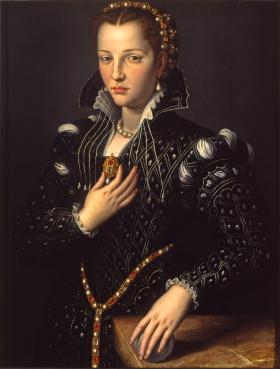
    4. That’s my last Duchess painted on the wall, Looking as if she were alive.

      Lucrezia de' Medici

      The image is a painting of Lucrezia de' Medici, and though this was painted for her brother one year after her passing, this painting could be used as the stand-in for the image the Duke is describing. The Duchess' somber gaze is antithetical to how the Duke describes the Duchess as a person, which makes the reader question how much truth could the Duke be speaking. Is it possible that the Duke is imagining a smile on her face because he feels guilty? Is the Duchess' stoic look a reflection of her feelings, or was it "by design" as the Duke later states?

    5. My Last

      While looking up the Duchess, Lucrezia de' Medici, came a poem called "My Next Duchess" by a priest named Lawrence Jones in which a member of the envoy warns of the Duke as a means to save the next duchess from his grasp. While the poem does not follow all the same writing conventions as Browning's poem such as form and tone, it is effective in the way that provides a secondary perspective on the story within this poem. The break of such conventions lends a sort of response that is more human that the facade that the Duke puts on.

      The poem aims to explore how the envoy reacted to the Duke's monologue, and the horror at which is deemed worthy enough to become a cautionary tale to future noblewomen about the Duke of Ferrara.

    6. if she let Herself be lessoned so, nor plainly set                                                     40 Her wits to yours, forsooth, and made excuse— E’en then would be some stooping; and I choose Never to stoop.

      To build off the previous annotation, the Duke's mask slips for a second as he admits that he would, in fact, "stoop"--but in doing so, it shows he does not have as much control as he fronts to his envoy. However, the Duke regains said control (and re-masks) through the use of others' fear of what he is capable of by stating that he chose "never to stoop" to the Duchess's level of behavior or intellect.

      This point is mentioned by Garratt regarding Browning's writing strategy using "masks" in his poetry, "The envoy is meant to be impressed by this graciousness, this taste, manners, and above all, command of life; the Duke hopes desperately that the envoy will carry that impression back to the count, and to the new duchess” (117). Garratt's point shows that the Duke's intentions in telling this story is so that the next Duchess will not behave the same way as the previous one, and she'll have no excuse as she'd already been warned; he is molding his new duchess through fear.

  2. Mar 2025
  3. Sep 2023
  4. Feb 2023
    1. What is Image Masking? Image masking is a technique used in photo editing to isolate or remove specific parts of an image. This is often done by creating a mask, which is a grayscale image that defines which parts of the original image should be visible and which should be hidden. With image masking, you can selectively hide or reveal parts of an image, making it an essential tool for photo editing. It allows you to remove backgrounds, change colors, and multiple composite images together to create a single image.

      Unveiling The Power Of Image Masking In Photoshop: A Comprehensive Guide See more on https://vectorwiz.com/image-masking/

  5. Dec 2022
  6. Aug 2022
  7. Apr 2022
    1. a well-fitting mask or respirator over their nose and mouth

      Most people I see wearing masks don't have a good seal, many have beards or facial hair affecting the seal, often they have their nose sticking out over the top - or chin mask.

      And masking children properly is an exercise in futility.

      Long story short, when worn properly they offer "some" protection studies also found that modest improvements in ventilation offered as much protection as even the best masks.

  8. Mar 2022
  9. Feb 2022
  10. Jan 2022
  11. Dec 2021
  12. Oct 2021
  13. Sep 2021
    1. David Dowdy on Twitter: “@NEJM joining the waning immunity debate. I’m going to push back a bit. Data from @UCSDHealth of vax effectiveness in health workers: 94% in June, 65% in July. Interpreted as ‘likely to be due to...delta and waning immunity over time, compounded by end of masking requirements.’ https://t.co/flDOfBbTs7” / Twitter. (n.d.). Retrieved September 2, 2021, from https://twitter.com/davidwdowdy/status/1433254675915157504?s=20

  14. Aug 2021
  15. Jun 2021