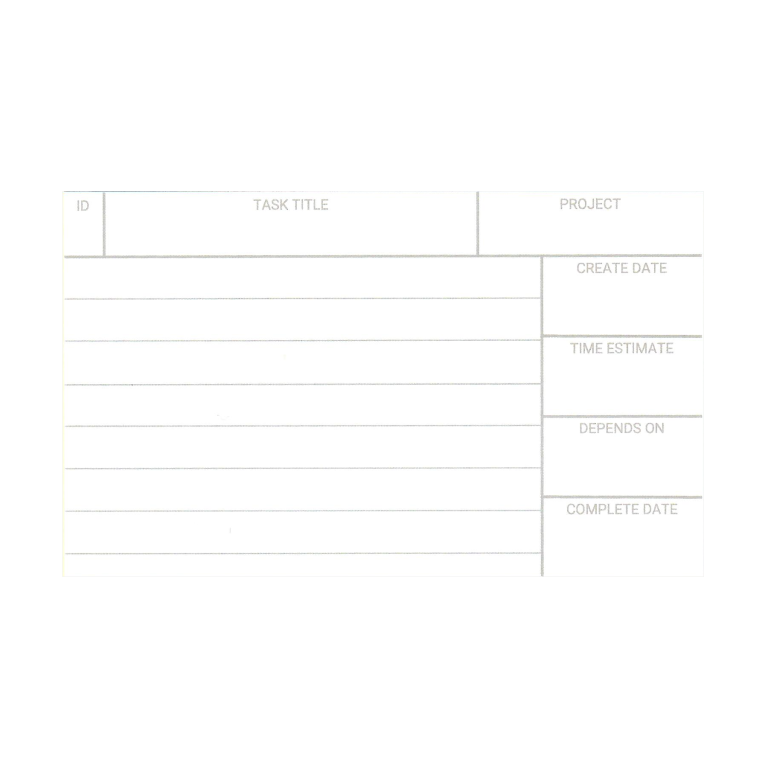
Felger, A. H. 1902. “A Plan for Recording in a Condensed Form the Life-History Notes of Birds.” The Auk 19(2): 189–95. doi:10.2307/4069312.
73 Matching Annotations
- Jul 2026
-
Local file Local file
-
Felger, A. H. 1907. “A Card System of Note-Keeping.” The Auk 24(2): 200–205. doi:10.2307/4070853.
Ornithologist A. H. Felger describes the use and form of a custom card index system for creating a paper database of data for tracking and counting birds.
In particular he recommends it over prior uses of journaling methods. He suggests the ability to look at multiple cards in a row to be able to more easily extract usable data versus those older journaling methods.
-
By the use of theseprinted forms no note indicated thereon that should be recordedis ever forgotten, as is lamentably the case when the diary systemis employed
Pre-formatted index cards used in creating a database help one not to forget any of the desired data to be collected in a project.
-
In this system I use three distinct types of cards, each 3 in. X5 in. and of 'medium weight,' which, for convenience of referencehere, I shall designate 'condition card' (Fig. 1, card 1), 'barredcard' (Fig. 2, card 1), and 'extension card' (Fig. 1, card 2; Fig.2, card 2). The cards for these plates were not selected withreference to contemporaneity, which I hope will not confuse, butselected with a view to illustrating to better advantage the plan ofamplifying notes on the 'extension cards.'
-
- Jun 2026
-
-
The preju-dice due to the supposed American origin of thesystem, stupid if the assumption were correct, doublystupid in view of its known European origin, hasceased to have its old influence, and as the necessity forgreater efficiency and a more accurate knowledge ofbusiness facts has become apparent, the popularity ofthe Card Index has increased, and it is not un-reasonable to anticipate that its ever-widening influencewill in the course of the next decade cause all othersystems to pass into oblivion.
R. B. Byles attributes the origin of the card index system to Europe, but provides no direct details or history.
-
Cards are made in three standard sizes, the approximatemeasurements being 3 in. x 5, 4 in. x 6, and 5 in. x 8.The smallest size is sufficient for the file index, and thelargest is almost invariably used for the Ledger Cards.Whether for other purposes the middle or largest sizeis most suitable, must depend entirely on the specialruling, and the amount of information it is to contain.
-
enough has been said to show both itselasticity and adaptability.
card systems are highly adaptable
-
The districts visited by different travellerscan be kept distinct, and to prevent the possibility ofmisfiling a colour, distinction can be introduced.
-
Roughly speaking, the world is divided into two classes :those who use the Card Index System and those whodo not.
HA!
I wonder where this trope started?
-
- Mar 2026
-
www.youtube.com www.youtube.com
-
Advanced Typing - Shortcuts (1943)
Advanced Typing: Shortcuts. 16 mm. Vol. MN-1512c. United States Navy Training Film, 1943. https://www.youtube.com/watch?v=JUJfCfqgsX0.
Correct typing posture: fingers curved<br /> arms sloping up<br /> light fast strokes<br /> steady rhythm
fast continuous motion of return lever<br /> using backing sheet (aka temping sheet ??)
Shortcuts:<br /> mise en place for office supplies (she doesn't use this phrasing though) - greater efficiency - cuts down on searching
tabulators can be helpful. There are two types:<br /> - automatic - handset
Use tabs for paragraphs, dating letters, columns of numbers, and letter closings.
To clear all tab stops, put carriage to left, hold tab clear key and move the carriage across. (Usually applies to Royal, Remington, Underwood, and Electromatic).
On LC Smith and Woodstock machines sometimes have a tab clear lever on the back.
Decimal tabulator keys help to align a variety of numbers around a decimal point. 09:43
Always have a few tabs set to prevent a flying carriage which can be hard on the machine.
When using carbon sheets which are slightly longer than the paper size, cut off a small triangle at the top left hand side. This makes it easier for one to separate the carbons from the copies by holding the top left with one hand and pulling the carbons out from the bottom of the stack.
To align multiple sheets of paper for carbon copies, use a folded sheet at the top to taco the pages into the machine. Remove the folded sheet once the carbon pack is rolled forward.
Paper bail rollers should be set to split the pages into thirds (for two rollers).
Remington noiseless machines have a pressure indicator on the front of the machine (usually above the keyboard) which can be used when using thick carbon packs that may cause the ribbon guide to stick or bind.
Only erase when the carriage is fully left or right to prevent eraser crumbs from falling into the machine. 15:26
Use a soft eraser on carbon copies. Use and insert slips of paper behind the carbons and allowing them to stick out the sides, erasing from back sheet to front so as not to allow the eraser to mark your carbon copies. For the front sheet, use a shield and ink eraser and erase with a horizontal motion. After erasing, easily pull out the inserted sheets.
When typing a correction, tap the key lightly two or three times rather than hard once.
When in a rush and it's necessary to add a word (on double spacing), underline the last letter of the prior word and type a slash (/). Then move the typing line up and type the insertion above the prior line. This creates an "arrow" of sorts for the inserted word.
Details for inserting extra letters in misspelled words using half-spacing machines. (Underwoods and Electromatics don't have this function.)
Light pencil marks at the bottom of the sheet can help to indicate the coming bottom of the sheet.
Putting up the card holders (fingers) on Underwoods and Royals. They help to hold the card and improve print quality and reduce noise.
Card holders can cause markings on carbon packs if they're not lowered.
Trick for quickly writing postcards in succession: Disengage the ratchet using the platen spring release (or variable platen switch) Type the address on the front of the card. When done give the platen a quick practiced spin. The postcard with "jump" up and stop at the paper table and be in position for rolling in the opposite direction to write the message on the back of the card! When done a faster spin of the platen will shoot the card over the back of the typewriter where it can land in a box to collect all the postcards which were written in such a manner. <br /> timestamp 23:22
Time saving methods for addressing envelopes:
-
Front seat principle. Insert the envelope in the usual way and type out the address. When done, turn the envelope down through the machine with the right hand. With the left hand, place the next envelope between the top of the first envelope and the front of the platen. Feed the first envelope back through the machine (in reverse) and the second will be rolled in to place for typing. Continue in this fashion until finished. All the finished envelopes will stack up in the back at the paper table.
-
Chain feeding. The first envelope is inserted and rolled partway into the machine. A second envelope is inserted between the platen and the second envelope (behind the platen). Turn the first envelope to the writing line and type the address. Take out the first envelope and insert the next the same way as before.
-
Uses paper bail. Do the first envelope in the usual way. Spin it out of the machine up and behind the paper bail into a box behind the typewriter.
For quickly doing labels or small cards:<br /> Create a small zig-zag fold into a piece of paper to create a pocket slot which can be scotch taped on either side. This template paper can then be inserted so that the pocket is visible above the writing line, but the paper below it is still in the platen. The label or card can be placed into the pocket and the platen reversed to feed the label or card in backwards to the desired typing line. Using a v-groove or hole in the typing line can create a pencil line to serve as a guide for inserting many labels at the same place so that the typing lines up between labels.
Some offices had special platens for holding cards like this.
Pockets like this can also be used to hold the page to add additional lines at the bottom of pages. Deeper pockets may need to be used for doing this with carbon packs whose carbons are longer than the pages.
Alternately one can do something similar by creating a inverted u-shaped set of slits into an index card. to hold such labels.
When in the midst of a page and needing to do another piece urgently, roll back the letter until about 2 inches from the top, and then place in the new page and one between each of the carbons. Then roll forward to do the short message as necessary. Turn back to the insertion position to remove the copies and then continue with the first letter where you left off.
For drawing horizontal lines on typewriter paper, push the carriage to the extreme left and place the pencil or pen at the edge of the card guide and the scale. Then move the carriage to the right to effect the line. For vertical lines, put the carriage at the desired space and place the pencil at the card guide and scale and move the platen up/down as necessary.
-
-
- Feb 2025
-
-
Casey, Robert S., James W. Perry, Madeline M. Berry, and Allen Kent. Punched Cards: Their Applications To Science And Industry. 2nd ed. 1951. Reprint, New York: Reinhold Publishing Corporation, 1958. http://archive.org/details/PunchedCardsTheirApplicationsToScienceAndIndustry.
-
-
warrenpaper.com warrenpaper.com
- Nov 2024
-
forum.zettelkasten.de forum.zettelkasten.de
-
@chrisaldrich Do you have some results from your online sessions? New insights from reading Doto's book?
Reply to @Edmund https://forum.zettelkasten.de/discussion/comment/21907/#Comment_21907
Doto's book is the best and tightest yet for explaining both how to implement a Luhmann-artig zettelkasten as well as why along with the affordances certain elements provide. He does a particularly good job of providing clear and straightforward definitions which have a muddy nature in some of the online spaces, which tends to cause issues for people new to the practice. Sadly, for me, there isn't much new insight due to the amount of experience and research I bring to the enterprise.
I do like that Doto puts at least some emphasis on why one might want to use alphanumerics even in digital spaces, an idea which has broadly been sidelined in most contexts for lack of experience or concrete affordances for why one might do it.
The other area he addresses, which most elide and the balance gloss over at best, is that of the discussion of using the zettelkasten for output. Though he touches on some particular methods and scaffolding, most of it is limited to suggestions based on his own experience rather than a broader set of structures and practices. This is probably the biggest area for potential expansion and examples I'd like to see, especially as I'm reading through Eustace Miles' How to Prepare Essays, Lectures, Articles, Books, Speeches and Letters, with Hints on Writing for the Press (London: Rivingtons, 1905).
I could have had some more material in chapter 3 which has some fascinating, but still evolving work. Ideas like interstitial journaling and some of the related productivity methods are interesting, but Doto only barely scratches the surface on some of these techniques and methods which go beyond the traditional "zettelkasten space", but which certainly fall in his broader framing of "system for writing" promise.
Doto's "triangle of creativity", a discussion of proximal feedback, has close parallels of Adler and Hutchins' idea of "The Great Conversation" (1952), which many are likely to miss.
For those who missed out, Dan Allosso has posted video from the sessions at https://lifelonglearn.substack.com/ Sadly missing, unless you're in the book club, are some generally lively side chat discussions as the primary video discussion was proceeding. The sessions had a breadth of experiences from the new to the old hands as well as from students to teachers and everywhere in between.
-
- Oct 2024
-
-
Value of knowledge in a zettelkasten as a function of reference(use/look up) frequency; links to other ideas; ease of recall without needing to look up (also a measure of usefulness); others?
Define terms and create a mathematical equation of stocks and flows around this system of information. Maybe "knowledge complexity" or "information optimization"? see: https://hypothes.is/a/zejn0oscEe-zsjMPhgjL_Q
takes into account the value of information from the perspective of a particular observer<br /> relative information value
cross-reference: Umberto Eco on no piece of information is superior: https://hypothes.is/a/jqug2tNlEeyg2JfEczmepw
Inspired by idea in https://hypothes.is/a/CdoMUJCYEe-VlxtqIFX4qA
-
Here's my setup: Literature Notes go in the literature folder. Daily Notes serve as fleeting notes. Project-related Notes are organized in their specific project folders within a larger "Projects" folder.
inspired by, but definitely not take from as not in evidence
Many people have "daily notes" and "project notes" in what they consider to be their zettelkasten workflow. These can be thought of as subcategories of reference notes (aka literature notes, bibliographic notes). The references in these cases are simply different sorts of material than one would traditionally include in this category. Instead of indexing the ideas within a book or journal article, you're indexing what happened to you on a particular day (daily notes) or indexing ideas or progress on a particular project (project notes). Because they're different enough in type and form, you might keep them in their own "departments" (aka folders) within your system just the same way that with enough material one might break out their reference notes to separate books from newspapers, journal articles, or lectures.
In general form and function they're all broadly serving the same functionality and acting as a ratchet and pawl on the information that is being collected. They capture context; they serve as reminder. The fact that some may be used less or referred to less frequently doesn't make them necessarily less important
-
-
Local file Local file
-
Another reason why it saves time is that here you canimply things instead of having to express them in full,for your Card-System and its Headings need only to beclear to yourself (see p. 67), whereas a complete Essayor Speech must be in Sentences and must be clear toyour readers or hearers as well. In the Cards you canuse all kinds of Abbreviations (p. 70) : these, again,need only be clear to yourself.
Miles touches on the interplay of knowledge written down on index cards and the knowledge which is kept only in one's mind. Some practitioners in the space from 2013-2024 seem to imply that they're writing almost everything out in far deeper detail than Miles would indicate. In his incarnation, much of the knowledge might be more quickly indicated by a short sentence or heading which the brain can associate to longer explanations.
This sort of indexing is akin to some of the method potentially seen in Marshall Mathers' zettelkasten.
I'm creating a tag here for "card index for productivity" to track the idea of productivity in writing which I'm specifically using separately from the tag "card index as productivity system" which is used to describe their use for project tracking systems in systems like GTD, Memindex, etc.
-
I arrived at the Card-System by degrees, and was glad to findthat Prof. Wendell also recommended Cards. I have elaboratedthe System considerably in the last few months,
Miles doesn't specify how he comes by the practice of a "Card-System" other than "by degrees" as well as elaborating on it in the months before he writes this book.
(Having something more concrete would be nice though...)
At some point he read Barrett Wendell's book on composition (1891) to discover that he recommended cards as well.
-
Connecting Linkbetween twoSentences orParagraphs,
Miles, 1905 uses an arrow symbol with a hash on it to indicate a "connecting link between two Sentences or Paragraphs, etc."
It's certainly an early example of what we would now consider a hyperlink. It actively uses a "pointer" in it's incarnation.
Are there earlier examples of these sorts of idea links in the historical record? Surely there were circles and arrows on a contiguous page, but what about links from one place to separate places (possibly using page numbers?) Indexing methods from 11/12C certainly acted as explicit sorts of pointers.
-
no false economy r
He's repeating (and thus emphasizing) the admonition that a card system is not expensive, particularly in relation to the savings in time and effort.
-
These Cards (if used only once) should be labelledand catalogued very carefully.
How does he define "labelled" and "catalogued"?
Presumably he means a version of tagging/categorization and possibly indexing them to be able to easily find them again?
-
At first, also, it might be thought that the Cardswould be inconvenient to use, but the personal ex-perience of thousands shows that, at any rate forbusiness-purposes, exactly the reverse is true
Miles' uses the ubiquity of card systems (even at the writing in 1899, prior to publication) within business as evidence for bolstering their use in writing and composition.
(Recall that he's also writing in the UK.)
-
You can prepare your Letters any-where, even in the train, and so save a great deal oftime ; and it may be noticed here that the idlenessof people, during that great portion of their lives whichthey spend in travelling and waiting, can easily beavoided in this way.
Using a card system, particularly while travelling, can help to more efficiently use one's time in preventing idleness while travelling and waiting.
-
I often noticed that most Candidates inExaminations used to begin to write their Essays atonce. They never realised that their minds were there-by being distracted and divided among many differentprocesses, each of which is particularly hard even whentaken alone. For all at once their minds are being-called upon to Collect Ideas, to Select and decide whichare important, etc., to Arrange the Selected Ideas, andto Express them. To try all this as a single action is" most extraordinarily unscientific, even if a few brilliantgeniuses here and there have succeeded in the attempt.
One of the major affordances of using a zettelkasten or card index for writing is that it forces the writer to break things down into their constituent parts, thereby making the entire process of writing far easier and less complex. One can separately focus their attention on the smaller steps of collecting, selecting, and arranging the material before beginning to actually write.
-
Miles, Eustace Hamilton. How to Prepare Essays, Lectures, Articles, Books, Speeches and Letters, with Hints on Writing for the Press. London: Rivingtons, 1905. http://archive.org/details/howtoprepareessa00mileuoft.
Tags
- card system for business
- writing advice
- idleness
- idea links
- waiting
- productivity
- Eustace Hamilton Miles
- Eminem
- intellectual history
- complexity
- step-by-step
- card system
- travelling
- card index for writing
- note taking manuals
- card index for productivity
- indexing methods
- Barrett Wendell
- card index
- hyperlinks
- card system process
- note taking affordances
- categories
- zettelkasten why
- References
- annotations
- card index as productivity system
- 1899
- card index for business
- open questions
Annotators
-
-
en.wikipedia.org en.wikipedia.org
-
English composition: Eight lectures given at the Lowell Institute, New York: Charles Scribner's Sons, 1891.
evidence of a card system/zettelkasten method in this?
I found a copy and indeed there is evidence!
-
- Sep 2024
-
www.ebay.com www.ebay.com
-
https://www.ebay.com/itm/156425307066
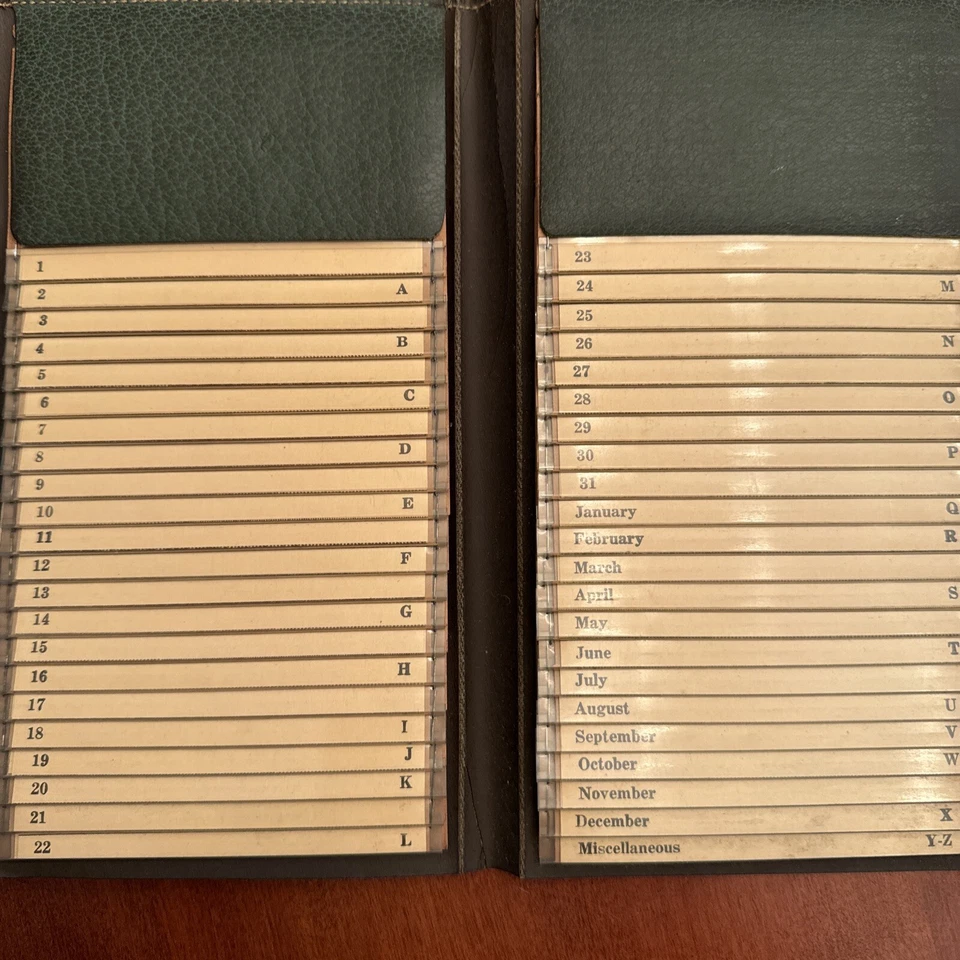
Remington Rand leather portable card index notebook case with slots for a variety of functionalities: - 1-31 for days of month - Alphabetic categorization A-Z - Months (Jan-Dec) - Miscellaneous
-
-
archive.org archive.org
-
Macey Filing Appliances 1906<br /> Catalogue No. 4206<br /> The Macey Co.<br /> https://archive.org/details/macey-filing-appliances-1906/mode/2up
-
- Aug 2024
-
analogoffice.net analogoffice.net
-
Index card system to track daily, weekly, and monthly routines by [[Anna Havron]]
Brief outline of a tickler file system for today, daily, weekly, and monthly to do items.
-
-
ugmonk.com ugmonk.com
-
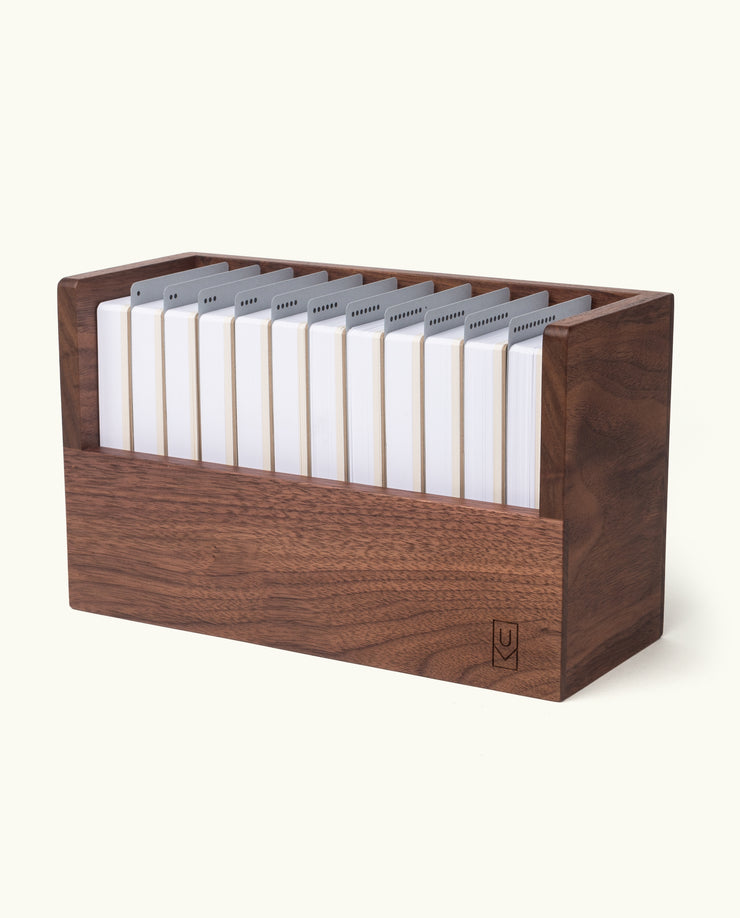
Ugmonk released a limited edition of 100 archive boxes for their Analog productivity cards today at 7AM (Pacific) for $229.00 (including 12 card packs and a metal divider). It sold out within two and a half hours.
With the inclusion of this archive box it makes the system much more like the original Memindex system.
https://ugmonk.com/products/analog-archive-box-walnut?variant=43942761562262
-
- Apr 2024
-
archive.org archive.org
-
[Narrator]: The Cluttered Desk, Index Card,file folders, the in-out basket, the calculator.These are the tools of the office professional's past.Since the dawn of the computer age, better machines have always meant bigger and more powerful.But the software could not accommodate the needs of office professionals who are responsiblefor the look, shape and feel of tomorrow.
In 1983, at the dawn of the personal computer age, Apple Inc. in promotional film entitled "Lisa Soul Of A New Machine" touted their new computer, a 16-bit dual disk drive "personal office system", as something that would do away with "the cluttered desk, index cards, file folders, the in-out basket, [and] the calculator." (00:01)
Some of these things moved to the realm of the computer including the messy desk(top) now giving people two messy desks, a real one and a virtual one. The database-like structure of the card index also moved over, but the subjective index and its search power were substituted for a lower level concordance search.
30 years on, for most people, the value of the database idea behind the humble "index card" has long since disappeared and so it seems here as if it's "just" another piece of cluttery paper.
Appreciate the rosy framing of the juxtaposition of "past" and "future" jumping over the idea of the here and now which includes the thing they're selling, the Lisa computer. They're selling the idealized and unclear future even though it's really just today.
-
-
Local file Local file
-
card system are indebted tothese catalogues for their information. But all these publications areprimarily concerned with the particular cabinet or file of the firm inwhose interest they are published.
Variations of card index systems were published in booklet form by filing cabinet manufacturers as a means of selling not only their cabinets, but their systems for using them was common in the early 1900s. Examples of magazine advertisements in System Magazine back this up. It is also specifically highlighted in a review of J. Kaiser's book "The Card System at the Office" from Ironmonger (1909-10-03) which appreciates a more fully fleshed out version of a card index system in book form without mention of specific manufacturing firms.
-
Kaiser, J. Systematic Indexing. The Card System Series 2. London: Sir Isaac Pitman & Sons, Ltd., 1911. http://archive.org/details/systematicindexi00kaisuoft.
Annotation URL: urn:x-pdf:2acc267d4cbe455af640e4a707a84692
See alternate version at: # or https://www.google.com/books/edition/Systematic_Indexing/iwFDAAAAIAAJ?hl=en Google-Books-ID: iwFDAAAAIAAJ
(Switched for better OCR)
-
-
Local file Local file
-
Summaries*
examples of specific workflows within Kaiser's card system
-
- Mar 2024
-
Local file Local file
-
It was said (76) that it isimpossible to devise a system wliich could be applied universally,the card registers give a very clear illustration of tliis.
This is a restatement that a particular system should be customized to its users.
There is potential that a system could be applied universally, but it requires a very large amount of data and metadata to suit the needs of a greater number of people and use cases. It also requires a reasonable amount of work in practical use to make it operate as expected.
The Mundaneum was likely close on paper and Google comes close to this, but still isn't perfect.
quote via ¶76 and 92
-
Devising Once a proper system has been devised, it requiresCard Systems
Devising Card Systems
Many modern-day note takers and knowledge workers might take solace in the broad advice provided by J. Kaiser in 1908. In describing some of the broad categories of uses of card index filing systems for business use he says that each entity "has its individual character and individual requirements, and its individual character" (ie, everyone is different and has different needs), therefore everyone "must devise [their] system in accordance with [their] own requirements" and should "be the best judge as to what these requirements are." He continues on in the rest of the book to outline a variety of suggestions and methods which one might use or adopt, but he doesn't dictate specific methods and leaves those decisions up to the end user.
When devising their own systems, one certainly ought to heed this advice when looking at a variety of alternative methods like Forte's P.A.R.A., Milo's LYT, or even in mimicking Luhmann's idiosyncratic Zettelkasten set up. Are these methods best for your particular use cases? Are they simple enough for what you want to do, or are they overly structured and complicated? The key is to be able to classify and file things quickly so that they can be easily accessed in the future, all the rest becomes additional details and overhead to support on an ongoing basis.
(¶76)
-
The development of the card system and itsmore universal adoption within recent years isundoubtedly due in the mail to the development in modernbusiness and factory organisation ; it may be regarded as anoffspring of manufacture in quantities. (Massenfabrikation, Gross-industrie.) The recognised principle in manufacture in quantities ismaximum of output with minimum of labour. The means to attainthis end is specialisation, which in its turn yields greater precisionand accuracy as it^ result. All this is equally applicable to thecard system, and the last factor, greater precision and accuracy,is one of its most conspicuous claims.
Julius Kaiser contemporaneously posits that mass manufacture and maximizing efficiency (greater output for minimum input) are the primary drivers of card index system use in the early 20th century. These also improve both precision and accuracy in handling information which allow for better company or factory operation, which would have been rising concerns for businesses and manufacturing operations at the rise of scientific management during the time period.
-
It requires but a moment's reflection to perceivethat even the vertical files with the correspondence binders arebut an imitation of a set of cards, on a larger scale. The set ofcards can fairly be regarded as the basis of the entire system,hence it is properly called the card system.
He notes the general equivalency of cards and papers in vertical files.
One of the primary affordances that individual atomic cards have is the ability to more easily re-arrange and reuse them for various purposes in comparison with larger sheets with greater amounts of data on them.
-
Office Organisation, of which the work here discussed forms part, 2has been considerably modified within recent years, and Avhatis called the " card system " has now come very much into vogue.
The nebulous, but colloquial "card system" was a common, but now lost moniker for the use of a card index in business settings in the early 1900s.
Tags
- efficiency
- accuracy
- card index affordances
- definitions
- card system
- index cards vs vertical files
- card index
- historical linguistics
- perfect system fallacy
- precision
- specialization
- note taking advice
- Julius Kaiser
- universal systems
- knowledge specialization
- card index for business
- scientific management
Annotators
-
- Jan 2024
-
de.wikipedia.org de.wikipedia.org
-
thetodaysystem.com thetodaysystem.com
-
https://betterhumans.pub/i-built-my-own-personal-productivity-system-around-a-3-x-5-index-card-147d7a8d83de
Melange of GTD, card index, and gamification....
Update 2024-01-04: I knew I had heard/seen this system before, but not delved into it deeply. I hadn't seen anyone either using it or refer to it by name in the wild until yesterday. All the prior mentions were people sharing the URLs as a thing rather than as something they used.
-
-
thetodaysystem.com thetodaysystem.com
-
The Today System:
A simple, yet scalable personal productivity system, centered around a single 3 x 5″ index card.
used by u/runslack
-
- Dec 2023
-
archive.org archive.org
-
I accomplished a couple of other things on that first day back into reality. First, with an evil Grinch-like smile | uprooted every household management system | had ever tried, and tore up every single 3x5 card in them. Then one by one, | roasted and toasted them in the fireplace until they were gone, gone, gone. Next, with equally fiendish delight, | speared my $35 namebrand notebook organizer with a marshmallow fork, and | roasted it too. It melted into oblivion, all but it’s ugly metal spine. Next, | prayed for my attitude and for help. And finally, | marched myself into Wal-mart and bought my first clear plastic bin, a two pound sack of M&M's, and a loaf of white bread. For better or worse, we have been pretty happy campers at my house ever since. (p6)
-
- Sep 2023
-
www.kickstarter.com www.kickstarter.com
-
Jeff Sheldon is the founder and designer of Ugmonk, a brand focused on creating high quality, well-designed products. What started as a small side project in 2008 to create and sell simple t-shirts has grown into a full-blown lifestyle brand which Jeff now runs full time.
-
- May 2023
-
www.levenger.com www.levenger.com
-
- Set of 52 weekly 3 x 5 accordion tri-folded cards - Undated planner with ruled lines and shaded blank areas for writing appointments, notes or lists on each day of the week - Thick and substantial 250-gsm card stock - Friendly to all types of ink - Unfolded, 9W x 5H
A 9 x 5" card that folds in three to make a 3 x 5" card for planning out one's entire week.
This is quite clever with respect the space of cards like Analog and 3x5 Life.
-
-
www.3x5life.com www.3x5life.com
-
What's included in the 3x5 Life System: 6 months of Daily cards **Schedule version** (186 cards) Monthly/Year Goal Cards (1 year of cards) Habit Tracker Cards (1 year of cards) Weekly Review Cards (1 year of cards) Storage Box with 3x5 logo on lid Monthly dividers to keep your storage box organized Mobile Phone Sleeve Stainless Steel Stand MINI COURSE: Outlining how best to utilize the system
via: https://www.3x5life.com/collections/frontpage/products/3x5-life-system-with-mini-course
They apparently offer a mini course outlining the system.
One wonders how much "why" they offer?
-
-
www.3x5life.com www.3x5life.com
-
Compare with other products in this category: - Analog (Jeff Sheldon productivity system) - Memindex - Bullet Journal - Frictionless Capture Cards - Pile of Index Cards

-
-
ugmonk.com ugmonk.comAnalog1
-

Following a pattern seen in many modern wooden recipe card boxes to hold the current recipe one is working on, Jeff Sheldon has cut a long thin slot into his card holder to allow one to stand up today's card in the front as a means of displaying and featuring what needs to get done.
-
-
www.kickstarter.com www.kickstarter.com
-
https://www.kickstarter.com/projects/ugmonk/analog-the-simplest-productivity-system
Jeff Sheldon's Analog productivity system is a physical product consisting of a wooden tray, metal divider, 3 x 5" custom printed index cards (and refills), a felt carrier, and other accessories which functions as a minimalistic version of the old Memindex.
-
- Apr 2023
-
zettelkasten.de zettelkasten.de
-
You should only write on the front side of the paper slips, so it is possible to read the note during searches without the need to take it out.
Luhmann mentions that he only wrote on one side so that he didn't need to physically remove notes from the box when searching it. There is a level of lost productivity if one needs to physically remove a card to read it and then replace it; this lost productivity is magnified if one uses their slip box regularly over the span of many years.
-
- Mar 2023
-
www.3m.co.uk www.3m.co.uk
-
"The Scrum method" described here, similar to the Kanban method, the Memindex method, tickler systems, or other card index as productivity systems, seems to be a productized name for selling Post-it Notes.
Scrum method consists of a project broken down into "story" rows with "to do" items in columns which progress along to "in process", "to verify", and finally "done".
Other productized names (particular to the note taking space): Antinet zettelkasten, Linking Your Thinking, Second Brain, etc.
-
-
archive.org archive.org
-
Wigent, William David, Burton David William Housel, and Edward Harry Gilman. Modern Filing and How to File: A Textbook on Office System. Rochester, N.Y.: Yawman & Erbe Mfg. Co., 1916. http://archive.org/details/modernfilingate02compgoog.
-
-
www.raulpacheco.org www.raulpacheco.org
-
Hawk Sugano has shared his Pile of Index Cards (PoIC) method as well.
Interesting to see a passing mention of Hawk Sugano's Pile of Index Cards here in a note taking context rather than a productivity one.
-
-
radiolab.org radiolab.org
-
Listened to on 2023-03-11
Much like Richard Feynman kept a list of his 12 favorite problems, Maurice Hilleman kept a running list of diseases for which he was working on developing vaccines to remedy.
-
-
www.google.com www.google.com
-
General instructions for using a Memindex
HOW IT IS USED <br /> Things to be done today, jot on face card. Things to be done tomorrow or next Friday, jot on card for that day. Things to keep before you until done, jot on opposite front card. A matter for January 10th jot on a short card put under the band till you return to your desk, then file next to card for January 10th when it will come out and refresh your memory.
Things to be done when in New York or Chicago jot on card "N" or "C." The new address of Mr. Jones, under "J." Ideas on advertising jot on card tabbed "adv." Things for your clerk to do, on his card , etc., etc. Retire today's card tonight, carrying forward things not completed and put next card in the file in has proved that almost back of pocket case. The alphabet enables one to index all jottings for instant reference. This system is very comprehensive yet perfectly simple. You soon the learn to depend on it every hour of every day.
Within the general instructions in a 1904 Memindex advertisement (next to an ad for "Genuine Edison Incandescent Lamps") we see the general ideas of indexing things into the future and carrying undone tasks forward, just as is done in the bullet journal method.
-
-
drive.google.com drive.google.comcontent1
-
mindex.THIS is the name Howard L. Wilson, of Rochester, N.Y.,hasgivenhisvestpocket cardsystem.Itisa
Geyers Stationer. “Memindex Advertisement.” Geyer’s Stationer: Devoted to the Interests of the Stationery, Fancy Goods and Notion Trades, September 15, 1904. https://www.google.com/books/edition/Geyer_s_Stationer/L507AQAAMAAJ?hl=en&gbpv=0
Howard L. Wilson of Rochester, NY named his vest pocket card index system the Memindex.
-
-
www.ebay.com www.ebay.com
-
Poem from the inside back cover of a 1913 Memindex Catalog:
JUST JOT IT DOWN.
If you’re going to meet a man<br /> Jot it down<br /> If you’ve got a little plan<br /> Jot it down<br /> If you never can remember<br /> Your requirements for September<br /> ’Till October or November<br /> Jot ’em down.
If you’ve got a note to pay<br /> Jot it down<br /> If its due the first of May<br /> Jot it down<br /> If collections are so slow<br /> That to meet the note you know<br /> You must dun old Richard Roe<br /> Jot it down
If you have a happy thought<br /> Jot it down<br /> If there’s something to be bought<br /> Jot it down<br /> Whether duty calls or pleasure<br /> If you’re busy or at leisure<br /> It will help you beyond measure<br /> Jot it down
If there’re facts that you’d retain<br /> Jot ’em down<br /> If you’ve got to meet a train<br /> Jot it down<br /> If at work or only play<br /> If at home or far away<br /> In the night or in the day<br /> Jot it down
-
c.1913 Wilson Memindex Desk Organzier Catalog Price List Booklet Rolodex Prequel
In a 1913 catalog for the Wilson Memindex, the company suggested putting to do items and one's schedule on one side of the card and potentially keeping one's accounts or a diary on the reverse side.
-
-
www.ebay.com www.ebay.com
-
1930s Wilson Memindex Co Index Card Organizer Pre Rolodex Ad Price List Brochure
archived page: https://web.archive.org/web/20230310010450/https://www.ebay.com/itm/165910049390
Includes price lists
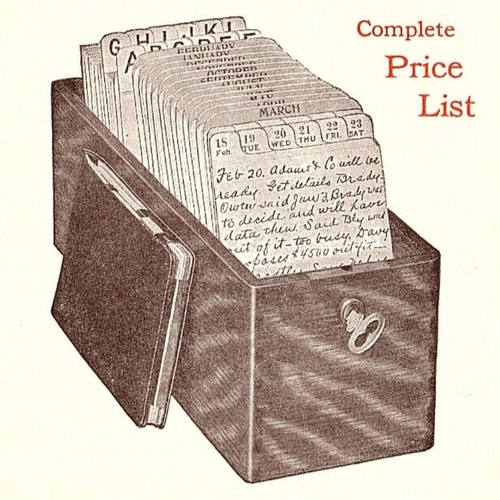
List of cards includes: - Dated tab cards for a year from any desired. - Blank tab cards for jottings arranged by subject. - These were sold in 1/2 or 1/3 cut formats - Pocket Alphabets for jottings arranged by letter. - Cash Account Cards [without tabs]. - Extra Record Cards for permanent memoranda. - Monthly Guides for quick reference to future dates. - Blank Guides for filing records by subject.. - Alphabet Guides for filing alphabetically.
Memindex sales brochures recommended the 3 x 5" cards (which had apparently been standardized by 1930 compared to the 5 1/2" width from earlier versions around 1906) because they could be used with other 3 x 5" index card systems.
In the 1930s Wilson Memindex Company sold more of their vest pocket sized 2 1/4 x 4 1/2" systems than 3 x 5" systems.
Some of the difference between the vest sized and regular sized systems choice was based on the size of the particular user's handwriting. It was recommended that those with larger handwriting use the larger cards.
By the 1930's at least the Memindex tag line "An Automatic Memory" was being used, which also gave an indication of the ubiquity of automatization of industrialized life.
The Memindex has proved its success in more than one hundred kinds of business. Highly recommended by men in executive positions, merchants, manufacturers, managers, .... etc.
Notice the gendering of users specifically as men here.
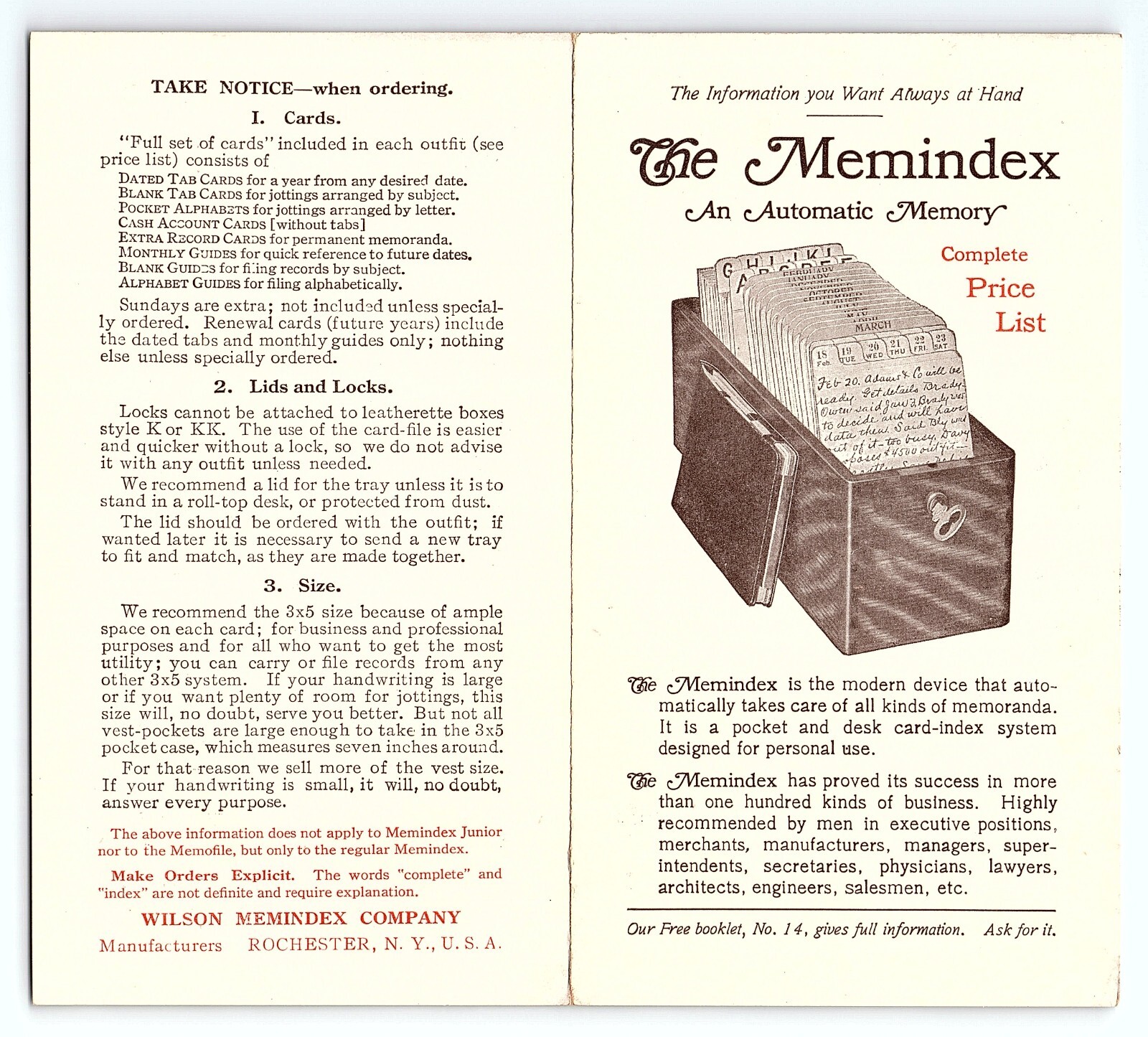

Features: - Sunday cards were sold separately and by my reading were full length tabs rather than 1/6 tabs like the other six days of the week - Lids were custom fit to the bases and needed to be ordered together - The Memindex Jr. held 400 cards versus the larger 9 inch standard trays which had space for 800 cards and block (presumably a block to hold them up or at an angle when partially empty).
The Memindex Jr., according to a price sheet in the 1930s, was used "extensively as an advertising gift".
The Memindex system had cards available in bundles of 100 that were labeled with the heading "Things to Keep in Sight".
-
-
www.ebay.com www.ebay.com
-
Vintage Memindex Wilson Wood Box 1937-38 Diary Planner Date Keeper Ephemera
Includes particularly good image of the individual day cards:

Notice that the tabs are done as 1/6th as most of these systems were manufactured/sold with out including Sunday.
-
-
www.flickr.com www.flickr.com
-
Getting Things Done with Index Cards<br /> by Jazz DiMauro
referenced in Lifehacker article as early as 2005
Note the use of envelopes for separation. Did this predate the Noguchi Filing System, inspired by it or wholly separate?
-
-
lifehacker.com lifehacker.com
-
The Hipster PDA<br /> by Gina Trapani
-
-
-
AndMr.H. BeebeofChicago,using butonedrawer,says:"IthasmademekeepappointmentsandlayoutmyworktoincreasethethingsIcandoinaday."
And Mr. H. Beebe of Chicago, using but one drawer, says: "It has made me keep appointments and lay out my work to increase the things I can do in a day. "
-
Also saves balf the time in filing correspondence , enabling one girlto do the work of two. This saving alone will quickly pay installationexpense.
Example of sales touting productivity in a filing system.
Note also the specific gendering of the clerk here in 1906.
-
-
www.ebay.com www.ebay.com
-
Vintage 1900 Macey Card Business System Fred Macey Company Original Ad 1021 A2<br />

https://www.ebay.com/itm/275147213477
Copy in notes folder as backup
-
-
www.ebay.com www.ebay.com
-

Copy in Notes folder.
-
- Jan 2023
-
www.reddit.com www.reddit.com
-
How do you maintain the interdisciplinarity of your zettlekasten? .t3_10f9tnk._2FCtq-QzlfuN-SwVMUZMM3 { --postTitle-VisitedLinkColor: #9b9b9b; --postTitleLink-VisitedLinkColor: #9b9b9b; --postBodyLink-VisitedLinkColor: #989898; }
As humans we're good at separating things based on categories. The Dewey Decimal System systematically separates mathematics and history into disparate locations, but your zettelkasten shouldn't force this by overthinking categories. Perhaps the overlap of math and history is exactly the interdisciplinary topic you're working toward? If this is the case, just put cards into the slip box closest to their nearest related intellectual neighbor—and by this I mean nearest related to you, not to Melvil Dewey or anyone else. Over time, through growth and branching, ideas will fill in the interstitial spaces and neighboring ideas will slowly percolate and intermix. Your interests will slowly emerge into various bunches of cards in your box. Things you may have thought were important can separate away and end up on sparse branches while other areas flourish.
If you make the (false) choice to separate math and history into different "sections" it will be much harder for them to grow and intertwine in an organic and truly disciplinary way. Universities have done this sort of separation for hundreds of years and as a result, their engineering faculty can be buildings or even entire campuses away from their medical faculty who now want to work together in new interdisciplinary ways. This creates a physical barrier to more efficient and productive innovation and creativity. It's your zettelkasten, so put those ideas right next to each other from the start so they can do the work of serendipity and surprise for you. Do not artificially separate your favorite ideas. Let them mix and mingle and see what comes out of them.
If you feel the need to categorize and separate them in such a surgical fashion, then let your index be the place where this happens. This is what indices are for! Put the locations into the index to create the semantic separation. Math related material gets indexed under "M" and history under "H". Now those ideas can be mixed up in your box, but they're still findable. DO NOT USE OR CONSIDER YOUR NUMBERS AS TOPICAL HEADINGS!!! Don't make the fatal mistake of thinking this. The numbers are just that, numbers. They are there solely for you to be able to easily find the geographic location of individual cards quickly or perhaps recreate an order if you remove and mix a bunch for fun or (heaven forfend) accidentally tip your box out onto the floor. Each part has of the system has its job: the numbers allow you to find things where you expect them to be and the index does the work of tracking and separating topics if you need that.
The broader zettelkasten, tools for thought, and creativity community does a terrible job of explaining the "why" portion of what is going on here with respect to Luhmann's set up. Your zettelkasten is a crucible of ideas placed in juxtaposition with each other. Traversing through them and allowing them to collide in interesting and random ways is part of what will create a pre-programmed serendipity, surprise, and combinatorial creativity for your ideas. They help you to become more fruitful, inventive, and creative.
Broadly the same thing is happening with respect to the structure of commonplace books. There one needs to do more work of randomly reading through and revisiting portions to cause the work or serendipity and admixture, but the end results are roughly the same. With the zettelkasten, it's a bit easier for your favorite ideas to accumulate into one place (or neighborhood) for easier growth because you can move them around and juxtapose them as you add them rather than traversing from page 57 in one notebook to page 532 in another.
If you use your numbers as topical or category headings you'll artificially create dreadful neighborhoods for your ideas to live in. You want a diversity of ideas mixing together to create new ideas. To get a sense of this visually, play the game Parable of the Polygons in which one categorizes and separates (or doesn't) triangles and squares. The game created by Vi Hart and Nicky Case based on the research of Thomas Schelling provides a solid example of the sort of statistical mechanics going on with ideas in your zettelkasten when they're categorized rigidly. If you rigidly categorize ideas and separate them, you'll drastically minimize the chance of creating the sort of useful serendipity of intermixed and innovative ideas.
It's much harder to know what happens when you mix anthropology with complexity theory if they're in separate parts of your mental library, but if those are the things that get you going, then definitely put them right next to each other in your slip box. See what happens. If they're interesting and useful, they've got explicit numerical locators and are cross referenced in your index, so they're unlikely to get lost. Be experimental occasionally. Don't put that card on Henry David Thoreau in the section on writers, nature, or Concord, Massachusetts if those aren't interesting to you. Besides everyone has already done that. Instead put him next to your work on innovation and pencils because it's much easier to become a writer, philosopher, and intellectual when your family's successful pencil manufacturing business can pay for you to attend Harvard and your house is always full of writing instruments from a young age. Now you've got something interesting and creative. (And if you must, you can always link the card numerically to the other transcendentalists across the way.)
In case they didn't hear it in the back, I'll shout it again: ACTIVELY WORK AGAINST YOUR NATURAL URGE TO USE YOUR ZETTELKASTEN NUMBERS AS TOPICAL HEADINGS!!!
-
- Oct 2022
-
lifehacker.com lifehacker.com
-
https://lifehacker.com/the-pile-of-index-cards-system-efficiently-organizes-ta-1599093089
LifeHacker covers the Hawk Sugano's Pile of Index Cards method, which assuredly helped promote it to the GTD and productivity crowd.
One commenter notices the similarities to Ryan Holiday's system and ostensibly links to https://thoughtcatalog.com/ryan-holiday/2013/08/how-and-why-to-keep-a-commonplace-book/
Two others snarkily reference using such a system to "keep track of books in the library [,,,] Sort them out using decimal numbers on index cards in drawers or something..." and "I need to tell my friend Dewey about this! He would run with it." Obviously they see the intellectual precursors and cousins of the method, though they haven't looked at the specifics very carefully.
One should note that this may have been one of the first systems to mix information management/personal knowledge management with an explicit Getting Things Done set up. Surely there are hints of this in the commonplace book tradition, but are there any examples that go this far?
-
-
Local file Local file
-
there might be a miscellaneous division, which wouldserve as a "tickler" and which might even be equipped with a set ofcalendar guides so that the "follow-up" system may be used.
An example of a ticker file in the vein of getting things done (GTD) documented using index cards and a card file from 1917. Sounds very familiar to the Pile of Index Cards (PoIC) from the early 2000s.
-
Sutherland, Lois Gilbert. “The English Teacher’s Card File.” The English Journal 6, no. 2 (1917): 111–12. https://doi.org/10.2307/801508.
Lois Gilbert Sutherland suggests using a card index system for multiple uses in the classroom including notes, administration, and general productivity.
There are so many parallels from this to how people are using platforms like Obsidian, Roam Research, and Notion in 2022.
-
-
Local file Local file
-
Bouttes contributedfrequently to Barthes’s seminar and gave an unusual paper at thecolloque de Cerisy called ‘Le diamantfoudre’ (‘The diamond-lightning’). He was darkly dazzling, strange, sombre, unexpected.Barthes thought he had something of Des Esseintes about him,witness an anecdote noted in his card index diary: ‘J.L.: in a phasewhere, in the restaurant, he deconstructs the menus, greatlyshocking the waiters. The other evening, at Prunier’s, oysters andoyster gratin, yesterday, at Le Balzar, oeuf en gelée and oysters,coffee ice cream and ice cream.’59
- BNF, NAF 28630, ‘Grand fichier’, 3 January 1975.
Roland Barthes' biographer Tiphaine Samoyault quotes portions of what he calls Barthes' card index diary.
This can also be seen in the published cards which comprise Barthes' Mourning Diary about the period following his mother's death.
Are there other people who've used their card index as a diary the way that some use it for productivity?
-
-
Local file Local file
-
Dwyer, Edward J. “File Card Efficiency.” Journal of Reading 26, no. 2 (1982): 171–171.
Ease of use in writing and grading with short assignments by using 4 x 6" index cards in classrooms.
This sounds like some of the articles from 1912 and 1917 about efficiency of card indexes for teaching.
I'm reminded of some programmed learning texts that were card-based (or really strip-based since they were published in book form) in the 1960s and 1970s. Thse books had small strips with lessons or questions on the front with the answers on the reverse. One would read in strips through the book from front to back and then start the book all over again on page one on the second row of strips and so on.
-
-
archive.org archive.org
-
Goutor defines self-help notes as notes which one would use to refresh their memory about what remains to be done or researched, problems that remain to be solved, or information which is needed to be researched or found. (p26) These are akin in some sense to what I call "open questions". He also indicates that these notes might be triggered by one's daily activities or occasional musings which relate to one's project but occur outside of its active pursuit. In this sense, they have a similar feel to the idea of Ahrens' fleeting notes, but in Goutor's practice they aren't defined as occurring while one is doing active reading or research.
He suggests that one keeps these notes in a separate area so that they might be systematically and regularly visited for review, further research, or answering as the opportunities to do so present themselves. Once the questions have been answered and appropriate notes updated or added, these self-help notes can be discarded.
-
- Aug 2022
-
-
While Heyde outlines using keywords/subject headings and dates on the bottom of cards with multiple copies using carbon paper, we're left with the question of where Luhmann pulled his particular non-topical ordering as well as his numbering scheme.
While it's highly likely that Luhmann would have been familiar with the German practice of Aktenzeichen ("file numbers") and may have gotten some interesting ideas about organization from the closing sections of the "Die Kartei" section 1.2 of the book, which discusses library organization and the Dewey Decimal system, we're still left with the bigger question of organization.
It's obvious that Luhmann didn't follow the heavy use of subject headings nor the advice about multiple copies of cards in various portions of an alphabetical index.
While the Dewey Decimal System set up described is indicative of some of the numbering practices, it doesn't get us the entirety of his numbering system and practice.
One need only take a look at the Inhalt (table of contents) of Heyde's book! The outline portion of the contents displays a very traditional branching tree structure of ideas. Further, the outline is very specifically and similarly numbered to that of Luhmann's zettelkasten. This structure and numbering system is highly suggestive of branching ideas where each branch builds on the ideas immediately above it or on the ideas at the next section above that level.
Just as one can add an infinite number of books into the Dewey Decimal system in a way that similar ideas are relatively close together to provide serendipity for both search and idea development, one can continue adding ideas to this branching structure so they're near their colleagues.
Thus it's highly possible that the confluence of descriptions with the book and the outline of the table of contents itself suggested a better method of note keeping to Luhmann. Doing this solves the issue of needing to create multiple copies of note cards as well as trying to find cards in various places throughout the overall collection, not to mention slimming down the collection immensely. Searching for and finding a place to put new cards ensures not only that one places one's ideas into a growing logical structure, but it also ensures that one doesn't duplicate information that may already exist within one's over-arching outline. From an indexing perspective, it also solves the problem of cross referencing information along the axes of the source author, source title, and a large variety of potential subject headings.
And of course if we add even a soupcon of domain expertise in systems theory to the mix...
While thinking about Aktenzeichen, keep in mind that it was used in German public administration since at least 1934, only a few years following Heyde's first edition, but would have been more heavily used by the late 1940's when Luhmann would have begun his law studies.
https://hypothes.is/a/CqGhGvchEey6heekrEJ9WA
When thinking about taking notes for creating output, one can follow one thought with another logically both within one's card index not only to write an actual paper, but the collection and development happens the same way one is filling in an invisible outline which builds itself over time.
Linking different ideas to other ideas separate from one chain of thought also provides the ability to create multiple of these invisible, but organically growing outlines.
-