10,000 Matching Annotations
  1. Feb 2026
    1. Intense nationalism, for example, can lead to difficulties. Nationalism is the sense of national consciousness that boosts the culture and interests of one country over those of all other countries. Strongly nationalistic countries, such as Iran and New Guinea, often discourage investment by foreign companies. In other, less radical forms of nationalism, the government may take actions to hinder foreign operations. France, for example, requires pop music stations to play at least 40 percent of their songs in French. This law was enacted because the French love American rock and roll. Without airtime, American music sales suffer. In another example of nationalism, U.S.-based PPG made an unsolicited bid to acquire Netherlands-based AzkoNobel NV. There was a chorus of opposition from Dutch politicians to the idea of a foreign takeover of AzkoNobel, the Dutch paint manufacturer. The government warned that it would move to defend AzkoNobel from a hostile takeover attempt. AzkoNobel played up the sentiment, tweeting about its rejection of the hostile takeover with the hashtag #DutchPride.37

      This section explains how strong nationalism can make it harder for foreign businesses to operate in other countries. Governments may create laws or block foreign companies to protect their own culture and industries. It shows that pride in a country can sometimes limit global business and trade.

    2. Protective tariffs make imported products less attractive to buyers than domestic products. The United States, for instance, has protective tariffs on imported poultry, textiles, sugar, and some types of steel and clothing, and in March of 2018 the Trump administration added tariffs on steel and aluminum from most countries. On the other side of the world, Japan imposes a tariff on U.S. cigarettes that makes them cost 60 percent more than Japanese brands. U.S. tobacco firms believe they could get as much as a third of the Japanese market if there were no tariffs on cigarettes. With tariffs, they have under 2 percent of the market.

      This part explains how tariffs make foreign products more expensive so people will buy more local goods. While this can help businesses in that country, it also makes it harder for companies from other countries to compete. It shows that trade rules can protect some industries but hurt others at the same time.

    3. Many countries depend more on international commerce than the United States does. For example, France, Great Britain, and Germany all derive more than 55 percent of their gross domestic product (GDP) from world trade, compared to about 28 percent for the United States.

      Indeed France Germany and Britain do have a huge trade importance, with Germany being a major automotive center and France in the Food/Beverage sector and the EU combined in the aviation sector too, are important as well not just the US alone.

    4. No longer just an option, having a global vision has become a business imperative. Having a global vision means recognizing and reacting to international business opportunities, being aware of threats from foreign competitors in all markets, and effectively using international distribution networks to obtain raw materials and move finished products to the customer.

      It is good to know as the international market is very competetive indeed as well as the other companies competing are also to be taken into account.

    5. Why do people fear globalization?

      There are many reason people fear globalization the main one being that millions of people have lost their jobs due to imports of production being shifted abord this cause the people to lose their job while company's profit of it because labor becomes less but at the cost of people's expense.

    1. EXISTENTIALISM AND DEATH*Existentialism is not a doctrine but a label widely used to lump together several philosophers and writers who are more or less opposedto doctrines while considering a few extreme experiences the beststarting point for philosophic thinking. Spearheading the movement,Kierkegaard derided Hegel's system and wrote books on Fear andTrembling (1843), The Concept of Anxiety (1844), and The Sickness unto Death, which is despair, ( 1849). Three-quarters of a centurylater, Jaspers devoted a central section of his Psychology of Weltanschauungen (1919) to extreme situations (Grenzsituationen),among which he included guilt and death. But if existentialism iswidely associated not merely with extreme experiences in generalbut above all with death, this is due primarily to Heidegger whodiscussed death in a crucial 32-page chapter of his influential Beingand Time (1927). Later, Sartre included a section on death in hisBeing and Nothingness (1943) and criticized Heidegger; and Camusdevoted his two would-be philosophic books to suicide (The Mythof Sisyphus, 1942) and murder (The Rebel, 1951).It was Heidegger who moved death into the center of discussion.But owing in part to the eccentricity of his approach, the discussion influenced by him has revolved rather more around histerminology than around the phenomena which are frequently referred to but rarely illuminated. A discussion of existentialism anddeath should therefore begin with Heidegger, and by first givingsome attention to his approach it may throw critical light on muchof existentialism.2Heidegger's major work, Being and Time, begins with a 40-pageIntroduction that ends with "The Outline of the Treatise." Weare told that the projected work has two parts, each of whichconsists of three long sections. The published work, subtitled "FirstHalf," contains only the first two sections of Part One. The"Second Half" has never appeared.* This essay was written for The Meaning of Death, edited by Herman Feifel,to be published by McGraw-Hill in 1960.75Of the two sections published, the first bears the title, "Thepreparatory fundamental analysis of Being-there." "Being-there"(Dasein) is Heidegger's term for human existence, as opposed tothe being of things and animals. Heidegger's central concern iswith "the meaning of Being"; but he finds that this concern itselfis "a mode of the Being of some beings" (p. 7), namely humanbeings, and he tries to show in his Introduction that "the meaningof Being" must be explored by way of an analysis of "Being-there."This, he argues is the only way to break the deadlock in the discussion of Being begun by the Greek philosophers?a deadlock dueto the fact that philosophers, at least since Aristotle, always discussed beings rather than Being.1 To gain an approach to Being, wemust study not things but a mode of Being; and the mode of Beingmost open to us is our own Being: Being-there. Of this Heideggerproposes to offer a phenomenological analysis, and he expresslystates his indebtedness to Husserl, the founder of the phenomenological school (especially on p. 38). Indeed, Being and Timefirst appeared in Husserl's Jahrbuch f?r Philosophie und ph?nomenologische Forschung.It is entirely typical of Heidegger's essentially unphenomenological procedure that he explains "The phenomenological method ofthe inquiry" (?7) by devoting one subsection to "The concept ofthe phenomenon" and another to "The concept of the Logos," eachtime offering dubious discussions of the etymologies of the Greekwords, before he finally comes to the conclusion that the meaningof phenomenology can be formulated: "to allow to see from itselfthat which shows itself, as it shows itself from itself" (Das was sichzeigt, so wie es sich von ihm selbst her zeigt, von ihm selbst hersehen lassen). And he himself adds: "But this is not saying anythingdifferent at all from the maxim cited above; 'To the things themselves!'" This had been Husserl's maxim. Heidegger takes sevenpages of dubious arguments, questionable etymologies, and extremely arbitrary and obscure coinages and formulations to say in abizarre way what not only could be said, but what others beforehim actually had said, in four words.1 My suggestion that the distinction between das Sein and das Seiende be rendered in English by using Being for the former and beings for the latter hasHeidegger's enthusiastic approval. His distinction was suggested to him by theGreek philosophers, and he actually found the English "beings" superior to theGerman Seiendes because the English recaptures the Greek plural, ta onta. (Cf.my Existentialism from Dostoevsky to Sartre, p .206.) All translations from theGerman in the present essay are my own.76In Being and Time coinages are the crux of his technique. Hecalls "the characteristics of Being-there existentials [Existenzialien].They must be distinguished sharply from the determinations of theBeing of those beings whose Being is not Being-there, the latterbeing categories" (p. 44). "Existentials and categories are the twobasic possibilities of characteristics of Being. The beings that correspond to them demand different modes of asking primary questions: beings are either Who (existence) or Which (Being-at-handin the widest sense)" (p. 45).It has not been generally noted, if it has been noted at all, thatwithout these quaint locutions the book would not only be muchless obscure, and therefore much less fitted for endless discussionsin European and South-American graduate seminars, but also afraction of its length?considerably under 100 pages instead of438. For Heidegger does not introduce coinages to say briefly whatwould otherwise require lengthy repititions. On the contrary.While Kierkegaard had derided professorial manners and concentrated on the most extreme experiences, and Nietzsche wroteof guilt, conscience, and death as if he did not even know ofacademic airs, Heidegger housebreaks Kierkegaard's and Nietzsche'sproblems by discussing them in such a style that Hegel and Aquinasseem unacademic by comparison. The following footnote is entirelycharacteristic: "The auth. may remark that he has repeatedly communicated the analysis of the about-world [Umwelt] and, altogether, the 'hermeneutics of the facticity' of Being-there, in hislectures since the wint. semest. 1919/20" (p. 72). Husserl is alwayscited as "E. Husserl" and Kant as "I. Kant"?and his minions dutifully cite the master as "M. Heidegger."How Kierkegaard would have loved to comment on Heidegger'soccasional "The detailed reasons for the following considerationswill be given only in . . . Part II, Section 2"?which never saw thelight of day (p. 89). Eleven pages later we read: "only now thehere accomplished critique of the Cartesian, and fundamentally stillpresently accepted, world-ontology can be assured of its philosophicrights. To that end the following must be shown (cf. Part I, Sect.3)." Alas, this, too, was never published; but after reading the fourquestions that follow one does not feel any keen regret. Witnessthe second: "Why is it that in-worldly beings take the place ofthe leaped-over phenomenon by leaping into the picture as theontological topic?" (I.e., why have beings been discussed insteadof Being?) Though Heidegger is hardly a poet, his terminology77recalls one of Nietzsche's aphorisms: "The poet presents his thoughtsfestively, on the carriage of rhythm: usually because they could notwalk" (The Portable Nietzsche, p. 54).If all the sentences quoted so far are readily translatable intoless baroque language, the following italicized explanation of understanding (p. 144) may serve as an example of the many more opaquepronouncements. (No other well-known philosophic work containsnearly so many italics?or rather their German equivalent whichtakes up twice as much space as ordinary type.) "Understandingis the existential Being of the own Being-able-to-be of Being-thereitself, but such that this Being in itself opens up the Where-at ofBeing with itself" (Verstehen ist das existenziale Sein des eigenenSeink?nnens des Daseins selbst, so zwar, dass dieses Sein an ihmselbst das Woran des mit ihm selbst Seins erschliesst). The following sentence reads in full: "The structure of this existential mustnow be grasped and expressed still more sharply." Still more?Heidegger's discussion of death comes near the beginning of thesecond of the two sections he published. To understand it, two keyconcepts of the first section should be mentioned briefly. The firstis Das Man, one of Heidegger's happier coinages. The German wordman is the equivalent of the English one in such locutions as "onedoes not do that" or "of course, one must die." But the Germanman does not have any of the other meanings of the English wordone. It is therefore understandable why Das Man has been translatedsometimes as "the public" or "the anonymous They," but sinceHeidegger also makes much of the phrase Man selbst, which means"oneself," it is preferable to translate Das Man as "the One." TheOne is the despot that rules over the inauthentic Being-there of oureveryday live
  2. pressbooks.library.torontomu.ca pressbooks.library.torontomu.ca
    1. Summary: In chapter three, Victor's mother dies from scarlet fever when nursing Elizabeth back to health, and Victor starts his studies at Ingolstadt. M. Krempe shunned his past research. Victor did not listen and went to M. Waldman, who eagerly became his mentor. The chapter ends with him saying that his future destiny has been decided.

    1. Dossier de Synthèse : La Psychologie de l'Engagement

      Résumé Exécutif

      Ce document synthétise les concepts clés de la psychologie de l'engagement, tels que présentés par le professeur Fabien Girandola.

      La thèse centrale est que la persuasion traditionnelle, basée sur l'information et l'argumentation, est largement inefficace pour modifier durablement les comportements.

      En opposition, la théorie de l'engagement propose une approche contre-intuitive mais puissante :

      • amener les individus à réaliser un premier acte, peu coûteux et en situation de libre choix, pour les lier à cet acte et
      • les inciter à adopter des comportements plus significatifs par la suite.

      Des techniques comme le "pied-dans-la-porte" et "l'étiquetage", validées par des décennies de recherche expérimentale, démontrent qu'il est possible d'influencer les actions en structurant la situation plutôt qu'en tentant de convaincre les esprits.

      Un effet psychologique majeur de ces techniques est la "naturalisation" : les individus attribuent leur nouveau comportement à leur propre nature ("je suis altruiste") sans avoir conscience de la manipulation situationnelle qui en est la véritable cause.

      La maîtrise de ces techniques soulève des questions éthiques fondamentales, naviguant entre l'influence et la manipulation.

      1. L'Inefficacité de la Persuasion : Le Fossé entre Opinion et Comportement

      La démarche classique pour changer les comportements repose sur la persuasion : l'idée qu'en fournissant des informations et des arguments convaincants, on peut modifier les opinions des individus, ce qui entraînera une modification de leurs actions.

      1.1. Le Postulat de la Persuasion

      L'approche persuasive suppose une chaîne causale directe :

      1. Information : Présenter des faits (ex: "Le tabac tue").

      2. Conviction : L'individu intègre l'information et modifie son opinion.

      3. Action : L'individu ajuste son comportement pour qu'il soit cohérent avec sa nouvelle opinion.

      1.2. La Démonstration de l'Échec

      Des décennies de recherche en psychologie sociale, depuis les années 1960, montrent que ce lien est faible, voire inexistant.

      Savoir quelque chose ne garantit pas de se conformer à cette connaissance.

      Exemples courants :

      ◦ Les fumeurs savent que le tabac est nocif mais continuent de fumer.   

      ◦ La majorité des gens s'accordent sur l'importance de l'écologie mais n'adoptent que peu de comportements pro-environnementaux.

      L'Expérimentation de Bigman (1972) : Cette étude princeps illustre parfaitement le décalage entre l'opinion déclarée et le comportement réel.

      Phase de l'Expérience

      Résultat

      Sondage d'opinion

      95 % des passants déclarent qu'il est important de garder les rues propres.

      Mise en situation

      Confrontés à un papier à ramasser dans la rue, seulement 2 % des mêmes personnes effectuent le geste.

      Cette expérience fondatrice démontre que l'adhésion à une idée (la propreté) ne se traduit pas automatiquement en action.

      2. La Théorie de l'Engagement : Agir d'Abord, Penser Ensuite

      Face aux limites de la persuasion, la théorie de l'engagement, développée notamment par des chercheurs comme Kiesler, Jean-Léon Beauvois et Robert-Vincent Joule, propose de renverser la logique.

      Au lieu de viser les opinions pour changer les actes, elle vise les actes pour, par la suite, influencer les opinions et les comportements futurs.

      2.1. Définition et Principes

      Définition (Kiesler, 1971) : L'engagement est "le lien qui unit l'individu à son acte".

      Principe fondamental : Ce n'est pas l'individu qui s'engage de lui-même, mais la situation qui l'engage.

      L'objectif est d'amener une personne à réaliser de petits actes progressifs qui l'entraîneront vers des comportements plus coûteux qu'elle n'aurait pas réalisés spontanément.

      2.2. Les Facteurs Clés de l'Engagement

      Pour qu'une situation soit engageante, plusieurs facteurs doivent être réunis.

      Facteur

      Description

      Exemple

      Le Sentiment de Liberté

      C'est le facteur le plus crucial. L'individu doit avoir l'impression qu'il a choisi librement de réaliser l'acte.

      Les formules comme "Vous êtes libre d'accepter ou de refuser" ou "Faites comme vous voulez" augmentent considérablement le taux d'acceptation, car elles créent un sentiment de liberté, même si celui-ci est contextuellement contraint.

      Demander de signer une pétition en ajoutant "mais vous êtes libre de refuser" fait passer le taux d'acceptation de 15 % à 45 %.

      Le Caractère Public

      Un acte réalisé publiquement (signer une pétition, prendre la parole) est plus engageant qu'un acte privé.

      Le nom et la signature laissés lient l'individu à son action.

      Signer une pétition avec son nom complet.

      La Répétition de l'Acte

      Répéter un comportement renforce le lien d'engagement.

      Après avoir prêté un objet plusieurs fois, il devient difficile de refuser.

      Prêter un outil à un voisin chaque semaine.

      Le Coût de l'Acte

      Un acte qui demande un effort ou un sacrifice (en temps, en argent, en énergie) est plus engageant.

      Prêter sa voiture est plus engageant que de prêter un stylo.

      L'Étiquetage (Imputation Interne)

      Attribuer une qualité à une personne ("Je sais que vous êtes serviable") l'engage à se comporter conformément à cette étiquette.

      L'acte semble alors "naturel" pour l'individu.

      Dire à quelqu'un "Vous êtes vraiment quelqu'un de bien".

      Note importante : L'engagement ne fonctionne pas en présence de récompenses ou de punitions.

      Si une personne est payée ou menacée pour faire quelque chose, l'acte n'est pas attribué à une décision interne mais à la contrainte externe.

      Il n'y a donc pas d'engagement psychologique.

      3. Les Techniques de Soumission Librement Consentie

      Ces principes théoriques ont été déclinés en techniques d'induction comportementale concrètes, regroupées sous le nom paradoxal de "soumission librement consentie" :

      l'individu se soumet à une demande tout en ayant le sentiment d'avoir agi librement.

      3.1. Le Pied-dans-la-Porte : Demander Peu pour Obtenir Plus

      C'est la technique la plus connue.

      Elle consiste à faire accepter une première requête très peu coûteuse (l'acte préparatoire) pour augmenter significativement les chances que la personne accepte une seconde requête, beaucoup plus coûteuse (le comportement visé).

      Expérimentation de Freedman & Fraser (1966) - Scénario 1 : L'enquête à domicile

      Condition Expérimentale

      Requête

      Taux d'Acceptation

      Contrôle

      Demande directe : Accepter la visite de 2-3h d'une équipe d'enquêteurs pour fouiller la maison.

      22 %

      Pied-dans-la-porte

      1. Acte préparatoire : Répondre à un court questionnaire téléphonique (accepté par tous).<br>

      2. Requête finale (3 jours plus tard) : Accepter la visite de l'équipe d'enquêteurs.

      53 %

      Expérimentation de Freedman & Fraser (1966) - Scénario 2 : Le panneau dans le jardin

      Condition Expérimentale

      Requête

      Taux d'Acceptation

      Contrôle

      Demande directe : Planter un grand panneau de 4x4m pour la sécurité routière dans son jardin.

      17 %

      Pied-dans-la-porte

      1. Acte préparatoire : Apposer un petit autocollant pour la prévention routière sur sa vitre (accepté par tous).<br>

      2. Requête finale (3 jours plus tard) : Accepter de planter le grand panneau.

      76 %

      3.2. L'Étiquetage et le Pied-dans-la-Porte Implicite

      Cette approche combine l'acte préparatoire avec une valorisation de la personne, l'incitant à réaliser d'elle-même un comportement coûteux, sans qu'on le lui demande explicitement.

      Expérimentation de Joule et al. (2002) - Le billet perdu à Aix-en-Provence

      Le comportement visé est l'altruisme : rendre un billet de 10 € tombé de la poche d'un complice.

      L'acte préparatoire consiste à renseigner un "touriste" (un autre complice) sur un plan.

      La variable clé est la manière dont le touriste remercie la personne.

      Condition

      Réponse du "Touriste" après avoir été aidé

      Taux de Restitution du Billet

      Contrôle

      Pas d'interaction préalable avec le touriste.

      30 %

      Pied-dans-la-porte (Remerciement simple)

      "Merci."

      43 %

      Pied-dans-la-porte (Service)

      "Vous m'avez rendu un grand service."

      48 %

      Pied-dans-la-porte + Étiquetage 1

      "Vous êtes serviable."

      70 %

      Pied-dans-la-porte + Étiquetage 2

      "Vous êtes vraiment quelqu'un de bien."

      78 %

      Cette expérience démontre que l'on peut faire varier le taux d'altruisme de 30 % à 78 % uniquement en modifiant une interaction anodine quelques minutes auparavant.

      4. Conséquences Psychologiques et Éthiques

      4.1. La Naturalisation du Comportement

      L'effet le plus remarquable de l'engagement est que les individus n'ont pas conscience d'avoir été influencés. Interrogés sur les raisons de leur acte (ex: rendre le billet), ils répondent systématiquement :

      "C'est normal, je suis quelqu'un d'altruiste/généreux".

      Signification vs. Détermination :

      Signification : L'explication que l'individu donne à son comportement (interne, liée à sa personnalité).  

      Détermination : La cause réelle du comportement (externe, liée à la situation créée par l'expérimentateur).

      Les individus n'ont pas accès à la véritable détermination de leurs actes et la remplacent par une signification qui valorise leur "moi".

      4.2. La Frontière avec la Manipulation

      Le professeur Girandola insiste sur le fait que ces techniques sont puissantes et naviguent à la frontière de la manipulation.

      Leur connaissance est essentielle non seulement pour les utiliser à bon escient (santé publique, éducation) mais aussi pour s'en prémunir.

      Il rappelle que l'usage de ces techniques par les psychologues est encadré par un code de déontologie strict : "il n'y a pas d'action sans éthique".

      5. Lectures et Ressources Recommandées

      Pour approfondir le sujet, plusieurs ouvrages et articles ont été mentionnés :

      Ouvrages de référence :

      Petit traité de manipulation à l'usage des honnêtes gens par R.-V. Joule et J.-L. Beauvois.  

      La soumission librement consentie par les mêmes auteurs.    ◦ Psychologie sociale et Attitude et comportement par F. Girandola.

      Articles en ligne :

      ◦ Des articles de vulgarisation sur la plateforme The Conversation, notamment sur l'application des techniques de manipulation par Donald Trump ou dans le contexte des soldes.

      Vidéo :

      ◦ La reconstitution filmée de l'expérience du "billet perdu" est disponible en ligne.

      6. Conclusion et Perspectives

      La présentation s'est concentrée sur les fondements de la théorie de l'engagement et la technique du pied-dans-la-porte.

      Il a été précisé que d'autres aspects importants n'ont pas été abordés, notamment :

      • Les effets de l'engagement sur les opinions (via la théorie de la dissonance cognitive).

      L'escalade d'engagement, un processus où un individu persévère dans une décision ou un comportement qui s'avère négatif, simplement parce qu'il s'y est initialement engagé.

    1. Wir messen das Gießverhalten, indem wir ermitteln, wie die Berliner*innen in allen Bezirken sich für ihren Baumbestand engagieren.

      Das ist andersrum?

    2. Reflexion

      Der Link funktioniert, aber das Kapitel auf das man dann kommt, heißt "Zusammenfassung und Reflexion"--> würde die Kapitelüberschrift auch in "Reflexion" ändern.

    3. Das heißt wir suchen in den Datensätzen und in den Visualisierungen nach auftretenden Strukturen, Zusammenhängen oder Besonderheiten.

      wieso? wir haben doch ein eindeutige Fragestellung? Oder folgt dies aus der noch unklar Operationalisierung? Wobei mir unklar ist, ob ihr das nur Pro Forma diskutiert habt, denn kurz danach schreibt "diese Operationalisierung ist ... diskutabel". also haht ihr euch festgelet?

      Sagt ihr mit diesem Abschnitt eigentlich vielleicht folgenden? - Engagement kann man sehr unterschiedlich messen. - Jeder nicht selbst erhobene Datensatz wird mit Einschränkungen zu nutzen sein, weil er aus einem anderen Zweck erstellt worden ist. - Wir müssen den Datensatz explorieren, um Übereinstimmung zwischen vorhandenen Daten und theoretischen Konzepten zu finden.

      Falls dies euer Argument ist, empfehle ich eine Umstrukturierung dieses Kapiteltextes! :)

    4. Wir wenden in dieser Fallstudie ein exploratives Vorgehen an.

      Vielleicht neutraler: Diese Fallstudie wendet ein exploratives Vorgehen an.

    5. “Operationalisierung bezeichnet den Prozess, ein Erkennungs- oder Messverfahren für ein theoretisches Konzept zu entwickeln.” ().

      Das Zitat wirkt etwas random. Sollte in den Text eingebaut werden. Am Ende stehen zwei Klammern, welche ich löschen würde.

    6. Wie wir aber sehen werden, kann das Gießverhalten selbst unterschiedlich gemessen werden.

      unter der Überschrift Operationalisierung erwarte ich, dass die Operationalisierung vorgenommen wird. Stattdessen wird gesagt, dass wir das noch sehen werden? Ich bin verwirrt.

    7. Als Engagement der Berliner:innen sollen in unserer Fallstudie die Bewässerungsdaten des Projektes “Gieß den Kiez” gelten (siehe Unterkapitel 2.3 Datenbasis). Wir messen das Gießverhalten, indem wir ermitteln, wie die Berliner*innen in allen Bezirken sich für ihren Baumbestand engagieren

      anders herum, oder? Ihr ermittelt das Engagement, in dem ihr messt, wieviel gegossen wird? Also: Als Engagement soll gelten, wieviel gewässert wird.

    8. Forschungsfrage

      ich hab sie schon wieder vergessen und sie ist auf einer anderen seite. entweder wiederholen oder vorher so verankern, dass sie sich leicht merken lässt.

    9. Operationalisierung der Forschungsfrage erfolgen. “Operationalisierung bezeichnet den Prozess, ein Erkennungs- oder Messverfahren für ein theoretisches Konzept zu entwickeln.” ().

      Operationalisierung hat hier zwei unterschiedliche Bedeutungen. Einmal im Kontext wissenschaftlicher Methodologie, also Messbarmachung von theoretischen Konzepten. Eine Forschungsfrage wird in einen Forschungsplan entwickelt (in dem Operationalisierung von Konzepten eine Teil ist). Letzteres ist Operationalisierung in einem Managementsinne .. daher vielleicht vermeiden.

    10. Zur Reflexion: Am Ende muss da logischerweise herauskommen, dass Daten zum Bewässerungsverhalten nur von den Bürger:innen selbst stammen können, da diese Werte nicht öffentlich erhoben werden können. Auch die “Selbstauskunft” ist keine verlässliche Größe, aber in diesem Fall die einzige, mit der man arbeiten kann. Daher müsste ein Dashboard über die Funktion verfügen, eine selbst gegossene Wassermenge eintragen zu können. Dies ist der Fall bei Gieß den Kiez, ein Projekt des CityLab Berlin, das uns zu unserer Fallstudie inspiriert hat.

      Ist das die abschließende Reflexion oder nur ein Gedanke-Einschub? ... muss da logischerweise herauskommen ... klingt so, als ob wir gleich was hinfälschen wollen.

    1. Haltung

      irgendwie müsste hier noch mal das Wort Manipulierbarkeit vorkommen. Es geht hier von Haltung zu Manipulierbarkeit. Vorher wurde immer nur von Manipulierbarkeit gesprochen.

    1. von Interesse sind und woher er sie beziehen kann.

      Vorschlag Formulierung: "...relevant sind und auf welche Weise sie beschafft werden können.“

    2. Daten über den Berliner Baumbestand Bewässerungsdaten des Projekts Gieß den Kiez

      Vielleicht stehe ich auf dem Schlauch: Hier wird mir gesagt, dass ich exakt zwei Datenquellen brauche und dann werden immer die Pumpen als dritte Datenquelle eingebracht. Warum sind die nicht hier erwähnt? Und wie passen die zu meiner Fragestellung? Lautet die: Da, wo es mehr öffentliche Pumpen gibt, gibt es mehr engagierte Gießerinnen?

    3. water_well” [out:json][timeout:60]; // Berliner Stadtgrenze (Relation) {{geocodeArea:Berlin}}->.searchArea; // Suche nach Wasserpumpen innerhalb Berlins ( node["man_made"="water_well"](area.searchArea); way["man_made"="water_well"](area.searchArea); relation["man_made"="water_well"](area.searchArea); ); out body; >; out skel qt; Copy to clipboard wurde eine umfangreiche Sammlung relevanter Pumpenstandorte generiert.

      Ich würde den Satz hier nicht unterbrechen mit einen Code snippet sondern zu Ende führen und dann den Code snippet einfügen und mit den Text danach weiter machen.

    1. Zusammenfassung und Reflexion

      Mir fehlt hier noch ein abschnitt über das gelernte, der nochmal alles erworbene zusammenfasst sowie ein Abschnitt "Ausblick" mit weiterführenden Materialien sowie Anregungen wenn man sich weiterbilden möchte ( & warum sich das lohnt)

    1. Vorbereitende Maßnahmen, bevor mit dem Bau eines Dashboards begonnen werden kann

      scheint nur Anweisungen zu geben, wenn man es lokal über RStudio macht. Was passiert im Fall, wenn Lernende sich dazu entscheiden, es über Google Cola zu machen? Sind die Schritte alle immer noch gleich?

    1. Koordinaten explizit extrahiert und die Geometriedaten

      Was genau zählt als Geometriedaten? Vielleicht würde es gut sein in klammern Beispiele der Datenkategorien zu listen?

    1. Dies schließt die gekennzeichneten Übungsaufgaben, deren Bearbeitungsdauer individuell variiert, aus.

      Würde ich löschen, weil weiter unten bereits steht, dass die Bearbeitungsdauer je nach Vorkenntnissen unterschiedlich ausfallen kann.

    2. Im Abschnitt 2.1 wird dazu eine Forschungsfrage formuliert, um darzulegen, was in dieser Fallstudie untersucht wird. Anschließend widmen wir uns im Abschnitt 2.2 der Operationalisierung, d. h. wir legen fest, wie ein theoretisches Konzept praktisch erfasst werden soll. Der Abschnitt 2.3 Datenbasis erläutert die Daten, mit denen wir in dieser Fallstudie arbeiten.

      dieser ganze Abschnitt ist redundant zu dem darunter

    3. Dieses Kapitel ist wegen der Methodik von Bedeutung? Wir befinden uns hier: Bild einfügen von Verortung in Fallstudien-Struktur - could not find this image some more text

      ???

    1. Dieses JupyterBook besteht aus mehreren Kapiteln, die jeweils als einzelne Open Educational Resource (OER) gelten. Sie sind anhand einer Forschungsfrage durch einen roten Faden verbunden, können aber auch einzeln absolviert werden.

      Vorschlag für Formulierung: „Dieses JupyterBook umfasst mehrere Kapitel, die jeweils als eigenständige Open Educational Resources (OER) konzipiert sind. Sie sind durch eine gemeinsame Forschungsfrage thematisch miteinander verbunden, können jedoch auch unabhängig voneinander bearbeitet werden

    2. 1.2.3. Erste Schritte in RStudio

      Hier würde ich auch externe Ressourcen verlinken, eine Person ohne R Kenntnisse brauch wahrscheinliche eine ausführlichere Erklärung. Die Erklärungen hier sind sehr kurz

    1. Ziel ist es, Anwendenden zu zeigen, wie aus offenen Daten empirische Antworten auf stadtsoziologische Fragen gewonnen werden können:

      hier findet ein Ebenen- oder Zielwechsel statt, oder? Oben wird eine deskriptive Forschungsfrage bestellt, die im Prinzip in einem Fachartikel enden könnte. Hier wird mit Bezug zu den Anwendenden nun die eher wissenschaftskommunikative Zielrichtung angesprochen.

    2. Fragestellung

      ich verstehe das nicht so ganz, ist das immer noch eine beschreibende Hinleitung, damit ich dann endlich irgendwann ins Notebook komme,n kann und was lerne oder lerne ich hier schon was?

    3. . Die fünf Reiter des Dashboards – Startseite, Karte, Bewässerungsanalyse, Zeitverlauf und Baumstatistik – dienen als praktische Übungsumgebung, in der die zuvor behandelten Konzepte angewendet und vertieft werden.

      eine info mit der ich ohne kenntnis des dashboards nichts anfangen kann. vielleicht schon mal ein screenshot?

    4. JupyterBook

      die Kapitel xyz der Fallstudie setzen sich daher mit der Übersetzung theoretischer Konzepte in messbare Variablen auseinander.

    5. offenen Verwaltungsdatenquelle (Gieß den Kiez) Indikatoren für Engagement entwickelt werden können

      yes! wobei: aus der datenquelle werden keine Indikatoren entwickelt, sondern generiert, oder? Aber die Exploration der Datenquelle, also ihrer Inhalte und Struktur hilft der Entwicklung (bzw. Auswahl)

    6. Um diese Frage beantworten zu können, vermittelt dieses JupyterBook schrittweise die notwendigen Kenntnisse zu Datenaufbereitung, Operationalisierung, Visualisierung und interaktiver Analyse

      warum befinden wir uns immer noch in einer Meta-Kommunikation? Solltes dies Teil der Präambel sein? Sollte es hier nicht um die Bedeutung der Fragestellung und ihrer Beantwortung gehen? Eine solche Erläuterung eröffnet gedanklichen Vektoren für die Übertragung. (also implizit die Frage beantworten, zu welcher Art von Forschung dies hier ein exemplarisches Vorgehen sein kann)

    1. Formulieren der Forschungsfrage und Operationalisieren des Verfahrens Die Forschungsfrage kann erläutert und in einen Kontext mit der Gestaltung eines Dashboards gesetzt werden. Methoden und Werkzeuge der Datenvisualisierung Grundsätze der Datenvisualisierung sind bekannt. 2. Auf die Manipulierbarkeit von Visualisierungen wird eingegangen. Aufbau eines Dashboards als Form der Visualisierung in der Verwaltung(swissenschaft) Der Aufbau und die Gliederung eines Dashboards können erklärt werden. Ein Dashboard kann mit R Shiny entworfen werden.

      Ich finde durch die Boxen ist es sehr viel Text und viel Klicken zu den Lernzielen. Vielleicht besser ohne Boxen?

    2. Dieses Kapitel erfordert keine Programmierkenntnisse, richtet den Blick jedoch auf konzeptionelle Qualitätskriterien guter Visualisierungen.

      Unverständlich, würde ich löschen. Es wirkt wie eingeschoben.

    3. insbesondere mit Variablen, Messkonzepten und dem Umgang mit Datensätzen.

      Ich würde diesen Teilsatz löschen, weil ich ihn überflüssig finde, denn es werden ja bereits grundlegende statistische Konzepte genannt. Außerdem macht er den Satz unnötig lang.

    4. wenn Anwendende

      in diesem Abschnitt wird niemand direkt angesprochen. im nächsten Abschnitt 1.2 werden dann die Leserinnen mit SIE angesprochen

    5. Dieses JupyterBook setzt ein grundlegendes Verständnis für Datenanalyse sowie ein Interesse an der Interpretation städtischer Strukturdaten voraus.

      Satz wirkt irgendwie abschreckend. Was sind städtische Strukturdaten?

    6. Grundsätze der Datenvisualisierung sind bekannt. 2. Auf die Manipulierbarkeit von Visualisierungen wird eingegangen.

      hier stimmt die Formatierung nicht.

    7. Dieses Kapitel erfordert keine Programmierkenntnisse, richtet den Blick jedoch auf konzeptionelle Qualitätskriterien guter Visualisierungen.

      für wen ist dies geschrieben? Für den User, den Lehrenden oder für den Projektträger?

    8. nteresse an der Interpretation städtischer Strukturdaten

      für wen ist dies geschrieben, für Lehrende, für Lernende (aus welchen Disziplinen?). Ich habe den Eindruck, dass ich die Frage für mich gar nicht beantworten kann, da ich den Bedeutungsumfang von 'städtischen Strukturdaten' nicht kenne (also ich kann nicht sagen, ob das, was mich interessiert, hier drin ist)

    9. Grundlegende R-Kenntnisse sind hilfreich, aber nicht zwingend notwendig, da alle Bausteine ausführlich erläutert werden.

      Steht im Kontrast zu der ersten Seite, auf der steht, dass Lernende Vorkenntnisse in R brauchen. Dieser Satz gibt einem die Schlussfolgerung, dass man keine fortgeschrittene Person sein muss. Wohin gegen das aber im Vorhinein geschrieben stand.

    1. Im 1. Schritt gilt es, Hintergrundwissen zu vermitteln.

      Vorschlag für Formulierung: Im 1. Schritt wird das notwendige Hintergrundwissen vermittelt.

    2. Im 1. Schritt gilt es, Hintergrundwissen zu vermitteln.

      lies sich seltsam. "Hintergrundwissen .. vermitteln". Eher: Relevante Fach- und Kontextwissen aufzuarbeiten.

    3. wichtig, wei

      vielleicht nicht ihre wichtigkeit, sondern ihre Wirkung/Funktionalität benennen. also: Visualisierungen sind ein bewährtes Mittel der ..., um zu ..

    4. Fokus# Leitfragen:

      unklar, warum es hier Überschriften gibt. Darüber steht bereits ".. Leitfragen:" Lösung: Unsichtbar schalten, falls dies für Anker-Link-Funktion bestehen bleiben muss

    5. Statt einer zentralen Forschungsfrage

      Dies irritiert, weil der Grund nicht klar ist. Mein Vorschlag: "Weil wir die Forschungsschritte exemplarisch darlegen wollen, skizzieren wir hier ein Szenario, in dem die hier adressierten Themen relevant sind".

    6. Dabei wird anhand einer modellhaften Forschungsfrage auf die Visualisierungsmöglichkeiten von Daten eingegangen. Dazu werden in einzelnen Kapiteln die Themen Datenvisualisierung, Dashboards und Manipulierbarkeit von Visualisierungen sowie Kommunikation von Forschungsergebnissen behandelt.

      Vorschlag zur Formulierung: Anhand einer modellhaften Forschungsfrage werden die Möglichkeiten der Datenvisualisierung analysiert. In den einzelnen Kapiteln werden dabei die Themen Datenvisualisierung, Dashboards, die Manipulierbarkeit von Visualisierungen sowie die Kommunikation von Forschungsergebnissen systematisch behandelt

    7. Voraussetzungen

      Ausführlicher, Kompetenzen die allgemein empfohlen sind fürs das OER, nicht nur für das Dashboard bauen. Das wird zwar schon bei 1.1 zu den Kapitel gemacht, sollte aber finde ich hier nochmal gebündelt stehen

    8. Bedeutung dieses Lehrbuchs für die Verwaltungswissenschaft

      andere Formulierungsvorschläge: Konkret auf den Nutzen bezogen:

      "Erkenntnisgewinn für die Verwaltungswissenschaft" "Implikationen für die verwaltungswissenschaftliche Forschung" "Relevanz für Theorie und Praxis der Verwaltungswissenschaft"

      Knapper:

      "Verwaltungswissenschaftliche Einordnung" "Forschungsbeitrag" "Wissenschaftstheoretische Verortung"

    9. Welche Rolle spielen räumliche (Bezirk, Baumdichte) und zeitliche (Pflanzjahr, Jahresverlauf) Faktoren für das Engagement?

      Diese Frage verstehe ich nicht. Meint ihr: Wie unterscheidet sich das Engagement der Bürgerinnen z.B.mit Blick auf den Bezirk, auf die dort vorhandene Baumdichte, auf das Alter der Bäume und auf die jeweilige Jahreszeit?

    10. Baumartenvielfalt und dem Bewässerungsverhalten erstellen, das auf offenen Datensätzen basiert.

      Baumarten die Wo existieren? Was ist der Umfang? Geht es nur um Deutschland? Das sollte noch beigefügt werden.

    11. Diese Fallstudie

      weil der lesende ja gar nicht weiß, dass diese alles eine Fallstudie ist, würde ich eher so beginnen: "Auf diesen Seiten bilden wir einen Forschungsverlauf einer Fallstudie in der Verwaltungswissenschaft in einem JupyterBook nach.

    1. La ciencia de la información[1][2][3] (abreviada como infosci) es un campo académico que se ocupa principalmente del análisis, recopilación, clasificación, manipulación, almacenamiento, recuperación, movimiento, difusión y protección de la información. [4] Los profesionales dentro y fuera del campo participan en el estudio de la aplicación y uso del conocimiento en las organizaciones. Además, examinan la interacción entre personas, organizaciones y cualquier sistema de información existente. El objetivo de este estudio es crear, reemplazar, mejorar o comprender los sistemas de información.

      Para mi la Ciencia de la Información es un campo interdisciplinario que se encarga de analizar cómo se genera, recolecta, organiza, almacena, recupera y transmite la información.

      En lugar de centrarse solo en los cables o el código , se enfoca en el vínculo entre las personas y los datos como tal objetivo principal es asegurar que la información sea accesible y útil para quien la necesite.

    1. Musculation Scolaire et Déterminisme Décisionnel : Analyse des Stéréotypes de Genre

      Résumé Exécutif

      Ce document synthétise les travaux de Matthieu Lorieux (en collaboration avec Dorian Deemer) concernant l'influence des normes de genre sur les choix des élèves en musculation scolaire. L'étude révèle que, malgré les objectifs éducatifs de santé et d'autonomie, la pratique de la musculation en milieu scolaire reste massivement déterminée par des stéréotypes corporels sexués. Les garçons privilégient le développement du haut du corps et la puissance (virilité agissante), tandis que les filles se concentrent sur le bas du corps et la silhouette (esthétique de la minceur). L'analyse souligne un paradoxe : l'institution scolaire, en autorisant une approche analytique centrée sur les zones musculaires, risque d'institutionnaliser des déviances narcissiques et individualistes issues de la sphère sociale et des réseaux sociaux, plutôt que de favoriser un véritable esprit critique.

      Contexte et État des Lieux de la Pratique

      Une expansion sociale et scolaire massive

      La musculation a connu une croissance exponentielle, quadruplant son nombre de pratiquants entre 2000 et 2020. Elle est aujourd'hui la deuxième activité physique la plus pratiquée en France, juste derrière la marche.

      En milieu scolaire : Elle est la deuxième activité la plus pratiquée au baccalauréat (toutes filières confondues) et la première en filières technologique et professionnelle.

      Enjeux de santé : Cette expansion s'inscrit dans un contexte de sédentarité accrue (la majorité des jeunes ne respectent pas les recommandations de l'OMS). Cependant, une confusion s'opère entre la santé (forme intrinsèque) et la beauté (forme extrinsèque), largement entretenue par l'industrie du fitness.

      L'influence des réseaux sociaux

      90 % des adolescents utilisent quotidiennement les réseaux sociaux. Ce canal diffuse des normes corporelles strictes via des cadrages spécifiques (plongée/contre-plongée) et des filtres, exacerbant la comparaison constante des corps et l'impératif de répondre à des standards plastiques.

      La Dialectique des Corps : Féminité vs Masculinité

      L'étude met en évidence une structuration binaire et opposée des aspirations corporelles selon le genre.

      | Genre | Zones Valorisées | Qualités Physiques Associées | Idéal Social | | --- | --- | --- | --- | | Masculin | Haut du corps (bras, dos, pectoraux) | Puissance musculaire, volume | Activité, virilité, force "invisible" | | Féminin | Bas du corps (cuisses, fessiers) | Endurance, tonicité, silhouette | Passivité esthétique, minceur, galbe |

      La construction de l'identité par l'opposition

      Pour les adolescents, l'identité se construit par le rejet des attributs du genre opposé. L'apparence physique est le premier vecteur de rapports sociaux et de pressions psychologiques, pouvant mener au harcèlement scolaire en cas d'écart aux normes.

      Analyse des Choix des Élèves en Contexte Scolaire

      L'étude de Matthieu Lorieux a porté sur deux classes de terminale, analysant leurs questionnaires et carnets d'entraînement.

      Préférences musculaires et rejet

      Les résultats montrent un réinvestissement direct des normes sociales dans les choix d'exercices :

      Garçons : 74 % privilégient le triptyque bras-dos-pectoraux. 58 % rejettent explicitement le travail des cuisses et des fessiers.

      Filles : 54 % valorisent prioritairement les cuisses et les fessiers. 52 % rejettent le travail du haut du corps (bras-pectoraux).

      Choix des thèmes d'entraînement

      Les thèmes choisis reflètent les qualités idéales attribuées à chaque sexe :

      Le thème "Puissance" : Choisi par 58 % des garçons, visant l'expression de la virilité par la performance.

      Le thème "Volume" : Choisi par 67 % des filles. Bien que le nom suggère la masse, il est perçu comme le seul thème à visée esthétique disponible pour remodeler la silhouette.

      Le thème "Endurance" : Totalement absent chez les garçons, confirmant que la masculinité doit s'exprimer par des charges lourdes et non par un effort prolongé à faible intensité.

      L'Évolution des Justifications : Entre Esthétique et Conformisme

      L'analyse des carnets d'entraînement montre une évolution des justifications au fil de la séquence d'enseignement.

      1. Début de séquence : Les justifications sont purement esthétiques ("avoir des biceps") ou liées à des pratiques sportives extrascolaires pour les garçons.

      2. Fin de séquence : On observe une explosion des justifications basées sur les "ressentis" et les "sensations" (+58 points chez les garçons).

      3. Le paradoxe du conformisme : Cette focalisation sur les sensations semble être une stratégie de conformisme scolaire. Les élèves adoptent le langage attendu par l'enseignant et l'institution (référentiel baccalauréat) pour rendre leurs choix acceptables, tout en conservant leurs motivations esthétiques profondes et stéréotypées.

      Exemple : Une élève (Agnès) justifie le travail du bas du corps par ses sensations, tout en avouant qu'elle cible cette zone car elle "complexe" sur ses fesses.

      Conclusions et Perspectives Pédagogiques

      Les risques d'une musculation analytique

      L'étude suggère que permettre aux élèves de choisir leurs zones musculaires à travailler (musculation analytique) revient à institutionnaliser les déviances narcissiques de la société. L'école, au lieu de libérer des stéréotypes, pourrait paradoxalement offrir un espace pour les renforcer.

      Vers des approches alternatives

      Pour contrer ce déterminisme, plusieurs pistes sont proposées :

      Musculation fonctionnelle : Remplacer le ciblage par groupe musculaire par une approche par fonctions motrices (pousser, tirer, flexion/squat, soulever, balancer).

      Entrée par l'expérience : Privilégier des thèmes centrés sur des paramètres physiologiques neutres (comme la fréquence cardiaque) plutôt que sur des thèmes à connotation esthétique.

      Développement de l'esprit critique : Ne pas se limiter à la gestion de la "vie physique" mais interroger activement les normes incorporées par les élèves.

      L'enjeu final pour l'Éducation Physique et Sportive (EPS) est de s'assurer que les choix des élèves résultent d'une véritable expérience motrice et non d'un a priori social préexistant.

    1. L'Intérêt en Situation des Élèves en Musculation : Analyse des Formats d'Autorégulation

      Résumé Exécutif

      Ce document synthétise les résultats d'une étude menée par Arthur Lefebvre dans le cadre du projet REFPS, portant sur l'intérêt en situation des élèves de lycée lors de séances de musculation.

      L'objectif central était de déterminer s'il existe un format d'autorégulation de la charge idéal pour favoriser l'engagement des élèves selon leur niveau d'expertise (novice, intermédiaire, expert).

      Les conclusions majeures indiquent que :

      L'hétérogénéité est mieux gérée par le format RPE 8 (Échelle de perception de l'effort), qui s'avère être le format le plus inclusif, ne créant quasiment aucune différence d'intérêt entre les niveaux.

      Les formats plus complexes (APRE 10, Temps 2, RIR 2) favorisent systématiquement les élèves experts, créant un écart significatif en termes de plaisir et d'intention d'exploration par rapport aux novices.

      Le défi perçu est plus élevé chez les novices, ce qui peut nuire à leur plaisir si la tâche est perçue comme trop complexe.

      Une progression pédagogique est préconisée, débutant par le format RPE pour engager les novices, avant d'introduire des formats plus exigeants comme l'APRE pour développer l'attention et la précision du rapport à la charge.

      --------------------------------------------------------------------------------

      1. Cadre Théorique et Objectifs de l'Étude

      L'étude s'inscrit dans la continuité des travaux sur l'intérêt en situation, défini par Chen (2006) comme l'effet attractif des caractéristiques d'une tâche sur un individu.

      Contrairement aux études précédentes focalisées sur le badminton (activité d'opposition et compétitive), cette recherche explore la musculation, une activité autoréférencée et non compétitive.

      Les Dimensions de l'Intérêt en Situation

      L'analyse s'appuie sur quatre des cinq dimensions du modèle de Tienen (2014) :

      1. Le plaisir instantané : La satisfaction immédiate liée à la pratique.

      2. Le défi : La complexité perçue de la tâche.

      3. La demande d'attention : La concentration requise par l'activité.

      4. L'intention d'exploration : La volonté de découvrir et d'apprendre de nouveaux éléments.

      --------------------------------------------------------------------------------

      2. Méthodologie de la Recherche

      L'étude a suivi un protocole rigoureux sur une séquence complète de 9 leçons :

      Participants : 164 élèves (moyenne d'âge 17 ans) répartis en 5 classes de lycée et des étudiants de STAPS.

      Classification par expertise : 47 novices, 68 intermédiaires, 49 experts (déterminés par un questionnaire d'intérêt individuel).

      Formats testés : Quatre formats basés sur l'autorégulation de la charge :

      APRE 10 : Régulation progressive basée sur la performance.  

      Temps 2 : Format basé sur le temps de travail.    ◦ RIR 2 (Repetitions in Reserve) : Évaluation subjective des répétitions restantes possibles.  

      RPE 8 (Rate of Perceived Exertion) : Évaluation de l'effort perçu sur une échelle de 1 à 10.

      --------------------------------------------------------------------------------

      3. Analyse Comparative des Formats de Pratique

      L'analyse des résultats montre que l'intérêt des élèves varie considérablement selon le format utilisé et leur niveau initial.

      | Format | Impact sur les Experts | Impact sur les Novices | Conclusion Pédagogique | | --- | --- | --- | --- | | APRE 10 | Très favorable (Plaisir, Attention, Exploration élevés). | Moins favorable ; écart significatif avec les experts. | Convient aux élèves expérimentés. | | Temps 2 | Intérêt soutenu. | Différences significatives en faveur des experts. | Format exigeant pour les novices. | | RIR 2 | Plaisir et exploration élevés. | Écart marqué avec les experts. | Favorise l'expertise. | | RPE 8 | Intérêt élevé et constant. | Intérêt quasi identique à celui des experts. | Format idéal pour l'hétérogénéité. |

      Le cas spécifique du format RPE 8

      Le format RPE 8 se distingue comme le "format qui épouse le mieux l'hétérogénéité". Il ne présente qu'une seule différence significative entre novices et experts sur les quatre dimensions étudiées. C'est le format qui "parle le plus à tout le monde", indépendamment du niveau.

      --------------------------------------------------------------------------------

      4. Analyse par Dimensions de l'Intérêt

      Le Défi et le Plaisir

      Il existe une corrélation entre le plaisir et le défi. L'étude révèle que la dimension "défi" est significativement plus élevée chez les novices (2,91 contre 2,54 pour les experts).

      Si le défi est trop grand, la tâche n'est plus optimale et le plaisir diminue.

      L'Intention d'Exploration

      Le format RPE est identifié comme un excellent point d'entrée pour les novices dans l'exploration de l'activité.

      Cependant, il semble insuffisant à lui seul pour maintenir cette dynamique de progression sur le long terme, nécessitant le passage vers d'autres formats plus complexes au fur et à mesure que l'expertise augmente.

      La Demande d'Attention

      Le format APRE 10 est celui qui génère la plus grande différence d'attention entre experts et novices.

      Les résultats suggèrent que pour développer l'attention, il est nécessaire de travailler spécifiquement sur le rapport à la charge et le rapport à l'échec.

      --------------------------------------------------------------------------------

      5. Perspectives et Innovations Pédagogiques

      Proposition d'une Innovation : Le "Format au Tonnage"

      Pour pallier l'absence d'un format unique idéal, Arthur Lefebvre propose une hybridation entre l'APRE et le RPE :

      Principe : 5 séries de 10 répétitions avec le tonnage le plus élevé possible.

      Contrainte : Si l'élève ne parvient pas à réaliser les 10 répétitions (échec ou arrêt prématuré), le score de la série est de 0 kg.

      Objectif : Allier le ressenti sensoriel (RPE) et la rigueur cognitive de la charge (APRE).

      Recommandations pour la Séquence d'Enseignement

      1. Début de séquence : Privilégier le format RPE 8 pour garantir l'engagement de tous les élèves, particulièrement des novices.

      2. Milieu de séquence : Introduire progressivement des formats plus subjectifs ou objectifs (RIR, Temps).

      3. Fin de séquence : Utiliser des formats type APRE ou des formats hybrides pour affiner l'expertise et la concentration sur la performance.

      Limites de l'Étude

      L'auteur souligne que l'échantillon (164 participants) et l'absence de mesure de la temporalité (l'évolution de l'intérêt sur le long terme selon le modèle de Hidi et Renninger) constituent des limites à prendre en compte pour les recherches futures.

    1. Synthèse de Pratiques Pédagogiques : Créer du Lien et de la Bienveillance en Maternelle

      Résumé Exécutif

      Ce document synthétise les réflexions et les pratiques de Mélanie, enseignante en maternelle à Strasbourg forte de 12 ans d'expérience. Le point central de son approche est la création d'un lien affectif profond avec ses élèves, un élément qu'elle considère comme le socle indispensable à tout apprentissage. En rompant délibérément avec la distance professionnelle traditionnelle, elle préconise une « communication bienveillante » et une « fermeté bienveillante » pour instaurer un climat de confiance.

      Le document détaille comment cette posture se traduit concrètement par l'abandon des systèmes de notation du comportement, l'adoption de classes à niveaux multiples pour favoriser la douceur sociale, et une organisation spatiale et pédagogique axée sur l'autonomie. L'objectif ultime est de transformer la classe en un « cocon » serein où l'enfant, apaisé et respecté dans son rythme, développe un rapport positif durable avec l'institution scolaire.

      1. La Centralité du Lien Affectif

      Pour Mélanie, l'attachement entre l'enseignant et l'élève n'est pas un obstacle, mais un moteur pédagogique. Cette vision a évolué au cours de sa carrière, passant d'une réserve initiale à une affirmation assumée de l'affection envers ses élèves.

      Déconstruction des barrières professionnelles

      Contestation du dogme de la distance : L'enseignante s'oppose à l'idée, souvent transmise lors de la formation initiale ou par certains tuteurs, qu'il faut maintenir une distance stricte. Elle cite l'ouvrage Chagrin d'école de Daniel Pennac pour illustrer cette interdiction tacite d'aimer ses élèves.

      Expression de l'affection : Elle assume l'utilisation de surnoms et n'hésite pas à dire « je t'aime » à ses élèves. Selon elle, cette proximité ne nuit pas au respect des règles ; au contraire, la connexion établie renforce l'autorité naturelle et le respect mutuel.

      L'importance de la stabilité : Le lien est plus difficile à tisser pour les enseignants remplaçants ou à temps partiel (comme les stagiaires en quart de décharge). Avoir sa propre classe à temps plein est présenté comme un facteur déterminant pour l'épanouissement professionnel et relationnel.

      L'impact sur le climat scolaire

      Le but est de créer un « cocon » où la sérénité est palpable. En début d'année, l'enseignante privilégie délibérément la relation, le cadre de travail et l'autonomie au détriment immédiat des apprentissages purement académiques, afin de garantir une fluidité pour le reste de l'année.

      2. Une Gestion de Classe Basée sur la Communication

      La communication dans la classe de Mélanie repose sur une compréhension profonde de l'enfant et un rejet des méthodes de coercition classiques.

      Rejet des systèmes de comportement

      L'enseignante a abandonné les outils traditionnels de gestion du comportement (lions de couleur, systèmes de points, etc.) car elle a constaté qu'ils aggravaient souvent les difficultés des élèves les plus fragiles. Elle privilégie désormais :

      La discussion systématique : Même si cela peut sembler répétitif ou aboutir parfois à des impasses, le dialogue reste l'outil principal.

      La compréhension des besoins : L'effort est mis sur l'analyse de la cause du comportement plutôt que sur la sanction immédiate.

      La posture physique : Elle souligne l'importance de parler à « hauteur d'enfant », une pratique inspirée des modèles scandinaves.

      La « Fermeté Bienveillante »

      Cette approche ne signifie pas l'absence de règles. Elle a été qualifiée par un inspecteur de « bienveillante fermeté ».

      Exemple de gestion de conflit : Face à une bévue (ex: écrire sur une table par inadvertance), l'enseignante dédramatise (« tu n'as pas besoin d'avoir l'air triste ») tout en responsabilisant l'enfant (nettoyer avec un papier et de l'eau).

      Limites de la patience : L'agacement survient principalement lors de comportements nuisant aux relations sociales (moqueries, phrases méchantes répétées), plutôt que lors d'accidents matériels.

      3. Organisation Pédagogique et Structure de Classe

      La forme scolaire elle-même est pensée pour soutenir cette bienveillance et s'adapter au rythme biologique et psychologique des enfants.

      Les bénéfices des niveaux multiples

      Mélanie préconise la mixité des âges (Petits, Moyens, Grands) pour plusieurs raisons :

      Atténuation des effets de groupe : Le mélange casse les dynamiques de groupes trop soudés et potentiellement conflictuels qui se suivent depuis la crèche.

      Instauration d'une douceur naturelle : La présence de « petits » incite les plus grands à la protection et au calme, créant une ambiance de type « familial ».

      Bénéfice social : Placer un enfant difficile avec des plus petits peut s'avérer bénéfique pour son propre apaisement.

      Autonomie et différenciation

      Le fonctionnement en autonomie permet d'éviter la standardisation des tâches :

      • Les enfants ne sont pas obligés d'exécuter tous le même travail en même temps.

      • Cela réduit le stress lié à des tâches inadaptées (trop complexes ou trop simples).

      • L'apaisement qui en découle rend les élèves plus disponibles pour les apprentissages.

      Aménagement de l'espace de travail

      L'espace physique est segmenté en zones spécifiques pour favoriser différents types d'activités :

      | Espace | Fonction / Caractéristiques | | --- | --- | | L'Ellipse | Un tracé au sol au milieu de la classe pour les regroupements (préféré aux tables). | | Espaces à scénario | Zones dédiées à des jeux de rôle ou situations thématiques (ex: yoga, pressing). | | Ateliers autonomes | Meubles de rangement organisés par domaines (phonologie, motricité fine, etc.). | | Sous le bureau | Utilisation de l'espace sous le bureau de l'enseignante pour créer un « coin écoute » avec des boîtes à histoires. | | Tables spécifiques | Table en U pour les ateliers dirigés, petite table pour la peinture. |

      4. Posture et Défis de l'Enseignant

      L'enseignement en maternelle exige un investissement personnel et une vigilance constante sur sa propre santé.

      Évolution de la sérénité : La confiance en soi s'acquiert avec les années et la stabilité du poste, permettant d'investir davantage dans la dimension relationnelle.

      Santé vocale : Mélanie souligne la pénibilité du métier pour la voix et les oreilles (bruit de la cour, appels). Elle s'efforce de ne pas crier pour préserver ses cordes vocales et maintenir le calme ambiant.

      Compétences annexes : L'usage d'instruments, comme la guitare (apprise de manière autodidacte), est utilisé comme un outil de lien supplémentaire, très apprécié par les élèves malgré un niveau technique qu'elle juge modeste.

      Conclusion

      L'approche décrite dans ce document montre que la réussite scolaire en maternelle repose sur un équilibre entre une structure pédagogique flexible (autonomie, multi-niveaux) et une relation humaine forte. En cassant la barrière de la distance traditionnelle, l'enseignante crée un environnement sécurisant qui favorise l'appétence des enfants pour l'école dès leurs premières années.

    1. Trajectoires des Jeunes Protégés et Facteurs de Résilience : Note de Synthèse

      Résumé Exécutif

      Ce document synthétise les interventions de Laëtitia Sauvage, chercheuse en anthropologie de l'éducation et membre du Conseil national de la protection de l'enfance, concernant les parcours de résilience des jeunes issus de la protection de l'enfance.

      La thèse centrale établit que la résilience n'est pas une compétence individuelle intrinsèque, mais un processus complexe, dynamique et systémique qui se construit dans l'interaction entre l'individu et son environnement.

      L'institution scolaire est identifiée comme un « tuteur de résilience » potentiel, à condition qu'elle dépasse le cadre strictement disciplinaire pour investir la dimension psychosociale.

      Le rapport au savoir agit comme un levier de mentalisation essentiel, permettant au jeune de se projeter au-delà de ses traumatismes.

      La réussite de ce processus repose sur une approche pluridisciplinaire coordonnée (école, famille, travailleurs sociaux) et sur la capacité des professionnels à décoder les comportements de « résistance » (agressivité, provocation) comme des appels au lien éducatif plutôt que comme de simples manquements disciplinaires.

      --------------------------------------------------------------------------------

      1. Redéfinition Théorique de la Résilience

      La résilience doit être comprise non pas comme une capacité fixe, mais comme un phénomène psychosociologique en constante redéfinition.

      Un processus dynamique : la métaphore du « flipper »

      L'individu est comparé à une bille de flipper, ballotée par les traumatismes. Son parcours de résilience se divise en étapes clés :

      Résistance : Réaction immédiate pour éviter l'effondrement ou la désorganisation mentale.

      Reconstruction : Mécanismes de réparation à moyen terme.

      Remaniement psychique (Néo-développement) : Transformation durable et continue tout au long de la vie.

      Distinction entre les mécanismes de réaction

      Il est crucial de ne pas confondre la résilience avec d'autres modalités de réaction aux traumatismes :

      Résistance : Confrontation nécessaire à l'autorité, souvent perçue à tort comme de l'agressivité gratuite.

      Désilience : Incapacité totale à se mobiliser, pouvant mener à des addictions ou au retrait social.

      Désistance : Abandon d'une sphère spécifique (ex: décrochage scolaire) tout en maintenant un investissement dans d'autres domaines (social, associatif).

      --------------------------------------------------------------------------------

      2. Analyse Systémique et Environnementale

      Le développement de l'enfant s'inscrit dans le modèle écologique de Bronfenbrenner, complété par la notion d'ontosystème.

      | Système | Définition | Rôle dans la Résilience | | --- | --- | --- | | Ontosystème | Monde sensible, psyché et valeurs intimes de l'enfant. | Siège de la sensibilité et des affects traumatiques. | | Microsystème | Sphère immédiate (famille, substituts parentaux). | Souvent le lieu des « fracas » initiaux en protection de l'enfance. | | Mésosystème | Interactions entre les milieux (école, sport, associations). | L'école y joue un rôle pivot de décloisonnement. | | Macrosystème | Normes institutionnelles et politiques nationales. | Évolue vers une meilleure prise en compte de la vulnérabilité. |

      Citation clé : « La résilience est un tricot qui noue une laine développementale avec une laine affective et sociale. Ce n'est pas une substance, c'est un maillage. »

      --------------------------------------------------------------------------------

      3. Le Rôle de l'Institution Scolaire

      L'école peut agir comme un tuteur de résilience en offrant un cadre sécurisant et des opportunités de mentalisation.

      Le rapport au savoir comme levier

      Le rapport au savoir ne se limite pas à l'acquisition de connaissances ; il soutient les capacités de projection de soi.

      Pour les jeunes protégés, l'institution du savoir peut être le seul espace de « sécurité pleine et totale ».

      L'importance de l'« autrui significatif »

      Des gestes simples et humanisants, comme le sourire d'une gardienne ou l'accueil d'un chauffeur de bus, constituent des ancrages fondamentaux.

      Ces interactions valident l'existence de l'enfant et soutiennent son sentiment d'appartenance.

      Défis et statistiques alarmantes

      Le système actuel présente des failles majeures dans l'accompagnement des jeunes confiés :

      Accès aux études supérieures : Seulement 8 % des jeunes issus de la protection de l'enfance (contre 52 % en population générale).

      Retard scolaire : 40 % des enfants de 11 ans accueillis sont encore en primaire (contre 10 % en population générale).

      --------------------------------------------------------------------------------

      4. Facteurs de Risque et de Protection

      L'analyse doit porter sur l'équilibre entre les vulnérabilités et les ressources disponibles.

      Facteurs de risque (Freins)

      • Manque de coordination entre enseignants, familles et travailleurs sociaux.

      • Orientations scolaires contraintes par des impératifs d'autonomie financière rapide.

      • Instabilité géographique (déplacements fréquents de lieux d'accueil).

      • Réunions institutionnelles organisées durant le temps scolaire, entravant la scolarité.

      Facteurs de protection (Leviers)

      Relations stables : Présence d'adultes référents non-jugeants.

      Espaces sécures : Accès aux bibliothèques, foyers ou salles de repos.

      Renforcement positif : Valorisation systématique des forces de caractère et des efforts de l'élève.

      Compétences psychosociales : Développement de l'estime de soi et de la capacité d'agir.

      --------------------------------------------------------------------------------

      5. Stratégies et Outils Opérationnels

      Pour transformer un établissement en environnement porteur de résilience, trois étapes de professionnalisation sont proposées :

      1. Identifier et dissocier : Apprendre à distinguer les mécanismes de défense (souvent inconscients, comme la sur-intellectualisation) des stratégies d'adaptation (recherche active d'informations).

      2. Décoder la résistance : Comprendre que l'agressivité d'un jeune peut être une marque de confiance, une « porte ouverte à la relation éducative » dans un lieu où il s'autorise enfin à exprimer son traumatisme.

      3. Valoriser les ressources psychologiques : S'appuyer sur des modèles comme les 24 forces de caractère de Seligman ou les ressources de Pourtois (affectives, sociales, cognitives, conatives).

      Programmes de « résilience assistée » mentionnés :

      Spark : Utilisation de supports ludiques pour la mentalisation.

      Care Commites (Pays-Bas) : Approche communautaire intégrée.

      Mentorat (Espagne) : Accompagnement par les pairs ou des tuteurs externes.

      Projets personnels d'accompagnement : Création d'une alliance éducative entre le jeune, un enseignant de son choix et son éducateur.

      --------------------------------------------------------------------------------

      Conclusion

      La promotion de la résilience en milieu scolaire exige un changement de paradigme : il ne s'agit plus de se focaliser uniquement sur le traumatisme ou les lacunes disciplinaires, mais d'adopter une approche inclusive et systémique.

      En identifiant les forces intrinsèques des jeunes et en sécurisant leur rapport au savoir, l'école devient le terreau d'un nouveau développement, permettant à l'élève de transformer son « fracas » initial en un épanouissement original et durable.

    1. Rapport de Synthèse : Conclusion du Grand Témoin – Julien Gagnebien

      Résumé Exécutif

      Ce document synthétise l'intervention de Julien Gagnebien, Inspecteur Général, lors d'un séminaire à l'INSPÉ Lille.

      L'analyse souligne un changement de paradigme nécessaire dans l'enseignement de l'Éducation Physique et Sportive (EPS). Les points clés incluent :

      L'Éthique au cœur du métier : L'enseignement doit équilibrer l'éthique relationnelle et l'éthique conceptuelle pour répondre aux besoins fondamentaux des élèves.

      La mutation du Champ d'Apprentissage 5 (CA5) : Bien que populaire, le CA5 (musculation, step, etc.) doit se réinventer pour aider les élèves à développer un regard critique face à l'influence croissante des réseaux sociaux et des influenceurs fitness.

      De l'exécution à la conception : Les futurs enseignants sont encouragés à privilégier le « quoi » et le « pourquoi » pédagogique avant le « comment », en s'éloignant des formats d'enseignement exclusifs ou obsolètes.

      La posture du « Chercheur de solutions » : L'institution ne demande pas des enseignants conformistes, mais des praticiens capables de douter, d'expérimenter et de collaborer pour favoriser la réussite de tous les élèves.

      --------------------------------------------------------------------------------

      1. Posture Professionnelle et Analyse de la Pratique

      L'intervention met en avant l'importance de l'observation et de la collaboration entre la recherche et le terrain pour l'évolution des pratiques en EPS.

      L'importance de l'observation in situ

      L'observation n'est pas une perte de temps, mais un levier de transformation majeure. Julien Gagnebien souligne que :

      • L'observation outillée permet de réinterroger les méthodes de l'enseignant.

      • Elle aide à mesurer le lien de cause à effet entre le contexte créé par l'enseignant et l'engagement réel des élèves.

      • Pour les candidats aux concours (CAPEPS), cette phase nourrit directement les propositions pour les épreuves orales.

      La relation Recherche-Praticiens

      L'Inspection Générale accorde une valeur significative aux enseignants-chercheurs. Leur travail est perçu comme un service essentiel pour faire évoluer les praticiens, malgré les contraintes financières des laboratoires. Cette synergie permet de nourrir l'institution et d'impulser de nouvelles dynamiques pédagogiques.

      --------------------------------------------------------------------------------

      2. Éthique et Engagement : La « Fleur des Besoins »

      Le métier d'enseignant repose sur une double responsabilité : marquer positivement la vie des élèves et adopter une posture juste.

      L'équilibre des éthiques

      Les enseignants d'excellence se situent à l'équilibre entre deux piliers :

      1. L'éthique relationnelle : La qualité du lien avec les élèves (point fort actuel des enseignants d'EPS).

      2. L'éthique conceptuelle : La capacité à concevoir des contextes d'apprentissage pertinents.

      La satisfaction des besoins fondamentaux

      S'appuyant sur les travaux d'André Canvel et Damien Tessier (théories de l'autorégulation), l'intervention présente la « fleur des besoins ». L'engagement de l'élève dépend de la capacité de l'enseignant à nourrir ces bulles :

      | Catégorie de besoins | Éléments clés | | --- | --- | | Sécurité et Confiance | Création d'un climat de classe serein. | | Justice et Respect | Évaluations transparentes et équitables. | | Autonomie et Choix | Possibilité pour l'élève de s'exprimer et de décider. | | Appartenance et Estime | Sentiment de faire partie du groupe et valorisation de soi. |

      Constat : Dans une leçon, le désengagement survient souvent après le premier quart d'heure, lorsque l'élève perçoit que le « menu » proposé ne répond pas à ces besoins.

      --------------------------------------------------------------------------------

      3. Analyse Critique des Formats de Pratique

      L'enseignant a le devoir de questionner les formats sportifs traditionnels qui peuvent devenir des vecteurs d'exclusion.

      Le paradoxe du cross scolaire : Le format classique (course de distance par catégorie d'âge) devient souvent insignifiant dès la classe de 5ème pour les élèves connaissant déjà leur classement. Ce format exclut les trois quarts des élèves alors même que l'EPS prône l'inclusion.

      La nécessité de réinvention : Il est impératif de concevoir des formats qui conservent l'enjeu de performance (Champ d'Apprentissage 1) tout en garantissant l'accessibilité et l'inclusion scolaire.

      --------------------------------------------------------------------------------

      4. Le Champ d'Apprentissage 5 (CA5) : Enjeux et Paradoxes

      Le CA5 (activités de développement des ressources personnelles) occupe une place prépondérante mais fait face à des défis inédits.

      Un succès institutionnel et matériel

      • Les activités comme la musculation sont parmi les plus choisies par les élèves (voie professionnelle et GT).

      • Les collectivités territoriales ont investi massivement dans des salles dédiées.

      • Ces activités favorisent l'autonomie et le réinvestissement à long terme dans la vie adulte.

      Le défi de la légitimité face aux influenceurs

      L'enseignant de CA5 est désormais en concurrence avec les influenceurs YouTube.

      Le conflit de crédibilité : Un élève peut contester l'enseignement d'un professeur en s'appuyant sur le discours d'un influenceur dont le morphotype lui semble plus légitime.

      L'enjeu du regard critique : Le véritable défi de 2025 est de former des élèves capables d'analyser de manière critique les programmes d'entraînement extérieurs plutôt que de subir l'influence de modèles esthétiques ou commerciaux.

      --------------------------------------------------------------------------------

      5. Directives pour les Futurs Enseignants (Concours et Carrière)

      Julien Gagnebien livre des conseils stratégiques pour les candidats aux concours (notamment l'Oral 3) et pour la pratique professionnelle.

      Priorités de conception

      Les jurys attendent une hiérarchisation claire des intentions pédagogiques :

      1. Le Quoi et le Pourquoi : Définir avec précision ce que l'élève doit construire et les raisons du scénario pédagogique. C'est le « ticket d'entrée » dans la profession.

      2. Le Comment : Les modalités pratiques (exercices, situations) viennent en second lieu. Une plus grande tolérance est accordée aux erreurs sur le « comment » car il relève de l'expérience en construction.

      Sortir de l'éparpillement

      Il est crucial de renoncer à vouloir « tout faire ». Une séquence (en musculation ou badminton) doit cibler des apprentissages fondamentaux spécifiques à chaque niveau (6ème vs Terminale) pour éviter le syndrome de « l'éternel débutant ».

      Travailler par « Dilemmes »

      Une piste innovante consiste à entrer dans les champs d'apprentissage par les dilemmes (ex: s'engager vs se préserver). Amener l'élève à traiter ces compromis en classe le prépare à faire des choix éclairés en autonomie hors de l'école.

      --------------------------------------------------------------------------------

      Conclusion : L'Injonction à la Liberté

      Le document conclut sur une déconstruction du mythe de « l'injonction institutionnelle ».

      En dehors de la sécurité, de l'évaluation et de l'équité, les programmes offrent une grande liberté.

      « On n'a pas besoin d'enseignants qui se conforment, on a besoin d'enseignants qui cherchent des solutions et qui en trouvent. »

      La mission ultime de l'enseignant est de devenir un « chercheur de solutions », capable de douter et d'expérimenter pour répondre à la complexité des contextes scolaires et assurer la réussite de tous les élèves.

    1. Réceptivité des Formats de Pratique en Musculation et Développement de l’Intérêt

      Résumé Exécutif

      Ce document synthétise les recherches de Mehdi Belhouchat concernant l'engagement psychologique des élèves en musculation scolaire.

      L'étude s'appuie sur le modèle de développement de l'intérêt en quatre phases pour évaluer comment différents formats de pratique influencent la motivation des élèves. Les conclusions majeures révèlent une corrélation directe entre le niveau d'intérêt initial d'un élève et sa réceptivité à un format spécifique.

      Alors que les élèves experts autogénèrent leur intérêt quelle que soit la tâche, les élèves novices (phases 1 et 2) sont extrêmement dépendants du design pédagogique.

      Les formats favorisant un guidage externe (APRE) ou interne (RPE) s'avèrent les plus efficaces pour déclencher l'engagement chez les débutants, tandis que le format "au temps" doit être utilisé de manière stratégique et ponctuelle pour favoriser des sauts qualitatifs de progression.

      Cadre Théorique et Problématique

      La recherche s'inscrit dans le cadre de la théorie de l'intérêt, notamment développée par Cédric Roure en contexte francophone, et le design de tâches d'apprentissage (Olivier Dieu).

      Le Constat de Départ

      Expansion de la musculation : Une activité en forte croissance depuis 20 ans en milieu scolaire et sociétal.

      Hétérogénéité des profils : Les classes se composent d'élèves aux profils variés, allant de l'expert inscrit en salle de sport (intérêt individuel développé) au décrocheur sédentaire (intérêt faible ou nul).

      Décalage des formats : Il existe une rupture entre les formats scolaires traditionnels (souvent basés sur le ressenti subjectif/RPE) et les pratiques sociales plus objectives, guidantes et intenses.

      Le Modèle de l'Intérêt en Quatre Phases

      Le développement de l'intérêt est analysé comme un passage d'un état psychologique éphémère à un trait de personnalité intégré :

      1. Phase 1 : Intérêt individuel très faible.

      2. Phase 2 : Intérêt individuel faible.

      3. Phase 3 : Intérêt individuel émergent.

      4. Phase 4 : Intérêt individuel bien développé.

      L'intérêt en situation est mesuré par trois facteurs : le déclenchement, le maintien au ressenti (valence affective) et le maintien aux valeurs (ancrage profond).

      --------------------------------------------------------------------------------

      Analyse des Formats de Pratique

      L'étude identifie trois types de guidage dans l'autorégulation de la charge de travail :

      | Format | Nature du Guidage | Caractéristiques | | --- | --- | --- | | APRE (Autoregulation Progressive Resistance Exercise) | Externe | Protocole normatif strict (tableaux). L'élève a peu de choix ; l'environnement dicte l'action. | | Au Temps | Mixte | Équilibre entre l'individu et l'environnement. Repère temporel imposé, mais décision de charge laissée à l'élève. | | RPE (Rating of Perceived Exertion) | Interne | Poids de l'environnement très faible. L'élève est au cœur des décisions de régulation selon son ressenti. |

      --------------------------------------------------------------------------------

      Résultats Clés de la Recherche

      L'étude, menée auprès de 319 participants (10 classes de lycée et étudiants), met en évidence plusieurs phénomènes critiques :

      1. L'Indépendance des Experts

      Les élèves situés en phases 3 et 4 (intérêt émergent ou développé) ne montrent aucune réceptivité spécifique aux formats.

      Ils projettent leur propre intérêt dans n'importe quelle situation et sont capables de redéfinir le but de la tâche pour s'impliquer. Ils sont psychologiquement indépendants du design pédagogique.

      2. La Sensibilité des Novices

      Pour les élèves en phases 1 et 2, le format est déterminant :

      Le format APRE (guidage externe) est dominant pour les novices les plus éloignés de la pratique (Phase 1). Il agit comme un environnement "puissant" qui stimule l'affect et l'intensité physique.

      Le format RPE (guidage interne) est également efficace en Phase 2, car il permet à l'élève de connecter ses propres expériences aux connaissances à acquérir.

      Le format "Au Temps" est le moins efficace pour déclencher l'intérêt chez les novices.

      3. Dynamique de Développement de l'Intérêt

      Linéarité du RPE : Ce format favorise un développement constant de l'intérêt à travers toutes les phases. Il est idéal pour gérer l'hétérogénéité d'une classe.

      Non-linéarité du format "Au Temps" : Ce format ne produit des effets que lors d'une transition spécifique entre l'intérêt faible et l'intérêt émergent. Il provoque un "saut" qualitatif.

      Instabilité de l'APRE : Son impact est décrit comme "désordonné et fluctuant", suggérant qu'il doit être utilisé de façon percutante mais espacée.

      --------------------------------------------------------------------------------

      Préconisations Pédagogiques pour l'Enseignant

      L'objectif pour l'enseignant est de devenir un "designer pédagogique" capable d'agencer les formats pour maximiser l'engagement, particulièrement chez les élèves les moins motivés.

      Séquence Type Recommandée

      Plutôt que d'utiliser un format unique, l'étude suggère un agencement stratégique durant le cycle de musculation :

      1. Début de cycle (Novices) : Prioriser des formats hybrides ou le RPE. Cela permet d'épouser l'hétérogénéité de la classe et d'enclencher le processus de développement de l'intérêt.

      2. Milieu de cycle : Introduire ponctuellement le format APRE pour injecter de l'intensité et stimuler les facteurs externes de l'intérêt.

      3. Fin de cycle : Utiliser le format Au Temps. Ce format, moins adapté aux débutants complets, devient pertinent plus tard pour valider un saut qualitatif dans l'intérêt émergent.

      4. Évaluation : Utiliser des formats hybrides pour stabiliser les acquis.

      "Une bonne séquence pédagogique en musculation, c'est la capacité à agencer convenablement des formats, notamment pour les novices." — Mehdi Belhouchat

    1. (3) If localities are insufficiently homogeneous, decentralisation may paradoxicallydiminish the accountability of government to interests that are marginalised inlocalities but enjoy some degree of cohesiveness at central level.

      Good. This one sounds scary but the idea is actually simple.

      Let’s go slow.


      The sentence:

      “If localities are insufficiently homogeneous…”

      Translation:

      If local areas are not all made up of similar people.

      So inside one town or region, there might be:

      • Different ethnic groups
      • Different religions
      • Different economic classes
      • Different political views

      In other words: each locality is internally divided.


      “…decentralisation may paradoxically diminish accountability…”

      Paradoxically = surprisingly.

      Diminish accountability = make government less responsive to some people.

      So it’s saying:

      Giving power to local governments can sometimes make government LESS responsive.

      That sounds backwards, right? We usually think local = more responsive.


      “…to interests that are marginalised in localities…”

      Marginalised = small minority, ignored group.

      So imagine:

      In each town, Group X is only 10% of the population.

      They are too small locally to influence elections.

      So local politicians can ignore them.


      “…but enjoy some degree of cohesiveness at central level.”

      Here’s the key.

      Even though Group X is small in each town…

      Across the whole country, they might be:

      • 20% or 25% of the total population
      • United
      • Organized
      • Able to influence national elections

      So nationally, they matter.

      Locally, they don’t.


      What’s the big idea?

      If you decentralise power:

      • Decisions move to the local level.
      • In each locality, the minority group is too small to matter.
      • They get ignored everywhere.

      But if power is centralised:

      • That same minority group can band together nationally.
      • Their total size becomes politically important.
      • National politicians have to pay attention to them.

      So decentralisation can actually make minorities worse off.


      Super simple example

      Imagine a country with:

      • 10 regions
      • In each region, Group A = 90%, Group B = 10%

      If power is local:

      • Group B loses everywhere.
      • They are too small in every region.

      If power is central:

      • Group B is now 10% × 10 regions = 10% of the whole country.
      • That might be enough to swing national elections.
      • National politicians might listen to them.

      One-sentence idiot version:

      If a group is small in every town but bigger when added up nationally, giving power to towns can make them weaker — not stronger.


      That’s the “paradox.”

    2. The interest of citizens in one or other form of government is not necessarilyshared by their political representatives. Local politicians will lose, and centralpoliticians gain, from centralisation, whatever the benefits to their citizens. Fur-thermore, if some politicians are potentially mobile, in the sense that they have asignificant probability of forming the government under either central or localarrangements, their incentives are perverse. They will have an interest in arguingfor centralisation only when its impact in reducing accountability outweighs itsbeneficial impact on intemalising spillovers, since under these circumstances thelevel of effort they have to undertake will be reduced.

      Yes. Good. Let’s go painfully slow and do it sentence by sentence, very plainly.

      Here’s the paragraph again in pieces.


      Sentence 1:

      “The interest of citizens in one or other form of government is not necessarily shared by their political representatives.”

      Translation:

      What regular people want is not always what politicians want.

      Citizens care about good policy. Politicians care about their careers.


      Sentence 2:

      “Local politicians will lose, and central politicians gain, from centralisation, whatever the benefits to their citizens.”

      Translation:

      If power moves to the center:

      • Local politicians lose power.
      • National politicians gain power.

      And this is true even if centralisation is good for citizens.

      So politicians judge it by who gets power, not just by whether it helps people.


      Sentence 3:

      “Furthermore, if some politicians are potentially mobile, in the sense that they have a significant probability of forming the government under either central or local arrangements, their incentives are perverse.”

      Break this down.

      “Potentially mobile” = Some politicians could end up in power under either system (local or central).

      So they don’t care which level they rule at — they just want to rule somewhere.

      “Incentives are perverse” = Their motivations don’t line up nicely with what’s good for society.

      Why? We’re about to see.


      Sentence 4 (the big one):

      “They will have an interest in arguing for centralisation only when its impact in reducing accountability outweighs its beneficial impact on internalising spillovers…”

      Slow down.

      Centralisation does two things:

      1. Reduces accountability → Harder to remove politicians → Good for politicians

      2. Fixes spillovers → Makes policy more efficient → Good for society

      The sentence says:

      These mobile politicians support centralisation only if the reduction in accountability is more important (to them) than the spillover benefit.

      In other words:

      They support centralisation when it helps them personally more than it improves policy.


      Final part:

      “…since under these circumstances the level of effort they have to undertake will be reduced.”

      This is the key.

      Politicians have to put in effort to:

      • Make good policies
      • Satisfy voters
      • Win elections

      If accountability is high → they must work hard.

      If accountability drops → they can slack more.

      So they support centralisation when it reduces how hard they have to work.


      The whole paragraph in idiot language:

      Citizens might want the system that produces better policy.

      Politicians want the system that:

      • Gives them more power
      • Makes it harder to fire them
      • Lets them work less

      So some politicians will only support centralisation if it mainly makes their jobs safer and easier — not just because it improves coordination.

    Annotators

    1. Guide de Référence Solidatech : Solutions Numériques pour les Associations

      Synthèse Opérationnelle

      Solidatech est un programme de solidarité numérique créé en 2008, porté par les Ateliers du Bocage, une coopérative d'utilité sociale membre d'Emmaüs. Sa mission principale est de renforcer l'impact des associations, fondations et fonds de dotation par le biais du numérique.

      Le programme repose sur deux piliers stratégiques : permettre aux structures de réaliser des économies significatives sur leurs équipements (logiciels et matériel) et les accompagner dans leur montée en compétences.

      Avec plus de 45 000 structures accompagnées, Solidatech s'impose comme un intermédiaire clé entre le secteur technologique et le monde associatif.

      Le programme traverse actuellement une phase de transition importante suite à la fin de son partenariat historique avec le réseau international TechSoup, entraînant une restructuration interne et une autonomisation de son catalogue de solutions.

      --------------------------------------------------------------------------------

      1. Identité et Gouvernance de Solidatech

      L'organisation se distingue par son ancrage dans l'économie sociale et solidaire (ESS).

      Structure porteuse : Les Ateliers du Bocage, une entreprise d'insertion et entreprise adaptée située dans les Deux-Sèvres (79).

      Affiliation : Membre du mouvement Emmaüs.

      Écosystème : Accompagne environ 45 000 associations, fonds de dotation et fondations reconnues d'utilité publique.

      Accessibilité : L'inscription au programme est entièrement gratuite pour les structures éligibles.

      --------------------------------------------------------------------------------

      2. Le Pilier Économique : Équipements et Logiciels

      Solidatech facilite l'accès à des ressources technologiques à tarifs préférentiels via une boutique en ligne dédiée.

      Solutions Logicielles

      Le catalogue est en cours de reconstruction pour privilégier des solutions françaises, sécurisées et, de plus en plus, issues du logiciel libre.

      Domaines couverts : Travail collaboratif, communication, sécurité informatique, comptabilité et gestion.

      Modèle tarifaire : Les associations s'acquittent d'un coupon (frais de gestion) auprès de Solidatech pour obtenir des remises importantes (souvent 30 % à 50 %) sur les abonnements annuels ou mensuels des partenaires.

      Exemples d'offres : AssoConnect (gestion associative), Kaspersky (sécurité).

      Matériel Informatique

      Le matériel est majoritairement reconditionné en France, au sein des Ateliers du Bocage.

      Gamme "Les Cabossés" : Une offre spécifique de matériel présentant des défauts esthétiques mineurs (rayures) mais parfaitement fonctionnel, proposée à des tarifs encore plus réduits.

      Diversité des équipements : Ordinateurs portables, unités centrales, écrans, tablettes, smartphones et accessoires.

      Garantie : Tout le matériel est garanti 1 an, avec une option d'extension d'un an supplémentaire.

      Systèmes d'exploitation : Possibilité d'équiper les machines avec Windows, Linux (dont PrimTux pour les enfants) ou ChromeOS Flex.

      --------------------------------------------------------------------------------

      3. Le Pilier Compétences : Formation et Accompagnement

      Au-delà de l'équipement, Solidatech propose un écosystème de services pour professionnaliser les usages numériques.

      Formation Professionnelle

      Certification : Organisme certifié Qualiopi, permettant le financement des formations via les crédits OPCO (équivalent du CPF pour les structures employeuses).

      Thématiques : Intelligence Artificielle (IA), Canva, Microsoft 365, RGPD, communication digitale et outils de travail collaboratif.

      Accompagnement et Diagnostic

      Diagnostic Numérique : Un outil gratuit d'auto-évaluation basé sur sept piliers de maturité numérique pour identifier les priorités d'action.

      Services de Migration : Aide au passage vers des environnements Cloud (Microsoft 365, Google Workspace) pour sécuriser les données et favoriser la collaboration.

      Prestatech : Une plateforme répertoriant des prestataires de confiance sélectionnés par Solidatech, pratiquant souvent des tarifs solidaires pour les associations.

      --------------------------------------------------------------------------------

      4. Évolutions Stratégiques et Changements Structurels

      Le paysage opérationnel de Solidatech a été modifié de manière significative à la fin de l'année 2023.

      | Aspect | Ancienne Situation | Situation Actuelle (Post-31/12/2023) | | --- | --- | --- | | Partenariat majeur | TechSoup Global (depuis 2008) | Fin du partenariat (décision de TechSoup) | | Support utilisateur | Équipe support interne dédiée | Suppression de l'équipe support (6 départs) | | Gestion des licences | Centralisée via TechSoup | Directe via les partenaires ou le nouveau catalogue Solidatech | | Catalogue | Partagé internationalement | Catalogue autonome en cours de repeuplement |

      Conséquence pour les utilisateurs : Pour les licences historiques acquises via TechSoup (ex: anciennes licences Microsoft ou Adobe), les associations doivent désormais s'adresser directement à TechSoup Europe (basé en Pologne) ou aux éditeurs concernés, Solidatech n'ayant plus accès aux données de ces anciens comptes.

      --------------------------------------------------------------------------------

      5. Ressources et Pilotage de la Maturité Numérique

      Solidatech produit et diffuse des connaissances pour éclairer le secteur associatif.

      Étude Nationale : Publication triennale de l'enquête "La place du numérique dans le projet associatif" (5ème édition disponible), coproduite avec Recherches & Solidarités.

      Centre de Ressources : Articles conseils, replays de webinaires et guides pratiques (ex: alternatives libres à la suite Adobe).

      Veille et Information : Une newsletter mensuelle et des webinaires réguliers (format court d'une heure) sur des enjeux d'actualité comme LinkedIn ou l'IA.

      --------------------------------------------------------------------------------

      6. Modalités Pratiques d'Inscription

      Pour bénéficier des services, une structure doit suivre un processus simple :

      1. Inscription sur solidatech.fr : Nécessite le téléchargement des documents officiels de l'association.

      2. Création de compte boutique : Une étape unique pour accéder au catalogue matériel et logiciel.

      3. Mise à jour des contacts : Il est recommandé de renseigner plusieurs contacts pour assurer la continuité des échanges malgré le turn-over associatif.

      Solidatech encourage activement les associations à faire remonter leurs besoins spécifiques via des questionnaires pour orienter les futurs partenariats du catalogue en reconstruction.

    1. Reviewer #1 (Public review):

      Summary:

      This manuscript by Lin et al. presents a timely, technically strong study that builds patient-specific midbrain-like organoids (MLOs) from hiPSCs carrying clinically relevant GBA1 mutations (L444P/P415R and L444P/RecNcil). The authors comprehensively characterize nGD phenotypes (GCase deficiency, GluCer/GluSph accumulation, altered transcriptome, impaired dopaminergic differentiation), perform CRISPR correction to produce an isogenic line, and test three therapeutic modalities (SapC-DOPS-fGCase nanoparticles, AAV9-GBA1, and SRT with GZ452). The model and multi-arm therapeutic evaluation are important advances with clear translational value.

      My overall recommendation is that the work undergo a major revision to address the experimental and interpretive gaps listed below.

      Strengths:

      (1) Human, patient-specific midbrain model: Use of clinically relevant compound heterozygous GBA1 alleles (L444P/P415R and L444P/RecNcil) makes the model highly relevant to human nGD and captures patient genetic context that mouse models often miss.

      (2) Robust multi-level phenotyping: Biochemical (GCase activity), lipidomic (GluCer/GluSph by UHPLC-MS/MS), molecular (bulk RNA-seq), and histological (TH/FOXA2, LAMP1, LC3) characterization are thorough and complementary.

      (3) Use of isogenic CRISPR correction: Generating an isogenic line (WT/P415R) and demonstrating partial rescue strengthens causal inference that the GBA1 mutation drives many observed phenotypes.

      (4) Parallel therapeutic testing in the same human platform: Comparing enzyme delivery (SapC-DOPS-fGCase), gene therapy (AAV9-GBA1), and substrate reduction (GZ452) within the same MLO system is an elegant demonstration of the platform's utility for preclinical evaluation.

      (5) Good methodological transparency: Detailed protocols for MLO generation, editing, lipidomics, and assays allow reproducibility

      Weaknesses:

      (1) Limited genetic and biological replication

      (a) Single primary disease line for core mechanistic claims. Most mechanistic data derive from GD2-1260 (L444P/P415R); GD2-10-257 (L444P/RecNcil) appears mainly in therapeutic experiments. Relying primarily on one patient line risks conflating patient-specific variation with general nGD mechanisms.

      (b) Unclear biological replicate strategy. It is not always explicit how many independent differentiations and organoid batches were used (biological replicates vs. technical fields of view).

      (c) A significant disadvantage of employing brain organoids is the heterogeneity during induction and potential low reproducibility. In this study, it is unclear how many independent differentiation batches were evaluated and, for each test (for example, immunofluorescent stain and bulk RNA-seq), how many organoids from each group were used. Please add a statement accordingly and show replicates to verify consistency in the supplementary data.

      (d) Isogenic correction is partial. The corrected line is WT/P415R (single-allele correction); residual P415R complicates the interpretation of "full" rescue and leaves open whether the remaining pathology is due to incomplete correction or clonal/epigenetic effects.

      (e) The authors tested week 3, 4, 8, 15, and 28 old organoids in different settings. However, systematic markers of maturation should be analyzed, and different maturation stages should be compared, for example, comparing week 8 organoids to week 28 organoids, with immunofluorescent marker staining and bulk RNAseq.

      (f) The manuscript frequently refers to Wnt signaling dysregulation as a major finding. However, experimental validation is limited to transcriptomic data. Functional tests, such as the use of Wnt agonist/inhibitor, are needed to support this claim (see below).

      (g) Suggested fixes/experiments

      Add at least one more independent disease hiPSC line (or show expanded analysis from GD2-10-257) for key mechanistic endpoints (lipid accumulation, transcriptomics, DA markers)

      Generate and analyze a fully corrected isogenic WT/WT clone (or a P415R-only line) if feasible; at minimum, acknowledge this limitation more explicitly and soften claims.

      Report and increase independent differentiations (N = biological replicates) and present per-differentiation summary statistics.

      (2) Mechanistic validation is insufficient

      (a) RNA-seq pathways (Wnt, mTOR, lysosome) are not functionally probed. The manuscript shows pathway enrichment and some protein markers (p-4E-BP1) but lacks perturbation/rescue experiments to link these pathways causally to the DA phenotype.

      (b) Autophagy analysis lacks flux assays. LC3-II and LAMP1 are informative, but without flux assays (e.g., bafilomycin A1 or chloroquine), one cannot distinguish increased autophagosome formation from decreased clearance.

      (c) Dopaminergic dysfunction is superficially assessed. Dopamine in the medium and TH protein are shown, but no neuronal electrophysiology, synaptic marker co-localization, or viability measures are provided to demonstrate functional recovery after therapy.

      (d) Suggested fixes/experiments

      Perform targeted functional assays:

      (i) Wnt reporter assays (TOP/FOP flash) and/or treat organoids with Wnt agonists/antagonists to test whether Wnt modulation rescues DA differentiation.

      (ii)Test mTOR pathway causality using mTOR inhibitors (e.g., rapamycin) or 4E-BP1 perturbation and assay effects on DA markers and autophagy.

      Include autophagy flux assessment (LC3 turnover with bafilomycin), and measure cathepsin activity where relevant.

      Add at least one functional neuronal readout: calcium imaging, MEA recordings, or synaptic marker quantification (e.g., SYN1, PSD95) together with TH colocalization.

      (3) Therapeutic evaluation needs greater depth and standardization

      (a) Short windows and limited durability data. SapC-DOPS and AAV9 experiments range from 48 hours to 3 weeks; longer follow-up is needed to assess durability and whether biochemical rescue translates into restored neuronal function.

      (b) Dose-response and biodistribution are under-characterized. AAV injection sites/volumes are described, but transduction efficiency, vg copies per organoid, cell-type tropism quantification, and SapC-DOPS penetration/distribution are not rigorously quantified.

      (c) Specificity controls are missing. For SapC-DOPS, inclusion of a non-functional enzyme control (or heat-inactivated fGCase) would rule out non-specific nanoparticle effects. For AAV, assessment of off-target expression and potential cytotoxicity is needed.

      (d) Comparative efficacy lacking. It remains unclear which modality is most effective in the long term and in which cellular compartments.

      (e) Suggested fixes/experiments

      Extend follow-up (e.g., 6+ weeks) after AAV/SapC dosing and evaluate DA markers, electrophysiology, and lipid levels over time.

      Quantify AAV transduction by qPCR for vector genomes and by cell-type quantification of GFP+ cells (neurons vs astrocytes vs progenitors).

      Include SapC-DOPS control nanoparticles loaded with an inert protein and/or fluorescent cargo quantitation to show distribution and uptake kinetics.

      Provide head-to-head comparative graphs (activity, lipid clearance, DA restoration, and durability) with statistical tests.

      (4) Model limitations not fully accounted for in interpretation

      (a) Absence of microglia and vasculature limits recapitulation of neuroinflammatory responses and drug penetration, both of which are important in nGD. These absences could explain incomplete phenotypic rescues and must be emphasized when drawing conclusions about therapeutic translation.

      (b) Developmental vs degenerative phenotype conflation. Many phenotypes appear during differentiation (patterning defects). The manuscript sometimes interprets these as degenerative mechanisms; the distinction must be clarified.

      (c) Suggested fixes

      Tone down the language throughout (Abstract/Results/Discussion) to avoid overstatement that MLOs fully recapitulate nGD neuropathology.

      Add plans or pilot data (if available) for microglia incorporation or vascularization to indicate how future work will address these gaps.

      (5) Statistical and presentation issues

      (a) Missing or unclear sample sizes (n). For organoid-level assays, report the number of organoids and the number of independent differentiations.

      (b) Statistical assumptions not justified. Tests assume normality; where sample sizes are small, consider non-parametric tests and report exact p-values.

      (c) Quantification scope. Many image quantifications appear to be from selected fields of view, which are then averaged across organoids and differentiations.

      (d) RNA-seq QC and deposition. Provide mapping rates, batch correction details, and ensure the GEO accession is active. Include these in Methods/Supplement.

      (e) Suggested fixes

      Add a table summarizing biological replicates, technical replicates, and statistical tests used for each figure panel.

      Recompute statistics where appropriate (non-parametric if N is small) and report effect sizes and confidence intervals.

      (6) Minor comments and clarifications

      (a) The authors should validate midbrain identity further with additional regional markers (EN1, OTX2) and show absence/low expression of forebrain markers (FOXG1) across replicates.

      (b) Extracellular dopamine ELISA should be complemented with intracellular dopamine or TH+ neuron counts normalized per organoid or per total neurons.

      (c) For CRISPR editing: the authors should report off-target analysis (GUIDE-seq or targeted sequencing of predicted off-targets) or at least in-silico off-target score and sequencing coverage of the edited locus.

      (d) It should be clarified as to whether lipidomics normalization is to total protein per organoid or per cell, and include representative LC-MS chromatograms or method QC.

      (e) Figure legends should be improved in order to state the number of organoids, the number of differentiations, and the exact statistical tests used (including multiple-comparison corrections).

      (f) In the title, the authors state "reveal disease mechanisms", but the studies mainly exhibit functional changes. They should consider toning down the statement.

      (7) Recommendations

      This reviewer recommends a major revision. The manuscript presents substantial novelty and strong potential impact but requires additional experimental validation and clearer, more conservative interpretation. Key items to address are:

      (a) Strengthening genetic and biological replication (additional lines or replicate differentiations).

      (b) Adding functional mechanistic validation for major pathways (Wnt/mTOR/autophagy) and providing autophagy flux data.

      (c) Including at least one neuronal functional readout (calcium imaging/MEA/patch) to demonstrate functional rescue.

      (d) Deepening therapeutic characterization (dose, biodistribution, durability) and including specificity controls.

      (e) Improving statistical reporting and explicitly stating biological replicate structure.

    2. Reviewer #3 (Public review):

      Summary:

      In this study, the authors describe modeling of neuronopathic Gaucher disease (nGD) using midbrain-like organoids (MLOs) derived from hiPSCs carrying GBA1 L444P/P415R or L444P/RecNciI variants. These MLOs recapitulate several disease features, including GCase deficiency, reduced enzymatic activity, lipid substrate accumulation, and impaired dopaminergic neuron differentiation. Correction of the GBA1 L444P variant restored GCase activity, normalized lipid metabolism, and rescued dopaminergic neuronal defects, confirming its pathogenic role in the MLO model. The authors further leveraged this system to evaluate therapeutic strategies, including: (i) SapC-DOPS nanovesicles for GCase delivery, (ii) AAV9-mediated GBA1 gene therapy, and (iii) GZ452, a glucosylceramide synthase inhibitor. These treatments reduced lipid accumulation and ameliorated autophagic, lysosomal, and neurodevelopmental abnormalities.

      Strengths:

      This manuscript demonstrates that nGD patient-derived MLOs can serve as an additional platform for investigating nGD mechanisms and advancing therapeutic development.

      Comments:

      (1) It is interesting that GBA1 L444P/P415R MLOs show defects in midbrain patterning and dopaminergic neuron differentiation (Figure 3). One might wonder whether these abnormalities are specific to the combination of L444P and P415R variants or represent a general consequence of GBA1 loss. Do GBA1 L444P/RecNciI (GD2-10-257) MLOs also exhibit similar defects?

      (2) In Supplementary Figure 3, the authors examined GCase localization in SapC-DOPS-fGCase-treated nGD MLOs. These data indicate that GCase is delivered to TH⁺ neurons, GFAP⁺ glia, and various other unidentified cell types. In fruit flies, the GBA1 ortholog, Gba1b, is only expressed in glia (PMID: 35857503; 35961319). Neuronally produced GluCer is transferred to glia for GBA1-mediated degradation. These findings raise an important question: in wild-type MLOs, which cell type(s) normally express GBA1? Are they dopaminergic neurons, astrocytes, or other cell types?

      (3) The authors may consider switching Figures 2 and 3 so that the differentiation defects observed in nGD MLOs (Figure 3) are presented before the analysis of other phenotypic abnormalities, including the various transcriptional changes (Figure 2).

    3. Author response:

      Public Reviews:

      Reviewer #1 (Public review):

      Summary:

      This manuscript by Lin et al. presents a timely, technically strong study that builds patientspecific midbrain-like organoids (MLOs) from hiPSCs carrying clinically relevant GBA1 mutations (L444P/P415R and L444P/RecNcil). The authors comprehensively characterize nGD phenotypes (GCase deficiency, GluCer/GluSph accumulation, altered transcriptome, impaired dopaminergic differentiation), perform CRISPR correction to produce an isogenic line, and test three therapeutic modalities (SapC-DOPS-fGCase nanoparticles, AAV9GBA1, and SRT with GZ452). The model and multi-arm therapeutic evaluation are important advances with clear translational value.

      My overall recommendation is that the work undergo a major revision to address the experimental and interpretive gaps listed below.

      Strengths:

      (1) Human, patient-specific midbrain model: Use of clinically relevant compound heterozygous GBA1 alleles (L444P/P415R and L444P/RecNcil) makes the model highly relevant to human nGD and captures patient genetic context that mouse models often miss.

      (2) Robust multi-level phenotyping: Biochemical (GCase activity), lipidomic (GluCer/GluSph by UHPLC-MS/MS), molecular (bulk RNA-seq), and histological (TH/FOXA2, LAMP1, LC3) characterization are thorough and complementary.

      (3) Use of isogenic CRISPR correction: Generating an isogenic line (WT/P415R) and demonstrating partial rescue strengthens causal inference that the GBA1 mutation drives many observed phenotypes.

      (4) Parallel therapeutic testing in the same human platform: Comparing enzyme delivery (SapC-DOPS-fGCase), gene therapy (AAV9-GBA1), and substrate reduction (GZ452) within the same MLO system is an elegant demonstration of the platform's utility for preclinical evaluation.

      (5) Good methodological transparency: Detailed protocols for MLO generation, editing, lipidomics, and assays allow reproducibility

      Weaknesses:

      (1) Limited genetic and biological replication

      (a) Single primary disease line for core mechanistic claims. Most mechanistic data derive from GD2-1260 (L444P/P415R); GD2-10-257 (L444P/RecNcil) appears mainly in therapeutic experiments. Relying primarily on one patient line risks conflating patient-specific variation with general nGD mechanisms.

      We thank the reviewer for highlighting the importance of genetic and biological replication. An additional patient-derived iPSC line was included in the manuscript, therefore, our study includes two independent nGD patient-derived iPSC lines, GD2-1260 (GBA1<sup>L444P/P415R</sup>) and GD2-10-257 (GBA1<sup>L444P/RecNcil</sup>), both of which carry the severe mutations associated with nGD. These two lines represent distinct genetic backgrounds and were used to demonstrate the consistency of key disease phenotypes (reduced GCase activity, elevated substrate, impaired dopaminergic neuron differentiation, etc.) across different patient’s MLOs. Major experiments (e.g., GCase activity assays, substrate, immunoblotting for DA marker TH, and therapeutic testing with SapC-DOPS-fGCase, AAV9-GBA1) were performed using both patient lines, with results showing consistent phenotypes and therapeutic responses (see Figs. 2-6, and Supplementary Figs. 4-5). To ensure clarity and transparency, a new Supplementary Table 2 summarizes the characterization of both the GD2-1260 and GD2-10-257 lines.

      (b) Unclear biological replicate strategy. It is not always explicit how many independent differentiations and organoid batches were used (biological replicates vs. technical fields of view).

      Biological replication was ensured in our study by conducting experiments in at least 3 independent differentiations per line, and technical replicates (multiple organoids/fields per batch) were averaged accordingly. We have clarified biological replicates and differentiation in the figure legends. 

      (c) A significant disadvantage of employing brain organoids is the heterogeneity during induction and potential low reproducibility. In this study, it is unclear how many independent differentiation batches were evaluated and, for each test (for example, immunofluorescent stain and bulk RNA-seq), how many organoids from each group were used. Please add a statement accordingly and show replicates to verify consistency in the supplementary data.

      In the revision, we have clarified biological replicates and differentiation in the figure legend in Fig.1E; Fig.2B,2G; Fig.3F, 3G; Fig.4B-C,E,H-J, M-N; Fig.6D; and Fig.7A-C, I.

      (d) Isogenic correction is partial. The corrected line is WT/P415R (single-allele correction); residual P415R complicates the interpretation of "full" rescue and leaves open whether the remaining pathology is due to incomplete correction or clonal/epigenetic effects.

      We attempted to generate an isogenic iPSC line by correcting both GBA1 mutations (L444P and P415R). However, this was not feasible because GBA1 overlaps with a highly homologous pseudogene (PGBA), which makes precise editing technically challenging. Consequently, only the L444P mutation was successfully corrected, and the resulting isogenic line retains the P415R mutation in a heterozygous state. Because Gaucher disease is an autosomal recessive disorder, individuals carrying a single GBA1 mutation (heterozygous carriers) do not develop clinical symptoms. Therefore, the partially corrected isogenic line, which retains only the P415R allele, represents a clinically relevant carrier model. Consistent with this, our results show that GCase activity was restored to approximately 50% of wild-type levels (Fig.4B-C), supporting the expected heterozygous state. These findings also make it unlikely that the remaining differences observed are due to clonal variation or epigenetic effects.

      (e) The authors tested week 3, 4, 8, 15, and 28 old organoids in different settings. However, systematic markers of maturation should be analyzed, and different maturation stages should be compared, for example, comparing week 8 organoids to week 28 organoids, with immunofluorescent marker staining and bulk RNAseq.

      We agree that a systematic analysis of maturation stages is essential for validating the MLO model. Our data integrated a longitudinal comparison across multiple developmental windows (Weeks 3 to 28) to characterize the transition from progenitors to mature/functional states for nGD phenotyping and evaluation of therapeutic modalities: 1) DA differentiation (Wks 3 and 8 in Fig. 3): qPCR analysis demonstrated the progression of DA-specific programs. We observed a steady increase in the mature DA neuron marker TH and ASCL1. This was accompanied by a gradual decrease in early floor plate/progenitor markers FOXA2 and PLZF, indicating a successful differentiation path from progenitors to differentiated/mature DA neurons. 2) Glycosphingolipid substrates accumulation (Wks 15 and 28 in Fig 2): To assess late-stage nGD phenotyping, we compared GluCer and GluSph at Week 15 and Week 28. This comparison highlights the progressive accumulation of substrates in nGD MLOs, reflecting the metabolic consequences of the disease at different mature stage. 3) Organoid growth dynamics (Wks 4, 8, and 15 in new Fig. 4): The new Fig. 4 tracks physical maturation through organoid size and growth rates across three key time points, providing a macro-scale verification of consistent development between WT and nGD groups. By comparing these early (Wk 3-8) and late (Wk 15-28) stages, we confirmed that our MLOs transition from a proliferative state to a post-mitotic, specialized neuronal state, satisfied the requirement for comparing distinct maturation stages.

      (f) The manuscript frequently refers to Wnt signaling dysregulation as a major finding. However, experimental validation is limited to transcriptomic data. Functional tests, such as the use of Wnt agonist/inhibitor, are needed to support this claim (see below).

      We agree that the suggested experiments could provide additional mechanistic insights into this study and will consider them in future work.

      (g) Suggested fixes / experiments

      Add at least one more independent disease hiPSC line (or show expanded analysis from GD2-10-257) for key mechanistic endpoints (lipid accumulation, transcriptomics, DA markers).

      Additional line iPSC GD2-10-257 derived MLO was included in the manuscript. This was addressed above [see response to Weaknesses (1)-a]. 

      Generate and analyze a fully corrected isogenic WT/WT clone (or a P415R-only line) if feasible; at minimum, acknowledge this limitation more explicitly and soften claims.

      We attempted to generate an isogenic iPSC line by correcting both GBA1 mutations (L444P and P415R). However, this was unsuccessful because the GBA1 gene overlaps with a pseudogene (PGBA) located 16 kb downstream of GBA1, which shares 96-98% sequence similarity with GBA1 (Ref#1, #2), which complicates precise editing. GBA1 is shorter (~5.7 kb) than PGBA (~7.6 kb). The primary exonic difference between GBA1 and PGBA is a 55-bp deletion in exon 9 of the pseudogene. As a result, the isogenic line we obtained carries only the P415R mutation, and L444P was corrected to the normal sequence. We have included this limitation in the Methods as “This gene editing strategy is expected to also target the GBA1 pseudogene due to the identical target sequence, which limits the gene correction on certain mutations (e.g., P415R)”. 

      References:

      (1) Horowitz M., Wilder S., Horowitz Z., Reiner O., Gelbart T., Beutler E. The human glucocerebrosidase gene and pseudogene: structure and evolution. Genomics (1989). 4, 87–96. doi:10.1016/0888-7543(89)90319-4

      (2) Woo EG, Tayebi N, Sidransky E. Next-Generation Sequencing Analysis of GBA1: The Challenge of Detecting Complex Recombinant Alleles. Front Genet. (2021). 12:684067. doi:10.3389/fgene.2021.684067. PMCID: PMC8255797.

      Report and increase independent differentiations (N = biological replicates) and present per-differentiation summary statistics.

      This was addressed above [see response to Weaknesses (1)-b, (1)-c]. 

      (2) Mechanistic validation is insufficient

      (a) RNA-seq pathways (Wnt, mTOR, lysosome) are not functionally probed. The manuscript shows pathway enrichment and some protein markers (p-4E-BP1) but lacks perturbation/rescue experiments to link these pathways causally to the DA phenotype.

      (b) Autophagy analysis lacks flux assays. LC3-II and LAMP1 are informative, but without flux assays (e.g., bafilomycin A1 or chloroquine), one cannot distinguish increased autophagosome formation from decreased clearance.

      (c) Dopaminergic dysfunction is superficially assessed. Dopamine in the medium and TH protein are shown, but no neuronal electrophysiology, synaptic marker co-localization, or viability measures are provided to demonstrate functional recovery after therapy.

      (d) Suggested fixes/experiments

      Perform targeted functional assays:

      (i) Wnt reporter assays (TOP/FOP flash) and/or treat organoids with Wnt agonists/antagonists to test whether Wnt modulation rescues DA differentiation.

      (ii) Test mTOR pathway causality using mTOR inhibitors (e.g., rapamycin) or 4E-BP1 perturbation and assay effects on DA markers and autophagy.

      Include autophagy flux assessment (LC3 turnover with bafilomycin), and measure cathepsin activity where relevant.

      Add at least one functional neuronal readout: calcium imaging, MEA recordings, or synaptic marker quantification (e.g., SYN1, PSD95) together with TH colocalization.

      We thank the reviewer for these valuable suggestions. We agree that the suggested experiments could provide additional mechanistic insights into this study and will consider them in future work. Importantly, the primary conclusions of our manuscript, that GBA1 mutations in nGD MLOs resulted in nGD pathologies such as diminished enzymatic function, accumulation of lipid substrates, widespread transcriptomic changes, and impaired dopaminergic neuron differentiation, which can be corrected by several therapeutic strategies in this study, are supported by the evidence presented. The suggested experiments represent an important direction for future research using brain organoids.

      (3) Therapeutic evaluation needs greater depth and standardization

      (a) Short windows and limited durability data. SapC-DOPS and AAV9 experiments range from 48 hours to 3 weeks; longer follow-up is needed to assess durability and whether biochemical rescue translates into restored neuronal function.

      We agree with the reviewer. Because this is a proof-of-principle study, the treatment was designed within a short time window. Long-term studies with more comprehensive outcome assessments will be conducted in future work.

      (b) Dose-response and biodistribution are under-characterized. AAV injection sites/volumes are described, but transduction efficiency, vg copies per organoid, cell-type tropism quantification, and SapC-DOPS penetration/distribution are not rigorously quantified.

      We appreciate the reviewer’s concerns. This study was intended to demonstrate the feasibility and initial response of MLOs to AAV therapy. A comprehensive evaluation of AAV biodistribution will be considered in future studies.

      The penetration and distribution of SapC-DOPS have been extensively characterized in prior studies. In vivo biodistribution of SapC–DOPS coupled CellVue Maroon, a fluorescent cargo, was examined in mice bearing human tumor xenografts using real-time fluorescence imaging, where CellVue Maroon fluorescence in tumor remained for 48 hours (Ref. #3: Fig. 4B, mouse 1), 100 hours (Ref. #4: Fig. 5), up to 216 hours (Ref. #5: Fig. 3). Uptake kinetics were also demonstrated in cells, with flow cytometry quantification showing that fluorescent cargo coupled SapC-DOPS nanovesicles, were incorporated into human brain tumor cell membranes within minutes and remained stably incorporated into the cells for up to one hour (Ref. # 6: Fig. 1a and Fig. 1b). Building on these findings, the present study focuses on evaluating the restoration of GCase function rather than reexamining biodistribution and uptake kinetics.

      References:

      (3) X. Qi, Z. Chu, Y.Y. Mahller, K.F. Stringer, D.P. Witte, T.P. Cripe. Cancer-selective targeting and cytotoxicity by liposomal-coupled lysosomal saposin C protein. Clin. Cancer Res. (2009) 15, 5840-5851. PMID: 19737950.

      (4) Z. Chu, S. Abu-Baker, M.B. Palascak, S.A. Ahmad, R.S. Franco, and X. Qi. Targeting and cytotoxicity of SapC-DOPS nanovesicles in pancreatic cancer. PLOS ONE (2013) 8, e75507. PMID: 24124494.

      (5) Z. Chu, K. LaSance, V.M. Blanco, C.-H. Kwon, B., Kaur, M., Frederick, S., Thornton, L., Lemen, and X. Qi. Multi-angle rotational optical imaging of brain tumors and arthritis using fluorescent SapC-DOPS nanovesicles. J. Vis. Exp. (2014) 87, e51187, 17. PMID: 24837630.

      (6) J. Wojton, Z. Chu, C-H. Kwon, L.M.L. Chow, M. Palascak, R. Franco, T. Bourdeau, S. Thornton, B. Kaur, and X. Qi. Systemic delivery of SapC-DOPS has antiangiogenic and antitumor effects against glioblastoma. Mol. Ther. (2013) 21, 1517-1525. PMID: 23732993.

      (c) Specificity controls are missing. For SapC-DOPS, inclusion of a non-functional enzyme control (or heat-inactivated fGCase) would rule out non-specific nanoparticle effects. For AAV, assessment of off-target expression and potential cytotoxicity is needed.

      Including inactive fGCase would confound the assessment of fGCase in MLOs by immunoblot and immunofluorescence; therefore, saposin C–DOPS was used as the control instead. 

      We agree that assessment of Off-target expression and potential cytotoxicity for AAV is important; this will be included in future studies.

      (d) Comparative efficacy lacking. It remains unclear which modality is most effective in the long term and in which cellular compartments.

      To address this comment, we have added a new table (Supplementary Table 2) comparing the four therapeutic modalities and summarizing their respective outcomes. While this study focused on short-term responses as a proof-of-principle, future work will explore long-term therapeutic effects. 

      (e) Suggested fixes/experiments

      Extend follow-up (e.g., 6+ weeks) after AAV/SapC dosing and evaluate DA markers, electrophysiology, and lipid levels over time.

      We appreciate the reviewer’s suggestions. The therapeutic testing in patient-derived MLOs was designed as a proof-of-principle study to demonstrate feasibility and the primary response (rescue of GCase function) to the treatment. A comprehensive, long-term therapeutic evaluation of AAV and SapC-DOPS-fGCase is indeed important for a complete assessment; however, this represents a separate therapeutic study and is beyond the scope of the current work.

      Quantify AAV transduction by qPCR for vector genomes and by cell-type quantification of GFP+ cells (neurons vs astrocytes vs progenitors).

      For the AAV-treated experiments, we agree that measuring AAV copy number and GFP expression would provide additional information. However, the primary goal of this study was to demonstrate the key therapeutic outcome, rescue of GCase function by AAV-delivered normal GCase, which is directly relevant to the treatment objective.

      Include SapC-DOPS control nanoparticles loaded with an inert protein and/or fluorescent cargo quantitation to show distribution and uptake kinetics.

      As noted above [see response to Weakness (3)-c], using inert GCase would confound the assessment of fGCase uptake in MLOs; therefore, it was not suitable for this study. See response above for the distribution and uptake kinetics of SapC-DOPS [see response to Weaknesses (3)-b].

      Provide head-to-head comparative graphs (activity, lipid clearance, DA restoration, and durability) with statistical tests.

      We have added a new table (Supplementary Table 2) providing a head-to-head comparison of the treatment effects. 

      (4) Model limitations not fully accounted for in interpretation

      (a) Absence of microglia and vasculature limits recapitulation of neuroinflammatory responses and drug penetration, both of which are important in nGD. These absences could explain incomplete phenotypic rescues and must be emphasized when drawing conclusions about therapeutic translation.

      We agree that the absence of microglia and vasculature in midbrain-like organoids represents a limitation, as we have discussed in the manuscript. In this revision, we highlighted this limitation in the Discussion section and clarified that it may contribute to incomplete phenotyping and phenotypic rescue observed in our therapeutic experiments. Additionally, we have outlined future directions to incorporate microglia and vascularization into the organoid system to better recapitulate the in vivo environment and improve translational relevance (see 7th paragraph in the Discussion).

      (b) Developmental vs degenerative phenotype conflation. Many phenotypes appear during differentiation (patterning defects). The manuscript sometimes interprets these as degenerative mechanisms; the distinction must be clarified.

      We appreciate the reviewer’s comments. In the revised manuscript, we have clarified that certain abnormalities, such as patterning defects observed during early differentiation, likely reflect developmental consequences of GBA1 mutations rather than degenerative processes. Conversely, phenotypes such as substrate accumulation, lysosomal dysfunction, and impaired dopaminergic maturation at later stages are interpreted as degenerative features. We have updated the Results and Discussion sections to avoid conflating developmental defects with neurodegenerative mechanisms.

      (c) Suggested fixes

      Tone down the language throughout (Abstract/Results/Discussion) to avoid overstatement that MLOs fully recapitulate nGD neuropathology.

      The manuscript has been revised to avoid overstatements.

      Add plans or pilot data (if available) for microglia incorporation or vascularization to indicate how future work will address these gaps.

      The manuscript now includes further plans to address the incorporation of microglia and vascularization, described in the last two paragraphs in the Discussion. Pilot study of microglia incorporation will be reported when it is completed.

      (5) Statistical and presentation issues

      (a) Missing or unclear sample sizes (n). For organoid-level assays, report the number of organoids and the number of independent differentiations.

      We have clarified biological replicates and differentiation in the figure legend [see response to Weaknesses (1)-b, (1)-c]. 

      (b) Statistical assumptions not justified. Tests assume normality; where sample sizes are small, consider non-parametric tests and report exact p-values.

      We have updated Statistical analysis in the methods as described below:

      “For comparisons between two groups, data were analyzed using unpaired two-tailed Student’s t-tests when the sample size was ≥6 per group and normality was confirmed by the Shapiro-Wilk test. When the normality assumption was not met or when sample sizes were small (n < 6), the non-parametric Mann-Whitney U test was used instead. For comparisons involving three or more groups, one-way ANOVA followed by Tukey’s multiple comparison test was applied when data were normally distributed; otherwise, the nonparametric Dunn’s multiple comparison test was used. Exclusion of outliers was made based on cut-offs of the mean ±2 standard deviations. All statistical analyses were performed using GraphPad Prism 10 software. Exact p-values are reported throughout the manuscript and figures where feasible. A p-value < 0.05 was considered statistically significant.”

      (c) Quantification scope. Many image quantifications appear to be from selected fields of view, which are then averaged across organoids and differentiations.

      In this work, quantitative immunofluorescence analyses (e.g., cell counts for FOXP1+, FOXG1+, SOX2+ and Ki67+ cells, as well as marker colocalization) were performed on at least 3–5 randomly selected non-overlapping fields of view (FOVs) per organoid section, with a minimum of 3 organoids per differentiation batch. Each FOV was imaged at consistent magnification (60x) and z-stack depth to ensure comparable sampling across conditions. Data from individual FOVs were first averaged within each organoid to obtain an organoid-level mean, and then biological replicates (independent differentiations, n ≥ 3) were averaged to generate the final group mean ± SEM. This multilevel averaging approach minimizes bias from regional heterogeneity within organoids and accounts for variability across differentiations. Representative confocal images shown in the figures were selected to accurately reflect the quantified data. We believe this standardized quantification strategy ensures robust and reproducible results while appropriately representing the 3D architecture of the organoids.

      In the revision, we have clarified the method used for image analysis of sectioned MLOs as below:

      “Quantitative immunofluorescence analyses (e.g., cell counts for FOXP1+, FOXG1+, SOX2+ and Ki67+ cells, as well as marker colocalization) were performed using ImageJ (NIH) on at least 3–5 randomly selected non-overlapping fields of view (FOVs) per organoid section, with a minimum of 3 organoids per differentiation batch. Each FOV was imaged at consistent magnification (60x) and z-stack depth to ensure comparable sampling across conditions. Data from individual FOVs were first averaged within each organoid to obtain an organoid-level mean, and then biological replicates (independent differentiations, n ≥ 3) were averaged to generate the final group mean ± SEM.”

      (d) RNA-seq QC and deposition. Provide mapping rates, batch correction details, and ensure the GEO accession is active. Include these in Methods/Supplement.

      RNA-seq data are from the same batch. The mapping rate is >90%. GEO accession will be active upon publication. These were included in the Methods.

      (e) Suggested fixes

      Add a table summarizing biological replicates, technical replicates, and statistical tests used for each figure panel.

      We have revised the figure legends to include replicates for each figure and statistical tests [see response in weaknesses (1)-b, (1)-c].

      Recompute statistics where appropriate (non-parametric if N is small) and report effect sizes and confidence intervals.

      Statistical analysis method is provided in the revision [see response in Weaknesses (5)-b].

      (6) Minor comments and clarifications

      (a) The authors should validate midbrain identity further with additional regional markers (EN1, OTX2) and show absence/low expression of forebrain markers (FOXG1) across replicates.

      We validated the MLO identity by 1) FOXG1 and 2) EN1. FOXG1 was barely detectable in Wk8 75.1_MLO but highly present in ‘age-matched’ cerebral organoid (CO), suggesting our culturing method is midbrain region-oriented. In nGD MLO, FOXG1 expression is significantly higher than 75.1_MLO, indicating that there was aberrant anterior-posterior brain specification, consistent with the transcriptomic dysregulation observed in our RNA-seq data.

      To further confirm midbrain identity, we examined the expression of EN1, an established midbrain-specific marker. Quantitative RT-PCR analysis demonstrated that EN1 expression increased progressively during differentiation in both WT-75.1 and nGD2-1260 MLOs at weeks 3 and 8 (Author response image 1). EN1 reached 34-fold and 373-fold higher levels than in WT-75.1 iPSCs at weeks 3 and 8, respectively, in WT-75.1 MLOs. In nGD MLOs, although EN1 expression showed a modest reduction at week 8, the levels were not significantly different from those observed in age-matched WT-75.1 MLOs (p > 0.05, ns).

      Author response image 1.

      qRT-PCR quantification of midbrain progenitor marker EN1 expression in WT-75.1 and GD2-1260 MLOs at Wk3 and Wk8. Data was normalized to WT-75.1 hiPSC cells and presented as mean ± SEM (n = 3-4 MLOs per group).ns, not significant.<br />

      (b) Extracellular dopamine ELISA should be complemented with intracellular dopamine or TH+ neuron counts normalized per organoid or per total neurons.

      We quantified TH expression at both the mRNA level (Fig. 3F) and the protein level (Fig. 3G/H) from whole-organoid lysates, which provides a more consistent and integrative measure across samples. These TH expression levels correlated well with the corresponding extracellular (medium) dopamine concentrations for each genotype. In contrast, TH⁺ neuron counts may not reliably reflect total cellular dopamine levels because the number of cells captured on each organoid section varies substantially, making normalization difficult. Measuring intracellular dopamine is an alternative approach that will be considered in future studies.

      (c) For CRISPR editing: the authors should report off-target analysis (GUIDE-seq or targeted sequencing of predicted off-targets) or at least in-silico off-target score and sequencing coverage of the edited locus. (off-target analysis (GUIDE-seq or targeted sequencing of predicted off-targets) or at least in-silico off-target score and sequencing coverage of the edited locus). 

      The off-target effect was analyzed during gene editing and the chance to target other off-targets is low due to low off-target scores ranked based on the MIT Specificity Score analysis. The related method was also updated as stated below:

      “The chance to target other Off-targets is low due to low Off-target scores ranked based on the MIT Specificity Score analysis (Hsu, P., Scott, D., Weinstein, J. et al. DNA targeting specificity of RNA-guided Cas9 nucleases. Nat Biotechnol 31, 827–832 (2013).https://doi.org/10.1038/nbt.2647).”

      (d) It should be clarified as to whether lipidomics normalization is to total protein per organoid or per cell, and include representative LC-MS chromatograms or method QC.

      The normalization was to the protein of the organoid lysate. This was clarified in the Methods section in the revision as stated below:

      “The GluCer and GluSph levels in MLO were normalized to total MLO protein (mg) that were used for glycosphingolipid analyses. Protein mass was determined by BCA assay and glycosphingolipid was expressed as pmol/mg protein. Additionally, GluSph levels in the culture medium were quantified and normalized to the medium volume (pmol/mL).”

      Representative LC-MS chromatograms for both normal and GD MLOs have been included in a new figure, Supplementary Figure 2.

      (e) Figure legends should be improved in order to state the number of organoids, the number of differentiations, and the exact statistical tests used (including multiplecomparison corrections).

      This was addressed above [see response to Weaknesses (1)-b and (5)-b].

      (f) In the title, the authors state "reveal disease mechanisms", but the studies mainly exhibit functional changes. They should consider toning down the statement.

      The title was revised to: Patient-Specific Midbrain Organoids with CRISPR Correction Recapitulate Neuronopathic Gaucher Disease Phenotypes and Enable Evaluation of Novel Therapies

      (7) Recommendations

      This reviewer recommends a major revision. The manuscript presents substantial novelty and strong potential impact but requires additional experimental validation and clearer, more conservative interpretation. Key items to address are:

      (a) Strengthening genetic and biological replication (additional lines or replicate differentiations).

      This was addressed above [see response to Weaknesses (1)-a, (1)-b, (1)-c].

      (b) Adding functional mechanistic validation for major pathways (Wnt/mTOR/autophagy) and providing autophagy flux data.

      (c) Including at least one neuronal functional readout (calcium imaging/MEA/patch) to demonstrate functional rescue.

      As addressed above [see response to Weaknesses (2)], the suggested experiments in b) and c) would provide additional insights into this study and we will consider them in future work. 

      (d) Deepening therapeutic characterization (dose, biodistribution, durability) and including specificity controls.

      This was addressed above [see response to Weaknesses (3)-a to e].

      (e) Improving statistical reporting and explicitly stating biological replicate structure.

      This was addressed above [see response to Weaknesses (1)-b, (5)-b].

      Reviewer #2 (Public review):

      Sun et al. have developed a midbrain-like organoid (MLO) model for neuronopathic Gaucher disease (nGD). The MLOs recapitulate several features of nGD molecular pathology, including reduced GCase activity, sphingolipid accumulation, and impaired dopaminergic neuron development. They also characterize the transcriptome in the MLO nGD model. CRISPR correction of one of the GBA1 mutant alleles rescues most of the nGD molecular phenotypes. The MLO model was further deployed in proof-of-principle studies of investigational nGD therapies, including SapC-DOPS nanovesicles, AAV9-mediated GBA1 gene delivery, and substrate-reduction therapy (GZ452). This patient-specific 3D model provides a new platform for studying nGD mechanisms and accelerating therapy development. Overall, only modest weaknesses are noted.

      We thank the reviewer for the supportive remarks.

      Reviewer #3 (Public review):

      Summary:

      In this study, the authors describe modeling of neuronopathic Gaucher disease (nGD) using midbrain-like organoids (MLOs) derived from hiPSCs carrying GBA1 L444P/P415R or L444P/RecNciI variants. These MLOs recapitulate several disease features, including GCase deficiency, reduced enzymatic activity, lipid substrate accumulation, and impaired dopaminergic neuron differentiation. Correction of the GBA1 L444P variant restored GCase activity, normalized lipid metabolism, and rescued dopaminergic neuronal defects, confirming its pathogenic role in the MLO model. The authors further leveraged this system to evaluate therapeutic strategies, including: (i) SapC-DOPS nanovesicles for GCase delivery, (ii) AAV9-mediated GBA1 gene therapy, and (iii) GZ452, a glucosylceramide synthase inhibitor. These treatments reduced lipid accumulation and ameliorated autophagic, lysosomal, and neurodevelopmental abnormalities.

      Strengths:

      This manuscript demonstrates that nGD patient-derived MLOs can serve as an additional platform for investigating nGD mechanisms and advancing therapeutic development.

      Comments:

      (1) It is interesting that GBA1 L444P/P415R MLOs show defects in midbrain patterning and dopaminergic neuron differentiation (Figure 3). One might wonder whether these abnormalities are specific to the combination of L444P and P415R variants or represent a 

      general consequence of GBA1 loss. Do GBA1 L444P/RecNciI (GD2-10-257) MLOs also exhibit similar defects?

      We observed reduced dopaminergic neuron marker TH expression in GBA1 L444P/RecNciI (GD2-10-257) MLOs, suggesting that this line also exhibits defects in dopaminergic neuron differentiation. These data are provided in a new Supplementary Fig. 4E, and are summarized in new Supplementary Table 2 in the revision.

      (2) In Supplementary Figure 3, the authors examined GCase localization in SapC-DOPSfGCase-treated nGD MLOs. These data indicate that GCase is delivered to TH⁺ neurons, GFAP⁺ glia, and various other unidentified cell types. In fruit flies, the GBA1 ortholog, Gba1b, is only expressed in glia (PMID: 35857503; 35961319). Neuronally produced GluCer is transferred to glia for GBA1-mediated degradation. These findings raise an important question: in wild-type MLOs, which cell type(s) normally express GBA1? Are they dopaminergic neurons, astrocytes, or other cell types?

      All cell types in wild-type MLOs are expected to express GBA1, as it is a housekeeping gene broadly expressed across neurons, astrocytes, and other brain cell types. Its lysosomal function is essential for cellular homeostasis and is therefore not restricted to any specific lineage. (https://www.proteinatlas.org/ENSG00000177628GBA1/brain/midbrain). 

      (3) The authors may consider switching Figures 2 and 3 so that the differentiation defects observed in nGD MLOs (Figure 3) are presented before the analysis of other phenotypic abnormalities, including the various transcriptional changes (Figure 2).

      We appreciate the reviewer’s suggestion; however, we respectfully prefer to retain the current order of Figures 2 and 3, as we believe this structure provides the clearest narrative flow. Figure 2 establishes the core biochemical hallmarks: reduced GCase activity, substrate accumulation, and global transcriptomic dysregulation (1,429 DEGs enriched in neural development, WNT signaling, and lysosomal pathways), which together provide essential molecular context for studying the specific cellular differentiation defects presented in Figure 3. Presenting the broader disease landscape first creates a coherent mechanistic link to the subsequent analyses of midbrain patterning and dopaminergic neuron impairment.

      To enhance readability, we have added a brief transitional sentence at the start of the Figure 3 paragraph: “Building on the molecular and transcriptomic hallmarks of GCase deficiency observed in nGD MLOs (Figure 2), we next investigated the impact on midbrain patterning and dopaminergic neuron differentiation (Figure 3).”

    1. Author response:

      The following is the authors’ response to the original reviews.

      Joint Public reviews:

      (1) Stable annual dynamics vs. episodic outbreaks

      We agree that RVF is classically described as producing periodic epidemics interspersed with long inter-epidemic periods, often linked to extreme rainfall events. Our model predicts more regular seasonal dynamics, which reflects the endemic transmission patterns we have observed in The Gambia through serological surveys. In this revision, we have:

      - clarified that while epidemics occur in other parts of sub-Saharan Africa, our results are consistent with the epidemiological narrative of RVF in The Gambia, characterised by sustained, moderate transmission without resulting in substantial outbreaks (hyperendemicity).

      - discussed how model assumptions (e.g. seasonality, homogenous mixing) may bias our results toward an endemic quasi-equilibrium dynamic.

      - highlighted the implications of this for interpretation and for public health decision-making.

      (2) Use of network analysis

      We acknowledge the reviewer’s concern. The network analysis was conducted descriptively to characterize cattle movement patterns and the structure of herd connections, but it was not formally incorporated into the model. In this revision we have:

      - clarified this distinction in the manuscript to avoid overinterpretation.

      - emphasized the need for future modelling work using finer-scale movement data, which could support more realistic herd metapopulation dynamics and better capture heterogeneity in transmission.

      (3) RVFV reproductive impacts

      While RVF outbreaks are known to cause substantial abortions and neonatal deaths, these events occur during sporadic epidemics. In the Gambian context, where we’re not observing large outbreaks but rather low-level circulation, the annual impact of RVF infection on births is likely modest compared to baseline herd turnover. Moreover, cattle demography is partly managed, with replacement and movement buffering birth rates against short-term losses.

      Our model includes birth as a constant demographic process, it’s reasonable to assume stable population since we are not explicitly modelling outbreak-scale reproductive losses. This approach is consistent with other RVF transmission models that adopt a similar simplifying assumption. However, we have acknowledged this simplification as a limitation in the revised manuscript.

      (4) Missing ODEs for M herds in the dry season

      We thank the reviewer for identifying this omission. The ODEs for the M subpopulation in the dry season were not included in the appendix due to an oversight, though demographic turnover was implemented in the model code. We have now added the missing equations to the appendix.

      (5) Role of immunity loss and model structure (SIR vs. SIRS)

      We acknowledge that the decline of detectable antibodies over time (seropositivity decay) is an important consideration in RVFV serology; however, whether this decline reflects a true loss of protective immunity following natural infection remains unknown. Available evidence suggests that infected cattle likely develop long-lasting immunity, and findings in humans further support this assumption, although longitudinal field data regarding RVFV-specific antibody durability in animals are not available to the best of our knowledge. From a modelling perspective, our objective was to estimate FOI and use it to predict an age-seroprevalence curve consistent with the observed cross-sectional age-seroprevalence patterns. We therefore adopted a parsimonious SIR framework, interpreting loss of seropositivity as a potential explanation for discrepancies between observed and predicted age-seroprevalence rather than explicitly modelling waning immunity. We have now:

      - clarified this rationale, emphasising that there is no direct evidence for waning immunity following natural RVFV infection in cattle, although evidence of seropositivity decay has been suggested in human.

      - highlighted that while an SEIS/SIRS framework could theoretically generate different long-term dynamics, evaluating this approach requires stronger evidence for true immunity loss.

      (6) RVFV induced mortality in serocatalytic model

      We thank the reviewer for this comment and for raising an important conceptual point. However, the force of infection in our study is not estimated using a serocatalytic framework. Instead, FOI is estimated mechanistically within the transmission model as a function of the number of infectious cattle, rather than from age-stratified seroprevalence data.

      RVF-induced mortality is accounted for through its effect on the infectious compartment, where increased mortality reduces the number and duration of infectious cattle and therefore indirectly reduces FOI. Consequently, RVF-related cattle death does not need to be explicitly incorporated into the FOI expression itself. Seroreversion similarly does not influence FOI estimation under this modelling framework. We have clarified this distinction in the Methods section to avoid confusion between mechanistic transmission models and serocatalytic approaches.

      (7) Clarifying previous vs. current study components

      We have revised the Methods and Appendix to make clearer distinctions between our previous work (e.g. household survey data collection, seroprevalence estimates) and the analyses undertaken for this manuscript (e.g. model development and fitting).

      (8) Limitations paragraph

      We have expanded the limitations section to identify the sparse household movement data as contributing most to uncertainty. We have outlined how these limitations may have implications for our conclusions, and may lead to under- or over-estimation of periods of heightened transmission risk.

      (9) Movement ban simulations & suitability of model for vaccination interventions

      We appreciate the reviewer’s concerns regarding the movement ban simulation. On reassessment, we agree that our model structure might not ideally be suited to exploring a movement ban. In this revised manuscript, we have removed this analysis. We are currently developing separate work focused on RVF vaccination strategies in cattle, where this model structure might be more directly applicable, and will reserve a deeper investigation of vaccination interventions for that forthcoming publication.

      Reviewer #1 (Recommendations for the authors):

      We thank the reviewer for the recommendations regarding the Introduction, Methods, Results, and Supplementary Figures. We have addressed these points below and revised the manuscript accordingly.

      (1) Introduction: Should avoid describing as "inaccessible" the regions that are inhabited by nomadic and transhumant pastoralists.

      We have revised the wording to “hard-to-reach” regions.

      (2) Methods: Can the authors state what share of the animals included in the household survey data were cattle as opposed to other small ruminants? It would be helpful to understand what share of the data is "excluded"

      We have now included the total number of cattle sampled, providing clarity on the proportion of data used in the analyses.

      (3) Methods: When introducing the deterministic model, it seems unnecessary to mention the initialization conditions (i.e., introduction of a single infected individual at time 0) when this is later repeated in the Estimation of model parameters section, where it seems simulations were first conducted.

      We have removed the redundant description.

      (4) Results: Could the negative correlation between geographic distance of connected herds and mean seroprevalence simply indicate proximal exposure rather than common risk factors?

      We acknowledge that both mechanisms are plausible. RVFV transmission is strongly influenced by share environmental factors that shape mosquito dynamics; however, direct transmission between proximal cattle herds may also occur through close contact with infectious tissues, bodily fluids, or contaminated materials. We have clarified this interpretation in the Results section.

      (5) Figure S5: inconsistent notation for the scaling factor parameter (tau), which is expressed in equations and tables as psi.

      We thank the reviewer for identifying this issue and have corrected all instances to ensure consistent use of tau throughout the manuscript.

      (6) Figure S6: Why a density plot, isn't the number of temporary extinctions (x-axis) discrete?

      We have replaced the density plot with a bar plot in Figure S6.

    1. Reviewer #3 (Public review):

      The hypothesis is that Trehalose metabolism regulates transcriptional control of muscle development in lepidopteran insects.

      The manuscript investigates the role of Trehalose metabolism in muscle development. Through sequencing and subsequent bioinformatics analysis of insects with perturbed trehalose metabolism (knockdown of TPS/TPP), the authors have identified transcription factor E2F, which was validated through RT-PCR. Their hypothesis is that trehalose metabolism regulates E2F, which then controls the myogenic genes. Counterintuitive to this hypothesis, the investigators perform EMSAs with the E2F protein and promoter of the TPP gene and show binding. Their knockdown experiments with Dp, the binding partner of E2F, show direct effect on several trehalose metabolism genes. Similar results are demonstrated in the trehalose feeding experiment, where feeding trehalose leads to partial rescue of the phenotype observed as a result of Dp knockdown. This seems contradictory to their hypothesis. Even more intriguing is a similar observation between paramyosin, a structural muscle protein, and E2F/Dp - they show that paramyosin regulates E2F/Dp and E2F/Dp regulated paramyosin. The only plausible way to explain the results is the existence of a feed-forward loop between TPP-E2F/Dp and paramyosin-E2F/Dp. But the authors have mentioned nothing in this line. Additionally, I think trehalose metabolism impacts amino acid content in insects, and that will have a direct bearing on muscle development. The sequencing analysis and follow-up GSEA studies have demonstrated enrichment of several amino acid biosynthetic genes. Yet authors make no efforts to measure amino acid levels or correlate them with muscle development. Any study aiming to link trehalose metabolism and muscle development and not considering the above points will be incomplete.

      The result section of the manuscript is quite concise, to my understanding (especially the initial few sections), which misses out on mentioning details that would help readers understand the paper better. While technical details of the methods should be in the Materials and Methods section, the overall experimental strategy for the experiments performed should be explained in adequate detail in the results section itself or in figure legends. I would request authors to include more details in the results section. As an extension of the comment above, many times, abbreviations have been used without introducing them. A thorough check of the manuscript is required regarding this.

      The Spodoptera experiments appear ad hoc and are insufficient to support conservation beyond Helicoverpa. To substantiate this claim, please add a coherent, minimal set of Spodoptera experiments and present them in a dedicated subsection. Alternatively, consider removing these data and limiting the conclusions (and title) to H. armigera.

      In order to check the effects of E2F/Dp, a dsRNA-mediated knockdown of Dp was performed. Why was the E2F protein, a primary target of the study, not chosen as a candidate? The authors should either provide justification for this or perform the suggested experiments to come to a conclusion. I would like to point out that such experiments were performed in Drosophila.

      Silencing of HaDp resulted in a significant decrease in HaE2F expression. I find this observation intriguing. DP is the cofactor of E2F, and they both heterodimerise and sit on the promoter of target genes to regulate them. I would request authors to revisit this result, as it contradicts the general understanding of how E2F/Dp functions in other organisms. If Dp indeed controls E2F expression, then further experiments should be conducted to come to a conclusion convincingly. Additionally, these results would need thorough discussion with citations of similar results observed for other transcription factor-cofactor complexes.

      I consider the overall bioinformatics analysis to remain very poorly described. What is specifically lacking is clear statements about why a particular dry lab experiments were conducted.

      In my judgement, the EMSA analysis presented is technically poor in quality. It lacks positive and negative controls, does not show mutation analysis or super shifts. Also, it lacks any competition assays that are important to prove the binding beyond doubt. I am not sure why protein is not detected at all in lower concentrations. Overall, the EMSA assays need to be redone; I find the current results to be unacceptable.

      GSEA studies clearly indicate enrichment of the amino acid synthesis gene in TPP knockdown samples. This supports the plausible theory that a lack of Trehalose means a lack of enough nutrients, therefore less of that is converted to amino acids, and therefore muscle development is compromised. Yet the authors make no effort to measure amino acid levels. While nutrients can be sensed through signalling pathways leading to shut shutdown of myogenic genes, a simple and direct correlation between less raw material and deformed muscle might also be possible.

      The authors are encouraged to stick to one color palette while demonstrating sequencing results. Choosing a different color palette for representing results from the same sequencing analysis confuses readers.

      Expression of genes, as understood from sequencing analysis in Figure 1D, Figure 2F, and Figure 3D, appears to be binary in nature. This result is extremely surprising given that the qRT-PCR of these genes have revealed a checker and graded expression.

      In several graphs, non-significant results have been interpreted as significant in the results section. In a few other cases, the reported changes are minimal, and the statistical support is unclear; please recheck the analyses and include exact statistics. In the results section, fold changes observed should be discussed, as well as the statistical significance of the observed change.

      Finally, I would add that trehaolse metabolism regulates cell cycle genes, and muscle development genes establish correlation and causation. The authors should ensure that any comments they make are backed by evidence.

    2. Author response:

      eLife Assessment

      This useful study examines whether the sugar trehalose, coordinates energy supply with the gene programs that build muscle in the cotton bollworm (Helicoverpa armigera). The evidence for this currently is incomplete. The central claim - that trehalose specifically regulates an E2F/Dp-driven myogenic program - is not supported by the specificity of the data: perturbations and sequencing are systemic, alternative explanations such as general energy or amino-acid scarcity remain plausible, and mechanistic anchors are also limited. The work will interest researchers in insect metabolism and development; focused, tissue-resolved measurements together with stronger mechanistic controls would substantially strengthen the conclusions.

      We thank the reviewer for the thoughtful and constructive evaluation of our work and for recognizing its potential relevance to researchers working on insect metabolism and development. We fully agree that our current evidence is preliminary and that the mechanistic link between trehalose and the E2F/Dp‑driven myogenic program needs to be strengthened.

      Our intention was to present trehalose-E2F/Dp coupling as a working model emerging from our data, rather than as a fully established pathway. We agree that systemic manipulations of trehalose and whole‑larval RNA‑seq cannot fully differentiate global metabolic stress from specific effects on myogenic programs. In the revision, we plan to include additional metabolic readouts (e.g., ATP/AMP ratio, key amino acids where available) to better discuss the overall energetic and nutritional state. We will reanalyze our RNA‑seq data to more clearly distinguish broad stress/metabolic signatures from cell‑cycle/myogenic signatures. Furthermore, we will reframe our discussion to explicitly state that we cannot completely rule out a contribution of general energy or amino‑acid scarcity at this stage.

      We acknowledge that, with our current experiments, the specificity for an E2F/Dp‑driven program is inferred mainly from enrichment of E2F targets among differentially expressed genes, and expression changes in canonical E2F partners and downstream cell‑cycle/myogenic regulators. To address this more rigorously, we are performing targeted qRT-PCR for a panel of well‑characterized E2F/Dp target genes and myogenic markers in larval muscle versus non‑muscle tissues, following trehalose perturbation. Where technically feasible, testing whether partial knockdown of HaE2F or HaDp modifies the effect of trehalose manipulation on selected myogenic markers. These data, even if limited, will help to provide a more direct functional link, and we will include them in the manuscript if completed in time. In parallel, we will soften statements that imply a fully established, trehalose‑specific regulation of E2F/Dp and instead present this as a strong candidate pathway suggested by the current data.

      We fully agree that tissue‑resolved analyses are essential to move from systemic correlations to causality in muscle. We are in the process of standardizing larval muscle dissections and isolating thoracic/abdominal body wall muscle for trehalose, glycogen, and expression assays. Comparing expression of key metabolic and myogenic genes in muscle versus fat body and midgut, under trehalose manipulation. These tissue‑resolved data will directly address whether the transcriptional changes we report are preferentially localized to muscle.

      We are grateful for the reviewer’s critical but encouraging comments. We will moderate our central claims, also explicitly consider and discuss alternative explanations. Further, we will add tissue‑resolved and more focused mechanistic data as far as possible within the current revision. We believe these changes will substantially strengthen the manuscript and better align our conclusions with the evidence we presently have.

      Public Reviews:

      Reviewer #1 (Public review):

      Summary:

      In this work by Mohite et al., they have used transcriptomic and metabolic profiling of H. armigera, muscle development, and S. frugiperda to link energy trehalose metabolism and muscle development. They further used several different bioinformatics tools for network analysis to converge upon transcriptional control as a potential mechanism of metabolite-regulated transcriptional programming for muscle development. The authors have also done rescue experiments where trehalose was provided externally by feeding, which rescues the phenotype. Though the study is exciting, there are several concerns and gaps that lead to the current results as purely speculative. It is difficult to perform any genetic experiments in non-model insects; the authors seem to suggest a similar mechanism could also be applicable in systems like Drosophila; it might be possible to perform experiments to fill some missing mechanistic details.

      A few specific comments below:

      The authors used N-(phenylthio) phthalimide (NPP), a trehalose-6-phosphate phosphatase (TPP) inhibitor. They also find several genes, including enzymes of trehalose metabolism, that change. Further, several myogenic genes are downregulated in bulk RNA sequencing. The major caveat of this experiment is that the NPP treatment leads to reduced muscle development, and so the proportion of the samples from the muscles in bulk RNA sequencing will be relatively lower, which might have led to the results. So, a confirmatory experiment has to be performed where the muscle tissues are dissected and sequenced, or some of the interesting targets could be validated by qRT-PCR. Further to overcome the off-target effects of NPP, trehalose rescue experiments could be useful.

      Thank you for this valuable comment. We will validate the gene expression data using qRT-PCR on muscle tissue samples from both treated and control groups. This will help determine whether the gene expression patterns observed in the RNA-seq data are muscle-specific or systemic.

      Even the reduction in the levels of ADP, NAD, NADH, and NMN, all of which are essential for efficient energy production and utilization, could be due to the loss of muscles, which perform predominantly metabolic functions due to their mitochondria-rich environment. So it becomes difficult to judge if the levels of these energy molecules' reduction are due to a cause or effect.

      We thank the reviewer for this thoughtful comment and agree that reduced levels of ADP, NAD, NADH, and NMN could arise either from a disturbance of energy metabolism or from loss of mitochondria‑rich muscles. Our current data cannot fully separate these two possibilities. Still, several studies support the interpretation that perturbing trehalose metabolism causes a primary systemic energy deficit that is coupled to mitochondrial function, not merely a passive consequence of tissue loss.

      For example:

      (1) Our previous study in H. armigera showed that chemical inhibition of trehalose synthesis results in depletion of trehalose, glucose, glucose‑6‑phosphate, and suppression of the TCA cycle, indicating reduced energy levels and dysregulated fatty‑acid oxidation (Tellis et al., 2023).

      (2) Chang et al. (2022) showed that trehalose catabolism and mitochondrial ATP production are mechanistically linked. HaTreh1 localizes to mitochondria and physically interacts with ATP synthase subunit α. 20‑hydroxyecdysone increases HaTreh1 expression, enhances its binding to ATP synthase, and elevates ATP content, while knockdown of HaTreh1 or HaATPs‑α reduces ATP levels.

      (3) Similarly, our previous study inhibition of Treh activity in H. armigera generates an “energy‑deficient condition” characterized by deregulation of carbohydrate, protein, fatty‑acid, and mitochondria‑related pathways, and a concomitant reduction in key energy metabolites (Tellis et al., 2024).

      (4) The starvation study in H. armigera has shown that reduced hemolymph trehalose is associated with respiratory depression and large‑scale reprogramming of glycolysis and fatty‑acid metabolism (Jiang et al., 2019).

      These findings support a direct coupling between trehalose availability and systemic energy/redox state. Therefore, the coordinated decrease in ADP, NAD, NADH, and NMN following TPS/TPP silencing is consistent with a primary disturbance of systemic energy and mitochondrial metabolism rather than exclusively a secondary consequence of muscle loss. We agree, however, that the present whole‑larva metabolite measurements do not allow a quantitative partitioning between changes due to altered muscle mass and those due to intrinsic metabolic impairment at the cellular level. Thus, tissue-specific quantification of these metabolites would allow us to directly test whether altered energy metabolites are a cause or consequence of muscle loss.

      References:

      (1) Tellis, M. B., Mohite, S. D., Nair, V. S., Chaudhari, B. Y., Ahmed, S., Kotkar, H. M., & Joshi, R. S. (2024). Inhibition of Trehalose Synthesis in Lepidoptera Reduces Larval Fitness. Advanced Biology, 8(2), 2300404.

      (2) Chang, Y., Zhang, B., Du, M., Geng, Z., Wei, J., Guan, R., An, S. and Zhao, W., 2022. The vital hormone 20-hydroxyecdysone controls ATP production by upregulating the binding of trehalase 1 with ATP synthase subunit α in Helicoverpa armigera. Journal of Biological Chemistry, 298(2).

      (3) Tellis, M., Mohite, S. and Joshi, R., 2024. Trehalase inhibition in Helicoverpa armigera activates machinery for alternate energy acquisition. Journal of Biosciences, 49(3), p.74.

      (4) Jiang, T., Ma, L., Liu, X.Y., Xiao, H.J. and Zhang, W.N., 2019. Effects of starvation on respiratory metabolism and energy metabolism in the cotton bollworm Helicoverpa armigera (Hübner)(Lepidoptera: Noctuidae). Journal of Insect Physiology, 119, p.103951.

      The authors have used this transcriptomic data for pathway enrichment analysis, which led to the E2F family of transcription factors and a reduction in the level of when trehalose metabolism is perturbed. EMSA experiments, though, confirm a possibility of the E2F interaction with the HaTPS/TPP promoter, but it lacks proper controls and competition to test the actual specificity of this interaction. Several transcription factors have DNA-binding domains and could bind any given DNA weakly, and the specificity is ideally known only from competitive and non-competitive inhibition studies.

      We thank the reviewer for this important comment and fully agree that EMSA alone, without appropriate competition and control reactions, cannot establish the specificity or functional relevance of a transcription factor-DNA interaction. In our study, we found the E2F family from GRN analysis of the RNA seq data obtained upon HaTPS/TPP silencing, suggesting a potential regulatory connection. After that, we predicted E2F binding sites on the promoter of HaTPS/TPP. The EMSA experiments were intended as preliminary evidence that E2F can associate with the HaTPS/TPP promoter in vitro. We will clarify this in the manuscript by softening our conclusion to indicate that our data support a “possible E2F-HaTPS/TPP interaction”. We also perform EMSA with specific and non‑specific competitors to confirm the E2F binding to the HaTPS/TPP promoter.

      The work seems to have connected the trehalose metabolism with gene expression changes, though this is an interesting idea, there are no experiments that are conclusive in the current version of the manuscript. If the authors can search for domains in the E2F family of transcription factors that can bind to the metabolite, then, if not, a chip-seq is essential to conclusively suggest the role of E2F in regulating gene expression tuned by the metabolites.

      A previous study in D. melanogaster, Zappia et al., (2016) showed vital role of E2F in skeletal muscle required for animal viability. They have shown that Dp knockdown resulted in reduced expression of genes encoding structural and contractile proteins, such as Myosin heavy chain (Mhc), fln, Tropomyosin 1 (Tm1), Tropomyosin 2 (Tm2), Myosin light chain 2 (Mlc2), sarcomere length short (sals) and Act88F, and myogenic regulators, such as held out wings (how), Limpet (Lmpt), Myocyte enhancer factor 2 (Mef2) and spalt major (salm). Also, ChiP-qRT-PCR showed upstream regions of myogenic genes, such as how, fln, Lmpt, sals, Tm1 and Mef2, were specifically enriched with E2f1, E2f2, and Dp antibodies in comparison with a nonspecific antibody. Further, Zappia et al. (2019) reported a chip-seq dataset that suggests that E2F/Dp directly activates the expression of glycolytic and mitochondrial genes during muscle development. Zappia et al., (2023) showed the regulation of one of the glycolytic genes, Phosphoglycerate kinase (Pgk) by E2F during Drosophila development.

      However, the regulation of trehalose metabolic genes by E2F/Dp and vice versa was not studied previously. So here in our study, we tried to understand the correlation of trehalose metabolism and E2F/Dp in the muscle development of H. armigera.

      References:

      (1) Zappia, M.P. and Frolov, M.V., 2016. E2F function in muscle growth is necessary and sufficient for viability in Drosophila. Nature Communications, 7(1), p.10509.

      (2) Zappia, M.P., Rogers, A., Islam, A.B. and Frolov, M.V., 2019. Rbf activates the myogenic transcriptional program to promote skeletal muscle differentiation. Cell reports, 26(3), pp.702-719.

      (3) Zappia, M. P., Kwon, Y.-J., Westacott, A., Liseth, I., Lee, H. M., Islam, A. B., Kim, J., & Frolov, M. V. (2023a). E2F regulation of the Phosphoglycerate kinase gene is functionally important in Drosophila development. Proceedings of the National Academy of Sciences, 120(15), e2220770120.

      Some of the above concerns are partially addressed in experiments where silencing of E2F/Dp shows similar phenotypes as with NPP and dsRNA. It is also notable that silencing any key transcription factor can have several indirect effects, and delayed pupation and lethality could not be definitely linked to trehalose-dependent regulation.

      Yes. It’s true that silencing of any key transcription factor can have several indirect effects. Our intention was not to argue that delayed pupation and lethality are exclusively due to trehalose-dependent regulation, but that E2F/Dp and HaTPS/TPP silencing showed a consistent set of phenotypes and molecular changes, such as (i) transcriptomic enrichment of E2F targets upon trehalose perturbation, (ii) reduced HaTPS/TPP expression following E2F/Dp silencing, (iii) reduced myogenic gene expression that parallels the phenotypes observed with HaTPS/TPP silencing and (iv) restoration of E2F and Dp expression in E2F/Dp‑silenced insects upon trehalose feeding in the rescue assay. Together, these findings support a functional association between E2F/Dp and trehalose homeostasis. At the same time, we fully acknowledge that these results do not exclude additional, trehalose‑independent roles of E2F/Dp in development.

      Trehalose rescue experiments that rescue phenotype and gene expression are interesting. But is it possible that the fed trehalose is metabolized in the gut and might not reach the target tissue? In which case, the role of trehalose in directly regulating transcription factors becomes questionable. So, a confirmatory experiment is needed to demonstrate that the fed trehalose reaches the target tissues. This could possibly be done by measuring the trehalose levels in muscles post-rescue feeding. Also, rescue experiments need to be done with appropriate control sugars.

      Yes, it’s possible that, to some extent, trehalose is metabolized in the gut. Even though trehalase is present in the insect gut, some of the trehalose will be absorbed via trehalose transporters on the gut lining. Trehalose feeding was not rescued in insects fed with the control diet (empty vector and dsHaTPP), which contains chickpea powder, which is composed of an ample amount of amino acids and carbohydrates. Insects fed exclusively on a trehalose-containing diet are rescued, but not on a control diet that contains other carbohydrates. We agree that direct measurement of trehalose in target tissues will provide important confirmation. In the manuscript, we will measure trehalose levels in muscle, gut, and haemolymph after trehalose feeding.

      No experiments are performed with non-target control dsRNA. All the experiments are done with an empty vector. But an appropriate control should be a non-target control.

      Yes, there was no experiment with non-target dsRNA. Earlier, we have optimized a protocol for dsRNA delivery and its effectiveness in target knockdown (concentration, time) experiment, and published several research articles using a similar protocol:

      (1) Chaudhari, B.Y., Nichit, V.J., Barvkar, V.T. and Joshi, R.S., 2025. Mechanistic insights in the role of trehalose transporter in metabolic homeostasis in response to dietary trehalose. G3: Genes, Genomes, Genetics, p. jkaf303.

      (2) Barbole, R.S., Sharma, S., Patil, Y., Giri, A.P. and Joshi, R.S., 2024. Chitinase inhibition induces transcriptional dysregulation altering ecdysteroid-mediated control of Spodoptera frugiperda development. Iscience, 27(3).

      (3) Patil, Y.P., Wagh, D.S., Barvkar, V.T., Gawari, S.K., Pisalwar, P.D., Ahmed, S. and Joshi, R.S., 2025. Altered Octopamine synthesis impairs tyrosine metabolism affecting Helicoverpa armigera vitality. Pesticide Biochemistry and Physiology, 208, p.106323.

      (4) Tellis, M.B., Chaudhari, B.Y., Deshpande, S.V., Nikam, S.V., Barvkar, V.T., Kotkar, H.M. and Joshi, R.S., 2023. Trehalose transporter-like gene diversity and dynamics enhances stress response and recovery in Helicoverpa armigera. Gene, 862, p.147259.

      (5) Joshi, K.S., Barvkar, V.T., Hadapad, A.B., Hire, R.S. and Joshi, R.S., 2025. LDH-dsRNA nanocarrier-mediated spray-induced silencing of juvenile hormone degradation pathway genes for targeted control of Helicoverpa armigera. International Journal of Biological Macromolecules, p.148673.

      The same vector backbone and preparation procedures were used for both control and experimental constructs, allowing us to specifically compare the effects of the target dsRNA. The phenotypes and gene expression changes we observed were specific to the target genes and were not seen in the empty vector controls, suggesting that the effects are not due to nonspecific responses of dsRNA delivery or vector components.<br /> We acknowledge your suggestions, and in future studies, we will keep non-target dsRNA as a control in silencing assays.

      Reviewer #2 (Public review):

      Summary:

      This study shows that the knockdown of the effects of TPS/TPP in Helicoverpa armigera and Spodoptera frugiperda can be rescued by trehalose treatment. This suggests that trehalose metabolism is necessary for development in the tissues that NPP and dsRNA can reach.

      Strengths:

      This study examines an important metabolic process beyond model organisms, providing a new perspective on our understanding of species-specific metabolism equilibria, whether conserved or divergent.

      Weaknesses:

      While the effects observed may be truly conserved across Lepidopterans and may be muscle-specific, the study largely relies on one species and perturbation methods that are not muscle-specific. The technical limitations arising from investigations outside model systems, where solid methods are available, limit the specificity of inferences that may be drawn from the data.

      Thank you for this potting out this experimental weakness. We will validate the gene expression data using qRT-PCR on muscle tissue samples from both treated and control groups. We will also perform metabolite analysis with muscle samples. This will help to determine whether the observed gene expression patterns and metabolite changes are muscle-specific or systemic.

      Reviewer #3 (Public review):

      The hypothesis is that Trehalose metabolism regulates transcriptional control of muscle development in lepidopteran insects.

      The manuscript investigates the role of Trehalose metabolism in muscle development. Through sequencing and subsequent bioinformatics analysis of insects with perturbed trehalose metabolism (knockdown of TPS/TPP), the authors have identified transcription factor E2F, which was validated through RT-PCR. Their hypothesis is that trehalose metabolism regulates E2F, which then controls the myogenic genes. Counterintuitive to this hypothesis, the investigators perform EMSAs with the E2F protein and promoter of the TPP gene and show binding. Their knockdown experiments with Dp, the binding partner of E2F, show direct effect on several trehalose metabolism genes. Similar results are demonstrated in the trehalose feeding experiment, where feeding trehalose leads to partial rescue of the phenotype observed as a result of Dp knockdown. This seems contradictory to their hypothesis. Even more intriguing is a similar observation between paramyosin, a structural muscle protein, and E2F/Dp - they show that paramyosin regulates E2F/Dp and E2F/Dp regulated paramyosin. The only plausible way to explain the results is the existence of a feed-forward loop between TPP-E2F/Dp and paramyosin-E2F/Dp. But the authors have mentioned nothing in this line. Additionally, I think trehalose metabolism impacts amino acid content in insects, and that will have a direct bearing on muscle development. The sequencing analysis and follow-up GSEA studies have demonstrated enrichment of several amino acid biosynthetic genes. Yet authors make no efforts to measure amino acid levels or correlate them with muscle development. Any study aiming to link trehalose metabolism and muscle development and not considering the above points will be incomplete.

      We appreciate the reviewer’s efforts in the careful evaluation of this manuscript and constructive comments. From our and earlier data we found it was difficult to consider linear pathway “trehalose → E2F → muscle,” but rather a regulatory module in which trehalose metabolism and E2F/Dp form an interdependent circuit controlling myogenic genes. E2F/Dp binds and activates trehalose metabolism genes (TPS/TPP, Treh1) and myogenic structural genes, consistent with EMSA (TPS/TPP-E2F) and predicted binding sites of E2F on metabolic genes, Treh1, Pgk, and myogenic genes such as Act88F, Prm, Tm1, Fln, etc. At the same time, perturbing trehalose synthesis reduces E2F/Dp expression and myogenic gene expression, and trehalose feeding partially restores all three. This bidirectional influence is similar to E2F‑dependent control of carbohydrate metabolism and systemic sugar homeostasis described in D. melanogaster, where E2F/Dp both regulates metabolic genes and is itself constrained by metabolic state (Zappia et al., 2023a; Zappia et al., 2021).

      The reciprocal regulation between Prm and E2F/Dp is indeed intriguing. Rather than a paradox, we interpret this as evidence that E2F/Dp couples metabolic genes and structural muscle genes within a shared module, and that key sarcomeric components (such as paramyosin) feed back on this transcriptional program. Similar cross‑talk between E2F‑controlled metabolic programs and tissue function has been documented in D. melanogaster muscle and fat body, where E2F loss in one tissue elicits systemic changes in the other (Zappia et al., 2021). For further confirmation of E2F-regulated Prm, we will perform EMSA on the Prm promoter with appropriate controls.

      We fully agree that amino‑acid metabolism is a critical missing piece. In the manuscript, we will quantify the amino acid levels and include the results: “Amino acids display differential levels showing cysteine, leucine, histidine, valine, and proline showed significant reductions, while isoleucine and lysine showed non-significant reductions upon trehalose metabolism perturbation. These results are consistent with previous reports published by Tellis et al. (2024) and Shi et al. (2016)”. We will reframe our conclusions more cautiously as establishing a trehalose-E2F/Dp-muscle development, while stating that “definitive causal links via amino‑acid metabolism remain to be demonstrated”.

      Reference:

      (1) Zappia, M. P., Kwon, Y.-J., Westacott, A., Liseth, I., Lee, H. M., Islam, A. B., Kim, J., & Frolov, M. V. (2023a). E2F regulation of the Phosphoglycerate kinase gene is functionally important in Drosophila development. Proceedings of the National Academy of Sciences, 120(15), e2220770120.

      (2) Zappia, M.P., Guarner, A., Kellie-Smith, N., Rogers, A., Morris, R., Nicolay, B., Boukhali, M., Haas, W., Dyson, N.J. and Frolov, M.V., 2021. E2F/Dp inactivation in fat body cells triggers systemic metabolic changes. elife, 10, p.e67753.

      (3)Tellis, M., Mohite, S. and Joshi, R., 2024. Trehalase inhibition in Helicoverpa armigera activates machinery for alternate energy acquisition. Journal of Biosciences, 49(3), p.74.

      (4) Shi, J.F., Xu, Q.Y., Sun, Q.K., Meng, Q.W., Mu, L.L., Guo, W.C. and Li, G.Q., 2016. Physiological roles of trehalose in Leptinotarsa larvae revealed by RNA interference of trehalose-6-phosphate synthase and trehalase genes. Insect Biochemistry and Molecular Biology, 77, pp.52-68.

      Author response image 1.
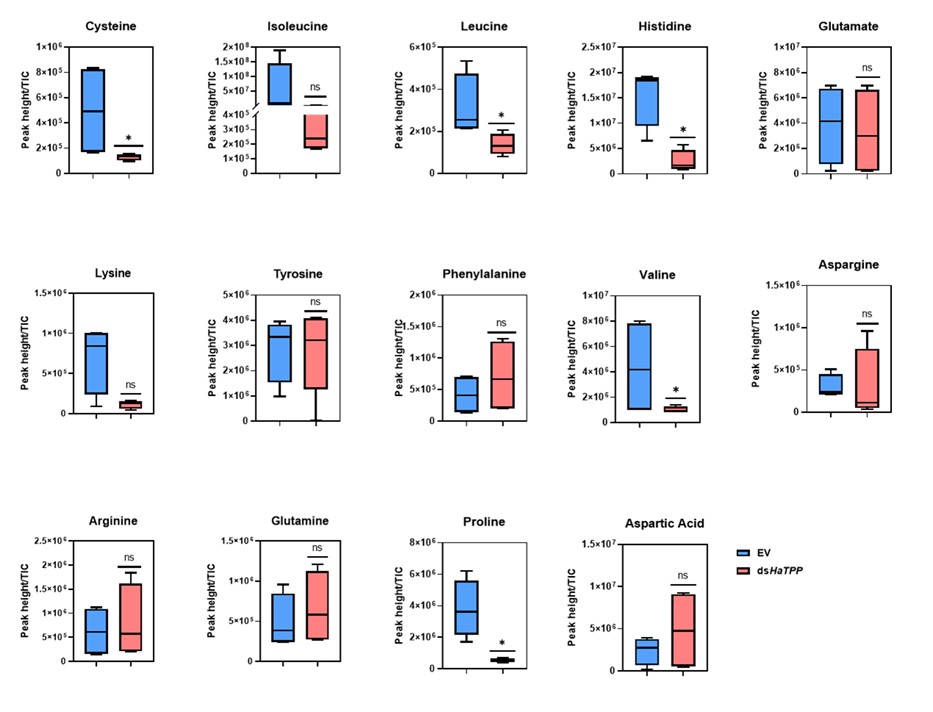
      The result section of the manuscript is quite concise, to my understanding (especially the initial few sections), which misses out on mentioning details that would help readers understand the paper better. While technical details of the methods should be in the Materials and Methods section, the overall experimental strategy for the experiments performed should be explained in adequate detail in the results section itself or in figure legends. I would request authors to include more details in the results section. As an extension of the comment above, many times, abbreviations have been used without introducing them. A thorough check of the manuscript is required regarding this.

      Thank you very much for pointing out this issue. We will revise the manuscript content according to these suggestions.

      The Spodoptera experiments appear ad hoc and are insufficient to support conservation beyond Helicoverpa. To substantiate this claim, please add a coherent, minimal set of Spodoptera experiments and present them in a dedicated subsection. Alternatively, consider removing these data and limiting the conclusions (and title) to H. armigera.

      We thank the reviewer for this helpful comment. We agree that, in this current version of the manuscript, the S. frugiperda experiments are not sufficiently systematic to support strong claims about conservation beyond H. armigera. Our primary focus in this study is indeed on H. armigera, and the addition of the S. frugiperda data was intended only as preliminary, supportive evidence rather than a central component of our conclusions. To avoid over‑interpretation and to keep the manuscript focused and coherent, we will remove all S. frugiperda data from the revised version, including the corresponding text and figures. We will also adjust the title, abstract, and conclusion to clearly state that our findings are limited to H. armigera.

      In order to check the effects of E2F/Dp, a dsRNA-mediated knockdown of Dp was performed. Why was the E2F protein, a primary target of the study, not chosen as a candidate? The authors should either provide justification for this or perform the suggested experiments to come to a conclusion. I would like to point out that such experiments were performed in Drosophila.

      Thank you for this thoughtful comment and the specific suggestion. We agree that directly targeting E2F would, in principle, be an informative complementary approach. In our study, however, we prioritized Dp knockdown for two main reasons. First, E2F is a large family, and E2F-Dp functions as an obligate heterodimer. Previous work in D. melanogaster has shown that depletion of Dp is sufficient to disrupt E2F-dependent transcription broadly, often with more efficient loss of complex activity than targeting individual E2F isoforms (Zappia et al., 2021; Zappia et al., 2016). Second, in our preliminary trials, we performed a dsRNA feeding assay with dsHaE2F, dsHaDp, and combined dsHaE2F plus dsHaDp. In that assay, we did not achieve silencing of E2F in dsRNA targeting HaE2F (dsHaE2F). So here, as E2F is a large family, other E2F isoforms may be compensating for the silencing effect of targeted HaE2F. However, HaE2F showed significantly reduced expression upon dsHaDp and combined dsHaE2F plus dsHaDp feeding (Figure A), whereas HaDp showed a significant reduction in its expression in all three conditions (Figure B).  As we observed reduced expression of both HaE2F and HaDp upon combined feeding of dsHaE2F and dsHaDp, we further performed a rescue assay by exogenous feeding of trehalose. We observed the significant upregulation of HaE2F, HaDp, trehalose metabolic genes (HaTPS/TPP and HaTreh1), and myogenic genes (HaPrm and HaTm2) (Figure C). For these reasons, we focused on Dp silencing as a more reliable way to impair E2F/Dp complex function in H. armigera.

      Author response image 2.
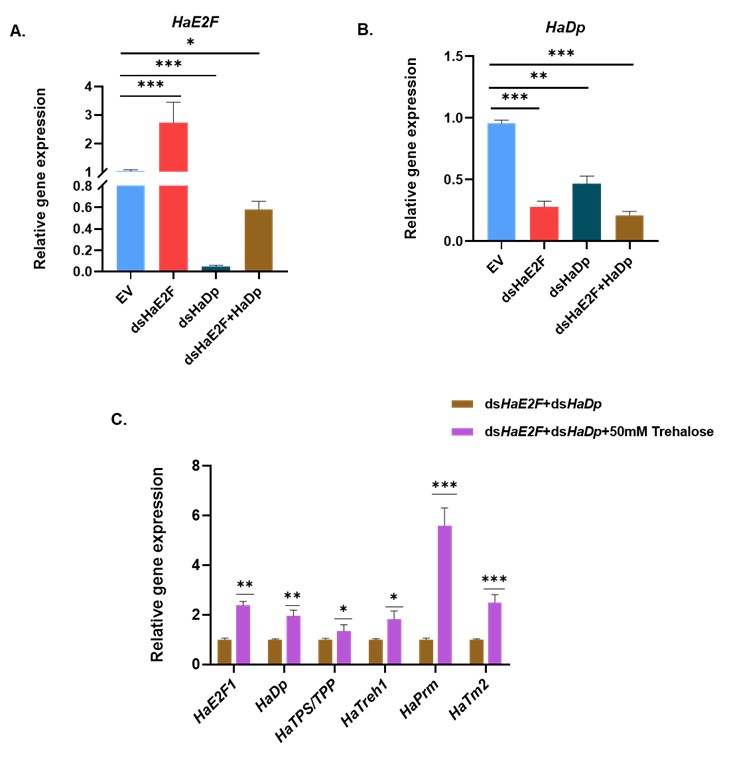
      References:

      (1) Zappia, M.P. and Frolov, M.V., 2016. E2F function in muscle growth is necessary and sufficient for viability in Drosophila. Nature Communications, 7(1), p.10509.

      (2) Zappia, M.P., Guarner, A., Kellie-Smith, N., Rogers, A., Morris, R., Nicolay, B., Boukhali, M., Haas, W., Dyson, N.J. and Frolov, M.V., 2021. E2F/Dp inactivation in fat body cells triggers systemic metabolic changes. elife, 10, p.e67753.

      Silencing of HaDp resulted in a significant decrease in HaE2F expression. I find this observation intriguing. DP is the cofactor of E2F, and they both heterodimerise and sit on the promoter of target genes to regulate them. I would request authors to revisit this result, as it contradicts the general understanding of how E2F/Dp functions in other organisms. If Dp indeed controls E2F expression, then further experiments should be conducted to come to a conclusion convincingly. Additionally, these results would need thorough discussion with citations of similar results observed for other transcription factor-cofactor complexes.

      Thank you for highlighting this point and for prompting us to examine these data more carefully. Silencing HaDp leading to reduced HaE2F mRNA is indeed unexpected if one only considers the canonical view of E2F/Dp as a heterodimer that co-occupies target promoters without strongly regulating each other’s expression. However, several lines of work suggest that transcription factor-cofactor networks frequently include feedback loops in which cofactors influence the expression of their partner TFs. First, in multiple systems, transcription factors and their cofactors are known to regulate each other’s transcription, forming positive or negative feedback loops. For example, in hematopoietic cells, the transcription factor Foxp3 controls the expression of many of its own cofactors, and some of these cofactors in turn facilitate or stabilize Foxp3 expression, forming an interconnected regulatory network rather than a simple one‑way interaction (Rudra et al., 2012). Second, E2F/Dp complexes exhibit non‑canonical regulatory mechanisms and can regulate broad sets of targets, including other transcriptional regulators. Several studies show that E2F/Dp proteins not only control classical cell‑cycle genes but also participate in diverse processes such as DNA damage signaling, mitochondrial function, and differentiation (Guarner et al., 2017; Ambrus et al., 2013; Sánchez-Camargo et al., 2021). In D. melanogaster, complete loss of dDP alters the expression of direct targets E2F/DP, including dATM (Guarner et al., 2017).

      All these reports indicate that the E2F-Dp complex sits at the top of multi‑layer regulatory hierarchies. Such architectures make it plausible that Dp silencing in H. armigera could modulate HaE2F expression in a non-canonical way.

      References:

      (1) Rudra, D., DeRoos, P., Chaudhry, A., Niec, R.E., Arvey, A., Samstein, R.M., Leslie, C., Shaffer, S.A., Goodlett, D.R. and Rudensky, A.Y., 2012. Transcription factor Foxp3 and its protein partners form a complex regulatory network. Nature immunology, 13(10), pp.1010-1019.

      (2) Guarner, A., Morris, R., Korenjak, M., Boukhali, M., Zappia, M.P., Van Rechem, C., Whetstine, J.R., Ramaswamy, S., Zou, L., Frolov, M.V. and Haas, W., 2017. E2F/DP prevents cell-cycle progression in endocycling fat body cells by suppressing dATM expression. Developmental cell, 43(6), pp.689-703.

      (3) Ambrus, A.M., Islam, A.B., Holmes, K.B., Moon, N.S., Lopez-Bigas, N., Benevolenskaya, E.V. and Frolov, M.V., 2013. Loss of dE2F compromises mitochondrial function. Developmental cell, 27(4), pp.438-451.

      (4) Sánchez-Camargo, V.A., Romero-Rodríguez, S. and Vázquez-Ramos, J.M., 2021. Non-canonical functions of the E2F/DP pathway with emphasis in plants. Phyton, 90(2), p.307.

      I consider the overall bioinformatics analysis to remain very poorly described. What is specifically lacking is clear statements about why a particular dry lab experiments were conducted.

      We again thank the reviewer for advising us to give a biological context/motivation for every bioinformatics analysis performed. The bioinformatics analyses devised here, try to explain the systems-level perturbations of HaTPS/TPP silencing to explain the observed phenotype and to discover transcription factors potentially modulating the HaTPS/TPP induced gene regulatory changes.

      (1) Gene set enrichment analyses:

      Differential gene expression analyses of the bulk RNA sequencing data followed by qRT-PCR confirmed the transcriptional changes in myogenic genes and gene expression alterations in metabolic and cell cycle-related genes. These perturbations merely confirmed the effect induced by HaTPS/TPP silencing in obviously expected genes. We wanted to see whether using an “unbiased” system-level statistical analyses like gene set enrichment analyses (GSEA), can reveal both expected and novel biological processes that underlie HaTPS/TPP silencing. GSEA results revealed large-scale transcriptional changes in 11 enriched processes, including amino acid metabolism, energy metabolism, developmental regulatory processes, and motor protein activity. GSEA not only divulged overall transcriptionally enriched pathways but also identified the genes undergoing synchronized pathway-level transcriptional change upon HaTPS/TPP silencing.

      (2) Gene regulatory network analysis:

      Although GSEA uncovered potential pathway-level changes, we were also interested in identifying the gene regulatory network associated with such large-scale process-level transcriptional perturbations. Interestingly, the biological processes undergoing perturbations were also heterogeneous (e.g., motor protein activity, energy metabolism, amino acid metabolism, etc.). We hypothesized that the inference of a causal gene regulatory network associated with the genes associated with GSEA-enriched biological processes should predict core/master transcription factors that might synchronously regulate metabolic and non-metabolic processes related to HaTPS/TPP silencing, thereby providing a broad understanding of the perturbed phenotype. The gene regulatory network analysis statistically inferred an “active” gene regulatory network corresponding to the GSEA-enriched KEGG gene sets. Ranking the transcription factors (TFs) based on the number of outgoing connections (outdegree centrality) within the active gene regulatory network, E2F family TFs were identified to be top-ranking, highly connected transcription factors associated with the transcriptionally enriched processes. This suggests that E2F family TFs are central to controlling the flow of regulatory information within this network. Intriguingly, E2F has been previously implicated in muscle development in insects (Zappia et al., 2016). Further extracting the regulated targets of E2F family TFs within this network revealed the mechanistic connection with the 11 enriched processes. This GRN analysis was crucial in discovering and prioritizing E2F TFs as central transcription factors mediating HaTPS/TPP silencing effects, which was not apparent using trivial analyses like differential gene expression analysis.

      As per the reviewer’s suggestions, we will add these outlined points in the text of the manuscript (Results section) to further give context and clarity to the bioinformatics analyses conducted in this study.

      In my judgement, the EMSA analysis presented is technically poor in quality. It lacks positive and negative controls, does not show mutation analysis or super shifts. Also, it lacks any competition assays that are important to prove the binding beyond doubt. I am not sure why protein is not detected at all in lower concentrations. Overall, the EMSA assays need to be redone; I find the current results to be unacceptable.

      Thank you for pointing out this issue. We will reperform the EMSA analysis with appropriate controls.  Although the gel image was not clear, there was a light band of protein (indicated by the white square) observed in well No. 8, where we used 8 μg of E2F protein and 75 ng of HaTPS/TPP promoter, upon gel stained with SYPRO Ruby protein stain, suggesting weak HaTPS/TPP-E2F complex formation.

      GSEA studies clearly indicate enrichment of the amino acid synthesis gene in TPP knockdown samples. This supports the plausible theory that a lack of Trehalose means a lack of enough nutrients, therefore less of that is converted to amino acids, and therefore muscle development is compromised. Yet the authors make no effort to measure amino acid levels. While nutrients can be sensed through signalling pathways leading to shut shutdown of myogenic genes, a simple and direct correlation between less raw material and deformed muscle might also be possible.

      We quantified amino acid levels as per the suggestion, and we observed differential levels of amino acids upon trehalose metabolism perturbation.

      However, we observed that insect were failed to rescue when fed a control chickpea-based artificial diet that contained nutrients required for normal growth and development. Based on this observation, we conclude that trehalose deficiency is the only possible cause for the defect in muscle development.

      The authors are encouraged to stick to one color palette while demonstrating sequencing results. Choosing a different color palette for representing results from the same sequencing analysis confuses readers.

      Thank you for the comment. We will revise the color palette as per the suggestion.

      Expression of genes, as understood from sequencing analysis in Figure 1D, Figure 2F, and Figure 3D, appears to be binary in nature. This result is extremely surprising given that the qRT-PCR of these genes have revealed a checker and graded expression.

      Thank you for pointing out this issue. We will revise the scale range for these figures to get more insights about gene expression levels and include figures as per the suggestion.

      In several graphs, non-significant results have been interpreted as significant in the results section. In a few other cases, the reported changes are minimal, and the statistical support is unclear; please recheck the analyses and include exact statistics. In the results section, fold changes observed should be discussed, as well as the statistical significance of the observed change.

      We will revise the analyses and include exact statistics as per the suggestion.

      Finally, I would add that trehalose metabolism regulates cell cycle genes, and muscle development genes establish correlation and causation. The authors should ensure that any comments they make are backed by evidence.

      We thank the reviewer for this insightful comment.  Although direct evidence in insects is currently lacking, multiple independent studies in yeast, plants and mammalian systems support a regulatory link between trehalose metabolism and the cell cycle. In budding yeast Saccharomyces cerevisiae, neutral Treh (Nth1) is directly phosphorylated and activated by the major cyclin‑dependent kinase Cdk1 at G1/S, routing stored trehalose into glycolysis to fuel DNA replication and mitosis (Ewald et al., 2016). CDK‑dependent regulation of trehalase activity has also been reported in plants, where CDC28‑mediated phosphorylation channels glucose into biosynthetic pathways necessary for cell proliferation (Lara-núñez et al., 2025). Furthermore, budding yeast cells accumulate trehalose and glycogen upon entry into quiescence and subsequently mobilize these stores to generate a metabolic “finishing kick” that supports re‑entry into the cell cycle (Silljé et al., 1999; Shi et al., 2010). Exogenous trehalose that perturbs the trehalose cycle impairs glycolysis, reduces ATP, and delays cell cycle progression in S. cerevisiae, highlighting a dose‑ and context‑dependent control of growth versus arrest (Zhang, Zhang and Li, 2020). In mammalian systems, trehalose similarly modulates proliferation-differentiation decisions. In rat airway smooth muscle cells, low trehalose concentrations promote autophagy, whereas higher doses induce S/G2–M arrest, downregulate Cyclin A1/B1, and trigger apoptosis, indicating a shift from controlled growth to cell elimination at higher exposure (Xiao et al., 2021). In human iPSC‑derived neural stem/progenitor cells, low‑dose trehalose enhances neuronal differentiation and VEGF secretion, while higher doses are cytotoxic, again highlighting a tunable impact on cell‑fate outcomes (Roose et al., 2025). In wheat, exogenous trehalose under heat stress reduces growth, lowers auxin, gibberellin, abscisic acid and cytokinin levels, and represses CycD2 and CDC2 expression, suggesting that trehalose signalling integrates with hormone pathways and core cell‑cycle regulators to restrain proliferation during stress (Luo, Liu, and Li, 2021). Together, these studies showed the importance of trehalose metabolism in cell‑cycle regulation to decide whether cells and tissues proliferate, differentiate, or remain quiescent.

      With respect to muscle development, previous work has implicated glycolytic metabolism in myogenesis and muscle growth. Tixier et al. (2013) showed that loss of key glycolytic genes results in abnormally thin muscles, while Bawa et al. (2020) demonstrated that loss of TRIM32 decreases glycolytic flux and reduces muscle tissue size. These findings indicate that carbohydrate and energy metabolism pathways are important determinants of muscle structure and growth. However, there are no previous studies about the role of trehalose metabolism in muscle development, other than as an energy source, so here we specifically set out to establish the involvement of trehalose metabolism in muscle development.

      References:

      (1) Ewald, J.C. et al. (2016) “The yeast cyclin-dependent kinase routes carbon fluxes to fuel cell cycle progression,” Molecular cell, 62(4), pp. 532–545.

      (2) Lara-núñez, A. et al. (2025) “The Cyclin-Dependent Kinase activity modulates the central carbon metabolism in maize during germination,” (January), pp. 1–16.

      (3) Silljé, H.H.W. et al. (1999) “Function of trehalose and glycogen in cell cycle progression and cell viability in Saccharomyces cerevisiae,” Journal of bacteriology, 181(2), pp. 396–400.

      (4) Shi, L. et al. (2010) “Trehalose Is a Key Determinant of the Quiescent Metabolic State That Fuels Cell Cycle Progression upon Return to Growth,” 21, pp. 1982–1990.

      (5) Zhang, X., Zhang, Y. and Li, H. (2020) “Regulation of trehalose, a typical stress protectant, on central metabolisms, cell growth and division of Saccharomyces cerevisiae CEN. PK113-7D,” Food Microbiology, 89, p. 103459.

      (6) Xiao, B. et al. (2021) “Trehalose inhibits proliferation while activates apoptosis and autophagy in rat airway smooth muscle cells,” Acta Histochemica, 123(8), p. 151810.

      (7) Roose, S.K. et al. (2025) “Trehalose enhances neuronal differentiation with VEGF secretion in human iPSC-derived neural stem / progenitor cells,” Regenerative Therapy, 30, pp. 268–277.

      (8) Luo, Y., Liu, X. and Li, W. (2021) “Exogenously-supplied trehalose inhibits the growth of wheat seedlings under high temperature by affecting plant hormone levels and cell cycle processes,” Plant Signaling & Behavior, 16(6).

      (9) Tixier, V., Bataillé, L., Etard, C., Jagla, T., Weger, M., DaPonte, J.P., Strähle, U., Dickmeis, T. and Jagla, K., 2013. Glycolysis supports embryonic muscle growth by promoting myoblast fusion. Proceedings of the National Academy of Sciences, 110(47), pp.18982-18987.

      (10) Bawa, S., Brooks, D.S., Neville, K.E., Tipping, M., Sagar, M.A., Kollhoff, J.A., Chawla, G., Geisbrecht, B.V., Tennessen, J.M., Eliceiri, K.W. and Geisbrecht, E.R., 2020. Drosophila TRIM32 cooperates with glycolytic enzymes to promote cell growth. elife, 9, p.e52358.

      Finally, we appreciate the meticulous review of this manuscript and constructive comments. We will perform the recommended experiments, data analysis, and revise the manuscript accordingly.
    1. Soutenir les compétences socio-émotionnelles chez les jeunes enfants : Approches et Dispositifs

      Résumé Exécutif

      Ce document synthétise les interventions de Sylvie Richard (Université de Genève / HP Valais) concernant le soutien aux apprentissages socio-émotionnels durant les premières années de scolarité.

      La recherche scientifique identifie deux leviers complémentaires : l'approche directe (structurée et dirigée par l'enseignant) et l'approche indirecte (développementale, centrée sur le jeu de faire semblant).

      Les données probantes, issues notamment de méta-analyses incluant plus d'un million d'élèves, démontrent que le renforcement des compétences socio-émotionnelles améliore non seulement le bien-être et les comportements sociaux, mais aussi les résultats académiques à long terme.

      La transition vers une pédagogie intégrant le jeu accompagné nécessite toutefois une formation approfondie des enseignants (plus de 20 heures) et un travail réflexif sur leurs propres compétences émotionnelles.

      --------------------------------------------------------------------------------

      1. Cadre Conceptuel des Compétences Socio-Émotionnelles

      Les compétences socio-émotionnelles sont définies selon le modèle de l'organisation Casel, qui regroupe trois grands domaines d'apprentissage :

      Conscience de soi et des autres : Identifier ses propres émotions et comprendre celles d'autrui.

      Gestion des émotions et des relations : Établir et maintenir des relations sociales positives.

      Prise de décision responsable : Apprendre à agir de manière éthique et constructive.

      --------------------------------------------------------------------------------

      2. L'Approche Directe : Programmes Structurés et Dirigés

      L'approche directe repose sur des activités planifiées où l'enseignant cible des savoirs spécifiques via des supports dédiés (jeux de plateau, fiches, lectures).

      Preuves d'Efficacité et Recherche

      La littérature scientifique internationale (méta-analyses de 2022 et 2025) souligne des bénéfices majeurs :

      Impact scolaire : Amélioration significative des résultats académiques comparativement aux élèves ne bénéficiant pas de ces programmes.

      Impact comportemental : Réduction des comportements problématiques et de la détresse émotionnelle.

      Impact à long terme : Diminution de la consommation de drogues à l'entrée de l'âge adulte.

      Programmes en Contexte Francophone

      Il existe un manque de programmes francophones validés par rapport aux modèles anglo-saxons. La simple traduction est jugée insuffisante ; une adaptation socio-culturelle est nécessaire. Deux outils se distinguent :

      | Programme | Origine | Compétences Ciblées | Accessibilité | | --- | --- | --- | --- | | Emotimat | France (Grenoble) | Identification, compréhension et expression des émotions. | Libre d'accès (en ligne). | | Emoti | Suisse (Genève) | Reconnaissance émotionnelle, besoins et régulation. | Payant (coût d'impression des cartes). |

      --------------------------------------------------------------------------------

      3. L'Approche Indirecte : La Pédagogie par le Jeu de Faire Semblant

      Le jeu de faire semblant est une activité où les objets, les paroles et les actions représentent autre chose que leur réalité immédiate. C'est une fonction mentale de haut niveau mobilisant l'imagination.

      Les Composantes du Jeu Mature

      Pour qu'un jeu génère des apprentissages, il doit tendre vers la maturité, caractérisée par plusieurs éléments :

      Substitution d'objets : Utiliser un bâton pour représenter une fusée (inhibition de la fonction réelle de l'objet).

      Attribution de rôles : Endosser une identité (docteur, pirate) et respecter le registre de comportement associé.

      Méta-communication : Planifier et négocier le scénario avec les pairs ("On dirait que tu étais...").

      Raisonnement par hypothèses : Utiliser la logique "Et si..." pour explorer des mondes possibles et des relations de cause à effet.

      Un Laboratoire de Développement

      Le jeu de faire semblant permet à l'enfant :

      1. De s'autoréguler : En s'imposant des règles de comportement liées au rôle choisi.

      2. D'expérimenter sans risque : Tester des situations sociales complexes dans un cadre "pour de faux", sans enjeu de performance.

      3. De traiter le réel : Mettre en scène sa compréhension du monde (ex: jeux liés à la pandémie ou aux soins médicaux) pour réguler ses frustrations ou ses peurs.

      --------------------------------------------------------------------------------

      4. Rôle et Posture de l'Enseignant

      Le passage d'un "jeu libre" à un "jeu accompagné" est crucial. L'enseignant ne doit pas être un simple spectateur, mais un acteur capable d'adopter plusieurs postures :

      Régisseur de scène : Fournir les accessoires et l'espace nécessaires.

      Co-joueur ou Joueur : Entrer dans le scénario pour enrichir le contenu et proposer des défis émotionnels.

      Observateur-Évaluateur : Identifier le niveau de maturité du jeu pour intervenir au bon moment.

      L'Importance de la Formation

      Les recherches indiquent que l'efficacité de ces dispositifs dépend de la préparation de l'adulte :

      Formation technique : Un minimum de 20 heures de formation est recommandé pour maîtriser l'accompagnement du jeu et les concepts socio-émotionnels.

      Dimension réflexive : L'enseignant doit évaluer ses propres compétences émotionnelles et sa capacité à jouer, car il sert de modèle par imitation pour les jeunes enfants.

      --------------------------------------------------------------------------------

      5. Conclusions et Recommandations

      La littérature scientifique actuelle récuse l'idée que le temps alloué au développement socio-émotionnel serait une "perte de temps" au détriment du scolaire. Au contraire :

      Complémentarité : Il est impératif de combiner les séances structurées et les temps de jeu accompagné.

      Enjeu de santé publique : Le déclin de l'engagement des enfants dans le jeu de faire semblant fait de son soutien à l'école une priorité de développement psychologique.

      Apprendre à jouer pour jouer pour apprendre : Le jeu de faire semblant n'est pas inné à un niveau mature ; il doit être enseigné pour devenir un outil d'apprentissage efficace.

    1. Reviewer #1 (Public review):

      Summary:

      This study evaluates the feasibility of using crispant founder mice, first-generation animals directly edited by CRISPR/Cas9, for initial phenotypic assessments. The authors target seven genes known to produce visible recessive traits to test whether mosaicism in founder animals prevents meaningful phenotype-genotype interpretation. Remarkably, they observe clear null phenotypes in founders for six of the seven genes, with high editing efficiencies. These results demonstrate that crispant mice can, under specific conditions, display recessive phenotypes that are readily interpretable. However, this conclusion should be moderated, as the study addresses only one biological context, visible Mendelian traits, and may not generalize to quantitative, subtle, or late-onset phenotypes. The report also examines attempts at multiplex CRISPR targeting, which reduce viability, underscoring limits for concurrent gene disruptions. Finally, the detailed description of diverse alleles generated by CRISPR provides valuable insight into how allelic series can be exploited to investigate protein function.

      Strengths:

      (1) The manuscript provides a comprehensive and technically rigorous description of CRISPR/Cas9‑induced mutations across several loci. The accompanying genotyping, sequencing, and analytical approaches are sound, complementary, and well-detailed, providing a resource that will be valuable to researchers using genome editing beyond the specific application of genetic screening.

      (2) By documenting a wide diversity of alleles and mutation types, the study contributes to understanding how allelic series generated by CRISPR can be leveraged for dissecting protein function, a perspective that has been less systematically presented in prior literature and could be compared to targeted strategies such as those described by Cassidy et al. (2022, DOI: [10.1016/bs.mie.2022.03.053]) or other relevant studies addressing CRISPR-based allelic series generation.

      (3) The work demonstrates technically solid editing and validation workflows, setting a methodological reference point for similar projects across species or trait categories.

      Weaknesses:

      (1) There is a disconnect between the abstract/introduction and the discussion. While both the abstract and introduction focus on the potential use of crispant founders for phenotypic assessment in the context of genetic screening, with the introduction notably emphasizing this framework through a detailed section on ENU-based screens, the discussion devotes relatively little attention to this aspect. Instead, it primarily examines CRISPR mutagenesis outcomes, mutation detection, and allele characterization. Overall, the study's aims are not clearly or explicitly defined, which contributes to the lack of alignment across sections.

      (2) Important limitations of the approach are not sufficiently discussed. For instance, the paper does not address how applicable the findings are beyond visible Mendelian traits, such as for quantitative, late-onset, or more subtle phenotypes, including behavioral ones, or how to interpret wild-type appearing founders. There is little consideration of appropriate experimental controls (e.g., wild-type or mock-edited animals) or of how many animals might be required to robustly establish genotype-phenotype associations.

      (3) The conclusion that this strategy will "dramatically reduce time, resources, and animal numbers" is not quantitatively supported by the data presented and should be expressed more cautiously.

    2. Reviewer #3 (Public review):

      Summary:

      The study assesses whether CRISPR-generated founder (F0) "crispant" mice can be reliably used for initial phenotypic assessment and screening. By targeting seven genes with known visible recessive phenotypes, the authors show that, despite genetic mosaicism, the expected null phenotypes were observed in all targeted genes. These findings demonstrate that the phenotyping and screening of F0 "crispant" mice is a valid (and efficient) approach to selecting candidate alleles for follow-up studies, thereby streamlining mouse breeding and animal husbandry-related costs.

      Strengths:

      The study is comprehensive, carefully executed, and provides deep insight into the utility of F0 "crispant" mice for phenotypic screening. The authors evaluated the CRISPR/Cas9 editing outcomes across seven genes using multiple sequencing modalities, providing a robust framework for determining and interpreting complex founder genotypes. Importantly, the study examines/highlights the biological insight gained from compound heterozygous founders and naturally arising allelic series, enabling genotype-phenotype associations and functional inferences about protein domains.

      More broadly, the authors' thorough evaluation of the CRISPR/Cas9-based gene editing events in the founders can serve as a benchmark for others in the field, engineering their own mouse "crispants."

      Weaknesses:

      The relationship between the sgRNA/Cas9 concentrations delivered to the zygotes and the resulting editing efficiencies are not explicitly investigated.

    3. Author response:

      We would like to thank the reviewers for their detailed reading of our manuscript and for the constructive comments they have provided.

      We plan to make structural changes to the introduction and the discussion. Reviewer #1 describes the “disconnect between the abstract/introduction and the discussion”. We agree that “the study's aims are not clearly or explicitly defined”. We will edit the introduction to state our aim of investigating the factors that affect using “crispants” in mouse functional genomics. In the discussion, we described how our findings inform sgRNA choice to ensure biallelic gene disruption in founders and how our extensive genotyping methods enabled us to determine the molecular basis for the observed phenotype (explaining why some founders showed the expected recessive trait and why it was partial or absent in others). We also concluded from our attempts of multiplexing that this had too great an impact on viability to be useful. We will edit the discussion to better address our aim and to elaborate on several points raised by the reviewers (discussed in more detail below). Specifically, we will provide examples of screening situations where generating crispant mice may be useful, e.g. preliminary in vivo studies to follow up candidates identified in large-scale cellular screens. We will also provide more context about our assumptions underlying our statement that the use of crispants will “dramatically reduce time, resources, and animal numbers” compared to ENU mutagenesis (where recessive traits require breeding of G2 females with G1 males to achieve homozygosity of de novo mutations in G3 offspring) and the work needed to validate this. We will more clearly acknowledge that our proof-of-principle study used visible phenotypes that can be assessed in individual animals and then discuss how the use of crispants could be extended to the investigation of quantitative or late-onset traits using cohorts of crispants (discussed further below). We will also discuss the assessment of non-null alleles to dissect protein function, building on our unexpected finding that a single round of CRISPR/Cas9mediated mutagenesis can generate an allelic series.

      Reviewer #1 asked us to address “how to interpret wild-type appearing founders”. We have discussed the mechanisms underlying the wild-type appearing founders generated in this study. This is linked with concerns in the field that incomplete editing, transcripts escaping nonsense-mediated decay, and/or the presence of in-frame mutations that don’t disrupt protein function may lead to founders that appear wild-type or have a partial phenotype. We have shown that our electroporation protocol results in very high levels of editing, but that this must always be assessed during genotyping. We found that by using an sgRNA that targets a critical protein domain, you can ensure that short in-frame indels also disrupt protein function. In future studies that determine how strain background modifies a phenotype that has been established on one strain (e.g. C57BL/6J), wild-type appearing founders would suggest that the new strain background rescues the null phenotype. In future studies that determine the consequence of targeting a second gene on a mutant background, wild-type appearing founders would indicate that the second mutation supresses the phenotype associated with the mutant background. We will add this to the discussion section where we describe possible screening situations in which crispant mice would be useful.

      Reviewer #3 states that “the relationship between the sgRNA/Cas9 concentrations delivered to the zygotes and the resulting editing efficiencies are not explicitly investigated.” Members of The Centre for Phenogenomics (TCP) Transgenic Production Core who co-author this study (Lauryl Nutter, Marina Gertsenstein and Lauri Lintott) have published detailed protocols on mouse model production, which we cite in this paper (PMID: 30040228; PMID: 33524495; PMID: 39999224). In PMID: 33524495, they tested a two-fold difference in Cas9 RNP concentrations for generating knock-out alleles. Using their optimised protocols for electroporation of one cell zygotes with RNPs, we achieved an extremely high editing rate. We did not vary the sgRNA/Cas9 concentrations as part of this study as our goal was to assess the ability to generate “complete” null animals. We do note, however, that by targeting two genes simultaneously whilst keeping the total RNP concentration constant (to avoid reagent toxicity), we halved the amount of each sgRNA and this did not lead to a decrease in editing efficiency. We will highlight this in the results/discussion section (as appropriate).

      Reviewer #1 asks about whether the use of crispants is applicable for “quantitative, late-onset, or more subtle phenotypes, including behavioral ones”. We are hopeful that this is possible and it is a priority for future studies. Crucially, cohorts of crispants can be generated in a single round of mutagenesis. Starting an experiment with ten donor females will produce ~100 zygotes, resulting in ~40 crispants. Power calculations must be performed to determine the size of the cohort required for the effect size and variability of the phenotype being studied, but many neurobehavioural studies use ~10 mutants vs ~10 controls. We note that sex and/or background genotype may mean that only some of the ~40 crispants produced can be used for phenotypic testing. This reviewer also raises the point about whether wild-type animals or mock-edited animals serve as the best controls. From work carried out by Lauryl Nutter and her colleagues from the IMPC (PMID: 37301944), we know that “wild-type” controls should ideally be from the same embryo pool as the crispants to avoid differences due to genetic drift within inbred colonies. This study also found that possible off-target mutations from CRISPR/Cas9-mediated mutagenesis is not an issue (despite a lot of attention in the literature). The suggestion of using mock-edited controls, resulting from zygotes that have gone through electroporation without RNP, addresses a possible need to control for the stress of undergoing the electroporation process. Our study shows that additional stress is caused by inducing and repairing a break in a neutral locus (EGFP). Controlling for these stressors may be particularly important when assessing behavioural phenotypes in crispants vs controls.

      Reviewer #2 states that “there could have been some discussion regarding how this approach would be impacted if mutations are dominant or embryonic lethal (for the latter, for example, F0 can be examined as embryos).” Our manuscript discusses how crispants could help with the study of genes that may be essential. Specifically, we stated that when CRISPR/Cas9-mediated mutagenesis fails to produce live pups, phenotypic assessment of crispant embryos could reveal whether targeting the gene impacts embryogenesis. Crispants can only be used to screen for recessive traits since both alleles are edited. The assessment of dominant traits is not addressed in our study and remains a challenge in the field. We note that CRISPRi screens in cultured cells reveal candidates that when partially downregulated lead to the desired phenotype. One possibility is to employ this set up in vivo using dCas9-KRAB transgenic mice (JAX stock #030000). We could add this point to the discussion section.

    1. A POLITICO review of hundreds of cases brought by ICE detainees across the country shows judges increasingly furious and exhausted by the Trump administration’s tactics.

      General comment about the article as a whole:

      1. Cited sources are numerous, reliable, and relevant
      2. The article sticks almost exclusively to direct quotes and verifiable facts
      3. Descriptions of the judges are limited to which administration appointed them, which helps with transparency around potential political bias of the judges in the article.
      4. The article stays on topic all the way through.
    1. What goals seem to dominate early management principles?

      early views of management were heavily oriented toward efficiency, at the expense of attention to the manager-as-leader. 

    1. As you review what you have written, you will undoubtedly see holes in your logic, sentences that confuse rather than clarify, and sentences and paragraphs out of place.

      It usually takes me re-reading about 3 times to catch the mistakes.

    1. In the end, you want your body paragraphs to build (like blocks) to your conclusion. Transitions are the glue that hold these blocks together. You should work  on building topic sentences that both develop and support the thesis in a logical manner. Avoid such easy, empty transitions as “firstly,” “secondly” and “finally.” Your reader should be able to understand they have been moved from one aspect of your argument to another without a tell-tale “secondly” informing them that the first point is over and the second point is about to begin. Again, this is where keeping a close eye to your thesis and your outline is so important. If you know where the essay is going, you can transfer your readers smoothly from the analysis of one aspect of the text to the next with meaningful connections and statements rather than empty transitional phrases. Witness the transition from the final sentence in Paragraph 2 into the first sentence and then the topic sentence of Paragraph 3.

      use paragraphs as blocks to your conclusion.Avoiding easy transitions.

    1. There are two types of formal outlines: the topic outline and the sentence outline. Format both types of formal outlines similarly. Place your introduction and thesis statement at the beginning, under roman numeral I. Use roman numerals (II, III, IV, V, etc.) to identify main points that develop the thesis statement. Use capital letters (A, B, C, D, etc.) to divide your main points into parts. Use arabic numerals (1, 2, 3, 4, 5, etc.) if you need to subdivide any As, Bs, or Cs into smaller parts. End with the final roman numeral expressing your idea for your conclusion. Here is what the skeleton of a traditional formal outline looks like. The indentation helps clarify how the ideas are related.

      Two types of formal outlines and the sentence outline.

    2. Chronological To tell a story or relate an experience To explain the history of an event or a topic To introduce the steps in a process Spatial To help readers visualize something as you want them to see it To create a main impression using the senses (sight, touch, taste, smell, and sound) Order of Importance To persuade or convince To rank items by their importance, benefit, or significance Organizing Your Writing Descriptive writing is most effective when it is organized well. Use the following information to decide what organization best fits your goals. Chronological order → best for describing events Spatial order → best for describing places Order of importance →  best for describing objects and people Types of Outlines A formal outline is a detailed guide that shows how all your supporting ideas relate to each other. This outline helps you distinguish between ideas that are equally important and ones that are less important. You can build your paper based on the framework you created in the outline. There are two types of formal outlines: the topic outline and the sentence outline. Format both types of formal outlines similarly. Place your introduction and thesis statement at the beginning, under roman numeral I. Use roman numerals (II, III, IV, V, etc.) to identify main points that develop the thesis statement. Use capital letters (A, B, C, D, etc.) to divide your main points into parts. Use arabic numerals (1, 2, 3, 4, 5, etc.) if you need to subdivide any As, Bs, or Cs into smaller parts. End with the final roman numeral expressing your idea for your conclusion. Here is what the skeleton of a traditional formal outline looks like. The indentation helps clarify how the ideas are related. Outlining a Paper Outlining a Paper Quick Guide to Topic Outlines Adapted from “Chapter Seven” of English for Business Success, 2012, used according to Creative Commons CC BY-NC-SA 3.0 License

      Three common ways to structure your writing with information for each step.

    1. Reviewer #2 (Public review):

      Summary:

      In this manuscript, Thompson et al. investigate the impact of prior ATP exposure on later macrophage functions as a mechanism of immune training. They describe that ATP training enhances bactericidal functions which they connect to the P2x7 ATP receptor, Nlrp3 inflammasome activation, and TWIK2 K+ movement at the cell surface and subsequently at phagosomes during bacterial engulfment. This is an incremental addition to existing literature, which has previously explored how ATP alters TWIK2 and K+, and linked it to Nlrp3 activation. The novelty here is in discovering the persistence of TWIK2 change and exploring the impact this biology may have on bacterial clearance. Additional experiments could strengthen their hypothesis that the in vivo protective effect of ATP-training on bacterial clearance is mediated by alveolar macrophages.

      Strengths:

      The authors demonstrate three novel findings: 1) prolonged persistence of TWIK2 at the macrophage plasma membrane following ATP that can translocate to the phagosome during particle engulfment, 2) a persistent impact of ATP exposure on remodeling chromatin around nlrp3, and 3) administering mice intra-nasal ATP to 'train' lungs protects mice from otherwise fatal bacterial infection.

      Weaknesses:

      (1) Some methods remain unclear including the timing and method by which lung cellularity was assessed in Figure 2. It is also difficult to understand how many mice were used in experiments 1, 2 and 6 and thus how rigorous the design was. A specific number is only provided for 1D and the number of mice stated in legend and methods do not match.

      (2) The study design is not entirely ideal for the authors' in vivo question. Overall, the discussion would benefit from a clear summary of study caveats, which are primarily that that 1) in vitro studies attributing ATP training-mediated bacterial killing to persistent TWIK2 relocation, K+ influx, a glycolytic metabolic shift , and epigenetic nlrp3 reprogramming were performed in BMDM or RAW cells and not primary AMs, 2) data does not eliminate the possibility that non-AM immune or non-immune cells in the lung are "trained" and responsible for ATP-mediated protection in vivo; flow data examined total lung digest which may obscure important changes in alveolar recruitment, and 3) in vivo work shows data on acute bacterial clearance but does not explore potential risks that "training" for a more responsive inflammasome may have for the severity of lung injury during infection.

      (3) The is some lack of transparency on data and rigor of methods. Clear data is not provided regarding the RNA-sequencing results. Specific identities of DEGs is not provided, only one high-level pathway enrichment figure. It would also be ideal if controls were included for subcellular fractionating to confirm pure fractions and for dye microscopy to show negative background.

      (4) In results describing 5A, the text states that "ATP-induced macrophage training effects, as measured by augmented bactericidal activity, were diminished in macrophages treated with protease inhibitors". However, these data are not identified significant in the figure; protease dependence can be described as a trend that supports the authors' hypothesis but should not be stated as significant data in text.

      In summary, this work contains some useful data showing how ATP can train macrophages via TWIK2/Nlrp3. Revisions have significantly improved methods reporting, added some data to strengthen the conclusions, and toned down on overstatements to bring conclusions more in line with data presented. The title still overstates what the authors have actually tested, since no macrophage-specific targeting in vivo (no conditional gene deletion, macrophage depletion etc) was performed in infection studies. However, in vitro data provide clear evidence that macrophages can be trained by ATP, and through caveats remain, it is plausible that macrophage training is a key mechanism for the protection observed here in the lung.

    2. Author response:

      The following is the authors’ response to the original reviews.

      Public Reviews:

      Reviewer #1 (Public review):

      (1) First, the concept of training or trained immunity refers to long-term epigenetic reprogramming in innate immune cells, resulting in a modified response upon exposure to a heterologous challenge. The investigations presented demonstrate phenotypic alterations in AMs seven days after ATP exposure; however, they do not assess whether persistent epigenetic remodeling occurs with lasting functional consequences. Therefore, a more cautious and semantically precise interpretation of the findings would be appropriate.

      In response, we have performed epigenetic analysis (ATAC seq analysis) as requested (Supp Fig. 1).

      (2) Furthermore, the in vivo data should be strengthened by additional analyses to support the authors' conclusions. The authors claim that susceptibility to Pseudomonas aeruginosa infection differs depending on the ATP-induced training effect. Statistical analyses should be provided for the survival curves, as well as additional weight curves or clinical assessments. Moreover, it would be appropriate to complement this clinical characterization with additional measurements, such as immune cell infiltration analysis (by flow cytometry), and quantification of pro-inflammatory cytokines in bronchoalveolar lavage fluid and/or lung homogenates.

      We have added the statistical analyses provided for the survival curves (new Fig. 1D), immune cell infiltration analysis, and quantification of pro-inflammatory cytokines in the lung (new Figs. 1, 2).

      (3) Moreover, the authors attribute the differences in resistance to P. aeruginosa infection to the ATP-induced training effect on AMs, based on a correlation between in vivo survival curves and differences in bacterial killing capacity measured in vitro. These are correlative findings that do not establish a causal role for AMs in the in vivo phenotype. ATP-mediated effects on other (i.e., non-AM) cell populations are omitted, and the possibility that other cells could be affected should be, at least, discussed. Adoptive transfer experiments using AMs would be a suitable approach to directly address this question.

      We have performed additional experiments and found that the numbers of lung macrophages were not significantly altered before and after ATP training (new Fig. 2), indicating the training effects are focused on lung resident macrophages.

      Reviewer #2 (Public review):

      (1) Missing details from methods/reported data: Substantial sections of key methods have not been disclosed (including anything about animal infection models, RNA-sequencing, and western blotting), and the statistical methods, as written, only address two-way comparisons, which would mean analysis was improperly performed. In addition, there is a general lack of transparency - the methods state that only representative data is included in the manuscript, and individual data points are not shown for assays.

      We have revised the methods and statistical analysis.

      (2) Poor experimental design including missing controls: Particularly problematic are the Seahorse assay data (requires normalization to cell numbers to interpret this bulk assay - differences in cell growth/loss between conditions would confound data interpretation) and bacterial killing assays (as written, this method would be heavily biased by bacterial initial binding/phagocytosis which would confound assessment of killing). Controls need to be included for subcellular fractionating to confirm pure fractions and for dye microscopy to show a negative background. Conclusions from these assays may be incorrect, and in some cases, the whole experiment may be uninterpretable.

      Seahorse assay methodology was updated to confirm the order of cell counting, time at seeding and cell counts. Methods were also updated to address the distinction between bacterial killing (Fig. 1B) and overall decrease in bacterial load.

      (3) The conclusions overstate what was tested in the experiments: Conceptually, there are multiple places where the authors draw conclusions or frame arguments in ways that do not match the experiments used. Particularly:

      (a) The authors discuss their findings in the context of importance for AM biology during respiratory infection but in vitro work uses cells that are well-established to be poor mimics of resident AMs (BMDM, RAW), particularly in terms of glycolytic metabolism.

      We have adjusted the text to reflect that the metabolic assay was performed on BMDMs. AMs are fragile for certain manipulations in vitro. We expect that the metabolic change is similar across several macrophage systems as well as the bacterial load reduction.

      (b) In vivo work does not address whether immune cell recruitment is triggered during training.

      We have performed immune cell infiltration analysis (new Fig. 2).

      (c) Figure 3 is used to draw conclusions about K+ in response to bacterial engulfment, but actually assesses fungal zymosan particles.

      We have corrected this in the manuscript.

      (d) Figure 5 is framed in bacterial susceptibility post-viral infection, but the model used is bacterial post-bacterial.

      We have corrected this in the manuscript.

      (e) In their discussion, the authors propose to have shown TWIK2-mediated inflammasome activation. They link these separately to ATP, but their studies do not test if loss of TWIK2 prevents inflammasome activation in response to ATP (Figure 4E does not use TWIK2 KO).

      We have now added the TWIK2 KO results (new Fig. 5E).

      Recommendations for the authors:

      Reviewer #1 (Recommendations for the authors):

      As noted in the public review, it would be advisable to further characterize the in vivo phenotype in order to strengthen the conclusions. Specifically, it would be useful to quantify the bacterial load in the bronchoalveolar lavage fluid and lung homogenates, as well as to measure cytokine levels both in the respiratory compartment and systemically. Additionally, a broader characterization of the immune response in the presence or absence of ATP-induced training would be valuable. In the absence of direct evidence demonstrating that trained AMs mediate the observed phenotype, the authors should adopt a more cautious interpretation of their results. Moreover, careful attention to semantic accuracy is recommended. The concept of trained immunity refers specifically to long-term epigenetic reprogramming that leads to an altered response of target cells upon a secondary challenge, distant from the initial stress. The data presented do not fully demonstrate this phenomenon, and the interpretations should remain aligned with the evidence provided.

      Bacterial load has been quantified (see more details in the Methods part). And we also measured immune cell infiltration, quantification of pro-inflammatory cytokines in the lung (new Figs. 1, 2), and epigenetic evaluation of vehicle- and ATP-treated cells (Supp. Fig. 1).

      Reviewer #2 (Recommendations for the authors):

      (1) It cannot be overstated how lacking the methods are. This includes no discussion of IACUC approval for animal procedures, which must be included as part of research ethics. It also needs to be made clear where raw data is being archived. This notably includes an accession for deposited RNA-sequencing data, although unmanipulated microscopy and western blot images should also be shown. Methods should discuss any pre-processing that occurred with images.

      We have revised the methods in the manuscript.

      (2) Per statistics, in addition to generally providing more detail and adjusting analyses if they have not been correctly performed, please disclose if SD or SEM is shown. Reporting aggregate data versus representative data would provide more rigor. Perhaps replicate experiments could be included in the supplemental if they cannot, for some reason, be aggregated. Detailed statistical methods for RNA-seq analysis also need to be included.

      More details have been provided in the methods section.

      (3) It is unclear whether bacterial killing assays were correctly designed and can be interpreted. What does cells collected mean? If the assay was focused on intracellular macrophage bacterial load, it is critical to assess and report phagocytosis since different input loads would confound the assessment of killing. A rigorous wash or an antibiotic to eliminate extracellular bacteria should also have been performed and be described in this case. If the total bacterial burden was assessed, that would use cells+media and also needs to be clear and described. With the information provided, it is unclear whether the assays performed are sufficiently rigorous to assess bacterial killing. In addition, Figure 1B reports using an MOI of 50-100, but all data is compiled in one graph - data from different levels of infection should be separated. Figure 5A shows a model with E.coli followed by PA, but that does not appear to be how the assay was structured in B or C. This also does not match how the experiment is written in the results section, which references S. aureus. It is unclear what tissue (or cells) were assessed in Figure 5. Whole lung? BAL? As written, no data provided regarding bacterial killing is of sufficient quality to be considered valid.

      We have re-written the bacterial killing assay in the manuscript. The methodology was corrected to distinguish bacterial killing vs load decrease and generally accurate methodology.

      (4) The in vitro data provide reasonable evidence that BMDM/RAW macrophage training can occur in response to ATP exposure. However, it is unclear whether training is an important mechanism for resident AM in vivo, or whether, in vivo, a broader inflammatory response is generated, recruiting additional immune cells that persist and change infection susceptibility. The authors argue for resident AM immune training, but do not provide sufficient evidence to counter the latter possibility (resident AM are never themselves directly assessed, and the presence of other immune cells in vivo is not excluded). See Iliakis et al 2023 (PMID 37640788) for discussion of how this issue continues to drive uncertainty in the field. For this study, at least providing flow cytometry data quantifying myeloid and lymphoid immune populations in BALF before and after various treatments would help address this caveat. Without knowing this, it also confounds the interpretation of Figure 1B; if BAL is not pure AM after training, perhaps 1B could be repeated with ex vivo training or resident AM could be purified?

      We have performed immune cell infiltration analysis in the lung (both to BALF and in-tissue, new Fig. 2).

      (5) Figure 3A appears to show that fewer than 50% of cells express GFP. Is it expected that only a fraction of RAW cells express TWIK2-GFP? How was this addressed in the analyses for Figure 3? Were cells not appearing to express any significant GFP, included in phagosomal-negative or excluded from analysis? Please include in the methods.

      The RAW cells were transfected with TWIK2-GFP and variable GFP expression was expected. These cells were expressing a non-integrated transgene, which has been added to the methods as well as the consideration of cells for the analysis. Cells without visible GFP expression were excluded.

      (6) Why are many data points in Figure 3D negative? This suggests that settings were not optimized for microscopy - perhaps there is a very high background signal and the ION stain is barely above it. This is concerning for the quality of data. Further, is it expected that only some cells are positive for ION K+? The images shown clearly differentiate phagosomal K with ATP versus the absence of K without, but it is surprising that some cells appear not to contain any ION K+ signal (not completely clear given lack of brightfield or other cell staining) - this may again point to issues with imaging settings that confound data interpretation. This analysis should be carefully assessed.

      This has been updated in the methodology. In old Fig. 3D (new Fig. 4D), the presented data is the net intensity of the phagosome, subtracting the average cytoplasmic MFI from that of the area corresponding to an engulfed zymosan-af594 bead. Thus, a negative value has higher cytoplasmic IonK signal than that of the phagosome.

      (7) The Discussion states that it will be interesting to test whether ATP-TWIK2 is a common mechanism of training and specifically references LPS as an ATP-generating signal. However, Figure 2D data show that LPS induces only transient TWIK2 translocation; the authors have data suggesting that, in the context of LPS, TWIK2 'training' will not be engaged. This line of discussion shows incomplete consideration of the data.

      We have further limited this language in the text such that this may require differential sensitivity/damage sustained by macrophages as compared to that of epi/endothelial cells in response to bacterial endotoxin.

      (8) For RNA-sequencing, plots of the actual genes changed for the mitochondrial pathways of interest would be helpful information for readers, as would a heat map showing sample purity between groups for macrophage markers versus possible contaminant cells, which can also be generated from precursors in BMDM cultures. In general, information in Methods regarding how the analyses in Figure 4B were run is necessary, per cutoffs used to determine DEGs, number of samples in each group, sex of samples used, etc. Greater transparency of data would be appreciated, so plots that show variation between replicates, such as heat maps, would be ideal. Supplemental tables would also be nice.

      We have added to the methodology of the RNA sequencing analysis

      (9) The use of alternate DAMPs is a positive addition to the experimental design, but no data is given regarding the concentrations used. Ideally, positive controls showing histones/NAD are used at acutely activating concentrations could be included but at least references supporting the doses chosen or information about how doses were selected should be given. It is easy to find substantial literature on histones as a DAMP, but it was unclear why/how NAD was selected.

      We have added these concentrations and corresponding references.

      (10) The E.coli CFU reported in Figure 5B are extraordinarily low. In addition, CFU are generally shown on a log scale, but this appears to be linear. Please confirm that these data are correct. Perhaps improved methods might explain why? Is the second hit a low dose?

      These have been corrected in the new Fig. 6B.

      (11) Given that loss of either TWIK2 or Nlrp3 ablates bacterial protection, a link should be tested - experiments should test whether loss of TWIK2 prevents inflammasome activation in response to ATP (TWIK2 KO in 4E) and if loss of Nlrp3 changes TWIK2 translocation (Nlrp3 KO in at least some experiments of Figures 2/3).

      We have now added the TWIK KO results (new Fig. 5E).

      (12) One of the most striking data pieces is Figure 1D. It would, therefore, strengthen the paper to repeat those experiments (even just with the high-dose ATP) using TEIK2/P2X7/NLRP3 KO mice and really show the importance of these pathways in vivo. This is conceptually Figure 5, but the survival data of Figure 1 is far more convincing than the relatively weak bacterial load data of Figure 5.

      Unfortunately, our previous laboratory has been closed and we have trouble acquiring enough mice for additional survival data during the transition period. However, the bacterial load data has been adjusted to the same bacterial counts per 5 mg lung tissue instead of per individual sampling, giving a more contextual interpretation of the data.

    1. def shape(piece_grid): cells = [] for y, row in enumerate(piece_grid): for x, ch in enumerate(row): if ch == "x": cells.append([x, y]) return cells

      Ett alternativ utan append, men inte helt glasklart om det är tydligare än for-loopen.

      med comprehensions i två nivåer: def shape(piece_grid): return [ [x, y] for y, row in enumerate(piece_grid) for x, ch in enumerate(row) if ch == "x" ]

    1. Pi: The Minimal Agent Within OpenClaw

      Author: Armin Ronacher | Date: January 31, 2026

      Core Concept

      • Pi is a minimal coding agent that powers OpenClaw, which went viral as ClawdBot/MoltBot
      • Written by Mario Zechner
      • Philosophy: LLMs excel at writing and running code, so embrace this fully

        "LLMs are really good at writing and running code, so embrace this"

      Pi's Distinguishing Features

      • Minimal core design with the shortest system prompt of any known agent

        "it has the shortest system prompt of any agent that I'm aware of"

      • Only four tools: Read, Write, Edit, Bash

      • Extension system with persistent state across sessions

        "it makes up for its tiny core by providing an extension system that also allows extensions to persist state into sessions, which is incredibly powerful"

      • High software quality: no flickering, low memory, reliable

        "Pi itself is written like excellent software. It doesn't flicker, it doesn't consume a lot of memory, it doesn't randomly break"

      Architectural Philosophy: What's Intentionally Excluded

      • No MCP support by design (can use mcporter as workaround)
      • Self-extension over downloading

        "You ask the agent to extend itself. It celebrates the idea of code writing and running code"

      • Users can point agent to existing extensions and remix them rather than using pre-built packages

      Session Architecture

      • Sessions support multiple model providers without leaning into provider-specific features

        "a session can really contain many different messages from many different model providers"

      • Custom messages for extension state persistence

      • Sessions are trees: branching, navigation, and side-quest workflows

        "sessions in Pi are trees. You can branch and navigate within a session"

      • Enables fixing broken tools in branch without wasting main session context

      • Built-in hot reloading for iterative extension development

        "it has built-in hot reloading so that the agent can write code, reload, test it and go in a loop"

      Extension Capabilities

      • Register tools for LLM to call
      • Custom TUI components: spinners, progress bars, file pickers, data tables, preview panes

        "Pi extensions can render custom TUI components directly in the terminal" - Demonstrated running Doom in TUI (proof of flexibility)

      Notable Extensions (Armin's)

      • /answer: Extracts questions from agent's prose into formatted input box; avoids structured question dialogs

        "I don't use plan mode. I encourage the agent to ask questions and there's a productive back and forth"

      • /todos: Agent-accessible to-do list stored as markdown in .pi/todos

      • /review: Agent reviews code before human review; modeled after Codex UI for commits/diffs/PRs

        "As more code is written by agents, it makes little sense to throw unfinished work at humans before an agent has reviewed it first"

      • /control: Multi-agent communication; one Pi sends prompts to another

      • /files: Lists session files with Finder reveal, VS Code diff, quick-look

      Community Extensions

      Skills vs Extensions Philosophy

      • Skills are agent-generated, not downloaded

        "they are hand-crafted by my clanker and not downloaded from anywhere" - Example: Replaced browser automation CLIs/MCPs with CDP skill - Skills are disposable - thrown away when not needed - Example skills: reading shared Pi sessions, commit message crafting, changelog updates, uv preference over pip - Full skills collection

      Key References

      Key Personalities

      • Mario Zechner - Pi author, "very grounded" approach
      • Peter (steipete) - OpenClaw creator, "sci-fi with a touch of madness"
      • Armin Ronacher - article author, Flask creator

      Takeaway

      • Software building software is the future

        "Part of the fascination that working with a minimal agent like Pi gave me is that it makes you live that idea of using software that builds more software" - OpenClaw's growth validates removing UI and connecting agents to chat interfaces

        "given its tremendous growth, I really feel more and more that this is going to become our future"