6,651 Matching Annotations
- Dec 2022
-
www.youtube.com www.youtube.com
-
www.nytimes.com www.nytimes.com
-
link.springer.com link.springer.com
-
Ultimately, after identifying some critical aspects of the doctrines of common goods, I will try to examine the possibility to guarantee all people the fundamental right to access to food by using the “public utilities made available by the local government”. Otherwise, if we let the laws of the market be the ones that can guarantee food, we risk legitimizing a “juridical paradox” that the constitutional order (at least the Italian one) by no means can tolerate.
Juridical perspective to verify the possibility to consider food as a common good. Being said that Italian constitutional doctrine has not covered this particular aspect. Bringing up the very common, yet taken for granted, concept of 'private' and 'public provided by the constitution into consideration.
-
-
www.rfc-editor.org www.rfc-editor.org
-
But anti- spam software often fetches all resources in mail header fields automatically, without any action by the user, and there is no mechanical way for a sender to tell whether a request was made automatically by anti-spam software or manually requested by a user. To prevent accidental unsubscriptions, senders return landing pages with a confirmation step to finish the unsubscribe request. A live user would recognize and act on this confirmation step, but an automated system would not. That makes the unsubscription process more complex than a single click.
HTTP: method: safe methods: GETs have to be safe, just in case a machine crawls it.
-
-
-
Imagine what happens when subscribers change activities, interests, or focus. As a result, they may no longer be interested in the products and services you offer. The emails they receive from you are now either ‘marked as read’ in their inbox or simply ignored. They neither click the spam reporting button nor attempt to find the unsubscribe link in the text. They are no longer your customers, but you don’t know it.
-
Let’s say the recipient is considering unsubscribing. He or she may be too busy to search through the email to find the unsubscribe link, so he or she just clicks “Report as SPAM” to stop the emails from coming. This is the last thing any marketer wants to see happen. It negatively impacts sender reputation, requiring extra work to improve email deliverability. With the list-unsubscribe header, you will avoid getting into this kind of trouble in the first place.
Tags
- better to know the disappointing truth than keep assuming something that is actually false
- better to know than not know
- making it easy to do the right thing so that they won't do the wrong thing instead
- email: delivery
- you don't know what you don't know
- mailing lists: unsubscribe links/process
- making it easy to do the right thing
Annotators
URL
-
- Nov 2022
-
fossilfueltreaty.org fossilfueltreaty.org
-
Fossil Fuel Non-Proliferation Treaty
transition away and exit from fossil fuels
Tags
Annotators
URL
-
-
documentation.mailgun.com documentation.mailgun.com
-
You can access Events through a few interfaces: Webhooks (we POST data to your URL). The Events API (you GET data through the API). The Logs tab of the Control Panel (GUI).
-
-
www.fhnw.ch www.fhnw.ch
-
Arbeitswelt von morgen:
Really?
-
Neu ab 2023: Bachelor-Studiengang Business Artificial Intelligence
👋 this document doesn't specify any category. Edit this comment to define up to 10 custom categories.
Categories
- Definition: Select this category to add definitions of terms you found in the documents.
- Explosion: Select to add terms, notes and descriptions or external resources, e.g. links to material you feel needs to included in the document.
- Deletion: Select to signal that you would like to delete specific terms in the document altogether. Add some thoughts or links to sources that explain why you feel the term should be deleted.
- Correction: Select to propose changes to the term in question. Note that correction has an authoritative connotation: you're suggesting a definitive replacement!
- Speculation: Select this category if you would like to avoid the authoritative connotation of correction. Speculation is future-oriented, open-ended, evocative and can involve uncertain trajectories. Hello World
-
-
www.theatlantic.com www.theatlantic.com
-
If more Americans were like TV Tropes’ users—that is, if they could spot the recurring motifs in purported political plots—might they also be better at separating fact from fiction?
Perhaps EIP could partner with On the Media to produce a trope consumer handbook for elections, vaccines, and various conspiracy theory areas?
Cross reference: https://www.wnycstudios.org/podcasts/otm/projects/breaking-news-consumers-handbook
-
-
www.henryjameskorn.com www.henryjameskorn.com
-
www.reddit.com www.reddit.com
-
Aram Saroyam and, I believe, Jackson Maclow produced something similar. MacLow's The Pronouns was super important to me back in grad school.
reply to Bob Doto on https://www.reddit.com/r/antinet/comments/z3f8kb/comment/ixlocl7/?utm_source=reddit&utm_medium=web2x&context=3
Do you have something particular on Saroyam for this? I found The Pronouns by Jackson Mac Low, but only tangential hits on Saroyam.
Similar useful efforts, though not in as clear-cut card format are: * Project Zero's thinking routines: https://pz.harvard.edu/thinking-routines * Untools: https://untools.co/
-
-
threadreaderapp.com threadreaderapp.com
-
tvtropes.org tvtropes.org
-
inst-fs-iad-prod.inscloudgate.net inst-fs-iad-prod.inscloudgate.netview1
-
Edgar Allan Poe, who wrote in 1844, “In the marginalia, too, we talkonly to ourselves; we therefore talk freshly — boldly — originally — with abandonnement— without conceit.”1
Poe, E. A. (1844). Marginalia. United States Magazine and Democratic Review, 15, 484, https://www.eapoe.org/works/misc/mar1144.htm
Curious that Poe framed marginalia as a self-conversation rather than a conversation with the text itself...
-
-
www.biorxiv.org www.biorxiv.org
-
Transparent Peer Review
Download the complete Review Process [PDF] including:
- reviews
- authors' reply
- editorial decisions
</br>

-
-
github.com github.com
-
I'm rather concerned about adding svelte.config.js support to things that already have well established mechanisms for configuration.
-
-
github.com github.com
-
If you are going to crawl sites you better use Ferrum or Vessel because you crawl, not test.
-
-
github.com github.com
-
This buildpack installs shims that always add --headless, --disable-gpu, --no-sandbox, and --remote-debugging-port=9222 to any google-chrome command as you'll have trouble running Chrome on a Heroku dyno otherwise.
-
-
www.biorxiv.org www.biorxiv.org
-
Transparent Peer Review
Download the complete Review Process [PDF] including:
- reviews
- authors' reply
- editorial decisions
</br>
-
-
www.biorxiv.org www.biorxiv.org
-
Transparent Peer Review
Download the complete Review Process [PDF] including:
- reviews
- authors' reply
- editorial decisions
</br>
-
-
www.biorxiv.org www.biorxiv.org
-
Transparent Peer Review
Download the complete Review Process [PDF] including:
- reviews
- authors' reply
- editorial decisions
</br>
-
-
www.biorxiv.org www.biorxiv.org
-
Transparent Peer Review
Download the complete Review Process [PDF] including:
- reviews
- authors' reply
- editorial decisions
</br>
-
-
www.biorxiv.org www.biorxiv.org
-
Transparent Peer Review
Download the complete Review Process [PDF] including:
- reviews
- authors' reply
- editorial decisions
</br>
-
-
www.biorxiv.org www.biorxiv.org
-
Transparent Peer Review
Download the complete Review Process [PDF] including:
- reviews
- authors' reply
- editorial decisions
</br>
-
-
www.biorxiv.org www.biorxiv.org
-
Transparent Peer Review
Download the complete Review Process [PDF] including:
- reviews
- authors' reply
- editorial decisions
</br>
-
-
www.biorxiv.org www.biorxiv.org
-
Transparent Peer Review
Download the complete Review Process [PDF] including:
- reviews
- authors' reply
- editorial decisions
</br>
-
-
www.biorxiv.org www.biorxiv.org
-
Transparent Peer Review
Download the complete Review Process [PDF] including:
- reviews
- authors' reply
- editorial decisions
</br>
-
-
www.biorxiv.org www.biorxiv.org
-
Transparent Peer Review
Download the complete Review Process [PDF] including:
- reviews
- authors' reply
- editorial decisions
</br>
-
-
www.biorxiv.org www.biorxiv.org
-
Transparent Peer Review
Download the complete Review Process [PDF] including:
- reviews
- authors' reply
- editorial decisions
</br>
-
-
www.biorxiv.org www.biorxiv.org
-
Transparent Peer Review
Download the complete Review Process [PDF] including:
- reviews
- authors' reply
- editorial decisions
</br>
-
-
www.biorxiv.org www.biorxiv.org
-
Transparent Peer Review
Download the complete Review Process [PDF] including:
- reviews
- authors' reply
- editorial decisions
</br>
-
-
-
Transparent Peer Review
Download the complete Review Process [PDF] including:
- reviews
- authors' reply
- editorial decisions
</br>
-
-
-
Transparent Peer Review
Download the complete Review Process [PDF] including:
- reviews
- authors' reply
- editorial decisions
</br>
-
-
-
Transparent Peer Review
Download the complete Review Process [PDF] including:
- reviews
- authors' reply
- editorial decisions
</br>
-
-
www.biorxiv.org www.biorxiv.org
-
Transparent Peer Review
Download the complete Review Process [PDF] including:
- reviews
- authors' reply
- editorial decisions
</br>
-
-
www.biorxiv.org www.biorxiv.org
-
Transparent Peer Review
Download the complete Review Process [PDF] including:
- reviews
- authors' reply
- editorial decisions
</br>
-
-
www.biorxiv.org www.biorxiv.org
-
Transparent Peer Review
Download the complete Review Process [PDF] including:
- reviews
- authors' reply
- editorial decisions
</br>
-
-
www.biorxiv.org www.biorxiv.org
-
Transparent Peer Review
Download the complete Review Process [PDF] including:
- reviews
- authors' reply
- editorial decisions
</br>
-
-
www.biorxiv.org www.biorxiv.org
-
Transparent Peer Review
Download the complete Review Process [PDF] including:
- reviews
- authors' reply
- editorial decisions
</br>
-
-
www.biorxiv.org www.biorxiv.org
-
Transparent Peer Review
Download the complete Review Process [PDF] including:
- reviews
- authors' reply
- editorial decisions
</br>
-
-
www.biorxiv.org www.biorxiv.org
-
Transparent Peer Review
Download the complete Review Process [PDF] including:
- reviews
- authors' reply
- editorial decisions
</br>
-
-
www.biorxiv.org www.biorxiv.org
-
Transparent Peer Review
Download the complete Review Process [PDF] including:
- reviews
- authors' reply
- editorial decisions
</br>
-
-
bugs.ruby-lang.org bugs.ruby-lang.org
-
I would like to understand this design then. In my experience it has only served to limit what I can achieve, and gained me no additional benefit.
-
-
www.youtube.com www.youtube.com
-
www.youtube.com www.youtube.com
-
www.eastgate.com www.eastgate.com
-
How Large Is A Note?
Looks like this eternal question is addressed in The Tinderbox Way.
-
-
theinformed.life theinformed.life
-
https://theinformed.life/2022/10/23/episode-99-mark-bernstein/
Listened to this yesterday (2022-11-17).
-
-
darwin-online.org.uk darwin-online.org.uk
-
dainty-sable-264aa3.netlify.app dainty-sable-264aa3.netlify.app
-
https://dainty-sable-264aa3.netlify.app/project/project_plan
-
-
www.suffix.be www.suffix.be
-
So far for the obligatory warning. I get the point, I even agree with the argument, but I still want to send a POST request. Maybe you are testing an API without a user interface or you are writing router tests? Is it really impossible to simulate a POST request with Capybara? Nah, of course not!
-
-
medium.com medium.com
-
https://medium.com/@ben_fry/tracing-the-origin-65011dc20877
Could be interesting to apply this sort of process to a variety of texts over time. A draft of Mary Shelley's Frankenstein comes to mind.
How to view this through the lens of Thomas Kuhn's The Structure of Scientific Revolutions? particularly as this was the evolution of an idea by the same author over time...
-
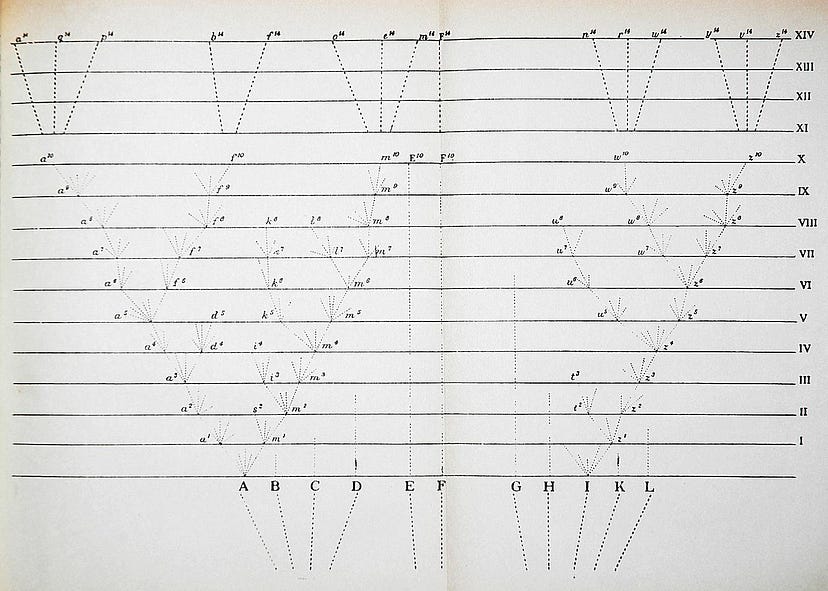
The only diagram or image in The Origin of Species, a tree depicting divergence (source)
Darwin's On the Origin of Species only contains one diagram, a branching tree diagram which shows divergence of species.
-
he was working on the same theme with Stefanie Posavec. They completed their piece some time later, depicting the changes as lovely branching trees — a kind of homage to Darwin’s lone diagram in the book.
Greg McInerny of Microsoft Research and Stefanie Posavek created a version of Darwin's On the Origin of Species that displayed variations between the editions as a branching tree diagram, a nod to the only diagram which appeared in Darwin's original work. .
-
Fifty years ago, coinciding with the centennial of the release of Darwin’s manuscript, author Morse Peckham collected all six editions into a single “variorum” text. Peckham painstakingly created a reference system that denotes the modifications and changes between editions. The text was created by Peckham’s careful enumeration of every sentence from every edition, copied onto index cards; from these cards, he carefully assembled them into a final text.
Tags
- The Structure of Scientific Revolutions
- card index for version control
- paradigm shifts
- tree diagrams
- index cards
- version control
- index cards for outlining
- On the Origin of Species
- Thomas Kuhn
- evolution of knowledge
- card index for writing
- variorum text
- Morse Peckham
- Stefanie Posavek
- Charles Darwin
- evolution
- read
- visualizations
- diagrams
- Greg McInerny
- information visualization
- digital humanities
- publishing
Annotators
URL
-
-
benfry.com benfry.com
-
What a spectacular visualization of Darwin's On the Origin of Species.
Richard Carter will love this if he's not seen it.
-
the phrase “survival of the fittest” — usually considered central to the theory and often attributed to Darwin — instead came from British philosopher Herbert Spencer, and didn't appear until the fifth edition of the text.
-
-
simonwillison.net simonwillison.net
-
Mastodon is just blogs and Google Reader, skinned to look like Twitter.
And this, in part, is just what makes social readers so valuable: a tight(er) integration of a reading and conversational interface.
https://simonwillison.net/2022/Nov/8/mastodon-is-just-blogs/
-
-
developer.twitter.com developer.twitter.com
-
In the guide below, you may see different terms referring to the same thing.
-
-
blog.chain.link blog.chain.link
-
What Is a Blockchain Oracle? A blockchain oracle is a secure piece of middleware that facilitates communication between blockchains and any off-chain system, including data providers, web APIs, enterprise backends, cloud providers, IoT devices, e-signatures, payment systems, other blockchains, and more. Oracles take on several key functions: Listen – monitor the blockchain network to check for any incoming user or smart contract requests for off-chain data. Extract – fetch data from one or multiple external systems such as off-chain APIs hosted on third-party web servers. Format – format data retrieved from external APIs into a blockchain readable format (input) and/or making blockchain data compatible with an external API (output). Validate – generate a cryptographic proof attesting to the performance of an oracle service using any combination of data signing, blockchain transaction signing, TLS signatures, Trusted Execution Environment (TEE) attestations, or zero-knowledge proofs. Compute – perform some type of secure off-chain computation for the smart contract, such as calculating a median from multiple oracle submissions or generating a verifiable random number for a gaming application. Broadcast – sign and broadcast a transaction on the blockchain in order to send data and any corresponding proof on-chain for consumption by the smart contract. Output (optional) – send data to an external system upon the execution of a smart contract, such as relaying payment instructions to a traditional payment network or triggering actions from a cyber-physical system.
Seems related to the paradox of information systems. Add to Anki deck
-
-
www.btcstudy.org www.btcstudy.org比特币网络全景图1
-
顶点代表点对点网络中的节点,边代表两个节点之间的连接。节点类别可以根据节点服务其它节点和客户端的能力进行划分。节点可以充当服务器、客户端,或身兼二职
-
-
meta.stackoverflow.com meta.stackoverflow.com
-
I don't think a new tag makes sense here, at least not yet.
-
Once "Containerfile" starts becoming less of a whisper and more of the topic, then perhaps we can talk about a synonym. But definitely not now.
-
They are 100% identical; just different names. From podman-build: “Builds an image using instructions from one or more Containerfiles or Dockerfiles and a specified build context directory. A Containerfile uses the same syntax as a Dockerfile internally. For this document, a file referred to as a Containerfile can be a file named either ‘Containerfile’ or ‘Dockerfile’.”
-
-
gitlab.com gitlab.com
-
Good commit hygiene is considered a best practice. GitLab should encourage and enable these kinds of best practices. This feature currently creates a problem and requires workarounds that remove information, or significant manual work.
-
-
www.digitalmedievalist.com www.digitalmedievalist.com
-
There’s a printed facsimile of the White Book, (Llyfr Gwyn Rhydderch) one of the two central medieval Welsh manuscripts of the Mabinogi and the other tales, all in Welsh.
-
-
danallosso.substack.com danallosso.substack.com
-
delong.typepad.com delong.typepad.com
-
You cannot followrules you do not know. Nor can you acquire an artistic habitany craft or skill-without following rules. The art as something that can be taught consists of rules to be followed inoperation. The art as something learned and possessed consists of the habit that results from operating according to therules.
This is why one has some broad general rules for keeping and maintaining a zettelkasten. It helps to have some rules to practice and make a habit.
Unmentioned here is that true artists known all the rules and can then more profitably break those rules for expanding and improving upon their own practice. This is dramatically different from what is seen by some of those who want to have a commonplace or zettelkasten practice, but begin without any clear rules. They often begin breaking the rules to their detriment without having the benefit of long practice to see and know the affordances of such systems before going out of their way to break those rules.
By breaking the rules before they've even practiced them, many get confused or lost and quit their practice before they see any of the benefits or affordances of them.
Of course one should have some clear cut end reasons which answer the "why" question for having such practices, or else they'll also lose the motivation to stick with the practice, particularly when they don't see any light at the end of the tunnel. Pure hope may not be enough for most.
-
That is to make notes about the shape of the discussion-the discussion that is engaged in by all of the authors,even if unbeknownst to them. For reasons that will becomeclear in Part Four, we prefer to call such notes dialectical.
Dialectical notes are made at the level of syntopical reading and entail creating a conversation not only between the reader and the author, but create a conversation of questions and answers between and among many texts and the reader.
-
Marking a book is literally an expression of your differences or your agreements with the author. It is the highest respect you can pay him.
-
Reading a book should be a conversation between you andthe author.
-
Knowing what the four questions are is not enough. Youmust remember to ask them as you read.
-
Milton,for example, wrote more or less lengthy headings, or "Arguments," as he called them, for each book of Paradise Lost.
Tags
- four questions of reading
- zettelkasten
- syntopical reading
- knowledge mastery
- dialectical notes
- definitions
- conversations with the text
- history of the book
- habit
- quotes
- arguments
- rules
- questioning authority
- respect
- types of notes
- dialectic
- purpose of reading
- Paradise Lost
- tables of contents
- hope
- subject headings
- conversations between texts
- note taking affordances
- John Milton
- agreement
- Mortimer J. Adler
- practice
- analytical tables of contents
- disagreement
- demanding readers
- breaking the rules
- obligations of the reader
Annotators
URL
-
-
www.openculture.com www.openculture.com
-
billyoppenheimer.com billyoppenheimer.com
-
When I come across interesting information, I highlight then comment a corresponding question:

Every studio has a slate.
What is the source for this?
It's highly related to having a direction in life, or the famous example of Feynman's 12 Favorite Problems that he always kept in mind to slowly be working at.
Part of having a list of purpose dovetails to how one builds their identity too.
-
This reminded me of Robert Greene’s definition of creativity, which is that creativity is a function of putting in lots of tedious work. “If you put a lot of hours into thinking and researching and reading,” Robert says, “hour after hour—a very tedious process—creativity will come to you.”
Robert Green's definition of creativity sounds like it's related to diffuse thinking processes. read: https://billyoppenheimer.com/august-14-2022/
Often note taking, and reviewing over those notes is more explicit in form for creating new ideas.
Come back to explore these.
-
The novelist and screenwriter Raymond Chandler said he avoided reading books written by someone who didn’t “take the pains” to write out the words. (It used to be common for writers to dictate into a recorder then have an assistant transcribe those words.) “You have to have that mechanical resistance,” Chandler wrote in a 1949 letter to actor/writer Alex Barris. “When you have to use your energy to put those words down, you are more apt to make them count.”
Tags
- Robert Greene
- barriers to entry
- direction in life
- project lists
- tools for thought
- definitions
- writing advice
- The Purpose Driven Life
- creativity
- quotes
- barriers to collection
- slates
- entertainment industry
- putting in the work
- purpose
- diffuse thinking
- Raymond Chandler
- activation energy
- Feynman's 12 Favorite Problems
- skin in the game
- identity
- resistance
- combinatorial creativity
Annotators
URL
-
-
-
Doing everything PID 1 needs to do and nothing else. Things like reading environment files, changing users, process supervision are out of scope for Tini (there are other, better tools for those)
-
-
en.wikipedia.org en.wikipedia.org
-
Synchronously waiting for the specific child processes in a (specific) order may leave zombies present longer than the above-mentioned "short period of time"
-
-
dainty-sable-264aa3.netlify.app dainty-sable-264aa3.netlify.app
-
https://dainty-sable-264aa3.netlify.app/project/measuring_thinking_tools.html
Openness should be broken out into smaller subsections to highlight the importance of supporting standards as a primary item by itself. Many of these axes are easier, low-hanging fruit that developers will iterate on anyway. Focusing on the harder and more subtle features like standards is a better way to go for the audience that can really use this now.
Many of these axes are better for a commercial market.
-
-
stackoverflow.com stackoverflow.com
-
But these two questions are interwoven (and you’ll find many answers to the wrong question in the Answers section).
-
-
github.com github.com
-
Sidekiq uses all of the data structures Redis provides: lists, sorted sets, hashes.
-
-
www.npr.org www.npr.org
-
https://www.npr.org/2022/10/27/1131936089/rudolph-red-nosed-reindeer-jules-bass-frosty-snowman
-
He earned the nickname "The Killer" — not for his music or wild life, but because that's what he called everybody else when he couldn't remember their names. So that's what they called him.
-
his 1964 album Live At The Star-Club Hamburg, recorded by the Dutch label Philips as part of a series of live recordings from the German venue, and about which Rolling Stone Magazine later raved, "It's not an album, it's a crime scene ... with no survivors but The Killer."
what a great review...
-
Lewis made it through a just a few tour dates before succumbing to the press and public's censure, and retreated back to the U.S. That doesn't mean that he was ever publicly regretful. His marriage to Myra lasted a decade
-
I just loved the blues. It was the real thing. I kinda always figured I was the real thing too."
Tags
- The Hobbit
- Animagic
- 2022-10-25
- sobriquets
- public shaming
- the blues
- cancel culture
- quotes
- stop motion animation
- analogies
- Myra Lewis
- Rankin/Bass Productions
- animation
- beyond the pale
- Jerry Lee Lewis
- Frosty the Snowman
- Rudolph the Red-Nosed Reindeer
- 1964
- obituaries
- read
- Santa Claus is Comin' To Town
- Rolling Stone Magazine
- Jules Bass
- Live At The Star-Club Hamburg
- The Killer
- child bride
Annotators
URL
-
- Oct 2022
-
-
In his essay ‘On Intellectual Craftsmanship’, appended to his The Sociological Imagination (1959), C. Wright Mills reassuringly remarks that ‘the way in which these categories change, some being dropped and others being added, is an index of your intellectual progress ... As you rearrange a filing system, you often find that you are, as it were, loosening your imagination.’
One's notes are an index of their intellectual progress. In sorting through and re-arranging them one "loosens their imagination".
-
-
soundcloud.com soundcloud.com
-
www.discogs.com www.discogs.com
-
-
And yeah, you two should probably gang up :)
-
what is the difference? and why do you write it from scratch?
-
-
www.explainpaper.com www.explainpaper.com
-
Another in a growing line of research tools for processing and making sense of research literature including Research Rabbit, Connected Papers, Semantic Scholar, etc.
Functionality includes the ability to highlight sections of research papers with natural language processing to explain what those sections mean. There's also a "chat" that allows you to ask questions about the paper which will attempt to return reasonable answers, which is an artificial intelligence sort of means of having an artificial "conversation with the text".
cc: @dwhly @remikalir @jeremydean
-
-
twitter.com twitter.com
-
One of W.G. Sebald’s masterpieces, The Rings of Saturn, an indescribable blend of fact and fiction, contains a section about one of his academic colleagues whose office was piled high with notes about Gustav Flaubert.
https://twitter.com/friendsofdarwin/status/1584936047929982976
-
-
www.reddit.com www.reddit.com
-
Zettelkasten in the office of Clement Atlee, former Prime Minister of UK, in The Crown S1E4 "Act of God" (Netflix, 2016)

-
-
ricksfreeautorepairadvice.com ricksfreeautorepairadvice.com
-
Your alternator is NOT a chargerThe alternator’s job is to supply the power needed for all electrical items on the vehicle, plus replenish the battery from the last start up. The alternator is not a battery charger so much as it is a battery maintainer. If the alternator has to recharge an overly discharged battery, the alternator will become over-worked, which will shorten its life.If you use your alternator to charge your dead battery, you will overheat the alternator during its charging process. The greater the amperage flowing through it, the higher the heat an alternator creates.Maximum Alternator Output Only Occurs at high RPMSAfter you start your car with jumper cables, the voltage regulator sees a discharged battery and commands maximum field in the rotor. But at 600 RPM, the alternator can only provide about 1/4th of its rated output. Let it idle for a long period and all you’ll do it overheat the rotor windings and burn up your expensive alternator. A 110-amp alternator can only output 110-amps at RPMS of 2,500 or more. So don’t even think about letting it idle to recharge the battery.A battery charger costs $40. A new Alternator $350Not exactly brain surgery, is it?The correct way to deal with this situation is to jump the battery (using a jumper pack is much safer than jumper cables) and driving it to a place where you can place a REAL battery charger on the battery.
Is this outdated info?
According to https://hyp.is/n7ZQpFF0Ee24ZbcIYA3xVQ/www.reddit.com/r/Cartalk/comments/aoks7b/how_much_idling_needed_after_jump_start_to/ it is. Which advice should we trust?
-
-
www.reddit.com www.reddit.com
-
This was much more of an issue a generation ago, when your ‘74 Chevy Nova or ‘69 Ford F-100 had a 35 amp alternator. Any car made in the last 15-20 years will have a 75 amp alternator as a bare minimum, and ratings well north of 100 amps are common in larger vehicles.There’s dozens of amps of headroom to charge the battery at idle speed, especially if you turn off the lights, stereo, HVAC, etc. That said, it’ll charge even more quickly if you drive the car.
This seems like more sound/trustworthy advice than the replied-to's advice/info.
-
This will KILL your alternator. You should get a battery charger or a trickle charger. Alternators go through hell when trying to recharge a fully depleted battery.
-
-
gamefound.com gamefound.com
-
After the first week of the campaign, we realized what are the main problematic pillars and fixed them right away. Nevertheless, even with these improvements and strong support from the Gamefound team, we’re not even close to achieving the backer numbers with which we could safely promise to create a game of the quality we think it deserves.
-
First and foremost, we need to acknowledge that even though the funding goal has been met–it does not meet the realistic costs of the project. Bluntly speaking, we did not have the confidence to showcase the real goal of ~1.5 million euros (which would be around 10k backers) in a crowdfunding world where “Funded in XY minutes!” is a regular highlight.
new tag: pressure to understate the real cost/estimate
-
-
www.npr.org www.npr.org
-
Perhaps in addition to reparations, we should be taking a closer look at poverty in general. We need to raise up the poorest among us. This will ease the political issue of whites who feel like they're being (unfairly) left behind. It should be a multi-racial effort.
We need to have a second Resonstruction.
-
-
teachingamericanhistory.org teachingamericanhistory.org
-
To meet our domestic emergencies in credit and banking arising from the reaction to acute crisis abroad the National Credit Association was set up by the banks with resources of $500,000,000 to support sound banks against the frightened withdrawals and hoarding. It is giving aid to reopen solvent banks which have been closed. Federal officials have brought about many beneficial unions of banks and have employed other means which have prevented many bank closings. As a result of these measures the hoarding withdrawals which had risen to over $250,000,000 per week after the British crisis have substantially ceased.
Hoover provided support for the banks in crisis, trying to stabalize the withdraws and panic
-
The emergencies of unemployment have been met by action in many directions. The appropriations for the continued speeding up of the great Federal construction program have provided direct and indirect aid to employment upon a large scale.
But not enough aid
-
There has been the least possible Government entry into the economic field, and that only in temporary and emergency form.
He's trying to limit the amount of federal control and only trying to promote the help of state and local government.
-
These measures have served those purposes and will promote recovery.
Hoover didn't really DO anything; FDR was the one who made sure everything was in order, all the groups and laws he made. Hoover on the other hand, didn't. He just provided for some public work projects and helped a little, but definitely not as much as FDR. He should've done more.
-
But of highest importance was the necessity of cooperation on our part to relieve the people of Germany from imminent disasters and to maintain their important relations to progress and stability in the world.
Why was Hoover so stuck on helping Germany? Yes, it is the right thing to do, and to support Germany as it struggles, but our country was facing an economic panic; why help others with resources we desperately need ourselves?
-
As our difficulties during the past year have plainly originated in large degree from these sources,
I find it odd how Hoover is blaming almost everything on other countries instead of taking accountability and doing something about it. He's using a victim perspective instead of fixing it.
-
-
Local file Local file
-
Sayers, Dorothy L. The Lost Tools of Learning. E. T. Heron, 1948.
-
Trivium adapts itself with a singularappropriateness to these three ages: Grammar to the Poll-parrot, Dialectic tothe Pert, and Rhetoric to the Poetic Age.
-
-
github.com github.com
-
<span class="dot"></span> <!--how can i center these dots and turn the one red? (in css of course)-->
Delete your button , replace it with an anchor within a div like
div a class = 'watch' href = https://www.youtube.com/watch?v=6u1Ps6ZlDxA> Watch Video /a-/div----------------------------------------------then place the span next then put a closing div to close out the div with class group!
then we gotta work some css magic which i will show you on css side!
-
class="dot"
apply id="dot" instead of class
-
-
github.com github.com
-
.dot { height: 10px; width: 10px; background-color: aqua; border-radius: 50%; display:inline-block; text-align: center; /*can anyone help me understand why these dots wont center? */ margin-bottom: 10px;
Change .dot margin-bottom:10px; to margin-top:20px;---------then copy and paste it and make one an id named dot
-
}
Make a class named watch----------------------------------- .watch{ background-color:aqua; padding:1.5px; font-size:1.2rem; }
-
-
-
Rousseau’sheretical view was that anything which was outside children’s experience wouldbe meaningless to them, much as Plato, Comenius, and others had warned. Hisinsights had condensed principally out of the prevailing intellectual atmosphereat the time—empiricism, explicated by philosophers such as John Locke. We’lllook at Locke and Rousseau in more detail in Chapter 2.
Just as the ideas of liberty and freedom were gifted to us by Indigenous North Americans as is shown by Graeber and Wengrow in The Dawn of Everything, is it possible that the same sorts of ideas but within the educational sphere were being transmitted by Indigenous intellectuals to Europe in the same way? Is Rousseau's 18th century book Emile, or On Education of this sort?
What other sorts of philosophies invaded Western thought at this time?
-
‘Now, all this study of reckoning and geometry...must be presented to them while still young, not inthe form of compulsory instruction.’ ‘Why so?’ ‘Because,’ said I, ‘a free soul ought not to pursueany study slavishly; for while bodily labours performed under constraint do not harm the body,nothing that is learned under compulsion stays with the mind.’ ‘True,’ he said. ‘Do not, then, myfriend, keep children to their studies by compulsion but by play.’The Republic, 536d–e; 537a
Apparently one couldn't ever force children to learn anything...
-
-
Local file Local file
-
Regarding his work on the sciences, Blumenberg did not facilitate hisreception within the Anglophone tradition by engaging much with it. Hemay have initiated the translation of The Structure of Scientific Revolutionsinto German,
Hans Blumenberg didn't engage much with the Anglophone world of science outside of initiating the translation of Thomas Kuhn's The Structure of Scientific Revolutions into German.
-
-
www.loom.com www.loom.com
-
For her online book clubs, Maggie Delano defines four broad types of notes as a template for users to have a common language: - terms - propositions (arguments, claims) - questions - sources (references which support the above three types)
I'm fairly sure in a separate context, I've heard that these were broadly lifted from her reading of Mortimer J. Adler's How to Read a book. (reference? an early session of Dan Allosso's Obsidian Book club?)
These become the backbone of breaking down a book and using them to have a conversation with the author.
-
-
forums.zotero.org forums.zotero.org
-
However, most of the sites featured on Omeka's Showcase and Blog only feature a small number of publications for the purpose of a more focused exhibition, rather than large bibliographies.
focused exhibition through small ... i don't get it....
-
-
delong.typepad.com delong.typepad.com
-
This effort, which Americans have supported almostfrom the beginning of the national existence and which is oneof the cornerstones of our democratic way of life, has hadremarkable results.
Read in juxtaposition with the knowledge of orality and along with Graeber & Wengrow's The Dawn of Everything, one could certainly argue that there are other ways of knowing which provide potentially better pathways to democracy.
Further, the simple fact of basic literacy doesn't necessarily encourage democracy. Take a look at the January 6th (2021) insurrectionists who were likely broadly literate, but who acted more like a damaged oral society and actively subverted democracy.
Literacy plus "other things" are certainly necessary for democracy. How do we define these other things, and then once we have, is literacy still part of the equation for democracy?
-
-
www.reddit.com www.reddit.com
-
Underlining Keyterms and Index Bloat .t3_y1akec._2FCtq-QzlfuN-SwVMUZMM3 { --postTitle-VisitedLinkColor: #9b9b9b; --postTitleLink-VisitedLinkColor: #9b9b9b; --postBodyLink-VisitedLinkColor: #989898; }
Hello u/sscheper,
Let me start by thanking you for introducing me to Zettelkasten. I have been writing notes for a week now and it's great that I'm able to retain more info and relate pieces of knowledge better through this method.
I recently came to notice that there is redundancy in my index entries.
I have two entries for Number Line. I have two branches in my Math category that deals with arithmetic, and so far I have "Addition" and "Subtraction". In those two branches I talk about visualizing ways of doing that, and both of those make use of and underline the term Number Line. So now the two entries in my index are "Number Line (Under Addition)" and "Number Line (Under Subtraction)". In those notes I elaborate how exactly each operation is done on a number line and the insights that can be derived from it. If this continues, I will have Number Line entries for "Multiplication" and "Division". I will also have to point to these entries if I want to link a main note for "Number Line".
Is this alright? Am I underlining appropriately? When do I not underline keyterms? I know that I do these to increase my chances of relating to those notes when I get to reach the concept of Number Lines as I go through the index but I feel like I'm overdoing it, and it's probably bloating it.
I get "Communication (under Info. Theory): '4212/1'" in the beginning because that is one aspect of Communication itself. But for something like the number line, it's very closely associated with arithmetic operations, and maybe I need to rethink how I populate my index.
Presuming, since you're here, that you're creating a more Luhmann-esque inspired zettelkasten as opposed to the commonplace book (and usually more heavily indexed) inspired version, here are some things to think about:<br /> - Aren't your various versions of number line card behind each other or at least very near each other within your system to begin with? (And if not, why not?) If they are, then you can get away with indexing only one and know that the others will automatically be nearby in the tree. <br /> - Rather than indexing each, why not cross-index the cards themselves (if they happen to be far away from each other) so that the link to Number Line (Subtraction) appears on Number Line (Addition) and vice-versa? As long as you can find one, you'll be able to find them all, if necessary.
If you look at Luhmann's online example index, you'll see that each index term only has one or two cross references, in part because future/new ideas close to the first one will naturally be installed close to the first instance. You won't find thousands of index entries in his system for things like "sociology" or "systems theory" because there would be so many that the index term would be useless. Instead, over time, he built huge blocks of cards on these topics and was thus able to focus more on the narrow/niche topics, which is usually where you're going to be doing most of your direct (and interesting) work.
Your case sounds, and I see it with many, is that your thinking process is going from the bottom up, but that you're attempting to wedge it into a top down process and create an artificial hierarchy based on it. Resist this urge. Approaching things after-the-fact, we might place information theory as a sub-category of mathematics with overlaps in physics, engineering, computer science, and even the humanities in areas like sociology, psychology, and anthropology, but where you put your work on it may depend on your approach. If you're a physicist, you'll center it within your physics work and then branch out from there. You'd then have some of the psychology related parts of information theory and communications branching off of your physics work, but who cares if it's there and not in a dramatically separate section with the top level labeled humanities? It's all interdisciplinary anyway, so don't worry and place things closest in your system to where you think they fit for you and your work. If you had five different people studying information theory who were respectively a physicist, a mathematician, a computer scientist, an engineer, and an anthropologist, they could ostensibly have all the same material on their cards, but the branching structures and locations of them all would be dramatically different and unique, if nothing else based on the time ordered way in which they came across all the distinct pieces. This is fine. You're building this for yourself, not for a mass public that will be using the Dewey Decimal System to track it all down—researchers and librarians can do that on behalf of your estate. (Of course, if you're a musician, it bears noting that you'd be totally fine building your information theory section within the area of "bands" as a subsection on "The Bandwagon". 😁)
If you overthink things and attempt to keep them too separate in their own prefigured categorical bins, you might, for example, have "chocolate" filed historically under the Olmec and might have "peanut butter" filed with Marcellus Gilmore Edson under chemistry or pharmacy. If you're a professional pastry chef this could be devastating as it will be much harder for the true "foodie" in your zettelkasten to creatively and more serendipitously link the two together to make peanut butter cups, something which may have otherwise fallen out much more quickly and easily if you'd taken a multi-disciplinary (bottom up) and certainly more natural approach to begin with. (Apologies for the length and potential overreach on your context here, but my two line response expanded because of other lines of thought I've been working on, and it was just easier for me to continue on writing while I had the "muse". Rather than edit it back down, I'll leave it as it may be of potential use to others coming with no context at all. In other words, consider most of this response a selfish one for me and my own slip box than as responsive to the OP.)
Tags
- zettelkasten
- multi-disciplinary research
- indices
- Niklas Luhmann's zettelkasten
- hierarchies
- Universal Decimal Classification
- information theory
- commonplace books vs. zettelkasten
- Dewey Decimal System
- Claude Shannon
- examples
- The Bandwagon
- Niklas Luhmann's index
- bottom-up vs. top-down
- reply
Annotators
URL
-
-
unix.stackexchange.com unix.stackexchange.com
-
Simply don't use aliases in scripts. It makes little sense to use a feature designed for interactive use in scripts. Instead, use functions
-
-
cosma.graphlab.fr cosma.graphlab.frAccueil1
-
https://cosma.graphlab.fr/<br /> https://cosma.graphlab.fr/en/
When did this come out?
Appears to be a visualization tool for knowledge work. They recommend it for use with Zettlr, but it looks like it would work with other text based tools. Point it at markdown files to create graphs apparently.
This looks like the sort of standards based tool that would allow greater flexibility when using various data stores that we talk about in Friends of the Link.
<small><cite class='h-cite via'>ᔥ <span class='p-author h-card'>Arthur Perret </span> in And you, what are you doing? (<time class='dt-published'>08/31/2022 02:40:03</time>)</cite></small>
@flancian
-
-
www.greyroom.org www.greyroom.org
-
http://www.greyroom.org/issues/60/20/the-dialectic-of-the-university-his-masters-voice/
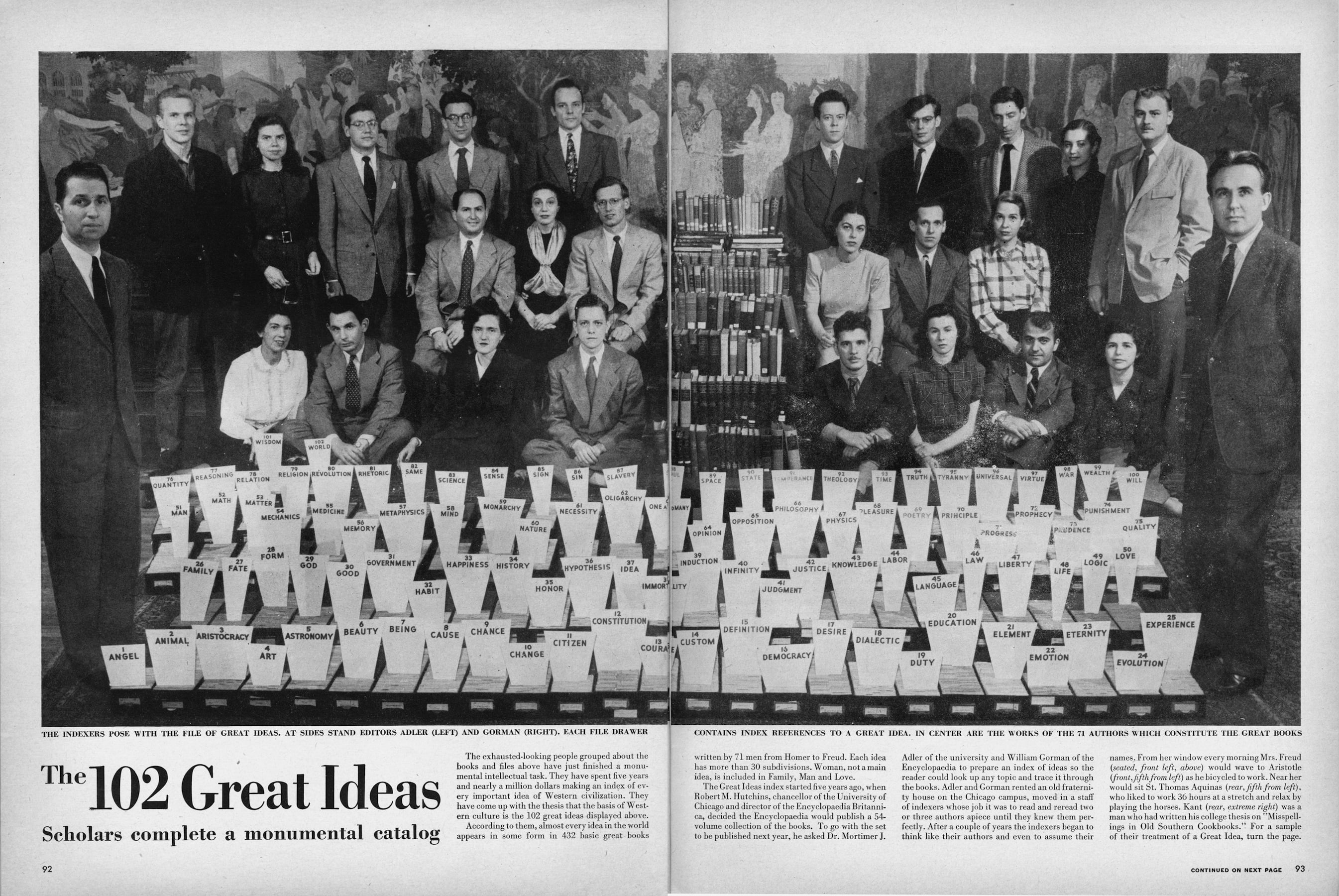 “The Indexers pose with the file of Great Ideas. At sides stand editors [Mortimer] Adler (left) and [William] Gorman (right). Each file drawer contains index references to a Great Idea. In center are the works of the 71 authors which constitute the Great Books.” From “The 102 Great Ideas: Scholars Complete a Monumental Catalog,” Life 24, no. 4 (26 January 1948). Photo: George Skadding.
-
-
kathleenmccook.substack.com kathleenmccook.substack.com
-
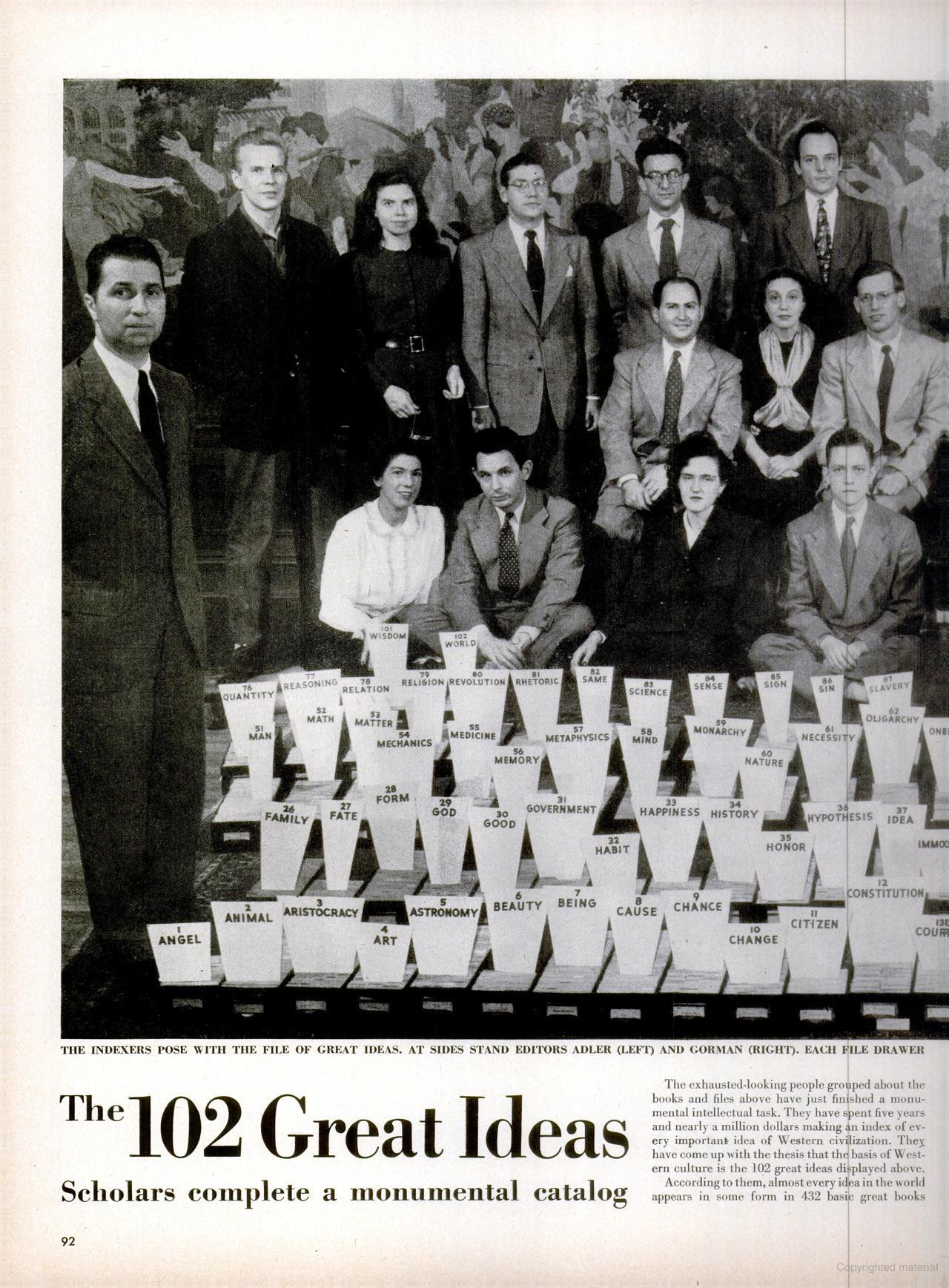
Photos from
"The 102 Great Ideas: Scholars Complete a Monumental Catalog," Life, 26 January 1948, 92–3.

-
-
Local file Local file
-
It was Ranke, too, who set the historian’s task: to find out wie eseigentlich gewesen ist, what really happened, or, literally, how itreally was. His goal is one that will remain forever just beyond ourgrasp for reasons I explained in a “Note on Sources” in The Guns ofAugust (a paragraph that no one ever reads but I think is the bestthing in the book). Summarized, the reasons are that we who writeabout the past were not there. We can never be certain that we haverecaptured it as it really was. But the least we can do is to stay withinthe evidence.
-
-
Local file Local file
-
The final lecture of the course considers Christianity as “the ever-adapting religion,” asking what elements remain constant within allits historical changes.
Religions are ever-evolving ideas and practices, and like rivers, which are broadly similar and recognizable even over spans of time, can never be practiced or experienced the same way twice.
-
this course considers at the very end the question of the essence of thereligion: Through all this change, does anything remain constant?
Religion co-evolves with the people, places, and times in which it exists. Much like human genes, it works at the level of the individual, the local group, the larger groups and communities (of both the religion itself as well as the polities around it), and when applicable at the scale of all people on the planet.
The Selfish Religion: How far might we take this religion/gene analogy with respect to Richard Dawkins' thesis (1976). Does religion act more like a gene that is part of the particular person or is it more like a virus which inserts itself? The latter may be closer as one can pick and choose a religion rather than it being a core part of their genetic identity.
(highlight: anchor only)
-
Johnson, Luke Timothy. The History of Christianity: From the Disciples to the Dawn of the Reformation. The Teaching Company, 2012, https://www.thegreatcourses.com/courses/the-history-of-christianity-from-the-disciples-to-the-dawn-of-the-reformation
-
-
www.rollingstone.com www.rollingstone.com
-
Marvin Gaye has a brief six-page file, which details an incident that followed him not being paid for a concert. Jimi Hendrix has a file including documents related to a pot bust in Canada. Mariam Makeba, an anti-apartheid activist who was married to Stokely Carmichael, has a 292-page file which details the couple’s every move, including buying new home appliances.
-
-
archive.org archive.org
-
As is common in the tradition of the zettelkasten, Goutor advises "that each note-card should contain only one item of information, whether a quotation, a summary, or anything else". (p28) He ascribes this requirement to his earlier need for clarity. (cross reference: https://hypothes.is/a/SfWFwENIEe2KfGMbR5n7Qg)
He indicates that while it may seem wasteful to have only one item on each card that the savings in time, efficiency in handling, classification, and retrieval will more than compensate for the small waste.
This sort of small local waste being compensated for by a larger global savings and efficiency can be seen in the design of the shipping container industry as discussed in Mark Levinson's The Box (Princeton University Press, 2008). Was this the exact sort of efficiency mentioned by Ahrens'? (Compare at https://hypothes.is/a/t4i32IXoEeyF2n9jQxu6BA)
-
-
Local file Local file
-
here are several ways I havefound useful to invite the sociological imagination:
C. Wright Mills delineates a rough definition of "sociological imagination" which could be thought of as a framework within tools for thought: 1. Combinatorial creativity<br /> 2. Diffuse thinking, flâneur<br /> 3. Changing perspective (how would x see this?) Writing dialogues is a useful method to accomplish this. (He doesn't state it, but acting as a devil's advocate is a useful technique here as well.)<br /> 4. Collecting and lay out all the multiple viewpoints and arguments on a topic. (This might presume the method of devil's advocate I mentioned above 😀)<br /> 5. Play and exploration with words and terms<br /> 6. Watching levels of generality and breaking things down into smaller constituent parts or building blocks. (This also might benefit of abstracting ideas from one space to another.)<br /> 7. Categorization or casting ideas into types 8. Cross-tabulating and creation of charts, tables, and diagrams or other visualizations 9. Comparative cases and examples - finding examples of an idea in other contexts and time settings for comparison and contrast 10. Extreme types and opposites (or polar types) - coming up with the most extreme examples of comparative cases or opposites of one's idea. (cross reference: Compass Points https://hypothes.is/a/Di4hzvftEeyY9EOsxaOg7w and thinking routines). This includes creating dimensions of study on an object - what axes define it? What indices can one find data or statistics on? 11. Create historical depth - examples may be limited in number, so what might exist in the historical record to provide depth.
-
certainly surrounding oneself with acircle of people who will listen and t a l k - - a n d at times theyhave to be imaginary characters--is one of them
Intellectual work requires "surfaces" to work against, almost as an exact analogy to substrates in chemistry which help to catalyze reactions. The surfaces may include: - articles, books, or other writing against which one can think and write - colleagues, friends, family, other thinkers, or even imaginary characters (as suggested by C. Wright Mills) - one's past self as instantiated by their (imperfect) memory or by their notes about excerpted ideas or their own thoughts
Are there any other surfaces we're missing?
-
Merely to name an item of experience often invitesus to explain it; the mere taking of a note from a book isoften a prod to reflection.
Tags
- building blocks
- dimensions
- conversations with the text
- definitions
- The Sociological Imagination
- trend analysis
- opposites
- academic writing
- categorization
- knowledge work
- inspiration
- browsing
- historical perspective
- card index for writing
- flâneur
- generalization
- active reading
- diffuse thinking
- conversations
- conversations between texts
- historical context
- abstraction
- devil's advocate
- intellectual surfaces
- information visualization
- compass points
- thinking routines
- terms
- examples
- taxonomies
- dialogues
- combinatorial creativity
- sociological imagination
Annotators
-
- Sep 2022
-
-
Poverty spells triggered by moving out of one’s parents’ house tend to bethe shortest, while spells triggered by the birth of a child tend to be the longest.
-
One reason for this is that poverty is not something that people wish to ac-knowledge or draw attention to. Rather, it is something that individuals andfamilies would like to go away. As a result, many Americans attempt to concealtheir economic difficulties as much as possible.22 This often involves keeping upappearances and trying to maintain a “normal” lifestyle. Such poverty downthe block may at first appear invisible. Nevertheless, the reach of poverty iswidespread, touching nearly all communities across America.
Middle Americans, and particularly those in suburbia and rural parts of America that account for the majority of poverty in the country, tend to make their poverty invisible because of the toxic effects of extreme capitalism and keeping up appearances.
Has this effect risen with the rise of social media platforms like Instagram and the idea of "living one's best life"? How about the social effects of television with shows like "Keeping up with the Kardashians" which encourage conspicuous consumption?
More interesting is the fact that most of these suburban and rural poverty stricken portions of the country are in predominantly Republican held strongholds.
Is there a feedback mechanism that is not only hollowing these areas out, but keeping them in poverty?
-
Or, take the case of unemployment as described by sociologist C. WrightMills:When, in a city of 100,000, only one man is unemployed, that is his per-sonal trouble, and for its relief we properly look to the character of theman, his skills, and his immediate opportunities. But when in a nation of50 million employees, 15 million men are unemployed, that is an issue, and
we may not hope to find its solution within the range of opportunities open to any one individual. The very structure of opportunities has collapsed. Both the correct statement of the problem and the range of possible solutions require us to consider the economic and political institutions of the society, and not merely the personal situation and character of a scatter of individuals.16
- C. Wright Mills, The Sociological Imagination (New York: Oxford University Press, 1959), p. 9.
I love this quote and it's interesting food for thought.
Framing problems from the perspectives of a single individual versus a majority of people can be a powerful tool.
The idea of the "welfare queen" was possibly too powerful because it singled out an imaginary individual rather than focusing on millions of people with a variety of backgrounds and diversity. Compare this with the fundraisers for impoverished children in Sally Stuther's Christian Children's Fund (aka ChildFund) which, while they show thousands of people in trouble, quite often focus on one individual child. This helps to personalize the plea and the charity actually assigned each donor a particular child they were helping out.
How might this set up be used in reverse to change the perspective and opinions of those who think the "welfare queen" is a real thing instead of a problematic trope?
-
three-fourths of Americans will encounterpoverty or near- poverty (150 percent below the official poverty line).4
Open question:<br /> Why is the word "below" used with numbers like "150 percent below the poverty line" when in fact this number indicates near, but above, poverty based on my reading?
-
The underlying theme tyingthese myths together is that poverty is often perceived to be an issue of“them” rather than an issue of “us”—that those who experience povertyare viewed as strangers to mainstream America, falling outside accept-able behavior, and as such, are to be scorned and stigmatized.
One of the underlying commonalities about the various myths of poverty is that we tend to "other" those that it effects. The "them" we stigmatize with the ills of poverty really look more like "us", and in fact, they are.
Rather than victim shame and blame those in poverty, we ought to spend more of our time fixing the underlying disease instead of spending the time, effort, energy, and money on attempting to remedy the symptoms (eg. excessive policing, et al.) Not only is it more beneficial, but cheaper in the long run.
Related:<br /> Gladwell, Malcolm. “Million-Dollar Murray.” The New Yorker, February 5, 2006. https://www.newyorker.com/magazine/2006/02/13/million-dollar-murray (.pdf copy available at https://housingmatterssc.org/million-dollar-murray/)
-
Theidealized image of American society is one of abundant opportunities, withhard work being rewarded by economic prosperity. Consequently, those whofail to get ahead have only themselves to blame according to this argument. Itis within this context that America thinks of itself as a fair and meritocraticsociety in which people get what they deserve in life.
There is a variety of confounding myths in America which tend to hold us down. These include economic mobility, meritocracy, poverty, and the land of opportunity.
With respect to the "land of opportunity", does positive press of a small number of cases from an earlier generation outweigh the actual experience of the majority?
There was a study on The Blitz in London and England in general in World War II which showed that despite high losses in general, enough people knew one or more who'd lost someone or something to the extreme but that the losses weren't debilitating from a loss perspective and generally served to boost overall morale. Higher losses may have been more demoralizing and harmful, but didn't happen. (Find this source: possibly Malcolm Gladwell??)
Is this sort of psychological effect at play socially and politically in America and thereby confounding our progress?
Tags
- ChildFund
- keeping up with the Jonses
- middle America
- rural poverty
- The Sociological Imagination
- American exceptionalism
- The Blitz
- invisible poverty
- descending into the particular
- welfare
- welfare queen
- politics
- poverty
- land of opportunity
- individuals vs. groups
- C. Wright Mills
- open questions
- poverty spells
- conspicuous consumption
- keeping up appearances
- childbirth poverty
- suburbs
- definitions
- Republican party
- Million-Dollar Murray
- toxic capitalism
- myths of poverty
- below the poverty line
- myth of meritocracy
- treating the symptoms and not the disease
- economics
- sociology
- economic mobility
- Christian Children's Fund
- Sally Struthers
- othering
- leaving the nest
Annotators
-
-
moodle.davidson.edu moodle.davidson.edu
-
On Intellectual Craftsmanship
Appendix to The Sociological Imagination (1959, 2000).
A 1952 draft was published as a stand alone journal article in 1980. https://link.springer.com/article/10.1007/BF02700062
-
Mills, C. Wright. The Sociological Imagination. 40th anniversary edition. Oxford University Press, 2000.
-
-
blog.mozilla.org blog.mozilla.org
-
“Internationalization is the design and development of a product, application or document content that enables easy localization for target audiences that vary in culture, region, or language. Localization refers to the adaptation of a product, application or document content to meet the language, cultural and other requirements of a specific target market (a locale).”
-
-
douglasorr.github.io douglasorr.github.io
-
First, to clarify - what is "code", what is "data"? In this article, when I say "code", I mean something a human has written, that will be read by a machine (another program or hardware). When I say "data", I mean something a machine has written, that may be read by a machine, a human, or both. Therefore, a configuration file where you set logging.level = DEBUG is code, while virtual machine instructions emitted by a compiler are data. Of course, code is data, but I think this over-simplified view (humans write code, machines write data) will serve us best for now...
-
-
metalblueberry.github.io metalblueberry.github.io
-
Also, the chances of breaking something are really high, because not even you remember how the code actually works.
-
it quickly becomes a mess of non related functions that anyone but the owner feels brave enough to import
-
Code explains what and how Documentation explains why.
Tags
- unintentionally breaking something
- easy to forget
- brave
- maintenance burden
- unrelated
- source code: comments: explain why, not what or how
- +1.0
- as the author/creator…
- misc./utility package
- answer the "why?"
- annotation meta: may need new tag
- only the creator could truly love
- maintainability
- fear of breaking things
- documentation: good
Annotators
URL
-
-
github.com github.com
-
in my personal opinion, there shouldn't be a special treatment of do-end blocks in general. I believe that anything that starts a "block", i.e. something that is terminated by and end, should have the same indentation logic
-
-
docs.openvalidation.io docs.openvalidation.io
-
The rules recorded in natural language are readable not only by humans but also by the computer and therefore no longer need to be programmed by a software developer. This task is now taken over by openVALIDATION.
-
-
Local file Local file
-
The problem is that if one player finds a way to undermine orcircumvent the rules and gets away with it then the others have no choicebut to follow. If they don’t they’ll lose out.
!- for : race to the bottom !- for : conformity bias - spiraling destructive entrainment
-
Fail to stay competitive and you will lose out in ‘the global race’.9And the threat works. Competition and competitiveness have becomeas unquestionable in the modern world as God, His angels and the Devilwere in the medieval. Fear of damnation in the future is ubiquitous. Todaygovernment leaders universally see it as their duty to pursue their nation’sinternational competiveness as unrelentingly as the defence of the realmand far more enthusiastically than regulating business or collecting taxes.But if competition is really so beneficial, why do global problems seemto be getting worse rather than better? If the markets in which we’re allembedded are competitions, and if competition only produces benefits, asneoliberal ideology insists, you’d have thought that its ‘staggering powerto make things better’ would, by now, have caused many of our problemsto disappear.Clearly, something doesn’t quite stack up.
!- relationship : competition and fear of the other - the other is unknown but is in competition with you - everyone is driven by the same fear of the other
-
tighter regulations and highercorporate taxes increase costs and make firms and nations less competitive.
!- tragedy of the commons : DSG example - A Deep Humanity analysis can add insight to unpack the problem - When I read this sentence, it triggers the following words to emerge from my salience landscape: - self / other dualism - different levels of othering - at each level, the self is competing to maximize sales - the other is alien, nebulous, unknown and this helps reinforce competition and not caring for the other, dominating the other - in ALL cases, each self-centered business entity views regulations as reducing competitive price advantage - this view is myopic because it does not consider the bigger picture of how the production is impacting nature and people - the normal view is habitually NOT a circular WEconomy view - manufacturing products that create environmental externalities present in the manufacturing process, in its usage and end of life is based on an assumption of negligible impact on nature. Total net impacts were far from planetary boundaries. - however, due to the exponential increase in the scale of production due to population pressures, this assumption has become obsolete a long time ago - Producers of products that continue environmental damage are enabled by current policies so will not change on their own because they all need the short term benefits the jobs provide - as an example, the fossil fuel industry and its millions of direct employees are knowingly destroying the life support system of the planet - when externalization exists, it is a policy reflecting collective disconnection from nature because it we are deeply connected to nature and externalization on this scale destroys our life support system - regulations are constraints that are needed for our own good. Instead of seeing it as anti-competition, the bigger picture is that it is pro-civilization - when each business looks out for itself for its own wellbeing and competing against others within an externalizing economic system, a tragedy of the commons occurs
-
-
developer.mozilla.org developer.mozilla.org
-
Warning: The client should not repeat this request without modification.
-
-
docs.google.com docs.google.com
-
I took along my son, who had never had any fresh water up his nose and who had seen lily pads only from train windows. On the journey over to the lake I began to wonder what it would be like. I wondered how time would have marred this unique, this holy spot--the coves and streams, the hills that the sun set behind, the camps and the paths behind the camps. I was sure that the tarred road would have found it out and I wondered in what other ways it would be desolated. It is strange how much you can remember about places like that once you allow your mind to return into the grooves which lead back. You remember one thing, and that suddenly reminds you of another thing. I guess I remembered clearest of all the early mornings, when the lake was cool and motionless, remembered how the bedroom smelled of the lumber it was made of and of the wet woods whose scent entered through the screen. The partitions in the camp were thin and did not extend clear to the top of the rooms, and as I was always the first up I would dress softly so as not to wake the others, and sneak out into the sweet outdoors and start out in the canoe, keeping close along the shore in the long shadows of the pines. I remembered being very careful never to rub my paddle against the gunwale for fear of disturbing the stillness of the cathedral.
-
-
designopendata.wordpress.com designopendata.wordpress.com
-
Above all, a fresh and original intellectual approach is needed, avoid-ing all standard solutions.
This relates to the increasing difficulty of being originial with the rapid advances in productivity today.
-
A striving for order can, and must, also be expressed inasymmetrical form.
This relates to sticking to past foundations that are somewhat indispensable.
-
Thetypographer must take the greatest care to study how his work is read andought to be read.
Today, this is foundational since there are constantly advances in works of typography making documentation and research important to giving future credit.
-
Evenin good central-axis composition the contents are subordinated to “beautifulline arrangement.”
Clarity becomes less important due the focus on the composition being centralized as it relates to improving the visual appeal of the artistic, "arrangement."
-
the rigidity of central-axis setting hardly allows work tobe carried out with the degree of logic we now demand.
The central axis in art relates to a somewhat balanced distribution of space on an art piece.
“ARTTALK Chapter 10 Balance - Ppt Google Img.” SlidePlayer, https://slideplayer.com/slide/10709291/.
-
This utmost clarity is necessarytoday because of the manifold claims for our attention made by the extraor-dinary amount of print, which demands the greatest economy of expression.
This emphasizes that having clear communication is made crucially important due to the difficulty of communicating to those who are surrounded by countless other "prints."
-
-
www.billboard.com www.billboard.com
-
json-schema.org json-schema.org
-
A workaround you can use is to move additionalProperties to the extending schema and redeclare the properties from the extended schema.
-
Because additionalProperties only recognizes properties declared in the same subschema, it considers anything other than “street_address”, “city”, and “state” to be additional. Combining the schemas with allOf doesn’t change that.
-
It’s important to note that additionalProperties only recognizes properties declared in the same subschema as itself. So, additionalProperties can restrict you from “extending” a schema using Schema Composition keywords such as allOf. In the following example, we can see how the additionalProperties can cause attempts to extend the address schema example to fail.
-
-
stackoverflow.com stackoverflow.com
-
In your scenario, which many, many people encounter, you expect that properties defined in schema1 will be known to schema2; but this is not the case and will never be.
-
When you do: "allOf": [ { "schema1": "here" }, { "schema2": "here" } ] schema1 and schema2 have no knowledge of one another; they are evaluated in their own context.
-
-
github.com github.com
-
unevaluatedProperties is like additionalProperties, except that it can "see through" $ref and "see inside" allOf, anyOf, oneOf, if, then, else
-
Yes, I understand that it had probably been tried. My question was more, "Why didn't twiddling the knob work?”
-
Everything else in this issue is just figuring out how to make that happen, which turns out to be rather involved.
-
Such schemas cannot easily be refactored without removing the benefits of sharing. Refactoring would require forking a local copy, which for schemas intended to be treated as an opaque validation interface with internal details that may change, eliminates the benefit of referencing a separately maintained schema in the first place.
Tags
- losing the benefits of something
- why didn't it work?
- why?
- the rest is just details
- JSON Schema: problem: can't use additionalProperties with allOf to make a union
- answer the "why?"
- cannot modify without forking
- non-technical problems
- JSON Schema: additionalProperties: can't see the properties inside of an allOf
- open-source software
- why not?
- good explanation
Annotators
URL
-
-
github.com github.com
-
Changing OAS to placate JSON Schema validators is definitely a tail-wagging-the-dog scenario.
-
-
mleddy.blogspot.com mleddy.blogspot.com
-
https://mleddy.blogspot.com/2009/11/nabokovs-unfinished.html
Nice short review with some cultural touchstones which may have been alluded to in the text, but whose context may be missing in years to come.
-
-
twitter.com twitter.com
-
But having a conversation partner in your topic is actually ideal!
What's the solution: dig into your primary sources. Ask open-ended questions, and refine them as you go. Be open to new lines of inquiry. Stage your work in Conversation with so-and-so [ previously defined as the author of the text].
Stacy Fahrenthold recommends digging into primary sources and using them (and their author(s) as a "conversation partner". She doesn't mention using either one's memory or one's notes as a communication partner the way Luhmann does in "Kommunikation mit Zettelkästen" (1981), which can be an incredibly fruitful and creative method for original material.
-
-
mleddy.blogspot.com mleddy.blogspot.com
-
warburg.sas.ac.uk warburg.sas.ac.uk
-
Knowing about Aby Warburg's zettelkasten use, I'd noticed that the Mnemosyne Atlas looked suspiciously like a visual version of a zettelkasten, but with images instead of index cards or slips. Apparently I'm not the first...
-
-
www.nytimes.com www.nytimes.com
-
Can the quality of a college be ranked by a single number, the way critics rate movies with stars?
-
-
-
I've recently run across a few examples of a pattern that should have a name because it would appear to dramatically change the outcomes. I'm going to term it "decisions based on possibilities rather than realities". It's seen frequently in economics and politics and seems to be a form of cognitive bias. People make choices (or votes) about uncertain futures, often when there is a confluence of fear, uncertainty, and doubt, and these choices are dramatically different than when they're presented with the actual circumstances in practice.
A recent example was a story about a woman who was virulently pro-life who when presented with a situation required her to switch her position to pro-choice.
Another relates to choices that people want to make about where their children might go to school versus where they actually send them, and the damage this does to public education.
Let's start collecting examples of these quandaries at all levels of making choices in the real world.
What is the relationship to this with the mental exercise of "descending into the particular"?
Does this also potentially cause decision fatigue in cases of voting spaces when constituents are forced to vote for candidates on thousands of axes which they may or may not agree with?
-
-
stackoverflow.com stackoverflow.com
-
Note: Git 2.6+ (Q3 2015) will propose that in command line: see "Why does git log not default to git log --follow?" Note: Git 2.6.0 has been released and includes this feature. Following path changes in the log command can be enabled by setting the log.follow config option to true as in: git config log.follow true
-
-
asdf-vm.com asdf-vm.com
-
asdf is not intended to be a system package manager. It is a tool version manager.
-
-
-
In combination with SCA, CERICoffers freedom from the transmission model of learning, where theprofessor lectures and the students regurgitate. SCA can help buildlearning communities that increase students’ agency and power inconstructing knowledge, realizing something closer to a constructivistlearning ideal. Thus, SCA generates a unique opportunity to makeclassrooms more equitable by subverting the historicallymarginalizing higher education practices centered on the professor.
Here's some justification for the prior statement on equity, but it comes after instead of before. (see: https://hypothes.is/a/SHEFJjM6Ee2Gru-y0d_1lg)
While there is some foundation to the claim given, it would need more support. The sage on the stage may be becoming outmoded with other potential models, but removing it altogether does remove some pieces which may help to support neurodiverse learners who work better via oral transmission rather than using literate modes (eg. dyslexia).
Who is to say that it's "just" sage on the stage lecturing and regurgitation? Why couldn't these same analytical practices be aimed at lectures, interviews, or other oral modes of presentation which will occur during thesis research? (Think anthropology and sociology research which may have much more significant oral aspects.)
Certainly some of these methods can create new levels of agency on the part of the learner/researcher. Has anyone designed experiments to measure this sort of agency growth?
-
-
www.theoi.com www.theoi.com
-
On what is called the Gaeum (sanctuary of Earth) is an altar of Earth; it too is of ashes.
What do they mean by ashes?
Tags
Annotators
URL
-
-
rbspy.github.io rbspy.github.io
-
So when should you use rbspy, and when should you use stackprof? The two tools are actually used in pretty different ways! rbspy is a command line tool (rbspy record --pid YOUR_PID), and StackProf is a library that you can include in your Ruby program and use to profile a given section of code.
-
-
-
So this is one of these things where the idea that you could make an internet is 100%, just from biology being so much more complex and working so well for decades.DEVON: And why is the decentralization of biological systems and of the internet so important for scalability?
!- relationship : internet to biology - internet was designed to biomimic biological systems for redundancy, resiliency, decentralized
-
The ARPA community was about, "Hey, we're in deep trouble and we're getting in deeper trouble. We need to get more enlightened and we need to do what Doug Engelbart called... we need to not just augment human beings, augment human intellect, but we have to augment the collective IQ of groups." Because most important things are done by groups of people. And so we have to think about what it means to have a group that's smarter than any member rather than a group that is less than the stupidest members.
!- salient : collaboration - the key point of the internet, or what was then called the "intergalactic network" was collaboration at scale to solve global challenges - The Most Important things are done by groups of people
-
Any curious person, I would think, at some point would say, "Well, wait a minute. 55 people. How could they draft this thing? How do they..." Well, you see it right there. The answer is that every night the annotated stuff was typeset. Remember, it was Philadelphia, which is the city of printers. So, it was typeset overnight. It was printed before breakfast. When they came into their meeting, everybody had a fresh copy that looked like the thing there, but without any handwriting on it. They debated about that. They each had their own copy. They wrote their own notes. Then, towards the end of the day, they'd assemble what was going to happen on the next draft. Isn't that great?
!- example : annotation - work by 55 authors of the US Constitution demonstrate the power of annotation on the margins
-
Right? You said... No, no, bullshit. Let's write it all down and we can go check it. Let's not argue about what was said. We've got this thing called writing. And once we do that, that means we can make an argument out of a much larger body of evidence than you can ever do in an oral society. It starts killing off stories, because stories don't refer back that much. And so anyway, a key book for people who are wary of McLuhan, to understand this, or one of the key books is by Elizabeth Eisenstein. It's a mighty tome. It's a two volume tome, called the "Printing Press as an Agent of Change." And this is kind of the way to think about it as a kind of catalyst. Because it happened. The printing press did not make the Renaissance happen. The Renaissance was already starting to happen, but it was a huge accelerant for what had already started happening and what Kenneth Clark called Big Thaw.
!- for : difference between oral and written tradition - writing is an external memory, much larger than the small one humans are endowed with. Hence, it allowed for orders of magnitude more reasoning.
Tags
- printing press
- collaboration
- augment human intellect
- annotation
- Printing Press as an Agent of Change
- thought augmentation technology
- Doug Englebart
- collective IQ
- Future of the Internet
- US Constitution
- biomimicry
- annotation on the margins
- external memory
- ARPA
- history of the internet
- history of the printing press
- elizabeth eisenstein
Annotators
URL
-
-
www.youtube.com www.youtube.com
-
if we grow up in that world we don't know it's pink right because that's all there is that is the background color 00:15:17 it's the thing we are least interested in because it's the most constant thing
!- similar to : fish in ocean metaphor - This is very similar to the fish in the ocean metaphor, where the fish do not know there is such a thing as water because it is so ubiquitous
Tags
Annotators
URL
-