1,252 Matching Annotations
- Jun 2022
-
github.com github.com
-
Local file Local file
-
two-tailed t-test
Statistical significance test evaluating whether a sample is greater than or less than a specific value range. Critical distribution area is two-sided.
-
Significance levels
The probability of rejecting the null hypothesis when it is true.
-
between-subject
Variability for individuals themselves in the sample.
-
within
Variability of specific scores for individuals in the sample.
-
voxel
A value on a regular grid in three-dimensional space. In this case, composes the 3-dimensional brain image.
-
T2*-sensitive functional imag-ing
MR imaging frequency that displays CSF as the brightest contrast, white matter as the second brightest contrast, and gray matter as the third brightest contrast. Stronger than T2 MR imaging frequency.
-
3-T Siemens Trio MRI scan-ner
3 Tesla-powered scanner model. In our replication, we will be using a different scanner.
-
fixation cross
A cross presented to research participants in a perception task with the intent directing the participants' attention to wherever the investigator wants them to look.
-
inter stimulus intervals
The amount of time between the end of one stimulus being presented and the start of another stimulus being presented.
-
T1-weighted images
MR imaging frequency that displays gray matter as the brightest contrast, white matter as the second brightest contrast, and CSF matter as the third brightest contrast.
-
cerebellum
Structure at the lower back of the brain, associated with motor control.
-
cortex
Outermost brain layer, associated with higher order cognitive abilities.
-
- May 2022
-
github.com github.com
-
The new lines you mention really are present in the text content of the element. HTML tags are not being replaced by new lines, they just get omitted entirely. If you look at the textContent property of the <p> element you selected in the browser console, and you'll see the same new lines. Also if you select the text and run window.getSelection().getRangeAt(0).toString() in the browser console you'll see the same new lines. In summary, this is working as it is currently expected to. What I think may have been surprising here is that the captured text is not the same as what would be copied to the clipboard. When copying to the clipboard, new lines in the source get replaced with spaces, and <br> tags get converted to new lines. Browser specifications distinguish the original text content of HTML "in the source" as returned by element.textContent from the text content "as rendered" returned by element.innerText. Hypothesis has always captured quotes from and searched for quotes in the "source" text content rather than the "rendered" text. This behavior causes issues with line breaks as well. It might make sense for us to look at capturing the rendered text (as copied to the clipboard) rather than the source text in future. We'd need to be careful to handle all the places where this distinction comes up, and also make sure that all existing annotations anchor properly. Also we should talk to other parties interested in the Web Annotations specifications to discuss how this impacts interoperability.
What I think may have been surprising here is that the captured text is not the same as what would be copied to the clipboard. When <mark>copying to the clipboard, <mark style="background-color: #8000314f">new lines in the source</mark> get <mark style="background-color:#00800030">replaced with spaces</mark>, and <br> tags get converted to new lines</mark>. </br> <mark>Browser specifications distinguish <mark style="background-color: #00800036">the original text content of HTML "in the source"</mark> as returned by <mark style="background-color: #00800036"/>element.textContent</mark> from <mark style="background-color: #ffa500a1">the text content "as rendered" returned by element.innerText.</mark></mark> Hypothesis has always captured quotes from and searched for quotes in the "source" text content rather than the "rendered" text.
-
-
interactions.acm.org interactions.acm.org
-
Even if we can capture patterns and overcome sharing, we might come back to consider the commonplace book.
How cool would it be if we could aggregate old commonplace books to create indicators of how often older books were not only read, but which annotations resonated with their readers during subsequent periods of history and overlay them in some visual way? Something like a historical version of Amazon Kindle's indicators that a certain number of readers have highlighted a particular sentence of a book.
-
Robin Sloan, a writer and media inventor, asks reviewers of his forthcoming book, Mr. Penumbra's Twenty Four Hour Book Store, to share their "mental state" via marginalia. Developing a visual language for real-time annotations, he welcomes people to go through his text at a reader's pace, marking their reactions in real time.
-
Microsoft researcher Cathy Marshall found students evaluated textbooks based on how "smart" the side margin notes seemed before purchasing. In an effort to discover methods for using annotations in eBooks, Marshall stumbled upon this physical-world behavior, an approach to gaining a wisdom-of-crowds conclusion tucked away in the margins [3].
- Marshall, C.C. Collection-level analysis tools for books online. Proc. of the 2008 ACM Workshop on Research Advances in Large Digital Book Repositories. (Napa Valley, CA, Oct. 2630) ACM, New York, 2008.
Cathy Marshall has found that students evaluated their textbooks prior to purchasing based on the annotations within them.
-
Blackwood Magazine most likely introduced the term in 1819, but Edgar Allan Poe popularized it some 25 years later with some of his published material: Marginalia. Since then, authors have had varying degrees of success creating their own collections of published marginalia. Among them is Walter Benjamin, who struggled after 13 years of research, leaving behind The Arcades Project: "the theater," he called it, "of all my struggles and all my ideas"
Blackwood Magazine most likely introduced the term marginalia in 1819. Edgar Allen Poe popularized the term with some of his published material entitled Marginalia.
What other (popular) published examples of marginalia exist?
Source for the Blackwood Magazine assertion?
-
-
www.nytimes.com www.nytimes.com
-
As John Dickerson recently put it on Slate, describing his attempt to annotate books on an iPad: “It’s like eating candy through a wrapper.”
[[similies]]
-
-
www.raulpacheco.org www.raulpacheco.org
-
I like how Dr. Pacheco-Vega outlines some of his research process here.
Sharing it on Twitter is great, and so is storing a copy on his website. I do worry that it looks like the tweets are embedded via a simple URL method and not done individually, which means that if Twitter goes down or disappears, so does all of his work. Better would be to do a full blockquote embed method, so that if Twitter disappears he's got the text at least. Images would also need to be saved separately.
Tags
Annotators
URL
-
-
notes.knowledgefutures.org notes.knowledgefutures.org
-
He notes that authors of such projects should consider the return on investment. It take time to go through community feedback, so one needs to determine whether the pay off will be worthwhile. Nevertheless, if his next work is suitable for community review, he’d like to do it again.
This is an apropos question. It is also somewhat contingent on what sort of platform the author "owns" to be able to do outreach and drive readers and participation.
-
A short text "interview" with the authors of three works that posted versions of their books online for an open review via annotation.
These could be added to the example and experience of Kathleen Fitzpatrick.
-
-
danallosso.substack.com danallosso.substack.com
-
I returned to another OER Learning Circle and wrote an ebook version of a Modern World History textbook. As I wrote this, I tested it out on my students. I taught them to use the annotation app, Hypothesis, and assigned them to highlight and comment on the chapters each week in preparation for class discussions. This had the dual benefits of engaging them with the content, and also indicating to me which parts of the text were working well and which needed improvement. Since I wasn't telling them what they had to highlight and respond to, I was able to see what elements caught students attention and interest. And possibly more important, I was able to "mind the gaps', and rework parts that were too confusing or too boring to get the attention I thought they deserved.
This is an intriguing off-label use case for Hypothes.is which is within the realm of peer-review use cases.
Dan is essentially using the idea of annotation as engagement within a textbook as a means of proactively improving it. He's mentioned it before in Hypothes.is Social (and Private) Annotation.
Because one can actively see the gaps without readers necessarily being aware of their "review", this may be a far better method than asking for active reviews of materials.
Reviewers are probably not as likely to actively mark sections they don't find engaging. Has anyone done research on this space for better improving texts? Certainly annotation provides a means for helping to do this.
-
-
www.youtube.com www.youtube.comYouTube1
Tags
Annotators
URL
-
-
www.youtube.com www.youtube.com
Tags
Annotators
URL
-
-
www.w3.org www.w3.org
Tags
Annotators
URL
-
-
Local file Local file
-
Writer and photographer Craig Mod wrote, “There is a gapingopportunity to consolidate our myriad marginalia* into an even morerobust commonplace book. One searchable, always accessible,easily shared and embedded amongst the digital text we consume.”6
6 Craig Mod, “Post-Artifact Books and Publishing,” craigmod.com, June 2011, https://craigmod.com/journal/post_artifact/.
It's not just me... I might hope that someone could leverage Hypothes.is' product to create a more explicit digital commonplace book out of their product.
-
-
idpf.org idpf.org
-
This specification, Open Annotation in EPUB, defines a profile of the W3C Open Annotation specification [OpenAnnotation] for the creation, distribution and rendering of annotations for EPUB® Publications.
This appendix is informative
All examples use the same hypothetical publication of Alice in Wonderland, and are given in the collection structure with a single annotation.
-
Commentary Annotation on Publication with URI
json-ld { "@context": "http://www.idpf.org/epub/oa/1.0/context.json", "@id": "http://example.org/epub/annotations.json", "@type": "epub:AnnotationCollection", "annotations": [ { "@id": "urn:uuid:E7E3799F-3CD5-4F69-87C6-5478B22873D6", "@type": "oa:Annotation", "hasTarget": { "@type": "oa:SpecificResource", "hasSource": { "@id": "http://www.example.org/ebooks/A1B0D67E-2E81-4DF5/v2.epub", "@type": "dctypes:Text" } }, "hasBody": { "@type": "dctypes:Text", "format": "application/xhtml+xml", "chars": "<div xml:lang='en' xmlns='http://www.w3.org/1999/xhtml'>I love Alice in Wonderland</div>", "language": "en" }, "motivatedBy": "oa:commenting" } ] } -
Commentary Annotation on Publication without Identifying URI
json-ld { "@context": "http://www.idpf.org/epub/oa/1.0/context.json", "@id": "http://example.org/epub/annotations.json", "@type": "epub:AnnotationCollection", "annotations": [ { "@id": "urn:uuid:E7E3799F-3CD5-4F69-87C6-5478B22873D6", "@type": "oa:Annotation", "hasTarget": { "@type": "oa:SpecificResource", "hasSource": { "@type": "dctypes:Text", "uniqueIdentifier": "isbn:123456789x", "originURL": "http://www.example.com/publisher/book/", "dc:identifier": "urn:uuid:A1B0D67E-2E81-4DF5-9E67-A64CBE366809", "dcterms:modified": "2011-01-01T12:00:00Z" } }, "hasBody": { "@type": "dctypes:Text", "format": "application/xhtml+xml", "chars": "<div xml:lang='en' xmlns='http://www.w3.org/1999/xhtml'>I love Alice in Wonderland</div>", "language": "en" }, "motivatedBy": "oa:commenting" } ] } -
Collection Metadata
json-ld { "@context": "http://www.idpf.org/epub/oa/1.0/context.json", "@id": "http://example.org/epub/annotations.json", "@type": "epub:AnnotationCollection", "dc:title": "Alice in Wonderland Annotations", "dc:publisher": "Example Organization", "dc:creator": "Anne O'Tater", "dcterms:modified": "2014-03-17T12:30:00Z", "dc:description": "Anne's collection of annotations on Alice in Wonderland", "dc:rights": [ { "@value": "Quelques droits en Français", "@language": "fr" }, { "@value": "Some Rights in English", "@language": "en" } ], "annotations": [ { "@id": "urn:uuid:E7E3799F-3CD5-4F69-87C6-5478B22873D6", "@type": "oa:Annotation", "hasTarget": { "@type": "oa:SpecificResource", "hasSource": { "@type": "dctypes:Text", "uniqueIdentifier": "isbn:123456789x", "originURL": "http://www.example.com/publisher/book/", "dc:identifier": "urn:uuid:A1B0D67E-2E81-4DF5-9E67-A64CBE366809", "dcterms:modified": "2011-01-01T12:00:00Z" } }, "hasBody": { "@type": "dctypes:Text", "format": "application/xhtml+xml", "chars": "<div xml:lang='en' xmlns='http://www.w3.org/1999/xhtml'>I love Alice in Wonderland</div>", "language": "en" }, "motivatedBy": "oa:commenting" } ] } -
Annotation with Ancillary Resources in the Zip
json-ld { "@context": "http://www.idpf.org/epub/oa/1.0/context.json", "@id": "http://example.org/epub/annotations.json", "@type": "epub:AnnotationCollection", "annotations": [ { "@id": "urn:uuid:E7E3799F-3CD5-4F69-87C6-5478B22873D6", "@type": "oa:Annotation", "hasTarget": { "@type": "oa:SpecificResource", "hasSource": { "@type": "dctypes:Text", "uniqueIdentifier": "isbn:123456789x", "originURL": "http://www.example.com/publisher/book/", "dc:identifier": "urn:uuid:A1B0D67E-2E81-4DF5-9E67-A64CBE366809", "dcterms:modified": "2011-01-01T12:00:00Z" } }, "hasBody": { "@type": "dctypes:Text", "format": "application/xhtml+xml", "chars": "<div xml:lang='en' xmlns='http://www.w3.org/1999/xhtml'>I love Alice in Wonderland! <img src='/imgs/heart.jpg'/></div>" }, "motivatedBy": "oa:commenting" } ] } -
Styling of Selection
json-ld { "@context": "http://www.idpf.org/epub/oa/1.0/context.json", "@id": "http://example.org/epub/annotations.json", "@type": "epub:AnnotationCollection", "annotations": [ { "@id": "urn:uuid:E7E3799F-3CD5-4F69-87C6-5478B22873D6", "@type": "oa:Annotation", "styledBy": { "@type": "oa:CssStyle", "format": "text/css", "chars": ".red { border: 1px solid red; }" }, "hasTarget": { "@type": "oa:SpecificResource", "hasSelector": { "@type": "oa:FragmentSelector", "value": "epubcfi(/6/4[chap01ref]!/4[body01]/10[para05]/3:10)" }, "hasSource": { "@type": "dctypes:Text", "uniqueIdentifier": "isbn:123456789x", "originURL": "http://www.example.com/publisher/book/", "dc:identifier": "urn:uuid:A1B0D67E-2E81-4DF5-9E67-A64CBE366809", "dcterms:modified": "2011-01-01T12:00:00Z" }, "styleClass": "red" }, "hasBody": { "@type": "dctypes:Text", "format": "application/xhtml+xml", "chars": "<div xml:lang='en' xmlns='http://www.w3.org/1999/xhtml'>I love this part of the text</div>", "language": "en" }, "motivatedBy": "oa:commenting" } ] }- Replying to an Annotation
json-ld
{
  "@context": "http://www.idpf.org/epub/oa/1.0/context.json",
  "@id": "http://example.org/epub/annotations.json",
  "@type": "epub:AnnotationCollection",
  "annotations": [
    {
      "@id": "urn:uuid:B81AF8C4-B04A-4D3D-B1D3-23F7C02E56BB",
      "@type": "oa:Annotation",
      "motivatedBy": "oa:replying",
      "hasTarget": "urn:uuid:E7E3799F-3CD5-4F69-87C6-5478B22873D6",
      "hasBody": {
        "@type": "dctypes:Text",
        "format": "application/xhtml+xml",
        "chars": "<span xmlns='http://www.w3.org/1999/xhtml'>I agree!</span>"
      }
    }
  ]
}
-
-
-
github.com github.com
-
We use the Web Annotation Protocol to sync bookmarks and last reading position across devices. At a glance it covers all the use cases here, and it's a well-defined protocol with multiple independent implementations. In particular, WAP defines a relation for discovery. Here's how we link to the annotation endpoint for a specific book in an OPDS 1.2 feed. Note the distinctive link relation and media type:
xml <link href="https://circulation.librarysimplified.org/NYNYPL/annotations/Gutenberg%20ID/40278/" type="application/ld+json; profile="http://www.w3.org/ns/anno.jsonld"" rel="http://www.w3.org/ns/oa#annotationService"/>
-
-
archivesetmanuscrits.bnf.fr archivesetmanuscrits.bnf.fr
-
www.youtube.com www.youtube.com
-
opencitations.net opencitations.net
Tags
Annotators
URL
-
-
semanticpublishing.wordpress.com semanticpublishing.wordpress.com
-
www.slideshare.net www.slideshare.net
-
oasislab.pubpub.org oasislab.pubpub.org
Tags
Annotators
URL
-
-
blog.ubiquitypress.com blog.ubiquitypress.com
-
web.hypothes.is web.hypothes.is
-
www.slideshare.net www.slideshare.net
-
www.slideshare.net www.slideshare.net
Tags
Annotators
URL
-
-
bioportal.lirmm.fr bioportal.lirmm.fr
-
bmcbioinformatics.biomedcentral.com bmcbioinformatics.biomedcentral.com
-
github.com github.com
-
<details open> <summary> Nanotate Annotations Samples
</summary> ```json [ { "id":"d5JrdABbEeuatj9X3vvoXw", "authority":"__world__", "url":"https://protocolexchange.researchsquare.com/article/pex-1069/v1", "created":"2020-09-27T00:50:41.265044+00:00", "updated":"2020-09-27T00:50:41.265044+00:00", "title":[ "Sample preparation and imaging procedures for fast and multiplexed superresolution microscopy with DNA-PAINT-ERS" ], "refs":[ ], "isReply":false, "isPagenote":false, "user":"acct:miguel.ruano@hypothes.is", "displayName":null, "text":"", "prefix":"for 10 minutes. Wash with PBS3. ", "exact":"Add imaging buffer with desired ratios of Buffer C (500 mM), ethylene carbonate, and IS-CF660R at 1-2 nM final concentration. The exact concentration of IS may need to be adjusted depending on the target and based on the imaging kinetics.", "suffix":"", "start":15158, "end":15396, "tags":[ "step" ], "group":"__world__", "ontologies":[ ] }, { "id":"FrhgjABcEeu5B4dnXgvb_A", "authority":"__world__", "url":"https://protocolexchange.researchsquare.com/article/pex-1069/v1", "created":"2020-09-27T00:55:08.276888+00:00", "updated":"2020-10-05T14:15:00.764415+00:00", "title":[ "Sample preparation and imaging procedures for fast and multiplexed superresolution microscopy with DNA-PAINT-ERS" ], "refs":[ ], "isReply":false, "isPagenote":false, "user":"acct:miguel.ruano@hypothes.is", "displayName":null, "text":"my other text modificate", "prefix":"ed ratios of Buffer C (500 mM), ", "exact":"ethylene carbonate", "suffix":"", "start":15219, "end":15237, "tags":[ "reagent" ], "group":"__world__", "ontologies":[ "CHEBI" ], "settings":{ "bio_annotations":[ "" ] } }, { "id":"7Z1sugBbEeu9_wtvk1iAjw", "authority":"__world__", "url":"https://protocolexchange.researchsquare.com/article/pex-1069/v1", "created":"2020-09-27T00:53:59.317703+00:00", "updated":"2020-09-30T00:39:50.822216+00:00", "title":[ "Sample preparation and imaging procedures for fast and multiplexed superresolution microscopy with DNA-PAINT-ERS" ], "refs":[ ], "isReply":false, "isPagenote":false, "user":"acct:miguel.ruano@hypothes.is", "displayName":null, "text":"", "prefix":"10 minutes. Wash with PBS3. Add ", "exact":"imaging buffer", "suffix":"", "start":15162, "end":15176, "tags":[ "reagent" ], "group":"__world__", "ontologies":[ "CHEBI" ], "settings":{ "bio_annotations":[ "http://purl.obolibrary.org/obo/CHEBI_35225" ] } } ] </summary>
-
-
nanotate.bitsfetch.com nanotate.bitsfetch.comNanotate1
-
Tool for the generation of 'nanopublications' based on hypothesis annotations
-
-
cris.maastrichtuniversity.nl cris.maastrichtuniversity.nl
-
robertknight.github.io robertknight.github.io
Tags
Annotators
URL
-
-
brat.nlplab.org brat.nlplab.org
Tags
Annotators
URL
-
-
www.programmableweb.com www.programmableweb.comGenius1
Tags
Annotators
URL
-
-
api.elifesciences.org api.elifesciences.org
Tags
Annotators
URL
-
-
www.youtube.com www.youtube.com
-
https://www.youtube.com/watch?v=LlwpwPlYnKE
Looks like some reasonable export to other services to get your notes out of the Boox e-reader.
Tags
Annotators
URL
-
- Apr 2022
-
shop.boox.com shop.boox.com
-
anno-rep.org anno-rep.org
-
-
www.themarginalian.org www.themarginalian.org
-
In the margins of books, in the margins of life as commonly conceived by our culture’s inherited parameters of permission and possibility, I have worked out and continue working out who I am and who I wish to be — a private inquiry irradiated by the ultimate question, the great quickening of thought, feeling, and wonder that binds us all: What is all this?
A wonderful little poem to the marginalia of life.
-
-
dokie.li dokie.li
-
-
github.com github.com
Tags
Annotators
URL
-
-
docs.google.com docs.google.com
-
```js document.createAnnotation()
document.getAnnotations(nodes)
document.removeAnnotation(annotation) ```
```js Annotation#addTarget(target)
Annotation#addBody(body) ```
-
-
datatracker.ietf.org datatracker.ietf.org
-
-
solo thinking isrooted in our lifelong experience of social interaction; linguists and cognitivescientists theorize that the constant patter we carry on in our heads is a kind ofinternalized conversation. Our brains evolved to think with people: to teachthem, to argue with them, to exchange stories with them. Human thought isexquisitely sensitive to context, and one of the most powerful contexts of all isthe presence of other people. As a consequence, when we think socially, wethink differently—and often better—than when we think non-socially.
People have evolved as social animals and this extends to thinking and interacting. We think better when we think socially (in groups) as opposed to thinking alone.
This in part may be why solo reading and annotating improves one's thinking because it is a form of social annotation between the lone annotator and the author. Actual social annotation amongst groups may add additonal power to this method.
I personally annotate alone, though I typically do so in a publicly discoverable fashion within Hypothes.is. While the audience of my annotations may be exceedingly low, there is at least a perceived public for my output. Thus my thinking, though done alone, is accelerated and improved by the potential social context in which it's done. (Hello, dear reader! 🥰) I can artificially take advantage of the social learning effects even if the social circle may mathematically approach the limit of an audience of one (me).
-
A 2019 study published in the Proceedings of the National Academy ofSciences supports Wieman’s hunch. Tracking the intellectual advancement ofseveral hundred graduate students in the sciences over the course of four years,its authors found that the development of crucial skills such as generatinghypotheses, designing experiments, and analyzing data was closely related to thestudents’ engagement with their peers in the lab, and not to the guidance theyreceived from their faculty mentors.
Learning has been shown to be linked to engagement with peers in social situations over guidance from faculty mentors.
Cross reference: David F. Feldon et al., “Postdocs’ Lab Engagement Predicts Trajectories of PhD Students’ Skill Development,” Proceedings of the National Academy of Sciences 116 (October 2019): 20910–16
Are there areas where this is not the case? Are there areas where this is more the case than not?
Is it our evolution as social animals that has heightened this effect? How could this be shown? (Link this to prior note about social evolution.)
Is it the ability to scaffold out questions and answers and find their way by slowly building up experience with each other that facilitates this effect?
Could this effect be seen in annotating texts as well? If one's annotations become a conversation with the author, is there a learning benefit even when the author can't respond? By trying out writing about one's understanding of a text and seeing where the gaps are and then revisiting the text to fill them in, do we gain this same sort of peer engagement? How can we encourage students to ask questions to the author and/or themselves in the margins? How can we encourage them to further think about and explore these questions? Answer these questions over time?
A key part of the solution is not just writing the annotations down in the first place, but keeping them, reviewing over them, linking them together, revisiting them and slowly providing answers and building solutions for both themselves and, by writing them down, hopefully for others as well.
-
-
Local file Local file
-
The bookitself participates in the history it recounts: it has a title page, table of contents,footnotes, a bibliography and an index to assist the reader, while the digitalcopy enables the reader to search for individual words and phrases as well asto copy-and-paste without disfiguring a material object.
Some scholars study annotations as part of material culture. Are they leaving out too much by solely studying those physically left in the books about which they were made, or should we instead also be looking at other sources like commonplace books, notebooks, note cards, digital spaces like e-readers that allow annotation, social media where texts are discussed, or even digital marginalia in services like Hypothes.is or Perusall?
Some of these forms of annotation allow a digital version of cut and paste which doesn't cause damage to the original text, which should be thought of as a good thing though it may separate the annotations from the original physical object.
-
-
info.orcid.org info.orcid.org
Tags
Annotators
URL
-
-
orcid.figshare.com orcid.figshare.com
-
www.slideshare.net www.slideshare.net
-
mgearon.com mgearon.com
Tags
Annotators
URL
-
-
wicg.github.io wicg.github.io
-
www.gabormelli.com www.gabormelli.com
-
tagme.d4science.org tagme.d4science.org
Tags
Annotators
URL
-
-
pro.europeana.eu pro.europeana.eu
Tags
Annotators
URL
-
-
iannotate.org iannotate.org
-
-
github.com github.com
Tags
Annotators
URL
-
-
www.zylstra.org www.zylstra.org
-
3. Who are you annotating with? Learning usually needs a certain degree of protection, a safe space. Groups can provide that, but public space often less so. In Hypothes.is who are you annotating with? Everybody? Specific groups of learners? Just yourself and one or two others? All of that, depending on the text you’re annotating? How granular is your control over the sharing with groups, so that you can choose your level of learning safety?
This is a great question and I ask it frequently with many different answers.
I've not seen specific numbers, but I suspect that the majority of Hypothes.is users are annotating in small private groups/classes using their learning management system (LMS) integrations through their university. As a result, using it and hoping for a big social experience is going to be discouraging for most.
Of course this doesn't mean that no one is out there. After all, here you are following my RSS feed of annotations and asking these questions!
I'd say that 95+% or more of my annotations are ultimately for my own learning and ends. If others stumble upon them and find them interesting, then great! But I'm not really here for them.
As more people have begun using Hypothes.is over the past few years I have slowly but surely run into people hiding in the margins of texts and quietly interacted with them and begun to know some of them. Often they're also on Twitter or have their own websites too which only adds to the social glue. It has been one of the slowest social media experiences I've ever had (even in comparison to old school blogging where discovery is much higher in general use). There has been a small uptick (anecdotally) in Hypothes.is use by some in the note taking application space (Obsidian, Roam Research, Logseq, etc.), so I've seen some of them from time to time.
I can only think of one time in the last five or so years in which I happened to be "in a text" and a total stranger was coincidentally reading and annotating at the same time. There have been a few times I've specifically been in a shared text with a small group annotating simultaneously. Other than this it's all been asynchronous experiences.
There are a few people working at some of the social side of Hypothes.is if you're searching for it, though even their Hypothes.is presences may seem as sparse as your own at present @tonz.
Some examples:
@peterhagen Has built an alternate interface for the main Hypothes.is feed that adds some additional discovery dimensions you might find interesting. It highlights some frequent annotators and provide a more visual feed of what's happening on the public Hypothes.is timeline as well as data from HackerNews.
@flancian maintains anagora.org, which is like a planet of wikis and related applications, where he keeps a list of annotations on Hypothes.is by members of the collective at https://anagora.org/latest
@tomcritchlow has experimented with using Hypothes.is as a "traditional" comments section on his personal website.
@remikalir has a nice little tool https://crowdlaaers.org/ for looking at documents with lots of annotations.
Right now, I'm also in an Obsidian-based book club run by Dan Allosso in which some of us are actively annotating the two books using Hypothes.is and dovetailing some of this with activity in a shared Obsidian vault. see: https://boffosocko.com/2022/03/24/55803196/. While there is a small private group for our annotations a few of us are still annotating the books in public. Perhaps if I had a group of people who were heavily interested in keeping a group going on a regular basis, I might find the value in it, but until then public is better and I'm more likely to come across and see more of what's happening out there.
I've got a collection of odd Hypothes.is related quirks, off label use cases, and experiments: https://boffosocko.com/tag/hypothes.is/ including a list of those I frequently follow: https://boffosocko.com/about/following/#Hypothesis%20Feeds
Like good annotations and notes, you've got to put some work into finding the social portion what's happening in this fun little space. My best recommendation to find your "tribe" is to do some targeted tag searches in their search box to see who's annotating things in which you're interested.
-
Where annotation is not an individual activity, jotting down marginalia in solitude, but a dialogue between multiple annotators in the now, or incrementally adding to annotators from the past.
My first view, even before any of the potential social annotation angle, is that in annotating or taking notes, I'm simultaneously having a conversation with the author of the work and/or my own thoughts on the topic at hand. Anything beyond that for me is "gravy".
I occasionally find that if I'm writing as I go that I'll have questions and take a stab only to find that the author provides an answer a few paragraphs or pages on. I can then look back at my thought to see where I got things right, where I may have missed or where to go from there. Sometimes I'll find holes that both the author and I missed. Almost always I'm glad that I spent the time thinking about the idea critically and got to the place myself with or without the author's help. I'm not sure that most others always do this, but it's a habit I've picked up from reading mathematics texts which frequently say things like "we'll leave it to the reader to verify or fill in the gaps" or "this is left as an exercise". Most readers won't/don't do this, but my view is that it's almost always where the actual engagement and learning from the material stems.
Sometimes I may be writing out pieces to clarify them for myself and solidify my understanding while other times, I'm using the text as a prompt for my own writing. My intention most often is to add my own thoughts in a significantly well-thought out manner such that I can in the near future reuse these annotations/notes in essays or other writing. Some of this comes from broad experience of keeping a commonplace book for quite a while, and some of it has been influenced on reading about the history of note taking practices by others. One of the best summations of the overall practice I've seen thus far is Sönke Ahrens' How to Take Smart Notes (Create Space, 2017), though I find there are some practical steps missing that can only be found by actually practicing his methods in a dedicated fashion for several months before one sees changes in their thought patterns, the questions they ask, and the work that stems from it all. And by work, I mean just that. The whole enterprise is a fair amount of work, though I find it quite fun and very productive over time.
In my youth, I'd read passages and come up with some brilliant ideas. I might have underlined the passage and written something like "revisit this and expand", but I found I almost never did and upon revisiting it I couldn't capture the spark of the brilliant idea I had managed to see before. Now I just take the time out to write out the entire thing then and there with the knowledge that I can then later revise it and work it into something bigger later. Doing the work right now has been one of the biggest differences in my practice, and I'm finding that projects I want to make progress on are moving forward much more rapidly than they ever did.
-
-
hechingerreport.org hechingerreport.org
-
homework compliance
A major point in Chloé Collins's text is that traditional annotations risk feeling like a chore, done to fulfill teachers' requirements. In Collins's experience, the collaborative dimension of social annotation helps make it into something learners do for themselves.
https://eductive.ca/en/resource/real-life-story/boosting-engagement-with-social-annotation/
-
-
elicit.org elicit.orgElicit1
-
https://hypothes.is/a/krnfMl0pEeyvKGMTU02-Lw
stuhlmueller Dec 14, 2021
Elicit co-founder here - feel free to leave feedback through hypothesis, we're reading it. :)
Example in the wild of a company using Hypothes.is to elicit (pun intended) feedback on their product.
Tags
Annotators
URL
-
-
-
Pedagogues considered marginal annotations as the first, optional step towardthe ultimate goal of forming a free-standing collection of excerpts from one’sreading. In practice, of course, readers could annotate their books without takingthe further step of copying excerpts into notebooks.
Annotations or notes are definitely the first step towards having a collection of excerpts from one's reading. Where to put them can be a useful question though. Should they be in the margins for ease of creation or should they go into a notebook. Both of these methods may require later rewriting/revision or even moving into a more convenient permanent place. The idea "don't repeat yourself" (DRY) in programming can be useful to keep in mind, but the repetition of the ideas in writing and revision can help to quicken the memory as well as potentially surface additional ideas that hadn't occurred upon the notes' original capture.
-
we have evidencetoo that some users of papyrus rolls made marginal notes, notably introducingsymbols to mark a passage for its content or for future editing.41
-
An initial stage of annotation might be provided bya professional reader hired to add aids to reading for the owner, including espe-cially mnemonic or meditative aids, or enhancements to the layout, but alsooccasionally self-reflexive or potentially dissenting observations.24 A successionof owner-readers could then add further corrections and comments.
Stages of annotation in the medieval period
When is Hypothes.is going to branch out into the business of professional readers to add aids to texts?! :)
Link this to the professional summary industry that reads books and summarizes them for busy executives
Link this to the annotations studied by Owen Gingerich in The Book Nobody Read.
-
- Mar 2022
-
inst-fs-iad-prod.inscloudgate.net inst-fs-iad-prod.inscloudgate.net
-
fiber volley amplitudes
Just because I won't get the chance to ask about it in class: what is a fiber volley amplitude?
-
stimulus intensities
What is the stimulus being referred to here? Is it the theta bursts? Is it basically saying that the fEPSP intensity (the slope) in response to theta burst intensity is being recorded? I had a very difficult time interpreting this paragraph because I wasn't sure what the stimulus being discussed here was. Does anyone who is more knowledgeable about this type of research understand what is meant by stimulus?
-
stationary wheel
What exactly is a stationary wheel, and how is it different from a regular running wheel? Why would the presence of such a thing cause the mice to gain a significant amount of weight? I looked up the definition of "stationary wheel" and it just seems like an alternative name for a running wheel, but that's clearly not what it is given the differential effects it had on weight gain in female mice.
-
activity- and experience-dependent patterns of gene expression
This was very confusing for me. I THINK what it's saying is that the gene expression that controls cell function in specific brain circuits is influenced by certain environmental experiences and activities engaged in, and that gene expression is what drives brain development. Essentially, brain development happens via synaptic plasticity, and that synaptic plasticity is very sensitive to the environment. I could be totally off here but I THINK that's what I think it means.
-
Exact temporal windows
This reminds me of the childhood sensitive periods during which synaptic plasticity being higher allows for the acquisition of different languages. Based on the content of this article, it seems like early life plasticity in general allows experiences to seriously alter how the brain develops, so something like exercise has much longer lasting or more permanent positive impact. I wonder if this works the other way, as well. Like, could trauma experienced during early life have a longer-lasting or more permanent negative impact than trauma experienced during adulthood?
-
-
groups.google.com groups.google.com
-
I've been using the Hypothesis Obsidian annotator to annotate PDFs in an Obsidian vault—so I have a bunch of annotations as markdown files. I am now attempting to publish the Obsidian vault as a website at movement-ontology.brandazzle.net, but the plugin apparently isn't supported on website, as the annotations do not render. Is there any way I could host the Hypothesis tools on the website and connect my annotations so that viewers can see my annotations?
Brandon,
Obsidian Annotator (https://github.com/elias-sundqvist/obsidian-annotator), which I'm presuming you're using, looks like it's working from within Obsidian instead of a web page and is very clever looking, but without some significant work, I don't think it's going to provide you with the results you're looking for. It sounds like you want an all-public chain of work and Obsidian Annotator currently defaults to an all-private chain.
From my brief perusal of what's going on, the plugin appears to be tied to a single Hypothes.is account (likely the developer's) which defaults all annotations to private (only you) and as a result, even if you had the permalink to the annotations you'd not be able to see them presented on the web as they're all private and you wouldn't have access to the account. You could try filing some issues on the related Github repository to see if the developer might add the ability to make public annotations using your own personal account, which I'm sure would require your personal API key for Hypothes.is to be put into the settings page for the plugin in Obsidian. Another issue I see is that it's taking Hypothesis tags and turning them into Obsidian tags, which is generally fine, but the developer isn't accounting for multi-word tags which is creating unintended tag errors along the way that will need to be manually fixed.
If you're open to an alternate method of annotating and doing so in public, I can recommend a workflow that will allow you to do what it sounds like you're attempting. It starts with annotating .pdf files (either on the web, or as local files in your browser) in public using your own Hypothes.is account. (Most of this also works with private annotations, but if you want them to appear on public versions of web-hosted .pdf files with the same fingerprints, you'll want them to be public so others can see/interact with them.) Next set up the Hypothesidian script described here: https://forum.obsidian.md/t/retrieve-annotations-for-hypothes-is-via-templater-plugin-hypothes-idian/17225. There are some useful hints further down the thread on that page, so read the whole thing. The Github repository for it is here: https://github.com/SilentVoid13/Templater/discussions/191 if you need it. I've documented a few modifications I've made to the built-in template to suit my particular needs and which might serve as a template if you find it useful: https://boffosocko.com/2021/07/08/hypothes-is-obsidian-hypothesidian-for-easier-note-taking-and-formatting/.
You can then use the functionality of Hypothesidian to pull in the annotations you want (by day, by document, only your annotations, all the annotations on a document, etc.) For .pdf files, you may require Jon Udell's facet tool https://jonudell.info/h/facet/ to search your personal account for the name of the file or one of the tags you used. When you find it, you can click on it and it will open a new browser window that contains the appropriate urn file "key" you'll need to put into Hypothesidian to grab the annotations from a particular .pdf file. It will be in the general form: urn:x-pdf:1234abcd5678efgh9101112ijkl13. I haven't found an easier means of pulling out the URN/fingerprint of pdf files, though others may have ideas.
When you pull in your annotations you can also get/find permalinks to the annotations on the web if you like. I usually hide mine in the footnotes of pages with the labels "annotation in situ" and "syndication links", a habit I've picked up from the IndieWeb community (https://indieweb.org/posts-elsewhere). You can see a sample of how this might be done at https://notes.boffosocko.com/where-are-the-empty-spaces-on-the-internet where I've been doing some small scale Hypothes.is/Obsidian/Web experiments. (I'm currently using Blot.im to get [[wikilinks]] to resolve.)
Another strong option you're probably looking for is to use "via" links (https://web.hypothes.is/blog/meetvia/) on the URLs for your pdf files so that people can automatically see the annotation layer. (This may require whitelisting on Hypothes.is' end depending on where the files are hosted; alternately https://docdrop.org/ may be useful here.) Then if you've annotated those publicly, they'll also be able to see them that way too.
Another side benefit of this method is that it doesn't require the Data View plugin for Obsidian to render your annotations within Obsidian which also means you'll have cleaner looking pages of annotations in your web published versions. (ie. none of the %% code blocks which don't render properly on the web)
As I notice you're using some scanned .pdf files which often don't have proper OCR and can make creating annotations with appropriate Hypothes.is anchors, you might also appreciate the functionality of docdrop for this as well.
Given your reliance on documents and the fact that you've annotated some in what looks like Adobe Acrobat or a similar .pdf program, you might additionally enjoy using Zotero with Obsidian, Zotfile, and mdnotes as outlined here: https://forum.obsidian.md/t/zotero-zotfile-mdnotes-obsidian-dataview-workflow/15536. It's relatively slick, but requires additional set up, reliance on more moving pieces, and isn't as nice an overall user interface in comparison to Hypothes.is. It also misses all of the potential useful social annotation you might get with Hypothes.is.
Hopefully this is all reasonably clear and helpful. I'd be interested in hearing about options from others who are using Hypothes.is in conjunction with Obsidian or other related note taking tools and publishing them to the web after-the-fact.
Best, Chris Aldrich
-
-
joinup.ec.europa.eu joinup.ec.europa.eu
-
dorian.substack.com dorian.substack.com
-
but they would have to find it for it to be of any use to them, and this is something I only have so much energy to advertise.
This is where widespread awareness of annotations would be useful. A service like Hypothes.is inherently functions as a sort of hub for relaying gossip about a given resource.
-
-
-
A simple request to “move your handsas you explain that” may be all it takes. For children in elementary school, forexample, encouraging them to gesture as they work on math problems leadsthem to discover new problem-solving strategies—expressed first in their handmovements—and to learn more successfully the mathematical concept understudy.
Given the benefits of gesturing, teachers can improve their pedagogy simply by encouraging their students to move their hands while explaining things or working on problems.
Studies with elementary school children have shown that if they gesture while solving math problems led them to discover and understand new concepts and problem solving strategies.
link this with prior idea of handwriting out annotations/notes as well as drawing and sketchnoting ideas from lectures
Students reviewing over Cornell notes also be encouraged to use their hands while answering their written review questions.
-
Research shows that people who are asked to write on complex topics,instead of being allowed to talk and gesture about them, end up reasoning lessastutely and drawing fewer inferences.
Should active reading, thinking, and annotating also include making gestures as a means of providing more clear reasoning, and drawing better inferences from one's material?
Would gestural movements with a hand or physical writing be helpful in annotation over digital annotation using typing as an input? Is this related to the anecdotal evidence/research of handwriting being a better method of note taking over typing?
Could products like Hypothes.is or Diigo benefit from the use of digital pens on screens as a means of improving learning over using a mouse and a keyboard to highlight and annotate?
-
-
www.w3.org www.w3.org
-
www.w3.org www.w3.org
-
Position Statement W3C Video Workshop 12/13th Dec 2007
"Architecture of a Video Web - Experience with Annodex"
- Dr Silvia Pfeiffer
- Vquence, Xiph.org and Annodex.org
-
-
web.hypothes.is web.hypothes.is
-
itol.embl.de itol.embl.de
Tags
Annotators
URL
-
-
www.youtube.com www.youtube.com
-
Nice to see someone speaking so joyously about annotations. :) Looks like you've got a heavier analog version of the digital version of what I'm doing. I often use Kindle hightlights/annotations and then import them to Obsidian. Alternately I use Hypothes.is on online .pdf copies and then use Hypothesidian (https://forum.obsidian.md/t/retrieve-annotations-for-hypothes-is-via-templater-plugin-hypothes-idian/17225) to import all my digital notes into Obsidian. I love being able to keep the original context of the text close for either creating literature notes or expanding fleeting notes into permanent ones. When I am in a more analog mode (who doesn't love the feel of a nice fountain pen on paper?) I have a method for doing optical character recognition on my handwritten notes to save the time of typing them out again: https://boffosocko.com/2021/12/20/55799844/
-
https://www.youtube.com/watch?v=Gvke-vriQbY
Morgan Eua talks about her active reading practice for fiction and non-fiction and how she transcribes her notes into Obsidian.
-
-
www.theverge.com www.theverge.com
-
I created a tiny app for tracking my studies and adding marginalia to digitally scanned quotes.
He's an annotations fan!
-
-
inst-fs-iad-prod.inscloudgate.net inst-fs-iad-prod.inscloudgate.net
-
significantly greater decreases inanxiety over time
Seems like the control group attenuated to anxiety more effectively than the PI group. Could this maybe be related to habituation? I.e., the controls being in a less stressful environment than the PI group allows them to habituate to negative feelings like anxiety more effectively than the PI group.
-
unconditioned stimulus(US)
So, the aversive noise is the US. Am I correct in interpreting the CS as the shape border becoming thicker? Also, this is the terminology used in classical conditioning, but this seems more like operant conditioning, since the participants actually have to do a specific behavior in order for the aversive stimulus to be removed.
-
enhanced aversive learning
As an adult with an anxiety disorder...yeah, this is pretty accurate. It's weird to think of anxiety as affording benefits when it's seemingly so maladaptive, but I guess it does make it easier for us to detect potentially harmful situations and avoid them. The problem is really when you begin to experience anxiety when you shouldn't, in response to nonthreatening or neutral stimuli.
-
Previously institutionalized (PI) youth (i.e., youth who were ini-tially reared in orphanage care)
This study looking into how stress experienced by orphaned children effects structure and function of mPFC and limbic structures made me curious about how children who go through foster care differ from children who grow up with their biological parents in terms of brain development, since the U.S. foster care system is notorious for child maltreatment. Looking into it, it seems that children who grow up in the foster care system significantly differ from children who grow up with their biological parents in terms of inhibitory control neurocircuitry (Bruce et al., 2013), although it isn't clear to me from skimming the article whether inhibitory control is more robust in foster care children or controls.
-
amygdala, hippocampus, andmedial prefrontal cortex
Is it possible that the mPFC, in a sense, "learns" to exert a greater amount of top-down control over the amygdala and hippocampus in individuals with high trait anxiety, since they appear to be overly active in said individuals (particularly the amygdala)? Could it be that spending time in an aversive environment early in development "conditions" these limbic structures to be hyperactive, which in turn leads to strengthened connections with the PFC, since it needs to exert a greater amount of top-down control over them in order to inhibit their overactivity?
-
- Feb 2022
-
subconscious.substack.com subconscious.substack.com
-
-
<small><cite class='h-cite via'>ᔥ <span class='p-author h-card'>Gordon Brander</span> in "Slouching toward Xanadu: a roundup of block reference mechanisms https://t.co/CxSm0bZjHu" (<time class='dt-published'>02/24/2022 17:12:12</time>)</cite></small>
Discussion of some prior art leading up to Google's text fragment links.
-
-
insertlearning.com insertlearning.com
-
Referred to me by Mark Grabe.
-
-
materchristi.libguides.com materchristi.libguides.com
-
https://materchristi.libguides.com/lion_witch_wardrobe/annotating
-
By annotating, you take ownership over the message that the book is trying to make.
Annotating a text allows the reader to more closely interact with the ideas and take ownership of them.
-
-
www.baltimoresun.com www.baltimoresun.com
-
Several years would pass, and a new editor-in-chief would ascend, before the paper eliminated the automatic race tags, in 1961, under pressure from readers who were sick of them.
-
-
twitter.com twitter.com
-
Original tweet thread archived: https://web.archive.org/web/20220222025045/https://twitter.com/perusall/status/1495945680002719751
-
-
perusall.com perusall.comPerusall1
-
Stay at the forefront of educational innovation
What about a standard of care for students?
<script async src="https://platform.twitter.com/widgets.js" charset="utf-8"></script>Bragging about students not knowing how the surveillance technology works is unethical.<br><br>Students using accessibility software or open educational resources shouldn't be punished for accidentally avoiding surveillance. pic.twitter.com/Uv7fiAm0a3
— Ian Linkletter (@Linkletter) February 22, 2022
<script async src="https://platform.twitter.com/widgets.js" charset="utf-8"></script>#annotation https://t.co/wVemEk2yao
— Remi Kalir (@remikalir) February 23, 2022
-
-
www.fermatslibrary.com www.fermatslibrary.com
-
https://www.fermatslibrary.com/margins
A tool for creating and sharing marginalia. Geared toward the education space, but has relatively limited UI and isn't as feature rich as Hypothes.is.
-
-
Local file Local file
-
Taking smart notes is the deliberate practice ofthese skills. Mere reading, underlining sentences and hoping toremember the content is not.
Some of the lighter and more passive (and common) forms of reading, highlighting, underlining sentences and hoping to understand or even remember the content and contexts is far less valuable than active reading, progressive summarization, comparing and contrasting, and extracting smart or permanent notes from one's texts.
-
Notes build up while you think, read, understand and generateideas, because you have to have a pen in your hand if you want tothink, read, understand and generate ideas properly anyway
An active reader is always thinking, writing, and annotating. The notes from this process can and could easily be used to facilitate writing and generating new material showing new contexts and new modes of thought.
-
-
reallifemag.com reallifemag.com
-
a new conviction structured the next decade of my life: The un-annotated life was not worth living.
Tags
Annotators
URL
-
- Jan 2022
-
hal.archives-ouvertes.fr hal.archives-ouvertes.fr
Tags
Annotators
URL
-
-
web.hypothes.is web.hypothes.is
-
Here’s an even more magical trick. Download that PDF to your file system, load it into a third tab, and annotate again. Now you’ll see all three annotations in all three tabs!
Since Hypothesis doesn’t know that the local copy of the PDF came from http://journals.plos.org/plosone/article/file?id=10.1371/journal.pone.0168597&type=printable, or that it’s related to http://journals.plos.org/plosone/article?id=10.1371/journal.pone.0168597, how is that possible?
The answer is that the PDF standard defines a unique identifier, or “fingerprint,” that authoring tools encode into the PDFs they create. When you use the Hypothesis client to annotate web-hosted PDF, it captures the fingerprint and sends it to the server.
-
It was already the case that you could search Hypothesis for the DOI, like so:
-
First, here’s a magic trick you might not realize Hypothesis has up its sleeve. Consider this PLOS One article. Annotate it in one tab, then open a second tab and annotate the PDF version there. You’ll see both annotations in both tabs. How is that possible?
The answer is that when scholarly publishers provide HTML versions of articles, they typically include metadata that points to PDF versions of the same articles. Here’s one way that happens:
<meta name=”citation_pdf_url” content=”http://journals.plos.org/plosone/article/file?id=10.1371/journal.pone.0168597&type=printable”>Hypothesis remembers the correspondence between the HTML and PDF versions, and coalesces annotations across them.
-
-
-
docs.genius.com docs.genius.com
-
-
thepund.it thepund.it
-
-
-
https://www.youtube.com/watch?v=7jFDzgHZOEk
<small><cite class='h-cite via'>ᔥ <span class='p-author h-card'>Remi Kalir</span> in Video: how i ANNOTATE my books // tips on annotating for beginners (DocDrop) (<time class='dt-published'>01/19/2022 20:47:29</time>)</cite></small>
-
-
-
That is why Francis Bacon was rather skeptical about the possibility that excerpts might be shared among scholars. His opinion was that ‘in general, one man’s Notes will little profit another, because one man’s Conceit doth so much differ from another’s; and because the bare Note itself is nothing so much worth, as the suggestion it gives the Reader’.47
See Bacon’s letter to Greville examined by Vernon Snow, ‘Francis Bacon’s Advice to Fulke Greville on Research Techniques’, Huntington Library Quarterly 23 (1960), 369–78, at 374
This is similar in tone but for slightly differing reasons to Mortimer J. Adler recommending against loaning one's annotated books to other users. (see: https://hypothes.is/a/6x75DnXBEeyUyEOjgj_zKg)
-
-
epress.trincoll.edu epress.trincoll.edu
Tags
Annotators
URL
-
-
ncsu-libraries.github.io ncsu-libraries.github.io
Tags
Annotators
URL
-
-
drive.google.com drive.google.com
-
Underlining (or highlighting): of major points, of important or forceful statements. • Vertical lines at the margin: to emphasize a statement already underlined. • Star, asterisk, or other doo-dad at the margin: to be used sparingly, to emphasize the ten or twenty most important statements in the book. (You may want to fold the bottom comer of each page on which you use such marks. It won't hurt the sturdy paper on which most modern books are printed, and you will be able take the book off the shelf at any time and, by opening it at the folded-corner page, refresh your recollection of the book.)
These three are all essentially the same thing, just providing differing levels of overall value to Adler somehow. Is there really so much value in highlighting one's highlights?
Perhaps better would be to rewrite the sections one is highlighting in their own words to provide a stronger signal that one truly understands the concepts one has read.
-
An incredibly short, but dense essay on annotating books, but one which doesn't go into the same sort of detail as he gets in his book length treatment in How to Read a Book.
Missing here is the social aspect of annotating a book. In fact, he actively recommends against loaning one's annotated books for fear of losing the details and value in them.
-
There are all kinds of devices for marking a book intelligently and fruitfully. Here's the way I do it: • Underlining (or highlighting): of major points, of important or forceful statements. • Vertical lines at the margin: to emphasize a statement already underlined. • Star, asterisk, or other doo-dad at the margin: to be used sparingly, to emphasize the ten or twenty most important statements in the book. (You may want to fold the bottom comer of each page on which you use such marks. It won't hurt the sturdy paper on which most modern books are printed, and you will be able take the book off the shelf at any time and, by opening it at the folded-corner page, refresh your recollection of the book.) • Numbers in the margin: to indicate the sequence of points the author makes in developing a single argument. • Numbers of other pages in the margin: to indicate where else in the book the author made points relevant to the point marked; to tie up the ideas in a book, which, though they may be separated by many pages, belong together. • Circling or highlighting of key words or phrases. • Writing in the margin, or at the top or bottom of the page, for the sake of: recording questions (and perhaps answers) which a passage raised in your mind; reducing a complicated discussion to a simple statement; recording the sequence of major points right through the books. I use the end-papers at the back of the book to make a personal index of the author's points in the order of their appearance.
Mortimer J. Adler's method of annotating a text.
He's primarily giving the author and their ideas all the power and importance here.
There is nothing, so far, about immediate progressive summarization. There's also little about the reuse of one's notes for analysis and future synthesis, which I find surprising.
Earlier in the essay he mentions picking the book up later to refresh one's memory, but there's nothing about linking the ideas from one book to another.
-
marking up a book is not an act of mutilation but of love.
—Mortimer J. Adler
-
You shouldn't mark up a book which isn't yours.
Killjoy!
-
You know you have to read "between the lines" to get the most out of anything. I want to persuade you to do something equally important in the course of your reading. I want to persuade you to write between the lines. Unless you do, you are not likely to do the most efficient kind of reading.
-Mortimer J. Adler
-
-
clariah.github.io clariah.github.io
-
annotations.lindylearn.io annotations.lindylearn.io
-
https://annotations.lindylearn.io/
What a great UI for annotations on Hypothes.is and Hacker News.
I wonder if this is pulling data from the public Hypothesis API? What triggers inclusion into the lists?
-
-
pro.europeana.eu pro.europeana.eu
-
The Annotations API is an extension to the Europeana REST API which allows you to create, retrieve and manage annotations on Europeana objects. Annotations are user-contributed or system-generated enhancements, additions or corrections to (or a selection of) metadata or media. We adopted the Web Annotation Data Model as a base model for the representation of annotations and as a format for exchanging annotations between client applications and the API, but also the Web Annotation Protocol as base HTTP protocol for the API.
Example:
{
  "@context": “http://www.w3.org/ns/anno.jsonld”
  "id": "http://data.europeana.eu/annotations/1",
  "type": "Annotation",
  "created": "2015-03-10T14:08:07Z",
  "creator": {
    "type": "Person",
    "name": "John Smith"
  },
  "generated": "2015-04-01T09:00:00Z",
  "generator": {
      "type": "Software",
      "name": "HistoryPin",
      "homepage": "https://www.historypin.org/"
  },
  "motivation": "tagging",
  "bodyValue": "MyBeautifulTag",
  "target": "http://data.europeana.eu/item/92062/BibliographicResource_1000126189360"
}
Tags
Annotators
URL
-
-
blog.jonudell.net blog.jonudell.net
-
julian.digital julian.digital
-
<small><cite class='h-cite via'>ᔥ <span class='p-author h-card'> Alexander Wang </span> in Alexander Wang on Twitter: "After discovering the idea of "A Meta-Layer for Notes" (https://t.co/EioyyptzCb), I started to try reading in this way ↓. https://t.co/lOhRyeytXZ" / Twitter (<time class='dt-published'>01/11/2022 09:15:59</time>)</cite></small>
-
You could imagine employers shipping corporate laptops with pre-installed notes to make it easier to transfer (previously tacit) knowledge and thus improve the onboarding process for new hires.
Using Hypothes.is as an annotation layer for internal company notes in a private space could be an interesting way for easing on-boarding.
In some sense, this is a little bit of what the annotated syllabus is doing for students at the beginning of a course (in addition to helping to onboard them to the idea of social annotation at the same time.)
-
Together, post-its essentially become a notes layer that augments the real world.
Annotations on Post-It Notes are a form of augmented reality.
-
-
www.programmableweb.com www.programmableweb.com
Tags
Annotators
URL
-
-
www.nytimes.com www.nytimes.com
-
Here is a transcript of his remarks, with additional context.
-
-
-
-
blog.jonudell.net blog.jonudell.net
- Dec 2021
-
boffosocko.com boffosocko.com
-
Marginalia
With Webmention support, one could architect a site to allow inline marginalia and highlighting similar to Medium.com’s relatively well-known functionality. With the clever use of URL fragments, which are well supported in major browsers, there are already examples of people who use Webmentions to display word-, sentence-, or paragraph-level marginalia on their sites. After all, aren’t inline annotations just a more targeted version of comments?
<figure> <figcaption>An inline annotation on the text “Hey Ev, what about mentions?” in which Medium began to roll out their @mention functionality.</figcaption>
</figure>
<figcaption>An inline annotation on the text “Hey Ev, what about mentions?” in which Medium began to roll out their @mention functionality.</figcaption>
</figure>
-
-
www.newyorker.com www.newyorker.com
-
The main feature of iA Writer is not having many features. The program is, essentially, a white rectangle, where the user can do little else but type in a custom monospaced font. There are no headers, footers, drawing tools, or chatty paper-clip assistants. The bare-bones interface uses special characters in a simple formatting language called Markdown to bold, italicize, or otherwise transform text—a way of encouraging writers to keep their hands on the keyboard and their minds on their work.
Using a completely blank page as the start of any creative endeavor is a miserable choice for writing. Start with some other object and annotate either on it or next to it. Look at something else as a base. Starting with blank nothing is a recipe for loneliness and disaster. So-called distraction free writing tools are the worst.
Didn't Ernest Hemmingway analogize staring at a blank page like facing a white bull? There is a litany of quotes about writers facing the blank page.
Why not, instead, use the advice of ancient rhetors by starting with the best? Become a bee and collect the best materials for your honey first. If we don't look to them, then perhaps follow the lesson taught by Benjamin Franklin on writing or the same lesson repeated in the movie Finding Forrester. Start with someone else's work and rewrite that until you find your own words. This is what makes writing while annotating so easy and simple. You've got a nice tapestry of textures to begin your work.
Giving birth to something fully formed as if from the head of Zeus is a fallacy. It only works for the gods.
-
-
datatracker.ietf.org datatracker.ietf.org
-
The Annodex annotation format for time-continuous bitstreams, Version 2.0 draft-pfeiffer-annodex-01
Abstract
This specification defines a file format for annotating and indexing time-continuous bitstreams for the World Wide Web. The format has been named "Annodex" for annotating and indexing. The Annodex format enables the specification of named anchor points in time-continuous bitstreams together with textual annotations and hyperlinks in URI [4] format. These anchor points are merged time-synchronously with the time-continuous bitstreams when authoring a file in Annodex format. The ultimate aim of the Annodex format is to enable an integration of time-continous bitstreams into the browsing and searching functionality of the World Wide Web.
-
-
arxiv.org arxiv.org
-
-
www.slideshare.net www.slideshare.net
-
JCDL 2010 presentation about using Memento to reconstruct the state for web resources involved in annotation.
-
-
literal.club literal.clubLiteral1
-
Plus you can scan text with your camera and create highlights from physical books.
This is exciting!
Tags
Annotators
URL
-
-
-
{
  "@context": {
    "oa": "http://www.w3.org/ns/oa#",
    "dc": "http://purl.org/dc/elements/1.1/",
    "dcterms": "http://purl.org/dc/terms/",
    "dctypes": "http://purl.org/dc/dcmitype/",
    "foaf": "http://xmlns.com/foaf/0.1/",
    "rdf": "http://www.w3.org/1999/02/22-rdf-syntax-ns#",
    "rdfs": "http://www.w3.org/2000/01/rdf-schema#",
    "skos": "http://www.w3.org/2004/02/skos/core#",
    "text": {
      "@id": "oa:hasBody"
    },
    "target": {
      "@type": "@id",
      "@id": "oa:hasTarget"
    },
    "source": {
      "@type": "@id",
      "@id": "oa:hasSource"
    },
    "selector": {
      "@type": "@id",
      "@id": "oa:hasSelector"
    },
    "state": {
      "@type": "@id",
      "@id": "oa:hasState"
    },
    "scope": {
      "@type": "@id",
      "@id": "oa:hasScope"
    },
    "user": {
      "@type": "@id",
      "@id": "oa:annotatedBy"
    },
    "serializedBy": {
      "@type": "@id",
      "@id": "oa:serializedBy"
    },
    "motivation": {
      "@type": "@id",
      "@id": "oa:motivatedBy"
    },
    "stylesheet": {
      "@type": "@id",
      "@id": "oa:styledBy"
    },
    "cached": {
      "@type": "@id",
      "@id": "oa:cachedSource"
    },
    "conformsTo": {
      "@type": "@id",
      "@id": "dcterms:conformsTo"
    },
    "members": {
      "@type": "@id",
      "@id": "oa:membershipList",
      "@container": "@list"
    },
    "item": {
      "@type": "@id",
      "@id": "oa:item"
    },
    "related": {
      "@type": "@id",
      "@id": "skos:related"
    },
    "format": "dc:format",
    "language": "dc:language",
    "created": "oa:annotatedAt",
    "updated": "oa:serializedAt",
    "when": "oa:when",
    "value": "rdf:value",
    "start": "oa:start",
    "end": "oa:end",
    "exact": "oa:exact",
    "prefix": "oa:prefix",
    "suffix": "oa:suffix",
    "label": "rdfs:label",
    "name": "foaf:name",
    "mbox": "foaf:mbox",
    "nick": "foaf:nick",
    "styleClass": "oa:styleClass",
    "@base": "http://hypothes.is/api/annotations/",
    "id": "@id",
    "tags": "oa:Tag"
  },
  "updated": "2014-09-18T21:43:16.353744+00:00",
  "target": [
    {
      "source": "http://faculty.georgetown.edu/irvinem/theory/Berners-Lee-HTTP-proposal.pdf",
      "pos": {
        "top": 549.5,
        "height": 17
      },
      "selector": [
        {
          "type": "RangeSelector",
          "startContainer": "/div[1]/div[2]/div[4]/div[1]/div[1]/div[2]/div[16]",
          "endContainer": "/div[1]/div[2]/div[4]/div[1]/div[1]/div[2]/div[16]",
          "startOffset": 0,
          "endOffset": 7
        },
        {
          "start": 397,
          "end": 404,
          "type": "TextPositionSelector"
        },
        {
          "type": "TextQuoteSelector",
          "prefix": "information Hypermedia CERNDOC",
          "exact": "ENQUIRE",
          "suffix": "Tim Berners-Lee section group C"
        }
      ]
    }
  ],
  "created": "2014-09-18T21:32:13.492351+00:00",
  "text": "As featured in \"Weaving the Web\" by Tim Berners-Lee",
  "tags": [
    "web",
    "history"
  ],
  "uri": "http://faculty.georgetown.edu/irvinem/theory/Berners-Lee-HTTP-proposal.pdf",
  "user": "acct:BigBlueHat@hypothes.is",
  "document": {
    "eprints": {},
    "title": "Berners-Lee-HTTP-proposal.pdf",
    "twitter": {},
    "dc": {},
    "prism": {},
    "highwire": {},
    "facebook": {},
    "reply_to": [],
    "link": [
      {
        "href": "http://faculty.georgetown.edu/irvinem/theory/Berners-Lee-HTTP-proposal.pdf"
      }
    ]
  },
  "consumer": "00000000-0000-0000-0000-000000000000",
  "id": "Gk_TW9d_SyCG5cFH4UCy9A",
  "permissions": {
    "admin": [
      "acct:BigBlueHat@hypothes.is"
    ],
    "read": [
      "acct:BigBlueHat@hypothes.is",
      "group:__world__"
    ],
    "update": [
      "acct:BigBlueHat@hypothes.is"
    ],
    "delete": [
      "acct:BigBlueHat@hypothes.is"
    ]
  }
}
-
-
www.w3.org www.w3.org
Tags
Annotators
URL
-
-
threadreaderapp.com threadreaderapp.com
-
-
dokieli is a clientside editor for decentralised article publishing, annotations and social interactions.
-
-
webannotation.org webannotation.org
-
-
www.youtube.com www.youtube.comYouTube1
-
-
oer.pressbooks.pub oer.pressbooks.pub
-
Cette page sert de bac à sable pour des annotations (commentaires, glose, interprétation, intertextualité, mots-clic...).
-
- Nov 2021
-
www.amazon.com www.amazon.com
-
https://www.amazon.com/Marginalia-Paper-Very-Margin-Notebook/dp/192689202X/
Marginalia Paper, you know, for annotating your own writing...
A must-have for the Hypothes.is fan who wants to go the hipster route.
-
-
jmeunierp8.github.io jmeunierp8.github.io
-
nowcomment.com nowcomment.com
-
In a category of tool like Hypothes.is. Worth checking out for UI and functionality.
-
-
www.edutopia.org www.edutopia.org
-
https://via.hypothes.is/https://www.edutopia.org/article/social-annotation-digital-age
a teaser article for social annotation. only scratches the surface.
-
As the book recounts, annotation is a centuries-old practice. For example, decorative images called drolleries were added in the margins of medieval texts as visual comments on themes in the text.
I've not seen it argued elsewhere (yet), but I would make a case that the majority of drolleries weren't so much comment on themes in text as that they were loci placed into the books at either intervals or in particular locations as part of the practice of the art of memory. They act as signposts to which the reader can more easily memorize portions of books by attaching the ideas on those pages to the dramatic and absurd images painted into them as suggested by Rhetorica ad Herennium (https://www.loebclassics.com/view/LCL403/1954/volume.xml).
Cross reference: The Art of Memory by Frances A. Yates (University of Chicago, 1966).for the historical practice of memory in the West, though she doesn't mention drolleries at all.
cc: @remikalir
-
-
docdrop.org docdrop.org
-
wn a looser sense the term is also used to designate notes of any kindW as in the tdvY shelfmark inthe qambridge ˆniversity zibrary reserved for books containing marginal annotationsi see ̧illiam vY `hermanW –ohn weem The Politics of Reading and Writing in the xnglish RenaissanceSomherstW ffassYW ]ggcTW ppY dc–ddY
"Adv." (standing for adversaria) is a shelfmark in the Cambridge University Library that is used for books which contain marginal annotations.
-
ut personal notes can also be shared with othersWon a limited scale with family and friends and on a wider scale throughpublicationW notably in genres that compile useful reading notes for othersY
Written in 2004, this is on the cusp of the growth of blogging and obviously predates the general time frame of social media and the rise of social annotation. Personal notes can now be shared more widely and have much larger publics.
-
- Oct 2021
-
-
sometimes you de- yelop a whole passage, not with the intention of completing it, but because it comes of itself and because inspiration is like grace, which passes by and does not come back.
So very few modern sources describe annotation or note taking in these terms.
I find often in my annotations, the most recent one just above is such a one, where I start with a tiny kernel of an idea and then my brain begins warming up and I put down some additional thoughts. These can sometimes build and turn into multiple sentences or paragraphs, other times they sit and need further work. But either way, with some work they may turn into something altogether different than what the original author intended or discussed.
These are the things I want to keep, expand upon, and integrate into larger works or juxtapose with other broader ideas and themes in the things I am writing about.
Sadly, we're just not teaching students or writers these tidbits or habits anymore.
Sönke Ahrens mentions this idea in his book about Smart Notes. When one is asked to write an essay or a paper it is immensely difficult to have a perch on which to begin. But if one has been taking notes about their reading which is of direct interest to them and which can be highly personal, then it is incredibly easy to have a starting block against which to push to begin what can be either a short sprint or a terrific marathon.
This pattern can be seen by many bloggers who surf a bit of the web, read what others have written, and use those ideas and spaces as a place to write or create their own comments.
Certainly this can involve some work, but it's always nicer when the muses visit and the words begin to flow.
I've now written so much here in this annotation that this note here, is another example of this phenomenon.
With some hope, by moving this annotation into my commonplace book (or if you prefer the words notebook, blog, zettelkasten, digital garden, wiki, etc.) I will have it to reflect and expand upon later, but it'll also be a significant piece of text which I might move into a longer essay and edit a bit to make a piece of my own.
With luck, I may be able to remedy some of the modern note taking treatises and restore some of what we've lost from older traditions to reframe them in an more logical light for modern students.
I recall being lucky enough to work around teachers insisting I use note cards and references in my sixth grade classes, but it was never explained to me exactly what this exercise was meant to engender. It was as if they were providing the ingredients for a recipe, but had somehow managed to leave off the narrative about what to do with those ingredients, how things were supposed to be washed, handled, prepared, mixed, chopped, etc. I always felt that I was baking blind with no directions as to temperature or time. Fortunately my memory for reading on shorter time scales was better than my peers and it was only that which saved my dishes from ruin.
I've come to see note taking as beginning expanded conversations with the text on the page and the other texts in my notebooks. Annotations in the the margins slowly build to become something else of my own making.
We might compare this with the more recent movement of social annotation in the digital pedagogy space. This serves a related master, but seems a bit more tangent to it. The goal of social annotation seems to be to help engage students in their texts as a group. Reading for many of these students may be more foreign than it is to me and many other academics who make trade with it. Thus social annotation helps turn that reading into a conversation between peers and their text. By engaging with the text and each other, they get something more out of it than they might have if left to their own devices. The piece I feel is missing here is the modeling of the next several steps to the broader commonplacing tradition. Once a student has begun the path of allowing their ideas to have sex with the ideas they find on the page or with their colleagues, what do they do next? Are they being taught to revisit their notes and ideas? Sift them? Expand upon them. Place them in a storehouse of their best materials where they can later be used to write those longer essays, chapters, or books which may benefit them later?
How might we build these next pieces into these curricula of social annotation to continue building on these ideas and principles?
-
-
nid.iicm.tugraz.at nid.iicm.tugraz.at
-
NetInteraktive Dokumente
Net-Interactive Documents is another system to add annotation in a repository context. It allows addition of multimedia contents as annotations Try the system at https://nid.iicm.tugraz.at/
Tags
Annotators
URL
-
-
commonplace.knowledgefutures.org commonplace.knowledgefutures.org
-
https://commonplace.knowledgefutures.org/pub/zzy5f6bn/release/1
-
We do, even asking in our conclusion, “How might the social life of annotation serve the public good?” Any social benefit mediated by annotation must address power.
The parallel structure here reminds me of the book The Social Life of Information which is surely related to this idea in a subtle way. I wonder if they cited it in their bibliography? I wonder if it influenced this sentence?
https://en.wikipedia.org/wiki/The_Social_Life_of_Information
-
example from your colleague, Victor Lee. We began a recent talk about Annotation.d-undefined, .lh-undefined { background-color: rgba(0, 0, 0, 0.2) !important; }.d-undefined, .lh-undefined { background-color: rgba(57, 0, 0, 0.5) !important; }1Remi Kalir with Victor’s tweet. His perspective on access, ownership, and power helped us to discuss a tension between readers who can and do write annotation —whether in books or the built environment— and the cultural rites of annotation, often unwritten, that also constrain where and how notes are added to everyday texts.
Ipsa annotātiō potestas est.
(Annotation is power.)
-
For academics, annotation is also essential to scholarly communication and knowledge production. With Annotation, we eagerly accepted a social and scholarly responsibility to spark, curate, and facilitate discussion about annotation.
The tools for thought crowd should all be reading Kalir and Garcia's book Annotation.
-
-
commonplace.knowledgefutures.org commonplace.knowledgefutures.org
-
docdrop.org docdrop.org
-
The annotation functionality is enabled by Hypothes.is.
Drag and drop a document to annotate it.
Gien Wong mentioned a tool that Gyuri is using to annotate videos. Is this it?
Tags
Annotators
URL
-
-
www.programmableweb.com www.programmableweb.com
-
Hypothesis REST API
The Hypothesis API integrates annotations into web services. Available to send HTTP requests and JSON responses, it aims to be useful for researchers, scientists, and educators.
-
-
www.w3.org www.w3.org
-
Private links One must be able to add one's own private links to and from public information. One must also be able to annotate links, as well as nodes, privately.
Tags
Annotators
URL
-
- Sep 2021
-
www.niemanlab.org www.niemanlab.org
-
From a media point of view, Genius was offensive for its initial underlying claim: that it was okay to take anyone’s content for zero compensation, so long as it “added transformative value” by tacking on a comment box where people could say it sucked.
Hot take 🔥
-
-
docs.google.com docs.google.com
-
https://docs.google.com/spreadsheets/d/1f86L7vgHUW9wSLNNSunhjmtxtg6KlCOVpHGKbqUzW-Y/edit#gid=0
Hypothes.is Historical Survey of Annotation Efforts
-
-
www.theatlantic.com www.theatlantic.com
-
So do all manner of other peculiarities of form, including notations of editions on the verso (the flip side) of the full title page and the running headers all throughout that rename the book you are already reading.
I do dislike the running headers of digital copies of books as most annotation tools want to capture those headers in the annotation.
It would be nice if they were marked up in an Aria-like method so that annotation software would semantically know to ignore them.
-
The iPad’s larger screen also scales down PDF pages to fit, making the results smaller than they would be in print. It also displays simulated print margins inside the bezel margin of the device itself, a kind of mise en abyme that still can’t actually be used for the things margins are used for, such as notes or dog-ears.
It would be quite nice if a digital reader would allow actual writing in the margins, or even overlaying the text itself and then allowing the looking at the two separately.
I do quite like the infinite annotation space that Hypothes.is gives me on a laptop. I wish there were UI for it on a Kindle in a more usable and forgiving way. The digital keyboard on Kindle Paperwhite is miserable. I've noticed that I generally prefer reading and annotating on desktop in a browser now for general ease-of-use.
Also, I don't see enough use of mise en abyme. This is a good one.
In Western art history, mise en abyme (French pronunciation: [miz ɑ̃n‿abim]; also mise en abîme) is a formal technique of placing a copy of an image within itself, often in a way that suggests an infinitely recurring sequence. In film theory and literary theory, it refers to the technique of inserting a story within a story. The term is derived from heraldry and literally means "placed into abyss". It was first appropriated for modern criticism by the French author André Gide.
-
In other words, as far as technologies go, the book endures for very good reason. Books work.
Aside from reading words to put ideas into my brain, one of the reasons I like to read digital words is that the bigger value proposition for me is an easier method to add annotations to what I'm reading and then to be able to manipulate those notes after-the-fact. I've transcended books and the manual methods of note taking. Until I come up with a better word for it, digital commonplacing seems to be a useful shorthand for this new pattern of reading.
-
-
www.npr.org www.npr.org
-
The
Questions the class came up with: Are they making more money off of vapes than they are cigarettes? Why aren't the stores IDing people like they do cigarettes? Why aren't these products banned if they are so harmful? Is there is a difference between a vape and e-cigarettes, or is it just a different name? Do certain vapes have more nicotine than others? Than cigarettes? Why don't they ban regular tobacco instead of e-cigarettes if e-cigarettes are safer than regular tobacco ?
-
-
finiteeyes.net finiteeyes.net
-
How to Use These Ideas
I love that he's not only externalized his thoughts from the book as annotations/notes and then synthesized them into a longer essay, but he's further expanded and externalized them by thinking about how to put them to use!
-
Then, later, when I had finished reading the book, I went back and wrote notes on each of the Post-Its. (Since I put notes on nearly every page of the book, I needed some easy way to find the information I might want in the future.) Doing so required me to reread the passage I put the note on, and then to figure out what about it had caught my eye, then to come up with a few words to put on the note. This is generally how I annotate books I read, but in this case I was also, inadvertently, demonstrating a couple of the book’s principle ideas: most people learn and remember best when they can turn their knowledge into artifacts, give it some physical presence, and make their attention (and memory) loop through information recursively rather than trying to learn in a linear way.
Matthew Cheney has a slightly different method of annotating books. He marks the pages/sections, but then revisits them afterwards to add notes.
However one does this, a lot of the power is in actually revisiting one's notes and thoughts and doing two things, reviewing them, extending them, and saving them for later use and review.
-
-
www.nytimes.com www.nytimes.com
-
Each was a small library in its own right, with slabs of text arranged in monumental double columns. The Great Books of the Western World were what books should not be: an antidote to pleasure.
This reminds me that books should have massively larger margins for writing notes.
-
-
jrdingwall.ca jrdingwall.ca
-
https://jrdingwall.ca/blogwall/25-years-of-ed-tech-blogs/
JR writes about some of his journey into blogging.
I appreciate some of the last part about the 9x9x25 blogs. For JR it seems like some smaller prompts got him into more regular writing.
He mentions Stephen Downes regular workflow as well. I think mine is fairly similar to Stephen's. To some extent, I write much more on my own website now than I ever had before. This is because I post a lot more frequently to my own site, in part because it's just so easy to do. I'll bookmark things or post about what I've recently read or watched. My short commentary on some of these is just that, short commentary. But occasionally I discover, depending on the subject, that those short notes and bookmark posts will spring into something bigger or larger. Sometimes it's a handful of small posts over a few days or weeks that ultimately inspires the longer thing. The key seems to be to write something.
Perhaps a snowball analogy will work. I take a tiny snowball and give it a proverbial roll. Sometimes it sits there and other times it rolls down the hill and turns into a much larger snowball. Other times I get a group of them and build a full snowman.
Of course lately a lot of my writing starts, like this did, as an annotation (using Hypothes.is) to something I was reading. It then posts to my website with some context and we're off to the races.
-
-
fs.blog fs.blog
-
Most of us were taught as children to treat books as something sacred—no folding the page corners, and no writing in the margins, ever.
Most Medieval manuscripts specifically left wide columns of space to encourage readers to mark up their texts.
cross reference: Medieval notepads - Khan Academy
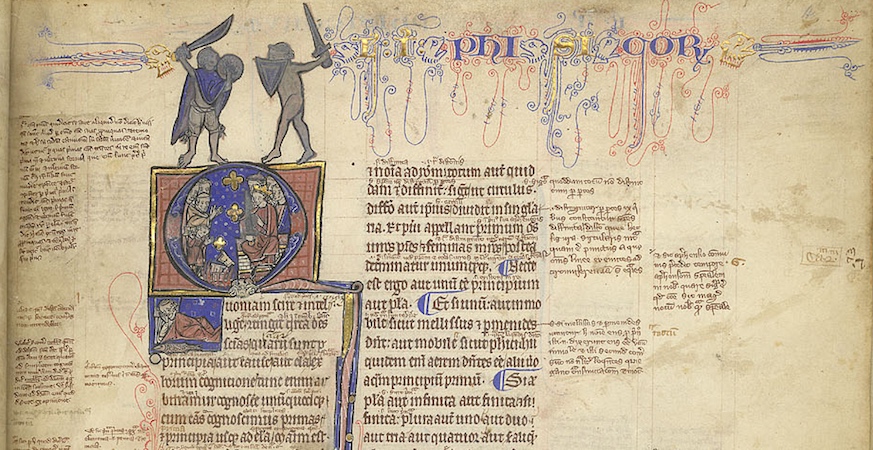 <small>Detail, London, British Library, Harley MS 3487 (13th century)—[source](http://www.bl.uk/catalogues/illuminatedmanuscripts/ILLUMIN.ASP?Size=mid&IllID=16790)</small>
 -
Jot down connections and tangential thoughts, underline key passages, and make a habit of building a dialogue with the author(s).
Some people consider annotations to be a conversation with the author. But you're also having a conversation with yourself and your own thoughts. (Cross reference Niklas Luhmann's having a conversation with himself via his notes.)
Further, there are platforms like Hypothes.is or social platforms like Twitter where you can move the conversation out of the page and engage with others. However, for this Hypothes.is has more power because it keeps the conversation linked to the original text and the original context (which I'll explicitly translate here as "with the text") to underline the point.
cf:
cum (Latin) : with
textus (Latin) : tissue, web, texture, fabric, connection, language
contextus (Latin) : context, connection, coherence, connexion, coherency, text
-
- Aug 2021
-
www.khanacademy.org www.khanacademy.org
-
This specific style of presenting two works on the one page, where the glosses (commentary) are presented as “square brackets”, is called textus inclusus.
-
The most common and sensible location for putting down thoughts, critique or notes was the margin of the medieval book. Consider this: you wouldn’t think so looking at a medieval page, but on average only half of it was filled with the actual text. A shocking fifty to sixty percent was designed to be margin. As inefficient as this may seem, the space came in handy for the reader. As the Middle Ages progressed it became more and more common to resort to the margin for note-taking.
-
-
Connecting a marginal remark to the relevant passage in the text was usually done with a duplicated symbol, called a signe de renvoi: one was placed in front of the marginal note, the other near the word or passage that the remark commented upon.
Evolution of footnotes
-
-
www.khanacademy.org www.khanacademy.org
-
-
The De disciplina scholarum, a student guidebook from Paris, stipulated that wax tablets or tiny slips of parchment be taken into the classroom for note-taking. These notes were later added to the margins of students’ textbooks.
-
-
medievalbooks.nl medievalbooks.nl
-
Interestingly, while the dragon could easily have been doodled by the reader himself, the depictions seen in Fig. 8 are carefully designed and painted. These pointing hands – the manuscript contains many of them – were probably done professionally. If this inference is correct, it suggests that the reader asked the artisan to insert them during production. This is interesting because it means that the reader already knew what passages he would wanted to have highlighted. It appears he already knew the text well before he owned a copy.
Professionally designed, drawn, and painted manicules may be an indicator that the reader knew a text well prior to commissioning a copy of a manuscript being made.
-
-
www.academia.edu www.academia.edu
-
Media and the Mind: Art, Science and Notebooks as Paper Machines, 1700-1830 (Chicago: University of Chicago Press, 2022), 550 pp + 60 figures.
I can't wait to read Media and the Mind: Art, Science and Notebooks as Paper Machines, 1700-1830 (Chicago: University of Chicago Press, 2022)!
I see some bits on annotation hiding in here that may be of interest to @RemiKalir and @anterobot.
If you need some additional eyeballs on it prior to publication, I'm happy to mark it up in exchange for the early look.
-
-
colinwalker.blog colinwalker.blog
-
If this blog had a tagline it would be "an ongoing conversation with myself."
Here's an example of a blogger using the idea of writing a blog as being in conversation with himself.
It obviously doesn't predate Niklas Luhmann's conversation with slip boxes, but the general tenor is certainly similar in form and function.
-
-
hedgeschool.substack.com hedgeschool.substack.com
-
Fleeting notes while reading is your way of having a conversation with the author. It may not eventuate to anything but the process instantly places agency back in your hands.
The idea of taking notes here as a conversation both with onesself as well as the author is essentially the old idea of making annotations in the margins of a book.
He's repackaging it in the framing of a zettelkasten, but it's the same sort of conversation that @remikalir talks about, though in that case Remi is usually talking about class-wide group conversations with a text.
Cross-reference this with Luhmann's paper Communicating with Slip-boxes which is a portion of the story from the zettelkasten perspective.
Certainly someone in the commonplace or annotation traditions mentioned the idea of a conversation? Either with themselves, with the author, or with the text itself? Was this ever tacitly acknowledged before Luhmann?
-
-
www.geeksforgeeks.org www.geeksforgeeks.org
-
Type Annotations:These annotations can be applied to any place where a type is being used. For example, we can annotate the return type of a method.
Tags
Annotators
URL
-
-
www.martinfowler.com www.martinfowler.com
-
Rubyists don't call these things annotations. One of the things I like doing is to find common techniques that cross languages, for me this is a common technique and 'annotation' seems like a good generic word for it. I don't know if Rubyists will agree.
-
-
www.martinfowler.com www.martinfowler.com
-
Languages may provide annotations in ways that don't reflect the syntax of the language
-