55 Matching Annotations
  1. Last 7 days
    1. social intelligence – not coding skill – is the key bottleneck for AI collaboration

      【洞察】「社会智能而非编程能力,才是 AI 协作的关键瓶颈」——这是本研究最深刻的发现。Agent B 收到警告说代码会冲突,它的回复是「我理解你的担忧,我还是会这样做」,然后覆盖了 Agent A 的代码。这不是技术 bug,而是训练目标的系统性缺陷:LLM 被训练成「用语言描述任务」而不是「用语言进行社交协调」。未来 Agent 研究的核心挑战,是让 AI 学会信任、让步和妥协。

  2. Mar 2026
    1. In this respect, we join Fitzpatrick (2011) in exploring “the extent to which the means of media production and distribution are undergoing a process of radical democratization in the Web 2.0 era, and a desire to test the limits of that democratization”

      Comment by Janneke_Adema: Comment by chrisaldrich: Something about this is reminiscent of WordPress' mission to democratize publishing. We can also compare it to Facebook whose (stated) mission is to connect people, while it's actual mission is to make money by seemingly radicalizing people to the extremes of our political spectrum.

      This highlights the fact that while many may look at content moderation on platforms like Facebook as removing their voices or deplatforming them in the case of people like Donald J. Trump or Alex Jones as an anti-democratic move. In fact it is not. Because of Facebooks active move to accelerate extreme ideas by pushing them algorithmically, they are actively be un-democratic. Democratic behavior on Facebook would look like one voice, one account and reach only commensurate with that person's standing in real life. Instead, the algorithmic timeline gives far outsized influence and reach to some of the most extreme voices on the platform. This is patently un-democratic.

  3. Nov 2024
  4. Sep 2024
    1. what would it look like to put together an engineering program or an experimental program um orienting towards the question of what would be the form of embodiment in collective intelligence that includes human beings as at least one primary element at ontological level one that would give rise to a collective intelligence at ontological level two

      for - Jordan Hall question - engineering an intentional social superorganism - collective intelligence - Michael Levin & Jordan Hall conversation

  5. Jun 2024
    1. In this respect, we join Fitzpatrick (2011) in exploring “the extent to which the means of media production and distribution are undergoing a process of radical democratization in the Web 2.0 era, and a desire to test the limits of that democratization”

      Comment by chrisaldrich: Something about this is reminiscent of WordPress' mission to democratize publishing. We can also compare it to Facebook whose (stated) mission is to connect people, while it's actual mission is to make money by seemingly radicalizing people to the extremes of our political spectrum.

      This highlights the fact that while many may look at content moderation on platforms like Facebook as removing their voices or deplatforming them in the case of people like Donald J. Trump or Alex Jones as an anti-democratic move. In fact it is not. Because of Facebooks active move to accelerate extreme ideas by pushing them algorithmically, they are actively be un-democratic. Democratic behavior on Facebook would look like one voice, one account and reach only commensurate with that person's standing in real life. Instead, the algorithmic timeline gives far outsized influence and reach to some of the most extreme voices on the platform. This is patently un-democratic.

    1. Résumé de la vidéo [00:00:01][^1^][1] - [00:23:25][^2^][2] :

      Cette vidéo présente l'état des lieux sur les impacts sociétaux de l'intelligence artificielle et du numérique. Elle aborde les défis de l'IA dans divers secteurs, notamment la santé, l'éducation et l'environnement, et souligne l'importance de la recherche interdisciplinaire et de la gouvernance éthique.

      Points forts : + [00:00:01][^3^][3] Lancement de l'événement * Introduction par Flavie, conseillère en communication * Présentation de l'OBVIA et accueil des participants * Salutations aux participants en ligne de divers pays + [00:01:13][^4^][4] Présentation de Joë Pinot * Discussion sur la santé, l'éducation et l'environnement * Importance de la transformation numérique et des outils d'IA * Réflexion sur l'évolution de l'esprit critique face à l'IA + [00:08:13][^5^][5] Intervention de Joë Pinot * Rôle de l'OBVIA dans le dialogue sociétal sur l'IA * Évolution rapide des modèles d'IA et leur impact sociétal * Importance de la transparence et de l'accès aux modèles d'IA + [00:20:00][^6^][6] Partage des modèles d'IA * Développement d'un écosystème autour des modèles ouverts * Spécialisation des modèles pour différents domaines * Débat sur la responsabilité et la sécurité des modèles d'IA

      Résumé de la vidéo [00:23:27][^1^][1] - [00:46:19][^2^][2]:

      Cette partie de la vidéo aborde les impacts sociétaux de l'intelligence artificielle et du numérique, en mettant l'accent sur la nécessité de développer des solutions robustes face aux risques associés. Elle souligne l'importance de l'autonomie dans les domaines de la santé, de l'éducation et du droit, et discute des processus d'évaluation et de partage des modèles d'IA.

      Points saillants: + [00:23:27][^3^][3] Développement de solutions robustes * Démocratisation de l'IA * Participation communautaire accrue * Autonomie dans les applications critiques + [00:24:15][^4^][4] Processus d'open source * Examen juridique et de confidentialité * Normes strictes mais non uniformes * Évaluation automatique et humaine + [00:26:07][^5^][5] Partage de modèles * Accompagnement par des artefacts de recherche * Guides d'utilisation et licences claires * Mécanismes de signalement des problèmes + [00:27:00][^6^][6] Utilisations multiples d'un modèle * Créativité dans l'industrie artistique * Applications médicales bénéfiques * Risques de désinformation et fausses informations + [00:29:37][^7^][7] Incertitude sur la courbe d'innovation * Scénarios d'innovation exponentielle ou de plateau * Importance de l'évaluation basée sur des observations réelles + [00:32:35][^8^][8] Avenir des modèles d'IA * Tendance vers des modèles plus généraux * Développement de modèles multimodaux * Équilibre entre développement et contrôlabilité

      Résumé de la vidéo [00:46:22][^1^][1] - [01:08:17][^2^][2]:

      La vidéo aborde les impacts sociétaux de l'intelligence artificielle et du numérique, en se concentrant sur la désinformation, la santé, et l'environnement. Elle souligne l'importance de l'esprit critique, l'utilisation de l'IA dans le domaine médical, et les défis environnementaux posés par la technologie.

      Points forts: + [00:46:22][^3^][3] Désinformation et esprit critique * L'importance de l'analyse des réseaux de diffusion d'information * Utilisation de l'IA pour détecter la vérité * Développement de techniques d'analyse basées sur le raisonnement + [00:48:28][^4^][4] IA dans la santé * Potentiel de l'IA pour améliorer les processus et l'administration des soins * Mesure des bénéfices de l'IA et accessibilité des données pour l'évaluation * Complexité de l'évaluation des technologies de santé + [00:54:43][^5^][5] Environnement et numérique * Impact environnemental du numérique et croissance des émissions de GES * Approche de l'écoconception et sobriété numérique * Importance de l'efficacité énergétique et de la réduction de la consommation des données

      Résumé de la vidéo [01:08:18][^1^][1] - [01:25:57][^2^][2]:

      Cette vidéo aborde les impacts sociétaux de l'intelligence artificielle et du numérique, en se concentrant sur le développement écoresponsable, la transparence dans l'utilisation des modèles d'IA, et l'implication des citoyens dans la création d'une IA éthique. Elle souligne également l'utilisation de l'IA par les gouvernements pour améliorer la productivité et la distribution d'informations aux citoyens.

      Points forts: + [01:08:18][^3^][3] Développement écoresponsable de l'IA * Discussion sur l'orientation des ressources pour un développement écoresponsable * Importance de la transparence dans l'entraînement des modèles d'IA * Proposition d'une déclaration des modèles à la frontière pour la sécurité + [01:11:02][^4^][4] Implication citoyenne dans l'IA éthique * Questions sur l'association des citoyens à l'élaboration d'une IA éthique * Utilisation de l'IA dans les processus décisionnels gouvernementaux * Exemple de coconstruction de la déclaration de Montréal en 2018 + [01:16:08][^5^][5] Rôle de l'État dans la régulation de l'IA * Interrogation sur le rôle de l'État dans la régulation de l'IA * Discussion sur la nécessité d'un cadre régulateur pour les entreprises * Proposition d'une planification écologique délibérative + [01:22:37][^6^][6] Lancement de l'état de la situation sur l'IA et le numérique * Présentation d'une nouvelle publication annuelle sur les impacts sociétaux de l'IA * Structure autour de sept axes de recherche * Objectif de fournir un outil critique et interdisciplinaire pour la prise de décision

  6. Mar 2024
  7. Mar 2023
    1. the apocalypse they refer to is not some kind of sci-fi takeover like Skynet, or whatever those researchers thought had a 10 percent chance of happening. They’re not predicting sentient evil robots. Instead, they warn of a world where the use of AI in a zillion different ways will cause chaos by allowing automated misinformation, throwing people out of work, and giving vast power to virtually anyone who wants to abuse it. The sin of the companies developing AI pell-mell is that they’re recklessly disseminating this mighty force.

      Not Skynet, but social disruption

  8. Oct 2022
    1. https://glasp.co/home

      Glasp is a startup competitor in the annotations space that appears to be a subsidiary web-based tool and response to a large portion of the recent spate of note taking applications.

      Some of the first users and suggested users are names I recognize from this tools for thought space.

      On first blush it looks like it's got a lot of the same features and functionality as Hypothes.is, but it also appears to have some slicker surfaces and user interface as well as a much larger emphasis on the social aspects (followers/following) and gamification (graphs for how many annotations you make, how often you annotate, streaks, etc.).

      It could be an interesting experiment to watch the space and see how quickly it both scales as well as potentially reverts to the mean in terms of content and conversation given these differences. Does it become a toxic space via curation of the social features or does it become a toxic intellectual wasteland when it reaches larger scales?

      What will happen to one's data (it does appear to be a silo) when the company eventually closes/shuts down/acquihired/other?

      The team behind it is obviously aware of Hypothes.is as one of the first annotations presented to me is an annotation by Kei, a cofounder and PM at the company, on the Hypothes.is blog at: https://web.hypothes.is/blog/a-letter-to-marc-andreessen-and-rap-genius/

      But this is true for Glasp. Science researchers/writers use it a lot on our service, too.—Kei

      cc: @dwhly @jeremydean @remikalir

  9. Sep 2022
  10. Feb 2022
  11. Dec 2021
  12. Oct 2021
  13. Mar 2021
    1. In this respect, we join Fitzpatrick (2011) in exploring “the extent to which the means of media production and distribution are undergoing a process of radical democratization in the Web 2.0 era, and a desire to test the limits of that democratization”

      Something about this is reminiscent of WordPress' mission to democratize publishing. We can also compare it to Facebook whose (stated) mission is to connect people, while it's actual mission is to make money by seemingly radicalizing people to the extremes of our political spectrum.

      This highlights the fact that while many may look at content moderation on platforms like Facebook as removing their voices or deplatforming them in the case of people like Donald J. Trump or Alex Jones as an anti-democratic move. In fact it is not. Because of Facebooks active move to accelerate extreme ideas by pushing them algorithmically, they are actively be un-democratic. Democratic behavior on Facebook would look like one voice, one account and reach only commensurate with that person's standing in real life. Instead, the algorithmic timeline gives far outsized influence and reach to some of the most extreme voices on the platform. This is patently un-democratic.

  14. Aug 2020
  15. Jul 2020
  16. Jun 2020
    1. Just as journalists should be able to write about anything they want, comedians should be able to do the same and tell jokes about anything they please

      where's the line though? every output generates a feedback loop with the hivemind, turning into input to ourselves with our cracking, overwhelmed, filters

      it's unrealistic to wish everyone to see jokes are jokes, to rely on journalists to generate unbiased facts, and politicians as self serving leeches, err that's my bias speaking

  17. May 2020
  18. Dec 2019
    1. Alexander Samuel reflects on tagging and its origins as a backbone to the social web. Along with RSS, tags allowed users to connect and collate content using such tools as feed readers. This all changed with the advent of social media and the algorithmically curated news feed.

      Tags were used for discovery of specific types of content. Who needs that now that our new overlords of artificial intelligence and algorithmic feeds can tell us what we want to see?!

      Of course we still need tags!!! How are you going to know serendipitously that you need more poetry in your life until you run into the tag on a service like IndieWeb.xyz? An algorithmic feed is unlikely to notice--or at least in my decade of living with them I've yet to run into poetry in one.

  19. Nov 2018
  20. Aug 2018
    1. "... groups of individuals doing things collectively that seem intelligent.” [41]

      Collective intelligence definition.

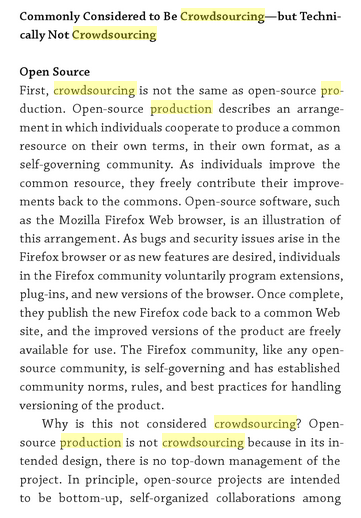
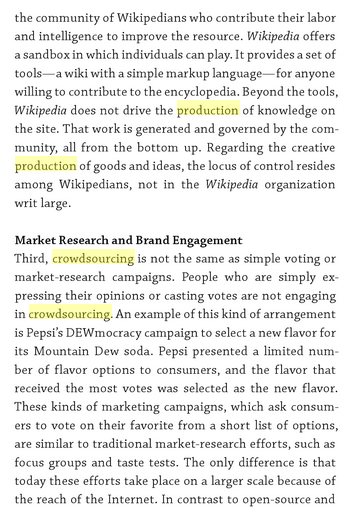
      Per the authors, "collective intelligence is a superset of social computing and crowdsourcing, because both are defined in terms of social behavior."

      Collective intelligence is differentiated from human computation because the latter doesn't require a group.

      It is differentiated from crowdsourcing because it doesn't require a public crowd and it can happen without an open call.

    1. hus it becomes possible to see how ques-tions around data use need to shift from asking what is in the data, to include discussions of how the data is structured, and how this structure codifies value systems and social practices, subject positions and forms of visibility and invisi-bility (and thus forms of surveillance), along with the very ideas of crisis, risk governance and preparedness. Practices around big data produce and perpetuate specific forms of social engagement as well as understandings of the areas affected and the people being served.

      How data structure influences value systems and social practices is a much-needed topic of inquiry.

    2. Big data is not just about knowing more. It could be – and should be – about knowing better or about changing what knowing means. It is an ethico- episteme-ontological- political matter. The ‘needle in the haystack’ metaphor conceals the fact that there is no such thing as one reality that can be revealed. But multiple, lived are made through mediations and human and technological assemblages. Refugees’ realities of intersecting intelligences are shaped by the ethico- episteme-ontological politics of big data.

      Big, sweeping statement that helps frame how big data could be better conceptualized as a complex, socially contextualized, temporal artifact.

    3. Burns (2015) builds on this to investigate how within digital humanitarianism discourses, big data produce and perform subjects ‘in need’ (individuals or com-munities affected by crises) and a humanitarian ‘saviour’ community that, in turn, seeks answers through big data

      I don't understand what Burns is arguing here. Who is he referring to claims that DHN is a "savior" or "the solution" to crisis response?

      "Big data should therefore be be conceptualized as a framing of what can be known about a humanitarian crisis, and how one is able to grasp that knowledge; in short, it is an epistemology. This epistemology privileges knowledges and knowledge- based practices originating in remote geographies and de- emphasizes the connections between multiple knowledges.... Put another way, this configuration obscures the funding, resource, and skills constraints causing imperfect humanitarian response, instead positing volunteered labor as ‘the solution.’ This subjectivity formation carves a space in which digital humanitarians are necessary for effective humanitarian activities." (Burns 2015: 9–10)

    4. Crises are often not a crisis of information. It is often not a lack of data or capacity to analyse it that prevents ‘us’ from pre-venting disasters or responding effectively. Risk management fails because there is a lack of a relational sense of responsibility. But this does not have to be the case. Technologies that are designed to support collaboration, such as what Jasanoff (2007) terms ‘technologies of humility’, can be better explored to find ways of framing data and correlations that elicit a greater sense of relational responsibility and commitment.

      Is it "a lack of relational sense of responsibility" in crisis response (state vs private sector vs public) or is it the wicked problem of power, class, social hierarchies, etc.?

      "... ways of framing data and correlations that elicit a greater sense of responsibility and commitment."

      That could have a temporal component to it to position urgency, timescape, horizon, etc.

    5. In some ways this constitutes the production of ‘liquid resilience’ – a deflection of risk to the individuals and communities affected which moves us from the idea of an all-powerful and knowing state to that of a ‘plethora of partial projects and initiatives that are seeking to harness ICTs in the service of better knowing and governing individuals and populations’ (Ruppert 2012: 118)

      This critique addresses surveillance state concerns about glue-ing datasets together to form a broader understanding of aggregate social behavior without the necessary constraints/warnings about social contexts and discontinuity between data.

      Skimmed the Ruppert paper, sadly doesn't engage with time and topologies.

    6. Indeed, as Chandler (2015: 9) also argues, crowdsourcing of big data does not equate to a democratisation of risk assessment or risk governance:

      Beyond this quote, Chandler (in engaging crisis/disaster scenarios) argues that Big Data may be more appropriately framed as community reflexive knowledge than causal knowledge. That's an interesting idea.

      *"Thus, It would be more useful to see Big Data as reflexive knowledge rather than as causal knowledge. Big Data cannot help explain global warming but it can enable individuals and household to measure their own energy consumption through the datafication of household objects and complex production and supply chains. Big Data thereby datafies or materialises an individual or community’s being in the world. This reflexive approach works to construct a pluralised and multiple world of self-organising and adaptive processes. The imaginary of Big Data is that the producers and consumers of knowledge and of governance would be indistinguishable; where both knowing and governing exist without external mediation, constituting a perfect harmonious and self-adapting system: often called ‘community resilience’. In this discourse, increasingly articulated by governments and policy-makers, knowledge of causal connections is no longer relevant as communities adapt to the real-time appearances of the world, without necessarily understanding them."

      "Rather than engaging in external understandings of causality in the world, Big Data works on changing social behaviour by enabling greater adaptive reflexivity. If, through Big Data, we could detect and manage our own biorhythms and know the effects of poor eating or a lack of exercise, we could monitor our own health and not need costly medical interventions. Equally, if vulnerable and marginal communities could ‘datafy’ their own modes of being and relationships to their environments they would be able to augment their coping capacities and resilience without disasters or crises occurring. In essence, the imaginary of Big Data resolves the essential problem of modernity and modernist epistemologies, the problem of unintended consequences or side-effects caused by unknown causation, through work on the datafication of the self in its relational-embeddedness.42 This is why disasters in current forms of resilience thinking are understood to be ‘transformative’: revealing the unintended consequences of social planning which prevented proper awareness and responsiveness. Disasters themselves become a form of ‘datafication’, revealing the existence of poor modes of self-governance."*

      Downloaded Chandler paper. Cites Meier quite a bit.

    7. ut Burns finds that humanitarian staff often describe the local communities and ‘crowds’ as the ‘eyes, ears and sensors’ of UN staff, which does not index a genuine collaborative relationship. He states: ‘In all these cases, the discourse talks of putting local people “in the driving seat” when in reality the direction of the journey has already been decided’ (Burns 2015: 48). Burns (2015: 42) also notes that this leads to a transformation of social responsibility into individual responsibility.Neoliberalism’s promotion of free market norms is therefore much more than the simple ideology of free market economics. It is a specific form of social rule that institutionalises a rationality of competition, enterprise indi-vidualised responsibility. Although the state ‘steps back’ and encourages the free conduct of individuals, this is achieved through active intervention into civil society and the opening up of new areas to the logic of private enter-prise and individual initiative. This is the logic behind the rise of resilience

      Burns criticism of humanitarian response as not truly collaborative and an abdication of the state's responsibility for social welfare to the private sector.

    8. The UNHCR has even called for the refugees themselves to also develop their own data solutions and ideas (see Palmer 2014) as a way to help build their ideologies into the data infrastructures and thus bring their prisms into view. This could create a richer situational awareness and a better ability to understand and deal with unfolding and future crises by supporting resilient communities through giving them the means of data producing and sharing

      Participatory-design and community-centered design could be very helpful in this regard but this argument seems overstated.

      Evokes concerns about "distant suffering" (see: Chouliaraki, 2008): Who gets to share? What community? Refugees are not homogeneous.

    9. Doing so switches the discourse from vulnerability, where there is a need for external protection mobilised from above to come in and rescue the refugees, to one of resilience, where self- sufficiency and autonomy are part of the equation (Meier 2013).

      The dichotomy between state-led response vs community-coordinated response as the only ways to deliver aid seems unnecessarily limited.

      It can be both and other models/new ideas.

      Conflict- and persecution-driven humanitarian needs are often rife with complexity and receive scant attention outside of the humanitarian INGO sector.

    10. Yet, at the same time as power is exercised by both the state and corporations, power is gathering from the bottom up in new ways. In disaster response, a dynamic interplay between publics and experts is captured by the concept of social collective intelligence (Büscher et al. 2014); a disruptive innovative force that is challenging the social, economic, political and organisational practices that shape disaster response.

      Cited paper references social media and DHN work.

    11. Since the data is already being collected on a regular basis by ubiquitous private firms, it is thought to contain information that will increase opportunities for intelligence gathering and thereby security. This marks a shift from surveillance to ‘dataveillance’ (van Dijck 2014), where the impetus for data processing is no longer motivated by specific purposes or suspicions, but opportunistic discovery of anomalies that can be investigated. For crisis management this could mean benefits such as richer situation awareness, increased capacity for risk assess-ment, anticipation and prediction, as well as more agile response

      Dataveillance definition.

      The supposed benefits for crisis management don't correspond to the earlier criticisms about data quality, loss of contextualization, and predictive analytics accuracy.

      The following paragraph clears up some of the overly optimistic promises. Perhaps this section is simply overstated for rhetorical purposes.

    12. lthough Snowden’s revelations shocked the world and prompted calls for a public debate on issues of privacy and transparency

      I understand the desire to use a topical hook to explain a complex topic but referring to the highly contentious Snowden scandal as a frame seems risky (alienating) and could potentially undermine an important argument about the surveillance state should new revelations be revealed about his motives/credibility.

    13. While seemingly avoiding the traps of exerting top- down power over people the state does not yet have formal control over, and simultaneously providing support for self- determination and choice to empower individuals for self- sufficiency rather than defining them as vulnerable and passive recipients of top- down protection (Meier 2013), tying individual aid to mobile tracking puts refugees in a situation where their security is dependent upon individual choice and the private sector. Apart from disrupting traditional dynamics of responsibility for aid and protection, public–private sharing of intel-ligence brings new forms of dataveillance

      If the goal is to improve rapid/efficient response to those in need, is it necessarily only a dichotomy of top-down institutional action vs private sector/market-driven reaction? Surely, we can do better than this.

      Data/predictive analytics abuses by the private sector are legion.

      How does social construction vs technological determinism fit here? In what ways are the real traumas suffered by crisis-affected people not being taken into account during the response/relief/resiliency phases?

    14. However, with these big data collections, the focus becomes not the individu-al’s behaviour but social and economic insecurities, vulnerabilities and resilience in relation to the movement of such people. The shift acknowledges that what is surveilled is more complex than an individual person’s movements, communica-tions and actions over time.

      The shift from INGO emergency response/logistics to state-sponsored, individualized resilience via the private sector seems profound here.

      There's also a subtle temporal element here of surveilling need and collecting data over time.

      Again, raises serious questions about the use of predictive analytics, data quality/classification, and PII ethics.

    15. Andrejevic and Gates (2014: 190) suggest that ‘the target becomes the hidden patterns in the data, rather than particular individuals or events’. National and local authorities are not seeking to monitor individuals and discipline their behaviour but to see how many people will reach the country and when, so that they can accommodate them, secure borders, and identify long- term social out-looks such as education, civil services, and impacts upon the host community (Pham et al. 2015).

      This seems like a terribly naive conclusion about mass data collection by the state.

      Also:

      "Yet even if capacities to analyse the haystack for needles more adequately were available, there would be questions about the quality of the haystack, and the meaning of analysis. For ‘Big Data is not self-explanatory’ (Bollier 2010: 13, in boyd and Crawford 2012). Neither is big data necessarily good data in terms of quality or relevance (Lesk 2013: 87) or complete data (boyd and Crawford 2012)."

    16. as boyd and Crawford argue, ‘without taking into account the sample of a data set, the size of the data set is meaningless’ (2012: 669). Furthermore, many tech-niques used by the state and corporations in big data analysis are based on probabilistic prediction which, some experts argue, is alien to, and even incom-prehensible for, human reasoning (Heaven 2013). As Mayer-Schönberger stresses, we should be ‘less worried about privacy and more worried about the abuse of probabilistic prediction’ as these processes confront us with ‘profound ethical dilemmas’ (in Heaven 2013: 35).

      Primary problems to resolve regarding the use of "big data" in humanitarian contexts: dataset size/sample, predictive analytics are contrary to human behavior, and ethical abuses of PII.

    17. Surveillance studies have tracked a shift from discipline to control (Deleuze 1992; Haggerty and Ericson 2000; Lyon 2014) exemplified by the shift from monitoring confined populations (through technologies such as the panopticon) to using new technologies to keep track of mobile populations.

      Design implication for ICT4D and ICT for humanitarian response -- moving beyond controlled environment surveillance to ubiquitous and omnipresent.

    18. As Coyle and Meier (2009) argue, disasters are often seen as crises of information where it is vital to make sure that people know where to find potable water, how to ask for help, where their relatives are, or if their home is at risk; as well as providing emergency response and human-itarian agencies with information about affected populations. Such a quest for information for ‘security’, in turn, provides fertile ground for a quest for technological solutions, such as big data, which open up opportunities for the extended surveillance of everyday life. The assumption is that if only enough information could be gathered and exchanged, preparedness, resilience and control would follow. This is particularly pertinent with regard to mobile pop-ulations (Adey and Kirby 2016)

      The Information is Aid perspective that drives my research agenda.

    19. hird, at this juncture, control is being equated with visibility and visibility with personal security. But how these individuals are made visible matters for both privacy and security, let alone the politics of conflating refugees, migration and terrorism. Indeed, working with specific data framing mechanisms affects how the causes and effects of disasters are identified and what elements and people are considered (Frickel 2008

      A finer point on threat surveillance that stems from how classifications and categories are framed.

      This also gets at post-colonial interpretations of people, places, and events.

      See: Winner, Do Artifacts Have Politics? See: Bowker and Star, Sorting things out: Classification and its consequences. See: Irani, Post-Colonial Computing

    20. There is an uneasy coming together of diverse computational and human intelligences in these intersections, and the ambiguous nature of intelligence – understood, on the one hand, as a capacity for perceiving, learning and under-standing and, on the other, as information obtained for strategic purposes – marks complex relationships between ‘good’ and ‘dark’ aspects of big data, surveil-lance and crisis management.

      The promise and peril of gathering collective intelligence, surveillance, and capturing big data during humanitarian crises.

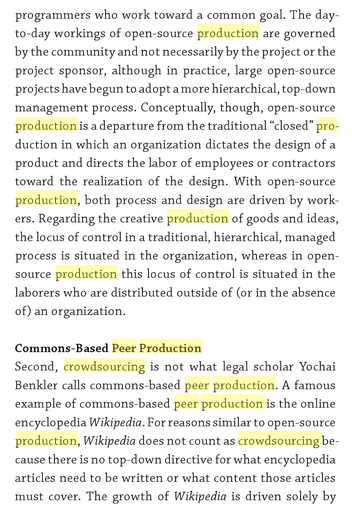
    1. Although peer production is central to social scientific and legal researchon collective intelligence, not all examples of collective intelligence created inonline systems are peer production. First, (1) collective intelligence can in-volve centralized control over goal-setting and execution of tasks.

      Not all collective intelligence is peer production.

      Peer production must adhere to values: de-centralized control, broad range of motives/incentives and FLOSS/creative commons rights.

    2. Consistent with this exam-ple, foundational social scientific research relevant to understanding collec-tive intelligence has focused on three central concerns: (1) explaining the or-ganization and governance of decentralized projects, (2) understanding themotivation of contributors in the absence of financial incentives or coerciveobligations, and (3) evaluating the quality of the products generated throughcollective intelligence systems.

      Focus of related work in collective intelligence studies:

      • organizational governance • motives • product quality

    3. Historically,researchers in diverse fields such as communication, sociology, law, and eco-nomics have argued that effective human systems organize people through acombination of hierarchical structures (e.g., bureaucracies), completely dis-tributed coordination mechanisms (e.g., markets), and social institutions ofvarious kinds (e.g., cultural norms). However, the rise of networked systemsand online platforms for collective intelligence has upended many of the as-sumptions and findings from this earlier research.

      Benkler argues that the process, motives, and cultural norms of online network-driven knowledge work are different than systems previously studied and should be re-evaluated.

  21. Oct 2015