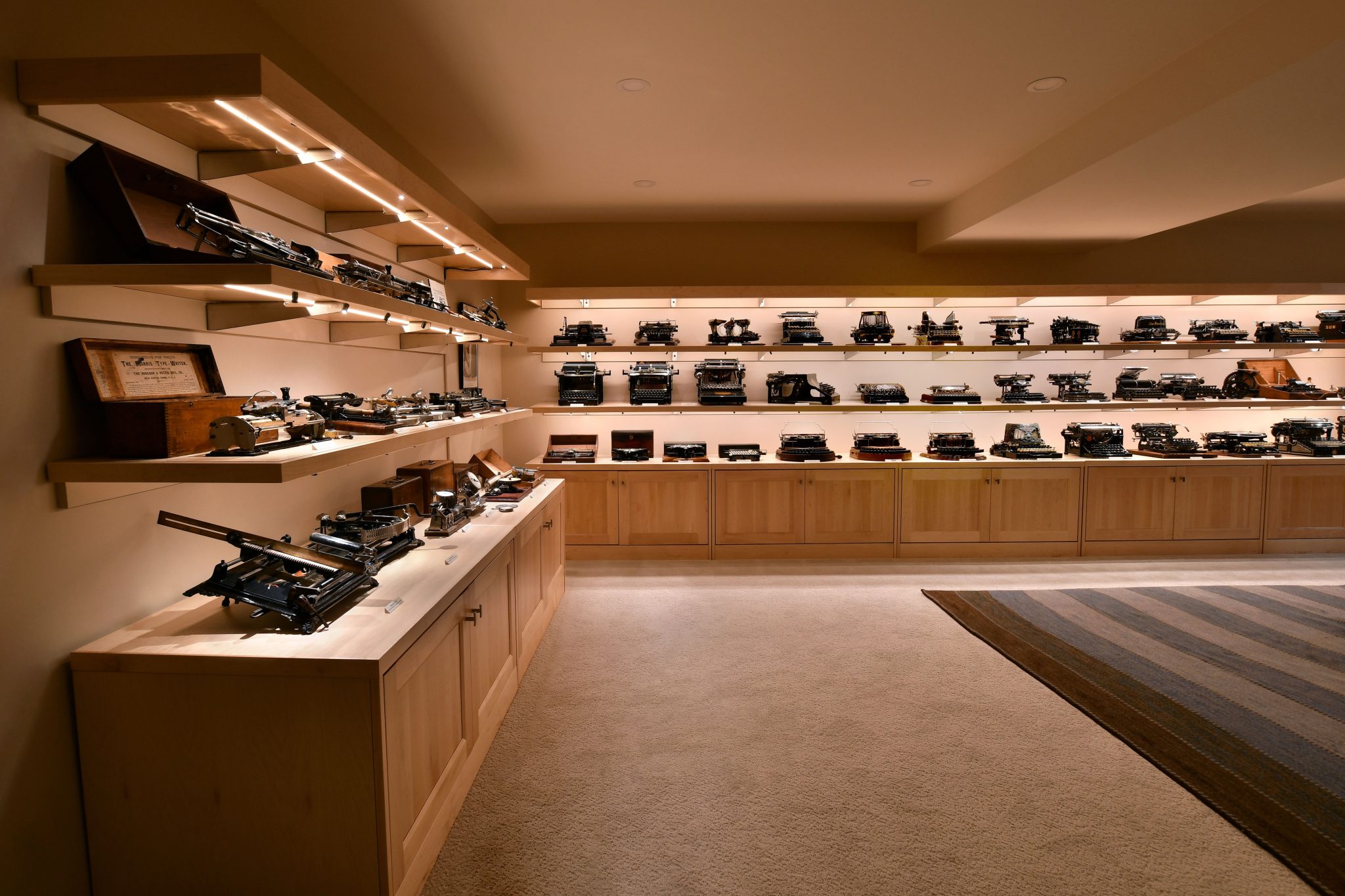
Are typewriters becoming an elite hobby?
A: Personally, I think it's a pica hobby.
Are typewriters becoming an elite hobby?
A: Personally, I think it's a pica hobby.
Charles Anderson discovers dragonflies that cross oceans<br /> TED on YouTube
Lawrence Lessig: Fixing the Republic
Recommended by TB
https://en.wikipedia.org/wiki/The_Corporation_(2003_film)<br /> The Corporation (Zeitgeist Films, 2003)
Robert D. Hare, a University of British Columbia psychology professor and FBI consultant, compares the profile of the contemporary profitable business corporation to that of a clinically diagnosed psychopath. The Corporation attempts to compare the way corporations are systematically compelled to behave with what it claims are the DSM-IV's symptoms of psychopathy, e.g., the callous disregard for the feelings of other people, the incapacity to maintain human relationships, the reckless disregard for the safety of others, the deceitfulness (continual lying to deceive for profit), the incapacity to experience guilt, and the failure to conform to social norms and respect the law.
The left Shift key on the Antares Parva was scratched. I sanded it first with wet-dry sandpaper and then polished it with a cotton pad and toothpaste.
via Tomi Aho at https://www.facebook.com/groups/705152958470148/posts/1375748211410616/
Secretaries Get to Throw Their Typewriters<br /> The Best of the Iowa Traveler<br /> by Iowa's News Now
Found via https://www.facebook.com/groups/TypewriterCollectors/posts/10164157502764678/
Getting Gabriel García Márquez's Smith-Corona 5TE Ready For Exhibit<br /> by [[Richard Messenger]] on oz.Typewriter<br /> accessed on 2026-09-19T12:30:13
Includes multiple photos. The Smith-Corona 5TE isn't listed on Richard Polt's site as of 2026-09-19.
 <br />
—via https://www.latercera.com/culto/2021/04/28/40-anos-de-cronica-de-una-muerte-anunciada-la-novela-que-garcia-marquez-consideraba-su-mejor-libro/<br />
Photo of Gabriel García Márquez in front of a standard typewriter with the brand name Underwood on the back.
<br />
—via https://www.latercera.com/culto/2021/04/28/40-anos-de-cronica-de-una-muerte-anunciada-la-novela-que-garcia-marquez-consideraba-su-mejor-libro/<br />
Photo of Gabriel García Márquez in front of a standard typewriter with the brand name Underwood on the back.
Not included in Richard Polt's collection of typers as of 2026-09-19
This article has a variation of the same photo credited as "El escritor colombiano y premio Nobel Gabriel García Márquez / Foto: archivo Biblioteca Nacional de Colombia"
 Profile photo of Gabriel García Márquez at a 1970's version of a cartridge-based Smith-Corona electric typewriter. <br />
Potential variations of this typewriter are already in Richard Polt's collection of typers, but this particular photo is not as of 2026-09-19.
Profile photo of Gabriel García Márquez at a 1970's version of a cartridge-based Smith-Corona electric typewriter. <br />
Potential variations of this typewriter are already in Richard Polt's collection of typers, but this particular photo is not as of 2026-09-19.
Typewriter force curves, bellcrank classification, and velocity curves<br /> by Haelscheir's Haven on YouTube
https://www.cookshelf.app/
Similar to Eat Your Books.
Potentially the same company just re-instantiated? What has changed with their cost/charging/business model?
Eat Your Books is an electronic database/index of recipes in cookbooks to make it easier for people to search their own paper (cook) books.
This is the sort of thing that Mortimer J. Adler was doing for the Great Books.
How nice would it be if there were a better digital index for all books which worked as well as this portends?
Smith Corona Electra 210 Typewriter // Inside the Robert A. Caro Archive<br /> The New York Historical
Suggested by Peter McKinnon<br /> https://www.youtube.com/watch?v=EXaQ_lU4JIM
How I cured my phone addiction with 2 tiny notebooks<br /> by Peter McKinnon
Adding a piece of string to a pocket notebook for use as a bookmark. https://youtu.be/EXaQ_lU4JIM?si=r4s-LHKV76IAq_mn&t=1091
clever...
The pocket notebook that will save you 5 hrs a day<br /> by Rachelle in Theory
Using a pocket notebook over a phone to regain time. Well reasoned out and a good overview of "why".
Some tools have the ability to speak to you in ways that others do not.
An extension of this is Conway's law which may tend to force us to create work which not only reflects us, but which becomes us.
The relationship with tools becomes a two way street between us and the tool as well as the tools which interpose all of us (humanity).
What might this mean for our relationship with Artificial Intelligence? Will our laziness with respect to thinking turn us into non-thinkers who rely on a tool not actually able to think?
In my experience, a Typewriter's soul reveals itself to the folks that are MEANT to be their custodian for a time. I find most objects that serve a creative purpose to be this way; They absolutely have voices, but only the right person(people?) can hear them. People don't find Typewriters. Typewriters find people.
reply to Kirk Jackson aka u/NashvilleTypewriter at https://old.reddit.com/r/typewriters/comments/1wjidrf/what_words_could_we_use_to_better_describe_the/pal3wez/
This is great. I find it to be the case as well.
Watching other spaces like note taking applications (and methods), stationery, planners, notebooks, pencils, pens, fountain pens, etc. it repeats itself over and over. Some will really love a particular object which seems to work for them while others don't. Fora are filled with people asking, what do you like? how do you use it? when instead they ought to be attempting to figure out what they like and how they would use it.
Some turn their love of a particular thing into a religion (Apple vs. IBM comes to mind) which also tends to make others doubt their own choices and what might work best for them. Instead of experimenting around a bit to see what works for them, they take the supposed "magic" propounded by others and wrongly try to make it work for themselves. This is one of the primary reasons I tell potential new typewriter stewards to visit shops or type-ins so that they can put their hands on a variety of machines to see which "speaks" or works best for them and their needs. There are so many people limping along out there on dreadfully maintained machines because they haven't tried others (or even cleaned, oiled, and well-adjusted ones) and don't know what they're missing.
I was reading/listening to a series by APM recently called Sold a Story about how some academics and scientists created a "new method" for teaching reading and sold it as a products to school systems all over the country. While it managed to work for a terrifically small population, it was broadly wrong for the majority of people. Decades of harm was done to children and the educational space because everyone went with what these experts said (and which may have seemed logical) rather than doing some work, trusting testing and results, or continuing to experiment with a variety of strategies. Similarly, while computers and writing software may work for many, some of the older tried-and-true methods out there using tools like pencils, pens, loose paper, index cards, notebooks, notepads, and typewriters can provide dramatically different affordances in ways of working with them which are actually better for some of the things one might wish to accomplish with them. Some tools have the ability to speak to you in ways that others do not.
(P.S. Thanks for your observation as this may become the kernel of the introduction to the book I'm slowly working on.)
[O]rganizations which design systems (in the broad sense used here) are constrained to produce designs which are copies of the communication structures of these organizations.— Melvin E. Conway, How Do Committees Invent?
How teaching kids to read went so wrong - Sold a Story: Season 1, Episode 1: The Problem<br /> by [[Emily Hanford]] in [[Sold a Story]] from APM Reports
https://www.reddit.com/r/Zettelkasten/comments/1wjdcjs/removed_by_reddit/
Do connected notes actually work better than folders?<br /> via u/Purple_Clock5044 on 2025-09-17
It's a lot easier to identify typefaces of typewriters if you include a few things in your photos: <br /> - Full frontal picture of the machine with clear shot of one or more of the rulers (so one can attempt to determine pitch as well as more easily identify the make/model for cross referencing).<br /> - A full typed sample of all the characters, especially some of the more unique ones like Q, 3, 5, 4, 7, &, G, A, E, and W in both upper and lower case.<br /> - A close up shot of the slugs which clearly shows the foundry marks (generally found in the middle of the slug) of both letter slugs and special character/number slugs as sometimes the latter are different.
Princess 300 with RaRo Elite Imperial typeface
The "AR" foundry mark is a shorthand for Albert Rodrian, one half of RaRo. If you ever see an R inside an octagon that's the mark for the other half, Alfred Ransmayer.
The "84" on the foundry mark is typical of RaRo's 12 pitch Elite Imperial which can be found with a sample at: https://typecast.munk.org/2023/02/04/1961-adler-typewriter-type-font-styles/
You can also compare other known Princess typefaces at the database: https://typewriterdatabase.com/twdb.0.typefaces?mfr_search=70&model_search=100#
If you put a ruler up to your type, you should find that there are 12 characters per inch.
You can also cross reference the following: - the Hass catalog, page 3, row 1:<br /> https://archive.org/details/typewriter-foundry-marks-haas/page/n1/mode/2up<br /> - RaRo Catalogue Page B3-4 "Elite-Schatten Ro 84":<br /> https://www.sommeregger.name/typewriters/files/RaRo/rarotype_katalog_1980_OCR_20160523.pdf
Reply to u/CaptainCulinary at https://old.reddit.com/r/typewriters/comments/1wjb0gk/princess_300_with_typeface/
https://www.instagram.com/p/DaqqSrUvM9I/?hl=en
Typing on an 1890s Odell model 3. Made in chicago, refurbished in chicago.<br /> via typewriter_chicago_
https://youtu.be/NWnX3ZkL_eA?si=mUD52esB34cLxhbJ&t=353
Suggestion to use index card or pocket notebook as a viewfinder for narrowing down one's view of the world.
https://www.flickr.com/photos/68103485@N05/
Examples like: <br />

I got several reels with a special discount. Nylon 1005 yards was €60 each, Cotton red/black was 360 yard was €125. I got several reels. They gave me a big discount. I purchase often from them. They paid tariffs with the shipping.
Sameera Sandaruwan Abeyrathna has had ribbon shipped from Europe before.
The Royal Companion was a trim line name for Royal portables in the 40s and 50s along with variations like the Aristocrat and the Quiet De Luxe. For some of its life it's essentially a cheaper Quiet De Luxe which may be missing features like a tabulator, Magic Margins, card fingers, or a touch control. You'd have to cross check the manual and the typewriter database to see how yours may differ from the QDL at the time it was made. Often it was a $5-10 price differential at the time for the difference in features, but with inflation this would be the equivalent of $140 now.
You could essentially use the list of QDL users from Polt's site and say that they all used a typewriter similar to your Companion. (Depending on the photos and angles, some of the listed Quiet De Luxe users may have really been using either a Companion or an Aristocrat, but it's incredibly difficult to discern unless you can see the specific feature differences between them.)
See also: - https://boffosocko.com/2024/06/25/users-of-the-early-henry-dreyfuss-royal-quiet-de-luxe-portable-typewriters/<br /> - https://typewriterdatabase.com/royal.72.typewriter-serial-number-database<br /> - https://typewriterdatabase.com/Royal.Companion.72.bmys - Manuals at: https://site.xavier.edu/polt/typewriters/tw-manuals.html
Reply to u/chocolate-sheep at https://old.reddit.com/r/typewriters/comments/1wi0jd6/writers_using_royal_companions/
Yes, dust can be an issue over time, especially if your machine is over-oiled and even more if you're in high dust/pollution area of the world and leave windows open regularly or have pets with lots of hair and dander production.
However, if uber-collector Martin Howard can be trusted, perhaps when designing your dream typewriter display room, dust isn't as horrible a problem as you might imagine. See: https://lumicrest.com/showcase-lighting-martin-howards-antique-typewriter-collection/ One imagines that occasional dusting and a can of compressed air will do the trick.
You could also do a nicer dust cover/mat the way Tom Hanks does: https://boffosocko.com/2025/06/16/tom-hanks-ingenious-custom-typewriter-covers-mats/
For my refurbished machines displayed in the house (where we have had a monster German Shepherd who sheds all year long and lots of exterior dust from Southern California pollution), if they're not in regular rotation, I'll drop a sheet of tinfoil or plastic wrap under the hood to prevent dust coming in through the hood and that seems to be more than enough protection while not covering up the entire machine.
reply to u/harperjones at https://old.reddit.com/r/typewriters/comments/1whqodm/closed_cabinets_for_display/
legendwill11
https://old.reddit.com/r/typewriters/comments/1wgjf93/i_made_a_video_about_why_i_use_a_1949_royal/
legendwill11 has a '49 Royal Quiet De Luxe and lives in the Glendale, CA area (via video at https://www.youtube.com/shorts/-YuazfTLiiw)
Why I Write Ads for Big Tech on a Typewriter
The Inner Game of Tennis says that real focus and creative freedom isn't about focusing harder, it's about narrowing in on what's actually relevant to the task in front of you, whether that's the seams on a tennis ball or whatever detail is clear in your creativity. For me, turns out a 60-year-old machine it does that better than any app I use.
Creativity isn't a gift, it's a system<br /> by Perry Daniels on YouTube
Perry Daniels' "Grail Notebook" is just a translation from the latin of ars excerpendi?! hmmm....
Stop Buying Field Notes<br /> by Perry Daniels on YouTube
Most Pencils Are Terrible. Here Are 6 You Should Actually Buy<br /> by [[John Pattison]] on YouTube<br /> accessed on 2026-09-14T23:51:04
What Reading Out Loud Does to Your Brain<br /> by The Upgrade with Makai Elías Calles
UsefulCharts<br /> by [[Matt Baker]] on YouTube<br /> accessed on 2026-09-14T23:08:17
Books: HitParade: 1895-1945<br /> by [[TIME]]<br /> accessed on 2026-09-14T23:02:57
The Success of Nonviolent Civil Resistance<br /> by [[Center for Nonviolent Conflict Research]] [[CNCR]]<br /> accessed on 2026-09-14T22:55:14
The '3.5% rule': How a small minority can change the world<br /> by [[David Robson]]<br /> accessed on 2026-09-14T22:54:21
And of this ourmother the state is to be the judge.
Plato. 1952. 7 Plato. 1st ed. eds. Robert M. Hutchins and Mortimer J. Adler. Chicago, IL: Encyclopedia Britannica, Inc.
The history, mythology, and literature of Greece, taken up by the Roman Empire, shaped the development of European and American culture. ToposText is a free tool, a mobile app and website, for going back to the primary sources and historic roots of western civilization, and in particular a tool for students and travelers eager to experience the ancient world through its surviving texts.
So, too, Meletus first gets rid of uswho corrupt the young shoots, as he says, and then afterwards he will obviouslytake care of the older ones and become a source of great blessings for the city, asseems likely to happen to one who started out this way.
How do you accomplish this in modernity, when you can't "get rid" of the opposition? You chill their speech, you erase their language, you erase their history. This seems to be the playbook of the far right in American politics under Donald J. Trump.
Redefine and poison words like DEI and Critical Race Theory (CRT), marginalize and criminalize the people who don't fit in your world view.
hould be as good as possible, just as a good farmer is likely to take care of theyoung plants first, and of the [3] others later.
I think he is the only one of our public men to start out the right way, for it is right to care first that the young
Cross reference: Teach Your Children Well by Crosby, Stills, Nash & Young
[2] EUTHYPHRO
Euthyphro<br /> Stephanus numbers 2a–16a<br /> G. M. A. Grube translation
in <br /> Plato. 1997. Plato: Complete Works. eds. John M. Cooper and D. S. Hutchinson. Indianapolis: Hackett Publishing Company, Inc.
SOCRATES: I do not really know him myself, Euthyphro. He is apparentlyyoung and unknown. They call him Meletus, I believe. He belongs to thePitthean deme, if you know anyone from that deme called Meletus, with longhair, not much of a beard, and a rather aquiline nose.
cf. with Benjamin Jowett translation:
A young man who is little known, Euthyphro; and I hardly know him : his name is Meletus, and he is of the deme of Pitthis. Perhaps you may remember his appearance; he has a beak, and long straight hair, and a beard which is ill grown.
There is certainly a charge of "youth" in both translations, but the "beak" and "ill-grown beard" seem to be more belittling in Jowett which be ad hominem appearance attacks on Meletus of Pithos before we've even heard his argument.
Which of these descriptions would have had cultural significance in Ancient Greece?
See: Pithos, Pitthos, Pithus: https://topostext.org/place/380239DPit
Does Platomean to suggest that piety may be shown simply in doing one’s best to become asmorally good as possible—something Socrates claims in the Apology the godswant more than anything else?
Of course if this is the aim, then one also ought to define "morally good" as cleanly as piety, something which might be elusive or which may vary based on an individual person, that person's culture, or even across cultures.
Plato. 1997. Plato: Complete Works. eds. John M. Cooper and D. S. Hutchinson. Indianapolis: Hackett Publishing Company, Inc.
Pitthos deme (Attica) 12 unknown - Πιτθός Πιτθός - Pitthos, an ancient deme of Attica, exact location unknown
https://www.facebook.com/reel/1632254748516251
Beau L'Amour does a tour of his father Louis L'Amour's typewriters:<br /> - Brown Olympia SM3, used in the 50s, on a trip or in a car primarily<br /> - Small gray portable typewriter (Hermes ultraportable?) <br /> - IBM Model B, purchased in 58 or 59, the majority of his writing work was produced on this machine<br /> - IBM Selectric (II or III), this became his primary machine once it was released and he began using it <br /> - SMC Electra 120
The M.R. key on a typewriter stands for "More Room" as defined by William Clark's daughter. <br /> via https://www.facebook.com/groups/27453296880990639/posts/28305005765819742
This is the “emotional support “ typewriter I brought to the office today
https://www.youtube.com/@Woodys-corner<br /> James Wood, typewriter collector<br /> aka u/Wooden_Underpants on Reddit aka elwoody.typewriters on Instagram
match via<br /> - https://www.reddit.com/r/typewriters/comments/1wbs1wq/day_in_the_life/ - https://www.instagram.com/p/DdEvO6Aol-j/?hl=en
https://www.patreon.com/GoIntoTheStory/posts/download-spec-168834157<br /> Spec Script Deals: 1991-2025
Spice Mixes Recipes by Naomi Braeden [2017] Cooking With Spices - 100 Recipes for Blends Marinades and Sauces from Around the World by Mark C. Stevens [2017]
added to Zotero 2026-09-11
via u/Anxious_Increase_219 at https://old.reddit.com/r/CookbookLovers/comments/1wc9gyb/spice_blend_book/
They also recommend:
Also about spices and cooking with spices:
Culinary Herbs and Spices by Ben-Erik von Wyk [2013]
Beginner's Guide to Cooking with Spices by Joseph Veebe [2019]
Herb & Spice Companion - The Complete Guide to Over 100 Herbs & Spices by Lindsey Herman [2015]
Herbs & Spices, The Cooks' Reference by Jill Norman [2015]
Spice - Understand the Science of Spice Create Exciting New Blends and Revolutionize by Dr Stuart Farrimond [2018]
The Encyclopedia of Herbs, Spices, & Flavorings by Elisabeth Lambert Ortiz [1992]
Jeff Lowell Dead: 'John Tucker Must Die' Writer & 'The Crew' Creator<br /> by [[Nellie Andreeva]]<br /> accessed on 2026-09-11T09:06:23
via rememberances at https://www.reddit.com/r/Screenwriting/comments/1wc86n8/rip_jeff_lowell/
Locked in a Basement<br /> song and lyrics by Heernt, Neal Persiani, Mark Guiliana<br /> accessed on 2026-09-11T09:03:32
Opinion: Civil Libertarians Knew This Would Happen. We Should Have Listened<br /> by [[Radley Balko]] in The New York Times Opinion<br /> accessed on 2026-09-10T11:38:03
the only category of federal employees to be prosecuted consistently for their crimes since Sept. 11 has been whistle-blowers who have drawn attention to government abuses.
In the years after Sept. 11, 2001, national security hawks were fond of the phrase “the Constitution is not a suicide pact.” That warning was always a canard. History teems with great states destroyed by autocrats and dictators. The threat to free societies has never been too much freedom. It has always been authoritarianism — and always will be.
An attorney from that office, John Yoo, infamously suggested that executive branch employees could have the power to crush a child’s testicles if doing so could extract national security intelligence from the child’s parent. The Justice Department later found that Mr. Yoo had committed “intentional professional misconduct,” but the courts granted him and other policymakers broad protection from civil liability.
After Watergate, Congress exposed how the F.B.I. had surveilled, blackmailed and intimidated activists, celebrities and politicians. To prevent such abuse, President Gerald Ford’s administration prohibited the agency from opening investigations without reasonable suspicion of a crime. In 2008, Attorney General Michael Mukasey and his Justice Department worked around that reform by creating a new category of F.B.I. investigations called “assessments.” Under the new policy, agents could use physical surveillance and interview acquaintances, as well as informants, to gather information, even in the absence of a demonstrably high level of suspicion.
The “sneak and peek” provision was used more sporadically at first — just 23 times in 2002. It soared in the years that followed and was used 5,601 times in 2012 alone. Almost eight in 10 of those were for drug investigations. Just 34, or 0.6 percent, were related to terrorism.
As the economic historian Robert Higgs has documented, however, new powers often become permanent, broadly applied and unmoored from the crises used to justify them.
War, financial crises and traumatic events such as the Sept. 11 attacks tend to create a ratchet effect on civil liberties in the United States.
Arrests Made in Maple Syrup Theft From Quebec Warehouse<br /> by [[Ian Austen]] for The New York Times<br /> accessed on 2026-09-10T10:55:27
Great Canadian Maple Syrup Heist<br /> Wikipedia<br /> accessed on 2026-09-10T10:54:41
The 7 Best Pens of 2026<br /> by [[Melanie Pinola]] for New York Times Reviews by Wirecutter<br /> accessed on 2026-09-10T10:49:16
The 5 Best Maple Syrups You Can Find at the Grocery Store in 2026<br /> by [[Michael Sullivan]] for New York Times | Reviews by Wirecutter accessed on 2026-09-10T10:45:52
Lorraine Hansberry and one BIG typewriter!<br /> by [[Robert Messenger]] oz.Typewriter <br /> accessed on 2026-09-09T19:45:55
Olympia SG3 Olympia SG3 (English, French, Spanish, Portuguese, Italian, Dutch, Swedish, Danish, Serbo-Croatian) Olympia SG3N Olympia SG3 and SG3N brochures Olympia SG3 Deluxe brochure
https://www.reddit.com/r/typewriters/comments/1wbn7x7/chrome_1967_ibm_selectric_72/
Apparently the IBM Selectrics through III were cast zinc, so they can be stripped and chromed.
James Wood, typewriter collector<br /> aka u/Wooden_Underpants<br /> https://www.youtube.com/@Woodys-corner<br /> match via https://www.reddit.com/r/typewriters/comments/1wbs1wq/day_in_the_life/
https://commons.wikimedia.org/wiki/File:Olavi_virta_levytukku.jpg<br /> https://en.wikipedia.org/wiki/Olavi_Virta

Based on the two-tone hood/body, the hood hole, the return arm, the screw locations in the back and what appear to be Magic Margins, Olavi Virta appears to be using a 1948/49 Henry Dreyfuss designed Royal Quiet De Luxe (or similar trim line).
https://typewriterdatabase.com/show.27283.typewriter
Royal Quiet De Luxe with blank plastic keytops
reply to u/InIt2WihnIt at https://reddit.com/r/typewriters/comments/1wba3iq/first_typewriterribbon_right/
Kudos!
Here's your manual: https://site.xavier.edu/polt/typewriters/SCMClassic12.pdf
Try to put your paper straight down from the start and place it flush with the adjustable paper guide as you roll it in with the platen knob. If it's still crooked, use the paper release lever to remove tension on the platen and rollers and then re-align it using either the line indicator, the paper bail, or the paper table. Then roll the paper back to where you need it to be to start writing.
See also: https://boffosocko.com/2025/08/17/the-uses-and-subtleties-of-the-line-indicator-on-a-typewriter/
https://auctions.posterauctions.com/lots/view/1-84GUYO/remington-1910
Original Leonetto Cappiello Remington poster sold for $31,250 on 2023-11-12
Building a community—The Start of the ‘Tappa Tappa’ Typewriter Meetup<br /> by [[Dave Grenier]]<br /> accessed on 2026-09-08T10:58:03
"There really wasn’t much typing getting done."
Ha!
Typewriter on a library card catalog table:
 <br />
—via Suzanne Summers LaPierre, librarian at https://www.facebook.com/photo.php?fbid=10235010364136282&set=p.10235010364136282&type=3
<br />
—via Suzanne Summers LaPierre, librarian at https://www.facebook.com/photo.php?fbid=10235010364136282&set=p.10235010364136282&type=3
Ad poster for the Remington typewriters, made by Leonetto Cappiello (1875-1942), France, c. 1910

Possibly inspired by the preface to the novel Penguin Island (L’Île des Pingouins. Calmann-Lévy, 1908) by Nobel prize laureate Anatole France, in which a scholar is drowned by an avalanche of index cards which formed a gigantic whirlpool streaming out of his card index (Zettelkasten)!? (See: https://boffosocko.com/2022/10/24/death-by-zettelkasten/)
From what I read, the little bit of oil that can be used should only be on active machines. If it’s sitting for a long time it’s better to have them dry. Have you used oil? If so, any recommendations on brand?
reply to u/grenierdave at https://reddit.com/r/typewriters/comments/1w86wy5/first_typewriter/
I like this Sewing Parts oil because it's got a nice, long "zoom spout" for dispensing a drop at a time. https://www.amazon.com/dp/B0BV4G9R1Sypers.html
I also sometimes use Rem Oil in a spray can, but that can be overly aggressive, so I follow it up with my air compressor at 75-90psi to blow off the excess.
Using a toothpick, screwdriver with a long shank and flat blade, or a long q-tip saturated in oil, and doing a "drop" at a time on moving parts is an old-school trick as well. A 4 oz bottle of oil should last you nearly forever.
Another trick some will use is to do a 10:1 mixture of mineral spirits to oil on their last treatment of a machine. The mineral spirits will flash off fairly quickly and leave an incredibly thin coat of oil on all the parts that need it (with exception to the segment.)
A drop of oil on your carriage rails every couple of weeks is also useful for ongoing maintenance.
See also:<br /> - https://boffosocko.com/2024/08/09/on-colloquial-advice-for-degreasing-cleaning-and-oiling-manual-typewriters/ - https://boffosocko.com/2025/06/06/typewriter-use-and-maintenance-for-beginning-to-intermediate-typists/
reply to James Grooms at https://typewriterdatabase.com/show.21794.typewriter
Notes on differentiating the Underwood SS/Rhythm Touch, SX-50, SX-100, and SX-150
How was it that you identified your model here as an SX-50? Are there ads/photos/manuals for an SX-50?
The SX-100 ads you show seem to have a similar 5 stripes of chrome on the side which is similar to the previous SS/Rhythm Touch Models, but this chrome detailing seems to be missing from your SX-50 as well as the SX-150 advertisement.
Your SX-50 exemplar and the SX-150 advertisements also seem to have/show vertical touch adjustment and ribbon selector switches while the SS/Rhythm Touch and the ad for the SX-100 have horizontal sliders for the touch adjustment and a vertical ribbon selector.
The main page of the database mentions an SX-50 and an SX-150 in July of 1953, but doesn't have a corresponding mention of an SX-100. It reads: "Oct. 1953: Model SX 150, SX 50 started (7500000)"
Polt's site has an explicit manual for the SX-150 which may help to differentiate on both form and functionality: https://site.xavier.edu/polt/typewriters/Underwood150.pdf though there are no corresponding manuals for a 50 or a 100.
This Tumbr identifies Sean Connery's machine in Finding Forrester as an SX-100: https://www.tumblr.com/typewriterspotting/16181699692/spotted-in-finding-forrester-2000-forrester-and <br /> Here's an extended clip from the film: https://www.youtube.com/watch?v=juko0sAndsA <br /> and some still photos of it from Robert Messenger's site: https://oztypewriter.blogspot.com/search?q=finding+forrester <br /> Given the appearance in the film, it might actually be an SS/Rhythm Touch, but it's difficult to distinguish this as well without a clear view of the front.
The database still seems to have empty landing pages for the:<br /> - SX-50: https://typewriterdatabase.com/Underwood.SX-50.4.bmys <br /> - SX-50 11\": https://typewriterdatabase.com/Underwood.SX-50+11%22.4.bmys - SX-100: https://typewriterdatabase.com/Underwood.SX-100.4.bmys <br /> - SX-150: https://typewriterdatabase.com/Underwood.SX-150.4.bmys <br /> Presumably they existed previously, but without clear delineations of features/changes over time and were concatenated into the SX page?
Additionally, I'm noticing that some of the SX exemplars at the bottom of the page at https://typewriterdatabase.com/Underwood.SX.4.bmys are really badged as Underwood Golden Touches!
Matching typewriter purchases identify u/Proud_Illustrator266 with Kathy Tetlak
https://www.reddit.com/r/typewriters/comments/1w7b12q/thrift_store_find/<br /> https://www.facebook.com/groups/705152958470148/posts/1363217359330368/
Russellville native finds niche in typewriter repair business |<br /> by [[Jack Dobbs]] for Bowling Green Daily News<br /> accessed on 2026-09-04T08:59:30
Royal Royalite/Parade/Signet Full Tear Down for Service Walkthrough Tutorial<br /> by [[Hot Rod Typewriter]]<br /> accessed on 2026-09-03T21:56:07
Much classier that "nicotine beige" haha.
via u/Wooden_Underpants at https://www.reddit.com/r/typewriters/comments/1w69ulq/comment/p7n66y2/?context=1&screen_view_count=1&ext-referrer=DIRECT
On receipt of orders from designated person in authority, destroy typewriters as completely as time, means, and personnel permit. Priority will be given to the obliteration or destruction of all unit identification lettering or markings, all serial numbers, and all manufacturer's nameplates. Smash typewriters and components with a sledge or other heavy instrument ; burn with kerosene, gasoline, fuel oil, flame thrower, or incendiary bomb; detonate with firearms, grenades, TNT, or other explosives. In the absence of other means, bury, sink, or scatter parts and components.
Department of the Army. 1955. TM 10 601 Dept of the Army Technical Manual: Underwood Typewriter Maintenance and Repair. http://archive.org/details/TM10601.
I have a weird affection for ”reciept/cheap bible” paper, and I don’t intend to type on both sides, so I’m actually pleasantly surprised that such a giant is actually surprisingly gentle with the paper! I have a Hermes 2000 that is the opposite; I call her the ”Swiss Machine Gun” because she punches ”bullet holes” in so many papers if you are not careful haha 😅
reply to u/240snusit at https://reddit.com/r/typewriters/comments/1w55sxd/dream_machine_aquired_1959_olympia_sg1_with_two/p7ciyaz/
I'll never understand how people love their typewriters so much, but refuse to take care of them. It's like driving around a nice Ferrari, but with bald tires.
Go ahead and spend the money to recover your brick hard platen and then get a proper ring and cylinder adjustment. It'll keep your machine from punching holes in your paper, your ribbon will last a lot longer, and your machine will love you for it.
https://sites.google.com/site/downeyprinterrepair/<br /> Cameron Skill <br /> I have 42 years experience as a typewriter technician.(as of August 2026).
See listings on Craigslist at https://www.craigslist.org/search/area/losangeles?cat=sss&query=zzyzx#search=2~gallery~0
Olivetti used regular M3 thumb nuts.
via Otto Koponen at https://www.reddit.com/r/typewriters/comments/1w4cy0o/spool_nuts_for_olivetti_lettera_32/
Let's start with ending the absolute myth of the "perfect study method". This is something app developers and influencers want you to believe so they can sell you something.
Tom Hanks' Unusual Hobby -Friday Night With Jonathan Ross
Likely Season 14, Episode 1 from Sun 13 Jan 2008
Hanks has a collection of "about 80 typewriters" circa 2008.
Friday Night with Jonathan Ross, Series 14, Episode 1<br /> by BBC One<br /> accessed on 2026-08-31T10:06:21
I know the gray fives like the back of my hand.
Typewriter repair people colloquially called the Underwood Touchmaster 5 the "gray fives".
via Jim Tuxbury on Facebook at https://www.facebook.com/groups/705152958470148/posts/1355024096816361
I am an old typewriter repairman. I worked at the underwood assembly plant in Hartford Connecticut for two years and became a typewriter service man for 20 years in St. Louis. I don’t own any typewriter’s I know the gray fives like the back of my hand. As well as the scriptors and forums. Still interested in those fabulous machines that I made a living off.
via Jim Tuxbury on Facebook at https://www.facebook.com/groups/705152958470148/posts/1355024096816361
I know of nothing that softens platens. Just appearance. Maybe grip, by lightly sanding. Or trick put simple green on the platen, pull paper release lever. Wipe it on let it dry. Resdue helps grip if slipping.
via Mitch Fixit, a typewriter repairman at https://www.facebook.com/groups/705152958470148/posts/1358201939831910
Full page photo:

In the Sunday, March 8, 1964 edition of The Plain Dealer Heloise Cruse suggest putting several drops of pure glycerin onto one's dried out typewriter ribbon as a means of rejuvenating them. She recommends letting them soak for at least three days.
https://www.facebook.com/groups/TypewriterCollectors/posts/10163177170344678/

Productivity Planner® Cards - Be More Productive<br /> by [[Intelligent Change]]<br /> accessed on 2026-08-28T10:25:07
Productivity cards with inspirational quotes...
Life-Nectarine-4337
https://www.reddit.com/r/typewriters/comments/1vywh68/comment/p629ss4/?context=1
Is u/Life-Nectarine-4337 the Reddit account of Just My Typewriter?
IBM Jingle: https://youtu.be/wtaI18Yq59s?si=1rexqhuKQafnOzuu&t=569
"Thou shalt conduct IBM's business in a responsible and ethical manner."<br /> —IBM Sales Manual #

uncommonly large typewriter spools
Throckmorton sign, also known as John Thomas sign, refers to when the penis points in the direction of unilateral disease, typically of the pelvis or hip. Throckmorton sign is a slang term used humorously by medical students and residents.According to the first serious study of the sign published in 1988, the sign is less accurate than tossing a coin 2. This finding was supported by another subsequent study and also a meta-analysis 5,7.
https://radiopaedia.org/articles/throckmorton-sign-pelvis?lang=us
Slopbait<br /> by [[Richard Polt]]<br /> accessed on 2026-08-28T08:25:18
The purse on Erasmus’s lap may be included in order to illustrate his generosity. Erasmus and Gillis made a point of informing More that they had split the cost of this gift because they wanted it to be a present from them both.
Compare this suggestion of the purse as an attribute suggesting generosity to Jardine's (1996) suggestion that its meant to place Erasmus in the merchant class.
(Of course it could be doing both.)
The books on the shelf behind the scholar have inscriptions relating to his recently published works: Novum Testament[um] and Hieronymus refer to Erasmus’s editions of the New Testament and St Jerome; Lovkianos refers to Erasmus’s and More’s collaboration in translating Lucian’s Dialogues; and Hor, which originally read Mor and must have been altered during an early restoration, spells the first letters of the Englishman’s name and refers to the ‘Praise of Folly’ (Encomium Moriae), a satirical essay written whilst Erasmus stayed with More in Bucklersbury in London in 1509. The words on the paper are a paraphrase of St Paul’s Epistle to the Romans, the handwriting is a close imitation of Erasmus’s own hand, and the reed pen was Erasmus’s favourite writing tool.
https://www.rct.uk/collection/405759/desiderius-erasmus-1466-1536
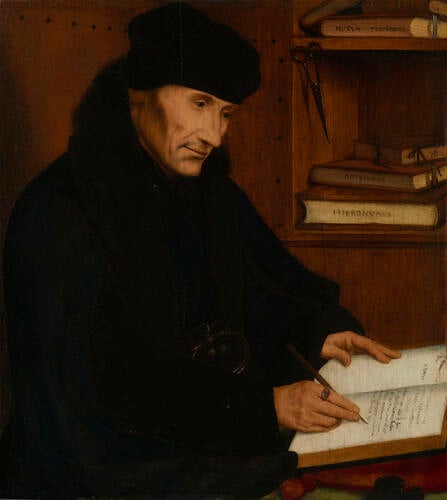
One ought to notice the shears hanging on a nail or hook on the bookshelf in the background. Presumably these would have been a primary tool for Erasmus' ars excerpendi practice.
Cross reference Lisa Jardine (1996) who calls out the purse on Erasmus' chest which identifies him as part of the merchant class.
Also cross reference Hans Holbein's portraits of Erasmus.
Coke contains phosphoric acid, which chemically breaks down iron oxide (rust) into iron phosphate. And Diet Coke isn’t sticky like Coke. And aluminum loses electrons and oxidizes, while the iron oxide (rust) gains electrons. This chemical reduction fundamentally changes the rust back into a form that easily breaks away from the base metal.
Craig French recommends soaking rusty typewriter springs in Diet Coke and then wiping them with aluminum foil to remove rust.
https://www.facebook.com/groups/705152958470148/posts/1354433773542060
https://www.facebook.com/groups/705152958470148/posts/1355607023424735

The Corona Zephyr and Smith-Corona Skyriter typewriter cases used to have two strips of leather sewn over a metal internal strip on their case handles.
Most of these vintage metal cases are missing the leather straps leaving only an uncomfortable metal strip.
I worked in the SCM plant in Groton NY back in the 60's. This is one of the machines that we built there. Plastic was never ment to last over 50 years.
via Greg Hubert
I would be more than happy to help you fix it, or if you are just done with it, I have a large number of machines for sale. I have everything from the 1920's to the 1980s, Manual, electric, electronic. I have portables and ultra portables. I also sell mine for about 1/3 of normal shops because I do this for the fun of it, not for income. I have a large number of Royal Quiet Deluxe and can even custom paint one if you want. Depending on your location, I'd even take that one in trade.
via Milton Solomon at https://www.facebook.com/groups/705152958470148/posts/1354754280176676/
Dolly Parton, Country Music Superstar Whose Songs Spoke to Millions, Dies at 80<br /> by [[Bill Friskics-Warren]] in The New York Times<br /> accessed on 2026-08-25T14:50:12
Success is a lagging indicator from hard work done earlier.<br /> —Jimmy Carr "Laughs Funny" Tour 2026 #
This is Angie Dickinson's Life<br /> by [[Army Archerd]]<br /> accessed on 2026-08-24T13:33:09
https://www.etsy.com/shop/HartongInternational
Looks like Jason of Hartong International refurbishes(?) typewriters and sells them via an Etsy Shop.
Typewriter maintenance all machines<br /> by bremeloboy
Vaguely hilarious in it's portrayal of the way that typewriter repair should never be done.
Millard Kaufman on Working in Hollywood #:
He said, "You're the writer; I'm the producer." He said, "You do it my way or I'm gonna fire your ass." And I was sitting at a typewriter when he said this. So I picked up the typewriter and threw it at him.
reply to u/dragonfenixbird at https://www.reddit.com/r/typewriters/comments/1vuht9b/about_to_buy_my_first_ibm_selectric_supposedly/
Honestly, unless you're in the game to spend months/years learning IBM repair and maintenance, the single best thing you can do for yourself is to buy a refurbished machine from a repair shop.
Chances are almost 100% that your machine will require some level of servicing and in addition to the $30 you'll have lost you'll end up paying as much or more to have it serviced than you might have done just buying refurbished from the start, especially if you just want to start typing.
Save yourself a lot of time, effort, and heartache and just buy one that you know works: https://site.xavier.edu/polt/typewriters/tw-repair.html
One of a handful of Professional Elite No. 41 machines in the typewriter database as of 2026-08-15:
We Tracked a Shipment of Rare Books. It Ended at an Amazon AI Training Facility<br /> by [[Emanuel Maiberg]]<br /> accessed on 2026-08-21T07:46:53
https://typewriterdatabase.com/show.16666.typewriter
A script typewriter missing the number 1 and on which the lower case L doesn't suffice. Perhaps the Capital i would work?
Of all coincidences, the post immediately after yours in the sub was for a refurbished Studio 44 out of Berkeley Typewriter Shop with a script typeface: https://www.reddit.com/r/typewriters/comments/1vtctas/will_i_regret_it_passing_on_this_olivetti_studio/
The though thing is recognizing how to identify potential script machines in online auctions when they don't explicitly state or show the typeface. For many machines prior to 1970 the clue to a script machine may be a dedicated "1" key as script lower case "l" typically won't suffice to also stand in for the number 1 as it did for most other typefaces.
If you'd like to scroll through some and do some research, the database has a section for typefaces: https://typewriterdatabase.com/typefaces.php If you log in there are also downloadable typeface catalogs you can browse through in addition to the resources Ted Munk has at https://typecast.munk.org/category/typewriter-typestylesfonts/
On machines with stated script faces, you may need to be prepared to pay $100-150 on average above the cost of just the machine itself. Less common (and more expensive) variations are machines with Fraktur, Vertical Script, or Spencerian typefaces.
Good luck in your hunt for one, they're definitely out there and not rare.
Reply to u/Ganimor at https://old.reddit.com/r/typewriters/comments/1vtcpjz/cursive_typewriter/
I spent $45 for it which isn't bad for typewriters here in Southern California.
u/WeepinbellJar13 is in the SoCal area for potential type-ins.<br /> https://www.reddit.com/r/typewriters/comments/1vszw4i/second_typewriter_bad_call/
reply to u/rjekyllhyde at https://old.reddit.com/r/Libraries/comments/1vruija/typewriter_request/
Librarian Suzanne LaPierre wrote an article last year about typewriters in libraries. I'll link it and some additional references below for those who are curious.
The Los Angeles Public Library has recently been doing some events with LA poet laureate Brian Sonia-Wallace who creates on his typewriter: https://www.instagram.com/p/DXufGLmgRB3/
There are more than a handful of typewriter enthusiasts who have been holding "Type-Ins" at libraries in the US over the past 5 or more years. I've held a couple of these at a nearby bookstore in Pasadena, CA and we had over 200 people stop by at both of them. (I'd have held them at a local library, but our main branch is undergoing a huge renovation and some of our other nearby branches have been affected by the Eaton Fire in January 2025.)
I know one collector who recently did a display at a library: https://www.youtube.com/watch?v=CJqYPVOb2Ss
I've run across one or two libraries that have typewriters as part of their Library of Things collections along with other analog materials like sewing machines, binoculars, and telescopes.
There are still lots of reasons to want to use a typewriter including for creativity, distraction-free writing, getting away from screens and having a more analog writing experience. Woz Flint has a relatively recent book about using typewriters to create first drafts of writing projects. In the last five or so years a lot of children in the 7-21 year old bracket have been drawn to typewriters as a means of getting away from their computers and screens and allowing them to concentrate better on their writing work. Richard Polt, a typewriter collector and professor of philosophy at Rutgers, wrote a book about the resurgence of typewriters. A handful of college professors have recently been reintroducing typewriters to their pedagogy. Creating art with a typewriter is also still a thing. Taylor Swift has been using typewriters in her songs and videos which adds to the cool factor, especially for the kids.
Is it worth mentioning that Ray Bradbury wrote Fahrenheit 451 on a typewriter at the UCLA Library which was coin operated?!?
I've personally got a small collection of typewriters as well as a list of articles and resources on them for those who may be interested in considering them. I'm happy to chat with any librarians who might consider adding them to their collections.
Happy typing!
References:<br /> * LaPierre, Suzanne S. “BiblioTech: Typewriters in Libraries.” Computers in Libraries 45, no. 2 (March 2025): 24–26. https://www.infotoday.com/cilmag/mar25/index.shtml. * Polt, Richard. 2015. The Typewriter Revolution: A Typist’s Companion for the 21st Century. 1st ed. Woodstock, VT: Countryman Press. * Flint, Woz Delgado. 2023. The Distraction-Free First Draft. One Idea Press. https://www.oneideapress.com/product-page/the-distraction-free-first-draft.
There are dozens of books (and websites) out there that have writing prompts which may help you. Flip open to a random page and start writing.
Here's a good example: https://www.amazon.com/Things-Write-Francisco-Writers-Grotto/dp/1452105448/
If there's some longer work you're hacking away at, another exercise I like to do occasionally that helps on the work at hand, but also gets me away from it is to put one or more of my characters into other popular books or movies. For example, what happens when I drop the 15 year old high school girl from my work into the middle of Die Hard? How would her dad attempt to fit into the milieu of Regina George's gang in Mean Girls? It can be quirky and fun, but also works to hone who those characters are by having them interact with other well developed characters.
reply to u/Sinfully-Dead https://old.reddit.com/r/typewriters/comments/1vrnldl/neglecting_my_typewriter_not_really/
It's Standard Pica. Probably a from the J H Shand type foundry, I see them fairly often on Babies.
Otto Koponen indicates that a "1B" foundry mark on a Hermes Baby is likely a standard pica face from the J. H. Shand type foundry.
via https://www.reddit.com/r/typewriters/comments/1vnpxg8/what_typeface_is_a_hermes_baby_1b/
https://axminsterheritage.org/industry-commerce/
J H Shand Ltd.<br /> From 1940 until the late 1980s J H Shand Ltd employed highly-skilled engineers and technicians, designing and manufacturing steel type used in office equipment and industrial marking systems; and the manufacture of tools and equipment for use by other manufacturing companies. The company’s original role was to supply individual letter type blocks to manufacturers of manual typewriters which they could build into their machines. As electric typewriters took over, the company specialised in the manufacture of plastic ‘daisy wheels’. As well as producing raised characters for use in typewriters etc , the company made embossing type to produce raised letters or numbers when pressed into metal or plastic. This technique was used to make credit cards, many millions of which have been issued. Another side to the business made larger equipment including precision machine tools.
https://archive.org/details/typewriter-foundry-marks-haas/page/n11/mode/2up
JHS is a foundry mark, along with a lion logo, which might appear on Royal, Oliver, Voss, and Underwood typewriters.
Example of it on a Royal Dart at https://www.facebook.com/groups/TypewriterCollectors/posts/10164011983564678
of Axminster. 1895 Company founded. 1936 Private company. 1961 Manufacturers of steel type dies, moulds and press tools.
https://ugmonk.com/collections/accessories-1/products/small-analog-card-sleeves-set-of-6-earth-tones
Ugmonk selling index card dividers (as "analog card sleeves") as a set of 6 for $12. They're fun colors but don't actually have tabs. They also function more as sleeves or folders for notes, but it's not immediately obvious how many cards they'd hold.
in James Ellroy's Red Sheets (Knopf, 2026) set in 1962.
https://www.facebook.com/groups/TypewriterCollectors/posts/10164017890544678/

Ellroy's Red Sheets (Knopf, 2026) mentions fictional typewriters Olivetti 2119, Underwood Selectronic, and the IBM Officemaster.
https://www.facebook.com/groups/705152958470148/posts/1347466777572093/
1965 episode of The Addams Family (S2 E8) "Morticia, the Writer"


Example of female typist covering keyboard up with handkerchief to show how light the touch needed would be.
"Note that the handkerchief is hardly ruffled."
I feel like that time period and the century before, being able to do something through a thin piece of cloth was indicative of how little effort was required, or how dainty something could be. It definitely feels very gendered to me, but I'll have to find other historical examples to back this argument up.
In the digital age, these typewriter superfans hold the keys<br /> by [[Victoria Hoffmann]], [[Mackenzie Farkus]], [[Melanie Stetson Freeman]] in The Christian Science Monitor CSMonitor.com<br /> accessed on 2026-08-15T16:33:28
a mini history along with some reasons to use typewriters in the 21st century. nothing really new here...
politician and inventor William Austin Burt patented the “typographer.” He invented the machine to help handle the amount of paperwork that his job as a surveyor entailed.
The first documented typewriter is from 1575 Italy, when Francesco Rampazetto, a printer and publisher, invented the scrittura tattile, a machine that left imprints of letters on paper.
Remembering what you read<br /> by [[Richard Griffiths]] in Writing Slowly<br /> accessed on 2026-08-15T16:16:37
I suspect the memory-aiding features of the bookshelf itself are qualitatively different from those of a plain list of the books in that bookshelf. The book shelves are a kind of ‘memory palace’ for the books themselves. In fact this realisation is quite important to me. It might explain why I get frustrated when someone reorganises these books: they’re literally reorganising my memory.
https://www.wincofoods.com/recipes/<br /> WinCo Foods used to have index card recipes for all of their bulk goods. Now their collection is online and references their SKU numbers in many cases to match with purchased goods.
A 1955 Smith Corona Silent-Super in Vertical Script, made its way into my hands. In Whitefish, MT currently, and of course I had to check FBmarket for any machines in the area. The ONLY one for sale was this ad with a bad-photo'd SCM with no photos but the machine sitting in an upside down case. BUT, I saw that little "I" on the @ key and BAM! Vertical script.
via nickila_typewriter at https://www.instagram.com/p/Db9wFQ2G8eW/
Smith-Corona machines with an @/1 key on the home row can be indicative of a machine with vertical script.
Remington Typewriter Company. 1927. An Easy Guide for Operating the Remington Portable Typewriter. http://archive.org/details/AnEasyGuideForOperatingTheRemingtonPortableTypewriter (August 13, 2026).
https://www.ebay.com/str/keatsandyeats
Web storefront at: https://www.typewritermechanic.com/
https://www.typewritermechanic.com/<br /> Unknown name and address in Lebanon, PA<br /> Private home, not a storefront<br /> Etsy shop: https://www.ebay.com/str/keatsandyeats
Not currently on Richard Polt's list as of 2026-08-13.
The sharpest increases include lunch boxes (26.8 percent), notebooks (23 percent), index cards (22.2 percent), notebook paper (20 percent), and tissues (20 percent).
As Students Head Back to School, Families Face 11% Price Hikes<br /> by [[Elizabeth Pancotti]], [[Zoe Butler]], [[Natalie Forman]], [[Janelle Jones]]<br /> accessed on 2026-08-12T14:37:28
2025 price: $3.16<br /> 2026 price: $3.86<br /> Increase 22.2%
Suspicious-Diver-630
u/Suspicious-Diver-630 on Reddit is Mos 6502 on TWdB
https://old.reddit.com/r/typewriters/comments/1vjoyny/underwood_touchmaster_ii_revival/ https://typewriterdatabase.com/typewriters.php?hunter_search=8385&collection_search=My+Collection
https://nb.notabene.com/<br /> Nota Bene software

 —via
—via