444 Matching Annotations
  1. Last 7 days
    1. PatientID: None

      KindredID: VHL1

      Case: M, 22Y0M, Ethnicity Unknown

      DiseaseAssertion: VHL

      FamilyInfo: N/A

      CohortInfo: A total of 190 patients recruited by the COMETE network over 15 years were included in the study.

      CasePresentingHPOs: HP:0002666 (Pheochromocytoma)

      CaseHPOFreeText: The patient had one benign pheochromocytoma.

      CaseNotHPOs: N/A

      CaseNotHPOFreeText: N/A

      CasePreviousTesting: RET/SDHB/SDHC/SDHD

      PreviouslyPublished: N/A

      SupplementalData: Table 1 of Supplementary

      Variant: p.S80N (c.239G>C)

      LegacyVariant: N/A

      CaseProblemVariantFreeText: N/A

      ClinVarID: 1070179, https://www.ncbi.nlm.nih.gov/clinvar/variation/1070179/

      CAID: N/A

      gnomAD: N/A

      VariantEvidence: Somatic VHL variant c.1-?_642+?del (complete deletion) was found in the tumor tissue.

      MutationType: missense_variant;transversion

      CivicName: S80N (c.239G>A)

      MultipleGeneVariants: N/A

    2. PatientID: None

      KindredID: VHL24

      Case: M, 22Y0M, Ethnicity Unknown

      DiseaseAssertion: VHL

      FamilyInfo: N/A

      CohortInfo: A total of 190 patients recruited by the COMETE network over 15 years were included in the study.

      CasePresentingHPOs: HP:0002666 (Pheochromocytoma)

      CaseHPOFreeText: The patient had one benign pheochromocytoma.

      CaseNotHPOs: N/A

      CaseNotHPOFreeText: N/A

      CasePreviousTesting: RET/SDHB/SDHC/SDHD

      PreviouslyPublished: N/A

      SupplementalData: Table 1 of Supplementary

      Variant: Complete Deletion (c.1-?_642+?del)

      LegacyVariant: N/A

      CaseProblemVariantFreeText: N/A

      ClinVarID: N/A

      CAID: N/A

      gnomAD: N/A

      VariantEvidence: The patient had no LOH found in the BAC array CGH data. Somatic VHL variant c.250G>C was found in the tumor tissue.

      MutationType: deletion

      CivicName: Deletion

      MultipleGeneVariants: N/A

    1. PMID: 23143947

      PatientID: CIV:2

      KindredID: C

      Case: M, 22Y0M, Chinese

      DiseaseAssertion: hemangioblastoma

      FamilyInfo: A 4-generation family is given with 3 confirmed members with this mutation. 3 other members had VHL-presenations however had not been tested for the gene.

      CasePresentingHPOs: HP:0010797 (hemangioblastoma)

      CaseHPOFreeText: diagnosed with hemangioblastoma and died of surgical complications at the age of 22Y

      CaseNotHPOs: HP:0002666; HP:0005584; HP:0001737; HP:0009711 (pheochromocytoma, renal cell carcinoma, pancreatic cysts, retinal capillary hemangioma)

      CaseNotHPOFreeText: N/A

      CasePreviousTesting: N/A

      PreviouslyPublished: N/A

      SupplementalData: N/A

      Variant: p.S80I (c.239G>T) [assumed]

      LegacyVariant: p.S80I (c.452G>T)

      CaseProblemVariantFreeText: N/A

      ClinVarID: 625229 https://www.ncbi.nlm.nih.gov/clinvar/variation/625229/

      CAID: N/A

      gnomAD: N/A

      VariantEvidence: No genetic testing was done prior to death, however family history and presentation leads to this assumption

      MutationType: missense_variant; transversion

      CivicName: S80I (c.239G>T)

      MultipleGeneVariants: N/A

    2. PMID: 23143947

      PatientID: BII:6

      KindredID: B

      Case: M, 24Y0M (deceased), Chinese

      DiseaseAssertion: cerebellar hemangioblastoma

      FamilyInfo: A 3-generation family is given with 1 confirmed member tested for VHL (proband: III:5). His mother likely had the mutation as the mother and her brother both had VHL phenotypes at young ages (27Y and 22Y).

      CasePresentingHPOs: HP:0006880 (cerebellar hemangioblastoma)

      CaseHPOFreeText: Patient had operation for cerebellar hemangioblastoma at the age of 22 and died of bilateral multiple hemangioblastoma at the age of 24, with no chance of surgical treatment.

      CaseNotHPOs: HP:0009711; HP:0002666; HP:0005584; HP:0001737 (retinal capillary hemangioma, pheochromocytoma, renal cell carcinoma, pancreatic cysts)

      CaseNotHPOFreeText: N/A

      CasePreviousTesting: N/A

      PreviouslyPublished: N/A

      SupplementalData: N/A

      Variant: p.P154L (c.461C>T) [assumed]

      LegacyVariant: p.P154L (c.647C>T)

      CaseProblemVariantFreeText: N/A

      ClinVarID: 649525, https://www.ncbi.nlm.nih.gov/clinvar/variation/649525/

      CAID: N/A

      gnomAD: N/A

      VariantEvidence: No genetic testing was done prior to death, however family history and presentation leads to this assumption

      MutationType: missense_variant; transition

      CivicName: P154L (c.461C>T)

      MultipleGeneVariants: N/A

    1. Grand cousin 1–22–23Renal cysts

      PatientID: None (Grand Cousin 1)

      KindredID: G

      Case: Sex Unknown, 23Y0M, Hungarian

      DiseaseAssertion: Assumed VHL

      FamilyInfo: Large VHL family spanning five generations. The index patient presented with pheochromocytoma, renal cell carcinoma as well as spinal cord, cerebellar, and medulla oblongata hemangioblastomas. Her parents showed no clinical, biochemical, or radiological evidence of the disease, but VHL-associated tumors were detected in five other family members (bilateral renal cell carcinomas in one, renal cysts in one, spinal cord, cerebellar, and medulla oblongata hemangioblastomas in three, retinal hemangioblastomas in four, and pheochromocytomas in two family members).

      CasePresentingHPOs: HP:0010797; HP:0009711; HP:0005562 (Hemangioblastoma, Retinal capillary hemangioma, Multiple renal cysts)

      CaseHPOFreeText: Presented with CNS hemangioblastoma at age 22 and retinal hemangioblastoma at age 23. No VHL diagnosis noted but assumed to have VHL based on genetic, clinical and familial findings.

      CaseNotHPOs: N/A

      CaseNotHPOFreeText: N/A

      CasePreviousTesting: N/A

      PreviouslyPublished: 18416845

      SupplementalData: N/A

      Variant: p.S80I (c.239G>T)

      LegacyVariant: N/A

      CaseProblemVariantFreeText: N/A

      ClinVarID: 625229, https://www.ncbi.nlm.nih.gov/clinvar/variation/625229/

      CAID: N/A

      gnomAD: N/A

      VariantEvidence: Variant reported as S80I and cDNA change was mapped to c.239G>T.

      MutationType: missense_variant;transversion

      CivicName: S80I (c.239G>T)

      MultipleGeneVariants: N/A

    2. DIP–22–22Renal cysts, pancreatic cyst, and accessory spleen1

      PatientID: IP (Proband)

      KindredID: D

      Case: F, 22Y0M, Hungarian

      DiseaseAssertion: VHL

      FamilyInfo: Index patient was a young woman who presented with cerebellar hemangioblastoma, multiple renal cysts, retinal detachment with vitreous hemorrhage, pancreatic cyst, spinal cord hemangiomas, and recurrence of the cerebellar lesion. Family members were not available for clinical and genetic screening, but family history revealed that the patient's father died of metastatic renal cell carcinoma.

      CasePresentingHPOs: HP:0006880; HP:0005562; HP:0001737; HP:0000541; HP:0007902; HP:0009713 (Cerebellar hemangioblastoma, Multiple renal cysts, Pancreatic cysts, Retinal detachment, Vitreous hemorrhage, Spinal hemangioblastoma)

      CaseHPOFreeText: Patient underwent surgery for cerebellar hemangioblastoma at the age of 22 years. Multiple renal cysts and retinal detachment with vitreous hemorrhage were also observed. At the age of 26 years, pancreatic cyst, spinal cord hemangiomas, and recurrence of the cerebellar lesion were found. Diagnosed with VHL Type 1.

      CaseNotHPOs: HP:0002666; HP:0009711; HP:0005584 (Pheochromocytoma, Retinal capillary hemangioma, Renal cell carcinoma)

      CaseNotHPOFreeText: N/A

      CasePreviousTesting: N/A

      PreviouslyPublished: N/A

      SupplementalData: N/A

      Variant: Exon 2 Deletion (c.341-?_463+?del)

      LegacyVariant: N/A

      CaseProblemVariantFreeText: N/A

      ClinVarID: N/A

      CAID: N/A

      gnomAD: N/A

      VariantEvidence: N/A

      MutationType: exon_loss_variant

      CivicName: Exon 2 Deletion

      MultipleGeneVariants: N/A

    1. We present the case of a 22-year-old woman who was diagnosed in childhood with type IIb VHL, with known multiple retinal angiomas, pancreatic cysts, and spinal and cerebellar hemangioblastomas. She was admitted to our hospital complaining of progressive dyspnea and palpitations. On examination, her blood pressure was 159/119 mm Hg and her pulse was 123 bpm. Physical examination revealed a systolic murmur at the mitral focus with irradiation to the axilla and pulmonary rales. Electrocardiography revealed no remarkable findings, except for sinus tachycardia. Laboratory tests showed an elevated N-terminal pro-brain natriuretic peptide and chest X-ray showed signs of pulmonary interstitial edema. The patient was admitted to the Department of Cardiology with the diagnosis of acute decompensated heart failure. Transthoracic echocardiography showed a dilated left ventricle with severely depressed ejection fraction due to generalized hypokinesia and a mild mitral regurgitation (fig. ​(fig.1a).1a). During admission, the patient had several episodes of paroxysmal dyspnea despite treatment with β-blockers and diuretics. Due to the clinical suspicion of adrenal gland disease, 24-hour urinary catecholamine and metanephrine tests were requested. Cardiac MRI was performed in order to complete the cardiomyopathy study, and confirmed the echocardiographic findings as well as revealed an incidental finding of a great left renal mass. The 24-hour urine laboratory tests showed markedly elevated levels of norepinephrine, total catecholamines, normetanephrine and metanephrine with normal epinephrine values: 24-hour norepinephrine 468 μg (normal range: 23-105), 24-hour epinephrine 13 μg (normal range: 4-20), 24-hour total catecholamines 658 μg (normal range: 217-575), 24-hour normetanephrine 2,988 μg (normal range: 105-354), 24-hour total metanephrine 3,013 μg (normal range: 0-1,000). Therefore, an abdominal MRI was performed, which showed the presence of two cystic masses (fig. ​(fig.2)2) located at the left hypochondrium. Surgical resection of both masses was performed (after α-blockade with phenoxybenzamine and β-blockade with propranolol) through a laparoscopic approach, confirming the diagnosis of pheochromocytoma and clear cell renal carcinoma on histology. During follow-up, blood pressure and heart rate values normalized (124/77 mm Hg, 78 bpm), 24-hour urinary catecholamine values returned to normal range (norepinephrine 69 μg/24 h, total catecholamine 221 μg/24 h, normetanephrine 202 μg/24 h and total metanephrine 259 μg/24 h) and the patient had no new episodes of palpitations or dyspnea. Six months after surgical resection, echocardiography was repeated and showed a left ventricle with normal diameters and preserved ejection fraction (fig. ​(fig.1b).1b). Genetic analysis revealed a germline mutation (exon 3 deletion) of the VHL tumor suppressor gene on the short arm of chromosome 3. As the patient had no family history of VHL, it was concluded that it was a de novo mutation.

      PatientID: None

      KindredID: 1

      Case: F, 22Y0M, Ethnicity Unknown

      DiseaseAssertion: VHL

      FamilyInfo: No family history of VHL, it was concluded that it was a de novo mutation.

      CasePresentingHPOs: HP:0009711; HP:0001737; HP:0009713; HP:0006880; HP:0002094; HP:0001962; HP:0011703; HP:0031664; HP:0001635; HP:0002375; HP:0001653; HP:0002666; HP:0006770 (Retinal capillary hemangioma, Pancreatic cysts, Spinal hemangioblastoma, Cerebellar hemangioblastoma, Dyspnea, Palpitations, Sinus tachycardia, Systolic heart murmur, Congestive heart failure, Hypokinesia, Mitral regurgitation, Pheochromocytoma, Clear cell renal cell carcinoma)

      CaseHPOFreeText: 22-year-old woman who was diagnosed in childhood with type IIb VHL, with known multiple retinal angiomas, pancreatic cysts, and spinal and cerebellar hemangioblastomas. She was admitted to our hospital complaining of progressive dyspnea and palpitations. Physical examination revealed a systolic murmur at the mitral focus with irradiation to the axilla and pulmonary rales. Electrocardiography revealed no remarkable findings, except for sinus tachycardia. Chest X-ray showed signs of pulmonary interstitial edema. The patient was admitted to the Department of Cardiology with the diagnosis of acute decompensated heart failure. Transthoracic echocardiography showed a dilated left ventricle with severely depressed ejection fraction due to generalized hypokinesia and a mild mitral regurgitation. During admission, the patient had several episodes of paroxysmal dyspnea. Cardiac MRI was performed in order to complete the cardiomyopathy study, and confirmed the echocardiographic findings as well as revealed an incidental finding of a great left renal mass. Abdominal MRI was performed, which showed the presence of two cystic masses located at the left hypochondrium confirming the diagnosis of pheochromocytoma and clear cell renal carcinoma on histology.

      CaseNotHPOs: N/A

      CaseNotHPOFreeText: N/A

      CasePreviousTesting: N/A

      PreviouslyPublished: N/A

      SupplementalData: N/A

      Variant: Exon 3 Deletion (c.464-?_642+?del)

      LegacyVariant: N/A

      CaseProblemVariantFreeText: N/A

      ClinVarID: N/A

      CAID: N/A

      gnomAD: N/A

      VariantEvidence: N/A

      MutationType: exon_loss_variant

      CivicName: Exon 3 Deletion

      MultipleGeneVariants: N/A

    1. The index case was a 14 year-old boy who presented to us in 1971 with severe hypertension. On evaluation he was found to have a right adrenal mass with elevated urinary VMA (normal <7 mg/24 hr), confirming the diagnosis of a right adrenal pheochromocytoma. He underwent right adrenalectomy and the post-operative period was uneventful. He was subsequently lost to follow. In 1979, he presented to us again with severe headache and recurrent seizures. On examination his pulse rate was 100/min, blood pressure was 160/130 mm of Hg. Cardiac auscultation revealed a loud 2nd heart sound and a 3rd heart sound. There were no murmurs. Examination of the abdomen revealed a palpable mass in the left hypochondrium. This mass was confirmed as a pheochromocytoma. After adequately controlling his blood pressure he underwent left cortical sparing adrenalectomy. The post-operative period was uneventful. He was on steroid replacement that was subsequently withdrawn after his serum cortisol levels had normalized. His 8 AM cortisol after withdrawal of steroids was 12 µg/dl.He subsequently got married and had two children as shown in Figure 1, who also eventually developed similar tumors.

      PatientID: II-1

      KindredID: 1

      Case: M, 57Y0M, Ethnicity Unknown

      DiseaseAssertion: VHL

      FamilyInfo: Family in India but Ethnicity not explicitly confirmed. Two children with the same mutation. Eldest son presented at age 10 with severe hypertension and bilateral pheochromocytoma. Daughter presented at age 17 with palpitation, blurred vision, blurring vision, bilateral papilledema and bilateral pheochromocytoma. Wife and brother were negative for the mutation.

      CasePresentingHPOs: HP:0000822; HP:0002666; HP:0006748; HP:0002315; HP:0001250; HP:0031657 (Hypertension, Pheochromocytoma, Adrenal pheochromocytoma, Headache, Seizure, Abnormal heart sound)

      CaseHPOFreeText: Presented at 14 years-old with severe hypertension. On evaluation he was found to have a right adrenal mass with elevated urinary VMA, confirming the diagnosis of a right adrenal pheochromocytoma. Presented at age 22 with severe headache and recurrent seizures. Cardiac auscultation revealed a loud 2nd heart sound and a 3rd heart sound. Examination of the abdomen revealed a palpable mass in the left hypochondrium. This mass was confirmed as a pheochromocytoma. Asymptomatic at age 57.

      CaseNotHPOs: HP:0030148 (Heart murmur)

      CaseNotHPOFreeText: There were no heart murmurs during evaluation at age 22.

      CasePreviousTesting: N/A

      PreviouslyPublished: N/A

      SupplementalData: Figure 1

      Variant: p.R82L (c.245G>T)

      LegacyVariant: N/A

      CaseProblemVariantFreeText: N/A

      ClinVarID: 526675, https://www.ncbi.nlm.nih.gov/clinvar/variation/526675/

      CAID: N/A

      gnomAD: N/A

      VariantEvidence: Authors carried out analysis of VHL variant p.Arg82Leu with six different in silico tools namely SIFT, I-Mutant3, PhD-SNP, MutPred, PolyPhen2 and SNPs&GO in order to determine the pathogenic potential of the variant.

      MutationType: missense_variant;transversion

      CivicName: R82L (c.245G>T)

      MultipleGeneVariants: N/A
  2. soochowmss.sharepoint.com soochowmss.sharepoint.com
    1. He didn't look at it-he didn't want to look at it. A terrible, closed look came over his face, as though he were keeping th e number on the bill a secret from him and me.

      I'm so surprisng about just a bill can cause such a strong feeling in the narrator's mind.

    1. A 22-year-old man complained of a shadow in his right eye and was diagnosed with retinal detachment secondary to a retinal hemangioblastoma. His family history was noncontributory and physical examination normal except for a right epididymal cyst. Laboratory studies were unremarkable. Magnetic resonance imaging (MRI) of his brain revealed a hypervascular lesion in the medulla (large arrow; Figure A) and a smaller lesion at the medullary-spinal cord junction (small arrow; Figure A). A T2-weighted abdominal MRI demonstrated innumerable pancreatic cysts (Figure B) and multiple benign-appearing renal cysts. After surgical resection of the retinal hemangioblastoma, the patient remains asymptomatic. What is the diagnosis?

      PatientID: None

      KindredID: 1

      Case: M, 22Y0M, Ethnicity Unknown

      DiseaseAssertion: VHL

      FamilyInfo: No notable family history.

      CasePresentingHPOs: HP:0000541; HP:0010797; HP:0009711; HP:0030424; HP:0005562; HP:0001737 (Retinal detachment, Hemangioblastoma, Retinal capillary hemangioblastoma, Epididymal cyst, Multiple renal cysts, Pancreatic cysts)

      CaseHPOFreeText: Complained of a shadow in his right eye and was diagnosed with retinal detachment secondary to a retinal hemangioblastoma. MRI of the brain revealed a hyper vascular lesion in the medulla and a smaller lesion at the medullary-spinal cord junction. Weighted abdominal MRI revealed innumerable pancreatic cysts and multiple benign-appearing renal cysts. After surgical resection of the retinal hemangioblastoma, the patient remains asymptomatic.

      CaseNotHPOs: N/A

      CaseNotHPOFreeText: N/A

      CasePreviousTesting: N/A

      PreviouslyPublished: N/A

      SupplementalData: N/A

      Variant: p.K159* (c.474_475insT)

      LegacyVariant: N/A

      CaseProblemVariantFreeText: N/A

      ClinVarID: N/A

      CAID: CA432423112, https://reg.clinicalgenome.org/redmine/projects/registry/genboree_registry/allele?hgvsOrDescriptor=NM_000551.3%3Ac.474_475insT

      gnomAD: N/A

      VariantEvidence: Reported as: NT474INST. Authors state that this is believed to be a novel sporadic mutation.

      MutationType: insertion; plus_1_frameshift_variant; stop_gained

      CivicName: K159* (c.474_475insT)

      MultipleGeneVariants: N/A

    1. PatientID: 220

      KindredID: 82

      Case: M, 36Y0M, Chinese

      DiseaseAssertion: VHL

      FamilyInfo: The proband's mother and sister both presented with renal cell carcinoma at ages 49 and 27, respectively. Their mother also had a CNS hemangioblastoma at 45, and their sister had a retinal angioma at 30. No genotyping information was available for either family member.

      CasePresentingHPOs: HP:0005584; HP:0002666 (Renal cell carcinoma, Pheochromocytoma)

      CaseHPOFreeText: The proband presented with renal cell carcinoma at age 22, and a pheochromocytoma at age 36.

      CaseNotHPOs: HP:0009711; HP:0001737; HP:0001732; HP:0010797 (Retinal capillary hemangioma, Pancreatic cysts, Abnormality of the pancreas, Hemangioblastoma)

      CaseNotHPOFreeText: N/A

      CasePreviousTesting: N/A

      PreviouslyPublished: This cohort was also published in a later paper by Wang et al., 2018 (PMID: 29330336).

      SupplementalData: Patient and family genotype-phenotype information is listed in Supplementary Table 1.

      Variant: p.R167Q (c.500G>A)

      LegacyVariant: N/A

      CaseProblemVariantFreeText: N/A

      ClinVarID: 2216, https://www.ncbi.nlm.nih.gov/clinvar/variation/2216/

      CAID: N/A

      gnomAD: N/A

      VariantEvidence: N/A

      MutationType: missense_variant;transition

      CivicName: R167Q (c.500G>A)

      MultipleGeneVariants: N/A

    2. PatientID: 280

      KindredID: 110

      Case: M, 22Y0M, Chinese

      DiseaseAssertion: VHL

      FamilyInfo: The proband, patient 280, presented with a CNS hemangioblastoma at age 16, a retinal angioma at age 15, and multiple pancreatic cysts/tumors at age 22. Their father presented with a CNS hemangioblastoma at age 25, and retinal angioma at age 29.

      CasePresentingHPOs: HP:0010797; HP:0001737; HP:0001732; HP:0009711 (Hemangioblastoma, Pancreatic cysts, Abnormality of the pancreas, Retinal capillary hemangioma)

      CaseHPOFreeText: The proband, patient 280, presented with a CNS hemangioblastoma at age 16, a retinal angioma at age 15, and multiple pancreatic cysts/tumors at age 22.

      CaseNotHPOs: HP:0002666; HP:0005584 (Pheochromocytoma, Renal cell carcinoma)

      CaseNotHPOFreeText: N/A

      CasePreviousTesting: N/A

      PreviouslyPublished: This cohort was also published in a later paper by Wang et al., 2018 (PMID: 29330336).

      SupplementalData: Patient and family genotype-phenotype information is listed in Supplementary Table 1.

      Variant: Exon 2-3 Deletion (c.341-?_642+?del)

      LegacyVariant: N/A

      CaseProblemVariantFreeText: N/A

      ClinVarID: N/A

      CAID: N/A

      gnomAD: N/A

      VariantEvidence: N/A

      MutationType: exon_loss_variant

      CivicName: Exon 2-3 Deletion

      MultipleGeneVariants: N/A

    1. GroupID: 8

      Case: 37Y0M, Sex Unknown, Ethnicity Unknown

      DiseaseAssertion: assumed VHL

      FamilyInfo: 1 of the 573 patients discussed in this paper were found to have this variant. This mutation was found in 1 VHL family with a single patient.

      CasePresentingHPOs: HP:0005584; HP:0009711; HP:0006880 (renal cell carcinoma; retinal capillary hemangioma; cerebellar hemangioblastoma)

      CaseHPOFreeText: patient had retinal angiomas diagnosed at 28Y, cerebellar hemangioblastomas diagnosed at 22Y, and renal cell carcinoma diagnosed at 37Y.

      CaseNotHPOs: HP:0002666 (pheochromocytoma)

      CaseNotHPOFreeText: N/A

      CasePreviousTesting: N/A

      PreviouslyPublished: N/A

      SupplementalData: Supplementary Table S1.

      Variant: p.R177* (c.529A>T)

      CaseProblemVariantFreeText: N/A

      LegacyVariant: N/A

      ClinVarID: 625258 https://www.ncbi.nlm.nih.gov/clinvar/variation/625258/

      CAID: N/A

      gnomAD: N/A

      VariantEvidence: N/A

      MutationType: stop_gained

      CivicName: R177* (c.529A>T)

      MultipleGeneVariants: N/A

    1. V1-122MCerebellumc.216delCChr. 3 LOH——Yes−224MCerebellumc.216delC———

      PatientID: V1

      KindredID: 1

      Case: M, 24Y0M, Ethnicity Unknown

      DiseaseAssertion: VHL

      FamilyInfo: This patient’s brother also had this germline mutation and at least one brainstem hemangioblastoma at 30 years old.

      CasePresentingHPOs: HP:0006880 (Cerebellar hemangioblastoma)

      CaseHPOFreeText: Study reports 2 cerebellar hemangioblastomas at the ages of 22 and 24. Other phenotype information not provided.

      CaseNotHPOs: N/A

      CaseNotHPOFreeText: N/A

      CasePreviousTesting: N/A

      PreviouslyPublished: N/A

      SupplementalData: Table 2

      Variant: p.Q73Rfs*86 (c.216del)

      LegacyVariant: N/A

      CaseProblemVariantFreeText: N/A

      ClinVarID: N/A

      CAID: CA432536422, https://reg.clinicalgenome.org/redmine/projects/registry/genboree_registry/by_canonicalid?canonicalid=CA432536422

      gnomAD: N/A

      VariantEvidence: The c.216delC variant was not genetically confirmed to be germline but was found in tumor samples from both the siblings.

      MutationType: minus_1_frameshift_variant

      CivicName: S72fs (c.216delC)

      MultipleGeneVariants: N/A

    1. PatientID: III-9

      KindredID: 1

      Case: F, 32Y0M, Ethnicity Unknown

      DiseaseAssertion: VHL

      FamilyInfo: Large multigenerational family with a history of both VHL and spinocerebellar ataxia type 2 (SCA2). Screening for clinical and genetic diagnostics were gathered as well as thorough information on non-living members. See family pedigree (Fig. 1).

      CasePresentingHPOs: HP:0010797; HP:0009711; HP:0000541; HP:0002542; HP:0001737; HP:0000107; HP:0030405; HP:0001272; HP:0007366; HP:0010873; HP:0001251; HP:0001260; HP:0001310 (hemangioblastoma, Retinal capillar hemangioma, Retinal detachment, Olivopontocerebellar atrophy, Pancreatic cysts, Renal cyst, Pancreatic endocrine tumor, Cerebellar atrophy, Atrophy/Degeneration affecting the brainstem, Cervical spinal cord atrophy, Ataxia, Dysarthria, Dysmetria)

      CaseHPOFreeText: diagnosed with VHL in her early teenage years. She had retinal involvement beginning at the age of 13 treated by cryotherapy and laser therapy (presumably for retinal angiomas); and retinal detachment at the age of 23 requiring eye surgery. She had cysts of the pancreas and kidney detected at 22 years. She has also carried the diagnosis of OPCA since the age of 26-28 (new onset slurred speech and illegible handwriting). Patient had multiple renal cysts without renal tumours, however a large infiltrative enhancing mass in the tail of the pancreas was suggestive of a neuroendocrine/islet cell carcinoma, and liver metastatic foci

      CaseNotHPOs: N/A

      CaseNotHPOFreeText: N/A

      CasePreviousTesting: N/A

      PreviouslyPublished: N/A

      SupplementalData: N/A

      Variant: p.E160Sfs*10 (c.477delA)

      LegacyVariant: c.688delA

      CaseProblemVariantFreeText: c.477del, p.Glu160Serfs10 should be used. Details: 477del same as 475delA bc that codon is AAA so doesn't matter which A gets deleted: there is an A at 475 476 477 so for HGVS we say that 477 (the latter) is deleted since that follows HGVS nomenclature. Thus use c.477del: p.Glu160Serfs10

      ClinVarID: 182959 https://www.ncbi.nlm.nih.gov/clinvar/variation/182959/

      CAID: N/A

      gnomAD: N/A

      VariantEvidence: N/A

      MutationType: minus_1_frameshift_variant

      CivicName: E160fs (c.477del)

      MultipleGeneVariants: SCA2 (an abnormal increase in CAG repeats in one allele of her ataxin-2 gene. This abnormal trinucleotide expansion is consistent with the diagnosis of spinocerebellar ataxia type 2)

    1. two cases

      PatientID: P1

      KindredID: 1

      Case: F, 27Y0M, Ethnicity Unknown

      DiseaseAssertion: VHL

      FamilyInfo: The patient’s father, age 45, presented with right ccRCC and pancreatic cysts. The patient’s uncle, age 38, presented with unilateral ccRCC. Both the patient’s father and uncle were found to carry the mutation the patient carried.

      CasePresentingHPOs: HP:0009726; HP:0001737 (Renal neoplasm, pancreatic cysts)

      CaseHPOFreeText: The patient presented with two right renal masses and several pancreatic cysts at 22Y.

      CaseNotHPOs: HP:0010797; HP:0002666 (Hemangioblastoma, pheochromocytoma)

      CaseNotHPOFreeText: Full VHL phenotyping with brain and spine MRI, abdominal CT, biochemical examination for pheochromocytoma, and ophthalmologic assessments did not reveal any additional VHL manifestations.

      CasePreviousTesting: SDHB, SDHC, SDHD

      PreviouslyPublished: N/A

      SupplementalData: N/A

      Variant: (c.-77_-32del)

      LegacyVariant: N/A

      CaseProblemVariantFreeText: The mutation was a deletion in the VHL 5’ UTR, including the promoter.

      ClinVarID: 433541, http://www.ncbi.nlm.nih.gov/clinvar/variation/433541

      gnomAD: N/A

      VariantEvidence: N/A

      MutationType: 5_prime_UTR_variant

      CivicName: c.-77_-32del

      MultipleGeneVariants: N/A

  3. Oct 2026
    1. PatientID: 47

      KindredID: 15

      Case: F, 22Y0M, Chinese

      DiseaseAssertion: VHL

      FamilyInfo: Proband (patient 42) has four family members confirmed with the mutation, and two family members who passed away before diagnosis/ genetic confirmation of the mutation. Family members confirmed with the mutation include: the proband's daughter (patient 43) who had retinal angioma (age 17), renal cell carcinoma (21), multiple pancreatic cysts/tumors (18), and a pheochromocytoma (19). His son (patient 44) who was asymptomatic at the time of assessment. His niece 1 (patient 47) who had a retinal angioma and renal cell carcinoma (22). And his niece 2 (patient 28) who had a CNS hemangioblastoma (19) and a retinal angioma (18). Family members who passed away before diagnosis and were not genetically confirmed include: his sister (oatient 45) who had a CNS hemangioblastoma (22), and his brother (patient 46) who had a retinal angioma and renal cell carcinoma at 52.

      CasePresentingHPOs: HP:0005584; HP:0009711 (Renal cell carcinoma, Retinal capillary hemangioma)

      CaseHPOFreeText: The proband's niece 1 (patient 47) had a retinal angioma and renal cell carcinoma at 22.

      CaseNotHPOs: HP:0001737; HP:0001732; HP:0002666; HP:0010797 (Pancreatic cysts, Abnormality of the pancreas, Pheochromocytoma, Hemangioblastoma)

      CaseNotHPOFreeText: N/A

      CasePreviousTesting: N/A

      PreviouslyPublished: This patient was also published in a later paper by Wang et al., 2018 (PMID: 29330336).

      SupplementalData: Patient and family genotype-phenotype information is listed in Supplementary Table 1.

      Variant: p.S80Tfs*77 (c.239_245del)

      LegacyVariant: N/A

      CaseProblemVariantFreeText: N/A

      ClinVarID: N/A

      CAID: CA913189246; https://reg.clinicalgenome.org/redmine/projects/registry/genboree_registry/allele?hgvsOrDescriptor=NM_000551.3%3Ac.239_245del

      gnomAD: N/A

      VariantEvidence: N/A

      MutationType: minus_1_frameshift_variant

      CivicName: S80fs (c.239_245del)

      MultipleGeneVariants: N/A

    2. PatientID: 3

      KindredID: 2

      Case: M, 22Y0M, Chinese

      DiseaseAssertion: VHL

      FamilyInfo: His father also had this mutation and presented with renal cell carcinoma and pancreatic cysts at age 48. His father's mother (his grandmother) presented with a CNS hemangioblastoma at age 61, and his father's brother (his uncle) presented with a CNS hemangioblastoma at age 33. His grandmother passed away before diagnosis, and there was no DNA sample available for his uncle.

      CasePresentingHPOs: HP:0010797 (Hemangioblastoma)

      CaseHPOFreeText: The patient presented with a CNS hemangioblastoma at the age of 22.

      CaseNotHPOs: HP:0009711; HP:0002666; HP:0005584; HP:0001737 (Retinal Capillary Hemangioma, Pheochromocytoma, Renal cell carcinoma, Pancreatic cysts)

      CaseNotHPOFreeText: N/A

      CasePreviousTesting: N/A

      PreviouslyPublished: This cohort was also published in a later paper by Wang et al., 2018 (PMID: 29330336).

      SupplementalData: Patient and family genotype-phenotype information is listed in Supplementary Table 1.

      Variant: p.S65W (c.194C>G)

      LegacyVariant: N/A

      CaseProblemVariantFreeText: N/A

      ClinVarID: 43597, https://www.ncbi.nlm.nih.gov/clinvar/variation/43597/

      CAID:

      gnomAD: N/A

      VariantEvidence: N/A

      MutationType: missense_variant;transversion

      CivicName: S65W (c.194C>G)

      MultipleGeneVariants: N/A

    1. PatientID: 24 (Aunt)

      KindredID: 18

      Case: F, 80Y0M, Ethnicity Unknown

      DiseaseAssertion: Assumed VHL

      FamilyInfo: 11 members of this family tested positive for the c.712C>T/c.499C>T germline variant of the VHL gene. 14 members of this family were assumed to carry this variant due to family history/personal medical history. Members of this family range from asymptomatic to multi-organ involvement (pheochromocytoma, pancreatic and renal cysts/tumors and hemangioblastomas). The family was previously reported in PMID 3942913.

      CasePresentingHPOs: HP:0010797; HP:0002666; HP:0009711 (Hemangioblastoma, Pheochromocytoma, Retinal capillary hemangioma)

      CaseHPOFreeText: This patient presented with CNS hemangioblastoma (36Y), pheochromocytoma (36Y) and retinal angioma (22Y).

      CaseNotHPOs: HP:0005584; HP:0000077; HP:0001732 (Renal cell carcinoma, Abnormality of the kidney, Abnormality of the pancreas)

      CaseNotHPOFreeText: N/A

      CasePreviousTesting: N/A

      PreviouslyPublished: 3942913 (some members of this family are previously reported (phenotypes only) but unable to match patients across papers with confidence)

      SupplementalData: Supplementary Table 1.

      Variant: N/A

      LegacyVariant: N/A

      CaseProblemVariantFreeText: N/A

      ClinVarID: N/A

      CAID: N/A

      gnomAD: N/A

      VariantEvidence: Authors state that the c.712C>T germline familial variant of the VHL gene in this patient is “inferred from the family”. No genetic testing was done on this patient to confirm this. Being that this familial variant is out of bound with respect to the NM_000551.3 reference sequence, it was concluded that this variant is noted in the Latif et al. (1993) reference and was translated to c.499C>T (NM_000551.3).

      MutationType: N/A

      CivicName: N/A

      MultipleGeneVariants: N/A

    2. PatientID: 83 (Cousin)

      KindredID: 18

      Case: F, 50Y0M, Ethnicity Unknown

      DiseaseAssertion: VHL

      FamilyInfo: 11 members of this family tested positive for the c.712C>T/c.499C>T germline variant of the VHL gene. 14 members of this family were assumed to carry this variant due to family history/personal medical history. Members of this family range from asymptomatic to multi-organ involvement (pheochromocytoma, pancreatic and renal cysts/tumors and hemangioblastomas). The family was previously reported in PMID 3942913.

      CasePresentingHPOs: HP:0010797; HP:0009711; HP:0001732 (Hemangioblastoma, Retinal capillary hemangioma, Abnormality of the pancreas)

      CaseHPOFreeText: This patient presented with CNS hemangioblastoma (25Y), retinal angioma (16Y) and pancreatic tumors or cysts (undefined) (22Y).

      CaseNotHPOs: HP:0005584; HP:0000077; HP:0002666 (Renal cell carcinoma, Abnormality of the kidney, Pheochromocytoma)

      CaseNotHPOFreeText: N/A

      CasePreviousTesting: N/A

      PreviouslyPublished: 3942913 (some members of this family are previously reported (phenotypes only) but unable to match patients across papers with confidence)

      SupplementalData: Supplementary Table 1.

      Variant: p.R167W (c.499C>T)

      LegacyVariant: c.712C>T

      CaseProblemVariantFreeText: N/A

      ClinVarID: 2218, https://www.ncbi.nlm.nih.gov/clinvar/variation/2218/

      CAID: N/A

      gnomAD: 0.000007954, https://gnomad.broadinstitute.org/variant/3-10191506-C-T?dataset=gnomad_r2_1

      VariantEvidence: A point mutation (c.712C>T) was found. Being that this variant is out of bound with respect to the NM_000551.3 reference sequence, it was concluded that this variant is noted in the Latif et al. (1993) reference and was translated to c.499C>T (NM_000551.3).

      MutationType: missense_variant;transition

      CivicName: R167W (c.499C>T)

      MultipleGeneVariants: N/A

    1. nonsense mutations (6/16)

      PatientID: 9

      KindredID: 9

      Case: 25Y0M, Sex Unknown, Argentinian

      DiseaseAssertion: VHL

      FamilyInfo: No family history

      CasePresentingHPOs: HP:0010797; HP:0005584; HP:0001737; HP:0000107 (hemangioblastoma; renal cell carcinoma; pancreatic cysts; renal cyst)

      CaseHPOFreeText: Aged 25Y at diagnosis (genetic testing); fulfils type 1 VHL clinical diagnosis. CNS angiomas diagnosed at 22, ccRCC at 22Y, renal cysts and pancreatic cysts at 22Y (See Table 1 & 2).

      CaseNotHPOs: N/A

      CaseNotHPOFreeText: N/A

      CasePreviousTesting: N/A

      PreviouslyPublished: N/A

      SupplementalData: N/A

      Variant: p.R161* (c.481C>T)

      LegacyVariant: N/A

      CaseProblemVariantFreeText: N/A

      ClinVarID: 2217 https://www.ncbi.nlm.nih.gov/clinvar/variation/2217/

      CAID: N/A

      gnomAD: N/A

      VariantEvidence: N/A

      MutationType: stop_gained

      CivicName: R161* (c.481C>T)

      MultipleGeneVariants: N/A

    2. missense mutations (1/16)

      PatientID: 6

      KindredID: 6

      Case: 29Y0M, Sex Unknown, Argentinian

      DiseaseAssertion: VHL

      FamilyInfo: Positive family history

      CasePresentingHPOs: HP:0010797; HP:0009711; HP:0001737; HP:0000107 (hemangioblastoma; retinal capillary hemangioma; pancreatic cysts; renal cysts)

      CaseHPOFreeText: Aged 22Y at diagnosis (genetic testing); fulfils type 1 VHL clinical diagnosis. CNS and retinal hemangioblastoma was diagnosed at 22, pancreatic cysts and renal cysts were diagnosed at 29Y (See Table 1 & 2).

      CaseNotHPOs: N/A

      CaseNotHPOFreeText: absence of pheochromocytoma/paraganglioma (pheo/pgl) after 14 years of follow-up.

      CasePreviousTesting: N/A

      PreviouslyPublished: N/A

      SupplementalData: N/A

      Variant: p.C162W (c.486C>G)

      LegacyVariant: N/A

      CaseProblemVariantFreeText: N/A

      ClinVarID: 223227 https://www.ncbi.nlm.nih.gov/clinvar/variation/223227/

      CAID: N/A

      gnomAD: N/A

      VariantEvidence: N/A

      MutationType: missense_variant; transversion

      CivicName: C162W (c.486C>G)

      MultipleGeneVariants: N/A

    3. frameshift mutations (4/16)

      PatientID: 7

      KindredID: 7

      Case: 23Y0M, Sex Unknown, Argentinian

      DiseaseAssertion: VHL

      FamilyInfo: Thus far, it has not been possible to study the parents or close relatives of this patient.

      CasePresentingHPOs: HP:0009711; HP:0000107 (retinal capillary hemangioma; renal cyst)

      CaseHPOFreeText: Aged 22Y at diagnosis (genetic testing); fulfils type 1 VHL clinical diagnosis. Bilateral retinal hemangioblastomas diagnosed at 22Y, and renal cysts were diagnosed at 23Y (See Table 1 & 2).

      CaseNotHPOs: N/A

      CaseNotHPOFreeText: N/A

      CasePreviousTesting: N/A

      PreviouslyPublished: N/A

      SupplementalData: N/A

      Variant: p.Q132Hfs*45 (c.343_395dup)

      LegacyVariant: N/A

      CaseProblemVariantFreeText: N/A

      ClinVarID: N/A

      CAID: CA2497030272 http://reg.clinicalgenome.org/redmine/projects/registry/genboree_registry/by_caid?caid=CA2497030272

      gnomAD: N/A

      VariantEvidence: N/A

      MutationType: plus_2_frameshift_variant; duplication

      CivicName: Q132Hfs*45 (c.343_395dup)

      MultipleGeneVariants: N/A

    1. MLPA showed an exon 2 deletion in proband 6

      PatientID: 6

      KindredID: 6

      Case: 30Y0M, Sex unknown, Chinese

      DiseaseAssertion: VHL

      FamilyInfo: Their sister had the same deletion and presented with VHL disease type 1, and first presented with a CNS hemangioblastoma at age 21. A second sister had no mutation and was asymptomatic, and the proband's daughter had the same deletion, but was asymptomatic at the time of the study.

      CasePresentingHPOs: HP:0009715; HP:0010797; HP:0005584 (Papillary cystadenoma of the epididymis, hemangioblastoma, renal cell carcinoma)

      CaseHPOFreeText: CNS hemangioblastoma first presenting at age 15Y and RCC at age 22Y and EC (papillary cystadenoma of the epididymis) at 30Y

      CaseNotHPOs: HP:0002666 (pheochromocytoma)

      CaseNotHPOFreeText: N/A

      CasePreviousTesting: N/A

      PreviouslyPublished: N/A

      SupplementalData: N/A

      Variant: Exon 2 deletion

      CaseProblemVariantFreeText: N/A

      LegacyVariant: N/A

      ClinVarID: N/A

      CAID: N/A

      gnomAD: N/A

      VariantEvidence: N/A

      MutationType: exon_loss_variant

      CivicName: Exon 2 deletion

      MultipleGeneVariants: N/A

    1. B6 CHB 22 c.698G → A, C162Y No 2 y 7 m Nil No testing 

      Patient ID: B6

      KindredID: 6

      Case: F, 22Y0M, Ethnicity Unknown

      DiseaseAssertion: cerebellar hemangioblastoma

      FamilyInfo: No testing in family history

      CasePresentingHPOs: HP:0006880 (cerebellar hemangioblastoma)

      CaseHPOFreeText: N/A

      CaseNotHPOs: N/A

      CaseNotHPOFreeText: no other clinical features were found after the cerebellar hemangioblastoma during 2 years and 7 month follow-up

      CasePreviousTesting: N/A

      PreviouslyPublished: N/A

      SupplementalData: N/A

      Variant: p.C162Y (c.485G>A)

      LegacyVariant: p.C162Y (c.698G>A)

      ClinVarID: 223225 (https://www.ncbi.nlm.nih.gov/clinvar/variation/223225/)

      CAID: N/A

      gnomAD: N/A

      VariantEvidence: N/A

      MutationType: missense_variant;transition

      CivicName: C162Y(c.485G>A)

      MultipleGeneVariants: N/A

    1. Case reportThe female patient, aged 49, reported pains in her second and third finger of the right hand that she had had for 2 years. Initial diagnosis revealed isthmus carpalis and the patient was operated on without much success—no improvement was noticed.A year later, intensifying root pains of Root C5 and C6 on the right side were the reason for performing an MRI scan of the cervical spine. The findings from the study showed an intramedullary lesion of 1.5 cm in diameter, localized at the height of C5–C6 with accompanying syrinx stretching from C3 to C7. The patient was consulted neurosurgically several times, but refused to submit to a surgical treatment. Gradually, the pains extended to the entire forearm of the upper right limb, and numbness appeared of both lower limbs. She met the clinical diagnostic criteria for VHL disease [11]. Sequencing of the VHL gene revealed the presence of the 393C>A (N131K) missense mutation (Fig. 1) [12]. VHL disease was also diagnosed in her relatives (shown in Fig. 2).

      PatientID: III:2 (case)

      KindredID: 1

      Case: F, 49Y0M, Ethnicity Unknown

      DiseaseAssertion: VHL

      FamilyInfo: VHL disease was diagnosed in her relatives - although no genetic testing was directly performed on them prior to death. 2/3 of her siblings and her father were affected. Her father had retinal hemangioblastoma at 30Y, CNS hemangioblastoma at 40Y and died at 41Y. Her older brother had kidney cancer and died at 48Y, and her sister had retinal hemangioblastoma at 13Y and CNS hemangioblastoma at 29Y. The case’s daughter tested negative and their other living sister.

      CasePresentingHPOs: HP:0009711; HP:0000107; HP:0009713; HP:0002668 (retinal capillary hemangioblastoma; renal cysts; spine hemangioblastoma; paraganglioma)

      CaseHPOFreeText: patient at retinal hemangioblastoma at 22Y. At 47Y she reported pains in her second and third finger of the right hand. She developed large carotid body paraganglioma at the common carotid artery bifurcation, (49Y) coexisting with a hemangioblastoma situated intramedullary in region C5/C6 (the right-sided dorsal part of the spinal cord) at 47Y). 1 year after the hemangioblastoma resection, the spinal symptoms receded and the carotid body paraganglioma still was asymptomatic. Motor issues and Babinski syndrome were also observed.

      CaseNotHPOs: N/A

      CaseNotHPOFreeText: N/A

      CasePreviousTesting: N/A

      PreviouslyPublished: N/A

      SupplementalData: N/A

      Variant: p.N131K (c.393C>A)

      LegacyVariant: N/A

      CaseProblemVariantFreeText: N/A

      ClinVarID: 420074 https://www.ncbi.nlm.nih.gov/clinvar/variation/420074/

      CAID: N/A

      gnomAD: N/A

      VariantEvidence: N/A

      MutationType: missense_variant;transversion

      CivicName: N131K (c.393C>A)

      MultipleGeneVariants: N/A

    1. c.269A>T p.Asn90Ile

      PatientID: II:3 (proband 4)

      KindredID: 4

      Case: M, 38Y0M, Chinese

      DiseaseAssertion: VHL

      FamilyInfo: Patient’s mother (I:1) was found with the same mutation and RCC at 63Y. The proband’s brother (II:1) died before diagnosis; thus no DNA sample available. He presented with hemangioblastoma at 19Y

      CasePresentingHPOs: HP:0010797; HP:0009711 (hemangioblastoma, retinal capillary hemangioma)

      CaseHPOFreeText: patient had hemangioblastoma at 22Y and retinal capillary hemangioma at 32Y

      CaseNotHPOs: N/A

      CaseNotHPOFreeText: N/A

      CasePreviousTesting: N/A

      PreviouslyPublished: N/A

      SupplementalData: N/A

      Variant: p.N90I (c.269A>T)

      CaseProblemVariantFreeText: N/A

      LegacyVariant: N/A

      ClinVarID: 223172 https://www.ncbi.nlm.nih.gov/clinvar/variation/223172/

      CAID: N/A

      gnomAD: N/A

      VariantEvidence: N/A

      MutationType: missense_variant; transversion

      CivicName: N90I (c.269A>T)

      MultipleGeneVariants: N/A

    1. The long clinical history of a 45-year-old woman started at 22 years of age when she had surgery for a right adrenal pheochromocytoma. Two years later, a pancreaticoduodenectomy was performed to remove a pancreatic mass which turned out to be a pancreatic neuroendocrine tumor. After a long period of relative wellness, 21 years after the surgical resection of her primary pancreatic neuroendocrine tumor, abdominal lymph node metastases of pancreatic neuroendocrine origin occurred. In fact, three abdominal nodules were removed by laparoscopic surgery, and the histological examination showed well-differentiated neuroendocrine tumors with similar immunohistochemical characteristics and Ki67 below 1%.

      PatientID: N/A (case)

      KindredID: 1

      Case: F, 45Y0M, Italian

      DiseaseAssertion: Assumed VHL

      FamilyInfo: Genetic analysis was performed on the patients relatives, including her daughter. Her 55Y0M brother had the same mutation but no clinical signs of VHL disease.

      CasePresentingHPOs: HP:0006748; HP:0030405 (adrenal pheochromocytoma, pancreatic neuroendocrine tumour)

      CaseHPOFreeText: At 22Y0M, she had surgery for a right adrenal pheochromocytoma. Two years later, a pancreatic oduodenectomy was performed to remove a pancreatic neuroendocrine tumor. 21 years later, abdominal lymph node metastases of the pancreatic neuroendocrine that was removed 21 years prior had occurred. Three abdominal nodules that were found to be neuroendocrine tumours immunohistochemical characteristics were removed. The patient’s clinical history suggested a hereditary endocrine syndrome.

      CaseNotHPOs: N/A

      CaseNotHPOFreeText: N/A

      CasePreviousTesting: N/A

      PreviouslyPublished: N/A

      SupplementalData: N/A

      Variant: p.T157I (c.470C>T)

      LegacyVariant: N/A

      CaseProblemVariantFreeText: N/A

      ClinVarID: 223223, https://www.ncbi.nlm.nih.gov/clinvar/variation/223223/

      CAID: N/A

      gnomAD: N/A

      VariantEvidence: N/A

      MutationType: missense variant; transition

      CivicName: T157I (c.470C>T)

      MultipleGeneVariants: N/A

    1. M22redMale22Pro86Arg1st R (2 subs R, no L)Former- <10 pack years33.46 (5*)No

      PatientID: None

      KindredID: 3

      Case: M, 22Y0M, Ethnicity Unknown

      DiseaseAssertion: Clear Cell Renal Cell Carcinoma

      FamilyInfo: N/A

      CohortInfo: The National Cancer Institute has a frozen tumour bank of ccRCC tumours that have been removed from VHL patients. We selected six patients, three males and three females, with at least five tumours from a single surgery from one kidney.

      CasePresentingHPOs: HP:0006770 (clear cell renal cell carcinoma)

      CaseHPOFreeText: One of the samples from this patient had few variants and clustered with the normal samples. Further inspection showed these samples were cyst-like rather than tumours, so they were excluded from further analysis. This suggests that the patient had renal cysts alongside ccRCC at age 22.

      CaseNotHPOs: N/A

      CaseNotHPOFreeText: N/A

      CasePreviousTesting: N/A

      PreviouslyPublished: N/A

      SupplementalData: N/A

      Variant: p.P86R(c.257C>G)

      LegacyVariant:N/A

      CaseProblemVariantFreeText: N/A

      ClinVarID: 223170 https://www.ncbi.nlm.nih.gov/clinvar/variation/223170/

      CAID: N/A

      gnomAD: N/A

      VariantEvidence: N/A

      MutationType: missense_variant;transversion

      CivicName: P86R(c.257C>G)

      MultipleGeneVariants: N/A

    1. IV/13 (27)-+ (22)-+ (23)renal cysts (20)Ser80Ile

      PatientID: IV-13

      KindredID: 1

      Case: F, 27Y0M, Hungarian

      DiseaseAssertion: VHL

      FamilyInfo: The patient had an affected brother (IV-14) who carried the Ser80Asn mutation and presented with pheochromocytoma and retina hemangioblastoma. The patient's mother (III-7) carried the same mutation and had a brain hemangioblastoma and retina hemangioblastoma. The uncle (III-8) harboured the same mutation and had brain hemangioblastoma, pheochromocytoma, and retina hemangioblastoma. He had three kids, out of which only one carried the mutation but was asymptomatic (IV-16). The patient's grandmother (II-5) also harboured the same mutation and presented with renal cell carcinoma. This patient's great aunt (II-1) carried two different VHL mutations; the Ser80Asn and Pro25Leu but herself was asymptomatic. She passed the Ser80Asn mutation to her daughter, the proband (III-1), who had renal cell carcinoma, brain hemangioblastoma, and pheochromocytoma. Refer to figure 1 for pedigree.

      CasePresentingHPOs: HP:0010797, HP:0009711, HP:0000107 (hemangioblastoma, retinal capillary hemangioma, renal cyst)

      CaseHPOFreeText: The patient presented with brain hemangioblastoma at age 22, retina hemangioblastoma at age 23, and renal cysts at age 20.

      CaseNotHPOs: HP:0005584, HP:0002666 (renal cell carcinoma, pheochromocytoma )

      CaseNotHPOFreeText: N/A

      CasePreviousTesting: N/A

      PreviouslyPublished: N/A

      SupplementalData: N/A

      Variant: p.S80N (c.239G>A)

      LegacyVariant: p.S80I (c.239G>A) *author mistake

      CaseProblemVariantFreeText: N/A

      ClinVarID:N/A

      CAID: CA70046108 http://reg.clinicalgenome.org/redmine/projects/registry/genboree_registry/allele?hgvsOrDescriptor=NM_000551.3%3Ac.239G%3EA

      gnomAD: N/A

      VariantEvidence: N/A

      MutationType: missense_variant;transition

      CivicName: S80N (c.239G>A)

      MultipleGeneVariants: N/A

    1. Case 11In 1978, an 8-yr-old girl without familial history of VHL was operated for a right pheochromocytoma and at age 13 for a contralateral pheochromocytoma. At age 15, a 4-cm mass at the neck was diagnosed by selective arteriography as a carotid paraganglioma that was removed and histologically confirmed. The patient was then operated twice for cerebellar hemangioblastoma at age 22, leading to the diagnosis of VHL disease. At age 27, the patient was operated again for a retrocaval pheochromocytoma and for islet cell tumors. The patient was also repeatedly treated for bilateral retinal hemangioblastomas leading to blindness at age 32. At age 36, again a pheochromocytoma was removed. Molecular genetic analysis identified the p.Thr157Ile VHL germline mutation. So far, there are no affected relatives.

      PatientID: 11

      KindredID: 11

      Case: F, 36Y0M, Ethnicity Unknown

      DiseaseAssertion: VHL

      FamilyInfo: There was said to be, at the time, no affected relatives

      CohortInfo: An international consortium registered patients with head and neck paragangliomas with VHL or RET gene mutations.

      CasePresentingHPOs: HP:0006748; HP:0002668; HP:0006476; HP:0006880; HP:0009711; HP:0000618; HP:0010797 (adrenal pheochorocytoma, paraganglioma, abnormality of the pancreatic islet cells, cerebellar hemangioblastoma, retinal capillary hemangioblastoma, blindness, hemangioblastoma)

      CaseHPOFreeText: At 8Y, (in 1978), she was operated for a right pheochromocytoma; at age 13 for a contralateral pheochromocytoma; at age 15, for a 4-cm mass at the neck was diagnosed by selective arteriography as a carotid paraganglioma. The patient was then operated twice for cerebellar hemangioblastoma at age 22, leading to the diagnosis of VHL disease. At age 27, the patient was operated again for a retrocaval pheochromocytoma and for islet cell tumors. The patient was also repeatedly treated for bilateral retinal hemangioblastomas leading to blindness at age 32. At age 36, again a pheochromocytoma was removed

      CaseNotHPOs: N/A

      CaseNotHPOFreeText: N/A

      CasePreviousTesting: RET

      PreviouslyPublished: N/A

      SupplementalData: N/A

      Variant: p.T157I (c.470C>T)

      LegacyVariant: p.T157I

      CaseProblemVariantFreeText: The publication only provides the p., the mutation was able to be deduced to p.T157I (c.470C>T)

      ClinVarID: 223223 https://www.ncbi.nlm.nih.gov/clinvar/variation/223223/

      CAID: N/A

      gnomAD: N/A

      VariantEvidence: N/A

      MutationType: missense_variant; transition

      CivicName: T157I (c.470C>T)

      MultipleGeneVariants: N/A

  4. soochowmss.sharepoint.com soochowmss.sharepoint.com
    1. But now, abruptly, I hated him. I couldn't stand the way he looked at me, partly like a dog, partly like a cunning child. I wanted to ask him what the hell he was doing in the school courtyard

      While most people would describe a child's eyes as "innocent" he actually described them as "cunning."

    2. A great block of ice got settled in my belly and kept melting there slowly all day long, while I taught my classes algebra. It was a special kind of ice. It kept melting, sending trickles of ice water all up and down my veins, but it never got less. Sometimes it hardened and seemed to expand until I felt my guts were going to come spilling out or that I was going to choke or scream. This would always be at a moment when I was remembering some specific thing Sonny had once said or done. When he was about as old as the boys in my classes his face had been bright and open, there was a lot of copper in it; and he'd had wonderfully direct brown eyes, and great gentleness and privacy. I wondered what he looked like now.

      The narrator doesn't know what Sonny looks like now, which suggests that they haven't been in contact for a long time. However, the news of Sonny's arrest still affects him deeply.

    3. I didn't hate him any more. I felt that in another moment rd start crying like a child.

      I'm so interested why the narrator doesn't hate him anymore.Was it because the narrator felt pity for the man, or was there another reason why he let go of his resentment toward him so quickly?

  5. Aug 2026
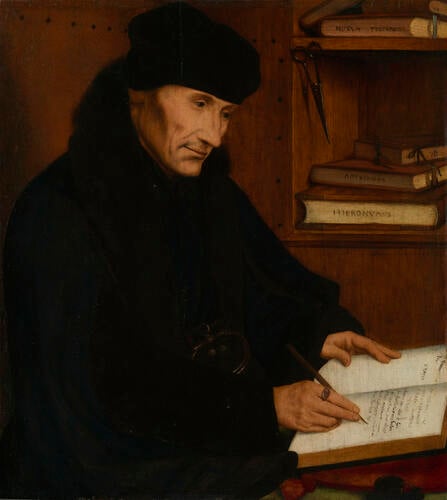
    1. The purse on Erasmus’s lap may be included in order to illustrate his generosity. Erasmus and Gillis made a point of informing More that they had split the cost of this gift because they wanted it to be a present from them both.

      Compare this suggestion of the purse as an attribute suggesting generosity to Jardine's (1996) suggestion that its meant to place Erasmus in the merchant class.

      (Of course it could be doing both.)

    2. https://www.rct.uk/collection/405759/desiderius-erasmus-1466-1536

      One ought to notice the shears hanging on a nail or hook on the bookshelf in the background. Presumably these would have been a primary tool for Erasmus' ars excerpendi practice.

      Cross reference Lisa Jardine (1996) who calls out the purse on Erasmus' chest which identifies him as part of the merchant class.

      Also cross reference Hans Holbein's portraits of Erasmus.

  6. Jul 2026
    1. 10/22/MClinical, geneticPartial deletion, protein truncating mutation++++−

      PatientID: 10

      KindredID: 10

      Case: M, 22Y0M, Caucasian

      DiseaseAssertion: VHL

      FamilyInfo: Positive family history.

      CohortInfo: Case series of 14 patients with definite or presumed von Hippel-Lindau disease and retinal vascular proliferation.

      CasePresentingHPOs: HP:0002011, HP:0001732, HP:0007850, HP:0012210, HP:0009711 (Morphological central nervous system abnormality, abnormality of the pancreas, retinal vascular proliferation, abnormal renal morphology, retinal capillary hemangioma)

      CaseHPOFreeText: At age 12, his left eye had a large juxtapapillary vascular complex extending from the nerve along the superior arcade that was associated with dense fibrovascular tissue. During the next 29 months, this fibrovascular complex enlarged, extending into the center of the macula and causing a decrease in visual acuity to 20/80. The patient underwent pars plana vitrectomy and membrane peel. When the patient was reexamined 7 years after his surgery, there was no recurrence of the lesion. In the patient's contralateral right eye, 3 typical peripheral RCHs were observed during this 7-year follow-up. At age 14 years, he was also noted to have a small patch of superficial retinal vessels in the inferior retinal quadrant near the equator of the right eye that resembled an arteriovenous anastomosis.

      CaseNotHPOs: N/A

      CaseNotHPOFreeText: N/A

      CasePreviousTesting: N/A

      PreviouslyPublished: N/A

      SupplementalData: N/A

      Variant: Partial Deletion

      LegacyVariant: N/A

      CaseProblemVariantFreeText: N/A

      ClinVarID: N/A

      CAID: N/A

      gnomAD: N/A

      VariantEvidence: N/A

      MutationType: deletion

      CivicName:Null (Partial deletion)

      MultipleGeneVariants: N/A

  7. Mar 2026
    1. [deleted]

      Original post by u/shapeless_nodule at https://reddit.com/r/typewriters/comments/1rp5mh6/brother_deluxe_220_jp1_typewriter_request_for/

      Hi All, In a fit overconfidence a couple of years ago, I bought a brother Deluxe 220 typewriter which worked fine other than being sticky. I duly tore it down, cleaned it up, oiled it, put it back together and... watched as nothing happened because somehow all of the springs had fallen out and were now sitting on my workbench. I then put it on a shelf and forgot about it, until starting a clearout last week. I would be deeply indebted to you if anyone who has this typewriter (or one of its sister models, as I understand it most of the JP-1 models are the same) take either some photos or a good video of exactly where all of the springs inside it connect to?

      Reply: <br /> This is fairly steep ask, particularly when, for a few dollars, you can get the location of all the springs in the repair manual:<br /> - https://www.lulu.com/shop/ted-munk/the-brother-jp-1-typewriter-repair-bible/paperback/product-186kzqem.html?q=brother&page=1&pageSize=4 - https://twdb.sellfy.store/brother-typewriters/

  8. Feb 2026
  9. Jan 2026
    1. Typewriter Profile: Comparing the Olivetti Lettera 22, Lettera 32, and Studio 44<br /> by [[Damon Di Marco]] of CreateX3.com on YouTube<br /> accessed on 2026-01-19T11:32:11

      Marcello Nizzoli designed the Olivetti Lettera 22, an ultra-portable, and the standard Lexicon 80. He used the automotive idea of press-forming steel to the Olivetti line.

      In 1959, the Illinois Institute of Technology chose the Olivetti Lettera 22 as the best designed product of the last 100 years. It also won the Compasso D'Oro Award in 1954.

      1963 Lettera 32 introduced<br /> Square keys

      1965 Olivetti Studio 44 introduced<br /> Between the standard and the portable<br /> Comes with a case, but is heavier than many portables

      Prefer original spools with spool nuts.

  10. Dec 2025
  11. Nov 2025
  12. Sep 2025
    1. I looked up Gorbachev and found a few sources that relate to this topic. 1. Interestingly enough, Gorbachev himself gave a Nobel Peace Prize speech. So, for my first source, I'd like to briefly mention Gorbachev's Nobel Peace Prize Lecture from 1990. In his speech he looks back on his reforms and focusing on how perestroika and glasnost were very much rooted in democratic pluralism. He also talked about the rule of law and the opportunity for negotiation instead of coercion. I believe this speech is important to include because I feel like it gives us a good insight into Gorbachev's intentions aside from the writing. He also pretty directly rejected any idea of returning to repression and heavily pushed his idea of necessary reformed change. 2. For my second source I wanted to find something that is a little more recent and not directly from Gorbachev himself. I came across an article from 2011 that discusses a documentary about the lives of five students who grew up during the Soviet era and during Gorbachev's reforms. I like this article because if you do not have time to watch an entire documentary, which is called "My Perestroika" you can read the article for a good summary. The article discusses the lives of these ordinary people experiencing the reforms firsthand. I found this interesting in comparison to the political elites discussing the reforms. This article provides a deeper personal and cultural look at how Gorbachev's reforms changed people's daily lives. It also restated Illarionov's idea of non-violent revolutions.

  13. Aug 2025
  14. May 2025
    1. Drei führende Klimawissenschaftler kritisieren die Illusion der "Net Zero-Politiken", die darauf setzen, das 1,5°-Ziel durch die Entfernung von CO2 aus der Atmosphäre zu erreichen. Sie werfen vielen ihrer KollegInnen vor, unrealistischen Konzepten nicht offen entgegenzutreten, um ihren politischen Einfluss nicht zu verlieren. Sie kritisieren auch die bisherigen Integrated Assessment Models des Weltklimarats, die von der Voraussetzung ausgehen würde, die Klimakatastrophe ließe sich mit marktwirtschaftlichen Mitteln beheben und fordern auf, deutlich zu sagen, dass sich eine Erhitzung der Erde auf 3 und mehr Grad nicht durch kleine Schritte, sondern nur durch einen Bruch mit dem bisherigen Wirtschaftssystem erreichen lässt.

      Anstatt uns unseren Zweifeln zu stellen, beschlossen wir Wissenschaftler, immer aufwändigere Fantasiewelten zu konstruieren, in denen wir sicher wären. Der Preis, den wir für unsere Feigheit zahlen mussten: Wir mussten den Mund halten über die immer größer werdende Absurdität der geforderten Kohlendioxid-Entfernung im planetarischen Maßstab.

      Greta Thunberg hat diesen Aufsatz als einen wichtigsten und informativsten Texte zur Klima- und ökologischen Krise bezeichnet.

      Climate scientists: concept of net zero is a dangerous trap. Thread von Greta dazu auf Twitter: https://twitter.com/GretaThunberg/status/1385869663188492290

  15. Apr 2025
  16. Mar 2025
    1. 30% der Arktis emittieren inzwischen mehr Treibhausgase als sie aufnehmen. Außer dem Schmelzen von Permafrostböden ist dafür auch Zunahme von Waldbränden verantwortlich. Die amerikanische Forschungsbehörde NOAA spricht davon, dass die Arktis „in ein neues Regime“ gekippt ist. 2024 war in der Arktis das zweitwärmste Jahr seit Messbeginn und das Jahr mit den zweihäufigsten Waldbränden. In einem langsamen, aber sich beschleunigenden Prozess wird immer mehr der 1460-1600 Gigatonnen im Arktisboden gespeicherten organischen Kohlenstoffs freigesetzt. Insgesamt entsprechen sie dem Doppelten der in der Erdatmosphäre gespeicherten Menge https://www.liberation.fr/environnement/en-arctique-la-toundra-nest-plus-un-puits-de-carbone-20250122_VZUZXLOHEZESBKJHXGYU7OPYME/

      NOAA Arctic Report Card 2024: https://www.nature.com/articles/s41558-024-02234-5 Studie zu den CO2-Emissionen arktischer Waldbrände: https://arctic.noaa.gov/wp-content/uploads/2024/12/ArcticReportCard_full_report2024.pdf

  17. Feb 2025
  18. Jan 2025
    1. Das Heartland Institute betreibt seit Dezember eine Niederlassung in London, u.a. mit Unterstäützung von Nigel Farage. Das Institut arbeitet eng mit radikalen Rechtsparteien zusammen. Es sieht den aktuellen Rollback in der Klimapolitik auch als eigenen Erfolg. Zu seinen Wegbereitern in Europa gehörten die FPÖ-Politiker Harald Vilimsky und Roman Haider. Ausführlicher Bericht im Guardian https://www.theguardian.com/environment/2025/jan/22/us-thinktank-climate-science-deniers-working-with-rightwingers-in-eu-parliament-heartland-institute

      DeSmog-Bericht: https://www.desmog.com/2025/01/22/usa-climate-denial-group-heartland-institute-using-far-right-to-attack-eu-green-policies/

  19. Dec 2024
  20. Nov 2024
  21. Oct 2024
    1. Dr. Armstrong.”Lombard gave a low whistle.“The doctor, eh? You know, I should have put him last of all.

      Lombard and Vera have a disagreement during a seemingly peaceful conversation, and based on the subsequent text, Vera appears to be quite convinced of her suspicions.

    2. None of us are going to leave the island. That’s the plan. You know it, of course, perfectly.What, perhaps, you can’t understand is the relief!”

      Why does General MacArthur say that everyone is waiting for the end while also stating that Vera won't understand this as a form of release?

    3. no, it isn’t coincidence! It’s our murderer’s touch of local colour! He’s a playful beast.Likes to stick to his damnable nursery jingle as closely as possible’

      In the current situation with multiple deaths, people have different perspectives on the issues at hand. However, some have also identified the killer's tricks, revealing the killer's talent for confusion and malicious enjoyment.

    1. Moreover, your goal in college classes is not just to remember the information for a test, but it is tobuild on that foundational knowledge to learn different levels of thinking

      10/22surprising:When we enter the college we not just memorize the textbook, we have read a lot of text and do a lot of critical thinking.

  22. Sep 2024
  23. Aug 2024
  24. Jul 2024
  25. Jun 2024
  26. May 2024
    1. Die Bewegung gegen die Autobahn A69, zu der auch Extinction Rebellion gehört, organisiert in einem Ort namens La Crémade eine ZAD (Zone à défendre, zu verteidigende Gebiet). Dazu wurden für den Autobahnbau bereits enteignete Gebäude besetzt, obwohl die Exekutive die Dächer beseitigt und großflächig Mist verstreut hatte, um die Aktivist:innen abzuschrecken. Die Exekutive vertrieb die Protestierenden gewaltsam. Reportage in der Libération. https://www.liberation.fr/environnement/a69-les-gendarmes-mobiles-tentent-de-demanteler-la-zad-des-opposants-20231022_YHXQJTFNOBAMBESFWFPXBWSG7Y/

  27. Apr 2024
  28. Mar 2024
  29. Feb 2024
    1. Am 22. Februar hat Michel Forst, Beichterstatter der Vereinten Nationen zur Aarhus-Konvention, die ZAD (zone à défendre) besucht, die zur Verhinderung des Baus der Autobahn A69 zwichen Toulouse und Castres eingerichtet wurde. Die Aktivist:innen haben bei der UNO eine Beschwerde gegen die Repression durch die Behöden eingelegt. Forst forderte eine Beruhigung der Situation, damit „die Umweltdemokratie ausgeübt werden kann“.

      https://www.liberation.fr/environnement/climat/un-rapporteur-de-lonu-au-chevet-des-militants-opposes-a-la69-20240222_NDMNZTLG7REL7HFU2WZ5M3AB6A/

    1. Eine neue Studie der Universität für Bodenkultur beziffert erstmals, wieviel Kohlenstoff zwischen 1900 und 2015 langfristig oder kurzfristig in menschlichen Artefakten wie Gebäuden gespeichert wurde. Die Menge des dauerhaft gespeicherten Kohlenstoffs hat sich seit 1900 versechzehnfacht. Sie reicht aber bei weitem nicht aus, um die globale Erhitzung wirksam zu beeinflussen. Die Möglichkeiten, Boot in Gebäuden zu nutzen, um der Atmosphäre CO2 zu entziehen, werden bisher nicht genutzt. https://www.derstandard.at/story/3000000208522/co2-entnahme-durch-holzbau-ist-bisher-nicht-relevant-fuer-den-klimaschutz

      Studie: https://iopscience.iop.org/article/10.1088/1748-9326/ad236b

    1. Erneuerbare Energien sind der wichtigste Treiber des Wirtschaftswachstums in China. Zugleich droht China die Klimaziele für 2025 zu verfehlen. 2023 hat der Energieverbrauch um 5,7% zugenommen. Zwischen 2021 Uhr und 2023 wuchsen die CO2-Emissionen jährlich um durchschnittlich 3, 8%. Ein Hauptgrund dafür ist die Stimulierung der Wirtschaft in China selbst und den Ländern, in die China exportiert, nach der Covid-Krise. https://www.theguardian.com/environment/2024/feb/22/growth-in-co2-emissions-leaves-china-likely-to-miss-climate-targets

  30. Jan 2024
    1. Das Handelsblatt hat be McKinsey eine Studie zu den Kosten der Energiewende in Deutschland in Auftrag gegeben. Danach ließen sich u.a. die Kosten bis 2035 um 100 Milliarden Euro reduzieren, wenn weniger auf Solar- und Windenergie und den dazu nötigen Ausbau der Stromnetze gesetzt würde und mehr auf Gaskraftwerke, die dann auf Wasserstoff umgerüstet werden können. Der Artikel berichtet nicht über Konsequenzen für die CO<sub>2</sub>-Bilanz. https://www.handelsblatt.com/politik/deutschland/milliarden-ersparnis-sind-die-ausgaben-fuer-die-energiewende-zu-hoch/100002547.html

    1. Bologna hat am 16. Jänner fast überall im Stadtgebiet eine Höchstgeschwindigkeit von 30 Stundenkilometern eingeführt - vor allem, um die Sicherheit im Straßenverkehr zu erhöhen. Der rechtspopulistische Infrastrukturminister Salvini von der Lega versucht diese Maßnahme teilweise rückgängig zu machen. Die Entwicklung in Bologna wird für viele andere italienische Städte Modellcharakter haben. https://www.repubblica.it/green-and-blue/2024/01/22/news/bologna_30_km_ora_proteste_mobilita_limite_velocita-421938294/

  31. Dec 2023
    1. Der Standard fasst Berichte der WMO, des europäischen Wetterdienstes Copernicus und des Österreichischen Alpenvereins zum Schwund der Gletscher 2022 zusammen. Die europäischen Alpengletscher verloren 2022 mehr als 5 Kubikkilometer Eis. Die Schweizer Alpengletscher haben in 20 Jahren ein Drittel ihres Eises eingebüßt. Bei einer Temperaturerhöhung um 2,7° bis 2100 würde allein durch das fast vollständige Abschmelzen der Gletscher in Mitteleuropa, den USA, Westkanada und Neuseeland der Meeresspiegel um 115mm steigen.

      https://www.derstandard.de/story/2000145833249/die-gletscher-schmolzen-2022-im-rekordtempo-besonders-in-europa

      Infografik: https://b.staticfiles.at/elm/static/2023-04-schneeanomalie/index.html?nc9238cb923b983a

    1. Wegen anhaltendem Wassermangel können im Augenblick nur hab so viele Schiffe den Panama durchqueren wie normalerweise Punkt für die Schleusen des Kanals werden große Mengen Süßwasser benötigt. Die niederschlagsmuster verändern sich deutlich. Es ist aber noch nicht abzusehen, wie die zukünftige Entwicklung aussehen wird. Ein Beispiel für das unkartierte Gelände, in das die globale Erhitzung geführt hat. https://www.theguardian.com/environment/2023/dec/22/changing-climate-casts-a-shadow-over-the-future-of-the-panama-canal-and-global-trade

    1. What the research I’ve described here makes clear, I hope, is that the trajectory that children’s lives follow can sometimes be redirected by things that might at first seem, to the adults in their lives, to be small and insignificant. The tone of a parent’s voice. The words a teacher writes on a Post-it note. The way a math class is organized. The extra time that a mentor or a coach takes to listen to a child facing a challenge. Those personal actions can create powerful changes, and those individual changes can resonate on a national scale.

      This is a great argument for the importance of a teacher's work. Through small acts, they can make a profound difference.

    2. “Deeper learning has historically been the province of the advantaged — those who could afford to send their children to the best private schools and to live in the most desirable school districts,”

      This reminds me of the John Dewey quote: "What the best and wisest parent wants for his child, that must we want for all the children of the community. Anything less is unlovely, and left unchecked, destroys our democracy.”

  32. Nov 2023
    1. Jedes Zehntel Grad weiterer Temperaturerhöhung drängt 140 Millionen Menschen - vor allem in ärmeren Regionen - aus der sogenannten Klimatische, in der Menschen gut leben können. Forschende haben genau berechnet, wie viele Menschen bei verschiedenen Klimaszenarien in so heißen Gebieten leben würden, dass sie mit hoher Wahrscheinlichkeit zur Emigration gezwungen werden. Bei dem derzeit wahrscheinlichen 2,7 Grad-Szenario für 2100 wären das bis 2030 ca 2 Milliarden Menschen, bei einem 1,5 Gra-Pfad 400 Millionen. Auch in den nicht ganz so heißen Gebieten wird die Zahl der Extremwetterereignisse weiter zunehmen. https://www.theguardian.com/environment/2023/may/22/global-heating-human-climate-niche

    1. Die europäischen Produzenten von Windturbinen machen enorme Verluste. Die Hauptgründe sind Kostensteigerungen und logistische Probleme. Hinzu kommen Investitionen für neue, stärkere Modelle und chinesische Konkurrenz. Ein zusätzliches Risiko könnte die Förderung der US-Turbinen-Industrie durch die Biden-Administration darstellen. Die europäischen Produzenten erwarten mehr Unterstützung durch die Regierungen, um Kompetenzen in Europa zu halten.

  33. Oct 2023
  34. Sep 2023
  35. May 2023
  36. Apr 2023
    1. My favorite is always changing. Any Smith-Corona Sterling or Silent is a gem. Any Hermes, either the green or tan, all work like lightning. I have a thing for my Olivetti Lettera 22’s, as they are masterpieces of design, the action is crazy fast and light, and the typewriter is in the Museum of Modern Art.

      —Tom Hanks in TribLive 2020-05-22 at https://web.archive.org/web/20200522085215/https://archive.triblive.com/aande/books/tom-hanks-on-his-love-of-typewriters-and-the-free-press/


      I've seen several sites and listings for Smith-Corona typewriters which mention this interview quote.

  37. Mar 2023
    1. ed away by theintense enjoyment he found in these pleasant fancies, he sethimself forthwith to put his scheme into execution

      This is what I like about Don Quixote. He think of what he wants to do first and execute it, instead of what he can do, because I know that if I only think of what I can do in the beginning, then I will achieve nothing.

    2. In short, his wits being quite gone, he hit upon the strang-est notion that ever madman in this world hit upon, and thatwas that he fancied it was right and requisite, as well for thesupport of his own honour as for the service of his country,that he should make a knight-errant of himself,

      Mostly, ambition is perceived as mad, but being mad is not always a bad thing.

  38. Oct 2022
    1. Sometimes a Scrum Team is hired and assembled fully by an organization without any input from the Scrum Team members, and there's nothing in Scrum preventing that. Likewise, there is nothing in Scrum that prevents a group of people from forming their own Scrum Team and organizing themselves into a structure that gives them their best shot at achieving the organization's goals.

      the Scrum Team may be both assembled or self-assembled

  39. Sep 2022
    1. If you are an American, you must allow all ideas to circulate freely in your community, not merely your own

      I agree with this. All ideas should be expressed and taught in school regardless because that is reality. The world is filled with all different thoughts, beliefs, and ideals, so I would think that schools would want to use all different types of novels and books that express this and can teach young people what others experience in real life.

    2. ratlike people who enjoy making money from poisoning the minds of young people

      I find it sad how the school thought that it was okay to burn books and think just because they thought of them as “evil” and “poisonous”. I don’t understand how the school does not rather appreciate different perspectives and types of books, which can truly be a great learning experience.

    1. 1.9 Title: ​DFAT Country Information Report: Sri Lanka Source: Australia. Department of Foreign Affairs and Trade. Date of Document: 23 December 2021 URL: https://www.dfat.gov.au/sites/default/files/country-information-report-sri-lanka.pdf Accessed Date: 16 May 2022

      UPDATED

    2. 1.8 Title: The impact of the COVID-19 pandemic, including on detention conditions, access to justice and socio-economic conditions in major cities (2019–May 2021) Code: LKA200596.E Source: Immigration and Refugee Board of Canada Date of Document: 7 May 2021 URL: https://irb-cisr.gc.ca/en/country-information/rir/Pages/index.aspx?doc=458345 Accessed Date: 26 May 2021

      RE-NUMBERED - PREVIOUSLY 1.14

    3. 1.7 Title: ​Présentation de Sri Lanka Source: France. Ministère de l'Europe et des Affaires étrangères. Date of Document: 18 February 2021 URL: https://www.diplomatie.gouv.fr/fr/dossiers-pays/sri-lanka/presentation-du-sri-lanka/ Accessed Date: 16 May 2022

      NEW FOR 2022

    4. 1.5 Title: ​Sri Lanka Development Update: Economic and Poverty Impact of COVID-19 Source: The World Bank Date of Document: June 2021 URL: https://thedocs.worldbank.org/en/doc/15b8de0edd4f39cc7a82b7aff8430576-0310062021/original/SriLanka-DevUpd-Apr9.pdf Accessed Date: 16 May 2022

      NEW FOR 2022

    1. For those few minutes, you will live entirely in the present moment and in the thoughts you're putting on paper

      I love the aspect of being more in the present when writing something to someone through a letter, which truly expresses how you feel and think at the time.

    2. Research has shown that the general act of writing by hand can promote quite a few physical and mental benefits

      in middle school letter writing helped me feel less alone when my best friend moved to California. We wrote letters to each other because i did not have a phone, so I was able to stay in touch.

    1. It was best to appeal directly to the emotions

      this is scary how manipulative US propaganda is; Seeing colorful misleading posters everywhere, implied that becoming a troop will be an “honor” to America but they were false visuals with no truth in how much death was actually occurring.

    1. I live in a world of death

      this was the most moving quote. Showing the true emotion of Aanenson, it makes you understand the reality of the war and the impact it had on the troops’ lives. They were surrounded by death and destruction most of their time serving and it eventually became hard to continue to have positivity and hope when writing. Living with constant fear of your life and the life of others that can be taken away at any point; it hard to keep inside. Although Aanenson wanted to initially reveal how he was truly feeling to the girl he loved, he knew it was best to not tell her, as she cannot prevent or do anything about it. He didn’t send the letter to keep his hope in their future. These troops crave comfort from their loved ones and writing letters probably relieves some of their suffering at least a little bit. Keeping messages and letters from family and friends allows them hold on to something that they know will always be safe with and bring them joy from reading it, so it was probably best to always write with positive outlooks in order to keep the hope and dreams of a better future and end to the war.

    2. Every day I hear of some person doing strange things

      This revealed the truth behind how people had felt in the Japanese imprisonment camps. Being confined caused people to loose themselves and get caught up in negative thoughts. Forced into camps, people needed to endure the emotional and mental trauma of this, which clearly changed people.

    3. We couldn't have won the war without it. It was terribly important as a motivator of the troops

      This is my favorite quote from this article. It reveals how important and valued letters were to the soldiers and families/friends at home who received them. The troops specifically probably held on to them, treasuring what was from their loved ones, giving them hope and a drive to keep fighting in order to go home to them.

    1. In the coming years more newsreels and photographs were released showing increasingly graphic images of death and destruction

      graphic movies and films of the war horrified people and I find it interesting how effective and powerful they were to engraving scary truths of what troops were actually living through.

    2. These sources played a vital role in connecting the home front with the war front and kept Americans informed about the progress of the fighting overseas as well as its impact on their communities

      This is an impactful meaning behind the radios and movies. They showed the true reality of what troops were going through and how everyone needs to keep having hope. Even though this caused worry, it also kept everyone informed and not clueless to what was occurring.

  40. Aug 2022