2,985 Matching Annotations
- Last 7 days
-
olivertypewriters.com olivertypewriters.com
- Oct 2026
-
en.wikipedia.org en.wikipedia.org
-
archive.org archive.org
-
archive.org archive.org
-
www.reddit.com www.reddit.com
-
en.wikipedia.org en.wikipedia.org
-
Auxiliary sciences of history<br /> https://en.wikipedia.org/wiki/Auxiliary_sciences_of_history
-
-
www.typebarmagazine.com www.typebarmagazine.com
-
in 2024, PBS claimed typewriters were “having a renaissance.”
https://www.pbs.org/newshour/show/why-typewriters-are-having-a-renaissance-in-the-digital-age
-
In 2019, the Voice of America reported that typewriters were becoming popular again, especially among younger folks.
https://voa-story.com/2019-07-14-will-typewriters-become-popular-again/?ref=typebarmagazine.com
-
- Sep 2026
-
press.princeton.edu press.princeton.edu
-
As I'm delving into the Fourth Turning, I'm piqued by the idea of how their theory overlaps or jives with similar historical cyclic theories like Secular Cycles. Bigger span theories like Ian Morris ought to fit in to some of these, though Morris' data may not be granular enough to show it. Similarly one has to wonder with increasing technology, do these cycles speed up over time?
- Turchin, Peter, and Sergey A. Nefedov. 2009. Secular Cycles. 1st ed. Princeton University Press. https://press.princeton.edu/books/hardcover/9780691136967/secular-cycles (September 30, 2026).
- Review: https://www.lesswrong.com/posts/2weRdcvqANDq3zdPH/book-review-secular-cycles
-
-
hypertext.niskanencenter.org hypertext.niskanencenter.org
-
In 1977, conservative scholars at the American Enterprise Institute published a report titled To Empower People: From State to Civil Society on how the federal government could and should implement its policies via voluntary groups and congregations. These ideas gave Ronald Reagan and George H. W. Bush a template to reduce the government’s bureaucratic footprint by turning instead to what Bush later termed “a thousand points of light” in civil society.
-
-
heathercoxrichardson.substack.com heathercoxrichardson.substack.com
-
September 19, 2026<br /> by [[Heather Cox Richardson]] in Letters From an American<br /> accessed on 2026-09-20T22:51:34
-
And the elites set out to drive wedges between Black slaves and white servants, establishing greater punishments for Black Virginians. In 1705 the Virginia Slave Codes pulled all those regulations together and went further. They prohibited Black Americans from owning cattle, hogs, or horses. They made it legal to kill an enslaved Virginian in the process of “correcting” them. And they made enslavement hereditary.
-
From 1670 to 1715, colonists enslaved between 30,000 and 50,000 Indigenous Americans. Entire tribes disappeared, and white farmers moved onto their lands.
-
-
www.youtube.com www.youtube.com
-
UsefulCharts<br /> by [[Matt Baker]] on YouTube<br /> accessed on 2026-09-14T23:08:17
-
-
www.worldhistoryandmythology.com www.worldhistoryandmythology.com
-
social.emucafe.org social.emucafe.org
-
Tamagotchi was released on November 23, 1996.
The first Tamagotchi was released on November 23, 1996. (Source: https://tamagotchi-official.com/us/history/).
-
- Aug 2026
-
en.wikipedia.org en.wikipedia.org
-
www.latimes.com www.latimes.com
-
www.youtube.com www.youtube.com
-
Example of female typist covering keyboard up with handkerchief to show how light the touch needed would be.
"Note that the handkerchief is hardly ruffled."
I feel like that time period and the century before, being able to do something through a thin piece of cloth was indicative of how little effort was required, or how dainty something could be. It definitely feels very gendered to me, but I'll have to find other historical examples to back this argument up.
-
-
www.csmonitor.com www.csmonitor.com
-
politician and inventor William Austin Burt patented the “typographer.” He invented the machine to help handle the amount of paperwork that his job as a surveyor entailed.
-
The first documented typewriter is from 1575 Italy, when Francesco Rampazetto, a printer and publisher, invented the scrittura tattile, a machine that left imprints of letters on paper.
-
-
davistypewriters.blogspot.com davistypewriters.blogspot.com
-
Davis Typewriter Works: A Royal Safari at Eighteen Years on the Net<br /> by [[Will Davis]]<br /> accessed on 2026-08-06T20:57:15
Tags
- Dong Ah Precision
- Royal typewriters
- Imperial Typewriter Co.
- Springfield, MO
- Typewriter Works Plovdiv
- Royal Safari
- Royal Safari III
- Clover typewriter
- Silver-Seiko typewriters
- Messa typewriters
- TA-Royal
- typewriter history
- Omega 30
- Maritsa 30
- read
- Monroe Calculating Machine Company
- Grundig
- Triumph-Adler
- Bulgaria
- Royal Safari II
- Litton Industries
- K-Mek
- Royal Safari IV
- Royal-McBee Corporation
- Volkswagen
Annotators
URL
-
-
www.reddit.com www.reddit.com
- Jul 2026
-
www.youtube.com www.youtube.comYouTube1
-
250. Tackling ‘Big History’ feat. Ian Morris<br /> unSILOed Podcast with Greg LaBlanc
Watched 2026-07-29
-
-
www.newyorker.com www.newyorker.comDiscards4
-
looking at these expressive dirt bands
dirt bands in library card catalogs, similar to dirt and wear marks on the fore edges of books gives some evidence of use
this can be useful research, but it has silently disappeared over time due to lack of archiving materials like card catalogs
some of these issues also pop up with digitizing physical books and throwing them away... we lose the information about how they were bound, how they might have been used, all the physicality is gone
-
By studying Haverford’s card catalogue, Michael Stuart Freeman, Librarian of Haverford College, was able to determine when his predecessors deployed their first typewriter (it was during the summer of 1916)—a tiny fact, perhaps, but one of sufficient interest to Freeman that he published a brief paper which discussed the history of typewriters in libraries. Freeman kept several handwritten cards as samples (“I save a few, because I’m a sentimentalist,” he confided to me); but once his own passing curiosity was satisfied, he dumped the rest of his catalogue.
-
Berkeley’s subject catalogue is already gone. Though it was more or less frozen in the nineteen-eighties, it was nonetheless very efficient for some kinds of searches: if the primary sources in your field were published in the eighteenth and nineteenth centuries, you don’t want your retrievals spread among the thousands of irrelevant records that a mechanical database subject haul brings up. Any drawer of an out-of-date paper catalogue represents the equivalent of a filtered computer search, a Boolean date-limited search, of a very sophisticated sort—in fact, one drawer represents the outcome of a kind of search that most on-line catalogues can’t and won’t ever be able to perform, since it offers clues to what books were in the library during different eras. If in seventy years a historian of science (say) wants to know whether some Nobel-laureate physics professor could possibly have seen and been influenced by a certain out-of-the-way Dutch mathematical monograph from the thirties which bears important similarities to his work—whether, that is, it was part of the library’s collection during the period when the professor was developing his ideas or was acquired only after the professor’s papers were published (perhaps acquired by the library as a gift from the professor’s estate, in fact, because the professor was sent the monograph by the Dutchman himself, anxious to establish primacy)—the historian of science will have little chance of finding an answer to his question now, because the computer record will bear the (to him) meaningless date of the retrospective conversion of the card, i.e., sometime in the late eighties or early nineties, which has no relation to the time that the card was originally produced (and the book placed on the shelf), whereas the original card, even if it bore no direct date of creation, would have exhibited distinct features (typewriter style, format, cataloguing conventions) that might have enabled a cataloguecard paleographer to place it within a five-year Period.
interesting research example of a search not enabled by a digital card catalog
-
In 1848, Antonio Panizzi, Keeper of Printed Books for the British Museum, had a similar notion:By an alphabetical catalogue it is understood that the titles be entered in it under some “headings” alphabetically arranged. Now, inasmuch as in a large. library no one can know beforehand the j uxtaposition of these headings, and it would beimpossible to arrange them in the requisite order, if they cannot be easily shifted, each title is therefore written on separate “slips” of paper . . . which are frequently changed from one place to another as required. It is selfevident that if these “slips . . . be not uniform, both in size or substance, their arrangement will cause mechanical difficulties which take time and trouble to overcome.
-
-
www.journals.uchicago.edu www.journals.uchicago.edu
-
)Morris, Ian. 2022. “Against Method: The Dawn of Everything: A New History of Humanity, by David Graeber and David Wengrow. New York: Farrar, Straus and Giroux 2021. Pp. 704. $35. ISBN 9780374157357 (Paper).” American Journal of Archaeology 126(3): E65–75. doi:10.1086/720603.
-
We do make our own history, but not in ways of our own choosing.
-
Across the last 20 years, evolutionists have adopted more sophisticated frameworks (such as niche construction theory) to accommodate the new findings, and Stephen Shennan’s superb book First Farmers of Europe provides a thorough and convincing evolutionary account of the origins and expansion of agriculture.15
-
Since the 2000s, archaeologists and paleobotanists have moved away from three older theories about the origins of agriculture—first, that population growth after the end of the Ice Age (around 9650 BCE) drove experiments with gardening and herding that led to the domestication of plants and animals in the Near East; second, that domestication happened in a few core regions of the Near East and then spread steadily outward; and third, that farming inexorably drove processes of sedentism, rising labor inputs, and increasing inequality. Instead, most experts now suggest that the relationship between population and domestication was complicated and variable; that experiments with cultivating plants went on in multiple locations, particularly wetlands; that domesticated plants caught on extremely slowly, needing 3,000 years (ca. 9500–6500 BCE) to go from under 20% of assemblages to over 80%; that the drift toward domesticated resources was regularly reversed; that rather than causing sedentism, domestication was often its consequence; that sedentism and experiments with plant cultivation began as early as 21,000 BCE, at the coldest point in the last Ice Age; and that there is little sign of institutionalized inequality in the Near East before about 5500 BCE.14
14 Asouti and Fuller 2013 has been particularly influential. On population, Palmisano et al. 2021.
Interesting shift in literature in archaeology since 2000s.
-
in northern Syria “the cultivation of wild cereals dates back at least to 10,000 BC” (234). They cite the arguments of Willcox et al. (2008) about rye at Abu Hureyra, but these have been seriously undermined by Colledge and Conolly (2010), further supported by Weide et al. (2021).
-
In what follows, I take evolutionists to be scholars who see some conceptual continuity between human history and biological evolution, who consider sociocultural evolution to be governed by identifiable mechanisms functioning somewhat like natural selection, who see these mechanisms as involving adaptation to the environment, who believe that the mechanisms operate on all societies regardless of time and space, and—usually, but not always—who recognize stages of social and cultural evolution, from egalitarian foraging bands through hierarchical agricultural empires and pastoral tribes, to modern fossil-fuel-based nation-states.
-
whether Graeber and Wengrow commit so many howlers that their central thesis is invalidated.
Is it good storytelling, is it fact, or something in between?
Interesting to see where the bar is in the anthropology community in terms of bringing evidence to tell a new story.
Where does this line exist between fact and fiction and what does it tell us about the level and rigor of a science? Mathematics and physics can't get away with stringing together falsities, yet the "softer" sciences apparently can.
Even if Graeber and Wengrow's story isn't fact, shouldn't it be? For the benefit of humanity?
-
Where Harari and Diamond offered evolutionist accounts of history,3 Graeber and Wengrow are explicitly anti-evolutionist. Dawn deserves admiration for being the most extended and detailed rebuttal to evolutionism this century—and it provokes exasperation for precisely the same reason.
Tags
- logic
- Ian Morris
- First Farmers of Europe
- history of science
- Yuvan Noah Harari
- David Graeber
- Stephen Shennan
- inequality
- Ice Age
- book reviews
- rye
- history
- evolution
- evolutionist accounts of history
- schools of thought
- Jared Diamond
- Against Method
- quote
- Big History
- sociocultural evolution
- read
- References
- archaeology
- Gini coefficients
- origins of agriculture
- agriculture
- perfection
- David Greeber
- storytelling
- anthropology
- definitions
- wild cereals
- David Wengrow
- history of agriculture
Annotators
URL
-
-
faculty.washington.edu faculty.washington.edu
-
Uncorrected preprint of Bender, Emily M, 'Artificial Intelligence' (25 June 2026), in Rayvon Fouché (ed.), Oxford Research Encyclopedia of Science, Technology, and Society (New York, NY, online edn, Oxford Academic, 25 June 2026 - ), https://doi.org/10.1093/9780197852712.003.0067
Article Summary
The term artificial intelligence is typically used as if it refers to a coherent, extant or near-future set of technologies, but in fact it does not. This article traces the history of the notion of artificial intelligence and the various ways that the idea has been used to organize how we understand our world, allocate resources, and relate to each other.
-
-
www.youtube.com www.youtube.com
-
The Crazy History of the First Humanoid Robot
- The World's Fair Debut: Introduced at the 1939 New York World's Fair by Westinghouse, "Electro the Moto Man" was a 7-foot-tall metal humanoid robot that amazed millions by performing actions like walking, talking, counting, smoking cigarettes, and detecting colors [00:01:11].
- Voice Control Mechanism: Rather than using modern AI, Electro operated via a voice-command system that functioned like a telephone switchboard. The operator's voice syllables triggered an electrical spike through a stepping relay sequence where specific word counts determined the action (e.g., one word cued an action, two words acted as an "on" switch) [00:09:54], [00:11:28].
- Mechanical Logic: The robot’s internal logic relied entirely on a physical sequencing U-switch, transformers, and 48 heavy mechanical relays rather than microchips. Actions like smoking or blowing up balloons were driven by hardware like bellows and small air compressors [00:08:29], [00:10:48].
- Technological Comparison: Electro's 48 physical relays are contrasted with modern robotics (using Foundation Robotics' "Phantom" robot as an example), which replace large, slow relays with billions of microscopic, fast transistors on microchips alongside precise actuators and camera-based AI models [00:14:15], [00:15:01].
- Post-Fair Travels and Fate: After the fair, Electro spent time stored in an inventor's basement, toured department stores in the 1950s, was painted silver for a Hollywood B-movie (Sex Kittens Go to College), and was eventually lost in storage crates inside an old trailer [00:04:17], [00:05:18], [00:06:08].
- The Modern Legal Drama: Electro's modern history is mired in a property dispute involving the late curator of the Mansfield Memorial Museum, Scott Shaw. Court documents and interviews suggest Shaw used charismatic tactics to amass family heirlooms as personal property, sparking ownership battles and estate auctions upon his death [00:16:15], [00:18:28], [00:19:54].
- Preservation and Legacy: The Weeks brothers (grandsons of an original Westinghouse inventor) successfully used legal affidavits to reclaim Electro's body and are actively restoring its mechanical motion. The video host purchased Electro's original hand-drawn blueprints at an estate auction and chose to return them to Mansfield to be displayed with the robot [00:07:51], [00:22:10], [00:22:48].
Tags
Annotators
URL
-
-
jack-clark.net jack-clark.net
-
In an existential conflict, where the existence of the state is threatened, the state will do what states throughout history have done to the powerless rich: arrest them and expropriate their assets.
这个观点提出了一个反直觉的假设,即在国家存在受到威胁的情况下,国家可能会像历史上对待无权势的富人那样对待人类。
-
- Jun 2026
-
-
To purchase desks having innumerablepigeon-holes and drawers on the assumption that theywill be useful for something is both uneconomical andunwise. In the modern office every receptacle formaterial that has no definite purpose is a snare, itinvites disorder, and encourages slovenly methods.
In the past, desks with a number of pigeon holes were used as part of one's database and organizational system. Once card indexes and filing cabinets came to the fore, these affordances of desks ultimately disappeared.
-
-
-
In the case of aircraft, most nations cooperate on things like safety standards and air traffic control.
大多数人认为颠覆性技术必然导致国家间竞争加剧。但作者以航空业为例,说明即使存在竞争,国家间仍能在安全标准等领域合作。这一类比暗示AI可能遵循类似发展路径,技术竞争不必然排除安全合作,挑战了技术民族主义叙事。
-
-
dl.acm.org dl.acm.org
-
To our knowledge, the first SDT research involving videogames [18] was conducted shortly after Deci's original formulation of CET [129] and investigated whether extrinsic rewards would reduce intrinsic motivation even for 'highly intrinsically motivating' activities such as videogame play. Videogames' intrinsically motivating qualities were also examined in early research on learning [e.g., 351]; however, focused examination of other core SDT concepts such as need satisfaction largely began much later [365].
-
Research on games and play in HCI (henceforth HCI games research), however, has continued to employ broad psychological theories as foundational work [417, 556]. One prominent example can be seen in self-determination theory (SDT) [481, 483], an influential theory of human motivation, which has provided HCI games research with propositions and concepts that can help explain motivational and experiential qualities of games and game-adjacent systems (e.g., gamification).
-
Psychological concepts and models have long been employed in human–computer interaction (HCI) to theorise the human user [88]. However, early applications of cognitive psychological theory did not develop into a coherent foundation of knowledge about human factors [89, 109, 455]—circumstances that Rogers [456, p. 22] attribute to "the stark differences between a controlled lab setting and the messy real world setting" for which interactive artefacts and systems are designed. The deployment of broad theory in HCI has subsequently declined in the intervening years [455, 456], and this sporadic progress in theory development in domains such as usability and user experience (UX) has been identified as a cause for concern [249, 314].
-
Psychological concepts and models have long been employed in human–computer interaction(HCI) to theorise the human user [88].
Tags
Annotators
URL
-
-
boisestate.pressbooks.pub boisestate.pressbooks.pub
-
his is where yo
we can use tags
-
-
-
https://www.si.edu/object/archives/sova-nmah-ac-0260<br /> Railway Express Agency Records<br /> American History Museum
-
-
www.nprillinois.org www.nprillinois.org
-
Neil Howe says the 4th turning is here. What does that mean for America in a moment of crisis?<br /> by [[Peter O'Dowd]] for [[NPR]]<br /> accessed on 2026-06-08T15:42:14
-
-
-
Painting shows 1608 meeting of Dutch States General while Spanish messenger comes in (signifying the then temporary recognition of Dutch sovereignty by the Spanish crown)
-
-
www.reddit.com www.reddit.com
-
2 page Typewritten letter from Will Hays to Warren Doan on July 10, 1926, on the letterhead of the Motion Picture Producers and Distributors of America, Inc.
Aphorism? included in the letter: <br /> "Liberty is fire on the hearth -- License is fire on the floor."
Interesting how he frames duty and morality as well as responsibility, but appears to be protecting the business versus using film as an art form to create discussion...
Evidence of plays featuring nudity in the mid-1920s while Hollywood endeavored not to show any nudity at all.


-
-
www.nytimes.com www.nytimes.com
-
It is not really a restoration; city agencies are subject only to comment, not regulation, by the landmarks panel. So the Department of Transportation is leaving the 1940's handrail and demolishing the brick engine house, although it says it will reconstruct it from the salvaged bricks. But the bridge will be repainted its original color - still undetermined - and it will be nice to see it glide closed on its 100th birthday.
1987-89 restoration of Carroll Street Bridge re-painted bridge to original color.
-
-
www.reddit.com www.reddit.com
-
reply to u/someblokeonhere at https://www.reddit.com/r/typewriters/comments/1u4ftix/which_typewriter_had_the_best_font/
The vast majority of typewriters were sold with a traditional mono-spaced Courier-like face in either pica or elite pitch (often with incredibly generic names like "Royal Pica" or "Royal Elite". Usually for about $5 (on what was often a $100 purchase which is about $1,000 in today's money), you could custom select an alternate face which was often marketed as a way to make your correspondence more personalized. They tried to make it a selling point, but I suspect it wasn't much of one in actual practice, particularly at that mark up. Many companies sold an "Executive" typeface that was often in italic as a means of differentiating typewriters meant for executives rather than the standard faces secretaries used.
Lots of alternate faces were manufactured for specific purposes like banking, accounting, speechwriting, and schools and those were sold as selling points for those markets. Other related features like keysets and special characters were marketed at pharmacists, doctors, engineers/mathematicians/scientists, and libraries.
If you create an account on the typewriter database you'll see options in the main menu for downloading full versions of a variety of typographical catalogs. Ted Munk also has (lesser) photo scans of some of these on his blog.
-
-
blog.archive.org blog.archive.org
-
An Archive of a Different Type<br /> by [[Jason Scott]] on Internet Archive Blogs accessed on 2026-06-11T10:58:48
-
-
-
Serifs can help build that conviction, or at least the illusion of it. Times New Roman itself was commissioned in the 1930s by Britain's Times newspaper.
大多数人可能认为Times New Roman等衬线字体只是传统选择,但作者认为这些字体被精心选择以创造权威感和信任的'幻觉'。这一观点挑战了字体选择的中立性,揭示了传统字体如何被重新包装为现代AI公司的信任工具。
-
- May 2026
-
www.ctinsider.com www.ctinsider.com
-
In 1994, Smith Corona moved manufacturing from the Route 13 plant to Tijuana, Mexico, leaving some supplementary operations at the South Cortland facility. In 1988, the company left the sprawling, largely vacant complex to the Bennie Road site.
-
Smith Corona closes shop after nearly a century<br /> by [[Kelly Palmer]]<br /> accessed on 2026-05-16T13:06:28
-
As the last Smith Corona workers drove away, they took the local bits and pieces of the last U.S. typewriter manufacturer with them.
Last typewriter manufacturer in the U.S. was Smith-Corona
2001-05-03
-
-
oztypewriter.blogspot.com oztypewriter.blogspot.com
-
On This Day in Typewriter History: Underwood and the Emperor’s New Old Clothes<br /> by [[Robert Messenger]] for Oz Typewriter Blog<br /> accessed on 2026-05-06T12:33:38
-
-
arstechnica.com arstechnica.com
-
These standards have governed our editorial work since AI tooling became available.
这一声明强调了Ars Technica在人工智能工具可用之前就制定了这些标准,表明其对新闻编辑的重视。
-
- Apr 2026
-
www.scientificamerican.com www.scientificamerican.com
-
Scientific American has served as an advocate for science and industry for 180 years, and right now may be the most critical moment in that two-century history.
180年的机构历史提供了重要背景,但'most critical moment'的主观判断缺乏量化依据。这种表述反映了媒体对当前科学重要性的强调,但需要具体数据支持这一历史性断言,例如科学资金、论文数量或政策变化的量化指标。
-
-
-
The model is named after Rosalind Franklin, whose rigorous research helped reveal the structure of DNA and laid foundations for modern molecular biology.
以Rosalind Franklin命名这一AI模型,不仅是对历史科学家的致敬,也暗示了AI在科学发现中的角色定位。Franklin的贡献常被忽视,这反映了科学发现中系统性偏见的问题,而AI可能成为纠正这种偏见的工具。
-
-
www.wired.com www.wired.com
-
Illinois was also early to regulate biometric data collection, passing the Biometric Information Privacy Act in 2008.
令人惊讶的是:伊利诺伊州在2008年就通过了生物特征信息隐私法,比许多州的AI监管立法早了近15年。这表明该州在技术监管方面一直处于前沿,从生物识别数据到AI,该州似乎总是提前应对新兴技术带来的隐私挑战。
-
-
www.understandingai.org www.understandingai.org
-
Across 1,000 runs, Claude Mythos Preview was able to find several bugs in OpenBSD, including one that allows any attacker to remotely crash a computer running it. The notable thing was that the bug had existed for 27 years.
令人惊讶的是:一个存在了27年的漏洞在OpenBSD这一以安全性著称的操作系统中被AI模型发现,而在此期间人类安全专家却未能察觉。这突显了AI在安全审计方面的独特优势和潜在价值。
-
-
-
After almost twenty years on the platform, EFF is logging off of X.
令人惊讶的是:EFF在X(前Twitter)平台上已经存在了近二十年,这比许多读者的使用时间还要长。作为数字权利的倡导者,EFF见证了该平台从初创到成为全球社交媒体巨头,再到被马斯克收购并彻底转型的全过程,这种长期陪伴在科技领域实属罕见。
-
-
thenextwavefutures.wordpress.com thenextwavefutures.wordpress.com
-
The two most recent surges are a cars/oil surge, which started in 1908, and the Information and Communications Technology, which started in 1971.
令人惊讶的是:根据Carlota Perez的技术-金融互动模型,我们目前正处于信息与通信技术(ICT)浪潮的末期,而这个浪潮始于1971年,至今已有55年历史。这意味着数字时代的黄金时期可能即将结束,而AI可能只是这一浪潮的最后阶段而非新开端。
-
-
a16z.com a16z.com
-
McBombalds has spent a lot of time thinking about. Its team has produced an entire memo on the threat of igniting the Earth's atmosphere, for instance (though it concluded prior to testing that the likelihood was not high enough to warrant shuttering the project).
令人惊讶的是:曼哈顿计划团队曾认真研究过核试验可能点燃地球大气层的威胁,并撰写了完整备忘录。尽管最终认为风险不足以终止项目,但这一科学担忧的深度和广度令人震惊,显示了科学家对技术后果的前瞻性思考。
-
Oppenheimer (and other members of the McBombalds C-suite) are well integrated into bay-area culture, including ambiguous communist associations that they have downplayed since becoming primo defense contractors.
令人惊讶的是:奥本海默及其团队与湾区文化深度融合,甚至有着模糊的共产主义联系,但在成为主要国防承包商后却淡化这些历史。这一事实揭示了科学与政治意识形态的复杂交织,以及历史人物形象的多面性。
-
-
www.typewritergazette.com www.typewritergazette.com
-
Odell and His Typewriter<br /> by [[Typewriter Gazette]]<br /> accessed on 2026-04-14T16:31:03
-
-
liorpachter.wordpress.com liorpachter.wordpress.com
-
Hausdorff<br /> by [[Lior Pachter]] in Bits of DNA<br /> accessed on 2026-04-14T12:11:12
Tags
- mathematics
- history of mathematics
- read
- Henriette Goldschmidt
- feminism
- Charlotte (Lotta) Goldschmidt
- Holocaust
- Hans Wollstein
- Hammer-Verlag
- Felix Hausdorff
- suicide of mathematicians
- Das Chaos in kosmischer Auslese (Chaos in Cosmic Selection)
- suicide
- Theodor Fritsch
- Protocols of the Elders of Zion
Annotators
URL
-
-
glassmanlab.seas.harvard.edu glassmanlab.seas.harvard.edu
-
The concept of rationality has its roots in economics, where it was developed to study how peo-ple should act in economic decision-making. In such settings, the idea is that people reach theirgoal, such as maximizing their return, by maximizing utility.
-
-
blogs.cisco.com blogs.cisco.com
-
Security has always been a team sport, and the defenders who have protected this industry for decades have never succeeded by working in isolation.
令人惊讶的是:我们常以为顶级安全公司依靠独家秘笈独步天下,但文章指出安全从来都是“团队运动”。几十年来,真正的防御者从不是在孤立中取得成功的,共享威胁情报才是生存法则。在AI时代,这种共享不仅没有减少,反而演变成了更深度的联盟行动。
-
- Mar 2026
-
www.indiewire.com www.indiewire.com
-
'Porgy and Bess' to Screen at Quentin Tarantino's Vista Theatre<br /> by [[Jim Hemphill]] in IndieWire accessed on 2026-03-30T10:47:37
-
-
www.reddit.com www.reddit.com
-
unpublished reply to u/kinga_forrester at https://www.reddit.com/r/vintageads/comments/1rvqt0e/comment/oayqqbd/
Rightly or wrongly I'm sure a vanishing number of people at that time would have held your view.
You've got to remember the historical context of this ad. During World War II all but one typewriter manufacturer in the US ceased production of typewriters and the one remaining was really producing machines for the military. This ad from 1943 actually says in tiny print at the bottom: "Royal is making bullets, and parts for airplane engines, propellers, machine guns, rifles." Civilian groups did drives to collect typewriters to send them to the war effort. Many of the extant and upcoming generation of typewriter repairmen went off to the war effort. All this against the backdrop of people being used to taking their machines (especially office ones in use 8 hours a day) in for service every year or so for cleaning and adjustment. Most office typewriters of the time were in use for an average of 3 years before requiring complete overhauls or replacement. In addition to all of the other things being rationed, typewriters and typewriter service were also being heavily rationed, particularly because the manpower and steel was being diverted heavily to the war effort.
At the time, most typewriters were in the $125-200 range which is the equivalent to about $1,500 now. They were trying to help people preserve their machines and functionality. This was at a time when almost any sizeable town in the US had at least one repair shop busy with work. A city the size of Chicago probably had several dozens of repair shops working full time and that likely dropped to just a few during the war. (There's only one now, and it's only been open for a few years; it also has a wait list of several months for service because it's so busy.)
The issue of typewriter preservation was so great during the war that the U.S. Navy produced a series of videos about their proper use and maintenance of them *and other expensive office machines of the time). See videos at https://boffosocko.com/2025/06/06/typewriter-use-and-maintenance-for-beginning-to-intermediate-typists/ The government also got involved in creating maintenance manuals like Basic Typewriter Care and Maintenance, Equipment Maintenance Series No. 1 (US FWIP, 1945) and repair manuals like War Department Technical Manual TM 37-305: Typewriter Maintenance (1944) which is essentially the same as the [1945 Ames manual[(https://site.xavier.edu/polt/typewriters/AmesVol1-Standards.pdf).
Comparing this with today when the general value of typewriters is almost nil and we're lucky to have a few dozen professional typewriter repair shops still operating, but the rate of retirements and deaths has long been outstripping the replacement rate and you'll understand why self-service is necessary. Even given this, the number of typewriter fora on the internet, Facebook, Reddit, etc. the amount of tinkering knowledge is almost cripplingly bad but seems to chug along. You'll notice that there are an awful lot of people just trying to identify their machines much less carry out the most basic repairs. The number of "broken machines" I've acquired in my collection that only needed the ribbon color selector set to something besides "stencil" is a sad indicator of the state of typewriter knowledge now, much less what it may have been in their heyday, tinkering or not.
Even by 1983 as typewriters were already beginning to feel the pressure from the computer business, books like Bryan Kravitz and Nancy Gorrell's Hints for a Happy Typewriter were attempting to educate people on proper maintenance and light repair before needing to rely on repair shops that were already starting to feel the pinch.
Incidentally, IBM wasn't what put most typewriter companies out of business. It was vicious competition caused by offshoring and the cheapening of parts and materials while computers in general did the rest. And as for all those typewriter repair shops: most began selling/servicing word processors, office machines like fax machines, photo copiers, dictaphones, and even computers.
-
-
www.trumanlibraryinstitute.org www.trumanlibraryinstitute.org
-
This Day in History: George Kennan Sends "Long Telegram"<br /> by [[Lacey Helmig]]<br /> accessed on 2026-03-12T09:45:51
-
-
-
George Kennan and the Long Telegram<br /> by [[James M. Lindsay]] in Council on Foreign Relations accessed on 2026-03-12T09:44:20
-
-
www.reddit.com www.reddit.com
-
www.reddit.com www.reddit.com
- Feb 2026
-
www.quantamagazine.org www.quantamagazine.org
-
The Man Who Stole Infinity<br /> by [[Joseph Howlett]] in Quanta Magazine on 2026-02-25<br /> accessed on 2026-02-26T09:01:10
Dedekind proved that the set of algebraic numbers is the same size as the set of whole numbers.
Cantor plagiarized his proof and later went on to prove that the set of real numbers is larger than the set of whole numbers.
-
The letter from Dedekind to Cantor, dated November 30, 1873, that went missing for more than a century. In it, Dedekind provides a proof that the set of algebraic numbers is the same size as the set of whole numbers — a result that Cantor later plagiarized.
-
German mathematician named Richard Dedekind. In 1858, he found a way to rigorously define the real numbers — any number that appears on the number line. But he didn’t share his finding. A slow and methodical thinker, he preferred to discuss his results with others until he was sure he was right.
-
-
www.reddit.com www.reddit.com
-
That's just a post-war one. Rheinmetall typewriter factory was situated in Sömmerda, Thuringia (so far from Rhein), this way it become a soviet-owned company after 1945 and before it was returned to newly created GDR. A lot of these machines were produced to be supplied to USSR as kind of reparations payments. The layout also proves this. Here's an experimental "ЭУКЕН" layout, one of transitional variants on the way to modern "ЙЦУКЕН" (since 1953). While all the pre-war typewriters were built with 1918 layout "Й1УКЕН"
https://www.reddit.com/r/typewriters/comments/1rbydwu/soviet_era_typewriter/
-
-
pantheon.world pantheon.worldPantheon1
-
https://pantheon.world/
-
- Jan 2026
-
en.wikipedia.org en.wikipedia.org
-
www.youtube.com www.youtube.com
-
The Arabic We Never Got: Unified Arabic Script #shorts<br /> by [[Haithooomi]] on YouTube<br /> accessed on 2026-01-22T09:56:12
-
-
www.reddit.com www.reddit.com
-
reply to u/aleahey at https://reddit.com/r/typewriters/comments/1qjzgtq/remington_postal_telegraph_mill/
On the paper guide, it definitely looks like a bend it back into shape issue.
While your model is obviously decaled as "Postal Telegraph", it's not a traditional mill machine as those are generally marked by having no lower case characters and having uppercase only. Sometimes it was uppercase with some "filler character" (often a + on Remingtons, a ~ on Underwoods, and a double dot on Olivettis) or uppercase on both the top and bottom of the slug. Generally the zero character had a slash through it to distinguish it specifically from the letter "O".
There are only two other exemplars on the typewriter database, so please be sure to upload your photos and data when you get a chance. https://typewriterdatabase.com/Remington.10+Postal+Telegraph.42.bmys You'll notice that one of the examplars by u/jbhusker doesn't appear to be a traditional mill while the other is. Perhaps James has some unwritten research on his Remington Postal Telegraph?
If you sift through the typewriter database you'll find other examples and research (especially if you're looking at commentary under individual examples while you're logged in). As an example of mills from Underwood in their Western Union Special: https://typewriterdatabase.com/Underwood.Western+Union+Special.4.bmys
-
-
www.americanyawp.com www.americanyawp.com
-
harpercollins.co.uk harpercollins.co.uk
-
for - book - Progress: A History of Humanity's Worst Idea - author - Samuel Miller McDonald - from - youtube - interview - Planet Critical - Samuel Miller McDonald --- https://hyp.is/r-hmFtjKEfCd8odATbINbA/www.youtube.com/watch?v=BEhmWEDkZUQ
-
-
-
Not far from the Ibgal temple of Inanna where the dedicatory tabletwas found, archaeologists excavated the earliest known breweryanywhere in Mesopotamia (a tablet found there even mentioned thebrewer).
-
The Sumerian term for king, “lugal,” literally meant “big man.”
-
Podany, Amanda H. 2013. The Ancient Near East: A Very Short Introduction. 1st ed. New York: Oxford University Press. https://www.amazon.com/Ancient-Near-East-Introduction-Introductions/dp/0195377990/ (January 1, 2026).
-
-
anildash.com anildash.com
-
[[Anil Dash c]] on the history of markdown, since 2002 (John Gruber and involvement of Aaron Swartz). Some remarks on its role in llms / ai use
-
-
yalebooks.yale.edu yalebooks.yale.edu
-
[[Too Much To Know by Ann Blair]] 2010, available through Kobo Plus, or 20e for the ebook. "Managing Scholarly Information before the Modern Age"
-
-
www.jstor.org www.jstor.org
-
Ann Blair on info overload 16/17th c. (2003)
Reading Strategies for Coping with Information Overload ca. 1550-1700 in Zotero since 2022
Tags
Annotators
URL
-
-
www.tandfonline.com www.tandfonline.com
-
Ann Blair 2010
Added The Rise of Note‐Taking in Early Modern Europe in Zotero
-
-
www.wired.com www.wired.com
-
Did Gates Really Say 640K is Enough For Anyone?<br /> by [[Jon Katz]] in WIRED<br /> accessed on 2026-01-05T16:22:13
-
- Dec 2025
-
www.reddit.com www.reddit.com
-
reply to u/rawbran30 at https://old.reddit.com/r/typewriters/comments/1py74mf/internet_hype_trendeffect_and_brand_popularity/
Olympias were imported into the US from the 50s into the 70s and were manufactured at peak typewriter engineering and manufacturing methods before machines slowly got cheaper and cheaper in terms of materials and craftsmanship through the 60s and into the early 80s before typewriters were subsumed by the word processor market.
Compared to Smith-Coronas and Remingtons of the 50s and early 60s (their peaks), Olympias are slightly better manufactured in terms of fit and finish. They're also slightly more modern looking in terms of body shapes and colors compared to other machines, which also helps to drive up price amongst collectors.
Now is an Olympia SM3 or SM9 really so much better than a Smith-Corona Silent Super that they should enjoy an almost 2x jump in price for an unserviced model? Potentially not, but if this is your issue, then buy something from a professional shop that's been cleaned, oiled, and adjusted and a lot of the price differential evaporates.
-
-
www.nationalgeographic.com www.nationalgeographic.com
-
As the men tore down a wall that had been built using the detritus of nearby ancient Egyptian sites, they discovered a large stone fragment covered in three types of writing, including ancient Greek.
<center> History of discovery of Rosetta Stone
</center>(...on July 15, 1799, during Napoleon Bonaparte’s Egyptian campaign, a French soldier Pierre Bouchard discovered a black basalt slab inscribed with ancient writing near the town of Rosetta, about 35 miles east of Alexandria. The irregularly shaped stone contained fragments of passages written in three different scripts: Greek, Egyptian hieroglyphics and Egyptian demotic. The ancient Greek on the Rosetta Stone told archaeologists that it was inscribed by priests honoring the king of Egypt, Ptolemy V, in the second century B.C. More startlingly, the Greek passage announced that the three scripts were all of identical meaning. The artifact thus held the key to solving the riddle of hieroglyphics, a written language that had been “dead” for nearly 2,000 years.) For rest of the article click Rosetta Stone Found
Why is Rosetta Stone important? Click Importance of Rosetta Stone
-
-
www.youtube.com www.youtube.com
-
he's he's kind of calling the bluff on the progress narrative
for - history - progress - Francis Fukuyama - liberalism won - calling the bluff
-
those have to deliver. They they can kind of get away with not delivering uh on their promises intergenerationally
for - history - progress - secular golden age promise - can procastinate by pushing it forward to the next generation
-
what's clever about the more religious progress narratives is that the golden age happens after you die
for - history - progress - religious golden age - is post death
-
even in the Old Testament, God has to keep promising land. He has to, you know, there has to always be this new kind of thing. Uh and it's it's never enough
for - history - progress - promised land - contemporary mythical promises - nothing new
-
these kind of secular ideas and trying to to uh reinvest them with uh religious and mythic ideas. Uh, >> and so there is, you know, a little bit of a reverse kind of enlightenment happening.
for - history - contemporary society - reverse enightenment
-
we are now back in this sort of age of religiosity, particularly with the Trump administration, him claiming that he has essentially been anointed anointed by God in order to do whatever he wants.
for - history - Trump - back into age of religosity. He claims, like former kings, he was anointed by god!
-
it's not so much about we have to you know expand the scope of the church or you know civilize people who don't have Jesus Christ and becomes more about we have to uh expand the market and we have to uh you know increase the the you know national revenue and the acreage that's under cultivation
for - history - progress - after Enlightenment - no long about converting savages to Christians - became about expanding markets
-
the the big break that you see between uh secularism and religiosity even outside of progress narratives is European enlightenment
for - history - progress - European Enlightenment - broke secular off from religious progress very abruptly
-
difference between secular faith in progress and this kind of more religious or mythical faith in progress is a running theme through the book
for - history - progress - secular vs religious
-
we first start seeing uh kind of more uh closer something closer to monotheism with Zoroastrianism in Persia
for - history - progress - monotheism appears - Zoroastrianism in Persia (2nd millenia BCE)
-
polytheism I think is is uh you know expansive and and is part of the the Greek state expansion as well. Uh it's part of the Roman expansionism
for - history - progress - expansionism and gods - went hand-in-hand
-
rulers who claim to be champions of Marduk and and kind of justify their position at the top of this hierarchy by being you about the the representatives of the supreme god
for - history - progress - political and religious partnership narrative - top leader claimed to represent top god
-
Greco Roman is is you know the Jupiter and and Zeus
for - history - progress - polytheistic gods - Roman and Greek - Jupiter & Zeus
-
pinpointing this kind of break with these polytheistic uh religions that emerge in Mesopotamia. Um Marduk is is the kind of the supreme god.
for - history - progress - animism - gave way to polytheism in Mesopotamia - Marduk god
-
hat the book is is kind of trying to do is trace that lineage from that initial uh you know the the very first kind of literary endeavors um through uh you know uh Judaism and and through the classical Greek uh thinkers
for - book - tracing history of progress / Growthist political economy narrative from Vikings to Mesopotamia to Judaism to Greeks to Islam to Enlightenment to US
-
finding that narrative just kind of reiterating over and over again through different cultures uh through along I mean you know thousands of years.
for - history - progress narrative - repeats over and over
-
rogress: A History of Humankind's Worst Idea
for - progress trap - book - to - book - Progress: A History of Humankind's Worst Idea - https://hyp.is/cMyt5tjMEfCGz9-Edzp-hA/harpercollins.co.uk/products/progress-a-history-of-humanitys-worst-idea-samuel-miller-mcdonald - author Samuel Miller McDonald
SRG comment - interview - book on Progress - see other references: - to - book - A Short History of Progress (2004) - https://hyp.is/93k5CtjLEfC1UpPEi59BHA/archive.org/details/shorthistoryofpr0000wrig - to - movie - Surviving Progress (2011) - https://hyp.is/sRPYJtjLEfCwuDdwG2xNnw/www.nfb.ca/film/surviving-progress/ - SRG article - Cogress
Tags
- to - book - Progress: A History of Humankind's Worst Idea
- history - progress narrative - repeats over and over
- history - progress - promised land - contemporary mythical promises - nothing new
- history - progress - secular golden age promise - can procastinate by pushing it forward to the next generation
- history - progress - animism - gave way to polytheism in Mesopotamia - Marduk god
- history - progress - Francis Fukuyama - liberalism won - calling the bluff
- book - Progress: A History of Humankind's Worst Idea
- history - progress - political and religious partnership narrative - top leader claimed to represent top god
- history - contemporary society - reverse enightenment
- SRG comment - interview - book on Progress
- history - progress - expansionism and gods - went hand-in-hand
- history - progress - after Enlightenment - no long about converting savages to Christians - became about expanding markets
- history - progress - secular vs religious
- progress trap - book
- history - progress - religious golden age - is post death
- history - progress - polytheistic gods - Roman and Greek - Jupiter & Zeus
- history - progress - European Enlightenment - broke secular off from religious progress very abruptly
- history - progress - monotheism appears - Zoroastrianism in Persia (2nd millenia BCE)
- book - tracing history of progress / Growthist political economy narrative from Vikings to Mesopotamia to Judaism to Greeks to Islam to Enlightenment to US
- author Samuel Miller McDonald
- history - Trump - back into age of religosity. He claims, like former kings, he was anointed by god!
Annotators
URL
-
-
archive.org archive.org
-
for - book - A Short History of Progress (2004) - author - Ronald Wright - progress trap - Ronald Wright - A Short History of Progress (2004) - to - movie - Surviving Progress (2011) - https://hyp.is/sRPYJtjLEfCwuDdwG2xNnw/www.nfb.ca/film/surviving-progress/ - to - book - Progress: A History of Humanity's Worst Idea - from - youtube - Planet Critical interview - Samuel Miller MacDonald - The Myth of Progress - https://hyp.is/r-hmFtjKEfCd8odATbINbA/www.youtube.com/watch?v=BEhmWEDkZUQ
Tags
- progress trap - Ronald Wright - A Short History of Progress (2004)
- book - A Short History of Progress (2004)
- Ronald Wright
- to - book - Progress: A History of Humanity's Worst Idea
- to - movie - Surviving Progress
- from - youtube - Planet Critical interview - Samuel Miller MacDonald - The Myth of Progress
Annotators
URL
-
-
www.nfb.ca www.nfb.ca
-
for - progress traps - movie - Surviving Progress (2011) - from - book - A Short History of Progress (2004) - https://hyp.is/93k5CtjLEfC1UpPEi59BHA/archive.org/details/shorthistoryofpr0000wrig - from - youtube - Planet Critical interview - Samuel Miller MacDonald - The Myth of Progress - https://hyp.is/r-hmFtjKEfCd8odATbINbA/www.youtube.com/watch?v=BEhmWEDkZUQ
-
-
www.youtube.com www.youtube.com
-
In 1979 and 1980, two political leaders came into power who would turn this economic revolution into a political one. Margaret Thatcher in [music] the UK and Ronald Reagan in the US.
for - economic history - Volcker Shock - 2 political allies - Thatcher (1979) and Reagan (1980) came to power - cast taxes, social programs and regulation as the bogeyman
- SRG comment - Reagan and Thatcher policies - advocating for inequality - against the sacred
-
David Harvey calls this [music] accumulation
for - economic history - Volcker Shock - David Harvey - accumulation by dispossession. Defaulted countries signing with IMF: - increased poverty - exploded inequality - collapsed public service - gave up economic sovereignty to global financial institutions - continuation of colonialist practice of extractionism and appropriation
-
conditions were called structural adjustment programs and they forced countries to adopt a very specific set of economic policies mainly the privatization [music] of public assets
for - economic history - Volcker Shock - IMF Structural adjustment program - privatize public assets, - cut spending of welfare, - austerity across the board - deregulation, - open domestic markets to foreign corporations, - remove protection of local businesses and workers - IMF - a deal with the devil
-
they had to turn somewhere for help. And that somewhere was the International Monetary
for - economic history - Volcker Shock - defaulted countries turn to IMF
-
subsaharan African countries and parts of Asia were also plunged into crisis
for - economic history - Volcker Shock - second casualties - Sub-Saharan African & Asian countries defaulted
-
the Latin American debt crisis
for - economic history - Volcker Shock - first casualties - Latin American debt crisis - Mexico, Brazil, Argentina defaulted on loans
-
Most global finance is denominated in dollars. US interest rates effectively set global interest rates. So when Fuler pushed rates towards 20%, developing countries who had borrowed dollars just a few years earlier saw their interest payments on those loans explode.
for - economic history - Volcker Shock - developing countries loans became unpayable overnight
-
Paul Fulker was appointed chairman of the Federal Reserve, essentially the head of the United States Central Bank. in 1979 and his appointment signaled a dramatic shift in US economic governance
for - economic history - 1979 - Paul. A. Volcker appointed chairman of Federal Reserve - Volcker Shock - shift - from employment to inflation - raised interest rates to an astounding 20%, intentionally causing a recession
-
monitoism offered Fulkar the intellectual and political cover he needed for this shift in monetary policy. Away from the Keynesian commitment to full employment and [music] economic stability and towards protecting the value of capital which had been eroded by years of high inflation.
for - economic history - Volcker Shock - used Milton Friedman's theory to provide cover to stop Keynesian commitment to full employment and instead protect capital from inflation. - Volcker raised interest rates to 20%,, causing massive plant shutdowns and unemployment to surge above 10%. - The recession closed shops, and labor lost its bargaining power when plants are shut down.
-
Milton [music] Freriedman, the economist most associated with neoliberalism, whose work was heavily financed by business elites. It was his theory, monitoism, which framed inflation as the ultimate economic threat
for - economic history - Milton Friedman - represented business elites - Monetarism - inflation seen as ultimate threat to elites
-
The business round table was established in 1972
for - economic history - 1972 - Business Round Table established
-
from 60,000 businesses in 1972 to over a quarter million just 10 years later
for stats - economic history - corporate power - 10 years - American Chamber of Commerce - from 60,000 to 250,000 members
-
Powell memo. It was written by Lewis Powell,
for - economic history - powell memo - Lewis Powell - inequality - corporate lawyer who became supreme court judge - memo that started a long term political campaign to exploit the elite crisis for corporations to take control of universities, media, law and public opinion FOR THE ELITES
Tags
- economic history - Volcker Shock -
- economic history - Milton Friedman - represented business elites - Monetarism - inflation seen as ultimate threat to elites
- economic history - powell memo - Lewis Powell - inequality
- economic history - Volcker Shock - 2 political allies - Thatcher (1979) and Reagan (1980)
- IMF - a deal with the devil
- economic history - 1972 - Business Round Table established
- economic history - Volcker Shock - defaulted countries turn to IMF
- SRG comment - Reagan and Thatcher policies - advocating for inequality - against the sacred
- economic history - Volcker Shock - IMF Sructural adjustment program - privatize public assets
- economic history - 1979 - Paul. A. Volcker appointed chairman of Federal Reserve - Volcker Shock
- stats - economic history - corporate power - American Chamber of Commerce
- economic history - Volcker Shock
- economic history - Volcker Shock - David Harvey - accumulation by dispossession
- economic history - Volcker Shock - second casualties - Sub-Saharan African & Asian countries defaulted
- economic history - Volcker Shock - first casualties - Latin American debt crisis
Annotators
URL
-
-
www.youtube.com www.youtube.com
-
I was faced in 1958 when I started graduate study at University College London with that extraordinary fact. Nobody knew how it could be that a muscle could excite itself to be rhythmic.
for - history - Denis Noble - 1958 - question - heartbeat of embryo - how? no nervous system yet.
-
-
www.youtube.com www.youtube.com
-
book Goliath's Curse, the history and future of societal collapse
for - to - book - Goliath's Curse: the History and Future of Societal Collapse - Luke Kemp
-
life comes in and not very much happens until life decides to excrete oxygen into the atmosphere when you get a whole raft of hydroxides and hydrox oxides and hydroxides coming in
for - geology - history - minerals - when life starts excreting oxygen - many new minerals - planetary boundary novel entities boundary
-
historically if you look at a history textbook, it's essentially a role called mass murderers.
for - explanation - why leaders are often psychopaths - history book is full of mass murderers
-
the climate of history
for - social sciences paper - The Climate of History - 2009 - species wide perspective of writing history
Tags
- to - book - Goliath's Curse: the History and Future of Societal Collapse - Luke Kemp
- explanation - why leaders are often psychopaths - history book is full of mass murderers
- geology - history - minerals - when life starts excreting oxygen - many new minerals
- social sciences paper - The Climate of History - 2009
- geology - history - minerals - when life starts excreting oxygen - many new minerals - planetary boundary novel entities boundary
Annotators
URL
-
-
d1wqtxts1xzle7.cloudfront.net d1wqtxts1xzle7.cloudfront.net
-
Thales (600BC) is thegodfather of the Western philosopher by propoundingthe existence of plurality of worlds, from then onwards,many theoretical approaches have arisen and sunkenaccording to the signs of times.
Thales did not propound the plurality of worlds. This is historically inaccurate. Pluralistic cosmology (multiple worlds from the indefinite apeiron) is suggested to be sourced from Anaximander - though, this is a very loose historical interpretation of his works.
-
To cite an example, the Australian aboriginesexplain with legends that their origin is extraterrestrial.They say that their cave paintings known as"wandjinas" are actually self-portraits made by thesewandjinas, gods or spirits associated with clouds andrain (inhabitants of sky, therefore). In the WesternAustralia region of Kimberley these rock art works areabundant, which have usually been dated to some 4000years old. But aboriginal tradition tells that it was thegods themselves who painted themselves in rockyshelters and who commissioned human artists (see Fig.2) to regularly repaint these manifestations of divinity
Aborigines mention cave paintings are self-portraits made by gods from the sky. The creation gods who came from the sky (or the sea in some accounts) in the Dreamtime were the Wandjina. It's difficult to necessarily associate them as extraterrestrial since they are also posited to have originated with clouds, rain, fertility, and the creation of the land and its people. This needs more references to validate the claim.
-
Obviating without detracting the Greekclassics, we will quote as an example ChristiaanHuygens, astronomer, physicist, mathematician andDutch inventor. Among other achievements, heexplained the true nature of Saturn's rings anddiscovered Titan, Saturn's largest moon. In the field ofAstrobiology, in 1698 he wrote "Cosmotheoros",affirming "what a marvellous and splendid picture ofthe magnificent vastness of the universe we haveachieved! Such amount of suns, such amount of earths,each and every one of them provided with plants, treesand animals, and adorned with seas and mountains!And how much increases our admiration andamazement if we stop to analyse the prodigiousdistance and the multitude of stars!""Cosmotheoros" (the observer of the stars), isthe first treaty that conjectures extraterrestrial life froma scientific point of view based on the theories of otherthinkers like Nicholas of Cusa, Giordano Bruno,Kepler, Tycho Brahe or Descartes.In "Cosmotheoros", Huygens describes morethan twenty possible forms of extraterrestrial life [6]
Early theories of astrobiology include Christian Huygens speculating on forms of extraterrestrial life in Cosmotheros (Latin for "Beholder of the Cosmos") (1698). This may be the first scientific speculation about astrobiology. This is difficult to state outright since authors were fantasizing about life on planets - see Lucian of Samosata's 2nd century work "A True Story" and Voltaire's 1752 novella "Le Micromégas" about beings from Sirius.
-
Its relation to their celestial origin is alsoevident in the Maasai culture. In 2005 the Maasai ofSynia, Tanzania, explained to Rafael Balaguer Rosatheir legends, star lore and their astronomicalknowledge, very basic, but that also related their originwith the sky, with space, in charge of their unique godNgai.Ngai travels from heaven to Earth descendingthe Milky Way. They call the Milky Way “nkurrei”,which means “way” too, great example of culturalconvergence; and to the Magellanic Clouds
The mention of the Maasai culture in Tanzania believing their god Ngai descended from the Milky Way seems speculative and not well referenced. Other sources just note Ngai descended from the sky. One of the authors is referenced - Rafael Balaguer Rosa, Tras los Pasos de Ngai, AstronomíA, 73-74 (2005), July-August 26-35
-
- Nov 2025
-
www.youtube.com www.youtube.com
-
Dario Amade was the C CEO of Anthropic a big AI company. He worked on safety at OpenAI and he left to start Anthropic because he said, "We're not doing this safely enough. I have to start another company that's all about safety
for - history - AI - Anthropic - safety first
-
-
oztypewriter.blogspot.com oztypewriter.blogspot.com
-
Collaborating with the Nazis: The Black Mark on Remington’s Typewriter History<br /> by [[Robert Messenger]]<br /> accessed on 2025-11-26T10:13:43
-
-
webstatics.ii.inc webstatics.ii.inc
-
Fn Eraise of qcribes
for - book - In Praise of Scribes - Author Johannes Trithemius - history - progress - technology - printing press
-
-
odp.library.tamu.edu odp.library.tamu.edu
-
“Childe Roland to the Dark Tower came.”
Clearly, the poem’s closing declaration has reverberated far beyond Victorian poetry. T. S. Eliot draws on its ruinous landscape in "The Waste Land", while Stephen King’s Dark Tower series recasts Roland’s quest as the foundation of his expansive fantasy epic. Its influence continues across speculative fiction: Alan Garner’s Elidor reimagines Roland as a modern quester, Roger Zelazny alludes to Browning in Sign of the Unicorn, Philip José Farmer quotes the poem in The Dark Design, John Connolly features it in The Book of Lost Things, and Alastair Reynolds names a doomed explorer Roland Childe in Diamond Dogs. These afterlives reveal the poem’s flexibility, as each era reshapes the Tower according to its own anxieties. Readers encountering the Tower today therein participate in a long tradition of reinterpretation, proving that Browning’s ambiguous ending is part of what gives the poem lasting cultural life.
-
Dauntless the slug-horn to my lips I set
Critics have long debated the meaning of Roland’s final gesture, which many read as a transformation of the quest’s traditional moment of triumph. Brandon Moen compares Roland’s horn-blast to The Road, where the father and son’s survival takes the place of moral salvation. Ronald Primeau compares the poem to “Man Against the Sky” calling the moment “triumphant futility” (Primeau 223). Roland gains neither glory nor salvation, yet he refuses despair. Together, these readings suggest that Browning reshapes the romance ending into a model of existential commitment that resonates across literary periods, making Roland a prototype for later heroes who persist without hope.
-
A great black bird, Apollyon’s bosom-friend, 160 Sailed past
The name “Apollyon” from Revelation 9:11 signals a theological crisis. By referencing a demonic presence from both scripture and Paradise Lost, where Milton casts Apollyon among the forces of Hell, Browning frames Roland’s journey as a passage through a world abandoned by providence. As Christopher MacKenna argues, the poem reflects a nineteenth-century “crisis of faith… [and] of knowing/meaning” (MacKenna 475). In a world “without light or redemptive purpose, ” Victorian readers, facing Darwinian science, biblical criticism, and rapid social change, often felt the same disorientation and loss of certainty as Roland (MacKenna 478). Thus, Browning created an image, the Tower, that became a touchstone for future generations confronting existential crises, helping to explain its powerful afterlives in later literature.
-
As for the grass, it grew as scant as hair In leprosy; thin dry blades pricked the mud
 This 1859 painting by Thomas Moran, inspired directly by Browning’s “Childe Roland,” visualizes the poem’s barren and hostile terrain. Turbulent clouds, jagged rocks, and desolate expanses dramatize the emotional weight of the quest. Additionally, the fiery, ominous sky evokes Romantic and Sublime traditions, but instead of ennobling Roland’s journey, the natural grandeur seems to overwhelm him. Rather than a knight striding toward a glorious destiny, the lone figure of Roland, dwarfed by the vast landscape, gazes toward the distant, looming tower. By pairing the poem with such imagery, anthology audiences can more fully experience the poem’s tension between heroic aspiration and environmental hostility. This artistic reimagining also shows how the Tower’s imagery quickly began to shape visual as well as literary culture.
 -
So many times among “The Band”—-to wit, The knights who to the Dark Tower’s search addressed
When Roland recalls “the knights who to the Dark Tower’s search addressed,” he gestures toward a centuries-old literary tradition. The name Roland first appears in the eleventh-century La Chanson de Roland, a French chanson de geste celebrating the knight’s heroism at Roncevaux Pass under Charlemagne. In 1595, George Peele revived the name in The Old Wives’ Tale. Then, Robert Jamieson recorded a folk version of the tale and placed it within Arthurian legend, making Roland the son of Arthur and Guinevere. Joseph Jacobs’s English Fairy Tales, pictured below, adopted Jaimeson’s version and introduced the “Dark Tower” as the dwelling of the King of Elfland, where Roland must save his sister. Where earlier Rolands fought or rescued, Browning’s hero merely endures, stripped of glory or divine purpose. With this history in mind, this scene helps capture part of why “Childe Roland” continues to haunt later writers. Its hero perseveres not because he hopes to succeed, but because turning back would mean erasing the meaning of every struggle that came before.
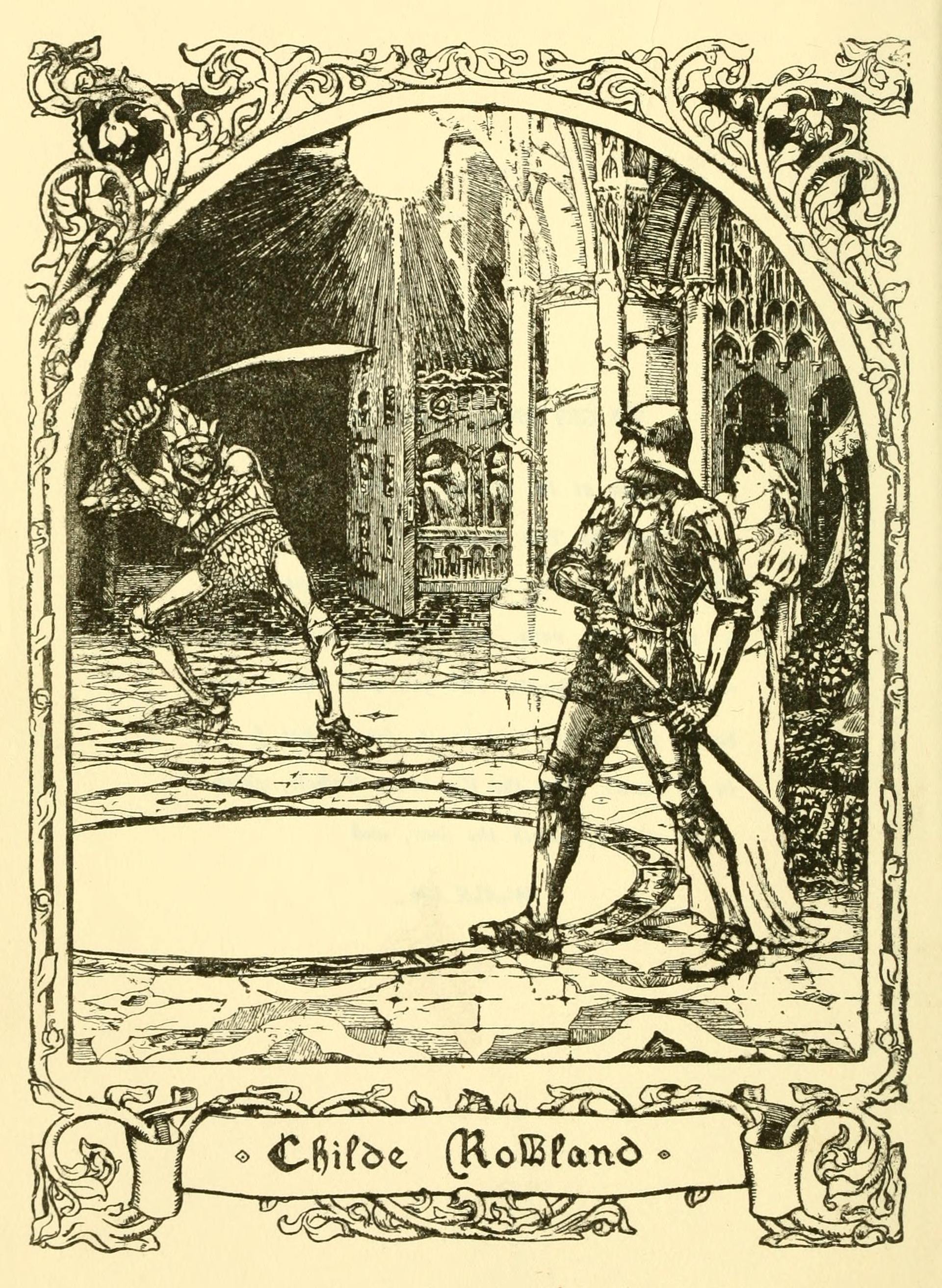
-
My first thought was, he lied in every word, That hoary cripple, with malicious eye
Browning opens his poem by overturning one of the oldest conventions of the quest romance in which the wise guide sets the hero on his way. The “hoary cripple” parodies that archetype, and his supposed direction is offered through deceit rather than wisdom. This ironic inversion signals that Roland’s journey, before it even begins, will be fraught with suspicion, fatigue, and self-doubt. Virginia Blain argues this encounter also exposes a deeper Victorian fear of failed masculinity. The cripple’s leer, Roland’s disgust, and the absence of women and redemptive love mirrors what Blain calls Browning’s “homosexual panic,” a symptom of the age’s broader struggle to define masculinity amid social change (Blain). Blain’s reading consequently joins the long critical tradition of reshaping “Childe Roland” to mirror contemporary concerns. In her hands, the poem becomes a reflection of Victorian gender anxiety, just as later critics and artists would recast it to speak to their own cultural and psychological landscapes.
-
(See Edgar’s Song in “Lear”)
Browning takes his title from King Lear, where Edgar, disguised as Poor Tom, mutters the phrase in the midst of feigned madness. In Shakespeare, the phrase carries no narrative function and is without clear meaning. However, Browning recontextualizes the fragment and expands it into a fully imagined landscape of interior ruin, retaining the original atmosphere of delirium while reshaping it into an existential quest. By transforming a line without context into a sustained meditation on purpose and persistence, Browning creates an interpretive void that later readers and artists repeatedly fill, fueling the poem’s evolving cultural afterlife within literary and critical discourse.
-
-
www-jstor-org.proxy.library.carleton.ca www-jstor-org.proxy.library.carleton.ca
-
If a revamp of the AtlanticCanada Portal is in the cards, two excellent models for what it could become areprovided by the Network in Canadian History and Environment (NiCHE) andActive History websites; tellingly, both of these websites use various social mediato promote the dissemination of history and, as a result, both reveal the potential ofhow the Internet and social media can positively impact our discipline.1
This is a really cool observation about how Canadian historians are using the internet. It shows that they've made successful websites like NiCHE and Active History. These are great examples because they prove that you can use simple tools like social media to share history with the public. It tells us that the history of the internet in Canada isn't just a technical story it's a story about making history a more public and accessible thing.
-
-
cjc.utppublishing.com cjc.utppublishing.com
-
Internet scholars are uncovering and connecting histories of early internets across the globe, but the Canadian context remains underexplored.
This is an important piece of information because it states that the history of the internet in Canada is not studied enough by scholars. I already know that most people focus on the American ARPANET, but this tells me there are whole histories, like the one about SAMSON, that historians are only just starting to uncover. As Canadians we need to look for Canadian-specific sources, not just general ones.
-
-
olh.openlibhums.org olh.openlibhums.org
-
The coins can be arranged into various layouts such as piles representing, for example, metal types, or streams visualizing the ebb and flow of coins over the centuries.
This concept of visualizing data as "streams visualizing the ebb and flow of coins over the centuries" is highly relevant to my research. I need to show change over time, specifically the sudden drop in coins or shift in material (like the debasement of currency) that occurs during and immediately after the plague years (1347-1351). This idea of "dynamic streams" helps me think past a static map and towards visualizing economic instability and recovery across Europe.
-
-
www.degruyterbrill.com www.degruyterbrill.com
-
sources of digital structured data (e.g., spreadsheets, traditional relational databases, content management systems) have seen far less critical enquiry. Structured digital data are often venerated for their capacities to facilitate interoperability, equitable data exchange, democratic forms of engagement with, and widespread reuse of archaeological records, yet their constraints on our knowledge formation processes are arguably profound and deserving of detailed interrogation.
If we only record an event's details in a rigid structured database, we create dark data. This is the subjective human wisdom which is the feelings, fear, or conflicts that are/could be found in a diary. The database intentionally leaves this wisdom behind because it is too ambiguous to fit its focus on measurable facts.
-
-
www.pnas.org www.pnas.org
-
Identifiers play a fundamental role in shaping data quality and reusability.
When analyzing archival documents, we must use unique, permanent identifiers for each document. This is an ethical duty because it ensures that future researchers can trace the data's original source and context (who found it, where it's stored), preventing errors and making data reusable.
-
-
www.abc.net.au www.abc.net.au
-
Our country's 50,000-year-old encyclopedia<br /> by [[Margaret Burin]], [[Chris Lewis]] in ABC News accessed on 2025-11-11T08:50:57
via A 50,000 year old community PKMS : r/PKMS<br /> by [[WadeDRubicon]]<br /> accessed on 2025-11-11T08:50:16
-
-
www.pencilpages.com www.pencilpages.com
-
The Pencil Pages<br /> by [[Doug Martin]]<br /> accessed on 2025-11-09T09:27:11
-
-
calcedar.com calcedar.com
-
Mongolized<br /> by [[WoodChuck]] for CalCedar accessed on 2025-11-09T09:24:05
-
-
liorpachter.wordpress.com liorpachter.wordpress.com
-
Review of Cold Spring Harbor Laboratory’s Obituary for Dr. James Watson<br /> by [[Lior Pachter]] on Bits of DNA<br /> accessed on 2025-11-08T22:43:12
-
-
www.youtube.com www.youtube.com
-
Ruthless: Monopoly's Secret History<br /> by [[American Experience]] on PBS<br /> accessed on 2025-11-08T09:13:39
-
- Oct 2025
-
www.newyorker.com www.newyorker.com
-
First, he says, in the age of the typewriter—the twentieth century, more or less—there was a mythology that what was typewritten was true, that the machine somehow caused writers to bare their souls. This is a central idea of “The Iron Whim,”
via Darren Herschler-Henry's book
-
By 1910, according to the Census Bureau, eighty-one per cent of professional typists were female.
-
-
christmas.musetechnical.com christmas.musetechnical.com
-
https://christmas.musetechnical.com/
Catalogs & Wishbooks from Sears, Montgomery Ward, and JC Penny
-
-
typecast.munk.org typecast.munk.org
-
Christmas 1959 is when Montgomery Wards gets their own “store brand” of a sort. They start offering the “Royal Heritage”, a model made specifically for MW by Royal. This is the beginning of the famous “blue badge” Royals with the sky-blue case interiors. If you see one of these, it was sold by Montgomery Wards.
-
-
typecast.munk.org typecast.munk.org
-
In Search Of: Clarence Leroy “Rocky” Jones<br /> by [[Ted Munk]] on November 12, 2016 <br /> accessed on 2025-10-15T11:15:17
-
-
www.openculture.com www.openculture.com
-
Mark Twain Wrote the First Book Ever Written With a Typewriter<br /> by [[Josh Jones]] in Open Culture<br /> accessed on 2025-10-13T23:01:35
-
- Sep 2025
-
strangebeautiful.com strangebeautiful.com
-
In calling the structure of the chromosome fibres a code-script
from where does he draw the idea "code-script"? Is it from the developing information theory of the time? Somewhere else?
There is definitely the idea of a code running in the sense of programming, which was likely not a common conceptualization at the time.
On p. 22 he uses the phrase "law-code" which is likely the closer meaning of code he's using and not the sense of genetic code as understood much later when DNA and the underlying protein coding sequences were unraveled.
Morse code may also be a tangential underlying meaning of his sense of "code" as something unknown but potentially revealable.
-
four-dimensional pattern
What a great conceptualization of considering organisms in time and space... something we don't do now as well as we ought to almost 80+ years later
One might presume as a physicist he's taking advantage of Einstein's conceptualization of spacetime, but here within biology.
-
THE RELATION BETWEEN CLOCKWORK ANDORGANISM
historical evidence of the scientific shift from Newtonian clockwork physics into an underlying statical mechanical one
-
-
aresluna.org aresluna.org
-
The day Return became Enter<br /> by [[Marcin Wichary]] in Aresluna<br /> accessed on 2025-09-12T09:33:12
-
-
themechanicaltype.blogspot.com themechanicaltype.blogspot.com
-
www.americanscientist.org www.americanscientist.org
-
My own assessment is that the book, which reads like a thoroughly researched legal brief (more than 100 pages are devoted to notes, references and a very detailed index), makes the best possible case for the highly dubious proposition that the ideas of information theory influenced the substance, rather than merely the rhetoric, of research in molecular biology in the 1950s and 1960s.
Information theorist Solomon Golomb, who directly participated in the applications of information theory to early genetics, doesn't feel that it influenced the substance of molecular biology in the 1950s and 1960s though it may have influenced the rhetoric.
-
-
xoverit.blogspot.com xoverit.blogspot.com
-
Olympia SM series (part 1, 1948-1964)<br /> by [[x over it]]<br /> accessed on 2025-09-05T17:14:33
-
-
www.youtube.com www.youtube.com
-
I did my um my PhD research on list machines in the artificial intelligence lab at MIT
History - Donald Hoffman - PhD on Lisp AI - Marvin Minsky - MIT lab
-
- Aug 2025
-
shrewdies.com shrewdies.com
-
Description
Who invented the lighthouse? Learn the history and evolution of lighthouses and tilting beacons in navigation. See their literary and cultural symbolism.
-
-
thomashunter.name thomashunter.name
-
There shouldn't be anything remarkable about this guide but there is... all the one-liners worked exactly as expected. God bless.
-
-
localhost localhost
-
The idea of using abstract spaces in a systematic fashion goes backto M. Frechet (1906)1 and is justified by its great success.
-
-
zubairsbookshelf.substack.com zubairsbookshelf.substack.com
-
The Seeker's Library<br /> by [[Zubair’s Bookshelf]] <br /> accessed on 2025-08-16T15:10:46
-
-
davistypewriters.blogspot.com davistypewriters.blogspot.com
-
Portable Typewriters Today - February 2015<br /> by [[Will Davis]] on 2015-02-10<br /> accessed on 2025-08-05T16:35:48
Tags
- UNIS typewriters
- Rover 5000
- Royal typewriters
- Royal Epoch
- Hammacher Schlemmer
- Olivetti Lettera 35I
- Flying typewriters
- Marshall MT-99
- Olivetti MS25 Premier
- Rover typewriters
- Generation Marketing Group
- Silver-Seiko typewriters
- Zhangjiagang Feiteng Typewriter Co., Ltd.
- typewriter history
- Ideal (Jinan) Machinery Co., Ltd.
- read
- typewriter distribution
- Dr. Leonard's Health Care catalog
- Generation 3000
- Skymall
- Chang Kong typewriters
- Nakajima
- Ningbo Duodashi Manufacturing Co.
- Olympia Carina
- Ningbo Duodashi
- Sharper Image
- mail order catalogs
- Carol Wright catalog
- Shanghai Weilv Mechanism Company
- Olympia Traveller C
- Ashok Matta
- Rover Traveller C
- Marshall Sewing Machine Industrial
- Olivetti Lettera 25
- Rover 8000
Annotators
URL
-
-
www.hsozkult.de www.hsozkult.de
-
Noa K. Ha, Rezension zu: Plamper, Jan: We are all Migrants. A History of Multicultural Germany. Cambridge 2023 , ISBN 9781009242264, in: H-Soz-Kult, 24.07.2025, https://www.hsozkult.de/publicationreview/id/reb-143159.
Noa H. Ka, [Review:] Plamper, Jan: We all Migrants. A History of Multicultural Germany, in: H-Soz-Kult 24.07.2025 URL:https://www.hsozkult.de/publicationreview/id/reb-143159 23.07.2025
-
-
www.hsozkult.de www.hsozkult.de
-
Julia Mutzenbach, Tagungsbericht: Digital in die jüdische Frühe Neuzeit, in: H-Soz-Kult, 24.07.2025, https://www.hsozkult.de/conferencereport/id/fdkn-156294.
Julia Mutzenbach, [Conference report:] Digital in die jüdische Frühe Neuzeit. Innovative Formen der Vermittlung. Organisiert von Interdisziplinäres Forum Jüdische Geschichte und Kultur in der Frühen Neuzeit und Akademie der Diözese Rottenburg-Stuttgart. Stuttgart [Hybrid] 14.--16.02.2025, in: H-Soz-Kult, 24.07.2025 https://www.hsozkult.de/conferencereport/id/fdkn-156294 27.07.2025
-
- Jul 2025
-
www.youtube.com www.youtube.com
-
An Orga Privat and its History by [[Will Davis]]
Bing Werke was the manufacturer and Orga was the distributor.
Piece of wood used to replace the rear legs of the typewriter to set it up by whittling.
A cut-rate typewriter without all the bells and whistles.
Tags
Annotators
URL
-
-
www.hsozkult.de www.hsozkult.de
-
In der Schlussdiskussion wurde das Tagungsthema als gelungenes Experiment gewürdigt, das mit seiner methodischen Ausrichtung neue Perspektiven eröffnete – auch wenn inhaltliche Forschungsthemen diesmal weniger im Fokus standen.
Sadly they only used a very narrow focus on the digital here. I guess there is a lot more possible with digital approaches in Jewish history than talking about games and digital editions.
-
Grundlegende Überlegungen zum Projekt stellten zunächst MARTHA FIEDELAK (Heidelberg) und LARA STUMPF (Heidelberg) an, indem sie die Verarbeitung frühneuzeitlicher Themen in Games vorstellten. Anhand von Games wie „Pentiment“ und „Martin Luther auf der Spur“ analysierten sie die Darstellung jüdischen Lebens in der Frühen Neuzeit. Dabei zeigten sie, dass jüdische Perspektiven oft nur am Rand erscheinen oder stereotypisiert eingebunden sind – selbst in sogenannten Serious Games mit Bildungsanspruch.
Jewish history only peripheral part of history in games.
-
Digitale Spiele im Geschichtsunterricht als ein Medium zwischen Historizität, Histotainment, Authentizität und Immersion präsentierte online zugeschaltet MATHIAS HERRMANN (Dresden). Er skizzierte die Entwicklung digitaler Spiele seit den 1970er-Jahren hin zu einem millionenschweren Massenmedium – ein Indiz für das breite öffentliche Interesse an Geschichte. Der Unterhaltungswert steht dabei oft über historischer Genauigkeit, doch gerade darin liegt auch ein didaktisches Potenzial: Historisierende Spiele sind Teil der Geschichtskultur, spiegeln populäre Vergangenheitsvorstellungen und können – kritisch analysiert – sogar als Quellen genutzt werden, um aktuelle Narrative und ideologische Deutungen sichtbar zu machen. Angesichts ihrer gezielten Nutzung durch rechtsideologische Kreise forderte Herrmann eine reflektierte Auseinandersetzung mit dem Medium. Richtig eingesetzt, etwa im Unterricht und begleitet durch geeignetes Material, könnten Spiele sowohl Faktenwissen als auch Medienkompetenz fördern – vorausgesetzt, sie werden als ernstzunehmende Bildungsmedien anerkannt.
Well, yes history in games is rarely accurate and this also okay. The main purpose is entertainment. We need a culture that recognizes that a game can still teach some things about history (e.g. how does persecution work). And also show perspectives about history. ALSO: Its not a question if games are educational, people will always use them to passively or actively educate themself about history.
-
ANNA NEOVESKY (Erfurt) begann mit einer Einführung in die Digital Humanities und Digital History. Sie präsentierte die Digital Humanities als eine Disziplin an der Schnittstelle von Technologie und Geisteswissenschaften, deren Wurzeln bis in die 1940er-Jahre zurückreichen und die seither fachspezifische Ausprägungen wie die Digital History hervorgebracht hat.
Bit sad, that we still need to do this introductions. Digital Humanities is around for so long, but even if we reference this in introductions its still news for some.
-
Zum 25-jährigen Jubiläum richtete das Forum Jüdische Geschichte und Kultur in der Frühen Neuzeit den Blick nach vorn. Ganz im Zeichen innovativer Methoden und digitaler Zugänge zur Vermittlung jüdischer Geschichte stehend,
Can we still speak of Digital Humanties methods as "new" (or even "new" to a certain subfield)? This seems a bit weird in 2025. Digital approaches are around since at least the 60s/70s. This also perpetual state of "novelty" also does not help Digital Humanities, a certain kind of normalising would be more helpful.
-
-
www.hsozkult.de www.hsozkult.de
-
Reading Plamper’s book and writing this review in a time of rising right-wing authoritarian politics—in which migration is weaponized to spread fear, prejudice, and hate—offers an inspiring reaffirmation of our shared humanity. The numerous detailed accounts and personal histories he presents serve as powerful testimonies to a lived reality that cannot be erased or ignored. Diverse backgrounds and religions shape daily lives in Germany, adapting and contributing in countless ways. By shifting the focus to those who actively form German society—despite often being labeled as “the other” or simply “migrants”—Plamper challenges exclusionary narratives. His meticulous documentation of migration stories underscores not only the enduring presence of these communities but also their role in shaping Germany’s future.
This is more like it, historical accounts can deliver political messages and show the way not to better political decision making but a better living together.
-
Plamper argues that the widely accepted notion of a homogeneous German identity is a myth, historically constructed and politically reinforced.
I guess this might be rooted in Plampers generation, as somebody born much later this identity was nothing but a myth to me -- and I do not know a lot in my generation that would share the idea of a homogeneous identity.
-
-
Local file Local file
-
Allen, Roland. The Notebook: A History of Thinking on Paper. United Kingdom: Profile Books, 2023. https://uk.bookshop.org/p/books/the-notebook-rolad-allen/6331084.
-
-
slate.com slate.com
-
Keeping Notebooks Could Change Your Life by [[John Dickerson]]
-
-
www.reddit.com www.reddit.com
-
www.madeinchicagomuseum.com www.madeinchicagomuseum.com
-
Paymaster Corp., est. 1917 by [[Made-in-Chicago Museum]]
Tags
- Theodore Hirschberg, Jr.
- Checkometer Sales Company
- Fisher Pen Company
- Louise Talmage
- United Steelworkers of America
- history
- Theodore B. Hirschberg, Sr.
- Todd Protectograph Company
- Arthur G. Rindfleisch
- G. W. Todd & Co.
- Hedman MFG Co.
- George Willis
- read
- checkwriters
- American Check Writer Company
- Chicago, IL
- check fraud
- XX
- Paymaster Corp.
- union busting
Annotators
URL
-
-
www.youtube.com www.youtube.com
-
six-month period between November of 52 and April of 53 where we unlocked first the power of the nucleus because we could fuse hydrogen and the other thing we were able to do was uh figure out the threedimensional structure of nucleic acid in the form of the double helix
for - stats - history - Nov 1952 - hydrogen bomb - -April 1953 - discovery of DNA
-
-
www.nytimes.com www.nytimes.com
- Jun 2025
-
typecast.munk.org typecast.munk.org
-
typecast.munk.org typecast.munk.org
-
www.uppercasetypewriter.com www.uppercasetypewriter.com
-
www.youtube.com www.youtube.com
-
who would have known this that your tracheal epithelial cells if expplanted if if liberated from the rest of the body they will make a self motile little uh construct that among other things knows how to heal neural wounds.
for - quote - no evolutionary history explains form and behavior - Michael Levin
observation - evolution alone is insufficient to explain life - These novel, artificial life forms behave in novel emergent ways, there is no natural selection at play here
-
-
www.telegraph.co.uk www.telegraph.co.uk
-
History Books of Note, should read
-

