that the reservation of what were popularly known as State rights had been to a great extent the cause of the difficulties which were now agitating that great country.
Preamble, §§. 91 and 92 of the Constitution Act, 1867.
that the reservation of what were popularly known as State rights had been to a great extent the cause of the difficulties which were now agitating that great country.
Preamble, §§. 91 and 92 of the Constitution Act, 1867.
liar. But it must not be supposed, on account of the use of that term, that in the Union now proposed to be established it was intended to imitate the Federal Union which we had seen existing in the United States. In the United States, the general Government exercised only such powers as were delegated to it by the State Governments at the time the Union was formed. Each State was regarded as a sovereign power, and it chose for the common interest to delegate to the general Government the right of deciding upon certain questions, which were expressly stated All the undefined powers, all the sovereign rights, remained with the Governments of the several States
Preamble, §§. 91 and 92 of the Constitution Act, 1867.
having unfortunately for our common interests comparatively little intercourse with each other, the difficulty was felt that, if we attempted to make a Legislative Union of these Provinces in the first instance, the dread, in the case of the Lower Provinces and probably of many among ourselves that peculiar interests might be swamped and certain feelings and prejudices outraged and trampled upon, was so great that such a measure could not be entertained and we were compelled to look for what was sought in a form of government that would commit all subjects of general interest to a general Government and Legislature, reserving for local Legislatures and Governments such subjects as from their nature required to been trusted to those bodies. (Cheers.) The term Federation was used with reference to the proposed Union, because it was that with which the public mind was most fami
Preamble, §§. 91 and 92 of the Constitution Act, 1867.
to determine whether it should be a Federal or a Legislative Union. A Legislative Union, as they were all aware, had certain advantages over one based on the Federal system. It was a more complete union, and implied a more direct action and control of the government over the interests of the people at large. And, where a people were homogeneous, and their interests of such a character as to admit of – niformity of action with regard to them, it could not be doubted that a government on the principle of a Legislative Union was the one which probably operated most beneficially for all
Preamble, §§. 91 and 92 of the Constitution Act, 1867.
the Hon. Mr. Brown and two other gentlemen representing the Liberal party of Upper Canada had entered, to address themselves to the preparation of a measure that would partake of a federal character as far as necessary with respect to local measures, while it would preserve the existing union in respect to measures common to all ; that they would endeavor, if necessary, to strike out a federal union for Canada alone, but that at the same time they would attempt, in considering a change in the Constitution of this country, to bring the Lower Provinces in under the same bond, as they were already under the same Sovereign. It was highly proper that, before touching the edifice of Government that had been raised in Canada they should address the statesmen of the Lower Provinces, and try to induce them to form a common system If it were found impossible to have a legislative union of all the British American Provinces, then they could reserve to the local governments of the several Provinces the control of such subjects as concerned them, while the rest should be committed to the cue of the General Government
Preamble, §§. 91 and 92 of the Constitution Act, 1867.
It was adopted by the Imperial Legislature with the view of remedying difficulties which then existed between the two Provinces. The inherent defect in the Imperial Act for the Union of the two Canadas was this : it attempted to combine the federal principle with unity of action. It endeavoured to give equal representation to the two sections of the Province, while it brought them together for the purpose of dealing as one with all subjects both (general and local,
§§. 3 and 12 of the Union Act, 1840.
Those claims were in themselves undoubtedly founded in justice— but at the same time there was great reason in the objections taken to them—they involved an interference with the Federal principle recognized in the Union Act, an interference which amounted to an entire change in the principles on which the Government of the country was to be administered, and could not be received otherwise than with dread by a large class, if not by the whole of the population of Lower Canada.
§§. 3 and 12 of the Union Act, 1840.
should have been a concession to Upper Canada, of additional members in proportion to its population, but that concession would, as be had already remarked, have been an invasion of the Federal principle, contained in the Union Act, and would unquestionably have been represented to the uttermost by a large proportion if not by the whole of Lower Canada.
§§. 3 and 12 of the Union Act, 1840; §§. 51 and 52 of the Constitution Act, 1867.
indeed, extend them in such a way as to promote the peace contentment, and prosperity of the people, at the same time preserving in the new constitution those rights they were afraid would be subjected to injustice.
Preamble of the Constitution Act, 1867.
stun cuffs that deliver 80,000 volts to detainees via remote control allow users to avoid direct responsibility for the human suffering they cause
This reminds me of the slave collars in Octavia Butler's Parable of the Talents.
Describing the creation of Superorganism's songs, Orono Noguchi says, "It usually starts with us listening to music and talking about music, art, and all kinds of stuff in the kitchen. Then, one of us would come up with a very basic idea for a song. We'd then send the file back and forth among the group and add on some random ideas that we have. We'd keep working on it until we have a final product."[9] "We've got the guy making the videos downstairs, mixing in the other room, [and] singing going on [elsewhere]," Harry says in regards to their live-in studio. "We've created this kind of warped version of a pop production house."[1]
This report summarizes the primary motivations of libraries that invest in open access initiatives.
ltngu1stte, visual, aural, gestural, and spatial-which they found could be
In "Forty Years Later, the Golden Record Goes Vinyl" is an interesting article because it incorporates three of the five mutlimodal modes which are linguistic, visual, and aural. The Golden Record originally was not intended for human consumption but after several years later it was. The Golden Record was created in several different languages so that many people would be able to understand.
vending zone” means an area or a place or a location designated as such bythe local authority, on the recommendations of the Town Vending Committee, for thespecific use by street vendors for street vending and includes footpath, side walk,pavement, embankment, portions of a street, waiting area for public or any such placeconsidered suitable for vending activities and providing services to the general public.
Used in the booklet on Pg 19 as: " The BBMP too cannot evict street vendors. The law is clear that BBMP has to first conduct a survey of all street vendors, and then issue ID Cards. Till then, no one can be evicted ir relocated. The BBMP has also issued a note about this. While clearing footpaths, the BBMP cannot violate the Street Vendors Act. Any move to evict is thus against the law!"
No street vendor shall be relocated or evicted by the local authority from the placespecified in the certificate of vending unless he has been given thirty days’ notice for thesame in such manner as may be specified in the scheme.
Used in the booklet on Pg 17 as: "What if shopkeepers or residents threaten to move us out of the footpath?"
Also as
Used in the booklet on Pg 17 as: "Shops and houses have the right to ensure that access to their house or gate is not blocked" said Neela. If we don't block that, we are not doing any wrong. Discuss problems amicable. If they insist you vacate for no reason, tell them that only BBMP can regulate vending and talk to the union. Sometimes the police files a petty case against vendors - under Section 92 (G) of Karnataka Police Act or Section 283 of IPC. If this happens, just don't pay the fine - if you pay it is as though you are guilty. Street Vending is not a crime - it is pakka legal. Tell the police that you would like to challenge the case in court and talk to the union. In fact, the office of the police commissioner has issued a circular ordering its officers to learn about the act."
The appropriate Government may constitute one or more committees consistingof a Chairperson who has been a civil judge or a judicial magistrate and two other professionalshaving such experience as may be prescribed for the purpose of deciding the applicationsreceived under sub-section (2)
Used in the booklet on Pg 17 as: "Shops and houses have the right to ensure that access to their house or gate is not blocked" said Neela. If we don't block that, we are not doing any wrong. Discuss problems amicable. If they insist you vacate for no reason, tell them that only BBMP can regulate vending and talk to the union. Sometimes the police files a petty case against vendors - under Section 92 (G) of Karnataka Police Act or Section 283 of IPC. If this happens, just don't pay the fine - if you pay it is as though you are guilty. Street Vending is not a crime - it is pakka legal. Tell the police that you would like to challenge the case in court and talk to the union. In fact, the office of the police commissioner has issued a circular ordering its officers to learn about the act."
Notwithstanding anything contained in any other law for the time being in force,no street vendor who carries on the street vending activities in accordance with the termsand conditions of his certificate of vending shall be prevented from exercising such rights byany person or police or any other authority exercising powers under any other law for thetime being in force
Used in the booklet on Pg 17 as: "Asking for hafta is illegal. Even the Supreme Court lamented this injustice. This is what the court said: 'Street Vendors are harassed a lot and are constantly victimized by the officials of local authorities, the police etc. who regularly target them for extra income and treat them with extreme contempt. Perhaps these minions in the administration have not understood the meaning of the term 'dignity' enshrined in the preamble of the constitution."
Each Town Vending Committee shall consist of
Used in the booklet on Pg15 as: "To conduct the survey, BBMP will create a town vending committee, with at least 40% members as street vendors, and rest from the Municipality, police, NGOs, RWAS wtc. Therefore according to the law atleast 40% members should be street vendors"
The Town Vending Committee shall, within such period and in such manner asmay be specified in the scheme, conduct a survey of all existing street vendors, within thearea under its jursidiction, and subsequent survey shall be carried out at least once in everyfive years.
Used in the booklet on Pg15 as: "The BBMP has to first conduct a survey of all the street vendors in the city."
The group has long been internally divided by dilemma as to whether its striving upward, should be aimed at strengthening its inner cultural and group bonds, both for intrinsic progress and for offensive power against caste; or whether it should seek escape wherever and however possible into the surrounding American culture.
I feel like either path invites criticism. When nonwhite communities strengthen their own boundaries and attempt to celebrate their culture, they are criticized as being disruptive and not making an effort to "become American." Yet people of color are also actively discouraged from integrating into white spaces due to fear and unfamiliarity, or are accused of whitewashing themselves. There's no winning here for people of color.
Knoll workstation fabric panel, 3'6" by 2', with crepe Knoll workstation fabric panel, 3'6" by 2'6", with crepe Knoll workstation fabric panel, 3'6" by 3'6", with crepe BPI workstation 1/2 plexiglass panel, 5'6" by 2'6"
List of objects: connection to The Pale King and Zero Kerning by Craig Dworkin
Similar goal? Collecting to detach from original function?
The influence of the media on the psychosocial development of children is profound. Thus, it is important for physicians to discuss with parents their child’s exposure to media and to provide guidance on age-appropriate use of all media, including television, radio, music, video games and the Internet.The objectives of this statement are to explore the beneficial and harmful effects of media on children’s mental and physical health, and to identify how physicians can counsel patients and their families and promote the healthy use of the media in their communities.
My daughter will be brought up to understand her true value. That’s a promise. As for all the little girls to be born around the world, the creation of these ads is an effort to show how imagination can change the conversation around their lives.
You may not copy any material accessed through this Website except to download, view or save to hard disk or diskette and store or print out single copies of individual search results for your own personal and non-commercial use, scholarly, educational or scientific research or study
Copyright.
Ὑπερβορέους
Δαλογενὴς
Περσᾶ[ν
No Pleiades URI https://en.wikipedia.org/wiki/Achaemenid_Empire
Ἑλλάνων
Συρακοσίῳ
songs
All that I have given up to this let them serve as examples of the way in which the Connaught peasant puts his love-thoughts into song and verse, whether it be hope or despair, grief or joy, that affect him. (147)
In these final lines of the book, the reader is offered Hyde’s selection of songs as a faithful and complete insight into vernacular Connacht song about the theme of love. Moreover, Hyde suggests that in reading this anthology one achieves a good degree of familiarity with an idealized, essentially native ‘Connaught peasant’.
Although speakers in the songs are variously male and female, and the reasons for separation from absent lovers differ, the experience of love is fairly uniform throughout. It is a sore experience of unrealized desire. That scenario produces a pronouncedly virtuous image of the ‘Connaught peasant’ for a number of reasons.
The reader encounters deep loyalty where admiration is unstinted by forbiddance of love because of emigration, lack of requital, or death. ‘Úna Bhán,’ for example, is preceded by a long passage explaining how deeply a bereaved lover missed the fair Úna after, until he himself passed away. Also, Hyde’s anthology is particularly rich in its examples of similes drawn from the natural world. See ‘my love is of the colour of the blackberries’ (5) in ‘If I Were to Go West’, ‘I would not think the voice of a thrush more sweet’ (27) in ‘Long I Am Going,’ and ‘My love is like the blossom of the sloe on the brown blackthorn’ (31) in ‘An Droighneán Donn’. In the vivid rendering of these images, the beauty of the desired lover is stressed, and the delicate sensibility of the speaker is inherently implied. The Connaught peasant is thoroughly valorized as a result.
Accounting for consistencies among what anthologies include, and among what they exclude, can highlight their organizing agenda. One obvious example in the area of Irish Studies is the Field Day Anthology controversy, detailed in depth by Caitríona Crowe in The Dublin Review: https://thedublinreview.com/article/testimony-to-a-flowering/
In the case of Hyde’s Love Songs, consistencies among excluded material strengthen our perception of how actively he sought to contrive an estimable image of the Connaught peasant. Though Hyde claims his selection is emblematic of the love-thought of that idealized personage, he does not provide any examples of la chanson de la malmariée. This variety of song is so widespread that Seán Ó Tuama, who was the principal authority on the theme of love in Irish folksong, included it as one of five major genres in his article ‘Love in Irish Folksong’ (in the book Repossessions: Selected Essays on the Irish Literary Heritage. Such songs are an expression of grief by a young woman unhappily married to an elderly man.
If we are to view the songs anthologized by Hyde in a broader context of Connacht songs about love, an awareness of the chanson de la malmariéé is required. Faoi Rothaí na Gréine (1999) is a relatively recently published collection of Connacht songs. The collecting work was done in Galway between 1927 and 1932 by Máirtín Ó Cadhain, and latterly edited by Professor Ríonach Uí Ógáin. ‘An Droigheán Donn’, ‘Úna Bhán’, and ‘Mal Dubh an Ghleanna’ are common to Faoi Rothaí na Gréine and Love Songs of Connacht. The inclusion in the former of two famous songs of the malmariée genre, ‘Dar Mo Mhóide Ní Phósfainn Thú’ (I Swear I Wouldn’t Marry You), and ‘Amhrán an Tae’ (The Tea Song) demonstrate the strong presence of that genre in the ‘love-thought’ of vernacular Connacht song.
This way of framing discussion of Love Songs of Connacht invites close interrogation of Hyde’s biases. The choice of material for inclusion and exclusion is ideologically cohesive, to the specific end of creating a valorous image of the idealized native peasant. In my M.A. thesis, I might further refine the line of argument pursued in this annotation, and use it as the basis on which to build a discussion of Hyde’s particular ideological motivations.
Love
‘S í an teanga Ghaodheilge is greannta cló, Go blasta léightear í mar cheol ‘S í chanas briathra binn-ghuth beóil, ‘S is fíor gur mór a h-áille (v)
Hyde’s romantically excessively verse translates roughly as:
It is the Gaelic language whose shape is most fine, She reads as a tuneful music, It is she who sings the mouth’s sweetest syllables, And truly her beauty is great
Abhráin
The formatting of e-books on Internet Archive does not allow hypothesis.is users to annotate the books’ text. In annotating Hyde’s Love Songs of Connacht for the EN6009 Annotate-A-Thon, I have attached annotations to the text beneath the scanned images. Extracts and corresponding page numbers are placed at the beginning of each annotation, in order to properly contextualize my responses.
Máire Ní Mhongáin
As Ciarán Ó Con Cheanainn writes in Leabhar Mór na nAmhrán, the oldest written version of this song dates to 1814, and is found in MS Egerton 117 in the British Library. Oral lore in Conneamara has it that Máire Ní Mhongáin’s three sons joined the British Army, and that Peadar deserted soon after joining, and emigrated to America. It seems probable that their involvement was in the French Revolutionary Wars or the Napoleonic Wars, the major conflicts fought by the British Army in the final decade of the eighteenth century and the first decade of the nineteenth respectively.
Máire Ní Mhongáin seems to have resonated among Irish emigrant communities in the United States. My evidence for this is that Micheál Ó Gallchobhair of Erris, County Mayo, collected songs from Erris emigrants living in Chicago in the 1930s, over a century after the occasion of ‘Amhrán Mháire Ní Mhongáin’s’ composition. It features in his collection, which you access via the following link: http://www.jstor.org.ucc.idm.oclc.org/stable/20642542?seq=2#page_scan_tab_contents
The virulent cursing of departed sons by the mother, named Máre, produces the effect of striking g contrasts with John Millington Synge’s bereaves mother, Old Maurya, in Riders to the Sea.
My Irish Studies blog features an in-depth account of typical features of the caoineadh genre to which Amhrán Mháire Ní Mhongáin belongs. You can access it via the following link: johnwoodssirishstudies.wordpress.com/2018/01/03/carraig-aonair-an-eighteenth-century-west-cork-poem/
Bean an tSeanduine - Sean Nós 2
‘Bean an tSeanduine’ features all of the conventions of the malmariée genre we have previously encountered in ‘An Seanduine Cam’. Also, it is a good example of the speaker blaming her parents for her plight, which is another regular feature of this song type.
As well as being one of the finest examples of the genre, it is perhaps the most well-known and commonly sung, owing in large part to the simplicity and catchiness of its monosyllable end-rhymes.
As well as Ó Tuama, Meidhbhín Ní Úrdail has written about the common features of the chanson de la malmariée. Her article ‘The Representation of the Feminine: Some evidence from Irish language sources’ in Eighteenth-Century Ireland/Iris an Dá Chultúr is a rich source of information on the topic. In ‘Bean an tSeanduine’, we have a fine example of what Ní Úrdail calls the description of ‘the plight of a beautiful young woman, trapped in an unhappy marriage to an impotent elderly spouse who is ignorant of her mental and physical frustration’. However, when we consider the particular humour of this song, we can identify how it serves to empower the female speaker.
‘Bean an tSeanduine’ differs from ‘An Seanduine Cam’ in that there is no third-person narrator. Like ‘An Seanduine Cam’, the humour of the song relies on a ridiculing of the old man, although here the young woman herself is his detractor. Each of his brags meet a witty riposte. When he claims wealth, she calls him a miser, and when he wonders what would become of his if he died during the night, she jokes that death is an immanent danger. When mockery of this kind is voiced by the female speaker, it serves to empower her, and inspire in the listener a sense of sympathy and respect.
An Seanduine Cam - Corn Uí Riada 2016
The song’s first two verses are spoken by a third-person narrator. In its humorous exaggeration, the first verse caricatures recognized conventions of arranged marriage. This narrative consciously situates itself in a genre whose familiarity to the listener is a necessary part of the humour. It addresses the economic incentives which were the major precipitating factors of marriage arrangements in rural Ireland during the eighteenth century. It also invokes the misery which such marriages often visited upon young women.
In his essay ‘Love in Irish Folksong’, Seán Ó Tuama identifies among typical features of the malmariée genre that ‘a young woman speaks (in the first person) of her anguish,’ that ‘the description of the husband can be unbelievably grotesque and ribald: he is humped, crippled; he coughs, grunts, whines at night; most of all, he is cold as lead, important, and completely fails to satisfy her desires’, and that ‘she discloses that she is going to leave him for a young man’ (149). ‘An Seanduine Cam’ provides clear examples of all of these traits.
Moreover, because these tendencies find expression in a debate form, and are redoubled in response to the unfeeling man, the resistant character of the put-upon young woman is strongly emphasized.
Songs
Hypothesis.is allows for annotation of various pages of a website. On this homepage, I have highlighted all text links to the other pages I have annotated.
Center of Excellence
Join the Center of Excellence. It is designed to help you improve your practice of Integrated PM through:
Mrs. Scales' Room
Title of the Blog
Out of Eden Walk Follow-Up
Title of blog entry/post, author name and timestamp. The timestamp will be automatically generated when you create the post.
In today's 24/7 media environment, in which kids may be spending more time with media than they are with their parents, choosing positive role models is more important than ever. By the time kids are in middle school, they start to look to their peers for a sense of what's socially acceptable or desirable. Parents may remain the primary influence in their kids' lives, but the competition starts to get fierce at this age. This separation is entirely age appropriate. But when the media comes into play, the values you want to pass down to your kids may be competing against, say, Homer Simpson's.
The good news is that there are plenty of positive role models you can point to that may influence your kids to make healthy choices, learn to respect others, achieve goals, and avoid anti-social behavior. Negative role models -- especially ones who don't suffer consequences for their actions -- can encourage anti-social behavior, stereotypes, and even cruelty. Help your kids choose positive media role models who embody the values you want to pass down. Tips for parents of young kid
Influencers reach out to kids via TV, YouTube, video games, Twitter, and music -- all of which are broadcast or easily accessible 24 hours a day. And as we all know, not all the characters or people who gain popularity through these channels have stellar role-model credentials.
placement
This crow called to me; I had to zoom in too much, but I loved the lines and spaces within the rule of thirds. https://flic.kr/p/245A9sn
Toilet of Diana
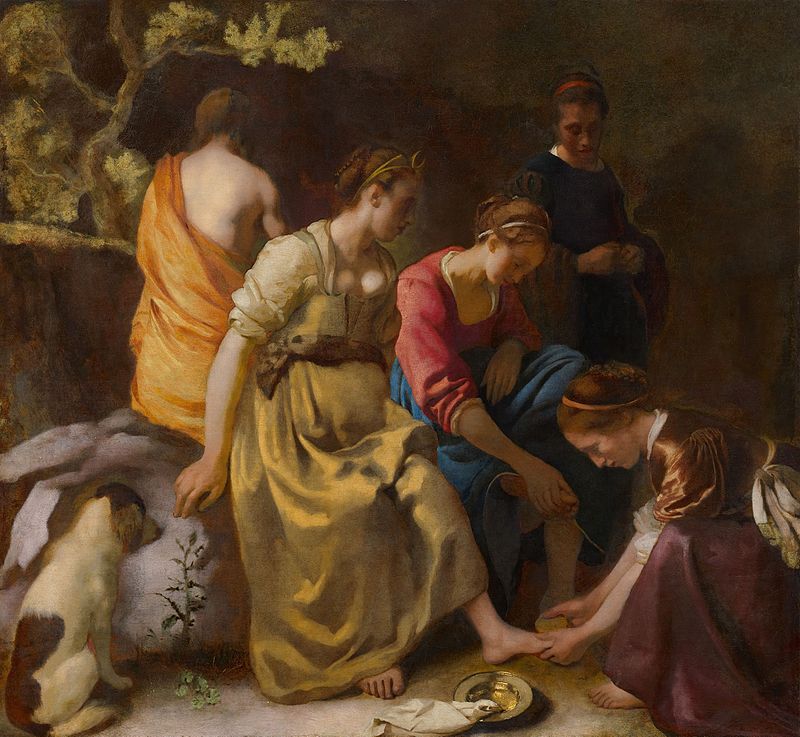
This painting has now been confirmed to be a Vermeer. It is thought be be one of his earliest works.
es visto y sentido como espacio vivencial de lo sagrado y lo cotidiano, del conocimiento de las leyes propias, de la relación con otros seres, con los humanos y del manejo o relaciones que se tienen con ellos. Cada parte esta interrelacionada con lo otro [...] El territorio es visto de manera integral donde lo físico y lo espiritual se articulan, y donde todos los actores [humanos y no-humanos] tienen una relación y un lugar. El reconocimiento del territorio se realiza a través de la lectura de las marcas ancestrales inscritas en los sitios sagrados desde los orígenes y que señalan el accionar presente, y los lleva a proponer un manejo integral de todo el territorio, para asegurar su conservación ambiental y cultural (Ull
el espacio vital que asegura la pervivencia como pueblo, como cultura en convivencia con la naturaleza y los espíritus. El territorio es nuestro verdadero libro histórico que mantiene viva la tradición de quienes habitamos en él. Representa y describe los principios y prácticas de nuestra cultura. Implica la posesión, control y dominio del espacio físico y espiritual. Como espacio colectivo de existencia, posibilita la convivencia armónica entre los pueblos. Fundamenta la cosmovisión indígena como razón de nuestra pervivencia”.
De ahí la importancia de los hackerspaces como territorio: lugar de memoria y convivencia.
Notably, a movement is growing to provide copyright-free open-access text books.
Yeah, that's not quite right...
Irwin Consulting Services Review - How to make sure of a safer winter road trip
Winter season brings in the beauty of cold and white nature. Many people look forward to this kind of weather because they can stay wrapped in their blankets or jackets the whole day while drinking hot chocolate and watching good movies. This month can be the most exciting month for many families because of the holiday season, and a lot of people are making last minute shopping and getting all their preparations done. With this, many individuals are getting busy using their cars to go to different places to buy things or products they needed for their Christmas and New Year celebrations. Others have been doing outdoor activities with their family members, friends or colleagues.
But no matter what the reason is, using your car during this season requires careful preparation to avoid accidents on the road. Irwin Consulting Services would like to provide some help in this regard through some helpful guidelines elucidated in the next paragraphs.
Consider changing into winter tires. This is often advised by many experts especially during this season, and it is even mandatory on particular places in the United States. Snow or winter tires provide traction that is better than all other tires when temperatures are at or below 7 degrees Celsius. Such allows greater control and shorter stopping distances on road surfaces during the cold and snowy weather. If you notice that some of your family members, relatives or friends don’t own this kind of tire, then you must advise them to buy some for their own safety and for all the people who will be riding with them in their cars. The price of this kind of tire can be higher than others but you can be certain that it is all worth it in the long run.
Put drifts into consideration while you’re on the road. You don’t want to be involved in any risky car spins scenarios right? It would be best to be careful with snow drifts because even if you’re driving on a clear road but with some speed, strong winds of winter can push those drifts on the clear road, which can lead to unwanted accidents if you’re not paying attention.
Make sure to properly cover the lids. In order to prevent moisture from freezing, you must cover the tire valves. Doing this, you can avoid air from escaping with the caps properly covered and also prevent having a flat tire.
Provide sufficient air. Going out of the house and engaging in long trips with your car can be a challenge this winter season because of the change in temperatures and other related aspects. If you wish to face the snowy roads prepared, then often check your tire pressure. Make sure to include this condition on your tire maintenance to have the tires in its best shape even with low temperatures and high air pressure.
Preparation is always the key. You can’t win against wintery roads if you’re not prepared to face its consequences. Bring with you some hats, mitts, and even a shovel organized inside your car trunk. Include in your winter driving kit a kitty litter too because it can provide traction to your car on icy or snowy roads. Bring an extra jug of winter windshield washer fluid as well especially during long trips to ensure visibility.
Pass on the knowledge. Some teenagers usually have a less proper understanding of wintery roads. It is your duty as an adult to remind them about the pivotal matters to consider in facing a snowy road to maintain their safety and their young lives. Irwin Consulting Services wanted you to be their guardian on the road, and if you’re a teen reading this then always remember to be prepared and be careful, and always listen to the advice of your older family members or friends.
Your tires also have its limits. You should have ample knowledge to identify when to replace them for good. You can change winter tires every two to three seasons as per advised by car experts. If you wanted to give new purpose to your old tires, a tire collector knows the best ways, so better get in touch with one within your neighborhood.
Irwin Consulting Services had previously provided some tips and guidelines on how to ensure indoor and outdoor safety during this holiday season, and this article is part of their objective to give helpful information to the public in making sure of their safety during any weather conditions.
Psychologists used to talk about perfectionism as though it were unidimensional — only directed from the self to the self. That’s still the colloquial usage, what we usually mean when we say someone’s a perfectionist. But in the last few decades, researchers have found it productive to broaden the concept. Curran and Hall rely on a multidimensional definition, encompassing three types of perfectionism: self-oriented, other-oriented, socially prescribed. Self-oriented perfectionism is the tendency to hold oneself to an unrealistically high standard, while other-oriented perfectionism means having unrealistic expectations of others. But “socially prescribed perfectionism is the most debilitating of the three dimensions of perfectionism,” Curran and Hall contend.
Multidimensional perfectionism
Buy Wholesale Bundles of Hair from Nana Hair
Our fellow citizens, too, who in proportion to their love of liberty keep a steady eye upon the means of sustaining it, do not require to be reminded of the duty they owe to themselves to remedy all essential defects in so vital a part of their system. While they are sensible that every evil attendant upon its operation is not necessarily indicative of a bad organization, but may proceed from temporary causes, yet the habitual presence, or even a single instance, of evils which can be clearly traced to an organic defect will not, I trust, be over-looked through a too scrupulous veneration for the work of their ancestors. The Constitution was an experiment committed to the virtue and intelligence of the great mass of our country-men, in whose ranks the framers of it themselves were to perform the part of patriotic observation and scrutiny, and if they have passed from the stage of existence with an increased confidence in its general adaptation to our condition we should learn from authority so high the duty of fortifying the points in it which time proves to be exposed rather than be deterred from approaching them by the suggestions of fear or the dictates of misplaced reverence.
Jackson's argument for amending the Constitution. What's important to him (or anyone): the end goal (in this case, changing the VP election law) or the supporting logic (the Founders understood their imperfection and so provided ways to rectify structural problems).
a pedagogy of small
I love this phrase. I am reminded of Robert Twigger's splendid book Micromastery. The subtitle to his book is "learn small, learn fast", i.e. pedagogies of small.
That takes me in a natural way to
Buckminster Fullers metaphor of the "trim tab". Ho loved that idea so much, he put it on his grave stone.
Let's find the trim tabs, the micromasteries, the small pedagogies that might work as we learn together. That is the kind of we-search I can support. Wholly.
finding patterns where there seems to be nothing but noise
Finding patterns where there is noise vs flashes of meaning that occur
Indeed we need look back only half a century, to times which many now living remember well, and see the wonderful advances in the sciences & arts which have been made within that period.
I found this statement interesting because it demonstrates the never-ending trend of society continuously advancing and moving forward. It is almost comical to think back how in 1818, when the document was written, the writers believed that their society and educational systems were so advanced. Looking back, this was obviously not the case; however, it is true that they had made many advances from previous centuries. Furthermore, today’s society has surpassed the first generations of UVA by a remarkable amount, not only in the technological and educational regard, but also in the moral regard, considering the original UVA was a school for solely white men of high status. The “indigenous” neighbors the document goes on to mention who the writers perceive to be less advanced than themselves are described as “barbaric and wretched.” This description is ironic considering the low moral standard of these founders who are almost barbaric and wretched themselves. Finally, it is again ironic that the writers are calling themselves “advanced” when they still have ignorant and amateur views about themselves and others.
Government announces it has secured a major strategic investment into UK by MSD ahead of this morning’s publication of its flagship Industrial Strategy Landmark investment comes as a huge vote of confidence in the government’s approach to industrial strategy, with the global healthcare company committing to open a new world-class hub in the UK
Back in 1993, when Eric Bina and I were first building Mosaic, it seemed obvious to us that users would want to annotate all text on the web – our idea was that each web page would be a launchpad for insight and debate about its own contents. So we built a feature called "group annotations" right into the browser – and it worked great – all users could comment on any page and discussions quickly ensued. Unfortunately, our implementation at that time required a server to host all the annotations, and we didn't have the time to properly build that server, which would obviously have had to scale to enormous size. And so we dropped the entire feature.
Our vision around the phrase reclaim is at least in part inspired by the documented work that Boone Gorges and D'Arcy Norman have been doing to take back their online presence from third-party services since 2011. While their approach is far more drastic than what we are advocating, Project Reclaim represents an ethos that is diametrically opposed to the innovation outsourcing that is prevalent in higher education IT shops at the moment.
Rather than framing everything at the course level, we should be deploying these technologies for the individual.26
Obvious question: what about groups, communities, networks, and other supra-individual entities apart from the course/cohort model?
equip them with practical web skills
Courses are severely limited in the ability to access other courses even within the institution (so much for "connecting silos"), and when courses end, students are typically cast out, unable to refer to past activity in their ongoing studies or in their lives (so much for "promoting lifelong learning").
Which is where a different type of unbundling can happen. “Courses” may limit our thinking.
mandate the use of "learning management systems."
Therein lies the rub. Mandated systems are a radically different thing from “systems which are available for use”. This quote from the aforelinked IHE piece is quite telling:
“I want somebody to fight!” Crouch said. “These things are not cheap -- 300 grand or something like that? ... I want people to want it! When you’re trying to buy something, you want them to work at it!”
In the end, it’s about “procurement”, which is quite different from “adoption” which is itself quite different from “appropriation”.
Five Arguments against the Learning Management System
Innovation involves the acceptance of the goals of a culture but the rejection of the traditional and/or legitimate means of attaining those goals. For example, a member of the Mafia values wealth but employs alternative means of attaining his wealth; in this example, the Mafia member’s means would be deviant.
The role of the ArchiMate standard is to provide a graphical language for the representation of enterprise architectures over time (i.e., including transformation and migration planning), as well as their motivation and rationale. The evolution of the standard is closely linked to the developments of the TOGAF standard and the emerging results from The Open Group forums and work groups active in this area.
In order to assess and document the level of compliance, completion of this information by an authorized representative of the supplier organization will provide the University of Colorado Procurement Service Center, and the campus affiliates it serves, with knowledge regarding the level of compliance and satisfaction of this policy and related standards with respect to the offered products and services.
Classic example of investment made on the basis of hype of tech, without evaluating it critically
Why, they would build an LMS. They did build an LMS. Blackboard started as a system designed by a professor and a TA at Cornell University. Desire2Learn (a.k.a. Brightspace) was designed by a student at the University of Waterloo. Moodle was the project of a graduate student at Curtin University in Australia. Sakai was built by a consortium of universities. WebCT was started at the University of British Columbia. ANGEL at Indiana University.
Let's imagine a world in which universities, not vendors, designed and built our online learning environments.
the backbone of for a distributed network of personal learning environments
On this model, students are responsible for their own education, often forming communities or societies to collaborate. Professors typically worked one-on-one with students, but from time to time would be enlisted to offer a series - or 'course' - of lectures on a given topic. The lectures could be (and often were) public, and were frequently attended by other professors in the same field.
Reminds me of @KevinCarey1 describe the original university of Bologna, in his End of College. Don’t have the quote handy (one of many cases where #OpenAccess would allow for more thoughtful discussion), but the gist of that paragraph sounds similar to what @Downes is describing here
This includes investing heavily in regional campus-based programs at universities and colleges that are aimed at encouraging students to acquire business skills and launch their own companies.
Speaking of “prescient”…
If there’s one standout global trend pertaining to today’s young people, it is an embrace of entrepreneurship as both a career path and a way a life.
A video for Domains 2017. All footage by the amazing Meredith Fierro. Contributions from Zach Whalen, Steve Greenlaw, Nora Forknall, Janine Davis, Mark Synder, Clark Billups, Lee Skallerup Bessette, Callie Liberty, Parrish Waters, Claudine Ferrell, Sierra, Andi Livi Smith, Elaina Finkelstein, Troy Paino, Kris Shaffer, Jenn Hill, Stephanie Buckler, and Audrey Watters.
Recognized a few, but not everyone. Would need to watch Meredith Fierra’s full film (with lower thirds, one might assume). https://www.youtube.com/watch?v=q9dGAAe-emY
my own spirit would begin to feel unreclaimable.
Reclaim ghosting?
representation of race and gender in our culture
having students do a basic Google image search for terms like “doctor” “teacher” “baby”
It may sound obvious but it actually works. Just did it with each of these three words (on DuckDuckGo) and the results, though unsurprising, bring home the point. Tried switching on the Canadian filter, to check if their might be a difference, and it mostly reorders the results, for some reason. Also tried “student” and “musician” which provide an interesting contrast. Doing this exercise in class, would probably start by asking learners to write down what they expect to get. (Might even do it in my applied anthro class, tomorrow.)
The other reason I worry about our dependence on WordPress is that we run the risk of recreating the very dynamic that Domain of One’s Own seeks to challenge
Embracing an Entrepreneurial Culture on Campus go.nmc.org/uni(Tom Corr, University Affairs, 4 May 2016.) The Ontario Network of Entrepreneurs is gaining global recognition for its efforts to bolster students’ business skills through investing in multiple campus events and programs. For example, the success of Ontario Centres of Excellence has led to the establishment of similar innovation hubs throughout North America, the UK, Australia, and Asia.
What’s fascinating here is that the province might be cutting a major part of the funding for the Ontario Centres of Excellence, particularly the part which has to do with Entrepreneurship Programs. (My current work is associated with Lead To Win, a Campus-Linked Accelerator out of Carleton University.)
Feldstein's Law: Any educational app that is actively developed for long enough and has a large enough user base will become indistinguishable from a badly designed LMS.
a Brazilian Portuguese language textbook they’ve written and maintained for more than 50 years
!! (Wondering about the “but we worked a lot on this” comment against OER.)
Witnessing,hacking,andcommoningarethreedigitalactsthathavebecomepossibleoverthepastfewyearsandhavecreatedopeningsforbeingdigitalcitizensinorbymakingrightsclaims.Theresignificationofexistingortheintroductionofnewconventionsmadetheseactspossible:Bitcoin,copyleft,CreativeCommons,Digg,GitHub,GNN,GNU,WikiLeaks,andmanyothers.Nodoubtsomeoftheseconventionswillbereplacedordisplacedbyothers.Somewillbecomedefunct.Somewillperhapspersistasatestamenttothedigitalcommons.Therewillcertainlybenewconventions.Whatenduresistheperformativeforcethathasgoneintomakingtheseopeningspossible.IfweunderstandcyberspaceasaspaceofrelationsbetweenandamongbodiesactingthroughtheInternet,witnessing,hacking,andcommoningresignifyorinventconventionsandmakepossibletheemergenceofnewwaysofbeingcitizensubjectsincyberspace.
[...] As we discussed earlier, just as many efforts are being expended on closings as these openings, cajoling and coercing them in various submissive ways and generally blocking possibilities. The digital commons is certainly a new frontier for struggles over commodification.[83] The main challenges to these creative forces emanate from state-security apparatuses and commerciallegal apparatuses. The main challenges to these creative forces emanate from state-security apparatuses and commerciallegal apparatuses. We have covered some of these closings, but here we want to restate the importance of open versus closed conventions of the Internet. Much has been said about Facebook, Flickr, Google, Tumblr, Twitter, and YouTube and their activities for tracking the conduct of people for advertising revenues and collecting big data. Let us emphasize that among one of the most important reasons that both state and corporate apparatuses are able to do this is because these are designed as proprietary and closed conventions. Unlike open conventions such as WordPress or Wikimedia, these conventions require submitting to end-user licences and user contracts that not only severely restrict actions but also appropriate their results as data. There is a massive difference between the digital commons created by open-source code and its increasing zoning, appropriation, sequestration, and enclosure through closed conventions. [...] Let us remember that cyberspace is a fragile if not a precarious space. This makes its protection as an open-source digital commons a political question—a question that those who are making digital rights claims are enacting with increasing effectiveness but also with urgency.
Copyrightderivesitslegalforcefromlawsthatprotectexclusiverightstoandcontrolofintellectualproperty.EvenifitsoriginscanbetracedtoearlymodernEurope(sixteenthtoeighteenthcenturies),itismoderninthesensethattheformationofintellectualproperty—thatis,theconversionofcreativeproductssuchaswords,data,images,andsoundintopropertyforexchange—isaresultoftheaccumulationofcapitalinmodernsocieties.
This is what Lyotard highlighted as the commodification of knowledge in what he then called computerized societies. The conversion of intellectual or, more broadly, cultural capital into economic capital is possible under the protection of copyright laws. This is the force of copyright law. Since it introduces a tension between creativity and calculability, it is doubtful that copyright law either protects or encourages creativity. Instead, creativity is commodified by copyright. The performative force of copyright is that both the creator and consumer must—knowingly and unknowingly—repeat and iterate it. The force of copyright law would be nothing if it were not performed. That is the reason why maintaining its imaginary force requires enormous energy: copyright mobilizes massive efforts to maintain its legal, performative, and imaginary force. If creativity were not commodified, copyright would not exist. Commodification transforms the use value of things into exchange value for being sold and bought.
Toxoplasmosis is caused by the obligate intracellular parasite, Toxoplasma gondii. Its life cycle consists of 3 forms, including an oocyst, a tissue cyst, and an active (proliferative) form.
See also: CDC- Toxoplasmosis
Toxoplasmosis
Source of Infection in humans:
Sources of T. gondi infection

Life cycle of T. gondi

Docker eventually sold out to (I believe) Bell and the professors did just fine.
How times have changed.
When you think the problem to be solved is the high cost of textbooks, inclusive access programs and OER adoption are just two competing approaches to solving the problem.
There was an interesting example of this during a short conference on digital textbooks, back in late 2014. Cindy Ives interim VP Academic at Athabasca (!) presented the etext pilot project in partnership with publishers. Ives’s approach was quite pragmatic and there’s nothing wrong with doing a pilot project on something like this. By that time, Ives was already involved in OER projects. It still struck a chord with those of us who care about OER, including Éric Francoeur who took an active part in the event and did work to create a free textbook through international and interlinguistic collaboration.
To me, a key notion from the ‘r’ in “OER” is the distinction with those content bundles we still call “textbooks”. Sure, it’s already in the 5-R model. But the “Remix” idea in music is to a large extent about unbundling.
ethics of video games in archaeology
Reminds me of this historian’s talk at Pint of Science Montreal 2015. (Sadly, not finding online traces of the event apart from my own section.)
“Including open in the list of examples for educational leadership is important because it brings it to the forefront. When I went up for promotion, I took a risk because engaging in open practice was not listed as an example of educational leadership, but not everyone is going to do that. Whereas if it’s strictly laid out it raises the profile for those who haven’t thought about open education and also shows that it is valued by the university as being a form of educational leadership,”
Excerpt from the UBC Guide to Reappointment, Promotion and Tenure Procedures (RPT): Evidence of educational leadership is required for tenure/promotion in the Educational Leadership stream… It can include, but is not limited to…Contributions to the practice and theory of teaching and learning literature, including publications in peer-reviewed and professional journals, conference publications, book chapters, textbooks and open education repositories / resources.
via this @SteelWagstaff Tweet, itself via this @_Mike_Collins slide.
he mouth of which is spacious and wide, but full of thorn and wild-fig bushes and brambles and briars, so thick and matted that they completely close it up and cover it over.
Check out this Freudian pschoanalytical interpretation of the Cave at about 3:00 in this youtube video https://www.youtube.com/watch?v=qGQFcG_NaoI
People with scientific training are adopting these practices as well, either by offering services on sites such as Upwork or finding projects through their previous academic networks.
This article reminds me to read "The Philosophy of Debt" by Andrew X. Douglas.
Whiletherecertainlyarebigdifferencesintherelationsofpowerbetweencitizensubjectsandplatformowners,actionscananddoexceedtheaffordancesoftheirconventions.Itisinrelationtothenormalizingtendenciesofcyberspace—fromthosethatformattheactionsthatmakeupparticipating,connecting,andsharingtothoseoffilteringandtracking—thattensionsariseandcitizensubjectsengageintheplayofobedience,submission,andsubversion.
Las infraestructuras de bolsillo y comunitarias serían una forma de lidiar con los desbalances de poder de las plataformas digitales. Está sin embargo el tema de la sostenibilidad cuando no se comercializa la intimidad de los usuarios. Esto debería estar asociado a economías cooperativas y de bienes comunes. El bootstrapping de dicho modelo está aún por verse, pero podría ocurrir a partir de consultorías individuales que alienten y financien dichas plataformas.
Ifwefocusoncallingsandtheactionstheymobilizeandhowtheymakeactspossible,wealsoshiftourfocusfromafreedomversuscontroldichotomytotheplayofobedience,submission,andsubversion.Thisisaplayconfiguredbytheforcesoflegality,performativity,andimaginarywhichcalluponsubjectstobeopenandresponsibleandthroughwhichmostlygovernmentalbutalsocommercialandnongovernmentalauthoritiestrytomaintaintheirgripontheconductofthosewhoaretheirsubjects.
Theimportantthingistoseparateacts(locutionary,illocutionary
The important thing is to separate acts (locutionary, illocutionary, perlocutionary), forces (legal, performative, imaginary), conventions, actions, bodies, and spaces that their relations produce.
the idea as a ‘Theory of Ruin-Value’, henceforth taking care only to use building materials that would crumble picturesquely (Speer, 1969). I offer this uncomfortable story, like the irradiated Strahlenkatze of nuclear semiotics, as an instance of our common drive to communicate across millennia—whether we grasp the fact, or not, that what we speak may be our darkest sin.
I cannot but see the egotism it must take to plan for 'Ruin-Value'. Given the example of who we are dealing with here, it is particularly appalling.
He calls for more thoughtful engagement with the notion not so much of making things, but of fixing them, repurposing them in their diminishment and dismantlement—not of making new, but of making do, and of thereby engaging what he calls ‘an ethics of mutual care’—with each other, the world around us, and with the (quite literal) objects of our affection (Jackson, 2013, p. 231). This is a source, he says, of ‘resilience and hope’ and it’s a way of being in space and time that has deep feminist roots (Jackson, 2013, p. 237).
My initial thoughts were: sustainability, repurposing, upcycling. And yes, I agree that there is a resilience and hope in that. How Jackson made the leap to 'feminist roots' is not clear to me. Page 11 of this PDF goes into more detail: https://sjackson.infosci.cornell.edu/RethinkingRepairPROOFS(reduced)Aug2013.pdf.
After reading this PDF, I think he is saying that this idea of sustainability and repurposing or 'an ethics of mutual care' can be sourced back to feminist scholarship that came about in the '70s through the '90s'. Unfortunately, I can't see any deeper meaning than that or why this must be feminist in nature and not simply human nature. Why gender comes into this, I do not know. But then again, perhaps my understanding of what it is to be feminist is flawed?
DHers peer with microscopes and macroscopes, looking into things we cannot see. And even while we delight in building the shiny and the new—and come to meetings like this to celebrate and share and advance that work—we know that someone, sooner or later, curates bits against our ruins.1
Yes, but in a wider sense is that not the transience of life and that within in? There is a beginning, middle and an end. In the future, our present will be their past, their history. Is there not hope in the fact that if we as DHrs begin this process of peering, analysing, recording and curating now that this process lives on in the future generation of DHrs who will curate our work, our ruins?
Gazing up into the darkness I saw myself as a creature driven and derided by vanity; and my eyes burned with anguish and anger.
James Joyce is known for is his use of epiphanies: "a sudden spiritual manifestation, whether in the vulgarity of speech or of gesture or in a memorable phase of the mind itself" (Stone 371).
The last line of "Araby" can be seen as the boy's epiphany. Leading up to this moment, Mangan's sister has consumed his mind, and he thought buying something for her from Araby would solve everything. Now that he finally made it to the bazaar, he is utterly disappointed.
There are many interpretations about what the boy's epiphany actually is. Some scholars posit that the he relates to the men flirting with the sales woman: "The boy looks steadily at this vulgar avatar of his longings; and then his other vision—his vision of a comely waiting presence, of a heavenly dolorous lady—dissolves and finally evaporates. The boy, at last, glimpses reality unadorned; he no longer deceives himself with his usual romanticizing" (Stone 371). He is ultimately just like those two men, and Mangan's sister is just another girl.
Another possible interpretation is that the boy's realization is a greater metaphor for the deterioration of Ireland's identity. He sees the French "Café Chantant". Moreover, while eavesdropping on the lady and the two men, the boy "remarked their English accents". Perhaps Ireland is not so Irish anymore.
Yet another meaning could be that the boy is no longer a boy; he has transitioned out of the magical and imaginative world of being a child. The story begins with the boy telling us how he and his friends, "played till our bodies glowed". He then stops playing with his friends because he is infatuated with Mangan's sister: "From the front window I saw my companions playing below in the street". After he hears about Araby the boy has "hardly any patience with the serious work of life which, now that it stood between me and my desire, seemed to me child’s play, ugly monotonous child’s play". His whole outlook on life has rapidly changed. In an essay titled "Closing Time: 'ten minutes to ten' and the End of Childhood in Joyce's Araby'", Steven Doloff notes that the boy arrives at the bazaar at "ten minutes to ten": "While clock hands regularly meet twenty-four times during the course of a day, their particular occurrence at 9:50 P.M. at the end of 'Araby' may have a special contextual significance. Their juncture immediately precedes the boy's anguished self-revelation and what appears to be the near-simultaneous closing of the bazaar at ten o'clock. If we choose to see the longer minute hand of the clock as representing adulthood and the shorter one childhood, then 'ten minutes to ten' would symbolically portend the moment that adulthood overtakes the boy's childhood, eclipses it, and begins to leave it behind—a simple visual icon for a widely acknowledged theme in the story".
These are just a few of many interpretations of the ending. Ezra Pound wrote that Joyce's "most engaging merit, is that he carefully avoids telling you a lot that you don't want to know".
Christian Brothers’ School set the boys free
"Araby" is filled with religious allusions; religion was important in Ireland. This passage could be interpreted in a number of ways. In one sense, the boys being set "free" could mean that they are finally able to enjoy being kids. They are literally released from the rigid structure of school, and now they can do what boys do: play. Furthermore, Khorand observes that it is possible that the school "constrains and limits [the boys] so much more with it's didactic religious teachings".
source: http://epiphany.ius.edu.ba/index.php/epiphany/article/view/109/106
blind
A street "being blind" means that it is a dead end. North Richmond Street also happens to be a dead end where one is not able to see around the corner (see picture in the annotation for "North Richmond Street"). Furthermore, Joyce's use of the word "blind" has been a topic of discussion among literary scholars. In an essay about symbolism in "Araby", Golbarg Khorand notes that "This blind street (repeated twice in the same paragraph) could be a symbol of the boy’s character that is literally blind due to his young age and immaturity". The blindness could also be connected to all of the people living on the street, or all Dubliners. Perhaps Joyce was even thinking about all the people who never venture out from the little corner of planet earth where they were born.
source: http://epiphany.ius.edu.ba/index.php/epiphany/article/view/109/106
Traditional grammar was based on nine parts of speech:
9 parts of speech Noun, Pronoun, Verb, Adjective, Adverb, Article, Conjunction, Preposition, Interjection.
The Battle Of Cable Street Sunday 4th October 1936
Hidden London: The Real Battle of Cable Street
Emotion is an important factor in literary works. It is the motive force of creation, the yeast of imagination and the element of artistic charm. Therefore, all literature and art activities are inseparable from emotion. In a sense, there is no art without emotion
As a young adult in America, I am surrounded by diversity of person and thought. I was raised and have it engrained in my mind that this diversity is beautiful and valued, and is what makes America great. I have always been told to never judge a person based on something they can’t control – like their race, ethnicity, class, gender, etc. To hear of the hate and violence in Charlottesville by white supremacist groups goes against my very being and everything I have ever learned. It confuses and scares me to live in a world where people 1) feel this way about their fellow Americans, and 2) feel as though they can say and act on these feelings without and worry of punishment or repercussions for their actions. I am disgusted by the lack of response, and, really, backbone displayed by the “leadership” (I use this term lightly) in Washington. If children are taught to promote peace and love, and to care for one another, why can’t our government lead by example and try to instill this ideal into our severely broken country?
I could not agree with this essay, more specifically this paragraph, more. The hate-filled white supremacists go against everything my parents taught me as a child. This "leadership" is weak. We need to continue to teach children to love all unconditionally, and to reject any idea of prejudice/discrimination.
In all my dreams before my helpless sight He plunges at me, guttering, choking, drowning.
It is interesting that the speaker gives us a graphic image of the sound of death using the language "guttering," "choking," and "drowning," yet it is in contrast to a dream-like state. This creates slight confusion as to whether we are now in the speaker's dream or his reality. This could be a futile attempt in showing how easy it is to have the lines of reality and fantasy cross; making the soldier a prisoner to war and "The old Lie: Dulce et decorum est Pro patria mori."
The old Lie: Dulce et decorum est Pro patria mori.
We come back to this Latin phrase, “Dulce et decorum est Pro patria mori” yet again. After being exposed to the imagery of the cruelties produced by chemical warfare, the soldiers are forever altered like the state of being “drunk” or in "An ecstasy" with now having to constantly live in the aftermath of war. The allusion of this phrase creates a shattering of one owns belief and alters the idea of what it means to be patriotic; just as the gas alters the mental capacity of the individual fighting for their country.
To quote W.B. Yeats), a poet during the 1920's post-war Europe, "Things fall apart; the centre cannot hold;" Our perception of war is forever changed through the lens and perspective of those used as human sacrifice.
Gas! GAS! Quick, boys!—An ecstasy of fumbling
WWI marked the introduction of chemical warfare which in return created complete terror and pandemonium; soldiers were not prepared for the effects of chemical warfare. As Jones indicates, the use of chemical warfare was to “terrorize the enemy and make their troops temporarily lose their minds.” Alexander Watson also claimed in his study (as cited in Jones, 2014) “gas created uncertainty: unlike shrapnel, it killed from the inside, eroding a soldier’s sense of control, while raising the terrifying fear of being suffocated." Going off the “created uncertainty” we have the use of "ecstasy" which encompasses a trance-like state; coinciding with the idea of being "drunk with fatigue" (see above annotation) from the effects of the gas. The delayed reactions of the soldiers against the gas would result in a behavior of "fumbling." The gas was designed to attack the nervous system; accelerating the deterioration of the body and mind.
like old beggars
With the introduction and evolution of chemical weapons used in this war (WWI); human bodies were no match for the damage these weapons were designed to inflict. Leading into the imagery of soldiers physically deteriorating when using phrases such as "bent double," "coughing like hags," and "men marched asleep;" would not lead one to believe that war is “sweet and fitting” in any capacity. With the use of the word “beggars” our minds may envision the effects of poverty and desperation which war seems to produce, and in this sense, we are given language expressing the overwhelming misery and accelerated age progression with the use of “old.” These descriptions challenge the assumptions the mind tends to gravitate towards when picturing what it means to "die for ones country."
Roosevelt
Marshall Nunn states that "For Ruben, [Roosevelt] is the representative man of the United States...[and the poem details] The imperialistic attitude that Roosevelt took regarding the building of the Panama Canal" Here, Roosevelt is not only literally the leader of the United States, but also represents the same ideals the United States was founded on. Throughout the poem Dario no longer addresses Roosevelt, but rather addresses the United States as a whole. With the assumption that Roosevelt represents the greater collective beliefs of the United States.
you oppose Tolstoy
Another great contrast in the poem occurs when Dario alludes to Tolstoy. A Russian writer in many ways represents a great contrast to Roosevelt himself. Acereda suggests that in fact Tolstoy represents the a vastly different moral view than Roosevelt. Acereda suggests that in fact Tolstoy is an image for opposition against Roosevelt's "Big Stick" policy. Where Tolstoy was working to liberate and educate his people Roosevelt was living an alternate justice system.

Liberty raises her torch in New York.
Several people have determined that this poem suggests that Dario is harshly judging the United States for their involvement in imperialism and slavery throughout the world. Hal L. Ballew argues that "the torch held by our country's most famous landmark directs its light into the far corners of the world in order to search out the innocent and helpless so that they may be conquered and enslaved"
verse of Walt Whitman
According to Marshall Nunn Dario "far from admiring of his [Whitman] democratic ideals," With Dunn's information the inference then becomes that Dario believes the only way that the American people will understand his message through Walt Whitman's poetry. However, given the knowledge that Dario does not respect Whitman this line can be seen as an insult to the American people. Or in contrast, as Acereda states Dario can be speaking on the American people's terms, Whitman being a classic American poet, in a desperate attempt to communicate a message to them.  )
)
Ifindeedweunderstandthisdynamicoftakinguppositionsassubjectivation,wethenidentifythreeforcesthroughwhichcitizensubjectscomeintobeing:legality,performativity,andimaginary.Theseareneithersequentialnorparallelbutsimultaneousandintertwinedforcesofsubjectivation
the benefits & blessings of which the legislature now propose to provide for the good
The authors of the Rockfish Gap Report affirm that religious worship is not conducive to a truly liberal arts education, going so far as to propose "no professor of Divinity." Yet religious language is smatter throughout the document (such as "blessings," "faithfulness," and "religious worship.") In the Virginia Statue for Religious Freedom which Thomas Jefferson also drafted, it is written,"all men shall be free to profess, and by argument to maintain, their opinions in matters of religion, and that the same shall in no wise diminish, enlarge, or affect their civil capacities." In this way, the assertions of both texts are consistent, but the biases of the authors are apparent in their use of religious language. This demonstrates that a collective view of what a society should be is not necessarily reflected in individual beliefs.
To develope the reasoning faculties of our youth, enlarge their minds cultivate their morals, & instil into them the precepts of virtue & order
I find it interesting that the University made it a goal to cultivate the morals of the students attending their school. They also stress how they want to instill the precepts of virtue and order. They want to achieve this, yet they based the location of their school to be around the centrality of the white population. I do not believe this is cultivating the morals of their students. This is narrowing their viewpoints, and not expanding on the multitude of cultures that lie within the United States.
The tender age at which this part of education commences, generaly about the tenth year, would weigh heavily with parents in sending their sons to a school so distant as the Central establishment would be from most of them
The University set out a goal for the parents of young boys to begin their studies of the ancient languages at the year of age ten. This is an extremely young age, considering that the boys would be going to college eight years later. The minds of the young boys seem to be too young to be able to grasp this form of art. This correlates to my Engagement, Art Inside/Out, by focusing on the art aspect. Latin, Greek, and Hebrew are forms of art in the language aspect. This piece of art is powerful and intriguing; however, it may be too complex for the minds of ten year olds who are still trying to develop.
In fact, an alternate form of the word—Anthropocene—coined by the biologist Eugene Stoermer in the 1980s, won out, having been popularized through the early 2000s by Nobel Prize-winning chemist Paul Crutzen
Everything by virtue must be named....
connections
Connections is the key thing, in a world of information abundance. How do we trust those connections, understand them, and act on them?
Even if government may (and perhaps must) monitor and regulate the way that drugs or TMS devices affect our health and safety, there may be aspects of the way we use such cognitive enhancement tools that should be reserved by the Constitution (or perhaps through other means) solely for free and unrestricted individual choice.
Except mind altering drugs often affect more than the individual themselves. Autonomy out to give way, in instances like these, to the greater public good/safety. Our choices always affect more than just ourselves.
Indeed, as noted earlier, one well-known thought-enhancement technology is written language itself and perhaps use of language more generally. As Levy writes, “speech does not merely allow us to articulate thoughts that we would have had in any case. Instead, it allows us to externalize our thoughts and thereby treat them as objects for contemplation and manipulation. Externalized thoughts can be worked over, criticized, and improved.”21:38-39
This is an interesting concept, particularly with regards to writing, because many people, myself included, think as they write. I often times do not even really know what I think about a topic until I start writing about it. Essays, for example, are usually difficult to start, but I end up figuring out what my argument is by the end because the process of writing itself has allowed me to think through the subject in a way normal biological cognition would not normally allow me to.
Co-regulation encompasses initiatives in which government and industry share responsibility for drafting and en-forcing regulatory standards
policy makers and scholars should explore an alternative approach known as “co-regulation.
This book is not about religion, although I talk about religion. It's about religious tolerance and the fight for human rights; the first battlefront in public discourse about human rights.
Freedom of religion was the first base upon which other understandings of freedom have been built upon.
This is the story of 16th century Europe, and the political earthquake that was protestantism. The overarching historical narrative unfolds around the lives of fictional characters who might have lived in this historic period.
Follett's literary reenactment explores the intricacies of the Protestant Reformation through a cast of strategically diverse characters, whose stories span across multiple continents, nations, and cities. Each character is an important harbinger of larger historical trends. Within the masterfully established geo-political reality, each of their decisions serve to gradually reveal their distinct personalities and temperaments, belief systems and ideologies, and cultural identities.
Elizabeth clings precariously to her throne and her principles, protected by a small, dedicated group of resourceful spies and courageous secret agents.
Think: Daenerys Targaryen
fluoride's apparent role in triggering early-onset brain diseases such as Alzheimer's
Vague wording again! (Also, "apparent" role; they're not even sure.)
One major area of research
Vague wording "major area of research"
One study shows that adding fluoride to water in the presence of even small amounts of aluminum
"One study" = vague (Without knowing details of study, this information has little merit/validity.) Also "small amount"; why not give a real amount?
fluoride greatly increases the overall toxic burden of this pervasive metal, rendering it exceptionally more toxic.
Vague wording that indicates many medical issues, but doesn't actually describe them or give information to combat issue.
What apparently happens when individuals with aluminum-induced neural degeneration are exposed to fluoride
Again, "apparently"; the author appears unfamiliar/unsure about the exact effect.
Studies
VAGUE!!!
major implications
GIVE US THE IMPLICATIONS THEN!!
"The presence of fluoride enhanced the bio-availability of aluminum (Al) causing more aluminum to cross the blood-brain barrier and become deposited in the brain. The aluminum level in the brains of the fluoride-treated group was double that of the controls."
Above statements a summary/synthesis of this point, quoted from a study; demonstrates tactic of fake news in writing stories.
especially when that fluoride interacts with other toxic chemicals commonly found in municipal water supplies.
Not referencing or identifying toxic chemicals; also not discussing quantity in reference to toxicity.
The World Health Organization (WHO) explains in a report on aluminum that aluminum salts used as coagulants at many water treatment facilities can lead to increased concentrations of aluminum in finished water, which is worsened by the addition of fluoride chemicals.
I'm unable to find a position of the WHO at this time; link at the bottom of the page doesn't lead anywhere. (Could be another tactic, using a reputable site and putting words in their mouth.)
http://www.who.int
No link to actually follow.
trace amounts of aluminum
No real amount given for aluminum (PPM?)
PhD students: How do you keep your notes while reading scientific papers?
friend’s friend’s friend’s
This is called the horizon of visibility. We generally know who are friends friends are but it is really hard to know who are friends friends friends are. SNA and the internet give us sight beyond the horizon. I wonder if that makes a difference in our choices or social capital?
friends of our friends’ friends.
This is called the horizon of visibility. We can see our friends friends but it is really hard to know who our friends friends friends are.
the discipline aims to identify the key actors within networks, where influence is concentrated in these networks, and how that influence is disseminated.
SNA also gives you the ability to see beyond your social horizon. It is easy to know our friends friends but it is very hard to know our friends friends friends. Much less our friends friends friends friends. But do they influence us in some way? How many steps out does influence remain? Is there a way to measure this in your small paper?
Liberty has a broader meaning of which privacy is a subset. All liberties may not be exercised in privacy. Yet others can be fulfilled only within a private space. Privacy enables the individual to retain the autonomy of the body and mind. The autonomy of the individual is the ability to make decisions on vital matters of concern to life
Privacy as subset of liberty
Privacy attaches to the person and not to the place where it is associated
Privacy is an intrinsic recognition of heterogeneity, of the right of the individual to be different and to stand against the tide of conformity in creating a zone of solitude.
privacy and heterogenity
The concept is founded on the autonomy of the individual. The ability of an individual to make choices lies at the core of the human personality. The notion of privacy enables the individual to assert and control the human element which is inseparable from the personality of the individual. The inviolable nature of the human personality is manifested in the ability to make decisions on matters intimate to human life. The autonomy of the individual is associated over matters which can be kept private. These are concerns over which there is a legitimate expectation of privacy. The body and the mind are inseparable elements of the human personality. The integrity of the body and the sanctity of the mind can exist on the foundation that each individual possesses an inalienable ability and right to preserve a private space in which the human personality can develop. Without the ability to make choices, the inviolability of the personality would be in doubt. Recognizing a zone of privacy is but an acknowledgment that each individual must be entitled to chart and pursue the course of development of personality. Hence privacy is a postulate of human dignity itself.
privacy and autonomy. Privacy a postulate of human dignity
right to privacy must be forsaken in the interest of welfare entitlements provided by the State
privacy is an elitist concern
that there is a statutory regime by virtue of which the right to privacyis adequately protected and hence it is not necessary to read a constitutional right to privacy into the fundamental rights. This submission is sought to be fortified by contending that privacy is merely a common law right and the statutory protection is a reflection of that position
A statutory and common law right to privacy negates the need for a constitutional right
Anita Allen
Anita Allen
Roger Clarke
Clarke's maslow pyramid classification
Alan Westin
Westin's four states of privacy - solitude, intimacy, anonymity, reservation
dangers of privacy when it is used to cover up physical harm done to women by perpetrating their subjection.
Feminist critique of privacy
privacy should be protected only when access to information would reduce its value such as when a student is allowed access to a letter of recommendation for admission, rendering such a letter less reliable. According to Posner, privacy when manifested as control over information about oneself, is utilised to mislead or manipulate others
Economic critique of privacy - posner
Judith Jarvis Thomson,in an article published in 1975, noted that while there is little agreement on the content of privacy, ultimately privacy is a cluster of rights which overlap with property rights or the right to bodily security. In her view, the right to privacy is derivative in the sense that a privacy violation is better understood as violation of a more basic right
Reductionist critique of privacy - JJ Thomson used by respondents to support the argument that privacy itself is not a right, but privacy violations may lead to other violations.
out of 878 potentially relevant studies published between 1992 and 2017, only 36 directly compared reading in digital and in print and measured learning in a reliable way. (Many of the other studies zoomed in on aspects of e-reading, such as eye movements or the merits of different kinds of screens.)
struggle upstream against the discursive power of the term, or playfully subvert it
How to deal with the problem of conceptualization, as the process of finding terms and applying meaning to things always means reduction of complexity? A solution might be to subvert connotations and implicit meanings by highlighting certain presuppositions. This might be the task of social science, in a broader sense of philosophy (cf. Adorno, who defines philosophy's major task, simply put, in interpreting the world).
If I have a number of ways of expressing and shaping my message, then the questions that confront me are: which mode is best, most apt, for the content / meaning I wish to communicate? Which mode most appeals to the audience whom I intend to address? Which mode most corresponds to my own interest at this point in shaping the message for communication? Which medium is preferred by my audience? Or by me? How am I positioning myself if I choose this medium or this mode rather than those others
Partial loss-of-func- tion alleles cause the preferential loss of ventral structures and the expansion of remaining lateral and dorsal struc- tures (Figure 1 c) (Anderson and Niisslein-Volhard, 1988). These loss-of-function mutations in spz produce the same phenotypes as maternal effect mutations in the 10 other genes of the dorsal group.
This paper has been curated by Flybase.
Students collaboratively (with the instructor) identify an area of interest and co-construct a driving question to guide inquiry.
I really like this because even though we have to cover certain content that aligns with state standards, students can still have a say in what they learn. In studying a particular topic, we can ask "What part of this most interests you? What should we learn more about within this topic of study?" And students can pick a driving question that most interests them.
Teach Source EvaluationSkillsIf you want to teach source evaluation skills, have small groups conduct research to answer a three-part problem such as this:1.How high is Mt. Fuji in feet?2.Find a different answer to this same question.3.Which answer do you trust and why do you trust it?As you observe students begin work on the third part of the problem, you likely will see a student begin to use the strategy that you have tar-geted: locating and evaluating the source of the information. When you see someone use this strategy, perhaps by clicking on a link to “About Us,” interrupt the other groups and have this student teach the strategy to the class, explaining how he or she evaluates a source for expertise and reliability. There are many inconsistent facts online that can also be used, just like this, to teach source evaluation including: “How long is the Mis-sissippi River?” or “What is the population of San Francisco?”
Finally, and perhaps most importantly, online reading may require even greater amounts of higher-level thinking than offline reading. In a context in which anyone may publish anything, higher-level thinking skills such as critical evaluation of source material become especially important online.
Yes this is a big one. Even otherwise intelligent adults take online writing at face value without reading laterally.
up vote 7 down vote accepted When you are starting your kafka broker you can define set of properties in conf/server.properties file. This file is just key value property file. One of the property is auto.create.topics.enable if it set tot true(by default) kafka will create topic automatically when you send message to non existing topic. All config options you can find here Imho Simple rule for creating topics is the following: number of replicas must be not less than number of nodes that you have. Number of topics must be the multiplier of number of node in your cluster for example: You have 9 node cluster your topic must have 9 partitions and 9 replicas or 18 partitions and 9 replicas or 36 partitions and 9 replicas and so on
Number of replicas = #replicas Number of nodes = #nodes Number of topics = #topic
k x (#topics) = #nodes
What our collaborative learning style empowers and enables is a student's resilience -- how do you look to your neighbor as a resource, how do you test your own theories, how do you understand if you're on the right track or the wrong track?" says Monique DeVane, College Prep's head of school. "It teaches them that it's not just about content; it's about cultivating habits of mind that are the underpinnings of deeper scholarship."
Collaborative Learning
FITness goes beyond traditional notions of computer literacy to require that persons understand information technology broadly enough to apply it productively at work and in their everyday lives, to recognize when information technology can assist or impede the achievement of a goal, and to continually adapt to changes in information technology. FITness, therefore, requires a deeper, more essential understanding and mastery of information technology for information processing, communication, and problem solving than does the traditional definition of computer literacy. Acquiring TK in this manner enables a person to accomplish a variety of different tasks using information technology and to develop different ways of accomplishing a given task. This conceptualization of TK does not posit an “end state,” but rather sees it developmentally, as evolving over a lifetime of generative, open-ended interaction with technology.
Fluency of Technology Literacy is fluid and must evolve over a person's lifetime, remaining flexible as technology changes. I would guess many of us stop growing in our FITness in our mid-20's as most people tend to stick with the tech tools and ways of doing things that they grew up with.
that economic rela- tionships are also social relationships in that they presuppose a definite social, political, cultural and legal con
Again, economic relationship is also social relationship in Marx's eyes. Because both relationships co-exist.
In Marx's idea, superstructure is the base for other infrastructure, all ideas rely on superstructure. Superstructure can be looked at as the foundation.
f class relations between owners of property and non-owners of property is essentially the same as in the earlier class-based modes of produc
This resembles the ancient mode of production where there are only two classes, the ones that own property and the ones that doesn't
he labour power of a class of landless labourers -the proletariat
This better defines the division of labors. People are divided by classes based on the number of properties they own.
.Infeudalismthedominantclasscontrolstheland,andcomprisesthe lords. The subordinate class is made up of serfs
In Feudal modes of production, people are separated by warriors (one's who control territory), nobles (one's who own lands) and serfs (servants who work for warriors and nobles).
The ancient mode of production
The main structure of ancient modes of production splits people into masters and slaves.
All non-communist modes have in common the production of goods by means of the domination and exploitation of one class by anot
This establishes the division of labor, since there's always the dominant class and the subordinate class in society. One class force exploitation on another class.
n the ancient, feudal and capitalist modes -there are just two classes that matter. These are the class that owns the means of production -it is their property -and the class that does not own it.
This defines what separates people in different classes. In the Ancient modes of production, classes are separated by owning property.
theprimitive communist, ancient, feudal, capitalist and communistmodes
According to Marx, these are the five modes of production. However, Marx believes that there are actually only 2 modes of production, which is communism and non-communism. He believes that all non-communism modes of production are in the process of becoming modes of production.
'economic activity' always includes work or labour as a set of social relationship
In Marx's social relationship of production, Marx always include that social is also a part of economic activity. Marx pointed out what differentiate human from animals are that human feel the need to work together and make the things they need to survive, and as a result of this, social relationship became essential in our lives.
capitalism and disastrous in their predictions about thepromiseofthecommunistsocietythathebelievedwouldreplaceit.
I find this statement to be eerily ironic given america currently
These different ways of producing goods Marx called modesofproduction.Thefiveare(inchronologicalorder):theprimitive communist, ancient, feudal, capitalist and communistmodes
successive stages in a society's developmen known as modes of production
The justification of inequality
The act of condition the citizenship to accept and expect stratification based on merit in society, thereby justifying unequal rewards (low pay, no health benefits, no control over shifts, low social status etc.)
divisionoflabour
The distribution of peoples' labor in the productive process. Organization depends on tasks, skill sets of laborers, and available means of production.
t one of five different ways of organiz- ing production. These different ways of producing goods Marx called modesofproduction.Thefiveare(inchronologicalorder):theprimitive communist, ancient, feudal, capitalist and communistmodes
The way that society is organized to produce goods, categorized based on social relations between consumers, producers and owners of the means of production (machinery, raw material, human labor etc.). Marx imagined early production systems as early versions of communism -- thereby imagined a reversion of society to a previous organization of labor -- while the stages in between are characterized by the exploitation of labor between classes.
Without burrows, lacking fur or claws, in this vulnerable state humans need to work together to survive, hence they need to develop social relationsh
Being that humans need to produce use-able goods from their natural environment, we must rely on the collective strength and ability of their community. Many people are involved in the labor process in production, thus, production creates social relationships.
Social Relationships of Production
This is a way of looking at class structure. In capitilistc society that we live in labor is extracted from the proletariat at the lowest possible costs for economic interest ( pay only enough to keep the proletariat alive and productive). Marx predicts the proletariat will drvie a change to communism from the capitalism
Modes of Production
Socities developmental stages that are successive: Primitive Communism, Slave Society (ancient), Feudalism, Capitalism, Communism
this a type of economic system, that is about all the different ways humans produce the means of survival (the needs) and enhance socialness. history is then characterized by predominant methods production. there then will be succesive socities in evolving patterns formed
Superstructure
these are the ideas and culture of a given stage which are derived from the modes of production
Division of Labor
This is a key component of capitalism that is unfavorable. Marx thinks this makes people estranged from the products they create and estranged from the process of production, thus causing the workers to no longer feeling associated with their labor. This also causes people to be less skilled, and not able to create whole products which thus makes them dependent on others. This can be connected as a mechanism of social control.
Classes, Class Exploitation, Class Struggle
Marx proposes that history is made of up stages driven by class conflict where there is an ownership class which controls the means of production and a lower class that thus provides labor for production. One class is thus exploiting another class. When these two come into conflict it leads to social change.
We focus on a particular topic (e.g., racial prejudice), use a particular resource (e.g., To Kill a Mockingbird), and choose specific instructional methods (e.g., Socratic seminar to discuss the book and cooperative groups to analyze stereotypical images in films and on television) to cause learning to meet a given standard (e.g., the student will understand the nature of prejudice, and the difference between generalizations and stereotypes).
he Three Stages of Backward DesignThe UbD framework offers a three-stage backward design process for curriculum planning, and includes a template and set of design tools that embody the process. A key concept in UbD framework is align-ment (i.e., all three stages must clearly align not only to standards, but also to one another). In other words, the Stage 1 con-tent and understanding must be what is assessed in Stage 2 and taught in Stage 3.
Teachers are coaches of understanding, not mere purveyors of content knowl-edge, skill, or activity. They focus on ensuring that learning happens, not just teaching (and assuming that what was taught was learned); they always aim and check for successful meaning making and transfer by the learner.
Doug Belshaw’s eight elements of digital literacies, I have just mentioned the civic, critical, creative, and communicative. The other four are cultural, cognitive, constructive, and confidence.
Bill Fitzgerald provides some useful tips recently in a webinar in regards to Terms of Service. He suggested searching for the following words associated with consent forms: third party, affiliations, change, update and modify.
Depeche Mode: The Best Of – Volume 1
VÖ: 7.11.2006
Charts: 71 Wochen
Gentleman: The Selection
VÖ: 16.6.2017
Charts seit 23.6.2017
governments are instituted among men
Jefferson got ideas for the constitution from "Genuine Principles of the Ancient Saxons"
Prudence indeed will dictate that governments long established should not be changed for light & transient causes;
[I have no doubt that Jefferson studied The genuine principles of the ancient Saxon, or English constitution, Volume 4 prior to writing the Declaration of Independence]
<iframe frameborder="0" scrolling="no" style="border:0px" src="https://books.google.com/books?id=jatbAAAAQAAJ&dq=Prudence%20indeed%20will%20dictate%20that%20governments&pg=PA1&output=embed" width=500 height=500></iframe>
that all Men are created equal;
[
Jefferson possibly looked at John Tillotson's "archbishop of Canterbury" (pg. 264), when Creating the Declaration of Independence](https://books.google.com/books?id=X7ZbAAAAQAAJ&dq=all%20men%20are%20created%20equal&pg=PA264#v=onepage&q=all%20men%20are%20created%20equal&f=false)
supernatural
I remember learning about the Vietnam war in history class, i thought the exact same thing, the amount of North Vietnamese soldiers was a measly 461,000 whereas the Americans and their allies had over 1 million troops (over twice as much) however, the North Vietnamese won! And moreover, with much less casualties. This led me to believe they definitely had some supernatural abilities or they were just extraordinarily smart with using tactics such as guerrilla fighting etc.
This also reminds me of the historic Khalsa battles such as the battle of Mukatsar in which Maharaj Sri Guru Gobind Singh Jee only had an army of around 40 (Chaalee Mukte along with the panj piaare and their two Sahibzaade - i think), thus roughly an army of 48. Yet, Wazir Khan had an army of well over 100,000 yet around It was said in the Zafarnama that each Sikh probably killed 100's yet 11 Sikhs, and Guru Gobind Singh jee Maharaj remained physically alive - thus, the Mughal forces were not successful in their aim