125 Matching Annotations
- Sep 2026
-
systemspedia.bcsss.org systemspedia.bcsss.org
- Aug 2026
-
pmejournal.org pmejournal.org
-
Ontological Fidelity
Re: Case-Informed Learning in Medical Education: A Call for Ontological Fidelity (Perspect Med Educ. 2023;12(1):120–128)
To the Editor,
MacLeod et al. [1] make a valuable case that PBL cases smuggle in unexamined ontological assumptions, and that narrative thinness is a real cost. We raise three concerns about the proposed remedy.
First, ontological fidelity, as operationalised in Table 1, asks case writers to add patient voice, practitioner reflection, messy timelines, and unresolved endings. Each addition is text. In time-boxed tutorials already strained by "PBL fatigue" [2], richer narrative content competes directly with time available for the hypothetico-deductive reasoning PBL exists to train. The authors offer no mechanism by which narrative elaboration converts into transferable clinical reasoning; the gain is experiential and affective, not demonstrably epistemic. Without evidence that narrative richness improves diagnostic accuracy or knowledge encapsulation, lengthening sessions to accommodate it risks trading a scarce resource (tutorial time) for a benefit that remains, at present, asserted rather than shown.
Second, the proposal is logistically demanding in a way the article underplays. Facilitating narrative-rich, deliberately unresolved cases well requires tutors comfortable eliciting affect, tolerating ambiguity, and resisting premature closure — a skill set closer to narrative medicine facilitation than to standard PBL tutoring. Programmes already struggle to recruit and calibrate sufficient tutors for conventional PBL [3]. Superimposing a narrative-competence requirement onto an already-constrained tutor pool compounds a known bottleneck; the article's recommendations would benefit from addressing faculty development and staffing feasibility explicitly, rather than treating tutor capacity as incidental.
Third, and most substantively, we suggest the field needs ontological commitment more than ontological fidelity. Fidelity, as the authors define it, concerns how closely a simulation resembles lived reality — an experiential and largely narrative property. Commitment, by contrast, concerns whether a case's underlying entities and relations (disease process, patient context, illness experience, clinician reasoning) are explicitly and consistently typed, so that students can build correct categorical and relational structures rather than isolated narrative impressions. A case can be narratively spare yet ontologically committed — for example, if it explicitly and consistently distinguishes the patient-as-continuant from the disease-process-as-occurrent, and marks the relations between them — without the added length that fidelity invites. Explicit categorical commitment, not narrative realism, is what should improve the coherence and transfer of case-based learning.
We share the authors' conviction that cases encode philosophical assumptions that deserve scrutiny. We would urge that the next step be a structural one: specifying what a case must ontologically commit to, rather than how real it must feel.
References
-
MacLeod A, Luong V, Cameron P, Burm S, Field S, Kits O, Miller S, Stewart WA. Case-informed learning in medical education: a call for ontological fidelity. Perspect Med Educ. 2023;12(1):120–128.
-
MacPherson R, Jones A, Whitehouse CR, O'Neill PA. Small group learning in the final year of a medical degree. Med Teach. 2001;23(5):494–502.
-
Servant-Miklos VFC, Norman GR, Schmidt HG. A short intellectual history of problem-based learning. In: Moallem M, Hung W, Dabbagh N, editors. The Wiley Handbook of Problem-Based Learning. 2019:3–24.
-
-
- Feb 2026
-
medium.com medium.com
-
1. A Formal Ontology: This is the rulebook. Built using standards like RDF, OWL, and SHACL, the ontology is an intentional, explicit contract of meaning. It defines the classes of things that matter (Customer, Contract, Product), their properties (hasName, hasValue), and the relationships between them (coversProduct, assignedTo). This is where you declare, unambiguously, that a Debitor in SAP is, in fact, the same as a Client in Salesforce.
ontology here is an information management ontology, mapping variables and their properties across applications ('domains' used above is a confusing term then). The mention of SAP here is a tell, in the sense of what type of scale of enterprise we're talking about.
-
The winning architecture uses Schema-RAG: retrieving meaning from a formal ontology before any data query is formed. This approach grounds the AI in verifiable business logic, ensuring accuracy and full explainability
schema-rag as improvement (formal ontology added up front before a query for rag is formulated).
-
- Jan 2026
-
world.hey.com world.hey.com
-
Resterende #openvraag - kun je hetzelfde bereiken met tekst markering in titel. - ik vermijd bewust timestamps up front omdat die nooit een rol spelen in het lezen, ik doe ze achteraan. Ook tekstmarkering doe ik achteraan, die kan ik skippen in lezen. Mbt filebestanden is dat ook fijn want achteraan als soort fileformat. Wat als je je emoji juist achteraan hebt?
-
Expres zo volledig mogelijk om lezers het volledige beeld ervan te geven. Ruim vierduizend woorden over emoji en bestandsnamen en waarom ik dingen noem zoals ik ze noem en waarom ik doe zoals ik doe. Het stuk werd beter gelezen dan ik had voorzien
His ontology is using a lot emoji to make items recognisable.
-
-
saref.etsi.org saref.etsi.org
-
SAREF, smart applications reference ontology is a suite of ontologies forming a shared model of consensus for semantic interoperability across providers and sectors wrt IoT. With the aim to contributing to the development of data spaces. #openvraag Is this IoT focus a limitation or a basis? Wrt TC Data in ETSI / JTC25
Tags
Annotators
URL
-
- Dec 2025
-
world.hey.com world.hey.com
-
Maar zonder een persoonlijke ontologie ben je overgeleverd aan de techreuzen.
andersom ook geldig: techreuzen zijn er omdat mensen dan niet over hun eigen workflow en structuren of ontologie hoeven te denken.
-
-
-
Life Lens System. Het is mijn implementatie: 149 tabellen, vijftigduizend records, vijf iPhone-apps, twintig jaar nadenken over ontologie. Gebouwd op mijn manier, voor mijn manier van werken.
Rightfully underscores it is a fully personal system, and there's a whole bunch of other possibilities. Metrics: 149 tables, some 50k records. Has 5 iphone companion apps (finance, public transport being 2 I remember), and his personal ontology. - [ ] outline what I know my personal ontology is (more location bound than marked up as such I suspect). #pkm #30mins
-
- Jul 2025
-
karger.com karger.com
- May 2025
-
bioportal.bioontology.org bioportal.bioontology.org
-
Welcome to BioPortal, the world's most comprehensive repository of biomedical ontologies
Medical Onotologies. They had to take out CPT codes a few years ago..
Tags
Annotators
URL
-
- Apr 2025
-
oo-oo.world oo-oo.world
-
Join the conversation
Lateral Research & Applied Development: A New Model for Scientific Breakthrough?
https://hyp.is/N1uvkP5qEe-TN2P1uQrhww/paldanius.org/LRAD/LRAD_00.pdf
-
- Jan 2025
-
ipfs.io ipfs.io
-
an approach to representingscientific concepts that reflects (1) the situated processes of science work, (2) the social construction of knowledge, and (3) the emergenceand evolution of understanding over time
Beyond Ontologies
ontology
seminal work
-
- Jun 2024
-
-
the learner’s experience that inmany learning activities, the online mode and the use of digitaldevices are absolutely helpful and expand learning
This inferred assumption seems the most accurate framing of the concept, lacking an explicit definition.
-
Every human activity is embedded in theconcrete interests, needs, and motives of the individual subject,and so every learning activity has an intentional dimension.
-
address the learning content as a fact to be determined bythe teacher
looks close to a definition
-
the content dimension of the learning action,such as identifying learning problems, exploring them, andforming independent ways of gaining knowledge, recedes into thebackground precisely because in bisected learning learners haveno reason to address these aspects since they have no influence onthem
-
As Hartmut Rosa points out, digital world reachextension paradoxically leads to progressive forms of world lossand therefore requires a countermovement and the developmentof a reflective practice of temporary
Hartmut Rosa talks about digital communication and digital media, and a problem of those being always available.
That is not digitalization in general, but the subset of never sleeping systems, commonly referred to as "online" systems.
-
world reach reduction
for the affinitive learning movement to take place, the subject must open themselves to the learning problem. Yet at the same time, they must define a certain area to open themselves to within. This effectively means that a key determinant of the success of the affinitive learning movement is the ability to close off from most of the world.
-
Intersubjective dialogue
a term highlighting the importance of the emergent properties of two subjects relating to each other in a constant feedback loop. A description of the way entirely new, third ways of understanding can arise from 2 perspectives mutually challenging each other.
-
affinitive self-organizing processes together with others
a description of the way the affinitive learning movement is established as a self-organizing process when a learner enters into dialogue with others.
-
“Correspondence … is the process by which beings or thingsquite literally co-respond or answer to one another over time, asfor example in the exchange of letters or of words in conversation… It is in attending to one another, as they go along together,that beings correspond
It is useful to know that correspondence in the context of learning can take place over a longer time as in letters, as this supports the view that Hypothes.is is a tool of entering into correspondence with the world in co-creation over a learning matter.
-
Withdefinitive learning movements, the insights and experiences onehas gained are retained and conceptually determined, and thusthe learning problem and the deepening into the contexts ofmeaning are consolidated at a new qualitative level—until, dueto new questions arising at this level, affinitive learning is againindicated.
The definitive movement is thus the final movement in reaching a new level of understanding.
-
qualitatively more unfolded learning problem that better graspsthe depth structure of the learning matter, and thus also includethe development of the learning principles applied in the learningprocess
Qualitative learning leaps constitute the movement to more unfolded learning problems, leading to a better grasp of the learning matter, thereby developing the learning principles applied in the learning process. Qualitative learning leaps thereby constitute the movement of movements, from less depth to more depth, improving comprehension of the learning matter.
-
qualitative learning leaps
This word describes the mechanism by which a learner can overcome being stuck in a learning situation. It is an unfolding of the subject matter in the learners mind to encompass more connections and relations in the explanation and understanding of the subject at hand.
-
If, in the course of reflecting and clarifying this diffuse emotionalsituation, the subject develops a feeling that there is something tobe learned about the action problem, that is, a learning problemcrystallizes, and in the process an emotional relationship to thelearning matter is established, and one somehow develops an ideathat this has a significance for everyday action and life that fascinatesand also moves one emotionally
Relating to and contextualizing the learning problem at hand is seen as the emotional mechanism by which the learner understands the limits of their knowledge, and the relates those limits to their everyday life. The affinitive movement in learning is therefore grounded in the ability of the learner to relate the world to themselves.
-
Holzkamp also recognizes this connection. “Affinitive learning,”he writes, “cannot come into its own by withdrawing influence onthe learning content,” rather “I can only have ‘good reasons’ forallowing affinitive self-organizing processes, if my learning actionas a whole is expansively grounded”
Expansive reasons for learning is connected to the affinitive movement in learning. Affinitive movements in learning are seen as directly dependant on expansive reasoning. Without influence of the content of the learning matter, the learning movement isn't tied to the learners everyday conduct of life. When the context is external to the learner, it can't be relied upon to understand the topic at hand.
-
The starting point of the learning action areproblems of action in the everyday world of the learning subjects,some kind of not knowing, not understanding, or not being ableto do something, that I would like to know, understand, or beable to do.
Learning is fundamentally defined to be the result of an intentional, future-oriented understanding of the present as defined by a lack of something. Only by understanding what lacks, can you understand what is to be gained from learning something.
-
for learning to be trulyproductive and expansive, the goal-oriented learning processmust be supplemented by an affinitive learning movement in thecontrary direction—an explorative movement of de-fixation, ofgaining distance and an overview, withdrawal, reflection, and soon
Here, the affinitive learning movement is defined as an opposite, yet complementary, supplement to the definitive learning movement.
Tags
- learn10tac:Correspondence
- learn10tac:LearningLeap
- learndigit:DigitalAlwaysOn
- learn10tac:LearningMatter
- learn10tac:LearningDepth
- ontology
- learn10tac:AffinitiveMovement
- learn10tac:DefinitiveMovement
- terminology
- learn10tac:LearningProblem
- learn10tac:Dialogue
- opinion
- digitalization opportunity
- learn2sect:OnlineTrap
- learn2sect:BisectedLearningTrap
- learn10tac:IntentDimension
- learn2sect:BisectedLearning
- definition
Annotators
-
-
Local file Local file
-
To improve the concept of the course in the future wewould consider to include annotation tools such as nb
The larger context of this concrete suggestion is identifying, that social interactions as part of an academic collaboration process was hampered by the limited bandwidth of digital media, referencing Hartmut Rosa's notion of loss of resonance.
The mentioned tool is NB
-
-
ogk.at ogk.at
-
Das spezifische Problem mit der digitalen Kommunikation und den digitalen Me-dien ist nun, dass durch ihre Vermittlung im Prinzip alle Sphären gleichzeitig auf unseindrängen. Innerhalb dieser 24/7-Logik verlieren wir die Zeitfenster.
The core problem is digital communication and digital media being always-on.
Not given a clue of a pace, we fail to mentally recharge, leading us to need an occational complete timout.
-
- May 2024
-
-
(1) the whatof the learning action, that is, the learning content and what thelearner would like to learn; (2) the why of the learning action,that is, the learner’s reasons for wanting to learn something. Thesemore content-related dimensions of learning give direction andthey determin
Schraube defines two (plural!) learning dimensions: content and reason. Perhaps there it is only one dimension containing those two aspects.
-
Expansive acts of learning are future-oriented; the learnerwants to achieve something not yet accessible to him or her. Thisprocess of not being able to do something toward being able todo it constitutes the decisive movement of non-bisected learning,and it unites both content and method.
Expansive acts are future-oriented
-
when I make notes on a piece of paper, put my thoughtsinto words with a word processing application, create a mind-mapof my reasoning, buy a book, or do a search in digital archives.In psychological- educational research, the material dimension oflearning relations has long been regarded as secondary, as a rathermarginal and negligible phenomenon. Today, with computers,digitalization, and artificial intelligence systems, this has changed.
the material dimension is the use of technologies: Instrumentation
-
Learning is distinguished, then, by its more or less explicitintentional character. For this reason, learning is not simply aprocedure, an operation, or an activity but an action. Learningdoes not only have its origin in everyday action but is itself aparticular form of action—and this is why one can rightly talk ofthe act of learning or a learning action.
Categorizing learning itself as an action is an important step to understanding the difficulties associated with learning digitally. Perhaps the problem with digital tools for learning is that they make the learning process less dynamic, more formulaic and predetermined?
-
many activities on the web are characterized byeffortlessness. In no time at all, what you are looking for is foundand what is unclear is explained, and without much effort youhave taken a step forward in the learning process
-
Reasoning traps aretypical pitfalls in the construction of subjective reasons for action
Definition of the whole group of reasoning traps.
-
In Holzkamp’s learning theory, the learning matter on the worldside is contrasted with the pre-learned on the subject side
the pre-learned is viewed as dialectically in opposition to learning matter
-
This process is the content dimension of thelearning action
Ah, the very definition of "the content-related".
-
The specific reasons for thelearning action are decisive for the mode of engagement, whereby,as shown in Chapter 1, a distinction can be made between thetwo typical reasoning patterns, defensive and expansive reasonsfor learnin
Defensive and expansive reasons for engaging into learning is distinct from defensive and expansive modes of engaging.
-
it is possible to distinguish between two typical patterns ofreasoning involved in identifying learning problems and pursuingthe detour of learning—defensive and expansive reasons for learning
Defensive and expansive reasons for learning, as defined by Holzkamp
Tags
- ontology
- learn10tac:LearningAction
- learn10tac:MaterialDimension
- learn10tac:Reason
- learn10tac:ContentDimension
- learn10tac:ReasoningTrap
- learn10tac:ExpansiveReason
- opinion
- learn10tac:UncertainnessAndEffortlessnessTrap
- learn10tac:Matter
- learn10tac:Mode
- definition
- learn10tac:PreLearned
- learn10tac:ExpansiveMode
- learn10tac:DefensiveReason
- learn10tac:DefensiveMode
Annotators
-
- Mar 2024
-
engineeringideas.substack.com engineeringideas.substack.com
-
a few interesting suggestions, but based on shaky assumptions and practices I think, and then jumping to (over)engineering an alternative system/tool, rather than updating one's (understanding of) tiny methods. The reference frames are useful notion I suspect, but as emergent structure. It seems as if author is thinking the actual work involved in writing / placing / linking is a bug rather than a feature.
-
- Jan 2024
-
-
for - adjacency - John Cobb - Whitehead - process relational ontology
-
-
-
there's always a little bit of novelty with each new drop of experience and so 00:17:17 there's a kind of uh reality at its fundamental basis is a kind of evolving relationship among all of these white heads technical term again 00:17:30 actual occasions of experience
for - definition - actual occasion of experience - Whitehead - definition - society - Whitehead - Whitehead - process relational ontology - adjacency - Whitehead's philosophy - morphic resonance
definition - actual occasion of experience - Whitehead question - does Whitehead mean that reality itself is intrinsically evolutionary in nature and that it is constantly metamorphosizing? Is he making a claim similiar to Rupert Sheldrake's morphic resonance? Or we might say Sheldrake follows Whitehead
Explanation - Whitehead's Process Relational Ontology - Passage below is explanation of Whitehead's Process Relational Ontology
- There's always a little bit of novelty with each new drop of experience and so
- There's a kind of reality
- At its fundamental basis is a kind of evolving relationship among all of these
- Whitehead's technical term again actual occasions of experience and
- as they co-evolve new habits emerge and these habits allow nature at various scales to form what Whitehead calls societies
- An example of a society of occasions or experiential events would be hydrogen atoms
- The first hydrogen atoms which emerge i think a few hundred thousand years after the big bang represent the growing together of what had been distinct processes
- protons and electrons
- to form this relationship that would be enduring which we call the hydrogen atom
- That's a society of actual occasions of experience that has formed
- and then hydrogen atoms continue this evolutionary process and collect together into the first stars
- and a star would be another example of a society of actual occasions of experience
- and as these new forms of social organization are emerging over the course of cosmic evolution
- what physics describes in terms of laws begin to take shape
- but again for Whitehead these are not eternally fixed laws imposed on the process of evolution that's unfolding
- Rather what we call laws
- emerge from out of that process itself
- as a result of the creative relationships being formed by these actual occasions of experience
- So rather than speaking of laws imposed from outside,
- Whitehead understands uh physical law
- in terms of the habits which emerge over the course of time
- as a result of relationships
- So for Whitehead, the task of philosophy is really
- to situate us in our experience
- His is a is an experiential metaphysics and
- as we've seen in our study of Goethe
- the idea here is not to look behind or beyond experience for something which might be the cause of experience
- The participatory approach to science that Goethe and Whitehead were both attempting to articulate
- requires that we stay with experience
- so metaphysics then
- is not an effort to explain away our common sense experience
- it's really the effort to bring logical coherence and consistency to experience
- to find the all-pervasive relationships among various aspects of experience
- so metaphysics then
- requires that we stay with experience
- And so science becomes the search for those relationships within experience
- rather than the search for some mechanical explanation which would be
- before,
- behind or
- beneath experience
- rather than the search for some mechanical explanation which would be
-
whitehead says that philosophy is an attempt to express the infinity of the universe in terms of the limitations of language
for - Whitehead's philosophy - Whitehead - limitations of language - Indra's Net - Whitehead - process relational ontology
-
Whitehead says that
- philosophy is an attempt to express the infinity of the universe
- in terms of the LIMITATIONS OF LANGUAGE
- philosophy is an attempt to express the infinity of the universe
-
And i think this image of the spiderweb with the dewdrops each reflecting the others is the perfect analogy for whitehead's ontology
- You may have heard of indra's net from madhyamaka buddhism
- the idea of dependent co-origination of all things
- that nothing has independent abiding existence
- but is rather caught up in a network of
- relations or
- causes and conditions
- but is rather caught up in a network of
- and so you can't remove any of the nodes in the network without destroying the node and totally changing the rest of the network that it was embedded within
- that nothing has independent abiding existence
- the idea of dependent co-origination of all things
- This is the key to what a process RELATIONAL ONTOLOGY is trying to reveal to us about the nature of reality
- Dependent co-origination or you could say
- the inter-penetration of all things
- though in Whitehead's cosmology there really are no
things
- if by thing you mean an inert isolated entity
- Whiteheads ontology is really composed of events or processes
- You could say and these processes for whitehead are
- drops of experience
- So for whitehead, there's no node in the network of reality that is not there for itself
- It is not enjoying some degree of experience or subjectivity or has some degree or capacity for feeling
-
-
-
docdrop.org docdrop.org
-
for - Whitehead's philosophy of Organism
-
- Dec 2023
-
plato.stanford.edu plato.stanford.edu
-
At the end of the day, Marcuse sees that Heidegger avoids the type of analyses that would reveal systems of oppression and domination from which many human beings suffer. The modes of existence for Dasein have a social, historical, and political context that shape the way they are experienced. For example, Dasein has a race, gender, class, etc. These particular features come with specific social interpretations which affect Dasein’s life’s prospects. According to Marcuse, Heidegger’s Dasein is a sociologically and biologically neutral category (Marcuse 2005b: 167). Heidegger gives no account of the multiple forms of oppression and domination present in advanced industrial societies nor the way that individuals respond to these forms of oppression and domination. In a 1977 interview conducted by Frederick A. Olafson, Marcuse raises the following criticism of Heidegger: How does the individual situate himself and see himself in capitalism—at a certain stage of capitalism, under socialism, as a member of this or that class, and so on? This entire dimension is absent. To be sure, Dasein is constituted in historicity, but Heidegger focuses on individuals purged of the hidden and not so hidden injuries of their class, their work, their recreation, purged of the injuries they suffer from their society. There is no trace of the daily rebellion, of the striving for liberation. The Man (the anonymous anyone) is no substitute for the social reality (Marcuse 2005b: 169)
This is just total misunderstanding of Heidegger: Heidegger is working towards the ultimate dimension. These concerns raised here are relative concerns. This is a great illustration of how western thought in general, and critical theory in general, is lacking this distinction (between ultimate and relative dimensions) -- and how problematic that is.
Tags
Annotators
URL
-
- Nov 2023
-
www.ias.edu www.ias.edu
-
It is possible, however, to be really struck by this option, to make a deeply felt shift from living in a material world to living in an experiential world.
-
paradigm shift - ontological - from material to experiential
-
for: paradigm shift - scientific ontology
-
comment
- the paradigm shift from a scientific worldview from a material to an experiential one of the profound shift alluded to in the previous annotation
-
-
Ask a scientist what the world is made out of, and he or she may talk about atoms or molecules, or quantum mechanical wave functions, or possibly strings or vacuum fluctuations, depending on the level on which one want to focus. Diverse as those answers may be, they all have in common that they borrow elements from descriptions of building blocks of nature, as used already within contemporary physics. Now propose to a scientist that everything could be seen as `made out of experience', or at least, for starters, as `given in experience.'
-
for: what is the world made of, paradigm shift - scientific ontology
-
question
- what off the world made of?
- answer ( Phenomenological)
- experience!
-
-
- Oct 2023
-
vocabularies.cessda.eu vocabularies.cessda.eu
- Mar 2023
-
brill.com brill.com
-
// - This article provides an intersectional study of: - climate change, - collective action research - terror management theory / mortality salience - it explains the beneficial impacts of non-rational relational ontology and recommends the use of ritual practices based on this as a way to promote pro-environmental behavior
//
-
There is reason to think that the effects of mortality salience are different in relational ontology. Contemporary Heathens are a particular sort of hybrid in living in modern society and emerging out of individualized ontologies, but forming incipient gift economies and expressing what I term a “gift ethic,” with an appreciation for what we receive from others, and desire to give in turn, sustaining social ecological systems as distributed networks of adaptive relations.
- key observation
- key insight
-
we also share an overarching and dominant individualized ontology that operates primarily in a logic of economization and consumerism. Economic metaphors and language dominate, and keep shifting our frame of reference back to economy. It is consumerism that is most often and consistently enacted in worldview defense when confronted with mortality salience in modern society.
- key observation
- key insight
-
- Dec 2022
-
datatracker.ietf.org datatracker.ietf.org
-
The RFC Ontology extends the Bibliographic Ontology [BIBO] and reuse elements from the Friend of a friend [FOAF] and DCMI Metadata Terms [DCTERMS] ontologies.
-
- Nov 2022
-
sparontologies.github.io sparontologies.github.io
- Aug 2022
-
ontolog.cim3.net ontolog.cim3.net
-
lider-project.eu lider-project.eu
- Jul 2022
-
bafybeicho2xrqouoq4cvqev3l2p44rapi6vtmngfdt42emek5lyygbp3sy.ipfs.dweb.link bafybeicho2xrqouoq4cvqev3l2p44rapi6vtmngfdt42emek5lyygbp3sy.ipfs.dweb.link
-
The thesis of this paper is that you can have your cake and eat it: it is possible todevelop an understanding of the mind that is both non-dual and analytic—in the sense ofbased on clearly defined, formal distinctions. To achieve that, we need to replace thevagueness of process metaphysics by the concreteness of what has been called actionontology (Heylighen, 2011; Turchin, 1993). That will allow us to “extend” the mind not justacross notebooks and social systems, but across the whole of nature and society
Heylighen's program is to transition from vague process metaphysics to measurable "action ontology"
-
- Jun 2022
-
meta.wikimedia.org meta.wikimedia.org
-
Improving communication and knowledge accessibility well beyond the Wikipedia projects.
Interesting to see what the ideas for imporved comms and knowledge accesibility beyond the project will be.
-
- Mar 2022
-
www.evolutionarymanifesto.com www.evolutionarymanifesto.com
-
As a result, members who pursue their own individual interests will also pursue the interests of the organization, as if guided by an invisible hand. Cooperation pays. Members capture the benefits of anything they can do to assist the organization. Within the group, they therefore treat the other as self.
Within the group, they therefore treat each other as self.
But what about when they don't - when people "free-ride". That's a key question. I agree that should we really treat others as ourselves suddenly completely new levels of cooperation would become possible and become easy. However, I think that needs quite a profound ontological shift and that isn't easy.
-
- Jan 2022
-
jbiomedsem.biomedcentral.com jbiomedsem.biomedcentral.com
- Nov 2021
-
www.newyorker.com www.newyorker.com
-
Since around 2010, Morton has become associated with a philosophical movement known as object-oriented ontology, or O.O.O. The point of O.O.O. is that there is a vast cosmos out there in which weird and interesting shit is happening to all sorts of objects, all the time. In a 1999 lecture, “Object-Oriented Philosophy,” Graham Harman, the movement’s central figure, explained the core idea:The arena of the world is packed with diverse objects, their forces unleashed and mostly unloved. Red billiard ball smacks green billiard ball. Snowflakes glitter in the light that cruelly annihilates them, while damaged submarines rust along the ocean floor. As flour emerges from mills and blocks of limestone are compressed by earthquakes, gigantic mushrooms spread in the Michigan forest. While human philosophers bludgeon each other over the very possibility of “access” to the world, sharks bludgeon tuna fish and icebergs smash into coastlines.We are not, as many of the most influential twentieth-century philosophers would have it, trapped within language or mind or culture or anything else. Reality is real, and right there to experience—but it also escapes complete knowability. One must confront reality with the full realization that you’ll always be missing something in the confrontation. Objects are always revealing something, and always concealing something, simply because they are Other. The ethics implied by such a strangely strange world hold that every single object everywhere is real in its own way. This realness cannot be avoided or backed away from. There is no “outside”—just the entire universe of entities constantly interacting, and you are one of them.
Object Oriented Ontology - Objects are always revealing something, and always concealing something, simply because they are Other. ... There is no "outside" - just the entire universe of entities constantly interacting, and you are one of them.
This needs to be harmonized with Stop Reset Go (SRG) complimentary Human Inner Transformation (HIT) and Social Outer Transformation (SOT) strategy.
-
-
notes.knowledgefutures.org notes.knowledgefutures.org
-
Merging distribute knowledge is an excersize on the abstractness of ontologies vs the practicality of schema-less graph knowledge.
Maybe a bit vague (the article), maybe re-read it. But i really appreciate the boldness [[agora]] try to solve the same problem.
-
- Sep 2021
-
www.mdpi.com www.mdpi.com
-
Creating a community network ontology is therefore about much more than just knowledge representation. It also requires us to think about how this conceptual knowledge model affects real-world knowledge creation and application processes, in our case concerning participatory community network mapping. Its participatory nature means that we need to think hard about how to explicitly involve the community in the construction, evolution, and use of the ontology.
-
Ontologies are inseparable from the communities in which they are being created and used [25].
-
-
- Aug 2021
- Mar 2021
- Feb 2021
-
bioportal.bioontology.org bioportal.bioontology.org
Tags
Annotators
URL
-
-
obofoundry.org obofoundry.org
Tags
Annotators
URL
-
- Jan 2021
-
opentheory.net opentheory.net
-
Ontological holy war is about degrading the other side’s ability to think complex and/or adversarial thoughts, by desecrating and warping the meanings of their words, fragmenting the ‘key signature’ of their connectome harmonics.
bringing people down as non-[[epistemic peers]] // form of [[narcissism]] that silos a more fluid perspective to a certain and immutable point of view / truth
-
-
troynikov.io troynikov.io
-
Scale, inevitably leads to power-law distributed outcomes, leading to the inevitable concentration of talent and resources among a few investigators pursuing a few lines of inquiry, and their pale second-rate imitators. Through this mechanism science at scale reinforces (and in fact, under sufficient political capture imposes) consensus, further annihilating the possibility of the necessary revolutionary synthesis of ideas.
The solution to any sort of global leaderboard thing - like Mendeley most read or most cited - is to break it up into local communities - most read among your friends or most cited within only the outer leaves of the topic tree.
-
- Nov 2020
-
www.ontotext.com www.ontotext.com
-
The ontology data model can be applied to a set of individual facts to create a knowledge graph – a collection of entities, where the types and the relationships between them are expressed by nodes and edges between these nodes, By describing the structure of the knowledge in a domain, the ontology sets the stage for the knowledge graph to capture the data in it.
How ontologies and knowledge graphs relate.
-
-
ceur-ws.org ceur-ws.org
-
An ontology is as a formal, explicit specification of a sharedconceptualization that is characterized by high semantic ex-pressiveness required for increased complexity [9]. Ontolog-ical representations allow semantic modeling of knowledge,and are therefore commonly used as knowledge bases in artifi-cial intelligence (AI) applications, for example, in the contextof knowledge-based systems. Application of an ontology asknowledge base facilitates validation of semantic relationshipsand derivation of conclusions from known facts for inference(i.e., reasoning) [9]
Definition of an ontology
-
- Oct 2020
-
-
Informative data about objects that are considered prototypes for the role. Base concept is similar to type, but without inheritance of limitations and properties. Base concepts are designed as a substitute for inheritance for external concepts. A base concept is like a related concept except that the base concept is almost identical to the role definition.
-
-
-
Taxonomy A hierarchical definition of how the characteristics of various classes relate to each other, in which classes inherit the properties of superclasses in the hierarchy. A taxonomy can comprise part of the formal definition of an ontology.
Tags
Annotators
URL
-
-
en.wikipedia.org en.wikipedia.org
-
Ontology is the philosophical study of the nature of being, becoming, existence or reality, as well as the basic categories of being and their relations
Tags
Annotators
URL
-
-
www.sparontologies.net www.sparontologies.net
Tags
Annotators
URL
-
-
Local file Local file
-
Object-Oriented PhilosophyThe Noumenon’s New Clothes
-
- Sep 2020
-
www.nature.com www.nature.com
-
10.1038/498255a
-
-
snarp.github.io snarp.github.io
-
But you think sometimes about what the real world is. Just what your brain mixes together from what your senses tell you. We create the world in a lot of ways. I suppose it shouldn’t be surprising that, when we’re not being careful, we can change it.
-
-
bioportal.bioontology.org bioportal.bioontology.org
-
bioportal.bioontology.org bioportal.bioontology.org
-
bioportal.bioontology.org bioportal.bioontology.org
- Aug 2020
-
meaningness.com meaningness.com
-
Cells, for example, are a central category, but there’s no definite criterion for what counts as a cell. If you attempt to find one, you rapidly bog down in a maze of exceptions. You might start with something like “a self-reproducing living unit carrying a single copy of the organism’s DNA within a membrane.” But red blood cells don’t self-reproduce and have no DNA. Mitochondria are not cells, but they self-reproduce using their own DNA within a membrane. Muscle cells have multiple nuclei, each with a separate complete copy of the DNA. Some algae have life stages in which they have no cell membranes. And so on indefinitely.8
I'm not an expert in biology or anything, but perhaps the moral there is we should rethink this 'cell' idea? IIRC astronomers continue to talk about 'planets' even though the longer you examine the concept the more incoherent it becomes. (For an extended example, see the infamous Discourse about whether "Pluto is a planet", which led to hilarious goal post stretching where people kept trying to find a definition of 'planet' that exactly fit the traditional celestial objects we classify as planets without having to include any new ones or exclude existing ones)
There is obviously no rule that says the categorizations we come up with for stuff when a field is young should be expected to have infinite inferential reach as that field of knowledge expands.
-
- May 2020
-
-
AMELICA/REDALYC EPIDEMICS-RELATED CONTENT – AmeliCA. (n.d.). Retrieved May 5, 2020, from http://amelica.org/epidemics/
-
- Apr 2020
-
www.w3.org www.w3.org
-
OWL documents, known as ontologies
"Web ontology language"
-
- Mar 2020
-
bioportal.bioontology.org bioportal.bioontology.org
-
unidad_COVID2019
-
-
bioportal.bioontology.org bioportal.bioontology.org
-
unidad_COVID2019
-
-
bioportal.bioontology.org bioportal.bioontology.org
-
unidad_COVID2019
-
-
bioportal.bioontology.org bioportal.bioontology.org
-
unidad_COVID2019
-
- Jan 2020
-
slack-files.com slack-files.com
-
He spells out his point by saying:
Does this argue against O-O-O?
-
-
www.w3.org www.w3.org
-
- Oct 2019
-
www.iste.co.uk www.iste.co.uk
-
A Formal Ontology of Geographic Agent Systems
-
- Feb 2019
-
anthrodendum.org anthrodendum.org
-
Escobar casts wide the net of his critique, his objective is not merely to tackle neoliberal capitalism, rampant individualism, patriarchy or colonialism — although each of those topics are explored in detail. He is writing against nothing less than all of modernity, a “particular modelo civilizatorio, or civilizational model… an entire way of life and a whole style of world making.” Our toxic, modern lifestyle in the Global North and the way it understands (or fails to understand) the relationality between humanity and other forms of life plays the dominant role in creating the contemporary crises. To preserve the future we need a different way of life and way to relate to all of life, “no less than a new notion of the human.” The crises are inseparable from our social lives. We need to step outside of our established worldviews to bring about significant transformations. Is this possible? How can we achieve such a transition?
Designs for the Pluriverse book review
-
-
trans.hackmeeting.org trans.hackmeeting.org
- Jan 2019
-
static1.squarespace.com static1.squarespace.com
-
t moves ontology into the domain of ontic oper-ations.
That's massive.
The ontological/ontic debate has existed within the ontological. Siegert's theory of cultural techniques moves it into the ontic. Put another way, it resolves the debate by demonstrating the ontic as ontologically prior to ontology.
-
-
static1.squarespace.com static1.squarespace.com
-
atter
Matter doesn't need to be observed. This is how she is avoiding relativism. She's grounding her ontology in the natural world.
-
healthy skepticismtoward Cartesian doubt
lol, but for real, what Barad is suggesting really is difficult to do, or at least I'm finding it difficult to do.
We believe words are more understandable and apprehensible than the physical world. We believe words are more understandable and apprehensible than the physical world. We believe words are more understandable and apprehensible than the physical world. . .
It seems crazy because our society is so science and tech driven, but she's right. We believe words to be prior (ontologically) to the world around us because they are a part of "us," our own minds.
Distorting Descartes's famous thought experiment here seems to help me understand this. While I suspect the average person could be pushed into admitting the possibility of an evil demon spinning an elaborate hoax for you, deceiving your physical senses and tricking your brain, I can't imagine finding anyone who would admit the opposite. The opposite would be that the external world exists largely as you perceive it. The demon is not manipulating your experience of the natural world at all. Instead, he is tricking you into believing you exist.
We're so Cartesian we can't even conceive of it being otherwise. Perhaps Spinoza would help here, as well as other monist ontologies?
Someone please redeem this annotation I don't even know what is happening anymore.
Tags
Annotators
URL
-
- Oct 2018
-
blog.geosemantik.de blog.geosemantik.de
-
Instead of continuing the millennia old search for the universal ontology, different types of ontologies have been proposed in computer science. [.] [C]lassification of ontologies [is] based on their granularity and [their] thematic scope [differs] into top-level, domain, task, and application ontologies ... (Hitzler, Janowicz, Berg-Cross, Obrst, Sheth, Finin, Cruz 2012)
-
- Sep 2018
-
www.apmreports.org www.apmreports.org
-
Education as a practice has placed a much higher value on observation and hands-on experience than on scientific evidence, Seidenberg said. "We have to change the culture of education from one based on beliefs to one based on facts."
-
- Jul 2018
-
drive.google.com drive.google.com
-
ng meets human needs—and exchange value—value based on profit—Trimbur points to the often-contradictory relationship between the two forms of value that is realized w
Object-Oriented Ontologies
-
Content has a core conditional quality, fluidity in terms of what shape it may take and where it may travel, and indeterminacy in terms of who may use it, to what ends, and how various uses may come to be valued.
Object-oriented ontological thinking?
Tags
Annotators
URL
-
-
www.acsh.org www.acsh.org
-
Actually, no, it hasn't, no matter what the Bunny's sign says. The scientific method is designed specifically to root out bias and false assumptions, including political ones. Sure, individual scientists can be political, but the scientific method is not. Its ideological agnosticism is why it works so well. In fact, the self-correcting nature of science means it is the best source of secular knowledge that humankind possesses.
-
- Jun 2018
-
en.wikipedia.org en.wikipedia.org
-
An upper ontology (or foundation ontology) is a model of the common relations and objects that are generally applicable across a wide range of domain ontologies.
-
A domain ontology (or domain-specific ontology) represents concepts which belong to a part of the world, such as biology or politics.
-
At present, merging ontologies that are not developed from a common upper ontology is a largely manual process and therefore time-consuming and expensive.
-
-
www.volkskrant.nl www.volkskrant.nl
- May 2018
-
link.springer.com link.springer.com
-
domain-specific ontology design
domain-specific ontology design
Tags
Annotators
URL
-
- Apr 2018
-
www.researchgate.net www.researchgate.net
-
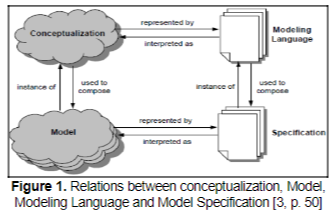
Theserequirements imply the integration of KOcapabilities not just in “design time” but at run time and,in the collaborative case,“on the fly” throughout the whole ‘life cycle’ of the ontology. [63] This way, dynamicontology building and maturing[42] arrived at technologies for permanent refactoringwith open ended lifeline including the possibility of bootstrappingthe ontology management framework. [65]
bootstrapping ontology management framework
-
- Dec 2017
-
engagements2017-18.as.virginia.edu engagements2017-18.as.virginia.edu
-
German now stands in a line with that of the most learned nations in richness of erudition and advance in the sciences. It is too of common descent with the language of our own Country, a branch of the same Original Gothic Stock, and furnishes Valuable illustrations for us. But in this point of View the Anglo-Saxon is of peculiar value. We have placed it among the modern languages because it is in fact that which we speak, in the earliest form in which we have knowledge of it. It has been undergoing, with time, those gradual changes which all languages, antient and modern, have experienced: and even now, needs only to be printed in the Modern character and Orthography, to be intelligible in a considerable degree to an English reader
Clearly the frame workers of the college put considerable weight upon the learning of foreign languages. I admire the kind of insight that the writers had when nothing that the German language lead to considerable advances in sciences. During the time in which this was written, it was not often considered as to how language changes the way you think. There are many distinctions that come from speaking a different language, some obvious, many very subtle and elusive. An example of this would be the fact that German speakers often focus on goal oriented details when constructing a sentence because the nature of their verbs are not as versatile as in English. Studies have shown that Germans can predict goal oriented behavior better when viewing an action, while English speakers focus more solely on the actions themselves. This is a subtle distinction, but it evidences that the differences exist, and these differences can culminate to big implications in terms of ways of thinking. To bring this full circle, UVA requires me to take a foreign language; but UVA has also come to the point in which they offer classes that study specifically Language and Thought. This may not have been in the original plan, but has become an offshoot based upon the broad curriculum that was originally setup for the school to branch off of.
-
- Feb 2017
-
www.sciencedirect.com www.sciencedirect.com
-
aberrant astrocyte-like cell (AbA cells)
Add to NIF ontology
-
- Apr 2016
-
-
This principle is, I will show, a convenient fiction in this new work, enabling the philosopher to hear the call of things and to speak to and for them, despite the new rule that we cannot think of objects as being-for-us and must reject older philosophies smacking of “presence” and traditional ontology or ontotheology.
The heart of the critique.
-
according to the new line of thinking, objects should be recognized for their indifference to us, for the sorts of things they do behind our backs, and for the ways in which they “are” behind appear-ances
-
- Dec 2015
-
www-ksl.stanford.edu www-ksl.stanford.edu
-
What is an Ontology?
-
-
tomgruber.org tomgruber.org
-
Ontology
-
-
math.mit.edu math.mit.eduCT4S.pdf1
-
I will use a mathematical tool calledologs, or ontology logs, to givesome structure to the kinds of ideas that are often communicated in pictures like theone on the cover. Each olog inherently offers a framework in which to record data aboutthe subject. More precisely it encompasses adatabase schema, which means a system ofinterconnected tables that are initially empty but into which data can be entered.
-
- Nov 2015
-
cms.whittier.edu cms.whittier.edu
-
ontology
Noun:
studies the nature of existence or being as such.
-
- Sep 2015
-
docs.google.com docs.google.com
-
In a nutshell, an ontology answers the question, “What things can we say exist in a domain, and how do we describe those things that relate to each other?”
-
-
plato.stanford.edu plato.stanford.eduRace1
-
ontological status
ontological status - they ways in which people define, characterize, and categorize a lived/experienced/observed phenomenon is that phenomenon's "ontology." The observed phenomena in this case are physical differences between various social groups from different geographic locations.
-
- Jul 2015
-
github.com github.com
-
gray matter
Gray matter should not be in the name here. You cannot distinguish gray matter from white matter tissue preparation in any meaningful sense. The gray matter/white matter distinction should derive from the anatomical structure being assayed.
-
- Jun 2015
-
github.com github.com
-
Perhaps this allseems laborious or trivial, but knowing exactly what goes into and comes out of a news application is fundamental to understanding how to preserve one.
-