the Latin American debt crisis
for - economic history - Volcker Shock - first casualties - Latin American debt crisis - Mexico, Brazil, Argentina defaulted on loans
the Latin American debt crisis
for - economic history - Volcker Shock - first casualties - Latin American debt crisis - Mexico, Brazil, Argentina defaulted on loans
we don't have leverage to uh counter what um John Baptist was and talking about at the end the more and more and more
for - infinite economic growth - more more more - climate crisis - infinite growth of capitalism problem - antidote - targeted degrowth
how our economic and social systems um are being valued and also continued the role of capitalism as a style of thought and also a practical system of how uh we household
for - climate crisis - questioning socio-economic system - capitalism
for - climate crisis - impact of Trump tariff strategy - increasing economic and carbon inequality and precarity for the masses - from - Youtube - Trump wants to crash to benefit the ultra wealthy - Trump's planning to crash the global economy - Richard J Murphy - 2024, Dec
// - SUMMARY - Richard J Murphy provides us with a big picture of Trump's objective in his calculated Tariff strategy - It's not that it makes no sense and is a strategy of a madman - On the contrary, he has a very calculated and maniacal strategy that will result in significantly increasing the wealth of the elites - By creating high tariffs, he will bring about a global economic crash - Like the 2008 and 2020 crash, central banks will print trillions of dollars of money and handout bailouts - It is the elites who will receive these bailouts and inflate the value of their assets - This will - substantially increase the wealth of the rich - substantially increase the precarity of the vast majority of people - increase global inequality - financial inequality and - carbon inequality - This increased precarity is bad news for the climate crisis as a precarious population have less flexibility in reducing their carbon footprint and are more dependent than ever on whatever remain job and resources they still have - Given we have this knowledge of the elite's hidden strategy, can we the people intervene in any way? - We need to have an understanding of how elites see the world - The entire worldview of externalizing investment as a game of accumulation must be understood deeply - in order to find leverage points for rapid system change
//
the majority of working group three which has been dominated by the integrated assessment model these big models that basically economic models with a bit of technology or a bit of mythical technology and a bit of um social sciences bolted on the side and and a small climate model but basically just economic models the business as usual models these models have dominated what we have to do about climate change
for - climate crisis - IPCC - warning - working group 3 - integrated assessment models - are basically economic models - with a bit of mythical technology - a bit of social science - Kevin Anderson
Academia: All the Lies: What Went Wrong in the University Model and What Will Come in its Place
“Students are graduating into a brutal job market.”
The entreprecariat is designed for learned helplessness (social: individualism), trained incapacities (economic: specialization), and bureaucratic intransigence (political: authoritarianism).
Three diagrams will explain the lack of social engagement in design. If (in Figure 1) we equate the triangle with a design problem, we readily see that industry and its designers are concerned only with the tiny top portion, without addressing themselves to real needs.
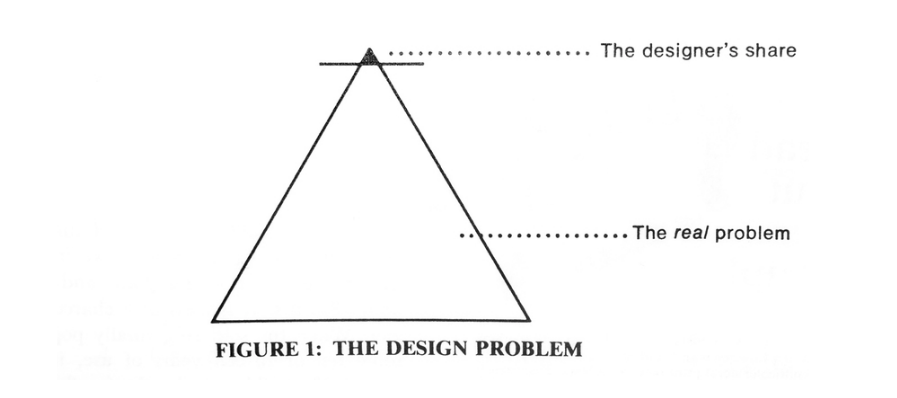
(Design for the Real World, 2019. Page 57.)
The other two figures merely change the caption for the figure.
ReconfigBehSci. (2021, January 14). RT @jimtankersley: The Biden ‘American Rescue Plan’ goes big: $1.9T, incl almost every Dem stimulus priority under the sun: State/local… [Tweet]. @SciBeh. https://twitter.com/SciBeh/status/1349993219988328449
Tankersley, J., & Crowley, M. (2021, January 14). Biden Outlines $1.9 Trillion Spending Package to Combat Virus and Downturn. The New York Times. https://www.nytimes.com/2021/01/14/business/economy/biden-economy.html
2021 Edelman Trust Barometer. (n.d.). Edelman. Retrieved February 17, 2021, from https://www.edelman.com/trust/2021-trust-barometer
Dr Phil Hammond 💙. (2020, December 6). In some parts of the country, 31% of care home staff come from the EU. Some areas already have a 26% vacancy rate. And on January 1, EU recruitment will plummet because workers earn less than the £26,500 threshold. A very predictable recruitment crisis on top of the Covid crisis. [Tweet]. @drphilhammond. https://twitter.com/drphilhammond/status/1335490431837200384
Business, A. T., CNN. (n.d.). The economy as we knew it might be over, Fed Chairman says. CNN. Retrieved 18 November 2020, from https://www.cnn.com/2020/11/12/economy/economy-after-covid-powell/index.html
COVID-19 and the Labor Market. (n.d.). IZA – Institute of Labor Economics. Retrieved October 11, 2020, from https://covid-19.iza.org/publications/dp13760/
IZA – Institute of Labor Economics. ‘COVID-19 and the Labor Market’. Accessed 6 October 2020. https://covid-19.iza.org/publications/dp13742/.
Jason Furman on Twitter. (n.d.). Twitter. Retrieved September 7, 2020, from https://twitter.com/jasonfurman/status/1301871401226338305
katherine_chen. (2020, June 17). PMO | National Broadcast by PM Lee Hsien Loong on 7 June 2020 [Text]. Prime Minister’s Office Singapore; katherine_chen. http://www.pmo.gov.sg/Newsroom/National-Broadcast-PM-Lee-Hsien-Loong-COVID-19
Enriquez, D., & Goldstein, A. (2020). Covid-19’s Socio-Economic Impact on Low-Income Benefit Recipients: Early Evidence from Tracking Surveys [Preprint]. SocArXiv. https://doi.org/10.31235/osf.io/hpqd5
Barber, C. (n.d.). ‘Instant Coffee’ COVID-19 Tests Could Be the Answer to Reopening the U.S. Scientific American. Retrieved August 27, 2020, from https://www.scientificamerican.com/article/instant-coffee-covid-19-tests-could-be-the-answer-to-reopening-the-u-s/
Chetty, R., Friedman, J. N., Hendren, N., Stepner, M., & Team, T. O. I. (2020). How Did COVID-19 and Stabilization Policies Affect Spending and Employment? A New Real-Time Economic Tracker Based on Private Sector Data (Working Paper No. 27431; Working Paper Series). National Bureau of Economic Research. https://doi.org/10.3386/w27431
Reacting Quickly and Protecting Jobs: The Short-Term Impacts of the COVID-19 Lockdown on the Greek Labor Market. COVID-19 and the Labor Market. (n.d.). IZA – Institute of Labor Economics. Retrieved July 27, 2020, from https://covid-19.iza.org/publications/dp13516/
Akbarpour, M., Cook, C., Marzuoli, A., Mongey, S., Nagaraj, A., Saccarola, M., Tebaldi, P., Vasserman, S., & Yang, H. (2020). Socioeconomic Network Heterogeneity and Pandemic Policy Response (Working Paper No. 27374; Working Paper Series). National Bureau of Economic Research. https://doi.org/10.3386/w27374
Flowe, H. D. (2020). Patterns of Violence and Its Impact on Women and Children Amidst the Covid-19 Pandemic in Kenya Policy Brief [Preprint]. PsyArXiv. https://doi.org/10.31234/osf.io/zykq7
Arellano, C., Bai, Y., & Mihalache, G. P. (2020). Deadly Debt Crises: COVID-19 in Emerging Markets (Working Paper No. 27275; Working Paper Series). National Bureau of Economic Research. https://doi.org/10.3386/w27275
Pindyck, R. S. (2020). COVID-19 and the Welfare Effects of Reducing Contagion (Working Paper No. 27121; Working Paper Series). National Bureau of Economic Research. https://doi.org/10.3386/w27121
Kundu, B., & Bhowmik, D. (2020). Societal impact of novel corona virus (COVID ̶ 19 pandemic) in India [Preprint]. SocArXiv. https://doi.org/10.31235/osf.io/vm5rz
Jeff Howe - Crowdsourcing and the Crisis: Collective Intelligence in the Age of Covid-19 (ACM CI’20). (n.d.). Retrieved June 25, 2020, from https://www.youtube.com/watch?v=POPMMHyIoS0
Burgess, M. G., Langendorf, R. E., Ippolito, T., & Pielke, R. (2020). Optimistically biased economic growth forecasts and negatively skewed annual variation [Preprint]. SocArXiv. https://doi.org/10.31235/osf.io/vndqr
In Tulsa, evictions were a crisis even before the pandemic. (2020, June 19). Marketplace. https://www.marketplace.org/2020/06/19/tulsa-evictions-were-crisis-before-pandemic/
Rolander, N., Lindeberg, R., & Liman, L. (2020, May 19) Sweden in ‘Very Deep Economic Crisis’ Despite Soft Lockdown. Bloomberg.Com. https://www.bloomberg.com/news/articles/2020-05-19/sweden-in-very-deep-economic-crisis-despite-soft-lockdown