10,000 Matching Annotations
  1. Last 7 days
    1. Anthropologists are quick to put dates on our existence in North America because of their colonized mindset to attempt to "prove" we have no history or "not enough" history in our homelands to lay claim to it. By trying to date our existence closer to the invasion of the Americas, they are attempting to dismiss our connection to our place of origin and our creation.

      after reading this paragraph it remain me of the history they told us in elementary about Europeans being tht goos guys in the stories.

    1. eLife Assessment

      This important study identifies a novel role for Hes5+ astrocytes in modulating the activity of descending pain-inhibitory noradrenergic neurons from the locus coeruleus during stress-induced pain facilitation. The role of glia in modulating neurological circuits including pain is poorly understood, and in that light, the role of Hes5+ astrocytes in this circuit is a key finding with broader potential impacts. This work is supported by convincing evidence, albeit somewhat limited by the indirect nature of the evidence linking adenosine to nearby neuronal modulation, and possible questions on the population specificity of the transgenic approach.

    2. Reviewer #1 (Public review):

      Review of the revised submission:

      I thank the authors for their detailed consideration of my comments and for the additional data, analyses, and clarifications they have incorporated. The new behavioral experiments, quantification of targeted manipulations, and expanded methodological details strengthen the manuscript and address many of my initial concerns. While some questions remain for future work, the authors' careful responses and the additional evidence provided help resolve the main issues I raised, and I am generally satisfied with the revisions.

      Review of original submission:

      Summary

      In this article, Kawanabe-Kobayashi et al., aim to examine the mechanisms by which stress can modulate pain in mice. They focus on the contribution of noradrenergic neurons (NA) of the locus coeruleus (LC). The authors use acute restraint stress as a stress paradigm and found that following one hour of restraint stress mice display mechanical hypersensitivity. They show that restraint stress causes the activation of LC NA neurons and the release of NA in the spinal cord dorsal horn (SDH). They then examine the spinal mechanisms by which LC→SDH NA produces mechanical hypersensitivity. The authors provide evidence that NA can act on alphaA1Rs expressed by a class of astrocytes defined by the expression of Hes (Hes+). Furthermore, they found that NA, presumably through astrocytic release of ATP following NA action on alphaA1Rs Hes+ astrocytes, can cause an adenosine-mediated inhibition of SDH inhibitory interneurons. They propose that this disinhibition mechanism could explain how restraint stress can cause the mechanical hypersensitivity they measured in their behavioral experiments.

      Strengths:

      (1) Significance. Stress profoundly influences pain perception; resolving the mechanisms by which stress alters nociception in rodents may explain the well-known phenomenon of stress-induced analgesia and/or facilitate the development of therapies to mitigate the negative consequences of chronic stress on chronic pain.

      (2) Novelty. The authors' findings reveal a crucial contribution of Hes+ spinal astrocytes in the modulation of pain thresholds during stress.

      (3) Techniques. This study combines multiple approaches to dissect circuit, cellular, and molecular mechanisms including optical recordings of neural and astrocytic Ca2+ activity in behaving mice, intersectional genetic strategies, cell ablation, optogenetics, chemogenetics, CRISPR-based gene knockdown, slice electrophysiology, and behavior.

      Weaknesses:

      (1) Mouse model of stress. Although chronic stress can increase sensitivity to somatosensory stimuli and contribute to hyperalgesia and anhedonia, particularly in the context of chronic pain states, acute stress is well known to produce analgesia in humans and rodents. The experimental design used by the authors consists of a single one-hour session of restraint stress followed by 30 min to one hour of habituation and measurement of cutaneous mechanical sensitivity with von Frey filaments. This acute stress behavioral paradigm corresponds to the conditions in which the clinical phenomenon of stress-induced analgesia is observed in humans, as well as in animal models. Surprisingly, however, the authors measured that this acute stressor produced hypersensitivity rather than antinociception. This discrepancy is significant and requires further investigation.

      (2) Specifically, is the hypersensitivity to mechanical stimulation also observed in response to heat or cold on a hotplate or coldplate?

      (3) Using other stress models, such as a forced swim, do the authors also observe acute stress-induced hypersensitivity instead of stress-induced antinociception?

      (4) Measurement of stress hormones in blood would provide an objective measure of the stress of the animals.

      (5) Results:

      (a) Optical recordings of Ca2+ activity in behaving rodents are particularly useful to investigate the relationship between Ca2+ dynamics and the behaviors displayed by rodents.

      (b) The authors report an increase in Ca2+ events in LC NA neurons during restraint stress: Did mice display specific behaviors at the time these Ca2+ events were observed such as movements to escape or orofacial behaviors including head movements or whisking?

      (c) Additionally, are similar increases in Ca2+ events in LC NA neurons observed during other stressful behavioral paradigms versus non-stressful paradigms?

      (d) Neuronal ablation to reveal the function of a cell population.

      (e) The proportion of LC NA neurons and LC→SDH NA neurons expressing DTR-GFP and ablated should be quantified (Figures 1G and J) to validate the methods and permit interpretation of the behavioral data (Figures 1H and K). Importantly, the nocifensive responses and behavior of these mice in other pain assays in the absence of stress (e.g., hotplate) and a few standard assays (open field, rotarod, elevated plus maze) would help determine the consequences of cell ablation on processing of nociceptive information and general behavior.

      (f) Confirmation of LC NA neuron function with other methods that alter neuronal excitability or neurotransmission instead of destroying the circuit investigated, such as chemogenetics or chemogenetics, would greatly strengthen the findings. Optogenetics is used in Figure 1M, N but excitation of LC→SDH NA neuron terminals is tested instead of inhibition (to mimic ablation), and in naïve mice instead of stressed mice.

      (g) Alpha1Ars. The authors noted that "Adra1a mRNA is also expressed in INs in the SDH".

      (h) The authors should comprehensively indicate what other cell types present in the spinal cord and neurons projecting to the spinal cord express alpha1Ars and what is the relative expression level of alpha1Ars in these different cell types.

      (i) The conditional KO of alpha1Ars specifically in Hes5+ astrocytes and not in other cell types expressing alpha1Ars should be quantified and validated (Figure 2H).

      (j) Depolarization of SDH inhibitory interneurons by NA (Figure 3). The authors' bath applied NA, which presumably activates all NA receptors present in the preparation.

      k) The authors' model (Figure 4H) implies that NA released by LC→SDH NA neurons leads to the inhibition of SDH inhibitory interneurons by NA. In other experiments (Figure 1L, Figure 2A), the authors used optogenetics to promote the release of endogenous NA in SDH by LC→SDH NA neurons. This approach would investigate the function of NA endogenously released by LC NA neurons at presynaptic terminals in the SDH and at physiological concentrations and would test the model more convincingly compared to the bath application of NA.

      (l) As for other experiments, the proportion of Hes+ astrocytes that express hM3Dq, and the absence of expression in other cells, should be quantified and validated to interpret behavioral data.

      (m) Showing that the effect of CNO is dose-dependent would strengthen the authors' findings.

      (n) The proportion of SG neurons for which CNO bath application resulted in a reduction in recorded sIPSCs is not clear.

      (o) A1Rs. The specific expression of Cas9 and guide RNAs, and the specific KD of A1Rs, in inhibitory interneurons but not in other cell types expressing A1Rs should be quantified and validated.

      (6) Methods:

      It is unclear how fiber photometry is performed using "optic cannula" during restraint stress while mice are in a 50ml falcon tube (as shown in Figure 1A).

    3. Reviewer #2 (Public review):

      Summary:

      This study investigates the role of spinal astrocytes in mediating stress-induced pain hypersensitivity, focusing on the LC (locus coeruleus)-to-SDH (spinal dorsal horn) circuit and its mechanisms. The authors aimed to delineate how LC activity contributes to spinal astrocytic activation under stress conditions, explore the role of noradrenaline (NA) signaling in this process, and identify the downstream astrocytic mechanisms that influence pain hypersensitivity.

      The authors provide strong evidence that 1-hour restraint stress-induced pain hypersensitivity involves the LC-to-SDH circuit, where NA triggers astrocytic calcium activity via alpha1a adrenoceptors (alpha1aRs). Blockade of alpha1aRs on astrocytes-but not on Vgat-positive SDH neurons-reduced stress-induced pain hypersensitivity. These findings are rigorously supported by well-established behavioral models and advanced genetic techniques, uncovering the critical role of spinal astrocytes in modulating stress-induced pain.

      However, the study's third aim-to establish a pathway from astrocyte alpha1aRs to adenosine-mediated inhibition of SDH-Vgat neurons-is less compelling. While pharmacological and behavioral evidence is intriguing, the ex vivo findings are indirect and lack a clear connection to the stress-induced pain model. Despite these limitations, the study advances our understanding of astrocyte-neuron interactions in stress-pain contexts and provides a strong foundation for future research into glial mechanisms in pain hypersensitivity.

      Strengths:

      The study is built on a robust experimental design using a validated 1-hour restraint stress model, providing a reliable framework to investigate stress-induced pain hypersensitivity. The authors utilized advanced genetic tools, including retrograde AAVs, optogenetics, chemogenetics, and subpopulation-specific knockouts, allowing precise manipulation and interrogation of the LC-SDH circuit and astrocytic roles in pain modulation. Clear evidence demonstrates that NA triggers astrocytic calcium activity via alpha1aRs, and blocking these receptors effectively reduces stress-induced pain hypersensitivity.

      Weaknesses:

      The study offers mainly indirect evidence for astrocyte-released adenosine acting on SDH-VGAT neurons. The potential contributions of astrocyte-derived D-serine and adenosine to different spinal neuron subtypes, as well as the transient "dip" in astrocytic calcium following LC optostimulation, merit further clarification in future work once appropriate tools become available.

      Comments on revisions:

      The authors have thoroughly addressed my previous comments, resolving most of the points I raised except those noted in the "Weaknesses" section above. I understand that some of these aspects will require future tool development.

    4. Reviewer #3 (Public review):

      Summary

      This is an exciting and timely study addressing the role of descending noradrenergic systems in nocifensive responses. While it is well-established that spinally released noradrenaline (aka norepinephrine) generally acts as an inhibitory factor in spinal sensory processing, this system is highly complex. Descending projections from the A6 (locus coeruleus, LC) and the A5 regions typically modulate spinal sensory processing and reduce pain behaviours, but certain subpopulations of LC neurons have been shown to mediate pronociceptive effects, such as those projecting to the prefrontal cortex (Hirshberg et al., PMID: 29027903).

      The study proposes that descending cerulean noradrenergic neurons potentiate touch sensation via alpha-1 adrenoceptors on Hes5+ spinal astrocytes, contributing to mechanical hyperalgesia. This finding is consistent with prior work from the same group (dd et al., PMID:). However, caution is needed when generalising about LC projections, as the locus coeruleus is functionally diverse, with differences in targets, neurotransmitter co-release, and behavioural effects. Specifying the subpopulations of LC neurons involved would significantly enhance the impact and interpretability of the findings.

      Strengths

      The study employs state-of-the-art molecular, genetic, and neurophysiological methods, including precise CRISPR and optogenetic targeting, to investigate the role of Hes5+ astrocytes. This approach is elegant and highlights the often-overlooked contribution of astrocytes in spinal sensory gating. The data convincingly support the role of Hes5+ astrocytes as regulators of touch sensation, coordinated by brain-derived noradrenaline in the spinal dorsal horn, opening new avenues for research into pain and touch modulation.

      Furthermore, the data support a model in which superficial dorsal horn (SDH) Hes5+ astrocytes act as non-neuronal gating cells for brain-derived noradrenergic (NA) signalling through their interaction with substantia gelatinosa inhibitory interneurons. Locally released adenosine from NA-stimulated Hes5+ astrocytes, following acute restraint stress, may suppress the function of SDH-Vgat+ inhibitory interneurons, resulting in mechanical pain hypersensitivity. However, the spatially restricted neuron-astrocyte communication underlying this mechanism requires further investigation in future studies.

      Comments on revisions:

      One important point remains insufficiently resolved. In Figure S4C, two of the three visible neurons in the A5 example appear to show a white "halo" at the cell border, suggesting a merge of eGFP (green) and TH (magenta) and therefore possible transgene positivity. To draw a confident conclusion about the specificity of the approach for the A6 (LC) population, the authors are kindly asked to provide high-resolution images of several representative A5 sections, presented both as merged and as separate colour channels. Ideally, quantification across multiple rostrocaudal sections of A5, A6 and A7 should be provided. This is essential for determining whether any transgene expression occurs within the A5 nucleus, particularly given its several-millimetre rostrocaudal extent. As the behavioural phenotype arises from manipulation of only a small subset of A6 neurons, ruling out any contribution from A5 (or A7) is critical for validating pathway specificity, especially in light of prior reports showing that similar approaches can label A5 fibres.

    5. Author response:

      The following is the authors’ response to the original reviews.

      Public reviews:

      Reviewer #1 (Public review):

      Summary:

      In this article, Kawanabe-Kobayashi et al., aim to examine the mechanisms by which stress can modulate pain in mice. They focus on the contribution of noradrenergic neurons (NA) of the locus coeruleus (LC). The authors use acute restraint stress as a stress paradigm and found that following one hour of restraint stress mice display mechanical hypersensitivity. They show that restraint stress causes the activation of LC NA neurons and the release of NA in the spinal cord dorsal horn (SDH). They then examine the spinal mechanisms by which LC→SDH NA produces mechanical hypersensitivity. The authors provide evidence that NA can act on alphaA1Rs expressed by a class of astrocytes defined by the expression of Hes (Hes+). Furthermore, they found that NA, presumably through astrocytic release of ATP following NA action on alphaA1Rs Hes+ astrocytes, can cause an adenosine-mediated inhibition of SDH inhibitory interneurons. They propose that this disinhibition mechanism could explain how restraint stress can cause the mechanical hypersensitivity they measured in their behavioral experiments.

      Strengths:

      (1) Significance. Stress profoundly influences pain perception; resolving the mechanisms by which stress alters nociception in rodents may explain the well-known phenomenon of stress-induced analgesia and/or facilitate the development of therapies to mitigate the negative consequences of chronic stress on chronic pain.

      (2) Novelty. The authors' findings reveal a crucial contribution of Hes+ spinal astrocytes in the modulation of pain thresholds during stress.

      (3) Techniques. This study combines multiple approaches to dissect circuit, cellular, and molecular mechanisms including optical recordings of neural and astrocytic Ca2+ activity in behaving mice, intersectional genetic strategies, cell ablation, optogenetics, chemogenetics, CRISPR-based gene knockdown, slice electrophysiology, and behavior.

      Weaknesses:

      (1) Mouse model of stress. Although chronic stress can increase sensitivity to somatosensory stimuli and contribute to hyperalgesia and anhedonia, particularly in the context of chronic pain states, acute stress is well known to produce analgesia in humans and rodents. The experimental design used by the authors consists of a single one-hour session of restraint stress followed by 30 min to one hour of habituation and measurement of cutaneous mechanical sensitivity with von Frey filaments. This acute stress behavioral paradigm corresponds to the conditions in which the clinical phenomenon of stress-induced analgesia is observed in humans, as well as in animal models. Surprisingly, however, the authors measured that this acute stressor produced hypersensitivity rather than antinociception. This discrepancy is significant and requires further investigation.

      We thank the reviewer for evaluating our work and for highlighting both its strengths and weaknesses. As stated by the reviewer, numerous studies have reported acute stress-induced antinociception. However, as shown in a new additional table (Table S1) in which we have summarized previously published data using the acute restraint stress model employed in our present study, most studies reporting antinociceptive effects of acute restraint stress assessed behavioral responses to heat stimuli or formalin. This observation is consistent with the findings from our previous study (Uchiyama et al., Mol Brain, 2022 (PMID: 34980215)). The present study also confirms that acute restraint stress reduces behavioral responses to noxious heat (see also our response to Comment #2 below). In contrast to the robust and consistent antinociceptive effects observed with thermal stimuli, some studies evaluating behavioral responses to mechanical stimuli have reported stress-induced hypersensitivity (see Table S1), which aligns with our current findings. Taken together, these data support our original notion that the effects of acute stress on pain-related behaviors depend on several factors, including the nature, duration, and intensity of the stressor, as well as the sensory modality assessed in behavioral tests. We have incorporated this discussion and Table S1 into the revised manuscript (lines 344-353). Furthermore, we have slightly modified the text including the title, replacing "pain facilitation" with "mechanical pain hypersensitivity" to more accurately reflect our research focus and the conclusion of this study that LC<sup>→SDH</sup> NAergic signaling to spinal astrocytes is required for stress-induced mechanical pain hypersensitivity. Finally, while mouse models of stress could provide valuable insights, the clinical relevance of stress-induced mechanical pain hypersensitivity remains to be elucidated and requires further investigation. We hope these clarifications address your concerns.

      (2) Specifically, is the hypersensitivity to mechanical stimulation also observed in response to heat or cold on a hotplate or coldplate?

      Thank you for your important comment. We have now conducted additional behavioral experiments to assess responses to heat using the hot-plate test. We found that mice subjected to restraint stress did not exhibit behavioral hypersensitivity to heat stimuli; instead, they displayed antinociceptive responses (Figure S2; lines 95-98). These results are consistent with our previous findings (Uchiyama et al., Mol Brain, 2022 (PMID: 34980215)) as well as numerous other reports (Table S1).

      (3) Using other stress models, such as a forced swim, do the authors also observe acute stress-induced hypersensitivity instead of stress-induced antinociception?

      As suggested by the reviewer, we conducted a forced swim test. We found that mice subjected to forced swimming, which has been reported to produce analgesic effects on thermal stimuli (Contet et al., Neuropsychopharmacology, 2006 (PMID: 16237385)), did not exhibit any changes in mechanical pain hypersensitivity (Figure S2; lines 98-99). Furthermore, a previous study demonstrated that mechanical pain sensitivity is enhanced by other stress models, such as exposure to an elevated open platform for 30 min (Kawabata et al., Neuroscience, 2023 (PMID: 37211084)). However, considering our data showing that changes in mechanosensory behavior induced by restraint stress depend on the duration of exposure (Figure S1), and that restraint stress also produced an antinociceptive effect on heat stimuli (Figure S2), stress-induced modulation of pain is a complex phenomenon influenced by multiple factors, including the stress model, intensity, and duration, as well as the sensory modality used for behavioral testing (lines 100-103).

      (4) Measurement of stress hormones in blood would provide an objective measure of the stress of the animals.

      A previous study has demonstrated that plasma corticosterone levels—a stress hormone—are elevated following a 1-hour exposure to restraint stress in mice (Kim et al., Sci Rep, 2018 (PMID: 30104581)), using a stress protocol similar to that employed in our current study. We have included this information with citing this paper (lines 104-105).

      (5) Results:

      (a) Optical recordings of Ca2+ activity in behaving rodents are particularly useful to investigate the relationship between Ca2+ dynamics and the behaviors displayed by rodents.

      In the optical recordings of Ca<sup>2+</sup> activity in LC neurons, we monitored mouse behavior during stress exposure. We have now included a video of this in the revised manuscript (video; lines 111-114).

      (b) The authors report an increase in Ca2+ events in LC NA neurons during restraint stress: Did mice display specific behaviors at the time these Ca2+ events were observed such as movements to escape or orofacial behaviors including head movements or whisking?

      By reanalyzing the temporal relationship between Ca<sup>2+</sup> events and mouse behavior during stress exposure, we found that the Ca<sup>2+</sup> transients and escape behaviors (struggling) occurred almost simultaneously (video). A similar temporal correlation is also observed in Ca<sup>2+</sup> responses in the bed nucleus of the stria terminalis (Luchsinger et al., Nat Commun, 2021 (PMID: 34117229)). The video file has been included in the revised manuscript (video; lines 111-113, 552-553, 573-575).

      Additionally, as described in the Methods section and shown in Figure S2 of the initial version (now Figure S3), non-specific signals or artifacts—such as those caused by head movements—were corrected (although such responses were minimal in our recordings).

      (c) Additionally, are similar increases in Ca2+ events in LC NA neurons observed during other stressful behavioral paradigms versus non-stressful paradigms?

      We appreciate the reviewer's valuable suggestion. Since the present, initial version of our manuscript focused on acute restraint stress, we did not measure Ca<sup>2+</sup> events in LC-NA neurons in other stress models, but a recent study has shown an increase in Ca<sup>2+</sup> responses in LC-NA neurons by social defeat stress (Seiriki et al., BioRxiv, https://www.biorxiv.org/content/10.1101/2025.03.07.641347v1).

      (d) Neuronal ablation to reveal the function of a cell population.

      This method has been widely used in numerous previous studies as an effective experimental approach to investigate the role of specific neuronal populations—including SDH-projecting LC-NA neurons (Ma et al., Brain Res, 2022 (PMID: 34929182); Kawanabe et al., Mol Brain, 2021 (PMID: 33971918))—in CNS function.

      (e) The proportion of LC NA neurons and LC→SDH NA neurons expressing DTR-GFP and ablated should be quantified (Figures 1G and J) to validate the methods and permit interpretation of the behavioral data (Figures 1H and K). Importantly, the nocifensive responses and behavior of these mice in other pain assays in the absence of stress (e.g., hotplate) and a few standard assays (open field, rotarod, elevated plus maze) would help determine the consequences of cell ablation on processing of nociceptive information and general behavior.

      As suggested, we conducted additional experiments to quantitatively analyze the number of LC<sup>→SDH</sup>-NA neurons. We used WT mice injected with AAVretro-Cre into the SDH (L4 segment) and AAV-FLEx[DTR-EGFP] into the LC. In these mice, 4.4% of total LC-NA neurons [positive for tyrosine hydroxylase (TH)] expressed DTR-GFP, representing the LC<sup>→SDH</sup>-NA neuronal population (Figure S4; lines 126-127). Furthermore, treatment with DTX successfully ablated the DTR-expressing LC<sup>→SDH</sup>-NA neurons. Importantly, the neurons quantified in this analysis were specifically those projecting to the L4 segment of the SDH; therefore, the total number of SDH-projecting LC-NA neurons across all spinal segments is expected to be much higher.

      We also performed the rotarod and paw-flick tests to assess motor function and thermal sensitivity following ablation of LC<sup>→SDH</sup>-NA neurons. No significant differences were observed between the ablated and control groups (Figure S5; lines 131-134), indicating that ablation of these neurons does not produce non-specific behavioral deficits in motor function or other sensory modalities.

      (f) Confirmation of LC NA neuron function with other methods that alter neuronal excitability or neurotransmission instead of destroying the circuit investigated, such as chemogenetics or chemogenetics, would greatly strengthen the findings. Optogenetics is used in Figure 1M, N but excitation of LCLC<sup>→SDH</sup> NA neuron terminals is tested instead of inhibition (to mimic ablation), and in naïve mice instead of stressed mice.

      We appreciate the reviewer’s comment. The optogenetic approach is useful for manipulating neuronal excitability; however, prolonged light illumination (> tens of seconds) can lead to undesirable tissue heating, ionic imbalance, and rebound spikes (Wiegert et al., Neuron, 2017 (PMID: 28772120)), making it difficult to apply in our experiments, in which mice are exposed to stress for 60 min. For this reason, we decided to employ the cell-ablation approach in stress experiments, as it is more suitable than optogenetic inhibition. In addition, as described in our response to weakness (1)-a) by Reviewer 3 (Public review), we have now demonstrated the specific expression of DTRs in NA neurons in the LC, but not in A5 or A7 (Figure S4; lines 127-128), confirming the specificity of LCLC<sup>→SDH</sup>-NAergic pathway targeting in our study. Chemogenetics represent another promising approach to further strengthen our findings on the role of LCLC<sup>→SDH</sup>-NA neurons, but this will be an important subject for future studies, as it will require extensive experiments to assess, for example, the effectiveness of chemogenetic inhibition of these neurons during 60 min of restraint stress, as well as optimization of key parameters (e.g., systemic DCZ doses).

      (g) Alpha1Ars. The authors noted that "Adra1a mRNA is also expressed in INs in the SDH".

      The expression of α<sub>1A</sub>Rs in inhibitory interneurons in the SDH is consistent with our previous findings (Uchiyama et al., Mol Brain, 2022 (PMID: 34980215)) as well as with scRNA-seq data (http://linnarssonlab.org/dorsalhorn/, Häring et al., Nat Neurosci, 2018 (PMID: 29686262)).

      (h) The authors should comprehensively indicate what other cell types present in the spinal cord and neurons projecting to the spinal cord express alpha1Ars and what is the relative expression level of alpha1Ars in these different cell types.

      According to the scRNA-seq data (https://seqseek.ninds.nih.gov/genes, Russ et al., Nat Commun, 2021 (PMID: 34588430); http://linnarssonlab.org/dorsalhorn/, Häring et al., Nat Neurosci, 2018 (PMID: 29686262)), we confirmed that α<sub>1A</sub>Rs are predominantly expressed in astrocytes and inhibitory interneurons in the spinal cord. Also, an α<sub>1A</sub>R-expressing excitatory neuron population (Glut14) expresses Tacr1, GPR83, and Tac1 mRNAs, markers that are known to be enriched in projection neurons of the SDH. This raises the possibility that α<sub>1A</sub> Rs may also be expressed in a subset of projection neurons, although further experiments are required to confirm this. In DRG neurons, α<sub>1A</sub>R expression was detected to some extent, but its level seems to be much lower than in the spinal cord (http://linnarssonlab.org/drg/ Usoskin et al., Nat Neurosci, 2015 (PMID: 25420068)). Consistent with this, primary afferent glutamatergic synaptic transmission has been shown to be unaffected by α<sub>1A</sub>R agonists (Kawasaki et al., Anesthesiology, 2003 (PMID: 12606912); Li and Eisenach, JPET, 2001 (PMID: 11714880)). This information has been incorporated into the Discussion section (lines 317-319).

      (i) The conditional KO of alpha1Ars specifically in Hes5+ astrocytes and not in other cell types expressing alpha1Ars should be quantified and validated (Figure 2H).

      We have previously shown a selective KO of α<sub>1A</sub>R in Hes5<sup>+</sup> astrocytes in the same mouse line (Kohro et al., Nat Neurosci, 2020 (PMID: 33020652)). This information has been included in the revised text (line 166-167).

      (j) Depolarization of SDH inhibitory interneurons by NA (Figure 3). The authors' bath applied NA, which presumably activates all NA receptors present in the preparation.

      We believe that the reviewer’s concern may pertain to the possibility that NA acts on non-Vgat<sup>+</sup> neurons, thereby indirectly causing depolarization of Vgat<sup>+</sup> neurons. As described in the Method section of the initial version, in our electrophysiological experiments, we added four antagonists for excitatory and inhibitory neurotransmitter receptors—CNQX (AMPA receptor), MK-801 (NMDA receptor), bicuculline (GABA<sub>A</sub> receptor), and strychnine (glycine receptor)—to the artificial cerebrospinal fluid to block synaptic inputs from other neurons to the recorded Vgat<sup>+</sup> neurons. Since this method is widely used for this purpose in many previous studies (Wu et al., J Neurosci, 2004 (PMID: 15140934); Liu et al., Nat Neurosci, 2010 (PMID: 20835251)), it is reasonable to conclude that NA directly acts on the recorded SDH Vgat<sup>+</sup> interneurons to produce excitation (lines 193-196).

      (k) The authors' model (Figure 4H) implies that NA released by LC→SDH NA neurons leads to the inhibition of SDH inhibitory interneurons by NA. In other experiments (Figure 1L, Figure 2A), the authors used optogenetics to promote the release of endogenous NA in SDH by LC→SDH NA neurons. This approach would investigate the function of NA endogenously released by LC NA neurons at presynaptic terminals in the SDH and at physiological concentrations and would test the model more convincingly compared to the bath application of NA.

      We appreciate the reviewer’s valuable comment. As noted, optogenetic stimulation of LC<sup>→SDH</sup>-NA neurons would indeed be useful to test this model. However, in our case, it is technically difficult to investigate the responses of Vgat<sup>+</sup> inhibitory neurons and Hes5<sup>+</sup> astrocytes to NA endogenously released from LC<sup>→SDH</sup>-NA neurons. This would require the use of Vgat-Cre or Hes5-CreERT2 mice, but employing these lines precludes the use of NET-Cre mice, which are necessary for specific and efficient expression of ChrimsonR in LC<sup>→SDH</sup>-NA neurons. Nevertheless, all of our experimental data consistently support the proposed model, and we believe that the reviewer will agree with this, without additional experiments that is difficult to conduct because of technical limitations (lines 382-388).

      (l) As for other experiments, the proportion of Hes+ astrocytes that express hM3Dq, and the absence of expression in other cells, should be quantified and validated to interpret behavioral data.

      We thank the reviewer for raising this point. In our experiments, we used an HA-tag (fused with hM3Dq) to confirm hM3Dq expression. However, it is difficult to precisely analyze individual astrocytes because, as shown in Figure 3J, the boundaries of many HA-tag<sup>+</sup> astrocytes are indistinguishable. This seems to be due to the membrane localization of HA-tag, the complex morphology of astrocytes, and their tile-like distribution pattern (Baldwin et al., Trends Cell Biol, 2024 (PMID: 38180380)). Nevertheless, our previous study demonstrated that ~90% of astrocytes in the superficial laminae are Hes5<sup>+</sup> (Kohro et al., Nat Neurosci, 2020 (PMID: 33020652)), and intra-SDH injection of AAV-hM3Dq labeled the majority of superficial astrocytes (Figure 3J). Thus, AAV-FLEx[hM3Dq] injection into Hes5-CreERT2 mice allows efficient expression of hM3Dq in Hes5<sup>+</sup> astrocytes in the SDH. Importantly, our previous studies using Hes5-CreERT2 mice have confirmed that hM3Dq is not expressed in other cell types (neurons, oligodendrocytes, or microglia) (Kohro et al., Nat Neurosci, 2020 (PMID: 33020652); Kagiyama et al., Mol Brain, 2025 (PMID: 40289116)). This information regarding the cell-type specificity has now been briefly described in the revised version (lines 218-219).

      (m) Showing that the effect of CNO is dose-dependent would strengthen the authors' findings.

      Thank you for your comment. We have now demonstrated a dose-dependent effect of CNO on Ca<sup>2+</sup> responses in SDH astrocytes (please see our response to Major Point (4) from Reviewer #2 (Recommendations for the Authors) (Figure S7; lines 225-228). In addition, we also confirmed that the effect of CNO is not nonspecific, as CNO application did not alter sIPSCs in spinal cord slices prepared from mice lacking hM3Dq expression in astrocytes (Figure S7; lines 225-228).

      (n) The proportion of SG neurons for which CNO bath application resulted in a reduction in recorded sIPSCs is not clear.

      We have included individual data points in each bar graph to more clearly illustrate the effect of CNO on each neuron (Figure 3L, N).

      (o) A1Rs. The specific expression of Cas9 and guide RNAs, and the specific KD of A1Rs, in inhibitory interneurons but not in other cell types expressing A1Rs should be quantified and validated.

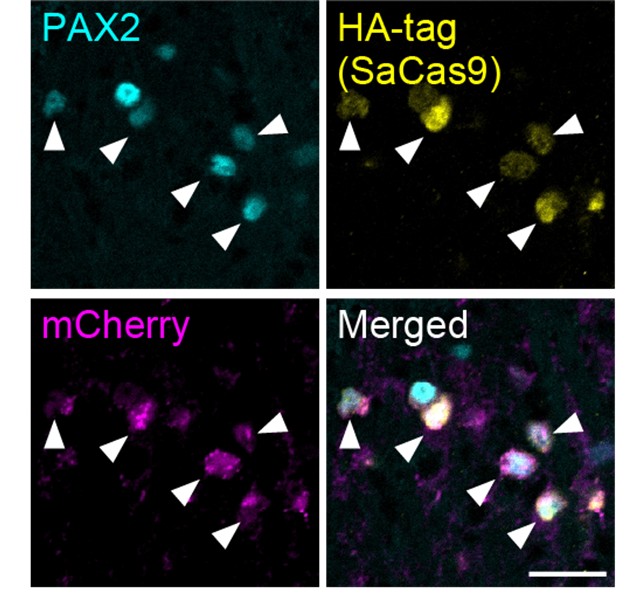
      In addition to the data demonstrating the specific expression of SaCas9 and sgAdora1 in Vgat<sup>+</sup> inhibitory neurons shown in Figure 3G of the initial version, we have now conducted the same experiments with a different sample and confirmed this specificity: SaCas9 (detected via HA-tag) and sgAdora1 (detected via mCherry) were expressed in PAX2<sup>+</sup> inhibitory neurons (Author response image 1). Furthermore, as shown in Figure 3H and I in the initial version, the functional reduction of A<sub>1</sub>Rs in inhibitory neurons was validated by electrophysiological recordings. Together, these results support the successful deletion of A<sub>1</sub>Rs in inhibitory neurons.

      Author response image 1.

      Expression of HA-tag and mCherry in inhibitory neurons (a different sample from Figure 3G) SaCas9 (yellow, detected by HA-tag) and mCherry (magenta) expression in the PAX2<sup>+</sup> inhibitory neurons (cyan) at 3 weeks after intra-SDH injection of AAV-FLEx[SaCas9-HA] and AAV-FLEx[mCherry]-U6-sgAdora1 in Vgat-Cre mice. Arrowheads indicate genome-editing Vgat<sup>+</sup> cells. Scale bar, 25 µm.
      (6) Methods:

      It is unclear how fiber photometry is performed using "optic cannula" during restraint stress while mice are in a 50ml falcon tube (as shown in Figure 1A).

      We apologize for the omission of this detail in the Methods section. To monitor Ca<sup>2+</sup> events in LC-NA neurons during restraint stress, we created a narrow slit on the top of the conical tube, allowing mice to undergo restraint stress while connected to the optic fiber (see video). This information has now been added to the Methods section (lines 552-553).

      Recommendations for the authors:

      Reviewer #1 (Recommendations for the authors):

      (1) Scientific rigor:

      It is unclear if the normal distribution of the data was determined before selecting statistical tests.

      We apologize for omitting this description. For all statistical analyses in this study, we first assessed the normality of the data and then selected appropriate statistical tests accordingly. We have added this information to the revised manuscript (lines 711-712).

      (2) Nomenclature:

      (a) Mouse Genome Informatics (MGI) nomenclature should be used to describe mouse genotypes (i.e., gene name in italic, only first letter is capitalized, alleles in superscript).

      (b) FLEx should be used instead of flex.

      Thank you for the suggestion. We have corrected these terms (including FLEx) according to MGI nomenclature.

      Reviewer #2 (Public review):

      Summary:

      This study investigates the role of spinal astrocytes in mediating stress-induced pain hypersensitivity, focusing on the LC (locus coeruleus)-to-SDH (spinal dorsal horn) circuit and its mechanisms. The authors aimed to delineate how LC activity contributes to spinal astrocytic activation under stress conditions, explore the role of noradrenaline (NA) signaling in this process, and identify the downstream astrocytic mechanisms that influence pain hypersensitivity.

      The authors provide strong evidence that 1-hour restraint stress-induced pain hypersensitivity involves the LC-to-SDH circuit, where NA triggers astrocytic calcium activity via alpha1a adrenoceptors (alpha1aRs). Blockade of alpha1aRs on astrocytes - but not on Vgat-positive SDH neurons - reduced stress-induced pain hypersensitivity. These findings are rigorously supported by well-established behavioral models and advanced genetic techniques, uncovering the critical role of spinal astrocytes in modulating stress-induced pain.

      However, the study's third aim - to establish a pathway from astrocyte alpha1aRs to adenosine-mediated inhibition of SDH-Vgat neurons - is less compelling. While pharmacological and behavioral evidence is intriguing, the ex vivo findings are indirect and lack a clear connection to the stress-induced pain model. Despite these limitations, the study advances our understanding of astrocyte-neuron interactions in stress-pain contexts and provides a strong foundation for future research into glial mechanisms in pain hypersensitivity.

      Strengths:

      The study is built on a robust experimental design using a validated 1-hour restraint stress model, providing a reliable framework to investigate stress-induced pain hypersensitivity. The authors utilized advanced genetic tools, including retrograde AAVs, optogenetics, chemogenetics, and subpopulation-specific knockouts, allowing precise manipulation and interrogation of the LC-SDH circuit and astrocytic roles in pain modulation. Clear evidence demonstrates that NA triggers astrocytic calcium activity via alpha1aRs, and blocking these receptors effectively reduces stress-induced pain hypersensitivity.

      Weaknesses:

      Despite its strengths, the study presents indirect evidence for the proposed NA-to-astrocyte(alpha1aRs)-to-adenosine-to-SDH-Vgat neurons pathway, as the link between astrocytic adenosine release and stress-induced pain remains unclear. The ex vivo experiments, including NA-induced depolarization of Vgat neurons and chemogenetic stimulation of astrocytes, are challenging to interpret in the stress context, with the high CNO concentration raising concerns about specificity. Additionally, the role of astrocyte-derived D-serine is tangential and lacks clarity regarding its effects on SDH Vgat neurons. The astrocyte calcium signal "dip" after LC optostimulation-induced elevation are presented without any interpretation.

      We appreciate the reviewer's careful reading of our paper. According to the reviewer's comments, we have performed new additional experiments and added some discussion in the revised manuscript (please see the point-by-point responses below).

      Reviewer #2 (Recommendations for the authors):

      The astrocyte-mediated pathway of NA-to-astrocyte (alpha1aRs)-to-adenosine-to-SDH Vgat neurons (A1R) in the context of stress-induced pain hypersensitivity requires more direct evidence. While the data showing that the A1R agonist CPT inhibits stress-induced hypersensitivity and that stress combined with Aβ fiber stimulation increases pERK in the SDH are intriguing, these findings primarily support the involvement of A1R on Vgat neurons and are only behaviorally consistent with SDH-Vgat neuronal A1R knockdown. The role of astrocytes in this pathway in vivo remains indirect. The ex vivo chemogenetic Gq-DREADD stimulation of SDH astrocytes, which reduced sIPSCs in Vgat neurons in a CPT-dependent manner, needs revision with non-DREADD+CNO controls to validate specificity. Furthermore, the ex vivo bath application of NA causing depolarization in Vgat neurons, blocked by CPT, adds complexity to the data leaving me wondering how astrocytes are involved in such processes, and it does not directly connect to stress-induced pain hypersensitivity. These findings are potentially useful but require additional refinement to establish their relevance to the stress model.

      We thank the reviewer for the insightful feedback. First, regarding the role of astrocytes in this pathway in vivo, we showed in the initial version that mechanical pain hypersensitivities induced by intrathecal NA injection and by acute restraint stress were attenuated by both pharmacological blockade and Vgat<sup>+</sup> neuron-specific knockdown of A<sub>1</sub>Rs (Figure 4A, B). Given that NA- and stress-induced pain hypersensitivity is mediated by α<sub>1A</sub>R-dependent signaling in Hes5<sup>+</sup> astrocytes (Kohro et al., Nat Neurosci, 2020 (PMID: 33020652); this study), these findings provide in vivo evidence supporting the involvement of the NA → Hes5<sup>+</sup> astrocyte (via α<sub>1A</sub>Rs) → adenosine → Vgat<sup>+</sup> neuron (via A<sub>1</sub>Rs) pathway. As noted in the reviewer’s major comment (2), in vivo monitoring of adenosine dynamics in the SDH during stress exposure would further substantiate the astrocyte-to-neuron signaling pathway. However, we did not detect clear signals, potentially due to several technical limitations (see our response below). Acknowledging this limitation, we have now added a new paragraph in the end of Discussion section to address this issue. Second, the specificity of the effect of CNO has now been validated by additional experiments (see our response to major point (4)). Third, the reviewer’s concern regarding the action of NA on Vgat<sup>+</sup> neurons has also been addressed (see our response to major point (3) below).

      Major points:

      (1) The in vivo pharmacology using DCK to antagonize D-serine signaling from alpha1a-activated astrocytes is tangential, as there is limited evidence on how Vgat neurons (among many others) respond to D-serine. This aspect requires more focused exploration to substantiate its relevance.

      We propose that the site of action of D-serine in our neural circuit model is the NMDA receptors (NMDARs) on excitatory neurons, a notion supported by our previous findings (Kohro et al., Nat Neurosci, 2020 (PMID: 33020652); Kagiyama et al., Mol Brain, 2025 (PMID: 40289116)). However, we cannot exclude the possibility that D-serine also acts on NMDARs expressed by Vgat<sup>+</sup> inhibitory neurons. Nevertheless, given that intrathecal injection of D-serine in naïve mice induces mechanical pain hypersensitivity (Kohro et al., Nat Neurosci, 2020 (PMID: 33020652)), it appears that the pronociceptive effect of D-serine in the SDH is primarily associated with enhanced pain processing and transmission, presumably via NMDARs on excitatory neurons. We have added this point to the Discussion section in the revised manuscript (lines 325-330).

      (2) Additionally, employing GRAB-Ado sensors to monitor adenosine dynamics in SDH astrocytes during NA signaling would significantly strengthen conclusions about astrocyte-derived adenosine's role in the stress model.

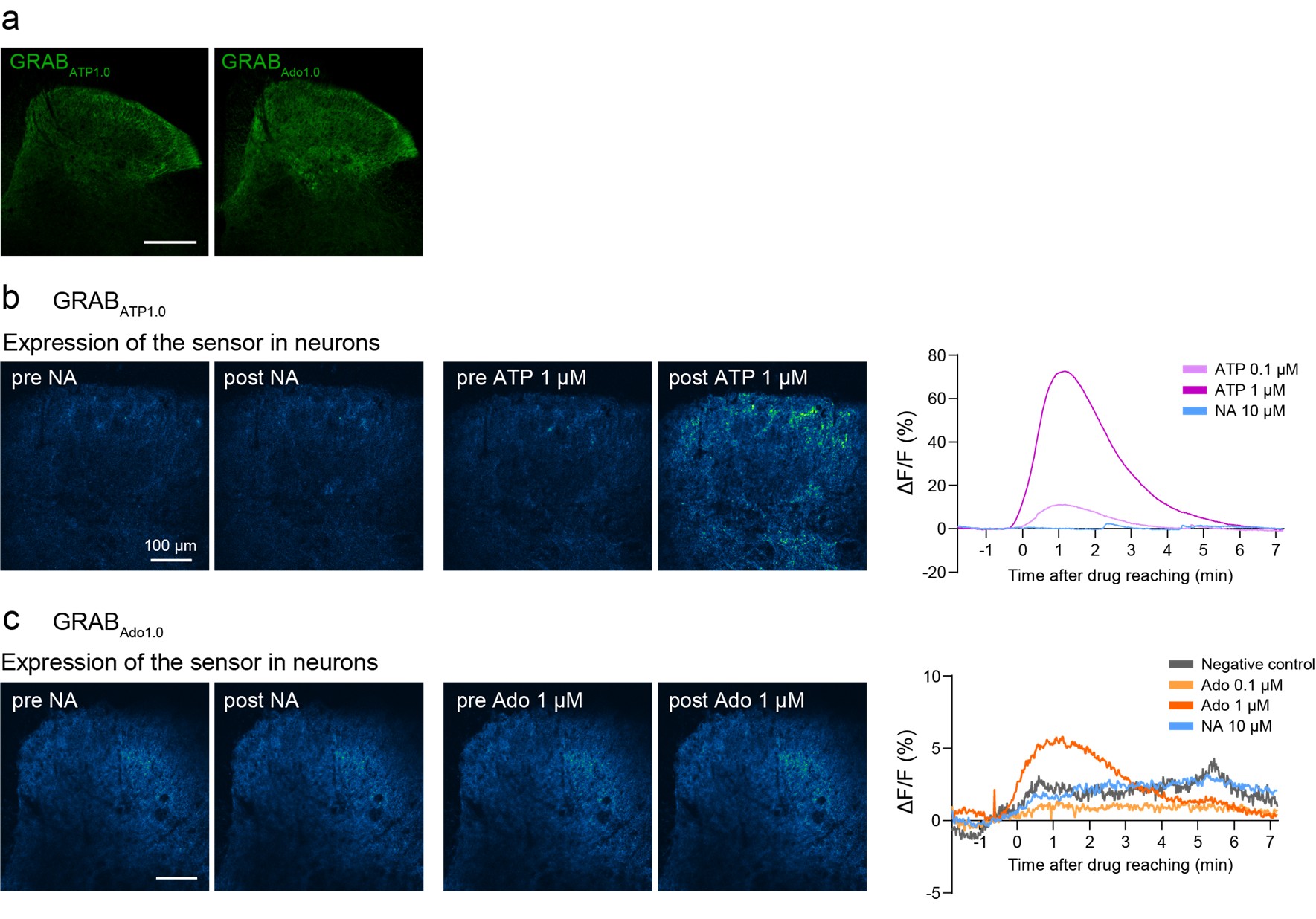
      We agree with the reviewer’s comment. Following this suggestion, we attempted to visualize NA-induced adenosine (and ATP) dynamics using GRAB-ATP and GRAB-Ado sensors (Wu et al., Neuron, 2022 (PMID: 34942116); Peng et al., Science, 2020 (PMID: 32883833)) in acutely isolated spinal cord slices from mice after intra-SDH injection of AAV-hSyn-GRABATP<sub>1.0</sub> and -GRABAdo<sub>1.0</sub>. We confirmed expression of these sensors in the SDH (Author response image 2a) and observed increased signals after bath application of ATP (0.1 or 1 µM) or adenosine (1 µM) (Author response image 2b, c). However, we were unable to detect clear signals following NA stimulation (Author response image 2b, c). The reason for this lack of detectable changes remains unclear. If the release of adenosine from astrocytes is a highly localized phenomenon, it may be measurable using high-resolution microscopy capable of detecting adenosine levels at the synaptic level and more sensitive sensors. Further investigation will therefore be required (lines 340-341).

      Author response image 2.

      Ex vivo imaging of GRAB-ATP and GRAB-Ado sensors.(a) Representative images of GRAB<sub>ATP1.0</sub> (left, green) or GRAB<sub>Ado1.0</sub> (right, green) expression in the SDH at 3 weeks after SDH injection of AAV-hSyn-GRAB<sub>Ado1.0</sub> or AAV-hSyn-GRAB<sub>Ado1.0</sub> in Hes5-CreERT2 mice. Scale bar, 200 µm. (b) Left: Representative fluorescence images showing GRAB<sub>ATP1.0</sub> responses before and after perfusion with NA or ATP. Right: Representative traces showing responses to ATP (0.1 and 1 µM) or NA (10 µM). (c) Left: Representative fluorescence images showing GRABAdo1.0 responses before and after perfusion with NA or adenosine (Ado). Right: Representative traces showing responses to Ado (0.01, 0.1, and 1 µM), NA (10 µM), or no application (negative control).
      (3) The interpretation of Figure 3D is challenging. The manuscript implies that 20 μM NA acts on Adra1a receptors on Vgat neurons to depolarize them, but this concentration should also activate Adra1a on astrocytes, leading to adenosine release and potential inhibition of depolarization. The observation of depolarization despite these opposing mechanisms requires explanation, as does the inhibition of depolarization by bath-applied A1R agonist. Of note, 20 μM NA is a high concentration for Adra1a activation, typically responsive at nanomolar levels. The discussion should reconcile this with prior studies indicating dose-dependent effects of NA on pain sensitivity (e.g., Reference 22).

      Like the reviewer, we also considered that bath-applied NA could activate α<sub>1A</sub>Rs expressed on Hes5<sup>+</sup> astrocytes. To clarify this point, we have performed additional patch-clamp recordings and found that knockdown of A<sub>1</sub>Rs in Vgat<sup>+</sup> neurons tended to increase the proportion of Vgat<sup>+</sup> neurons with NA-induced depolarizing responses (Figure S8). Therefore, it is conceivable that NA-induced excitation of Vgat<sup>+</sup> neurons may involve both a direct effect of NA activating α<sub>1A</sub>Rs in Vgat<sup>+</sup> neurons and an indirect inhibitory signaling from NA-stimulated Hes5<sup>+</sup> astrocytes via adenosine (lines 298-300).

      The concentration of NA used in our ex vivo experiments is higher than that typically used in vitro with αR-<sub>1A</sub>expressing cell lines or primary culture cells, but is comparable to concentrations used in other studies employing spinal cord slices (Kohro et al., Nat Neurosci, 2020 (PMID: 33020652); Baba et al., Anesthesiology, 2000 (PMID: 10691236); Lefton et al., Science, 2025 (PMID: 40373122)). In slice experiments, drugs must diffuse through the tissue to reach target cells, resulting in a concentration gradient. Therefore, higher drug concentrations are generally necessary in slice experiments, in contrast to cultured cell experiments, where drugs are directly applied to target cells. Importantly, we have previously shown that the pharmacological effects of 20 μM NA on Vgat<sup>+</sup> neurons and Hes5<sup>+</sup> astrocytes are abolished by loss of α<sub>1A</sub>Rs in these cells (Uchiyama et al., Mol Brain, 2022 (PMID: 34980215); Kohro et al., Nat Neurosci, 2020 (PMID: 33020652)), confirming the specificity of these NA actions.

      Regarding the dose-dependent effect of NA on pain sensitivity, NA-induced pain hypersensitivity is abolished in Hes5<sup>+</sup> astrocyte-specific α<sub>1A</sub>R-KO mice (Kohro et al., Nat Neurosci, 2020 (PMID: 33020652)), indicating that this behavior is mediated by α<sub>1A</sub>Rs expressed on Hes5<sup>+</sup> astrocytes. In contrast, the suppression of pain sensitivity by high doses of NA was unaffected in the KO mice (Kohro et al., Nat Neurosci, 2020 (PMID: 33020652)), suggesting that other adrenergic receptors may contribute to this phenomenon. Clarifying the responsible receptors will require future investigation.

      (4) In Figure 3K-M, the CNO concentration used (100 μM) is unusually high compared to standard doses (1 to a few μM), raising concerns about potential off-target effects. Including non-hM3Dq controls and using lower CNO concentrations are essential to validate the specificity of the observed effects. Similarly, the study should clarify whether astrocyte hM3Dq stimulation alone (without NA) would induce hyperpolarization in Vgat neurons and how this interacts with NA-induced depolarization.

      We acknowledge that the concentration of CNO used in our experiments is relatively high compared to that used in other reports. However, in our experiments, application of CNO at 1, 10, and 100 μM induced Ca<sup>2+</sup> increases in GCaMP6-expressing astrocytes in spinal cord slices in a concentration-dependent manner (Figure S7). Among these, 100 μM CNO most effectively replicated the NA-induced Ca<sup>2+</sup> signals in astrocytes. Based on these findings, we selected this concentration for use in both the current and previous studies (Kohro et al., Nat Neurosci., 2020 (PMID: 33020652)). Importantly, to rule out non-specific effects, we conducted control experiments using spinal cord slices from mice that did not express hM3Dq in astrocytes and confirmed that CNO had no effect on Ca<sup>2+</sup> responses in astrocytes and sIPSCs in substantial gelatinosa (SG) neurons (Figure S7; lines 223-228). Thus, although the CNO concentration used is relatively high, the observed effects of CNO are not non-specific but result from the chemogenetic activation of hM3Dq-expressing astrocytes.

      In this study, we used Hes5-CreERT2 and Vgat-Cre mice to manipulate gene expression in Hes5<sup>+</sup> astrocytes and Vgat<sup>+</sup> neurons, respectively. In order to fully address the reviewer’s comment, the use of both Cre lines is necessary. However, simultaneous and independent genetic manipulation in each cell type using Cre activity alone is not feasible with the current genetic tools. We have mentioned this as a technical limitation in the Discussion section (lines 382-388).

      (5) The role of D-serine released by hM3Dq-stimulated astrocytes in (separately) modulating sub-types of neurons including excitatory neurons and Vgat positives needs more detailed discussion. If no effect of D-serine on Vgat neurons is observed, this should be explicitly stated, and the discussion should address why this might be the case.

      As mentioned in our response to Major Point (1) above, we have added a discussion of this point in the revised manuscript (lines 325-330).

      (6) Finally, the observed "dip" in astrocyte calcium signals below baseline following the large peaks with LC optostimulation should be discussed further, as understanding this phenomenon could provide valuable insights into astrocytic signaling dynamics in the context of single acute or repetitive chronic stress.

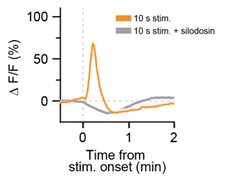
      Thank you for your comment. We found that this phenomenon was not affected by pretreatment with the α<sub>1A</sub>R-specific antagonist silodosin (Author response image 3), which effectively suppressed Ca<sup>2+</sup> elevations evoked by stimulation of LC-NA neurons (Figure 2F). This implies that the phenomenon is independent of α<sub>1A</sub>R signaling. Elucidating the detailed underlying mechanism remains an important direction for future investigation.

      Author response image 3.

      The observed "dip" in astrocyte Ca<sup>2+</sup> signals was not affected by pretreatment with the α<sub>1A</sub>R-specific antagonist silodosin. Representative traces of astrocytic GCaMP6m signals in response to optogenetic stimulation of LC-NAe<sup>→SDH</sup>rgic axons/terminals in a spinal cord slice. Each trace shows the GCaMP6m signal before and after optogenetic stimulation (625 nm, 1 mW, 10 Hz, 5 ms pulse duration, 10 s). Slices were pretreated with silodosin (40 nM) for 5 min prior to stimulation.
      Reviewer #3 (Public review):

      Summary:

      This is an exciting and timely study addressing the role of descending noradrenergic systems in nocifensive responses. While it is well-established that spinally released noradrenaline (aka norepinephrine) generally acts as an inhibitory factor in spinal sensory processing, this system is highly complex. Descending projections from the A6 (locus coeruleus, LC) and the A5 regions typically modulate spinal sensory processing and reduce pain behaviours, but certain subpopulations of LC neurons have been shown to mediate pronociceptive effects, such as those projecting to the prefrontal cortex (Hirshberg et al., PMID: 29027903).

      The study proposes that descending cerulean noradrenergic neurons potentiate touch sensation via alpha-1 adrenoceptors on Hes5+ spinal astrocytes, contributing to mechanical hyperalgesia. This finding is consistent with prior work from the same group (dd et al., PMID:). However, caution is needed when generalising about LC projections, as the locus coeruleus is functionally diverse, with differences in targets, neurotransmitter co-release, and behavioural effects. Specifying the subpopulations of LC neurons involved would significantly enhance the impact and interpretability of the findings.

      Strengths:

      The study employs state-of-the-art molecular, genetic, and neurophysiological methods, including precise CRISPR and optogenetic targeting, to investigate the role of Hes5+ astrocytes. This approach is elegant and highlights the often-overlooked contribution of astrocytes in spinal sensory gating. The data convincingly support the role of Hes5+ astrocytes as regulators of touch sensation, coordinated by brain-derived noradrenaline in the spinal dorsal horn, opening new avenues for research into pain and touch modulation.

      Furthermore, the data support a model in which superficial dorsal horn (SDH) Hes5+ astrocytes act as non-neuronal gating cells for brain-derived noradrenergic (NA) signalling through their interaction with substantia gelatinosa inhibitory interneurons. Locally released adenosine from NA-stimulated Hes5+ astrocytes, following acute restraint stress, may suppress the function of SDH-Vgat+ inhibitory interneurons, resulting in mechanical pain hypersensitivity. However, the spatially restricted neuron-astrocyte communication underlying this mechanism requires further investigation in future studies.

      Weaknesses

      (1) Specificity of the LC Pathway targeting

      The main concern lies with how definitively the LC pathway was targeted. Were other descending noradrenergic nuclei, such as A5 or A7, also labelled in the experiments? The authors must convincingly demonstrate that the observed effects are mediated exclusively by LC noradrenergic terminals to substantiate their claims (i.e. "we identified a circuit, the descending LC→SDH-NA neurons").

      (a) For instance, the direct vector injection into the LC likely results in unspecific effects due to the extreme heterogeneity of this nucleus and retrograde labelling of the A5 and A7 nuclei from the LC (i.e., Li et al., PMID: 26903420).

      We appreciate the reviewer's valuable comments. To address this point, we performed additional experiments and demonstrated that intra-SDH injection of AAVretro-Cre followed by intra-LC injection of AAV2/9-EF1α-FLEx[DTR-EGFP] specifically results in DTR expression in NA neurons of the LC, but not of the A5 or A7 regions (Figure S4; lines 127-128). These results confirm the specificity of targeting the LC<sup>→SDH</sup>-NAergic pathway in our study.

      (b) It is difficult to believe that the intersectional approach described in the study successfully targeted LC→SDH-NA neurons using AAVrg vectors. Previous studies (e.g., PMID: 34344259 or PMID: 36625030) demonstrated that similar strategies were ineffective for spinal-LC projections. The authors should provide detailed quantification of the efficiency of retrograde labelling and specificity of transgene expression in LC neurons projecting to the SDH.

      Thank you for your comment. As we described in our response to the weakness (5)-e) of Reviewer #1 (Public review), our additional analysis showed that, under our experimental conditions, expression of genes (for example DTR) was observed in 4.4% of NA (TH<sup>+</sup>) neurons in the LC (Figure S4; lines 126-127).

      The reasons for this difference between the previous studies and our current study is unclear; however, it is likely attributed to methodological differences, including the type of viral vectors employed, species differences (mouse (PMID: 34344259, our study) vs. rat (PMID: 36625030)), the amount of AAV injected into the SDH (300 nL at three sites (PMID: 34344259), and 300 nL at a single site (our study)) and LC (500 nL at a single site (PMID: 34344259), and 300 nL at a single site (our study)), as well as the depth of AAV injection in the SDH (200–300 µm from the dorsal surface of the spinal cord (PMID: 34344259), and 120–150 µm in depth from the surface of the dorsal root entry zone (our study)).

      (c) Furthermore, it is striking that the authors observed a comparably strong phenotypical change in Figure 1K despite fewer neurons being labelled, compared to Figure 1H and 1N with substantially more neurons being targeted. Interestingly, the effect in Figure 1K appears more pronounced but shorter-lasting than in the comparable experiment shown in Figure 1H. This discrepancy requires further explanation.

      Although only a representative section of the LC was shown in the initial version, LC<sup>→SDH</sup>-NA neurons are distributed rostrocaudally throughout the LC, as previously reported (Llorca-Torralba et al., Brain, 2022 (PMID: 34373893)). Our additional experiments analyzing multiple sections of the anterior and posterior regions of the LC have now revealed that approximately sixty LC<sup>→SDH</sup>-NA neurons express DTR, and these neurons are eliminated following DTX treatment (Figure S4; lines 126-128) (it should be noted that these neurons specifically project to the L4 segment of the SDH, and the total number of LC<sup>→SDH</sup>-NA neurons is likely much higher). Considering the specificity of LC<sup>→SDH</sup>-NAergic pathway targeting demonstrated in our study (as described above), together with the fact that primary afferent sensory fibers from the plantar skin of the hindpaw predominantly project to the L4 segment of the SDH, these data suggest that the observed behavioral changes are attributable to the loss of these neurons and that ablation of even a relatively small number of NA neurons in the LC can have a significant impact on behavior. We have added this hypothesis in the Discussion section (lines 373-382).

      Regarding the data in Figures 1H and 1K, as the reviewer pointed out, a statistically significant difference was observed at 90 min in mice with ablation of LC-NA neurons, but not in those with LC<sup>→SDH</sup>-NA neuron ablation. This is likely due to a slightly higher threshold in the control group at this time point (Figure 1K), and it remains unclear whether there is a mechanistic difference between the two groups at this specific time point.

      (d) A valuable addition would be staining for noradrenergic terminals in the spinal cord for the intersectional approach (Figure 1J), as done in Figures 1F/G. LC projections terminate preferentially in the SDH, whereas A5 projections terminate in the deep dorsal horn (DDH). Staining could clarify whether circuits beyond the LC are being ablated.

      As suggested, we performed DTR immunostaining in the SDH; however, we did not detect any DTR immunofluorescence there. A similar result was also observed in the spinal terminals of DTR-expressing primary afferent fibers (our unpublished data). The reason for this is unclear, but to the best of our knowledge, no studies have clearly shown DTR expression at presynaptic terminals, which may be because the action of DTX on the neuronal cell body is necessary for cell ablation. Nevertheless, as described in our response to the weakness (5)-f) by Reviewer 1 (Public review), we have now confirmed the specific expression of DTR in the LC, but not in the A5 and A7 regions (Figure S4; lines 127-128).

      (e) Furthermore, different LC neurons often mediate opposite physiological outcomes depending on their projection targets-for example, dorsal LC neurons projecting to the prefrontal cortex PFCx are pronociceptive, while ventral LC neurons projecting to the SC are antinociceptive (PMIDs: 29027903, 34344259, 36625030). Given this functional diversity, direct injection into the LC is likely to result in nonspecific effects.

      To avoid behavioral outcomes resulting from a mixture of facilitatory and inhibitory effects caused by activating the entire population of LC-NA neurons, we employed a specific manipulation targeting LC<sup>→SDH</sup>-NA neurons using AAV vectors. The specificity of this manipulation was confirmed in our previous study (Kohro et al., Nat Neurosci, 2020 (PMID: 33020652)) and in the current study (Figure S4). Using this approach, we previously demonstrated that LC neurons can exert pronociceptive effects via astrocytes in the SDH (Kohro et al., Nat Neurosci, 2020 (PMID: 33020652)). This pronociceptive role is further supported by the current study, which uses a more selective manipulation of LC<sup>→SDH</sup>-NA neurons through a NET-Cre mouse line. In addition, intrathecal administration of relatively low doses of NA in naïve mice clearly induces mechanical pain hypersensitivity. Nevertheless, we have also acknowledged that several recent studies have reported an inhibitory role of LC<sup>→SDH</sup>-NA neurons in spinal nociceptive signaling. The reason for these differing behavioral outcomes remains unclear, but several methodological differences may underlie the discrepancy. First, the degree of LC<sup>→SDH</sup>-NA neuronal activity may play a role. Although direct comparisons between studies reporting pro- and anti-nociceptive effects are difficult, our previous studies demonstrated that intrathecal administration of high doses of NA in naïve mice does not induce mechanical pain hypersensitivity (Kohro et al., Nat Neurosci, 2020 (PMID: 33020652)). Second, the sensory modality used in behavioral testing may be a contributing factor as the pronociceptive effect of NA appears to be selectively observed in responses to mechanical, but not thermal, stimuli (Kohro et al., Nat Neurosci, 2020 (PMID: 33020652)). This sensory modality-selective effect is also evident in mice subjected to acute restraint stress (Table S1). Therefore, the role of LC<sup>→SDH</sup>-NA neurons in modulating nociceptive signaling in the SDH is more complex than previously appreciated, and their contribution to pain regulation should be reconsidered in light of factors such as NA levels, sensory modality, and experimental context. In revising the manuscript, we have included some points described above in the Discussion (lines 282-291).

      Conclusion on Specificity: The authors are strongly encouraged to address these limitations directly, as they significantly affect the validity of the conclusions regarding the LC pathway. Providing more robust evidence, acknowledging experimental limitations, and incorporating complementary analyses would greatly strengthen the manuscript.

      We appreciate the reviewer’s comments. We fully acknowledge the limitations raised and agree that addressing them directly is important for the rigor of our conclusions on the LC pathway. To this end, we have performed additional experiments (e.g., Figure A and S4), which are now included in the revised manuscript. Furthermore, we have also newly added a new paragraph for experimental limitations in the end of Discussion section (lines 373-408). We believe these new data substantially strengthen the validity of our findings and have clarified these points in the Discussion section.

      (2) Discrepancies in Data

      (a) Figures 1B and 1E: The behavioural effect of stress on PWT (Figure 1E) persists for 120 minutes, whereas Ca2+ imaging changes (Figure 1B) are only observed in the first 20 minutes, with signal attenuation starting at 30 minutes. This discrepancy requires clarification, as it impacts the proposed mechanism.

      Thank you for your important comment. As pointed out by the reviewer, there is a difference between the duration of behavioral responses and Ca<sup>2+</sup> events, although the exact time point at which the PWT begins to decline remains undetermined (as behavioral testing cannot be conducted during stress exposure). A similar temporal difference was also observed following intraplantar injection of capsaicin (Kohro et al., Nat Neurosci, 2020 (PMID: 33020652)); while LC<sup>→SDH</sup>-NA neuron-mediated astrocytic Ca<sup>2+</sup> responses in SDH astrocytes last for 5–10 min after injection, behavioral hypersensitivity peaks around 60 min post-injection and gradually returns to baseline over the subsequent 60–120 min. These findings raise the possibility that astrocyte-mediated pain hypersensitivity in the SDH may involve a sustained alteration in spinal neural function, such as central sensitization. We have added this hypothesis to the Discussion section of the revised manuscript (lines 399-408), as it represents an important direction for future investigation.

      (b) Figure 4E: The effect is barely visible, and the tissue resembles "Swiss cheese," suggesting poor staining quality. This is insufficient for such an important conclusion. Improved staining and/or complementary staining (e.g., cFOS) are needed. Additionally, no clear difference is observed between Stress+Ab stim. and Stress+Ab stim.+CPT, raising doubts about the robustness of the data.

      As suggested, we performed c-FOS immunostaining and obtained clearer results (Figure 4E,F; lines 243-252). We also quantitatively analyzed the number of c-FOS<sup>+</sup> cells in the superficial laminae, and the results are consistent with those obtained from the pERK experiments.

      (c) Discrepancy with Existing Evidence: The claim regarding the pronociceptive effect of LC→SDH-NAergic signalling on mechanical hypersensitivity contrasts with findings by Kucharczyk et al. (PMID: 35245374), who reported no facilitation of spinal convergent (wide-dynamic range) neuron responses to tactile mechanical stimuli, but potent inhibition to noxious mechanical von Frey stimulation. This discrepancy suggests alternative mechanisms may be at play and raises the question of why noxious stimuli were not tested.

      In our experiments, ChrimsonR expression was observed in the superficial and deeper laminae of the spinal cord (Figure S6). Due to the technical limitations of the optical fibers used for optogenetics, the light stimulation could only reach the superficial laminae; therefore, it may not have affected the activity of neurons (including WDR neurons) located in the deeper laminae. Furthermore, the study by Kucharczyk et al. (Brain, 2022 (PMID: 35245374)) employed a stimulation protocol that differed from ours, applying continuous stimulation over several minutes. Given that the levels of NA released from LC<sup>→SDH</sup>-NAergic terminals in the SDH increase with the duration of terminal stimulation (as shown in Figure 2B), longer stimulation may result in higher levels of NA in the SDH. Considering also our data indicating that the pro- and anti-nociceptive effects of NA are dose dependent (Kohro et al., Nat Neurosci, 2020 (PMID: 33020652)), these differences may be related to LC<sup>→SDH</sup>-NA neuron activity, NA levels in the SDH, and the differential responses of SDH neurons in the superficial versus deeper laminae (lines 388-395).

      (3) Sole reliance on Von Frey testing

      The exclusive use of von Frey as a behavioural readout for mechanical sensitisation is a significant limitation. This assay is highly variable, and without additional supporting measures, the conclusions lack robustness. Incorporating other behavioural measures, such as the adhesive tape removal test to evaluate tactile discomfort, the needle floor walk corridor to assess sensitivity to uneven or noxious surfaces, or the kinetic weight-bearing test to measure changes in limb loading during movement, could provide complementary insights. Physiological tests, such as the Randall-Selitto test for noxious pressure thresholds or CatWalk gait analysis to evaluate changes in weight distribution and gait dynamics, would further strengthen the findings and allow for a more comprehensive assessment of mechanical sensitisation.

      Thank you for your suggestion. Based on our previous findings that Hes5<sup>+</sup> astrocytes in the SDH selectively modulate mechanosensory signaling (Kohro et al., Nat Neurosci, 2020 (PMID: 33020652)), the present study focused on behavioral responses to mechanical stimuli using von Frey filaments. As we have not previously conducted most of the behavioral tests suggested by the reviewers, and as we currently lack the necessary equipments for these tests (e.g., Randall–Selitto test, CatWalk gait analysis, and weight-bearing test), we were unable to include them in this study. However, it will be of great interest in future research to investigate whether activation of the LC<sup>→SDH</sup>-NA neuron-to-SDH Hes5<sup>+</sup> astrocyte signaling pathway similarly sensitizes behavioral responses to other types of mechanical stimuli and also to investigate the sensory modality-selective pro- and antinociceptive role of LC<sup>→SDH</sup>-NAergic signaling in the SDH (lines 396-399).

      Overall Conclusion

      This study addresses an important and complex topic with innovative methods and compelling data. However, the conclusions rely on several assumptions that require more robust evidence. Specificity of the LC pathway, experimental discrepancies, and methodological limitations (e.g., sole reliance on von Frey) must be addressed to substantiate the claims. With these issues resolved, this work could significantly advance our understanding of astrocytic and noradrenergic contributions to pain modulation.

      We have made every effort to address the reviewer’s concerns through additional experiments and analyses. Based on the new control data presented, we believe that our explanation is reasonable and acceptable. Although additional data cannot be provided on some points due to methodological constraints and limitations of the techniques currently available in our laboratory, we respectfully submit that the evidence presented sufficiently supports our conclusions.

      Reviewer #3 (Recommendations for the authors):

      A lot of beautiful and challenging-to-collect data is presented. Sincere congratulations to all the authors on this achievement!

      Notwithstanding, please carefully reconsider the conclusions regarding the LC pathway, as additional evidence is required to ensure their specificity and robustness.

      We thank the reviewer for the kind comments and for raising an important point regarding the LC pathway. The reviewer’s feedback prompted us to conduct additional investigations to further strengthen the validity of our conclusions. We have incorporated these new data and analyses into the revised manuscript, and we believe that these revisions substantially enhance the robustness and reliability of our findings.
    1. The two judgessaid that archivists have a duty to boththe government and the public. Unfor-tunately, archival dogma can lead ar-chivists to consider the needs of govern-ment first.

      I agree with the judges final decision that the archivists do have a duty to the public. I think the wording is interesting, government and the public. The two are separate here. But the government is suppose to serve the people. The "immediate operational needs" I think is a way that it is serving the government and how it operates, but again, it is suppose to be in service of the people. I think the case is interesting overall because it exposed multiple ways in which a part of the government does not, particularly with destroying of documents pertaining to its citizens.

    1. I

      This report is about women in the music industry and the percentages of the feminine gender participating in musical projects across 1,300 songs from 2012-2024. Also, they are analyzing the Billboard Hot 100 Year-End Charts and how "a total of 130 artists appeared on the Hot 100 Year-End chart of 2024 and men account[ed] for 62.3% of performers and women account[ed] for 37.7% " (Prior 1). Overall, this source claims that there is progress for women in the industry, but not as much as society wants or is expecting. They show categories and percentages of total women artists, songwriters, producers, Grammy award winners, and more that participate in the industry. The report also mentions that "women artists were relegated almost exclusively to Pop and R&B genres" (1). which means they are usually confided into certain music styles. The authors also discuss about marginalized groups that struggle in the industry, but I am focusing on women and their main obstacles for now. This study was conducted by USC Annenberg. They conducted a survey that directly correlated with Spotify. Spotify is a well-known music streaming platform for artists. The study includes percentages, graphs, ratios, and visuals that help the readers understand the data that is shown about women and men. This source is important to my research because it highlights specific percentages and data for women across 1,300 of the most popular songs from 2012-2024, which is a practical timeline to analyze. Also, the report gives me multiple categories of data on females, specifically on songwriters, artists, producers, Grammy awards, and more which are my main focus points for my research.

    1. A large detection literature

      I wonder whether we should motivate the paper with a big picture policy question (how to fight corruption) that requires understanding how it works and is organized. Knowing that we can better understand how the organizing responds to enforcement, what are signatures to look for (and which signatures are easily circumvented). Not sure exactly. But point is we must start with a very clear policy question. Then argue that existing literature comes short. Not just start with literature gap.

    1. Yup. When I was in college, they assigned everyone with a task to design and develop a website for a local business founded by the elderly and for the elderly. Worked super hard (was just getting into web design and dev) and created, what I and my friends thought, was a beautiful site form scratch. I thought I had a good shot at winning but they ended up picking a website that was covered in one color and used a very basic free pre-built bootstrap theme. It even had a little footer that said ‘theme from xyz’ at the bottom of the page when they presented it to the client. Old people and their taste can be surprising.

      The complainants' comments here are pure occupational psychosis.

      See also: déformation professionnelle.

    1. Kuntillet Ajrud inscriptions

      BiblicalArchaeology.org confirms that the Kuntillet Ajrud inscriptons mention Asherah. These inscriptions were found on large storage containers, but according to this website, some scholars have interpreted both figures as male. Furthermore, another article from this website says that there is a plural term for Ashera, Asherim, which may mean that this term refers to a type of deity. It is also mentioned that there are both masculine and feminine forms of this word "asherim" in Hebrew.

    2. Today, the scholarly consensus holds that Asherah was indeed worshipped alongside Yahweh in ancient Israel, particularly during the monarchic period

      The Jewish Women's Archive backs up this claim, saying that "YHWH and Asherah were appropriately worshipped as a pair."

    3. The evidence that the God of Israel had a wife is substantial and multifaceted

      I feel like a lot of the evidence that this article is trying to use is almost taken out of context. I found myself asking more questions than finding answers.

    4. Thus, references to Asherah remain, now framed as negative examples of Israel's repeated "unfaithfulness" to God.

      Did find that to be true in references to the worshiping of the golden calf in Exodus.

    5. The most famous discovery comes from Kuntillet Ajrud, a site in the Sinai Peninsula dating to around 800 BCE.

      Found some differing information regarding time and location, but nothing so crazy that it feels all wrong yet. And some is the same. (epic arcaeology)

    6. Proverbs 8 personifies Wisdom (Hokmah in Hebrew) as a female figure who was with God from the beginning of creation.

      I read Proverbs 8 and even without having the word "her" at the beginning to tell us that this is a woman's voice, it sounds like a mother talking to her children.

    7. For example, Proverbs 8 personifies Wisdom (Hokmah in Hebrew) as a female figure who was with God from the beginning of creation. Several scholars have argued that this personified Wisdom is actually a sanitized version of Asherah, transformed by later editors from a goddess into an abstract concept while retaining feminine qualities and language that suggest an intimate relationship with God.

      I searched up this idea of the feminine idea of "Wisdom." I first looked into Proverbs 8. Proverbs 8 does have Wisdom in a feminine lens as Proverbs 8:1 states "Does not wisdom call out? Does not understanding raise her voice?" https://www.biblegateway.com/passage/?search=Proverbs%208&version=NIV

      When searching up who Wisdom was, I read more about who this figure is. Jewish Women's' Archive has an article about why Wisdom is portrayed as a feminine figure. The article states the idea of the word "wisdom" is a feminine noun in Hebrew. The site also gives the idea that this can be the case to be a counterpoint to a negative form of a woman, referred to as "loose woman." https://jwa.org/encyclopedia/article/woman-wisdom-bible

    8. Since many scholars believe that Yahweh and El were originally distinct deities who became merged in Israelite tradition, it makes perfect sense that Asherah, El's consort, would have been adopted as Yahweh's consort as well. The transfer of divine attributes and relationships from El to Yahweh would naturally have included El's wife.

      Looked up and thought it was interesting what I found. Many ancient gods were known to have many wives or consorts, but the Israelite God only thought of or known to have one. Even though it was common to see in the Bible men having many wives, it does not say that God did. Does this 1. reinforce the idea of monotheism or 2. that marriage is stated clearly by God for two people?

    9. They embarked on an aggressive campaign to purge Asherah worship and to rewrite Israelite religious history as having always been monotheistic.

      It seems like one of the articles that this Chatbot referenced was https://www.thegospelcoalition.org/themelios/review/did-god-have-a-wife/ , a review on a book written by William Dever about wether or not God had a wife. The Chatbot seems to forget though, at the bottom of the review, the author gives contrasting information and disagreements with Dever's argument. Notably this quote I have attached here. "While archaeological data does testify that, at various points in its history, ancient Israel largely failed to be monolatrous or monotheistic, this is in accord with the biblical text.Thus, Israel did not have a polytheistic history in the sense that it embraced polytheism as one stage in its religious evolution. We should not confuse the history of Israel’s failures with the history of monotheism."

    10. The prophet Jeremiah (7:18 and 44:15-25) describes how entire families participated in making offerings to the "Queen of Heaven"—men gathered wood, women kneaded dough, and children helped prepare cakes for this female deity

      Sounds like what ancient Greeks did to worship their gods. That is where this idea was first brought up in a class for me, talking about ancient Greece.

    11. Notably, in Jeremiah 44, the women defend their worship of the Queen of Heaven, arguing that they prospered when they honored her and suffered only when they stopped—suggesting this practice was both longstanding and widely accepted.

      Jeremiah 44 is titled as "Disaster Because of Idolatry." The passage discusses how it people were worshipping a "Queen of Heaven." But, this was a form of idolatry as Jeremiah questioned them that the Lord provides for them and asked if they remember that. This text from the Bible is rejecting the idea of people worshipping another god. https://www.biblegateway.com/passage/?search=Jeremiah%2044&version=NIV

    12. he evidence overwhelmingly suggests that for much of ancient Israelite history, ordinary Israelites believed their God had a divine wife, and this belief was likely reflected in both popular and official religious practices.

      Fact checked and found that it is believed but sources differ between Israelites and Canaanites. (Jewish Women's Archive and Catholic Answers)

    13. Most scholars now agree that Yahweh, the God of ancient Israel, was originally worshipped alongside a female consort named Asherah.

      Did look up, found that it is true according to Jewish Women's Archive.

    14. strongly suggests that at least some segments of Israelite society, including perhaps the royal court, saw no contradiction between monotheistic Yahweh worship and the veneration of his consort

      2 Kings 21:6 mentions that King Manasseh, did "much evil in the sight of the LORD, provoking him to anger"

    15. 2 Kings 21:7 mentions that King Manasseh placed an image of Asherah in the Temple,

      It does say this yes, however how I am reading this passage in context, the portrait of Asherah is a portrait of a foreign god, because the King had been placing portraits and idols in the temple which was upsetting a lot of people.

    16. Most scholars now agree that Yahweh, the God of ancient Israel, was originally worshipped alongside a female consort named Asherah.

      I am wondering how many scholars agree about this statement. When searching this up broadly on Google, this topic is still a wide debate with many still saying no. Especially looking into the Google platform, there are sites like https://versebyverseministry.org/bible-answers/does-god-have-a-wife and https://www.biblegateway.com/blog/2011/03/did-god-have-a-wife/ that state that the answer is no to this question. This idea of the chatbot wording this sentence adds a hint of bias for the reader to believe the information the bot is going to spit out below, by trying to gain their trust in the introduction.

    1. Women

      This source is about women in the music industry that continue to face misogyny and how society wants to change this issue. Misogyny is a problem in the music industry, and it happens worldwide every day. Women still struggle with "discrimination, misogyny, and sexual abuse in an industry that is still routinely described as a 'boys’ club." Women are taken advantage of usually when working with other men--especially when drugs, money, and threats of fame come into play. Even though women are being credited more for their creative works and performing in front of large audiences, they still do not get treated the same as their male counterparts. The UK is developing the Creative Industries Independent Standards Authority (CIISA) to help prevent harassment and injustice in the music industry for women and others who experience inappropriate scenarios. There are also more organizations that are helping women face gender biases and harassment, "including the F-List, Black Lives in Music, Cactus City, and Women in CTRL, to more local schemes such as Girls Rock London, Yorkshire Sound Women Network and Manchester-based Brighter Sound, just to name a few." This source is important to my research because it shares the issues that women are currently facing within the music industry but also showcasing how we can improve the industry to make it a better place for everyone. This article also provides many reliable quotes that can be added in the paper from leaders or institutions in the music industry.

    1. eLife Assessment

      This important study provides evidence for dynamic coupling between translation initiation and elongation that can help maintain low ribosome density and translational homeostasis. The authors combine single-molecule imaging with a new approach to analyze mRNA translation kinetics using Bayesian modeling. This work is overall solid and will be of interest to those studying translational regulation.

    2. Reviewer #1 (Public review):

      Summary:

      In this study, Lamberti et al. investigate how translation initiation and elongation are coordinated at the single-mRNA level in mammalian cells. The authors aim to uncover whether and how cells dynamically adjust initiation rates in response to elongation dynamics, with the overarching goal of understanding how translational homeostasis is maintained. To this end, the study combines single-molecule live-cell imaging using the SunTag system with a kinetic modeling framework grounded in the Totally Asymmetric Simple Exclusion Process (TASEP). By applying this approach to custom reporter constructs with different coding sequences, and under perturbations of the initiation/elongation factor eIF5A, the authors infer initiation and elongation rates from individual mRNAs and examine how these rates covary.

      The central finding is that initiation and elongation rates are strongly correlated across a range of coding sequences, resulting in consistently low ribosome density ({less than or equal to}12% of the coding sequence occupied). This coupling is preserved under partial pharmacological inhibition of eIF5A, which slows elongation but is matched by a proportional decrease in initiation, thereby maintaining ribosome density. However, a complete genetic knockout of eIF5A disrupts this coordination, leading to reduced ribosome density, potentially due to changes in ribosome stalling resolution or degradation.

      Strengths:

      A key strength of this work is its methodological innovation. The authors develop and validate a TASEP-based Hidden Markov Model (HMM) to infer translation kinetics at single-mRNA resolution. This approach provides a substantial advance over previous population-level or averaged models and enables dynamic reconstruction of ribosome behavior from experimental traces. The model is carefully benchmarked against simulated data and appropriately applied. The experimental design is also strong. The authors construct matched SunTag reporters differing only in codon composition in a defined region of the coding sequence, allowing them to isolate the effects of elongation-related features while controlling for other regulatory elements. The use of both pharmacological and genetic perturbations of eIF5A adds robustness and depth to the biological conclusions. The results are compelling: across all constructs and conditions, ribosome density remains low, and initiation and elongation appear tightly coordinated, suggesting an intrinsic feedback mechanism in translational regulation. These findings challenge the classical view of translation initiation as the sole rate-limiting step and provide new insights into how cells may dynamically maintain translation efficiency and avoid ribosome collisions.

      Assessment of Goals and Conclusions:

      The authors successfully achieve their stated aims: they quantify translation initiation and elongation at the single-mRNA level and show that these processes are dynamically coupled to maintain low ribosome density. The modeling framework is well suited to this task, and the conclusions are supported by multiple lines of evidence, including inferred kinetic parameters, independent ribosome counts, and consistent behavior under perturbation.

      Impact and Utility:

      This work makes a significant conceptual and technical contribution to the field of translation biology. The modeling framework developed here opens the door to more detailed and quantitative studies of ribosome dynamics on single mRNAs and could be adapted to other imaging systems or perturbations. The discovery of initiation-elongation coupling as a general feature of translation in mammalian cells will likely influence how researchers think about translational regulation under homeostatic and stress conditions.

      The data, models, and tools developed in this study will be of broad utility to the community, particularly for researchers studying translation dynamics, ribosome behavior, or the effects of codon usage and mRNA structure on protein synthesis.

      Context and Interpretation:

      This study contributes to a growing body of evidence that translation is not merely controlled at initiation but involves feedback between elongation and initiation. It supports the emerging view that ribosome collisions, stalling, and quality control pathways play active roles in regulating initiation rates in cis. The findings are consistent with recent studies in yeast and metazoans showing translation initiation repression following stalling events. However, the mechanistic details of this feedback remain incompletely understood and merit further investigation, particularly in physiological or stress contexts.

      In summary, this is a thoughtfully executed and timely study that provides valuable insights into the dynamic regulation of translation and introduces a modeling framework with broad applicability. It will be of interest to a wide audience in molecular biology, systems biology, and quantitative imaging.

    3. Reviewer #2 (Public review):

      Summary:

      This manuscript uses single-molecule run-off experiments and TASEP/HMM models to estimate biophysical parameters, i.e., ribosomal initiation and elongation rates. Combining inferred initiation and elongation rates, the authors quantify ribosomal density. TASEP modeling was used to simulate the mechanistic dynamics of ribosomal translation, and the HMM is used to link ribosomal dynamics to microscope intensity measurements. The authors' main conclusions and findings are:

      - Ribosomal elongation rates and initiation rates are strongly coordinated.

      - Elongation rates were estimated between 1 and 4.5 aa/sec. Initiation rates were estimated between 1 and 2 ribosomes/min. These values agree with previously reported ones.

      - Ribosomal density was determined to be below 12% for all constructs and conditions.

      - eIF5A-perturbations (GC7 inhibition) resulted in non-significant changes in translational bursting and ribosome density.

      - eIF5A perturbations affected both elongation and initiation rates.

      Strengths:

      This manuscript presents an interesting scientific hypothesis to study ribosome initiation and elongation concurrently. This topic is relevant for the field. The manuscript presents a novel quantitative methodology to estimate ribosomal initiation rates from Harringtonine run-off assays. This is relevant because run-off assays have been used to estimate, exclusively, elongation rates.

      Comments on revisions:

      The authors have addressed my concerns. Specifically, they have expanded the discussion on unexpected eIF5A perturbation results, calculated CAI values for all constructs, and made code and data publicly available via GitHub and Zenodo. The mathematical notation is now consistent, and all variables are properly defined.

    4. Reviewer #3 (Public review):

      Disclaimer:

      My expertise is in live single-molecule imaging of RNA and transcription, as well as associated data analysis and modeling. While this aligns well with the technical aspects of the manuscript, my background in translation is more limited, and I am not best positioned to assess the novelty of the biological conclusions.

      Summary:

      This study combines live-cell imaging of nascent proteins on single mRNAs with time-series analysis to investigate the kinetics of mRNA translation.<br /> The authors (i) used a calibration method for estimating absolute ribosome counts, and (ii) developed a new Bayesian approach to infer ribosome counts over time from run-off experiments, enabling estimation of elongation rates and ribosome density across conditions.

      They report (i) translational bursting at the single-mRNA level, (ii) low ribosome density (~10% occupancy {plus minus} a few percents), (iii) that ribosome density is minimally affected by perturbations of elongation (using a drug and/or different coding sequences in the reporter), suggesting a homeostatic mechanism potentially involving a feedback of elongation onto initiation, although (iv) this coupling breaks down upon knockout of elongation factor eIF5A.

      Strengths:

      (1) The manuscript is well written and the conclusions are in general appropriately cautious (besides the few improvements I suggest below).

      (2) The time-series inference method is interesting and promising for broader application.

      (3) Simulations provide convincing support for the modeling (though some improvements are possible).

      (4) The reported homeostatic effect on ribosome density is surprising and carefully validated with multiple perturbations.

      (5) Imaging quality and corrections (e.g., flat-fielding, laser power measurements) are robust.

      (6) Mathematical modeling is clearly described and precise; a few clarifications could improve it further.

      Weaknesses:

      (1) The absolute quantification of ribosome numbers (via the measurement of $i_{MP}$​) should be improved. This only affects the finding that ribosome density is low, not that it appears to be under homeostatic control. However, if $i_{MP}$​ turns out to be substantially overestimated (hence ribosome density underestimated), then "ribosomes queuing up to the initiation site and physically blocking initiation" could become a relevant hypothesis. In my first review of this work, I made recommendations, which the authors did not follow. In my view, the robustness of this particular aspect of this study remains moderate.

      (2) The proposed initiation-elongation coupling is plausible, but alternative explanations such as changes in abortive elongation frequency should be considered. In their response to my previous comments, the authors indicate that this is "beyond the scope of the present work".

      (3) More an opportunity for improvement than a weakness: It is unclear what the single-mRNA nature of the inference method is bringing since it is only used here to report _average_ ribosome elongation rate and density (averaged across mRNAs and across time during the run-off experiments -although the method, in principle, has the power to resolve these two aspects). In response to my previous comment, the authors note that such analyses could be incorporated in future work.

    5. Author response:

      The following is the authors’ response to the original reviews.

      Public Reviews:

      Reviewer #1 (Public review): 

      Summary:

      In this study, Lamberti et al. investigate how translation initiation and elongation are coordinated at the single-mRNA level in mammalian cells. The authors aim to uncover whether and how cells dynamically adjust initiation rates in response to elongation dynamics, with the overarching goal of understanding how translational homeostasis is maintained. To this end, the study combines single-molecule live-cell imaging using the SunTag system with a kinetic modeling framework grounded in the Totally Asymmetric Simple Exclusion Process (TASEP). By applying this approach to custom reporter constructs with different coding sequences, and under perturbations of the initiation/elongation factor eIF5A, the authors infer initiation and elongation rates from individual mRNAs and examine how these rates covary.

      The central finding is that initiation and elongation rates are strongly correlated across a range of coding sequences, resulting in consistently low ribosome density ({less than or equal to}12% of the coding sequence occupied). This coupling is preserved under partial pharmacological inhibition of eIF5A, which slows elongation but is matched by a proportional decrease in initiation, thereby maintaining ribosome density. However, a complete genetic knockout of eIF5A disrupts this coordination, leading to reduced ribosome density, potentially due to changes in ribosome stalling resolution or degradation.

      Strengths:

      A key strength of this work is its methodological innovation. The authors develop and validate a TASEP-based Hidden Markov Model (HMM) to infer translation kinetics at single-mRNA resolution. This approach provides a substantial advance over previous population-level or averaged models and enables dynamic reconstruction of ribosome behavior from experimental traces. The model is carefully benchmarked against simulated data and appropriately applied. The experimental design is also strong. The authors construct matched SunTag reporters differing only in codon composition in a defined region of the coding sequence, allowing them to isolate the effects of elongation-related features while controlling for other regulatory elements. The use of both pharmacological and genetic perturbations of eIF5A adds robustness and depth to the biological conclusions. The results are compelling: across all constructs and conditions, ribosome density remains low, and initiation and elongation appear tightly coordinated, suggesting an intrinsic feedback mechanism in translational regulation. These findings challenge the classical view of translation initiation as the sole rate-limiting step and provide new insights into how cells may dynamically maintain translation efficiency and avoid ribosome collisions.

      We thank the reviewer for their constructive assessment of our work, and for recognizing the methodological innovation and experimental rigor of our study.

      Weaknesses:

      A limitation of the study is its reliance on exogenous reporter mRNAs in HeLa cells, which may not fully capture the complexity of endogenous translation regulation. While the authors acknowledge this, it remains unclear how generalizable the observed coupling is to native mRNAs or in different cellular contexts.

      We agree that the use of exogenous reporters is a limitation inherent to the SunTag system, for which there is currently no simple alternative for single-mRNA translation imaging. However, we believe our findings are likely generalizable for several reasons.

      As discussed in our introduction and discussion, there is growing mechanistic evidence in the literature for coupling between elongation (ribosome collisions) and initiation via pathways such as the GIGYF2-4EHP axis (Amaya et al. 2018, Hickey et al. 2020, Juszkiewicz et al. 2020), which might operate on both exogenous and endogenous mRNAs.

      As already acknowledged in our limitations section, our exogenous reporters may not fully recapitulate certain aspects of endogenous translation (e.g., ER-coupled collagen processing), yet the observed initiation-elongation coupling was robust across all tested constructs and conditions.

      We have now expanded the Discussion (L393-395) to cite complementary evidence from Dufourt et al. (2021), who used a CRISPR-based approach in Drosophila embryos to measure translation of endogenous genes. We also added a reference to Choi et al. 2025, who uses a ER-specific SunTag reporter to visualize translation at the ER (L395-397).

      Additionally, the model assumes homogeneous elongation rates and does not explicitly account for ribosome pausing or collisions, which could affect inference accuracy, particularly in constructs designed to induce stalling. While the model is validated under low-density assumptions, more work may be needed to understand how deviations from these assumptions affect parameter estimates in real data.

      We agree with the reviewer that the assumption of homogeneous elongation rates is a simplification, and that our work represents a first step towards rigorous single-trace analysis of translation dynamics. We have explicitly tested the robustness of our model to violations of the low-density assumption through simulations (Figure 2 - figure supplement 2). These show that while parameter inference remains accurate at low ribosome densities, accuracy slightly deteriorates at higher densities, as expected. In fact, our experimental data do provide evidence for heterogeneous elongation: the waiting times between termination events deviate significantly from an exponential distribution (Figure 3 - figure supplement 2C), indicating the presence of ribosome stalling and/or bursting, consistent with the reviewer's concern. We acknowledge in the Limitations section (L402-406) that extending the model to explicitly capture transcript-dependent elongation rates and ribosome interactions remains challenging. The TASEP is difficult to solve analytically under these conditions, but we note that simulation-based inference approaches, such as particle filters to replace HMMs, could provide a path forward for future work to capture this complexity at the single-trace level.

      Furthermore, although the study observes translation "bursting" behavior, this is not explicitly modeled. Given the growing recognition of translational bursting as a regulatory feature, incorporating or quantifying this behavior more rigorously could strengthen the work's impact.

      While we do not explicitly model the bursting dynamics in the HMM framework, we have quantified bursting behavior directly from the data. Specifically, we measure the duration of translated (ON) and untranslated (OFF) periods across all reporters and conditions (Figure 1G for control conditions and Figure 4G-H for perturbed conditions), finding that active translation typically lasts 10-15 minutes interspersed with shorter silent periods of 5-10 minutes. This empirical characterization demonstrates that bursting is a consistent feature of translation across our experimental conditions. The average duration of silent periods is similar to what was inferred by Livingston et al. 2023 for a similar SunTag reporter; while the average duration of active periods is substantially shorter (~15 min instead of ~40 min), which is consistent with the shorter trace duration in our system compared to theirs (~15 min compared to ~80 min, on average). Incorporating an explicit two-state or multi-state bursting model into the TASEP-HMM framework would indeed be computationally intensive and represents an important direction for future work, as it would enable inference of switching rates alongside initiation and elongation parameters. We have added this point to the Discussion (L415-417).

      Assessment of Goals and Conclusions:

      The authors successfully achieve their stated aims: they quantify translation initiation and elongation at the single-mRNA level and show that these processes are dynamically coupled to maintain low ribosome density. The modeling framework is well suited to this task, and the conclusions are supported by multiple lines of evidence, including inferred kinetic parameters, independent ribosome counts, and consistent behavior under perturbation.

      Impact and Utility:

      This work makes a significant conceptual and technical contribution to the field of translation biology. The modeling framework developed here opens the door to more detailed and quantitative studies of ribosome dynamics on single mRNAs and could be adapted to other imaging systems or perturbations. The discovery of initiation-elongation coupling as a general feature of translation in mammalian cells will likely influence how researchers think about translational regulation under homeostatic and stress conditions.

      The data, models, and tools developed in this study will be of broad utility to the community, particularly for researchers studying translation dynamics, ribosome behavior, or the effects of codon usage and mRNA structure on protein synthesis.

      Context and Interpretation:

      This study contributes to a growing body of evidence that translation is not merely controlled at initiation but involves feedback between elongation and initiation. It supports the emerging view that ribosome collisions, stalling, and quality control pathways play active roles in regulating initiation rates in cis. The findings are consistent with recent studies in yeast and metazoans showing translation initiation repression following stalling events. However, the mechanistic details of this feedback remain incompletely understood and merit further investigation, particularly in physiological or stress contexts. 

      In summary, this is a thoughtfully executed and timely study that provides valuable insights into the dynamic regulation of translation and introduces a modeling framework with broad applicability. It will be of interest to a wide audience in molecular biology, systems biology, and quantitative imaging.

      We appreciate the reviewer's thorough and positive assessment of our work, and that they recognize both the technical innovation of our modeling framework and its potential broad utility to the translation biology community. We agree that further mechanistic investigation of initiation-elongation feedback under various physiological contexts represents an important direction for future research.

      Reviewer #2 (Public review):

      Summary:

      This manuscript uses single-molecule run-off experiments and TASEP/HMM models to estimate biophysical parameters, i.e., ribosomal initiation and elongation rates. Combining inferred initiation and elongation rates, the authors quantify ribosomal density. TASEP modeling was used to simulate the mechanistic dynamics of ribosomal translation, and the HMM is used to link ribosomal dynamics to microscope intensity measurements. The authors' main conclusions and findings are:

      (1) Ribosomal elongation rates and initiation rates are strongly coordinated.

      (2) Elongation rates were estimated between 1-4.5 aa/sec. Initiation rates were estimated between 0.5-2.5 events/min. These values agree with previously reported values.

      (3) Ribosomal density was determined below 12% for all constructs and conditions.

      (4) eIF5A-perturbations (KO and GC7 inhibition) resulted in non-significant changes in translational bursting and ribosome density.

      (5) eIF5A perturbations resulted in increases in elongation and decreases in initiation rates.

      Strengths:

      This manuscript presents an interesting scientific hypothesis to study ribosome initiation and elongation concurrently. This topic is highly relevant for the field. The manuscript presents a novel quantitative methodology to estimate ribosomal initiation rates from Harringtonine run-off assays. This is relevant because run-off assays have been used to estimate, exclusively, elongation rates.

      We thank the reviewer for their careful evaluation of our work and for recognizing the novelty of our quantitative methodology to extract both initiation and elongation rates from harringtonine run-off assays, extending beyond the traditional use of these experiments.

      Weaknesses:

      The conclusion of the strong coordination between initiation and elongation rates is interesting, but some results are unexpected, and further experimental validation is needed to ensure this coordination is valid. 

      We agree that some of our findings need further experimental investigation in future studies. However, we believe that the coordination between initiation and elongation is supported by multiple results in our current work: (1) the strong correlation observed across all reporters and conditions (Figure 3E), and (2) the consistent maintenance of low ribosome density despite varying elongation rates. While additional experimental validation would be valuable, we note that directly manipulating initiation or elongation independently in mammalian cells remains technically challenging. Nevertheless, our findings are consistent with emerging mechanistic understanding of collision-sensing pathways (GIGYF2-4EHP) that could mediate such coupling, as discussed in our manuscript.

      (1) eIF5a perturbations resulted in a non-significant effect on the fraction of translating mRNA, translation duration, and bursting periods. Given the central role of eIF5a, I would have expected a different outcome. I would recommend that the authors expand the discussion and review more literature to justify these findings.

      We appreciate this comment. This finding is indeed discussed in detail in our manuscript (Discussion, paragraphs 6-7). As we note there, while eIF5A plays a critical role in elongation, the maintenance of bursting dynamics and ribosome density upon perturbation can be explained by compensatory feedback mechanisms. Specifically, the coordinated decrease in initiation rates that counterbalances slower elongation to maintain homeostatic ribosome density. We also discuss several factors that complicate interpretation: (1) potential RQC-mediated degradation masking stronger effects in proline-rich constructs, (2) differences between GC7 treatment and genetic knockout suggesting altered stalling resolution kinetics, and (3) the limitations of using exogenous reporters that lack ER-coupled processing, which may be critical for eIF5A function in endogenous collagen translation (as suggested by Rossi et al., 2014; Mandal et al., 2016; Barba-Aliaga et al., 2021). The mechanistic complexity and tissue-specific nature of eIF5A function in mammals, which differs substantially from the better-characterized yeast system, likely contributes to the nuanced phenotype we observe. We believe our Discussion adequately addresses these points.

      (2) The AAG construct leading to slow elongation is very surprising. It is the opposite of the field consensus, where codon-optimized gene sequences are expected to elongate faster. More information about each construct should be provided. I would recommend more bioinformatic analysis on this, for example, calculating CAI for all constructs, or predicting the structures of the proteins.

      We agree that the slow elongation of the AAG construct is counterintuitive and indeed surprising. Following the reviewer's suggestion, we have now calculated the Codon Adaptation Index (CAI) for all constructs (Renilla 0.89, Col1a1 0.78, Col1a1 mutated 0.74). It is therefore unlikely that codon bias explains the slow translation, particularly since we designed the mutated Col1a1 construct with alanine codons selected to respect human codon usage bias, thereby minimizing changes in codon optimality. As we discuss in the manuscript, we hypothesize that the proline-to-alanine substitutions disrupted co-translational folding of the collagen-derived sequence. Prolines are critical for collagen triple-helix formation (Shoulders and Raines, 2009), and their replacement with alanines likely generates misfolded intermediates that cause ribosome stalling (Barba-Aliaga et al., 2021; Komar et al., 2024). This interpretation is supported by the high frequency (>30%) of incomplete run-off traces for AAG, suggesting persistent stalling events. Our findings thus illustrate an important potential caveat: "optimizing" a sequence based solely on codon usage can be detrimental when it disrupts functionally important structural features or co-translational folding pathways.

      This highlights that elongation rates depend not only on codon optimality but also on the interplay between nascent chain properties and ribosome progression.

      (3) The authors should consider using their methodology to study the effects of modifying the 5'UTR, resulting in changes in initiation rate and bursting, such as previously shown in reference Livingston et al., 2023. This may be outside of the scope of this project, but the authors could add this as a future direction and discuss if this may corroborate their conclusions. 

      We thank the reviewer for this excellent suggestion. We agree that applying our methodology to 5'-UTR variants would provide a complementary test of initiation-elongation coupling, and we have now added this as a future direction in the Discussion (L417-420).

      (4) The mathematical model and parameter inference routines are central to the conclusions of this manuscript. In order to support reproducibility, the computational code should be made available and well-documented, with a requirements file indicating the dependencies and their versions. 

      We have added the Github link in the manuscript (https://github.com/naef-lab/suntag-analysis) and have also deposited the data (.ome.tif) on Zenodo (https://zenodo.org/records/17669332).

      Reviewer #3 (Public review):

      Disclaimer:

      My expertise is in live single-molecule imaging of RNA and transcription, as well as associated data analysis and modeling. While this aligns well with the technical aspects of the manuscript, my background in translation is more limited, and I am not best positioned to assess the novelty of the biological conclusions.

      Summary:

      This study combines live-cell imaging of nascent proteins on single mRNAs with time-series analysis to investigate the kinetics of mRNA translation.

      The authors (i) used a calibration method for estimating absolute ribosome counts, and (ii) developed a new Bayesian approach to infer ribosome counts over time from run-off experiments, enabling estimation of elongation rates and ribosome density across conditions.

      They report (i) translational bursting at the single-mRNA level, (ii) low ribosome density (~10% occupancy

      {plus minus} a few percents), (iii) that ribosome density is minimally affected by perturbations of elongation (using a drug and/or different coding sequences in the reporter), suggesting a homeostatic mechanism potentially involving a feedback of elongation onto initiation, although (iv) this coupling breaks down upon knockout of elongation factor eIF5A.

      Strengths:

      (1) The manuscript is well written, and the conclusions are, in general, appropriately cautious (besides the few improvements I suggest below).

      (2) The time-series inference method is interesting and promising for broader applications. 

      (3) Simulations provide convincing support for the modeling (though some improvements are possible). 

      (4) The reported homeostatic effect on ribosome density is surprising and carefully validated with multiple perturbations.

      (5) Imaging quality and corrections (e.g., flat-fielding, laser power measurements) are robust.

      (6) Mathematical modeling is clearly described and precise; a few clarifications could improve it further.

      We thank the reviewer for recognizing the novelty of the approach and its rigour, and for providing suggestions to improve it further.

      Weaknesses:

      (1) The absolute quantification of ribosome numbers (via the measurement of $i_{MP}$ ) should be improved.This only affects the finding that ribosome density is low, not that it appears to be under homeostatic control. However, if $i_{MP}$ turns out to be substantially overestimated (hence ribosome density underestimated), then "ribosomes queuing up to the initiation site and physically blocking initiation" could become a relevant hypothesis. In my detailed recommendations to the authors, I list points that need clarification in their quantifications and suggest an independent validation experiment (measuring the intensity of an object with a known number of GFP molecules, e.g., MS2-GFP MS2-GFP-labeled RNAs, or individual GEMs).

      We agree with the reviewer that the estimation of the number of ribosomes is central to our finding that translation happens at low density on our reporters. This result derives from our measurement of the intensity of one mature protein (i<sub>MP</sub>), that we have achieved by using a SunTag reporter with a RH1 domain in the C terminus of the mature protein, allowing us to stabilise mature proteins via actin-tethering. In addition, as suggested by the reviewer, we already validated this result with an independent estimate of the mature protein intensity (Figure 5 - figure supplement 2B), which was obtained by adding the mature protein intensity directly as a free parameter of the HMM. The inferred value of mature protein intensity for each construct (10-15 a.u) was remarkably close to the experimental calibration result (14 ± 2 a.u.). Therefore, we have confidence that our absolute quantification of ribosome numbers is accurate.

      (2) The proposed initiation-elongation coupling is plausible, but alternative explanations, such as changes in abortive elongation frequency, should be considered more carefully. The authors mention this possibility, but should test or rule it out quantitatively. 

      We thank the reviewer for the comment, but we consider that ruling out alternative explanations through new perturbation experiments is beyond the scope of the present work.

      (3) The observation of translational bursting is presented as novel, but similar findings were reported by Livingston et al. (2023) using a similar SunTag-MS2 system. This prior work should be acknowledged, and the added value of the current approach clarified.

      We did cite Livingston et al. (2023) in several places, but we recognized that we could add a few citations in key places, to make clear that the observation of bursting is not novel but is in agreement with previous results. We now did so in the Results and Discussion sections.

      (4) It is unclear what the single-mRNA nature of the inference method is bringing since it is only used here to report _average_ ribosome elongation rate and density (averaged across mRNAs and across time during the run-off experiments - although the method, in principle, has the power to resolve these two aspects).

      While decoding individual traces, our model infers shared (population-level) rates. Inferring transcript-specific parameters would be more informative, but it is highly challenging due to the uncertainty on the initial ribosome distribution on single transcripts. Pooling multiple transcripts together allows us to use some assumptions on the initial distribution and infer average elongation and initiation-rate parameters, while revealing substantial mRNA-to-mRNA variability in the posterior decoding (e.g. Figure 3 - figure Supplement 2C). Indeed, the inference still informs on the single-trace run-off time distribution (Figure 3 A) and the waiting time between termination events (Figure 3 - figure supplement 2C), suggesting the presence of stalling and bursting. In addition, the transcript-to-transcript heterogeneity is likely accounted for by our model better than previous methods (linear fit of the average run-off intensity), as suggested by their comparison (Figure 3 - figure supplement 2 A). In the future the model could be refined by introducing transcript-specific parameters, possibly in a hierarchical way, alongside shared parameters.

      (5) I did not find any statement about data availability. The data should be made available. Their absence limits the ability to fully assess and reproduce the findings.

      We have added the Github link in the manuscript (https://github.com/naef-lab/suntag-analysis) and have also deposited the data (.ome.tif) on Zenodo (https://zenodo.org/records/17669332).

      Recommendations for the authors:

      Reviewer #1 (Recommendations for the authors): 

      Major Comments:

      (1) Lack of Explicit Bursting Model

      Although translation "bursts" are observed, the current framework does not explicitly model initiation as a stochastic ON/OFF process. This limits insight into regulatory mechanisms controlling burst frequency or duration. The authors should either incorporate a two-state/more-state (bursting) model of initiation or perform statistical analysis (e.g., dwell-time distributions) to quantify bursting dynamics. They should clarify how bursting influences the interpretation of initiation rate estimates.

      We agree with the reviewer that an explicit bursting model (e.g., a two-state telegraph model) would be the ideal theoretical framework. However, integrating such a model into the TASEP-HMM inference framework is computationally intensive and complex. As a robust first step, we have opted to quantify bursting empirically based on the decoded single-mRNA traces. As shown in Figure 1G (control) and Figure 4G (perturbed conditions), we explicitly measured the duration of "ON" (translated) and "OFF" (untranslated) periods. This statistical analysis provides a quantitative description of the bursting dynamics without relying on the specific assumptions of a telegraph model. We have clarified this in the text (L123-125) and, as suggested, added a discussion (L415-417) on the potential extensions of the model to include explicit switching kinetics in the Outlook section.

      (2) Assumption of Uniform Elongation Rates

      The model assumes homogeneous elongation across coding sequences, which may not hold for stalling-prone inserts (e.g., PPG). This simplification could bias inference, particularly in cases of sequence-specific pausing. Adding simulations or sensitivity analysis to assess how non-uniform elongation affects the accuracy of inferred parameters. The authors should explicitly discuss how ribosome stalling, collisions, or heterogeneity might skew model outputs (see point 4).

      A strong stalling sequence that affects all ribosomes equally should not deteriorate the inference of the initiation rate, provided that the low-density assumption holds. The scenario where stalling events lead to higher density, and thus increased ribosome-ribosome interactions, is comparable to the conditions explored in Figure 2E. In those simulations, we tested the inference on data generated with varying initiation and elongation rates, resulting in ribosome densities ranging from low to high. We demonstrated that the inference remains robust at low ribosome densities (<10%). At higher densities, the accuracy of the initiation rate estimate decreases, whereas the elongation rate estimate remains comparatively robust. Additionally, the model tends to overestimate ribosome density under high-density conditions, likely because it neglects ribosome interference at the initiation site (Figure 2 figure supplement 2C). We agree that a deeper investigation into the consequences of stochastic stalling and bursting would be beneficial, and we have explicitly acknowledged this in the Limitations section.

      (3) Interpretation of eIF5A Knockout Phenotype

      The observation that eIF5A KO reduces initiation more than elongation, leading to decreased ribosome density, is biologically intriguing. However, the explanation invoking altered RQC kinetics is speculative and not directly tested. The authors should consider validating the RQC hypothesis by monitoring reporter mRNA stability, ribosome collision markers, or translation termination intermediates.

      We thank the reviewer for the comment, but we consider that ruling out alternative explanations through new experiments is beyond the scope of the present work.

      (4) To strengthen the manuscript, the authors should incorporate insights from three studies.

      - Livingston et al. (PMC10330622) found that translation occurs in bursts, influenced by mRNA features and initiation factors, supporting the coupling of initiation and elongation.

      - Madern et al. (PMID: 39892379) demonstrated that ribosome cooperativity enhances translational efficiency, highlighting coordinated ribosome behavior.

      - Dufourt et al. (PMID: 33927056) observed that high initiation rates correlate with high elongation rates, suggesting a conserved mechanism across cell cultures and organisms.

      Integrating these studies could enrich the manuscript's interpretation and stimulate new avenues of thought.

      We thank the reviewer for the valuable comment. We added citations of Livingston et al. in the context of translational bursting. We already cited Madern et al. in multiple places and, although its observations of ribosome cooperativity are very compelling, they cannot be linked with our observations of a feedback between initiation and elongation, and it would be very challenging to see a similar effect on our reporters. This is why we did not expressly discuss cooperativity. We also integrated Dufourt et al. in the Discussion about the possibility of designing genetically-encoded reporter. We also added a sentence about the possibility of using an ER-specific SunTag reporter, as done recently in Choi et al., Nature (2025) (https://doi.org/10.1038/s41586-025-09718-0).

      Minor Comments:

      (1) Use consistent naming for SunTag reporters (e.g., "PPG" vs "proline-rich") throughout.

      Thank you for the comment. However, the term proline-rich always appears together with PPG, so we believe that the naming is clear and consistent.

      (2) Consider a schematic overview of the experimental design and modeling pipeline for accessibility.

      Thank you for the suggestion. We consider that experimental design and modeling is now sufficiently clearly described and does not justify an additional scheme. 

      (3) Clarify how incomplete run-off traces are handled in the HMM inference.

      Incomplete run-off traces are treated identically to complete traces in our HMM inference. This is possible because our model relies on the probability of transitions occurring per time step to infer rates. It does not require observing the final "empty" state to estimate the kinetic parameters ɑ and λ. The loss of signal (e.g., mRNA moving out of the focal volume or photobleaching) does not invalidate the kinetic information contained in the portion of the trace that was observed. We have clarified this in the Methods section.

      Reviewer #2 (Recommendations for the authors):

      (1) Reproducibility:

      (1.1) The authors should use a GitHub repository with a timestamp for the release version.

      The code is available on GitHub (https://github.com/naef-lab/suntag-analysis).

      (1.2) Make raw images and data available in a figure repository like Figshare.

      The raw images (.ome.tif) are now available on Zenodo (https://zenodo.org/records/17669332).

      (2) Paper reorganization and expansion of the intensity and ribosome quantification:

      (2.1) Given the relevance of the initiation and elongation rates for the conclusions of this study, and the fact that the authors inferred these rates from the spot intensities. I recommend that the authors move Figure 1 Supplement 2 to the main text and expand the description of the process to relate spot intensity and number of ribosomes. Please also expand the figure caption for this image.

      We agree with the importance of this validation. We have expanded the description of the calibration experiment in the main text and in the figure caption.

      (2.2) I suggest the authors explicitly mention the use of HMM in the abstract.

      We have now explicitly mentioned the TASEP-based HMM in the abstract.

      (2.3) In line 492, please add the frame rate used to acquire the images for the run-off assays.

      We have added the specific frame rate (one frame every 20 seconds) to the relevant section.

      (3) Figures and captions:

      (3.1) Figure 1, Supplement 2. Please add a description of the colors used in plots B, C. 

      We have expanded the caption and added the color description.

      (3.2) In the Figure 2 caption. It is not clear what the authors mean by "traceseLife". Please ensure it is not a typo.

      Thank you for spotting this. We have corrected the typo.

      (3.3) Figure 1 A, in the cartoon N(alpha)->N-1, shouldn't the transition also depend on lambda?

      The transition probability was explicitly derived in the “Bayesian modeling of run-off traces” section (Eqs. 17-18), and does not depend on λ, but only on the initiation rate under the low-density assumption.

      (3.4) Figure 3, Supplement 2. "presence of bursting and stalling.." has a typo.

      Corrected.

      (3.5) Figure 5, panel C, the y-axis label should be "run-off time (min)."

      Corrected.

      (3.6) For most figures, add significance bars.

      (3.7) In the figure captions, please add the total number of cells used for each condition.

      We have systematically indicated the number of traces (n<sub>t</sub>) and the number of independent experiments (n<sub>e</sub>) in the captions in this format (n<sub>t</sub>, n<sub>e</sub>).

      (4) Mathematical Methods:

      We greatly thank the reviewer for their detailed attention to the mathematical notation. We have addressed all points below.

      (4.1) In lines 555, Materials and Methods, subsection, Quantification of Intensity Traces, multiple equations are not numbered. For example, after Equation (4), no numbers are provided for the rest of the equations. Please keep consistency throughout the whole document.

      We have ensured that all equations are now consistently numbered throughout the document.

      (4.2) In line 588, the authors mention "$X$ is a standard normal random variable with mean $\mu$ and standard deviation $s_0$". Please ensure this is correct. A standard normal random variable has a 0 mean and std 1. 

      Thank you for the suggestion, we have corrected the text (L678).

      (4.3) Line 546, Equation 2. The authors use mu(x,y) to describe a 2d Gaussian function. But later in line 587, the authors reuse the same variable name in equation 5 to redefine the intensity as mu = b_0 + I.

      We have renamed the 2D Gaussian function to \mu_{2D}(x,y) in the spot tracking section

      (4.4) For the complete document, it could be beneficial to the reader if the authors expand the definition of the relationship between the signal "y" and the spot intensity "I". Please note how the paragraph in lines 582-587 does not properly introduce "y".

      We have added an explicit definition of y and its relationship to the underlying spot intensity I in the text to improve readability and clarity.

      (4.5) Please ensure consistency in variable names. For example, "I" is used in line 587 for the experimental spot intensity, then line 763 redefines I(t) as the total intensity obtained from the TASEP model; please use "I_sim(t)" for simulated intensities. Please note that reusing the variable "I" for different contexts makes it hard for the reader to follow the text. 

      We agree that this was confusing. We have implemented the suggestion and now distinguish simulated intensities using the notation I<sub>S</sub> .

      (4.6) Line 555 "The prior on the total intensity I is an "uninformative" prior" I ~ half_normal(1000). Please ensure it is not "I_0 ~ half_normal(1000)."? 

      We confirm that “I” is the correct variable representing the total intensity in this context; we do not use an “I<sub>0</sub>” variable here.

      (4.7) In lines 595, equation 6. Ensure that the equation is correct. Shouldn't it be: s_0^2 = ln ( 1 + (sigma_meas^2 / ⟨y⟩^2) )? Please ensure that this is correct and it is not affecting the calculated values given in lines 598.

      Thank you for catching this typo. We have corrected the equation in the manuscript. We confirm that the calculations performed in the code used the correct formula, so the reported values remain unchanged.

      (4.8) In line 597, "the mean intensity square ^2". Please ensure it is not "the square of the temporal mean intensity."

      We have corrected the text to "the square of the temporal mean intensity."

      (4.9) In lines 602-619, Bayesian modeling of run-off traces, please ensure to introduce the constant "\ell". Used to define the ribosomal footprint?

      We have added the explicit definition of 𝓁 as the ribosome footprint size (length of transcript occupied by one ribosome) in the "Bayesian modeling of run-off traces" section.

      (4.10) Line 687 has a minor typo "[...] ribosome distribution.. Then, [...]"

      We have corrected the punctuation.

      (4.11) In line 678, Equation 19 introduces the constant "L_S", Please ensure that it is defined in the text.

      We have added the explicit definition of L<sub>S</sub> (the length of the SunTag) to the text surrounding Equation 19.

      (4.12) In line 695, Equation 22, please consider using a subscript to differentiate the variance due to ribosome configuration. For example, instead of "sigma (...)^2" use something like "sigma_c ^2 (...)". Ensure that this change is correctly applied to Equation 24 and all other affected equations.

      Thank you, we have implemented the suggestions.

      (4.13) In line 696, please double-check equations 26 and 27. Specifically, the denominator ^2. Given the previous text, it is hard to follow the meaning of this variable. 

      We have revised the notation in Equations 26 and 27 to ensure the denominator is consistent with the definitions provided in the text.

      (4.14) In lines 726, the authors mention "[...], but for the purposes of this dissertation [...]", it should be "[...], but for the purposes of this study [...]"

      Thank you for spotting this. We have replaced "dissertation" with "study."

      (4.15) Equations 5, 28, 37, and the unnumbered equation between Equations 16 and 17 are similar, but in some, "y" does not explicitly depend on time. Please ensure this is correct. 

      We have verified these equations and believe they are correct.

      (4.16) Please review the complete document and ensure that variables and constants used in the equations are defined in the text. Please ensure that the same variable names are not reused for different concepts. To improve readability and flow in the text, please review the complete Materials and Methods sections and evaluate if the modeling section can be written more clearly and concisely. For example, Equation 28 is repeated in the text.

      We have performed a comprehensive review of the Materials and Methods section. To improve conciseness and flow, we have merged the subsection “Observation model and estimation of observation parameters” with the “Bayesian modeling of run-off traces” section. This allowed us to remove redundant definitions and repeated equations (such as the previous Equation 28). We have also checked that all variables and constants are defined upon first use and that variable names remain consistent throughout the manuscript.

      Reviewer #3 (Recommendations for the authors):

      (1) Data Presentation

      (1.1) In main Figures 1D and 4E, the traces appear to show frequent on-off-on transitions ("bursting"), but in supplementary figures (1-S1A and 4-S1A), this behavior is seen in only ~8 of 54 traces. Are the main figure examples truly representative?

      We acknowledge the reviewer's point. In Figure 1D, we selected some of the longest and most illustrative traces to highlight the bursting dynamics. We agree that the term "representative" might be misleading if interpreted as "average." We have updated the text to state "we show bursting traces" to more accurately reflect the selection.

      (1.2) There are 8 videos, but I could not identify which is which.

      Thank you for pointing this out. We have renamed the video files to clearly correspond to the figures and conditions they represent.

      (2) Data Availability:

      As noted above, the data should be shared. This is in accordance with eLife's policy: "Authors must make all original data used to support the claims of the paper, or that are required to reproduce them, available in the manuscript text, tables, figures or supplementary materials, or at a trusted digital repository (the latter is recommended). [...] eLife considers works to be published when they are posted as preprints, and expects preprints we review to meet the standards outlined here." Access to the time traces would have been helpful for reviewers.

      We have now added the Github link for the code (https://github.com/naef-lab/suntag-analysis) and deposited the raw data (.ome.tif files) on Zenodo (10.5281/zenodo.17669332).

      (3) Model Assumptions:

      (3.1) The broad range of run-off times (Figure 3A) suggests stalling, which may be incompatible with the 'low-density' assumption used on the TASEP model, which essentially assumes that ribosomes do not bump into each other. This could impact the validity of the assumptions that ribosomes behave independently, elongate at constant speed (necessary for the continuum-limit approximation), and that the rate-limiting step is the initiation. How robust are the inferences to this assumption?

      We agree that the deviation of waiting times from an exponential distribution (Figure 3 - figure supplement 2C) suggests the presence of stalling, which challenges the strict low-density assumption and constant elongation speed. We explicitly explored the robustness of our model to higher ribosome densities in simulations. As shown in Figure 2 - figure supplement 2, while the model accuracy for single parameters deteriorates at very high densities (overestimating density due to neglected interference), it remains robust for estimating global rates in the regime relevant to our data. We have expanded the discussion on the limitations of the low density and homogeneous elongation rate assumptions in the text (L404-408).

      (3.2) Since all constructs share the same SunTag region, elongation rates should be identical there and diverge only in the variable region. This would affect $\gamma (t)$ and hence possibly affect the results. A brief discussion would be helpful.

      This is a valid point. Currently, our model infers a single average elongation rate that effectively averages the behavior over the SunTag and the variable CDS regions. Modeling distinct rates for these regions would be a valuable extension but adds significant complexity. While our current "effective rate" approach might underestimate the magnitude of differences between reporters, it captures the global kinetic trend. We have added a brief discussion acknowledging this simplification (L408-412).

      (3.3) A similar point applies to the Gillespie simulations: modeling the SunTag region with a shared elongation rate would be more accurate.

      We agree. Simulating distinct rates for the SunTag and CDS would increase realism, though our current homogeneous simulations serve primarily to benchmark the inference framework itself. We have noted this as a potential future improvement (L413-414).

      (3.4) Equation (13) assumes that switching between bursting and non-bursting states is much slower than the elongation time. First, this should be made explicit. Second, this is not quite true (~5 min elongation time on Figure 3-s2A vs ~5-15min switching times on Figure 1). It would be useful to show the intensity distribution at t=0 and compare it to the expected mixture distribution (i.e., a Poisson distribution + some extra 'N=0' cells). 

      We thank the reviewer for this insightful comment. We have added a sentence to the text explicitly stating the assumption that switching dynamics are slower than the translation time. While the timescales are indeed closer than ideal (5 min vs. 5-15 min), this assumption allows for a tractable approximation of the initial conditions for the run-off inference. Comparing the intensity distribution at t=0 to a zero-inflated Poisson distribution is an excellent suggestion for validation, which we will consider for future iterations of the model.

      (4) Microscopy Quantifications:

      (4.1) Figure 1-S2A shows variable scFv-GFP expression across cells. Were cells selected for uniform expression in the analysis? Or is the SunTag assumed saturated? which would then need to be demonstrated. 

      All cell lines used are monoclonal, and cells were selected via FACS for consistent average cytoplasmic GFP signal. We assume the SunTag is saturated based on the established characterization of the system by Tanenbaum et al. (2014), where the high affinity of the scFv-GFP ensures saturation at expression levels similar to ours.

      (4.2) As translation proceeds, free scFv-GFP may become limiting due to the accumulation of mature SunTag-containing proteins. This would be difficult to detect (since mature proteins stay in the cytoplasm) and could affect intensity measurements (newly synthesized SunTag proteins getting dimmer over time).

      This effect can occur with very long induction times. To mitigate this, we optimized the Doxycycline (Dox) incubation time for our harringtonine experiments to prevent excessive accumulation of mature protein. We also monitor the cytoplasmic background for granularity, which would indicate aggregation or accumulation.

      (4.3) The statements "for some traces, the mRNA signal was lost before the run-off completion" (line 195) and "we observed relatively consistent fractions of translated transcripts and trace duration distributions across reporters" (line 340) should be supported by a supplementary figure.

      The first statement is supported by Figure 2 - figure supplement 1, which shows representative run-off traces for all constructs, including incomplete ones.

      The second statement regarding consistency is supported by the quantitative data in Figure 1E and G, which summarize the fraction of translated transcripts and trace durations across conditions.

      (4.4) Measurements of single mature protein intensity $i_{MP}$:

      (4.4.1) Since puromycin is used to disassemble elongating ribosomes, calibration may be biased by incomplete translation products (likely a substantial fraction, since the Dox induction is only 20min and RNAs need several minutes to be transcribed, exported, and then fully translated).

      As mentioned in the “Live-cell imaging” paragraph, the imaging takes place 40 min after the end of Dox incubation. This provides ample time for mRNA export and full translation of the synthesized proteins. Consequently, the fraction of incomplete products generated by the final puromycin addition is negligible compared to the pool of fully synthesized mature proteins accumulated during the preceding hour.

      (4.4.2) Line 519: "The intensity of each spot is averaged over the 100 frames". Do I understand correctly that you are looking at immobile proteins? What immobilizes these proteins? Are these small aggregates? It would be surprising that these aggregates have really only 1, 2, or 3 proteins, as suggested by Figure 1-S2A.

      We are visualizing mature proteins that are specifically tethered to the actin cytoskeleton. This is achieved using a reporter where the RH1 domain is fused directly to the C-terminus of the Renilla protein (SunTag-Renilla-RH1). The RH1 domain recruits the endogenous Myosin Va motor, which anchors the protein to actin filaments, rendering it immobile. Since each Myosin Va motor interacts with one RH1 domain (and thus one mature protein), the resulting spots represent individual immobilized proteins rather than aggregates. We have now revised the text and Methods section to make this calibration strategy and the construct design clearer (L130-140).

      (4.4.3) Estimating the average intensity $i_{MP}$ of single proteins all resides in the seeing discrete modes in the histogram of Figure 1-S2B, which is not very convincing. A complementary experiment, measuring *on the same microscope* the intensity of an object with a known number of GFP molecules (e.g., MS2-GFP labeled RNAs, or individual GEMs https://doi.org/10.1016/j.cell.2018.05.042 (only requiring a single transfection)) would be reassuring to convince the reader that we are not off by an order of magnitude.

      While a complementary calibration experiment would be valuable, we believe our current estimate is robust because it is independently validated by our model. When we inferred i<sub>MP</sub> as a free parameter in the HMM (Figure 5 - figure supplement 2B), the resulting value (10-15 a.u.) was remarkably consistent with our experimental calibration (14 ± 2 a.u.). We have clarified this independent validation in the text to strengthen the confidence in our quantification (L264-272).

      (4.4.4) Further on the histogram in Figure 1-S2B:

      - The gap between the first two modes is unexpectedly sharp. Can you double-check? It means that we have a completely empty bin between two of the most populated bins.

      We have double-checked the data; the plot is correct, though the sharp gap is likely due to the small sample size (n=29).

      - I am surprised not to see 3 modes or more, given that panel A shows three levels of intensity (the three colors of the arrows).

      As noted below, brighter foci exist but fall outside the displayed range of the histogram.

      - It is unclear what the statistical test is and what it is supposed to demonstrate.

      The Student's t-test compares the means of the two identified populations to confirm they are statistically distinct intensity groups.

      - I count n = 29, not 31. (The sample is small enough that the bars of the histogram show clear discrete heights, proportional to 1, 2, 3, 4, and 5 --adding up all the counts, I get 29). Is there a mistake somewhere? Or are some points falling outside of the displayed x-range?

      You are correct. Two brighter data points fell outside the displayed range. The total number of foci in the histogram is 29. We have corrected the figure caption and the text accordingly.

      (5) Miscellaneous Points: 

      (5.1) Panel B in Figure 2-s1 appears to be missing.

      The figure contains only one panel.

      (5.2) In Equation (7), $l$ is not defined (presumably ribosome footprint length?). Instead, $J$ is defined right after eq (7), as if it were used in this equation.

      Thank you for pointing this out, we have corrected it.

      (5.3) Line 703, did you mean to write something else than "Equation 26" (since equation 26 is defined after)?

      Yes, this was a typo. We have corrected the cross-reference.

    1. Stratégies d’apaisement et d’autorégulation en milieu scolaire : Analyse et mise en œuvre

      Résumé exécutif

      Ce document synthétise les perspectives de Madame Claudia Verrette, docteure en sciences de l’activité physique et professeure à l’UQAM, sur le déploiement des mesures d'apaisement en milieu scolaire.

      Initialement issues du domaine de la santé mentale et de l'ergothérapie pour des besoins spécifiques (autisme, troubles sensoriels), ces mesures sont désormais utilisées plus largement pour favoriser l'autorégulation de tous les élèves.

      L'objectif central est de maintenir ou de restaurer la « disponibilité pour l’apprentissage » de l’élève.

      L'analyse identifie quatre catégories majeures d'outils : l'aménagement de l'espace, les techniques physiques, les stratégies de diversion ou d'ancrage, et l'activité physique.

      La réussite de ces interventions ne repose pas sur l'objet lui-même, mais sur un processus d'accompagnement réflexif mené par l'adulte.

      Pour être efficaces, ces stratégies doivent s'inscrire dans un changement de paradigme au sein de l'équipe-école, passant d'une approche punitive à une gestion bienveillante et proactive des comportements.

      --------------------------------------------------------------------------------

      Définition et fondements des mesures d'apaisement

      Les mesures d'apaisement constituent une famille d'outils et d'activités visant à aider l'élève à s'autocontrôler.

      Bien que le terme « apaisement » suggère principalement le calme (référant aux calming tools en anglais), il est plus juste de parler de mesures d'autorégulation.

      Objectifs clés

      Disponibilité : Permettre à l'élève de rester dans une zone propice à l'apprentissage.

      Modulation : Selon le besoin, activer l'élève (vigilance) ou le calmer.

      Alternative : Offrir une option aux mesures coercitives traditionnelles pour gérer les comportements.

      Origines et évolution

      Ces outils proviennent initialement de la psychiatrie et de l'ergothérapie, conçus pour des élèves présentant des troubles du spectre de l'autisme ou des troubles d'intégration sensorielle.

      Par la médiation sensorielle (pression profonde, stimulation des récepteurs musculaires), ils envoient des signaux d'apaisement au cerveau.

      Aujourd'hui, leur usage s'est généralisé, notamment au primaire, pour pallier l'hyperactivité ou l'inattention.

      --------------------------------------------------------------------------------

      Typologie des mesures d'autorégulation

      Les interventions se divisent en quatre grandes catégories distinctes, chacune répondant à des besoins spécifiques de l'élève.

      | Catégorie | Exemples d'outils et d'activités | Objectifs visés | | --- | --- | --- | | Aménagement de la salle | Coins calmes, coins « zen », chaises berçantes, coussins, musique douce, écouteurs. | Offrir un espace de retrait volontaire (non punitif) loin des stimulus de la classe. | | Mesures physiques | Respiration lente et profonde (yoga, méditation), automassage (balles, rouleaux), technique de Jacobson (contraction/relâchement). | Envoyer un signal physiologique de sécurité au cerveau par la voie sensorielle et musculaire. | | Diversion et Ancrage | Ancrage : Objets lourds (animaux lestés), musique, autocollants texturés, Fidget spinners. Diversion : Puzzles, démontage d'objets, tri de blocs. | Réorienter l'attention ou se « sortir » d'une situation difficile par l'imagerie positive ou la concentration sur un objet. | | Activité physique | Corridors actifs, pauses actives, séances de 20 min d'intensité élevée, décharge motrice. | Améliorer la concentration post-effort et utiliser le mouvement comme outil de gestion comportementale. |

      --------------------------------------------------------------------------------

      L'activité physique comme levier d'intervention multiniveau

      L'activité physique occupe une place prépondérante dans les stratégies d'apaisement, structurée selon un modèle de réponse à l'intervention :

      1. Niveau Universel : Éducation physique, récréations et corridors actifs accessibles à tous les élèves pour favoriser la santé et le calme général.

      2. Niveau Ciblé : Périodes supplémentaires d'activité pour des sous-groupes d'élèves, parfois utilisées comme récompense pour un comportement attendu.

      3. Niveau Individualisé (Le cas du « Ring ») :

      Concept : Salle de décharge motrice pour élèves avec troubles graves du comportement.  

      Fonctionnement : Séquences contrôlées (ex: 10 Jumping Jacks, poussées au mur, saut à la corde) entrecoupées de respirations profondes.    

      Accompagnement : Un adulte guide la réflexion de l'élève sur son état émotionnel (ex: passage de la colère à une zone de retour en classe).  

      Résultat : Ce dispositif est identifié par les élèves comme la mesure la plus efficace et appréciée.

      --------------------------------------------------------------------------------

      Conditions de réussite et mise en œuvre efficace

      L'efficacité d'une mesure d'apaisement ne réside pas dans l'objet lui-même, qui peut sinon devenir une simple source de distraction.

      Le processus d'autorégulation assistée

      Pour que l'élève devienne autonome, l'adulte doit l'accompagner dans un processus cognitif en trois étapes :

      Reconnaissance : Aider l'élève à nommer son état (colère, agitation, envahissement par les pensées).

      Choix : Sélectionner l'outil approprié dans un répertoire personnel préalablement pratiqué (est-ce un besoin d'activation ou de calme ?).

      Retour réflexif : Évaluer après coup si l'outil a été efficace et s'il peut être réutilisé.

      Facteurs de succès organisationnels

      Habituation : Permettre à tous les élèves d'explorer les outils au début pour dissiper l'effet de nouveauté (« lune de miel »).

      Cohérence de l'équipe-école : Les stratégies doivent être communes à tous les intervenants entourant l'élève pour assurer une prévisibilité et une efficacité accrue.

      Vision bienveillante : Abandonner le présupposé que l'élève « devrait être capable » de s'autoréguler seul, surtout au secondaire où les besoins persistent.

      --------------------------------------------------------------------------------

      Conclusion : Le changement de paradigme

      Le passage aux mesures d'apaisement exige une réflexion profonde sur la discipline.

      Un même objet (comme un banc) peut servir de punition ou d'outil d'autorégulation selon l'intention de l'adulte.

      Le succès de ces mesures dépend de la volonté de l'équipe-école de s'engager vers des pratiques axées sur l'autodétermination et la bienveillance, plutôt que sur la coercition.

      Sans cette concertation et cet accompagnement humain, les outils d'apaisement risquent d'être délaissés après quelques mois d'utilisation inefficace.

    1. "Queen of Heaven"

      The phrase "queen of heaven" appears in two passages of the Bible. Jeremiah 7:18 and Jeremiah 44:17-25. The website I found explains that this "queen of heaven" was referring to the wife of the false god Baal not Yahweh. Then the second passage Jeremiah 44:17-25 is where Jeremiah warns people that are worshiping false gods that greater punishments await if they do not repent. They reply that they have no intentions of giving up their worship of idols, promising to continue pouring out drink offerings to the queen of heaven, Ashtoreth. So, the phrase "queen of heaven" is mainly tied up to the idea of false Gods. Therefore, I would have to say that it was taken out of contents and need to be relooked at.

      Sources: https://www.gotquestions.org/Queen-of-Heaven.html https://www.christianity.com/wiki/bible/who-is-baal-in-the-bible.html

    2. While the Hebrew Bible underwent extensive editing by monotheistic reformers

      Happened between 1500 and 500 BCE, and there is evidence the bible has been edited although it does not explicitly say it was done by monotheistic reformers it could be inferred as reasonably true.

    3. Some estimates suggest that virtually every household would have possessed such a figurine, pointing to Asherah worship as a fundamental aspect of popular Israelite religion.

      While it is true that almost all household possessed the figurine I do not think this directly points to Asherah worship since most scholars mentioned were hesitant to put a name to them.

    4. "pillar figurines,

      I found a reputable source that dives into meaning of these pillar figurines. https://www.worldhistory.org/Judean_Pillar_Figurines/ It lists multiple reputable scholars instead of just broadly saying "some people think" or "scholars theorize" like in this essay. The main consensus I gathered seems to be that they were cultish objects that women used specifically for fertility. They were said to be earlier plaque representations of females or other goddesses that were more commonly found in Canaanite mythology.

    5. ordinary Israelites

      What exactly does it mean by "ordinary Israelites" and what factors contribute to someone being ordinary? What were non-ordinary people saying about the fact that God may have had a wife? This essay also feels very biased as for example most argumentative essays would have a counter paragraph to help argue against their point and make their opinion seem fairer and more contextual. This essay writes like there is no doubt about Asherah being real, but says it's one of the most intriguing debates today without mentioning view from the other side?? Seems a little sus to me tbh.

    6. Most scholars

      "most scholars" is a very encompassing term however it gives no statistic or specification on what kind of scholars are agreeing with this statement. Not sure this is true without more evidence :/.

    1. A key strategy of the biblical authors was the semantic demotion of Asherah. By consistently using the term asherah to refer to the wooden object ("pole," "tree") rather than the person, they depersonalized her.

      Found sources backing up this claim of Asherah being "demoted", seems it started with uncapitalizing the A.

    2. Asherah is the "Wet Nurse of the Gods" in Ugaritic texts

      BYU's Archives confirm this and say that Asherah was seen as the mother of the other gods.

    3. Judean Pillar Figurine

      Potential resolution between Asherah as Yahweh's spouse and as his "pillar"? It is very likely both, as there are mentions of a pillar being set up in the temple.

    4. Psalm 82

      Psalm 82 is about God condemning other "gods." Psalm 82 also puts "gods" as lower case and in quotations. This could mean that these others were not gods but human beings. When searching up the meaning of Psalm 82, there were sites saying these "gods" could have been humans who wanted power.

    5. As William Dever famously argued, "A symbol is a symbol of something."

      This might be a quote from his book Symbiosis, Symbolism, and the Power of the Past. I could not find the direct quote though.

    6. he number of the sons of El (Deuteronomy 32:8-9,

      Neither "Seventy sons of Athirat" or the number "seventy" appear in Deuteronomy 32: 8-9. In NRSVUE the only name mentioned is Jacob, and it talks about some sort of division of people and the gods they worship.

    1. Synthèse de la Matinale Associations : Fiscalité, Mécénat et Fonds de Dotation

      Résumé Exécutif

      Ce document synthétise les interventions de la Direction Régionale des Finances Publiques (DRFIP) d’Île-de-France lors d'un webinaire consacré à l'actualité fiscale des organismes sans but lucratif (OSBL).

      La gestion fiscale des associations et fonds de dotation est marquée par une recherche accrue de sécurité juridique, illustrée par une hausse constante des demandes de rescrit fiscal (près de 50 % des demandes totales concernent le secteur associatif).

      Les points critiques à retenir sont le renforcement des contrôles sur l'émission des reçus fiscaux suite à la loi du 24 août 2021, l'application rigoureuse des critères de non-lucrativité (règle des « 4P » et gestion désintéressée), et la distinction impérative entre le mécénat et le parrainage commercial.

      Enfin, le cadre des fonds de dotation, bien que plus souple, impose des obligations déclaratives et de dotation minimale (15 000 €) strictes.

      --------------------------------------------------------------------------------

      I. Le Cadre d'Action de la DRFIP et la Sécurité Juridique

      La Direction Régionale des Finances Publiques d'Île-de-France, et plus particulièrement son pôle de contrôle fiscal et des affaires juridiques, assure une mission de sécurisation de la dépense fiscale.

      1. La montée en puissance du rescrit fiscal

      Le rescrit est une procédure volontaire permettant à un organisme d'obtenir une prise de position formelle de l'administration sur son régime fiscal.

      Statistiques : En 2025, la DRFIP prévoit de traiter environ 1 140 demandes de rescrits, dont 493 concernent spécifiquement les associations (soit environ 45 %).

      Objectif : Sécuriser l'émission des reçus fiscaux pour les donateurs afin d'éviter des remises en cause ultérieures lors de contrôles.

      Limites : Le rescrit ne protège l'organisme que si les informations fournies sont exhaustives et conformes à la réalité. Il n'empêche pas un contrôle fiscal ultérieur.

      2. Le renforcement des contrôles (Loi du 24 août 2021)

      La loi confortant le respect des principes de la République a transformé la nature des contrôles :

      Avant 2021 : Simple contrôle de concordance des montants.

      Depuis 2021 : Contrôle de validité sur le fond. L'administration vérifie si l'organisme est réellement fondé à émettre des reçus fiscaux au regard des critères d'intérêt général.

      --------------------------------------------------------------------------------

      II. Analyse de la Lucrativité : Critères et Méthodologie

      Le régime par défaut d'une association est l'exonération des impôts commerciaux, basée sur une présomption simple de non-lucrativité.

      L'administration peut toutefois apporter la preuve contraire en suivant une analyse par étapes.

      1. La gestion désintéressée

      C’est la condition préalable indispensable. Elle repose sur trois piliers :

      Absence de rémunération des dirigeants : Les dirigeants doivent être bénévoles.

      Une tolérance existe pour une rémunération ne dépassant pas les 3/4 du SMIC, appréciée annuellement.

      Absence de distribution de ressources : Aucun bénéfice ne doit être reversé aux membres.

      Absence d'attribution de parts d'actif : Les membres ne peuvent pas s'approprier les biens de l'association, même lors de sa dissolution.

      2. L'examen de la concurrence et la règle des « 4P »

      Si une association intervient dans un secteur concurrentiel, l'administration évalue ses modalités de gestion par rapport aux entreprises commerciales selon le faisceau d'indices dit des « 4P » (par ordre d'importance décroissante) :

      | Critère | Analyse | | --- | --- | | Produit | L'utilité sociale du service rendu (ex: méthodes adaptées pour les troubles dys). | | Public | Le service s'adresse-t-il à des personnes ne pouvant normalement pas y accéder (critères sociaux) ? | | Prix | Les tarifs sont-ils nettement inférieurs au marché ou modulés selon les revenus ? | | Publicité | L'association utilise-t-elle des méthodes commerciales de promotion ou une simple information ? |

      3. La notion de communauté d'intérêt

      Une association peut être jugée lucrative si elle constitue le prolongement d'une entreprise commerciale ou lui offre des débouchés.

      Jurisprudence "Audace" (2016) : Une association servant de « capteur de clientèle » pour une société d'assistance juridique dirigée par la même personne a été requalifiée en organisme lucratif.

      Relations privilégiées : Cette notion s'applique lorsque l'association permet à des entreprises membres de réduire leurs dépenses (ex: études de marché à moindre coût), leur offrant ainsi un avantage concurrentiel.

      --------------------------------------------------------------------------------

      III. Le Régime du Mécénat et du Parrainage

      Le dispositif du mécénat a été libéralisé par la loi de décembre 2023 (entrée en vigueur en janvier 2024), mais reste soumis à des définitions strictes.

      1. L'intérêt général fiscal

      L'intérêt général au sens fiscal (articles 200 et 238 bis du CGI) diffère du sens commun. Il exige :

      • Une gestion désintéressée.

      • Une activité non lucrative.

      • L'absence de bénéfice pour un « cercle restreint » de personnes.

      2. Distinction Mécénat vs Parrainage (Sponsoring)

      La distinction repose sur la valorisation des contreparties :

      Mécénat : Il doit exister une disproportion marquée entre le don et les contreparties reçues par le donateur (ex: simple mention du nom du donateur).

      Parrainage (Sponsoring) : Si les contreparties (publicité, logos sur maillots, cocktails premium, places réservées) ont une valeur proche du montant versé, il s'agit d'une prestation de service commerciale taxable.

      3. Cas particulier du spectacle vivant

      Le législateur autorise certains organismes lucratifs (ex: sociétés commerciales détenues par des entités publiques) à bénéficier du mécénat pour des activités de spectacle vivant, de cinéma ou d'expositions d'art contemporain, à condition que la gestion reste désintéressée.

      --------------------------------------------------------------------------------

      IV. Les Fonds de Dotation : Un Outil Spécifique

      Créés par la loi de 2008, les fonds de dotation visent à favoriser le mécénat pour le financement de missions d'intérêt général.

      1. Modes de fonctionnement

      Fonds opérateur : Réalise lui-même des activités d'intérêt général.

      Fonds redistributeur : Collecte des fonds pour les reverser à d'autres organismes d'intérêt général.

      Mixte : Combine les deux activités.

      2. Obligations et fiscalité

      Dotation minimale : 15 000 €.

      Obligations déclaratives : Déclaration annuelle en préfecture précisant le montant de la collecte et des redistributions.

      Consomptibilité : Si les statuts prévoient que la dotation peut être consommée, le fonds perd certains avantages fiscaux sur ses revenus patrimoniaux (soumission à l'IS à taux réduit).

      Taxe sur les salaires : Les fonds de dotation y sont soumis sans l'abattement dont bénéficient les associations (2 144 €), sauf pour les salaires liés à l'organisation de six manifestations de bienfaisance annuelles.

      --------------------------------------------------------------------------------

      V. Jurisprudences et Exemples de Contrôle

      L'administration s'appuie sur des cas concrets pour illustrer l'application des règles :

      École de voile de Carantec : Requalification lucrative car la zone de chalandise (touristes venant de toute la France) et les tarifs étaient comparables aux écoles de voile commerciales de la région.

      Arrêt "Piou-Piou" (2022) : Une association de ski pour enfants entretenait des relations privilégiées avec les moniteurs de l'ESF (membres de l'association), car elle leur fournissait un débouché économique direct.

      Défense de la mémoire (Affaire Maréchal Pétain) : Le mécénat est refusé si l'activité éligible (ex: un musée) est accessoire par rapport à l'objet principal de l'association qui, lui, ne rentre pas dans les critères de la loi.

      VI. Secteur Lucratif Accessoire et Sectorisation

      Une association non lucrative peut exercer des activités commerciales accessoires.

      Franchise d'impôts : Jusqu'à un seuil de 90 011 € (chiffre cité pour 2023/2024), ces revenus ne sont pas imposés si l'activité non lucrative reste prépondérante.

      Au-delà du seuil : L'association doit sectoriser ses activités. Elle paie des impôts commerciaux sur le secteur lucratif dès le premier euro.

      Critère de prépondérance : L'administration ne regarde pas seulement les recettes, mais aussi la mobilisation des ressources (temps de bénévolat, occupation des locaux, salaires) pour déterminer si l'activité non lucrative reste dominante.

    1. popweight

      autre var de ponderation ? (eg pop => urbain, or + urbain - de PAC)

      idéalement un bon prédicteur de la demande de PAC. voir eg dans RP la % d'utilisation de fioul pour chauffage. heating degree days re: saisonnalité ou pop au sens pop éligible à MPR (ici <quartile 1)

      pour approximer qualité, on peut aussi regarder les DPE ---> ne sont pas renseignés. NB : sur notre dataset, on n'a pas les dossiers "MPR Sérénité" (ajd "Rénovation d'ampleur") = "Travaux de rénovation globale, qui garantissent une amélioration significative du confort et de la performance énergétique du logement (35 % minimum de gain énergétique)"

    2. Peut-être un lien avec la fin de période CEE ?

      autre possibilité : les études de marché mentionne que les PAC sont liées au cycle de construction immo. -> s'il y a un effet où certains équipements sont difficile à installer dans des logements anciens (ou inversement) = effet hétérogène de MP/de la crise immo 2022-

    1. ‘winners-take-all-markets’

      That also means people's hope is connected tightly with actual materials, either money or fames(which can be understand as a kind of social relations), hope is powerful than just a kind of virtual concept.

  2. docs-staging.docs.admlabs.aws.swinfra.net docs-staging.docs.admlabs.aws.swinfra.net
    1. Filtering

      example for filtering by the user ID: api/shared_spaces/<space_ID>/sessions?fields=session_identifier,client_type,user,creation_time,access_type,license_edition,end_time,client_ip,id&query="(creation_time>'2026-01-28T20:59:59.427Z';creation_time<'2025-11-27T20:59:59Z';(user={id=220001}))"

    2. ./api/shared_spaces/1001/sessions?fields=end_time,user,client_type&query="(end_time=null)"&order_by=start_time

      api/shared_spaces/<space_ID>/sessions?fields=creation_time,end_time,user,client_type&query="(creation_time GE ^2026-01-01T00:00:00Z^);(creation_time LE ^2026-01-30T23:59:59Z^)"

    1. eLife Assessment

      This manuscript reports important findings indicating that cell cycle progression and cytokinesis both contribute to the transition from early to late neural stem cell fates. Loss-of-function experimental evidence convincingly shows that disrupting the cell cycle or cytokinesis can alter cell fate. This work sets the stage for future investigations into the underlying mechanisms linking the cell cycle to the expression of temporal factors controlling cell fate.

    2. Reviewer #1 (Public review):

      Summary:

      Drosophila larval type II neuroblasts generate diverse types of neurons by sequentially expressing different temporal identity genes during development. Previous studies have shown that transition from early temporal identity genes (such as Chinmo and Imp) to late temporal identity genes (such as Syp and Broad) depends on the activation of the expression of EcR by Seven-up (Svp) and progression through the G1/S transition of the cell cycle. In this study, Chaya and Syed examined if the expression of Syp and EcR is regulated by cell cycle and cytokinesis by knocking down CDK1 or Pav, respectively, throughout development or at specific developmental stages. They find that knocking down CDK1 or Pav either in all type II neuroblasts throughout the development or in single type neuroblast clones after larval hatching consistently leads to failure to activate late temporal identity genes Syp and EcR. To determine whether the failure of the activation of Syp and EcR is due to impaired Svp expression, they also examined Svp expression using a Svp-lacZ reporter line. They find that Svp is expressed normally in CDK1 RNAi neuroblasts. Further, knocking down CDK1 or Pav after Svp activation still leads to loss of Syp and EcR expression. Finally, they also extended their analysis to type I neuroblasts. They find that knocking down CDK1 or Pav, either at 0 hours or at 42 hours after larval hatching, also results in loss of Syp and EcR expression in type I neuroblasts. Based on these findings, the authors conclude that cycle and cytokinesis are required for the transition from early to late late temporal identity genes in both types of neuroblasts. These findings add mechanistic details to our understanding of the temporal patterning of Drosophila larval neuroblasts.

      Strengths:

      The data presented in the paper are solid and largely support their conclusion. Images are of high quality. The manuscript is well-written and clear.

      Weaknesses:

      The authors have addressed all the weaknesses in this revision.

    3. Reviewer #2 (Public review):

      Summary:

      Neural stem cells produce a wide variety of neurons during development. The regulatory mechanisms of neural diversity are based on the spatial and temporal patterning of neural stem cells. Although the molecular basis of spatial patterning is well-understood, the temporal patterning mechanism remains unclear. In this manuscript, the authors focused on the roles of cell cycle progression and cytokinesis in temporal patterning and found that both are involved in this process.

      Strengths:

      They conducted RNAi-mediated disruption on cell cycle progression and cytokinesis. As they expected, both disruptions affected temporal patterning in NSCs.

      Weaknesses:

      Although the authors showed clear results, they needed to provide additional data to support their conclusion sufficiently.

      For example, they can examine the effects of cell cycle acceleration on the temporal patterning.

    4. Reviewer #3 (Public review):

      Summary:

      The manuscript by Chaya and Syed focuses on understanding the link between cell cycle and temporal patterning in central brain type II neural stem cells (NSCs). To investigate this, the authors perturb the progression of the cell cycle by delaying the entry into M phase and preventing cytokinesis. Their results convincingly show that temporal factor expression requires progression of the cell cycle in both Type 1 and Type 2 NSCs in the Drosophila central brain. Overall, this study establishes an important link between the two timing mechanisms of neurogenesis.

      Strengths:

      The authors provide solid experimental evidence for the coupling of cell cycle and temporal factor progression in Type 2 NSCs. The quantified phenotype shows an all-or-none effect of cell cycle block on the emergence of subsequent temporal factors in the NSCs, strongly suggesting that both nuclear division and cytokinesis are required for temporal progression. The authors also extend this phenotype to Type 1 NSCs in the central brain, providing a generalizable characterization of the relationship between cell cycle and temporal patterning.

      Weaknesses:

      One major weakness of the study is that the authors do not explore the mechanistic relationship between cell cycle and temporal factor expression. Although their results are quite convincing, they do not provide an explanation as to why Cdk1 depletion affects Syp and EcR expression but not the onset of svp. This result suggests that at least a part of the temporal cascade in NSCs is cell-cycle independent which isn't addressed or sufficiently discussed.

    5. Author response:

      The following is the authors’ response to the original reviews.

      Public Reviews:

      Reviewer #1 (Public review):

      Summary:

      Drosophila larval type II neuroblasts generate diverse types of neurons by sequentially expressing different temporal identity genes during development. Previous studies have shown that the transition from early temporal identity genes (such as Chinmo and Imp) to late temporal identity genes (such as Syp and Broad) depends on the activation of the expression of EcR by Seven-up (Svp) and progression through the G1/S transition of the cell cycle. In this study, Chaya and Syed examined whether the expression of Syp and EcR is regulated by cell cycle and cytokinesis by knocking down CDK1 or Pav, respectively, throughout development or at specific developmental stages. They find that knocking down CDK1 or Pav either in all type II neuroblasts throughout development or in single-type neuroblast clones after larval hatching consistently leads to failure to activate late temporal identity genes Syp and EcR. To determine whether the failure of the activation of Syp and EcR is due to impaired Svp expression, they also examined Svp expression using a Svp-lacZ reporter line. They find that Svp is expressed normally in CDK1 RNAi neuroblasts. Further, knocking down CDK1 or Pav after Svp activation still leads to loss of Syp and EcR expression. Finally, they also extended their analysis to type I neuroblasts. They find that knocking down CDK1 or Pav, either at 0 hours or at 42 hours after larval hatching, also results in loss of Syp and EcR expression in type I neuroblasts. Based on these findings, the authors conclude that cycle and cytokinesis are required for the transition from early to late temporal identity genes in both types of neuroblasts. These findings add mechanistic details to our understanding of the temporal patterning of Drosophila larval neuroblasts.

      Strengths:

      The data presented in the paper are solid and largely support their conclusion. Images are of high quality. The manuscript is well-written and clear.

      We appreciate the reviewer’s detailed summary and recognition of the study’s strengths.

      Weaknesses:

      The quantifications of the expression of temporal identity genes and the interpretation of some of the data could be more rigorous.

      (1) Expression of temporal identity genes may not be just positive or negative. Therefore, it would be more rigorous to quantify the expression of Imp, Syp, and EcR based on the staining intensity rather than simply counting the number of neuroblasts that are positive for these genes, which can be very subjective. Or the authors should define clearly what qualifies as "positive" (e.g., a staining intensity at least 2x background).

      We thank the reviewer for this helpful suggestion. In the new version, we have now clarified how positive expression was defined and added more details of our quantification strategy to the Methods section (page 11, lines 380-388; lines 426-434 in tracked changes file). Fluorescence intensity for each neuroblast was normalized to the mean intensity of neighboring wild-type neuroblasts imaged in the same field. A neuroblast was considered positive for a given factor when its normalized nuclear intensity was at least 2× the local background. This scoring criterion was applied uniformly across all genotypes and time points. All quantifications were performed on the raw LSM files in Fiji prior to assembling the figure panels.

      (2) The finding that inhibiting cytokinesis without affecting nuclear divisions by knocking down Pav leads to the loss of expression of Syp and EcR does not support their conclusion that nuclear division is also essential for the early-late gene expression switch in type II NSCs (at the bottom of the left column on page 5). No experiments were done to specifically block the nuclear division in this study specifically. This conclusion should be revised.

      We blocked both cell cycle progression and cytokinesis, and both these manipulations affected temporal gene transitions, suggesting that both cell cycle and cytokinesis are essential. To our knowledge, no mechanism/tool exists that selectively blocks nuclear division while leaving cell cycle progression intact. We have added more clarification on page 4, line 123 onwards (lines 126 onwards in tracked changes file).

      (3) Knocking down CDK1 in single random neuroblast clones does not make the CDK1 knockdown neuroblast develop in the same environment (except still in the same brain) as wild-type neuroblast lineages. It does not help address the concern whether "type 2 NSCS with cell cycle arrest failed to undergo normal temporal progression is indirectly due to a lack of feedback signaling from their progeny", as discussed (from the bottom of the right column on page 9 to the top of the left column on page 10). The CDK1 knockdown neuroblasts do not divide to produce progeny and thus do not receive a feedback signal from their progeny as wild-type neuroblasts do. Therefore, it cannot be ruled out that the loss of Syp and EcR expression in CDK1 knockdown neuroblasts is due to the lack of the feedback signal from their progeny. This part of the discussion needs to be clarification.

      Thanks to the reviewer for raising this critical point. We agree and have added more clarification of our interpretations and limitations to our studies in the revised text on page 8, line 278-282 (lines 296-300 in tracked changes file)

      (4) In Figure 2I, there is a clear EcR staining signal in the clone, which contradicts the quantification data in Figure 2J that EcR is absent in Pav RNAi neuroblasts. The authors should verify that the image and quantification data are consistent and correct.

      When cytokinesis is blocked using pav-RNAi, the neuroblasts become extremely large and multinucleated. In some large pav RNAi clones, we observed a weak EcR signal near the cell membrane. However, more importantly, none of the nuclear compartments showed detectable EcR staining, where EcR is typically localized. We selected a representative nuclear image for the figure panel. To clarify this observation, we have now added an explanatory note to the discussion section on page 8, lines 283-291 (lines 301-309 in tracked changes file).

      Reviewer #2 (Public review):

      Summary:

      Neural stem cells produce a wide variety of neurons during development. The regulatory mechanisms of neural diversity are based on the spatial and temporal patterning of neural stem cells. Although the molecular basis of spatial patterning is well-understood, the temporal patterning mechanism remains unclear. In this manuscript, the authors focused on the roles of cell cycle progression and cytokinesis in temporal patterning and found that both are involved in this process.

      Strengths:

      They conducted RNAi-mediated disruption on cell cycle progression and cytokinesis. As they expected, both disruptions affected temporal patterning in NSCs.

      We appreciate the reviewer’s positive assessment of our experimental results.

      Weaknesses:

      Although the authors showed clear results, they needed to provide additional data to support their conclusion sufficiently.

      For example, they need to identify type II NSCs using molecular markers (Ase/Dpn).The authors are encouraged to provide a more detailed explanation of each experiment. The current version of the manuscript is difficult for non-expert readers to understand.

      Thanks for your feedback. We have now included a detailed description of how we identify type II NSCs in both wild-type and mutant clones. We have also added a representative Asense staining to clearly distinguish type 1 (Ase<sup>+</sup>) from type 2 (Ase<sup>-</sup>) NSCs see Figure S1. We have also added a resources table explaining the genotypes associated with each figure, which was omitted due to an error in the previous version of the manuscript. 

      Reviewer #3 (Public review):

      Summary:

      The manuscript by Chaya and Syed focuses on understanding the link between cell cycle and temporal patterning in central brain type II neural stem cells (NSCs). To investigate this, the authors perturb the progression of the cell cycle by delaying the entry into M phase and preventing cytokinesis. Their results convincingly show that temporal factor expression requires progression of the cell cycle in both Type 1 and Type 2 NSCs in the Drosophila central brain. Overall, this study establishes an important link between the two timing mechanisms of neurogenesis.

      Strengths:

      The authors provide solid experimental evidence for the coupling of cell cycle and temporal factor progression in Type 2 NSCs. The quantified phenotype shows an all-ornone effect of cell cycle block on the emergence of subsequent temporal factors in the NSCs, strongly suggesting that both nuclear division and cytokinesis are required for temporal progression. The authors also extend this phenotype to Type 1 NSCs in the central brain, providing a generalizable characterization of the relationship between cell cycle and temporal patterning.

      We thank the reviewer for recognizing the robustness of our data linking the cell cycle to temporal progression.

      Weaknesses:

      One major weakness of the study is that the authors do not explore the mechanistic relationship between the cell cycle and temporal factor expression. Although their results are quite convincing, they do not provide an explanation as to why Cdk1 depletion affects Syp and EcR expression but not the onset of svp. This result suggests that at least a part of the temporal cascade in NSCs is cell-cycle independent, which isn't addressed or sufficiently discussed.

      Thank you for bringing up this important point. We are equally interested in uncovering the mechanism by which the cell cycle regulates temporal gene transitions; however, such mechanistic exploration is beyond the scope of the present study. Interestingly, while the temporal switching factor Svp is expressed independently of the cell cycle, the subsequent temporal transitions are not. We have expanded our discussion on this intriguing finding (page 9, line 307-315; lines 345-355 in tracked changes file). Specifically, we propose that svp activation marks a cell-cycle–independent phase, whereas EcR/Syp induction likely depends on cell-cycle–coupled mechanisms, such as mitosis-dependent chromatin remodeling or daughter-cell feedback. Although further dissection of this mechanism lies beyond the current study, our findings establish a foundation for future work aimed at identifying how developmental timekeeping is molecularly coupled to cell-cycle progression.

      Recommendations for the authors:

      Reviewer #1 (Recommendations for the authors): 

      (1) Figure 1 C and D, it would be better to put a question mark to indicate that these are hypotheses to be tested. 

      We appreciate this suggestion and have added question marks in Figure 1C and 1D to clearly indicate that these panels represent hypotheses under investigation clearly.

      (2) Figure 2A-I, Figure 4A-I, Figure 5A-I and K-S, in addition to enlarged views of single type II neuroblasts, it would be more convincing to include zoomed-out images of the entire larval brain or at least a portion of the brain to include neighboring wild-type type II neuroblasts as internal controls. Also, it would be ideal to show EcR staining from the same neuroblasts as IMP and Syp staining. 

      We thank the reviewer for this valuable input. In our imaging setup, the number of available antibody channels was limited to four (anti-Ase, anti-GFP, anti-Syp, and antiImp). Adding EcR in the same sample was therefore not technically possible, we performed EcR staining separately. 

      (3) The authors cited "Syed et al., 2024" (in the middle of the right column on page 5), but this reference is missing in the "References" section and should be added. 

      The missing citation has been added to the reference section.  

      (4) It would be better to include Ase staining in the relevant figure to indicate neuroblast identity as type I or type II. 

      We agree and now include representative Ase staining for both type 1 and type 2 NSC clones in Figure S1, along with corresponding text updates that describe these markers.

      Reviewer #2 (Recommendations for the authors): 

      Major comments 

      (1) The present conclusion relies on the results using Cdk1 RNAi and pav RNAi. It is still possible that Cdk1 and Pav are involved in the regulation of temporal patterning independent of the regulation of cell cycle or cytokinesis, respectively. To avoid this possibility, the authors need to inhibit cell cycle progression or cytokinesis in another alternative manner. 

      We thank the reviewer for raising this important point. While we cannot completely exclude gene-specific, cell-cycle-independent roles for Cdk1 or Pav, we observe consistent phenotypes across several independent manipulations that slow or block the cell cycle. Also, earlier studies using orthogonal approaches that delay G1/S (Dacapo/Rbf) or impair mitochondrial OxPhos (which lengthens G1/S; van den Ameele & Brand, 2019) produce similar temporal delays. These concordant phenotypes strongly support the interpretation that altered cell-cycle progression—rather than specific roles of a single gene—is the primary cause of the defect. While we cannot exclude additional, gene-specific effects of Cdk1 or Pav, the concordant phenotypes across independent perturbations make the cell-cycle disruption model the most parsimonious interpretation. We have clarified this reasoning in the discussion section on pages 8-9, lines 293-305 (lines 311-343 in tracked changes file).

      (2) To reach the present conclusion, the authors need to address the effects of acceleration of cell cycle progression or cytokinesis on temporal patterning. 

      We thank the reviewer for this insightful suggestion. To our knowledge, there are currently no established genetic tools that can specifically accelerate cell-cycle progression in Drosophila neuroblasts. However, our results demonstrate that blocking the cell cycle impairs the transition from early to late temporal gene expression. These findings suggest that proper cell-cycle progression is essential for the transition from early to late temporal identity in neuroblasts.

      Minor comments 

      (3) P3L2 (right), ... we blocked the NSC cell cycle...

      How did they do it? 

      Which fly lines were used?

      Why did they use the line? 

      These details are now included in the Materials and Methods and the Resource Table (pages 11-13). We used Wor-Gal4, Ase-Gal80 to drive UAS-Cdk1RNAi and UASpavRNAi in type 2 NSCs 

      (4) P5L1(left), ... we used the flip-out approach...

      Why did they conduct it? 

      Probably, the authors have reasons other than "to further ensure." 

      We have clarified in the text on page 4, lines 137-139, that the flip-out approach was used to generate random single-cell clones, enabling quantitative analysis of type 2 NSCs within an otherwise wild-type brain. 

      (5) P5L8(left), ... type 2 hits were confirmed by lack of the type 1 Asense...  The authors must examine Deadpan (Dpn) expression as well. Because there are a lot of Asense (Ase) negative cells in the brain (neurons, glial cell, and neuroepithelial cells). 

      Type II NSCs can be identified as Dpn+/Ase- cells.

      We agree that Dpn is a helpful marker. However, we reliably distinguished type II NSCs by their lack of Ase and larger cell size relative to surrounding neurons and glia, which are smaller in size and located deeper within the clone. These differences, together with established lineage patterns, allow unambiguous identification of type 2 NSCs across all genotypes. We have now added representative type I and type 2 NSC clones to the supplemental figure S1 (E-G’) with Asense stains to demonstrate how we differentiate type I from type II NSCs. 

      (6) P5L32(left), To do this, we induced... 

      This sentence should be made more concise.

      Please rephrase it. 

      The sentence has been rewritten for clarity and concision.

      (7)  P5L42(left), ...lack of EcR/Syp expression (Figure 2).  However, EcR expression is still present (Figure 2I). 

      In some large pavRNAi clones, a weak EcR signal can be observed near the cell membrane; however, none of the nuclear compartments—where EcR is typically localized—show detectable staining. We selected a representative nuclear image for the figure and addressed this observation on page 8, lines 283-291 (lines 301-309 in tracked changes file).

      (8) P7L29(left), ......had persistent Imp expression...

      Imp expression is faint compared to that in Figure 2G.

      The differences between Figures 2G and 3G should be discussed. 

      We thank the reviewer for this comment. We have added a note in the Methods section clarifying that brightness and contrast were adjusted per panel for optimal visualization; thus, apparent differences in signal intensity do not reflect biological variation. Fluorescence intensity for each neuroblast was normalized to the mean intensity of neighboring wild-type neuroblasts imaged in the same field. A neuroblast was considered Imp-positive when its normalized nuclear intensity was at least 2× the local background. This scoring criterion was applied uniformly across all genotypes and time points. All quantifications were performed on the raw LSM files in Fiji prior to assembling the figure panels.

      (9) P8 (Figure 5)

      The Imp expression is faint compared to that in Figure 5Q.

      The difference between Figure 5G and 5Q should be discussed further. 

      As mentioned above, we have clarified our image processing approach in the Methods section to explain any differences in signal appearance between these figures.

      (10) P10 Materials and Methods

      The authors did not mention the fly lines used. This is very important for the readers. 

      We thank the reviewer for bringing this oversight to our attention. The Resource Table was inadvertently omitted from the initial submission. The complete list of fly lines and reagents used in this study is now provided in the updated Resource Table.

      Reviewer #3 (Recommendations for the authors): 

      Major points 

      (1) The authors mention that the heat-shock induction at 42ALH is well after svp temporal window and therefore the cell cycle block independently affects Syp and EcR expression. However, Figure 3 shows svp-LacZ expression at 48ALH. If svp expression is indeed transient in Type 2 NSCs, then this must be validated using an immunostaining of the svp-LacZ line with svp antibody. This is crucial as the authors claim that cell cycle block doesn't affect does affect svp expression and is required independently. 

      We thank the reviewer for bringing this important issue to our attention. As noted, Svp protein is expressed transiently and stochastically in type 2 NSCs (Syed et al., 2017), making direct antibody quantification challenging upon cell cycle block. Consistent with previous work (Syed et al., 2017), we used the svp-LacZ reporter line to visualize stabilized Svp expression, which reliably captures Svp expression in type 2 NSCs (Syed et al., 2017 https://doi.org/10.7554/eLife.26287, and Dhilon et al., 2024 https://doi.org/10.1242/dev.202504).

      (2) The authors have successfully slowed down the cell cycle and showed that it affects temporal progression. However, a converse experiment where the cell cycle is sped up in NSCs would be an important test for the direct coupling of temporal factor expression and cell cycle, wherein the expectation would be the precocious expression of late temporal factors in faster cycle NSCs. 

      We agree that such an experiment would be ideal. However, as noted above (Reviewer #2 comment 2), to our knowledge, no suitable tools currently exist to accelerate neuroblast cell-cycle progression without pleiotropic effects.

      Minor point 

      The authors must include Ray and Li (https://doi.org/10.7554/eLife.75879) in the references when describing that "...cell cycle has been shown to influence temporal patterning in some systems,...".  

      We thank the reviewer for this helpful suggestion. The cited reference (Ray and Li, eLife, 2022) has now been included and appropriately referenced in the revised manuscript.

    1. Réforme de l'éducation : Enjeux, modèles et perspectives systémiques

      Résumé analytique

      Le système éducatif européen, et particulièrement le modèle allemand, fait face à une remise en question fondamentale de ses structures centenaires.

      Le débat oppose deux visions : une approche neuroscientifique et réformatrice, prônant l'abolition des notes et l'autonomie, et une approche sociologique et réaliste, soulignant les fonctions de sélection et de cohésion sociale de l'école.

      Les points critiques incluent l'impact délétère de l'évaluation chiffrée sur le développement cérébral des jeunes enfants, la persistance des inégalités sociales à travers le tri précoce des élèves, et la nécessité de passer d'une motivation extrinsèque (notes) à une motivation intrinsèque.

      Toutefois, les recherches convergent vers un constat central : au-delà de la structure du système, la qualité et l'investissement de l'enseignant demeurent le facteur le plus déterminant de la réussite scolaire.

      --------------------------------------------------------------------------------

      I. La problématique de l'évaluation : L'impact des notes

      Le système de notation est au cœur des tensions entre partisans de la tradition et réformateurs.

      L'analyse des sources révèle des conséquences divergentes selon le profil des élèves.

      A. Perspectives neuroscientifiques

      La professeure Michaela Brohm-Badri souligne que les notes modifient la chimie cérébrale des élèves :

      Pour les bons élèves : La réussite déclenche la libération de dopamine (motivation) et d'ocytocine.

      Cependant, cela remplace la motivation intrinsèque (curiosité naturelle) par une motivation extrinsèque de récompense.

      Pour les élèves en difficulté : L'échec libère de l'adrénaline et du cortisol (hormones du stress).

      L'amygdale bloque alors le cortex préfrontal, empêchant toute réflexion correcte et créant un cercle vicieux de contre-performance.

      Immaturité cérébrale : Le cortex préfrontal n'atteint sa maturité qu'entre 21 et 23 ans.

      Noter et orienter les enfants dès 9 ou 10 ans revient à figer leur destin social avant la fin de leur développement biologique.

      B. Biais cognitifs et subjectivité

      L'évaluation est critiquée pour son manque d'objectivité, influencée par plusieurs phénomènes :

      La constante macabre : Tendance inconsciente des enseignants à reproduire une courbe de répartition (bons, moyens, faibles) quel que soit le niveau réel de la classe.

      L'effet d'ordre : Un devoir moyen semble meilleur s'il suit une copie très médiocre.

      Facteurs exogènes : L'apparence physique (lunettes, coiffure), l'origine sociale, le sexe ou l'humeur de l'enseignant interfèrent avec la note.

      --------------------------------------------------------------------------------

      II. Les fonctions sociales et politiques de l'école

      Selon le professeur Roland Reichenbach, l'école ne peut être réduite à un simple lieu d'apprentissage ; elle remplit une dizaine de fonctions essentielles à la société.

      Instruction et intégration : Transmission des savoirs et apprentissage de la vie en communauté.

      Sélection : Bien que critiquée, la sélection prépare à la réalité du marché du travail et de l'économie.

      Gardiennage : Une fonction logistique fondamentale permettant le fonctionnement de la société.

      Éducation démocratique : L'école apprend à l'individu à s'autocorriger, à viser l'objectivité et à dépasser ses désirs individuels.

      Protection contre l'arbitraire privé : Si l'école publique renonçait à l'évaluation, cette mission incomberait au secteur privé, favorisant alors exclusivement les plus riches ou les plus puissants.

      --------------------------------------------------------------------------------

      III. Modèles pédagogiques et expérimentations

      A. Comparaison des systèmes européens

      Le document met en évidence des disparités majeures dans l'organisation scolaire en Europe :

      | Pays | Caractéristiques du système | | --- | --- | | Allemagne | Système conservateur. Orientation précoce (10 ans) vers trois filières (professionnelle, technique, générale). | | France | État centralisé, programmes nationaux, style d'enseignement plutôt autoritaire et hiérarchisé. | | Finlande | Relation d'égalité prof-élève. Pas de notes avant la 3ème. Très haut niveau de performance. | | Royaume-Uni | Forte présence du privé. Innovation technologique précoce (programmation obligatoire dès le secondaire). |

      B. L'exemple de l'Alemanon Schule (Wutöschingen)

      Cette école allemande propose une alternative radicale au modèle frontal :

      Apprentissage autonome : Les élèves sont des "partenaires d'apprentissage". Les cours classiques ("inputs") sont réduits au profit d'ateliers libres.

      Responsabilisation : L'élève décide du moment où il passe ses tests de compétences.

      Mixité sociale et tutorat : L'entraide entre élèves de différentes filières est encouragée.

      Résultats : En 2022, les résultats au baccalauréat y étaient supérieurs à la moyenne régionale, avec une augmentation du nombre d'élèves brillants.

      --------------------------------------------------------------------------------

      IV. Le facteur humain : La centralité de l'enseignant

      La méta-analyse "Visible Learning" de John Hattie, portant sur plus de 2 100 études, apporte des conclusions nuancées qui bousculent les idéologies :

      1. L'enseignant est la variable clé : La réussite scolaire dépend avant tout de la clarté de l'enseignant, de sa gestion de classe et de son investissement individuel auprès des élèves.

      2. Dépassement du clivage traditionnel/moderne : Si Hattie valide certains aspects de l'enseignement traditionnel (consignes directes), il soutient également des réformes comme le feedback individualisé et l'abolition des étiquettes (notes).

      3. Valorisation de la profession : Dans les pays performants (Finlande, Suède), seuls les 10 % des meilleurs diplômés peuvent devenir enseignants, et la profession bénéficie d'une haute reconnaissance sociale.

      --------------------------------------------------------------------------------

      V. Synthèse des risques et perspectives

      A. Le piège de la "pédagogie des privilégiés"

      Une mise en garde est formulée concernant l'autonomie totale : certains élèves, issus de milieux éloignés de la culture scolaire, ont besoin d'un encadrement strict et d'un guidage direct.

      L'apprentissage autonome peut, paradoxalement, accroître les inégalités s'il n'est pas accompagné d'un renforcement de l'affirmation de soi pour les élèves les plus fragiles.

      B. L'objectif d'équité

      L'égalité des chances ne signifie pas que tous les élèves doivent être identiques ou avancer au même rythme. Le défi moderne de l'école est de concilier :

      • Le développement du goût du risque et de l'expérimentation.

      • La nécessité d'un feedback pour grandir.

      • Le maintien de la motivation intrinsèque face à un monde concurrentiel.

      En conclusion, si le système de performance semble inévitable pour la structure sociale et économique, l'enjeu majeur reste de transformer l'autorité autoritaire en une autorité inspirante, capable de valoriser la différence sans la stigmatiser par l'échec.

    1. Comprendre la Contre-volonté : Analyse de l'Opposition Instinctive chez l'Enfant

      Résumé Exécutif

      Ce document propose une analyse approfondie du concept de « contre-volonté », un phénomène souvent confondu avec l'opposition ou l'impolitesse dans le cadre de l'éducation et du développement de l'enfant.

      Contrairement aux perceptions populaires qui valorisent l'obéissance immédiate, la recherche développementale démontre que la contre-volonté est une réaction instinctive, saine et nécessaire.

      Elle assure la protection de l'individu contre les influences extérieures non sécurisées et constitue le socle de l'affirmation de soi et de l'esprit critique à l'âge adulte.

      Le document souligne que les interventions basées sur la pression, les ultimatums ou la punition sont contre-productives, car elles alimentent la résistance au lieu de favoriser la coopération.

      La clé d'une collaboration harmonieuse réside dans la réactivation intentionnelle du lien d'attachement.

      En privilégiant la connexion émotionnelle, l'humour et la créativité, les adultes peuvent transformer une dynamique de confrontation en une adhésion naturelle, permettant à l'enfant de se développer sans sacrifier son intégrité personnelle.

      --------------------------------------------------------------------------------

      1. Définition et Origines de la Contre-volonté

      La contre-volonté se distingue de la simple « opposition » par sa nature structurelle et instinctive dans le développement humain.

      Un être autodéterminé : L'humain est, par essence, un être doté d'une volonté propre. La contre-volonté émerge lorsque la volonté de l'adulte entre en conflit direct avec celle de l'enfant.

      Opposition vs Contre-volonté : Alors que le terme « opposition » est souvent utilisé de manière péjorative dans le jargon populaire pour décrire un manque de respect, la « contre-volonté » décrit plus précisément le processus biologique et psychologique de résistance à une consigne externe perçue comme intrusive.

      Le mythe de l'enfant « bien élevé » : Le modèle traditionnel valorise l'obéissance au doigt et à l'œil.

      Or, une obéissance totale et immédiate s'apparente davantage au fonctionnement d'un robot ou d'une marionnette qu'à celui d'un être humain en développement.

      2. La Valeur Développementale et Sécuritaire

      Loin d'être un défaut de comportement, la contre-volonté remplit des fonctions vitales pour l'individu.

      Protection et Survie

      Résistance instinctive : Les humains sont programmés pour résister aux directives de personnes avec lesquelles ils n'ont pas de lien d'attachement solide.

      Sécurité physique : Cette résistance est un mécanisme de protection essentiel (par exemple, refuser de suivre un inconnu dans la rue).

      L'enfant fait alors preuve de contre-volonté pour préserver son intégrité.

      Affirmation de Soi et Esprit Critique

      Préparation à l'âge adulte : L'affirmation de soi ne commence pas à 18 ou 22 ans.

      Elle se cultive dès l'enfance. Un adulte capable de négocier son salaire ou de poser des limites dans son couple est un enfant qui a pu exercer sa contre-volonté.

      Développement du jugement : La capacité de remettre en question, d'argumenter et de ne pas tout accepter « pour argent comptant » est le fondement de l'esprit critique.

      Sans contre-volonté, l'enfant devient un adolescent et un adulte vulnérable à l'influence d'autrui.

      3. Les Causes de la Résistance au Quotidien

      L'analyse identifie plusieurs facteurs exacerbant la contre-volonté dans les interactions quotidiennes :

      | Facteur | Description | | --- | --- | | Immaturité cérébrale | Le cerveau de l'enfant traite souvent une seule information à la fois. S'il est absorbé par le jeu, il n'ignore pas l'adulte par mépris, mais par incapacité neurologique à basculer instantanément sa volonté. | | Pression extérieure | L'usage de l'autorité brute, des menaces, des punitions ou des ultimatums augmente la contre-volonté au lieu de susciter la collaboration. | | Déconnexion relationnelle | Donner une consigne à distance ou sans avoir préalablement établi un contact visuel ou émotionnel crée un fossé qui déclenche la résistance. |

      4. Stratégies de Collaboration : De la Pression à la Connexion

      Pour réduire la contre-volonté, l'adulte doit chercher à « augmenter la volonté » de l'enfant de collaborer par des leviers relationnels.

      Le Concept de la « Bulle » et du « Velcro »

      La Bulle d'attachement : L'adulte doit inviter l'enfant à entrer dans sa « bulle » de sécurité. Lorsque l'enfant est connecté à l'adulte, il a naturellement tendance à suivre la direction de ce dernier.

      L'effet Velcro : Plutôt que d'être une « balle de ping-pong » (donner un ordre et repartir), l'adulte doit devenir « velcro » : s'approcher physiquement, s'intéresser à l'activité de l'enfant et établir un lien avant de formuler une demande.

      Leviers d'Intervention Efficaces

      La Connexion avant la Consigne : Prendre quelques secondes pour saluer l'enfant, le flatter ou exprimer son plaisir de le retrouver.

      La Créativité et l'Humour : Utiliser le jeu pour contourner la résistance (ex: faire parler un jouet pour inviter au lavage des mains). La créativité est présentée comme une alternative supérieure à l'autorité pure.

      L'Empathie : Reconnaître que la volonté de l'enfant est légitime, même si elle diffère de la nôtre. L'objectif n'est pas de céder sur tout, mais d'imposer une structure dans le respect du stade développemental de l'enfant.

      5. Perspectives Systémiques : Adolescence et Milieu Scolaire

      La dynamique de la contre-volonté s'étend au-delà de la petite enfance et touche toutes les sphères sociales.

      Adolescence : C'est une période de contre-volonté intense.

      Les interventions basées sur la déconnexion et les attentes irréalistes de soumission ne font qu'empirer la situation.

      Milieu Scolaire : Les enfants ayant les besoins relationnels les plus importants sont souvent ceux qui résistent le plus.

      Le système tend malheureusement à les exclure ou à les punir (systèmes de couleurs, retrait de privilèges), ce qui rompt davantage le lien d'attachement et renforce leur comportement d'opposition.

      Vie Adulte : La contre-volonté persiste chez l'adulte.

      Un employé réagira par la résistance face à un supérieur qui impose une directive sans considération pour son travail en cours ou sans politesse élémentaire.

      Conclusion

      La contre-volonté n'est pas un problème de comportement à éradiquer, mais un signal de besoin de connexion ou d'affirmation.

      En changeant de perspective — en passant de la gestion de l'opposition à la culture de l'attachement — les éducateurs et parents favorisent le développement d'individus autonomes, critiques et capables de respecter leurs propres limites tout en collaborant avec la structure sociale.

      Comprendre ce mécanisme permet de passer d'une éducation basée sur la force à une éducation basée sur la relation.

    1. eLife Assessment

      This valuable study investigates the computational role of top-down feedback - a property found in biological circuits - in artificial neural network (ANN) models of the neocortex. Using hierarchical recurrent ANNs in an audiovisual integration task, the authors show that an anatomically inspired feedback motif induces a stable visual bias consistent with human perception and yields modest but meaningful benefits for learning dynamics and robustness. The strength of evidence is solid: the modeling, analyses, and controls mostly support the central claim that top-down feedback motifs impose persistent inductive biases that shape functional specialization and behavior. But the evidence for a broad, general framework that predicts behavior remains only partially supported, and the Methods would benefit from a compact, reproducible summary of hyperparameters and architectural details.

    2. Reviewer #1 (Public review):

      Summary:

      Here, the authors aim to investigate the potential improvements of ANNs when used to explain brain data using top-down feedback connections found in the neocortex. To do so, they use a retinotopic and tonotopic organization to model each subregion of the ventral visual (V1, V2, V4, and IT) and ventral auditory (A1, Belt, A4) regions using Convolutional Gated Recurrent Units. The top-down feedback connections are inspired by the apical tree of pyramidal neurons, modeled either with a multiplicative effect (change of gain of the activation function) or a composite effect (change of gain and threshold of the activation function).

      To assess the functional impact of the top-down connections, the authors compare three architectures: a brain-like architecture derived directly from brain data analysis, a reversed architecture where all feedforward connections become feedback connections and vice versa, and a random connectivity architecture. More specifically, in the brain-like model the visual regions provide feedforward input to all auditory areas, whereas auditory areas provide feedback to visual regions.

      First, the authors found that top-down feedback influences audiovisual processing and that the brain-like model exhibits a visual bias in multimodal visual and auditory tasks. Second, they discovered that in the brain-like model, the composite integration of top-down feedback, similar to that found in the neocortex, leads to an inductive bias toward visual stimuli, which is not observed in the feedforward-only model. Furthermore, the authors found that the brain-like model learns to utilize relevant stimuli more quickly while ignoring distractors. Finally, by analyzing the activations of all hidden layers (brain regions), they found that the feedforward and feedback connectivity of a region could determine its functional specializations during the given tasks.

      Strengths:

      The study introduces a novel methodology for designing connectivity between regions in deep learning models. The authors also employ several tasks based on audiovisual stimuli to support their conclusions. Additionally, the model utilizes backpropagation of error as a learning algorithm, making it applicable across a range of tasks, from various supervised learning scenarios to reinforcement learning agents. Conversely, the presented framework offers a valuable tool for studying top-down feedback connections in cortical models. Thus, it is a very nice study that can also give inspiration to other fields (machine learning) to start exploring new architectures.

    3. Reviewer #2 (Public review):

      Summary:

      This work addresses the question whether artificial deep neural network models of the brain could be improved by incorporating top-down feedback, inspired by the architecture of neocortex.

      In line with known biological features of cortical top-down feedback, the authors model such feedback connections with both, a typical driving effect and a purely modulatory effect on the activation of units in the network.

      To asses the functional impact of these top-down connections, they compare different architectures of feedforward and feedback connections in a model that mimics the ventral visual and auditory pathways in cortex on an audiovisual integration task.

      Notably, one architecture is inspired by human anatomical data, where higher visual and auditory layers possess modulatory top-down connections to all lower-level layers of the same modality, and visual areas provide feedforward input to auditory layers, whereas auditory areas provide modulatory feedback to visual areas.

      First, the authors find that this brain-like architecture imparts the models with a light visual bias similar to what is seen in human data, which is the opposite in a reversed architecture, where auditory areas provide feedforward drive to the visual areas.

      Second, they find that, in their model, modulatory feedback should be complemented by a driving component to enable effective audiovisual integration, similar to what is observed in neural data.

      Overall, the study shows some possible functional implications when adding feedback connections in a deep artificial neural network that mimic some functional aspects of visual perception in humans.

      Strengths:

      The study contains innovative ideas, such as incorporating an anatomically inspired architecture into a deep ANN, and comparing its impact on a relevant task to alternative architectures.

      Moreover, the simplicity of the model allows it to draw conclusions on how features of the architecture and functional aspects of the top-down feedback affects performance of the network.

      This could be a helpful resource for future studies of the impact of top-down connections in deep artificial neural network models of neocortex.

      Weaknesses:

      Some claims not yet supported.

      The problem is that results are phrased quite generally in the abstract and discussion, while the actual results shown in the paper are very specific to certain implementations of top-down feedback and architectures. This could lead to misunderstanding and requires some revisions of the claims in the abstract and discussion (see below).

      "Altogether our findings demonstrate that modulatory top-down feedback is a computationally relevant feature of biological brain..."

      This claim is not supported, since no performance increase is demonstrated for modulatory feedback. So far, only the second half of the sentence is supported: "...and that incorporating it into ANNs affects their behavior and constrains the solutions it's likely to discover."

      "This bias does not impair performance on the audiovisual tasks."

      This is only true for the composite top-down feedback that combines driving and modulatory effects, whereas modulatory feedback alone can impair the performance (e.g., in the visual tasks VS1 and VS2). The fact that modulatory feedback alone is insufficient in ANNs to enable effective cross-modal integration and requires some driving component is actually very interesting, but it is not stressed enough in the abstract. This is hinted at in the following sentence, but should be made more explicitly:

      "The results further suggest that different configurations of top-down feedback make otherwise identically connected models functionally distinct from each other, and from traditional feedforward and laterally recurrent models."

      "Here we develop a deep neural network model that captures the core functional properties of top-down feedback in the neocortex" -> this is too strong, take out "the", because very likely there are other important properties that are not yet incorporated.

      "Altogether, our results demonstrate that the distinction between feedforward and feedback inputs has clear computational implications, and that ANN models of the brain should therefore consider top-down feedback as an important biological feature."

      This claim is still not substantiated by evidence provided in the paper. First, the wording is a bit imprecise, because mechanistically, it is not really the feedforward versus feedback (a purely feedforward model is not considered at all in the paper), but modulatory versus driving. Moreover, the second part of the sentence is problematic: The results imply that, computationally/functionally, driving connections are doing the job, while modulatory feedback does not really seem to improve performance (best case, it does not do any harm). It is true that it is a feature that is inspired by biology, but I don't see why the results imply that (modulatory) top-down feedback should be considered in ANN models of the brain. This would require to show that such models either improve performance, or do improve the ability to fit neural data, both which are beyond the scope of the paper.

      The same argument holds for the following sentence, which is not supported by the results of the paper:

      "More broadly, our work supports the conclusion that both the cellular neurophysiology and structure of feed-back inputs have critical functional implications that need to be considered by computational models of brain function."

      Additional supplementary material required

      Although the second version checked the influence of processing time, this was not done for the most important figure of the paper, Figure 4. A central claim in the abstract "This bias does not impair performance on the audiovisual tasks" relies on this figure, because only with composite feedback the performance is comparable between the the "drive-only" and "brain-like" models. Thus, the supplementary Figure 3 should also include the composite networks and drive only network to check the robustness of the claim with respect to process time. This robustness analysis should then also be mentioned in the text. For example, it should be mentioned whether results in these networks are robust or not with respect to process time, whether there are differences between network architectures or types of feedback in general etc.

      Moreover, the current analysis for networks with modulatory feedback is a bit confusing. Why is the performance so low for the reverse model for a process time of 3 and 10? This is a very strong effect that warrants explanation. More details should be added in the caption as well. For example, are the models separately trained for the output after 3 and 10 processing steps for the comparison, or just evaluated at these times? Not training these networks separately might explain the low performance for some networks, so ideally networks are trained for each choice of processing steps.

    4. Reviewer #3 (Public review):

      Summary:

      This study investigates the computational role of top-down feedback in artificial neural networks (ANNs), a feature that is prevalent in the brain but largely absent in standard ANN architectures. The authors construct hierarchical recurrent ANN models that incorporate key properties of top-down feedback in the neocortex. Using these models in an audiovisual integration task, they find that hierarchical structures introduce a mild visual bias, akin to that observed in human perception, not always compromising task performance.

      Strengths:

      The study investigates a relevant and current topic of considering top-down feedback in deep neural networks. In designing their brain-like model, they use neurophysiological data, such as externopyramidisation and hierarchical connectivity. Their brain-like model exhibits a visual bias that qualitatively matches human perception.

      Weaknesses:

      While the model is brain-inspired, it has limited bioplausibility. The model assumes a simplified and fixed hierarchy. The authors acknowledge this limitation in the discussion.

      While the brain-like model showed an advantage in ignoring distracting auditory inputs, it struggled when visual information had to be ignored. This suggests that its rigid bias toward visual processing could make it less adaptive in tasks requiring flexible multimodal integration. It hence does not necessarily constitute an improvement over existing ANNs. The study does not evaluate whether the top-down feedback architecture scales well to more complex problems or larger datasets. A valuable future contribution would be to evaluate how the network's behaviour fits to human data.

    5. Author response:

      The following is the authors’ response to the original reviews.

      Public Reviews:

      Reviewer #1 (Public review):

      Summary:

      Here, the authors aim to investigate the potential improvements of ANNs when used to explain brain data using top-down feedback connections found in the neocortex. To do so, they use a retinotopic and tonotopic organization to model each subregion of the ventral visual (V1, V2, V4, and IT) and ventral auditory (A1, Belt, A4) regions using Convolutional Gated Recurrent Units. The top-down feedback connections are inspired by the apical tree of pyramidal neurons, modeled either with a multiplicative effect (change of gain of the activation function) or a composite effect (change of gain and threshold of the activation function).

      To assess the functional impact of the top-down connections, the authors compare three architectures: a brain-like architecture derived directly from brain data analysis, a reversed architecture where all feedforward connections become feedback connections and vice versa, and a random connectivity architecture. More specifically, in the brain-like model the visual regions provide feedforward input to all auditory areas, whereas auditory areas provide feedback to visual regions.

      First, the authors found that top-down feedback influences audiovisual processing and that the brain-like model exhibits a visual bias in multimodal visual and auditory tasks. Second, they discovered that in the brain-like model, the composite integration of top-down feedback, similar to that found in the neocortex, leads to an inductive bias toward visual stimuli, which is not observed in the feedforward-only model. Furthermore, the authors found that the brain-like model learns to utilize relevant stimuli more quickly while ignoring distractors. Finally, by analyzing the activations of all hidden layers (brain regions), they found that the feedforward and feedback connectivity of a region could determine its functional specializations during the given tasks.

      Strengths:

      The study introduces a novel methodology for designing connectivity between regions in deep learning models. The authors also employ several tasks based on audiovisual stimuli to support their conclusions. Additionally, the model utilizes backpropagation of error as a learning algorithm, making it applicable across a range of tasks, from various supervised learning scenarios to reinforcement learning agents. Conversely, the presented framework offers a valuable tool for studying top-down feedback connections in cortical models. Thus, it is a very nice study that also can give inspiration to other fields (machine learning) to start exploring new architectures.

      We thank the reviewer for their accurate summary of our work and their kind assessment of its strengths.

      Weaknesses:

      Although the study explores some novel ideas on how to study the feedback connections of the neocortex, the data presented here are not complete in order to propose a concrete theory of the role of top-down feedback inputs in such models of the brain.

      (1) The gap in the literature that the paper tries to fill in the ability of DL algorithms to predict behavior: "However, there are still significant gaps in most deep neural networks' ability to predict behavior, particularly when presented with ambiguous, challenging stimuli." and "[...] to accurately model the brain."

      It is unclear to me how the presented work addresses this gap, as the only facts provided are derived from a simple categorization task that could also be solved by the feedforward-only model (see Figures 4 and 5). In my opinion, this statement is somewhat far-fetched, and there is insufficient data throughout the manuscript to support this claim.

      We can see now that the way the introduction was initially written led to some confusion about our goal in this study. Our goal here was not to demonstrate that top-down feedback can enable superior matches to human behaviour. Rather, our goal was to determine if top-down feedback had any real implications for processing ambiguous stimuli. The sentence that the reviewer has highlighted was intended as an explanation for why top-down feedback, and its impact on ambiguous stimuli, might be something one would want to examine for deep neural networks. But, here, we simply wanted to (1) provide an overview of the code base we have created, (2) demonstrate that top-down feedback does impact the processing of ambiguous stimuli.

      We agree with the reviewer that if our goal was to improve our ability to predict behaviour, then there was a big gap in the evidence we provided here. But, this was not our goal, and we believe that the data we provide here does convincingly show that top-down feedback has an impact on processing of ambiguous stimuli. We have updated the text in the introduction to make our goals more clear for the reader and avoid this misunderstanding of what we were trying to accomplish here. Specifically, the end of the introduction is changed to:

      “To study the effect of top-down feedback on such tasks, we built a freely available code base for creating deep neural networks with an algorithmic approximation of top-down feedback. Specifically, top-down feedback was designed to modulate ongoing activity in recurrent, convolutional neural networks. We explored different architectural configurations of connectivity, including a configuration based on the human brain, where all visual areas send feedforward inputs to, and receive top-down feedback from, the auditory areas. The human brain-based model performed well on all audiovisual tasks, but displayed a unique and persistent visual bias compared to models with only driving connectivity and models with different hierarchies. This qualitatively matches the reported visual bias of humans engaged in audio-visual tasks. Our results confirm that distinct configurations of feedforward/feedback connectivity have an important functional impact on a model's behavior. Therefore, top-down feedback captures behaviors and perceptual preferences that do not manifest reliably in feedforward-only networks. Further experiments are needed to clarify whether top-down feedback helps an ANN fit better to neural data, but the results show that top-down feedback affects the processing of stimuli and is thus a relevant feature that should be considered for deep ANN models in computational neuroscience more broadly.”

      (2) It is not clear what the advantages are between the brain-like model and a feedforward-only model in terms of performance in solving the task. Given Figures 4 and 5, it is evident that the feedforward-only model reaches almost the same performance as the brain-like model (when the latter uses the modulatory feedback with the composite function) on almost all tasks tested. The speed of learning is nearly the same: for some tested tasks the brain-like model learns faster, while for others it learns slower. Thus, it is hard to attribute a functional implication to the feedback connections given the presented figures and therefore the strong claims in the Discussion should be rephrased or toned down.

      Again, we believe that there has been a misunderstanding regarding the goals of this study, as we are not trying to claim here that there are performance advantages conferred by top-down feedback in this case. Indeed, we share the reviewer’s assessment that the feedforward only model seems to be capable of solving this task well. To reiterate: our goal here was to demonstrate that top-down feedback alters the computations in the network and, thus, has distinct effects on behaviour that need to be considered by researchers who use deep networks to model the brain. But we make no claims of “superiority” of the brain-like model.

      In-line with this, we’re not completely sure which claims in the discussion the reviewer is referring to. We note that we were quite careful in our claims. For example, in the first section of the discussion we say:

      “Altogether, our results demonstrate that the distinction between feedforward and feedback inputs has clear computational implications, and that ANN models of the brain should therefore consider top-down feedback as an important biological feature.”

      And later on:

      “In summary, our study shows that modulatory top-down feedback and the architectural diversity enabled by it can have important functional implications for computational models of the brain. We believe that future work examining brain function with deep neural networks should therefore consider incorporating top-down modulatory feedback into model architectures when appropriate.”

      If we have missed a claim in the discussion that implies superiority of the brain-like model in terms of task performance we would be happy to change it.

      (3) The Methods section lacks sufficient detail. There is no explanation provided for the choice of hyperparameters nor for the structure of the networks (number of trainable parameters, number of nodes per layer, etc). Clarifying the rationale behind these decisions would enhance understanding. Moreover, since the authors draw conclusions based on the performance of the networks on specific tasks, it is unclear whether the comparisons are fair, particularly concerning the number of trainable parameters. Furthermore, it is not clear if the visual bias observed in the brain-like model is an emerging property of the network or has been created because of the asymmetries in the visual vs. auditory pathway (size of the layer, number of layers, etc).

      We thank the reviewer for raising this issue, and want to provide some clarifications: First, the number of trainable parameters are roughly equal, since we were only switching the direction of connectivity (top-down versus bottom-up), not the number of connections. We confirmed the biggest difference in size is between models with composite and multiplicative feedback; models with composite feedback have roughly ~1K more parameters, and all models are within the 280K parameter range. We now state this in the methods.

      Second, because superior performance was not the goal of this study, as stated above, we conducted limited hyperparameter tuning. Given the reviewer’s comment, we wondered whether this may have impacted our results. Therefore, we explored different hyperparameters for the model during the multimodal auditory tasks, which show the clearest example of the visual dominance in the brainlike model (Figure 3).

      We explored different hidden state sizes, learning rates and processing times, and examined whether the core results were different. We found that extremely high learning rates (0.1) destabilize all models and that some models perform poorly under different processing times. But overall, the core results are evident across all hyperparameters where the models learn i.e the different behaviors of models with different connectivities and the visual dominance observed in the brainlike model. We now provide these results in a supplementary figure (Fig. S2, showing larger models trained with different learning rates, and Fig S3, which shows the effect of processing time on AS task performance).

      Reviewer #2 (Public review):

      Summary:

      This work addresses the question of whether artificial deep neural network models of the brain could be improved by incorporating top-down feedback, inspired by the architecture of the neocortex.

      In line with known biological features of cortical top-down feedback, the authors model such feedback connections with both, a typical driving effect and a purely modulatory effect on the activation of units in the network.

      To assess the functional impact of these top-down connections, they compare different architectures of feedforward and feedback connections in a model that mimics the ventral visual and auditory pathways in the cortex on an audiovisual integration task.

      Notably, one architecture is inspired by human anatomical data, where higher visual and auditory layers possess modulatory top-down connections to all lower-level layers of the same modality, and visual areas provide feedforward input to auditory layers, whereas auditory areas provide modulatory feedback to visual areas.

      First, the authors find that this brain-like architecture imparts the models with a light visual bias similar to what is seen in human data, which is the opposite in a reversed architecture, where auditory areas provide a feedforward drive to the visual areas.

      Second, they find that, in their model, modulatory feedback should be complemented by a driving component to enable effective audiovisual integration, similar to what is observed in neural data.

      Last, they find that the brain-like architecture with modulatory feedback learns a bit faster in some audiovisual switching tasks compared to a feedforward-only model.

      Overall, the study shows some possible functional implications when adding feedback connections in a deep artificial neural network that mimics some functional aspects of visual perception in humans.

      Strengths:

      The study contains innovative ideas, such as incorporating an anatomically inspired architecture into a deep ANN, and comparing its impact on a relevant task to alternative architectures.

      Moreover, the simplicity of the model allows it to draw conclusions on how features of the architecture and functional aspects of the top-down feedback affect the performance of the network.

      This could be a helpful resource for future studies of the impact of top-down connections in deep artificial neural network models of the neocortex.

      We thank the reviewer for their summary and their recognition of the innovative components and helpful resources therein.

      Weaknesses:

      Overall, the study appears to be a bit premature, as several parts need to be worked out more to support the claims of the paper and to increase its impact.

      First, the functional implication of modulatory feedback is not really clear. The "only feedforward" model (is a drive-only model meant?) attains the same performance as the composite model (with modulatory feedback) on virtually all tasks tested, it just takes a bit longer to learn for some tasks, but then is also faster at others. It even reproduces the visual bias on the audiovisual switching task. Therefore, the claims "Altogether, our results demonstrate that the distinction between feedforward and feedback inputs has clear computational implications, and that ANN models of the brain should therefore consider top-down feedback as an important biological feature." and "More broadly, our work supports the conclusion that both the cellular neurophysiology and structure of feed-back inputs have critical functional implications that need to be considered by computational models of brain function" are not sufficiently supported by the results of the study. Moreover, the latter points would require showing that this model describes neural data better, e.g., by comparing representations in the model with and without top-down feedback to recorded neural activity.

      To emphasize again our specific claims, we believe that our data shows that top-down feedback has functional implications for deep neural network behaviour, not increased performance or neural alignment. Indeed, our results demonstrate that top-down feedback alters the behaviour of the networks, as shown by the differences in responses to various combinations of ambiguous stimuli. We agree with the reviewer that if our goal was to claim either superior performance on these tasks, or better fit to neural data, we would need to actually provide data supporting that claim.

      Given the comments from the reviewer, we have tried to provide more clarity in the introduction and discussion regarding our claims. In particular, we now highlight that we are not trying to demonstrate that the models with top-down feedback exhibit superior performance or better fit to neural data.

      As one final note, yes, the reviewer understood correctly that the “only feedforward” model is a model with only driving inputs. We have renamed the feedforward-only models to drive only models and added additional emphasis in the text to ensure that the distinction is clear for all readers.

      Second, the analyses are not supported by supplementary material, hence it is difficult to evaluate parts of the claims. For example, it would be helpful to investigate the impact of the process time after which the output is taken for evaluation of the model. This is especially important because in recurrent and feedback models the convergence should be checked, and if the network does not converge, then it should be discussed why at which point in time the network is evaluated.

      This is an excellent point, and we thank the reviewer for raising it. We allowed the network to process the stimuli for seven time-steps, which was enough for information from any one region to be transmitted to any other. We found in some initial investigations that if we shortened the processing time some seeds would fail to solve the task. But, based on the reviewer’s comment, we have now also run additional tests with longer processing times for the auditory tasks where we see the clearest visual bias (Figure 3). We find that different process times do not change the behavioral biases observed in our models, but may introduce difficulties ignoring visual stimuli for some models. Thus, while process time is an important hyperparameter for optimal performance of the model, the central claim of the paper remains. We include this new data in a supplementary figure S3.

      Third, the descriptions of the models in the methods are hard to understand, i.e., parameters are not described and equations are explained by referring to multiple other studies. Since the implications of the results heavily rely on the model, a more detailed description of the model seems necessary.

      We agree with the reviewer that the methods could have been more thorough. Therefore, we have greatly expanded the methods section. We hope the model details are now more clear.

      Lastly, the discussion and testable predictions are not very well worked out and need more details. For example, the point "This represents another testable prediction flowing from our study, which could be studied in humans by examining the optical flow (Pines et al., 2023) between auditory and visual regions during an audiovisual task" needs to be made more precise to be useful as a prediction. What did the model predict in terms of "optic flow", how can modulatory from simple driving effect be distinguished, etc.

      We see that the original wording of this prediction was ambiguous, thank you for pointing this out. In the study highlighted (Pines et al., 2023) the authors use an analysis technique for measuring information flow between brain regions, which is related to analysis of optical flow in images, but applied to fMRI scans. This is confusing given the current study, though. Therefore, we have changed this sentence to make clear that we are speaking of information flow here. 

      Reviewer #3 (Public review):

      Summary:

      This study investigates the computational role of top-down feedback in artificial neural networks (ANNs), a feature that is prevalent in the brain but largely absent in standard ANN architectures. The authors construct hierarchical recurrent ANN models that incorporate key properties of top-down feedback in the neocortex. Using these models in an audiovisual integration task, they find that hierarchical structures introduce a mild visual bias, akin to that observed in human perception, not always compromising task performance.

      Strengths:

      The study investigates a relevant and current topic of considering top-down feedback in deep neural networks. In designing their brain-like model, they use neurophysiological data, such as externopyramidisation and hierarchical connectivity. Their brain-like model exhibits a visual bias that qualitatively matches human perception.

      We thank the reviewer for their summary and evaluation of our paper’s strengths.

      Weaknesses:

      While the model is brain-inspired, it has limited bioplausibility. The model assumes a simplified and fixed hierarchy. In the brain with additional neuromodulation, the hierarchy could be more flexible and more task-dependent.

      We agree, there are still many facets of top-down feedback that we have not captured here, and the modulation of hierarchy is an interesting example. We have added some consideration of this point to the limitations section of the discussion.

      While the brain-like model showed an advantage in ignoring distracting auditory inputs, it struggled when visual information had to be ignored. This suggests that its rigid bias toward visual processing could make it less adaptive in tasks requiring flexible multimodal integration. It hence does not necessarily constitute an improvement over existing ANNs. It is unclear, whether this aspect of the model also matches human data. In general, there is no direct comparison to human data. The study does not evaluate whether the top-down feedback architecture scales well to more complex problems or larger datasets. The model is not well enough specified in the methods and some definitions are missing.

      We agree with the reviewer that we have not demonstrated anything like superior performance (since the brain-like network is quite rigid, as noted) nor have we shown better match to human data with the brain-like network. This was not our intended claim. Rather, we demonstrated here simply that top-down feedback impacts behavior of the networks in response to ambiguous stimuli. We have now added statements to the introduction and discussion to make our specific claims (which are supported by our data, we believe) clear.

      Recommendations for the authors:

      Reviewer #1 (Recommendations for the authors):

      I believe that the work is very nice but not so mature at this stage. Below, you can find some comments that eventually could improve your manuscript.

      (1) Intro, last sentence: "Therefore, top-down feedback is a relevant feature that should be considered for deep ANN models in computational neuroscience more broadly." I don't understand what the authors refer to with this sentence. There are numerous models (deep ANNs) that have been used to model the neural activity and are much simpler than the one proposed here which contains very complex models and connectivity. Although I do agree that the top-down connections are very important there is no data to support their importance for modeling the brain.

      Respectfully, we disagree with the reviewer that we don’t provide data to demonstrate the importance of top-down feedback for modelling. Indeed, we provided a great deal of data to show that top-down feedback in the networks has real functional implications for behaviour, e.g., it can induce a human-like visual bias. Thus, top-down feedback is a factor that one should care about when modelling the brain. But, we agree with the reviewer that more demonstration of the utility of using top-down feedback for achieving better fits to neural data would be an important next step. 

      (2) I suggest adding some extra supplementary simulations where, for example, the number of data for visual and auditory pathways is equal in size (i.e., the same number of examples), the number of layers is identical (3 per pathway), and also the number of parameters. Doing this would help strengthen the claims presented in the paper.

      In fact, all of the hyperparameters the reviewer mentions here were identical for the different networks, so the experiments the reviewer is requesting here were already part of the paper. We now clarify this in the text.

      (3) Results: I suggest adding Tables with quantifications of the presented results. For example, best performance, epochs to converge, etc. As it is now, it is very hard to follow the evidence shown in Figures.

      This is a good suggestion, we have now added this table to the start of the supplemental figures.

      (4) Figure 2e, 3e: Although VS3, and AS3 have been used only for testing, the plot shows alignments with respect to training epochs. The authors should clarify in the Methods if they tested the network with all intermediate weights during VS1/VS2 or AS1/AS2 training.

      Testing scenarios in this context meant that the model was never shown the scenario/task during training, but the models were indeed evaluated on the VS3 and AS3 after each training epoch. We have added clarifications to the figure legends.

      (5) Methods: It would be beneficial to discuss how specific hyperparameters were selected based on prior research, empirical testing, or theoretical considerations. Also, it is not clear how the alignment (visual or audio) is calculated. Do the authors use the examples that have been classified correctly for both stimuli or do they exclude those from the analysis (maybe I have missed it).

      As noted above, because superior performance was not the goal of this study, we conducted limited hyperparameter tuning. But we have extended the results with additional hyperparameter tuning in a supplementary figure, and describe the hyperparameter choices more thoroughly in the methods. As well, all data includes all model responses, regardless of whether they were correct or not. We now clarify this in the methods.

      (6) Code: The code repository lacks straightforward examples demonstrating how to utilize the modeling approach. Given that it is referred to as a "framework", one would expect it to facilitate easy integration into various models and tasks. Including detailed instructions or clear examples would significantly improve usability and help users effectively apply the proposed methodology.

      We agree with the reviewer, this would be beneficial. We have revised the README of the codebase to explain the model and its usage more clearly and included an interactive jupyter notebook with example training on MNIST.

      Some minor comments are given below. Generally speaking, the Figures need to be more carefully checked for consistent labels, colors, etc.

      (1) Page 4, 1st paragraph - grammar correction: "a larger infragranular layer" or "larger infragranular layers"

      Thank you for catching this, we have fixed the text.

      (2) Page 4, 2nd para - rephrase: "In three additional control ANNs" → "In the third additional control ANN"

      In fact, we did mean three additional control ANNs, each one representing a different randomized connectivity profile. We now clarify this in the text and provide the connectivity of the two other random graphs in the supplemental figures.

      (3) Page 4, VAE acronym needs to be defined before its first use

      The variational autoencoder is introduced by its full name in the text now.

      (4) Page 4: Fig. 2c reference should be Fig. 2b, Fig. 2d should be Fig. 2c, Fig. 2b should be Fig. 2d, VS4; Fig. 2b, bottom should be VS4; Fig. 2f, Fig. 2f to Fig. 2g. Double check the Figure references in the text. Here is very confusing for the reader.

      We have now fixed this, thank you for catching it.

      (5) Page 5, 1st para: "Altogether, our results demonstrated both" → "Altogether, our results demonstrated that both"

      This has been updated.

      (6) Figure 2: In the e and g panels the x label is missing.

      This was actually because the x-axis were the same across the panels, but we see how this was unclear, so we have updated the figure.

      (7) Figure 3: There is no panel g (the title is missing); In panels b, c, e, and g the y label is missing, and in panels e and g the x label is missing. Also, the Feedforward model is shown in panel g but it is introduced later in the text. Please remove it from Figure 3. Also in legend: "AV Reverse graph" → "Reverse graph". Also, "Accuracy" and "Alignment" should be presented as percentages (as in Figure 2).

      This has been corrected.

      (8) Figure 4; x labels are missing.

      As with point (6), this was actually because the x-axis were the same across the panels, but we see how this was unclear, so we have updated the figure.

      (9) Page 7; I can’t find the cited Figure S1.

      Apologies, we have added the supplemental figure (now as S4). It shows the results of models with multiplicative feedback on the task in Fig 5 (as opposed to models with composite feedback shown in the main figure).

      Reviewer #2 (Recommendations for the authors):

      (1) Discussion Section 3.1 is only a literature review, and does not really add any value.

      Respectfully, we think it is important to relate our work to other computational work on the role of top-down feedback, and to make clear what our specific contribution is. But, we have updated the text to try to place additional emphasis on our study’s contribution, so that this section is more than just a literature review.

      “Our study adds to this previous work by incorporating modulatory top-down feedback into deep, convolutional, recurrent networks that can be matched to real brain anatomy. Importantly, using this framework we could demonstrate that the specific architecture of top-down feedback in a neural network has important computational implications, endowing networks with different inductive biases.”

      (2) Including ipython notebooks and some examples would be great to make it easier to use the code.

      We now provide a demo of how to use the code base in a jupyter notebook.

      (3) The description of the model is hard to comprehend. Please name and describe all parameters. Also, a figure would be great to understand the different model equations.

      We have added definitions of all model terms and parameters.

      (4) The terminology is not really clear to me. For example "The results further suggest that different configurations of top-down feedback make otherwise identically connected models functionally distinct from each other and from traditional feedforward only recurrent models." The feedforward and only recurrent seem to contradict each other. Would maybe driving and modulatory be a better term here? I also saw in the code that you differentiate between three types of inputs, modulatory, threshold offset and basal (like feedforward). How about you only classify connections based on these three type? I was also confused about the feedforward only model, because I was unsure whether it is still feedback connections but with "basal" quality, or whether feedback connections between modalities and higher-to-lower level layers were omitted altogether.

      We take the reviewer’s point here. To clarify this, we have updated the text to refer to “driving only” rather than “feedforward only”, to make it obvious that what we change in these models is simply whether the connection has any modulatory impact on the activity. 

      (5) "incorporating it into ANNs can affect their behavior and help determine the solutions that the network can discover." -> Do you mean constrain? Overall, I did not really get this point.

      Yes, we mean that it constrains the solutions that the network is likely to discover.

      (6) "ignore the auditory inputs when they visual inputs were unambiguous" -> the not they

      This has been fixed. Thank you for catching it.

      (7) xlabel in Figure 4 is missing.

      This has been fixed, thank you for catching it.

      Reviewer #3 (Recommendations for the authors):

      Major:

      (1) How alignment is computed is not defined. In addition to a proper definition in the methods section, it would be nice to briefly define it when it first appears in the results section.

      We’ve added an explicit definition of how alignment is calculated in the methods and emphasized the calculation when its first explained in the results

      (2) A connectivity matrix for the feedforward-only model is missing and could be added.

      We have added this to Figure 1.

      (3) The connectivity matrix for each random model should also be shown.

      We’ve shown each of the random model configurations in the new supplemental figure S1.

      (4) Initial parameters are not defined, such as W, b etc. A table with all model parameters would be great.

      We have added a table to the methods listing all of the parameters.

      (5) Would be nice to show the t-sne plots (not just the NH score) for each model and each task in the appendix.

      We can provide these figures on request. They massively increase the file size of the paper pdf, as there’s 49 of them for each task and each model, 980 in total. An example t-SNE plot is provided in figure 6.

      Minor:

      (1) Page 4:

      "we refer to this as Visual-dominant Stimulus case 1, or VS1; Fig. 1a, top)." This should be Fig. 2a.

      (2) "In stimulus condition VS1, all of the models were able to learn to use the auditory clues to disambiguate the images (Fig. 2c)."

      This should be Fig. 2b.

      (3) "In comparison, in VS2, we found that the brainlike model learned to ignore distracting audio inputs quickly and consistently compared to the random models, and a bit more rapidly than the auditory information (Fig 2d)."

      This should be Fig. 2c.

      (4) "VS3; Fig. 2b, top"

      This should be Fig. 2d

      (5) "while all other models had to learn to do so further along in training (Fig. 2e)."

      It is not stated explicitly, but this suggests that the image-aligned target was considered correct, and that weight updates were happening.

      (6) "VS4; Fig. 2b, bottom"

      This should be Fig. 2f

      (7) "adept at learning (Fig. 2f)."

      This should be Fig. 2g

      (8) Figure 3:b,c,e y-labels are missing

      3f: both x and y labels are missing

      (9) Figure labeling in the text is not consistent (Fig. 1A versus Fig. 2a)

      (10) Doubled "the" in ""This shows that the inductive bias towards vision in the brainlike model depended on the presence of the multiplicative component of the the feedback"

      (11) Page 9 Figure 6: The caption says b shows the latent spaces for the VS2 task, whereas the main text refers to 6b as showing the latent space for the AS2 task. Please correct which task it is.

      (12) Methods 4.1 page 13

      "which is derived from the feedback input (h_{l−1})"

      This should be h_{l+1}

      (13) r_l, u_l, u and c are not defined to which aspects of the model they refer to

      Even though this is based on a previous model, the methods section should completely describe the model.

      Equations 1,2,3: the notation [x;y] is unclear and should be defined.

      Equation 5: u should probably be u_l.

      (14) Page 14 typo: externopyrmidisation.

      (15) It is confusing to use different names for the same thing: the all-feedforward model, the all feedforward network, the feedforward network, and the feedforward-only model are probably all the same? Consistent naming would help here.

      Thank you for the detailed comments! We’ve fixed the minor errors and renamed the feedforward models to drive-only models.

    1. Qu’est-ce qu’on va faire de toi ? : Synthèse des perspectives enfantines sur le monde

      Ce document de synthèse analyse les échanges et les réflexions de jeunes enfants au sein d'un cadre scolaire, tels que rapportés dans le documentaire d'ARTE.

      Il explore la manière dont ces enfants perçoivent, interprètent et s'approprient des concepts complexes tels que l'identité, la politique, la justice sociale et les relations humaines.

      Résumé Exécutif

      L'analyse du contexte source révèle une porosité frappante entre le monde des adultes et l'univers enfantin.

      Les enfants ne sont pas de simples observateurs passifs ; ils intègrent les discours médiatiques, politiques et familiaux pour construire leur propre compréhension de la société.

      Les thématiques centrales incluent la remise en question des normes de genre, une conscience aiguë des inégalités socio-économiques et une appréhension palpable des tensions géopolitiques mondiales (guerre en Ukraine, immigration).

      Le document souligne également l'importance de la vie démocratique à l'échelle de l'école (élections de délégués) comme laboratoire de la citoyenneté, tout en mettant en lumière les peurs existentielles des enfants face à la violence et au changement.

      --------------------------------------------------------------------------------

      I. Identité, Genre et Structures Familiales

      Les discussions enfantines révèlent une phase de déconstruction et de négociation des normes sociales traditionnelles.

      La perception de la diversité et de l'altérité

      Représentation physique : À travers des jeux comme le "Qui est-ce ?", les enfants interrogent la représentation des couleurs de peau et des caractéristiques physiques, notant parfois l'absence de diversité dans les supports de jeu ("Tout le monde est blanc").

      Identité divine : Une distinction est opérée entre les humains et les figures divines ou mythologiques (Athéna, Cerbère), avec des débats sur l'existence physique de Dieu, confrontée à la réalité scientifique (l'astronaute Neil Armstrong ne l'a pas vu).

      Évolution des rôles de genre

      Répartition des tâches ménagères : Les enfants contestent l'idée que la cuisine est réservée aux femmes, citant des exemples paternels faisant la vaisselle ou l'aspirateur.

      Expression de soi : La distinction entre filles et garçons est remise en question par l'usage du vernis à ongles ou des paillettes par les garçons, certains affirmant que "les hommes peuvent se vernir".

      Force et autorité : Les enfants discutent de la brutalité ou de la force, parfois attribuée aux sœurs ou aux filles, brisant les stéréotypes de douceur féminine.

      Schémas familiaux et procréation

      Homoparentalité : Le concept de deux mères est abordé.

      Les enfants débattent de la nécessité biologique d'un homme (spermatozoïdes) pour concevoir un enfant, tout en reconnaissant la possibilité pour deux femmes d'élever un bébé ensemble grâce à une aide extérieure.

      II. Conscience Politique et Enjeux Sociaux

      Les enfants manifestent une connaissance surprenante de l'actualité et des structures de pouvoir.

      Manifestations et figures politiques

      Le droit de grève : Les enfants associent la grève à une colère contre le Président et à l'utilisation d'affiches pour manifester dans la rue.

      Perception des dirigeants : Les noms d'Emmanuel Macron, de Marine Le Pen et de Vladimir Poutine apparaissent dans les discussions.

      Les avis sont partagés sur la "méchanceté" ou le rôle de ces figures, certains suggérant même un mariage (erroné) entre Macron et Le Pen.

      Géopolitique et conflits

      Guerre en Ukraine : Le conflit est perçu comme une lutte pour le territoire et le pouvoir.

      Les enfants critiquent l'absurdité de détruire un pays que l'on souhaite récupérer ("Ils sont un peu bêtes parce que s'ils veulent récupérer un pays, ils cassent tout").

      Immigration et frontières : La question des réfugiés et des contrôles aux frontières (notamment en Italie) est évoquée, liée à la nécessité de parler la langue et de travailler pour être accueilli.

      Inégalités économiques

      Pauvreté vs Richesse : Les enfants expriment le désir d'être "blindés d'argent" pour mieux soigner leurs proches ou accéder à de meilleures écoles.

      Écoles privées : Certains perçoivent l'école privée comme une injustice ou un moyen de "voler de l'argent", créant une séparation entre amis.

      III. La Vie Scolaire comme Micro-Société

      L'école est le lieu où s'expérimentent la démocratie, la justice et les émotions liées à la collectivité.

      L'expérience démocratique : Les élections de délégués

      Les enfants organisent des élections et proposent des programmes électoraux centrés sur l'amélioration du quotidien et la justice sociale :

      | Candidat / Thème | Propositions et Idées | | --- | --- | | Protection | Protéger la planète, protéger les filles. | | Partage | Partager l'argent avec ceux qui n'en ont pas. | | Règlement | Arrêter les bêtises, interdire les punitions. | | Bien-être | Plus de fêtes, plus de glace à la cantine. |

      Instabilité et attachement

      Transience : Le départ de camarades en cours d'année (dû à des déménagements ou des changements de situation sociale comme l'hébergement en hôtel) suscite une tristesse profonde et une peur de la solitude pour ceux qui partent.

      Valeurs républicaines : La devise "Liberté, Égalité, Fraternité" est citée comme un idéal de droits communs et de lien fraternel.

      IV. Imaginaires, Peurs et Violences

      L'univers mental des enfants est peuplé de références culturelles et de craintes liées à la violence réelle ou fictive.

      Peurs médiatiques : Les informations télévisées ("Le malheur du monde") et certains clips (comme Thriller de Michael Jackson) génèrent des cauchemars impliquant des monstres électroniques ou des morts-vivants.

      Terrorisme et sécurité : La notion d'attentat est comprise comme une attaque surprise.

      Les enfants imaginent des systèmes d'alerte pour se protéger des "méchants" qui s'introduiraient dans l'école.

      Définition de la torture : Les enfants débattent de la cruauté, citant la guillotine ou l'arrachage d'organes comme exemples de torture, tout en distinguant la méchanceté pure de la violence physique extrême.

      V. Verbatim : Paroles d'Enfants

      « Si j'étais président, je dirais que les gens ils peuvent faire ce qu'ils veulent sauf voler de l'argent. »

      « Marine Le Pen... elle veut pas qu'on accueille des gens du tout en France... moi je pense qu'elle va être présidente, elle est méchante. »

      « Ce qui est important dans la vie c'est d'être heureux. »

      « La devise de la France c'est liberté, égalité, fraternité. Ça veut dire nous sommes tous frères, nous avons les mêmes droits. »

      « Ils sont un peu bêtes parce que s'ils veulent récupérer un pays, ils cassent tout le pays, du coup quand ils vont le récupérer ils vont devoir tout reconstruire. »

    1. The mission of the combined ESE program is to produce graduates whoare able to understand the unique attributes of each student without focusing solelyon established special education or other labels.

      This is an amazing goal to teach new educators. Provide them with the attributes and tools to provide differentiated instruction for all students! This is a great way to meet their needs.

    2. In a combined program teacher candidates learn about thewide variation of the human condition, including students with disabilities, incourses in which the content for elementary and special education is integrated.

      I think this is good because these students got to learn about how to lead a classroom with students that have certain disabilities. I bet this helped teachers learn how to deal with all different types of students, learning styles, and much more.

    3. The interviews wereplanned to allow teachers sufficient time to reflect on their first year with moreobjectivity.

      I really like how they are reflected in an objective manner. It is best to look through the lens in a non-bias way.

    4. Research on successful novice teachers stresses the importance of praxis inteacher education

      I have taken many Praxis exams, and they have given me knowledge that has aided me in my early years as a teacher.

    5. An important aspect related to the development of critical reflection, is therole that theory plays in a novice teacherís ability to enact meaningful change inthe classroom or school setting

      Reflection is a key tool for teacher growth. If we do not reflect, then how can we improve, as professionals?

    6. Teacher education programs strongly influence the extent towhich novice teachers are able to think and problem-solve

      I have learned so much from my 4 year college, and I continue to learn and grow through work and my graduate studies!

    7. In order for novice teachers to become successful, they require the toolsnecessary for coping with challenges they encounter.

      I believe this is done with the communication and collaboration from veteran teachers.

    8. if theenvironment is conducive to positive growth and provides the novice teacher withopportunities for success, then the likelihood is that his/her self-efficacy willincrease

      I agree with this statement completely. If our work environment is positive and uplifting, it will result in positive growth from all teachers!

    9. Teacher education research has focused on various ways programs havepositively impacted confidence levels through successful participation in fieldexperiences that are connected to course work

      I have to say my confidence grows when I receive positive feedback from peers, and when I attend county meetings. It gives me a sense of improvement and gives new ideas.

    10. Personal as opposed to collective self-efficacyhas to do with the amount of confidence individuals have in their ability to completetasks successfully; therefore judgments of efficacy forecast how much effort oneexpends and how long he or she persists on a task

      I agree with this statement. Confidence builds with how well a lesson goes!

    11. novice teachers revealed that they are expected toengage in activities that result in the development of shared meaning and a sense ofcommunity in their schools. This involves an alignment between the philosophy ofthe new teacher and the context in which he or she is teaching. The notion of collectiveefficacy means that greater confidence is attained when its constituents have sharedvisions and goals

      This sticks out to me because I am still a new teacher. I believe that it is best to collaborate with veteran teachers to see what progress has been made.

    12. The school culture literature points out that teacher retention decreases whenteachers are confronted with inadequate support by administrators

      In order for teachers to be their best, they must have support from their peers, especially their administrator.

    1. Slavoj Žižek noted, Hegel’s dialectic can be seen as a form of autopoiesis—order emerging from contingency through self-referential negation

      hegel

    1. eLife Assessment

      This study investigates the temporal dynamics of neural activity preceding self-initiated movements and makes a valuable contribution to this field. The authors identify key methodological and analytical limitations in previous work and introduce a novel approach to overcome the shortcomings in assessing how predictive neural activity is of an upcoming event. Applying generally solid methods and analyses, they show that a late-stage neural event, ~100 ms before movement execution, is most predictive of upcoming movements, whereas earlier neural activity is less informative. Although interesting, additional analyses are needed to strengthen confidence in this central claim.

    2. Reviewer #1 (Public review):

      Summary:

      Jeay-Bizot and colleagues investigate the neural correlates of the preparation of, and commitment to, a self-initiated motor action. In their introduction, they differentiate between theoretical proposals relating to the timing of such neural correlates relative to the time of a recorded motor action (e.g., a keypress). These are categorised into 'early' and 'late' timing accounts. The authors advocate for 'late' accounts based on several arguments that align well with contemporary models of decision-making in other domains (for example, evidence accumulation models applied to perceptual decisions). They also clearly describe prevalent methodological issues related to the measurement of event-related potentials (ERPs) and time-frequency power to gauge the timing of the commitment to making a motor action. These methodological insights are communicated clearly and denote potentially important limitations on the inferences that can be drawn from a large body of existing work.

      To attempt to account for such methodological concerns, the authors devise an innovative experiment that includes an experimental condition whereby participants make a motor action (a right-hand keypress) to make an image disappear. They also include a condition whereby the stimulus presentation program automatically proceeds at a set time that is matched to the response timing in a previous trial. In this latter condition, no motor action is required by the participant. The authors then attempt to determine the times at which they can differentiate between these two conditions (motor action vs no motor action) based on EEG and MEG data, using event-related potential analyses, time-frequency analyses, and multivariate classifiers. They also apply analysis techniques based on comparing M/EEG amplitudes at different time windows (as used in previous work) to compare these results to those of their key analyses.

      When using multivariate classifiers to discriminate between conditions, they observed very high classification performance at around -100ms from the time of the motor response or computer-initiated image transition, but lower classification performance and a lack of statistically significant effects across analyses for earlier time points. Based on this, they make the key claim that measured M/EEG responses at the earlier time points (i.e., earlier than around -100ms from the motor action) do not reliably correlate with the execution of a motor action (as opposed to no such action being prepared or made). This is argued to favour 'late' accounts of motor action commitment, aligning with the well-made theoretical arguments in favour of these accounts in the introduction. Although the exact time window related to 'late' accounts is not concretely specified, an effect that occurs around -100ms from response onset is assumed here to fall within that window.

      Importantly, this claim relies on accepting the null hypothesis of zero effect for the time points preceding around -100ms based on a somewhat small sample of n=15 and some additional analyses of individual participant datasets. Although the authors argue that their classifiers are sensitive to detecting relevant effects, and the study appears well-powered to detect the (likely to be large magnitude) M/EEG signal differences occurring around the time of the response or computer-initiated image transition, there is no guarantee that the study is adequately sensitive to detect earlier differences in M/EEG signals. These earlier effects are likely to be more subtle and exhibit lower signal-to-noise ratios, but would still be relevant to the 'early' vs 'late' debate framed in the manuscript. This, along with some observed patterns in the data, may substantially reduce the confidence one may have in the key claim about the onset timing of M/EEG signal differences.

      Notably, there is some indication of above-chance (above 0.5 AUC) classification performance at time points earlier than -100ms from the response, as visible in Figure 3A for the task-based EEG analyses (EEG OC dataset, blue line). While this was not statistically significantly above chance for their n=15 sample, these results do not appear to be clear evidence in favour of a zero-effect null-hypothesis. In Figures 2A-B, there are also visible differences in the ERPs across conditions, from around the time that motor action-related components have been previously observed (around -500ms from the response). The plotted standard errors in the data are large enough to indicate that the study may not have been adequately powered to differentiate between the conditions.

      Although the authors acknowledge this limitation in the discussion section of their manuscript, their counter-argument is that the classifiers could reliably differentiate between conditions at time points very close to the motor response, and in the time-based analyses where substantive confounds are likely to be present, as demonstrated in a set of analyses. Based on this data, the authors imply that the study is sufficiently powered to detect effects across the range of time points used in the analyses. While it's commendable that these extra analyses were run, they do not provide convincing evidence that the study is necessarily sensitive to detecting more subtle effects that may occur at earlier time points. In other words, the ability of classifiers (or other analysis methods) to detect what are likely to be very prominent, large effects around the time of the motor response does not guarantee that such analyses will detect smaller magnitude effects at other time points.

      In summary, the authors develop some very important lines of argument for why existing work may have misestimated the timing of neural signals that precede motor actions. This in itself is an important contribution to the field. However, their attempt to better estimate the timing of such signals is limited by a reliance on accepting the null hypothesis based on non-statistically significant results, and arguably a limited degree of sensitivity to detect subtle but meaningful effects.

      Strengths:

      This manuscript provides compelling reasons why existing studies may have misestimated the timing of the neural correlates of motor action preparation and execution. They provide additional analyses as evidence of the relevant confounds and provide simulations to back up their claims. This will be important to consider for many in the field. They also endeavoured to collect large numbers of trials per participant to also examine effects in individuals, which is commendable and arguably better aligned with contemporary theory (which pertains to how individuals make decisions to act, rather than groups of people).

      The innovative control condition in their experiment may also be very useful for providing complementary evidence that can better characterise the neural correlates of motor action preparation and commitment. The method for matching image durations across active and passive conditions is particularly well thought-out and provides a nice control for a range of potential confounding factors.

      Weaknesses:

      There is a mismatch between the stated theoretical phenomenon of interest (commitment to making a motor action) and what is actually tested in the study (differences in neural responses when an action is prepared and made compared to when no action is required). The assumed link between these concepts could be made more explicit for readers, particularly because it is argued in the manuscript that neural correlates of motor action preparation are not necessarily correlates of motor action commitment.

      As mentioned in the summary, the main issue is the strong reliance on accepting the null hypothesis of no differences between motor action and computer initiation conditions based on a lack of statistically significant results from the modest (n=15) sample. Although a larger sample will increase measurement precision at the group level, there are some EEG data processing changes that could increase the signal-to-noise ratio of the analysed data and produce more precise estimates of effects, which may improve the ability to detect more subtle effects, or at least provide more confidence in the claims of null effects.

      First, it is stated in the EEG acquisition and preprocessing section that the 64-channel Biosemi EEG data were recorded with a common average reference applied. Unless some non-standard acquisition software was used (of which we are not aware exists), Biosemi systems do not actually apply this reference at recording (it is for display purposes only, but often mistaken to be the actual reference applied). As stated in the Biosemi online documentation, a reference should be subsequently applied offline; otherwise, there is a substantial decrease in the signal-to-noise ratio of the EEG data, and a large portion of ambient alternating current noise is retained in the recordings. This can be easily fixed by applying a referencing scheme (e.g., the common average reference) offline as one of the first steps of data processing. If this was, in fact, done offline, it should be clearly communicated in the manuscript.

      In addition, the data is downsampled using a non-integer divisor of the original sampling rate (a 2,048 Hz dataset is downsampled to 500 Hz rather than 512 Hz). Downsampling using a non-integer divisor is not recommended and can lead to substantial artefacts in raw data as a result, as personally observed by this Reviewer in Biosemi data. Finally, although a 30 Hz low-pass filter is applied for visualisation purposes of ERPs, no such filter is applied prior to analyses, and no method is used to account for alternating current noise that is likely to be in the data. As noted above, much of the alternating current noise will be retained when an offline reference is not applied, and this is likely to further degrade the quality of the data and reduce one's ability to identify subtle patterns in EEG signals. Changes in data processing to address these issues would likely lead to more precise estimates of EEG signals (and by extension differences across conditions).

      With regard to possible effects extending hundreds of milliseconds before the response, it would be helpful for the authors to more precisely clarify the time windows associated with 'early' and 'late' theories in this case. The EEG data that would be required to support 'early' theories is also not made sufficiently clear. For example, even quite early neural correlates of motor actions in this task (e.g., around -500ms from the response, or earlier) could still be taken as evidence for the 'late' theories if these correlates simply reflect the accumulation of evidence toward making a decision and associated motor action, as implied by the Leaky Stochastic Accumulator model described by the authors. In other words, even observations of neural correlates of motor action preparation that occur much earlier than the response would not constitute clear evidence against the 'late' account if this neural activity represents an antecedent to a decision and action (rather than commitment to the action), as the authors point out in the introduction.

      In addition, there is some discrepancy regarding the data that is used by the classifiers to differentiate between the conditions in the EEG data and the claims about the timing of neural responses that differentiate between conditions. Unless we reviewers are mistaken, the Sliding Window section of the methods states that the AUC scores in Figure 3 are based on windows of EEG data that extend from the plotted time point until 0.5 seconds into the past. In other words, an AUC value at -100ms from the response is based on classifiers applied to data ranging from -600 to -100 milliseconds relative to the response. In this case, the range of data used by the classifiers extends much earlier than the time points indicated by Figure 3, and it is difficult to know whether the data at these earlier time points may have contributed (even in subtle ways) to the success of the classifiers. This may undermine the claim that neural responses only become differentiable from around -100ms from response onset. The spans of these windows used for classification could be made more explicit in Figure 3, and classification windows that are narrower could be included in a subset of analyses to ensure that classifiers only using data in a narrow window around the response show the high degree of classification performance in the dataset. If we are mistaken, then perhaps these details could be clarified in the method and results sections.

    3. Reviewer #2 (Public review):

      Summary:

      The authors set out to investigate how well the onset of a self-initiated movement could be predicted at different times prior to action onset. To do so, they collected EEG and MEG data across 15 human participants who watched natural landscape images on a screen. These participants performed active self-initiated movements or observed passive actions to have a new image appear. By comparing the neural activity prior to active and time-matched passive actions, the authors found that even though a build-up of neural activity is visible close to 1s prior to action, action onset could only be reliably predicted around 100ms prior to action. These results confirm what was already suggested in previous literature: the commitment to action is only clear from the late stages in the visible neural ramp-up to action onset.

      Strengths:

      (1) The paper presents a well-thought-out methodology to assess the predictive value of neural activity prior to a self-initiated movement and passively observed action, while keeping all other experimental factors identical. This methodology can be applied outside the specific scope of this paper as well, in efforts to assess the correspondence of a neural signature with an observed behavior.

      (2) The results are a strong confirmation of what was suggested less clearly in previous research (Trevena & Miller, 2010, Consciousness & Cognition; Schmidt et al., 2016, Neuroscience & Biobehavioral Reviews; Travers et al., 2020, NeuroImage).

      Weaknesses:

      (1) Although the authors conducted a solid confirmatory study, the importance of this confirmation is less clear to me. How do the current results change our interpretation of the relation between conscious intention and neural preparation for action? Do these results affect our interpretation of free will? Why does it matter at all whether we see neural preparatory activity prior to the report of a conscious intention to act, or prior to action observation? This study does not clarify the relationship between the observed neural phenomenon, the action or the experienced intention. It does not explain whether this relation is causal, correlational or something else.

      (2) Whereas Derchi et al. (2023, Scientific Reports) were able to keep the entire experimental context similar across intended and unintended conditions, Jeay-Bizot et al. have one big difference between their passive and active conditions: the presence of a movement. Therefore, the present results explain the presence or absence of a movement rather than the presence or absence of an intention to act.

    1. a network of processes that continuously generate and realize the components that produce them, thereby sustaining the system’s identity and boundaries.

    1. eLife Assessment

      This fundamental study reports the effects of the psychedelic drug psilocin on iPSC-derived human cortical neurons, analyzing different aspects of structural and functional neuronal plasticity. The evidence is convincing and supports the value of using iPSC-derived human cortical neurons for testing the potentially translational effects of psilocin and other psychedelic-related compounds.

    2. Reviewer #1 (Public review):

      Summary:

      This study reports the effects of psilocin on iPSC-derived human cortical neurons.

      Strengths:

      The characterization was comprehensive, involving immunohistochemistry of various markers, 5-HT2A receptors, BDNF, and TrkB, transcriptomics analyses, morphological determination, electrophysiology, and finally synaptic protein measurements. The results are in close agreement with prior work (PMID 29898390) on rat cultured cortical neurons. Nevertheless, there is value in confirming those earlier findings and furthermore to demonstrate the effects in human neurons, which are important for translation. The genetic, proteomics, and cell structure analyses used in this paper are its major strength. The study supports the value of using iPSC-derived human cortical neurons for drug development involving psychedelics-related compounds.

      Weaknesses:

      (1) Line 140: 5-HT2A receptor expression was found via immunocytochemistry to reside in the somatodendritic and axonal compartments. However, prior work from ex vivo tissue using electron microscopy has found predominantly 5-HT2A receptor expression in the somatodendritic compartment (PMID: 12535944). Was this antibody validated to be 5-HT2A receptor-specific? Can the authors reason why the discrepancy may arise, and if the axonal expression is specific to the cultured neurons?

      (2) Line 143: It would be helpful to specify the dose of psilocin tested, and describe how this dose was chosen.

      (3) Figure 1: The interpretation is that the differential internalization in the axonal and somatodendritic compartments is time-dependent. However, given that only one dose is tested, it is also possible that this reflects dose dependence, with the longer time exposure leading to higher dose exposure, so these variables are related. That is, if a higher dose is given, internalization may also be observed after 10 minutes in the dendritic compartment.

      (4) Figure 3 & 4: What is the 'control' here? A more appropriate control for the 24 hours after psilocin application would be 24 hours after vehicle application. Here the authors are looking at before and after, but the factor of time elapsed and perturbation via application is not controlled for.

      (5) The sample size was not clearly described. In the figure legend, N = the number of neurites is provided, but it is unclear how many cells have been analyzed, and then how many of those cells belong to the same culture. These are important sample size information that should be provided. Relatedly, statistical analyses should consider that the neurites from the same cells are not independent. If the neurites indeed come from the same cells, then the sample size is much smaller and a statistical analysis considering the nested nature of the data should be used.

      Comments on revisions:

      The authors performed substantial experiments to check validity of the HTR2A antibody for the revision. Briefly, they found that western blot shows a single band, abolished by a blocking peptide, in neural progenitors and iPSC-derived neurons, suggesting positive results. However, they also detected immunofluorescence signals in HEK293 and HeLa cells, which do not express 5-HT2A receptors as scRNAseq analysis of these cells show complete absence of the transcript. Therefore the antibody has epitope-selective binding but also has some non-specific binding, precluding its use. The authors rightfully removed the data related to the antibody in the revised manuscript. The account is repeated here to highlight to anyone who may find the information helpful. Overall, the additional results added rigor to the study.

    3. Reviewer #2 (Public review):

      In this article, Schmidt et al use iPSC-derived human cortical neurons to test the effects the psychedelic psilocin in different models of neuroplasticity.

      Using human iPSC-derived cortical neurons, the authors test the expression of 5-HT2A and subcellular distribution, as well as the effect of different times of exposure to psilocin on 5-HT2A expression. The authors evaluated the effect of the 5-HT2 antagonist ketanserin, as well as the inhibition of dynamin-dependent endocytic pathways with dynasore. Gene expression and plasticity (structural and functional) was also evaluated after different times of exposure to psilocin.

      In general, results are interesting since they use the iPSC to evaluate the potentially translationally relevant effects of psilocin (the active metabolite of the psychedelic psilocybin).

      Comments on revisions:

      The authors have addressed all of my previous concerns. A particular strength of the rebuttal is that the authors corroborated the lack of selectivity/specificity of the anti-5-HT2A antibody used in earlier versions of the manuscript.

    4. Author response:

      The following is the authors’ response to the original reviews.

      Reviewer #1:

      Comment 1: 5-HT2A Antibody Specificity

      Was this antibody validated to be 5-HT2A receptor-specific? Can the authors reason why the discrepancy may arise, and if the axonal expression is specific to the cultured neurons?

      We performed extensive validation of the anti-5-HT2A receptor antibody (Alomone #ASR-033), which is summarized in the accompanying Author response images:

      Positive findings (Author response image 1c-e, Author response image 2a): (1) Western blot showed a single band at the expected molecular weight (~50 kDa) in neural progenitors and iPSCderived neurons. (2) The blocking peptide (#BLP-SR033) abolished Western blot bands and markedly reduced immunofluorescence signals in neurons, confirming epitope-specific binding.

      Negative findings (Author response image 1a-b, Author response image 2a-b, Author response image 3): (1) We detected positive immunofluorescence signals in HEK293 and HeLa cells (Author response image 1a-b), which do not express 5-HT2AR. (2) Western blot also showed bands in HEK293 and HeLa cells (Author response image 2a-b). (3) Single-cell RNA-seq analysis of HEK293T cells confirmed complete absence of HTR2A expression (Author response image 3a). (4) qPCR showed no detectable HTR2A transcripts in iPSCs or HeLa cells (Ct > 36), while neural progenitors and neurons showed clear expression (Author response image 3b). (5) siRNA knockdown experiments failed to produce a corresponding decrease in immunofluorescence or Western blot signals, despite reduced HTR2A transcript levels (data not shown).

      BLAST analysis: Protein BLAST analysis of the 13-amino acid immunogenic peptide sequence identified the human 5-HT2A receptor as the top hit (9/13 amino acids overlap). However, shorter sequence similarities were also found with other proteins, including APPBP1 (6/9 amino acids), Immunoglobulin Heavy Chain (6/7 amino acids), and Interleukin31 receptor (6/8 amino acids). While these partial homologies do not provide a definitive mechanistic explanation for the observed off-target binding, they illustrate that the epitope sequence is not entirely unique to the 5-HT2A receptor.

      Conclusion: While our validation confirmed epitope-specific binding (blocking peptide effective in neurons), the antibody clearly detects something in cells that demonstrably lack HTR2A gene expression. This indicates off-target binding to other proteins sharing the epitope sequence. We have therefore removed all antibody-based 5-HT2A receptor experiments from the revised manuscript. This includes the receptor internalization data from Figure 1. The remaining findings (BDNF upregulation, gene expression changes, morphological effects, electrophysiology) are supported by independent methods including pharmacological blockade with ketanserin.

      Comment 2: Psilocin Dose Selection

      It would be helpful to specify the dose of psilocin tested, and describe how this dose was chosen.

      We used 10 µM psilocin based on: (1) The seminal study by Ly et al. (2018), which demonstrated neuroplasticity effects at this concentration in rat cortical neurons. (2) Our own dose-response experiments (Figure S2B) showing maximal BDNF increase at 10 µM compared to lower concentrations (10 nM, 100 nM, 1 µM). We have clarified this in the revised Methods section.

      Comment 3: Dose vs. Time Dependence

      Given that only one dose is tested, it is also possible that this reflects dose dependence, with the longer time exposure leading to higher dose exposure.

      We agree that dose dependence cannot be excluded with our current experimental design. This point is now moot as we have removed the 5-HT2A receptor internalization experiments from the manuscript. Future studies in our group will address dose-dependent effects on other readouts.

      Comment 4: Control Conditions

      What is the 'control' here? A more appropriate control would be 24 hours after vehicle application.

      The control condition is indeed a vehicle (DMSO) control collected at the same time point as the experimental condition (i.e., 24 hrs post-treatment). We have clarified this in the revised figure legends and Methods section to avoid confusion.

      Comment 5: Sample Size Description

      The sample size was not clearly described. Statistical analyses should consider that neurites from the same cells are not independent.

      We have expanded the sample size descriptions in the figure legends. Analyses were performed using 5-10 microscope images per condition, with 15 ROIs per image, across at least two independent differentiations from two genetic backgrounds. Regarding independence: each neurite segment exists within a distinct microenvironment and can be considered an independent measurement unit, consistent with established practices in the field (Paul et al., 2021, CNS Neurosci Ther). We acknowledge this increases statistical power and have noted this in the Methods.

      Reviewer #2:

      Comment 1: 5-HT2A Antibody Validation

      Without validation (using for example knockdown techniques to decrease expression of 5HT2A), the experiments using this antibody should be excluded from the manuscript.

      We agree with this assessment. As detailed in our response to Reviewer 1 (Comment 1) and documented in the Response to Reviewer Figure, our extensive validation attempts—including siRNA knockdown—could not conclusively demonstrate antibody specificity. We have removed all antibody-based 5-HT2A receptor experiments from the revised manuscript.

      Comment 2: Serotonin in Cell Media

      Did the authors evaluate whether 5-HT is present in the cell media?

      The cell culture media used in our experiments does not contain serotonin. We have explicitly stated this in the revised Methods section.

      Comment 3: Statistical Analysis of Figure S1F

      Some of the datasets are not statistically analyzed, such as Figure S1F.

      Figure S1F related to the 5-HT2A receptor experiments and has been removed from the revised manuscript along with the associated data.

      Comment 4: Translational Validity of Prolonged Exposure

      The authors continuously exposed cells to psilocin for hours or days. Since this is not the model of what occurs in vivo, the findings lack translational validity.

      We acknowledge this limitation. Most experiments (BDNF, gene expression, branching) were conducted 24–48 hrs after a brief 10-minute exposure, which better reflects the in vivo situation. Prolonged exposures (96 hrs) were used specifically for synaptogenesis experiments based on literature showing that repeated LSD administration enhances spine density (Inserra et al., 2022; De Gregorio et al., 2022). Our in vitro system lacks metabolizing enzymes and glial cells, which may introduce temporal biases. We have added a discussion of these limitations in the revised manuscript.

      Comment 5: Ketanserin Effect on BDNF

      In Figure 2E, ketanserin by itself seems to reduce BDNF density. How do the authors conclude that ketanserin blocks psi-induced effects?

      We identified that one cell line (Ctrl 1) with inherently higher BDNF density was inadvertently excluded from the ketanserin-only condition. After removing Ctrl 1 from all conditions and reanalyzing, the difference between Ctrl and Ket alone is no longer significant. The significant difference between Psi+Ket and Ket alone demonstrate that psilocin exerts effects that ketanserin can block, consistent with 5-HT2A receptor mediation. The revised figure and statistical analysis are included in the updated manuscript.

      Comment 6: mCherry Localization mCherry (Fig 4A) seems to be retained in the nucleus.

      The CamKII promoter drives expression of cytoplasmic mCherry, which fills the entire neuron including soma, dendrites, and axons. The apparent nuclear signal reflects mCherry accumulation in the soma, which surrounds the nucleus. The images clearly show mCherry extending into neurites, which was essential for our Sholl analysis of neuronal complexity.

      Comment 7: Reference 36

      Reference 36 is a review article that does not mention psilocin.

      Our statement refers broadly to serotonergic psychedelics increasing neurotrophic factors. Reference 36 (Colaço et al., 2020) examines ayahuasca, which contains the serotonergic psychedelic DMT. We have revised the text to clarify this point.

      Summary of Major Revisions

      (1) Removed all 5-HT2A receptor antibody-based experiments from Figure 1 and supplementary figures due to inconclusive specificity validation. An Author response image documenting our validation attempts is provided.

      (2) Clarified control conditions (vehicle controls at matched time points) in figure legends.

      (3) Expanded sample size descriptions in Methods and figure legends.

      (4) Re-analyzed ketanserin experiments with consistent cell line inclusion.

      (5) Added discussion of translational limitations.

      (6) Added new Figure S5 summarizing proposed signaling pathways.

      (7) Expanded discussion on the relevance of iPSC-derived neurons for drug development.

      Author response image 1.

      Immunostaining for 5-HT2A receptor across cell types and peptide-blocking control. (a) HEK293 cells display a positive immunofluorescent signal despite not endogenously expressing 5-HT2AR, indicating nonspecific antibody reactivity. (b) HeLa cells also exhibit a positive signal despite lacking endogenous 5-HT2AR expression, further demonstrating nonspecific antibody binding in non-expressing cell types. (c) Neural progenitor cells show clear positive 5-HT2AR staining. (d) iPSC-derived neurons exhibit robust and well-defined 5-HT2AR staining. (e) Application of the Alomone 5-HT2AR blocking peptide (#BLP-SR033) markedly reduces neuronal signal intensity, supporting epitope-specific binding.

      Author response image 2.

      Western blot analysis of 5-HT2A receptor abundance and peptide-blocking control. (a-b) In line with the immunofluorescence a single band is detected in iPSCs, HEK cells, neural progenitors, iPSC-derived neurons and (b) HeLa cells. (a) Preincubation of the primary antibody with the corresponding blocking peptide abolishes this band across all samples, consistent with specific binding of the antibody to its intended epitope.

      Author response image 3.

      Lack of detectable 5-HT2AR expression in HEK and HeLa cells. (a) Analysis of a human-only HEK293T single-cell RNA-seq dataset (10x Genomics; https://www.10xgenomics.com/datasets/293-t-cells-1-standard-1-1-0, accessed 2025-11-25) shows no meaningful HTR2A expression, whereas other genes such as GAPDH, TP53, MYC, and ACTB are robustly detected. Consistently, evaluation of a “Barnyard” dataset - an equal mixture of human HEK293T and mouse NIH3T3 cells (10x Genomics; https://www.10xgenomics.com/datasets/20-k-1-1mixture-of-human-hek-293-t-and-mouse-nih-3-t-3-cells-3-ht-v-3-1-3-1-high-6-1-0, accessed 2025-1125) reveals only ~4 of ~10,000 droplets with minimal HTR2A signal, confirming the absence of meaningful expression.(b) (b) qPCR analysis further demonstrates no detectable HTR2A transcripts in iPSCs or HeLa cells (Ct > 36), while neural progenitors and iPSC-derived cortical neurons show expression when normalized to housekeeping genes GAPDH and TBP.

    Annotators

    1. eLife Assessment

      This study provides valuable insight into stress biology by showing that yeast populations can rapidly evolve a trehalose producing resting state that substantially improves survival and rapid regrowth after freeze-thaw. This finding is consistent with the role of trehalose metabolism as a biophysical adaptation that is broadly relevant to the community working on environmental resilience and dormancy. The evidence is convincing: the authors integrate experimental evolution, cell-level biophysical measurements, and modelling in a mutually reinforcing manner.

    2. Reviewer #1 (Public review):

      Summary:

      This manuscript presents findings on the adaptation mechanisms of Saccharomyces cerevisiae under extreme stress conditions. The authors try to generalize this to adaptation to stress tolerance. A major finding is that S. cerevisiae evolves a quiescence-like state with high trehalose to adapt to freeze-thaw tolerance independent of their genetic background. The manuscript is comprehensive, and each of the conclusions is well supported by careful experiments.

      Strengths:

      This is excellent interdisciplinary work.

      I have commented on the response of the authors, in-line, below. This is to maintain the conversation thread with the authors.

      Comment 1:

      Earlier papers have shown that loss of ribosomal proteins, that slow growth, leads to better stress tolerance in S. cerevisiae. Given this, isn't it expected that any adaptation that slows down growth would, overall, increase stress tolerance? Even for other systems, it has been shown that slowing down growth (by spore formation in yeast or bacteria/or dauer formation in C. elegans) is an effective strategy to combat stress and hence is a likely route to adaptation. The authors stress this as one of the primary findings. I would like the authors to explain their position, detailing how their findings are unexpected in the context of the literature.

      Response:

      We agree that the link between slower growth and higher stress tolerance has been well stud-ied. What is distinctive here is that repeated, near-lethal freeze-thaw selected not only for a tolerant/quiescent-like state but also for a shorter lag on re-entry. In this regime of freeze-thaw-regrowth, cells that are tolerant but slow to restart would be outcompeted by naive fast growers. Our quiescence-based selection simulations reproduce exactly this constraint. We have added this explanation to the Results to make clear that the novelty is the co-evolution of a tolerant, trehalose-rich state together with rapid regrowth under an alternating regime.

      Comment to Response: I get the point. I believe that the outcome is highly dependent on how selection pressure is administered. So, generalizing this over all stresses (as done in the abstract) may not be accurate.

      Comment 2:

      Convergent evolution of traits: I find the results unsurprising. When selecting for a trait, if there is a major mode to adapt to that stress, most of the strains would adapt to that mode, independent of the route. According to me, finding out this major route was the objective of many of the previous reports on adaptive evolution. The surprising part in the previous papers (on adaptive evolution of bacteria or yeast) was the resampling of genes that acquired mutations in multiple replicates of an evolution experiments, providing a handle to understand the major genetic route or the molecular mechanism that guides the adaptation (for example in this case it would be - what guides the over-accumulation of trehalose). I fail to understand why the authors find the results surprising, and I would be happy to understand that from the authors. I may have missed something important.

      Response:

      Our surprise was precisely that we did not see the classical pattern of "phenotypic convergence + repeated mutations in the same locus/module." All independently evolved lines converged on a trehalose-rich, mechanically reinforced, quiescence-like phenotype, but population sequencing across lines did not reveal a single repeatedly hit gene or small shared pathway, even when we increased selection stringency (1-3 freeze-thaw cycles per round). We have now stated in the manuscript that this decoupling (strong phenotypic convergence, non-overlapping genetic routes) is the central inference: selection is acting on a physiologically defined state that multiple genotypes can reach.

      Comment to Response: You indeed saw a case of phenotypic convergence. Converging towards trehalose-rich, mechanically reinforced, quiescent like - are phenotypes that have converged. This is what prevented lysis. The same locus need not be mutated over and over again, if the trehalose pathway is controlled by many processes (it is, and many are still unknown as I point in the next comment), many different mutations on different loci can result in the same regulation! I do not see the decoupling between phenotypic convergence and decoupling of genetic mutations as surprising or novel; molecular and cellular biology is replete with such examples where deletion(mutation) of hundreds of different genes can have the same phenotypic outcome (yeast deletion library screening, indirect effects etc). If this was a specific question unsolved in evolutionary biology, then the matter is different.

      A minor point: Here I would also like to point out that the three phenotypes you measure may be linked to each other, so their independent evolution may just be a cause-effect relationship. For example Trehalose accumulation may drive the other two. This has not been deconvoluted in this manuscript.

      Comment 3:

      Adaptive evolution would work on phenotype, as all of selective evolution is supposed to. So, given that one of the phenotypes well-known in literature to allow free-tolerance is trehalose accumulation, I think it is not surprising that this trait is selected. For me, this is not a case of "non-genetic" adaptation as the authors point out: it is likely because perturbation of many genes can individually result in the same outcome - up-regulation of trehalose accumulation. Thereby, although the adaptation is genetic, it is not homogeneous across the evolving lines - the end result is. Do the authors check that the trait is actually a non-genetic adaptation, i.e., if they regrow the cells for a few generations without the stress, the cells fall back to being similarly only partially fit to freeze-thaw cycles? Additionally, the inability to identify a network that is conserved in the sequencing does not mean that there is no regulatory pathway. A large number of cryptic pathways may exist to alter cellular metabolic states.<br /> This is a point in continuation of point #2, and I would like to understand what I have missed.

      Response:

      We agree, and we have removed the wording "non-genetic adaptation." The evolved populations retain high survival even after regrowth for {greater than or equal to}25 generations without freeze-thaw, so the adaptation is clearly genetically maintained. What our data show is that there is no single genetic route to the shared phenotype; different mutations can all drive cells into the same trehalose-rich, quiescence-like, mechanochemically reinforced state. We now describe this as "genetic diversification with phenotypic convergence."

      Comment to Response: While the last term does explain what is going on, isn't it an outcome that is routine in cell biology (as pointed out in my previous comment to your response)? I apologize for not understanding the punchline that is provided in the last few sentences of the abstract.

      Comment 4:

      To propose the convergent nature, it would be important to check for independently evolved lines and most probably more than 2 lines. It is not clear from their results section if they have multiple lines that have evolved independently.

      Response:

      We indeed evolved four independent lines and maintained two independent controls. We have added this information at the start of the Results so that the level of replication is immediately clear.

      Comment to Response: Previous large scale studies have done hundreds of sequencing to oversample the pathway and figure out reproducible loci. With pooled sequencing (as mentioned below) and only 4 sample evolution, I am not sure that you would have the power in your study to conclude in the loci are sampled or not! If there were 10 gene LOFs that control Trehalose levels (which you can find from the published deletion screening experiment), then four of the experiments are likely to go through one of these routes; what is the likely event that you would identify the same route in two pools? It is unlikely, and therefore, sequencing of 4 pools cannot tell you if the mutation path is repeatedly sampled or not.

      Comment 5:

      For the genomic studies, it is not clear if the authors sequenced a pool or a single colony from the evolved strains. This is an important point, since an average sequence will miss out on many mutations and only focus on the mutations inherited from a common ancestral cell. It is also not clear from the section.

      Response:

      We sequenced population samples from the evolved lines. Our specific question was whether independently evolved lines would show the same high-frequency genetic solution, as is often seen in parallel evolution. Pool sequencing may under-sample rare/private variants, but it is appropriate for detecting such shared, high-frequency routes - and we do not find any. We have clarified this rationale in the Methods/Results.

      Comment to Response: Please provide the average sequencing depth of each sequencing run. It is essential to understand the power of this study in identifying mutations. What coverage was used in Xgenome size?

    3. Reviewer #2 (Public review):

      Summary:

      The authors used experimental evolution, repeatedly subjecting Saccharomyces cerevisiae populations to rapid liquid-nitrogen freeze-thaw cycles, while tracking survival, cellular biophysics, metabolite levels, and whole-genome sequence changes. Within 25 cycles, viability rose from ~2 % to ~70 % in all independent lines, demonstrating rapid and highly convergent adaptation despite distinct starting genotypes. Evolved cells accumulated about three-fold more intracellular trehalose, adopted a quiescence-like phenotype (smaller, denser, non-budding cells), showed cytoplasmic stiffening and reduced membrane damage, and re-entered growth with shorter lags-traits that together protected them from ice-induced injury. Whole-genome indicated that multiple genetic routes can yield the same mechano-chemical survival strategy. A population model in which trehalose controls quiescence entry, growth rate, lag, and freeze-thaw survival reproduced the empirical dynamics, implicating physiological state transitions rather than specific mutations as the primary adaptive driver. The study therefore concludes that extreme-stress tolerance can evolve quickly through a convergent, trehalose-rich quiescence-like state that reinforces membrane integrity and cytoplasmic structure.

      Strengths:

      Experimental design, data presentation and interpretation, writing

      Weaknesses:

      None

      Comments on revisions:

      The revised manuscript is improved and addresses the reviews concerns adequately.

    4. Author response:

      The following is the authors’ response to the original reviews.

      We thank the editor and the reviewers for the detailed and constructive comments. In revising the manuscript we have: (i) clarified what is new relative to prior stress tolerance work, (ii) made explicit that we observe phenotypic convergence without a shared genetic route, (iii) stated upfront that we evolved four independent lines plus two controls, and (iv) corrected figure legends, statistics, and the missing citations. Below we respond point-by-point.

      Public Reviews:

      Reviewer #1 (Public review):

      Summary:

      This manuscript presents findings on the adaptation mechanisms of Saccharomyces cerevisiae under extreme stress conditions. The authors try to generalize this to adaptation to stress tolerance. A major finding is that S. cerevisiae evolves a quiescence-like state with high trehalose to adapt to freeze-thaw tolerance independent of their genetic background. The manuscript is comprehensive, and each of the conclusions is well supported by careful experiments.

      Strengths:

      This is excellent interdisciplinary work.

      Weaknesses:

      I have questions regarding the overall novelty of the proposal, which I would like the authors to explain.

      (1) Earlier papers have shown that loss of ribosomal proteins, that slow growth, leads to better stress tolerance in S. cerevisiae. Given this, isn’t it expected that any adaptation that slows down growth would, overall, increase stress tolerance? Even for other systems, it has been shown that slowing down growth (by spore formation in yeast or bacteria/or dauer formation in C. elegans) is an effective strategy to combat stress and hence is a likely route to adaptation. The authors stress this as one of the primary findings. I would like the authors to explain their position, detailing how their findings are unexpected in the context of the literature.

      We agree that the link between slower growth and higher stress tolerance has been well studied. What is distinctive here is that repeated, near-lethal freeze–thaw selected not only for a tolerant/quiescent-like state but also for a shorter lag on re-entry. In this regime of freeze–thaw–regrowth, cells that are tolerant but slow to restart would be outcompeted by naive fast growers. Our quiescence-based selection simulations reproduce exactly this constraint. We have added this explanation to the Results to make clear that the novelty is the co-evolution of a tolerant, trehaloserich state together with rapid regrowth under an alternating regime.

      (2) Convergent evolution of traits: I find the results unsurprising. When selecting for a trait, if there is a major mode to adapt to that stress, most of the strains would adapt to that mode, independent of the route. According to me, finding out this major route was the objective of many of the previous reports on adaptive evolution. The surprising part in the previous papers (on adaptive evolution of bacteria or yeast) was the resampling of genes that acquired mutations in multiple replicates of an evolution experiments, providing a handle to understand the major genetic route or the molecular mechanism that guides the adaptation (for example in this case it would be - what guides the overaccumulation of trehalose). I fail to understand why the authors find the results surprising, and I would be happy to understand that from the authors. I may have missed something important.

      Our surprise was precisely that we did not see the classical pattern of “phenotypic convergence + repeated mutations in the same locus/module.” All independently evolved lines converged on a trehalose-rich, mechanically reinforced, quiescence-like phenotype, but population sequencing across lines did not reveal a single repeatedly hit gene or small shared pathway, even when we increased selection stringency (1–3 freeze–thaw cycles per round). We have now stated in the manuscript that this decoupling (strong phenotypic convergence, non-overlapping genetic routes) is the central inference: selection is acting on a physiologically defined state that multiple genotypes can reach.

      (3) Adaptive evolution would work on phenotype, as all of selective evolution is supposed to. So, given that one of the phenotypes well-known in literature to allow free-tolerance is trehalose accumulation, I think it is not surprising that this trait is selected. For me, this is not a case of ”non-genetic” adaptation as the authors point out: it is likely because perturbation of many genes can individually result in the same outcome - up-regulation of trehalose accumulation. Thereby, although the adaptation is genetic, it is not homogeneous across the evolving lines - the end result is. Do the authors check that the trait is actually a non-genetic adaptation, i.e., if they regrow the cells for a few generations without the stress, the cells fall back to being similarly only partially fit to freeze-thaw cycles? Additionally, the inability to identify a network that is conserved in the sequencing does not mean that there is no regulatory pathway. A large number of cryptic pathways may exist to alter cellular metabolic states.

      This is a point in continuation of point #2, and I would like to understand what I have missed.

      We agree, and we have removed the wording “non-genetic adaptation.” The evolved populations retain high survival even after regrowth for ≥25 generations without freeze–thaw, so the adaptation is clearly genetically maintained. What our data show is that there is no single genetic route to the shared phenotype; different mutations can all drive cells into the same trehalose-rich, quiescencelike, mechanochemically reinforced state. We now describe this as “genetic diversification with phenotypic convergence.”

      (4) To propose the convergent nature, it would be important to check for independently evolved lines and most probably more than 2 lines. It is not clear from their results section if they have multiple lines that have evolved independently.

      We indeed evolved four independent lines and maintained two independent controls. We have added this information at the start of the Results so that the level of replication is immediately clear.

      (5) For the genomic studies, it is not clear if the authors sequenced a pool or a single colony from the evolved strains. This is an important point, since an average sequence will miss out on many mutations and only focus on the mutations inherited from a common ancestral cell. It is also not clear from the section.

      We sequenced population samples from the evolved lines. Our specific question was whether independently evolved lines would show the same high-frequency genetic solution, as is often seen in parallel evolution. Pool sequencing may under-sample rare/private variants, but it is appropriate for detecting such shared, high-frequency routes — and we do not find any. We have clarified this rationale in the Methods/Results.

      Reviewer #2 (Public review):

      Summary:

      The authors used experimental evolution, repeatedly subjecting Saccharomyces cerevisiae populations to rapid liquid-nitrogen freeze-thaw cycles while tracking survival, cellular biophysics, metabolite levels, and whole-genome sequence changes. Within 25 cycles, viability rose from ~2 % to ~70 % in all independent lines, demonstrating rapid and highly convergent adaptation despite distinct starting genotypes. Evolved cells accumulated about threefold more intracellular trehalose, adopted a quiescence-like phenotype (smaller, denser, non-budding cells), showed cytoplasmic stiffening and reduced membrane damage, and re-entered growth with shorter lag traits that together protected them from ice-induced injury. Whole-genome sequencing indicated that multiple genetic routes can yield the same mechano-chemical survival strategy. A population model in which trehalose controls quiescence entry, growth rate, lag, and freeze-thaw survival reproduced the empirical dynamics, implicating physiological state transitions rather than specific mutations as the primary adaptive driver. The study therefore concludes that extreme-stress tolerance can evolve quickly through a convergent, trehalose-rich quiescence-like state that reinforces membrane integrity and cytoplasmic structure.

      Strengths:

      The strengths of the paper are the experimental design, data presentation and interpretation, and that it is well-written.

      (1) While the phenotyping is thorough, a few more growth curves would be quite revealing to determine the extent of cross-stress protection. For example, comparing growth rates under YPD vs. YPEG (EtOH/glycerol), and measuring growth at 37ºC or in the presence of 0.8 M KCl.

      We thank the referee for the interesting suggestions. However, growth rates alone may be difficult to interpret since WT strains also show different growth rates under these conditions. Therefore, comparing the relative fitness or survival of the evolved strains versus the WT under these stresses would be more informative. In the present study we limited growth/survival measurements to what was needed to parameterize the adaptation model in YPD under the freeze–thaw regime. We have now added a statement in the Discussion that, given the shared trehalose/mechanical mechanism, such cross-stress assays are an expected and straightforward follow-up.

      (2) Is GEMS integrated prior to evolution? Are the evolved cells transformable?

      Yes. GEMs were integrated prior to evolution, because the non-integrated evolved population showed low transformation efficiency, likely due to altered cell-wall properties.

      (3) From the table, it looks like strains either have mutations in Ras1/2 or Vac8. Given the known requirements of Ras/PKA signaling for the G1/S checkpoint (to make sure there are enough nutrients for S phase), this seems like a pathway worth mentioning and referencing. Regarding Vac8, its emerging roles in NVJ and autophagy suggest another nutrient checkpoint, perhaps through TORC1. The common theme is rewired metabolism, which is probably influencing the carbon shuttling to trehalose synthesis.

      We appreciate the reviewer’s suggestion to consider pathways like Ras/PKA (linked to Ras1/2) and autophagy/TORC1 (linked to Vac8) as potential upstream modulators. While these pathways are involved in nutrient sensing and metabolic regulation, we choose not to emphasize them specifically. This is because (i) some evolved lines lack Ras1/2 or Vac8 variants, and (ii) none of the variants lies directly in trehalose synthesis/degradation pathways. Furthermore, direct links to trehalose accumulation are not well established for these specific variants in this context, and pathways like Ras are global regulators with broad effects. Together with the strongly convergent phenotype, this supports our main inference that multiple genetic/metabolic routes can feed into the same trehalose-rich, mechanochemically reinforced, quiescence-like state. We have added a note in the discussion regarding metabolic rewiring and trehalose.

      Recommendations for the authors:

      Reviewer #1 (Recommendations for the authors):

      Generally, the results sections should have more details. The figures should be corrected, and the legends should be checked for correctness. The manuscript seems to have been assembled in haste?

      We have expanded the relevant Results subsections with one-sentence motivations (why each measurement was performed) and we have corrected the figure legends for ordering and consistency.

      Figure 3: It will be good to have the correct p-values on the figure itself. P-values are typically less than 1, unless there is some special method (here the values presented are , etc). Please explain how the P-values were obtained in the figure legend itself.

      Figure 3 now shows the actual p-values. The legend specifies the details and the sample sizes used.

      Figure 5: It is not clear what the error bars show in 5B, E (different evolved population/ clones/ cells?). All the figure legends are mixed up, please correct them. It is difficult to follow the paper.

      Figure 5 legends now state clearly what the error bars represent (biological replicates) and which panels are from single-cell measurements. We have checked the panel lettering and legend order for consistency with the flow of the main text.

      Reviewer #3 (Recommendations for the authors):

      Overall, the paper is outstanding, well-written, and insightful.

      A point to address is that there are missing citations on lines 60, 91.

      We have added the missing citations at both locations. We apologize for the omission, which was due to a compilation error. This error has been fixed, and the bibliography has been corrected (now containing 74 references).

    1. La ciencia de la información [ 1 ] [ 2 ] [ 3 ] (abreviada como infosci ) es un campo académico que se ocupa principalmente del análisis , la recopilación, la clasificación , la manipulación, el almacenamiento, la recuperación , el movimiento, la difusión y la protección de la información

      A demás de lo que se menciona sobre la ciencia de la informacion, agregaria que es una necesidad del ser humano para su desarrollo integral.

    1. eLife Assessment

      The authors present an important set of data implicating ETFDH as an epigenetically suppressed gene in cancer with tumor suppressive functions. The evidence is convincing, with the authors demonstrating that suppression of ETFDH activity results in accumulation of amino acids that impact metabolism via hyperactive mTORC1.

    2. Reviewer #1 (Public review):

      In their manuscript, Papadopoli et al explore the role of ETFDH in transformation. They note that ETFDH protein levels are decreased in cancer, and that deletion of ETFDH in cancer cell lines results in increased tumorigenesis, elevated OXPHOS and glycolysis, and a reduction in lipid and amino acid oxidation. The authors attribute these effects to increased amino acid levels stimulating mTORC1 signaling and driving alterations in BCL6 and EIF4EBP1. They conclude that ETFDH1 is epigenetically silenced in a proportion of neoplasms, suggesting a tumor-suppressive function. Overall, the authors logically present clear data and perform appropriate experiments to support their hypotheses.

    3. Reviewer #2 (Public review):

      Summary:

      The altered metabolism of tumors enables their growth and survival. Classically, tumor metabolism often involves increased activity of a given pathway in intermediary metabolism to provide energy or substrates needed for growth. Papadopoli et al. investigate the converse - the role of mitochondrial electron transfer flavoprotein dehydrogenase (ETFDH) in cancer metabolism and growth. The authors present compelling evidence that ETFDH insufficiency, which is detrimental in non-malignant tissues, paradoxically enhances bioenergetic capacity and accelerates neoplastic growth in cancer cells in spite of the decreased metabolic fuel flexibility that this affords tumor cells. This is achieved through the retrograde activation of the mTORC1/BCL-6/4E-BP1 axis, leading to metabolic and signaling reprogramming that favors tumor progression.

      Strengths:

      This review focuses primarily on the cancer metabolism aspects of the manuscript.

      The study provides robust evidence linking ETFDH insufficiency to enhanced cancer cell bioenergetics and tumor growth.

      The use of multiple cancer cell lines and in vivo models strengthens the generalizability of the findings.

      The mechanistic insights into the mTORC1/BCL-6/4E-BP1 axis and its role in metabolic reprogramming are of general interest within and outside the immediate field of tumor metabolism.

      Conclusion:

      This manuscript provides significant insights into the role of ETFDH insufficiency in cancer metabolism and growth. The findings highlight the potential of targeting the mTORC1/BCL-6/4E-BP1 axis in ETFDH-deficient cancers. The compelling data support the conclusions presented in the manuscript, which will be valuable to the cancer metabolism community.

      [Editors' note: The authors have addressed each of the two weaknesses previously listed in the public review, providing new experimental data on nucleotides and showing that the catalytic activity is required via the suggested addback experiment.]

    4. Author response:

      The following is the authors’ response to the original reviews.

      Public Reviews:

      Reviewer #1 (Public review):

      Authors state, "we identified ETF dehydrogenase (ETFDH) as one of the most dispensable metabolic genes in neoplasia." Surely there are thousands of genes that are dispensable for neoplasia. Perhaps the authors can revise this sentence and similar sentiments in the text.

      We agree with the reviewer and have corrected the text accordingly. Specifically, we rephrased the sentence: “Surprisingly, we observed that in contrast to muscle, ETFDH is one of the most non-essential metabolic genes in cancer cells.” to “Surprisingly, we observed that in contrast to muscle, ETFDH is a non-essential gene in acute lymphoblastic leukemia NALM-6 cells”

      Authors state, "These findings show that ETFDH loss elevates glutamine utilization in the CAC to support mitochondrial metabolism." While elevated glutamine to CAC flux is consistent with the statement that increased glutamine, the authors have not measured the effect of restoring glutamine utilization to baseline on mitochondrial metabolism. Thus, the causality implied by the authors can only be inferred based on the data presented. Indeed, the increased glutamine consumption may be linked to the increase in ROS, as glutamate efflux via system xCT is a major determinant of glutamine catabolism in vitro.

      Indeed. We changed the statement "These findings show that ETFDH loss elevates glutamine utilization in the CAC to support mitochondrial metabolism." to "Collectively, these data demonstrate that ETF insufficiency in cancer cells remodels mitochondrial metabolism and increases the glutamine consumption and anaplerosis."

      Authors state that the mechanism described is an example of "retrograde signaling". However, the mechanism seems to be related to a reduction in BCAA catabolism, suggesting that the observed effects may be a consequence of altered metabolic flux rather than a direct signaling pathway. The data presented do not delineate whether the observed effects stem from disrupted mitochondrial communication or from shifts in nutrient availability and metabolic regulation.

      Notwithstanding that the term “retrograde” was used to refer to signaling from mitochondria to mTORC1, rather than from mTORC1 to mitochondria [1], we have removed the term “retrograde signaling” throughout the manuscript.

      The authors should discuss which amino acids that are ETFDH substrates might affect mTORC1 activity or consider whether other ETFDH substrates might also affect mTORC1 in their discussion. Along these lines, the authors might consider discussing why amino acids that are not ETFDH substrates are increased upon ETFDH loss.

      Based on the literature, we expect that branched chain amino acids that are ETFDH substrates (e.g., leucine) are likely to play a major role in activating mTORC1 upon ETFDH abrogation. As expected, the aforementioned amino acids are among those that are the most highly upregulated in ETFDH deficient cells (Fig 3A). We have, however, never formally tested the role of branched chain amino acid in activating mTORC1 in the context of ETFDH disruption. The increase in amino acids that are not metabolized via ETFDH, is likely to stem from global metabolic rewiring of ETFDH-deficient cells and observed alterations in amino acid uptake (e.g., glutamine; Fig 2F). We discuss this in the revised version of the paper as follows:

      “Several metabolites can be sensed via signaling partners upstream of mTORC1, including leucine, arginine, methionine/SAM, and threonine [2]. Branched-chain amino acids (leucine, isoleucine, and valine), which are among the highest upregulated metabolites in ETFDH deficient cells (Fig 3A) serve as ETFDH substrates, and have been described to display strong activation capabilities towards mTORC1 in the literature [3,4]. Glutamine can also activate mTORC1 through Arf family of GTPases [5]. Indeed, glutamine can supplement the non-essential amino acid (NEAA) pool through transamination [6] and amino acid uptake [7]. Accordingly, the maintenance of NEAA that are non-ETFDH substrates may be supported by the global metabolic rewiring fueled by enhanced glutamine metabolism in ETFDH-deficient cells. Deciphering the mechanisms leading to accumulation of specific amino acids and their role in ETFDH-dependent mTORC1 modulation is warranted.”

      Reviewer #2 (Public review):

      The authors would strengthen the paper considerably by adding back catalytically inactive ETFDH to show that the activity of this enzyme is responsible for the increased growth phenotypes and changes in labeling that they observe.

      Based on the Reviewers’ suggestions we performed these experiments. Herein, we took advantage of Y304A/G306E ETFDH mutant that impairs electron transfer from ETF and cannot substitute for the wild type (WT) gene function in ETFDH-deficient myoblasts [8]. We expressed WT and Y304A/G306E ETFDH mutant in ETFDH KO HCT116 colorectal cancer cells and confirmed that they are expressed to a comparable level (Supplementary Figure 6C). Re-expression of WT decreased proliferation, while suppressing mTORC1 signaling and increasing 4E-BP1 levels relative to control (vector infected) ETFDH KO EV HCT116 cells (Supplementary Figure 6D). In contrast, proliferation rates, mTORC1 signaling and 4E-BP1 levels remained largely unchanged upon Y304A/G306E ETFDH mutant expression in ETFDH KO HCT116 cells (Supplementary Figure 6D). Similarly, re-expression of WT ETFDH disrupted the bioenergetic phenotype associated with ETFDH loss, in contrast to re-expression of Y304A/G306E ETFDH mutant, which exhibited similar bioenergetic profiles as ETFDH KO control (Supplementary Figure 6E-F). Collectively these findings argue that the ETFDH activity is required for its tumor suppressive effects.

      If nucleotide pool and labeling data are available, or can be obtained readily, this would significantly strengthen the tracing data already obtained.

      We followed Reviewer’s suggestion and measured nucleotide levels. This revealed that loss of ETFDH results in increase in steady-state nucleotide pools (Supplementary Figure 2K), consistent with increased aspartate labelling and accelerated tumor growth.

      References

      (1) Morita, M. et al. mTORC1 controls mitochondrial activity and biogenesis through 4EBP-dependent translational regulation. Cell Metab 18, 698-711 (2013). https://doi.org/10.1016/j.cmet.2013.10.001

      (2) Valenstein, M. L. et al. Structural basis for the dynamic regulation of mTORC1 by amino acids. Nature 646, 493-500 (2025). https://doi.org/10.1038/s41586-025-09428-7

      (3) Appuhamy, J. A., Knoebel, N. A., Nayananjalie, W. A., Escobar, J., & Hanigan, M. D. Isoleucine and leucine independently regulate mTOR signaling and protein synthesis in MAC-T cells and bovine mammary tissue slices. J Nutr 142, 484-491 (2012). https://doi.org/10.3945/jn.111.152595

      (4) Herningtyas, E. H. et al. Branched-chain amino acids and arginine suppress MaFbx/atrogin-1 mRNA expression via mTOR pathway in C2C12 cell line. Biochim Biophys Acta 1780, 1115-1120 (2008). https://doi.org/10.1016/j.bbagen.2008.06.004

      (5) Jewell, J. L. et al. Metabolism. Differential regulation of mTORC1 by leucine and glutamine. Science 347, 194-198 (2015). https://doi.org/10.1126/science.1259472

      (6) Tan, H. W. S., Sim, A. Y. L. & Long, Y. C. Glutamine metabolism regulates autophagy-dependent mTORC1 reactivation during amino acid starvation. Nat Commun 8, 338 (2017). https://doi.org/10.1038/s41467-017-00369-y

      (7) Chen, R. et al. The general amino acid control pathway regulates mTOR and autophagy during serum/glutamine starvation. J Cell Biol 206, 173-182 (2014).https://doi.org/10.1083/jcb.201403009

      (8) Herrero Martin, J. C. et al. An ETFDH-driven metabolon supports OXPHOS efficiency in skeletal muscle by regulating coenzyme Q homeostasis. Nat Metab 6, 209-225 (2024). https://doi.org/10.1038/s42255-023-00956-y

    1. one of the cofounders of thegaming site Kongregate, Emily Greer, posted about the harassmentshe has received for her participation in the game industry. Promptedby GamerGate to reflect on the difference between messages sent toher and her brother, she wrote that she had assumed the harassmentshe received was “normal for a co-founder of a game site” and wassurprised to hear that her brother and fellow cofounder did not havethe same experience. Counting up their messages, she found that shereceives about four times as much harassment as her male sibling.

      I've cut other examples for brevity.

    2. The most frequently cited touch point for GamerGaters was theinsistence that a key part of their movement was about journalismethics.70 The most constructive read of the group is as a consumerboycott of people concerned about journalistic coverage that insultedtheir target audience instead of providing objective coverage of rele-vant news.71 The most common flashpoint in this regard was a flurry ofarticles that appeared shortly after the #GamerGate hashtag was bornthat decried the death of the gamer. The two most widely circulatedand referenced essays were those by Leigh Alexander and Dan Gold-ing.72 The argument about the end of gamers had three key claims.First, video games were reaching a broader audience than ever beforeand, as such, game publishers need not focus on the classic gamer ste-reotypes as their primary audience. This argument largely followed ina tradition of cultural criticism that proclaimed the death of the authoror a variety of other subject positions, and was backed up by data thatclearly indicate the audience of videogame players is far more diverse agroup than the white males of means who match the typical stereotypeof a group of gamers.73 Second, the term “gamer” was at one point akey reclamation of space that reframed people away from being a nerdor some other insulting label into something more positive.

      Third and last argument is that they were scolded and told racist but that didn't sit with their views of themselves or their field. They aimed to protect it, and dismissed other cases as cherry picked anecdotes or as being a necessary part of the system, their system, their identity.

    3. community, fueled by a strong desire to re-tain what already exists. Typically, the cases are carefully swaddled inappeals to skill, to being good enough, and to working hard enoughto make it. All these tropes are at the center of any sort of merito-cratic appeal. If the harassed were tough enough to take it, then theywould be able to reap the rewards of success. Systemic harassment setsthe terms on which players engage, giving stark advantage to thosewho are not targeted and retaining power for those who have alreadyclimbed the ladder.

      There's this non-homogeneous group of white privilege people that yearn to continue playing these types of games, and that may even see themselves as activists when buying them. These may be big mainstream titles, but much like in cinema and TV, their budgets are also big. They know, and they don't mind, they wish these games be as larger and ambitious as possible, ever bigger, and more complex, and continuously "improving", and "innovating" in this sense. They see defending this kind of consumption as defending their identity, defending who they are, defending dark comedy and freedom of speech... freedom of speech, at which point does it become hate speech? Why should their tone for people that have no skin in the game and who aim to get rid of their identity, of their way of living, without asking? You see how both sides have self-reinforcing narratives, and they may even acknowledge this, and although many left-wingers would love to parse out this radically big titles, instead of talking it out and recognising the current exclusionary and biased present (not perpetuating endless debates), some prominent white privilege people push a zero-sum incompatibility competition narrative where one must survive, and it will be them.

      You can't expect a person who's played 5000 hours, to quit Fifa overnight.

    Annotators

    1. eLife Assessment

      This manuscript investigates the extremely interesting and important claim that the human hippocampus represents interactions with multiple social interaction partners on two relatively abstract social dimensions - and that this ability correlates with the social network size of the participant. This research potentially demonstrates the intricate role of the hippocampus in navigating our social world. While most of the results are solid, the paper requires some further clarification.

    2. Reviewer #1 (Public review):

      Schafer et al. tested whether the hippocampus tracks social interactions as sequences of neural states within an abstract social space defined by the dimensions of affiliation and power, using a narrative-based task in which participants engaged in dynamic social interactions. The study showed that individual social relationships were represented as distinct trajectories of hippocampal activity patterns. These neural trajectories systematically reflected trial-by-trial changes in affiliation and power between the participant and each character, suggesting that the hippocampus encodes sequences of socially relevant events and their relational structure, extending its well-established role beyond spatial representations.

      A major strength of this study is the use of a richly structured, narrative-based task that allows social relationships to evolve dynamically over time. The use of representational similarity analysis provides a principled framework for linking behavioral trajectories in social space to neural pattern dynamics.

      One potential limitation concerns temporal autocorrelation in the neural data, as nearby trials are inherently related both behaviorally and temporally within a continuous narrative. Although the authors carefully attempted to control for temporal distance and related confounds, fully disentangling representational similarity driven by social structure from similarity driven by temporal proximity remains challenging within a single-session task design.

      While the findings of a two-dimensional representational structure is an important contribution, it remains an open question whether such a representation reflects an inherent property of how the human brain encodes social relationships, or whether it is partly driven by task constraints in which social interactions were limited to changes along two (affiliation and power) dimensions. Future studies that allow social relationships to vary along richer or higher-dimensional feature spaces will be necessary to determine the generality of low dimensional representations.

    3. Reviewer #2 (Public review):

      The substantially revised paper has increased in clarity and is much more accessibe and straightforward than the first version. The analyses are now clearer and support the conclusions better. There are however some remaining methodological weakness, which in my mind still renders the evidence to not be entirely convincing.

      (1) The temporal autocorrelation concern is not fully convincingly addressed. The temporal autocorrelation curves supplied in the supplements are really helpful, but linearly regressing out the temporal distance from the neural distance clearly does not work, as one can see from the right panel of supplementary Figure 1. If the method had worked correctly the line should have been flat. The analysis however shows that decision trials with a lag > 2 are basically independent - so a simple way to address this is to restrict the RSA analysis to trials with a decision lag of > 2. This analysis would strengthen the paper a lot.

      (2) In the final analysis, the authors use all the trials to make the claim that the hippocampus represents the characters in a shared social space. However, as within-character distances are still included in the analysis, this result could still be driven by the effects of within-character representations that are not shared across characters. A simple way of addressing this concern would be to only include between-character distances in this analysis, making it truly complementary to the previous within-character analysis. It would also be very interesting to compare the the within- and between-character analyses in the hippocampus directly.

      (3) Overall, the correction for multiple comparisons in the fMRI and the resulting corrected p-values are not sufficiently explained and documented in the paper. What was exactly permuted in the tests? Was correction applied in a voxel-wise or cluster-wise fashion? If cluster-wise, the cluster-wise p-values need to be reported.

    4. Author response:

      The following is the authors’ response to the original reviews.

      Public reviews:

      Reviewer #1 (Public review):

      Summary:

      Schafer et al. tested whether the hippocampus tracks social interactions as sequences of neural states within an abstract social space defined by dimensions of affiliation and power, using a task in which participants engaged in narrative-based social interactions. The findings of this study revealed that individual social relationships are represented by unique sequences of hippocampal activity patterns. These neural trajectories corresponded to the history of trial-to-trial affiliation and power dynamics between participants and each character, suggesting an extended role of the hippocampus in encoding sequences of events beyond spatial relationships.

      The current version has limited information on details in decoding and clustering analyses which can be improved in the future revision.

      Strengths:

      (1) Robust Analysis: The research combined representational similarity analysis with manifold analyses, enhancing the robustness of the findings and the interpretation of the hippocampus's role in social cognition.

      (2) Replicability: The study included two independent samples, which strengthens the generalizability and reliability of the results.

      Weaknesses:

      I appreciate the authors for utilizing contemporary machine-learning techniques to analyze neuroimaging data and examine the intricacies of human cognition. However, the manuscript would benefit from a more detailed explanation of the rationale behind the selection of each method and a thorough description of the validation procedures. Such clarifications are essential to understand the true impact of the research. Moreover, refining these areas will broaden the manuscript's accessibility to a diverse audience.

      We thank the reviewer for these comments and have addressed them in various ways.

      First, we removed the spline-based decoding and spectral clustering analyses. As we detail in our response to the recommendations, these approaches were complex and raised legitimate interpretational concerns, making it unclear how they supported our core claims. The revised manuscript now focuses on a set of representational similarity analyses to show representations consistent with social dimension similarity (affiliation vs. power decision trials) and social location similarity (trajectory/map-like coding based on participant choices).

      Second, we expanded the Methods and Results to more clearly explain the analyses, the questions they address, and associated controls and robustness tests. The dimension similarity analysis tests whether hippocampal patterns differentiate affiliation and power decisions in a way consistent with an abstract dimension representation. The location similarity RSAs test whether within-character neural pattern distances scale with Euclidean distance in social space (relationship-specific trajectories), and whether pattern distances across all characters scale with location distances when distances are globally standardized, consistent with a shared map-like coordinate system.

      Third, we emphasize new controls. For the dimension similarity RSA, we test for potential confounds such as word count, text sentiment, and reaction time differences between affiliation and power trials. For the location similarity RSA, we control for temporal distance between trials and show (in the Supplement) that the reported effects cannot be explained by temporal autocorrelation in the fMRI data or by the relationship between temporal distance and behavioral location distance.

      We believe that these changes address the reviewer’s request for clearer rationale and validation.

      Reviewer #2 (Public review):

      Summary:

      Using an innovative task design and analysis approach, the authors set out to show that the activity patterns in the hippocampus related to the development of social relationships with multiple partners in a virtual game. While I found the paper highly interesting (and would be thrilled if the claims made in the paper turned out to be true), I found many of the analyses presented either unconvincing or slightly unconnected to the claims that they were supposed to support. I very much hope the authors can alleviate these concerns in a revision of the paper.

      Strengths & Weaknesses:

      (1) The innovative task design and analyses, and the two independent samples of participants are clear strengths of the paper.

      We thank the reviewer for this comment.

      (2) The RSA analysis is not what I expected after I read the abstract and tile of the result section "The hippocampus represents abstract dimensions of affiliation and power". To me, the title suggests that the hippocampus has voxel patterns, which could be read out by a downstream area to infer the affiliation and power value, independent of the exact identity of the character in the current trial. The presented RSA analysis however presents something entirely different - namely that the affiliation trials and power trials elicit different activity patterns in the area indicated in Figure 3. What is the meaning of this analysis? It is not clear to me what is being "decoded" here and alternative explanations have not been considered. How do affiliation and power trials differ in terms of the length of sentences, complexity of the statements, and reaction time? Can the subsequent decision be decoded from these areas? I hope in the revision the authors can test these ideas - and also explain how the current RSA analysis relates to a representation of the "dimensions of affiliation and power".

      We agree that this analysis needed to be better justified and explained. We have revised the text to clarify that by “represents the interaction decision trials along abstract social dimensions” we mean that hippocampal multivoxel patterns differentiate affiliation and power decisions in a way consistent with the conceptual framework of underlying latent dimensions. The analysis tests one simple prediction of this view – that on average these trial types are separable in the neural patterns. We have added details to the Methods, showing how the affiliation and power trials do not differ in word count or in sentiment, but do differ in their semantics, as assessed by a Large Language Model, as we expect from our task assumptions. Thanks to the reviewer’s comment, we also tested for and found a reaction time difference between affiliation and power trials, that we now control for.

      (3) Overall, I found that the paper was missing some more fundamental and simpler RSA analyses that would provide a necessary backdrop for the more complicated analyses that followed. Can you decode character identity from the regions in question? If you trained a simple decoder for power and affiliation values (using the LLE, but without consideration of the sequential position as used in the spline analysis), could you predict left-out trials? Are affiliation and power represented in a way that is consistent across participants - i.e. could you train a model that predicts affiliation and power from N-1 subjects and then predict the Nth subject? Even if the answer to these questions is "no", I believe that they are important to report for the reader to get a full understanding of the nature of the neural representations in these areas. If the claim is that the hippocampus represents an "abstract" relationship space, then I think it is important to show that these representations hold across relationships. Otherwise, the claim needs to be adjusted to say that it is a representation of a relationship-specific trajectory, but not an abstract social space.

      We appreciate this comment and agree on the value of clear, conceptually simple analyses. To address this concern, we have simplified our main analysis significantly by removing the spline-based analysis and substituting it with a multiple regression representational similarity analysis approach. We test whether within-character neural pattern distances scale with distance in social space (relationship-specific trajectories), and whether pattern distances across all characters scale with location distances when distances are globally standardized. We find evidence for both, consistent with a shared map-like coordinate system.

      We agree that decoding character identity and an across-participant decoding approach could be informative. However, our current task is not well designed for such analyses and as such would complicate the paper. Although we agree that these questions are interesting, they would test questions that are outside the scope of this paper. 

      (4) To determine that the location of a specific character can be decoded from the hippocampal activity patterns, the authors use a sequential analysis in a lowdimensional space (using local linear embedding). In essence, each trial is decoded by finding the pair of two temporally sequential trials that is closest to this pattern, and then interpolating the power/affiliation values linearly between these two points. The obvious problem with this analysis is that fMRI pattern will have temporal autocorrelation and the power and affiliation values have temporal autocorrelation. Successful decoding could just reflect this smoothness in both time series. The authors present a series of control analyses, but I found most of them to not be incisive or convincing and I believe that they (and their explanation of their rationale) need to be improved. For example, the circular shifting of the patterns preserves some of the autocorrelation of the time series - but not entirely. In the shifted patterns, the first and last items are considered to be neighboring and used in the evaluation, which alone could explain the poor performance. The simplest way that I can see is to also connect the first and last item in a circular fashion, even when evaluating the veridical ordering. The only really convincing control condition I found was the generation of new sequences for every character by shuffling the sequence of choices and re-creating new artificial trajectories with the same start and endpoint. This analysis performs much better than chance (circular shuffling), suggesting to me that a lot of the observed decoding accuracy is indeed simply caused by the temporal smoothness of both time series.

      We thank the reviewer for emphasizing this important concern; we agree that we did not sufficiently address this in the initial submission. This concern is one main reason we removed the spline-based analysis and now use regression-based representational similarity analyses in its place. In the revision, we report autocorrelation-related analyses in the supplement, and via controls and additional analysis show that temporal distance (or its square) cannot explain the location-like effects. This substantially improves our ability to interpret the findings.

      (5) Overall, I found the analysis of the brain-behavior correlation presented in Figure 5 unconvincing. First, the correlation is mostly driven by one individual with a large network size and a 6.5 cluster. I suspect that the exclusion of this individual would lead to the correlation losing significance. Secondly, the neural measure used for this analysis (determining the number of optimal clusters that maximize the overlap between neural clustering and behavioral clustering) is new, non-validated, and disconnected from all the analyses that had been reported previously. The authors need to forgive me for saying so, but at this point of the paper, would it not be much more obvious to use the decoding accuracy for power and affiliation from the main model used in the paper thus far? Does this correlate? Another obvious candidate would be the decoding accuracy for character identity or the size of the region that encodes affiliation and power. Given the plethora of candidate neural measures, I would appreciate if the authors reported the other neural measures that were tried (and that did not correlate). One way to address this would have been to select the method on the initial sample and then test it on the validation sample - unfortunately, the measure was not pre-registered before the validation sample was collected. It seems that the correlation was only found and reported on the validation sample?

      We agree that this analysis was too complicated and under constrained, and thus not convincing. We think that removing this cluster-based analysis is the most conservative response to the reviewer’s concerns and have removed it from the revised paper.

      Recommendations to the authors:

      Reviewer #1 (Recommendations for the authors):

      The manuscript's description of the shuffling analysis performed during decoding is currently ambiguous, particularly concerning the control variables. This ambiguity is present only in the Figure 4 legends and requires a more detailed explanation within the methods section. It is essential to clarify whether the permutation process was conducted within each character's data set or across multiple characters' data sets. If permutations were confined to within-character data, the conclusion would be that the hippocampus encodes context-specific information rather than providing a twodimensional common space.

      We thank the reviewer for this comment. We have now removed the spline analysis due to these and other problems and have replaced it with representational similarity analyses that are both more rigorous and easier to interpret. We think these analyses allow us to make the claim that the characters are represented in a common space. 

      In the methods, we explain the analyses (page 23-24, lines 475-500):

      “We also expected the hippocampus to represent the different characters’ changing social locations, which are implicit in the participant’s choices. We used multiple regression searchlight RSA to test whether hippocampal pattern dissimilarity increases with social location distance, based on participant-specific trial-wise beta images where boxcar regressors spanned each trial’s reaction time.”

      “We ran two complementary regression analyses to address two related questions. First, we asked whether the hippocampus represents how a specific relationship changes over time. For this analysis, for each participant and each searchlight, we computed character-specific (i.e., only for same character trial pairs) correlation distances between trial-wise beta patterns and Euclidean distances between the social location behavioral coordinates. Distances were zscored within character trial pairs to isolate character-specific changes. The second analysis asked whether the there is a common map-like representation, where all trials, regardless of relationship, are represented in a shared coordinate system. Here, we included all trial pairs and z-scored the distances globally. For both regression analyses, we included control distances to control for possible confounds. To account for generic time-related changes, we controlled for absolute scan-time difference, as this correlated with location distance across participants (see Temporal autocorrelation of hippocampal beta patterns in the supplement). Although the square of this temporal distance did not explain any additional variance in behavioral distances, we ran a robustness analysis including both temporal distance and its square and saw qualitatively the same clusters with similar effect sizes. As such, we report the main analysis only. We included binary dimension difference (0 = trial pairs of different dimension, 1 = trials pairs of the same dimension), to ensure effects could not be explained by dimension-related effects. In the group-level model, we controlled for sample and the average reaction time between affiliation and power decisions.”

      In the results, we describe the results and our interpretation (pages 11-12, lines 185208):

      “We have shown that the left hippocampus represents the affiliation and power trials differently, consistent with an abstract dimensional representation. Does it also represent the changing social coordinates of each character? To test this, we multiple-regression RSA searchlight to test whether left hippocampus patterns represent the characters’ changing social locations across interactions (see Figure 3). We restricted the distances to those from trial pairs from the same character and standardized the distances within character (see Figure 3BD). We controlled for temporal distance to ensure the effect was not explainable by the time between trials, and for whether the trials shared the same underlying dimension (affiliation or power; see Location similarity searchlight analyses for more details). At the group level, we controlled for sample and the average reaction time difference between affiliation and power trials. Using the same testing logic as the dimensionality similarity analysis, we first tested our hypothesis in the bilateral hippocampus and found widespread effects in both the left (peak voxel MNI x/y/z = -35/-22/-15, cluster extent = 1470 voxels) and right (peak voxel MNI x/y/z = 37/-19/-14, cluster extent = 1953 voxels) hemispheres. The whole-brain searchlight analysis revealed additional clusters in the left putamen (-27/-3/14, cluster extent = 131 voxels) and left posterior cingulate cortex (-10/-28/41, cluster extent = 304 voxels).”

      “We then asked a second, complementary question: does the hippocampus represent all interactions, across characters, within a shared map? To test for this map-like structure, we repeated the analysis but now included all trial pairs, z-scoring distances globally rather than within character (Figure 3E-F). The remainder of the procedure followed the same logic as the preceding analysis. The hippocampus analysis revealed an extensive right hippocampal cluster (27/27/-14, cluster extent = 1667 voxels). The whole-brain analysis did not show any significant clusters.”

      We also describe the results in the discussion (page 12, lines 220-226): 

      “Then, we show that the hippocampus tracks the changing social locations (affiliation and power coordinates), above and beyond the effects of dimension or time; the hippocampus seemed to reflect both the changing within-character locations, tracking their locations over time, and locations across characters, as if in a shared map. Thus, these results suggest that the hippocampus does not just encode static character-related representations but rather tracks relationship changes in terms of underlying affiliation and power.”

      The manuscript's description of the decoding analysis is unclear regarding the variability of the decoded positions. The authors appear to decode the position of a character along a spline, which raises the question of whether this position correlates with time, since characters are more likely to be located further from the center in later trials. There is a concern that the decoded position may not solely reflect the hippocampal encoding of spatial location, but could also be influenced by an inherent temporal association. Given that a character's position at time t is likely to be similar to its positions at t−1 and t+1, it is crucial that the authors clearly articulate their approach to separating spatial representation from temporal autocorrelation. While this issue may have been addressed in the construction of the test set, the manuscript does not seem to adequately explain how such biases were mitigated in the training set.

      We agree that temporal confounding needs to be better accounted for, as our claims depend on space-like signals being separable from time-like ones. We address this in several ways in the revised manuscript.

      First, we emphasize that this is a narrative-based task, where temporal structure is relevant. As such, our analyses aim to demonstrate that effects go beyond simple temporal confounds, like trial order or time elapsed.

      Despite the temporal structure to the task, the decisions for the same character are spaced in time, and interleaved with other characters’ decisions, reducing the chance that a simple temporal confound could explain trajectory-related effects. We now describe the task better in the revised methods (page 16, lines 314-318):

      “All six characters’ decision trials are interleaved with one another and with narrative slides. On average, after a decision trial for a given character, participants view ~11 narrative slides and complete ~3 decisions for other characters before returning to that same character, such that each character’s choices are separated by an average of ~20 seconds (range 12 seconds to 10 min).”

      To address temporal autocorrelation in the fMRI time series, we used SPM’s FAST algorithm. Briefly, FAST models temporal autocorrelation as a weighted combination of candidate correlation functions, using the best estimate to remove autocorrelated signal.

      We also now report the temporal autocorrelation profile of the hippocampal beta series in the supplement, including (pages 29-31, lines 593-656):

      “The Social Navigation Task is a narrative-based task, where the relationships with characters evolve over time; trial pairs that are close in time may have more similar fMRI patterns for reasons unrelated to social mapping (e.g., slow drift). It is important to account for the role of time in our analyses, to ensure effects go beyond simple temporal confounds, like the time between decision trials. To aid in this, we quantified how fMRI signals change over time using a pattern autocorrelation function across decision trial lags. We defined the left and right hippocampus and the left and right intracalcarine cortex using the HarvardOxford atlas and thresholded them at 50% probability. We chose intracalcarine corex as an early visual control region that largely corresponds to primary visual cortex (V1), as it is likely to be driven by the visually presented narrative. We used the same trial-wise beta images as in the location similarity RSA (boxcar regressors spanning each decision trial’s reaction time). For each participant and region-of-interest (ROI), we extracted the decision trial-by-voxel beta matrix and quantified three kinds of temporal dependence: beta autocorrelation, multivoxel pattern correlation and multivoxel pattern correlation after regressing out temporal distance.”

      “To estimate the temporal autocorrelation of the trial-wise beta values, we treated each voxel’s beta values as a time series across trials and measured how much a voxel’s response on one trial correlated (Pearson) with its response on previous trials. We averaged these voxel wise autocorrelations within each ROI. At one trial apart (lag 1), both the hippocampus and V1 showed small positive autocorrelations, indicating modest trial-to-trial carryover in response amplitude (see Supplemental figure 1) that by three trials apart was approximately 0.”

      “Because our representational similarity analyses depend on trial-by-trial pattern similarity, we also estimated how multivoxel patterns were autocorrelated over time. For each lag, we computed the Pearson correlation between each trial’s voxelwise pattern and the pattern from the trial that many trials earlier, then averaged those correlations to obtain a single autocorrelation value for that lag. At one trial apart, both regions showed positive autocorrelation, with V1 having greater autocorrelation than the hippocampus; pattern correlations between trials 3 or 4 trials apart reduced across participants, settling into low but positive values. Then, for each participant and ROI, we regressed out the effect of absolute trial onset differences from all pairwise pattern correlations, to mirror the effects of controlling for these temporal distances in regressions. After removing this temporal distance component, the short lag pattern autocorrelation dropped substantially in both regions. The similarity in autocorrelation profiles between the two regions suggests that significant similarity effects in the hippocampus are unlikely to be driven by generic temporal autocorrelation.”

      “Relationship between behavioral location distance and temporal distance “

      “We also quantified how temporal distances between trials relates to their behavioral location distances, participant by participant. Our dimension similarity analysis controls for temporal distance between trials by design (see Social dimension similarity searchlight analysis), but our location similarity analysis does not. To decide on covariates to include in the analysis, we tested whether temporal distances can explain behavioral location distances. For each participant, we computed the correlations between trial pairs’ Euclidean distances in social locations and their linear temporal distances (“linear”) and the temporal distances squared (“quadratic”), to test for nonlinear effects. We then summarized the correlations using one-sample t-tests. The linear relationship was statistically significant (t<sub>49</sub> = 12.24, p < 0.001), whereas the quadratic relationship was not (t<sub>49</sub> = -0.55, p = 0.586). Similarly, in participant specific regressions with both linear and quadratic temporal distances, the linear effect was significant (t<sub>49</sub> = 5.69, p < 0.001) whereas the quadratic effect was not (t<sub>49</sub> = 0.20, p = 0.84). Based on this, we included linear temporal distances as a covariate in our location similarity analyses (see Location similarity searchlight analyses), and verified that adding a quadratic temporal distance covariate does not alter the results. Thus, the reported location-related pattern similarity effects go beyond what can be explained by temporal distance alone.”

      How the free parameter of spectral clustering was determined, if there is any?

      The interpretation of the number of hippocampal activity clusters is ambiguous. It is suggested that this number could fluctuate due to unique activity patterns or the fit to behaviorally defined trajectories. A lower number of clusters might indicate either a noisier or less distinct representation, raising the question of the necessity and interpretability of such a complex analysis. This concern is compounded by the potential sensitivity of the clustering to the variance in Euclidean distances of each trial's position relative to the center. If a character's position is consistently near the center, this could artificially reduce the perceived number of clusters. Furthermore, the manuscript should address whether there is any correlation between the number of clusters and behavioral performance. Specifically, what are the implications if participants are able to perform the task adequately with a smaller number of distinct hippocampal representation states?

      The rationale for conducting both cluster analysis and position decoding as separate analyses remains unclear. While cluster analysis can corroborate the findings of position decoding, it is not apparent why the authors chose to include trials across characters for cluster analysis but not for decoding analysis. An explanation of the reasoning behind this methodological divergence would help in understanding the distinct contributions of each analysis to the study's findings.

      The paper by Cohen et al. (1997), which provides the questionnaire for measuring the social network index, is not cited in the references. Upon reviewing the questionnaire that the author may have used, it appears that the term "social network size" does not refer to the actual size but to a score or index derived from the questionnaire responses. It may be more appropriate to replace the term "size" with a different term to more accurately reflect this distinction.

      Thank you for seeking these clarifications. Given the complexity of this analysis, we have decided to drop it to focus instead on our dimension and location representational similarity analysis results.

      Reviewer #2 (Recommendations for the authors):

      How did the participants' decisions on previous trials influence the future trials that the subjects saw? If the different participants were faced with different decision trials, then how did you compare their decision? If two participants made the same decisions, would they have seen exactly the same sequence of trials (see point X on how the trial sequence was randomized).

      All participants experience the same narrative, with the same decisions (i.e., the same available options); their choices (i.e., the options they select) are what implicitly shape each character’s affiliation and power locations, and thus each character’s trajectory. In other words, the narrative is fixed; what changes is the social coordinates assigned to each trial’s outcome depending on the participant’s choice of how to interact from the two narrative options. This means that we can meaningfully compare participants' neural patterns, given that every participant received the same text and images throughout.

      We have now added details on the narrative structure, replacing more ambiguous statements with a clearer description (page 16, lines 309-318):

      “The sequence of trials, including both narrative and decision trials, were fixed across participants; all that differs are the choices that the participants make. Narrative trials varied in duration, depending on the content (range 2-10 seconds), but were identical across participants. Decision trials always lasted 12 seconds, with two options presented until the participant made a choice, after which a blank screen was presented for the remainder of the duration. All six characters’ decision trials are interleaved with one another, and with the narrative slides. On average, after a decision trial for a given character, participants view ~11 narrative slides and complete ~3 decisions for other characters before returning to another decision with the same character, such that each character’s choices are separated by an average of ~20 seconds (ranging from 12 seconds to 10 min).”

      Figure 2B: I assume that "count" is "count of participants"? It would be good to indicate this on the axis/caption.

      Thank you for noting this. We have now removed this figure to improve the clarity of our figures. 

      We have shown that the hippocampus represents the interaction decision trials along abstract social dimensions, but does it track each relationship's unique sequence of abstract social coordinates?". Please clarify what you mean by "represents the interaction decision trials”.

      By “represents the interaction decision trials along abstract social dimensions”, we mean that when the participant makes a choice during the social interactions the hippocampal patterns represent the current social dimension of the choice (affiliation vs power). In other words, the hippocampal BOLD patterns differentiate affiliation and power decisions, consistent with our hypothesis of abstract social dimension representation in the hippocampus. We have clarified this (page 11, lines 185-187):

      “We have shown that the left hippocampus represents the affiliation and power trials differently, consistent with an abstract dimensional representation.”

      Page 8: "Hippocampal sequences are ordered like trajectories": It is not entirely clear to me what is meant by the split midpoint. Is this the midpoint of the piece-wise linear interpolation between two points, or simply the mean of all piecewise splines from one character? If the latter, is the null model the same as simply predicting the mean affiliation and power value for this character? If yes, please clarify and simplify this for the reader.

      Page 8: "Hippocampal sequences track relationship-specific paths". First, I was misled by the "relationship-specific". I first understood this to mean that you wanted to test whether two relationships (i.e. the identity of the partner) had different representations in Hippocampus, even if the power/affiliation trajectories are the same. I suggest changing the title of this section.

      The analysis in this section also breaks any temporal autocorrelation of measured patterns - so I am not sure if this is a strong analysis that should be interpreted at all. This analysis seems to not address the claim and conclusion that is drawn from it. I assume that the random trajectories have different choices and different affiliation/power values than the true trajectories. So the fact that the true trajectories can be better decoded simply shows that either choices or affiliation and power (or both) are represented in the neural code - but not necessarily anything beyond this.

      Page 9: "Neural trajectories reflect social locations, not just choices". The motivation of this analysis is not clear to me. As I understand this analysis, both social location and choices are changed from the real trajectories. How can it then show that it reflects social locations, not just the choices?

      Figure 4 caption: "on the -based approximation" Is there a missing "point"-[based] here?

      We agree with the reviewer that this analysis is hard to interpret and does not adequately address concerns regarding temporal autocorrelation, and as such we have removed it from the manuscript. We describe the new results that include controlling for temporal distance between trials (pages 11-12, lines 185-208):

      “We have shown that the left hippocampus represents the affiliation and power trials differently, consistent with an abstract dimensional representation. Does it also represent the changing social coordinates of each character? To test this, we multiple-regression RSA searchlight to test whether left hippocampus patterns represent the characters’ changing social locations across interactions (see Figure 3). We restricted the distances to those from trial pairs from the same character and standardized the distances within character (see Figure 3BD). We controlled for temporal distance to ensure the effect was not explainable by the time between trials, and for whether the trials shared the same underlying dimension (affiliation or power; see Location similarity searchlight analyses for more details). At the group level, we controlled for sample and the average reaction time difference between affiliation and power trials. Using the same testing logic as the dimensionality similarity analysis, we first tested our hypothesis in the bilateral hippocampus and found widespread effects in both the left (peak voxel MNI x/y/z = -35/-22/-15, cluster extent = 1470 voxels) and right (peak voxel MNI x/y/z = 37/-19/-14, cluster extent = 1953 voxels) hemispheres. The whole-brain searchlight analysis revealed additional clusters in the left putamen (-27/-3/14, cluster extent = 131 voxels) and left posterior cingulate cortex (-10/-28/41, cluster extent = 304 voxels).”

      “We then asked a second, complementary question: does the hippocampus represent all interactions, across characters, within a shared map? To test for this map-like structure, we repeated the analysis but now included all trial pairs, z-scoring distances globally rather than within character (Figure 3E-F). The remainder of the procedure followed the same logic as the preceding analysis. The hippocampus analysis revealed an extensive right hippocampal cluster (27/27/-14, cluster extent = 1667 voxels). The whole-brain analysis did not show any significant clusters.”

      We emphasize that the results are robust to the inclusion of temporal distance squared, in the methods (pages 23-24, lines 493-496):

      “Although the square of this temporal distance did not explain any additional variance in behavioral distances, we ran a robustness analysis including both temporal distance and its square and saw qualitatively the same clusters with similar effect sizes.”

      Page 8: last paragraph: The text sounds like you have already shown that you can decode character identity from the patterns - but I do not believe you have it this point. I would consider this would be an interesting addition to the paper, though.

      This section has been removed, and we have been careful to not imply this in the current version of the manuscript. While we agree a character identity decoding would enrich our argument, we do not believe our task is well-suited to capture a character identity effect. Each character only has 12 decision trials, and these trials are partially clustered in time - this is one problem of temporal autocorrelation that we thank the reviewers for pushing us to consider in more detail. Dimension and location patterns, on the other hand, are more natural to analyze in our task, especially in representational similarity analyses that test whether the relevant differences scale with neural distances.

      Page 14ff: Why is "Analysis section" not part of "Materials and Methods"? I believe adding the analysis after a careful description of the methods would improve the clarity of this section.

      We agree with the reviewer and have now consolidated these two sections.

      Two or three examples of Affiliation and Power decision trials should be provided, so the reader can form a more thorough understanding of how these dimensions were operationalized. For the RSA analysis, it is important to consider other differences between these two types of trials.

      We agree that adding examples will clarify the operationalization of these dimensions. We now include example affiliation and power trials in a table (page 17-18).

      We thank the reviewer for noting the need to rule out alternative hypotheses; we have added several such tests. Affiliation and power trials were not different in word count (page 17, lines 329-332):

      “To ensure that any observed neural or behavioral differences were not confounded by trivial features of the text, we tested for differences between the affiliation and power trials (where the two options are concatenated). There were no differences in word count (affiliation average = 26.6, power average = 25.6; t-test p = 0.56).”

      They were also not different in their sentiment, as assessed by a Large Language Model (LLM) analysis (page 17, lines 332-335): 

      “The text’s sentiment also did not differ between these trial types (t-test p = 0.72), as quantified by comparing sentiment compound scores (from most negative, −1, to most positive, +1), using a Large Language Model (LLM) specialized for sentiment analysis [26]. “

      The affiliation and power trials were different in terms of semantic content, consistent with our assumptions (page 17, lines 337-347):

      “Our framework assumes that affiliation and power trials differ in their semantic content–that is, in the conceptual meaning of the text, beyond word count or sentiment. To test this assumption, we used an LLM-based semantic embedding analysis. Each decision trial was embedded into a semantic vector. We then measured the cosine similarity between pairs of trials and calculated the difference between average within-dimension similarity (affiliation-affiliation and power-power comparisons) and average between-dimension similarity (affiliationpower comparisons) and assessed its statistical significance with permutation testing (1,000 shuffles of trial labels). As expected, decision trials of the same dimension were more similar to each other than trials of different dimension, across multiple LLMs (OpenAI’s text-embedding-3-small [27]: similarity difference = 0.041, p < 0.001; all-MiniLM-L12-v2 [28]: similarity difference = 0.032, p < 0.001).”

      The affiliation and power trials were different in average reaction time. To control for this difference in the dimension RSA analysis, we added each participant’s absolute value reaction time difference between the trial types as a covariate. The results were nearly identical to what they were before. We updated the text to reflect this new control (page 23, lines 471-474):

      “However, there was a significant difference in the average reaction time between affiliation and power decisions across participants (t<sub>49</sub> = 6.92, p < 0.001; affiliation mean = 4.92 seconds (s), power mean = 4.51 s), so we controlled for this in the group-level analysis.”

      The exact implementation and timing of the behavioral tasks should be described better. How many narrative trials were intermixed with the decision trials? Which characters were they assigned to? How was the sequence of trials determined? Was it fixed across participants, or randomized?

      We agree that additional details are helpful. In the Methods, we now describe this with more detail (page 16, lines 301-318):

      “There are two types of trials: “narrative” trials where background information is provided or characters talk or take actions (a total of 154 trials), and “decision” trials where the participant makes decisions in one-on-one interactions with a character that can change the relationship with that character (a total of 63 trials). On each decision, participants used a button response box to select between the two options. The options (1 or 2, assigned to the index and middle fingers) choice directions (+/-1 arbitrary unit on the current dimension) were counterbalanced.”

      “The sequence of trials, including both narrative and decision trials, were fixed across participants; all that differs are the choices that the participants make. Narrative trials varied in duration, depending on the content (range 2-10 seconds), but were identical across participants. Decision trials always lasted 12 seconds, with two options presented until the participant made a choice, after which a blank screen was presented for the remainder of the duration. All six characters’ decision trials are interleaved with one another, and with the narrative slides. On average, after a decision trial for a given character, participants view ~11 narrative slides and complete ~3 decisions for other characters before returning to another decision with the same character, such that each character’s choices are separated by an average of ~20 seconds (ranging from 12 seconds to 10 min).”

      What is the exact timing of trials during fMRI acquisition - i.e. how long were the trials, what was the ITI, were there long phases of rest to determine the resting baseline? These are all important factors that will determine the covariance between regressors and should be reported carefully. Ideally, I would like to see the trial-by-trial temporal auto-correlation structure across beta-weights to be reported.

      We thank the reviewer for asking for this clarification. We have added the following text to clarify the trial timing (page 16, lines 314-318):

      “All six characters’ decision trials are interleaved with one another and with narrative slides. On average, after a decision trial for a given character, participants view ~11 narrative slides and complete ~3 decisions for other characters before returning to that same character, such that each character’s choices are separated by an average of ~20 seconds (range 12 seconds to 10 min).”

      We now describe the temporal autocorrelation patterns in the supplement, including how we decided on how to control for temporal distance in representational similarity analyses (pages 29-31, lines 593-656):

      “The Social Navigation Task is a narrative-based task, where the relationships with characters evolve over time; trial pairs that are close in time may have more similar fMRI patterns for reasons unrelated to social mapping (e.g., slow drift). It is important to account for the role of time in our analyses, to ensure effects go beyond simple temporal confounds, like the time between decision trials. To aid in this, we quantified how fMRI signals change over time using a pattern autocorrelation function across decision trial lags. We defined the left and right hippocampus and the left and right intracalcarine cortex using the HarvardOxford atlas and thresholded them at 50% probability. We chose intracalcarine corex as an early visual control region that largely corresponds to primary visual cortex (V1), as it is likely to be driven by the visually presented narrative. We used the same trial-wise beta images as in the location similarity RSA (boxcar regressors spanning each decision trial’s reaction time). For each participant and region-of-interest (ROI), we extracted the decision trial-by-voxel beta matrix and quantified three kinds of temporal dependence: beta autocorrelation, multivoxel pattern correlation and multivoxel pattern correlation after regressing out temporal distance.”

      “To estimate the temporal autocorrelation of the trial-wise beta values, we treated each voxel’s beta values as a time series across trials and measured how much a voxel’s response on one trial correlated (Pearson) with its response on previous trials. We averaged these voxel wise autocorrelations within each ROI. At one trial apart (lag 1), both the hippocampus and V1 showed small positive autocorrelations, indicating modest trial-to-trial carryover in response amplitude (see Supplemental figure 1) that by three trials apart was approximately 0.”

      “Because our representational similarity analyses depend on trial-by-trial pattern similarity, we also estimated how multivoxel patterns were autocorrelated over time. For each lag, we computed the Pearson correlation between each trial’s voxelwise pattern and the pattern from the trial that many trials earlier, then averaged those correlations to obtain a single autocorrelation value for that lag. At one trial apart, both regions showed positive autocorrelation, with V1 having greater autocorrelation than the hippocampus; pattern correlations between trials 3 or 4 trials apart reduced across participants, settling into low but positive values. Then, for each participant and ROI, we regressed out the effect of absolute trial onset differences from all pairwise pattern correlations, to mirror the effects of controlling for these temporal distances in regressions. After removing this temporal distance component, the short lag pattern autocorrelation dropped substantially in both regions. The similarity in autocorrelation profiles between the two regions suggests that significant similarity effects in the hippocampus are unlikely to be driven by generic temporal autocorrelation.”

      “Relationship between behavioral location distance and temporal distance “

      “We also quantified how temporal distances between trials relates to their behavioral location distances, participant by participant. Our dimension similarity analysis controls for temporal distance between trials by design (see Social dimension similarity searchlight analysis), but our location similarity analysis does not. To decide on covariates to include in the analysis, we tested whether temporal distances can explain behavioral location distances. For each participant, we computed the correlations between trial pairs’ Euclidean distances in social locations and their linear temporal distances (“linear”) and the temporal distances squared (“quadratic”), to test for nonlinear effects. We then summarized the correlations using one-sample t-tests. The linear relationship was statistically significant (t<sub>49</sub> = 12.24, p < 0.001), whereas the quadratic relationship was not (t<sub>49</sub> = -0.55, p = 0.586). Similarly, in participant specific regressions with both linear and quadratic temporal distances, the linear effect was significant (t<sub>49</sub> = 5.69, p < 0.001) whereas the quadratic effect was not (t<sub>49</sub> = 0.20, p = 0.84). Based on this, we included linear temporal distances as a covariate in our location similarity analyses (see Location similarity searchlight analyses), and verified that adding a quadratic temporal distance covariate does not alter the results. Thus, the reported location-related pattern similarity effects go beyond what can be explained by temporal distance alone.”

    1. Briefing : Feuille de Route de l'Éducation Nationale pour les Droits et le Bien-être des Enfants

      Synthèse

      Ce document synthétise les axes stratégiques et les constats chiffrés présentés par Édouard Geffray, ministre de l'Éducation nationale, lors de son audition devant la délégation aux droits des enfants.

      L'école y est définie par deux fonctions cardinales : instruire et protéger. Les priorités ministérielles s'articulent autour de trois piliers majeurs : la santé mentale des élèves, la lutte contre le harcèlement scolaire et la sécurisation des parcours pour les enfants les plus vulnérables (situation de handicap ou sous protection).

      Le ministre souligne une situation alarmante de la santé mentale des jeunes, exacerbée par les usages numériques, et propose des mesures systémiques : déploiement du programme "Phare", interdiction du portable au lycée, et création d'un cadre de "scolarité protégée".

      Malgré une baisse démographique drastique (un million d'élèves en moins d'ici 2029), le ministère affirme vouloir maintenir une trajectoire de recrutement pour les personnels médico-sociaux afin de répondre à l'explosion des besoins de détection et d'orientation.

      --------------------------------------------------------------------------------

      I. Santé Mentale et Lutte contre le Harcèlement Scolaire : Un Enjeu de Sécurité Absolue

      Le ministre place la santé mentale parmi ses trois priorités absolues, s'appuyant sur des indicateurs de détresse psychologique en forte hausse.

      État des lieux et chiffres clés

      Risques de dépression : 14 % des collégiens et 15 % des lycéens présentent un risque important.

      Idées suicidaires : 24 % des lycéens déclarent avoir eu des pensées suicidaires au cours des 12 derniers mois.

      Harcèlement : Environ 5 % des élèves (soit un élève par classe en moyenne) sont victimes de harcèlement chaque année.

      Urgences : Augmentation de 80 % des passages aux urgences pour intentions ou tentatives de suicide depuis la crise du COVID-19.

      Stratégies de réponse

      Désanonymisation des questionnaires : Le questionnaire annuel de harcèlement (rempli du CE2 à la Terminale) permet désormais aux élèves de décliner leur identité en fin de document pour être recontactés par l'équipe enseignante.

      Formation des personnels : L'objectif est de former deux personnels "sentinelles" par établissement pour repérer et orienter les élèves. Actuellement, la moyenne est de 1,6 personnel formé.

      Dispositif "Coupe-file" : Un mécanisme est en cours de finalisation avec le ministère de la Santé pour garantir aux infirmiers et médecins scolaires une prise de rendez-vous rapide vers les Centres Médico-Psychologiques (CMP) ou la médecine de ville, évitant des délais d'attente de 3 à 6 mois.

      Arsenal répressif : La loi du 2 mars 2022 fait du harcèlement un délit. 10 000 affaires ont été enregistrées par les parquets depuis 2022. Le décret du 16 août 2023 permet désormais de changer d'école l'élève auteur de harcèlement ou de violences intentionnelles.

      --------------------------------------------------------------------------------

      II. Protection de l'Enfance et "Scolarité Protégée"

      L'école s'affirme comme le premier émetteur d'informations préoccupantes (IP) et d'articles 40 en France.

      Signalements : Le nombre d'informations préoccupantes émises par l'école est passé de 50 000 à 80 000 en deux ans. Un guide national de standardisation des alertes est en cours de publication.

      Circulaire "Scolarité Protégée" : Publiée prochainement, elle vise à garantir la continuité pédagogique des enfants confiés à l'Aide Sociale à l'Enfance (ASE), dont 70 % sortent actuellement du système sans diplôme. Elle prévoit :

      ◦ Un suivi individuel par les services départementaux (DASEN).  

      ◦ Des appuis scolaires spécifiques pour éviter les ruptures liées aux changements de foyers ou de familles d'accueil.  

      ◦ Un soutien renforcé à l'orientation et à l'estime de soi.

      --------------------------------------------------------------------------------

      III. École Inclusive et Évolution de l'Accompagnement

      Le ministre distingue les élèves "non accompagnés" (disposant d'une solution pédagogique mais attendant une aide humaine) des élèves "sans solution" (exclus du système faute de structure adaptée).

      De la compensation à l'accessibilité : Le ministère souhaite sortir d'un modèle basé uniquement sur l'aide humaine systématique (AESH) pour privilégier l'accessibilité pédagogique et matérielle. L'objectif est d'éviter "l'externalisation" du handicap à l'intérieur de la classe.

      Pôles d'Appui à la Scolarité (PAS) : Déployés pour favoriser l'intervention du médico-social directement dans les murs de l'école et fluidifier les parcours entre le milieu ordinaire et les structures spécialisées.

      Besoins : 42 000 élèves seraient encore en attente d'accompagnement après les vacances de la Toussaint, malgré la création de 1 200 postes d'AESH supplémentaires pour 2026.

      --------------------------------------------------------------------------------

      IV. Numérique et Éducation à la Vie Affective (EVARS)

      La régulation des écrans

      Le ministre défend une interdiction stricte du portable au lycée (prévue pour 2026), justifiée par des enjeux cognitifs et de santé publique :

      Corrélation scientifique : La dégradation psychique des élèves est proportionnelle à la consommation d'écrans (le risque de troubles anxio-dépressifs passe de 30 % à 60 % pour les gros utilisateurs).

      Conscience avant contenu : Le ministre souhaite rétablir une primauté de l'éducation aux risques numériques avant l'exposition massive aux contenus violents ou faux.

      Éducation à la vie affective, relationnelle et sexuelle (EVARS)

      Obligation : Les trois séances annuelles sont présentées comme "non négociables", tant dans le public que dans le privé sous contrat.

      Constats : 15 % des filles et 12 % des garçons au collège déclarent avoir subi une forme de violence sexuelle.

      Déploiement : Au 31 décembre, 66 % des écoles et 48 % des collèges publics avaient réalisé au moins une séance.

      Formation des enseignants : Le ministère reconnaît la nécessité de protéger les personnels qui, étant parfois eux-mêmes d'anciennes victimes, pourraient subir des traumatismes en dispensant ces enseignements.

      --------------------------------------------------------------------------------

      V. Pilotage Institutionnel et Défis Démographiques

      La gestion des moyens humains

      Le système éducatif fait face à une chute démographique sans précédent :

      Données : Perte d'un million d'élèves entre 2019 et 2029 dans le premier degré. Une génération de 200 000 élèves "disparaît" tous les quatre ans.

      Ajustements : Le ministre justifie les suppressions de postes d'enseignants (4 000 prévus) par cette baisse, tout en souhaitant augmenter progressivement les effectifs médico-sociaux (300 à 500 postes par an) pour compenser l'explosion des besoins en santé mentale.

      L'éducation prioritaire (REP/REP+)

      Le ministre admet que la carte actuelle, figée depuis 2015, est obsolète. Cependant, il refuse une révision avant 2027 pour deux raisons :

      1. Technique : Le processus de concertation avec les collectivités et les syndicats nécessite 15 à 18 mois.

      2. Démocratique : Il considère que ce débat doit appartenir à la prochaine échéance présidentielle et refuse de "figer" une carte qui s'imposerait au futur gouvernement.

      Création d'un défenseur des droits des enfants

      Un adjoint à la médiatrice de l'Éducation nationale sera spécifiquement chargé de la protection de l'enfance. Sa mission sera de traiter les litiges entre scolaire et périscolaire pour assurer une sécurité "de la porte à la porte" et de produire un rapport annuel dédié à ces enjeux.

      --------------------------------------------------------------------------------

      VI. Tableau Synthétique : Chiffres de la Santé Mentale et du Bien-être

      | Indicateur | Donnée Statistique | | --- | --- | | Élèves victimes de harcèlement | 5 % (stable du CE2 à la Terminale) | | Lycéens avec idées suicidaires | 24 % | | Passage aux urgences (suicide) | \+ 80 % depuis le Covid | | Information préoccupantes (École) | 80 000 / an (en hausse de 30 000) | | Sortie de l'ASE sans diplôme | 70 % | | Couverture EVARS (Écoles) | 66 % (au 31/12) | | Élèves en attente d'AESH | 42 000 (Toussaint 2025) |

    1. eLife Assessment

      This study presents a potentially valuable exploration of the role of thalamic nuclei in language processing. The results will be of interest to researchers interested in the neurobiology of language. However, the evidence is incomplete to support robust conclusions at this point.

    2. Reviewer #1 (Public review):

      Summary:

      The manuscript by Mengxing et al., reports an assessment of three first-order thalamic nuclei (auditory, visual, somatosensory) in a 3 x 2 factorial design to test for specificity of responses in first-order thalamic nuclei to linguistic processing particularly in the left hemisphere. The conditions are reading, speech production, and speech comprehension and their respective control conditions. The authors report the following results:

      (1) BOLD-response analyses: left MGB linguistic vs non-linguistic significant; left LGN linguistic vs non-linguistic significant. There is no hemisphere x stimulus interaction.

      (2) MVPA: left MGB linguistic vs. non-linguistic significant; bilateral VLN linguistic vs. non-linguistic significant; significant lateralisation in MGB (left MGB responses better classified linguistic vs. non-linguistic in contrast to right).

      (3) Functional connectivity: there is, in general, connectivity between the thalamic ROIs and the respective primary cortices independent of linguistics.

      Strengths:

      The study has a clear and comprehensive design and addresses a timely topic. First-order thalamic nuclei and their interaction with the respective cerebral cortex area are likely key to understanding how perception works in a world where one has to compute highly dynamic stimuli often in an instant. Speech is a prime example of an ecologically important, extremely dynamic, and complex stimulus. The field of the contribution of cerebral cortex-thalamic loops is wide open, and the study presents a solid approach to address their role in different speech modalities (i.e., reading, comprehension, production).

      Weaknesses:

      I see two major overall weaknesses in the manuscript in its current form:

      (1) Statistics:

      Unfortunately, I have doubts about the solidity of the statistics. In the analyses of the BOLD responses, the authors do not find significant hemisphere x stimulus interactions. In my view, such results would pre-empt doing a post-hoc t-test. Nevertheless, the authors motivate their post-hoc t-test by 'trends' in the interaction and prior hypotheses. I see two difficulties with that. First, the origin of the prior hypotheses is somewhat unclear (see also the comment below on hypotheses), and the post-hoc t-test is not corrected for multiple comparisons. I find that it is a pity that the authors did not derive more specific hypotheses grounded in the literature to guide the statistical testing, as I think these would have been available, and the response properties of the MGB and LGN also make sense in light of them. In addition, I was wondering whether the MVPA results would also need to be corrected for the three tests, i.e., the three ROIs.

      Hypotheses:

      In my view, it is relatively unclear where the hypotheses precisely come from. For example, the paragraph on the hypotheses in the introduction (p. 6-7) is devoid of references. I also have the impression that the hypotheses are partly not taking into account previous reports on first-order thalamic nuclei involvement in linguistic vs. non-linguistic processing. For example, the authors test for lateralisation of linguistic vs. non-linguistic responses in all nuclei. However, from previous literature, one could derive the hypothesis that the lateralisation in MGB for speech might be there - previous work shows, for example, that speech recognition abilities consistently correlate with left MGB only (von Kriegstein et al., 2008 Curr Biol; Mihai et al., 2019 eLife). In addition, the involvement of the MGB in speech in noise processing is present in the left MGB (Mihai et al., 2021, J Neuroscience). Developmental dyslexia, which is supposed to be based on imprecise phonological processing (Ramus et al., 2004 TiCS), has alterations in left MGB (Diaz et al., 2012 PNAS; Galaburda et al., 1994 PNAS) and left MGB connections to planum temporale (Tschentscher et al., 2019 J Neurosci) as well as altered lateralisation (Müller-Axt et al., 2025 Brain). Conversely, in the LGN, I'm not aware of any studies showing lateralisation for speech. See, for example, Diaz et al., 2018, Neuroimage, where there are correlations of LGN task-dependent modulation with visual speech recognition behaviour in both LGNs. Thus, based on this literature, one could have predicted the result pattern displayed, for example, in Figure 3A at least for MGB and LGN.

      In summary, the motivation for the different hypotheses needs to be carved out more and couched into previous literature that is directly relevant to the topic. The above paragraph is, of course, my view on the topic, but currently, the paper lacks different literature as references to fully understand where the hypotheses are derived from.

    3. Reviewer #2 (Public review):

      Summary:

      This study investigates the involvement of first-order thalamic nuclei in language-related tasks using task-based fMRI in a 3 × 2 design contrasting linguistic and non-linguistic versions of reading, speech comprehension, and speech production. By focusing on the LGN, MGN, and VLN and combining activation, connectivity, lateralization, and multivariate pattern analyses, the authors aim to characterize modality-specific and language-related thalamic contributions.

      Strength:

      A major strength of the work is its hypothesis-driven and multimodal analytical approach, and the modality-specific engagement of first-order thalamic nuclei is robust and consistent with known thalamocortical organization. This is a very sound study overall.

      Weaknesses:

      However, several conceptual issues complicate the interpretation of the results as evidence for linguistic modulation per se. A central concern relates to the operationalization of the linguistic versus non-linguistic contrast. In the present design, linguistic and non-linguistic stimuli differ along multiple dimensions beyond linguistic content. For example, written words and scrambled images differ in spatial frequency structure, edge composition, contrast regularities, and familiarity, while intelligible speech and acoustically scrambled sounds differ substantially in temporal and spectral statistics. This is particularly relevant given that first-order thalamic nuclei such as the LGN are known to be highly sensitive to low-level sensory properties. As a result, observed differences in thalamic responses may reflect sensitivity to stimulus properties rather than linguistic processing per se, and this limits the specificity of claims regarding linguistic modulation.

      Relatedly, although the manuscript frequently refers to effects "depending on the linguistic nature of the stimuli," the statistical evidence for linguistic versus non-linguistic modulation is uneven across analyses. Whole-brain contrasts collapse across stimulus type and primarily test modality effects. Similarly, the primary ROI analyses of activation amplitude are collapsed across linguistic and non-linguistic conditions and convincingly demonstrate modality-specific engagement of thalamic nuclei, but do not in themselves provide evidence for linguistic modulation. Linguistic effects emerge only in later, more targeted analyses focusing on hemispheric lateralization and multivariate pattern classification, and these effects are nucleus-, modality-, and analysis-specific rather than general. Taken together, these results suggest that linguistic modulation constitutes a secondary and selective finding, whereas modality-specific task engagement represents the primary and most robust outcome of the study.

      An additional interpretational issue concerns task engagement and attention. The tasks differ substantially in cognitive demands (e.g., passive reading and listening versus overt speech production), and linguistic and non-linguistic blocks may differ systematically in salience or engagement. This is particularly important given prior evidence, cited by the authors, that LGN and MGN activity can be modulated by task demands and attention. In the absence of behavioral measures indexing task engagement or compliance, it is difficult to determine whether differences between linguistic and non-linguistic conditions reflect linguistic processing per se or are mediated by attentional factors.

      Finally, while the manuscript emphasizes the novelty of evaluating thalamic involvement in language, thalamic contributions to language have been documented previously in both lesion and functional imaging studies. The contribution of the present work, therefore, lies less in establishing thalamic involvement in language per se, and more in its focus on specific first-order nuclei, its multimodal design, and its combination of univariate, connectivity, and multivariate analyses. Moderating claims of novelty would help place the findings more clearly within the existing literature.

    4. Author response:

      We acknowledge the concerns raised by both reviewers and plan to address them in our revision:

      Regarding Reviewer #1's comments: We will strengthen the statistical framework and address the concerns about multiple comparison corrections. We will also expand our literature review to better motivate our hypotheses, particularly incorporating the work on lateralization patterns in MGN/LGN and the existing evidence on first-order thalamic nuclei in linguistic processing.

      Regarding Reviewer #2's comments: We acknowledge the valid concern that linguistic and non-linguistic stimuli differ beyond linguistic content, including some low-level sensory properties. We will elaborate on the creation and properties of these stimuli in the Methods section and upload stimuli examples to an online repository to provide transparency about differences. We will also add a discussion of this limitation in the Discussion section, acknowledging that disentangling effects of linguistic processing from low-level stimulus properties will require further testing in future research. Additionally, we will moderate part of our claims and reorganize the presentation of results as suggested, and clarify our contribution relative to existing literature.

    1. Preferimos pocos principios de funcionamiento y componentes que se interconectan formas poderosas y que funcionan en una amplia varidad de máquinas, desde memorias USB, hasta computadoras modestas o servidores potentes

      En mi caso personal lo que importa es la versatilidad y la eficiencia que se logra con una base bien diseñada.

    1. eLife Assessment

      This manuscript reports high-resolution cryo-EM structures of a trimethylamine N-oxide demethylase and advances the intriguing hypothesis that the enzyme is bifunctional, coupling TMAO demethylation to formaldehyde capture at a distal tetrahydrofolate-binding site via an enclosed intramolecular tunnel. Supported by biochemical assays and molecular dynamics simulations, the structural findings are valuable and potentially of broad interest, particularly the unusual oligomeric architecture and the proposed conduit for a reactive intermediate. However, the mechanistic framework is considered incomplete, raising substantial concerns regarding the proposed catalytic mechanism, metal/cofactor requirements, and the interpretation of biochemical data supporting formaldehyde channelling.

    2. Reviewer #1 (Public review):

      Summary:

      Thach et al. report on the structure and function of trimethylamine N-oxide demethylase (TDM). They identify a novel complex assembly composed of multiple TDM monomers and obtain high-resolution structural information for the catalytic site, including an analysis of its metal composition, which leads them to propose a mechanism for the catalytic reaction.

      In addition, the authors describe a novel substrate channel within the TDM complex that connects the N-terminal Zn²-dependent TMAO demethylation domain with the C-terminal tetrahydrofolate (THF)-binding domain. This continuous intramolecular tunnel appears highly optimized for shuttling formaldehyde (HCHO), based on its negative electrostatic properties and restricted width. The authors propose that this channel facilitates the safe transfer of HCHO, enabling its efficient conversion to methylenetetrahydrofolate (MTHF) at the C-terminal domain as a microbial detoxification strategy.

      Strengths:

      The authors provide convincing high-resolution cryo-EM structural evidence (up to 2 Å) revealing an intriguing complex composed of two full monomers and two half-domains. They further present evidence for the metal ion bound at the active site and articulate a plausible hypothesis for the catalytic cycle. Substantial effort is devoted to optimizing and characterizing enzyme activity, including detailed kinetic analyses across a range of pH values, temperatures, and substrate concentrations. Furthermore, the authors validate their structural insights through functional analysis of active-site point mutants.

      In addition, the authors identify a continuous channel for formaldehyde (HCHO) passage within the structure and support this interpretation through molecular dynamics simulations. These analyses suggest an exciting mechanism of specific, dynamic, and gated channeling of HCHO. This finding is particularly appealing, as it implies the existence of a unique, completely enclosed conduit that may be of broad interest, including potential applications in bioengineering.

      Weaknesses:

      Although the idea of an enclosed channel for HCHO is compelling, the experimental evidence supporting enzymatic assistance in the reaction of HCHO with THF is less convincing. The linear regression analysis shown in Figure 1C demonstrates a THF concentration-dependent decrease in HCHO, but the concentrations used for THF greatly exceed its reported KD (enzyme concentration used in this assay is not reported). It has previously been shown that HCHO and THF can couple spontaneously in a non-enzymatic manner, raising the possibility that the observed effect does not require enzymatic channeling. An additional control that can rule out this possibility would help to strengthen the evidence. For example, mutating the THF binding site to prevent THF binding to the protein complex could clarify whether the observed decrease in HCHO depends on enzyme-mediated proximity effects. A mutation which would specifically disable channeling could be even more convincing (maybe at the narrowest bottleneck).

      Another concern is that the observed decrease in HCHO could alternatively arise from a reduced production of HCHO due to a negative allosteric effect of THF binding on the active site. From this perspective, the interpretation would be more convincing if a clear coupled effect could be demonstrated, specifically, that removal of the product (HCHO) from the reaction equilibrium leads to an increase in the catalytic efficiency of the demethylation reaction.

      While the enzyme kinetics appear to have been performed thoroughly, the description of the kinetic assays in the Methods section is very brief. Important details such as reaction buffer composition, cofactor identity and concentration (Zn²⁺), enzyme concentration, defined temperature, and precise pH are not clearly stated. Moreover, a detailed methodological description could not be found in the cited reference (6), if I am not mistaken.

      The composition of the complex is intriguing but raises some questions. Based on SDS-PAGE analysis, the purified protein appears to be predominantly full-length TDM, and size-exclusion chromatography suggests an apparent molecular weight below 100 kDa. However, the cryo-EM structure reveals a substantially larger complex composed of two full-length monomers and two half-domains.

      Given the lack of clear evidence for proteolytic fragments on the SDS-PAGE gel, it is unclear how the observed stoichiometry arises. This raises the possibility of higher-order assemblies or alternative oligomeric states. Did the authors attempt to pick or analyze larger particles during cryo-EM processing? Additional biophysical characterization of particle size distribution - for example, using interferometric scattering microscopy (iSCAT)-could help clarify the oligomeric state of the complex in solution.

      The authors mention strict symmetry in the complex, yet C2 symmetry was enforced during refinement. While this is reasonable as an initial approach, it would strengthen the structural interpretation to relax the symmetry to C1 using the C2-refined map as a reference. This could reveal subtle asymmetries or domain-specific differences without sacrificing the overall quality of the reconstruction.

      In this context, the proposed catalytic role of Zn²⁺ raises additional questions. Why is a 2:1 enzyme-to-metal stoichiometry observed, and how does this reconcile with previous reports? This point warrants discussion. Does this imply asymmetric catalysis within the complex? Would the stoichiometry change under Zn²⁺-saturating conditions, as no Zn²⁺ appears to be added to the buffers? It would be helpful to clarify whether Zn²⁺ occupancy is equivalent in both active sites when symmetry is not imposed, or whether partial occupancy is observed.

      The divalent ion Zn2+ is suggested to activate water for the catalytic reaction. I am not sure if there is a need for a water molecule to explain this catalytic mechanism. Can you please elaborate on this more? As one aspect, it might be helpful to explain in more detail how Zn-OH and D220 are recovered in the last step before a new water molecule comes in.

      Overall, the authors were successful in advancing our structural and functional understanding of the TDM complex. They suggest an interesting oligomeric complex composition which should be investigated with additional biophysical techniques.

      Additionally, they provide an intriguing hypothesis for a new type of substrate channeling. Additional kinetic experiments focusing on HCHO and THF turnover by enzymatic proximity effects would strengthen this potentially fundamental finding. If this channeling mechanism can be supported by stronger experimental evidence, it would substantially advance our understanding and knowledge of biologic conduits and enable future efforts in the design of artificial cascade catalysis systems with high conversion rate and efficiency, as well as detoxification pathways.

    3. Reviewer #2 (Public review):

      Summary:

      The manuscript reports a cryo-EM structure of TMAO demethylase from Paracoccus sp. This is an important enzyme in the metabolism of trimethylamine oxide (TMAO) and trimethylamine (TMA) in human gut microbiota, so new information about this enzyme would certainly be of interest.

      Strengths:

      The cryo-EM structure for this enzyme is new and provides new insights into the function of the different protein domains, and a channel for formaldehyde between the two domains.

      Weaknesses:

      (1) The proposed catalytic mechanism in this manuscript does not make sense. Previous mechanistic studies on the Methylocella silvestris TMAO demethylase (FEBS Journal 2016, 283, 3979-3993, reference 7) reported that, as well as a Zn2+ cofactor, there was a dependence upon non-heme Fe2+, and proposed a catalytic mechanism involving deoxygenation to form TMA and an iron(IV)-oxo species, followed by oxidative demethylation to form DMA and formaldehyde.

      In this work, the authors do not mention the previously proposed mechanism, but instead say that elemental analysis "excluded iron". This is alarming, since the previous work has a key role for non-heme iron in the mechanism. The elemental analysis here gives a Zn content of about 0.5 mol/mol protein (and no Fe), whereas the Methylocella TMAO demethylase was reported to contain 0.97 mol Zn/mol protein, and 0.35-0.38 mol Fe/mol protein. It does, therefore, appear that their enzyme is depleted in Zn, and the absence of Fe impacts the mechanism, as explained below.

      The proposed catalytic mechanism in this manuscript, I am sorry to say, does not make sense to me, for several reasons:

      (i) Demethylation to form formaldehyde is not a hydrolytic process; it is an oxidative process (normally accomplished by either cytochrome P450 or non-heme iron-dependent oxygenase). The authors propose that a zinc (II) hydroxide attacks the methyl group, which is unprecedented, and even if it were possible, would generate methanol, not formaldehyde.

      (ii) The amine oxide is then proposed to deoxygenate, with hydroxide appearing on the Zn - unfortunately, amine oxide deoxygenation is a reductive process, for which a reducing agent is needed, and Zn2+ is not a redox-active metal ion;

      (iii) The authors say "forming a tetrahedral intermediate, as described for metalloproteinase", but zinc metalloproteases attack an amide carbonyl to form an oxyanion intermediate, whereas in this mechanism, there is no carbonyl to attack, so this statement is just wrong.

      So on several counts, the proposed mechanism cannot be correct. Some redox cofactor is needed in order to carry out amine oxide deoxygenation, and Zn2+ cannot fulfil that role. Fe2+ could do, which is why the previously proposed mechanism involving an iron(IV)-oxo intermediate is feasible. But the authors claim that their enzyme has no Fe. If so, then there must be some other redox cofactor present. Therefore, the authors need to re-analyse their enzyme carefully and look either for Fe or for some other redox-active metal ion, and then provide convincing experimental evidence for a feasible catalytic mechanism. As it stands, the proposed catalytic mechanism is unacceptable.

      (2) Given the metal content reported here, it is important to be able to compare the specific activity of the enzyme reported here with earlier preparations. The authors do quote a Vmax of 16.52 µM/min/mg; however, these are incorrect units for Vmax, they should be µmol/min/mg. There is a further inconsistency between the text saying µM/min/mg and the Figure saying µM/min/µg.

      (3) The consumption of formaldehyde to form methylene-THF is potentially interesting, but the authors say "HCHO levels decreased in the presence of THF", which could potentially be due to enzyme inhibition by THF. Is there evidence that this is a time-dependent and protein-dependent reaction? Also in Figure 1C, HCHO reduction (%) is not very helpful, because we don't know what concentration of formaldehyde is formed under these conditions; it would be better to quote in units of concentration, rather than %.

      (4) Has this particular TMAO demethylase been reported before? It's not clear which Paracoccus strain the enzyme is from; the Experimental Section just says "Paracoccus sp.", which is not very precise. There has been published work on the Paracoccus PS1 enzyme; is that the strain used? Details about the strain are needed, and the accession for the protein sequence.

    4. Author response:

      Public Reviews:

      Reviewer #1 (Public review):

      Summary:

      Thach et al. report on the structure and function of trimethylamine N-oxide demethylase (TDM). They identify a novel complex assembly composed of multiple TDM monomers and obtain high-resolution structural information for the catalytic site, including an analysis of its metal composition, which leads them to propose a mechanism for the catalytic reaction.

      In addition, the authors describe a novel substrate channel within the TDM complex that connects the N-terminal Zn²-dependent TMAO demethylation domain with the C-terminal tetrahydrofolate (THF)-binding domain. This continuous intramolecular tunnel appears highly optimized for shuttling formaldehyde (HCHO), based on its negative electrostatic properties and restricted width. The authors propose that this channel facilitates the safe transfer of HCHO, enabling its efficient conversion to methylenetetrahydrofolate (MTHF) at the C-terminal domain as a microbial detoxification strategy.

      Strengths:

      The authors provide convincing high-resolution cryo-EM structural evidence (up to 2 Å) revealing an intriguing complex composed of two full monomers and two half-domains. They further present evidence for the metal ion bound at the active site and articulate a plausible hypothesis for the catalytic cycle. Substantial effort is devoted to optimizing and characterizing enzyme activity, including detailed kinetic analyses across a range of pH values, temperatures, and substrate concentrations. Furthermore, the authors validate their structural insights through functional analysis of active-site point mutants.

      In addition, the authors identify a continuous channel for formaldehyde (HCHO) passage within the structure and support this interpretation through molecular dynamics simulations. These analyses suggest an exciting mechanism of specific, dynamic, and gated channeling of HCHO. This finding is particularly appealing, as it implies the existence of a unique, completely enclosed conduit that may be of broad interest, including potential applications in bioengineering.

      Weaknesses:

      Although the idea of an enclosed channel for HCHO is compelling, the experimental evidence supporting enzymatic assistance in the reaction of HCHO with THF is less convincing. The linear regression analysis shown in Figure 1C demonstrates a THF concentration-dependent decrease in HCHO, but the concentrations used for THF greatly exceed its reported KD (enzyme concentration used in this assay is not reported). It has previously been shown that HCHO and THF can couple spontaneously in a non-enzymatic manner, raising the possibility that the observed effect does not require enzymatic channeling. An additional control that can rule out this possibility would help to strengthen the evidence. For example, mutating the THF binding site to prevent THF binding to the protein complex could clarify whether the observed decrease in HCHO depends on enzyme-mediated proximity effects. A mutation which would specifically disable channeling could be even more convincing (maybe at the narrowest bottleneck).

      We agree with the reviewer that HCHO and THF can react spontaneously in a non-enzymatic manner, and our experiments were not intended to demonstrate enzymatic channeling. The linear regression analysis in Figure 1C was designed solely to confirm that HCHO reacts with THF under our assay conditions. Accordingly, THF was titrated over a broad concentration range starting from zero, and the observed THF concentration–dependent decrease in HCHO reflects this chemical reactivity.

      We do not interpret these data as evidence that the enzyme catalyzes or is required for the HCHO–THF coupling reaction. Instead, the structural observation of an enclosed channel is presented as a separate finding. We have clarified this point in the revised text to avoid overinterpretation of the biochemical data (page 2, line 16).

      Another concern is that the observed decrease in HCHO could alternatively arise from a reduced production of HCHO due to a negative allosteric effect of THF binding on the active site. From this perspective, the interpretation would be more convincing if a clear coupled effect could be demonstrated, specifically, that removal of the product (HCHO) from the reaction equilibrium leads to an increase in the catalytic efficiency of the demethylation reaction.

      We agree that, in principle, a decrease in detectable HCHO could also arise from an indirect effect of THF binding on enzyme activity. However, in our study the experiment was not designed to assess catalytic coupling or allosteric regulation. The assay in question monitors HCHO levels under defined conditions and does not distinguish between changes in HCHO production and downstream consumption.

      Additionally, we do not interpret the observed decrease in HCHO as evidence that THF binding enhances catalytic efficiency, or that removal of HCHO shifts the reaction equilibrium. Instead, the data are presented to establish that HCHO can react with THF under the assay conditions. Any potential allosteric effects of THF on the demethylation reaction, or kinetic coupling between HCHO removal and catalysis, are beyond the scope of the current study, and are not claimed.

      While the enzyme kinetics appear to have been performed thoroughly, the description of the kinetic assays in the Methods section is very brief. Important details such as reaction buffer composition, cofactor identity and concentration (Zn<sup>2+</sup>), enzyme concentration, defined temperature, and precise pH are not clearly stated. Moreover, a detailed methodological description could not be found in the cited reference (6), if I am not mistaken.

      Thank you for the suggestion. We have added reference [24] to the methodological description on page 8. The Methods section has been revised accordingly on page 8 under “TDM Activity Assay,” without altering the Zn<sup>2+</sup> concentration.

      The composition of the complex is intriguing but raises some questions. Based on SDS-PAGE analysis, the purified protein appears to be predominantly full-length TDM, and size-exclusion chromatography suggests an apparent molecular weight below 100 kDa. However, the cryo-EM structure reveals a substantially larger complex composed of two full-length monomers and two half-domains.

      We appreciate the reviewer’s careful analysis of the apparent discrepancy between the biochemical characterization and the cryo-EM structure. This issue is addressed in Figure S1, which may have been overlooked.

      As shown in Figure S1, the stability of TDM is highly dependent on protein and salt conditions. At 150 mM NaCl, SEC reveals a dominant peak eluting between 10.5 and 12 mL, corresponding to an estimated molecular weight of ~170–305 kDa (blue dot, Author response image 1). This fraction was explicitly selected for cryo-EM analysis and yields the larger complex observed in the reconstruction. At lower salt concentrations (50 mM) or higher (>150 mM NaCl), the protein either aggregates or elutes near the void volume (~8 mL).

      SDS–PAGE analysis detects full-length TDM together with smaller fragments (~40–50 kDa and ~22–25 kDa). The apparent predominance of full-length protein on SDS–PAGE likely reflects its greater staining intensity per molecule and/or a higher population, rather than the absence of truncated species.

      Author response image 1.

      Given the lack of clear evidence for proteolytic fragments on the SDS-PAGE gel, it is unclear how the observed stoichiometry arises. This raises the possibility of higher-order assemblies or alternative oligomeric states. Did the authors attempt to pick or analyze larger particles during cryo-EM processing? Additional biophysical characterization of particle size distribution - for example, using interferometric scattering microscopy (iSCAT)-could help clarify the oligomeric state of the complex in solution.

      Cryo-EM data were collected exclusively from the size-exclusion chromatography fraction eluting between 10.5 and 12 mL. This fraction was selected to isolate the dominant assembly in solution. Extensive 2D and 3D particle classification did not reveal distinct classes corresponding to smaller species or higher-order oligomeric assemblies. Instead, the vast majority of particles converged to a single, well-defined structure consistent with the 2 full-length + 2 half-domain stoichiometry.

      A minor subpopulation (~2%) exhibited increased flexibility in the N-terminal region of the two full-length subunits, but these particles did not form a separate oligomeric class, indicating conformational heterogeneity rather than alternative assembly states (Author response image 2). Together, these data support the 2+2½ architecture as the predominant and stable complex under the conditions used for cryo-EM. Additional techniques, such as iSCAT, would provide complementary information, but are not required to support the conclusions drawn from the SEC and cryo-EM analyses presented here.

      Author response image 2.

      The authors mention strict symmetry in the complex, yet C2 symmetry was enforced during refinement. While this is reasonable as an initial approach, it would strengthen the structural interpretation to relax the symmetry to C1 using the C2-refined map as a reference. This could reveal subtle asymmetries or domain-specific differences without sacrificing the overall quality of the reconstruction.

      We thank the reviewer for this thoughtful suggestion. In standard cryo-EM data processing, symmetry is typically not imposed initially to minimize potential model bias; accordingly, we first performed C1 refinement before applying C2 symmetry. The resulting C1 reconstructions revealed no detectable asymmetry or domain-specific differences relative to the C2 map. In addition, relaxing the symmetry consistently reduced overall resolution, indicating lower alignment accuracy and further supporting the presence of a predominantly symmetric assembly.

      In this context, the proposed catalytic role of Zn<sup>2+</sup> raises additional questions. Why is a 2:1 enzyme-to-metal stoichiometry observed, and how does this reconcile with previous reports? This point warrants discussion. Does this imply asymmetric catalysis within the complex? Would the stoichiometry change under Zn<sup>2+</sup>-saturating conditions, as no Zn<sup>2+</sup> appears to be added to the buffers? It would be helpful to clarify whether Zn<sup>2+</sup> occupancy is equivalent in both active sites when symmetry is not imposed, or whether partial occupancy is observed.

      The observed ~2:1 enzyme-to-Zn<sup>2+</sup> stoichiometry likely reflects the composition of the 2 full-length + 2 half-domain (2+2½) complex. In this assembly, only the core domains that are fully present in the complex contribute to metal binding. The truncated or half-domains lack the Zn<sup>2+</sup> binding domain. As a result, only two metal-binding sites are occupied per assembled complex, consistent with the measured stoichiometry.

      We note that Zn<sup>2+</sup> was not deliberately added to the buffers, so occupancy may not reflect full saturation. Based on our cryo-EM and biochemical data, both metal-binding sites in the full-length subunits appear to be occupied to an equivalent extent, and no clear evidence of asymmetric catalysis is observed under these current experimental conditions. Full Zn<sup>2+</sup> saturation could potentially increase occupancy, but was not explored in these experiments.

      The divalent ion Zn<sup>2+</sup> is suggested to activate water for the catalytic reaction. I am not sure if there is a need for a water molecule to explain this catalytic mechanism. Can you please elaborate on this more? As one aspect, it might be helpful to explain in more detail how Zn-OH and D220 are recovered in the last step before a new water molecule comes in.

      Thank you for your suggestion. We revised our text in page 2 as bellow.

      Based on our structural and biochemical data, we propose a structurally informed working model for TMAO turnover by TDM (Scheme 1). In this model, Zn<sup>2+</sup> plays a non-redox role by polarizing the O–H bond of the bound hydroxyl, thereby lowering its pK<sub>a</sub>. The D220 carboxylate functions as a general base, abstracting the proton to generate a hydroxide nucleophile. This hydroxide then attacks the electrophilic N-methyl carbon of TMAO, forming a tetrahedral carbinolamine (hemiaminal) intermediate. Subsequent heterolytic cleavage of the C–N bond leads to the release of HCHO. D220 then switches roles to act as a general acid, donating a proton to the departing nitrogen, which facilitates product release and regenerates the active site. This sequence allows a new water molecule to rebind Zn<sup>2+</sup>, enabling subsequent catalytic turnovers. This proposed pathway is consistent with prior mechanistic studies, in which water addition to the azomethine carbon of a cationic Schiff base generates a carbinolamine intermediate, followed by a rate-limiting breakdown to yield an amino alcohol and a carbonyl compound, in the published case, an aldehyde (Pihlaja et al., J. Chem. Soc. Perkin Trans. 2, 1983, 8, 1223–1226).

      Overall, the authors were successful in advancing our structural and functional understanding of the TDM complex. They suggest an interesting oligomeric complex composition which should be investigated with additional biophysical techniques.

      Additionally, they provide an intriguing hypothesis for a new type of substrate channeling. Additional kinetic experiments focusing on HCHO and THF turnover by enzymatic proximity effects would strengthen this potentially fundamental finding. If this channeling mechanism can be supported by stronger experimental evidence, it would substantially advance our understanding and knowledge of biologic conduits and enable future efforts in the design of artificial cascade catalysis systems with high conversion rate and efficiency, as well as detoxification pathways.

      Reviewer #2 (Public review):

      Summary:

      The manuscript reports a cryo-EM structure of TMAO demethylase from Paracoccus sp. This is an important enzyme in the metabolism of trimethylamine oxide (TMAO) and trimethylamine (TMA) in human gut microbiota, so new information about this enzyme would certainly be of interest.

      Strengths:

      The cryo-EM structure for this enzyme is new and provides new insights into the function of the different protein domains, and a channel for formaldehyde between the two domains.

      Weaknesses:

      (1) The proposed catalytic mechanism in this manuscript does not make sense. Previous mechanistic studies on the Methylocella silvestris TMAO demethylase (FEBS Journal 2016, 283, 3979-3993, reference 7) reported that, as well as a Zn2+ cofactor, there was a dependence upon non-heme Fe<sup>2+</sup>, and proposed a catalytic mechanism involving deoxygenation to form TMA and an iron(IV)-oxo species, followed by oxidative demethylation to form DMA and formaldehyde.

      In this work, the authors do not mention the previously proposed mechanism, but instead say that elemental analysis "excluded iron". This is alarming, since the previous work has a key role for non-heme iron in the mechanism. The elemental analysis here gives a Zn content of about 0.5 mol/mol protein (and no Fe), whereas the Methylocella TMAO demethylase was reported to contain 0.97 mol Zn/mol protein, and 0.35-0.38 mol Fe/mol protein. It does, therefore, appear that their enzyme is depleted in Zn, and the absence of Fe impacts the mechanism, as explained below.

      The proposed catalytic mechanism in this manuscript, I am sorry to say, does not make sense to me, for several reasons:

      (i) Demethylation to form formaldehyde is not a hydrolytic process; it is an oxidative process (normally accomplished by either cytochrome P450 or non-heme iron-dependent oxygenase). The authors propose that a zinc (II) hydroxide attacks the methyl group, which is unprecedented, and even if it were possible, would generate methanol, not formaldehyde.

      (ii) The amine oxide is then proposed to deoxygenate, with hydroxide appearing on the Zn - unfortunately, amine oxide deoxygenation is a reductive process, for which a reducing agent is needed, and Zn2+ is not a redox-active metal ion;

      (iii) The authors say "forming a tetrahedral intermediate, as described for metalloproteinase", but zinc metalloproteases attack an amide carbonyl to form an oxyanion intermediate, whereas in this mechanism, there is no carbonyl to attack, so this statement is just wrong.

      So on several counts, the proposed mechanism cannot be correct. Some redox cofactor is needed in order to carry out amine oxide deoxygenation, and Zn<sup>2+</sup>cannot fulfil that role. Fe<sup>2+</sup> could do, which is why the previously proposed mechanism involving an iron(IV)-oxo intermediate is feasible. But the authors claim that their enzyme has no Fe. If so, then there must be some other redox cofactor present. Therefore, the authors need to re-analyse their enzyme carefully and look either for Fe or for some other redox-active metal ion, and then provide convincing experimental evidence for a feasible catalytic mechanism. As it stands, the proposed catalytic mechanism is unacceptable.

      We thank the reviewer for the detailed and thoughtful mechanistic critique. We fully agree that Zn<sup>2+</sup> is not redox-active, and cannot directly mediate oxidative demethylation or amine oxide deoxygenation. We acknowledge that the oxidative step required for the conversion of TMAO to HCHO is not explicitly resolved in the present study. Accordingly, we have revised the manuscript to remove any implication of Zn<sup>2+</sup>-mediated redox chemistry, and have eliminated the previously imprecise analogy to zinc metalloproteases.

      We recognize and now discuss prior biochemical work on TMAO demethylase from Methylocella silvestris (MsTDM), which proposed an iron-dependent oxidative mechanism (Zhu et al., FEBS 2016, 3979–3993). That study reported approximately one Zn<sup>2+</sup> and one non-heme Fe<sup>2+</sup> per active enzyme, implicated iron in catalysis through homology modeling and mutagenesis, and used crossover experiments suggesting a trimethylamine-like intermediate and oxygen transfer from TMAO, consistent with an Fe-dependent redox process. However, that system lacked experimental structural information, and did not define discrete metal-binding sites.

      In contrast,

      (1) Our high-resolution cryo-EM structures and metal analyses of TDM consistently reveal only a single, well-defined Zn<sup>2+</sup>-binding site, with no structural evidence for an additional iron-binding site as in the previous report (Zhu et al., FEBS 2016, 3979–3993).

      (2) To investigate the potential involvement of iron, we expressed TDM in LB medium supplemented with Fe(NH<sub>4</sub>)<sub>2</sub>SO<sub>4</sub> and determined its cryo-EM structure. This structure is identical to the original one, and no EM density corresponding to a second iron ion was observed. Moreover, the previously proposed Fe<sup>2+</sup>-binding residues are spatially distant (Figure S6).

      (3) ICP-MS analysis shows undetectable Iron, and only Zinc ion (Figure S5).

      (4) Our enzyme kinetics analysis with the TDM without Iron is comparable to that of from MsTDM (Figure 1A). The differences in Km and Vmax we propose is due to the difference in the overall sequence of the enzymes. Please also see comment at the end on a new published paper on MsTDM.

      While we cannot comment on the MsTDM results, our ‘experimental’ results do not support the presence of an iron-binding site. Our data indicate that this chemistry is unlikely to be mediated by a canonical non-heme iron center as proposed for MsTDM. We therefore revised our model as a structural framework that rationalizes substrate binding, metal coordination, and product stabilization, while clearly delineating the limits of mechanistic inference supported by the current data.

      The scheme 1 and proposal mechanism section were revised in page 4. Figure S6 was added.

      (2) Given the metal content reported here, it is important to be able to compare the specific activity of the enzyme reported here with earlier preparations. The authors do quote a Vmax of 16.52 µM/min/mg; however, these are incorrect units for Vmax, they should be µmol/min/mg. There is a further inconsistency between the text saying µM/min/mg and the Figure saying µM/min/µg.

      Thank you for the correction. We converted the V<sub>max</sub> unit to nmol/min/mg. and revised the text in page 2. We also compared with the value of the previous report in the TDM enzyme by revising the text on page 2. See also the note on a newly published manuscript and its comparison.

      (3) The consumption of formaldehyde to form methylene-THF is potentially interesting, but the authors say "HCHO levels decreased in the presence of THF", which could potentially be due to enzyme inhibition by THF. Is there evidence that this is a time-dependent and protein-dependent reaction? Also in Figure 1C, HCHO reduction (%) is not very helpful, because we don't know what concentration of formaldehyde is formed under these conditions; it would be better to quote in units of concentration, rather than %.

      We appreciate this important point. We have revised Figure 1C to present HCHO levels in absolute concentration units. While the current data demonstrate reduced detectable HCHO in the presence of THF, we agree that distinguishing between HCHO consumption and potential THF-mediated enzyme inhibition would require dedicated time-course and protein-dependence experiments. We have therefore revised the description to avoid overinterpretation and limit our conclusions to the observed changes in HCHO concentration in page 2, line 18-19.

      (4) Has this particular TMAO demethylase been reported before? It's not clear which Paracoccus strain the enzyme is from; the Experimental Section just says "Paracoccus sp.", which is not very precise. There has been published work on the Paracoccus PS1 enzyme; is that the strain used? Details about the strain are needed, and the accession for the protein sequence.

      Thank you for this comment. We now indicate that the enzyme is derived from Paracoccus sp. DMF and provide the accession number for the protein sequence (WP_263566861) in the Experimental Section (page 8, line 4).

      Recommendations for the authors:

      Reviewer #1 (Recommendations for the authors):

      (1) The ITC experiment requires a ligand-into-buffer titration as an additional control. Also, maybe I misunderstood the molar ratio or the concentrations you used, but if you indeed added a total of 4.75 μL of 20 μM THF into 250 μL of 5 μM TDM, it is not clear to me how this leads to a final molar ratio of 3.

      We thank the reviewer for this suggestion. A ligand-into-buffer control ITC experiment was performed and is now included in Figure S8C, which shows no realizable signal.

      Regarding the molar ratio, it is our mistake. The experiment used 2.45 μL injections of 80 μM THF into 250 μL of 5 μM TDM. This corresponds to a final ligand concentration of ~12.8 μM, giving a ligand-to-protein molar ratio of ~2.6. We revised our text in page 9, ITC section.

      (2) Characterization/quality check of all mutant enzymes should be performed by NanoDSF, CD spectroscopy or similar techniques to confirm that proteins are properly folded and fit for kinetic testing.

      We appreciate the reviewer’s suggestion. All mutant proteins, including D220A, D367A, and F327A, were purified with yields similar to the wild-type enzyme. Additionally, cryo-EM maps of the mutants show well-defined density and overall structural integrity consistent with the wild-type. These findings indicate that the introduced mutations do not significantly affect protein folding, supporting their use for kinetic analysis. While NanoDSF might reveal differences in thermal stability due to mutations, it does not provide structural information. Our conclusions are not based on minor differences in thermostability. Our cryo-EM structures of the mutants offer much more reliable structural data than CD spectroscopy.

      (3) Best practice would suggest overlapping pH ranges between different buffer systems in the pH-dependence experiments to rule out buffer-specific effects independent of pH.

      We thank the reviewer for this helpful suggestion. We agree that overlapping pH ranges between different buffer systems can be valuable for excluding buffer-specific effects. In this study, the pH-dependence experiments were intended to provide a qualitative assessment of pH sensitivity rather than a detailed analysis of buffer-independent pKa values. While we cannot fully exclude minor buffer-specific contributions, the overall trends observed were reproducible and sufficient to support the conclusions drawn. We have added a clarifying statement to the revised manuscript to reflect this consideration, page 2, line 12.

      (4) Structural comparison revealed high similarity to a THF-binding protein, with superposition onto a T protein.": It would be nice to show this as an additional figure, as resolution and occupancy for THF are low.

      We thank the reviewer for this suggestion. To address this point, we have revised Figure S6 by adding an additional panel (C, now is Figure S7C) showing the structural superposition of TDM with the THF-binding T protein. This comparison is included to better illustrate the structural similarity, despite the limited resolution and partial occupancy of THF density in our map.

      (5) Editing could have been done more thoroughly. Some spelling mistakes, e.g. "RESEULTS", "redius", "complec"; kinetic rate constants should be written in italic (not uniform between text and figures); Prism version is missing; Vmax of 16.52 µM/min/mg - doublecheck units; Figure S1B: The "arrow on the right" might have gone missing.

      We corrected the spelling in page 2 ~ line 10, page 5 ~ line 34, page 6 ~ line40. Prism version was added. The arrow was added into figure S1B. The Vmax unit is corrected to nmol/min/mg.

      Reviewer #2 (Recommendations for the authors):

      (1) The authors must re-examine the metal content of their purified enzyme, looking in particular for Fe or another redox-active metal ion, which could be involved in a reasonable catalytic mechanism.

      We thank the reviewer for this suggestion and have carefully re-examined the metal content of TDM. Elemental analyses by EDX and ICP-MS consistently detected Zn<sup>2+</sup> in purified TDM (Zn:protein ≈ 1:2), whereas Fe was below the detection limit across multiple independent preparations (Fig. S5A,B). To assess whether iron could be incorporated or play a functional role, we expressed TDM in E. coli grown in LB medium supplemented with Fe(NH<sub>4</sub>SO<sub>4</sub>)<sub>2</sub> and performed activity assays in the presence of exogenous Fe<sup>2+</sup>. Neither condition resulted in enhanced enzymatic activity.

      Consistent with these biochemical data, all cryo-EM structures reveal a single, well-defined metal-binding site coordinated by three conserved cysteine residues and occupied by Zn<sup>2+</sup>, with no evidence for an additional iron species or other redox-active metal site.

      (2) The specific activity of the enzyme should be quoted in the same units as other literature papers, so that the enzyme activity can be compared. It could be, for example, that the content of Fe (or other redox-active metal) is low, and that could then give rise to a low specific activity.

      Thank you for the suggestion, we quoted the enzyme units as similar with previous report. and revised the text in in page 2.

      Since the submission of our paper a new report on MsTDM has been published (Cappa et al., Protein Science 33(11), e70364). It further supports our findings. First, the reported kinetic parameters using ITC (Vmax = 0.309 μmol/s, approximately 240 nmol/min/mg; Km = 0.866 mM) are comparable to our observed (156 nmol/min/mg and 1.33 mM, respectively) in the absence of exogenous iron. Second, the optimal pH for enzymatic activity similar to that observed in our paraTDM. Third, the reported two-state unfolding behavior is consistent with our cryo-EM structural observations, in which the more dynamic subunits appear to destabilize prior to unfolding of the core domains. Based on these findings, we now propose that Zn<sup>2+</sup> appears to function primarily as an organizational cofactor at the core catalytic domain (revised Scheme 1).

    1. 10:26 basically means you are that not connected to it, not loved by it. You 10:33 are the divine wearing this [music] human costume.

      tat wa masi

    1. empirical psychology can-not fully account for consolation and desolation.

      Ignatius’s consolation and desolation can’t be fully explained by psychology because they affect a person’s whole outlook, not just one isolated feeling. Still, they are not totally separate from ordinary emotions, so we should avoid both reducing them to mental states OR treating them as purely miraculous experiences.

    Annotators

    1. The success has been such that the foursome joined forces with two others to create Julia Computing, the commercial advisory arm for the language. Setting up the commercial arm was a positive but nerve-racking moment, Shah said. Indeed, he pegged it as the most difficult time for Julia: “It was less to do with Julia and more [to do with] how we can make it self-sustaining. We knew it was the right time, but at the same time, it was scary to imagine doing that.”

      La verdadera ruptura fue la transición de un proyecto entre amigos a una compañía auténtica, para Shah y su equipo, el desafío no consistía en el aspecto técnico del lenguaje, que ya era excelente; sino en cómo hacer que sobreviviera: convertir un código gratuito en una empresa sostenible. Fue una decisión, abandonar el experimento académico y transformarlo en un instrumento profesional que hoy emplean empresas de gran tamaño en cualquier parte del mundo.

    2. That such a language didn’t exist frustrated Karpinski, and he expressed the sentiment to his friend Viral Shah toward the end of his time at UC Santa Barbara. Shah, who had previously worked at Interactive Supercomputing for Alan Edelman—an MIT professor and world-renowned mathematician responsible for Edelman’s law—and had since moved to Bengaluru, India, to work on a countrywide biometric identification project, agreed. So did Jeff Bezanson, a colleague of Shah’s at Interactive Supercomputing, as well as Edelman himself.

      Básicamente, fue una "frustración colectiva" entre amigos, que unió a mentes brillantes Karpinski expresó su inconformidad a Shah, quien a su vez convenció a Bezanson y Edelman, decidieron dejar de esperar que no existiera una la herramienta tecnológica perfecta y crearon su propia solución .

    3. “We were really just building something for ourselves,” said Julia co-creator Stefan Karpinski, a Harvard Mathematics alum with a PhD in computer science from the University of California, Santa Barbara. (Karpsinki also set a Guinness World Record in 2006 for the fastest single-fare journey across the whole of New York City’s subway system; he’s a determined guy who doesn’t like to waste time.)

      Esta anécdota de Karpinski lo dice todo, Julia fue creado por gente que odiaba perder el tiempo, en otras palabras Julia es el resultado de expertos que se cansaron de esperar y decidieron construir un diseño mas ágil en el mundo de programación.

    4. Like many revolutionary changes in human history, it started with a flash of frustration. Today, Julia is ranked among the top programming languages, and is deployed by the likes of Amazon, Apple, Facebook, NASA, and Uber. But when its creators started building it nearly a decade ago, their goal was a lot smaller.

      A veces la frustración en cualquier campo es el combustible de las mejores innovaciones tecnológicas y el caso Julia y sus creadores no es exención.

    1. wereldwijd behaalde winst

      Dit is echter niet het bedrag dat werkelijk belast wordt. Binnenlandse belastingplichtigen hebben de objectvrijstelling voor buitenlandse ondernemingswinsten (art. 15e lid 1 Vpb)

    1. Inmiddels is DataFryslân een coöperatie met veertien leden, waaronder zeven Friese gemeenten en de Provinsje Fryslân. Nieuw Elan Juni 2024 Nee./PODIUM Geen. Ntb. Ntb. Geen. Geen.Geen. Huurdersbelang Fryslân december 2023 Nee./PODIUM Geen. Ntb. Ntb. Geen. Geen.Geen. De Friesland november 2023 Nee./PODIUM. Geen. Ntb. Ntb. Geen. Geen.Geen. Gemeente Tytsjerksteradiel november 2023 Nee./HUB Geen. Ntb. Ntb. Geen. Geen.Geen. Provinsje Fryslân februari 2019 Ja./HUB Drs. Arjan SchepersAlgemeen Directeur Provinsje Fryslân Mark StuijtAdviseur Provinsje Fryslân Berend TirionAdviseur Provinsje Fryslân Diederik Scepter (februari 2019 - december 2021) Regina Bouius (februari 2019 - juni 2022) Geen.Geen. Gemeente Leeuwarden februari 2019 Ja./HUB Drs. Eelke de JongBestuursvoorzitter DataFryslânVoorzitter ALV DataFryslânGemeentesecretaris Gemeente Leeuwarden Gijs ScholtenWethouder gemeente Leeuwarden Elsbeth van HaselenHoofd Informatiemanagement Mr. Ir. Reindert Hoek (februari 2019)... Gemeente Súdwest-Fryslân februari 2019 Ja./HUB Drs. Kristiaan StrijkerPenningmeester DataFryslânGemeentesecretaris gemeente Súdwest-Fryslân Michiel RietmanWethouder gemeente Súdwest-Fryslân Rob JanssenTeammanager Informatiemanagement Pieter Zondervan (februari 2019  - december 2021)... Gemeente Smallingerland februari 2019 Ja./HUB Siebren van den BergSecretaris bestuur DataFryslânGemeentesecrataris gemeente Smallingerland Sipke HoekstraWethouder gemeente Smallingerland Mariska van Nijen, Teammanager Informatiemanagement (2025 - ) Jelmer Mulder (februari 2019 - december... Rijksuniversiteit Groningen februari 2019 Ja./HUB Prof. Dr. Anne BeaulieuAletta Jacobs chair of Knowledge InfrastructuresDirector of the Data Research Centre at Campus Fryslan Prof. Dr. Andrej ZwitterDean Campus Fryslân Dr. Oscar GstreinProgramme Director Campus Fryslân Jouke de Vries (februari... NHL STENDEN februari 2019 Ja./HUB Drs. Peter MulderProgrammamanager Ecosystemen Erica SchaperBestuursvoorzitter van NHL Stenden Frank GortProgrammamanager NHL Stenden Soon Hee Santema (februari 2019 - december 2021) Geen.Geen. Planbureau Friesland februari 2019 Ja./PODIUM Geen Geen Chaïm La Roi Drs. Ingrid de VegteDirecteur/Bestuurder FSP(2019 - 2023) Jornt OzengaRaad van Toezicht FSPGemeentesecretaris van gemeente Lelystad(2019 - 2023) Marijn Mollema (2022-2024) Gemeente Waadhoeke mei 2022 Ja./LAB Geen. Jeroen IJkemaGemeentesecretaris gemeente Waadhoeke Jan-Daem de LangeTeammanager Informatiemanagement Geen. Geen.Geen. ROS Friesland Mei 2022 Nee./PODIUM Geen Sandra ScherstraDirecteur ROS Friesland Jildou de JongAdviseur Geen. Geen.Geen. Tresoar September 2019 Nee./PODIUM Geen. Arjan DijkstraDirecteur Tresoar Olav KwakmanTeammanager ICT Geen. Geen.Geen. Elkien September 2019 Nee./HUB Drs. Peter van er WegDirecteur/bestuurder Elkien Janine Koning, MSc, Manager ICT, Data en Digitalisering (januari 2025 - ) Dennis Feenstra (2022 - ) Geen. Geen. Roel Vuursteen (2022 - 2024) Gemeente Ooststellingwerf November 2022 Nee./PODIUM Geen. Geen. Geen. Geen. Geen.Geen. Gemeente Weststellingwerf November 2022 Nee./PODIUM Geen. Geen Geen Geen. Geen.Geen. Gemeente Noardeast-Fryslân Juni 2024 Nee./HUB Geen. Henk Verbunt MBA, gemeentesecretaris Noardeast-Fryslân Herman Buikema Geen. Geen.Geen. Gemeente Heerenveen Maart 2023 Nee./PODIUM Geen. Geen. Geen. Geen. Geen.Geen.

      De DataFryslan cooperatie heeft 20 leden,

      • 10 gemeenten: Weststellingwerf, Leeuwarden, Noard-East Fryslan, Sudwest Fryslan, Heerenveen, Tytjerksteradiel, Smallingerland, Opsterland, Waadhoeke, Ooststellingwerf
      • Provinsje Fryslan
      • Tresoar
      • Huurdersplatform Nieuw Elan
      • ROS Friesland
      • Rijksuniversiteit Groningen
      • Huurdersbelang Fryslan
      • NHL Stenden
      • De Friesland (verzekeraar, de enige private partij)
      • Planbureau Friesland (ook al betrokken bij open data 2016)
      • Elkien
    1. eLife Assessment

      This study provides a useful contribution to understanding how wearable augmentation devices interact with human proprioception, using a longitudinal design over a single session. Results demonstrate that the perceptual representation of the biological finger and augmentation device changes across different phases of device exposure and use. The evidence supporting a representational change over time is solid, although it is still not clear whether these changes reflect three distinct phases of sensorimotor plasticity, as argued, versus 'washout' or adaptation effects. This work will be of interest to researchers studying body representation, sensorimotor learning, and human-technology interaction.

    2. Reviewer #1 (Public review):

      This study by Radziun and colleagues investigates the effects of using a hand-augmentation device on mental body representations. The authors use a proprioceptive localisation task to measure metric representations of finger length before and after participants wear the device, and then before and after they learn to use the device, which extends the lengths of the fingers by 10 cm. The authors find changes between different time points, which they interpret as evidence for three distinct forms of plasticity: one related to simply wearing the device, one related to learning to use it, and an aftereffect after taking the device off. A control experiment with a similar device, which does not lengthen the fingers, showed the first and third of these forms of plasticity, but not the second.

      This study takes an interesting approach to a timely and theoretically significant issue. The study appears to be appropriately designed and conducted. There are, however, some points which require clarification.

      (1) The nature of the localization task is unclear. On its face, the task appears to involve localization of each landmark within the 2-dimensional surface of the touchscreen. However, the regression analysis presupposes that localization is made in a 1-dimensional space. Figure S2 shows that three lines are presented on the screen above the index, middle, and ring fingers, which I imagine the participant is meant to use as a guide. But it is at least conceivable that the perceived location or orientation of the finger might not correspond exactly to these lines. While the method can deal gracefully with proximal-distal translations of the fingers (i.e., with the intercept parameter of the regression), it isn't clear how the participant is supposed to respond if their proprioceptive perception of finger location is translated left-right or rotated relative to the lines on the screen. I also worry that presenting a long, thin line to represent each finger on the screen may not be a neutral method and may prime participants to represent the finger as long and thin.

      (2) The task used here fits within a wider family of tasks in the literature using localization judgments of multiple landmarks to map body representations. I feel that some discussion of this broader set of tasks and their use to measure body representation and plasticity is notably absent from the paper. It is also striking to me that some of the present authors have themselves recently criticized the use of landmark localization methods as a measure of represented body size and shape (Peviani et al, 2024, Current Biology). It is therefore surprising to see them use this task here as a measure of represented finger length without commenting on this issue.

      (3) 18 participants strikes me as a relatively small sample size for this type of study. It weakens the manuscript that the authors do not provide any justification, or even comment on, the sample size. This is especially true as participants are excluded from the entire sample, and from specific analyses, on rather post-hoc grounds.

      (4) I have some concerns about the interpretation of contraction in stage 2. The authors claim that wearing the finger extended produces "a contraction",i.e., an "under-representation" (page 12). But in both experiments, regression slopes in stage 2 were not significantly different from 1 (i.e., 0.98 [SE: 0.07] in Exp 1a and 1.04 [SE: 0.09] in Experiment 1b). So how can that be interpreted as "under-representation"?

      (5) I also have concerns about the interpretation of the stretch that is claimed to occur following training. In Exp 1a, regression slopes in stage 3 are on average 1.15. That is LESS than in the pretest at stage 1 (mean: 1.16). The idea of stretch only comes about because of the lower slopes in stage 2, which the authors have interpreted as reflecting contraction. So what the authors call stretch and a 2nd form of plasticity could just be the contraction from stage 2 wearing off or dissipating, since perceived finger length in stage 3 just appears to return to the baseline level seen in stage 1. While the authors describe their results in terms of three distinct forms of plasticity, these are not in fact statistically independent. The dip in regression slopes in stage 2 is interpreted as evidence for two distinct plasticity effects, which I do not find convincing.

      (6) The distinction between plasticity at stage 3 (which appears specific to augmentation) and plasticity at stage 4 (which does not appear specific, as it also occurs in Experiment 1b) feels strained. This feels like a very subtle distinction, and the theoretical significance of it is not convincingly developed.

      (7) The reporting of statistics is not always consistent. For example, 95%CIs are presented for regression slopes in stages 1, 3, and 4, but not for stage 2. Statistics are performed on regression slopes, except for one t-test on page 7 comparing lengths in cm. Estimates of effect size would be nice additions to statistical tests.

      (8) Minor point: On page 4, the authors write, "These included sorting colored blocks, stacking a Jenga tower, and sorting pegs into holes; the latter task required fine-grained manipulation and was used as our outcome measure of motor learning." This suggests that peg sorting was the outcome measure, but in Figure 1D, Jenga is presented as the outcome measure.

    3. Reviewer #2 (Public review):

      Summary:

      This study aimed to explore dynamic changes in the somatosensory representation of both the body and artificial body parts. The study investigated how proprioceptive localisation along the finger changes when participants wear, actively use, and then remove a hand augmentation device - a rigid finger-extension. By mapping perceived target locations along the biological finger and the extension across multiple stages, the authors aim to characterise how the somatosensory system updates our spatial body representation during and after interaction with body augmentation technology.

      Strengths:

      The manuscript addresses an interesting question of how augmentation devices alter proprioceptive localisation abilities. Conceptually, the work moves beyond classic tool-use paradigms by focusing on a device that is used with the hand to extend the fingers' abilities (versus a tool that is simply used by the hand), and by attempting to map perceived spatial structure across both biological and artificial segments within the same framework.

      A major strength is the multi-stage design, which samples localisation abilities at baseline, the beginning of device wear, post-training, and immediately post-removal. This provides a richer characterisation of short-term adaptation compared to a simple pre/post comparison. The dense sampling across stages and target locations generates a rich behavioural dataset that will be valuable to readers interested in somatosensory body representation. The within-subject, counterbalanced control session further strengthens interpretability, providing a useful comparison for interpreting stage-dependent effects, and to probe how functional training shapes changes in the perceptual representations. Finally, the augmentation device itself appears carefully engineered, with thoughtful design decisions regarding wearability, including comfort and customised fit. The manuscript is also communicated clearly, with transparent reporting of analyses and succinct figures that make the pattern changes across stages straightforward to evaluate.

      Weaknesses:

      There is conceptual ambiguity in how the regression outcomes are interpreted in relation to perceived length and spatial integration. The manuscript treats regression slope as a proxy for "length perception" and discards the intercept as "spatial bias," but in this localisation task translation (intercept) and scaling (slope) are coupled: changes in anchoring at the proximal baseline (intercept) or distal endpoint can generate slope differences without uniform rescaling across the mapped surface. Relatedly, the analyses do not establish whether the reported effects are global across targets or disproportionately driven by the most distal locations. This limits the strength of inferences about "partitioning" or "reallocation" of representational space across biological and artificial segments. Some interpretive statements also appear stronger than the evidence supports (e.g., describing the stage 2 bio-extension map as "geometrically accurate", despite Bayes factors that provide only anecdotal support for no difference from true length). Extensive repeated judgements to a fixed set of locations may additionally stabilise response strategies or anchoring even without feedback, complicating the separation of body-representation change from task-specific calibration.

      The manuscript would also benefit from clearer conceptual framing of what the device is and what its training probes are. The device is described variably as an "artificial finger" versus a rigid "finger extension," with different implications for perception and function. In addition, the training tasks appear to emphasise manipulation and dexterity more than scenarios requiring an extended reachable workspace (indeed, participants appear to have performed at least as well, if not better, in the control training), which brings into question whether participants explored the device's intended functionality and possible proprioceptive consequences. The control experiment is thoughtfully designed to test whether functional training contributes to the stage 3 changes, but because localisation is not performed while wearing the short device, the design does not resolve whether the stage 2 change and the post-removal aftereffect are specific to the augmentative extension versus more general consequences of wearing a device on the finger (and the following possible distorted distal cues).

      Finally, the immediate post-removal aftereffects are intriguing, but the mechanistic interpretation remains underspecified. As presented within the internal model framework, the magnitude and consistency of the aftereffect following brief exposure are difficult to reconcile with the stability expected from a lifetime biological finger model, and because the aftereffect is assessed only immediately after removal, its time course and functional significance remain unclear.

    4. Reviewer #3 (Public review):

      Summary:

      The study aims to investigate sensorimotor plasticity mechanisms by exposing a cohort of 20 subjects to manipulation activities while using wearable finger extensions. With a series of experiments involving localization and motor tasks, the authors provide evidence that the finger extensions are integrated into the body representation of the subjects.

      Strengths:

      The study deserves attention, and the psychophysical protocols are carefully designed, and the statistical analyses are solid.

      Weaknesses:

      However, the current version of the manuscript, in my opinion, makes an exaggerated use of the term plasticity, and this should be amended. This is because the authors support the plasticity claims with psychophysical experiments, without providing evidence of neural-plasticity mechanisms (e.g., neuroimaging methods are not used).

      The authors are recommended to revise the wording of the manuscript and possibly perform additional experiments with brain imaging methods (e.g., EEG or fMRI).

    1. DataFryslân is in 2019 ontstaan als samenwerkingsverband van zeven Friese maatschappelijke organisaties die tijdens hun gezamenlijke betrokkenheid bij de Kulturele Haadstêd 2018 ontdekten dat er mooie dingen kunnen ontstaan als partijen met diverse achtergronden kennis en ervaringen met elkaar delen en samen optrekken met een gemeenschappelijk doel: datagedreven werken organiseren, stimuleren en propageren.

      DataFryslan begon als 7 maatschappelijke organisaties die elkaar rondom Culturele Hoofdstad 2018 troffen op datagedreven werken.

    1. According to the new view, things arethe other way around: Huckleberry Finn performs an action with full moral worth,whereas Finn from Star Wars does not.

      Is this true? It seems to me like Arpaly, for one, WOULD grant that the actions of Star Wars Finn have moral worth. What am I missing?

    2. counterintuitiveclaims about examples like B URIED TREASURE , ACCIDENTAL SLAYER , and SEMAPHORE D AN-CER

      Moral knowledge seems like it is importantly different from the kinds of knowledge involved in these examples.

    Annotators

    1. hester.107 Bycontrast, while Llywelyn ap Gruffudd, the prince of Wales killed in1282, was commemorated in verse and music, notably a highlypopular cantata first performed at the National Eisteddfod in 1863,nothing came of periodic attempts from the 1850s onwards to raisesubscriptions for a monument in his honour.108 The same was largelytrue of calls for the raising of statues of other Welsh heroes. Thus itwas that Tom Ellis, Liberal Member of Parliament and leading lightof the Cymru Fydd or Young Wales movement, still felt it necessaryin 1892 to urge his compatriots to cherish "the

      So welsh people didn;t do this as much as else where?

    2. astle," submitted to the Llangolleneisteddfod of 1858 and published two years later, may have been setin the late fourteenth century but its subject was the ideal VictorianWelsh woman, and thus, as one of its adjudicators observed, offereda riposte to the Blue Books' slurs on Welsh w

      POetry at the eisteddfod, while with a medieval flavour, sought to use the past to legitimise themselves

    3. anwg. The Llangolleneisteddfod of 1858, masterminded by the Reverend John Williams(Ab Ithel; 1811-62), was the high tide of this ardent patriotism,prompting The Times to observe sourly: "For four days all that hastaken place in the world since the age of OWEN GLYNDWR isforgotte

      Link to eistedfodd

    4. o-Saxons. The popularity ofthis satirical characterization of the Blue Books testified to awidespread familiarity among the Welsh with legends about theirearly and medieval past.76 Indeed, one response to the Blue Bookswas to vindicate what was perceived to be traditional Welsh culturewith its roots in the Middle A

      good quote!

    5. on, which asserted that the early Welsh church windependent of Rome; thus the end of the period covered in the stusaw, to quote Rees, "the Welsh in the possession of a NationaChurch and in the enjoyment of religious liberty," subsequentrestored at the Refor

      Medieval revival kinda was aided by the growth of nonconformity and scholarly thinking that medieval times saw welsh church og not affilitated with rome

    6. f Anglicans were receptive to Pre-Raphaelite art, and byimplication its medieval exemplars, Evan Williams (18167-1878),Calvinist Methodist minister, artist, and pioneering Welsh-languageart critic was extremely hos

      Interesting - did people even accept the pre-raphelite medieval revival? Had close links to catholicism.

    7. ar. However, though it lacks anyobvious Welsh affinities, it provided a fitting setting for a landownerintent on proclaiming his status as a latter-day lord of the manor, notsimply in the general terms so common at the time wherebyVictorian gentlemen identified themselves with the ethos ofmedieval chivalry, but more specifically as the self-proclaimedtwenty-third lord in succession of Cemais - a lordship in nearbynorthern Pembrokeshire established in the early twelfth ce

      The art style was also used to assert dominance - not exactly very nationalist is it

    1. eLife Assessment

      This paper investigates the Achilles' heel of an aggressive pediatric bone cancer known as Ewing sarcoma. The authors aimed to better understand how its previously undruggable drivers mediate oncogenic mechanisms using several omics approaches. Transcriptomic changes aligned with their findings provide convincing evidence for the role of a short alpha helix in the DNA binding domain of FLI1 in modulating binding to GGAA microsatellites and promoting enhancer activity. The study provides valuable new insights into the underlying oncogenic mechanisms in Ewing sarcoma.

    2. Reviewer #1 (Public review):

      Summary:

      Ewing sarcoma is an aggressive pediatric cancer driven by the EWS-FLI oncogene. Ewing sarcoma cells are addicted to this chimeric transcription factor, which represents a strong therapeutic vulnerability. Unfortunately, targeting EWS-FLI has proven to be very difficult and better understanding how this chimeric transcription factor works is critical to achieving this goal. Towards this perspective, the group had previously identified a DBD-𝛼4 helix (DBD) in FLI that appears to be necessary to mediate EWS-FLI transcriptomic activity. Here, the authors used multi-omic approaches, including CUT&tag, RNAseq, and MicroC to investigate the impact of this DBD domain. Importantly, these experiments were performed in the A673 Ewing sarcoma model where endogenous EWS-FLI was silenced, and EWS-FLI-DBD proficient or deficient isoforms were re-expressed (isogenic context). They found that the DBD domain is key to mediate EWS-FLI cis activity (at msat) and to generate the formation of specific TADs. Furthermore, cells expressing DBD deficient EWS-FLI display very poor colony forming capacity, highlighting that targeting this domain may lead to therapeutic perspectives.

      Strengths:

      The group has strong expertise in Ewing sarcoma genetics and epigenetics and also in using and analyzing this model (Theisen et al., 2019; Boone et al., 2021; Showpnil et al., 2022).

      They aim at better understanding how EWS-FLI mediated its oncogenic activity, which is critical to eventually identifying novel therapies against this aggressive cancer.

      They use the most recent state-of-the-art omics methods to investigate transcriptome, epigenetics, and genome conformation methods. In particular, Micro-C enables achieving up to 1kb resolved 3D chromatin structures, making it possible to investigate a large number of TADs and sub-TADs structures where EWS-FLI1 mediates its oncogenic activity.

      They performed all their experiments in an Ewing sarcoma genetic background (A673 cells) which circumvents bias from previously reported approaches when working in non-orthologous cell models using similar approaches.

      Weaknesses:

      The main weakness stems from the poor reproducibility of the Micro-C data. Indeed, the distances and clustering observed between replicates appear to be similar to, or even greater than, those observed between biological conditions. For instance, in Figure 1B, we do not observe any clear clustering among DBD1, DBD2, DBD+1, and DBD+2. Although no further experiments were performed, the authors tempered their claims by rephrasing aspects related to this issue and the reviewer also acknowledged that the transcriptomic data are convincing and support their findings.

      Regarding DBD stability and the cycloheximide experiments requested to rule out any half-life bias of DBD (as higher stability of the re-expressed DBD+ could also partially explain the results independently of a 3D conformational change), the reviewer acknowledged that the WB, RNA-seq data and agar assays presented by the authors appear reproducible across experiments.

    3. Author response:

      The following is the authors’ response to the previous reviews

      Public Review:

      Reviewer #1 (Public review):

      Ewing sarcoma is an aggressive pediatric cancer driven by the EWS-FLI oncogene. Ewing sarcoma cells are addicted to this chimeric transcription factor, which represents a strong therapeutic vulnerability. Unfortunately, targeting EWS-FLI has proven to be very difficult and better understanding how this chimeric transcription factor works is critical to achieving this goal. Towards this perspective, the group had previously identified a DBD-𝛼4 helix (DBD) in FLI that appears to be necessary to mediate EWS-FLI transcriptomic activity. Here, the authors used multi-omic approaches, including CUT&tag, RNAseq, and MicroC to investigate the impact of this DBD domain. Importantly, these experiments were performed in the A673 Ewing sarcoma model where endogenous EWS-FLI was silenced, and EWS-FLI-DBD proficient or deficient isoforms were re-expressed (isogenic context). They found that the DBD domain is key to mediate EWS-FLI cis activity (at msat) and to generate the formation of specific TADs. Furthermore, cells expressing DBD deficient EWS-FLI display very poor colony forming capacity, highlighting that targeting this domain may lead to therapeutic perspectives.

      This new version of the study comprises as requested new data from an additional cell line. The new data has strengthened the manuscript. Nevertheless, some of the arguments of the authors pertaining to the limitations of immunoblots to assess stability of the DBD constructs or the poor reproducibility of the Micro C data remain problematic. While the effort to repeat MicroC in a different cell line is appreciated, the data are as heterogeneous as those in A673 and no real conclusion can be drawn. The authors should tone down their conclusions. If DBD has a strong effect on chromatin organization, it should be reproducible and detectable. The transcriptomic and cut and tag data are more consistent and provide robust evidence for their findings at these levels. 

      We agree that the Micro-C data have more apparent heterogeneity within and across cell lines as compared to other analyses such as our included CUT&Tag and RNA-seq. We addressed the possible limitations of the technique as well as inherent biology that might be driving these findings in our previous responses. Despite the poor clustering on the PCA plots, our analysis on differential interacting regions, TADs and loops remain consistent across both cell lines. We are confident that these findings reflect the context of transcriptional regulation by the constructs, therefore the role of the alpha-helix in modulating chromatin organization. To address the concerns raised by the editors and reviewers for the strength of the conclusions we drew from the Micro-C findings we have made changes to the language used to describe them throughout the manuscript. Find these changes outlined below.

      • On lines 70-71, "is required to restructure" was changed to "is implicated in restructuring of"

      • On line 91, "is required for" was changed to "participates in"

      • On line 98, "is required for" changed to "is potentially required for"

      • On line 360-361, "is required for restructuring" changed to "participates in restructuring"

      Concerning the issue of stability of the DBD and DBD+ constructs, a simple protein half-life assay (e.g. cycloheximide chase assay) could rule out any bias here and satisfactorily address the issue.

      While we generally agree that a cycloheximide assay is a relatively simple approach to look at protein half-life, as we discussed last me the assays included in this paper are performed at equilibrium and rely on the concentration of protein at the me of the assay. This is particularly true for assays involving crosslinking, like Micro-C. As discussed in our prior response, western blots are semi quantitative at best, even when normalized to a housekeeping protein. In analyzing the relative protein concentration of DBD vs. DBD+ with relative protein intensities first normalized to tubulin and using the wildtype EWSR1::FLI1 rescue as a reference point, we find that there is no statistical difference in the samples used for micro-C here (Author responseimage 1A) or across all of the samples that we have used for publication (Author response image 1B). This does show that DBD generally has more variable expression levels relative to wildtype EWSR1::FLI1, and this is consistent with our experience in the lab.

      Nonetheless, we did attempt to perform the requested cycloheximide chase experiment to determine protein stability. Unfortunately, despite an extensive number of troubleshooting attempts, we have not been able to get good expression of DBD for these experiments. The first author who performed this work has left the lab and we have moved to a new lab space since the benchwork was performed. We continue to try to troubleshoot to get this experimental system for DBD and DBD+ to work again. When we tried to look at stability of DBD+ following cycloheximide treatment, there did appear to be some difference in protein stability (Author response image 2). However, these conditions are not the same conditions as those we published, they do not meet our quality control standards for publication, and we are concerned about being close to the limit of detection for DBD throughout the later timepoints. Additional studies will be needed with more comparable expression levels between DBD and DBD+ to satisfactorily address the reviewer concerns.

      Author response image 1.

      Expression Levels of DBD and DBD+ Across Experiments. Expression levels of DBD and DBD+ protein based on western blot band intensity normalized by tubulin band intensity. Expression levels are relative to wildtype EWSR1::FLI1 rescue levels and are calculated for (A) A673 samples used for micro-C and (B) all published studies of DBD and DBD+. P-values were calculated with an unpaired t-test.

      Author response image 2.

      CHX chase assay to determine the stability of DBD and DBD+. (A) Knock-down of endogenous EWSR1::FLI1 detected with FLI1 ab and rescue with DBD and DBD+ detected with FLAG ab. (B) CHX chase assay to determine the stability of DBD and DBD+ in A-673 cells with quantification of the protein levels (n=3). Error bars represent standard deviation. The half-lives (t1/2) of DBD and DBD+ were listed in the table.

      Suggestions:

      The Reviewing Editor and a referee have considered the revised version and the responses of the referees. While the additional data included in the new version has consolidated many conclusions of the study, the MicroC data in the new cell line are also heterogeneous and as the authors argue, this may be an inherent limitation of the technique. In this situation, the best would be for the authors to avoid drawing robust conclusions from this data and to acknowledge its current limitations.

      As discussed above, we have changed the language regarding our conclusions from micro-C data to soften the conclusions we draw per the Editor’s suggestion.

      The referee and Reviewing Editor also felt that the arguments of the authors concerning a lack of firm conclusions on the stability of EWS-FLI1 under +/-DBD conditions could be better addressed. We would urge the authors to perform a cycloheximide chase type assay to assess protein half-life. These types of experiments are relatively simple to perform and should address this issue in a satisfactory manner.

      As discussed above, we do not feel that differences in protein stability would affect the results here because the assays performed required similar levels of protein at equilibrium. Our additional analyses in this response shows that there are not significant differences between DBD and DBD+ levels in samples that pass quality control and are used in published studies. However, we attempted to address the reviewer and editor comments with a cycloheximide chase assay and were unable to get samples that would have passed our internal quality control standards. These data may suggest differences in protein stability, but it is unclear that these conditions accurately reflect the conditions of the published experiments, or that this would matter with equal protein levels at equilibrium.