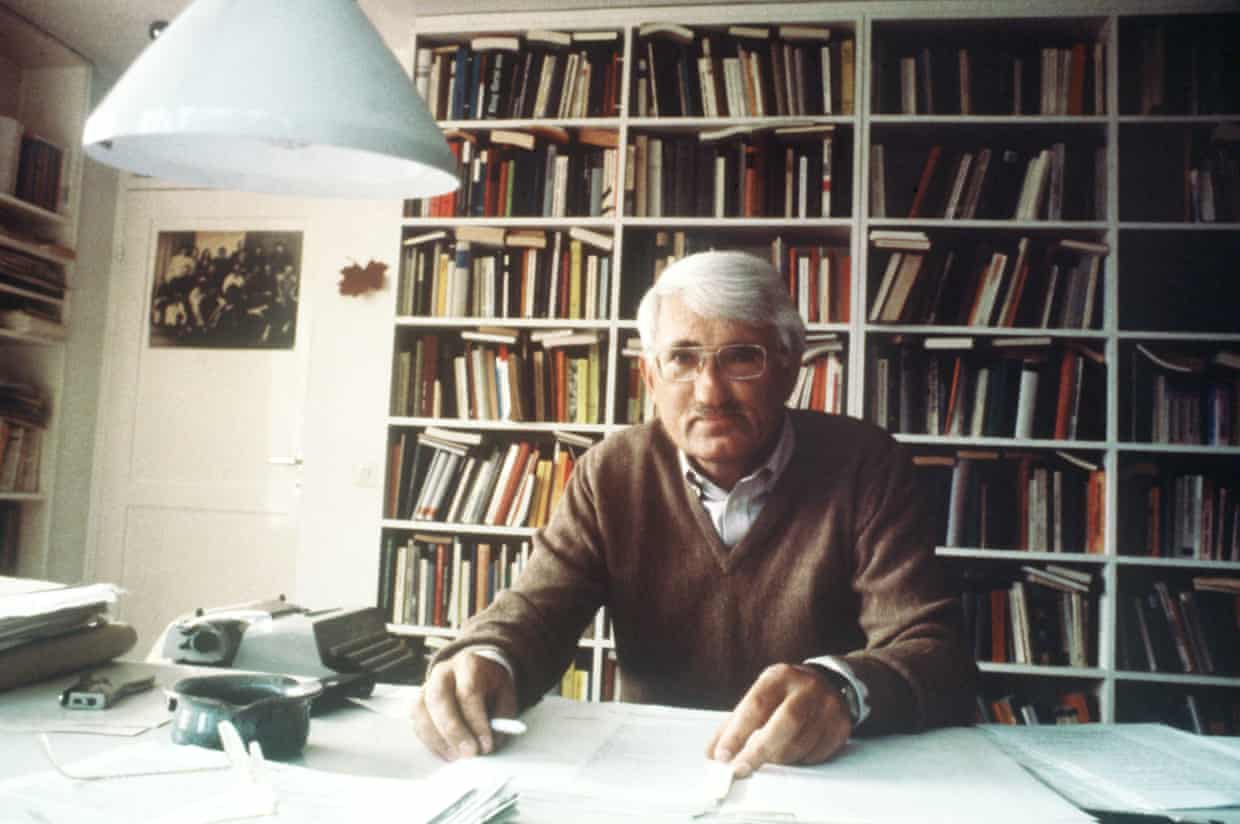
Hal B. Wallis, producer, had a Royal Vogue typewriter in his office.
Hal B. Wallis, producer, had a Royal Vogue typewriter in his office.
Attending an eminent institution can help build a network of high-income mentors and be a signal to employers and graduate schools that recruit disproportionately at those institutions.
Opportunity for institutions to proactively foster such outcomes, and also to proactively produce and share the data. Prove credentials of value by showing concrete value beyond earnings data.
The data is likely to draw protest from educators who believe that undergraduate education is not just about the earnings outcomes. Still, most institutions have done little to explain, with other data, how much people learn there or what they gain in friendship or career networks
https://www.reddit.com/r/typewriters/comments/1o8vjc5/typewriter_type_action_chart_my_personal/
u/N0nob compares the weight versus feel of their typewriter collection:

Cross reference with https://boffosocko.com/2026/09/17/what-words-could-we-use-to-better-describe-the-soul-of-a-typewriter/
In 2019, the Voice of America reported that typewriters were becoming popular again, especially among younger folks.
https://voa-story.com/2019-07-14-will-typewriters-become-popular-again/?ref=typebarmagazine.com
“I type very quickly, very badly, with many errors [ fautes],” Jacques Derrida confessed in a late interview. This paper proposes that the typographical error – usually viewed as a mere “accident” – may in fact be understood as a productive site for deconstructive reading and thought. Drawing on Nietzsche’s suggestion that the typewriter acts as a “collaborator” in thinking, this paper examines Derrida’s use of the typewriter, with particular attention to his typos. Following Derrida’s reading in the Geschlecht series and his own typographical practice, this paper argues that the typo should be thought of as the condition of possibility of every type – and as a defining difference between Derrida and Heidegger.
Chenoweth, Katie. 2021. “Faute de Frappe: Derrida’s Typos.” Research in Phenomenology 51(1): 61–77. doi:10.1163/15691640-12341464.
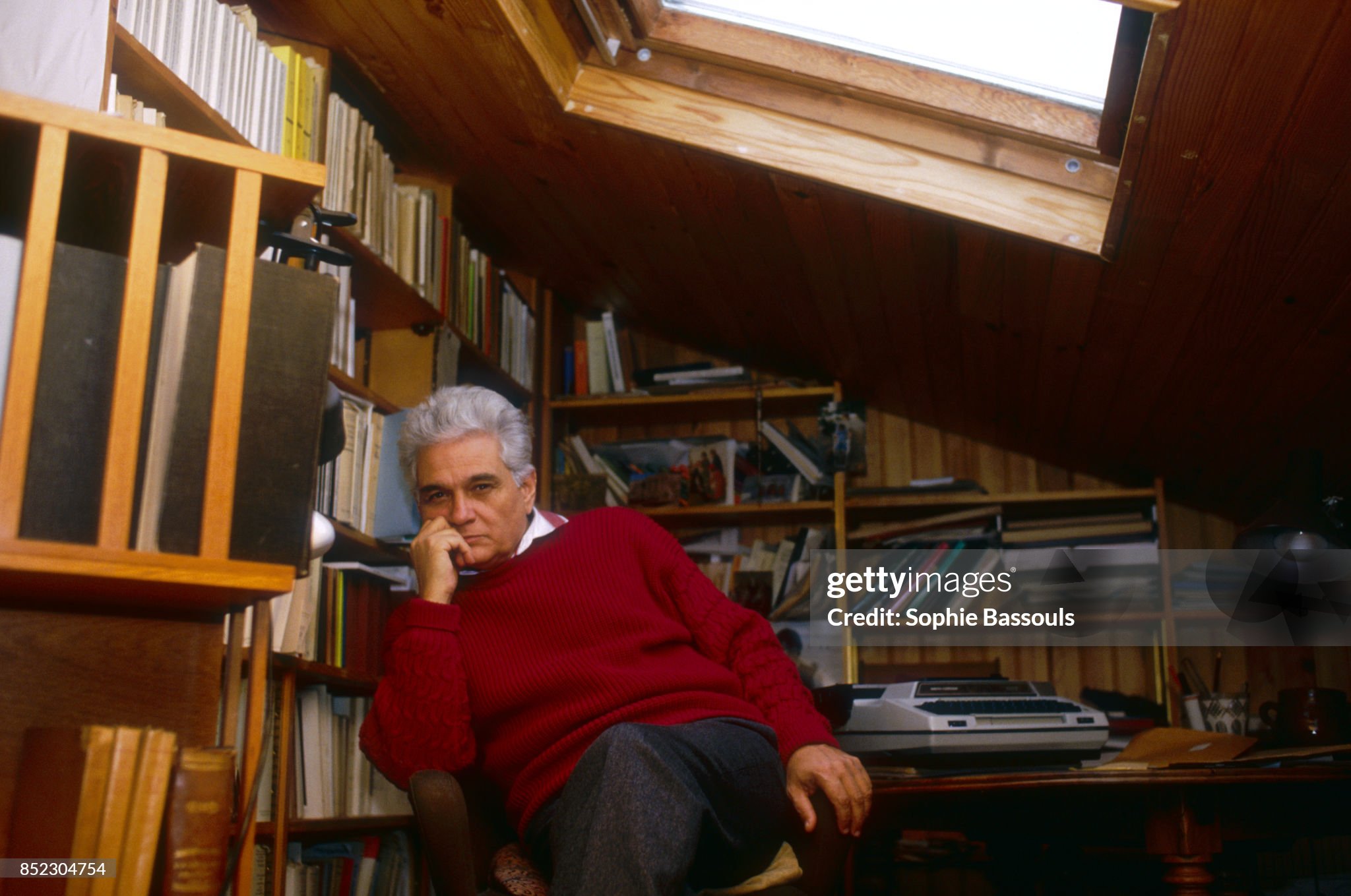
Potentially one of the Coronamatic line: 1200 or 2200.
Might be a Coronet XL, but his looks like it has the Smith-Corona badging/name on the front left where the Coronet XL name was typically placed. https://typewriterdatabase.com/Smith+Corona.Coronamatic+Coronet+XL.86.bmys
The shape of the top of the 2500 isn't quite right: https://typewriterdatabase.com/Smith+Corona.Coronamatic+2500.86.bmys
The shapes of the Coronamatic 7000 and 8000 are wrong for this.
See also guesses at https://www.reddit.com/r/typewriters/comments/1wzwzvi/what_typewriter_did_derrida_use/
https://web.archive.org/web/20070411202436/http://www.jamesnormanhallhome.pf/indexen.html
From the James Normal Hall home museum. James Norman Hall is an American writer best known for The Bounty Trilogy, a series of historical novels co-authored with Charles Bernard Nordhoff: Mutiny on the Bounty (1932), Men Against the Sea (1934), and Pitcairn's Island (1934).


This photo appears to show him at a different machine that looks more like a standard:<br />

It's an early 40's Royal Quiet De Luxe (it appears to have a tabulator key in the top right). Compare with: https://typewriterdatabase.com/Royal.Quiet+De+Luxe.72.bmys Note the rectangular shift keys which didn't start until late 1940.
**Myofilaments ** Thread like protein strands that make the muscle contract and relax.
https://www.instagram.com/reel/Dd1Gi9kjkef/<br /> Florence Pugh's ASMR with a Hermes Baby and a Blackwing 602.
https://www.reddit.com/r/typewriters/comments/1wu29c7/another_rare_vogue_royal/
Ginger Rogers newspaper article about her using a Royal typewriter with Vogue<br />

Frank Capra writing on a Remington Portable as pictured in The Wisconsin State Journal on August 15,1931<br />

proband
Case#: Two affected sisters/Female siblings/Progressive onset initially presenting as Stargardt disease
DiseaseAssertion: ABCA4
FamilyInfo: Large American family pedigree with two affected sisters. Both sisters were compound heterozygous for two novel ABCA4 variants. Unaffected relatives carried one variant or neither variant, supporting autosomal recessive inheritance.
CasePresentingHPOs: HP:0000556, HP:0000572, HP:0007754, HP:0000648, HP:0000510, HP:0001133, HP:0000610
CaseHPOFreeText: Proband initially showed phenotype compatible with Stargardt disease with progressive central vision loss. Over several years disease advanced into severe cone-rod dystrophy with worsening retinal degeneration, abnormal visual fields, and reduced electroretinography responses.
CaseNotHPOs: n/a
CaseNotHPOFreeText: Unaffected family members with only one mutation had no retinal disease phenotype.
Genotyping Method: Genome-wide linkage analysis using 408 microsatellite markers followed by direct Sanger DNA sequencing of all ABCA4 exons and exon-intron boundaries. Segregation analysis performed in family members.
PreviouslyPublished: No, both variants were novel at time of publication.
Variant: ABCA4 (RefSeq: NM_000350.3): c.655A>T ; ABCA4 (RefSeq: NM_000350.3): c.5312+3A>T
ClinVar: 632118
CAID: n/a
SupplementalData: Variants absent in 200 unrelated controls. Clinical testing included visual acuity, fundus examination, fluorescein angiography, visual field testing, and electroretinography. Compound heterozygous state associated with severe progressive phenotype.
 Harlan Ellison with pipe at an SG3 typewriter
 Harlan Ellison leaning on an Olympia SG1 typewriter (alternate angle from photo already in Richard Polt's collection)
 <br />
Harlan Ellison with pipe types at an Olympia SG3 typewriter
<br />
Harlan Ellison with pipe types at an Olympia SG3 typewriter
 John Houston with a cigarette in his mouth as he sits at a Royal KMM typewriter on the set of The Treasure of the Sierra Madre (Warner Bros. Pictures, 1948). He looks up to his right at Humphrey Bogart who is leaning over to look at the page in the typewriter.
This article critically examines Enslaved.org through the framework proposed in The Crying Child .
I establish The Crying Child as the primary framework for my analysis. The questions raised in the reading shaped what aspects of Enslaved.org I focused on, particularly representation, accessibility, and the relationship between institutions and descendant communities.
https://www.reddit.com/r/typewriters/comments/1wqxq5e/typewriters_of_the_country_music_hall_of_fame/
Tom Parker (aka The Colonel) used a Royal RE

Don Schlitz wrote The Gambler which became a hit for Kenny Rogers (1978) on an L.C. Smith Model 14<br />

Bill Anderson had a Royal Electress

Cindy Walker used a Royal Quiet De Luxe ('53 or '54)

At the Smithsonian, Maya Angelou's typewriter holds a place of honor : NPR<br /> by [[Daniel Ofman]] for NPR<br /> accessed on 2026-09-27T13:31:46
LABODE: This artifact is a typewriter that belonged to Maya Angelou. She probably had it from the early 1980s until her death. It's an Adler typewriter. It's an electric typewriter that was manufactured in West Germany.
This tracks with the Adler Meteor 12 from Soboroff's collection which is already documented on Richard Polt's page.
Supplier Requirements
all the information is comprehensively divided into different headline with a corresponding picture
GOAT = Get Old And Type ????
via u/Pete1885 at https://old.reddit.com/r/typewriters/comments/1wpx74d/i_think_i_found_the_goat/
History of the Shavian Keyboard Imperial Good Companion Portable Typewriter<br /> by [[Robert Messenger]] of oz.Typewriter accessed on 2026-09-24T10:20:26
Jack Lemmon roasts Burt Reynolds over donation<br /> https://www.reddit.com/r/classicfilms/comments/1wnetp1/oh_jack_lemmon_my_favorite/
“His name, Socrates, is Evenus, he comes from Paros, [c] and his fee isfive minas.”
Callias, son of Hipponicus recommends Evenus of Paros to Socrates as a Sophist teacher whose fee is five minas.
Compare this five minas to the price Socrates mentions at the end of the trial as potential penalty. Socrates says he can afford one mina while his friends could put up 30 minas for him.
Yet I think it afine thing to be able to teach people as Gorgias of Leontini does, and Prodicus ofCeos, and Hippias of Elis.2
- [Editors:] These were all well-known Sophists. For Gorgias and Hippias see Plato’s dialogues named after them; both Hippias and Prodicus appear in Protagoras.
The editors call out these philosophers/teachers as Sophists. Compare where they appear in Protagoras.
So, too, Meletus first gets rid of uswho corrupt the young shoots, as he says, and then afterwards he will obviouslytake care of the older ones and become a source of great blessings for the city, asseems likely to happen to one who started out this way.
How do you accomplish this in modernity, when you can't "get rid" of the opposition? You chill their speech, you erase their language, you erase their history. This seems to be the playbook of the far right in American politics under Donald J. Trump.
Redefine and poison words like DEI and Critical Race Theory (CRT), marginalize and criminalize the people who don't fit in your world view.
SOCRATES: I do not really know him myself, Euthyphro. He is apparentlyyoung and unknown. They call him Meletus, I believe. He belongs to thePitthean deme, if you know anyone from that deme called Meletus, with longhair, not much of a beard, and a rather aquiline nose.
cf. with Benjamin Jowett translation:
A young man who is little known, Euthyphro; and I hardly know him : his name is Meletus, and he is of the deme of Pitthis. Perhaps you may remember his appearance; he has a beak, and long straight hair, and a beard which is ill grown.
There is certainly a charge of "youth" in both translations, but the "beak" and "ill-grown beard" seem to be more belittling in Jowett which be ad hominem appearance attacks on Meletus of Pithos before we've even heard his argument.
Which of these descriptions would have had cultural significance in Ancient Greece?
See: Pithos, Pitthos, Pithus: https://topostext.org/place/380239DPit
Becoming a continuous workforce partner also means making it easier for someone to return for a short-term credential that builds toward a larger career goal without navigating a bureaucratic maze.
Learner-centered means that institutions must reflect not only on delivery of learning. We must consider the broader, comprehensive experience, including the logistics of simply enrolling.
Our foundational role is to instill the aptitude, mindset and curiosity graduates need to continue developing throughout their careers.
The purpose of postsecondary education, redefined.
September 19, 2026<br /> by [[Heather Cox Richardson]] in Letters From an American<br /> accessed on 2026-09-20T22:51:34
Getting Gabriel García Márquez's Smith-Corona 5TE Ready For Exhibit<br /> by [[Richard Messenger]] on oz.Typewriter<br /> accessed on 2026-09-19T12:30:13
Includes multiple photos. The Smith-Corona 5TE isn't listed on Richard Polt's site as of 2026-09-19.
 <br />
—via https://www.latercera.com/culto/2021/04/28/40-anos-de-cronica-de-una-muerte-anunciada-la-novela-que-garcia-marquez-consideraba-su-mejor-libro/<br />
Photo of Gabriel García Márquez in front of a standard typewriter with the brand name Underwood on the back.
<br />
—via https://www.latercera.com/culto/2021/04/28/40-anos-de-cronica-de-una-muerte-anunciada-la-novela-que-garcia-marquez-consideraba-su-mejor-libro/<br />
Photo of Gabriel García Márquez in front of a standard typewriter with the brand name Underwood on the back.
Not included in Richard Polt's collection of typers as of 2026-09-19
This article has a variation of the same photo credited as "El escritor colombiano y premio Nobel Gabriel García Márquez / Foto: archivo Biblioteca Nacional de Colombia"
 Profile photo of Gabriel García Márquez at a 1970's version of a cartridge-based Smith-Corona electric typewriter. <br />
Potential variations of this typewriter are already in Richard Polt's collection of typers, but this particular photo is not as of 2026-09-19.
Profile photo of Gabriel García Márquez at a 1970's version of a cartridge-based Smith-Corona electric typewriter. <br />
Potential variations of this typewriter are already in Richard Polt's collection of typers, but this particular photo is not as of 2026-09-19.
https://www.cookshelf.app/
Similar to Eat Your Books.
Potentially the same company just re-instantiated? What has changed with their cost/charging/business model?
Eat Your Books is an electronic database/index of recipes in cookbooks to make it easier for people to search their own paper (cook) books.
This is the sort of thing that Mortimer J. Adler was doing for the Great Books.
How nice would it be if there were a better digital index for all books which worked as well as this portends?
The Royal Companion was a trim line name for Royal portables in the 40s and 50s along with variations like the Aristocrat and the Quiet De Luxe. For some of its life it's essentially a cheaper Quiet De Luxe which may be missing features like a tabulator, Magic Margins, card fingers, or a touch control. You'd have to cross check the manual and the typewriter database to see how yours may differ from the QDL at the time it was made. Often it was a $5-10 price differential at the time for the difference in features, but with inflation this would be the equivalent of $140 now.
You could essentially use the list of QDL users from Polt's site and say that they all used a typewriter similar to your Companion. (Depending on the photos and angles, some of the listed Quiet De Luxe users may have really been using either a Companion or an Aristocrat, but it's incredibly difficult to discern unless you can see the specific feature differences between them.)
See also: - https://boffosocko.com/2024/06/25/users-of-the-early-henry-dreyfuss-royal-quiet-de-luxe-portable-typewriters/<br /> - https://typewriterdatabase.com/royal.72.typewriter-serial-number-database<br /> - https://typewriterdatabase.com/Royal.Companion.72.bmys - Manuals at: https://site.xavier.edu/polt/typewriters/tw-manuals.html
Reply to u/chocolate-sheep at https://old.reddit.com/r/typewriters/comments/1wi0jd6/writers_using_royal_companions/
Why I Write Ads for Big Tech on a Typewriter
The Inner Game of Tennis says that real focus and creative freedom isn't about focusing harder, it's about narrowing in on what's actually relevant to the task in front of you, whether that's the seams on a tennis ball or whatever detail is clear in your creativity. For me, turns out a 60-year-old machine it does that better than any app I use.
The history, mythology, and literature of Greece, taken up by the Roman Empire, shaped the development of European and American culture. ToposText is a free tool, a mobile app and website, for going back to the primary sources and historic roots of western civilization, and in particular a tool for students and travelers eager to experience the ancient world through its surviving texts.
Pitthos deme (Attica) 12 unknown - Πιτθός Πιτθός - Pitthos, an ancient deme of Attica, exact location unknown
https://www.facebook.com/reel/1632254748516251
Beau L'Amour does a tour of his father Louis L'Amour's typewriters:<br /> - Brown Olympia SM3, used in the 50s, on a trip or in a car primarily<br /> - Small gray portable typewriter (Hermes ultraportable?) <br /> - IBM Model B, purchased in 58 or 59, the majority of his writing work was produced on this machine<br /> - IBM Selectric (II or III), this became his primary machine once it was released and he began using it <br /> - SMC Electra 120
Current age 26 years
After Watergate, Congress exposed how the F.B.I. had surveilled, blackmailed and intimidated activists, celebrities and politicians. To prevent such abuse, President Gerald Ford’s administration prohibited the agency from opening investigations without reasonable suspicion of a crime. In 2008, Attorney General Michael Mukasey and his Justice Department worked around that reform by creating a new category of F.B.I. investigations called “assessments.” Under the new policy, agents could use physical surveillance and interview acquaintances, as well as informants, to gather information, even in the absence of a demonstrably high level of suspicion.
TanStack Router gave us a useful precedent around the same time because it had its own state graph, its own adapters, and the same need to run well across React, Solid, and Vue. Its work on a store factory and native Solid primitives showed that the core could depend on a small shared shape while each adapter supplied the implementation that made sense for its framework.
Lorraine Hansberry and one BIG typewriter!<br /> by [[Robert Messenger]] oz.Typewriter <br /> accessed on 2026-09-09T19:45:55
Thank you for the additional clarification and for the considerable expenditure of explanatory effort represented by the preceding response. Before proceeding further with the underlying technical question, it may be useful to establish a more explicit shared understanding concerning the relationship between the quantity of information supplied, the extent to which that information is necessary for the immediate decision being made, and the finite amount of maintainer attention available for converting the supplied information into an actionable conclusion. For the avoidance of doubt, the concern being raised here is not that factual accuracy, reproducibility, technical precision, correction of earlier assertions, or sufficient evidentiary support are undesirable. Each of those properties is useful and may, under the appropriate circumstances, be necessary. The difficulty arises when the information required to establish the relevant fact is accompanied by additional explanation whose presence, although potentially interesting and perhaps even technically correct, does not materially alter the fact itself, the confidence with which that fact can be evaluated, or the action that follows from accepting it. Every response imposes what might be described as a comprehension obligation upon its recipients. That obligation consists not merely of reading the words presented, but also of determining which statements constitute factual claims, which function as evidence, which are qualifications, which are conjectures, which supersede earlier statements, which merely restate conclusions already established elsewhere, and which are included primarily to explain the circumstances under which some other statement came to be made. The cost of satisfying this obligation tends to increase with the length, density, and structural complexity of the response, even where the amount of information capable of changing the maintainer’s eventual decision remains constant. This consideration is particularly significant in the context of open-source maintenance, where the time required to read, classify, verify, and contextualize one response cannot simultaneously be used to reproduce another issue, review a pull request, investigate a regression, prepare a release, answer another contributor, evaluate a dependency update, improve documentation, or perform any of the numerous other activities competing for the same limited pool of attention. Consequently, verbosity is not entirely without cost merely because the information is supplied voluntarily, constructively, and with the intention of preventing misunderstanding. Its cost is transferred to each recipient who must determine which portions are operationally necessary and which portions can be disregarded without compromising the validity of the resulting conclusion. We would therefore ask that future responses be prepared according to something approximating a principle of minimum sufficient communication, by which a response contains the smallest collection of independently useful facts required to answer the question currently being asked or to establish the behavior currently under discussion. Information should not be included solely because it is adjacent to the subject, because it records the path by which a conclusion was reached, because it anticipates questions that have not yet been asked, because it exhaustively delineates the boundaries of claims whose ordinary interpretation is already sufficiently narrow, or because omitting it might leave some peripheral aspect of the subject less than comprehensively characterized. The use of the word “smallest” in this context should not be interpreted as a request for artificial abbreviation, unexplained assertions, incomplete reproduction instructions, or the omission of facts required to distinguish the reported behavior from another superficially similar behavior. It means, instead, that each sentence should justify the attention required to process it by contributing something without which a maintainer would be materially less able to verify the report or determine the appropriate next action. Where the removal of a sentence would leave the actionable meaning unchanged, that sentence should generally be presumed removable. Where several paragraphs can be replaced by a single concrete observation without sacrificing reproducibility, the concrete observation should be preferred. Where a mechanism can be demonstrated through a minimal configuration change and an immediately observable result, that demonstration should ordinarily take precedence over a comprehensive narrative describing the mechanism’s provenance, implications, surrounding implementation details, and hypothetical manifestations in configurations not yet tested. Qualifications should similarly be restricted to those that alter the reasonable interpretation of the principal claim. It is generally unnecessary to enumerate every proposition that is not being asserted, every environment that has not been tested, every alternative explanation that was considered and rejected, every inference that a sufficiently careful reader might otherwise draw, or every reason the author has for believing that an untested configuration may behave similarly. Where uncertainty is relevant, it is usually sufficient to identify the precise boundary of verification rather than narrating the broader epistemological status of all related propositions. One potentially useful standard for deciding whether information warrants inclusion is to ask whether the behavior that actually occurs, the smallest reliable procedure that causes it to occur, and any qualification without which those statements would become materially misleading remain understandable and reproducible after the information is removed. If they do, the removed material was probably not necessary for the immediate response. Background already available elsewhere in the issue, detailed explanations of standard language or bundler behavior, speculative generalizations beyond the verified reproducer, extended discussion of why an earlier reproducer was inadequate, descriptions of investigative paths that did not produce the final result, and multiple reformulations of the same conclusion at successively different levels of abstraction should normally be retained by the author unless and until a maintainer requests them. This request is not intended as a judgment concerning the effort, competence, thoroughness, or good faith involved in preparing the response. It concerns the format in which the result of that effort is presented. A technically correct response may nevertheless be disproportionately expensive to consume, in much the same way that a comprehensive diagnostic log may contain the relevant error while simultaneously making that error more difficult to locate. The objective is not to minimize the amount of investigation performed by the reporter, but to minimize the portion of that investigation which every subsequent reader must reconstruct before reaching the actionable result. We recognize that determining what is essential requires judgment and that contributors cannot invariably know in advance which detail a maintainer will consider relevant. In such circumstances, the preferred strategy is progressive disclosure, under which the shortest adequately supported factual answer is provided initially and further supporting detail is supplied only when a maintainer identifies a concrete need for it. It is substantially easier for a maintainer to request one missing fact than it is for multiple maintainers to independently identify and disregard several pages of facts that do not affect the decision being made. The appropriate optimization target is therefore not maximum completeness at the time of the first response, but minimum aggregate effort across all participants required to reach a sufficiently supported conclusion. A concise response that results in one targeted follow-up question may satisfy that target more effectively than an exhaustive response which attempts to preempt every conceivable follow-up but requires substantially greater processing time from every reader, including readers for whom most of the anticipated questions would never have arisen. Facts directly necessary to establish the reported behavior should be included. Evidence directly necessary to verify those facts should be included only to the extent that verification would otherwise be impractical or ambiguous. Context that may be interesting but does not change the facts, their verification, or the resulting action should be omitted unless specifically requested. Where several formulations communicate materially identical information, the shortest formulation should be selected. Where a direct statement is available, it should take precedence over a narrative account of how the statement was discovered. Where one verified claim is sufficient, it should not be surrounded by multiple hypothetical extensions. Where the answer to a question can be expressed as a concrete condition and an observable consequence, the response should ordinarily contain that condition and consequence without attempting to supply a general theory of every adjacent failure mode. It is also important to clarify that this does not mean providing a concise summary followed by the same extended explanation that the summary was intended to replace. The continued presence of the explanation preserves most of the reading, classification, and triage cost. A summary is not a substitute for removing unnecessary material when the unnecessary material remains directly beneath it. Supporting details can remain available to the author and can be supplied in a subsequent response if a maintainer determines that the initial facts are insufficient. Nor is it generally necessary to surround relevant facts with introductory courtesies, repeated apologies, rhetorical transitions, anticipatory defenses, summaries of prior misunderstandings, explanations of why the current answer differs from a previous answer, assurances about claims that are not being made, or concluding restatements of conclusions already expressed. Courtesy is appreciated, but its communicative footprint need not substantially exceed that of the technical substance. A correction is most useful when it makes the corrected claim immediately identifiable and permits the obsolete claim to be discarded without requiring the reader to reconstruct the entire history of the correction. Applied to the present exchange, the information that appears most capable of affecting maintainer action is that disabling HMR removes the React refresh preamble, that the resulting client bootstrap no longer causes the relevant environment initialization to occur before createClientRpc is evaluated, and that server-function construction consequently encounters a ReferenceError because process is unavailable. The precise import-order mechanics, the contrast with the initial theory concerning a relative URL, the implications for other plugins whose preambles may differ, the explanation of why the originally linked example does not exhibit the behavior under its default configuration, and the broader characterization of the problem as a dependency on an incidental ordering guarantee may become relevant during implementation, but they need not all be transmitted before maintainers have had an opportunity to evaluate the narrower verified condition and its immediate consequence. In consideration of the asymmetry between the effort required for an author to preserve additional material and the cumulative effort required for every recipient to inspect and classify that material, and with due regard for the limited and nonrenewable character of volunteer maintainer attention as it relates to the substantially renewable supply of potentially relevant contextual exposition, future participation would be most effective if each response were reduced, before submission, to only those empirically established statements whose omission would prevent reproduction, materially distort the reported behavior, or leave the specific question under consideration unanswered, with all supplementary narrative, speculative extension, duplicative reformulation, historical reconstruction, rhetorical cushioning, and otherwise nonessential elaboration withheld pending an explicit indication that its disclosure is required.
and the finite amount of maintainer attention available for converting the supplied information into an actionable conclusion.
We recognize that determining what is essential requires judgment and that contributors cannot invariably know in advance which detail a maintainer will consider relevant. In such circumstances, the preferred strategy is progressive disclosure, under which the shortest adequately supported factual answer is provided initially and further supporting detail is supplied only when a maintainer identifies a concrete need for it
with due regard for the limited and nonrenewable character of volunteer maintainer attention as it relates to the substantially renewable supply of potentially relevant contextual...
https://commons.wikimedia.org/wiki/File:Olavi_virta_levytukku.jpg<br /> https://en.wikipedia.org/wiki/Olavi_Virta

Based on the two-tone hood/body, the hood hole, the return arm, the screw locations in the back and what appear to be Magic Margins, Olavi Virta appears to be using a 1948/49 Henry Dreyfuss designed Royal Quiet De Luxe (or similar trim line).
It is an exciting time to be a robot. They are becoming promptable, not programmed. They are stepping onto factory floors, into warehouses, restaurants, and homes. For sixty years, the answer to keeping us safe around robots was a cage: bolt the machine down, fence it off, keep people out. It worked because the robot was blind and repetitive. The cage kept the risk contained. Dangerous inside, safe outside. Today's robots can see, plan, and work on their own, alongside people. The prize is the largest market on earth: labor itself. But what replaces the cage? Every dangerous machine in the past, from the steam boiler to the elevator to the car, won its place the same way. Its risk became legible: measurable, comparable, priceable. Robot risk today is not legible. But a robot among people today must be compliant and insured from day one. Legibility takes instrumentation to measure, standards to compare, and insurance priced on evidence, turning as one circuit: evidence prices insurance, insurance feeds the standard, and the standard writes the next round of evidence. We call it the Evidence Loop. As a system, it has not started. What follows is our answer: the 17 things robot makers, deployers, insurers, and policymakers can do by 2030 to start the loop that replaces the cage. It is published open for review: we invite you to shape it and join its reviewers.
For sixty years, we knew exactly how to keep a robot safe. It came down to one simple idea: keep people out.
A robot used to wait for instructions. It worked because it was predictable, repetitive, and blind. Now imagine one deciding what happens next.
That assumption is now breaking. The robot is leaving the cage. AI is giving it the ability to see, plan, and act without a script or program for every move. every move.
These machines are moving into warehouses, restaurants, factories, and homes, working alongside the people the cage was built to keep away.
But what replaces the cage?
The machines that changed the world all faced a version of the same problem: how do you make something dangerous safe enough to use around people?
Every dangerous machine in the past, from the steam boiler to the elevator to the car, won its place the same way. Their risks became something people could inspect, compare, and eventually price.
Their risk became legible.
Robot risk isn't there yet.
A robot working around people has to be compliant and insured from day one. But a safety assessment can only tell you what was true when the robot was assessed.
It cannot tell you what happened after the machine went to work: how often it stopped, how often a person had to intervene, what changed after an update, or whether the same problem appeared across deployments.
That matters because insurers cannot price what they cannot measure. And without a history of real-world performance, every new deployment starts with uncertainty.
The missing piece is evidence: a record of what the robot actually did in service, measured in a way that different deployments can be compared.
Once that record exists, the pieces can start reinforcing one another.
It can help insurers price risk, give standards bodies better data, and give deployers a track record they can take to their next renewal.
We call this the Evidence Loop.
This article lays out 17 things robot makers, deployers, insurers, standards bodies, and policymakers can do by 2030 to start the loop that replaces the cage.
It is published open for review: we invite you to shape it and join its reviewers.
Astra brings together years of research and big bets across pre-training, reinforcement learning, and alignment. Astra is state-of-the-art on computer use, browsing, software engineering, cybersecurity, science, and professional work.
【非共识】这一广泛的能力声明涵盖了多个专业领域,但没有提供具体的衡量标准或比较基准。需要详细了解这些领域中的具体表现指标,以及与现有解决方案的对比,以评估这一全面能力声明的真实性。
Games are recreational because they offer no immediate benefit to our survival. Yet game-playing skills have always been adaptive behaviors.
Games are a lot more beneficial then they seem. They are not only fun, but they also provide practice for real-life situations. I will use Adventures with Anxiety as another example, but that game/interactive story helps the player understand the effects of anxiety and how an individual acts on it.
“We don't need hundreds of disconnected training programs that produce credentials and hope the labor market absorbs the graduates,” Sims says. “We need workforce ecosystems designed backward from actual jobs.”
Just makes sense. Especially in the CVI environment, design that starts at the finish line is going to create programming and credentials that result in great outcomes data for value metrics. There's nothing wrong with great programming and credentials that prepare people for success; such efforts just won't be able to compete with those that have the learners' success baked into the design.
Invest, connect and scale proven training and credentialing solutions by bringing together educators, businesses, workforce organizations, corporate leaders, industry vendors and other stakeholders to address shared workforce challenges and expand what works.
Note the ecosystem thinking and the centering of credentials.
many AI tools do not cover the five levels of AMP discovery and design [
what are these levels? basic screening to clinical trials?
there is protein synthesis,phospholipases, capsular polysaccharides, lipopolysaccharides, membrane and QS pro-teins, metal absorption, cytokines and biofilms [ 152 ,156 ].
not as familiar w/ these AB virulence factors
ackbone sampling, side-chainoptimization and energy-based refinement
more details on these methods?
nonlinear interactions between features
'nonlinear interactions' is thrown around often; just a behavior that causes exponential or multi-faceted consequences?
ecision trees trained on bootstrapped subsets of the data
maybe familiar? random forests use decision trees -> like a flow chart?
k-mer frequencies, dipeptideand tripeptide motifs, pseudo-amino acid composition
are these all bad for AMP effectiveness?
Featureextraction,
vaguely familiar; just looking for specific qualities? generating specific qualities?
de novo peptide design and multi-objective optimization, integrating activity, selectivityand stability considerations into the design process
not very familiar with these; have heard of de novo peptide design and selectivity/stability considerations
Secondly, this is the script I used to cancel everyone's subscriptions in Stripe.
This was a generous share.
Side note: I've had an unwritten draft post kicking around for a while (a few(?) years) under the title "Forms are forms"—with the idea being that the name of the HTML form element wasn't chosen arbitrarily. They have an analog in the, uh, analog world: forms. Like the ones printed on paper, and that you fill out (however and wherever you want), and then turn over to whomever is intended to process it. It's an accident (injustice?) of history that we started treating HTML forms differently.
In a more perfect world, the snippet shared here would be able to use the Stripe SDK to prepare an offline collection comprising an eventual form submission. You would then be able to load that collection into your favorite user agent (think: Postman, but for real humans, not people paid to shuttle JSON between endpoint to endpoint), which would then issue the requests and format/capture the output for your review.
Let's start with ending the absolute myth of the "perfect study method". This is something app developers and influencers want you to believe so they can sell you something.
The purse on Erasmus’s lap may be included in order to illustrate his generosity. Erasmus and Gillis made a point of informing More that they had split the cost of this gift because they wanted it to be a present from them both.
Compare this suggestion of the purse as an attribute suggesting generosity to Jardine's (1996) suggestion that its meant to place Erasmus in the merchant class.
(Of course it could be doing both.)
The books on the shelf behind the scholar have inscriptions relating to his recently published works: Novum Testament[um] and Hieronymus refer to Erasmus’s editions of the New Testament and St Jerome; Lovkianos refers to Erasmus’s and More’s collaboration in translating Lucian’s Dialogues; and Hor, which originally read Mor and must have been altered during an early restoration, spells the first letters of the Englishman’s name and refers to the ‘Praise of Folly’ (Encomium Moriae), a satirical essay written whilst Erasmus stayed with More in Bucklersbury in London in 1509. The words on the paper are a paraphrase of St Paul’s Epistle to the Romans, the handwriting is a close imitation of Erasmus’s own hand, and the reed pen was Erasmus’s favourite writing tool.
https://www.rct.uk/collection/405759/desiderius-erasmus-1466-1536
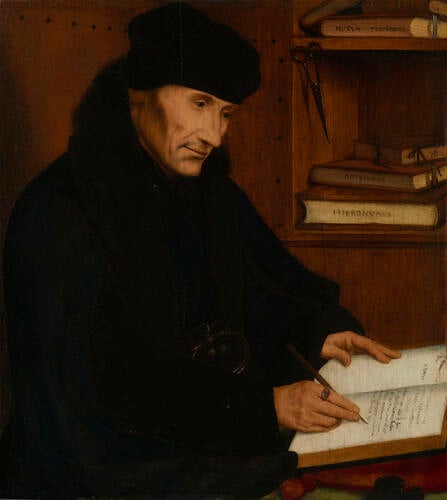
One ought to notice the shears hanging on a nail or hook on the bookshelf in the background. Presumably these would have been a primary tool for Erasmus' ars excerpendi practice.
Cross reference Lisa Jardine (1996) who calls out the purse on Erasmus' chest which identifies him as part of the merchant class.
Also cross reference Hans Holbein's portraits of Erasmus.
Trials measure efficacy, but the world cares about effectiveness. Today, benchmarks lack even a good measure of efficacy and are far away from effectiveness.
把临床试验里 efficacy(理想条件有效)和 effectiveness(真实世界有用)的区分搬到评测上,是本文最可外推的一层。当前榜单连第一层都没做扎实就在谈落地,等于跳过了医学花几十年才走完的路。注意作者是 Protege 的合作方,指出问题的同时也在卖解法。
Millard Kaufman on Working in Hollywood #:
He said, "You're the writer; I'm the producer." He said, "You do it my way or I'm gonna fire your ass." And I was sitting at a typewriter when he said this. So I picked up the typewriter and threw it at him.
Exchange value
Exchange value appears as the property of a commodity that is exchangeable for other commodities. It also presupposes societies who produce commodities and exchange them. While all societies have things with use values, exchange value is relative to a specific time and place.
Additionally, exchanging commodities must also presuppose a way to determine proportionality between different commodities, so that they can be exchanged in the first place.
Exchange therefore requires some other measure that stands above the two commodities meant to be exchanged. If there were no ways in which iron and corn were found similar to a society, for example, then we would not exchange them and they would have no exchange value.
Marx will contend that what each commodity must contain crystalized within it is value (formally) and that the substance of value is labor (viz. the common factor of both iron and corn is labor). Marx will call this kind of labor abstract labor.
Invest in data sharing systems to track work-based learning participation and outcomesand inform student and employer decision-makingWhen designed well, integrated data systems — such as state longitudinal data systems orP-20W data systems — can connect information across education, workforce, and employersystems (e.g., adding a job type field to UI wage records or tracking WBL experiences on collegetranscripts), helping leaders, employers, and learners understand who is participating, wheregaps exist, and which programs are delivering strong outcomes.
Vital opportunity for Humanities: intentional effort to create high quality WIL for learners combined with proactively gathering and reporting on data such as described here could be a recipe for successfully navigating the Credentials of Value reality. Rather than see degree level programs clumsily crosswalked to earnings outcomes that misidentify value, connect WBL accessed through our programs of study to that outcomes data.
Lipson says policymakers must ask whether we’re dealing with a skills problem, a matching problem, a true lack of demand with too few entry-level jobs, or a price problem where young workers cost too much relative to expected productivity.
Validate assumptions about the true issues! The solutions are different depending on the problem.
The aims of this study were to: (i) explore health professional views of the enablers and barriers to delivering evidence-based patient falls prevention education programs in hospitals; and (ii) understand health professional perceptions of appropriate educational delivery for hospitalised patients.
Briefly but indepthly shows the aims of this study and where it targets directly.
Since nursing and allied health professionals are the main providers of falls prevention education in hospitals, it is imperative for them to deliver patient education effectively, with consideration to evidence-based approaches.
This shows who is in control of managing and preventing patient falls.
n developmentalterms, the child/adolescent is seen as prematurely exposed to adult knowledge, assumingextensive adult roles and responsibilities within their family
Definition
with contributions from security researchers at Anthropic, OpenAI, and Google
横向阅读的最高价值发现。Anthropic 7/29 的事故披露文脚注 2 写明「OpenAI/Hugging Face 事件发生于 ExploitGym 的一次评测」,并用整整一节把两起事件对立起来(我们主动发现 / 他们 0-day 逃逸)。但这里写着:ExploitGym 的构建有 Anthropic 安全研究员的贡献,同文还说「Anthropic ran the Opus 4.6 and Mythos Preview trials」——Anthropic 自己也在这套基准上跑模型。事故文对这层关系只字未提。结合已知的 Irregular 关系(商业供应商 + 白皮书合著方),这个领域里「独立第三方评测」的实际独立性比表面叙述低得多。
Due to a misunderstanding between us and our evaluation partner, this was not the case, and internet access was available
根因被归为「我们与评测伙伴之间的误解」,且主语消失(谁做的配置?)。补上外部信息后这句的分量会变:该伙伴 Irregular(原 Pattern Labs)2025 年 9 月由 Sequoia、Redpoint 领投融资 8000 万美元、估值 4.5 亿,同时是 OpenAI 与 Anthropic 的商业供应商,并与 Anthropic 合著过白皮书。本次「联合调查」是两家有商业与合著关系的公司互查,不是独立审计。
By ByteBot Share TanStack Start hit Release Candidate status in early 2026 as a full-stack React framework that challenges Next.js’s dominance with a radically different philosophy: client-first, not server-first. Built on TanStack Router, Vite, and Nitro, it delivers server-side rendering, streaming, and server functions without forcing developers into the server-centric mental model that’s become React’s default. If Next.js’s opinionated approach or React Server Components feel heavy-handed, TanStack Start offers breathing room.
“I'm all in favor of keeping dangerous weapons out of the hands of fools. Let's start with typewriters.” ― Frank Lloyd Wright
https://www.goodreads.com/quotes/312645-i-m-all-in-favor-of-keeping-dangerous-weapons-out-of
original source?
Yes, this was one of the oldest, most unique typewriters with history in a while, last one before this was Larry McMurtry's Hermes 3000. Before those I was both Erma Bombeck and Paul Harvey's typewriter tech, both used IBM selectric's
via Duane Jensen at https://www.youtube.com/watch?v=tJxFzACiISM&lc=UgyDGDDU6cEskMvsPmh4AaABAg.9Vb0zueAXOF9VbnHZ4AT_F
1st hand, Because his assistant was the one who contacted me first, then I talk to Larry via phone, after working on 2 Hermes 3000's, the 3rd typewriter I delivered myself to him at his place in Tucson. After he died, all 12 of his Hermes 3000's were auctioned of for about $3000.00 ea, I was hoping he would have willed those to me . . . .
via Duane Jensen at https://www.youtube.com/watch?v=tJxFzACiISM&lc=UgyDGDDU6cEskMvsPmh4AaABAg.9Vb0zueAXOFAEfXxtmCuPo
supporting K-12 schools to implement coherent instruction and colleges and universities to holistically meet the needs of their students is among the hardest, most necessary work in education
Gates Foundation: "holistically meet the needs of their students" which makes me think about - Persistence - Quality (getting the learning they came to get) - Relevance (WIL) - Advising + support services - Community (belonging, mentors, friends) - Purpose + Meaningfulness (it's what learners want and it's what motivates people)
250. Tackling ‘Big History’ feat. Ian Morris<br /> unSILOed Podcast with Greg LaBlanc
Drawn from Chapter 5
It states where the passage is in the overall boo
D
Student sample: The Age of Innocence by Edith Wharton
Part A
Inthe 1880s, it was considered insulting touse typewriters for private correspon-dence. It was thought, for instance, thata typewritten letter from a man was notreally personal because it would gener-ally have required a professionaloperator's help to produce.
- Bruce Bliven, The Wonderful Writing Machine (New York: Random, 1953), p.68-71.
Baker, Nicholson. 1994. “Discards.” The New Yorker 70(7): 64. https://www.newyorker.com/magazine/1994/04/04/discards (August 6, 2021).
Berkeley’s subject catalogue is already gone. Though it was more or less frozen in the nineteen-eighties, it was nonetheless very efficient for some kinds of searches: if the primary sources in your field were published in the eighteenth and nineteenth centuries, you don’t want your retrievals spread among the thousands of irrelevant records that a mechanical database subject haul brings up. Any drawer of an out-of-date paper catalogue represents the equivalent of a filtered computer search, a Boolean date-limited search, of a very sophisticated sort—in fact, one drawer represents the outcome of a kind of search that most on-line catalogues can’t and won’t ever be able to perform, since it offers clues to what books were in the library during different eras. If in seventy years a historian of science (say) wants to know whether some Nobel-laureate physics professor could possibly have seen and been influenced by a certain out-of-the-way Dutch mathematical monograph from the thirties which bears important similarities to his work—whether, that is, it was part of the library’s collection during the period when the professor was developing his ideas or was acquired only after the professor’s papers were published (perhaps acquired by the library as a gift from the professor’s estate, in fact, because the professor was sent the monograph by the Dutchman himself, anxious to establish primacy)—the historian of science will have little chance of finding an answer to his question now, because the computer record will bear the (to him) meaningless date of the retrospective conversion of the card, i.e., sometime in the late eighties or early nineties, which has no relation to the time that the card was originally produced (and the book placed on the shelf), whereas the original card, even if it bore no direct date of creation, would have exhibited distinct features (typewriter style, format, cataloguing conventions) that might have enabled a cataloguecard paleographer to place it within a five-year Period.
interesting research example of a search not enabled by a digital card catalog
In 1848, Antonio Panizzi, Keeper of Printed Books for the British Museum, had a similar notion:By an alphabetical catalogue it is understood that the titles be entered in it under some “headings” alphabetically arranged. Now, inasmuch as in a large. library no one can know beforehand the j uxtaposition of these headings, and it would beimpossible to arrange them in the requisite order, if they cannot be easily shifted, each title is therefore written on separate “slips” of paper . . . which are frequently changed from one place to another as required. It is selfevident that if these “slips . . . be not uniform, both in size or substance, their arrangement will cause mechanical difficulties which take time and trouble to overcome.
N-LINE catalogues are wonderful things in principle—things of efficacy, and even, occasionally (as in the case of O.C.L.C.’s Online Union Catalog), of grandeur. As a result of the publicly financed expansion of higher education in the sixties, and the boom in academic publishing that followed it, the holdings of the typical university library have doubled over the last twenty years. Without on-line catalogues, and the circulation and acquisition modules of software with which on-line catalogues are linked, libraries would simply not have been able to process all the books and journals that were arriving on their loading docks. By the early seventies, there was an ominous arrearage of uncatalogued material waiting on herds of rolling carts near the overtaxed cataloguing departments of most large libraries. Cataloguing had reached a state of crisis similar to the one that forced the financial markets to close early during some of the high-volume weeks of 1969, when Wall Street’s paper-based methods of order processing couldn’t keep up with each day’s orders to buy and sell stock. Computerized stock-execution saved Wall Street (and made program trading and Brack Monday possible, too), and computerized cataloguing procedures saved libraries.
It is true that they seldom have formal training in the intricacies of the cataloguer’s art: they are not necessarily up on the elaborate Anglo-American cataloguing rules, nor are they current concerning the periodic “Rrs, or Rule Interpretations, issued by the Library of Congress, which—like hermeneutical dispatches from the I.R.S. or the Financial Accounting Standards perplexing cases in classification as they emerge. Most operators have had no library-school courses in the Dewey Decimal system (still thriving, by the way, and very big in Europe), or the “Sears List of Subject Headings,” or Cutter numbers, or the abbreviational niceties of the International Standard Bibliographic Description (I.S.B.D.) format—but they do apparently pick up a great deal as they go.
Timothy Kohler and Michael Smith’s edited volume Ten Thousand Years of Inequality (2018), calculating Gini coefficients for multiple ancient societies, perhaps appeared too late for Graeber and Wengrow to take it into account, but the broad patterns that are emerging seem to owe little to prehistoric peoples’ will to imagine different possibilities.
How would we know whether the cases that Graeber and Wengrow explore are sufficient to falsify the evolutionists’ claims?
This is a solid question and worth exploring.
Looking at it another way, perhaps Graeber and Wengrow are just showing a less teleological perspective with wider variance bars around the data to say that there are other potential possible outcomes? (Which they do.)
Monuments Without AgricultureIt used to be a truism among archaeologists that farmers build monuments, mobilizing huge amounts of labor, but foragers do not. This, we now know, is overstated. The most famous exception is Göbekli Tepe, an extraordinary cluster of sunken chambers with massive, carved stone pillars near the Turko-Syrian border. Construction began here by 9500 BCE, just as experiments with domestication were beginning not far to the south, but all the evidence suggests that the builders were hunters and gatherers.16 Stonehenge, the most famous prehistoric monument of all, was built between roughly 3000 and 2600 BCE by herders rather than farmers,17 but as early as 8000 BCE, foragers had set up a series of monumental posts (perhaps totem poles) at the site. At Locqmariaquer in Brittany, fishermen dragged a 20-meter-tall, 350-ton stone stele for 5 kilometers around 4500 BCE and then erected it over a communal tomb. In coastal Peru, other fishermen started building mounds at Aspero, Caral, and Sechin Bajo before 3700 BCE. Foragers in Louisiana heaped up giant earthworks at Watson Brake around 3400 BCE and even bigger ones, using a standardized unit of measurement, at Poverty Point around 1600 BCE.18
Nice list of examples for early monuments here.
How do they all fit into broader themes of mnemonic traditions potentially?
Across the last 20 years, evolutionists have adopted more sophisticated frameworks (such as niche construction theory) to accommodate the new findings, and Stephen Shennan’s superb book First Farmers of Europe provides a thorough and convincing evolutionary account of the origins and expansion of agriculture.15
Since the 2000s, archaeologists and paleobotanists have moved away from three older theories about the origins of agriculture—first, that population growth after the end of the Ice Age (around 9650 BCE) drove experiments with gardening and herding that led to the domestication of plants and animals in the Near East; second, that domestication happened in a few core regions of the Near East and then spread steadily outward; and third, that farming inexorably drove processes of sedentism, rising labor inputs, and increasing inequality. Instead, most experts now suggest that the relationship between population and domestication was complicated and variable; that experiments with cultivating plants went on in multiple locations, particularly wetlands; that domesticated plants caught on extremely slowly, needing 3,000 years (ca. 9500–6500 BCE) to go from under 20% of assemblages to over 80%; that the drift toward domesticated resources was regularly reversed; that rather than causing sedentism, domestication was often its consequence; that sedentism and experiments with plant cultivation began as early as 21,000 BCE, at the coldest point in the last Ice Age; and that there is little sign of institutionalized inequality in the Near East before about 5500 BCE.14
14 Asouti and Fuller 2013 has been particularly influential. On population, Palmisano et al. 2021.
Interesting shift in literature in archaeology since 2000s.
Allen Johnson and Timothy Earle’s widely read book The Evolution of Human Societies, which uses the Great Basin Shoshone of a century ago as one of its key case studies. Like the Cheyenne, the Shoshone spent most of the year in unranked, family-sized groups, but some of them periodically granted “rabbit bosses” and “antelope shamans” far-reaching powers to coordinate large-scale hunting and trapping.
In what follows, I take evolutionists to be scholars who see some conceptual continuity between human history and biological evolution, who consider sociocultural evolution to be governed by identifiable mechanisms functioning somewhat like natural selection, who see these mechanisms as involving adaptation to the environment, who believe that the mechanisms operate on all societies regardless of time and space, and—usually, but not always—who recognize stages of social and cultural evolution, from egalitarian foraging bands through hierarchical agricultural empires and pastoral tribes, to modern fossil-fuel-based nation-states.
whether Graeber and Wengrow commit so many howlers that their central thesis is invalidated.
Is it good storytelling, is it fact, or something in between?
Interesting to see where the bar is in the anthropology community in terms of bringing evidence to tell a new story.
Where does this line exist between fact and fiction and what does it tell us about the level and rigor of a science? Mathematics and physics can't get away with stringing together falsities, yet the "softer" sciences apparently can.
Even if Graeber and Wengrow's story isn't fact, shouldn't it be? For the benefit of humanity?
Where Harari and Diamond offered evolutionist accounts of history,3 Graeber and Wengrow are explicitly anti-evolutionist. Dawn deserves admiration for being the most extended and detailed rebuttal to evolutionism this century—and it provokes exasperation for precisely the same reason.
the ordinary 'stock cards' furnished by firms for card cataloguepurposes. In large quantities they should be obtained in thisway ruled, cut, and printed, for $1.35$1.50 per M
These cards can be made by any printing establishment provided with a ruling machine at a cost considerably below that of
This model gives both learners and employers clarity and confidence around competencies without having to interpret them from college transcripts or job descriptions.
Remove guess work. Transparency demystifies and makes clear what credentials are credentialing.
It enables states to document whether programs are producing graduates with the skills and competencies that regional economies need. Better than the first-job earnings metrics in place today, a quality assurance model can confirm whether credentials are truly delivering verified skills that matter and are producing measurable mobility for learners, employers, and communities.
Knowing that credentials earners then become wage earners is important. It is a relatively reliable signal that the credential carries value. It's also a clumsy proxy for answering the far more vital question of whether the credential is a valuable resource for meeting the skills employers seek in order to fill living wage jobs.
these programs lead to credentials that deliver value because skills and learning outcomes are transparent, credible, and comparable.
We know what the credential is credentialing. We know how the credential compares and relates to other credentials. And we know that if someone has the credential, we can trust that they earned it.
We should applaud the new federal “do no harm” standards and other accountability measures that raise the bar. But our nation’s colleges and universities must aim higher by seeking to do good throughout the lives of their learners.
Impetus is about funding based on short-term employment results, however the opportunity is for institutions to respond with more than a minimal compliance approach and instead take a more meaningful path that goes deeper and broader in serving learners with value now and for years to come.
A version of this manuscript has been published. Here is the citation: Dustin T. Hill, Rafael Schulman, Ian Vasconcelos Caldas, Christopher Dunham, Yifan Zhu, Daryl Lamson, Lindsey Rickerman, Kirsten St. George, Yasir Ahmed-Braimah, Hyatt Green, Brittany L. Kmush, Frank Middleton, David A. Larsen. (2026). Diversity of SARS-CoV-2 genome in wastewater and implications for shifts in infectious disease transmission. Science. 392. 735-741. DOI 10.1126/science.aed6094.
Users of the Royal KHM typewriter:<br /> William Faulkner, L. Ron Hubbard, David McCullough, Al Neuharth, Mickey Spillane, Dalton Trumbo, Frank Lloyd Wright, J. D. Salinger, Georges Simenon, Richard Wright, Eric Hodgins, William Peter Blatty, Post Malone, and Taylor Swift.
20 years Age of onset 3 years 9 years
In Kolumbien wird der neugewählte rechte Präsident einen Rollback in der Umweltpolitik und bei der Energiewende einleiten. Er wird dabei auf gut organisierten Widerstand lokaler Communities und der Linken stoßen. Trotz der Politik der Regierung Gustavo Petro ist Kolumbien noch immer von Rohstoffexporten abhängig. Interessierte Machtgruppen setzen vor allem auf die Expansion des Kupfer-Bergbaus.
Exxon started giving money for climate research to Columbia University’s Lamont-Doherty Earth Observatory in the late 1970s. Then in 1991, the company funded the launch of the Joint Program on the Science and Policy of Global Change at Massachusetts Institute of Technology, according to the program’s former co-director, Henry Jacoby. Chevron, Shell and BP also later supported the program, which developed influential climate-related models.
It will be decided by who builds the best worlds for models to learn in, the best guardrails for them to operate within, and the best games to discover what they can actually do.
作者在文末提出了极具洞察力的结论:AI 的竞争焦点已从单纯的模型规模,转移到了“环境构建”、“安全护栏”和“动态评测”三个维度。这意味着算力壁垒可能被数据和评估壁垒所取代,未来的 AI 巨头将是那些能打造最佳“沙盒生态”的公司。
Premise 2: Content is small. A 500-word blog post renders fine in Markdown. A 3,000-word agent-generated implementation plan with architecture decisions, trade-off tables, and code samples does not. Past about 100 lines, Markdown becomes a wall of text. No navigation, no collapsible sections, no way to jump to the part you care about. Thariq’s observation is blunt: “Nobody really reads a Markdown file longer than 100 lines.”
https://www.instagram.com/p/DZSwHjyGgMz/
Cartoon typewriter depicted on the cover of House of Secrets, No. 18 (DC Comics)
For decades, code contributions have been how open source projects learned who to trust. People would show up, do the work, take responsibility for their changes, and stick around. Over time, trust emerged from the work itself. AI tools have changed the economics of this very quickly. We use them ourselves every day, but a pull request no longer tells us as much as it used to about the person submitting it. A substantial patch used to imply substantial effort, and that effort was a reasonable proxy for good faith. That assumption no longer holds. For a browser, this matters. A browser runs untrusted input from the entire internet on the user’s machine, and one well-disguised vulnerability is all an attacker needs. We have already seen patient, well-resourced campaigns in open source to earn maintainer trust and abuse it. What has changed is how much faster and cheaper it has become to produce work that looks like a serious contribution.
In a mistaken effort after economy some peoplerefrain from taking this advice, and have cards printedand cut at the local printing office. Whatever initialsaving is effected is dearly bought, for such cards areseldom cut with the mathematical accuracy necessaryfor satisfactory work.
He's not using the traditional wording, but he's talking about the need for having "cards of equal size" for use in a card index here.
It would be un-grateful not to acknowledge with appreciation theobligation owed to the publishers of that most excellentbusiness magazine, " System/' from the pages of whichanyone interested in modern business methods mustinevitably derive some inspiration.
People don't want infinite choice anymore; they want fewer decisions inside places where someone has already thrown out the worst options.
Reminds me of an experiment summarized in Barry Schwartz's Paradox of Choice. As I recall it, grocery store customers were divided into 2 groups - one group saw shelves upon shelves of different jams and jellies; the other group saw about 4 kinds of jelly. Everyone agreed that the store with more options must be the better store. But the people presented with fewer options said they had a better shopping experience.
And they bought more jelly.
We now spend much more of our time delegating tasks to many Claudes in parallel.
大多数人认为AI会取代人类工作,导致失业,但作者认为AI实际上改变了人类工作方式,让人们转向更高层次的任务分配和管理。这挑战了关于AI与就业关系的传统叙事,表明AI可能创造新的工作形式而非简单替代人类。
The union has drawn a hard line. 'Not a single humanoid robot will be allowed on the production lines without a labour-management agreement,' it said. It wants a veto, not a briefing.
大多数人认为工会会抵制机器人技术以保护现有工作岗位,但作者提出了一个更激进的解读:工会实际上是在寻求对自动化决策的否决权,而不仅仅是被动抵抗。这表明工人正在主动争取对工厂未来的控制权,而不仅仅是保护现状。
I'm sorry for anyone using it, but I no longer have the time to maintain it.
Self-Determination Theory (SDT), a major psychological the-ory of human motivation, has become increasingly popular inHuman-Computer Interaction (HCI) research on games andplay.
Todd Blanche hit with state bar complaint backed by 101 former judges<br /> by [[Steve Benen]]<br /> accessed on 2026-06-24T00:19:53
Trump may be mystery patient in odd case of 79yo getting experimental obesity drug<br /> by [[Beth Mole]] in Ars Technica<br /> accessed on 2026-06-23T21:06:22
his is where yo
we can use tags
ydotool will then be rewritten in JavaScript afterwards, to enable more people to understand the code & contribute.
Texas anti-ICE protesters convicted of terrorism charges sentenced to at least 50 years in prison | Trump administration | The Guardian<br /> by [[Sam Levine]]<br /> accessed on 2026-06-23T09:12:06
[Why this creepy melody is in so many movies}(https://www.youtube.com/watch?v=-3-bVRYRnSM)<br /> on YouTube by Vox
Purposeful entry; looking for person of peace / houses of peace
the priesthood of all believers (1 Peter 2:5-9),
The focus is to make every follower of Christ a reproducing disciple rather than merely a convert.
They invite “persons of peace” into a simple, inductive Bible study along with their family and friends.
According to some, finding a person of peace is essential to a fruitful entry strategy for a missionary. However, this interpretation of Luke 10 is exegetically flawed, and following this philosophy to identify a person of peace is potentially dangerous.
Jesus was walking by the Sea of Galilee and saw Levi sitting in a tax booth. “Follow me,” Jesus commanded. “Levi got up and followed him” (Mark 2:14, NIV). The next scene is at Levi’s house. Levi has invited all his business associates and sinners to a large meal to introduce them to Jesus. Levi was a person of peace.
I should note—a person of peace may not have accepted Jesus as their Lord and Savior but still be open to the Gospel message. It’s this openness to those sharing the Gospel that shows God is already working within their lives.
Utterly Absurd Contractor Behind Reflecting Pool Renovation Disaster<br /> by [[Rachel Kahn]] in The New Republic<br /> accessed on 2026-06-19T13:06:37
It was so important for Trump to have the reflecting pool be blue that they stupidly hired "Greenwater Services" with a no-bid contract.
It is our prayer that this training will help you in your personal efforts and in your church’s efforts to make disciples for the Kingdom of God. We hope that you will view your experience with eLife and beyond as helping you expand the work of Christ’s Church, and not as serving as a representative of eLife, trying to carry out eLife’s programs or to promote eLife in any way. What we have shared and will share with you does not belong to eLife, but is intended to be given away for the good of the Body of Christ. Please do so with our blessing towards the goal of fulfilling the Great Commission.
Trump Calls Obama a “Son of a B*tch” After Disastrous Iran Deal Leaked<br /> by [[Edith Olmsted]] in The New Republic<br /> accessed on 2026-06-18T09:16:08
Angry and Rattled, Trump’s Fox Allies Blurt It Out on Live TV: He Lost<br /> by The Daily Blast With Greg Sargent on The New Republic<br /> accessed on 2026-06-18T09:13:10
THE HUMOURS OF WHISKEY<br /> by [[Marc Gunn]], Celtic Bard accessed on 2026-06-17T11:52:28
Vance’s admission contradicts what he said on Friday, when he claimed in an X post that Iran would not be “receiving any cash, and no funds are being released simply for signing a deal or attending a meeting.” In addition to the U.S. and its allies paying $300 billion in reconstruction funds, Iran reports that the U.S. has agreed to release $25 billion in frozen Iranian assets.
So somehow this (on top of all the losses and multiple billions in costs of the war and economic problems) is better than the Obama nuclear deal? WTF?
Conservatives, including Trump and Vance, have long criticized the Obama administration’s 2015 nuclear deal, which involved the U.S. lifting sanctions and sending Iran $1.7 billion to settle decades-old failed contracts between the two countries. That deal was also succeeding, with international observers stating that Iran was adhering to all its nuclear terms. It was Trump who decided to break it in his first term and then start a war with Iran in his second.
America has lost its war with Iran<br /> by [[Editorial]] | The Independent<br /> accessed on 2026-06-15T22:04:21
Ranganathan, S. R. 1931. The Five Laws of Library Science. 1st ed. Madras, London: The Madras Library Association; E. Goldston. https://catalog.hathitrust.org/Record/001661182 (June 15, 2026).
Opinion - A Defense of a Liberal Arts Education in the Age of A.I.<br /> by [[Ross Douthat]], [[Victoria Chamberlin]], [[jennSophia Alvarez Boyd]] - The New York Times<br /> accessed on 2026-06-11T16:57:08
Let us remember that it was the Obama administration that rolled out the scorecard of majors. So this kind of utilitarian push is, I believe, bipartisan.
I share your view that the purported death of literacy is a tragedy.
Robert Caro Reveals Details of His Final Lyndon Johnson Biography<br /> C-SPAN's Book TV
Caro outlines the entirety of his book before he starts writing. He puts his outline onto paper which he tacks up onto cork boards across his office wall.
Caro writes everything in longhand first then types/revised it on his Smith-Corona Electra 210.
Caro only gave Gottlieb a piece of his LBJ bio draft when he ran out of money and needed an advance. Otherwise, he doesn't give his editor material until he's done.
Caro lives on the corner in Central Park West
Caro was on the 22nd floor (of 29) at 250 W. 57th Street for 22 years and wrote 3 books in a one room office. Joseph Heller had an office there as well.
The only way out for keeping my employability in the long-term now seems to be shifting my domain expertise to something LLMs will not get good at so easily. But what's left?
大多数人认为人类可以通过转向更复杂的领域或学习高级技能来应对AI挑战,但作者暗示即使是这些领域也可能被AI迅速渗透,表达了一种'无处可逃'的悲观情绪。这与'人类总能找到AI无法替代的领域'的主流乐观观点相悖。
Several of the apps evaluated are subscription or freemium products that depend on users returning. This creates a structural conflict of interest: The business succeeds when users stay engaged, but good mental health care succeeds when users get better and need less support.
This structural conflict is the most fundamental critique of the entire category — not a product flaw but a business model flaw. Successful mental health treatment produces clients who no longer need the product. Gamification mechanics (streaks, coins, follow-up questions) are retention tools that optimize for the opposite outcome. As long as revenue depends on engagement, these apps face an inherent incentive to keep users symptomatic enough to return.
Paul Varjak’s typewriter in “Breakfast at Tiffany’s” is a 1960 Smith-Corona Galaxie with 10″ Carriage, 12CPI Elite typeface, in “Hunter Red” and carried in a deluxe blue Holiday Case.
Breakfast At Tiffany’s: Paul Varjak’s Typewriter<br /> by [[Ted Munk]]<br /> accessed on 2026-06-02T16:11:00
George Berkeley: A Treatise Concerning the Principles of Human Knowledge<br /> by Tod Desmond
Four important questions:<br /> - What can I know?
Berkeley believes in two things: ideas and the minds that perceive them.
"manifest contradiction"
Lucretius: things are made of atoms<br /> Berkeley: there are only ideas (and no matter)
Where do ideas and minds separate? where do they connect? how are they different from each other?
primary qualities versus secondary qualities
Plato's theory of absolute ideas<br /> - he rejects matter - GB: we can't separate primary and secondary qualities in our minds
How does matter interact with mind?
Crete practitioners prepare tens of thousands of tax returns each season which requires working through millions of underlying documents.
这个数据点展示了税务处理的规模:数万份报税表和数百万份文件。这解释了为什么自动化如此重要—人工处理如此大规模的数据不仅耗时而且容易出错。'tens of thousands'和'millions'之间的比例关系也显示了每份报税表通常涉及数十份支持文档的复杂性。
These criteria give rise to certain non-negotiable requirements. First, all systems used in a war setting must guarantee the possibility of retracing and reconstructing decision-making processes, so that accountability and blame are not collapsed into “the machine.” Second, the decision to use lethal force cannot be delegated to opaque or automated processes, but must remain under effective, self-aware and responsible human control. Finally, it is imperative to establish a shared framework — also at the international level — in order to curb the technological arms race and ensure robust protection for civilians and the infrastructures necessary for their survival.
Criteria for the AI-assisted use of force. (Might be interesting to ask whether these should apply to non-war situations as well, like police or private security use of force.)
We must therefore promote an ecology of communication. On the level of public policy, this entails establishing norms so that the decision-making behind content selection and its development becomes more transparent and protects personal data. Regarding social and cultural aspects, this requires a strengthening of intermediary organizations, serious journalism and forums for debate, where reasoned argumentation and verification carry greater weight than immediate reaction. For families and schools, there is a growing need for new educational awareness and for formation concerning the proper and critical use of digital tools, AI and online commercial and financial platforms. In universities, the principal challenge lies in the integration of knowledge, cultivating both the capacity to connect and synthesize knowledge in order to grasp complexity, and the skills necessary to verify facts.
Hopkins' most famous dropout | Hub<br /> by [[Aleyna Rentz]] in JHU Hub accessed on 2026-05-26T13:36:21
A Treatise concerning thePrinciples of I-Iuman Kno,vledge
Berkeley, George. Jessop, T. E., ed. 1964. “The Principles of Human Knowledge.” In The Works of George Berkeley Volume 2: The Principles of Human Knowledge, First Draft of the Principles, Three Dialogues, Philosophical Correspondence with Johnson, The Works of George Berkeley, London: Thomas Nelson and Sons, Ltd., 1–113.
Reprint of first edition (thus) 1949; Original publication 1710
reply to u/deleted at https://old.reddit.com/r/typewriters/comments/1te4u1i/state_of_the_typosphere/
Two or three typewriter repair shops have opened up in the past couple of years, though probably not enough to offset the retirements or deaths which include Tom Furrier (Cambridge Typewriter) and Duane Jensen (Phoenix Typewriter) respectively. Lucas Dul opened up a brick-and-mortar typewriter shop in Chicago.
Philly Typewriter and Bremerton Typewriter Company have started up typewriter repair schools/apprenticeships to expand on the trade.
Tom Hanks has continued donating typewriters to typewriter repair shops over the past few years, ostensibly to encourage the space as well as to slim down his own collection.
Richard Polt recently downsized his collection significantly. (His blog is generally a good source of the news of what's new in the past few years.)
Prices are up somewhat in general, but especially for Hermes 3000s, Olympias, Smith-Corona Silent Supers, and Olivetti Letteras even in poor condition.
Historical updates: https://typewriterdatabase.com/twdb.0.news-media
Type Pals has started up monthly meetups again: https://www.typepals.com/events
Lou Spirito designed a baseball scorecard for typewriters which was unveiled by Tom Hanks on March 29, 2025.
Qwertyfest seems to be going strong: https://www.qwertyfest.com/
Atlanta, Albuquerque, and Los Angeles have bee hosting type-ins a few times a year.
I've fleshed out some details and examples on typecasting for those interested in trying it out: https://indieweb.org/typecast
Other esophagus motility disorders
Dysphagia for liquids as well as solids tends to be intermittent and nonprogressive. DY
Manometry is not routinely used for mild to moderate symptoms because the findings seldom influence medical management
Barium esophagography is useful to exclude mechanical obstruction and to evaluate esophageal motility
Upper endoscopy also is performed to exclude a mechanical obstruction (as a cause of dysphagia) and to look for evidence of erosive refl traders ux esophagitis (a common cause of chest pain) or eosinophilic esophagitis (confirmed by esophageal biopsy)
Understanding Call Monitoring
Unlock the benefits of call monitoring for your contact center. Enhance customer satisfaction and performance with effective call listening and monitoring practices.
Know More: https://callyzer.co/blog/what-are-the-benefits-of-call-monitoring/
minority “communities of interest” have historically only been guaranteed representation through the practice of “racial gerrymandering,” a practice ruled unconstitutional in the recent US Supreme Court’s decision in Louisiana v. Callais.
Unfortunately, the Supreme Court did not find this argument to be persuasive, ruling instead that the question of partisan gerrymandering is “nonjusticiable”—outside their jurisdiction. Subsequent rulings, such as Abbott v. League of United Latin American Citizens, give little hope that the Supreme Court will impede future gerrymandering.
The Supreme Court in Rucho v. Common Cause (2019) found that Markov chain Monte Carlo sampling wasn't persuasive and found that gerrymandering is "nonjusticable".
Maine and Alaska both use instant-runoff voting for House elections.
That Pigeon Looks Just Like Michael Keaton<br /> The Late Show with Stephen Colbert
Definitely a late model Olivetti. Either a Studio 45, which was more common in the United States, or a Studio 46, both of which came in that color.
I'm leaning toward 46 because of some of the shape of the hood as well as the white variable button on the platen which I've only ever seen on the 46 while the 45s were typically black or had the button colored to match the body color.
A photo of a scribbled note becomes an interactive to-do list; a paused frame in a travel video becomes a booking link for that cool-looking restaurant.
These aren't demos—they're previews of how AI will collapse the gap between passive content consumption and active task completion. Every image, video frame, or document becomes a potential action surface. This fundamentally changes what 'content' means.
Torvalds' remarks contrast with recent comments from fellow kernel maintainer Greg Kroah-Hartman, who recently told The Register that AI has become an increasingly useful tool for the FOSS community.
文章只是简单指出Torvalds和Kroah-Hartman的观点存在对比,但没有深入分析这种差异的原因或背景。这种对比缺乏上下文,可能导致读者误解Linux社区对AI工具的整体态度。改进应包括探讨两位开发者可能的不同职责或经验如何导致观点差异,或提供其他社区成员的观点以平衡报道。
I think it is sufficient to make a proof of concept, and with a proof of concept then we can convince companies to actually put in the money to train larger systems, or systems that are trained from scratch using the same principle.
这一观点强调了概念验证的重要性,认为通过小规模实验可以说服公司投资更大规模的安全AI系统,展示了实现目标的实际路径。
In the final weeks of The Late Show with Stephen Colbert, Tom Hanks gifts Stephen Colbert with a box of computer paper and an Underwood Ace typewriter (circa 1955-57).
The Evolution of the Card Catalog System – Raymond Geddes<br /> accessed on 2026-05-13T21:39:37
The typewriter of Hollywood writer Carl Foreman and later Milton Sperling, it's encased in plexi with the titles of the films that were written on it.
https://www.facebook.com/groups/TypewriterCollectors/posts/10163613988099678/

Rosenbaum, Ron. 1999. “The Last Luddite Gets Wired.” Slate. https://slate.com/news-and-politics/1999/05/the-last-luddite-gets-wired-4.html (May 11, 2026).
I believe a case can be made–indeed a case has been made by others, by historians of Apple and hacker culture–that “Secrets of the Little Blue Box,” a story I wrote for Esquire back in 1971 about “phone phreaks” and the first computer hackers (it was only the second magazine story I’d ever had published) played a crucial role in the careers of the founders of Apple and of a legendary ur-hacker I made famous who went by the name of Captain Crunch.
The Quiet Cult of the Olympia Report deLuxe Electric Typewriter<br /> by [[Wilson Rothman]] and [[Steven Levy]]<br /> accessed on 2026-05-11T13:13:15
The Mystery of Patrick Moore's Woodstock Typewriter<br /> by [[Robert Messenger]] for oz.Typewriter<br /> accessed on 2026-05-08T13:19:49
For example, causal system is more abstract than posi-tive feedback system, which in turn is more abstract than the specific positive feedbacksystem by which the melting of polar ice causes lower reflectance of the sun’s heat, lead-ing in turn to more rapid melting.