Lynne Kelly: Modern memory, ancient methods by [[Lynne Kelly]]
530 Matching Annotations
- Sep 2024
- Jul 2024
-
stackoverflow.com stackoverflow.com
-
If the link you are trying to send is just some kind of harmless confirmation link (e.g. subscribe/unsubscribe from a newsletter), then at least use a form inside the web page to do the actual confirmation through a POST request (possibly also using a CSRF token), otherwise you will unequivocally end up with false positives.
-
-
www.drupal.org www.drupal.org
-
Drupal use a HTTP GET to change data witch is not how HTTP protocol is supposed to be work. A HTTP POST request should be used to change an account from blocked to active. It's a bug and a ugly one.
-
-
stackoverflow.com stackoverflow.com
-
If you want to be (relatively) sure that any action is triggered only by a (specific) human user, then use URLs in emails or other kind of messages over the internet only to lead them to a website where they confirm an action to be taken via a form, using method=POST
-
Links (GETs) aren't supposed to "do" anything, only a POST is. For example, your "unsubscribe me" link in your email should not directly unsubscribe th subscriber. It should "GET" a page the subscriber can then post from.
-
-
www.rfc-editor.org www.rfc-editor.org
-
The purpose of distinguishing between safe and unsafe methods is to allow automated retrieval processes (spiders) and cache performance optimization (pre-fetching) to work without fear of causing harm.
-
Request methods are considered "safe" if their defined semantics are essentially read-only; i.e., the client does not request, and does not expect, any state change on the origin server as a result of applying a safe method to a target resource.
-
- Apr 2024
-
www.cwu.edu www.cwu.edu
-
Canvas Content Delivery
Content delivery
-
-
-
The Varidex is the name given to onemethod-a direct expanding index made inletter , bill and le gal sizes. In this systemthe general plan of tab positions is similarto the direct alphabetic system. It main-tains the fam iliar sectional arrangementfor guide s, individual and )Jliscellaneousfo ld er s.
-
- Feb 2024
-
localhost:5674 localhost:5674
-
gloryhole, a drawer in whichthings are heaped together without any attempt at order or tidiness;
compare with scrap heaps or even the method of Eminem's zettelkasten (Eminem's gloryhole ???). rofl...
-
- Jan 2024
-
mongoosejs.com mongoosejs.com
-
Instance methods Instances of Models are documents. Documents have many of their own built-in instance methods. We may also define our own custom document instance methods. // define a schema const animalSchema = new Schema({ name: String, type: String }, { // Assign a function to the "methods" object of our animalSchema through schema options. // By following this approach, there is no need to create a separate TS type to define the type of the instance functions. methods: { findSimilarTypes(cb) { return mongoose.model('Animal').find({ type: this.type }, cb); } } }); // Or, assign a function to the "methods" object of our animalSchema animalSchema.methods.findSimilarTypes = function(cb) { return mongoose.model('Animal').find({ type: this.type }, cb); }; Now all of our animal instances have a findSimilarTypes method available to them. const Animal = mongoose.model('Animal', animalSchema); const dog = new Animal({ type: 'dog' }); dog.findSimilarTypes((err, dogs) => { console.log(dogs); // woof }); Overwriting a default mongoose document method may lead to unpredictable results. See this for more details. The example above uses the Schema.methods object directly to save an instance method. You can also use the Schema.method() helper as described here. Do not declare methods using ES6 arrow functions (=>). Arrow functions explicitly prevent binding this, so your method will not have access to the document and the above examples will not work.
Certainly! Let's break down the provided code snippets:
1. What is it and why is it used?
In Mongoose, a schema is a blueprint for defining the structure of documents within a collection. When you define a schema, you can also attach methods to it. These methods become instance methods, meaning they are available on the individual documents (instances) created from that schema.
Instance methods are useful for encapsulating functionality related to a specific document or model instance. They allow you to define custom behavior that can be executed on a specific document. In the given example, the
findSimilarTypesmethod is added to instances of theAnimalmodel, making it easy to find other animals of the same type.2. Syntax:
Using
methodsobject directly in the schema options:javascript const animalSchema = new Schema( { name: String, type: String }, { methods: { findSimilarTypes(cb) { return mongoose.model('Animal').find({ type: this.type }, cb); } } } );Using
methodsobject directly in the schema:javascript animalSchema.methods.findSimilarTypes = function(cb) { return mongoose.model('Animal').find({ type: this.type }, cb); };Using
Schema.method()helper:javascript animalSchema.method('findSimilarTypes', function(cb) { return mongoose.model('Animal').find({ type: this.type }, cb); });3. Explanation in Simple Words with Examples:
Why it's Used:
Imagine you have a collection of animals in your database, and you want to find other animals of the same type. Instead of writing the same logic repeatedly, you can define a method that can be called on each animal instance to find similar types. This helps in keeping your code DRY (Don't Repeat Yourself) and makes it easier to maintain.
Example:
```javascript const mongoose = require('mongoose'); const { Schema } = mongoose;
// Define a schema with a custom instance method const animalSchema = new Schema({ name: String, type: String });
// Add a custom instance method to find similar types animalSchema.methods.findSimilarTypes = function(cb) { return mongoose.model('Animal').find({ type: this.type }, cb); };
// Create the Animal model using the schema const Animal = mongoose.model('Animal', animalSchema);
// Create an instance of Animal const dog = new Animal({ type: 'dog', name: 'Buddy' });
// Use the custom method to find similar types dog.findSimilarTypes((err, similarAnimals) => { console.log(similarAnimals); }); ```
In this example,
findSimilarTypesis a custom instance method added to theAnimalschema. When you create an instance of theAnimalmodel (e.g., a dog), you can then callfindSimilarTypeson that instance to find other animals with the same type. The method uses thethis.typeproperty, which refers to the type of the current animal instance. This allows you to easily reuse the logic for finding similar types across different instances of theAnimalmodel.
Tags
Annotators
URL
-
-
-
You know XGBoost, but do you know NGBoost? I'd passed over this one, mentioned to me by someone wanting confidence intervals in their classification models. This could be an interesting paper to add to the ML curriculum.
-
- Dec 2023
-
web.archive.org web.archive.org
-
735: _Nen_Kumi Name______ : 2006/03/04 (Sat) 23:35:55 ID:??? >>732 5×3 was used as a book search card. (Almost all electronic now) It 's a little smaller than the popular version of the productivity notebook, making it ideal for portable notes. Other purposes include memorization cards and information retrieval. However, B7 and mini 6-hole system notebooks are almost the same size, so they are being pushed out and are not widely used in Japan. How to do it in a book called How to Write an American-style Essay. 1.Write a tentative table of contents. 2.Write out the required literature on 5x3 cards. a Classification code in the upper right corner b Author name and book title in the middle. c Assign a serial number to the top left. d Below is where you can get information.Finally, write down all the information necessary for the paper's citation list. (4-a) 3. Rewrite the literature cards into a list. (It's a pain twice, but he says to do it.) 4. Write the information on 5x3 cards. a Prepare literature cards and literature. Finish your bibliography cards. (2-e) bWrite an information card ① One memo per card, information is the golden rule ② Write it in your own words ③ When copying, enclose it in quotation marks. ⑤ Serial number of the literature card in the upper left ⑥ Tentative table of contents and card keyword in the upper right 5. Once all the literature cards are checked, rearrange them in the order of the table of contents. Elaboration. 6. The rest is drafting, footnotes, reviewing, citing, proofreading, and finishing.
Apparently there is a Japanese text with the title "How to Write and American-style Essay" which recommends using classification codes in the upper right and an assigned serial number in the top left.
How was this related (or not) to Luhmann's practice or to the practices of the Dewey Decimal System? [Update: not related at all, see: https://hypothes.is/a/bDEoiqT3Ee6lAeNajBBsjw]
-
-
www.flickr.com www.flickr.com
-
Hawk Sugano's Pile of Index Cards method is laid out visually in his Flickr account using photos of several of his cards along with descriptions of what each is for and how they work.
These include: 0. PoIC Format/Template 1. Record Card 2. Discovery Card 3. GTD Card 4. Cite Card 5. How to link between cards
-
-
scholar.sun.ac.za scholar.sun.ac.za
-
Metodes van beklemtoning
-
- Nov 2023
-
Local file Local file
-
In reality, the research experience mattersmore than the topic.”
Extending off of this, is the reality that the research experience is far easier if one has been taught a convenient method, not only for carrying it out, but space to practice the pieces along the way.
These methods can then later be applied to a vast array of topics, thus placing method above topic.
-
- Oct 2023
-
arxiv.org arxiv.org
-
Wu, Prabhumoye, Yeon Min, Bisk, Salakhutdinov, Azaria, Mitchell and Li. "SPRING: GPT-4 Out-performs RL Algorithms byStudying Papers and Reasoning". Arxiv preprint arXiv:2305.15486v2, May, 2023.
-
Quantitatively, SPRING with GPT-4 outperforms all state-of-the-art RLbaselines, trained for 1M steps, without any training.
Them's fighten' words!
I haven't read it yet, but we're putting it on the list for this fall's reading group. Seriously, a strong result with a very strong implied claim. they are careful to say it's from their empirical results, very worth a look. I suspect that amount of implicit knowledge in the papers, text and DAG are helping to do this.
The Big Question: is their comparison to RL baselines fair, are they being trained from scratch? What does a fair comparison of any from-scratch model (RL or supervised) mean when compared to an LLM approach (or any approach using a foundation model), when that model is not really from scratch.
-
-
www.youtube.com www.youtube.com
-
https://www.youtube.com/watch?v=k_6BjUzwJX8
via https://everbookforever.com/
Leather sheet folded into four sections onto itself like a book cover. It holds six folders of pieces of paper (most of them folded in half making mini-booklet pages): - blank paper for future note taking use - templates (project pack, weekly schedule/to do template, project list, project templates) - logbook, journal like, dated, - contains notes, outlines, brain storms, and scratch pad - next actions/workstation (to do lists for email, home, work, calls ) - Project Pack (9 projects for the quarter, each has their own page or mini folder with details) - Work Week or the Weekly Review Folder (areas of focus/project list, yearly calendar on a page for planning, whatever folder, wild ideas,
When done, all the pages of folders are packed up and wrapped with an elastic band for easy carrying. It's like a paper (looks like A5) notebook deconstructed and filed into paper folders and wrapped in a pretty leather cover.
As sections are finished/done they can be archived into small booklets and presumably filed.
This looks shockingly like my own index-card productivity system based on a variety of Memindex/Bullet Journal/GTD.
-
-
www.lrb.co.uk www.lrb.co.uk
-
Those who prefer research methods to be buried may find Ogilvie’s habit of making explicit her archival travails frustrating, but it’s fascinating watching her track the contributors down.
Link to the hidden process discussed by Keith Thomas:
Thomas, Keith. “Diary: Working Methods.” London Review of Books, June 10, 2010. https://www.lrb.co.uk/the-paper/v32/n11/keith-thomas/diary.
-
- Jul 2023
-
www.instagram.com www.instagram.com
-
When you run out of ideas and desperate, try thinking “opposite” like Fosbury.
Worth adding to the list of oblique strategies...
related to methods of proof: direct proofs by day, contradiction by night
Changing methods of approach to problems
via khimtan at https://www.instagram.com/p/CpkJHCfJnyW/
-
-
www.statoo.com www.statoo.com
-
CRISP-DM has not been built in a theoretical, academic manner working from technicalprinciples, nor did elite committees of gurus create it behind closed doors.
Tags
Annotators
URL
-
- Jun 2023
-
cdn.openai.com cdn.openai.com
-
13.19%
that's a lot!
-
The Bloom filterswere constructed such that the false positive rate is upperbounded by 1108 . We further verified the low false positiverate by generating 1M strings, of which zero were found bythe filter
Bloom filters used to determine how much overlap there is between train and test set, to be more sure of their results.
-
-
-
Direct Instruction, a technique in which great hopeswere invested in the USA in the 1970s and 1980s.
Direct Instruction was a method promulgated in the 1970s and 80s that touted 'teacher-proof' methods, but ultimately didn't pan out. Some of the early gains seen in use of the method were ultimately attributed to generous resourcing rather to the program itself.
Generous resourcing might then be a better method to attempt from the start? (snarkmark)
-
-
stackoverflow.com stackoverflow.com
-
Let me preface this by saying I'm talking primarily about method access here, and to a slightly lesser extent, marking classes final, not member access.
-
-
stackoverflow.com stackoverflow.com
-
to clarify, I am distinguishing between properties as representing state and methods representing actions
-
- Apr 2023
-
datatracker.ietf.org datatracker.ietf.org
-
If the target resource does not have a current representation and the PUT successfully creates one, then the origin server MUST inform the user agent by sending a 201 (Created) response. If the target resource does have a current representation and that representation is successfully modified in accordance with the state of the enclosed representation, then the origin server MUST send either a 200 (OK) or a 204 (No Content) response to indicate successful completion of the request.
-
- Mar 2023
-
-
Heyde, Johannes Erich. Technik des wissenschaftlichen Arbeitens. (Sektion 1.2 Die Kartei) Junker und Dünnhaupt, 1931.
annotation target: urn:x-pdf:00126394ba28043d68444144cd504562
(Unknown translation from German into English. v1 TK)
The overall title of the work (in English: Technique of Scientific Work) calls immediately to mind the tradition of note taking growing out of the scientific historical methods work of Bernheim and Langlois/Seignobos and even more specifically the description of note taking by Beatrice Webb (1926) who explicitly used the phrase "recipe for scientific note-taking".
see: https://hypothes.is/a/BFWG2Ae1Ee2W1HM7oNTlYg
first reading: 2022-08-23 second reading: 2022-09-22
I suspect that this translation may be from Clemens in German to Scheper and thus potentially from the 1951 edition?
Heyde, Johannes Erich. Technik des wissenschaftlichen Arbeitens; eine Anleitung, besonders für Studierende. 8., Umgearb. Aufl. 1931. Reprint, Berlin: R. Kiepert, 1951.
-
-
www.google.com www.google.com
-
General instructions for using a Memindex
HOW IT IS USED <br /> Things to be done today, jot on face card. Things to be done tomorrow or next Friday, jot on card for that day. Things to keep before you until done, jot on opposite front card. A matter for January 10th jot on a short card put under the band till you return to your desk, then file next to card for January 10th when it will come out and refresh your memory.
Things to be done when in New York or Chicago jot on card "N" or "C." The new address of Mr. Jones, under "J." Ideas on advertising jot on card tabbed "adv." Things for your clerk to do, on his card , etc., etc. Retire today's card tonight, carrying forward things not completed and put next card in the file in has proved that almost back of pocket case. The alphabet enables one to index all jottings for instant reference. This system is very comprehensive yet perfectly simple. You soon the learn to depend on it every hour of every day.
Within the general instructions in a 1904 Memindex advertisement (next to an ad for "Genuine Edison Incandescent Lamps") we see the general ideas of indexing things into the future and carrying undone tasks forward, just as is done in the bullet journal method.
-
Howard L. Wilson, Manufacturer, 45 State St., Rochester, N. Y.<br /> (next to an ad for "Genuine Edison Incandescent Lamps")(p.2 in a 2/3 page ad)
Carleton, Hubert, ed. St. Andrew’s Cross. Vol. 19. Brotherhood of St. Andrew., 1904.
Specific issue: Nov-Dec 1904 Vol. 19, No 2-3, Pittsburgh, PA
-
-
www.ebay.com www.ebay.com
-
1930s Wilson Memindex Co Index Card Organizer Pre Rolodex Ad Price List Brochure
archived page: https://web.archive.org/web/20230310010450/https://www.ebay.com/itm/165910049390
Includes price lists

List of cards includes: - Dated tab cards for a year from any desired. - Blank tab cards for jottings arranged by subject. - These were sold in 1/2 or 1/3 cut formats - Pocket Alphabets for jottings arranged by letter. - Cash Account Cards [without tabs]. - Extra Record Cards for permanent memoranda. - Monthly Guides for quick reference to future dates. - Blank Guides for filing records by subject.. - Alphabet Guides for filing alphabetically.
Memindex sales brochures recommended the 3 x 5" cards (which had apparently been standardized by 1930 compared to the 5 1/2" width from earlier versions around 1906) because they could be used with other 3 x 5" index card systems.
In the 1930s Wilson Memindex Company sold more of their vest pocket sized 2 1/4 x 4 1/2" systems than 3 x 5" systems.
Some of the difference between the vest sized and regular sized systems choice was based on the size of the particular user's handwriting. It was recommended that those with larger handwriting use the larger cards.
By the 1930's at least the Memindex tag line "An Automatic Memory" was being used, which also gave an indication of the ubiquity of automatization of industrialized life.
The Memindex has proved its success in more than one hundred kinds of business. Highly recommended by men in executive positions, merchants, manufacturers, managers, .... etc.
Notice the gendering of users specifically as men here.
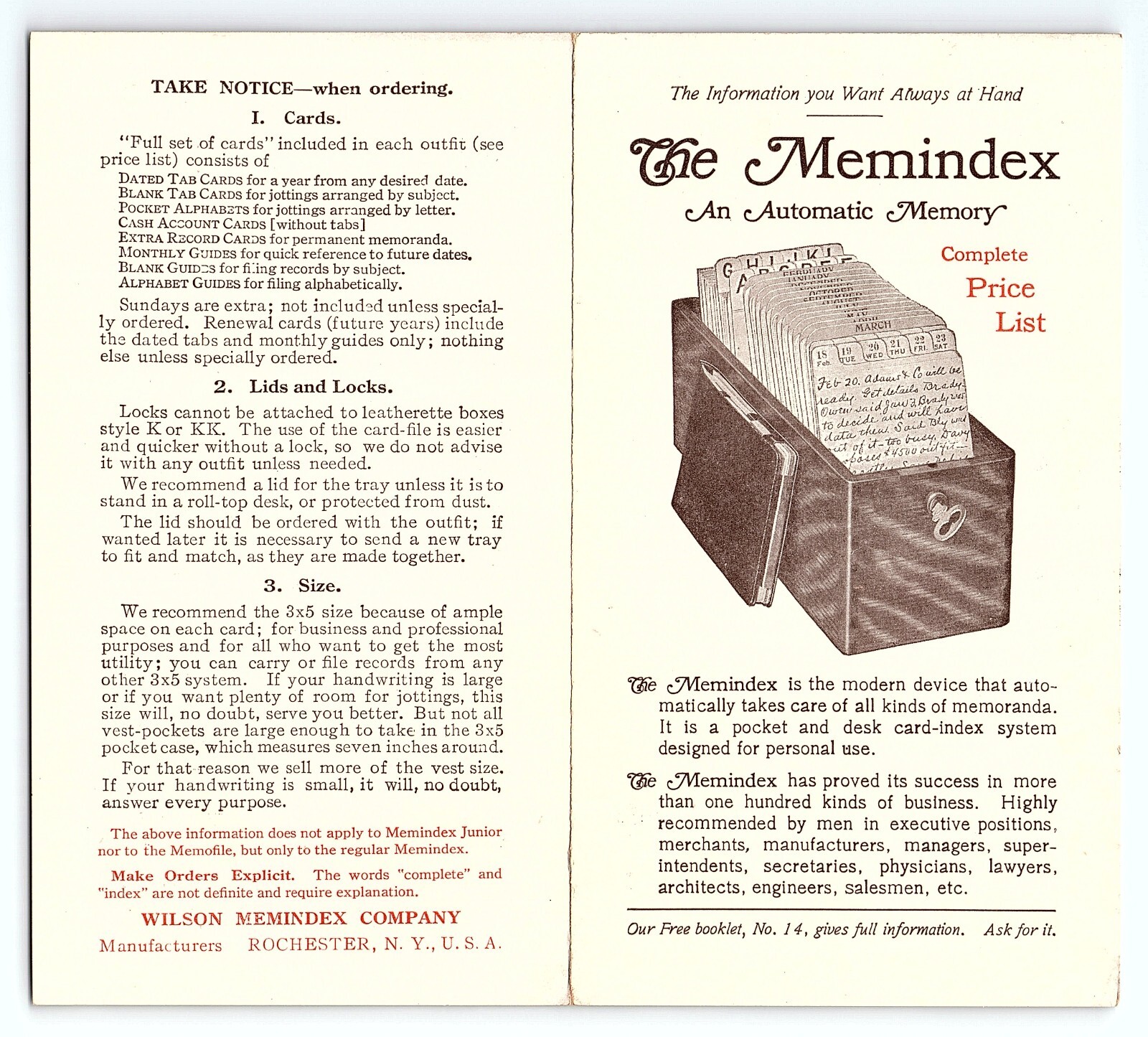

Features: - Sunday cards were sold separately and by my reading were full length tabs rather than 1/6 tabs like the other six days of the week - Lids were custom fit to the bases and needed to be ordered together - The Memindex Jr. held 400 cards versus the larger 9 inch standard trays which had space for 800 cards and block (presumably a block to hold them up or at an angle when partially empty).
The Memindex Jr., according to a price sheet in the 1930s, was used "extensively as an advertising gift".
The Memindex system had cards available in bundles of 100 that were labeled with the heading "Things to Keep in Sight".
-
- Feb 2023
-
Local file Local file
-
Odds ratios (ORs)
A statistic that quantifies the strength of association between two events, A and B. It is the ratio of the odds of A in the presence of B, the odds of A in the absence of B, the odds of B in the presence of A, or the odds of B in the absence of A.
-
-
www.markbernstein.org www.markbernstein.org
-
This volume is filled with finely-written, accessible and engaging pieces on such topics as Gibbon’s style, his library and note-taking practices, and his knowledge of the city of Rome.
The Cambridge Companion To Edward Gibbon by Karen O’Brien and Brian Young, eds.<br /> by Mark Bernstein
Oh, do tell!
-
-
Local file Local file
-
“I only dowhat is easy. I only write when I immediately know how to do it. If Ifalter for a moment, I put the matter aside and do something else.”(Luhmann et al., 1987, 154f.)[4]
By "easy" here, I think he also includes the ideas of fun, interesting, pleasurable, and (Csikszentmihalyi's) flow.
-
-
Local file Local file
-
Things were changing quickly.Eco’s methods of organizing and filing information werestill effective, but word processors and the Internet werebeginning to offer exciting alternatives to long-establishedresearch and writing techniques.
Esparmer is correct that research and writing did change with the advent of word processors and the internet in the 1990s and early 2000s (p xi), but these were primarily changes to the front and the back of the process. Esparmer and far too many others seem to miss the difference in which affordances were shifting here. The note taking and organization portions still remained the same, so Eco's advice is still tremendously important. Even if one were to do long form notes in notebook format or in digital documents, they would profitably advised to still properly cross-index their notes or have them in a form that allows them to rearrange them most simply with respect to the structuring and creative processes.
Losing the ability to move ideas around easily, restructure them, link them together and outline them was a tremendous blow in going from the old methods to the new digital ones.
Did we accidentally become enamored of the new technologies and forget that their affordances didn't completely replace those of the old methods?
-
-
forum.obsidian.md forum.obsidian.md
-
In paper books I use Cal Newport’s “Morse Code method” placing a dot in the margin by a main point and a dash in the margin by a supporting point.
-
- Jan 2023
-
www.ncbi.nlm.nih.gov www.ncbi.nlm.nih.gov
-
MATERIALS AND METHODS
What do you notice about the position of the method section in the paper? Is this the same as in the Report Writing Guidelines?
-
-
www.complexityexplorer.org www.complexityexplorer.org
-
https://www.youtube.com/watch?v=5pSGniUOyLc
Digital humanities aka Humanities Analytics
5:54 Simon DeDeo mentioned Alastair McKinnon the philosopher in the 60s did a stylopheric study of Kierkegaard pseudonyms - Kierkegaard's Pseudonyms: A New Hierarchy by Alastair McKinnon https://www.jstor.org/stable/20009297
Tools for supplementing research and scholarship
core audience is Ph.D. students
-
- Dec 2022
-
pressbooks.rampages.us pressbooks.rampages.us
-
https://pressbooks.rampages.us/msw-research/
Note taking section, particularly here: https://pressbooks.rampages.us/msw-research/chapter/5-writing-your-literature-review/#chapter-285-section-2
-
-
127.0.0.1:3999 127.0.0.1:3999
-
You can only declare a method with a receiver whose type is defined in the same package as the method. You cannot declare a method with a receiver whose type is defined in another package (which includes the built-in types such as int).
You can only declare a method with a receiver whose type is defined in the same package as the method.
-
A method is a function with a special receiver argument.
A method is a function with a special receiver argument.
-
-
apolitical.co apolitical.co
-
Some governments say labs build a culture of innovation. While a comforting idea, it’s wrong. Research from 2017 has found that while many companies and countries are investing in labs, that does not mean they are becoming more innovative. It concluded, “[Innovation] takes a lot more than opening a lab. It takes a disciplined approach on a number of fronts.”
So while something like an OpenLab can create value, it's not sufficient to bring in more innovation.
One could also put it this way: Instead of trying to become "the innovation lab" in our organization, why not use the group as a room where we can discuss how we bring innovation individually to our groups.
-
-
genizalab.princeton.edu genizalab.princeton.edu
-
Keeping track of research materials used to require an excellent memory, exceptional bookkeeping skills or blind luck; now we have databases.
Love the phrasing of this. :)
-
-
www.reddit.com www.reddit.com
-
To Zotero or not to Zotero?
reply to: https://www.reddit.com/r/PersonalKnowledgeMgmt/comments/zgvbg4/to_zotero_or_not_to_zotero/
I don't often add in web pages, but for books and journal articles I love Zotero for quickly bookmarking, tagging, and saving material I want to read. It's worth it's weight in gold just for this functionality even if you're not using it for writing citations in publications.
Beyond this, because of it's openness and ubiquity it's got additional useful plugins for various functions you may want to play around with and a relatively large number of tools are able to dovetail with it to provide additional functionality. As an example, the ability to dump groups of material from Zotero into ResearchRabbit to discover other literature I ought to consider is a fantastically useful feature one is unlikely to find elsewhere (yet).
-
-
www.newyorker.com www.newyorker.com
-
At Ipswich, he studied under the unorthodox artist and theorist Roy Ascott, who taught him the power of what Ascott called “process not product.”
"process not product"
Zettelkasten-based note taking methods, and particularly that followed by Luhmann, seem to focus on process and not product.
-
-
www.heritagedaily.com www.heritagedaily.com
-
Published in the journal, Proceedings of the Royal Society B, the paper also shows that the mice share similarities in mitochondrial DNA with Scandinavia and northern Germany, but not with mice found in Portugal.
Use of DNA on rodents to indicate ancient trade and travel.
-
-
stackoverflow.com stackoverflow.com
-
Procs can't accept blocks as implicit arguments (the format you're trying). A proc can receive other proc objects as arguments, either explicitly, or using & arguments. Example: a = Proc.new do |&block| block.call end a.call() {puts "hi"}
-
-
www.rfc-editor.org www.rfc-editor.org
-
But anti- spam software often fetches all resources in mail header fields automatically, without any action by the user, and there is no mechanical way for a sender to tell whether a request was made automatically by anti-spam software or manually requested by a user. To prevent accidental unsubscriptions, senders return landing pages with a confirmation step to finish the unsubscribe request. A live user would recognize and act on this confirmation step, but an automated system would not. That makes the unsubscription process more complex than a single click.
HTTP: method: safe methods: GETs have to be safe, just in case a machine crawls it.
-
This document describes a method for signaling a one-click function for the List-Unsubscribe email header field. The need for this arises out of the actuality that mail software sometimes fetches URLs in mail header fields, and thereby accidentally triggers unsubscriptions in the case of the List-Unsubscribe header field.
-
- Nov 2022
-
theinformed.life theinformed.life
-
All research… All significant research is, in some respects, bottom-up. There is no alternative. And so, the only research that you can do top-down entirely is research for which you already have the solution.
Research, by design, is a bottom-up process.
-
-
www.youtube.com www.youtube.com
-
Victor Margolin's note taking and writing process
- Collecting materials and bibliographies in files based on categories (for chapters)
- Reads material, excerpts/note making on 5 x 7" note cards
- Generally with a title (based on visual in video)
- excerpts have page number references (much like literature notes, the refinement linking and outlining happens separately later in his mapping and writing processes)
- filed in a box with tabbed index cards by chapter number with name
- video indicates that he does write on both sides of cards breaking the usual rule to write only on one side
- Uses large pad of newsprint (roughly 18" x 24" based on visualization) to map out each chapter in visual form using his cards in a non-linear way. Out of the diagrams and clusters he creates a linear narrative form.
- Tapes diagrams to wall
- Writes in text editor on computer as he references the index cards and the visual map.
"I've developed a way of working to make this huge project of a world history of design manageable."<br /> —Victor Margolin
Notice here that Victor Margolin doesn't indicate that it was a process that he was taught, but rather "I've developed". Of course he was likely taught or influenced on the method, particularly as a historian, and that what he really means to communicate is that this is how he's evolved that process.
"I begin with a large amount of information." <br /> —Victor Margolin
"As I begin to write a story begins to emerge because, in fact, I've already rehearsed this story in several different ways by getting the information for the cards, mapping it out and of course the writing is then the third way of telling the story the one that will ultimately result in the finished chapters."<br /> —Victor Margolin
-
-
www.obsidianroundup.org www.obsidianroundup.org
-
Inevitably, I read and highlight more articles than I have time to fully process in Obsidian. There are currently 483 files in the Readwise/Articles folder and 527 files marked as needing to be processed. I have, depending on how you count, between 3 and 5 jobs right now. I am not going to neatly format all of those files. I am going to focus on the important ones, when I have time.
I suspect that this example of Eleanor Konik's is incredibly common among note takers. They may have vast repositories of collected material which they can reference or use, but typically don't.
In digital contexts it's probably much more common that one will have a larger commonplace book-style collection of notes (either in folders or with tags), and a smaller subsection of more highly processed notes (a la Luhmann's practice perhaps) which are more tightly worked and interlinked.
To a great extent this mirrors much of my own practice as well.
-
-
billyoppenheimer.notion.site billyoppenheimer.notion.site
-
Carlin’s bags of categorized ideas, from the archives of George Carlin
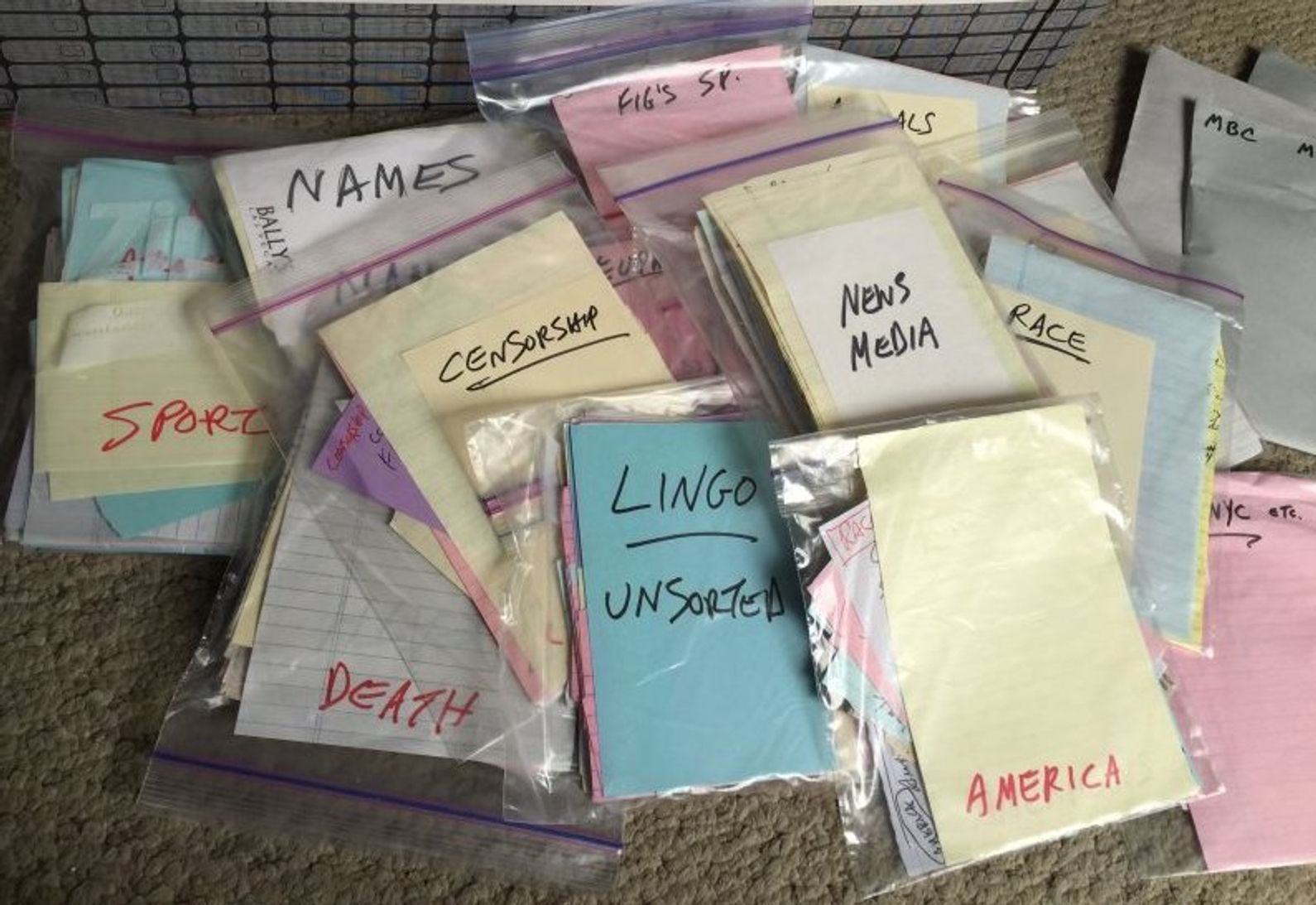
George Carlin kept his slips (miscellaneous scraps of collected paper with notes) sorted by topic name in Ziploc bags (literally that specific brand given the photo's blue/purple signature on the bag locks).
This is similar to others, including historian Keith Thomas, who kept his in labeled envelopes.
Tags
Annotators
URL
-
- Oct 2022
-
-
When I go to libraries or archives, I make notes in a continuous form on sheets of paper, entering the page number and abbreviated title of the source opposite each excerpted passage. When I get home, I copy the bibliographical details of the works I have consulted into an alphabeticised index book, so that I can cite them in my footnotes. I then cut up each sheet with a pair of scissors. The resulting fragments are of varying size, depending on the length of the passage transcribed. These sliced-up pieces of paper pile up on the floor. Periodically, I file them away in old envelopes, devoting a separate envelope to each topic. Along with them go newspaper cuttings, lists of relevant books and articles yet to be read, and notes on anything else which might be helpful when it comes to thinking about the topic more analytically. If the notes on a particular topic are especially voluminous, I put them in a box file or a cardboard container or a drawer in a desk. I also keep an index of the topics on which I have an envelope or a file. The envelopes run into thousands.
Historian Keith Thomas describes his note taking method which is similar to older zettelkasten methods, though he uses larger sheets of paper rather than index cards and files them away in topic-based envelopes.
-
In his splendid recent autobiography, History of a History Man, Patrick Collinson reveals that when as a young man he was asked by the medievalist Geoffrey Barraclough at a job interview what his research method was, all he could say was that he tried to look at everything which was remotely relevant to his subject: ‘I had no “method”, only an omnium gatherum of materials culled from more or less everywhere.’
How does a medievalist reference "omnium gatherum" without an explicit mention of even florilegia which generally translates as "gatherings of flowers" as their method?!
-
-
delong.typepad.com delong.typepad.com
-
method," and the method known variously as the "see-say,""look-say," "look-and-say," or "word method." Doubtless experiments are now being undertaken in methods and approaches that differ from all of these. It is perhaps too earlyto tell whether any of these is the long-sought panacea forall reading ills.
Hence, researchers are very active at the present time, and their work has resulted in numerous new approaches to reading instruction. Among the more important new programs are the so-called eclectic approach, the individualized reading approach, the language-experience approach, the various approaches based on linguistic principles, and others based more or less closely on some kind of programmed instruction. In addition, new mediums such as the Initial Teaching Alphabet ( i.t.a. ) have been employed, and sometimes these involve new methods as well. Still other devices and programs are the "total immersion method," the "foreign-language-school
Have we ultimately come to the conclusion that neurodiversity means there is no one-size-fits all solution? Should we also be placing some focus on orality and memory methods to allow those to flourish as well? Where is the literature on "orality pedagogy"? Is it a thing? It should be...
-
-
johannadaniel.fr johannadaniel.fr
-
johannadaniel.fr johannadaniel.fr
-
http://johannadaniel.fr/isidoreganesh/2015/06/archives-roland-barthes/
-
Il y a un point, en particulier, qui me frappe chaque jour davantage : ce que l’archive du chercheur d’hier peut apprendre au chercheur d’aujourd’hui, sur le plan de la méthodologie.
Translation:
There is one point in particular that strikes me more every day: what the archive of yesterday's researcher can teach today's researcher, in terms of methodology.
With the rarer exceptions of writers like Erasmus, Melanchthon, Agricola, U. Eco, and G. Weinberg who wrote manuals or others like John Locke (on Indices), E. Bernheim, Langlois/Seignobos, and B. Webb who tucked reasonable advice on research and note taking methods in their texts or appendices one of the benefits of of researcher archives is not just the historical record of the researcher's evolving thought, but to actually show specific types of methodology and changes through time.
-
-
Local file Local file
-
Lamenting that ‘I have only two eyes, and, unfortunately cannot use themso as to read two books at the same time’,
Tags
Annotators
-
-
archive.org archive.org
-
...the usefulness of a note-taking system has an ultimate limit beyond which it becomes self-defeating. [...] After all, the ultimate purpose of the exercise is not to produce beautiful notes displaying the researcher's technical prowess, but rather usable notes to build the mosaic.<br /> —Jacques Goutor (p33)
-
Goutor breaks down the post-processing of notes into two phases: "coding" (tagging or categorization) and "cross-referencing". (p31).
-
There is a difference between various modes of note taking and their ultimate outcomes. Some is done for learning about an area and absorbing it into one's own source of general knowledge. Others are done to collect and generate new sorts of knowledge. But some may be done for raw data collection and analysis. Beatrice Webb called this "scientific note taking".
Historian Jacques Goutor talks about research preparation for this sort of data collecting and analysis though he doesn't give it a particular name. He recommends reading papers in related areas to prepare for the sort of data acquisition one may likely require so that one can plan out some of one's needs in advance. This will allow the researcher, especially in areas like history or sociology, the ability to preplan some of the sorts of data and notes they'll need to take from their historical sources or subjects in order to carry out their planned goals. (p8)
C. Wright Mills mentions (On Intellectual Craftsmanship, 1952) similar research planning whereby he writes out potential longer research methods even when he is not able to spend the time, effort, energy, or other (financial) resources to carry out such plans. He felt that just the thought experiments and exercise of doing such unfulfilled research often bore fruit in his other sociological endeavors.
-
Goutor's description is offered as an outline of a mechanical method which he hopes will provide a greater level of efficiency, but which might be adapted to each researcher's work and needs. He also specifically offers it as a method to be used for "constructing some sort of final product". He considers it as serving the functions of gathering, organizing, storing and retrieving information.
(p3, Introduction)
-
Goutor indicates that "a certain amount of individual in methods is commendable, and indeed necessary." but that "it soon becomes apparent that there are some ways of doing things more efficient and ultimately more productive than others". But he goes on to bemoan that how to manuals offer little help.
(p3, Introduction)
Tags
- individuality
- 1980
- C. Wright Mills
- note taking methods
- Beatrice Webb
- usability
- note taking process
- note taking affordances
- research planning
- mosaics
- note taking why
- subject headings
- productivity
- quotes
- On Intellectual Craftsmanship
- cross references
- user interface
- card index as database
- scientific note taking
- card index
- Jacques Goutor
- note taking advice
- research methods
Annotators
URL
-
-
Local file Local file
-
I do not want toacquire any technique of work that would limit the play offancy.
-
- Sep 2022
-
-
Thesheets must always be of equal size, or at least of equal height in order not to get stuck or beoverlooked when manually searching for sheets or adding them.
-
-
Local file Local file
-
The fact that too much order can impede learning has becomemore and more known (Carey 2014).
-
After looking at various studies fromthe 1960s until the early 1980s, Barry S. Stein et al. summarises:“The results of several recent studies support the hypothesis that
retention is facilitated by acquisition conditions that prompt people to elaborate information in a way that increases the distinctiveness of their memory representations.” (Stein et al. 1984, 522)
Want to read this paper.
Isn't this a major portion of what many mnemotechniques attempt to do? "increase distinctiveness of memory representations"? And didn't he just wholly dismiss the entirety of mnemotechniques as "tricks" a few paragraphs back? (see: https://hypothes.is/a/dwktfDiuEe2sxaePuVIECg)
How can one build or design this into a pedagogical system? How is this potentially related to Andy Matuschak's mnemonic medium research?
-
This is not so different from when elaboration is recommended asa “learning method.” As a method, it has been proven to be moresuccessful than any other approach (McDaniel and Donnelly 1996).
Elaboration has been shown to be the most successful learning approach. (See McDaniel and Donnelly 1996) It is a two step process of being able to write about it and to use it in alternate contexts.
How is the Feynman Technique similar to/different from elaboration? It would seem to be missing the second portion.
This is one of the first times I've come across another word for part of the Feynman technique I've been looking for.
-
-
-
categorical reading method
Not well defined. What do they mean specifically by categorical reading methods? CERIC may be one, but what are others? Are they standardized?
-
The primary motivation behind categorical reading methods isto dissect each paper's structure and central argument using theabove conceptual model (Figure 1).
This appears to be the closed definition in the paper for the idea of categorical reading methods. They only provide one example without any comparison or contrast for better contextualization.
What is a more concrete idea for this particular term?
-
-
forum.zettelkasten.de forum.zettelkasten.de
-
Andy 10:31AM Flag Thanks for sharing all this. In a Twitter response, @taurusnoises said: "we are all participating in an evolving dynamic history of zettelkasten methods (plural)". I imagine the plurality of methods is even more diverse than indicated by @chrisaldrich, who seems to be keen to trace everything through a single historical tradition back to commonplace books. But if you consider that every scholar who ever worked must have had some kind of note-taking method, and that many of them probably used paper slips or cards, and that they may have invented methods relatively independently and tailored those methods to diverse needs, then we are looking at a much more interesting plurality of methods indeed.
Andy, I take that much broader view you're describing. I definitely wouldn't say I'm keen to trace things through one (or even more) historical traditions, and to be sure there have been very many. I'm curious about a broad variety of traditions and variations on them; giving broad categorization to them can be helpful. I study both the written instructions through time, but also look at specific examples people have left behind of how they actually practiced those instructions. The vast majority of people are not likely to invent and evolve a practice alone, but are more likely likely to imitate the broad instructions read from a manual or taught by teachers and then pick and choose what they feel works for them and their particular needs. It's ultimately here that general laziness is likely to fall down to a least common denominator.
Between the 8th and 13th Centuries florilegium flouished, likely passed from user to user through a religious network, primarily facilitated by the Catholic Church and mendicant orders of the time period. In the late 1400s to 1500s, there were incredibly popular handbooks outlining the commonplace book by Erasmus, Agricola, and Melancthon that influenced generations of both teachers and students to come. These traditions ebbed and flowed over time and bent to the technologies of their times (index cards, card catalogs, carbon copy paper, computers, internet, desktop/mobile/browser applications, and others.) Naturally now we see a new crop of writers and "influencers" like Kuehn, Ahrens, Allosso, Holiday, Forte, Milo, and even zettelkasten.de prescribing methods which are variously followed (or not), understood, misunderstood, modified, and changed by readers looking for something they can easily follow, maintain, and which hopefully has both short term and long term value to them.
Everyone is taking what they want from what they read on these techniques, but often they're not presented with the broadest array of methods or told what the benefits and affordances of each of the methods may be. Most manuals on these topics are pretty prescriptive and few offer or suggest flexibility. If you read Tiago Forte but don't need a system for work or project-based productivity but rather need a more Luhmann-like system for academic writing, you'll have missed something or will only have a tool that gets you part of what you may have needed. Similarly if you don't need the affordances of a Luhmannesque system, but you've only read Ahrens, you might not find the value of simplified but similar systems and may get lost in terminology you don't understand or may not use. The worst sin, in my opinion, is when these writers offer their advice, based only on their own experiences which are contingent on their own work processes, and say this is "the way" or I've developed "this method" over the past decade of grueling, hard-fought experience and it's the "secret" to the "magic of note taking". These ideas have a long and deep history with lots of exploration and (usually very little) innovation, but an average person isn't able to take advantage of this because they're only seeing a tiny slice of these broader practices. They're being given a hammer instead of a whole toolbox of useful tools from which they might choose. Almost none are asking the user "What is the problem you're trying to solve?" and then making suggestions about what may or may not have worked for similar problems in the past as a means of arriving at a solution. More often they're being thrown in the deep end and covered in four letter acronyms, jargon, and theory which ultimately have no value to them. In other cases they're being sold on the magic of productivity and creativity while the work involved is downplayed and they don't get far enough into the work to see any of the promised productivity and creativity.
-
-
Local file Local file
-
The second is the fact that, formany persons, the tasks of critical scholarship arenot without their charm; nearly every one findsin them a singular satisfaction in the long runand some have confined themselves to these taskswho might, strictly speaking, have aspired to higherthings.
what about people who may have been on the spectrum, and naturally suited to these endeavors, but who may have wished to hide from the resultant fame or notoreity? Those researchers surely existed in the past.
What about the quickening of these research databases in the digital era that allow researchers like Thomas Piketty to do work on the original sources, but still bring them into a form that allows the analysis and writing critically about them over the span of their own lifetimes? How many researchers are there like this?
-
It would be very interesting to have information on the methodsof work of the great scholars, particularly those who undertooklong tasks of collection and classification. Some information ofthis kind is to be found in their papers, and occasionally in theircorrespondence. On the methods of Du Cange, see L. Feugfere, Mudesur la vie et les ouvrages de Du Gomge (Paris, 1858, 8vo), pp. 62 sqq_,
Indeed! I find myself having asked this particular question in a similar setting/context before!!!
-
- Aug 2022
-
occidental.substack.com occidental.substack.com
-
https://occidental.substack.com/p/the-adlernet-guide-part-ii?sd=pf
Description of a note taking method for reading the Great Books: part commonplace, part zettelkasten.
I'm curious where she's ultimately placing the cards to know if the color coding means anything in the end other than simply differentiating the card "types" up front? (i.e. does it help to distinguish cards once potentially mixed up?)
-
-
-
German publishers send out so-called book cards to book shops along with their newreleases. On them, bibliographic information is printed. Those book cards are also in postcardsize, i.e. A6, and their textual structure allows for them to be included in the reference filebox.
Automatic reference cards!
When did they stop doing this!!!
-
In the mercantile world, the energy- and time consuming note book process has been replacedwith a file card system because competition forces them to save time and energy.
note the evolution here based on competition from practices in another field (accounting)
What was his experience within accounting and these traditions?
-
The sheet box
Interesting choice of translation for "Die Kartei" by the translator. Some may have preferred the more direct "file".
Historically for this specific time period, while index cards were becoming more ubiquitous, most of the prior century researchers had been using larger sheets and frequently called them either slips or sheets based on their relative size.
Beatrice Webb in 1926 (in English) described her method and variously used the words “cards”, “slips”, “quarto”, and “sheets” to describe notes. Her preference was for quarto pages which were larger pages which were likely closer to our current 8.5 x 11” standard than they were to even larger index cards (like 4 x 6".
While I have some dissonance, this translation makes a lot of sense for the specific time period. I also tend to translate the contemporaneous French word “fiches” of that era as “sheets”.
See also: https://hypothes.is/a/OnCHRAexEe2MotOW5cjfwg https://hypothes.is/a/fb-5Ngn4Ee2uKUOwWugMGQ
-
-
-
Gibbon for instance made all his notes
Historian Edward Gibbon made all of his notes "in books of fast-bound leaves".
-
Dow, Earle Wilbur. Principles of a Note-System for Historical Studies. Century Company, 1924.
-
-
docdrop.org docdrop.org
-
Allosso, Dan, and S. F. Allosso. How to Make Notes and Write. Minnesota State Pressbooks, 2022. https://minnstate.pressbooks.pub/write/.
-
-
-
the slips by the topicalheadings. Guide cards are useful to gdicate the several head-ings and subheadings. Under each heading classif the slipsin writing, discarding any that may not prove useful andmaking cross references for notes which may be needed foruse in more than one lace. This classification will reveal,almost automatically, wiere there are deficiencies in the ma-terials collected which should be remedied. The completedand classified collection of notes then becomes the basis ofcomposition.
missing some textual context here for full quote...
Dutcher is recommending arranging notes and cards by topical headings in a commonplace sort of method. He does recommend a sub-arrangement of placing them in logical order for one's writing however. He goes even further and indicates one may "make cross references for notes which may be needed for use in more than one place." Which provides an early indication of linking or cross linking cards to multiple places within in one's card index. (Has this cross referencing (linking) idea appeared in the literature specifically before, or is this an early instantiation of this idea?)
-
111. RESEARC
Dutcher suggest that there are three "purposes in reading": information, thought, and style.
-
-
worldcat.org worldcat.org
-
Technik des wissenschaftlichen Arbeitens by Johannes Erich Heyde( Book )29 editions published between 1931 and 1970 in 3 languages and held by 197 WorldCat member libraries worldwide
-
Technik des Wissenschaftlichen Arbeitens. Eine anleitung, besonders für Studierende, mit Ausführlichem Schriftenverzeichnis by Johannes Erich Heyde( Book )25 editions published between 1933 and 1951 in German and Undetermined and held by 114 WorldCat member libraries worldwide
-
Technik des wissenschaftlichen Arbeitens; eine Anleitung, besonders für Studierende by Johannes Erich Heyde( Book )32 editions published between 1931 and 1951 in German and held by 179 WorldCat member libraries worldwide
-
-
scottscheper.com scottscheper.com
-
https://scottscheper.com/letter/36/
Clemens Luhmann, Niklas' son, has a copy of a book written in German in 1932 and given to his father by Friedrich Rudolf Hohl which ostensibly is where Luhmann learned his zettelkasten technique. It contains a 34 page chapter titled Die Kartei (the Card Index) which has the details.
-
-
-
Heyde, Johannes Erich. 1931. Technik des wissenschaftlichen Arbeitens. Zeitgemässe Mittelund Verfahrensweisen: Eine Anleitung, besonders für Studierende, 3rd ed. Berlin: Junkerund Dünhaupt.
A manual on note taking practice that Blair quotes along with Paul Chavigny as being influential in the early 21st century.
-
-
occidental.substack.com occidental.substack.com
-
Malachy Walsh23 hr agoI'm 75 years old. Unfortunately I rejected the notecard method when it was taught in high school, instead choosing cumbersome notebooks all the way through graduate school...until Richard McKeon at University of Chicago recommended using notecards not only as a record of my reading and other experiences but also as a source of creative and rhetorical invention. This was a mind opening, life changing perspective. His only rule: each card or slip should pose and answer a single question. He recommended organizing all journal entries by one of the following topics: 1. By the so called great ideas in the Syntopticon. 2. By work or business projects, activities and events(I spent my life as an advertising man, juggling many assignments over 30 years, from Frosted Flakes to The Marines to Ford). 3. By great books worthy of Adler's analytical readings. 4. By everyday living topics like family, friends, health, wealth, politics, business, car, house, occasions, etc. This way of working has served me well. I believe a proper book case is half full of books and half full of boxes of notes about those books. Notice that McKeon's advice is not limited to writing and reflecting about the books we read. McKeown also encourages reflection on all areas of experience that are important to us. I guess I have an Aristotelian view that our lives consist of thinking, doing, making, and interacting and that writing offers us a way of connecting our thinking with these other activities. So, the nature, scope, and shape our "note system" should be designed to help us engage successfully in our day to day activities and long term enterprises. How should follow What and Why, connect with Who, and fit with When and Where. Any success I have had in business or personal life I attribute to McKeon's advice.
Richard McKeon's advice, as relayed by a student, on how to take notes using an index card based practice.
Does he have a written handbook or advice on his particular method?
-
- Jul 2022
-
Local file Local file
-
The industrious apprentice will find in the Appendix (C) a short memorandumon the method of analytic note-taking, which we have found most convenient inthe use of documents and contemporaneous literature, as well as in the recording ofinterviews and personal observations.
method of analytic note-taking from Beatrice Webb
-
in a later chapter I call it syntheticnote-taking, in order to distinguish it from the analytic note¬taking upon which historical work is based.
Webb distinguishes synthetic note taking from analytic note taking.
-
THE ART OF NOTE-TAKING
Beatrice Webb's suggestions: - Use sheets of paper and not notebooks, specifically so one can re-arrange, shuffle, and resort one's notes - She uses quarto pages as most convenient (quarto sizes have varied over time, but presumably hers were in the range of 8.5 x 11" sheets of paper, and thus rather large compared to index cards
It takes some careful attention, but her description of her method and how she used it in a pre-computer era is highly indicative of the fact that Beatrice Webb was actively creating a paper database system which she could then later query to compile data to either elicit insight or to prove answers to particular questions.
She specifically advises that one keep one and only one sort of particular types of data on each card whether that be dates, locations, subjects, or categories of facts. This is directly equivalent to the modern database design of only keeping one value in a particular field. As a result, each sheet within her notes might be equivalent to a row of related data which might contain a variety of different types of individual data. By not mixing data on individual sheets one can sort and resort their tables and effectively search through them without confusing data types.
Her work and examples here would have been in the period of 1890 and 1910 (she specifically cites that this method was used for her research on the "principles of 1834" which was subsequently published as English Poor Law Policy in 1910) at a time after Basile Bouchon and Joseph Marie Jacquard and contemporaneously with Herman Hollerith who were using punched cards for some of this sort of work.
-
-
danallosso.substack.com danallosso.substack.com
-
I'm trying to get info OUT of my note-taking system. It's not as easy as I'd like it to be.
This is one of the biggest problems with any of the systems digital or analog. The workflows for this are all generally not great.
I'm actually trying some advice from Konrad Gessner from the 1500s today. I've printed out some of my digital notes about Tiago Forte's new book to arrange and organize them in an attempt to reuse all my writing and thinking about it into a review of the book. It'll probably take a bit as I've left them for a week or two, but I'm curious to see what the manual process looks like here in an effort to help make the digital portion potentially easier.
-
-
Local file Local file
-
the behavioral sciences have commonly insisted upon certain arbi-trary methodological restrictions that make it virtually impossible for scientificknowledge of a nontrivial character to be attained.
What specifically?
-
-
www.remastery.net www.remastery.net
-
https://medium.com/curious/umberto-ecos-index-card-system-90faaa19734f
author: Julius Reizen
-
- Jun 2022
-
Local file Local file
-
There is no single right way to build a Second Brain. Your systemcan look like chaos to others, but if it brings you progress anddelight, then it’s the right one.
All this description and prescription, then say this?!
I'll agree that each person's system should be their own and work for them, but it would have been more helpful to have this upfront and then to have looked at a broad array of practices and models for imitation to let people pick and choose from a variety of practices instead of presenting just one dish on the menu: P.A.R.A. with a side of C.O.D.E.
-
There is one more layer we can add, though
This four layer processing thing is painful and I suspect few are going to spend this much time on so many potential ideas.
Ahren's framing of fleeting notes and permanent notes is quicker and easier.
Also missing is any sort of inherent link to any other ideas or even to a broader index to make it somewhat easier to find/use. Simply filing it into a folder, even an "important" one seems fairly useless and make-work.
-
Our notes are things to use,not just things to collect.
Many people take notes, they just don't know where they're taking them to. It's having a concrete use for them after you've written them down that makes all the difference. At this point, most would say that they do read back over them, but this generally creates a false sense of learning through familiarity. Better would be turning them into spaced repetition flashcards, or linking them to ideas and thoughts already in our field of knowledge to see if and where they fit into our worldview.
link to - research on false feeling of knowledge by re-reading notes in Ahrens
-
Instead of organizing ideas according to where they come from, Irecommend organizing them according to where they are going
This is a useful distinction.
-
-
www.insidehighered.com www.insidehighered.com
-
One of my frustrations with the “science of learning” is that to design experiments which have reasonable limits on the variables and can be quantitatively measured results in scenarios that seem divorced from the actual experience of learning.
Is the sample size of learning experiments really large enough to account for the differences in potential neurodiversity?
How well do these do for simple lectures which don't add mnemonic design of some sort? How to peel back the subtle differences in presentation, dynamism, design of material, in contrast to neurodiversities?
What are the list of known differences? How well have they been studied across presenters and modalities?
What about methods which require active modality shifts versus the simple watch and regurgitate model mentioned in watching videos. Do people do actively better if they're forced to take notes that cause modality shifts and sensemaking?
-
-
-
I know one magazine editor who hoardsnewspaper and magazine clippings.
Twyla Tharp tells the story of a colleague who is a magazine editor. They keep a pile of clippings of phots, illustrations, and stories in their desk and mine it, often with others, for something that will create story ideas for new work.
This method is highly similar to that of Eminem's "Stacking Ammo" method.
-
-
www.choosingeasy.com www.choosingeasy.com
-
Sönke Ahrens’ How to Take Smart Notes changed so much.Now everyone is condemning note-takers (those collecting knowledge in heaps, e.g. via the good old Evernote) and praising note makers (those selecting their notes and linking them to other knowledge and producing their own thinking through them, e.g. via newish tools such as Obsidian)
In the framing here, I don't think it was so much Ahren's book, but the florescence of note taking tools (many of them very technical and appealing to the male/techbro crowd mentioned earlier in the piece). Though perhaps some of this tech crowd were influenced by Ahrens to make these tools which simply accelerated the space.
-
-
zettelkasten.de zettelkasten.de
-
The four principles Niklas Luhmann used to build his notebox system are: Analog Numeric-alpha Tree Index The first letters of those four principles (A, N, T, I) are what comprise an Antinet. An Antinet Zettelkasten is a network of these four principles.
The four principles Niklas Luhmann used to build his notebox system are:
- Analog
- Numeric-alpha
- Tree
- Index
The first letters of those four principles (A, N, T, I) are what comprise an Antinet. An Antinet Zettelkasten is a network of these four principles.
-
- May 2022
-
Local file Local file
-
The last element in his file system was an index, from which hewould refer to one or two notes that would serve as a kind of entrypoint into a line of thought or topic.
Indices are certainly an old construct. One of the oldest structured examples in the note taking space is that of John Locke who detailed it in Méthode nouvelle de dresser des recueils (1685), later translated into English as A New Method of Organizing Common Place Books (1706).
Previously commonplace books had been structured with headwords done alphabetically. This meant starting with a preconceived structure and leaving blank or empty space ahead of time without prior knowledge of what would fill it or how long that might take. By turning that system on its head, one could fill a notebook from front to back with a specific index of the headwords at the end. Then one didn't need to do the same amount of pre-planning or gymnastics over time with respect to where to put their notes.
This idea combined with that of Konrad Gessner's design for being able to re-arrange slips of paper (which later became index cards based on an idea by Carl Linnaeus), gives us an awful lot of freedom and flexibility in almost any note taking system.
Building blocks of the note taking system
- atomic ideas
- written on (re-arrangeable) slips, cards, or hypertext spaces
- cross linked with each other
- cross linked with an index
- cross linked with references
are there others? should they be broken up differently?
Godfathers of Notetaking
- Aristotle, Cicero (commonplaces)
- Seneca the Younger (collecting and reusing)
- Raymond Llull (combinatorial rearrangements)
- Konrad Gessner (storage for re-arrangeable slips)
- John Locke (indices)
- Carl Linnaeus (index cards)
-
-
journals.plos.org journals.plos.org
-
However, the degraded performance across all groups at 6 weeks suggests that continued engagement with memorised information is required for long-term retention of the information. Thus, students and instructors should exercise caution before employing any of the measured techniques in the hopes of obtaining a ‘silver bullet’ for quick acquisition and effortless recall of important data. Any system of memorization will likely require continued practice and revision in order to be effective.
Abysmally sad that this is presented without the context of any of the work over the last century and a half of spaced repetition.
I wonder that this point slipped past the reviewers and isn't at least discussed somewhat narratively here.
-
-
www.reddit.com www.reddit.com
-
For Eco on using something like a ZK, see his short book How to Write an Essay. Basically, he writes about making something that we could say is like a ZK, but one card system for each writing assignment.
Umberto Eco's book How to Write a Thesis (MIT Press, 2015, #) can broadly be thought of as a zettelkasten system, but it advises a separate system for each project or writing assignment. This is generally good advice, and potentially excellent for students on a one-time basis, but it prevents one from benefitting from the work over multiple projects or even a lifetime.
In some sense, a more traditional approach, and one seen used in Niklas Luhmann's example is to keep different sections separated by broad topics.
Niklas Luhmann's zettelkasten #1 had 108 broad topics (along with a bibliography and a subject index), and zettelkasten #2 had 11 broad topics. (Cross reference: https://niklas-luhmann-archiv.de/bestand/zettelkasten/inhaltsuebersicht)
The zettelkasten structure allowed a familiar "folder" like top level structure, but the bibliographic and subject indices allowed them to interlink ideas from one space to the next for longer term work on multiple projects simultaneously.
-
-
Local file Local file
-
the lessons you will find within thesepages are built on timeless and unchanging principles
The ideas behind knowledge management are largely timeless, but they are far from unchanging. They have evolved slowly over 2000+ years until we broadly threw many of them away in the early 20th century.
One only need read a few pages of Ann M. Blair's Too Much to Know: Managing Scholarly Information before the Modern Age to see some of the changes and shifts within the space from the 1400s on.
-
-
Local file Local file
-
$L(#&$'&$+-41,[*$4'2'+18$081**)--C*Y$*+=4#&+*$=*#$+"#*#$+--8*$+-$8#1)&$"-H$+-$H)'+#Y$4)1HY$1&4$0180=81+#$-&$*"##+*$-.$919#)$+"1+Y$H"#&$08'99#4Y$*+198#4Y$-)$28=#4$+-2#+"#)Y$7#0-C#$1$&-+#7--@V
What are the differences in the affordances of handwritten notes versus digital notes? Worth making a complete list.
-
- Apr 2022
-
-
Theories of note-taking can tell us about how memory and writingwere understood, and practices of note-taking, about the tools that proved mostuseful in managing textual information in early modern Europe.
Historical note taking practices can tell us many things aside from just the ways in which textual information was managed. They can also tell us about how people lived, how they thought, how they used memory and writing and how these things were understood culturally.
We do however need to be careful in how we interpret these documents historically. We need to attempt to view them exegetically and not eisegetically. We also need to be careful to look at them from a "large world" perspective and not presume that small things had large and heavy influence on things to come in the future.
-
Francis Bacon explained succinctlythat notes could be made either “by epitome or abridgement” (that is, by sum-marizing the source) or “by heads or commonplaces” (that is, by copying a pas-sage verbatim or nearly so and storing it in a notebook under a commonplaceheading for later retrieval and use). Bacon considered the latter method “of farmore profit and use,” and most note-taking advice focused on this practice of ex-cerpting.46
This quote is worth looking up and checking its context. Particularly I'm interested to know if the purpose of summarizing the source is to check one's understanding of the ideas as is done in the Feynman technique, or if the purpose is a reminder summary of the piece itself?
Link to Ahrens mentions of this technique for checking understanding. (Did he use the phrase Feynman in his text?)
-
The Jesuit Francesco Sac-chini, in contrast, commended the interruption in reading that resulted fromstopping to copy a passage into one’s notebook: it slowed down reading and aidedretention.44
-
Pedagogues considered marginal annotations as the first, optional step towardthe ultimate goal of forming a free-standing collection of excerpts from one’sreading. In practice, of course, readers could annotate their books without takingthe further step of copying excerpts into notebooks.
Annotations or notes are definitely the first step towards having a collection of excerpts from one's reading. Where to put them can be a useful question though. Should they be in the margins for ease of creation or should they go into a notebook. Both of these methods may require later rewriting/revision or even moving into a more convenient permanent place. The idea "don't repeat yourself" (DRY) in programming can be useful to keep in mind, but the repetition of the ideas in writing and revision can help to quicken the memory as well as potentially surface additional ideas that hadn't occurred upon the notes' original capture.
-
An eighteenth- century manual of bookkeeping listed three stages ofrecords a merchant should keep: waste book, journal (arranged in systematicorder), and ledger (featuring an index to access all people, places, and merchan-dise)
-
Early modern scholars referred most often to merchants as exemplars for theirhabit of keeping two notebooks: a daybook (or journal) to record transactionsin the order in which they occurred and a ledger in which these transactionswere sorted into categories, as in double- entry bookkeeping
-
During the same period zibaldone designated notebooks kept bywriters, artists, and merchants to record a wide variety of information: outgoingletters, copies of documents, indexes to books, lists of paintings, and excerptscopied from all kinds of texts, including poetry, prose, merchants’ manuals, legalsources, and tables of weights and measures.27
-
Italian merchants of the fourteenth and fifteenthcenturies are known for keeping ricordanze that combined personal and practicalinformation.
Compare this with the waste book tradition in accounting.
-
But it is more difficult in a world of manuscriptsthan in the era of printing to evaluate what constitutes a note—that is, a piece ofwriting not meant for circulation but for private use, say, as preparatory toward afinished work
Based on this definition of a "note", one must wonder if my public notes here on Hypothes.is are then not notes as they are tacitly circulated publicly from the first use. However they are still specifically and distinctly preparatory towards some future finished work, I just haven't yet decided which ultimate work in which they'll appear.
-
Pliny’s abundant reading and note-taking in one of his nephew’s letters (which I discuss in more detail below).
-
Discardingand forgetting are crucial to effective information management.
-
Wax tablets were the standard erasable surfacefrom antiquity to the Renaissance: one or more boards, often bound togetherin a codex form, were coated in wax to be inscribed with a stylus then erased forreuse.7 In early modern England one could also purchase pocket-sized writingtablets featuring paper that had been treated so as to offer a rigid writing surfaceon which markings made with the accompanying metal stylus could be erasedwith a little moisture.8 The slate blackboard is also attested in Europe in musicinstruction in the sixteenth century, sized either for group or for personal use(as is still the case today), and was used at least by the eighteenth century in theteaching of astronomy. The sand tray, a board or slab spread with a fine layer ofsand that one inscribed with a stick and could easily erase, was another long-lived medium: used in ancient Babylon and medieval Islam for calculations andin Europe principally for children and artists learning to write or sketch down tothe Victorian period.9 None of these temporary notes have left any traces, exceptthrough extant higher- order notes made from them.
-
A study of Samuel Johnson (1709–84) has identified four different kinds of reading in which Johnson described himself engaging: “hard study” for learned books read with pen in hand, “perusal” for purposeful consultation in search of information, “curious reading” for engrossment in a novel, and “mere reading” for browsing and scanning “without the fatigue of close attention.”216
"Mere reading" today consists of a lot of scrolling through never-ending social media posts on mobile phones....
-
More detailed work in the history of reading has cast aside the strict periodization and the suddenness of change implied in the notion of a “reading revolution.”215 Rather than sudden shifts, I trace the development and spread of new methods of reading along-side the continuation of older options. Consultation reading existed among the learned in earlier centuries, and in an unbroken line of transmission at least as far back as the thirteenth century, so the most distinctively new kind of reading in the eighteenth century was not consultation reading but rather engrossment in the novels that were a new and successful genre. Conversely, “intensive reading,” classically identified with repetitive meditation on the Bible, was also practiced in the eighteenth century, in religious circles at least, for example, among Pi-etists, Methodists, and in Catholic religious orders. (Witness the 1786 publica-tion of Sacchini’s recommendation for intensive reading, which I discuss in the next chapter.) Proficient readers engaged in different kinds of reading depending on the text and their purpose in reading it.
Broad forms of reading: - consultation reading - intensive reading (meditation, religious) - entertainment reading (novels)
Tags
- discarding
- fifteenth century
- handbooks
- music
- epitome
- definitions
- Europe
- reading with a pen in hand
- ledgers
- pedagogy
- Samuel Johnson
- active reading
- Babylon
- intensive reading
- commonplace books
- accounting
- zibaldone
- Italian merchants
- abridgement
- note taking
- Francis Bacon
- notebooks
- aide-mémoire
- subject headings
- excerpting
- entertainment reading
- Feynman Technique
- manuals
- circulation
- annotations
- ricordanze
- marginalia
- note taking methods
- personal papers
- publishing
- tablets
- waste books
- daybooks
- eisegesis vs. exegesis
- interruptions
- history
- memory
- Francesco Sacchini
- understanding
- art
- don't repeat yourself
- double-entry accounting
- working in public
- Pliny
- sand trays
- public vs. private
- reading methods
- paper
- consultation reading
- creative writing
- journals
- fourteenth century
- wax tablets
- writing
- forgetting
- ledger
Annotators
URL
-
-
-
In 2019, Smolyansky co-founded Connected Papers, one of a new generation of visual literature-mapping and recommendation tools.
https://www.connectedpapers.com/
https://twitter.com/ConnectedPapers
Something about the name Connected Papers reminds me of the same sort of linking name that Manfred Kuehn gave to his note taking software ConnectedText.
-
-
twitter.com twitter.com
-
Dr Ellie Murray, ScD. (2021, July 6). Also, see👇🏼 [Tweet]. @EpiEllie. https://twitter.com/EpiEllie/status/1412249702460968967
-
-
Local file Local file
-
one cannot help but wish that Blair had discussed her ownmethod at greater length, especially given that many of the authors she citesbelieved the sources of one’s achievement should be made public.
I too had hoped that Ann Blair would discuss her own methods of note taking, compiling, and analysis.
Perhaps we should interview her for the details?
-
-
www.poverty-action.org www.poverty-action.org
-
Public Data
-
-
www.zylstra.org www.zylstra.org
-
2. What influence does annotating with an audience have on how you annotate? My annotations and notes generally are fragile things, tentative formulations, or shortened formulations that have meaning because of what they point to (in my network of notes and thoughts), not so much because of their wording. Likewise my notes and notions read differently than my blog posts. Because my blog posts have an audience, my notes/notions are half of the internal dialogue with myself. Were I to annotate in the knowledge that it would be public, I would write very differently, it would be more a performance, less probing forwards in my thoughts. I remember that publicly shared bookmarks with notes in Delicious already had that effect for me. Do you annotate differently in public view, self censoring or self editing?
To a great extent, Hypothes.is has such a small footprint of users (in comparison to massive platforms like Twitter, Facebook, etc.) that it's never been a performative platform for me. As a design choice they have specifically kept their social media functionalities very sparse, so one also doesn't generally encounter the toxic elements that are rampant in other locations. This helps immensely. I might likely change my tune if it were ever to hit larger scales or experienced the Eternal September effect.
Beyond this, I mostly endeavor to write things for later re-use. As a result I'm trying to write as clearly as possible in full sentences and explain things as best I can so that my future self doesn't need to do heavy work or lifting to recreate the context or do heavy editing. Writing notes in public and knowing that others might read these ideas does hold my feet to the fire in this respect. Half-formed thoughts are often shaky and unclear both to me and to others and really do no one any good. In personal experience they also tend not to be revisited and revised or revised as well as I would have done the first time around (in public or otherwise).
Occasionally I'll be in a rush reading something and not have time for more detailed notes in which case I'll do my best to get the broad gist knowing that later in the day or at least within the week, I'll revisit the notes in my own spaces and heavily elaborate on them. I've been endeavoring to stay away from this bad habit though as it's just kicking the can down the road and not getting the work done that I ultimately want to have. Usually when I'm being fast/lazy, my notes will revert to highlighting and tagging sections of material that are straightforward facts that I'll only be reframing into my own words at a later date for reuse. If it's an original though or comment or link to something important, I'll go all in and put in the actual work right now. Doing it later has generally been a recipe for disaster in my experience.
There have been a few instances where a half-formed thought does get seen and called out. Or it's a thought which I have significantly more personal context for and that is only reflected in the body of my other notes, but isn't apparent in the public version. Usually these provide some additional insight which I hadn't had that makes the overall enterprise more interesting. Here's a recent example, albeit on a private document, but which I think still has enough context to be reasonably clear: https://hypothes.is/a/vmmw4KPmEeyvf7NWphRiMw
There may also be infrequent articles online which are heavily annotated and which I'm excerpting ideas to be reused later. In these cases I may highlight and rewrite them in my own words for later use in a piece, but I'll make them private or put them in a private group as they don't add any value to the original article or potential conversation though they do add significant value to my collection as "literature notes" for immediate reuse somewhere in the future. On broadly unannotated documents, I'll leave these literature notes public as a means of modeling the practice for others, though without the suggestion of how they would be (re-)used for.
All this being said, I will very rarely annotate things privately or in a private group if they're of a very sensitive cultural nature or personal in manner. My current set up with Hypothesidian still allows me to import these notes into Obsidian with my API key. In practice these tend to be incredibly rare for me and may only occur a handful of times in a year.
Generally my intention is that ultimately all of my notes get published in something in a final form somewhere, so I'm really only frontloading the work into the notes now to make the writing/editing process easier later.
-
How do you get your annotations into the rest of your workflow for notes and learning? How do you prevent that your social annotation tool is yet another separate place where one keeps stuff, cutting off the connections to the rest of one’s work and learning that would make it valuable?
Where
My annotations broadly flow into two spaces:
Obsidian
My private Obsidian-based vault is where I collect the notes and actively work on, modify, edit, and expand them if and when necessary. This is also the space where I'm broadly attempting to densely interlink them together for future use and publication in other venues. If I could, I would publish these all on the web, but I've yet to find a set up with a low enough admin tax that I can publish them inexpensively in a way I'd like them to appear (primarily with properly linked [[WikiLinks]]) while still owning them in my own space.
I've been experimenting around with using Blot.im as a solution to display them here https://notes.boffosocko.com/, but at present it's a very limited selection of my extant notes and doesn't include Webmention or other niceties I'd like to add. As it's a very alpha stage experiment I don't recommend anyone follow or use it and it may disappear altogether in the coming months.
WordPress
My main website uses WordPress. To a great extent, this is (now) primarily a back up location and the majority of the annotations are unpublished to the public, but are searchable to me on the back end.
I do, however, use it occasionally for quickly publishing and syndicating select annotations which I think others may find interesting or upon which I'm looking for comments/feedback and don't expect that the audience I'd like these from will find them natively on Hypothes.is' platform. An example of this might be a paper I was reading this weekend on Roland Barthes which discusses his reasonably well documented zettelkasten-like note taking practice. The article can be found here: https://culturemachine.net/wp-content/uploads/2019/01/373-604-1-PB.pdf with the annotations seen here: https://docdrop.org/pdf/The-Card-Index-as-Creativity-Ma---Wilken-Rowan-upq8g.pdf/. To tip off others in the space, I made a post on my site with a bit of a puzzle and syndicated it to Twitter. A few hours later I posted a follow up with some additional details and links to my notes on hypothesis which got some useful feedback from Matthias Melcher on the Barthes paper as well as on a related paper I mentioned by Luhmann, particularly about German translation, with which I have little facility.
Another recent illustrative example was this annotation on the Library of Congress website about Vladimir Nabokov which was picked up by my website (though unpublished/not public) but which I syndicated to Twitter primarily to be able to send a notification to Eleanor Konik who I know is interested in the idea of World Building using historical facts and uses Obsidian in her work. (The @mention in the tweet is hiding in the image of the index card so that I could save text space in the main tweet.) Several others interested in note taking and zettelkasten for writing also noticed it and "liked" it. Not being on Hypothes.is to my knowledge much less following me there, neither Eleanor nor the others would have seen it without the Tweet.
<script async src="https://platform.twitter.com/widgets.js" charset="utf-8"></script>Nabokov used index cards for his research & writing. In one index card for Lolita, he creates a "weight-heigh-age table for girls of school age" to be able to specify Lolita's measurements. He also researched the Colt catalog of 1940. #WorldBuildinghttps://t.co/i16Yc7CbJ8 pic.twitter.com/JSjXV50L3M
— Chris Aldrich (@ChrisAldrich) April 10, 2022How
Obsidian
Getting annotations from Hypothes.is to Obsidian is a short two-step process which is reasonably well automated so that I don't spend a lot of time cutting/pasting/formatting.
I start with an IFTTT recipe that takes the RSS output of Hypothes.is and creates text files directly into my Obsidian vault. The results are quite rudimentary and only include the title of the document, the permalink of the Hypothes.is post, the highlighted text, and my annotation. It doesn't include the tags as RSS doesn't have a specification for these.
Second, I've set up Hypothesidian which has a much higher fidelity dovetail with the Hypothes.is API to get all the data and even the formatting set up I'm looking for. A reasonably well laid out set of instructions with a low/no code approach for it can be found at https://forum.obsidian.md/t/retrieve-annotations-for-hypothes-is-via-templater-plugin-hypothes-idian/17225. It allows importing annotations by a variety of methods including by date and by document URL. I've also made a small modification to it so that tags on Hypothes.is are turned into [[wikilinks]] in Obsidian instead of #tags which I only use sparingly.
All the IFTTT annotations will be ported individually into a specific Obsidian folder where I'll process them. I can then quickly use Hypothesidian to import the properly laid out version (using templates) of the notes with just a few keystrokes and then focus my time on revising my notes if necessary and then linking them to the appropriate notes already in my system. Finally I'll move them into the appropriate folder based on their content—typically one of the following: zettelkasten, wiki, commonplace, dictionary, or sources (for bibliographic use). Careful watchers will notice that I often use Hypothes.is' "page notes" functionality to create a bookmark-like annotation into which I will frequently post the URL of the page and occasionally a summary of a piece, these are imported into my system and are used as source/bibliographic information. I also have some dovetailing with Zotero as a bibliographic set up which feeds into this data as well.
This version which I've cobbled together works well for me so that I'm not missing anything, but there are definitely other similar processes available out there both for Obsidian (with plugins or scripts) as well as for other platforms. If I'm not mistaken, I think Readwise (a paid solution) has a set up for note transfer and formatting.
WordPress
As there isn't an extant Micropub client for Hypothes.is I initially used RSS as a transport layer to get my notes from Hypothes.is into WordPress. The fidelity isn't great in part because RSS doesn't include any tags. To get some slightly better presentation I set up a workflow using RSS output from Hypothes.is as input into an IFTTT workflow which outputs to a webhook that stands in as a Micropub client targeting my websites Micropub server. Some of the display on my site is assisted by using the Post Kinds plugin, which I know you've been working around yourself. The details may be above some, but I've outlined most of the broad strokes of how this is done in a tutorial at https://boffosocko.com/2020/01/21/using-ifttt-to-syndicate-pesos-content-from-social-services-to-wordpress-using-micropub/. In that example, I use the service Pocket as an example, but Hypothes.is specific information could easily be swapped out on a 1-1 basis.
A custom stand-alone or even an integrated micropub client for Hypothes.is would be a fantastic project if someone wanted to dig into the details and dovetail it with the Hypothes.is API.
Why
Ideally, I'm hoping that small pieces loosely joined and IndieWeb building blocks will allow me to use the tools and have the patterns I'm looking for, without a lot of work, so that I can easily make annotations with Hypothes.is but have and share (POSSE) my content on my own site in a way that works much the way many IndieWeb sites dovetail with Twitter or Mastodon.
I'm doing some portions of it manually at present, without a lot of overhead, but it would be fun to see someone add micropub and webmention capabilities to Hypothes.is or other IndieWeb building blocks. (I suspect it won't be Hypothes.is themselves as their team is very small and they're already spread thin on multiple other mission critical projects.)
In the end, I'm using Hypothes.is as a well designed and convenient tool for quickly making notes on digital documents. All the data is flowing to one of two other locations where I'm actually making use of it. While there is some social layer there, I'm getting email notifications through the Hypothes.is settings and the data from my responses just gets rolled back into my spaces which I try to keep open and IndieWeb friendly by default. At the same time, for those who want or need it, Hypothes.is' interface is a great way of reading, searching, sorting, and interacting with my notes in public, particularly until I get something specific and user friendly up to do it on my own domain.
-
-
docdrop.org docdrop.org
-
The filing cards or slipsthat Barthes inserted into his index-card system adhered to a ‘strictformat’: they had to be precisely one quarter the size of his usualsheet of writing paper. Barthes (1991: 180) records that this systemchanged when standards were readjusted as part of moves towardsEuropean unification. Within the collection there was considerable‘interior mobility’ (Hollier, 2005: 40), with cards constantlyreordered. There were also multiple layerings of text on each card,with original text frequently annotated and altered.
Barthes kept his system to a 'strict format' of cards which were one quarter the size of his usual sheet of writing paper, though he did adjust the size over time as paper sizes standardized within Europe. Hollier indicates that the collection had considerable 'interior mobility' and the cards were constantly reordered with use. Barthes also apparently frequently annotated and altered his notes on cards, so they were also changing with use over time.
Did he make his own cards or purchase them? The sizing of his paper with respect to his cards might indicate that he made his own as it would have been relatively easy to fold his own paper in half twice and cut it up.
Were his cards numbered or marked so as to be able to put them into some sort of standard order? There's a mention of 'interior mobility' and if this was the case were they just floating around internally or were they somehow indexed and tethered (linked) together?
The fact that they were regularly used, revise, and easily reordered means that they could definitely have been used to elicit creativity in the same manner as Raymond Llull's combinatorial art, though done externally rather than within one's own mind.
-
I am speaking here of what appear to be Barthes’ fichier boîte or indexcard boxes which are visible on the shelf above and behind his head.
First time I've run across the French term fichier boîte (literally 'file box') for index card boxes or files.
As someone looking into note taking practices and aware of the idea of the zettelkasten, the suspense is building for me. I'm hoping this paper will have the payoff I'm looking for: a description of Roland Barthes' note taking methods!
-
-
twitter.com twitter.com
-
Surprised no one mentioned window notes as a strategy. You fold the paper into 4 squares entitled Facts, Feelings, Questions, and Ideas.
Window notes are a note taking method in which one folds a piece of paper into four squares and titles them "facts", "feelings", "questions", and "ideas" to be filled in by the note taker.
<script async src="https://platform.twitter.com/widgets.js" charset="utf-8"></script>Surprised no one mentioned window notes as a strategy. You fold the paper into 4 squares entitled Facts, Feelings, Questions, and Ideas. I also like the idea of using Popplet or Evernote as a digital or collaborative note taking method as well to include drawings and videos.
— Valerie Lewis (@iamvlewis) October 7, 2018
-
- Mar 2022
-
www.youtube.com www.youtube.com
-
https://www.youtube.com/watch?v=lnFHwl2Dbr0
- System should be as frictionless as possible.
- Capture in one location. (She says as few as possible, but this is too wishy-washy: she's got a "Readwise page" and a "Links page".)
- There needs to be levels of processing.
- Split out based on future value.
- Everything has resources. How to capture metadata and be able to cite it?
Everything needs to have a "Why"? What is the context for capturing? What is the reason? How will it be used in the future? Why was it interesting?
She also describes how she collects notes in various formats (books, online articles, Kindle, Twitter, etc.) It primarily involves using Notion along with a variety of other sub-applications including Instapaper for sharing to Notion.
Dramatically missing from this presentation is the answer to the question "why" collect all this stuff? How is she using it in the future? What is the overall value? She touches on writing the why for herself as she's taking notes, but I get the impression that she's not actively practicing what she preaches, and I suspect that many don't. This leaves me with the impression that she's collecting with no end goal, which for many may be fine.
She's got a gaping hole in the processing section which likely needs a video unto itself and which would probably go a long way toward answer the "why" question above.
In looking at her other videos, I see she's using the phrase "second brain" and words like productivity. There seems to be a high level of disconnect between those using "second brain" and the "why do this?" question other than the simple idea of "productivity" which seems to be a false trap that gets people into the mindset of being a collector for collections' sake.
Almost hilariously she's got videos with titles like: - "I'm a productivity guru and I hate it." - "Productivity YouTube is brainwashing you"
She's titled the final portion of the video "Outro" which is actually displayed on the video UI. This might be useful for production purposes but should be changed or omitted for actual consumption.
The title "How I Remember Everything I Read" is pure clickbait here. It's more aptly titled, "How I Take and Save Notes". Where's the how I use this after? or how I review over it all to actually remember it/memorize it? There's nothing here to support this end of things which is the promise given in the title.
-
-
-
nicholas lerman is a sample of one 01:09:54 and if the zerocarton is a tool for thinking there are all these other thinkers out there who are thinking um and do we know how they're thinking how their 01:10:07 how you know what note systems are they using i'd like to i'd like to be able to place lerman yeah amongst all these others and and sort of in the zerocast and 01:10:23 see what others are doing as well and yeah i mean if there was one project i would have loved to do is going around 01:10:36 asking everyone i whose work i admire how do you do it how do you do it exactly what do you do in the morning how do you sit down how do you digest the books you're reading 01:10:48 um i was obsessed with the idea and it's just because i'm too shy to follow up on that
Some discussion of doing research on zettelkasten methods and workflows.
What do note taking methods and processes look like for individual people?
What questions would one ask for this sort of research in an interview setting (compared to how one would look at extant physical examples in document-based research)? #openquestions
Link this to the work of Earle Havens on commonplace books through portions of history.
-
-
cs3110.github.io cs3110.github.io
-
A method is a component of an object
I liked the definition of method used in Julia Language: a method is the implementation of a function for some concrete types of its parameters. For example the following are distinct methods for the function
sum(x,y):sum(x:int, y:int)is distinct fromsum(x:float,y:float)andsum(x:int,y:float)andsum(x:float,y:int).I have a hunch that such definition can be restricted to match the OO static semantic by saying something like: a method in OO is the implementation of a function where only the type of the first argument is used for method-dispatching; when the method is defined inside the lexical scope of a class (data type) the first parameter is implicitly defined as
this: ClassType...I hope this makes sense to some PL scientist, at least. If it does, I hope to see a definition of methods that can be specialised to match different language sematics.
-
-
ratfactor.com ratfactor.com
-
They get harder to read the longer I wait to transcribe them.
He's using his Field Notes notebooks as waste books and transcribing the important pieces into other places as necessary.
He also indicates that he's taking brief, reminder notes (or fleeting notes) contemporaneously and then expanding upon them later as necessary.
-
-
-
The use of gesture supplies a temporary scaffold that supports theseundergraduates’ still wobbly understanding of the subject as they fix theirknowledge more firmly in place.
Gesturing supplies a visual scaffolding which allows one to affix their budding understanding of new concepts into a more permanent structure.
-
“It is from the attempt of expressing themselves thatunderstanding evolves, rather than the other way around,” he maintains.
—Woff-Michael Roth
Actively attempting to express oneself is one of the best methods of evolving one's understanding.
Link this to the ideas related to being forced to actively manufacture the answer to a question is one of the best ways to learn.
-
A simple request to “move your handsas you explain that” may be all it takes. For children in elementary school, forexample, encouraging them to gesture as they work on math problems leadsthem to discover new problem-solving strategies—expressed first in their handmovements—and to learn more successfully the mathematical concept understudy.
Given the benefits of gesturing, teachers can improve their pedagogy simply by encouraging their students to move their hands while explaining things or working on problems.
Studies with elementary school children have shown that if they gesture while solving math problems led them to discover and understand new concepts and problem solving strategies.
link this with prior idea of handwriting out annotations/notes as well as drawing and sketchnoting ideas from lectures
Students reviewing over Cornell notes also be encouraged to use their hands while answering their written review questions.
-
-
www.youtube.com www.youtube.com
-
Nice to see someone speaking so joyously about annotations. :) Looks like you've got a heavier analog version of the digital version of what I'm doing. I often use Kindle hightlights/annotations and then import them to Obsidian. Alternately I use Hypothes.is on online .pdf copies and then use Hypothesidian (https://forum.obsidian.md/t/retrieve-annotations-for-hypothes-is-via-templater-plugin-hypothes-idian/17225) to import all my digital notes into Obsidian. I love being able to keep the original context of the text close for either creating literature notes or expanding fleeting notes into permanent ones. When I am in a more analog mode (who doesn't love the feel of a nice fountain pen on paper?) I have a method for doing optical character recognition on my handwritten notes to save the time of typing them out again: https://boffosocko.com/2021/12/20/55799844/
-
- Feb 2022
-
brainbaking.com brainbaking.com
-
Public digital gardens are overrated. They are very hard to navigate. Time and time again, I get lost in the jungle of mystical links, in the check-ins drowned in the bookmarks and the quotes. Fancy IndieWeb sites that boast 5 separate RSS feeds to “help” navigate the labyrinth do not make it better. I’ve tried following multiple interesting people that pump loads and loads of seemingly cool looking stuff into their site. It always ends in confusion. Yes, sometimes I discover a link to another published article (external to the garden, by the way!) that is interesting. As admiring as the garden is, the things they grow there are almost always puzzling.
Wouter Groeneveld here is mixing up a digital garden and a blog with social media enhancements. I personally wouldn't expect a digital garden to necessarily have features like checkins, bookmarks, etc. Ideally it would be a mix of of a zettelkasten with atomic ideas and notes and a wiki structure with somewhat longer articles and ideas strung together.
From this definition, my personal website definitely isn't a "digital garden" but a blog with a variety of social media features built in. Looking at some smaller subsets of my website, one might consider it to be a digital garden.
An additional piece of digital gardening also has to do with actually tending the garden, which I generally don't do in my website the way I do in my Obsidian vault. My vault is more like a digital garden which has many streams of data coming into it and being regularly tended.
This is another example of the broader space of these ideas being mixed together in a hodgepodge without clear definitions of what each are.
-
-
twitter.com twitter.com
-
Trying to find research on sketchnoting during presentations. Research directly comparing sketchnoting and more traditional notetaking does not seem to exist. References to dual coding theory do not count. Why is this popular?
-
-
Local file Local file
-
In the early chapters Ahrens outlines the general form and method for taking notes for a zettelkasten, though he's not overly descriptive of the method and provides no direct examples.
In the middle chapters he talks broadly about learning research and how the zettelkasten method dovetails with these methods.
He does this almost as if he's a good teacher showing the student an outline of what to do and why, but leaving it up to them to actually do the work and experimentation to come up with their own specific methods of use to best suit their purposes. This allows them to do the work themselves so that they have a better chance of following a simple, but easy set of rules, but in a way that will allow them to potentially more quickly become an expert at the practice.
“The one who does the work does the learning,” writes Doyle (2008, 63) [Section 10.5]
In some sense, he's actively practicing what he preaches as a teaching device within his own book!
I think that this point may be actively missed by those readers who aren't actively engaging with and converting his ideas into their own and doing the work which he's actively suggesting.
-
he best-researched and mostsuccessful learning method is elaboration. It is very similar to whatwe do when we take smart notes and combine them with others,which is the opposite of mere re-viewing (Stein et al. 1984)Elaboration means nothing other than really thinking about themeaning of what we read, how it could inform different questions andtopics and how it could be combined with other knowledge
Elaboration is thinking deeply about the meaning of what we've read, how it could inform or answer different questions, and how it can be linked or combined with other knowledge. It is one of the best-researched and most successful learning methods. While it seems to have some subtle differences, it sounds broadly similar to the Feynman technique and is related to the idea of writing questions based on one's notes in the Cornell note taking method.
-
While it is obvious that familiarity is not understanding, we have nochance of knowing whether we understand something or just believewe understand something until we test ourselves in some form.
The Cornell notes practice of writing questions in the empty left column as a means of testing knowledge can be an effective tool after taking notes to ensure that one has actually learned and understood the broad concepts. They can also be used for spaced repetition purposes as well.
Valuable though they may be as teaching and learning tools, they don't figure directly into the idea of permanent notes from a zettelkasten perspective.
-
Taking smart notes is the deliberate practice ofthese skills. Mere reading, underlining sentences and hoping toremember the content is not.
Some of the lighter and more passive (and common) forms of reading, highlighting, underlining sentences and hoping to understand or even remember the content and contexts is far less valuable than active reading, progressive summarization, comparing and contrasting, and extracting smart or permanent notes from one's texts.
-
Different independent studies indicate that writing byhand facilitates understanding. In a small but fascinating study, twopsychologists tried to find out if it made a difference if students in alecture took notes by hand or by typing them into their laptops(Mueller and Oppenheimer 2014). They were not able to find anydifference in terms of the number of facts the students were able toremember. But in terms of understanding the content of the lecture,the students who took their notes by hand came out much, muchbetter. After a week, this difference in understanding was still clearlymeasurable.
Mueller and Oppenheimer 2014 indicate that students that took lecture notes (rather than typing them on a laptop) were able to understand the content of a lecture better and that this effect extended the span of a week. It did not show a difference in the number of facts they were able to remember.
-
no underlinedsentence will ever present itself when you need it in the developmentof an argument.
-
Just collecting unprocessedfleeting notes inevitably leads to chaos.
Collecting fleeting notes and not processing them into something more useful and permanent will eventually end in abject failure.
An example can be seen in the note taking of Joachim Jungius in 1657. He compiled approximately 150,000 slips (also known as scraps) with excerpts and ideas without any sort of order, arrangement, index or reference system. Following his death his students and heirs could make nothing of the massive "scrap heap". As a result, Vincent Placcius in De Arte Excerpendi (1689) specifically warns against this practice (p. 72).
(cross reference from : https://hypothes.is/a/SyenKlO2Eeys0esqwOgjUw)
-
In hindsight, we know why they failed: The ship owners tried tointegrate the container into their usual way of working withoutchanging the infrastructure and their routines. They tried to benefitfrom the obvious simplicity of loading containers onto ships withoutletting go of what they were used to.
Ahrens makes a useful analogy: the reason that early attempts at shipping containers failed was because their users tried to fit them into their own way of doing business instead of reorganizing their businesses to accommodate the shipping container. Similarly one needs to consider how one's note taking method fits into their work in a more integrative way. Without properly integrating it into one's workflow seamlessly the system will fail.
-
You can look up for yourself some ofhis notes on their website.[12] Soon, you will be able to access thewhole digitalised slip-box online.
For those interested in looking at a system in English but with a slightly different form, but ostensibly similar, try W. Ross Ashby's digitized note collection: http://www.rossashby.info/
Perhaps not coincidentally, Ashby was a research colleague of Luhmann's.
-
Academic writing in itself is not a complicated process thatrequires a variety of complicated tools, but is in constant danger ofbeing clogged with unnecessary distractions. Unfortunately, moststudents collect and embrace over time a variety of learning andnote-taking techniques, each promising to make something easier,but combined have the opposite effect.
Not highlighted in this context but it bears thinking about, Ahrens is looking at writing in particular while many note taking techniques (Cornell notes, SQ3R, SQ4R, etc.) and methods geared at students are specific to capturing basic facts which may need to be learned, by which I mean memorized or at least highly familiar, so that they can later be used in future analysis.
Many of these note taking concepts are geared toward basic factual acquisition, repetition, and memorization and not future generative thought or writing applications.
It's important to separate these ideas so that one can focus on one or the other. Perhaps there are contexts within which both may be valuable, but typically they're not. Within the zettelkasten context the difference between the two may be subtly seen in the conception of "literature notes" and "permanent notes".
Literature notes are progressive summarizations which one may use to strengthen and aid in understanding and later recall. These may include basic facts which one might wish to create question/answer pairs for use in spaced repetition programs.
Permanent notes have a higher level of importance, particularly for generative writing. These are the primary substance one wants to work with while the literature notes may be the "packing peanuts" or filler that can be used to provide background context to support one's more permanent notes.
Compare this with: https://boffosocko.com/2021/12/22/different-types-of-notes-and-use-cases/
-
And if you stumble upon one idea and think that it might connect toanother idea, what do you do when you employ all these differenttechniques? Go through all your books to find the right underlinedsentence? Reread all your journals and excerpts? And what do youdo then? Write an excerpt about it? Where do you save it and howdoes this help to make new connections? Every little step suddenly
turns into its own project without bringing the whole much further forward. Adding another promising technique to it, then, would make things only worse.
Keeping one's notes across multiple modalities, in different locations, different apps is a massive problem portending imminent and assured failure. Regardless of the system employed (paper, digital, app), one of the most important features of any note taking system is having them all centralized in one location.
-
As the only way to find outif something is worth reading is by reading it (even just bits of it), itmakes sense to use the time spent in the best possible way. Weconstantly encounter interesting ideas along the way and only afraction of them are useful for the particular paper we started readingit for. Why let them go to waste? Make a note and add it to your slip-box. It improves it. Every idea adds to what can become a criticalmass that turns a mere collection of ideas into an idea-generator.
Even if the paper or book you're reading doesn't answer the particular question you're researching, you're bound to come across other novel ideas and potential questions. Don't let these go to waste, but instead note them down and save them into your note taking system. They may be useful in the future, particularly if you found them interesting or intriguing.
It turns out "waste not, want not" is applicable to ideas as well.
I can't help but also thinking "waste note, want note" as an interesting turn of expression.
-
Notes build up while you think, read, understand and generateideas, because you have to have a pen in your hand if you want tothink, read, understand and generate ideas properly anyway
An active reader is always thinking, writing, and annotating. The notes from this process can and could easily be used to facilitate writing and generating new material showing new contexts and new modes of thought.
-
cut out paper as Luhmann hadto.
On the back of his notes, you will find not only manuscript drafts, but also old bills or drawings by his children. [footnote]
While it's possible that Luhmann may have cut some of his own paper, by the time he was creating his notes the mass manufacture of index cards of various sizes was ubiquitous enough that he should never have had to cut his own. He certainly wasn't forced to manufacture them the way Carl Linnaeus had to.
Tags
- linking
- tools for thought
- spaced repetition
- literature notes
- Joachim Jungius
- workflows
- Carl Linnaeus
- active reading
- location
- waste not want not
- note taking
- handwriting
- zettelkasten
- learning
- scrap heap
- fleeting notes
- quotes
- Feynman Technique
- SQ4R
- Vincentius Placcius
- inventio
- W. Ross Ashby
- annotations
- teaching
- elaboration
- learning methods
- research methods
- generative thought
- How to Take Smart Notes
- note taking methods
- permanent notes
- links
- practice what you preach
- friction
- facts
- index cards
- writing process
- underlining
- understanding
- progressive summarization
- Sönke Ahrens
- comprehension
- Niklas Luhmann
- highlights
- Cornell notes
- handwriting vs. typing
- excerpting vs. progressive summarization
- SQ3R
- scraps
- integration
- analogies
- collector's fallacy
- note taking misconceptions
Annotators
-
-
reallifemag.com reallifemag.com
-
qbatten annotates on Jan 11, 2022:
Why note-taking is bad. Why you shouldn't take notes. Taking notes shouldn't be the end in itself!
I'll agree that "taking notes shouldn't be the end in itself", but they've drawn the completely wrong conclusion about note taking being bad or that this flimsy argument indicates that one shouldn't take notes.
Not everyone who wields a hammer is going to be a master craftsman and it's even less likely that someone who tinkers with one for a few months or even a few years will get there without some significant help. There's no evidence here of anything but desire for methods to work. Where was the deep practice, research into these systems described?
From the start, the featured image in the original article of a crazy person's conception of a massive collection of piles of paper to represent the process is highly illustrative of so many misconceptions.
-
-
boffosocko.com boffosocko.com
-
It should be recognized that these basic note types are very different than the digital garden framing of 📤 (seedbox), 🌱 (seedling), 🪴 (sapling), 🌲 (evergreen), etc. which are another measure of the growth and expansion of not just one particular idea but potentially multiple ideas over time. These are a project management sort of tool for focusing on the growth of ideas. Within some tools, one might also use graph views and interconnectedness as means of charting this same sort of growth.
Sönke Ahrens' framing of fleeting note, literature note, and permanent note are a value assignation to the types of each of these notes with respect to generating new ideas and writing.
-
-
sakai.washjeff.edu sakai.washjeff.educbi.eps4
-
We surveyed recreationists on the University of Califor-nia, Santa Cruz north campus
Survey location
-
We observed the beetle for anadditional 2 min after the recreational activity ceased andrecorded the beetle’s behavior and distance moved. Forcontrol trials, we observed a beetle for 4 min
observation period
-
Slow cycling was 8—12 km/h and fast cycling as 30—35 km/h. We measured bicycle speed with a Schwinn20-Function Bike Computer
Cycling speeds
-
Santa Cruz County, California(U.S.A.), in the Ohlone tiger beetle habitat known as In-clusion Area A (
Study site
-
-
journals.sagepub.com journals.sagepub.com
-
Bayes’ Theorem postulates that the probability of a hypothesis being true increases or decreases as pieces of evidence for or against it accumulate. In the words of Bennett (2009: 8), ‘the more unlikely a piece of evidence [E] is in light of alternatives to explanation H, the more that evidence [E] increases our confidence that H is true . . .’ Although it remains controversial whether it makes sense to assign specific numerical probabilities to qualitative evidence (Beach, 2017: 15; Fairfield and Charman, 2017; Zaks, 2021), applying the general principles of Bayesian inference can be considered another benchmark for process-tracing research.
This only works if you can be certain you have some certainty that you have accumulated and considered a large enough set of possible alternatives with their potential sets of evidentiary support. Bayes is tempting but problematic
-
- Jan 2022
-
words.jamoe.org words.jamoe.org
-
https://words.jamoe.org/handwritten-hqa-notes/
Mostly a review of the prior article with little new.
-
Its design allows you to jump between moving fast and slow through your notes and has the benefits of active recall built-in, making your memories stickier.
This method also presupposes that one is taking notes solely for memorizing facts and helping to support basic understanding.
What about for analysis, comparison, synthesis, generation of entirely new ideas?
-
-
words.jamoe.org words.jamoe.org
-
If shallow depth is your priority, our Jump Note technique will be a better fit. This technique is for when we're thinking fast like if we're exploring a new topic or slowing down to take more thoughtful notes isn't preferable or practical.
They say that HQ&A is for when narrow depth is a priority and Jump Notes for when shallow depth is a priority? What's the difference here? Aren't narrow and shallow really synonyms? This should be clearer.
They sound mostly like they're talking about highlighting facts and then doing progressive summarization.
-
-
uni-bielefeld.de uni-bielefeld.de
-
As Luhmann noted,19 this concept goes back to the general structure
of the brain modeled by W.R. Ashby:20 the capacity of the brain does not derive from a huge number of point-to-point-accesses but on the relations between the nodes (i.e. notes).
Evidence that Niklas Luhmann was aware of W. Ross Ashby. The secondary question to be asked here: did they each know of each others' note taking methods and systems which are highly similar?
Index card no. 9/8b of the second collection. (Niklas Luhmann)
-
-
-
The spider web system was, in fact, a work in progress; the resulting hypertext was designed to be open-ended.
One's lifetime of notes could be thought of as a hypertext work in progress that is designed to be open-ended.
-
That is why Francis Bacon was rather skeptical about the possibility that excerpts might be shared among scholars. His opinion was that ‘in general, one man’s Notes will little profit another, because one man’s Conceit doth so much differ from another’s; and because the bare Note itself is nothing so much worth, as the suggestion it gives the Reader’.47
See Bacon’s letter to Greville examined by Vernon Snow, ‘Francis Bacon’s Advice to Fulke Greville on Research Techniques’, Huntington Library Quarterly 23 (1960), 369–78, at 374
This is similar in tone but for slightly differing reasons to Mortimer J. Adler recommending against loaning one's annotated books to other users. (see: https://hypothes.is/a/6x75DnXBEeyUyEOjgj_zKg)
-
-
cnnumerique.fr cnnumerique.fr
-
Avec Designers Éthiques nous avons élaboré une matrice de design persuasif qui :
Il faudrait que tous les etudiants en design soient formes !
-
- Dec 2021
-
thesephist.com thesephist.com
-
I think this new identity should… build upon a diverse group of people and ideas remember, but not revere, past research and tradition welcome independent contributors, and view itself as a collective of people, not an industry of companies work in the open, and value building and testing ideas over spreading them.
From the jump, I can't help but think that it sounds like he's looking for a niche within the IndieWeb space.
-
-
-
De Arte Excerpendi: Of Scholarly Book Organization by Vincen-tius Placcius. It offers an overview of contemporary procedures, instruc-tions on regular excerpting, and an extensive history of the subject. Placcius expressly warns against a loose form of indexing as pursued by Jungius. 38
- Placcius 1689, p. 72.
Vincentius Placcius in De Arte Excerpendi: Of Scholarly Book Organization (1689) offers a contemporary set of instructions on excerpting knowledge as well as a history of the subject.
In the book, he warns specifically against the loose form of indexing exhibited by Joachim Jungius. (p72)
-
It is an important fact that the Bibliotheca Universalis addresses a dual audience with this technology of indexing: on the one hand, it aims at librarians with its extensive and far-reaching bibliography; on the other hand, it goes to didactic lengths to instruct young scholars in the proper organization of their studies, that is, keeping excerpted material in useful order. In this dual aim, the Bibliotheca Universalis unites a scholar ’ s com-munication with library technology, before these directions eventually branch out into the activity of library professionals on the one hand and the private and discreet practices of scholarship on the other hand
Konrad Gessner's Bibliotheca Universalis has two audiences: librarians for it's extensive bibliography and scholars for the instruction of how to properly organize their studies by excerpting material and keeping it in a useful order.
-
- Nov 2021
-
drive.google.com drive.google.com
-
ocus on the methods and activities that work in the virtual as inthe traditional classroom.
focus on the methods and activities that work in the virtual as in the traditional classroom.
-
and evaluation methods
methods for online ed differs from F2F
- this article reaffirms....
-
-
danallosso.substack.com danallosso.substack.com
-
I also did a bit of web and JSTOR research, and started a new Zotero folder called World History Comparison. Research Rabbit found a bunch of similar titles, but it will be a while before I can get to many of them. I DID, however, ask some people and groups such as the OE Global community on Twitter, and I want to extend that request to anyone who watches this video. I know a number of my subs and viewers are in India and I've noticed on Twitter and on Abhijit Chavda's channel that there's quite a bit of controversy about the way Indian History is taught to Indian students.
Methods for attacking a research problem about history used here:
- Web research
- Journal database research
- Zotero reference manager stub
- Research Rabbit (AI search)
- Reach out on various social media channels
Not mentioned, but perhaps useful:
- Standard library search (WorldCat)
- Internet Archive search (scanned historical textbooks)
- Off-label and dark web services (Library Genesis, Pirate Bay, etc.)
- Open access and OER sources (this will probably find newer perspectives and newer texts which sometimes have philosophical outlines of what they're trying to change for the future versus the pedagogies of the past)
- Current curricula and recommended textbooks at major universities on particular books and potential comparisons to those of the past (perhaps via Internet Archive).
-
-
-
According to your catalog, if you have made one, in which every division or subdivision bears a serial letter or number, you can put your slips in order. When they are once arranged, you will find them again without any trouble at the moment of work.
So here we have in print (we may need to double check the original French from 1921) an indicator of a note taker recommending using serial numbers on slips before Niklas Luhmann's birth.
-
- Oct 2021
-
-
How are notes to be classified? Famous men have adopted different systems. The best, in the long run, is the system that one has tried, tested by one’s own needs and intellectual habits, and established by long practice.
This is still solid advice today; advice I have dispensed to others without having seen it written before by others.
-
- Sep 2021
-
www.scienceintheclassroom.org www.scienceintheclassroom.org
-
Double immunofluorescence revealed that different photoperiods changed the balance of dopamine and SST coexpression in neurons in the PaVN and PeVN
The experimenters performed immunostaining for both dopamine and SST expression. Panel B depicts immunofluorescence of these transmitters in the PaVN. The first of the three images depicts the results from long day exposure; under this condition, there is an abundance of red representing an increase of SST expression and very little green indicating that there is a decrease in dopamine expression. Under short day exposure (third image), the opposite is true.
-
terminal deoxynucleotidyl transferase–mediated deoxyuridine triphosphate nick end labeling
During the late stages of apoptosis, cells undergo extensive DNA degradation. The resulting 3′- hydroxyl ends of these double-strand DNA breaks can be attached with nucleotides by the enzyme terminal deoxynucleotidyl transferase. In the TUNEL staining employed by the experimenters, the nucleotides attached by TdT are tagged directly with a fluorescent label. All in all, the TUNEL assay serves as a measurement for apoptosis.
-
-
stackoverflow.com stackoverflow.com
-
The important thing to understand is that there is no such thing as a class method in Ruby. A class method is really just a singleton method. There is nothing special about class methods. Every object can have singleton methods. We just call them "class methods" when the object is a Class because "singleton method of an instance of Class" is too long and unwieldy.
-
Class methods are actually instance methods defined on the singleton class of a class.
-
- Aug 2021
-
Local file Local file
-
The foregoing studies suggest two strands of commonplacing circa 1700. The first was thecollection of authoritative knowledge, usually in the form of quotations. The second was thecollection of personal or natural knowledge, with Francis Bacon’s lists, desiderata and apho-risms serving as early examples. While Moss has shown that the first strand was losing popular-ity by the 1680s, recent scholarship has shown that the second retained momentum through theeighteenth century,9especially in scientific dictionaries,10instructional cards,11catalogues,12
loose-leaf manuscripts,13syllabi14and, most especially, notebooks.15
There are two strands of commonplacing around 1700: one is the traditional collection of authoritative knowledge while the second was an emergent collection of more personal knowledge and exploration.
-
- Jul 2021
-
browninterviews.org browninterviews.org
-
A research methodology is a whole system of methods or approaches that you can follow to start doing your research or finish a research project. They are the tools you use to conduct your research.
Tags
Annotators
URL
-
-
news.ycombinator.com news.ycombinator.com
-
> I should have used "side-effect-free" instead of "idempotent" in my tweetsThe HTTP term is "safe method".
-
-
wordtothewise.com wordtothewise.com
-
So long as the filters are only using GET requests to pull down links, there’s nothing fundamentally wrong with them. It’s a basic (though oft-ignored) tenet of web development that GET requests should be idempotent; that is, they shouldn’t somehow change anything important on the server. That’s what POST is for. A lot of people ignore this for convenience’s sake, but this is just one way that you can get bitten. Anyone remember the Google Web Accelerator that came out a while ago, then promptly disappeared? It’d pre-fetch links on a page to speed up things if you clicked them later on. And if one of those links happened to delete something from a blog, or log you out… well, then you begin to see why GET shouldn’t change things. So yes, the perfect solution to this is a 2-step unsubscribe link: the first step takes to you a page with a form on it, and that form then POSTs something back that finalizes the unsubscribe request.
-
Idempotent just means that following a link twice has exactly the same effect on persistent state as clicking it once. It does not mean that following the link must not change state, just that after following it once, following it again must not change state further. There are good reasons to avoid GET requests for changing state, but that’s not what idempotent means.
https://hyp.is/JTNJ6uaLEeuFtzvtkXWaeA/developer.mozilla.org/en-US/docs/Glossary/Safe/HTTP confirms this claim and states it even more clearly.
-
-
security.stackexchange.com security.stackexchange.com
-
Arguably any link that performs such an action via GET is fundamentally broken. A proper unsubscribe should direct to a page with a form that requires a POST submission. (Of course, in the real world, few things are proper.)
-
-
softwareengineering.stackexchange.com softwareengineering.stackexchange.com
-
This is not advice. A GET is defined in this way in the HTTP protocol. It is supposed to be idempotent and safe.
-
-
-
developer.mozilla.org developer.mozilla.org
-
An HTTP method is safe if it doesn't alter the state of the server. In other words, a method is safe if it leads to a read-only operation.
-
-
www.pmichaud.com www.pmichaud.com
-
Apparently an early internet meme...
Tags
Annotators
URL
-
-
www.pmichaud.com www.pmichaud.com
-
In the future, we recommend that toasters be sold in six-packs to accomodate important SPT research.
Definitely an important finding! :)
Tags
Annotators
URL
-
- May 2021
-
interpersonal.stackexchange.com interpersonal.stackexchange.com
-
Calling over e-mailing has a number of advantages, you're able to empathize with the person and they're able to hear how comfortable you are with the topic over the phone.
-
-
www.youtube.com www.youtube.com
-
SIOP/CARMA Open Science Virtual Summer Series, May&June 2021! - YouTube. (n.d.). Retrieved May 28, 2021, from https://www.youtube.com/watch?v=_USXkE7ICJo
-
-
carmattu.com carmattu.com
-
Ezgi. (n.d.). SIOP/CARMA Open Science Virtual Summer Series. Consortium for the Advancement of Research Methods and Analysis (CARMA). Retrieved May 28, 2021, from https://carmattu.com/siop-carma-open-science-virtual-summer-series/
-
-
www.simplypsychology.org www.simplypsychology.org
-
Method
How to write a methods section: Participants
-