stock rotation
Using dates
stock rotation
Using dates
i read that book 00:11:08 in the translation by garfield and it was a shock for me it's an incredible it's a it's just a fantastic book so it really blew away my mind and i 00:11:21 spent a while as a a summer uh immersed in that book trying to read everything i could get nakatuna and thinking about that and i ended up with two ideas um which i just would put on the table and to to 00:11:35 discuss one smaller one larger one smaller is that in nagarjuna there are some basic ideas which are helpful uh to make sense of about quantum mechanics not not because the cartridge 00:11:48 knew anything about quantum physics of course it didn't uh but i think that to do science we need we need ideas and philosophy is very useful and uh we get from philosophy uh 00:12:01 conceptual structure way of thinking uh that as usual to make sense of of of better ways of understanding about the world and and and what is useful in nagarjuna is the idea 00:12:14 of uh what you do for quantum physics is the idea that uh it's it's better to think of the world not as entities or substance or or things of god or 00:12:27 whatever matter uh that has its own properties but only um through the interdependence of of things so you don't understand anything by itself if not connected to the others 00:12:39 that's uh in fact it's even more i think what nagarjuna shows that uh if you think that their relations with you think that things affect one another that's the only way of thinking so the idea of 00:12:52 of a thing by itself of things existing uh independently of anything else of a fundamental reality it's uh it's not useful and it's 00:13:08 i think the guardian argues contradictory that's a that's a specific idea this is the bigger idea which i i found uh wonderful and that completely captured me 00:13:20 is that uh this is a for me fascinating philosophical perspective because it starts from the day of separating uh sort of a conventional reality and 00:13:31 and an ultimate ultimate reality uh which is very common uh in in a very common perspective also in science and western philosophy um 00:13:44 you can also read some of the evolution of science or western philosophy trying to search for this ultimate life is that matter is that god is that spirit is that the mind is that language is that there are many other circles is that phenomenology or 00:13:58 the whosoever whatever you want and nagarjuna the book of nagarjuna is not a positive construction it's a negative destruction every chapter takes away something look this by itself doesn't stay together 00:14:12 this there's a state together it takes away it takes somebody takes something and so the suggestion here is that maybe the question is wrong um we should look for the ultimate value the ultimate value doesn't exist in a 00:14:24 sense it's the same thing as a as a conventional reality that i found fantastic it's a it's a dissolving um it's dissolving a fake problem in a 00:14:36 sense and opening up a sudden uh uh coherence as i read it and with all my superficiality it's not denying reality right it is here i mean this pen is his pen 00:14:48 it it denies the fact that this is ultimate reality in this pen or in something on which this pen is based including the mind which is uh there's a superficial buddhism a view of 00:15:01 beauties in the west uh which is just everything is the mind the mind is it's everything is is uh if you think it's a self and everything you know um where you were born in hollywood so 00:15:12 the illusory aspect of the walls i wonder if you got it from buddhism from hollywood i don't know but this is this idea that you know the the world is a big cinema and everything is is in the mind of berkeley 00:15:25 and this is a there's a chapter in in in nagarjuna which denies that completely because the mind itself is not um it's not uh doesn't have an ultimate reality so you cannot found anything on the mind nor on the dharma or the 00:15:39 on anything up to the point and then i conclude so my reason of my fascination throwing my fascination from the guardian on the table in this passage about the view this uh 00:15:51 this comments the emptiness of emptiness which was the real moment in which the guardian captured uh captured me so it's a point in which uh you know translated the way i read it or probably superficially is that all 00:16:04 right so everything is empty in the sense of doesn't not having an intrinsic reality so therefore this emptiness is the foundation of everything and regardless of the words no no no wait this is this 00:16:16 is a this is the view uh which you which is itself empty in the sense that it depends on else this is suddenly extremely liberating i think uh and i found it it hadn't 00:16:31 impacted me intellectually suddenly i have a i have a way to take take away from my intellectual search and anguish finding the foundations uh which i find liberating and even 00:16:43 personally i mean it's thinking about myself not as an entity but as a combination of other things uh has definitely an effect on me on a on a on a human being 00:16:55 and uh so i guess what what finally fascinated me in a gardener is this anti-foundational aspect it's taking away the starting point um it's absolute radicality 00:17:08 uh when he says that nirvana and samsara themselves are sort of illusioned in some sense empty in his own sense devoid of intrinsic reality
Rovelli explains what is so profound about Nagarjuna's teaching, that EVERYTHING, including all the statements Nagarjuna's himself makes, is empty.
Reading Strategies for CopingWith Information Overloadca. 1550-1700
Interesting take from way back.
“The mind is dulled, not fed, by inordinate reading, it is made gradually incapable of reflection and concentration, and therefore of production…. Never read when you can reflect; read only, except in moments of recreation, what concerns the purpose you are pursuing; and read little, so as not to eat up your interior silence.”
Reading encourages us to put outside reality on hold, to construct a parallel world in our minds, and retreat into it.
Those who read with pen in hand form a species nearly extinct. Those who read the marginal notes of readers past form a group even smaller. Yet when we write in antiphonal chorus to what we’re reading, we engage in that conversation time and distance otherwise make impossible.
The Reading Brain in the Digital Age: The Science of Paper versus Screens https://www.scientificamerican.com/article/reading-paper-screens/ by Ferris Jabr Scientific American 2013-04-11 A good overview of reading practices, reading user interfaces, and research literature relevant to it. Lots of abstracts from research which I ought to look at more closely, and thus didn't make note of as much as I'd rather delve into the primary sources.
Most of the research cited here is preliminary to early e-reading devices and has small sample sizes. Better would be to see how subsequent studies have fared with larger and more diverse groups.
Some researchers have found that these discrepancies create enough "haptic dissonance" to dissuade some people from using e-readers. People expect books to look, feel and even smell a certain way; when they do not, reading sometimes becomes less enjoyable or even unpleasant. For others, the convenience of a slim portable e-reader outweighs any attachment they might have to the feel of paper books.
"The implicit feel of where you are in a physical book turns out to be more important than we realized," says Abigail Sellen of Microsoft Research Cambridge in England and co-author of The Myth of the Paperless Office. "Only when you get an e-book do you start to miss it. I don't think e-book manufacturers have thought enough about how you might visualize where you are in a book."
How might we design better digital reading interfaces that take advantage of a wider range of modes of thinking and reading?
Certainly adding audio to the text helps to bring in benefits of orality, but what other axes are there besides the obvious spatial benefits?
In turn, such navigational difficulties may subtly inhibit reading comprehension.
If digital user interfaces and navigational difficulties inhibited reading comprehension in the modern age, what did similar interfaces do to early reading practices?
What methods do we have to tease out data of these sorts of early practices?
What about changes in modes of reading (reading out loud vs. reading quietly)?
I'm reminded of this as a hyperbolic answer, but still the root question may be an apt one:
I very much appreciate your commitment to growth and learning. I also think it's nice to have colorful posts here vs. a ghost town. My feedback would be to gear your posts towards how to use an Antinet to produce written output. Specifically what main note you created, with pictures of the main note, and then elaborate on what they actually mean, and share a written post about the idea. You've done several of these posts, and I'd say lean even more towards sharing the most powerful thought/the most powerful maincard you've developed all week. For frequency, I'd say one post a week on this would be great.My main point is this: the primary use of Luhmann's Antinet was written output. The thoughts he shared were deep and developed because of the Antinet process. We're not in the PKM space, we're in the AKD space. Analog Knowledge Development, focusing on written output. The paradox is, when changing your mindset to written output, you actually become more of a learning machine.
One of the toughest parts about these systems is that while they're relatively easy to outline (evidence: the thousands of 500-1000 word blog posts about zettelkasten in the last 3 years), they're tougher to practice and many people have slight variations on the idea (from Eminem's "Stacking Ammo" to Luhmann's (still incomplete) digital collection). Far fewer people are sticking with it beyond a few weeks or doing it for crazy reasons (I call it #ProductivityPorn, while Scott has the colorful phrase "bubble graph boys").
For those who visit here, seeing discrete cards and ideas, videos, or examples of how others have done this practice can be immensely helpful. While it can be boring to watch a video of someone reading and taking notes by hand, it can also be incredibly useful to see exactly what they're doing and how they're doing it (though God bless you for speeding them up 😅).
This is also part of why I share examples of how others have practiced these techniques too. Seeing discrete examples to imitate is far easier than trying to innovate your way into these methods, particularly when it's difficult to see the acceleration effects of serendipity that comes several months or years into the process. Plus it's fun to see how Vladimir Nabokov, Anne Lamott, Gottfried Wilhelm Leibniz, Bob Hope, Michael Ende, Twyla Tharp, Roland Barthes, Kate Grenville, Marcel Mauss, Claude Lévi-Strauss, Joan Rivers, Umberto Eco, Georg Christoph Lichtenberg, Raymond, Llull, George Carlin, John Locke, and Eminem all did variations of this for themselves. (This last sentence has so much entropy in it, I'm certain that it's never been written before in the history of humanity.)
And isn't everyone tired to death of Luhmann, Luhmann, Luhmann? You'd think that no one had ever thought to take note of anything before?!
While my own approach is a hybrid of online and offline techniques, I've gotten long emails from people following my Hypothes.is feed of notes and annotations saying what a useful extended example it is. Of course they don't see the follow up that entails revision of the notes or additional linking, tagging, and indexing that may go on, but it's at least enough of an idea that they understand the start of the practice.
(Incidentally, I wrote most of this using a few cards from my own system. 🗃️✂️🖋️)
very meta activity of having people annotate about right reading online
They're annotating this article in Scientific American: The Reading Brain in the Digital Age: The Science of Paper versus Screens
https://www.youtube.com/watch?v=dPHw-WdiNbw
Example of someone's explicit note taking practice. While there's some missing context hiding without pre-knowledge of what a zettelkasten is, it's an n interesting example for modeling purposes for beginners.
Chrome extension that adds to your browsing experience by showing you relevant discussions about your current web page from Hacker News and Reddit.
Similar to the browser extension / "bug" that shows other Hypothes.is conversations and annotations.
This would be cool if it could be expanded to personal search to show you blog conversations or Twitter conversations of people you follow.
Link to: - https://boffosocko.com/2022/06/18/wikilinks-and-hashtags-as-a-portal-to-cross-site-search/ - https://boffosocko.com/2019/06/29/social-reading-user-interface-for-discovery/
But systems of schooling and educational institutions–and much of online learning– are organized in ways that deny their voices matter. My role is to resist those systems and structures to reclaim the spaces of teaching and learning as voice affirming. Voice amplifying.
Modeling annotation and note taking can allow students to see that their voices matter in conversation with the "greats" of knowledge. We can and should question authority. Even if one's internal voice questions as one reads, that might be enough, but modeling active reading and note taking can better underline and empower these modes of thought.
There are certainly currents within American culture that we can and should question authority.
Sadly some parts of conservative American culture are reverting back to paternalized power structures of "do as I say and not as I do" which leads to hypocrisy and erosion of society.
Education can be used as a means of overcoming this, though it requires preventing the conservative right from eroding this away from the inside by removing books and certain thought from the education process that prevents this. Extreme examples of this are Warren Jeff's control of religion, education, and social life within his Mormon sect.
Link to: - Lawrence Principe examples of the power establishment in Western classical education being questioned. Aristotle wasn't always right. The entire history of Western science is about questioning the status quo. (How can we center this practice not only in science, but within the humanities?)
My evolving definition of active reading now explicitly includes the ideas of annotating the text, having a direct written conversation with it, questioning it, and expanding upon it. I'm not sure I may have included some or all of these in it before. This is what "reading with a pen in hand" (or digital annotation tool) should entail. What other pieces am I missing here which might also be included?
there is clear evidence that explicitly teaching reading strategies to students improves their overall academic performance, such instruction is often limited to developmental reading or study skills courses (Saxby 2017, 37-38).
Teaching reading strategies to students improves their overall academic performance, but this instruction is often limited to developmental reading or study skills courses.
ref: Saxby, Lori Eggers. “Efficacy of a College Reading Strategy Course: Comparative Study.” Journal of Developmental Education 40, no. 3 (2017): 36-38.
Using Hypothes.is as a tool in a variety of courses can help to teach reading strategies and thereby improve students' overall academic performance.
Archaeology of Reading project
https://archaeologyofreading.org/
The Archaeology of Reading in Early Modern Europe (AOR) uses digital technologies to enable the systematic exploration of the historical reading practices of Renaissance scholars nearly 450 years ago. This is possible through AOR’s corpus of thirty-six fully digitized and searchable versions of early printed books filled with tens of thousands of handwritten notes, left by two of the most dedicated readers of the early modern period: John Dee and Gabriel Harvey.
Perhaps some overlap here with: - Workshop in the History of Material Texts https://pennmaterialtexts.org/about/events/ - Book Traces https://booktraces.org via Andrew Stauffer, et al. - Schoenberg Institute's Coffe with a Codex https://schoenberginstitute.org/coffee-with-a-codex/ (perhaps to a lesser degree)
Alessio Antonini (Open University)
Dr Alessio Antonini is a Research Associate at the Knowledge Media Institute (KMi), Open University, and a member of KMi's Intelligent Systems and Data Science group. Before joining KMi, he was a post-doc researcher in Urban Computing at the University of Turin, Italy. His research is on Human-Data Interaction (HDI) in applicative context of Civic Technologies, Smart City and Digital Humanities (DH) applications, in which contributed with more than 30 peer-reviewed papers. Transdisciplinary problems emerging from real-life scenarios are the focus of his research, approached through interdisciplinary collaborations, ranging from urban planning, philosophy, law, humanities, history and geography. He has extensive experience in EU and national projects, leading activities and work-packages in 14 projects. With more than ten years of professional practice, he as broad experience in leading R&D projects.
Select bibliography:
How to stop forgetting stuff you read.
When summarizing you can put general thoughts and other stuff, like how you discovered it, favorite quotes, etc.
The whole point is to engage with the material.
Zettelkasten method is recommended.
Literature notes are quick notes that should get converted to evergreen or permanent notes.
Around 1941, Barzun took on a larger classroom, becoming the moderator of the CBS radio program “Invitation to Learning,” which aired on Sunday mornings and featured four or five intellectual lights discussing books. From commenting on books, it was, apparently, a short step to selling them. In 1951, Barzun, Trilling, and W. H. Auden started up the Readers’ Subscription Book Club, writing monthly appreciations of books that they thought the public would benefit from reading. The club lasted for eleven years, partly on the strength of the recommended books, which ranged from Kenneth Grahame’s “The Wind in the Willows” to Hannah Arendt’s “The Human Condition,” and partly on the strength of the editors’ reputations.
Traditionally, Lectio Divina has four separate steps: read; meditate; pray; contemplate. First a passage of scripture is read, then its meaning is reflected upon. This is followed by prayer and contemplation on the Word of God.
https://www.youtube.com/watch?v=n3dbH2c3l0M
Templater scripts: - My Clippings: https://github.com/SilentVoid13/Templater/discussions/296 - Extract highlights to create mini-summary draft: https://github.com/SilentVoid13/Templater/discussions/294
This could be interesting to attempt on a book.
This is reminiscent of Rapid Serial Visual Presentation (RSVP) reading method which became popular for a while a few years back, got squashed by patent claims, and then has slowly been coming back as the method was reported in the early 1970s.
“A writer only begins a book. A reader finishes it.” ― Samuel Johnson, Works of Samuel Johnson
An active reader finishes an author's book by writing in its margins.
Active reading to the extreme!
What a clever innovation building on the ideas of the art of memory and Raymond Llull's combinatoric arts!
Does this hit all of the areas of Bloom's Taxonomy? I suspect that it does.
How could it be tied more directly into an active reading, annotating, and note taking practice?
The highlights you made in FreeTime are preserved in My Clippings.txt, but you can’t see them on the Kindle unless you are in FreeTime mode. Progress between FreeTime and regular mode are tracked separately, too. I now pretty much only use my Kindle in FreeTime mode so that my reading statistics are tracked. If you are a data nerd and want to crunch the data on your own, it is stored in a SQLite file on your device under system > freetime > freetime.db.
FreeTime mode on the Amazon Kindle will provide you with reading statistics. You can find the raw data as an SQLite file under system > freetime > freetime.db.
The student doesn’t have a strong preference for any of these archetypes. Their notes serve a clear purpose that’s often based on a short-term priority (e.g, writing a paper or passing a test), with the goal to “get it done” as simply as possible.
The typical student note taking method of transcribing, using (or often not using at all), and keeping notes is doomed to failure.
Many students make the mistake of not making their own actual notes. By this I don't mean they're not writing information down. In fact many are writing information down, but we can't really call these notes. Notes by definition ought to transform something seen or heard into one's own words. Without the transformation, these students think that they're taking notes, but in reality they're focusing their efforts on being transcriptionists. They're attempting to capture something for later consumption. This is a deadly trap! By only transcribing, they're not taking advantage of transforming information by putting ideas down in their own words to test their understanding. Often worse, even if they do transcribe notes, they don't revisit them. If they do revisit them, they're simply re-reading them and not actively working with them. Only re-reading them will lead to the illusion that they're learning something when in fact they're falling into the mere-exposure effect.
Students who are acting as transcriptionists would be better off simply reading a textbook and taking notes directly from that.
A note that isn't revisited or revised, may as well be a note not taken. If we were to consider a spectrum of useful, valuable, and worthwhile notes, these notes would be at the lowest end of the spectrum.
A 20-year age difference (for example, from 20 to 40, or from 30 to 50 years old) will, on average, correspond to reading 30 WPM slower, meaning that a 50-year old user will need about 11% more time than a 30-year old user to read the same text.
Users’ age had a strong impact on their reading speed, which dropped by 1.5 WPM for each year of age.
We have to endlessly scroll and parse a ton of images and headlines before we can find something interesting to read.
The randomness of interesting tidbits in a social media scroll help to put us in a state of flow. We get small hits of dopamine from finding interesting posts to fill in the gaps of the boring bits in between and suddenly find we've lost the day. As a result an endless scroll of varying quality might have the effect of making one feel productive when in fact a reasonably large proportion of your time is spent on useless and uninteresting content.
This effect may be put even further out when it's done algorithmically and the dopamine hits become more frequent. Potentially worse than this, the depth of the insight found in most social feeds is very shallow and rarely ever deep. One is almost never invited to delve further to find new insights.
How might a social media stream of content be leveraged to help people read more interesting and complex content? Could putting Jacques Derrida's texts into a social media-like framing create this? Then one could reply to the text by sentence or paragraph with their own notes. This is similar to the user interface of Hypothes.is, but Hypothes.is has a more traditional reading interface compared to the social media space. What if one interspersed multiple authors in short threads? What other methods might work to "trick" the human mind into having more fun and finding flow in their deeper and more engaged reading states?
Link this to the idea of fun in Sönke Ahrens' How to Take Smart Notes.
…and they are typically sorted: chronologically: newest items are displayed firstthrough data: most popular, trending, votesalgorithmically: the system determines what you see through your consumption patterns and what it wants you to seeby curation: humans determine what you seeby taxonomy: content is displayed within buckets of categories, like Wikipedia Most media entities employ a combination of the above.
For reading richer, denser texts what is the best way of ordering and sorting it?
Algorithmically sorting with a pseudo-chronological sort is the best method for social media content, but what is the most efficient method for journal articles? for books?
https://winnielim.org/journal/growing-old-with-books/
Books can save and enrich your life.
Instead read this gems brief source code completely before use OR copy the code straight into your codebase.
TL;DR: Incremental Reading is about spacing your reading materials so you don’t necessarily have to finish reading in one setting.
It reduces the cost of context switching, and in fact lets you reap the benefits of context switching. It encourages it.
For students, historical habits of mind constitute majorintellectual hurdles. Students see their professors' thoughts asfinished products, tidied up and packaged for publicpresentation in books, articles, and lectures
This is where social annotation can be powerful, by making the habits of a reading mind visible, and open for discussion.
solo thinking isrooted in our lifelong experience of social interaction; linguists and cognitivescientists theorize that the constant patter we carry on in our heads is a kind ofinternalized conversation. Our brains evolved to think with people: to teachthem, to argue with them, to exchange stories with them. Human thought isexquisitely sensitive to context, and one of the most powerful contexts of all isthe presence of other people. As a consequence, when we think socially, wethink differently—and often better—than when we think non-socially.
People have evolved as social animals and this extends to thinking and interacting. We think better when we think socially (in groups) as opposed to thinking alone.
This in part may be why solo reading and annotating improves one's thinking because it is a form of social annotation between the lone annotator and the author. Actual social annotation amongst groups may add additonal power to this method.
I personally annotate alone, though I typically do so in a publicly discoverable fashion within Hypothes.is. While the audience of my annotations may be exceedingly low, there is at least a perceived public for my output. Thus my thinking, though done alone, is accelerated and improved by the potential social context in which it's done. (Hello, dear reader! 🥰) I can artificially take advantage of the social learning effects even if the social circle may mathematically approach the limit of an audience of one (me).
In case you’re interested in understanding how to safely implement a future combinator function using stack pinning yourself, take a look at the relatively short source of the map combinator method of the futures crate and the section about projections and structural pinning of the pin documentation.
References
The Jesuit Francesco Sac-chini, in contrast, commended the interruption in reading that resulted fromstopping to copy a passage into one’s notebook: it slowed down reading and aidedretention.44
The first manual solely devoted to excerpting, or note-taking fromreading, was composed for students in the advanced or rhetoric class at Jesuitcolleges by Francesco Sacchini (1570–1625), professor of rhetoric at the CollegioRomano. De ratione libros cum profectu legendi libellus (A Little Book on Howto Read with Profit) was published in 1614 and in a further six editions, followedby a translation into French in 1786 (for the use of Calvinists, judging from thededication to a pastor in Geneva) and into German in 1832.34
Footnote:
Sacchini (1614)—further references to “Sacchini” will be to this edition; warm thanks to Helmut Zedelmaier for sharing with me his photocopy of this edition. Further editions include: Sammieli (Saint-Mihiel, Lorraine), 1615; Ingolstadt 1616; Bordeaux 1617; Dillingen 1621; Leipzig 1711 and 1738; and Venetiis Britonum (Vannes, Brittany), 1866. It was translated into French (Sacchini [1786]) and German, Über die Lektüre, ihren Nutzen und die Vortheile sie gehörig anzuwenden, nach dem Lateini- Notes to Pages 70–72 283 schen des Sacchini teutsch bearbeitet und mit einem Anhange begleitet von Herrmann Walchner (Karlsruhe, 1832). I am grateful to Helmut Zedelmaier for the information about the German edition, which I have not seen. Sacchini’s De ratione . . . legendi was a source for Rainierio Carsughi, Ars bene scribendi (Rome, 1709), as discussed in Haskell (2003), 260. For the full range of Jesuit practices of note-taking (including notes taken under dictation) see Nelles (2007)—I am grateful to Paul Nelles for helpful conversations over the years. On Sacchini, see also Dainville (1978), 224–27.
James Boswell (1740–95) defended the state of learning in his day: “It has been maintained that this superfoetation, this teeming of the press in modern times, is prejudicial to good literature, because it obliges us to read so much of what is of inferiour value, in order to be in the fashion; so that better works are neglected for want of time, because a man will have more gratification of his vanity in conversation, from having read modern books, than from having read the best works of antiquity. But it must be con-sidered that we now have more knowledge generally diffuse; all our ladies read now, which is a great extension.”
Link to earlier note about Caleb Deschanel
A study of Samuel Johnson (1709–84) has identified four different kinds of reading in which Johnson described himself engaging: “hard study” for learned books read with pen in hand, “perusal” for purposeful consultation in search of information, “curious reading” for engrossment in a novel, and “mere reading” for browsing and scanning “without the fatigue of close attention.”216
"Mere reading" today consists of a lot of scrolling through never-ending social media posts on mobile phones....
More detailed work in the history of reading has cast aside the strict periodization and the suddenness of change implied in the notion of a “reading revolution.”215 Rather than sudden shifts, I trace the development and spread of new methods of reading along-side the continuation of older options. Consultation reading existed among the learned in earlier centuries, and in an unbroken line of transmission at least as far back as the thirteenth century, so the most distinctively new kind of reading in the eighteenth century was not consultation reading but rather engrossment in the novels that were a new and successful genre. Conversely, “intensive reading,” classically identified with repetitive meditation on the Bible, was also practiced in the eighteenth century, in religious circles at least, for example, among Pi-etists, Methodists, and in Catholic religious orders. (Witness the 1786 publica-tion of Sacchini’s recommendation for intensive reading, which I discuss in the next chapter.) Proficient readers engaged in different kinds of reading depending on the text and their purpose in reading it.
Broad forms of reading: - consultation reading - intensive reading (meditation, religious) - entertainment reading (novels)
Even as he was critical of overabundance, Gesner exulted in it, seeking exhaustiveness in his accumulation of both themes and works from which others could choose according to their judgment and interests.
Note here the presumed freedom to pick and choose based on interest and judgement. Who's judgement really? Book banning and religious battles would call to question which people got to exercise their own judgement.
to develop concepts for thinking about how programmable attention systems can extend beyond productivity (which is where these systems are most prolific, as can be seen from above examples)
Netflix-like autoplay but for binge reading...
Although it is productive: Incremental Writing
serendipity that sends the user down a rabbit hole to find new ideas and the links between them
Big Incremental Reading vibes
A recommendation engine for reading that could reliably supply enjoyable inceptive experiences would be a marvel.
.c2 Likely the best way to achieve this is on a platform with shortform introductory content that can then funnel you to high quality longform content. This already exists in a unofficial way on Youtube and Tiktok, but no platform would commit to it (as it is taking people away from their site). Readwise could do this through their supplemental highlights feature.
https://www.youtube.com/watch?v=2I44oMVd4Cw
Become a Better Reader in 8 Minutes - Write down basic Impressions - Write actionable takeaways - Limit it to 10 items to create a level of selection - Create a list of favorite quotes - Bonus section: Catch all for other important tidbits. Also good for important questions.
This is useful for its brevity and actionability, but it's also glossing over so much more that could be valuable. It specifically is leaving out methods and means of actively reusing all these written notes. No mention of reviews of the material or spaced repetition.
Saw this via YouTube algorithm.
sometimes it's 00:55:43 not the actual information bit but in a combined order that this is what it's all about and that often makes a difference between yeah you understand it and 00:56:00 you really understand it and um so maybe that's a good reminder that when we write it's it's not so much about new information and yeah don't have to 00:56:15 be too worried about not having the new information but about making this difference to really understanding it as something that 00:56:28 a significant or makes a difference
For overall understanding and creating new writing output from it, the immediate focus shouldn't be about revealing new information or simple facts so much as it's about being able to place that new information into your own context. Once this has been done then the focus can shift to later being able to potentially use that new knowledge and understanding in other novel and enlightening contexts to create new insights.
what i don't really do 00:48:10 is having a checklist like going through possible biases i don't feel that's very helpful i think it's important to keep them in mind but i think it's more about detecting okay 00:48:25 what kind of question is [Music] the author trying to answer
Understanding the sorts of questions an author is looking at and attempting to answer are often more important than going through a checklist of biases which may come into play.
give the text your reading the opportunity to tell you something new and something 00:49:02 you have not expected so i'm worried a little bit of having fixed [Music] categories to look through 00:49:16 text because it might turn every text into something that is um already fitting your categories instead of expanding them 00:49:26 or adding to them
Coming to a text with too rigid a set of questions or preconceived categories may cause you to be blinded by what you expect to get out of it rather than allowing the text to surprise you with new and interesting insights you may not have anticipated.
it is a tool for productivity um but i think it's a technology that forces you to [Music] engage more deeply with 00:29:06 the text you're reading
The zettelkasten is a tool for thought that forces you to engage more deeply with what you're reading.
Put Eidsheim 2015 and O'Callaghan 2007 in dialogue with each other.
Brandon Lewis seems to be talking about actively taking two papers and placing them "in dialogue with each other" potentially by reading, annotating, and writing about them with himself as an intermediary.
https://highlighted.app/
Highlighted.app Tagline: "Capture, organize and revisit important parts of your books."
Apple iOS only
Creative work is not complete until it is disseminated
This is an interesting perspective, but are there cases where it's false?
Link to the idea at CAA that you haven't really read a script unless you've actively acted upon what you've read.
Evaluations of the platform show that users who follow the avatar inmaking a gesture achieve more lasting learning than those who simply hear theword. Gesturing students also learn more than those who observe the gesture butdon’t enact it themselves.
Manuela Macedonia's research indicates that online learners who enact specific gestures as they learn words learn better and have longer retention versus simply hearing words. Students who mimic these gestures also learn better than those who only see the gestures and don't use them themselves.
How might this sort of teacher/avatar gesturing be integrated into online methods? How would students be encouraged to follow along?
Could these be integrated into different background settings as well to take advantage of visual memory?
Anecdotally, I remember some Welsh phrases from having watched Aran Jones interact with his cat outside on video or his lip syncing in the empty spaces requiring student responses. Watching the teachers lips while learning can be highly helpful as well.
Research shows that people who are asked to write on complex topics,instead of being allowed to talk and gesture about them, end up reasoning lessastutely and drawing fewer inferences.
Should active reading, thinking, and annotating also include making gestures as a means of providing more clear reasoning, and drawing better inferences from one's material?
Would gestural movements with a hand or physical writing be helpful in annotation over digital annotation using typing as an input? Is this related to the anecdotal evidence/research of handwriting being a better method of note taking over typing?
Could products like Hypothes.is or Diigo benefit from the use of digital pens on screens as a means of improving learning over using a mouse and a keyboard to highlight and annotate?
we use theCoSP framework (Backes, Hofheinz, and Unruh, CCS 2009)
ஒரு நல்ல படைப்பை அடையாளம் கண்டுகொள்ள சில அவதானிப்புகளைச் சொல்கிறேன். முதலில், எது அதிகம் பேரால் பகிரப்படுகிறதோ அது நல்ல படைப்பாக இருக்க வாய்ப்பே இல்லை. இரண்டாவது, ஒரு நல்ல படைப்பு பெரும்பாலும் நம்மைத் தேடி வராது; அதைத்தான் நாம் தேடிச் செல்ல வேண்டும். வேறுவிதமாகச் சொல்வதானால், வாசிக்கச் சுலபமாய் இருக்கும் ஆக்கங்கள் பெரும்பாலும் குப்பைகளாகவே இருக்கும். வாசிக்கச் சிரமம் தருபவையும், பல்துறை ஞானத்தைக் கோருபவையுமே நல்ல படைப்புகளாக இருக்கும். மூன்றாவது, வாசித்து முடிந்தவுடன் மறந்து போவது நல்ல படைப்பாக இருக்க வாய்ப்பில்லை அல்லது தற்காலிக மகிழ்ச்சியைத் தருவதும் நல்ல படைப்பாக இருக்காது.
The analytical, inferential, perspective-taking reading brain with all its capacity for human consciousness, and the nimble, multifunctional, multimodal, information-integrative capacities of a digital mind-set do not need to inhabit exclusive realms
Annahme: digitales mind-set und Lektürekompetenz schließen einander nicht aus
https://www.youtube.com/watch?v=Gvke-vriQbY
Morgan Eua talks about her active reading practice for fiction and non-fiction and how she transcribes her notes into Obsidian.
https://only-the-questions.glitch.me/
A tool for extracting all the questions out of a particular text.
Via: https://uxdesign.cc/the-power-of-seeing-only-the-questions-in-a-piece-of-writing-8f486d2c6d7d
Link to [[searching for questions while reading]]
Take Smart Notes
It's important to be able to understand an idea within it's given text fully, but good readers are able to take the idea and place it into other contexts, to extend it, connect it to ideas beyond the text, and ask additional questions that the original author may not have considered or even thought possible.
Even though your highlights from books typically include a page or "location" number, this context is largely meaningless unless you happen to be writing a paper requiring proper citations.
Page numbers are terrible for anything other than looking up a location or citing where a quote is from, it provides little meaningful organizational context.
consistent use of the concatenate action tag will elevate your reading practice to the next level. Analyzing a text to decide what is and isn't worth saving is a form of actively engaging with what you're reading.
Identifying what parts of a highlight are important and which are superfluous is another aspect of active reading.
when everything is highlighted, nothing is highlighted
Verbose highlights are painful to review
Highlights that are too long however are painful to review. There's a balance to providing just enough context.
As you develop the habit of revisiting your highlights, you'll increasingly start to think in terms of your future self. As you highlight, for example, you might starting asking: Will my future self be able to understand what this passage is saying and why I highlighted it? To ensure your future self has enough context, you might then also take much longer highlights.
To become a more proficient active reader who uses highlighting effectively you need to think about what contextual information will be required for comprehension when you review annotations in the future. Longer highlights may be required.
Not only does inline tagging make it easy to add keywords and categories to your highlights, consistent use will also elevate your reading practice to the next level. Distilling a highlight down to a single keyword or forging an association between a passage and something you're working on are both forms of actively engaging with what you're reading. And actively (rather than passively) reading is essential to getting more of what you want out of books
Adding keywords isn't just to make finding things easier later on, the act of associating a highlight with a keyword or linking it to a project through a tag elevates your reading to be active rather than simply passive.
To create trails When we are studying a text we need to take the time to understand more than just the storyline. During your second reading, any comments made during the first reading (marginal comments or summaries) will quickly give you the gist of your first reading, so that you can take advantage of your second.
While multiple readings of a text in antiquity may have been rarer, due to the cheap proliferation of books, one can more easily "blaze a trail" through their reading to make it easier or quicker to rebuild context on subsequent readings.
Look at history of reading to see which books would have been more likely re-read, particularly outside of one's primary "area" of expertise.
Link to the trails mentioned by Vannevar Bush in As We May Think.
But it isn’t. This is because over such a long period a message can easily be distorted or altered without this being in any way intended. (This distortion or alteration in the meaning or method of transmission of a message, whether intended or not, is called “noise.”) Languages, both written and spoken, always change. The meanings of symbols are often lost in the passage of time. In fact, most messages are bound so closely to a particular period and place that even a short time later they cannot be understood. Therefore, ensuring that a message created now can be decoded by future generations is highly problematic.
Can symbol that represents one thing change over a long period of time to mean something different?
ea. It is only because there is already a well-established connection in our minds between the appearance of an apple and the idea of temptation that this fruit is used in the picture. It is this connection that makes the picture successful in terms of communicatio
Why was the apple chosen as the representation of temptation?
semiotician,
A Theory of signs and symbols that deals especially with there function in both artificially constructed and natural languages.
The learner, just by clicking or hovering on a word, is always in a position to answer three questions: what does it mean, what does it sound like, and where have I seen it before.
Brief description of what the LARA system does.
https://www.unige.ch/callector/lara
example: https://www.issco.unige.ch/en/research/projects/callector/le_petit_prince_abc2vocabpages/hyperlinked_text.html
That is, the first thing he asked of this particular object was not “How should it look?” but “What must it do?” and to that extent all good typography is modernist.
Typography is not about how it should look but rather how it can convey the message.
because everything about it is calculated to reveal rather than to hide the beautiful thing that it was meant to contain.
I like this statement because when it comes to typography it is meant to reveal the beauty behind the design.
that the most important thing about printing is that it conveys thought, ideas, images, from one mind to other minds.
It's true that if you can transfer your thought and ideas in your design, your audience would be able to understand your message.
maudlin experiments
self-pityingly or tearfully sentimental, often through drunkenness.
impudent
Not showing due respect for another person or being impertinent
When a goblet has a base that looks too small for security, it does not matter how cleverly it is weighted; you feel nervous lest it should tip over. There are ways of setting lines of type that may work well enough, and yet keep the reader subconsciously worried by the fear of “doubling” lines, reading three words as one, and so forth.
The writer seems to to talking about the reader of a design becoming overwelmed by the text in a design when they look at it if there is to much causing the message of the design to be lost or not focused on in the design.
Digital technology puts creation, production, and distribution into the hands of the designer, enabling such bold assertions of artistic presence. These acts of graphic authorship fit within a broader evolving model of collective author-ship that is fundamentally changing the producer-consumer relationship.
What role does technology play in shaping design?
Because of the technological advances that we have made, technology has helped designers to re-imagine the impossible.
Technology has helped us to create the impossible.
Today some graphic designers continue to champion ideals of neutrality and objectivity that were essential to the early formation of their field. Such designers see the client’s message as the central component of their work. They strive to communicate this message clearly, although now their post-postmodern eyes are open to the impossibility of neutrality and objectivity.
What distinguishes the field, or fields, of design from other creative occupations?
I think that creativity is key for distinguishing the difference between design and other occupation.
As a designer you have to be neutral and creative in getting your clients message across.
Looking back across the history of design through the minds of these influential designers, one can identify pervasive themes like those discussed in this introduction. Issues like authorship, universality, and social responsi-bility, so key to avant-garde ideology, remain crucial to contemporary critical and theoretical discussions of the field.
According to this author, what role should design play in society?
I think that the author was talking about how the design community should be the new avant-garde.
I think that designers should be at the forefront of the design community.
In the early chapters Ahrens outlines the general form and method for taking notes for a zettelkasten, though he's not overly descriptive of the method and provides no direct examples.
In the middle chapters he talks broadly about learning research and how the zettelkasten method dovetails with these methods.
He does this almost as if he's a good teacher showing the student an outline of what to do and why, but leaving it up to them to actually do the work and experimentation to come up with their own specific methods of use to best suit their purposes. This allows them to do the work themselves so that they have a better chance of following a simple, but easy set of rules, but in a way that will allow them to potentially more quickly become an expert at the practice.
“The one who does the work does the learning,” writes Doyle (2008, 63) [Section 10.5]
In some sense, he's actively practicing what he preaches as a teaching device within his own book!
I think that this point may be actively missed by those readers who aren't actively engaging with and converting his ideas into their own and doing the work which he's actively suggesting.
If you now think: “That’s ridiculous. Who would want to read andpretend to learn just for the illusion of learning and understanding?”please look up the statistics: The majority of students chooses everyday not to test themselves in any way. Instead, they apply the verymethod research has shown again (Karpicke, Butler, and Roediger2009) and again (Brown 2014, ch. 1) to be almost completelyuseless: rereading and underlining sentences for later rereading.And most of them choose that method, even if they are taught thatthey don’t work.
Even when taught that some methods of learning don't work, students will still actively use and focus on them.
Are those using social annotation purposely helping students to steer clear of these methods? is there evidence that the social part of some of these related annotation or conversational practices with both the text and one's colleagues helpful? Do they need to be taken out of the text and done in a more explicit manner in a lecture/discussion section or in a book club like setting similar to that of Dan Allossso's or even within a shared space like the Obsidian book club to have more value?
We face here the same choice between methods that make us feellike we learned something and methods that truly do make us learnsomething.
What methods of studying actually make us learn something versus make us feel as if we've learned something?
Active reading, progressive summarization may be on this list while highlighting and underlining might not. Or perhaps there's a spectrum of poor to good, and if this is the case, what does it look like? Is it the same for everyone or are factors like neurodivergence part of the equation which might change this spectrum of learning methods and techniques?
Reading, especially rereading, caneasily fool us into believing we understand a text. Rereading isespecially dangerous because of the mere-exposure effect: Themoment we become familiar with something, we start believing wealso understand it. On top of that, we also tend to like it more(Bornstein 1989).
The mere-exposure effect can be dangerous when rereading a text because we are more likely to falsely believe we understand it. Robert Bornstein's research from 1989 indicates that we will tend to like the text more, which can pull us into confirmation bias.
Bornstein, Robert F. 1989. “Exposure and Affect: Overview and Meta-Analysis of Research, 1968-1987.” Psychological Bulletin 106 (2): 265–89.
Reading with a pen in yourhand is the small-scale equivalent of a lecture.
Active reading with a pen in your hand and the creation of smart notes is a small-scale equivalent of a full introductory lecture from the perspective of Richard Feynman's technique for testing understanding.
Active reading is roughly equivalent to the idea of reading with a pen in your hand or showing evidence of a mind at play.
Taking smart notes is the deliberate practice ofthese skills. Mere reading, underlining sentences and hoping toremember the content is not.
Some of the lighter and more passive (and common) forms of reading, highlighting, underlining sentences and hoping to understand or even remember the content and contexts is far less valuable than active reading, progressive summarization, comparing and contrasting, and extracting smart or permanent notes from one's texts.
Notes build up while you think, read, understand and generateideas, because you have to have a pen in your hand if you want tothink, read, understand and generate ideas properly anyway
An active reader is always thinking, writing, and annotating. The notes from this process can and could easily be used to facilitate writing and generating new material showing new contexts and new modes of thought.
It matters less what you read, he told me, emphasizing each word, than how you take notes.
I appreciate how he puts some priority in note taking, but it does matter what your read.
Better:
It matters both what you read and how you take notes.
eBook 978-1-952271-05-2 $24.99
because, of course, you've got to read the digital version of this book!
https://dancohen.org/2019/07/23/engagement-is-the-enemy-of-serendipity/
Dan Cohen talks about a design change in the New York Times app that actively discourages exploration and discovery by serendipity.
This is similar to pulling out digital copies of books you're looking for instead of going to the library, tracking down the book on the shelf and in the process seeing and experiencing the books on the shelf which are nearby, or even the book that catches your eye across the aisle, wasn't in your sphere of search or interest, but you pick it up anyway.
How can we bring this sort of design back to digital experiences?
It's not just the algorithmic feeds which are narrowing our interests and exposure, but the design of our digital spaces as well.
this is an interesting article... and it goes deeply into the wider details behind the product it's reviewing. We don't normally see that with standard reviews.
https://www.youtube.com/watch?v=7jFDzgHZOEk
<small><cite class='h-cite via'>ᔥ <span class='p-author h-card'>Remi Kalir</span> in Video: how i ANNOTATE my books // tips on annotating for beginners (DocDrop) (<time class='dt-published'>01/19/2022 20:47:29</time>)</cite></small>
r/antiwork reading list - go through this
r/anarchy101 reading list - go through this
r/socialism reading list - go through this
An incredibly short, but dense essay on annotating books, but one which doesn't go into the same sort of detail as he gets in his book length treatment in How to Read a Book.
Missing here is the social aspect of annotating a book. In fact, he actively recommends against loaning one's annotated books for fear of losing the details and value in them.
Most of us have been taken in by the notion that speed of reading is a measure of our intelligence. T
Where did the idea of speed reading being a measure of our intelligence stem?
Certainly in a world of information overload there is the perception that greater consumption is better, but lack of comprehension and memory are the enemies.
Comprehension and the ability to remember the books we read should be of the utmost importance.
reading, if it is active, is thinking, and thinking tends to express itself in words, spoken or written.
Nice to see him pay some homage to orality here.
You know you have to read "between the lines" to get the most out of anything. I want to persuade you to do something equally important in the course of your reading. I want to persuade you to write between the lines. Unless you do, you are not likely to do the most efficient kind of reading.
-Mortimer J. Adler
Collision reduction in Hash Tables : Open Addressing
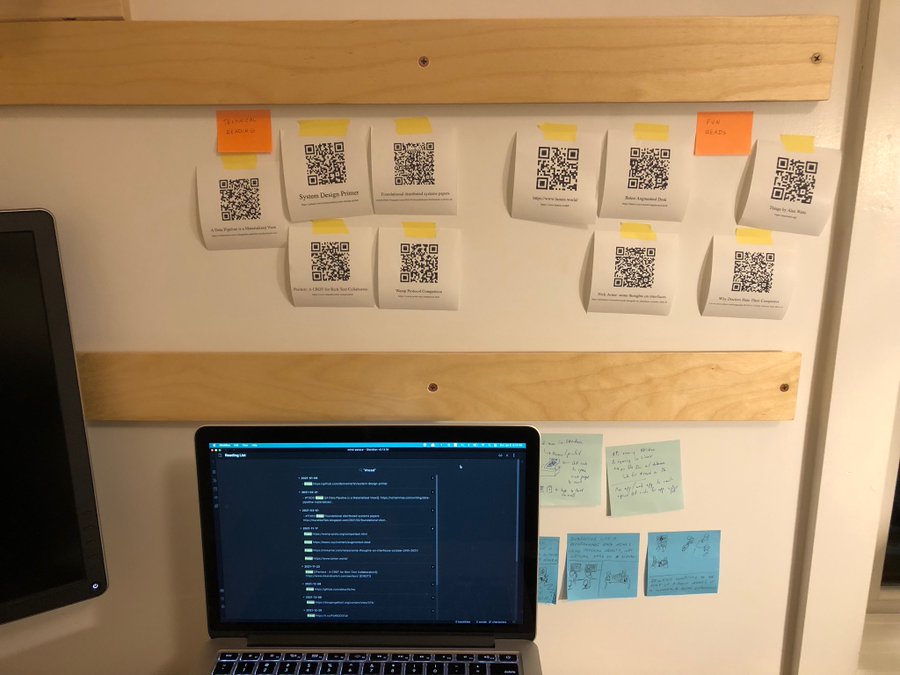
Moving my (web) reading list to sticky notes because I never remember to check it on my computer.
Wall with stickie note sized print outs taped to it. They contain a QR code, presumably linking to the thing they want to read with a Title and author below it.
உலக சிந்தனை வரலாற்றை எடுத்துப் பார்த்தால் இதுவரையில் எழுதப்பட்டு தலைமுறை தலைமுறையாக கைமாற்றப்பட்டு நீடிக்கும் பெரும்பாலான படைப்புகள் புனைவுகளே.
Reading "refreshes," but it must lead to writing. Neither activity should be pursued at the exclusion of the other. "Continuous writing will cast gloom over our strength, and exhaust it," while continuous reading "will make our strength watery and flabby. It is better to have recourse to them alternately, and to blend one with the other, so that the fruits of one's reading may be reduced to the concrete form by the pen" (277).
Almost like saying that "man cannot live by bread alone"...
Francis Bacon, for instance, thought that "some books are to be tasted, others to be swallowed and some few to be chewed and digested; that is, some books are to be read only in parts; others to be read, but not curiously; and some few to be read wholly, and with diligence and attention."
An interesting classification of books which fits a fair amount of my own views, particularly looking at the difference between fiction, poetry, and non-fiction.
Source?
A recent addition to the writer-editor-reader relationship is something called a “sensitivity reader,” that is someone of diverse background who can advise on dicey cultural matters whom writers are now encouraged to consult.
<small><cite class='h-cite via'>ᔥ <span class='p-author h-card'>Manfred Kuehn</span> in Taking note: Grafton on the Future of Reading (<time class='dt-published'>01/01/2022 12:57:23</time>)</cite></small>
Future Reading: Digitization and its discontents. By Anthony Grafton October 29, 2007 https://www.newyorker.com/magazine/2007/11/05/future-reading
he page note can function as a general guide. When I teach I use it as a place to share possible instructions. For example, I want to share a close reading of John's work so that we can be a bit better prepared for the meet on #nwpstudio for First Chapter Friday with John McCaffrey. Or as John writes in the short afterword in the story, "If you really want to know the real story: what I felt, why I did what I did, why I didn’t do what I could? Listen. Listen close. It’s the only way."
https://takingnotenow.blogspot.com/2007/12/grafton-on-future-of-reading.html
Serious reading will require just as much effort as it has always required.
Reading is hard to disrupt.
Speeding up and dramatically improving the reading process is incredibly difficult. No one has yet made really huge strides in this space. Google has made it imminently more accessible to the masses, but it still requires a lot of physical work and processing on our part.
https://luhmann.surge.sh/learning-how-to-read
Learning How to Read by Niklas Luhmann
Not as dense as Mortimer J. Adler's advice, but differentiates reading technical material versus poetry and novels. Moves to the topic of some of the value of note taking as a means of progressive summarization which may have implications for better remembering material.
Mr. Byers coined a term — “book-wrapt” — to describe the exhilarating comfort of a well-stocked library.
when you reach the end of a chapter, you pause for few minutes to author one or two paragraphs of text summarizing your understanding and reflections on the key concepts discussed in the previous chapter. Beyond the two paragraphs, it is also a good practice to articulate questions that come to mind, for which you will seek answers in the upcoming chapters, or that you want to research beyond the book.
Law One: The more reading you assign, the less the students will read. Law Two: The more you talk in class, the less the students will read.
Two Iron Laws of College Reading https://crookedtimber.org/2021/12/22/two-iron-laws-of-college-reading/
https://www.newyorker.com/magazine/2021/12/20/can-distraction-free-devices-change-the-way-we-write
<small><cite class='h-cite via'>ᔥ <span class='p-author h-card'>Aaron Davis </span> in 📑 Can “Distraction-Free” Devices Change the Way We Write? | Read Write Collect (<time class='dt-published'>12/27/2021 14:09:33</time>)</cite></small>
If you want to be a writer, you have to be a reader first.
“Don’t feel guilty if you spend the first 90 minutes of your day drinking coffee and reading blogs,” Nate Silver once advised young journalists. “It’s your job. Your ratio of reading to writing should be high.”
Stephen King says he writes all morning and reads all afternoon.
entretiens de Royaumont
These designers value expression over style
It's about expressing oneself or creates distortion rather than valuing or achieving a certain look that they should convey.
syntactical
in a way that relates to the grammatical arrangement of words
in a sentence: a syntactically complicated language
Shattering the constraints of minimalism was exhilarating and far more fun than the antiseptic discipline of the classical Swiss school.
That's understandable because doing the same type of style over and over again can be boring sometimes.
Discussion is led by an instructor, but the instructor’s job is not to give the students a more informed understanding of the texts, or to train them in methods of interpretation, which is what would happen in a typical literature- or philosophy-department course. The instructor’s job is to help the students relate the texts to their own lives.
The format of many "great books" courses is to help students relate the texts to their own lives, not to have a better understanding of the books or to hone methods of interpreting them.
This isn't too dissimilar to the way that many Protestants are taught to apply the Bible to their daily lives.
Are students mis-applying the great books because they don't understand their original ideas and context the way many religious people do with the Bible?
This book, then, is an analysis of physiotherapy through the lens of the sociology of the professions. It explores what the professions are, what they do in society, what’s good about them, and what’s bad. It applies these ideas to physiotherapy so that we can better understand the issues the profession is now facing. And the book concludes with some challenging and, some might say, heretical recommendations for where physiotherapy goes next, as we all adapt to the post-professional era.
The aim of the book.
I'm intrigued. I don't see an easy route from where we are to a society giving up on its professionals.
The End of Physiotherapy
See here for more information.
with medicine being the paradigm case
And possibly law.
A good library is filled with mostly unread books. That’s the point. Our relationship with the unknown causes the very problem Taleb is famous for contextualizing: the black swan. Because we underestimate the value of what we don’t know and overvalue what we do know, we fundamentally misunderstand the likelihood of surprises. The antidote to this overconfidence boils down to our relationship with knowledge. The anti-scholar, as Taleb refers to it, is “someone who focuses on the unread books, and makes an attempt not to treat his knowledge as a treasure, or even a possession, or even a self-esteem enhancement device — a skeptical empiricist.” My library serves as a visual reminder of what I don’t know.
I prefer the positive interpretation, of how much more there is to know. Quantifying anything in terms of how much we do not have is limited because we have finite knowledge out of an infinite set.
Each book instead of referencing something we do not know is a portal into things we have yet to know.
I think Nassim Taleb also mentioned elsewhere that having a lot of books you haven't read shows interest in a topic.
article explores how annotation with digital, social tools can address digital reading challenges while also supporting writing skill development for novices in college literature classrooms. The author analyzes student work and survey responses and shows that social annotation can facilitate closer digital reading and scaffold text-anchored argumentation practices.
Writing to understand what I read is critical to my practice. Doing so socially is particularly helpful when I don't understand something or am lacking the motivation to keep reading.
405
Our close reading passage this week is from Book 10, lines 406-449:
from: 10.406 "so she spoke, and the proud heart in me was persuaded..." to 10. 449: "...but followed along in fear of my fierce reproaches."
Instructions: as with last week's passage, pay attention to every detail that catches your attention, or that doesn't seem to make sense. Context matters: the scene in last week's passage was Ithaca, a relatively normal if disorderly human community, but this week's passage deals with events on a magical island where humans are easily changed into animals. Is this island in any way a threat to the homecomings of Odysseus and his men? In your view, does it affect their behavior?
475
Hopkins at Home The Odyssey of Homer: a Close Reading
Sample close reading passage: 5.475 - 5.493 (end of chapter 5)
This moment occurs at the end of book five, just after Odysseus has escaped the rage of Poseidon by dragging himself ashore on the island of Scheria (likely Corfu), land of the Phaiakians/Phaeacians. Odysseus has just decided to look for shelter in the nearby forest, which despite the danger of wild animals offers somewhat more warmth than the wet shore of the river from which he has crawled. To help with our discussion I’ve divided the text into three parts.
I’d suggest printing this out and jotting your thoughts down—circle words that strike you as significant, as having multiple meanings, etc. Enjoy! You can send your thoughts to me or just keep your notes handy for our next class.
Karnofsky suggests that the cost/benefit ratio of how we typically think of reading may not be as simple as we intuitively expect i.e. we think that 'more time' = 'more understanding'.
If you're simply reading to inform yourself about a topic, it may be worth reading a couple of book reviews, and listening to an interview or two, rather than invest the significant amount of time necessary to really engage with the book.
A few hours of skimming and reviews/interviews may get you to 25% understanding and retention, which in many cases may be more than enough for your needs of being basically informed on the topic. Compared to the 50 - 100 hours necessary for a deep, analytical engagement with the text, that would only get you to 50% understanding and retention.
That being said, if your goal is to develop expertise, both Karnofsky and Adler ('How to read a book') suggest that you need a deep engagement with multiple texts.
https://site.pennpress.org/material-texts-2021/9780812236422/textual-situations/
This looks interesting for a later time...
Textual Situations: Three Medieval Manuscripts and Their Readers by Andrew Taylor
Generations of scholars have meditated upon the literary devices and cultural meanings of The Song of Roland. But according to Andrew Taylor not enough attention has been given to the physical context of the manuscript itself. The original copy of The Song of Roland is actually bound with a Latin translation of the Timaeus.
Textual Situations looks at this bound volume along with two other similarly bound medieval volumes to explore the manuscripts and marginalia that have been cast into shadow by the fame of adjacent texts, some of the most read medieval works. In addition to the bound volume that contains The Song of Roland, Taylor examines the volume that binds the well-known poem "Sumer is icumen in" with the Lais of Marie de France, and a volume containing the legal Decretals of Gregory IX with marginal illustrations of wayfaring life decorating its borders.
Approaching the manuscript as artifact, Textual Situations suggests that medieval texts must be examined in terms of their material support—that is, literal interpretation must take into consideration the physical manuscript itself in addition to the social conventions that surround its compilation. Taylor reconstructs the circumstances of the creation of these medieval bound volumes, the settings in which they were read, inscribed, and shared, and the social and intellectual conventions surrounding them.
https://torrentfreak.com/book-publishers-expand-uk-pirate-site-blocking-151128/
Blocking at the ISP level has been used as a strategy for preventing copyright for a while. What better methods might exist? Is this method just whack-a-mole?
https://infohist.fas.harvard.edu/news/information-cultures-series-john-hopkins-university-press
This looks like a fascinating series and who could go wrong with Ann Blair, Anthony Grafton, and Earle Havens?
Also interesting to see what sorts of things they will find interesting at the cutting edge of all these disciplines.
The Odyssey of Homer: a Close Reading
Wondering whether, for fun, we ought to be doing a close listening instead of a close reading of Home.
I think of the Kindle and what enormous potential that browser had to change our relationship with the internet, to push it towards a web that you read (instead of one that tries so very hard to read you).
I love the phrase "a web that your read instead of one that tries so very hard to read you."
́his historical interest is fueled not onlyby the rapid growth of the history of readingW of which the study of notetaking is an offshootW
Where exactly do we situate note taking? Certainly within the space of rhetoric, but also as Ann M. Blair suggests within the history of reading.
What else? manuscript studies, psychology, others?
PREPARATION FOR WORK
This whole section looks the most interesting and promising to me: reading, memory, and notes!
I'll likely read these first and at best skim the rest depending on content.
dichotomous
1: dividing into two parts
2: relating to, involving, or proceeding from dichotomy the plant's dichotomous branching a dichotomous approach can't be split into dichotomous categories
Yet most companies neglect design as a strategy tool. What they don’t realize is that design can enhance products, environments, communi-cations, and corporate identity.”
This is true because a Designer can communicate one's ideas in a clear and sensible way. Companies need design in order to get as many people to associate themselves with them.
maelstrom
1: a powerful often violent whirlpool sucking in objects within a given radius tried to shoot the canoe across a stretch of treacherous maelstrom — Harper's
2: something resembling a maelstrom in turbulence the maelstrom enveloping the country a maelstrom of emotions
raison d’être
Reason or justification for existence.
The typographer must take the greatest care to study how his work is read and ought to be read.
Absolutely, depending on the work and the intention behind it. You wouldn't want your audience to be confused about the readability of your work.
“Hurry up and do it before someone else does!” she told him. And so he did.
At least he did it quickly as possible because it's a known fact that people can have similar ideas as you.
ephemera
Definition of ephemera 1: something of no lasting significance —usually used in plural
2 ephemera plural : paper items (such as posters, broadsides, and tickets) that were originally meant to be discarded after use but have since become collectibles
A handful of African-American designers seemed exempt from Modernism’s influence, which may be because they didn’t work in advertising or commerce.
This is not surprising at all. Funny thing is just as he mentioned that...it made me realize there's barely any black designers being known, especially around that time.
Time Required
Pages 35 to 39
Payments in Lieu of TaxesBy Nonprofits: Case Studies
comment in hypothesis for class.
Introduction
Read from here to page 29 of the pdf (54) - 3 hours
“We’ve been thoughtful,” Amazon continued, “about adding only features and experiences that preserve and enhance the reading experience.” The question of whose experience doesn’t seem to come up.
They're definitely not catering to my reading, annotating, and writing experience.
Skimming through pages, the foremost feature of the codex, remains impossible in digital books.
This is related to an idea that Tom Critchlow was trying to get at a bit the other day. It would definitely be interesting in this sort of setting.
<script async src="https://platform.twitter.com/widgets.js" charset="utf-8"></script>Has anyone built a generalizable text zoom JavaScript library that let's you progressively summarize an article as you zoom in and out?<br><br>(Why yes I am procrastinating my to-do list. You?)
— Tom Critchlow (@tomcritchlow) September 17, 2021
In other words, as far as technologies go, the book endures for very good reason. Books work.
Aside from reading words to put ideas into my brain, one of the reasons I like to read digital words is that the bigger value proposition for me is an easier method to add annotations to what I'm reading and then to be able to manipulate those notes after-the-fact. I've transcended books and the manual methods of note taking. Until I come up with a better word for it, digital commonplacing seems to be a useful shorthand for this new pattern of reading.
<small><cite class='h-cite via'>ᔥ <span class='p-author h-card'>Suzanne Conklin Akbari</span> in Growing a Research Network: Approaches to Global Book History | Penn Libraries (<time class='dt-published'>09/12/2021 21:11:23</time>)</cite></small>
La gare est à 5 minutes en voiture de la maison, 15 minutes en tramway . Elle permet de rejoindre Paris en 45 minutes de TGV, Disneyland Paris en 30 minutes.
Un parc avec des jeux pour enfants est situé à 3 minutes à pieds de la maison :)
https://www.youtube.com/watch?v=jfXE6VCBo3k
This boils down to distilling one's notes down to something smaller.
Book review (and cultural commentary) on Alex Beam's A Great Idea at the Time, (Public Affairs, 2008).
The big thing here for me, though, is the difference between tagged content showing up in a read-only space vs. showing up in a read-and-write space.
Or more powerful, in a read, write, remix, and edit space.
Somewhat related to:
The Read Write Web is no longer sufficient. I want the Read Fork Write Merge Web. #osb11 lunch table. #diso #indieweb 2011-06-23 at OSBridge2011 having lunch with Ward, Tantek exclaimed
https://indieweb.org/2011/Smallest_Federated_Wiki#Inspiration
https://fs.blog/2021/08/remember-books/
A solid overview of how to read. Not as long or as in-depth as Mortimer J. Adler, but hits all of the high points in an absorbable manner.
Definitely worth re-reading...
The goal is not to read as many books as possible. The goal is to gain as much wisdom as you can.
Using models while reading can also help you get more out of the book. Here are some examples of paths they might lead you down: Confirmation bias: Which parts of this book am I ignoring? Does this book confirm my opinions? (Okay, but does it actually affirm your beliefs or are you just seeing what you want to see? If you cannot think of a single point in the book that you disagreed with, confirmation bias is likely distorting your reasoning.) Bayesian updating: What opinions should I change in light of this book? How can I update my worldview using the information in it? Keep in mind the words of John Maynard Keynes: “When the facts change, I change my mind. What do you do, sir?” Incentives: What motivates the characters or the author? What are they seeking? What is their purpose? Here’s how Kurt Vonnegut described the importance of incentives in books: “When I used to teach creative writing, I would tell the students to make their characters want something right away—even if it’s only a glass of water. Characters paralyzed by the meaninglessness of modern life still have to drink water from time to time.” Availability bias: Are the books I have recently read affecting how I perceive this one? How are my immediate past experiences shaping my reading? Am I assigning undue importance to parts of this book because they are salient and memorable? Social proof: How is social proof—the number of copies sold, bestseller status, the opinions of others—affecting my perception of this book? Is the author using social proof to manipulate readers? It is not unusual for authors to buy their way onto bestseller lists, providing social proof that then leads to substantial sales. As a result, mediocre books can end up becoming popular. It’s a classic case of the emperor having no clothes, which smart readers know to look out for. Survivorship bias: Is this (nonfiction) book a representation of reality or is the author failing to account for base rates? Survivorship bias is abundant in business, self-help, and biographical books. A particular case of a successful individual or business might be held as the rule, rather than the exception. Utility: If a book offers advice, does it have practical applications? At what point do diminishing returns set in?
This is a good list of questions to put into a template to ask both while and after reading a book.
What other regularly recurring questions might go into such a list?
Author and librarian Nancy Pearl advocates the “Rule of 50.” This entails reading the first 50 pages of a book and then deciding if it is worth finishing. The Rule of 50 has an interesting feature: once you are over the age of 50, subtract your age from 100 and read that many pages. Pearl writes: “And if, at the bottom of Page 50, all you are really interested in is who marries whom, or who the murderer is, then turn to the last page and find out. If it’s not on the last page, turn to the penultimate page, or the antepenultimate page, or however far back you have to go to discover what you want to know.…When you are 51 years of age or older, subtract your age from 100, and the resulting number (which, of course, gets smaller every year) is the number of pages you should read before you can guiltlessly give up on a book.…When you turn 100, you are authorized (by the Rule of 50) to judge a book by its cover.”
Most of us were taught as children to treat books as something sacred—no folding the page corners, and no writing in the margins, ever.
Most Medieval manuscripts specifically left wide columns of space to encourage readers to mark up their texts.
cross reference: Medieval notepads - Khan Academy
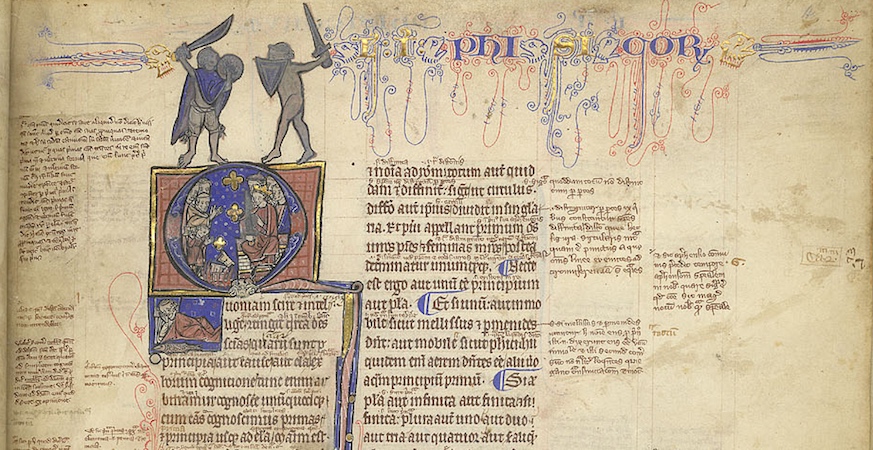 <small>Detail, London, British Library, Harley MS 3487 (13th century)—[source](http://www.bl.uk/catalogues/illuminatedmanuscripts/ILLUMIN.ASP?Size=mid&IllID=16790)</small>
“The things you’re looking for, Montag, are in the world, but the only way the average chap will ever see ninety-nine percent of them is in a book.” —Ray Bradbury, Fahrenheit 451
“Think before you speak. Read before you think.” —Fran Lebowitz
How does the book relate to topics you’re already familiar with?
Spark:
Some people think and endeavor to read a book once and take such great notes that they'll never have to read it again. They're fooling themselves if they think they can do this. The context of what's in the book compared to the context of what they already know is ever-changing. The new you that re-reads a book years or months later will notice new and different things. Make new and interesting connections. Much like Heraclitus's river, we ourselves are ever-changing, and our changing contexts will allow us to get different things from what we're reading on subsequent visits.
Book summary services miss the point. A lot of companies charge ridiculous prices for access to vague summaries bearing only the faintest resemblance to anything in the book. Summaries can be a useful jumping-off point to explore your curiosity, but you cannot learn from them the way you can from the original text.*
Some books only have small bits of wisdom in them to begin with, so summaries can be good.
However, if one puts the "quality" content in a primary position, then the text itself will often have some incredibly valuable context that may be missing from summaries.
The most common and sensible location for putting down thoughts, critique or notes was the margin of the medieval book. Consider this: you wouldn’t think so looking at a medieval page, but on average only half of it was filled with the actual text. A shocking fifty to sixty percent was designed to be margin. As inefficient as this may seem, the space came in handy for the reader. As the Middle Ages progressed it became more and more common to resort to the margin for note-taking.
Dots and lines are particularly common ingredients of such footnote symbols. Interestingly, their first appearance is not as a connector of comment and text, but as an insertion mark that added an omitted line into the text.
In a version similar to a footnote, a line and a dot were first used much as we use the carot symbol (^) today for editing to indicate the insertion of a missing line.
Evidently, these two groups of bookmarks—static and dynamic—provided very different approaches to marking information—and thus to a book’s use. Readers who added clip-on or “spider” bookmarks anticipated they would need to retrieve information not from one single page but from a changing number of pages. In other words, movable bookmarks served an audience with a shifting knowledge “appetite,” while the static ones encouraged a more “ritual” use of a book. In other words, both types are telling, in their own way, about medieval reading culture.
Static bookmarks may have indicated "ritual" or habitual use of books and the information they contained, while dynamic bookmarks may indicate the need for retrieving (temporary) information from one or more pages.
The solution to the vanishing bookmark came in the form of what is called a “register bookmark." This type, which looks like a spider with its legs trapped, was securely fastened to the top of the binding (visible below), so it couldn’t get lost. Additionally, the bookmark allowed the reader to mark multiple locations in the book.
Register bookmark
These carousels allowed readers to consult multiple manuscripts in a very convenient fashion, by spinning (slowly!) the top part, which moved. The oldest one I could find dates from the fourteenth century (here(Opens in a new window)), but it is possible they were in use even earlier.
there are very few medieval scenes in which someone is reading but not writing—where books are present but pens are not. In part, this has to do with medieval study practices. Readers would usually have a pen nearby even when they were just reading. After all, remarks and critiques needed to be added to the margin at the spur of the moment. “Penless” images, while rare, often show a crowded desktop.
Images of Medieval reading practices generally pictured pens along with books. In the rare cases where pens were not included, the desks pictured were messy and thus covered up the pens involved.
Did you feel bad about setting down a book knowing that you’d never pick it up again? If you did feel bad, it’s not your fault. We moralize reading.
This just happened to me last Summer when I felt pretty guilty about putting down a book I was reading for fun. As an English major, I feel an extra incentive to keep reading because that's what people expect of me. That is, since I am devoting a great deal of my life and school career to reading, I am required to finish all books I pick up. If I don't, then I have somehow failed.
საკუთარი სიამოვნებისთვის სისტემატიური კითხვა ხელს უწყობს მოსწავლის განათლებას ბევრი მიმართულებით.
გარეგანი ჯილდოს მიცემა (მაგ., თამაში დრო) როგორც მინიმუმ არაა აუცილებელი (სიამოვნებისთვის კითხვა უკვე ჯილდოა) და შეიძლება საზიანოც იყოს (გარეგან ჯილდოს მიჩვეული მოსწავლე სკოლის გარეთ თავისით წაიკითხავს?)
სკოლაში მოცულობითი ბიბლიოთეკის ყოლა მაღალი გავლენა აქვს მოსწავლეების განათლებაზე. იმხელა, რომ შეუძლია გადაწონს სიღარიბით გამოწვეული ნეგატიური ეფექტი.
https://kimberlyhirsh.com/2019/04/01/dissertating-in-the.html
A description of some of Kimiberly Hirsh's workflow in keeping a public research notebook (or commonplace book).
I'd be curious to know what type of readership and response she's gotten from this work in the past. For some it'll bet it's possibly too niche for a lot of direct feedback, but some pieces may be more interesting than others.
Did it help her organize her thoughts and reuse the material later on?
What is Border Gateway Protocol? https://www.youtube.com/watch?v=A1KXPpqlNZ4
Step 3: Set up reading storage and a reading environment.
Calibre isn't a bad tool/application for doing this for a variety of document types and managing meta data
部分可以参考我一篇拖更了很久的回答:家庭药箱需常备哪些药品和工具? - Leslie Pan的回答 - 知乎
Link https://www.zhihu.com/question/21407675/answer/154012115
The first step in translating experience, either of other men's writing, or of your own life, into the intellectual sphere, is to give it form. Merely to name an item of experience often invites you to explain it; the mere taking of a note from a book is often a prod to reflection. At the same time, of course, the taking of a note is a great aid in comprehending what you are reading.
on the purpose of taking notes, annotating one's reading, or commonplacing
highlight is a quote from
C. Wright Mills' profound "Appendix: On Intellectual Craftsmanship," as found in his book on The Sociological Imagination.[16]
Reading should never be merely passive and consist in the mere absorption or copying of information. It should be critical and engage the material reflectively, being guided by questions such as "Why is this important?" "How does this fit in?" "Is it true?" "Why is the author saying what she is saying?" etc.
Reading is a stillness that another stillness called forth. At its root it is a communal meditation.
What a magnificent quote.
The Latin noun ‘compendium’, and the phrase ‘via compendiaria’ were used assynonyms for the noun ‘methodus’ during the sixteenth and seventeenth centuries.23ByLinnaeus’s time, the word was used in Latin book titles to denote a compilation of collocatedtexts that had previously existed as separate works on their own, or which, if removed and distrib-uted separately, could be read without recourse to other parts of the book.