He preferred penning poems to typing them, because, he said, “A poem can appear finished just because of the cleanness of the typescript, and I don’t want it to seem finished before it is.” When he typed a poem, he said, he was reading it, but when he wrote a poem by hand he could hear it.
1,340 Matching Annotations
- Apr 2023
-
www.dalekeiger.net www.dalekeiger.net
-
-
www.nytimes.com www.nytimes.com
-
the best predictor of whether we agree with the science is simply where we fall on the political spectrum.
Dr. Katharine Hayhoe, climate scientist at Texas Tech University
the referent "the science" is "the [climate] science" in this context
-
-
www.youtube.com www.youtube.com
-
Now, I've made a number of documentaries about fake news. And what interests me is the first person to use the phrase mainstream media was Joseph Goebbels. And he, in one of his propaganda sheets, said “It's very important that you don't read the mainstream media because they'll tell you lies.” You must read the truth by the ramblings of his boss and his associated work. And you do have to watch this. This is a very, very well-established technique of fascists, is to tell you, don't read this stuff, read our stuff.<br /> —Ian Hislop, Editor, Private Eye Magazine 00:16:00, Satire in the Age of Murdoch and Trump, The Problem with Jon Stewart Podcast
-
-
-
TheSyntopicon invites the reader to make on the set whatever demands arisefrom his own problems and interests. It is constructed to enable the reader,nomatter what the stages of his reading in other ways, to find that part of theGreat Conversation in which any topic that interests him is being discussed.
While the Syntopicon ultimately appears in book form, one must recall that it started life as a paper slip-based card index (Life v24, issue 4, 1948). This index can be queried in some of the ways one might have queried a library card catalog or more specifically the way in which Niklas Luhmann indicated that he queried his zettelkasten (Luhmann,1981). Unlike a library card catalog, The Syntopicon would not only provide a variety of entry places within the Western canon to begin their search for answers, but would provide specific page numbers and passages rather than references to entire books.
The Syntopicon invites the reader to make on the set whatever demands arise from his own problems and interests. It is constructed to enable the reader, no matter what the stages of his reading in other ways, to find that part of the Great Conversation in which any topic that interests him is being discussed. (p. 85)
While the search space for the Syntopicon wasn't as large as the corpus covered by larger search engines of the 21st century, the work that went into making it and the depth and focus of the sources make it a much more valuable search tool from a humanistic perspective. This work and value can also be seen in a personal zettelkasten. Some of the value appears in the form of having previously built a store of contextualized knowledge, particularly in cases where some ideas have been forgotten or not easily called to mind, which serves as a context ratchet upon which to continue exploring and building.
-
-
-
Aristotle, who had said, many centuries before in Politics (BookVIII): ‘No one would dispute the fact that it is a lawgiver’s prime duty to arrangefor the education of the young. In states where this is not done the quality of theconstitution suffers.’
Current American climate indicates that Republicans take this quote of Aristotle's to heart, but they're not closely thinking about how they define "education". They're definitely not defining it with respect to John Locke's views in Some Thoughts Concerning Education which encourages political systems that move away from an electorate that is subservient to authority.
see: https://hypothes.is/a/upfxCtSiEe2wrdd3cOo-Lg for John Locke
-
In his essay Of the Conduct of the Understanding, Locke frowned upon those
‘who seldom reason at all, but do and think according to the example of others, whether parents, neighbours, ministers...for the saving of themselves the pains and trouble of thinking and examining for themselves’ (p. 169).
-
A political system, he said, needs people who are fair,open-minded, and think for themselves; it doesn’t want people who aresubservient to authority.
Is there a better direct quote from Locke for this indirect one?
Oddly, large portions of the religious right and Republican right are highly subservient to authority while simultaneously espousing the idea of "freedom".
Apparently the base definition of "freedom" on the right has shifted in large portions of American culture.
-
-
zettelkasten.de zettelkasten.de
-
The Zettelkasten provides combinatorial possibilities that were never planned, never pre-meditated, or never designed in this way.
-
If you have to write anyway, it is pragmatic to exploit this activity by creating a system of notes that can act as a competent communication partner.
-
- Mar 2023
-
www.nytimes.com www.nytimes.com
-
“The hardest thing I’ve learned over the years is that I’m getting paid a lot of money to produce a movie, but sometimes the best thing to do is nothing,” he told The New York Times in 1992, when he was making “Hoffa.” “I don’t need to impose myself.”Nonetheless, he knew he played a vital role.“It’s the creative urge that makes me work,” he told American Film magazine for a 1988 article. “The pleasure is, to some extent, vicarious, but it’s no less creative for that. It is creating a world by bringing together creative financing with creative filmmakers. In a sense, producing can be compared to conceptual art.”
-
-
www.nytimes.com www.nytimes.com
-
Mr. Luddy at the 2017 Telluride Film Festival. The festival became a gathering of devotees to the religion of filmmaking, and Mr. Luddy was its most fervent believer and its main officiant.
"religion of filmmaking"
-
-
twitter.com twitter.com
-
<script async src="https://platform.twitter.com/widgets.js" charset="utf-8"></script>I do my thinking with pen on paper. Digital tools, even (or especially?) the note-taking ones, are just not for me. <br><br>They may be easy to access or carry around, but what’s the point if they constrain the output?
— Julia Pappas (@JuliaPappasJoy) March 30, 2023A common issue of many digital note taking apps is that while they may have ease for cutting and pasting data into them, moving data around, visualizing it in various forms, and exporting it into a final product may be much more difficult. At the opposite end of the spectrum, physical index cards are much easier to sort, resort, and place into an outline form to create output.
-
-
www.insidehighered.com www.insidehighered.com
-
It does not feel patriotic to have my students pay money for public-domain literature on their American heritage.”
-
-
-
Mentioned this to someone who moved to Bushwick and kept saying "I wish more of Brooklyn was like this" with a rebuttal saying "this is why the people who made it attractive to you aren't here anymore" and got the "it's not my problem" shit. https://twitter.com/hollley/status/1641149981678530560. I think that's where being a "transplant" into a different place becomes violent - your presence IMMEDIATELY disrupts the environments you're in (and because of that, you have an obligation to minimize it as much as possible).
-
-
-
I’m not sure I need a system around, for example, the best way to surface the minutiae from interstitial journaling. In fact, just using the phrase “interstitial journaling” is a dead giveaway that I’ve already been overthinking it. Settle down, Jack!
🤪
-
-
mastodon.social mastodon.social
-
Ein Zettel, auf den kein anderer Zettel verweist, ist kein Zettel
—Detlef Stern, 2023-03-21, https://mastodon.social/@t73fde/110062851811483123
A note not referenced by another note is not a note. (translation mine)
-
-
www.npr.org www.npr.org
-
"No one volunteers for res," she says, a little ruefully.
-
-
www.youtube.com www.youtube.com
-
Remember the Thesaurus is a work of the human brain and therefore it is fallible. —Kathleen M. Coleman
replace Thesaurus with zettelkasten...
-
-
web.archive.org web.archive.org
-
wenn man Sethes Lebensprinzip kennt: "Ich arbeite nur, wenn ich mag. Aber ich mag immer arbeiten."
Kurt Sethes' philosophy was encapsulated as "I only work when I like. But I always like to work." (Translation from German mine.)
-
-
theeffortfuleducator.com theeffortfuleducator.com
-
“No significant learning can occur without a significant relationship.” – Dr. James Comer
Interesting quote; beware, it's not about person to person relations.
-
-
www.nytimes.com www.nytimes.com
-
‘‘So long as so-called A.I. systems are being built and deployed by the big tech companies without democratically governed regulation, they are going to primarily reflect the values of Silicon Valley,’’ Emily Bender argues, ‘‘and any attempt to ‘teach’ them otherwise can be nothing more than ethics washing.’’
ethics washing!
-
Right before we left our lunch, Sam Altman quoted a saying of Ilya Sutskever’s: ‘‘One thing that Ilya says — which I always think sounds a little bit tech-utopian, but it sticks in your memory — is, ‘It’s very important that we build an A.G.I. that loves humanity.’ ’’
-
‘‘I think it lets us be more thoughtful and more deliberate about safety issues,’’ Altman says. ‘‘Part of our strategy is: Gradual change in the world is better than sudden change.’’
What are the long term effects of fast breaking changes and gradual changes for evolved entities?
-
-
www.nytimes.com www.nytimes.com
-
Universities are factories of human knowledge. They’re also monuments to individual ignorance.
https://www.nytimes.com/2023/01/03/opinion/college-learning-students-success.html
-
-
biblioracle.substack.com biblioracle.substack.com
-
Writing is rewarding. Writing is empowering. Writing is even fun. As human, we are wired to communicate. We are also wired for “play.” Under the right circumstances, writing allows us to do both of these things at the same time.
-
In a piece like this, writing is the expression and exploration of an idea (or collection of ideas). It is only through the writing that I can fully understand what I think.
-
one of the things I value about writing, is the act of writing itself. It is an embodied process that connects me to my own humanity, by putting me in touch with my mind, the same way a vigorous hike through the woods can put me in touch with my body.
-
If we assume students want to learn - and I do - we should show our interest in their learning, rather than their performance.
-
-
www.youtube.com www.youtube.com
-
Learning has to be knowledge. 00:10:07 And learning has to be based on understanding. And what you understand you can absorb, internalize and it becomes knowledge. What you know, you don't forget. You can block something that you know, but not forget.
-
-
en.wikipedia.org en.wikipedia.org
-
Ollendorff's name is used as an epithet in H.G. Wells' The Island of Doctor Moreau:[10] "Yesterday he bled and wept," said the Satyr. "You never bleed nor weep. The Master does not bleed or weep." "Ollendorffian beggar!" said Montgomery, "you'll bleed and weep if you don't look out!"
-
-
www.ebay.com www.ebay.com
-
Plan Your Work and Work your Plan An Infallible Rule for Success
was there a prior source for this aphorism?
-
-
www.reddit.com www.reddit.com
-
Witness the unapologetic swagger of "FORGET WITH IMPUNITY" vs. its wimpy cousin Evernote's "Remember Everything".
—u/spanchor
-
-
boffosocko.com boffosocko.com
-
A zettelkasten with no quotes—by definition—shouldn’t carry the name. So let’s lay to rest that dreadful idea that quotes aren’t allowed in a zettelkasten.
This is fundamental. No research project has no quotes. Sometimes the words of the author is just better than anything that one could say.
-
-
Local file Local file
-
Beware the “alibi of photocopies”! Photocopies are indis-pensable instruments. They allow you to keep with you atext you have already read in the library, and to take homea text you have not read yet. But a set of photocopies canbecome an alibi. A student makes hundreds of pages ofphotocopies and takes them home, and the manual laborhe exercises in doing so gives him the impression that hepossesses the work. Owning the photocopies exempts thestudent from actually reading them. This sort of vertigo ofaccumulation, a neocapitalism of information, happens tomany. Defend yourself from this trap: as soon as you havethe photocopy, read it and annotate it immediately. If youare not in a great hurry, do not photocopy something newbefore you own (that is, before you have read and annotated)the previous set of photocopies. There are many things thatI do not know because I photocopied a text and then relaxedas if I had read it.
(p. 125)
Tags
Annotators
-
-
twitter.com twitter.com
-
We create product not to show how good we are, but to measure how good we are.
<script async src="https://platform.twitter.com/widgets.js" charset="utf-8"></script>We create product not to show how good we are, but to measure how good we are.
— Naval (@naval) February 19, 2023
-
-
www.theatlantic.com www.theatlantic.com
-
None of this is easy. In the words of Jill Lepore, one of our finest historians, “Writing history requires empathy, inquiry, and debate. It requires forswearing condescension, cant, and nostalgia. The past isn’t quaint. Much of it, in fact, is bleak.”
ostensibly in The Story of America: Essays on Origins
-
“Wisdom is the tears of experience,” the eminent sociologist Daniel Bell told my graduating class at Brandeis University.
-
-
zettelkasten.de zettelkasten.de
-
A Zettelkasten is a system of notes that fit the criteria of being a system. Being alive vs. being a machine is a good metaphor to understand the difference. A Zettelkasten is alive, a conventional note taking system is a machine.
I'm not the only one to think of zettelkasten as "living"...
-
My translation of Niklas Luhmann (1997): Die Gesellschaft der Gesellschaft, Frankfurt/M: Suhrkamp. S.11: “Bei meiner Aufnahme in die 1969 gegründete Fakultät für Soziologie der Universität Bielefeld fand ich mich konfrontiert mit der Aufforderung, Forschungsprojekte zu benennen, an denen ich arbeite. Mein Projekt lautete: Theorie der Gesellschaft; Laufzeit: 30 Jahre; Kosten: keine.”
As I began to work at the 1969 founded faculty of sociology of the University of Bielefeld, I was confronted with the request to name research projects I work on. My project was: a theory of society; Duration: 30 years; Costs: none.(1)
-
- Feb 2023
-
zettelkasten.de zettelkasten.de
-
Principles are higher than techniques. Principles produce techniques in an instant. —Ido Portal
source?
-
-
www.reddit.com www.reddit.com
-
Posted byu/A_Dull_Significance6 hours agoWhat’s something you do with your Zettelkasten that you’re “not supposed to do”? .t3_11awtrx._2FCtq-QzlfuN-SwVMUZMM3 { --postTitle-VisitedLinkColor: #9b9b9b; --postTitleLink-VisitedLinkColor: #9b9b9b; --postBodyLink-VisitedLinkColor: #989898; } questionI think the title says it all.There are lots of ideas about things you should, or shouldn’t, do with you zettelkasten. What is something that works for you that you’re “not supposed to do”?For me, it’s the idea you shouldn’t keep quotes. I have a section (56/2) which is mainly a collection of different quotes on the topic of writing complexity and ease of comprehension. Some are for complexity, some against. Some place the burden on the writer, some on the reader, some mutual. I find it fruitful.What about you? What “rule” do you break?
Who made up this supposed rule against quotes! Are they not aware that quotes, particularly of sententiae, are some of the most excerpted and transmitted bits of knowledge in the entire Western canon? Without quotes, the entire tradition of note taking would probably not exist. Of course properly quoting is a sub-art in and of itself within rhetoric and the ars excerpendi.
A zettelkasten with no quotes— by definition— shouldn't carry the name.
-
-
www.reddit.com www.reddit.com
-
I’m an imposter-perfectionist
—NomadMimi
Perfectionism is a good thing to be an imposter at.
-
-
blay.se blay.se
-
Life in Zettelkasten is more like dance than a factory.
link to related: https://hypothes.is/a/whBvKrLnEe2OvPOgSd_4zg
-
-
forum.zettelkasten.de forum.zettelkasten.de
-
Remember that life in a Zettelkasten is supposed to be fun. It is a joyful experience to work with it when it works back with you. Life in Zettelkasten is more like dance than a factory.
I've always disliked the idea of "work" involved in "making" notes and "processing" them. Framing zettelkasten and knowledge creation in terms of capitalism is a painful mistake.
the quote is from https://blay.se/2015-06-21-living-with-a-zettelkasten.html
-
-
spectator.org spectator.org
-
Indeed, Martin Anderson, Reagan’s former domestic policy adviser, says that Reagan’s system did wonders for his ability to give speeches. Reagan was able to approach a lectern with no sign anywhere of a prepared speech. Only those seated on the stage behind him could see his left hand drop into his suitcoat pocket and pull out a neat, small packet of cards and slip off the elastic band with his right hand as he set the cards down. And as for helping him in preparing the speech material, “his system was unrivaled,” Anderson remembers. “Before the speech Reagan would pore over the packs of cards, then pluck a few cards from one pack, a few from another, and combine them. In a matter of minutes, he would create an entirely new speech. The system was as flexible as a smooth gold chain.”
-
“These cards are the tools of his trade. He can take any speech and insert some of these zingers and one-liners. Let’s say he’s speaking to a Kiwanis Club. He knew what to put in. If he was talking to a group of firemen, he had a joke about putting out a fire. If you’re really looking for the hand of a president, and how his mind is working, all of these note cards together, in a way, give you the magic of Ronald Reagan.”
-
-
www.cbsnews.com www.cbsnews.com
-
"Prosperity is something created by businessmen for politicians to take credit for."
—Ronald Reagan
-
"If at first you don't succeed, do it the way she told you."
—Ronald Reagan
Now that we know better about the history and the results of the Regan administration, we really should be listening more to women —Ronald Reagan said it himself!
-
"Room bugged? Every time I sneezed the chandelier said, 'Gesundheit!'"
—Ronald Reagan
-
"I won't say he should be put in a mental institution, but if he was in one, don't think I'd let him out."
—Ronald Reagan
A sad show for the man who gutted mental health support in California and then more broadly in the United States.
-
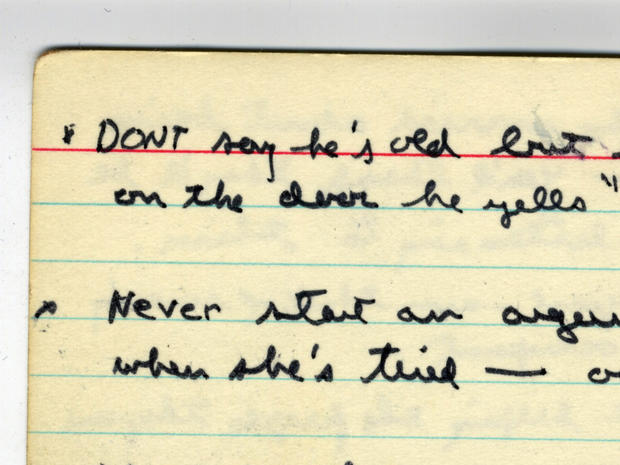
"Never start an argument with a woman when she's tired -- or when she's rested."
—Ronald Reagan
-
"Don't say he's old, but every time there's a knock on the door he yells 'Everybody hide, it's Indians!'"
—Ronald Reagan
-
"You can talk to any number of President Reagan's speechwriters over the years, and when they might hand him a speech, the speeches would come back with a quote, or an expression or a joke that they hadn't seen before," John Heubusch, executive director of the Reagan Library, told CBS News' Mo Rocca.
-
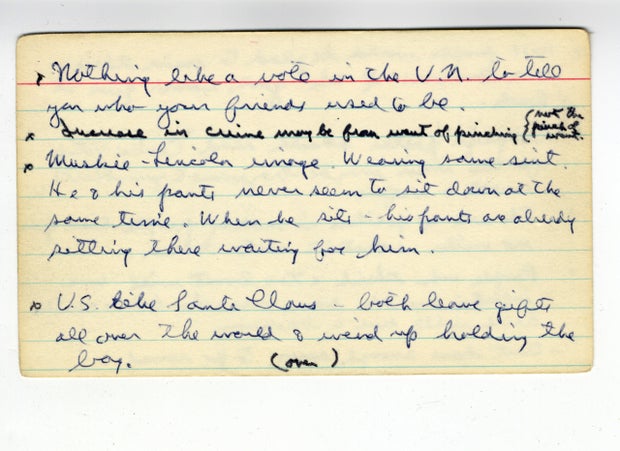
"Nothing like a vote in the U.N. to tell you who your friends used to be."
—Ronald Reagan
Tags
- politics
- speechwriting
- Indians
- business culture
- Cold War
- economics
- mental health
- Mo Rocca
- United Nations
- one-liners
- Ronald Reagan
- prosperity
- Reagan administration
- institutional racism
- index card based commonplace books
- friendship
- zettelkasten for business
- Reaganomics
- jokes
- John Heubusch
- misogyny
- spycraft
- how old is he?
- quotes
- Germany
Annotators
URL
-
-
-
The Zettelkasten Method is not a thing; it is a manual to productivity.
-
-
forum.zettelkasten.de forum.zettelkasten.de
-
The reason is that the journaling is in part an accumulative method: There is a long period of low-structured input which benefits manifest first acutely (writing in itself seems to be healing through understanding). After you amassed a time-line of thoughts you can try to find throughlines and patterns which then gives you access to deep insights if you have the right tools. Most of the time people use psychologists which I think is in a similar way problematic that people use physical therapists for too much of their problems: Many problems are best solved by the person that has immediate access to the ego-perspective (phenomenological layer, subjective access, etc.) of the problem. This is of course dependent on self-education on basic concepts of what I call true self-care. Self-care seems to be associated with stuff like doing pleasant things (hot bath, nice walks in the sun) nowadays. If you take the antifragile nature of us humans into account this is just another way of the modern hedonist to keep stuck. (This is important for my approach to incorporate journaling into the Zettelkasten Method)
—Sasha Fast https://forum.zettelkasten.de/profile/Sascha
I love the deeper definition and distinction of self-care here.
-
-
aeon.co aeon.co
-
If Seneca or Martial were around today, they would probably write sarcastic epigrams about the very public exhibition of reading text messages and in-your-face displays of texting. Digital reading, like the perusing of ancient scrolls, constitutes an important statement about who we are. Like the public readers of Martial’s Rome, the avid readers of text messages and other forms of social media appear to be everywhere. Though in both cases the performers of reading are tirelessly constructing their self-image, the identity they aspire to establish is very different. Young people sitting in a bar checking their phones for texts are not making a statement about their refined literary status. They are signalling that they are connected and – most importantly – that their attention is in constant demand.
-
-
forum.zettelkasten.de forum.zettelkasten.de
-
If you treat a metaphor as a second order perception (first order perception = senses) you can create Pseudo-Synesthesia which may increase divergent thinking.
Mull on this...
-
-
Local file Local file
-
One student’s rabbinical thesis, also completed that year,opened with the declaration: ‘We must not forget that History is a Science. Its facts cannever be doubted. One may indeed, differ as to the interpretation of facts but neverdispute the fact per se!’ (orig. emph., Holtzberg, 1916: Introduction).
Interesting to see this quote in light of the work of Ernst Bernheim and historical method.
At what point did history begin to be viewed as a science this way? (Did it predate Berheim?) Is it still?
-
Anecdotes’, he concluded, ‘havetheir historic value, if properly tested’ – reflecting both his interest in details and also theneed to ascertain whether they were true (Deutsch, 1905b).
-
-
Local file Local file
-
“I only dowhat is easy. I only write when I immediately know how to do it. If Ifalter for a moment, I put the matter aside and do something else.”(Luhmann et al., 1987, 154f.)[4]
https://youtu.be/qRSCKSPMuDc?t=37m30s (all links are on takesmartnotes.com)<br /> Luhmann, Niklas, Dirk Baecker, and Georg Stanitzek. 1987. Archimedes und wir: Interviews. Berlin: Merve.
-
-
Local file Local file
-
we have preserved Eco’s handwritten index cardresearch system in all its detail, precisely because it is the soulof How to Write a Thesis.
!!!
-
-
www.washingtonpost.com www.washingtonpost.com
-
“you’ll never be able to sanitize the Internet.”
-
“The reality is that tech companies have been using automated tools to moderate content for a really long time and while it’s touted as this sophisticated machine learning, it’s often just a list of words they think are problematic,” said Ángel Díaz, a lecturer at the UCLA School of Law who studies technology and racial discrimination.
-
-
www.newyorker.com www.newyorker.com
-
at a time when anything that takes more than a few minutes to skim is called a “longread”—it’s understandable that devoting a small chunk of one’s frisky twenties to writing a thesis can seem a waste of time, outlandishly quaint, maybe even selfish. And, as higher education continues to bend to the logic of consumption and marketable skills, platitudes about pursuing knowledge for its own sake can seem certifiably bananas.
-
Consider Eco’s caution against “the alibi of photocopies”: “A student makes hundreds of pages of photocopies and takes them home, and the manual labor he exercises in doing so gives him the impression that he possesses the work. Owning the photocopies exempts the student from actually reading them. This sort of vertigo of accumulation, a neocapitalism of information, happens to many.” Many of us suffer from an accelerated version of this nowadays, as we effortlessly bookmark links or save articles to Instapaper, satisfied with our aspiration to hoard all this new information, unsure if we will ever get around to actually dealing with it.
neocapitalism of information!!
Is information overload compounded by our information hoarding tendencies?
-
-
wordcraft-writers-workshop.appspot.com wordcraft-writers-workshop.appspot.com
-
More provocatively, great writing is transgressive — it subverts expectations and challenges the reader.
-
“...it can be very useful for coming up with ideas out of thin air, essentially. All you need is a little bit of seed text, maybe some notes on a story you've been thinking about or random bits of inspiration and you can hit a button that gives you nearly infinite story ideas.”- Eugenia Triantafyllou
Eugenia Triantafyllou is talking about crutches for creativity and inspiration, but seems to miss the value of collecting interesting tidbits along the road of life that one can use later. Instead, the emphasis here becomes one of relying on an artificial intelligence doing it for you at the "hit of a button". If this is the case, then why not just let the artificial intelligence do all the work for you?
This is the area where the cultural loss of mnemonics used in orality or even the simple commonplace book will make us easier prey for (over-)reliance on technology.
Is serendipity really serendipity if it's programmed for you?
-
-
www.robinsloan.com www.robinsloan.com
-
But a good short story is always basically a memento mori.
An interesting theory...
An Occurrence at Owl Creek Bridge by Ambrose Bierce comes to mind as an excellent example.
-
I have to report that the AI did not make a useful or pleasant writing partner. Even a state-of-the-art language model cannot presently “understand” what a fiction writer is trying to accomplish in an evolving draft. That’s not unreasonable; often, the writer doesn’t know exactly what they’re trying to accomplish! Often, they are writing to find out.
-
-
sciencegarden.net sciencegarden.net
-
Der Zettelkasten weiß tendenziell immer weniger als man selbst, aber immer soviel, wie wir auf Karten geschrieben haben.
google translate:
The Zettelkasten always tends to know less than you do, but always as much as we have written on cards.
-
-
docdrop.org docdrop.org
-
“The Zettelkastenis much more effortand time consumingthan writing books.”Niklas Luhmann, Shortcuts, p.26
-
-
www.newyorker.com www.newyorker.com
-
Proust writes, with only the faintest irony, “Real life, life at last laid bare and illuminated—the only life in consequence which can be said to be really lived—is literature.”
source? Swann's Way?
Definitely from a literacy forward perspective!
-
-
www.edwinwenink.xyz www.edwinwenink.xyz
-
a very simple principle for note-taking: notes are things where I explain something to myself.
-
What we ultimately should care about is being able to use our knowledge to produce something new, whatever that may be. To not merely reproduce you must understand the material. And understanding requires application, a hermeneutic principle that particularly Gadamer worked out extensively. If you really want to measure your level of understanding, you should try to apply or explain something to yourself or someone else.
-
-
maggieappleton.com maggieappleton.com
-
Digital gardening is the Domestic Cozy response to the professional personal blog; it's both intimate and public, weird and welcoming.
-
-
Local file Local file
-
If you ask an elder about the work’s meaning, you may quickly find yourself enrolledin what Wardaman law man Yidumduma Bill Harney calls “Bush University”.
-
Art is often focused on aesthetic, but more importantly, it is avisual embodiment of knowledge.
link to: Eddington quote https://hypothes.is/a/TNV2WqfpEe2Z24NgnWsZCg
-
And yes, it is also very pretty.
understated quote of the day
-
-
strengejacke.wordpress.com strengejacke.wordpress.com
-
Should you copy a method just because Luhmann used it? No, indeed it doesn’t make sense to copy a method just because it appears sexy. One should find the best fitting method for himself.
Some in the current zettelkasten space come close to this (Bob Doto comes to mind) while others seem to be more dogmatic. I think people generally ultimately do this in practice, but there is still a lingering sense of orthodoxy.
-
-
www.thesing-online.de www.thesing-online.de
-
A Zettelkasten is hypertext plus a hierarchical tree structure and keywords.
an elegant little statement
-
-
Local file Local file
-
Suppose that we were asked to arrange the followingin two categories—distance, mass, electric force, entropy, beauty, melody.I think there are the strongest grounds for placingentropy alongside beauty and melody and not with thefirst three.
Syndication link: https://boffosocko.com/2013/09/26/entropy-beauty-melody/
-
-
en.wikipedia.org en.wikipedia.org
-
His best-known works are two voluminous books that attempt to systematize the development of the sciences, History of the Inductive Sciences (1837) and The Philosophy of the Inductive Sciences, Founded Upon Their History (1840, 1847, 1858–60). While the History traced how each branch of the sciences had evolved since antiquity, Whewell viewed the Philosophy as the "Moral" of the previous work as it sought to extract a universal theory of knowledge through history. In the latter, he attempted to follow Francis Bacon's plan for discovery. He examined ideas ("explication of conceptions") and by the "colligation of facts" endeavored to unite these ideas with the facts and so construct science.[11] This colligation is an "act of thought", a mental operation consisting of bringing together a number of empirical facts by "superinducing" upon them a conception which unites the facts and renders them capable of being expressed in general laws.[22]
-
-
www.complexityexplorer.org www.complexityexplorer.org
-
My blurb should have a blurb, it was so good. —Simon DeDeo (12:10)
-
-
www.reddit.com www.reddit.com
-
If something is not worth a note card, then I don't read it
—u/IamOkei https://www.reddit.com/r/antinet/comments/10qpphw/given_that_you_do_analog_notemaking_do_you/
link to John Water's quote: https://hypothes.is/a/E6wDpPfVEey88SclTBoJPQ
-
- Jan 2023
-
Local file Local file
-
The real story of what happened in human history is a thousandtimes more diverting.
-
In the end I decided: everyone hates a long essay; everyoneloves a short book. Why not turn the essay into a freestanding workand let it stand on its own merits?And that is what I have done.
-
-
-
Re"...what is it like? How does it manifest?"For me, the idea that my zettelkasten becomes an entity outside myself is most often (and most obviously) felt in two situations (tho there are probably others):When I'm importing new ideas and a connection arises that I hadn't thought of previouslyWhen following trains of thought and connections arise that I didn't overtly intend to makeIn the first instance, I come across ideas I had forgotten about, and although it's not the direction I assumed the new idea would go, it becomes an exciting and possibly more lucrative way to take it.In the second instance, where I might be tracing a thought line to develop an article, I might, for example, zoom in on the graph view in Obsidian and see an idea that, while not formally connected to the ones I'm following, happens to be in close proximity spatially, and so it triggers a new direction I might want to take the article. (You can see this happen IRL in this video: https://www.youtube.com/watch?v=9OUn2-h6oVc&)In both cases, my zk feels like it's offering me more than what I would have gotten had I not been communicating with it. There is a sense that I and it are working together. I import new ideas with a rough sense of how they should connect. It shows alternatives to my thinking on the matter.Obviously, in both cases, all the ideas are my own. So, the zk is not necessarily developing ideas for me. But, because of the way in which the ideas are handled—non-hierarchically, rhizomatic, cross-categorical, cross-theme, etc.—non-habituated connections come to light, connections that are less conditioned by my own conventional ways of thinking.
A good description from Bob Doto.
-
-
chat.indieweb.org chat.indieweb.org
-
[Rose] I trained instagram into thinking I have cats. I get a lot of cat adverts which are just cute pictures of cats now, 10/10 would recommend!
-
-
www.complexityexplorer.org www.complexityexplorer.org
-
Panofsky's quote that "“Thus, while science endeavours to transform the chaotic variety of natural phenomena into what may be called a cosmos of nature, the humanities endeavour to transform the chaotic variety of human records into what may be called a cosmos of culture.”
check quote and original source
-
-
www.complexityexplorer.org www.complexityexplorer.org
-
A. Both Robespierre and Animal are ambitious and protean members of an elite group, shifting their identities in response to changing conditions and gradually taking on increasingly extreme positions, driving both the French Revolution and the Muppet Show into what is colloquially known as “The Terror”.
WTF! 🤣
-
-
-
Browsing through Walten’s notes also helped Jagersma to get to know the pamphleteer better, even though he is been dead for three hundred years. “The Memoriaelen say a lot about him. I could read how Walten did his research, follow his fascinations, and see the ideas for pieces he was not able to work out anymore. In a way, these two notebooks are a kind of self-portrait.”
-
In the process, her notes become very personal. “The more personal, the more valuable,” says Fraza. “The way in which you link your ideas is what makes your knowledge base unique.”
-
And the third category is for things that inspire me but that I don’t yet know exactly how to use. This category is actually the most interesting.”
Many people collect notes that they're not sure what to do with or even where to put them. Neuroscience student and researcher Charlotte Fraza keeps her version of these notes in a category of "things that inspire me, but I don't yet know exactly how to use. She feels that compared to the other categories of actionable specific use and sources, this inspiration category is the most interesting to her.
-
-
zettelkasten.de zettelkasten.de
-
Richard Feynman was fond of giving the following advice on how to be a genius. You have to keep a dozen of your favorite problems constantly present in your mind, although by and large they will lie in a dormant state. Every time you hear or read a new trick or a new result, test it against each of your twelve problems to see whether it helps. Every once in a while there will be a hit, and people will say, “How did he do it? He must be a genius!”
Gian-Carlo Rota (1997): Ten Lessons I Wish I Had Been Taught, Notices of the American Mathematical Society 1, 1997, Vol. 44, pp. 22-25.
-
-
fs.blog fs.blog
-
“Any intelligent fool can make things bigger, more complex, and more violent. It takes a touch of genius—and a lot of courage—to move in the opposite direction.” E.F. Schumacher
-
-
laudatortemporisacti.blogspot.com laudatortemporisacti.blogspot.com
-
Basil Lanneau Gildersleeve, "Brief Mention," American Journal of Philology 20.1 (1899) 108-113 (at 108): With all our advance in scientific astronomy, the average modern man is not so familiar with the sky as was his antique brother, and some of the blunders in modern works of fiction that are scored from time to time in scientific journals would hardly have been possible for a ploughman of antiquity, not to say a sailor. The world needs every now and then a reminder that the modern head holds different things from the ancient brain-pan, not necessarily more.
How painfully true this may have been in 1899, it's now much worse in 2023!
Specialization of knowledge tends to fit the lifeways of the people who hold and maintain it. Changing lifeways means one must lose one or more domains and begin using or curating different domains of knowledge.
In a global world of specialization, humans who specialize are forced to rely more heavily on the experience and veracity of those around them who have also specialized. One may be able to have a Ph.D. in astrophysics, but their knowledge of the state of the art in anthropology or economic policy may be therefore utterly undeveloped. As a result they will need to rely on the knowledge and help of others in maintaining those domains.
This knowledge specialization means that politicians will need to be more open about what they think and say, yet instead politicians seem to be some of the least knowledge about almost anything.
This is just the start of a somewhat well-formed thesis I've developed elsewhere, but not previously written out... more to come...
-
-
www.reddit.com www.reddit.com
-
I’m back at the box.
This is a great euphemism for the fun "work" of maintaining a zettelkasten.
via u/A_Dull_Significance at https://www.reddit.com/r/antinet/comments/10gnh3u/box_update/
-
-
thebaffler.com thebaffler.com
-
Friedrich Schiller had already argued in 1795 that it was precisely in play that we find the origins of self-consciousness, and hence freedom, and hence morality. “Man plays only when he is in the full sense of the word a man,” Schiller wrote in his On the Aesthetic Education of Man, “and he is only wholly a Man when he is playing.”
-
-
Local file Local file
-
Might not my Journal be called “Field Notes?”
—Henry David Thoreau, March 21, 1853
-
to heaven. I see that if my facts were sufficiently vital and significant,—perhaps transmuted more into the substance of the human mind,—Ishould need but one book of poetry to contain them all.
I have a commonplace-book for facts and another for poetry, but I find it difficult always to preserve the vague distinction which I had in my mind, for the most interesting and beautiful facts are so much the more poetry and that is their success. They are translated from earth
—Henry David Thoreau February 18, 1852
Rather than have two commonplaces, one for facts and one for poetry, if one can more carefully and successfully translate one's words and thoughts, they they might all be kept in the commonplace book of poetry.
-
Sometimes, Isuspect, he copied his own words because he liked to copy: no one’scommonplace books could run to a million words—those are just theones that survive, in addition to a two-million-word Journal, andenormous quantities of other writing—without a sheer love of sittingwith pen in hand, a printed book and a blank page both open before
him.
-
Jan. 22. To set down such choice experiences that my own writingsmay inspire me and at last I may make wholes of parts. Certainly it isa distinct profession to rescue from oblivion and to fix the sentimentsand thoughts which visit all men more or less generally, that thecontemplation of the unfinished picture may suggest its harmoniouscompletion. Associate reverently and as much as you can with yourloftiest thoughts. Each thought that is welcomed and recorded is anest egg, by the side of which more will be laid. Thoughts accidentallythrown together become a frame in which more may be developedand exhibited. Perhaps this is the main value of a habit of writing, ofkeeping a journal,—that so we remember our best hours and stimulateourselves. My thoughts are my company. They have a certainindividuality and separate existence, aye, personality. Having bychance recorded a few disconnected thoughts and then brought theminto juxtaposition, they suggest a whole new field in which it waspossible to labor and to think. Thought begat thought.
!!!!
Henry David Thoreau from 1852
Tags
- lost in translation
- idea crystallization
- note taking as aide-mémoire
- poetry
- associative thinking
- facts
- note taking affordances
- commonplace books
- field notes
- love of writing
- Field Notes
- idea links
- inspiration
- journals
- associative trails
- combinatorial creativity
- note taking
- Henry David Thoreau
- quotes
- translations
- creativity
- 1852
- juxtaposition
- only one commonplace
- journaling
Annotators
-
-
hcommons.social hcommons.social
-
Ryan Randall @ryanrandall@hcommons.socialEarnest but still solidifying #pkm take:The ever-rising popularity of personal knowledge management tools indexes the need for liberal arts approaches. Particularly, but not exclusively, in STEM education.When people widely reinvent the concept/practice of commonplace books without building on centuries of prior knowledge (currently institutionalized in fields like library & information studies, English, rhetoric & composition, or media & communication studies), that's not "innovation."Instead, we're seeing some unfortunate combination of lost knowledge, missed opportunities, and capitalism selectively forgetting in order to manufacture a market.
https://hcommons.social/@ryanrandall/109677171177320098
-
-
arrieta.io arrieta.io
-
Here are two personal sites that I found in the last couple of days. One I find fascinating for its ambition of totalization, the other for its simplicity and design. Chris Aldrich Andy Bell
https://arrieta.io/little-corner-of-the-internet/
I can only assume that mine is the one that has "ambition of totalization". :)
-
-
-
It would actually be nice if there were some negative things that went along with conscientiousness, but at this point it’s emerging as one of the primary dimensions of successful functioning across the lifespan. It really goes cradle to grave in terms of how people do.— How Children Succeed: Grit, Curiosity, and the Hidden Power of Character
double-check quote and source
Tags
Annotators
URL
-
-
moodle.univ-lyon2.fr moodle.univ-lyon2.fr
-
not the technology itself that will bring about the learning or solve pedagogic prob-lems in the language classroom, but rather the affordances of those technologies andtheir use and integration in a well-formulated curriculum
-
eachers’ digital litera-cies and their preparedness and motivation to introduce technology in their teachingwill largely impact on the extent to which technology-mediated TBLT will be viable asan innovation (Hubbard 2008)
-
The addition of new technologies to people’s lives is never neutral, as it affects them,their language, and their personal knowledge and relations (Crystal 2008; Jenkinset al. 2009; Walther 2012)
-
“digital natives”(Prensky 2001)
A retenir pour usage ultérieur: digital native aka gen Z
-
Warschauer has long warned, computerand information technology is no magic bullet and can be used to widen as much asto narrow social and educational gaps (Warschauer 2012
-
particularly newInternet-connected devices and digital technologies have become embedded in thelife and learning processes of many new generations of students (Baron 2004; Ito et al.2009)
saving this fact because it can be used as a reference in all our works later: so related to our field.
-
-
www.youtube.com www.youtube.com
-
https://www.youtube.com/watch?v=WIfH-iSGa5M
2021-05-12
Dr. Hanan Harif started out as a Geniza scholar but is now a biographer of Shlomo Dov Goitein.
In the 1920s Goitein published his only play Pulcellina about a Jewish woman who was burned at the stake in France in 1171.
Had a friendship with Levi Billig (1897-1936)
You know very well the verse on Tabari that says: 'You wrote history with such zeal that you have become history yourself.' Although in your modesty you would deny it, we suggest that his couplet applies to yourself as well." —Norman Stillman to S.D. Goitein in letter dated 1977-07-20
Norman Stillman was a student of Goitein.
What has Hanan Harif written on Goitein? Any material on his Geniza research and his note cards? He addressed some note card material in the Q&A, but nothing direct or specific.
Goitein's Mediterranean Society project was from 1967-1988 with the last volume published three years after his death. The entirety of the project was undertaken at University of Pennsylvania.
The India Book, India Traders was published in 2007 (posthumously) as a collaboration with M.A. Friedman.
Goitein wrote My Life as a Scholar in 1970, which may have some methodological clues about his work and his card index.
He also left his diaries to the National Library of Israel as well and these may also have some clues.
His bibliography is somewhere around 800 publications according to Harif, including his magnum opus.
Harif shows a small card index at 1:15:20 of one of Goitein's collaborators (and later rival) Professor Eliasto (unsure of this name, can't find direct reference?). Harif indicates that the boxes are in the archives where he's at (https://www.nli.org.il/en/discover/archives/archives-list ? though I don't see a reasonable name/materials there, so perhaps it's at his home at Rothberg International School of the Hebrew University of Jerusalem).
-
-
Local file Local file
-
As Goitein is reported to have said: “A good editionis the highest form of interpretation.”
-
-
escapingflatland.substack.com escapingflatland.substack.com
-
Over time, they have been expanded and organized: it is the scaffolding of our conversation, left behind as a structure to think in.
"they" = "notes"
-
-
500ish.com 500ish.com
-
Mastodon Brought a Protocol to a Product Fight
https://500ish.com/mastodon-brought-a-protocol-to-a-product-fight-ba9fda767c6a
-
-
tedgioia.substack.com tedgioia.substack.com
-
“I don’t think books are overpriced.”
-
“There is no substitute for good decisions at the top—and no remedy for stupid ones.”
-
- Dec 2022
-
benlog.com benlog.com
-
my strong sense is that we’re currently papering over major UX problems that are linked to core architectural properties.
-
-
arstechnica.com arstechnica.com
-
"Queer people built the Fediverse," she said, adding that four of the five authors of the ActivityPub standard identify as queer. As a result, protections against undesired interaction are built into ActivityPub and the various front ends. Systems for blocking entire instances with a culture of trolling can save users the exhausting process of blocking one troll at a time. If a post includes a “summary” field, Mastodon uses that summary as a content warning.
-
-
-
When writing history, there are rules to be followed and evidence to be respected. But no two histories will be the same, whereas the essence of scientific experiments is that they can be endlessly replicated.
A subtle difference here between the (hard) sciences and the humanities. Every human will bring to bear a differently nuanced perspective.
-
-
www.viget.com www.viget.com
-
Since there is no measurable performance advantage for either, any time (however marginal) spent thinking or talking about a choice between the two is wasted. When you prefer single quoted strings, you have to think when you need interpolation. When you use double quoted strings, you never have to think. (I'd also add, anecdotally, that apostrophes are more prevalent in strings than double quotes, which again means less thinking when using double-quoted strings.) Therefore always using double-quoted strings results in the least possible wasted time and effort.
-
-
github.com github.com
-
pkm.social pkm.social
-
Scott is the pope of paper.
https://pkm.social/@bobdoto/109558009858082429
quote by Bob Doto. :)
-
-
johnmount.github.io johnmount.github.io
-
Increasing your use of tools without increasing your exposure to distractions is a great way to increase your abilities and get a lot more done.
-
Good stationary is a cheap vice.
-
-
docdrop.org docdrop.org
-
I think one of the the things that 00:00:27 really separates us from the high primates is that we're tool builders and I read a a study that measured the efficiency of locomotion for various species on the planet the Condor used 00:00:41 the least energy to move a kilometer and humans came in with a rather unimpressive showing about a third of the way down the list it was not not too proud of a showing for the crown of 00:00:53 creation so that didn't look so good but then somebody at Scientific American had the insight to test the efficiency of locomotion for a man on a bicycle and a man on a bicycle or human on a bicycle 00:01:07 blew the Condor away completely off the top of the charts and that's what a computer is to me what a computer is to me is it's the most remarkable tool that we've ever come up with and it's the 00:01:19 equivalent of a bicycle for our minds
Cleaned up quote:
I think one of the [the] things that really separates us from the high primates is that [uh] we're tool builders. And I read a [uh] study that measured the efficiency of locomotion for various species on the planet. The Condor used the least energy to move a kilometer and [uh] humans came in with a rather unimpressive showing about a third of the way down the list. It was not [not] too proud of a showing for the crown of creation. So [uh] that didn't look so good, but then somebody at Scientific American had the insight to test the efficiency of locomotion for a man on a bicycle. And a man on a bicycle or human on a bicycle blew the Condor away—completely off the top of the charts and that's what a computer is to me. [uh] What a computer is to me is: it's the most remarkable tool that we've ever come up with and it's the equivalent of a bicycle for our minds.<br /> —Steve Jobs in Memory & Imagination: New Pathways to the Library of Congress. Documentary. Krainin Productions, 1990.
Snippet from full documentary: https://www.youtube.com/watch?v=ob_GX50Za6c
-
-
Local file Local file
-
But Thamus replied, " Most ingenious Theuth, oneman has the ability to beget arts, but the ability tojudge of their usefulness or harmfulness to their usersbelongs to another ; and now you, who are the fatherof letters, have been led by your affection to ascribeto them a power the opposite of that which theyreally possess. For this invention will produce for-getfulness in the minds of those who learn to use it,because they will not practise their memory. Theirtrust in writing, produced by external characterswhich are no part of themselves, will discourage theuse of their own memory within them. You haveinvented an elixir not of memory, but of reminding ;and you offer your pupils the appearance of wisdom,not true wisdom, for they will read many thingswithout instruction and will therefore seem to knowmany things, when they are for the most part ignorant
and hard to get along with, since they are not wise, but only appear wise." pp 563-564
-
-
www.reddit.com www.reddit.com
-
Life is too short to spend it on personal knowledge management.Tl;dr: I think personal knowledge management, in many cases, is a fruitless effort and there are generally only very few cases (see above) in which note taking actually makes sense.
How was this tl;dr not obvious from before the start of their journey?
-
-
Local file Local file
-
By AD 500, the Christian Church had drawn most of the talented men of theage into its service, in either missionary, organizational, doctrinal, or purelycontemplative activity.—Edward Grant, Physical Science in the Middle Ages
quote
Google is like the Catholic Church both as organizers of information and society<br /> Just as the Catholic Church used funding from the masses to employ most of the smartest and talented to its own needs and mission from 500-1000 AD, Google has used advertising technology to collect people and employed them to their own needs. For one, the root was religion and the other technology, but both were organizing people and information for their own needs.
Who/what organization will succeed them? What will its goals and ethics entail?
(originally written 2022-12-11)
-
-
www.newyorker.com www.newyorker.com
-
But taste is not an act—it’s an opinion.
-
“I thought that art schools should just be places where you thought about creative behavior, whereas they thought an art school was a place where you made painters,” he said later.
We should do better at teaching and training creative behavior in schools. We say that we encourage exploration but somehow do it in all the wrong ways such we discourage it wholly.
-
As he told Keyboard, in 1981, “Any constraint is part of the skeleton that you build the composition on—including your own incompetence.”
-
-
www.youtube.com www.youtube.com
-
https://www.youtube.com/watch?v=Q8Xaw72ESdA
According to researcher Danny Hatcher, the "Feynman Technique" was coined by Scott H. Young in the August 22, 2011 YouTube video Learn Faster with The Feynman Technique and the subsequent 2022-09-01 article Learn Faster with Feynman Technique, ostensibly in a summarization of Gleick, James (1992). Genius: The Life and Science of Richard Feynman. Pantheon Books. ISBN 0-679-40836-3. OCLC 243743850.
The frequently quoted Einstein that accompanies many instances of the Feynman Technique is also wrong and not said by Einstein.
The root Einstein quote, is apparently as follows:
that all physical theories, their mathematical expressions apart ought to lend themselves to so simple a description 'that even a child could understand them.' —Ronald W. Clark, p418 of Einstein: His Life and Times (1972)
-
-
-
to lowered economic productivity through reduced earnings. In addition,increased health costs amount to $192 billion, whereas costs associated withincreased crime and incarceration (increased victimization costs of street crime;increased corrections and crime deterrence; increased social costs of incarcer-ation) total $406 billion.
Childhood poverty results in an annual loss of $294 billion due...
-
Alexis de Tocqueville referred to this in his 1840 treatise on America as self-interest properly understood. In fact, the full title of the chapter from his book,Democracy in America, is, “How the Americans Combat Individualism by theDoctrine of Self-Interest Properly Understood.” His basic premise was that“one sees that by serving his fellows, man serves himself and that doing good isto his private advantage.”6
-
-
www.noemamag.com www.noemamag.com
-
“Miraculous worlds may reveal themselves to a patient observer where the casual passerby sees nothing at all.” — Karl von Frisch
-
-
blog.jonudell.net blog.jonudell.net
-
I couldn’t help noticing that RSS kept turning out to be a great way to move data between cooperating systems. That’s always been true, and I love how this example reminds us that it’s still true.
-
-
zephoria.medium.com zephoria.medium.com
-
Perceptions of failure don’t always lead to shared ideas of how to learn from these lessons.
-
-
blog.jonudell.net blog.jonudell.net
-
Humans didn’t evolve to thrive in frictionless social networks with high fanout and velocity, and arguably we shouldn’t.
-
-
www.swyx.io www.swyx.io
-
When you grow up you tend to get told the world is the way it is and you’re life is just to live your life inside the world. Try not to bash into the walls too much. Try to have a nice family, have fun, save a little money. That’s a very limited life. Life can be much broader once you discover one simple fact: Everything around you that you call life was made up by people that were no smarter than you.
-
-
Local file Local file
-
“I first make a plan of what I am going to write,and then take from the note cabinet what I can use.”60
source:
60 Hans-Georg Moeller, The Radical Luhmann (New York: Columbia University Press, 2011), 11.
I rather like the phrase "note cabinet" which isn't used often enough in the zettelkasten space. Something more interesting than filing cabinet which feels like where things are stored to never be seen again versus a note cabinet which is temporary and directed location storage specifically meant for things to actively be reused.
-
“I started my Zettelkasten,because I realized that I had to plan for a life and not for a book.”5
from Niklas Luhmann, Niklas Luhmann Short Cuts (English Translation), 2002, 22.
-
- Nov 2022
-
www.dalekeiger.net www.dalekeiger.net
-
James Clear:The only way to become excellent is to be endlessly fascinated by doing the same thing over and over.
-
But Dr Essai has observed time and again how the finest artists are the ones whose idea of fun is spending hour after hour, day after day doing the same thing over and over and over and over. And then some more.
This seems to fit in with Malcolm Gladwell's observation about Paul Simon see: https://hypothes.is/a/Kd7X4lvPEe250Gvn57Pbdg
-
-
theinformed.life theinformed.life
-
Mark: Yeah. And I actually think the Agile revolution in software development is software development catching up to the fact that it’s a writer-ly art. Writers don’t know where they’re going or how they’re going to express it when they start out. Neither, it turns out, does software developers. They can pretend by writing it the first time in a spec language and then coding it and then, checking the specification, then finding out that they’ve written the wrong thing and writing a new specification. That was when I was getting started, the right way to write software.
Agile software development is akin to the design of the writing process.
-
-
www.youtube.com www.youtube.com
-
Victor Margolin's note taking and writing process
- Collecting materials and bibliographies in files based on categories (for chapters)
- Reads material, excerpts/note making on 5 x 7" note cards
- Generally with a title (based on visual in video)
- excerpts have page number references (much like literature notes, the refinement linking and outlining happens separately later in his mapping and writing processes)
- filed in a box with tabbed index cards by chapter number with name
- video indicates that he does write on both sides of cards breaking the usual rule to write only on one side
- Uses large pad of newsprint (roughly 18" x 24" based on visualization) to map out each chapter in visual form using his cards in a non-linear way. Out of the diagrams and clusters he creates a linear narrative form.
- Tapes diagrams to wall
- Writes in text editor on computer as he references the index cards and the visual map.
"I've developed a way of working to make this huge project of a world history of design manageable."<br /> —Victor Margolin
Notice here that Victor Margolin doesn't indicate that it was a process that he was taught, but rather "I've developed". Of course he was likely taught or influenced on the method, particularly as a historian, and that what he really means to communicate is that this is how he's evolved that process.
"I begin with a large amount of information." <br /> —Victor Margolin
"As I begin to write a story begins to emerge because, in fact, I've already rehearsed this story in several different ways by getting the information for the cards, mapping it out and of course the writing is then the third way of telling the story the one that will ultimately result in the finished chapters."<br /> —Victor Margolin
-
-
inst-fs-iad-prod.inscloudgate.net inst-fs-iad-prod.inscloudgate.netview2
-
The prevalence of annotation online is a reminderthat the web is an information fabric woven together by linked resources. Annotationincreases the thread count of that fabric.
-
Edgar Allan Poe, who wrote in 1844, “In the marginalia, too, we talkonly to ourselves; we therefore talk freshly — boldly — originally — with abandonnement— without conceit.”1
Poe, E. A. (1844). Marginalia. United States Magazine and Democratic Review, 15, 484, https://www.eapoe.org/works/misc/mar1144.htm
Curious that Poe framed marginalia as a self-conversation rather than a conversation with the text itself...
-
-
-
“In order to talk to each other, we have to have words, and that’s all right. It’s a good idea to try to see the difference, and it’s a good idea to know when we are teaching the tools of science, such as words, and when we are teaching science itself,” Feynman said.
Maths, Logic, Computer Science, Chess, Music, and Dance
A similar observation could be made about mathematics, logic, and computer science. Sadly, public education in the states seems to lose sight that the formalisms in these domains are merely the tools of the trade and not the trade itself (ie, developing an understanding of the fundamental/foundational notions, their relationships, their instantiations, and cultivating how one can develop capacity to "move" in that space).
Similarly, it's as if we encourage children that they need to merely memorize all the movements of chess pieces to appreciate the depth of the game.
Or saying "Here, just memorize these disconnected contortions of the hand upon these strings along this piece of wood. Once you have that down, you've experienced all that guitar, (nay, music itself!) has to offer."
Or "Yes, once, you internalize the words for these moves and recite them verbatim, you will have experienced all the depth and wonder that dance and movement have to offer."
However, none of these examples are given so as to dismiss or ignore the necessity of (at least some level of) formalistic fluency within each of these domains of experience. Rather, their purpose is to highlight the parallels in other domains that may seem (at first) so disconnected from one's own experience, so far from one's fundamental way of feeling the world, that the only plausible reasons one can make to explain why people would waste their time engaging in such acts are 1. folly: they merely do not yet know their activities are absurd, but surely enough time will disabuse them of their foolish ways. 2. madness: they cannot ever know the absurdity of their acts, for "the absurd" and "the astute" are but two names for one and the same thing in their world of chaos. 3. apathy: they in fact do see the absurdity in their continuing of activities which give them no sense of meaning, yet their indifference insurmountably impedes them from changing their course of action. For how could one resist the path of least resistance, a road born of habit, when one must expend energy to do so but that energy can only come from one who cares?
Or at least, these 3 reasons can surely seem like that's all there possibly could be to warrant someone continuing music, chess, dance, maths, logic, computer science, or any apparently alien craft. However, if one takes time to speak to someone who earnestly pursues such "alien crafts", then one may start to perceive intimations of something beyond their current impressions
The contorted clutching of the strings now seems... coordinated. The pensive placement of the pawns now appears... purposeful. The frantic flailing of one's feet now feels... freeing. The movements of one's mind now feels... marvelous.
So the very activity that once seemed so clearly absurd, becomes cognition and shapes perspectives beyond words
-
-
blog.mahabali.me blog.mahabali.me
-
Building community alone has value.
-
-
-
Justice Louis D.Brandeis instructedlawyers that “there is nosuch thing as good writ-ing. There is only goodrewriting.”23
-
“Broadly speaking, the shortwords are the best, and the old wordswhen short are best of all,” attestedformer British Prime Minister WinstonChurchill,
-
“Usethe smallest word that does the job,”advised essayist and journalist E. B.White.20
-
“[T]here is always a short word for it,”Rogers said. “‘I love words but I don’tlike strange ones. You don’t under-stand them, and they don’t understandyou. Old words is like old friends– you know ‘em the minute you see‘em.”17
17 betty roGerS, wiLL roGerS 294 (1941; new ed. 1979) (quoting Rogers).
-
Novelists Ernest Hemingway and Wil-liam Faulkner, for example, went backand forth about the virtues of simplic-ity in writing. Faulkner once criticizedHemingway, who he said “had nocourage, never been known to use aword that might send the reader to thedictionary.” “Poor Faulkner,” Heming-way responded, “Does he really thinkbig emotions come from big words?He thinks I don’t know the ten-dollarwords. I know them all right. But thereare older and simpler and better words,and those are the ones I use.”15
15 A.E. Hotchner , PAPA heminGwAy 69-70 (1966) (quoting Hemingway).
-
Guy de Maupassant, was no lawyer,but his advice can help guide lawyerswho seek precision in their writing.“Whatever you want to say,” he assert-ed, “there is only one word to expressit, only one verb to give it movement,only one adjective to qualify it. Youmust search for that word, that verb,that adjective, and never be contentwith an approximation, never resortto tricks, even clever ones, and neverhave recourse to verbal sleight-of-hand to avoid a difficulty.”11
11 Guy de Maupassant, Selected Short Sto- ries 10-11 (Roger Colet ed., 1971) (Maupassant quoting French writer Gustave Flaubert).
Tags
- writing for understanding
- Ernest Hemingway
- E.B. White
- emotions
- precision
- dictionaries
- rewriting
- Guy de Maupassant
- friends
- Winston Churchill
- Will Rogers
- words
- writing advice
- courage
- language
- Louis D. Brandeis
- simplicity in writing
- small words
- William Faulkner
- quotes
- words matter
- simplicity
- word choice
Annotators
-
-
www.youtube.com www.youtube.com
-
Robert Greene: (pruriently) "You want to see my index cards?"<br /> Brian Rose: (curiously) Yeah. Can we?? ... This is epic! timestamp
-
-
doctorow.medium.com doctorow.medium.com
-
Samuel Johnson’s maxim, “No man but a blockhead ever wrote except for money.”
-
-
-
social historian G. M. Trevelyan (1978) put theissue some time ago, ‘Education...has produced a vast population able to readbut unable to distinguish what is worth reading.’
-
As the British prime minister WilliamGladstone put it at the time in the Edinburgh Review, speaking of the remarkablePrussian success in the Franco-Prussian War: ‘Undoubtedly, the conduct of thecampaign, on the German side, has given a marked triumph to the cause ofsystematic popular education.’
-
-
delong.typepad.com delong.typepad.com
-
Reading a book should be a conversation between you andthe author.
-
writing your reactions downhelps you to remember the thoughts of the author.
-
. Full ownership of a bookonly comes when you have made it a part of yourself, and thebest way to make yourself a part of it-which comes to thesame thing-is by writing in it.
-
To use a good book as a sedative is conspicuous waste.
-
This is a rhetorical flourish, and it deserves what mererhetoric always deserves
-
You should also be able to placethe book even more accurately than before in your mental cardcatalogue, for further reference if the occasion should everarise.
use of "mental card catalogue" as memory
-
Weare on record as holding that unlimited educational opportunity-or, speaking practically, educational opportunity thatis limited only by individual desire, ability, and need-is themost valuable service that society can provide for its members.
This broadly applies to both oral and literate societies.
Desire, ability, and need are all tough measures however... each one losing a portion of the population along the way.
How can we maintain high proportions across all these variables?
Tags
- writing for understanding
- card catalogs
- sleep
- pedagogy
- reading practices
- rhetorical flourishes
- books
- Mortimer J. Adler
- open questions
- rhetoric
- waste
- reading with a pen in hand
- card index as memory
- good books
- examples
- societies
- lifelong learning
- conversations with the text
- comparative anthropology
- ownership of knowledge
- ownership
- human resources
- quotes
- literacy
- sedatives
- anthropology
Annotators
URL
-
-
www.youtube.com www.youtube.com
-
Tech is friction. Tech is just ways of mediating friction."<br /> —Bob Doto #
Tags
Annotators
URL
-
-
forum.zettelkasten.de forum.zettelkasten.de
-
Being an English only speaker I love the mystery invoked by the German term "Zettelkasten".
Example of someone who sees "mystery" in the idea of Zettelkasten, which becomes part of the draw into using it.
-
-
baty.blog baty.blog
-
I'm pretty much done thinking about "tools for thought". It quickly becomes an infinity of navel gazing and a complete waste of time. It's an easy topic for budding "influencers" because you don't actually need to know anything. All they need is to spend some time with a new bit of software and tell people how they should use it and the next thing you know they're selling an online course via their budding YouTube channel.
scathing, but broadly true...
-
-
www.arthurperret.fr www.arthurperret.fr
-
Chris Aldrich est un fin connaisseur de l’histoire de la fiche.
Something I never thought would be written of me, surely.
-
-
en.wikisource.org en.wikisource.org
-
A commonplace book is what a provident poet cannot subsist without, for this proverbial, reason, that "great wits have short memories;" and whereas, on the other hand, poets, being liars by profession, ought to have good memories; to reconcile these, a book of this sort, is in the nature of a supplemental memory, or a record of what occurs remarkable in every day's reading or conversation. There you enter not only your own original thoughts, (which, a hundred to one, are few and insignificant) but such of other men, as you think fit to make your own, by entering them there. For, take this for a rule, when an author is in your books, you have the same demand upon him for his wit, as a merchant has for your money, when you are in his. By these few and easy prescriptions, (with the help of a good genius) it is possible you may, in a short time, arrive at the accomplishments of a poet, and shine in that character[3].
"Nullum numen abest si sit prudentia, is unquestionably true, with regard to every thing except poetry; and I am very sure that any man of common understanding may, by proper culture, care, attention, and labour, make himself whatever he pleases, except a good poet." Chesterfield, Letter lxxxi.
See also: https://en.m.wikisource.org/wiki/Page:The_Works_of_the_Rev._Jonathan_Swift,_Volume_5.djvu/261 as a source
Swift, Jonathan. The Works of the Rev. Jonathan Swift. Edited by Thomas Sheridan and John Nichols. Vol. 5. 19 vols. London: H. Baldwin and Son, 1801.
-
-
www.nytimes.com www.nytimes.com
-
“Don’t buy into your myth.”
Stanley Meyer always said, "Don't believe your own publicity."
-
-
twitter.com twitter.com
-
<script async src="https://platform.twitter.com/widgets.js" charset="utf-8"></script>3/ Champion your competition’s work<br><br>With his reading list email, on podcasts, in his bookstore, Ryan promotes other books more than his own.<br><br>When asked, he’ll say:<br><br>“Authors think they’re competing with other authors. They’re not. They’re competing with people not reading.”
— Billy Oppenheimer (@bpoppenheimer) August 24, 2022
-
-
billyoppenheimer.com billyoppenheimer.com
-
When he was coming up as a writer, the author and journalist Rex Murphy would write out longhand favorite poems and passages. He was asked, what’s that done for you? “There’s an energy attached to poetry and great prose,” Murphy said. “And when you bring it into your mind, into your living sensibility, by some weird osmosis, it lifts your style or the attempts of your mind.” When you read great writing, when you write down a great line or paragraph, Murphy continues, “somehow or another, it contaminates you in a rich way. You get something from it—from this osmotic imitation—that will only take place if you lodge it in your consciousness.”
This writing advice from Rex Murphy sounds like the beginning portions of Benjamin Franklin's advice on writing and slowly rewriting one's way into better prose styles.
Link to Franklin's quote
-
David Brooks talks about what he calls the “theory of maximum taste.” It’s similar to what Murphy is saying. “Exposure to genius has the power to expand your consciousness,” Brooks writes. “If you spend a lot of time with genius, your mind will end up bigger and broader than if you [don’t].”
-
For example, I recently read about how Lin-Manuel Miranda tells the same story dozens of times to the same person because he forgets who he already told. Once, when he finished telling his collaborator Tommy Kail a story, Kail said, “That happened to me. I told you that.” They both laughed then Kail added, “That’s why you’re cut out for theater, because you’ll tell it like it’s the first time.” So in the margin I wrote, LIKE IT’S THE FIRST TIME:
This is interesting for itself.
(reference: Sicker in the Head)
It's also interesting because it's an example of regular rehearsal that actors, comedians, storytellers, performers and even salespeople often do to slowly hone and improve their performance or pitch. Each retelling and the response it gives provides subtle hints and clues as to how to improve the story or performance on the next go round, or at least until the thing is both perfected and comes out the same way every time.
-
Randall Stutman, an executive advisor and prolific note-taker, says, “collecting insights is just the preamble to what really matters: reviewing, with some level of consistency, those insights. You have to routinely make those insights available to yourself.” “Wisdom is only wisdom if you can act on it,” Randall says. “In the review process, you’re making those insights available for your mind to act on.”
Regular review through one's note cards is important for the memory portion of directly remembering your insights and received wisdom, but they're also important for helping to allow you to grow them into new ideas as well as combining them with other ideas to allow dramatic innovation.
-
The novelist and screenwriter Raymond Chandler said he avoided reading books written by someone who didn’t “take the pains” to write out the words. (It used to be common for writers to dictate into a recorder then have an assistant transcribe those words.) “You have to have that mechanical resistance,” Chandler wrote in a 1949 letter to actor/writer Alex Barris. “When you have to use your energy to put those words down, you are more apt to make them count.”
Tags
- actors
- barriers to entry
- reading practices
- modality shifts
- improvement
- tools for thought
- osmosis
- performers
- oral revision
- David Brooks
- activation energy
- quotes
- pitches
- combinatorial creativity
- revision
- Raymond Chandler
- writing process
- Benjamin Franklin
- Tommy Kail
- skin in the game
- spaced repetition
- insight
- innovation
- Lin-Manuel Miranda
- rehearsal
- reviews
- wisdom
- Randall Stutman
- writing advice
- orality
- barriers to collection
- sales
- practice
- Rex Murphy
- writing style
- resistance
Annotators
URL
-
-
www.usatoday.com www.usatoday.com
-
"If the Reagans' home in Palisades (Calif.) were burning," Brinkley says, "this would be one of the things Reagan would immediately drag out of the house. He carried them with him all over like a carpenter brings their tools. These were the tools for his trade."
Another example of someone saying that if their house were to catch fire, they'd save their commonplace book (first or foremost).
-
-
forge.medium.com forge.medium.com
-
It's not an exaggeration: Nearly every dollar I've made in my adult life was earned first on the back or front (or both) of an index card.Everything I do, I do on index cards.
-
-
www.npr.org www.npr.org
-
I just loved the blues. It was the real thing. I kinda always figured I was the real thing too."
-
- Oct 2022
-
Local file Local file
-
A recent writer has called attention to apassage in Paxson's presidential address before the American Historical Associationin 1938, in which he remarked that historians "needed Cheyney's warning . . . not towrite in 1917 or 1918 what might be regretted in 1927 and 1928."
There are lessons in Frederic L. Paxson's 1938 address to the American Historical Association for todays social media culture and the growing realm of cancel culture when he remarked that historians "needed Cheyney's warning... not to write in 1917 or 1918 what might be regretted in 1927 and 1928.
-
I am not much like Turner ; but I believe that I am like him in that Iam aware that in history you cannot prove an inference. You cannotprove causation, much as you crave to do it. You may present sequencesof events, whose relationship suggests a link-up of cause and consequence ;
you may carry on the inquiry for a lifetime without discovering other events inconsistent with the hypothesis which has caught your eye. But you can never get beyond a circumstantial case. . . .<br /> "A Footnote to the Safety-Valve," August 15, 1940, Paxson Papers (University of California Library, Berkeley)
-
The Verdict of History," he scrawled on anote : "There is none — . . . Apart from verif of facts There is noverdict only onesided testimony." "
Note, n.d. (probably made during the 1920's), unsorted, Paxson File.
-
"Say what one may of historical philos-ophy," he wrote in 1926, "history is a matter of facts; and theestablishment of facts, desiccated as they may be, is the chief func-tion of the genuine historian."
Review of John B. Black, The Art of History; A Study of Four Great His- torians of the Eighteenth Century (New York, 1926), New York Herald Tribune Books, December 12, 1926, p. 12.
-
"Do not take out of a secondarywork a paragraph or its substance and incorporate it in your work. . . . Use it if youmust, but restate it in your own terms, and make its form entirely yours. Give thefootnote of course but remember that you must be the author."
Paxson advised that one should completely know, understand, and own one's sources and materials so that they would be able to act as auteur when relaying those ideas in their own theses.
-
the author must not merely articulate his sources; he mustdigest them. A long passage quoted or closely followed "remainsan undigested bit of foreign matter." "Over quotation may meanunder thought."
relatable to: https://hypothes.is/a/wIyvtm0oEeyNypNtc--Clw
-
A note system, he told his stu-dents, should permit rearrangement and study of notes in differentrelationships "until the fact itself is brought out against the back-ground in all its important details."
- Note headed "notes," n.d., Paxson File, unclassified.
Tags
- proofs
- writing for understanding
- auteur theory
- Frederick Jackson Turner
- facts
- Frederic L. Paxson
- evidence
- cancel culture
- reading for understanding
- Cheyney's warning
- social media
- testimony
- cause and effect
- writing advice
- verdicts
- critical history
- historical method
- tools for thought
- note taking
- digesting material
- note taking advice
- inferences
- quotes
- quotations
- history
- circumstantial evidence
Annotators
-
-
-
‘What tho’ his head be empty, provided his common-place book be full?’ sneered Jonathan Swift.
-
For without a clear conceptual plan, an accumulation of excerpts, what Milton called ‘a paroxysm of citations’, can rapidly become a substitute for thought.
-
I feel sympathy for Robert Southey, whose excerpts from his voracious reading were posthumously published in four volumes as Southey’s Common-Place Book. He confessed in 1822 that,Like those persons who frequent sales, and fill their houses with useless purchases, because they may want them some time or other; so am I for ever making collections, and storing up materials which may not come into use till the Greek Calends. And this I have been doing for five-and-twenty years! It is true that I draw daily upon my hoards, and should be poor without them; but in prudence I ought now to be working up these materials rather than adding to so much dead stock.
-
In his essay ‘On Intellectual Craftsmanship’, appended to his The Sociological Imagination (1959), C. Wright Mills reassuringly remarks that ‘the way in which these categories change, some being dropped and others being added, is an index of your intellectual progress ... As you rearrange a filing system, you often find that you are, as it were, loosening your imagination.’
One's notes are an index of their intellectual progress. In sorting through and re-arranging them one "loosens their imagination".
-
As Francis Bacon warned long ago, ‘One man’s notes will little profit another.’
-
It is possible to take too many notes; the task of sorting, filing and assimilating them can take for ever, so that nothing gets written.
-
another long forgotten manual for students, History and Historical Research (1928) by C.G. Crump of the Public Record Office: ‘Never make a note for future use in such a form ... that even you yourself will not know what it means, when you come across it some months later.’
Tags
- The Sociological Imagination
- writing for understanding
- Jonathan Swift
- ars excerpendi
- card index for writing
- handwriting
- commonplace books
- Robert Southey
- imagination
- intellectual progress
- John Milton
- tools for thought
- scrap heaps
- permanent notes
- Keith Thomas
- writing advice
- published note collections
- citations
- C. Writght Mills
- fleeting notes
- C. G. Crump
- note taking
- Francis Bacon
- note taking advice
- collector's fallacy
- productivity
- quotes
- combinatorial creativity
Annotators
URL
-
-
www.goodreads.com www.goodreads.com
-
“To attain knowledge, add things everyday. To attain wisdom, remove things every day.” ― Lao Tse
original source??
-
-
www.theverge.com www.theverge.com
-
The essential truth of every social network is that the product is content moderation, and everyone hates the people who decide how content moderation works.
-
-
benwerd.substack.com benwerd.substack.com
-
Congratulations (I guess?) on finding my semi-secret Substack: a place away from my main site to discuss my journey from technologist (a pompous term that really just means I do computers) to writer (a pompous term that really just means I do computers but now it’s art).
This quote is art... :)
-